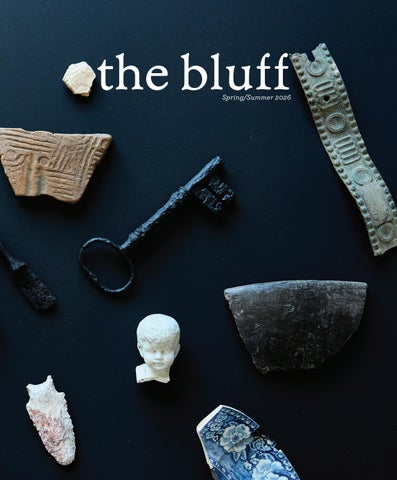
the bluff
Spring/Summer 2026


SHAPED
BY NATURE, Perfected By Play.


TABLE OF CONTENTS


FEATURETTES
18 | MEMBER PROFILE
102 | FOREST TO FORK
108 | SOCIAL PAGES
118 | LOCAL CHARACTER
20 OFF COURSE
The Bluff’s elusive dinner series offers twelve seats, one table, and a landscape-driven menu.
28 THE SAVANNAH EDIT
Our curated guide guide highlights Savannah’s enduring elegance, creative spirit, and evolving cultural landmarks.
ON THE COVER: TKTKTK TKTKT TKTKTK PHOTOGRAPH BY TKTK
42 CLOSE ENCOUNTERS
An intimate look at dolphin behavior and the seasonal rhythms of Palmetto Bluff’s protected waterways.
50 HOME GROWN
At Palmetto Bluff, The Farm connects land, kitchens, and community through agriculture.
64 BUNK UP
Bunk rooms at Palmetto Bluff have evolved into sophisticated, multigenerational spaces defined by thoughtful design.
74 ANSON POINT
Bill Coore’s hole-by-hole strategy for Anson Point reveals land-led, minimalist Lowcountry design.
88 MATERIAL MEMORY
Arun Drummond uses silhouette and material to record memory, history, and cultural inheritance.
96 HIDDEN HISTORY
Archaeology at Palmetto Bluff reveals layered human histories and the continuity of life across millennia.


UPCOMING EVENTS
SEWE AT THE BLUFF WEEKEND
March 19-21
ANSON CUP GOLF TOURNAMENT
March 23-25
PALMETTO BLUFF CLUB
EASTER EGG HUNT AND CARNIVAL
April 4
ARTISTS OF THE BLUFF SPRING FINE ART SHOW
April 11
THE REVELRY MEMBER-MEMBER
April 22-25
WILSON LANDING MARINA
BASS FISHING TOURNAMENT
May 1-18
PALMETTO BLUFF CONSERVANCY
BIRDING GLOBAL BIG DAY
May 9
THE CANEBRAKE MEN'S MEMBER GUEST
May 13-16
PALMETTO BLUFF FARMERS MARKET
May 20
PALMETTO BLUFF CLUB
FOURTH OF JULY FESTIVITIES
July 4

There are moments at Palmetto Bluff when nature reminds us of its mystery. This sense of wonder is not something we have to imagine or manufacture; it’s already here, moving through the water, trees, and sky. I was reminded of this on a fall morning out on the May River with the Semeraro family and Captain Boo Harrell for “Close Encounters” (pg. 40). We were surrounded—pods of dolphins surfacing and diving alongside the boat, pelicans and shorebirds overhead, the air alive with motion and sound. It felt less like observing wildlife and more like being briefly invited into it. These encounters are increasingly uncommon in the world, yet here they remain part of everyday life.
This abundance is not accidental. It is the result of care, protection, and a deep respect for the natural systems that sustain this place. To experience wildlife so fully—to feel its presence, its intelligence, its vitality—is a gift, and one worth pausing to notice. In this issue of the bluff , we celebrate that sense of wonder. I hope you enjoy!

Hailey Wist | Editor and Designer
LONGFIELD STABLES
TWILIGHT JUMPER SHOW
July 18
FPO
Fall might just be the Lowcountry at its best—crisp mornings, golden marsh grasses, and long sunsets. As the holidays approach, we can’t wait to gather with friends and family. From cozy evenings by the fire and oyster roasts to the opening of the new Anson Point golf course, there’s so much to enjoy at the Bluff. We look forward to seeing you soon!
PATRICK, JORDAN, AND CHRIS SOUTH STREET PARTNERS


“The Nationals” Silver Award • Pinnacle Award Finalist & Merit Winner
Beaufort Civitas Award • 432 Lighthouse & Finalist Awards • Numerous “Best Builder” awards
Small Business of the Year • NKBA Best Large Luxury Kitchen Award


CONTRIBUTORS

SUMMER PAGATPATAN | PHOTOGRAPHER
Summer Pagatpatan is a Hilton Head Island photographer who focuses on capturing love stories and weddings. When she’s not behind the camera, you can find her surfing with her fiancé, traveling, or immersed in a novel.

KATHRYN ANN WALLER | PHOTOGRAPHER
Kathryn Ann Waller is a Savannahbased photographer specializing in artful imagery for design, travel, and lifestyle brands. When she isn’t behind the camera, you’ll find her traveling or on the boat enjoying the Southeastern coast.

BARRY KAUFMAN | WRITER
Barry Kaufman has been a Bluffton resident for eighteen years, writing for various publications around the South, crafting copy for real estate and resort clients, and hosting B-Town Trivia. He lives with his wife, three kids, and several million small animals.

LAWSON BUILDER | PHOTOGRAPHER
Lawson Builder is a commercial photographer based in Charleston, South Carolina. His work focuses on the outdoors, tradecraft, and food. When he’s not clicking buttons, you can find him fly fishing, traveling, or making a mess in the kitchen.

PATRICK O'BRIEN | PHOTOGRAPHER
For twenty-five years Patrick O’Brien has been honored to work among the very best creative teams in the world. He finds inspiration in the natural beauty of the Southern landscape and the opportunity to share that beauty with like-minded souls.

JOEY MORIAN | PHOTOGRAPHER
Joey Morian is a photographer and drone operator in Denver, Colorado. His recent work has been based around golf, sports, and commercial photography. When he is not working, he enjoys traveling, snowboarding, and, of course, golfing.


Building Extraordinary Outdoor Spaces Across the Lowcountry


Rhonda and Dan DeMuth
Where are you from?
Rhonda: I’m from Minnesota. I am one of eleven kids and grew up on a farm. After college, I took a job in Ohio, and I worked there my entire career.
Dan: I was born in Sylvania, Ohio. Rhonda and I met in Columbus.
How did you meet?
Dan: I was introduced to Rhonda and her husband, John, to do some consulting work with their company. We got along great and went to dinner every quarter. When John died, I got a message from Rhonda that she wanted me to come to the funeral. But I was in Alaska with my sons and couldn’t get there. I invited her to lunch instead. She was a mess, and I wasn’t sure if I’d ever see her again after that. And then one Sunday she called and said, Dan, do you play racquetball? Well, I’m eighty now, but I come from the era when girls didn’t play anything other than field hockey. She beat the stuffing out of me, I tell you. And all of a sudden, I started thinking romantically about her, I had never met anybody like that.
Rhonda: He wrote me this email that said, I know you have feelings for me, and it’s okay. (Laughs) That broke the ice. When you’re married, you’re committed, and it took a while for me to be okay with feeling romantic about someone else. This week is our twenty-sixth wedding anniversary!
How did you find Palmetto Bluff?
Dan: We had been talking about moving when we retired. We had a second home in Arizona, but we only wanted one house.
Rhonda: It’s gorgeous there. We love Phoenix, but the summers are way too hot.
Dan: A friend invited us to Palmetto Bluff, and they really set us up— they already had two houses picked out! We thought we were just coming down to visit.
Rhonda: We went on bike rides, and we took a boat ride on the Grace We went hiking and ate at Canoe Club—all in three days! That was in 2017, and we bought the house while we were on that trip! We walked into this house, Dan looked at me, I looked at him, and I said, I could do this. We closed a month later.
What do you think is so special about Palmetto Bluff?
Rhonda: It’s a magical place. When you drive in and see the live oak trees with Spanish moss and these giant birds and the gators! Maybe we’re supposed to be afraid of them, but I think they are incredible animals.
Dan: The golf courses are really important to both of us. And Rhonda is really into pickleball. I lose her six hours a day—two hours to pickleball and four hours to golf.
Tell me about golf.
Dan: Rhonda used to be a big volleyball player. She actually played competitively until she was in her fifties! I told her she was going to get hurt and that she should focus on golf. That first year, she hated it. She couldn’t hit the ball off the ground. Now she beats me up!
Rhonda: We play a lot. The women’s group is growing every year. I play in the Magnolia League every Tuesday. The May River Golf Course is special—it’s very challenging and very beautiful.
Dan: I started a men’s group in 2018. We play Tuesdays and Thursdays.
Wow. You are really active!
Dan: We try! I was having trouble with my knee a few years ago, and my doctor suggested a hyperbaric chamber. That sent us on a journey. We have a wellness room upstairs with a red-light therapy bed and hyperbaric chamber, and now we’re putting in a steam room. But we also have a big wine cellar up there too— to even things out!
What else do you like to do here?
Rhonda: Dan and I are very social. And since retiring, he has gotten into cooking! So we have people over often, just informally. It’s such a great way to connect with people, just relax and enjoy. Oftentimes, we’re on the porch, looking out over the marsh.


Off Course
A secretive, twelve-seat dinner series leads Palmetto Bluff Club members into the community’s most beautiful and hidden landscapes.

STORY BY HAILEY WIST PHOTOGRAPHS BY SUMMER PAGATPATAN
Deep within Palmetto Bluff’s forests and winding back roads are landscapes that feel almost forgotten.
The Off Course Dinner Series was inspired by Stephanie Sekula, Palmetto Bluff Club’s Director of Special Events, and her desire to lead members into these rarely seen spaces, creating an experience unlike anything else at the Bluff. As she explained, “There’s so much beauty here that members would never see if we didn’t bring them there.”
From this, a new kind of dining experience took shape, one centered on mystery, discovery, and a deep connection to place. Each dinner welcomes only twelve guests, selected through a lottery that draws hundreds of hopeful participants. Linen invitations are handdelivered to members’ doors, complete with a watercolor illustration hinting at the evening’s general mood but offering no true clues. Guests are picked up and driven down unfamiliar roads until the setting reveals itself.
The Spring dinner took place on the Anson Bridge, a location near the water where driftwood textures and soft coastal hues inspired both the design and the menu. Seafood played a central role, reflecting the landscape. The Fall event, held deep along Theus Road, embraced the woods at golden hour. Under towering oaks, a table designed to disappear into the landscape set the tone for a menu shaped by open-fire cooking. Tomahawks, Ibero pork belly, skirt steak, and vegetables sourced directly from The Farm anchored the courses.
Palmetto Bluff Club Executive Chef Beth Cosgrove, alongside Chef Rhy Waddington, Director of Food & Beverage Operations, craft each menu with the season in mind. Together, they consider what The Farm is producing and how the landscape of the chosen location


The anticipation is intentional. Members receive only the essential details and a small artistic hint, leaving the rest to imagination. The drive becomes its own moment of curiosity as guests try to predict where they are going before the location finally appears.


With only twelve seats, the dinners bring together members who may have never crossed paths. Conversations unfold naturally, and by the end of the evening, guests are often sharing stories, trading contact information, and planning to see each other again. Many describe it as a rare opportunity to explore new parts of the Bluff while forming genuine connections around the table.
The scenery guides the menu. Anson Bridge, with its water views and driftwood textures, called for a lighter, coastal approach, while Faye Road’s wooded surroundings encouraged rustic, fire-forward cooking. Each site defines its own culinary direction.


should guide the evening. “It’s driven by what’s available,” Waddington said. “Each menu really comes from the land itself.”
Much of the work happens long before the guests arrive. The team spends significant time identifying a location that can support both the vision and the logistics, often scouting with Conservancy staff to understand terrain conditions and natural light. Moving equipment into remote areas requires careful planning, test runs, and coordination, since even a change in weather can alter the route. The result is an experience that feels seamless to guests, even though the effort behind it is anything but.
What ultimately defines the Off Course Series is its scale. Twelve people, one table, and a setting they may never see again in the same way. The chefs introduce each course and Director of Beverage Gene Castellino explains wine pairings. By the end of the evening, members are often planning after-dinner drinks together. The events are less about spectacle and more about perspective. They offer a chance to experience the Bluff’s landscape with fresh eyes.
With only two dinners a year, one in spring and one in fall, the series captures the property at two of its most beautiful moments. It is a rare, curated glimpse into Palmetto Bluff’s most hidden places and an experience that stays with members long after the evening ends.
“Our team thrives on creativity. We always say there is no such thing as a bad idea. We challenge each other to think about locations and offerings that will genuinely surprise members, and that collaboration is what makes these dinners so special.” — Chef Rhy
Waddington
It is an experience that stays with members long after the evening ends.


The team spends weeks scouting potential sites, often walking or driving through remote areas with Conservancy staff to find the perfect setting. They study how the light moves across the road, how the trees frame the space, and whether the landscape will support the logistics of a full-service dinner.


THE SAVANNAH EDIT
STORY BY HAILEY WIST
Savannah is a historic city in the truest sense. Its riverfront location, shady squares, and remarkably intact architecture create an atmosphere that is completely distinct. There is a slightly mysterious quality, an old Southern allure supported by genuine cultural depth—from museums and universities to a strong food scene and a thriving creative community. This edit highlights places that reflect that richness: institutions and experiences that define Savannah’s character while showing how the city continues to evolve.


PERRY LANE HOTE L
TO STAY 256 EAST PERRY STREET
Perry Lane Hotel blends refined sophistication with relaxed Southern ease in the heart of the Historic District. Art-filled common spaces, intimate seating areas, and curated bookshelves give the hotel a collected, residential feel. The rooftop bar offers sweeping views over church spires and live oak canopies, while The Emporium Kitchen & Wine Market serves polished Lowcountry plates with European influence. Guest rooms are defined by clean lines, warm tones, and thoughtful details. With its focus on design, hospitality, and cultural connection, Perry Lane has become a defining presence in Savannah’s downtown.
TO DINE
109 MARTIN LUTHER KING JR BOULEVARD
Set inside a restored 1938 Greyhound bus terminal, The Grey reimagines Southern cuisine through the lens of Chef Mashama Bailey’s personal history and global training. The dining room preserves the building’s Art Deco character, creating a setting that feels both nostalgic and contemporary. Defined by intentional pacing, warm service, and a clear point of view, The Grey remains one of Savannah’s most celebrated and culturally significant dining destinations.

THE GREY SCAD FILM FESTIVAL


TO WATCH
601 TURNER BOULEVARD
Each autumn, Savannah College of Art and Design’s film festival transforms the city into a cinematic showcase, drawing filmmakers, actors, and audiences from around the world. Founded by SCAD in 1997, the festival celebrates storytelling in all its forms—film, television, animation, and emerging media—while offering a platform for both rising talent and industry icons. For one week each year, screenings and panels unfold across historic theaters and modern SCAD venues, blending redcarpet glamour with genuine creative exchange.
TELFAIR MUSEUMS
TO LEARN
121 BARNARD STREET
124 ABERCORN STREET
207 WEST YORK STREET
Savannah’s Telfair Museums anchor the city’s cultural landscape across three distinct spaces. The Jepson Center showcases contemporary exhibitions and bold architectural lines, while the Telfair Academy houses one of the nation’s oldest public art museums within a 19th-century mansion. Nearby, the Owens-Thomas House offers an immersive look into Savannah’s layered social history, including the lives of the enslaved people who lived and labored there. Together, the trio invites visitors to move between past and present, between fine art and lived experience.


THE DOUGLAS
TO STAY 14 EAST OGLETHORPE AVENUE
A newer addition to Savannah’s hospitality scene, The Douglas offers a calm, contemporary retreat within the city’s historic core. Interiors from Charleston-based designer Kirby Caldwell strike a careful balance of modern minimalism and warmth with neutral palettes, sculptural lighting, and natural textures that echo the city’s timeless beauty. Common spaces feel warm and intentional, designed for conversation, reflection, or work over coffee. With its emphasis on comfort and thoughtful design, The Douglas is a refined choice for travelers seeking modern simplicity in a city celebrated for its history.
COMMON THREAD
TO DINE
122 EAST 37TH STREET
Set inside a restored Victorian home, Common Thread weaves regional ingredients with global techniques in a way that feels both grounded and quietly inventive. Guests move through a series of softly lit rooms and intimate spaces, the experience unfolding more like a dinner at a friend’s home than a formal night out. The seasonal menu highlights local produce, seafood, and meats, plated with restraint and clarity so the ingredients lead. The restaurant is the Savannah sister to Farm in Bluffton, and its chef, Brandon Carter, brings a deep familiarity with Lowcountry sourcing from his time at Palmetto Bluff’s River House. That shared sensibility— respect for place, product, and process—anchors the cooking. With its measured elegance and confident approach, Common Thread has become a defining presence in Savannah’s contemporary dining scene.


ASHER + RYE
TO SHOP 348 WHITAKER STREET
Asher + Rye balances beauty and ease with an intuitive sense of place. The home shop blends Scandinavian simplicity with Southern warmth, offering everything from hand-thrown ceramics and linens to pantry goods and children’s toys. Each display feels lived-in and personal, more aesthetic inspiration than showroom. Asher + Rye reminds us that good design isn’t about perfection—it’s about intention, comfort, and care.


THE PARIS MARKET
TO SHOP
36 WEST BROUGHTON STREET
The Paris Market on Broughton Street is part boutique, part café—a transportive space that feels like a small slice of Paris in the heart of Savannah. Inspired by European flea markets, the shop features a carefully curated mix of homewares, antiques, stationery, and globally sourced goods. Shelves are styled to invite discovery, encouraging visitors to linger and browse at an unhurried pace. The café serves espresso, pastries, and light snacks, with tables set for people-watching or a quiet moment with a book. The Paris Market rewards curiosity, offering small pleasures that feel both intentional and unexpected.
BONAVENTURE CEMETERY
TO STROLL
330 BONAVENTURE ROAD
Bonaventure Cemetery, set along the Wilmington River, is one of Savannah’s most historic and widely recognized sites. Originally part of a plantation established in the 1760s, it became a public cemetery in 1846 and soon reflected the city’s growth and character. The grounds are known for their live oaks, intricate Victorian statuary, and notable residents, including poet Conrad Aiken and songwriter Johnny Mercer. The cemetery remains an essential part of understanding Savannah’s character—its elegance, its mystery, and the stories that continue to shape it.


MUNICIPAL BAR
TO DRINK
132 EAST BROUGHTON STEET
Housed within a thoughtfully restored mid-century building on Broughton Street, Municipal Bar blends Savannah’s historic character with a modern sense of ease. The hotel’s dining room and bar unfold in a series of warm, well-composed spaces that feel both polished and approachable, inviting guests to settle in rather than simply pass through. Crudo, local seafood, and refined takes on familiar comforts anchor the menu, while the bar offers a focused selection of cocktails and wines that complement the food without overshadowing it. Municipal Bar has quickly become a gathering place for travelers and locals alike.
E. SHAVER BOOKSELLERS
TO SHOP
326 BULL STREET
Just off Madison Square, E. Shaver Booksellers feels like the kind of place that could only exist in Savannah. Cats wander between stacks, staff recommendations are written by hand, and visitors speak in a hush that good bookstores inspire. The selection ranges from literary fiction and regional history to art and children’s books. It’s the kind of shop you don’t just visit but return to, again and again.


DESIGN COMES FIRST. EVERYTHING ELSE FOLLOWS.
At Front Light, each home begins with a design-led process that brings architecture, interiors, and construction into thoughtful alignment. By leading with design, we create clarity, reduce unnecessary complexity, and guide the process with intention from start to finish. Choose from homes already designed and move-in ready, or collaborate with our team to create a custom home in Palmetto Bluff.


close

encounters
STORY BY HAILEY WIST
PHOTOGRAPHS BY LAWSON BUILDER

Dolphins return season after season to feed, calve, and navigate the familiar channels of our protected estuarine system. With Captain Boo Harrell of Outside Palmetto Bluff decoding tide cycles and surface shifts, the river becomes a map of intricate patterns and behavior.

The May River opens wide beneath a blue sky, its tide breathing in a slow rhythm as Captain Boo eases the boat into the channel.

Sunlight glances off the water’s shifting surface, gulls ride thermals overhead, and the brackish air carries that unmistakable Lowcountry amalgam of salt and humidity. Palmetto Bluff members John and Nicole Semeraro settle their three boys into their seats, everyone’s eyes trained on the horizon.
For Captain Boo, the river is familiar territory. He spent his childhood on these creeks, fishing and swimming. In the early 2000s, he earned his captain’s license and has led tours around Palmetto Bluff ever since. “Every excursion I do, there’s always an opportunity to see dolphins in their natural habitat,” he says. “And it never gets old.”
The Lowcountry is one of the most reliable places in the region to see bottlenose dolphins. The May River and surrounding creeks provide a stable food source and calm conditions for raising young. Many dolphins here are residential, spending most of their lives in the same estuary system. But their sightings shift seasonally. Winter often brings fewer animals as some travel to deeper, warmer water where prey is more available. “They will go to where the food sources are if they need to,” Boo explains. “Then they come back up here during the spring and summer.”
Calves are born in late spring and early summer after a year-long gestation. Mothers nurse for more than a year and keep their calves close for up to three years. Young dolphins learn navigation, communication, and feeding strategies by following their mothers through the creeks. Adult males often form alliances, while juveniles sometimes travel on their own; something Boo notices often in winter. “The ones we do see tend to be juveniles by themselves,” he says. “That’s part of the weaning process.”
For many families, dolphins are part of daily life on the water. The Semeraros recently shifted from second-home visits to full-time living at Palmetto Bluff, and the natural surroundings played a major role in the decision. “Our family thrives here—being outdoors,

being at the golf course, being on the water,” says Nicole. “The peace and calm allow us to take a breath.” Her connection to dolphins is personal. She regularly goes to the Wilson Village dock at sunrise, where she journals and plans her day. “When I’ve gone through some of the hardest times, dolphins pop up and give me a sense of peace,” she says. “They symbolize hope, guidance, and protection.”
Cutting the engine, Boo explains how to read the surface of the water. Small changes in texture, movement near oyster beds, or shifts in the tide indicate where dolphins might be feeding. Bottlenose dolphins rely heavily on echolocation, especially in murky estuary water, and their feeding activity increases when the tides change. They hunt both cooperatively and independently, depending on conditions.
He also described one of the most unusual behaviors in the region: strand feeding, where dolphins work together to push fish onto mudbanks before lunging up to grab them. It’s rare to witness and documented in only a few places in the world.
On this warm October day, the boys shout as several mother-calf pairs circle the boat, and a few juveniles surface further out. At one point, a dolphin comes close enough for the kids to see its eye. “I love when they
Captain Boo Harrell of Outside Palmetto Bluff


Many dolphins here are residential, spending most of their lives in the same estuary system.


come out of the water with their eyes,” Boo says. “If you see their eyes, they’re definitely observing you.”
Nicole lives for these moments. “It takes your breath away!” She says. “It makes you appreciate this place, not just Palmetto Bluff but the waterways around it.” She often feels the same thing when she’s out at sunrise or fishing with her family in the evenings.
Responsible dolphin viewing is critical in these shared waterways. Federal guidelines require at least fifty yards of distance and prohibit feeding, approaching, or harassing wild dolphins. Boo follows those regulations closely, avoiding erratic movements, minimizing noise, and keeping clear of mothers with calves. Feeding dolphins is illegal and disrupts their natural foraging patterns, putting the animals at risk.
Dolphins are also indicators of environmental health. Changes in their behavior, feeding patterns, or movement can reflect shifts in fish populations or water quality. Observing them in the wild provides a clearer
understanding of the broader ecosystem.
As the tour wraps up, the light softens across the water. A final pair of dolphins surfaces near the boat, moving steadily along the current. The kids lean forward, quiet for the first time, watching as the animals travel together before disappearing beneath the surface.
Boo finds meaning in watching people experience the genuine magic of the river, where wildlife reveals itself on its own terms. “When someone sees a mom and a calf for the first time, they often have a pretty emotional response,” he says. “It’s incredible to see.”
Walking off the boat that evening, the Semeraro’s are still buzzing from the encounter, the boat ride at speed. The experience delivered what makes these tours memorable—authentic connection to the natural world, wildlife in situ, and an important primer on how our Lowcountry environment supports this iconic species.
by Patrick
Photograph Right
O’Brien

“When someone sees a mom and a calf for the first time, they often have a pretty emotional response. It’s incredible to see.”

Home Grown

From weekly harvests to farmers markets and seasonal dinners, The Farm plays a central role in Palmetto Bluff’s culinary program.
STORY BY JOANNY PALSSON
PHOTOGRAPHS BY SUMMER PAGATPATAN
Most mornings at Palmetto Bluff begin at sunrise, before the kitchens light up and dining rooms come alive. Along Old Moreland Road, The Farm is already in motion. Greens are being cut. Herbs snipped. Eggs gathered.
Spread across thirteen acres, The Farm is not decorative or symbolic. It is a working agricultural operation that supplies produce to Club restaurants, hosts events throughout the year, and serves as one of the most tangible connections between land and daily life at Palmetto Bluff. You see its influence in the kitchens, where crates of tomatoes, fresh herbs, and greens arrive daily.
For Executive Chef Beth Cosgrove, this proximity has changed the rhythm of cooking on property. “It’s the first place I’ve ever worked that has an actual farm right here on site,” she says. “Not a garden out back or herbs on a roof, this is a real farm, producing at scale.”
Each week, chefs gather at the farm to walk the rows and talk through what’s coming next, in collaboration with longtime farm manager Shane Rahn. These meetings are practical and forward-looking—what’s nearly ready, what needs another week, what’s abundant enough to build menus around. Tomato season, Cosgrove notes, is the clearest example of how the farm and kitchens move in step. “We fly through tomatoes,” she says. “The restaurants can’t get enough, members can’t get enough,


MEET FARMER SHANE
Shane Rahn is the Farm Manager at Palmetto Bluff, where he oversees the Bluff’s working farm and sustainable growing practices. With a background in crop and soil sciences, he connects seasonal agriculture, community, and stewardship of the Lowcountry landscape.

RESTAURANTS & FARM MARKETS
Palmetto Bluff’s farm-to-table approach begins at The Farm, where vegetables and herbs are grown specifically for the Club’s kitchens. Shane and the chefs work in close coordination, planning plantings around seasonal menus and harvesting to order. Fresh produce is incorporated daily into recipes at Cole’s, May River Grill, Crossroads, Canoe Club, across Club events, and at RT’s Market in Wilson Village.
The Farm hosts the Palmetto Bluff Farmers Markets on select days during harvest season months: May, June, October, November, and December.


and when they’re coming in strong, everything revolves around them.” Tomato tastings, market sales, simple preparations that let the fruit speak for itself—the season has its own momentum.
Other crops move regularly through Club menus. Collard greens are a favorite, from Sunday fried chicken nights at Cole’s to seasonal sides throughout the community. In summer, herbs are so popular with Club chefs that outside purchases often stop altogether. Interns head into the fields to harvest, then return to the kitchens with armfuls of basil, mint, and parsley—ingredients that will be cooked and served the same day.
That full cycle—from soil to service—is central to how the farm functions within the Club’s culinary program. For Rhy Waddington, Palmetto Bluff Club’s Director of Food & Beverage Operations, the farm is both an operational resource and an educational one. With roughly thirty-five international culinary students working at the Club at any given time, it becomes part of how young cooks learn the craft. “They’re planting, harvesting, and then cooking with the same product,” he says. “It gives them a complete picture of where food begins.”
That connection becomes most visible during the Farm’s seasonal farmers markets. Held several times a year, these markets bring together members, neighbors, and families on busy mornings. Herbs and vegetables from the farm anchor the tables, joined by baked goods from the pastry team and dishes prepared by culinary interns using what’s in season. It’s one of the few moments when the farm’s output is gathered in one place, offered directly to the community. The Farm also serves as a setting for larger
gatherings. Each fall, the Harvest Dinner—part of the Around the Table series—brings members into the fields for an evening meal built around the season’s produce.
Behind the scenes, the farm continues to evolve. The culinary team works closely with Rahn to refine what is grown and in what quantities, favoring greater variety over sheer volume. New raised beds will allow for smaller batches and experimentation with crops better suited to restaurant use. “It gives the chefs more to work with,” Waddington says, “and it helps us use everything more effectively.”
The Farm also supports a number of related efforts across the property. Honey from on-site beehives makes its way into kitchens and markets. Rahn collects oyster shells from the restaurants to return to a reef restoration site established by the South Carolina Oyster Recycling and Enhancement Program. A composting program using kitchen trimmings is under consideration, part of an ongoing effort to close loops where possible, cycling materials back into natural systems.
For residents, The Farm is woven into everyday life. Families walk the grounds, kids peeking in at the chickens in their coop. Volunteers help during planting and harvest. It’s a fully integrated part of life at Palmetto Bluff.
In the end, The Farm’s impact is felt less in any single dish or event but rather as an underlying ethos: meals shaped by season, menus that change based on freshness, and an appreciation for where food comes from. It supports the kitchens, provides a gathering ground, and is part of what makes Palmetto Bluff feel so unique and connected to the land.


Rahn has begun establishing blueberry bushes and arbors of scuppernong and muscadine grapes, along with satsuma and Valencia orange trees, figs, kaffir lime, and Kieffer pear trees.


TASTING PARTIES
The Farm is known for its tomatoes and good times. An open-air pavilion near the pond is a favorite venue for Palmetto Bluff Club private events and harvest dinners. Through his work, Farmer Shane helps supply the essential ingredients that elevate the Bluff’s event menus.
Each summer, The Farm’s popular Tomato Tastings invite members to sample the tomato varieties grown on-site, with two or three new types added to the lineup each year. Club chefs array an assortment of fresh bread, various aiolis, fried bacon, salts, and peppers. Attendees are invited to make as many tomato sandwiches or BLTs as they’d like to try.


Material: Michelangelo Gold Dolomite Builder: Randy Jeffcoat
The Lowcountry's Most Trusted Pool Builder Since 1991


Photograph by Kelli Boyd


STORY BY BARRY KAUFMAN


There have been numerous think pieces and articles that have celebrated Palmetto Bluff ’s unique architecture. The way screened porches extend the living space beyond four walls, blurring the line between indoor and outdoor living. The way a home can tell a story of generations through extensions and wings that harken to different eras. The way layers of tabby, Savannah brick, stone, and timbers can look as distinctly modern as they are timeless.
Here, we turn to one of the quieter expressions of a Palmetto Bluff home. In expanding the definition of luxury, architects and designers did not conclude their work once the principal rooms were resolved; they carried the same precision into the supporting spaces. A laundry room may not invite lingering, yet it can still reflect thoughtful cabinetry, considered materials, and a measured use of color. A back kitchen may be intended to keep preparation out of view, yet it can also function as a space of comfort and utility, outfitted with the same intelligence and care as the rooms that receive the most attention.
Through this lens, they have even created an entirely new visual language in one of the most overlooked spaces of all: the bunk room.
CUSTOM CRAFTED
When designer Kelley McRorie undertook the interiors of this River Road residence, the bunk room was conceived not as a sidebar to the plan but as a continuation of it. “The way we’re designing these isn’t necessarily just for children. We’re designing them so that people love them,” she explains. “These homes are carefully considered from build through completion, so the bunk room should feel integrated rather than set apart.”
In this space, the wallpaper and detailed millwork extend the home’s broader palette and pattern language, softened just enough to maintain a sense of ease. The beds were constructed as part of the architecture rather than as standalone pieces, reading as extensions of the paneling rather than additions to it. Instead of conventional bedding, custom mattress covers were selected to match the room’s scheme and to simplify day-today use.
“We find that people want these rooms to function beyond sleeping,” McRorie notes. “If someone needs a quiet place to read, they have it. If they want to use the space as a daybed, they can do that without disturbing a fully made bed.”

Photograph by Josh Gibson
SPATIAL SOPHISTICATION
Designing a bunk room often requires a precise allocation of space, and the constraints in this River Road home were clear: a compact footprint and a sloped ceiling that ruled out side-by-side beds. The solution was an L-shaped configuration, with two bunks partially enclosed to provide a degree of privacy rarely found in such rooms.
“Corner units are often the best response when a room is this small,” notes McRorie. “The challenge is to maximize the square footage in a way that feels refined and still entirely usable. We also keep in mind that adults will occupy these spaces as often as children.”
A palette of deep grays, recessed lighting, and textured finishes across both wall and floor created a deliberate sense of continuity, while softer elements kept the room from feeling compressed. The result is a bunk room that reads as part of the home’s overall composition rather than a utilitarian add-on.
“This is very much in line with the design of the house,” McRorie adds. “We don’t consider the bunk room a separate aesthetic category. It should participate in the same language as the rest of the interior.”
“The challenge is to maximize the square footage in a way that feels refined and still entirely usable.”

Photograph by Josh Gibson

Photograph by Anne Caufmann
SOARING HEIGHTS
Some bunk rooms are clearly for children, others unapologetically for adults. This Corley Street iteration sits comfortably between the two, combining polished materials with a sense of discovery that appeals across ages. Architects Tom Markalunas and Leighann Markalunas, wellpracticed in bunk-room design from their years working in Colorado ski lodges, understand how to make these spaces feel both spirited and composed.
“What distinguishes this one is not only the board-and-batten detailing but the way the high-pitched ceilings allowed us to introduce sculptural chandeliers and give real presence to a room that can often be an afterthought,” says Leighann. “Bunk rooms tend to be compact, but they can still be purposeful and gracious without feeling constrained.”
For Tom, the approach continues a familiar design brief. “We’ve created these spaces in ski lodges and lake houses, and Palmetto Bluff functions similarly,” he explains. “Holidays and summers bring multiple families together, and these rooms offer flexibility while keeping everyone under one roof.”

CURTAIN CALL
Accommodating multiple sleepers in a bunk room can test both proportion and planning, yet this space in The Point manages the brief with ease. Rather than simply fitting beds into a tight footprint, the design introduces elements that expand the room’s comfort and perceived volume.
“Holidays and summers bring multiple families together, and these rooms offer flexibility while keeping everyone under one roof.”
Sliding curtains on ceiling-mounted tracks allow each occupant to create a private enclosure, recalling the intimacy of a sleeper car. “Recessed niches within each bunk provide dedicated lighting that can be controlled individually,” explains designer Kelley McRorie. “We often fit those with power for charging devices and a small ledge for a glass of water or personal items.”
“You’d be surprised how many homeowners call to say how much they love their bunk rooms,” McRorie notes. “It has become a meaningful design feature, so we approach it with the same care we bring to any other room.”
Photograph by Josh Gibson
EMERALD FLAIR
In this room, a twin-over-queen configuration provides flexibility, functioning as a full guest suite when occupied by a single visitor and accommodating more when needed. Utility, however, is only part of the story. Designers have increasingly treated bunk rooms as extensions of the home’s aesthetic rather than secondary quarters, and this space reflects that shift. Shelley Wilkins, of S. Wilkins Interior Design introduced saturated emerald tones and rattan accents throughout the lighting and furnishings, resulting in a composition that feels both intentional and relaxed. Lighthearted artwork rounds out the palette without overwhelming it.
“The term bunk room has expanded to describe any sleeping space with multiple beds, not only traditional stacks,” notes architect Michael Gentemann, who designed the room. “To function well for larger groups, these spaces often require additional floor area, more storage, and in some cases higher ceilings. We also look for ways to incorporate privacy, whether through back-to-back built-ins, individual reading lights, or personal charging outlets.”

Photograph by Kelli Boyd

GENERATIONAL LIVING
Not every bunk room is created solely with children in mind. A guest is a guest, regardless of age, and maximizing space does not exclude the possibility of sophistication.
“This is a more refined bunk space that works as a multigenerational room,” says architect William Court, whose team designed this interior as well.
Layered woods, wool, and soft metallic finishes set against creamy shiplap and tailored millwork establish a quiet, organic palette. The
bunks, integrated into built-ins rather than dominating the room, lend structure without visual bulk, allowing the space to function as both sleeping quarters and a polished guest suite.
“Even when the bunk isn’t in use, this remains a fully functional bedroom,” Court notes. “We often design twins over queens for flexibility. Palmetto Bluff sees golf weekends, family gatherings, and ladies’ trips, so adaptable layouts are essential.”
Photograph by Kelli Boyd

BROAD APPEAL
In this Lighthouse Award–winning Moreland Road home, the bunk room was designed to accommodate a wide range of guests. Because the residence participates in the Montage luxury rental program, versatility and broad appeal were key priorities.
“We didn’t want it to feel specific to age or gender, so I approached it from that perspective and worked backward,” says designer Mikaelah Seifrit of Southern Grace Interiors. “It really comes down to considering how someone will move through and experience the space.”
Seifrit achieved that balance with a palette that pairs soft blues and pinks against neutral walls and warm wood tones, creating something neither overtly playful nor overly formal. Comfortable lounge seating provides a place for younger guests to relax, while integrated drawers and individual bunk lighting support ease of use and privacy. The result is a bunk room that feels intentional, adaptable, and aligned with the expectations of a luxury hospitality environment.
STARRY NIGHT
For Court Atkins Group, the bunk room on Davies Road offered a chance to introduce a sense of play. “Owners create these spaces as a way to give kids and grandkids a place of their own and to support that idea of generational living,” says architect William Court. “On Davies Road, there are several full bedroom suites, but this room is meant to be a surprise—a space the youngest guests will remember.”
Architecturally, the team maximized square footage with L-shaped bunks, built-in cubbies below for storage, and integrated alcoves to serve as nightstands. Visually, designer Adrienne Warner layered in quiet drama through floating sculptural forms that echo the night sky. The effect is immersive, without leaning too far into the theme, and the room reads as a polished interpretation of sleeping under the stars.
“The overall feel is more whimsical, with softness and select color, but the starry canopy is what stays with you,” Court notes.
“This room is meant to be a surprise—a space the youngest guests will remember.”
Photograph by Corey Gibson

by Kelli Boyd
Photograph


STORY BY MICHAEL CROLEY
PHOTOGRAPHS BY PATRICK O’BRIEN AND JOEY MORIAN

Palmetto Bluff’s new course is emblematic of the Lowcountry—with sandy soil, majestic oak trees draped in Spanish moss, and marshland stretching toward Savannah. The goal for Bill Coore and Ben Crenshaw (to paraphrase the poet) was to make Anson Point feel old, as if it had always been lying in wait. And in some ways, it was.
Years ago, the duo was called to Palmetto Bluff to build a golf course, but like many development projects, the plan was lost to time and circumstance. The opportunity arose again when South Street Partners met with Coore in 2023. On a dinner napkin at the Canoe Club, a contract was fashioned and signed, and Anson Point at Palmetto Bluff was born.
Many of the most dramatic features, aside from its ever-present gaggle of wild turkeys, were already there. Lead Coore & Crenshaw associate Ryan Farrow, who spent eighteen months on site, simply pulled back the ground cover to reveal terrain ready-made for golf.
Anson Point is one of Coore & Crenshaw’s best courses, epitomizing their design philosophy by giving the average golfer options to run the ball into the green while still providing meaningful challenges for better golfers through varied and interesting lines of play. Above all, this is the game in its truest form—a course that blends into its natural surroundings in complete harmony. It’s a course so good that even if you’re off-key, you’ll still be singing.


Anson Point in The words of Bill Coore
Hole #1
444 YARDS
Ben Crenshaw and I have long believed that the first hole of any of our golf courses should convey a vivid impression of what golfers are about to experience. At Anson Point, with the majestic oaks draped in moss, the towering pines, and sandy, native grass, that impression is instantly the Carolina Lowcountry. The first green, set in a decades-old sand pit, beckons a distinctively different, quirky, and old-world form of Lowcountry golf. There’s a bit of mystery to this hole, as there is throughout the course. Welcome to Anson Point.
Hole #2
493 YARDS
The second hole is a short par five that rewards position more than length and introduces natural wetlands that play in the form of a barranca shot left of the green. Tee shots played to the upper right of the fairway afford the best angle of approach, especially for players attempting to reach the green in two shots. But beware! A wetland hazard and bunkers guard the left side of the green, joined by an unusual feature—a towering pine that rises short of the putting surface, directly in the line many players will want to take. While there is ample room to the right of the green for safe plays, even short shots played from this area will require great precision.
*All yardages are from the championship tees.
Hole #3
198 YARDS
The third hole is a demanding par-3, played across a fronting wetland to a wide, gently raised green. The open approach allows the ball to be run onto the surface, but the hazards are more subtle than they first appear. The striking bunker left of the green, paired with the wetland, commands attention, yet it’s a small pot bunker along the right-center edge that often proves the most punishing. Almost unassuming in scale, it is fully in play from every tee, its influence amplified by the surrounding landforms. With one of the course’s largest and most expressively contoured greens, the third reminds players that the challenge is far from over once the green is found.
Hole #4
430
YARDS
The fourth is a short-to-medium par-4 that plays over gently rumpled ground to one of the most artfully— and deceptively—contoured greens on the course. Tee shots that challenge the bunkers along the left side of the fairway are rewarded with a direct approach into a deep, narrow putting surface set low between a right greenside bunker and a subtle fall-off to the left. Those who play more conservatively to the right face a far more exacting second shot, as the green’s angled orientation and a spine-like ridge running lengthwise complicate both distance control and accuracy. With pin positions difficult to access from either side, precision is paramount. A short-grass mound immediately in front of the green adds interest, influencing approach shots from anywhere in the fairway and reinforcing the hole’s strategic depth.


Hole #5
178 YARDS
A dramatic counterpoint to the third, the fifth is a compact par-3 that rewards precision over power. Its angled green, canted left to right and subtly elevated, sits tightly between a dramatic bunker to the right and a steep grassy bank to the left, leaving little margin for error. Set within a quiet clearing of oaks and pines and edged by sandy scrub, the green feels both exposed and elusive. Though seldom chosen, a deliberately short tee shot can offer a thoughtful and strategic alternative to attacking the surface directly. Modest in length but demanding in execution, the fifth is likely to stand as one of the course’s toughest tests against par.
Hole #6
410 YARDS
The sixth is a short par-4 that plays through sandy scrub, echoing the landscape surrounding the fifth green. Tee shots that challenge the fairway bunkers along the left side are rewarded, while drives that drift right leave a less favorable angle of approach. The green is defended by a large pine to the left and a small pot bunker set into the front edge. Some may describe it as a Lion’s Mouth green—though it doesn’t fully wrap around the bunker, the suggestion alone demands a precise pitch to access hole locations near the pine.

Hole #7
588 YARDS
A dramatic par-5, the seventh hole offers deceptive visuals off the tee and one of the smallest greens on the course. Played from beside a sandy quarry, the fairway is framed by towering live oaks to the left and twisting pines to the right. The ideal tee shot is played just right of the fairway bunkers visible on the left side; stronger players who push their drives risk finding them to the right.
The second shot carries over another stretch of sandy scrub, where position is paramount. Approaches are best played from the right, opening an angle into a raised green that pitches left to right and is closely ringed by sand. Shots that run long are difficult to hold on the putting surface.


468 YARDS
One of the longest par-4s on the course, the eighth arrives at an ideal moment in the routing, following the exacting seventh and preceding the short pitch-shot ninth. Strategy here is driven not by bunkering but by contour. A prominent knob front and right of the bunkerless green serves as the hole’s primary defense, subtly influencing tee-shot placement and approach angles. Over time, players come to appreciate how positioning to navigate this feature shapes decisionmaking from the tee.
130 YARDS
Ben and I are sometimes chided for it—we tend to include a hole like this on our courses. We plead guilty! We love short par-4s and pitch-shot par-3s, holes where strength isn’t the primary consideration. The ninth is about precision, and we like that almost anyone, regardless of age or power, has a chance to succeed. Returning to the future clubhouse, the hole arrives at just the right moment in the round. It’s a quirky hole! We’re drawn to holes that reveal something, and we’ve never shied away from the unusual.
Hole #9
Hole #8
Hole #10
449 YARDS
The first of a pair of exacting par-4s, this hole is defined by a long ditch that cuts across the fairway, echoing the burns and drainage features of classic courses. Here, the ditch functions as both a visual statement and a strategic decision point, influencing longer players while offering a challenge to be navigated by those playing shorter. The green is small and strikingly contoured—one of the most expressive on the course— but its narrow entrance demands precision.
Hole #11
502 YARDS
The eleventh is best approached with restraint—played short and right of the green, everything begins to work in the player’s favor. Sweeping right from the tee, it shares a kinship with the eighth, another long par-4 that rewards accuracy and positioning. Tee shots placed just right of center reveal a clear running approach, while those pushed too far right are subtly screened, complicating the second shot. A long bunker set short and left of the green gathers approaches and encourages the ball forward. With the putting surface sitting only slightly above fairway grade, the green reads as a continuation of the ground leading into it.
Hole #12
197 YARDS
The twelfth, along with the seventeenth, will likely be considered among the most photogenic holes on the course. But beneath its beauty lies a demanding midto-long par-3 played over wetlands. This is an all-carry shot, with no opportunity to run the ball onto the putting surface. A sandy bunker guards a striking, contoured green that pitches from front to back, while additional bunkers frame the target from the back left and right. The only safe miss is a small area of fairway-height turf just off the middle right of the green.


Hole #13
359 YARDS
The thirteenth is the tightest tee shot on the golf course, but also the second shortest par-4. Like the eighth and eleventh, the hole was routed to preserve as much of the existing landscape as possible, resulting in the sharp angles that define the opening shot. The tee ball must thread a narrow corridor before the hole opens into a broader fairway, creating a strong contrast between restraint and release.
The green is small and exacting, protected at the front, along the right by the quarry, and to the left. Behind and left of the putting surface, a steep grassy slope gathers balls below the hole, leaving nippy chips and pitch shots back up the green. Precision, rather than length, is the prevailing requirement throughout.
Hole #14
590 YARDS
A long par-5 with a punch bowl green, fourteen will tempt big hitters to get home in two shots. Tee shots played too far left quickly become compromised, as the angles narrow and options diminish. The preferred line is down the right-hand side, setting up position through the first landing area, where a large sandy pit intrudes into the fairway.
A second sandy pit pushes in again short and right of the green, shaping both the layup and the approach. From there, the shots into the sunken putting surface become particularly compelling, influenced by a pronounced hump fronting the green that can be used—or avoided—with equal consequence.


Hole #15
336 YARDS
The homeward stretch begins with a short par-4 that asks for judgment rather than power. Bunkers flanking the fairway provide visual framing but shouldn’t influence play. The true challenge lies at the green, where a bunker set well short creates a deceptive sense of proximity from the tee. Shots struck too boldly tend to run long, while approaches that flirt with the bunker— or skirt it to either side—find their reward.
A finely contoured putting surface adds further nuance, with a barely visible bunker on the left ready to collect errant shots. The hole encourages careful thought, especially from stronger players tempted to be overly aggressive.
Hole #16
596 YARDS
It’s hard to climb a hill in the Lowcountry, but you will see an elevation change on this hole, with heaving contours and wide fairways that sweep left off the tee. The shaping of the landing area creates constant interest, as balls settling on subtle upslopes, downslopes, or sidehill lies can complicate the second shot, which plays into a gently tilted fairway.
For stronger players, the challenge is less about the drive and more about positioning for the approach. A bunker cutting across the front-right portion of the green exerts influence well back into the fairway, dictating both angle and trajectory. While there is ample room to miss to the right, holding the green from that side, despite its generous size and playful contours, proves far more difficult than it first appears.
Hole #17
233 YARDS
Most people will look at this hole, playing through the big trees and over the wetland, and think it’s one of the hardest par-3s on the course. I don’t think it is. I think that’s mostly an illusion—the framing, the setting, all of it. Seventeen is the postcard of golf at Anson Point. We built one of the larger greens here, with soft banks and a knob, and the entrance is completely open. You can run the ball in, and there are plenty of chances to get it up and down.
Hole #18
415 YARDS


The eighteenth is a short par-4 that sweeps left off the tee, with the fairway naturally falling from left to right toward the marsh. The preferred approach comes from the right side of the fairway, where angles open more favorably into the green. Tee shots played left can use the slope to work the ball back toward position, setting up the proper line of attack. From the high side, however, tricky contours and a bunker left of the green make scoring far more difficult. Once on the putting surface, a break in the trees offers a final glimpse of the marsh in the distance.
surface, a break in the trees offers a final glimpse of the


Behind the Scenes


THE SCORE IS YOURS TO KEEP. WE HOPE YOU ENJOYED THE WALK!


Jonathan Green Clam Diggers

MATERIAL MEMORY
As the November Artist in Residence with The Arts Initiative at Palmetto Bluff, Arun Drummond showcased a practice that balances form and cultural memory, emphasizing how portraiture can both honor and illuminate.
PHOTOGRAPHS & STORY BY HAILEY WIST

Arun
Drummond’s portraits are, at first glance, striking in their restraint: silhouettes rendered with clean lines, simple palettes, and a deliberate absence of facial detail. Look longer, and the layers of meaning surface. The unfinished coils of sweetgrass held in painted hands reference a culture still in process, still becoming. Figures that echo the color of their backgrounds suggest what can fade if not preserved, while the separation between head and body reflects the distance many African Americans feel from ancestral origins. For Drummond, representation is not decoration but inheritance, and each piece is a record against erasure—an argument for memory, continuity, and cultural stewardship.
On a sunny November afternoon outside FLOW Gallery + Workshop in Wilson Village, that philosophy translated into practice. Drummond led a handson workshop in the courtyard, guiding participants through their own silhouettes. He offered adjustments and suggestions here and there, encouraging personal interpretation rather than mimicry. When the paint dried, he helped each guest place a small coil of sweetgrass at the figure’s hands, the beginning of a basket that connected their portraits to a gesture of cultural continuity.
Arun speaks often about how stories travel—what passes down, what gets lost, what must be remembered. His own path into artmaking was not immediate. Raised in Greer, in South Carolina’s Upstate, he describes an upbringing largely unmarked by formal artistic influence. “A lot of my influences were not artistic,” he recalls, “until I became an adult and started working in the art industry.” That moment arrived in 2004 when he moved to Charleston and took a framing job at Gallery Chuma. In the back room, surrounded by the work of Jonathan Green, he learned to mat, measure, and cut. Eventually, he moved out front to greet visitors and collectors and to speak about what hung on the walls.


Three Generations, 36 x 48, Mixed media acrylic on linen with sweetgrass basket detail


For Drummond, representation is not decoration but inheritance, and each piece is a record against erasure—an argument for memory, continuity, and cultural stewardship.

Those conversations shaped him. Green’s celebrated depictions of Gullah life were not simply images; they were continuities, visual affirmations of a culture that has endured along the coastal South for generations. Arun understood quickly that art could do more than decorate. It could preserve. It could teach. “I dedicated my time to educating everyone who walked through that door about Gullah culture,” he says. He developed fluency in the significance of sweetgrass baskets, the origins of the language, the foodways and craft traditions that remain points of connection to West African ancestry. It became his life’s work.
When asked to describe his own artistic practice, Arun returns to one principle: storytelling. “It doesn’t matter if you are a writer, a photographer, a chef, or a visual artist,” he says. “Storytelling is one of the most powerful things we can do.” His silhouettes, regardless of palette or posture, always contain a social element. They are meant to stir awareness, to catalyze questions, to keep cultural erasure at bay. His symbolism is deliberate. The figures whose bodies echo the color of the background, for instance, a reminder that if heritage is not recorded, it recedes. The unfinished basket coils reference what is still in progress, still alive, still being made.
The path to that signature style was not linear. He first worked in abstract forms, then in folk representation
after the death of his father. “A lot of his stories went along with him,” Arun says. That loss altered his trajectory. He began painting specific figures, anchoring memory in form. When he learned basketry techniques, the work shifted again into mixed media. Sweetgrass— materially and symbolically—entered the frame.
His palette, once bold under Green’s influence, has moved to refined neutrals in recent years. The silhouettes are not anonymous; they are archetypes of lived experience. Many of the men are infused with the presence of his father, one of ten siblings who grew up working the land. Overalls, sun hats, and agricultural postures—these gestures memorialize labor and endurance.
Arun’s newest work expands that continuity into three-dimensional form. Symbolic sculptural pieces, including one currently on display at the Avery Institute, address place-making, equity, and cultural space. His series begins with A Seat at the Table—a meditation on who historically has been allowed access to institutional and creative platforms, and who must be brought into the room.
In October, Arun opened his own gallery in Charleston. The milestone carries an important symmetry: He began in a gallery helping present others’ work, and he now owns a space that brings emerging artists into public view. It is, he says, about accessibility.

His symbolism is deliberate—the figures whose bodies echo the color of the background, for instance, a reminder that if heritage is not recorded, it recedes.
Making art less intimidating. Creating opportunities for first exhibitions. Offering a seat at the table.
This ethos traveled with him to Palmetto Bluff during his November residency. He walked the trails, biked the nature loops, and studied the tides. He speaks about the landscape with the same circumspection that marks his teaching. “I really realized how special this place is,” he says. Nature is not backdrop; it is context. Rice cultivation and sweetgrass basketry is fundamental to the history of the Sea Islands. To encounter a place like Palmetto Bluff is to remember these historical resources.
At FLOW Gallery, the women in his workshop approached their own versions with curiosity. Some painted figures that echoed family members or ancestors, others played with unexpected color, and one participant built dimension with thicker paint. When everything had dried, each added a neat twist of sweetgrass to the figure’s hands.
Arun describes his work as tied to history but motivated by the present. Cultural spaces, he notes, are vulnerable. Traditions are not guaranteed. His art, in this way, is insistence—a record that refuses to fade into background color. His figures, women in headpieces, men in overalls, silhouettes holding the first loop of sweetgrass, ask the viewer to consider the narratives that outlast time, migration, and change.

Presented by The Arts Initiative at Palmetto Bluff, the Artist in Residence program is a distinguished platform that supports the arts while enriching community life. Spanning February through December, the program hosts a diverse array of artists who lead workshops, performances, and demonstrations that highlight the transformative power of creativity. Set within Palmetto Bluff’s pristine surroundings, these offerings are open to residents, the greater Lowcountry community, and all who seek to engage with the arts in a meaningful way.
UPCOMING EVENTS
CHRIS WILSON
MARCH ARTIST IN RESIDENCE
March 18-21
M DONOHUE COLLECTION
APRIL ARTIST IN RESIDENCE
April 22-25
TIFFANIE BARRIERE
MAY ARTIST IN RESIDENCE
May 6-9
GRACE MILLER MOODY
JUNE ARTIST IN RESIDENCE
June 5
ANNIE MORAN
SEPTEMBER ARTIST IN RESIDENCE
September 9-12
To learn more about The Arts Initiative at Palmetto Bluff, please visit pbartsinitiative.com.
Above: The Matriarch, 36 x 48, Mixed media acrylic on linen with sweetgrass basket detail
Left: What We Carry, 30 x 40, Mixed media acrylic on linen with sweetgrass basket detail


Over thousands of years, countless people have called this place home, and through ongoing archaeological work, their stories continue to surface—tangible pieces of the past that help us understand the Bluff’s remarkable continuum of life.
STORY BY HAILEY WIST
PHOTOGRAPHS BY HAILEY WIST & KATHRYN ANN WALLER
Few places in the Lowcountry hold as complete or continuous a record of human history as Palmetto Bluff. Archaeological research here has uncovered evidence of habitation stretching back more than 10,000 years, and new discoveries continue to expand that story, revealing how generations of people have lived and worked on this land for centuries.
Archaeologist Katie Epps has spent years piecing together this history, linking physical evidence to human stories that span many millennia. Her work is both scientific and deeply human: part field excavation, part conservation, part archival research, and part storytelling.
Much of Katie’s work begins in the field. Excavation across Palmetto Bluff has revealed an extraordinary timeline of habitation, beginning with Paleo-Indian peoples who shaped stone tools here over 10,000 years ago. Later prehistoric communities left behind the region’s earliest pottery—Stallings Island pottery, made roughly 4,500 years ago—and historic layers reveal the complex eras of plantation life, Freedmen communities following the Civil War, and the early twentieth century, when the property became a hunting retreat.
The excavation process is slow, methodical, and precise. The value of an artifact is not simply what it is, but where it is found. “Context is everything for archaeologists,” Katie explains. “That’s why we ask people not to pick up artifacts. Artifacts are the puzzle pieces. If you remove pieces, you can’t complete the puzzle.”
Each excavation culminates in a comprehensive final report, a legal requirement submitted to and reviewed by the State Historic Preservation Office and the Tribal Historic Preservation Office. These reports
evaluate not only the artifacts but also their spatial relationships—data that reveals how people lived, worked, built structures, used land, shared resources, and interacted with broader cultural networks.
If the field is where artifacts are found, the lab is where they become understandable. The lab at Palmetto Bluff is a quiet, light-filled upstairs studio where trays of pottery fragments, animal bone, glass, and corroded metal cover large work tables. “Lab work takes a lot of space and a lot of time,” Katie says. “We create displays and presentations, mend and conserve artifacts, write reports.”
“That’s why we ask people not to pick up artifacts. Artifacts are the puzzle pieces. If you remove pieces, you can’t complete the puzzle.”
Each artifact is washed, sorted, identified, weighed, counted, and cataloged. These seemingly small details are essential to reconstructing the past, especially when objects have been damaged due to centuries of plowing, erosion, or exposure. “A lot of this property has been plowed for hundreds of years,” Katie notes, “and twentieth-century plowing really did a number on the ceramics. Many pieces are broken into smaller fragments than they originally would have been.”
Despite the disruption, careful sorting and analysis can reveal how objects were made, used,


CLOCKWISE: ARCHAEOLOGIST KATIE EPPS | EPPS USES SILLY PUTTY TO VIEW THE IMPRESSION OF A NINETEENTH CENTURY BUTTON | ARCHAEOLOGICAL TECHNICIAN, ZOE KLAUCK GLUES BROKEN PREHISTORIC POTTERY SHERDS TOGETHER | ELECTROLYTIC CONVERSION IS USED TO CONSERVE METAL ARTIFACTS. HERE, A TOY GUN HANDLE IS REMOVED FROM THE ELECTROLYSIS TANK.


traded, repurposed, and discarded. Ceramics are mended by Archaeological Technician Zoe Klauck, who reassembles pottery into larger fragments that reveal vessel shape, use, and cultural style. Glass is rarely mended—its smooth edges make it difficult to bond.
Katie handles the conservation of metal artifacts, using a controlled electrolytic conversion process called electrolysis to stabilize items before they deteriorate.
“I choose artifacts that can survive electrolysis,” she says. “We don’t do every nail—we have thousands— but we conserve representative examples.” They also conserve objects like buttons, coins, hinges, locks, and lead shot. Some conserved items remain at Palmetto Bluff for educational programming and interpretive displays. Others are cataloged and transferred to a climate-controlled facility at Georgia Southern University.
One of the most meaningful dimensions of Katie’s work lies in interpreting the lives of the enslaved Africans and African Americans who lived and labored on the plantations that once occupied the Bluff. “The enslaved were responsible for the care of the land, the crops, the buildings, and the livestock,” she says. “Their presence was continuous. They left behind artifacts that help us understand their daily lives.”
But the historical record is often incomplete. “We know of the people who labored here,” Katie says, “but we don’t always know their names. One of our biggest challenges is finding out their names. We want to make sure they and their contributions are recognized.” Recent digitization of historical documents has begun
Archaeological research
here has
uncovered
evidence of habitation
stretching back more than
10,000
years, and new discoveries continue to expand that story.
to make previously inaccessible information available. Katie’s team recently recovered names associated with enslaved individuals at Oak Island Plantation. “Every time new documents are uploaded, we have a greater chance of making connections to the past,” she says. “The hope is to connect the people who lived here to their descendants today.”
For Katie, this work is not just archaeological—it is ethical. “We want to make sure they are recognized. Even if we don’t have their names, the work we do helps give them a voice.”
The lab may appear quiet, with its work tables and window light, but it is where stories are uncovered. Piece by piece. Layer by layer. Voice by voice.
OPPOSITE PAGE, CLOCKWISE. A MARMALADE CROCK FOUND IN THE WILSON BOTTLE DUMP WAS GLUED BY ZOE KLAUCK. THIS MARMALADE IS STILL PRODUCED TODAY. || A FRAGMENT OF MARION MASON WILSON’S MONOGRAMMED DINNER PLATE || LATE ARCHAIC PROJECTILE POINT DATING TO APPROXIMATELY 4,000 YEARS AGO || A DECORATIVE METAL FURNITURE RIBBON FROM THE NINETEENTH OR EARLY TWENTIETH CENTURY || A BENT CIVIL WAR-ERA SOCKET BAYONET || CREAMWARE SHERD OF WASHINGTON #1 PATTERN PRODUCED BETWEEN 1792 AND 1796


From Forest to
Fork
STORY BY MEGHAN LAMB
Sometimes inspiration arrives in the most unexpected places. For Chef Melissa Logan, Executive Pastry Chef at Montage Palmetto Bluff, it came in the form of a wine pairing request at River House, the resort’s signature fine dining restaurant. The wine carried notes of pine bough, and Melissa was tasked with creating a dessert to match. “I hadn’t worked with pine in my career,” she recalls, “but we are surrounded by it here in South Carolina.” She reached out to Cassie Critchlow, the resort’s resident Master Naturalist, who works closely with the Palmetto Bluff Conservancy to steward the property’s vast expanse of land and wildlife. Together, they ventured into River Road Preserve, a stretch of forest managed by the Conservancy, where they gathered loblolly pine needles— untreated, fresh, and brimming with possibility.
Back in the kitchen, Chef Melissa began what would become a three-day ritual. The loblolly needles, unlike most pines that carry that nostalgic “Christmas tree” scent, offered something unexpected: a bright, citrusy aroma. They were washed again and again, chopped, and simmered with cream, vanilla, and sugar to coax out those

IMAGES COURTESY OF MONTAGE PALMETTO BLUFF
Cassie Critchlow, Montage Palmetto Bluff Master Naturalist

those delicate notes. The infusion was strained, set, and whipped into a silky crèmeux. From there, the dessert took shape—literally. Using a piping tip, Chef Melissa sculpted the crèmeux into the form of a pinecone. Then, using an airbrush technique, she layered on shades of yellow, green, and brown until it looked as though it had fallen straight onto the forest floor from the canopy above.
At the heart of the “pinecone” lies a cassis crèmeux and quinoa tuile, frozen overnight to form the core. Once complete and ready to be served, the pinecone is plated with a surgeon’s precision—a dessert that is as much art as it is indulgence.
The inspiration, however, runs deeper than aesthetic and taste. The loblolly pine tells a story of the land itself. Once dominated by longleaf pines, the landscape of Palmetto Bluff shifted when logging and fire suppression allowed its relative, the loblolly pine,
to thrive in its place. Unlike the longleaf, which grows slowly and resists fire, loblolly grows quickly, adapting to shaded understories. Today, it is the most common pine across Palmetto Bluff, and its needles—shorter and clustered in twos, threes, or fours—are easy to distinguish from the longleaf’s famously long fascicles.
For Chef Melissa, the dessert is more than a pairing; it’s a philosophy. “The best place to begin is with the season,” she explains. “What’s growing right now? What’s native to your area and can be used in a meaningful way? The most memorable dishes always feel true to their surroundings.”
That philosophy is evident in River House’s Loblolly Pine dessert. Diners may hesitate at first, as pine needles aren’t exactly a kitchen staple, but Chef Melissa and her team delight in watching skepticism turn to wonder. “To be able to say, this dessert literally came from our backyard—it’s just special.”
The flavors surprise, too. Unlike the sharp, resinous taste of Christmas-tree pine, the bright citrus notes that the loblolly carries pair seamlessly with yuzu, blood orange, and cassis. The result is a dessert that feels both familiar and entirely new, a reminder that sometimes the most extraordinary flavors are waiting just outside the door. And while the recipe itself is extensive, Chef Melissa encourages home cooks not to shy away from experimentation. “One of the biggest mistakes we make is talking ourselves out of an idea before we even try it. If it doesn’t work, you’ve learned something new. But when it does, that’s where the magic happens.”
At River House, that magic now has a permanent place on the menu. The Loblolly Pine dessert is more than a sweet finish—it’s a story of the place.
Chef Melissa Logan, Executive Pastry Chef at Montage Palmetto Bluff

“To be able to say, this dessert literally came from our backyard it’s just special.”


A Better Way to Wealth


Whether you’re planning for retirement, pursuing new endeavors, or transferring wealth to those closest to you and the causes you care about, let us help in crafting a legacy as splendid as Palmetto Blu .
From our local o ce on Hilton Head Island, established in 1996, we o er the extensive resources of a national trust bank, including:
• Integrated Financial Planning and Investment Management
• Access to Alternatives and Private Capital
• Strategic Tax Planning and Return Preparation
• Estate Planning and Trust Administration
• Donor-Advised Fund for Planned Giving
• Private Banking Services
We listen, understand, and tailor our approach to fit your unique journey. Let us guide you through a retirement filled with peace, prosperity, and purpose. Schedule your personal consultation today. amgnational.com/boysarnold/blu s

Eric Magnin


Situated on 20,000 acres of Palmetto State paradise, Montage Palmetto Bluff is a place where the rhythm of the sea and its breeze set the pace for Lowcountry living. Come and let the stillness of the land show you what it means to let go of time and lean into something timeless.
On location at Montage Palmetto Bluff


OYSTER HARVEST & ROAST
HAUNTED MASQUERADE AROUND THE TABLE
TENNIS 101
TENNIS 101
SIP & SAVOUR WEEKEND
MEMBER HOLIDAY PARTY


FALL AND WINTER AT
PALMETTO BLUFF
Throughout the seasons, Palmetto Bluff hosts dozens of soirées, outings, and workshops. It was a fantastic fall and winter!


CORKS & CROQUET
SEPTEMBER ARTIST IN RESIDENCE LANDRUM TABLES
MEMBER HOLIDAY PARTY PHOTOGRAPHS by NICOLE WEINZIMMER and JOE ARMENI
OCTOBER ARTIST IN RESIDENCE
BETH BLACKWELL CULLEN
BUFFALO


HAUNTED MASQUERADE AROUND THE TABLE
OYSTER HARVEST & ROAST
PALMETTO BLUFF CUP CHAMPIONSHIP PARTY
TENNIS 101


CORKS & CROQUET
OYSTER HARVEST & ROAST


TENNIS 101
CHRISTMAS BIRD COUNT
MEMBER HOLIDAY PARTY
BUFFALO RUN


DECEMBER ARTIST IN RESIDENCE PAM WHITE WORKSHOP
BUFFALO RUN
OYSTER HARVEST & ROAST
MEMBER HOLIDAY PARTY


BUFFALO RUN
MEMBER HOLIDAY PARTY
HAUNTED MASQUERADE AROUND THE TABLE
REPHRAIM CEMETERY WALK
MEMBER HOLIDAY PARTY


EXPERIENCE A Simpler Homebuilding Journey


At Palmetto Bluff Builders, we believe a home should feel like it’s always belonged – to the land, to the moment, and most of all, to you. That’s why we’ve reimagined the building process to offer a more seamless path to ownership. Each turnkey residence is thoughtfully designed in collaboration with local architects and designers, pre-approved by the Design Review Board, and crafted to complement the character of the Bluff.
This spring, this philosophy is coming to life in Bramble Park, Palmetto Bluff’s newest neighborhood of twelve homesites, four home plans, and three interior styles to choose from. No waiting. No wondering. Just timeless design and exceptional quality, move-in ready when you are.


Where are you from?
I grew up in South Florida, in the West Palm Beach area, and went to school in Charlotte, where I did my apprenticeship and met my wife, Calay, who’s also a golf professional. Not long after, I had the opportunity to work at Oakmont Country Club in Pittsburgh under Bob Ford, the legendary head professional. He helped place me in my first director of golf position in San Diego. After seven years there and the birth of our daughter, we returned to Charlotte.
How did you get to Palmetto Bluff?
Throughout my entire career, I was always trying to make my way to the Lowcountry—it was a driving force for me.
I first visted Palmetto Bluff in 2006 when it was brand-new! I’ve always felt this was a special place, and I remember thinking that if the right opportunity ever came along here, I would jump at it. Over the years, I’ve served as director of golf at several clubs, most recently at Sea Pines [Country Club]. When the Director of Golf Club Operations position opened up at Palmetto Bluff, it offered a great opportunity for a broader oversight role while still maintaining a strong focus on golf. It was an opportunity I couldn’t pass up.
James Swift LOCAL CHARACTER
What is your favorite place at Palmetto Bluff?
I tend to be biased, but my favorite place at Palmetto Bluff is the 12th hole at Anson Point. When you’re standing there, looking out over the new golf course, you get a full sweep of marsh, and the scene stretches all the way to Savannah. It’s pretty incredible.
What is your most marked characteristic?
I hope it’s my friendly nature! I try to engage with members and staff daily, to be present, and to keep a pulse on what’s going on at the club every day.
What are you most excited about for the future? What we have now with May River and Crossroads is pretty incredible. Adding Anson Point into that quiver of clubs—that competitive set—gives us the opportunity to become a true golf community and destination. It allows us to grow every facet of the club experience, from outside service and overall hospitality to instruction, which I think we’re ready for. It also allows us to further elevate our tournament program. I’m very excited about how all of this is coming together and how it will enhance the member experience.
Tell me about your family.
I am the luckiest man in the world to be married to a PGA professional. My wife and I have been married for twenty-five years. She is the Assistant Golf Professional and Head Merchandise Manager at Moss Creek [Golf Club]. Our daughter, Delcie, is twenty years old and a junior at Jacksonville University. She plays Division I softball and is pursuing a major in marine sciences. Our son, Andrew, is fifteen and a multisport athlete at Hilton Head High School.
DIRECTOR OF GOLF CLUB OPERATIONS
PALMETTO BLUFF CLUB

Our luxury residential and resort communities are de ned by quality, lasting value, and a commitment to designing with nature. Known for thoughtful planning, timeless architecture, and world-class amenities, these highly regarded communities o er residents access to outdoor pursuits and wellness in naturally inspired settings. Each community fosters a strong connection –to place, to people, and to the environment. Discover ownership in one of our coveted residential communities today. It’s time to revel in the now.


BECKWITH RESIDENCES


KIAWAH ISLAND
THE CLIFFS