CMYK
Wednesday, 20 May, 2020 I 26 Ramzan-ul-Mubarak, 1441 I Rs 15.00 I Vol X No 322 I 12 Pages I Karachi Edition
PeoPle taking Covid-19 lightly after Court’s remarks, govt tells sC g
CJP says not concerned about govt’s spending on Covid-19 measures but about ‘quality of service’ at quarantine centres fiqah-e-hanfia lahore sehr: 3:29 aM iftar: 6:56 PM
islaMabad sehr: 3:26 aM iftar: 7:06 PM
karachi sehr: 4:19 aM iftar: 7:12 PM
fiqah-e-jafaria lahore sehr: 3:19 aM iftar: 7:06 PM
islaMabad sehr: 3:16 aM iftar: 7:16 PM
karachi sehr: 4:09 aM iftar: 7:22 PM
t
HE federal government on Tuesday told the Supreme Court (SC) that the masses were not taking the Covid-19 threat seriously after the apex court ’s remarks the other day, making it difficult for the administration to take measures to curb the viral outbreak. Sindh Advocate General Salman Talibud-
Flour mills call off strike after minister promises no checking
din endorsed the federal government ’s opinion expressed by Attorney General for Pakistan (AGP) Khalid Javed Khan, saying the lockdown is no more effective as shops have been allowed to open. The remarks came during the hearing of a suo motu case, pertaining to measures taken to cope with the health crisis, which is being heard by a five-member bench comprising Chief Justice of Pakistan (CJP) Gulzar Ahmed, Justice Umar
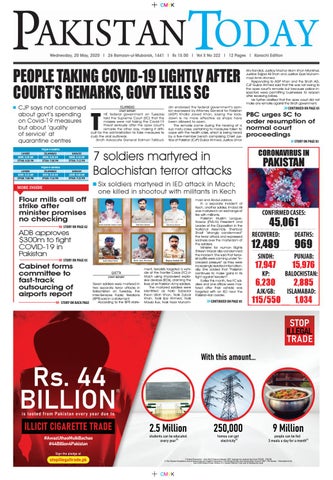
7 soldiers martyred in Balochistan terror attacks g
more inside
ISLAMABAD STAFF REPORT
ADB approves $300m to fight COVID-19 in Pakistan
STORY ON PAGE 03
STORY ON BACK PAGE
CONTINUED ON PAGE 05
PBC urges SC to order resumption of normal court proceedings STORY ON PAGE 03
Coronavirus in
Pakistan
Six soldiers martyred in IED attack in Mach; one killed in shootout with militants in Kech
STORY ON PAGE 02
Cabinet forms committee to fast-track outsourcing of airports report
Ata Bandial, Justice Mazhar Alam Khan Miankhel, Justice Sajjad Ali Shah and Justice Qazi Muhammad Amin Ahmed. Responding to AGP Khan and the Sindh AG, CJP Gulzar Ahmed said that this was not owing to the apex court’s remarks but because police inspectors were permitting businesses to reopen after receiving bribes. He further clarified that the apex court did not make any remarks against the Sindh government.
QUETTA STAFF REPORT
Seven soldiers were martyred in two separate terror attacks in Balochistan on Tuesday, the Inter-Services Public Relations (ISPR) said in a statement. According to the ISPR state-
ment, terrorists targeted a vehicle of the Frontier Corps (FC) in Mach using improvised explosive devices (IEDs), claiming the lives of six Pakistan Army soldiers. The martyred soldiers were identified as Naib Subedar Ihsan Ullah Khan, Naik Zubair Khan, Naik Ijaz Ahmed, Naik Maula Bux, Naik Noor Muham-
CMYK
mad and Abdul Jabbar. In a separate incident at Kech, another soldier, Imdad Ali was martyred in an exchange of fire with militants. Pakistan Muslim LeagueNawaz (PML-N) President and Leader of the Opposition in the National Assembly Shehbaz Sharif “strongly condemned” the terror attack and expressed sadness over the martyrdom of the soldiers. Minister for Human Rights Shireen Mazari also condemned the incident. She said that terrorist outfits were coming under “increased pressure” as they were increasingly isolated internationally. She added that “Pakistan continues to make gains in its fight against terrorism”. Earlier this month, five FC soldiers and one officer were martyred after their vehicle was targeted with an IED near the Pakistan-Iran border.
CONTINUED ON PAGE 05
CONFIRMED CASES:
45,061
RECOVERED:
DEATHS:
SINDH:
PUNJAB:
12,489 17,947
969
15,976
KP:
BALOCHISTAN:
AJK/GB:
ISLAMABAD:
6,230 115/550
2,885 1,034
02
wednesday, 20 May, 2020
news
FLouR MILLS CALL oFF StRIKE AFtER MINIStER PRoMISES No CHECKINg LAHORE
t
STAFF REPORT
HE Flour Mills Association on Tuesday announced to end the strike after their meeting with Punjab Food Minister Abdul Aleem Khan, who, on behalf of the government, assured them of allaying their concerns on a priority basis. A 10-member delegation of Flour Mills Association headed by Central Chairman Asim Raza and Provincial President Abdul Rauf Mukhtar agreed that flour prices would not increase till Eid. It was also decided that the district administration would not raid the flour mills while the Food Department would have access to these mills. Aleem Khan said that flour mills would be allowed for 7 days wheat stor-
age instead of 72 hours. He said that permission in this regard was being given but the flour mills would have to declare their stocks.
He telephoned the Punjab chief secretary during the meeting and asked him to convey the new instructions up to the division and district level. Aleem said that this
year wheat was being bought but intends to create a new mechanism for the affairs of flour mills for which the concerned stakeholders should be on the same page. He said that for this purpose a joint meeting of the Food Department and Flour Mills Association will be held immediately after Eid. The minister clarified that the government’s job should be to regulate and facilitate flour mills instead of procurement. He added that a new strategy would be worked out for the procurement of wheat and “bar dana” in the coming years. Aleem asked the officials of the Flour Mills Association to formulate their proposals in the light of which the next road map will be designed. The meeting decided that after Eid, flour mills of KP will also be given wheat but KP Food Department.
KP mulls massive cuts in development budget PESHAWAR AZIZ BUNERI
Corruption reference against Shehbaz after Eid, says Faraz ISLAMABAD: Federal Minister for Information and Broadcasting Senator Shibli Faraz on Tuesday said a reference against Pakistan Muslim League-Nawaz (PML-N) President Shehbaz Sharif concerning the misappropriation of public funds will be filed after Eidul Fitr. Speaking on a TV channel, he said that PM’s aide on accountability Barrister Shahzad Akbar had asked some questions from Shehbaz Sharif, but instead of giving proper replies, he started demanding fresh elections in the country to avoid corruption cases. To a question, he said the PML-N had introduced the culture of trampling laws. He made it clear that no one was above the law of the land. Commenting on the information minister’s statement, PML-N spokesperson Marriyum Aurangzeb said that Faraz should be more worried about the patience of the public rather than Shehbaz Sharif. She said that Prime Minister Imran Khan’s “corruption, theft of flour and sugar, and incompetence” was testing the people’s patience, adding that the devastation of the economy in 18 months had also taken its toll on the business community. STAFF REPORT
PML-N moves IHC against NFC formation ISLAMABAD: Pakistan Muslim League Nawaz (PML-N) has challenged the formation of the 10th National Finance Commission in the Islamabad High Court. The petition filed by PML-N leader Khurram Dastgir has named Secretary to the President, Secretary Cabinet, Finance Division, Secretary Law and Finance Advisor Abdul Hafeez Shaikh as parties in the matter. The petition states that the responsibility of equitable distribution of financial resources between the federation and provinces lies with the National Finance Commission. According to the Finance Division notification, the President of Pakistan constituted an 11-member commission on April 23. According to PML-N’s petition, it is necessary to consult with the governors before including a finance adviser and a finance secretary, but the notification did not mention any consultation with any provincial governor. The petition argues that and members cannot be appointed in violation of the procedure laid down in Article 160 of the Constitution. Moreover, the finance adviser was given the authority to chair meetings in the absence of the finance minister but according to the law, in the absence of the Finance Minister, NFC’s actions would be unconstitutional and without effect. STAFF REPORT
The Khyber Pakhtunkhwa (KP) government has directed 25 administrative departments not to launch new development schemes for the next financial year due to financial difficulties in the wake of the coronavirus crisis. According to sources in the planning and development department, the provincial government was thinking of slashing the annual development budget considerably in the next financial year. “Therefore each department will propose just 6 annual development programmes,” they said, adding that the current expenditure will also be brought down. The finance department has directed departments to reduce expenditure so that the available funds can be utilized properly and efficiently. According to sources, the provincial government has set a limit of Rs115 billion, Rs100 billion, Rs90 billion, Rs80 billion, Rs70 billion and Rs60 billion for the annual development programmes from which any ADP will be formulated according to the resource of the province. According to sources, 32 departments of the province have also been divided into four separate sections in which the first priority departments have been directed to include new schemes. The provincial government has given top priority to agriculture, primary and secondary education, food, health,
GOVT TO PRIORITISE AGRICULTURE, EDUCATION, FOOD, HEALTH, AND INDUSTRY SECTORS higher education, industry and rehabilitation and directed these departments to introduce new schemes. It has also been decided to make a big cut in next year’s development programme pertaining to the religious and minority affairs, finance, excise and taxation, finance, housing, law, minerals, welfare, population, sports and transport. There will be changes made in the development programmes of the Department of Home Affairs, Information, Labour, Municipalities, Drinking Water, and Highways Authority However, the department will not introduce any new projects. While the ADP of the Department of Communications and Works, Energy, Environment, Forestry, Science and Technology, Urban Development and will be deducted. In the proposed development programme, 85% budget will be allocated for ongoing schemes and 15% for new schemes. Those departments which could not get the scheme approved yet will have to approach the government for funds next year.
Pakistan rejects India’s new Kashmir domicile law ISLAMABAD STAFF REPORT
Pakistan on Tuesday strongly condemned and completely rejected the Indian government’s attempts to further deprive the people of Indian Occupied Kashmir (IOK) through Jammu and Kashmir Grant of Domicile Certificate (Procedure), 2020. The Foreign Office (FO), in a statement, said that the new domicile law is illegal and in clear violation of the relevant United Nations Security Council (UNSC) resolutions, international law including the 4th Geneva Convention and bilateral agreements between Pakistan and India. The domicile law is aimed at changing the demographic structure of IOK and undermining the exercise by the Kashmiri people of their right to self-determination through free and impartial plebiscite as per the relevant UNSC Resolutions, it said.
“We reiterate that such steps can neither change the disputed nature of Jammu and Kashmir recognised as such by the United Nations and the international community nor can they prejudice the inalienable right to self-determination of the Kashmiri people,” the statement read. It also said that the timing of this illegal Indian action is particularly reprehensible as it uses the world community’s preoccupation with the Covid-19 pandemic and reflects the opportunistic and morally bankrupt mindset of RSS-BJP combine. FO said that like the earlier illegal Indian actions, the people of IOK have completely rejected the domicile law as “unacceptable.” The Kashmiri people will never accept the sinister “Hindutva” agenda of dispossessing them of their land, marginalising them politically and economically, and depriving them of their distinct identity, said the statement. “Pakistan has been consistently sensitising the international community about the real Indian designs behind its illegal and unilateral actions of 5 August 2019.
NAB to probe Akram Khan Durrani, Rukhsana Bangash’s son ISLAMABAD: The National Accountability Bureau (NAB) on Tuesday authorised filing of reference against Foreign Ministry officials and approved investigations against Akram Khan Durrani and son of Rukhsana Bangash for inflicting huge losses to national exchequer by abusing their authority. The Executive Board Meeting (EBM) of NAB, chaired by Chairman Justice (r) Javed Iqbal, authorised filing a reference, conducting five inquiries, an investigation, a complaint verification and referring back the ongoing inquiry being conducted against the officials of the Federal Board of Revenue (FBR) to NAB Rawalpindi bureau for further perusal. According to details shared by NAB spokesman, the EBM authorised filing reference against the officers/officials of Foreign Ministry on the accusations of inflicting heavy losses to national exchequer by selling Pakistan embassy building in Jakarta (Indonesia) by trampling the rules and regulations and abusing their authority. The EBM authorised conducting investigation against Ministry of Inter Provincial Coordination Senior Joint Secretary Arif Ibrahim. The EBM authorised conducting of five inquiries against various personalities, including two separate inquiries against Umer Manzoor, son of Rukhsana Bangash, former MNA and political secretary of former president Asif Ali Zardari, officers, officials of Ministry of Housing and Works and others, former GilgitBaltistan (GB) secretary works Syed Akhtar Hussain Rizvi, former minister for housing and works Akram Khan Durrani, officers/officials of the ministry, management and others of job testing services. APP
ANP’s secretary general tests positive for coronavirus PESHAWAR: ANP Secretary General Mian Iftikhar Hussain has been tested as coronavirus positive. In a statement issued from Bacha Khan Markaz here on Tuesday, ANP Spokesman Zahid Khan confirmed the news and said, "Mian Iftikhar Hussain has isolated himself and is in quarantine". The ANP’s secretary general had participated in the funeral prayers of his brother who died on Monday but was taken away from the venue as his health deteriorated. It may be noted here that his brother Mian Mohammad Sarir died of coronavirus. "The condition of Mian Iftikhar Hussain is stable for now but he will remain quarantined till complete recovery," Zahid Khan said. The ANP spokesman has appealed the party workers to pray for the secretary general’s early recovery and avoid visiting him to offer condolences over the death of his brother as not even his family was meeting anyone. “People should adopt precautionary measures keeping the situation in view,” he said, adding that the ANP leader would meet those coming to express condolence of his brother after recovering. APP
UN starts consultations on PM’s initiative for debt relief FM QURESHI SAYS WITHOUT INT’L COMMUNITY’S SUPPORT, DEVELOPING COUNTRIES WON’T HAVE ENOUGH FISCAL SPACE TO MEET CHALLENGES ISLAMABAD APP
Ambassadors from over 22 countries, representing developing and developed countries from all regions, held a first round of consultations on Prime Minister Imran Khan’s global initiative for debt relief at their virtual meeting in New York on Monday. Senior officials of the United Nations (UN), International Monetary Fund (IMF), World Bank (WB) and United Nations Conference on Trade and Development (UNCTAD) also participated in the meeting, which was chaired by Pakistan’s UN Ambassador Munir Akram. Last month, the prime minister ap-
pealed to the international community, the United Nations Secretary-General (UNSG) Antonio Guterres and the international financial institutions to “launch an initiative to give debt relief to developing countries” to help in their fight against the novel coronavirus pandemic. Thanking Pakistan for convening the consultations and welcoming PM Imran’s initiative, United Nations General Assembly (UNGA) President Tijjani MuhammadBande called for moving quickly on debt and concessional finance to support the most vulnerable people around the world. “We must also review our financial architecture, which has long-standing and evident gaps. We must strive to make our sovereign debt system fairer and more ef-
CMYK
fective for debt crisis resolution, and encourage more responsible borrowing and lending,” Muhammad-Bande added. “Such progress can only take place with political will and steadfast international cooperation and I call on Member States to help ensure critical liquidity in many developing countries suffering from a heavy debt burden,” the president went on to say. “The early debt relief initiatives of the G20, World Bank, the IMF as well as from Member States – such as that of Pakistan’s Prime Minister – are welcome. We must leave no one behind in this time of crisis,” he added. UN Deputy Secretary-General Amina Mohammed underscored the need for the international community to address the
debt challenges of developing countries in a sustainable manner. “For a significant number of countries, this will only be possible with some form of debt relief. Solutions can be found if we can muster the political will to do so,” she said, adding that the 2030 global development agenda depended on it. During the consultations, diplomats said several proposals for addressing the debt issue were presented. Ambassador Akram said that another meeting would be convened in near future to explore agreement on some of the measures. In his opening remarks to the meeting, read out by Ambassador Akram, Foreign Minister Shah Mahmood Qureshi, stressed the need for addressing the debt distress of many developing countries, which has a potential to become a debt crisis. He said that without international support, many developing countries would not have the fiscal space to respond to the current health and economic crisis.
wednesday, 20 May, 2020
CoVID-19 CASES SPIKE AMID EASE IN LoCKDowN ISLAMABAD
w
MIAN ABRAR
HILE the federal and provincial governments have eased the restrictions following a two-month lockdown across the country, there has been a sharp rise in the cases of coronavirus, with no respite in sight. A detailed study of the data provided by the National Command and Operations Center (NCOC) reveals that the active cases had surged 600 percent since April 16. On May 19, the total number of active cases was at 43,702 while 12,489 had recovered. Total deaths are
939 while 30 people died of the infection in past 24 hours. If we draw a comparison with previous month, the data reveals that on April 16, the number of positive infections in the country was 6,505 cases out of which 1645 had recovered. So the number of infections was 4,736 while 124 people had died of the disease. However, on May 19, the number of infections rose to 43,966 in the country – a jump of 37,461 patients in the country in a mere a month’s time. The number of recovered patients is however encouraging as 12,489 patients have recovered while the deaths also increased to 939 — 751 per cent hike.
Former PM Abbasi secures pre-arrest bail in PSo appointments case ISLAMABAD: The Sindh High Court (SHC) on Tuesday granted pre-arrest bail to former prime minister Shahid Khaqan Abbasi and former petroleum division secretary Arshad Mirza in a case pertaining to the alleged illegal appointment of managing director and deputy managing director of the Pakistan State Oil (PSO). The court also directed the duo to submit surety bonds worth Rs0.5 million each. Abbasi and Mirza had filed separate petitions with the SHC, seeking pre-arrest bail in the case after an accountability court in Karachi summoned both on June 9. Abbasi, in his plea, maintained that the said reference against him is baseless and he “wants to appear before the National Accountability Bureau (NAB) court to defend self but fears arrests”. The former prime minister appealed the court to grant him pre-arrest bail so that he can appear before the court to fight the reference. The bureau had filed a reference against Abbasi and Mirza for allegedly appointing Sheikh Imranul Haq as managing director and Yaqoob Sattar as deputy managing director (finance) of the PSO in violation of relevant rules and regulations. STAFF REPORT
No reduction in fares as trains will run with 60pc occupancy: minister PESHAWAR: A day after the government announced resumption of 30 passenger trains (15 up and 15 down), Minister for Railways Sheikh Rasheed Ahmed on Tuesday announced that there will be no reduction in the fares as trains will already run at 60 per cent occupancy to maintain social distancing. Speaking to the media in Peshawar, the minister said that Pakistan Railways had already reduced the train occupancy more than Britain and India. “They are running trains at 70pc occupancy,” he said. Rasheed again thanked Prime Minister Imran Khan for allowing train operations to resume. “It was very difficult. The provinces were not agreeing but I am thankful to the prime minister for allowing the transport of the poor to resume,” he said. The countrywide passenger train service was suspended on March 25 due to the spread of the coronavirus. On Monday, Rasheed said he had no difference with any province on the issue of resuming train service, however, he sought the cooperation of Sindh Chief Minister Syed Murad Ali Shah for smooth train service from the province. Since the passenger train operation will help the citizens to travel to various destinations to celebrate Eid, the department said that the passengers who had already got their seats booked online would be given priority to travel. “We appeal to the passengers to follow the SOPs and maintain social distance and travel only when required direly. APP
Experts fear that a major outbreak is likely while the government may not have the capacity to deal with mass outbreak. A doctor at PIMS said, due to poor management at the early stages of the lockdown, the infected population got mixed up with the non-infected populace, triggering the hike in infectious people who later caused a major outbreak in across the country. “Along with public, the officials on the top too took the contagion casually,” it said, adding strict lockdown and heavy fines are the only way to curtail the infection rate. The doctor said that the government should massively increase its testing capacity. Moreover, the capacity
building of available hospitals should also be increased and new staff should be hired. Whereas the existing staff should be trained under the capacity building programme. He also said that there was no disposal system in place of used masks and other gears being used by medics and population, which may further infect the healthy population. “People use masks and throw them on roads. Such masks and other gears may cause further infections as district administrations have no system in place to dispose of such waste. This issue must be taken care of as even there is no system in federal capital – what to talk about in remote cities,” he concluded.
Pakistan seeks collective response to fight Covid-19 ISLAMABAD APP
Prime Minister’s Special Assistant on Health Dr Zafar Mirza on Tuesday urged the international community to launch a coordinated, collective and sustained drive to mitigate the fallout of the Covid-19 pandemic. Addressing to 73rd Session of World Health Assembly held in Geneva via video conference, Mirza said there was a need for enhanced investments in national and global pandemic preparedness, detection and response mechanisms. The World Health Assembly is the supreme decisionmaking forum of the World Health Organization (WHO) where 194 nations converge to deliberate and devise strategies for promoting health and reducing disease burden. Mirza said that the WHA session was significant in many ways and it must lend its full support to the on-going preparedness and response plans and strategies. He urged the assembly to support growing calls for development and production of Covid-related diagnostics, therapeutics, and vaccines that were affordable, equitable and accessible to all. “It is clear that no country alone can protect itself from this contagion. Solidarity and unity is, therefore, vital to tackling morbidity and mortality, to ease the burden on the health systems, and support national and global economies,” he said. He said that Pakistan had a significantly lower number of Covid-19 patients than the initial international projections, especially considering that Pakistan was the 5th most populous developing country in the world.
However, he stressed that despite these numbers, “we are not complacent and are taking every possible step” to combat the pandemic. “We are implementing a national action plan for Covid-19 with a whole-of-nation approach, including at the highest level and multisectoral coordination at federal, provincial and local levels,” he added. “Through this plan the overarching strategy of trace, test and quarantine is being pursued and operationalised. We are training the frontline health care workers through our ‘We Care’ campaign, sustaining the momentum of public awareness messages, making available critical medical supplies to healthcare professionals and workers.” Mirza told the assembly that Pakistan endorsed the statement delivered by the Chinese delegation on the issue of Taiwan. Pakistan fully supported China’s efforts to safeguard its sovereignty and territorial integrity,” he added. “In line with iterations of General Committee, year after year, Pakistan’s position is that there is only OneChina and Taiwan being its integral part has no right whatsoever to claim the membership of WHO,” Mirza said. The de facto health minister of Pakistan told the participants that some of the lessons learned from the outbreak of Covid-19 pandemic included the need for enhanced investments in national and global pandemic preparedness, detection and response mechanisms. “WHO and member states must take this opportunity to start imagining the future of healthcare. Current political global attention must translate into strengthened essential public health functions.
Ghani asks courts to reflect on whether they are meddling in govt’s domain KARACHI STAFF REPORT
In reference to the Supreme Court’s directives to the Sindh government, provincial Minister for Education Saeed Ghani on Tuesday said the courts should reflect on whether the “decisions they take fall within the ambit of the government’s authority”. Addressing a press conference in Karachi, he said the constitution gives authority to the executive and it also bounds the courts to make decisions in accordance with the same. “[The courts] should think whether the decision they are taking can be followed,” he said, adding that everybody would have to follow whatever decision the
courts took, including himself even if he “did not like it”. He chided the Sindh opposition for being “silly”. “They are in power in other provinces. Whatever they do is correct but whatever we do is wrong?” he questioned. The decision to keep shopping malls closed was taken during a National Command and Operation Centre (NCOC) meeting, he said, accusing the federal government of doing “U-turn politics”. “Experts are saying it is dangerous to go out but everyone including the federal government isn’t listening so what can we do? If people think buying Eid clothes is more important than preventing disease then so be it.” He added that the Sindh government had not agreed to the resumption of flight and train operations.
Peshawar on top of coronavirus victims list with 200 reported deaths PESHAWAR APP
Peshawar, the provincial metropolis of Khyber Pakhtunkhwa (KP), is on top of the list of victims of coronavirus as 200 deaths out of the total of 334 deaths in the province have been reported from the city alone. According to data released by the KP Health Depart-
ment on Monday, a total of 16 persons died on Monday due to coronavirus in KP out of which 12 were in Peshawar district only. The total number of infected people in KP was at 6,230 till May 18, 2020 out of whom 1944 have been recovered from the illness. Health experts have suggested people to take care and fully adopt precautionary measures against the deadly pandemic which is fast infecting people on daily basis.
news
03
ADB approves $300m to fight CoVID-19 in Pakistan ISLAMABAD STAFF REPORT
The Asian Development Bank (ADB) on Tuesday approved $300 million emergency assistance loan to strengthen Pakistan’s public health response to the COVID-19 pandemic. “The COVID-19 pandemic is having a significant detrimental impact on the health and economic prospects of the people of Pakistan,” said ADB Vice-President Shixin Chen in a statement. The project will support the purchase of medical supplies and personal protective equipment (PPE) for hospitals; upgrading of medical facilities; training of health workers; the purchase of emergency vehicles to strengthen rescue capacity in remote border areas, reads the statement. To protect the poor, ADB’s project will provide cash assistance to directly benefit the women of poor households through the government’s Ehsaas Emergency Cash Assistance Package, launched in response to the COVID-19 pandemic. “These payments are designed to meet the basic food needs and necessary living expenses of poor and vulnerable women and families, which are the bedrock of Pakistani society,” said ADB’s Project Administration Unit Head and co-team leader of the project Zheng Wu.
PBC urges SC to order resumption of normal court proceedings ISLAMABAD STAFF REPORT
The Pakistan Bar Council (PBC) on Tuesday urged the superior judiciary to order the resumption of normal functioning of the courts across Pakistan. In a statement, PBC Vice-Chairman Abid Saqi appreciated Monday’s SC order regarding the opening of shopping malls. “Yesterday’s order passed by the Supreme Court setting aside the government decision to close markets and business centres and requiring the federal as well as provincial governments to allow the immediate opening of all the shops, markets and shopping malls throughout the week without any restriction of timing is appreciable as that may ensure the earning of livelihood by trading class and the workforce of hundreds and thousands of people attached therewith,” he stated. Saqi said that in line with the spirit of the court’s order, it is desirable that all the courts in the country should start their normal functioning and resume hearings of normal and routine cases also. “The Chief Justice of Pakistan and Chief Justices of all the High Courts are, therefore, requested to pass appropriate orders for the immediate reopening of all the courts at different levels to start normal functioning and hearing of all the routine cases for safeguarding the valuable rights and interests of litigants which would also strengthen the system of dispensation of justice,” the statement added.
Wednesday, 20 May, 2020
04 KARACHI
PRAyER TImIngS
WEATHER UPDATES WEDNESDAY
390C
270C
THURSDAY
370C
270C
FRIDAY
370C
270C
FAJR SUNRISE
ZUHR
ASR MAGHRIB ISHA
4:21
12:29
3:54
5:46
7:11
8:36
ShoPPing MallS to rEoPEn in Sindh KARACHI
S
STAFF REPORT
INDH government on Tuesday allowed shopping malls in the province to reopen a day after the Supreme Court ordered the authorities to seek permission from the health ministry in this regard and allow them to operate. A five-member bench of the apex court, headed by Chief Justice of Pakistan Gulzar Ahmed had directed that the provincial governments ensure the reopening on Saturday and Sunday of shops and business activities which were previously closed during the complete lockdown.
“We don’t find any justified reason for closing the shops on the weekend,” the court had noted in its order, adding that it is in the convenience of human beings that the two days are named as such; there is otherwise no distinction between other days and Saturday and Sunday. The SC’s directives were received with concern by the Sindh government due to a sharp rise in the number of COVID-19 cases since the lockdown was eased in the country. As of today, 46,996 are infected with the virus with the death toll nearing 1,000. On Tuesday, Sindh Home Department issued a notification allowing shopping malls to open, subject to the condition of strictly adhering to the Standard Operating
Procedures (SOPs) issued to curb the spread of the virus. “The conditions and provisions including opening timings (8am to 5pm) will remain the same,” the notification read. However, food courts, beauty parlours/beauty salons and entertainment/play areas in the malls will remain closed. The provincial government also suspended the order declaring Fridays, Saturdays and Sundays as "safe days" on the instructions of the apex court. Meanwhile, Commissioner Karachi Iftikhar Ali Shallwani issued the SOPs outlined below, to be followed by the management of shopping malls in the city. 1. No customer shall be allowed to enter
2. 3. 4.
5. 6.
the shopping malls without the face mask. Availability of hand sanitizes for customers shall be ensured at the entry points of shopping malls. No customer shall be allowed to enter the shopping malls without being scanned with thermal guns. Persons with the flu-like symptoms, high temperature, and dry cough shall not be allowed to enter in the shopping malls. The management of shopping malls shall reduce 1/3rd of footfall capacity in their shopping malls. The footfall shall be digitalized to monitor the social distancing of at least 03
feet amongst the customers. 7. The management shall use signage throughout the premise to ensure social distancing for customers and employees. 8. Display instructions and awareness posters with pictorial images for workers, staff and customers at prominent places. 9. Persons of over 55 years and children below 12 years of age shall not be allowed to enter shopping malls. 10. Entry & Exit points in shopping malls shall be prominently marked, displayed and strictly monitored. 11. The shopping malls shall be frequently cleaned with disinfectant.
Sindh govt announces Eidul Fitr holidays from May 22 to 27th KARACHI: The Sindh government on Tuesday declared May 22 to May 27 as public holidays to mark the Eidul Fitr throughout the province. All government offices, autonomous, semi-autonomous bodies, corporations and local councils under the administrative control of government of Sindh, except essential services, departments and offices engaged in the prevention and control of coronavirus emergency would remain closed. APP
People support SC order to open shopping malls KARACHI: The presence of a huge number of people from all age groups and genders, waiting anxiously for their chance to enter one or the other fully airconditioned retail complexes here Tuesday was almost like a public endorsement of the Supreme Court's order to open shopping malls. The scenario was neither unexpected nor strange for any one mainly because shopping, over the years, has emerged to be a major source of recreation for vast majority of citizens - many of whom firmly believed being deprived of during past almost two months’ time, under pretext of Covid-19 threat. Whether they had their doubts or not about veracity of coronavirus diseases, declared as global pandemic, shoppers were absolutely patient and more than willing to meet all the precautions required by them for entrance to their choice of mall. "I am here to get accessories of my choice of brand and do not feel inconvenient in any manner to get my temperature checked or made to wash my hands or use sanitizer or even pass through walk though gates sprinkling disinfectants before getting into the mall," said Sukaina Khorasani. Mrs Tyabji, accompanying her daughters at Atrium in Saddar, however, did feel the exercise of being kept awaiting till fixed numbers of people allowed to enter the mall may return back and another batch of shoppers be allowed to get in quite annoying. "I know this is necessary and also appreciate concerted efforts being made to ensure physical distancing but this is quite tiresome for people of my age group," commented the lady. She was also of the opinion that the holy month of Ramazan should not had been wasted in shopping and other worldly activities but commented that since no shopping could be done even before the current month hence people were left with little option. In reply to a question, she agreed that gravity of the situation demanded that people celebrate the festival with maximum possible simplicity and resort to needed isolation for their as well as wellbeing of others. Shopkeepers talking to APP thanked the chief justice of Pakistan (CJP) for realising how the situation was fast turning from bad to worse and people being forced towards poverty. "It is not that we are oblivious of the situation but do believe that life has to go on with needed modifications in our lifestyle more and cautiously tilted towards prevention of the viral disease and containment of its spread through proper compliance to recommended SOPs," said Hameed Akhter. APP
Sindh in no position to open schools KARACHI: Sindh Education Minister Saeed Ghani said on Tuesday that the provincial government was not in a position to reopen schools across the province. “Even if we try, we cannot reopen schools,” said the minister, talking to media in Karachi. He stated that the government felt that if schools were reopened, many parents would not send their children.The minister also announced that the provincial government will be launching an app which would be the first step towards a digital class. “Internet distribution is still a problem and we are in touch with cellular services,” said the minister, adding that they were also in talks with cable operators to allocate one channel for education. “We will try to include as many students as we can in our system,” vowed Ghani, adding that they were also training teachers to get used to conducting the digital class. “Through this app, students can study in English, Urdu and Sindhi,” said the minister. He added that the app is available for students of kindergarten till fifth grade. STAFF REPORT
KARACHI: Railway workers wash trains after government announced resumption of service on Tuesday. InP
19 more died of coronavirus in Sindh, says CM KARACHI STAFF REPORT
Sindh Chief Minister Syed Murad Ali Shah has said that coronavirus hit a new high on Tuesday with 19 patients losing their lives in Sindh, which is the highest number since the first death reported on March 19. “The 19 deaths within 24 hours are the highest number since the first death was reported on March 19 and now Sindh has a total of 299 deaths stemming from the coronavirus which constitutes 1.6 per cent of the total patients," he said in his statement issued from the CM House on Tuesday. Shah said that from March 19 to May 19, which mean the last two months, they had been taking more than five bodies on average per day. “Though the death ratio stands at 1.6 per cent of the total patients yet, we have taken 299 bodies with 61 days which is quite painful,” he deplored. He said that at present, 135 patients were in critical condition, of them 34 had been put on ventilators. “May Allah helps them to recover at the earliest,” he said. Talking about 12,906 patients, Shah said that 11,373 or 88 per cent were at home isolation, 819 at isolation centers and 715 or 5.7 per cent at different hospitals. He added that he was happy to disclose that 252 more patients had recovered from the infection, the number of the patients who had recovered so far had reached 4,741, which means a 27 per cent recovery ratio. The chief minister said 706 new patients were detected when
3803 samples were tested. “On the one hand, our 252 patients have recovered while another 706 have emerged which means despite discharging 252 patients, 454 other were admitted,” he said and added that these figures showed that the recovery rate was much lower than the infection rate and this rate could be controlled when everyone would follow the SOPs. He said that so far, the government had tested 131,376 samples against which 17,947 positive cases were diagnosed. “The overall percentage of positive cases of the totals tests stands at 13.7 per cent which is higher than various other countries ratio,” he said. Talking about Karachi, Shah said that out of 706 new cases, 558 alone belong to Karachi. “These cases include 134 South, 131 East, 105 Central, 72 West, 58 Malir and 58 Korangi. Karachi, as usual, is on the top in local spread,” he said. He said that they had 20 new cases in Hyderabad, 16 Larkana, 12 Kambar-Shahdadkot, 10 Jamshoro, six each in Shikarpur and Sukkur, five Khairpur, four Jacobabad, three each in Mirpurkhas, two each in Dadu, Ghotki and Kashmore while each one in Badin, Tando Allahyar and Naushehro Feroze. According to the chief minister, three flights from Washington, Mascut and Jeddah brought in 792 stranded Pakistanis to Karachi on May 14, 15 and 16 respectively. They all were tested as a result, 60 of them came positive while the results of 17 passengers were being awaited. The chief minister, once again urged the people to follow SOPS and avoid going out of home without any solid reason.
Factories and mills violating pact could be sealed, warns minister KARACHI: Provincial Minister for Industries & Commerce and Cooperative Department & Anti-Corruption Jam Ikramullah Dharejo, while taking stern notice of the reports that factories and mill owners are not paying salaries and benefits to their employees, has said that those factories and mill owners, who are doing so, are violating their agreement with Sindh government and need to abide by their agreement. He warned them that not only fines would be imposed on them within the law, but their factories and mills could also be sealed if necessary. He said that the factories and mill owners were committed to continue to pay salaries and benefits to their employees in the lockdown and now that the lockdown had eased considerably and most of the factories and mills had reopened, It should not be done so. Dharejo further said that the Sindh government would take action on such complaints and the rights of the poor laborers would be protected in all cases. He said that Eid-ulFitr is very close and employers need to take extra care of their poor workers on this occasion and non-payment of salaries and benefits is also a violation of human rights. He said that he was aware of the problems of the industrialists but the solution to the problems of the workers would be given priority. STAFF REPORT
Darker days ahead, PMA warns as SC announces end to lockdown KARACHI PPI
A meeting of Pakistan Medical Association (PMA) through video link meeting that was held on Tuesday at the PMA House Karachi, feared that cases of Covid-19 would rise sharply as lockdown restrictions continue to ease. The meeting was chaired by Dr Ikram Ahmed Tunio, while PMA Centre President Dr S. M Qaisar Sajjad, PMA Centre Secretary General Dr Qazi Wasiq, PMA Centre Treasurer Dr Salma Aslam Kundi, PMA Centre President-Elect Dr Ashraf Nizami, Lahore PMA President Dr Malik Shahid Shaukat, Lahore PMA General Secretary Dr Sahibzada Syed Masood us Syed, Sialkot President Dr Amir Saleem, PMA Centre Joint Secretary-I, Quetta PMA President Dr Fareed Sumalani, Dr Mushtaq, Joint Secretary-II Dr Saeed
Ahmed, Dr S. Tipu Sultan, PMA ex-president Dr Sharif Hashmani, Karachi President Dr Abdul Ghafoor Shoro Karachi PMA General Secretary, Karachi PMA Dr Shershah Syed attended the meeting. The meeting showed its concern over the SC’s decision to end the lockdown in the country. “Ending of the lockdown will definitely increase the burden of disease Covid-19. The load of corona patients at hospitals will increase which will have horrifying consequences. PMA always respects the verdicts of our courts, but as far as the coronavirus situation is concerned, the Supreme Court should have considered the opinion of doctors,” they said. They said that doctors, nurses and paramedics are fighting against coronavirus at the risk of their lives and they are very distressed. Moreover, doctors are serving with dedication in hospital wards, emergencies and OPDs at both public and private sector hospitals. It may be noted here that more than 1,100 health-
care workers have been infected with coronavirus while 12 doctors have died. Two of the deceased doctors were treating corona patients while the other 10 doctors died while treating non-corona patients. The deceased were working at Quarantine Centres, Isolations Centres, HDUs and at ICU to treat coronavirus patients. “In this situation we request the government to manage the coronavirus and the economic conditions of the people in a balanced way. We humbly request the general public to take care of themselves at their own. Coronavirus is a reality, take it seriously. It is a fatal disease which has killed 320,448 people and has effected 4,910,481 people till now around the world,” the doctors said. They concluded by reminding the public to adopt preventive measure like hand washing, hand sanitizing, wearing a mask, maintaining social distance and not hugging or shaking hands during Eid days.
Wednesday, 20 May, 2020
FBR To lose Rs77.3BN Due To INCReasINg IllICIT CIgaReTTe TRaDe ISLAMABAD
T
SHAHZAD PARACHA
HE Federal Board of Revenue (FBR) is expected to lose Rs77.3 billion during the ongoing fiscal year owing to increasing volume of illicit cigarette trade. Pakistan Tobacco Company Senior Regulatory Affairs Manager Noor Aftab told the media on Tuesday that the market share of illicit cigarettes has surged to 33 per cent in 2019 from 23.5 per cent in 2014. Similarly, the revenue loss has also increased to Rs77.3 billion from Rs50.9 billion last year. The tobacco companies paid Rs123 billion in sales tax in 2018-19. Noor Aftab said that PTC is giving jobs (directly or indirectly) to 72,000 people and due to the ongoing Covid-19 pandemic, the business of tax-paying companies has been more affected compared to those who are evading taxes, warning that businesses might be closed of the illicit trade exceeds 50 per cent. He also talked about the PWC as well as Oxford Economics study on the economics of illicit cigarettes in Pakistan. He revealed that there has been a 93 per
cent increase in excise duty during the past 18 months which has widened the price gap between illicit and legal cigarettes. On the other hand, an unprecedented 46 per cent hike in excise rate of lowest tier in the Finance Supplementary (Amendment) Act, 2018, increased the non-duty paid cigarette market share up to 37.6 per cent. He said that the government needs to implement certain fiscal and administrative
actions to combat these issues. He suggested that the government should avoid levying any additional tax, levy or charge on the cigarette sector as this will provide incentive for further tax evasion and increase in market share of illicit cigarettes. In addition to this, he said that the government also needs to reduce the duties of cigarettes so that the market presently cap-
tured by illicit manufacturers is minimised. “Federal excise duty on unmanufactured tobacco needs to be increased at least to Rs500 per kg, and the rate of adjustable advance income tax, which currently stands at 5 per cent should also be increased to 10 per cent,” he said. He also asked the government to reduce the minimum pack price as illicit manufacturers operate at a price range and tax paying companies paid Rs62.76 per pack. Aftab said that enforcement measures have so far failed to curb the market share of illicit cigarettes. “The government intends to introduce a track and trace system, however, its success is dependent upon implementation and enforcement at retail level,” he added. He also said that counterfeit cigarette trade has also increased to approximately 2.75 billion sticks per year, in addition to market share of non-duty paid cigarettes. “Total cigarette consumption has remained stable despite excise rate increases. In Tier1, the rate has increased by more than 30 per cent which has shifted some of the volume to smuggled cigarettes not sporting the statutory health warning. Non-duty paid cigarettes do not conform to regulations governing legal trade,” he added.
NEWS
05
Repair of Tower: NTDC to partially suspend power in Islamabad, Rawalpindi areas LAHoRe PRESS RELEASE
The repair work on the tower of 500kV Rawat–Neelum Jhelum Transmission Line will be carried out on May 20-21, the spokesman of the National Transmission and Despatch Company Ltd (NTDC) said on Tuesday. Subsequently partial load management will be observed from 9am to 5pm on May 20 and from 5am to 5pm on May 21 on 132 kV and 66 kV grid stations of IESCO. The spokesman further informed that the grid stations and feeders where partial load management would be observed include Chakwal, Chakri, Adiala, Gujar Khan, Jatli, Padshan, Pinanwal, Dandot, Talagang, Choa Syedan Shah, Noorpur Sethi, Bhagwal, Jand, Lakarmar and Tamman. Bestway Cement, Pakistan Cement, DG Khan Cement, Pak Lafarge Cement and Dandot Cement Industries will also face partial load management.
People taking Covid-19 lightly after court’s remarks, govt tells SC CoNTINuTeD fRoM pAGe 01 “Even the provincial government is allowing government offices to reopen,” he added. In its order yesterday, the court had directed the Sindh government to obtain permission from the National Health Services and Research Centre to open shopping malls across the province. It had noted that Punjab and Islamabad had done the same. “If such can be done by the biggest province of Pakistan, i.e. Punjab, why the similar cannot be done by Sindh and apparently, we find no valid reason or justification for the same,” the order had read. In Tuesday’s hearing, the top judge noted: “Sindh government has opened all government offices. You have opened the sub-registrar’s office.” He added that the sub-registrar’s office was a “corrupt institute”. “Government offices have been opened, not those of public service.” The chief justice said that the SC was not concerned about the government’s expenses to overcome this pandemic but rather the quality of the services being provided to Covid-19 patients. He referred to examples of SC employees who were initially tested positive in government labs but their tests from private labs came out negative. The chief justice further clarified that the order to keep markets open on Saturday and Sunday was only applicable until Eidul Fitr.
When asked to “clarify” that the restrictions had only been relaxed until Eid, the chief justice said that it will be done in the next hearing. A day earlier the bench, in a written order issued after the hearing, had said that it was “not at all satisfied” by the report presented by the National Disaster Management Authority (NDMA), saying that it could “find no reason why so much money is being spent on this coronavirus”. “There are other serious ailments prevailing in the country, from which people are dying daily and those ailments are not being catered and the coronavirus (Covid-19), which apparently is not a pandemic in Pakistan, is swallowing huge money,” the written order had said. During Tuesday’s hearing, NDMA Chairman Lt Gen Muhammad Afzal appeared before the court in order to give an explanation of the money being spent to deal with the pandemic. Justice Ahmed raised questions over the condition of quarantine centres saying that “10 people are sitting side by side”. “What kind of quarantining is this?” he inquired, saying that centres did not have clean bathrooms and there was also no water. The chief justice said that “videos of quarantine centres’ poor conditions are being circulated on social media” with residents telling expatriates who wished to return “to die abroad but don’t come to Pakistan”. He noted that Pakistan was a poor country, saying: “We are
playing with money and don’t care for the people.” The attorney general of Pakistan told the court that Pakistan now had the capability to make ventilators. The chief justice said that the country should be self-sufficient in everything, warning that “there will be a time when nothing, including medicines, will be available from abroad”. He further said that all surgical instruments could be made in Pakistan. ‘WHAT IS DESTO PAKISTAN ARMY?’ The bench summoned NDMA chief Lt Gen Muhammad Afzal on the rostrum and discussed the report submitted by the body. The chief justice noted that the report mentioned a company that manufactured personal protective equipment. “What is Desto Pakistan Army? Is this a private company?” Justice Ahmed asked, adding: “The machinery for this company has been brought through a special plane.” The NDMA chief explained that Desto (Defence Science & Technology Organisation) was a subsidiary company of Strategic Plans Division Force (SPD). The chief justice inquired if the machinery for Desto was being ordered from a single Chinese company and said that Pakistan only received “third class” material from China. “Graduates are not being utilised in our country,” Justice Ahmed lamented. “Pakistan has a lot of talent, it should be used.” The hearing was subsequently adjourned until June 8.
Chinese military medical team visits NCOC headquarters ISLAMABAD STAFF REPORT
A 10-member Chinese military medical team headed by Major General Huang Qingzhen visited the National Command and Operation Centre (NCOC). The team was briefed about Pakistan’s efforts against the pandemic so far, as well as the future course of action including the country’s emergency response measures. The delegation was also briefed on the National Test Track and Quarantine (TTQ) strategy – a major initiative launched by NCOC earlier this month. The strategy envisions
SRINAGAR AGENCIES
Two Kashmiri fighters, including a key leader, were killed by Indian security forces during a 12-hour gun battle in the occupied valley’s capital on Tuesday, authorities said. Such clashes are a common occurrence in Indiaoccupied Kashmir (IoK) but rare in Srinagar, and the siege marked the first shootout in the city’s centre for two years. Explosions and gunshots echoed through the densely-populated neighbourhood, with streets largely empty as a result of a coronavirus lockdown that has kept most residents confined to their homes. Paramilitary troops and police exchanged fire with Kashmiri fighters after cordoning off part of the area. Five homes
were reduced to rubble during the battle and 10 others were severely damaged, residents told AFP. Junaid Ahmed Sehrai, a commander of Hizbul Mujahideen and the son of a top separatist leader, was killed in the clash, police said in a statement. Another Hizbul Mujahideen member was also killed and four Indian police officers were wounded, the statement said. Most mobile voice and internet services were cut across the city as the fighting kicked off and have yet to be restored. Locals poured onto the streets as news of the killings spread to hurl stones at Indian forces, who fired tear gas and shotgun pellets to disperse them. No injuries were reported. The deaths came two weeks after Hizbul Mujahideen chief Riyaz Naikoo and a close aide were killed by government forces during a twoday gun battle.
IDIMS, which will allow authorities to both trace those new patients have been in contact with and figure out where the virus hotspots are and what infection trends look like. According to the officials, a TTQ apex committee comprising the focal person on Covid-19, the federal and provincial health ministers and each province’s health secretary will oversee the strategy. A TTQ execution cell, comprising four subordinate groups will report directly to the apex committee while providing support, assistance and guidance to existing provincial mechanisms, like the Provincial Disaster Management Authorities (PDMAs).
CEC curtails administrative powers of GB govt ahead of general poll GILGIT
Top Kashmiri fighter killed after 12-hour gun battle in IHK
ramping up testing to identify Covid19 hotspots as a precursor to easing blanket lockdowns and moving towards a ‘smart’ containment model. The visitors also shared their expertise and valuable input. The Chinese military medical team is on an official visit to Pakistan. Various specialists including disease control, pulmonology, testing and nursing experts are part of the visiting team. Detailing how the TTQ flowchart would work, officials said it begins with direct reports of Covid-19 cases from hospitals, laboratory walk-ins, national and provincial helplines, etc. From there, data is fed into the
STAFF REPORT
The chief election commissioner (CEC) of Gilgit-Baltistan (GB) on Tuesday announced a number of steps to curtail the administrative powers of the regional government ahead of the upcoming general election for the GB Assembly in a bid to “ensure free and fair elections”. Earlier in April, the Supreme Court (SC) allowed the federal government to conduct the coming general elections in GB under the Election Act 2017 and amend the related law to install a caretaker government for conducting polls. Following the directive, President Dr Arif Alvi on Saturday had promulgated the “Gilgit-Baltistan Election and Caretaker Amendment Order, 2020” to form a caretaker setup. According to a notification issued by the CEC’s office on Tuesday,
no government department will be permitted to recruit, post or transfer any employee until the holding of the election. The only exemption permitted is recruitment done through the Federal Public Service Commission (FPSC) and the recruitment of potential candidates who were interviewed before May 15. The notification also halts work on new development projects by the incumbent government, including those being undertaken through communitybased initiatives and the utilisation of local government funds. The notification sparked anger within the Pakistan Muslim League-Nawaz (PML-N) government with the government’s political adviser Shams Mir terming the new directives as “undemocratic”. “This is nothing but an insult to the mandate given by the people to this government for five years,” said Mir speaking to the media in Gilgit. He also claimed that the notifica-
tion was issued at the behest of the federal government. The incumbent assembly is scheduled to dissolve on June 24. The regional election commission is bound to hold the next election within 60 days. CEC IN GB: Meanwhile, the composition and formation of the CEC itself in GB has raised legal concerns. The formation of a single-person body has raised skepticism and criticism in the region. The Election Commission of Pakistan (ECP) comprises the CEC, who is the chairperson of the commission, and four other members – one from each province. In GB’s case, however, a single person – only the CEC – has been appointed with no other members to support him in the conduct of affairs. The decision elicited a strong reaction from New Delhi which lodged a protest with Pakistan through a demarche over the Supreme Court’s directive.
Wednesday, 20 May, 2020
06 COMMENT
The war on science and reason
Coronavirus exposes a major vulnerability State of Pakistan’s science and technology
A deep-seated culture of ignorance and denial continues to dominate the covid-19 discourse
T
HE supreme Court has raised a number of pertinent questions during suo motu hearing on measures taken to control the coronavirus. The Court expressed dissatisfaction with the national disaster Management authority’s report, particularly the hefty sums spent on corona patients, purchase of medical equipment and maintenance of quarantine facilities. These are highly relevant questions and it is for the ndMa to satisfy the apex court One of the vital issues raised by the court is the country’s failure to develop the scientific and technological knowhow to enable it to prepare the required medicines and kits. One can only add that the ongoing health crisis has laid bare the dismal situation of the scientific and technological research that forces the country to import costly equipment and medicines for practically all serious ailments from abroad. Every year there are reports of children and adults dying of respiratory tract infections as there are not enough ventilators in government hospitals. Unless mega-funds are diverted to develop institutions of excellence for scientific research, the country will remain dependent on foreign donors to cope with major diseases and disasters The Court has ordered the malls and shops opened for seven days. it has simultaneously ordered ensuring strict adherence to sOPs. The devastation caused by covid-19 has forced some of the countries known as outstanding champions of human rights to put curbs on businesses and individual liberties. in Pakistan the number of positive cases and deaths is on the rise and is supposed to peak sometime in June. The Court has questioned if covid-19 had really assumed epidemic proportions. The answer can only be given by scientists that specialize in different branches of medicine including epidemiology. One hopes that before reaching a conclusion the Court seeks the professional advice of the medical community. doubts expressed by the Court could encourage those who dismiss the coronavirus as foreign propaganda to throng the markets and mosques violating all sOPs. The all-out opening of the markets and resumption of land-cum-air transport has led the clerics to unilaterally announce daily five times prayers in mosques. The government still maintains that if the numbers of corona patients was to go beyond a limit, it would reimpose a lockdown. This is easier said than done.
HAris Ali virk
W
aTCHinG the pictures of bustling bazaars and markets filled with shopping enthusiasts, i was reminded of what Carl sagan, the great american astronomer and astrophysicist, feared years ago. We have built the modern world based on science and technology, yet nobody understands anything about them. He prophesied that this combustible mixture of ignorance and power, sooner or later, is going to blow up in our faces. Well, it has already lessened the chances of our survival, and continues to threaten the very existence of our planet. Ours is an arrogant attitude. it’s an attitude that wages war on science and reason. We know that our weather patterns are changing, pollution levels are mounting and droughts are on the rise. We know all this but we don’t really ‘believe’ in it. and this is why we won’t ask our government to introduce reforms and take urgent measures in order to reverse deforestation, conserve energy, promote renewable power, and punish industrial polluters. Last year, we saw a huge invasion of locusts in various regions of interior sindh that destroyed hundreds of acres of crops and incurred hunger, food shortage, and loss of cattle. as usual, nobody took it seriously. it was conveniently dismissed as mere natural event which could not have been avoided. The story hasn’t been any different when it comes to how our people have responded to COVid-19. it has never really been perceived as an existential threat. Just go to any random street or shop around the corner of your neighborhood, you would listen to at least a dozen conspiracy theories, none of which would recognize there’s any danger. You would see them arguing that it’s all a part of some mysterious plot to overthrow the existing world order and that the Western powers are behind it. some would blame the Chinese for their ‘dirty’ eating habits and assert with pride how we, the Muslims, are the world’s ‘cleanliest civilization’. Others would confidently conclude that israel has unleashed the virus to distract the world while it conquers the remains of the West Bank and the Gaza strip. as if israel really cares what the rest of the world thinks about its brutal occupation. Our pulpits, meanwhile, have been hurling abuse, literally, at the Usa for conspiring against islam and the Muslim world. They have been preaching how we don’t need to take any precautions because God will protect us anyway. But what if
Terrorism on the rise
India’s deceptive defence budget 2020-21
Fresh wave should be dealt with swiftly
a
fresh wave of terrorism has hit the country that has primarily targeted security forces. The latest of these attacks has claimed the lives of six soldiers of the Frontier Corps (FC) in Mach, Balochistan in an iEd blast. The same day another soldier was killed in north Waziristan owing to a blast in a crowded market in Miramshah. a few weeks back five FC soldiers and an officer were martyred in a similar attack at the Pakistaniran border. For the past two months a lot of attention and resources have been diverted to dealing with the Covid-19 pandemic and perhaps in all the chaos the omnipresent threat posed by terrorists was unintentionally underestimated and there has also been some complacency. The recent back-to-back strikes however, have shown that the threat is still very real and potent, especially for those who are the first line of defence against the menace of terrorism. Multiple military operations have attempted to cleanse our badlands of militants but clearly there is room for them to continue planning and executing attacks. One reason for this is cross-border terrorism, which cannot be addressed through on-ground or aerial interventions and has to be tackled through coordination and intelligence. in both iran and afghanistan’s case, border security remains a perennial irritant, making diplomacy hard and maintaining a secure border even more difficult. it is imperative therefore that cooperation on the issues of border security is increased as the countries face a common enemy. internally, Pakistan has to be able to collect more actionable intelligence in order to preempt attacks rather than act after the fact. Pakistan has a complicated and bloody history with terrorism with over 60, 000 deaths that includes over 7,000 security force personnel. The country has come a long way since then and those achievements are reflected in the lower frequency and intensity of attacks. The fight continues and efforts have to be stepped up in order to maintain and multiply the gains already made through sacrifice and perseverance.
The Indian military doesn’t seem to know there’s a pandemic Amjed jAAved
I
ndia’s 2020-21 Budget envisages a total outlay of Rs 30,42,230 crore. Out of this, Rs 3, 37,553 crore has been allocated for military (excluding military pensions). For military pensions, Rs. 1, 33,825 crore has been provided in Budget Estimates 2020-21. There is an increase of Rs 40,367.21 crore in the total military allocations (Rs 4, 71,378 crore) over 2019-20. The total military budget accounts for 15.49 percent of total expenditure for 2020-21. The allocation represents a growth of 9.37 per cent over Budget Estimates for 2019-20. Out of Rs 3, 37,553 crore allocated for 2020-21, Rs 2, 18,998 crore is for net revenue expenditure and Rs 1, 18,555 crore is for capital expenditure, which includes modernizationrelated expenditure. The ‘transparent’ military expenditure shows an increase of only 9.37 per cent. But, if we add to it concealed provisions the increase would balloon manifold. The concealed provisions include quasi-defence allocations like border and strategic roads, nuclear/space research, paramilitary forces like Border security Force, Central Reserve Police Force, and so on. Besides there are public sector undertakings like dockyards, machine tool industries and Bharat Heavy Electrical Limited. Then, india unnoticeably increases her defence expenditure under Revised and actual budget estimates. But the real expenditure in past years has been much greater than that shown. Previously, india increased its military outlays in revised and then actual estimates. Thus the actual military expenditure is much higher than the initial estimates, which are quoted in international media under a hypnotic spell. india does so to `lower’ its military budget as proportion of GnP. Thus india, as compared with its neighbours, gets a favourable image in The Military Balance, Jane’s defense, and other international magazines. The Explanatory Memorandum to demands for Grants, not generally available, throws light on india’s mega-purchases. They include carbines for the army, advanced Jet Trainers, airborne Warning and Control system, additional Mi-17 Helicopters, MiG29 upgrade, Low-Level Transportable Radar, integrated air Command and Control system and
Dedicated to the legacy of the late Hameed Nizami
Arif Nizami Editor Aziz-ud-Din Ahmad
Umar Aziz
Asher John
Joint Editor
Executive Editor
Deputy Editor
Lahore – Ph: 042-36300938, 042-36375965
instead of dealing with our fears and skepticism, we die? Well, as the almighty wills. as for our politicians, their long-lost love for any the state has tried to depoliticize science over the kind of logical thinking is not unknown to anyone. The years, and has always kept it at the margins. never Prime Minister, who never gets tired of boasting about have we allowed scientific dialogue and engagement how much time he has spent in Europe, has absolutely to become a part of the mainstream conversation. as no idea what he has been doing. This is a man who, much as the world has been turning towards scientific since the beginning of this crisis, has just been strug- solutions for all kinds of crises, we have uniquely gling to understand and explain the difference between avoided all that. never have i heard even the word two terms: curfew and lockdown. That’s the best of his ‘science’ in the electoral campaigns and manifestos, abilities. Each time he comes up on screen to address television shows and public debates. There is no culture of research and scienthe nation, all he brings tific investigation in our of value to the national universities, and the state discourse is some new no interest whatsoever form of confusion. simiWe are at present living in a crucial has to change its priorities and larly, Bilawal Bhutto, the focus on education. leader of the country’s moment in our history. This The fact is we have most ‘liberal’ party, has pandemic could bring about the not only been alienated already embarrassed science but have dehimself last year when he end of organized human existence from veloped a national pasgave his ‘expert opinion’ time of attacking all kinds to explain the floods in as we know it, and the threat we of scientific explanations Karachi and the rest of sindh. The shareef face is not external, but internal. We of the natural world. We are that wretched nation brothers too, of course, are not threatened by an which has disowned its are no Wright Brothers prolific scientist, a who came up with the inintergalactic predator, but our own most nobel laureate, because vention of airplanes. They are just as ignorant vanity and ignorance. It is our own he does not fulfill our criteria of who can be called as the rest of the lot we actions that have brought us to this a Pakistani. no wonder, have been gifted with. we are headed towards a The problem, howbrink of catastrophe disaster. We have chosen ever, isn’t this simple. it a path which gave birth to goes far deeper. Our disthe most brutal, totalitartrust of science has roots ian regimes of the in the long history of imperialism. since the onslaught of the Renaissance, fol- 20th century. nazi Germany and Mussolini’s italy lowed by the Enlightenment and the scientific were as insane when it came to the question of sciRevolution, the West has established a monopoly over ence and rationality. Our collective attitude also the field of science. Therefore, a common mind per- matches the fanaticism of Franco’s spain, which once ceives all that is scientific to also be western. We are reverberated with the slogan “down with intelliskeptic of the modern scientific methods because the gence! Long live death!” colonial experience and the modern-day invasions of We are at present living in a crucial moment in the Muslim countries have instilled a strong anti-West- our history. This pandemic could bring about the end ern sentiment in our hearts. But we have found our- of organized human existence as we know it, and the selves in a strange dilemma: on the one hand, we threat we face is not external, but internal. We are not renounce scientific answers to the myriad of challenges threatened by an intergalactic predator, but our own we face, and then, on the other hand, we are also envi- vanity and ignorance. it is our own actions that have ous of the Western model of progress and develop- brought us to this brink of catastrophe. ment. in the post 9/11 world, this dilemma has deepened further, and so has the nostalgia, in our colHaris Ali Virk can can be reached lective unconscious, for the golden age of islam. at harisali.gcu@gmail.com
I
Karachi – Ph: 021-35381208-9
I
surveillance Radar Element for the air force. Weapon Locating Radar and T- 72 upgrade for the army, Rafale fighters, and more. during his visit to india, Us President donald Trump offered to sell india $3 billion (per unit) Terminal High altitude area defense (THaad) and Patriot advanced Capability (PaC-3) missile defence systems as an alternative to the Russian s-400 system. india ditched Russia, from whom it had decided to purchase five s-400 systems for $5.4 billion. With tacit Us support, india is getting tougher with China. There was a 73-day standoff on the doklam plateau on the sikkim border last year. at Us prodding, india revised its maritime strategy in 2015 to “Ensuring secure seas”. The previous strategy was “Freedom to Use the seas”. To implement the new strategy, india built the Chabahar port. india took up the development of the sittwe Port in Myanmar as part of the Kaladan multi-modal transit transport project for building a multi-modal sea, river and road transport corridor for shipment of cargo from the eastern ports of india to Myanmar through sittwe. india upgraded its existing listening post in northern Madagascar. india has obtained access to the Us naval base in diego Garcia, and to the French naval bases in Mayotte and Reunion, besides the australian naval base in the Cocos. Robert Kaplan, in his book, Monsoon: The Indian Ocean and Future of American Power, argues that the geopolitics of the 21st century will hinge on the indian Ocean. its waters reach 28 countries which together account for 35 percent of the world’s population and 19 percent of its GdP. sixty percent of the world’s oil shipments from the Gulf countries to China, Japan and other asian countries pass through these waters which host 23 of the world’s busiest ports. Methyl isocyanates were being produced at the Union Carbide india when it exploded killing thousands of people. There were 27 factories producing products including Carbaryl through cyanates supplied by UCiL. Vizag Gas Leak also has military potential. Where does provision for CBW research appears in india’s military budgets? Colossal expenditure on conventional weapons by a nuclear power is not understood. nuclear deterrence does not mean matching bomb for bomb. nuclear victory would at best be pyrrhic. india is emerging as the Us proxy against rising China, which is determined to surpass the Usa in
Islamabad – Ph: 051-2204545
I
Web: www.pakistantoday.com.pk
I
GdP by 2027. india is opposed to China’s Belt and Road initiative. Besides, it uses its aid, trade and border contiguity to obstruct Chinese influence in Bhutan, nepal, and Bangladesh. at india’s bidding, those countries toe the indian line in saaRC and other international forums like G20. in 2005, Washington expressed its intention to help india become a major world power in the 21st century. Henry Kissinger views indian ambitions thus: ‘Just as the early american leaders developed in the Monroe doctrine concept for america’s special role in the Western Hemisphere, so india has established in practice a special positioning the indian Ocean region between East indies and the horn of africa. Like Britain with respect to Europe in the eighteenth and nineteenth centuries, india strives to prevent the emergence of a dominant power in this vast portion of the globe. Just as early american leaders did not seek approval of the countries of the Western Hemisphere with respect to the Monroe doctrine, so indian in the region of its special strategic interests conducts its policy on the basis of its own definition of a south asian order’. Zbigniew Brzeszinski takes note of india’s ambition to rival China thus: ‘indian strategies speak openly of greater india exercising a dominant position in an area ranging from iran to Thailand. india is also position itself to control the indian Ocean militarily, its naval and air power programs point clearly in that direction as do politically guided efforts to establish for indi strong positions, with geostrategic implications in adjoining Bangladesh and Burma.’ any analysis of india’s military budget should be based on actual demands for Grants coupled with Explanatory memoranda. The allocations concealed under civil ministries outlays should be ferreted out and added to military allocations. The successive increases in revised and then actual budget estimates should be taken into account. as a result of india’s rising military expenditures, Pakistan also increases her defence expenditure. and all this is happening while the world is focused on the covid-19 pandemic. But india merely uses this as cover! Amjed Jaaved is a freelance journalist, has served in the Pakistan government for 39 years and holds degrees in economics, business administration, and law. He can be reached at amjedjaaved@gmail.com.
Email: editorial@pakistantoday.com.pk
Wednesday, 20 May, 2020
COMMENT 07 Editor’s mail Send your letters to: Letters to editor, Pakistan Today, 4-Shaarey Fatima Jinnah, Lahore, Pakistan. E-mail: letters@pakistantoday.com.pk Letters should be addressed to Pakistan Today exclusively
Economy is more than life iT is very difficult to understand that what is going on nowadays in our country. Our government is just supporting economy instead of of life. They give priority to economy only. as cases are reaching sky our government doesn’t pay attention upon it. Opening markets and starting transport is very big mistake of our government. nobody is following sOPs in markets. People are thinking that now they are relax and there isn’t any corona which is totally wrong. i urge government officials to take some serious action and give priority to lifes as whole world is giving. AnTHOny SAHOTrA Larkana
Fee reduction issue
Pak-Iran relations Relations were cordial until the Revolution
mAlik muHAmmAd AsHrAf
R
ECEnTLY an improvised explosive device (iEd) hit a vehicle of the military personnel in Buleda (district Kech) Balochistan near the Pak-iran border, killing one major of the Pakistan army and five soldiers who were returning to their base after conducting a routine patrol in the area. The Balochistan Liberation army, which has bases on the iranian soil, claimed responsibility for the attack. it was in the backdrop of this regrettable incident that COas Gen Qamar Javed Bajwa called iran’s Chief of staff of the armed Forces, Maj Gen Mohammad Bagheri, to express his concern over the attack by the militants and according to a press release of isPR both of them resolved to enhance security measures on either side of the border. General Bajwa rightly told General Bagheri that Pakistan had started fencing the border but would require mutual cooperation to ensure border security and to stem smuggling activity which was also used by terrorists and narcotics traffickers to cover their movement. Unfortunately it was not for the first time that the militants based in iran carried out an attack against Pakistani security personnel. a similar attack was carried out by the militants on 18 april 2019 at Buzi top on the coastal highway when militants wearing uniforms barricaded the road, stopped three or four buses travelling from Ormara to Gawadar and killed 14 people including 11 personnel of the navy, air Force and Coast Guards. Pakistan lodged a very strong protest with the iranian government, saying that the intelligence reports regarding the bases of the militants in iran and their activities were shared with the iranian authorities but nothing has been done to stop the terrorists from carrying out their nefarious activities against security personnel of Pakistan. it was in the backdrop of the tense situation created by the Ormara incident that Prime Minister imran Khan immediately paid a two-day visit to iran and met its leaders. as a result of the mutual interaction the two countries agreed to set up a Joint Rapid Reaction Force to fight terrorism and guard the common border between the two countries, and vowed not to allow their territories to be used for terrorist activities. Relations between the two countries were under great stress following terrorist attacks on both sides of the frontier. it was then hoped that set-
ting up of the joint force and fencing of the Pak- scholar by saudi arabia. it rather preferred to iran border by Pakistan would help in preventing play a mediatory role to lessen the tensions. the recurrence of such incidents. in the context This stance stemmed from the considered view of bilateral relations, the two sides also resolved that it was in Pakistan’s utmost interest to reto enhance cooperation in a number of social and main neutral in any conflict between saudi cultural domains besides expanding economic arabia and iran. Prime Minister imran Khan also played a relations. But unfortunately the Baloch militants still find it convenient to carry out their terrorist mediatory role in defusing tensions between iran acts against Pakistan using the iranian territory, and saudi arabia which had been brewing since as is evident from this latest attack on the secu- the drone attack on oil facilities in saudi arabia on 20 september 2019. He paid visits to iran and rity personnel. it would perhaps be pertinent to have an in- saudi arabia in October. Both iran and saudi sight into the history of relations between the arabia welcomed the initiative. The Prime Mintwo countries. in 1947 iran was the first country ister himself acknowledged his mediatory role to recognize Pakistan after its independence. The when he visited new York to attend the Un Gentwo countries were members of the Baghdad eral assembly session. Probably it was in recogPact known as CEnTO, which was an alliance nition of Pakistan’s importance in the region and against the UssR during the Cold War era. They, the efforts that Prime Minister imran Khan was along with Turkey, formed the Regional Coop- making for the regional peace that even Us Preseration for development which later became a ident donald Trump asked him to help defuse larger group known as Economic Cooperation tensions with iran. Pakistan also expressed disapproval of the Us Organization decision to continue (ECO), when these with sanctions were joined by the against iran after the Central asian rePakistan under the stewardship of onset of the coronpublics and avirus, urging the afghanistan. The Prime Minister Imran Khan is all latter to take a huwarmth and depth manitarian view of of ties between the out for recalibrating cordial the situation. two countries could relations with its neighbouring Having cordial be judged from the relations with both fact that during the countries, particularly Iran, and saudi arabia and 1965 war with iran is imperative india, iran sided playing a role of a facilitator in for Pakistan to with Pakistan. it also helped in putresolving the regional conflicts. It avoid any adverse backlash on the doting down the insuris hoped that Iran in the interest of mestic front as well gency in as for boosting the Balochistan. the required bonhomie would see efforts for a susHowever, the events of 1979, into it that the Baloch militants were tained economic development which cluding the invasion no more able to use its soil for undoubtedly deof afghanistan by pends on prevalence the UssR and the attacks against Pakistan of peace within the revolution in iran, country as well as in drastically changed the region. the situation in the iran is our imregion as well as within Pakistan which also affected relations be- mediate neighbour and has been a close ally. it tween the two countries. Though iran though op- can also help Pakistan in diluting the energy criposed the soviet invasion and joined hands with sis by providing oil, electricity and gas through Pakistan in supporting the afghan Jihad, it al- the iP gas pipeline in case it becomes feasible to ways looked askance at the growing influence construct it. We also need the cooperation of iran in bringing peace and security to the region, parof saudi arabia and the Usa on Pakistan. during the conflict between the Taliban ticularly in resolving the conflict in afghanistan regime and the northern alliance in afghanistan, and elimination of the scourge of terrorism for while Pakistan supported the Taliban, iran along the collective benefit of the countries of the rewith india assisted the latter. so iran from an ally gion. The economic and political interests of both became an adversary of Pakistan competing for iran and Pakistan are inextricably linked and opposing goals in the regional context, straining their geographical proximity and common relirelations between them. The consequent imposi- gion provide a solid base for protecting and tion of sanctions on iran by the Un on the nu- strengthening those interests. They both need clear issue also limited the scope of trade each other to realize that objective. Pakistan under the stewardship of Prime relations between the two countries. The iranPakistan-india (iPi) gas pipeline also became a Minister imran Khan is all out for recalibrating casualty of tensions between the Usa and iran, cordial relations with its neighbouring countries, and india withdrew from the project under Us particularly iran, and playing a role of a facilipressure. However, it is pertinent to mention that tator in resolving the regional conflicts. it is the successive regimes in Pakistan, except Gen- hoped that iran in the interest of the required eral Ziaul Haq’s, have always strived for cordial bonhomie would see to it that the Baloch militants were no more able to use its soil for attacks and brotherly relations with iran. Pakistan rightly refused to be drawn into against Pakistan. saudi-iranian conflict in Yemen, sectarian criMalik Muhammad Ashraf is an academic. sis in Bahrain and the diplomatic row between the two after the execution of a shia religious He can be contacted at: ashpak10@gmail.com.
PRiVaTE schools have become favourite whipping boys of all & sundry. They are called “mafia” by the parents, politicians & the judiciary. interestingly, come admission time and one sees long queues of parents outside these “mafia” schools anxious to get their kids entrusted to the very “mafia”. is the hypocrisy not jarring? Education is a fundamental right of every child. in all countries of the world, governments work to provide education through government schools. not so in Pakistan. Here provincial governments abuse education budgets for corruption to line their pockets. Hence, we sadly hear of “ghost schools”. The government & the worthy supreme Court believe that it is the responsibility of the private sector to fulfil the global requirement of education for all. not only should the private sector assume this responsibility, it should do so on terms to be dictated by the education ministers & the judiciary. all sectors of the economy may earn abnormal profits but the private schools should earn a pittance for education is not a business. One is constrained to ask why private schools are being destroyed when the govt itself is incapable of providing basic education of reasonable quality? do parents realize their targeting of schools is like cutting the tree branch on which they are themselves sitting. MAAz AbbASI Karachi
Easing the lockdown aFTER the outbreak of covid 19, pakistan is facing terrible ecnomic crises. not only pakistan developed countries are facing this problem too. due to which the decision of easing in lockdown is made.consensuse, the govt of pakistan has eased in lockdown. Which include reopning of malls, beautypalors, barbear and industries. But inforced of lockdown can result a tough time for health authorities. as they were warning people not to go outside to save your and their lives. But we can see the rush in markest and other places where people are standing nearby each other without precutive gears. Even in this pendamic children have been wittnessed with elders while shopping without masks. almost noone is following sOPs, this carelessness of citizens can bring hardships for health authorities. With the risisng cases of covid 19 the tally has reached 40,151 and 873 deaths. However, within less time the cases can rise up more higher. This easing in lockdown can risk many lives of shopkeepper and laubors. it would be a better decision, if govt eases the lockdown after eid. Becouse this eid shopping can make the circumstances out of control. MAHnOOr SIrAJ Awaran
Corona fears THE dreaded coronavirus pandemic is spreading very fast because our government is confused. after easing the lockdown there was a huge rush of Eid shoppers. in a panic, the state reduced the days reserved for shopping from five to four in a week in the hope that this will reduce the number of shoppers. What has actually happened is that the number of shoppers has remained the same, but now they are crammed into four days instead of five days. This increased the density of persons in each market, thereby increasing the chances of human contact and consequently a rise in the number of corona cases that are being reported. The other factor is that in the melee to get all their Eid shopping done, the people ignored the sOPs while visiting markets and public spaces. Therefore the people who were supposed to exercise caution and help check the pandemic, actually ended up in spreading it by their carelessness. One is, therefore, inclined to agree with senior medical authorities when they say that it is important to fear the spread of coronavirus and not be complacent about fighting it. zILL-e-HuMA rawalpindi
Our own worst enemy COVid-19 has taken Pakistan by storm, many lives are lost, and thousands are affected. But it seems like this is not an epidemic after all. The government says that the public is dying in need of the resources at their homes and the most funny part is that it said that the people only shop during the Eid season, otherwise don’t shop at all. but since the lock down was eased and markets are opened, the people are walking around like they do in normal days, they also feel like that is not an epidemic at all, others are just coughing normally and they are ineffective of this virus. They are neither seen wearing a face mask not the shopkeeper instructs them to wear one, they all believe it’s nothing or they are immune to this disease. not only the people are blind but also the Government, who also believe this is not an epidemic at all. The cases have reached a peak level and over 1000 lives are lost in a matter of days and they all think this is not true at all or nothing like this happened. it pretends that the people cannot live without food and clothes at their homes while people are going shopping like they were not suffering at all. Then for what reason the lock down was eased? is the Covid-19 pandemic even real or it’s just a nightmare in our dreams? When this not an epidemic at all then why are the cases increasing or people dying? does government has an answer to it or they have no answer at all? zuHAIb SHAH Karachi
Wednesday, 20 May, 2020
08 WORLD VIEW
Poor countries borrowed billions from china. they can’t Pay it back NATIONS WANT BEIJING TO FORGIVE OR RENEGOTIATE LOANS AS THEIR ECONOMIES SUFFER. DOING SO WOULD BE COSTLY. SAYING NO COULD HURT CHINA’S GLOBAL IMAGE
New York Times
a
Maria abi-Habib and KeitH bradsHer
s the coronavirus spread around the globe, Pakistan’s foreign minister called his counterpart in Beijing last month with an urgent request: The country’s economy was nose-diving, and the government needed to restructure billions of dollars of Chinese loans. similar requests have come flooding in to Beijing from Kyrgyzstan, sri Lanka and a number of African nations, asking to restructure, delay repayments or forgive tens of billions of dollars of loans coming due this year. With each request, China’s drive to become the developing world’s biggest banker is backfiring. Over the last two decades it unleashed a global lending spree, showering countries with hundreds of billions of dollars, in an effort to expand its influence and become a political and economic superpower. Borrowers put up ports, mines and other crown jewels as collateral. Now, as the world economy reels, countries are increasingly telling Beijing they can’t pay the money back. China faces difficult choices. If it restructures or forgives these loans, that could strain its financial system and infuriate the Chinese people, who are suffering under their own slowdown. But if China demands repayment when many countries are already angry with Beijing over its handling of the pandemic, its quest for global clout could be at risk. “China is politically on the back foot,” said Andrew small, senior fellow at the German Marshall Fund. should China foreclose on those loans, he added, “they would be taking over strategic assets in countries that now can’t afford to feed their people.” China’s global reputation is on the line. Countries are openly questioning its role in the coronavirus outbreak, after Chinese officials in January initially downplayed the severity and contagiousness of the disease.
Beijing is selling and donating masks and equipment to help its battered image. A misstep could deal its global ambitions a major setback. At the same time, the financial stakes are huge. The Kiel Institute, a German research group, pegs China’s lending to the developing world at $520 billion or more, with the vast majority doled out in the last few years. That makes Beijing a bigger lender than the World Bank or the International Monetary Fund. At the forefront of the spree is the Belt and Road Initiative, President Xi Jinping’s $1 trillion program to finance infrastructure projects across the world and pick up allies in the process. since the initiative started in 2013, China has lent up to $350 billion to countries, about half of them considered high-risk debtors. China has dismissed the idea of mass debt forgiveness but signaled that it is willing to negotiate. In some cases it has already acted: The Kyrgyzstan government announced in April that China agreed to reschedule $1.7 billion of debt repayments, without disclosing details. Others are hoping for relief too. “Not only from China have we requested,” said s.R. Attygalle, sri Lanka’s secretary to the treasury, in an interview, citing requests to Japan and China’s Export-Import Bank. In the meantime, he said, China Development Bank widened a credit line by $700 million to help sri Lanka cope, lowered the interest rate and delayed the repayment timeline by two years. Beyond those steps, Chinese officials haven’t yet decided how to tackle the problem, say people familiar with some of the deliberations. Debt relief is “not simple or effective,” song Wei, an official in the research arm of China’s Ministry of Commerce, wrote in the Global Times, a newspaper controlled by the Communist Party. “What China could do to help is bring projects funded by loans back to life and realize sustainable profits, instead of measures as simple as offering write-offs.” Belt and Road had become a sensitive subject before the outbreak. Chinese officials worried whether too many banks and companies were pouring money into the same countries with scant coordination. China’s financial system is already straining under debt accumulated by state-run companies and local governments to keep growth humming. some people in China began questioning whether
their hard-earned money was being squandered abroad. Despite China’s growing wealth, its households still have incomes less than a quarter of those in developed countries. Its economy has also been shaken by the outbreak, leading it to shrink for the first time since the Mao era. China’s loans differ from most other loans to developing countries by rich nations or by institutions like the World Bank. They tend to carry higher interest rates and shorter maturities, requiring refinancing every couple years. They frequently use national assets as collateral. Those features gave Chinese state-controlled banks the confidence to lend to poor countries. In some places, lending has soared. Djibouti’s debts to China jumped to more than 80 percent of its annual economic output. Ethiopia’s debt to China totals 20 percent of its annual output. In Kyrgyzstan, the amount is about 40 percent. The Trump administration has accused China of “debt trap diplomacy,” lending more money than poor countries could afford to seize strategic assets and to expand its military and economic footprint. Beijing denies these accusations, and many Chinese experts agree. seizing collateral overseas is difficult, they argue. Loans cost more because Chinese lenders face the real prospect of not getting paid back. “A lot of the loans should have higher interest rates that should reflect the correct risk,” said Chen Long, a partner at Plenum, a Beijing economic analysis firm. But an anti-China backlash has grown in recent years as countries struggled to pay off debts. Belt and Road projects have often proven unprofitable, leaving taxpayers with hefty bills. When Beijing seized a strategic seaport in sri Lanka as collateral, debtor nations watched with concern. China also relied on a secretive web of bilateral negotiations for Belt and Road, to line officials’ pockets or get them to agree to unreasonable terms, some debtor countries claim. Malaysia pushed back on a $16 billion loan package, pressuring Beijing to cut it to $11 billion. Now it appears Beijing underestimated the risk that severe credit problems might afflict all developing countries at the same time. China still insists on dealing with its debtor countries individually. But leaders in those places are increasingly calling for broad global efforts to help with their problems. “China wants to keep Belt and Road countries di-
vided, as they are stronger than each country individually,” said Benn steil, the director of international economics at the Council of Foreign Relations. In April, Pakistan’s prime minister appealed to wealthy countries and institutions for debt relief for all developing nations. Two weeks later, the Group of 20 nations, which includes China, announced it would freeze all debt payments for the world’s poorest countries until the end of the year. But Mr. song, the Commerce Ministry official, wrote in the Global Times that preferential loans from the Export-Import Bank of China are “not applicable for debt relief.” The Export-Import Bank of China is Belt and Road’s money pot, financing more than 1,800 projects worth at least $149 billion, the lender revealed last year. The pressure on China will only increase as the global economic crisis deepens. Officials familiar with the debt negotiations said many countries are demanding China provide debt relief or forgiveness, including a number of African countries. Ethiopia, Africa’s fastest-growing economy, has asked China to cancel part of its debt load and is taking a lead role on behalf of African nations in negotiations, several officials said. “These are early days. But I know the Chinese have generally been recognizing of the challenges that countries are in,” said the state minister of finance Eyob Tekalign Tolina in an interview, adding that a bloc of the “least developed” African countries have called for debt cancellation. “Given the overall global shock and the pandemic’s effect on growth, this is a call for support,” he said. But Ghana’s finance minister, Ken Ofori-Atta, said in a video interview with the Center for Global Development that China needed to do more and “come on stronger.” Chinese officials insist that they will continue to do projects in the developing world. Pakistan last week awarded a $5.8 billion dam-building contract to a Chinese state-owned company’s joint venture with the commercial unit of the Pakistani army. Financing details weren’t released. But if China strikes hard bargains, debtor nations could band together and try to present a united front. They could reveal the extent of their Chinese loans and their terms and conditions, which could put even more focus on the problem. Other countries could shift how they lend, which could force China to change its ways or ease back. “It’s a reckoning for China,” said scott Morris, a senior fellow at the Center for Global Development, a think tank. “When you look at the breadth and scope of the countries that may default, it could be a very high risk for China. Will they take an inevitable write-down on some of these debts? Or will they be willing to seize countries’ assets during such a sensitive time?” Salman Masood and Simon Marks contributed reporting. Maria Abi-Habib is a South Asia correspondent, based in Delhi. Before joining The Times in 2017, she was a roving Middle East correspondent for The Wall Street Journal. Keith Bradsher is the Shanghai bureau chief. He previously served as Hong Kong bureau chief, Detroit bureau chief, Washington correspondent covering international trade and then the U.S. economy, telecommunications reporter in New York and airlines reporter.
Some philosophical responses to the coronavirus I SHOULDN’T FEAR MY OWN DEATH, BECAUSE WHEN IT HAPPENS, I WON’T BE THERE (SINCE DEATH IS THE EXTINCTION OF CONSCIOUSNESS). I MIGHT RATIONALLY FEAR THE PAINFUL PROCESS OF DYING, BUT DEATH ITSELF IS NOTHING TO FEAR
Times LiTerarY suppLemeNT nigel Warburton
One of the few sentences from Hegel I think I understand is “The owl of Minerva flies only at dusk”. When history has unfurled we will see its full significance, but not until then. But lacking a Hegelian confidence and altitude from which to interpret the logic of our story, what are we to make of the current crisis? Can philosophy illuminate this confusing mess? Perhaps a little, if we cherry-pick from its history. Were susan sontag alive today we could count on her to be scathing about the way politicians have been speaking about Covid-19. In Illness as Metaphor and AIDs and Its Metaphors, she analysed the metaphors used around TB, cancer and HIV. Today martial metaphors dominate. Emmanuel Macron declared war on the virus in the first few weeks of March. He used the phrase “We are at war” six times in one speech. Around the same time Boris Johnson announced “We are engaged in a war against the disease which we have to win”. Across the Atlantic Andrew Cuomo described doctors and nurses as “the soldiers who are fighting this battle for us”. All rousing stuff, giving a pretext for Churchillian speeches – but dangerous too. This rhetoric of war makes it much easier to bring in far-reaching restrictions on civil liberties, and it can cloud our thoughts
about the nature of the situation. It has allowed politicians to enforce wartime measures – “because this is after all a war” – none more extreme than those of Viktor Orbán in Hungary, who has given himself the power to rule by decree for a period with no specified end date. When Johnson fell ill, Dominic Raab continued the martial theme, describing the PM as “a fighter”. He would come through OK — but the implication seemed to be that those who die weren’t fighting hard enough. Many rightly called him out. The truth is that survival in such cases is usually outside the patient’s control. sontag again: “one cannot think without metaphors. But that doesn’t mean there aren’t some metaphors we might well abstain from or try to retire”. No more war talk, please. Jumping back to the seventeenth century, Thomas Hobbes in Leviathan examined how much freedom we should be prepared to give up for the security of living under the protection of a powerful state. If you don’t find the prospect of a “solitary, poor, nasty, brutish, and short” life attractive you should be prepared to give up a lot. Almost everything. Freedom is good, but security is better when the alternative is constant risk of death. That’s hard to deny. Just as long as the curbs on freedom are proportional and reversible. But how far should governments be allowed to go? This is a pressing concern and the conditions of lockdown aren’t making it easy for us to think clearly about it. Most of us feel a little fuzzy. Take just one issue, mass surveillance. Countries around the world are using digital technology to monitor citizens’ movements and connections. There’s an app for this.
Things are happening so quickly that it is hard to tell what safeguards are being put in place. What will happen to that data afterwards? Will governments relinquish such a convenient tool of control once this crisis has ebbed? For anyone concerned with civil liberties there is a real fear that the virus is nudging us into an Orwellian future in which our every move can easily be monitored by the state – and will be. For those who studied “Trolley Problems” in Introduction to Philosophy classes it might seem obvious that philosophy can give us insights into what is going on now. In many countries life and death decisions have to be made about who gets access to scarce medical resources. Politicians have to decide whether likely deaths resulting from ending lockdown would be an acceptable cost for preventing a greater number of deaths that are likely from economic disaster. These situations are analogous to the famous thought experiment first formulated by Philippa Foot in which the runaway train carriage (the “trolley”) looks set to kill six people, but you could switch the points so it only takes out one. should you sacrifice that one innocent person to save many? The consensus seems to be yes (as long as you don’t have to kill that person with your bare hands or, in a variant of the scenario, push him off a railway bridge to stop another runaway train hurtling towards six unfortunates). But can this easy answer apply to real cases? How should we react to taking an older person off a ventilator when a younger person comes through the door of the hospital, who “needs” it more because they are more likely to survive, and if so, more likely to live a longer life? Quality
Adjusted Life-Year (QUALY) calculations seem brutal in such situations. Reality is not as clear-cut as any thought experiment, variables vary more, and outcomes are not so easily predicted. At best philosophy can clarify what is at stake and reveal what should be done given certain assumptions. But I’m sceptical that it can provide adequate answers to such terrible dilemmas, or make it any easier to decide who should live or die. Assumptions are hard to shift. some people, for example, firmly believe that there are no circumstances in which we should make life and death decisions about other people. How do we accommodate them? Weighing lives is not easy. Traditionally that has been left to God, but that is no longer a plausible option (my own assumption). Yet our doctors are left to play God. When things get bad, it is worth remembering that philosophy also has a therapeutic tradition that started in ancient Greece. stoics emphasized Epictetus’s dichotomy of control. It boils down to this: “You can control some things and other aspects of life are beyond your control. Focus on the ones you can control and don’t lose any sleep over the rest”. Many of us can take precautions that will lower the risk of exposure to the virus, but whether we succeed or not is largely out of our hands. Whether we get seriously ill and die is not something we can change just by the power of thought either. so we shouldn’t worry about it. Instead, focus on what we can control (allegedly), namely our reactions to what is happening, our behaviour. That way we can achieve a calm state of mind whatever the world throws at us. That will work for some people.
I find the Epicurean tradition more appealing, however, particularly in how it encourages us to think about our own deaths. This fits with the classical belief that we study philosophy in order to learn how to die, a thought Montaigne riffed on in one of his essays. I shouldn’t fear my own death, because when it happens, I won’t be there (since death is the extinction of consciousness). I might rationally fear the painful process of dying, but death itself is nothing to fear. simple. Those who feel otherwise are probably fantasizing that they will continue to exist and observe what is going on after they have died. But you won’t be there. Death is the end. That’s it. As Ludwig Wittgenstein put it, death is not an event in life. Yet, of all philosophers, Albert Camus stands out as the most insightful and relevant to our situation today. He sometimes denied that he was a philosopher, but he clearly was one. His novel The Plague (1947) which describes a North African city, Oran, shut off from the rest of the world to contain bubonic plague is traditionally read as a metaphor for Nazi occupation. But, as Robert Zaretsky noted in the TLs of April 10, it is far more than this. A more literal reading is appropriate today. Camus made many profound observations about human psychology under quarantine, and what really matters in life when living in fear of death. To take just one example, he discusses heroism in the face of a virulent disease, the heroism of those who are prepared to take serious personal risks to help other people. Yet such heroism is not something akin to sainthood; rather, it is ordinary people rising to an occasion and doing extraordinary things. There are, of course, those who take advantage of others’ weaknesses for their own ends. But there are heroes too, real heroes. Nigel Warburton is the author of A Little History of Philosophy, 2011, and co-host of the Philosophy Bites podcast
Wednesday, 20 May, 2020
BUSINESS 09
Moody’S to rEviEw ratingS of fivE Major PaKiStani BanKS
CORPORATE CORNER
KARACHI MEIRYUM ALI
Shahid Nazir is the first cancer patient who receives stereotactic radiotherapy at SKMCH&RC
SNGPL Managing Director Amer Tufail listens to public grievances at e-Kachehri held at head-quarters
Daraz, HBL partner to fuel growth in Pakistan’s SME sector KARACHI BUSINESS DESK
Daraz and HBL have signed a strategic partnership agreement to enable the growth of Small and Medium Enterprises (SMEs) by inviting SMEs to set up online shops on Daraz, and avail HBL’s extensive banking solutions to meet their financial needs. HBL is Pakistan’s largest bank and a leader in the SME segment while Daraz is the country’s leading e–commerce platform. As part of the partnership, HBL is encouraging its SME clients to set up their online ventures on Daraz thereby availing the business and financial support the platform is offering under the recently launched Daraz Humqadam program. The Humqadam program includes commission fees waiver for May and June, free-of-cost educational support and training on Daraz University, express sign-ups and free marketing to promote SME businesses and setting up their online shops within days. Daraz with its online retail footprint in more than 500 cities, towns and districts and over 5 million monthly active users nationwide is in a unique position to empower SMEs and facilitate their transition towards online retail. Combined with HBL’s national presence, largest distribution network, extensive financing solutions and investment in technology, the partnership presents an excellent opportunity for SMEs to reach millions of customers nationwide, increase demand for their products and invest in their business growth. The partnership aims to boost the national economy in the long term.Ehsan Saya, Managing Director Daraz Pakistan said, “HBL and Daraz have a rich history together and have enabled thousands of Pakistanis to participate in Digital Payments. As a continuation of our partnership with HBL, we aim to offer the same level of service to our rapidly growing seller base. At Daraz, we take full ownership of fueling Pakistan’s economy during this difficult economic period and there is no sector that fuels growth like the SME sector. We are very proud to have joined hands with HBL to work towards this goal.”
Moody’s Investors Service has placed five Pakistani banks on review for downgrade, according to a statement released on Tuesday. The five banks to be reviewed are Allied Bank Limited (ABL), Habib Bank Ltd. (HBL), MCB Bank Limited (MCB), National Bank of Pakistan (NBP) and United Bank Ltd. (UBL). These banks’ B3 long-term local-currency deposit ratings, foreign currency deposit ratings and baseline credit assessments have all been placed on review for downgrade. The decision to place these major Pakistani banks on review follows Moody’s decision just five days earlier on May 14, to place the Government of Pakistan’s B3 issuer and senior unsecured ratings on review for downgrade. That decision came about as Pakistan has recently requested bilateral
DECISION COMES DAYS AFTER GLOBAL RATING AGENCY PUT PAKISTAN’S RATING ON REVIEW FOR DOWNGRADE sector debt service relief under the recently announced G20 initiative. The rating is only likely to be confirmed at its current level, if Moody’s conclude that participation in bilateral debt service relief will not entail default on private sector debt. RATING PARAMETERS: The global rating agency’s research arm concluded that given the high credit linkages between balance sheets and sovereign credit risk, the government’s potentially weakened creditworthiness will weigh on the banks’ stand alone credit profile. According to the banks’ latest financial statements, their direct exposure to government securities stood at around 7.6x of Tier-1 capital for ABL, 8.1x for HBL, 6.0x for MCB, 8.7x for NBP and 6.5x for UBL.
“The high direct exposure to government credit risk, renders the banks susceptible to event risk at the sovereign level and constrains their baseline credit assessments at the government rating,” Moody’s said. Moody’s said it would also assess the impact of the coronavirus pandemic on economic and business activity, and on the financial performance of Pakistani banks, especially on their asset quality and profitability. Further, there is a risk of a further weakening in the Pakistani government’s capacity to support banks in case of need. “The local-currency deposit ratings of two rated banks, NBP and HBL, incorporate one notch of support uplift from their caa1 baseline credit assessments,” said Moody’s. Caa1 refers to
the Moody’s rating below B3, and is judged to be ‘very high-credit risk’, as opposed to be B3, which is just ‘highcredit risk’. LIKELIHOOD OF DOWNGRADE: Whether or not the five banks are downgraded depends on whether or not the government of Pakistan’s rating remains the same. Given the interlinkages between the banks and the government, the rating will stay the same, if Pakistan’s B3 sovereign rating is confirmed. However, Moody’s said that decision is also conditional on there being no material deterioration in banks’ standalone fundamentals throughout the coronavirus crisis. However, should there be a downgrade of the sovereign rating, then that would be downward pressure on the banks’ ratings. That would signal a reduction in the government’s capacity to extend financial support to banks in case of need. “Downward pressure on the baseline credit assessments of individual banks could also develop from a greater-than-expected deterioration in operating conditions from the coronavirus spread, weakening their asset quality, profitability, and capital adequacy,” Moody’s noted.
Bulls return as Pakistan to exploit post-Covid opportunities to boost exports: Dawood KSE-100 gains ISLAMABAD STAFF REPORT
Prime Minister’s Adviser on Commerce and Investment Abdul Razak Dawood on Tuesday said that the post-coronavirus world will be a perfect opportunity to increase the local exports to the international markets under the “Make in Pakistan Policy”.“We are fully prepared to exploit the economic and trade opportunities expected in the wake of the post-COVID-19 pandemic to increase local production for promoting Pakistan made products in global potential markets,” the adviser told APP here. “We perceive and expect more opportunities to promote bilateral trade and strengthen linkage with potential markets, including the European Union, China, Central Asian States, Middle East, and African region besides promoting regional trade in the post-pandemic environment,” he said. He said that business processes would be completely different in the post-COVID-19 situation and such difficult times always bring out new opportunities, new products, and new ways of thinking. Razak Dawood said that in the current emergence of new realities and paradigm shifts in international trade and the economic side, this was a golden opportunity for Pakistan to pursue the Make in Pakistan Policy. He said that Pakistan must move towards making products on its own rather than importing items.
Talking about the tariff structure, he said that the Ministry of Commerce was pursuing to bring changes in the tariff structure for the upcoming fiscal year, aiming at facilitating local production and thereby moving towards local manufacturing. He said the government wanted to decrease customs’ duties on raw material and also wanted to document the non-tax businesses to bring them in the tax net. He said exports to different regions had increased as the exports to the Middle East went up 36 per cent, African regions 10 per cent, while the exports to Central Asian Countries especially Uzbekistan were also on the rise. The adviser emphasized the need for exploiting the huge opportunities of increasing exports in the health and safety products like personal protective equipment (PPE), including protective masks, gloves, sanitizers, clothing, helmets, goggles and other garments or equipment designed for protection from COVID -19. He said a summary in that regard would be presented to the cabinet, while the ministry was also negotiating the future strategy for increasing the exports to help export-led economic growth. “We should conclude our strategy and start manufacturing in different sectors to achieve our export targets,” he added. Replying to a question, he said the government was equally focusing on all sectors of the economy, including textile, non-textile, and agriculture and engineering sectors, to build the export potential of the country in the coming months.
Rupee weakens against dollar in interbank ISLAMABAD APP
The exchange rate of Pakistani rupee declined by 37 paisas against US dollar in the interbank on Tuesday to close at Rs160.74 against the last closing of Rs160.37. However, according to the Forex Association of Pakistan, the buying and selling rates of US dollar in the open market were recorded at Rs160.5 and Rs161.5 respectively.
The State Bank of Pakistan (SBP) reported that in the interbank, the price of euro appreciated by Rs2.30 to close at Rs175.58 against the last day’s trading of Rs173.28. The Japanese yen remained stable at Rs1.49 whereas an increase of Rs2.56 was witnessed in the exchange rate of British pound which was traded at Rs 196.60 as compared to its last closing of Rs194.04. The exchange rates of Saudi Riyal and Arab Emirates Dirham increased by 08 paisas and 10 paisas to close at Rs 42.77 and Rs 43.76 respectively.
353 points
BUSINESS DESK The Pakistan Stock Exchange (PSX) recovered from Monday’s bearish trend as indices moved in upward trajectory on Tuesday, lifting the KSE-100 index 353 points. Foreign investors remained net sellers on Monday with a net outflow of $3.85 million. Highest selling was witnessed in banking ($0.942 million) and fertilizer sector (0.769 million). Global equity markets displayed a mixed performance.With a gain of 545.81 points the KSE-100 index recorded its intraday high of 34,350.78. It, however, settled after accumulating 353.58 points at 34,158.55. The KMI 30 index appreciated by 625.05 points closing at 55,845.42. While, the KSE All Share index gathered 232.04 points ending at 24,477.51. Out of total shares exchanged 158 advanced and 140 declined.Overall volumes fell from 261.995 million in last session to 247.63 million. Hascol Petroleum Limited (HASCOL +4.58pc) turned out as volume leader with a volume of 31.63 million shares, followed by TRG Pakistan Limited (TRG +2.70pc) and Maple Leaf Cement Factory Limited (MLCF 0.99pc). The scrips had 15.99 million shares and 12.74 million shares traded, respectively.Sectors driving the KSE 100 index north included Oil and Gas Exploration sector (+113.57 points), Pharmaceutical sector (+54.56 points) and Oil and Gas Marketing sector (+42.41 points). Oil and Gas Development Company Limited (OGDC +63.74 points), Pak Petroleum Limited (PPL +39.55 points) and Pakistan Services Limited (PSEL +33.65 points) were top points contributors. The Pharmaceutical sector gained +3.97pc in its cumulative market capitalization. GlaxoSmithKline (Pakistan) Limited (GLAXO +3.63pc), Abbot Laboratories (Pakistan) Limited (ABOT +5.74pc), the Searle Company Limited (SEARL +4.35pc) and Wyeth Pakistan Limited (WYETH +7.50pc points) all closed positive. Standard Chartered Bank (Pakistan) Limited (SCBPL +5.33pc) released its financial performance for 1QFY20. The banks total income appreciated by 27pc YoY. Profit inflated by 51pc from SPLY. EPS clocked in at Rs1.37 as compared to Rs0.91 in SPLY. Indus Motor Company Limited (INDU +5.94pc), Atlas Honda Limited (ATLH 0.00pc), Honda Atlas Cars (Pakistan) Limited (HCAR +0.11pc) were amongst the companies who announced resumption of their operations following the relaxation allowed from lockdown by the government.
CDWP approves Rs2.28bn for Hub Special Economic Zone ISLAMABAD STAFF REPORT
The Central Development Working Party (CDWP) Tuesday approved establishment of the Hub Special Economic Zone at the cost of Rs2.28 billion to provide basic amenities to various industrial sectors in Balochistan. As per the documents, the Hub SEZ would be set up on a total area of 406 acres, facilitating industrial units of chemical, food, cement manufacturing, pharmaceuticals, power generation, oil lubricants, blending, marble, metal processing, mineral grinding and steel grinding industries. The initial cost is estimated to be Rs4 billion. The special industrial zone in the Hub area of Lasbela dis-
ENDORSES PROJECTS IN HEALTH, HIGHER EDUCATION AND INDUSTRIES SECTORS trict with the capacity of 100 new industrial units is aimed at creating ample job opportunities for locals. The meeting of the CDWP held was chaired by Deputy Chairman Planning Commission Mohammad Jehanzeb Khan. Senior officials from the Planning Commission and federal government also participated. The representatives of the provincial governments participated through video conference. Meanwhile, the CDWP also approved another five projects worth over Rs14 billion and recommended another project worth Rs25.226
billion to ECNEC for consideration. Four projects related to health, higher education and industries and commerce were presented in the meeting. Two projects related to health were presented in the meeting. The project titled “Strengthening Civil Registration & Vital Statistics System” worth Rs201.917 million was approved in the meeting. The project will create a revamped model of registration of all vital events (births, deaths, marriage etc) in Model Islamabad Capital Territory (ICT). Sec-
ond project namely “Balochistan Human Capital Investment Project” worth Rs5,616.985 million was approved in the meeting. Two projects related to higher education were presented in the CDWP meeting. First project namely “Ph.D Scholarship under USPakistan Knowledge Corridor” worth Rs2,5226.274 million was referred to ECNEC. This program will develop collaboration between Pakistan and renowned US institutions to transfer new research techniques focused on Pakistani needs. The project will also bring opportunities to develop research projects and build capacity in the higher education system of both the partner countries. Second project namely “Jalozai Campus of UET Peshawar” worth Rs6,535.32
million was approved in the meeting. Two projects related to Information Technology namely “E-Office Replication at Division of the Federal Government '' worth Rs689.653 million was approved by CDWP. The major objective of this project includes replacing the e-office/filing system in all Ministries/Divisions to achieve the goal of internal efficiency and effectiveness. Second project titled “Feasibility and System Definition Study (FSDS) of Pakistan Satellite Navigation Program (PSNP)” worth Rs780 million was also approved in the meeting. Seven concept clearance projects were presented in the meeting wherein two projects are associated with the World Bank and five projects are linked to the Ministry of Finance.
Wednesday, 20 May, 2020
10 FOREIGN NEWS
FranCE, GErMany Chart 500 bn EurO virus rEsCuE as EurOpEan lOCkDOwn EasEs PARIS
F
AGENCIES
RANCE and Germany on Monday laid out plans for a 500-billion-euro ($544 billion) European fund backed by joint EU borrowing to fight the economic fallout from the coronavirus, as the continent pushed ahead towards normality with major landmarks reopening after a two month-hiatus. St Peter’s Basilica and the Acropolis in Athens opened their doors to visitors alongside many European shops, restaurants and churches, as Italy reported that its daily death toll from the virus had fallen below 100 for the first time since early March. More than 4.7 million people have tested positive and 315,270 have been killed by the disease since it emerged in Wuhan late last year, according to an AFP tally. Recent days have seen soaring infections in Brazil, India and South Africa. Battling against allegations from the United States and elsewhere that it concealed the scale of the problem, China vowed to back an independent inquiry into the handling of the coronavirus after it is “brought under control”. Chinese President Xi Jinping insisted during an address to the World Health Assembly — the WHO’s decision-making body — that Beijing had been “transparent” throughout the crisis. Beijing also offered to share a vaccine once one became available. But China’s main critic US sharpened the tone at the same talks, accusing the WHO of being too close to Beijing. US Secretary of State Mike Pompeo cited the continued exclusion of Taiwan from the UN health agency as a sop to Beijing, as he charged that China “continues to
withhold vital information about the virus and its origins”. Amid the blame game, UN chief Antonio Guterres warned the virus’ impact on the southern hemisphere could be “even more devastating” than in the global north. SOUTH AMERICA, AFRICA HIT HARD: In Asia, India extended its lockdown covering 1.3 billion people to the end of May as it reported its biggest single-day jump in infections on Sunday. But natural catastrophe threatened to de-
McDonald's hit with sexual harassment complaint at OEC AMSTERDAM: An international group of labour unions said Monday it has filed a complaint against McDonald’s for what it called systematic sexual harassment at the fast food chain’s restaurants around the world. The complaint, filed at the Organisation for Economic Cooperation and Development (OECD)’s offices in the Netherlands, was the first of its kind to target a multinational company, its authors said. “McDonald’s workers have sounded the alarm about sexual harassment and gender-based violence for years, but a company with a culture rotten from the top has failed to take meaningful action to address the problem,” Sue Longley, general secretary of the International Union of Foodworkers, said in a statement. “Because McDonald’s has neglected to act to create a safe workplace, the Dutch government should make use of this complaint to empower workers to effectively address the rampant harassment they face under the Golden Arches,” she said. The complaint also targets two investment banks, APG Asset Management of the Netherlands and Norges Bank of Norway, which together have holdings worth $1.7 billion in the food giant. The complainants noted that the OECD’s own guidelines “require due diligence by institutional shareholders in companies to ensure responsible business conduct.” The unions said it was the “first-ever complaint brought to the OECD to take aim at systematic sexual harassment at a multinational company.” MCDONALD’S CULTURE: The document cites witness testimony of “attempted rape, indecent exposure, groping, and sexual offers.” It said the victims, some as young as 16, “said they were ignored, mocked, or punished when they reported it. Some had their hours cut back and others were fired.” It also cited cases of “touching, forced kissing and other forms of unwanted bodily contact” in branches of the food chain in numerous countries including the United States, Britain, Australia, Brazil, Chile, Colombia, and France, among others. In France, it cited a case in which a McDonald’s manager allegedly “installed a cellphone camera in the women’s changing room, and secretly filmed young women changing their clothes.” “Gender-based violence and harassment is part of McDonald’s culture,” the complaint alleged. McDonald’s said in a statement it would review the complaint when it had received it, stressing that the food giant is a “people-first company”. “There is a deeply important conversation around safe and respectful workplaces in communities throughout the US and around the world,” the company said. “Around the world we believe that McDonald’s and its business partners have a responsibility to take action on this issue and are committed to promoting positive change,” it added. Last year, the firm fired its CEO Steve Easterbrook for having a consensual relationship with a member of staff in violation of company policy. The complaint will be examined by the Dutch government, which has up to three months to decide whether to launch a process of mediation with the company. The OECD does not have the power to fine or penalise the company, said Lance Compa, an expert on international labour law. AGENCIES
rail the plans to keep transmission at bay — with Cyclone Amphan barrelling towards India and Bangladesh at speeds of 240 kilometres (145 miles) per hour, two million people face evacuation. In Latin America, Brazil now has the fourth-highest caseload in the world at 241,000 confirmed infections, and deaths have risen sharply in recent days. Far-right President Jair Bolsonaro has blamed lockdowns for unnecessarily hurting the Brazilian economy. He has defied social
distancing measures, even as experts and regional leaders have warned that the country’s healthcare infrastructure could collapse. Ecuador reported the first COVID-19 case in one of its indigenous Amazon tribes, deepening the crisis in one of South America’s hardest-hit countries. Nicaraguan hospital staff have said the country’s health system is overwhelmed with patients suffering from respiratory illnesses. Relatives have reported that the bod-
ies of loved ones were being carted off in pick-up trucks for “express burials” without their consent. “Mourners are forced to chase trucks with the coffin to find out where their loved ones are being buried,” the opposition National Coalition said in a statement denouncing government secrecy. There was also grim data in Africa, where the number of infections rose rapidly. South Africa on Sunday reported 1,160 new coronavirus infections, the highest daily number since the first case was recorded in March, taking the total to 15,515 — the highest on the continent. COURAGEOUS: In a sign of solidarity, French President Emmanuel Macron and German Chancellor Angela Merkel proposed “borrowing from the market in the name of the EU” to fund 500 billion euros of spending on the 27-strong bloc’s “worst-hit sectors and regions”. Countries benefiting from the financing would not have to repay the sum, said Macron. “The aim is to ensure that Europe comes out of the crisis more cohesive and with more solidarity,” said Merkel, calling the proposal “courageous”. If agreed with other EU members, the fund would break through the bloc’s fiscal deadlock. Northern countries such as Germany have until now firmly rejected joint debt in the name of budget discipline. But it immediately ran into resistance, with Austrian Chancellor Sebastian Kurz insisting that any help “has to be in the form of loans, not grants”. With infection numbers falling, Europe sought to pick up the pace on its exit from the lockdown. In Venice, the gondolas returned to the waters again, even if the gondoliers wore gloves and masks. Locals welcomed the sight. “It’s good news, a sign of everyone’s desire to get back to normal as soon as possible, but without ever lowering our guard in order to defeat the virus once and for all,” said Giovanni Giusto, city councillor for the Protection of Traditions.
Russian PM recovers from virus as infection rates slow MOSCOW AGENCIES
Russia’s Prime Minister Mikhail Mishustin returned to his duties on Tuesday after recovering from the coronavirus, as total infections approached 300,000 and officials said new cases were dropping off. President Vladimir Putin signed a decree reinstating Mishustin as the head of government, nearly three weeks after the prime minister announced on television he had tested positive for coronavirus. Mishustin checked himself into hospital and his deputy was named interim prime minister, but he continued to participate in meetings via video-link wearing a suit and tie. The 54-year-old former tax chief was appointed prime minister in a surprise government shakeup earlier this year but had little time to make an impact before the coronavirus pandemic hit. His reinstatement came after health officials reported 9,263 new infections in Russia over the last 24 hours, bringing the total to 299,941, the second-highest in the world after the United States. Mishustin was just one of several high-ranking Russian officials to have been infected, including the ministers of culture, education and construction, as well as Putin’s spokesman Dmitry Peskov. The prime minister said Monday that Russia had stopped the growth of new infections, but cautioned that the situation remained “difficult”. He credited a nationwide lockdown and “systematic work” over the past two months for slowing the rate of new infections. The Kremlin last week eased nationwide anti-virus measures imposed in March and Mishustin said
Monday that dozens of regions throughout the country were ready to gradually lift lockdown orders. Tuesday’s tally saw new cases fall below 10,000 for the fourth day in a row, after Monday’s count saw new infections under 9,000 for the first time since the begin-
ning of May. A majority of infections in Russia are centralised in the capital, which has extended its lockdown until the end of May, with residents only allowed to leave their homes for brief trips to a shop, to walk dogs or to travel to essential jobs with a permit.
Brazil jumps to third in Covid-19 cases worldwide RIO AGENCIES
Brazil has the third-highest number of novel coronavirus cases in the world, according to official figures released Monday, a troubling surge for a country struggling to respond to the pandemic. With 254,220 confirmed cases, Brazil has now surpassed Britain, Spain and Italy in the past 72 hours on the list of total infections, and is behind only the United States (1.5 million) and Russia (290,000). Brazil has registered 16,792 COVID-19 deaths, the sixth-highest toll in the world. But experts say under-testing means the real figures could be 15 times higher or more. The giant South American country of 210 million people is torn by a political battle over how to respond to the virus. Far-right President Jair Bolsonaro compares
CMYK
the virus to a “little flu,” condemns the “hysteria” surrounding it and is urging the country to get back to work to stop an economic crash. State and local authorities, however, are largely calling on citizens to stay home and practice social distancing — backed by the Supreme Court, which gave them the final say in the matter. Bolsonaro is now seeking his third health minister since the pandemic began. He fired the first after publicly battling over stayat-home measures, and the second resigned last week after less than a month on the job, reportedly over the president’s insistence on widespread use of the controversial and unproven malaria drug chloroquine to treat the disease. Hospitals in several areas are meanwhile operating close to full capacity, and the hardest-hit cities have begun burying victims in mass graves, even as the number of infections continues to soar.
Wednesday, 20 May, 2020
SPORTS 11
curtailed French season could have been completed in august, ueFa letter reveals pariS
a
Agencies
N August 3 deadline to complete the suspended football season was only a recommendation and “not official”, according to a letter written by UEFA president Aleksander Ceferin amid an ongoing row over the decision to call a premature end to the campaign in France. In a letter sent to the Lyon president Jean-Michel Aulas on May 14 — revealed by French daily Le Parisien and of which AFP has obtained a copy — Ceferin explains that European football’s governing body had indeed discussed setting an August 3 deadline for countries to finish their domestic leagues. August 3 was cited as the latest date for the top 15 European leagues, including France, to finish seasons which ground to a halt in mid-March because of the
coronavirus pandemic. The date for lower-ranked competitions was July 20. “However, we always mentioned during those meetings that these dates were recommended and tentative, not official,” Ceferin wrote. Referring to a UEFA meeting on April 23 setting out a way forward for suspended leagues, the head of European football’s governing body emphasised that the aim was to play on wherever possible. “UEFA’s recommendation was ... clearly to encourage the national associations and leagues to do their utmost to finish the ongoing domestic championships, either in the original format or an adapted format, if necessary,” he wrote. However, the French league (LFP) called an end to its season on April 30 with 10 rounds of matches left unplayed. diSConTenT: That was after the French government said that the season “cannot restart” and that large gatherings would remain banned until September.
Paris Saint-Germain were declared champions but Lyon were one of several clubs left deeply unhappy with the decision which denied them European qualification for next season. Aulas has been outspoken in his rejection of what he saw as a hasty decision, insisting that a way could have been found to finish the season in August before the next campaign begins. Meanwhile Amiens have launched legal action against the league’s decision which condemned them to relegation from Ligue 1. Aulas has claimed that the LFP based their decision around the deadline put forward by UEFA. The date of August 3 was indeed mentioned in the minutes of the LFP’s meeting as “an obstacle to the 2019-20 Ligue 1 season restarting when it will be possible to organise matches again”. The LFP has nevertheless insisted that its decision was legally “solid” and “definitive”.
France is the biggest European league so far to declare the season over, although the Belgian and Scottish leagues have since followed the same lead, while the Dutch season was voided with no champion named. In contrast, the German Bundesliga became the biggest league on the continent to restart at the weekend, amid strict heath protocols and with matches being played behind closed doors.
India’s Kohli says father refused to bribe way into team MuMbai Agencies
lance armstrong admits to first doping ‘probably at 21’ new York: Disgraced former American cyclist Lance Armstrong has revealed he first started doping from the age of 21, during his first season as a professional. “Wow, straight to the point, probably 21,” Armstrong replied when asked how old he was when he first doped as part of an ESPN documentary. The exchange with US journalist Marina Zenovich appeared in a 90-second trailer released on Monday for a two-part documentary called “Lance” which will be broadcast by ESPN on May 24 and 31. During the clip, in which former US Postal Service team-mates Tyler Hamilton and George Hincapie respond to the same question about performance-enhancing drugs, Armstrong, now 48, explains there are “a bunch of ways to define doping”. “The easiest way to define it is breaking the rules. Were we getting injections of vitamins and other things like that at an earlier age? Yes, but they weren’t illegal. I always asked (what I was being given). I always knew, and I always made the decision on my own,” he said. “Nobody said, ‘Don’t ask, this is what you’re getting.’ I never, ever would have gone for that. I educated myself on what was being given, and I chose to do it.” Agencies
India captain Virat Kohli has told how his late father refused to pay a bribe to get him into a Delhi state junior team when he was a teenager. The world’s top ranked one-day batsman did not identify who had demanded the bribe but said he was rejected by the team, a rebuff that left him “broken”. “In my home state... sometimes things happen that are not fair,” the Times of India newspaper and other media quoted Kohli as saying during an online forum with India’s football captain Sunil Chhetri. “On one occasion, a certain person did not play by the rules for selection criteria,” the skipper added. “He told my father while I had the merit, a little extra (bribe) was needed to confirm my selection.” But Kohli said his father had insisted the selection had to be on merit
alone. “My father simply said, ‘If you want to select Virat then let it be purely on merit. I will give you nothing extra.’” Kohli said he was in tears after being told he had not made the team. “I cried a lot. I was broken,” he declared. “That incident taught me a lot. I re-
alised that this is how the world is run,” he was quoted as saying. “If you want to progress, do something that no one else is doing. If I had to become successful, I needed to be extraordinary. “And I had to achieve this purely through my own effort and hard work. “My father showed me the right way through his actions and not merely words. Those little things had a great impact on me,” Kohli was quoted as saying. Kohli’s father, a lawyer, died when he was 18 and playing in a Ranji Trophy state match for Delhi. He returned to bat the day after his father’s death. “I accepted his death as I was focused on moving forward with my career,” Kohli said. “His death made me realise I had to make something of my life. Now I think about how nice it would be if I could have given my father the peaceful retired life he deserved. At times I get emotional thinking about him.”
Fury plans to emulate KlitschKo’s longevity London: Tyson Fury has set his sights on emulating Wladimir Klitschko’s sustained dominance as the British fighter warned he can remain a world champion until he retires. Klitschko was the undisputed world champion for over four years until Fury earned a shock win against the Ukrainian in 2015. Fury was unable to defend those titles amid mental health problems, but he has bounced back impressively. The 31-year-old wants to stay at the top after regaining his WBC heavyweight belt in February with an emphatic win over Deontay Wilder, who he is due to face again once the coronavirus is subdued. “I’ve won every single belt in boxing. From the English title to becoming the undisputed heavyweight champ of the world. All done, all finished. Considered the best, done,” Fury told Sky Sports on Tuesday. “If I don’t box again, I’m happy, but if I do box again, then I continue to box. If we get past this thing, which hopefully we will, then we’re going to keep boxing and just keep taking on contenders. “Klitschko did it until he was 40. A lot of the great champions are continuing, and continuing. “I ain’t boxing for money, I ain’t boxing for fame, I ain’t boxing for a belt. I’m boxing because it keeps me mentally happy and I like to do it.” Fury is in contention to face British rival Anthony Joshua, who holds the WBA, IBF, WBO and IBO world titles, in a 2021 bout after fulfilling his contractual obligations for a third fight with Wilder. Agencies
umar akmal appeals against three-year ban SportS DeSk Batsman Umar Akmal has finally filed an appeal against the three-year-ban slapped on him by the Pakistan Cricket Board’s (PCB) Disciplinary Panel for not reporting approaches by corrupt elements, a source within the PCB has confirmed. According to the source, the board, within the next 15 days, will appoint an independent arbitrator to hear the appeal. Akmal has hired Adviser to the Prime Minister on Parliamentary Affairs, Babar Awan’s law firm to assist him in the case. The PCB had imposed a threeyear-ban on Akmal after he had violated the Article 2.4.4 of the PCB’s code of conduct on two occasions.
ronaldo back training at Juventus after two months
In rarefied air... mountain villagers to lace up boots for Euro 2020
bern Agencies
Despite the postponement of Euro 2020 because of the coronavirus pandemic, a small Swiss mountain village — thought to be home to the highest pitch in Europe — is hoping to stage a scaled-down version of the tournament this summer. The European Mountain Village Championship dates back to 2008, the same year Switzerland co-hosted the conventional tournament with neighbours Austria, and is set to return to its origins in Gspon. The competition was the brainchild of Fabian Furrer, a Gspon native and sports magazine editor, who splits his time between Bern and this idyllic village of 585 inhabi-
tants, where in the winter “the ski slopes run across the football pitch”. Perched atop the canton of Valais in the Swiss Alps near Zermatt, Gspon sits two kilometres above sea level and is only accessible by cable car. Its football pitch, which bears the name of former Switzerland and Bayern Munich coach Ottmar Hitzfeld, lies buried beneath snow each year until May. After the inaugural event won by a team from Spain, the second edition was held in 2012 in Kleinarl, Austria, at an altitude of just over 1,000 metres. French ski resort Morzine most recently staged the tournament in 2016. Originally planned for June, much like Euro 2020, the “Bergdorf Euro” was also forced to find new dates and pushed back until August 28-30. iSLe oF MAn, neTHerLAndS inViTed: “When I sent a message on WhatsApp to all the coaches saying that the Euro would be postponed to the end of August, they replied 10 minutes later and they were all very positive,” said Furrer. “Nobody has the guarantee the tournament can be organised as planned, but we are very optimistic and we make sure everything will be ready.” “For this year, we have fingers crossed. I hope we can travel to Switzerland,” said Gary Christian, the playercoach of Peel Saint German, a team from the small seaside town on the Isle of Man. Nine teams are signed up to take part. Morzine will again represent France, with Kleinarl competing for Austria and Piedimulera, from the Piedmont village in Italy, also set to make the trip. More surprisingly, the Dutch will be there too, represented by Viljen, a village that claims to be one of the highest points in the country at 200 metres above sea level.
CMYK
Sweden, Germany and Belgium will also send teams. Participants are required to meet certain criteria. Teams must be strictly amateur and play in leagues between the seventh and 11th tiers in their respective countries “to avoid huge differences in the level of play”, says Thierry Marchand, a restaurant owner and coach of Morzine. ouT oF BreATH QuiCker: However, the “mountain village” requirement is slightly more flexible. While Peel tops out at just 100 metres above the Irish Sea, it is an essential part of the famous Isle of Man TT, the hairraising motorcycle race over the island’s hilly roads staged annually since 1907 on the “Mountain Course”. The pitch at Ottmar Hitzfeld Stadium, nestled into the mountainside, is smaller than usual with flat surfaces hard to find and sits next to a steep drop. “If the ball goes over the safety nets, it’s gone forever,” chuckles Marchand, a former defender and current president of Morzine. But above all, at this altitude, “we’re out of breath quicker,” he acknowledged. “And even if we spend the whole year at 1,000m, to play at 2,000m requires great physical condition.” “Playing football in altitude is one thing but the other thing, it’s very hot in summer, we can have 30 degrees there. We never experience this on our island,” says Peel’s Christian, a 40-year-old accountant who supports Manchester United. “Many players of our team are touching 40 and don’t play football regularly any more.” While admitting his team is “thin on the ground in terms of talent”, Christian is eagerly awaiting football’s return from its virus-enforced hiatus and another chance to represent the Isle of Man, better known for cycling star Mark Cavendish.
Turin: Cristiano Ronaldo returned to training with Juventus in Turin on Tuesday after an absence of over two months because of the coronavirus pandemic. The 35-yearold arrived at the Juventus Training Centre in a Jeep with tinted windows around 09:20 (0720 GMT), leaving three hours later with a smile and thumbs up for waiting photographers. Ronaldo underwent medical and physical tests before joining up with his teammates for the first time in 72 days for individual training, according to media reports. Coach Maurizio Sarri has been conducting training in small groups since Monday, pending the final health protocol to be agreed with the Italian government. Juventus players got back to individual training on May 4, the day Ronaldo returned to Italy after spending lockdown in his native Portugal. For the past two weeks, he has been in quarantine in his villa in Turin. Ronaldo played in Juventus’ last Serie A game before the season was suspended, a 2-0 win over Inter Milan behind closed doors at the Allianz Stadium on March 8. The fivetime Ballon d’Or winner is the first Juventus foreign player, among those who left Italy during the lockdown, to return to the team’s Continassa training centre. Agencies
Wednesday, 20 May, 2020
NEWS
CAbineT fOrms COmmiTTee TO fAsT-TrACk OuTsOurCing Of AirpOrTs ISLAMABAD
T
APP
HE federal cabinet, after a thorough discussion on Tuesday, constituted a committee to prepare a legal framework by June 30, to outsource the country’s major airports to bring them at par with the international standards. Briefing the media persons about the decisions of cabinet meeting chaired by Prime Minister Imran Khan, Minister of Information and Broadcasting Senator Shibli Faraz said that the government was looking for some international firm that had an experience in operating and managing airports. The objective of the move was to bring Pakistan’s airports up to the international standards with the provision of all those facilities that were available at the major airports of the developed countries, he added. Faraz said that the cabinet meeting was informed that some firms had already shown interest in the matter. “A legal framework would be devised
FARAZ SAYS GOVT TAKING ACTION AGAINST ILLEGAL APPOINTMENTS IN MINISTRIES, DIVISIONS before the start of tendering process starts. The committee headed by Aviation Minister Ghulam Sarwar Khan and comprising Special Assistant to the Prime Minister on Overseas Pakistanis Zulfiqar Bukhari, Adviser to the PM on Parliamentary Affairs Babar Awan, Adviser to the PM on Commerce, Trade and Industry Abdul Razzak Dawood and the Board of Investment (BoI) chairperson as members, would fast-track the process,” he added. The minister said that the cabinet discussed the issue of provincial water share and decided to install the latest telemetry system to ensure transparency in the water distribution. He said that in the past, some vested interests had been creating hurdles in the installation of telemetry system. The cabinet, he said, noted that the performance of the members of Indus River System Authority (IRSA) from Sindh, Pun-
jab and the federal capital was not up to the mark, and decided to hold an inquiry against them and if found guilty, they would be replaced with efficient and honest persons who would ensure running of the telemetry system in a transparent manner. He also said that cabinet approved the decisions of the Economic Coordination Committee (ECC) meeting of May 13 allowing mobile phone manufacturing in the country and 50 per cent federal subsidy on the wheat procurement for Azad Jammu and Kashmir (AJK). Faraz said that Pakistan’s economy depended on the agriculture. “The PM attaches special attention to the agriculture sector as it could boost the national economy after the coronavirus crisis, and the cabinet gave approval to a special package for the agriculture sector,” he said. He also said that Rs37 billion subsidy
was being given on the fertilizers, Rs8.8 billion were allocated to reduce the interest rate, Rs2.30 billion for cotton seed and Rs6 billion for cotton pesticides, and Rs2.5 billion for locally manufactured tractors were approved by the cabinet. He further said the prime minister had directed to clear all the outstanding dues of media houses before Eidul Fitr. “The PM was briefed about the outstanding dues of various media houses pertaining to different ministries, and all the ministries were instructed to clear their dues so that the media houses could pay salaries and outstanding dues of the media workers before Eid,” he said. Faraz said that 27 ministries submitted reports regarding illegal recruitment in the government departments. Some 638 illegally appointed persons were working in different government departments. The prime minister, he said, expressed his strong displeasure over the laxity of the ministries, which had still not submitted their data of illegal appointments and gave them a week time to do the needful. Action was
Pakistan, China, Iran and Russia express support for intra-Afghan dialogue ISLAMABAD STAFF REPORT
Four regional countries, including Pakistan, on Tuesday urged all stakeholders in Afghanistan to declare a comprehensive ceasefire, as they welcomed the powersharing agreement between Afghan President Ashraf Ghani and Dr Abdullah Abdullah. Special representatives of Pakistan, China, Iran and Russia held a virtual conference to discuss the current situation in Afghanistan against the backdrop of recent power-sharing deal in Afghanistan, ending the months-long deadlock between Ghani and Abdullah and also the recent spike in violence in the war-torn country. A joint statement issued simultaneously by the four countries voiced serious concerns over the terrorism threat existing in Afghanistan. The statement said the quartet supported UN Secretary General António Guterres’ initiative for a universal ceasefire and called for a simultaneous declaration of a comprehensive ceasefire throughout Afghanistan as agreed among parties to the conflict. Concerned with the serious terrorism
AfgHAn fOrCes repel fierCe TAlibAn ATTACk On kunduz KUNDUZ AGENCIES
A fierce attack from Taliban on Kunduz was repelled by Afghan security forces on Tuesday, officials said. Kunduz is a strategic city in northern Afghanistan that had briefly fallen to the militants twice in the past. Taliban fighters attacked several outposts of Afghan forces on the outskirts of the city at around 1:00 am, triggering fierce fighting, a Defence Ministry statement said. “With the support of air force their attack was repelled. Eleven Taliban were killed and eight wounded,” it said, adding that the fighting lasted for several hours. Both sides have repeatedly clashed in rural areas in recent months, but an attempt to enter a city like Kunduz is seen as a serious escalation. It follows a declaration by President Ashraf Ghani last week to resume offensive strikes against the insurgents, after a string of brutal attacks. The Taliban responded to the order by vowing to increase attacks against Afghan security forces. During Tuesday’s fighting, the insurgents managed to briefly capture an Afghan army post, killing one soldier, but it was quickly retaken by security forces, Hadi Jamal, an army spokesman in northern Afghanistan told AFP. The Taliban were not immediately available for comment. threat existing in Afghanistan, they urged all sides in Afghanistan to take decisive action against al Qaeda, ISIL, ETIM, TTP and other international terrorist organisations operating against regional countries, and to
completely eradicate the production and trafficking of narcotics in the country. “Pay close attention to the follow-up developments resulting in exit of foreign troops from Afghanistan, call on foreign
troops to withdraw in an orderly and responsible way so that the situation in Afghanistan will experience a steady transition,” the joint statement read. The joint statement reiterated their respect for the sovereignty, independence and territorial integrity of Afghanistan, and the decision of its people on their future and development path. They welcomed the agreement between two main political leaders and hoped that this important event will expedite the start of intra-Afghan negotiations. They also supported the “Afghan-led, Afghan-owned” peace and reconciliation process, and said that the inclusive intraAfghan negotiations are the only way to realise the Afghan national reconciliation, leading to prompt end of the prolonged conflict. The joint statement called on all Afghan ethnic groups and parties, including the Taliban, to act upon the opportunities preparing the situation to launch the intra-Afghan negotiations as soon as possible. They supported the release of prisoners and detainees held by all parties to the conflict in Afghanistan, a key phase of the peace process leading to the intraAfghan dialogue.
being taken against the illegal recruitment, which were made from August 2016 onward, the minister added. He also lashed out at Leader of the Opposition Shehbaz Sharif for demanding fresh elections at a time when the nation was fighting the coronavirus pandemic. “Shehbaz and his family are facing serious allegations of corruption, kickbacks and money laundering, but instead of replying to the allegations, he has started demanding new elections,” he added. The Sharif family, he further, did not like to be in opposition, rather they wanted to loot and plunder the national wealth while being in power. The elections won by them were fair while the one in which they lost were bogus for them, he added. The minister said that the people of Pakistan had rejected the corrupt elements in the general election of 2018 and they could no more be fooled by such slogans. “Shehbaz wants to divert the people’s attention from the serious allegations of corruption against him by such raising such slogans,” he added.
WHO annual assembly urges independent probe of its Covid-19 response GENEVA AGENCIES
World Health Organisation member states agreed Tuesday to an independent probe into the UN agency’s coronavirus response as US criticism mounted over its handling of the pandemic. Countries taking part in the WHO’s annual assembly, being held virtually for the first time, adopted a resolution by consensus urging a joint response to the crisis. The resolution, tabled by the European Union, called for an “impartial, independent and comprehensive evaluation” of the international response to the pandemic, which has so far infected more than 4.8 million people and killed over 318,000. It said the investigation should include a probe of “the actions of WHO and their time-lines pertaining to the COVID19 pandemic”. The United States did not disassociate itself from the consensus as some had feared after Washington chastised the WHO on the first day of the assembly Monday and lashed out further against China over its role in the outbreak. ‘PUPPET OF CHINA’: US President Donald Trump threatened late Monday to pull the United States out of the WHO, accusing it of botching the global coronavirus response and of being a “puppet of China”.
Diamer-Bhasha dam’s construction set to commence after 40 years of delay ISLAMABAD MIAN ABRAR
After 40 long years of planning and political wrangling on the Diamer-Bhasha Dam project, Pakistan has finally crossed the ‘line of reluctance’ by announcing to start the construction work on the project. Officials said that over the past four decades, the project could not commence due to lack of political will and reluctance of the executive authority due to conspiracy theories and negative propaganda launched by the enemy under ‘5th generation war’. However, Prime Minister Imran Khan decided to go ahead with the project and tasked former Inter-Services Public Relations (ISPR) director-general and incumbent China-Pakistan Economic Corridor (CPEC) Authority Chairman Lieutenant General (r) Asim Saleem Bajwa to ensure immediate execution of the project. Since overtaking the job, he has been instrumental in pushing the project and due to his efforts, the project is now ready for start of construction work at the project. Last week, the government signed a contract of Rs442 billion with China Power for the construction of the Diamer-Bhasha Dam. The Chinese firm is executing the project in a joint venture with Frontier Works Organi-
LT GEN ASIM PROVIDES FINAL PUSH TO PROJECT AS GOVERNMENT CROSSES ‘LINE OF RELUCTANCE’ sation (FWO). The Chinese state-run firm holds 70 per cent and the FWO, a commercial arm of the Pakistan Armed Forces, has 30 per cent share in the consortium. The contract covers construction of a diversion system, main dam, access bridge and the 21MW Tangir Hydropower Project. Amir Bashir Chaudhry, the chief executive officer of the project, and the authorised representative of China Power Yang Jiandu signed the agreement on behalf of the Water and Power Development Authority (WAPDA) and the Chinese company, respectively. Water Resources Minister Faisal Vawda, Chinese Ambassador Yao Jing, Water Resources Secretary Mohammad Ashraf, WAPDA Chairman Lieutenant General (r) Muzammil Hussain, Pakistan Army Engineer-In-Chief Lieutenant Gen Moazzam Ejaz and FWO Director General Major General Kamal Azfar attended the signing ceremony. The WAPDA chairman expressed the hope that the Diamer-Bhasha Dam would be completed as per the timeline to cope with the increasing water and electricity requirements of the country. The dam project with a
total financial outlay of about Rs1,406.5 billion would be completed in 2028, he added. He also said that the total financial outlay includes land acquisition and resettlement, confidence building measures for social uplift of the local people, construction of dam and power houses. He added that the project would have a gross storage capacity of 8.1 eight million-acre feet and power generation capacity of 4,500MW, with an annual generation of 18.1 billion units, however, the electromechanical and power generation project would be taken up separately at a later stage. The dam will help provide cheap energy for the country’s industrial development besides helping irrigate 1.23 million acres of barren land mostly in Sindh province. The irrigation would also help the country develop its food needs and also export vegetables and food resources while it would also deter floods. An official said the concerned departments are monitoring the rise of anti-dam propaganda on social media sites which needs to be countered with facts and aware-
ness campaign is being designed in this regard. The official hoped that patriotic Pakistanis would castoff the propaganda against the dam. The eight MAF reservoir with 272-metre height would be the tallest roller compact concrete (RCC) dam in the world. It would have a spillway, 14 gates and five outlets for flushing out silt. The diversion system would involve two tunnels and a diversion canal — all three having one kilometre length each. The bridge — a box girder structure — under the contract would be constructed downstream of the dam structure while the 21MW power plant would be built to meet energy requirements of the project during construction. WAPDA has already awarded a contract of Rs27.182 billion for dam’s consultancy services to Diamer-Bhasha Consultants Group (DBCG). The consultancy agreement includes construction design, construction supervision and contract administration of the dam project. The DBCG joint venture comprises 12 top-ranked national and foreign consulting firms — Nespak (Pakistan), Associate Consulting Engineers (Pakistan), Mott MacDonald Pakistan, Poyry (Switzerland), Montgomery Watson and Harza (MWH) International-Stantec (USA), Dolsar Engineering (Turkey), Mott McDonald International
(England), China Water Resources Beifang Investigation, Design and Research Company (China), Mirza Associates Engineering Services (Pakistan), Al-Kasib Group of Engineering Services (Pakistan), Development Management Consultant (Pakistan) and MWH Pakistan, with Nespak as the lead firm. These firms have a vast experience of providing consultancy services for mega water projects the world over. The Diamer-Bhasha Dam has been studied since 1980’s. Its preliminary feasibility was carried out by MONENCO of Canada and they proposed an Earth Core Rockfill Dam (ECRD) with a cutoff wall through 40 meters thick alluvium of Indus. An official said that a detailed feasibility study was carried out by NEAC Consultants, including top-notch world class consultants like Montgomery Watson Harza of the United States and Binnie Blac & Veatch of the United Kingdom. The official said that a very pertinent point is that different group of consultants have designed dams on the Indus River in the same area, where the geology and seismicity is pretty similar. These include the Bunji Dam and Dasu Dam among others, he said. He also said that the Diamer-Bhasha Dam has gone through three phases from investigations to design from pre-feasibility (1884) to detailed design (2008).
Published by Arif Nizami at Plot No 66-C, 1st Floor, 21st Commercial Street, Phase-II (Extension), DHA Karachi and printed at Ibn-e-Hassan Printing Press, Hockey Stadium, Karachi. Ph: 021-35381208-9. Email: newsroom@pakistantoday.com.pk