CMYK
Tuesday, 16 June, 2020 I 24 Shawwal-ul-Mubarak, 1441 I Rs 15.00 I Vol X No 347 I 12 Pages I Lahore Edition
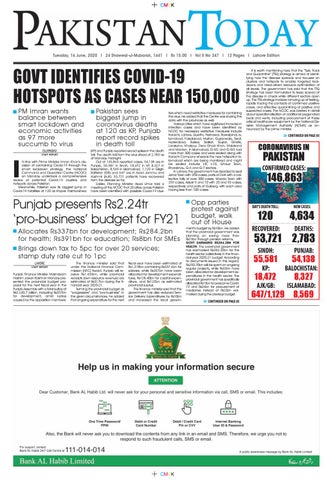
Govt identifies Covid-19 hotspots as Cases near 150,000 g
PM Imran wants balance between smart lockdown and economic activities as 97 more succumb to virus ISLAMABAD
i
STAFF REPORT
n line with Prime Minister Imran Khan’s decision of containing Covid-19 through the smart lockdown strategy, the national Command and Operation Centre (nCOC) on Monday undertook a comprehensive review of potential Covid-19 clusters and hotspots across Pakistan. Meanwhile, Pakistan saw its biggest jump in Covid-19 fatalities at 120 as Khyber Pakhtunkhwa
g
Pakistan sees biggest jump in coronavirus deaths at 120 as KP, Punjab report record spikes in death toll
(KP) and Punjab reported record spikes in the death toll. The death toll from the virus stood at 2,783 as of Monday midnight. Out of 145,863 reported cases, 54,138 are in Punjab, 55,581 in Sindh, 18,472 in KP, 8,327 in Balochistan, 8,569 in Islamabad, 1,129 in GilgitBaltistan (GB) and 647 are in Azad Jammu and Kashmir (AJK). 53,721 patients have recovered from the disease so far. Earlier, Planning Minister Asad Umar told a meeting of the nCOC that 20 cities across Pakistan have been identified with possible Covid-19 clus-
ters which need restrictive measures for containing the virus. He added that the Centre was sharing the data with the provinces as well. Various cities which have registered increase in infection cases and have been identified by nCOC for necessary restrictive measures include Karachi, Lahore, Quetta, Peshawar, Rawalpindi, Islamabad, Faisalabad, Multan, Gujranwala, Swat, Hyderabad, Sukkar, Sialkot, Gujrat, Ghotki, Larakana, Khairpur, Dera Ghazi Khan, Malakand and Mardan. In Islamabad, G-9/2 and G-9/3 had more than 300 cases and were sealed along with Karachi Company whereas the new hotspots in Islamabad which are being monitored and might be sealed include I-8, I-10, Ghauri Town, Bharakhau, G-6 and G-7 sectors. In Lahore, the government has decided to seal Johar Town with 358 cases, parts of DHA with a collective tally of over 300 cases, Wapda Town with 259 cases, Askari 9 and 10 with 20 and 93 cases, respectively and parts of Gulberg, with each area having less than 100 cases.
Punjab presents Rs2.24tr ‘pro-business’ budget for FY21 Allocates Rs337bn for development; Rs284.2bn for health; Rs391bn for education; Rs8bn for SMEs g Brings down tax to 5pc for over 20 services; stamp duty rate cut to 1pc g
LAHORE STAFF REPORT
Punjab Finance Minister Makhdoom Hashim Jawan Bakht on Monday presented the provincial budget proposal for the next fiscal year in the Punjab Assembly with a total outlay of Rs2,240.7 billion, including Rs337bn for development, amid ruckus caused by the opposition members.
The finance minister said that under the national Finance Commission (nFC) Award, Punjab will receive Rs1,433bn, while provincial receipts (own resource revenue) are estimated at Rs317bn during the financial year 2020-21. Terming the provincial budget as “progressive” and “pro-business” in the given circumstances, he added that ongoing expenditure for the next
fiscal year have been estimated at Rs1,318bn containing Rs337.6bn for salaries, while Rs337bn have been allocated for development expenditures, Rs128.40bn for capital expenditure, and Rs125bn as estimated provincial surplus. The finance minister said that the government has also reduced Service Delivery Expenditures by Rs10bn and increased the local govern-
CMYK
g
Opp parties protest against budget, walk out of House
ment’s budget by Rs10bn. He added that the provincial government was planning on saving more than Rs19bn through pension reforms. GOVT EARMARKS RS284.2BN FOR HEALTH: The provincial government has earmarked Rs284.20bn for the health sector collectively in the financial year 2020-21 budget. According to documents issued in this regard, Rs250.70bn will be spent on ongoing regular projects, while Rs33bn have been allocated for development expenditures in the health sector. The provincial government has specifically allocated Rs13bn to overcome Covid19 and Rs26bn for procurement of medicines instead of Rs23bn earmarked during the previous budget.
CONTINUED ON PAGE 05
It is worth mentioning here that the “Test, Track and Quarantine” (TTQ) strategy is aimed at identifying how the disease spreads and focuses on clusters and hotspots to enable targeted lockdowns and need-driven resource optimisation at all levels. The government has said that the TTQ strategy has been formulated to keep spread of the disease in check while different sectors open up. The TTQ strategy involves ramping up of testing, rapidly tracing the contacts of confirmed positive cases, and effective quarantining of positive and suspected cases. The nCOC was briefed in detail about operationalisation of additional oxygenated beds and vents, including procurement of these critical healthcare equipment by the national Disaster Management Authority (nDMA) as announced by the prime minister.
CONTINUED ON PAGE 05
Coronavirus in
pakistan
CONFIRMED CASES:
146,863
DAY'S DEATH TOLL:
NEW CASES:
120
4,634
RECOVERED:
DEATHS:
SINDH:
PUNJAB:
53,721 2,783
55,581
54,138
KP:
BALOCHISTAN:
AJK/GB:
ISLAMABAD:
18,472
8,327
647/1,129 8,569
02
Tuesday, 16 June, 2020
NEWS
Govt to face consequences if sc quashes reference aGainst Justice isa JUSTICE BANDIAL SAYS NO BAR ASSOCIATION HAS EVER ACCUSED JUSTICE ISA OF BEING DISHONEST
GOVT’S LAWYER TELLS SC IT APPEARS THAT PRESIDENT, PM, LAW MINISTER ARE ON TRIAL AND NOT THE JUDGE ISLAMABAD
t
STAFF REPORT
HE government’s counsel on Monday told the Supreme Court (SC) that the president, prime minister, and law minister were ready to face the consequences if the presidential reference against SC Justice Qazi Faez Isa is quashed. Dr Farogh Naseem, former law minister and currently the government’s counsel in the case against Justice Isa, submitted before members of the 10-judge full court that it appeared as if the top government functionaries were on trial and not the judge who has yet to explain the source of income for his family members’ properties.
“We are ready to face consequences,” said Dr Naseem, adding that the consequences would be across the board. Earlier, Justice Syed Mansoor Ali Shah had observed that the government is also accountable if the reference is not maintainable. “There should be consequences if the reference is quashed based on malice,” noted another judge, Justice Maqbool Baqar. Meanwhile, chief judge of the full court, Justice Umar Ata Bandial observed that no bar association has ever complained about Justice Isa being dishonest. None of the government’s allegations prove dishonesty of Justice Isa, he remarked. The federal counsel maintained that a judge is the most powerful person in society,
PM directs chief secretaries to control prices of essential items ISLAMABAD: Prime Minister Imran Khan has directed all provincial chief secretaries to formulate a joint strategy to control prices of essential daily-use items. Chairing a meeting to review steps taken by the government to control prices of essential items on Monday, PM Imran said that the reduction in petrol and diesel prices by the government was aimed at providing all possible relief to the people. He directed that all the provincial chief secretaries should formulate a joint strategy so that a common man may get benefit. It has been decided to further accelerate administrative measures against the hoarding of essential commodities in the meeting. Imran Khan directed the concerned authorities to envisage effective strategies for taking stern action against hoarders and profiteers. He said that the availability of pure goods reflects good governance so special attention should be paid to this issue. The chief secretaries of the provinces briefed PM Imran over the measures made for the reduction in prices of essential items in the country. Regarding the abundant supply of wheat in the country, the prime minister directed the National Price Control Committee to take all necessary steps in this regard to ensure the supply of flour to the people at reasonable prices. APP
no cash rewards for employees in fY21, fBr says ISLAMABAD: The Federal Board of Revenue (FBR) has changed its plan of giving cash reward/honoraria to its employees. This was informed by the FBR in a letter to all field formations, Inland Revenue Service/Pakistan Customs Service (IRS/PCS). "The competent authority has directed that no sanctioned/unsanctioned amount of cash reward/honoraria be disbursed by any field formations of FBR (IRS & PCS)," the letter stated. Earlier, the FBR had communicated that in order to give meritorious reward to the officials in BS 1-19, their performance would be categorised on a solid basis in three categories; A, B & C. Officials said that the tax department usually sanctions around Rs500 million cash reward to more than 20,000 employees every year, but no reward was given this time due to the "unsatisfactory performance" of the tax collectors. FBR is likely to collect around Rs3.908 trillion tax in this fiscal year, as against the original target of Rs5.55 trillion. On the other hand, sources said, FBR was also taking into account the fact the finance ministry did not award any honoraria to its employees, including those who prepared the budget. SHAHZAD PARACHA
Locusts exist in 40 districts, says nDMa ISLAMABAD: The National Disaster Management Authority (NDMA) Monday said that locusts exist in 40 districts of the country, including 29 districts in Balochistan, eight in Khyber Pakhtunkhwa and three in Sindh. A spokesperson of NDMA said that survey and spray operations to control locust are underway across the country. He said that survey of 312,000 hectares of area was carried out while 6,800 hectares were sprayed across the country during the last 24 hours. He said 5,300 hectares in Balochistan, 1,000 hectares in Khyber Pakhtunkhwa and 800 hectares in Sindh were sprayed during the last 24 hours. The spokesperson said that over 623,000 hectares of area has so far been sprayed across the country. He said that state-of-the-art equipment has been imported from China to control the pest, which also includes drones for spraying. He said micron sprayers from a UKbased firm will arrive soon which will help clear large swathes of territory from the pest. APP
and therefore, he argued, we must have confidence that the judge is free of controversy. The independence of the judiciary comes through integrity, and there should be good public perception of the judge, added Dr Naseem. At this, Justice Shah inquired whether the counsel admits that this is a case pertaining to independence of the judiciary. Justice Shah further asked the federal counsel whether a husband could seek his wife’s tax records from the Federal Board of Revenue. To this, Dr Naseem replied that he would have to ask the relevant officials. Under which law can the Supreme Judicial Council (SJC) ask a judge to disclose details of his wife’s properties, inquired Justice Shah. He observed that the public perception of a judge
can also be destroyed on social media. At this, Dr Naseem said that fake news could not destroy public perception but if a judge is unable to explain the source of his family members’ properties than it would influence his reputation before the public. Justice Bandial told the federal counsel that instead of relaying a violation of Section 116 of the Income Tax law his main focus is on the issuance of the show cause notice to Justice Isa by the Supreme Judicial Council. With regards to the show cause notice, Justice Maqbool Baqar noted that if the basis of the reference was illegal then all of the proceedings would be quashed. Referring to various SC judgements, Dr Naseem said that the office of a judge came
IHC may revoke stay order in sugar inquiry case ISLAMABAD STAFF REPORT
The Islamabad High Court (IHC) on Monday accepted the petition of a sugarcane grower from Rahim Yar Khan to be made a party in the sugar inquiry case, and also hinted that it may revoke the interim stay order which restricted the government from taken action against sugar mills owners upon being informed that sugar was not being sold at Rs70 per kilogramme as directed by the court. The court fixed the case for hearing on June 19 due to non-compliance on the rate of sugar, on which the stay was conditional. Additional Attorney General Tariq Khokhar told the court that sugar was not being sold at the decided price. He said that correspon-
dence with the millers continued but sugar was not available in the market at the rate of Rs70 per kg. IHC Chief Justice Athar Minallah expressed his annoyance at the failure to fix the price. He remarked that the interim stay was conditional on this matter, and the hearing of the case can be held sooner. The court fixed the hearing for June 19. The court admitted the farmer’s petition to be made party in the case after the government’s lawyer also supported it. Last week, the IHC issued an interim stay order, temporarily restricting the government from acting on the recommendations of the sugar inquiry commission report. Mill owners were directed to fix the price of sugar at Rs70 per kilogramme during this time, and they assured the court of the same.
The court is hearing the petition filed by the owners of 17 sugar mills including PTI stalwart Jahangir Tareen and the Pakistan Sugar Mills Association (PSMA) against the commission’s report. Notices were issued to Special Assistant to the PM on Accountability Shahzad Akbar, members of the commission including its head FIA Director General Wajid Zia and other officials seeking their response to the sugar industry’s plea. Sugar mill owners have maintained that the inquiry commission exceeded its constitutional authority in the preparation of the report by trespassing into the domain of the provinces. They also argued that the recommendations forwarded to the government by the commission did not fall within the ambit of the law.
Legendary PAF fighter pilot Group Captain (r) Saiful Azam passes away RAWALPINDI STAFF REPORT
Legendary fighter pilot Saiful Azam, who was awarded Sitara-i-Jura’at for his heroics in the 1965 war against India, breathed his last in Bangladesh capital Dhaka on Sunday morning, according to officials and media reports. The 80-year-old retired group captain died at his residence, local newspaper Jugantor said. He had been suffering from various old-age complications for a long time. Bangladeshi army’s mouthpiece Inter-Services Public Relations Directorate also confirmed the death to Anadolu Agency over the phone. “We came to know about his death but we have not published it on our official web page as he is a retired official,” ISPR Director Lt. Col. Abdullah Ibn Zaid said. Pakistan Air Force (PAF) Chief of Air Staff Air Chief Marshal Mujahid Anwar Khan expressed heartfelt grief on the demise of the great war veteran, according to a press release by PAF’s media wing. PAF chief paid rich
under the definition of public office and it is mandatory for a public servant that their family members’ lifestyle is not beyond the ostensible source of income. He maintained that his case was about the source of income. The bench asked Dr Naseem yet again as to why the government did not question Justice Isa’s wife about her source of income for the properties in question. If the wife purchased these properties through inherited income, would the judge be liable to reply, asked Justice Shah. In the same vein, Justice Yahya Afridi asked whether all judges should be asked about their family members’ tax concerns by the Supreme Judicial Council or by tax authorities. To this Dr Naseem said that disciplinary proceedings against a judge could only be initiated by the Supreme Judicial Council.
tribute to Azam, saying that the former fighter pilot will always be remembered for his professionalism and his part in the 1965 Indo-Pak and 1967 Arab-Israel wars. According to APP, Azam was born in then East Bengal’s Pabna District in 1941. He left home at 18 to enlist in PAF and was commissioned as a Pakistani fighter pilot in 1960. During the 1965 war, he served in No. 17 Squadron at PAF’s Sargodha base. Apart from inflicting heavy damage to Indian forces in 12 ground-attack missions, Azam also downed an Indian Air Force aircraft and was awarded Sitara-i-Jura’at. According to available records, Azam is the unique air force figure in the history of Bangladesh who took part in wars as a fighter pilot of three different countries — Jordan, Iraq and Pakistan. He is the only fighter pilot who downed four Israeli aircraft during the 1967 Arab-Israel war, which is also a world record. The United States government also awarded him as one of the world’s 22 “Living Eagles” for his outstanding war skills and courage.
court extends judicial remand of Mir shakil till June 29 LAHORE APP
An accountability court on Monday extended the judicial remand of Editor-in-Chief of Jang Group Mir Shakilur Rahman (MSR) in an illegal plots allotment case till June 29. Accountability Judge Syed Jawadul Hassan conducted the brief proceedings of the case wherein National Accountability Bureau (NAB) Prosecutor Asim Mumtaz and defence counsel appeared. The court adjourned the matter after it was apprised that Mir Shakil was admitted in hospital for treatment. Mir Shakil was taken into custody following his appearance in the anti-corruption watchdog’s office in Lahore on March 12, after he failed to give satisfactory answers during interrogation. The NAB had alleged that the accused obtained illegal exemption of 54 plots of one-kanal each in Johar Town Lahore, with the connivance of Nawaz Sharif, the then chief minister of Punjab, in violation of the exemption policy. It is pertinent to mention here that Mir Shakil had approached the Lahore High Court (LHC) for bail in the case.
eidul azha on July 31, fawad says NEWS DESK Minister for Science and Technology Fawad Chaudhry on Monday announced that Eidul Azha will be celebrated on July 31 according to the Islamic calendar issued by his ministry. Taking to Twitter, Chaudhry said that the Zil Haj moon will be seen “over Karachi and its peripheral areas on July 21”. The minister added that the moon could be sighted with the help of binoculars and in some areas, with the naked eye as well. He added that the “exact location” of the moon can also be determined through the Ruet App.
Court orders FIA to register case against US blogger ISLAMABAD STAFF REPORT
The district and sessions court of Islamabad on Monday directed the Federal Investigation Agency (FIA) to register a case against Cynthia Dawn Ritchie, a Pakistan-based US blogger who accused former minister of interior Rehman Malik of raping her in 2011. The blogger, 44, who is residing in Pakistan since 2009, got herself involved in a dogfight last month when she levelled indecent allegations against slain prime minister Benazir Bhutto on Twitter. Ritchie followed up her tweets with a string of allegations against top Pakistan People’s Party (PPP) leadership, including former premier Yousaf Raza
Gilani and former ministers Rehman Malik and Makhdoom Shahabuddin. Additional District and Sessions Judge Jahangir Awan, while taking up the petition of PPP Islamabad chapter President Raja Shakeel Abbasi against Ritchie, directed FIA to register a case
CMYK
against the accused. Abbasi had approached the court last Saturday after police refused to lodge a first information report (FIR) against Ritchie. In his petition, Abbasi stated that the blogger had made “baseless allegations” against Bhutto and sought legal action against her under Section 22-A of the Criminal Procedure Code (CrPC). During the hearing, Pakistan Telecommunication Authority (PTA) expressed its inability to proceed against Ritchie, saying the authority lacked the jurisdiction to proceed against an individual over a tweet. The PTA, however, suggested that in case there is any criminality related to Ritchie’s official social media accounts then there is a cybercrime wing of the
FIA to handle this. Earlier, the FIA opposed registration of FIR in this matter and claimed that the petitioner had no locus standi to become complainant in the mater for invoking the provisions of the Prevention of Electronic Crime Act, 2016. According to the act, the “bare reading of the law would reveal that only an aggrieved neutral person or his guardian can lodge a complaint. The right provided in subsection (2) to the aggrieved person or his guardian, in case the aggrieved person is a minor for applying the authority for removal of contents further substantiate that in the case under discussion, the law can be set in motion only on the complaint of either an aggrieved ‘natural person’ or his guardian”.
Tuesday, 16 June, 2020
NEWS
asif caLLs ex-iMf officiaLs in Pakistan ‘Mercenaries’, warns of More taxes PML-N LEADER CRITICISES ASAD UMAR FOR FAILING TO REDUCE GOVT’S EXPENDITURE ISLAMABAD
B
STAFF REPORT
EGINNING the debate in the National Assembly on the Budget 2020-21, Pakistan Muslim LeagueNawaz (PML-N) leader Khawaja Asif on Monday termed top government officials having a career history with the International Monetary Fund (IMF) as mercenaries, saying the budget for the upcoming fiscal year was a “temporary one”. “There will be a mini-budget and more taxes will be imposed,” Asif said. “These are mercenaries; why are they brought [to power]?” The PML-N leader, taking note of the ongoing coronavirus pandemic, said he honoured the healthcare professionals — including doctors, nurses, and paramedical staff — for not only putting their own lives on stake but also potentially risking their families as well. “This government’s policies are against them,” he added. The former foreign minister said the incumbent PTI-led government was drawing back economically; “in fact, it has acknowledged defeat without saying it publicly,” he said. Comparing the current government’s performance with that of the prior one led by the PML-N, he said growth in gross domestic product (GDP), agriculture, large-scale manufacturing, industrial, and service sectors were 5.5 per cent, 4pc, 5pc, 4.9pc, and 6.2pc, respectively; the same under Prime
Minister Imran Khan’s “Naya Pakistan”, however, were -0.4pc, 2.7pc, -0.78pc, 2.6pc, and -0.6pc, respectively, he noted. Similarly, tax collection, inflation, gross public debt, debt-to-GDP ratio, and exports were Rs3,842 billion, 3.9pc, Rs24,953bn, 72.1pc, Rs24.8bn, respectively, during Nawaz Sharif’s era and Rs3,844bn, 11.2pc, Rs35,207bn, 85.0pc, Rs19.7bn, respectively, during Imran Khan’s tenure. The fiscal deficit-to-GDP ratio, public sector development programme (PSDP), the government’s running expenditures, and unemployment were -6.6pc, Rs750bn, Rs402bn, and 5.8pc, respectively, during the PML-N tenure, whereas the same under PM Imran’s administration were -9.2pc, Rs623bn, Rs475bn, and 8.5pc, respectively. “The figures explain everything,” Asif said. “Unemployment is rising and millions of people are becoming jobless,” Asif said. “Imran Khan was brought with great desire and pampering.” UNFULFILLED CLAIMS: On government’s running expenditures, he said Planning Minister Asad Umar had repeatedly claimed that it would be reduced. The PSDP is a stimulus for economic activity, he noted, but millions of people were becoming unemployed. “There were a lot of claims previously, even today, while presenting the budget, they were claiming that the budget was transparent and corruption-free one,” the
PLANNING MINISTER REJECTS CRITICISM, SAYS FOREIGN INVESTMENTS AND RESERVES HAVE INCREASED UNDER PTI GOVT doned our years-long practice,” he said. Asif said while the list of corruption and accountability claims against the PPP and PML-N was quite long, “no attention is given to foreign funding and BRT case.” Referring to the Billion Tree Tsunami project, the PML-N leader asked about its progress to which the speaker said he would give him a visit. “Nations are ruined when the love of power overcomes the basic instincts of humanity,” he noted, adding that the current government was raking in money from helpless people even in these tough times of the coronavirus. “There will be 1.2 million patients of coronavirus by July, according to international surveys. The Imperial College London’s research study has given a date and projections that 80,000 people will die in a day due to the coronavirus “[PM] Imran Khan kept negating the severity of the virus, termed it a flu in the past days when strict measures were required to contain the disease,” Asif said. ‘LOCKDOWN INEFFECTIVE POLICY’: After Asif concluded his speech, Umar, the planning minister, retorted, saying: “Nawaz Sharif used to call fascist [Indian Prime Minister] Narendra Modi for visits to Pakistan. Giving the example of India, the minister said the country had 653 coronavirus cases as of March 25 and then, in June, they
PML-N leader said. Asif said the PTI chief had earlier vowed against obtaining debts from the IMF and other international organisations. The incumbent ruling party had previously claimed that the amnesty scheme was for thieves but they have used it for their own benefit, he added. “They had promised to punish the Sahiwal [incident’s] culprits but they freed them all later after giving them cheques at the chief minister’s house,” he said. The former foreign minister said the government should have benefited from the falling interest rate but Pakistan “incurred a loss of about Rs1.5-1.7 trillion on interest rate”. “We kept asking the State Bank of Pakistan Governor [Dr Reza Baqir] and the Public Accounts Committee (PAC) about the hot money and have exited after earning with a 13.5pc policy rate,” he said. “The undertakers of Pakistan’s current economy, Dr Hafeez Shaikh and SBP Governor should be put on the ECL [exit control list],” he warned, saying both should be given targets and sign performance bonds. “Don’t make a mess out of country’s economy. The ordeal of corruption goes on unabated,” he added. Asif also called for aiding the public servants during the pandemic. “You should have compensated the government employees during these hard times of crisis. They work hard day and night. They have aban-
APP
Prime Minister Imran Khan on Monday directed for setting up a special cell under the Naya Pakistan Housing Authority and comprising representatives from the State Bank of Pakistan (SBP), relevant ministries, provincial governments and their departments concerned for better coordination and fast track resolution of the construction-related issues. He was chairing a meeting to review progress on the steps taken under Naya Pakistan Housing project for the construction of
houses for the low income group and promotion of construction sector. Naya Pakistan Housing Authority Lt Gen (r) Chairman Anwar Ali Haider and senior officials whereas SBP Governor Reza Baqir, former finance minister Shaukat Tareen, Arif Habeeb, Mudassar Khan, Aqeel Kareem Dhedhi, Hassan Bakhshi and others attended the meeting via video link, according to a press release. During the meeting, the prime minister directed that with the consultation of commercial banks, the recommendations formulated by a think tank for expediting construction under the Naya Pakistan Hous-
ing project, should be finalised so that creation of financial resources for the construction of houses could be ensured. Addressing the participants, he said the government was providing Rs30 billion for the completion of Naya Pakistan Housing project so that it could be expedited to provide affordable residences to the low income groups. He said due to coronavirus pandemic, the government paid special attention to the promotion of construction sector to ensure provision of houses to the low income groups, besides creating employment opportunities for labourers and the poor people.
Punjab allocates Rs13.3bn for livestock, dairy sector for FY2020-21 LAHORE HASSAN NAQVI
The Punjab government has allocated Rs13.3 billion for the livestock and dairy sector in the provincial budget for the fiscal year 2020-21. Out of the total budget announced for the livestock and dairy sector during the budget session in the Punjab Assembly on Monday, Rs 11.6 billion has been allocated for non-development projects while Rs1.7 billion has been allocated for development projects. The provincial government has allocated Rs375.2 million for enhancing beef production, Rs116.2 million for propagation of backyard poultry, Rs100 million for provision of veterinary services in rural areas of Punjab, Rs82 million for the improvement of breed through Progeny Testing Programme (PTP), DNA bank and enhancement of non-descript cattle and Rs300 million for provision of veterinary services and capacity building in Rajanpur. “95 per cent of Pakistan’s dairy sector is informal which sells loose milk. The government has already placed a ban on the sale of loose milk from 2022 onwards. However, no allocation has been made for the capacity building of the informal dairy sector to ease this transition,” said Tajammal Mehdi, a dairy development
expert, while talking to Profit. “We often hear that the Punjab Food Authority (PFA) has disposed off thousands of liters of hazardous milk. That's not enough. The government needs to invest in capacity building of the informal dairy farmers and invest in educating them about pasteurisation,” he said. He added that the quality of loose milk can be greatly improved by implementing farm to sale point safety interventions and by ensuing minimum pasteurisation. Milk pasteurisation is a process that uses mild heat to eliminate pathogens from milk and extend its shelf life. “The process is intended to sterilise food by destroying or deactivating organisms that contribute to spoilage,” said Tajammal Mehdi. Mehdi stressed that across the world milk is recognised as a key source of nutrition and governments are increasing regulations and introducing minimum pasteurisation laws to ensure milk quality in order to safeguard the public’s health. He demanded that considering the health hazards of loose milk, a nationwide minimum pasteurisation law should be implemented to save people from consuming bacteria contaminated milk. “All types of milk and dairy products have the potential to transmit pathogenic (disease-causing) organisms to humans. That is why it is important to ensure a regulatory framework for minimum pasteurization of milk,” he said.
said that could not control the situation despite a lockdown and more than 100,000 infections were reported. More than 5,500 people had lost their lives due to coronavirus during the strict lockdown, he noted. “The lockdown is an ineffective policy and a menace for developing nations like Pakistan,” he stressed, adding that an Indian minister had said Modi inflicted an unprecedented damage on the economy by pushing millions below the poverty line. Responding to Asif, he said the PML-N leader had in the past alleged that Shaukat Khanum Memorial Cancer Hospital & Research Centre is a fraud and “it generated the most funds that year, people donated the most that year”. “They are projecting that the PTI’s popularity has ended now but the picture is completely opposite. Foreign investments and reserves have increased but Khawaja Asif did not talk about that. “We have improved the annual exports with 4pc and 11pc, according to the latest figures. A 2.8pc increase in agricultural sector [was recorded] before Covid-19 hit the country,” Umar said. Asif, he added, misquoted the figures about the PSDP. He raised an important question about hot money and being the supreme power, the Parliament should know about the facts. “PM Imran Khan responded to the Supreme Court’s question about his assets for eight months and was declared honest and truthful after the investigation,” he said. Talking about the National Accountability Bureau (NAB) and its functioning, the minister said it was the national corruption watchdog running according to the laws framed by the PML-N while its chief was appointed by the same party as well. “Stop blaming Imran Khan for its policies,” he said. Responding to the PML-N leader’s suggestion to prevent Shaikh, the PM’s finance adviser, and SBP Governor Dr Baqir from leaving the country, Umar said: “I have stopped believing in the ECL now.”
Centre deducts Rs154bn from KP’s share in NFC Award for FY20
PM wants special cell for resolving construction sector's issues ISLAMABAD
03
PESHAWAR: The federal government has deducted Rs154.164 billion from Khyber Pakhtunkhwa’s (KP) share in the National Finance Commission (NFC) Award for the financial year 2019-20.KP is already is facing severe financial problems due to federal cuts and non-payment of its NFC Award and the net hydel profit.The federal government had to pay 1 per cent distributable revenue in the fiscal year 2019-20 under the NFC Award to the provinces and in the fight against terrorism. Therefore, the KP government was to be given Rs533.26 billion, but due to low federal revenue, Rs379.97 billion were paid to the province, which is Rs 154.164 billion less than the allocated amount.The federal government has now promised to give Rs477.51 billion to KP in the next financial year 2020-2021, which is 10 per cent less than the financial year 2019-20. The Centre is likely to provide Rs55.74 billion less to KP next year.According to the budget documents for the next financial year, the federal government had allocated Rs1,611.364 million in the NFC for the financial year 2019-20, of which Rs1,135.447 billion had been provided to Punjab, Sindh had been provided Rs592.321 billion out of its share of Rs814.916 billion, Balochistan was paid Rs295.214 billion and KP was provided Rs379.097 billion out of its share of Rs533.261 billion. AZIZ BUNERI
Punjab allocates Rs39.6bn for agriculture, food security LAHORE HASSAN NAQVI
The Punjab government has allocated Rs39.6 billion for agriculture and food security in the provincial budget for the fiscal year 2020-21. During the budget session held in the Punjab Assembly on Monday, it was announced that out of the total allocation for agriculture and food security, Rs31.7 billion are for non-development expenditure and Rs7.9 billion have been kept for development expenditure. The provincial government also allocated Rs4 billion to deal with locusts and other natural catastrophes, of which Rs1 billion will be provided to the Provincial Disaster Management Authority (PDMA). The government earmarked Rs4 billion as subsidy on agricultural inputs; Rs1.86 billion for interest-free loan scheme for farmers, providing a subsidy of Rs36,000 per farmer; and Rs1.68 billion to enhance crop productivity of wheat, rice, sugarcane and oilseeds. The provincial government has also allocated Rs500.2 million for construction of modern silos, Rs400 million for matching grants under Agricultural Innovation and Development Enterprise (AIDE) fund, Rs50 million for provision of happy seeder and rice straw
choppers at 80pc subsidy under mechanised management of rice crop residue programme to combat smog and Rs86.6 million for mobile food sampling and inspection infrastructure. “This is the same old system which has been in place since the last three or four decades in which figures go up and down. The direction of the government is the same, and that direction is wrong,” said Asif Sharif, an agriculture sector expert, while talking to Profit. According to Sharif, despite Punjab's environment, temperature and atmosphere that is suitable for crop production, the land and soil of the province is fast losing its ability to absorb water and the province's water resources are diminishing. He added that these factors lead to the deteriorating quality of food production in the province and greatly increase the cost of food production. “Our agricultural exports have declined by 30 to 40pc in the last few years. Unless we do focused and targeted crop production and educate our farmers our agriculture sector will continue to suffer,” he said while further stressing on the need to concentrate on increasing soil fertility in the province. “All these budgetary proposals are good for nothing. Instead, they will only increase problems instead of mitigating them,” he added.
04 LAHORE
Tuesday, 16 June, 2020
PRAyER TIMINgS
WEATHER UPDATES TUESDAY
420C
290C
WEDNESDAY
410C
280C
THURSSDAY
420C
290C
FAJR SUNRISE
ZUHR
ASR MAGHRIB ISHA
3:27
11:59
4:52
5:02
6:57
8:33
anti-polio drive to be re-launched in province from July LAHORE APP
The Punjab government will re-launch anti-polio drive from mid-July this year by following all standard operating procedures (SOPs). A spokesperson of the Punjab Primary and Secondary Healthcare department said that discussion for the implementation of SOPs had been completed. Secretary Primary and Secondary Health Care (PPSHC) M Usman informed that representatives of the World Bank, all provinces and other countries participated in the discussion and embarked upon a short-term and long–term joint action plan in the joint discussion. He said that training would be organised for polio workers before launching the drive. It is pertinent to mention here that polio drive has been suspended due to Covid-19.
sarwar informs Qureshi of international support on kashmir issue LAHORE APP LAHORE: A farmer carries a rice bundle from a field for re-plantation in another field. A paddy field is a flooded parcel of arable land used for growing semiaquatic rice. ONLINE
Govt announces 15-day selective lockdown in lahore LAHORE STAFF REPORT
Amid a rapid surge in the number of positive Covid-19 cases in the province, Punjab Health Minister Dr Yasmin Rashid on Monday announced a 15-day selective lockdown in Lahore which would come into effect from Tuesday midnight. Addressing a press conference, Dr Yasmin said that selected neighbourhoods, including Shahdara, Mozang, Walled City, Harbanspura, Nishtar Town, Allama Iqbal Town, would be locked down completely from midnight. According to the health minister, more than 300 cases had been recorded in each of these areas which is why the
decision to enforce a lockdown was taken there. However, she said pharmacies, tandoors, and dairy shops would remain open in these areas and so would any factories that are making protective equipment. “These areas will be locked down for at least two weeks and then we will observe the results,” she added. The provincial health minister lamented the “wrong” criticism the Pakistan Tehreek-e-Insaf (PTI) government received for her allegedly loose handling of the pandemic. “If [you say that] our government has failed, so has every other government in the world,” she said. “The media is comparing us to New Zealand and Taiwan. The population of
New Zealand is half [about 5 million] of that of Lahore’s. Controlling the virus there is much easier than controlling it in a thickly populated country like ours,” she observed. People do not understand that this is a viral infection. Even in China, where they followed strict measures with commendable discipline, there is a resurgence of cases.” Beijing reported its second consecutive day of record new numbers of positive Covid-19 cases on Monday, adding urgency to efforts to rein in a sudden resurgence of the coronavirus in the Chinese capital. Dr Yasim said that people believe that ventilators are the only resort for coronavirus patients and debunked this miscon-
ception. She assured the people that the government was ensuring provision of ventilators and ICU beds at all hospitals in the city. “People do not understand that this is a viral infection,” she said. “It is very important to understand that we can only fight the virus by wearing masks and social distancing.” Punjab has reported more than 54,000 coronavirus cases — the highest in any province. The death toll in the province is also the highest and has crossed the 1,000 mark. As of Monday morning, the number of deaths in the province stood at 1,031. Pakistan has reported a total of 2,729 deaths with the most being reported in Punjab.
Governor Punjab Chaudhry Mohammad Sarwar called on Foreign Minister Shah Mehmood Qureshi and informed the latter about his contacts with European and British Members of Parliament regarding Indian government’s atrocities against the Muslims and Kashmiris. During a meeting at the Ministry of Foreign Affairs (MOFA) in Islamabad, he said, "I met European and British officials on Indian atrocities against Indian Muslims and extrajudicial killings of innocent Kashmiris. The Governor Punjab said more than 15 members of the European Parliament, including Vice President of European Parliament Fabio Castaldo, wrote a letter to the European Parliament against Indian atrocities and promised to speak out against Indian atrocities at other forums, including the European Parliament. He said the European and British Members of Parliament were closely monitoring India's war frenzy and the atrocities of Indian security forces against innocent people, adding that Today, the world was standing by Prime Minister Imran Khan’s vision of regional peace, and India was facing a dilemma on every front. Foreign Minister Shah Mehmood Qureshi appreciated the efforts undertaken by the Governor Punjab Chaudhry Mohammad Sarwar to expose India government at all forums. The Foreign Minister said Pakistan had exposed India through effective diplomacy.
LHC directs authorities to ensure availability of Actemra injections LAHORE STAFF REPORT
LAHORE: Artists protest outside the Lahore Press Club for the acceptance of their demands. ZUBAIR MEHFOOZ
The Lahore High Court (LHC) on Monday directed the provincial authorities to ensure availability of coronavirus medicines on affordable rates. While hearing a petition against selling Actemra injection on high prices, the court issued summons for representatives of concerned departments on June 17. Notices were also issued to federal and provincial governments in this regard. Meanwhile, the Punjab Healthcare Commission (PHC) allowed private hospitals to
purchase Tocilizumab (Actemra) injection to treat the critically ill patients of coronavirus. The provincial government had approved the use of Actemra last month in the wake of a sudden rise in the death rate reported by state-run hospitals across the province. The 400mg injectable drug — an interleukin-6 inhibitor which goes by the generic name of tocilizumab — will be prescribed to patients who develop lung complications and an abnormal level of IL-6 in the blood. IL-6 is an endogenous chemical that causes inflammation. According to the official directives, the hospitals with at least five or more dedicated beds for pandemic patients were allowed to
purchase the injection. According to multiple reports which cited official sources, the price of each dose of the injection is Rs60,000 and it would be given twice to patients under treatment at an Intensive Care Unit (ICU) in a life-threatening condition. The acquirement of the injection however would be subject to official permission. A twomember committee will issue a formal letter to the hospital’s administration after inspecting the patient. Moreover, the hospitals would submit the record of purchase and usage of the drug to the commission. PHC would also monitor and audit the use of injections in private hospitals.
Minister commends provincial govt for presenting tax-free, balanced budget LAHORE INP
Punjab Minister for Industries & Trade Mian Aslam Iqbal while expressing his views on the provincial budget complimented that Punjab government under the able leadership of Chief Minister Usman Buzdar has presented an excellent budget despite facing difficult economic situation. Aslam Iqbal commended that effective steps have been proposed for the welfare of financially deprived segments in the budget. He further appreciated that Punjab government on the pattern of federal
government has written a new history by presenting a tax-free budget. He further lauded the financial team for presenting a balanced and welfare-oriented budget. The provincial Minister also welcomed tax exemption in the upcoming budget for promoting small and medium scale business. He maintained that with the introduction of markup subsidy and credit guarantee schemes, the economic activities and employment opportunities will be enhanced. He disclosed that a huge amount of Rs8 billion has been allocated for the promotion of SME sector. He fur-
ther added that in order to cater the needs of industry, Rs6 billion 87 crore have been allocated for preparing skilled human resource. Aslam Iqbal apprised that during the upcoming financial year such projects will be introduced which will increase additional employment opportunities. He outlined that with the introduction of skilled youth programme, skill development, online learning and introduction of new technical education courses will usher positive changes. He further disclosed that more steps are being taken for providing ease in doing business.
The provincial minister maintained that with the introduction of more than Rs56 billion tax relief, budget, business-friendly policies of the government will be strengthened. He informed that industrial estates of Lahore, Bahawalpur and Faisalabad will be completed on priority basis as with its completion economic and financial activities will be escalated. Aslam Iqbal intimated that projects worth Rs165 billion have been earmarked under public-private partnership and vowed that PTI government will continue to undertake steps for the provision of relief for the masses.
Tuesday, 16 June, 2020
NEWS
05
FinanCial seCtor exPanDeD 11.7PC in 2019: sBP SBP ISSUES FINANCIAL STABILITY REVIEW CY19, NOTES INCREASE IN FOREX RESERVES, STABILISATION IN MARKETBASED EXCHANGE RATE AND CONTRACTION IN FISCAL DEFICIT KaraCHi
P
MEIRYUM ALI
AKISTAN’S financial sector had sluggish growth during the early part of 2019, but began to stabilize towards the end of the year, according to a publication issued by the State Bank of Pakistan (SBP) on Monday. The SBP’s annual publication, 'Financial Stability Review for CY19', reviews the performance and assesses the risk of banks, non-banking financial institutions, and the corporate sector. As per the review, the consolidated asset base of the financial sector expanded by 11.74pc during the calendar year 2019, which was higher than the 7.46pc growth recorded in the previous year. Most of this growth came from the banking sector, which is the largest segment of the financial sector.
Govt identifies Covid-19 Continued from page 01 The forum was told that a total of 2,150 additional oxygenated beds would be functional by end of July to meet additional requirement, and 1,000 oxygenated beds would be functional by end June and another 1,150 by end of July. BALANCING HEALTH AND ECONOMY: Separately, PM Imran, while chairing a review meeting on the coronavirus situation, directed the provinces to impose smart lockdown in the affected areas by creating a balance between precautionary measures and economic activities in the upcoming difficult weeks. The premier said the provinces have been issued directions for smart lockdown in the affected areas, adding that steps should be taken while keeping in view the ground realities so that a balance is created between precautionary measures and economic activities. He emphasised the pivotal role of the general public in curbing the spread of coronavirus across the country by adopting precautionary measures. He said the government, on the basis of latest estimates, is taking all necessary steps to protect the people from the deadly virus. Expressing satisfaction on provision of protective clothing and kits in the country, PM Imran directed the local leadership to review the Covid-19 facilities in hospitals in their respective areas in cooperation with the administration and also play a vibrant role in ensuring people’s cooperation in following the standard operating procedures (SOPs). The prime minister, while taking notice of the difficulties in the availability of some medicines and injections used for treating Covid-19 patients, directed the chairman of the NDMA to ensure their supply. The meeting was apprised that 107 laboratories are working in the country for coronavirus tests and 25,000 tests are being conducted daily. The number of ventilators in the country is 4,800 while another 1,600 will be added soon.
"Financial markets—after remaining volatile in the first half of CY19—observed stability in the second half as operations in the foreign exchange market smoothed after the transition to a market-based exchange rate system," the review noted. According to the review, the equity market also showed a significant recovery towards the end of 2019, after having been volatile earlier in the year. The SBP said the banking sector remained resilient, with robust solvency backed by healthy profitability. The Capital Adequacy Ratio (CAR) improved to 17pc, well above global and domestic minimum regulatory requirements of 10.5pc and 11.5pc, respectively. Earnings of the banking sector surged by 14.3pc to Rs170 billion in 2019, a turn around after the contraction of the previous few years. The higher interest income of the sector improved the Net Interest Margin (NIM) to
4pc, a 60 basis points rise over the last year. Accordingly, profitability indicators like the return on assets and equity also increased. While demand for financing weakened, bank assets expanded by 11.73pc in 2019, primarily, due to a surge in investment in treasury instruments. Though asset quality saw some deterioration, most of the NonPerforming Loans continued to be fully provisioned. Encouragingly, the deposit base also exhibited a marked recovery, expanding by 11.92pc, and provided the resources to support asset growth. Islamic Banking Institutions also saw their assets surge by 23.52pc, and their profitability also increased, bolstering the overall earnings of the banking sector. However, despite the healthy inflow into their deposits, these banks continue to face limited Shariacompliant investment opportunities. The performance of non-banking financial institutions remained steady in 2019, considering their risk-averse behaviour and a challenging environment. Their assets observed strong expansion of 58.12pc during 2019, mainly driven by 96.47pc expansion in investments. Advances growth accelerated to 11.63pc during 2019, against 7.39pc in 2018. However, the review noted that the strategy of funding assets through short-term
borrowing may not be sustainable in the long-term. "Lack of longer tenor affordable funding remained a major challenge for DFIs in expanding their advances portfolio," the review said. The corporate sector assessment was based on a sample of the top 100 listed companies. The profitability and debt repayment capacity showed improvement while sales, solvency and asset efficiency indicators trended downwards in 2019. Automobiles, energy and cement sectors also faced major contractions in sales. During the period under review, tighter financial conditions and higher input prices pushed the cost of doing business up and demands for goods down for the corporate sector. There was a deceleration in the growth of the corporate sector’s assets, to 7.1pc in CY19, against 16.1pc in CY18. The review also stressed that stabilization measures had helped reduce the uncertainty from Pakistan’s external and fiscal imbalances by year-end 2019. “There were early signs of an economic revival as foreign exchange reserves increased, the marketbased exchange rate stabilized, the fiscal deficit contracted, and economic activity, particularly the Large Scale Manufacturing, revived,” noted the review. COVID-19 SHOCK: According to the SBP,
Govt senators back federal budget as Opp demands relief measures iSLamaBad APP
The Senate on Monday started the debate on a motion to make recommendations to the National Assembly on the Finance Bill, 2020, with the members from treasury benches backing it and the opposition calling for more relief measures. Taking part in the debate, Leader of the House Dr Shahzad Waseem said that the government would appreciate the collective wisdom of the august House and hoped for positive suggestions form the members for incorporation in the finance bill. He said that the government under the leadership of Prime Minister Imran Khan would take all decisions in the larger interest of the people and the country. Dr Shahzad said that the budget documents had a complete roadmap for future progress and reflected the vision of leadership. It revolved around three principles, including empathy/compassion, sacrifices and reforms, he maintained. He said that the government had announced a stimulus package of Rs1.2 trillion for the poor segments of the society, and small businesses, and amount of Rs150 billion was disbursed among the poor families and Rs200 billion among the daily-wagers and labourers. The utility bills’ payment was deferred for three months and Rs100 billion was specified for the small business sector, he added. Dr Shahzad said that PM Imran himself gave a sacrifice and
slashed the allocations for the PM House by Rs180 million. He said that the reforms process had been expedited in all the public sector enterprises to make them profitable, for the first time in the country’s history, the sugar scandal report was made public, he added. He also said that the past rulers had posted their blue-eyed officials in various institutions to protect their personal business. He further said that the Pakistan Tehreek-e-Insaf government had completed some 149 projects till June under the Public Sector Development Programme (PSDP), while Rs650 billion were allocated in the budget for the PSDP 2020-2 for launching various development projects in all the provinces which would help create job opportunities. Regarding health issues, Dr Shahzad said that it was the basic responsibility of the provinces to strengthen health facilities in their respective jurisdictions as health had already been devolved to them under the 18th Amendment, however, the federal government fully supported the provincial governments in the wake of Covid19 pandemic and provided them all the required equipment. He said that during the critical situation, the chain supply across the Pakistan remained stable. The government announced an agriculture package worth Rs100 billion, besides allocating hefty amount for agriculture emergency programme. Similarly, he added, Rs10 billion were earmarked for locust control.
Dr Shahzad said that as the role of information technology was very important in the current era, the government allocated huge amount for IT-related projects to digitise Pakistan and to promote knowledge economy for creating more jobs. Similarly, steps were being taken for ease of doing business in the country, he added. Regarding Covid-19, Dr Shahzad said that the government took consistent and timely decisions to cope with the pandemic despite limited resources. Continuous monitoring and evaluation of situation was being carried out, he added. He said that the world economies have also shrunk due to Covid-19 and the gross domestic product (GDP) of developed countries, including United Kingdom, Spain and Italy, had also decreased while around 20 million people became jobless in the United States. He also said that the PTI government had inherited a fragile economy with a loan of Rs30,000 billion and the country on the brink of default. It paid special attention to the economy and managed to reduce the current account deficit from $20 billion to $3 billion, he added. The incumbent government, Dr Shahzad said, also repaid loans of Rs5,000 billion, which were acquired by the past regimes and the import bill was reduced while exports were increased in the short time. Similarly, he said, the revenue collection witnessed record 17 per cent increase. The international rating institutions, including Moody’s and Bloomberg declared Pakistan ratings better, he added.
the banking sector should remain resilient to the Covid-19 shock under most reasonable shock scenarios, as per various stress tests that have been conducted. This, according to the SBP, reflects the strong capital and liquidity positions of the majority of banks. Strong capital buffers built over the years have also significantly enhanced the resilience of Pakistan’s banking sector. The review noted that the ‘dismal impact’ of COVID-19 on Pakistan is still unfolding. SBP has taken a number of measures, such as substantial monetary easing; release of capital buffers; deferment of the repayment of the principal loan amount for corporate, SMEs, and household borrowers; restructuring of loans; concessionary financing to save jobs and boost health care to combat COVID-19; ensuring availability and continuity of financial services; and reduction in payment system-related costs. According to SBP, these measures have started bearing results as banks have approved debt deferment of around Rs495 billion and rescheduling of PKR 70 billion to around seven hundred thousand borrowers. Under the refinance scheme to avoid layoffs, around Rs93 billion have been approved for 1,172 companies covering about eight hundred and fifty thousand employees.
Petroleum Division says protest near gas field might hamper supply, asks KP govt to take action LaHore STAFF REPORT
The Petroleum Division has taken notice of the attempt to mobilise agitation and protests in District Kohat and has asked the Khyber Pakhtunkhwa (KP) government to take action against the protesters who could possibly threaten the supply of gas and oil from nearby Khyber Oil and Gas Field. According to a press statement issued by the division staging protests within two kilometres (km) of an active oil and gas field is an illegal act. “The Petroleum Division has drawn attention of the KP government to this (protest) and requested for action to ensure no untoward activity takes place which could stall the continued supply of oil and gas from the site areas,” read the press statement. The secretary petroleum in his letter to KP chief secretary has also requested that directions be issued to concerned departments to ensure that the supply and transportation of gas and oil from Tal Block will not be hampered. “The Ministry of Energy (MoE) values the international investments in the exploration and production sector of Pakistan and is closely monitoring the situation and such rabble will not be tolerated at any cost,” said the press statement issued by the Petroleum Division. Earlier on Monday, The LHC summoned the principal secretary to the prime minister, secretary petroleum, OGRA chairman and others on June 17, to appear before the court in a case related to the shortage of petroleum products in the country.
Punjab presents Rs2.24tr ‘pro-business’ budget for FY21 Continued from page 01 The provincial government will spend Rs6bn on upgradation and provision of missing facilities in the district headquarters hospitals of Dera Ghazi Khan, Gujranwala, Sahiwal as well as the Institute of Urology and Transplantation Rawalpindi, Nishtar Hospital Phase-II Multan, Mother and Child Block Sir Ganga Ram Hospital, Upgradation of Radiology/ Specialties Department Services Hospital Lahore and establishment of Institute of Pediatric Cardiology and Cardiac Surgery at the Children Hospital. It will also provide important facilities in the Wazirabad Institute of Cardiology, Institute of Neuro-Sciences Lahore and Pakistan Kidney and Liver Institute Lahore during the current financial year. The government earmarked Rs12bn for Insaf Health Cards initiative, which will be introduced across the province. An amount of Rs11.46bn has been allocated under the Department of Primary and Secondary Healthcare Development budget and it will be spent on upgradation of DHQs
hospitals situated in the underdeveloped areas, establishment of new mother and child hospitals and revamping of all DHQs and 15 tehsil headquarters hospitals. The government will initiate a comprehensive programme to control Covid-19, Hepatitis, AIDS and Tuberculosis (TB). It has also earmarked Rs1bn to keep 196 basic health units operational round-the-clock for seven days under the Prime Minister’s Health Initiative. The government has allocated Rs1.7bn for Integrated Reproductive Maternal Newborn Child Health and Nutrition Programme. Bakht said that more than Rs391bn are being allocated for education sector. Out of it, Rs350.10bn will be spent on School Education Department which will ensure provision of scholarships to more than 500,000 female students and free text books for all. RS9.35BN ALLOCATED FOR DEVELOPMENT: An amount of Rs9.35bn has been allocated under the development budget by the Punjab government for ongoing schemes including medical education, specialised healthcare and miscellaneous and
tertiary care hospitals of specialized healthcare and medical education while Rs250m would be spent on new schemes of the sector and Rs12.55bn have been allocated for other development programme (ODP). An amount of Rs11.462bn has been earmarked in development budget 2020-21 for primary and secondary healthcare in which Rs9.502bn has been allocated for ongoing schemes under the primary and secondary healthcare, including Rs25m for local development programme, Rs3.238bn for preventive healthcare, Rs548.699bn for primary healthcare, Rs1.293bn for research and development, Rs3.349bn for secondary healthcare and Rs1.049bn for special initiatives. In the development budget, an amount of Rs1.960bn has been allocated for new schemes of primary and secondary healthcare, including Rs1.9bn for two new schemes of preventive healthcare, Rs10m for one scheme of primary healthcare and Rs50m for one new scheme of secondary healthcare. In his budget speech, the Punjab finance minister said that the provincial government
has decided to include the private sector to meet its development needs through innovating financing. He said that Punjab Public Partnership Authority has been setup which has identified mega projects worth Rs165bn for the next fiscal year. These projects include Lahore Ring Road Phase 4, Multan Vehari Dual Road, Nala Layi Expressway, Rawalpindi Ring Road and provision of Water Meters. Bakht said that Rs15bn are being allocated for Community Development Program. He said that Rs8bn are being allocated for development of micro, small and medium enterprises. He said that an allocation worth Rs6.87bn has been made for Technical and Vocational Education Authority out of which Hundermand Jawan Program is being launched at a cost of Rs1.50bn. TAX RELIEF: The finance minister also announced the biggest tax relief package of provincial history for business community which will also provide relief to public as well. Under this package, tax rate on health insurance and doctors’ consultancy fees and
hospitals will be made zero from current rate of 16 per cent and 5pc, respectively. He said that tax rate on more than 20 services, including small hotels, guests houses, marriage halls, laws, caterers, IT services, and tour operators will be brought down from 16pc to 5pc. He said that current rate of stamp duty rate will be brought down from 5pc to 1pc during next fiscal year which will help in promoting construction industry and create new job opportunities. OPPOSITION PROTESTS:The opposition parties staged a loud protest during the finance minister’s speech. They held placards inscribed with slogans against the budget. Members of the opposition parties, including the Pakistan Muslim League-Nawaz (PML-N) and Pakistan People’s Party (PPP), also attempted to besiege the finance minister’s seat during the speech. However, after protesting for several minutes, the opposition members walked out of the session. Punjab Assembly Speaker Chaudhry Pervez Elahi adjourned the session until Thursday 2pm after completion of day’s agenda.
Tuesday, 16 June, 2020
06 COMMENT
On information overload
Contempt for human lives
But none can silence the dead speaking from graves
More on PowerPoint in education
S
eTTInG aside Punjab government’s recommendations, Pm Imran Khan decided to implement a strategy of “smart lockdowns”. next day Punjab became the first province in the country to record over 1,000 deaths caused so far by Covid-19. The PTI leadership’s unconcern for human lives continues to persist. According to the Pm, industrial and business activities must continue even if these lead to large scale casualties. The government initially tried to trivialize the Coronavirus threat maintaining that it would disappear with the arrival of a hot and dry season. A little later it was claimed that the pandemic’s intensity was still low in Pakistan because it was a blessed country. Last month federal minister Asad Umar maintained that if the prevailing death rate persisted, there would be 720 deaths each month. The next sentence betrayed his disdain for the common man’s life “Around 4,000 people die in road accidents in the country every month, but we still allow cars on roads, because their necessity is greater than the danger of those accidents.” dr Zafar mirza thinks Pakistan resembles mexico (total deaths over 17,000) and Brazil (total deaths over 42,000) in population rates and social conditions implying that it would be ‘normal’ if Pakistan’s death rate was comparable. The PTI leadership claims that the world has discovered that lockdowns ruin the economy and has ended them. nothing could be further from the truth. Countries have ended lockdowns only after curves flattened and infection rates started to fall, i.e., after controlling the spread of the virus. The PTI government on the other hand has exposed its population to the pandemic by lifting the lockdown while the virus is supposed to peak by end of July or August. Still moves are on in several european countries to question government leaders for endangering human lives through faulty policies. on Tuesday the chief prosecutor in Paris opened a probe into the French state’s handling of the coronavirus outbreak, with possible charges including “involuntary homicide” and “endangering life”. on Friday prosecutors spent three hours questioning the Italian Prime minister as they deepened their inquiry into whether officials’ missteps helped magnify the outbreak by delaying a rigid lockdown in certain areas of Italy.
haSaN aFTaB SaEED
I
n an article published in these pages entitled ‘Too much of a bad thing’, I had listed some reasons why PowerPoint was a bad idea in teaching. This was more than a year ago. In the meanwhile, I have had reasons to revise that view. I owe my readers – all one hundred of them – an apology followed by making a clean breast of it. I now believe that PowerPoint is even more inimical to education than my last review suggested. In what is considered its principal plus, PowerPoint makes it extremely easy to pack in a lot of information – in fact as much information as one wants to include, and a whole lot more (because why the hell not!). Admittedly, this is not PowerPoint’s fault, only that of the user in how he uses it. But just as a man with a hammer in his hand can rarely resist using it, it’s impossible to resist going over the top with PowerPoint’s bullets unless one is endowed with superhuman self-discipline – something extremely rare on this side of the Bosporus. So, the net effect on the student is that of not seeing the forest for the trees. He feels he has heard a lot on the subject without having understood any one aspect in concrete terms. The man teaching some subject on PowerPoint
Compulsory courses
We, the migratory animals
Teaching the Holy Quran at Universities
T
He Punjab government has decided to make the teaching of the Holy Quran, with Urdu translation, mandatory for all University students as a separate subject that they will have to pass to graduate. This will be in addition to Islamiat and Pakistan Studies that are already compulsory courses and students need to secure a passing grade in both to graduate as well. The state is of course free to decide what it deems necessary to be taught at every level of education on the basis of what it has set out to achieve in terms of morals, ideas and understandings that should be uniform across the young population of the country. As it is, students have to contend with studying two subjects, Pak Studies and Islamiat at University after having read them at the secondary level, with no discernable difference between the syllabi at either level. This is a repetitive exercise that only eats into the time that students could and should be giving to core subjects that contribute the most towards the degree that they are pursuing, whatever that may be. But there is another dimension to this decision. It opens up room for debate over what else can be part of University teaching that would contribute to the development of students from a moral standpoint. Perhaps down the line, an argument is presented that in addition to the Quran, Hadith studies should also be included. That such an alteration to the curriculum has not been made by previous governments despite the idea being floated many times does not mean that they were less religious than the current one; rather they realized what it would entail. It seems that the Punjab government under the PTI is attempting to gain some political advantage from this move as it primarily panders to the religious right vote bank. The relevant stakeholders involved in this decision should review it. But if there is no possibility of reconsidering, at the very least, the studying of the Holy Quran should be made a component of the Islamiat syllabus rather than a new separate subject altogether.
Shah Nawaz Mohal
F
reedom, of any hue, colour, or creed wants sacrifice, nah, it does not want it, it demands sacrifice. Sacrifice of life is the ultimate one. once anyone is willing to part with their lives, there is nothing that can stop them from taking the ultimate leap, if freedom from any kind of oppression is end-all-and-be-all for a person, they just can’t wait for the end. They jump the hedge; they trespass the final obstacle and take the leap. rather than allowing life to take its course and delivering divine justice promised in scriptures, they just prefer the last regret. Shaheed Bhagat Singh was one of these people along with his group of merry men who went all out to bring the British empire on its knees. They failed. Some were murdered by the state, some slayed themselves. The anarchist in every single one of them was high on the ultimate ideal-freedom, fuelled by fury and rage, they wanted to rid their country of oppression, foreign occupation and exploitation. They failed. Some would say, they didn’t. They kept the angst alive. They sacrificed their mortal bodies to water the soul of a nation that was divided along a hundred lines. Castes divided the masses into fragments, wealth divided the affluent, more affluent and those having no affluence in water-tight compartments, religions divided same caste members into baffled folks
Arif Nizami Editor Umar Aziz
Asher John
Joint Editor
Executive Editor
Deputy Editor
Lahore – Ph: 042-36300938, 042-36375965
have two options to choose from. either to assimilate in the international crowd, befriend complete strangers out of the blue, in alone, gloomy, partying streets we find companions who answer our SoS. Fathers, old, old fathers we have left behind, back at home, drawing pension or working two jobs so that we can move ahead in the world, we sense their absence and seek their presence in places who knew little, thought nothing and feigned know- they were never fortunate enough or too busy to visit. ing everything. Languages divided regional cultures. And mothers, you can’t endure the tears in pixels on muslim vs. Hindu. Jat vs. Bengali. Brahman vs. your phone, you end the call. And cry. And roam Shudi. Urdu speakers vs. Sages of Sanskrit. And the around missing not hugging her tightly enough the division kept on getting deeper and deeper, spreading last time you saw her. wider and wider, turning denser and denser, making or, we seek refuge in our own colour, those who every reality dizzier and dizzier. have the same passports as us, who have lived Bhagat Singh and his fellow gentlemen were the through the same realities we already know like the martyrs we had, demigods we turned them into and in back of our hand. The comfort they have is what we the marketplace of ideas ran away from in the first we sell them like t-shirts place. And even though having iconic pictures of we have severed the Che Guevera, Guy shackles of the place we Or, we seek refuge in our own Fawkes masks, every hated; we fall in the same Tom Alone, Tom’s Harry, trap. Away from the colour, those who have the same Harry’s Tom and dick home, we had. Home, printed on, sans a purthe doomed home, we passports as us, who have lived pose, without a thought. are still in. through the same realities we And in our age, we When I came here, the potential Bhagat folks it is still a column already know like the back of our Singhs from our part of not a personal blog, yet I the planet, the sub-contihand. The comfort they have is what would love to share what nent, seek our ultimate option I choose out of the we ran away from in the first place. two above. I choose the freedom in a student visa, a work permit, a spouse one, the first one. And even though we have severed I‘either’ with foreign nationality, choose loneliness over an illegal way to get comfort. I choose agony the shackles of the place we hated; of across to Greece in search long, dark, gloomy of greener pastures like we fall in the same trap. Away from winters over solace that Germany and France. reeked of home, yet was the home, we had. Home, the We, the great, grand, just an attempt to tame a splendid folks of South rogue child I have aldoomed home, we are still in. Asia who habitually take ways been. impossible amount of What did I get? pride in our cultures, reliWell, I got to experigions, languages, way of ence professors I could life, honor, world view and what not have all the wis- share a cigarette with, friends I can get lost and found dom in the universe yet we shy away from answering in Black, Black Berlin and the pastural beauty that a simple question: What makes us think that we are the Potsdam has to offer. I got to see the world I read centre of the Universe? Why does everything always about. I got to get over grief. I got over heartbreak. I have to be either in our favour or an enemy incarnate? got over missing home, for I found the reason for Why can’t we just realize, admit and move on with life. leaving it. I belong to a species whose nature is conA life with all the enormity, all the anguish, all the demned to migrate from one land to another, one feelbeautiful moments and all the rotten memories. Why ing to another, one moment to another. can’t we just know who we are to the world at large. We, the migratory animals. We, the seekers of We are either a big, humongous market to sell ideas to home in lands not ours. or a part of the world that provides labour in abundance, while creating manageable levels of nuisance Shah Nawaz Mohal is a law graduate and at our borders. journalist based in Islamabad. He can be reached at Those who left home, left their loved ones behind mshahnawazmohal@gmail.com.
And the two options this world gives to those who move away from home
Dedicated to the legacy of the late Hameed Nizami
Aziz-ud-Din Ahmad
we need humans for knowledge and wisdom. one of the major jobs of a teacher is to save the does not need to have nearly the level of preparation student from getting bogged down in unnecessary dethat a man who develops the same concept live (so to tails that do nothing to improve his understanding of speak). And the latter simply cannot do it without being the concept at his level of study. The nuances to be infully involved in the class. This involvement directly cluded and those to leave out are matters for the translates into the involvement of his audience. But teacher’s judgment. This is where a good teacher disthat is only a part of it. To the man doing it all on the tinguishes himself from an average one. For, while life board, economy dictates that he sticks to a plan and – and by extension any subject – is no doubt compliavoids clutter. Anything he decides to do, takes up cated; not every detail is of equal importance. Board time, which is at a premium. He is therefore forced to and chalk (or their variants) force this prioritization on the teacher. He would prioritize. Prioritize! – if never think of listing two there is one word that dehundred factors on the fines the job description board, much less expect of the teacher, this is it. He is therefore forced to prioritize. his students to know every subject under the them all. With Powersun is large enough to dePrioritize! – if there is one word Point at his disposal, mand many lifetimes to master. The teacher’s role that defines the job description of there is nothing he could not – and would not – inat any level of learning is the teacher, this is it. Every subject clude. to prioritize the content modules of any subfor his student at that under the sun is large enough to ject, like aspects of life level. He always has a litare complexly intle less time than he demand many lifetimes to master. itself, terdependent; and yet, of would like. necessity, they need to be Here, I am by no The teacher’s role at any level of taught in more or less a means advocating shortlearning is to prioritize the content linear fashion. All subchanging students by jects are boundless; and over-simplifying things or for his student at that level. He yet the semester is time(worse) teaching them bound. one couldn’t what is not true. Let me ilalways has a little less time than hope to exhaust the nulustrate my point with an he would like. ances of the simplest of example. Let’s say there concepts even if one are three factors that comspoke for days on end; bine to contribute 95% to and yet the class is only a process, and there are so many minutes long. two hundred others that contribute to the remaining 5%. It is the teacher’s job to ensure that the student most textbooks are so bulky they make very effective goes home knowing the three factors, the share of each, doorstops; and yet the students have their lives to live and their overwhelming influence (to the exclusion of too. The teacher’s impossible but tremendously reall others). It does no good to the student if he is given warding role is to somehow reconcile these seema list of 200 factors. In fact, this sort of thing could eas- ingly opposing realities. When he succeeds in pulling ily hinder his understanding of the subject. The same it off, it is like magic. even when he fails while giving goes for minute local aberrations in an overall decisive his best, there is something heroic in his failure. But trend. There are occasions in life where less is more. he makes his already impossible odds even steeper if of course, each subject can be learnt in increasing he decides to rely on PowerPoint as his principal tool. depth with more and more added at each layer; but Hasan Aftab Saeed is a connoisseur of music, without a hierarchy it is only information, not knowledge – certainly not wisdom. We have cheap access to literature, and food (but not drinks). He can be data storage facilities for huge quantities of data, but reached at www.facebook.com/hasanaftabsaeed
I
Karachi – Ph: 021-35381208-9
I
Islamabad – Ph: 051-2204545
I
Web: www.pakistantoday.com.pk
I
Email: editorial@pakistantoday.com.pk
Tuesday, 16 June, 2020
COMMENT 07 Editor’s mail Send your letters to: Letters to Editor, Pakistan Today, 4-Shaarey Fatima Jinnah, Lahore, Pakistan. E-mail: letters@pakistantoday.com.pk Letters should be addressed to Pakistan Today exclusively
Open-book exams during lockdown oPen-BooK exams allow you to take notes, texts or resource materials into an exam situation. main purpose of this test is to find your Level of reasoning , diversity of information and power of knowledge.This type of examination is a better option for Universities in this condition of lockdown. online papers of different problems or questions can be uploaded to a relevant platform and then allow the students to re-uploaded after solving the questions within time limit.The questions should be of mix category, some questions of the relevant subject and others should be of general IQ level Problems.open-book exams test your ability to quickly find relevant information and then to understand, analyse, apply knowledge and think critically. exams of this type don't test your memory only but test also your ability to find and use information for problem solving, and to deliver well-structured and well-presented arguments and solutions.The style of question depends on the Level of degree and subject. Probably the biggest misconception about open-book exams is that there is no need to study. You should study just as you would for any other exam.So that you would become able to apply it effectively. SAQIB ISHAQ Jhelum Valley
Food security in Pakistan
The annexation debate American and European responsibility
washington watch Dr JaMES J zogBy
W
ITH Israeli Prime minister Benjamin netanyahu promising to annex portions of the West Bank, liberal critics here in the US and across europe are in a tizzy. They have been quick to point fingers blaming this crisis on netanyahu and US President donald Trump – since Trump’s “deal of the Century” allows for Israel to claim at least 30% of the West Bank. The critics, however, are wrong since paternity for this imminent extension of Israeli sovereignty over occupied Palestinian lands goes beyond the current Israeli government or the Trump Administration. There are, in fact, three culprits. In the first place, blame must be placed squarely on the shoulders of all Israeli governments going back to the beginning of the occupation over one-half century ago. Since then, Israel has repeatedly violated international law by establishing settlements in the occupied territories – initially claiming it was for “security reasons:” to thicken its border, to surround and lay claim to an expanded Jerusalem, and to control the Jordan Valley. In the late 1970s, Likud embraced a plan to both accelerate settlement construction in these areas while also expanding settlements in the interior of the West Bank. The plan also called for building roads to connect these settlements to pre- ‘67 Israel for the expressed purpose of carving up the West Bank making a contiguous Palestinian area impossible. After signing the oslo Accords, the pace of settlement expansion in the West Bank intensified with settler population doubling in the first eight years. In the past two decades, the number of settlers doubled once again. In reality, whether Israel formally extends sovereignty or not, today Israel has virtually annexed much of the West Bank, exercising near complete control over the occupied territories. They have moved over 650,000 of their citizens beyond the internationally recognized border, built roads and infrastructure to connect these settlers to Israel proper, constructed a 290-mile wall (much of it on Palestinian land), and set up over 100 checkpoints, denying Palestinians free-
dom of movement. In the Jordan Valley, they right of the Palestinians to be represented by the have burned thousands of acres of Palestinian PLo, and their right to self-determination. But in the four decades that have passed, agricultural land and fenced off much more. As a result, the West Bank and what the Israelis call while europe has passed numerous declarations “east Jerusalem” (actually 24 Palestinian vil- and voted to condemn Israeli policies on a numlages now termed “neighborhoods” in the fiction ber of occasions, including a recent statement Israelis call “Greater Jerusalem”) are now even warning against Israel’s annexation of the terrifurther divided without access to land and water. tories, they continued to cede control of IsraeliFault must also be found with successive Palestinian peace to US. In addition, european American administrations which protested or declarations are without teeth, so their warnings complained, but ultimately acquiesced to this have been ignored. And so, while the US has beIsraeli colonial conquest. during this half-cen- come either Israel’s coat holder or cheerleader, tury, US policy shifted from calling settlements europe has rendered itself an impotent bystander “illegal,” to “obstacles to peace,” to “unhelp- in a conflict for which they have some paternity ful,” to saying “continued settlement expansion and toward which they could have an impact. If we are to learn any lessons from past failis illegitimate.” Beginning with the Bush Administration and ures, on the eve of Israel’s threat to formally continuing under the obama Administration, annex parts of the West Bank, here’s what must while new settlement expansion was frowned be done: First, Israel must be called to account not upon, existing settlements were viewed as “realities.” For the Israelis, the lesson was clear, set- only if it moves forward with annexation, but for tlement expansion might be frowned upon, but its half-century of lawless behavior. To end imonce built, they were accepted – so why not let punity, there must be accountability. The response cannot just the US whine while be recognition of a continuing to build? Palestinian state. The refusal or inBecause this state ability of the US to act decisively to put Even liberal US voices who oppose will still not be in control of its territhe brakes on settleannexation fall short in their tory, economy, and ment expansion led resources – such to an Israeli sense of criticism. Their critiques are all too recognition will be a impunity. In this hollow gesture. Accontext, the apoften hollow and toothless, since countability requires proach taken by the they refuse to couple their sanctions, because if Trump Administrathere are no ecotion in its “deal of warnings with any promise to cut nomic and political the Century” is the logical extension of aid to Israel or any other sanctions consequences, then bad behavior will 50 years of US acthat might cause an Israeli continue. quiescence. In line with this, even liberal US government to reconsider it is of critical imporvoices who oppose tance that the human annexation fall rights of the Palestinshort in their critiian people be elecism. Their critiques are all too often hollow and toothless, vated as a concern by the international since they refuse to couple their warnings with community. The Palestinian people cannot remain any promise to cut aid to Israel or any other defenseless as they continue to be victimized by sanctions that might cause an Israeli government the Israeli occupation and settler violence. Land to reconsider. Their pious claims of wanting to theft, home demolitions, collective punishment of protect the “two state solution” are, at best, hol- civilian populations, mass incarceration, abuse of low – more of a “two-state absolution” – as if children, the daily humiliation at checkpoints, and this show of support absolves them of their fail- other forms of repression will continue to scar ures to call for the very measures that might Palestinians as long as the international community feigns powerlessness. make such a Palestinian state a reality. exposure of these Israeli crimes is the Last but not least, europe must share some of the blame. We are 100 years after the notori- first step. Accountability and sanctions are ous San remo Conference, which not unlike the the remedy. europe, or at the european states who issued Trump “deal of the Century,” arrogated to itself the right to carve up the region and support the the Venice declaration, should recognize that the Balfour declaration without any consultation factor – the US inability to act as an honest browith or consideration for the rights of the indige- ker – that led them to assert (but then fail to denous people of whose lands they were giving liver on) their “special role” and responsibility away. In the intervening years europe changed, still exists. They should assume a greater role to balance that played by the US. That will, of nebut only somewhat. It was 40 years ago this month, that nine cessity, require political and economic sanctions, major european countries, frustrated with the because mere statements of condemnation will lack of US leadership, issued the Venice decla- continue to be ignored. ration – in which they called for an end to the Dr James J Zogby is President, Arab occupation in accordance with United nations Security Council resolutions 224 and 338, the American Institute.
HIGH levels of poverty and high food prices have given Pakistan some of the highest rates of malnutrition, undernourishment and childhood stunting in the world. The situation is especially bad in rural areas, despite the importance of agriculture to the rural economy. This is due to the high incidence of poverty in rural areas and the fact that many farmers are net buyers of food. Furthermore, economic and environmental shocks have left many poor Pakistanis deeper in poverty, which, in turn, decreases their access to food. With economic pressures increasing, it seems unlikely that the Pakistani Government will be able to successfully implement a series of proposed reforms designed to reduce poverty and increase food security. SuMAN FAHEEM Karachi
The World’s next leader. THe world’s next leadership’s flag might be in the hands of that nation which will craft and shepherd a cooperative response on the production of the CoVId-19 vaccine and its treatment. And to whom will reinstate the mutually beneficial global economy providing aid to the third world countries in this paradox is another responsibility. As we noted, President donald Trump has desultory plans to stop the aiding of the world health organization (WHo). This is the time to reform global infrastructure, so they will be better planned to deal with the next pandemic outbreak or to curb the coming global challenges. The CoVId19 outbreak in a short period mismanaged the global governance structure. Trade has been cut down between all states for at least 3 months. It is also underpinning the Globalization phenomenon. due to this, regionalism is on its own. nations are tending to mitigate trade with far-reaching countries to avoid coronavirus. There is a dire need to reinstate globalization, to put the developing and developed countries on track. ArSLAN ASHIQ Kot Adu
Hajj policy SAUdI government should announce its policy soon for the sake of clarity. Instead of allowing large numbers of people from across the world, perhaps a solution can be found by only allowing a small, symbolic number of locals to perform the key rituals in makkah, Arafat, mina, etc so that the religious obligation is fulfilled. Allowing a large number of believers to congregate may complicate the situation further. And even if Saudi Arabia decides to proceed as usual, each muslim country, including Pakistan, must assess the risks to its own citizens before allowing them to undertake the pilgrimage this year. Perhaps if ulema from different countries and schools of thought are consulted, and the advice of health professionals is kept in view, a solution can be found for the pilgrimage to symbolically go ahead, and ensure that muslims’ lives are not threatened by Covid-19. SAQIB ISHAQ Khalana AJK
Waves of disinformation In this epoch of Pandemic governments are heedfully trying to reveal different realities regarding this virulent disease. To gain Information about the enduring circumstances people rely on the national media which can be a dependable source but how much, nobody knows. People are facing countless issues when it comes to valid information about the causes and treatment of this virus. People here are still calling it a conspiracy when it is sprouting briskly across the country. not only common men but international leaders have also fallen to the delusion as regards this pandemic. donald Trump constantly Blaming China for the outbreak of the virus is a blatant example of it. many journalists are arrested in different parts of the world for corresponding false news and creating fear and fright among the people. Taking advantage of the whole scenario religious clerics are also claiming to treat CoVId by their way which would be the effective way according to their point of view. misconceptions about the treatment of this deadly virus are also hanging around. once again I would quote mr Trump who said that injecting antiBacterial substances would help people rid off this virus but this idea was rejected at first sight by doctors and Scientists as these substances would badly Harm Human Body. Another thought about the plague that gained ground here was that the virus would not survive in more than 40 celsius temperature. Because there is 80% of Alcohol in Hand Sanitizer so consuming Alcohol would help uproot this virus, this was also a thoughtProvoking idea. With all these gossips around it would be better to follow World Health organization KAMrAN KHAMISo KHowAJA Sujawal
Tuesday, 16 June, 2020
08 WORLD VIEW
The pasT Three monThs have proved iT: The cosTs of lockdown are Too high GOVERNMENTS NOW KNOW THE ECONOMIC, SOCIAL, HEALTH AND EDUCATIONAL COSTS OF FULL COVID-19 LOCKDOWNS SCAR TOO DEEPLY
Guardian
T
larry ellIott
HE past three months have been a global experiment to test whether modern economies built on social interaction are compatible with methods for tackling a pandemic that haven’t moved on much since the Black Death. The results are now in. Lockdowns are toxic for a world in which people travel to work on buses or commuter trains, spend eight hours with their colleagues at the office, spend their lunch hour doing a bit of shopping, and head off in the evening to the pub, the theatre or the football. Britain imposed severe restrictions to-
wards the end of March. By the end of April, according to initial estimates by the Office for National Statistics, the economy had shrunk by 25%. If anything, that will prove to be optimistic because of the difficulty in getting data from companies forced to close. Little by little, restrictions are being lifted but life is not going to return to normal while face masks are obligatory on public transport, diners have to stay two metres, or even a metre apart in restaurants and customers are discouraged to browse in shops. Recovery will be even slower in the event of a second wave of infections, something the history of past pandemics suggests is probable. Covid-19 looks to be the sort of virus that sticks around. The number of new cases has been on a downward trend for weeks as a result of the severest curbs on the UK population ever imposed in peacetime and the arrival of warmer weather, but what happens in the autumn when restrictions have been further eased and the temperature starts to drop? If the
The best way to keep the military out of politics? ELECT A NEW PRESIDENT
trend is reversed, does the government lock down the economy a second time? The answer is almost certainly not, even though the possibility spooked financial markets last week. Share prices crashed in the early stages of the crisis because investors grasped that measures taken to control the pandemic would result in much weaker corporate profits. Markets subsequently rallied fast because the tentative easing of lockdown restrictions raised hopes of a V-shaped recession. They then had second thoughts after an increase in new Covid-19 cases in a number of US states, mainly in the south. The city of Houston in Texas is mulling the possibility of again ordering people to stay in their homes. A partial shutdown has been imposed in Beijing after the city reported its first cases of Covid-19 in almost two months. This is likely to be the template for the months ahead: a targeted, localised approach rather than a blanket ban on activity.
If not curtailed, Netanyahu’s attacks on the media will become his legacy Editorial Jerusalem Post
l a timEs mICHael mCGouGH
In 1964, movie audiences were thrilled by “Seven Days in May,” an adaptation of a novel about a plot by a charismatic chairman of the Joint Chiefs of Staff (played by Burt Lancaster) to topple the president in a military coup. The president in question, played by Fredric March, stood for adherence to the Constitution, while Lancaster’s character obviously wanted to subvert it. I don’t know whether Army Gen. Mark A. Milley, the current chairman of the Joint Chiefs of Staff, ever saw “Seven Days in May.” But his remarkable apology this week for joining in President Trump’s June 1 photo opportunity in front of St. John’s Church — which occurred after authorities cleared the Lafayette Square area of largely peaceful protesters — spoke to the theme of keeping the armed services out of politics. “My presence in that moment and in that environment created a perception of the military involved in domestic politics,” Milley said on Thursday in a commencement address to National Defense University. “As a commissioned uniformed officer, it was a mistake that I have learned from, and I sincerely hope we all can learn from it.” Milley’s statement echoed the remarks of retired Marine Corps Gen. James N. Mattis, who served as Trump’s first secretary of defense. On June 3 Mattis said: “When I joined the military, some 50 years ago, I swore an oath to support and defend the Constitution. Never did I dream that troops taking that same oath would be ordered under any circumstance to violate the constitutional rights of their fellow citizens — much less to provide a bizarre photo op for the elected commander-inchief, with military leadership standing alongside.” I first thought of “Seven Days in May” after Trump took office and installed former military leaders in key positions in his administration. Mattis was able to be confirmed as defense secretary only after Congress waived
a prohibition on recently retired military officers serving in that position. But the way the Trump administration has played out has confounded the “Seven Days in May” comparison as much as it has confirmed it. Mattis and other former and active military officials seem to have a better understanding of the role of the armed forces in a constitutional democracy than Trump does. At the same time, you can argue that for an active-duty official such as Milley to differ publicly with the president undermines civilian control of the military. In an article in National Review, Mackubin Thomas Owens, a former professor of national security affairs at the U.S. Naval War College, argues that Milley “should have made his objections known to the president in private.” Referring to reports that some retired officers had urged Milley to resign in protest, Owens writes: “There is no tradition of public resignation in American history. At best, resignation under such circumstances undermines the mutual trust that lies at the heart of healthy civil-military relations. At worst, such a step constitutes a form of mutiny.” The problem with this critique — and with a lot of commentary about civilian-military relations in this administration — is that Trump is not a normal president. Having shown little respect for the importance of an apolitical military, he is in a poor position to complain that military officers are engaging in what he might see as politics. Still, the lines are being blurred with military officials distancing themselves from Trump in various ways, including in how they characterize the protests that erupted after the death of George Floyd. As my colleague Doyle McManus wrote: ”Nothing says ‘internal chaos’ more clearly than Cabinet officers or top aides refusing to fully carry out the president’s desires and publicly staking lines they will not cross.” You can simultaneously welcome resistance from the military to Trump’s authoritarianism and still be uneasy about it, even if it doesn’t come close to the rebellion dramatized in “Seven Days in May.” There is an obvious remedy, however: Elect a new president who respects the Constitution. Michael McGough is the Los Angeles Times’ senior editorial writer, based in Washington, D.C.
Political leaders are going to be wary of reimposing full lockdowns, and they are right to be. For a start, it has become clear that there is no such thing as “the science” when it comes to Covid-19. Immunologists have different views about infection rates and possible mortality outcomes in the same way that monetarists and Keynesians differ over economics. Ministers felt they had no option but to adopt a safety-first approach when the crisis broke in March because there was a genuine risk that an uncontrolled pandemic would overwhelm the NHS. Every person who had contracted the virus was infecting three others. Three months later things look different. The NHS coped and the extra capacity installed through the Nightingale hospitals was not needed. The R number – the reproduction rate at which the virus spreads – has come down from three to one or just below. Evidence of the harmful side-effects of the lockdown have also emerged. The number of suicides is up. Domestic violence has increased. Mental health is suffering. Unemployment figures out this week will illustrate the human cost of a 20.4% drop in national output in just one month. The jobless total is heading for 3 million this summer despite the fact that the government is currently pay-
ing a third of the workforce. As the Institute for Fiscal Studies pointed out last week, the crisis has deepened Britain’s class, ethnic, gender and generational divides. Young people are the least likely demographic group to be infected with Covid-19 but they are being particularly hard hit by the lockdown. The cost of school closures for all children, but especially those from poorer households, will be high. The 18-24 age group are most likely to end up unemployed because many of them work in hospitality, retailing and leisure. The likelihood that Covid-19 will resurface a second and perhaps a third or fourth time makes the case for a measured approach to future lockdowns even stronger. All the evidence is that six months without going to school is more than twice as damaging as three months. The same applies to youth unemployment. The longer the spell out of work the deeper the scars. Getting young people to abide by a second lockdown would be problematic. They want to work, to meet their mates, go on demonstrations and have some fun. They know they are low risk and will do their own cost-benefit analysis. Many will simply not comply, deciding instead that Covid-19 is a risk they are prepared to accept. This is not a bad philosophy because until a vaccine is found there is a choice. Either countries such as Britain use effective track and trace systems to deal with local hotspots and let the rest of the country operate as near to normal as possible, or they shut everything down again. If they haven’t already done so, governments will conclude that the economic, social, health and educational costs of full lockdowns are too high and that somehow we have to learn to live with Covid-19.
‘Were it left to me to decide whether we should have a government without newspapers, or newspapers without a government, I should not hesitate a moment to prefer the latter.” This is what Thomas Jefferson wrote Edward Carrington, whom he had sent as a delegate to the Continental Congress from 1786 to 1788. It is a lesson Benjamin Netanyahu could do well to learn. On Wednesday night, Israel’s prime minister said that Channel 13 journalist Raviv Drucker should be arrested and jailed for a segment on his popular show Hamakor during which he aired recordings that seem to implicate Netanyahu in Case 4000, the Bezeq-Walla affair. Netanyahu released a video on his Facebook page, criticizing Drucker for carrying out a “criminal court martial” and “disrupting legal proceedings and threatening state witnesses to change the minds of the judges.” This was not the first time that Netanyahu had attacked Drucker but it was the first time that a leader in Israel – still a democracy – called to jail a journalist for an unfavorable report. Netanyahu claimed that Channel 13 did not air his response to the report – which discusses an alleged bribery deal struck by Netanyahu with Bezeq and Walla! owner Shaul Elovitch. Channel 13 had originally turned to the Likud Party for the response, but deemed it irrelevant after all it did was attack Drucker. Attacks on journalists are not a new phenomenon in Netanyahu’s Israel. Last January,
WE URGE NETANYAHU TO STOP THESE ATTACKS IMMEDIATELY ahead of the April 2019 election, the Likud Party put up posters in different parts of the country with the faces of four well-known journalists – Amnon Abramovich and Guy Peleg from N12, Drucker, and Ben Caspit of Maariv – with the words “They will not decide. You will decide.” The anti-media campaign came in response to a series of reports by these journalists about the investigations against Netanyahu. We urge Netanyahu to stop these attacks immediately. Firstly, because they are dangerous. Israelis have seen in the past what happens when politicians incite or allow their followers to incite without consequence. Netanyahu would do well, for example, to recall his participation in demonstrations where then-prime minister Yitzhak Rabin was depicted as a Nazi. Netanyahu of course never promoted violence, but when Rabin was assassinated he should have learned a lesson about the power of words. In addition to the physical risk, these attacks also represent a misunderstanding of how a democracy works. The job of a journalist is to investigate, report and ensure that politicians are transparent and held accountable. After all, it was Netanyahu who accused the press – before he was reelected prime minister in 2009 – of not doing enough to uncover corruption during the term of his predecessor, Ehud Olmert, who ended up being sent to jail. Drucker, for example, is one of Israel’s
leading journalists, mostly because he doesn’t hold back from investigating anyone – whether on the Left, on the Right or in the Center. Sadly, we have little expectation that Netanyahu will change. Yes, he claimed on Thursday that the text he posted against Drucker had been wrongly worded by his spokesperson, but he also has a history of using divisive language to bolster his power. He did this during the three consecutive election campaigns when he consistently attacked Arab-Israelis giving the feeling that he is prime minister only for seven million of Israel’s nine million citizens. Then, his attacks against Arabs were part of an attempt to show Israelis why they needed him to remain their prime minister. The Arabs were the threat – no matter their Israeli citizenship – just like the media, including journalists like Drucker, are the enemies today. Having an “enemy” is important for Netanyahu to help solidify his rule. This way he presents the people with a threat and then explains why he is needed and has to remain in power. The problem is that these attacks – against the media, the courts and the police – will all continue as long as Netanyahu remains on trial and feels like his rule is in danger. He should stop because if he doesn’t, this will become his legacy. He won’t be remembered for annexation or fighting Iran. Instead, he will be remembered for the damage he has caused to the fabric of Israel’s democratic institutions.
Steps must be taken to de-escalate the situation in Jaffa Editorial Haaretz
The protests in Jaffa have gone on for a week already and don’t seem to be calming down. The protests began in the wake of the resumption of construction at an 18th-century Muslim burial ground, after the Tel Aviv District Court approved the work. The city plans to build a halfway house there that will house around 80 homeless people. While the protests are over the resumption of construction work at the cemetery, they aren’t solely about respect for the dead. Their roots lie in the many problems from which Jaffa residents suffer and the inequality between Jews and Arabs in Israel. The protests have included mass prayer, but also blocking roads, throwing stones, clashing with police and even the setting of fires. On Saturday, a Molotov cocktail was thrown at a building owned by the city. Members of the Islamic Council denounce the violence but say
the protests have only just begun. It’s hard to view reports on events in Jaffa in isolation from events abroad. The death of George Floyd ignited protests throughout the United States, and they have spread across the ocean. In Jaffa, too, enforcement tactics against Arabs are aggressive, often turning explosive. The cemetery was closed to new burials in 1915, and in 1936 the mufti of Jerusalem had the graves moved to a different cemetery in the city. Until 2018, Jaffa residents didn’t even know that this land – which in the past has housed a soccer field, a well-baby clinic and a homeless shelter – still contained dozens of graves. The court denied a petition demanding that it halt construction on the site, ruling that the interests of the living must take precedence over those of the dead. But in Israel, where the sanctity of the dead and of archaeological finds are often used to justify decisions on construction, demolitions and sovereignty, it’s hard to avoiding seeing this as discrimination on the basis of religion or
ethnicity. The authorities’ insensitivity toward the sanctity of the dead cries out in this case primarily in light of their excessive sensitivity toward Jewish graves. The municipality, instead of acting on its own and quietly removing the bones that were found there, as if it were trying to hide what it was doing, ought to have reached a negotiated solution with Jaffa’s Muslim organizations. Had it found Jewish graves there, would it also have acted on its own, quietly, to create facts on the ground while concealing it from the public? The police by themselves aren’t capable of solving either Jaffa’s fundamental problems or the ethnic tensions there. But they can and must try to prevent an escalation. And that will happen only if Tel Aviv Mayor Ron Huldai and leaders of the Arab community work together to try to reduce the sources of pressure in Jaffa and find a comprehensive solution to the residents’ protests. Overpolicing and police brutality could end in disaster.
Tuesday, 16 June, 2020
BUSINESS 09
NA Body for eArly redreSSAl of iSSueS hAmperiNg mANgo exportS
CORPORATE CORNER
ISLAMABAD
ISLAMABAD: Bata Pakistan Managing Director Imran Malik donates 100,000 pairs of shoes to healthcare workers and support staff who are fighting as a frontline force against Covid-19 pandemic.
LAHORE: OPPO is back with its F series, launching OPPO F15 following the lightningfast, endless fun theme. With its latest online purchase feature, OPPO is giving a perfect window to consumers to book the smartphone online in the comfort of their homes as a precautionary measure against Covid-19.
JS Bank witnesses significant growth in profitability KARACHI: JS Bank has reported profit before tax of Rs628.5 million for the quarter ended March 31, 2020, as compared to profit before tax of Rs54.7 million over the corresponding period of last year, depicting an incredible 1,000pc increase. Profitability showed a marked increase primarily due to markup and commission income, FCY income and gain on sale of securities. The breakup value per share of the bank as of March 31, 2020 stood at Rs13.9 with the earnings per share of Rs0.29. In addition, the bank’s deposits grew to Rs379.25 billion whereas advances level maintained at Rs235.1 billion during the current quarter, which reflects a continued focus of the Bank on prudent growth and core business activities.
t
GHULAM ABBAS
HE Special Committee of the National Assembly (NA) on Agriculture Products has asked the concerned authorities to resolve issues pertaining to the export of mangoes as early as possible. It also asked Pakistan International Airline (PIA) to facilitate the shipment of consignments of perishable export items, as delays and cancellation of flights were causing losses to the exporters. The meeting was chaired by NA Speaker Asad Qaiser on Monday, with Planning Minister Asad Umar, Foreign Affairs Minister Shah Mahmood Qureshi, National Food Security & Research Minister Fakhar Imam, Aviation Minister Ghulam Sarwar Khan, NA members Famida Mirza, Naveed Qamar and PIA CEO Air Commodore Arshad Malik also in attendance. Representing mango exporters, Wa-
PIA ASKED TO FACILITATE CONSIGNMENTS OF PERISHABLE EXPORT ITEMS, AS DELAYS AND CANCELLATION OF FLIGHTS ARE CAUSING LOSSES TO EXPORTERS heed Ahmed, head of Pakistan Fruit and Vegetable Exporters, Importers and Merchant Association (PFVA), joined the meeting via video link, apprising the participants of the barriers hindering the export of mangoes. He informed the committee that due to the partial opening of the Pak-Iran border (three days a week/limited time period), the export of mangoes to Iran was in jeopardy. "A limited number of trucks that come from Iran to Pakistan are being utilised to export mangoes to Iran, and this is not sufficient to meet the demand of our importers," he stated. Similarly, the committee members were briefed about issues being encountered in the by-air export of mango and
problems experienced from the national carrier due to inadequate facilities and high freight charges. The participants, keeping in view the current state of the economy and amid the likelihood of huge financial losses to the agriculture sector, assured the exporters of all possible support in the resolution of their problems. The federal ministers stated they would ensure the enhancement of exports and upliftment of the agriculture sector through close coordination among the concerned ministries and departments. During the meeting, it was unanimously agreed that the duration for the opening of the Pak-Iran border would be extended for mango exports and that the number of trucks coming from Iran to
Pakistan would also be multiplied. The committee also instructed the national flag carrier to extend cooperation and support to exporters. Earlier, mango exporters informed the committee that by increasing the share of PIA in the export volume of mangoes, the government could save valuable foreign exchange, being paid to the foreign carriers as freight charges for mango exports. This saved amount could be translated into revenue generation for the national carrier. On the committee's advice, it was decided that a meeting would be held on Tuesday between the PFVA mango exporters and a team of PIA led by CEO Arshad Malik. The committee on interior affairs was directed to send its recommendations on issues related to the export of mangoes to Iran. Waheed Ahmed later lauded the sincere and concerted efforts of the committee members in resolving the export issues, which had multiplied after the Covid-19 outbreak.
MARKET DAILY
Stocks shed 786 points as budget fails to lure investors KARACHI ARIBA SHAHID
The Pakistan Stock Exchange (PSX) witnessed a bloodbath in its first session after the announcement of the federal budget, with the benchmark KSE-100 Index shedding almost 800 points intraday and closing below the 34,000-mark. According to analysts, the market remained largely disappointed by the budget, as the investors had expected major tax cuts and incentives from the government. "Selling pressure was observed across the board from banks to oil and cement
sectors, which remained oblivious to the reduction in duties that the government had announced on the import of raw material for various sectors," said a report issued by Arif Habib Ltd. "The declining trend, however, was also in line with the meltdown witnessed in some equity markets around the world." The KSE-100 Index remained in the negative territory throughout the day, registering its intraday low at 33,814.86 after losing 796.37 points. It closed lower by 786.72 points or -2.27pc at 33,824.51. Among other indices, the KMI-30 Index plunged 1,502.31 points to end at 53,628.12, while the KSE All Share Index
lost 480.01 points, settling at 24,223.28. Of the total shares traded, 78 advanced and 223 declined. The overall market volumes increased from 177.9 million shares in the previous session to 262.8 million shares (+48pc). Average traded value also surged by 31pc, from $38.3 million to $50.2 million. Unity Foods Limited (UNITY +2.29pc), Power Cement Limited (POWER -1.11pc) and Azgard Nine Limited (ANL +6.11pc) led the volume chart, exchanging 45.35 million, 10.97 million and 10.34 million shares, respectively. Sectors that drove the KSE-100 Index south included banking (-178.05 points),
oil & gas exploration (-115.10 points) and cement (-99.50 points). Among the companies, MCB Bank Ltd (MCB -51.24 points), Oil and Gas Development Company Ltd (OGDC -49.69 points) and United Bank Ltd (-45.24 points) dented the index the most. Shedding 3.43pc from its cumulative market capitalization, the oil & gas marketing sector turned out to be the biggest loser of the day, with Pakistan State Oil Company Ltd (PSO -5.03pc), Sui Southern Gas Company Ltd (SSGC -3.28pc), Shell Pakistan Limited (SHEL -3.13pc) and Hi-Tech Lubricants Limited (HTL 5.30pc) closing in the red.
GSP to spend $20m on mineral exploration in Balochistan ISLAMABAD APP
The Geological Survey of Pakistan (GSP) would map 50 toposheets of 'outcrop area' in Balochistan so as to identify the province's mineral potential. The federal government in this regard had allocated Rs20 million under the Public Sector Development Programme (PSDP) 2020-21. "Under the project, 50 geological mappings of toposheets of outcrop areas of Balochistan, out of 354 unmapped toposheets, will be carried out," said an offi-
cial while talking to APP. "Geological maps provide a bird's eye view of the surface and (subsurface) distribution of various types of rocks and economic minerals that are found in a particular region." Over the next three years, the GSP aims to spend Rs127.595 million on the mapping of outcrop areas, through which it would be able to maintain a database for future exploration of metallic and non-metallic minerals, dimension stones, aggregates and limestone reserves for the industry. "These maps are essential for all detailed geological works in the future, including mineral exploration, civil
engineering, soil surveys, land use, town planning, groundwater, earthquake hazards, environmental geology and soil conservation projects," said GSP in its project detail. Worldwide experience suggests that geological maps of 1:50,000 scale provide the most useful information and meet the basic requirements of the majority of demands, involving research in 'stratigraphy', structure & tectonics, sample collection for laboratory studies, mineral evaluation and identification of promising areas for further exploration of natural resources. According to GSP, the total outcrop area of Balochis-
tan is 335,360 square kilometres (524 toposheets), of which 108,800 Sq Km (170 toposheets) have been mapped and published on 1:50,000 scale. "The promising mineral potential outcrop area will be mapped under this project, following which its gained experience will be used in mapping rest of the outcrop area," it stated. "For the next fiscal year, the GSP has set a target to fill the posts for the project, collect and review technical data, perform geological mapping of 16 toposheets, measure 32 'stratigraphic' sections, collect field rock samples, do chemical analysis and petrographic studies, besides digitization of geological maps.”
Rupee expected to remain stable against dollar, analysts say LAHORE MUHAMMAD FAROOQ
Analysts believe that the Pakistani rupee would remain stable against the US dollar in the foreseeable future as the economy faces challenges on multiple fronts. The precarious financial situation can be gauged from the fact that the incumbent government has set aside Rs2.946 trillion for interest payments for holders of the national debt and in paying off the principal amounts in the upcoming financial year (FY) 202021. Since the beginning of July 2017 till date, the rupee has depreciated by a whopping 55.6% and despite the high-growth rate of 5.8% touted by the PML-N in its last year in power set in motion a balance of payment (BoP) crisis of which busted the economy and which was largely inherited by the present administration. In a nutshell, whether it is domestic, public and external debt, it goes on piling up as the debt burden touches unprecedented levels. Adding insult to injury are the low levels of foreign exchange reserves with the State Bank of Pakistan which would be barely enough to provide import cover of two to three months. Debt servicing will constitute over twofifth of the country’s overall budget outlay in the next FY21. Not only is the federal government cash strapped, but it also faces a challenge of high unemployment, an anaemic economy saddled with the stinging
threat of rising coronavirus cases and then the locust threat that could decimate the food crops, cause food insecurity and leave the agriculture sector in limbo. In the next FY21, the splurge on foreign debt servicing would amount to Rs315.135 billion and no amount will be spent on foreign loan repayment as shared by Minister for Industries and Production Hammad Azhar in the lower house of Parliament last week. While speaking on the condition of anonymity, a financial analyst told Profit that there is a no prospect of an outright default for Pakistan because the level of private debt is not as much as to say in African countries. Moreover, he elaborated that Pakistan’s debt is more multilateral and countries which are open to more negotiations. He explained that in the past few months Pakistan’s current account deficit has improved on the back of dropping imports which is again positive for external debt sustainability. “Question remains on how quickly Europe opens and how virus progresses there for our export pipeline to materialise. Especially on apparel side given people’s demand for “going-out” clothes dampen with less social activities,” he concluded. According to Uzair Younus, a NonResident Senior Fellow at The Atlantic Council in Washington D.C, “The SBP is committed to a market-determined exchange rate, so one expects that change in export earnings, remittance flows, and debt repayments will be reflected in the
change in the value of the currency.” “The economy will continue to remain weak - COVID-19 and the locust attacks have created a perfect storm and a more proactive fiscal strategy is needed to deal with the economic fallout. Food security may become an issue - only last year we say over 30% inflation for perishable food items - and the government must be more proactive in dealing with this evolving crisis,” he concluded. However, Chief Global Market Strategist AxiTrader, Stephen Innes told Profit, “The narrative is not overly confusion as traders continue to fret about the doomy and gloomy economic knock-on effects from further lockdown restrictions. The WHO last week doubled down on local authorities to reimpose proximity lockdown measures. The market does not know which way to run as Imran Khan policy is a double-edged sword as his government has resisted calls for a stricter lockdown with over the short term are good.” “But it is fear that drives the economy. Falling infection rates have provided investors with the confidence that the lockdown approach was working, allowing equity investors to look forward to 2021 as impressive monetary and fiscal policy provide a post-pandemic bridge,” said Innes. However, Innes believes that one good thing for the rupee is that the US Fed is doing everything they can to weaken the US dollar and provide the global market will a lot of US dollars.
While Pakistan does not have swap lines with the Fed, they still benefit by proximity via liquidity from regional peers, said Innes. Moreover, he explained, “That the debt to GDP ratio is always a huge problem given the ever-increasing mountain of debt that gets exacerbated even more by the stronger US dollar, given that much of the external debt is in USD denominated instrument. It costs more to service that debt “The remittance issue with many Pakistani foreign workers furloughed in the Middle East is a huge issue,” said Innes. “And with crucial export sectors just starting to recover as much of Pakistan exports are destined for some of the most affected countries by the lockdown and those economies are just beginning to emerge from lockdown, there is not a lot of dollar coming in to SWAP back to rupee perhaps causing some hoarding of US dollar fearing a more significant fall in the rupee,” he opined. However, Arsalan Soomro, Managing Director at KASB Securities observed, “In a "market" based exchange rate, we have to see the demand and supply equation. The supply side, remittances have been hit but the decline would be 10-15% at best given the informal sources of remittances remaining alive.” “Similarly, the exports would resume activity once our export markets - EU and the US - pick up. In short, that is contingent on effective and safe vaccines. For regulators, letting currency depreciation would not materially increase exports and create more
problems than solving those, said Mr Soomro. “Likewise, the FY21 inflation forecast of 6.5pc is unachievable if currency plummets or sees aggressive pressures. Since the tax targets were ambitious, we are certain that we want to remain within IMF holds. That keeps multilateral and bilateral loans pouring in. Hence, I would not expect "disorderly" movements in the currency,” he added. “On the demand side, falling oil prices are saving us some dollar outflows for sure. And the reduced consumptions activity in the country also would keep demand for imported - elastic luxury and inelastic industrial demand - in check,” said Mr Soomro. “The imports would not be too much of a worry for the next couple of months. However, I expect after normalisation the currency pressure could rise if non-oil imports rise in double digits because of low-interest rates. Then the risks could emerge warranting questions on monetary easing. Doves can turn hawks then,” he shared. “With most of the SCRA-led money out of the system from foreign investors, I feel IMF disbursement of tranche money followed up with ADB and WB lending would bring FX reserves back in the upward trajectory. So, in the short term, I do not expect the currency to go closer to Rs 170. However, by December I would not be surprised but that too is 4pc in relative terms. Our country can afford to live with 4-5pc depreciation provided the GDP is in sustainable expansionary mode,” he concluded.
Tuesday, 16 June, 2020
10 FOREIGN NEWS
Another police killing of A BlAck mAn stokes Us tension, deBAte ATLANTA
t
AGENCIES
HE fatal shooting of a black man by a white police officer in Atlanta has poured more fuel on the raging US debate over racism, prompting another round of street protests and the resignation of the southern city’s police chief. The death of 27-year-old Rayshard Brooks was ruled a homicide by the county medical examiner’s office on Sunday, a day after the Wendy’s restaurant where he died was set on fire and hundreds of people marched to denounce the killing. His deadly encounter with police on Friday drew expressions of outrage, shock and dismay in a country deeply shaken by civil
unrest since the May 25 police killing in Minneapolis, Minnesota of George Floyd, an unarmed black man. Atlanta Mayor Keisha Lance Bottoms announced at a news conference Saturday that Police Chief Erika Shields had decided to step down. “I do not believe this was a justified use of deadly force,” Bottoms said. The officer who shot Brooks — identified as Garrett Rolfe — has been dismissed. Fulton County District Attorney Paul Howard said his office would decide whether to lay criminal charges against Rolfe by mid-week, the Atlanta JournalConstitution reported. James Clyburn, an African-American member of Congress from South Carolina, said he was incensed by the killing.
“This did not call for lethal force. And I don’t know what’s in the culture that would make this guy do that. It has got to be the culture. It’s got to be the system,” he said, speaking on CNN’s “State of the Union.” Clyburn is among the lawmakers debating how to reform a judicial system seen by critics as stacked against poor and minority citizens and which has proved stubbornly resistant to change. Some activists on the left have taken up “defund the police” as a rallying cry, one that US President Donald Trump has jumped on to use as a cudgel against his Democratic rival for the White House, Joe Biden. Biden, for his part, has tried to distance the party from the defund movement, instead advocating increased funding for community
policing. Ilhan Omar, a Somali-American congresswoman from Minnesota, called his proposal “ludicrous” and instead supported dismantling troubled police forces in places like Minneapolis, her hometown, and rebuilding them from the ground up. “Nobody is going to defund the police,” said Clyburn, the third-ranking Democrat in the House of Representatives. “The fact of the matter is, the police have a role to play,” he said. “What we have got to do is make sure that their role is one that meets the times.” A STRUGGLE TURNS DEADLY: Friday’s incident began when police responded to a complaint that Brooks was asleep in his car, blocking the drive-in lane at the Wendy’s. Brooks allegedly failed a sobriety test administered by police, and when the officers tried to arrest him, a struggle broke out. Video of the incident circulating on social media showed two white police officers wrestling Brooks to the ground in the parking lot. One of them attempts to use a Taser on Brooks, who managed to grab the stun gun and run away, the video images show. The Georgia Bureau of Investigation,
which probes police-involved killings, also released restaurant surveillance video that showed Brooks turn and appear to fire the Taser at the officers. An officer reached for his service weapon, and as Brooks turned back “the weapon goes off,” GBI director Vic Reynolds told reporters. Brooks was taken to the hospital but died after surgery, the GBI said, adding that one officer was injured. A lawyer acting for the dead man’s family said disproportionate force was used in the confrontation. “In Georgia, a Taser is not a deadly weapon — that’s the law,” L. Chris Stewart told reporters. “Support came, in I think two minutes. He would have been boxed in and trapped. Why did you have to kill him?” “(The officer) had other options than shooting a man in the back.” Brooks had four children, Stewart added, and had celebrated the birthday of his eightyear-old daughter earlier on Friday. His death is the 48th shooting involving an officer that the GBI has been asked to investigate this year, according to the Atlanta Journal-Constitution. Fifteen of those incidents were fatal.
Macron rejects tearing down statues in France PARIS AGENCIES
Britain's Johnson announces body to probe inequality amid race protests LONDON AGENCIES
Prime Minister Boris Johnson said he was setting up a commission to look at “all aspects of inequality” following race protests across Britain. Writing in the Telegraph newspaper on Monday, Johnson said there was “much more that we need to do” to tackle racism despite “huge progress”, and argued the “substance” of the problem needed to be addressed, rather than the “symbols”. There have been Black Lives Matter demonstrations in cities across the United Kingdom since the police killing of George Floyd, an unarmed black man, in the United States on May 25, and Saturday saw far-right groups gather in London to counter the anti-racism demonstrators. “It is time for a cross-governmental commission to look at all aspects of inequality –- in employment, in health outcomes, in academic and all other walks of life,” Johnson wrote in the article, which was also published online late on Sunday. “We need to tackle the substance of the problem, not the symbols.” Race campaigners have called for the removal of statues depicting some historical figures, and the toppling of a statue of the 17th-century slave trader Edward Colston in the southwestern port city of Bristol is considered a defining moment in Britain’s Black Lives Matter movement. But Johnson insisted a bronze sculpture of wartime leader Winston Churchill — who some activists say was racist — outside the British parliament in Westminster should remain in place. “We need to address the present, not attempt to rewrite the past – and that means we cannot and must not get sucked into [a] never-ending debate about which well-known historical figure is sufficiently pure or politically correct to remain in public view,” the prime minister wrote. Johnson condemned the “thugs” who gathered in central London on Saturday to “protect” the boarded-up statue of Churchill, which has been defaced in recent weeks. “It was utterly absurd that a load of far-Right thugs and bovver boys this weekend converged on London with a mission to protect the statue of Winston Churchill,” the 55-year-old premier and Churchill biographer wrote. “He was a hero, and I expect I am not alone in saying that I will resist with every breath in my body any attempt to remove that statue from Parliament Square, and the sooner his protective shielding comes off the better.” Johnson suggested that instead of tearing down statues, more should be built of people regarded “worthy of the memorial” by the current generation. The prime minister has been branded racist himself following a 2002 article for the Telegraph in which he referred to black people as “piccaninnies” with “watermelon smiles”.
President Emmanuel Macron vowed on Monday that France would not seek to erase elements of its history or take down statues of controversial public figures, despite growing global scrutiny of former colonial powers in the wake of worldwide protests. In an address to the nation, Macron said France would be “uncompromising” in its fight against racism after days of demonstrations over alleged prejudice among police forces. Angry crowds have toppled statues of colonial figures in Britain and the United States, and there has been an intensified scrutiny of the records of key leaders of the colonial era in Europe. But Macron said the country would not obscure elements of its history or dismantle statues of public figures who may have advocated racist views or policies. “The Republic will not wipe away any trace or any name from its history. It will not forget any of its works. It will not take down any of its statues but lucidly look at our history and our memory together,” he said. He said this was especially important in Africa, where French colonial rule in several countries left a legacy that remains a subject of anger for many to this day. Together, France and Africa need to find a “present and a future that is possi-
ble on both sides of the Mediterranean”, he said. In a sign of the sensitivities in France, former prime minister Jean-Marc Ayrault had Saturday urged a new designation for a hall in parliament named after the 17th-century statesman JeanBaptiste Colbert. It was Colbert who drew up the “Code Noir” that defined the conditions for slavery. ‘POLICE DESERVE SUPPORT’: Several demonstrations against racism and police violence against minorities have erupted in French cities in recent weeks, given impetus by the death in police custody of George Floyd in the United States. Protesters have rallied in particular around the case of a young black man, Adama Traore, who died in custody in 2016. It remains under investigation. Twenty-one people have been placed under arrest over their actions in a demonstration in Paris in Saturday that ended in clashes with police, prosecutors said. Macron acknowledged that France had to fight against the fact that “the name, the address, the colour of the skin” can affect a person’s chances in their lives. “We will be uncompromising against racism, anti-Semitism and discrimination. New decisions for equality will be taken,” he said. “It is necessary to unite around Republican patriotism. We are a nation where everyone — whatever their origin and religion — can find their place.” “Is this true everywhere and for
everyone? No,” he admitted. Human Rights Watch said Sunday that France should halt identity checks by the police that are “abusive and discriminatory” towards black and Arab males. But Macron defended France’s under-fire police force, saying they “deserve public support and the recognition of the nation for their work”. “Without Republican order, there cannot be security or freedom,” he said. He warned that the fight against racism became distorted when it became exploited by what he described as “separatists”.
Police have themselves protested against what they perceive as a lack of backing from the government and in particular Interior Minister Christophe Castaner. Several hundred police staged a second night of demonstrations in Paris after the president’s address. “We are not at all reassured by the speech tonight, on the contrary,” an officer demonstrating near the Eiffel Tower told AFP on Sunday. The previous night, several dozen police officers parked their police cars by the Arc de Triomphe and flashed their lights.
Coronavirus resurgence in Beijing prompts reinstatement of tough measures BEIJING AGENCIES
Beijing reported its second consecutive day of record new numbers of Covid-19 cases on Monday, adding urgency to efforts to rein in a sudden resurgence of the coronavirus in the Chinese capital. The recent outbreak has been traced to Xinfadi, a sprawling wholesale food market that is the biggest in Asia and accounts for 80 per cent of Beijing’s farm produce supply sourced both domestically and from overseas. The market has been shut, tens of thousands of nearby residents are being tested for the virus, and a citywide campaign launched to identify people who have recently visited the market or been in contact with people who have. Some schools have started to suspend classes. “The risk of the epidemic spreading is very high, so we should take resolute and decisive measures,” Xu Hejiang, spokesman at the Beijing city government, said at a press conference on Monday. Xinfadi, a complex of warehouses and trading halls spanning an area the size of nearly 160 soccer pitches, is more than 20 times larger than the seafood market in Wuhan where the coronavirus originated. Thousands of tonnes of vegetables, fruits and meats are traded at Xinfadi each day. Beijing officials on Monday confirmed 36 new Covid-19 cases for June 14, the same as a day earlier, which was the city’s highest daily infection count since late March. Officials have now reported 79 cases over just four days, the biggest concentration of infections since February. A number of neighbourhoods in the west and southwest of Beijing have been upgraded to medium-risk, including Financial Street where banks and financial firms converge, which calls for measures such as strict control of people and vehicle movements, disinfections and temperature checks. One neighbourhood in the same district as the food market was raised to high-risk, denoting the most severe level of infection and warning people not to
CMYK
go there. Beijing started testing en masse on Sunday, conducting 76,499 tests. Fifty-nine individuals tested positive, Gao Xiaojun, a spokesperson for the Beijing public health commission, said at Monday’s briefing. Samples of 8,950 people who were recently at Xinfadi had been collected as of early Monday, said Gao, adding that results from the 6,075 tested so far were negative. INVESTIGATION: The new Beijing cluster prompted governments in some cities and provinces to warn their residents against non-essential travel to the capital, and to implement isolation protocols and testing for some incoming visitors from the capital. The northeastern province of Liaoning and northern Hebei province have reported a combined handful of cases connected to the Beijing infections. Sichuan in the southwest reported one suspected case on Monday. The World Health Organisation said on Sunday it
was informed of the outbreak by Chinese officials who were investigating its source and extent. WHO reinforced the need for thorough investigations. “Genetic sequencing from humans and environmental samples is ongoing, and WHO encourages the release of these sequences as soon as possible,” WHO said in its statement. “WHO understands that genetic sequences will be released as soon as possible once further laboratory analyses are completed.” An epidemiologist with the Beijing government said on Sunday that a DNA sequencing of the virus showed the Xinfadi outbreak could have come from Europe. “Our preliminary assessment is the virus came from overseas. We still can’t determine how it got here. It might’ve been on contaminated seafood or meat, or spread from the faeces of people inside the market,” state media quoted Yang Peng as saying.
Tuesday, 16 June, 2020
SPORTS 11
PCB unveiLS AmBitiOuS FiveyeAr StrAtegy FOr CriCket PESHAWAR
W
APP
ITH the vision of becoming one of the top-performing and most credible cricket boards in the world, the Pakistan Cricket board Monday released its five-year strategic plan, which has been approved by the Board of Governors, a PCB release issued here said. Captioned under Five-Year Plan to Inspire and Unify Our Nation, the document lays down strategic and corporate objectives, sets a straightforward course of action for the progress and enhancement of the national men’s, women’s and age-group teams and presents a clear pathway and structure
for grassroots development. Underpinning the objectives will be a tracking system that will ensure that progress is robustly monitored on a monthly basis throughout the duration of the plan. The work on the strategy commenced last year and already a number of significant strides have been made against the objectives set out. The strategy has been put together with a key focus on the stakeholders of the game and bringing the fans closer to the game, with accountability, transparency, ethics and professionalism remaining at its core. The six salient features of the strategy are Sustainable Corporate Governance – will be underpinned by timely and effective planning and allocation of resources.
Deliver World Class International Teams - ongoing investment into a merit-based domestic system and a focus on excellence in High-Performance Centres will help transform our international teams into consistent top-class performers. Grassroots and Pathways Framework providing opportunities and supporting the seamless transition of young and aspiring cricketers into the mainstream game. Inspire Generations Through our Women’s Game - we will maintain a key focus on diversity and invest in our future cricketers to develop cricket champions across the nation. Grow and Diversify Commercial Revenue Streams - we will set strategic, innovative and targeted commercial plans that will support the sustainability of
the PCB and the Cricket Associations. Enhance the Global Image of Pakistan - we will showcase Pakistan through the promotion of the HBL Pakistan Super League, sustainable home international cricket and by maintaining ongoing and close dialogue with other cricket boards around the world. Each of the aforementioned strategies is divided into clear objectives and tactics. A
Djokovic breaks down in tears at his Belgrade event BELGRADE AGENCIES
Football’s A-League to kick off on July 16 SYDNEY: Australia’s domestic football league plans to restart on July 16, officials said Monday, with the 27 remaining regular season games crammed into less than a month. The ALeague was the country’s final active sport when the coronavirus pandemic began to take hold before being suspended on March 24. But it is one of the last to resume, with rugby league and Australian Rules football already underway and Super Rugby due to kick off on July 3. Football Federation Australia chief James Johnson said the A-League’s return followed a new pay agreement with players to cover the now extended season. “We have all had to readjust to this new landscape and this has meant coming together to make sacrifices for the greater good of the game,” he said, without spelling out what the pay deal looked like. The 11-team A-League kicked off in October and was nearing the end of its regular season when it was halted. Head of Leagues Greg O’Rourke said the remaining 27 league matches will be contested over 28 days, starting on July 16, with five finals series games to follow. “We can now focus on the testing of all players for Covid-19 before a return to training for the clubs this week,” he added. Fans could be allowed into stadiums to cheer on their teams. The Australian government last week announced plans to allow up 10,000 spectators from a yet-to-bedecided date next month. Football is not Australia’s most popular spectator sport, but more than two million people play the game countrywide. AGENCIES
Emotional Novak Djokovic broke down in tears in front of an enthusiastic home crowd in Belgrade after he failed to make the final in the first leg of his Balkans charity tennis tournament on Monday. “I am not crying because I missed the finals. I am just overwhelmed by emotion because this reminds me of my childhood,” the world number one told 4,000 fans packed into the Novak Tennis Centre on the banks of the Danube. “It’s been an emotional few days and I want to thank everyone who supported the event and made it happen.” To a standing ovation, the 33-yearold added: “I love you all and thank you so much for coming.” Third-ranked Dominic Thiem, number seven Alexander Zverev and Grigor Dimitrov, the world 19, also took part in the Adria Tour event that got underway on Saturday. The four headline stars were joined by Serbian ATP players — Viktor Troicki, Filip Krajinovic and Dusan Lajovic. Two big surprises marked the first day — Djokovic lost to Krajinovic in three sets and Dimitrov went down in two against late call-up Nikola Milojevic. Djokovic’s win against Zverev on Sunday was not enough to secure him a place in the final which saw Thiem defeat Krajinovic 4-3, 2-4, 4-2. NO-GO MONTENEGRO: The event had suffered an embarrassing setback on Saturday when the planned Montenegro leg of the four-nation tour was cancelled over coronavirus protocol rules. Montenegro was due to be the third stop on June 27 and 28 after Croatia and before the conclusion in Bosnia. But organisers said the visit to the neighbouring country was called off
when it became apparent Serbia did not match strict health requirements. Meanwhile, asked to comment on social distancing measures during the Belgrade weekend, which witnessed packed stands, Djokovic said that both Serbia and the region had been relatively successful in containing the virus. “Of course you can criticise, you can also say this is dangerous or not, but it’s not up to me to make the calls what is health-wise right or wrong,” he told reporters, stressing he was acting in line with recommendations of the Serbian government. Balkan countries coped with the coronavirus pandemic with relative success. The region of some 22 million people registered about 24,000 infections and fewer than 800 deaths. The ATP and WTA Tours have been suspended since March due to the pandemic and will not resume at least until the end of July. Initially, the organisers in Belgrade, respecting the rules in force after the relaxation of the lockdown in Serbia, put
1,000 tickets on sale. They sold out in just seven minutes. Since then, the authorities further relaxed the lockdown and another 1,000 tickets were put on sale and they sold out almost as quickly. An additional 2,000 tickets were distributed to various sponsors. “It’s fantastic, we are the capital of the tennis world this weekend,” said Dusan Bogicevic, 25, a law student from Belgrade. However, spectators appeared to have little regard for health precautions. Each person was given a mask at the entrance to the stadium, but inside only a few wore them. Amongst the players, Zverev of Germany was happy to be back playing. “To tell you the truth I didn’t see that many people in one room in quite a while,” Zverev told a press conference. On June 20 and 21, the Adria Tour tournament will move to Zadar, on Croatia’s Adriatic coast. Djokovic will be joined there by Croatia’s 2014 US Open winner Marin Cilic and Borna Coric.
Marcelo takes knee as Madrid return with win over Eibar MADRID AGENCIES
Marcelo celebrated by taking a knee as Real Madrid returned from three months away following the coronavirus suspension by beating Eibar 3-1 on Sunday. After scoring Madrid’s third goal in the 37th minute, Marcelo dropped onto his left knee and raised his clinched right fist into the air, apparently in support of the Black Lives Matter movement. Madrid’s win may have come at a cost as Eden Hazard and Sergio Ramos were both substituted early in the second half and were seen with ice packs strapped to them while sitting in the stands. Hazard was making his first start since February and his ice pack appeared to be around his troublesome right ankle, which he injured in November and February, before undergoing surgery in March. “We knew Eden would lack a bit of rhythm playing the whole game,” coach Zinedine Zidane said. “He played well for an hour, he took a knock which was a scare but at half-time he said he was fine. He is happy with what he has done and we are happy with him.” Madrid’s win means they reduce the gap behind league leaders Barcelona back to two points after the Catalans thrashed Real Mallorca 4-0 on Saturday. Madrid struck in the fourth minute after a superb strike from Toni Kroos before Ramos tucked away Hazard’s pass
on the counter-attack. Eibar pulled one back in the second half through Pedro Bigas but never found the second to make Madrid nervous, despite a brief spell of pressure. Before going off, Hazard was busy, the Belgian involved in all three goals. His weaving run through midfield led to Kroos’ shot and it was his effort that was cleared out to Marcelo, who drove into the corner. After a miserable opening season in Spain, it was a bright start for Hazard, who could now redeem himself by playing a crucial role in the run-in, if he can stay injury-free. Perhaps even more impressive though was Karim Benzema, who linked up brilliantly with Hazard and was
CMYK
unfortunate not to get the goal an excellent all-round performance deserved. Gareth Bale started on the bench but came on and could start against Valencia on Thursday. Zidane is likely to rotate heavily over the next few weeks, with the games coming thick and fast. Madrid’s coach will also have been pleased to get off to a positive start in their new training ground home, which was the 100th different stadium to be used in La Liga. They will be playing all their remaining home matches at the Alfredo di Stefano Stadium to allow renovation work at the Santiago Bernabeu to continue this summer. “We know the situation, it’s all a bit strange,” said Zidane. “But the players are all champions and we have to get our heads around it.” Barca had needed less than two minutes to score against Mallorca and Madrid were only slightly later, as Hazard broke through Eibar’s midfield and Casemiro set Benzema free. The ball was cleared to Kroos on the edge of the area, who struck first time, sidefooting perfectly into the far top right-hand corner. Ramos doubled their advantage after starting, and finishing, a ruthless counter-attack. In between, Benzema and Hazard were involved again, the former picking out the latter, who generously gave Ramos an open goal. Marcelo put Eibar all but out of sight before half-time as Benzema played through for Hazard and his shot spilled out to Marcelo to lash into the corner.
senior manager will own one of the six strategic priorities and will be responsible for its execution, while a robust monitoring system with clear delivery timelines will track monthly progress. Unveiling the strategy, PCB Chief Executive Wasim Khan said: “We developed the five-year plan in 2019 and awaited signoff by the Board of Governors. We are delighted that we received official sign-off in February this year and are now in a position to formally announce it. Delivery against key priorities for the 2019-2023 plan began last year and I am delighted to see the progress that we have already made across a number of areas.” “It was highly important that we developed a clear, exciting and achievable roadmap that provided clarity on our direction of travel, not only for all PCB staff but also the fans and its stakeholders,” he added. “Strategic plans on paper achieve little unless individuals buy-into the vision, take ownership of the strategy and are held accountable for delivering. Our robust monitoring system will track progress in a timely way so as to ensure we remain focused on what we want to achieve,” he informed.
Seal the deal: Flick urges Bayern to secure title MUNICH: Bayern Munich coach Hansi Flick wants his side to “seal the deal” and wrap up an eighth consecutive Bundesliga title on Tuesday with victory at relegation-threatened Werder Bremen. Top scorer Robert Lewandowski and Thomas Mueller, one shy of the record for assists in a single season, are both available again after missing Bayern’s 21 win over Borussia Moenchengladbach due to suspension. Victory at Bremen, where Bayern have won all 12 games over the last decade, will clinch a record-extending 30th league title, and the first leg of a potential treble in Flick’s debut season in charge. “We want to finish the job on Tuesday. That is our goal. We have an excellent run and want to continue our winning streak,” said Flick, who stepped in when Niko Kovac was sacked last November. “The target is to win again in Bremen. We want to just seal the deal.” Bayern have won their last 10 league games and another victory on Tuesday would leave them an unassailable 10 points clear before second-placed Borussia Dortmund, who have three matches left, host strugglers Mainz on Wednesday. “It’s our plan to bring it (the trophy) back home,” said midfielder Leon Goretzka. Lewandowski, the league’s leading scorer with 30 goals this term, netted twice while Mueller, who is sitting on 20 assists, also got on the scoresheet when Bayern thrashed Bremen 6-1 when the sides met in December. Poland star Lewandowski has struck 45 goals in all competitions this campaign and needs one more to establish a new Bundesliga personal best, having also reached the 30-goal plateau in 2015-16 and 2016-17. AGENCIES
‘Formula One wants two races in Shanghai’
SHANGHAI: Formula One chiefs want to stage two races in Shanghai this season after the Chinese Grand Prix was postponed because of the coronavirus, the city’s sports boss said Monday, adding there was no final decision. This year’s pandemic-disrupted world championship is expected to launch with a double-header in Austria on July 5 and 12, with Silverstone in England also hosting two races. The Chinese Grand Prix, originally scheduled for April 19, was postponed in February but Formula One appears determined to race in the country — one of the sport’s key markets — in the second half of this year. Asked if there would be two grands prix in Shanghai instead of the usual one, Xu Bin, director of the city’s sports bureau, told Shanghai People’s Radio: “This was proposed by the F1 management company. “Everyone knows that F1 has officially announced that they have resumed the first eight European races this year, but none of them are in Asia.” Xu added: “We are still communicating with F1 to see if there is any possibility of hosting two races in Shanghai, but there is no final decision yet. “Of course we should see how the virus is being controlled.” China, where the coronavirus emerged late last year, had seen a significant drop in the number of infections and deaths. AGENCIES
Tuesday, 16 June, 2020
NEWS
TWO IndIan embaSSy STafferS arreSTed Over HIT-and-run InCIdenT about the incident. However, on Monday evening the two staffers were released because they had diplomatic immunity. Indian English daily, the Times of India featured a report earlier in the day, stating that two officials of the Indian High Commission ‘had gone missing’ in Islamabad. “The officials were out for an official work before they went missing. The Indian government has taken up the matter with Pakistani authorities,” said the report. Last month, India declared two officials of the Pakistan High Commission in New Delhi “persona non grata requiring them to leave India within 24 hours” alleging that they had been found guilty of espionage. Pakistan had condemned the Indian government’s decision to expel the staff members as part of a “persistent anti-Pakistan propaganda”. Islamabad had said that the two staff members of the Pakistan High Commission in New Delhi were “lifted by the Indian authorities today (31 May 2020) on false
ISLAMABAD POLICE LATER RELEASE SILVADES PAUL AND DAWAMU BRAHAMU DUE TO DIPLOMATIC IMMUNITY ISLAMABAD STAFF REPORT
T
HE Islamabad Capital Territory (ICT) police on Monday arrested two staff members of the Indian High Commission (IHC) over their alleged involvement in a hit-and-run incident. A vehicle, reportedly a BMW, hit a pedestrian walking on the embassy road at around 8am. The two staffers, identified as Silvades Paul and Dawamu Brahamu, tried to flee after the incident but were caught by bystanders and handed over to local police. The critically injured pedestrian was shifted to a nearby hospital for treatment. Eyewitnesses said the car was being driven irresponsibly and had gotten out of control due to speeding. Local police later informed the Foreign Office (FO)
and unsubstantiated charges”. They were subsequently released after the Pakistan High Commission intervened. “We condemn the detention and torture as well as threatening and pressuring of the diplomatic officials to accept false charges,” the Foreign Office had said. Earlier this year, an SUV belonging to the US Embassy drove into a car on a main artery of the federal capital, killing a woman and injuring five members of her family. The police arrested the Pakistani driver of the US Embassy, named Amjad Zaman, and registered a case against him at Margalla police station. Accidents involving vehicles belonging to diplomatic missions, especially the US Embassy, have been frequent in recent years and in most cases the drivers got away unpunished by invoking diplomatic immunity. In April 2018, a motorcyclist was killed after being hit by a vehicle driven by the military attaché at the US Embassy in Islamabad. In Feb 2013, an SUV driven by an administrative assistant at the US Embassy hit two motorcyclists near Kohsar Complex on Margalla Avenue, killing one of them and injuring the other.
In July 2010, an officer attached to the US Embassy’s Force Protection Department hit and killed a young man riding a motorcycle on 7th Avenue. In 2011, a CIA contractor, Raymond Davis, caused countrywide outrage after he killed two persons when he ran over a motorcycle in Lahore. The deadly incident had strained ties between Washington and Islamabad. Davis went scot-free after paying blood money to the families of the victims.
Qureshi challenges Indian defence minister on IHK issue ISLAMABAD STAFF REPORT
Pakistan’s positivity rate of Covid-19 'high', finds WHO NEWS DESK Pakistan’s positivity rate of the deadly coronavirus is now 22 per cent, finds a report by the World Health Organisation (WHO). Positivity rates, which are being monitored in all pandemicstruck countries around the world, is the percentage of positive results out of the total number of tests sampled. Guidelines from the WHO recommend that countries looking to relax social distancing rules, lockdowns, or other public health measures should report a positivity rate of 5pc or less, for two consecutive weeks. Although Pakistan has ramped up its testing to over 29,000 tests per day lately, of those tests diagnosed upward to 22pc have come back positive in total, notes the WHO. Meanwhile, Pakistan began easing its three-week lockdown in early May. In a previous report of the WHO, dated June 4, a breakdown of the ratio by province was provided. Balochistan ranked the highest at 19pc, followed by Khyber Pakhtunkhwa, 17pc, Sindh, 16pc, Punjab, 12pc, Gilgit Baltistan, 9pc, Azad Jammu and Kashmir, 4pc, and Islamabad, 8pc. A report sent by a WHO representative to the Punjab government last week also pointed out the “high” positivity rate in the country.
Foreign Minister Shah Mehmood Qureshi on Monday while responding to a statement by Indian Defence Minister Rajnath Singh said it was a misconception that Kashmiris stood with New Delhi. Rejecting the statement by the Singh, the foreign minister said that Kashmiris despised the Indian government for its policies and now more than ever. “If he [Indian Defence Minister] thinks that Kashmiris are with him, then I invite him to come to Muzaffarabad, come there and see how many Kashmiris agree with him,” Qureshi said, adding that the Indian minister should invite Pakistani officials to Srinagar to see the true picture. He added the Modi-led regime was suffering from misunderstanding, thus, things will clear-out after seeking the opinions of Kashmiris on the matter. Separately while addressing a press conference in Islamabad earlier on Monday, the foreign minister said there will be no change even if India becomes a member of United Nation’s Security Council as United Nations (UN) is well-informed about Pakistan’s agenda and stance about regional peace. “We respect the UN resolutions
Six jailed in Paris over ‘Karachi affair’ PARIS AGENCIES
unlike India, who has disrespected the resolutions on all forums, however, the world and UN Human Rights Commission should take notice of such violations,” the minister said. He further said, “We were expecting that after the global pandemic, India would ease the brutal lockdown and would reduce the oppression in the held region of Kashmir but nothing like that happened.” “The Srinagar protests were subdued with a communication blackout but the world still remembers the CAA [Citizenship Amendment Act] raging protests in New Delhi,” Qureshi said. Referring to India’s disputes with China in Ladakh, the minister then raised questions, asking which neighbouring county was satisfied with the current foreign policies of New Delhi.
“While advocating Hindutva policies, India has disregarded prestigious forums like SAARC and is constantly threatening the regional peace,” the minister maintained. Pakistan on Sunday had asked the Indian government to immediately remove all restrictions in Indian occupied Kashmir, withdraw occupation forces and abolish draconian laws there instead of entertaining further delusions about Azad Jammu and Kashmir (AJK). While strongly rejecting Indian defence minister’s “delusional remarks” through a video address to “Jammu Jan Samvad rally” about AJK and situation in IOJ&K, the foreign office spokesperson had said the statement was another manifestation of the BJP government’s delusions about AJK and incurable obsession with Pakistan.
China virus cluster grows as European borders reopen BEIJING AGENCIES
China reported dozens of new coronavirus cases for the second consecutive day on Monday as a growing cluster of infections stoked fears of a second wave, while more borders were opened in Europe ahead of the summer holiday season. Streams of people queued in a stadium as mass testing was carried out in Beijing, the capital of the country where the disease emerged late last year. The pandemic is gathering pace in Latin America, and Iran and India have reported worrying increases in deaths and infections — adding to concern over challenges the world will face in the long fight against COVID19. But for the moment news has been better in Europe, which
has mostly seen caseloads fall steadily in recent weeks. Many countries are further lifting painful lockdowns that have saved lives but have also devastated economies and wearied confined populations. “Very few people have been infected […] it’s why I’ve cho-
sen to travel to Santorini. Next week I’m going to Crete,” Max Han, a young Chinese tourist, told AFP on the Greek island as he admired the sunset. Greece is already allowing travellers from nations deemed low-risk, and on Monday it opened its borders to EU coun-
tries — as did Germany, Belgium, France, with Austria to follow the next day. China was the first country to implement extreme restrictions on movement early this year, forcing local transmission down to near-zero as the crisis walloped the rest of the world. But on Monday Chinese health officials reported there have now been 75 cases of the respiratory illness in Beijing where the fresh cluster has been linked to a wholesale food market. More than 10,000 people there have already been tested, including workers at the Xinfadi market, local residents and anyone who visited it in recent weeks. Officials have said they plan to test 46,000 people who live in the area, and a strict lockdown was extended across 21 neigh-
bourhoods in the capital. ‘MICRO-OUTBREAKS’: More than 430,000 people worldwide have died from COVID-19, nearly halfway through a year in which countless lives have been upended and the global economy ravaged by the crisis. The United States — by far the hardest-hit country with more than 115,700 recorded fatalities — on Monday reported its lowest 24-hour death toll since its infection rate peaked in mid-April. President Donald Trump’s administration has noted that some states have seen new flareups but insists there will be no shutdown of the economy if a second full-blown wave arises. The Middle East’s worst-hit country, Iran, reported its own uptick on Sunday, recording more than 100 new virus deaths in a single day for the first time in two months. And there have been two new outbreaks in Rome, with 109 infections including five deaths diagnosed at a hospital and 15 cases detected at a building inhabited by squatters.
Published by Arif Nizami at Qandeel Printing Press, 4 Queens Road, Lahore. Ph: 042-36300938, 042-36375965. Email: newsroom@pakistantoday.com.pk
A Paris court on Monday found three former French government officials and three others guilty of involvement in millions of euros in kickbacks from arms sales to Pakistan and Saudi Arabia signed in 1994. The court handed the men prison sentences of two to five years over the so-called “Karachi affair” that has dogged former prime minister Edouard Balladur, who is facing trial on charges that he used the kickbacks to help fund his failed 1995 presidential bid. These were the first convictions to emerge from the sprawling investigation named after the Pakistani city, where a bus carrying French defence engineers was blown up in 2002, killing 15 people. Al Qaeda was initially suspected of the attack, but the focus later shifted to the arms deals on suspicions the bombing may have been in retaliation for nonpayment of promised bribes. The three former aides are Nicolas Bazire, Balladur’s former campaign manager; Renaud Donnedieu de Vabres, a former adviser to his defence minister Francois Leotard; and Thierry Gaubert, a former aide to then budget minister Nicolas Sarkozy. Bazire and Donnedieu de Vabres were ordered to spend three years in prison, with the court saying Bazire “knew perfectly well” that 10.25 million francs (nearly 1.6 million euros) from dubious sources had landed in Balladur’s campaign accounts. Gaubert was handed a two-year sentence, as was Dominique Castellan, a former head of the international division of French naval defence contractor DCN (since renamed as the Naval Group). Two Lebanese middlemen who allegedly acted as go-betweens for the bribes and kickbacks, Ziad Takieddine and Abdul Rahman El-Assir, were ordered to spend five years in prison. The two middlemen refused to appear at trial, and warrants have been issued for their arrest. Balladur, 90, and Leotard, 77, have also been charged in the case. They are to be tried in the coming months by the Court of Justice of the Republic, a tribunal that hears cases of alleged misconduct by government ministers. Balladur lost the 1995 presidential contest to Jacques Chirac, who ended the payment of all remaining commissions on the arms deals. That prompted speculation that the 2002 Karachi bombing was revenge for the lost payouts, but the theory was dismissed by France’s DGSI counter-terrorism agency last year, saying an attack by Islamic insurgents remained the most likely scenario. Takieddine, one of the middlemen, is a French-Lebanese businessman with a history of ties to conservative French politicians, including Sarkozy. In 2016, Takieddine rocked the French establishment by claiming he delivered millions of euros in cash from former Libyan dictator Moamer Kadhafi for Sarkozy’s successful presidential bid in 2007. Sarkozy was charged in 2018 with taking bribes and illegal campaign financing, accusations he has denied. A Paris appeals court is set to hear Sarkozy’s legal challenge to the inquiry in September, sources told AFP this month.