In partnership with
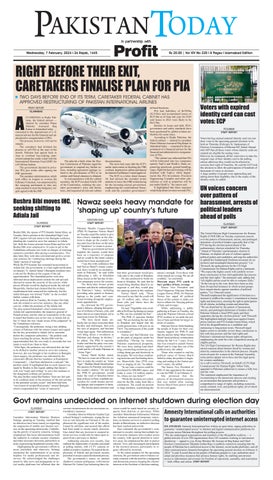
RIGHT BEFORE THEIR EXIT, CARETAKERS FINALISE PLAN FOR PIA
Profit
Wednesday, 7 February, 2024 I 26 Rajab, 1445
A g
Rs 20.00 | Vol XIV No 220 I 8 Pages I Islamabad Edition
TWO DAYS BEFORE END OF ITS TERM, CARETAKER FEDERAL CABINET HAS APPROVED RESTRUCTURING OF PAKISTAN INTERNATIONAL AIRLINES PROFIT REPORT ISLAMABAD
CCORDING to Radio Pakistan, the federal cabinet — chaired by caretaker Prime Minister Anwaarul Haq Kakar in Islamabad today — consented to the appointment of a financial advisor for the financial and administrative reorganisation of PIA. The process, however, will not be simple. The caretakers had initiated the process to sell PIA at the start of the month. Pakistan had agreed back in June to overhaul loss-making stateowned enterprises under a deal with the International Monetary Fund (IMF) for a $3 billion bailout. The government decided to privatise PIA just weeks after signing the IMF agreement. The caretaker administration, which took office in August to oversee the February 8 election, was empowered by the outgoing parliament to take any steps needed to meet the budgetary targets agreed with the IMF.
The plan hit a hitch when the Election Commission of Pakistan urged the government to suspend any further actions, including agreement signings, related to the privatisation of PIA or its entities until formal clearance is obtained. In correspondence with the cabinet secretary, the ECP invoked Article 230 of the Constitution, outlining the caretaker government’s roles and limitations, and requested all relevant cabinet
Bushra Bibi moves IHC, seeking shifting to Adiala Jail ISLAMABAD
STAFF REPORT
documentation. The move had come after the ECP’s earlier intervention in blocking the FBR overhaul, despite prior cabinet and Special Investment Facilitation Council approval. The ECP, in a letter dated January 30, had advised the caretaker prime minister to leave the FBR restructuring for the incoming elected government, emphasizing the constitutional framework and the caretaker government’s
defined functions. PIA had liabilities of Rs785bn ($2.81bn) and accumulated losses of Rs713bn as of June last year. Its CEO said losses in 2023 were likely to be Rs112bn. Besides its losses and debt, PIA’s governance and safety standards have been questioned by global aviation authorities for some years. According to Radio Pakistan, the federal cabinet — chaired by caretaker Prime Minister Anwaarul Haq Kakar in Islamabad today — consented to the appointment of a financial advisor for the financial and administrative reorganisation of PIA. “The cabinet was informed that PIA will be bifurcated into two companies namely TopCo and HoldCo. Basic engineering operations, ground handling, cargo, flight kitchen and training will be attached with TopCo, while departments like PIA Investment, Precision Engineering Complex and other subsidiaries as well as properties will be put under HoldCo,” the report said. It highlighted that these measures would help attract investors towards PIA.
Nawaz seeks heavy mandate for ‘shaping up’ country’s future KHUDDIAN KHAS
Pakistan Muslim League-Nawaz (PML-N) Supremo Nawaz Sharif on Tuesday urged the nation to give him a heavy mandate in the elections to shape up the country’s future and close the door on the entry of “fraudsters” to return to power. “Had my government not been toppled, the country would have been on a trajectory of progress and no youth in the entire country would have been unemployed.” “I say this with confidence that had Nawaz Sharif’s tenure continued, there would be no unemployment in Pakistan,” he said while addressing a rally in Khuddian Khas, Kasur on the last day of election campaigns across the country. The three-time former prime minister said that he outlined plans for Pakistan’s future, including providing solar panels to farmers, laptops to the youth, and vocational training alongside employment opportunities. He criticised the PTI government’s failures, alleging that promises of millions of houses, jobs, and dams that never materialised, led to enormous losses for Pakistan. “We have faced many setbacks, but we must overcome these hurdles and challenges, then join the race of progress, and become Asian tiger again. This enthusiasm will bring about a revolution in Pakistan and change its destiny,” he added. The PML-N supreme leader said that his party was completely supported by the country’s youth and he will make Pakistan an ‘Asian Tiger.’ Nawaz Sharif further stated, “We have to come out of this era; we have to make the country an ‘Asian Tiger’. Shehbaz Sharif should utilise this passion for Pakistan and change the country’s destiny.” He said that the PML-N government would make the road of Khudian better than of those in Paris, establish universities for youth besides providing laptops and computers to them. The former prime minister said
PESHAWAR
STAFF REPORT
Voters having expired national identity card can cast their votes in the upcoming general elections to be held on Thursday (February 8). Spokesman of Election Commission of Pakistan KP, Sohail Ahmad told APP that all those voters whose identity cards are expired are eligible for casting votes. However, he continued, all the voters have to take the original copy of their identity card to the polling station otherwise they would not be allowed to exercise their right of franchise. He said the ECP took this decision to allow the participation of hundreds of thousands of voters in elections. A large number of people were approaching and asking about their eligibility due to the expiry of the identity cards, he added.
UN voices concern over pattern of harassment, arrests of political leaders ahead of polls ISLAMABAD
STAFF REPORT
Bushra Bibi, the spouse of PTI founder Imran Khan, on Tuesday filed a petition in the Islamabad High Court (IHC) against sub-jail status to her Banigala residence, pleading she wanted to serve her sentence in Adiala Jail. Both the former premier Imran Khan and his wife Bushra Bibi were sentenced to 14 years in jail in the Toshakhana reference last week on charges of retaining expensive jewellery after paying a nominal price. Two days later, they were also convicted and given a sevenyear sentence for “contracting marriage during the ‘Iddat’ (period of waiting)”. While the PTI founder has remained incarcerated at Adiala Jail, the government, in a late-night notification on January 31, turned Imran’s Banigala residence into a sub-jail for Bushra at the request of the jail superintendent. The Islamabad police were also informed about deployment outside the sub-jail and directed to ensure the security of the convict, while prison officials would be deployed inside the sub-jail. Meanwhile, Bushra had claimed that the military establishment had contacted her indirectly, but the initial dialogue was termed “futile” as she avoided further contact with them. In the petition filed on Tuesday, the former first lady said she wished to serve her sentence, like any other convict, within the premises of the Adiala Jail. The plea named Islamabad’s chief commissioner, Adiala Jail superintendent, the inspector general of Punjab prisons and the state as respondents in the case. It stated that Bushra was on her way to Adiala Jail on Jan 31 when she was “made aware of the judgment” in the Toshakhana reference. “Consequently, the petitioner, being a law-abiding citizen of Pakistan with the utmost respect and regard for the law, proceeded to Adiala Jail to surrender before the competent authorities,” the petition said. Upon reaching the prison, Bushra Bibi told the superintendent that she was ready to surrender but was made to wait from 10am to 9pm. “After 9pm, the petitioner was informed that she had to be shifted to another prison to serve her sentence, however, she was brought to her residence at Banigala. Upon inquiry, the petitioner was informed by the concerned officials that her residence at Residential Compound […] had been declared as a sub-jail,” the petition stated. It highlighted that no such request was made by Bushra in this regard, adding that Imran’s wife was “ready and willing” to serve her sentence in the designated ordinary jail premises. The plea further stated that Bushra “does not feel safe to be confined alone in the premises of the sub-jail due to the potential security issues” and there had been “movement of unidentified people” around Banigala which compounded her “sense of insecurity”.
Voters with expired identity card can cast votes: ECP
STAFF REPORT
that their government would provide jobs to the youth of Khudian. He also promised to build stadium in Khudian. He said that he would bring Shehbaz Sharif to inaugurate it, and they would play the opening match in this stadium. Nawaz Sharif said, “Those who used to say that the youth will get 10 million jobs, where are those jobs and where have the houses gone?” He said, “Vegetables were available at Rs10 per kg during my tenure as PM, roti was available for Rs4.” The PML-N supremo further said, “We are holding the last rally in Khudian and hoped that the youth present here will join us on Feb 8. The enthusiasm of the youth is exemplary.” Nawaz said that Pakistan was on the path of progress under his leadership. “During my tenure, Pakistan experienced prosperity. We were busy ending load-shedding, constructing motorways, providing cheap gas and electricity to the people. We were busy eradicating terrorism and facilitating farmers. Meanwhile, they (PTI) were busy in staging sit-ins,” he added. “In our time, a tractor could be purchased for 800,000 rupees, and today it costs 3.8 million rupees. So, whose era was better?” “While the elections are scheduled for the 8th, today feels like a celebration. The youth are present in large numbers, symbolising the
nation’s strength. Even those with white beards are young. We are all youthful,” he concluded. Maryam urges PTI youth to bury politics of hate, revenge Senior Vice President and Chief Organizer Pakistan Muslim League-Nawaz (PML-N) Maryam Nawaz has urged all political forces of the country to make collective efforts for ‘burying politics of hate and revenge’. While addressing a public gathering in Kasur on Tuesday, she asked the Pakistan Tehreek-e-Insaf (PTI) workers to set aside the politics of hate and think for larger interest of country. Maryam Nawaz while thanking the people of Kasur for their continuous support for PML-N said that she and her father Mian Nawaz Sharif faced political victimization during the last 6 to 7 years. Every line was crossed to punish Nawaz Sharif and to wipe him out of the political area, she added. Those who wanted to end the political career of Nawaz Sharif failed as today the politics is beginning and ending in the former premier’s name, she added. The Senior Vice President of PML-N also appealed to the masses to vote for PML-N on February 8. She promised that the process of development projects that was halted after ousting Nawaz Sharif from power would be revived again.
The United Nations High Commissioner for Human Rights (UNHCHR) on Tuesday expressed concern over the pattern of harassment, arrests, and prolonged detentions of political leaders especially that of the PTI during the election period ahead of the parliamentary election scheduled for Thursday. “Ahead of Thursday’s parliamentary election in Pakistan, we deplore all acts of violence against political parties and candidates, and urge the authorities to uphold the fundamental freedoms necessary for an inclusive and meaningful democratic process,” Liz Throssell, the spokesperson for the UN High Commissioner for Human Rights said in a statement. “We expect the higher courts will carefully review these conclusions in line with applicable due process and fair trial rights,” the statement said, adding that “all eligible parties must be able to compete fairly.” “In the run-up to the vote, there have been no less than 24 reported instances in which armed groups have staged attacks against members of political parties,” Liz Throssell noted. Throssell emphasised the significance of elections as a moment to reaffirm the country’s commitment to human rights and democracy, ensuring the right to participation for all citizens, including women and minorities. “We are disturbed by the pattern of harassment, arrests, and prolonged detentions of leaders of the Pakistan Tehreek-e-Insaf (PTI) party and their supporters during the election period,” said Throssell. She highlighted multiple legal cases against former prime minister and PTI founder Imran Khan, which led to his disqualification as a candidate and sentencing to long prison terms. Throssell urged higher courts to carefully review these conclusions in line with due process and fair trial rights and Pakistan’s international human rights obligations, emphasising the need for a fair competition among all eligible parties. The UN High Commissioner for Human Rights also raised concerns about barriers faced by women and minority communities in the election process. Despite reserved seats for women in the National Assembly, some parties appear not to have met the legal quota for women candidates. As a call to action, Throssell, on behalf of UN High Commissioner for Human Rights Volker Türk, appealed to Pakistani authorities to ensure a fully free and fair vote. The statement emphasised the importance of recommitting to the democratic process and creating an environment that promotes and protects a comprehensive range of rights, including economic, social, cultural, civil, and political rights, all of which are interconnected.
Govt remains undecided on internet shutdown during election day ISLAMABAD
STAFF REPORT
Caretaker Information Minister Murtaza Solangi, speaking on Tuesday, clarified that no directives have been issued yet regarding the suspension of mobile and internet services on the upcoming election day. Underlining the gravity of security concerns, Solangi emphasized that local administrations hold the authority to evaluate security situations and make necessary decisions, particularly in areas experiencing heightened security risks. Highlighting the government’s efforts to assist journalists and observers, Solangi mentioned the establishment of an online helpline for media professionals and observers. He acknowledged the challenges posed by fake news and propaganda on social media platforms but affirmed that the
current circumstances do not necessitate extraordinary measures. Caretaker Interior Minister Gauhar Ejaz echoed Solangi’s sentiments, urging the nation to vote honestly on February 8. He emphasized the significant role of the media, trusted by millions, and assured that efforts had been made to ensure timely elections. Ejaz stated that any decision to suspend internet services would only be taken upon request from a province or district. Addressing concerns over security, Ejaz outlined the deployment of security personnel at polling stations, with CCTV cameras installed at sensitive locations. He assured the deployment of federal and provincial security personnel to ensure a peaceful electoral process. The government’s stance on internet shutdown remains ambiguous, with Interior Minister Dr. Gohar Ejaz indicating that a de-
cision would be made based on security requests from districts or provinces. While caretaker Balochistan Information Minister Jan Achakzai announced temporary restrictions on internet services in sensitive polling booths in Balochistan, no definitive decision has been reached nationwide. Ejaz reiterated the government’s commitment to security, stating that multiple layers of security measures were in place across the country, with special attention to sensitive areas. He emphasized the duty to protect citizens’ lives and encouraged participation in the electoral process, particularly in regions affected by terrorism. As the nation prepares for the upcoming elections, the government aims to balance security concerns with the need for a transparent and democratic process, keeping the citizens’ interests at the forefront of decision-making.
Amnesty International calls on authorities to guarantee uninterrupted internet access
ISLAMABAD: Amnesty International has written an open letter, urging authorities to guarantee “uninterrupted access” to Internet and digital communication platforms for everyone across Pakistan throughout the polling process. “We, the undersigned organisations and members of the #KeepItOn coalition — a global network of over 300 organisations from 105 countries working to end internet shutdowns — appeal to you, Prime Minister Mr Anwaar-ul-Haq Kakar and Chief Election Commissioner Sikandar Sultan Raja, to publicly commit to ensuring that the people of Pakistan have unfettered access to the internet, social media platforms, and all other communication channels throughout the upcoming general election on February 8, 2024,” it said. It noted that as the people of Pakistan prepare to vote, authorities must adopt and prioritise measures that advance human rights, by enabling unrestricted access to information and avenues for freedom of expression, assembly, and association — both offline and online. STAFF REPORT
02
BEARS LEAVE PSX FIELD FOR BULLS TO TAKE OVER
T g
Wednesday, 7 February, 2024 | ISLAMABAD
NEWS
KSE-100 surges by 796 points or 1.26% PROFIT
News Desk
HE benchmark KSE-100 Index at the Pakistan Stock Exchange (PSX) on Tuesday gained 796.10 points, or 1.26%, just two days ahead of the general elections. According to the PSX website, the KSE-100 Index closed at 63,799.01 level. During the intraday trading, peaks outnumbered troughs, reflecting investors’
confidence in the equity market. The oil and gas sector displayed more gains than losses, mainly due to the caretaker government’s discussions with the IMF regarding the circular debt settlement. Mari Petroleum’s share price increased by Rs 77.73 during intraday trading. The company revealed earnings per share (EPS) of Rs 281.14, up from Rs 178.87 in the first six months of the ongoing financial year compared to the same period of last year.
Mari Petroleum declared an interim cash dividend of Rs 98 per share. Consequently, the higher return on equity and improved profitability appear to be drawing more equity investors. “Notably, within the E&P sector, OGDC (+5.71%) and PPL (+5.39%) saw increases, buoyed by news of the caretaker government’s formal discussions with the IMF to settle gas circular debt to the tune of around Rs1.2 trillion. In the banking sector, MCB (0.94%) disclosed its FY23 results, revealing an EPS of Rs 50.32 and cash dividend of Rs 9.0 per share. Activity in
the cement sector was also observed, with DGKC (+2.64%), LUCK (+1.08%), and CHCC (+1.05%), closing higher than the previous day’s figures, partly due to the drop in international coal prices to $US94
S&P assigns Pakistan CCC+ rating g
Collaboration with key institutions is crucial for securing IMF financing, says credit rating agency PROFIT
News Desk
S&P Global Ratings, a credit rating agency, has assigned a CCC+ credit rating to Pakistan, highlighting the importance of the incoming government’s ability to win public support and effectively collaborate with key institutions as critical factors in securing financing from the
International Monetary Fund (IMF). According to economic data from S&P Global on Pakistan, the country’s real GDP growth stands at a mere 0.29%, with an investment-to-GDP ratio of 13.63%. Real GDP per capita growth is at -1.45%, and the unemployment rate constitutes 7% of the workforce. More concerning, however, is the data on the central government’s debt and
borrowing, which unveils a gross longterm commercial borrowing of $33.10 billion and a commercial debt stock amounting to $179.10 billion. Additionally, implementing new policy measures aimed at enhancing investor confidence and reducing inflation could improve fiscal and external metrics, potentially elevating the country’s sovereign ratings to the ‘B’ category, according to S&P Global Ratings.
The post-election period can become an economic revival time for Pakistan. Especially when the IMF Executive Board’s decision last month allowed for an immediate disbursement of around $700 million. The country has experienced stabilisation in its economic activities, though its future prospects remain fraught with challenges and are heavily dependent on the implementation of effective policy measures. However, the upcoming government needs to focus on meeting fiscal targets and implementing structural reforms to ensure inclusive growth.
per ton”, said Topline Securities. Market moguls are hoping for more gains in the equity market in the postelection period. Political stability and a better business environment can further contribute to higher gains at PSX. “In the election week, the index is in a converging range with the election result expected to move the index +/-7-10%”, said Arif Habib Limited. Therefore, the rally in shares at the PSX could receive a boost from the elections, and investors who have recently bought shares during dips may see higher returns in the coming weeks.
Industry calls for government action against rising tyre smuggling
PROFIT
News Desk
Caretaker govt hits record Rs4trn in bank loans during July-January g
Surge in borrowing marks 185% increase compared to same period in previous fiscal year PROFIT
News Desk
The caretaker administration under Prime Minister Anwaarul Haq Kakar has set a new precedent in bank borrowing, with figures reaching nearly Rs4 trillion from July 1, 2023, to January 19, 2024. This surge in borrowing marks a significant 185% increase compared to the same period in the previous fiscal year, where the government had borrowed Rs1.398 trillion, according to data from the State Bank of Pakistan. This fiscal year’s borrowing has already outpaced the total amount borrowed in FY23, raising concerns about the economic implications as Pakistan grapples with a substantial debt load.
Despite achieving revenue collection targets for the first six months, the government’s borrowing spree continues unabated, driven by the need to cover escalating expenditures. Inflation has been a double-edged sword for the economy, averaging over 28% in the past seven months, which, while boosting revenue through higher liquidity, has also necessitated increased government spending. The financial strain is further compounded by sluggish economic growth, insufficient revenue generation, and the burden of domestic and foreign debts. Additionally, the government faces pressure to address the power sector’s circular debts, now standing at Rs5.7 trillion. The borrowing strategy, with returns around 21%, represents a costly endeavor for the caretaker
government, consuming over half of the budget for debt servicing alone. This approach has been critiqued by financial experts and acknowledged by the government as a significant economic challenge. Banking institutions have emerged as the primary beneficiaries of this situation, reporting doubled profits in 2023. With government borrowings in FY22 and FY23 recorded at Rs3.448 trillion and Rs3.716 trillion respectively, the trend towards increased borrowing seems unlikely to reverse in the near term. The upcoming general elections on February 8 and the anticipated formation of a new government may prolong political uncertainties, dampening investment prospects. Observers note the challenging economic climate, with the International Monetary Fund (IMF) projecting a modest 2% GDP growth for FY24 and high base lending rates discouraging new ventures. Amidst these challenges, the outlook for economic growth in FY24 remains guarded, echoing the previous fiscal year’s negative growth rate of -0.6%.
FBR determines 20% customs duty on bladeless solar DC ceiling fans g
Ruling emphasizes that "Fan Sets without blades" in retail packaging, should be classified as 'incomplete Ceiling Fans' PROFIT
News Desk
In a recent decision, the Federal Board of Revenue’s (FBR) Customs Classification Committee (CCC) has issued a ruling on the customs duty applicable to the import of “Complete Solar DC Ceiling Fan without blades,” resolving a classification dispute. According to the CCC, these items will now attract a 20 percent
customs duty. The controversy centered around whether the Solar DC Ceiling Fans were eligible for zero percent customs duty under Pakistan Customs Tariff (PCT) heading number 8501.3100 or should be subjected to a 20 percent duty under PCT heading number 8414.5190. The CCC, after careful consideration, determined that the fans fall under the latter category, PCT heading 8414.5190,
Consumers face second blow as gas prices soar 35% following IMF directive g
OGRA unveils 35.13% increase in gas tariffs PROFIT
News Desk
In response to a directive from the International Monetary Fund (IMF), the Oil and Gas Regulatory Authority (OGRA) has raised gas tariffs, burdening consumers with an additional 35.13% increase. This move, the second in the current fiscal year 2023-24, comes as the public already grapples with soaring and unaffordable gas bills. Specifically, OGRA has increased the gas tariff for Sui Northern by 35.13% and for Sui Southern by 8.57%, amplifying financial challenges for households. Breaking down the figures, the rate per MMBTU for Sui Northern now stands at Rs1673.82, reflecting a substantial increase of Rs435.14. Similarly, for Sui Southern, the rate per MMBTU rises to Rs1466.40, marking a hike of Rs115.72. These recommendations await consideration by the caretaker federal government. The directive from the IMF urged Pakistan to raise gas prices by mid-February, potentially reaching an increase of 41%. Notably, the IMF has declined to offer subsidies on power tariffs beyond those outlined in the budget. Pending approval from the government, OGRA is expected to formally announce the new gas tariff rates, intensifying concerns for the public amidst economic challenges. As consumers brace for the impact, the rising cost of gas remains a pressing issue in their daily lives.
in accordance with General Interpretative Rules (GIR) 1 and 2(a). The decision came after an analysis of PCT heading 8501, which is reserved for motors used in an array of mechanical and electrical devices, including fans. However, the CCC concluded that the “Complete Solar DC Ceiling Fan without blades” constitutes the core essence of a fan despite being marketed without blades. For classification purposes, such
products are deemed unfinished fans under heading 8414, thereby warranting the 20 percent duty. The committee further elaborated that the term ‘essential character’ pertains to products specifically designed to fulfill a distinct function, asserting that even in an incomplete state, items designed for a particular purpose maintain their ‘essential character’. This principle has been previously applied in the classification of CKD/SKD Kits across various categories, including air conditioners, deep freezers, washing machines, and vehicles, as per budgetary measures ratified by the National Assembly. The ruling emphasizes that the products in question, presented as “Fan Sets without blades” in retail packaging, should be classified as ‘incomplete Ceiling Fans’ under PCT heading 8414, thereby clarifying the applicable customs duty for importers.
The resurgence of tyre smuggling is causing concern among local manufacturers, with industry leaders highlighting the negative impact on Pakistan’s economy. The issue, exacerbated by the devaluation of the rupee, has seen a significant reduction in legal imports, leading to an increase in illicit tyre trade. Hussain Kuli Khan, CEO of Ghandhara Tyre and Rubber Company Ltd (GTR), pointed out the availability of smuggled tyres of all sizes in the market, a situation that has returned despite previous government efforts to curb the practice. He emphasized the importance of the local industry in generating employment, contributing to the national exchequer, and saving foreign exchange. The decline in tyre imports, attributed to the rupee’s devaluation, has led to a supply gap filled by smuggled tyres, often of inferior quality but preferred for their lower prices. According to Khan, Pakistan’s tyre market demands 14.5 million units annually, with only a quarter being met by domestic production and 10% through legal imports. The remaining demand is fulfilled by smuggled tyres, resulting in a loss of over Rs70 billion annually to the national exchequer and harming local manufacturers. The Collectorate of Customs Enforcement’s recent confiscation of over 55,000 smuggled tyres in Karachi, valued at approximately Rs540 million, highlights the extent of the problem. These tyres often arrive in poor condition, with smugglers using mechanical tools to make them saleable, compromising safety and reducing their lifespan. Khan also raised concerns over the misuse of the Afghan Transit Trade (ATT) for smuggling tyres into Pakistan, suggesting a reevaluation of the imported items under this agreement to match the actual vehicle numbers in Afghanistan. He stressed the contribution of the local industry, including GTR’s over Rs3.2 billion annual contribution to the national exchequer, and called for stricter government measures to address tyre smuggling and support local manufacturers. The Pakistan Bureau of Statistics reported a decrease in tyre and tube imports to 1.75 million units, costing $44 million, in the first half of the current fiscal year, down from 1.892 million units ($67 million) a year earlier, highlighting the challenges faced by the industry.
Govt seeks extension for WB’s $400m tax reform project g
PRR project, initially set for a five-year term, is designed to enhance Pakistan's tax system and revenue collection processes PROFIT
News Desk
The government has officially requested a oneyear extension for the completion of the Pakistan Raises Revenue (PRR) project, a crucial initiative backed by a $400 million funding from the World Bank. The proposed extension aims to extend the project deadline to June 30, 2025, allowing for the thorough completion of its Investment Project Financing (IPF) component. This move comes as part of a broader strategy to update and refine the project’s development objectives in light of evolving measurement capabilities and the discontinuation of previously used benchmarks. The PRR project, initially set for a five-year term, is designed to enhance Pakistan’s tax system and revenue collection processes. It comprises a $320 million results-based component and an $80 million IPF component focusing on the technological and infrastructural enhancement of the Federal Board of Revenue’s (FBR) operations. The extension seeks not only to adjust the project’s timeline but also to revise its Project
Development Objective (PDO) indicators and Disbursement Linked Indicators (DLIs) to better reflect the project’s goals and the current landscape. Significant changes proposed include shifting the Tax to GDP ratio metric to a more direct measure of the FBR’s total collections as a percentage of GDP, aiming for an increase from 8.5% in fiscal year 2023 to 8.8% by fiscal year 2025. Additionally, in response to the cessation of the World Bank’s Doing Business Report, the project will adopt alternative methodologies, such as case studies and real-time data, to assess
progress in areas like tax filing and customs clearance efficiency. The restructuring also proposes adjustments to the scope of the withholding regime and the enhancement of coordination among provincial tax authorities, with an emphasis on digital and systematic data sharing systems. Despite these modifications, the overall budget allocation for the project remains unchanged. To date, the PRR project has disbursed approximately $291.31 million, approximately 74% of its total funds, and has been marked satisfactory in its progress towards development objectives. Notable achievements include the reduction of withholding tax lines, the establishment of a Directorate General for Revenue Analysis, significant additions to the tax base, and the implementation of electronic monitoring systems in key production sectors. The requested extension and restructuring are geared towards ensuring the project’s objectives are met with greater accuracy and relevance, reflecting the government’s commitment to enhancing transparency, efficiency, and accountability within Pakistan’s tax system.
Wednesday, 7 February, 2024 | ISLAMABAD
03
CARETAKERS DISCUSS POWER TARIFF, CIRCULAR DEBT PLAN WITH IMF NEWS
T
Fixed monthly charges for certain consumer groups will rise from Rs50 to Rs450
g
PROFIT
MoNitoRiNg DeSk
HE caretaker government engaged in discussions with the International Monetary Fund (IMF) aiming to secure support for its strategies on tariff adjustments and reducing the accumulation of unpaid bills in the energy sector.
Under the proposed plan, industrial electricity rates will be cut to between 8.5 and 11.75 cents per kWh from the current 14 cents, without increasing subsidies. To offset this, fixed monthly charges for certain consumer groups will rise from Rs 50 to Rs 450, reducing the need for crosssubsidisation. Additionally, a plan to address the energy sector’s circular debt, amounting
to Rs 1.27 trillion, has been put forth, relying on short-term government financing. This dialogue was initiated by dedicated teams from the Ministries of Power and Petroleum, led by caretaker Minister Muhammad Ali, in hopes of gaining approval from both the IMF and the caretaker federal cabinet before their term concludes. The IMF has requested
further details from Pakistan, with a promise to provide clarity within the next few days, setting the stage for future discussions. The World Bank has also been involved in these preliminary talks. The proposed tariff reforms suggest reducing industrial electricity rates significantly, aiming to balance the costs with a subsidy-neutral approach, while increasing fixed charges for certain consumer categories to offset subsidies. A recent meeting of the Special Investment Facilitation Council (SIFC)
SBP successfully sells Rs63.8b in Market Treasury Bills PROFIT
NewS DeSk
In a recent auction on Tuesday, the State Bank of Pakistan (SBP) achieved a notable success by selling Market Treasury Bills (MTBs) worth Rs63.84 billion for durations of 3, 6, and 12 months. Despite a target set at Rs480 billion, the SBP efficiently managed to secure substantial bids. The cut-off yields for the respective periods stood at 20.4399%, 20.3951%, and 20.0800%. There was a significant decline of 6 basis points (bps) and 15 bps
All arrangements made to ensure peaceful, transparent conduct of elections: Gohar ISLAMABAD
Staff RepoRt
Interior Minister Gohar Ejaz has stated that all necessary arrangements have been made to ensure peaceful and transparent conduct of general elections on Thursday. Addressing a news conference along with Minister for Information and Broadcasting Murtaza Solangi in Islamabad today, he emphasized the people should come out on the polling day and exercise their right to vote without any fear or intimidation. The Interior Minister said the civil armed forces, the armed forces and police as well as administration are working round the clock to ensure conducive environment on the polling day. Gohar Ejaz said ninety thousand seven hundred and seventy-seven polling stations have been established nationwide. Of these, forty-four thousand polling stations have been declared normal, twenty-nine thousand nine hundred and eighty-five sensitive and sixteen thousand, seven hundred and sixty-six highly sensitive. He said each polling station will have deployment of seven to eight security personnel on average. He said about six hundred and fifty thousand security personnel have been deployed on the ground to ensure the security of the voters.
in the 3-month and 12-month categories, while the yield for the 6-month papers remained stable. Out of a total amount offered, the SBP accepted Rs64 billion, reflecting a strong market response. The bids received were Rs482.66 billion for 3 months, Rs80.29 billion for 6 months, and Rs589.88 billion for 12 months. The SBP accepted Rs17.53 billion for 3 months and Rs5 billion for 12 months from the respective categories. Furthermore, the SBP acquired Rs41.31 billion from the non-competitive auction, contributing to the total accepted amount of Rs64 billion. The bid-to-cover
ratio, illustrating the ratio of bids received to the amount sold, experienced a significant rise, reaching 18.06 compared to 6.24 in the previous auction. In essence, the SBP accepted approximately 5.54% of the total bids received. In the last auction on January 10, 2024, the SBP sold MTBs worth Rs185 billion against a target of Rs225 billion, with cut-off yields of 20.4997%, 20.4%, and 20.2298% for 3, 6, and 12 months, respectively. The recent success reflects the continued confidence of investors in the financial instruments offered by the State Bank of Pakistan.
PPL to fund Balochistan’s share in lead-zinc mining project g
Financial backing follows PPL’s disclosure in Dec 2021 of obtaining a large-scale mining lease in Khuzdar PROFIT
NewS DeSk
Pakistan Petroleum Limited (PPL) has announced its decision to finance the Government of Balochistan’s (GoB) capital contribution in the Lead-Zinc processing plant project (BLZ Project). The announcement came following the approval by PPL’s Board of Directors (BoD) in a meeting held on February 3, 2024, as per the notice sent to the Pakistan Stock Exchange (PSX). Although the specific funding amount was not disclosed, PPL has committed to sourcing the capital from its cash flows, providing a financing arrangement for GoB’s contribution. The arrangement includes debt servicing from GoB’s share of the project’s cash flows. A financing agreement is to be executed between
PPL and GoB, pending all necessary approvals, including those from Balochistan’s provincial cabinet and PPL shareholders. This financial backing follows PPL’s disclosure in December 2021 of obtaining a large-scale mining lease for lead and zinc in District Khuzdar from GoB. The lease, covering an extensive area of 30 Sq.km (7413.16 acres), marks the initiation of the BLZ Project, with operations handed over to Bolan Mining Enterprises (BME), a joint venture between GoB and PPL. BME, established on a 50% working interest agreement between GoB and PPL since June 1, 1974, is tasked with mining, grinding, and marketing baryte deposits in Gunga near Khuzdar and other minerals in Balochistan. With PPL as the designated operator, the agreement, initially signed for thirty years, was renewed in June 2004 for an additional thirty years.
2 terrorists killed in North Waziristan IBO: ISPR ISLAMABAD
Staff RepoRt
Two terrorists were killed in an intelligencebased operation (IBO) in Khyber Pakhtunkhwa’s North Waziristan district, the military’s media affairs wing said on Tuesday. According to a press release issued by the Inter-Services Public Relations (ISPR), security forces conducted an IBO last night on the reported presence of terrorists. “During the conduct of operation, intense fire exchange took place between own troops and terrorists, as a result of which two terrorists were sent to hell, including terrorist ring leader Ayubullah Mansoor,” the ISPR said. It added that weapons, ammunition and explosives were also recovered from the militants who “remained actively involved in numerous terrorist activities, including targeted killing as well as extortion and abduction of innocent civilians”. “Sanitisation operation is being
conducted to eliminate any other terrorist found in the area. Locals of the area appreciated the operation and expressed their full support to eliminate the menace of terrorism,” the ISPR said. The development comes a day after 10 police officials were martyred and six others injured in a pre-dawn attack by dozens of militants on a police station in Dera Ismail Khan, as violence escalated ahead of general elections this week. A spokesperson for Dera police said that militants, equipped with sophisticated weapons, attacked the Chaudhwan Police Station in Daraban tehsil at around 3am, adding that cops inside the building retaliated and a gun battle continued for around two and a half hours. The militants escaped after the attack under the cover of darkness. Last week, the ISPR said that 24 terrorists were killed during firefights and clearance operations in the Mach and Kolpur towns of Balochistan over three days.
The statement had come after security forces had thwarted three “coordinated attacks” launched by terrorists using rockets and sophisticated weapons in Mach. The terrorists also targeted a hotel and six shops in the Kolpur area and set them on fire. Pakistan has witnessed an uptick in terror activities in the past year, especially in KP and Balochistan after the banned militant Tehreeki-Taliban Pakistan ended its ceasefire with the government in November 2022. According to an annual security report issued by the Centre for Research and Security Studies, Pakistan witnessed 1,524 violencerelated fatalities and 1,463 injuries from 789 terror attacks and counter-terror operations in 2023 — marking a record six-year high. KP and Balochistan were the primary centres of violence, accounting for over 90 per cent of all fatalities and 84pc of attacks, including incidents of terrorism and security forces operations.
outlined the need for a comprehensive technical paper to address circular debt, aiming for inclusion in the upcoming budget. However, the SIFC’s Apex Council decided that immediate action was preferable to waiting for the budgetary process. In a Senate Standing Committee on Power, it was acknowledged that high tariffs are hindering the competitiveness of Pakistani industries. The IMF raised concerns about potential revenue losses from these tariff reforms.
Pakistan’s first E-Rozgar center inaugurated ISLAMABAD
Staff RepoRt
The caretaker Information Technology (IT) Minister, Umar Saif, on Tuesday inaugurated Pakistan’s first ERozgar center in Islamabad. During the inauguration ceremony, the IT minister, Umar Saif, stated that the ERozgar center boasts around 100 workstations fully equipped with state-of-the-art facilities tailored for freelancers, with plans to expand to 300 workstations in the future. Speaking on the occasion, Dr. Umar Saif said that with the establishment of the center, the project of setting up 10,000 e-rozgar centers across the country has now officially begun. “We have also fulfilled another promise made to the people, where a significant number from the existing 1.5 million and upcoming new freelancers can work independently at very low rates,” the minister said. He added that the best facilities including high-speed internet, UPS, training centers, individual cabins, meeting rooms, and separate office rooms for start-ups had been provided to freelancers. The minister expressed optimism and stated that with the completion of the great project, IT exports would be increased soon by $ 10 billion annually, and under public-private partnership, these centers would also be able to significantly increase the capacity and income of freelancers. He said, the Pakistan Software Export Board (PSEB) would be responsible for providing freelancers and required technical support for these centers. Dr. Umar Saif said that as promised, e-rozgar centers in other cities were also nearing completion. “We have taken all the required steps for the digital ecosystem in Pakistan, and we have also used all available forums to declare Pakistan as a “Technology Destination” internationally” he added. He said that the toughest decisions related to the IT and Telecom sector had been taken in the short period of the caretaker tenure. The minister said that timely decisions had been made due to Special Investment Facilitation Council (SIFC). Dr. Umar said, “A conducive environment for the upcoming government and a complete roadmap of Digital Pakistan has been made, hopefully the newly elected government will continue to play its full role in promoting Pakistan’s digital economy.”
CJCSC visits Saudi Arabia, strengthens defence ties SAUDI ARABIA Staff RepoRt
The Chairman Joint Chiefs of Staff Committee (Chairman JCSC) of Pakistan, General Sahir Shamshad Mirza, undertook a significant official visit to the Kingdom of Saudi Arabia in connection with the 2nd World Defence Show, the military said on Tuesday. During his visit, General Mirza met with His Royal Highness Prince Khalid Bin Salman Bin Abdulaziz Al-Saud, the Minister of Defence of Saudi Arabia, to discuss crucial strategic and security issues, the Inter-Services Public Relations (ISPR) said in a statement. The discussions also explored opportunities to enhance defence cooperation between the two brotherly nations, it added. The visit emphasised the longstanding and robust relationship between Pakistan and Saudi Arabia, particularly in the field of defence. General Mirza expressed Pakistan’s commitment to further strengthening bilateral ties and working collaboratively to address regional security challenges. One of the highlights of the visit was the inauguration of the Al-Fatah-II Missile stall at the World Defence Show, a momentous occasion symbolising the technological prowess and advancements in Pakistan’s defence capabilities. The Chairman JCSC toured various stalls featuring organisations from Pakistan, showcasing the country’s defence industry and fostering collaborations with international partners.
MCB records highest ever profit before tax for year 2023 g
Strong volumetric growth in current account and timely repositioning of the asset book, net interest income for the year 2023 increased by 69% PROFIT
pReSS ReleaSe
The Board of Directors of MCB Bank Limited (MCB) in its meeting under the Chairmanship of Mian Mohammad Mansha, on February 06, 2024, reviewed performance of the Bank and approved the financial statements for the year ended December 31, 2023. The Board of Directors has declared final cash dividend of Rs. 9.0 per share i.e. 90%, in addition to 210% already paid, bringing the total cash dividend for the year 2023 to 300%. Through focused efforts of the Bank’s management in building no-cost deposits and optimizing its earning assets mix, MCB achieved significant growth in core earnings to post a historic Profit Before Tax (PBT) of Rs. 125.2 billion; registering an impressive increase of 75% over last year. The Profit After Tax (PAT) was recorded at Rs. 59.6 billion (+82%) and translated into an Earning Per Share (EPS) of Rs. 50.32 compared to an EPS of Rs. 27.63 reported in the last year. Aided by a strong volumetric growth in current account and timely repositioning of the asset book, net interest income for the year 2023 increased by 69% as compared to last year. Non-markup income increased to Rs.
32.9 billion (+34%) against Rs. 24.6 billion in the last year with major contributions coming in from fee commission income (Rs. 20.2 billion), income from dealing in foreign currency (Rs. 8.5 billion) and dividend income (Rs. 3.0 billion). Improving customer and interbank flows, diversification of revenue streams through continuous enrichment of service suite, investments towards digital transformation and an unrelenting focus on upholding high standards of service delivery supplemented a broad- based growth of 43% in income from fee commission; with trade and guarantee related business income growing by 111%, cards related income by 49%, branch banking customer fees by 14% and income from home remittance by 26%. The Bank continues to manage an efficient operating expense base and monitor costs prudently. Amidst a persistently high inflationary environment, currency devaluation, rapidly escalating commodity prices and continued investments in human resources and technological upgradation, the operating expenses of the Bank were reported at Rs. 51.8 billion (+25%). The cost to income ratio of the Bank improved significantly to 29% from 37% reported in the last year. Navigating a challenging operating
and macroeconomic environment, the Bank has been addressing asset quality issues by maintaining discipline in management of its risk return decisions. Diversification of loan book across customer segments and a robust credit underwriting framework that encompasses structured assessment models, effective pre- disbursement evaluation tools and an array of post disbursement monitoring systems has enabled MCB to effectively manage its credit risk; the Non-performing loan (NPLs) base of the Bank was reported at Rs. 53.9 billion as at December 31, 2023. The coverage and infection ratios of
the Bank were reported at 82.70% and 8.66% respectively. On the financial position side, the total asset base of the Bank grew by 16% and was reported at Rs. 2.43 trillion. Analysis of the assets mix highlights that net investments increased by Rs. 271 billion (+28%) whereas gross advances reported a decrease of Rs. 175 billion (-22%) over December 31, 2022. The Bank continued its focus on building no cost deposits, leading to a unprecedented growth of Rs. 180 billion (YoY: +28%) in average current deposits. The average current to total deposits ratio
improved to 50.5% in the year 2023 as compared to 42.2% in the last year. Despite a 7.3% increase in average policy rate during the year, the domestic cost of deposits was contained at 9.12% as compared to 6.51% in the year 2022. Return on Assets and Return on Equity significantly improved to 2.64% and 31.60% respectively, whereas the book value per share was reported at Rs. 174.35. During the year, MCB attracted home remittance inflows of USD 3,247 million to further consolidate its position as an active participant in SBP’s cause for improving flow of remittances into the country through banking channels; with market share improving to 12.3% as compared to 11.5% in the year 2022. While complying with the regulatory capital requirements, the Bank’s total Capital Adequacy Ratio (CAR) is 20.39% against the requirement of 11.5% (including capital conservation buffer of 1.50% as reduced under the BPRD Circular Letter No. 12 of 2020). Quality of the capital is evident from Bank’s Common Equity Tier-1 (CET1) to total risk weighted assets ratio which comes to 17.21% against the requirement of 6%. Bank’s capitalization also resulted in a Leverage Ratio of 6.17% which is well above the regulatory limit of 3.0%. The Bank reported Liquidity Coverage Ratio (LCR) of 250.62% and Net Stable Funding Ratio (NSFR) of 147.41% against requirement of 100%.
04 COMMENT
A Different Kind of Armageddon Election
Wednesday, 7 February, 2024
Piling up for the next government
E
The USA will face van unappetizing choice
As elections approach, the caretakers incur record debt
LECTIONS will occur on Thursday (tomorrow) and the country will have a new government which will replace the current caretakers. Unlike them, this government will be anchored in the National Assembly, in the chosen representatives of the people. However, whereas it will inherit the fruits of the caretakers’ good decisions, it will also inherit the thorns of its harmful actions. One of the problem areas it will inherit will be the debt mountain it leaves behind. State Bank data showed that government borrowing had reached Rs 3.99 trillion for the current financial year by January 19, which was as much as was borrowed in the whole of the previous financial year. It is unfortunate but true that the money is no longer being borrowed to finance development, but to meet current expenditures. Of those current expenditures, debt servicing looms the largest. In short, the government’s borrowing goes not just to meet current expenditure on its functions. But to pay the cost of previous borrowing. What that means is that the debt stock keeps increasing. Therefore, as has happened, even if the government increases its revenue, it finds itself unable to meet the cost of servicing its debt, with the result that it has to borrow to plag the gap. Remember, this is only domestic debt, so the problem of raising the requisite foreign exchange has not arisen. One of the more harmful effects of this situation is that it drives the private sector out of the credit market. Another problem that has arisen is that the State Bank of Pakistan, following IMF advice, first raised its key policy rate, and then kept it there. This has driven up the cost of borrowing for the government, and has thus increased the burden on the taxpayer. Whenever interest payments fall due, the government borrows money to pay them off, thus converting those payments into debt stock. The catch is that the government thus becomes more indebted than before. The next government will find itself facing numerous challenges. However, this will be key. Many of those challenges are only solvable by spending money on them.However, that cannot be done if the money in the Treasury has already been earmarked for debt servicing. Rupee-denominated debt is as much of a danger of foreign debt, and will have to be tackled sensibly and without bringing the whole edifice of government crashing down.
T
Dr James J. Zogby
WENTY years ago, my brother John Zogby called that year’s presidential contest “the Armageddon Election.” He was referring to the way each side was characterizing the dangers to the country and the world should the other side win. Since then, that term has been used to describe every presidential election and will no doubt be dragged out and repurposed again in 2024. And for good reason. As Stephen Walt thoughtfully argues in a recent article in Foreign Policy Magazine, the most significant differences between former President Donald Trump and President Joseph Biden are not in the areas of foreign affairs. There will be differences, to be sure, but with regard to the most significant challenges we are facing— Ukraine, the Middle East, and China— policies in a second Trump or Biden Administration will largely follow the same trajectory. The contest over whether to bring on or avoid Armageddon will be fought on the domestic front. We’re still early in the primary calendar, but with President Biden facing no real opposition for the Democratic nomination and former President Trump having vanquished the substantial array of Republicans who challenged him, we appear set for a Biden-Trump rematch. While the first two primaries demonstrate Biden’s and Trump’s ability to win, they also point to questions about both candidates’ vulnerabilities. Trump’s supporters have bought into his nightmare vision of an America in which politically correct elites are destroying our traditional culture and allowing our country to be overrun by foreigners from the south who are taking our jobs, bringing crime and disease, and “tainting our blood.” And Trump loyalists have come to believe that their leader must be defended against the threats he faces from law enforcement, the courts, and media because they accept his boast that he, and only he, can save America
from devastation and the chaos of the apocalypse. Meanwhile, Democrats and supporters of President Biden will point to Trump’s many court cases for crimes ranging from financial fraud and sexual assault to compromising government secrets and encouraging insurrection, and note that his threats of revenge and refusal to accept the outcome of past elections expose him as a vengeful authoritarian who threatens America’s democracy. But while this November’s Biden-Trump rematch appears to be a classic example of an Armageddon election, it comes with a difference. As things stand right now, barring the unforeseen, this election will be a contest that many voters do not want and about which even some partisans are currently unenthusiastic. Recent polls show that only four in 10 voters are even somewhat pleased with this rematch. Both men have low approval and even lower job performance ratings. And among members of their respective parties, both prospective candidates are only polling in the low 70-percent range. The result is that this election, a clash between two dramatically divergent visions of the future of the nation, features standard bearers about whom many voters are simply not excited. Trump’s Republican problems come from those in his party who are appalled by his political and personal behaviour. Biden’s difficulties with his Dem-
The billions spent on attack ads will exacerbate the polarization, only intensifying the sense that this is an Armageddon election. An additional byproduct of these negative ads will be to further deflate interest among those voters already displeased with the choices before them. When it’s over, no matter who wins, we will be more divided with our fragile democracy and our country’s unity at greater risk
Dedicated to the legacy of late Hameed Nizami
Arif Nizami (Late) Founding Editor
ocratic base come from younger voters and non-white voters who are concerned about his age and disappointed with his failure to deliver on promises he made during his 2020 campaign regarding immigration reform and domestic spending priorities, and, interestingly, his unconditional support for Israel’s war on Gaza. Despite the lukewarm reaction to both candidates, national head-to-head polling matchups show the two within a few points of each other—with neither ever crossing over 50 percent. When the current lacklustre field of “third party” candidates are thrown into the mix, the share garnered by Biden and Trump drops to less than eight in 10. This situation creates an inviting environment in which a more serious in-
Unending persecution of Kashmiris M. A. Niazi
Babar Nizami
Editor Pakistan Today
Editor Profit
Why Kashmir Solidarity Day is marked
T
malik muhammaD ashraf
HE Indian security forces have been using ruthless force to suppress the freedom struggle of the people of Indian Occupied Kashmir, which they launched in 1989 after having been frustrated by the Indian intransigence over granting them the right of self–determination. According to reports compiled by human right organizations and other authentic sources since then, 96,290 Kashmiris have been killed till January 2024, nearly 11,500 women have been either gang-raped or molested and 110,550 houses have been destroyed. The history of the freedom struggle is replete with innumerable incidents of bestiality committed by the Indian security forces. However none of them can be compared to the brutality and callousness exhibited by them on 21 January 1990 when they resorted to indiscriminate firing on the demonstrators in Srinagar, who were protesting the molesting and rape of Kashmiri women at the hands of the Indian security personnel, killing 55 people and injuring dozens. The incident revived the memories of the 1919 Jallianwala Bagh massacre in Amritsar and justifiably caused severe outrage and resentment in Occupied Kashmir, throughout Pakistan and among the Kashmiri community the world over. Complete strike was observed in Pakistan on 5 February 1990 to protest against this dastardly act of the Indian troops. Since then February 5 is observed as Kashmir Solidarity Day in Pakistan and by the Kashmiri diaspora around the world. The observance of the Solidarity Day with the people of Indian Occupied Kashmir is meant to reassure them that Pakistan has an abiding and unswerving commitment to support their cause and stand by them under all circumstances. It also aims at reminding the UN and world community of its obligations towards the people of Kashmir and to reiterate the fact that their apathy to their sufferings could have disastrous consequences for regional and world peace. Another objective is to send a clear message to the Indians that no amount of oppression and persecution can keep the people of Kashmir under subjugation for long and prevent the inevitable. The observance of the solidarity day has assumed greater significance in the backdrop of the Indian move to change the special status of
the state; its bifurcation into two regions and declaring them part of the Indian union virtually nullifying the UN resolutions; siege of the state and continuation of the killing spree. Reportedly more than 500 Kashmiris have been killed since 5th August 2019. India is in the grip of the proponents of supremacist philosophy of Hindutva headed by Narendra Modi who by revoking the special status of Indian-Occupied Kashmir and making it part of the Indian Union has created a very dangerous situation, posing grave threat to peace and security in the region. He has not only ended the special status of Indian-Occupied Kashmir, but has also adopted a belligerent posture towards Pakistan. Modi is a cunning and callous enemy who can go to any extent to achieve his nefarious designs premised on the RSS ideology of Hindutva. The revelations by the Indian Journalist Arnab Goswani that Modi orchestrated the Pulwama incident in which over 50 Indian soldiers were killed to win elections and finding an excuse to take action against Pakistan, amply expose his fascism. He did send his planes to hit imaginary terrorist camps at Balakot in February 2019, though that incident ended in a lot of embarrassment for his government, costing it two planes and the capture of a pilot. The situation could have led to full-fledged war between the two countries but the restraint shown by Pakistan and the intervention of friendly countries defused the situation. Modi has not only tried to change demographic realities in Indian-Occupied Kashmir but has also turned India into a majoritarian state by adopting anti-Muslim policies. The promulgation of Citizens Amendment Act and National Register of Citizens in West Bengal are ranting testimonies of this reality. The current wave of demolishing historic mosques and building temples in their place speaks itself about anti-Muslim bias of the Modi government. India also continues to persist with her belligerent posture towards Pakistan and there are fears that due to the tremendous stress internally and new elections coming up it might execute another false-flag operation against Pakistan; a possibility about which Pakistan has been
sounding the world community. Any such eventuality could have disastrous consequences for the entire region as any miscalculation on either side could easily trigger nuclear war between the two countries. Pakistan has shown tremendous restraint over Indian provocations notwithstanding the fact that it was fully capable of giving a befitting response to any act of aggression against it as it proved in last February. Continuation of tensions and the possibility of war between Pakistan and India cannot go away until the Kashmir dispute is resolved in consonance with the UN resolutions. The world community, the powers which can help in having those resolutions implemented and pressurizing India to end persecution of the people of the Indian Occupied Kashmir, must abandon their indifference to the plight of the people of Kashmir who are fighting for their right of selfdetermination. The people of Kashmir are undeterred by the Indian atrocities and are continuing their struggle for freedom. Their resistance and freedom movement continues notwithstanding the brutalities perpetrated on them by the Indian security forces. Indian machinations have not been able to subdue their urge for independence and they would not relent until they are allowed to decide their own fate as per the UN resolutions. India is holding Kashmir against the will of its people and its stance on the issue has no moral or legal basis. History is a witness to the fact that freedom struggles cannot be subdued through the barrel of the gun. Pakistan, which is party to the Kashmir dispute, would not allow India to get away with her illegal occupation of Indian-Occupied Kashmir and its annexation to the Indian Union in defiance of the UN resolutions. India which is spilling the blood of Kashmiris and has crossed all limits of persecution must realize that it cannot keep doing it indefinitely. By continuing the persecution of Kashmiris and maintaining a belligerent posture towards Pakistan, it is not only endangering peace in the region but also jeopardizing its own security and economic well-being of its people.
Malik Muhammad Ashraf is an academic. He can be contacted at: ashpak10@gmail.com.
India which is spilling the blood of Kashmiris and has crossed all limits of persecution must realize that it cannot keep doing it indefinitely. By continuing the persecution of Kashmiris and maintaining a belligerent posture towards Pakistan, it is not only endangering peace in the region but also jeopardizing its own security and economic well-being of its people
Lahore – Ph: 042-36300938, 042-36375965
dependent candidate could challenge the two parties’ nominees in November. At that point, this election will be about Trump and Biden competing to win over undecided voters, while attempting to shore up their support among less than enthusiastic members of their own parties. This will, of course, make partisanship even more intense. Meanwhile, the third-party candidates will most likely be working to win over voters disaffected with both parties and lukewarm toward their nominees. What’s certain is that both major parties and their supportive Political Action Committees will have billions of dollars to spend in November. They’ll use their fortunes to tout their candidates’ records, to project their contrasting visions, and even more so to slam their opponents. And here’s where it gets ugly. Years ago, I was in a departure lounge at New York’s JFK Airport. The television was on and those waiting with me for their flight were watching a popular TV show. During each commercial break, there were nothing but political ads, alternating between those in support of the Democratic and Republican candidates for governor. Since I was flying to an Arab country, most of those watching were Arabs. Trying to see it all through their eyes, I became embarrassed at the extremely hostile personal attacks that characterized the ads, thinking “What must they think of our democracy and the choices we have to make between a cheat and liar or a criminal with ties to organized crime?” The billions spent on attack ads will exacerbate the polarization, only intensifying the sense that this is an Armageddon election. An additional byproduct of these negative ads will be to further deflate interest among those voters already displeased with the choices before them. When it’s over, no matter who wins, we will be more divided with our fragile democracy and our country’s unity at greater risk.
I
Karachi – Ph: 021-32640318 I
Islamabad – Ph: 051-2204545
I
The writer is President of the Arab American Institute
Editor’s mail
Send your letters to: Letters to Editor, Pakistan Today, 4-Shaarey Fatima Jinnah, Lahore, Pakistan. E-mail: letters@pakistantoday.com.pk Letters should be addressed to Pakistan Today exclusively
Polio vigilance
FOR many decades in Pakistan, polio has been a major public health concern. Even though efforts have been made to eradicate the disease, it still poses a threat to the population, particularly in remote and underprivileged areas. As a result, the country has placed a great deal of emphasis on polio education. The government and organizations such as the World Health Organization (WHO) have been promoting the importance of polio vaccinations and preventing the spread of the disease by conducting various initiatives and campaigns. The purpose of this education is to increase awareness of polio symptoms, the importance of routine immunisations, and how to maintain proper hygiene and sanitation practices to prevent the virus from spreading. Polio education is frequently provided through schools, mosques, and community centres, reaching both children and adults. Despite the difficulties in reaching all segments of society due to cultural and social barriers, polio education efforts have been crucial in decreasing the number of cases of polio in Pakistan. It is crucial to maintain efforts towards polio education to eradicate the disease completely from the country and ensure a healthy future for its citizens. MERAJ HAYAT MEERABAD
Academic pressure impact
MY aim is to draw attention to an issue that is very important to our kids’ welfare: the excessive pressure parents put on them to do well in school. In a time where grades are frequently used to determine success, a lot of parents unintentionally put a lot of pressure on their kids to perform well academically. The relentless chase of excellent grades may have negative impacts on a child’s mental and emotional health. Constantly feeling that you have to perform above and above can lead to tension, worry, and even negative self-esteem. Children may give up their passion and originality in an effort to live up to parental expectations, giving in to the limited pursuit of grades rather than comprehensive personal development. Additionally, the parent-child bond may be strained as a result of this pressure. Children may unintentionally create a communication-blocking atmosphere because of their well-meaning desire to succeed academically. This is because they may feel unable to communicate their challenges or fear disappointing their parents. Parents must understand that every child has special abilities and skills. An excessive focus on academic success alone may restrict a child’s potential in other spheres of life. A child’s overall development can be enhanced by promoting a balanced approach that fosters a variety of interests, thereby building resilience and a positive sense of self. Parents must approach their children’s education from a balanced perspective, even though academic success is unquestionably important. HAFSA ALI ISLAMABAD
Sewage disposal
INADEQUATE sewage management poses severe risks, contaminating water sources, causing disease outbreaks, and harming ecosystems. Effective disposal methods, like treatment plants or decentralised systems, filter and purify wastewater, rendering it safe for reuse or release. Education related to responsible disposal is crucial, and investments in infrastructure bolster will ensure efficient collection and treatment. Embracing innovative technologies will help in recycling wastewater for irrigation or non-potable purposes, reducing the strain on the country’s freshwater reserves. Through proper strategies, sewage disposal is bound to preserve human health and ecological harmony. AYESHA RAFIQ RAWALPINDI
Web: www.pakistantoday.com.pk
I
Email: editorial@pakistantoday.com.pk
CPEC footprints in 2024 Wednesday, 7 February, 2024
CPEC will continue to be a gamechanger
A
yasir habib khaN
S the year 2024 unfolds, the China-Pakistan Economic Corridor emerges as a key driver of transformative and all-round developments in Pakistan, with several groundbreaking initiatives poised to redefine a fresh face of progress and growth. A highlight among these is the Mainline-I (ML-I) project, set to commence early in the year, representing a monumental leap in rail infrastructure. The twophase plan involves laying a 930-km rail track from Karachi to Multan in the first phase, addressing infrastructure damage causd by the 2022 floods. Subsequently, the second phase extends the rail track from Multan to Peshawar, aligning with future demands. In parallel, the inauguration of the Gwadar International Airport is expected in mid-2024. Spanning 4,300 acres, this airport boasts a runway accommodating large aircraft and a modern terminal building. With an estimated cost of $246 million, its completion will not only mark a new era for air travel in Pakistan but it also solidifies the enduring partnership between China and Pakistan. TRANSPORT INFRASTRUCTURE In 2024, the China-Pakistan Economic Corridor (CPEC) is set to achieve notable milestones other than the groundbreaking of ML-1 in the realm of transportation infrastructure, contributing to enhanced connectivity and economic development. The completion or significant progress of several key projects is anticipated to reshape the region's transportation landscape. The ZhobQuetta (Kuchlak) (N-50) project, spanning
305 km, promises to improve connectivity between Zhob and Quetta, facilitating smoother movement of goods and people. Likewise, the Khuzdar-Basima Road (N-30), covering a distance of 106 km, is expected to enhance accessibility and connectivity in the Khuzdar region. The Hoshab-Awaran Road Section (M-8) project, stretching over 146 km, will contribute to the development of infrastructure in the Awaran district, fostering economic growth. Additionally, the KKH Alternate Route Shandur-Chitral Road, spanning 153 km, holds the promise of improved connectivity and accessibility to the picturesque Chitral region. The completion or progress of the Nokundi-Mashkhel Road, covering 103 km, will bolster transportation links in the Nokundi and Mashkhel areas, promoting economic activities in these regions. As these projects advance, they not only signify improvements in transportation but also reflect the broader impact of CPEC in fostering economic development, regional integration, and improved connectivity throughout Pakistan. SOCIOECONOMIC DEVELOPMENT The China-Pakistan Economic Corridor (CPEC) has played a pivotal role in propelling social and economic development in Pakistan, and there are high expectations for significant advancements in various ongoing projects in the year 2024. One noteworthy endeavor is the China-Pakistan Joint Agricultural Technology Laboratory, poised to make strides in enhancing agricultural practices through collaborative research. The provision of agricultural equipment and tools is anticipated to witness notable progress, contributing to increased productivity in the agricultural sector. The commitment to advancing the country's academic infrastructure is exemplified by the establishment of smart classrooms for higher education. Furthermore, the targeted maintenance and renovation efforts focusing on 50 schools in newly merged districts are expected to make substantial headway in improving educational facilities. The deployment of solar-powered lighting equipment aligns with sustainable energy goals, while the overseas student scholarship program signals continued dedication to human capital development. In the healthcare sector, the expected
progress in providing medical equipment and materials, along with the ongoing Gwadar hospital project, underscores the focus on healthcare improvements. Initiatives like the Brightness Journey in Pakistan, coupled with projects addressing drinking water equipment and the Gwadar Desalination Plant, are poised to meet crucial needs of the population. Lastly, the Gwadar Vocational and Technical Project aims to equip the local workforce with essential skills for the evolving job market. Together, these initiatives under CPEC reflect a comprehensive approach to fostering social progress and economic prosperity in Pakistan, with a focus on anticipated developments in the year 2024. In 2024, the CPEC is poised to initiate a range of projects, furthering its commitment to comprehensive development in Pakistan. Among these ventures, the ChinaPakistan Joint Agricultural Demonstrations stand out, signalling advancements in agricultural practices through collaborative showcases. The Bacterial Grass (JunCao) Technology Training and Promotion Project aims to disseminate innovative agricultural techniques, contributing to sustainable farming methods. The Pakistan Agricultural Vocational Training initiative is set to equip individuals with the skills necessary for a thriving agricultural sector. Moreover, the provision of teaching equipment for primary and secondary schools underscores a dedication to enhancing the education system. The establishment of burn centres reflects a focus on healthcare infrastructure, addressing critical needs in emergency medical services. The China-Pak Joint Telemedicine Network and the Medical Emergency Center in Balochistan represent significant strides in healthcare accessibility and emergency response capabilities. The Rural Poverty Reduction Joint Research Project highlights efforts to uplift marginalized communities through targeted research and interventions The Cooperative Project with the PakAustria Fachhochschule Institute of Applied Sciences and Technology exemplifies international collaboration for educational advancement, fostering expertise and knowledge exchange. Lastly, the PunjabTianjin University of Technology Project is expected to contribute to technological innovation and academic excellence. These diverse projects collectively showcase CPEC's commitment to fostering sustain-
What did 7 October achieve?
Israel has failed to break Palestinians’will and attachment to their land
A
THE ELECTRONIC INTIFADA basem Naim
S we approach the fifth month of the Zionist aggression against our Palestinian people, it is perhaps useful to take a step back and evaluate both the 7 October Al-Aqsa Flood operation and its aftermath. Was 7 October legitimate? What did it achieve? What have we learned from the Zionist reaction? What are the repercussions for all parties, inside or outside Palestine, for local, regional or global actors? First, it is important to establish that everyone who communicated with the leadership of Hamas before 7 October, from politicians and diplomats to mediators and journalists, heard a clear, unequivocal message: An explosion was only a matter of time. The reason? Israel was trying to transform what is a political conflict over a Palestinian state, the right of return of Palestinian refugees, and self-determination for the Palestinian people, into a religious conflict pitting Judaism (and Christianity) against Islam. These policies included Israel’s attempts to exert full control over al-Aqsa mosque, with a view to its eventual demolition; its decades-old attempts to Judaize Jerusalem, expelling Palestinians from their homes and lands; and its de facto annexation of the wider West Bank along with threats to formally annex its illegal settlements. They also included the continued siege on Gaza, under which the coastal strip and its 2.3 million people were isolated and imprisoned. They included the mistreatment of Palestinian prisoners, which accelerated under Itamar Ben-Gvir, the national security minister. And they finally included attempts at persuading, under American cover, Arab and Muslim countries to ignore Palestinian rights and normalize relations with the Zionist entity without resolving the Palestinian issue, rendering it a purely
domestic Israeli concern. Hamas leaders conveyed all of these issues to anyone who would listen, but no one took heed. Either they considered warnings of an explosion an empty threat; they had fully adopted the Zionist narrative that Hamas was “deterred” and primarily concerned with consolidating its rule in Gaza; or they were intoxicated by Zionist power. Operation Al-Aqsa Flood, led by Hamas and other resistance factions, was a response to what was a clear and imminent danger to our national cause, and a reaction to regional and international indifference to Palestine and its people. Without the preemptive step of 7 October, the Palestinian cause could have been forgotten and erased entirely. But did it achieve its desired goals? INCREDIBLE RESILIENCE There are two phases to discuss. The first began and ended on 7 October, and the second is what followed and continues to this day. The goals of 7 October were fully achieved. Al-Aqsa Flood demolished the myth of Israel’s invincible army and all-seeing, all-knowing intelligence agencies, capable of striking in every corner of the region and the world. All this was done with just a handful of men with simple, limited means but firm faith and fierce resolve. In the second phase, the Palestinian people have paid a very steep price. But Palestinians have deep faith in their right to a free and dignified homeland. Alongside a resourceful resistance that has surprised all observers, friends and foes alike, they have thwarted Israel’s plans to crush the resistance, deport Gaza’s population and recover its captives. After four months, it is clear that the resistance leadership still firmly manages the battlefield with skill and ingenuity, continuing to inflict painful blows on the enemy military. Despite all the horrors unleashed on our people – over 65,000 tons of explosives have been dropped on Gaza 2.3 million people since 7 October – Israel has failed to break people’s will and attachment to their land. Our people, despite the pain and suffering, have shown incredible resilience, astonishing the world. And despite all technological and intelligence efforts from the East and West to locate captives in Gaza, the enemy has failed at every attempt. The Israeli military has managed to kill some captives, along with those who came to their rescue, but no captive has returned to their families except
under the conditions and timeline set by the resistance. THE CORE QUESTION IS NOW: WHAT NEXT? We are still in the middle of a fierce battle and it may be premature to draw conclusions. However, all indicators point in one direction: What comes next will not be the same as what had been before 7 October. AlAqsa Flood and everything that has followed will alter the strategic terms of the conflict in favor of our Palestinian people and their just cause on the national, regional or international levels, as well as for the enemy and its future. CHANGE AT THE TOP On the national level, our people have regained their vigor and confidence in their ability to overcome the shameful Oslo reality and its catastrophic consequences. Most importantly, the possibility of liberation, return and dismantling Israel’s occupation has become not only possible but very likely. One of the consequences is that the leadership whose political project failed with the 1993 Oslo accords and brought national calamity cannot remain at the helm. Opinion polls undertaken since the aggression began confirm this truth. We must turn a new page in our intra-national relations, to build on the battle’s outcomes and rebuild the Palestinian house democratically in light of the new realities established by this battle. The most important step is to construct the Palestinian political institutions and the Palestinian national project to reflect the changes over the past decades to be truly representative of our people’s aspirations, sacrifices and political experience, especially the disastrous Oslo experience. On the regional level, Al-Aqsa Flood has had fundamental and strategic repercussions. Most importantly, it disrupted the catastrophic “normalization” project, which would have certainly ended with the erasure of the Palestinian issue. The 7 October operation demonstrated to those who looked to Israel for support and protection that the Zionist entity is fragile and too weak to even protect itself. The battle has opened a huge divide between the region and its people on one side, and Israel and the possibility of its integration on the other. This turn of events has revived in people what had almost died due to lean years in the region – rekindling the great hope of return, liberation of holy
day, where the court heard testimony of her refusal to comply with Metropolitan Police orders. Thunberg, 21, was arrested in Octo-
The larger protests outside the London hotel were organized by Fossil Free London and Greenpeace, targeting the Energy Intel-
Greta Thunberg trial starts in London
T
She and her colleagues have been charged with “failing to comply with a condition imposed under section 14 of the Public Order Act” OILPRICE.COM
Charles keNNeDy
HE trial of Swedish climate campaigner Greta Thunberg and four others for refusing to end an oil protest outside a London industry summit last year began on Thurs-
ber last year while protesting outside the InterContinental Hotel in central London during a summit attended by global oil executives. She and her colleagues have been charged with “failing to comply with a condition imposed under section 14 of the Public Order Act”.
ligence Forum (EIF). Critics had referred to the Oil and Money conference as the “oily money conference”, which featured executives of Saudi Aramco, Spanish Repsol, Shell and TotalEnergies, among others. On Thursday, police testified to the Westminster Magistrates' Court that Thun-
COMMENT 05
able development, improving healthcare services, elevating education standards, and addressing key socio-economic challenges in Pakistan. SPECIAL ECONOMIC ZONES In 2024, substantial progress is anticipated in the development of several underconstruction Special Economic Zones (SEZs) under the China-Pakistan Economic Corridor (CPEC). These zones are poised to play a pivotal role in the economic growth of the respective regions. The Rashakai Special Economic Zone, located in Khyber Pakhtunkhwa near Peshawar, is expected to become a hub for various industries, including processing and manufacturing, home appliance, pharmaceuticals, home building materials, automobile and parts, agriculture and horticulture, wholesale market/ specialty mills. Similarly, the Allama Iqbal Industrial City in Faisalabad is set to house textile, packaging, automobiles, building materials, pharmaceuticals, food processing, chemical and paints, electrical and electronic, and engineering industries. The Dhabeji Special Economic Zone in Thatta, Sindh, will contribute to the development of warehousing, building material, steel foundries, consumer electronic engineering, chemical and pharmaceuticals, light engineering, automative and auto parts. Meanwhile, the Bostan Special Economic Zone in the Pishin district is poised to foster growth in fruit processing, agriculture machinery, pharmaceuticals, motorbikes assembly, chromite, ceramic industries, ice and cold storage, electric appliance and halal food industry. These zones signify a strategic effort to diversify the industrial landscape of Pakistan, promoting sectors ranging from agriculture and textiles to pharmaceuticals and construction. The development of these SEZs is a testament to CPEC's commitment to regional economic integration, job creation, and fostering a conducive environment for diverse industries to thrive. GWADAR DEVELOPMENT Under the China-Pakistan Economic Corridor (CPEC), Gwadar is undergoing a significant transformation through various uplift programmes aimed at enhancing the city's infrastructure and facilitating sustainable development. Significant advancements in the growth of Gwadar are expected in 2024. The ongoing construction of necessary facilities for fresh water treatment, water supply, and distribution underscores a commitment to addressing essential needs, ensuring a reliable and sufficient water supply for the growing city. As part of this initiative, the Pak-China Friendship Hospital
is a key project that will contribute to the healthcare sector in Gwadar, providing accessible and quality medical services to the local population. Simultaneously, the 300 MW CoalFired Power Project in Gwadar is a crucial component to meet the region's energy demands, promoting industrial growth and economic activities. To overcome water scarcity challenges, the 1.2 MGD and 5 MGD Desalination Plants in Gwadar are being developed, offering sustainable solutions for freshwater supply. These projects not only address immediate water needs but also lay the foundation for long-term resilience against water shortages. Collectively, these initiatives reflect the comprehensive approach of CPEC in fostering the economic and social development of Gwadar, contributing to its emergence as a key hub in the region. ENERGY PROJECTS Furthermore, the energy landscape is poised for transformative advancements with a notable focus on hydro power projects. Among the key developments, the 700.7 MW Azad Pattan Hydro Power project, the substantial 1,124 MW Kohala project, and the impactful 300 MW Gwadar Coal Power Project are currently underway, symbolizing a strategic commitment to diversifying the energy mix. Anticipated to make significant strides, these projects are projected to achieve notable progress or even completion by the year 2024. The China-Pakistan Economic Corridor (CPEC) stands as a catalyst for transformative development across various sectors in Pakistan. The groundbreaking Mainline-I (ML-I) project, the inauguration of the Gwadar International Airport, and substantial progress in transportation infrastructure signify significant milestones. Moreover, CPEC's influence extends to socioeconomic development, with initiatives in agriculture, education, healthcare, and poverty reduction. The establishment of under-construction Special Economic Zones (SEZs) further underlines the commitment to diverse industrial growth. Gwadar's development, including infrastructure enhancements and energy projects, positions it as a key regional hub. As CPEC continues to shape Pakistan's future, the collective impact of these initiatives reflects a comprehensive approach towards fostering sustainable growth, economic prosperity, and regional integration.
Yasir Habib Khan is President of the Institute of International Relations and Media Research (IIRMR). strategic blow to the Israeli public’s faith in its political, security, and military leaderships, and their ability to lead, provide security or protect their citizens. The resistance and its leadership still firmly hold the reins. On the field, there is still ground to cover in defeating the enemy, forcing it to stop the aggression and withdraw from our beloved Gaza. At the same time, efforts are ongoing to relieve our people and alleviate this humanitarian disaster. On the national political level, some are trying to revert us to the political context prior to 7 October, but it should be clear that neither the resistance nor our people will accept the status quo ante or any outcome that does not honor our people’s enormous sacrifices. Here it may be useful to point out that the two priorities of the resistance at this stage – which it communicates to states and mediators – is to immediately and comprehensively end the aggression and secure the withdrawal of all occupation forces from the entirety of the Gaza Strip, and address the humanitarian catastrophe created by the aggression. Any proposals that do not immediately achieve these two goals as a first step will not be accepted and will not be successful. POLITICAL PROCESS A medium and long-term political process can begin only later, starting with a prisoner exchange, the lifting of the siege and rebuilding what the occupation has destroyed. This should then be followed by a reorganization of the Palestinian body politic on foundations that restore the credibility of the original national project, culminating in a political process to end the Zionist occupation, uphold the Palestinian right to selfdetermination, establish an independent Palestinian state with Jerusalem as its capital and secure the return of refugees in accordance with relevant international resolutions. Al-Aqsa Flood marked a defining moment and a strategic opportunity, not only for our people but for our Arab and Islamic nations, to regain the initiative in civilization, presenting a different model for managing human affairs. The West, its leaderships and systems, have failed to protect humanity from fascism, racism and their catastrophic impacts on humanity. This opportunity must not slip from our hands, or we may, God forbid, have to wait decades for a similar moment.
sites and self-determination. Gaza has presented an exceptional model of initiative and action despite enormous challenges and obstacles. If besieged Gaza can do this, why can’t we, throughout the Arab homeland, repeat the experience? This in turn will undoubtedly have fundamental repercussions on how the peoples of the region view themselves and their capacity for action and change, regardless of their political orientations or geographic location. We can thus expect a new cycle of the Arab Spring in the region since the official response to Gaza’s bloody confrontation has been far from the aspirations of the nation, its peoples and the historical responsibility of the Arab nation to the Palestinian cause. END THE AGGRESSION On the international level, the breakthrough was significant, strategic and irreversible. Firstly, the Palestinian issue, despite Zionist attempts to bury it, has become a personal cause for millions of people worldwide. The world has directly witnessed the reality of this racist project, a stark contrast to its claims of representing the West and the values of freedom, democracy and respect for human rights. It has instead revealed itself as a bloody predator, playing the role of victim and extorting humanity for decades. The significance of this narrative shift lies in Israel’s reliance on two main pillars of support for its survival: its material strength (military and economic) and international acceptance of its legitimacy. Our people and their resistance have dealt with the first factor. The second has collapsed dramatically in the aftermath of 7 October. On the official international level, the battle is still in its early stages. Those who founded this malicious project, built and nurtured it for decades within the framework of mutual interests between the Zionist movement and imperialist powers, have rushed to its rescue when it nearly collapsed. However, we can at least observe important transformations. Many countries have realized that erasing the Palestinian issue and bypassing the Palestinian people is simply not possible. No one will enjoy security and stability in the region or beyond without resolving this conflict and meeting the inherent rights of the Palestinian people. As for the Zionist enemy, the battle and its repercussions have deepened severe internal divisions, be they political, social or ideological. One of the main reasons why this battle is continuing is the Israeli leadership’s attempts to escape the consequences of their actions, fearing the day after and the threat of collapse. Most importantly, 7 October landed a
Dr. Basem Naim is a former Palestinian minister of health and a member of the political bureau of Hamas. He has previously appeared and published in several media outlets, including Australia’s ABC network, the UK’s Sky News, The Guardian, Middle East Eye, Al Jazeera and The Jewish Daily Forward.
berg was issued a final warning by police officers to vacate the premises, which she refused. The trial is by judge without a jury and it is estimated that it will last for two days until judgment, with each defendant facing a maximum fine of 2,500 pounds (around $3,160). Police argue that conditions had been imposed on the protest under Section 14 of the Public Order Act in order to “prevent serious disruption to the community, hotel and guests”, as reported by The Independent. The prosecutor said the Crown’s case was that “all five of these defendants took part in a public assembly” despite being
aware that a Section 14 condition had been imposed. Police Commander Matthew Cox told the court that the situation outside the conference had been a “rapidly evolving” one, and he had been prompted to call for a “force mobilisation as it “looked as a deliberate attempt to stop people coming into and coming out of the hotel”. “It was a slow build but essentially the delegates were not able to get in or out of the hotel. It was relayed to me on a number of occasions by [hotel] security that guests were unable to get out as well. Essentially, people were really restricted on how they could access the hotel,” Cox said, as reported by the Guardian.
06 NEWS
CHINA CALLS ON NORWAY TO PROVIDE FAIR BUSINESS ENVIRONMENT
C
CHINA
AGENCIES
HINESE Vice Premier Ding Xuexiang on Tuesday called on Norway to provide an open, fair, just and non-discriminatory business environment for Chinese enterprises. Ding made the remarks during his meeting with Norway’s Minister of Foreign Affairs, Espen Barth Eide, in Beijing. Noting that this year marks the 70th anniversary of the establishment of diplomatic ties between China and Norway, Ding called on both sides to consolidate political mutual trust, deepen mutually beneficial cooperation, accommodate each other’s core interests and
major concerns, and promote the sustained, sound and steady development of China-Norway relations. China is committed to opening up at a higher level and is willing to share with Norway the opportunities of China’s large market, Ding said. Ding also said China is willing to work with Norway to continuously strengthen cooperation in environmental governance, climate change and biodiversity protection and make a greater contribution to global green and sustainable development. Eide said Norway speaks highly of China’s important role in global governance and looks forward to enhancing bilateral exchanges at all levels and pushing for new achievements in cooperation in various fields.
Police shoot dead two ‘terrorists’ outside Istanbul court: minister TURKEY
AGENCIES
Turkish police on Tuesday shot dead a man and a woman belonging to a leftist “terrorist” organisation who attacked a security checkpoint outside Istanbul’s main courthouse, injuring six people, officials said. Interior Minister Ali Yerlikaya said the assailants were members of the Revolutionary People’s Liberation Party-Front (DHKP-C) — a fringe leftist group that has staged periodic attacks in Turkiye since the 1980s. The group issued no initial claim of responsibility. “While the terrorists who attempted to attack were neutralised, six people, including three police officers and three citizens, were injured,” Yerlikaya said in a social media statement. Justice Minister Yilmaz Tunc said “heroic police officers prevented a treacherous attack”, adding that prosecutors had launched a “multi-faceted investigation”. Images from the scene showed two bodies lying on the ground outside the main entrance of the Caglayan courthouse, which has been used for some of Turkiye’s biggest trials. Police sealed off the courthouse entrances as a security precaution. Pakistan strongly condemned the terrorist attack targeting the Courthouse complex and reaffirmed its “resolute solidarity” with Turkiye in the fight against terrorism. “We extend our heartfelt condolences to the brotherly people and government of Turkiye and pray for the swift and complete recovery of those injured in this heinous attack,” a statement released by the Foreign Office said. “Our thoughts and prayers are with the bereaved families,” it added.
King Charles’ cancer ‘caught early’, as Harry flies in to see him LONDON AGENCIES
King Charles’ cancer was caught early and the whole country is hoping he can make a full recovery, British Prime Minister Rishi Sunak said on Tuesday, as messages of support for the 75-year-old monarch poured in from world leaders. Buckingham Palace revealed on Monday that Charles, on the throne for less than 18 months since the
death of his mother Queen Elizabeth, was suffering from a “form of cancer” and would postpone his public engagements to undergo treatment. The king was remaining “wholly positive” and looking forward to returning to public work as soon as possible, the palace said. Charles’ younger son Prince Harry, estranged from the royal family, is due to arrive in Britain shortly and his elder brother, heirto-the-throne Prince William, is ex-
pected to step up to fulfil some of the monarch’s duties. Sunak said he had been “shocked and sad” at the news. “All our thoughts are with him and his family. You know, thankfully, this has been caught early,” he told BBC radio. Charles is planning to continue with much of his private work as monarch including his weekly audience with the prime minister and dealing with state papers, and Sunak said he was in regular contact.
Toyota’s robust global sales propel net profit to historic high of 4.5tr yen PROFIT MONITORING DESK
Toyota has set a new record for its annual net profit forecast, driven by strong sales globally in the first three quarters, with the global semiconductor shortage showing signs of easing. The weakened yen is further contributing to Toyota’s success, resulting in an upgraded net profit projection of 4.5 trillion yen ($30 billion) for this fiscal year, up from the previous estimate of 3.95 trillion yen. In the third quarter, the company experienced a significant 86% year-onyear increase in net profit, reaching almost 1.36 trillion yen. However, Toyota had to revise down its sales volume target for the fiscal year due to scandals involving manipulated engine and safety tests at its subsidiaries. Chief Financial Officer Yoichi Miyazaki attributed the backlog of vehicle orders in early 2023 to the global semiconductor shortage, prompting the company to reconsider its operational pace. Despite these challenges, Toyota has successfully recovered in vehicle production from recent semiconductor and supply shortages, announcing record vehicle
sales of 11.2 million units across its brands in 2023 last week, maintaining its position as the world’s leading automaker. Testing irregularities at subsidiaries, particularly Daihatsu, are expected to impact sales in Japan. While sales are anticipated to grow in Europe and North America, a predicted reduction in domestic sales led Toyota to trim its 2023-24 sales volume from 9.60 million to 9.45 million. In response to the global shift towards electric vehicles (EVs), Toyota is striving to catch up, with targets to sell 1.5 million EVs annually by 2026 and 3.5 million by 2030. The company also aims to mass-produce solid-state batteries for faster charging and increased EV range. Despite this emphasis on EVs, Toyota remains
committed to hybrids, recognizing challenges faced by battery-powered engines, including limited range, charging infrastructure, resale values, and battery recycling. Analysts, such as Tatsuo Yoshida from Bloomberg Intelligence, highlight that supply chain improvements, pent-up demand, and a weak yen are currently working in Toyota’s favor. However, concerns persist over the potential impact of scandals involving subsidiaries like Daihatsu and Hino, as well as Toyota Industries, on the overall performance of the company. Board chairman Akio Toyoda has publicly apologized for the scandals, expressing his embarrassment, and has pledged to oversee improvements to regain consumer trust.
Chinese marine scientific researches for peaceful purposes, fully comply with intl sea law: FM CHINA AGENCIES
“China’s scientific research activities in relevant waters are for peaceful purposes and aimed at contributing to humanity’s scientific understanding of the ocean. The activities are in strict compliance with the terms of the United Nations Convention on the Law of the Sea,” the Chinese Foreign Ministry spokesperson said in response to the docking of Chinese scientific research vessel Xiang Yang Hong 03 in the Indian Ocean later this week.
Wednesday, 7 February, 2024 | ISLAMABAD
China stocks rebound sharply on renewed talk of official support PROFIT
REUTERS
Battered Chinese stocks leapt to their largest one-day gain in two years on Tuesday and the yuan rose on a slew of signals that authorities are strengthening their resolve to support slumping markets. The Shanghai Composite (.SSEC) jumped 3.2%, its biggest daily gain since March 2022. Trade volume was the highest since May last year. The blue-chip CSI 300 (.CSI300) climbed 3.5% for its largest one-day rise since Nov. 2022, and the small cap index (.CSI1000I) notched its biggest rise since 2008. The rebound comes after the country’s main indexes sank to five-year lows in recent sessions on gloom about the sputtering economy and a lack of forceful policy stimulus measures like those rolled out during past crises. Most of the surge happened when traders returned from markets’ midday break having digested a volley of helpful headlines. Bloomberg News had reported President Xi Jinping will discuss the struggling stock market with financial regulators. Regulators also announced further curbs on short selling and state investors said they were expanding their stock buying plans. “(It’s) still far from convincing, but you stop panicking when the policymakers start to panic,” said Nick Ferres, chief investment officer at Vantage Point Asset Management in Singapore, who has been a recent buyer. Foreigners’ net buying at 12.6 billion yuan ($1.75 billion) was the largest one-day rush of the year so far. In Hong Kong, the Hang Seng (.HSI) rose 4% for its biggest gain in six months and beaten-down market darlings led the way, with the Hang Seng tech index (.HSTECH) up 6.8% in its biggest rise in more than a year. Online giants and Alibaba (9988.HK) and JD.com (9618.HK) were among the top performers with gains larger than 7.5%. Developer Longfor (0960.HK) rose 10% as did Country Garden’s property services division (6098.HK)
Wednesday, 7 February, 2024 | ISLAMABAD
CORPORATE CORNER IESCO completes arrangements for providing uninterrupted power supply on election day
To ensure power continuity and quick rectification of power outage complaint during general election 2024 day IESCO management has framed complete work plan. Teams consist of senior officers will remain present in Central Monitoring Control room, Islamabad during 07th to 09th February, 2024 and will monitor power continuity, early fault rectification on 11 KV feeders and will closely monitor electricity demand and supply available quota. Control rooms have also been established at each operation circles. Officer have instructed to liaison with field formation round the clock. The ongoing scheduled shutdown for system maintenance from 7 to 9 February 2024 has been cancelled. Chief Executive Officer IESCO Dr. Muhammad Amjad Khan and Chief Engineer Operation Muhammad Aslam Khan will directly monitor all operations. For registration of complaints and redressal, consumer can contact concerned complaint offices, IESCO Helpline Line Number 118 and CCMC phone number 0519252933-34. PR
Dr Kauser Abdulla Malik highlights importance of strong bond between agricultural research and farmers
ISLAMABAD: Dr.Kauser Abdulla Malik, Federal Minister for National Food Security & Research (MNFSR) and President, Board of Governors of Pakistan Agricultural Research Council (PARC), chaired the 47th Meeting of the Board at the National Agricultural Research Centre (NARC) Islamabad. Official board members, including the Federal Secretary of the Ministry of National Food Security and Research and officials from the Ministry of Finance and Planning and Reforms, participated in the meeting. In addition, provincial members also participated in the meeting. In his address, Dr. Kauser Abdulla Malik extended a warm welcome to all members of the PARC Board and commended the Pakistan Agricultural Research Council for its endeavours in modernizing the country's agriculture sector. Dr. Kauser also provided guidance to the PARC team, emphasizing the importance of maintaining their current level of dedication while simultaneously strengthening their involvement and interaction with the farming and scientific community. PR
MCB posts highest-ever profit before tax of Rs125.2B for year 2023
LAHORE: The Board of Directors of MCB Bank Limited (MCB) in its meeting under the Chairmanship of Mian Mohammad Mansha, on February 06, 2024, reviewed performance of the Bank and approved the financial statements for the year ended December 31, 2023. The Board of Directors has declared final cash dividend of Rs. 9.0 per share i.e. 90%, in addition to 210% already paid, bringing the total cash dividend for the year 2023 to 300%. Through focused efforts of the Bank’s management in building no-cost deposits and optimizing its earning assets mix, MCB achieved significant growth in core earnings to post a historic Profit Before Tax (PBT) of Rs. 125.2 billion; registering an impressive increase of 75% over last year. The Profit After Tax (PAT) was recorded at Rs. 59.6 billion (+82%) and translated into an Earning Per Share (EPS) of Rs. 50.32 compared to an EPS of Rs. 27.63 reported in the last year. Aided by a strong volumetric growth in current account and timely repositioning of the asset book, net interest income for the year 2023 increased by 69% as compared to last year. Non-markup income increased to Rs. 32.9 billion (+34%) against Rs. 24.6 billion in the last year with major contributions coming in from fee commission income (Rs. 20.2 billion), income from dealing in foreign currency (Rs. 8.5 billion) and dividend income (Rs. 3.0 billion). Improving customer and interbank flows, diversification of revenue streams through continuous enrichment of service suite, investments towards digital transformation and an unrelenting focus on upholding high standards of service delivery supplemented a broad-based growth of 43% in income from fee commission; with trade and guarantee related business income growing by 111%, cards related income by 49%, branch banking customer fees by 14% and income from home remittance by 26%.. PR
NEWS 07 DOMKI INAUGURATES SOLARIZATION, COMPUTER LABS FOR EDUCATIONAL INSTITUTIONS, HOSPITALS IN BALOCHISTAN
B
SADAF KHAN
ISLAMABAD
ALOCHISTAN Caretaker Chief Minister Mir Ali Mardan Khan Domki on Tuesday inaugurated the extensive solarization project of converting of various public department buildings including educational, institutions, healthcare facilities and civic departments over renewables that will provide clean, affordable and uninterrupted power supply to the public facilities of Balochistan. The Balochistan government with the support of Chines government has completed the solarization of some 12 educational institutions, computer labs & hospitals that have been equipped with modern solar power facilities. Ali Mardan Domki has esteemed the Chinese government support to the provincial government for the solarization and provision of basic facilities in educational institutions across the province.
He said that the Chinese government has always supported the Balochistan government in its development endeavours of the province. “Pakistan and China are known and recognized as friendly countries all over the world due to their close political, social and economic relations. These cordial relations span over past seven decades
that possess very deep and durable roots. It is certainly possible due to the understanding of the leadership of both the countries and a common vision for the future,” Chief Minister Ali Domki said. The Chief Minister added that China’s largest investment in Pakistan is the CPEC projects, which have proved to be another strong link in the long-lasting
Tobacco control efforts failing millions
Former WHO officials, Prof. Robert Beaglehole and Prof. Ruth Bonita, have sounded the alarm with an article published in Lancet Journal, which states that tobacco control is not working for most of the world – rather, it maintains the status quo. The Lancet report highlights that the overall number of tobacco users globally has seen little change, indicating a lack of significant progress in reducing tobacco use. Interestingly, four out of five of the world’s smokers are in low-income and middle-income countries. Their verdict is damning, especially for countries like Pakistan, where the majority of tobacco-related deaths occur amidst sluggish declines in smoking rates. Shockingly, only a paltry 30% of countries are on track to meet the WHO's target of slashing adult tobacco use by 30% by 2030, demanding a seismic shift in approach. The authors stress the need for greater compliance with the WHO Framework Convention on Tobacco Control (FCTC) and argue that the
FCTC is no longer fit for purpose, especially for low-income countries: neither WHO nor the FCTC are grounded in the latest evidence on the role of innovative nicotine delivery devices in assisting the transition from smoking to less harmful products. Equally, the focus on youth vaping, most of which is experimental, detracts from the crucial public health goal of reducing smoking-related deaths in adults. Further, the authors criticize the opposition to harm reduction strategies by the WHO and the FCTC Conference of Parties, and identify this as the missing strategy in their policies. Harm reduction strategies focus on reducing the harm caused by burnt tobacco by replacing smoking with less harmful ways of delivering nicotine. A recent study titled 'Integrating Harm Reduction Into Tobacco Control,' conducted in London, aligns with the recommendations of Prof. Beaglehole and Prof. Bonita. The study suggests that Pakistan could potentially save 1.2 million
lives over the next four decades by embracing harm reduction strategies to tobacco control. In the quest for effective tobacco control strategies, evidence from countries like Sweden sheds light on the potential of harm reduction approaches. Over the past 15 years, Sweden has achieved a remarkable reduction in smoking rates, plummeting from 15% in 2008 to an impressive 5.6% today. This success is attributed to Sweden's embrace of harm reduction through alternatives such as e-cigarettes, nicotine pouches, and snus. The findings and recommendations of Prof. Beaglehole and Prof. Bonita, based on their extensive experience within the WHO, shed light on the urgent need for innovative approaches to tobacco control. Collective action, a sincere commitment from all stakeholders and embracing harm reduction strategies are essential steps towards reducing the burden of smoking-related diseases.
India bears responsibility for regional instability: Mushaal ISLAMABAD
STAFF REPORT
Special Assistant to the Prime Minister for Human Rights and Women Empowerment, Mushaal Hussein Mullick, has highlighted India's role in regional instability, attributing it as a major obstacle to economic progress within the region. She was addressing an event organized by Islamabad Chamber of Commerce and Industry (ICCI) held in connection with Kashmir Solidarity Day. The event was also addressed by President ICCI Ahsan Zafar Bakhtawar, Senior Vice President ICCI Faad Waheed, Vice President ICCI Engr. Azhar-UlIslam Zafar and many other dignitaries. Focal Person to SAPM Sabien Hussein Mullick and members of executive committee of Islamabad chamber of Commerce and Industry also attended the event. Special Assistant to the Prime Minister expressed appreciation for the unwavering support of Pakistan's business community for the just and noble cause of the Kashmiri people. Mushaal highlighted India's engagement in gross human rights violations and atrocities against innocent civilians in IIOJK spanning over seven decades. She highlighted the implementation of oppressive laws by India to stifle the voices of the people of IIOJK. She lamented the deafening silence of the World leaders regarding the deteriorating situation in IIOJK and Pales-
tine, despite widespread global public support for the oppressed populations. Special Assistant to the Prime Minister highlighted her recent meeting with the Ambassador of South Africa, commending his country's principled stance in bringing Israel's ongoing genocide of the Palestinian people to global attention through the International Court of Justice. She urged the international community to similarly address India's genocidal actions in IIOJK. She criticized the Modi’s authoritarian tactics for unjustly incarcerating peaceful Kashmiri political leaders under fabricated charges. She said that despite court orders mandating their appearance, the Kashmiri leadership was being unlawfully denied physical access to courts and prevented from being represented by legal counsel. Mushaal described RSS as parallel state within India, propagating Hindutva policies and expanding its terrorist network around the world. She shed light on RSS terror operations in various countries, including the US, Canada, UK, and Australia. She urged the World to designate RSS as a terrorist organization and impose robust economic and financial sanctions to dismantle its transcontinental terror activities. She said that BJP led mob of Hindu extremists martyred 500 years old Babri Masjid. She further said that the building of Ram Mandir on the site of Babri Masjid was part of Modi’s plans to erase Muslims heritage from India.
The Plight of Islamabad Zoo: A Call for Change and Responsibility HAYAH BAHRONI
The closure of the zoo in Islamabad, once a beacon of wonder and joy for many, marks a heartbreaking chapter in the city's history. What was once a place of fascination and education has descended into a state of neglect and tragedy, with animals suffering due to poor care and inadequate conditions. As someone who treasured this facility in my youth, the recent events surrounding the zoo's mismanagement and exploitation by self-proclaimed saviors of animal rights are deeply troubling. Growing up, the zoo held a special place in my heart. It was a sanctuary of discovery, where I could marvel at creatures from around the world and learn about the importance of wildlife conservation. However, recent reports of animals being poorly fed, neglected and even meeting tragic fates like the burning of a lion have shattered the image of this once-vibrant institution. The transition from a wellmaintained facility to a haven of neglect and exploitation was a result of the zoo falling into the hands of individuals who had ittle to no experience of handling the affairs but instead prioritize personal gain over
the well-being of the creatures they are meant to protect. On the other hand, the so-called animal rights mafia had turned a blind eye to the suffering of the animals, perpetuating a cycle of cruelty and disregard for life. And now after the closure of this facility they have used the situation to suit their own vested interests and are now looking to expand the influence even on the hiking trails. Unfortunately these people are only concerned for their own fringe benefits and have no pain or empathy for the poor animals. It is imperative that sanity prevails and responsible authorities step in to rectify the dire situation encircling the fiasco that led to the closure of the zoo. The Capital Development Authority must reclaim control of the zoo's administration and institute sweeping reforms to ensure that the facility upholds the highest standards of animal welfare, hygiene and care. It is not only a matter of justice for the voiceless inhabitants of the zoo but also a moral obligation to provide them with the dignity and respect they deserve. By restoring the zoo to its former glory, the Capital Development Authority can create a space that not only serves as a source of enter-
tainment and education for the public but also as a testament to our commitment to the well-being of all living beings. A properly managed zoo can become a symbol of hope and conservation, inspiring future generations to appreciate and protect the diverse species that share our planet. Reimagining the zoo as a modern, ethical institution will not only benefit the animals but also enrich the lives of visitors who seek to connect with nature in a meaningful way. It is a chance to bridge the gap between the digital world, where animals are often reduced to mere images on screens and the tangible reality of witnessing these majestic creatures up close. The closure of the zoo in Islamabad due to the appalling conditions in which the animals were kept is a wake-up call for us all. It is a reminder of our responsibility to safeguard the welfare of all creatures and to ensure that places like zoos serve as centers of conservation and education. Let us hope that the Capital Development Authority heeds this call for change, turning the fate of the zoo around and creating a legacy that we can be proud to pass on to the next generation.
relationship between China and Pakistan due to strongly intertwined economic ties. “Pakistan and China have an excellent relationship of friendship and neighborliness which is getting stronger with the passage of time,” he added. Ali Mardan said that the establishment of a modern hospital in Gwadar under Pakistan-China friendship, a desalination water plant to provide clean drinking water to the people of Gwadar and other public welfare projects are manifestations of Pakistan-China friendship. Ali Mardan said due to the vision of the leadership of Pakistan and China, CPEC has made significant progress and there have been key achievements in the construction and development of Gwadar port. He said that CPEC is a major project from 2014 to 2030 that includes infrastructure, energy, development of Gwadar port and industrial cooperation. “We are determined that the valuable partnership between Pakistan and China will be developed on more sustainable lines,” he maintained.
Ignite inks agreement with Pakistan Services Ltd, Hashoo Group to manage NIC Islamabad
ISLAMABAD: In a significant development for the thriving Pakistan’s technology and startup ecosystem, Ignite National Technology Fund, Company incorporated under Ministry of IT & Telecom signed an agreement with Pakistan Services Limited (PSL) - Hashoo Group, led consortium that includes Fauji Foundation, Telenor Pakistan, Change Mechanics, CyberVision International and Founder Institute to manage the National Incubation Center Islamabad for the next 5 years. This initiative underscores a collective commitment through public private partnership to further bolster the startup ecosystem in Pakistan, with a special focus on nurturing technology startups that promise to elevate the country's economic GDP and generate employment opportunities for its youth.In his welcome. PR
SKMCH hosts carnival to mark World Cancer Day
To mark World Cancer Day this year, Shaukat Khanum Memorial Cancer Hospital and Research Centre organised a carnival in Lahore for children who are cancer fighters and survivors. Such events play an important role in providing psychological relief for young ones going through a challenging and stressful time in their lives, creating moments of joy, and promoting their mental wellbeing along with their physical health.The fun-filled day featured entertaining activities for paediatric cancer patients, including games, jumping castles, rides, magic show and a puppet show. Generous supporters from different corporate organisations offered free of charge merchandise for children, including clothing and food, and their employees also volunteered at the event: Hush Puppies, Shakarganj, Pearl Continental, Outfitters, Wateen, Teradata, Cure MD, Techmate Tech, Ten X, HBL, Intech Co., Topdot, and Cheezious. PR
Zong 4G holds annual business conference to set strategic roadmap for 2024
ISLAMABAD: Zong 4G, held its Annual Business Conference 2024 at its Headquarters in Islamabad. The conference, themed “Elevate Core Capabilities, Strive for Excellence”, celebrated Zong 4G's remarkable achievements in 2023 and presented its strategic direction for the year 2024. The Chairman & CEO, Mr. Huo Junli praised the employees for their exceptional efforts that resulted in the company's positive growth, creating over 47 million satisfied and happy customers. Mr. Huo Junli reaffirmed that Zong 4G's industry success is attributed to the unwavering commitment and resilience of its employees, propelling the company to greater heights. Even in challenging times, Zong's dedication to placing its employees at the forefront of its operations was strengthened, accompanied by various initiatives for their well-being.. PR
wednesday, 7 February, 2024
orders police not SHERRY STRESSES URGENT ECP INTERVENTION IHC to harass PTI AMIDST ONGOING ATTACKS ON PPP MEMBERS candidates, workers
PRAYER TIMINGS
nEws
S
LAHORE
STAFF REPORT
ENATOR Sherry Rehman, the Vice-President of the Pakistan Peoples Party, on Tuesday strongly denounced the recurring attacks on PPP members across various parts of Pakistan, particularly within Lahore’s NA-127 constituency ahead of the upcoming polls, and urged the Election Commission of Pakistan to prioritize impartiality and non-discrimination in political processes, calling for swift attention and decisive action to address these concerns. Speaking during a press conference, she said: I would like to convey a message, particularly to the Election Commission of Pakistan (ECP), stressing the importance of impartiality and non-discrimination among political parties. Timely intervention and action are crucial, especially in the face of the recent attacks on PPP workers in different parts of the country. We demand the ECP take notice of the incidents along with action immediately. The ECP needs to live up to its name as it is the Election Commission of Pakistan, not of one party. No FIR has been registered yet for the at-
tacks on the PPP’s office in NA-127.” She added that Lahore’s NA-127 constituency, from where PPP chairman Bilawal Bhutto Zardari is contesting the elections, has witnessed targeted attacks on PPP workers by the supporters of PML-N’s Ata Tarrar, including both his associates and the local police. “Such assaults are unacceptable, and elections should not be marred by violence or coercion. The democratic process should allow people to make choices freely, without fear or intimida-
‘Inadequate’ manifestos put voters in quandary over which party to choose: IPI study ISLAMABAD
STAFF REPORT
tion. The PPP and its voters have always stood firm against threats and have never backed down. Our campaign has achieved significant success nationwide, and the people of Lahore need to understand that this locality belongs to everyone, not any individual or group.” She further said that chairman Bilawal has made it clear that he is not willing to be part of a government where he has to compromise on his principles or fail to fulfill promises, as it would be a fruitless effort.
SWIFT POLITICS, SLOW JUSTICE
Toshakhana verdict vs slow trials of Noor Mukadam and Sarah Inam ISLAMABAD
MANAL JAFFERY
As the general elections are around the corner, the three leading parties – Pakistan Tehreek-e-Insaf, Pakistan People’s Party, and Pakistan Muslim League-Nawaz have launched ambitious manifestos to attract voters – offering a range of reforms and policies. These manifestos, however, lack crucial detailed strategies, particularly in addressing democratic reforms, the economic crisis, and internal security issues. This situation has left voters in a quandary over which party to choose, as they seek one capable of steering the country through the complex and overlapping crises confronting it. According to a comparative study of the manifestos undertaken by Islamabad Policy Institute (IPI), both PML-N and PPP have pledged to strengthen local governance. The PML-N aims at amending constitutional articles impacted by past military regimes, while PPP focuses on the effective implementation of the 18th Constitutional amendment to smooth federal-provincial relations. However, both parties, along with the PTI, have not adequately addressed the issue of civil-military imbalance or the potential for creating new provinces. PTI is pushing for a radical change in the legislative structure. The party proposes a Presidential-style Prime Minister and the direct election of the Prime Minister, aiming to reduce undue influence of the legislators. In economic terms, all three parties have failed to present concrete strategies to navigate the economic crisis. Though their manifestos set lofty goals but the parties have shown a reluctance to commit to difficult decisions, such as negotiating a new International Monetary Fund (IMF) facility, removing subsidies, or privatizing state-owned enterprises. Despite acknowledging the need for economic revival, detailed plans for budget reassessment or resource redistribution are notably absent. On the foreign policy front, the manifestos subtly admit to the limited role political parties play in shaping Pakistan’s international relations, opting instead to concentrate on geo-economics to foster trade and investment ties. However, regional engagement is expected to be influenced by security relationships with neighboring countries, and efforts to revisit policies towards India, Iran, and Afghanistan might confront domestic and external hurdles. Regarding internal security, PTI has been silent, suggesting either a dependency on current security measures or a focus on other priorities. Both PPP and PML-N have recognized the need for external cooperation and border security but have not presented comprehensive strategies, revealing gaps in their approaches to the complex challenges of militancy and extremism.
“We are not power-hungry, never engaged in any selections, and refrain from mudslinging. In elections, transparency is upheld through constructive debates and thoughtful deliberations,” she said. 20 NEW MEMBERS JOIN PPP Senator Rehman further announced during the press conference that an important development has taken place, with 20 new members, including councilors and nazims formerly affiliated with PML-N and the PTI, opting to align themselves with the PPP. THE NEW MEMBERS INCLUDE: Malik Sadiq, ex-Nazim PML-N; Malik Amhad Ali, councilor; Haji Ikram, ex-chairman PTI; Zulfikar Ali Bhutto excouncilor PML-N; Bashir Mughal, councilor; Mrs. Tasleem Bano; Mrs. Ashfaq Gujjar; Khalida Perveen; Rashida Bibi; Nawaz Butt, ex-Nazim; Chaudhry Khalid Gujjar; Muhammad Arshad; Munazza Begum; Jamil Tajir; Manzoor; Bilal; Haji Ghulam Nabi Virk; Prof Allama Muhamad Abidi; and Haji Ghulam Rasool. Additionally, Chairman All Pakistan Langah Jamaat, Sardar Pir Bakhsh Langah, declared support for Bilawal Bhutto in NA-127. Vice President PPP, Senator Sherry Rehman, warmly welcomed the Langah community’s endorsement.
The recent Toshakhana reference trial involving former Prime Minister Imran Khan and his wife, Bushra Bibi, has raised eyebrows due to its unprecedented speed. In mere one month and 12 days, the National Accountability Bureau (NAB) completed the trial, leading to a 14-year imprisonment sentence for the prominent political figure. This swift legal process stands in stark contrast to the agonizingly slow progress of the murder cases of Noor Mukadam and Sarah Inam, shedding light on the shortcomings of the judicial system in Pakistan. Speedy verdict raises concerns The Toshakhana reference trial against Imran Khan is hailed as the fastest in the history of the National Accountability Bureau. Critics argue that the unprecedented speed may compromise the thoroughness and fairness of the proceedings. In comparison, other high-profile cases, such as the Avenfield, Al-Azizia, and Flagship references against former Prime Minister Nawaz Sharif, took approximately 10 months to conclude. Imran Khan’s multiple convictions, including a 10year sentence in the cipher case have ignited controversy. The trials have been marred by claims of unlawful procedures, with allegations that Khan’s legal team was denied the opportunity to adequately represent him, raising concerns about the impartiality of the legal process. Justice delayed is justice denied The brutal murders of Noor Mukadam and Sarah
Inam shocked the nation, prompting their fathers to seek timely justice. Despite the apparent openness and straightforward nature of the cases, the legal proceedings have been protracted and emotionally draining for the victims’ families. Noor Mukadam’s case, in particular, was initially deemed an open-and-shut case, resulting in a death sentence for the accused, Zahir Jaffer, in February of the previous year. However, the case was then sent to the Islamabad High Court, where Jaffer was again sentenced to death, prolonging the legal battle. Noor’s father passionately pleaded for the Supreme Court to expedite the case, emphasizing the importance of maintaining public confidence in the justice system. Similarly, the case of Sarah Inam, a 37-year-old Canadian national and successful economist, faced delays and complications. Her father, Inam-ur-Rahim, expressed dismay at the unexpected tragedy that befell their family and highlighted the questionable behavior of the accused, Shahnawaz Amir. The slow progress of the trial, marked by the opposing counsel’s attempts to prolong proceedings, further underscores the need for a swift and just legal system. Call for judicial reform The glaring contrast between the rapid Toshakhana reference trial and the agonizingly slow proceedings in the murder cases of Noor Mukadam and Sarah Inam raises questions about the fairness and independence of the Pakistani judicial system. The cry for a more equitable and responsive legal system is now more urgent than ever, prompting us to ponder: is it truly justice or merely selective justice?
Cold wave to grip upper parts of country: PMD ISLAMABAD STAFF REPORT
Cold wave will continue gripping upper parts of the country during the next 24 hours, according to the Pakistan Meteorological Department (PMD). “Mainly cold and dry weather is expected in most parts of the country while very cold in upper parts”, the PMD said. However, rain wind-thunderstorms with snowfall over mountains are expected at isolated places in
northeast Balochistan and Gilgit Baltistan. Cold winds are likely in upper Punjab during the evening/night. Shallow fog is likely to persist at isolated places in plain areas of Punjab during morning hours. As per the synoptic situation, continental air was prevailing over most parts of the country. A shallow westerly wave was likely to affect north-eastern parts of Balochistan and southern Punjab in the next 24 hours. During the last 24 hours, cold and partly
cloudy weather prevailed over most parts of the country. Shallow fog prevailed over a few plain areas of Punjab. However, rain recorded in Rawalakot was 05 mm and Murree 03 mm. The snowfall recorded was Rawalakot 01.5 inches and Murree 0.5 inches. The lowest minimum temperatures recorded were Kalam, Leh -14 C, Astore -09, Skardu -07, Gupis -06, Malamjabba -05, Gilgit, Bagrote and Kalat -04 C.
PROFIT
The Cabinet Committee on Energy (CCoE) on Tuesday approved Pakistan Oil Refining Policy 2023-for Upgradation of Existing/Brownfield Refineries with some amendments. The Pakistan Oil Refining Policy 2023 is an important achievement of the caretaker government and it is now approved by CCoE after intense and prolonged consultation between the government, refineries, and independent financial and legal advisory firms. The Pakistan Oil Refining Policy 2023-for Upgradation of Existing/Brownfield Refineries-Implementation Issues was appropriately amended and approved by the Cabinet Committee on Energy in a meeting held on Tuesday chaired by Minister of Energy Muhammad Ali. This policy will be implemented after necessary ratification by the Federal Cabinet within next couple of days, said sources. Under the approved Policy: Upgrade Agreement to be signed within 60 days instead of one month Capping on incentives for refinery project
based on used equipment increased to 24.5 % from 22% against 27.5% for new equipment 3.Implementation/ policy committee to consist of secretaries Petroleum, Finance and Law divisions. The new Oil Refining Policy will enable the oil refineries to undertake major upgradation projects to not only comply with Euro V specifications but also increase production of deficit products of petrol and diesel by 99 % and 47 % respectively and also reduce the production of furnace oil by 78%, which because of drastically reduced demand in recent years often results in storage constraints forcing the refineries to reduce capacity utilization. The refineries up-gradation will bring in an investment of US $ 5 – 6 Billion and not only result in cleaner environmentfriendly fuels but also major savings of precious foreign exchange. Background The policy, which was approved by the CCoE in June 2023, offers various incentives to the refineries for upgrading their facilities, such as deemed duty, tax exemption, and output flexibility. The policy also re-
quires the refineries to sign upgrade agreements with OGRA within six months of the policy notification, failing which they would face penalties and restrictions. However, the refineries raised several concerns regarding the viability and sustainability of the upgrade projects, which have delayed the signing of the upgrade agreements. The refineries highlighted the financial implications and foreign exchange situation, which pose challenges in arranging debt and equity for the projects. They also pointed out the technical constraints and legal/contractual issues in the upgrade agreement template finalised by OGRA. Enter the consultants To address these concerns, the Ministry of Energy, in collaboration with OGRA, engaged in multiple meetings with the refineries and hired financial consultant KPMG and legal consultant Ajuris to examine the proposals and provide recommendations. KPMG’s analysis revealed that the discontinuation of 7.5% deemed duty on HSD and taxation on CAPEX incentives negatively impacted project IRR and NPV for the majority of the refineries, while the contin-
ASR MAGHRIB ISHA
1:30
4:30
5:45
7:30
ISLAMABAD
The Islamabad High Court (IHC) on Tuesday ordered police not to harass the Pakistan Tehreek-e-Insaf (PTI) candidates and workers who are running election campaigns. The order was issued during the hearing of PTI candidates Shoaib Shaheen and Ali Bukhari’s plea against stopping their election campaigns and harassment of workers. Shaheen told Chief Justice Amir Farooq that police nabbed the PTI supporters and forced them to quit the party. He said police called him and threatened him that a case would be filed against him if held a rally. Ali Bukhari submitted that the PTI polling agents were being threatened to stay away. Later, Chief Justice Farooq ordered the authorities to refrain from harassing the PTI workers.
PTI announces new party-backed candidate for NA-155 LAHORE
STAFF REPORT
PTI leader Hammad Azhar has announced Rao Muhammad Qasim as the new candidate for NA-155, following the withdrawal of support for the party from the previous candidate, who joined the Istehkaam-e-Pakistan Party (IPP). As per a statement by PTI’s Hammad Azhar on X, Qasim has been chosen as the new party-endorsed candidate after “two of the previous candidates were kidnapped from Lodhran.” He also mentioned that “tap” will be the electoral symbol for the new candidate. He urged people to propagate the information to more people, especially those of the constituency.
IHC seeks ECP reply on plea against non allocation of 5pc tickets to women candidates ISLAMABAD
STAFF REPORT
The Islamabad High Court (IHC) on Tuesday issued notice to the Election Commission of Pakistan (ECP) on a plea against non-allocation of 5pc quota for women by political parties for the upcoming general elections. IHC Chief Justice Aamer Farooq heard the petition and issued notice to the ECP, seeking its response by Wednesday (tomorrow). Naeem Ahmed Mirza, executive director of Aurat Foundation filed the petition, revealing that only PMLN and MQM-P allocated over 5pc of their parties tickets to women for 266 National Assembly seats, while other political parties failed to meet this requirement. The petitioner sought the court’s direction for the ECP to decide his pending application. The petitioner said that he had filed an application with the ECP, urging it to act in accordance with the law and ensure that the political parties observe the 5 percent women quota in the award of tickets to their candidates. However, the ECP had not taken any action on his application till date. The IHC issued a notice to the ECP for Wednesday. The petitioner cited a letter written by the Aurat Foundation to the ECP, in which it had informed the commission about the failure of the major political parties to award 5 per cent tickets to female candidates and had demanded legal action against them. According to data shared by the petitioner, in the National Assembly, several parties including the PPP, the Jamaat-e-Islami (JI), the Awami National Party (ANP), the Tehreek Labbaik Pakistan (TLP), the JUI-F, and the BNP did not meet the requirement of allocating at least 5 percent of their tickets to women for general seats. Conversely, the Muttahida Qaumi Movement Pakistan (MQM-P) and the Pakistan Muslim League Nawaz (PML-N) complied with the quota, with more than 5 percent of their tickets awarded to female candidates for the National Assembly. In the Punjab Assembly, findings indicate that PMLN, PPPP, JI, MQM, and TLP did not fulfill the requirement of allocating 5 percent of their tickets to women. Notably, the PML-N, despite its national performance, also fell short in this regard at the provincial level.
NEW POLICY TO ENABLE REFINERIES UNDERTAKE MAJOR UPGRADATION TO COMPLY WITH EURO V SPECIFICATIONS, INCREASE PRODUCTION AHMAD AHMADANI
ZUHR
6:50
STAFF REPORT
CCoE approves Oil Refining Policy 2023 g
FAJR SUNRISE
6:15
uation of deemed duty on HSD and taxation significantly improved project economics. Considering this, KPMG proposed the continuation of 7.5% deemed duty on HSD for the project’s life. Regarding taxation, options were explored, and an alternate proposal was developed, including compensating the shortfall by enhancing the cap limit from 25% to 27.5% and extending the incentive period from six to seven years. Ajuris provided legal options to address outstanding legal/contractual issues in the upgrade agreement template, such as arbitration, force majeure, and committed output. After discussions with refineries and OGRA, several recommendations were formulated, including adding a force majeure clause to the policy and the upgrade agreement, and allowing output flexibility for the refineries. The findings of the KPMG as well as Ajuris were also discussed with the refineries and OGRA in a series of meetings. The last meeting was chaired by Minister for Energy on 15th January, 2024 wherein the following recommendations were agreed for considerations of the CCoE: To compensate for the shortfall in incre-
Published by Asad Nizami at Plot # 7, Al-Baber Centre, F/8 Markaz, Islamabad, for PT Print (Pvt) Limited. Ph: 051-2204545. Email: newsroom@pakistantoday.com.pk
mental/ Capex incentive due to taxation, the cap limit of withdrawal from escrow account may be enhanced from current 25% to 27.5% of the project cost and incremental incentive period may be increased from current six to seven years. The prevailing 7.5% deemed duty on HSD for sustainability shall continue after the seven years incentive period for 20 years or till deregulation, whichever I earlier. After the completion of a six year period for upgradation, the waiver shall expire and the refineries producing products below Euro V specification will not be entitled to any deemed duty on MS and HSD. Deemed duty on HSD shall be reduced from 7.5% to 5% for refineries which do not sign the upgrade agreement (UA) within one month of the date of notification of amendment in the policy. It was felt that there was no forum available to resolve the issues faced by the refineries after signing the upgrade agreement, therefore the following committee shall be constituted which shall address the issues/anomalies faced during implementation of this policy. Secretary, Petroleum Division (Chairman) Secretary, Finance Division Chairman OGRA The implications of the meeting