CMYK
Monday, 20 January, 2020 I 24 Jamadi-ul-Awwal, 1441 I Rs 19.00 I Vol X No 201 I 16 Pages I Islamabad Edition
FLOUR CRISIS
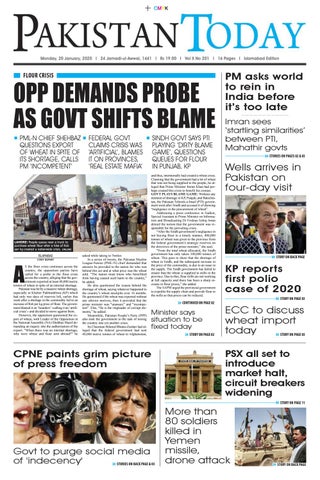
Opp demands prObe as gOvt shifts blame g
PMl-n chief Shehbaz queStionS exPort of wheat in SPite of itS Shortage, callS PM ‘incoMPetent’
g
federal govt claiMS criSiS waS ‘artificial’, blaMeS it on ProvinceS, ‘real eState Mafia’
LAHORE: People queue near a truck to purchase wheat flour after a hike of Rs6 per kg created a nationwide crisis. o n l i n e
ISLAMABAD
a
staff report
s the flour crisis continues across the country, the opposition parties have called for a probe in the flour crisis across the country, alleging that the government exported at least 40,000 metric tonnes of wheat in spite of an internal shortage. Pakistan was hit by a massive wheat shortage, especially in Khyber Pakhtunkhwa (KP) which had only two days of reserves left, earlier this week after a shortage in the commodity led to an increase of Rs6 per kg price of flour. The government blamed it on ‘hoarders’ –calling it an ‘artificial crisis’– and decided to move against them. However, the opposition questioned the export of wheat, with Leader of the Opposition in the National Assembly (NA) shehbaz sharif demanding an inquiry into the authorisation of the export. “When there was an internal shortage, why were wheat and flour sent abroad?” he
asked while taking to Twitter. In a series of tweets, the Pakistan Muslim League-Nawaz (PML-N) chief demanded that answers be provided to the nation for who was behind this act and at what price was the wheat sold. “The nation must know who benefitted from having caused such harm to the country,” he added. He also questioned the reason behind the shortage of wheat, saying whatever happened to the country’s wheat stockpile over 16 months. He questioned if the wheat was exported without any ulterior motives, then it provided that the prime minister was “unaware” and “incompetent”. Else, “He is the ringleader of corrupt elements,” he added. Meanwhile, Pakistan People’s Party (PPP) also took the government to the task of miring the country into yet another crisis. Its Chairman Bilawal Bhutto-Zardari had alleged that the federal government had sent 40,000 metric tonnes of wheat to Afghanistan,
Sindh govt SaYS Pti PlaYing ‘dirtY blaMe gaMe’, queStionS queueS for flour in Punjab, KP
g
and thus, intentionally had created a wheat crisis. Claiming that the government had a lot of wheat that was not being supplied to the people, he alleged that Prime Minister Imran Khan had perhaps created this crisis to benefit his cronies. GOVT PLAYS BLAME GAME: Without any mention of shortage in KP, Punjab, and Balochistan, the Pakistan Tehreek-e-Insaf (PTI) government went after sindh and accused it of showing “negligence in the procurement of wheat”. Addressing a press conference in sialkot, special Assistant to Prime Minister on Information and Broadcasting Dr Firdous Ashiq Awan denied the notion that the government was responsible for the prevailing crisis. “After the sindh government’s negligence in not buying flour in a timely manner, 400,000 tonnes of wheat was given to the province from the federal government’s strategic reserves on the directives of the prime minister,” she said. “From the total wheat allocated, the sindh government has only taken 100,000 tonnes of wheat. This goes to show that the shortage of wheat in sindh, and the subsequent increase in the price of the commodity, is due to an issue in the supply. The sindh government has failed to ensure that the wheat is supplied to mills in the province. Due to this, flour mills are not working at full capacity and there has been a sharp increase in flour prices,” she added. The sAPM urged the provincial government to expedite the supply chain and provide flour to the mills so that prices can be reduced.
PM asks world to rein in India before it’s too late imran sees ‘startling similarities’ between Pti, Mahathir govts STORIES ON PAGES 02 & 03
wells arrives in Pakistan on four-day visit
STORY ON BACK PAGE
KP reports first polio case of 2020 STORY ON PAGE 03
CONTINUED ON PAGE 02
Minister says situation to be fixed today
CPNE paints grim picture of press freedom
STORY ON PAGE 02
ecc to discuss wheat import today STORY ON PAGE 03 PSX all set to introduce market halt, circuit breakers widening STORY ON PAGE 11
govt to purge social media of 'indecency' STORIES ON BACK PAGE & 03
More than 80 soldiers killed in Yemen missile, drone attack
STORY ON BACK PAGE
CMYK Monday, 20 January, 2020
02 NEWS Flour crisis: Opp demands probe as govt shifts blame contInuED fRoM PAgE 01 She said that the “real estate mafia” has started stocking agricultural commodities to whiten its black money by selling them at higher prices when they see an opportunity. “PM Imran has ordered a crackdown on this mafia and with the power of the people we will defeat hoarders since the premier himself has promised the nation that he would not allow profiteers to amass wealth illegally,” she added. She claimed that the Centre has been providing wheat to flour mills across Punjab at subsidised rates and the public can purchase flour, wheat, rice, and pulses from the utility stores at cheap prices. “We need to defeat this negative propaganda against the government. The provincial governments were negligent in the procurement of wheat. Punjab produces 60 per cent additional wheat and it gets stocked if not procured timely,” she added. ‘SHORTAGE IN SINDH’: However, Sindh Chief Minister Murad ali Shah took an exception to the claims made by the federal government. In a statement, he said that 300,000 tonnes of wheat have been allocated for Sindh by PaSSCO which will be brought in from Punjab and Balochistan. He added that the delay in transporting the wheat had been caused by the transporters’ strike. “at least 70,000 bags of wheat have reached Karachi today. By tomorrow, an additional 50,000 bags will also be delivered,” he further said. Moreover, Sindh Information Minister Saeed Ghani demanded that the prime minister should appear on television and apologise to the nation for the shortage. He held the premier responsible for the wheat shortage in Sindh as well as the rest of the country. “Is the Sindh government also responsible for the shortage in Punjab?” he pointed out. He claimed that wheat from Punjab had been sent to KP and a shortage was intentionally created in Punjab.”The PTI government is playing a dirty game by blaming Sindh,” he added. The provincial minister criticised the federal government for being occupied with blaming Sindh while there were queues lined up in lahore, Peshawar and Quetta of people for flour. “The PTI government cannot put up this act for much longer where it blames others to hide its own incompetence,” he added.
Minister says govt will abolish giDC on fertilisers to reDuCe urea priCe by rs400 per bag ISLAMABAD
F
STAFF REPORT
ederal Minister for National Food Security and research Makhdoom Khusro Bakhtiar on Sunday said that sufficient wheat stocks were available in the country to fulfil domestic requirements of flour and expressed firm resolve to take strict action against those involved in creating an “artificial crisis” through hoarding and profiteering. addressing a press conference, the minister said that multiple factors were responsible for the wheat flour crisis. “Transporters’ strike in Karachi affected the supply of wheat flour to local markets in Sindh and the inter-provincial ban on wheat supply to curb smuggling caused a crisis in Punjab and Khyber Pakhtunkhwa (KP),” he said. “Both cases disrupted the supply of in local markets and by addressing the root cause, we have been somewhat
Minister says FlOOr crisis tO ease FrOM tOday
successful in bridging the gap between demand and supply,” he said, adding that the price of wheat flour would decrease in a few days. He said that wheat supply for Karachi was enhanced to 10,000 metric tonnes from 9,000 metric tonnes and wheat-laden trucks of the National logistics Cell had already left for their destination. He added that the federal government had informed the Sindh government that it can procure additional 50,000 tonnes from Pakistan agricultural Storage and Services Corporation’s (PaSSCO) warehouses. He also said that the supply in KP which was disturbed due to inter-provincial checks was realigned and increased from 4,000 metric tonnes to 5,000 metric tonnes per day. Besides this, the private sector is also supplying 4,000 tonnes in provincial markets, which means that by Monday, the supply would be able to reach 10,000 metric tonnes, he added. “So far, KP has lifted 250,000 metric tonnes from the 450,000 metric tonnes approved for
it,” he said, adding that another 100,000 metric tonnes of wheat will be provided to the province once the economic Coordination Council (eCC) approves it on Monday. The minister said that flour mills in Punjab were provided 390 metric tonnes of wheat, adding that the 180,000 bags of 20kg each per day were required by lahore and adjoining areas. “The food department is supplying 140,000 bags whereas the private sector is providing 35,000 bags,” he added. He further said that the remaining 5,000 bags were procured from local wheat grinders and the government intends to regulate these as well to ensure smooth pricing. Bakhtiar said that about 40,000 metric tonnes of wheat were smuggled to afghanistan per month and special measures were also taken to curb this smuggling to ensure smooth supply to the local markets. He also said that a special helpline was established to monitor wheat supply in local markets and wheat pro-
travellers face hurdles as pak-afghan relations deteriorate PESHAWAR AZIZ BUNERI
deteriorating relations between Islamabad and Kabul are not only affecting bilateral trade between the two neighbouring countries but they are badly affecting millions of people who frequently travel between Pakistan and afghanistan. The issuance of visa for travellers has now become a serious hurdle as diplomats of both countries have imposed their own terms and conditions in this respect. during frequent visits to Peshawarbased afghanistan Consulate, this scribe has witnessed long queues of people from dawn to dusk. They also included women with infant children and the elderly. Soon after 9/11, when the Taliban
regime in Kabul fell, Pakistan and afghanistan decided to issue visas without any fee or charges in a bid to strengthen relations and improve bilateral trade and other economic activities. However, since the last couple of years, diplomats have become notorious for minting money through the issuance of visas. aspirants from both countries have confirmed these reports and said that they have to give more bribes in Kabul and Jalalabad than in Islamabad. The diplomats in Peshawar informed this scribe that every day they are issuing 300 to 400 visas and similar are the statistics from Kabul and Jalalabad. But the number of applicants is much higher, thus angering the visa aspirants from countries. In order to protest the state of affairs,
CMYK
curement targets were also enhanced from six million metric tonnes to eight million metric tonnes to facilitate strategic reserves for local requirements. He further said that the output of wheat crop reduced by 1.2 million metric tonnes last year which is why the government has decided to import wheat to create a buffer stock in the country. He said that the government has fixed the price of wheat to rs1,365 per 40kg and it has set a purchase target of 2.7 million metric tonnes for the next year. responding to a question, he said that the incumbent government prioritises the agriculture sector and has initiated development projects worth rs300 billion to enhance the output of major crops, including wheat. He further said that the government would also abolish Gas Infrastructure development Cess (GIdC) on fertilisers which will help in reducing the price of urea by around rs400 per bag.
Pakistani nationals held demonstrations in front of Peshawar Press Club whereas afghans ransacked the visa offices in Kabul and Jalalabad. although Peshawar-based afghan diplomats are reluctant to respond to media queries regarding growing miseries of visa aspirants, some of them have justified their acts by claiming that they are a reaction to the increasing bribes in Pakistan’s embassy in Kabul and consulate general in Jalalabad. It has been observed that without bribes, passports are collected in Kabul but the applicants are given seven to 15 days for the issuance of their visas. But in Peshawar, if no bribes are paid, the passports are returned in a humiliating manner. The officeholders of Pakistanafghanistan Joint Chambers of Commerce’s, different political parties, transporters and tribal elders are lamenting the difficulties in the visa process and the travelling restrictions between the two countries but no one from Islamabad and Kabul has paid any heed to their concerns.
imran sees ‘startling similarities’ between pti, Mahathir govts ISLAMABAD STAFF REPORT
Prime Minister Imran Khan in a tweet on Sunday said Malaysian Prime Minister Mahathir Mohamad, whom he billed as the most experienced and accomplished statesman of the Muslim world, faces exactly the same problems as his government. Sharing a report listing “startling similarities” between Pakistan’s situation and that of Malaysia, the prime minister tweeted: “The most experienced and accomplished statesman of the Muslim world faces exactly the same problems as my govt.” “He [Malaysian PM] is confronted with an entrenched pol mafia that has bankrupted and indebted Malaysia, leaving state institutions devastated.” In a meeting with the Malaysian prime minister’s special envoy and deputy Foreign Minister Marzuki Bin Haji Yahya last year in Nov, PM Imran Khan had reaffirmed his commitment to further deepening PakistanMalaysia relations in all fields. He had appreciated Malaysia’s principled position on the Jammu and Kashmir dispute. He also apprised the special envoy of the continuing inhuman lockdown of over 8 million Kashmiris since India’s illegal and unilateral actions of 5 august 2019 and the dire human rights and humanitarian situation resulting from it. The prime minister stressed the importance of the international community playing its role in the removal of curfew and other restrictions in Indian Occupied Jammu and Kashmir and peaceful resolution of the longstanding issue.
CMYK Monday, 20 January, 2020
NEWS
PM asKs world to rEin in india bEforE it’s too latE ISLAMABAD
P
STAFF REPORT
RIME Minister Imran Khan on Sunday once again warned the world that if India continued with its attacks across the Line of Control (LoC) then it would be difficult for Pakistan to “remain an inactive observer”. In a Twitter thread, the prime minister urged the need for United Nations Security Council (UNSC) to intervene and ask India to allow United Nations Military Observer Group in India and Pakistan to return to Indian occupied Kashmir.
The prime minister reminded the world again that New Delhi may carry out a “false flag operation” as the Indian forces continue to target and kill civilians across the LoC with increasing intensity and frequency. “I want to make clear to India and the international community that if India continues its military attacks killing civilians across LoC, Pakistan will find it increasingly difficult to remain an inactive observer along the LoC,” tweeted PM Imran. This is not the first time that the premier has warned of India’s plan to carry out a false flag operation to divert the world’s attention from the on-
going protests in the country and the situation in the occupied valley. Last month, PM Imran had said that in case India decided to conduct a false flag operation to divert attention from its domestic crisis “to divert attention from its domestic chaos plus whip up war hysteria to mobilise Hindu nationalism”, Pakistan will have no option but to give a ‘befitting response’ to India. Days after the prime minister’s statement, Foreign Minister Shah Mehmood Qureshi had also said that Pakistan had once again drawn the attention of the world over Narendra Modi government’s intentions of staging a false flag operation to divert
KP reports first polio case of 2020
the world attention from the grave human rights violations in India and occupied Kashmir. “The world must have its interests for considering India its commercial ally but it should not be silent on the prevailing situation in India giving due importance to people’s values,” Qureshi said.
MQM-P chief asks govt to fulfil promises for Karachi’s uplift KARACHI STAFF REPORT
Muttahida Qaumi Movement Pakistan (MQM-P) Convener Dr Khalid Maqbool Siddiqui on Sunday urged the Pakistan Tehreek-e-Insaf (PTI) to fulfil its promises made to the people of Karachi, saying the urban areas of the province needed justice from centre. According to a statement issued by the lawmaker, the MQM-P fulfilled all promises made to the federal government and now the urban areas need justice from the centre. The politician said that the
prominence of Karachi remained unchanged. Even though it was not the federal capital anymore, it is still the centre of industries and economic activities, he added. He said that the national economy was in a bad shape when the new government came to power, but now after over a year, it was the responsibility of the PTI government to control inflation. He said that MQM-P will win its case as it was impossible to make Pakistan a prosper state without Karachi’s uplift. Siddiqui said that MQM-P had faced serious allegations in the past
but now the political party will restore its image by ensuring development in Karachi at all costs. The PTI and MQM-P on Saturday held another round of talks to iron out differences, but the dialogue remained inconclusive owing to the demands put forth by the junior coalition partner. The relations between the two parties strained after the MQM-P chief and then IT minister Khalid Maqbool Siddiqui quit the cabinet, citing reservations over the non-fulfilment of commitments made during the formation of the cabinet last year.
Addressing a press conference following the meeting, Siddiqui, flanked by PTI leaders, had said that the talks were fruitful and had claimed that “visible progress” was expected to take place in the next few days if the government responded positively to their demands. The MQM-P’s demands are the formation of a university in Hyderabad; development budget for Hyderabad; implementation of a package of Rs162 billion for Karachi; and opening of MQM’s closed offices that were shut down after its founder Altaf Hussain’s infamous speech.
CPNE paints grim picture of press freedom KARACHI STAFF REPORT
Though Article 19 of the constitution and the Universal Declaration of Human Rights (UDHR) guarantees freedom of expression and free media but media in Pakistan continued to be in chains or under a strict form of physical intimidation like killings and self-censorship regime during 2019 like preceding years. It is revealed by the Council of Pakistan Newspaper Editors (CPNE) in its Pakistan Media Freedom Report 2019 issued here on Sunday. It has a compilation of cases, number of victims and sequence of events that made a mockery of freedom of media and freedom of speech in the country. The report says that despite the fact that there is a specific law on defamation but the government and other actors used the Anti-Terrorism Act (ATA), Prevention of Electronic Crimes Act (PECA) and Pakistan Penal Code’s (criminalization) sections against media practitioners in Pakistan. At least 60 journalists were booked under the Anti-Terrorism Act 1997 in 35 cases which included 50 journalists from Sindh province alone. The report said that the first-ever conviction for possession of banned material was also made. Chaudhry Nasrullah, member of Karachi Press Club was jailed for five years on alleged possession of banned material. According to available data at least seven journalists reportedly were murdered during the year 2019 while reports suggest at least 15 journalists were injured during attacks in the line of duty. The pathetic state of un-announced impunity for those who attack the media
can be perceived from the fact that not a single killer or attacker of journalists and media persons was brought to justice. Khyber Pakhtunkhwa while taking a lead introduced the first provincial law on Right to Information (RTI) followed by Punjab and Sindh respectively. The Federal Capital adopted new legislation on RTI as well. However, in the province of Balochistan, RTI laws remained a distant dream, the report noted. It further stated that it was claimed by the government that cyber law- Prevention of Electronic Crimes Act (PECA) 2016 would deal with cybercrimes and online harassment of women and, would not be used against journalists & media. But on the contrary, the same law had been used against media freedom and freedom of expression in one way or another. In a flagrant attempt to curb media freedom, the PTI government announced to form Special Tribunals (Media Courts) to tighten its grip on media. But due to strong opposition by CPNE and other stakeholders, the government dropped the proposal. Press Information Department in a move to introduce advertisement policy by the federal government shared a draft of the proposed policy with various stakeholders, including CPNE. According to media professionals, the advertisements are being used as a tool to restrict media freedom and keeping this in view CPNE shared its feedback on the policy. According to the World Press Freedom Index, Pakistan ranked 142 out of 180 (comparison) countries, which gives an indication of how media in Pakistan was under threat. On the other side extreme fear and self-censorship continued haunting
ECC to discuss wheat import today ISLAMABAD: The Economic Coordination Committee (ECC) of the federal cabinet will take up the matter of wheat import on Monday. Adviser to Prime Minister on Finance and Revenue Dr Hafeez Shaikh will chair the meeting to discuss matters pertaining to six different ministries. The ECC will take up sovereign guarantees as well as proposed five per cent sales tax exemption on
03
media freedom and free expression in the country, the report observed According to available data at least, seven journalists including Urooj Iqbal, Mirza Wasim Baig, Muhammad Bilal Khan, Ali Sher Rajpar and Malik Amanullah Khan reportedly were murdered during the year. Due to its stories and content, Daily Dawn came under the severe attack as its offices were besieged by angry organized mobs in Islamabad and Karachi; while foul language was used against the Dawn management, including its Chief Editor Zaffar Abbas, the report lamented. Discussing the PEMRA’s role, CPNE reported that PEMRA not only issued notices to TV channels but barred some anchors from offering opinions on TV channels and talk shows. It was ordered not to discuss the issue pertaining release of PML-N leader Shahbaz Sharif on bail. TV channels were directed not to cover live telecast of PML-N leader Maryam Nawaz’s press conference and were also issued notices for non-compliance, added the report. An interview of Asif Ali Zardari, former President of Pakistan and Co-Chairman of Pakistan Peoples’ Party with host Hamid Mir was stopped from being aired shortly after it started on Geo News in July 2019. In the report, Arif Nizami, President CPNE has recommended the enactment of special federal and provincial laws for safety of journalists should be done to obligate the legal system to protect journalists and special federal and provincial prosecutors be appointed. A unified self-regulated code of conduct should be introduced and implemented by media houses/ journalists bodies, he urged.
cotton seed cake. It will also consider Ministry of Commerce’s summary for converting Lahore Garment City Company’s cash development loan into a grant. The committee is likely to approve technical supplementary grant of Rs96 million for the National Book Foundation and Rs15 for the centralised procurement of ICT infrastructure to ensure e-readiness for proper implementation of the egovernance system. Sources said that on the Interior Division’s request, the ECC is likely to grant TSG amounting to Rs458 million for CAF personnel deployed in United Nations (UN) peacekeeping missions. STAFF REPORT
CMYK
PESHAWAR: The National Institute of Health (NIH) Islamabad has notified this year’s first wild polio case in Tehsil Sarai Naurang of district Lakki Marwat. According to the notification, the polio virus has been isolated from the stool sample of a 12 months old male child from union council Bakhmal Ahmedzai, Sarai Naurang, Lakki Marwat. According to the family’s vaccination history, they refused proper vaccination with only allowing their children one dose of essential immunisation and three doses of SIAs as per recall. It is pertinent to mention here that the oral polio vaccine (OPV) is the only cure from poliomyelitis as once contracted the disease was incurable. “The major cause of the surge in polio cases is parental refusal, misconceptions, and antipolio propagandas,” said Khyber Pakhtunkhwa (KP) Emergency Operations Centre (EOC) coordinator Abdul Basit. “In the new year, we must pledge to wipe out this menace as the more it lingers on, the more children will be disabled for life and the country will continue to bear travel sanctions,” he added. He said that polio eradication was a government programme that protects children from disabilities, adding that eradicating the disease is a matter of national pride as it has already been wiped out across the globe except for Pakistan and Afghanistan. AZIZ BUNERI
Centre to take control of three Karachi hospitals within few months: PM's aide Prime Minister’s Special Assistant on Health Dr Zafar Mirza said that the Centre will take over the administrative control of three major Karachi hospitals — the Jinnah Postgraduate Medical Centre (JPMC), the National Institute of Cardiovascular Diseases (NICVD) and the National Institute of Child Health (NICH) — within few months. Dr Mirza said the federal authorities have been holding consultations with the Sindh government on the smooth transfer of these hospitals. In July last year, the federal government had handed three public sector hospitals back to the Sindh government months after it was ordered to take control of the hospitals by the Supreme Court in January 2019. After the ruling that had asked Centre to take over these hospitals, the Sindh government had approached the apex court with a claim that since the subject of health had been devolved to provinces under the 18th Amendment, the management of the hospitals should also rest with it. However, the court had rejected the provincial government’s plea, saying the SC couldn’t leave “poor at the mercy of the provincial governments”. The Centre had taken control of the port city’s three major hospitals in May following the verdict. NEWS DESK
04 ISLAMABAD
Monday, 20 January, 2020
WEATHER UPDATES MONDAY
170C
070C
TUESDAY
120C
040C
WEDNESDAY
160C
KP CM oRdeRs aCTion againsT flouR hoaRdeRs
T
NEWS DESK
HE Chief minister Khyber-Pakhtunkhwa Mahmood khan has directed the provincial and Distt administrations throughout the province to take actions against hoarders, stockiest and artificial price rise of essential food items of daily use especially Atta. Punitive actions should be
initiated against them, he directed. All DCs should send teams in field to discourage hoarding of essential items especially Wheat products, he added. He issued these directives following media reports and public complaints about the artificial price spiral of Atta and other food items in the markets. Chief minister directed to immediately convene Meetings of Consumers committee and hold regular meet-
CDA terminates two officials on corruption charges ISLAMABAD INP
Capital Development Authority (CDA) management has terminated its two officials on corruption, inefficiency and misconduct. The officials have been terminated in accordance with clause 8.05 (a,b&c) of CDA Employees Service Regulations 1992. The officials who have been terminated include Technician Iqbal Khan of Capital Hospital. A proper probe was conducted against the official on the charges of inefficiency, misconduct and corruption. The official was given right of defense but failed to submit satisfactory reply. The official was also granted opportunity of personal hearing, however, he failed to defend himself. Similarly, another technician of Capital Hospital Majeeb-ur-Rehman has also been removed from services on corruption, misconduct and inefficiency. The official has been terminated after fulfilling all the formalities including proper inquiry, opportunity of personal hearing, however, the official failed to defend himself. Recovery on account of corruption, amounting to Rs.464472/would be made from Iqbal Khan and Rs 464,472/- would be made from Majeebur Rehman, Technician. After completion of probe by the inquiry officers and consequent recommendations in the regard, competent authority i.e. Member Administration has approved the termination of the both officials. Hospital Administration has formally issued the termination orders of the both officials.
ings of the committee to take steps for price control of Atta and other commodities of daily use. He further directed that Daily reports about the overall market situation and stability of prices of Atta and other food items should be shared with PMRU for onward transmission to the chief minister. Chief minister is personally monitoring the situation and warned to take action against
stockiest, hoarders and unwarranted price spiral of Atta and other food items throughout the province. Meanwhile the provincial government has rejected increasing the rate of roti. The chief minister directed to supply Atta to nanbais trough nominated dealers on government fixed rates. The meeting of district administration and consumers’ committee is going on and nanbai association is also present.
Global crime index report rates capital as safest city in the world ISLAMABAD STAFF REPORT
A global crime index report declared Islamabad as the safest city in the world as there was a significant decrease in crime rate in the federal capital. Islamabad went up 69 levels in a world crime index report issued by NUMBEO. With reduction of crime rate around four percent as per report, Islamabad has been at 301st number from 232nd last year survey after
conducted survey in 374 cities around the world According to the report, Islamabad crime Index decreased up to 28.63 percent from 32.88 percent of the last year. The levels of crimes are declined up to 24.49 percent but problems of corruption and bribery are ranked at 57.55 percent. Moreover, Citizens are safely walking alone during day and night with index of 81.67 percent and 63.50 percent, mentioned in report. Islamabad beat in rating of the
world major cities like London which stands at 107 with a crime index of 47.63, Paris at 111 with a crime index of 48.16, Berlin at 201 with a crime index of 59.03, Moscow at 206 with a crime index of 59.61, and Shanghai at 242 with a crime index of 63.69. Inspector General of Police Islamabad Muhammad Aamir Zulfiqar said that crime rate has decreased in Islamabad owing effective strategy. He said that effective action is being ensured against criminal and anti-social elements.
020C
THURSDAY
180C
030C
BRT holds another test drive in Peshawar PESHAWAR INP
Bus Rapid Transit (BRT) on Sunday has arranged another test drive in Peshawar.According to details, Special Assistant to Chief Minister on Local Government and Rural Development, Kamran Khan Bangash also participated in the test drive of the project. Talking to media, the special assistant told that the project will soon be inaugurated by the CM. It is to be mentioned here that only six percent work was done on the Peshawar BRT project in last six months due to delay in issuance of funds to the contractors. The mega project of Khyber Pakhtunkhwa (KP) government – which was started during Pakistan Tehreek-e-Insaf’s previous term in the province – has been surrounded by controversies and problems since the beginning. The initial estimated cost of the project was Rs 49 billion which has now surged to Rs 68 billion. The government has decided to conduct a forensic audit of the planned undertaking through the Asian Development Bank (ADB). However, it has been learnt that people will not get benefit from the project as no subsidy will be provided to the masses that will pay Rs 5 per kilometer. At the end of the year, the Federal Investigation Agency (FIA) started investigation into the matter on the directives of the Peshawar High Court (PHC) while the KP government moved the Supreme Court (SC) to stop the interrogation. The provincial government has maintained that it has contacted the apex court to only bring forth its stance over the matter.
ISLAMABAD: Workers paint different patterns on a truck at their workplace in the federal capital. ONLINE
Craftsmanship of classical music instruments on verge of extinction PESHAWAR APP
Passing through the labyrinth of alleyways in historic Peshawar city, one becomes bewitched by the beat of traditional Tabla (hand-drums) and to the tune of rabab (guitar) echoed in the market owned by the craftsmen-manufacturers who adhered to the centuries old legacy of making classical music instruments. The Peshawar’s historic name is `Pesha War’ (Skillful-Persons) which means that the city was recognized in history as `City of Artisans’ due to ample livelihood facilities provided by the generosity of its dwellers to the people of the region. The artisans busy at work of thumping stretched out dry animal hide to adjust beat of hand drums or twisting strings to set tunes of rabab (guitar) takes passerby to nostalgic time of swinging to the tunes
of classical music. However, over the years, like other handicrafts in the region, the profession of making musical instruments, particularly the classical ones, have also witnessed decline due to modernity and innovation in the music industry. Sitting in shops located in Mohallah Shah Burhan in the interior city, a couple of shopkeepers are displaying handmade musical instruments for sale including hand drums, rababs and tambourine. These shopkeepers share the same lineage with the art of making and repairing of musical instruments from the last one century. Talking to APP, an artisan by profession, Ahmad Ali said, “Our grandfather, Rahim Buksh, migrated from Gujrawala district of Punjab to Peshawar and started this art as a mean of livelihood. The profession is continued by our father, Rahim
Murtaza and we the third generation also inherited it in succession.” He said that the knack of preparing classical music instruments in Peshawar is in danger of disappearance because only a few skillful persons associated with it are continuing it. While elaborating his concern, Ahmad Ali said that unlike his elders and they themselves, the art is not adopted by their children as a profession due to deep slump in business. In fact, “We decided discontinuation of this vocation by our children because of dwindling income due to modernity in melody choice diverting focus of people from classical music to the latest DJ (Disc Jockey) style”, He added. The craftsmanship will not be available in future and classical music lovers in Peshawar will have to face a dead end due to difficulties in finding out perfect instruments manufacturers besides mechan-
CMYK
ics to repair the instruments already in use. Rahim Mujtaba, another artisan in the same locality said that he is associated with the art of manufacturing and repairing of musical instruments for the last 40 to 45 years. But the economic recession they are being faced with during the last 12 to 15 years, is unprecedented, making it difficult for them to make both ends meet. He said, “The process of crushing iron in metal mortar and pestle is very cumbersome exercise which not only consumes time, but also needs a lot of physical strength.” Zarshad, a hand drum beater said, “I came from Charsadda district to get my hand drums repaired as there is no shop or person in our area to do this job.” He said that people associated with classical music are facing very tough time due to reduction in demand in the market. Holding of music shows by TV
Channels, especially regional, have provided a lot of opportunity to music performers and their number increased, but if there is no professional person for tuning of music instruments, people will face a lot of problem, Fazle Rauf continued. Raiz Ahmad, Assistant Director Culture Department KP said, “Culture department is cognizant to the problems being faced by music lovers and artisans associated to manufacturing and repairing of instruments.” He said that KP Culture Department launched `Support to Living Human Treasure’ project with the objective of extending financial support to artist community. Under the project, a stipend of Rs. 30,000 was paid to around 500 persons including singers, musicians and Tabla (hand drum) players. The project ended around six months earlier after completing two years of its stipulated period.
Monday, 20 January, 2020
NEWS
05
The Order Of The BOOT City Notes M A NiAzi
dI Khan jailbreak mastermind caught by CTd The suspected mastermind who paved the way for the escape of several high-profile convicted Tehreek-e-Taliban Pakistan (TTP) terrorists by plotting and executing the 2013 Dera Ismail (DI) Khan central jail attack was arrested in Sukkur on Saturday. The suspect has been identified as Waqar Amin, a militant, who had been on the run since the attack seven years ago. According to the details, he was caught during a raid on Boster Link Road in Sukkur by the Counter Terrorism Department (CTD) and other agencies. Waqar is currently being kept at an undisclosed location and will be shifted to DI Khan for further investigation. Earlier on Friday, police had arrested the TTP Malakand commander in Mardan. Around 150 TTP militants armed with mortars and grenades had launched a major attack on the Dera Ismail Khan central prison on the midnight of July 20, 2013, freeing top figures of the terrorist organisation along with other inmates after a gun battle with security forces. At least 12 people including four policemen were martyred and seven others wounded in the brazen assault staged by the militants disguised in police uniforms. Earlier in October 2018, the CTD had killed key terrorist Muhammad Abid, in the DI Khan jailbreak. NeWs DesK
TB claims 56,000 lives annually ISLAMABAD: As many as 160,000 tuberculosis (TB) patients are missed from treatment and around 56,000 deaths are occurred due to this disease in Pakistan every year. According to an official of National TB Control Programme, the figures of patients diagnosed with tuberculosis (TB) are increasing in Pakistan as estimated 27,000 new cases are being reported every year in the country. Sharing the official available data, he said the TB cases incidence rate per year is 525,000 in Pakistan while the figure of TB cases under treatment is 368,589. The official said 1,571 microscopy centres have been working in the country. He added the TB treatment success rate was 93 percent. He said the government has paid special attention to this critical issue and strengthened the programme for providing a free treatment to TB patients. He said more than three hundred thousand TB patients are benefiting free diagnostic and treatment facilities every year in Pakistan. He said more than 30 hospitals have been upgraded to take care of multi-drug resistant TB cases and 13 laboratories equipped with state-of-the-art facilities are being established in various parts of the country. He said the government is committed to achieve the target of eliminating the disease from the country and sought support of all stakeholders in this regard. He said the government has planned several activities to raise public awareness about the devastating health, social and economic consequences and to step up efforts to end the disease epidemic. He said it was in 1882 when Dr Robert Koch announced that he had discovered the bacterium that causes TB, which opened the way towards diagnosing and curing this disease. Each day, nearly 4,500 people lose their lives to TB and close to 30,000 people fall ill with this preventable and curable disease, he added. He said global efforts to combat TB have saved an estimated 54 million lives since the year 2000 and reduced the TB mortality rate by 42 percent. APP
IFFAT FAROOQ ITES flying in the February air always fascinated him. They added colors to the ten-year old’s mundane routine and his dream to fly high like them took him to immortal times. Hamza belongs to the slums of Shahdrah wherein his parents indulge in draining domestic labour from dawn to dusk. He is a part of a family of eight, which is barely able to manage to put food for one time on its table and going to school is far distant dream for them. He used to work with his brothers at a factory since he touched his seventh birthday. Sundays, was the only time his friends could meet up and enjoy the cheap yet exultant liberties within the slums of the outskirts of Lahore. In the last Basant season, kite flying excursions brought sorrows of loneliness and caging along, as someone on the road got tangled within the string of his kite and slit his wrist open and died on the spot. He was much scared and true to the fear, caught up in the District Jail Lahore with other under trial minors. His parents, over the course of the next couple of weeks, tried to seek justice from the local police and prison authorities but were unable to access any relief.
K
T
HE first thing I want to know is Mian Nawaz Sharif’s doctor’s name. Any doctor who can recommend a walk that ends in a restaurant is the doctor I want to go to, in my book. My own experience so far has been of doctors telling me that anything I eat is bad for my heart, my blood pressure, and my kidneys. I’m waiting for the day a doctor who tells me to stop breathing because the air is too polluted for health. That day can’t be too far off, because the rain we’ve been having hasn’t cleared the air, though it did increase the cold. So not only is it as bitterly cold as ever, but the smog is back. I think that I won’t want Dr Imran Khan at my bedside. He’s the one who diagnosed Mian Nawaz as being healthy from a picture of the back of his head in the restaurant. I’m sure he was prescribing and operating and treating patients while in Azad Kashmir, where he went after the avalanches and landslides there killed more than 100 people. Despite his phenomenal diagnostic skills, honed on his years in the cricket field. What does the cricket field have to do with practicing medicine? You ask. Well, let me remind you of the four Grace brothers, of whom the most famous was W.G., who turned out for so many years for Gloucestershire in the last half of the 19th century and the beginning of the 20th, and who were all doctors or medical students. And none of them ever won a World Cup or built a cancer hospital. So anyone objecting to him treating patients should know where they can get off.
I wonder whether he will wear a white coat next, or take a stethoscope to his next TV appearance. That might upset doctors, not that he would mind. After all, he’s on the same page with someone else. That someone else was less than amused with Water Resources Minister Faisal Vawda, who found himself better known than any time before in his entire life by the simple act of bringing a boot to a TV show. And never, I think, has anyone found he has put his foot further into his mouth than him. And instead of a ban on appearing in talk shows, surely he should get the Order of the Boot from the Cabinet. Of course, what he did was in bad taste, but it didn’t harm anyone. Well, it did insult all our brave men in uniform, but it didn’t hurt them the way Science and Technology Minister Fawad Chaudhry hurt a TV host when he slapped him recently. Mr Vawda hasn’t apologised for his deed, but he hasn’t justified it either, as Ch Fawad did, who said that he had done so because the host had insulted him on Youtube. A layman might nod, but Ch Fawad is a lawyer, and a nephew of a former Chief Justice of the Lahore High Court, as well as of Ch Altaf, the Punjab Governor, a prominent lawyer alongside a long political career. Ch Fawad would know that he couldn’t offer that as a defence in any court. There are quite a few remedies, but a slap isn’t one of them. As a matter of fact, a slap is not even allowed to be part of a sentence. The Penal Code allows a man to be hanged, and the Jail Manual prescribes how, but neither allows a prisoner, even one over whose head the noose dangles, to be slapped. While Imran ignores Ch Fawad’s pugilistic proclivities, he gave Mr Vawda a two-week ban from appearing on talk shows. While that must be disappointing for his family, all it means is that TV
anchors will be lining up to have him appear after a fortnight. So what will he do for an encore? Slap the anchor? Well, maybe he should appear barefoot. I’m not so sure Vawda knows what party he’s in. I mean, the PTI expressing disdain for national institutions? He should watch the Musharraf case more carefully. The General appealed his death sentence to the Lahore High Court, which proved that its patriotism was aboveboard, and declared that Musharraf was not guilty of high treason by firing Iftikhar Chaudhry as Chief Justice. In other words, no blame attaches to whatever you do to the Constitution. That message will be popular among those who were so upset over the death sentence. Between you and me, I think it’s unfair that NAB isn’t allowed to offer rewards, and has just to pursue cases. I mean, while it closed the inquiry against Zulfi Bokhari, it wasn’t allowed to order that he receive a hero’s welcome in Lahore, or be accorded a triumph in Karachi. Or that he be allowed to bind Nawaz Sharif, Yousaf Reza Gilani and Asif Zardari to his chariot wheels on entry to Islamabad. Those three had been caught at the door of the Toshakhana, redhanded in the act of sneaking out valuables from there. It is still not clear whether they did so separately, or together. Imran was getting other good news. Like the US-China trade deal, which means that Pakistan’s diplomacy bringing them together has worked. Then there was the recall for Shoaib Malik to the T20 team against Bangladesh. Who also agreed to a split Test series. This must be the first time a 2-test series has been split. I wonder when they’ll come up with split days. Y’ know, up to lunch against one team, the lunch-tea session against another, and tea-close against a third. And if they can recall Shoaib. Why not Imran?
Rights activists slam Indian general’s threat to push Kashmiris into ‘deradicalisation camps’ NEW YORK APP
Human rights activists and Kashmiri intellectuals have denounced a proposal by India’s top general’s to ship off people in Indian occupied Kashmir to “deradicalization camps,” according to a report published in The New York Times. Gen. Bipin Rawat, chief of India’s defence staff — a new post created by Prime Minister Narendra Modi — made the suggestion about sending Kashmiris to deradicalization camps at an international affairs conference in New Delhi attended by government officials, foreign diplomats, business executives and scholars. “Responding to a question on how to fight terrorism, the general said that in Kashmir, “Girls and boys as young as 10 and 12 are now being radicalized. These people can still be isolated from radicalization in a gradual
way, but there are `people who have completely been radicalized.” “These people need to be taken out separately, possibly taken into some deradicalization camps,” he was quoted as saying in the Times. “We’ve got deradicalization camps going on in our country.” (The move by some countries to forcibly put dissenting people into â “deradicalization camps” has been described by some analysts as a new way to carry out a “cultural genocide”). “It’s shocking he would even suggest this,” Siddiq Wahid, a Kashmiri historian who earned his PhD from Harvard, was quoted as saying by the Times. I don’t think the general realizes the insanity of what he is talking about.” The newspaper point out that Kashmir has been mired in crisis for decades and this past year the Indian government upended decades of delicate, albeit flawed
policies by unilaterally revoking the statehood of Jammu and Kashmir, the part of the region it controls. It sent in thousands of additional troops, arrested practically the entire intellectual class there, including elected representatives, business people and students, and shut down the internet. “All of that was highly unexpected and is what makes Kashmiri intellectuals fear the general’s comments,” the Times said. They say that under the government of Prime Minister Narendra Modi, just about anything — however unbelievable just a few years ago — is possible. The paper says&nnbsp; Modi’s party has been pushing a religious nationalist ideology that critics say favours India’s Hindu majority and deeply alienates its Muslim minority. Just last month, Modi’s government passed a highly divisive law that creates a special path for migrants to get Indian citizenship —
if they are not Muslim. Outrage at the law sett off weeks of nationwide antigovernment protests, which are continuing. Saket Gokhale, a civil rights activist in Mumbai, said this was the first he had ever heard of deradicalization camps inside India. He said that in some areas where the security forces were battling armed groups, such as the Maoist belt in central India, the military ran deradicalization programmes including community visits and vocational training. But those were voluntary and did not involve confinement. “There have been outreach programmes, but a deradicalization programme is very different from a deradicalization camp,”Gokhale said. Wahid, the historian, said he was concerned about the general’s use of the word “camps.” “Are we talking about summer camps or one-year camps where you strip people of their identity and rebuild them?” he asked.
Juvenile cell gazing at the horizon He has been in the jail cell for more than two years now, awaiting a gust of justice to flow within the air. The people in his vicinity failed to protest his detention; the man who illegally sold the “DOR” of the kite remains in the market alongside the rest of mafia. The unequipped criminal justice system has turned deaf ears towards Hamza. He has only been given two chances to defend himself and his case is in trial over the course of the last two years. The pain and loneliness of the cell and courtyard full of hardened criminals has suffocated him and the senses are full of disappointment flowing outside. He feels as though life inside is also being extinguished with each passing moment. When he finally goes to bed in the juvenile cell he recollects and dreams about his childhood stories. While sleeping his mind wanders and he wishes that had he stopped that day by some unseen force and went for cricket or ‘gilli danda’ instead, he would have been able to enjoy the comforts of home. He could have saved up money to buy expensive
medicines for his sick and frail mother. The process of salvation has blurred his vision and obscured his mind. In dark chilly nights, cell walls shrink as close that it seems, they would break his ribs and the next moment, he feels himself roaming in rusty streets and playing in small courtyard with his siblings. When he looks out the windows of the small jail cell, he still imagines colorful kites flying out the window; he wishes he could flow freely in the sky like them. He imagines himself flying in the dark grey sky with the shining, peaceful clouds. He dreams of flying alongside Aero planes and hears reveries of his dream of himself becoming a pilot and being able to take care of his beloved mother. And then suddenly, he recalls the last time she came to visit him, with news of his trial being extended, and how he cried for hours into her lap and rest of night witnessed screams and shreds. One very innocent kite flying session had ended up in him being thrown into a ruthless time. He has lost two formative years, hundreds of days and
thousands of hours, confined, for a crime he didn’t even know he was committing. He twists his wrists in agony while thinking about how his parents are suffering. As he remembers his life back in the slums, fresher tears fill his eyes with the testimony of the cruelty of the country’s criminal justice system. The unfulfilled, tender aged dreams are screaming for conscious attitude over the placid behavior of the community towards the most vulnerable and dependent segment of the society. His mother always comes as a ray of hope, as the sole savior in the wasteland of small cells and motivates him to never give up his dream of flying high and high. He thinks of the times he’ll be able to fly his aero plane above the colorful and innocent kites. This is the only hope that soothes him and tells him that the horizon he dreamt of, isn’t too far off. Each new day comes up with new impetus to prepare for the court hearing and to prove his innocence but the wave of unheard days freeze his bones and he gets scared that he might be unable to and
despises being shifted into the elder’s jail, if his trial travels at the same pace. Thousands of hours spent in the prison quadrangle rattle the doors of freedom loving society and mindfulness of the state. He wishes to blow the trumpet of justice and prejudice so loudly that its frequency deafens the rest of the world. The criminal justice system and the unwarranted authorities have never seen with so much clarity an innocent’s tears and forgotten dreams, both soaked into his mother’s lap. But still, as he peeps over the horizon from the juvenile cell, he sees vibrant kites flying and along with them his pure, intense yet unattainable dreams. He feels himself flying aloft the prejudicial conscientiousness of all human beings. “As I walked out the door toward the gate that would lead to my freedom, I knew if I didn’t leave my bitterness and hatred behind, I’d still be in prison.” – Nelson Mandela. The writer is a public policy practitioner and she has keen interest in the sociopolitical arena of Pakistan.
Monday, 20 January, 2020
06 WORLD VIEW
We have to talk about these Pakistani gangs THE MANCHESTER ABUSE SCANDAL SHOWS WHAT A HORRENDOUS IMPACT POLITICAL CORRECTNESS CAN HAVE
Spiked
t
BRendan o’neill
HIS week, we have seen the true toll of political correctness. PC isn’t just irritating or stupid. It isn’t just woke students banning sombreros or schools getting iffy about ‘Baa Baa Black Sheep’. PC destroys lives. A report into police and council failings in Manchester has found that gangs of predominantly Pakistani men were free to abuse up to 57 girls after chief cops and local officials turned a blind eye to this foul, cruel behaviour. Why did they turn away? Partly out of fear of stoking racial tensions. Partly because they were worried that drawing attention to the grooming and exploitation of mostly white working-class girls by Asian men might ‘incite racial hatred’ and damage multicultural relations. Let’s put it plainly: they sacrificed girls to political correctness; they thought that preserving the ideology of multiculturalism was more important than protecting girls from harm.
The independent review into grooming and abuse in Manchester in the mid-2000s, published recently, makes for grim reading. It says there were up to 57 victims, mostly white girls aged between 12 and 16, and 97 potential perpetrators, mostly men of ‘Asian heritage’. The review makes clear, from some of the evidence it acquired, that some of the abuse networks were made up of ‘predominantly Pakistani men’. That is, similar to Rotherham, Telford and other parts of the UK, this was a case involving what is sometimes referred to as a Muslim grooming gang. The girls were groomed, sexually abused, plied with drugs and raped. They suffered, in the review’s words, ‘the most profound abuse and exploitation’. But little was done to help them. Their abusers were not brought to justice. And this catastrophic failing was in part fuelled by what the review refers to as Greater Manchester Police’s concerns about ‘sensitive community issues’. As one news report summarises it, the police were ‘keen not to be seen targeting [a] minority group’. As a result of this PC cowardice, of this mad multicultural sensitivity, the abuse continued. The review focuses on the tragic case of Victoria Agoglia, a 15-year-old girl in the care of Manchester social services who died from a heroin overdose in 2003. Social services were aware that Victoria was being exploited. She was being injected with heroin by the gangs who used and abused her. She reported being raped. Scandalously, little was done to assist her. Following her death, the coroner said she was known ‘to provide sexual favours’ – a repulsive way of describing the sexual
abuse of an underage girl by older men. As the independent review says, such a view of Victoria and her tragic fate ‘significantly underplays the coercion and control’ and ‘harrowing experience’ she was subjected to. Think about this: we live in a time in which a middle-class woman’s complaint about overhearing a sexist joke or having a hand briefly placed on her knee becomes a huge scandal and can even dominate news coverage, and yet a vulnerable working-class girl can experience horrendous genuine abuse and a coroner, influenced by the view of social services, will refer to it as ‘sexual favours’. Greater Manchester Police launched Operation Augusta following Victoria’s death. They identified 57 victims and 97 potential perpetrators. Yet hardly any of these people were brought to justice and their ‘activities [were not] disrupted’, as the review says. That is, they carried on abusing. Operation Augusta was wrapped up early and resources were devoted to other, less ‘sensitive’ crimes. As the review says, ‘The authorities knew that many were being subjected to the most profound abuse and exploitation but did not protect them from the perpetrators’. This is a scandal of epic proportions. The very organisations that are charged with looking after young people who are at risk of abuse failed to do their duty. And they failed to do their duty because they did not want to ruffle community feathers; because they believed, as so much of the establishment does, that ordinary Britons are a vile racist throng and if we hear about an Asian grooming gang we will go crazy. They let their ideology – their com-
mitment to political correctness and to multicultural censorship – distract them from the task of protecting girls from ‘the most profound abuse and exploitation’. The silence around grooming gangs, in which largely Muslim men abuse largely white working-class girls, has gone on long enough. We need a serious debate about this. And yet even discussing it is difficult. People are branded racist if they bring it up. You’re an Islamophobe if you talk about the background of most of these men. Sarah Champion was thrown out of the shadow cabinet for daring to write about gangs of Pakistani men abusing girls in her constituency of Rotherham. Corbynistas and Muslim groups accused her of racism. This unwillingness to talk about, never mind take seriously, the abuse of hundreds of white working-class girls across the country can also be seen in the response to the Manchester scandal. As some people are pointing out, many of today’s newspapers have not led with this story in the way we should expect them to, given it is a huge social and political scandal. What’s more, feminists, so-called progressives and the allegedly pro-working-class left are silent about the whole thing. There are no hashtags. There is no #MeToo solidarity for these abused girls. There are no expressions of concern from the left. Just shameful, cowardly silence. ‘Make it go away’, is the attitude of these people. Indeed, this week we have had the truly grotesque spectacle of lefties expressing more concern for a duchess, Meghan Markle, than for 57 working-class girls who suffered ‘profound abuse’. They’ve shed more tears over a few rude headlines
about the painfully privileged Duchess of Sussex than they have over the revelation that working-class girls were degraded in the most awful way because the authorities couldn’t be bothered to help them. All day the chattering classes were droning on about ‘white privilege’ while ignoring the reports about white, mostly poor girls in Manchester being abused. The cognitive dissonance is complete: ‘All white people have privilege’, they cry, as a review reveals the abuse and rape of white girls by mostly Pakistani gangs. We have to talk about this. We have to talk about how officialdom’s shameful reluctance to investigate these kinds of cases allowed the abuse to continue. We have to talk about how the cultural elite’s silence on these crimes further denigrates the victims, treating them as if they are unworthy of public sympathy. We have to talk about how the new elite’s denigration of white working-class communities as backward and stupid and trashy could well inflame some people’s view of these communities as unimportant, as worthy of abuse. And we have to talk about how the ideology of multiculturalism, the PC unwillingness to look community tensions and divisions in the face, is harming the country. If we don’t talk about this, far-right elements will continue to make mileage from this issue, girls will continue being abused, and society’s divisions will never be tackled. Only honesty and firmness can stop these things from happening again. Brendan O’Neill is editor of spiked and host of the spiked podcast, The Brendan O’Neill Show.
Fatima Bhutto: What I know about men Muslims make a point: Identity
Age Jane Rocca
My paternal grandfather [former Pakistan Prime Minister Zulfikar Ali Bhutto] featured strongly in my life because his assassination in 1979 changed the course of my father Murtaza’s life. He had to leave the country and went into exile. It brought the shadow of violence over our entire family. I learnt about my grandfather from a very young age and my father spoke of his famous library in Karachi. The sense of justice and injustice was always very close to my grandfather’s story. My father was a tall man who dressed incredibly well and smelt distinctly of cologne. My earliest memory is of him wearing a leather jacket in the cold but I can’t place where we were. He was warm and funny and when we were in exile in Syria I always felt safe around him. He and my mother, Fauzia, divorced when I was three. My father was my primary care giver. I am sure it was unsettling, but my memories have always been with him. He would cut my hair, take me to school, do my homework with me. My father raised me as a single parent until I was eight. He brought me to my love of books and writing. I remember being in Syria, where I grew up, and him promising me, at the age of four, that he would take me to the school library. He built up the day and told me what a library was like – an amazing place for books that you could borrow and take home and borrow more if you took care of them. My father never pushed me into politics; but whenever I gave him an outrageous suggestion of what I wanted to be – at one point, a swimmer – he would say, “What about being a foreign minister, like your grandfather?”
My dad passed on his love of James Bond movies to me. Even though Syria was a closed place in the 1980s, somehow you could still get James Bond films. We would watch them on VHS. There was always a debate around if you were a Sean Connery fan or Roger Moore. I liked Sean. He played Bond like a killer and Moore played Bond like a lover – which makes you torn between the two, I guess. My father was shot and killed when I was 14, in 1996. I was just starting the ninth grade at Karachi American School. I had some great male friends around who were very kind to me at that period in my life. Their protective instincts kicked in. After my father’s death, my younger brother Zulfi and I were sent back to Syria to live because we didn’t know if Pakistan was safe or what would happen to us. I was very excited about having a baby brother. I always took on a very protective role – I’d get upset about his grades, or him not doing schoolwork. If he didn’t do well on a test, he didn’t have to worry about his mother, Ghinwa – it was me who got upset. He is now 29, an artist in San Francisco. Professor Dennis Dalton taught me political theory at Barnard College in Columbia. At the time I didn’t think political theory was my cup of tea, but he was so electrifying. He was also a political activist in America in the 1950s and ’60s and hid Malcolm X in his home. He introduced me to Malcolm X’s autobiography – a journey from anger and fear to openness and compassion. It was a real political awakening. I was confused about my country at that time. I didn’t know how to feel about my father’s death, I was angry about his murder and Dennis was helpful in guiding my thoughts and evolution. I did my thesis with him and he influenced me as a writer. A.A. Gill, the late British writer and critic, was also a great friend. I always admired his humour and ability to condense and observe life around him. I have never had a friend like him before and know I never will again. I prefer not to speak about my private life. I have spent most of my 20s and 30s focused on working and writing. I guess marriage one day would be nice. New Kings of the World: Dispatches from Bollywood, Dizi and K-Pop (New South Books) by Fatima Bhutto. Jane lives in Melbourne and writes about fashion, music and lifestyle.
not divorced from nationhood IS IT FEAR THAT IS PUSHING MUSLIMS TO MAKE THESE DECLARATIONS OF PATRIOTISM?
TimeS of indiA SagaRika ghoSe
The protests against the Modi government’s citizenship laws are throwing up images in which stereotypes are being shattered. Maulanas and clerics are not leaders here; instead, youth and home-makers are. These are not “Muslim” mobilisations as earlier seen against Salman Rushdie, triple talaq or Taslima Nasrin. Instead, this new inclusive movement is one where Bhim Army’s Chandrashekhar Azad — and not the Shahi Imam — has addressed crowds at Jama Masjid. Students and citizens from all communities have joined in raising the non-denominational slogan — azaadi. Protesters make a crucial argument: given the foundational constitutional principle of all religions being equal before the law, India’s Parliament cannot, in the 21st century, insert religious discrimination into any legislation. It’s a protest armed with nothing but the Preamble. Clothes do not matter; jeans, jackets and hijab co-exist. Importantly, the women of Shaheen Bagh or software professionals in Bangalore or students of Jamia, have little truck with old-style victimhood. Instead, theirs is a forceful declaration of equal citizenship by patriotic Indians. At protest sites youngsters are lining up to have their faces painted with the Tricolour, something normally
seen during cricket matches or Independence Day. At Shaheen Bagh, there’s an installation of India Gate and giant India maps. Posters of freedom heroes Gandhi, Bhagat Singh, Ambedkar and Maulana Azad are depicted standing together. Claiming all of them together — something conventional politicians don’t — is what makes the protest ideologically unique. In Hyderabad, AIMIM leader Asaduddin Owaisi is organising Tiranga rallies and plans to light up Charminar in Tricolour on Republic Day. In Mumbai’s Dharavi, Muslim slum-dwellers stand with their Marathi manoos neighbours, chanting patriotic songs. AIMIM’s Waris Pathan has yelled that others may migrate to Australia and America but the Indian Muslim will never leave his beloved Bharat. Is it fear that is pushing Muslims to make these declarations of patriotism? BJP may argue that its precisely these declarations of ‘loyalty to India’ from Muslims which the party has always pushed for. Yet there’s no fear in the Muslims’ open defiance of the prejudice that has been consistently directed at them. Instead, there’s an unwillingness to succumb to stereotyping and demonising. At the same time there’s a deep yearning for crosscommunity brotherhood, to align with other inclusive patriots. Said a protester: ‘Enough is enough. Didn’t we remain quiet after the Ayodhya judgment? Didn’t we remain quiet even though many of our businesses were ruined after cattle trade laws? Didn’t we remain quiet when the only Muslim majority state was split into UTs? Have we not consistently spoken of peace after bloody assaults? Now when our citizenship itself is being questioned, we will not fight shy of voicing a cry of both anger and of intense belonging to our homeland.” This cry is directed not only against saffron majoritarianism, but also against those within the Muslim
community — notably, intellectuals like the late Syed Shahabuddin who insisted on a ‘Muslim’ identity ahead of an ‘Indian’ one. The slogan, ‘Hindustan ke chaar sipahi, Hindu, Muslim, Sikh, Isaai’, is regularly raised in Shaheen Bagh, emphasising that inter-community partnership built free India. Instances of violence and radicalised politics in UP, West Bengal and Mangaluru have taken away some of the movement’s moral dignity. Yet the overwhelming majority of the protests have remained non-violent and may even have the potential to renew faith in conscientious non-violent civic action. The onus is now on the majority community: can Hindus embrace this call for the Constitution and shun the regressive stereotypes propagated by politicians who believe “protesters can be recognised by their clothes”? The ruling BJP has internalised the lexicon of British imperialists. The scholarly book ‘Beyond Turk and Hindu’ shows how British colonial census takers, in pursuit of ‘divide and rule’, froze Indians into watertight silos of ‘Hindu’ and ‘Muslim’. Before the British, the subcontinent was a free give and take of broad “Islamicate” and “Indic” people. The protests evoke those age-old ties and stake a claim to Muslims’ long-held place in India’s history. It’s a mistake to see the protests as a “Muslim” issue. It would also be a mistake for protesters to descend into narrow identity politics. At the moment, there’s a striving for modern constitutional values and strong rejection of the two-nation theory. In fact, the protests are an opportunity for the emergence of an active new Muslim citizenship beyond the majority-minority divide because this movement asserts that the patriotism of the Indian Muslim is in no way lesser than the deshbhakti voiced by Indian Hindus. A powerful sentiment courses through the protests: garv se kaho hum Indian Muslim hain.
Monday, 20 January, 2020
FOREIGN NEWS 07
libya oil exporTs blocked, raising sTakes for berlin peace summiT TRIPOLI
F
AGENCIES
ORCES loyal to Libyan military strongman Khalifa Haftar blocked oil exports from the war-ravaged country’s main ports Saturday, raising the stakes on the eve of an international summit aimed at bringing peace to the North African nation. The move to cripple the country’s main income source was a protest against Turkey’s decision to send troops to shore up Haftar’s rival, the head of Tripoli’s UNrecognised government Fayez al-Sarraj. It comes ahead of Sunday’s conference in Berlin that will see the United Nations try to extract a pledge from world leaders to stop meddling in the Libyan conflict — be it through supplying troops, weapons or financing. “All foreign interference can provide some aspirin effect in the short term, but Libya needs all foreign interference to
stop,” UN Libya envoy Ghassan Salame told AFP in an interview. But Sarraj issued a call for international “protection troops” if Haftar keeps up his offensive. “Such a protection force must operate under the auspices of the United Nations. Experts will have to advise who should participate, such as the EU or the African Union or the Arab League”, he told the Die Welt newspaper on Sunday. The presidents of Russia, Turkey and France as well as US Secretary of State Mike Pompeo are to join the Sunday talks, held under the auspices of the UN. Haftar and Sarraj are also expected, German Foreign Minister Heiko Maas confirmed Saturday, ahead of the first gathering of such scale on the conflict since 2018. After months of combat, which has killed more than 2,000 people, a ceasefire took effect on January 12 backed by both Ankara and Moscow, which is accused of supporting Haftar.
But Saturday’s blockade raised fears over the conflict. The disruption to oil exports is expected to more than halve the country’s daily crude production, to 500,000 barrels from 1.3 million barrels, translating to losses of $55 million a day, warned Libya’s National Oil Company. “Our line at the UN is clear. Don’t play with petrol because it’s the livelihood of the Libyans,” warned Salame just hours before the blockade. Jalel Harchaoui, an expert at the Hague-based Institute Clingendael, said the petrol blockade was part of “the logic of blackmail”. “It can work, but there’s also a risk that Washington will react badly” he said. Washington was deeply opposed to any move that could drive up crude prices, he added. The oil-rich North African country has been torn by fighting between rival armed factions since a 2011 NATObacked uprising killed dictator Moamer Kadhafi and toppled his regime.
More recently, Haftar’s forces launched an assault in April on Sarraj’s troops in Tripoli. Although Sarraj’s government is recognised by the UN, some powerful players have broken away to stand behind Haftar — turning a domestic conflict into what is essentially a proxy war with international powers jostling to secure their own interests. Alarm grew internationally when Ankara ordered in troops early January to help shore up Sarraj. Russia has denied accusations it provided weapons, financing and mercenaries to Haftar. “We must end this vicious cycle of Libyans calling for the help of foreign powers. Their intervention deepens the divisions among the Libyans,” said Salame. The place of international players should be to “help Libyans develop themselves”, he added. The UN envoy said Sunday’s meeting will also seek to “consolidate” the shaky ceasefire.
“Today we only have a truce. We want to transform it into a real ceasefire with monitoring, separation (of rival camps), repositioning of heavy weapons” outside urban zones, he said. Although the UN has tried repeatedly to broker peace, talks have repeatedly collapsed. ERDOGAN ISSUES WARNING: On the eve of the Berlin talks, Turkish President Recep Tayyip Erdogan warned Europe to stand united behind Sarraj’s government, as Tripoli’s fall could leave “fertile ground” for jihadist groups like IS or Al-Qaeda “to get back on their feet”. Erdogan also played up Europe’s fears of a repeat of the 2015 refugee crisis in his commentary for Politico news website, saying further unrest could prompt a new wave of migrants to head for the continent. Accusing France in particular of siding with Haftar, Erdogan said leaving Libya to the commander would be a “mistake of historic proportions”.
Iran aims to examine downed plane's black boxes, no plan yet to send them abroad Philippine military says 5 Indonesians kidnapped by Abu Sayyaf militants MANILA AGENCIES
The Philippine military on Sunday said it has launched search and rescue operations for five Indonesian fishermen kidnapped by militants belonging to the Islamic State-linked Abu Sayyaf group in Malaysian waters last week. Eight Indonesians were abducted in Sabah on Thursday. Three were released, while the remaining five were probably brought by their captors to the southern Philippine province of Sulu, said Lieutenant General Cirilito Sobejana, chief of the military’s Western Mindanao Command. Sulu is Abu Sayyaf ’s stronghold. Sobejana disclosed the abduction a day after soldiers clashed with Abu Sayyaf members in Sulare island in Parang town, in Sulu, killing one militant and destroying a speed boat believed to have been used in the kidnapping. Sobejana said Malaysian authorities had immediately coordinated with the Philippine military after the abduction. Indonesia’s foreign ministry said it also has coordinated with the Philippine government and was still waiting for official information about the incident. The speed boat was positively identified by the three Indonesian fishermen who have been freed as the one used in the abduction staged by six militants, Sobejana said. “The likelihood they are in Sulare island or Parang, Sulu is very high,” he said. Abu Sayyaf, which has its roots in separatism, is notorious for banditry and piracy, including beheading some captives if no ransom is paid.
DUBAI AGENCIES
Iran is trying to analyze the black boxes of a Ukrainian airliner that its military shot down this month, the state IRNA news agency reported on Sunday, denying a report that a decision had been taken to send the plane’s recorders to Ukraine. All 176 people on board the plane were killed in the Jan. 8 crash. Canada, which had 57 citizens on board, and other countries that lost nationals have said the flight data and voice recorders should be analyzed abroad. The plane disaster has heightened international pressure on Iran as it grapples with a long-running dispute with the United States over its nuclear program and its influence in the region that briefly erupted into open conflict this month. The military has said it downed Ukraine International Airlines flight 752 in error in the aftermath of tit-for-tat strikes by the United States and Iran. But authorities delayed admitting this, prompting days of protests on Iran’s streets. “We are trying to read the black boxes here in Iran. Otherwise, our options are Ukraine and France, but no decision has been taken so far to send them to another country,” Hassan Rezaifar, a director in charge of accident investigations at Iran’s
Bodies of Ukrainian victims of Iran plane crash returned home KIEV: The bodies of the 11 Ukrainian citizens who died when a passenger plane was accidentally shot down by Iran this month were brought back to Ukraine on Sunday in a solemn ceremony at Kiev airport. All 176 on board the Ukraine International Airlines flight from Tehran to Kiev were killed when the Boeing 737-800 was shot down on Jan. 8, at a time when Iran was on high alert for a US attack. Most of those on board were Iranians or dual nationals. Canada had 57 citizens on board. Nine of the Ukrainian citizens were crew members. “Today at Boryspil Airport the bereaved families and the whole nation have an opportunity to pay their respects to the Ukrainian crew and passengers of #PS752 who are now home,” Foreign Minister Vadym Prystaiko wrote on Twitter. “Deeply grateful for the messages of condolence & solidarity that we have received from around the world.” With President Volodymyr Zelenskiy looking on, coffins draped in the Ukrainian flag were carried one by one from a Ukrainian military plane to waiting hearses at the airport. Soldiers held up flags to represent the different nationalities of those who died. Relatives came to the airport carrying bunches of flowers. Airline staff, some in tears, were waiting on the tarmac. Some knelt down as the coffins passed them. AGENCIES
Civil Aviation Organization, told IRNA. Rezaifar had been quoted by Iran’s semi-official Tasnim news agency on Saturday as saying the black boxes could not be decoded in Iran and would be sent to Ukraine after Kiev’s repeated requests. IRNA also reported on Sunday that the official had made similar comments a day earlier.
It was not immediately clear what prompted Rezaifar to backtrack. The Boeing 737-800 was en route from Tehran to the Ukrainian capital. Most of those on board were Iranians or dual nationals. Ukraine has previously said it expected the recorders to be handed over, while Canadian Prime Minister Justin
Trudeau has said France was one of the few countries with the ability to read information on the recorders. France’s air accident agency BEA said on Saturday it was awaiting an official request for assistance. UNFORGIVABLE ERROR: The bodies of 11 Ukrainian victims were brought home on Sunday in a ceremony at Kiev airport. Ukrainian Foreign Minister Vadym Prystaiko said that “bereaved families and the whole nation have an opportunity to pay their respects”. The plane was brought down when the military was on high alert in the tense hours after Iran launched missiles at U.S. targets in Iraq in response to the killing of a top Iranian commander in a U.S. drone strike on Jan. 3 in Baghdad. Iranian President Hassan Rouhani has called the downing an “unforgivable error” and promised to hold those responsible to account. The Revolutionary Guards also issued profuse apologies, as protesters raged against the Guards, an elite military force that was set up to protect the clerical system. The Islamic Republic’s supreme leader, Ayatollah Ali Khamenei, said on Friday that “some tried to use it as an excuse to overshadow the martyrdom of our great commander” Qassem Soleimani, the powerful general killed in the U.S. strike.
China says 17 new cases in virus outbreak, Wuhan to restrict large gatherings BEIJING AGENCIES
China said on Sunday that 17 more people had become infected with a new coronavirus strain, fanning fears it will spread further as hundreds of millions of people travel to celebrate the upcoming Lunar New Year. Three of those patients are seriously ill, according to a statement issued by the health commission in the central city of Wuhan, where all 62 of the cases in China have occurred. Two people have died. Two cases have also been reported in Thailand and one in Japan – both involving people who travelled from Wuhan. One of the two patients in Thailand has recovered. Wuhan officials have been providing updates on new cases almost daily since Jan. 11, and 17 is the highest number reported since then. The 17 new patients began exhibiting symptoms such as a fever or cough before Jan. 13, the statement said. The World Health Organization said in a tweet on Sunday that some of the new
cases appear not to be linked to the Huanan seafood market, believed to the centre of the outbreak. Due to China’s efforts to implement broader screening, new cases may be identified in the coming days and weeks, it added. “The fact that three cases have been exported to Thailand and Japan without connection to the Huanan Seafood Market suggests that the virus has spread beyond the Huanan Seafood Market into the community,” said David Hui, a professor of respiratory medicine at the Chinese University of Hong Kong. Chinese health authorities did not immediately respond to requests for comment. The Chinese Center for Disease Control and Prevention, a national level body, issued a large infographic on Saturday on social media, urging people not to believe rumours about the virus and stressing it is not SARS. The unknown virus however is from the same large family of coronaviruses that includes Severe Acute Respiratory Syndrome (SARS), which killed nearly 800 people globally during a 2002/03 outbreak that also started in China.
SCREENING STRENGTHENED: Wuhan will strengthen oversight of largescale events and reduce the number of public gatherings, state media quoted Chen Yanxin, the city’s deputy mayor as saying on Sunday. Wuhan officials said since Jan. 14 they are using infrared thermometers at air-
ports, railway stations and other passenger terminals in the city to strengthen screening. The outbreak has stoked worries globally as many of China’s 1.4 billion people will travel both domestically and overseas during the Lunar New Year holidays that begin next week.
Monday, 20 January, 2020
08 COMMENT Getting off the grey list Foreign Minister Qureshi brought no news of FATF relief
P
akIStaNI Foreign Minister Shah Mehmood Qureshi has completed a three-nation tour, of Saudi arabia, Iran and the USa, with the most pressing item on his agenda reserved for the end. though the structure of his tour indicated that he was acting as a bridge between the three, in the USa, his emphasis was on the country playing a part in keeping Pakistan off the Financial action task Force (FatF) black list, and indeed to help ensure that it is taken off the grey list, on which it has been presently based, at the FatF meeting in Beijing next month, and then at the plenary meeting in Paris in april. Pakistan is already on the list of countries which have not done enough to stop money laundering and where terrorists can still raise funds for their activities. It has been unfortunate that India has used the forum to foment ill-will against Pakistan, and tried to paint it as a terrorist state that should be blacklisted. Unfortunately, Pakistan has laid itself open to this charge. Its recent actions, such as screening investors in savings schemes and tightening controls on commercial banks, do indicate a definite seriousness about combatting terror funding, but the fact that the steps, along with many others, have only been taken very recently, shows that they had not been taken before. It is thus no wonder that China, which has always backed Pakistan at international fora, cried off on FatF recently, as has Saudi arabia. Its failure to take action had allowed India to sell a narrative of Pakistan as a terrorist haven. Mere verbal denials were not believed. Pakistan itself should have acted against terror financing, because it should have realised that ending it was in its own interest. Now it finds it has to do what it should have done without compulsion before, and itself subject to the will of the USa. What price exactly the USa will extract for this support, if any, will be seen, but it would not have had to be paid if Pakistan had much earlier taken the measures it now has to take. the FatF listing is important not just because of Pakistan’s access to the world capital markets, but because the IMF has indicated that it will pull out its programme if Pakistan is blacklisted.
Prison reform A report shows it is needed badly
e
verYONe knew that the prison system was in need of reform, but a report by a commission formed to examine prison conditions by the Islamabad high Court showed that prison reforms are not merely desirable, but urgently needed. there are 73,661 inmates, according to the report, against a capacity of 56,634. Perhaps the most serious problem, and a major cause of the over-crowding bedevilling the system, is the vast number of under-trial prisoners in jails, 44,853, or over 60 percent. It does mean, if they are convicted, that they will be released earlier (as time in jail while under trial counts towards the sentence, but what if they are acquitted? there is a serious flaw in the justice system, even before the prison stage, that needs to be rectified. another area in urgent need of reform is health care. the report found that 2400 prisoners were suffering from serious infectious diseases like hIv, tuberculosis and aIDS. this puts the rest of the prison population at risk. there were about 600 prisoners suffering from mental diseases. While they would not infect the other prisoners, their presence in the general prison population is a cause for concern, and might well justify establishing a separate psychiatric prison, where such cases could be kept. however, at the root of the problem is that half the posts of medical staff are unfilled. Such a high vacancy rate means that retention is a problem. Not only is equipment unavailable, such as X-ray and eCG machines, but the woeful shortage of ambulances means there is no way to transport sick prisoners to betterequipped hospitals if the jailers wish. Prisons have been neglected in all the provinces, and being a provincial subject, require the provincial governments to display a more humane attitude and ensure the provision of basic facilities. however, the federal government can not only raise awareness but provide funds for directed interventions and projects. It has a duty to do so, and will provide justice to a section of society that may well be suffering for crimes they have committed. even if they are guilty, punishment is not supposed to be cruel or unusual, which even simple imprisonment has become.
Dedicated to the legacy of the late Hameed Nizami
Arif Nizami Editor Aziz-ud-Din Ahmad
Umar Aziz
Asher John
Joint Editor
Executive Editor
Deputy Editor
Lahore – Ph: 042-36300938, 042-36375965
I
Global economic prospects and Pakistan Te World Bank’s gloomy picture
DR OmER JAVED
T
he World Bank Group recently launched its flagship report, Global Economic Prospects [GEP] 2020: Slow Growth, Policy Challenges in which expected global economic performance in the current year is discussed. Straightaway the report highlights that trade and investment are expected to rebound after a sluggish 2019, which could result in a slight increase in growth rate for 2020 to reach 2.5 percent, as against ‘the postcrisis low of 2.4 percent registered last year’. at the same time, the report indicated that this pickup in global growth is expected to come from a recovery in ‘a small number of large eMDes [emerging market and developing economies], most of which are emerging from deep recessions or sharp slowdowns.’ In order to come out of this recession, the report recommends that ‘in an environment of limited macroeconomic policy space compounded by high debt levels, eMDes need to foster inclusive and sustainable growth by undertaking reforms to bolster governance and business climates, improve tax policy, promote trade integration, and rekindle productivity growth, while protecting vulnerable groups.’ having said that, the report expects that only a small number of countries among eMDes will recover, and that ‘about a third of eMDes are expected to decelerate.’ Moreover, even though a small number of countries among this group are expected to regain some growth momentum, nonetheless, it will not be enough to have any significant consequences for denting poverty levels
in eMDes, since according to the report ‘per capita income growth in eMDes will remain insufficient to meet poverty alleviation goals.’ Furthermore, the growth in per capita income is expected to be slowest in Sub-Saharan africa. GeP 2020 points out that for eMDes to grow, it is important for them to focus on enhancing productivity, and continuing with structural reforms. With regard to these two goals, the report recommends ‘encouraging diversification and upgrading to high-value-added, technology-intensive industries is a pressing priority, and integration in supply chains could also boost productivity and help to counterweigh the effects of weak global trade. Measures to improve governance and business climates and phase out price controls can make institutional environments more conducive to growth. Lastly, tax policy reforms are needed to broaden the revenue base to fund growth-enhancing and climate-friendly investment to support inclusive and sustainable growth.’ Global economic Prospects report 2020 indicates that in the case of Pakistan, the real GDP growth rate follows a U-curve, whereby from an expected 3.3 percent in FY2019 (where FY stands for fiscal year, and means FY2018/19), it is forecast to drop to 2.4 percent in FY2020, after which it is expected to increase to 3 percent and 3.9 percent in FY2021 and FY2022, respectively. this is indeed modest when compared with the South asian region at 4.9 percent (FY2019 expected), 5.5 percent (FY2020 forecast), 5.9 percent (FY2021 forecast), and 6 percent (FY2022 forecast). Moreover, the expected and forecasted growth rate for Pakistan is not at all enough to create needed jobs in the country, or dent poverty in any significant way. that is why the report recommends focusing on both structural reforms and policies that enhance productivity, so that an appropriate impetus could be provided to the economy from both aggregate demand and supply side policies; a message for overall eMDes, that is totally applicable to Pakistan. On the other hand, the best performing economy in the South asian region stands out to be Bangladesh. here, during FY2020-22, forecast average real GDP growth rate is at 7.3 percent, which is more than the average for the region at 5.8 percent for the same time period. Indeed, there are lessons for Pakistan to take from
the policies Bangladesh is pursuing, especially with regard to its export-promotion policies. the report highlights that slowdown in economic growth in Pakistan owes to reasons including, ‘[a] monetary tightening, and [b] demand faltered amid credit tightening, reflecting structurally high non-performing assets.’ Moreover, GeP 2020 points out that ‘in Pakistan, growth decelerated to an estimated 3.3 percent in FY2018/19, reflecting a broad-based weakening in domestic demand. Significant depreciation of the Pakistani rupee (the nominal effective exchange rate depreciated about 20 percent over the past year) resulted in inflationary pressures (SBP 2019). Monetary policy tightening in response to elevated inflation restricted access to credit. the government retrenched, curtailing public investment, to deal with large twin deficits and low international reserves.’ With regard to inflation and the budget deficit in Pakistan, the report highlights that ‘Inflation has been mostly stable in the region on the back of weak domestic demand and broadly stable currency markets, with the notable exception of Pakistan... Progress in fiscal consolidation has broadly weakened. Pakistan’s budget deficit rose more sharply than expected. Contributing factors were a shortfall in revenue collection, combined with a sizable increase in interest payments.’ With regard to outlook, GeP 2020 points out that ‘regional economic activity is expected to benefit from policy accommodation (India, Sri Lanka), improvement in business confidence and support from infrastructure investments (afghanistan, Bangladesh, Pakistan).’ With regard to possible risks, the report highlights that ‘[a] although recent tensions between India and Pakistan have abated, a re-escalation would damage confidence and weigh on investment in the region... [b] Lack of progress in reforms to improve tax collection could result in more acute revenue shortfalls (Bangladesh, Sri Lanka) and put further pressure on elevated fiscal deficits (Pakistan...)... [and c] For countries with elevated debt levels and large current account deficits (...Pakistan, Sri Lanka), an unexpected tightening in global financing conditions could sharply raise borrowing costs and lead to stops in capital inflows (Sengupta and Gupta 2015).’ Dr Omer Javed holds PhD in Economics degree from the University of Barcelona, and previously worked at International Monetary Fund. He tweets @omerjaved
The next target The National Registers of Citizens will be used against Indian minorities
ALI SUKHANVER
W
hatever you call it; migration, displacement, compulsive shifting or dislodgment; it is always very painful, particularly when you know that it is going to be an irreversible process. Be it migration of the Muslims from India to Pakistan in 1947 or compulsive shifting of the rohingyas from Myanmar’s rakhine State to Bangladesh; the situation had ever been very painful. according to a detailed report, an estimated 655,000 to 700,000 rohingya people reportedly fled to Bangladesh between 25 august 2017 and December 2017, to avoid ethnic and religious persecution by Myanmar’s security forces in their “clearance operations” against insurgents, joining 300,000 rohingya refugees who were already there in Bangladesh. the Myanmar government says that rohingyas originally do not belong to Myanmar; they are illegal immigrants from neighbouring Bangladesh. Moreover the Myanmar government is so strict and touchy in its approach towards rohingyas that
Karachi – Ph: 021-35381208-9
I
it always refers to them as the ‘Bengalis’ in a derogatory manner. On the other hand, the rohingyas reject all claims of the Myanmar government and maintain that they are the native people of Myanmar and they have been there for many centuries. as a result of this conflict and confrontation, the rohingyas have to face countless troubles in Myanmar as well as in Bangladesh. today, over 1.1 million rohingya refugees reside in Bangladesh. the two countries, Bangladesh and Myanmar are not having cordial relationship, which is why nothing could have been done to integrate or repatriate the rohingya refugees. In short, now hundreds of thousands of rohingya refugees are living in abject deteriorating conditions. this all is the outcome of the New Citizenship Law implemented by the Government of Myanmar (then Burma) in 1982 which identified 135 national ethnic groups, excluding the rohingya— effectively rendering them stateless. Unfortunately, the Government of India under the ‘kind’ leadership of Narendra Modi is once again writing the same story of distress by implementing the new Citizenship amendment act in India. experts on Indian affairs are of the opinion that the Caa would do the same damage to the Muslims and other minorities which Myanmar’s New Citizenship Law (1982) did to
Islamabad – Ph: 051-2204545
I
the rohingyas. the Caa was enacted into law on 12 December 2019. the amendment facilitates Sikh, Jain, Parsi, Buddhist, hindu and Christian refugees from Bangladesh, afghanistan and Pakistan who sought refuge in India before 2015; but according to this amendment, the Muslims from Pakistan, afghanistan and Bangladesh as well as tamil refugees from Sri Lanka, rohingyas from Myanmar and Buddhist refugees from tibet could never be blessed with Indian Citizenship. Different analysts are of the opinion that Mr Modi and his Bharatiya Janata Party (BJP) are pursuing an anti-Muslim agenda that threatens India’s status as an officially secular republic. US Congressional research Service (CrS) has recently issued a report on the Caa which says that for the first time in independent India’s history, a religious criterion has been added to the country’s naturalization process. according to this act, nonMuslim refugees who came to India till 31 December 2014, to escape religious persecution in Pakistan, Bangladesh and afghanistan will be given Indian citizenship and the Muslims from these countries would be dealt otherwise. the CrS further claims that ‘the amendment’s key provisions allowing immigrants of six religions from three countries a path to citizenship while excluding Muslims may violate certain articles
Web: www.pakistantoday.com.pk
I
of the Indian Constitution, in particular articles 14 and 15’. It seems that the BJP government is trying to convert the biggest minority of India into the smallest minority in number. according to a report prepared by BBC, ‘Northern India’s Uttar Pradesh has been the worst affected in the ongoing protests against the controversial new citizenship law. at least 19 people have died in the state since protests began on 20 December. the fear in the Muslim community has been fuelled further by Chief Minister Yogi adityanath’s anti-Muslim statements, including advocating for a Donald trump-style travel ban on Muslims in India.’ a more alarming thing for the Muslims in India is the implementation of National register of Citizens, better known as the NrC. It is a register of all Indian citizens whose creation is mandated by the Citizenship act 1955. Initially the NrC was implemented in the state of assam in 2013–2014. Now the government is planning to implement it for the rest of the country by 2021. experts say that the Caa is a part of the NrC. It is also being said that both the Caa and the NrC would be used to target Muslims without documentation. almost seven years back, when the NrC was implemented in the state of assam, more than 1.9 million people were excluded from the list; most of the excluded ones were Muslims. In short, more bad days are to come for the Muslims in India but it does not mean that the Christians, Sikhs and the Buddhists are standing on safer ground. they all will have to face the same situation, sooner or later if Mr. Modi remains in the chair. Ali Sukhanver is a freelance journalist.
Email: editorial@pakistantoday.com.pk
Monday, 20 January, 2020
COMMENT 09 Editor’s mail
Send your letters to: Letters to Editor, Pakistan today, 4-Shaarey Fatima Jinnah, Lahore, Pakistan. E-mail: letters@pakistantoday.com.pk Letters should be addressed to Pakistan today exclusively
Some observations SIr, it has been observed that when the former ruling parties PPP alias Zardari Party and PML(N), which have been brokered and brought together by the Maulana who is obviously quite hurt on being out of corridors of powers after being there doing nothing for more than 10 years, win and secure a victory in any matter, then everything is right, there is no rigging; there is no irregularity as such as well. For instance recently held Ghotki by-election which the PPP, the ruling party in Sindh province, won. When the opposition headed by these parties loses some case or matter then everything is wrong, rigged, and horse trading, and what not is committed by the winning side. For instance, the failure of the combined opposition onslaught to oust the sitting Chairman of the upper house of the Parliament, the Senate, apparently for no crime of his on thursday. the losers hurled all sorts of accusations on the winners intentionally brushing aside the Chhanga Manga excursion trip which the people still remember, particularly in Punjab province. and, the combined opposition had put up a candidate for the top slot who after losing the “battle”unwarrantly attacked the chief of the premier national institution which is quite deplorable and regrettable to say the least, please. thanks. M. Z. RIFAt Lahore
Post conflict women protection Where is the State Presence?
W
FAtImA ZUbAIR
e live in a world of dichotomies, ironies, hypocrisy and utter confusion. We say one thing, and do another. We claim to want something and we do nothing about it. We harp on matters we have not researched. We condemn religions we know nothing about. We are a messed up people. the above might be too much to handle for some, but my point is that Islam gets a flag for everything. Be it the decision on female lives; expectations from women and how they ought to lead their affairs of life. But one thing that Islam delineated 1400 years ago- and something that states after all their acumen and intellect have failed to enact- was womenn’s exemption from being made a part of military conflict. Women, children, animals, places of worship, even crops are not to be harmed in a warzone. how much of this is true in today’s world? Massive feminist uproar has been witnessed in recent times, both within Pakistan and without, about women liberation, their rights and demands for equality. But why does no one pinpoint what needs to be? What of women in a post-conflict scenario? What of their inhuman treatment and degradation in such a milieu? It is imperative to talk about this. Why does no one consider this a topic for emergency discussion and debate? We only see gross images of women and females humiliated and shunned in war zones such as kashmir and Palestine. We only look at them and condemn it on Whatsapp groups. Should not the states stand up and resolve to hinder all excesses to basic human rights here? States need to change from being perpetrators to being active contributors to human welfare. States need to stop feeding off their military-industrial complexes, that only fuel human agony, torture around the world and need to go to war. If they are so worried about female liberation, they need to start talking against war and occupation. Forget about equality with men, or liberation– talk about equality of life. the 2009 United Nations Security Council resolution 1889 highlighted the need for protection and an effective women’s role in the post-conflict area. “a cessation of conflict should not result in the marginalization of women and girls, nor their relegation to stereotypical roles,” said United Nations Deputy Secretary-General asha-rose Migiro. the following points were brought to the fore: “the particular needs of women and girls in post-conflict situations, including, inter alia, phys-
ical security, health services including reproductive and mental health, ways to ensure their livelihoods, land and property rights, employment, as well as their participation in decision-making and post conflict planning, particularly at early stages of post-conflict peace building.” and, “that despite progress, obstacles to strengthening women’s participation in conflict prevention, conflict resolution and peace building remain; that women’s capacity to engage in public decision making and economic recovery often does not receive adequate recognition or financing in post-conflict situations, and that, funding for women’s early recovery needs is vital to increase women’s empowerment, which can contribute to effective post-conflict peacebuilding.” armed conflicts usually occur in countries with low economic development– where poverty, battle for resources and inequality cause the conflict. Massive human rights abuses and humanitarian disasters accompany them. Women are always more vulnerable and in need for external protection by the state or NGOs; as they end up worse off economically than men, due to traditionally subjugated roles. they cannot be expected to gain full control of their lives and decision making if such an arrangement had been missing from the start. the state’s role is minimal as it is itself struggling with post-conflict crises like unemployment, inflation and corruption, an overall breakdown of economic, political and social life. to expect the state to pay heed to women protection, be they IDPs or other civilians, is asking for too much. this is why the state plays little or no role in women protection. Why we find in the examples of afghanistan, rwanda, Sudan-Darfur and now Syria, women are hardly ever paid attention during armed conflict, of both international and national scope. It is non-governmental initiatives which to some extent help alleviate female miseries after a conflict. Women’s problems are further compounded as they suddenly find themselves in the male roles after conflict in otherwise male-dominated societies and cultures. this time may well be very promising for the women, allowing them greater autonomy and exposure as breadwinners; but the challenges in the shape of post-conflict violence are tremendous. they need help with health issues; shelter, nutrition, water and sanitation; birth registration; educational programmes; and need programmes to prevent and respond to genderbased violence, as well as condemnable traditional practices such as female genital mutilation. Solutions and approaches in this regard are varied. the journal Do not Delete states that rehabilitation after conflict has to focus on centrality of gender. the two fundamental steps should be, to respond to the post-conflict population’s daily needs, ranging from livelihood to health to education; and secondly, to expand the focus of justice and accountability mechanisms to account for the core material needs of those whom the conflict has victimized, and to articulate and implement their visions of justice. Women are the hardest hit. Forming the nucleus of the family structure, they cannot be ignored and hence, must be considered both in the ‘general’ and ‘specific’ protection and rehabilitation mechanisms in the post-conflict arrangement, like the strategy proposed for women’s empowerment in Iraq. In 2003 the Food and agriculture Organization, under its Socio-economic and Gender analysis Programme, prepared a strategy for participatory
processes of context, livelihood and stakeholder analysis with the immediate objective of assisting emergency specialists in planning and implementing gender-sensitive operations there. the main outputs foreseen included improved i) information systems from a gender perspective, ii) institutional capacity in terms of socioeconomic and gender analysis and planning capability, and iii) micro-projects for women’s empowerment. Women empowerment matters because they have to raise a generation that will form the cornerstone of the population. a lot is expected of women, with little provision. they have both general and specific rights. their education and employment will matter, because they will add to labor force and help a war-torn economy. they form over 50 percent of the world population and cannot be left to rot with stigmatizing social stereotypes, without being utilized. educating them will improve chances of their children being educated and adequately nourished. States that fail to provide for and protect its weak members, fail! It has been noted in as disparate examples as rwanda, afghanistan, vietnam, Bangladesh, North korea and Northern Ireland that ‘indecent assault’ on women is a perpetual occurrence used as a weapon to undermine the enemy. Protection against this inhuman treatment, solutions for post traumatic stress disorder and hIv/aIDS in fractured societies is indispensable to the post-conflict healing process. Social security, micro finance, justice and social services like education, adequate livelihood support, health care and a well-trained civil service will only help enhance the long term development of the post-conflict zone. health care is most important as an immediate relief provision, since, it might have been completely destroyed during conflict. Like in east timor, where more than one-third of clinics were destroyed. Women and Post Conflict Reconstruction Issues and Sources by Birgitte Sorensen states that politically, women must be made part of liberation movements and peace-building activities; democratization and decentralization of power, and immediate elections must be called for a society to cope post-conflict. Formal and informal employment must be available to women equally for them to develop. Social integration, especially the integration of socially stigmatized groups (like molested women), will help reduce the female plight. Concluding, the author says that, problems facing the state will only be resolved and women issues assuaged once there is a shift from ‘gender-blind accounts’ to ‘gender-sensitive analysis’; transition from universality of solutions to specificity and diversity; and, endorsing women not as victimized figures, but active female participants post-conflict. this will only happen once we remove the veneer of upperclass, elitist–hence, far detached and unreal– cries for female liberation. Such voices are limited only to what they want to wear. We need to start working toward real female freedom from oppression. the matter is graver than it seems on the common images of posters hollering female lib. It is time we treated women as humans, equally vulnerable and damaged as men in a war zone. Fatima Zubair is a freelance columnist and author of the bestseller “A Child of the new Millennium, Stories and Essays from Pakistan”, launched in Kinnaird College for Women in 2015. She writes on international affairs, literature and humanities, holistically.
A solution to Kashmir dispute? IS the kashmir solution finally in sight? the BJP-led Indian Government is planning on revoking the “special status” of kashmir in India. this special status allowed kashmir region to be an independent state within the Indian state, with its own Prime Minister and President. this status also stopped Indians from purchasing property in kashmir, which helped maintain the Muslim majority in the region. But now the Indian Government wants to end this special status, absorbing kashmir into India, while allowing hindus to purchase property and eventually become the majority in the region. and when India implements the end of special status, than Pakistan can also convert kashmir into its province and request UN and the World to consider the current disputed border as a permanent border. and both countries can agree to develop their new provinces for tourism, while also plan on disarming the regions and increasing tourism cooperation among the two regions. tourists and locals should be allowed to move across borders easily to ensure lasting peace. India can also be offered to be a part of CPeC to ensure trade and peace for a long time. EnGR. SHAHRyAR KHAn BASEER Peshawar
IHK’s militarisation INDIa has shrugged off US president’s repeated mediation offers, though without chanting the ‘atoot ang’ mantra (sacred words or sounds repeated). Simultaneously, she rushed ten thousand additional troops to Ihk to meet tangible terror threat from Pakistan. Lt Gen kJS Dhillon, Corps Commander of the Srinagar-headquartered 15 Corps, along with IGP kashmir SP Pani and CrPF aDG Zulfiquar hasan addressed a joint press conference in Srinagar. he claimed to have recovered a cache of snipers and land mines with Pak army markings. the airlifting of additional forces triggered rumours that article 35-a was being rescinded. the puppet governor of kashmir had to publicly announce that ‘there were no plans to abrogate article 35a’. Some newspapers reported that Pakistan would withhold terrorist attacks until it has passed the FatF test this coming October. India highlights ‘terror threat’ while simultaneously dispelling it for reason of FatF constraints on Pakistan. Let India be consistent in its lies. M. A. HAMEED Rawalpindi
4G needed back in Turbat INterNet is a medium which has enabled computers to connect with each other.It has pervaded our lives like air. For students, the internet is like a living teacher or even more than that. a couple of years ago, 4G was available in turbat which helped the students, especially the poor ones, very much in their studies. Poor students cannot afford a PtCL connection as it is beyond their budget. 4G packages were cheaper and more helpful as they could be availed everywhere. the students could have used 4G in many ways like, they could have ordered books online, they could have downloaded lectures related to their courses, and many more. Not only it was beneficial for students. but for the companies as well as they were doing great business by the help of 4G. Since 4G has gone, students are facing problems. the students of turbat are looking forward to avail 4G once again. MAHnAZ FAqIR turbat
Teach Balochi in Baloch schools! IN Balochistan more than 2000 subjects are available to students for study. But there is no Balochi subject. Balochi is the mother tongue of Baloch people. While other all subjects including english, Urdu, and others are being taught, Balochi is being completely ignored. Baloch students are good at Urdu and english but they don’t know how to write in Balochi because they have not been taught by any teachers in schools. I request the government to make Balochi a subject and make it available for study all over Balochistan. RAZZAq Kech
Monday, 20 January, 2020
10 FOREIGN NEWS
Trump lawyers presenT defence for 'dangerous' impeachmenT WASHINGTON
p
AGENCIES
RESIDENT Donald Trump’s legal team presented Saturday its line of defense for his upcoming impeachment trial, a process they dismissed as unconstitutional and “dangerous.” It was the first time the team presented its arguments, modelled on those put forward since December by Trump and his fellow Republicans. White House counsel Pat Cipollone will be lead lawyer, backed by Trump’s personal attorney Jay Sekulow. They will be joined by Ken Starr, who was at the center of Bill Clinton’s impeachment in the 1990s, and celebrity lawyer Alan Dershowitz. In an initial response to the president’s being charged, written by Cipollone and Sekulow, the defence said that the articles of impeachment — passed by the majority-Democrat House of Representatives — “are a dangerous attack on the right of the American people to freely choose their president.” “This is a brazen and unlawful at-
Heavy snow hampers search for missing S Korean, Nepal trekkers KATHMANDU AGENCIES
Heavy snow, chilling winds and poor visibility hampered the search Sunday for four South Koreans and three Nepalis caught in an avalanche in the popular Annapurna region of the Himalayas, officials said. Relatives of the missing Koreans have arrived in Kathmandu alongside several officials sent by Seoul to help with the emergency rescue efforts, Ang Dorjee Sherpa of the Korean Alpine Federation told AFP. The missing group was near the Annapurna base camp around 3,230 metres (10,600 feet) above sea level when the avalanche struck after heavy snowfall on Friday. “Search and rescue efforts are underway but weather and snow in the area has made it difficult to make much progress,” said Mira Acharya from Nepal’s tourism department. Helicopters were sent out on Saturday to rescue about 200 people stranded around Annapurna and other nearby mountains after the incident. Photos from the area shared on social media showed guesthouses along the trekking route blanketed in a thick layer of snow. Tek Gurung, a guesthouse owner aiding in the search operation, said more than two metres of snow (6.6 feet) had fallen on the hiking trails. “We have been searching since yesterday but have not found anything yet.
tempt to overturn the results of the 2016 election and interfere with the 2020 election,” the team said in a statement. Trump has been impeached on
charges that he abused his office to try and force Ukraine into digging up dirt on leading Democratic presidential candidate Joe Biden by withholding $400 mil-
lion in military aid and a White House meeting with his Ukrainian counterpart President Volodymyr Zelensky. He was also impeached for allegedly
Police fire tear gas to disperse thousands in central Hong Kong HONG KONG
obstructing Congress. “The articles of impeachment are constitutionally invalid on their face. They fail to allege any crime or violation of law whatsoever,” the defence team said. In a call with reporters earlier Saturday, a source close to Trump’s legal team said the articles violate the Constitution because they are “the product of invalid proceedings that flagrantly denied the president any due process rights.” The impeachment process risks doing “lasting damage to our structure of government,” the source said. The sources added that Trump had met with Zelensky at the UN in September and that the military aid had been released, proving there was no quid pro quo with Kiev — although by that point, a whistleblower within the administration had already triggered the impeachment proceedings. The House managers, or prosecutors in the impeachment trial, filed their official brief on Saturday, in which they said that Trump’s conduct “is the Framers’ worst nightmare,” referring to the authors of the US Constitution. “The case against the President of the United States is simple, the facts are indisputable, and the evidence is overwhelming,” the managers said in a joint statement after filing the brief. “President Trump abused the power of his office to solicit foreign interference in our elections for his own personal political gain, thereby jeopardizing our national security, the integrity of our elections, and our democracy.”
Evacuees pray for safety at Sunday mass amid Philippine volcano threat TAGAYTAY CITY AGENCIES
AGENCIES
Police fired tear gas on Sunday to disperse thousands of anti-government protesters who gathered in a central Hong Kong park but later spilled onto the streets, briefly barricading roads and spray-painting buildings. Out in numbers before the demonstration began, police intervened promptly when the rally turned into an impromptu march. Several units of police in riot gear were seen chasing protesters and several arrests were made. A water cannon truck drove on central streets, flanked by an armoured jeep, but was not used. Organizers initially applied for a permit for a march, but police only agreed to a static rally in the park, saying previous marches have turned violent. Once protesters spilled onto the streets, some of them, wearing allblack clothing, barricaded the roads with umbrellas and street furniture, dug up bricks from the pavement and smashed traffic lights. Police said in a statement two police community liaison officers were attacked with wooden sticks and sustained head injuries. They also said some protesters threw water bottles at some other officers who were conducting a ‘stop and search’ operation.
“In view of the violent incidents, police officers have asked the organizer to halt the public meeting … and urge participants to … leave the area by public transport,” the statement said. The “Universal Siege Against Communism” demonstration was the latest in a relentless series of protests against the government since June, when Hong Kongers took to the streets to voice their anger over a now-withdrawn extradition bill. The protests, which have since broadened to include demands for universal suffrage and an independent investigation into police handling of the demonstrations, had lost some of their intensity in recent weeks. In an apparent new tactic, police have been showing up ahead of time in riot gear, with officers con-
ducting “stop and search” operations near expected demonstrations. “Everyone understands that there’s a risk of stop-and-search or mass arrests. I appreciate Hong Kong people still come out courageously, despite the risk,” said organizer Ventus Lau. On Jan 1, a march of tens of thousands of people ended with police firing tear gas to disperse crowds. The gathering in the park was initially relaxed, with many families with children listening to speeches by activists. In one corner, a group of volunteers set up a stand where people could leave messages on red cards for the lunar new year to be sent to those who have been arrested. One read: “Hong Kongers won’t give up. The future belongs to the youth”.
Hundreds of people who have fled their homes near a restive volcano on the Philippines’ main island Luzon attended a Catholic mass at a temporary shelter on Sunday, praying for safety amid fears of a violent eruption. Some residents danced and brought wooden replicas of the Infant Jesus, locally known as “Santo Nino”, to celebrate the feast of the Holy Child. Many worshippers in Asia’s biggest Catholic nation believe the statues can grant miracles. “We prayed that we can rise up, put a stop to this calamity to allow us to return back to our homes,” said 44-year-old evacuee Annie Villanueva. “A lot of families like us want to be together in our own homes and stand up.” More than 70,000 people have been evacuated since the Taal, one of the Philippines’ most active volcanoes, began spewing clouds of ash, steam and gas on Jan. 12. The volcano alert level remains at 4, just a notch below the highest, which means that “hazardous explosive eruption is possible within hours to days”. “We feel afraid, especially for our families because we don’t know our fate, if we will be safe,” Villanueva said. Nearly 800 volcanic earthquakes were recorded overnight within the danger zone, indicating “intense seismic activity (that) likely signifies continuous magmatic intrusion beneath”, the Philippine Institute of Volcanology and Seismology (Phivolcs) said in an advisory. Highrisk areas within a 14-km (9-mile) radius of the volcano’s main crater should remain strictly off-limits to people, Maria Antonia Bornas, chief science research specialist at Phivolcs, told reporters.
IT happens: Facebook sorry for Xi Jinping's name gaffe LOS ANGELES AGENCIES
Facebook apologised Saturday for a distasteful mistranslation of Chinese President Xi Jinping’s name from Burmese language posts during his much-touted visit to Myanmar. His two-day visit to Myanmar’s capital Naypyidaw was the first made by a Chinese leader in almost two decades. But the historic moment was dimmed by the automatic translation feature on Myanmar’s Facebook page — which rendered Xi Jinping’s name from Burmese into English as “Mr Shithole”. The error most notably appeared on the official Facebook page of Myanmar’s civilian leader Aung San Suu Kyi.
“Mr Shithole, President of China arrives at 4 PM,” said a translated announcement posted earlier Saturday. “President of China, Mr Shithole, signed a guest record of the house of representatives,” it continued. Facebook said it was sorry and blamed a technical glitch. “We fixed a technical issue that caused incorrect translations from Burmese to English on Facebook. This should not have happened and we are taking steps to ensure it doesn’t happen again. We sincerely apologize for the offense this has caused,” a Facebook spokesperson said. Facebook said it did not have Xi’s name in its Burmese translations data. In cases such as those, Facebook’s system
guesses and replaces them with words that have similar syllables. The company tested similar words in Burmese, and other words that start with “xi” and “shi” in Burmese, which use the same character, were also translated as “shithole,” Facebook said. Tech-nascent Myanmar loves Facebook. The platform is the most popular site for news, entertainment and chat — many even see it as synonymous with the internet. Politicians and government agencies also use it for official statements and announcements. The site — which has more than two billion users globally — is restricted in China.
Monday, 20 January, 2020
BUSINESS 11
PsX all set to Introduce market halt, cIrcuIt breakers wIdenIng KARACHI
t
MEIRYUM ALI
hE Pakistan Stock Exchange (PSE) is all set to introduce both the widening of circuit breakers and a market halt from Monday (January 20). The maximum limit on a rise or fall for an individual share price will increase from 5per cent at present to 7.5pc eventually. This means the band within which a share’s price can move has increased from 10pc to 15pc. Circuit breakers will be increased on a fortnightly basis, starting from Monday. The proposed schedule for the circuit breaker enhancement is February 4 (6pc), February 19 (6.5pc), March 5 (7pc) and March 20 (7.5pc). The PSX had initially made the announcement in a notice sent out on December 13 last year. “The existing circuit breaker of
5pc or Re1, whichever is higher, will be enhanced by 0.5pc every 15th day till the time the circuit breaker reaches the level of 7.5pc or Re1, whichever is higher,” PSX GM and Acting Chief Regulatory Officer Abbas Mirza stated in a notice. Concurrently, market halts will also be introduced. Starting from January 20, the exchange will apply index-based market halt in case the KSE-30 index moves 4pc either way from its opening index value. however, once circuit breakers reach the level of 7.5pc, market halts will only be applicable in case the KSE-30 index moves 5pc either way. “Where KSE-30 Index moves 4pc (these days) or 5pc (later on), as applicable, either way, for consecutive 5 minutes, market halt will apply for 45 minutes. It may be noted that market halt will not be applicable in case KSE-30 Index moves beyond 4pc or 5pc as applicable in the last one hour of the
Palm row: IndIa's trade mInIster wIll avoId meetIng hIs malaysIan counterPart In davos India’s trade minister will not meet with his Malaysian counterpart in Davos next week because of his tight schedule, an Indian trade ministry official said on Sunday, as a spat simmers between the top buyer of palm oil and its biggest supplier.India has repeatedly objected to Malaysian Prime Minister Mahathir Mohamad speaking out against a new citizenship law which critics say discriminate against Muslims. Malaysia is the second biggest producer and exporter of palm oil and India’s restrictions on the refined variety of the commodity imposed last week have been seen as a retaliation for Mahathir’s criticism of New Delhi. A Malaysian government spokesman said on Friday that trade ministers from India and Malaysia could meet on the sidelines of the World Economic Forum’s annual meeting in Davos.But the Indian trade ministry official, who said he was speaking on behalf of the ministry, said no meeting was planned between India’s Piyush Goyal and Malaysia’s Darell Leiking. “I can tell you fair and square there’s no meeting between the Malaysian minister and the Indian trade minister at Davos,” he said, asking not to be named as he was not a government spokesman. “As part of a larger meeting of trade ministers they may be both together, but there’s no meeting. The schedule is already finalised, and it’s full.”India last week imposed curbs on refined palm oil, which a source in New Delhi with direct knowledge of the matter said could be used to deny or delay imports from Malaysia. India has been Malaysia’s top palm market for five years. The row dragged benchmark Malaysian palm futures to their biggest weekly decline in more than 11 years on Friday. Malaysia’s Leiking has sent a message to Goyal wishing him well for the Davos meeting, according to the message reviewed by Reuters. Spokespeople for the trade ministries of India and Malaysia did not immediately respond to queries from Reuters. Mahathir, the world’s oldest premier at 94 and one of the Muslim world’s biggest voices, has said he would continue to speak out against “wrong things” even if his words cost his country financially. “Why is he harming his own country by his erratic actions?” the Indian official said, referring to Mahathir. “The comments he’s making are very unprecedented.” Responding to a question on India’s new citizenship law, Mahathir said last month the country was trying to “deprive some Muslims of their citizenship”. At the UN General Assembly in September, he said India had “invaded and occupied” Kashmir. AGENCIES
market,” the notice also clarifies. During the halt, equity and equity-based derivative markets will be suspended. The market will also have a five minutes pre-open before its re-opening. As per the exchange, the market halt helps in managing risks and allows for adequate cooling-off period to the investors to assess the market. The move to relax the rules and broaden the circuit breakers is both an attempt to accelerate trade activities, but also to help calm volatility. Some analysts say the existing circuit breakers’ limits are too narrow for the current time period. Pakistan’s circuit breaker’s limits used to be 7.5pc, but were brought down to 5pc after extreme volatility in 2008. Previously, Bloomberg had reported that Pakistan had experienced historical volatility that led to a two-year high in the equity index in September 2019.
WHAT’S A CIRCUIT BREAKER? A circuit breaker is essentially a financial instrument used as a trading ‘curb’. Globally, circuit breakers are used to reduce market volatility, and to avoid massive sell-offs and stock market crashes. In some cases, they are also used to prevent speculative gains. If prices move rapidly outside of predetermined bouds, the circuit breaker is triggered, and trading is monetarily halted for a short period of time. This allows for more accurate information among traders, and gives time for traders to reconsider transactions, thereby reducing volatility. Circuit breakers bounds are frequently revised based on how past crises have unfolded in stock exchanges.Circuit breakers were put in place for the first time after the global market crash of October 19, 1987- also known as Black Monday.
Illicit tobacco business continues as FBR ‘delays’ installing TTS ISLAMABAD STAFF REPORT
The Federal Board of Revenue (FBR) has been ‘delaying’ installation and implementation of track and trace system (TTS) to curb illicit tobacco trade in Pakistan as illegal tobacco products continue to pour in the country.The tobacco products include undeclared local production, smuggling of tobacco products of foreign brands and counterfeit production.The tobacco sector in Pakistan contributed significant revenue to FBR in 2018-19 amounting to Rs117 billion (Rs 90.854 billion FED and Rs26.147 billion sales tax).A study conducted by Oxford Economics put Pakistan as Asia’s largest illicit cigarettes market causing on average loss of Rs44 bn per annum in unpaid taxes and duties during the past five years. The primary reason for the existence of illegal manufacturers and traders is the tax-driven price differential between legal and illicit brands, which currently stands nearly at 130 per cent. Over the past two years, drive against tax evasion has intensified, especially in the tobacco sector. In 2017, FBR had established the Inland Revenue Enforcement Network (IREN) to curb the menace of illicit cigarettes, by enforcing the laws against tax evasion. Since then, IREN has seized more than 1bn illicit cigarettes and other illegal equivalents of tobacco.According to IREN, 19 companies in Pakistan are selling more than 55 brands, between the price ranges of Rs20 to Rs29. It is impossible for tax-paying producers to sell cigarettes at such cheap prices because the minimum excise tax on a pack of cigarettes is approximately Rs33 and the minimum price of any pack has been set at R63. Earlier this year, the FBR started a countrywide crackdown against the sale of illicit cigarettes on the orders of Prime Minister Imran Khan seeking to impose hefty fines and imprisonment to the violators of the law.
‘TRACK AND TRACE SYSTEM’: Additionally, FBR also initiated a project to implement a track and trace system for tobacco products to meet its national need to monitor and protect its revenues and address the high level of illicit trade within its borders. This step is also essential to meet international obligations under FCTC to implement a track and trace system that can form part of a regional and/or global international track and trace regime for tobacco products. The system once implemented, will monitor all locally produced and sold tobacco products which is expected to curb significantly the sale of locally produced tax evading and smuggled cigarettes that causes billions of loss every year to the national exchequer. Through measures taken at all entry points and throughout the value chain to root out smuggled, counterfeit or duty-not-paid tobacco, illicit trade is expected to be eliminated from the country and uplifting the economy and industry as well. The system which was to be implemented in September 2019 continues to face delays, most recently due to litigation. Delay in the implementation of the track and trace system directly benefits the illicit sector in making unlawful profits while causing huge loss to the economy in terms of unpaid duties and taxes.
Pakistan adopts roadmap towards cashless society despite challenges: report ISLAMABAD INP
A roadmap has been brought in practice in the government’s circles to take Pakistan towards a cashless society, Gwadar Pro Mobile News Net reports. The State Bank of Pakistan (SBP) earlier launched the National Payment Strategy System (NPSS) in order to build a roadmap and action plan for Pakistan to have a modern and robust digital payments network. According to the report of Gwadar Pro App, the key goal of the strategy is to make the access of the people easier to financial services while helping them to improve financial inclusion in the country, particularly for women, along with greater documentation of the economy. Therefore SBP aimed to develop a faster payment system that would simplify the requesting, receiving and sending of payments in the country. The central bank in collaboration with the private sector would increase the number of digital access points for making easy payments and plans to install additional one million digital access points over the next three years. SBP also claimed that migration to electronic payments will stimulate consumption and trade, boosting Pakistan’s economy by as much as seven per cent and creating four million jobs by 2025. The Micro Payment Gateway is being implemented in collaboration with the Bill and Melinda Gates Foundation to ensure faster retail payments. Meanwhile, the World Bank also extended its full support to SBP in the implementation of key economic reforms and action items as highlighted in the strategy. Cash still dominates Pakistan’s economy, with most wages paid in paper money and merchants largely unable to accept digital payments. Only 21pc of adults have a transaction account and of this only 7pc are women. In developing countries like Pakistan, transparent cashless digital transactions can instill greater confidence in the international investors. Pakistan can acquire much from other developed countries like China to further boost the digital payment system, which is still in its infancy. China’s estimated 890 million unique mobile payment users made transactions totaling around $17 trillion in 2017- more than double the 2016 figure. The number of people making mobile merchant payments raised to 577 million in 2019 and expected to touch almost 700 million in 2022. Beside many advantages coming with it there are also few challenges and issues with digital payments in a country like Pakistan. For example, cybersecurity remains a key focus area of the central bank as keeping the system protected from cyber-attacks is a major challenge. Issues related to internet connectivity, power infrastructure, digital payment set-ups and lack of necessary insight among wider society can constrain the outreach of digital transactions. Cash is not an option but a necessity for a major chunk of population, as only 21pc of Pakistanis have access to formal financial services. Therefore, cashless economy cannot be imposed rather it has to be gradually adopted by general public for successful implementation. The application also needs to be very simple and easy to use so that everyone can understand. Companies need to gain the confidence of such people by offering various incentives. After motivating people to become part of the mobile payment system, they needed to engage them by offering the option to pay on retail stores also because currently digital payment options are available at high-end restaurants, stores and boutiques only, which is not enough. Digital payment companies can team up with the government and develop an ecosystem for digital payment such that even bakeries, barbershops, betel leaf and even tuck shops would be able to use it. Common people are familiar with the digital payment system for remittances inside the country like Easypaisa, however, they do not use it for retail payments. The merchants, on the other hand, must be taken along and need to be educated to the safety and efficiency of the system and how it would benefit them. Many digital payment solutions have entered Pakistan and awareness of digital payments is the need of the time. While the added use of smartphones in the country is paving way for the development of e-commerce and new mediums of payment, cash still remains the most preferred payment method in Pakistan. Possibly, there has been a rise in the number of customers opting for digital payments, rather than conventional means, paving the way for a new trend in the industry, although it is yet to be seen on a large scale.
China to enhance imports from US according to ‘market principles’ BEIJING AGENCIES
China will negotiate with American companies and increase imports of US goods and products according to market principles, an official with its state planner said on Sunday. The United States has high quality supply in the fields of energy, manufactured goods, agricultural products, medical care and financial services, said Meng Wei, spokesperson for China’s National Development and Reform Commission (NDRC), at a press conference on Sunday. China will boost purchases of US goods and services by $200 billion over two years in exchange for the
rolling back of some tariffs under an initial trade deal between the world’s
two largest economies.Chinese Vice Premier Liu he, who signed the trade
deal with US President Donald Trump earlier this week, said the deal would not affect “third parties’ interests”, apparently in reference to deals made with other suppliers of farm goods. Chinese companies will import US agricultural goods according to consumers’ need, and demand and supply in the market, Liu told reporters, according to CCTV. PROJECTS WORTH $195BN APPROVED: Separately, China’s state planner said it had approved 157 fixedasset investment projects in 2019, worth a total 1.33 trillion yuan ($195 billion). NDRC spokeswoman Meng Wei told reporters that China’s economy has the foundations to continue to operate stably in 2020.
Monday, 20 January, 2020
12 BUSINESS
badIn gas ProductIon lIkely to commence wIthout FIXed PrIce mechanIsm ISLAMABAD
t FertIlIsers ProductIon grows 8Pc In FIrst 5 months oF Fy 2019-20 ISLAMABAD STAFF REPORT
Fertilisers production in the country increased by 8.18 per cent during the first five months of the current financial year as compared to the output of the corresponding period of last year, the Pakistan Bureau of Statistics (FBS) During the period from July-November 2019-20, nitrogen fertilizers grew by 8.18pc as over 1.364 million tonnes of fertilizers produced as against the production of 1.261 million tonnes of the same period of last year, according the provisional Quantum Index Numbers of Large Scale Manufacturing Industries (LSMIs) released by PBS for the period from July-November, 2019-20, and November 2019. On month-on-month basis, the production of nitrogen fertilizers were recorded at 256,902 metric tonnes as against the production of 263,628 tonnes of the corresponding month of last year. Meanwhile, the production of phosphorous fertilizers swelled by 6.92pc and about 288,919 tonnes of above mentioned commodity produced during the period under review as against 270,224 tons of the same period of last year. On month-on-month basis, the production of phosphorous fertilizers plunged by 5.36pc in November 2019 as compared to the same month of last year. About 53,186 tonnes of phosphorus fertilizers produced as against the production of 56,200 tonnes in the same period of last year. It may be recalled here that overall output of LSMIs in the country during first five months (July-November) of current financial year (2019-20) decreased by 5.93pc as compared to the corresponding period of last year. According the provisional QIN, the LSMIs production fell by 5.93pc in five months for the period from July-November 2019-20, and November 2019. Meanwhile, on monthon-month basis, LSMI output decreased by 4.61pc during November 2019 as compared to the same month in 2018. As compared to the previous month (October) 2019 the LSMI output decreased by 3.78pc. The provisional quantum indices of LSMI for November 2019 with base year 2005-06 have been developed on the basis of latest data supplied by the source agencies, it added.
AHMAD AHMADANI
hE Petroleum Division and the Directorate General Petroleum Concession (DGPC) have been allegedly ‘pressuring’ an Exploration and Production (E&P) company for starting gas production from Badin IV South Gas Fields before settling the additional premium per MMBTU. The company claims additional premium of $0.25 per MMBTU under the Marginal/Standard Gas Fields-Gas Pricing Criteria and Guidelines, 2013 against what it said have already been declared as marginal in nature. Sources said without resolving the controversy of an additional premium by DGPC, Special Assistant to the Prime Minister on Petroleum Nadeem Babar has asked the E&P company, which had spudded the gas fields earlier, should commence gas production from the fields and then request for reconsideration of price.
According to the Petroleum Division, Nadeem Babar says “the company may commence gas production from the fields and pay all outstanding obligations (exceeding US$ 400,000) and then request for reconsideration in the matter.” On the other hand, third party who was earlier nominated by DGPC to examine the fields has repeatedly informed that the gas fields were marginal in nature and recommended that price of gas for Badin IV South Gas Fields should be set in accordance with Marginal/Standard Gas Fields-Gas Pricing Criteria and Guidelines, 2013. Located in Sindh, Badin IV South Gas Fields are operated by PEL and two other foreign Joint Venture (JV) partners namely FhL of Canada and GPXP of Kuwait with $60 million investment in the block. With three gas discoveries in the said block namely Ayesha, Ayesha North and Aminah, the completely developed fields have been ready to produce and inject 30 MMCFD of high quality gas into the SSGCL system since June 2019. however, the
only pending matter remained the approval of marginal price incentive for Badin fields by DGPC in accordance with guidelines. DGPC Imran Ahmad rebutting the previous story said as per the aforementioned guidelines, the marginal fields gas prices will be set in accordance with the Petroleum Exploration & Production Policy 2012 with an additional premium of US$ 0.25 MMBTU for the three zones as defined in the policy. “It was concluded that the joint economics of Ayesha, Ayesha North and Aminah fields calculated on conventional price is positive on point forward basis, therefore, these fields could not be declared as marginal fields. Accordingly, the company’s contention of considering past cost (being sunk cost) as per accepted principle of all economic studies being consistently followed in all earlier precedents have been rejected,” DGPC clarified in his statement. however, documents available with Pakistan Today disclosed that IPR International Energy Group had
inspected the gas field and declared the field to be marginal in nature. however, DGPC raised objections on its report and asked the firm to inspect the field once again. The results were the same this time as well. Sources earlier told this scribe that DGPC has so far refused to give an additional premium of US$ 0.25 per MMBTU for three zones as defined in the Petroleum Exploration & Production Policy 2012. They said DGPC Imran Ahmed’s incompetence has placed an additional burden on the national exchequer and the economy. Due to gas shortage in the country the government, that has been importing expensive Liquefied Natural Gas (LNG) which costs $10/MMBTU, has so for paid around $50 million, sources added. DGPC is concealing and distorting facts to hinder the addition of this cheap gas into the system in order to facilitate the import of more expensive LNG imports, sources alleged and added that DGPC’s actions have deprived the government and the locals of earning money in this crucial time, sources maintained.
FBR notifies penalties for defaulters in amended tax law banks to ProvIde account holders’ detaIls to Fbr thIs month MONITORING REPORT The Federal Board of Revenue (FBR) has issued a notification in the wake of presidential ordinance for amendments in the tax laws related to the greenfield industry and traders and retailers falling under the tier-1 classification. According to the FBR notification, any land which has not been used for any commercial, industrial or manufacturing will fall under the greenfield status in light of the amendments introduced through the presidential ordinance. A circular issued by the FBR also introduced prescribed penalties for tax defaulters falling under the tier1 category. Under the new rules, the traders and grocery sellers under tier1 might have their shops sealed or fined massively while vendors may also face imprisonments for failing to register with FBR’s computerised monitoring and tracking system. According to the changes, traders and shopkeepers who tamper with the FBR’s system might face a fine of up to Rs500,000 or up to 200 percent of the taxes, which have been evaded. Similarly, those failing to file taxes with the FBR’s system might face up
In a major development towards transparency and to check suspected undocumented money in the banking channels, all commercial banks have agreed to share their client financial transactions details with tax authorities of Federal Board of Revenue (FBR) by the end of January. The banks would provide details of customers including name, CNIC and address. The banks would further provide details of persons making transactions, which included: cash withdrawal above Rs50,000; deposits above Rs10 million in a month; Rs200,000 transactions through credit or debit cards in a month etc. The development comes after an agreement signed between the FBR and financial institutions in November last year. Under the agreement, the banks will provide a bulk of information of financial transactions made during the first half of the current fiscal year i.e July-December 2019/2020. It has been learnt that details of accountholders, who made transactions, including cash withdrawal, deposits and payment through credit, debit cards etc will be provided to the FBR. The FBR and the Pakistan Bankers Association (PBA) on November 27, 2019 signed an agreement that enabled the tax department to access real-time information of transactions made through the banking channels which would enable FBR to detect a large number of potential taxpayers through examination of data shared by the banks. The volume of banking transactions increased substantially during past few years while the deposits through the banking system increased to record high of Rs14.63 trillion by the end of December 2019 as compared with Rs13.35 trillion in the same month of the last year, according to data released by the State Bank of Pakistan (SBP). MONITORING REPORT to Rs1 million in penalties. The repeat offenders would have their shops sealed and an additional Rs1 million fine would be slapped over non-compliance within six months of the first penalty. Dealers involved in smuggling of precious metals including gold and silver would be subjected to hefty fines and imprisonment while their stocks would be confiscated. however, individuals without NTN and sales tax registration number would be spared from fines on items sent as gifts through courier services, air cargo or diplomatic cargo or imported or exported by local, provincial or federal governments. The manufacturers and importers, who fail to print retail prices on pack-
aging of taxable items would be fined at Rs10,000 or 5 percent of the tax applicable on the product. The penalties and punishment have been laid to combat elements involved in currency smuggling and terrorism financing. According to the presidential ordinance, foreign currency being illegally carried outside the country would be confiscated and subjected to a fine proportionate to the amount of foreign exchange being smuggled. Those possessing foreign currency between $10,000 and $20,000 would have to pay twice the amount being seized while individuals possessing foreign currency between $20,000 and $50,000 would be liable to pay thrice the amount being confiscated as well
as serve two years in jail. Those found possessing over $50,000 and up to $100,000 could face up to seven years in jail and three times the amount confiscated as fine. Similarly, any gold, silver and precious stones being illegally carried outside the country would also be confiscated while the smuggler would be nabbed. Customs authorities and officials were allocated powers to enforce all these laws. As per the ordinance, the seized items would be presented before a special judge during the inquiry phase and after record of the evidence, the court may grant orders for auction of the seized shipment or its disposal.
Govt hesitant to link SBP governor’s tenure with performance MONITORING REPORT Prime Minister Imran Khan-led government of the Pakistan Tehreek-e-Insaf (PTI) is reluctant to link tenure of State Bank of Pakistan (SBP) Governor with performance and placing proper accountability in the proposed amendments to the SBP Act, it has been reliably learnt. The SBP has to share draft amendments to the SBP Act with the Finance Ministry by end of January 2020 as a technical mission of the International Monetary Fund (IMF) is scheduled to visit Pakistan from next week for reveweing finalising draft of SBP amendments for granting autonomy to the central bank. When the IMF approved programme, Pakistan had committed that the tenure of SBP governor would be linked with perform-
ance and accountability. But after first review under the IMF programme, Pakistani authorities have excluded certain commitments from the signed set documents to the IMF through Memorandum of Financial and Economic Policies (MEFP).The sources concerned said, “We are going to abide by timelines given for proposing amendments to SBP Act.” They further said it would be important how much independence the government proposed for operational autonomy of the central bank. In the first IMF document released after approval of $6 billion Extended Fund Facility (EFF), it stated that Pakistan will submit to the Parliament amendments to the SBP Act by December-end 2019 (structural benchmark) addressing the recommendations of the new 2019 Safeguards Assessment Report in-
cluding by (i) ensuring its full operational independence in pursuit of price stability as its primary objective; (ii) lengthening the governor’s tenure and delinking it from the electoral cycle (iii) improving SBP’s governance, including by clear delineation between management and oversight functions, establishment of the Executive Board, protecting personal autonomy of SBP Board and MPC members (iv) enhancing SBP’s financial autonomy and accountability by strengthening the profit distribution rules and specifying adequate recapitalisation requirement; and (v) prohibiting any form of direct credit to government. Now after completion of first review under IMF programme, Pakistani side sent out signed MEFP by making commitment in writing that “We are taking
the necessary measures to strengthen SBP’s autonomy, governance, and mandate in line with the recommendations of the IMF safeguards assessment.” “We are preparing amendments to the SBP Act to address recommendations of the new 2019 Safeguards Assessment Report, including: (i) setting domestic price stability as a primary objective; (ii) prohibiting monetary financing of the public sector debt; (iii) removing quasi-fiscal operations following a phase-out period; (iv) statutory mechanisms for sufficient capitalisation and profit retention; (v) securing stronger protection of the personal autonomy of senior officials; (vi) statutory underpinnings for external auditors, audit committee, and internal audit function; (vii) enhancing collegial decision making at the executive management;
and (viii) providing stronger oversight by the Board. We have requested IMF-provided technical assistance to support us in the preparation of this broad-ranging piece of legislation. Amendments to the SBP Act will be forwarded by the SBP to the Ministry of Finance by end-January 2020, and submitted to cabinet.” “Thereafter, we will submit the amendments to Parliament by end-March 2020 (a new deadline for this structural benchmark, reset from end-December 2019)”. Now the technical mission of IMF will help authorities to finalise the draft amendments into SBP Act by apprising them about world best practices for making the central bank more powerful and independent in the pursuit of goal of achieving price stability as its first and foremost objectives.
Britain’s Prince Harry and Meghan to give up royal titles
LONDON
B
agencies
HOLLYWOOD BOLLYWOOD
ritain’s Prince Harry and his wife Meghan will give up their royal titles and public funding as part of a settlement with the Queen to start a new life away from the British monarchy. the historic announcement from Buckingham Palace on Saturday follows more than a week of intense private talks aimed at managing the fallout of the globetrotting couple’s shock resignation from front-line royal duties. it means Queen Elizabeth ii’s grandson Harry and his american tV actress wife Meghan will stop using the titles “royal highness” — the same fate that befell his late mother Princess Diana after her divorce from Prince Charles in 1996. “Following many months of conversations and more recent discussions, i am pleased that together we have found a constructive and supportive way forward for my grandson and his family,” the 93-year-old monarch said in a statement. “i recognise the challenges they have experienced as a result of intense scrutiny over the last two years and support their wish for a more independent life.” HARDEST MEXIT POSSIBLE: Her comments referred to battles with the media that prompted Harry and Meghan to sue several newspapers in October over intrusions into their private lives.
the Queen said she was “particularly proud of how Meghan has so quickly become one of the family” and wished the couple “a happy and peaceful new life”. a separate statement attributed to Buckingham Palace said: “the Sussexes will not use their HrH titles as they are no longer working members of the royal Family”. HrH stands for His or Her royal Highness. “as agreed in this new arrangement, they understand that they are required to step back from royal duties, including official military appointments. they will no longer receive public funds for royal duties,” the statement said. the settlement added that the two will also repay £2.4 million ($3.1 million) of taxpayer’s money spent on renovating their Frogmore Cottage home near Windsor Castle. Much of the British media interpreted the ruling as the Queen’s punishment for Harry and Meghan’s wayward ways. the Queen “brought down the iron fist”, Sky news’ royal commentator alastair Bruce said. “Make no mistake, Saturday night’s statement represents the hardest Megxit possible,” the Daily telegraph newspaper said, PROGRESSIVE NEW ROLE: the Palace would not comment on who ends up paying for Harry and Meghan’s security detail in Canada, where the couple are expected to spend much of their time — an issue of intense public debate. it also failed to mention whether the couple
would be allowed to benefit financially from future royalties and franchise fees. “they are now Mr and Mrs Ordinary,” public relations consultant Mark Borkowski told the UK’s Pa news agency. “it’s still going to be difficult, but not having the royal mark they can be more free in terms of what they choose to fund them.” the couple are dedicated to environmental causes and are looking to develop their charitable foundation as part of a “progressive new role”. the queen’s announcement is her second on the royal crisis since Harry and Meghan’s effective resignation on March 8. “We have chosen to make a transition this year in starting to carve out a progressive new role within this institution,” the couple said at the time. Meghan then jetted back to Canada and is now their with their son archie. their announcement caught the royal family by surprise and created a media sensation in both Britain and the wider world. their treatment by London’s hard-hitting tabloid press and their personal future — as well as questions about longstanding royal traditions — have turned into daily front-page news. Media reports said Harry would probably join Meghan and archie on the west coast of Canada this coming week. ABDICATION: the Queen’s final ruling on her grandson’s future drew immediate comparisons to King Edward Viii’s abdication in 1936. Edward married the american socialite Wallis Simpson the following year and spent much his remaining life abroad. “Harry is not King (he is sixth in line) but tonight this feels like his and Meghan’s own abdication,” itV television’s royal editor Chris Ship wrote on twitter. “this isn’t 1936. But it’s still pretty big.” the BBC’s royal correspondent nicholas Witchell said Meghan must decide whether she intends to return and spend time in Britain in order to gain her UK citizenship. “i think they are feeling their way into this as much as anyone else.” the couple’s future tax status also remains unclear. “Harry and Meghan are still members of the royal Family, but they are effectively no longer royal,” said Jonny Dymond, another BBC royal correspondent. the couple will now formally be known as “Harry, the Duke of Sussex” and “Meghan, the Duchess of Sussex”. the Palace statement said the new arrangement “will take effect in the Spring of 2020”.
Black Widow Leaks: Robert Downey Jr., Post-Credit-Scenes, Taskmaster
Zachary Levi 'Snyder Cut' Comments Prior To Zack Snyder Confirmation
Black Widow leaks are said to have hit the net involving robert Downey Jr., the post-credit scenes, the identity of taskmaster and more. Warning: Possible big spoilers follow. the leak comes via 4Chan, which obviously should be taken with a grain of salt, but some of the leaks from 4Chan have been legit including Star Wars: the rise of Skywalker, Guardians of the Galaxy 2 and the Last Ledi. a user on 4Chan posted his/her thoughts about seeing Black Widow offering it's a "pleasant surprise" and compares the film to a Mission impossible sequel with Black Widow replacing Ethan Hunt and that "it works better than you'd expect." it's claimed that Black Widow has the same plot beats as Mission impossible: "Excommunicated, hunted by the government, get this thing so life can go back to normal, oh no there's a grander conspiracy, save the world, give the thing to your sister, deal with the consequences, peace out."
twitter is currently ablaze as Zachary Levi said that the Snyder Cut of Justice League doesn't exist and that fans should get over it -- but it's a quote that is basically taken out of context from October, which is prior to Jason Momoa confirming the existence in november and Zack Snyder having confirmed things in December. Why the quote surfaced now is anybody's guess, but the click-bait-owned site by CBS network reported Saturday: "Shazam! Star Zachary Levi Says Finished Justice League Snyder Cut release is 'Just not Happening.'" "this whole thing came about because of a slow news day for a particular 'online news' outlet who published my words 3 months after i actually said them, and a lot of folks reading a clickbait headline, and searching no further for truth," Levi tweeted. "it’s all good! the silver lining in all this is that they’ve now shown themselves to be less than trustworthy in how they represent 'news,' while i now get to decide which outlets i’ll speak to or not when doing press."
CMYK
The Mobile Phone Throwing World Championships are held in Finland. One winner (not pictured) said he prepared for the event by "mainly drinking." k
In the '50s, Marilyn Monroe promised nightclub owner Charlie Morrison she'd be in the front row every night if he booked k Ella Fitzgerald. He agreed, and she was true to her word. "After that, I never had to play a small jazz club again," Fitzgerald said. "She was an unusual woman—a little ahead of her times. And she didn't know k it."
Frank k Sinatra has three stars on the Hollywood Walk k of Fame: one for film, one for music, and one for television.
Urvashi Rautela copies PM Narendra Modi’s tweet for Shabana Azmi, Twitter trolls her apart actor Urvashi rautela is in the news once more for plagiarising on social media. this time, she has copied Prime Minister narendra Modi’s tweet for Shabana azmi, after the veteran actor was injured in a car accident on Saturday evening. Hours after PM narendra Modi wrote on twitter, “the news of @azmiShabana Ji’s injury in an accident is distressing. i pray for her quick recovery,” Urvashi tweeted the same thing from her own account. However, netizens called her out for copying the PM’s tweet word for word. Earlier, Urvashi passed off a statement by supermodel Gigi Hadid as her own. after reports that she tipped off the photographers to capture her on a coffee date with ananya Panday’s cousin and aspiring actor ahaan Panday but later feigned ignorance, she slammed the media. Urvashi’s statement was a carbon copy of a statement released by Gigi, after repeated “negative” stories about her relationship with Zayn Malik, with just the references of Zayn removed.
Monday, 20 January, 2020
14 SPORTS
McGreGor deMolishes cerrone in 40-second return to uFc octaGon LAS VEGAS
c
AGENCIES
ONOR McGregor made a triumphant return to the UFC octagon on Saturday, pummelling Donald "Cowboy" Cerrone for a technical knockout victory in just 40 seconds. The mixed martial arts superstar from Ireland -- returning to the Ultimate Fighting Championship for the first time since he was battered into submission by arch-rival Khabib Nurmagomedov in October 2018 -- overpowered his American foe without ever being tested. After charging in with a left and missing, McGregor immediately bloodied a clinching Cerrone's nose with an upward shoulder strike -quickly followed by another. As soon as Cerrone stepped back, McGregor caught him on the jaw with a high kick, then buried him under a hail of punches. Referee Herb Dean stepped in to call a halt to the welterweight bout 40 seconds into the first round at the T-Mobile Arena in Las Vegas. "I made history here tonight," McGregor said. "I'm the first UFC fighter to secure knockouts in featherweight, lightweight and now welterweight. "Etch my name in the history books one more time," he said. "For the Irish people. For my mom back home." McGregor who took his record to 22-4, was the first UFC fighter to hold two championship belts at the same time. He achieved that feat in 2016, when he stopped Eddie Alvarez in a lightweight title fight, adding that belt to his featherweight title. But he hadn't won since. That triumph was followed by a loss to boxing great Floyd Mayweather in a crosscombat superfight in 2017, his loss to Nurmagomedov, announcements of retirements and returns to fighting. Along the way there were brushes with authorities outside the octagon. He pleaded guilty to hitting a man in a bar in Ireland and was accused of smash-
Gattuso 'scared' as napoli hit 'rock bottom' ROME AGENCIES
ing a fan's phone in Florida. The New York Times reported he is the subject of two alleged sexual assault investigations in Ireland. Nevertheless, McGregor remains the most popular fighter in UFC history, and his return brought out stars including British heavyweight Tyson Fury and New England Patriots superstar quarterback Tom Brady for the sold-out show. And McGregor didn't disappoint against Cerrone, an experienced veteran whose 36 wins included the most knockouts (20) in UFC. "He destroyed me," Cerrone, said, "100 percent I've never seen anything like it. I got my ass whipped early." Although there was no title at stake, McGregor said the outcome was a harbinger of things to come. "I like this (welterweight) division," he said. "I feel really good. I came out of here unscathed. I've got work to do to get back to where I was." McGregor has expressed interest in a re-
match with Nurmagomedov, who is scheduled to defend his lightweight title in April against Tony Ferguson. At welterweight there is the enticing prospect of Jorge Masvidal. UFC boss Dana White said he was "blown away" by McGregor's performance. "He looked fast, he hit hard, he had a game plan and he finished a real tough kid who came to win," White said, adding that in his opinion the obvious fight to point McGregor toward was a rematch with the 28-0 Nurmagomedov. "Khabib is the fight to make," White said. "We're looking at Hagler-Hearns. We're looking at, like, Ali-Foreman, Ali-Frazier. This is a massive fight with global appeal." White was unruffled by the chance that his top draw McGregor could be lured back to the boxing ring, for a Mayweather rematch or even a clash with Filipino fight king Manny Pacquiao. "These are great problems to have," White said.
Baby on board: Mirza embarks on first Slam bid as a mum
BRISBANE AGENCIES
India's Sania Mirza said her baby had his own "entourage" and was waking her up at night as she heads into her first Grand Slam tournament as a
mother at the Australian Open. Mirza, who will play doubles with Ukraine's Nadiia Kichenok -- fresh from winning in Hobart together -- said life on tour was a little different with one-year-old Izhaan. "My baby's entourage is bigger than mine now. That's the only way I'm able to give my 100
percent into training," Mirza said on Sunday. "It is a little more complicated. He sleeps in the same bed as me still, so he wakes up a couple of times a night. It's basic things like that that you probably don't think about when you're not a mum. "It's things like that. I'm really lucky. I have a lot of help. My mum is there. My parents have been a great support. There's no way I would have done it without them." Mirza, who won the 2016 Australian Open doubles with Martina Hingis, joins a select band of players including Serena Williams and Kim Clijsters who have returned to tennis after giving birth. The 33-year-old, who is married to former Pakistan cricketer Shoaib Malik, said she hoped to show other South Asian mothers that having children doesn't mean giving up on their dreams. "I feel especially in the part of the world that I come from, when women have a kid or kids, it's treated as kind of an end of their world, it's all about the children," Mirza said. "I feel that women are made to feel if they go out and chase their dreams, they're probably not the best mothers in the world. I hope that changes. "I hope that if my victory or even one match can inspire even one woman to follow her dream or heart, I would be really, really privileged."
Gennaro Gattuso said he was "worried and scared" as Napoli fell 2-0 at home to Fiorentina on Saturday leaving last season's Serie A runners-up scrambling to save their season. A third consecutive defeat saw the southern giants slump to 13th position as they sit closer to the relegation zone than the Champions League places. Napoli are without a league win at their San Paolo Stadium since October 19 ahead of hosting Barcelona in the Champions League in a month's time. For Gattuso the "soulless, unwatchable and embarrassing" defeat was his fourth in five league games since replacing Carlo Ancelotti on December 11, with the club then in seventh spot. "I'm very worried," admitted the 42-year-old former AC Milan coach. "We have hit rock bottom and we need to understand what we are going towards. "We're not looking at the Champions League, we're looking at the scary ranking. We're playing with fire." Federico Chiesa and Dusan Vlahovic scored in either half to give Fiorentina a valuable win in Naples. "The performance was embarrassing, we must apologise to the fans and the city," continued Gattuso. "We only did a little bit in the first 20-25 minutes, then we were unwatchable. We tickled the opponents, without competitive fury." Gattuso said the team had agreed to head straight to a training retreat at Castel Volturno, northwest of Naples, before hosting Lazio in the Italian Cup quarter-finals on Tuesday and welcoming champions Juventus to Naples next weekend. "We have to look at each other, be together, let off steam and look for solutions. What we are doing is not enough," explained Gattuso. "I was convinced that we would have a great performance today but I saw a team that did the opposite of what we had prepared."
title is gone but Man city can still thrive, says Mendy MANCHESTER AGENCIES
Benjamin Mendy is adamant Manchester City can still enjoy a successful season despite their failure to defend the Premier League title. Pep Guardiola's side are trailing well behind Liverpool after Saturday's 2-2 draw with Crystal Palace dealt another blow to their faint hopes of catching the runaway leaders. Hampered by injuries, City have been unable to match the consistency of their past two title-winning seasons. Guardiola accepted last month his side could no longer catch Liverpool, but City defender Mendy knows there are still three other trophies to play for, including the Champions League, which his team have never won. City hold a 3-1 League Cup semi-final first leg lead against Manchester United, host Fulham in the FA Cup fourth round next weekend and are due to play Real Madrid in the Champions League last 16. "When you start the league you try to win, to do your best and you have to say the truth, which is that Liverpool have done very, very well and are a good, strong team everybody can see that," Mendy said. "We deal well with it. When another team is doing well you can't be upset or angry. This is the truth, no one can complain. So in our dressing room we try to focus on us.
Arteta hopes Arsenal are healing rift with fans LONDON AGENCIES
Mikel Arteta believes Arsenal are finally healing their strained relationship with the club's frustrated fans. When Arteta was appointed last month to succeed Unai Emery as Arsenal manager, the Spaniard arrived to find a club split by a damaging rift between the under-performing players and disillusioned supporters. The root cause was years of poor results and the problem came to a head with the abuse of Gunners midfielder Granit Xhaka in a match against Crystal Palace, with the Swiss star responding by swearing at the crowd. But former Arsenal midfielder Arteta has worked hard to repair the damage and the signs were promising in Saturday's 1-
1 draw against Sheffield United. The Gunners were pegged back as Gabriel Martinelli's opener on the stroke of half-time was cancelled out by John Fleck's late leveller, leaving Arsenal 10th in the Premier League and with just one win from their last seven games. But, unlike the jeering and negativity which greeted the final whistle during the majority of Emery's last games at the helm, Arteta praised Arsenal's supporters for sticking with the team against the Blades. "The fans were terrific," he told Ar senal Player. "They were right behind the team and they appreciated every action as we were pushing them. "I'm so thankful to them because compared to how it was a month ago, I think it's completely different. "We have to keep trying to convinc-
ing them and encouraging them to keep doing it, and hopefully they can deserve and enjoy more good results." Arsenal defender Shkodran Mustafi, another player often criticised by fans, believes it is not just in the stands where unity is flourishing again. "I feel that we are united. I think we stay together and the dressing room has always been top during good and bad periods," he said. "That's the only way to get out of it and I think if we want to be successful, we need to stick together, players, staff and everyone at the club. "Obviously all the people that come to the games, we want them to be happy but it's always good when a game like this finishes and you go round and applaud and they are too, it shows that we are united."
CMYK
Monday, 20 January, 2020
SPORTS 15
clinical india outplay australia to clinch odi series BENGALuRu
a
AGENCIES
sparkling century by Rohit Sharma and inspired bowling helped India to a seriesclinching seven-wicket win over Australia in the third one-day international on Sunday. Sharma made 119 and put on a key 137-run second-wicket stand with skipper Virat Kohli, who made 89, as India chased india down their target of 287 in 47.3 overs in 289 for 3 Bangalore. (SharMa 119, Kohli 89) The hosts fought back in BeaT auSTralia 286 for 9 the series after a 131, laBuSchagne the Aussies. (SMiTh 10-wicket drubbing in the open54, ShaMi 4-63, JadeJa 2He finally fell ing game to go to Adam 44, BuMrah 0-38) By leg spin as Zampa's past the Aaron the sen7 wicKeTS Finch-led tourists 2-1. ior batsman attempted Paceman Moa big hit but the ball tophammed Shami claimed four edged off his bat to be caught wickets to lead the bowling charge by Mitchell Starc at long-on. with the hosts restricting Australia to Kohli kept the chase on track 286 for nine on a good batting pitch with an attacking Shreyas Iyer, undespite Steve Smith's 131. beaten on 44, as the pair put on 68 Sharma took the attack to the op- runs before the captain was bowled position with a steady flow of by Josh Hazlewood. boundaries -- eight fours and six Indian opener Shikhar Dhawan sixes in his 128-ball knock -- and did not bat after injuring his shoulder completed his eighth century against while fielding in the fifth over Aus-
tralian innings. He went for an X-ray later and TV pictures showed the batsman's arm in a sling. India though did not feel his absence as Sharma and wicketkeeperbatsman KL Rahul put on 69 runs to set up the chase. Rahul was given not out by the on-field umpire after being trapped lbw off Ashton Agar for 19 but Australia successfully reviewed the decision in their favour. SMITH CENTURY: Earlier Smith followed up his 98 in the second match with his ninth ODI hundred and his first since January 2017 -- a period
during which he served a one-year ban between March 2018 and 2019. Smith put on 127 runs for the third wicket with Marnus Labuschagne to lay the foundation for Australia's total after they elected to bat. Shami struck first to send David Warner trudging back to the pavilion for three after the left-handed opener edged to wicketkeeper KL Rahul. Finch and Smith started to build, but their partnership was cut short by a big mix up between the two batsmen with the captain being run out for 19. Smith played the ball to short third man and Finch ran for a single only to get stuck with his partner at the striker's end, and fell well short of the crease while trying to make it back. Smith kept the scoreboard ticking with singles and twos and the occasional boundary with partner Labuschagne, who got a maiden ODI fifty after making his debut in the opening match of the series. Left-arm spinner Ravindra Jadeja broke the partnership with the wicket of Labuschagne for 54, and struck twice in his ninth over to pull Australia back. Smith played a lone hand before falling to Shami as the middle and lower order did not fire.
embuldeniya strikes but Kasuza firm on debut HARARE AGENCIES
Zimbabwe's slow progress before lunch continued after the break, the score oozing forward at just 1.53 an over in the afternoon. They did lose the wicket of their senior opener Prince Masvaure, however, soon after he had reached a maiden half century. Debutant Kevin Kasuza, who had batted securely, but incredibly watchfully, on a slow-ish Harare track, stood two runs from his own fifty at the break. He was striking at 28.40, and had Craig Ervine for company. Thirty overs were bowled in the second session, but it featured only five fours and a six. Kasuza hit three of those fours, two with the sweep, and one with a pleasant cover drive. The only six came off his bat as well, advancing to wallop Embuldeniya over long-off for six. He was almost out on 30, attempting a hook shot off Suranga Lakmal - the mis-hit not held by a diving Dimuth Karunaratne closing in from midwicket. Occasionally, Kasuza would
play and miss, particularly against Lahiru Kumara, but was generally incredibly selective with his strokeplay. Sri Lanka were perhaps guilty of not bowling enough deliveries that would have hit Tea Kasuza's stumps, as they laboured outside ZiMBaBwe 108 the off stump. for 1 (KaSuZa 48*, Masvaure was ervine 4*, not quite as circumspect as his partner, 1-38) eMBuldeniya though he was not exv Sri lanKa actly in a hurry himself. His half century came off the 123rd delivery he faced, and he even slowed down a little after that - his final strike rate coming to 36.91. He was the final overs of the session. Although there was nothing in ruthless with the cut shot, but Sri Lanka's seamers rarely bowled too the pitch to enthuse either Sri wide, and Masvaure was forced to Lanka's seamers or spinners, the vislook for singles elsewhere. He was iting attack did, at least, starve the eventually caught off the bowling of batsmen of scoring opportunities Embuldeniya, when he drove too much better than they had done early, and chipped aerially towards against Pakistan last month. Kasun mid-off, where Karunaratne com- Rajitha and Lakmal remained almost pleted a good low catch. religiously on that off stump line, Karunaratne did himself an external while Embuldeniya and Dhananjaya injury during that dismissal, how- de Silva also maintained good conever, and was not seen on the field in trol - the Zimbabwe batsmen declin-
ing to hit out and put them under pressure either. Even Kumara, who had conceded 23 runs from his first five overs, before lunch, bowled a miserly spell in the second session, giving away only five runs in six overs - a sequence that included four maidens. In the first session, Zimbabwe had been on 62 for no loss at lunch, with no clear chances coming Sri Lanka's way.
dom Bess five-for fires england before Quinton de Kock defiance PORT ELIzABETH AGENCIES
Dom Bess became the latest of England's young bloods to leave his mark on South Africa but the old foe of bad weather, coupled with some much-needed defiance from the home batsmen (plus a few dropped catches), prevented the tourists from maximising their advantage on day three in Port Elizabeth. With Bess producing his most impressive display in an England shirt to secure a maiden Test five-for, the threat of the follow-on loomed large for South Africa. But they were able to recover from a position of 109 for 5 thanks to Quinton de Kock's third half-century of the series, as well as 136 balls of dogged resistance from the nightwatchman, Anrich Nortje. De Kock was unbeaten on 63 at the close, having put on partnerships of 45 with Nortje and a further 54 alongside Vernon Philander. He might have been dismissed three times by spin but on each occasion Ben Stokes was unable to hold on to sharp chances at slip - and with another 26 overs lost due to rain, England's prospects of capturing a series lead before the teams move on to Johannesburg looked to have taken a hit. South Africa's captain, Faf du Plessis, pronounced before the third Test that his team had made "huge steps in the right direction" against England, following a run of five consecutive defeats. While du Plessis could not extricate himself from his own run of bad form, falling to Bess for the second time in as many innings, the bloody-minded efforts of de Kock and, in particular, Nortje, gave his side something to rally around. Although there was no doubting England were on top, they seemed likely to find themselves in a battle against time, the elements and an unforgiving pitch - with de Kock's rearguard blocking their path to enforcing the follow-on, and 92 runs still needed for South Africa to take the decision out of Joe Root's hands. The morning session could scarcely have gone better for England, with Bess striking three more times to claim each of the five South African wickets to have fallen, before a delay of more than three hours began to impinge on hopes of a positive result in this match. When play was able to resume in mid-afternoon, de Kock succeeded in seeing off the fiery Mark Wood as he and Nortje combined to frustrate England further. South Africa's wicketkeeper produced a number of fine strokes during a counterattacking innings, although at times he lived on the edge. Root might have removed him twice, on 30 and 56, with Stokes the culprit on both occasions. Another chance came late in the day, when de Kock was cramped by Joe Denly's legspin and top-edged a cut low to Stokes' right - but again England's most-reliable catcher could not cling on. Du Plessis seemed intent on taking the attack to England's rookie offspinner, a 22-year-old playing in just his fourth Test, twice leaving his ground to stroke fours through mid-off.
Five men to watch at the Australian Open BRISBANE AGENCIES
Five players to watch in the men's draw at the Australian Open, the first Grand Slam tournament of the season, which starts on Monday: NOVAK DJOKOVIC: Melbourne Park is a home away from home for the Serbian world number two who has won seven of the last 12 Australian Opens since making his Grand Slam breakthrough on its hardcourts way back in 2008. Djokovic, who has amassed 16 Major tournament wins, thrashed his old sparring partner Rafael Nadal in last year's final to kick off another phenomenal year where he won his fifth Wimbledon title and collected five tournament victories to take his career tally to 77. Now 32 and seeded two, he enters the tournament after leading Serbia to the ATP Cup title in Sydney with few betting against 'Nole' dominating his favourite event once again. ROGER FEDERER: Tennis royalty Federer is rapidly becoming the oldest
swinger in town but even at 38, he still has the tools to add to his all-time record of 20 Grand Slam titles. Retirement talk is never far away at his age but there are few signs he plans to call a halt this year, when Federer will look to fill the only gap in his trophy cabinet -- Olympic singles gold. Like Djokovic, he has a liking for Melbourne Park, where he has won six titles, most recently in 2018. But he enters the opening Grand Slam of 2020 rusty, with no competitive matches under his belt this season. The Swiss great crashed last year in the fourth-round to Greek Stefanos Tsitsipas, who is 17 years his junior. RAFAEL NADAL: Top-ranked Nadal, so often Federer's nemesis, can deliver the ultimate slap to the great Swiss by equalling his 20 Major titles in Melbourne. The Mallorcan, the first man to be world number one in three different decades, won the 2009 final against a tearful Federer but that remains his best showing in Australia, with four runner-up finishes to his name.
Nadal, 33, has been the gallant loser in two of the last three deciders but it would be just like the indomitable Spaniard to hit back with a long-awaited second Australian Open title on February 2. STEFANOS TSITSIPAS: Expectations are high for the 21-year-old Tsitsipas, who
CMYK
stunned Federer last year en route to the Melbourne semi-finals before making a breakthrough by winning the season-ending ATP Finals in London -- the youngest to do so since Lleyton Hewitt in 2001. It was a standout year for the 1.93m (6ft 4in) Greek, who lifted two other
trophies to end the season as world number six. But apart from his Melbourne run, he wasn't such a threat at Grand Slams, losing in the first-round at Wimbledon and the US Open and in the fourth round at Roland Garros. He admitted last week to sometimes losing focus at crunch moments with Tsitsipas needing to show he has what it takes to break the Big Three's stranglehold on the Major titles. NICK KYRGIOS: When Kyrgios plays, controversy is never far away and the combustible Canberran could well provide some fireworks at Melbourne Park. The Australian is possessed of a huge forehand and serve -- when he's not serving underarm -- but all too often allows emotions to get in the way, sparring with umpires, fans and fellow players. The 24-year-old, however, heads into his home Grand Slam seemingly more reserved after spearheading efforts to raise funds for bushfire-ravaged Australia, a disaster that he admits has impacted him deeply.
Monday, 20 January, 2020
NEWS
Govt to purge social media of 'indecency' A day after the Pakistan Tehreek-e-Insaf (PTI) announced a crackdown against ‘fake news’, the government has decided to go after social media sites to curb down sharing of ‘indecent messages, images, and videos’. According to reports, the government has formed a committee to change rules of the Cyber Crime Act to be led by the Additional Director General Headquarters of the Federal Investigation Agency (FIA). The committee would include ADG Basharat, Cyber Crime Director Waqar Ahmed, Director Law Tariq Mehmood, and Deputy Director Sajjad Ali. The committee would also preset its report on the non-cooperation from six social media sites and would submit them to the interior and law ministries. In January 2019, Federal Minister for Law and Justice Barrister Dr Muhammad Farogh Naseem on Thursday said that the government would bring amendments in cyber-crime law to remove flaws. NEWS DESK
Over 2800 Pakistani received Indian citizenship in six years, says minister India’s Finance Minister Nirmala Sitharaman on Sunday claimed that 2,838 Pakistanis were among the refugees given Indian citizenship in the last six years as she attempted to defend the controversial Citizenship (Amendment) Act, 2019 that has sparked widespread protests in the country, Times of India reported. “In the last six years, as many as 2838 Pakistani refugees, 914 Afghan refugees, 172 Bangladeshi refugees including Muslims have been given Indian citizenship,” Sitharaman, a member of the ruling Bharatiya Janata Party (BJP), is quoted as saying by the publication. “From 1964 to 2008, more than 4,00,000 Tamils [from Sri Lanka] have been given Indian citizenship,” Sitharaman said at ‘Programme on Citizenship (Amendment) Act, 2019’ in Chennai. The Indian minister further said that till 2014 some 566 Muslims had migrated to India from Bangladesh and Afghanistan, claiming that the BJP government had granted close to 1,595 citizenships to Pakistani migrants and 391 to Muslims from Afghanistan between 2016-2018. “It was also during the same period in 2016, that Adnan Sami was given Indian citizenship,” said the Indian minister. “This is an example.” It may be mentioned here that Modi, during the last six years in power, has renamed places with Islamic-origin names, rewritten history textbooks to diminish or discredit the role of Muslim leaders, and stripped the Muslim-dominated region of Kashmir of its special autonomy. NEWS DESK
Wells arrives in PakisTan on four-day visiT PAKISTAN TO TAKE UP KASHMIR ISSUE, AFGHANISTAN PEACE PROCESS WITH VISITING TOP US DIPLOMAT
WELLS TO HOLD MEETINGS WITH PAKISTAN CIVIL, MILITARY LEADERSHIP, ENGAGE WITH CIVIL SOCIETY
ISLAMABAD
ternet and communication services suspended across the territory. Pakistan has taken up the Kashmir issue of the United Nations that has held two meetings over the issue hitherto. On Wednesday, the UNSC held a meeting on Wednesday on Jammu and Kashmir and reviewed the situation in the India-occupied valley. On Aug 16, the UNSC also considered the volatile situation in Kashmir, addressing the issue in a meeting focused solely on the dispute. This was the first such meeting since 1965. The August meeting was held on China’s request, which asked the world body to review the rising tensions between South Asia’s two nuclear powers over the dispute. The issue had remained dormant since December 1971, when the UNSC held its last meaningful meeting on the Kashmir issue. Another meeting of UNSC’s five permanent members was called on China’s request in December 2019 when the council asked the UN Military Observers Group in India and Pakistan (UNMOGIP) to submit a report on the situation in Kashmir. The council also agreed to hold a special meeting on Kashmir to consider the UNMOGIP report.
T
STAFF REPORT
HE United States Assistant Secretary of State for South and Central Asian Affairs Alice Wells arrived in Pakistan on Sunday to discuss Kashmir issue, Pakistan-US ties, Afghanistan peace process and other regional issues plaguing the country. During the visit that spanned over a period of four days, the top diplomat will meet representatives from Pakistan’s political and military leadership to talk about several issues and engage with members of civil society on what the US State Department calls “issues of bilateral and regional concern”. Sh will also speak at a think tank during her stay in the country. The US envoy’s visit followed Foreign Minister Shah Mahmood Qureshi’s visit to Washington earlier this week, during which he called on his counterpart Mike Pompeo and discussed regional tensions, especially the turmoil in the Middle East post-Iranian general’s killing. Qureshi had also held meetings with National Security Adviser Robert O’ Brien, and Under Secre-
tary of Defence John Rood during his visit to the US. The foreign minister, who undertook a three-day visit to the US on the direction of Prime Minister Imran Khan to help defuse tension in the Middle East, had briefed the top US official about his meetings during his recent visit to Iran and Saudi Arabia. He had endorsed the claim made by the Afghan Taliban that they were willing to strike a peace deal with the US. “We have agreed to scale down military operations in days leading up to the signing of the peace agreement with the United States,” Taliban spokesperson Suhail Shaheen said on Saturday. The focus of this visit will be on the
imminent peace deal between the Afghan Taliban and the US expected by the end of this month. If the deal is signed by the end of this month, there is a possibility of high level visit from the US to Islamabad in order to acknowledge Pakistan’s efforts. Ambassador Wells is expected to PAKISTAN TO TAKE UP KASHMIR WITH WELLS: During the visit, Pakistani authorities will take up the issues of illegal bifurcation of occupied Kashmir, months-long curfew, human rights violations in the region, and New Delhi’s anti-Pakistan rhetoric. Since Aug 5 when India scrapped Kashmir’s special status, the held region has been under lockdown, with in-
More than 80 soldiers killed in Yemen missile, drone attack More than 80 Yemeni soldiers have been killed and scores injured in a missile and drone attack blamed on Houthi rebels in central Yemen, medical and military sources said on Sunday. Saturday's strike follows months of relative calm in the war between the Iran-backed Houthis and Yemen's internationally recognised government, which is backed by a Saudi-led military coalition. The Houthis attacked a mosque in a military camp in the central province of Marib — about 170 kilometres (105 miles) east of the capital Sanaa -- during evening prayers, military sources told AFP. A medical source at a Marib city hospital, where the casualties were transported, said that 83 soldiers were killed and 148 injured in the strike. Death tolls in Yemen's grinding conflict are often disputed, but the huge casualty list in Marib represents one of the bloodiest single attacks since the war erupted in 2014 when the rebels seized Sanaa. Saudi-owned Al-Hadath television
broadcast a video that it said showed the gruesome aftermath of the attack. Body parts can be seen on the floor, among shredded debris, and with blood pooled on the carpet and spattered against the walls. The drone and missile strike came a day after coalition-backed government forces launched a large-scale operation against the Houthis in the Nihm region, north of Sanaa. Fighting in Nihm was ongoing on Sunday, a military source said according to the official Saba news agency. “Dozens from the (Houthi) militia were killed and injured,” the source added. 'De-escalation cannot be sustained' Yemeni President Abedrabbo Mansour Hadi condemned the “cowardly and terrorist” attack on the mosque, Saba reported. “The disgraceful actions of the Houthi militia without a doubt confirm its unwillingness to (achieve) peace, because it knows nothing but death and destruction and is a cheap Iranian tool in the region,” it quoted Hadi as saying. The president also stressed the im-
portance of increasing military vigilance “to foil hostile and destructive plans and maintain security and stability”. The Houthis did not make any immediate claim of responsibility and the Saba report did not give a death toll.The uptick in violence comes shortly after United Nations envoy Martin Griffiths welcomed a sharp reduction in air strikes and the movement of ground forces. “We are surely, and I hope this is true and I hope it will remain so, witnessing one of the quietest periods of this conflict,” he said in a briefing to the UN Security Council on Thursday. “Experience however tells us that military de-escalation cannot be sustained without political progress between the parties, and this has become the next challenge.” A year after Yemen's warring sides agreed to a UN-brokered truce for the key Red Sea port city of Hodeida and its surroundings, fighting in the province has subsided but the slow implementation of the deal has quashed hopes for an end to the conflict.
The landmark agreement signed in Sweden in December 2018 had been hailed as Yemen's best chance so far to end the fighting that has pushed the country to the brink of famine. Tens of thousands of people, mostly civilians, have been killed and millions displaced in the war that has ravaged the country, triggering what the UN describes as the world's worst humanitarian crisis.Saudi Arabia and its allies intervened in the conflict to back the government against the Houthis in March 2015, shortly after the rebels seized control of Sanaa.A senior UN official warned on Thursday that certain key factors that threatened to trigger a famine in Yemen last year were once again looming large, including a plunge in the value of the national currency. “With a rapidly depreciating rial and disrupted salary payments, we are again seeing some of the key conditions that brought Yemen to the brink of famine a year ago,” Ramesh Rajasingham, who coordinates humanitarian aid in Yemen, told the UN Security Council. AGENCIES
Almost 400 people wounded in Lebanon as protests turn violent BEIRUT AGENCIES
Almost 400 people were wounded Saturday during running battles between Lebanese anti-government protesters and security forces in the capital Beirut, rescue services said. It was the heaviest toll since the protests erupted three months ago, with the Red Cross and Civil Defence saying 377 people at least were rushed to hospitals or treated at the scene. More demonstrations were expected later Sunday as part of the wave of popular protests that has demanded the wholesale ouster of the Lebanese political class,
which the activists condemn as inept and corrupt. Protesters had called Saturday for a week of “anger” as an economic crisis deepened while efforts remained deadlocked to form a new government to replace the one that stepped down under street pressure late last year. Saturday’s clashes began after dozens of protesters, some concealing their faces with scarves, threw rocks, plant pots and other objects at anti-riot police guarding the road leading to parliament. Others tried to breach barbed wire barricades to reach the legislature building or charged police lines using traffic signs as weapons.
The security forces responded with water cannon and tear gas to disperse the crowds. The Civil Defence said late Saturday 43 people were taken to hospital and that it had treated at the scene 114 others who were “slightly injured or suffered from breathing problems”. The Red Cross said it had rushed 80 people to city hospitals while 140, including both protesters and members of the security forces, were given first aid at the scene of the clashes. The state-run National News Agency said around 30 people were detained following the violence but were later released.
Meanwhile, security forces said they had opened an investigation after a video shared online showed police beating up people believed to be protesters as they were brought to a Beirut police station. The protest movement that has rocked Lebanon since October 17 is demanding that a new government be comprised of independent experts and exclude all established political parties. The previous government headed by veteran premier Saad Hariri stepped down on October 29 under pressure from the street but has stayed on in a caretaker capacity. The demonstrators have been de-
Published by Arif Nizami at Plot # 7, Al-Baber Centre, F/8 Markaz, Islamabad. Ph: 051-2204545. Email: newsroom@pakistantoday.com.pk
CMYK
nouncing rampant corruption in Lebanon and accuse authorities of being inefficient and motivated by personal and partisan gains. Political factions agreed on December 19 to appoint former education minister Hassan Diab as the new premier but have since squabbled over proposed ministers. The World Bank has warned of the worsening impact on the economy, saying the poverty rate in Lebanon could rise from a third to half of the population if the political crisis is not resolved soon. On Sunday, calls were posted online for new demonstrations near the parliament.