CMYK
Monday, 9 March, 2020 I 13 Rajab, 1441 I Rs 20.00 I Vol X No 250 I 60 Pages I Islamabad Edition
AURAT MARCH
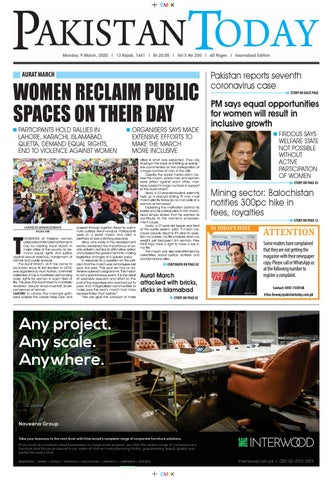
Women reclaim public spaces on Their day g
PaRTICIPanTs hoLd RaLLIEs In LahoRE, kaRaChI, IsLaMabad, QuETTa, dEMand EQuaL RIghTs, End To vIoLEnCE agaInsT WoMEn
LAHORE/ISLAMABAD/KARACHI
T
ayesha bibi
housands of Pakistan women celebrated International Women’s day by holding aurat March in major cities of the country to demand equal rights and justice against sexual violence, harassment at homes and public spaces. The aurat March, as it has come to be known since its first iteration in 2018, was organised by hum aurtain, a feminist collective. It has a manifesto demanding basic rights for women in each field of life. This year, the aurat March’s manifesto revolved around khud-mukhtari (independence) of women. LAHORE: In Lahore, the marchers gathered outside the Lahore Press Club and
g
oRganIsERs says MadE ExTEnsIvE EFFoRTs To MakE ThE MaRCh MoRE InCLusIvE
passed through Egerton Road to culminate outside aiwan-e-Iqbal. Participants were in a jovial mood and held a plethora of eye-catching placards. alina, who works in the development sector, explained the importance of social activism as it led to affirmative action and pressed the government into making legislative changes at a quicker pace. In response to a question on the criticism that the march was not inclusive last year, she said, “This year we had an extensive outreach programme. This march is not a spontaneous event, it is the result of extensive research and effort on the part of the organisers who reached out to poor and marginalised communities to make sure this year’s march had more representation than before.” “We are glad the conduct of male
allies is what was expected. They are staying in the back and letting us speak,” she commented on the participation of a large number of men in the rally. despite the social media storm before the march, where men and women were pitted against each other, men were present in large numbers in support of the aurat March. asad, a 22-year-old student, solemnly held up a placard stating “a man must march silently today so no man yells at a woman of tomorrow”. Explaining the motivation behind his poster and his participation in the march, asad simply stated that he wanted to contribute to the women’s empowerment cause. huda, a 27-year-old lawyer was tired of the subtle sexism, said: “I march because people assume it’s okay to question my career, my life choices, even my weight; just because I am woman, they think they have a right to have a say in my life.” The march was also well attended by celebrities, social justice activists and academicians alike.
CONTINUED ON PAGE 02
Aurat March attacked with bricks, sticks in Islamabad STORY ON PAGE 02
CMYK
Pakistan reports seventh coronavirus case STORY ON BACK PAGE
PM says equal opportunities for women will result in inclusive growth g
FIRdous says WELFaRE sTaTE noT PossIbLE WIThouT aCTIvE PaRTICIPaTIon oF WoMEn STORY ON PAGE 03
Mining sector: balochistan notifies 300pc hike in fees, royalties STORY ON PAGE 12
in today’s issue
attention Some readers have complained that they are not getting the magazine with their newspaper copy. Please call or WhatsApp us at the following number to register a complaint. Contact: 0307-7338168 irfan.farooq@pakistantoday.com.pk
02
Monday, 9 March, 2020
NEWS
AurAt MArCh AttACKed with BriCKS, StiCKS in iSlAMABAd
S
EvERAL people were injured after the Aurat March in Islamabad came under attack by religious men –one of whom was disguised as a woman in a burqa — on Sunday as the march was drawing to a close in front of Islamabad Press Club. The men initially began with throwing stones at the marchers, but also drew out sticks to chase after and hit the women. The burqa-clad man was arrested by the police as it was later revealed that he along with a few others had infiltrated the march pretending to be supporters and had begun attacking the marchers. A cloth partition installed for the protection of the participants was also removed after which hoards of men infiltrated the demonstration, prompting people to hurriedly exit from the venue. It may be noted here that the men were on the other side of the partition had been staging a counter-protest when they de-
cided to launch the attack. According to an organiser who spoke to a local media channel, the men, who reportedly belonged to the Jamiat Ulema-e Islam – Fazl (JUI-F) and Lal Masjid, were hurling abuses at women, telling them to stop chanting the slogan ‘Mera Jism, Meri Marzi’. Police and organisers struggled to control the situation and closed the F-6 road for traffic but the people were stopped from marching till DChowk. Some policemen were also seen running away and escaping themselves. Many women reported being subjected to violence. According to a woman who was returning to her car with her children, a man threw chilli powder at her face while many others reported that the religious men showed them their private parts. The march was attended by over 2,000 people who protested against multiple issues faced by women, transgenders, men, children and society as a whole and raised slogans urging the government to take action for their causes. In the lead up to the March, supporters of the march had been threat-
Pakistan pays tribute to Kashmiri women ISLAMABAD STAFF REPORT
Foreign Office (FO) Spokesperson Aisha Farooqui on Sunday paid tribute to the resolve and perseverance of Kashmiri women in the face of gruesome atrocities at the hands of the Indian government. In a tweet, the FO spokesperson said, “We pay special tribute to all the Kashmiri women who have suffered Indian atrocities Since 1989: 22,911 women widowed 11,179 women molested and raped 2377 women killed Women leaders Asiya Andrabi, Nahida Nasreen, Fahmida Sofi & many others remain incarcerated #Kashmiriwomen.” As the world observes International Women’s Day, the miseries and victimization of women in occupied Kashmir continue unabated at the hands of Indian troops.
PPP workers protest after Bilawal's refusal to meet them
ISLAMABAD STAFF REPORT
Chief of Army Staff (COAS) General Qamar Javed Bajwa on Sunday paid tribute to the women of the country for their pivotal role in nation-building. In a tweet, Inter-Services Public Relations (ISPR) Director General Major General Babar Iftikhar said that COAS has paid tribute to all women of Pakistan, who have played a pivotal role in nation-building in all segments of our society. “Our brave mothers, sisters, daughters especially our martyrs’ families and those serving in armed forces are the pride of our nation,” ISPR quoted the army chief as saying.
LAWMAKERS CONDEMN ASSAULT, DEMAND ACTION AGAINST CULPRITS NEWS DESK
COAS pays tribute to women for role in nation-building
ened with murder, rape and violence, in addition, to being subjected to online vitriol and opposition from men and religious women. On the other hand, Pakistan Electronic Media Regulatory Authority (PEMRA) had issued an advisory, asking Tv channels to refrain from broadcasting ‘vulgar/inappropriate content’ citing Pemra rules as well as court orders. PPP Senator Mustafa Nawaz Khokhar also condemned the incident and said: “To scare women from sticks, stones and bad language is cowardly behaviour.” Khokhar demanded that legal action be
taken against the people responsible for pelting marchers with stones. Human Rights Minister Shireen Mazari also issued a condemnation, saying that while people have the right to disagree, “violence is unacceptable”. “Strongly condemn the stoning and violence against peaceful gathering of women, men and families in #AuratMarch2020. Our religion teaches tolerance and Sabr. It does not allow throwing stones and sticks at unarmed people one disagrees with. Can disagree with them but violence is unacceptable,” she tweeted.
Sindh to start wheat procurement form March 15 ISLAMABAD APP
The federal government in close coordination with all four provincial governments has finalised all arrangements to procure about 8.25 million tonnes of wheat during its campaign for the year 2019-20 in order to keep the strategic reserves of staple grains as well as for exporting. The procurement campaign in Sindh will start from March 15, whereas in Punjab it will start by next month, said an official in the Ministry of National Food Security and Research. Talking to APP, he said that Sindh would procure about 1.4 million tonnes of wheat and it had also established 517 procurement centres in order to facilitate the farmers to sell
their produces on official fixed rates on their nearest centre. The sack distribution among the growers to be started by March 15 all across the crop growing areas of Sindh Province, he said adding that besides the provincial food department, Pakistan Agriculture Storage and Services Corporation would also establish its procurement centres to facilitate the growers. He said that PASSCO would procure about 1.8 million tonnes of wheat from the four provinces and in this regard it had also established its 233 wheat procurement centres, adding that in Sindh it had established 17 centres, in Punjab 204 and 12 procurement centres had been established in Balochistan. He informed that Punjab would procure about 4.5 million tonnes of wheat,
Sindh 1.4 million tonnes, Khyber Pakhtunkhwa (KP) 0.4 million tonnes and Balochistan 0.1 million tonnes during the wheat procurement drive for the year 2019-20. It is worth mentioning here that Senate Standing Committee on National Food Security and Research in its last meeting had recommended fixing minimum wheat support price at Rs1,400 per 40 kg for ensuring a better return to local farmers and encouraging them to grow additional wheat to cater its increasing demand. The committee had also observed that wheat prices in local markets were at the lowest level as compared to other markets of the region, besides other crops, including oilseeds which had been providing more returns than the wheat with less input cost.
Govt making all-out efforts to contain coronavirus, says Mirza
Met OffiCe fOreCAStS MOre rAinS ISLAMABAD INP
Reports of intermittent rains have been received from different parts of the country including Rawalpindi and the capital during the last 24 hours. Met Office forecast more rain with a thunderstorm in upper Khyber Pakhtunkhwa (KP), Islamabad, upper Punjab, Kashmir and Gilgit-Baltistan (GB) during the next 12 hours. The temperature of some major cities recorded this morning: Islamabad and GB 9 degrees centigrade, Quetta and Muzaffarabad 4, Lahore 12, Peshawar 11, Karachi 16 and Murree 2 degrees. IslamabadPeshawar Motorway (M1) section was closed to all sorts of traffic due to heavy downpour yesterday. A spokesperson of the Motorway Police said that the section of the motorway has been closed owing to bad weather conditions. The spokesman also advised the people to avoid unnecessary travelling. KP DECLARES EXTREME WEATHER EMERGENCY: The Khyber Pakhtunkhwa government on Sunday declared week-long Extreme Weather Emergency as torrential rains wreak havoc across the province. At least 17 people have been killed and 38 injured in rainrelated incidents across K-P. The Provincial Disaster Management Authority (PDMA) in its report issued on Saturday said at least 57 houses have been caved and majority of deaths have been caused due to housecollapse incidents.
Bilawal is proud to be son of 'most empowered woman' NEWS DESK
ISLAMABAD
NEWS DESK
STAFF REPORT
Pakistan People's Party (PPP) workers on Sunday held a protest outside the residence of party chief Bilawal Bhutto-Zardari after the latter refused to meet them at his house in Lahore. The supporters chanted slogans against Bilawal. "We want the workers to be respected too," said a PPP supporter. "I have come from really far to meet our leader but he didn't even let us inside the house." Another supporter said that they have been affiliated with the PPP since the start. "We go to all their rallies and support their cause but they aren't even allowing us to meet Bilawal," he added.
State Minister for Health Dr. Zafar Mirza has said that the government is taking every possible step to protect people from the virus. According to details, Dr Zafar Mirza made an unannounced visit to the isolation room of PIMS hospital and inquired about the available facilities from the deployed staff. Dr Mirza directed paramedical staff and doctors to strictly follow issued SOPs. He also said that the government is making all possible efforts to prevent the spread of the virus in the country and federal and provincial governments have formed isolation rooms at hospitals. He added that the government is working closely with provinces under the National Action Plan.
Pakistan People’s Party (PPP) chairman Bilawal Bhutto-Zardari on Sunday took to Twitter to pay tribute to women, including his mother, former prime minister Benazir Bhutto on International Women’s Day. “Women in Pakistan have been on the forefront of every struggle, against every tyrant. Today they march not just for themselves, but for generations to come,” the PPP leader said. “So proud to have been raised by the strongest most empowered woman. She remains my guiding light.” International Women’s Day is being observed today to raise awareness against gender bias and to take action for equality.
Aurat March: Women reclaim public spaces on their day CoNtINuED FRoM pAgE 01
ISLAMABAD: Thousands of Pakistan women celebrated International Women's Day by holding Aurat March in major cities of the country to demand equal rights and justice against sexual violence, harassment at homes and public spaces. ONLINE
Nayab Gohar Jan, a famed activist, entrepreneur, and journalist, showed her happiness at the huge turnout at the march and stated, “This year’s march is a huge success despite the negative propaganda.” Meanwhile, a resolution was submitted in the Punjab Assembly by PML-N MPA Kanwal Liaquat, demanding an end to gender discrimination. The resolution condemned under-age marriages and demanded that women be granted legal, social and economic protection. ISLAMABAD: The Aurat March began at 03:00 pm in the federal capital. Separately, female members of the Jamaat-
CMYK
e-Islami (JI) held a march outside the National Press Club. The participants reached China Chowk from the National Press Club where the party chief Sirajul Haq addressed the gathering. The participants of the JI march reached China Chowk from the National Press Club where JI chief Sirajul Haq addressed the gathering. During his address, Haq said that the Election Commission of Pakistan (ECP) should not name any hopeful who as a male does not give his sister her inheritance rights. “In the future, I will not give a party ticket to any man who doesn’t give his sister her rights,” he said. Although the authorities had erected a tent between the two marches in order to avoid clashes, after the Jamia Hafsa students ended their march, the
male participants took down the tent and started throwing stones, injuring at least one member of the Aurat March. However, the police soon brought the situation under control. The incident was condemned by the organisers of Islamabad’s Aurat March, who questioned the security measures taken by authorities for the event. KARACHI: In Karachi, advocates of women’s rights held the Aurat March outside Frere Hall. Pakistan People’s Party-Shaheed Bhutto leader Ghinwa Bhutto also arrived at the venue to participate in the march. A spokesperson for the Sindh government Barrister Murtaza Wahab also participated in the Aurat March with his family.
Monday, 9 March, 2020
NEWS
PM says equal oPPortunities for woMen will result in inclusive growtH FIRDOUS SAYS WELFARE STATE NOT POSSIBLE WITHOUT ACTIVE PARTICIPATION OF WOMEN ISLAMABAD
P
StAff RePoRt
RIME Minister Imran Khan on Sunday said that the observance of International Women’s Day was the reiteration of the commitment to undertake every possible effort to ensure equal rights and opportunities for the women. “In this effort, we are guided by the teachings of our religion, the character of Holy Prophet (PBUH) and the core values that distinguish
our society,” the prime minister stated. He said that it was indeed encouraging to see that the Pakistani women were proving their mettle in all walks of life and were achieving excellence in their respective fields at the national and international levels. “I firmly believe that inclusive and sustainable socio-economic development can only be ensured by providing equal opportunities and a conducive environment for women.” “I reaffirm my pledge this day to take all measures that would help
PTM lawmakers allowed to go to Kabul after initial refusal FIA HAD STOPPED WAZIR AND DAWAR FROM TRAVELLING, SAYING NAMES WERE ON ECL
H
NEWS DESK
oURS after the Federal Investigation Agency (FIA) stopped Pashtun Tahafuz Movement (PTM) lawmakers Ali Wazir and Mohsin Dawar from flying to Kabul, citing their presence on the Exit Control List (ECL) as the reason, Prime Minister Imran Khan granted them one-time exemption from the no-fly list to facilitate their travel, reported APP. According to a statement issued by the Interior Ministry, the names of the lawmakers were put on the ECL after the Kharqumar incident in which 14 PTM activists had lost their lives in an alleged clash with the security forces. The lawmakers were sched-
uled to be in Kabul on Monday for attending the oath-taking ceremony of Ashraf Ghani, who was recently declared as the winner of the Afghan presidential elections held last year. However, when they reached the immigration counter of the agency at the Islamabad International Airport, they were stopped by the officials. Earlier, speaking to a local news outlet, Mohsin Dawar confirmed that they had indeed been stopped at the airport by the authorities. He said that their flight was scheduled for 3:30 pm but they were stopped at 2 pm and were not allowed to board the plane. Dawar said that their supporters and leaders, including ex-senator Afrasiab Khattak, had already flown to Kabul to attend the oath-taking
our women to lead a safe, secure and prosperous life,” the PM office media wing quoted the prime minister as saying. The Aurat March was held in various cities across Pakistan to observe the International Women’s Day. The first march of such kind was held in 2018 by Hum Aurtain – a feminist collective – in Karachi, but last year it extended to other cities, including Lahore, Multan, Faisalabad, Larkana, and Hyderabad. President Arif Alvi quoted Quaid-e-Azam Mohammad Ali Jinnah as saying, “Power of women is greater than the pen and sword.” Minister for Human Rights Shireen Mazari said women in Pakistan would be marching to “demand
ceremony, but they were stopped because the authorities wanted to punish them for “speaking the truth”. The development was also confirmed by an FIA official, who spoke to a local news outlet about the incident. The official said that they were stopped because the agency found their names on the no-fly list. It is pertinent to mention here that this is not the first time the PTM leaders have been barred from flying abroad. In November 2018, FIA officials had offloaded them from a plane moments before their departure to Dubai where they were scheduled to attend a Pashtun cultural event. The agency had told them that their names were placed on the ECL a day before as they were “wanted in a case registered against them in Swabi”. However, in December 2018, Prime Minister Imran Khan had issued orders for removing their names from the no-fly list. Later, in July 2019, the government had once again barred them from travelling abroad by placing their names on the ECL for “running an alleged campaign against the state institutions, including Pakistan Army”.
FBR registers 17 per cent revenue growth in 7MFY20 ISLAMABAD StAff RePoRt
The revenue collection of the Federal Board of Revenue (FBR) grew by 17 per cent with additional revenues of Rs345 billion in the first seven months of the current fiscal year (FY20), compared with the corresponding period of last year. Against the target of Rs920 billion for the period between July-January (FY20), the FBR accumulated Rs897.5 billion income tax as compared to the collection of Rs749.1 billion in the corresponding months of last year, showing an increase of 18.1pc, according to official figures released by the bureau. Likewise, against Rs1,039 billion target of sales tax collection as of January 2020, an amount of Rs996.6 billion has been collected with a growth of 24.7pc compared to the corresponding period in the last year in which Rs799.1 billion were collected. An amount of Rs145.1 million has been collected under federal excise duty against the target of Rs151 billion for the first seven months of the current fiscal year, which showed an increase of 23.6pc. The customs duty collection target was set at Rs399 billion till January 2020. The FBR managed to collect Rs373.8 billion compared to Rs390.6 billion last year in the same months. So far the bureau has collected Rs2,407.7 billion against the target of Rs2,509 billion,
which has witnessed an increase of 16.7pc compared to last year when Rs2,062.7 billion were collected. The domestic tax collection has also recorded an increase of 28pc. Domestic sales tax has also increased by 41pc from July 2019 to January 2020. The total domestic revenue of Rs1,339.91 billion has been collected compared to last year’s Rs1,057.60 billion. Revenue at import stage has grown by 6pc against the budgeted target of 36.8pc. FBR issued Rs54 billion of additional refunds this year compared to last year. The total refunds of Rs131.01 billion have been released till January 2020, whereas in the last year the refunds of Rs76.71 billion were issued. FBR has also released the refunds detail issued through FASTER system. The total number of refunds claims cases where Annex-H submitted were 6,081 with a claimed amount of Rs37,614 million. The FASTER system has processed 4,606 cases with a claimed amount of Rs33,364 million, showing a percentage of 89.99pc of total cases. After the processing of such cases, total refunds of Rs29,303 million have been issued, showing a percentage of 87.47pc of processed cases. Through the FASTER system, Rs4,061 million were deferred due to want of required data. Up to February 29, 2020, total returns for the Tax Year 2019 were 2,483,866, whereas 373,877 new taxpayers paid taxes in the Tax Year 2019.
their rights in accordance with our religion Islam, as enshrined in our Constitution and in the commitments made by successive governments through ratification of international human rights conventions”. She said that the right to peaceful protest is a “democratic right and women cannot be denied it”. “Women must also respect that right for other women. Diversity and tolerance — respect for the ‘other’. #AuratMarch,” she tweeted. Special Assistant to the Prime Minister on Information and Broadcasting Dr Firdous Ashiq Awan said Islam has given respect to women and added that without the development of the women the country cannot progress. Addressing a special ceremony
in connection with International Women’s Day in Lahore, she said without the active participation of women in every field of life, the dream of a true Islamic welfare state cannot be fulfilled. She said that Pakistani women were committed to proving their capabilities in every field of life. Firdous Ashiq Awan said Islam
03
gave the highest respect to women and all rights given to them in the United Nations (UN) Charter were already present in the Holy Quran. Referring to the miserable condition of Kashmiri women suffering gravely at the hands of Indian forces along other segments of society for the last four months, she lamented the world institutions’ silence over it.
Complete consensus in PTI on women's rights: Fawad FAISALABAD APP
Federal Minister for Science and Technology Fawad Chaudhry on Sunday said that there was a complete consensus in the Pakistan Tehreek-e-Insaf (PTI) on women’s rights, and the government was pursuing a holistic strategy to include all segments of society, including women, in the mainstream of national development. Speaking to the media, Fawad said that women were an integral part of society as they were about 50 per cent of the total population. “According to Quaide-Azam, we cannot make progress until and unless we bring the women in the mainstream of national development,” he said.
Responding to a question, Fawad said that women should get themselves educated first and then make themselves strong economically. “When women will be strong and independent economically, they can easily take part in all activities of national progress and prosperity,” he added. Earlier, Fawad visited the residence of Chief Minister’s Complaint Cell Chairman Chaudhry Mehboob Alam Sindhu and condoled with him over the demise of his mother. He also prayed for the departed soul and patience for the bereaved family. National Assembly (NA) Standing Committee on Finance, Revenue and Economic Affairs Chairman Faizullah Kamoka and other Pakistan Tehreek-e-Insaf (PTI) leaders were also present on the occasion.
04 ISLAMABAD
Monday, 9 March, 2020
WEATHER UPDATES MONDAY
210C 120C
TUESDAY
230C 110C
WEDNESDAY
180C 120C
PrAyer TImINgs FAJR SUNRISE
ZUHR
ASR MAGHRIB ISHA
5:01
12:13
3:35
6:21
6:05
7:26
DC eyes Rs15bn invesTmenT in ‘new blue AReA’ PRojeCT
D
ISLAMABAD APP
ePuTy Commissioner Islamabad Muhammad Hamza Shafqaat has said that the ‘New Blue Area’, being set up near the Fatima Jinnah (F-9) Park to boost commercial activities in the Federal Capital, was all set to attract around Rs 15 billion investment. He said, “Rs 15 billion investment is expected in the ‘New Blue Area’ which would be spent on the capital’s rehabilitation and its road infrastructure.” Talking to APP, Hamza said the Capital Development Authority (CDA) had already started construction work on two underpasses in-
cluding the ‘G-7/G-8’ underpass and one other near the Pak-China Centre to resolve the grievances of public about traffic. He said, “a mega project amounting to Rs 18 billion has also been prepared for the extension of Islamabad expressway which help ensure resolve traffic issue on the one of major arteries of the capital. It also includes three hanging bridges and addition of two lanes on both sides of the Islamabad Highway from Kural to Rawat,” he added. The deputy commissioner said Islamabad was also about to get its first-ever metro bus which was in the launching process. The Islamabad Local Government Act was in place since 2015 but unfortunately, the Municipal Corpo-
ration of Islamabad had not spent a single penny on road infrastructure of the federal capital, he regretted. In terms of population, he said Islamabad was the fastest growing city of the world as it added 5,00,000 people after the passage of every five years. Its population was 5,00,000 in 2005 which now had ballooned to 2.2 million. Hamza said, “Zero investment has been made on Islamabad’s road infrastructure and cleanliness during the last five years. Last road was built in 2015 which was Koral Interchange.” However, the new management of the Capital Development Authority took cognizance of the situation and had generated Rs 11 billion recently by auctioning plots in Islamabad, he added.
Over 15,000 kanals of encroached land retrieved in Islamabad ISLAMABAD INP
The Islamabad Capital Territory (ICT) administration has recovered around 15,000 kanals of state land from encroachers and land grabbers during the last year including 8,000 kanals of forest land. “Some 1,000 acres (8,000 kanals) of forest land have been handed over to the Punjab Forest Department on which massive forestation is being carried out,” Islamabad Deputy Commissioner Hamza Shafqaat told APP. He said the Punjab Forest Department was installing boundary pillars around the recovered land to avert the
re-emergence of encroachers. Similarly, some 7,000 kanals of land was freed from illegal possession of land grabbers including eight-kilometres patch on the Kashmir Highway, and 20 km in Tarnol and Rawat, GT Road. Hamza said some 500 shops along the GT road had also been demolished to clear the right of way. The land related to the right of way had been handed over to the National Highway Authority (NHA), which would be utilized for developing road infrastructure in the area, he maintained. He said around 600 acres of land in Tumair had also been recovered that were still being demarcated by the Survey of Pakistan.
ISLAMABAD: Federal Secretary Information and Broadcasting Akbar Hussain Durrani chairs a meeting regarding the revival of Pakistan’s film industry. The meeting was attended by representatives of the film industry. PID
nine Die As bus fAlls in AjK sTReAm ISLAMABAD: At least nine people were killed and 12 others were injured on Sunday when a passenger bus fell in a stream in Azad Kashmir’s Arja area. Rescue officials rushed to the scene and retrieved the bodies and the injured from the nullah and shifted them to the hospital, a private news channel reported. Police said the passenger bus fell into the nullah while taking a sharp turn in Arja area of AJK. Four of the 12 injured are reportedly in critical condition in the hospital, said the rescue officials. APP
CTP fails to maintain flow of traffic RAWALPINDI: Traffic load on city roads particularly Murree Road has become nuisance for the citizens as traffic wardens have failed to ensure smooth flow of traffic on the main artery of the city. The motorists were going through a mental agony as there was no option except to remain stuck in traffic jam at almost all road of the city including Murree road, Liaquat Road, College Road, Raja Bazaar, Marrir Hassan, Tench Bhatta, Mall Road and other link roads of the city. One of the motorists talking to APP, said encroachment is the main hurdle in smooth flow of traffic. APP
Monday, 9 March, 2020
Govt to facilitate film industry: Firdous LAHORE APP
Special Assistant to Prime Minister on Information and Broadcasting Dr Firdous Ashiq Awan on Sunday said that the government is committed to facilitating the film industry of the country to nurture a healthy entertainment culture. She said this while talking to the representatives of Pakistan Film Producers Association and Pakistan Film Exhibitors Association. Federal Secretary Information and Broadcasting, Akbar Durrani, Director General, Directorate of Electronic Media and Publications and Chairman Central Board of Film Censors also attended the meeting. Matters relating to the implementation and review of National Film Policy 2018 came under discussion. On this occasion, Firdous emphasised that the prime minister had directed that proposals for facilitating film and cinema industry may be prepared so that relaxations and concessions approved under the existing film policy could be effectively implemented. She also said that the government intended to remove overlapping in the film censorship process, wherein every film has to pass thrice through the censor process, by giving more powers to the Central Board. She said that as this matter involved consultation with provinces, the premier had desired that this proposal may be discussed at the level of Council of Common Interest (CCI). Akbar Durrani assured the participants that the Information Ministry wanted to fully implement the current film policy and invited suggestions and recommendations from film associations to further improve it. He said that film producers would be encouraged and facilitated in shooting their films at picturesque locations in various parts of the country.
AFGhAn DeAl GolDen opportunity For peAce: FM MULTAN
F
APP
OREIGN Minister Shah Mahmood Qureshi on Sunday termed the Afghanistan peace deal a golden opportunity to move towards peace in the region. Talking to media persons after the inauguration of a road at Timber Market, Qureshi said that a few elements should not be allowed to succeed to derail the peace process so that this golden opportunity is availed for sustainable peace in Afghanistan. He said that there was some information about development on the issue of the release of prisoners. He also said that after the successful resolution of the issue, the intra-Afghan dialogue was on the cards. He further said that everyone has condemned Kabul attack which is a good sign, adding that the same spirit was needed in the future to bring ease in the lives of the people of Afghanistan. Speaking about south Punjab, he said that the Pakistan Tehreek-e-Insaf (PTI) government is committed to establishing south Punjab as a separate province but does not have the clear majority to pass a resolution. He said that it has been decided in a meeting to seek support from other parties for the purpose. He said that the government had decided to establish a sub-secretariat in south Punjab to facilitate people of the areas, however, few par-
Second phase of Ehsas Kafaalat to be launched today ISLAMABAD APP
The second phase of the Ehsaas Kafaalat Programme will be launched in Khyber Pakhtunkhwa (KP) on Monday for the socio-economic empowerment of poor women. Under the programme, the government will provide an Rs2,000 stipend would be paid to registered women under the Ehsas Kafalat Programme through a digital system. According to Special Assistant to the Prime Minister on Social Protection and Poverty Alleviation Dr Sania Nishtar, the stipend would be paid to beneficiaries of formerly Benazir Income Support Programme (BISP) through two leading private banks to avoid complications. PTI’s flagship social welfare programme was launched in a phased manner. In the first phase, the programme was launched in Lakki Marwat, Haripur,
Charsadda and Mohmand districts where the enrolment process began following the completion of the National Socio-Economic Registry (NSER) survey. The enrolled families of these districts started receiving stipends from February 2020 while more beneficiary families will be added through desk registration over the course of the year. Registration desks have been set up by National Database Registration Authority (NADRA) in every tehsil of these four districts while other districts will be covered by end of the year. All existing eligible beneficiaries of the BISP from KP will continue to be part of the Kafaalat Programme, said a press release. According to the eligibility criteria, only the destitute are eligible under the programme. Government servants and their spouses, taxpayers, car owners, people with a history of foreign travels are not eligible. Data analytics will be used to exclude individuals on these parameters.
AurAt MArch vs coronAvirus CITY NOTES M A NIAZI
i
do not think the comedian Amanullah died because the Aurat March was going ahead. But the fact is that the Lahore and Islamabad High Courts ruled that the March could go ahead, and he gave up the ghost. Does that mean the organisers of the march are humourless? Judging by the exhibition put on by dramatist Khalilur Rehman Qamar on a talk show, opponents certainly are. I would not claim to support the March. There is an undercurrent which hints that I, a mere man, would not be welcome to comment. The march is against me, right? Okay, I would not be impertinent. But I must point out that one reason we do not have women’s rights might indeed be a misogynist heritage, but that comes from the Hinduism, and Islam moves a stage ahead of the women’s movement by positing both men and women as slaves of the Almighty. It is pointed out that women have been excluded from the position of caliph, for example. Apart from that being a rather academic discussion (for these days, no man can be caliph either), there is the very strict accounting of the ruler, which made the first caliph, Abu Bakr, exclaim that he wished he had been a blade of grass. Each will be accounted for his deeds, and
in that perfect justice will be done. In that perfect justice, the Almighty will take into account the sex of the person. From one point of view, it would be a mercy to be forbidden something, for then there will be no accounting in that role. Another point is that it seems a foreign movement. That impression has been reinforced by the controversial slogan, ‘Mera Jism, Meri Marzi’, which is a translation of the pro-choice slogan, ‘My Body My Choice’. Now it is interesting, but that slogan infuriates a lot of men. That ignores the Shafei view, which merely stipulates that abortions must occur within 40 days of conception. There should be a reason, such as a woman fearing the cosmetic effects of the pregnancy on, yes, her body. It is hers. She will have to account to the Almighty for what she did with it. Well, while the Aurat March is going ahead, Umrah is not, while Hajj may be suspended, and that Western act of collective worship, the Olympics, which are to be held in Tokyo, and all because of the coronavirus. Well, the coronavirus has infected more than 105,000 people worldwide, well, 99 countries and territories), and more than 3,500 have died. The bulk of the cases are in China still, but the number from Iran and Italy are so impressive that the Chinese authorities claim that returning travellers from those two countries have infected Chi-
nese people who had stayed at home. And there are now reports that pilgrims returning from Iran were not the first infections, but travellers returning from China. The government is trying to sit on this because they feel the truth would spoil relations with China. Why do they not make sure that nothing goes wrong, and shut down Internet services? And under the circumstances, can we risk a public assembly? Like the Aurat March. And just as Amanullah did not give up the ghost in ire against it, Punjab Advocate General Jamal Sukhera also did not resign because of it. However, it was probably not related to the earlier resignation of the attorney general, but it did mean that Usman Buzdar was as short of legal advice as his leader. Another person who seems bereft of legal advice is Saudi Crown Prince Muhammad bin Salman, though as the holder of a law degree he can advise himself, not something that can be said for our own prime minister and his followers here. And for a family that rules a country, he has been a little disrespectful, for he has arrested his uncle, and two cousins, including the previous Crown Prince, for ‘attempting a coup’. I wonder if Imran will learn from this how to deal with the people behind the sugar and what crises. Not that anyone in the Pakistan Tehreek-e-Insaf (PTI) dares attempt a coup against him.
liamentarians wanted the establishment of the secretariat in Bahawalpur and few in Multan. The foreign minister added that the general secretary of the Organisation of Islamic Cooperation (OIC) had sent a special envoy to Pakistan which met with all leaders. He said that the envoy had visited different areas of the country and also Azad Jammu and Kashmir (AJK) where he had met with the Raja Farooq Haider. FM Qureshi stated that the European Union (EU) has extended Pakistan’s GSP plus status for another two years which is a victory of the government’s foreign policy. He said that an extension of status would increase the country’s exports. He said that inflation has been decreased to 11.4 per cent from 14.6 per cent, adding that efforts were being made to bring more decrease in it. Answering a question on coronavirus, he said that Pakistani students in China were safe and were being offered with different facilities by the government of China. He said that the government has taken various measures to prevent coronavirus infections in the country, including the closing of the border with Afghanistan and Iran. He said that international organisations have appreciated the measures taken by the government against coronavirus. He added that not even a single case of death by coronavirus has been reported so far in the country.
NEWS
05
Death toll of Karachi building collapse touches 25 KARACHI STAFF REPORT
Three more bodies were recovered on Sunday from the debris of a building that fell in Karachi’s Gulbahar neighborhood earlier this week, bringing the death toll to 25. On Thursday, the residential building had fallen on two adjacent structures, bringing them to the ground as well, killing 14 people and injuring at least 17 others. Since then, bodies of multiple victims have been retrieved from the debris while a boy was pulled out alive from the rubble on Saturday. However, seven to eight people still remain trapped underneath the collapsed building, according to the spokesperson of Edhi Foundation Saad Edhi. “The rescue operation is ongoing and we have reached the ground floor. The rescuers have apprehensions some seven to eight people are still trapped […] they might be alive.” The spokesperson added that the area was congested so heavy machinery could not be brought in to help with rescue efforts. A preliminary investigation suggested that the builder had allegedly carried out major excavation work at the foundation and tried to erect additional pillars to support the existing pillars. He did it to strengthen the building structure and prevent it from collapsing. According to Rizvia Society police station investigation officer Agha Amir, the owner, Mohammed Javed Khan, had started construction work on a fifth-floor when the building cracked. Sindh Chief Minister Murad Ali Shah on Friday had taken notice of the building collapse and directed Commissioner Karachi to ensure that rescue and relief operations were executed smoothly in the area.
Monday, 9 March, 2020
06 WORLD VIEW
IndIA's MuslIMs Are punIshed fOr AskIng TO be IndIAn THE DELHI VIOLENCE OPENS A NEW DARK CHAPTER IN INDIA'S MODERN HISTORY
al Jazeera
O
VIDya SuBraHManIaM
N February 24, Hindu nationalist mobs descended on the northeastern parts of India's capital, New Delhi, and wreaked havoc for four days, targeting Muslim businesses and homes. More than 50 people were killed and hundreds were injured in the violence. In the aftermath of the attacks, I visited one of the worst-affected neighbourhoods, Shiv Vihar, and witnessed the destruction. While Hindu shops and residences looked largely intact, most Muslim houses and businesses were gutted down to their bare bones. The burnt remains of the possessions of Muslim families fridges, TV sets and cars - were scattered across the neighbourhood's narrow lanes. While one local mosque was charred to the ground, another named Auliya looked largely unaffected from the outside. But inside, I found that it, too, was a charred, mangled mess. Hindu residents seemed to be carrying on with their lives as normal, but Muslims were nowhere to be seen - they had all left, seeking safety in relief camps set up by the government. The unrest that left Shiv Vihar in ruins was triggered after the weeks-long sit-ins in Delhi against the new Citizenship Amendment Act (CAA), which opponents say discriminates against Muslims, who were
attacked by Hindu nationalists. Anti-CAA protests in Delhi had been peaceful from the beginning. People got together to sing patriotic songs, wave Indian flags, recite from the Indian constitution and listen to speeches on freedom, solidarity and secularism. The protesters - many of them women - demonstrated nothing but loyalty to their country, but this did not stop the ruling Bharatiya Janata Party (BJP) from portraying them as "traitors" and making them prime targets for vigilante attacks. In the run-up to the February 7 Delhi assembly elections, for example, the BJP ran a vicious campaign targeting the city's Muslims. Anurag Thakur, the junior finance minister, incited the crowd at an election rally to shout "shoot the traitors". Another minister, Parvesh Verma, swore the protesters would be "sent packing" within hours of a BJP victory, adding that if left unchecked, they would "rape and kill". Prime Minister Narendra Modi and Minister of Home Affairs Amit Shah, meanwhile, implied the protesters were anti-India and proPakistan. Modi termed the ongoing protests a "conspiracy" designed to undermine "India's harmony". Shah claimed protesters had raised slogans like "Jinnah wali azaadi (We want Jinnah-style independence)", suggesting they demand the disintegration of India. When the inevitable happened and the protesters were attacked, the violence quickly spread across Delhi. The authorities did little to ease the tensions, while the police faced accusations of looking the other way. Many observers compared the attacks in Delhi to previous episodes of communal violence. Indeed, India's post-independence history is bristling with such incidents. This most recent episode was neither
the biggest nor the most violent in India's recent history. Yet, for careful India watchers, what happened last month was in a different category. To understand what makes these attacks unique and therefore more frightening, let us recall two other episodes of intercommunal violence in India's recent history: the 1984 massacres of Sikhs in Delhi and the 2002 pogroms targeting Muslims in the state of Gujarat. The roots of the anti-Sikh violence of 1984 can be traced back to a separatist armed uprising that formed in the state of Punjab in the mid-1970s. As the movement grew in power, fighters started staging violent attacks in Delhi and other northern cities. In 1983, the leader of the movement, Jarnail Singh Bhindranwale, and some of his most prominent followers took refuge in the Golden Temple, the holiest of Sikh shrines located in Amritsar in Punjab, to escape arrest. In June 1984, then-Prime Minister Indira Gandhi ordered the Indian military to flush out the Sikh fighters from the temple. More than 500 people were killed during the operation, including many Sikh civilians. Then on October 31, 1984, two Sikh guards assassinated Gandhi at her residence in New Delhi in retaliation. Her assassination set off a fury: at the end of three days of non-stop butchery, 2,800 Sikhs were dead. The 2002 Gujarat pogroms followed a similar scenario. On February 27, 2002, a blaze in a train carrying Hindu pilgrims killed 59 people in Godhra, Gujarat. The passengers were Hindu pilgrims, returning from Ayodhya after a religious ceremony at the site of the Babri Mosque. The mosque was demolished 10 years earlier by Hindu mobs claiming it was built on the ruins of a temple dedicated to ram, a major deity of Hinduism.
One official enquiry concluded that the fire in the train was accidental, caused by someone cooking or smoking inside a coach, but this report was later dismissed by the Supreme Court as "invalid". The Indian authorities eventually concluded that the train was set ablaze by Muslims. The incident caused an explosion of rage in the Hindu community and led to the killing of more than 1,000 people, most of them Muslims. The 1984 massacres of Sikhs and the 2002 pogroms against Muslims in Gujarat had a lot in common. In both cases, the police were accused of abandoning their supervisory duties, by either remaining passive or, in some cases, aiding and abetting the killings. Both instances were also marked by acts of extreme violence previously unseen in communal clashes in India. In 1984, Sikh men and boys were fitted with burning tyres around their necks so that their deaths would be slow and painful. Sikh women, on the other hand, were repeatedly raped and forced to watch their husbands and sons die. In 2002 in Gujarat, many men and boys were dismembered and burned. Ehsan Jafri, a former member of Parliament, for example, was hacked to pieces and burned despite repeatedly seeking help from people he knew in the state government. Another important similarity between these two horrific episodes of violence was accusations of government complicity. In 1984, local Congress leaders in Delhi were accused of aiding and abetting rioters, while the central government faced accusations of turning a blind eye to the violence. In 2014, a fact-finding team jointly organised by two prominent civil society organisations, the People's Union for Democratic rights and the Peo-
ple's Union for Civil Liberties, found that the attacks on members of the Sikh Community in Delhi and its suburbs "were the outcome of a well-organised plan marked by acts of both deliberate commission and omission by important politicians of the Congress". Four years later, Sajjan Kumar, who was a prominent MP at the time of the riots, was sentenced to life in prison for "inciting crowds to kill Sikhs". In Gujarat, similar accusations were directed at the state's BJP government. Modi, the then Chief Minister of Gujarat, was accused of failing to halt the violence and indirectly encouraging some of the Hindu rioters. During its deliberations on the Gujarat riots, India's Supreme Court even likened Modi's government to that of Nero, the roman emperor who fiddled while rome burned. In 2012, Modi was cleared of complicity in the violence by a Special Investigation Team appointed by the Supreme Court, but rights groups continue to accuse him of tacitly supporting the rioters. Last month's anti-Muslim attacks in Delhi had all of these characteristics. There is, however, one aspect that sets the events of last month apart from the historic cases of communal violence. Both the Sikh massacres and the Gujarat pogroms started in response to alleged atrocities committed by the members of the targeted communities. Last month's anti-Muslim violence in Delhi, however, was not "revenge" for anything. It was not preceded by a major infraction against the Hindu majority. The Muslim community did nothing that could even remotely warrant retaliation. The only thing they had done in the weeks prior to the attacks was to peacefully protest against the country's new, discriminatory citizenship law. Thus, unlike in 1984 and 2002, there was no ostensible cause for the violence. This time, Muslims were punished, only for being Muslim and asking to be Indian. And because of this, last month's attacks mark the beginning of a new, frightening chapter in Indian history. The Hindu mobs, empowered by the Hindu-nationalist central government, no longer appear to need a reason to attack minorities. This signals that for minority communities in India, the future is now darker and more frightening than it has ever been before. Vidya Subrahmaniam is an awardwinning Indian journalist and political commentator.
A Taliban peace deal at what cost? There's a badass in every woman and l a TiMeS STaFFan DE MISTura, MarGoT waLLSTrÖM anD SaHar HaLaIMZaI
O
VEr the last year, Afghans watched as the Trump administration negotiated with the Taliban, while excluding the Afghan government, the people, civil society and, in particular, Afghan women. The sequencing and opaqueness of this process raised alarm bells from the start, but many in the international community trusted that any deal the U.S. signed with the Taliban would not reignite another cycle of violence or a return to the severe human rights abuses and oppression of women that previously occurred under Taliban rule. That was before we saw the terms of the deal. It’s now clear that the plan contains no meaningful provision for the protection of women and the constitutional rights that underline it. It doesn’t condition the pullout of U.S. troops on a permanent ceasefire or a successful intra-Afghan agreement. It does, however, call for the release of 5,000 Taliban prisoners before peace talks between the Afghan government and the Taliban begin on March 10, undercutting any leverage the government might have. Not surprisingly, President Ashraf Ghani of Afghanistan has said that’s not a promise the U.S. can make and that it won’t happen before negotiations start. On Monday, the Taliban indicated that it would return to fighting against the Afghan government. Unless the talks can be recalibrated, the opportunity for peace will be squandered. The current process, which began without the inclusion of women or their elected government, has, in fact, put all the progress made in Afghanistan at risk. Over the last 18 years, Afghans have worked hard to build their political, social and economic institutions. Although serious challenges remain in consolidating these gains, the recent Asia Foundation Survey of the Afghan People shows that 65% of Afghans trust the way in which their democracy works. In sharp contrast, only 6% strongly sympathize with the Taliban’s political project.
THE INTERNATIONAL COMMUNITY MUST ALSO PLAY ITS PART TO ENSURE THAT THE TERMS OF ANY AGREEMENT ACTUALLY SUSTAIN PEACE AND REPRESENT THE WILL OF THE AFGHAN PEOPLE In the past two decades, Afghan girls and women have experienced remarkable change. In 2001, only 500,000 boys attended school. Today, 9 million boys and girls are being educated. Women went from being virtually erased under Taliban rule to becoming policewomen, teachers, public officials, mayors and entrepreneurs. In 2019, women accounted for 28% of the Afghan parliament — a proportion higher than 67% of countries tracked by the World Bank. They will not go back. The majority of Afghan citizens stand behind them: 65% of citizens say they are not willing to sacrifice women’s education or their right to work outside their home. They also want a strong central government to protect these rights. But these principles were apparently ignored by the American and Taliban negotiators. President Trump wants to end the war, and most Afghans don’t want a permanent presence of foreign troops. But it’s far from clear if the deal can create the conditions for a real peace — or if it’s largely a road map for an American exit. Much of the fear and uncertainty felt across the country was heightened by a process that was secretive and exclusive, one that raised the specter of an interim government, threatening the country’s hard-won democratic institutions. If the government’s talks with the Taliban fail, it would be wrong to blame the Afghan people when they and the government were actively excluded from the process that set this stage. The way forward will require broad political support from all of Afghan society. Only a democratically elected government will be able to carry out the concessions that will be needed, whether it’s releasing prisoners, reforming the armed forces, or protecting refugees or former fighters as they re-
turn to their homes. To achieve any form of lasting stability, it is imperative that women be included at the negotiating table. For its part, the Taliban must also provide a seat for women on its side of the table. Inclusivity means involving those with the most at stake in the process. It’s also important to reconcile the Taliban to the changes that have occurred in Afghan society over the past two decades. Taliban leaders must understand the financial and political consequences of their positions. Over the last year, the U.S.Taliban talks have been predicated on the idea that the Taliban has changed. The Taliban will have to demonstrate that change through actions, not merely promises without practical guarantees. The international community must also play its part to ensure that the terms of any agreement actually sustain peace and represent the will of the Afghan people. The deputy leader of the Taliban, Sirajuddin Haqqani, has said that Afghanistan will need continued development assistance from the international community. If the U.S., the European Union and others are to continue to invest in Afghanistan’s development and institutions, they must ensure that progress on women’s rights is not rolled back and the constitutional order is preserved. This is a historic moment that could bring an end to nearly two decades of war. But peace can’t be achieved unless the voices of Afghan women and civil society leaders are central to the talks. We should listen to them. Staffan De Mistura is a former United Nations under-secretary-general and U.N. special envoy for Syria, Afghanistan, Iraq and Lebanon. Margot Wallström is a former foreign minister and deputy prime minister of Sweden. Sahar Halaimzai, an Afghan-British human rights advocate, currently leads the Afghan campaign Time4realPeace.
that's why I hate the word 'empowerment'
Sydney Morning Herald
O
Laura Brown
K, ladies, control yourselves. Sunday is International Women’s Day. Now, I know we’ve waited 364 days since the last one, but you have to be cool, OK? (Hang on … a whole day? Stop! It’s too much!) My point, if I haven’t laid it on thickly already, is that maybe this is a little silly? That us womenfolk are granted a one-day window on the international calendar to mark our accomplishments? I’m sure our male brothers are in a flop sweat of panic and insecurity (but don’t fret, fellas, you get IMW on November 19 as the cherry on top of your patriarchy cake). Of course, we celebrate and honour our suffragette sisters who started International Women's Day. But, and I say this respectfully, that was in 1910. I’m pretty sure that famed activist Sylvia Pankhurst, who was arrested on IWD in London in 1914, would be the first to say, “We’re still here?!” Now, a Badass Woman in 2020 wouldn’t settle for any of this, this tokenism. A Badass Woman just gets on with it. 24/7, 365. As I say at InStyle magazine, where we hatched the “BAW” platform almost three years ago to spotlight amazing women changing the world, Badass Women “show up, speak up and get things done”. Consistently. I mean, Badass Ladies are everywhere, so as editors, we’re spoiled for choice. (I really should make a calendar: Badass for all Seasons.) When I was contacted about writing this piece, the brief was, “Why the world needs more Badass Women”. Of course, I support women having greater influence globally (guess we’re going to have to wait a little longer for a female president of the United States), but I also believe there is a badass in every woman. Explicitly and
implicitly. That’s why I loathe terms like “empowerment”. I think it’s beyond patronising, carrying with it the implication that women don’t have any power in the first place. Just add your name to this sentence: “Let’s empower ____” and see how much of a chafe it is. Go on, I’ll wait. There’s a straightforwardness to a Badass Woman. She doesn’t sloganeer, throw in on social media hashtags or choose every battle. She has better things to do. To give some antipodean examples ... One, Jacinda Ardern. Prime Minister of New Zealand since late 2017, an MP since 2008. Within a week of the Christchurch massacre, she passed legislation banning assault weapons. But Ardern is also the woman who will pay for another woman’s groceries when she forgets her credit card just because “she’s a mum”. Celeste Barber – her vast social reach born from her hilarious skewering of Instagram beauty “goals” – who corralled that into her passionate raising of over $52 million for Australian bushfire relief. Or independent MP Zali Steggall, who has called for a “conscience vote” on climate change (her petition, at the time of publication, had collected 70,477 signatures – including mine). Having a conscience is vital. That, and empathy. I’d in fact argue that empathy is a Badass Woman’s greatest power. Look at the US Speaker of the House, Nancy Pelosi. She is independently wealthy, and, at the end of this month, will be 80 years old. She could be resting on her laurels (on a daybed, eating bonbons). But every day, she wakes up to fight for the constitution, for gun control and the rights of immigrants. If that’s not empathy, I don’t know what is. There’s both passion, and traction, to this Badass Women thing. Back at my day job at InStyle, we dedicate two issues a year to it. In New York City in July, we’re going to launch our first "Badass Day" (or B.A.D.). Everyone’s invited, young to old. There will be a bar (obviously) and a big, jazzy dinner at the end. Presidential historian Doris Kearns Goodwin will be there, her talk inspired by the famed Laurel Thatcher Ulrich quote: “Well behaved women rarely make history.” Cheers to that, sisters. Let's trash the joint. (Metaphorically.) Laura Brown is the Australian-born editor-inchief of the influential US InStyle magazine and will be in Australia for Virgin Australia's Melbourne Fashion Festival.
Monday, 9 March, 2020
FOREIGN NEWS 07
Refugee ShelteR BuRnS aS gReece RollS out new aSyluM ReStRictionS ANKARA
a
AGENCIES
fire engulfed a refugee shelter on the island of Lesbos Saturday as Greece announced further restrictions towards asylum seekers in response to a migration surge enabled by Turkey. The fire at One Happy Family, a Swiss-operated family care centre for refugees just outside the island capital, came after violence at the weekend directed at aid groups and journalists on Lesbos. “The school building has a lot of damage, we can’t say more at the moment,” a source among the operators told AFP. “The fire brigade is there, our team on the ground as well,” they added. There were no immediate reports of injuries. Over 1,700 migrants have landed on Lesbos and four other Aegean islands from Turkey over the past week, adding to the 38,000 already crammed into abysmal and overstretched refugee centres. The new surge has ramped up already high tensions on Lesbos, an island that has been on the migration frontline for years. Frustration exploded into violence last weekend with mobs setting up roadblocks, attacking cars carrying NGO workers and beating journalists.
Earlier Saturday, the Greek migration minister announced plans for two new camps to house asylum-seekers who arrived after March 1, when Turkey announced it would no longer prevent people from trying to cross into the European Union. On the land border with Turkey, tens of thousands of asylum-seekers have been trying to break through for a week. There
Bolsonaro urges Brazilians to march in his support RIO: Brazil’s far-right president Jair Bolsonaro called Saturday on his backers to take to the streets next weekend to show their support for him, even as critics said such a demonstration would be anti-democratic. “This is not a movement against the Parliament or the judicial branch, but for Brazil,” Bolsonaro said in northern Boa Vista state before heading to Florida for a dinner meeting with Donald Trump at the US president’s Mar-a-Lago resort. The point of the March 15 demonstration, he added, would be to show that “it is the people who determine the direction the country should take.” Bolsonaro, who has unabashedly embraced Trumpian language and positions, provoked an outcry recently when he shared on the WhatsApp messaging system a video calling for the March 15 rally. The video was highly critical of both Parliament and the judiciary branch. Leading lawmakers sharply protested, as did several Supreme Court justices. Bolsonaro said at the time that he was merely passing the video along to a few friends. But on Saturday, he openly embraced the call for what he said would be a “spontaneous movement.” “If a politician is afraid of the street, he should get out of politics,” said Bolsonaro, a former army captain. ProBolsonaro demonstrations last May 26 brought tens of thousands of people to the streets of Brazilian cities. But pressure on Bolsonaro has grown amid an economic slowdown. Brazil’s GDP grew a tepid 1.1 percent in 2019, his first year in office. That was its slowest pace in three years. AGENCIES
Malaysia’s palace denies 'royal coup' in appointing new PM KUALA LUMPUR: Malaysia’s palace on Sunday denied allegations of a “royal coup” in appointing the country’s prime minister after veteran leader Mahathir Mohamad resigned, saying the king used his discretionary powers prescribed in the constitution. The palace was responding to an editorial in the UK daily The Guardian this week that said Malaysia’s king, Sultan Abdullah Sultan Ahmad Shah had overturned a democratic election result by naming Muhyiddin Yassin as prime minister despite the opposite camp claiming a majority. Muhyiddin was sworn in last Sunday as the head of a government formed with the support of a corruption-tarnished party that was defeated in the last general election in 2018 by a multi-ethnic group. The palace said it went beyond its “call of obligation” by meeting all lawmakers and the leaders of various political parties before the king arrived at his decision that Muhyiddin was the person likely to command a majority in parliament. AGENCIES
have been numerous exchanges of tear gas and stones with Greek riot police. Turkey has accused Greece of injuring many migrants and killing at least five, a claim Athens denies. “We want to build two closed centres in (the northern region of) Serres and the greater Athens area with 1,000 places,” migration minister Notis Mitarachi told Skai TV. “We need the backing of local
communities. We cannot leave all (these) people on the islands,” he said. Mitarachi also said state support for refugees would be drastically reduced, and that they would be asked to leave camps after securing protected status. “Accomodation and benefits for those granted asylum will be interrupted within a month. From then on, they will have to work for a living. This makes our country a less attractive destination for migration flows,” the minister said. Far-right militants from other parts of Europe have travelled to Lesbos and the Greek border with Turkey, among them Swedish far-right leader Jimmie Akesson, who reportedly handed out flyers at Edirne with the message “Sweden is full”. On Friday, two Germans and two Austrians — identified as hardline nationalists by local media — told police they had been attacked and beaten on the central Lesbos market. One of the four, who claimed they were journalists, was identified as Mario Mueller, a German member of the far-right Identitarian Movement. On Saturday, anti-fascist activists organised a gathering in support of refugees on Lesbos. “We need to react in some way because we’ve reached a point where fear is taking hold,” said Maria Psomadaki, a retired teacher.
China quarantine hotel collapse kills 10 BEIJING AGENCIES
At least ten people were killed in the collapse of a hotel used as a coronavirus quarantine facility in eastern China, authorities said Sunday. Rescuers retrieved 48 people from the rubble, of whom 38 are still alive, the Ministry of Emergency Management said on social media. The building in the coastal city of Quanzhou had been repurposed to house people who recently had contact with patients confirmed with COVID-19, the state-run People’s Daily newspaper reported. The city has recorded 47 cases of the virus. Video posted online by the ministry’s firefighting department showed rescuers helping children don surgical masks before pulling them from the wreckage of the six-storey Xinjia hotel, including a 12-year-old boy. Rescuers were also seen spraying disinfectant on each other as part of “strict decontamination” measures between shifts. Footage published by local media appears to show the hotel collapsing in seconds. Other videos circulating on China’s Twitter-like Weibo platform show workers combing through the rubble in the dark as they reassure a woman trapped under heavy debris and carry injured people to ambulances. RENOVATION: The building’s facade appeared to have
crumbled to the ground, exposing the structure’s steel frame. Nine people escaped on their own at the time of the collapse, the ministry said. The first floor had been undergoing renovation since before the Lunar New Year holiday, and construction workers called the hotel’s owner minutes before the collapse to report a deformed pillar, authorities said. The owner has been summoned by police while investigators work to determine whether the renovation or an original structural issue was at fault, according to the ministry. Fifty-eight people who had recently been in regions hard hit by COVID-19 were being quarantined in the hotel but all had tested negative for the virus, local newspaper Quanzhou Evening News reported Sunday. More than 800 rescuers and 750 medical staff were deployed for the rescue effort along with 20 ambulances, the ministry said. China’s National Health Commission said it was sending to Quanzhou 18 medical experts from the nearby cities of Fuzhou and Xiamen.
Sudan women decry slow progress on rights since Bashir's fall KHARTOUM: Sudanese women were at the forefront of the protests that toppled autocrat Omar al-Bashir but 11 months on, activists are disappointed at a lack of progress on women’s issues. “Nothing has been done to meet women’s demands,” said Zeineb Badreddine. An activist involved from the start of the protest movement that ended Bashir’s threedecade rule last April, Badreddine will lead a demonstration in front of the Justice Ministry on Sunday to mark International Women’s Day. Almost 30 years after being fired under Bashir for her “progressive ideas”, she has also returned to teaching. But despite the toppling of the Islamist regime, she says the new government lacks female representation. When Prime Minister Abdalla Hamdok formed his government in September, he vowed to improve the situation for women despite the country’s economic and social difficulties. He allocated four of 17 ministerial positions to women, including the key foreign affairs portfolio. A woman was also named head of the judiciary. But the country’s top authority, the joint civilian and military Sovereign Council charged with overseeing the transition to civilian rule, only has two female members out of 11. “If women had better representation, they would have more voices to defend their cause,” said Badreddine. DISCRIMINATORY LAWS REMAIN: Under the Islamist regime, a notorious “public order” law was used to have women publicly flogged or imprisoned for “indecent” dress or for drinking alcohol, seen as “indecent and immoral acts”. Hamdok’s government last November revoked the legislation — but many other discriminatory laws remain in place. Badreddine decries a lack of legislation criminalising sexual harassment. Judges in Sudan also have powers to judge whether or not a woman has been raped, which can sometimes lead to rape victims being prosecuted for adultery. Lawyer and women’s activist Inaam Atiq takes aim at a 1991 personal status law, which she says “is causing the suffering of thousands of women across Sudan”. She says the legislation, inspired by Islamic law, allows 10-year-old girls to be married against their wishes. “This text must be urgently amended and this can be done without touching Shariah (Islamic law) principles,” she said. Another law forbids women to travel abroad unless they have permission from a male guardian — a measure that even ultra-conservative Saudi Arabia has abolished. “My guardian could be a younger brother that I raised, or even my son,” Atiq said. Nor do courts specialising in personal status issues consider the results of DNA tests, allowing Sudanese men to shirk parental responsibilities and compounding women’s problems, she said. Activist Manal Abdelhalim expresses amazement at “voices, including those of some women, who say that the issue (of women’s rights) is not a priority and that it can wait”. But Atiq is more hopeful. “We need immediate measures, and I think that the justice ministry and the government understand the situation,” she says. AGENCIES
Glamour and equality in Thailand at world's top transgender pageant BANGKOK AGENCIES
After her friends were killed in transphobic attacks at home in Brazil, Ariella Moura’s aim was to make a statement against gender discrimination on Saturday at the world’s top transgender pageant in Thailand. The annual Miss Tiffany’s Universe pageant brings together 21 international contestants showcasing their beauty but also spreading a defiant message for equality from across the globe. The pageant’s winner, Mexico’s Valentina Fluchaire, was presented her sash and tiara by Jazelle Barbie Royale of the United States, who took the prize in 2019. But for 22-year-old Moura, who was one of the night’s finalists, the evening was about far more than performing well. “People are open-minded in Brazil for a lot of things, but it is a big country… and for sexuality people are discriminated (against) a lot. I know a lot of friends who were murdered,” said Moura, who was crowned Miss Trans Brazil in 2019. “I hope this (will) change,” she added, decrying the strident transphobic and ho-
mophobic views of her country’s far-right populist president Jair Bolsonaro. Moura lauded her parents for helping her through the stigma and practical difficulties of coming out as a teen and is now ready to strut her stuff under the glittering lights of Tiffany’s. “I am very proud to be representing my country,” she said. The event has been held since 1984 in Pattaya, a resort town a few hours outside Bangkok notorious for its raucous nightlife and laissez-faire attitude to sex. The city is home to thousands of transgender women — many working in the area’s sprawling sex industry because of stigma that curtails their employment and educational opportunities elsewhere in Thailand. Contestants say the pageant is a chance to challenge that discrimination. “Having a good attitude shows the people that don’t like us that being a transgender person isn’t a bad thing,” says 22year-old Thai contestant Ruethaipreeya Nuanglee, who was also a finalist in the night’s competition. “We can’t make people like us. (But) I have a plan. I want be a spokesperson to push for a change of law for transgender people.” Pattaya has been hard hit by the
COVID-19 epidemic sweeping the globe, with tourist numbers falling off a cliff after China closed its borders and as western visitors stay home out of fear of the outbreak. Businesses have reported drops in revenue of up to 90 percent as tourists
defer travel plans, leaving hotels empty and tourist knick-knack stalls bereft of customers. Miss Tiffany Universe contestants posed in ball gowns and face masks before the competition to support public health measures to control the virus.
Monday, 9 March, 2020
08 COMMENT
Mera Jism Meri Marzi in eyes of dignity
NAB under the spotlight The damage to reputations cannot be undone
I
SLAMABAD High Court Chief Justice Mr Justice Athar Minallah’s remarks about the National Accountability Bureau (NAB) go to the heart of one of the main problems with the whole accountability process, especially under the PTI: the iniquity of arresting someone, then presenting him before the media in handcuffs, followed by a prolonged period in jail in custody, only to have him acquitted when the case goes to trial. Though acquitted, Mr Justice Minallah pointed out, the damage to reputation sustained, not to mention the humiliation felt because of the jailing and glare of publicity, are not compensated. Mr Justice Minallah’s remarks are particularly pertinent because there have been a number of highprofile opposition figures arrested with much government fanfare by the Bureau, only for them to obtain bail at an early stage of their cases. An example is provided recently, by the bails obtained by PML-N Secretary General Ahsan Iqbal in the Narowal Sports City reference, and by former Prime Minister Shahid Khaqan Abbasi in the LNG reference. Mr Justice Minallah may well be highlighting the fact that these inconclusive cases may be doing the government more harm than good. The government itself is very emphatic that NAB acts independently. If it does, it has been acting in a singularly pro-PTI manner. Not only has it been arresting opposition leaders, it has been scrapping investigations against government figures. The impression exists that NAB is doing the government’s bidding. This is bad for the government, as it lets NAB incompetence or lack of professionalism come in the way of the PTI’s accountability drive. It will let the corrupt get away on the plea that they are being victimised. NAB should sit up and take notice. Not only should it realise what sort of reputation it has developed, but also the damage it is doing to the government. It must shake off any influence there might be on it, and let the chips lie where they might fall. So far, the legal provisions governing it have survived the judicial tests, but if NAB is misused, or even seen as less than scrupulously fair, it is well within the realm of possibility for the courts to start examining the law which gives it its existence. If that law allows the government of the day to use it as a tool against political opponents, it may not be allowed to survive.
Dignity demands the slogan be changed Hafiz MuHaMMad azeeM
A
slogan is defined as a short and striking or memorable phrase used in advertising. And the purpose of a slogan is to capture the attention of the audience it is trying to reach. It is usually written in an eye-catching order to attract consumers or audiences. This is the case in Aurat March. Slogans are being used to attract the audience. They are being written in an eye-catching manner— also some are being represented eccentrically and irregularly. All just to catch the audience. One of the slogans caught the most audience. (#Mera Jism Meri Marzi). Ironically, fear of the Coronavirus could not get us engaged in debate more than the terminology issue of the slogan. Each mobile phone in every person’s hand at every workplace is depicting the slogan of Mera Jism Meri Marzi. The heat brings the matter to the courtroom. But could not convince the judge. And he holds: “It is in this context that the International Women’s day ought to be observed as a day of introspection. The petitioners and the society should show their abhorrence and outrage against the norms of certain sections of our society, which are in defiance of Islamic injunctions”. Anyhow, some said, the very slogan is not only misunderstood but also largely taken out of the context. To them, it might be true: what meaning do you have in your minds or context? But the question is how our society is perceiving it. Why does the majority feel it against human dignity? I too give weight to this question. Although the courts-of-law gave the slogan Mera Jism Meri Marzi a clean-chit. Yet, could we ignore the majority, while living in a democracy, where the majority’s will and opinions are the only way to rule and regulate? Could we put it aside, how the majority holds dignity amid them? Could we, based on our acuteness, shrewdness, and perspicaciousness— which is rarely found in a society of 59 percent literacy rate— ignore the mores and current social dignity? George Ketab in his book Human Dignity told us that “human dignity is perceived to be the basis for
Picking the right team The PM doth protest too much?
P
rIME MINISTEr Imran Khan’s saying that his government’s problems are caused by some of his ministers, and that they spend too much time in Kohsar Market (in Islamabad) and not enough doing their job, begs a number of questions, even if one agrees with the analysis. It is to be assumed that Mr Khan himself chose them to serve as members of his team. It is possible that a PM might choose the wrong person or persons, but who retains them in their job? Under the system in force, the Prime Minister is not restrained in his choice of ministers, there being no individual ministerial vote of confidence, nor any process of committee approval, with the only restriction, that ministers be members of a house of Parliament, being ridden over roughshod by the appointment of advisers and special assistants. This whining does no honour to the office he enjoys. Besides, this whining does not address the question of why he entered politics, which was surely a voluntary process. His hints that he was not entirely free in selecting his team is not credible in view of the insistence he showed in his cricketing days in having the final say on team selection when he was captain. His attempts to throw the blame elsewhere when things are not going well have led him in the past to blame his predecessors, and then to attack various mafias (which he shows no sign of unveiling), and then the press. Now, it seems, he is blaming those who are supposed to be his colleagues. Taking things public will not be helpful if specific persons are named and shamed. A Prime Minister should know how to drop the incorrigible, and breathe a word in the ear of those who he believes can mend their erring ways. Mr Khan was voted into office by those who were impressed by his ability to put together a team that could deliver. Both his achievements before entering politics, winning the Cricket World Cup and building a cancer hospital, were predicated on proper selection of personnel. He should not use an excuse for which he has to say his strength is being exercised by someone else. And if so, who? That territory is so dangerous, he will not want to step there.
Does Islam give liberty to women? Men and women are different and the Almighty takes this into account Muttaqi Naik
A
historical study of the existence of differences between men and women in various societies leads to the conclusion that these differences are indications of different values as well. Because of the values and culture of male domination and of discrimination against women, the position of women in the West was no better than their position in Asia and Africa. Even worse, women were unaware of their rights even there until the beginning of the 19th century. When Western women fought for the recognition of their rights denied for centuries and the struggle for them came into focus with the Suffragette movement in the beginning of the 20th century. This gave birth to women’s liberation movements in various parts of Europe and the Americas. Starting with the Married Women’s Property Act 1882 and ending for the time being with the Pension Act 1995, women in the UK have slowly gained the economic, social, and political freedom denied to them earlier. Unfortunately, the attitude of the Christian Church, until the end of the 18th century, was not very friendly towards women and this caused further difficulties. However, the process of reinterpreting Christian texts and the restating of its values in the 19th and the 20th centuries have been of immense help to Christian women. (The Position of Women in Islam: A Progressive View by Mohammad Ali Syed). In pre-Islamic Arabia the position of women was even worse. Women were treated as nothing but cattle. Married women were treated as heritable property, to be inherited by the heirs of a husband. In this dark era for women, Islamic reforms through the Quran and the Hadith of the Prophet Muhammad (Peace Be Upon Him) were revolutionary. Due to these Islamic reforms, between 610 and 632 Muslim women gained rights unparalleled in the world. In fact, Muslim women enjoyed more rights than women in any other society until the liberation of women in the western world. The Quran, the principal authority for all Islamic rules and regulations, put women on an almost
Dedicated to the legacy of the late Hameed Nizami
Arif Nizami Editor Aziz-ud-Din Ahmad
Umar Aziz
Asher John
Joint Editor
Executive Editor
Deputy Editor
Lahore – Ph: 042-36300938, 042-36375965
human rights”. He further tells us that “the core idea them, and what prejudices the most to the other of human dignity is that on earth, humanity is the should be abandoned. In our case, the individual right to expression greatest type of being— or what we call a species because we have learned to see humanity as one species (Article-19 of the Constitution) competes with the in the animal kingdom, which is made up of many right to dignity (Article 14). As per the balancing test: other species along with our own— and that every which one would be prejudiced most? The right to member deserves to be treated in a manner consonant express or the right to dignity? The answer is the right to dignity of society. Because dignity is inviolable with the high worth of the species”. Furthermore, at the core of dignity lies equality. and not subject to any limitation. Whereas, the rightHow humanity differs from the animal kingdom; the to-expression has been controlled by almost eight to top- most reason is equality. And within equality— nine exceptions, including morality and dignity. So, in Ketab’s words— “feelings of injury and insult have dignity outweighs expression. Although, the higher mattered most, especourts of the country cially when they come have not banned the slotogether to impel a leap gan Mera Jism Meri of consciousness, in Marzi, yet the majority which a quickened exAlthough, the higher courts of the have found it altogether pectation of decent country have not banned the slogan abhorrent, unethical, treatment is combined against the mores and unwith a more definite Mera Jism Meri Marzi, yet the majority derstandings of the socifeeling of what human ety regarding their dignity in some simple have found it altogether abhorrent, dignity. While reiterating sense is owed”. Here, here, that our majority is decency and morality unethical, against the mores and not as much acute and are being emphasized as understandings of the society good interpreters as the part and parcel of Aurat March organizers human dignity. Whether regarding their dignity are. Therefore, their the slogan Mera Jism humble views must not Meri Marzi is decent be set aside with such and moral; the answer impunity. As the majordepends on class of soity’s dignity is at stake, this slogan must be reshaped ciety you belong to. However, here the majority class is with a 59% in a dignified manner, keeping in due regard our maliteracy rate. And to them, the slogan is antagonistic jority’S acuteness and understanding. Lastly, we all to human dignity. Yet, we can distinguish between the in our childhood, read stories with morals: “All that dignity of every human individual and the dignity of glitters is not gold”; applying the same here too and the human society as a whole. Those who are in as a natural corollary “All that catches an audience is favour of the slogan Mera Jism Meri Marzi are con- not a good slogan”. Therefore, a change of slogan is sidering dignity an individual subject, yet the soci- inevitable, if one deems society’s dignity more important to the individual one. ety’s dignity outweighs individual dignity. Because as per the doctrine of proportionality or Hafiz Muhammad Azeem is an advocate of the balancing defined by Prof Aharon Barak in his book Proportionality, whenever in considering the indi- high court and writes on various topics. He can be vidual constitutional-fundamental right (in this case reached at Khokhar.azeem@yahoo.com. His an individual dignity) comes in the way of a public articles can be accessed on hmazeem.blospot.com. right (in this case the public’s view of dignity re- He holds an LL.M. from the Punjab University and garding the slogan), the balance must be done amid teaches law.
I
Karachi – Ph: 021-35381208-9
I
equal footing with their male counterparts, and the rights conferred on Muslim women by the Quran were supported and supplemented by the authentic Hadith of the Prophet Muhammad (PBUH). It was Islam that uplifted the status of women and made them parallel to men, they got right of inheritance and other equal rights. The prophetic traditions mainly focus on uplifting the female child and prescribe that one who nourishes a female child is guaranteed paradise. This degree hasn’t been given to a male child. Moreover there are many other traditions that clearly indicate that women entertain more freedom and rights in an Islamic society. There are many tales from the Prophetic era and episodes from the time of rightly guided Caliphs that talk about the liberty women then enjoyed. Islam is a complete code of life, guides humanity from nothing to everything, ND guides really well in all the domains of life whether they be social, ethical, economic or political. Islam hasn’t just taken care of big issues, but has paid tremendous attention towards small and minute things. As how to sleep. How to eat and drink, and so on. How can a thinking brain forget the pages of history filled with the killing of innocent female infants, and history time and again reminds us about those massive killers who considered the birth of a female a cause for alarm and like a bad dream. The Holy Prophet (PBUH) changed this discourse. Now the females were given due care and respect. The unpleasant pages of history were replaced with beautiful and pleasant lines. Human beings are a species which has been called the crown of creation; their Lord has set different rights and duties for them, so that the whole of humanity can remain in better peace and harmony. Humans have freedom in many things while as they are restricted from such things as are harmful for humanity or other species, whether `flora or fauna. Since from the beginning of life the Almighty has been guiding them to make them live well. But time and again the message and commandments of the Almighty were maligned. In the end the last and greatest guide from Allah named Muhammad (p.b.u.h) came and guided humanity. Human freedom
Islamabad – Ph: 051-2204545
I
Web: www.pakistantoday.com.pk
I
was greatly appreciated. Moreover their rights were addressed. This included so many freedoms and rights, while some restrictions too were imposed. Quran is the final Word of God sent to guide all humanity. He created pairs for every species so that they can find peace. Likewise humans were also uplifted in pairs, that is, male and female. Both are biologically and physically different. Both have separate capacities and weaknesses. So there are some domains where there way of acting and behaving is different. The biological differences don’t make any superior or inferior. The doctor has separate domain from that of engineer, and can’t be compared. Likewise man and women have differences, but that doesn’t mean one is superior to other. Islam is a big advocate for the rights of both. It has laid solid basis for the life, honour and dignity of humanity. Muslim men and Muslim women are partners of each other. Whoever does good will be honoured without any discrimination on the basis of sex. So in nutshell, both have been guaranteed great freedom within the circle of sharia. As for liberty, it emerged from the time when Adam and Eve were still in Heaven. They were given freedom of everything, but commanded not to eat from the forbidden tree. So while free for everything, there was a restriction. The Almighty doesn’t stop us from things that are good for us, but forbids those with the worst consequences on human intellect and body, like alcohol. Islam guarantees the rights and liberty of women, but those rights were snatched from women in different names. There are women who have shown great character and talent, and the Prophet (PBUH) even encouraged them. But later women were deprived of such freedom. This resulted in the worst condition of women, which then gave birth to feminism and claimed those rights which don’t suit a woman. The need of the hour is to return to Islan’s basic sources and seek out What rights and privileges it gives women, so that their freedom, liberty and rights can be protected. Muttaqi Naik can greenxmuttaqi@gmail.com
Email: editorial@pakistantoday.com.pk
be
reached
at:
Monday, 9 March, 2020
COMMENT 09 Editor’s mail Send your letters to: Letters to Editor, Pakistan Today, 4-Shaarey Fatima Jinnah, Lahore, Pakistan. E-mail: letters@pakistantoday.com.pk Letters should be addressed to Pakistan Today exclusively
Skyrocketing prices of essential commodities
Trump’s disastrous domestic policy Trump failed on all fronts
Dr Alon Ben-Meir
S
adly, we have become accustomed to Trump’s lies about the presumed progress the USa made under his watch. It’s time to take a hard look at his domestic policy which is inflicting terrible damage and anguish on the majority of americans. Trump knows he lies just about everything, but he continues to successfully sell his lies to his base, representing the 25 to 30 percent of americans who still believe every word he says. Trump’s immigration policy disgraces this country, built by immigrants and a beacon of hope for those seeking a new life and new opportunities. The outrage began with his “Muslim ban”, targeting those from Muslim-majority countries he deemed a threat, followed by even more discriminatory executive orders and proclamations. another ban targeted asylum seekers at the southern border and shamelessly ordered the separation of children from their parents, placing them in cages unfit even for stray animals. He refused to consider legislation granting citizenship to the approximately two million dreamers, including nearly 700,000 daCa recipients, who know no other country. He insists on building a useless wall along the Mexican border costing billions, which by all accounts will be ineffective and not stop a determined migrant crossing. Finally, he refused to grant a path to citizenship to nearly 11 million undocumented immigrants who are integral to not just US industries, but culture. He put in charge of immigration policy his ruthless, disdainful, and white supremacist advisor Steven Miller, whose narrow-minded approach to immigration is surpassed only by his bigotry and hollow soul. Trump’s tax cut legislation far from benefits all americans. Every study shows that it benefits the rich the most, and is in fact harming middleclass and low-income families. While unemployment is at a record low, wages remain stagnant and an increasing number of families are often forced to choose between food and medicine. He dishonestly equates the stock market’s breaking records (before the coronavirus outbreak) to a healthy economy, when the vast majority of americans do not trade in the stock market and derive no benefit from its past repeated gains. The tax cut also increased the national debt by over $1 trillion, while poverty is on the rise. Since Trump failed to repeal Obamacare, he has opted instead to gut it, causing many millions to lose coverage. Trump constantly lies on his positions, especially pre-existing conditions. For example, he tweeted: “I was the person who
saved Pre-Existing Conditions in your Healthcare, you have it now…” actually, healthcare for people with pre-existing conditions was guaranteed by Obamacare; Trump’s proposed alternative doesn’t cover them and his claim to the contrary is a flat-out lie. To prove his determination to gut federal support from safety net programs, including healthcare, Trump proposes cutting billions from them in his $4.8 trillion budget proposal for 2021. This includes $1 trillion in cuts to Medicaid and aCa over a decade, strongly contradicting his public statements. The National Center for Children in Poverty estimates that 15 million children– 21 percent of all american children– live in families with incomes below the federal poverty threshold, a measurement which has been shown to underestimate the basic needs of families. an estimated 3.5 million americans— including 1.25 million children— will suffer one or more episodes of homelessness this year. In 2019, the US spent more than $100 billion on the Child Tax Credit. The only problem is that it fails to help those who need the tax credit the most. Twenty-three million children are ineligible for the full credit because their parents earn too little to qualify, as its current structure benefits higher-income families. Over 50 percent of Hispanic and Black children are ineligible to benefit in full, and nearly 1 in 5 Blacks not at all. another failure is not proposing any significant legislation for the USa’s crumbling infrastructure, as he promised during his 216 campaign. The american Society of Civil Engineers says this country’s infrastructure is in desperate need of investment. On its 2017 Infrastructure Report Card, the country receiveda d+, the same as in 2013. The aSCE estimates we need to spend roughly $4.5 trillion over the next five years to fix the country’s roads, bridges, dams, and other infrastructure. In the past 20 years alone, there have been a number of catastrophic bridge failures leading to the deaths and injuries of hundreds. The poor condition of roads, waterways, parks, and schools have affected cities and small towns all over. The increasing number of floods, due in part to climate change, are made worse due to failing infrastructure. Trump’s denial of climate change is one of his most dangerous positions as President. His numerous actions, including withdrawing from the Paris agreement on climate change, increasing environmental deregulation, and embedding climate change deniers in the EPa and department of the Interior, are dangerous shams. The scientific evidence of climate change is overwhelming, but Trump still claims climate change is fiction. The unprecedented fires in the amazon, australia, and California, rising sea temperatures, and the intensity of hurricanes only a blind man like Trump can deny. In august 2019, the Trump administration planned to cut regulations for methane emissions, a major contributor to climate change. The USa is the world’s second-largest polluter after China, and more than any other country bears the responsibility to cut down on gas emissions. also, Trump has sought to open millions of acres of public land and water to drilling, including the arctic National Wildlife Refuge, and has lifted an Obama-era moratorium on new coal mining leases on public land.” america’s opioid crisis affects people from all walks of life and economic backgrounds. ac-
cording to the National Institute on drug abuse, between 21 to 29 percent of patients prescribed opioids misuse them, eight to 12 percent develop an addiction, and four to six percent who misuse prescription opioids eventually transition to heroin. In addition, roughly 130 people die every day after overdosing on opioids— which includes prescription pain killers, heroin, and synthetics like fentanyl. Trump’s response has been dismal, though he takes credit for the overall drop in drug overdose deaths in 2018. Even with that drop, 2018 was still the second highest year for such deaths— surpassed only by 2017. The opioid crisis is at its heart a public health crisis, yet Trump continues to advocate pulling funding for Medicaid and repealing the aCa, programs which have enabled especially low-income americans to access health care and reduce opioid-related overdose deaths. Trump’s unwillingness to enact gun control laws makes him complicit in the over 100 Americans’ deaths daily by firearms. In 2017, gun deaths reached their highest level since 1968, nearly 40,000. For every person killed in a gun homicide, six others are injured. additionally, as the Giffords law Center reports, there is an average of one mass shooting every day in the USa. Even on background checks and assault rifles, Trump flip-flopped because he has really never committed himself genuinely to effective guncontrol laws. Trump regularly ties mass shooting to mental illness alone, and calls for more mental institutions rather than stricter gun laws. Trump has done virtually nothing to enact common sense gun legislation and has remained entirely in the pocket of the gun lobby and the NRa. despite Trump’s claims, his trade wars have done little to offset the trade gap with China. US farmers are angry over Trump’s lies in this trade war. China’s tariffs are closing off the world’s biggest export market for US agricultural products. Trump’s lies about trade apply equally to NaFTa. again, in one of his misleading remarks, he said: “We’re taking NaFTa– one of the worst deals ever made in the history of trade– and we are redoing it…We lost thousands of factories and millions of jobs because of NaFTa…We’re turning it around. already, Chrysler is coming back with auto plants… We’re making incredible trade deals.” In fact, the newly-negotiated USMCa trade agreement hardly differs from NaFTa, but leave it to Trump to boast about how much better it is. In sum, Trump’s disastrous domestic policies will impact the lives and wellbeing of most americans for years to come. His failures must be exposed for all, and drastic corrective measures must be taken to address them systematically. The cost will certainly be astronomical, but then, with a clear vision, determination, and responsible budgeting and equitable taxation over a period of five to seven years, much of america’s domestic ills can be addressed on a continuing basis. america’s future national security and global leadership is intertwined, as it has always been, with its domestic health and vitality. any Republican or democratic president who fails to grasp this does so at his peril. Dr Alon Ben-Meir is a professor of international relations at the Centre for Global Affairs at NYU. He teaches courses on international negotiation and Middle Eastern studies. alon@alonben-meir.com
SIR, I am writing to you to express my deep concern over the skyrocketing prices of essential commodities which is making the life of the common people very hard. The Government has failed miserably in its promise of keeping inflation low. The prices of essential commodities such as pulses, vegetables, cereals, cooking oil, sugar, rice, and petrol, etc. have been rising unrelentingly. all measures to bring the prices down have failed. I just want to ask the concerned ministry and authorities what is happening. The poor are desperate, while the rich are having a gala! Why does the Government not put a rein on inflation? Why is the Government PdS such a big failure? See the paradox! On one hand we have food grains worth millions of rupees rotting in the FCI godowns, and on the other hand, the poor and the middle classes of our country are not getting the grain and pulses at reasonable price. Why does the Government not make these food grain and pulses available to the common people? Once the Government will supply these food items into the market, the prices will automatically go down. Besides, the Government need to act strictly against the hoarding and black-marketing of food items. Through the columns of your esteemed daily I appeal to the concerned ministry to look into the matter and take steps to alleviate people’s troubles. MAAz AzHEr Karachi
Social Media, a blessing in disguise IN the Pakistani society it isn’t unprecedented to feel that internet based life is a threat which has spread especially among youths to destroy their lives. Frequently seen as the best issue of our age, web based life is intensely scrutinized. However, there are sure benefits of online networking which can refute this manner of thinking. This conviction springs from what online life sites have been named as. destinations, for example, Facebook and Twitter have gotten incredible analysis starting late normally being seen as a path for youngsters to squander their days on their electronic gadgets. This to a degree can even be viewed as obvious yet just in the event that one contemplates over the outside of the ocean that is present day media. While indeed, web based life may have expanded the utilization of electronic gadgets, the benefits accompanying it are much more than that of a silver coating. In the electronic age of the 21st century, online life is the best stage to make mindfulness. We would now be able to see works pioneers, scandalously donald Trump, running their administration of web based life locales, for example, Twitter. This mass mindfulness has demonstrated to really be a gift. The #BlacklivesMatter and #WeareThe1% for the Fergeunson and Occupy Wall Street Movement individually have been more prominent occasions of social developments which did make mindfulness about critical issues as well as tackled these issues. all however the two issues conflicted with the standards which had been set a state as incredible as the United States of america, when mass familiarity with an issue becomes even the best countries need to pay regard. along these lines, internet based life costs to be a crucial resource. Internet based life has additionally allowed each person to voice their conclusion. The #MeToo is the best case of this where not just have ladies at long last had the capacity to talk about a predominant issue in the public arena yet have had the capacity to join to neutralize it. Through thusly a solitary post via web-based networking media makes numerous ladies feel less alone. Thus, the ongoing down disorder displaying program on Facebook have made it conceivable to maintain kids with the affliction and not make them feel segregated. Obviously the best course to embrace, as in each part of life, is balance. a reasonable utilization of media, in the correct ways will permit to utilize it appropriately as an extraordinary stage. Issues emerge regular. Where better to talk about their gravity and need to talk facing them then a medium through which our each word can achieve a huge number of individuals by the dash of a catch? ABBAS FAtEH-UD-DiN ASiM Lahore
Jinnah’s ‘Purana Pakistan’ MaRTIN luther King Jr once said ‘almost always, the creative dedicated minority has made the world a better place’. Jinnah wanted the Pakistanis to respect our minorities. I want to reiterate that Prime Minister Imran Khan had promised to give minorities their due rights. He envisioned following the model of the state of Medina. Mr Khan’s zeal was witnessed when he proposed that dr atif Mian was the panacea for the economic calamity of Pakistan. He desired to see dr atif as the Finance Minister in his ‘Naya Pakistan’. The desire was a rhetorical. Nevertheless, Mr Khan coerced dr atif to resign from the Economic advisory Council, owing to his faith; which is indifferent to our economy. Consequently, dr Imran Rasul resigned in protest. This robbed our Economic Council of competent members. However, Jinnah would have daunted the government’s decision because he guaranteed justice, equality, and opportunities for the minorities. Jinnah was a protagonist of minority rights. He stood for the Muslims when they were a minority in the colonial India. Jinnah must have been disenchanted following this inauspicious decision. The premier idealises Jinnah and pledged to withhold the values of the father of our nation. The white part of our flag denotes Pakistan’s minority. One need not be a Muslim to serve this country. any person regardless of their religion is capable of serving his/her state without prejudice. Unfortunately, our government has unceasingly disdained almost every other Pakistani, who had the audacity to choose a dissimilar trajectory since the demise of Mr Jinnah. Pakistan loses her chance to prosper when every Joginder Nath Mandal, Sir Zafarullah Khan, abdul Salam and in this case dr atif is left to the mercy of the bigots in the country. This is a startling moment for our homeland. The food for thought is that can our nation flourish with this myopic attitude and is Pakistan alike India when it comes to minorities? Ostensibly, those who claim to be the harbinger of revolution, need to aspire for the Pakistan of 1947 i.e., ‘Purana Pakistan’. BArriStEr ArSALAN CHAUDHrY Narowal
Monday, 9 March, 2020
10 FOREIGN NEWS
LeBanon to defauLt on euroBonds as fInanCIaL CrIsIs IntensIfIes BEIRUT
L
AGENCIES
EBANON said Saturday it would default on its Eurobond debt for the first time and seek out restructuring agreements due to a spiralling financial crisis that has hit foreign currency reserves. The country, hit by a severe liquidity crunch and months of anti-establishment protests, was due on Monday to repay a $1.2-billion Eurobond, while another $700 million matures in April, and a further $600 million is due for repayment in June. But Prime Minister Hassan Diab said that foreign currency reserves have fallen to “a worrying and dangerous level which pushes the Lebanese government to suspend payment” of the Eurobonds due on March 9. Foreign reserves stood at $35.8 billion at end-February, according to the central bank. “The Lebanese state will seek to restructure its debts, in a manner consistent with the
national interest” through negotiations with creditors, Diab said in a live address. Diab’s government was nominated in January to handle the economic crisis amid unprecedented protests that began in October demanding a complete overhaul of the political class. He said a default — the first decision taken by his government — was the “only way” to stop reserves from depleting. In taking this path, Diab’s administration is in effect overruling objections from banks who say it would pile added pressure on domestic lenders and compromise ties with foreign creditors. The move also exposes the country to legal action by creditors. “How could we pay creditors while the Lebanese people are unable to access their own money in their bank accounts?” Diab said. Lebanon’s debt burden, long among the largest in the world, is now equivalent to nearly 170 percent of its gross domestic product (GDP). Despite a series of crises, the country has never before defaulted, but in recent months
it has grappled with its worst economic turmoil since the 1975-1990 civil war. Foreign currency has become increasingly scarce, Lebanon’s pound has plunged in value and banks have imposed tough restrictions on dollar withdrawals and transfers. RESCUE PLAN: Diab said debt restructuring is part of a wider economic rescue plan, that seeks to cut state spending and save more than $350 million annually. He said downsizing the banking sector is part of the reform plan. Seeking to assuage public concern, the prime minister pledged to protect bank deposits, especially those of small depositors. He assured foreign backers of Lebanon’s commitment to reforms pledged at a conference dubbed CEDRE in Paris in April 2018. But an $11 billion (10 billion euro) aid package pledged at the conference has not been unlocked by donors due to a lack of commitment to reforms. As Diab spoke, demonstrators who have stayed on the streets since October rallied
UK to deliver post-Brexit budget under virus cloud LONDON AGENCIES
India's Yes Bank founder arrested on money laundering allegations NEW DELHI: The founder of India’s Yes Bank was arrested on allegations of money laundering Sunday, amid efforts to formulate a rescue plan for the country’s fourth-largest private lender. In a late-night move Friday, the Central Bank seized control and imposed withdrawal limits on Yes Bank, which has been struggling with bad loans. Rana Kapoor was arrested at about 3:00 am Sunday after being questioned for more than 20 hours by officials from the Enforcement Directorate, India’s financial intelligence agency, in Mumbai. “He has been arrested as he was not cooperating in the probe,” an Enforcement Directorate official who requested anonymity told AFP. Yes, Bank confirmed the arrest. Officials earlier raided Kapoor’s sea-facing residence in an upscale Mumbai neighbourhood. The limit on withdrawals to 50,000 rupees ($678) every 30 days had sent customers rushing to Yes Bank ATMs and branches on Friday and Saturday in a desperate bid to retrieve their deposits. The State Bank of India, the country’s largest lender, said Saturday it was ready to invest 24.5 billion rupees for a 49 percent stake in Yes Bank as part of a Reserve Bank of Indiabacked rescue plan. “Twenty-three potential investors have approached us to invest and they include some very good names,” SBI chairman Rajnish Kumar told reporters. The Reserve Bank said Yes Bank’s weakened position was “largely due to inability of the bank to raise capital to address potential loan losses and resultant downgrades”. India has been grappling with a liquidity crunch caused by the near-collapse more than a year ago of IL&FS, one of India’s biggest shadow banks — finance houses responsible for significant consumer lending. Yes Bank’s total exposure to shadow lenders and developers was 11.5 percent as of September, according to Bloomberg News. It has been struggling for some time to raise fresh capital to free itself of an increasing pile of bad loans in order to quell worries about its viability. The bank has over 1,000 branches and more than 1,800 ATMs across the country. AGENCIES
Britain unveils its first post-Brexit budget on Wednesday and analysts expect Prime Minister Boris Johnson to press ahead with major spending on infrastructure, despite the economic fallout from the coronavirus. Finance minister Rishi Sunak, who will present the budget after his predecessor Sajid Javid resigned unexpectedly last month, is also scheduled to outline emergency funding measures in the battle against COVID-19. Before the novel coronavirus hit the headlines, Chancellor of the Exchequer Sunak had said the budget “will deliver” on recent government promises of “unleashing the country’s potential”. However, the government has now delayed publication of its National Infrastructure Strategy — a more long-term outlook on improving British transport connections while achieving net-zero emissions nationwide by 2050. In the immediate term, 39year-old Sunak’s task is to carry out Johnson’s goal of boosting improved productivity in cities outside London via massive infrastructure projects, such as the new high-speed railway HS2. Javid resigned, and was replaced by his deputy Sunak, after Johnson offered
to keep on the former chancellor only if he sacked all of his political advisers. The prime minister wants greater say over Treasury policy following the Conservatives’ victory in the general election in December that finally unlocked Brexit and allowed Britain to quit the European Union on January 31. “Sunak won’t sit on his hands in the budget, in the face of the meltdown in financial markets and growing concerns that the coronavirus is developing into a pandemic,” said Ruth Gregory, economist at Capital Economics research group. “The chancellor’s first priority will be to unveil a package of targeted measures to help offset any damage inflicted by the virus.” DELIVERING ON PROMISES: The second “will be to deliver the government’s 2019 manifesto promises and set the wheels in motion on raising investment spending,” Gregory said. The government has said full construction work on the long-delayed HS2 would begin next month after Johnson backed the project despite soaring costs and damage to wildlife. Analysts also expect the new budget to provide greater detail on the government’s fiscal plans. “There’s the implication that there will be a lot of increased investment spending,” said Paul John-
effort, and will require painful measures.” According to Marwan Barakat, head of research at Bank Audi, Lebanese banks owned $12.7 billion of the country’s outstanding $30 billion Eurobonds as of the end of January. The central bank held $5.7 billion and the remainder was owned by foreign creditors, he said. “Lebanon needs first and foremost an imminent debt restructuring plan within the context of a comprehensive plan for debt management,” Barakat told AFP, adding that it would be best for such a plan to be formed under the auspices of the International Monetary Fund. Diab met last month with a delegation from the IMF to discuss how to tackle the crisis, but he has yet to request funds.
against deteriorating living conditions. They have lobbied for a default for weeks, fearing a depletion of reserves could further limit access to their savings. “We shouldn’t have to pay the price of government shortcomings,” said Nour, a 16year-old demonstrator, during a rally outside the central bank’s headquarters in Beirut. Jad Chaaban, an economics professor at the American University of Beirut, blamed the political class for Lebanon’s predicament, accusing it of decades of corruption. The crisis “is the creation of a failed and criminal political class that has lied and robbed for more than 30 years,” he said on Facebook. PAINFUL MEASURES: Diab said Lebanon must now enter into debt restructuring negotiations, which “will take time,
son, director of the Institute for Fiscal Studies. “But for all the chanting about the number of additional police officers and hospitals and so on… there’s very little in there, in terms of actual promises for changes to day-to-day spending or indeed promises for tax changes.” The government is promising 20,000 extra police officers and greater investment in the country’s state-run hospitals — but details on National Health Service spending, in particular, have been sketchy. Britain’s departure from the European Union has cost taxpayers more than £4 billion ($5.2 billion, 4.6 billion euros) in extra government costs, the National Audit Office said on Friday. VIRAL FALLOUT: The coronavirus is also expected to cloud the outlook for the British economy. On the eve of Brexit, the Bank of England cut its growth forecasts for this year and next, as the country faces tough negotiations with the EU on a new trade deal. Recent official data showed that growth slowed to zero in the final quarter of last year as manufacturing shrank. The Bank of England is predicted to follow the lead of the US Federal Reserve and cut its own interest rates to support the British economy as the coronavirus hurts global growth.
China tech firm to sell gay dating app Grindr for $608 million BEIJING: One of China’s biggest mobile gaming companies is selling popular gay dating app Grindr for $608 million after pressure from US authorities concerned over the potential misuse of user data. National security officials in Washington fear the platform — which bills itself as the world’s largest social networking space for LGBT people — could be used by the Chinese government to blackmail Americans with government security clearances, according to media reports last year. Beijing Kunlun Tech took a majority stake in the app in 2016 and bought the remaining equity two years later for a combined $245 million, but was reportedly ordered to relinquish the platform by US officials last year. It will sell a 98.59 percent stake in Grindr to San Vicente Acquisition, a holding company based in the US state of Delaware, according to a company filing with the Shenzhen Stock Exchange on Friday. The deal is awaiting approval from a US committee authorised to review transactions involving foreign investments, the filing said. Grindr has faced other accusations of improperly managing the data under Beijing Kunlun’s ownership. The platform violated European Union privacy regulations by sharing the GPS data, age and gender of its users with third-party companies to help target advertisements, according to a report by a Norwegian consumer rights group. AGENCIES
How one woman is taking on Vietnam's 'big coal' HANOI AGENCIES
As a child, Nguy Thi Khanh used to lie in the grass in her Vietnamese village and watch toxic emissions from nearby coal plants float past like clouds. Today she is one of the few voices in Vietnam taking on the industry — a rare female climate crusader pushing for renewables in a country where dirty energy is on the rise. At 43, she has already founded Green ID, Vietnam’s best-known environmental NGO, convinced the government to reduce some of its coal targets, helped spark a national conversation about rising air and water pollution, and won international plaudits for her work. But it is not without risks: Dissent is not tolerated by the Vietnamese government and many activists have wound up in jail for speaking up against authorities. “When we got global recognition, vested interest groups recognised who their enemy is and they are very powerful,” she says, adding that she has learnt to safely work within the bounds of civil society
laws to try and shift the government’s policies on green energy. Khanh admires Greta Thunberg, who has brought civil disobedience in the name of the environment to the world’s stage for a new generation, but concedes that particular brand of activism is not possible in Vietnam. Even as 2020 is being hailed the year of climate action worldwide, she must walk a tightrope — driving change without falling foul of authorities or well-connected big energy firms in the one-party state. Khanh has watched with dread as the communist country of 95 million struggled to balance breakneck economic growth with environmental sustainability. “I have three kids, I always remind them that your future will not be like my current life. Our generation has more resources than you will,” she says of her motivation to drive change, despite the risks. COMMUNITIES DESTROYED: The nation’s annual GDP has risen by six percent annually since 2015 but it has come at a heavy cost. Rapid industrialisation has contributed to a steady rise in air and water pollution across the country, while moun-
tains of plastic waste choke landfills and waterways. In a bid to meet its soaring energy demands, the government is racing to build dozens more coal plants over the next decade, even in the face of climate change and its commitments in the Paris Agreement to reduce emissions by 2030. Electricity generated from coal, which already makes up a third of Vietnam’s energy mix, is expected to increase five-fold in the next decade, according to official figures. But her non-profit has had some success reining in the nation’s love affair with fossil fuels. After four years of tireless research and lobbying, it persuaded the government to strip 20,000 megawatts of coal power from the national energy plan by 2030. Her team of 20 is also publishing some of the country’s only air pollution studies, piling pressure on officials to address the growing threat. And she remains committed to her grassroots work, rolling out clean energy programs in schools and homes across the country. Her goal for the next five years is to scale back Vietnam’s
ambitious coal plans in favour of more renewable energy options. There is no shortage of wind or sunshine in Vietnam, but energy derived from such sources makes up a fraction of the total. SMEAR CAMPAIGNS, HARASSMENT Khanh didn’t set out to work in the field she is leading today. After studying international relations at Vietnam’s diplomatic academy she pivoted into development work, mostly with the country’s ethnic minorities. Soon she saw how mining activity was ravaging Vietnam’s most vulnerable from deadly mining accidents to coal-dust coating villages. “It really encouraged me to really focus on energy,” she explains of her decision to set up Green ID in 2011. It was a nascent industry then, she says, and the few firms that did exist were run by men. When she went to register the organisation, an official derided her for being a woman, but determined not to let discrimination hamper her ambitions, she pushed back. “I don’t feel like a minority because I’m confident,” she insists, but she is one of only a few women in her field even now.
Monday, 9 March, 2020
BUSINESS 11
Services: KP revenue authority’s registration week starts today PESHAWAR: The Khyber Pakhtunkhwa Revenue Authority (KPRA) has announced to kick off the registration week from today (Monday) to facilitate people associated with the services sector across the province. For Peshawar, the registration week would start from March 9 and continue until March 12. On the directives of KPRA Director General Fayyaz Ali Shah, the teams from the authority’s headquarters in Peshawar and regional offices at Bannu, Mardan and Abbottabad would setup mobile registration offices at various locations where anyone associated with the services sector could visit and register business with the authority. Each regional office of the authority would conduct its registration week on separate dates. “Paying taxes is our obligation and it’s our tax money that fiscally empowers the government to finance developmental projects in your area. Your tax money would not only make the province economically self-reliant, but the development would also bring prosperity with a visible growth in business and trade,” said Shah in his message for the drive. "We are observing the registration week to facilitate our people and to ease their job. Anyone associated with the services sector can come and visit our mobile registration offices and get their businesses registered with the authority," he added. The registration week for Bannu region is scheduled to be held from March 16-20 and for Mardan and Malakand regions the week will be held from March 24-27. Similarly, for Abbottabad the registration week would be observed from March 30 to April 3. KPRA teams would be present at the mobile registration centres in each region during the registration week and anyone could easily come and seek help in registering their businesses or any other information relating to the registration or tax filing with the authority. People can also directly contact the KPRA through WhatsApp and telephone or visit its website to get any information regarding registration and sale tax on services. Under the KP’s Finance Act 2013, sales tax on services is mandatory for every business owner who provides with services in the province. To pay sales tax on services, it is mandatory to register the business first with the authority. STAFF REPORT
CoronAviruS: KP imPorterS feAr loSSeS beCAuSe of PAK-ChinA border CloSure GOVT URGED TO RESCUE LOCAL BUSINESSES DEPENDENT ON CHINESE RAW MATERIALS, PARTS PESHAWAR
l
AZIZ BUNERI
IKE other parts of the country, the importers in Khyber Pakhtunkhwa have been facing billions of rupees worth losses due to the coronavirus outbreak in China and the suspension of imports due to the closure of Pak-China border. Traders believe there will be a shortage of essential products in the markets and prices will increase, if the government has not taken immediate steps. Among others, the motorcycle industry is severally affected as the industry people are unable to import parts from China. Besides, the prices of electronic goods have also surged in local market because of no imports from China. The provincial government’s revenue collection has also affected because of shortage of Chinese imported goods in local markets. At present, billions of rupees are usually collected under customs duty, regular duty, surcharges, 17 per cent sales tax on Chinese imports in Pakistan. Majority of traders from across the country as well as KP import textiles, motorcycle parts, mobile phones, plastics, hosiery, garments, crockery, cosmetics, carpets, steel, plastic products,
electronic goods, mobile phones parts, vehicles spare-parts, gadgets, children's toys as well as large quantities of goods, including vegetables, fruits and dry fruits. Imports from China are routed to KP within 40 to 45 days after placing orders. However, the supply of goods has now halted owing to the closure of the Pak-China border. In KP, major Chinese goods markets are in Peshawar, Swat and Mardan, which are now giving a deserted look. Shahzad Akbar of Swat, who imports cloth from China, said China imports had already been affected by an increase in the government taxes. He said earlier, a cloth container from China used to be cleared through agent at the Karachi Port in Rs1.8 to Rs2.2 million. However, the present government had raised cost per container up to Rs10.10 million, forcing them to import goods through Sost Border instead of seaport., he added.
Akbar said at present, bilateral trade volume with China had increased from $4 billion to $15.6 billion dollars, but if the government imposed more taxes, there was a possibility of reduction in mutual trade. Akbar said Rs220 to Rs250 per kilogramme cloth was being charged at Sost Border, whereas Rs450 to Rs500 per kg cloth was being charged at seaport, which had also increased its price in the market in the country. Due to an increasing cost of cloth production in Pakistan, the traders preferred to import readymade cloth from China, he added. “If Pakistani imports from China aren’t cleared within a month, about 90pc of goods will not be available in Pakistani markets that are being dominated by Chinese products,” Akbar feared. Another importer Haji Mian Khan, was of the view that not only KP but the importers across the country were facing troubles due to the current situation as
traders and their investments had stuck in China due to the coronavirus. Khan said the government was also facing a decrease in revenue, adding local industries were not producing the products imported from China due to expensive electricity and raw materials. Pakistan China Joint Chamber of Commerce and Industry’s Secretary General Salahuddin said Pakistan had been assured that closed roads and factories were gradually opening in China and that the supply of goods would be restored to end the crisis. Abidullah Khan, who is former vice president of the Sarhad Chamber of Commerce and Industry, said the situation created by the coronavirus was hitting the motorcycle industry hard, as out of 400, around 50 motorcycle parts imported from China couldn’t not be shipped over the past several weeks. Sharafat Ali Mubarak, another KP entrepreneur, appealed to the federal government to intervene into the matter and save traders from huge losses due to the border’s closure. He said 80pc of Pakistani imports were from China and due to the shortage of supply, there was an imbalance in demand and supply in the market besides fear of price hike. The KP traders associated with the Chinese imports were of the view that the government would have to develop better policy to regulate the local industry. The suggested tax exemptions, reduction in prices of gas and electricity, and reduction of taxes on imports of raw materials so that the local industries could start production to fulfil the domestic requirements.
Artificial Jewellery exports dip 17pc in seven months ISLAMABAD: The exports of artificial jewellery from the country dipped by 17.27 per cent during the first seven months of the current financial year (2019-20) as compared to the exports of the corresponding period of last year. The artificial jewellery exports during JulyJanuary FY20 were recorded at $2.816 million against the exports of $3.404 million during July-January FY19), showing a decline of 17.27pc, according to the Pakistan Bureau of Statistics (PBS). On year-on-year basis, the jewellery exports witnessed a decrease of 23.64pc in January 2020 as compared to the exports of the same month of last year. The artificial jewellery exports during January 2020 were recorded at $0.239 million against the exports of $0.313 million in January 2019. On month-on-month basis, the jewellery exports also plunged by 17.59pc during January 2020 when compared to the exports of $0.290 million in December 2019, the PBS data further revealed. The country's merchandise trade deficit plunged by 28.40pc during the first seven months of FY20 as compared to the deficit of the same period of last year. During the period under review, the country's exports registered about 2.14pc growth, whereas imports reduced by 15.95pc, according the foreign trade statistics released by the PBS. During the period from July-January (2019-20), the exports reached to $13.498 billion against the exports of $13.216 billion of the same period of last year. Meanwhile, the country's imports witnessed a significant decrease of 15.95pc as those went down from $32.420 billion in the first seven months of last financial year to $27.249 billion of same period of current financial year. APP
RAWALPINDI: A woman sells vegetables at her stall at a weekly Sunday Bazaar. I NP
GSP-Plus: Garments industry backs aggressive marketing plan to enhance exports LAHORE STAFF REPORT
Appreciating the role of the Commerce Ministry, the Pakistan Readymade Garments Manufacturers and Exporters Association (PRGMEA) on Sunday welcomed the European Union (EU)’s decision to retain the GSP plus status for Pakistan for another two years. The association stressed the need for an aggressive marketing plan to exploit this huge opportunity of enhancing exports to EU countries. “The apparel sector appreciates the efforts of Advisor to Prime Minister on Commerce and Industry Razzak Dawood, Commerce Secretary Sardar Ahmad Nawaz Sukhera and the whole team of the ministry,” said PRGMEA Chief Coordinator Ijaz Khokhar. Khokhar said the International Trade (INTA) Committee of EU Parliament had extended the Generalised System of Prefer-
ences plus status for Pakistan, enabling the country to continue to enjoy preferential duties on exports for the next two years. While this facility had been available to Pakistan since Jan 2014, its continuation was an award for Pakistan’s progress in enacting new laws and developing new institutions for implantation of 27 core conventions of GSP plus, especially the National Action Plan for human rights, he added. He said in view of the outcome of 3rd Biennial Review of GSP so far, the PRGMEA would like to commend the efforts of the government, especially the Commerce Ministry that coordinated with other ministries and federal and provincial departments to formulate policies and laws so that 27 conventions related to GSP Plus could be fully implemented. He said Pakistan's exports to the EU had enhanced from 4.538 billion euros since the grant of GSP-Plus in 2014 to 7.492 billion
euros in 2019, registering an increase of 65pc, which is not so significant. “We could not take full advantage of the GSP plus benefit, primarily due to lack of solid marketing plan to improve our exports.” The PRGMEA’s coordinator said the renewal of GSP plus status for another two years was a golden opportunity, which our exporters could exploit and make most out of it in order to meet export target. He said value-added textile sector had been the main driver of the economy for the last 50 years in terms of foreign currency earnings and jobs creation. “There is no alternative industry or service sector other than textile that has the potential to benefit the economy with foreign currency earnings and new jobs creation.” “We have not made any marketing plan before and after granting of the GSP facility. We have no clear road map to increase our share under GSP facility available,”
Khokhar maintained. The PRGMEA’s chief coordinator further said a close consultation with the stakeholders needed to determine issues being confronted by the industry and then to suggest measures to ensure its viability and competitiveness in the international market. Khokhar also stressed the need for enhancing the product lines of the country’s exports, saying for that purpose some incentives should also be announced by the government for the motivation of our exporters. “Currently the garment sector has a limited product line for export market due to non-availability of the latest fabric locally. As foreign buyers demand new garments based on G3, G4 and technical fabric material, we need to offer more diversified products to take benefit from the GSP Plus,” Khokhar maintained. Another key challenge, he said, was 17pc sales tax on exporters, as almost every
exporter’s 45-60pc cash liquidity was blocked due to this taxation, a major hurdle in exports growth. He said value-added textile sector leader urged the Prime Minister to immediately restore zero-rating of sales tax to fully exploit the GSP plus facility for the country. Khokhar appealed to the PM to direct the FBR for instant release of refunds otherwise thousands of SMEs would close down. He asked the government to identify textile as a key priority area, setting the right policies and incentives that encouraged the private sector investment in value addition. Regarding extreme cash flow crunch, he observed the government had given an assurance to clear all pending claims, but the factual position was that more and more refund claims were piling up. The government should announce a clear policy to finally clear all the pending refund claims, Khokhar demanded.
Monday, 9 March, 2020
12 Business
MininG sector: BAlochistAn notifies 300pc hike in fees, royAlties MINERS BODY MULLS OPTIONS OF STRIKE OR LEGAL BATTLE AGAINST THE GOVT DECISION ISLAMABAD
Agri experts slam absence of policy framework for GM seeds ISLAMABAD TLTP
Deliberating on the positives and negatives of permitting Genetically Modified Organisms (GMOs) in Pakistan, agricultural experts partaking in a moot were congruent over the need of devising a comprehensive and consolidated policy framework having proper rules and regulations to deal with the import of GM seeds. The necessity was stressed at a roundtable discussion titled ‘GMO Scene in Pakistan’, which was held at the Institute of Policy Studies (IPS), Islamabad the other day. The session was chaired by IPS Executive President Khalid Rahman and addressed by former federal cabinet secretary Syed Abu Ahmad Akif, Pakistan Environmental Protection Agency (Pak-EPA) Director General Farzana Altaf Shah, Federal Seed Certification and Registration Department’s former director general Dr Abdul Rauf Bhutta, Islamia College University Peshawar’s Associate Professor Dr Muhammad Fahim Peshawar, and Agriculture Reform Movement President Ijaz Ahmed Siddiqui. Dr Bhutta, in his opening speech, said though the Seed Act 1976 of Pakistan had no provision for certification of GMOs, the multinational companies were still being given exemptions for seed import in Pakistan Biosafety Rules 2005. He was critical of the government departments and regulatory authorities, saying the national food security was one of the pillars of sovereignty for any country, but there was no proper risk assessment sector in Pakistan for the purpose except the National Biosafety Committee. Ijaz Ahmed Siddiqui’s talk focused on the need of agriculture development making use of technological advancements. Speaking against allowing import of any GMO seeds for food crops, Siddiqui questioned if GMOs were so environment-friendly and beneficial for human health, why their advocates had to use illegal and indirect ways to put them in the system. He highlighted various discrepancies and inefficiencies underscoring the incompetency of government departments, maintaining that many decisions made over the years pertaining to GMOs were taken against the country’s interest. Siddiqui also criticized the lack of proper regulatory guidelines in the country, stressing alongside that Pakistan’s regulations and guidelines for biosafety would also have to show compliance with the Cartagena Protocol on Biosafety, which Pakistan has ratified. Dr Fahim pointed out that there were proper check and balance systems in place in the countries that were using GMOs, whereas Pakistan neither had laboratories nor the expertise for this purpose. He said he was not against GMOs, but local laws, practices as well as capacity also needed to be built first accordingly. The speaker also criticised the agriculture researchers in Pakistan, stating that their only objective was to earn a few points for receiving rewards from the Higher Education Commission (HEC), and hence their produced research was not adding any value or utility to local requirements. Dr Farzana agreed that there was no consolidated policy regarding GMOs in Pakistan so far despite the need, but mentioned that the Pakistan Environmental Protection Act 1997, the National Biosafety Guidelines 2005 and Biosafety Rules 2005 did address this issue. She negated the objection of having no biosafety testing labs in the country and also categorically denied that any GMO seed license was issued by the National Biosafety Committee. Dr Farzana appreciated the efforts of IPS for conducting a useful discussion over the GMO issue. She emphasized the need of raising awareness over the issue, saying that platforms like IPS could be used to identify policy gaps and provide necessary policy guidelines to address these shortcomings. “Such interactions involving government representatives and people working in the field would help policymakers design a strategy that is more practical and in line with the local needs,” she added.
GhULAM ABBAS
i
N a surprising development, the Balochistan government has notified an unprecedented increase of about 300 per cent in fees, rents and royalties in the mining sector, which may adversely affect the business of various sectors involved in the industry. The government, through a notification issued on March 3 this year, had shocked the industry by enhancing fee related to leasing process and rates of royalties without even taking the stakeholders on board. Interestingly the Federal Board of Revenue (FBR), following the notification by the provincial government, has also subsequently issued new rates/fee/royalties for the mining sector. According to officials of the All Pakistan Marble Mining, Processing Industry and Exporters Association (APMMPIEA), the unprecedented rise in royalties and fees would suppress already dwindling mining activity further as it would not only cause loss in revenues to the provincial government but also would depress overall mining activity. In a province like Balochistan, the move would lead to more separatist sentiments and would not favor the environment of peace and reconciliation, the association feared. According to the notification issued by the Balochistan’s Mines and Mineral Development Department, the license fee/renewal fee for minerals has been increased in the range of Rs0.5 million to Rs 2million. Previously, the same fee was in the range of Rs10,000 to Rs0.2 million. As per the notification, the reconnaissance license (LSM) has been increased from Rs20,000 to Rs500,000; exploration license fee has been increased to Rs1 million from Rs0.24 million; fee for mineral deposit retention license increased from Rs350,000 to Rs1.5 million; while fee for mining license has been enhanced from Rs0.8 million to Rs3 million. The government fee for mining lease has been set at Rs1million, increasing from existing Rs50,000. The security deposits for mineral title other than reconnaissance has also been increased from Rs2 million to Rs4 million. In the annual rental category, there is a jump
from Rs10,000 to Rs100,000 for different license holders. At least Rs50,000/sq.km/annum will be added to the normal rent for license holders in the coastal belt of the province. The provincial government has also notified an increase in royalties three times for at least 42 different products including Asbestos, Antimony, Agglomerate, Barite, Basalt, Bentonite, Bajri, Coal, Clay, Gypsum, Granite, Gabbro Stone, Iron Ore, LimeStone (for manufacturing of cement) Marble Onyx, Magnesite, Ordinary Stone, Sulphur, Soapstone, sand, Shale, Quarts etc. The royalties for precious stone, metal/other groups have also been increased from existing 5pc to 6.5pc. Reacting to the sudden jump in the rates in the mining sector, APMMPIEA Chairman Sanaullah Khan said the notification had been formulated without any involvement of concerned stakeholders. He said there had been a marked increase in fees related to the leasing process besides 300pc jump in the rates of royalties, adding an increase in royalties had no economic backing. Balochistan's biggest employer was commercial mining activity of various minerals, but the mining activity has witnessed suppression in recent times due to global recession and other unfavorable economic conditions, Khan added. He was of the view that in such hard times, the
government, instead of enhancing fees, should have actually assisted the industry through government incentives of reduced royalties and licensing fees besides streamlining licensing processes. “Unfortunately the ill-advised Balochistan mineral department is making the poor situation even worse as the rates have been increased despite the fact that the provincial government has not announced any facility to the mining community through machinery pools, security for actual mining ventures, roads and other infrastructural inputs,” states a letter written by APMMPIEA to Chief Minister Balochistan, Ministry of Commerce, Industry and FBR. “If this notification is implemented it will create havoc in the mining sector and suppress commercial activity further. It seems the decision of revising the rates/fee and royalties was made somewhere else as the sitting chief minister of Balochistan province is also associated with the mining business,” Sanaullah Khan said, adding that commercial activities would no longer continue if the said notification is implemented. He said apart from the marble industry, other sectors like coal, Gypsum, Granite etc would also oppose the notification. “We are also planning to observe strike or approach a court against the government’s initiative,” the APMMPIEA chairman vowed.
UN trade body predicts big coronavirus hit to FDI ZURICH AGENCIES
The coronavirus outbreak will cause global foreign direct investment (FDI) to shrink by 5pc-15pc from previous forecasts, resulting in only marginal growth in 2020-21, with automotive, airlines and energy industries hit hardest, a United Nations report released on Sunday indicated. The UN Conference on Trade and Development (UNCTAD) said that the negative impact of the virus would likely get worse. Of 100 multinational companies which UNCTAD tracks as a global economic barometer, many are slowing capital expenditure in affected areas and 41 have so far issued profit warnings, which will hit reinvested earnings, a major driver of FDI, UNCTAD said. Most of the profit warnings are from consumer-facing companies, in-
dicating that slowing demand, for now, is expected to have more direct effects on earnings than production or supply chain disruptions. A wider sample of the top 5,000
listed companies showed earnings forecasts for fiscal year 2020 have been revised down in the last month by an average 9% due to the new virus, which has infected more than
100,000 people and killed thousands. The automotive industry (-44pc), airlines (-42pc) and energy and basic materials (-13pc) have been hit hardest, UNCTAD said. “The revisions to date are most likely to be conservative,” UNCTAD said. “The negative impact of the virus is likely to spread and increase further.” In January, UNCTAD estimated that global FDI flows in 2019 were $1.39 trillion and expected them to rise by around 5pc in 2020. Now it thinks they may hit the lowest level since the financial crisis in 2008 should the epidemic spread and continue throughout the year. James Zhan, UNCTAD’s director of investment and enterprise, said East Asia will bear the brunt of lower FDI inflows. “China has been the secondlargest FDI recipient country, therefore a significant decline of FDI flows to the country in the short term will affect the level of global FDI flows,” he said.
FBR, PBA at loggerheads over ‘unverified accounts’ ISLAMABAD ShAhzAd PArAChA
The Federal Board of Revenue (FBR) and the Pakistan Banks’ Association (PBA) are at loggerheads over biometrically unverified accounts as the tax department believes a good number of unverified accounts may turn out to be the benami accounts. Sources said that the FBR’s anti-benami initiative had written a letter to the PBA with regard to furnishing biometrically unverified accounts. Sources added the tax department and
banking representatives were in the process of cross communication on this matter and that one bank had also filed an application in the Sindh High Court (SHC) regarding preventing the anti-banami initiative from getting the unverified accounts details. Sources further said the association had objected over the Anti-banami Initiative Act, whereas the anti-banami initiative in its cross correspondence had shown serious reservations on the PBA’s letter stating that, “PBA is not a proper legal entity to respond on behalf of the individual
banks as well as authorities/personnel managing the affairs of the banks.” The banks were legally bound to assist the authorities under the act, sources further said and added the banks under the law had also highlighted that they were providing with information pertaining to anti-money laundering (AML), counter terror financing (CTF) and suspicious transactions to the financial Monitoring unit (FMU) and other relevant organizations. According to the anti-benami initiative, the AML and CTF are separate laws from the Anti-Benami Law and that the initiative had
shown a lot of flexibility while communicating with the representatives of banks with regard to biometrically unverified accounts. Sources said the anti-benami initiative realized that the association’s members were reluctant to furnish the requirements and were hiding the required information, which might lead to unearthing the benami accounts. The anti-benami initiative further alleged that the banks were apparently sheltering some account holders while disregarding the act, sources added. The initiative asked the association to
advise its members to furnish specific information involving unverified accounts and warned that the FBR would be forced to treat its members in collusion with benami account holders. The law would, therefore, take its course under the provisions of Civil Procedure Code, 1908 and Pakistan Penal Code I860 read with Benami Transaction, Prohibition Act 2017, the anti-benami initiative made it clear to the PBA. The banks have information of around 54.7 million accounts, of which 85pc are verified.
AbdullAh MuzAffAr receives love for ‘Tere bAjon’ froM PAkisTAn And border Across!
A
By Rohama Riaz
bdullah Muzaffar has just released a soulful new single ‘Tere bajon’, and while we have been loving the single so far, we didn’t know that the young pop sensation has some big fans from Pakistan, and the border across. The powerful lyrics, backed by the young musician’s soft vocals is a treat to our ears. Where he has definitely made it to our playlists with this new release, you’d be surprised to know how many people he has managed to impress with his music. One of Pakistan’s biggest names in the industry, Imran ashraf, took to his social media to congratulate the singer on the release and couldn’t stop himself from praising the new song! Though, there is more. aspirational
singers from across the border shared the budding artists’ new work, and it was definitely a moment of pride for
everyone to see a Pakistani singer receiving praises from singers from India. artists from the likes of Siddhu
Moose Wala, Garry Sandhu, and Sharry Mann shared abdullah Muzaffar’s new music on their stories, and we couldn’t help but feel a rush of pride! Tere bajon is a beautiful love ballad that is catchy, soulful, and refreshing, giving the perfect romantic vibes with a hint of classical touch in the sound. The song hasn’t only been garnering attention from fellow musicians, it has also been a big hit among the music lovers, who are all praises for the song. abdullah Muzaffar has been one of the biggest breakout talents in the country with a unique voice that has kept us hooked to his music so far. having done a number of hit singles in such a small period of time, we can’t wait to find out when the star would be releasing some more new music, because we cannot wait!
“Q” is the only letter of the alphabet that does not appear in any U.S. territory or state name.
List Of Books & Movies That Predicted Coronavirus Years Ago Coronavirus has officially spread across 85 countries with over 95,000 confirmed cases and 3,286 confirmed deaths globally. The
enD OF DAYS
HOLLYWOOD BOLLYWOOD
The novel ‘End of days’ written by Sylvia browne, who claimed to be a medium with psychic abilities, predicted the outbreak of the virus 12 years ago. a photo of an excerpt from the book is going viral on social media platforms. The excerpt reads, “In around 2020 a severe pneumonia-like illness will spread throughout the globe, attacking the lungs and the bronchial tubes and resisting all known treatments.” Creeped out yet? Wait there is more. It further reads, “almost more baffling than the illness itself will be the fact that it will suddenly vanish as quickly as it has arrived, attack again 10 years later, and then disappear completely.”
outbreak has been termed as a pandemic. Some people are even asking the question- Is this how we die? Well, no one knows when
the world will be free from the epidemic of coronavirus outbreak. But there are some books, movies and series that
COnTAgiOn
The movie ‘Contagion’ starring Gwyneth Paltrow was released in 2011 and described the virus outbreak which originated from hongkong. The fictional virus which is known as MEV1 in the movie is shown to kill 20 percent of people affected with it. awestruck? More to come.
The FuTure-TeLLer SiMPSOnS
The longest-running animated comedy series is master in predicting major world events. almost 16 years ago, in an episode titled ‘bart to the Future’, it was shown that donald Trump will become the president of the united States of america. and they had predicted about a virus too in 1993. a viral collection of images, apparently taken from the 1993 episode of Simpsons are going viral on social media. In the Simpsons, the viral flu is seen to be originating from Japan and not China as the workers ship the Osaka Flu to Springfield.
predicted the pandemic years ago. Here is a look into books and movies that predicted the outbreak years ago:
The eYeS OF The DArkneSS Despite the optical illusion, the Gateway Arch is exactly as wide (630 feet) as it is tall.
another novel talked about a virus, Wuhan-400, which was created as a bio-weapon in a laboratory. The novel written by dean Koontz in 1981 talked about a deadly virus, which had the capability to wipe out an entire city or country.
With the Friends due back, indian fans are over the moon
At Mentalhood screening, Kareena Kapoor, sister Karisma and mom Babita steal the show
Could you be any more excited about the upcoming Friends reunion special? The american sitcom that ran from 1994 to 2004 will not have a sequel. Instead, the main cast of six — you know them all — will film an unscripted reunion episode for hbO, in May. Series creators, david Crane and Marta Kauffman, will join them to chat about the show, all this time after it ended. did it really end, though? In India, Friends has had a rich afterlife in reruns. More Indians have been introduced to the gang in the replays than from the original telecast. blogger Neha Pai, 37, from Mangaluru, remembers the show’s India debut in the early 2000s, years after it became a sensation in america. “There was a lot of hype,” she recalls. “It was screened on an English TV channel late at night, and that alone made my mother apprehensive. Plus, it was really open about sex and I think this made a lot of Indian parents uncomfortable at the time.” For an India newly adjusting to economic reform and foreign imports, this was a fascinating world — these young people drinking coffee, enjoying independent lives in New York.
actor Kareena Kapoor Khan was the star attraction at the screening of sister Karisma Kapoor’s upcoming web series, Mentalhood. The actor attended the screening with mother babita and Karisma. Ekta Kapoor was also seen at the event. also spotted at the screening were bigg boss 13 star Rashami desai, Kareena’s cousin aadar Jain and his mother Rima Jain, Sumona Chakravarti, amrita arora, Shruti Seth, dino Morea among others. Karisma will make her digital debut with alTbalaji’s web series that has been directed by Karishma Kohli. The show is about the challenges of parenting and will see the actor play a character called Meira Sharma. She is a former Miss Kanpur who now wants her three children to enter the glamour industry. Sanjay Suri will play her husband on the show. Mentalhood will also star Shruti, dino, Shilpa Shukla, Sandhya Mridul and Tillotama Shome. The show will premiere on March 11 on alTbalaji and Zee5. Karisma’s was last seen Vikram bhatt’s supernatural thriller dangerous Ishhq in 2012. She was seen in special appearances bombay Talkies (2013) and aanand l Rai’s Zero (2018).
There's a basketball court above the Supreme Court. It's known as the Highest Court in the Land.
Akshay kumar wishes skipper harmanpreet ahead of women’s T20 World Cup finals, urges team to win actor akshay Kumar took to Twitter on Sunday to wish team India and skipper harmanpreet ahead of the women’s T20 World Cup finals on Sunday. The actor urged the team to go for the kill and win the tournament and the trophy. Sharing the clip, he wrote: “Sending my best to the best! @Imharmanpreet and team, you’ve already done us proud. all I can say more is Chak de phatte!!! P.S. harmanpreet, don’t forget to have some fun today on your birthday :)” he also asked harmanpreet to have fun on her birthday on Sunday. In the clip, akshay said, “I would like to congratulate harmanpreet and team India for reaching the finals of T20 World Cup finals. I remember when you all had reached the finals of one-day World Cup, I was also present there with all of you. This time round, you have already won our hearts with your spectacular performance that you have displayed. Now’s the time to conquer the world. Chak de phatte!”
Monday, 9 March, 2020
14 SPORTS
sWiss TriAl over GermAn 2006 World cuP corruPTion oPens
GENEVA
T
AGENCIES
hree former German football officials and ex-FIFA Secretary General Urs Linsi will go on trial on Monday in Switzerland over suspicions that Germany bought
votes to obtain the 2006 World Cup. The three defendants have indicated that they will not be present at the hearing in Bellinzona for a variety of reasons, including fear of travelling because of coronavirus contagion. Swiss Linsi, 70, former German Football Association (DFB) presidents Wolf-
gang Niersbach, 69, and Theo Zwanziger, 74, and 78-year-old former DFB General Secretary Horst R. Schmidt are being prosecuted for "fraud". They are accused by the Swiss Federal Prosecutor's Office (BA) of concealing from the DFB the true destination of a transfer of 6.7 million
euros ($7.6 million today), paid in 2005 by the organising committee to former Adidas boss, the late Robert LouisDreyfus, via FIFA. The case of former World Cup organising committee chairman Franz Beckenbauer is being heard separately because of the former Germany captain's poor health. The investigation was prompted by a report in German publication Der Spiegel in 2015 that Germany had used a secret fund of 10 million Swiss francs (6.7 million euros at the time) to buy votes and obtain the rights to host the competition at the expense of South Africa. Beckenbauer is suspected of having asked Louis-Dreyfus, to contribute to this fund shortly before the vote on the host in the summer of 2000. Louis-Dreyfus was allegedly reimbursed by the German Football Association on the pretext of expenses related to a FIFA gala evening, which ever took place. Zwanziger, Niersbach and Schmidt have also been charged with tax fraud in Germany and the case is expected to come to trial in the coming months.
Paes's 30-year Davis Cup dream ends as Ecuador, Italy enjoy empty feeling HONOLULU
ATP, WTA Announce meAsures Aimed To limiT coronAvirus sPreAd
AGENCIES
India's Leander Paes went down fighting as his dream of crowning his 30-year Davis Cup career with a place at the finals ended Saturday while Ecuador and Italy reached the November showpiece, triumphing in empty arenas locked down because of the coronavirus crisis. Paes, 46, has played for India in every Davis Cup season bar one since his debut in 1990 but went to the qualifier tie in Zagreb against two-time champions Croatia having already announced that 2020 would be his last year on tour. With India trailing 2-0 overnight, Paes rolled back the years, linking up with 40-year-old Rohan Bopanna to defeat Mate Pavic and Franko Skugor 6-3, 6-7 (9/11), 7-5 to keep their country's faint hopes of making the finals alive. However, former US Open champion Marin Cilic then ruthlessly crushed that ambition with a quickfire 6-0, 6-1 demolition of Sumit Nagal. "This was going to be my last match but the captain (Rohit Rajpal) said something to me after the match," Paes told daviscup.com, hinting that he could still play in the September play-offs. "I will leave it to the captain because whoever plays, the best thing needs to be done and the best decision needs to be made." It was a sweet Davis Cup farewell for US doubles duo Bob and Mike Bryan in Hawaii. The twin brothers, playing what they said would be their last Davis Cup tie, defeated Sanjar Fayziev and Denis Istomin 6-3, 6-4 in just 67 minutes to give the United States an unassailable 3-0 lead over Uzbekistan. Reilly Opelka had beaten Istomin 6-2, 7-5 and Taylor Fritz beat Fayziev 6-1, 6-2 on Friday to put 32-time winners United States on the road to victory. US captain Mardy Fish, aiming to rekindle US fortunes in a competition they last won 13 years ago, asked the 41-year-old Bryans to return for the first time since they played in a
INDIAN WELLS AGENCIES
US quarter-final loss to Croatia in 2016. The Bryans agreed, but said they won't be on hand when the 12 qualifiers join champions Spain, Canada, Britain, Russia, France and Serbia in November's finals in Madrid. Although they plan to hang up their racquets for good after the US Open in September, Bob Bryan said they were pleased to have a chance to end a Davis Cup career that began in 2003 on a high note. "We've played some of the most important matches of our lives (in Davis Cup)," he told daviscup.com. "These are the matches we'll remember. Today was a great way to end this part of our career." John Millman was Australia's star in Adelaide, wearing down Thiago Monteiro 6-7 (6/8), 7-6 (7/3), 76 (7/3) to give the 28-time champions victory over Brazil. Ecuador swept past Japan in Miki in a tie played behind closed doors due to fears over the spread of the coronavirus. The hosts were without injury-hit Kei Nishikori and Yoshihito Nishioka, who decided not to join his team to avoid a possible virus quarantine on his return to the United States.
The ATP and WTA announced measures aimed at combatting the spread of deadly coronavirus on Saturday, days before the start of the BNP Paribas Open at Indian Wells, California. "As the outbreak of COVID19 continues to cause concern on a global scale, the ATP and WTA have jointly announced a series of precautionary health measures that will be implemented on-site at upcoming events including the BNP Paribas Open in Indian Wells, the Miami Open presented by Itau and WTA's Volvo Car Open in Charleston," a joint statement from the men's and women's tours said. Under the new measures, players and mascots won't hold hands when they walk on court. Ball kids at the tournaments will be provided with gloves and won't handle player towels or drinks during matches. Players will be instructed not to distribute used towels, headbands, shirts and sweatbands -- which are sometimes tossed to fans as souvenirs. Players also won't accept pens, tennis balls or other items to be signed. "The health and safety of our players, fans, staff and tournament personnel is paramount and, as the outbreak of COVID-19 continues, these are common sense precautions for us to take," the ATP and WTA said. "We continue to monitor this closely on a daily basis, working with our players and tournaments, as well as public health authorities as the situation evolves globally."
champions league football in West Asia postponed over virus HANOI AGENCIES
The AFC Champions League was put on temporary hold in West Asia on Sunday while football officials work out ways to get the remaining group matches played despite the new coronavirus outbreak. With the competition's East Asian zone already severely disrupted by COVID-19, delegates from West Asia suspended group play to evaluate a "series of proposals" to complete the pool stage. "All matches in AFC Champions League match day three were postponed in the West zone," the Asian Football Confederation said after emergency talks in Doha and Dubai. "The AFC has now asked for the cooperation of the member associations in producing a plan by which the remaining matches can be played before the round of 16." Hard-hit Iran has four teams in Asia's premier club competition, while Saudi Arabia, UAE, Iraq, Uzbekistan and Qatar, the 2022 World Cup hosts, are also involved. The tournament's East zone, kept separate from the West until the final, last week moved back the start of its knock-out rounds to August. China, South Korea and Japan, whose domestic leagues are on hold over the virus, all have teams in the competition. The West zone's quarter-finals will be moved to September to accommodate the extended group phase, and the two-legged semi-finals will be on October 14, 15, 28 and 29. The final remains on November 22 and 28. "As with the East Zone, the MAs (member associations) provided some proposals which will now be considered by the AFC and the various stakeholders, including commercial partners," the AFC statement said.
sumo tournament begins in empty arena amid virus fears TOKYO AGENCIES
Sumo's spring tournament began behind closed doors on Sunday, the latest big event in Japan to be hit by the coronavirus less than five months before the Tokyo Olympics. The Japan Sumo Association said last week spectators would be barred the tournament in Osaka from Sunday until March 22, as the virus has infected at least 454 people across Japan and been linked to seven deaths. On Sunday, public broadcaster NHK carried two hours of live programing from the tournament. "This tournament without spectators would be an extremely hard one for sumo wrestlers as they struggle to focus their minds," Sumo Association chairman Hakkaku said in his welcoming address.
Italy sports minister calls for 'immediate' halt to Serie A over coronavirus ROME AGENCIES
Italy's Sports Minister Vincenzo Spadafora called Sunday for an immediate suspension of the Serie A season due to the coronavirus outbreak that has killed 233 people in the Mediterranean country. "The FIGC (Italian Football Federation) should consider immediately STOPPING Serie A," Spadafora wrote in a statement on his Facebook page. "It makes no sense right now, as we ask citizens to make enormous sacrifices to prevent the spread of the virus, to endanger the lives of players, referees, coaching staff and fans who will surely gather to watch the matches, by not temporarily suspending football." Italy has borne the brunt in Europe of an epidemic that first emerged in China at the end of last year and has spread to almost 100 countries. On Wednesday, the league was ordered to play matches behind closed doors until April 3 as part of broader measures imposed nationwide to limit crowds and fight the spread of the COVID-19 disease. Italian Footballers' Association president Damiano Tommasi tweeted on Sunday that "stopping football is the most useful thing for our country right now".
"The teams to cheer are playing in our hospitals, in emergency rooms," Tommasi wrote. Spadafora's comments are the reported reason for Sunday's first match Parma v SPAL -- one of six previously postponed games being played this weekend -- being pushed back over an hour to 1245 GMT. The clash was supposed to kick off at 1130 GMT but Sky Sport reports that the players were led back into the dressing rooms from the tunnel as they lined up to take the field. The confusion comes after Italian media obtained copies of draft legislation that ordered the quarantining of the entire Lombardy region in northern Italy, the worst affected by the coronavirus outbreak. Lombardy capital Milan is Italy's economic heart, and the region is home to some 10 million people. The government decree also covers parts of the Veneto region around Venice as well as Emilia-Romagna's Parma and Rimini. The decree advised people in the quarantine zones to stay at home as much as possible, and it shuts down all night clubs as well as gyms and swimming pools. Bars and restaurants will remain open but must ensure that everyone is seated at least a metre (three feet) apart. It stresses that entry into and out of the new quarantine zones would only be allowed for "serious reasons". More 5,800 people have been diagnosed with the virus in Italy in the past two weeks.
Monday, 9 March, 2020
SPORTS 15
JAmes VInCe sTArs WITh 61 off 24 As mulTAn sulTAns mAke The Psl PlAy-offs Dominant Australia crush India to win fifth T20 World Cup MELBOURNE AGENCIES
HBL SCoRECARd
RAWALPINDI
ISLAmABAd uNItEd INNINGS (9 ovER mAxImum) l ronchi † c rossouw b junaid Khan..................................................................................................18 C Munro c Sohail tanvir b Imran tahir..................................................................................................25 Shadab Khan (c) c Ali b Imran tahir......................................................................................................14 CA Ingram c Vince b Ali..............................................................................................................................6 Asif Ali c & b junaid Khan.........................................................................................................................4 rizwan Hussain run out (Shan Masood/junaid Khan).................................................................. 7 Amad Butt run out (Vince/†Zeeshan Ashraf)................................................................................... 8 rumman raees not out.............................................................................................................................0 ExtRAS: (lb 6, w 3) ....................................................................................................................................9 totAL: (9 Overs, rr: 10.11).........................................................................................................................91/7 dId Not BAt: Muhammad Musa, Akif javed, DW Steyn FALL oF WICKEtS: 1-26 (luke ronchi, 2.4 ov), 2-57 (Colin Munro, 4.3 ov), 3-65 (Colin Ingram, 5.4 ov), 4-70 (Shadab Khan, 6.3 ov), 5-74 (Asif Ali, 7.1 ov), 6-81 (rizwan Hussain, 7.5 ov), 791 (Amad Butt, 8.6 ov) BoWLING: Sohail tanvir 2-0-15-0, Mohammad Ilyas 1-0-11-0, junaid Khan 2-0-17-2, Shahid Afridi 1-0-20-0, Imran tahir 2-0-13-2, MM Ali 1-0-9-1 muLtAN SuLtANS INNINGS (tARGEt: 92 RuNS FRom 9 ovERS) Zeeshan Ashraf †c & b Shadab Khan ..................................................................................................16 jM Vince not out ...........................................................................................................................................61 MM Ali not out................................................................................................................................................14 ExtRAS: (lb 1, nb 1, w 1) .............................................................................................................................3 totAL: (6.4 Overs, rr: 14.1).......................................................................................................................94/1 YEt to BAt: Shan Masood (c), rr rossouw, Khushdil Shah, Shahid Afridi, Sohail tanvir, Mohammad Ilyas, Imran tahir, junaid Khan FALL oF WICKEtS: 1-68 (Zeeshan Ashraf, 5.1 ov) mAtCH dEtAILS: rawalpindi Cricket Stadium SERIES: pakistan Super league toSS: Multan Sultans, elected to field first PLAYER oF tHE mAtCH: james Vince umPIRES: Sri lanka ranmore Martinesz, tariq rasheed tv umPIRES: rashid riaz RESERvE umPIRE: Saqib Khan mAtCH REFEREE: roshan Mahanama
Afghanistan seals T20 series win against Ireland
T
AGENCIES
he rain deprived Islamabad United of any points against Peshawar Zalmi on Saturday, and they will now hope it had continued long enough to ensure today's match against Multan Sultans was rendered impossible. For once it got going, Multan delivered a lesson in ruthless efficiency, teaching Islamabad how to fly out of the blocks and develop an unassailable lead. A target of 92 might have been tricky in nine overs, but not when James Vince is in full flow it's not. An onslaught that was frightening in its brutality and exquisite in its execution steamrolled Islamabad, taking just 24 balls for an unbeaten 61. It killed off the contest, with Multan cruising to the chase in fewer than 6.3 overs. Islamabad were sitting fairly pretty in the opening stages of the match, having brought up their own fifty in just 3.3 overs. Their prospects looked bright when Colin Munro whipped Shahid Afridi for three sixes off his first three balls. But the wheels would come off after that for Shadab Khan's side with wickets starting to fall with alarming frequency. Most batsmen found more height
than distance on their shots, a number holing out in the deep, and in no time, a scorecard that read 57 for 1 had slumped to 91 for 7. Since the Munro offensive, only 41 runs came off the last 33 balls, and in a nine-over game, that was too much of a slowdown. Versus implies this might have been a contest; it was, instead a blowout. For Vince, who delights and frustrates in equal measure, the former because of the elegance of his strokeplay and the latter for its ephemeral nature, found a shortend game suited his strengths wonderfully. He had displayed his timing was on point with a glorious drive through backward point off Dale Steyn, and Akif had plenty of reasons to be wary. The first ball was heaved into the onside for four and the next a slightly fortuitous edge to third man, and things would only get better. When Akif pitched one up full, Vince leant into one of those glorious drives most responsible for putting food on his table, before a straight drive made it four in a row. There was further ignominy for the hapless Javed when he was bludgeoned through extra cover for five in a row, and the only saving grace was Vince wouldn't be able to make it six. That still meant eight fours had been scored off the first 11
Lahore Qalandars defeat Karachi Kings by 8 wickets
DUBLIN AGENCIES
Teenage spinner Mujeeb Ur Rahman took three wickets to help Afghanistan beat Ireland by 21 runs and claim an unassailable 2-0 series lead in the second Twenty20 international in India on Sunday. Afghanistan won the toss and elected to bat, but started sluggishly before skipper Asghar Afghan's 49 off 28 balls lifted the team to 184 for 4 from 20 overs. Mujeeb struck early in Ireland's innings to claim the wickets of openers Paul Stirling and Kevin O'Brien, and finished with 3-38 to earn the man of the match. Captain Andrew Balbirnie (46) and Harry Tector (37) mounted a recovery but it was not enough, with Ireland finishing on 163-6. "Happy to win the series. We focused on some strike rotation before going for quick runs," Afghan told Cricinfo after the match. Ireland captain Andrew Balbirnie said his team needed to build on its strong starts. "We started pretty well but you have to be good for the whole 20 overs... The series is now gone but it's a big year and we need to focus on the third game," Balbirnie added. Afghanistan beat Ireland in the first match on Friday in a rain-affected fixture in India. The two teams play the third and final game, also in northern India, on Tuesday.
balls of the innings. It was more a procession than a run-chase from that point onwards. No matter how you stack the deck against bowlers and how hostile you make the conditions, Imran Tahir always seems to find a way to excel. Coming in for the fifth over - just after Afridi had been spanked for 20 in his - Tahir wasn't fazed, taking just three balls to remove the dangerous Munro, his over costing Multan just seven. He was just as effective the second time around, this time snaring the in-form Shadab. He had a chance to make that spell an even more glittering one, but his weakest suit - his fielding - let him down as he failed to cling on to a skier by Asif Ali. Even so, 2 for 17 in his two-over spell was the perfect antidote to Munro's destructiveness, and ensured that Multan wrestled back the momentum. Vince ensured once they had it in their grasp, they would never let of it. For the first time in PSL history, a new team has entered the play-offs, with Multan Sultans confirming safe passage through to the last four. Islamabad have just seven points with one game to go, and may need other results to go in their favour if they are to maintain their perfect record of play-off progression.
A rampant Australia emphatically swept to their fifth women's Twenty20 World Cup title Sunday, crushing India by 85 runs in front of more than 86,000 fans at the Melbourne Cricket Ground. Alyssa Healy smashed a quick-fire 75 and Beth Mooney an unbeaten 78 as the defending champions plundered an ominous 184 for four -- the highest score ever in a women's T20 final. India could only manage 99 all out in reply to end a 17-day tournament that reinforced Australia's dominance, having now won five of the seven World Cups held. "I'm just really proud of this group of players," said Australian skipper Meg Lanning. "There was a lot of expectation on us, inside and out. Definitely some tough times in there, but we stuck with each other, had each other's backs. "It's been massive, 86,000 people at the MCG, I've never seen it before and didn't think I'd be part of it in the middle," she added. The blockbuster showdown between the world's top-ranked team and fast-improving India was billed as the biggest in women's cricket history. A #FilltheMCG campaign was launched to help bring the sport to a new generation and fans responded with 86,174 attending, despite fears about the deadly coronavirus that has seen other global sporting events cancelled or played behind closed doors. They were targeting the official world record for a women's sporting fixture -- set at the 1999 football World Cup final when 90,185 watched the United States beat China in California -- but fell just short. It was nevertheless a record crowd for a women's cricket game helped by the lure of pop superstar Katy Perry, who performed before and after the game. Australia came into their sixth successive final as heavy favourites, in contrast to India who were playing their first decider. India had upset Lanning's team in the opening game of the tournament, but they never got a look in on Sunday. "I still have a lot of faith in my team," said disappointed Indian skipper Harmanpreet Kaur. "We need to focus, especially in fielding. But I trust this team. It's part of the game, sometimes you win and sometimes you lose. You have to keep learning." After Australia won the toss, Healy showed her intent with a boundary off Deepti Sharma's first ball. She smacked two more in an eventful opening over which also saw her dropped by Shafali Verma.Opening partner Mooney also had an early let-off, with Rajeshwari Gayakwad putting down a caught and bowled chance when she was on eight.
LAHORE AGENCIES
The Lahore Qalandars thrashed Karachi Kings with an eight-wicket victory in the PSL 2020 clash between the two sides on Sunday. The Qalandars chased down the 188-run target set by the Kings comfortably courtesy the onslaught of sixes by Ben Dunk, who sent the ball flying a massive 12 times, including the final shot of the match. Dunk fell short of a century, however managing to amass 99 runs off just 40 deliveries. Sohail Akhtar was the other big hitter who scored 68 off 46 balls. Both remained standing till the end of the innings, which came at 19.1 overs. The sole two wickets claimed by the Karachi Kings were those of Fakhar Zaman,
CMYK
bowled out by Mohammad Amir for a duck and Mohammad Hafeez (16 runs off 24 balls) caught by Cameron Delport off Umer Khan's delivery. The outcome has given both sides a decent chance to qualify for the top 4. Karachi Kings are placed at the fourth spot with seven points while Lahore Qalandars are in fifth place with six points. KARACHI KINGS INNINGS: The Kings' game was propelled by Alex Hales and Chadwick Walton who scored 80 and 45 respectively. The high-octane first innings saw Hales and Walton hit five 6s each. Prior to the partnership between the two, the side experienced a steady fall of wickets — five to be precise. Sharjeel Khan was the first man dismissed, run out by wicketkeeper Wiese off Shaheen Afridi's ball at 2.4 overs. The second to go was Babar Azam (38 off 29), caught at extra cover by Sohail Akhtar off Maaz Khan's delivery at 8.5 overs. The wicket marked Maaz's first of the tournament.
HBL SCoRECARd KARACHI KINGS INNINGS (20 ovERS mAxImum) Sharjeel Khan run out (†Wiese) .............................................................................................................5 Babar Azamc Sohail Akhtar b Maaz Khan..........................................................................................38 AD Hales not out...........................................................................................................................................80 CS Delport c & b Maaz Khan...................................................................................................................15 Iftikhar Ahmed run out (Fakhar Zaman/†Vilas)...............................................................................1 CAK Walton †c Wiese b Salman Irshad..............................................................................................45 Imad Wasim (c) not out.............................................................................................................................0 ExtRAS: (B 1, lB 1, W 1) .............................................................................................................................3 totAL: (20 OVerS, rr: 9.35) 187/5 YEt to BAt: moHAmmAd AmIR, AAmER YAmIN, CJ JoRdAN, umER KHAN FALL oF WICKEtS: 1-10 (SHArjeel KHAn, 2.4 OV), 2-70 (BABAr AZAM, 8.5 OV), 3-90 (CAMerOn DelpOrt, 12.2 OV), 4-94 (IFtIKHAr AHMeD, 13.2 OV), 5-187 (CHADWICK WAltOn, 19.5 OV) BoWLING: SHAHeen SHAH AFrIDI 4-0-36-0, Sr pAtel 4-0-24-0, MAAZ KHAn 4-0-31-2, USMAn SHInWArI 3-0-44-0, D WIeSe 1-0-11-0, MOHAMMAD HAFeeZ 2-0-11-0, SAlMAn IrSHAD 2-0-28-1 LAHoRE qALANdARS INNINGS (85/2 (9/9 ov, tARGEt 79)) Fakhar Zaman b Mohammad Amir........................................................................................................0 Sohail Akhtar (c) not out............................................................................................................................68 Mohammad Hafeez c Delport b Umer Khan.....................................................................................16 Br Dunk not out............................................................................................................................................99 ExtRAS: (lb 2, w 5).....................................................................................................................................7 BoWLING: Mohammad Amir 4-0-33-1, Aamer Yamin 1.1-0-9-0, Imad Wasim 3.5-0-40-0, Cj jordan 4-0-36-0, Umer Khan 3-0-37-1, CS Delport 3.1-0-33-0 mAtCH dEtAILS: Gaddafi Stadium, lahore SERIES: pakistan Super league toSS: lahore Qalandars , elected to field first umPIRES: Shozab Raza, michael Gough tv umPIRES: Asif Yaqoob RESERvE umPIRE: nasir Hussain
Monday, 9 March, 2020
NEWS
Pakistan rePorts seventh coronavirus case NO POSITIVE CASE AMONG CORONAVIRUS SUSPECTS QUARANTINED AT TAFTAN BORDER
QUETTA
s
STAFF REPORT
indh has reported its fourth case of coronavirus, taking the total number of cases across the country to seven, Sindh’s coronavirus taskforce informed Chief Minister Murad Ali Shah on Sunday. The case was reported a day after the Sindh government said the first patient of the virus, Yahya Jafri, showed signs of recovery. Yahya Jafferi supposedly contracted the virus during his visit to the Iranian holy city of Qum, where he had travelled to as part of a group of 28 pilgrims. He had tested positive for coronavirus on February
26 and was shifted to the isolation ward of a private hospital in Karachi. Health Secretary Zahid Abbasi told the chief minister that out of four samples sent to a lab for tests, one of them was diagnosed positive while the results of three others were negative. The chief minister directed the health department to isolate people who had remained in contact with the infected persons. The meeting was informed that Sindh health department had conducted the test of 107 samples: four were positive while 103 came out as negative. The chief minister was told that 300 pilgrims who were scheduled to reach Sukkur on Sunday could not leave Taftan and now they would leave for Sukkur on Monday evening. The chief minister said that all the pilgrims must be checked when they reach Sukkur. “If they are all clear they should be allowed to go their home,
else the entire bus should be quarantined,” he ordered the authorities concerned. Pakistan has reported six confirmed cases of coronavirus and all of them had a travel history to Iran. Pakistan’s neighbor has reported the highest number of coronavirus deaths outside of China and thousands have been infected, including parliamentarians and government officials. On Thursday, the provincial health department had reported the country’s sixth case of the novel coronavirus in Karachi, whereas the fifth case was reported on March 3. More than 100,000 people have been infected and over 3,200 have died worldwide from the virus, which has now reached over 80 countries and territories. Almost 300 million students worldwide faced weeks at home, with Italy the latest country to shut schools over the deadly new coronavirus, as the IMF urged an all-out,
global offensive against the epidemic. ‘NO CASES AT TAFTAN BORDER’: None of the people quarantined at Pakistan House at the Taftan Border have tested positive for the coronavirus, it emerged on Sunday. They will be sent back home after staying in quarantine for a week, a media report said. There were fears that travelers coming from Iran would bring the coronavirus with them so Pakistan closed the border and put all the arrivals in quarantine. The PDMA says many people have completed a full week in quarantine and have tested negative for the virus. Over 2,000 will be sent to Quetta. So far, the number of people who crossed the border into Pakistan has been recorded at 4,000. A quarantine center has been set up in Quetta where 3,000 people can stay. It was set up after the Pakistan House ran out of space.
Trump refuses to halt rallies as Bangladesh confirms first coronavirus cases INDIA’S CASES RISE TO 40; IRAN RECORDS 49 DEATHS IN A DAY WASHINGTON AGENCIES
US President Donald Trump signalled Saturday that he has no intention of halting campaign rallies despite surging coronavirus infections, as a case was confirmed for the first time within miles of the White House and Bangladesh confirmed its first three cases of coronavirus in the south Asian country. The US president struck a defiant tone as he spoke to reporters about the outbreak at his Mar a Lago resort in southern Florida, where he was hosting his Brazilian counterpart Jair Bolsonaro. “We will have tremendous rallies and we’re doing very well, and we’ve done a fantastic job with respect to that subject,” Trump responded when asked if his “Keep America Great” campaign events would continue. Trump’s remarks came as the number of cases confirmed across the United States leapt past 400, with 19 deaths confirmed so far, mainly in the west coast state of Washington.
Meanwhile, health authorities announced the first confirmed case in the nation’s capital — a Washington DC resident in his 50s with no history of international travel and no close contacts with anyone known to be infected. Asked if he was concerned that the virus had spread to within a few miles of the White House, Trump replied: “No, I’m not concerned at all.” The president had already insisted as he visited the Centers for Disease Control and Prevention (CDC) on Friday that the risk of having so many people in close proximity “doesn’t bother me at all.” The CDC warns on its coronavirus web page against people congregating in crowds and encourages the elderly, in particular, to stay home as much as possible. Trump has been holding rallies — which attract many senior citizens — at a rate of more than one a week recently, often as counter-programming to Democratic primary contests or debates. However, his website currently indicates “no events scheduled” for the coming days, without giving a reason.
Trump has been heavily criticized for repeatedly contradicting the advice of his administration’s own experts in his public pronouncements about the coronavirus. The event was intended to update the public on the epidemic. Meanwhile in Dhaka, the affected people, aged between 20 and 35, include two people who returned home from Italy recently, IEDCR Director Meerjady Sabrina told reporters. “The other one was a family member of one of the travellers,” she said. “They are in stable condition and are being treated in a hospital,” Sabrina said. Three more people who came in contact
with the infected people have been quarantined, she added. EGYPT RECORDS FIRST DEATH FROM CORONAVIRUS: Egypt’s health ministry has confirmed that a German national residing in the country had died from the novel coronavirus, Reuters reported. This is the first death recorded from the disease in the country. NETHERLANDS TOLL RISES TO THREE: Two more people infected with the coronavirus in the Netherlands have died, taking the total number of fatalities to three, Reuters quoted Dutch health officials as saying.
Biden wins kamala harris endorsement, sanders snags nod from civil rights leader WASHINGTON AGENCIES
Senator Kamala Harris endorsed Joe Biden for the Democratic presidential nomination Sunday, while his chief rival Bernie Sanders won the backing of civil rights leader Jesse Jackson as the rival candidates competed for African American support. Harris said she was coming out for Biden because she believes the former vice president can best unify the country going into crucial November US elections against Donald Trump. “I have decided that I am with great enthusiasm going to endorse Joe Biden for president of the United States,” she said in a videotaped statement posted on Twitter. Biden later responded, also on Twitter, saying to Harris, “You’ve spent your whole career fighting for folks who’ve been written off and left behind— and no small part of that alongside Beau. From our family: thank you.” Biden’s late son Beau worked closely with Harris when he was attorney general of Delaware and she held the same position in California. A onetime rival of Joe Biden’s, Harris made waves early in the Democratic race by chastising him in a televised debate in June 2019 over his warm words for past segregationist senators and opposition to busing to integrate US schools in the 1970s. But many African American leaders have since swung behind Biden, helping to resurrect his once flagging campaign with decisive victories in South Carolina and a string of Super Tuesday contests. “I believe in Joe, I really believe in him and I have known him for a long time,” Harris said. She follows former candidates Pete Buttigieg, Amy Klobuchar and Beto O’Rourke in endorsing Biden. Jackson, in a statement posted by the Sanders campaign, noted that the “black firewall” of support for Biden had changed the dynamics of the race, but he questioned whether moderate policies would benefit African Americans. “A people far behind cannot catch up choosing the most moderate path,” he said. “The most progressive social and economic path gives us the best chance to catch up and Senator Bernie Sanders represents the most progressive path. That’s why I choose to endorse him today.” Sanders, who has had trouble attracting black support, touted the endorsement on Sunday television talk shows, calling Jackson “one of the great civil rights leaders in the modern history of this country.”
Global rallies for International Women’s Day despite virus fears PARIS AGENCIES
Thousands took to the streets across the globe to mark International Women’s Day on Sunday despite the coronavirus outbreak forcing the cancellation of a slew of events in Asia, as violence marred some European gatherings. In China state broadcaster CCTV highlighted the work of female medical workers on the frontlines in the fight against the virus. Despite growing fears over the worsening epidemic, marches went ahead in Thailand, Indonesia and the Philippines while women also allied in ultra-conservative Pakistan demanding “freedom”. A women’s marathon planned in India was postponed over virus concerns. France saw a clutch of virus deaths take its virus toll to 16 Saturday but Paris hosted several rallies—one of which saw violence which organisers blamed on police. A rally in Kyrgyzstan also turned violent as police detained dozens of protesters—mainly women—after masked men attacked them and tore up their placards in the capital Bishkek. A police spokesman said they were detained for their own safety and because police had not been warned about the rally. In South Korea, where more than 7,000 virus infections make it the hardest hit country outside China, several events were cancelled. “Although we can’t be physically together,
our minds for realising gender equality are stronger than ever,” the country’s gender equality minister Lee Jung-Ok said in a video message. ‘VIOLENCE AND POVERTY GETTING WORSE’: Many feminist groups held online campaigns instead of street marches, using hashtags such as #FemaleStrike, #PowerUp and #38InternationalWomensDay to raise awareness of gender inequality. In Bangkok, protesters called for improved labour protections amid the epidemic that has infected dozens in Thailand, and greater rights under a military-aligned government. Organisers blamed virus fears for the fact that the turnout was lower than last year. Hundreds of women and men rallied in the Philippine capital Manila, burning a giant effigy of President Rodrigo Duterte—who they accuse of misogyny—to mark the day. “The violence and poverty among women are getting worse,” Joms Salvador of women’s group Gabriela told AFP. “While we have 37 laws related to women’s rights, on the ground what is happening is widespread violence in the forms of domestic abuse, sexual harassment and rape,” he said. A big crowd turned out in Melbourne to watch the women’s Twenty20 World Cup final between India and Australia. US singer Katy Perry, wearing an outfit emblazoned with the female symbol, performed her hit single “Roar” ahead of the game. Rallies were smaller than usual in virus-hit
Published by Arif Nizami at Plot # 7, Al-Baber Centre, F/8 Markaz, Islamabad. Ph: 051-2204545. Email: newsroom@pakistantoday.com.pk
CMYK
Europe. On Sunday, topless Femen activists, wearing protective glasses and masks, gathered at Place de la Concorde in Paris to denounce “the patriarchal pandemic”, despite the best efforts of police to control them. “Who’s doing the washing up?” they chanted. “We are making a revolution”. But rights groups and politicians denounced what they said was police violence at a women’s march in Paris the night before, after scuffles broke out and police arrested nine people. Paris mayor Paris Anne Hidalgo, currently seeking re-election, said she was shocked at the “unacceptable and incomprehensible” violence and expressed her solidarity with the demonstrators. Some women tweeted pictures of marchers left battered and bruised, prompting Europe Ecology-The Greens party secretary Julien Bayou to blast what he termed “absolutely unjustifiable police violence”. Elsewhere, women also turned out in force in Iraq and Lebanon, while Mexico, which has long battled deep-rooted gender violence, was to stage rallies, notably in the northern border city of Ciudad Juarez. Back in Europe, Italian President Sergio Mattarella recorded a video message with much of the country in coronavirus lockdown, regretting the need to avoid large-scale gatherings. Instead, he elected to “express a grateful thought to the women—and there are many—who are working in hospitals… in the red (quarantine) zones to fight the spread of the virus that worries us today.”