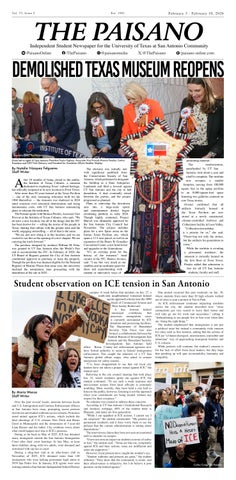
Volume 72, Issue 2

Page 1


THE PAISANO

Demolished texas museum reopens

After 18 months of being closed to the public, the Institute of Texan Cultures, a museum dedicated to exploring Texas’ cultural heritage, has offcially reopened at its new location in Frost Tower.

After more than 50 years housed at the Texas Pavilion — one of the only remaining structures built for the 1968 HemisFair — the museum was shuttered in 2024 amid concerns over structural deterioration and rising maintenance costs, with UT San Antonio announcing plans to relocate the institution.

The Paisano spoke with Monica Perales, Associate Vice Provost at the Institute of Texan Cultures, who said, “We do have a new location, but all of the things that the ITC has been known for — telling the stories of the people in Texas, sharing that culture with the greater state and the world, engaging storytelling — all of that is the same.

“We are just now doing it in this location, and we are excited to see this as the opening of a new chapter. We are carrying the torch forward.”

The pavilion, designed by architect William M. Peña, was granted to UT San Antonio after the World’s Fair end to accommodate the ITC. In February of 2024, the UT Board of Regents granted the City of San Antonio conditional approval to purchase or lease the property. Though the pavilion was deemed eligible for the National Register of Historic Places that same year, the university declined the nomination, later proceeding with the demolition of the site in 2025.

The decision was initially met with signifcant pushback from the Conservation Society of San Antonio, which petitioned to designate the building as a State Antiquities Landmark and fled a lawsuit against UT San Antonio and the city to halt demolition. A deal eventually struck between the parties, and the project progressed as planned.

Plans to redevelop the downtown area into a large-scale sports and entertainment district began circulating publicly in early 2024.

Though highly contested, Project Marvel was ultimately approved by the San Antonio City Council last November. The project includes plans for a new Spurs arena on the former Texas Pavilion site, which spans a 13.5-acre parcel, as well as an expansion of the Henry B. González Convention Center, a new hotel tower and upgrades to the Alamodome.

“It’s an exciting point for the history of the museum,” head curator at the ITC, Bianca Alvarez, said. “I see this very much as our sandbox and an incubator space for ideas and experimenting with content or innovative ways of

presenting material.” modernization, spearheaded by UT San Antonio, took about a year and a half to complete. The institute now occupies a smaller footprint, moving from 180,000 square feet in the aging pavilion to an 8,000-square-foot space featuring two galleries centered on core Texas stories. confrmed that all artifacts formerly housed at the Texas Pavilion are now stored at a newly constructed, climate-controlled Archives and Collections facility in Leon Valley. stewardship is a priority for us,” she said. “Preserving not only the stories, but the artifacts for generations to the institute is awaiting a permanent residence, the museum is currently located on the frst foor of Frost Tower. Perales added that admission is free for all UT San Antonio students, faculty and staff.

Student observation on ICE tension in San Antonio

Over the past several weeks, tensions between locals and U.S. Immigration and Customs Enforcement offcers in San Antonio have risen, prompting recent protests downtown and student walkouts across schools. Protesters stood united against ICE’s actions, which include the fatal shootings of U.S. citizens Alex Pretti and Renee Good in Minneapolis and the detainment of 5-year-old Liam Ramos and his father. City residents worry about what could happen next due to ICE’s presence.

Dating as far back as May of 2025, ICE has detained many immigrants outside the San Antonio Immigration Court after their court hearings. In late May, at least three children, along with two adults, were detained and restrained with zip ties in court.

During a drug-bust raid at an after-hours club in November of 2025, ICE detained more than 140 immigrants who were lacking permanent legal status at 5939 San Pedro Ave. In January, ICE agents were seen waiting outside a San Antonio Independent School District

campus. A week before that incident, on Jan. 27, a south-side neighborhood witnessed federal agents approach a home near the 3000 block of Commercial Avenue and West Ansley Boulevard. San Antonio federal municipal courthouse that processes immigration cases is currently surrounded by ICE detention and processing facilities. The Department of Homeland Security Task Force was also formed, a collaboration between the Federal Bureau of Investigation San Antonio and the Homeland Security Investigations San Antonio feld County law enforcement agencies now have formal authority to assist in federal immigration enforcement. This caught the attention of a UT San Antonio global affairs major, who asked to remain anonymous for safety reasons.

been disappointed to see that our local city leaders have not taken a proper stance against ICE,” the to the city council meeting that took place Jan. 22, where residents spoke out against ICE, the student continued, “To see such a weak response and non-existent actions from local offcials is extremely troubling. Most recently, they have held a city hall to listen to the public; however, listening is not the approach when your constituents are being treated without any respect for their existence.”

No solution was created to address these concerns.

According to UT San Antonio’s Institutional Research and Analysis webpage, 60% of the student body is Hispanic, and many are frst-generation.

“While I am appalled at ICE actions, I cannot say I am surprised,” the student commented. “My parents are permanent residents, and it does worry them to see the policies that the current administration is setting about deportations.”

The interviewee claims they have not seen an emotional shift in students on campus.

“I have not seen an impact on students in terms of safety or fear,” the student said. “Some are like me, completely against ICE and their actions, some are indifferent and some are supportive.”

However, local protests have caught the student’s eye.

“Student walkouts and protests are great,” the student refected. “They show that the community is aware, and their effectiveness is subjective, but I do believe it puts pressure on the federal agency.”

One protest occurred this past weekend, on Jan. 30, where students from more than 20 high schools walked out of class to join a protest in Travis Park.

As ICE enforcement continues impacting residents across the city, the student described how “close connections get very scared to leave their house and will only go out for work and necessities,” calling it “disheartening to see people live in fear even when they are ‘doing the right thing.’”

The student emphasized that immigration is not just a political issue but instead a community-wide concern for cities such as San Antonio, adding that the actions of ICE are “a blatant disregard, mistreatment, insensible and inhumane” way of approaching immigrant families and U.S. citizens.

While protests will continue, the student’s concern is for the lack of effort from local leaders, but they hope that speaking up will spur accountability, humanity and tranquility.

(From left to right) UT San Antonio President Taylor Eighmy, Associate Vice Provost Monica Perales, Centro
President and CEO Trish Debarry and President for Academic Affairs Heather Shipley.
Marisela Cruz/The Paisano
Carlos Craig/The Paisano

Texas website lets students report against universities

After the passage of the Texas Senate Bill 37 — a bill requiring a 5-year annual review of degrees and curriculum, limiting the power of faculty senates and downsizing faculty senates to 60 — the University of Texas Board of Regents ordered university presidents to eliminate their faculty senate and replace it with less independent groups, making them now accountable to the regents.

In January, the Texas Higher Education Coordinating Board Offce of the Ombudsman — created by SB 37 — launched a website for students to report any activity by university faculty or professors that violates Texas’ policies over curriculum and diversity, equity and inclusion.

The offce divided complaints into two subsets: statutory complaints and nonstatutory complaints. The frst is the statutory complaint section, which is any complaint that signals a university is directly violating state law, such as the SB 17 prohibition of any DEI practice. The second are responses “outside of the statutory complaint process.” Here, the offce will contact universities to delve deeper into them and offer feedback.

The website also stipulates that any false complaint made will subject the individual to costs incurred in investigating the report.

The website’s launch comes after Texas A&M University fred Melissa McCoul for discussing gender identity and UT San Antonio lost its $8 million research grant

for violating DEI policies.

With the major surge in the restructuring of faculty senates and increased oversight over university curriculum, SB 17 sparked outrage from professors and education advocates who worry about the independence of these faculty bodies that have been key to their function as advisory boards. In addition to the faculty senates’ remodeling, SB 17 raises concerns about the autonomy and new restrictions placed on professors.

Dr. Marissa Munoz, an assistant professor in the Department of Interdisciplinary Learning at Teaching at UT San Antonio , stressed the role of SB 37 in harming scholarship in universities.

“[SB 37] breeds a culture of fear,” Munoz explained. “I can’t even talk about current events because that might be offensive.”

Texas has “had several major institutions collapse what used to be an entire department of race, ethnicity, gender studies,” Munoz explained regarding the passage of SB 37. “Part of what makes that complicated is that information becomes harder to access.”

Over the course of recent months, universities, including Texas A&M University, have eliminated their women’s and gender studies degree programs. Munoz worries this act will only make educational accessibility even harder to attain.

“We’re erasing the history of how people have thought [and] how that information is accessible to the next generation,” Munoz commented.

President Trump cuts health programs, reinstates them within 48 hours

President Donald Trump’s administration notifed 2,000 health program providers in cities around the country, including San Antonio, that their federal funding would be completely cut. After protests from House representatives and local groups, their decision was reversed 48 hours later, reinstating the allocated $2 billion of funding.

Thousands of notifcation letters were received by behavioral health organizations around the U.S. on Jan. 13, informing them that their previously approved federal grant funding would no longer be dispensed. Although the decision was reversed 48 hours later, many of the organizations expressed concerns over potential funding cuts being permanent in the future.

Funding for the federal Substance Abuse and Mental Health Services Administration is vital for health programs around the country, and especially in San Antonio, where 20% of the population live with a mental health or substance abuse disorder. Federal funding is also very important for programs provided by the Center for Health Care Services and the San Antonio Council on Drug and Alcohol Awareness.

While SACADA and other such organizations do not receive a set amount of annual federal funding, SACADA was set to receive $5 million through four separate grants,

State of the City

Week of 2/3

Not subscribed to local news but still want to stay up-to-date on the happenings around town? Look no further.

Highlighting notable stories from external San Antonio news sources, State of the City summarizes the most captivating news headlines of the week. This week’s topics range from a shooting on the East Side to the Salvation Army supporting the homeless.

Conflict among citizens arise at town hall meeting

After being rescheduled from Jan. 12, Mayor Gina Ortiz Jones successfully held her sixth Town Hall meeting at the Walker Ranch Senior Center in District 9. Yesterday’s meeting addressed the Fiscal Year 2027 budget for the upcoming bond, federal implications and Jones’ 2026 priorities.

Jones briefy discussed topics that coincide with the agenda to give ample time for those in attendance to ask questions at the end of the presentation.

The city’s fscal year bond was approximately $800 million in 2017; Jones announced that the upcoming bond is expected to be signifcantly less. The FY 2027 bond amounts to $600 million, and the bond would cover infrastructure projects, affordable housing and potential food projects.

“There is a $142 million budget gap. Now, the city manager has a plan to close that, but as you and I both know, that budget ain’t closed,” Jones said.

Regarding the federal implications that Jones addressed, the One Big Beautiful Bill was brought up to cause a disruption in funding towards the Supplemental Nutrition Assistance Program, Medicaid, Medicare and Children’s Health Insurance Program.

“Just to give you a sense of how the higher dose cuts could be, just one section of that $50 million worth is federally provided to San Antonio, which goes to SNAP benefts,” Jones emphasized.

The 2026 priority that Jones predominantly delved into concerned affordable housing in the city. Various types of cost-effective housing were explained for veterans, seniors, lowincome individuals and LGBTQ+ youth.

Before concluding her presentation, Jones relayed a message to the citizens waiting for their chance to question her and others who were present at the meeting.

“One of the most important things I think we can do in our community is create a space for conversation,” Jones stated. “We might not have all the answers, but I think showing respect and the willingness to listen and to create expectation on what we are actually dealing with.”

San Antonio resident Effa Farnsworth addressed her question to San Antonio

which it has previously used to provide alcohol and drug abuse prevention programs for at-risk youth, DWI courses for frst-time offenders, along with distributing educational substance abuse prevention materials. All of these services would have been unable to continue without federal funding.

According to the letters received, the funding was cut to restructure the SAMHSA grant program to “better align” with the administration’s priorities. The funding cut would have resulted in $2 billion being withheld from many behavioral health organizations. The decision was reversed as a result of intense bipartisan backlash from over 100 House representatives, including Democratic representative Rosa DeLauro, who stated the following in a letter to the U.S. Department of Health and Human Services Secretary Robert F. Kennedy Jr.

Police Department Chief William McManus.

“I know that you are required to cooperate with ICE, but I’m wondering how far that cooperation will go? Because if I’m being assaulted by ICE and they’re pepper-spraying me in my eyes, like they did to my husband, can I call the police for protection?” Farnsworth questioned. McManus approached the front of the meeting to address her question.

“When you talk about a local law enforcement agency intervening or interfering with a federal operation, I spoke with the U.S. Attorney’s offce the other day about that, and we have to be very careful about intervening with other agencies’ operations, whether it’s federal, local or state,” McManus explained.

“But what I will tell you is that if you have a complaint about that, if we take a report, we will explain to you how to make a report to the agency.”.

A woman from across the room asked Farnsworth’s husband, Ron, who was allegedly pepper-sprayed by U.S. Immigration and Customs Enforcement agents, why he was attacked. He responded, saying he was at a demonstration being held at Dilley Detention Center. The woman then rolled her eyes and said, “Of course, you were at a protest.”

Tensions arose in the meeting room following concerns about ICE. Attendees clashed with each other on whether ICE operations have been getting out of hand or not. One citizen stood up and requested that the conversation topic be changed, directing it to Jones.

Christine Welde, a churchgoer and demonstrator who was present at the Dilley Detention Center protest, addressed concerns of protecting oneself from federal enforcement.

“What is going to keep us safe from federal agencies, like ICE, who are consistently using illegal and excessive force?” Welde questioned.

McManus approached the front to respond.

“I can’t speak for other agencies, federal, state or local, but I can speak for SAPD, all administrations and protests that we’ve handled in the city,” McManus stated. We’ve handled protests, respectfully, and like you said earlier, we protect those folks who are protesting peacefully. But I can’t speak for other agencies.”

“We have an addiction and mental health crisis in this country that spares no family and yet, this administration is decimating the programs that help children, their families and adults that are in recovery. We prioritized investments in treatment and prevention to address these crises, and we succeeded: overdose deaths fell for the past two years. This destruction threatens to reverse that progress,” an excerpt from the letter read.

Many of the organizations that received these letters feared they would no longer be able to operate, which

Man charged with murder after East Side shooting

20-year-old Daniel Sanchez Jr. is charged with murder following the fatal shooting of an unidentifed 21-year-old man. According to the San Antonio Police Department, Sanchez and a woman met the victim outside of a home in the 200 block of Cardiff Avenue around 12:20 a.m. on Jan. 28. The victim was “in the process of repaying a debt” to Sanchez when he was shot. Sanchez fed to a nearby home on the East Side. The victim later died at a hospital from his wounds.

was supported by the $1.7 billion SAMHSA budget in 2025 and accompanied by a 55% general staff cut and 70% senior staff cut, turning their offces into a “ghost town,” according to one center for mental health services the programs that SACADA offers in San Antonio are primarily related to substance abuse treatment, the effects of this $2 billion cut would have had widespread effects across the country.

Other programs that would have been cut include the National Alliance on Mental Illness, with chapters such as the one in New Hampshire that provides daily assistance for families dealing with depression, schizophrenia and bipolar disorder. Another example is the American Psychiatric Association’s programs educating elementary, middle and high school teachers and counselors on how to identify and support students with additional mental health needs.

Immigration Legal Defense Fund’s $1 million contract

According to a Jan. 28 News 4 San Antonio article, Bexar County has a million-dollar contract with the nonproft American Gateways, which provides free and low-cost immigration legal representation. The Bexar County Immigrant Legal Defense Fund Information Sheet reveals 79% of cases in Texas immigration courts lack legal representation. Members of the Bexar County Commissioners Court voted to extend the contract before the holiday season, allocating $1 million in public funds to the nonproft.

The Salvation Army aids homeless population

The Salvation Army set up its mobile feeding truck on Saturday and Sunday near the intersection of Frio Road and Houston Street to help homeless individuals during the recent cold weather. The team manning the truck distributed “sack lunches, blankets, winter clothes, hygiene kits, dog food and other essentials.” The organization encouraged people to visit the Salvation Army’s Emergency Family Shelter, located at 515 W. Elmira, and the Dave Coy Center, located at 226 Nolan St.

OPINION

Artificial intelligence boxes student creativity

UT San Antonio enourages AI implementation

in traditionally creative courses

Editorial

An artist is usually limited by the edges of their canvas. For the writer, it is the ink in their pen, and for all people, time’s scarcity. Beyond these restrictions, human creativity is allowed to dominate in every setting it fnds itself in. The chessmaster invents a new endgame strategy, the lawyer fnds a niche exception in the law that acquits their client and the farmer designs a more effcient way to harvest his crops.

That same creative potential also exists in student life; however, UT San Antonio’s adoption of artifcial intelligence in its Microcredential programs acts as another bounding box for students and teaches them to rely on a computer for their creative processes.

When ChatGPT and other AI programs emerged, educational institutions quickly acknowledged that they had no place in professional or student work. Students who were caught turning in an assignment heavily supplemented by or completely authored by AI would receive a failing grade. While AI has since been recognized as a useful tool for editing grammar and fnal drafts, the university extends as far as to endorse its use for brainstorming and thought organization.

While the university’s guidelines operate on a classby-class basis, the outer limits they set on acceptable use extend beyond “ethical use.” If the specifc course

allows it, a student may use AI to copy-paste paragraphs of generated research so long as “AI-generated content is clearly cited, included in the appendix, and reviewed by the student for accuracy.”

If AI’s severe environmental consequences are ignored, perhaps this practice is more acceptable in a non-research or non-writing-based course; however, AI’s integration is

AI tearing apart music

Commentary

Apparently, inputting a prompt into a computer and selling the product constitutes someone as an artist. Artifcial intelligence songs are fooding Spotify charts, knocking out human-produced songs. AI is consuming the musical world; lamentably, that lyrical automation is succeeding.

Last year, the top 10 AI “artists” accumulated over $500,000 on Spotify. Their average monthly listeners ranged from 80,000 to almost 300,000, and these 10 do not even scratch the surface. There are many more AI “musicians” on Spotify and other platforms not mentioned. Many of these AI slop composers are robbing real artists of opportunities.

Telisha “Nikki” Jones, an R&B artist, uses AI-generated vocals and images in her music production. She also created an AI persona called Xania Monet using the artifcial intelligence start-up Suno.

With the help of AI, Jones signed on to receive a $3 million record deal with Hallwood Media. Hallwood Media gave a multimillion-dollar contract to an AI, a contract that could have been given to a composer of fesh and blood. But instead, they gave the deal to someone who just owns a software program.

The music AI “artists” make does not belong to them, nor does the music belong to the database of artists artifcial intelligence uses. The music the “artists” produce belongs to the composers the AI steals from. AI cannot just compose lyrics on a whim. It scans rhythms and tones of different genres, analyzing the words of creators. It takes what it learns and applies that to produce any song the user demands. The users do not have the capacity to create real art; AI takes that ability away. Using AI models, such as ChatGPT, lowers brain activity. It trains the users to rely on a computer, lowering cognitive processing, making them lazier and diminishing their creativity.

An experiment was performed where two groups were given the same task: to invent a toy using different objects. One group was able to use artifcial intelligence while the other was prohibited. The AI users produced similar toys. The non-AI users, on the other hand, designed an array of toys. Each is more novel than the last. AI chips away at the brain; with each use, it redacts any formative idea.

AI “artists” are stealing opportunities and hindering their ingenuity. Artifcial intelligence is an affiction on musical society, both the users and AI haters, taking opportunities from real artists while hurting those who do use it. It kills the mind and the soul of sound, turning music into robotic noise. Stop using artifcial intelligence to create what is already hidden inside the artist’s head.

even found in staple, expressive courses such as technical writing.

A syllabus for a technical writing class reads, “Any student work submitted using AI tools should clearly indicate with attribution and screenshots of the AI usage drafting process.” The course explains that it will teach students how to adequately prompt AI to generate useful ideas for writing tasks.

Every time AI is used this way, it replaces work that an individual could have done better. When AI is used, it replaces the need to think critically. Social media replaced reading for pleasure, contributing to the country’s decline in literacy; AI could very well do the same longterm. People can organize or come up with their own thoughts for a writing assignment, and a basic Photoshop understanding is far more useful than “AI prompting” skills.

Even if AI has no impact over time, it places an outer edge on human imagination. It regurgitates wellestablished, bland ideas and, by design, gives users limited options for their work. If AI drives the creative process, everything will be well structured, but nothing will be new or innovative. This is not the “ethical” world that UT San Antonio should aspire to model. Do not crop a student’s canvas before they even pick up a brush.

PAC money pig trough

Commentary

Texas’ Senate primaries for the Democratic nomination are being led by Jasmine Crockett and James Talarico. The candidates are in a dead heat, with neither showing any clear signs of being the projected winner. Unfortunately, it appears as though the two are not just equally likely victors, but equally hypocritical.

Both Crockett and Talarico have run campaigns that are critical of billionaires, a position that left-leaning Americans tend to appreciate. However, it appears as though these politicians are no different from any other: willing to turn around at any moment for some money.

Crockett accepted donations from the Lockheed Martin Employees’ Political Action Committee, which is deeply concerning since Lockheed Martin is a huge supplier to Israel. She also accepted money from Marc Andresseen, a huge technocrat and pro-Trump billionaire; and from each of the Winklevoss twins, a pair of crypto-focused, pro-Trump billionaires. It is terrifying to know that she will be considering the interests of Israel and technocrat Trumpies.

Talarico’s money came from just one place, the Texas Sands PAC. This PAC is run by billionaire and casino tycoon Miriam Adelson. Adelson is a hardcore Zionist who wrote an article for Forbes Israel, where she claimed that antiIsraeli protesters were nothing more than “ghastly gatherings of radical Muslims and Black Lives Matter activists.” It is almost impressive that she manages to be so racist that she can fnd a way to relate her hate for Palestinians back to Black people. It is offensive that Talarico would even consider accepting

money from her.

The fact that these people would criticize Republicans for accepting money from billionaires and call for tax cuts to billionaires, only to then grab cash by the handfuls from racists, crypto-bros and Lockheed Martin, makes it hard to believe that either of them has said a single truthful thing in any of their campaigns.

Being against billionaires is powerful and important. It shows people — normal people — that they are seen. It tells people that the injustices facing them are recognized. It lets them know that they are more than statistics, more than a game to be played and potential constituents as more than mere votes. For those reasons, it is diffcult to express just how disappointing it is to see Crockett and Talarico smile and wave with one hand, while keeping the other behind their back with their fngers crossed. Their refusal to stand their ground on a stance as simple as “distrust billionaires” speaks volumes about how much they actually care about their voters.

It seems as though Texans are in for six more years of their interests being ignored in place of those with deep pockets. If these people are worth their weight in gold, then they can only be trusted as far

ACA ending: State, city, university must act

Commentary

Since the enhanced Affordable Care Act subsidies expired in December 2025, Texans face a brutal reality: skyrocketing insurance premiums. This “subsidy cliff” will create a fnancial disaster for Texans, particularly for those just above 400% of the federal poverty level, older enrollees, self-employed individuals and small business owners.

According to data from the Centers for Medicare and Medicaid Services, Texas saw record-breaking enrollment in recent years. Of the 4.1 million Texans who selected a plan, approximately 125,000 report incomes above 400% of the federal poverty line — the group now disproportionately crushed by the loss of aid. A Kaiser Family Foundation report predicts that out-of-pocket payments could more than double, with average premiums increasing 35.2%. This is devastating to the families and individuals who keep the state’s economy moving.

Because the federal government has failed to extend these life-saving credits, the responsibility now falls on Texas, San Antonio and local institutions, such as UT San Antonio, to bridge the gap.

Texas should pursue a Section 1332 State Innovation Waiver to establish a reinsurance program. Under this waiver, Texas can use federal “pass-through” funds to cover high-cost medical claims and co-insure its most expensive citizens. This lowers premiums for all

Texans because the state helps pay for the most expensive medical bills; therefore, insurance companies do not have to raise prices on everyone else to cover those costs.

Additionally, the 89th Legislature should prioritize Senate Bill 289, also called the Texas Solution, which aims to create a state-level version of premium tax credits. This should target the subsidy cliff for families earning between 400% and 500% of the federal poverty level who are now

San Antonio must bolster its local safety net. As residents are priced out of private plans, the city and Bexar County should expand the budget for University Health’s CareLink program to absorb the surge in demand for primary care. Local leaders should also provide emergency grants to navigator organizations to help residents transition to lower-cost “Bronze” plans that remain somewhat affordable due to existing state “silver-

San Antonio has a duty to protect its student body and adjunct workforce. The university should advocate for the UT System to use discretionary funds to buy down premiums for the Student Health Insurance Plan, which currently sits near $3,500 annually. For example, if the university pays $500 of that $3,500, the student’s bill becomes more affordable.

Furthermore, the recent launch of the UT Health San Antonio Multispecialty and Research Hospital presents unique opportunity for the university to directly lower the cost of living for its people. UT San Antonio should establish a preferred pricing tier for its community. This means a UT San Antonio student or adjunct worker would pay signifcantly less for a procedure or visit at a UT facility than a member of the general public would. Using the university’s medical infrastructure to create a safety net.

San Antonio can ensure that the cost of education does not come at the expense of health. As a fagship public university in the state’s second-largest city, UT San Antonio’s voice matters.

Sarah Campos/The Paisano
Catherine Salongona /The Paisano
Emma Cavanaugh /The Paisano

OPINION

Abbott does anything but help

After President Donald Trump’s administration amended the lottery selection process for attaining H-1B visas on Dec. 29 to favor “higher-skilled and higherpaid aliens,” it seems Gov. Greg Abbott is dutifully following Trump’s attacks on visa applicants. He announced a freeze in unapproved H-1B visa applications for public universities and state agencies on Jan. 27.

“State government must lead by example and ensure that employment opportunities — particularly those funded with taxpayer dollars — are flled by Texans frst,” Abbott argued.

America is supposed to be the land of opportunity, but Abbott’s direct attack on our public institutions will result in a loss of specialized skills and labor that immigrant workers bring to Texas.

In the announcement, Abbottclaimed the new H-1B visa policy is meant to strengthen Texas’s working conditions. He insisted that his changes, including championing the allocation of $5 billion to revamp the academic and technical programs in Texas’s higher education system, set Texas apart from other states. That is false.

Oxfam America, a nonproft that fghts inequality, injustice and poverty, released a 2025 index ranking the 50 states from best to worst for work based on their wage policies, worker protections and union rights. Texas ranked No.45 out of 50. That is far from being

the “best state in the nation to work.” Some of the current policies contributing to this score included the state minimum wage of $7.25, not providing protection for warehouse workers and the absence of workers’ protection against wage theft.

Abbott seems very concerned about “maintaining” Texas as the top worker state. In reality, he should shift his focus from following Trump’s beck and call to providing standard policies that actually improve Texans’ lives.

Furthermore, according to the Texas Tribune, the median salary of the 155,000 state employees is $60,828 as of Jan. 1. This wage is not a comfortable one and is less than livable for single-parent families. If Abbott wanted to improve Texans’ working conditions, he should focus on raising the wages of many of the workers in his government.

This does not only apply to government workers. As per their website, the Dallas Independent School District looked to sponsor visas for the 2025-2026 school year for elementary bilingual and special education teachers. These positions require specifc schooling and certifcations to work that could be achieved by Texans. But, Texas has a shortage of teaching staff in the state due to the lackluster salaries teachers make. The issue is not that Texans’ jobs are being passed over or “stolen,” Abbott just does not care about employees’ real needs. He only cares about following Trump’s footsteps.

Abbott is a spineless governor so committed to bending his knee to Trump that he disregards the needs of everyday Texans to further the president’s agenda. Texans deserve better leadership than that. This November, Texans should elect a governor who truly wants the best for Texas, not a puppet who enables Trump’s actions at the expense of Texans.

State elections go band-for-band

With districts, candidates and propositions changing every year, it is important to know “What’s on the ballot” in a given election cycle. This section will go over notable races and issues until the spring primary on March 3. This issue covers the races for Texas lieutenant governor, comptroller and attorney general.

These races are largely dominated by extremely wellfunded Republicans competing with each other for the chance to crush their underfunded Democratic counterparts.

Beginning with the Lt. Governor’s race, Republican incumbent Dan Patrick is looking to secure another term. This cycle, he is saturated in $37.7 million and billionaire donations, compromising his fnancial integrity. He spent his past term championing disastrous policies, including posting the 10 Commandments in schools and enforcing the deadly abortion ban.

Incumbents are usually impossible to challenge, but he faces veterans Perla Hopkins, Timothy Mabery and Esala Wueschner nonetheless.

On the Democratic side, State Representative for the South Austin area, Vikki Goodwin, faces labor leader Marcos Vélez from Houston. Both advocate for making housing more affordable and education accessible, but Goodwin’s additional focus on healthcare and greater experience make her the better candidate.

While not given much attention, the Texas

Comptroller is a highly important offce as the state’s chief fnancial offcer. Current Acting Comptroller Kelly Hancock has partially overseen the offce’s expansion into one that attacks “diversity, equity and inclusion” contracts, while uplifting the school voucher program.

He somehow faces an even worse candidate, Don Huffns. Huffns is better funded, endorsed by Sen. Ted Cruz and the late Charlie Kirk and appears more aggressive on slashing corporate taxes and pursuing President Donald Trump’s agenda — a calamitous combination.

Democrat Sarah Eckhardt from Austin is running mostly unopposed. While she looks respectable, her campaign promises appear rather empty.

The best for last is the Attorney General race. Current AG Ken Paxton has stepped out to run for Senate, and current GOP Congressman Chip Roy has entered. The AG represents the state in legal disputes and can choose to prosecute suspected violators of Texas laws.

Roy promises more of the same: border enforcement, defeating the “woke agenda” and abortion rights destruction. Although vastly more popular thus far, Roy has been outspent by oil baron and Trump ally Mayes Middleton.

Most of these Republican candidates continue the status quo of expanding their party’s boldness and willingness to disenfranchise others, while Democrats can only hoist up a candidate or two. It will be interesting to see how far money will go in these races come March 3.

The Paisano

Editorial Board

Jasmine Williams | Editor-in-Chief Editor@paisano-online.com

Cruz Delgado | Managing Editor Manager@paisano-online.com

Marisela Cruz | News Editor News@paisano-online.com

Henry Holmes | Opinion Editor Opinion@paisano-online.com

Audrey Villar | Arts & Life Editor Arts@paisano-online.com

Rylan Renteria | Sports & Photo Editor

Sports@paisano-online.com Photo@paisano-online.com

Hallie Lott | Web Editor Web@paisano-online.com

Sarah Quintanilla | Graphic Editor Graphic@paisano-online.com

Regan Williams | Multimedia Editor Multimedia@paisano-online.com

Valentina Quintanilla | Magazine Editor Magazine@paisano-online.com

Karis Vickers | Social Media Editor Socialmedia@paisano-online.com

Jaclyn Banda | Buisness Manager Buisness@paisano-online.com Staff

Diane Abdo | Advisor

Stefanie Arias | Advisor

Corey Franco | Advisor

Jack Himelblau | Advisor

Mason Hickok | Advisor

John Helton | Advisor

Ted Cruz: Mr. Leaked n’ Loaded

Commentary

Republican Sen. Ted Cruz has found himself in yet another compromising situation; he was caught in a series of leaked recordings harshly criticizing President Donald Trump and Vice President J.D. Vance. It is unsurprising that Cruz criticized Trump, considering their feud where Trump publicly insulted Cruz’s wife, implying she is ugly and suggesting that his father was involved with former President John F. Kennedy’s assassination. Cruz later referred to Trump as a “bully” and “pathological liar.” Regardless, Cruz endorsed Trump in the 2024 election,

tariffs. He warned donors during the recordings that the tariffs could shatter the economy and result in Trump’s impeachment. Cruz states that after the tariffs were introduced in early April 2025, he and other senators had a call with Trump where they pressured him to stand down. Cruz says the call stretched past midnight, “did not go well” and that Trump was “yelling” and “cursing.”

Cruz says he told Trump, “You’re going to lose the House, you’re going to lose the Senate, you’re going to spend the next two years being impeached every single week.”

According to Cruz, Trump responded, “Fuck you, Ted.”

Of course, like the shameless yes-man he is, Cruz offers little resistance and remains compliant without any objection.

When a questioner in the recordings mentions “Liberation Day” — Trump’s title for his tariffs unveiling — Cruz joked, “I’ve told my team if anyone uses those words, they will be terminated on the spot. That is not language we use.”

Even in situations where he knows what is right, Cruz publicly keeps up his two-faced sycophant act, while privately positioning himself as an independent of Trump’s regime. One would expect this behavior from high school children, not some of the most powerful people in the country.

Furthermore, Cruz accused Vance of being conservative podcaster Tucker Carlson’s pawn. Cruz previously accused Carlson of promoting antisemitism and an anti-Israel foreign policy but has refrained from publicly associating Vance with Carlson until these recordings were brought to light.

These politicians will criticize their peers behind closed doors yet fall in line when a vote is called. Cruz is a coward — the same coward who fed Texas in the wake of a winter storm. The same coward who said, “How about we all come together and say let’s stop attacking pedophiles?”

There needs to be a change, and it starts with getting rid of spineless, opportunistic politicians such as Cruz.

Steven Kellman | Advisor

Jake Mireles | Advisor

Sandy Norman | Advisor Imelda Robles | Advisor Chloe Williams | Advisor

Te Paisano is published by the Paisano Educational Trust, a non-proft, tax exempt, educational organization. Te Paisano is operated by members of the Student Newspaper Association, a registered student organization. Te Paisano is NOT sponsored, fnanced or endorsed by UT San Antonio. New issues are published every Tuesday during the fall and spring semesters, excluding holidays and exam periods. Te Paisano is distributed on the UT San Antonio Main Campus. Additionally, Paisano publications are distributed at a variety of of-campus locations, including Tri-point and a variety of apartment complexes near the UT San Antonio Main Campus. All revenues are generated through advertising and donations. Advertising inquiries and donations should be directed to: 14526 Roadrunner Way Suite 101 San Antonio, TX 78249 Phone: (210) 690-9301 © 2025

censorship and advance approval of copy, and their editors and managers are solely responsible for editorial and content policies and decisions. Editors and managers of Student Publications will not be subject to arbitrary suspension/ expulsion or removal from their positions within a Registered or Sponsored Student Organization (Student Organization) by the University because of student,

Emma Cavanaugh /The Paisano

ARTS & LIFE Gardopia sustains LOCals

When University of the Incarnate Word alum Stephen Lucke began conjuring the idea that would become Gardopia Gardens, he set out to improve public well-being and promote sustainable use of land. What follows is a tale of a collective’s power to bring a dream to life and support one another.

Gardopia Gardens, located on the East Side of San Antonio, provides educational programming to students about nutrition and agriculture while offering a safe haven for locals to cultivate their food, such as squash, fgs and eggs.

To celebrate 10 years of his mission with Gardopia Gardens, Lucke hosted a documentary screening alongside a seed swap on Jan. 31. The documentary began as disconnected interviews, but Lucke now hopes to submit the work into festivals with the intention of raising enough funds to develop a featurelength version.

“It’s just about our past 10 years of growth and how we have positively impacted the community through the food system and through ecosystem change,” Lucke described. “A lot of people have been involved in this. It wasn’t just me. Of course,

I was sort of the radical root, but since that point in time, so many other folks have come together to make this a reality.”

The documentary discusses the partnership of Lucke and Dominic Dominguez, who is currently pursuing a PhD in environmental science and engineering at UT San Antonio, as well as the transformation of a dirt lot located at 619 N. New Braunfels Ave. into the agricultural utopia it is today.

Despite the chilling temperatures, members of the community came together to indulge in the serendipity of seed swapping and learn more about the organization’s fateful beginnings.

The spirit of beautifying and educating the community rang true for San Antonio native and frst-

time Gardopia patron Maria Valdez.

“They have one landscaping area on Democracy Prep at Stuart,” Valdez commented. “I see them out there sometimes. It looks so beautiful the way they got it populated for the winter months, and I saw some of the crop that was coming out of it. So excited [about] the way they incorporate the science class, and they have the kids out there working at it as well.”

Lucke is not done innovating his program. He hopes to expand on what Valdez recognized at Democracy Prep and provide the Gardopia curriculum with all students in San Antonio.

“We want every kid in San Antonio to learn about where their food comes from and how they can take better care of this planet,” Lucke said. “That’s our next step. We got a fund from the USDA to turn our curriculum into videos, so we’re doing that right now.

“We are building a farm on the west side. We’re working with the UTSA Architecture Program to design the master plan of this property and really just integrating this into the fabric and the culture of San Antonio.”

Gardopia Gardens, located at 619 N. New Braunfels Ave., is open Monday to Friday from 9 a.m. to 5 p.m. and from 9-11 a.m. on Saturday. The organization is hosting a volunteer activity on Feb. 7 at 9 a.m. For information on how to get involved, visit gardopiagardens.org.

Local youth revive Black history Money, classes

afternoon came to

someone entered the In The Eye Of The Beholder Art Gallery. The gallery’s atmosphere — warm with a spicy-sweet aroma — enveloped all who graced its presence on Jan. 31 for the African American History Fair.

The fair, the product of a classroom project titled The Living Wax Museum, showcased the research of a handful of elementary and middle school students embodying prominent fgures in African American history. The children dressed and spoke as the fgures they studied, allowing their stories spring to life once more through the youth of today.

“I don’t do a number of events that don’t recognize who we are,” owner and curator of In The Eye Of The Beholder Art Gallery Maria M. Williams said. “These kinds of events make sure that we recognize those who are signifcant in our history. And the fact that these children recognize them [is] extremely important.”

Hushed jazz melodies after the opening remarks soothed the young scholars overfowing with nerves. By 2:30 p.m., the quiet conversations of the parents in attendance gave way to silence; the students, who represented people like Father of the Blood Bank Charles R. Drew and Civil Rights activist Rosa Parks, had the foor.

“I got chills hearing my babies,” seventh grade U.S. history teacher and coach to the students V. Lewis revealed. “I mean, yes, they rehearsed, but I got chills when I actually hear them go forth because I know they’re nervous. And so it was just amazing.

“Even though I say, ‘Go do your research,’ they still teach me something about the individuals that they present.”

Parents seated in the gallery beamed with pride, occasionally whispering reminders to the youngest of the bunch and nodding in approval.

“It’s bringing history to life. It makes them own their project. They become the character. But it’s also a creative way for learning,” A Better Chance for Youth Futures Inc. Founder and Executive Director Monique Robinson expressed. “If you don’t know where you come from, you don’t know where you’re going. And I think that’s the problem that we have now. [A] lot of people obviously don’t know their history, and that’s why it’s being repeated.

“But one thing that we can do is we can learn for ourselves and also teach others — it’s a ‘each one reach one’ mentality.”

The project originates from Detroit, Michigan, where Robinson, a teacher at the time, would organize it yearly in her classroom during Black History Month.

She has continued leading the project in San Antonio for the past two years. In the last four years, she began participating in and collaborating with DreamWeek San Antonio, “a 17-day summit of events to foster the exchange of ideas on universal issues.” The project has been entwined with DreamWeek San Antonio’s programming ever since.

Williams generously offered her gallery to host this year’s fair, recognizing the importance of historical education.

“They’re not being taught about those fgures any longer because of the ban on African American studies in different schools,” Williams stated. “As I shared with the parents, we really survive on oral history, so it needs to be something that’s started at home.”

For upcoming DreamWeek San Antonio events, visit dreamweek.org/events/.

Zine Club cultivates company

With streaming services raising their prices and social media growing more and more stressful for some, many Gen Z’ers have begun returning to physical media and hands-on hobbies for entertainment and stress relief. For UT San Antonio students looking to follow this trend, the campus’s Zine Club offers a space to fnd community and showcase creativity.

A zine is a miniature booklet or magazine, produced independently and often covering niche subject matter through art, writing and photography. The Zine Club’s Financial Director, Politics and Law major Jimena Felix, describes the club as “A student based magazine here at UTSA directed for the creatives on campus.”

The zines produced by the club are sold monthly on campus, each with a distinct theme.

“We have a topic every month with a design based on that topic, and we accept everyone to submit,” Ike Sampson, the club’s Director of Design, said.

The most recent zine’s theme is DIY, and past zines have featured themes such as nostalgia, analog horror and cybercore.

The club includes people across many different majors, years and interests. But members say the high points of the club are in the artistic expression and the strong community of zine making.

“I love the freedom and creativity you’re allowed to have with the spreads,” member and sophomore psychology major Bella Read said. “And it’s just a lot of cool people coming together.”

The club also partners with the Musicians of Business club to host events, such as the recent mixer held at The

Block, where both potential and longtime members of each club got to know each other by flling out icebreaker zines over food and drinks.

“I’ve made all my friends in Zine Club,” Sampson vocalized. “They’ve also helped me become more creative. I’ve taken photos, I’ve done interviews and it’s also helped me fnd different media and adopt them.” The club welcomes anyone to join, with the offcers inviting people of all talents.

“I’m looking for more writers, more drawers and looking to make more collages. I wanna make hella mixed media,” Sampson said.

Interested students can follow the club’s Instagram at @zineclubutsa and see past issues at zineclub.org.

“We wanna create,” Sampson notes. “We wanna hone your skills and give you a voice.”

Bird On The Street Week of 2/3

As the month of new beginnings concludes, students settle into new classes while getting to know their professors. They also begin to drain their pool of funds on tuition. Hypotheticals are then raised of how students would spend a large amount of money if given the chance, their views on academics and the student body. This week on Bird on the Street, The Paisano interviewed freshman environmental science major Adan Avalos, senior psychology major Ciara Johnson, sophomore cyber security major Colton Hofmockel and freshman psychology major Safya Akhmedov.

What would you do with $1 million? Avalos would spend the $1 million on tuition, his mom and investing. Akhmedov replied along the same lines, choosing to redistribute the million to her family. Johnson quickly answered, “Pay off my student debt,” certain of her priority. Hofmockel was more sentimental with how he decided to spend his money, saying, “I’d probably try to fnd a home outside of Texas, maybe somewhere in Oregon, but save it and use it to travel.”

Should Rate My Professor impact your professor?

Hofmockel says the site is useful in gauging a professor’s course but believes it “shouldn’t count against them in the rating sense.” Akhmedov concurs, explaining, “I don’t think it should affect their salary,” arguing that Rate My Professor “does what it is supposed to do.” Avalos believes “in some special cases, yes” but is generally against it, as “some students must adapt” to their professor. Johnson agrees with Avalos, saying, “It kind of depends” because students can leave negative reviews in bad faith.

Should UT San Antonio increase its student body?

Avalos believes that UT San Antonio ought to grow, citing that “we should expand it just to give more opportunities to more people.” Hofmockel offers another proposition: “Cap it because it would bring more value to the degree itself.” Akhmedov and Johnson follow suit, with Akhmedov stating that the campus population “is good where it is” and that the campus is too small for more students. Johnson explains, “They just built a whole new dorm room for freshmen, but they do not accommodate for all the parking.”

What classes are you dreading?

Johnson swiftly answers her applied behavioral analysis class, stressing, “It’s test-heavy, 70% exams and 30 quizzes, and exams are all free response.” While Johnson anticipates a strenuous and hefty semester, Avalos brings a more optimistic tone. “Personally, none. If anything, my hardest class is probably environmental statistics,” he noted. Hofmockel refers to his economics course because “it is kind of boring.” Akhmedov points to her Spanish class because she “has it 3 times a week,” and as she explained, “It’s my earliest class, and I’ve also just always hated Spanish class.” Have a question and want it answered by UT San Antonio students? Submit at http://bit.ly/4pdDfIP.

Lillianna Flores/The Paisano
The bitter cold of an East Side San Antonio winter
a sudden halt the second

ARTS & LIFE

Markiplier breathes vitality into ‘Iron Lung’

Spoiler Warning

When every light fades away, passion shines through. Written, directed and starred in by Mark “Markiplier” Fischbach, “Iron Lung” bleeds with passion, stitched together by an ever-constricting environment, intimate camera work and an eerie storyline. Despite being crafted by a YouTube megastar and based on an indie game, the flm stands on its own. However, slow-burning scenes smudge what would otherwise be a clean watch.

The fick opens with an explanation of the world that raises more questions than it resolves. Every star has disappeared, and humanity is on the brink of annihilation. The viewer joins Fischbach in a ramshackle submarine as it descends into an ocean of blood. The dark, confned space is where the camera and Fischbach largely remain for the entire two-hour run time. The scene is initially as dark as his character’s understanding of it, only guided by the unfamiliar voice of Caroline Kaplan over a speaker.

The submarine’s interior is industrial, lined almost entirely with metal, with pipes and wiring plastered where the walls meet the ceiling. Fishbach’s character is isolated from the outside. All he has to work with is a desk with a radon-green digital compass, a dial to turn the vehicle and a lever to accelerate. On the other side of the compartment is a large, glowing button capturing a black and white, usually unintelligible image of the outside that quickly fades.

The minimalist setting emphasizes the few details that

do exist: a drop of sweat on Fischbach’s face, a fash and churning blood in the background. It also juxtaposes high-velocity scenes, allowing them to shine. Every subtle change leaves the viewer on the edge of their seat, unsure if it spells the end for Fischbach.

The camera jumps around within the submersible, further enclosing the audience in an already claustrophobic environment. He is welded into the vehicle with no way out, oxygen dwindling and blood slowly oozing into the submarine. The flm is an incomplete puzzle, deliberately leaving the viewer as lost as the character.

The flm is carried by Fischbach’s performance, as he inevitably dominates a majority of the flm thanks to his claustrophobic surroundings. His acting is paired with onpoint sound design, anxious atmosphere and subtle scene changes. His performance is certainly not A-list worthy, but he exceeds expectations, giving an understanding of how truly terrible his circumstances are.

Following Fischbach’s change in mood is an easy task. His despair pours through the screen as his hope waxes and wanes. The flm curates a foreign situation, but an all too understandable character.

What truly makes the flm are the few moments where the outside is clearly visible. Flashes of what went wrong in his character’s life, glimpses of the stars, false visions within the submarine and wide shots showing the ocean do much-needed work to disrupt slow moments and deliver shocking spectacles.

That being said, the movie’s title and premise become a death trap. The audience is trapped by the two hour and seven minute runtime, unfortunately making the riveting

camera work repetitive and cumbersome. Cutting 20 minutes would have been perfectly pleasing. Regardless, “Iron Lung” is a testament to independent flmmaking in an era of boring sequels and offers a worthwhile theatre watch at Regal Huebner Oaks until Feb. 12.

Xaviersobased’s album is autotuned all the way

“Xavier,” xaviersobased’s studio debut album, is the cloud rapper’s latest release, dropped on Jan. 30. It was oddly fascinating, to say the least; however, the album

mumble and cloud rap, analogous to Bladee, Yung Lean and the general Drain Gang collective.

Instrumentally, the tracks are breathtaking. Songs such as “100,000,” “Give It Up” or “Negative Canthal Tilt” are astounding in both beats and melody — flled with dreamy piano rolls and bass-boosted beats. Every song in the album is ethereal in production and overall melody. Xaviersobased’s talent is defnitely demonstrated in each melody, given that the album never sounds like repetitive mush — at least Unfortunately, xaviersobased eventually starts rapping.

The rapper’s vocals drown in effects such as reverb, autotune and delay — oversaturating the experience. The adlibs are often unft for the style of the song; they are disarranged and do not complement the track whatsoever.

The rapper’s voice breaks with the insane amount of autotune — even if his style of music is known for its excessive autotune. In the opening song for the record, “I Don’t Gotta Say It,” xaviersobased begins with a potent

and angelic intro, but then starts vocalizing using an autotune that makes his voice turn into a weird vibration.

The fow of his voice did not seem to change with the tempo of the song. Instead, it seems he was spitting runon sentences in every single track. It was challenging not to compare some of the songs on “Xavier” to the songs of parody rapper, Yuno Miles. The satirical rapper uses low quality renderings of rap songs that reference Gen-Z slang or situations, all while having horrible lyrics and instrumentals. “Zelle You” and “iPhone 16” sound exactly like something Miles would sing, only with higher microphone quality, mixing and mastering.

The quality of music should not be defned solely by its rhymes, but having proper lyrics does elevate the listening experience. The album’s lyricism is overall indecipherable and often strange. An example of this would be a bar on “iPhone 16” that says, “They been trying to steal my swag since I was sixteen / I just blocked a bitch ‘cause she was sixteen.” Lyrically, the best songs on the record are “Dat Shit Fr” and “Minute,” having a more tolerable fow in the verses.

Had it been any other rapper on the mic, the aura of the album would have defnitely been altered for the better. With the overwhelming vocals, the album feels like a very bad trip.

Xaviersobased defnitely has extravagant skill as a producer, given that this album shows growth in comparison to his previous albums despite the fact that those records already had a prominent quality of production. Regardless of his skill, his hypnotizing instrumentals are completely drowned by his fear-inducing vocals.

‘Thorns & Living Systems’ converses via absence

UT San Antonio alumnae Jayne Lawrence and Leigh Ann Lester feature 2D and 3D artwork in “Thorns & Living Systems,” the latest exhibit to be featured in the Russell Hill Rogers Gallery located at the UT San Antonio Southwest Campus.

The juxtaposition of the wild, natural world, symbolized through organic shapes and a lack of bold contour lines, along with the human form underscores the developing perspective of childhood wonder as it becomes exposed to art. Many of the sculptures generate imagery that one may fnd in the words of Lewis Carroll’s “Alice’s Adventures in Wonderland,” especially Lawrence’s “The Innocent.” The sculpture, created using mixed forms of media, places a white furry creature with the silhouette of a bunny upon a merry-goround. Notably, the carnival attraction does not feature the typically seen rideable animals. Instead, Lawrence opts to place organic fgures that invite viewers to fll the

gaps between their imagination and the perceived reality she creates. Stylized brushing of the large white fgure resembles a face, but ultimately the viewer is forced to complete the visual. Although the vibrant, warm colors of the merry-go-round cultivate a sense of nostalgia, it does little to comfort against the eeriness of the taxidermyreminiscent fgure sitting atop the ride.

“I’m a narrative artist,” Lawrence refects. “I work on developing some kind of story that you step into. When you step into my story, I’m not giving you a conclusion or telling you how to think. I’m just giving you clues that direct you along a path, and you’re to implement your own feelings, expressions, experiences into those narratives and see what you come out with.”

Unlike other exhibits featured in the Russell Hill Rogers Gallery, “Thorns & Living Systems” provides viewers with a distinct starting point highlighted by the neon buzz of Cathy Cunningham Little’s sign that reads “Cactus Bra” with a yellow arrow directing the audience’s walk towards a wall of Lawrence’s and Lester’s graphite works.

“F*#!ball” by Lawrence once again engages a literary mind. However, rather than the enchanting curiosity of Carroll, Lawrence fxates on a more dystopic dynamic between the natural world and the human form that alludes to Franz Kafka’s line, “As Gregor Samsa awoke one morning from uneasy dreams he found himself transformed in his bed into a gigantic insect.” Legs that one can only assume are attached to a body become muddied as bugs — possibly cockroaches — and emerge with a closed shape, accented by subtle yet present contour lines.

The graphite drawing occupies the bottom right corner of the paper, leaving much of the piece as negative space. The lack of shadow and the absence of imagery in the background situate the image in a dream-like landscape — a testament to the might of Lawrence’s creativity, and acknowledgement of her imagination’s limits as a defnitive landscape remains unrendered. Instead, the blank canvas calls upon the viewer to interact with the piece by infusing their own imagined terrain.

Lester’s graphite images take a different approach to engaging audiences. Rather than working with missing forms, Lester presents viewers with two

images placed atop each other. “Mutant Generate” depicts a more threatening perspective of nature. The forms toy with textures through frazzled and jagged contour lines that only become further distorted in the image in the background. The ghostly plants require a closer look to notice its details, and through the background’s invitation, audiences become ingrained with the bolder foreground image that invokes hostility.

The grandeur and, at times, frightening natural world yearns for engagement in “Thorns & Living Systems.” The exhibit featured at the Russell Hill Rogers Gallery will be on display until March 28.

Kate Stanford/The Paisano
The gallery located at 1201 Navarro St. is free and open to the public Thursday-Saturday from 12-5 p.m.
Carlos Craig/The Paisano
Valentina Quintanilla/The Paisano

Roadrunners spoil Aysia Proctor’s return to San Antonio

SAN ANTONIO — There are no trades in college athletics, but UTSA women’s basketball and the University of North Texas pulled off the closest thing to a trade in the 2025 offseason.

The Roadrunners (10-9, 5-3 AC) and Mean Green (11-10, 5-4 AC) swapped point guards in the transfer portal. Aysia Proctor, a rising star for the ‘Runners, joined North Texas; UTSA matched the move by signing senior stalwart Ereauna Hardaway.

Coming into this rivalry matchup, Proctor leads the Mean Green with 13.6 points per game. In the muchanticipated homecoming game, the Roadrunners stifed and frustrated Proctor, holding her to just four points en route to defeating North Texas 66-64 on Wednesday at the Convocation Center.

“It was hard,” coach Karen Aston said of facing Proctor for the frst time. “I recruited her. I know her family, and I love her. I am proud of her. I think she’s played extremely well this year, and we knew we needed to respect her ability. I thought we did that tonight.”

UTSA trailed by six heading into the second quarter after shooting just 20% from the feld in the opening quarter. Hardaway kept the Roadrunners afoat by scoring fve of the team’s six opening period points. In the second quarter, UTSA came alive.

Five different Roadrunners found the net as UTSA surged to take a 26-18 lead over North Texas. Senior forward Cheyenne Rowe led the team with nine

points while the ‘Runners’ defense stepped up and held the Mean Green to just 13% from the feld.

The Roadrunners rode Rowe’s hot hand into the second half where she kept UTSA ahead with eight points. Junior forward Idara Udo returned to action for the frst time since the Roadrunners matchup against Texas A&M University - Kingsville and added four points as the game headed into the fnal quarter.

“Her energy is from experience, confdence from experience,” Aston said of Udo. “She defnitely has an energetic and enduring personality.”

In the fourth, North Texas rallied and outscored UTSA 36-20 to cut its defcit to two with 27 seconds left. Mean Green guard Mekhia Chase proceeded to drill a clutch three to give North Texas a one point lead. UTSA matched with the goahead jumper from sophomore guard Damara Allen to seal the win.

“What was going through my head was ‘Go through the play, shoot the shot and hopefully it goes in,’” Allen said after the game. “Crashing hard after, getting my own rebound and putting back the shot was key, and it just went in.”

Rowe’s 27 points led the team; Hardaway fnished second to Rowe with nine points. Rowe led in rebounds with 11 while Hardaway and Allen tied for the lead in assists with fve a piece. UTSA held Proctor to 12% from the feld.

UTSA will remain home to face Rice University at 1 p.m. Saturday at the Convocation Center.

Ice-cold second half stalls UTSA’s comeback against Rice

SAN ANTONIO — A late defensive surge wasn’t enough for UTSA women’s basketball to overcome a disastrous shooting second half, as the Roadrunners fell 65–55 to Rice University on Saturday at the Convocation Center.

After entering halftime trailing by three, UTSA (10-10, 6-4 AC) went ice cold offensively, shooting 7-36 in the second half and getting outscored 20–11 in the third quarter. Rice (19-3, 9-0 AC) used that stretch to build a double-digit cushion that held up despite the Roadrunners forcing multiple turnovers and going on an 8-0 run that briefy cut the defcit to single digits. That push was ultimately answered late by Owls guard Victoria Flores, who capped off a 33-point night.

“We lost on the boards. We let a player get 30 points. We got beat on the defensive end. We got beat at the free-throw line. We got beat on the three,” coach Karen Aston said. “We got beat today, and we have to be better.”

Rice seized control early in the third quarter as UTSA’s offense stalled completely. The Owls capitalized on offensive rebounds and trips to the free throw line, stretching the lead to double fgures while the Roadrunners went ice cold, shooting just 3-16 in the period.

UTSA made one fnal push in the fourth quarter. Senior forward Cheyenne Rowe cut the defcit to single digits, and sophomore guard Damara Allen helped fuel an 8–0 run as the ‘Runners forced nine Rice turnovers in the quarter. The defensive pressure gave UTSA repeated opportunities to climb back into the game, but the offense could not convert consistently, shooting 4-20 from the feld

in the period. Despite forcing 20 total turnovers — seven more than the Owls’ season average — UTSA’s inability to generate consistent offense ultimately proved costly.

“We haven’t shown to be a true 40-minute team,” Aston said. “We’ve got to fgure out how to put 40 minutes together and come out of half and match somebody’s competitive nature.”

The frst quarter featured steady offensive exchanges from both teams. Sophomore center Emilia Dannebauer opened the scoring with a midrange jumper, and Rowe followed with backto-back pull-ups to keep the Roadrunners within striking distance. Rice answered each early push behind Flores, who buried three triples in the period and scored 11 of the Owls’ 19 frst-quarter points to give the visitors a narrow edge.

The ‘Runners steadied themselves in the second quarter after a sluggish end to the opening period. Freshman forward Sanaa Bean provided a spark inside, while freshman guard Adriana Robles and Allen added timely baskets to trim what had nearly become a double-digit defcit. By slowing the tempo and forcing empty possessions, UTSA closed the half on a strong stretch and entered the break trailing just 31–28, but the momentum evaporated after halftime.

“When things are hard offensively, it’s easier to just take a quick shot than to do the hard thing, which is move it and get into position where you can have a good shot or an offensive rebound,” Aston said. “I thought they came out pretty intentional defensively, and we just didn’t match that.”

UTSA will next travel to Alabama to take on the University of Alabama at Birmingham at 6 p.m. Tuesday at Bartow Arena.

Aysia Proctor playing for North Texas.
Aysia Proctor playing for UTSA in 2025.
Rylan Renteria/The Paisano
Aramis Santiago Staff Writer
Mia Hammonds driving to the rim against Rice University.
Ana Sofa Corral/The Paisano

UTSA hockey emerges victorious

SAN ANTONIO – UTSA Hockey returned home and earned back-to-back blowout wins in a weekend sweep against East Texas Baptist University at the Ice & Golf Center at Northwoods. Despite UTSA visiting the penalty box numerous times, the Roadrunners won 9-1 Friday and 7-2 Saturday to complete the sweep.

Game One

Junior forward Jaylen Mendez opened the scoring three minutes in. Senior forward Jonathan Blum and junior forward Travis Sorce scored a goal each in the middle of the period. Freshman forward Caden Wong scored the fourth goal with four minutes left in the period to make it 4-1.

The second period had both teams chasing after the puck for 12 minutes. PhD candidate goalie Joe Spracklen froze the biscuit until Mendez scored the ffth goal of the game. Sorce scored with two minutes remaining on the clock. Despite leading, UTSA’s patience was wearing thin as Mendez and freshman defenseman Evan Grainer got into two separate fghts during the same stoppage. Both were

escorted into the penalty box a minute before time ran out.

“Caden Wong played so well,” Sorce shared after being named the evening’s MVP. “He’s one of the younger guys on our team, and he’s been growing so much and he’s a really good player. Honestly, he deserved Player of the Game more than I did.”

The third period allowed Sorce to score a hat-trick goal in the frst minute. Grainer followed suit, scoring six minutes in. Wong scored a Gordie Howe hat-trick fresh out of the penalty box on minute 13, and the rest of the period, ETBU had a 5-on-4 advantage due to senior forward Joshua Lecomte getting into a scuffe with two opposing players.

Game Two

At 2 p.m., senior night attendees cheered for the Ice Birds and UTSA hockey as seniors Nariah Garza, Paulina González, Spracklen, Blum, Lecomte and captain defenseman Noah Dow walked on the ice to get photographed with their loved ones before warm-ups.

“One of the big things I’ve learned is to learn how to work with people and necessarily fnd a way to make everyone feel included and not left out,” Dow said, refecting on his time with the team.

UTSA falls short in a back-and-forth nailbiter

Roadrunners add on to losing streak, dropping 14 straight

SAN ANTONIO — UTSA men’s basketball fought to the end against the University of Alabama at Birmingham, losing 83-73 in a tight battle on Wednesday night at the Convocation Center.

Up 69-68 with 4:06 to play, the Roadrunners (4-17, 0-9 AC) allowed the Blazers (13-8, 4-4 AC) to score nine straight points in a two-minute stretch, creating a late-game lead the ‘Runners could not come back from. This run, the largest of the night for either team, came at the conclusion of a cagey, hard-fought game in which neither team seemed able to come out on top. Despite exciting the Convocation Center crowd and showing their grit all night, the ‘Runners and head coach Austin Claunch are still searching for their frst win in conference play.

“The frustrating thing is not losing this game tonight. The frustrating part of being a head coach is what could I have done more to get these guys playing like this a

month ago,” Claunch said after the game.

The loss Wednesday night comes after another respectable showing against Temple University on Saturday. Against Alabama-Birmingham, UTSA had a lead of fve early in the frst half and trailed 3638 at the break.

Their frst half performance centered on sophomore forward Baboucarr Njie and junior guard Brent Moss, with each having 11 points in the period. Njie had a key run that kept the ‘Runners in the game at the end of the frst half, scoring four out of the last fve UTSA baskets. The secondyear Roadrunner continues to be a reliable scorer in the paint, while dominating the interior defensively, with three blocks.

Junior College product Brent Moss was a major threat from distance throughout the game, going 7-14 from the feld and 3-7 from three.

“Everytime he shoots, I think it’s going in,” Claunch said of Moss’ performance.

“He looks every part of one of the best players on the foor, and that’s what he is.”

In the second half, the Blazers began to punish the UTSA defense with secondchance scoring and improved free throw shooting. Alabama-Birmingham led the entire second half until the four minute mark, but the lead never increased past

“Sometimes you guys take sacrifces, sometimes you don’t want to be a leader, but you know you should because you have the qualities to,” Lecomte added.

“So, sometimes you just gotta put yourself in that situation, the rest will come.”

Sophomore forward Corey Devereaux scored the frst goal of the game three minutes into the frst period. With Blum in the penalty box, the chase after the puck was unbalanced with a 5-on-4 power play favoring ETBU. Freshman defenseman Thad Bielanski wrist-shot an insurance goal on minute 11. Sorce fnished the period scoring on minute 17, leaving the scoreboard at 3-1.

The second period started to heat up as players were going into the penalty box for roughing. Sorce scored on minute eight, and freshman defender Justin Trevino took advantage of UTSA’s 4-on5 power play to score. The 4-on-5 turned into a 4-on-4 when penalties were given left and right for high-sticking, roughing and fghting, among other penalties from sophomore forward Jackson Stubblefeld, Blum and Lecomte.

“We let them just play a mental game with us that we’ve been trying to avoid all year long,” Coach Zac Swank shared regarding the game before pivoting back to praising his seniors. “Thank you guys

for everything you do for the team. It’s a great group of kids, and without them this program’s not even possible. Great guys, love them to death, and sad to see them go, but we got an exciting group coming in. The team’s only going to get better from here on out.”

The third period was the most aggressive of the night. Devereaux scored the sixth goal in minute two, and Wong followed suit with UTSA’s last goal in the next minute. Penalties increased in the rest of the game when the 4-on-5 turned into a 3-on-5 in favor of ETBU. The last one to visit the box was Lecomte with nine minutes remaining. The battle for the puck intensifed. While saucer passes, hand passes and body checks were happening alternatively, the matchup ended 7-2, ensuring a well-fought win for UTSA.

“I’ve seen how much work Josh and Noah have put towards the team behind the scenes and just seeing how it’s come from nothing,” Spracklen shared. “I just hope that the newcomers are appreciative of the opportunity to play hockey again, to play some meaningful games, to wear the UTSA jersey that we all think is so special.”

UTSA will head up I-35 to face Dallas Baptist University at 8:30 p.m. on Friday at StarCenter-Farmers Branch.

seven, as the Roadrunners responded with quick spurts of scoring.

Down 60-62 with eight minutes left to play, senior guard Jamir Simpson tied the game with a pull-up jumper. A minute and a half later, he had the highlight play of the game, with a driving dunk over the outstretched arm of an AlabamaBirmingham defender. He then sank a 3-pointer to make it three baskets in a row for the ‘Runners.

“[The defense] wants to close off on the 3-point shot, because they know I can shoot good. So I’m really just trying to get downhill, either fnd other people,

or be aggressive to get myself a bucket,” Simpson said when asked about his versatility.

Simpson played every minute of the second half, and had 12 points on 5-8 shooting, fnishing with 18 points overall.

The Roadrunners lost the rebounding battle 35-41, but they had the advantage 38-30 in paint points and 13-11 in second chance scoring. UTSA’s bench put up 20 points in the losing effort.

The Roadrunners have their next game in Tampa, Florida, facing the University of South Florida on Wednesday night at 6 p.m.

UTSA hockey freshman defenseman Evan Granier (left) body checking an opponent, and freshman forward Konner Wilson (right) staring daggers at the camera.
Sarah Quintanilla Graphic Editor
Aidan Moreno/The Paisano
Courtesy/Armin Suljovic
Brad Millwater Contributor
Baboucarr Njie and Brent Moss battle an Alabama-Birmingham player for the ball.

Turn static files into dynamic content formats.

Create a flipbook
Issuu converts static files into: digital portfolios, online yearbooks, online catalogs, digital photo albums and more. Sign up and create your flipbook.