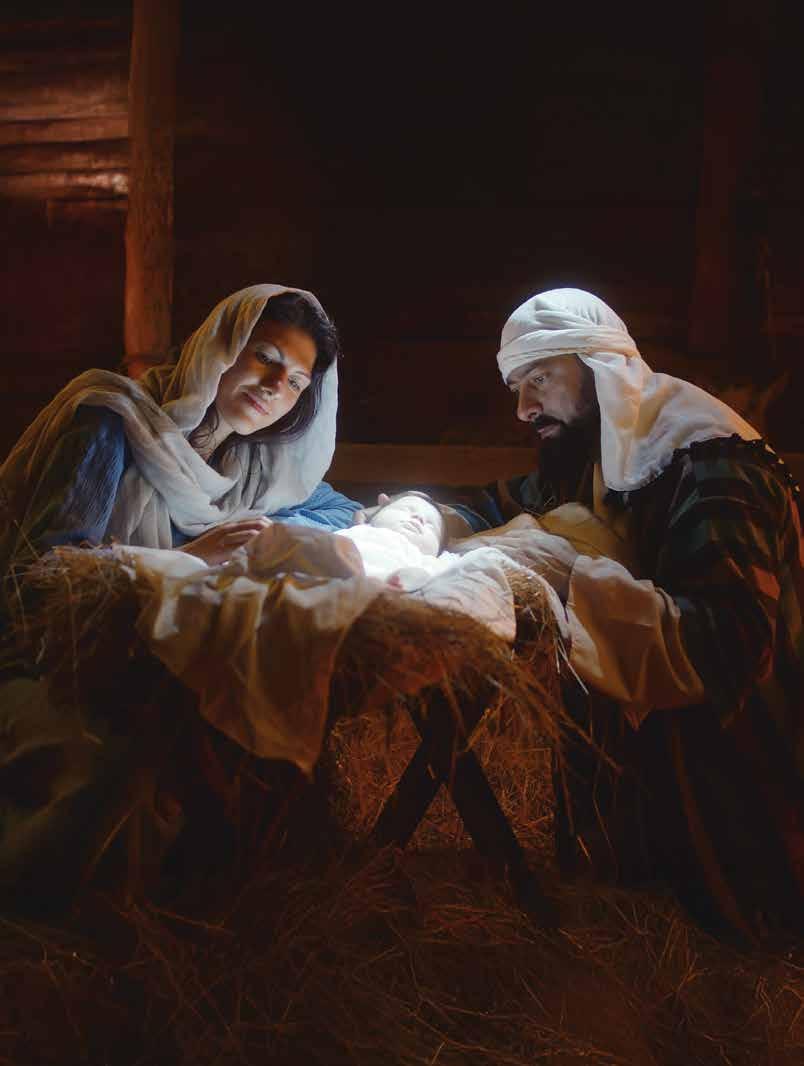
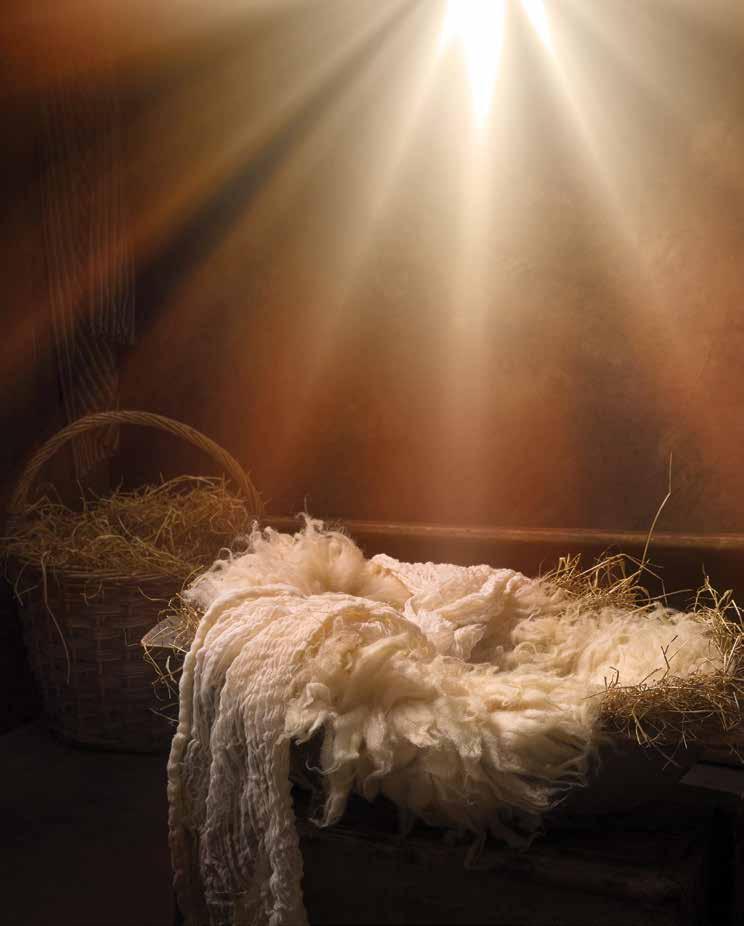
For to us a child is born, to us a son is given, and the government will be on his shoulders. And he will be called Wonderful Counselor, Mighty God, Everlasting Father, Prince of Peace. Isaiah 9:6
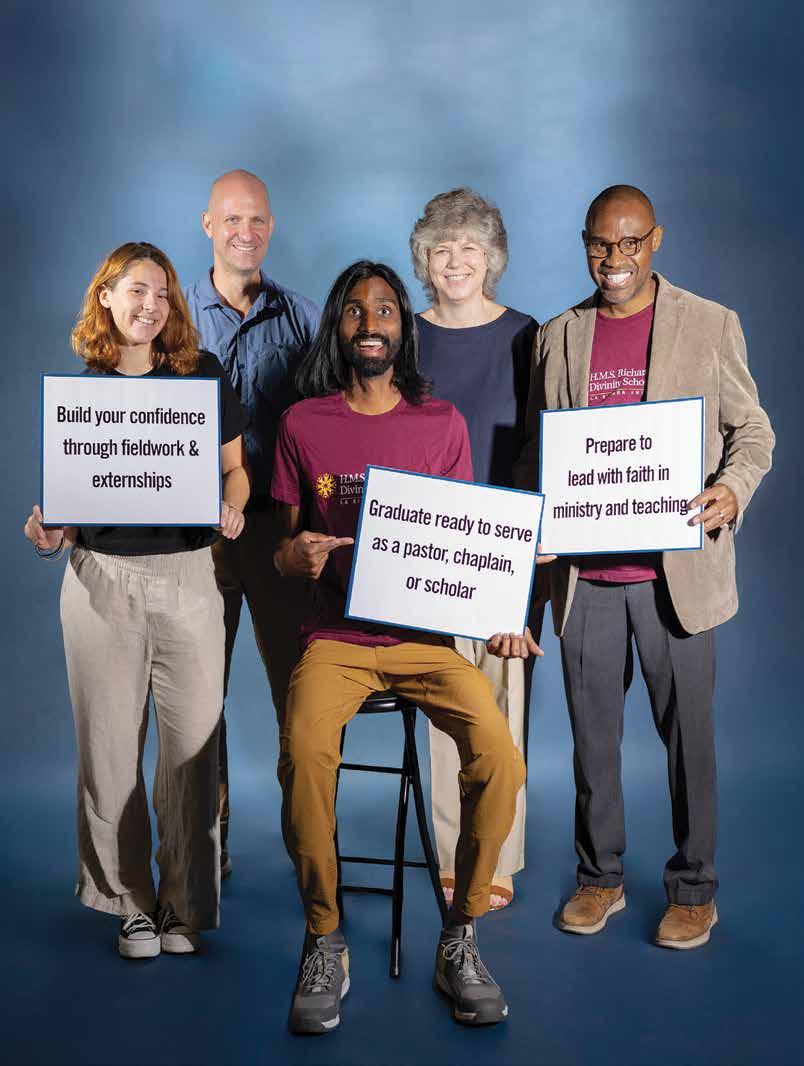
GOD GAVE YOU POTENTIAL; WE’LL HELP YOU REACH IT.
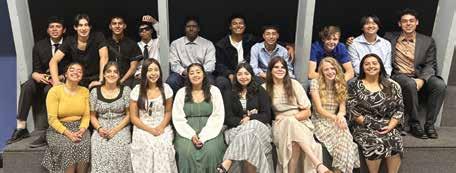
La Sierra’s Divinity School prepares students for leadership in congregational care, theological scholarship, chaplaincy, and pastoral care. Students benefit from biblical studies, pastoral studies with practical fieldwork opportunities, mentoring by experienced faculty, and placement for service locally and globally. With strong academic foundations and spiritual guidance, you’ll be equipped to serve, lead, and inspire.
Want to learn more about Theology? lasierra.edu/divinity | (951) 785-2041
SCAN FOR CAMPUS TOUR
Photographed by La Sierra alumna
At the birth of Jesus the angel announced, Peace on earth, and good will to men. And now at His first appearance to the disciples after His resurrection, the Saviour addressed them with the blessed words, “Peace be unto you.” Jesus is ever ready to speak peace to souls that are burdened with doubts and fears. He waits for us to open the door of the heart to Him, and say, Abide with us. He says, “Behold, I stand at the door, and knock: if any man hear My voice, and open the door, I will come in to him, and will sup with him, and he with Me.”
—Ellen G. White, The Desire of Ages, p. 803.
What’s inside
4 The Christ of Christmas
8 Fundamental Belief #21: Stewards of the Gift
10 Adventist Pioneers in the West: Beginnings: Asian-Pacific Work in the Southwest
14 Decorating a Christmas Tree and the Spiritual Life
17 The True Meaning Behind the Magic
20 Newsdesk
27 Reclaiming Ellen G. White
32 Arizona Conference
34 Central California Conference
36 Hawaii Conference
38 Holbrook Indian School 40 Adventist Health
41 La Sierra University
42 Loma Linda University Health 43 Pacific Union College
44 Nevada-Utah Conference
46 Northern California Conference
48 Southeastern California Conference
50 Southern California Conference
52 Community & Marketplace
56 Sunset Calendar
Recorder
Publisher Ray Tetz
Editor Alberto Valenzuela
Assistant Editor Connie Jeffery
Design/Layout
Stephanie Leal • Alberto Valenzuela
Adventist Health 916-742-0429
Kim Strobel strobeka@ah.org
Arizona
480-991-6777 ext 139 Jeff Rogers jrogers@azconference.org
Central California 559-347-3031
Justin Kim Communication@cccsda.org
Hawaii 808-595-7591
Printing Pacific Press Publishing Association www.pacificpress.com Postal Regs: The Pacific Union Recorder (ISSN 0744-6381), Volume 125, Number 12,
rate: No charge to Pacific Union Adventist church members; $16 per year in U.S.; $20 foreign (U.S. funds); single copy, $2.
Northern California 916-886-5600
Laurie Trujillo Laurie.Trujillo@nccsda.com
Pacific Union College 951-809-6777
Gene Edelbach gedelbach@puc.edu
Southeastern California 951-509-2258
Taji Saleem taji.saleem@seccsda.org
Southern California 818-546-8400
Lauren Lacson Llacson@sccsda.org
Editorial Correspondents
Send address changes to: Circulation Department, Pacific Union Recorder, Box 5005, Westlake Village, CA 91359. Info@adventistfaith.com.
Christ
The of Christmas
By Bradford C. Newton
Does Christmas bring you joy or anxiety? According to Intuit Credit Karma, almost half of Americans are stressed about the cost of the holidays. Over a third are pressured to spend more than they can afford. And, in case consumers waver, the incessant advertising bombards us, urging us to open our wallets to show that we have the “spirit of giving” in our hearts. Can we redeem Christmas from this ever-growing consumerism?
I find Christmas to be a joyful season. Viewing beautiful decora tions, listening to holiday music, enjoying delicious food, finding enj oyment in sharing gifts with friends and family. But most of all, it’s the opportunity to focus on the incarnation of Jesus during our worship services in December. I also smile as the great hymns of Christmas (“Silent Night,” “Hark! the Herald,” “Joy to the World,” etc.), proclaiming the theology of the incarnation, are piped over the sound systems of every restaurant and store.
Even in the face of the commercialism that surrounds us, I believe that we can come to Christmastime with a renewed hope and joy. I think of some of those wonderful Bible passages that speak of Jesus’ birth. Luke 2 begins with those well-known verses, “And it came to pass in those days, that there went out a decree from Caesar Augustus that all the world should be taxed” (KJV). From there, the drama of Jesus’ birth unfolds. Matthew 1 announces that Immanual—“God with us”—
During these challenging, perplexing, and discouraging times, we can come to this Christmas season with renewed confidence because we know the Christ of Christmas.
has come to earth in the person of Jesus. The first chapter of John’s Gospel announces the deeper theological meaning of Christmas: “So the Word became human and made his home among us” (John 1:14). 1 Each of these well-known passages provides a beautiful caption to the familiar Christmas-card picture of baby Jesus born in the manger.
Our daughter, Amanda, is a remarkable gift-giver. She has that unique perception to match what she knows about you with a present that you have never seen or thought of before. You open the package and immediately feel, “This is perfect!” Like a uniquely special gift, there is an often overlooked Scripture that contains the very essence of what the true meaning of Christmas entails.
Hebrews 1:1-4 reads, “Long ago God spoke many times and in many ways to our ancestors through the prophets. And now in these final days, he has spoken to us through his Son. God promised everything to the Son as an inheritance, and through the Son he created the universe. The Son radiates God’s own glory and expresses the very character of God, and he sustains everything by the mighty power of his command. When he had cleansed us from our sins, he sat down in the place of honor at the right hand of the majestic God in heaven. This shows that the Son is far greater than the angels, just as the name God gave him is greater than their names.”
The audience for the book of Hebrews were Jewish Christians growing discouraged with the pressures of faithfully serving the Lord. Some were falling away. Others had doubts growing in their minds that Jesus was indeed the Messiah in whom they first believed. They wondered if it was time to go back to their synagogues and return to faith in the earthly priesthood of Jerusalem. Persecution and hardships were falling hard upon
these Jewish Christians. It was this backdrop that was the context for these encouraging words about holding on to gospel truth: “We do this by keeping our eyes on Jesus, the champion who initiates and perfects our faith. Because of the joy awaiting him, he endured the cross, disregarding its shame. Now he is seated in the place of honor beside God's throne” (Hebrews 12:2).
During these challenging, perplexing, and discouraging times, we can come to this Christmas season with renewed confidence because we know the Christ of Christmas. Hebrews 12:2 calls Jesus the champion of our faith. The Greek word used here is also translated as “the pioneer of our faith.” I am drawn to this image of Jesus as the scouting forerunner that has traveled all the trails of our trials before us. Unlike earthly priests, He knows how we feel because “This High Priest of ours understands our weaknesses, for he faced all of the same testings we do, yet he did not sin" (Hebrews 4:15).
How can we approach Christmas to transform these weeks from being a festival of excess shopping, debt, and materialism to a time of rebirthed belief? First, we can renew our hearts by embracing the complete Christ of Christmas rather than the mere sentimentalism of a baby in the manger. He is both Creator and Savior who endures the Cross, conquers death, and takes His seat of honor next to His Father. Second, we can choose to adjust our buying habits and consciously reject the rampant consumerism surrounding us. This doesn’t mean we cancel Christmas! Instead, we examine our choices and ask, “Do my buying habits honor the Christ of Christmas?” Third, we can make a deliberate effort to reflect the behavior and values of the Christ of Christmas. Philippians 2:5-7 says, “You must have the same attitude that Christ Jesus had. Though
he was God, he did not think of equality with God as something to cling to. Instead, he gave up his divine privileges; he took the humble position of a slave and was born as a human being.” This positions us as the countercultural alternative to an increasingly compromised society.
As we come to this Christmas season, let’s embrace again the Christ of Christmas. Our spirits can be renewed. Our hearts can be warmed again with the joy of those angels who sang on the night of Jesus’ birth. We will come with humble hearts like the shepherds who knelt before the Baby King.
There is a favorite holiday song that I believe expresses our Christ of Christmas testimony. Speaking of Jesus, it says,
He is the chorus to every song that we were born to sing.
He is the rhythm of your heart, so let the beat begin.
It's so glorious.
He is glorious.
Glory, this is God with us.
He is the miracle of the love that set the people free.
He is the wonder of the world like we have never seen.
It's so glorious.
He is glorious.
Glory, this is God with us. 2
Bradford C. Newton is the president of the Pacific Union Conference.
1Unless otherwise indicated, all Scripture quotations are from the New Living Translation.
2Andy Mineo, Tedd Tjornhom, Luke Smallbone, and Joel Smallbone, “Glorious.”
Fundamental Belief #21
Stewards of the Gift
By Kathleen V. Diaz
YAs stewards, we are not called to keep these blessings to ourselves but to use them to bless others.
ou see a perfectly wrapped gift, and it immediately catches your attention—red wrapping paper with a big, beautiful bow placed symmetrically to enhance its beauty. It’s so perfect that you almost don’t want to open it. You just want to look at it, to admire it for as long as you can. We all love receiving gifts—especially when they look that good. When we begin to truly appreciate everything around us, it’s as if we are constantly receiving gifts. We watch the pink and orange hues of a sunset blending together as the day fades into night. We see the trees that provide oxygen and renew the atmosphere. Surrounded by so many gifts, we naturally want to enjoy them for a long time. When God created this world, He said:
“Let us make mankind in our image, in our likeness, so that they may rule over the fish in the sea and the birds in the sky, over the livestock and all the wild animals, and over all the creatures that move along the ground” (Genesis 1:26, NIV).
God first created the world, and then He created humanity. He presented Adam and Eve with a gift and gave them the responsibility to be stewards of His creation. Humanity has been given precious gifts: a perfectly designed body, talents and abilities, time, and material possessions. Each of these was entrusted to us to manage wisely. When we care for what God has given us, we honor Him.
As stewards, we are not called to keep these blessings to ourselves but to use them to bless others. In doing so, we honor God and reflect His love through faithful stewardship.
What we give back to God demonstrates our gratitude and the sincerity of our hearts.
“The King will reply, ‘Truly I tell you, whatever you did for one of the least of these brothers and sisters of mine, you did for me’” (Matthew 25:40, NIV).
It matters how we treat others and how we give to them. Let us give with cheerful hearts—out of love and thankfulness—for “God loves a cheerful giver” (2 Corinthians 9:7, NIV).
Jesus gave us the perfect gift: His life, so that whoever believes in Him will not perish but will have everlasting life. It was the ultimate gift, given freely, expecting nothing in return. A gift so perfect, given out of pure love, beyond comparison. He gave His life so that we could live a life filled with Him. By giving His life, He rescued us from sin and blessed us with eternal life.
After receiving such a gift, everything we give in return becomes an expression of gratitude. It’s as if we are saying, “Thank You, Lord, for all You have given me. I may not have much, but what I offer comes from a heart full of thankfulness.”
We must regularly evaluate our stewardship to ensure it aligns with the Creator’s will. True stewardship means using wisely everything entrusted to us—not only returning our resources faithfully to God but also managing wisely what remains.
We dedicate one day a week to worship, yet our stewardship extends
beyond that day. We honor God not only in our Sabbath worship but throughout the entire week. We manage all resources on how we save, give, and share. We faithfully return our tithes and offerings, but we must also be mindful of how we use the rest of what God has placed in our care. In all that we do, we are stewards of His gifts.
Every good gift comes from God. We are called to nurture and develop these gifts—not just for our own benefit, but to bless others. The work of the Lord must be proclaimed throughout the world and across generations. Through our faithful tithes and offerings, we help preach the gospel and make disciples.
This is a shared mission, a sacred calling. When we dedicate our resources and place them in God’s service, the gospel reaches new hearts. One day, when we see thousands of new believers accepting God’s love, we will feel deep joy knowing we were part of that movement—faithful stewards contributing to the fulfillment of His mission.
Kathleen V. Diaz is the Treasurer/CFO of the Southern California Conference.
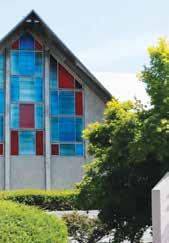
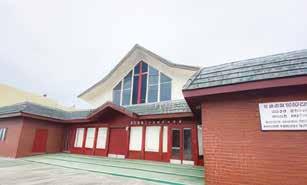
RIGHT: Chandler FilAm church in Phoenix.
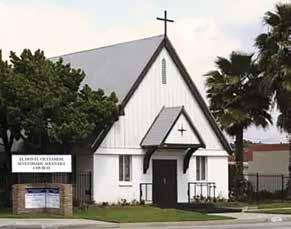
FAR RIGHT: El Monte Vietnamese church.
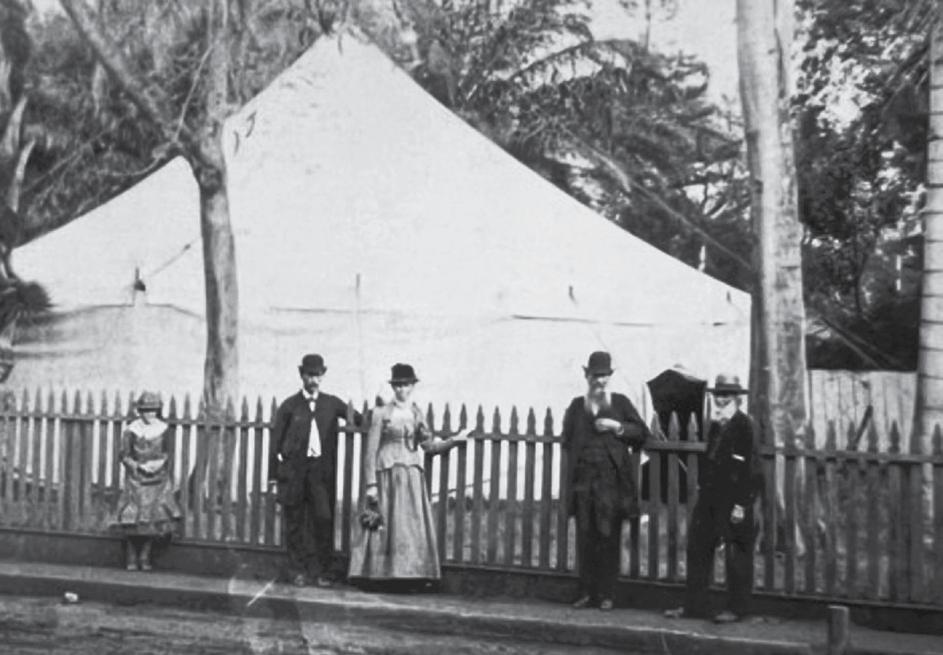
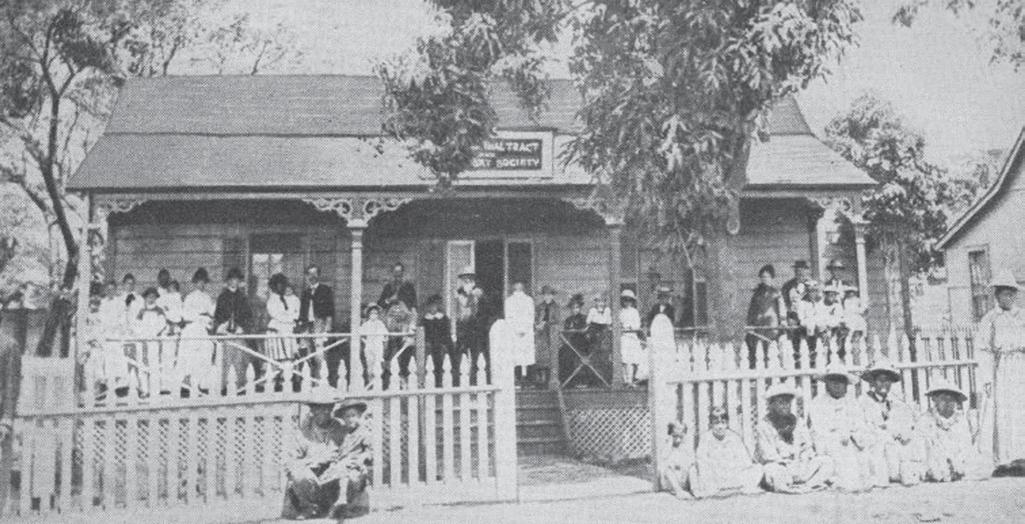
BELOW: The Tract and Missionary Society in Honolulu, Hawaii, in 1885; Pastor La Rue is pictured standing in doorway, wearing a hat.
Beginnings: Adventist
ABOVE: Photograph of the first evangelistic meeting held in Hawaii from January through March 1886. From left to right: Birdie Healey, William Healey, Clara Healey, Loran A. Scott, and Abram La Rue.
Pioneers in the West
By the Recorder editorial staff
Asian-Pacific Work in the Southwest
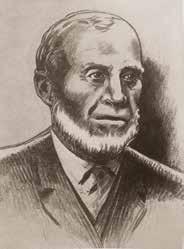
When a literature evangelist named Abram La Rue left California’s Gold Country in 1882 and sailed for Hong Kong, he probably did not imagine that his pamphlets would help shape a spiritual bridge stretching from Asia back to America’s Pacific states. Yet more than a century later, Asian Seventh-day Adventist churches thrive in California, Nevada, Utah, Arizona, and Hawai‘i—living proof of Adventism’s global reach and its ability to adapt to migration, language, and culture.
The earliest Adventist missionaries reached Honolulu in 1884. By 1888, a church had been organized, only to be disrupted when its leader was lost at sea. Undeterred, members reorganized in 1896. That small nucleus became the seedbed for ethnic ministries across the islands.
By 1940, a Japanese Adventist church had been planted in Mānoa Valley. Later decades added a Filipino church in Honolulu and even a Chinese Sabbath
School in the 1980s. Hawai‘i became a model of multiethnic ministry: one “mother” church in Honolulu serving as a nursery for Japanese, Filipino, Chinese, Samoan, and other congregations.
If Hawai‘i was the bridge, California was the generator. Immigrant streams converged here, and Adventist institutions—publishing, schools, hospitals—provided fertile ground.
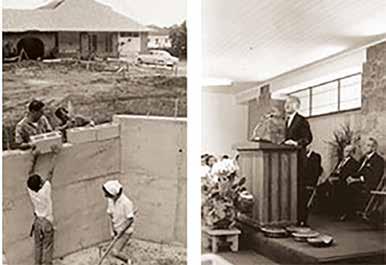
Building the Japanese Honolulu church.
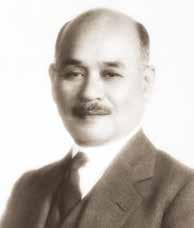
LEFT: Abram La Rue. RIGHT: Teruhiko Okohira.
Teruhiko Okohira, a student who joined Adventism in Paso Robles in 1892, returned to Japan with the gospel. That spark returned stateside in 1926 when Kinichi Nozaki organized the first Japanese Adventist church in Mountain View. West Los Angeles and San Francisco followed. World War II brought disruption as Japanese American Adventists were sent to incarceration camps. But congregations regrouped and endured, embodying what one pastor later called “prisoners of hope.”
In 1950, a Chinese church was organized in
Asian Adventist “Firsts” in the West
• 1884 – First Adventist missionaries arrive in Honolulu, Hawai‘i
• 1896 – First Adventist church in Hawai‘i reorganized after a brief 1888 effort
• 1926 – First Japanese Adventist church in the U.S. (Mountain View, California)
• 1940 – Honolulu Japanese church organized in Mānoa Valley
• 1950 – San Francisco Chinese church organized
• 1957 – Central Filipino church organized in Wilmington, Los Angeles (first Filipino Adventist church in the U.S.)
• 1960 – Los Angeles Central Korean church organized (first Korean Adventist church in U.S.)
• 1978 – Loma Linda Filipino church organized, later growing to 1,000+ members
• 1985 – Honolulu Central fosters a Chinese Sabbath School
• 1988 – Alameda Chinese church organized in the Bay Area
• 1994 – El Monte Vietnamese church organized in Southern California
San Francisco—one of the first language-specific Adventist churches in the city. By 1988, another group launched in Alameda, and today multiple congregations continue to serve Bay Area families in their heart language.
On Sept. 21, 1957, the Central Filipino church was born in Wilmington, Los Angeles—the very first Filipino Adventist congregation in the United States. From this mother church, new plants spread: Glendale Filipino, celebrating its 50th anniversary in 2025, and the thriving Loma Linda Filipino church, organized in 1978 and now numbering over a thousand members.
Los Angeles Central Korean church, organized in 1960, was the first Korean Adventist church in America. It later sprouted ministries for secondgeneration youth, blending Korean tradition with English-language worship.
California’s Filipino, Korean, Chinese, and Japanese congregations reflect the larger story of immigration to the state since 1945—and the Adventist instinct to plant language-specific ministries.
The story of Vietnamese Seventh-day Adventists
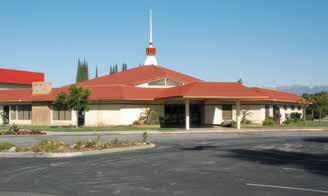
TOP: Loma Linda Filipino church. ABOVE: Honolulu Japanese church.
in California begins in the aftermath of the Vietnam War. When large numbers of Vietnamese refugees arrived in the United States in the mid- to late-1970s, many settled in California, especially in Orange County, San Jose, and the Bay Area. Among them were a handful of Adventists who brought their faith with them, seeking community and continuity in a new land.
In Arizona, Adventists first organized in Phoenix in 1890. While early work centered on Anglo and Hispanic communities, Filipino Adventists later brought new vitality. Churches like Chandler Fil-Am in the Phoenix metro area embody the Filipino presence in Arizona’s healthcare and technology workforce.
In Nevada and Utah, Asian Adventists have never been numerous, but they have been significant. Salt Lake City’s Central church (later Wasatch Hills) once served as the regional hub, and Las Vegas’ growing service economy drew Filipino Adventists who strengthened local congregations. Here, ethnic members often integrate into multiethnic churches rather than maintaining large stand-alone congregations, but their influence remains visible.
Several threads run across this history: Early Adventism in Japan, Korea, China, and the Philippines created faith lineages that re-emerged in U.S. immigrant communities. From Japanese
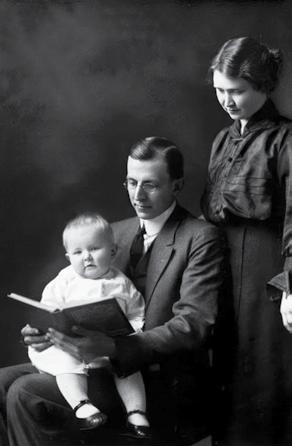
Hoffman (pictured here with his family) and Kinichi Nozaki held a series of meetings for the Pacific Union Conference in Northern California. Hoffman believed that the services at Mountain View—given by him and Nozaki in Japanese—generated “an interest manifested among the Japanese people” that he had never seen “in all his experience.”1
in Honolulu to Korean in Los Angeles, Adventists consistently planted mother-tongue congregations. Filipino Adventists clustered near Loma Linda because of its hospital; Chinese and Korean groups formed around Bay Area campuses and medical centers. Japanese American Adventists endured wartime incarceration and rebuilt after 1945.
Honolulu Central and other hubs nurtured multiple ethnic ministries under one roof, pointing toward a shared, multi-cultural Adventism.
Today, Asian Adventist congregations across the Pacific Union and the desert Southwest face the challenge of bridging generations. First-generation immigrants cherish worship in Tagalog, Korean, Chinese, or Japanese; their children lean toward English. Many churches now run parallel services or multi-ministry models under one roof.
Yet the heartbeat is unchanged: Sabbath hope, Christ’s soon return, and a gospel made real in neighborhoods from Honolulu to San Francisco, Los Angeles to Phoenix, Salt Lake City to Las Vegas. What began with a sailorcolporteur in the 1880s has become a living mosaic—an Asian Adventism firmly rooted in American soil yet forever connected to its Pacific homelands.
1“California: The Japanese Work,” Pacific Union Recorder, April 1, 1926.
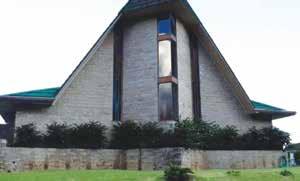
LEFT: Mountain View Japanese church. ABOVE: San Francisco Chinese church.
Decorating a Christmas Tree and the Spiritual Life
By Rico Mundi
Sharing Jesus can be taught as a duty or an expectation, but this season I wonder if perhaps it is meant to be something much deeper: an overflow of experiencing His presence in each moment. When we truly have Jesus, we share out of our outflow because His life within us becomes the source of our words, our actions, and our hope.
I and other believers have struggled with sharing Jesus—not out of lack of desire but because something is disconnected in the spiritual life. Even though we have done things like praying, studying our Bibles, attending worship, and engaging in service, we sense that our “light” isn’t shining as brightly as it could. The communication is not flowing. Something is dim. Something is missing.
Perhaps it is a burned-out bulb.
An analogy from the world of Christmas traditions speaks powerfully.
Decorating a Christmas tree with lights used to be a hassle. In the past, Christmas lights were wired on a series circuit, meaning that if one bulb went out, the whole strand went dark. The only way to fix it was to carefully test each individual bulb until the burned-out one was found and replaced. The failure of one tiny light affected everything.
In the Christian life, spiritual disciplines are often like that series of lights. Bible study, prayer, worship, fellowship, and humility all matter. But many believers have one burned-out bulb that affects the glow of the entire strand: evangelism—sharing Jesus, who is the Good News about God.
When we stop sharing Jesus, our walk with Him can dim—not because God withdraws but because sharing Him is a way we keep our experience of His love active, fresh, relational, and real.
Sharing Jesus is not exclusively a task for the especially gifted. It is a spiritual discipline that strengthens others. When we evangelize, our prayer life intensifies, our hunger for Scripture grows, our desire for holiness deepens, our theology roots itself in real-life conversations, and our joy multiplies.
Sharing Jesus isn’t just about helping others know Him—it also helps us know Him more fully.
The Pacific Union Conference’s theme for 2025 was Sharing Jesus. Growing up Adventist, I heard that I should, we should, share Jesus. The explanation I heard centered significantly on sharing the truth about His soon coming at the second advent. My attention focused forward to a time of fear followed by the time of ultimate hope and joy. I looked forward, forgetting that I live in the present moment.
The second coming is a beautiful promise, but when our focus is only on the future, we can miss the presence of Christ now. Sharing Jesus is not
just about proclaiming the future; it is about revealing God-with-us right now. And people around us are longing for a Jesus who meets them today.
A few years ago, as the Christmas season approached, I was talking with a friend from another other Christian tradition. He asked me, "Are you looking forward to the Advent season?" His question reminded me that Christians in other traditions think of “Advent” not only as Christ’s future return but as His first coming—His incarnation, His birth, His nearness.
At his question, my thoughts immediately went to the second coming of Jesus. Then I paused as I realized, " Oh, that’s not the Advent he’s asking about. " He meant the one that happened over 2,000 years ago, an advent that makes all hope possible, perhaps believing the “Advent” in our church name referred to that event.
This moment revealed something: even though our name includes “Advent,” we can sometimes forget the power of the first
Advent—the moment when God stepped into the world and said, “I am with you.”
Somehow though, the season that other believers see as pivotal had become secondary in my experience, and my first thought was of a future event, detached from the present. As I reflected on this, I returned to the name of God most meaningful throughout my spiritual journey: Immanuel, a “with us” God (literally).
Sharing Jesus is not primarily sharing information— it's sharing Presence.
It is God with us in the future and God with us in the past, but especially God who dwells in the present and with whom I can connect moment by moment. This is what transforms evangelism from obligation to overflow.
Recently I have taken up a practice of breathing, being still, and knowing He is God—here now in the present, through the Advent that made everything possible.1
When we slow down and experience Christ within, His peace becomes real. His joy becomes real. And then sharing Him is simply sharing with others about the reality we are tasting.
I've have pondered two questions that I learned from non-violent communication: 1) What is alive in you/me? (or, How are you?) and 2) What would make life more wonderful for you/me?
What beautiful, Christlike questions! They reflect love, empathy, and presence. Sharing Jesus is often as simple as listening deeply, caring sincerely, and pointing gently to the One who brings life.
When I believe Jesus words—“It is expedient for you that I go away…but if I depart, I will send him [the Holy Spirit] unto you” (John 16:7, KJV)—and, while breathing slowly, sense God in this present moment, then I find
that life is more wonderful with Jesus' peace in my inner being, and I am alive.
The 11th step of the 12 steps used by Alcoholics Anonymous states, "Sought through prayer and meditation to improve our conscious contact with God as we understand Him, praying only for knowledge of His will for us and the power to carry that out."2
This step invites me to hear His voice as He knocks at the door and, in the present moment, open the door—inviting His peace that passes understanding to enter my heart. Jesus is near in my heart and being, right here and now. I can continue practicing and experiencing His presence each day, each hour.
He will return, and He is already here.
Returning to my friend's question, I do look forward to Advent season, both what was and what will be, along with what is now. I pray that I may live and share a Jesus who is with us—whose presence makes life more wonderful today.
I share Jesus when I have Jesus.
To share Jesus is to be alight like a bulb connected to the source. When one bulb goes out, the strand dims. But when each bulb is alive, the whole tree shines. Let us keep every bulb glowing: prayer, Scripture, worship, service, and, yes, sharing Jesus. Not just for others but for the health of our own souls.
We share Jesus—not because we must but because He is with us, in us, and too wonderful to keep to ourselves.
Rico Mundi is associate director of information technology at the Pacific Union Conference.
1I'm indebted to Jim Heaney's book, Choosing Presence, for the insight into God's presence with us in each moment. Jim Heaney, Choosing Presence: How to Access God’s Peace and Release Fear, Anxiety, and Stress (San Antonio, TX: Turning Stone Press, 2020).
When we slow down and experience Christ within, His peace becomes real. His joy becomes real.
The True Meaning Behind the Magic
By Teobaldo Montagut
There is a certain magic in the word “Christmas.” The lights, the laughter, the reunion of family, the scent of pine and spices, the special foods (tamales, buñuelos, and champurrado, in my family)—these all stir our hearts with joy. But Christmas is far more than a season of warmth and gifts. It is a divine invitation to worship. It is a holy moment to reflect on the coming of Jesus Christ—not only as a historical event but as a present and eternal reality.
Too often we allow the traditions of men to drown out the voice of God. The hustle and bustle of holiday cheer can distract us from the call to pause, kneel, and worship the newborn King. I invite you to travel with me back to Bethlehem—not to admire the manger scene as a quaint nativity display, but to meet Jesus anew and offer Him what He deserves most: our hearts, our reverence, and our lives.
Mary and Joseph were not just proud parents; they were reverent stewards of the divine. Mary, cradling her son, must have felt awe as the angel's words echoed in her mind: “You shall call His name Jesus, for He will save His people from their sins” (Matthew 1:21, NKJV). Here was not just a child but the long-awaited Messiah, the Son of God.
And then came the Magi, wise men from the East, journeying across deserts with one goal: to find the King of the Jews and worship Him. When they found the Christ child, Matthew tells us, “they fell down and worshiped Him” (Matthew 2:11, ESV). They opened their treasures, but more importantly, they opened their hearts.
Even the angels—those who had worshiped Christ in His heavenly glory—joined in the celebration, proclaiming, “Glory to God in the highest, and on earth peace, good will toward men” (Luke 2:14, KJV). The book of Hebrews reminds us that God Himself commanded them, “Let all God’s angels worship him” (Hebrews 1:6, NIV).
What a scene! Earth and heaven united in adoration. If angels, shepherds, and magi worshiped Him then, how much more should we worship Him now?
Christmas is not just a historical commemoration. It is a divine reminder of the fruits of the Spirit that Christ came to plant in our lives. The world may decorate with ornaments and lights, but the Lord seeks to adorn our hearts with love, joy, and peace.
Paul writes in Galatians 5:22, “The fruit of the Spirit is love.…” Christmas was born from love— the love of a Father who gave His Son for a lost world. “For God so loved the world, that he gave his only Son” (John 3:16, ESV). And what a gift it was! The Creator entered creation through a virgin’s womb. Deity became dust. Majesty was wrapped in swaddling clothes.
This love calls for a response. 1 John 4:19 reminds us, “We love Him because He first loved us” (NKJV). If Christ’s birth was love in action, our celebration should be love in practice. Love your neighbor. Forgive the one who wronged you. Reach out to the lonely. This is Christmas in its truest form.
As Ellen G. White once said, “What love, what matchless love, that, sinners and aliens as we are, we may be brought back to God and adopted into His family! We may address Him by the endearing name, ‘Our Father,’ which is a sign of our affection for Him
and a pledge of His tender regard and relationship to us” (Testimonies for the Church, vol. 5, p. 739).
The angel announced to the shepherds, “Behold, I bring you good tidings of great joy” (Luke 2:10, NKJV). Why joy? Because the Savior had come! Joy is the echo of heaven in the soul of the believer. The same Jesus who endured the cross “for the joy that was set before Him” (Hebrews 12:2, NKJV) invites us into that same joy.
The world offers temporary happiness, but Jesus offers eternal joy. The joy of knowing you are forgiven. The joy of being loved by God. The joy of belonging to a kingdom that cannot be shaken. Let this joy fill your heart this season—not because of presents or parties, but because of His presence. “In thy presence there is fulness of joy, in thy right hand are pleasures for evermore” (Psalm 16:11, RSV).
The third fruit of Christmas is peace. Isaiah called Him the “Prince of Peace” (Isaiah 9:6), and His birth was the fulfillment of a divine promise: “Peace on earth, good will toward men.” In a world torn by division, disease, and despair, we long for peace. But true peace doesn’t come from politics or possessions. It comes from a Person—Jesus. Paul wrote, “He is our peace” (Ephesians 2:14, KJV).
The peace of Christmas is peace with God through Christ. It is peace that calms our fears and steadies our hearts in storms. Jesus said, “Peace I leave with you, My peace I give to you; not as the world gives do I give to you” (John 14:27, NKJV).
It is true that December 25 is not the actual birthday of Christ. Historical evidence suggests a spring or early autumn birth, and many of the customs we now associate with Christmas—the Yule log, mistletoe, the date itself—have pagan origins. But let us not be discouraged by this. Instead, let us redeem the season for its highest purpose: to glorify God. What matters most is not the date but the declaration: “for to us a child is born, to us a son is given” (Isaiah 9:6, NIV).
The early church, though compromised in some areas, saw in the winter solstice a symbolic light:
Christ, the Light of the world, entering our darkest hour. And so, we too can enter into this season, not to imitate paganism but to proclaim the gospel.
As Ellen White wisely counseled: “As the twentyfifth of December is observed to commemorate the birth of Christ…it can be made to serve a very good purpose” (The Adventist Home, p. 478.) So decorate, yes—but let your heart be the tree that bears spiritual fruit. Exchange gifts, yes—but don’t forget to offer the gift of yourself to Jesus. Sing carols, yes—but let your life be a song of praise.
So what does it mean for us to worship Christ this Christmas?
It means more than attending a special service or singing “Silent Night” or “Esta noche es Nochebuena.” It means turning our attention from the glitter to the glory. It means setting aside time in prayer, in Scripture, in family worship. It means living a life that honors Jesus, not just on December 25 but every day of the year.
From the depths of grateful hearts, let us also worship.
Christ is not in the manger anymore. He is exalted at the right hand of God (Philippians 2:9), and yet He remembers the trials of humanity. He knows the worker’s burden and the mother’s fatigue. He is our High Priest, our Intercessor, our Redeemer.
Hebrews 7:25 assures us: “He is able for all time to save those who draw near to God through him, since he always lives to make intercession for them” (RSV). So let us draw near this Christmas. Not just to Bethlehem, but to Calvary. Not just to Calvary, but to the empty tomb. Not just to the empty tomb, but to the throne of grace. There, we find mercy, and there we offer worship. Christmas is a moment of holy visitation. The God of eternity stepped into time. The Word became flesh and dwelt among us (John 1:14). The Creator became our Redeemer.
Let us not reduce Christmas to mere sentimentality, the exchange of presents, and traditional treats and meals—though I look forward to that special meal every year! Let us elevate it to sacred celebration. Like Mary and Joseph, the shepherds, the Magi, and the angels, let us worship. Let us bear the fruits of the Spirit: love, joy, and peace. And let us live in joyful anticipation of His return, for the same Jesus who came in humility will come again in glory.
This Christmas may your heart be His Bethlehem. May your worship rise like incense. And may your life shine with His glory.
Teobaldo Montgut is a freelance writer from Southern California.
More Than a Skill Set: Adventist Communicators Gather in Pacific Union for Annual Conference
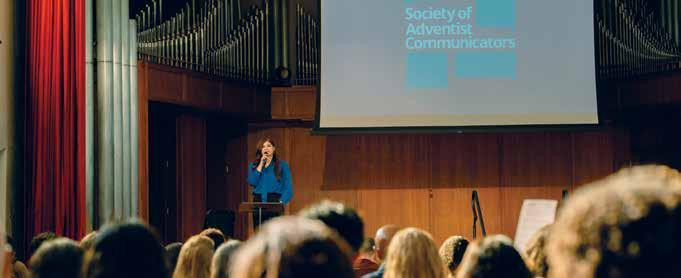
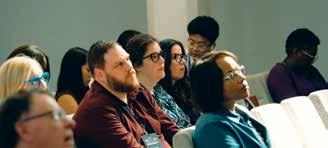
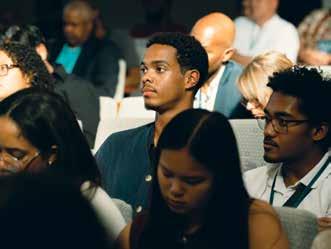
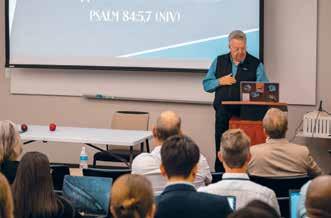
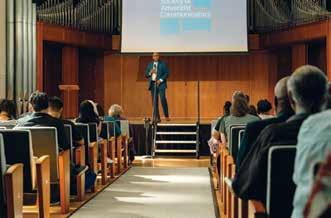
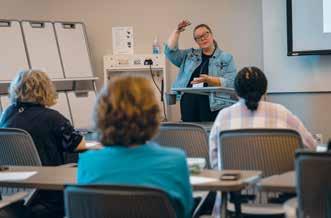
The 2025 Society of Adventist Communicators (SAC) conference was held Oct. 16-18 in the Zapara School of Business on the campus of La Sierra University. The conference included several session speakers and workshop presenters from across the Pacific Union Conference.
“Partnering with the Pacific Union for SAC 2025 has truly been a wonderful experience,” said JeNean Lendor, SAC board president and communication director for the Lake Region Conference. “Ray Tetz’s passion for all things communication shines through in every detail. It wasn’t just a labor of love; it was pure love in action. The Pacific Union team approached the partnership thoughtfully, and we’re genuinely grateful for their hospitality, creativity, and commitment to excellence.”
Opening the conference during the main session on Thursday afternoon was Merlinda Balmas, head of Warner Bros. Entertainment (WB) Theatrical Marketing. Balmas is also part of the Board for Hollywood Prayer Network, a non-profit organization with over 10,000 members that seeks to build a bridge between the church and Hollywood through prayer.
“Prayer is powerful not because of our prayers, but who we pray to,” she commented. She went on to share five steps to communicating Christ’s love in the work we do: Pray more, shame less, engage more, work well, and love always.
“As communicators it’s our job to tell people about Jesus so they can choose,” she said. “As a communicator, how are you using your influence?”
Vespers and Sabbath morning programming were centered on a theme with multiple facets: the Sabbath. This included the screening of several short films by renowned filmmaker Martin Doblemeier on the concept and purpose of Sabbath. On Friday evening, attendees heard an engaging presentation by Kendra Haloviak Valentine, professor of New Testament studies at La Sierra University, and on
Sabbath they enjoyed a sermon by Sigve K. Tonstad, research professor of biblical interpretation at Loma Linda University.
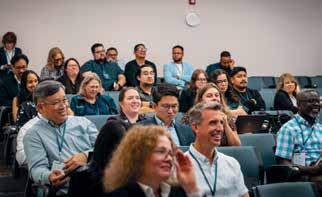
Over the last few years, SAC has increased its offerings to include specific sessions for communication students. This year, of the 250 attendees, 60 were current college students from across the North American division; 15 were communication educators.
“I bring students to SAC so they can see what it looks like when faith and professionalism meet in real-world spaces,” shared Tara Hargrove, chair of the department of communication and world languages at Pacific Union College. “It’s inspiring for students to meet Adventist communicators who are doing meaningful work across so many fields—and to realize there’s a place for their gifts, too.”
Students attending SAC participate in media tours on Thursday morning before the conference officially begins, attend a student-specific orientation session, and enjoy various other communication-specific sessions just for them.
“One thing I really found helpful was when Ms. Balmas from Warner Bros. talked about how to hold onto Jesus while still being in the film industry,” commented Sydney Wilson, student at Oakwood University. “That’s something I really value because I want to go into the film industry.”
On Friday afternoon, a special session for students showcased four professionals in communications sharing their experiences. This included two Pacific Union communicators: Taji Saleem, communication director for Southeastern California Conference, and Candace Olusola, director of ministry and communication for Gather Los Angeles.
Of note, Saleem is one of the youngest communication directors in the Adventist church. It was unexpected, he shared, that at this point in his life he would be sharing his expertise with other young people.
“The biggest thing I wanted the students to know is that it’s OK to be in a space of the unknown,” Saleem shared afterward. “It’s OK to not have a plan. It’s OK to be anxious sometimes, not knowing what’s coming
Presenters at SAC 2025 from within the Pacific Union
Jon Daggett – Hiroshima Daggett law firm, Redlands
Felipe Gutierrez – Kufe Studios, Riverside
Patricia Maxwell – professor, San Diego
Bradford C. Newton – president, Pacific Union Conference
Taji Saleem – communication director, Southeastern California Conference
Becky St. Clair
freelance writer/editor, Napa Valley
Ray Tetz – director of communication and community engagement, Pacific Union Conference
Sigve K. Tonstad – research professor of biblical interpretation, Loma Linda University
Kendra Haloviak Valentine – professor of New Testament studies, La Sierra University
Seth Yelorda –
Vision Clarity Consulting, Riverside
More Than Leading: Ray Tetz Receives Lifetime Achievement Award
next. Sometimes God operates best in that space where we don’t know, because He’s able to do His best work when we admit we don’t know where we’re supposed to be but we’re willing to let Him take us there.”
One of the top takeaways for both professionals and students who attend SAC is the networking opportunities. Students can leave the conference with internships or even jobs lined up; professionals make connections beneficial to their work and potential future partnerships.
“Bringing together our professional communicators from across the denomination has tremendous value,” said Bradford C. Newton, president of the Pacific Union. “It’s an opportunity to network, learn together, create together, develop competencies, and look at what the cutting-edge issues are for communication right now for the church.”
The benefit of SAC digs deep into the heart of why Adventist communicators do what they do—in whatever sector they serve.
“I hope both our students and the professionals in attendance experience communication not just as a skill set, but as a calling,” Hargrove commented. “This conference is a great reminder that we belong to a community of Adventist communicators who are shaping culture with integrity and creativity.”
The next SAC conference is in Orlando, Florida, Oct. 15-17, 2026. Learn more about SAC and its annual event at adventistcommunicator.org.
By Becky St. Clair
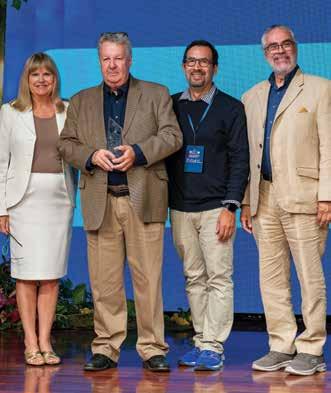
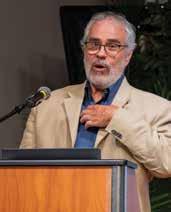
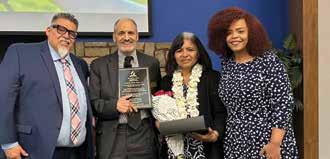
During the awards ceremony of the Society of Adventist Communicators conference on Oct. 18, Ray Tetz, director of communication and community engagement for the Pacific Union Conference, was presented with the Lifetime Achievement Award.
Though it took some doing—since Tetz’s department was heavily involved in programming
for the weekend, as host territory—the SAC team managed to keep the award a secret from him. He didn’t know it at the time, but Alyssa Truman, director of communications for the General Conference (GC), had been tasked with making sure he was in the room when the time came.
“I had no clue whatsoever,” Tetz said with a chuckle. “I was completely surprised.” When Julio Muñoz, associate communication director for the North American Division (NAD) and long-time friend of Tetz, took to the stage following the evening’s presentation, Tetz assumed he was wrapping up the event. “Then I realized he was talking about some experiences we had shared going back more than 30 years.”
It was when Julio referenced “Global Village 1992” that Tetz realized what was really going on. “I think I said out loud, ‘Oh my…’ because Alyssa gave me a little ‘gotcha’ giggle. It was an almost overwhelming moment, both amazing and humbling.”
Tetz has a long history in Adventist communication, having served as VP for strategic communication and corporate development at Adventist Development and Relief Agency (ADRA) for 10 years. He then spent 20 years running a consulting and media production company serving dozens of Adventist organizations and ministries in the NAD and GC.
Since 2015, Tetz has served as director of communication and community engagement for the Pacific Union Conference. Tetz began his service to the church in the Southern California Conference as pastor, Bible teacher, and youth director.
In his presentation, Muñoz said, “Ray is a brilliant creative, a crisis communication expert, a strategist, and a mentor who cares deeply about helping the next generation of professional communicators. To me, Ray is a friend. And if he had not taken a chance on me, I would not be standing here today.”
When it was her turn at the mic, Connie Vandeman Jeffery, associate director of communication and community engagement for
the Pacific Union Conference, added, “He’s the most creative, big-idea person I’ve ever known. He inspires people with his vision and his ability to break down the most complex ideas and projects into manageable pieces. Ray is a mentor, a cheerleader, a leader, a boss who leads by example, and I know no one more deserving of this Lifetime Achievement Award.”
By far, Tetz says his most frequent and influential collaborator has been Alberto Valenzuela, associate communication director and editor of the Recorder for the Pacific Union Conference. “We’ve worked together in different capacities and situations since 1984, and we’ve pushed and mentored each other, sharing so many incredible opportunities—many on the global stage.”
Valenzuela commended Tetz’s ability to solve problems creatively, accept others’ points of view, and work to support the growth of those around him. “For Ray, ministry is more than leading; it’s casting a vision for others to figure out their talents and put them to use for the benefit of others,” Valenzuela said.
He also commented on the way Tetz dreams up initiatives that seem too big to others. “They may look too extravagant or too impossible, but Ray proves that false every time,” Valenzuela said. “And nothing he does is to excel or gain prominence for himself; rather, it is to strive for the growth of others,” he added. “Whether leading by example or providing wings for them to fly on their own, he wants to see them succeed.”
Tetz lists among his most important mentors
Bill Johnsson (voice and writing), Kermit Netteburg (strategy and tactics), Gus Cheatham (managing up), Ted Wick (introspection and reflection), Dan Day (systems thinking), and Bob Nixon (guardrails). But one of the most influential individuals in his life, Tetz said, was his sophomore English teacher, Edith Davis.
“Her assessment, ‘You may actually have talent, but you are possibly the most undisciplined writer I’ve ever taught,’ was just the beginning of her campaign to help me discover my life work,” Tetz shared. “I was 15; how did she know? She had such an impact on my life.”
Tetz feels blessed to have been able to endeavor in just about every sector of church communication over the years, and he said it has “always been a collaborative process and experience.” He added that receiving this award “sharpens my sense of the importance of partnerships and creative teams that bring things to life.”
He appreciated being able to accept the award with his closest longtime colleagues and friends on the stage with him. Also present were his wife, RosAnne, and their adult daughter, Catherine.
“It is always wonderful when the work you do is acknowledged and appreciated, and when it is your lifework recognized by your peers, it is particularly meaningful,” he said. “This award means a great deal to me, and after a career in communication approaching five decades, I’m still excited about the work we get to do each day. It’s an honor I will always cherish.”
By Becky St. Clair
Arizona and Hawaii Conferences Work Together for Unforgettable Youth Rush Summer
The Arizona Conference and the Hawaii Conference cooperated to make a special Youth Rush summer happen for 20 young people. The plan maximized each conference’s strengths, personnel, and
sponsorship. The program was the first of its kind for Arizona and Hawaii.
“Definitely not a normal summer,” remarked David Niebles, a student from the Phoenix area. “It hasn’t been done before—it was very different.
People need to be reached everywhere.”
“Collaborating with another conference meant we could share team members and resources, which made it possible to reach more people in more places,” said Arizona Youth Rush Coordinator Dina Coelho. Arizona Conference Treasurer Reggie Leach agreed: “This kind of partnership strengthens the work across territories and gives our young people unforgettable experiences that will impact their faith and ministry for years to come.”
During the first half of the summer, students were based at the Glendale church in the greater Phoenix area. Midway through the summer the group transitioned to the Hilo church on the Big Island of Hawaii. Another group of students that was positioned on the island of Oahu rounded out the Hawaii Youth Rush summer.
“Eventually I’d like to be able to cover all the islands in one summer,” said Mario Bravo, Hawaii Conference Youth Rush Coordinator. “This special arrangement with Arizona helped us take a step toward reaching that goal and engaged more of our young people.”
The students had a scare when a major earthquake struck off the north coast of Russia, triggering tsunami sirens all along the Hawaii
“This kind of partnership strengthens the work across territories and gives our young people unforgettable experiences that will impact their faith and ministry for years to come.”
Reggie Leach
coastline. The team fled to high ground, but fortunately the tsunami did not arrive.
For the entire summer combined, students left nearly 8,000 books in people’s homes (not counting other pieces of literature), prayed with residents, and found many people interested in Bible studies.
“The program demonstrated that interconference cooperation can benefit both entities,” said Hawaii Conference President Erik VanDenburgh. “We were glad to have Arizona Youth Rush students working in our territory.”
“Some of our students had never left Arizona before,” said Coelho. “Not only did they get to experience a new place, but they also got to take the gospel with them.”
Youth Rush is a summer outreach program for students in late high school and college. Students meet community members, find Bible study interests, pray with people, and leave
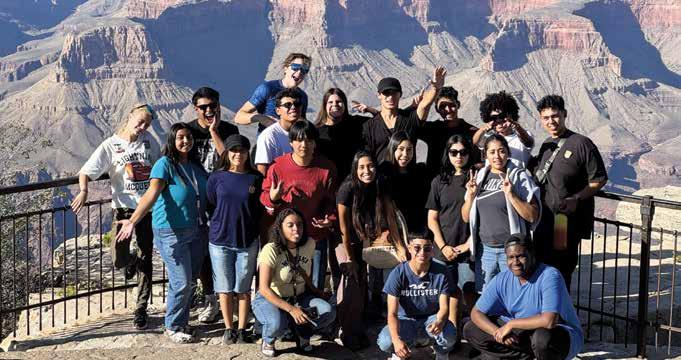
Arizona and Hawaii Youth Rush students visit the Grand Canyon. The students served the first half of their summer in Arizona and the second half in Hawaii.
books for donations. Funds earned help students attend school. All Adventist universities and many academies offer a matching scholarship of some kind; for example, La Sierra University and Pacific Union College match Youth Rush earnings dollar for dollar up to a ceiling of $5,000, making a total possible of $10,000. Contact your local conference for more information.
By William Krick
Dexter Thomas Brings Personal Passion and Vision to Christian Record Services Presidency
When Pastor Dexter Thomas steps into his new role as president of Christian Record Services (CRS) in Lincoln, Nebraska, he brings with him not only a distinguished résumé but also the unique perspective of someone who is blind—a life story deeply intertwined with the community he now leads.
Thomas’s journey to CRS is marked by a hands-on approach to ministry and a heart for those often overlooked. As senior pastor at Fairfield Community church in California, he guided a diverse congregation, launching new ministries and fostering growth. But it’s his work beyond the pulpit that has left a lasting mark—most notably, founding PhoneFaith, a national outreach connecting people who are blind or have low vision. That ministry, now part of CRS, reflects Thomas’ belief that everyone deserves to feel seen, heard, and valued.
His experience also includes serving as
disability coordinator for the Florida Conference, teaching at Starr King School of Ministry, and leading evangelism campaigns around the globe. Since 2017, Thomas has been a familiar voice on the CRS Board of Directors, contributing regularly to the organization’s publications.
“It’s with profound gratitude that I accept this call from God through the North American Division and the Board of Christian Record Services to serve as president,” Thomas said. “My hope is to partner with churches and organizations so that every person who is blind or has low vision knows their inherent worth in Christ.”
With Thomas at the helm, CRS looks forward to expanding its reach and deepening its mission to serve with compassion and excellence.
For more information, visit https://www. christianrecord.org/.
LEFT: Arizona Youth Rush Coordinator Dina Coelho and Hawaii Literature Ministries Director Mario Bravo present a combined report at this year’s end-of-summer iShare convention in Loma Linda. RIGHT: This summer’s Youth Rush participants.
Reclaiming Ellen G. White
By Alberto Valenzuela
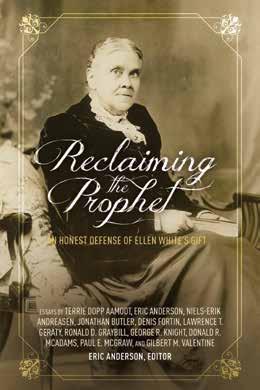
There is a certain tenderness in the way the aged speak about belief. It trembles at the edge of irony, like a candle in a church basement that has survived too many sermons and too few listeners. When I began reading Reclaiming the Prophet, edited by Eric Anderson1, I imagined a room of gray-haired scholars gathered in the quiet hills of Angwin, sipping decaf and nostalgia in equal measure. The year was 2023; the world outside their conference room glowed with the fever of new certainties and new disillusionments. Inside, a circle of voices leaned toward the past. They were trying, gently, to reclaim a prophet.
They could have called the book “Reclaiming Ourselves,” and it would have meant the same thing. I have to admit I was tempted to title this review Recycling the Prophet, which is what I thought of while listening to their presentation at the Loma Linda University church on a recent Saturday afternoon.
From the first pages, Anderson’s introduction feels like a confession disguised as history. He describes the private conference at Pacific Union College that gave birth to these essays—a gathering not of zealots but of veterans, men and women who have spent half a century both loving and arguing with Ellen G. White. No one recorded the sessions; perhaps they feared how
they might sound to younger ears. Theirs is the generation that once defended the prophet against “plagiarism” and “perfectionism,” only to find that the real battle was within their own personal faith, the desire to believe without pretending.
That longing hums beneath every paragraph of this book. Reclaiming the Prophet is not a manifesto. It is a slow exhale, a sigh from those who once marched in certainty and now linger among the questions.
In his introduction, Anderson recalls how modern Adventism has exhausted itself arguing about what Ellen White was not: not infallible, not unique, not final, not untouched by her time. The scholars meeting at Angwin agreed with all that; they have paid their dues in the currency of criticism. But, as Anderson says, “misuse does not nullify proper use.” It is a sentence that sounds almost like a man speaking to his stubborn grandchildren. Misuse does not erase meaning; exaggeration does not cancel inspiration.
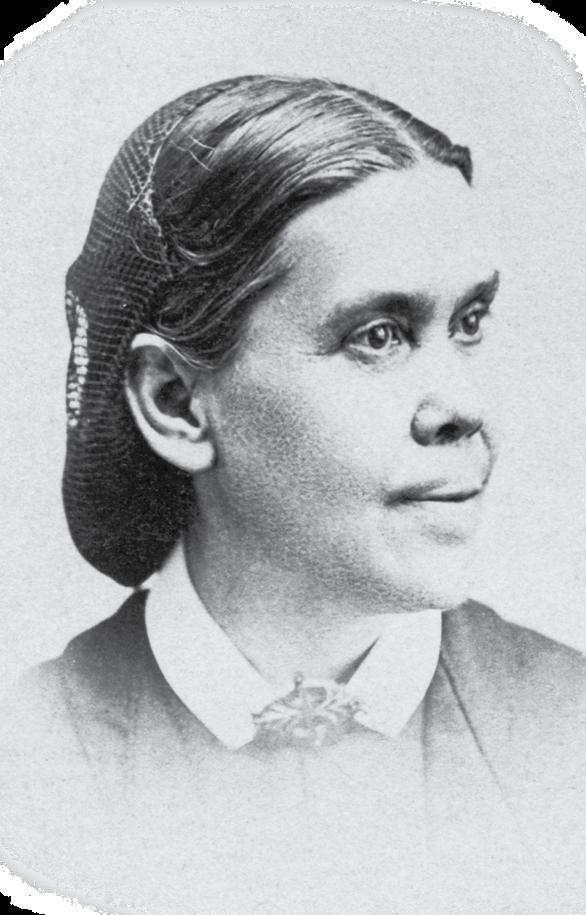
reminder both obvious and profound: “Ellen White Was a Woman.” It is the simplest sentence in the book and also the most radical. Aamodt sketches the prophet not as marble statue but as daughter, twin, wife, and mother—all the frailties that the old biographies omitted. Her prose carries a historian’s care but also a novelist’s tenderness; she sees Ellen as one who learned to use her weakness as a kind of authority.
What strikes me most is not the chronology but the sympathy. Aamodt allows the domestic to become theological. The prophet’s exhaustion, her endless multitasking, her grief for lost children: these become not footnotes but the very grammar of inspiration. For Aamodt, the prophetic voice arises not from detachment but from the ordinary labor of love.
From that conviction the book unfolds, not to defend Ellen White’s perfection but to defend her humanity and, by extension, their own.
The writers gathered in this book of essays— Aamodt, Anderson, Butler, Fortin, Geraty, McGraw, Knight, McAdams, Graybill, Valentine, and Andreasen—are not the militants of apologetics. They are teachers who still have chalk dust clinging to their cuffs, pastors whose sermons have learned humility. They are the ones who stayed after class when everyone else had gone home.
Part One is called “Who Was Ellen White?” In Chapter One, Terrie Dopp Aamodt answers with a
Reading her, I wondered whether these Adventist historians, after decades of doctrinal combat, have begun to suspect that holiness is domestic too, that the divine hides in the chores, the migraines, the laundry of belief.
Chapter Two is written by Jonathan Butler—my professor at Loma Linda University in the 80s who introduced me to Numbers’ Prophetess of Health and whose essays I have always enjoyed—who refuses to approach Ellen White directly. Instead, he begins with his grandmother, a woman both violent and generous, a home both sanctuary and storm. She sounds sort of like my own mother—may they both rest in peace. It is an extraordinary move: to locate theology within family memory. His “Good Granny” and “Bad Granny” mirror the church’s split personality toward its prophet. Butler’s essay,
half memoir and half sermon, becomes an act of reconciliation between affection and exasperation, between faith and analysis.
He seems to say that we cannot love the prophet unless we first forgive our parents, our teachers, ourselves.
Butler writes with that wry intimacy that older scholars acquire when they no longer need to prove they are right. His humor is defensive, his nostalgia exacting. Through Granny’s contradictions, he hints that true prophecy may come wrapped in humanity’s wrinkles—and that the divine, if it speaks at all, must speak in broken voices.
Gilbert Valentine, the biographer of Ellen White’s GC presidents, follows with “Messenger with a New England Style.” His essay could have been purely academic, but it reads instead like a long apology for misunderstanding the past. Valentine insists that the 19th century is a “foreign country.” He teaches us to translate not only words but temperaments. The “plain speaking” of New England revivalism, he argues, cannot be judged by the therapeutic tone of 21st-century spirituality.
In other words: stop demanding that Isaiah write in English.
Valentine’s insight seems simple, yet it cuts deep. Modern Adventists, restless for comfort, often want prophets who sound like counselors. Ellen White, however, spoke with the fire of a reformer. Seen from afar, her harshness might be courage, her certainty, humility. Reading Valentine, I thought of all our efforts to sandpaper our prophets into politeness. He reminds us that holiness once shouted. I have come to appreciate his writing since Oak & Acorn reprinted his book The Struggle for the Prophetic Heritage, and then we had the privilege to
work on his book Ostriches and Canaries
Part Two is called “How to Read Ellen White.” Paul McGraw, in “The Prophet as Preacher,” and Denis Fortin, in “Ellen White as Devotional Writer,” turn our attention from controversy to cadence. They show how Ellen White’s power lies not in systematic theology but in her ability to move hearts—to turn doctrine into devotion. Fortin’s portrait of a writer who translated holiness into daily compassion is particularly graceful. He calls her not an intellectual analyst but a guide for “how to live in the time of the end.”
Eric Anderson’s own essay, “God Wants Us All to Have Common Sense,” is both playful and profound. After years as a historian and college president, he seems weary of grand theories. His “common sense” is a moral plea: interpret Ellen White neither as oracle nor as relic but as companion. It is an Adventist version of what literary critics might call close reading—attentive, honest, unafraid of context.
In their pages, I sensed something like repentance: the scholars who once dissected the prophet now wish to listen again, simply, without the noise of defense.
By the time we reach Part Three, “How to Believe in Ellen White,” the tone grows both personal and institutional. George R. Knight, always the candid pedagogue, admits that his teachers never taught him to think of Ellen White as fallible. Yet he learned it anyway. Donald R. McAdams, long criticized for exposing her literary borrowings, now returns not as accuser but as witness. Together, they sound like two men visiting an old friend after years of estrangement.
They do not deny the wounds; they simply choose to remember the laughter.
Reclaiming the Prophet is not a manifesto. It is a slow exhale, a sigh from those who once marched in certainty and now linger among the questions.
Their essays remind me of looking into a mirror from too close: every pore visible, every imperfection magnified. “From a distance, I look better,” I once wrote,2 and I feel these authors might say the same of Ellen White. Up close, her contradictions glare, her borrowed words, her stern admonitions, her silences on race and empire. However, as you step back from the mirror, the image relaxes; you recognize yourself again. When we step back, time softens the outlines, and the individual begins to shine again. That is what these authors are doing for Ellen White—and, I suspect, for their own faith.
The title Reclaiming the Prophet could mean rescuing her from her admirers as much as from her critics. But it could also mean reclaiming the childlike vision that once made prophecy seem possible at all.
Ronald Graybill and Lawrence Geraty, both veterans of Adventist scholarship, close the book’s
main essays with a dialogue on “Ellen White for Today.” Their concern is not academic; it is linguistic. They know that words such as “inspiration,” “revelation,” and “authority,” have frayed from overuse. They ask whether we can still speak of prophecy without shouting or apologizing.
Their answer is modest: perhaps we must simply learn to speak more clearly, to distinguish testimony from command, metaphor from law.
In their careful sentences I sensed fatigue—the good kind, the fatigue of craftsmen who have labored long in a single workshop. They have seen generations of students oscillate between idolizing and abandoning Ellen White. They have watched the denomination itself age, like the scholars gathered at Angwin, yearning for coherence. And still, they write.
Niels-Erik Andreasen’s afterword feels like an epilogue to their lives. The Dane who once presided over the denomination’s flagship university now writes as a pilgrim looking back at the road. He calls for an Adventism freed from 19th-century distractions yet rooted in its prophetic imagination. His words are gentle, almost pastoral. He knows that reclaiming Ellen White is also reclaiming the courage to change.
He writes not with nostalgia but with distance. Andreasen’s distance is spiritual maturity: the understanding that faith, like art, requires perspective.
What unites these essays is not argument but honesty. The book’s subtitle—An Honest Defense of Ellen White’s Gift—is crucial. Honesty here is not weapon but wound. Each writer, in their way, acknowledges the cost of belief: careers risked, friendships strained, reputations scarred by controversy. Yet none of them seem bitter. They have come to a peace that younger apologists rarely find—the peace of complexity.
Reading them, I felt as though I were watching a circle of old friends sitting around a long table, their laughter mingling with the clinking of cups.
They know they are not building new cathedrals; they are tending ruins and gardens. They speak softly because they have learned how loud certainty can be.
I think this is what makes Reclaiming the Prophet so moving: its serenity. It does not try to convert. It simply testifies that grace is still possible in scholarship.
Of course, every reader sees themselves in the mirror they hold up. As I moved through these pages, I kept feeling the quiet hum of recognition. The distance they kept from their subject was the same distance I keep. They study Ellen White not to glorify her but to understand how belief survives disillusionment.
I too have stood behind a lectern, pretending certainty, seeking eyes in the audience that might believe in me more than I do in myself. I too have discovered that from far away I appear coherent; that faith—like faces, like personality—looks better in soft focus.
Perhaps these scholars are doing for Adventism what every aging believer must do for their soul: clean the mirror, accept the wrinkles, light the candle again.
Stylistically, Reclaiming the Prophet is unhurried. It avoids the sensationalism that has plagued both critics and defenders of Ellen White. There are no shouting matches here, only stories, memories, reflections. Each essay could stand alone, but together they form a collective autobiography of a generation—the class of historians who refused to leave the church even when the church did not know what to do with them.
Their prose is occasionally uneven, sometimes too careful, but that is part of its charm. You can feel the tremor in their hands, the long sentences reaching for clarity that might never come.
What saves the book from melancholy is its humor. Anderson’s anecdotes, Butler’s stories of Granny, Valentine’s dry wit—they remind us that faith can laugh at itself. And when Anderson ends
with a hymn from the early Adventist songbook, it feels less like sentimentality than benediction.
So what, finally, do they reclaim? Not the authority of Ellen White’s visions, nor the literalism of her followers. What they reclaim is permission. Permission to read her with affection and intelligence, to find in her flawed humanity a mirror of divine patience. They reclaim the possibility that criticism and devotion can coexist. They reclaim Adventism as a conversation rather than a courtroom. They reclaim the prophet as a companion in the pilgrimage of uncertainty.
When I finished the book, I felt the same quiet melancholy that follows a family reunion. Everyone has aged; everyone knows it. Yet there is beauty in that recognition. The scholars of Reclaiming the Prophet have grown old with their subject. They have lived through the fever of discovery, the chill of disillusionment, and have come out with something softer, almost luminous: not certainty, but love.
In that sense, they have succeeded.
Perhaps Ellen White herself once sang the lyrics with which Anderson closed his Introduction: “The darkness shall turn to dawning, and the dawning to noonday bright.”3 The authors of this volume do not promise noonday; they settle for dawn. But dawn, after all, is when the prophet looks best—the light still gentle, the outlines merciful.
And perhaps that is how faith survives: by learning, at last, to see from a distance.
Alberto Valenzuela is the associate director of communication and community engagement for the Pacific Union Conference and editor of the Recorder
1Eric Anderson, ed., Reclaiming the Prophet: An Honest Defense of Ellen White’s Gift (Nampa, ID: Pacific Press Pub. Assn., 2025).
2Facebook post, https://www.facebook.com/alberto.valenzuela.129/posts/ pfbid025hA92jJ8ijsmSX2vZuAGLhmNDw7PQE5johH3TbxrHxTLJZMxCnhpQSy3AHNYbtisl; https://www.facebook.com/alberto.valenzuela.129/posts/ pfbid0zRG5o4HQMpA8vMJQQRPD7SmJ2Y4CiD9YuzQJ8JT5hRZKpts5wc4cYCk9rGGLdpepl.
3“We’ve a Story to Tell to the Nations,” Hymnary.org, https://sdawest.pub/nations.
From Roping to Redemption: How
DAR and GodPods Are
Sharing Jesus Across the Navajo Nation
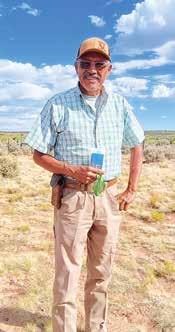
John Boyd Jr. was born in Gallup, New Mexico. His early years were filled with baseball, Catholic church services, and the thrill of roping, which he began at age four. But faith never took root, and for years he was known as “a drunk rodeo cowboy.”
His wife, Clarina, grew up with a limited understanding of Jesus— celebrating only “baby Jesus” at Christmas and Easter eggs. She later described her conversion as moving from a life in black and white to one in full color, when she discovered that Christ had lived, died, and risen again for her.
The couple met at a bar—the salad bar in the Navajo Community College cafeteria. Their journey together was far from easy. Clarina quietly ministered to John, even praying while preparing food for him and his friends when they went out drinking. She was trusting God’s timing and hoping that she wasn’t crazy for following His impression on how to reach her husband. Meanwhile, John’s life
spiraled until one day, after teaching his grandson to rope, he realized that alcohol might rob him of seeing his grandson grow up. That day, he quit drinking cold turkey.
With his newfound clarity, John began to pray: “OK, Lord, what are you going to do with me now?” He opened the Bible and couldn’t stop reading. At first, he stayed in the New Testament, but eventually he discovered how the Old Testament testified of the Savior. “I used to be stingy with Him,” John admitted. “But now I point people to John 14:6: ‘I am the way and the truth and the life.’ Jesus is the key.”
In July, John received a GodPod, a solar-powered audio player with the Bible in Navajo, from Diné Adventist Radio (DAR) Editor Kietel Jones. On the rodeo circuit that summer, when John couldn’t listen to local radio stations, he turned it on. “I started listening to the New Testament in Navajo. Then I got a Navajo Bible and followed along. It was powerful.”
The GodPod became more than a personal tool; it became a ministry. At rodeos, John would hang it in the stall or trailer, and other Navajo cowboys would gather on hay bales, close by, to listen. At their home church, their daughter, a youth leader, now uses a GodPod along with Navajo Bibles for youth studies. “Not only are they learning about Jesus,” John said, “they’re also learning Navajo.”
John has already given away six of the ten additional GodPods that were given to him. “I give them to people who really want to learn,” he explained.
Together, John and Clarina are passionate about reaching the Navajo Nation. They know the struggles— shame, substance abuse, and the perception that Christianity is a “White man’s church.” But they remind others that Jesus was not White and that He looks at the heart.
Through Diné Adventist Radio, GodPods, and their own testimonies, the Boyds are showing that the gospel is for everyone. They now organize basketball camps, cowboy camps, and Western heritage events to introduce young people to Christ. Clarina reminds Navajo youth without fathers that they do have a Dad: “He’s the Father of all fathers. They just have to call upon Him.”
Today, John Boyd Jr. is no longer “a drunk rodeo cowboy.” He is a child of God, a Navajo cowboy, and a champion roper, as well as an evangelist. Clarina sees
Children’s Ministries
“Alive in Jesus” Training
The Arizona Conference Children’s Ministries Department hosted an “Alive in Jesus” curriculum training for Kindergarten and Primary Sabbath School teachers on October 31 and November 1 at the Phoenix Glendale church.
The two-day training brought together over 50 dedicated teachers and ministry leaders ready to learn how to implement the new Alive in Jesus curriculum. To better serve participants, the training was divided into English and Spanish tracks, allowing teachers from across the conference to engage in presentations, demonstrations, and collaborative discussions in their preferred language.
Alive in Jesus trainer Gladys Gonzalez shared, “The new curriculum is being rolled out in January 2026, so it is really good for the Sabbath School teachers to get the training now so they are prepared for the new curriculum.”
Throughout the sessions, participants explored the
herself as a teacher, servant, and messenger of Christ. Together, they are living proof of what happens when lives are surrendered to Jesus—and how tools like the GodPod are helping the Word of God travel across the rodeo circuit, into youth groups, and throughout the Navajo Nation.
“These GodPods are a great thing,” John said. “As I drive all those miles, I listen and learn more about Jesus. It’s working on me. And it’s working on others too.”
By Steve Pester
philosophy behind the Alive in Jesus approach, which emphasizes relational and grace-filled teaching that leads children to a lifelong friendship with Jesus. Teachers practiced lesson planning, storytelling, and creative worship ideas designed to nurture faith and spiritual growth in young hearts.
By Jeff Rogers
Members of the Arizona Conference Children’s Ministries Team.
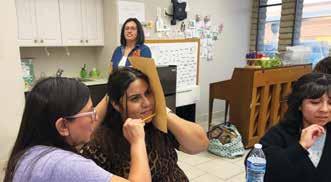
Participants in the Alive in Jesus training create face profiles for an activity.
All Nations Adventist Church
Celebrates Harvest of Souls with 18 Baptisms
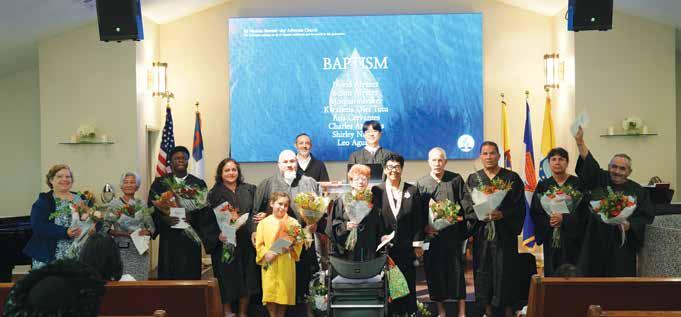
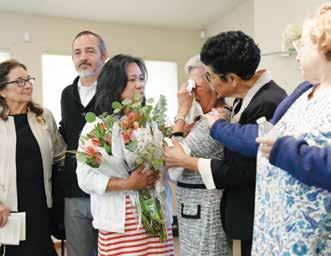
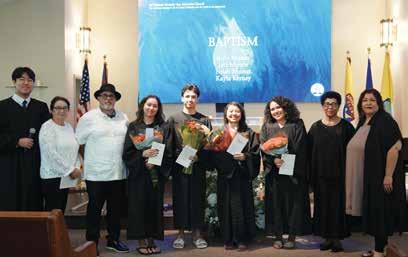
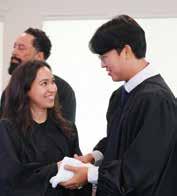
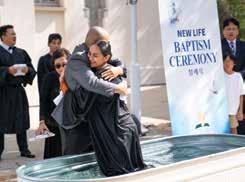
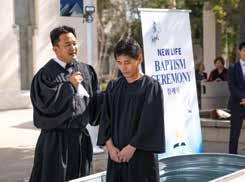
The All Nations church in Fresno celebrated 18 baptisms during its Pentecost 2025 "Preparation" evangelistic series held on October 20-25. The week was filled with food, music, testimonies, praise, and powerful messages that culminated in this beautiful harvest of souls. "We are so thankful for God's providence," said Bryan Bong, lead pastor of All Nations church. "This baptism is the fruit of everything our church has poured into ministry this year."
The church's preparation for Pentecost 2025 began months in advance with intentional outreach initiatives. Members launched digital evangelism prayer ads, laying a foundation of intercessory prayer for their community. Each Sabbath, the church conducted Bible study classes designed for visitors and those preparing for baptism, offering steady, week-by-week scriptural instruction. "We held Bible study classes every week, though sometimes only a few people attended," shared
head elder Dolores Jones, who led the Preparation for Heaven Class. "There were moments when we wondered if our efforts were making a difference. But we kept opening our class each week. And now, by the Holy Spirit's leading, we see the harvest."
The church's outreach extended beyond the classroom. Members engaged in food ministry and the choir participated in community visits, performing cantatas and concerts at local facilities, sharing God's love through music. One such visit led Shirley Nielsen to discover the All Nations church. After attending a choir performance, she began attending worship services with the congregation, participated in Bible studies, and was baptized during the evangelistic series.
As the entire congregation united in soul-winning efforts, the impact first appeared within members’ own families. Rachel, the church clerk, celebrated as her son-in-law, Samuel Padilla, became a church member through profession of faith. Similarly, Irene Esguerra,
mother of head deaconess Chamin, joined the church family through profession of faith.
Three young people, Ruby, Jaci, and Noah Munoz, the children of Lenore and Joy, accepted Jesus as their personal Savior and were baptized together. Their journey to baptism included a moment where God's protection was clearly seen. Several months before the evangelistic series, the family experienced a serious car accident involving three vehicles. Their car was totaled, with everyone still inside. Yet they all escaped with only minor injuries. Following the accident, Bong and Jones visited them in the hospital for an anointing service. At that moment, they realized that God had a special plan for their lives. They began attending church regularly, studying the Bible together at home, and participating in the church's Bible study classes. Eventually, the three children felt the Spirit's call and made the decision to accept Jesus as their Savior through baptism.
future baptisms. The church's Sabbath School classes remain full, and small group Bible studies continue to meet regularly in members' homes.
"I believe God has allowed this harvest because He has a special plan for All Nations," Pastor Bong said. "This is just the beginning. We are committed to praying more, studying God's Word more diligently, and holding firmly to the mission He has given us. Our prayer is that All Nations will continue to reach souls for His kingdom." Church members report that the baptisms have energized the congregation. Longtime members who had felt discouraged by challenges in recent years now have renewed hope after witnessing how God worked in different people's lives. The church has also established an ongoing discipleship program for the newly baptized members, ensuring they receive continued spiritual support and growth opportunities.
The ministry at All Nations continues to impact both the congregation and the surrounding community. Many others are currently studying the Bible and preparing for
The October baptismal celebration stands as a reminder that faithful ministry bears fruit in God's perfect timing.
By Bryan Bong
Hawaii Conference Constituency Session
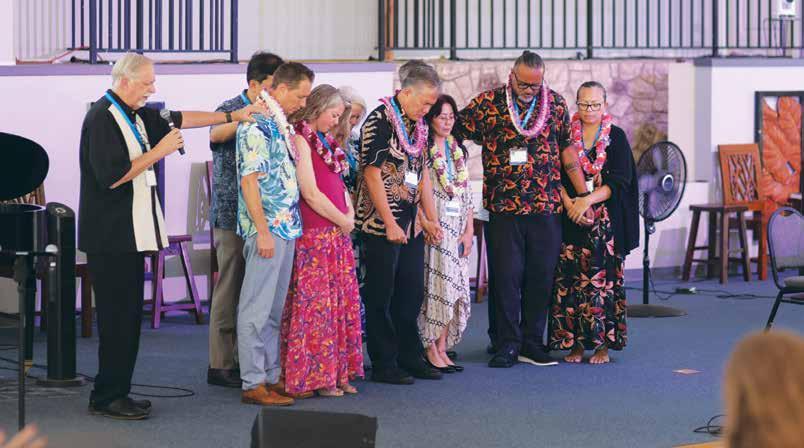
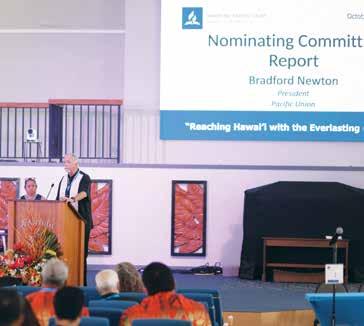
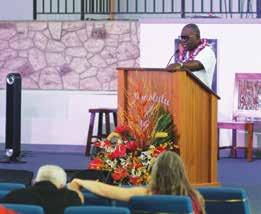
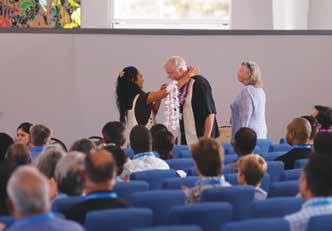
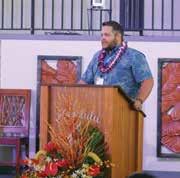
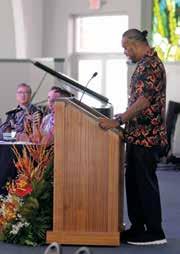
On October 5, regular delegates and delegates-at-large from across the Hawaiian Islands gathered at the Honolulu Central church for the 2025 Hawaii Conference Constituency Session, a historic meeting that shaped the direction of the Hawaii Conference for the next five years.
VIPs in attendance included North American Division leaders Executive Secretary Kyoshin Ahn and Director of Archives, Statistics, and Research Michael Campbell; Pacific Union Conference officers President Bradford Newton, Executive Vice President Leon Brown, Executive Secretary Sandy Roberts, and Treasurer Stephen Mayer; Southeastern California Conference President Jonathan Park; and Pacific Union College President Ralph Trecartin.
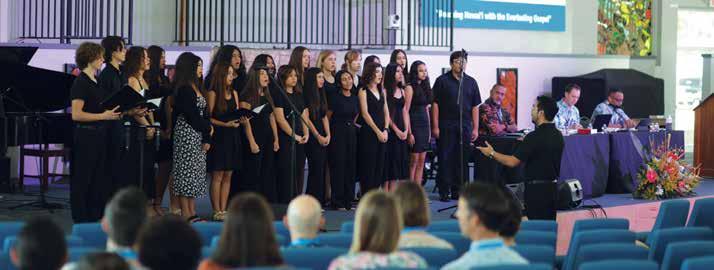
The session began with prayer and a special musical presentation by the Hawaiian Mission Academy Choir. Attendees received insightful historical presentations from Michael Campbell, who gave an overview of Adventism in the Hawaiian Islands, and Chase Aalborg, president of Adventist Health Castle, who shared the history of how Adventist Health came to Oahu.
The business of the day included reports from the conference officers—president, executive secretary, and treasurer. Department reports were shared via video, including presentations from Adventist Community Services, Camp Waianae, Education, Facilities Management, Literature Evangelism, and Youth Ministries. The election
of new officers followed: President Erik VanDenburgh, Executive Secretary Meshach Soli, and Treasurer Benjamin Supit. Delegates also elected members of the Executive Committee and Constitution and Bylaws Committee, and they voted on approved changes to the Hawaii Conference Constitution and Bylaws.
Pastor Newton offered a prayer for God’s guidance and blessings over the officers and the Hawaii Conference as it moves forward into the next five years.
The audited financial report confirmed that the Hawaii Conference is in good standing, receiving an unqualified opinion, which is the highest rating any entity can receive from General Conference Auditing Services.
The Hawaii Conference of Seventhday Adventists expresses its gratitude to all delegates, guests, and staff for their commitment, prayers, and support during this important session, as the conference continues its mission of “Reaching Hawaii with the Everlasting Gospel.”
By Judi Jeffreyes
A Seventh-day Adventist Boarding Academy Serving Native American Youth Since 1946
Building a Legacy
When asked what they want to be remembered for, people will often say that they hope they leave behind a good legacy for their family to follow or one that impacts their community and paves the way for lasting change.
One of the beautiful aspects of working at Holbrook Indian School (HIS) is knowing that we are collaborating with God, each other, and our students to build a legacy here that will last a lifetime. We are especially encouraged when we see former students return as staff members. Mr. Sam Hubbard, our math, history, and Native culture teacher, spoke of this joy: “As a staff member of HIS for 20 plus years, I see many students come through our school that I don’t see again. I have always wondered what became of many of them. There are some who have recognized me while I’m at different places in my walk of life. Then there are those who have returned to work at HIS and have become my colleagues.
“It’s this last group that I am most excited about. They are now walking in my moccasins, experiencing what a joy it is to work with young people from all walks of life—and what Christ must experience every day while working with young people.
“My dream has never been to become an administrator,
Shanel Draper (Class of 2014)
but one day I want to see one of these students become a leader at HIS. I would love to see former students from HIS become pastors to their own people, too.”
It is with this shared joy we announce that we have quite a robust group of HIS alumni and a former student working here this year, and we could not be more thrilled! Two of them are new to our team.
Four of our six deans are HIS alumni. Shanel Draper (Class of ‘14) is in her eighth year as a staff member and is currently serving as our associate girls’ dean as well as our pottery teacher. She is joined by Terrell Bahe (Class of ‘17), who is in his fifth year as an HIS employee and is serving as our associate boys’ dean. Next, we have Terrell’s classmate and fellow graduate, Quintin Clah (Class of ‘17), who is our assistant boys’ dean. Joining the deans as a new staff member this year is Antoinette Hardy (Class of ‘11), our assistant girls’ dean.
We also have America Rodriguez (Class of ‘14), who is in her third year of working at HIS as our cafeteria assistant. America was a classmate of Shanel’s, and she is also Terrell’s cousin. Last but not least, our newest member of the HIS team is Dalariyn Dele, a former student who has returned as part of our college and trade prep initiative, which includes our college transition program. She currently serves as our horsemanship assistant.
Through the college transition program, former students are able to return to campus either to work as an employee or to live with a current HIS staff member while getting their bearings
“I
would love to see former students from HIS become pastors to their own people, too.” Sam Hubbard
as they adjust to life after HIS. This is one of the ways that we continue supporting our students as they transition from life on our campus to life in their local communities and/or at college or trade school. We are pleased to see that so many of our students have returned to HIS as staff members this year. Through each of their roles, they are helping to build a beautiful legacy that will ignite the next generation for the glory of our Creator as well as for their people.
By Kimberly Cruz
A Seventh-day Adventist Boarding Academy Serving Native American Youth Since 1946
Holbrook Indian School (HIS) is a first- through twelfth-grade boarding academy operated by the Pacific Union Conference of the Seventh-day Adventist Church. HIS also manages a first- through eighth-grade day school on the Navajo reservation in Chinle, Arizona. Eighty-seven percent of funding comes from individuals who have a desire to support Native American ministries and Christian education. Your generosity makes a difference in the lives of our students, their families, and the communities they serve. Thank you for your support.
According to the American Heart Association, someone in the United States has a stroke every 40 seconds, affecting nearly 800,000 Americans and killing 140,000 every year. Stroke is a leading cause of death and serious disability nationwide and around the world. But it doesn’t have to be.
You can learn how to identify a stroke (quick care is critical) and how to help prevent stroke from occurring in the first place.
What is a stroke?
A stroke is when blood flow to a part of the brain is blocked or when a blood vessel in the brain bursts. Blood carries oxygen to cells in the body, and when brain cells are starved of blood they die.
Strokes often occur as a result of chronic health conditions (such as arrhythmia or other heart disorders), poor health choices (such as smoking, unhealthy diet, and inactivity), or environmental factors or genetics. People over age 65 are most commonly affected, but a stroke can happen at any age. In fact, nearly one fourth of people who experience a stroke are under age 65.
Strokes are a medical emergency. It’s important to get care as soon as possible. Some treatments for stroke work only if given in the first three hours after
symptoms start. A delay in care can raise the risk of permanent brain damage or death.
Spotting a stroke
In the event you or a loved one has a stroke, knowing the warning signs and what to look for could save a life. Use the acronym FAST to remember what to look for:
F – Face: Ask the person to smile. Does one side of their face droop?
A – Arms: Ask the person to raise both arms. Does one arm drift downward?
S – Speech: Ask the person to repeat a simple phrase. Is their speech strange or slurred?
T – Time: Time to act! If you observe any of these signs, call 9-1-1 immediately.
How can you prevent a stroke?
Here are a few tips to get started on lifestyle changes that can reduce the risk of stroke.
Manage your blood pressure. Keeping your blood pressure in the healthy range is among the most significant factors in reducing stroke risk. If your blood pressure is elevated, be sure it’s treated and monitored regularly by a doctor.
Also, be sure to include in your diet foods rich in potassium, such as sweet potatoes, raisins, and bananas. These types of foods may help reduce stroke risk by 20 percent. Try to follow a healthy diet overall, filled with plenty of fresh fruits, vegetables, and whole grains. Try to reduce the salt in your diet to half a teaspoon or less per day.
Get more exercise. Whether it’s a jog around the block or a lap in the pool, being active at least 30 minutes a day, five days a week is an important factor in lowering your stroke risk. According to one study, simply walking a total of two hours a week showed a 30 percent reduction in stroke risk.
Quit smoking. Curbing this dangerous habit can be difficult, but it reduces your risk for many health issues, including stroke. Seek support from family or your doctor to help put a plan in place.
Taking preventive measures and being proactive about your health is one of the best ways to stay healthy and prevent stroke and other diseases.
By Kim Strobel
The La Sierra University team poses for a group photo prior to the start of the 5k race during the Mission Inn Run.
La Sierra Fields Largest Team in Riverside Run, Raises Foster Youth Tuition Funds
It was a historic and poignant day for the team from La Sierra University. In partnership with TeamWith, a local social impact analytics company, La Sierra fielded the largest group in the history of the 48-yearold Mission Inn Run, which took place on October 19 in Riverside, California. More than 300 student-athletes, faculty, staff, alumni, and friends donned La Sierrabranded attire and hit the streets of Riverside, following a 3.1-mile course in the run’s 5k race.
The contingent joined around 7,000 Riversiders who participated in the day’s various races. While race registration fees aided the Mission Inn Foundation, the university through its alumni office and TeamWith offered an opportunity for the La Sierra group to contribute toward the creation of a new La Sierra scholarship endowment named Home@LaSierra. The endowment will fund La Sierra University tuition and housing costs for eligible young people who are aging out of foster care, allowing them to pursue their college degree and a strong start on life surrounded by the supportive care of the campus community.
An official fundraising kickoff was held in November for Home@LaSierra, with future events planned.
“We were thrilled with the La Sierra family’s turnout for the Mission Inn Run and owe a debt of gratitude in particular to our student-athletes whose significant presence and energy allowed us to cross the finish line as a record-holding group,” said La Sierra University
President Christon Athur. "Many people worked hard to make this event a success and to support our new endowment. We are very excited about the impacts Home@LaSierra can make in the lives of our young people. It is a lived example of our values that embrace justice toward leveling the playing field of opportunity, so that all may reach their God-promised potential.”
While waiting for the race to start, La Sierra’s students had fun stepping to music at the start line while Arthur participated in an interview with Los Angeles’ KTLA 5. Then, with the roar of the pace car, the La Sierra team and more than 2,000 others bolted forward. La Sierra’s Alexander Navarro, a 2025 graduate and a member of the university’s crosscountry team, finished first in his age group (20-24), first for La Sierra, and fourth overall out of 2,486 participants. He also bested his own record with a time of 16 minutes, 24 seconds.
“This was not just a workout, but a testament to retaining faith through every stride, breath, and heartbeat throughout the entire journey,” Navarro said. “In fact, I never run without first thinking about God because He moves me with purpose, power, and motion. I set my personal record in the 5k, which gave me inspiration to run marathons, but most importantly, a greater attachment to God to make me run closer to Him.”
By Darla Martin Tucker
Study Highlights Reduction in Cardiovascular Disease by Adding Nuts to Diet
People who consume more nuts, especially tree nuts such as almonds, walnuts, and cashews, have a significantly lower risk of death from cardiovascular disease compared with those who rarely or never eat them, according to a new study by Loma Linda University Health researchers.
Those with the highest intake of tree nuts had a 1727% lower risk of death, according to researchers, who hoped their study would add to the evidence that diet continues to play a substantial role in health.
“We embarked on this research because heart disease continues to be one of the leading causes of death in the United States and globally,” said Montry Suprono, DDS, director of the Center for Dental Research at Loma Linda University School of Dentistry and the study’s lead author. “A lot of medications have been created; however, many health problems can be prevented, and one of the best ways to prevent them is through diet.”
Their study—“Nut consumption and risk of cardiovascular disease and ischemic heart disease mortality: The Adventist Health Study 2”—was published in October in the Journal of Nutrition.
The team explored data from a longitudinal survey of more than 80,000 people to conduct their research. That cohort, from the Adventist Health Study 2, involved an in-depth questionnaire of North American Adventists from 2002 to 2007. Suprono said that cohort was generally healthier than the general population, with few regularly using tobacco or alcohol.
“Those kinds of harmful substances and behaviors in other cohorts appeared more frequently and can
See the latest news and Health & Wellness stories from Loma Linda University Health at news.llu.edu.
cloud the association between diet and disease,” Suprono said. “The Adventist Health Study 2 better allows researchers to evaluate the association between just diet and disease.”
Although the latest findings are observational and cannot prove cause and effect, they are consistent with other studies of nuts being associated with a drop in cardiovascular risk, Suprono said.
Suprono said nuts in the 1980s and early 1990s were considered by many people to be unhealthy because of their fat content. Because early research linked dietary fat intake to heart disease, medical advice and dietary guidelines at the time often discouraged high-fat foods (including nuts), leading many people to avoid them. It wasn’t until 1992 that Gary Fraser, the primary investigator of the Adventist Health Study 2, came out with a landmark study showing the potential protective effects of nuts against heart disease. Fraser was also involved in this latest study.
“That study literally put nuts back on the map,” Suprono said. “It triggered a cascade of studies from other U.S. based cohorts, along with other studies in Europe and Asia.”
Nuts contain plant sterols, magnesium, fiber, and vitamins that may help reduce inflammation and, to some degree, blood pressure, Suprono said. Together, these macro and micronutrients work synergistically to support healthier blood vessels and reduce the risk of atherosclerosis and heart disease.
Eating a few small handfuls of nuts a few times a week would be a great starting point, Suprono said. Nuts are nutrient-dense foods, packed with lots of macro- and micro-nutrients. They can be eaten in moderation whole or added to items such as salads, oatmeal, shakes, or yogurt. He also recommends nuts that are minimally processed—unsalted and raw instead of processed or roasted.
By Ansel Oliver
PUC’s Enrollment Increases for 2025-2026 Year
Pacific Union College (PUC) continues to welcome more students for another year, following a pattern of positive enrollment growth. For the 2025-2026 academic year, 1,080 students are enrolled, including 228 first-time college students, 166 transfer students, and 45 graduate students. This year’s enrollment is the highest since the 2017-2018 school year, marking the fifth of the last six years with an increase. With new programs created on and off campus, partnerships with health care institutions, and enhancements to existing departments over the last few years, around 350 students are enrolled in undergraduate-to-master’s programs to further their careers. Vice President for Enrollment, Marketing, and Communication Gene Edelbach credits the changes and delivery of these new programs in making a significant difference in enrollment.
Since taking on the role as director of admission last year, Pauline Cidro has made it a priority to strengthen the relationship between the admissions office and recruitment team, having the office serve as a support for the enrollment counselors, especially when they are out traveling to connect with schools, churches, and families. Director of Recruitment Isabella MalanGarrido ensures that she and enrollment counselors are present at around 400 various fairs and events each year across the country to market PUC and focus on student retention across academia, spiritual life, and student life.
Executive Assistant and Enrollment Counselor Andrianna Massena helps hundreds of families see the campus for themselves when they visit PUC, creating a personalized experience tailored to students' chosen majors, their families' interests, and financial plans. With yearly events, such as college days, sports tournaments, and college early summer programs, Massena connects with academies, ensuring their students feel at home and offering a glimpse of what PUC could look like for them. With general check-ins when students return home, they feel extra support, which makes PUC feel like the place where they can thrive.
“Bringing students to PUC is not a group processing event,” said Edelbach. “Each and every student has
their own needs and their own plan, and we are here to customize and support as they go through the entire process. Our enrollment counselors have been extremely successful. Each one of them is dedicated to doing an excellent job and cares so much about incoming students and our school.”
The same goes for the marketing and communication department. Every minor to major detail they create is the result of thorough thought and authenticity. They heavily support admissions and enrollment by developing engaging materials—from imaging to social media—that emphasize PUC as a whole. Through this messaging, it has attracted more students to enroll, simply from a piece of paper and online presence.
Retention doesn’t stop in these departments; it spreads throughout the campus. Faculty strive to provide an excellent education to their students, supporting them by engaging regularly and even hosting them in their homes for department dinners and pre-vespers to build relationships.
Aimee Leukert, PUC vice president of student and spiritual life, is not surprised that enrollment is up this year. “The energy on campus amongst our students, faculty, and staff is so incredibly positive,” she said. “I believe that prospective students are talking to their friends who are up here, or seeing the work that is happening in our departments, or coming up for a visit—and they want to be a part of it!"
This year’s enrollment increase showcases the time, dedication, and care that faculty and staff put into PUC. Edelbach said, “Our mission is to provide Seventh-day Adventist, Christ-centered education to as many people as possible.”
By Ally Romanes
Honoring a Faithful Servant
On October 25, 2025, members, leaders, and colleagues gathered at Paradise church in Las Vegas to celebrate the ministry of Pastor Peter Neri, who retired after decades of dedicated service, including 18 years within the NevadaUtah Conference (NUC).
Music, tributes, and heartfelt stories reflected the impact Pastor Neri has had on the church and the Las Vegas area community. Colleagues from across the Nevada-Utah Conference, including President Carlos Camacho and Executive Secretary Chanda Nunes-Henry, attended the celebration in person to honor his ministry.
“Pastor Neri’s ministry has been marked by faithfulness and humility,” Camacho said. “He never sought recognition; he simply served with a full heart. His example reminds us that leadership is about consistency, compassion, and finishing well.”
Members also shared moving testimonies about Neri’s pastoral care and compassion
through every season of church life.
“Pastor Neri, you’ve been more than a pastor—you’ve been family,” a church member testified. “When my husband was in the hospital, you showed up every single day to pray with us. You didn’t just preach love, you lived it.”
To close the special celebration, Pastor Neri thanked everyone who played a part in his ministry. And of course, he acknowledged the One who had placed him on this journey in the first place:
“First of all, I just want to thank God for His faithfulness. When I look back, it’s really been Him all along. Every sermon, every baptism, every prayer visit: it’s been His grace carrying me through.
“As I step into this new season, I’m not retiring from serving the Lord; I’m just changing assignments. God still has work for us to do. Keep pressing forward, stay united, and remember: it’s all about Jesus.
“I’ll close with this: if I’ve done anything well, to God be the glory. If I’ve made mistakes, thank you for forgiving me. And if I’ve blessed you in any way, it’s because God has been so good to me.”
It was clear that, while Pastor Neri’s time in full-time ministry may be coming to a close, his legacy continues in the lives of the people he served.
By Neat Randriamialison
Members and guests fill the sanctuary to celebrate Pastor Neri’s retirement.
From left to right: NUC President Carlos Camacho, Pastor Peter Neri, his wife Jenny Neri, and NUC Executive Secretary Chanda Nunes-Henry pose together after the Neris were presented with a plaque and special gift from the Nevada-Utah Conference in honor of Pastor Neri’s retirement.
An Ark in the Desert
What if the story of Noah’s ark didn’t just exist in Sabbath School lessons but came to life in a kid-sized, climbable wonder?
That’s exactly what Kayenta church set out to do. Pastor James Crosby and his wife, Nancy, have long dreamed of bringing the Bible story to life by creating a modern-day adventure through the construction of a Noah’s Ark playground.
“In our area, the effects of the Flood are evident all around us. We needed a safe place for kids to play at church, but we wanted something that would be special and a reminder of God’s word,” explained Pastor Crosby. When Katie Chitwood contacted the Crosbys to organize a mission trip, the ark became more than an idea.
A group of 25 volunteers from across the United States, including Montana, Tennessee, Michigan, and Florida, came together during the last week of May. They arrived on site in Kayenta, Arizona, on the Navajo Nation, and immediately began to work. Three volunteers worked with Pastor Crosby to build a two-story ark, 10 feet wide and 35 feet long, complete with a ramp, a roof, and windows. The volunteers came with their families, and while the ark took shape, the rest of the volunteers, the youngest only six years old, worked in the church’s community garden and organized an engaging four-day spaceflight Vacation Bible School. On the first night, 25 children attended!
After the mission trip came to an end, work continued on the ark. Pastor Crosby finished staining the wood and added a slide, climbing wall, and upper deck.
Once the ark was finished, the Kindergarten and Primary Sabbath School class sat in the completed project for the first time and listened to the story of Noah’s ark and its significance to their lives. Now, after church and during community events, children can enjoy the ark playground.
The ark has become a talking point in the community as children walk by on their way home from school and express their curiosity at the big boat. One child noted, “I read about a man named Noah in a book, and that looks like his ark!” A mother said that her children have been begging to play on the ark every time they pass by. Pastor and Nancy Crosby are always ready to welcome visitors and retell the story behind this boat in the desert.
By Anne Crosby
Finding Faith and Friendship Under the Stars
Across Northern California, young adults are discovering that faith grows best in shared experiences—around campfires, on trails, and beneath the stars. What started with Sabbath School, vespers, and a 10-person camping trip led by Joseph Cartwright of the Auburn church has blossomed into a young adult-led community focused on worship, conversation, and lasting friendships.
Camping retreats have become the ministry’s highlight. Last year’s trips to Big Sur and Lake Tahoe included baptisms, and this year’s Lake Tahoe retreat drew over 100 campers, the group’s largest
gathering yet. R.J. Gamboa, coordinator of the General Conference’s Sidewalk Evangelism initiative, and his wife, Charinette, joined the weekend to share about living fully surrendered to Jesus.
Connecting in post-school adult life can be challenging, but this group’s intentional activities— hiking, paddleboarding, shared meals, and late-night conversations—have strengthened bonds across faith and communities. One young professional reflected, “Finding each other in this new stage of life is the first step toward building a real community.”
By Ken Miller
Building Character, One Adventure at a Time
Northern California Conference (NCC) Pathfinder and Adventurer leaders continue to provide programs that encourage and teach enthusiastic youth. Over three weekends, youth gathered at Leoni Meadows to take part in spiritual programs, participate in hands-on learning, and earn honors.
In October, over 600 Pathfinders attended the NCC Pathfinder Camporee for a weekend of outdoor adventure and spiritual growth. Despite rainy weather on Thursday, spirits remained high, and by Sabbath morning the skies cleared for a day of activities. Weekend highlights included the blacksmithing honor
(supported by Pacific Union College and Adventist Health), the Parade of Nations, a Leaders in Training social activity, and four baptisms. The theme “All In” encouraged Pathfinders to live out their faith through worship, service, and community involvement, while honor classes and service projects fostered friendships and character.
Following the Camporee, the NCC Adventurer program hosted two weekend events—one in Spanish and one in English—bringing young children and families together. The 2025 theme, “Down on the Farm,” offered hands-on experiences exploring food, farm life, and Jesus’ birth. The Spanish event welcomed
more than 70 families; the English weekend hosted 30. Children earned awards while parents participated in family ministry activities and guest-led worship. Sunday included go-kart rides and a historic train ride.
Together, the Pathfinder and Adventurer programs showcase the NCC’s commitment to fun, faith-filled events that build character, foster spiritual growth, and inspire service.
By Eddie Heinrich and Barry van Iderstein
Northern California Conference Celebrates Two Ordinations
Two pastors in the Northern California Conference were recently ordained, each reflecting God’s call and years of faithful service.
On October 4, Dexter Thomas was ordained at the Fairfield Community church. Legally blind, Thomas has transformed personal limitations into an innovative ministry, founding PhoneFaith, a spiritual care outreach serving hundreds of blind individuals nationwide. Before serving in Fairfield, he was an auxiliary evangelist at Grand Advent church, where he led evangelistic efforts and leadership training.
Since his ordination, Thomas has accepted a call from the North American Division as president of Christian Record Services. There he hopes to enhance ministry for the blind and those with low vision.
On October 18, Daniel Garza was ordained at the Community Adventist church in Yuba City.
Recognizing God’s call early on, Garza began
preaching at a young age and, at age 19, co-founded Army of Youth Ministries to support youth and young adults in ministry.
He joined the NCC in 2011, serving at Gracepoint and Granite Bay in a variety of positions, including Bible worker, assistant pastor, and pastor. In 2016, he became the district pastor of the Woodland and Vacaville churches, where he guided both to numerous baptisms and innovative evangelistic outreaches.
In 2023, Garza earned a Master of Ministry degree from Southern Adventist University. He now pastors in Yuba City, where he emphasizes salvation by grace through faith and continues to inspire and mentor congregants and young ministers alike. Garza credits his successes to the steadfast love and prayers of his family and friends, whose encouragement has strengthened him at every step.
By Communication Staff
Danielle Berumen Appointed Associate Ministerial Director
For Danielle Berumen, ministry wasn’t part of her original plan. As a college student pursuing premedicine, she envisioned a career in the medical field working with children. But in the midst of long nights studying science and excelling in her religious studies courses at La Sierra University, she began to sense God leading her down an unexpected path.
“One night I finally asked God, ‘What is your will for my life?’” She recalled. “I felt this still, small voice say, ‘I’ve been showing you all along.’” From teaching youth Sabbath School classes in high school to preaching when invited by her academy chaplain, Berumen realized that God had been preparing her for pastoral ministry long before she recognized it.
SECC Executive Secretary, Patty Marrufo announces Berumen’s new role during the All Pastors Professional Development Day.
Her journey since then has taken her through several Southeastern California Conference (SECC) churches; she has served at Azure Hills, Palm Springs, and Calimesa in roles ranging from youth and children’s pastor to interim sole pastor. Along the way, she was mentored and impacted by the ministry of supportive pastors and professors—too many to name—and she feels very grateful for the ways she has been encouraged and poured into over the course of her ministry. Each mentor reminded her that “people always come before the task,” a value that continues to shape her leadership today.
Berumen and her husband, Manny, daughter, Eiza, and son, Judah.
Now, as associate ministerial director for SECC, Berumen steps into a new chapter, one that allows her to pastor pastors. “God was so clear in calling me here,” she said. “I know He’s doing something special in this season.”
In her new role, Berumen will serve all the pastors of our conference territory, while intentionally supporting young pastors, female pastors, and students of the Growing Young Leaders program.
She hopes to create meaningful opportunities for fellowship and renewal through gatherings like Pastors Connect, where ministers can encourage one another and simply enjoy being together.
Reflecting on Berumen’s appointment, Will Penick, ministerial director, shared, “Danielle brings a heart for people and a deep passion for encouraging pastors in their calling. Her ability to listen, empathize, and build genuine community will be a tremendous blessing to our ministerial team and the churches we serve.”
When asked to summarize her ministry philosophy, she chose three words: service, presence, and encouragement. “I never imagined being a pastor,” she reflected, “but God knew this would bring me joy. My prayer is to stay responsive to the Spirit’s leading and to help our pastors and churches reflect more of God’s kingdom here in Southeastern California.”
By Jordyn Wright
Isaac Kim Appointed Youth Director
With a background in young adult ministry and marriage and family therapy, Isaac Kim steps fully into his role as youth director for Southeastern California Conference (SECC). His appointment to the position followed confirmation of the August Executive Committee, effective September 2025. Kim succeeds Aren Rennacker, who was director of SECC Youth Ministries for five years.
Kim is no stranger to youth ministry or SECC. After more than two decades pastoring at the Calimesa church, he joined the conference office in 2021 as associate director for Family & Children’s Ministries—a ministry area he continues to oversee as youth director.
Originally from Georgia, Kim began his academic journey at Georgia State University before receiving the call to study religion at Southern Adventist University. He later earned his master’s degree in Marriage and Family Therapy from Loma Linda
“Strong children’s ministries build strong youth ministries, which then strengthen adult ministries. Ministry doesn’t happen in isolation—it’s intergenerational.”
University, where he discovered how spiritual care and emotional health intersect in ministry. Working with young adults and families has always been a passion for Kim. “There’s a certain blessing that comes when you’re able to engage in the lives of people you worship and minister with,” he shared.
Reflecting on his transition to the Youth Department, Kim is focusing on the momentum the department has created. “Aren and I shared a vision that age-based ministries are cohesive,” he explained. “Strong children’s ministries build strong youth ministries, which then strengthen adult ministries. Ministry doesn’t happen in isolation—it’s intergenerational.”
As youth director, Kim oversees SECC’s Family, Children’s, Youth, and Young Adult Ministries. The department supports local churches, Club Ministries, and summer camp at Pine Springs Ranch, and it also works collaboratively with schools and pastors to nurture young people across all stages of faith development.
Kim emphasizes the importance of connection and prayer. “We ask that our members pray for our youth,” he said. “They are the most valuable part of the church. Anything we can do to support our local churches and extend ministry to the next generation matters.” Through his leadership, Kim hopes to strengthen connections between generations and ensure that young people not only belong in the church today but help shape its future.
By Taji Saleem
LEFT: Kim and his two boys, Christian and Noah. RIGHT: Kim speaks to Adventurers, Pathfinders, and Master Guides at the Club Ministries Fair.
Nine Korean Churches in Los Angeles Unite for a Month of Evangelism
The Korean Adventist community came together this fall for Korean Adventist Family Evangelism of Los Angeles (KAFE LA), a month-long evangelism series under the theme “On That Glorious Day.” The first three weekends in October held an evangelism emphasis—family and children, youth, and young adult—and the final weekend was a day of united worship.
“I dreamed for a day like this, when all nine Korean congregations came together for worship,” Vinh Nguyen, Southern California Conference (SCC) Asian/Pacific Region director, said during the program. “I encourage you to continue to do this annually, and God bless you as you carry this message to the Korean people in Southern California.”
Throughout the month, the evangelistic meetings saw an average of 200-250 attendees. Of those attendees, three identified as atheist and 23 were first-time visitors to an Adventist church. Additionally, 50 people who had stopped attending church came back for the meetings. Part of SCC’s Asian/Pacific Region, all nine Korean churches and groups collaborated to plan this work. Ahead of the culminating event, throughout the year for Pentecost 2025, many evangelistic efforts took place among these churches, such as music evangelism
(Cerritos Korean church), outreach to people experiencing homelessness (Good Neighbor group), family camp evangelism (Southbay Korean group), seniors evangelism (Valley United Korean church), family evangelism (Glendale Korean church), and many more.
Collaboration among the churches was evident on this united worship day. Both the English Ministry and Korean Ministry choirs—each formed with members from all nine participating churches—offered special music. Tim Kwon, senior pastor at Lombard Fellowship Church in Illinois, shared a message focused on working together to prepare for Christ’s return. The day concluded with an afternoon concert featuring vocal ensembles, quartets, and soloists from various churches.
Two people were baptized on that day, adding to the 16 people who have been baptized from Pentecost 2025 initiatives this year.
“While KAFE LA might be over, our work is not finished,” said Enoch Lee, Olympic Korean church associate pastor. “We hope and pray that everyone will continue to do the work of evangelism—the work of inviting people into a relationship with Jesus—so that one day, we will all be united together in the name of Jesus on that glorious day of His soon return.”
By Araya Moss
TOP: Bringing together voices from all nine churches, the English Ministry (left) and Korean Ministry (right) choirs united in praise through special music. LEFT: Two people were baptized into the Olympic Korean church.
PHOTOS: ARAYA MOSS
Rolling Hills Church Celebrates 50 Years of Faith & Community
This October, the Rolling Hills church family celebrated its golden anniversary with a full weekend of events.
Throughout five decades, generations have found belonging and fellowship in this community. From Sabbath School and Bible study classes to youth and Pathfinder meetings and midweek prayer gatherings, vibrant ministries have brought life to the church and blessings to its members. Through creative outreach activities, like the annual car show, the church has found unique ways to minister in the local community and meet the needs of their neighbors.
“We learned to be a community through five decades, each decade looking just a little different,” noted Janet Lui, an elder at Rolling Hills, during the welcome on Sabbath morning. “I know that for some of you this is going to be like old home week and for others it’s going to be, ‘Who are these people?’ But let me tell you, you’re here because you have experienced the love of God in this place. Just know that anybody that came through this door this morning has had that same experience in this place.”
Many former pastors of the church were present and participated throughout the weekend. The Southern California Conference (SCC) executive officers joined to support the milestone, with the morning’s message brought by SCC President John H. Cress, entitled “Love Restored, Mission Renewed.” The Sabbath morning service closed with a special baptism of four new members of the church family.
Fabio Campos, who has served as the Rolling Hills pastor since 2022, receives a check to support the church and a letter celebrating the occasion from the Southern California Conference.
“We especially celebrate the diversity and family spirit that mark your church,” read a letter from the SCC executive officers to the church recognizing the occasion. “Rolling Hills stands as a reflection of the kingdom of God—welcoming people of all ages and backgrounds into one fellowship of grace. Your unity in Christ is a witness to the wider community that the gospel brings people together in love and hope.”
By Lauren Lacson
LEFT: Campos and the four baptismal candidates gather for the vows a few moments before the baptism. RIGHT: All the former pastors in attendance were asked to join Campos on the platform for a special rededication prayer for the church and its members, offered by SCC Executive Vice President Royal Harrison.
Advertising
Advertising is accepted as a service to Seventh-day Adventist church members in the Pacific Union. The Recorder management reserves the right to refuse any advertisement, especially ads not related to the needs and practices of the church membership. Acceptance of any advertising shall be considered a matter of accommodation and not a matter of right, nor shall it be construed to constitute approval of the product or service advertised.
Payment in advance must accompany all classified advertisements or they will not be published. Display ads for known advertisers will be billed.
How to Submit Advertising
Classified ads must be sent with payment to the Recorder office. Display ads should be arranged with the editor (recorder@adventistfaith.com).
Classified Rates
$70 for 50 words; 75 cents each additional word. Display rates (full color only): back cover, $4,200; full page, $3,800; 1/2-pg., $2,200; 1/4-pg., $1,200; 1/8-pg., $700; $160 per column inch.
Information
The Pacific Union Recorder is published 12 times per year with a circulation of approximately 75,000. For more information about advertising, please email to recorder@adventistfaith.com.
Upcoming Deadlines
These are the advertising deadlines for the Recorder Your local conference news deadlines will be earlier. January: December 2 • February: January 5
Contributions
The Recorder pages are assigned to the local conferences, colleges, and healthcare institutions, and all content comes through the communication departments in those organizations. If you have a news story/idea, calendar announcement, etc., please contact your local communication department. See the masthead for contact information. Want tips for writing for us? See www.dailywritingtips.com/the-artof-writing-news.
Recorder Membership
The Pacific Union Recorder is provided as a free service to members of the conferences that are part of the Pacific Union Conference (Arizona, Hawaii, Northern California, Central California, Southern California, Southeastern California, and Nevada-Utah). Each conference maintains the list of members, based on the reports from their churches. If you would like to make a change to your subscription (name, address, cancellation), please contact your local conference. The staff of the Recorder does not have access to the circulation lists, other than the paid subscriptions.
Calendar
La Sierra University
Christmas Tree Lighting. La Sierra University’s annual Christmas Tree Lighting event will be held on Thursday, Dec. 4 at 5:30 p.m. at the sculpture plaza. It will feature musical performances, food and craft booths, games and activities, and the lighting of the university Christmas tree. For information, contact osi@lasierra.edu.
Pierce Street Jazz. La Sierra University’s Pierce Street Jazz, a professional artist series offered free to the community, will be held on Thursday, Dec. 4 at 7 p.m. at Troesh Conference Center in conjunction with the Christmas Tree Lighting festivities. For information, contact pr@lasierra.edu.
Pacific Union College
Academy Basketball Tournament , Jan. 20-25, 2026. PUC's annual basketball tournament will host 16 teams, comprising both boys' and girls' teams. The tournament is a time for students not only to connect with other athletes but also to bond on our campus and experience the social and spiritual life of PUC.
Connect Ministries is a group of Pacific Union College students passionate about Jesus and sharing through music and worship. The bilingual team leads the worship services, retreats, youth events, and any programs where they can inspire other young people to become worship leaders. Any school or church interested in having them visit, please email connectministries@puc.edu.
Add PUC News in Your Church Bulletin. With many updates to share at Pacific Union College, we designed a printable bulletin insert for churches to use. Just print the PDF double sided and cut in half, then include as a bulletin insert. Download at puc. edu/bulletin.
Subscribe to the PUC Now Newsletter. Stay up to date with Pacific Union College by subscribing to their monthly newsletter at puc.edu/subscribe. From campus stories and alumni features to student interviews, you’ll be in the now with PUC.
Classified
Employment
Holbrook Indian School is currently in need of a Maintenance Director. This is a paid position. If you or someone you know are mission-minded and would like to serve American Indian children, please see or share our jobs page at HolbrookIndianSchool.org/jobs.
Pacific Union College seeks dedicated Executive Director to lead Human Resources operations and strategy and oversee well-being and development of talented team members. Strong leadership, communication, and organizational skills are essential. https://sdawest.pub/job_posting. Email hr@puc.edu, 707-965-6231.
Pacific Union College seeks qualified candidates to fill open positions in fulfilling our mission to Learn with Purpose, Rise in Faith, and Serve in Love. Beautiful mountain campus, minutes to shopping, an hour+ drive of ocean and skiing. Current openings at https:// sdawest.pub/candidates.
Live-in Companion in Madera, CA. Seeking an SDA woman to share home with a mostly independent elderly woman. Evenings/overnight preferred; minimal assistance, presence in the home. Must be reliable, kind, and comfortable with one gentle, mostly outdoor cat. Room & board plus stipend provided. Email ayomoon@ gmail.com with references and brief bio.
Camp Cedar Falls is hiring! Live and work in God’s beautiful nature. Positions available include: Camp Ranger/Custodial and Camp Ranger/Maintenance. Opportunities available to singles, couples, and families. To learn more or apply, visit https://scc.adventist. org/departments-ministries/human-resources/jobopenings. For questions, call Camp Cedar Falls at 909805-4104.
Real Estate
PUC Commercial Space for Rent. Pacific Union College has commercial real estate space available for lease. The spaces are in various sizes and functionality and are available for inquiries. For additional information, please email Sam Heier at sheier@puc.edu.
Cottage for Rent. Are you looking for serenity and peace? Then this rental is the perfect place for you. A small and private cottage, complete with picket fences and gardens. 1 bedroom, 1.5 bathrooms, skylights, and unique shower. Located in foothills by Collins Lake, CA. Contact John at Mountains. skyz@gmail.com.
Summit Ridge Retirement Villages, an Adventist community in a rural setting, offers affordable homes or apartments and caring neighbors, with fellowship you will enjoy. Onsite church, planned activities, and transportation as needed. Onsite Wolfe Living Center offers independent living and nursing homes. Visit SummitRidgeVillage.org or call Bill Norman, 405-2081289.
Country living with contemporary luxury in this newly remodeled 3-bed 2-bath 2700 sf home with open floor plan bathed in natural light with gourmet kitchen, SS appliances, granite countertops, LVP flooring. A
master suite with a large bathroom and shower with a huge walk-in closet. Also a large game room/office, all on a single level. House on 1.6 acres backed by a pond and stream; more acreage available. Any questions or pictures, contact me at ptnbear@gmail.com.
Country living in Northern California: 3-bedroom, 2-bath, newly renovated home for sale on one acre, quiet street 15 minutes from Redding, mature fruit trees, grapevines, 50x80 fenced garden area with small greenhouse, irrigation system, landscaping, 3-car garage, gym, and large 18x30 shop with RV hookups. Call, text 909-735-2745.
Near Pacific Union College, in Pope Valley, CA. Beautiful 3-story, 4 BDRM, 3 full bath home for sale. Downstairs could be apartment. Peaceful, secluded, sits above creek. Own water access. Dock possible. Kayak, swim, picnic, hike. No neighbors either side, rolling hills across. $525,000. See listing: www.listing4. com/1060deputydrive. Kris Chun, Brokerage License 01870237; phone: 707-853-5747.
Reduced price, rare mountain jewel, 21.67 acres in high Sierras, out of valley fog, east of Jackson, CA, near Silver Lake, Kirkwood, and south Lake Tahoe. Horse corral, miles of forest trails, 5th wheel and camping trailer on site. Hunting, and fishing on river. A great weekend retreat or home site. $99,000. Terms, owner seller must sell, 209-745-2302.
Southern Oregon, Days Creek, country living: 10-acre property, 4+bdrm, 3.5-bath, 4,000 sq. ft, well
California Adventist Federal Credit Union
YOUR “ ONE STOP FINANCE SHOP ”
Serving our Adventist Community for over 68 years with financial products and services, along with wealth building education.
Please visit our website for updates on all that CAFCU has to offer. Call our office and speak to our friendly staff or manager for more information.
www. SDA Credit Union .com I 818-246-7241
with 3,000-gallon tank, septic system, big garden area, grapes and fruit trees, large workshop, greenhouse, woodshed/carport, lots of storage, Adventist schools and church nearby, ideal place for country living or wellness center. Call 541-825-3823, email janmay92@ aol.com.
Off-grid solar, 4+ sloped acres. Shared well, older mobile, 2 bd/1bath with 3 sheds. Near Mexico and Arizona border. God willing, moving overseas. Church with school nearby. Estimated $130K invested. No conventional financing. Cash offers. Much to include. Materials for strong greenhouse. Text, 520-858-6674 message, or email poolman52@hotmail.com.
45-Acre Retreat Estate in Valley, Washington.
This 45-acre estate offers a remarkable opportunity for Christian ministry, retreat, or community living. The main residence spans over 15,000 sq. ft. with 10 bedrooms and 11 bathrooms—ideal for hosting church retreats, leadership gatherings, discipleship training, or extended fellowship stays. Amenities include an indoor pool and spa, elevator, multiple family rooms, and spacious common areas designed for rest and renewal. Beyond the home, the property’s 45 acres feature barns, shops, guest quarters, and horse facilities—perfect for outdoor ministry, youth camps, agricultural projects, or creation care programs. Surrounded by serene mountain views, this estate provides a peaceful environment for prayer, worship, and community connection. Offered at $2,300,000.
For more information, please contact: Riley Knutson, knutsonrealtor@gmail.com, 509-279-9797; Clive Osbourne, clive@cliveosbourne.com, 971-901-5350.
For Sale
Outpatient Physical Therapy and Aquatic Therapy in the foothills above Sacramento, CA. Turn-key practice, in business for over 30 years. Great referral base and solid practice. Lots of potential for growth. Great opportunity for someone wanting to establish a medical mission outpost or wellness center as well. 5400-sq-ft facility. $450,000. Flexible options to the right party. Contact levi2000@sbcglobal.net or leave message at 209-3047455.
Well-established medical practice for sale in beautiful East Tennessee, one hour from Southern Adventist University. Low capital investment, 4000-sq-ft office building with 8 exam rooms, excellent support staff, completely furnished, 10 years of patients in electronic medical records. Transition assistance available. Please contact William H. Taylor II, CPA, MBA at whtayloriitn@ gmail.com indicating level of interest.
Vacation Opportunities
Biblical Study Tour of Greece —Footsteps of Apostles Paul & John in Greece! June 24-July 6, 2026. A biblical journey through Philippi, Amphipolis, Thessalonica, Vergina, Berea, Meteora, Delphi, Athens, Corinth. Enjoy a cruise to Patmos, Crete, Santorini, Mykonos, Ephesus. Experience the Greek
culture and food. www.biblicaltouring.com. George Dialectakis, 860-402-2247.
Travel on a faith-based biblical tour to Egypt (Dec. 2025) or Israel (March 2026) with Dr. Carl Cosaert, Dean of the School of Theology at Walla Walla University. To learn more, visit www.adventtours.org or email info@adventtours.org.
Travel on a William Tyndale Reformation Tour , Aug. 26 to Sept. 11, 2026, celebrating the 500th anniversary of the English New Testament with Dr. Carl Cosaert of Walla Walla University. Explore Tyndale’s England, with an optional Germany and Belgium extension. To learn more, visit www. adventtours.org or email info@adventtours.org.
Angwin home. Five-bedroom, three-bathroom vacation home 2 miles from PUC. Fully furnished, large kitchen, dining room, living room, family room, piano, vineyard views, WiFi, washer and dryer, BBQ, sleeps 10. Call for rates, photos, and reservations: 415-539-7980 or email nroger1965@gmail.com.
Bulletin Board
Christmas music —LifeTalk Radio plays Christmas music all through December, with special concerts nightly at 8 pm ET, from December 6 through 25. Fill your life and home with a Christian spirit of Christmas. Enjoy Christmas music 24/7 at LifeTalk.net.
Canvasback Missions: Help the Lord’s ministry of healing in Micronesia by donating your car, boat, bike, RV, or truck. All proceeds help provide free medical services to the island peoples of Micronesia. Canvasback Missions, a 501 (c) (3) charitable organization, has been serving since 1986. For more info: www.canvasback.org or 707-746-7828.
Shop for new/used Adventist books: TEACH Services offers used Adventist books at www. LNFBOOKS.com or new book releases at your local ABC or www.TEACHServices.com. Authors, let us help publish your book with editing, design, marketing, and worldwide distribution. Call 706-504-9192 for a free evaluation.
Adventist singles wanted! Looking for meaningful, faith-centered connections? Join AdventistDating. com—where single Seventh-day Adventists meet for friendship, companionship, and love grounded in shared beliefs. Safe, sincere, and free to join. Start your journey today at AdventistDating.com — where faith meets love!
Palm Springs church missing members, Palm Springs Adventist Church, 620 S. Sunrise Way, Palm Springs, CA 92264, 760-327-5112. Charles Beck, Milo Bickmore, Sue Bishop, Don Brewster, Evelyn Cook, Kristina Cook,
Patty Cook, Alyssa (Burton) Daymon, David Daymon, Preston Dubbs, John Easton, Shirley Easton, Paul Emerson, Debra Finck, Alicia Flores, Eduardo Flores, Higinio Flores, Regina Foster, Tammie Fraser, Tammy Frederick, Cathy Gardener, Carol Gonzales, Yvonne Gonzales, Ruth Hammond, Irene Harris, Michelle Hoskins, Robert Howell, Nancy Jackson, Alfie Johnson, Shirl Kagle, Daniel Keller, Laura, Keyser, Peter Klein, Savanah Klein, Ronda Koochaki, Henry Kuh, Xiomana Landa, Christine Lundgren, Luz Maysonet-Calimlim, Judy Michaels, Louise Nelson, Beau Newell, Karin Patzke, Thomas Patzke, Elena Pelen, Brenda Perilla, Jennifer Perilla, Maria Perilla, Damien Philips, Sherry Ponce, Martha Radwell, Valene Rounsville, Linda Sage, Edythe Sandblom, Lois Schneider, Adams Sheldon, Harriet Steward, Terri Sturdevant, Maria Toth, Lydia Tucker, Kevin Wienke, Robert Willis, Alejandra Alvarez, Sharon Angeles, Jeanette Bair, Sean Barnhart, Tonja Barnhart Christianson, Mario Cuevas, Maria Aparecida DeSouza Bastos, Arienne Dodrill, Fermin Garcia, Socorro Garcia, Daniel Garza, Elizabeth Giner, Michelle Grozdich, Irene Hall, Ella Hardin, Jessica Headley, Naomi Jabola, Matthew Kirker, Sondra Leno, Sama Maksoudian, Ana Marroquin, Misael Marroquin, Nancy McFall, Kyla McMillan, Agustin Olivera, Nicole Pere, Moises Rivas, Shawn Smith, Andree Sperry, Janell Stemple, BuVy Valdez, Rick Vining, David Young.
At Rest
Berk, Lee – b. June 21, 1943, Winnipeg, Canada; d. July 9, 2025, Loma Linda, CA. Survivors: wife, Dottie Berk; daughter, Landria Catullo; son, Ryan Berk; three grandsons.
Cruz, Cami – b. June 2, 1938, Dominican Republic; d. Sept. 23, 2025, Avon Park, FL. Survivors: children, Alba, Abel, Brunilda; five grandchildren; one greatgranddaughter. For over five decades, Cruz served as an evangelist and preacher, with 14 of those years serving the Southeastern California Conference as a senior head auditor.
Davidson, Irma Jean – b. May 12, 1924, Butte, MT; d. Sept. 28, 2025, La Sierra, CA. Survivors: son, Jerry Davidson; daughters, Nancy Chadwick, Carol Driver; seven grandchildren; eight great-grandchildren. Jean was church organist at Sebastopol church over 15 years, then taught Primary Division at La Sierra church.
Diaz, Candida Fe – b. Dec. 24, 1933; d. Sept. 6, 2025, Riverside, CA. Survivors: daughter, Margarita Bonilla; son, Robert Diaz; three granddaughters; twin sister, Esperanza Hernandez. She worked as a registrar/ secretary and teacher at the Calexico Mission School from 1974- 1996. Prior to that she and her husband, Juan, served for 17 years at what is now Universidad Adventista de Centro America.
Dysinger, Paul William (Bill) – b. May 24, 1927; d. March 30, 2025. Survivors: sons, Edwin, Wayne, John; daughter, Janelle Edwards; sister Ruth Harris; 14 grandchildren; 16 great-grandchildren; one great-greatgrandchild. In 1961 Bill joined Loma Linda University and continued there until 1988, during which he assisted in the founding of the LLU School of Public Health. Prior to retirement, he was the Senior Health Advisor for ADRA. Bill traveled to 122 countries as part of his work, and lived for periods of time in Cambodia, Tanzania, Singapore, Pakistan, and Yemen.
Kalbermatter, Alfredo – b. Dec. 31, 1924, Andaguaylas, Peru; d. Oct. 20, 2025, Loma Linda, CA. Survivors: children, Nora Kalbermatter, Olga Kalbermatter, Marta Tooma, Will Kalbermatter; four grandchildren; five great-grandchildren.
Murdoch, Lamont – b. Aug. 7, 1938, Watford, England; d. Oct. 27, 2025, Loma Linda, CA. Survivors: children, Julie Lorenz, Linda Carr, Tricia Zmaj, Matthew Murdoch, Marlissa House; siblings, Marilyn Herrmann, Floyd Murdoch; four grandchildren. Dr. Murdoch returned to Loma Linda University Medical Center in 1969 to strengthen the endocrinology section and became its first chief in 1979. A gifted teacher and clinician, he
December 2025 Sunset Calendar
mentored countless physicians and served as assistant chief physician and vice chair of the Department of Medicine.
Ocampo, Eduardo – b. Oct. 13, 1931, Cusco, Peru; d. Oct. 22, 2025, Loma Linda, CA. Survivors: wife, Flora Alva de Ocampo; children, Nino Ocampo, Sam Ocampo, Lucy Ocampo, and Flora Ocampo Abela; eight grandchildren.
Orrillo, Carlos – b. April 18, 1938, Lima, Peru; d. Oct. 16, 2025, Orange, CA. Survivors: wife, Shenny Orrillo; son, Bryan Orrillo.
Ranney, George Lucian – b. Oct. 24, 1933; d. March 10, 2025. Survivors: daughters, Susan Fields, Cindy Myers; five grandchildren; eight great-grandchildren. George served faithfully as a deacon in several California churches.
NEW FROM
With historical introduction and notes by Denis Fortin
Discover one of the most profound commentaries ever written on Jesus’ Sermon on the Mount—now enriched with fresh insight and historical clarity.
Robinson, Edna – b. Sept. 14, 1927, Eunice, LA; d. Feb. 4, 2024, San Diego, CA. Survivor: daughter, Leah Robinson. Sister Robinson served for many years as the head of the Education Department and also served on the Board at San Diego Academy.
Titus, Catherine – b. June 17, 1933, Loma Linda, CA; d. Oct. 3, 2025, Loma Linda, CA. Survivors: children, Stephen Lang, Gregory Lang, Cari Offenhauser; sister, Bonne Roach; six grandchildren.
Willis, Calvin – b. Feb. 23, 1927, Mosier, OR; d. Sept. 17, 2025, Loma Linda, CA. Survivors: wife, Pat Willis; son, Steven Willis; daughters, Nancy Willis-Sukosky, Merry Whitcomb; four grandchildren; three great-grandchildren.
Thoughts from the Mount of Blessing
By Ellen G. White
In this beautifully annotated edition, theologian Denis Fortin uncovers the story behind Ellen White’s beloved devotional, tracing how it was written, edited, and inspired. Through detailed notes and historical background, readers will encounter both the words of Christ and the spiritual journey of one of Adventism’s most influential voices in a new light.
“Every sentence is a jewel from the treasure house of truth.” —Ellen G. White
This edition includes:
• A comprehensive historical introduction to the book’s creation and context.
• Annotations and footnotes explaining key theological and literary insights.
• Reproduced archival photographs and documentation from the Ellen G. White Estate.
• An appendix identifying Ellen White’s original sources and influences.
Ideal for pastors, students, and readers seeking deeper understanding of Christian character, discipleship, and the ethics of the kingdom of God.
Oak & Acorn Publishing is a ministry of the Pacific Union Conference.
By Ray Tetz
There Were Shepherds The Last Word
The planning committee that had gathered in the heavenly conference room were already well into the agenda when someone brought up the shepherds. That slowed things down a bit.
The committee had worked through all of the essentials: the timing, the geographical coordinates, the undisclosed location (sure to be a surprise!), the primary participants, even the alignment of the star.
They had already talked about the Wise Men, although there was no consensus on what they should be called. They would already be in route— thoughtfully and diligently following the star from the East. They would arrive right on time, their gifts well hidden. They were fulfilling the psalmist’s ancient vision: “May the kings of Tarshish and of distant shores bring tribute to Him” (Psalm 72:10, NIV). But they were still far away.
There had been quite a bit of time spent on the question of the grand celestial choir, and the choir leadership still had questions. Should the announcement begin with a single voice, “The people who walked in darkness have seen a great light” (Isaiah 9:2, NRSV), or was that too subtle? Shouldn’t the whole choir get to share in this moment? The cherubim were lobbying for trumpets, but the seraphim thought that might be distracting. What about a light show to accompany the sound, or should the glory of the heavenly beings themselves be what filled the night sky?
Now they were going over the audience question again: when the choir is in place and ready, who will hear it? They had ruled out a private performance for the Holy Family, since no one wanted to be responsible for waking up the baby. The whole global songfest was overruled because it lacked focus.
And then somebody asked, “What about shepherds?
For one long moment there was a sort of shocked incredulity in the room. Shepherds as the audience? They were the lowliest of all classes, excluded from most public life because they were rough and loud and smelled terrible. They rarely went to synagogue. They didn’t exactly fit the proper profile. Then someone reminded the committee of Micah’s words that Bethlehem would be the birthplace of a ruler who “will stand and shepherd his flock in the strength of the Lord” (Micah 5:4, NIV). After that the consensus built quickly.
Abel had been the first to offer a lamb acceptable to the Lord, and he had been a shepherd (Genesis 4:2-4). Abraham lived among tents and flocks (Genesis 13:5), and he was God’s friend. Jacob, who grew up among flocks and herds and later became a shepherd himself, dreamed of angels who ascended and descended a stairway between heaven and earth (Genesis 26, 28, 30, 31). Moses was carrying his shepherd’s staff and tending sheep when he came upon a bush aflame with God’s glory (Exodus 3:1).
And then there was David, Bethlehem’s
favorite son. Didn’t they have to call him in from the fields where he had been tending Jesse’s flocks so Samuel could anoint him with the oil of kingship? (1 Samuel 16:11-13).
The image of the shepherd was frequently used to describe God’s love, as in, “The Lord is my shepherd; I shall not want” (Psalm 23:1, KJV), and “He will feed His flock like a shepherd. He will gather the lambs in His arms” (Isaiah 40:11, NLV), and “I myself will search for my sheep and seek them out” (Ezekiel 34:11, NET).
Bethlehem was David’s city. The Christ child was heir to every promise God had ever made to His people. The shepherds were abiding in the same fields where David had once tended his flocks, raised his voice in song, and sought God’s presence. Where better for the news to be proclaimed, and who better to hear it first than the shepherds on the hills of Bethlehem? It was a unanimous decision.
It is only with our “sanctified imaginations” that we can create such a scene. The depth of planning and intentionality and care that were given to the real events that first Christmas were far superior to what we can possibly imagine. Luke fills in the now familiar details:
There were in the same country shepherds abiding in the field, keeping watch over their flock by night. And, lo, the angel of the Lord came upon them, and the glory of the Lord shone round about them: and they were sore afraid. And the angel said unto them, Fear not: for, behold, I bring you good tidings of great joy, which shall be to all people. For unto you is born this day in the city of David a Saviour, which is Christ the Lord. And this shall be a sign unto you; Ye shall find the babe wrapped in swaddling clothes, lying in a manger. And suddenly there was with the angel a multitude of the heavenly host praising God, and saying, Glory to God in the highest, and on earth peace, good will toward men (Luke 2:8-14, KJV).
When the singing stopped, and the last of the heavenly host disappeared from the sky, and the sheep finally settled down, it was a band of wholly amazed and thunderstruck shepherds who quickly made their way to Bethlehem, and there they “found Mary, and Joseph, and the babe lying in a manger” (Luke 2:16, KJV).
Years later, when that Child was grown, He spoke of shepherds with familiarity and fondness. He described the shepherd who left ninety and nine sheep safe in the fold to find the one who had become lost (Luke 15:4-7). He referred to Himself as “the gate for the sheep” (John 10:7) and lay claim to the title of “the good shepherd” who knows His own and lays down His life for the sheep (John 10:14-15).
He spoke harshly of hirelings known to abandon the flocks at the first sign of danger (John 10:12-13).
He lay claim to other sheep, “not of this fold,” that He would also shepherd and keep (John 10:16). And one who knew Him well wrote in the last book of the Scriptures that “the Lamb at the center of the throne will be their shepherd; ‘he will lead them to springs of living water.’ ‘And God will wipe away every tear from their eyes’” (Revelation 7:17, NIV).
Whenever the story is told of how the world came to know that the Savior who had been promised has come into our world, whenever we settle down to listen to the story retold in church or tell it to our children or reflect on how Joseph and Mary described that incredible night to Jesus Himself, it is not a story about princes and palaces. It is about a poor and tired couple far from home seeking safety and shelter—a night filled with wonders more incredible than anything we can imagine. It is not a story that begins with “Once upon a time” but rather with three simple and unforgettable words: “There were shepherds.”
Ray Tetz is the director of communication and community engagement of the Pacific Union and the publisher of the Recorder.