



WINTER 2025
Land, Love, Legacy
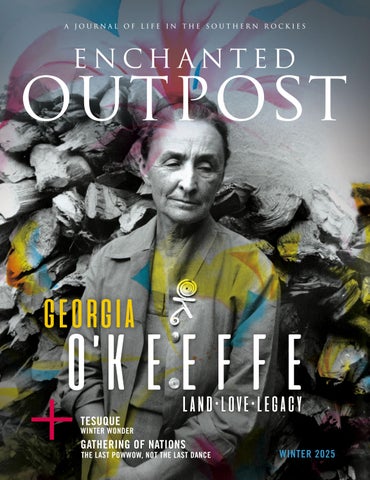
Georgia O’Keeffe, often referred to as the “Mother of American Modernism,” redefined how the world saw flowers, bones, and desert landscapes. Her bold use of form and color captured both intimacy and vastness, forever shaping the course of American art and influencing an art movement in New Mexico.
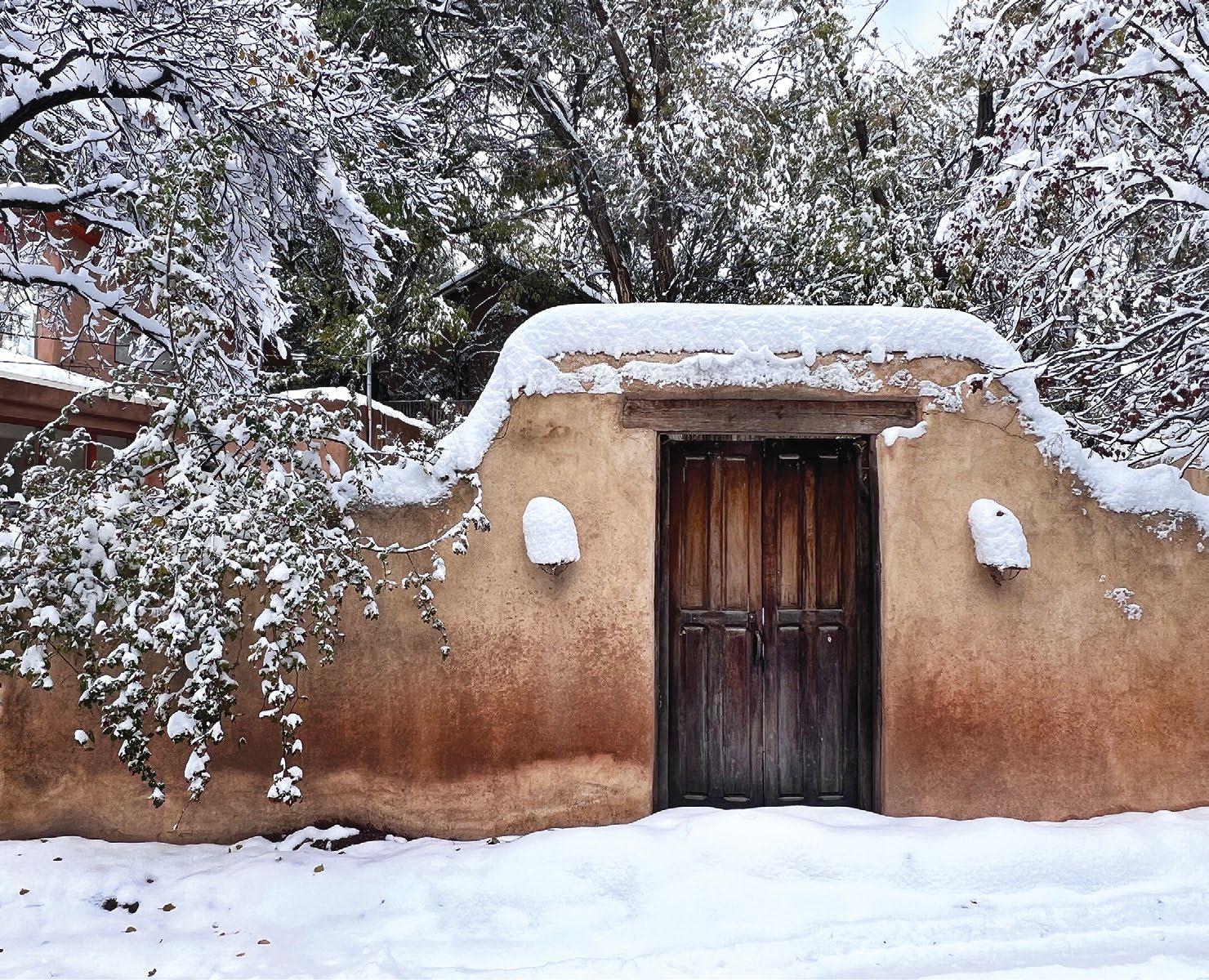
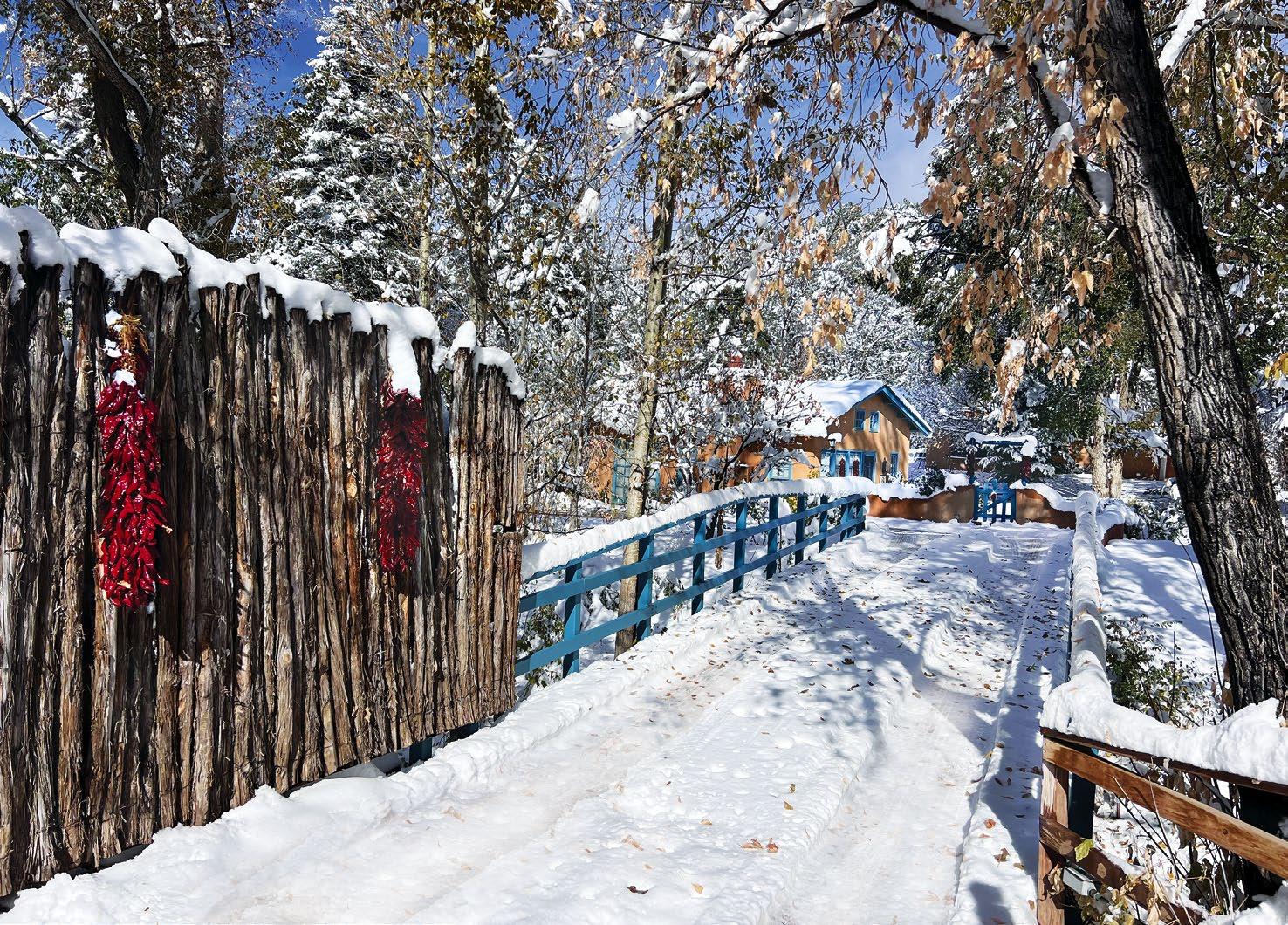
Radiating Charm Under a Blanket of Snow Nestled in the foothills north of Santa Fe, Tesuque exudes a quiet winter charm. Snow-dusted adobe homes, piñon-scented fires, and tranquil village lanes create a timeless atmosphere, where tradition, natural beauty, and serene stillness invite visitors to linger and savor.
The Last Powwow, Not The Last Dance
The final powwow of the Gathering of Nations in Albuquerque in 2026 will pulse with drumming, dancing, and spirit. Thousands will gather in unity, celebrating Indigenous culture, tradition, and resilience. Experience this culturally significant event before it fades into history.
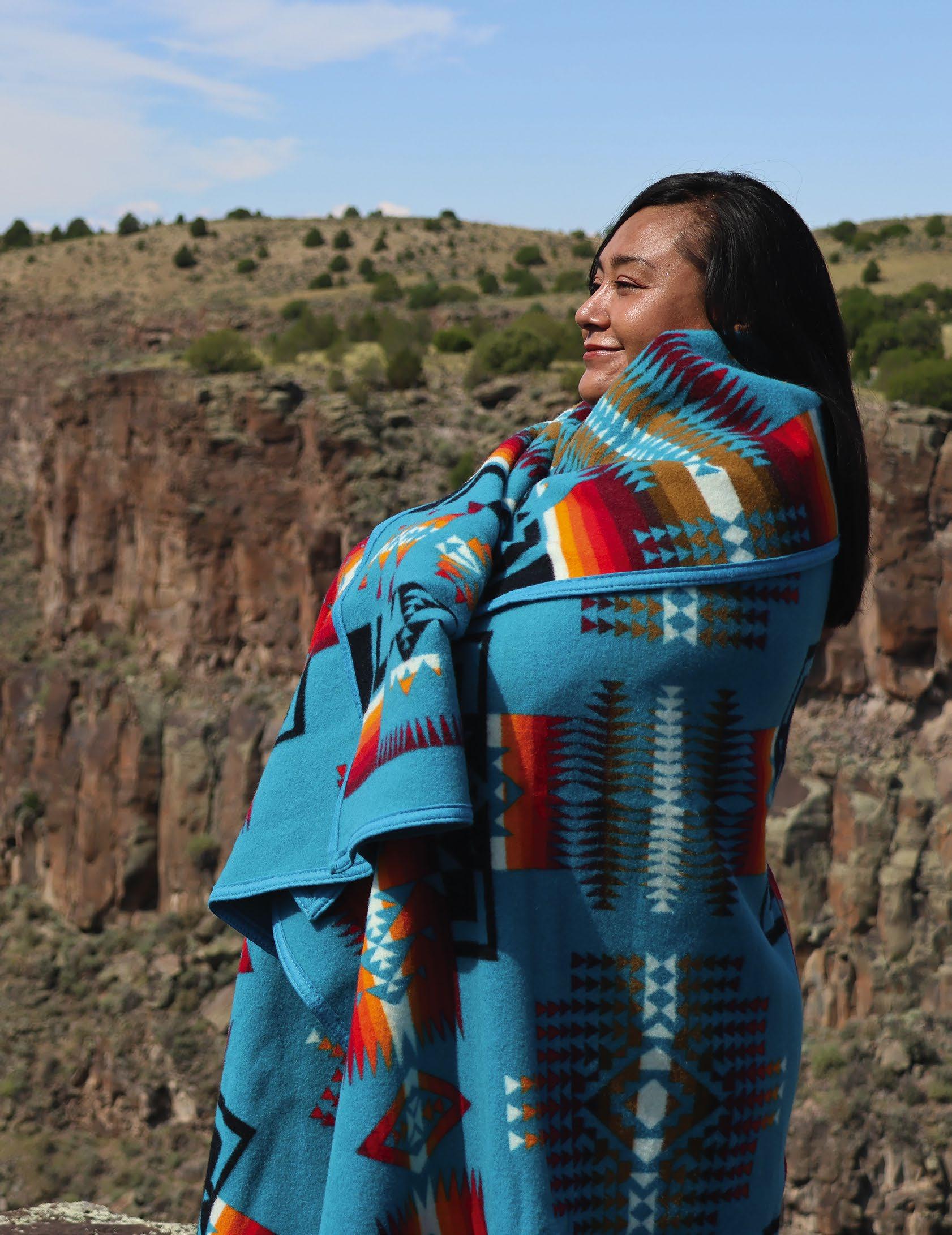
Augusta Sunshine Duran is as warm as her name, and her roots go deeper than the cottonwoods that line the streets of Taos. It’s not difficult to see how her drive to serve her community of Taos Pueblo is only eclipsed by her charming and contagious personality. We were fortunate to spend time with Sunshine to learn more about what motivates her to help create a better world.


WINTER 2025
52 Capturing the View From Here
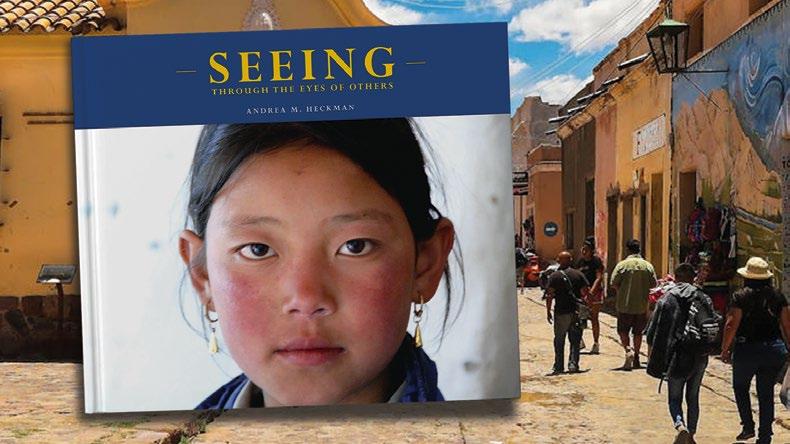
56 READ: SEEING Through the Eyes of Others
56 TOUCH: Santa Fe Bug Museum
56 LISTEN: New Mexico Wildlife Podcast
57 WATCH: Dark Winds
57 TASTE: Santa Fe Biscochito Company
58 SUPPORT: Youth Heartline
58 SIP: Watrous Coffee House
58 STAY: Mabel Dodge Luhan House
62 CALENDAR: Featured Regional Events
70 Regional Interior Design Masters
78 Voormi: The Future of Clothing
90 Sage Work Organics: An Intention of Hygge
96 The Whimsical World of Ray Renfroe
108 A Trail of Two Cities
116 Sunshine Rising
124 Chimayó: A Pilgrimage of Remembrance
132 A.R. Mitchell Museum of Western Art
136 Will James: The Cowboy Artist
146 Magical Snowshoeing Adventures
154 Bikepacking on the Outpost Grande Loop
170 Cold Rush: Race the Chama Chile Ski Classic
180 Maxwell National Wildlife Refuge
186 The Rocky Mountain Bristlecone Pine
192 A Crane Conversation: Celebrating Sandhill Cranes
201 A Last Look for the Season
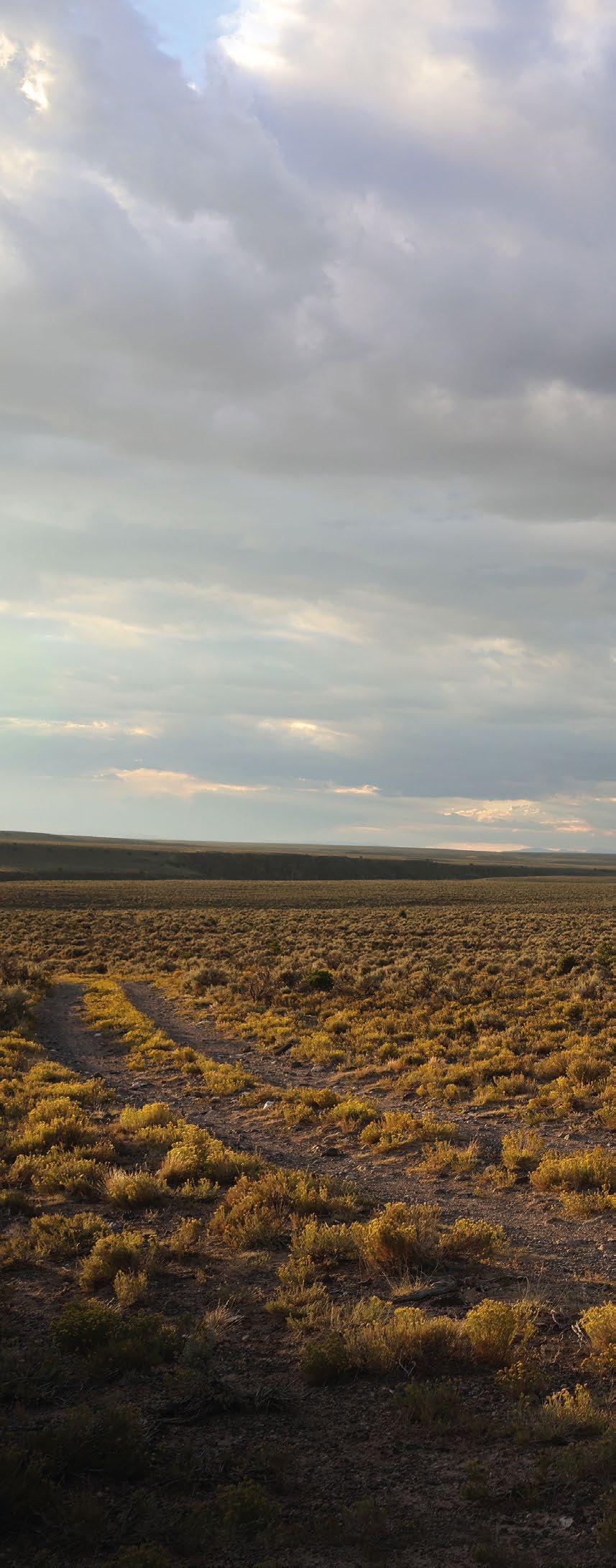
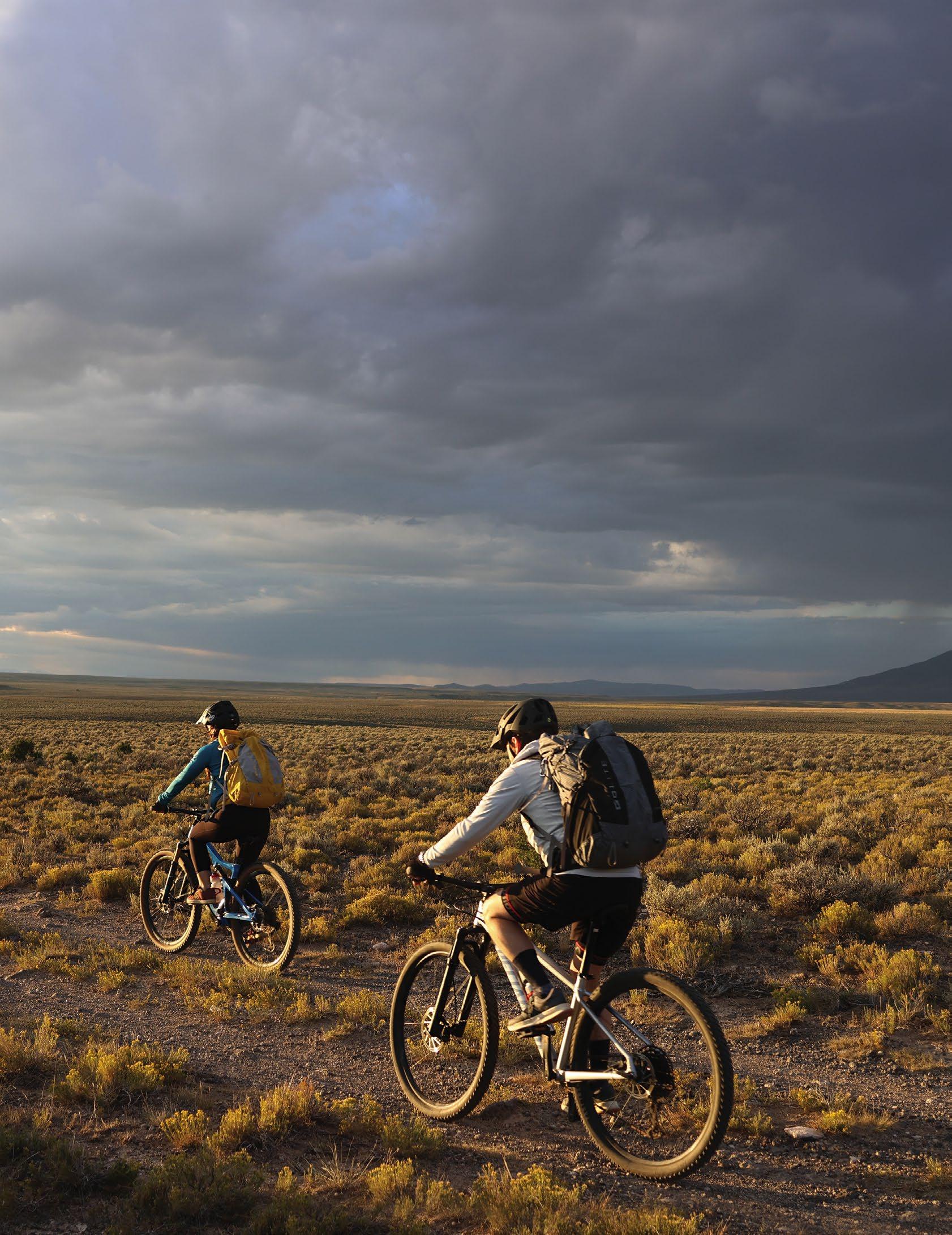
The sport of Bikepacking has grown to become a refined, international adventure travel activity. We’re tapping into this growing popular culture with the introduction of a proposed route we’re calling the Outpost Grande Loop. This outdoor adventure route has the potential to bring an entirely new, organized experience to our region and expand our adventure travel offerings to enthusiasts around the globe. Learn more and get involved. Together we can bring the OGL to the world.




A word from the publisher.
When we set out to create an upscale regional lifestyle publication, our intention was to shed light on the rich cultural tapestry, the stunning landscapes, and the colorful people who consider this region their home. But the bigger initiative was to start a movement and play a role in driving new economic prosperity to the entire region we serve.
When I decided to move to northern New Mexico, one person I spoke to commented: “I’m not sure why you would want to move there, New Mexico is poor and riddled with crime and blight.” This comment was precisely what drove me to launch Enchanted Outpost magazine.
Although public perception of New Mexico—in a positive light—is a place where Indigenous and Hispano cultures and beautiful vast desert landscapes inspire spiritual connection and exhibit true la vita dolce, it is also seen as one of the poorest states in the country. And although the governor and her team work to improve the local economy through adventure tourism, a tech movement, film industry growth, and other key initiatives, it literally takes a village to bring prosperity to a village.
North of the border in Colorado—in the region of the state that we serve—those communities have one extra thing going for them: the word Colorado. Yet from our western outpost of Pagosa Springs eastward, we see vastly underserved communities. Towns like Walsenburg, Alamosa, and Trinidad work hard to bring visitors to spend money, but their efforts can only go so far.
We mostly receive rave reviews about the magazine and praise for our efforts. Public consensus leans heavily toward Enchanted Outpost being a “breath of fresh air.” Most municipalities in our region recognize what we’re attempting to do and support us however they can.
Yet, there are still people who strongly oppose the exposure we are generating. To them I say this: No matter what you do to attempt to stop the evolution of something, your attempt to stop it is still evolution. Things always move. Even successfully stopping development is an evolutionary change over time. Backwards is still forward evolution—eventually stagnating a community to the point where no businesses can survive. If you are a business owner here or provide a service, you likely love momentum. If not, maybe there’s a disconnect in understanding the dependency business owners have on more than local traffic. Because of that disconnect I can understand the initiative to stop or slow evolution. But that will only lead to the closing of the businesses that serve you. The world is changing exponentially. In a matter of a few years—whether acknowledged or not—technology and environmental issues will evolve every corner of the planet. Change is coming everywhere. Choose to fear change or embrace it.
There are three kinds of people: critics, talkers, and doers. It probably goes without saying that Heather and I are both talkers and doers. We talk the talk, and then walk the walk. We roll up our sleeves, put our heads down, and execute the things we set out to achieve.
We’ve spent countless hours speaking face-toface with hundreds of business owners across the more than forty communities we serve. We deeply understand the challenges real local people here face. Set aside the retired folks for a moment. Set aside the second home owners for a bit. The people here who are driven to create livelihood depend almost entirely on traffic through the door of their business, typically more so from visitors than locals. These are the people that connect our hearts
“I’m not sure why you would want to move there, New Mexico is poor and riddled with crime and blight.”
“This
comment was precisely what drove me to launch Enchanted Outpost magazine.”
to the region—the people who create the allure and ultimately the region’s identity. Through our conversations we understand, while they are deeply concerned about preserving a cultural identity, they also desire prosperity.
Prosperity to them is a consistent stream of customers, enough to maintain a simple yet comfortable life.
So, we set out to influence the inevitable evolution toward cultural preservation and respect while also driving economic prosperity. Our purpose is to bring to the surface as many hidden gems as we can—to showcase and honor the inspiring yet humble people who truly shape our culture. We believe in putting new businesses in empty buildings. We’re driven to blur the lines between high seasons and shoulder seasons. We’re motivated to disperse people from the economic centers people visit—like Santa Fe—into the smaller communities that equate to the full essence of our region. We’re here to harness the incredible momentum the City of Santa Fe has achieved to help all communities prosper.
Evolution is inherent. With every page of every issue of Enchanted Outpost, we’re choosing to influence that evolution toward real regional economic prosperity while inspiring cultural and environmental respect. With more than half a million estimated readers across our print and digital magazine, and countless comments of praise from both regional visitors and local readers alike, we believe we are achieving our mission.
Scott Leuthold PUBLISHER & COFOUNDER

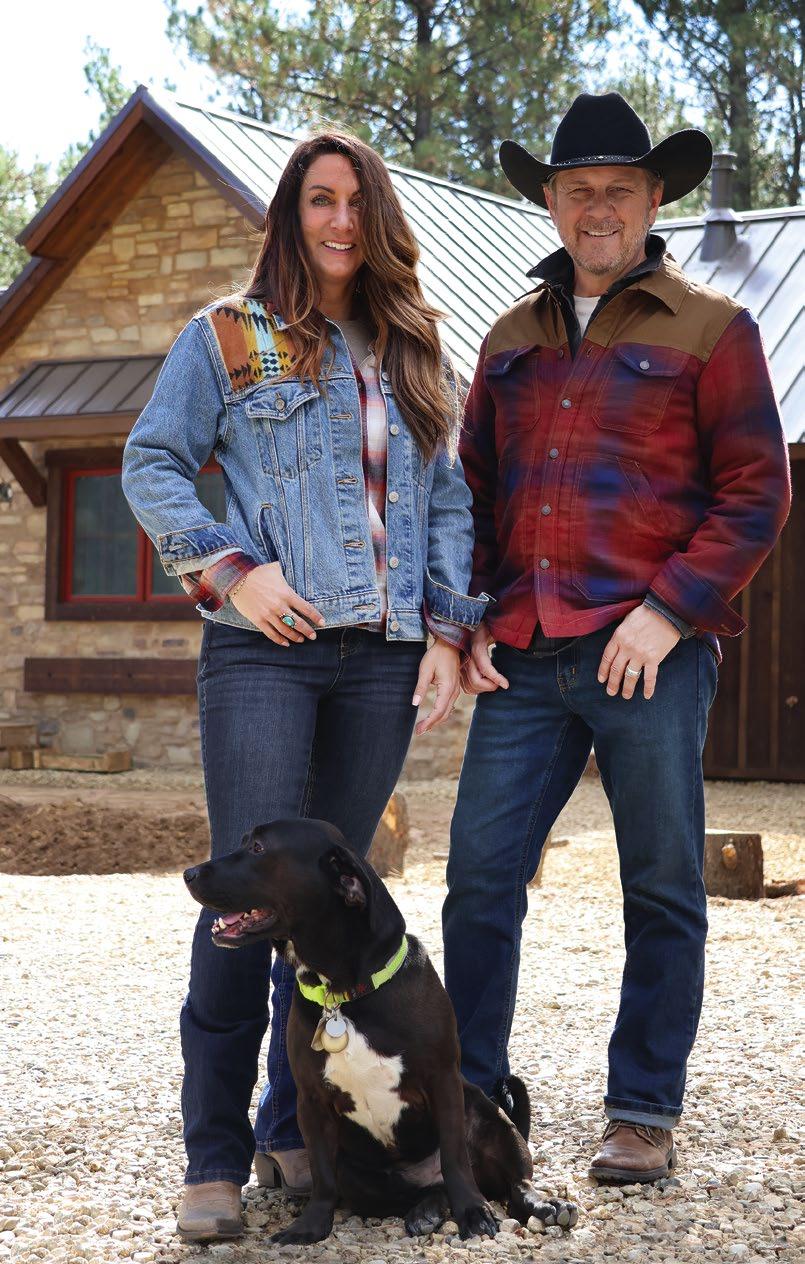


Publishers and Cofounders
Scott and Heather Leuthold
Creative Director and Lead Designer Scott Leuthold
Copy Editor
Lauren Wise Wait
Advertising Sales
Collin Leuthold, Director of Sales advertise@enchantedoutpost.com
Distribution and Subscriptions
Ahnna Swanson, Director of Distribution distribution@enchantedoutpost.com
Photographers
Sarah McIntyre, Daniel Combs, Page Steed, Roland Pabst, Daniel Quat, Dustin English, Michael Candelaria, Scott Leuthold, Heather Leuthold, Collin Leuthold, Yellowstone Art Museum, Georgia O’Keeffe Museum, A.R. Mitchell Museum, and Library of Congress
To leave comments, make suggestions, or report errors, please complete the contact form on our website.
Visit us on-line at: enchantedoutpost.com
Enchanted Outpost is distributed through a variety of outlets in northern New Mexico, southern Colorado, and Texas and by mail through subscription service.
OUTPOST ALLIANCE, LLC and Enchanted Outpost PO Box 1650, Angel Fire, New Mexico 87710
©2025 Outpost Alliance, LLC. All rights reserved.
No part of this publication may be reproduced, distributed, or transmitted in any form or by any means, including photocopying, recording, digital scanning, or other electronic or mechanical methods, without the prior written permission of the publisher, except in the case of brief quotations embodied in critical reviews and certain other noncommercial uses permitted by copyright law. For permission requests, please complete the contact form on our website.
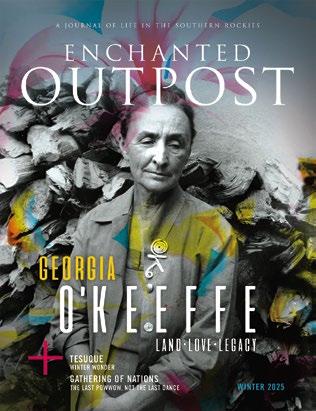
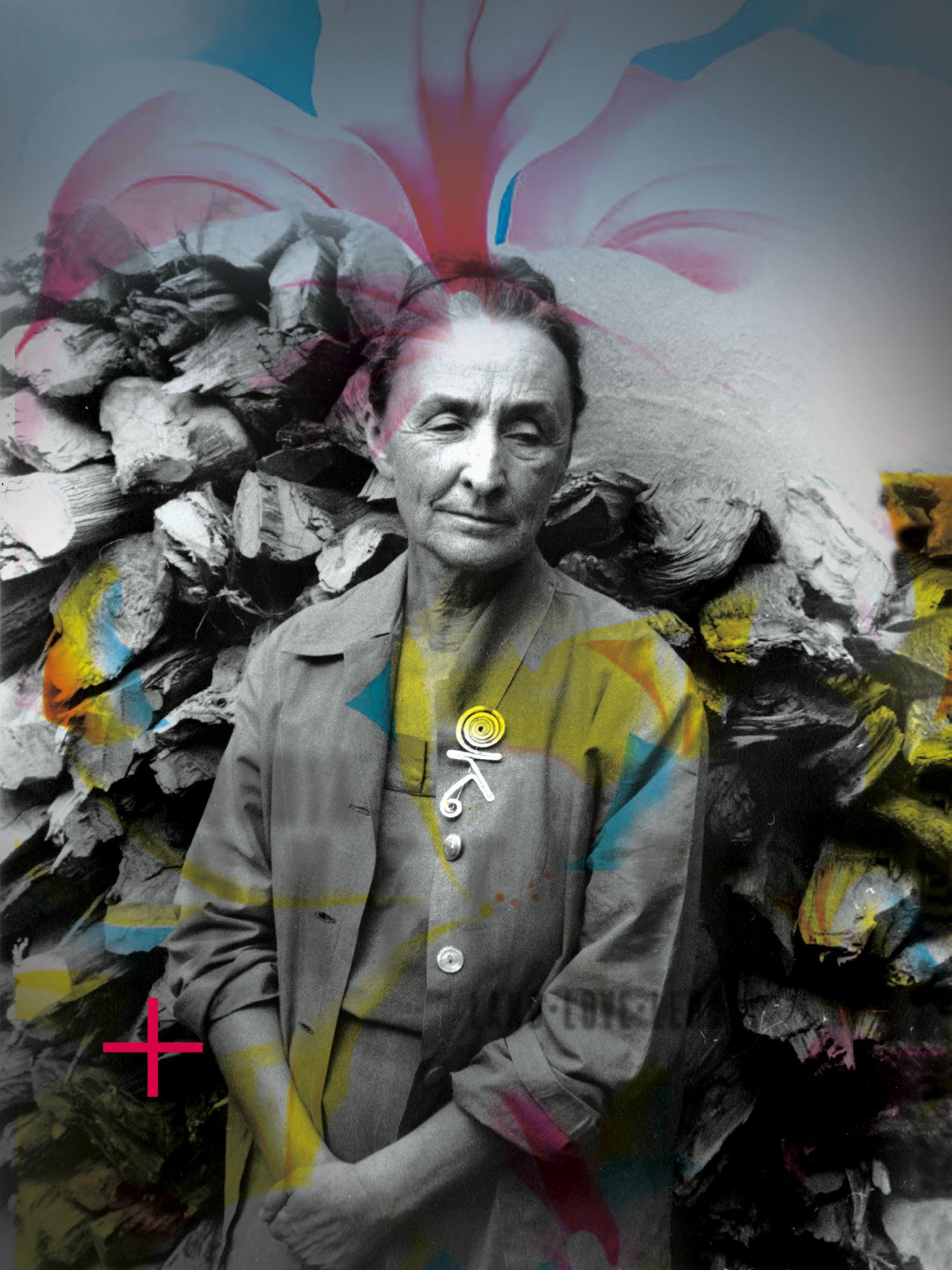
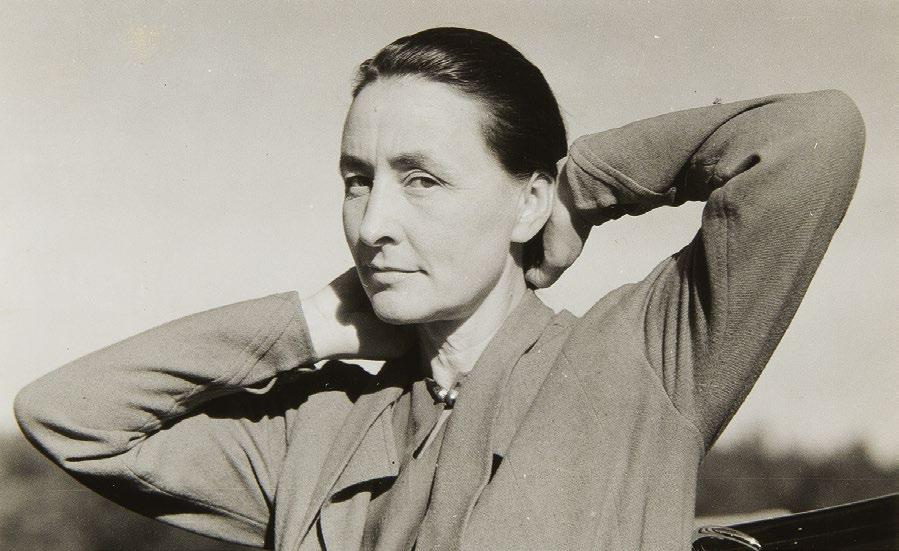
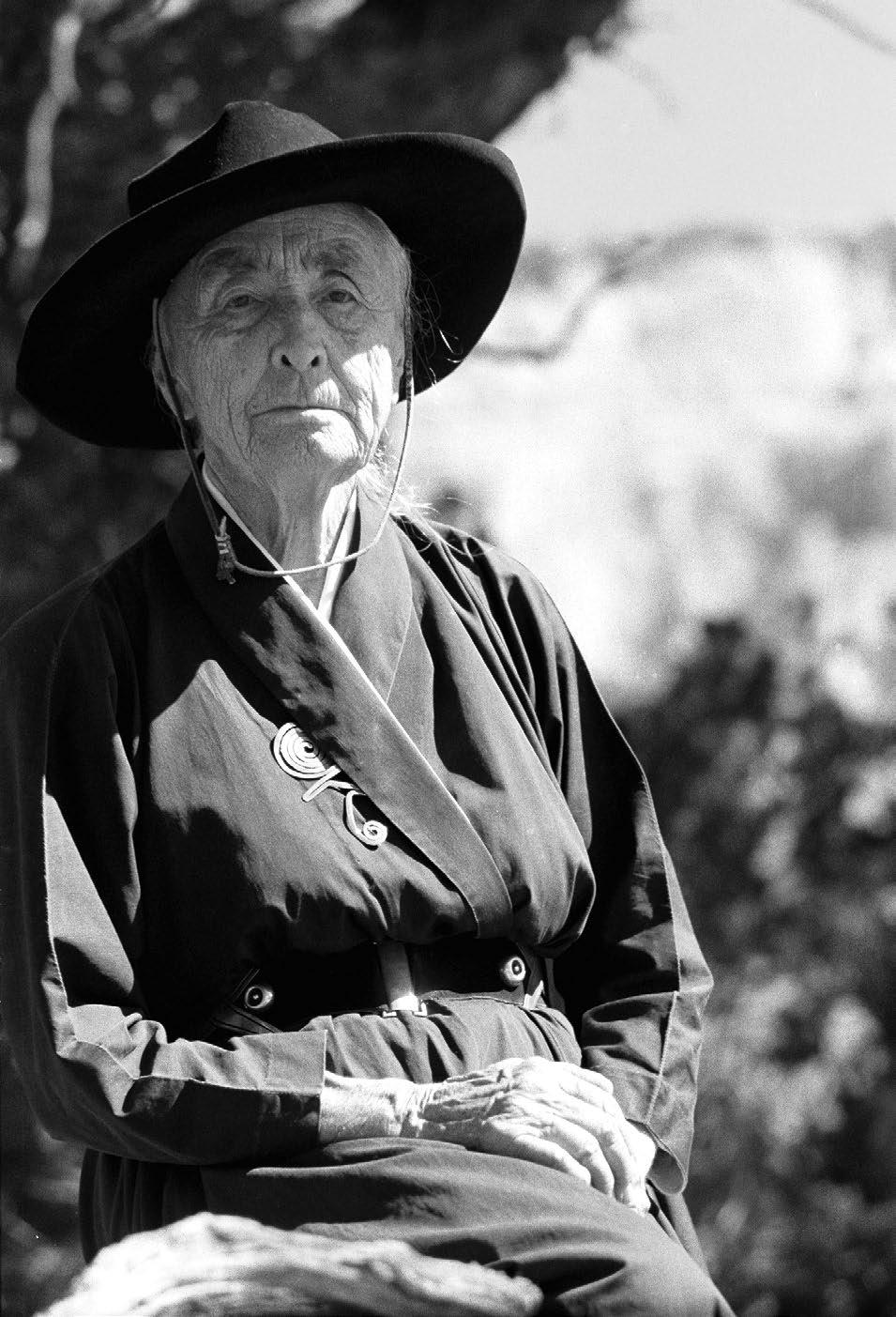
Georgia O’Keeffe, photographed at her home in Abiquiú, New Mexico in 1950, was a prolific artist and transformative figure who significantly influenced New Mexico’s art culture.
PHOTO: Carl Van Vechten/ Library of Congress. Edited by Scott Leuthold with permission from Logan Esdale, Carl Van Vechten Trust.
Lisa Ragsdale
Lisa is a freelance writer living in Albuquerque, New Mexico. She loves being outdoors, hiking, backpacking, paddle boarding, and spending as much time as possible at her family’s property in the mountains near Angel Fire, New Mexico.
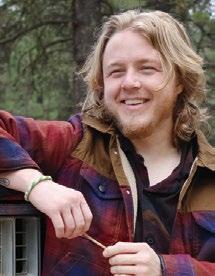
Collin Leuthold
Collin is a creative individual with a passion for music, short film production, vintage cameras, old cars, and outdoor adventure. Originally from Scottsdale, Arizona, and a graduate of Grand Canyon University, he now resides in Angel Fire serving as a Director of Enchanted Outpost Magazine.

Lauren Wise Wait
Lauren is an Arizonabased writer and editor who believes every great story has the power to connect and inspire. Her work has been published by VICE and LA Weekly. She loves to cook, travel, and teach her young son about desert critters and plants.
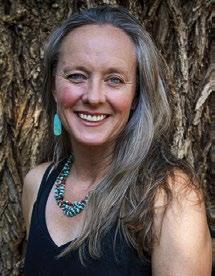
Shelli Rottschafer
Shelli lives in El Prado, New Mexico and Louisville, Colorado with her partner, photographer Daniel Combs, and their Pyrenees-Border Collie. She completed her doctorate in Spanish from the University of New Mexico, Albuquerque (‘05) and her MFA in Creative Writing from Western Colorado University, Gunnison (‘25).
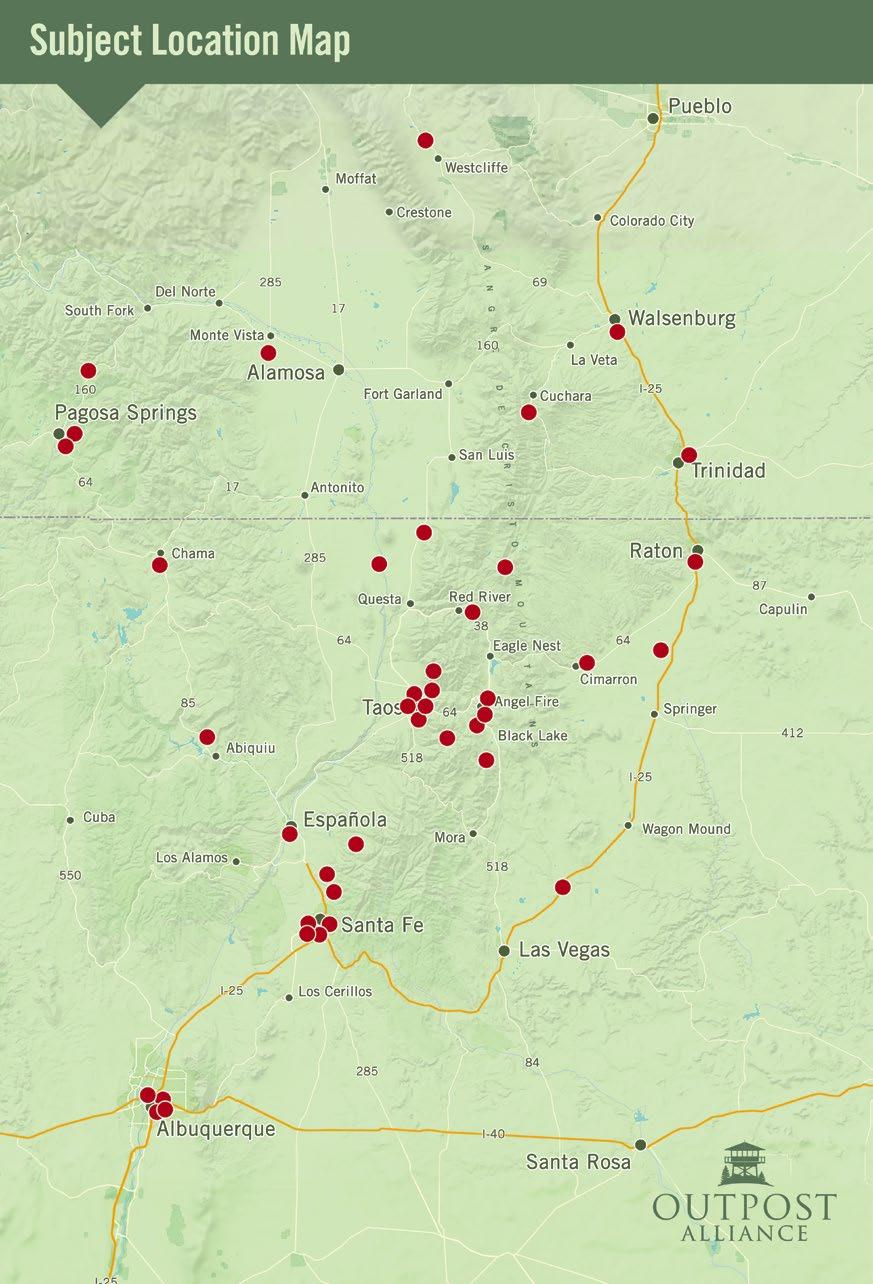
Our content and distribution region spans the state border and covers Pagosa Springs, Colorado east to Trinidad, Colorado and from Pueblo, Colorado to Albuquerque, New Mexico.
The locations of our subject matter in this issue of Enchanted Outpost are shown on the map to the right, illustrating our commitment to delivering unique stories from the 40+ communities we serve.
As an upscale, regional lifestyle magazine, we strive as a publisher to optimize our engagement with readers. To do so, you will discover opportunities with many of our articles to utilize your smartphone to extend the reading experience with interactive content. We employ the use of QR Codes to streamline the process of opening website links. As of the date of publication, all QR Codes resolved to their respective destination URLs.

QR Codes are easily read by most current model smartphone cameras. To read a QR Code, open the camera app on your phone. Point the camera at the QR Code. Your smartphone will recognize the code image and offer a link on the camera screen that you can tap with your finger. Doing so will open the website address in your smartphone browser. For further instructions, please refer to the owner’s manual of your mobile device.
We continually strive to improve the reading experience of our magazine with a goal of being the best regional lifestyle magazine in the country.
New Features:
• Added Guest Writer Contributors
• Added STAY to Waypoints
• Redesigned the interactive content areas of the articles.
• Improved maps
How one artist referenced the Southwest for then and now
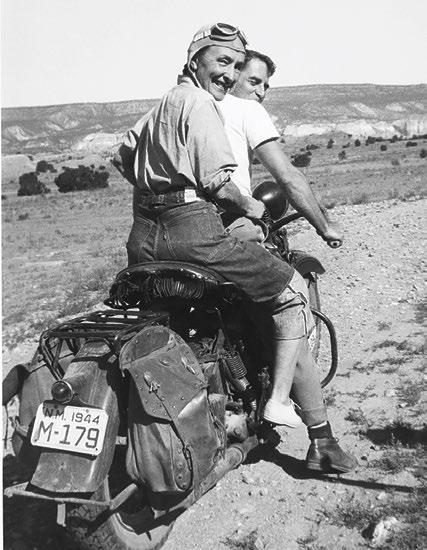
On a summer night in 1929, Georgia O’Keeffe lay flat on her back beneath a towering ponderosa pine at the D.H. Lawrence Ranch in Taos. She looked to the branches arched overhead like cathedral ribs, framing a scatter of New Mexico stars. Instead of sketching the postcard mountains beyond, she tilted her gaze upward, capturing the limbs as they stretched into the night sky. The resulting painting, The Lawrence Tree, was radical not because of what it showed, but how it showed it: a ground-level perspective that transformed an ordinary tree into something cosmic. It married abstraction and reverence and was a literary nod as well:
D.H. Lawrence had written beneath that very tree.
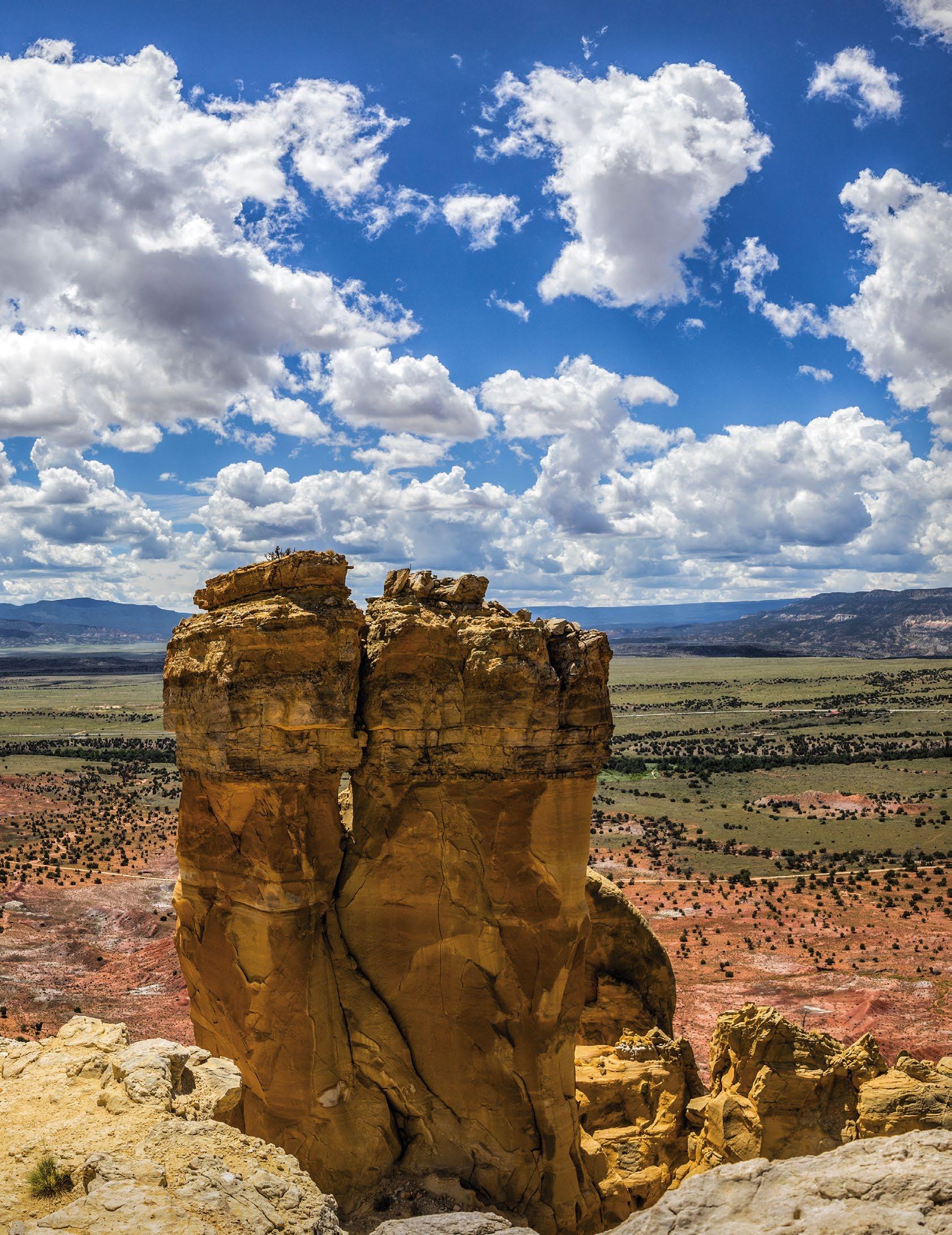
This shift—cropping, enlarging, editing the land into intimate fragments— became O’Keeffe’s signature. Her artistic language was born not from theory but from place: the red cliffs of Ghost Ranch, the white stone of Plaza Blanca, the adobe walls of Abiquiú, the flat crown of Cerro Pedernal. O’Keeffe didn’t just modernize the Southwest; she mapped a new way of seeing it, transforming land into language. As she once famously said: “I found I could say things with color and shapes that I couldn’t say any other way—things I had no words for.”
Born in 1887 to a dairy farming family in Wisconsin, O’Keeffe announced by
age ten that she wanted to be an artist. By her early twenties, after studying at the Art Institute of Chicago as well as in New York, O’Keeffe ran headlong into the stiff, rule-bound curriculum of art academies at the turn of the century. She stepped away from painting, believing she would never distinguish herself, and became a commercial artist.
Her creative rebirth came unexpectedly in 1912, during a summer course at the University of Virginia. There, she encountered the teachings of Arthur Wesley Dow, a proponent of Japanese aesthetic principles. Dow emphasized composition, line, and harmony—a dramatic shift from copying nature to interpreting it. Under his influence,


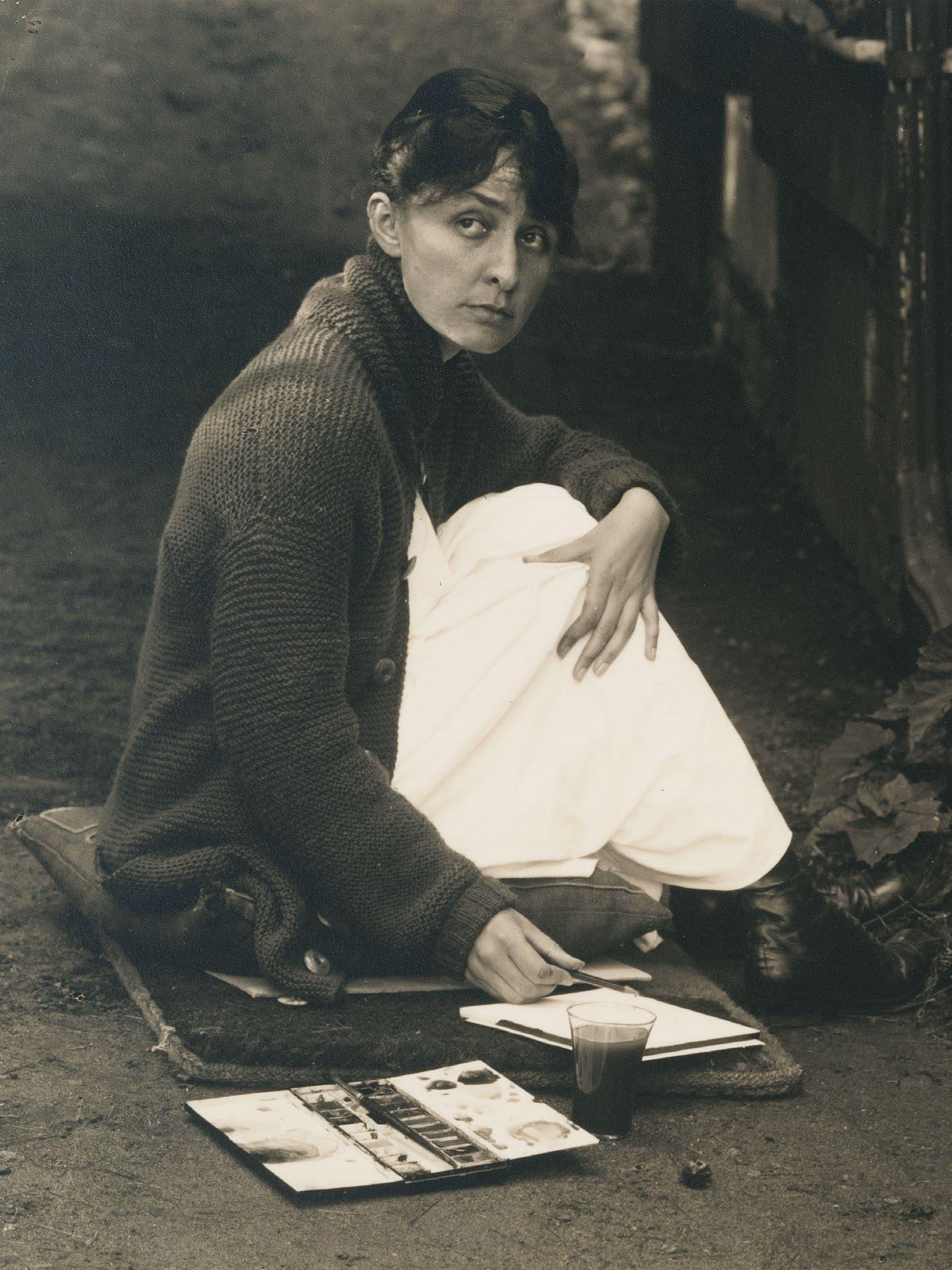
O’Keeffe began producing abstract charcoal drawings, and developing her unique style with watercolors.
In 1915, she sent a series of these drawings to a friend, Anita Pollitzer, who showed them to Alfred Stieglitz, a photographer and New York gallery owner. Stieglitz immediately recognized their brilliance, displaying them at his 291 Gallery. Stunned and intrigued, O’Keeffe confronted him for showing her work without permission but allowed the pieces to remain. It was a curious case of love at first sight.
The two kept in touch for two years while she taught at a Texas college, evolving from mentor/protégé to creative partner; O’Keeffe painted some of her most celebrated early watercolors during this time, including her iconic
Evening Star series and Abstraction, which evoke the starry Texan sky. She moved back to New York to marry Stieglitz in 1924, which spurred the start of her liberation into a modern woman and media personality: Fueled by the sensuous nude photographs of O’Keeffe that Stieglitz had taken and exhibited in 1918, her famous flower paintings were often interpreted and sensationalized as sexual metaphors, linking her sexuality and art.
But these flower paintings were also the early signs of her lifelong artistic mission: to find and depict the essential truth of a subject, pared down to form, color, and feeling. Her paintings were not records of what she saw, but equivalents for what she felt.
Through Stieglitz, she met a circle of
“I’ve been absolutely terrified every moment of my life and I’ve never let it keep me from a single thing that I wanted to do.”
—GEORGIA O’KEEFFE
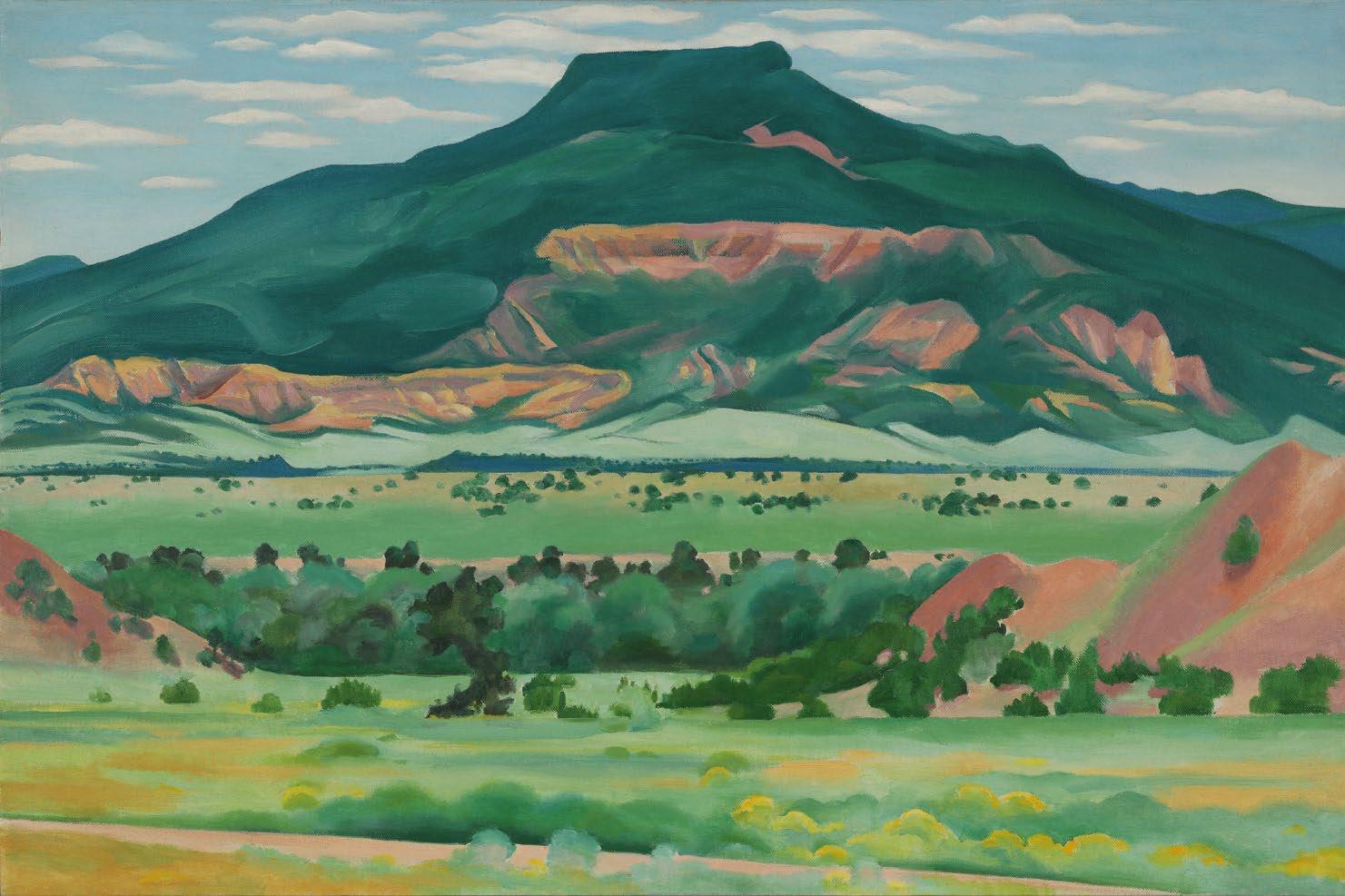
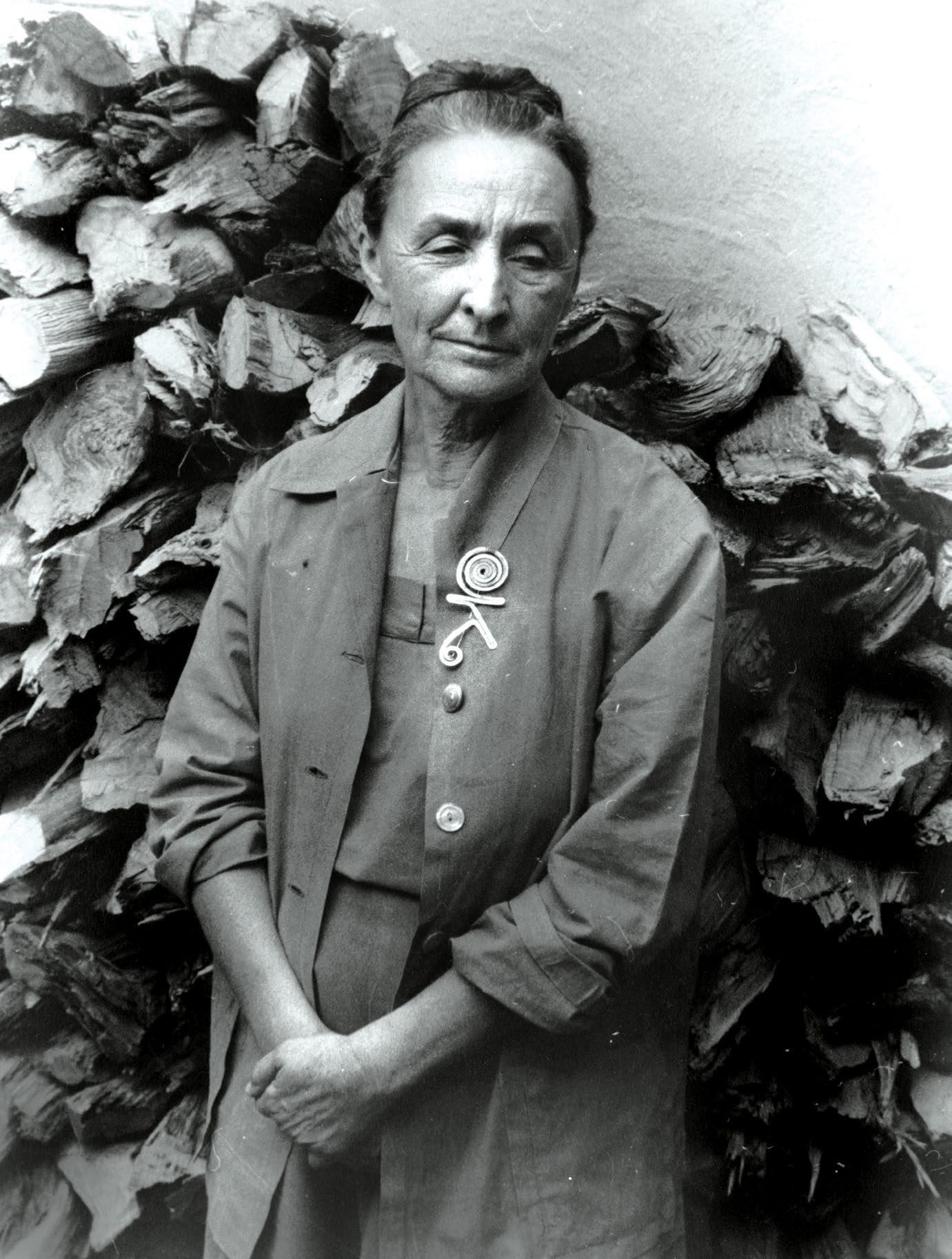

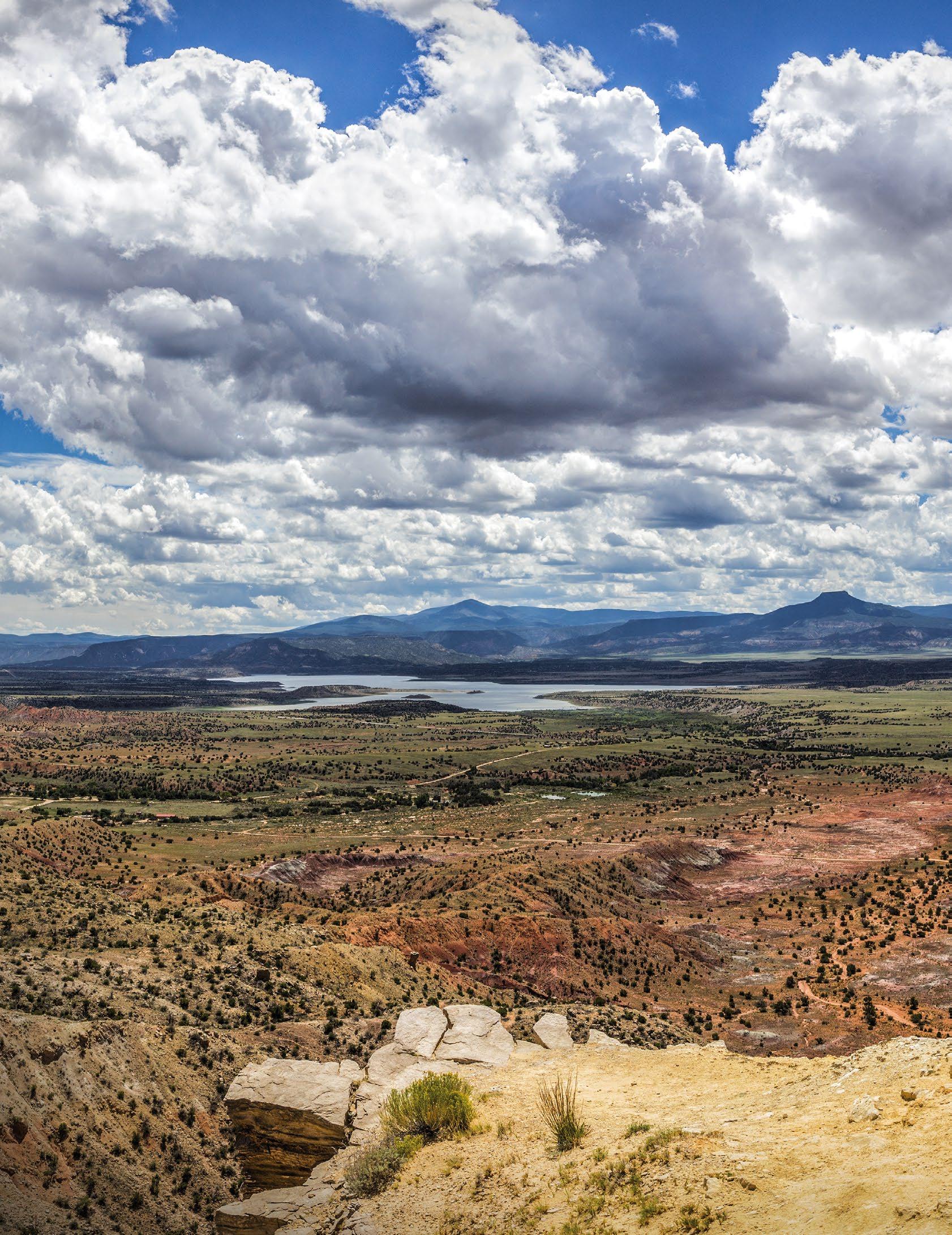
American modernists who influenced her trajectory, but New York’s buzzing art scene never satisfied her. By the late 1920s, O’Keeffe was restless. Then the invitation that changed her life came from Taos patron Mabel Dodge Luhan, who routinely hosted a salon with writers and artists—a patronage without creative control. In 1929, O’Keeffe arrived with her friend Rebecca Strand, stayed in Luhan’s studios, and quickly
became enchanted with the land. The high desert, with its raw beauty and vast spaces, resonated with something deep within her.
At that time in New Mexico, the dominant artistic gaze was panoramic and romanticized. The Taos Society of Artists painted sweeping, sun-drenched vistas in the European realist tradition. But O’Keeffe took a different path, zooming in. Her canvases became
portals into a distilled world of flower centers, cloud formations, and adobe doorways. With each brushstroke, she told us that the spiritual essence of the desert could be found not in its grandeur, but in its details.
This edit of the land—this refusal to romanticize it—allowed her to turn mesas into minimalism, cliffs into color fields. In the process, she made the Southwest a key site of American modernism.
She painted the San Francisco de Asís Mission Church at Ranchos de Taos not in its entirety, but in cropped, minimal forms. The massive adobe structure became an abstract curve against a brilliant sky. She explored the ancient adobe of Taos Pueblo and discovered the morada of the Penitente brothers— all of which would become recurring motifs in her art.
Although she returned to New York after that first summer, O’Keeffe came back to New Mexico nearly every year, staying for longer periods each time. The desert wasn’t just a temporary escape. It was becoming her true home, and Luhan’s salons offered O’Keeffe access to a Western network and coastal tastemakers.
But what appealed to her most was the isolation. A loner by nature, she sought places where she could exist alone with her thoughts and paints. Ghost Ranch, north of Abiquiú, called to her.
By 1934 she staked her claim to a small house at Ghost Ranch surrounded by red and yellow cliffs. Later she acquired a crumbling adobe in Abiquiú. She spent years restoring it, eventually transforming it into a winter home and studio. The structure itself, with its clean lines and earthy textures, became a subject in her work. By 1949, after Stieglitz’s death, she left New York and made northern New Mexico her permanent home.
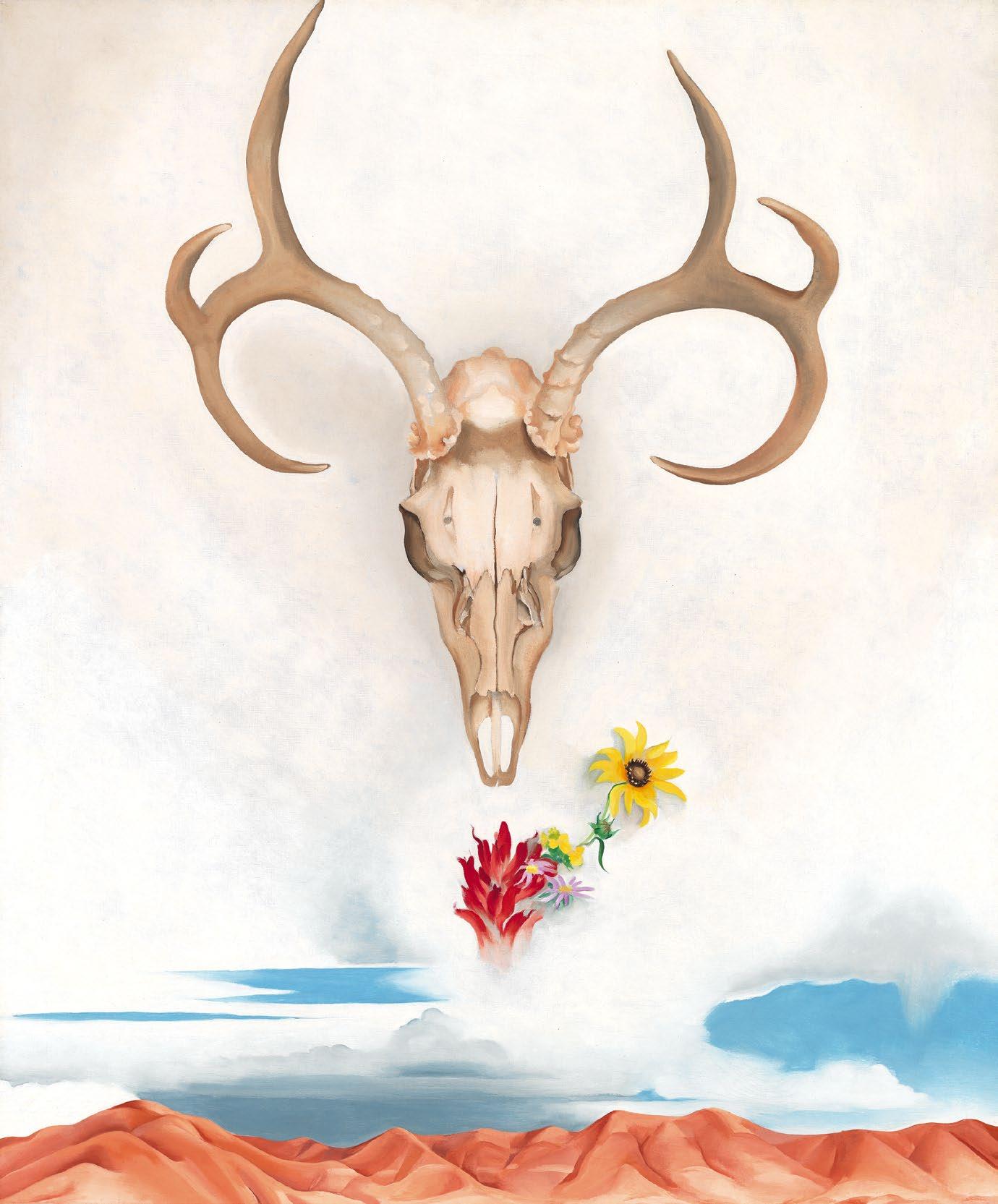
She roamed the land in her Model A Ford that she’d purchased and learn to drive in 1929, gathering bones, rocks, and dried flowers. These became central to her paintings. Summer Days (1936) features a deer skull suspended in the sky above a desert horizon dotted with wildflowers. These floating forms were not surrealist tricks but spiritual compositions—altars to the land’s mortality and mystery.
In the 2020s, her work feels startlingly current. In a world of digital overload and climate anxiety, her art invites us to slow down, to notice, to reconnect with the physical world.
Her landscapes from this period are among her most iconic. She once explained about the New Mexico landscape, “Such a beautiful, untouched, lonely feeling place, and such a fine part of what I call the ‘Faraway.’ It is a place I have painted before … even now I must do it again.”
Red Hills with Pedernal, the Black Place, and the White Place series showcase her mastery of simplification. The flat-topped Pedernal became her mountain—“God told me if I painted it enough, I could have it,” she said. She began making the architectural forms of her Abiquiú house subjects in her work and worked with photography, providing striking counterparts to her patio and door paintings. And over the years, she received many distinguished visitors at Ghost Ranch, including Charles and Anne Lindbergh, Joni Mitchell, and Ansel Adams. Her influence radiated outward. For
landscape painters, she legitimized abstraction, proving that cropping and simplification could express land more powerfully than realism. For a culture eager for myth, she helped reimagine the desert as a landscape not of scarcity but of revelation. And for women, O’Keeffe became proof that a woman could be both modernist and rooted in place. She broke free of strict gender roles and adopted gender-neutral clothing. Artists like Agnes Martin and Judy Chicago drew from her example, and a generation of women found the freedom to create in New Mexico. O’Keeffe had, by chance, arrived through a salon door opened by Luhan, and stayed because the land kept talking.
Santa Fe and Taos have become global art centers, in no small part due to O’Keeffe. Her presence drew attention, collectors, and curators. The Land Art movement of the 1960s and 1970s—with works like Walter De Maria’s The Lightning Field and Nancy Holt’s Sun Tunnels—extended her belief that the desert could be a cosmic canvas, sharing her view of land as sacred, stripped-down, and symbolic. Contemporary artists such as Yayoi Kusama and Cynthia Daignault continue the conversation she started. Today, the Georgia O’Keeffe Museum in Santa Fe serves as both a shrine and a springboard, a place where her legacy continues to inspire new generations.
In the 2020s, her work feels startlingly current. In a world of digital overload and climate anxiety, her art invites us to slow down, to notice, to reconnect with the physical world. O’Keeffe asked (and still asks us) questions that matter: What does land mean? How do we live with it, not just on it? How does place shape who we are?
Her final decades were spent in near solitude in Abiquiú. Even as macular degeneration dimmed her eyesight
in the 1970s, she continued to draw, relying on memory and sensation. She passed away in 1986 at the age of 98. Her ashes were scattered at Ghost Ranch, the land she had made her own.
Ghost Ranch today is a 21,000-acre education and retreat center, where spiritual development and environmental stewardship converge. The logo, adapted from an O’Keeffe drawing, appears on T-shirts and signage. Her shadow is everywhere—not as a ghost, but as a guide. Today, artists still pilgrimage to her homes, study her work, and stand before the Pedernal, seeking the stillness and clarity that O’Keeffe found in the New Mexico desert.
Georgia O’Keeffe didn’t just paint the American Southwest—she reimagined how we see it. In doing so, she shifted the Southwest from backdrop to subject, from setting to spiritual core. Her artistic language of spare color, negative space, and off-center scale was born of place: Ghost Ranch, Abiquiú, Plaza Blanca, Cerro Pedernal. These weren’t just where she lived. They were her muses, collaborators, and finally, her legacy.
Nearly a century later, she still teaches us how to see. t
Learn more about Georgia O’Keeffe
Visit the Georgia O’Keeffe Museum to experience more.
Online: okeeffemuseum.org

Online: ghostranch.org






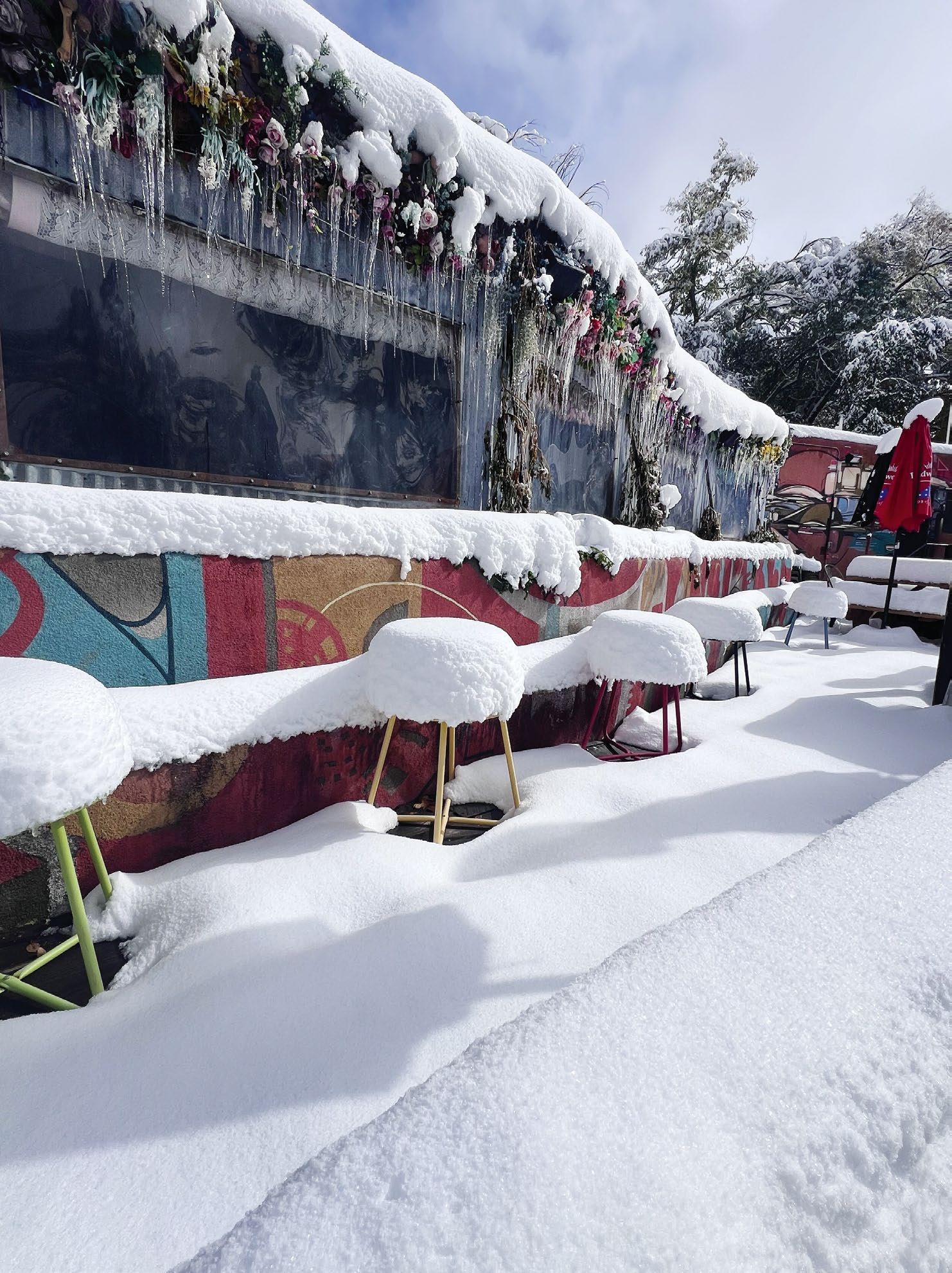
bakery counter, and coolers filled with unique items. In warmer weather, the outside patio offers umbrella-covered tables. Today, however, they are covered in a thick layer of snow, balanced atop like giant marshmallows.
Next door, visitors can wander through the sculpture garden at Glenn Green Galleries. This unique interactive art experience set among a stunning, lush oasis is a must-visit for those walking the area.
At the intersection of Tesuque Village and Bishops Lodge Roads, foodies can discover an eclectic pair of dining establishments: El Nido, an open-fire
Italian eatery, and Su Sushi, a specialty sushi dining experience. Other offerings farther south on Bishops Lodge Road include Tesuque Glassworks—a glass art studio and gallery established in 1975—and the reputable Santa Fe Institute—an educational institution offering undergraduate and graduate Complexity Science Research residency programs. These enrich the village with both creative and intellectual appeal.
Two of the finest luxury hotels in Santa Fe are nestled in the foothills of the Sangre de Cristos surrounding Tesuque Village. The Four Seasons Resort Rancho Encantado Santa Fe, located
north of the village along NM 592, and Bishop’s Lodge, located south of Tesuque toward Santa Fe along Bishops Lodge Road, both offer luxury accommodations and unique adventure-oriented activities for guests.
Tesuque becomes a painting, sepia dreams stitched with ivory thread.
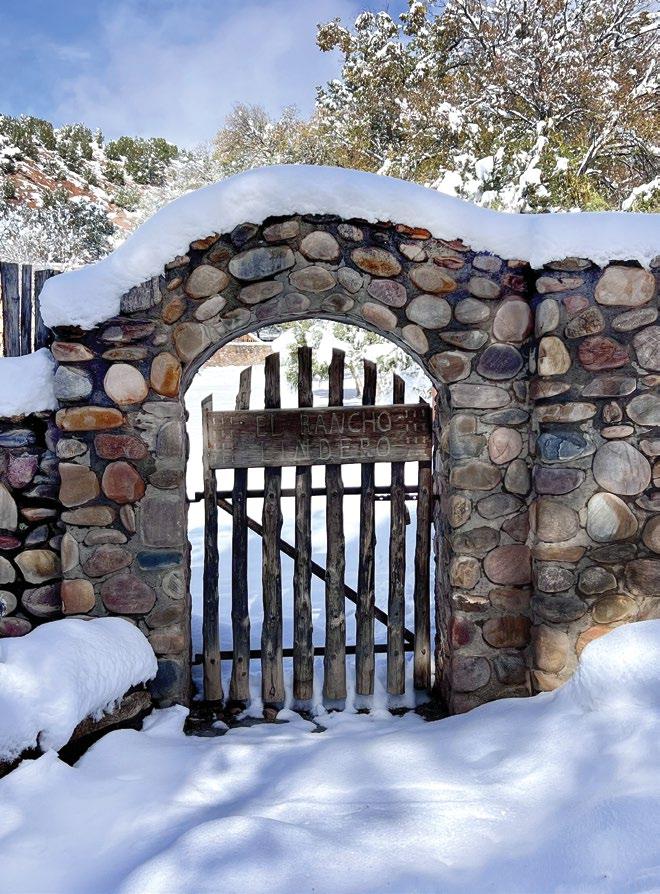
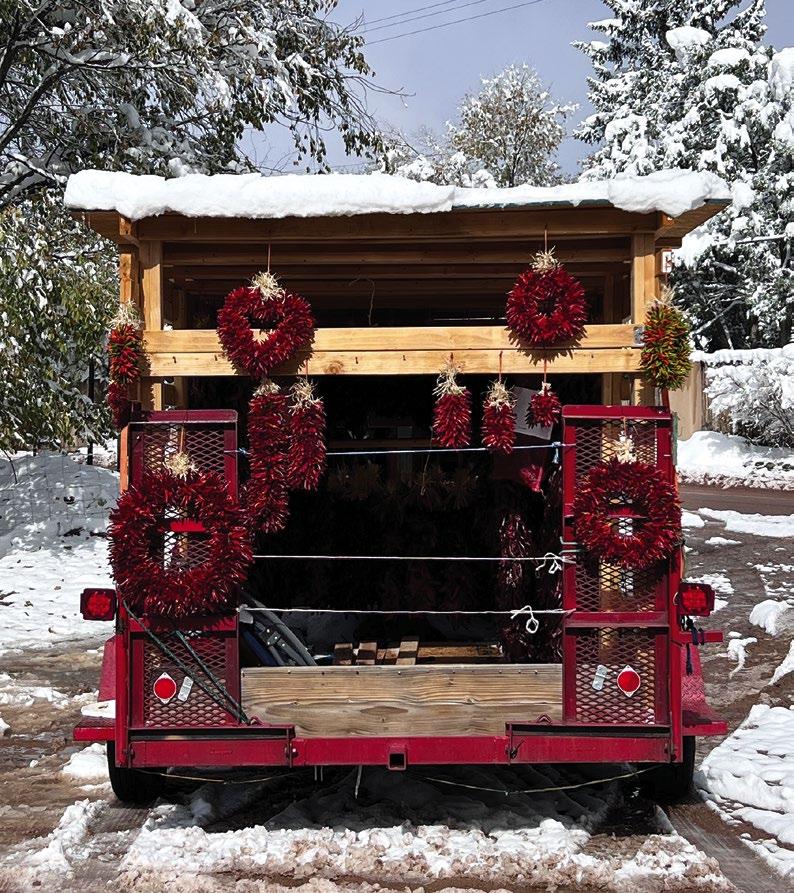
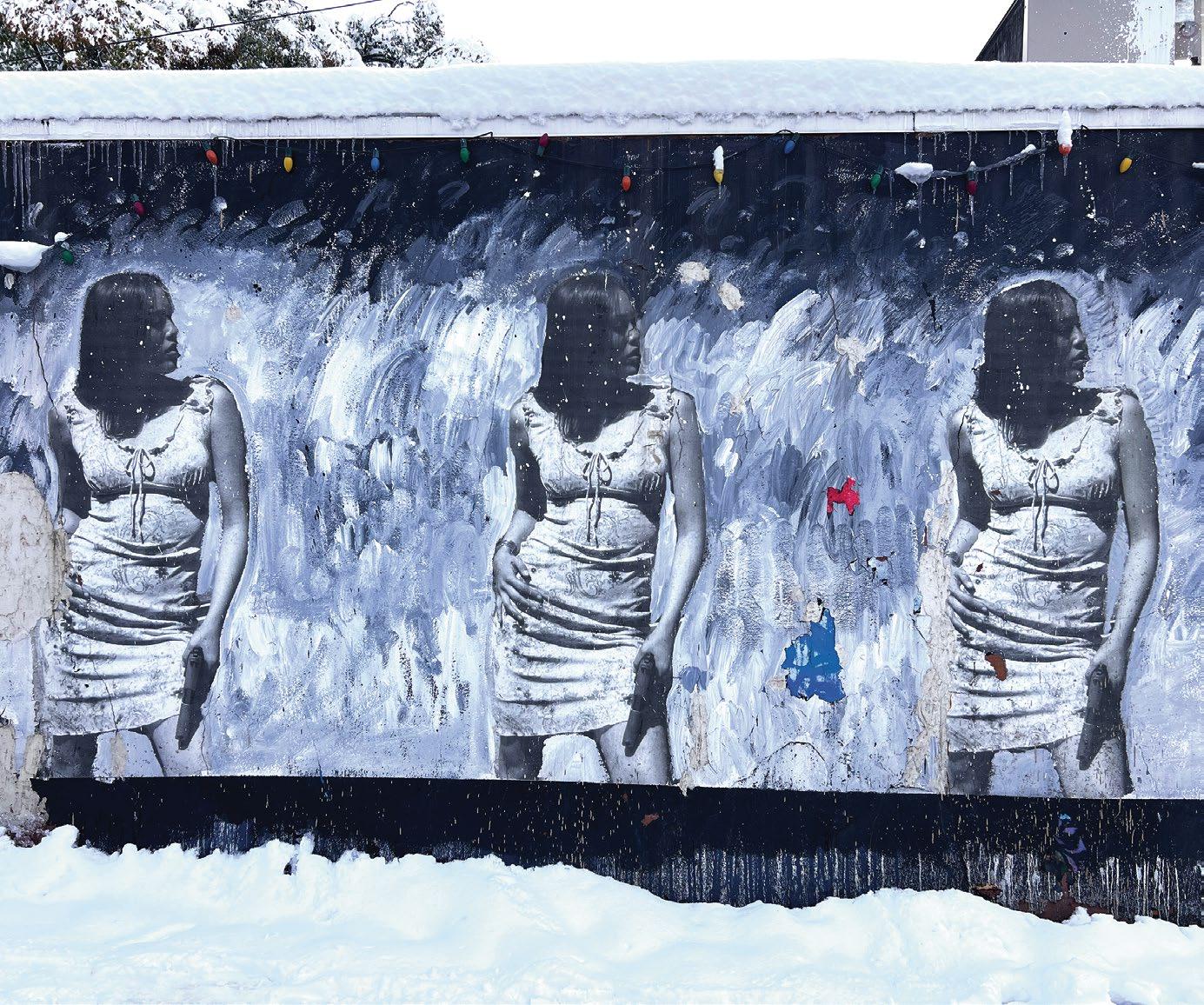
The nearby Pueblo of Tesuque (for which the village is named) has a long history in the region. Tesuque is a Spanish variation of the traditional Tewa language name for “village of the narrow place of the cottonwood trees.” Though Tesuque Pueblo is one of the smallest pueblos in the state—encompassing some 17,000 acres—the Pueblo’s culture has influenced the region for more than 800 years. Today, the Pueblo offers one of the premier casinos in all of northern New Mexico. With its modern steel and glass architecture poised on the crest of a mesa above the valley, Tesuque Casino provides modern gaming and entertainment
with stunning views of the surrounding mountain ranges.
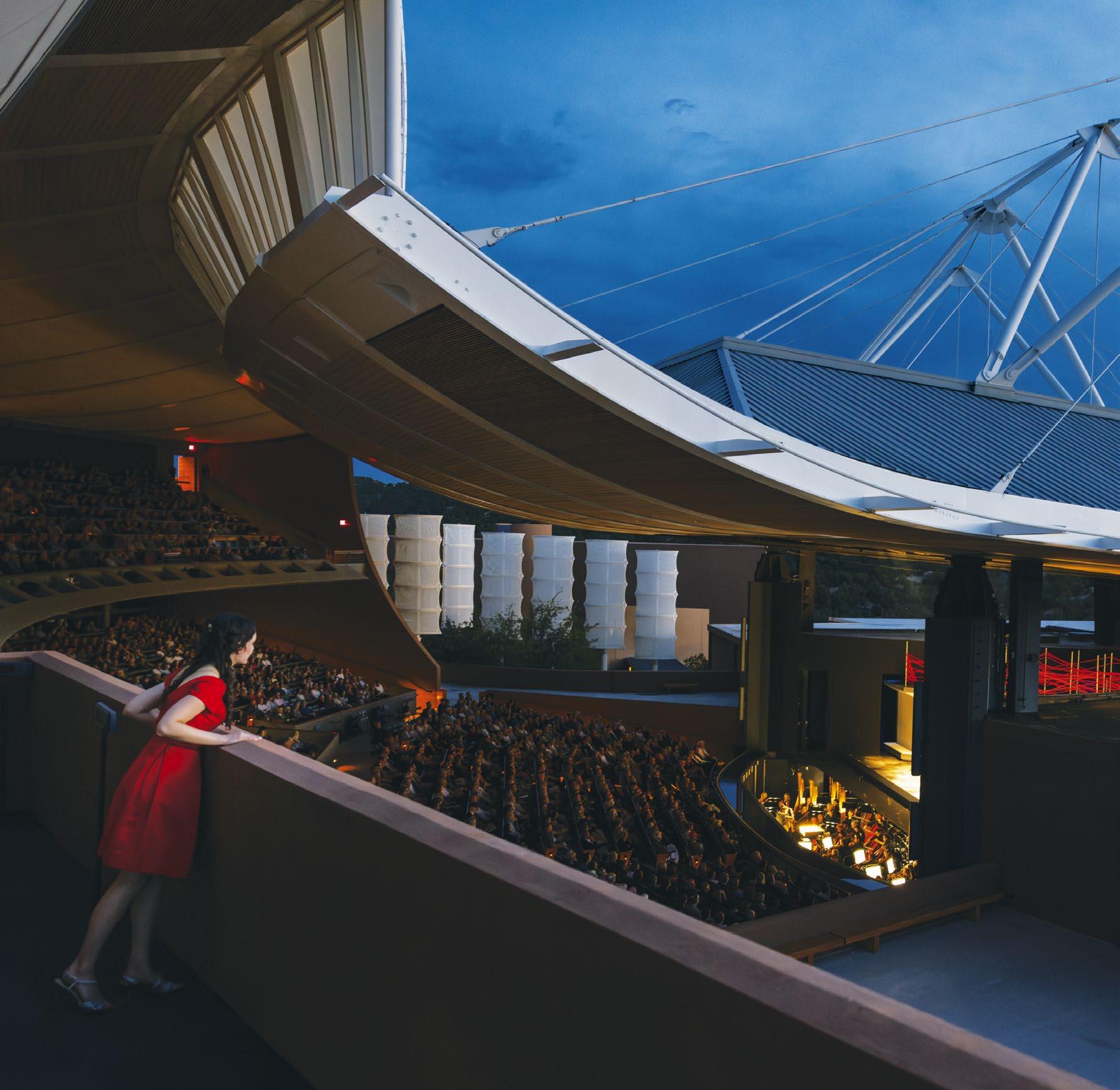
The world-renowned Santa Fe Opera is located just south of the casino, perched high above the valley. Spending an evening at the opera is considered one of the top activities when visiting Santa Fe.
Though Tesuque Village sits in the shadow of greater Santa Fe, the community offers something truly unique and all its own: the essence of authentic New Mexico. And if you’re fortunate enough to experience a fresh snowfall here, it makes for a most memorable experience. t
Tesuque Valley Community Association Online: tesuquevalley.org
Pueblo of Tesuque Online: tesuquepueblo.org
Tesuque Village Market Online: tesuquevillagemarket.com
Tesuque Casino Online: tesuquecasino.com
Santa Fe Opera Online: santafeopera.org







By Shelli Rottschafer
by Daniel Combs
In the Spring of 2000, I attended Gathering of Nations for the first time with a friend who grew up in Albuquerque. Held in The Pit—the University of New Mexico’s Sports Arena—we bought our tickets and descended the steep steps into the bleachers moments before Grand Entry.
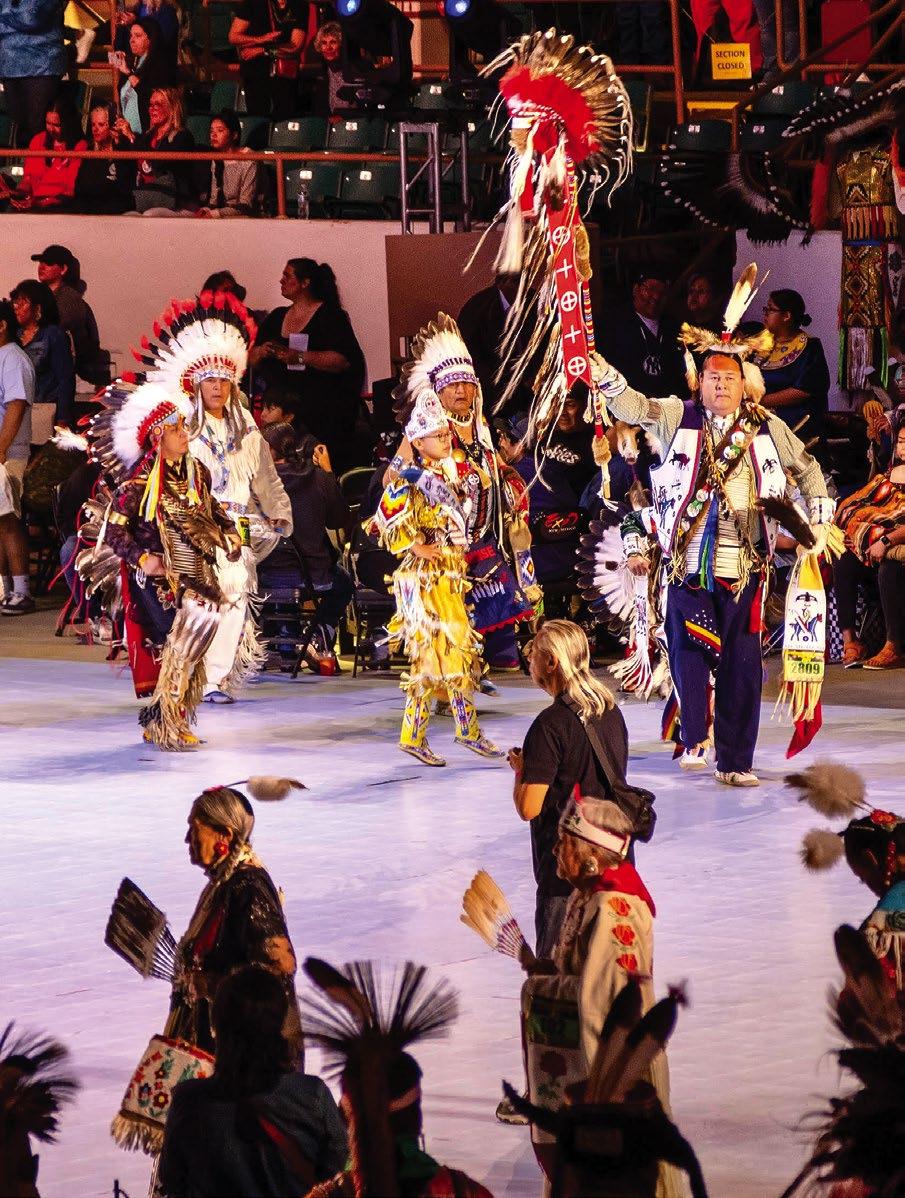
As we took our seats, the Grand Entry drums guided dancers to the arena floor. Participants in full regalia paraded stepping and stomping to the beat of the drums and the wails of the singers. In response to the dancers lei-lei-ed in high pitched ululations, shouted war cries, and proceeded in an undulating circle around the dance floor. Seeing Grand Entry is powerful. The drums resonate through your chest; the wails bring goosebumps.
Gathering of Nations was first held in 1983. It was organized by University of Albuquerque’s Dean of Students, Derek Matthews. In 1984, the powwow was officially named “Gathering of Nations.” The powwow was established for the school’s Native American students to connect with their cultures. Although the University of Albuquerque closed not long after, the powwow continued. For two years the event struggled organizationally, then in 1986 it moved to The Pit.
Over the last four decades, Gathering of Nations has evolved and grown. Since 2017, it has been held at Expo NM where the Fairgrounds are located, and within Tingley Coliseum where the New Mexico Scorpions hockey team used to play. Over 70,000 people participate in Gathering of Nations whether as spectators, artists, dancers, or organizers.
On April 25, 2024, my partner Daniel and I went to Gathering of Nations. It was my second time over two decades later, and his first.
We arrived early to the Fairgrounds, and as we pulled into the parking lot other vehicles stationed themselves as well. Sliding doors open and lifting hatchbacks, people began setting boxes down on the asphalt, putting folding chairs and tables into place, setting up their dressing rooms for the day. Tailgaters with Coleman propane stovetops warmed up food, and heavy coolers were laden with sodas. Our car-neighbor began donning his fancy dancing regalia, bustles with eagle feathers, and leather moccasins.
Daniel and I stood in line, our pre-purchased tickets in hand. The line grew behind with visitors, extended family of dancers, and tourists. Volunteers behind the gate reminded everyone to stay hydrated—but also that Gathering of Nations is a sober event. We walked through the grounds,

taking it all in. There was a food court and food trucks selling everything from “Indian-Tacos” made with fry bread to elotes covered in mayonnaise and tajin to burgers with Hatch green chiles. The tent section of Expo NM held the artisan area with herbal remedies, parrot feathers and beads for regalia crafting, beaded earrings and necklaces, silver and turquoise jewelry, as well as dream catchers. Then we headed to Tingley Coliseum where the Grand Entry was about to start.
We took our seats in the bleachers. In front of us were tourists from Texas, and behind us was an extended family from Sandia Pueblo, cheering on family members about to dance. In the back rows were some folks resting in full regalia, their headdresses seated next to them before they made their way down to the floor.
Each Gathering of Nations begins with an opening ceremony. In our case, Miss World Indian looked over the floor as the drummers pounded. Their wide drums boomed and wails accompanied an honored dancer who began the procession by raising a ceremonial
staff. The beat drew in different groups of dancers in a clock-wise rhythm. Women dancers, senior and golden-age dancers circled onto the floor. In 2024, tribes representing all First-Nations in Canada, Natives throughout the United States, Indigenous Mexicans with Aztec-Nahuatl plumage-regalia, and international representatives gathered as waves of people trickled into the center.
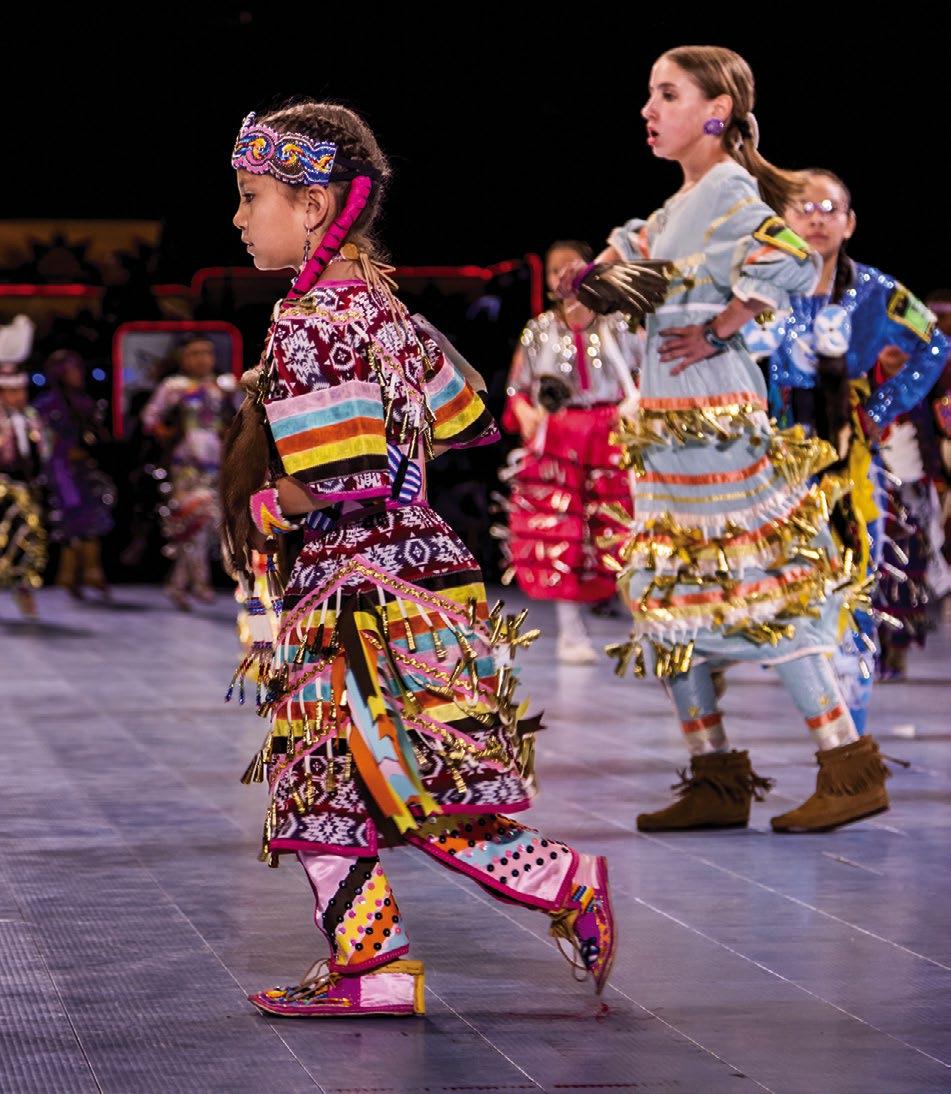
Each powwow dancer is unique. Some men wear “grass dance” regalia with headpieces made of porcupine or deer hair and feathers. “The body of the outfit includes an apron with long fringe that mimics the action of grass blowing in the wind. The dancers themselves spin, turn, and shuffle their feet as if they are moving in tall grass, all to the beat of the drum” (Treuer 150). Other men wear “fancy dance” regalia of bright colors, double bustles, and eagle feathers. Their moves, “display rapid footwork [like] spinning, cartwheeling, and jumping” (150). Watching these athletic dancers was mesmerizing.
As women entered the arena some wore “jingle dresses” from an Ojibwe tradition. These are dresses made by the
dancer and her female family members, with 365 jingles—small metal cones— upon each dress, representing one for each day of the year. “The jingle part of the regalia is believed to have healing power” (Treuer 151).
Other women and girls wear “fancy shawl” and “ribbon skirt” regalia. “The attire involves a colorful dress and shawl. The dancer spins and moves her arms to mimic the actions of a butterfly coming out of its cocoon and flitting about the arena” (Treuer 156).
In 2024, during Grand Entry there were over two thousand traditional dancers on the floor. Seeing that number of people gathered, dancing in unison, brought tears to my eyes.
After Grand Entry we made our way down to the arena floor and joined other photographers who crouched on their knees to film the dancers. That’s when the children entered the arena. As drummers called they began their dancing steps. Each had a number on their sleeve, and judges swirled around the periphery with clipboards, evaluating their moves and agility. Some looked stern as they lofted feathers or staffs into the air. Some had smiles strewn across their faces. All proudly represented their families and communities as a member of a new generation.
After 43 years, the organizers of Gathering of Nations are billing the 2026 ceremonial celebration as “The Last Dance.” However, there are other similar events that are community-specific. For example, Taos Pueblo held its own powwow July 11-13, 2025. The dates for 2026 are to be determined. The Gallup Inter-Tribal Ceremony will be held July 31-August 9, 2026. While other dances are held throughout the year at the Pueblo Cultural Center in Albuquerque. t
References:
Treuer, Anton. Everything You Wanted to know About Indians But Were Afraid to Ask. Young Readers Edition. NY: Levine Querido, 2021.
Dr. Anton Treuer (Leech Lake and White Earth Ojibwe) is an esteemed scholar having graduated from Princeton and the University of Minnesota, who now teaches at Bemidji State University in Bemidji, Minnesota. He teaches Native American Studies and is an Anishinaabe Culture and Anishinaabemowin-Language Revitalization expert. He is the author of several scholarly works on Native American Studies, memoirs, and a young adult novel Where Wolves Don’t Die (2024). He lives with his family on his community’s traditional land upon the Leech Lake Reservation.
Visit: antontreuer.com
Anton Treuer comes from a family of activists, his mother Margaret “Peggy” Treuer was a Native Rights lawyer and Tribal Judge in Minnesota. His brother David Treuer is a Native American Historian and Nonfiction Author who has taught at IAIA: The Institute of American Indian Art in Santa Fe. He currently teaches English at USC. Visit: davidtreuer.com
Gathering of Nations, Ltd. 3301 Coors Blvd. NW, Suite R300 Albuquerque, NM 87120
Online: gatheringofnations.com
YouTube Video:
Gathering of Nations Powwow to end in 2026 after 42 years— a report by KOAT 7 News in Albuquerque.
DIGITAL CONTENT:










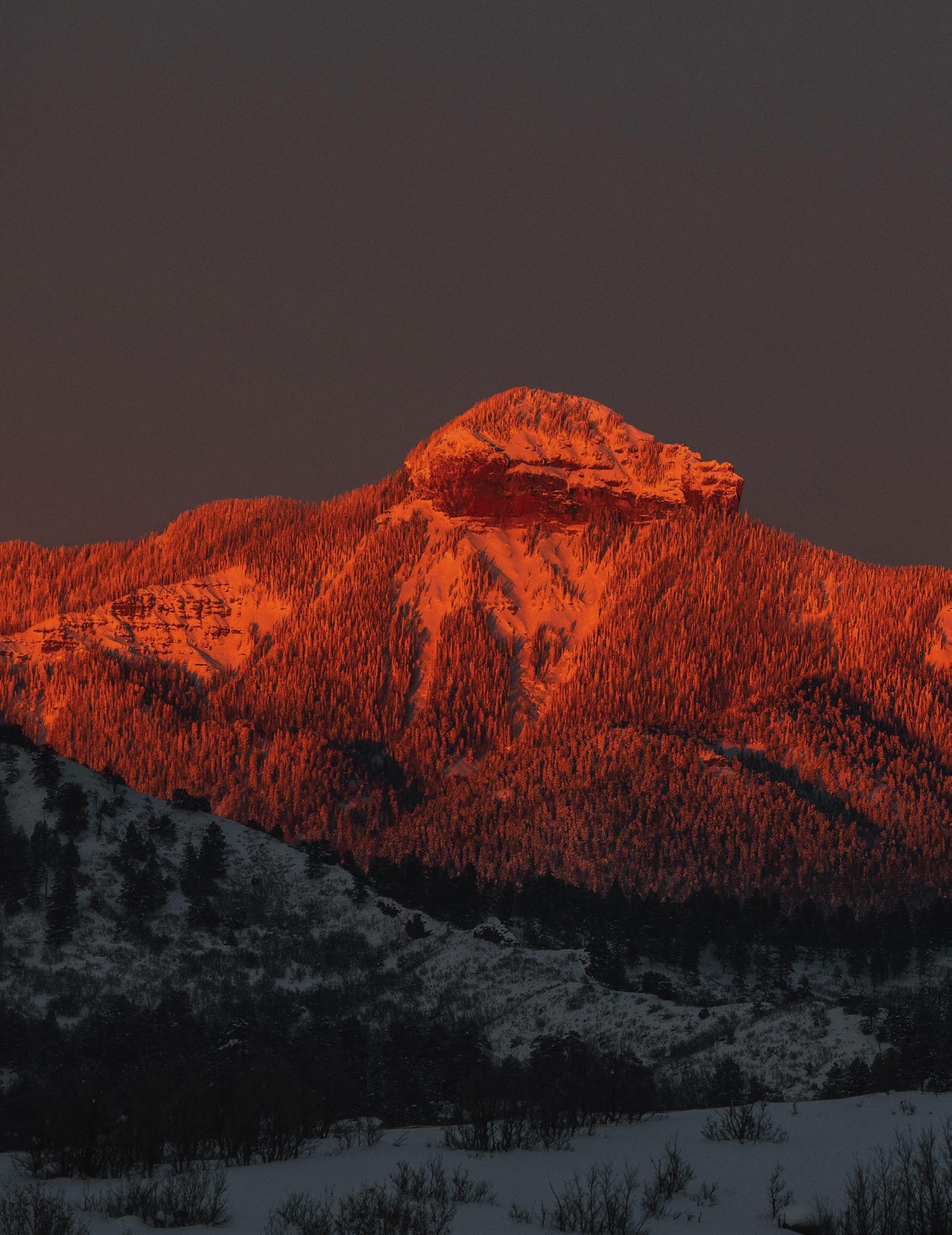
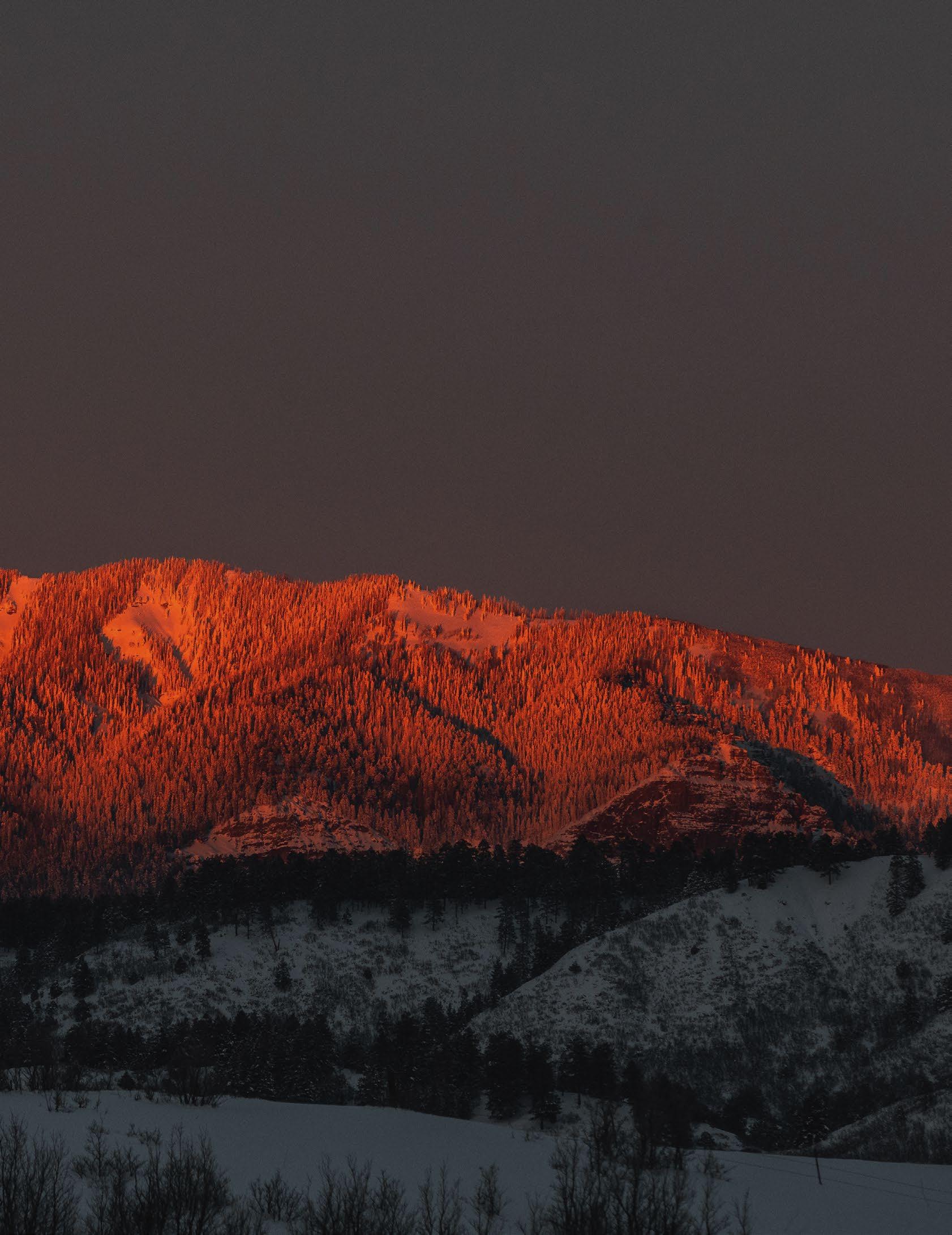
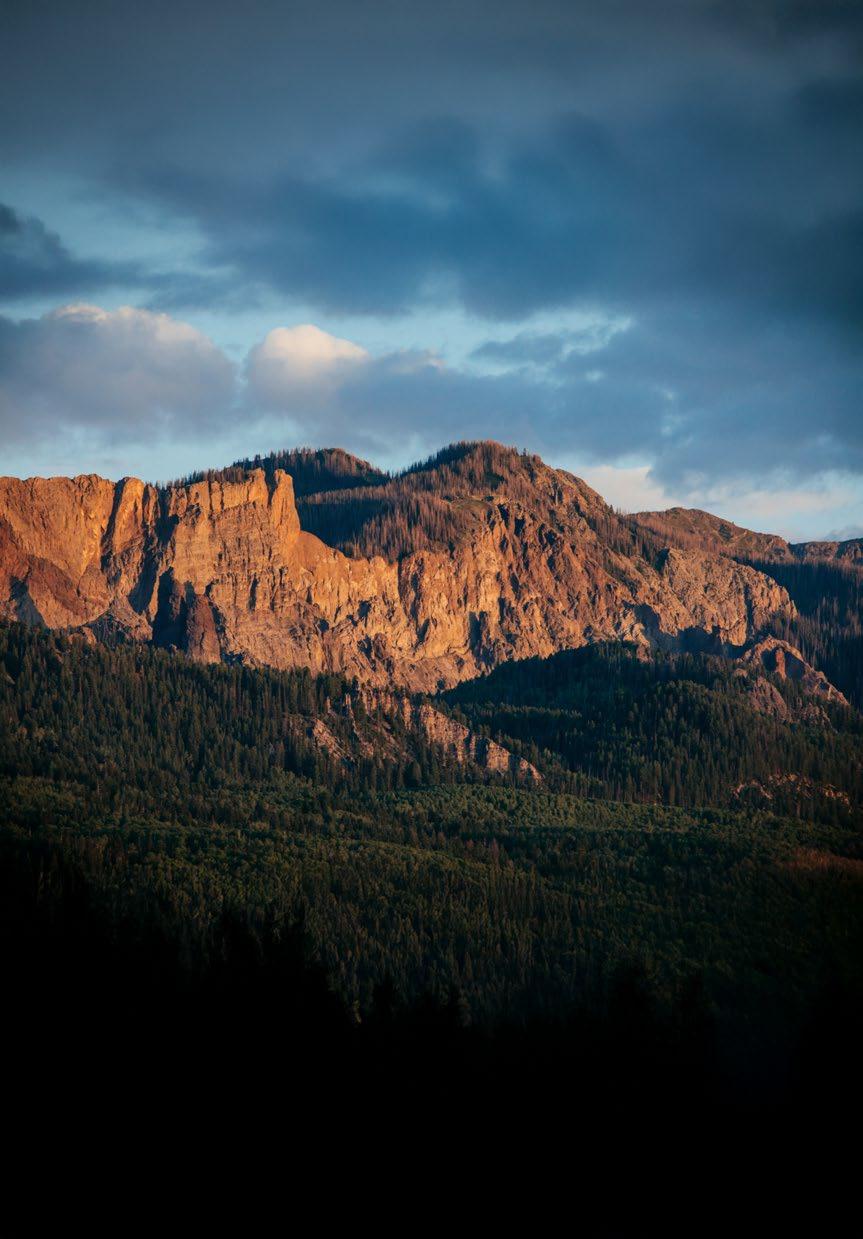
Capturing the view from here.
The setting sun casts a brilliant auburn glow against Squaretop Mountain located in the San Juan Range east of Pagosa Springs, Colorado. The natural feature exhibits a commanding presence over the surrounding valley below.
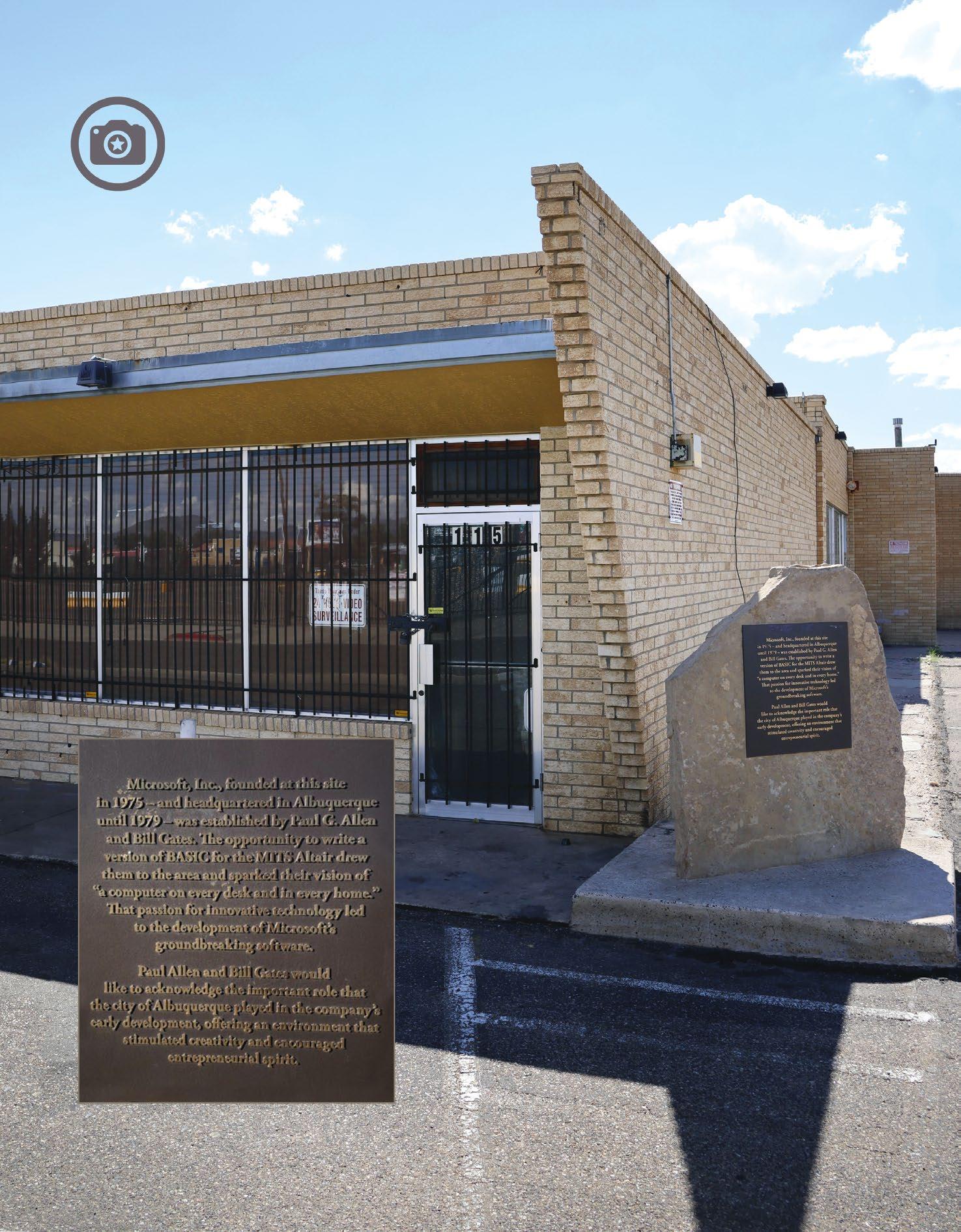

Microsoft—founded on April 4, 1975 by Bill Gates and Paul Allen—was originally housed in a strip mall office complex on the corner of Linn Avenue and California Street in Albuquerque, New Mexico. The multinational computer technology corporation operated from this location until 1979 and was established to develop and sell software, specifically a BASIC interpreter for the Altair 8800 personal computer. The company operated here until 1979, when it relocated to Bellevue, Washington to access a more robust computer programmer workforce. Currently, at the Albuquerque location, visitors can read a monument plaque that indicates the dynamic origin of one of the world’s most successful companies.

Andrea M. Heckman
Photojournalist, award-winning filmmaker, and Taos Ski Valley entrepreneur Andrea Heckman takes readers on a journey in SEEING Through the Eyes of Others. Based on years of travel photos and teachings organized by myth, pilgrimage, objects, and dance, this book brings cultural diversity and the human experience front and center with stunning images seen through the author’s lens while traversing remote locals around the world. Heckman is the owner of Andean Software, an Alpaca, fine textiles, and an international art retail store located in the central plaza at Taos Ski Valley. She began working with photography and fiber arts in California in the 1970s. By 1979, she had become a world traveler with annual trips to Peru, Ecuador, and Bolivia. She achieved her PhD in Latin American Studies in Anthropology and Art History—later teaching at the University of New Mexico. She’s resided in Taos since 1975.


Eyes wide open: stonecorralmedia.com/books

Fostering a connection between visitors and the natural world, this museum offers hands-on experiences and exhibits of unusual creatures, fossils, artifacts, and more. Founded in 2013 as the Harrell House, the organization has grown to serve more than 70,000 visitors. It features over a hundred live bug, reptile, and creature exhibits, where visitors are offered an opportunity to touch and interact with live specimens to help people have a better understanding of the environment.
Visit the Santa Fe Bug and Reptile Museum located at The Fashion Outlets near the intersection of I-25 and Cerrillos Road in Santa Fe.

The museum is open Tuesdays through Saturdays 10AM-6PM.
Bug out: bugandreptile.org
One of the fundamental rights as citizens of our great country is having access to wild places and the opportunity to witness wildlife in their natural habitat. Such experiences bring us closer to the land and instill a respect for nature and the planet—as well as offer a chance to provide for our families through honed skills in capturing and harvesting from our natural resources. Managing our natural environment is, in part, the responsibility of the Department of Game and Fish. Here in New Mexico, the department has forged ahead with an informative and entertaining podcast, hosted by James Pitman—the Information and Education Division Chief at New Mexico Department of Game and Fish—for coverage on all things outdoors in the land of enchantment.

Find nature: wildlife.dgf.nm.gov/home/publications/magazine
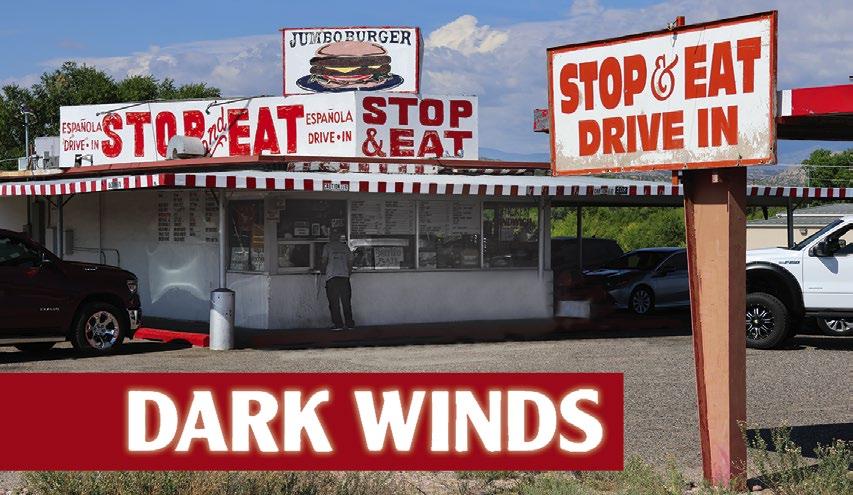
The AMC psychological thriller Dark Winds released its first episode in 2022. The multi-season series follows Lieutenant Joe Leaphorn, deputy Jim Chee, and Bernadette Manuelito, a Navajo Tribal police force who serve justice on the Navajo Nation in northern Arizona during 1971. As the posse works to solve violent crimes that escalate, their experiences force them to face personal challenges stemming from life on the reservation.
Dark Winds’ mostly Indigenous cast stars Zahn McClarnon, Kiowa Gordon, Jessica Matten, Deanna Allison, Rainn Wilson, and Elva Guerra. It’s executive produced by Robert Redford and George R.R. Martin and based on Tony Hillerman’s Leaphorn & Chee novels.
Though the story takes place on the Navajo Nation near Monument Valley, the sets were scattered around the Four Corners’ region, including locations in Arizona, Utah, and New Mexico. In New Mexico, film set locations include Gallup, Española, Santa Fe, Tesuque Pueblo, Cochiti Pueblo, and Abiquiú. Much of the show was produced at Camel Rock Studios, a state-of-the-art film production studio established in 2020 that’s owned and operated by the Tesuque Pueblo. At over 75,000 square feet, the facility has hosted Hollywood productions, including News of the World starring Tom Hanks. The studio is the first Indigenous-owned and operated film and TV studio in the United States.


Stream it: amc.com/shows/dark-winds--1053387
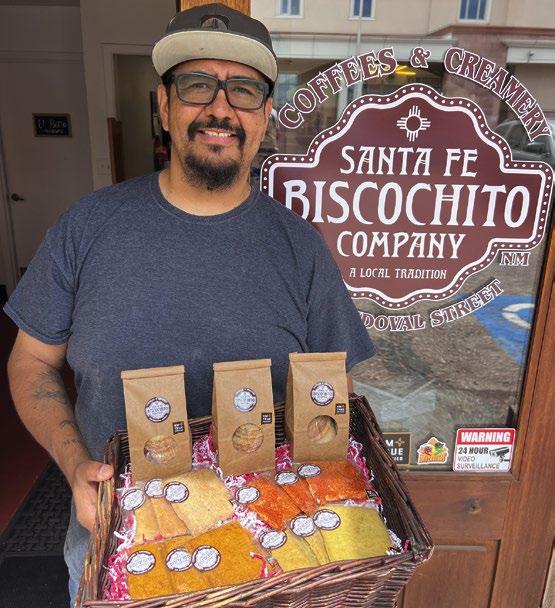
The Santa Fe Biscochito Company brings a rich New Mexican tradition to life with every batch of their handcrafted biscochito cookies and freshly brewed coffee. Made using time-honored recipes, their biscochitos are crisp, buttery, and delicately flavored with anise and cinnamon. Each cookie carries the warmth and heritage of generations past, offering a nostalgic taste of Santa Fe’s unique culinary culture. Red and green chilies add to the flavor palette for a range of choices. Gift baskets can also be ordered to gift a taste of New Mexico.
Paired with their locally roasted coffee, the experience becomes even more comforting. The coffee is bold and smooth, with a deep, earthy flavor that complements the subtle sweetness and spice of the biscochitos. The combination is both grounding and satisfying—and don’t forget to try the Biscookies, an ice cream sandwich favorite.
Owner and award-winning baker Richard Perea takes great pride in using quality ingredients and honoring traditional methods, while still offering a product that feels fresh and timeless. Whether you’re a lifelong New Mexican or discovering biscochitos for the first time, their cookies and coffee offer a connection to place, memory, and simple pleasures. It’s a treat that speaks to the heart of New Mexico and the Southwest.

B is for Biscookie: santafebiscochitocompany.com

Founded in 1991, Youth Heartline strives to reduce risk factors and remove barriers for underserved children and families. Their mission is to influence long-term outcomes and provide access to vital services.
One of the programs offered at Youth Heartline include court-appointed special advocates, safe exchange and supervised visitation, in-school and summer programs, Trauma Training, and youth and family navigation. The organization is the first and only court-appointed special advocates program for the Eighth Judicial District of New Mexico, including Colfax, Taos, and Union Counties. The Youth Heartline operates from offices in both Raton and Taos.

Help out: youthheartline.org

While traveling I-25 between Las Vegas and Raton, New Mexico, pull off the interstate into the community of Watrous for a most surprising discovery. This unassuming exit leads travelers through this tiny enclave before being welcomed by a tall green signpost for the Watrous Coffee House, a cozy inviting cafe situated in a beautifully renovated historic ranch-style home. Within, patrons discover an establishment that might otherwise be found in an urban community—we love it. Creative drinks, pastries, and other items are available weekly from a friendly, sophisticated staff. Stop in for a hot custom coffee, tea, or other flavorful drinks on your next journey through the area.

Warm up: instagram.com/watrouscoffee
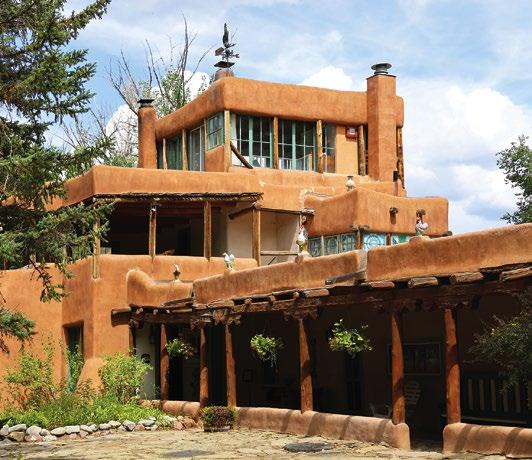
Also known as the “Big House,” this property was designated a National Historic Landmark in 1991. The former home of arts supporter and writer Mabel Dodge Luhan, which is now used as a hotel and conference center, was a central hub for artistic salons in the early 20th century and hosted many well-known painters, writers, photographers, musicians, and emerging artists of the Taos Art Colony.
An exceptional example of traditional Puebloan construction, the main public space—the kitchen, reception office, and rooms—immerse the visitor in the historic charm of northern New Mexico architecture and culture. The outdoor decks and gardens are well-kept and serve as inspiring backdrops for recognized guest fine art painters, including D.H. Lawrence, Ansel Adams, Georgia O’Keeffe, Martha Graham, and Edward Weston. Bonus fun fact: the home was also owned by actor Dennis Hopper.

Stay well: mabeldodgeluhan.com
With each issue of Enchanted Outpost, we add our Waypoints to a new section we are building on our website. Use your smart phone or tablet camera and the QR Code below to discover these and other great picks we’ve featured in past issues.
Or Visit: enchantedoutpost.com/waypoints

Point your smartphone camera at the QR Code. Your camera will recognize the code. Tap your screen to visit the website.




Attend Main St. Live in Trinidad, Colorado for the performance of Miracle on 34th Street adapted by Mountain Community Theater from the novel by Valentine Davies. Based upon the Twentieth Century Fox motion picture.
When: December 12-21
Where: Trinidad, Colorado Visit: mainstreetlive.org

1-4 Wolf Creek Ski Local Appreciation Day Pagosa Springs, CO visitpagosasprings.com
6-7 Winter Spanish Market Santa Fe, NM traditionalspanishmarket.org
12 Del Norte’s Hometown Holiday Del Norte, CO - delnortecolorado.com
13 Farolito Trail of Lights 5K Run Albuquerque, NM - irunfit.com
13 Alumbra de Questa Holiday Market Questa, NM - questacreative.org
15 Home for the Holidays Winter Gala Santa Fe, NM - santafesymphony.org
27 Cirque Musica Holiday Wonderland Santa Fe, NM - hiltonbuffalothunder.com
Rio Frio Ice Festival
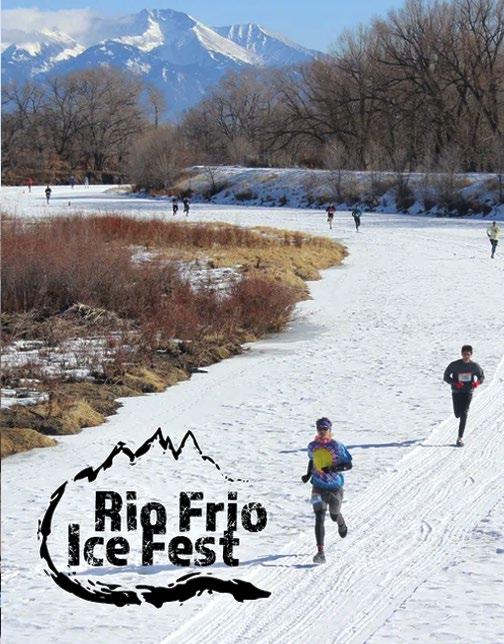
Join in on the fun in Alamosa for the annual Rio Frio Ice Festival. The event includes a 5K winter run, ice carving demonstrations, disc golf tournament, kid’s zone, live music, vendors market, a cross-country luminaria walk and rounds out with a Polar Plunge.
When: January 23-25
Where: Alamosa, Colorado Visit: rioraces.com
2 ArtStop Market @ FUSION Albuquerque, NM - abqtodo.com
10 Cabin Fever Nordic Races Pagosa Springs, CO - pagosanordic.com
16-18 Albuquerque Comic Con Albuquerque, NM albuquerquecomiccon.com
17-18 Chama Chile (X-Country) Ski Classic Chama, NM chamachileskiclassic.com
22-24 Red River Songwriters’ Festival Red River, NM - redriversongs.com
30 Winter Warmup: Taos Opera Taos, NM - taosoi.org
30-31 Angel Fire Shovel Races Angel Fire, NM - visitangelfirenm.com

Enjoy 28 winery partners pouring their best wines alongside bites from great Taos restaurants. Bid at a silent wine auction including 40 wine lots. The event benefits Taos High School’s Great Chefs of Taos program. Sip and Support this great program for Taos students.
When: February 5-8
Where: Taos, New Mexico Visit: taoswinterwinefest.com
3-5 So. Rocky Mtn. Agriculture Conf. Monte Vista, CO - agconferencesrm.com
5-7 Quilt, Craft & Sewing Festival Albuquerque, NM - quiltcraftsew.com
7 Carlos Mencia – The Liberated Tour Santa Fe, NM - hiltonbuffalothunder.com
8 Artist Dinner, La Boca Santa Fe, NM - sfpromusica.org
12-17 Mardi Gras in the Mountains Red River, NM - redriver.org
13 The Conjurors: Performing Arts Raton Arts & Humanities Council Raton, NM - ratonarts.org
27-1 National Fiery Foods and BBQ Show Albuquerque, NM - fieryfoodsshow.com

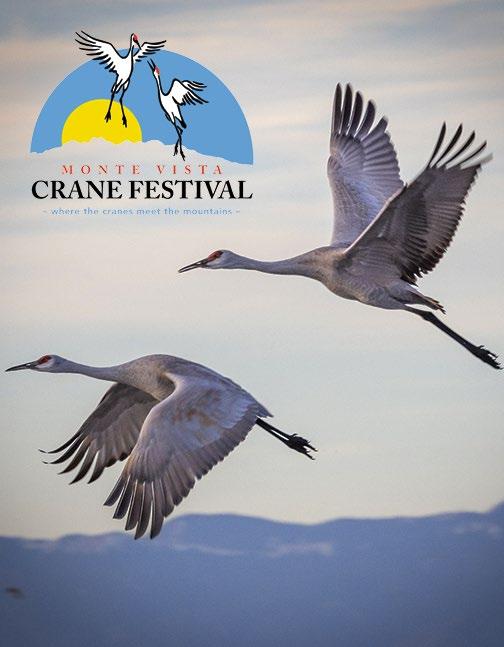
Discover the Monte Vista Crane Festival in Colorado’s San Luis Valley — a vibrant three-day celebration of thousands of migrating Sandhill Cranes, engaging workshops, guided wildlife tours, and a lively craft & nature fair amidst majestic mountain scenery.
When: March 6-8
Where: Monte Vista, Colorado Visit: mvcranefest.org
1-2 Taos IFSA Qualifier 2 Taos Ski Valley, NM - ifsafreeride.org
7 Aaron Lewis American Tour Santa Fe, NM hiltonbuffalothunder.com
17 Happy Saint Patrick’s Day! Various Event Locations
20-22 Santa Fe Whole Bead Show Santa Fe, NM - wholebead.com
20-22 Treasures of the Earth Gem, Mineral and Jewelry Expo Albuquerque, NM - agmc.info
22 Women of Americana Music Tour Albuquerque, NM womenofamericanatour.com
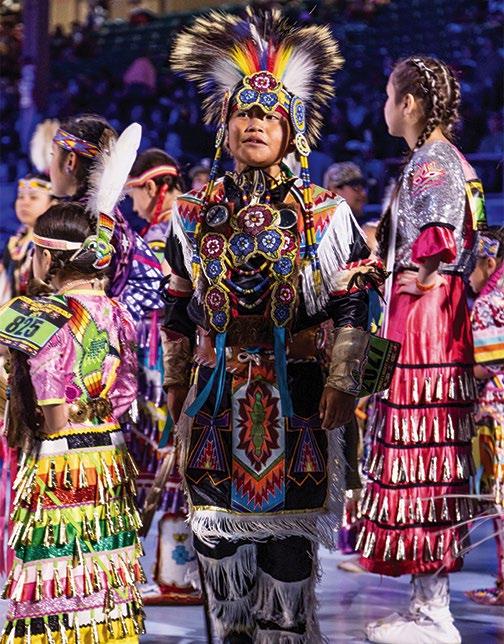
Attend the largest Indigenous-led powwow in North America—to celebrate vibrant culture, music, dance, and community. Experience the Indian Traders Market, dramatic grand entry, crowning of Miss Indian World and the beautiful tradition of the powwow way.
When: April 24-25
Where: Albuquerque, New Mexico Visit: gatheringofnations.com
2-6 Chimayó Pilgrimage Chimayó, NM - holychimayo.us
4 Snowy Easter Egg Hunt and Potluck Eagle Nest, NM - eaglenestchamber.com
4-5 NM Renaissance Celtic Festival Edgewood, NM - nmrenceltfest.com
9 Shelby Means & Joel Timmons Concert Taos, NM - taoslifestyle.com
11 Rachel Barton Pine Violin Concert Los Alamos, NM - visitlosalamos.org
11-12 Southwest Chocolate & Coffee Festival Albuquerque, NM chocolateandcoffeefest.com
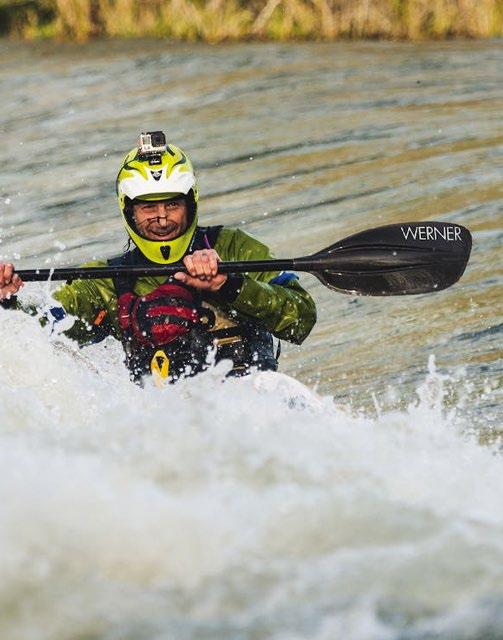
Founded in the 1950s by Los Alamos paddle boater and LANL employee, Jim “Stretch” Fretwell, this year marks the 68th annual race event on the Rio Grande River. Join in as a race course competitor or as a spectator. Get adrenaline either way you choose.
When: May 8-10
Where: Pilar, New Mexico Visit: mothersdaywhitewater.com
3 Santa Fe Pro Musica Season Finale Santa Fe, NM - lensic.org
15-16 Boots in The Park Music Festival Albuquerque, NM abq.bootsinthepark.com
15-17 Santa Fe Intl. Literary Festival Santa Fe, NM sfinternationallitfest.org
17 Elevated Baroque - Harwood Museum Taos, NM - harwoodmuseum.org
17 Dennis Hopper Day Taos, NM - robbyromero.com
22-25 Mayfest in the Mountains Red River, NM - redriver.org


Tucked away in the majestic Sangre de Cristo Mountains of northern New Mexico, Angel Fire Resort has been a beloved alpine escape since 1966. What began as a modest ski area at 8,600 feet has evolved into one of the most dynamic year-round mountain destinations in the Rockies—offering adventure, luxury, and community without the crowds or prices of its northern counterparts.
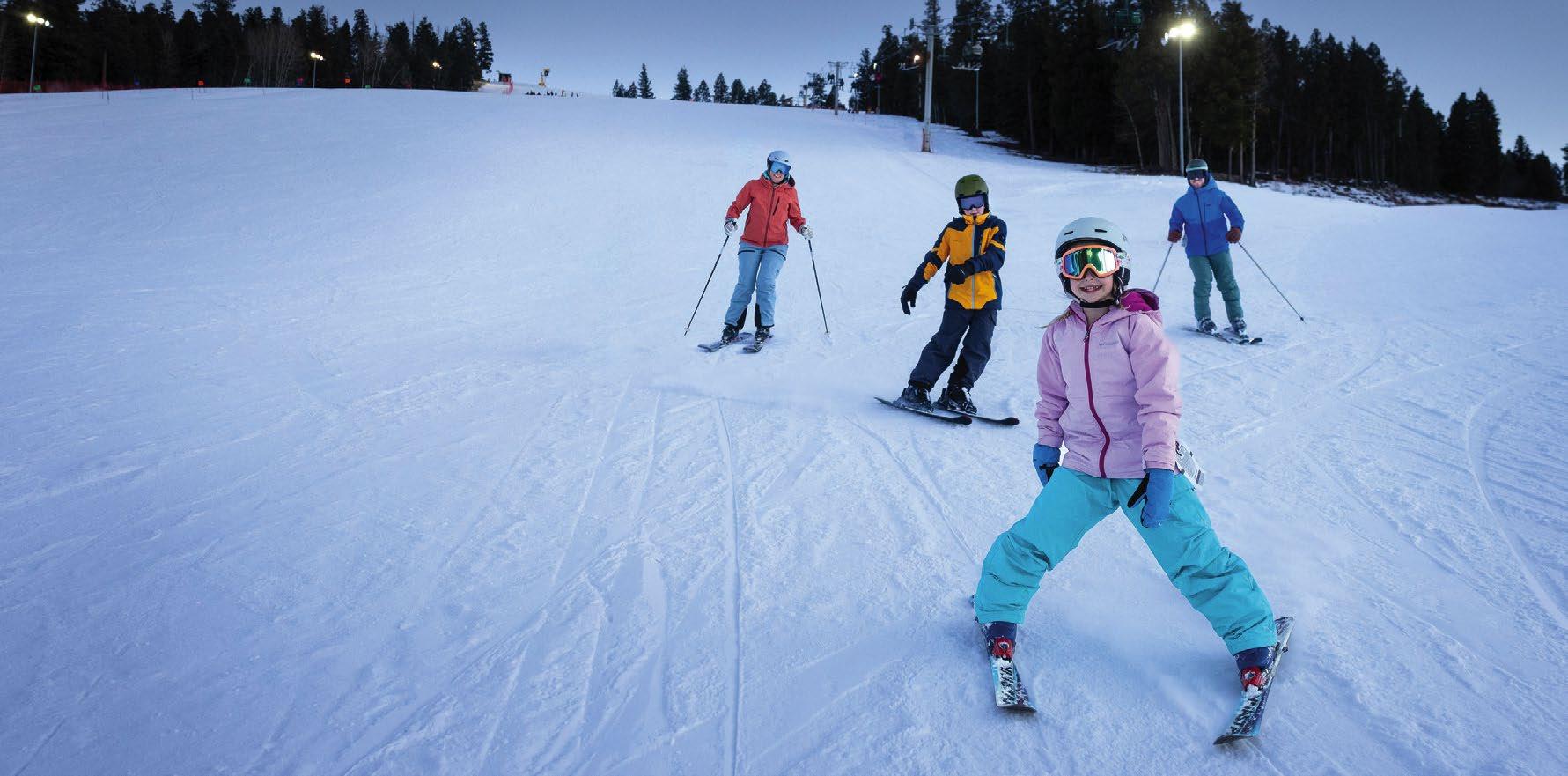
In winter, Angel Fire’s 560 acres of skiable terrain deliver some of the Southwest’s best snow experiences— from gentle family-friendly runs to expert-only “Steeps” in the back basin. Boasting the longest ski run in New Mexico and the state’s only night skiing, the resort continues to grow, with a new fixed-grip quad lift (Rakes Rider) debuting in 2025 and New Mexico’s first high-speed six-pack opening the following season.
When the snow melts, Angel Fire transforms into a summer paradise. Its award-winning bike park offers 60+ miles of lift-served terrain across over 30 trails—one of the top-rated parks in the country. U.S. golfers enjoy a Paul Ortiz–designed championship course, winding through pine and aspen forests at the acclaimed Angel Fire Country Club. Tennis, pickleball, disc golf, and Monte Verde Lake’s kayaking and fishing make it a true four-season retreat.
The Village of Angel Fire is rapidly evolving into a vibrant mountain
community. The new Mountain View Events Center—complete with a stage, turf lawn, and festival grounds—hosts signature summer events like Cool Summer Nights, Bluews Fest, and Oktoberfest, drawing visitors from across the Southwest. Future plans include a downtown plaza and convention center, creating a lively hub for locals, visitors, and homeowners alike.
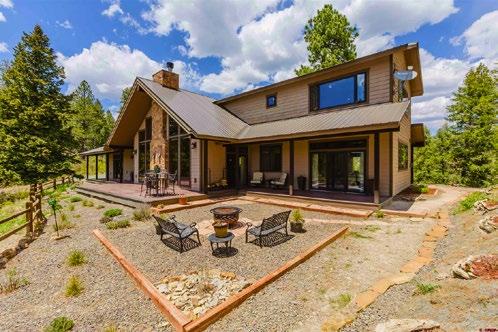
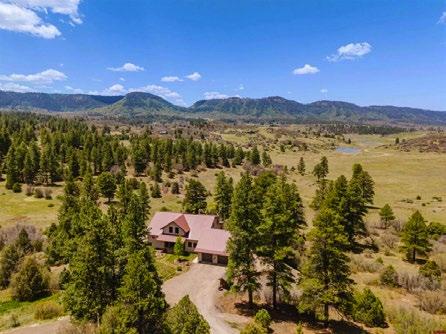
With over 18,000 acres of breathtaking scenery, the village is seeing an exciting wave of residential growth. Coldwell Banker Mountain Properties—Angel Fire’s premier real estate brokerage—is launching three exciting new residential communities:
Angel Fire Crossing
Affordable four, three, and two-bed-
room townhomes with one-car garages, starting in the mid-$400,000s.
Sangre de Cristo Townhomes
Value-packed, three-level, three-bedroom townhomes, one-car garage plus sports equipment storage priced under $500,000.
Base Camp Angel Fire
Luxury 4-story townhomes, within walking distance to the new six-pack chair, with private rooftop living and sweeping mountain views of Wheeler Peak, starting in the mid-$800,000s.
These projects will bring over 100 mountain home options over the next two years, offering attainable luxury at a fraction of Colorado’s resort prices.
“We’re seeing unprecedented demand for quality, well-priced mountain
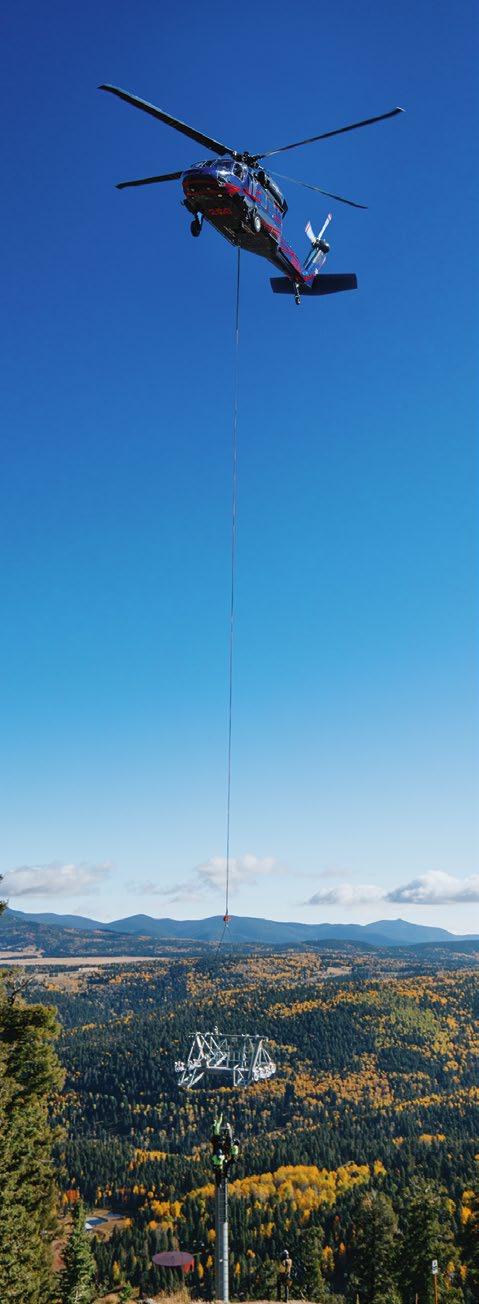
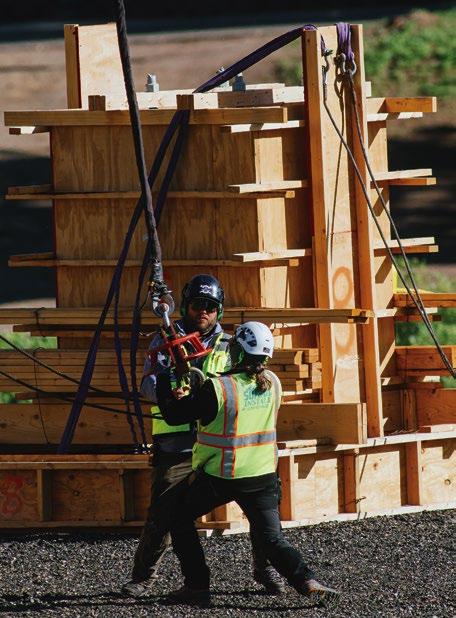
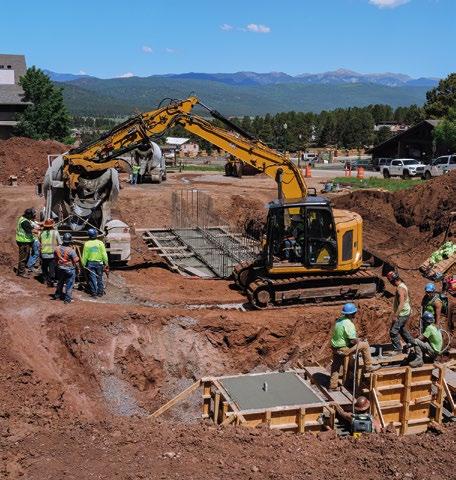
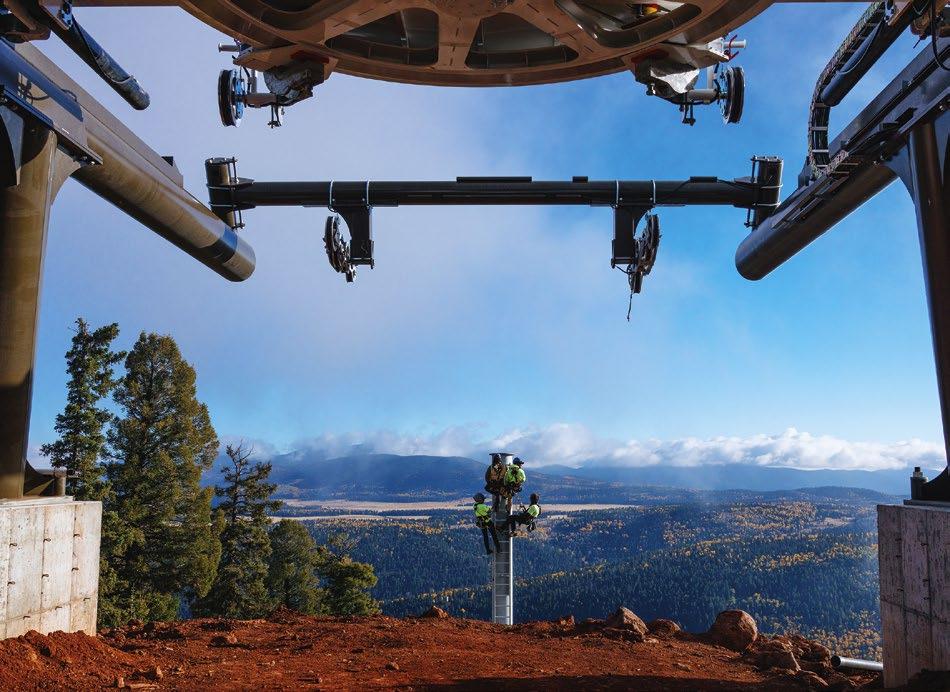
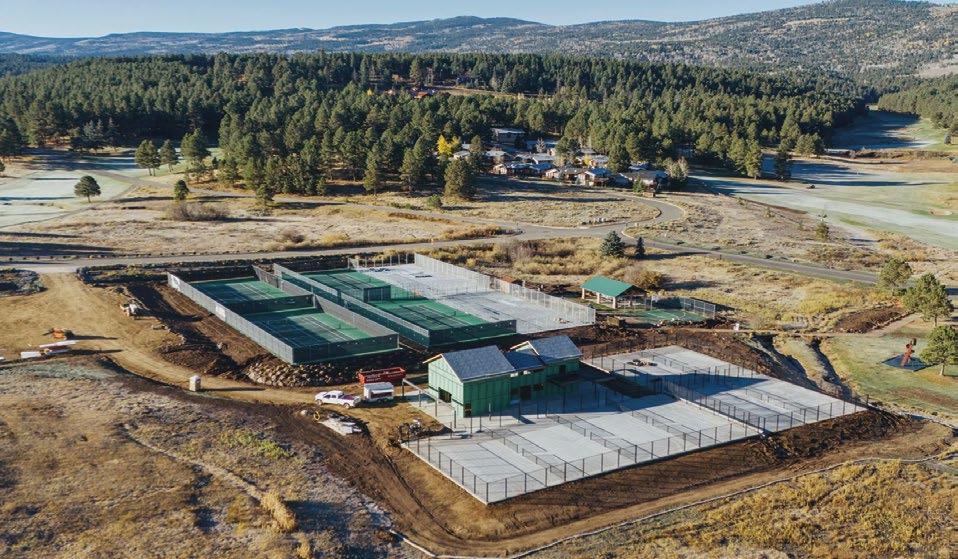
Left: A helicopter lowers a tower on Rakes Rider to a team of installers. Above: Angel Express six-pack chairlift under construction at the resort base. Below: Expansion of the Tennis and Pickleball Center.
homes,” says Jeff Weeks of Coldwell Banker Mountain Properties.
With interest rates trending downward and major resort upgrades underway, Angel Fire is positioned for exceptional growth in the next decade.
“It’s the perfect storm of opportunity —strong demand, attractive pricing, and expanding amenities,” notes Kellie Buchanan of Highlands Residential Mortgage.
Easily accessible—just a five-hour drive from Denver, or a 25-minute flight from Albuquerque to Angel Fire Airport—this hidden gem in the Southern Rockies is finally stepping into the spotlight.
Whether you’re looking for a mountain getaway, a smart investment, or a place to call your mountain home, Angel Fire offers an unbeatable blend of accessibility, affordability, and mountain resort lifestyle.
Visit our property websites to learn more or contact local Broker, Jeff Weeks at Coldwell Banker Mountain Properties in Angel Fire at (505) 603-7311.
New Property Search
Angel Fire, New Mexico
Angel Fire Crossing
Priced from the mid $400,000s Online: angelfirecrossing.com
Sangre de Cristo Townhomes
Priced under $500,000 Online: sdctownhomes.com
Base Camp Angel Fire
Priced from the mid $800,000s Online: basecampangelfire.com
Regional Interior Design Masters | 70 Voormi: The Future of Clothing | 78 Sage Work Organics, An Intention of Hygge | 90
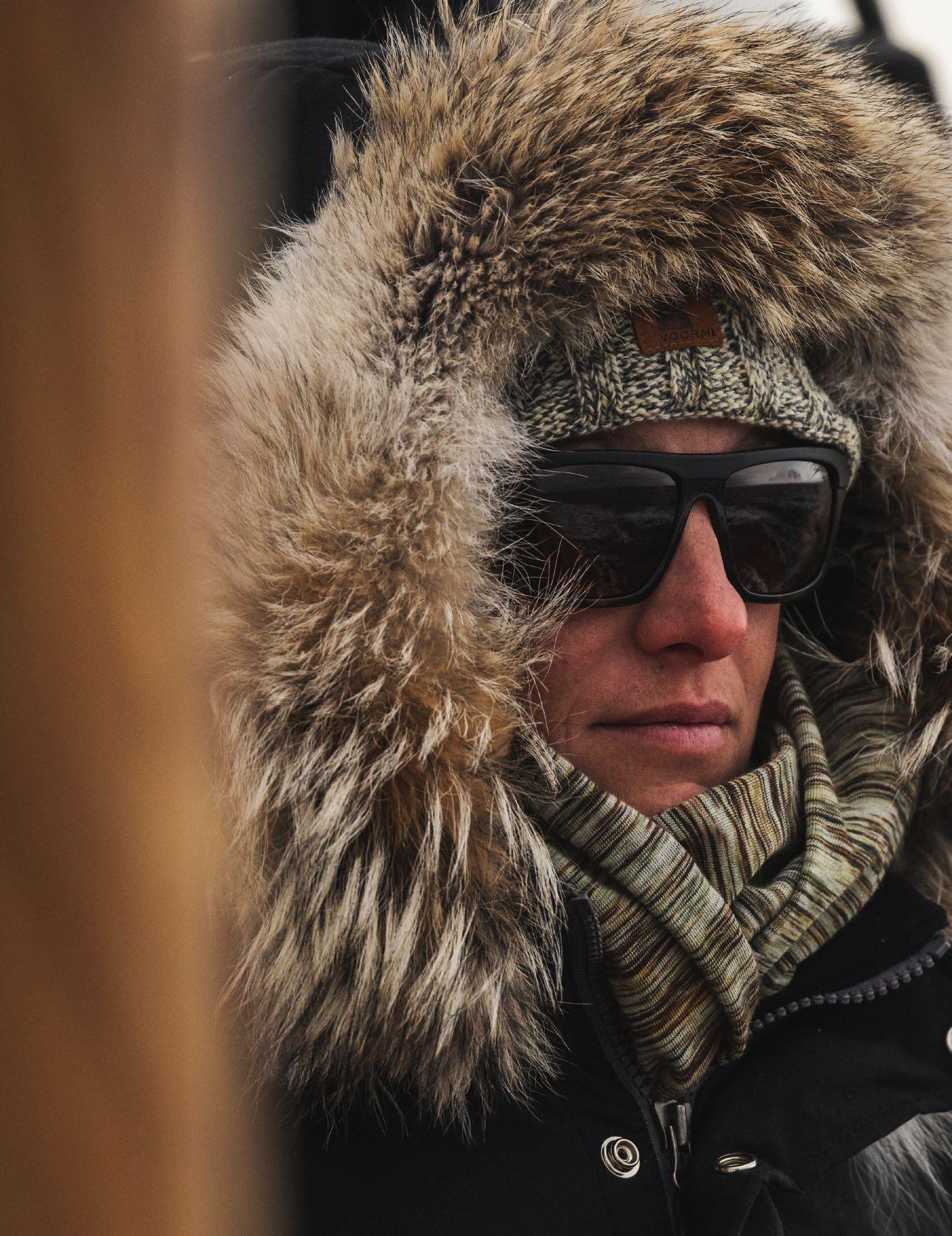
Voormi, an outdoor clothing company headquartered in Pagosa Springs, Colorado, develops high-performance, sustainable outdoor apparel and gear by merging advanced textile innovation with cutting-edge technology—and fashionable to boot.
By Scott Leuthold
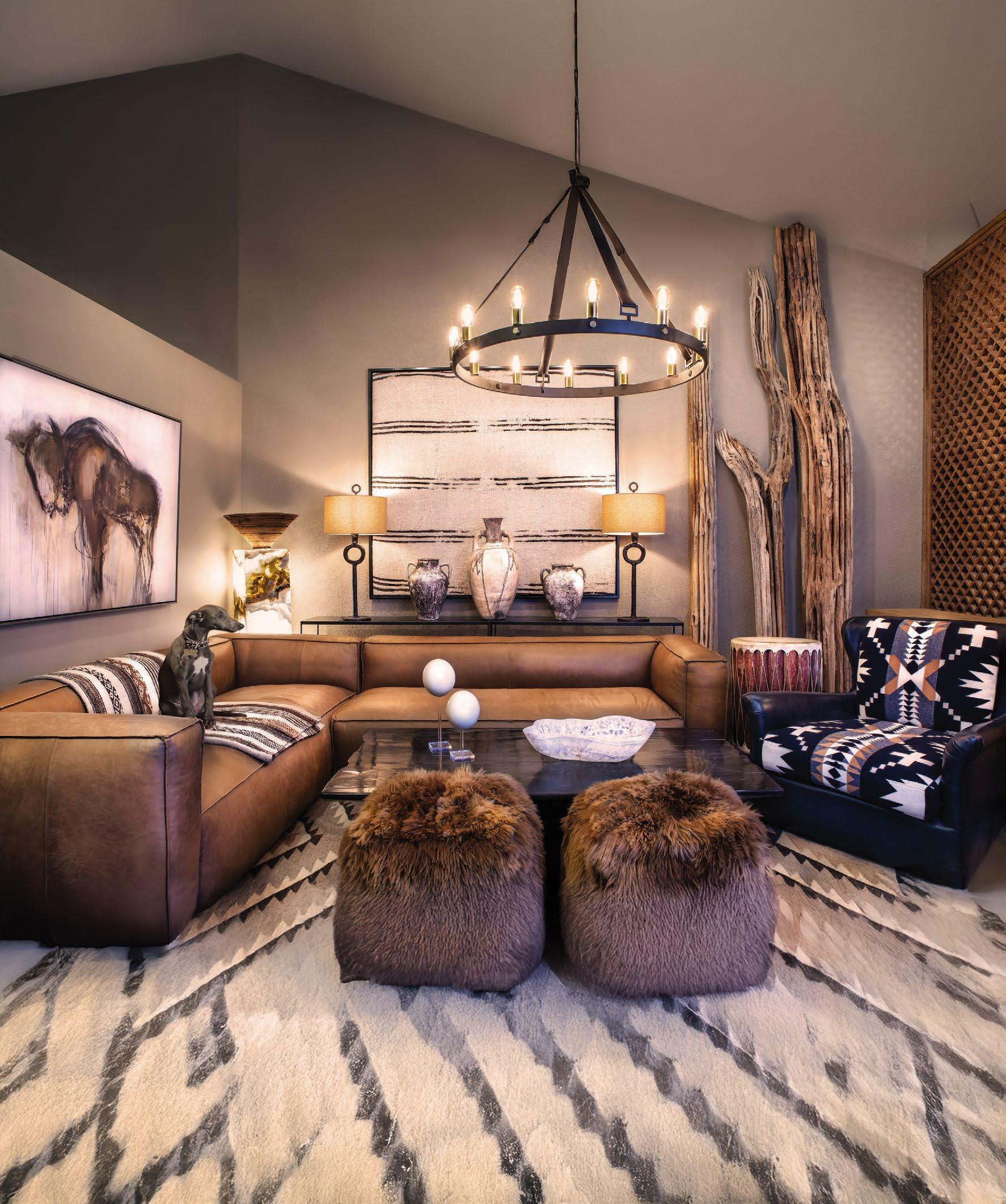
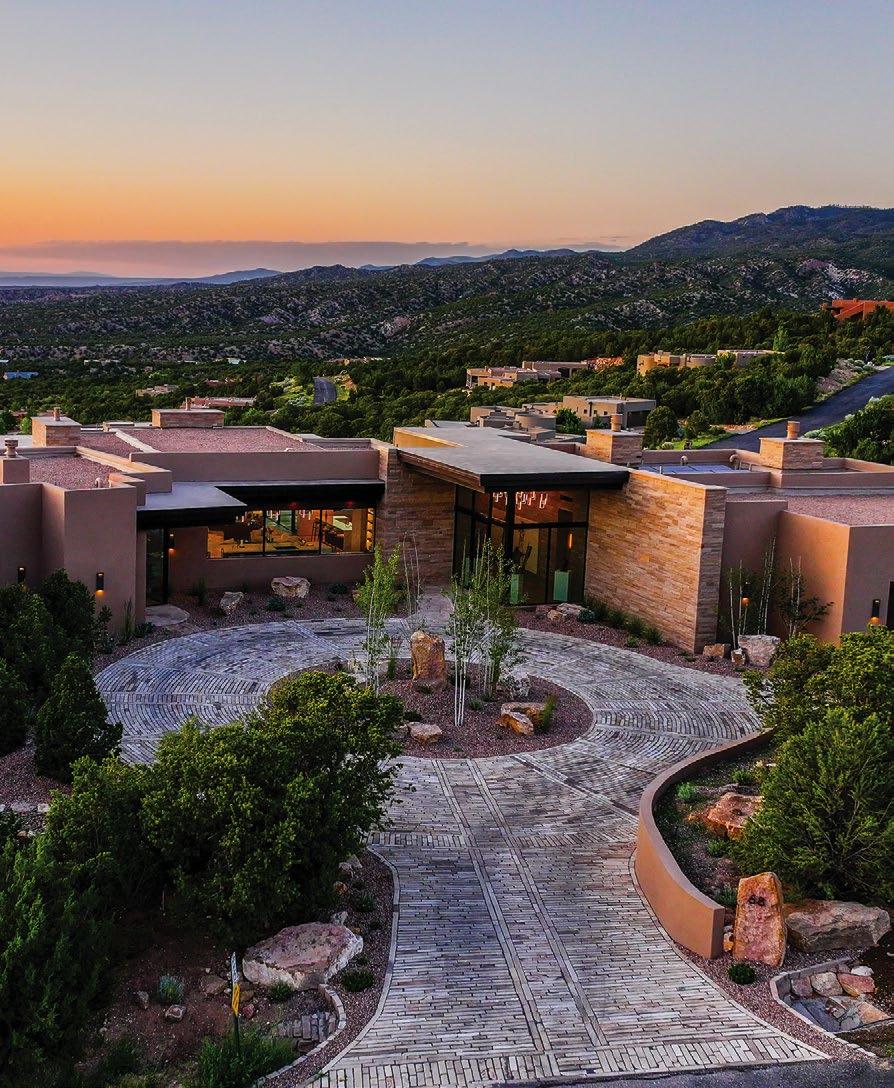
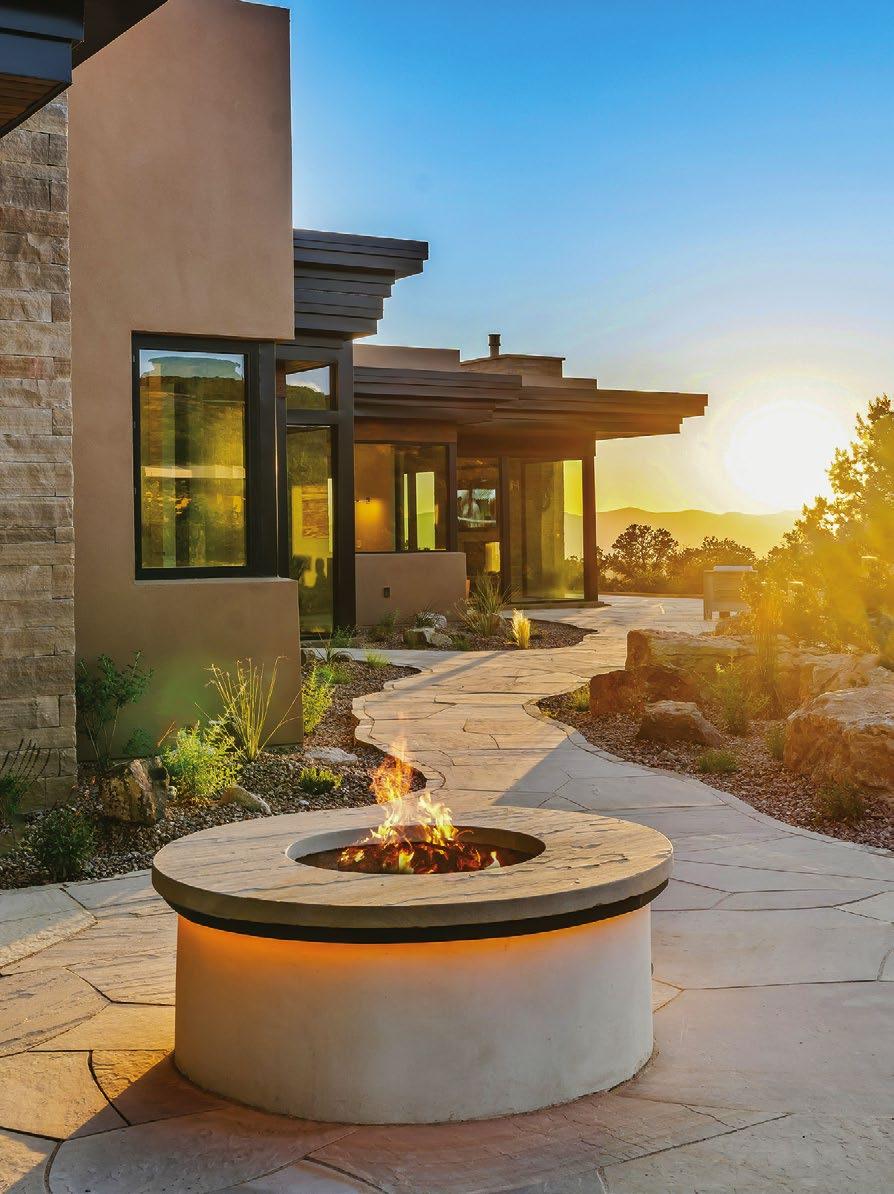
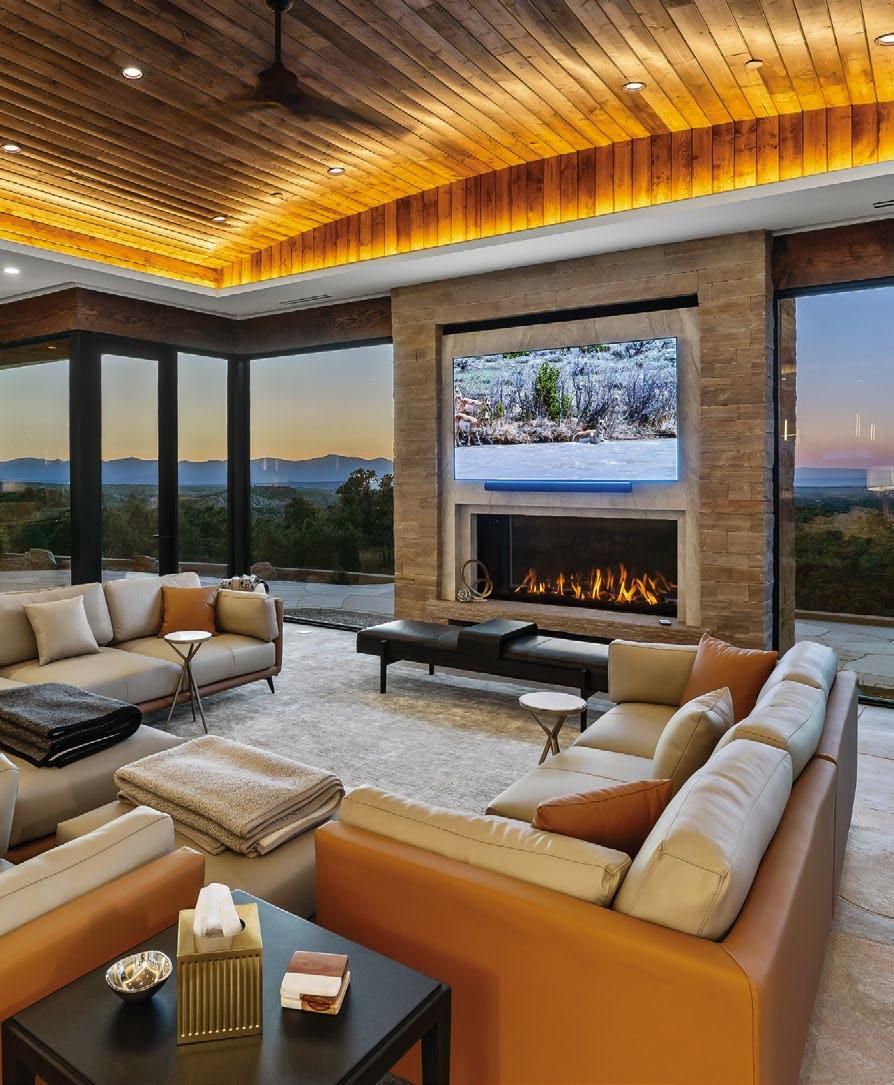
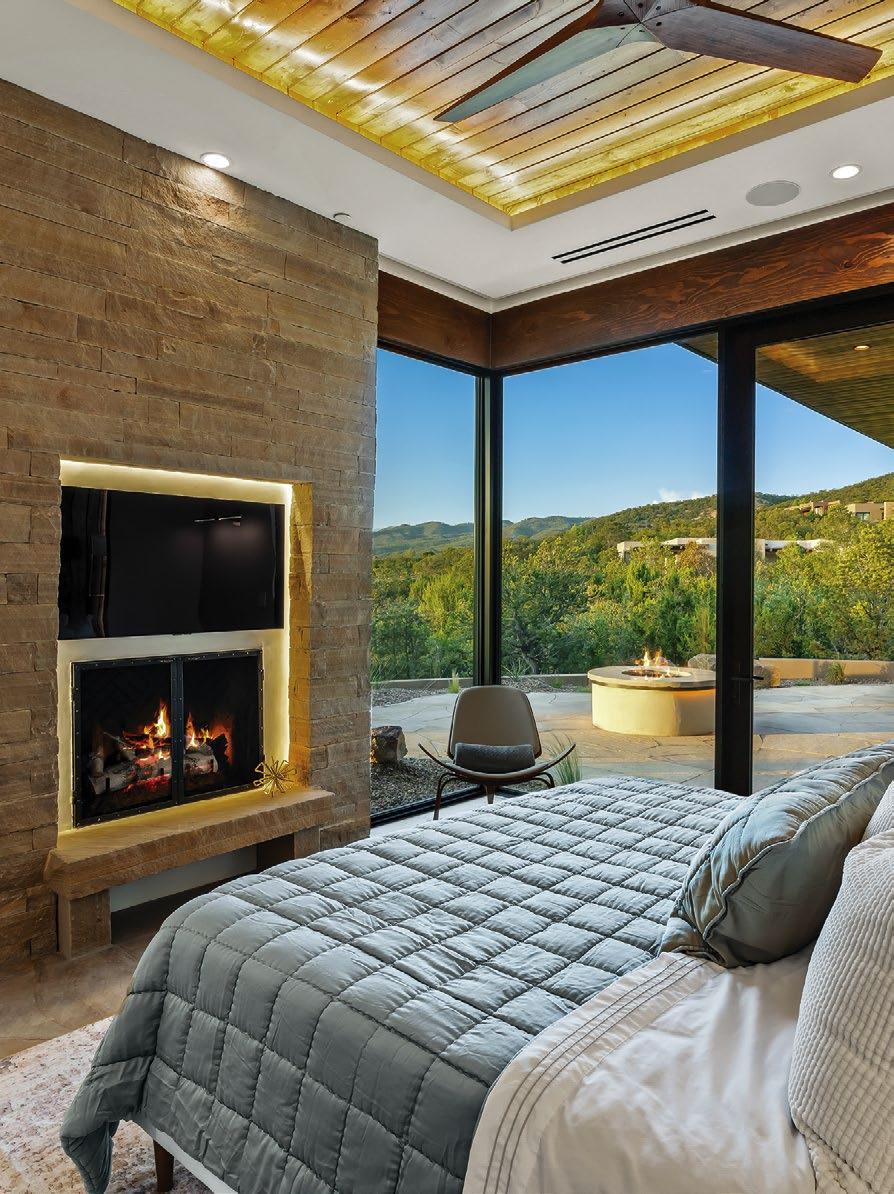
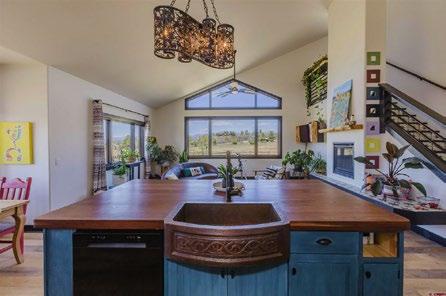
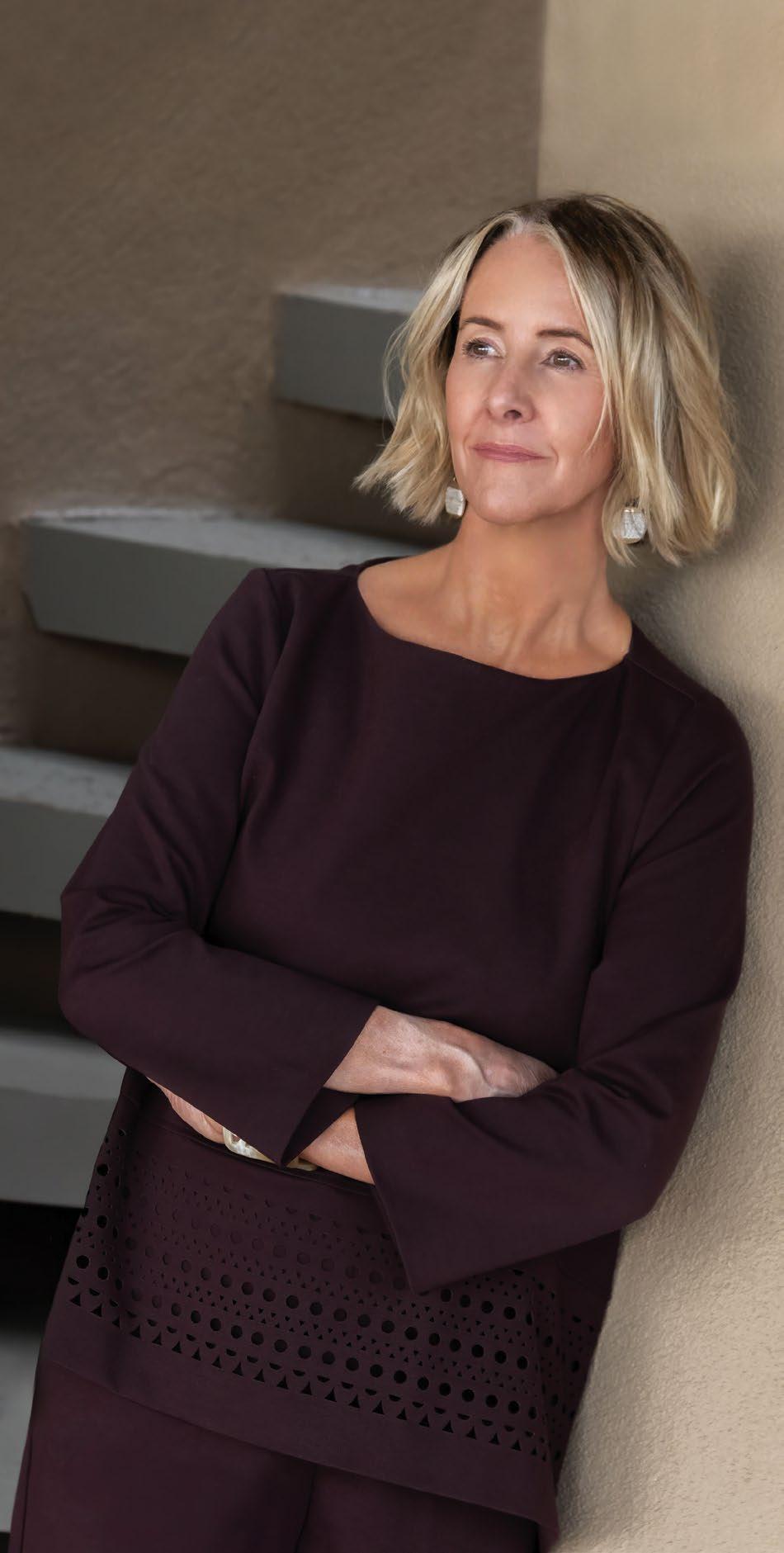
The interior design landscape of New Mexico and southern Colorado is a rich blend of cultural heritage, natural inspiration, and evolving modern trends. Rooted in the distinctive architecture of adobe homes, Pueblo Revival, and Territorial styles, the interiors of the region often celebrate earthy textures, organic materials, and warm, sunwashed palettes. Exposed wood beams, hand-plastered walls, and artisanal tilework reflect traditions that have shaped the Southwest’s visual identity for centuries. At the same time, contemporary design is weaving its way into the fabric of these spaces, with clean lines, minimalist furniture, and natural light, all used to balance rustic authenticity with modern comfort.
Demand for interior design in the region is on the rise, driven by a growing influx of homeowners seeking a blend of authenticity and sophistication. Many are drawn to the idea of creating interiors that mirror the rugged beauty of mesas, mountains, and desert landscapes, while still incorporating smart technologies and sustainable practices. From Santa Fe’s art-driven aesthetic to the mountain lodges of southern
Colorado, the region’s design trends reflect both a reverence for tradition and a willingness to innovate. The result is a distinctive design ethos—warm, grounded, and timeless, yet adaptable to modern lifestyles.
To understand how interior design is influencing the way our regional society dwells, we connected with five designers who serve astute clients, ranging from the high desert urban centers to our alpine forest communities. t

Kelly Davidson Pagosa Springs
Jamie Stoilis
Santa Fe
Joan Duncan Taos
Jenny Gordon
Albuquerque
Annie Jo Lindsey Angel Fire
From a young age Kelly was drawn to the world of design— whether it was interiors, fashion, or art, she always believed that if you loved one, you naturally loved them all. Growing up with a mother who was an interior designer, Kelly was immersed in a creative environment where color palettes, space planning, and finishes were part of daily life. She credits her mother for shaping her keen eye and innate sense of style.
Based in both Denver and Pagosa Springs, Kelly specializes in luxury residential projects with a strong focus on mountain homes. Her primary design style leans into the timeless appeal of Mountain Modern—a look that balances contemporary lines with the warmth and texture of natural materials. Drawing inspiration from her travels and the scenic beauty of the outdoors, her work blends modern simplicity with the rugged charm of mountain living. She brings a sharp eye and creative intuition to every detail of a space—but she’s especially known for her expertise in lighting design, color selection, and floor planning. She understands how thoughtful lighting can transform a room, how the right color palette sets the tone, and how smart layouts maximize both beauty and function. She also has a knack for crafting truly unique bathrooms, blending materials, textures, and finishes to create spaces that feel like personal retreats. Her approach is both practical and artful, resulting in interiors that are as striking as they are livable.
Kelly Davidson
Pagosa Springs, Colorado (719) 641-4417
Online: scenichomeinteriors.com
Instagram: @scenichomeinteriors


Jamie’s journey as a designer began at the Colorado Institute of Art, where she studied both interior design and architecture and graduated with honors at the top of her class. Coveted internships with a model home design firm and an international hospitality design firm led her to a full-time engagement immediately after graduation.
After shifting to residential work, she was hired by a European antique dealer with a high-end residential firm. The firm’s clientele includes many celebrities and overseas clients so, for almost a decade, Jamie was privileged to work on some of the most magnificent mountain homes in Colorado. These projects took her across the globe, sourcing pieces for each unique setting she helped create. It’s this sophisticated, international sensibility that informs all of her work.
J. Stoilis Design Associates, LLC opened in 2010, offering full-service interior design for both residential and commercial settings, supporting clients from the beginning stages through furnishing selections and the final finishing touches. Jamie relishes every aspect of the process and loves collaborating to create environments that reflect her clients’ identities. She makes it her mission to bring their dreams and vision into graceful, elegant reality. Her work spans traditional to modern styles with an emphasis on construction and interior architecture of luxury homes.
J. Stoilis Design Associates
Jamie Stoilis
Santa Fe, New Mexico (505) 467-8978
Online: jamiestoilis.com
Instagram: @jstoilisdesign
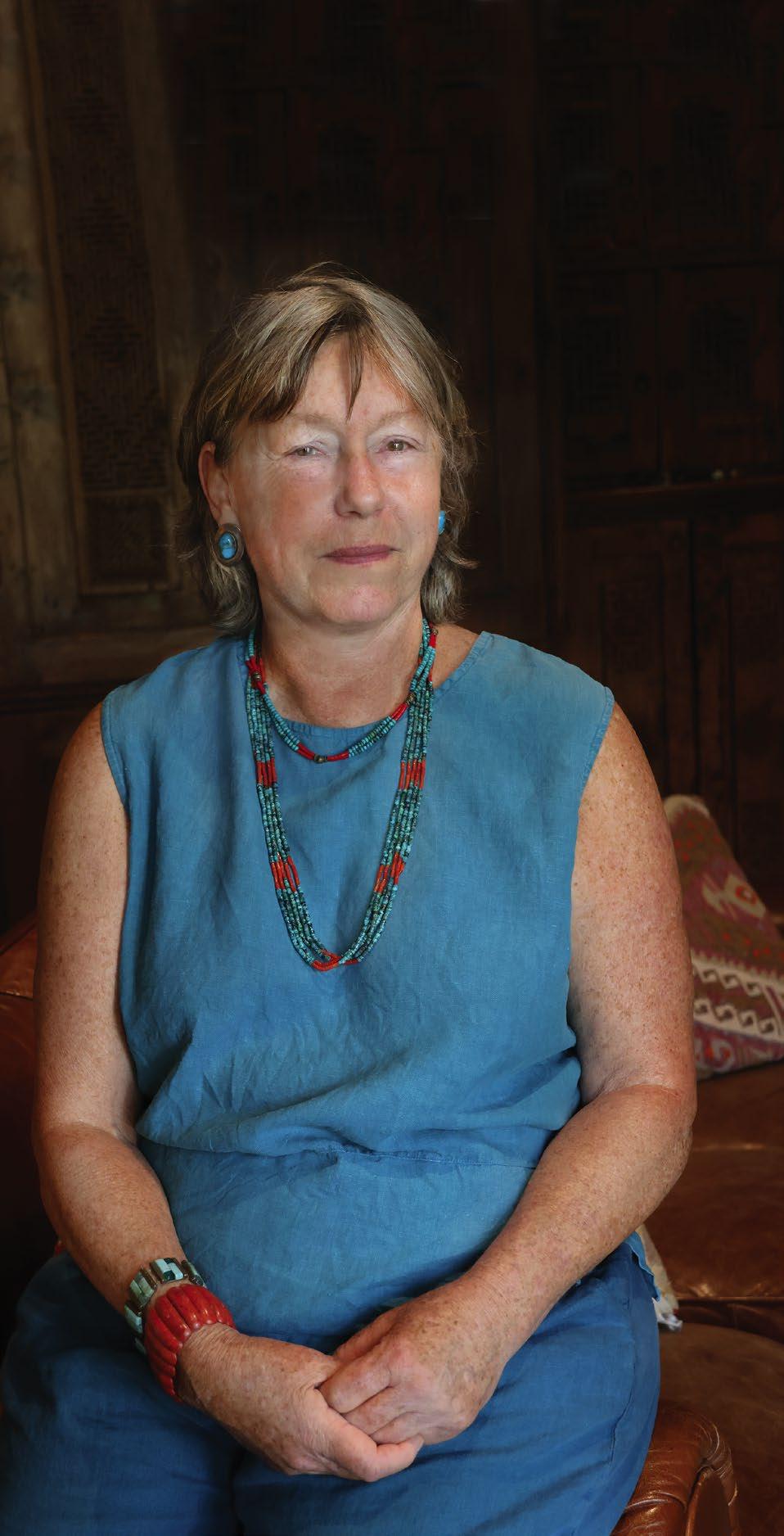
or more than 35 years, Joan Duncan has brought artistry, intuition, and heart to the world of interior design. After earning her BA in Art from the University of Texas, Duncan graduated from the Rhode Island School of Design (RISD). During her RISD years, she discovered Taos, New Mexico, a place she chose for a creative retreat long before making it her permanent home in 2000. Today, she is deeply rooted in Taos, often called the “Soul of the Southwest,” and has spent the last 25 years in Taos shaping interiors that resonate with the spirit of the high desert.
Duncan describes her style as eclectic, guided less by strict design categories and more by what brings joy to her clients. Though she has worked on commercial projects (including design for a resort), residential spaces are her specialty, with each project an exploration of personality, form, function, color, and materials. “Listening,” she says, “is my greatest strength.” By carefully tuning in to her clients—whether individuals or couples with differing tastes—she ensures their homes become reflections of their lives. Her process embraces the uncertainties of change, guiding clients through the journey of transformation with openness and trust. Whether navigating bold color choices or blending contrasting styles, Duncan thrives on finding common ground that creates harmony. The result is more than a designed space—it’s a home imbued with authenticity and soul.
Joan Duncan, ASID, Interior Architect Taos, New Mexico (575) 751-3030
Online: acreatrix.com
Instagram: @acreatrix
Jenny founded The Vibe Design Company in 2019 to help create spaces that owners feel passionate about. She believes that beautiful, welldesigned spaces make people feel good, which to her is an honorable endeavor. It is her mission to blend aesthetics and practicality to bring her client’s vision to life.
As a child, Jenny spent a great deal of time arranging furniture. She’s continually reimagining, decorating, and redecorating all the spaces she occupies. With a degree in business and marketing, her interior design is self-taught but comes from a place of deep passion.
Jenny’s design style is grounded in nature with a modern, warm Southwestern materiality and emphasizes interesting textures, earthy color palettes, and modern forms to convey her interpretation of contemporary Southwest design. She seeks inspiration in nature—especially in rock formations and naturally occurring color palettes.
She designs primarily for luxury homes and condominiums but has also completed commercial, retail, and office spaces, including an upscale salon and a boutique hotel. Working with a client, to her, is like ingredients of a collaboration soup. Her clients have their desires and needs, the space has its limitations and history, and Jenny has her design eye and experience. By blending shared experiences—putting it all into a pot and stirring it around— together they create something personal and original that the client feels a part of.
The Vibe Design Company
Jenny Gordon
Albuquerque, New Mexico (505) 369-2265
Online: thevibedesigncompany.com
Instagram: @thevibedesignco
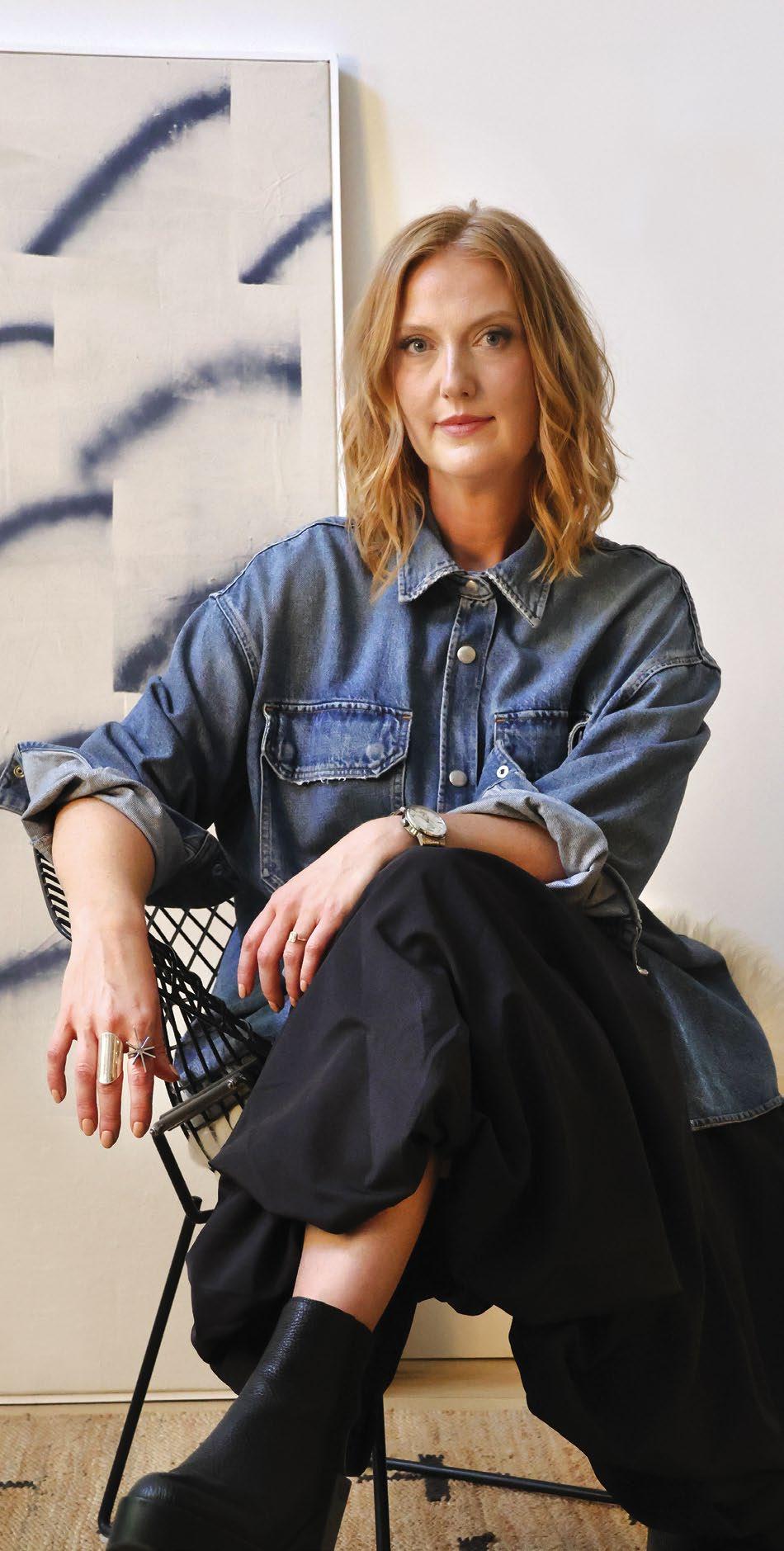

nnie Jo moved to the mountains of Angel Fire at age twelve, and eventually opened her own hair salon at age nineteen. After running her business for more than twenty years, she transitioned into real estate in 2017. She shares this passion with her husband BJ Lindsey—who launched Lindsey Custom Builders in 2008—to delve deeply into every aspect of homes: Designing, building, buying, selling, remodeling, furnishing, and decorating.
Having become a premier builder in the area, the pair have combined their skills and shared vision to create Lindsey Land & Home, a real estate brokerage with a mission to help people find their own piece of paradise in the mountains.
In winter of 2024, Annie Jo launched Lindsey Living, a retail furniture and accessories boutique that serves as a staging area for her interior decorating projects. The space reflects the Mountain Modern style Annie Jo has become well recognized for. She incorporates a mix of modern metals with rustic wood textures, while utilizing palettes that combine neutral colors with pops of organic shades of greens or blues. To her, it’s all about combining the texture of the outdoors with the luxury of modern interiors.
Annie Jo specializes in luxury residential homes and condominiums, and has recently completed her first commercial project—Elevated Pour, an upscale wine bar next door to her retail store located in the Frontier Plaza in Angel Fire.
Lindsey Living
Annie Jo Lindsey
Angel Fire, New Mexico (575) 447-1248
Online: lindseyhomes.com
Instagram: @lindseyhomesnm

STORY BY LISA RAGSDALE
PHOTOGRAPHY BY DUSTIN ENGLISH AND VOORMI
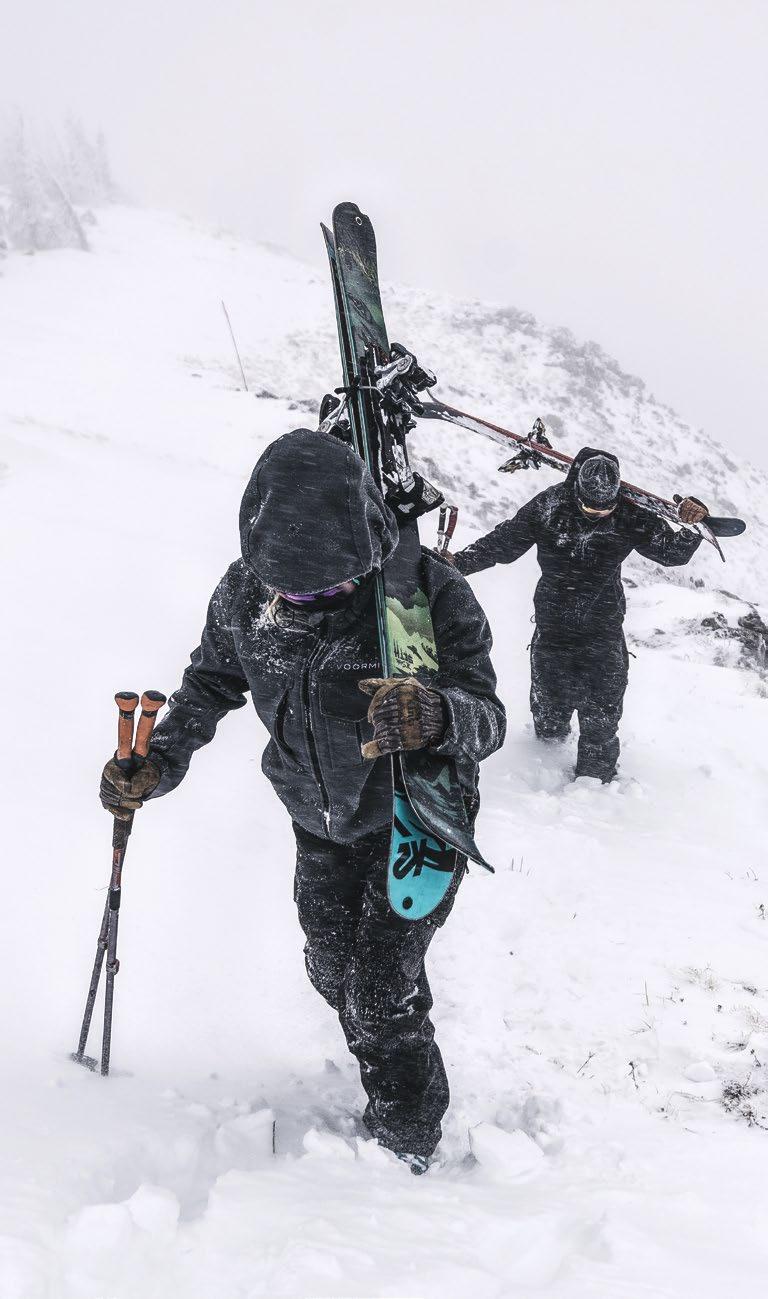
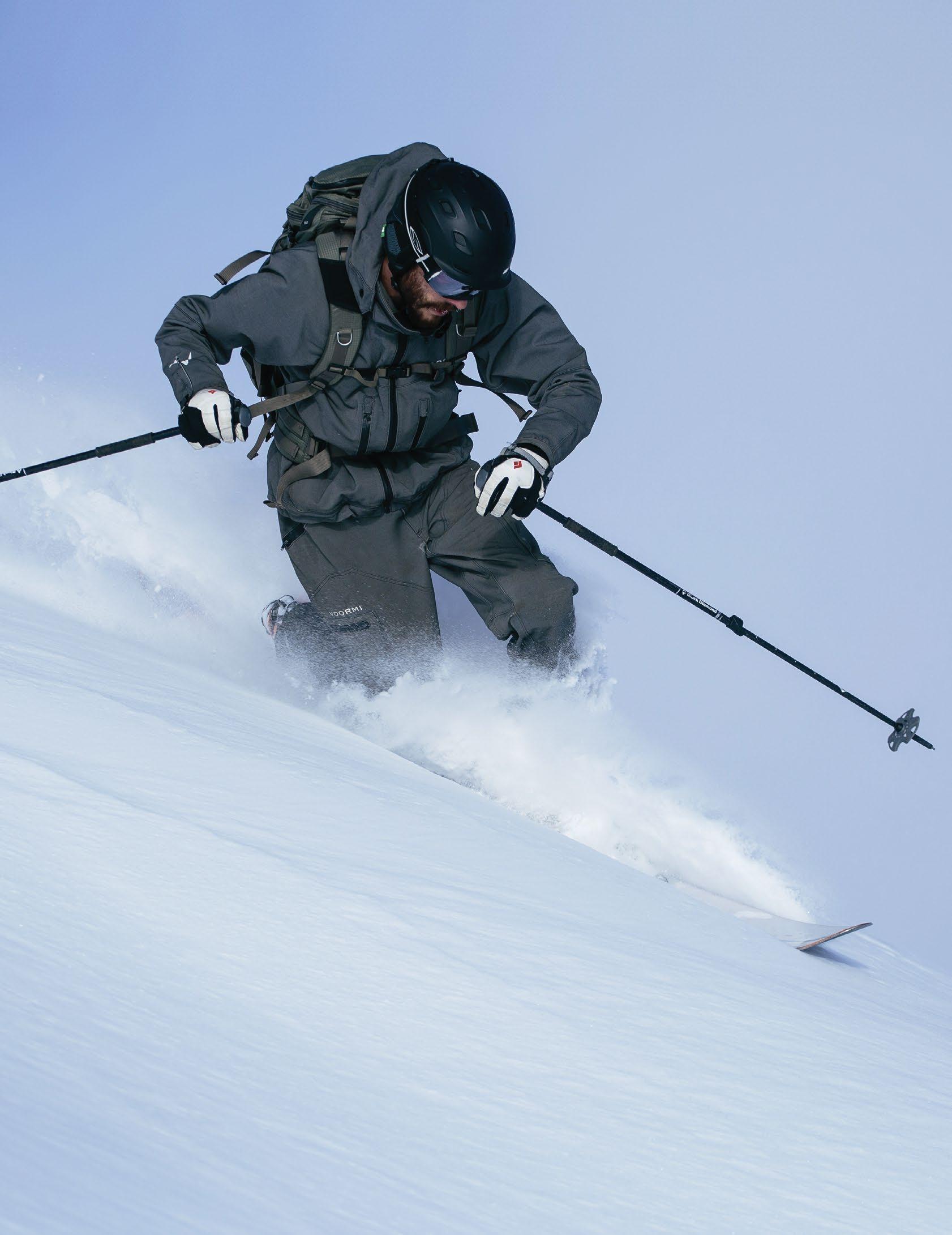
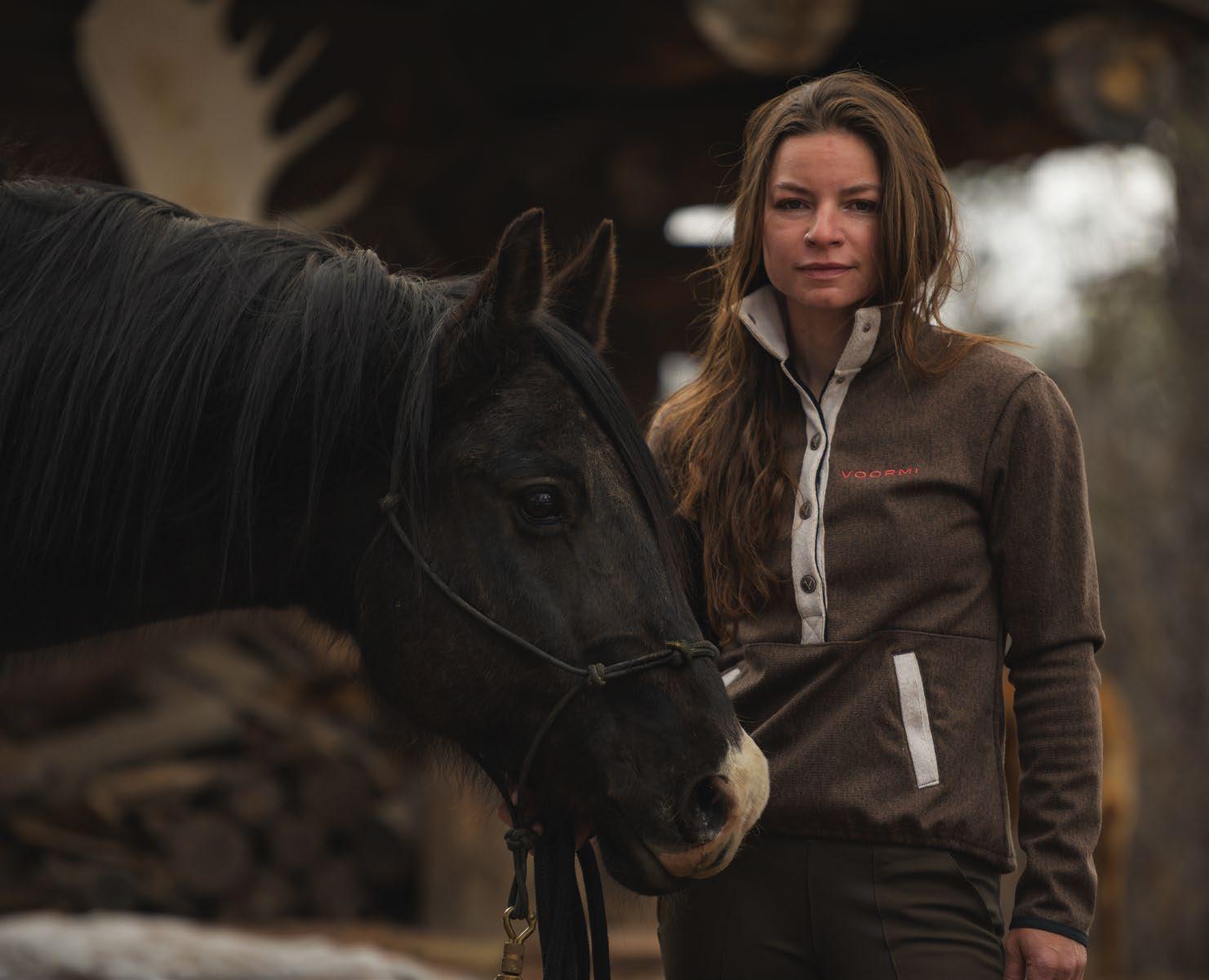
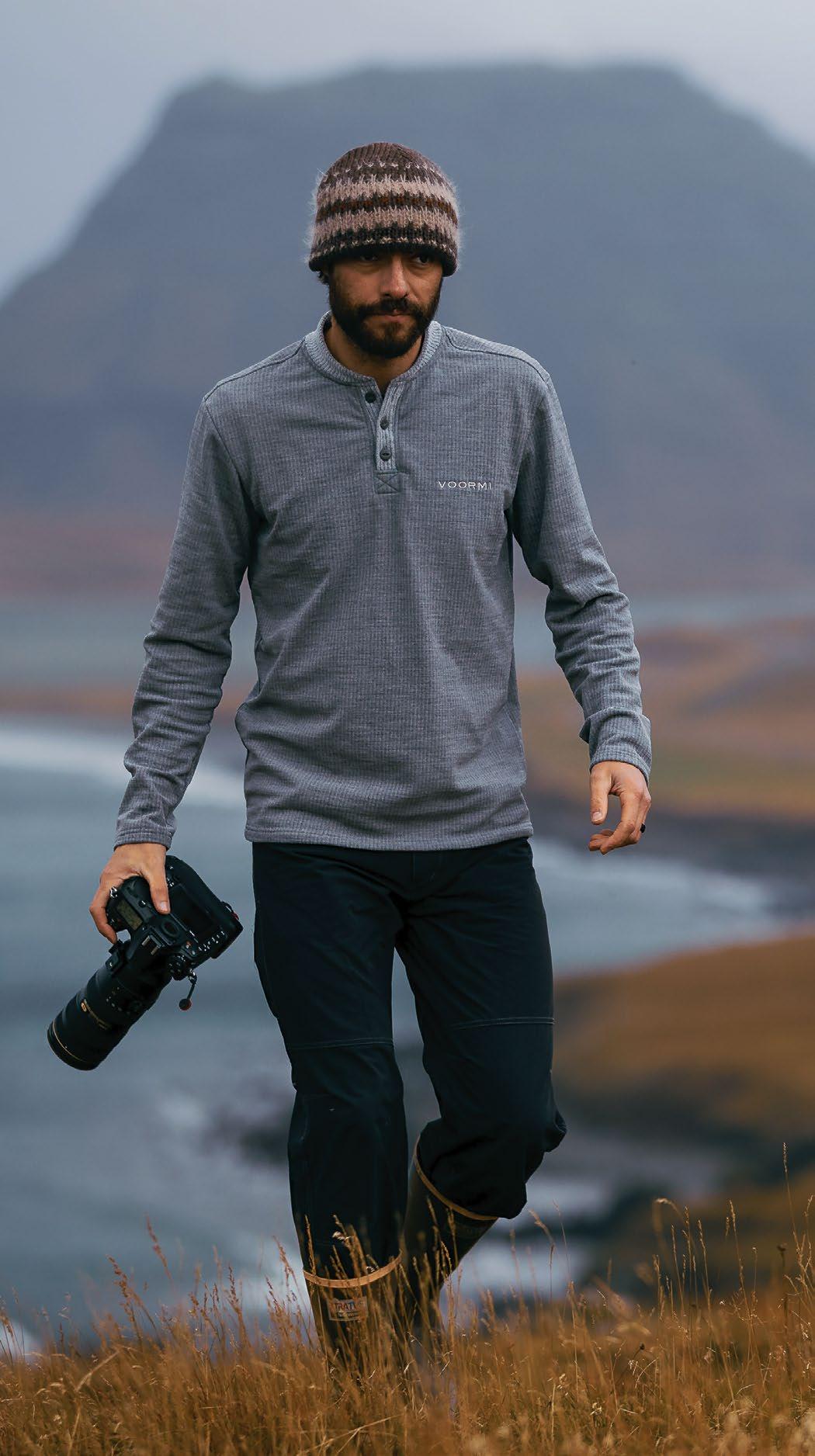
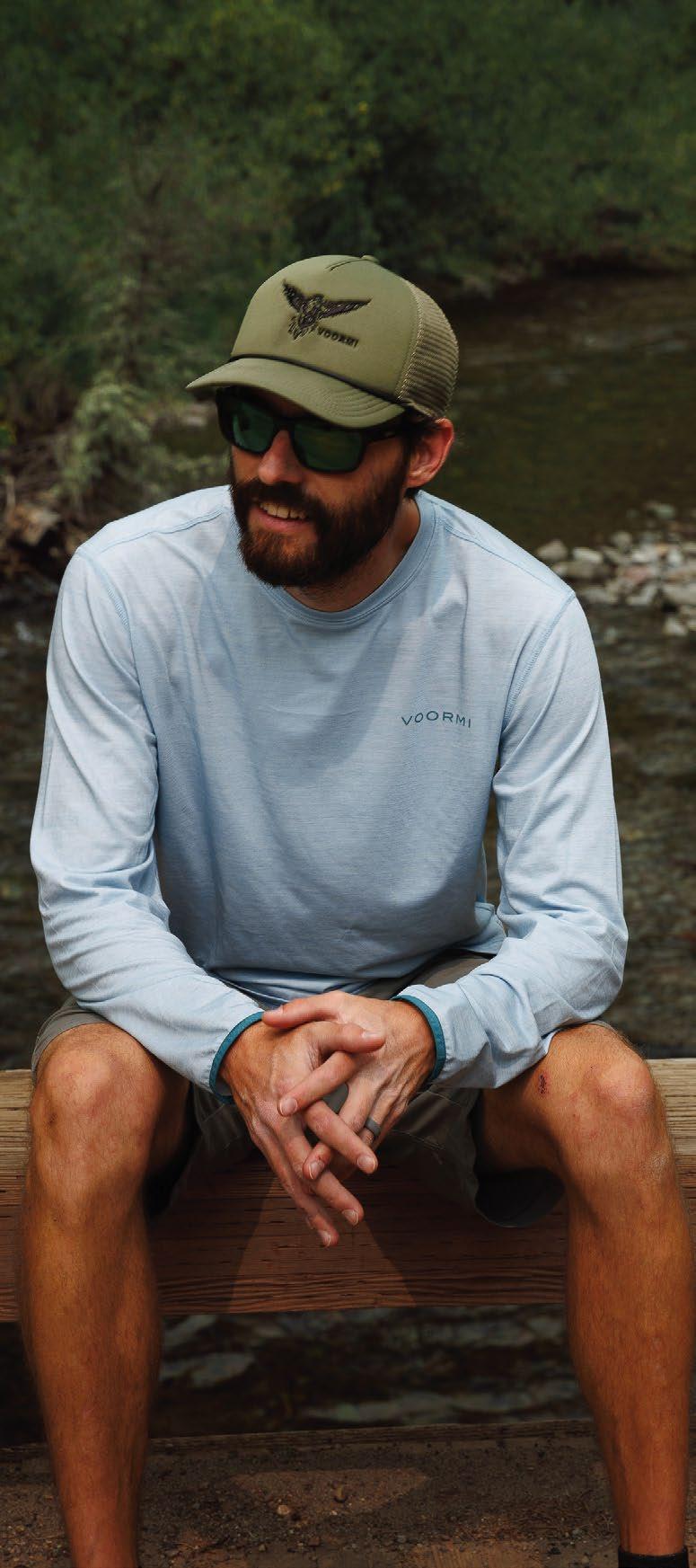
After years of guiding clients up Denali, North America’s highest peak, and countless other adventures, Dustin English experienced first-hand how gear can catastrophically fail when lives are on the line. When facing unpredictable weather there’s no room for compromise, and after years of frustration, Dustin knew the industry couldn’t provide a solution. It became clear that clothing needed to evolve. VOORMI transforms clothing from passive protection into active partnership, creating gear that doesn’t just keep pace with your ambitions—it amplifies your potential and adapts to your world, whatever that may look like in the moment. To find out more, we reached out to Dustin and his team to learn about what drives their ingenuity and what’s next for the outdoorsenthusiast clothing line VOORMI.
EO: What inspired the idea to fuse technology with clothing?
V: It was late June 2009 on Denali, and Dustin was leading his team higher into the Alaska Range. At 10,000 feet, the mornings began bitterly cold. Breath froze instantly in the air. Water bottles turned solid in the packs. Everyone moved stiffly in their parkas, just trying to shake the chill out of their bones.
But a few hours later, the mountain flipped the switch. Under the thin air, high-altitude sun, and snow reflecting light from every angle, it felt like walking across the sur-
face of the sun. Jackets were stripped, sleeves pushed up, sweat pouring down faces. The swing from below zero to blazing heat happened almost daily, and there was no gear system built to keep up with these changes.
By 12,000 feet, the rhythm was set. Every water break turned into a scramble—someone shoving a down jacket into their pack or fumbling for a mid-layer, another peeling off gloves. What should have been a quick stop, stretched longer as the team wrestled with layers. As the guide, Dustin found himself less focused on the route and more on coaching people through their constant adjustments.
He felt it, too. One ridge brought wind that cut straight to the core. The next sheltered section had him overheating within minutes. Over and over, the cycle repeated: sweat, chill, swap, repeat.
By the time the team reached 16,000 feet, frustration was thick in the thin air. Morale dipped with every sweaty climb that turned into another shivering break. Dustin could see it: the mountain demanded their focus, but the clothing kept stealing it away. That’s when the thought crystallized: why are we adapting to our gear, instead of our gear adapting to us?
EO: Tell me about the brand name VOORMI. Where did it come from and what does it mean to you?
V: When we were searching for our brand name, we wanted meaning. During our extensive travels, we learned something fascinating: ancient legends spoke of mysterious, yeti-like beings called VOORMI who inhabited the harsh Arctic regions. These weren’t just mythical creatures, they were survivors, masters of their frozen domain who thrived in conditions that would defeat others. They had an almost supernatural ability to adapt. They didn’t just endure extreme cold; they flourished in it.
But there was another layer to our discovery. VOORMI, we learned, is actually a Dutch word meaning “For Me.” This wasn’t just coincidence, it was synchronicity. The Dutch translation represented our personal philosophy of gear designed with the individual in mind. This dual meaning became the foundation for everything we do, including our breakthrough technology MijTM, Dutch for “Me,” which continues this thread of personal adaptation and individual performance.
EO: How did your personal connection to the outdoors shape its beginnings?
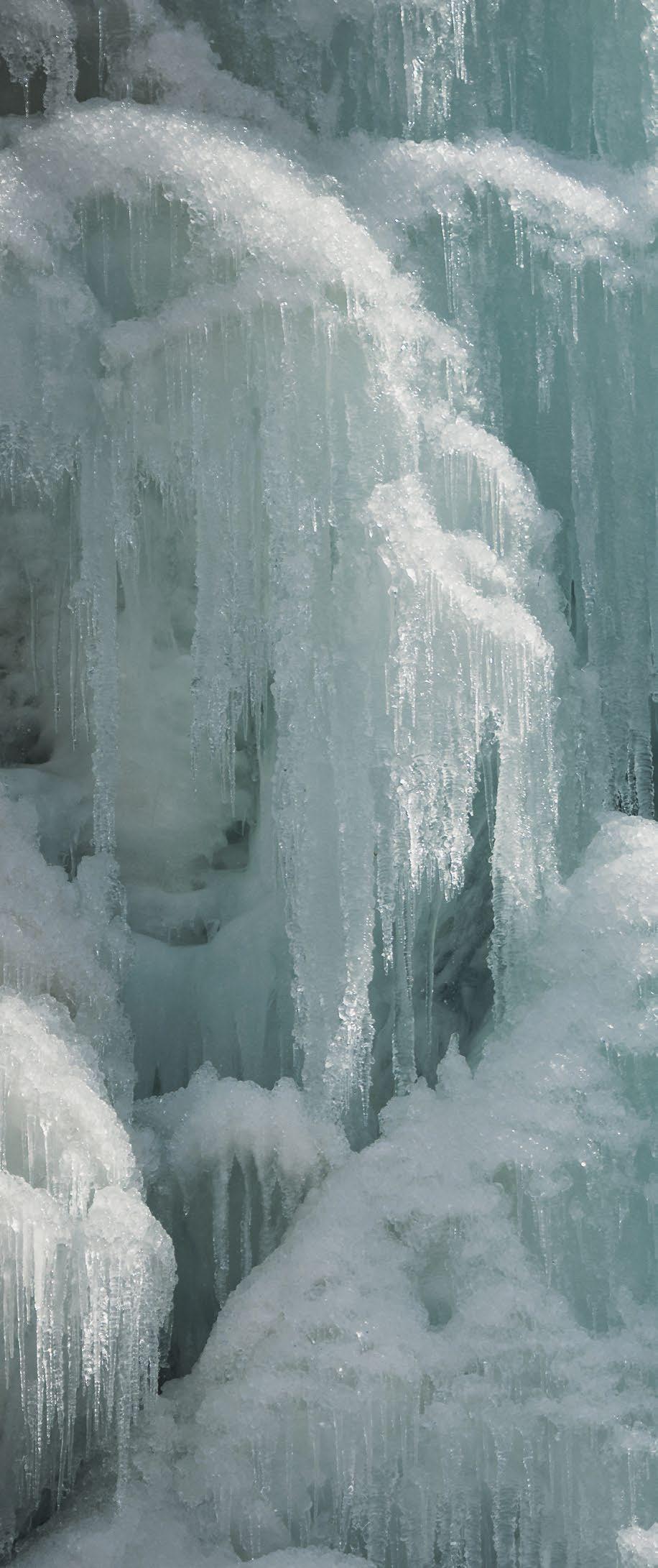
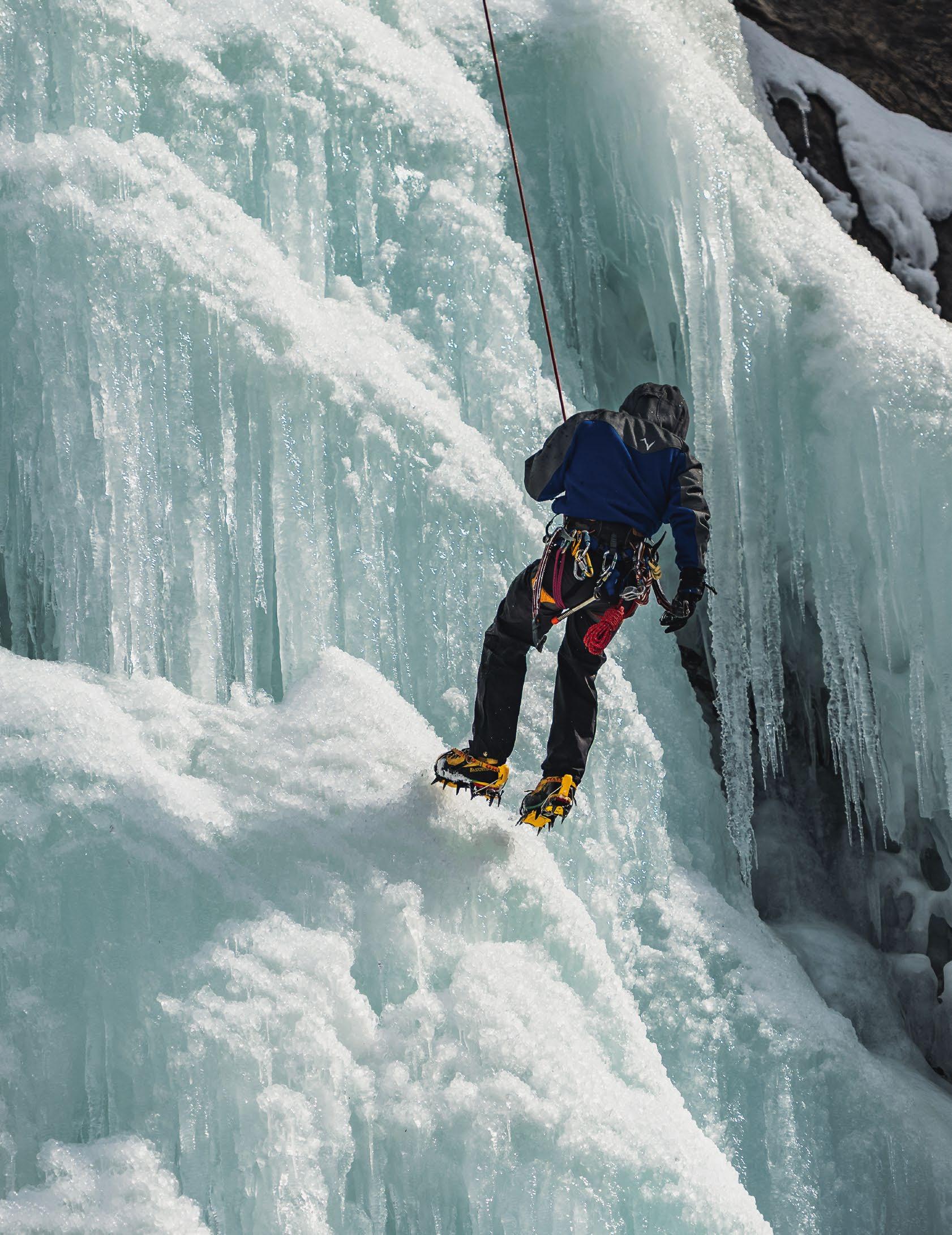
V: VOORMI emerged from a fundamental frustration that every outdoor enthusiast knows intimately: the gear simply wasn’t designed for how we actually live and move in the mountains. As lifelong skiers, fly-fishers, Denali guides, and relentless outdoorspeople, we experienced first-hand the massive disconnect between what the industry is producing and what we actually need to perform and remain comfortable across diverse environments. We refused to believe that clothing had to
remain static while everything else in our world became increasingly more intelligent, adaptive, and revolutionary.
EO: Who do you partner with for research and development?
V: Our R&D philosophy is radically collaborative. Our highly skilled and diverse team works directly with national labs, textile scientists, and elite athletes who share our obsession with pushing boundaries. This approach has yielded breakthroughs, like our Ultralight collection, CORE CONSTRUCTION® technology, and our latest marvel: MijTM, the first successful integration of
biometric sensors directly into textiles. When MijTM won the innovation award at CES® 2025, it validated what we’ve always believed—that clothing has been sleeping through the technological revolution for far too long. Our tagline “The Future of Clothing” isn’t aspiration; it’s our commitment to revolutionizing the most intimate technology humans use every day. We’re not just a gear company; we’re pioneers of intelligent human-textile interaction.
With MijTM, we’ve achieved what sounds like science fiction: clothing that learns from your body, predicts your needs, and becomes an extension
of your biological intelligence. This is clothing as a living system, not dead weight. The best part, it is still as comfy as modern-day clothing!
EO: VOORMI emphasizes performance, sustainability, and local craftsmanship. How do these values show up in your day-to-day decisions?
V: Operational imperatives are hardwired into every decision we make. We deliberately stress-test everything to failure during development so it never fails when your safety depends on it. Every product must prove it belongs in our lineup.
Sustainability means building for lifetimes, not seasons. The most sustainable product is the one you never have to replace. Also, local craftsmanship keeps us connected to our process, our standards, and our community. We develop proprietary fabrics, manufactured domestically when possible. This control allows us to prioritize quality over quantity while staying rooted in the mountain communities that shaped our vision.
EO: What does “The Future of Clothing” mean to you—not just as a tagline, but as a philosophy?
V: “The Future of Clothing” captures something fundamental about our methodology and our core belief that clothing should do more. We recognized an absurd contradiction: while smartphones became supercomputers, cars learned to drive themselves, and homes became responsive ecosystems, clothing remained essentially unchanged for centuries. We were still putting on passive fabric that just hung there, waiting for us to adapt to it instead of the other way around.
This philosophy represents how we develop gear in the same unforgiving environment it’s meant to conquer, where every design decision gets
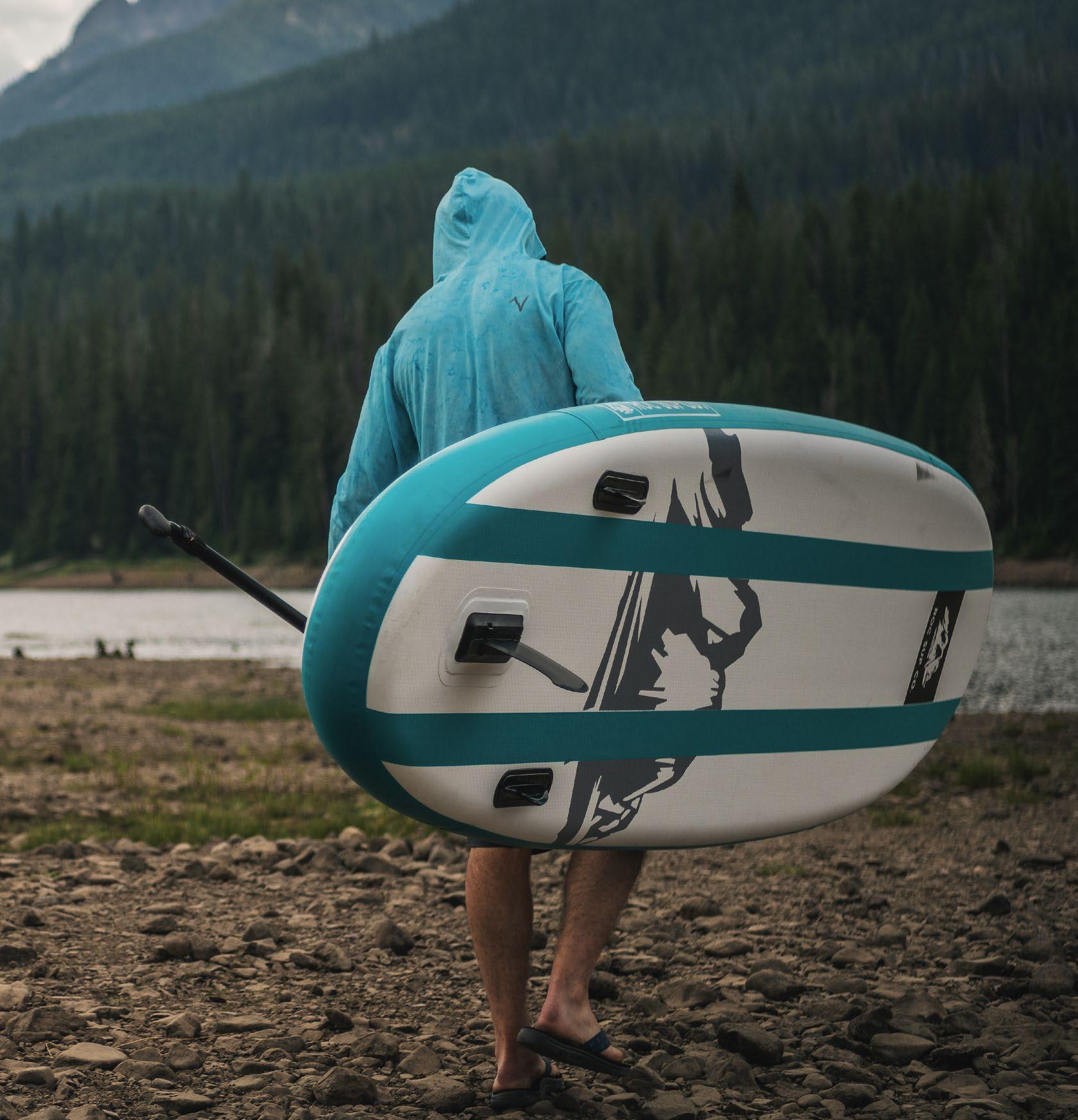
interrogated by reality, not theory. But more importantly, it embodies our relentless pursuit of clothing that actively enhances human capability, rather than just passively protecting. From the beginning, we’ve believed that gear should work harder than you do, adapting to your needs and amplifying your potential. This philosophy drives us to continuously push boundaries, from CORE CONSTRUCTION® to MijTM. We build it uncompromisingly, test it relentlessly, and never stop innovating toward clothing that truly does more. That’s the philosophy that fuels our vision for the future.
EO: How does the landscape of Pagosa and the Rocky Mountains influence your design choices and brand identity?
V: The high country is nature’s ultimate testing ground. Living and working at high altitude means our gear gets put through hell every single day—from bone-chilling mornings at 20o below to blazing midday sun to sudden afternoon storms that drop temperatures 30o in minutes.
Most importantly, this place keeps us honest. We’re proving performance in some of the most demanding environments on Earth.
EO: How do you balance innovation with tradition in your materials and manufacturing process?
V: True innovation doesn’t abandon tradition; it perfects and transcends it. CORE CONSTRUCTION® exemplifies this approach. Instead of accepting traditional membrane placement, we revolutionized it by embedding waterproof barriers between fibers rather than bonding them on top. This breakthrough delivers breathability and temperature regulation that outperforms everything else available.
Now we’re writing the next chapter
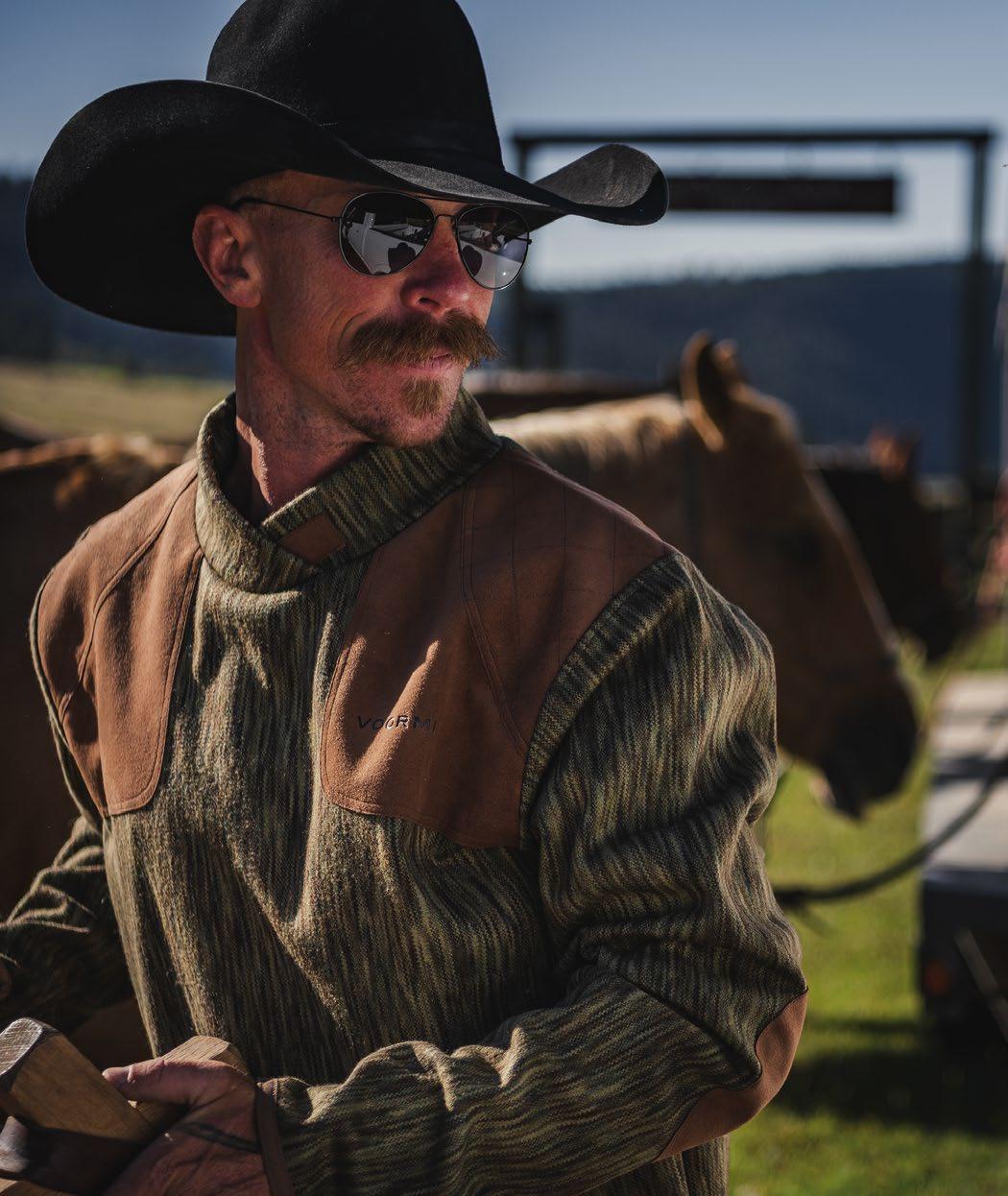
with MijTM, intelligent textiles that honor everything clothing has always done (protect, insulate, and endure) while introducing capabilities clothing has never possessed: learning, adapting, responding to human physiology in real-time.
This is innovation with integrity: respecting the craft while revolutionizing the possibilities.
EO: How do you see VOORMI contributing to the outdoor community—not just through products, but through culture and connection?
V: VOORMI contributes by staying au-
thentically rooted in the communities where outdoor life isn’t recreation—it’s identity. From Pagosa Springs to Bozeman, we’re not visitors; we are neighbors who serve as Emergency Medical Technicians (EMTs), Search and Rescue volunteers, trail builders, and mentors.
We collaborate with people who live and work at the edge: athletes, guides, creatives, and mountain folk who help us evolve our gear through real-world application. These are R&D collaborations with people whose lives depend on performance.
We’re fostering a culture where innovation serves adventure, where quality
trumps hype, where gear is built by people who depend on it. We support emerging talent with access, opportunity, and equipment that performs when it matters most.
EO: What type of feedback are you getting from customers or collaborators that has reaffirmed your mission?
V: The feedback that fuels us comes from moments when our gear enables experiences that wouldn’t otherwise be possible—the summit reached because our jacket held strong through a freezing storm, the guide who worked fourteen hours on water without sunscreen yet stayed cool and protected throughout.
The most electrifying feedback now comes from early MijTM testers. With MijTM, we’ve achieved something that seemed impossible: electronics and textiles merged at the thread level, seamlessly, invisibly, durably. Current testers include endurance athletes, engineers, and executives, and their feedback is beyond encouraging. It’s revolutionary. It’s the foundation of an entirely new relationship between human and textile. We’ll launch MijTM to consumers in 2026, and it will redefine what clothing can accomplish. You can see studies on our site in the Fall of 2025.
EO: What’s next for VOORMI—any new directions, materials, technology or partnerships on the horizon?
V: At VOORMI, there’s no finish line, only milestones on an endless journey toward clothing that truly amplifies human potential. While we’ll continue creating exceptional outdoor gear, our obsession extends far beyond: we’re pioneering the future of clothing itself.
MijTM is just the opening chapter. We’re exploring materials that respond autonomously to environmental changes, textiles that self-regulate temperature, fabrics that can repair themselves.
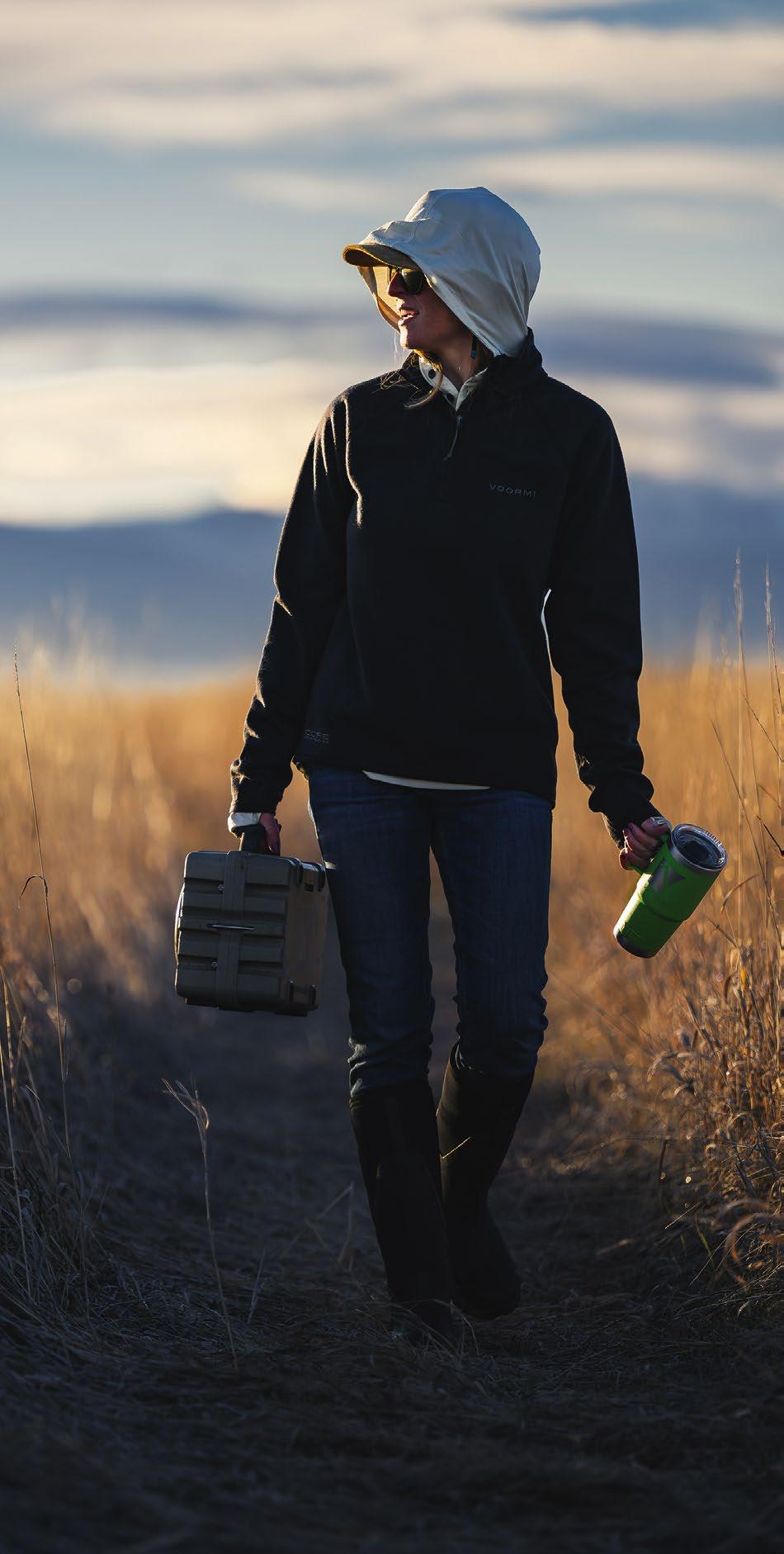
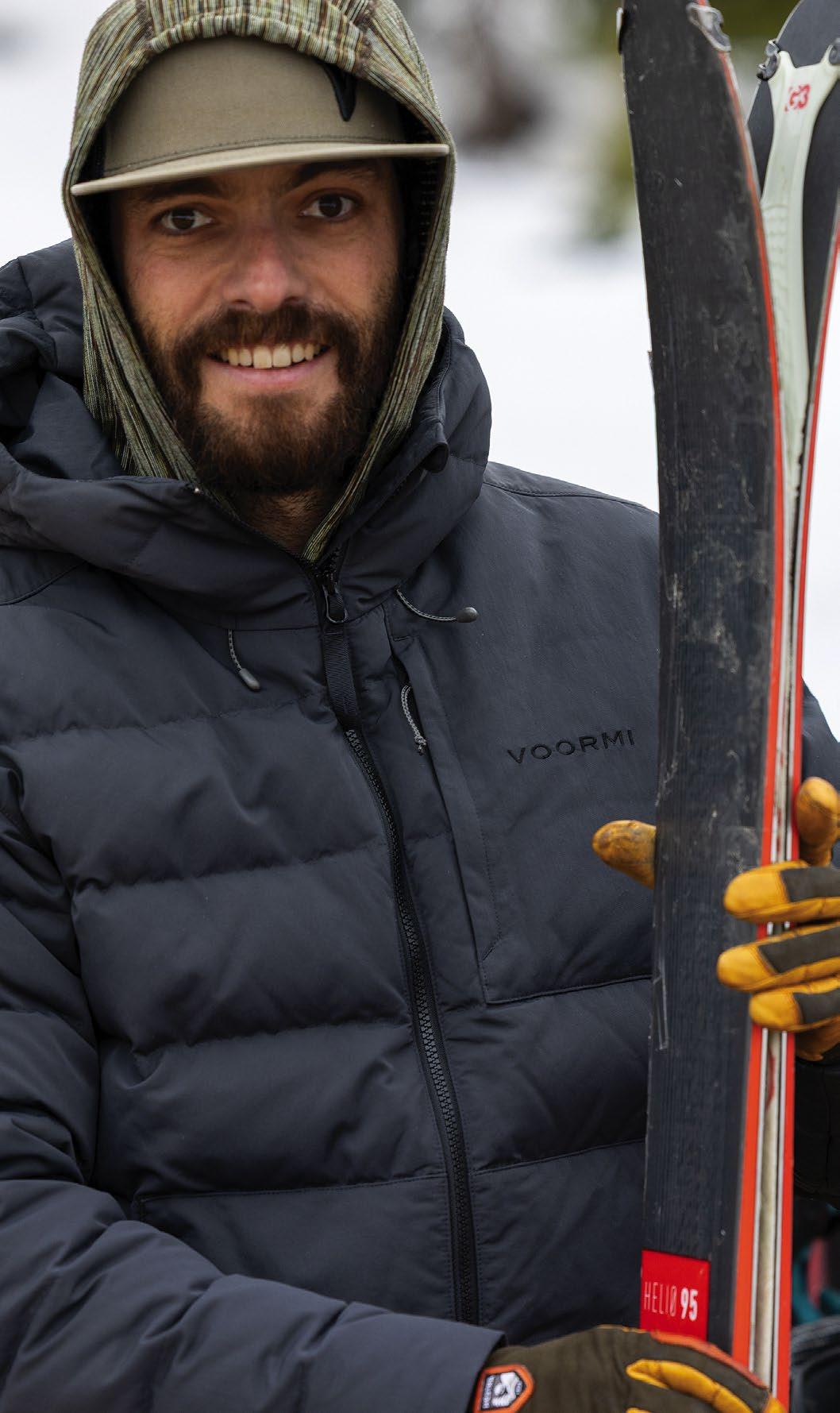
We’re building partnerships with researchers, athletes, and visionaries who share our conviction that clothing has been stagnant while every other technology evolved exponentially.
EO: If you could distill Voormi’s mission into one sentence, what would it be?
V: VOORMI transforms clothing from passive protection into active partnership, creating gear that doesn’t just keep pace with your ambitions, but amplifies your potential and adapts to your world.
EO: What legacy do you hope VOORMI leaves in the outdoor industry and in the lives of those who wear it?
V: VOORMI’s legacy will be the paradigm shift the industry desperately needed, a complete rejection of disposability in favor of gear that becomes integral to the wearer’s story, equipment that earns its place in life and keeps it for decades.
Let our legacy be this: We didn’t just build superior gear. We built the future of clothing, a vision born out of frustration and destined to revolutionize how humans interact with what they wear. t
Pagosa Springs 331 Hot Springs Blvd Pagosa Springs, CO 81147 (970) 264-2724
Bozeman 17 East Main Street Bozeman, MT 59715 (970) 264-2724
Online: voormi.com


by lisa ragsdale
Native New Mexican, Michael Candelaria, first began helping people feel better as a massage therapist. Although he would often recommend natural, organic solutions to his clients with muscle pain, he says that people wouldn’t go buy them. So, he decided to make and sell them at his office. After an ACL injury sidelined his massage
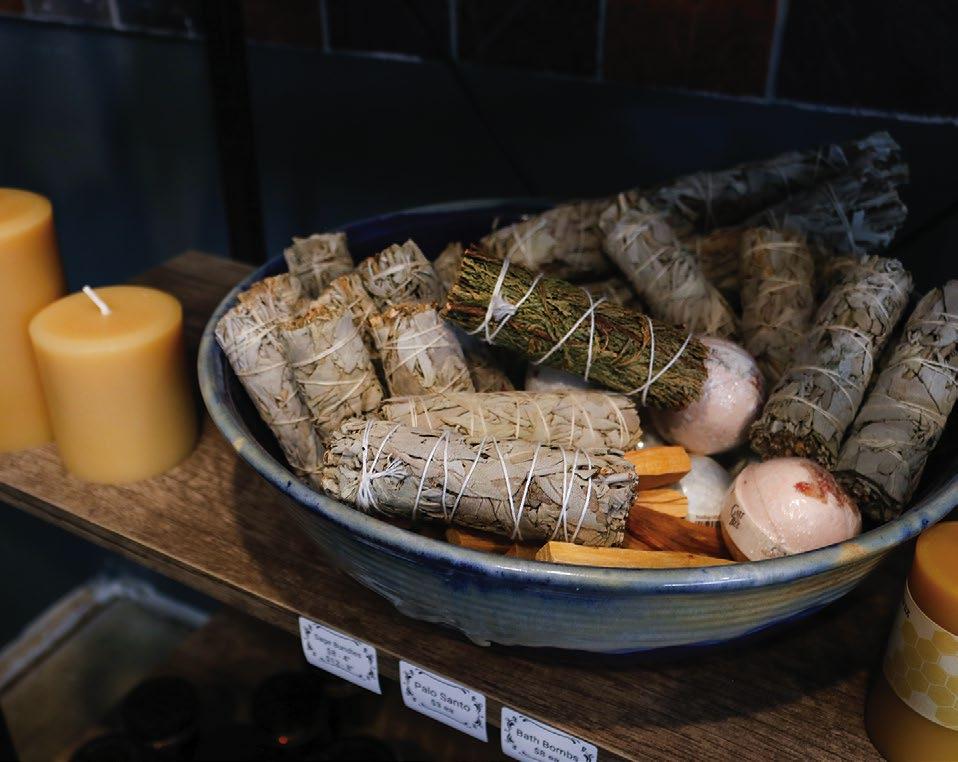
therapy work, he turned his focus to his products. His inspiration came from a variety of sources: his massage therapy curriculum included classes on herbalism and aromatherapy, and his grandmother, a curandera traditional native healer, taught him herbal remedies. A curandera is typically a woman, found in Indigenous Mexican and Latin American cultures who practices curanderismo, a holistic healing system that addresses spiritual, emotional, and physical aspects of well-being.
In Duke City, Michael’s family was among the first settlers in New Mexico and owned land in the South Valley. These influences and his commitment to safe, organic products that are proven to work, resulted in Sage Work Organics, a small, family-owned and operated business that draws from generations of experience in herbs and natural formulations to provide products that elevate health and beauty from the outside in—as well as the inside-out.
The Sage Work Organics brand, as
well as the family’s product vision, incorporates a concept of hygge. Hygge is a Scandinavian word that evokes comfort and coziness. Think lying on a warm massage table with vibrant scents swirling in the darkened room and soft, relaxing music playing. Hygge reflects the cultural value of taking time away from the rush of daily life, to focus on relaxing and caring for yourself and your loved ones while taking the time
Hygge reflects the cultural value of taking time away from the rush of daily life, to focus on relaxing and caring for yourself and loved ones while taking the time to feel the comfort of good things.
to feel the comfort of good things. The cornerstone of Sage Work Organics’ pain-relief products is magnesium, which accounts for about 85 percent of their business. Magnesium plays a key role in muscle function, nervous system balance, energy production, and sleep. The Replenish Magnesium Butter comes in several varieties and strengths, including one for expecting moms, and one for kids.

Michael explains that almost everyone is magnesium deficient, and they don’t even know it. Oral supplements might help, but topical magnesium has better and faster absorption through the skin. A simple foot rub twenty to thirty minutes before bed will tell your nervous system that it’s time to rest. It’s also a great post-workout recovery to reduce inflammation and speed muscle repair. Sage Work’s small team handcrafts magnesium butter in small batches using high-quality, naturally sourced magnesium and botanicals.
Other offerings include bar soap, facial moisturizer, shave cream, aromatherapy candles, and eleven essential oils; deodorant spray and a natural bug spray are in the works. There’s also the signature 4 Thieves Essential Oil Blend which includes clove, cinnamon, eucalyptus, lemon, and rosemary essential oils that work together as an antiviral and antibacterial to ward off illness and improve mood.
One surprising offering I found on Michael’s site was gourmet kitchen spices, and I asked him about the connection between organic health, healing products, and the spices. But Michael just loves to cook, so he started reaching out to suppliers and testing blends. He’s had great outcomes there, too, so he started offering the blends and sharing a recipe or two on his blog. Recently, he shared a twenty-minute blackened salmon recipe using Sage Work Organics’ Blackening Seasoning, a blend of smoked paprika, cracked black pepper, cayenne, garlic, oregano, and citrus peel. Who can pass up a quick recipe that is full of flavor and ready for a weeknight meal or a dinner party in just a few minutes?
But spices offer health benefits, too. They can be anti-inflammatory, antioxidants, and support immunity and digestion, so the connection makes sense. Michael is well on his way to
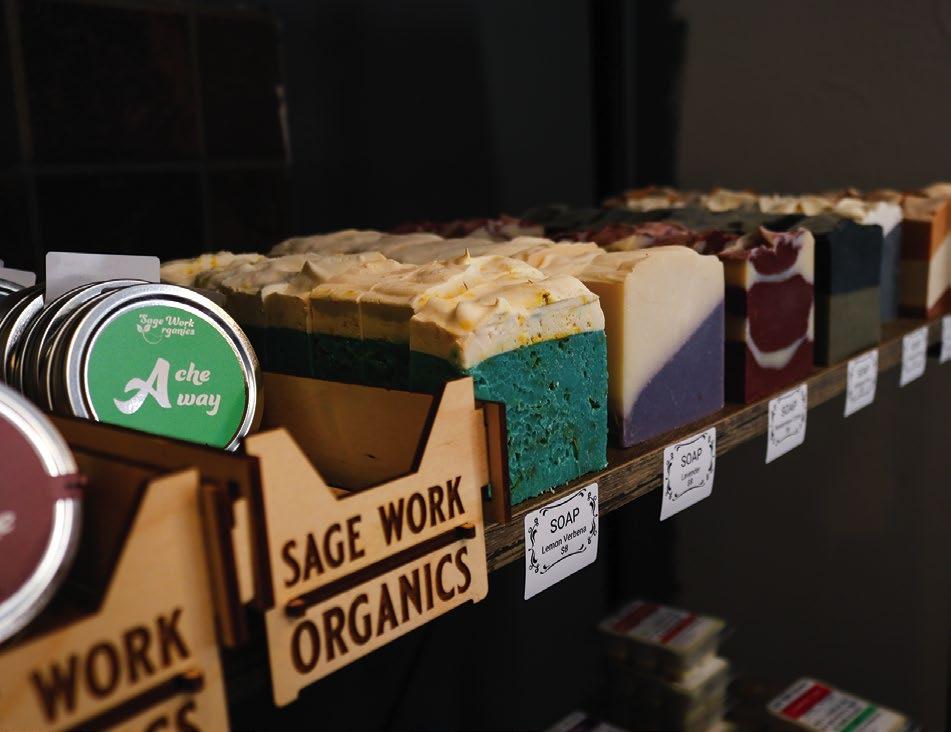
becoming a true apothecary. And that’s the vision: he just opened a physical location called Sage Craft in Albuquerque as a storehouse for his healing goods. He envisions making the products in the same place they’re sold alongside a coffee shop. Customers can browse and experience treatments on the premises so clients can test the products and take them away the same day. It may even evolve into a retail herb store. Right now, Sage Work Organics’ products are available at A Piece of New Mexico in Old Town, Albuquerque, Sage Craft, LLC, and online at Sageworkorganics.com. A trained graphic artist and photographer, Michael also creates and prints his own labels and does the product photography for his website. When I think of the term hygge and Michael, I see he is truly living out that philosophy. He’s expressing the creative aspects of his personality with his desire to make and do something important; something that heals and keeps his clients and customers in the moment—a moment of comfort and
peace—as they take the personal time to heal. The most important aspect of hygge is to take the time to realize how good that moment is, and for Michael and his family, that means making a life of helping others feel better. t
Find Sage Work Organics’ line of products at the following locations in Albuquerque.
Sage Craft, LLC
9720 Candelaria Rd. NE, Ste. E Albuquerque, NM 87112
A Piece of New Mexico
419 San Felipe Street NW Albuquerque, NM 87104
Online: sageworkorganics.com





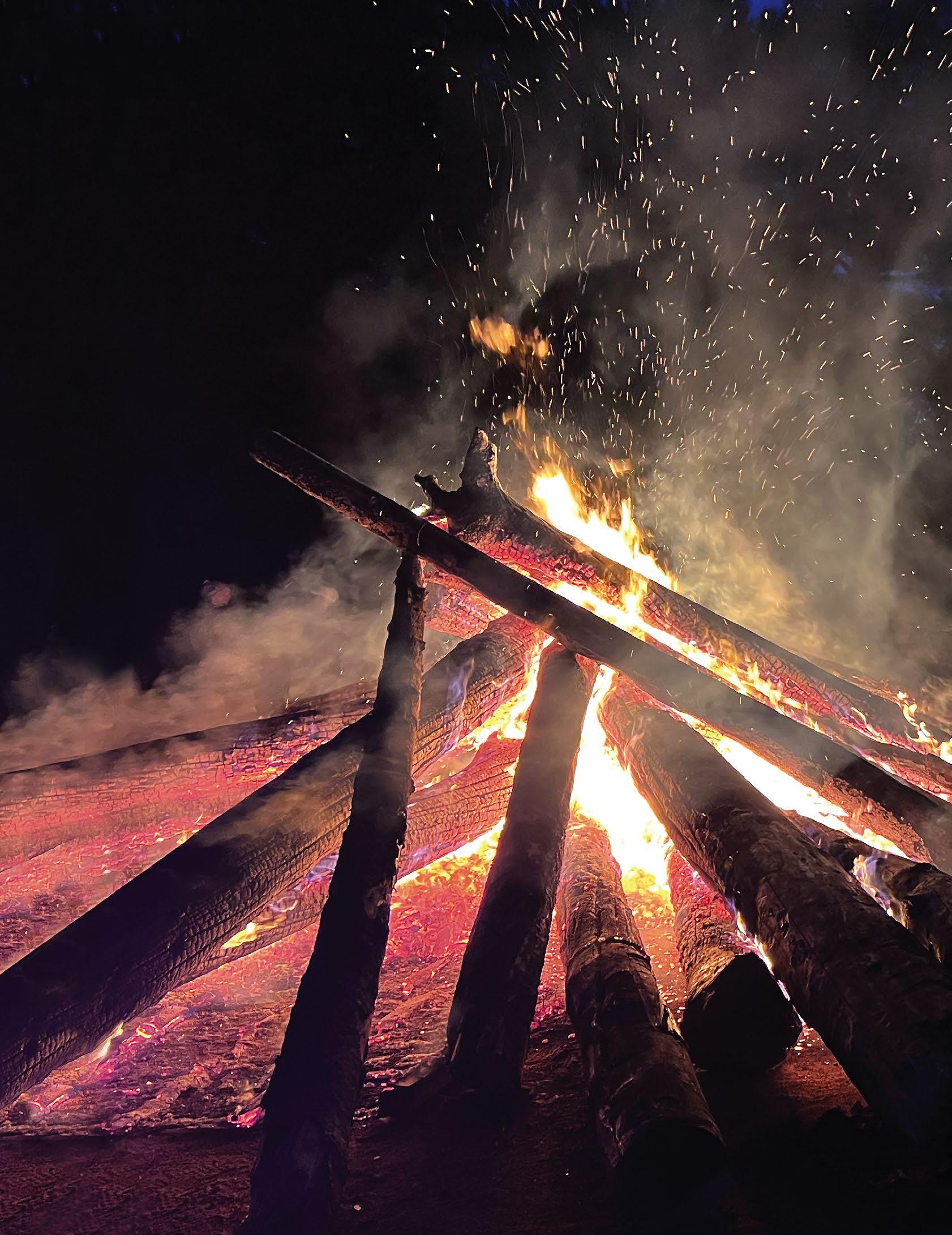
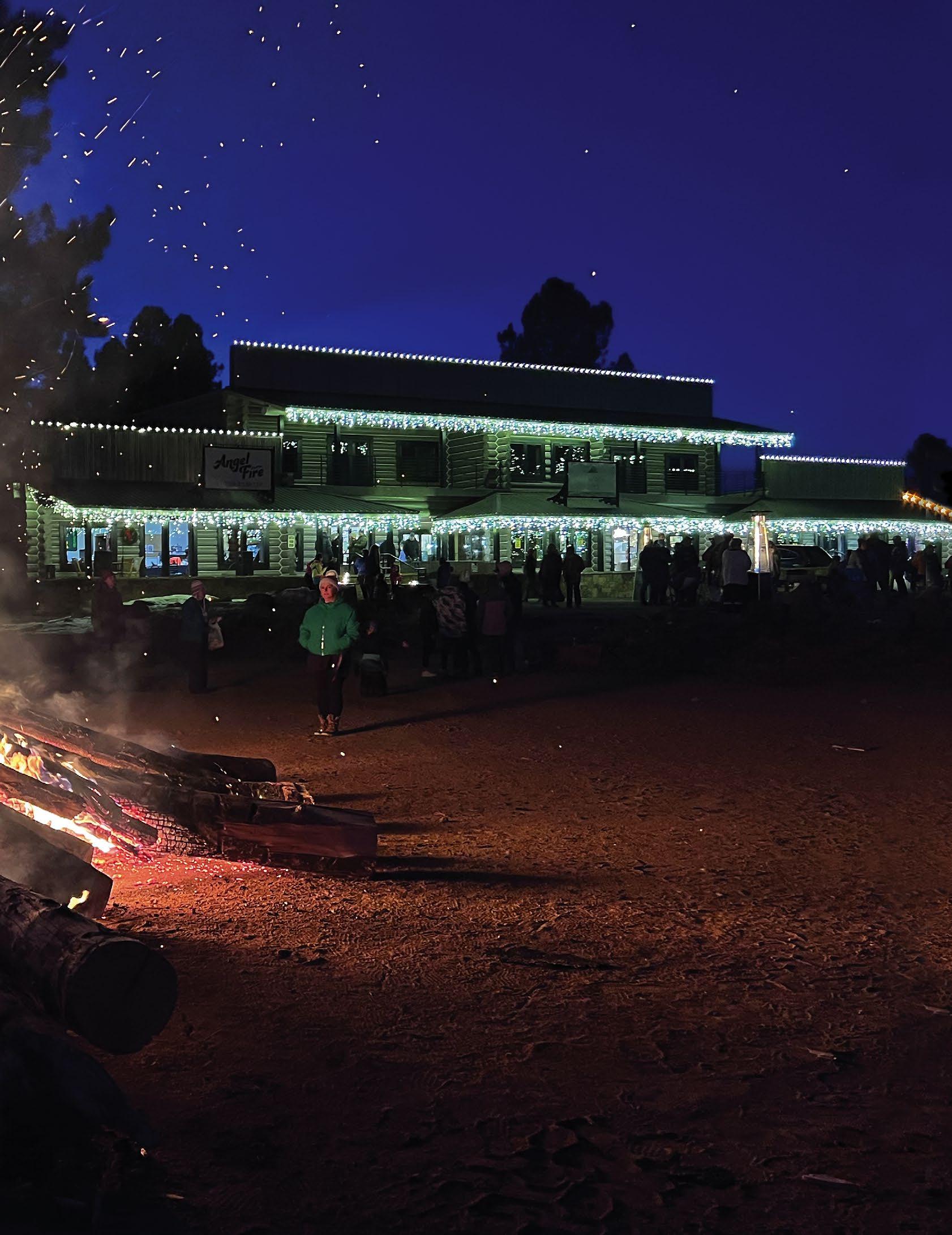
The Whimsical World of Ray Renfroe | 96 A Trail of Two Cities: A Community-Driven Trail Project | 108 Sunshine Rising: A Native Woman’s Journey | 116
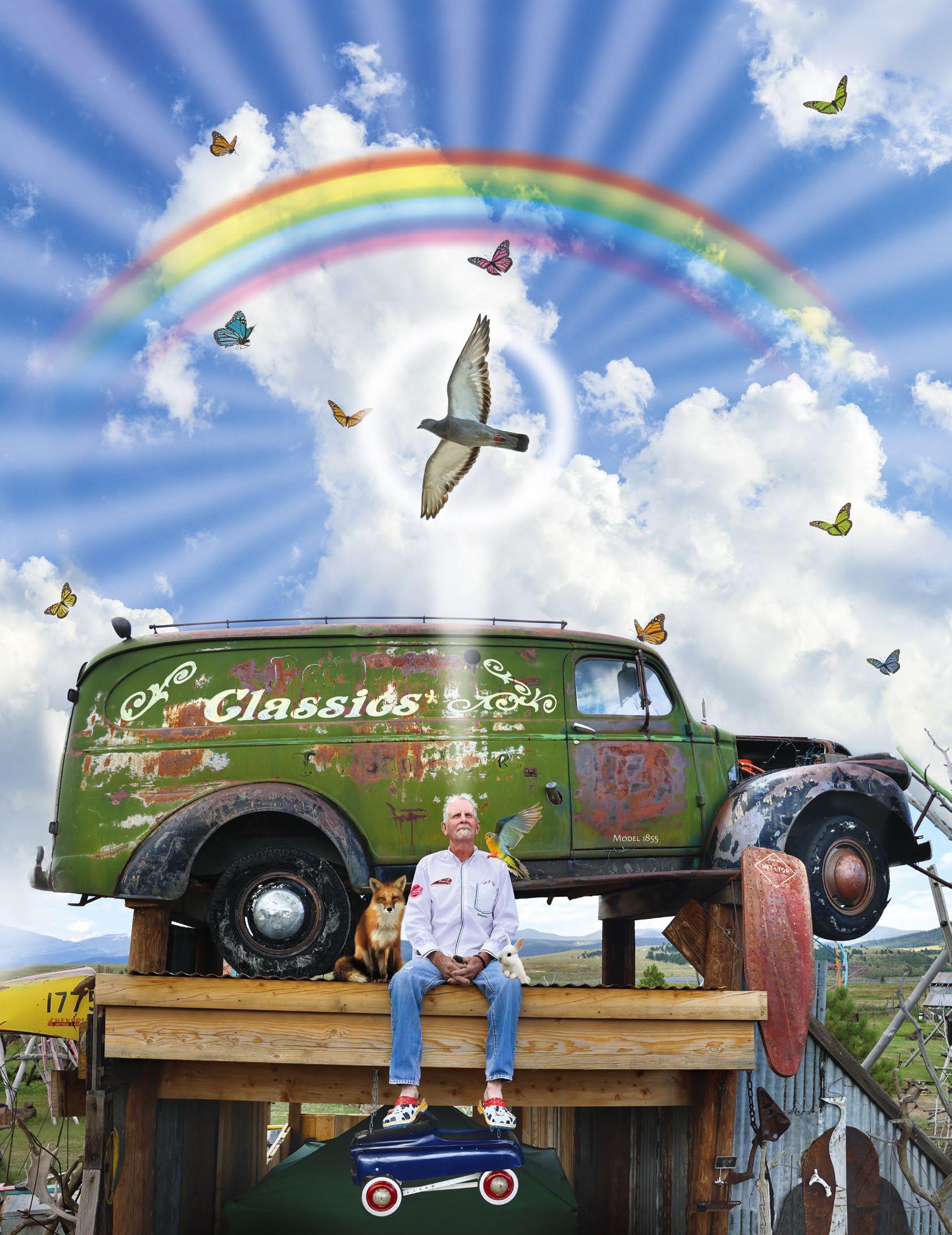
Story
by Scott Leuthold
Renfroe
He’s a kaleidoscope-craftsman, prairie dog circus trainer, inventor of wind-powered coffee percolators, and—most notably—the town’s unofficial dream tinkerer. Well—all of that may be a bit of a stretch, but the truth is not that far off. Ray is a very peculiar human, and what he creates with the extraordinary mind he’s been gifted is nothing short of artistic masterpieces. As a creative mind myself, I would go so far as to say that his work is mind-bending, and he emits an energy that no doubt vibrates dreams into form. A skill like that is nothing short of pure magic.
You see, Ray has an exceptional ability to catch dreams like butterflies in a net. It wouldn’t surprise me if every night after dark while the town sleeps, Ray flaps his wings to the top of Wheeler Peak—New Mexico’s highest peak— wearing snow boots, a silver vest stitched with moon-thread, and a very large butterfly net. His gift is a thing of astonishment and that’s precisely why he deserves a place in the pages of this publication. We tend to dig deep for those with a transformative story to tell. His is one of those stories.
As the exceptional human he is, Ray Renfroe doesn’t hoard captured dreams for himself. His work spans immersive, experiential art, custom home design and construction, artistic interior carpentry aesthetics, furniture making, and more. Everything he does can unequivocally be billed as “art.” His home, a ten-acre property recognized by the local community as What?Ville, located just east of Angel Fire Airport, is comparable to an outdoor circus version of the internationally recognized Meow Wolf art installation founded in Santa Fe. And honestly, he deserves such recognition. His home is a place of wonder—a place that blurs the lines between art and architecture, where adults can marvel at curiosities the way children set their eyes on Disneyland. What?Ville is some version of a place we all might create if adulthood hadn’t scarred us from remembering who we truly are—children in our creator’s eyes. Ray is a true storyteller who, through his creativity, rejoins us with our fundamental humanity. Built from reclaimed aspen sticks, old truck parts, vintage typewriters, deer antlers, and virtually any found object that sparks a story, What?Ville is something of a whimsical set from Charlie and the
Chocolate Factory, where visitors wander about through a mix of teepee-like structures, odd staircases, symbolic sculptures, and installations meant to ignite joy and curiosity. Among them are ceramic chickens representing Cain and Abel, a staircase to heaven, and art stations where guests are encouraged to leave their mark by painting sticks and adding to the evolving space.
Behind his white goatee and brilliant blue eyes, Ray’s mind captures those butterflies and transforms them into an emotionally immersed experience. When allowed to be himself—to express his ideas as they emerge, and to unfold his creativity like an origami monarch—this is when the magic truly happens.
I’ve had the opportunity to witness such magic. Hiring Ray to finish the interior trim work and carpentry aesthetics of our new home—a place we call the Mountain Outpost and meticulously created to wrap ourselves in a Pendleton blanket of security and comfort, a place we cherish—has been one of the most profound decisions we’ve made in the realm of our everyday lives. Ray is extraordinary. Through our interactions he’s become a friend. He helped us create that woven blanket that allows us to let go, take a deep breath, wrap ourselves in that warmth, and just live in comfort while the chaos of the world blends into the sound of the winter wind blowing through the needles of the pine forest surrounding us.
At first observation, his reserved demeanor and unconventional homestead could trigger a knee-jerk impression of him. Some may see What?Ville as the work of an aberrant eccentric. But any astute observer would quickly recognize the almost divine harmony in all that he creates. And, if the observer just doesn’t get it, that’s ok, too. Creativity is the central theme, and such is the observer’s perception—a craft to each his own.
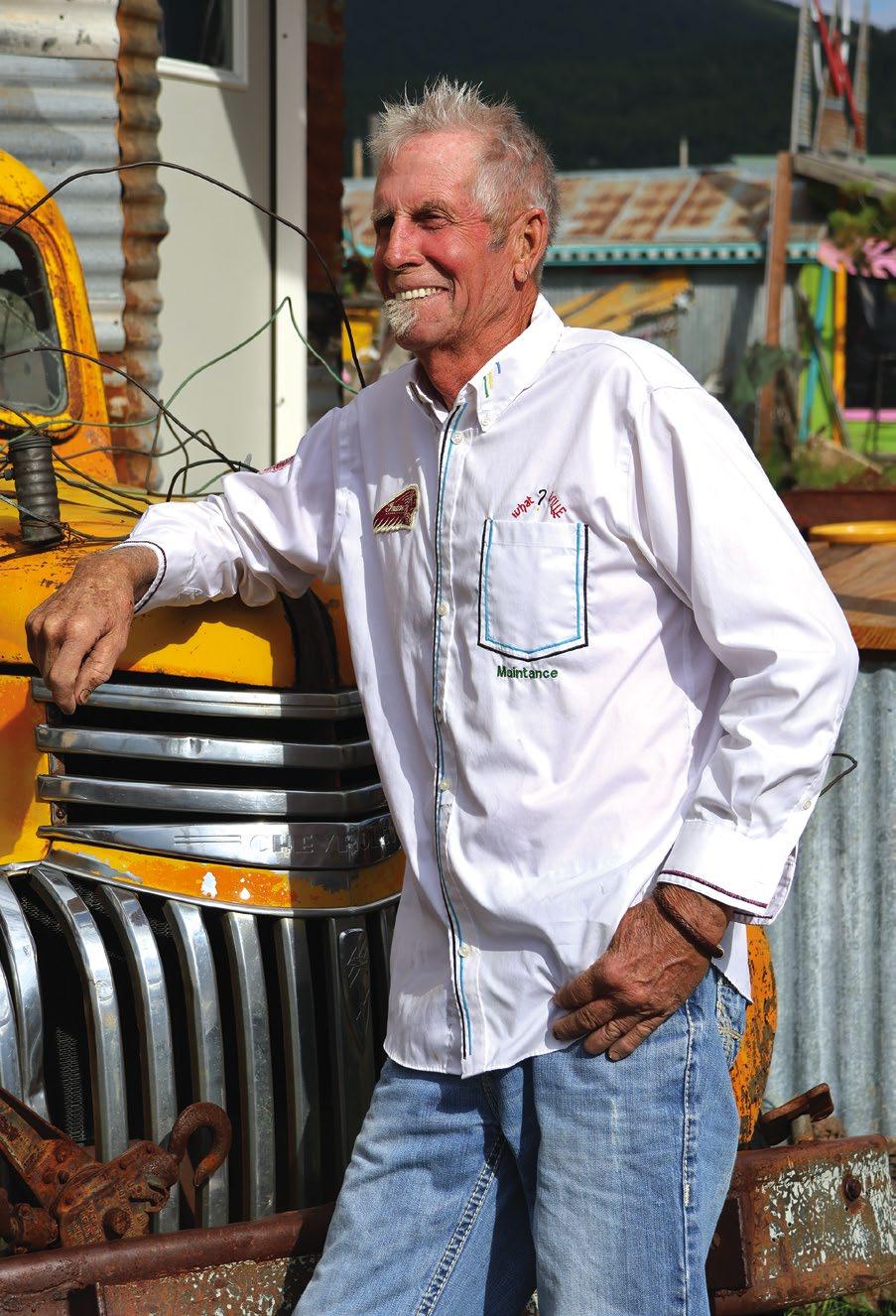
The question most often sparked from those who visit his extraordinary property is, what drives the man behind the creation? What?Ville was born not only out of Renfroe’s artistic drive, but also from profound personal loss. Following the tragic passing of his son Cody Blue in 2001, Renfroe began seeking an outlet for grief and remembrance. What?Ville became that outlet—a whimsical tribute to healing, laughter, and connection.
Prior to hiring Ray to finish the interior of our own home, he invited us on
a private tour to see some of his many dwelling projects. With each owner’s eager welcome, we entered the front doors and were immersed into Ray’s mind and embrace. Our response was to give him an almost carte-blanche authority to create his vision within the walls of our own dreamcatcher.
Ray has invested over two decades defining and honing his craft. He builds more than homes: he crafts dwellings imbued with soul. And extending beyond artistic carpentry, Ray also custom crafts much of the furniture that
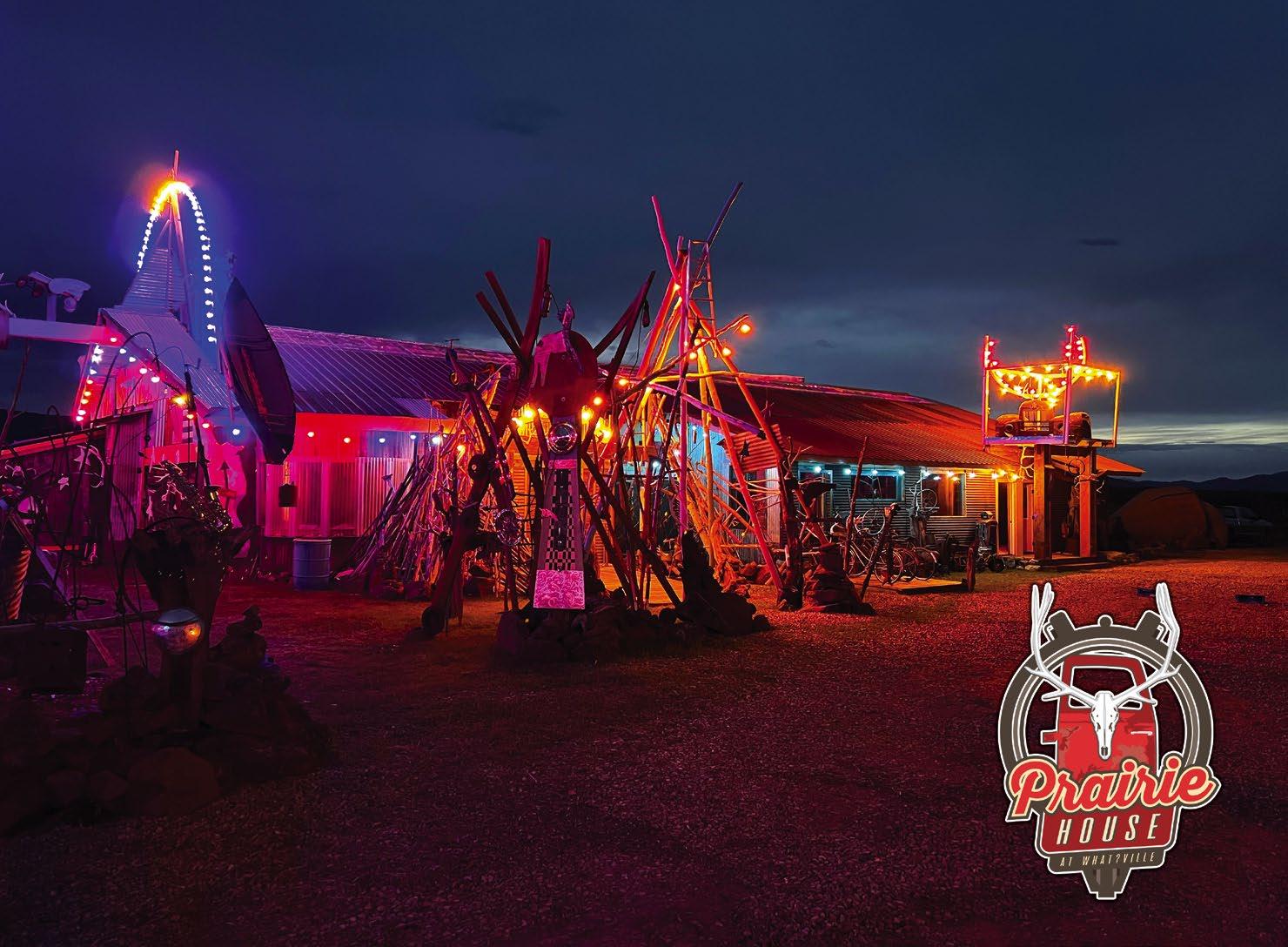
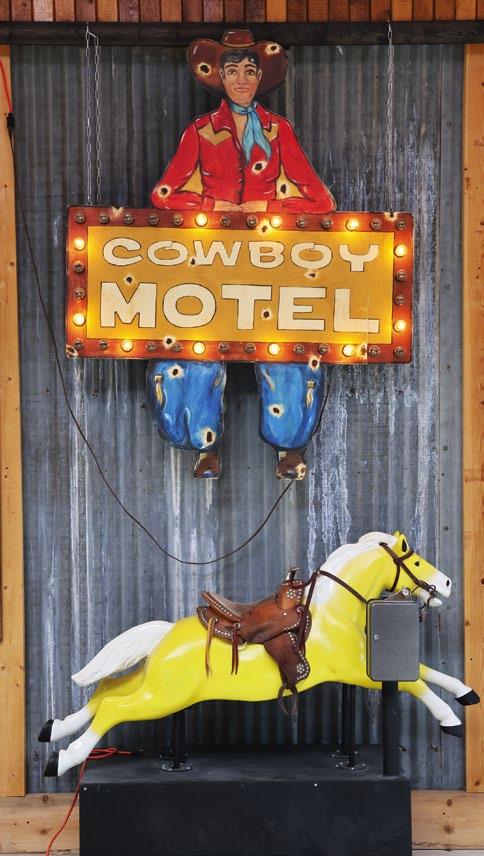
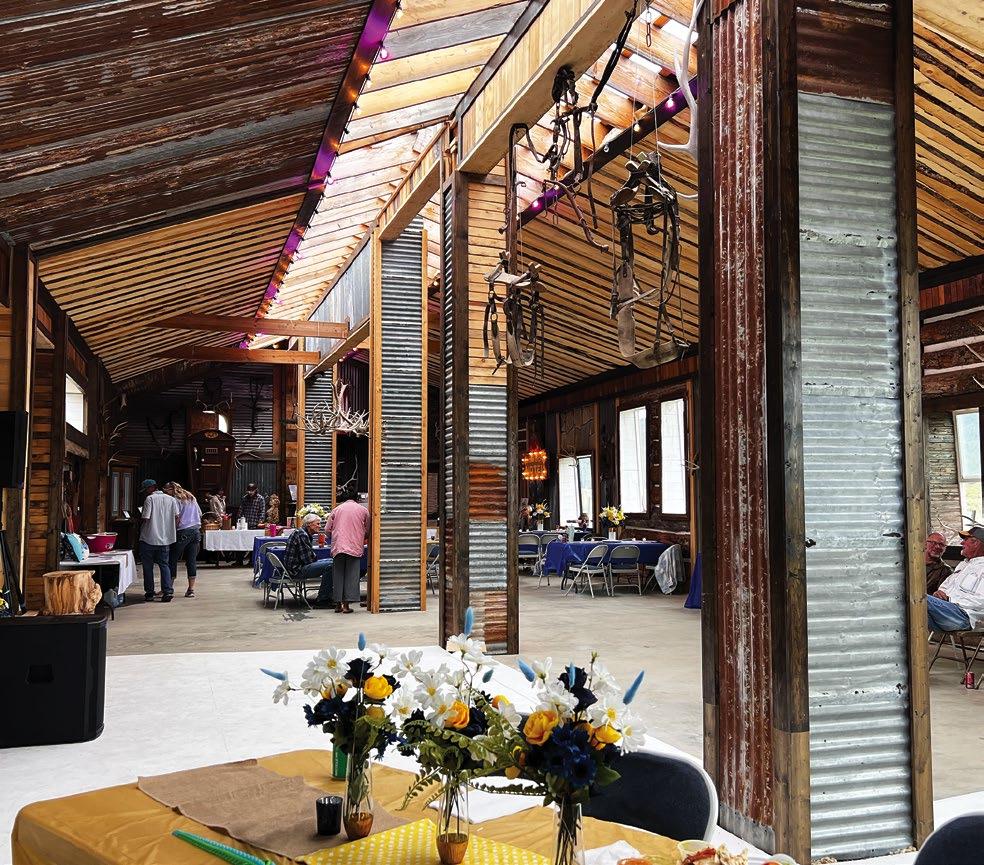
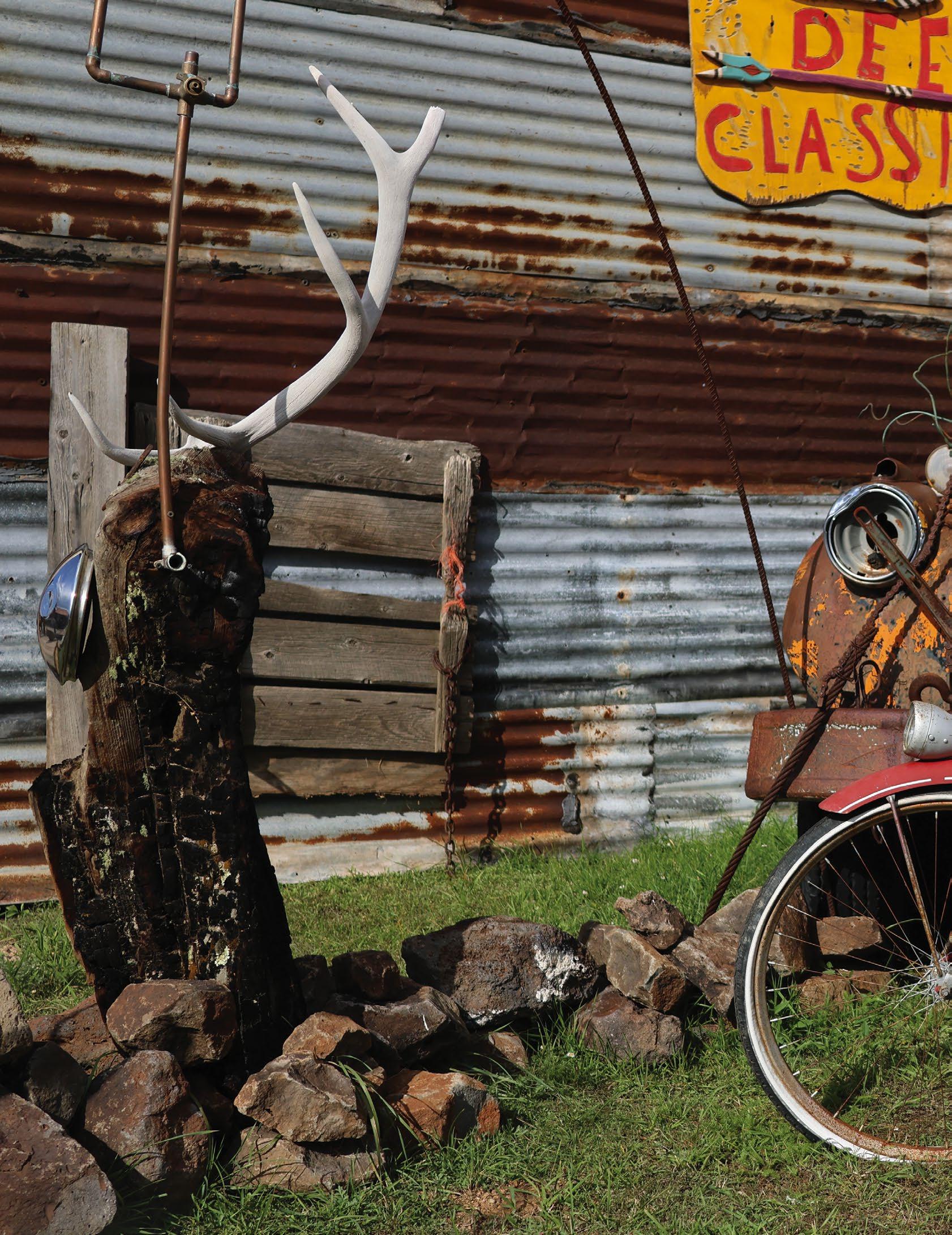
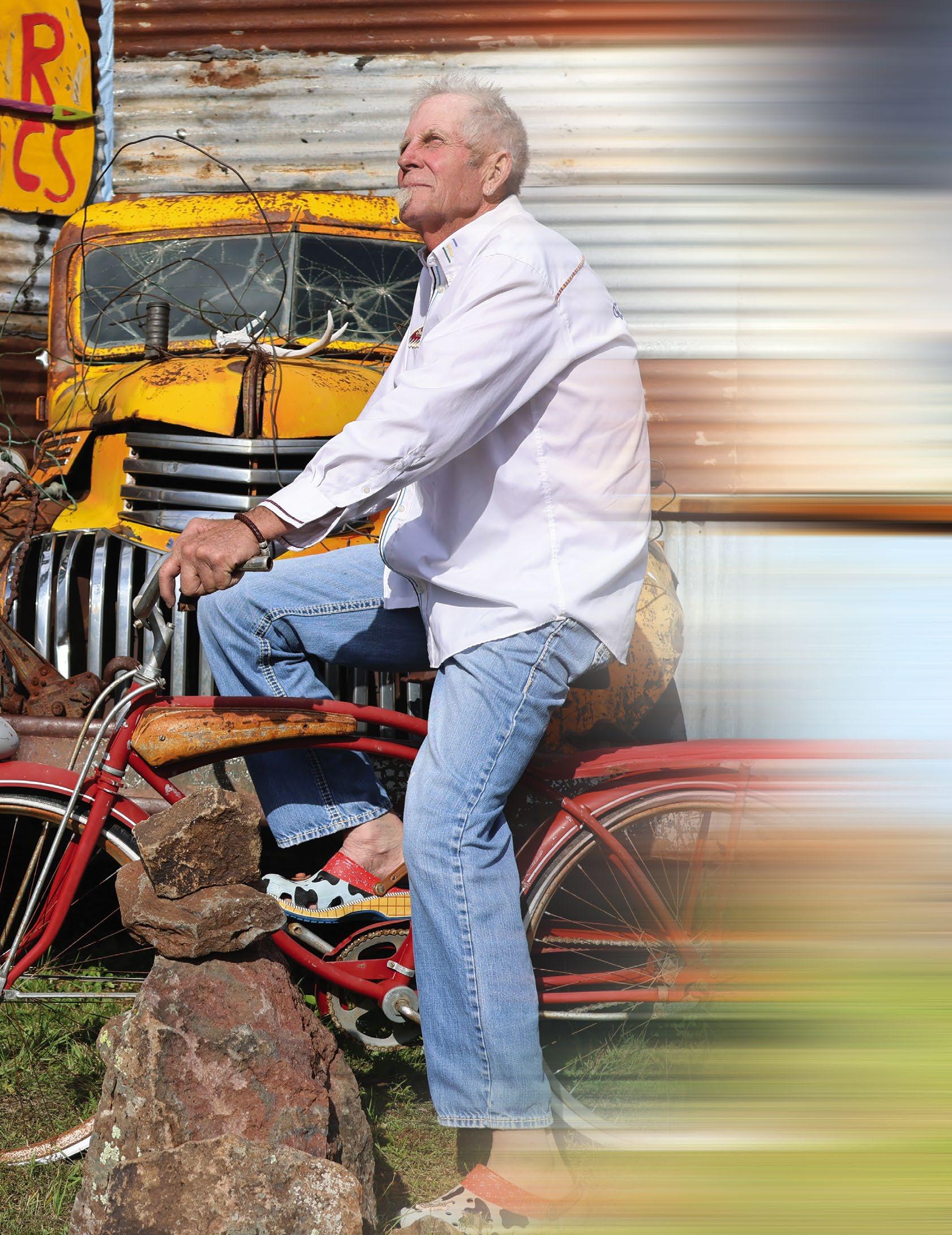
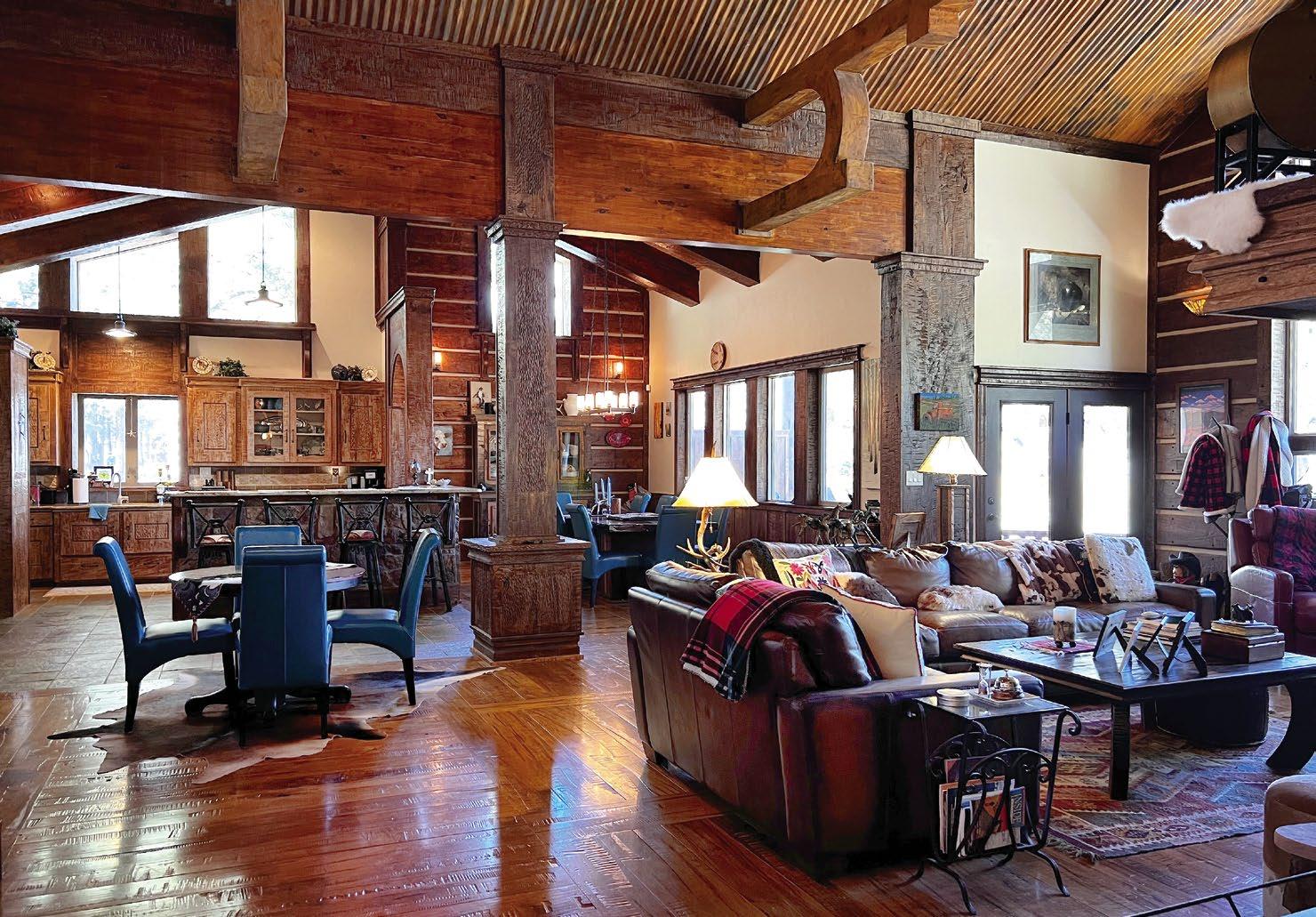
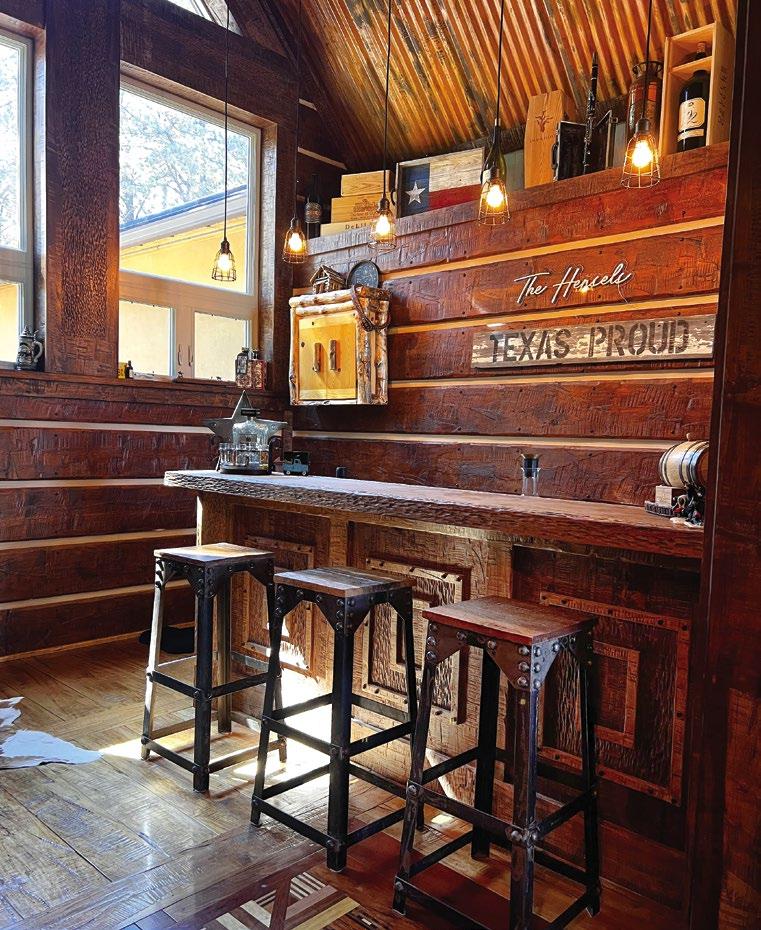
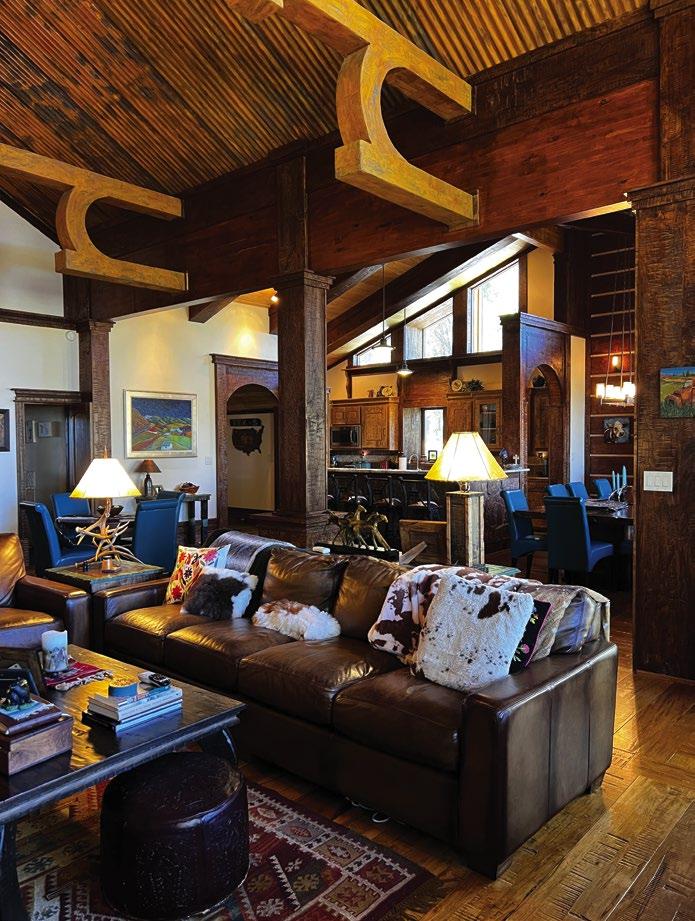
custom
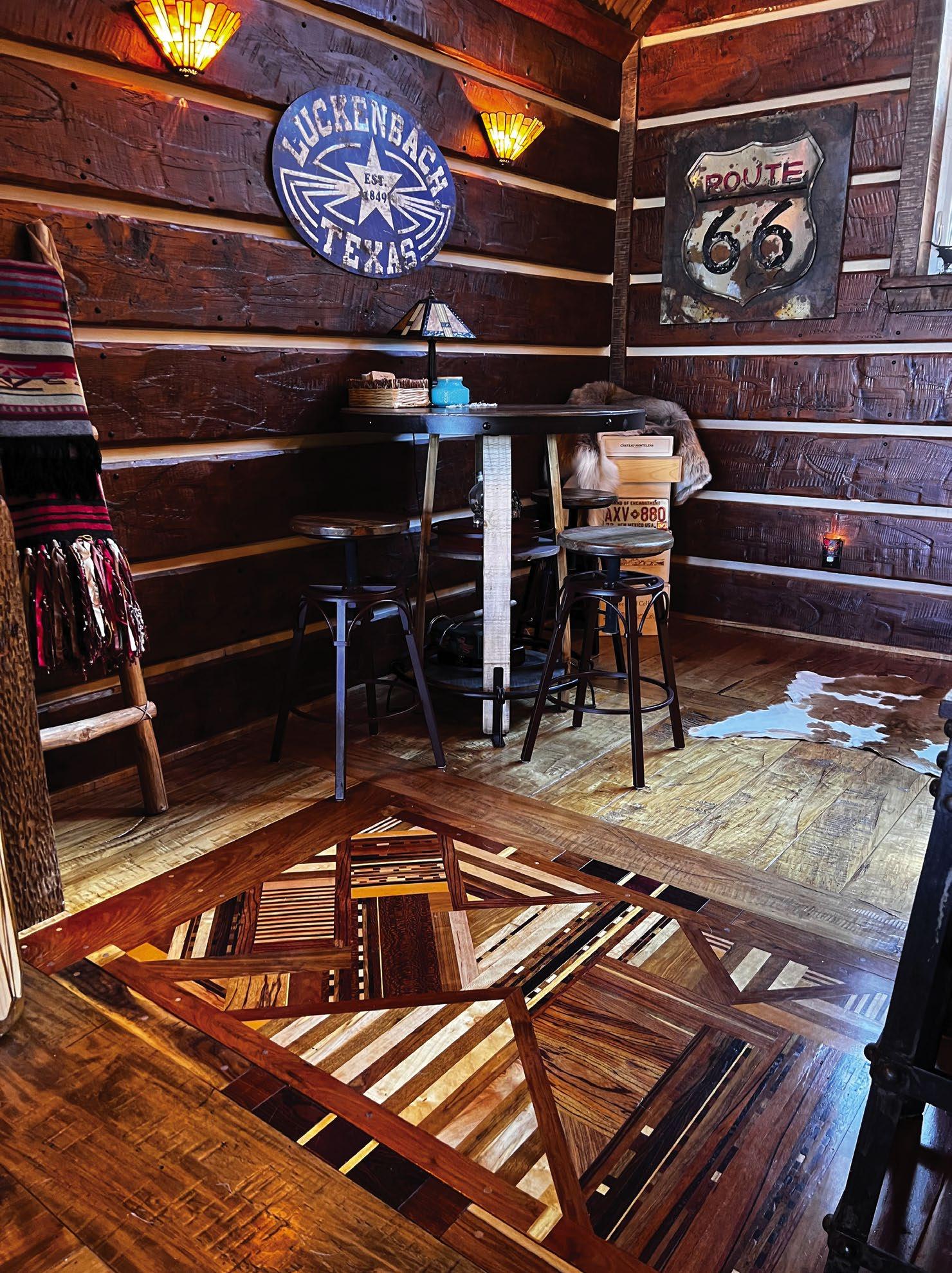
including
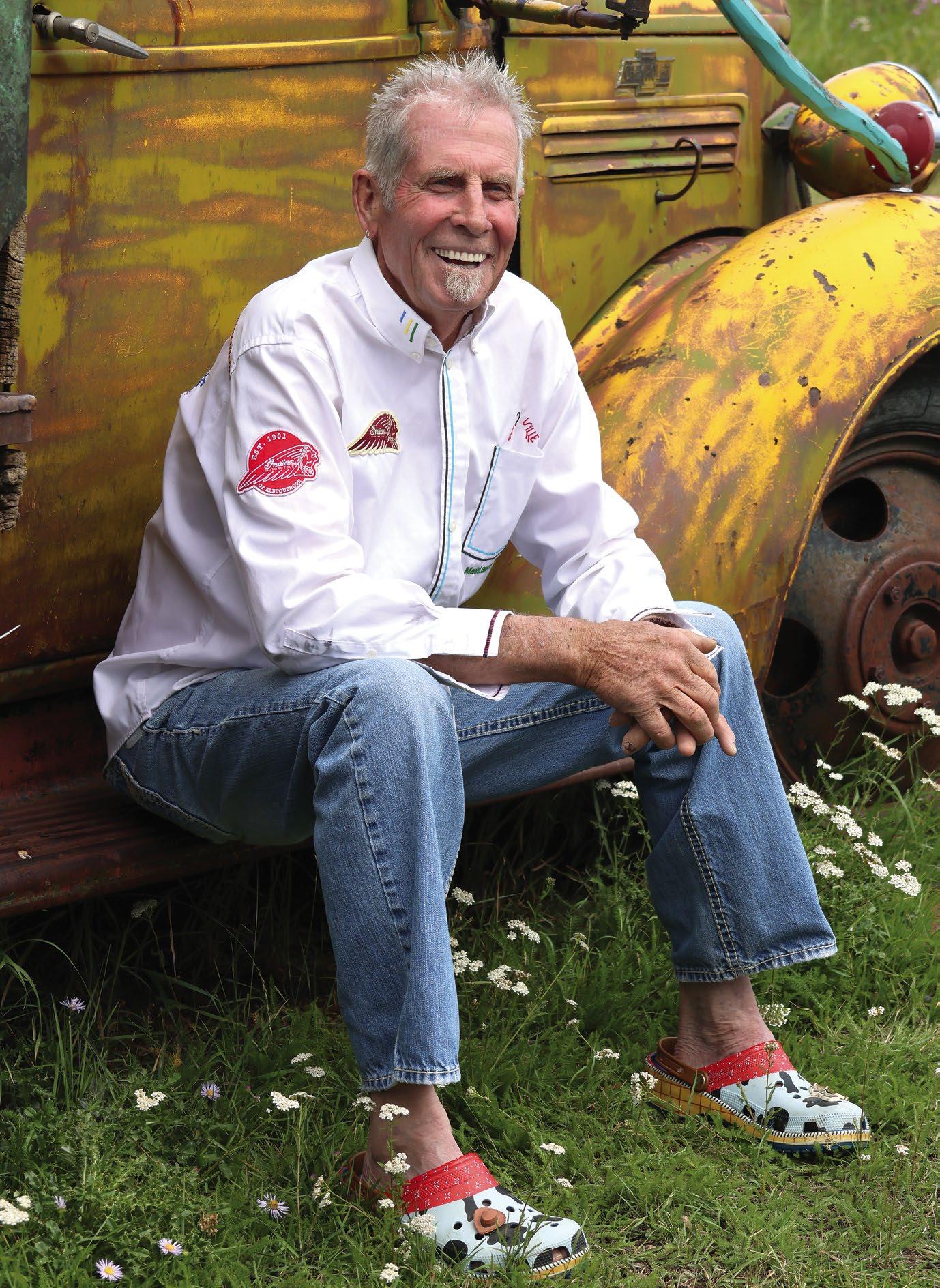
will embody the dwelling, as if to insert a hand into a perfectly fitting glove.
As the founder of Blue Ray Homes, Inc., Renfroe became known for designing and constructing high-end, hand-crafted residences across the Angel Fire area. One of his most iconic works—and a home we were granted an opportunity to tour— is Woodland Castle, a sprawling 7,151 square-foot estate located at 37 Camino Real within the village. Designed by Renfroe himself, the property seamlessly blends Spanish hacienda, European mountain lodge, and Native American influences. No two surfaces are the same: river rock, barnwood, semi-precious stones, knotted, twisted branches, and antique trims come together to form a home that is a living piece of art.
I first met Ray in the spring of 2021. Immediately following Balloons Over Angel Fire—a hot air balloon rally held each Father’s Day weekend—my wife and I found ourselves wandering into What?Ville. Ray was leaning against the bed of his truck in the driveway, and we sparked a conversation.
In 2024, while writing our first issue of Enchanted Outpost, I reached out to him to write an article, but he was, at the time, preoccupied with the idea of leaving the area. It took three more issues of our publication before I set out to connect with him again. And the timing couldn’t have been better. We not only needed his services on our home and wanted his creativity woven through our interior design, but he’d found resolve in his decisions to stay in the area. Getting to know him through his process was the ideal way to discover for myself what story should be told. I can only hope what I’ve written lives up to the exceptional human being he is. Broken but healed, criticized but respected, Renfroe has emerged as a glimmering example of resilience, renewal, and creative mastery. Angel
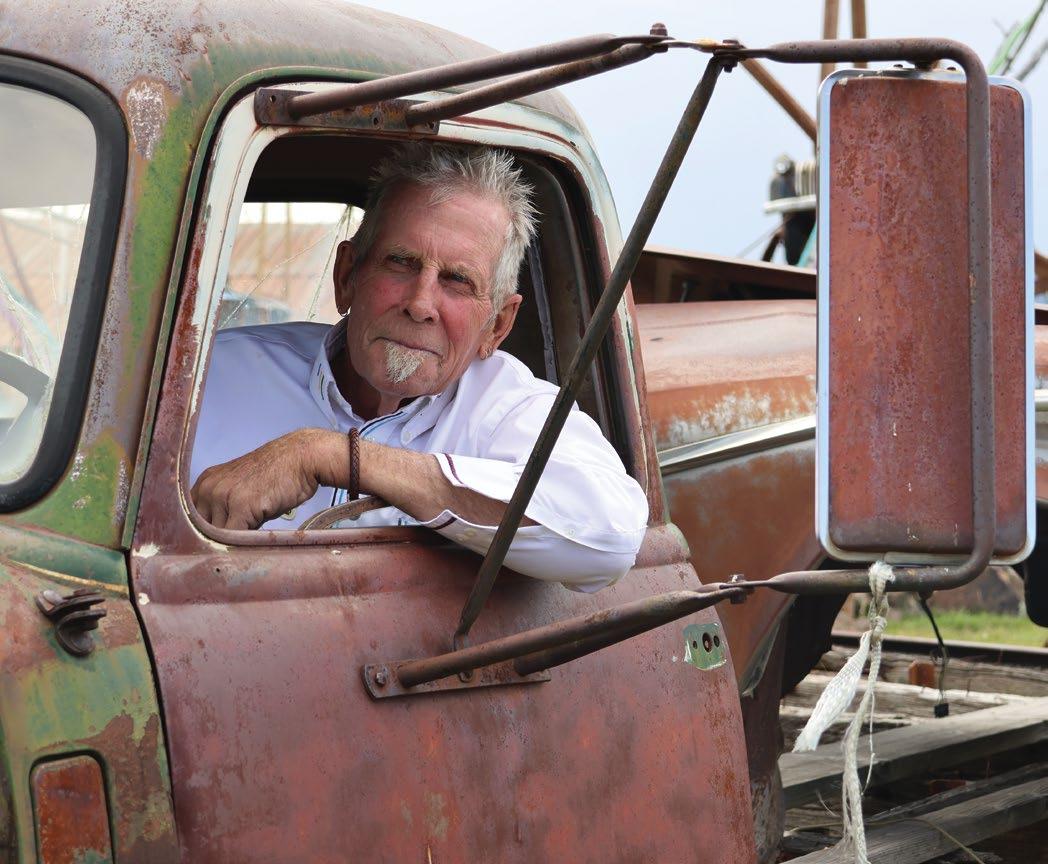
Fire—even if not acknowledged—is considerably fortunate to have him as a part of the community.
Although still a work in progress, What?Ville has become a beloved local curiosity. Local supporters in the town’s arts community see it as a potential cultural landmark—one that could draw visitors, support local vendors, and foster creative expression.
Ray envisions What?Ville as a hybrid space: part art installation, part event venue, part marketplace. Plans include a vendor barn, a concert stage, and an ever-evolving open-air gallery. It’s a space where art and commerce meet, where tourists and locals alike can pause to wonder.
Ray Renfroe’s work—whether building a luxury home or hammering together a colorful sculpture of found metal—comes from the same place: a desire to tell stories, build things that last, and bring joy to others. His creative spirit helps shape Angel Fire into not just a mountain getaway, but a canvas for human connection—and those attributes are precisely what we were looking for when we hired him
to create within the walls of our very special mountain home.
Whether you visit Angel Fire to ski the slopes, hike and bike the trails, or play a round of golf, be sure to look through the forest for the trees. You just might stumble upon What?Ville and discover more than you expected to find. Make your visit here even more memorable by booking a stay in one of the homes he’s built, offered by current owners on AirBnB—and immerse yourself in the imagination of a man whose work turns dreams into wood, stone, and vibrant colors. Rest assured, like the rest of us, you will be captured within his whimsical, magical net. t
Keep an eye on local events held at Prairie House, Ray’s new event venue at What?Ville. Online: WhatvilleNM.com
Location: 30 Trujillo Lane Angel Fire, NM 87710

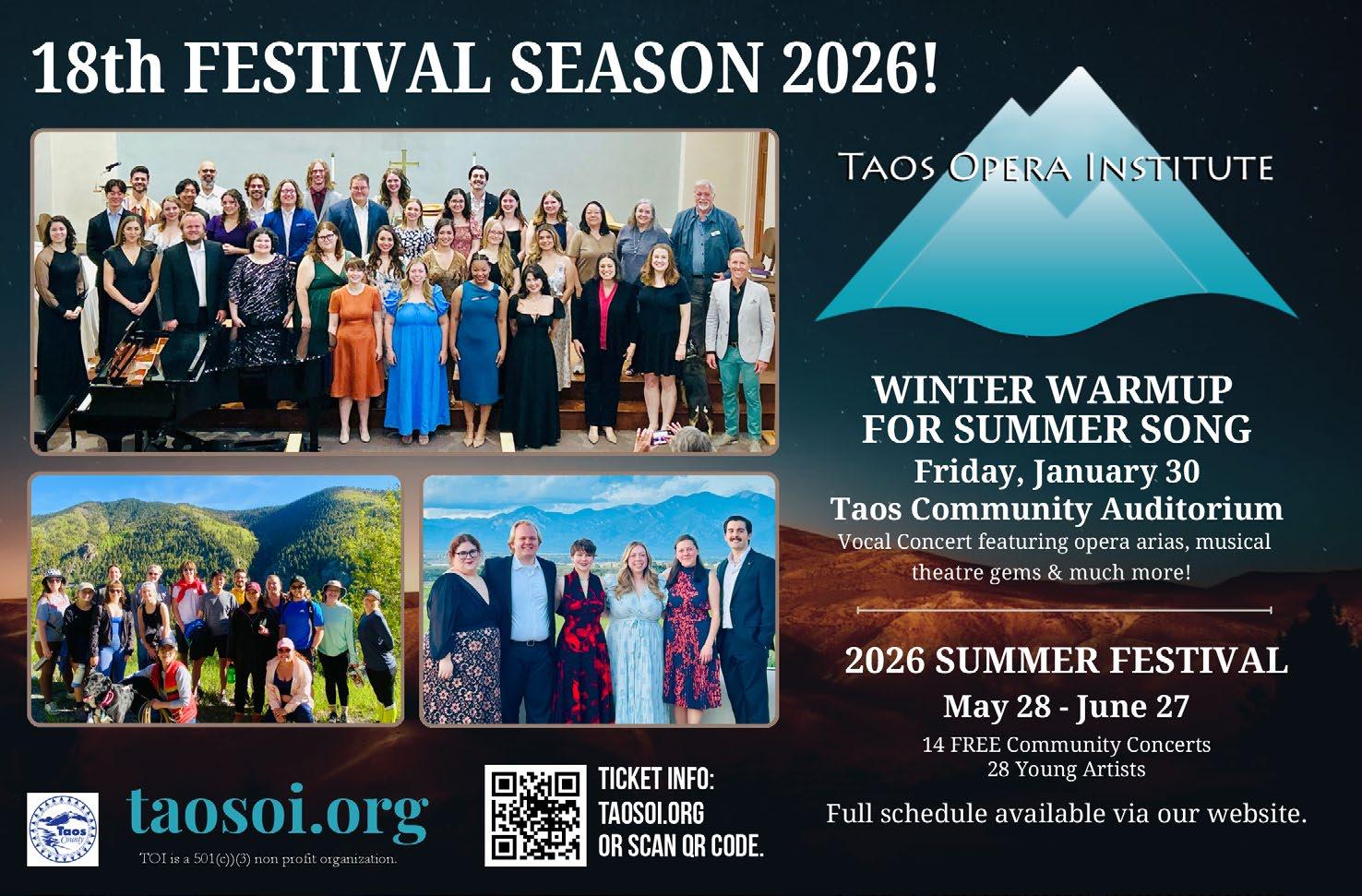
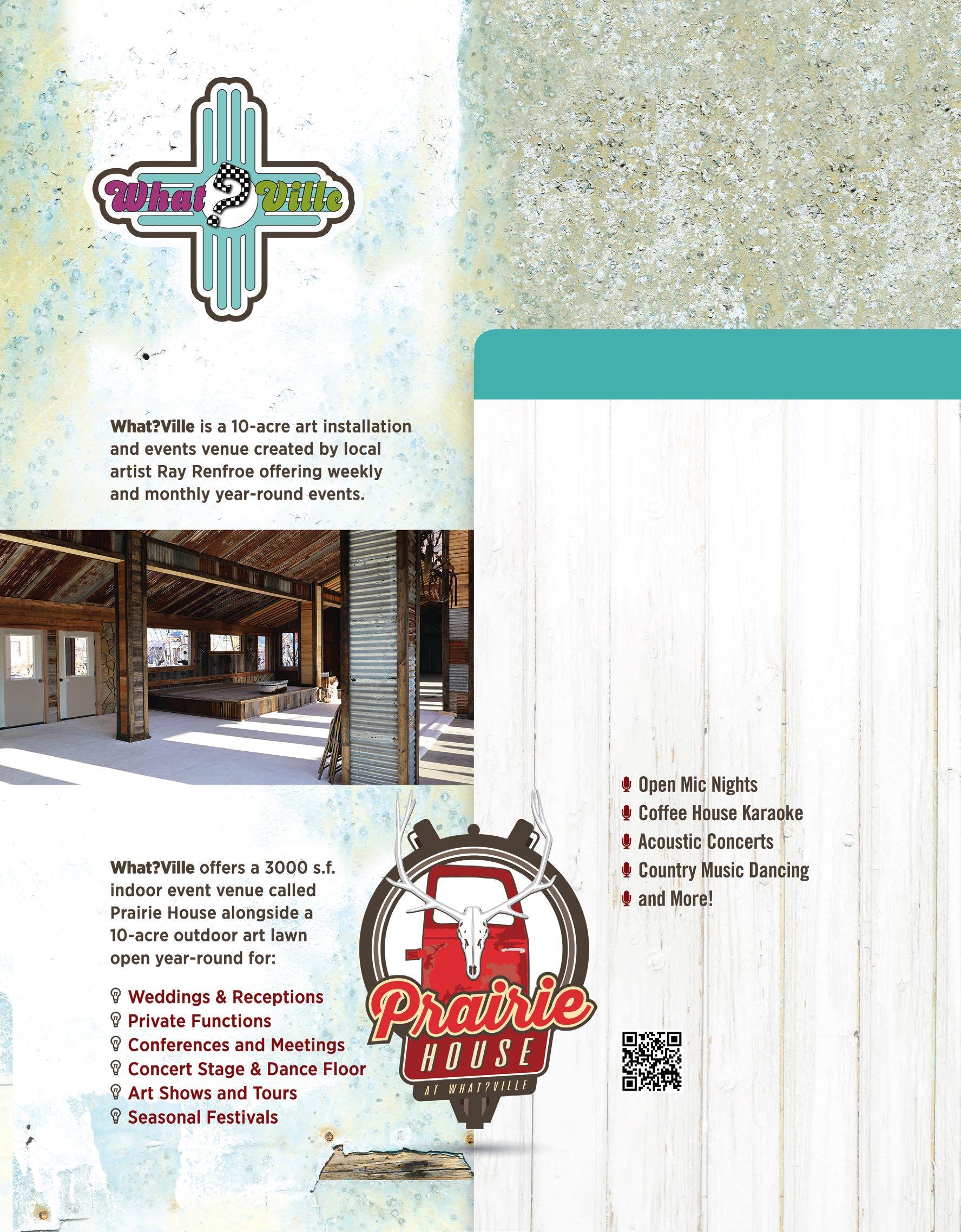


Community-Driven Trail Project to Enhance Recreation and Economic Growth in Red River and Questa, New Mexico.
Words and photos by Scott Leuthold
What if Charles Dickens had traded London smog for New Mexico sunshine? The story might have begun not with “the best of times” and “the worst of times,” but with two mountain towns joined by a single path. A Trail of Two Cities captures that same spirit of contrast and connection—transforming the remnants of an industrial past into a corridor of recreation, restoration, and opportunity.
At first glance, it may seem this article belongs in either our Adventure or Environment section of Enchanted Outpost; however, this story is just as notable for the efforts of citizens and organizations taken to connect two communities: Red River and Questa, New Mexico. A planned recreational trail along the Red River is poised to bring both ecological and economic benefits to these two communities.
“The Questa to Red River Trail is more than just a trail. It’s a bridge between our communities,” says Red River Mayor Linda Calhoun. “Designed to be ADA accessible, it invites hikers, bikers, and outdoor enthusiasts of all abilities to stay longer and explore more. We’re creating new reasons for people to visit and stay longer in Red River. Every extra night in town means more support for our local businesses, from restaurants to shops to lodging providers.”
Questa stands to gain additional exposure and visitation from the project as well. “Diversifying our economy after the mine shut down is critical to the future of Questa,” says Questa Mayor John Anthony Ortega. “This can be accomplished through outdoor recreation, which this trail will bring to the area. Questa is beautiful; I personally consider it one the most beautiful places in the state. This trail will allow visitors to take advantage of our beautiful scenery and bring much needed tourism and economic development to the area.”
Originating from the removal of mining infrastructure from the Chevron Mine (formerly MolyCorps Mine), the project reimagines a former industrial corridor as a space for outdoor recreation and environmental restoration. The idea was sparked by the removal of pipelines and tailings from the mine site, which created a pathway for a recreational trail. Though initially planned to follow these industrial corridors, the design has evolved into a more natural route through the canyon, aligning with both ecological and user needs.
The project has seen extensive community involvement throughout its planning stages, reflecting the collaborative spirit driving its development. Phase I of planning, which took place over two years ending in 2018, involved a diverse group of stakeholders, including the Carson National Forest, the Enchanted Circle Trails Association (ECTA), local government entities, community members, and environmental organizations. Public meetings were held to gather input and ensure that all perspectives were considered in the trail’s design. “This trail is an investment in our future, connecting us to our neighbors, sustaining our smalltown charm, and creating economic opportunities that will help Red River thrive for generations to come,” says Calhoun.
The result is a trail that balances recreational access with environmental stewardship, with the goal of preserving the area’s unique ecosystems. According to a January 2025 press release issued by the Forest Service: “The anticipated level of analysis under the National Environmental Policy Act is an environmental assessment, meaning no significant environmental impacts are expected.”
The trail’s development continues with active public participation, including ongoing environmental assessments
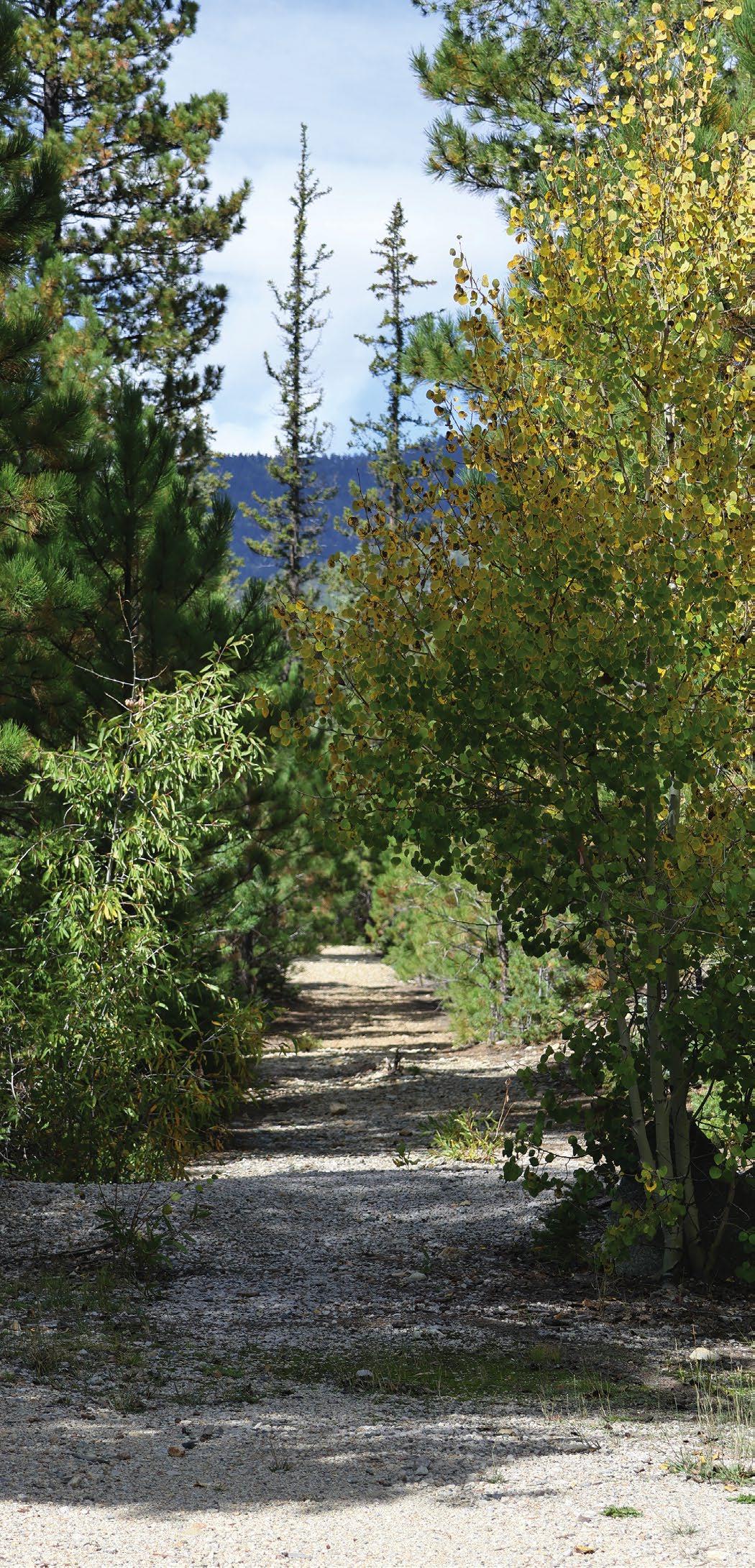
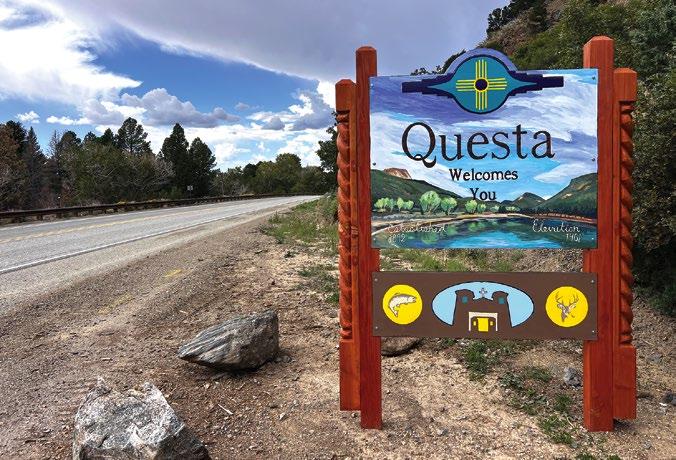
by the Carson National Forest providing opportunities for public feedback. The project has already secured funding through multiple sources, including New Mexico’s Infrastructure Capital Improvement Plan and the Department of Transportation’s Recreational Trail Program. This funding will ensure the completion of engineering studies, environmental surveys, and the construction of the trail with minimal environmental impact.
“The real challenge has been design,” says Loren Bell of the Enchanted Circle Trails Association. “We want this trail to be a great experience for as many users as possible, while protecting the
river and the wildlife that depend on it. The route avoids the riparian area wherever possible and keeps users away from the highway except where absolutely necessary.” According to Bell, the trail embodies the spirit of the Enchanted Circle Trails Plan, which envisions a fully connected regional system for all trail users.
Beyond its ecological and recreational value, the Q2RRT (Questa to Red River Trail) is expected to have significant economic benefits for the region. By linking Questa and Red River, it serves not only as a practical connector between the two communities, but also as a vital piece of the larger network.
The Questa to Red River Trail is more than just a trail. It’s a bridge between our communities.
Linda Calhoun, Mayor Red River, NM “
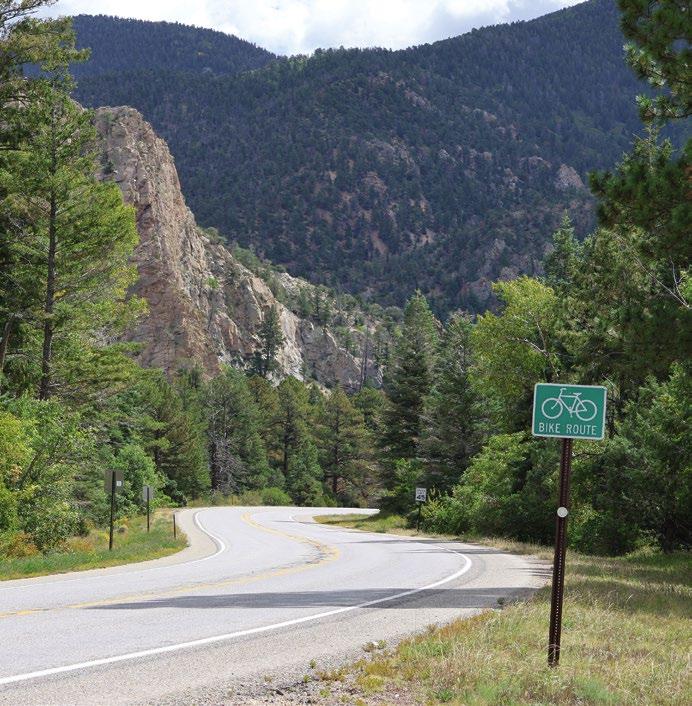
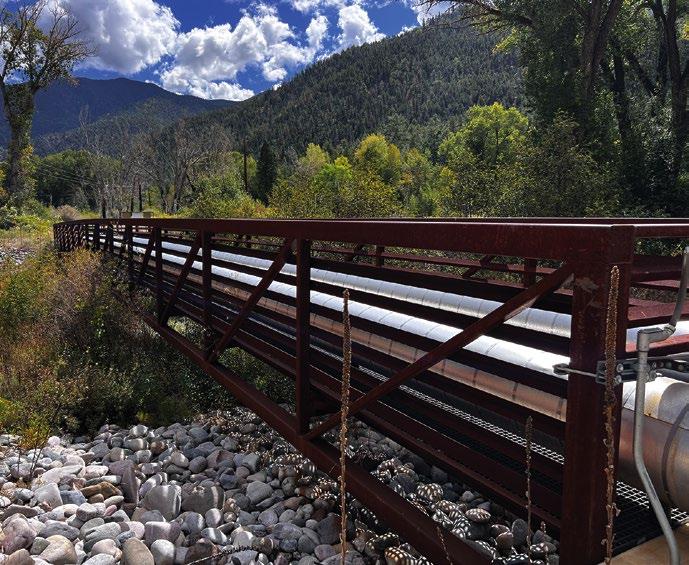
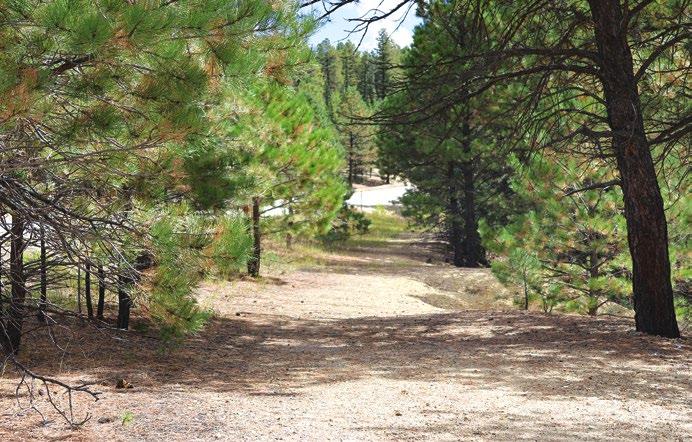
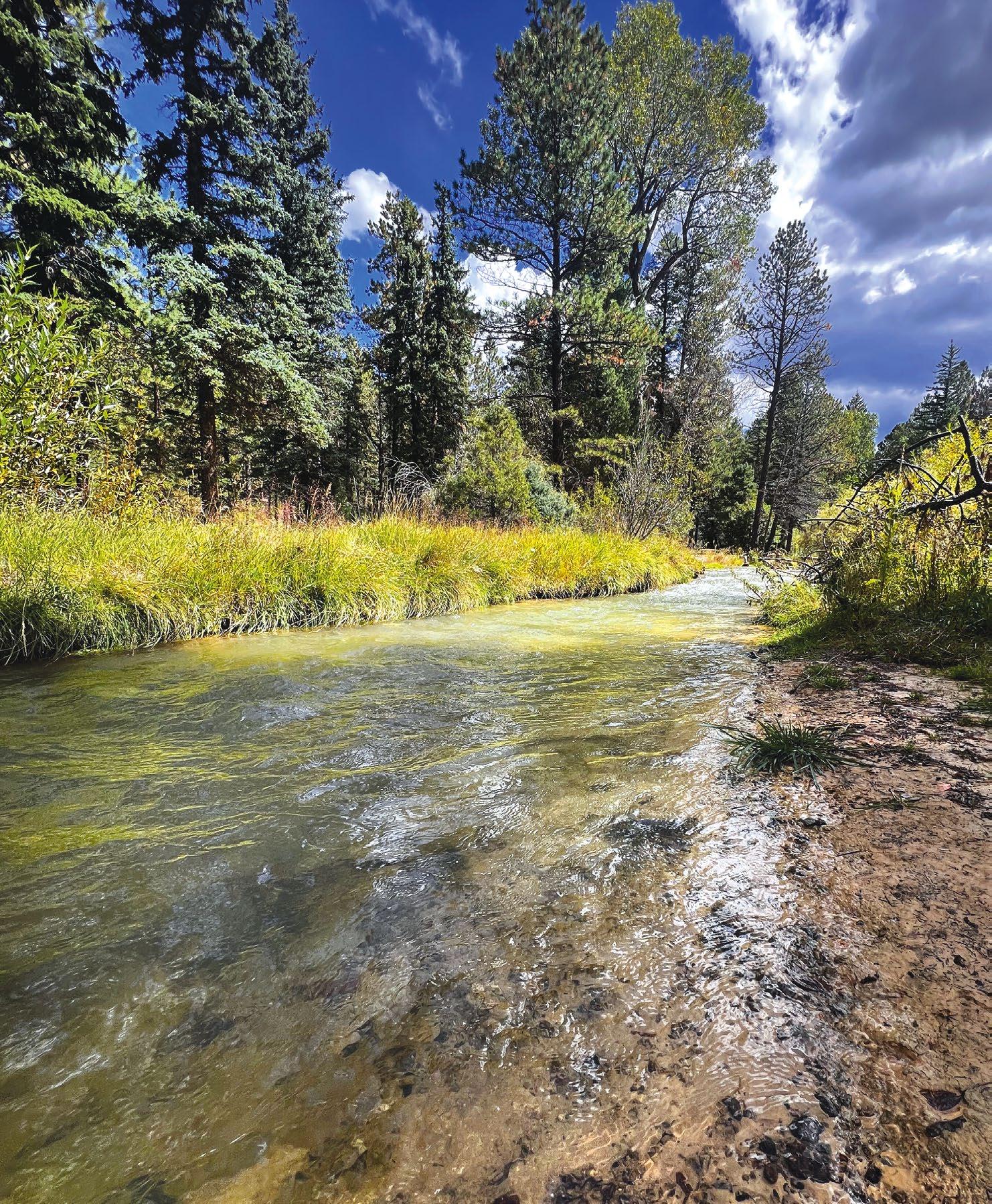
Some portions of the trail will navigate along the Red River, though much of the trail is designed to avoid the river’s edge to preserve the river’s natural environment.
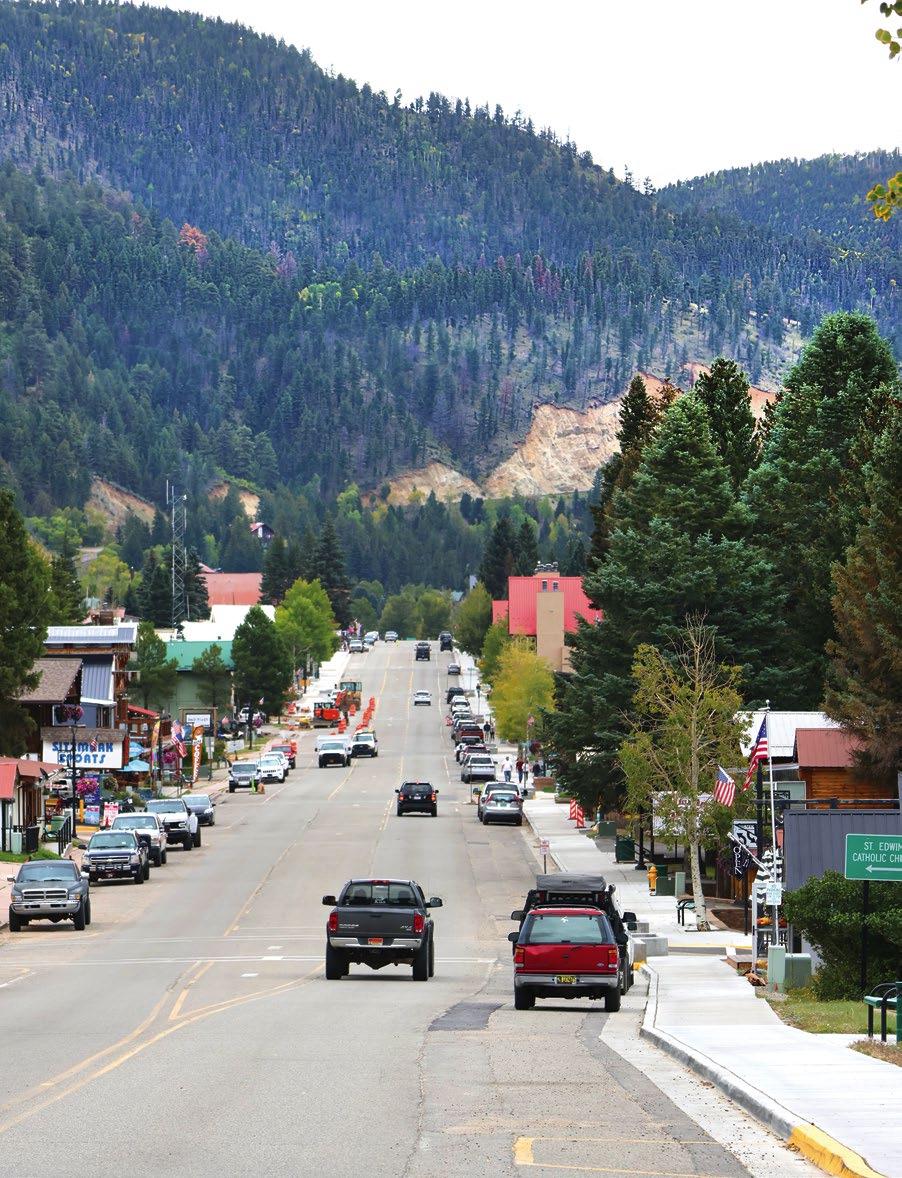

“Locally, the Q2RRT is the string that ties together the recreation pearls of Red River Canyon into a cohesive and accessible showpiece,” Bell says. The enhanced access will drive tourism, increasing visitation to the area and benefiting local businesses. Visitors will stay in local accommodations, dine at nearby restaurants, and shop in retail stores, stimulating business growth and creating job opportunities. The trail will also serve as an alternative transportation route between Questa and Red River, improving connectivity between the two communities and fostering economic exchange.
“Today’s announcement is the culmination of ideas and work by many in the wider community,” says Questa District Ranger Amy Simms. “This is a big step in the process to provide a sustainable connection between these two communities that will increase access to high quality recreation experiences.”
In addition, the Q2RRT could inspire new business ventures, such as shuttle services to trailheads or bike rental shops catering to tourists. This project offers a sustainable model for revitalizing the area, providing a scenic space for recreation, enhancing local economies, and supporting community engagement through its inclusive planning process. t
US Forest Service fs.usda.gov/r03/carson/projects/67508
Proposed Trail Map: enchantedcircletrails.org/development/q2rrt/


WRITTEN BY LISA RAGSDALE
PHOTOS BY SCOTT LEUTHOLD
Augusta Sunshine Duran is as warm as her name, and her roots go deeper than the cottonwoods that line the streets of Taos. She’s had an eclectic upbringing on the Taos Pueblo that has contributed to the wisdom behind her eyes and the strength and joy in her voice.
Sunshine—as she is known— grew up on Taos Pueblo with extended family. Her mother, Bertina Concha-Karcher, married Joaquin Karcher when she was twenty-six and Sunshine was just eight years old. Her mother was always deeply involved in her community, which grounded Sunshine in the Pueblo way of life. Her stepfather has lived in Taos for 34 years and designs and builds sustainable, carbon-free homes. Her father, Anthony Duran, is the Head of
Preservation for Taos Pueblo. She eventually followed those same footsteps into Pueblo community service.
After losing her husband to cancer, Sunshine sought an escape from the pain through substance abuse. After losing everything, she knew she needed to make a change. In 2018, she entered the Wellness and Recovery Program at Taos Pueblo to start her recovery journey. That journey was inspired by a diverse network of people she met as she got back on her feet, ready to
face the shame of substance abuse, get healthy, and give back to the community that supported her.
The path to healing was marked by several “signposts”—people who guided her into new discoveries about our spiritual existence and the beliefs she’s come to embrace. Growing up, her stepfather read the Bible to Sunshine and her two brothers. Early in her recovery, she worked at a local rock shop and met many customers who shared the value and power of crystals. One
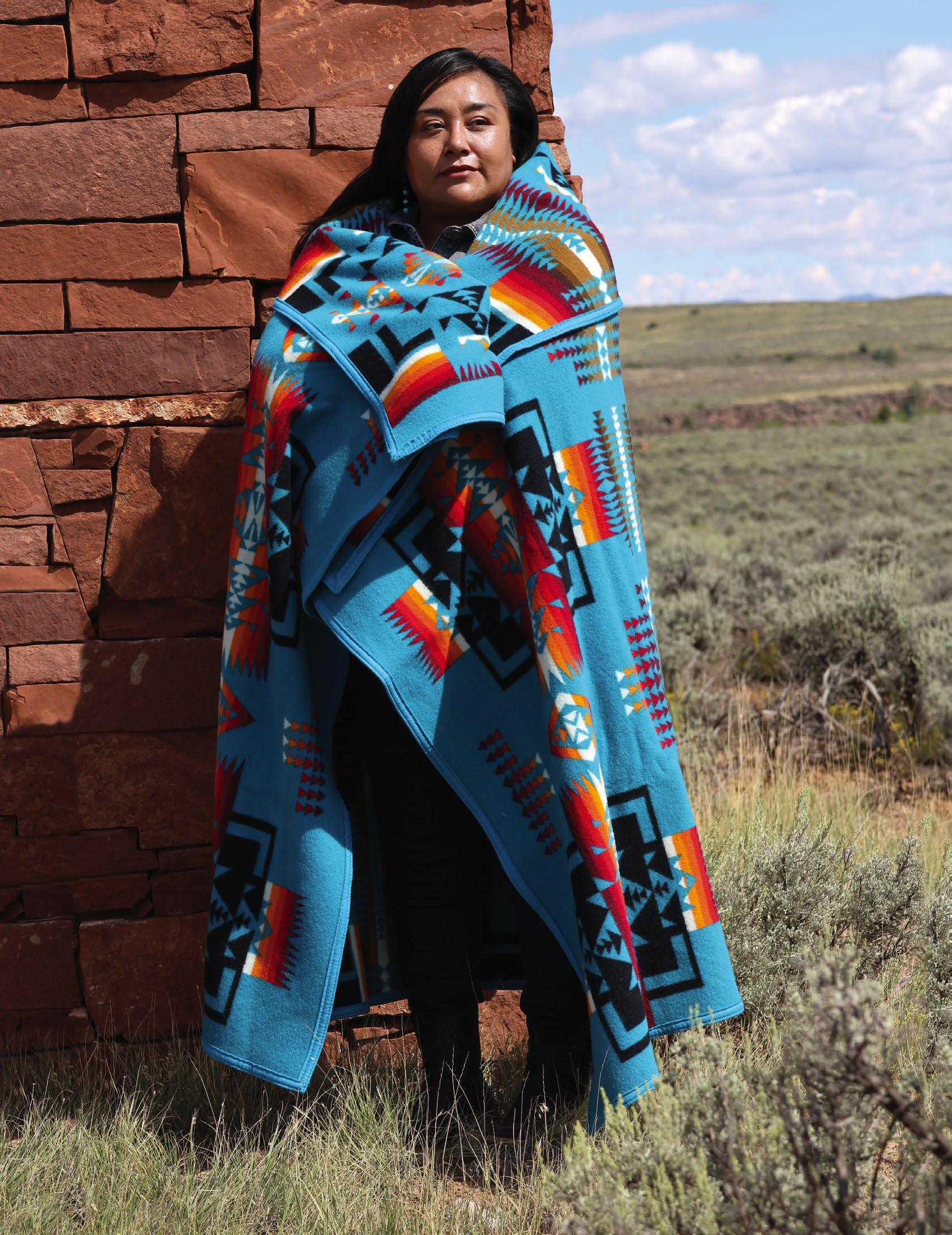
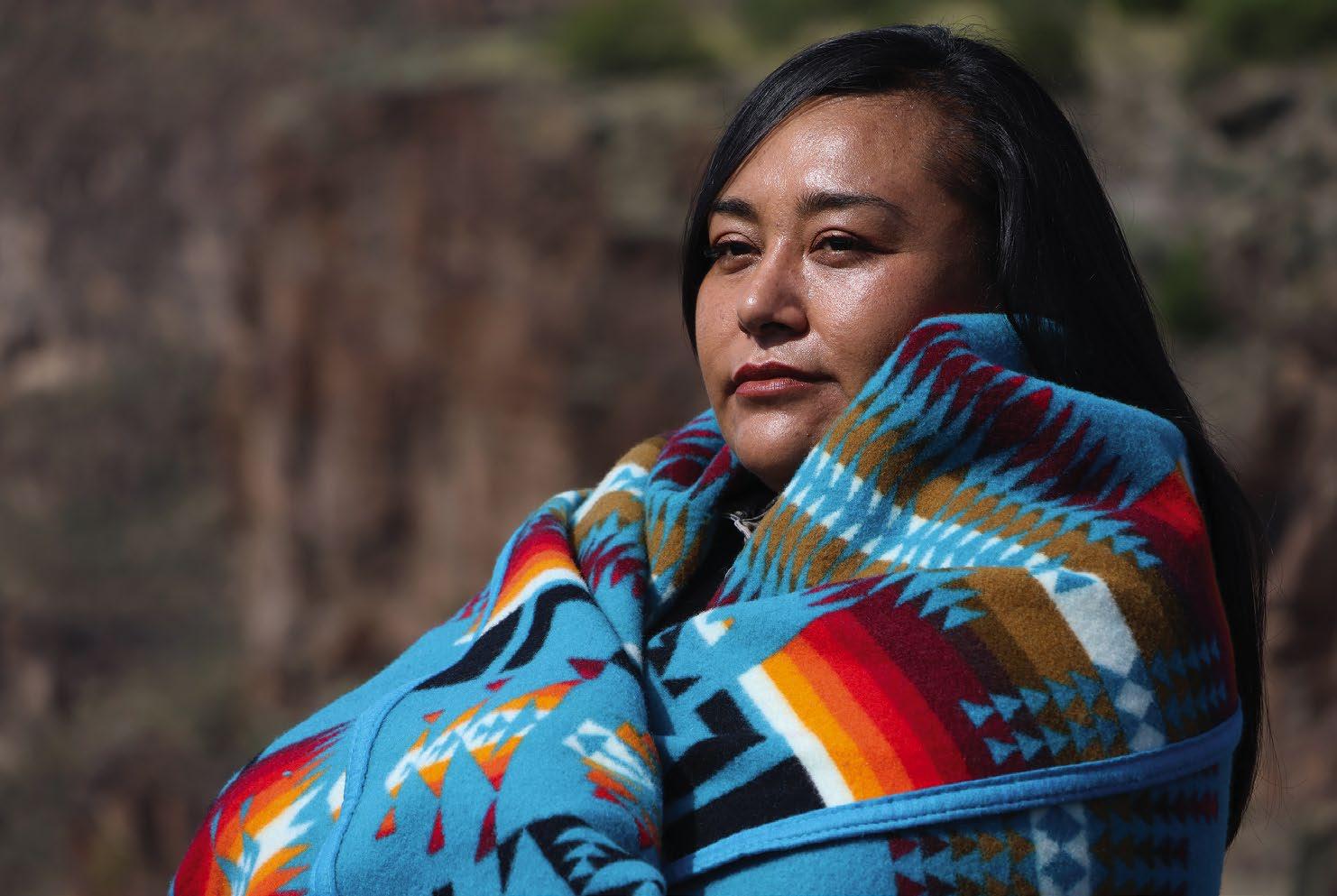
day while working, she met an insightful man from Mexico who told her, “Two men are standing here watching you, and they are curious about what you’re doing.” She asked about them, and he “described my great-grandfather to a tee.” She was convinced it was him looking over her, because the man described him as “tall,” and there aren’t many tall Taos Pueblo Natives. She felt that encounter was an affirmation of the unsure path she was on. This was part of the journey—sobriety and wellness were the motivation. One woman she met at the shop told her to just ask to be delivered from her addiction and for guidance—“Ask for a path,” she said. And Sunshine did just that, which ultimately brought her through two traditional Amazonian ceremonies that she learned about from the Amazon jungle. The preparation and ceremonies
resulted in a deep understanding of her pain, allowing her to forgive herself. The experience reinforced the belief that there is so much more to this world than we can see. And this power was manifested in her healing journey.
Sunshine explains that trauma separates us from pieces of our souls, and successful healing gradually brings those pieces back together. She has been enabled to do this through the help and guidance of Patricia Padilla, her mentor and an eighth-generation curandera, a traditional native healer. Sunshine believes that “every mistake or perceived downfall is an opportunity to learn and a lesson to take forward.” Painful experiences fuel that learning. “This is a schoolyard,” she explains. “There is nothing so serious that we can do here that can’t be forgiven, but we have to work diligently to bring some-
thing special home when we go.”
Bringing something special is now the focus of Sunshine’s life. Taos Pueblo’s recovery program “had good bones,” she says, and she found a way to put flesh on it with the Recovery Works! program she founded.
What makes Recovery Works! different is balancing the clinical aspects of care with the traditional value system, including the community service the participants perform. They work four hours at a time, serving the community in various ways, and often directly for their elders. These relationships provide participants with a connection to their rich past and heritage. Sunshine also believes that the traditional values infused in the Recovery Works! program are what make it successful because the prayers they pray in Tiwa “help them walk the talk.”
“The Tiwa language is not a language of necessity; it’s a heart language,” explains Sunshine. “So, it’s used to express how you feel about something or a person. The pain we feel and how to express the healing is different from what we can say in English. For example, if you say a sound differently, it means a whole different thing in Tiwa.”
The community embraced Recovery Works! and then funded it, and though she is no longer working in that capacity, the program is still viable. She misses the connection with the participants in the program, but she’s now on another mission.
Sunshine has since realigned her focus to Community Development Outreach and Communication Manager for Taos Pueblo. She is currently working on a senior-needs assessment, developing a newsletter, and heading up a community engagement committee responsible for all the events at Taos Pueblo related to community building. The network she built in Recovery Works! has been instrumental in helping bring the community together in positive ways, creating safe spaces, and allowing her to do what she had been doing—but on a much larger scale.
She’s also pursuing involvement in the International Association for Community Development, a global network working toward sustainable development and community empowerment. IACD organizes events to share best practices and discuss rights for Indigenous people around the world. She laughs when she admits that it was surprising for her to realize that there are “first peoples” everywhere who hold ancient knowledge. “It made me think that we are so often ego-, culture-, and place-centric sometimes, that we don’t grasp these obvious truths about our world and the people in it.”
Locally, she hopes to see her people thriving in such a way that the commu-
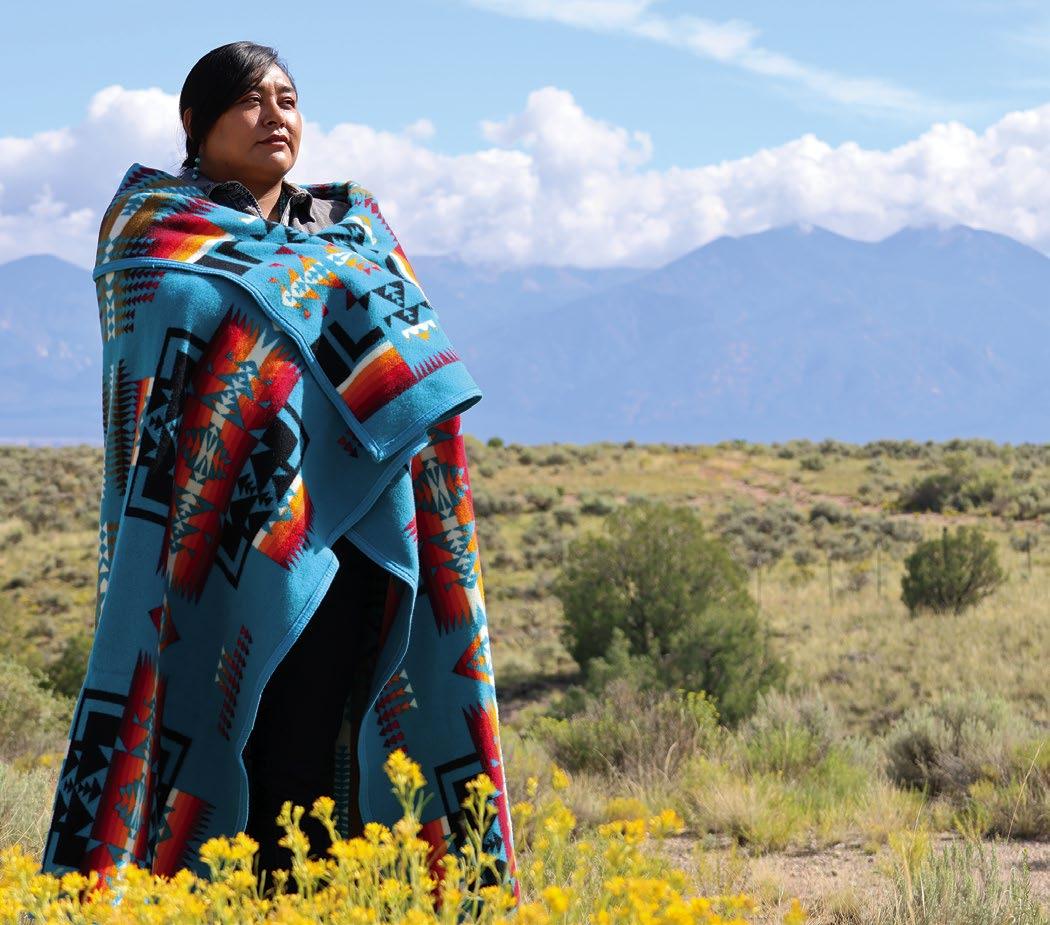
nity is independent from the outside, while also building friendships and allyships between the village of Taos and the Taos Pueblo. She wants to see the sovereign, self-governed nation of Taos Pueblo have control over the everyday functioning of their systems, ensure people’s needs are met, and everyone feels like they are contributing to the community.
In the meantime, she’s continuing her education toward a bachelor’s degree in Native American Studies, with minors in Community Health Education and Psychology to prepare herself for the next challenge as a leader in the greater Taos community, and to be a model to the Taos Pueblo youth.
“If our children can’t see us in those leadership spaces,” she says, “they won’t be able to see themselves in those spac-
es either.” In her new role, immersed in community development, Sunshine is lighting the way for those who come beside and behind her. t
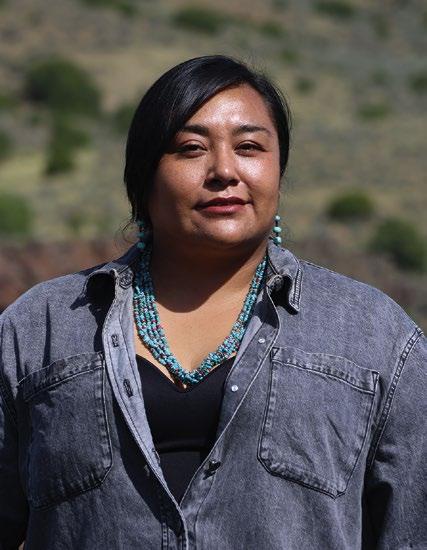


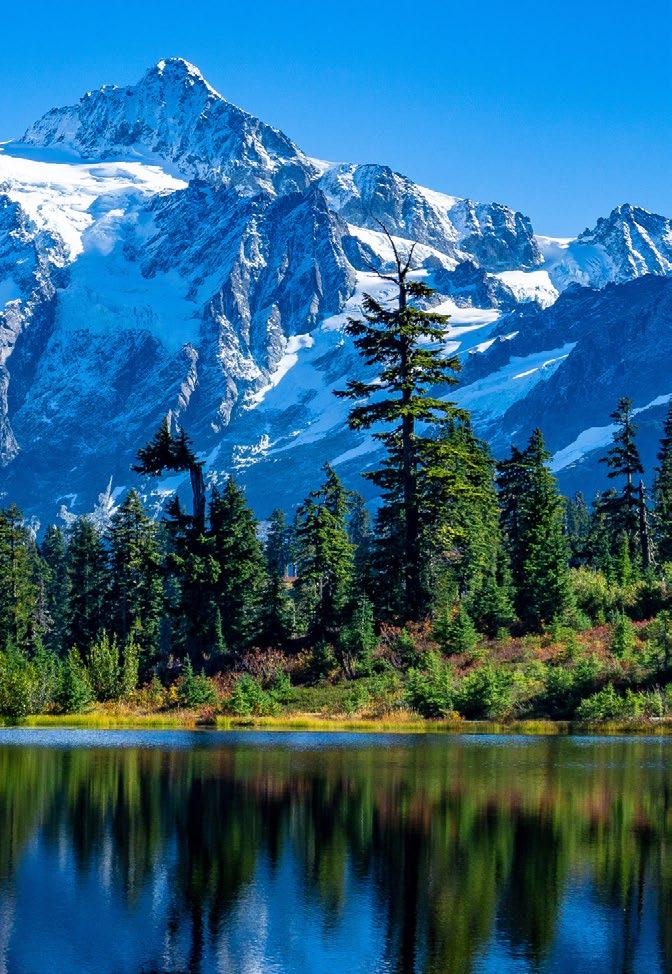

Chimayó: A Pilgrimage of Remembrance | 124
The A.R. Mitchell Museum of Western Art | 132 Will James: The Cowboy Artist | 136

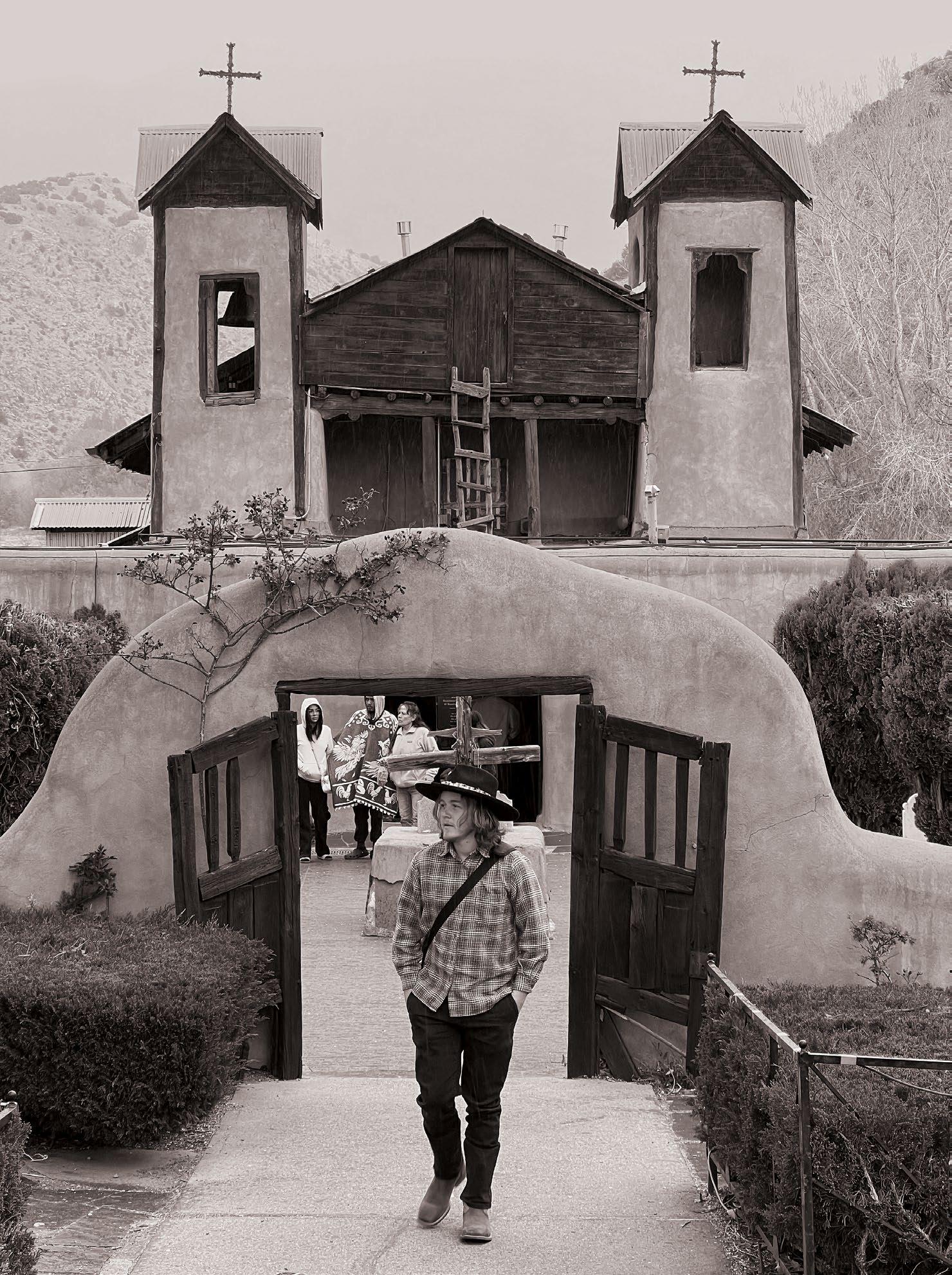
Chimayó, Nuevo
México is renowned for its picante red-roasted chile, intricate Churro Sheep wool weavings, lowriders, and its Semana Santa (Holy Week pilgrimage). All of these can converge during Easter celebrations, which for 2026 will be Holy Thursday (April 2) through Easter Monday (April 6). However, a meaningful journey to Chimayó— or Tsi-Mayoh, as the Tewa name this sacred place—can be anytime of the year.
By Shelli Rottschafer
The Santuario de Chimayó is the epicenter of this multiday celebration. The faithful, the penitent, and those who want to lift their burdens make this journey alongside those who want to more deeply understand nuevomexicano cultures. And there are those who may just want to indulge in a classic platter of blue corn enchiladas de pollo smothered in “Christmas,” the local way of saying both green and red chile at Rancho de Chimayó, a family owned restaurant since 1965.
To visit El Santuario de Chimayó, take Highway 285 north from Santa Fe. Turn right onto NM 76 (“the High Road”) which winds and curves into the village that is nested within the Sangre de Cristo Mountains, a range that runs north-south in northern New Mexico.
Chimayó has always been a crossroads. Pueblo Native Americans and traditional Tewa-Tiwa language speakers have lived within these foothills since the 12th century. Their traditional ecological knowledge teaches that healing spirits dwelled in and around these four sacred hills, as well as the hot springs that once bubbled in the region. Those ojitos, hot pools, have since evaporated, leaving behind healing soil that forms the earthen floor of the mission

church. These mineral-rich, red-hued sands are scraped into a hole within the vestuario (where the priest dresses before mass), and where those seeking healing can now go to rub the dirt upon what ails them—whether a sore knee, an aching hip, or a troubled heart. Left behind are crutches, rosaries, milagro charms, and family pictures, giving testimony to miracles or relief from emotional turmoil.
Even if not taken as a religious pilgrimage, a journey to Chimayó is special. It is a testament to the tenacity of the multi-cultures that come together in this region. Tewa-speaking pueblos like Nambé, and Tiwa-speaking pueblos like Picurís and Taos, traditionally call this area home. Then the Spanish conquistadors and priests came in search of land, souls, and gold for the Spanish crown. In 1680, the Spanish were ousted during the Pueblo Revolt. Then in 1693, Diego de Vargas returned in the Reconquista (the reconquest) and brought settlers who created small subsistent-level farms along the Santa Cruz River. Legend claims that in 1810, a glowing apparition came out of the ground to reveal a crucifix buried that was associated with Our Lord of Esquipulas. Although Esquipulas is a colonial Guatemalan effigy, it claims to help healing, and thus from 1813
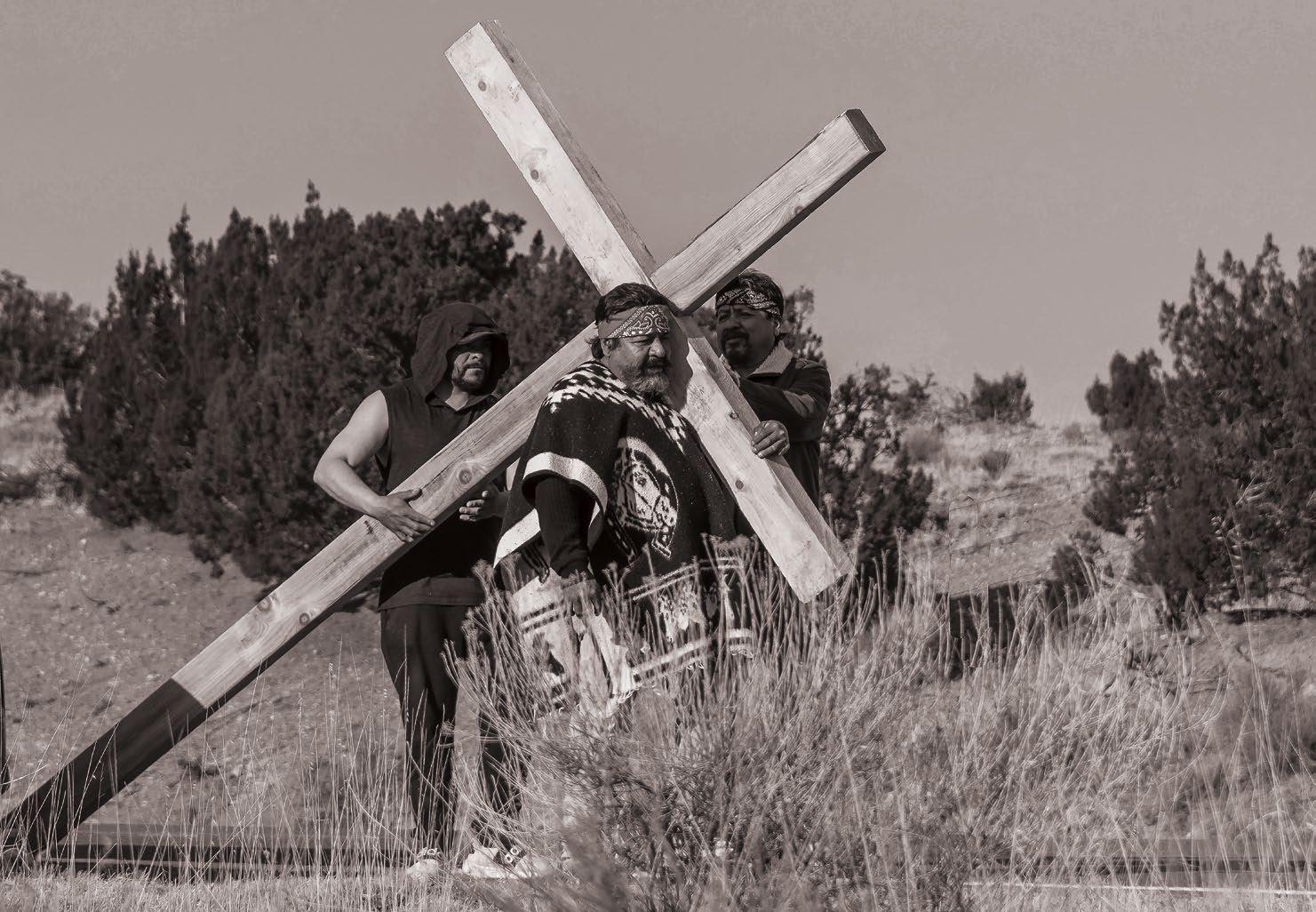
through 1816, when the region was still a Spanish colony, the chapel was constructed. Much later, the adjacent Capilla del Santo Niño de Atocha (The Chapel of the Holy Child) was built. It remained a private place of prayer until 1992 when it was sold to the Diocese.
The Semana Santa pilgrimage calls in folks from across the state and beyond. Some initiate the journey upon bended knee, crawling from their beginning point to the church as an endpoint. Others heft crude crosses on their shoulders and walk from descanso to descanso—the roadside altars dedicated to those who have passed—until they reach the final adobe threshold. Or maybe a road trip is one’s calling, whether in an El Camino Lowrider brilliantly decorated with La Virgen de Guadalupe upon the hood or in a dust-covered Subaru.
For a variety of reasons, Chimayó’s pilgrimage calls many. A familia may come with their matriarch in the lead, slowly walking in front with the aid of her walker. Abuela retrieves a Ziploc baggy from her pocket to take the sacred dirt; she saves it for later, to rub it on her hip scar, a result from her recent surgery. Or, as the “Lourdes of the Southwest,” a soldier returns. With his right-leg in a snug brace and a crutch under his left shoulder; he peers into a picture pin-pricked to the community board. It is a younger version of himself, as a graduate from basic training, unaware of what’s to come. But what is important now is that he has returned. Meanwhile, an auntie leaves a small teddy bear on a ledge next to the votives. She lifts this gift up for her godchild, the one who has felt isolated ever since COVID. A twenty-something
wrapped in yoga-spandex forward folds to scoop the soil into a glass mason jar to use in her daily practice of holding light. For these reasons and more, they have arrived.
El Santuario de Chimayó beckons, and in response, they come. In 2025, it’s estimated that some 30,000 pilgrims paid their respects during Semana Santa. Folks bend their heads in respect under the manicured rosebush that vines atop the adobe wall, and pour through the wide-open wooden doors. Flagstones guide the path to the chapel entry. Because the church is adobe-constructed, it is cool in the summer and
A pilgrim walks bearing the weight of a rustic wooden cross up Highway 76 as he and others with him make their way toward Santuario de Chimayó.


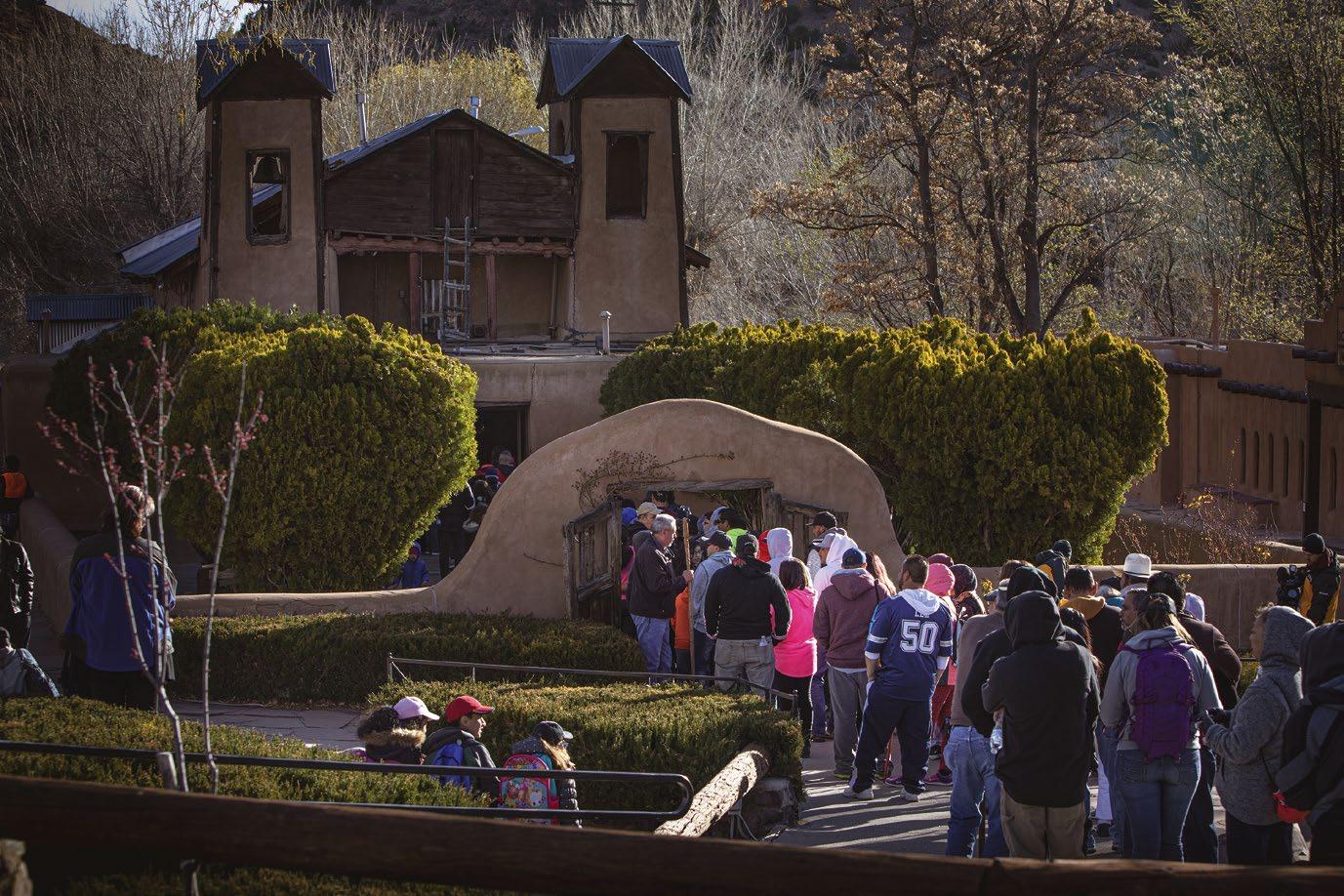
warm in the winter. The nave leads to the altar, which is painted in crimson and includes santero Catholic saints. Outdoors, the stations of the cross proceed along a grassy area that parallels the Santa Cruz River, a chain link fence adorned with make-shift crosses from fallen cottonwood twigs and branches. There’s a grotto with burning candles and trinkets left in honor for prayers lifted that completes the circle.
The Chimayó Pilgrimage is one of remembrance. It considers “Los Heroes” who have passed. Here we consider what the Centennial Poet of New Mexico Levi Romero penned: (right)
Chimayó is a place to remember those who came before us; those who made an impression, not only upon ourselves, but our communities. Remembering and retelling the stories of those who have passed solidifies a sense of identity, who we are, and where we come from. The pilgrimage takes us from our home-place to a memory-place. Descansos, the roadside altars

Los Heroes
los watchávamos we watched them, checked ‘em out cuando pasaban when they would pass echando jumito azul blowing out blue smoke en sus ranflas aplanadas in their lowered rides como ranas de ojelata like metal frogs
eran en los días those were the days de los heroes of our heroes cuando había heroes when there were heroes turriqueando en jiving in lengua mocha broken tongue y riza torcida and crooked laughter
Q-volé
Hey, now!
ahora nomás pasan the only thing that passes now los recuerdos are the memories uno tras del otro one after the other y mi corazón and my heart baila dances
bendición blessing
bendición es to be content estar contento is a blessing
Señor, gracias por...
Father, thank you… gracias por todo thank you for everything (Sagrado 76).
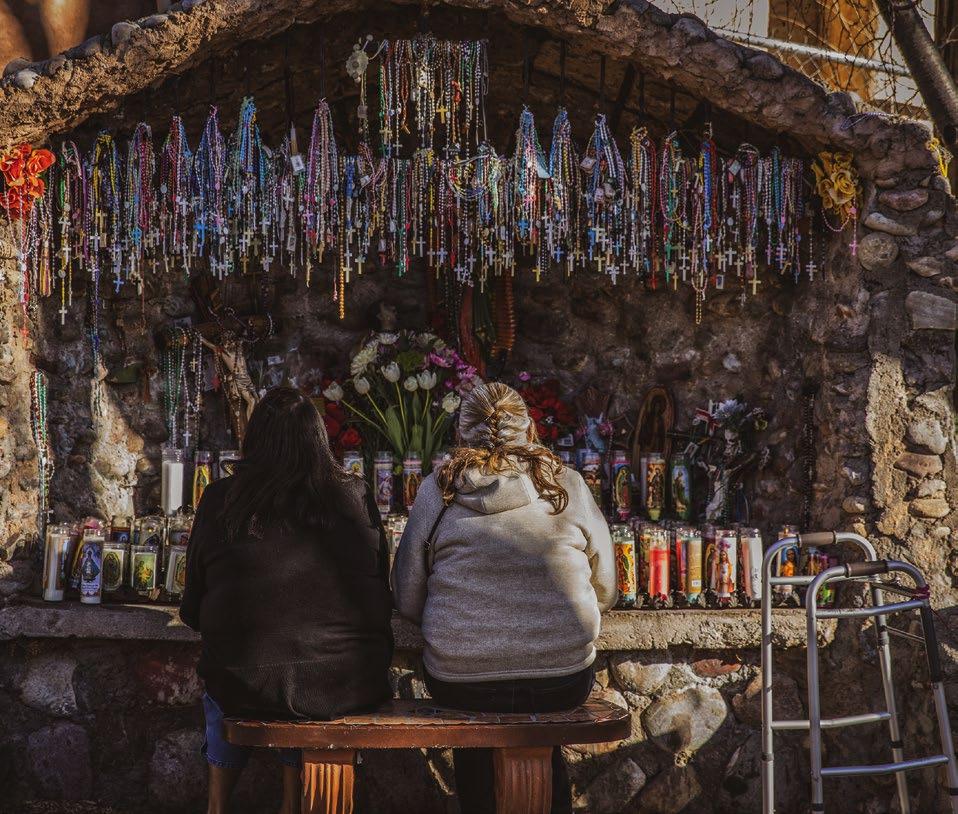
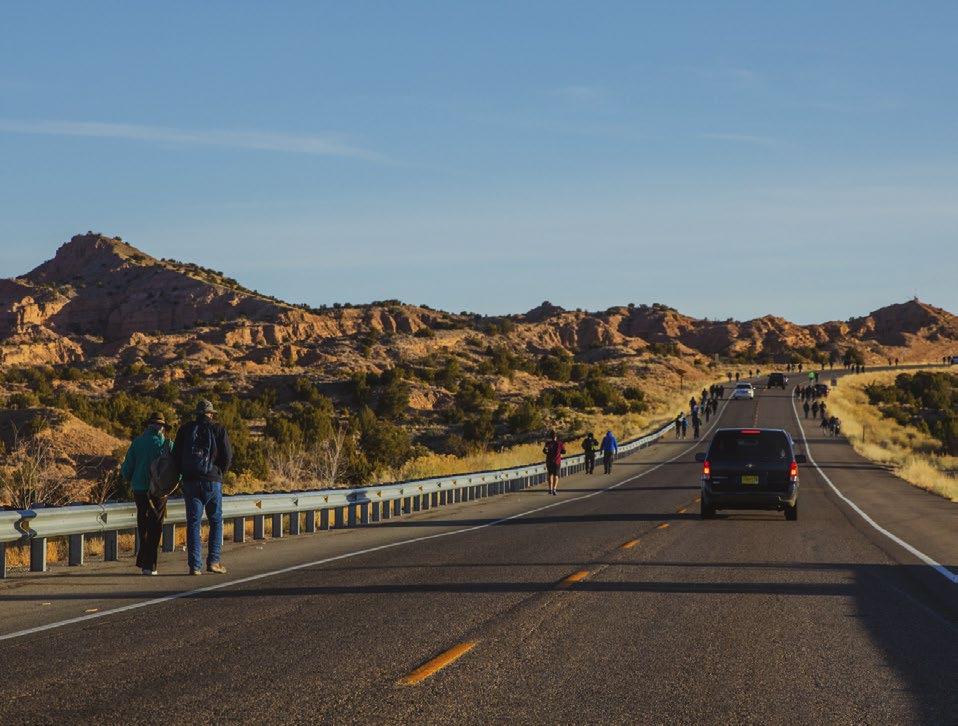
that pebble the way, and the santuario as ending-place, mark this passage:
i come down into the valley, sunflowers and wild floral patterns on the meadows
the mountain’s cleft in the distance behind your final resting place strong, stubborn, like you…. but now the sparrows, the alfalfa flower, blue, violet, yellow butterflies, so many, so many and all around your descanso, like a blanket of sunrise, daisies (Sagrado 119).
Romero’s poetry reminds, like the tenacity that shrouds Chimayó, that strength reveals itself in many ways. Sometimes it is buried in healing soil; sometimes it sprouts in bouquets along drought tested byways; sometimes it is walked out one foot at a time, one step in front of the other on el camino del norte a Chimayó. t
Online: nps.gov/places/el-santuario-dechimayo.htm
“Los


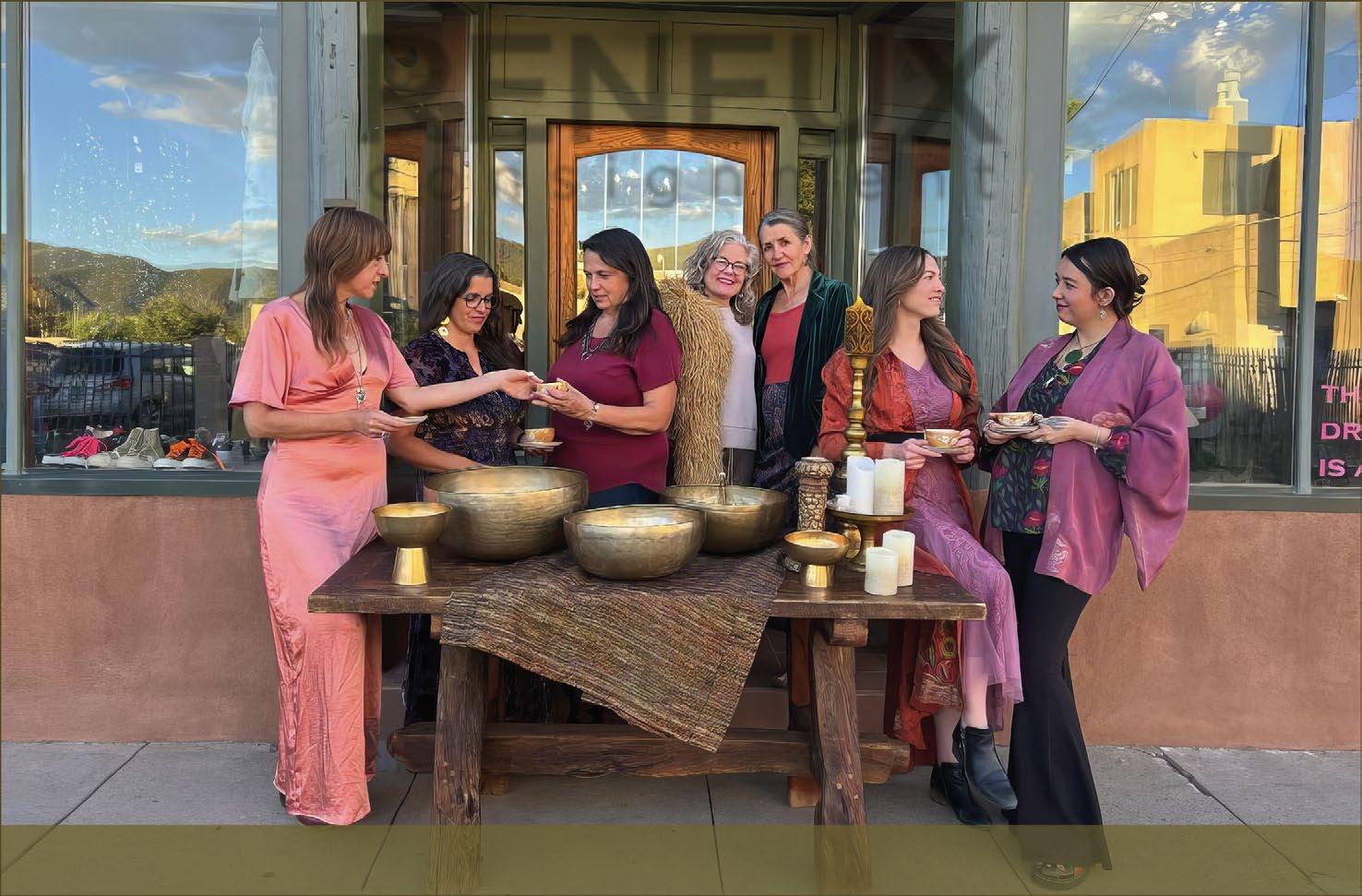




BY SHELLI ROTTSCHAFER
Arthur Roy Mitchell was born December 18, 1889 in Jansen, Colorado just outside of Trinidad, Colorado. The town of Trinidad is the gateway to Raton Pass, which climbs 7,834 feet and leads south into New Mexico. This town was incorporated a decade earlier when the Atchison, Topeka, and Santa Fe Railroads reached this location, shipping coal, cattle, and other goods from southeastern Colorado across the nation. Mitchell’s family homesteaded on the mesa below the Sangre de Cristo Mountains. When he was eight, the family moved into Trinidad as his dad took a job as the Superintendent of Utilities for the town.
As a teenager Mitch was hired on as a cowhand for the A6 Outfit, located forty miles south in Vermejo Park, New Mexico. It was there he learned to love the land. Although never encouraged to be an artist when he was young, Mitchell appreciated painting and sketching these landscapes.
In his early twenties, Mitchell moved to Boise, Idaho and began working as a cartoonist and a lettering specialist. These three years in Idaho became known as part of his “lost years.” Once WWI began, he enlisted and was stationed at Camp Lewis in Washington state. When the war ended, he remained in the Pacific Northwest
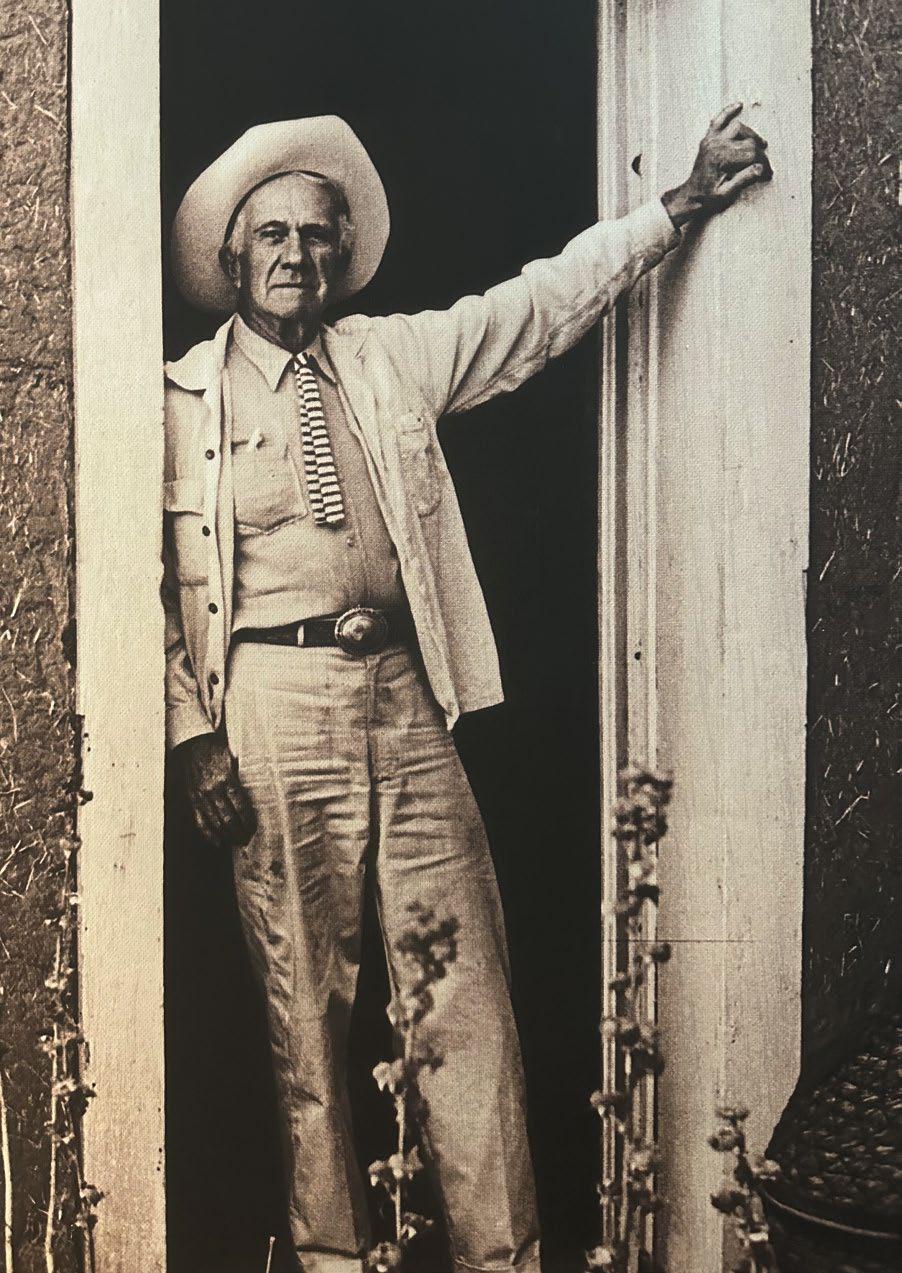
working for a newspaper, the Seattle Post-Intelligencer
While in the Pacific Northwest, Mitch became friendly with California-based artist Harold von Schmidt. Their friendship and creative competitiveness led them both to study with Harvey Dunn at the Grand Central School of Art in New York. This is where Mitch honed his craft as a painter and illustrator, with most of his themes leaning toward Western-scapes.
Over next two decades, from the 1920s to 1940s, Mitchell lived in New Jersey. With his connections in New York City and NYC-based publication houses, Mitchell’s artwork covered pulp magazines and dime-store novels. He was known as the “King of Pulp Magazine Covers” for stories about cowhands and their livelihoods. Some of his illustrations accompanied stories published by authors like Zane Grey, Jack London, and others. His work was
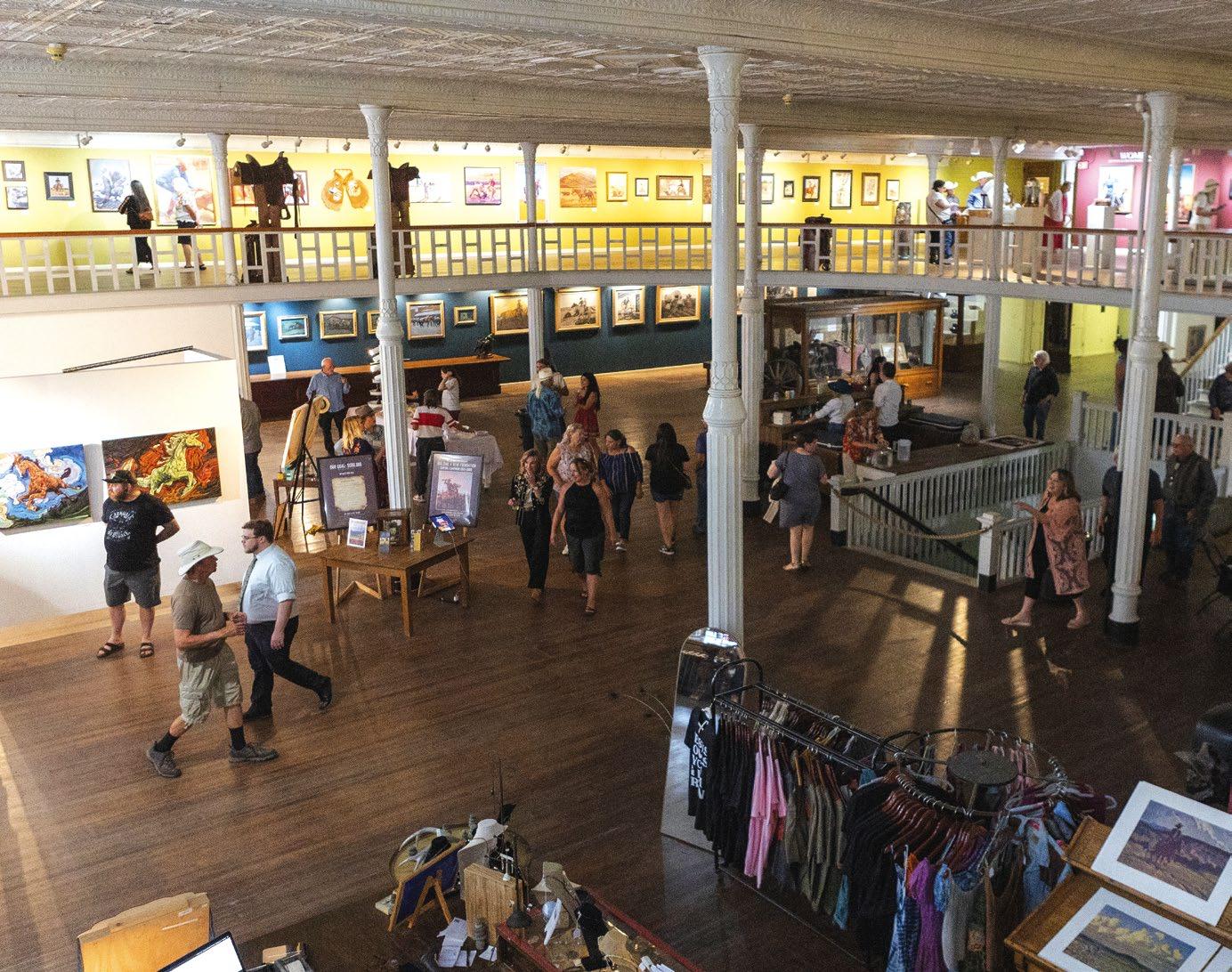
influenced by the mountains, mesas, and high deserts of his youth; as well as landscapes painted en plein air whenever he returned to Trinidad to visit family.
In 1944, Mitchell was diagnosed with terminal lung cancer, and he returned west to spend what little time he had left with his sister, Ethel “Tot” Erikson, and help work on her ranch. During that time, he also began teaching. He’s accredited with establishing the Art Department at what now is called Trinidad State College, saying: “This art class is no mere side issue with me, but is the outcome of a long-felt, earnest desire to establish in Trinidad an art class and an art consciousness, which will carry on in the future.”
Mitchell felt it was his “duty” to teach
his students the skills he’d learned over the decades. He is quoted saying, “If I merely break a trail for others who will surpass me, I will be satisfied, and maybe the footprints of the one who showed them the way need not be rubbed out entirely.”
Tot and her husband eventually left Trinidad for Denver, and Mitchell stayed until 1975 when he joined her family in the north. Mitchell died November 15, 1977 in Denver. He dedicated his life to depicting the land and lifeways he loved. When reflecting on his life he mentioned, “You look back over the trail, and you see the fine friends you’ve made, and you see you’ve managed to make a living doing something you really loved; how could anyone ask for more?”
Allyson Sheumaker, the Executive Director of The A.R. Mitchell Museum of Western Art, explained that the museum was created in 1981. Then it gained its permanent home in 1991 when the Jamieson Dry Goods store in historic downtown Trinidad was purchased. Tot Erickson donated her brother’s entire collection, and as a result “The Mitch” has become an important venue for Western-themed art in southeastern Colorado.
In addition to Mitchell’s Western-scape art, the museum also houses other exhibits that are part of the permanent collection. The Sacred Heart exhibit is a Hispano Folk & Religious Art Collection. In particular, it highlights the Penitentes The Brothers of Light. It contains bultos (intricately
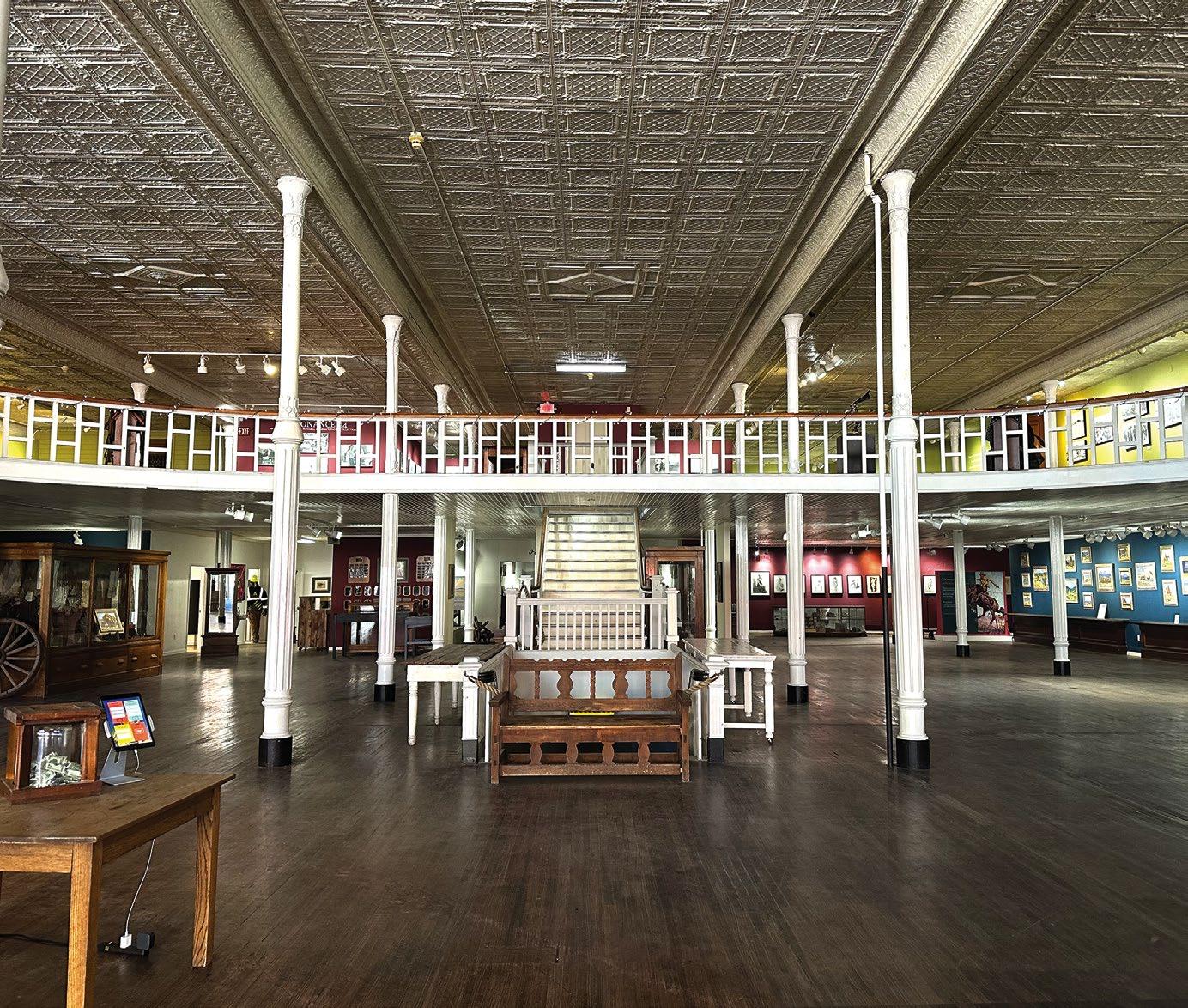
carved religious statues of Catholic Saints), retablos (colorfully painted wooden tablets that depict religious scenes), and tinwork like lanterns and sconces that are traditional folk-art of the region.
The museum also contains many Native American pieces. Trinidad, Colorado and the Sangre de Cristo Mountain Range are the traditional lands of the Comanche, Ute, Diné/Navajo, and Puebloan people. Pottery and textiles made by Indigenous artisans demonstrate these tribes’ creative traditions. Their craft expresses a connectedness to the land of the Southwest, which was and is their homeland.
The A.R. Mitchell Museum of Western Art also houses the Kuehl Fine Art Gallery, which invites a diverse body of present-day artists to show their craft in temporary exhibits. This work pushes the boundaries of the Western Mythos of the past, in order to demonstrate what art in the West can be now. t
The A.R. Mitchell Museum of Western Art
Location: 150 E. Main Street Trinidad, CO 81082 (719) 846-4224
Executive Director: Allyson Sheumaker
Online: armitchellmuseum.com
Hours: Tuesday - Saturday 10AM-4PM Admission is free.





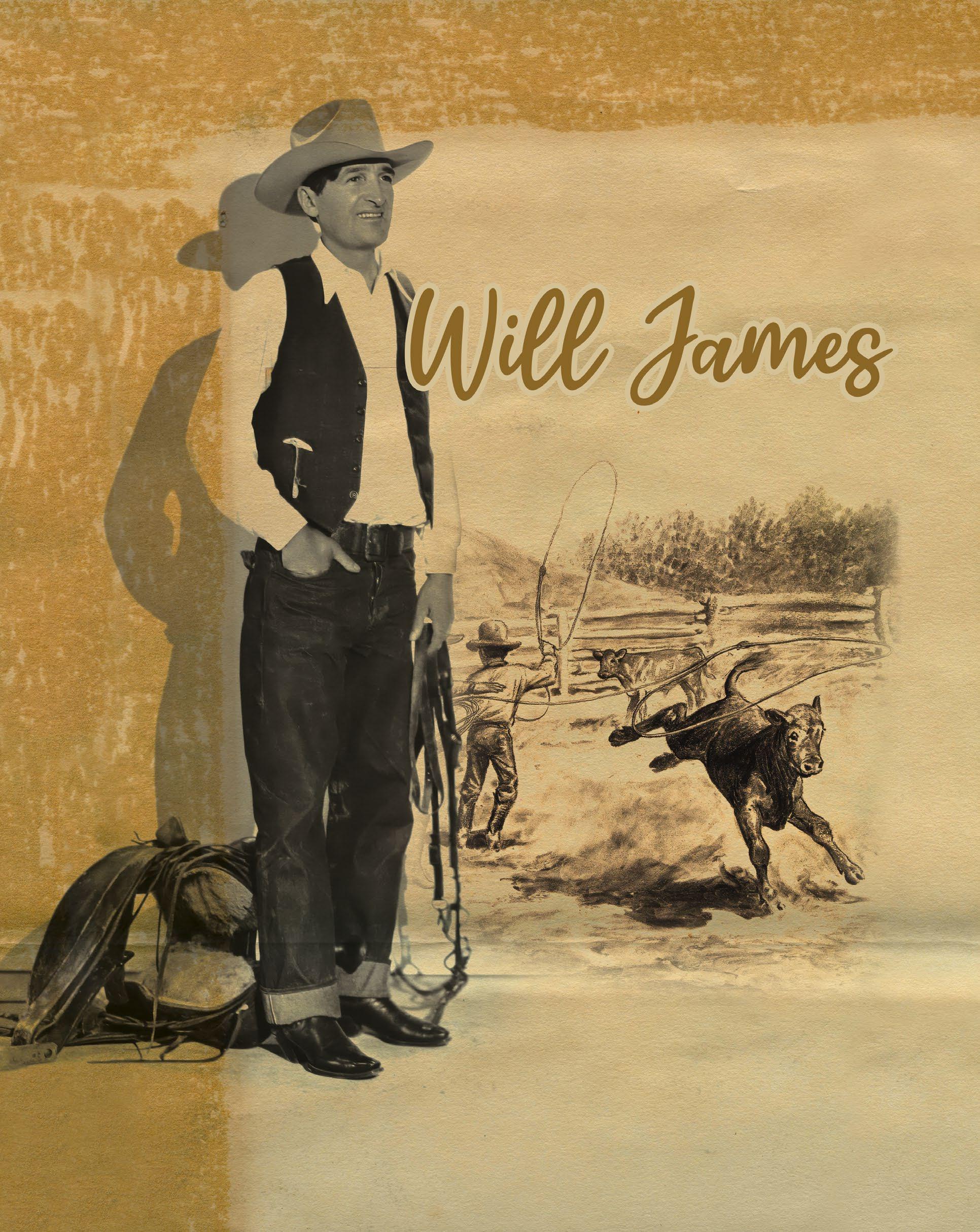

“For that pony had got tangled up in the cowboy’s heartstrings a heap more than that cowboy wanted to let on, even to himself. He couldn’t get away from how he missed him.”
WILL JAMES SMOKY THE COWHORSE
Will James may have been born in a Quebec village in 1892, but his soul always spoke the language of the American West. By the time he was 15, he had left home to chase a dream: to become a real cowboy. That dream would take him from the vast prairies of Saskatchewan to the ridges of northern New Mexico, where a summer in a cow camp near Angel Fire ultimately changed the course of his life—and American Western art—forever. After working on Canadian farms and ranches into his late teens, James (born Joseph Ernest Nephtali Dufault) ran into trouble with the law around 1910. In true Western fashion, he changed his name to William Roderick James, slipped across the border, and never looked back. In the U.S., he worked for cattle outfits across Montana, Idaho, and Nevada, often living on the edge—capturing wild horses for profit, and even serving 18 months in the Nevada State Prison for cattle rustling. It was in that prison that James began to take his lifelong passion for drawing horses and cowboys more seriously. Encouraged by fellow inmates and staff, he began to consider art not just as a pastime, but as a way out.
A kick to the jaw by a bronco in 1916 sent James to Los Angeles for dental work, where he joined Clarence “Fat” Jones’s Stables and found work as a stuntman in early Western films. Later drafted into the U.S. Army during World War I, he served as a mounted scout on the California-Mexico border. His discharge in 1919 later brought him U.S. citizenship—and a renewed determination to become a professional artist.
By 1920, James was living in San Francisco and sold two series of sketches and narratives to Sunset Magazine struggling to make ends meet. He began to develop a unique blend of cowboy storytelling and dynamic, action-filled illustration. A year later, he heard about Santa Fe’s burgeoning art colony and decided to make his way there in hopes of developing a market for his artwork. That’s where he met Wallace Springer, an art lover whose family owned the CS (Charles Springer) Ranch outside Cimarron, New Mexico.
Wallace’s brother, Ed Springer, was running the ranch at the time and offered James a job: working cattle at a cow camp 9,000 feet up in the Sangre de Cristo Mountains. James’ home was at an isolated cabin near Aurora, just a few miles from Black Lake and present-day Angel Fire. Locals say (with a great deal of speculation) that while in Aurora, he may have even painted a self-portrait on the inside wall of his cabin, a hidden piece of Western art history and the truth of its origin lost in the pines.
While at the CS Ranch, James became known not just for his skill with horses but for his ability to tell a story—and sketch it too. That summer, a ride-in visit from Yale University dean Burton Twitchell (alongside Ed Springer and neighbor Jack Nairn) proved pivotal. Twitchell, impressed by James’ raw artistic talent, offered him an art scholarship to Yale, with Springer and Nairn agreeing to cover any remaining costs. James quickly realized he preferred cowboy life over Yale life, but what followed was monumental: Twitchell introduced him to Charles Scribner, head of Scribner’s Magazine, then America’s most prestigious publisher.
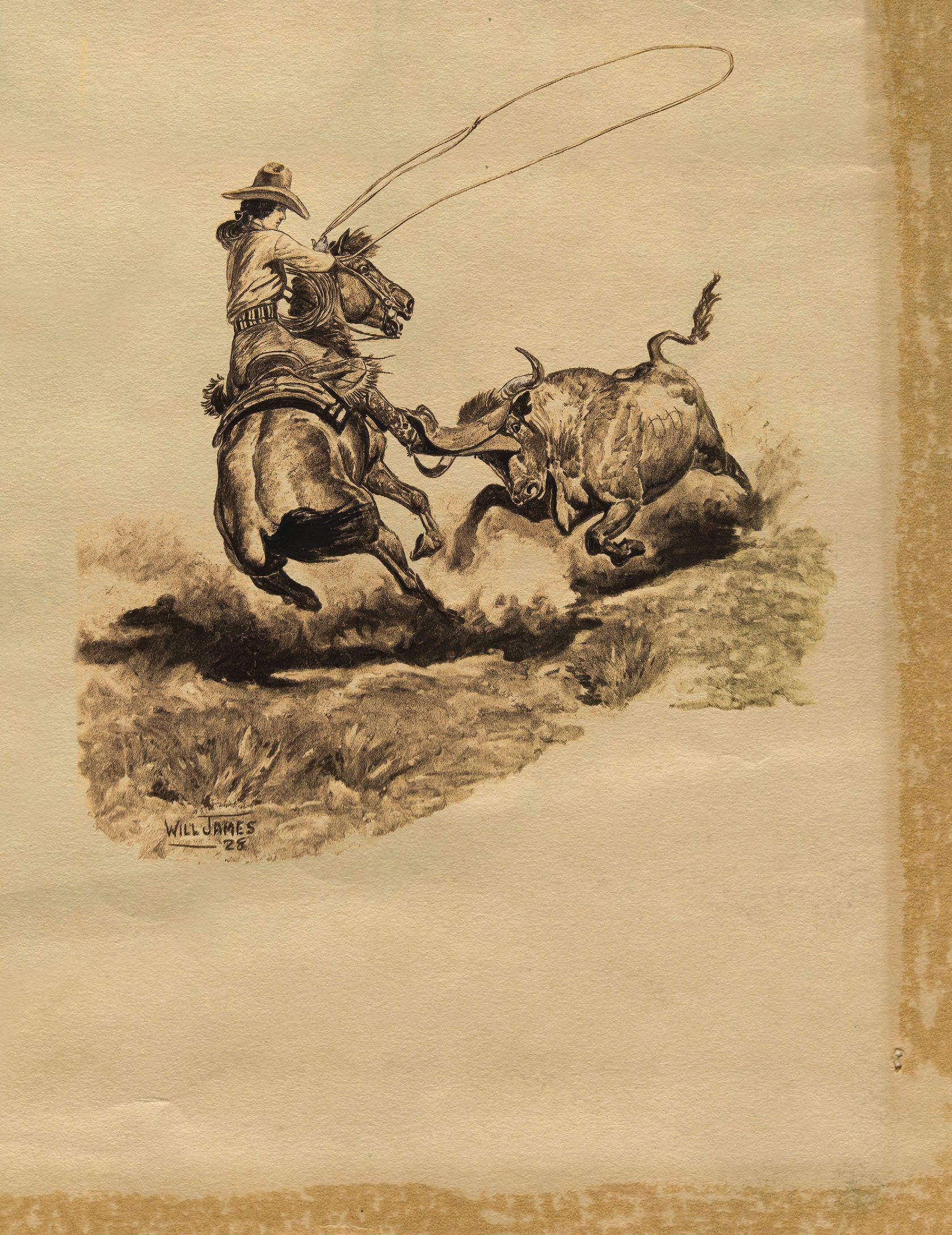
“There was so much life wrapped up in that pony’s hide that it was mighty hard for him to settle down and behave...he sometimes had to bust out and do things that wasn’t at all proper...”
WILL JAMES SMOKY THE COWHORSE
James sent in a story with eight illustrations. Four editors said it was “too cowboy” for their readers—but the art director pushed it through, and James’ first nationally published story appeared in 1923. He was paid $300 for “Bucking Horses and Bucking-Horse Riders.”
By 1924, Scribner’s was publishing James’ short stories, and the art director encouraged him to write novels—and would go on to release 23 of his books over two decades, all written in his authentic cowboy vernacular and illustrated with his own dynamic linework. His third book, Smoky the Cowhorse (1926), won the Newbery Medal for children’s literature in 1927 and became one of the most celebrated works in the genre, later adapted into three films. James would go on to be compared with Charlie Russell as a visual storyteller of the cowboy West. His books were translated into six languages, and nearly every school and library in North America stocked them. In 1991, he was posthumously inducted into the Nevada Writers Hall of Fame.
Although he eventually settled in California, James never forgot his time at the CS Ranch, nor the role New Mexico played in shaping his path. He sent personally inscribed first editions of his books to Ed Springer, one bearing the note:
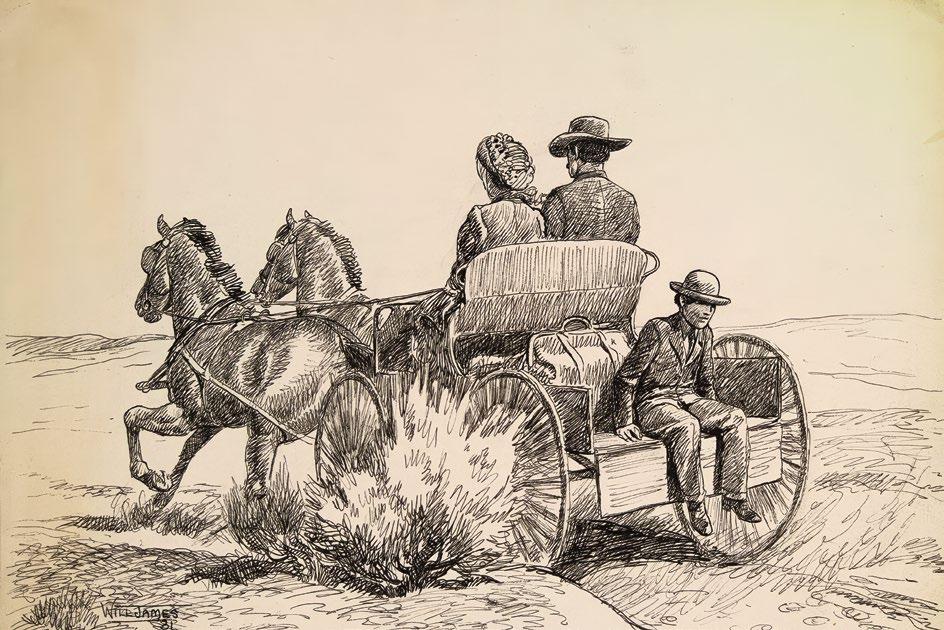
Top: Will James, “The trip to town seemed like a funeral march to Bill”, 1931. Ink on paper, 9 ¼ x 12 inches. Yellowstone Art Museum Permanent Collection, Gift of Virginia Snook. Bottom: Will James, “Uncle Bill was in the middle of answering a long question”, 1932. Graphite on artist board, 18 x 13 ¾ inches. Yellowstone Art Museum Permanent Collection, Gift of Virginia Snook.
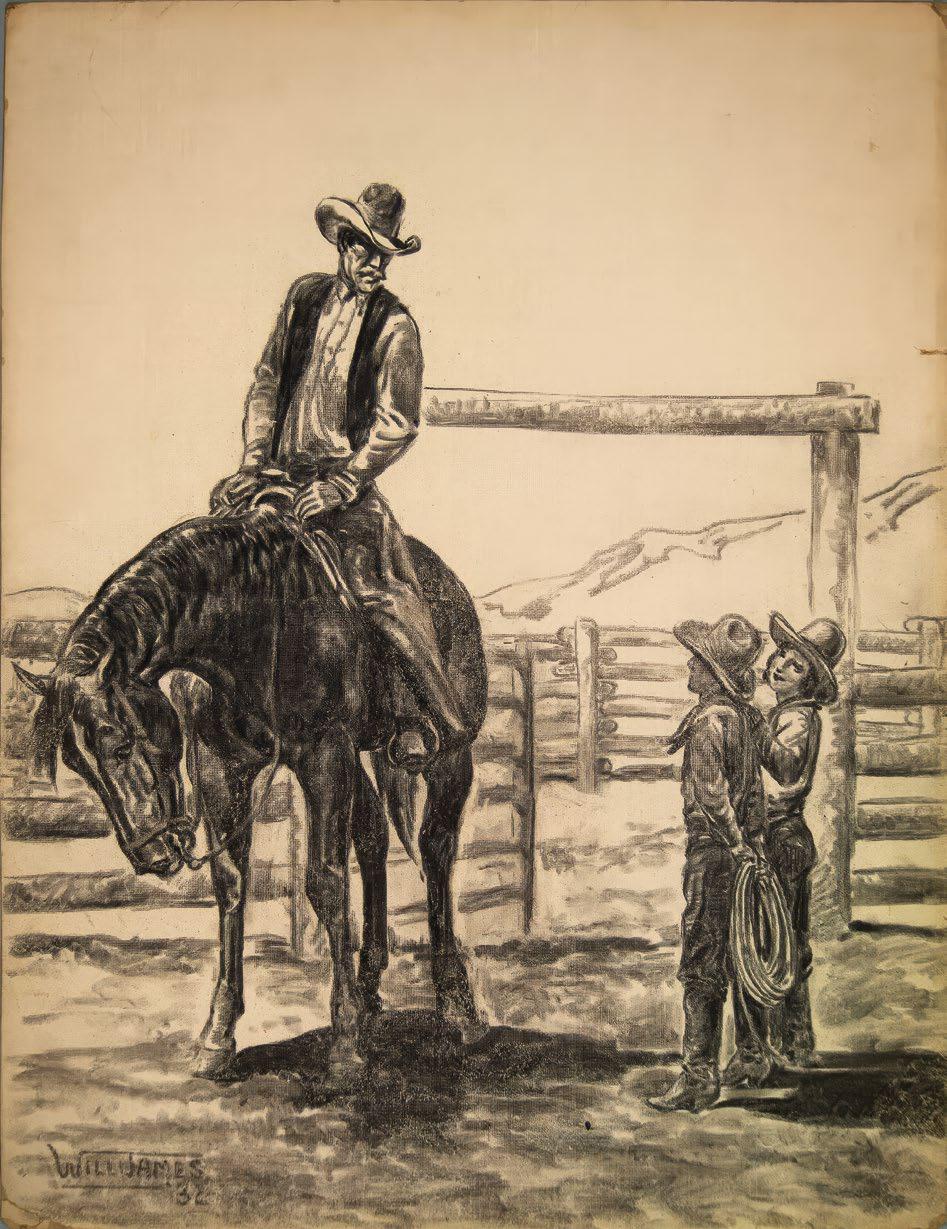
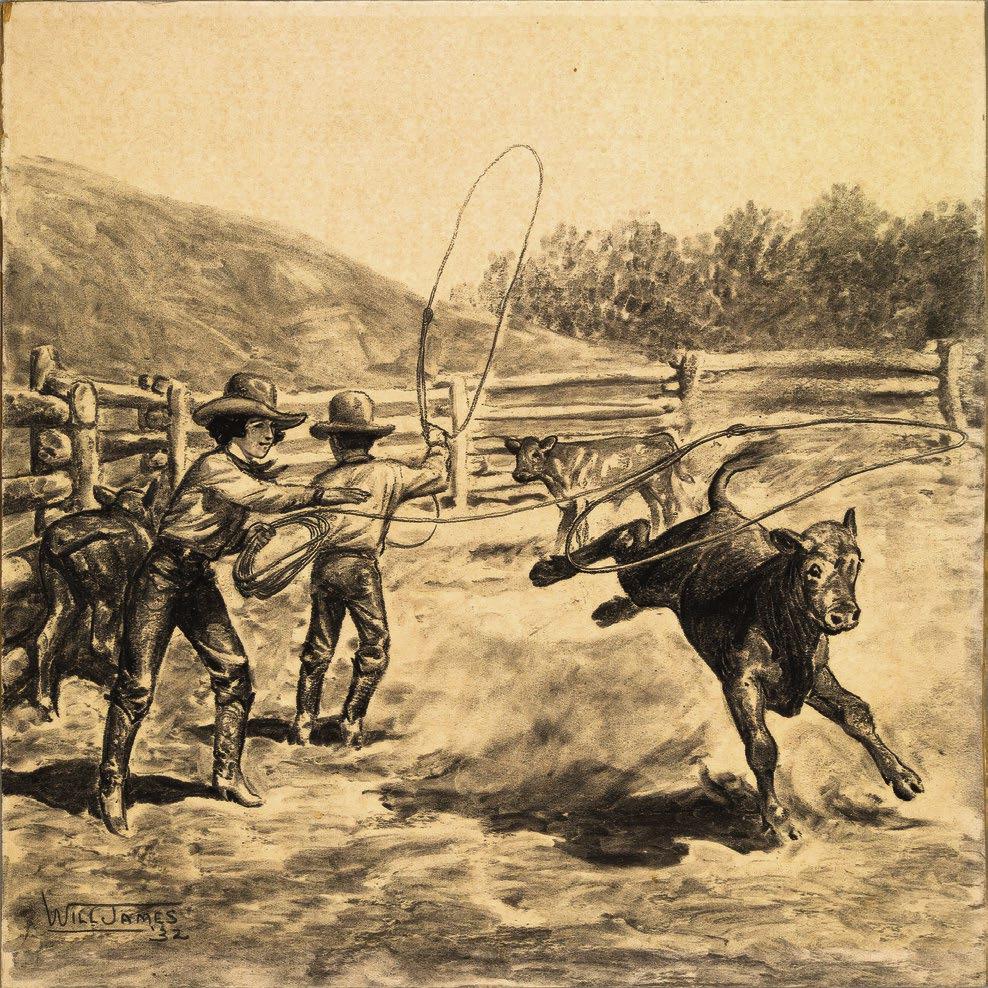
Today, Will James’ legacy is etched into the landscape of northern New Mexico, from the bunkhouse at the CS Ranch to the alleged hidden remains of a hand-painted self-portrait in a long-forgotten cabin near Aurora. Angel Fire and the surrounding region remain a quiet backdrop to one of the most important turning points in the life of America’s cowboy artist—a place where a French-Canadian outlaw-turned-cowboy found his voice, his vision, and his future in the wild beauty of the Sangre de Cristos. t
Above: Will James, “They was getting pretty good with a rope”, 1932. Graphite on artist board, 10 x 10 inches. Yellowstone Art Museum Permanent Collection, Gift of Virginia Snook.
Yellowstone Art Museum
401 North 27th Street
Billings, MT 59101 (406) 256-6804
Online: artmuseum.org
Hours: Wed. – Sat. 10 a.m. – 5 p.m. Thursday 10 a.m. – 8 p.m.

“If you know whether a man is a decided monist or a decided pluralist, you perhaps know more about the rest of his opinions than if you give him any other name ending in IST. To believe in the one or in the many, that is the classification with the maximum number of consequences.”
WILL JAMES
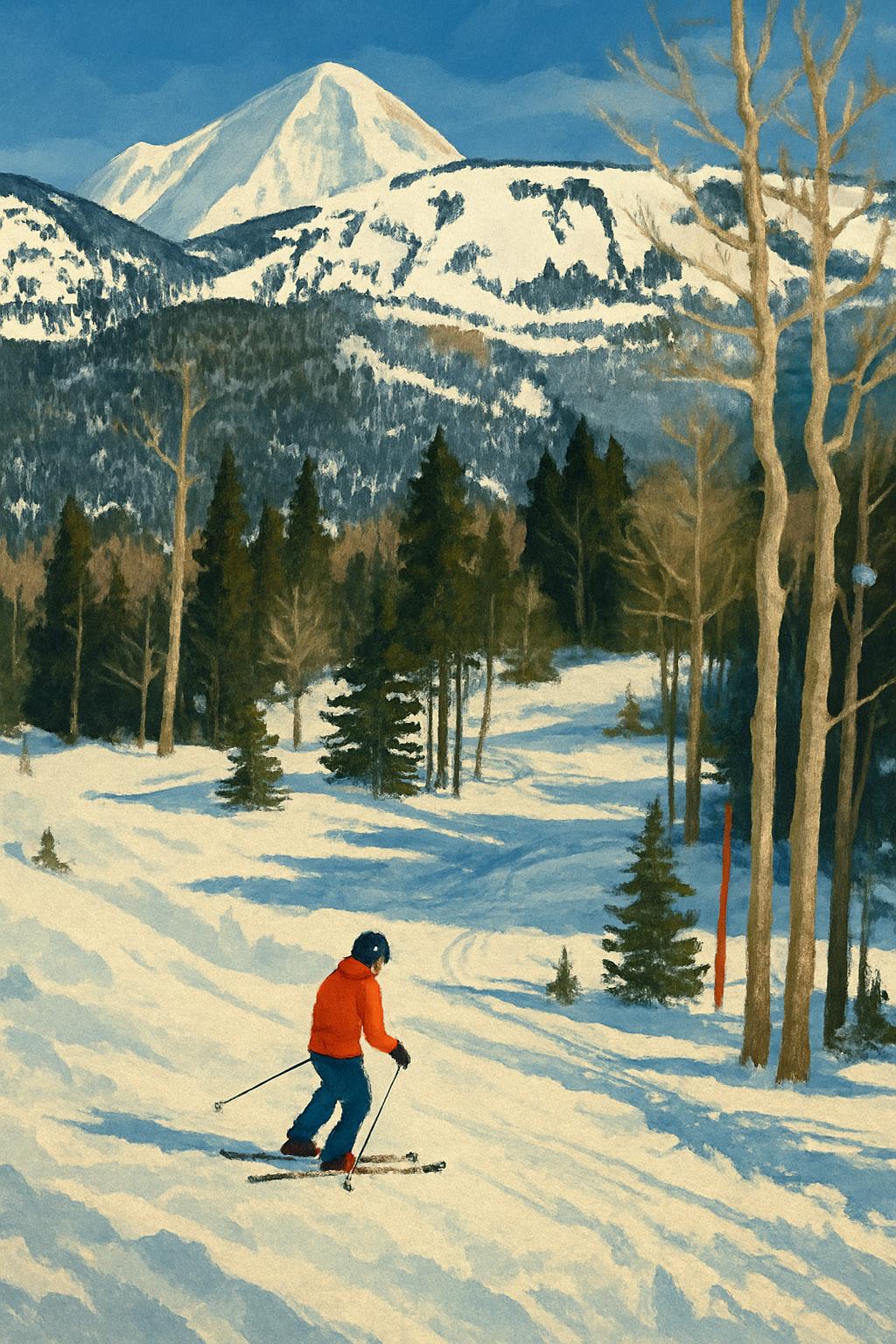

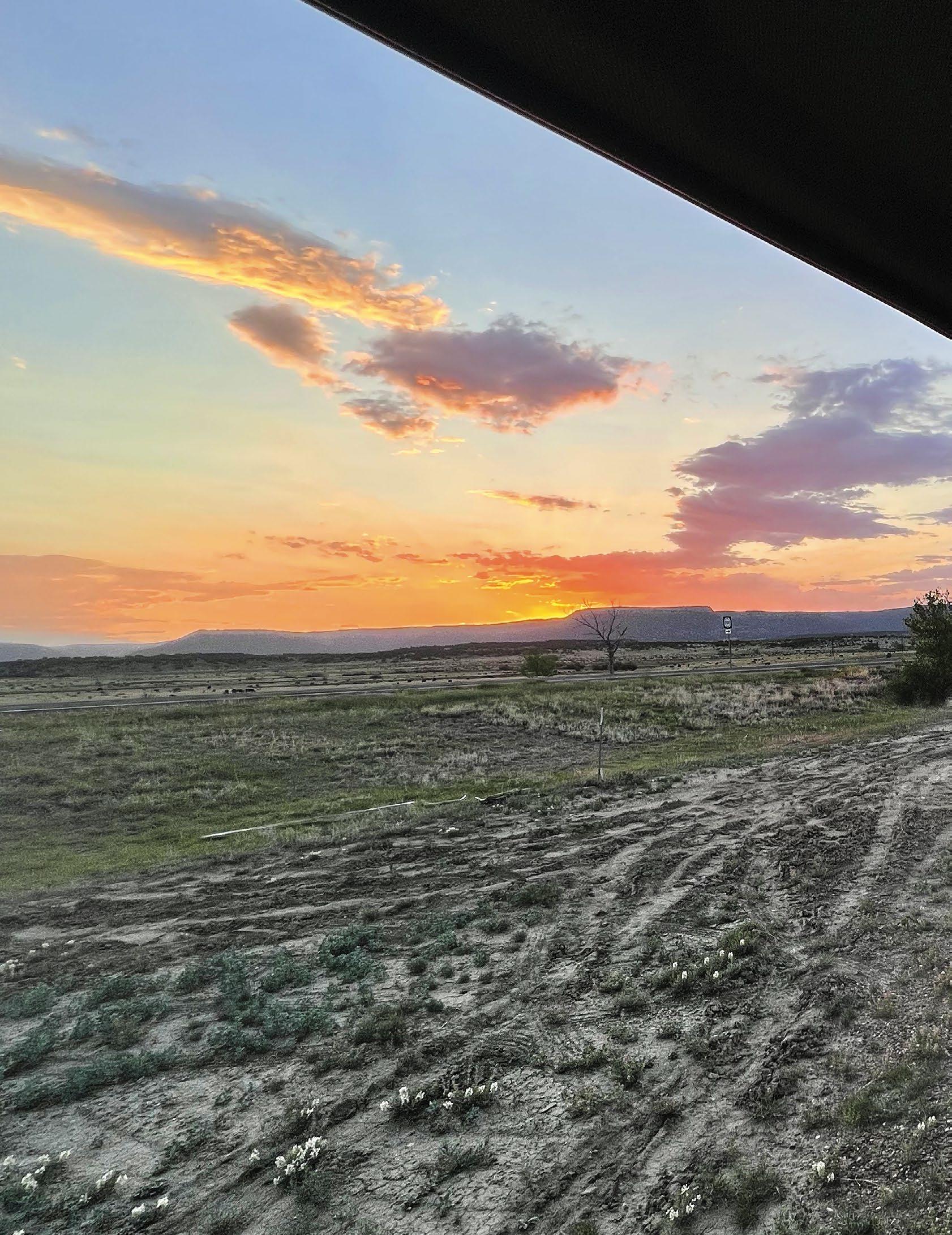

There’s a certain magic that happens when the first soft flakes of snow transform the forest into a hushed cathedral of white powder. Snowshoeing in a fresh blanket is much more than just a way to explore a wilderness trail—it’s an invitation to slow down, breathe deeply, and feel a part of wild places. With each step, the snow gently gives beneath your snowshoes, a satisfying crunch that breaks the stillness while leaving a delicate trail behind you.
In a mountain forest, the air feels sharper and cleaner, carrying the scent of pine and the quiet weight of winter. Sunlight filters through snow-draped branches, casting shimmering light across the ground like scattered diamonds. Deer, fox, or rabbit tracks often appear before you, reminders that you are not alone, but sharing the woods with creatures perfectly at home in this landscape—even in the harshest of weather.
Snowshoeing requires no rush, no finish line—just the steady rhythm of movement and the warmth that builds in your body as you travel farther into the forest. It’s a chance to reconnect with nature and yourself, to trade the noise of daily life for the serene silence of winter. In fresh powder, every journey feels like discovery, and every breath a gift.
There are countless places to discover the wild wonder of winter here in the Southern Rockies. We’ve selected a few to share so you can get on your way to a deep and meaningful connection with nature.
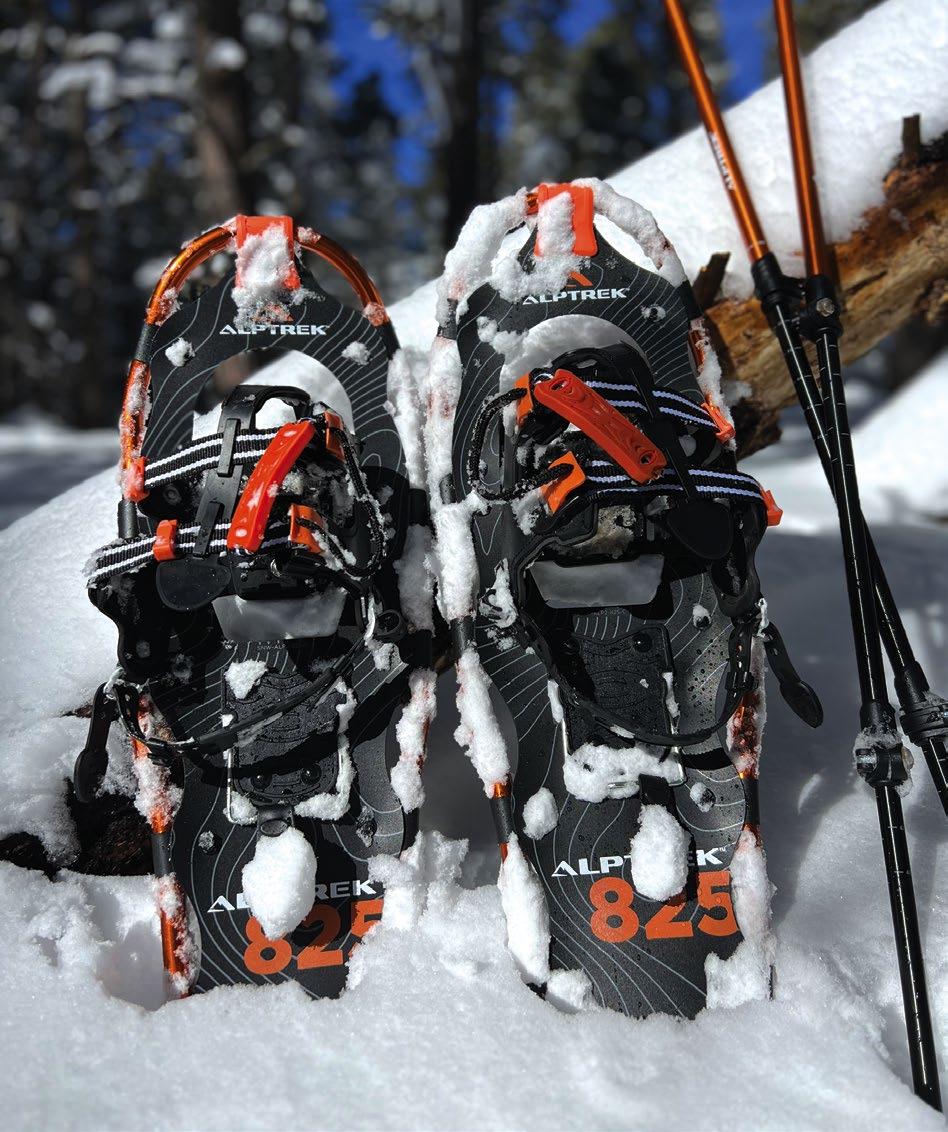
This trail begins at Monte Verde Lake in Angel Fire, New Mexico, and traverses southwest for one mile until it intersects with a national forest passthrough gate. Here the trail forks in three directions. Turning left allows for loop routes back to the gate, offering some of the finest heavy snowfall scenery with creek crossings over wooden bridges. Trails in the Carson National Forest are mostly marked. If you have an opportunity to be the first in after a fresh snowfall, consider yourself blessed.
This cross-country ski area offers snowshoe hikes to yurts for overnight stays. Service offerings at the lodge include snowshoe tours, picnic areas, warming huts, and rentals. Sitting at around 9,800 feet with a summit elevation of 10,078 feet, Enchanted Forest is located just west of Bobcat Pass above Red River, New Mexico. The trails offer stunning views of the valley below. The quaint lodge offers a seating deck and a small parking area. Visitors can also rent cross-country skis and traverse groomed trails.
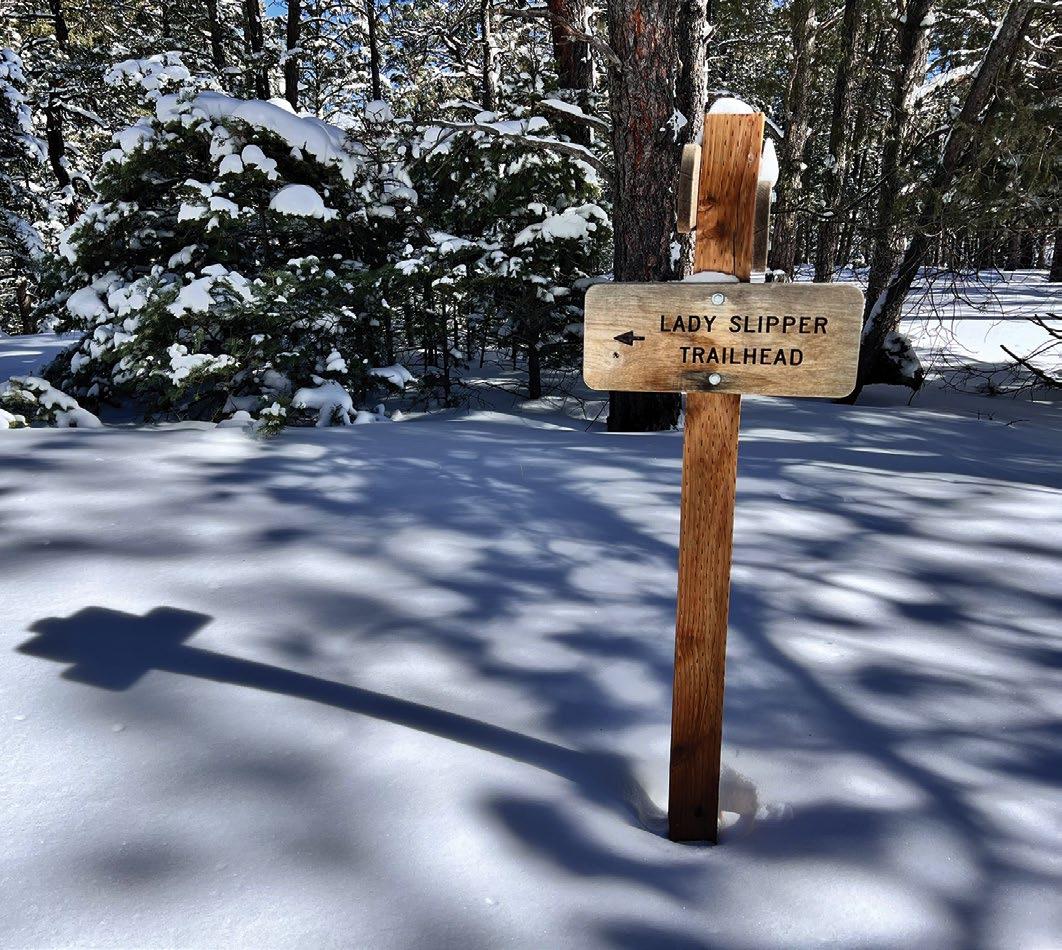
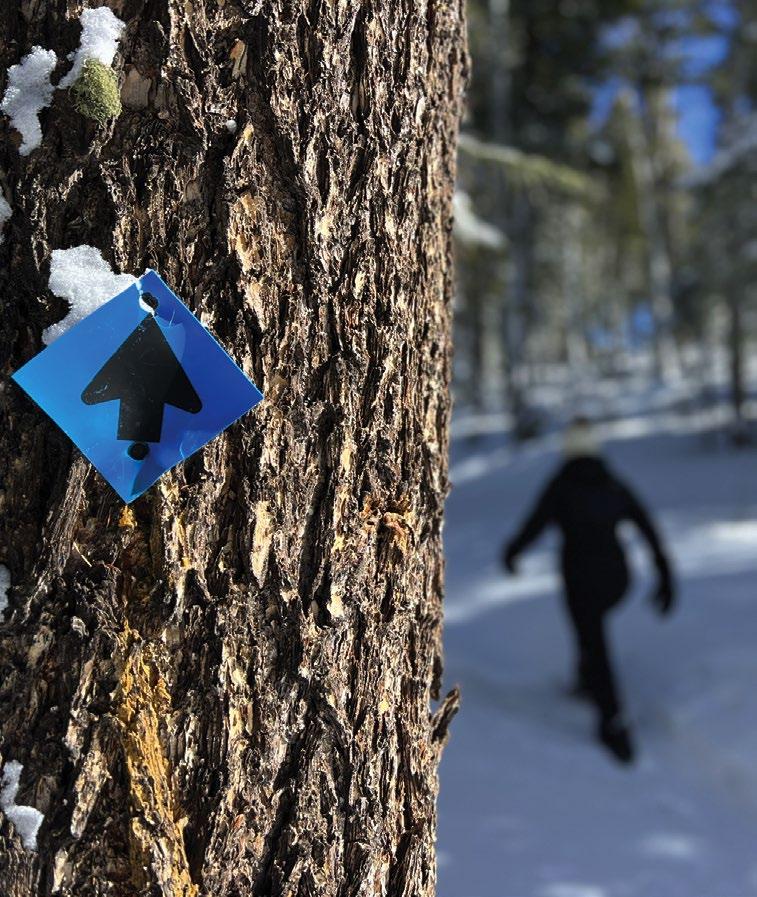
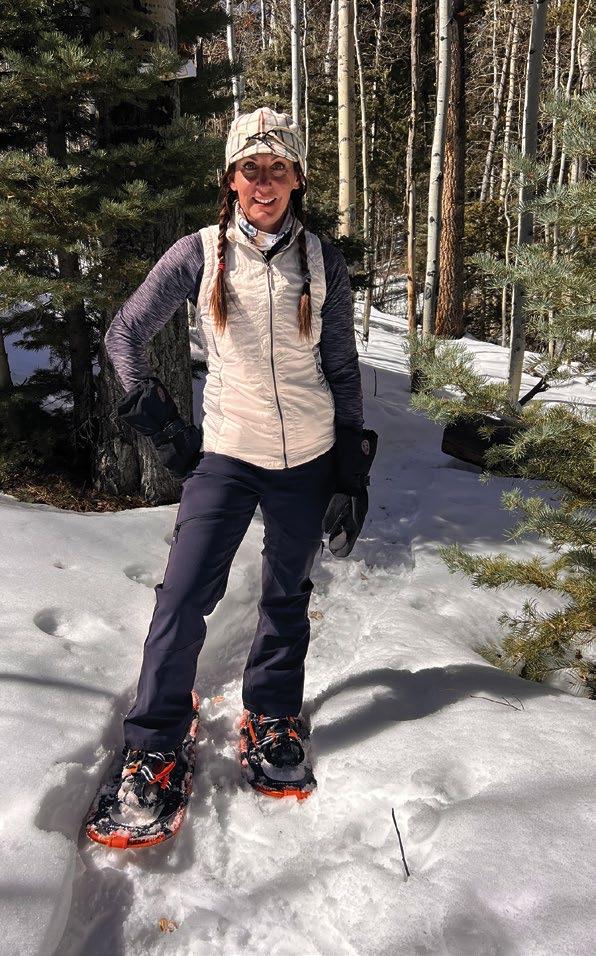
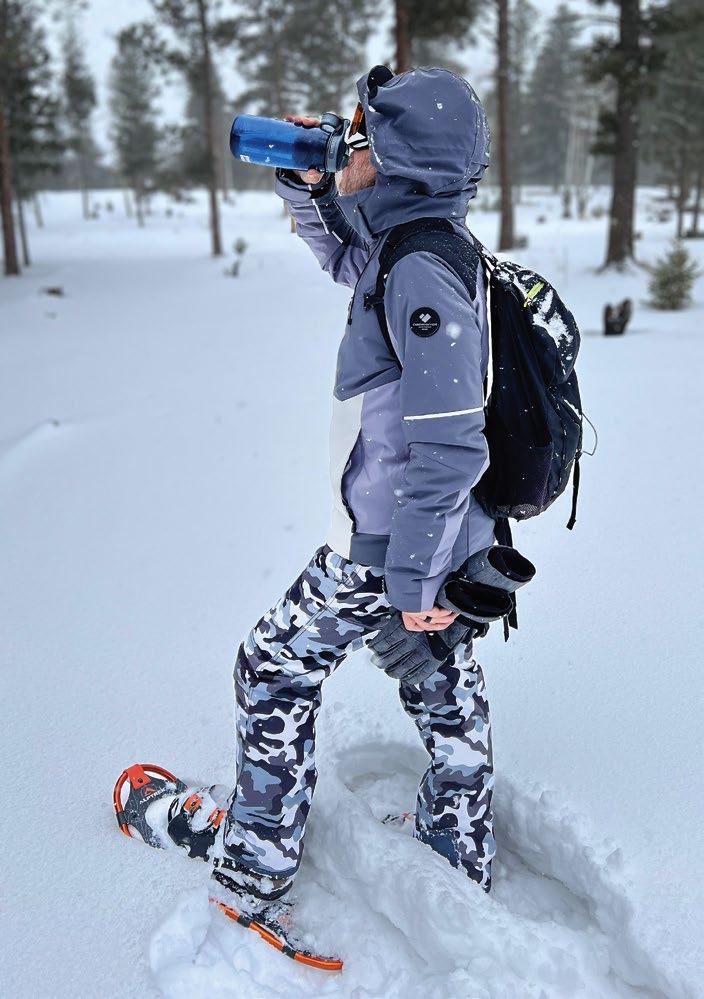
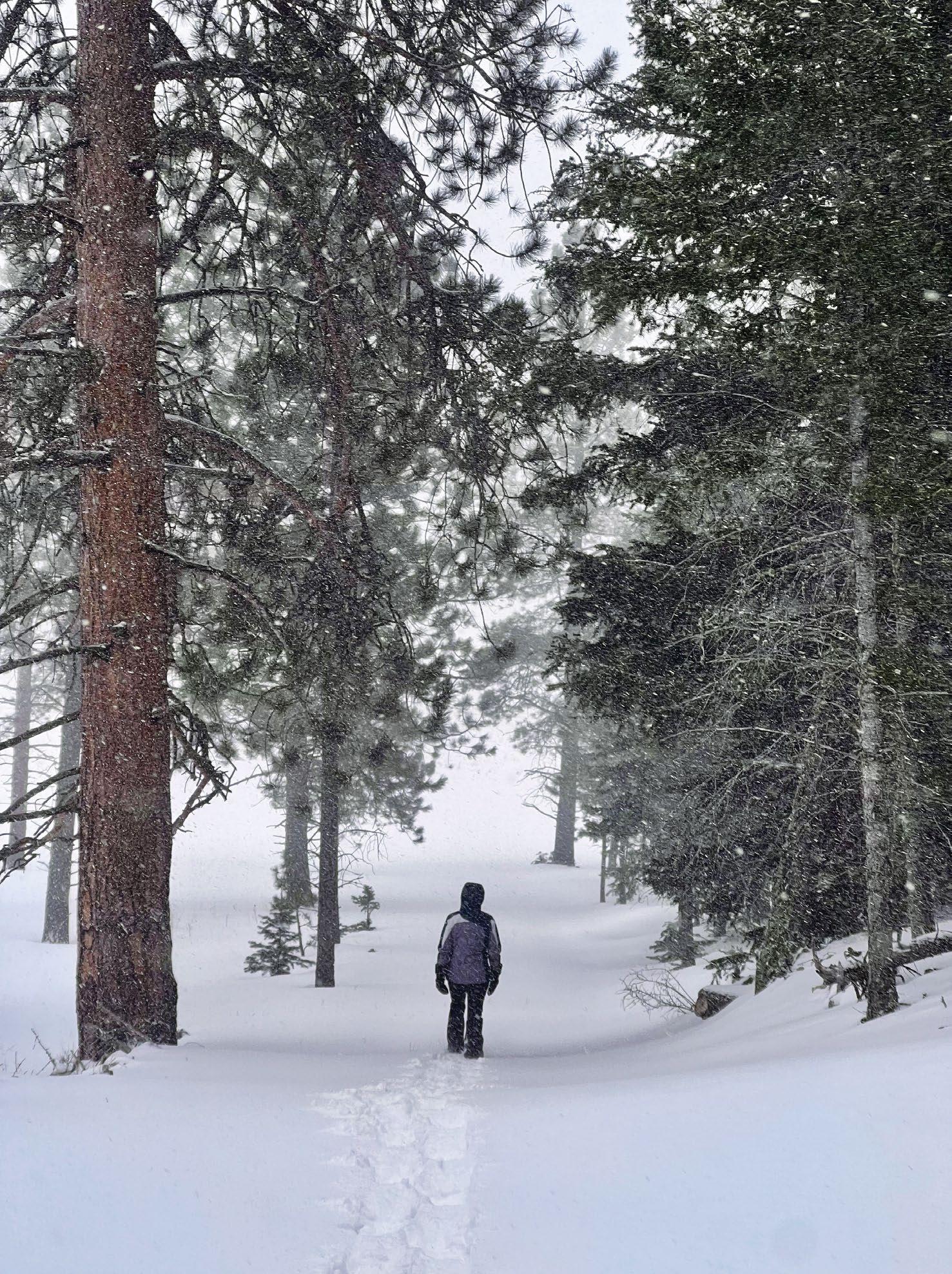
and
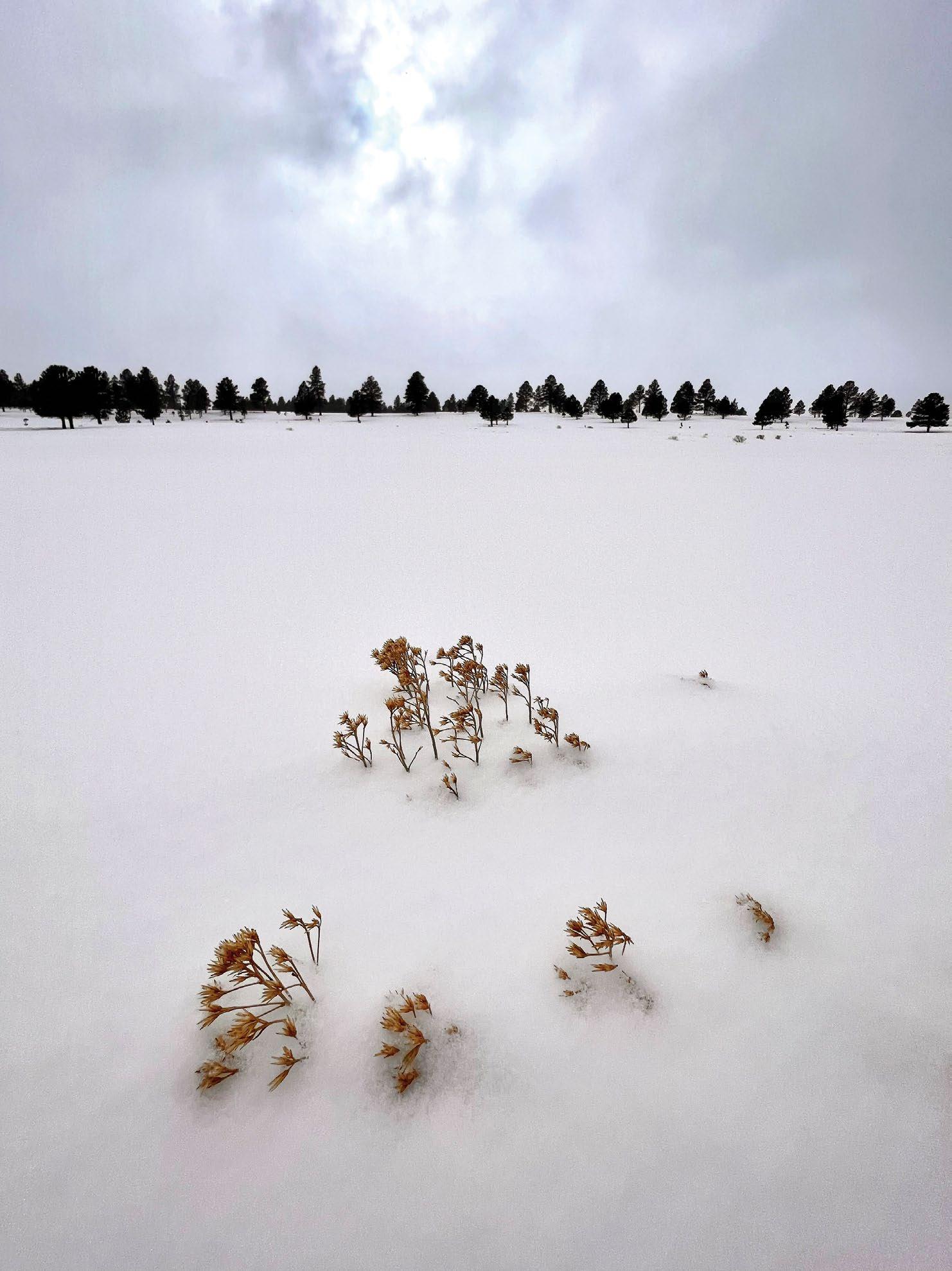
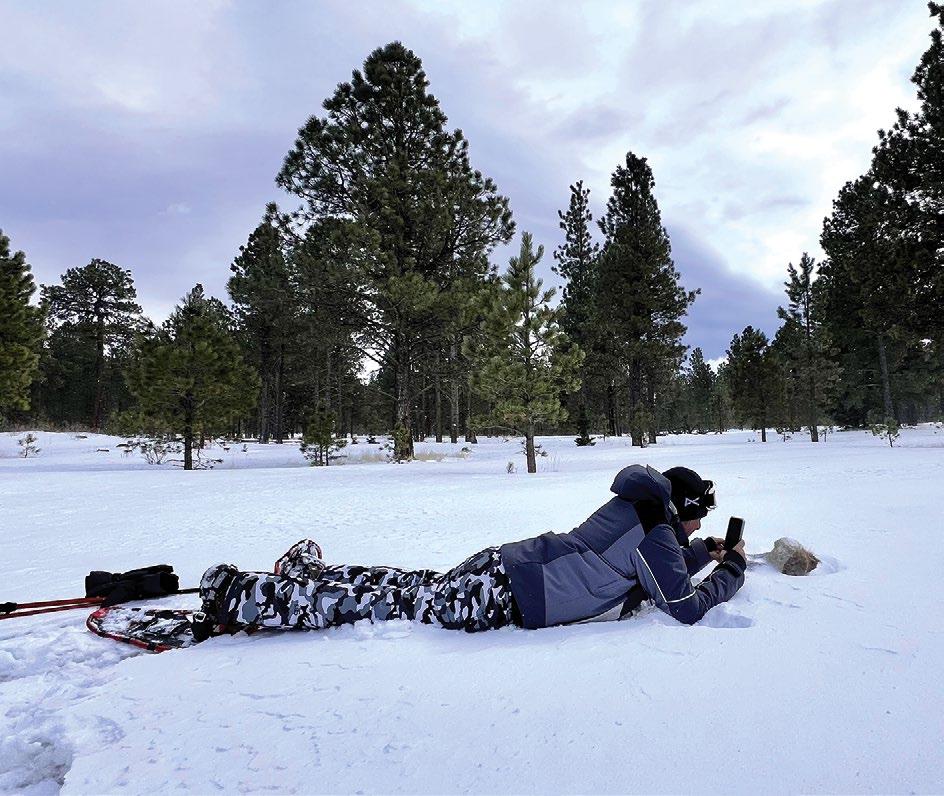
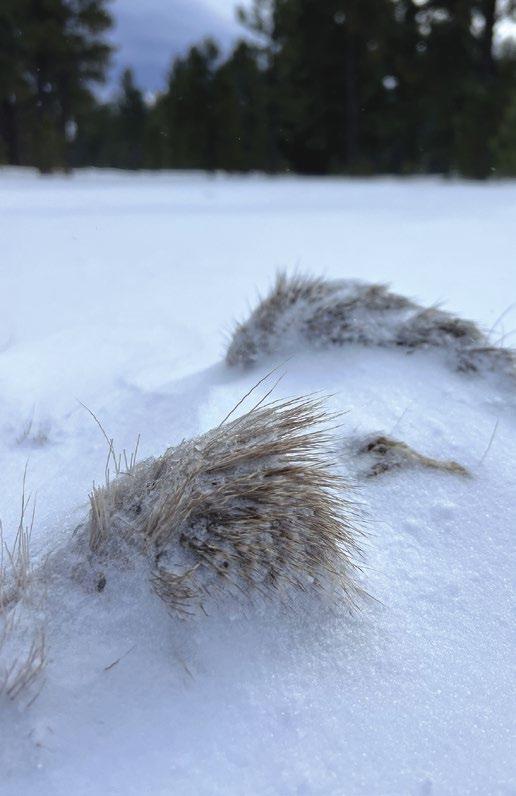
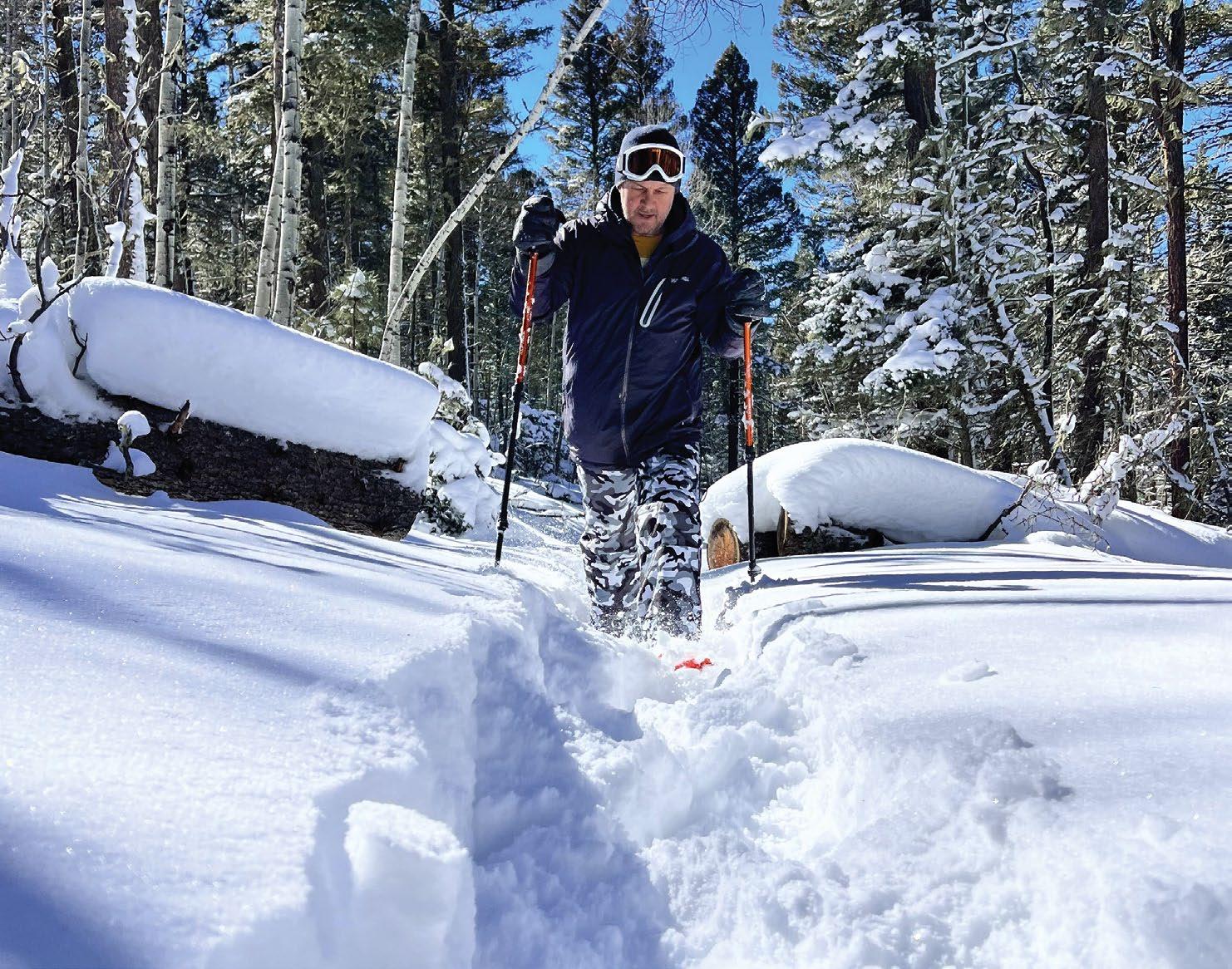
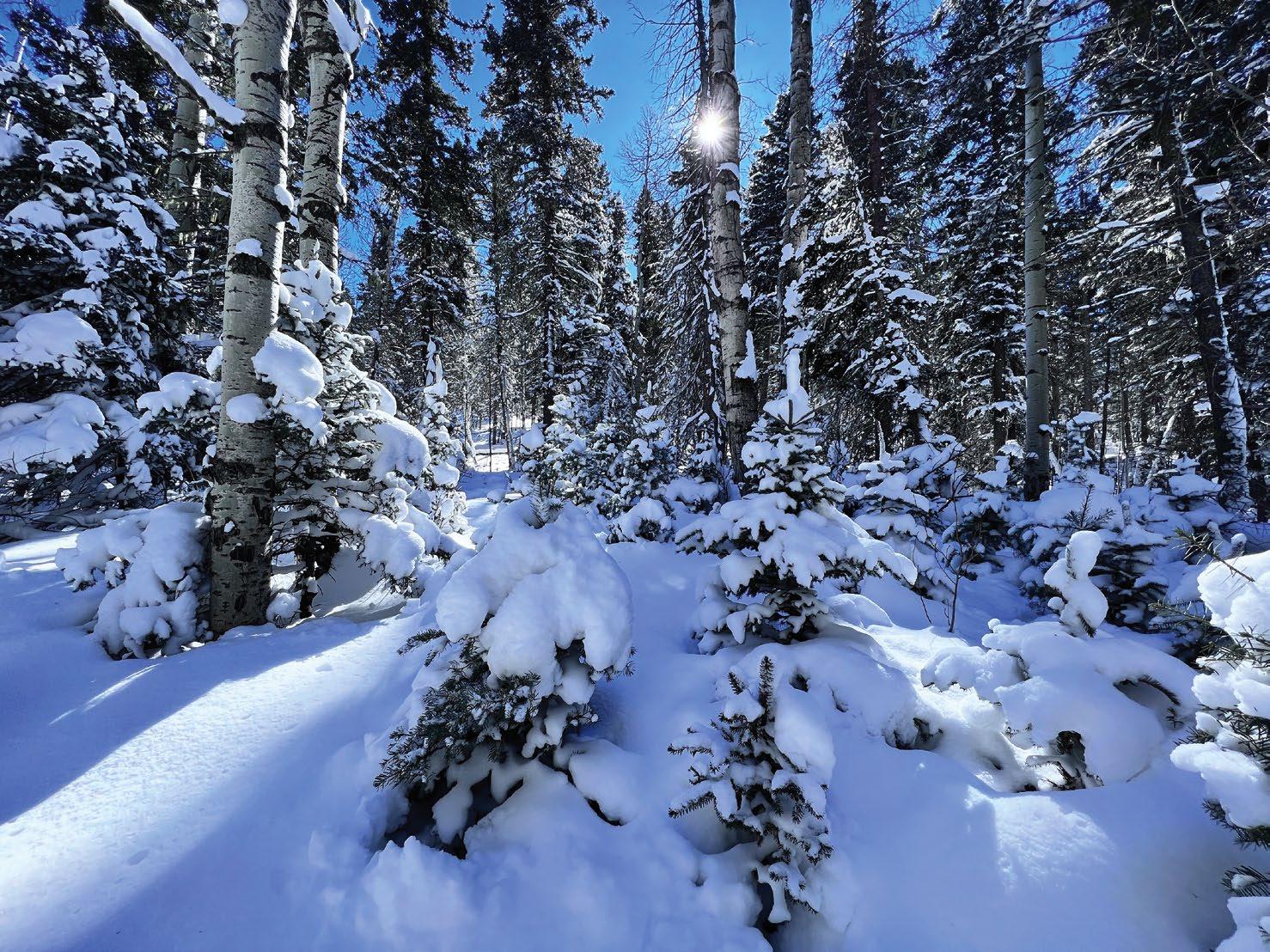
Though this trail is both a private access road and a groomed cross-country ski trail, snowshoeing is a treasured activity in this area—however, snowshoe enthusiasts are asked to please avoid walking on the groomed trails. The trail starts from the intersection of US 160 and the top of West Fork Road, about 15 miles east of Pagosa Springs. The trail descends downslope from the highway northbound. This trail is one of the most stunning winter experiences in the region: it sits just below the western slope of the San Juan range and the famed Wolf Creek Pass, which receives tremendous annual snowfall. Explorers enjoy stunning views of the West Fork of the San Juan River below towering cliffs and spires.
This is a 5.4-mile out-and-back trail located south of Cuchara Pass in Colorado. Access can be limited to get to the trailhead, however, explorers can also park along Highway 12 and snowshoe in along the forest road. This high-elevation hike offers picturesque views of the North Fork of the Purgatoire River below the towering Trinchera, Cuatro, and Mariquita Peaks of the Sangre de Cristo Mountains. t
Beneath tall pines the silence grows,
A hush where winter’s secret flows.
Soft tracks appear where deer have laid,
The fox and rabbit have carefree played.
The sun shines through with golden rays,
Casting on drifts where the aspen sways.
Snowflakes shimmer, fall, and rise,
Tiny sparkles that grace the skies.
The forest stirs, alive, awake
Each breath a song the cold can’t take.
And as I wander, observant and free,
The wilderness walks the woods with me.



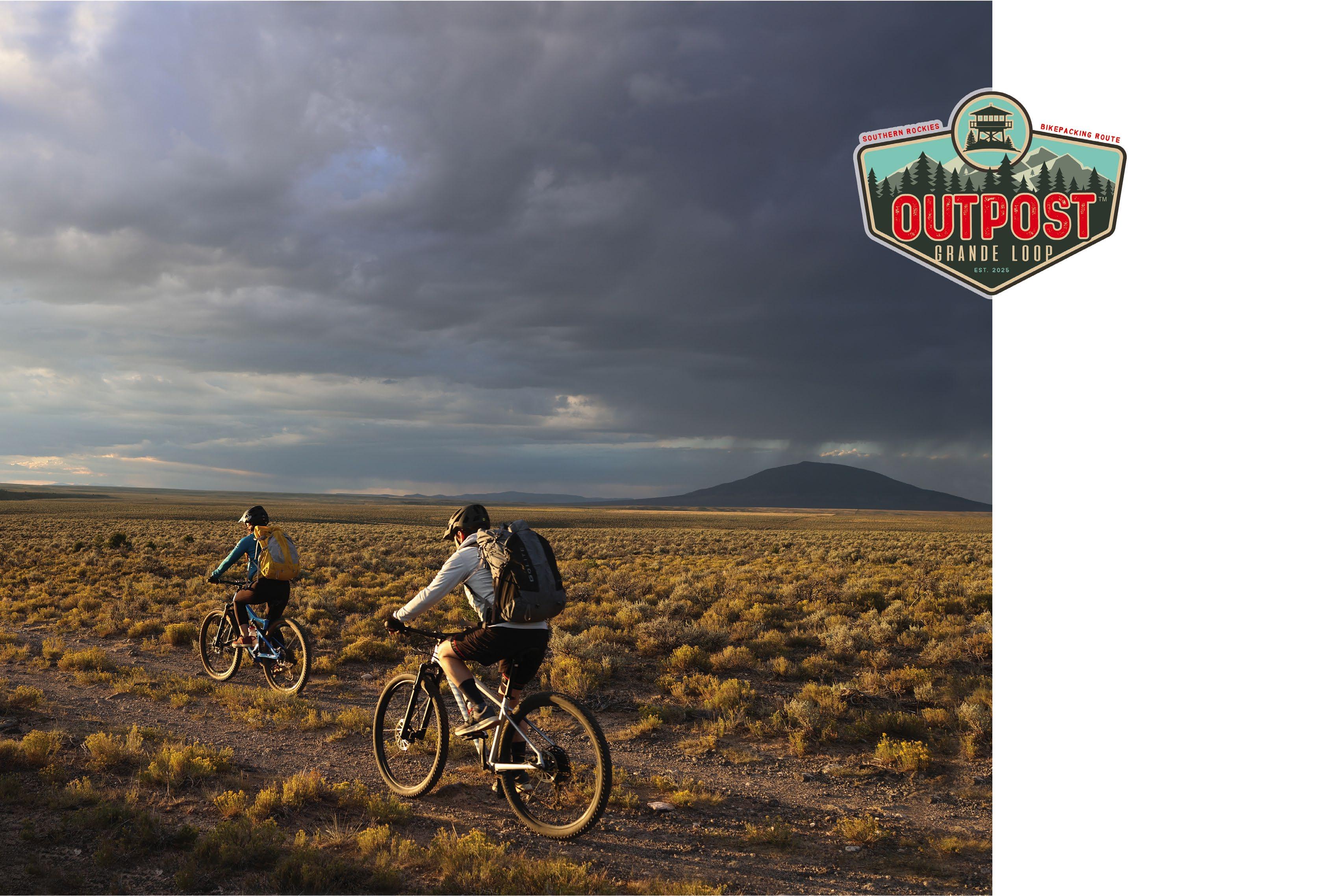
BY SCOTT LEUTHOLD
PHOTOS BY SCOTT AND HEATHER LEUTHOLD
I have been an avid adventurer and explorer across the span of my entire life. My childhood was reminiscent of scenes from the movie Stand By Me: including the junkyard dog, the treks down railroad tracks with trestle bridge crossings, hidden forts in neighboring corn fields and thickets of forest, and bicycling rides across the countryside on the backroads of Central Wisconsin.
My older step-brother, John, was an avid adventurer when I was young. He would embark on crazy adventures and return home with stories and slide shows that he’d present to the family while playing his acoustic guitar. He once took an Amtrak train ride from our home state of Wisconsin out west to Montana. Then, rode his bike from Montana to Seattle where he boarded a ferry and pitched a tent on the deck up the inside passage. From there, he rode
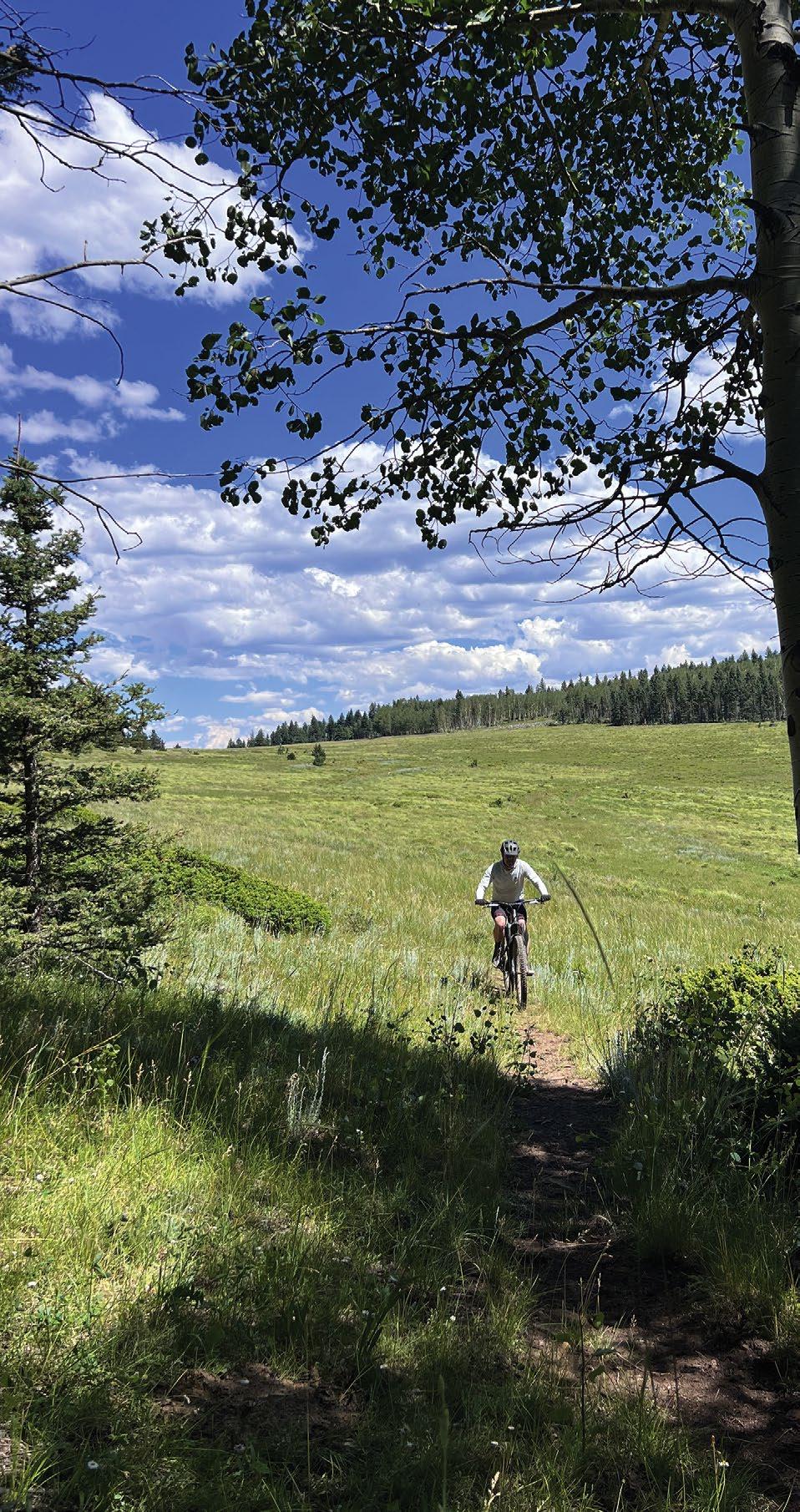
his bicycle up the Alaska Highway (this was before it was paved). He rounded out his trip by paddling a kayak on Prince William Sound and eventually boarded a lobster fishing vessel at sea, relishing lobster as a storm rolled in.
On another adventure, in the 1980s, he traveled by Amtrak to Santa Fe with his bicycle, planning to return home to Wisconsin on those two wheels. Unfortunately, after a brief visit to Bandelier National Monument, he spent a week in the hospital, injured, after trying to wipe glass off his front tire while on a hill descent. He never completed the journey.
He later became a park ranger at Canyonlands National Park, long before the roads into and through the park were paved. His job was to patrol the backcountry, and often the only way through the rough, impassable roads was by mountain bike—just himself in the remote Canyonlands’ wilderness.
As I matured, my experiences grew more courageous. In high school, I participated with friends on multi-day, 800-mile bicycling tours (RAGBRAI— Des Moines Register’s Annual Great Bicycle Ride Across Iowa), solo darksky cross-country ski excursions, and family cycle touring weekends. Toward the end of high school, I spent my summers teaching sailing and windsurfing on Lake Michigan. The job included regular rescues of capsized sixteen-foot sailboat rentals in Green Bay’s eightfoot storm swells as captain of a Boston Whaler rescue boat.
Starting around 2003 I began traveling internationally: On a skiff up the Amazon River in a remote Brazilian jungle, backpacking Costa Rica with my son, Collin, when he was 12,
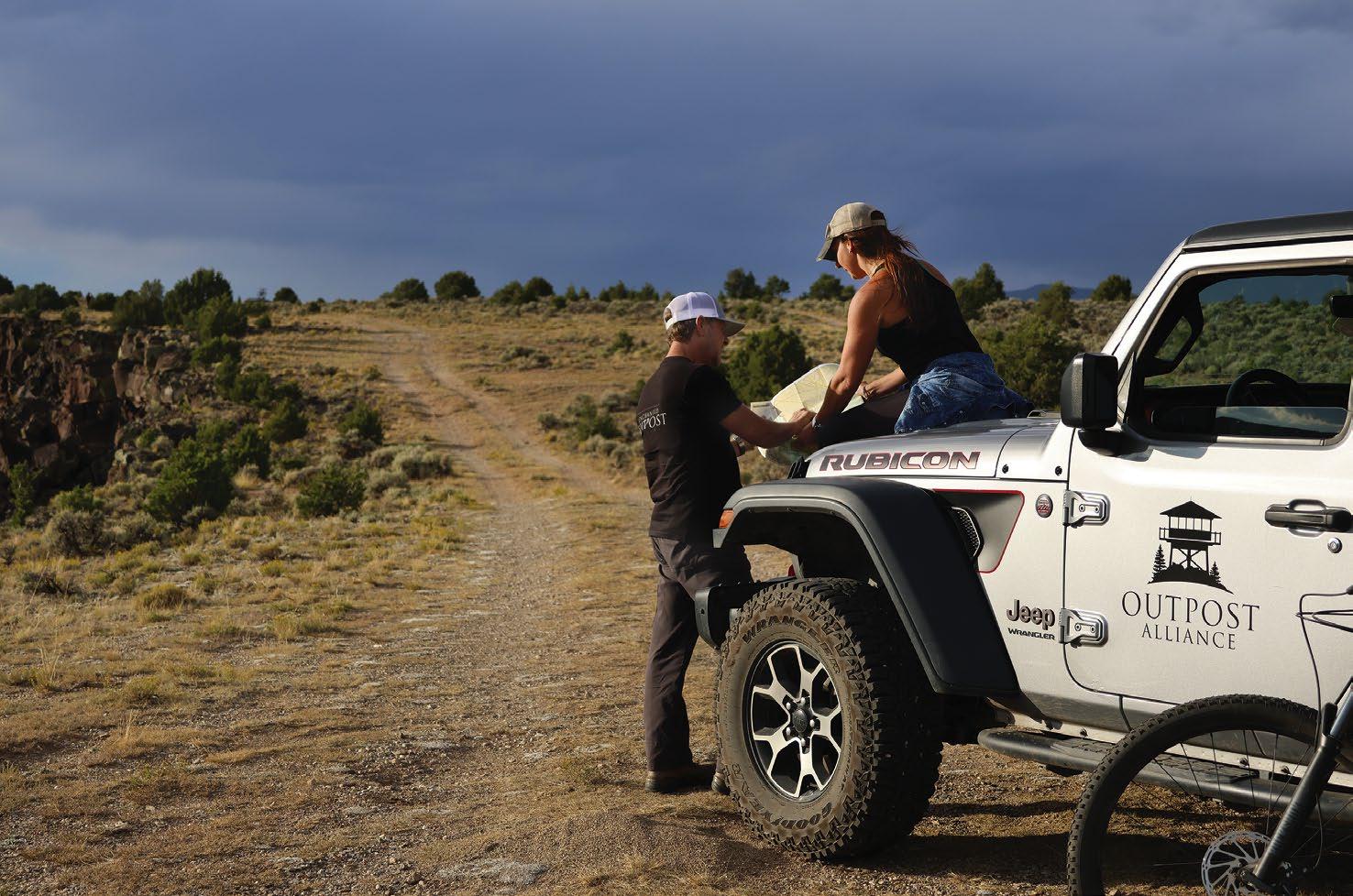
island-hopping several times in Belize, exploring the ancient Mayan city of Tikal in Guatemala, and traversing the Italian Dolomites with a backpack. I even ice-climbed Mount Ritter in the Sierras with friends on the original route navigated by John Muir.
In the summer of 2021, I relocated to Black Lake, New Mexico while hosting an adventure show on YouTube and began documenting my excursions in the local area. Though I no longer host the show, the more than 175 videos on my channel still inspire others to “Venture Out.”
So, it should be of no surprise I’d explore the possibility of establishing regional adventure routes and highlighting the natural and cultural features along the way. My purpose in sharing adventures has always been to get more people outdoors in order to appreciate
the valuable gifts that spending time in nature affords.
Last spring, I began researching and planning a bikepacking adventure route that included several regional communities, natural wonders, and a range of paved and unpaved roads, as well as single track through our vast National Forests.
One day, I was talking with my good friend Shane Young of Moss Adventures in Raton, discussing his plans for a hostel across the street from the regional Amtrak station above the Raton Adventure Centre he and his wife Sandra launched. I began to uncover a unique opportunity for cycling enthusiasts to access our region by train, explore the region on two wheels, and return home the same way they arrived. The Raton Amtrak station is a regular stopping point for seasonal youth going
to work for the summer at Philmont Scout Ranch.
My wife Heather and I began researching—and exploring on mountain bikes and by Jeep—a proposed route during summer of 2025. Our intentions are to pedal the entire route in summer of 2026. The Outpost Grande Loop (OGL) as we have named it, is panning out to be around 300 miles—not including the spur routes and access route from Raton to intersect with the loop. The route traverses a diverse terrain and multiple climate zones, including high desert portions along the Rio Grande Gorge, two ascents over the Sangre de Cristo range—one heading east through Valle Vidal, the other west from Angel Fire along Elliot Barker Trail and the South Boundary Trail—and then passes through ten of our region’s colorful communities. As
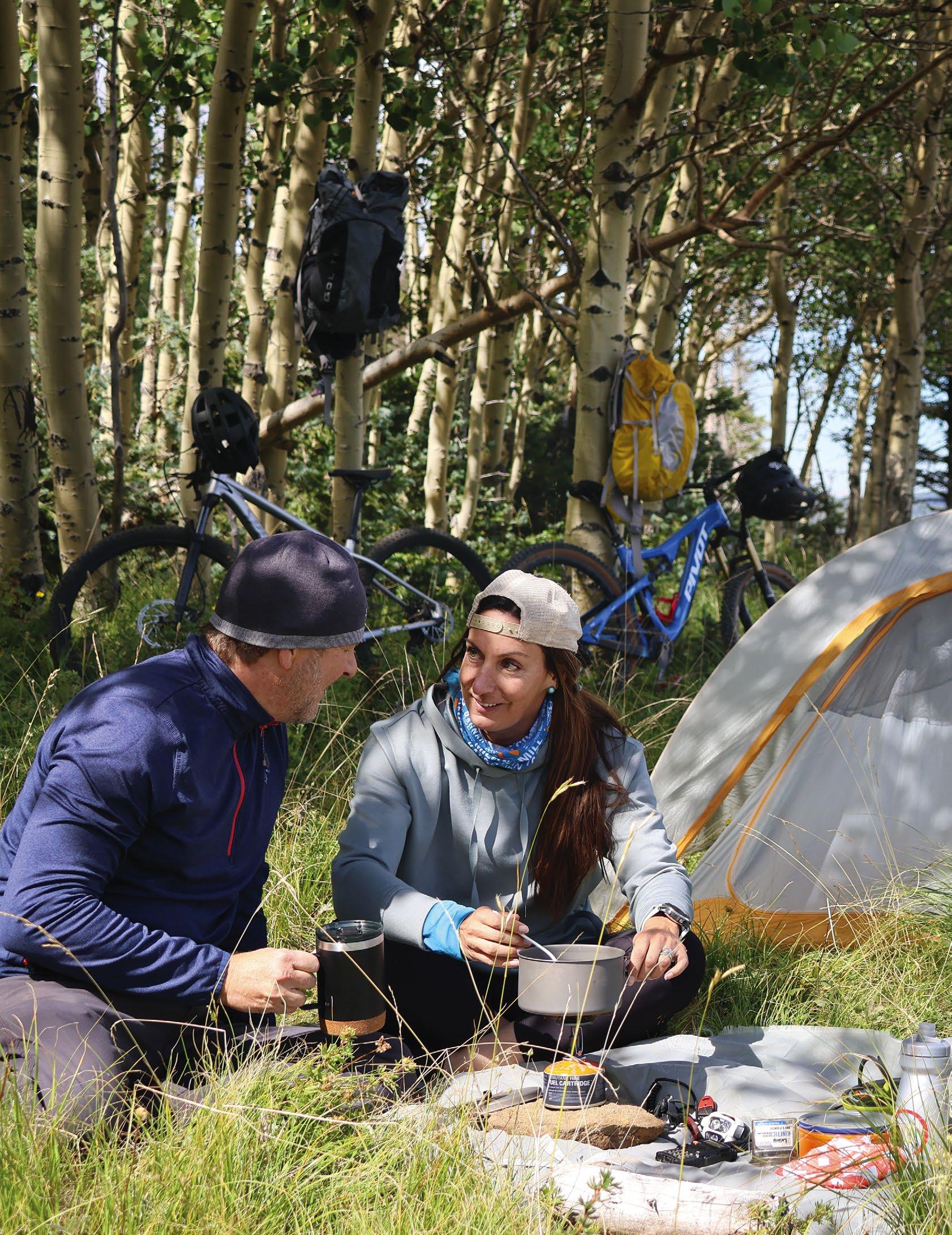
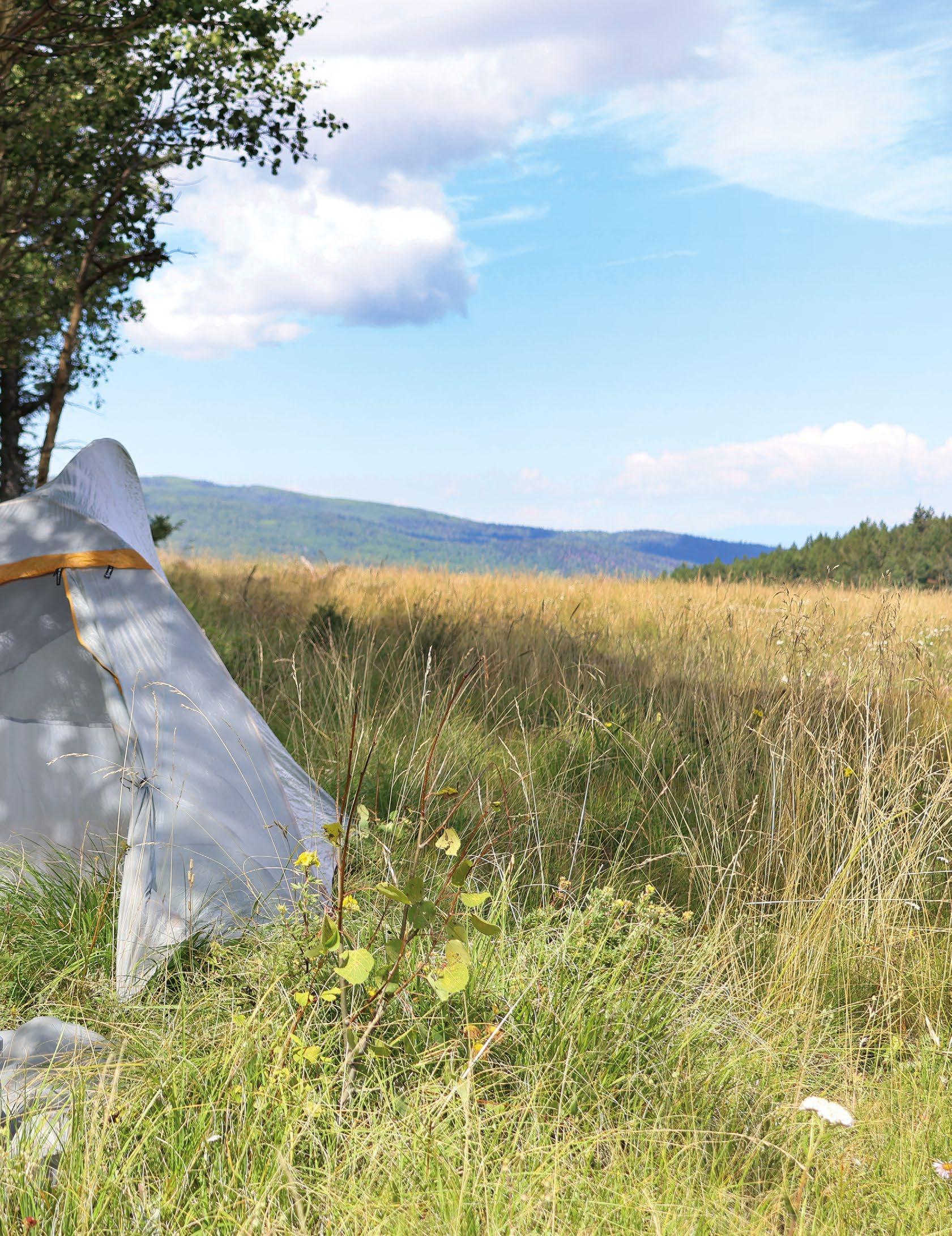
Ultralight camping on Osha Pass in the Carson National Forest. Elliot Barker Trail, TR1, crosses Osha Pass in route over Osha Mountain where the trail intersects with the South Boundary Trail toward Taos.
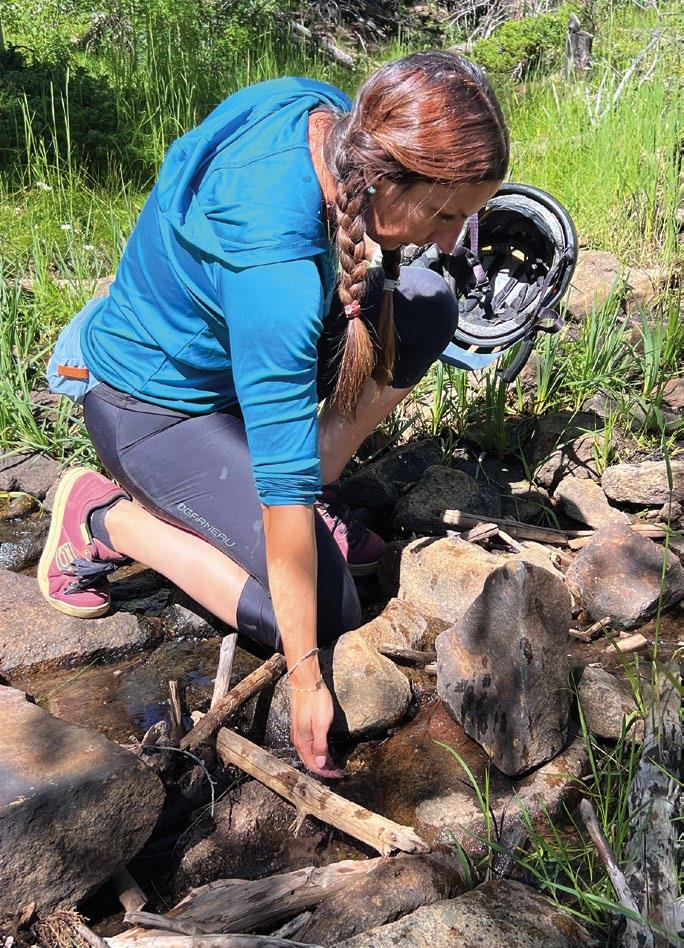
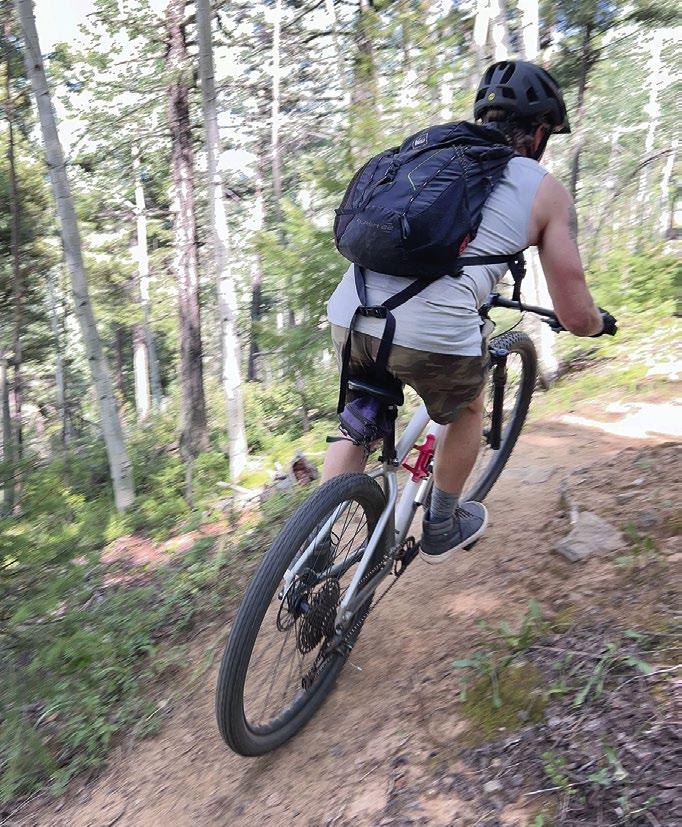
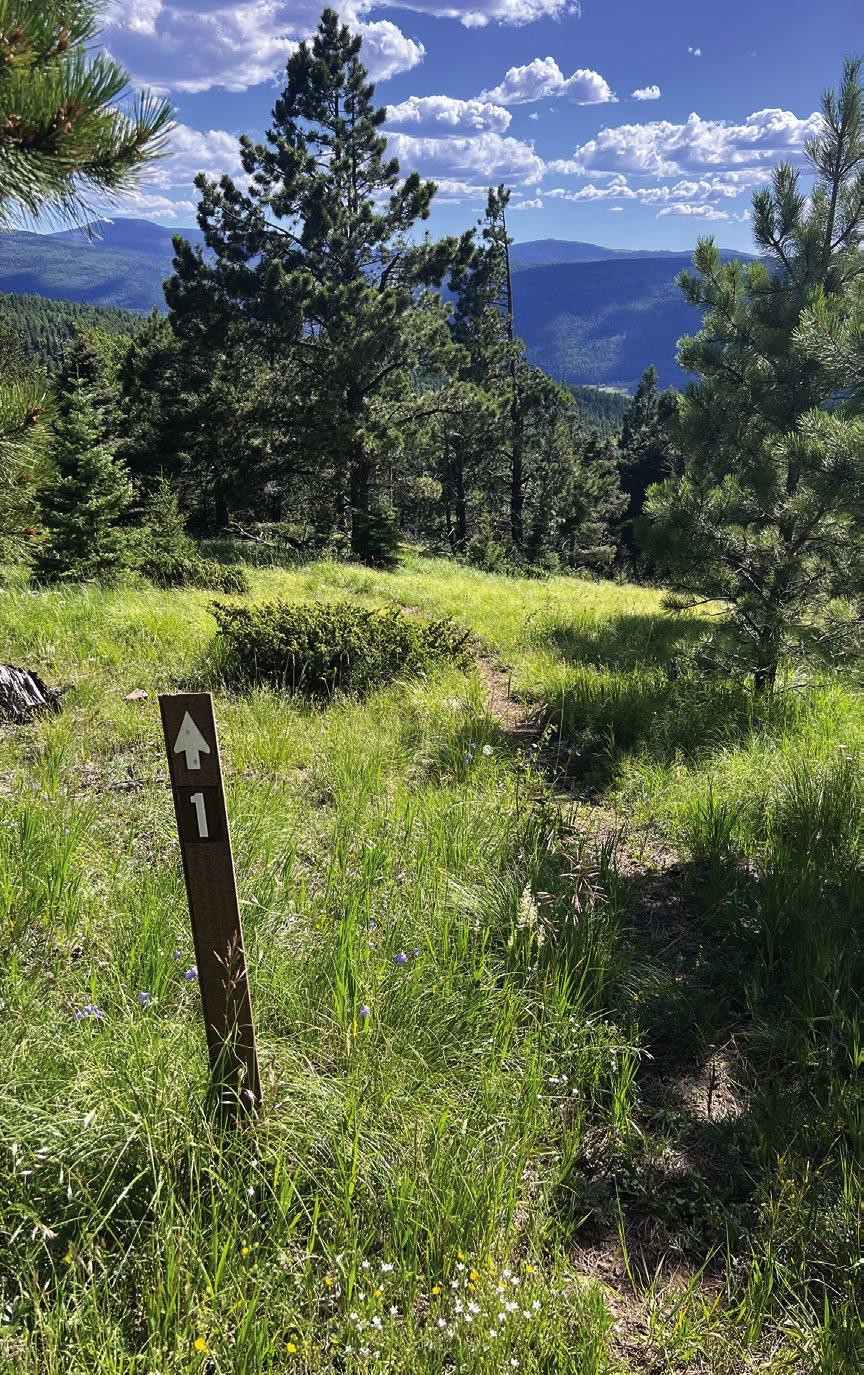
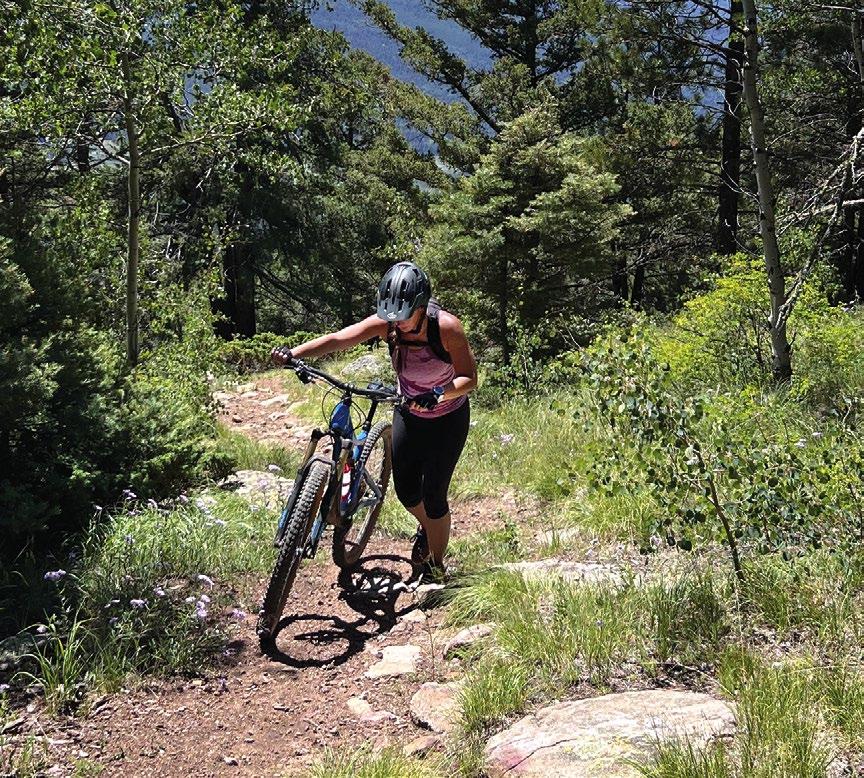
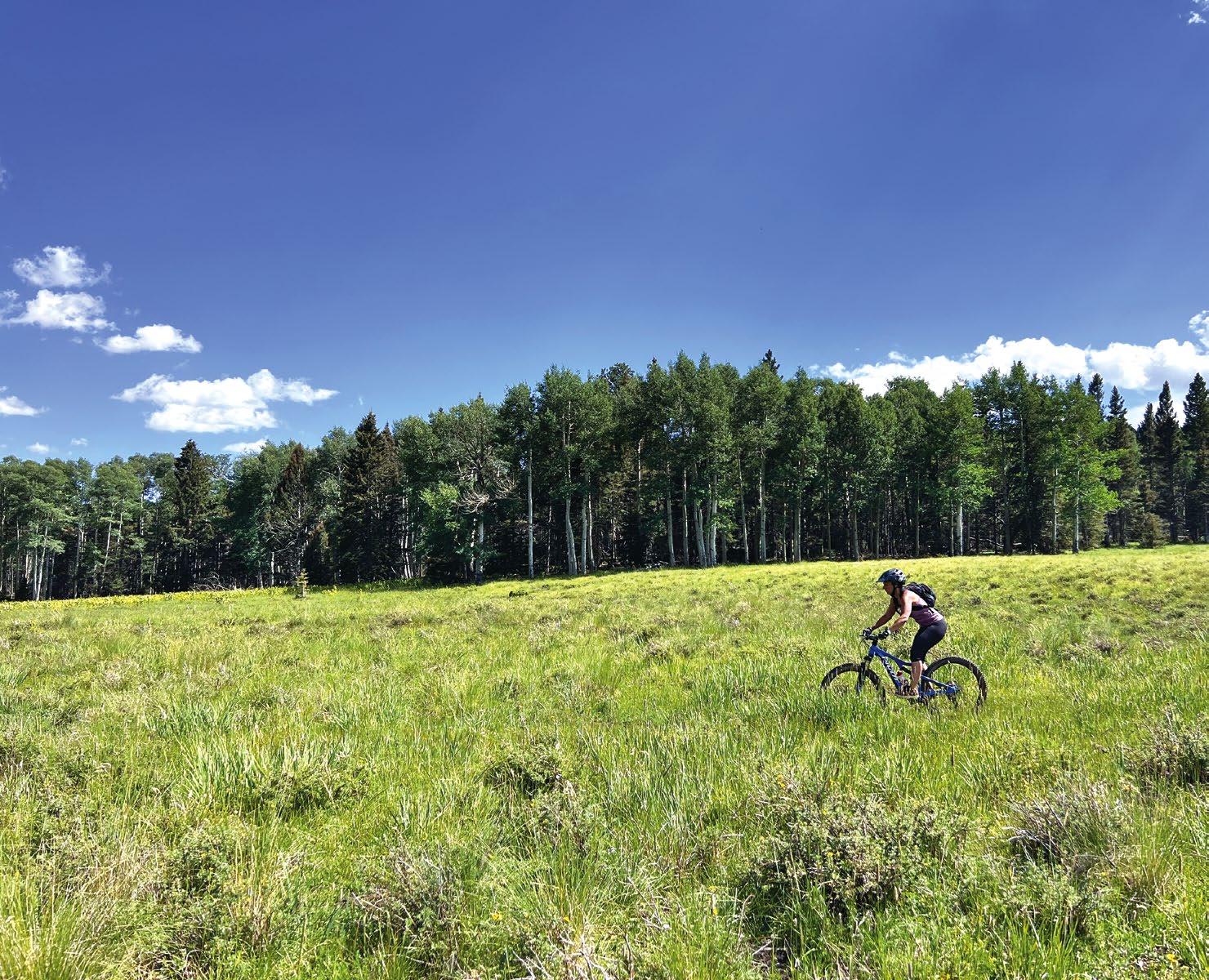
some riders may be on e-bikes, we are working on alternative route segments to adhere to national forest restrictions and to accommodate the technology by providing charging options.
Because I’m typically no stranger to tackling big ideas, my vision is to establish a formal, authorized route—for bikepacking enthusiasts from around the globe—with a downloadable waypoints map. Portions of the route are on public roads. Some sections are within national forests. And some are on National Monument land and BLM land. Thus, the appropriate jurisdiction authorization and access are necessary.
The proposed route map I’ve established includes camping and lodging options, food and water services, bike repair locations, emergency medical services, noted points of interest, difficulty ratings, and even the possibility for vehicle support if necessary.
The suggested route passage is clockwise, however, adventure travelers can begin at any point on the route. If traveling by train, the route begins in Raton, New Mexico and connects with the OGL along Highway 64 at the junction with FR1950. From the
junction, cyclists would make their way into Cimarron, New Mexico and follow the route from there. Otherwise, the designated starting point is in Taos, where there are plenty of services to obtain provisions, along with a good night’s sleep prior to embarking on the journey north toward Arroyo Seco.
After Arroyo Seco, the route leads cyclists through Arroyo Hondo and then along FR 493 through San Cristobal, Lama, and into Questa, with a suggested stop at Sangre de Cristo Market, to restock provisions if necessary.
Beyond Questa, the route passes through the village of Cerro before
traversing along the Rio Grande Gorge, northbound through Rio Grande del Norte, circumnavigating around Ute Mountain, and then along the Colorado border to Garcia, Colorado and into Costilla, New Mexico, where there is another stop for provisions.
After Costilla, the route winds along 196 toward Rio Costilla Park, eventually along FR 1950 into the Valle Vidal Unit of the Carson National Forest. Here, there are several options for designated camping and portable water pump purification.
Cyclists eventually connect with Highway 64, just west of Cold Beer, New Mexico and either return to Raton and the Amtrak station, or, if they started in Taos or need to restock provisions before heading to Raton, venture into Cimarron.
From Cimarron, cyclists follow Highway 64 into Cimarron Canyon and the Cimarron Canyon State Park, for designated camping options. Over the top of the canyon, riders discover Eagle Nest, Eagle Nest Lake State Park, and eventually Angel Fire.
Entering Angel Fire, the route offers three options: To the Elliot Barker Trail, leading toward South Boundary Trail; into Angel Fire for provisions, which offers a secondary route up FR 76, to connect with the South Boundary Trail; or for those either on e-bikes or who wish to take the paved road, over Palo Flechado Pass and down Taos Canyon on Highway 64. This leads into Taos or Ranchos de Taos, depending on the sights the rider wishes to experience. Additionally, there is an off-road expansion option under consideration that traverses FR 76 to Tres Ritos on Highway 518 and then connects with the High Road to Taos, adding an additional 80 miles to the loop.
Along the way, there are several spur trips to extend the number of days and the experiences, including a ride into Taos Pueblo, up to Taos Ski Valley, with designated camping along the Rio Hondo, a side trip into Rio Grande del Norte for camping and hiking, and a side trip from Cimarron to visit Philmont Scout Ranch, to browse at the Tooth of Time Traders outfitter store (in season). t
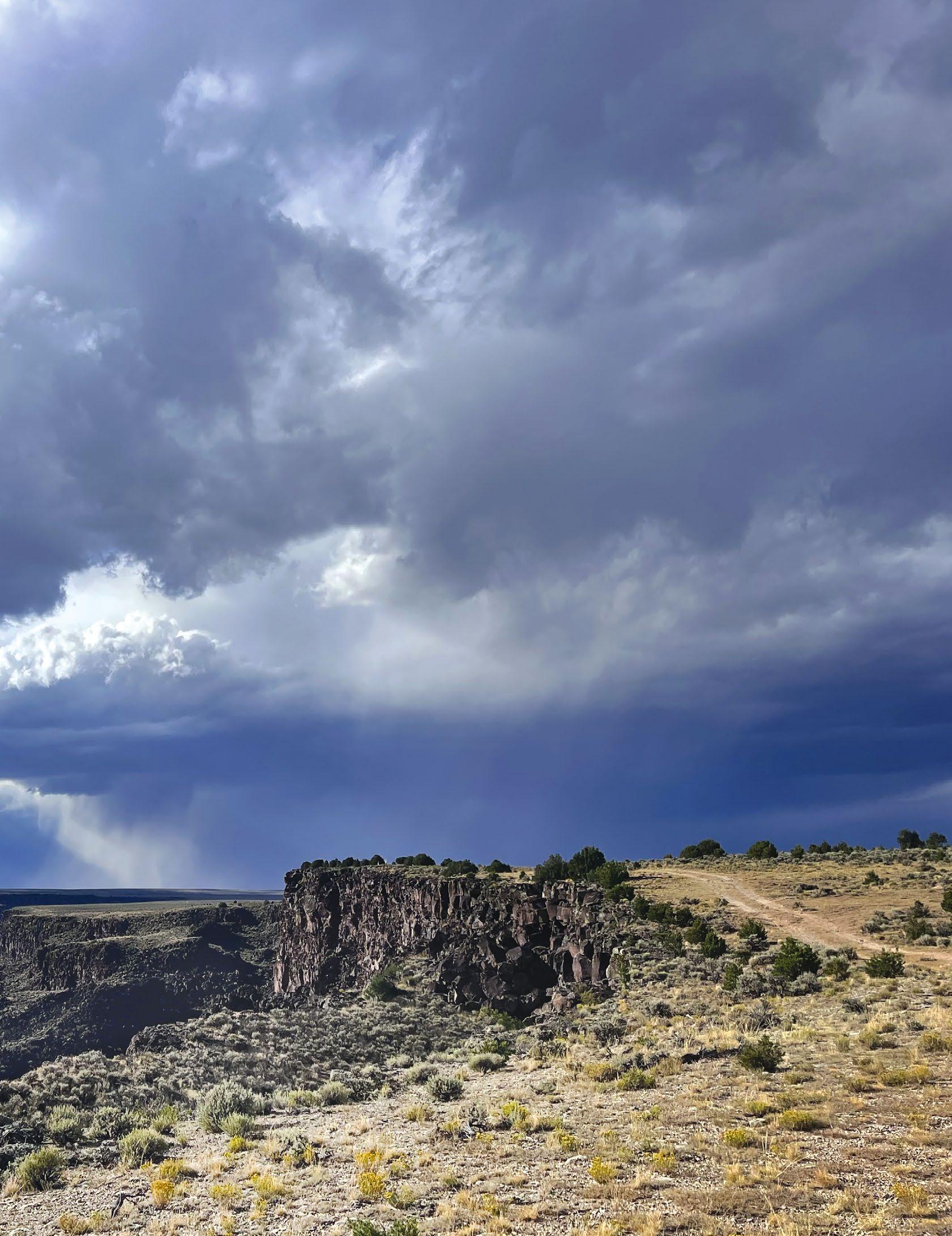
The proposed route traverses the eastern ridge of the Rio Grande River Gorge within Rio Grande del
National Monument for approximately 20 miles.
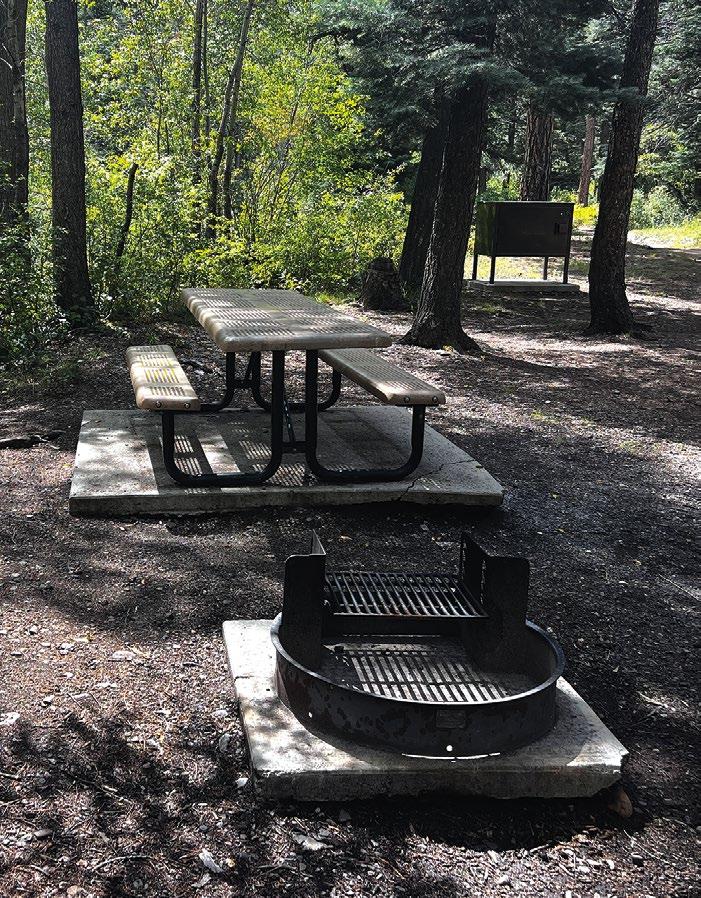
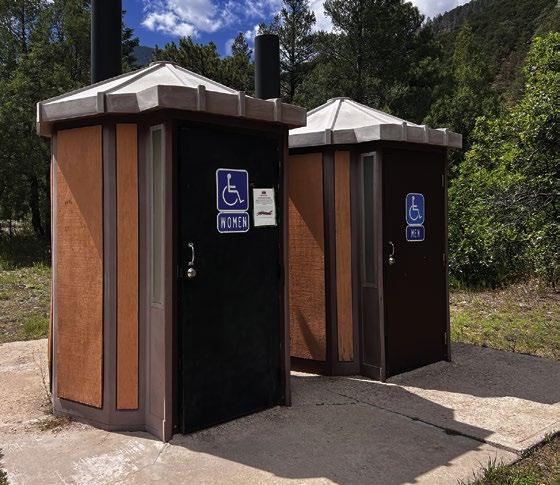
There are several designated campgrounds along the proposed route, typically with facilities, such as the Blackjack Tent Area within Cimarron Canyon State Park (shown). Other camping facilities include Rio Grande del Norte National Monument and several campgrounds within the Carson National Forest, such as Rio Costilla Park and Campground, Cimarron Campground, and McCrystal Campground within the Valle Vidal Unit. There are also many privately owned campgrounds with facilities in the communities of Eagle Nest, Angel Fire, Taos, Questa, and Cimarron. And, of course, dispersed camping is allowed in the national forests where posted. Right: Highway 64 passes through Cimarron Canyon State Park. The highway is part of the route along the Outpost Grande Loop.
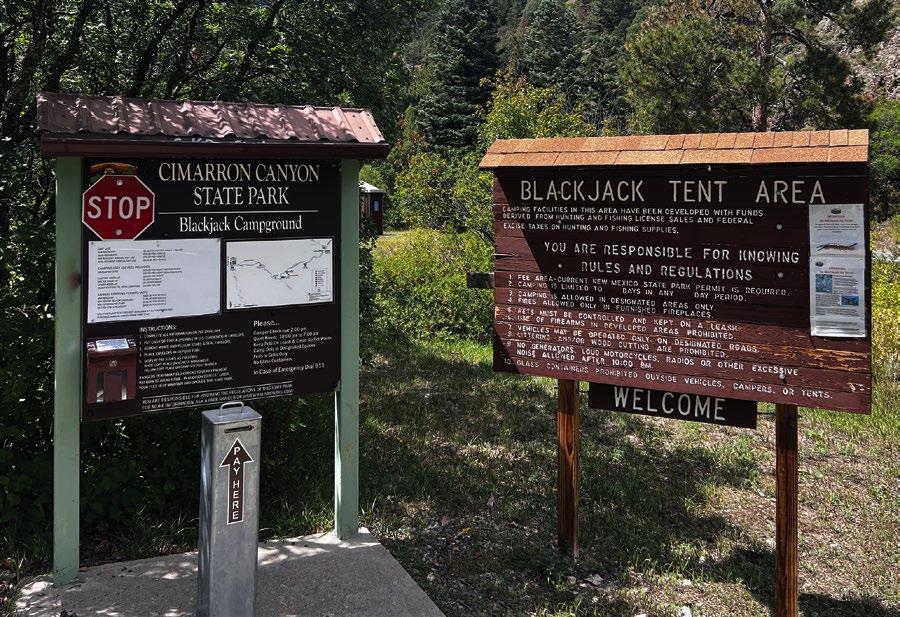
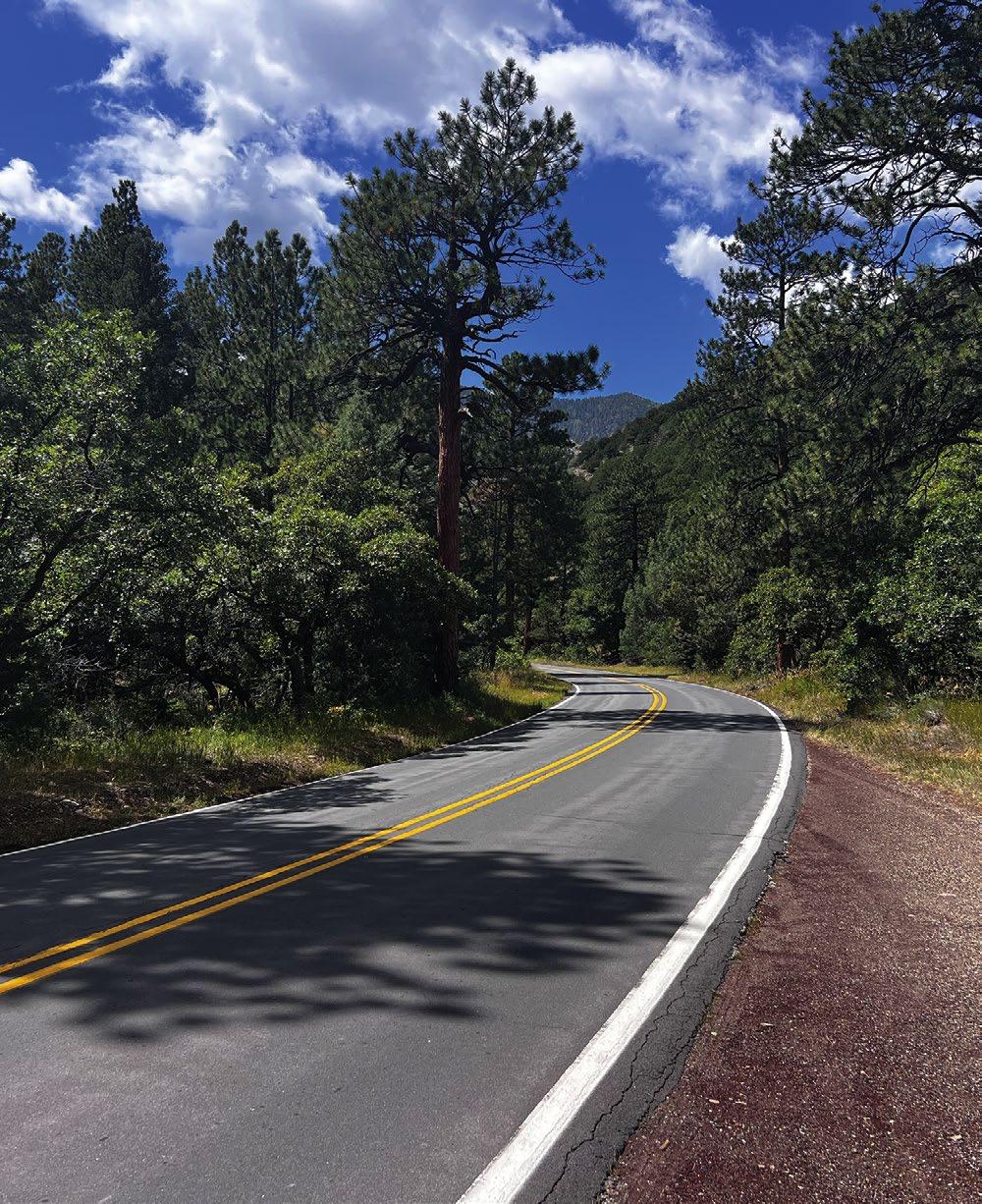
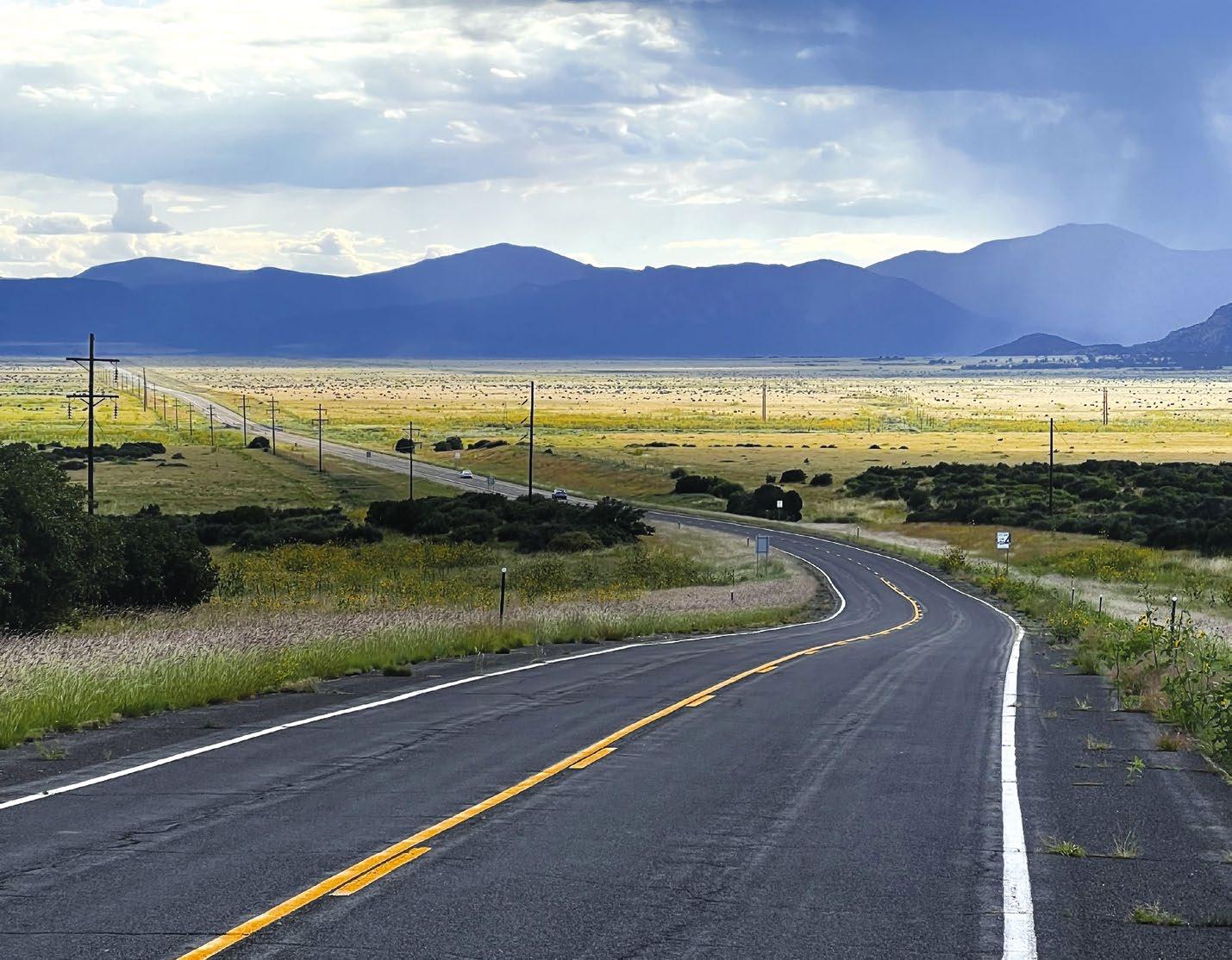
Highway 64 heads toward Cimarron, New Mexico and the Sangre de Cristo Mountains. This segment of the Outpost Grande Loop is utilized when arriving to the area via Amtrak, which stops at a station in Raton. The spur route is approximately 40 miles to where it intersects with the OGL and approximately 53 miles from Raton to Cimarron, New Mexico.
We’re seeking coordinators, route explorers, and sponsors with the intent of establishing an initiative to bring an entirely new, organized adventure travel activity to our region. This would expand our adventure tourism economy and provide a new sport to attract adventure travelers. Bicycle touring and mountain biking are nothing new to our region, but an established, official bikepacking route—a popular and growing sport around the world—could position northern New Mexico as a sought-after bikepacking destination. Those interested in volunteering on a committee, who may want to participate in route exploration, or sponsor the route, should send an email to OGL@outpostalliance.com to get involved. We’re considering an organized, authorized week-long route ride for summer 2026. If you would like to participate on a flagship multi-day adventure ride, please inquire.
Explore the Outpost Grande Loop (OGL) and discover the true nature of our region and its people. There are few ways more tactile than doing so on two wheels.
Email us at: OGL@outpostalliance.com
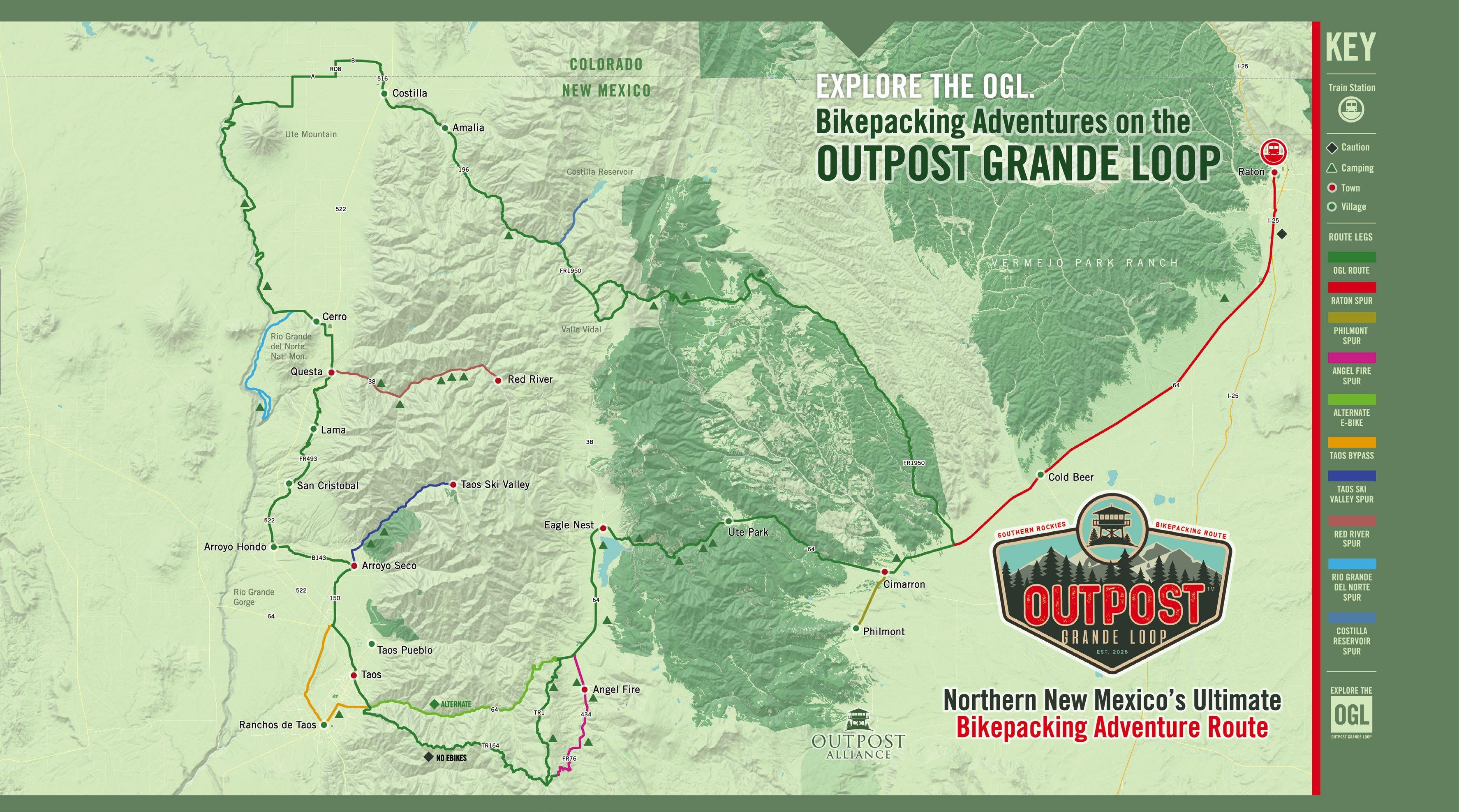







BY SCOTT LEUTHOLD
Every Martin Luther King Jr. weekend, the snowy mountains north of Chama, New Mexico, come alive with skis, snowshoes, laughter, and a strong sense of community. In January 2026, the Chama Chile Ski Classic will celebrate its 53rd year, continuing a tradition that began in the early 1970s and has since become a hallmark of winter recreation in the southern San Juan Mountains. The event is more than a race—it’s a celebration of place and people. Organized today by the Chama Peak Land Alliance (CPLA), the Ski Classic carries forward a legacy of supporting local needs. For decades, the Chama Rotary oversaw the event, using it to raise funds for home heating assistance. When new leadership was needed, CPLA stepped in with a refreshed vision. Proceeds now support the
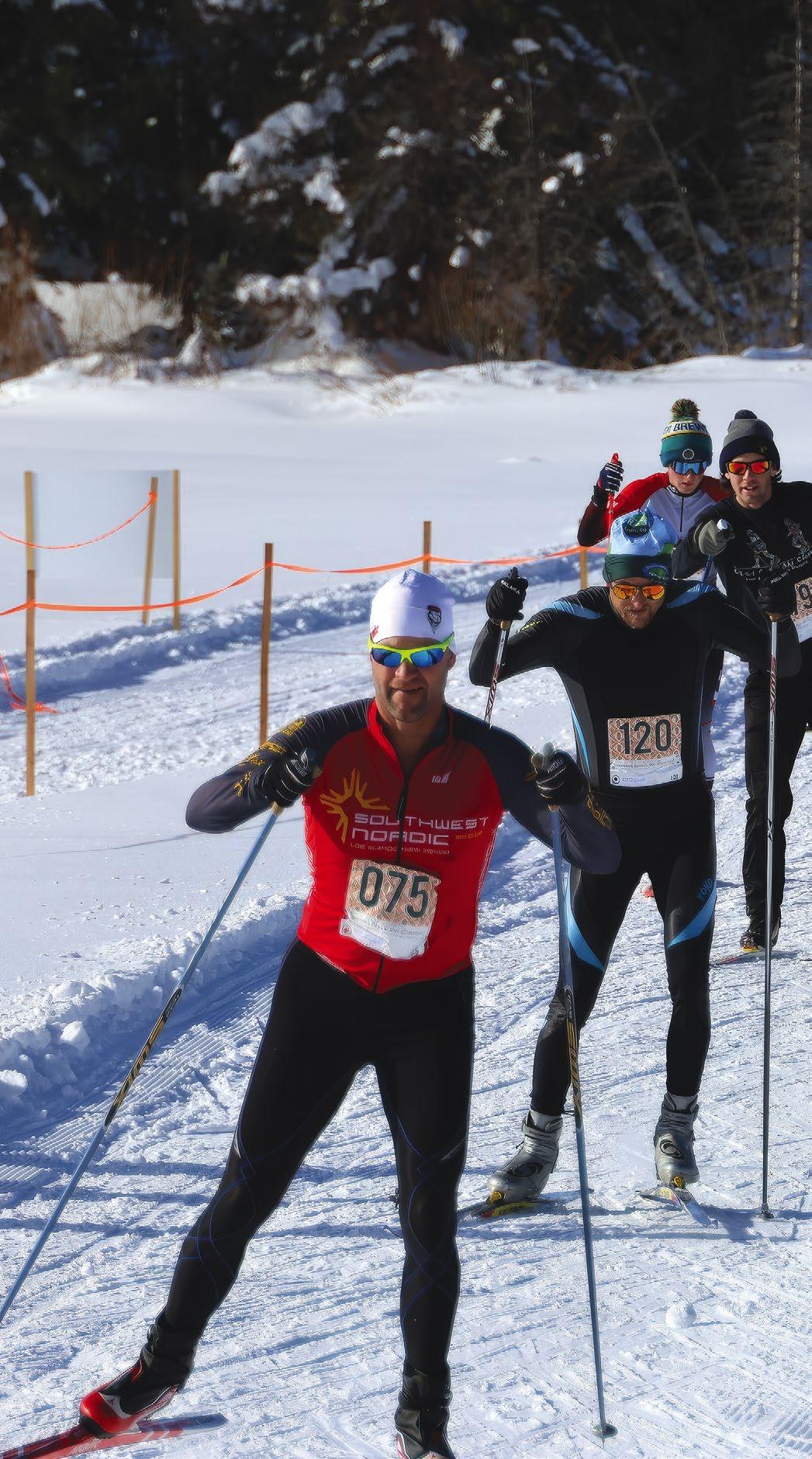
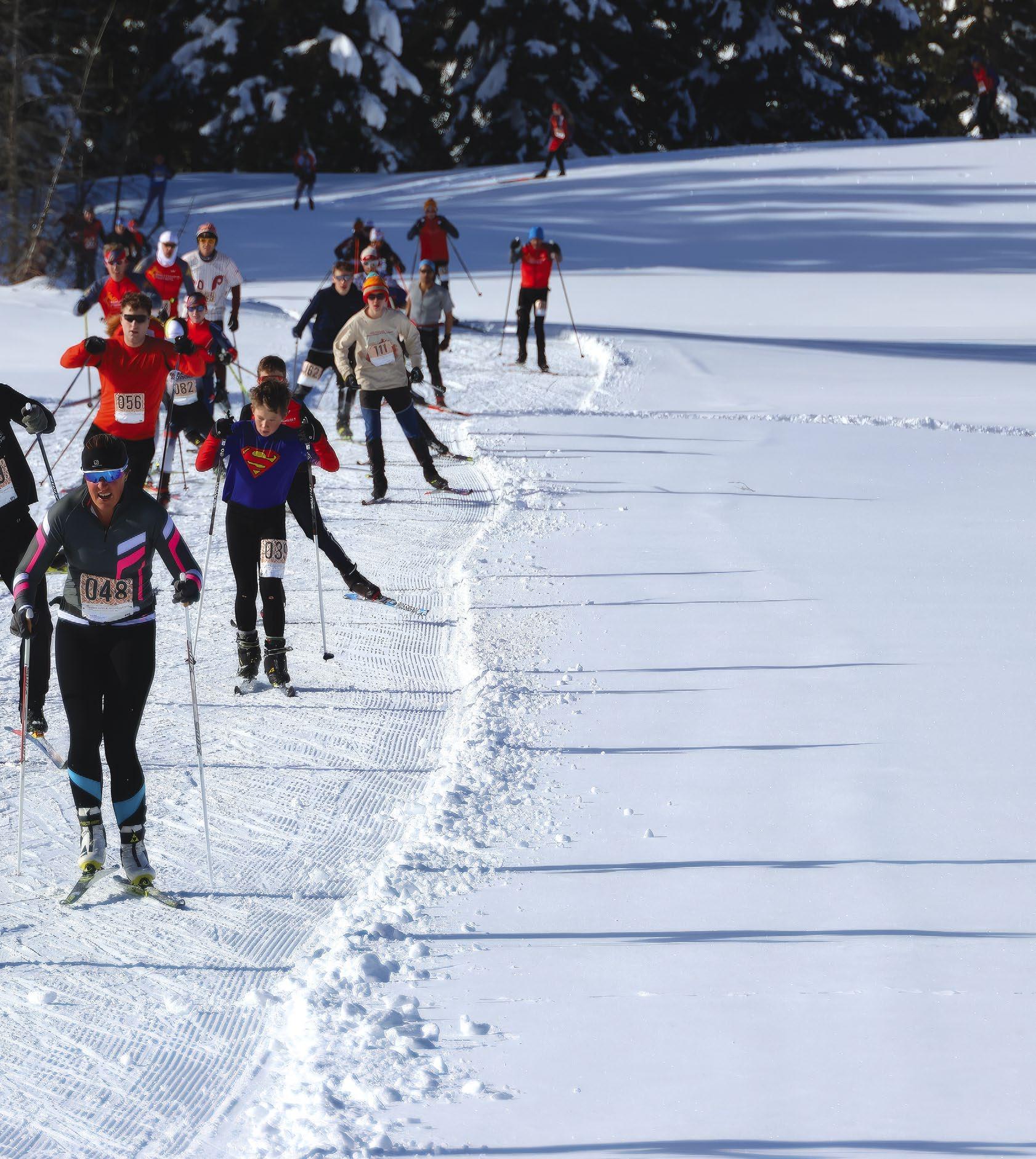
Ski
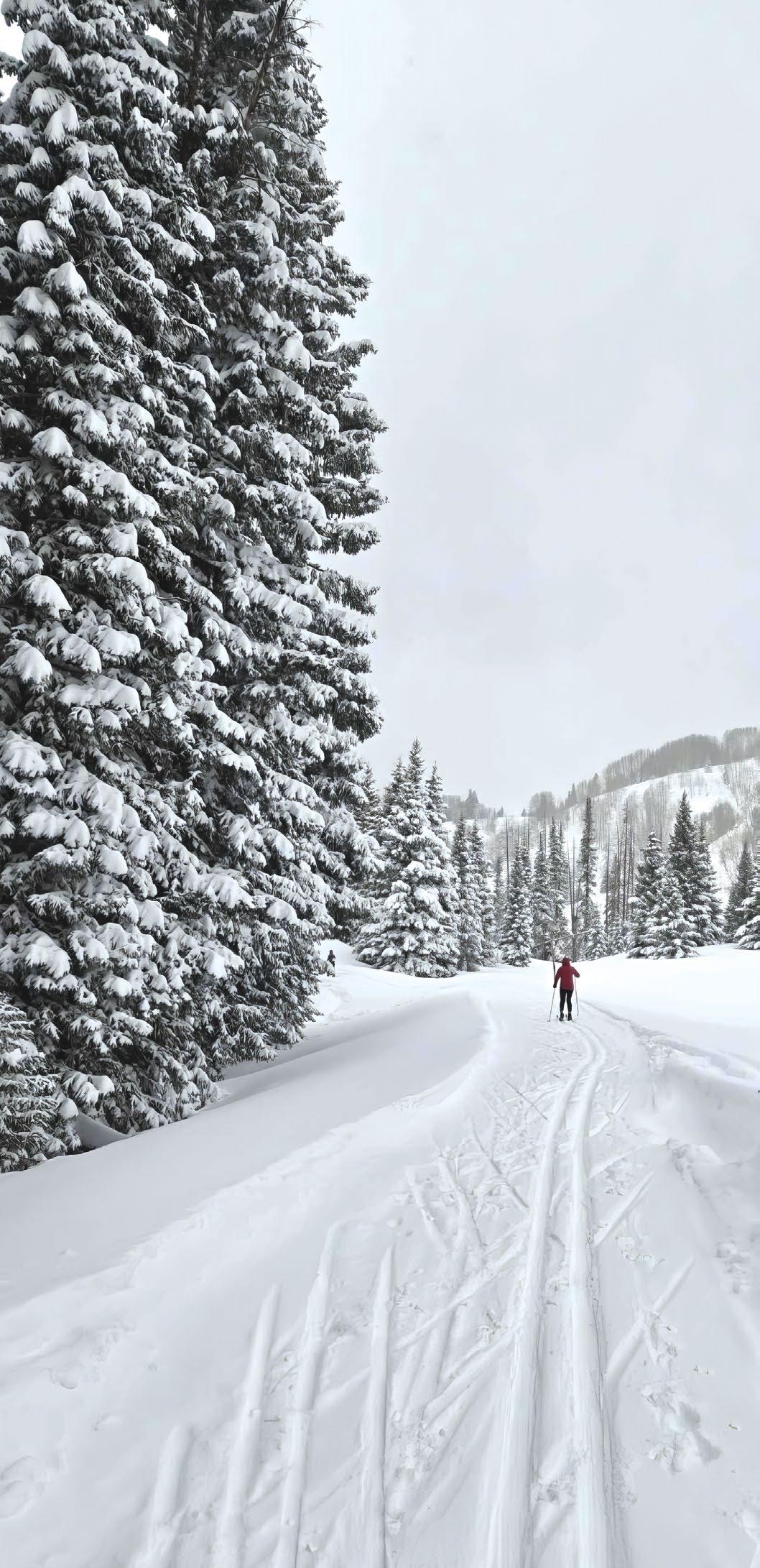
“firewood for seniors” program, which provides wood to elderly and disabled residents, ensuring warmth during Chama’s long, cold winters.
CPLA’s leadership of the Ski Classic also reflects its wider mission. The organization is a diverse group of conservation-minded land stewards, dedicated to the responsible management of land, water, and wildlife across southern Colorado and northern New Mexico. By embracing and sharing stewardship practices that safeguard cultural heritage and natural resources, CPLA works to ensure that future generations can benefit from the region’s landscapes, communities, and traditions. The Ski Classic is just one example of how the group combines conservation with community well-being.
The 2026 Ski Classic will take place January 17 and 18, welcoming participants from across New Mexico and beyond—sometimes from several states away. Races are set along a scenic course on Highway 17, about eleven miles north of Chama, that winds through rolling hills, aspen groves, open meadows, and forests of spruce and fir. The route even passes along parts of the historic Cumbres & Toltec Scenic Railroad, offering competitors a rare combination of history and high-country beauty.
Competitors can choose from several events: classic and freestyle cross-country skiing, snowshoeing, and even a combined race. For younger participants, the “rookie race” gives kids a chance to join the fun, while families often bring sleds and toys, adding to the playful atmosphere. “The beauty of being out in this winter wonderland is hard to beat,” says the event’s spokesperson and CPLA Program Manager, Sage Faulkner. “We see first-time racers, competitive athletes, and plenty of families. The memories made here will be treasures.”
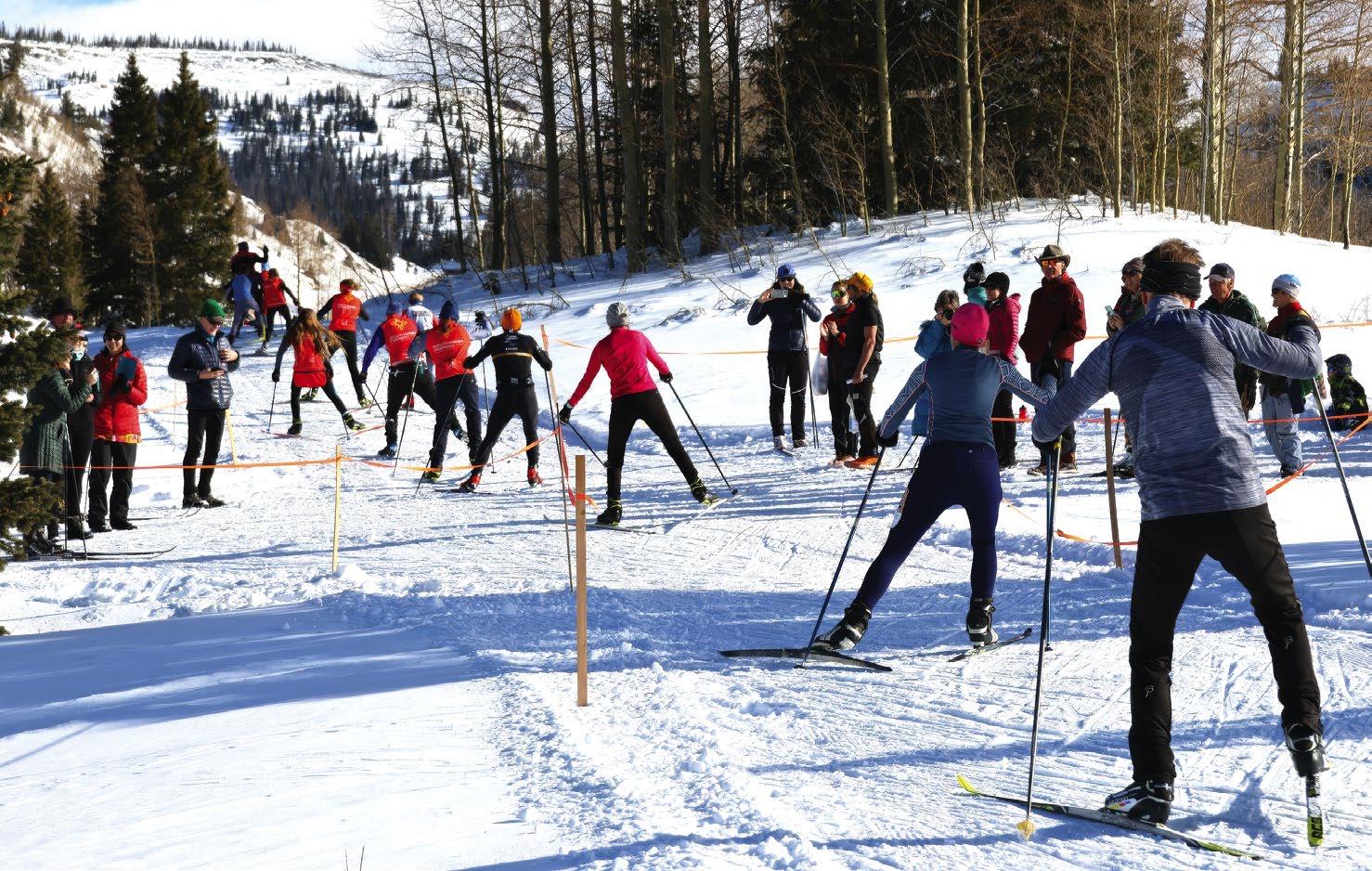
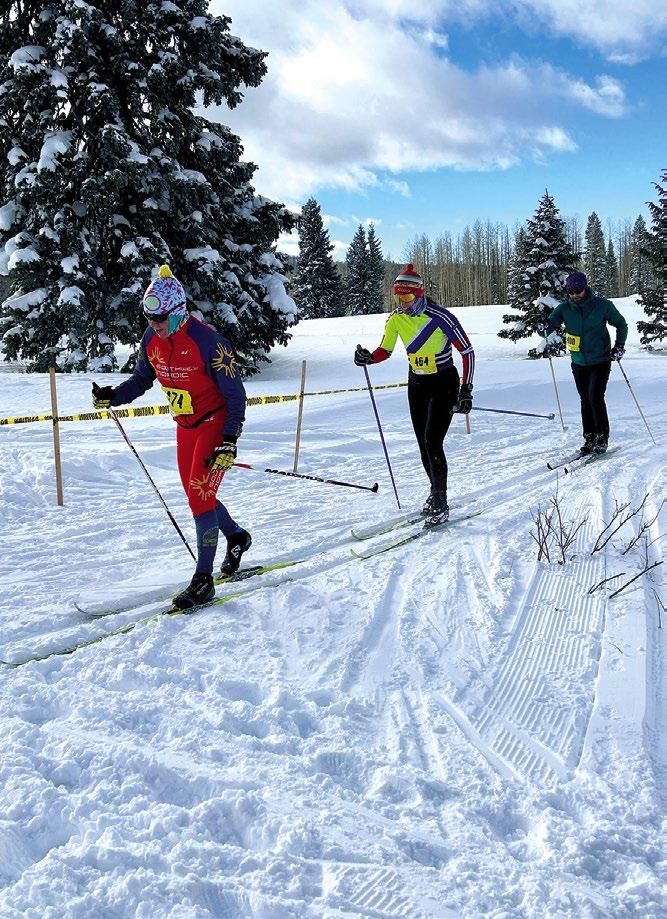
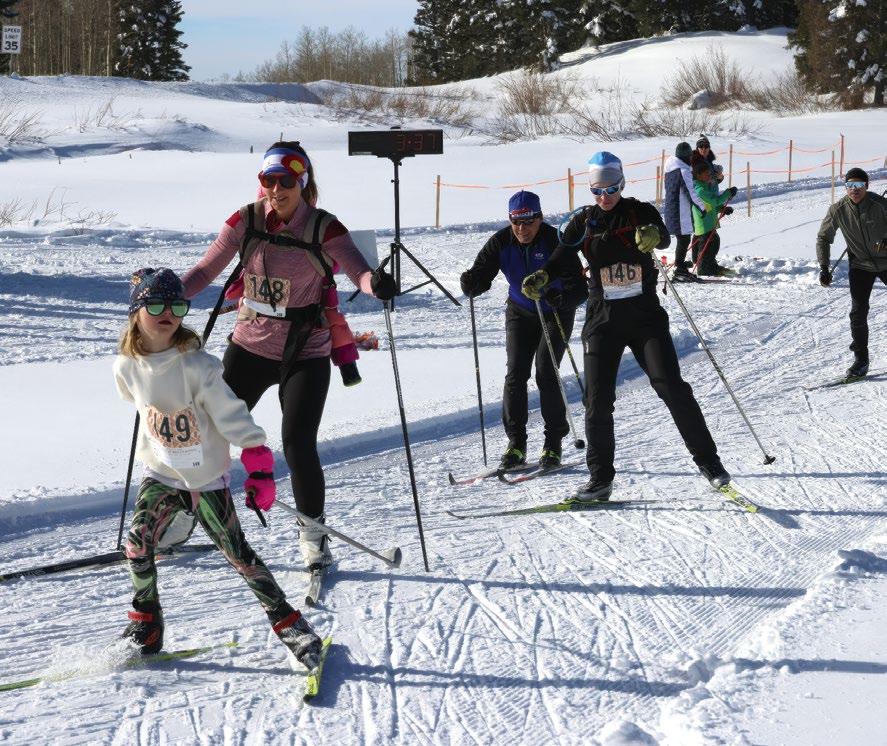
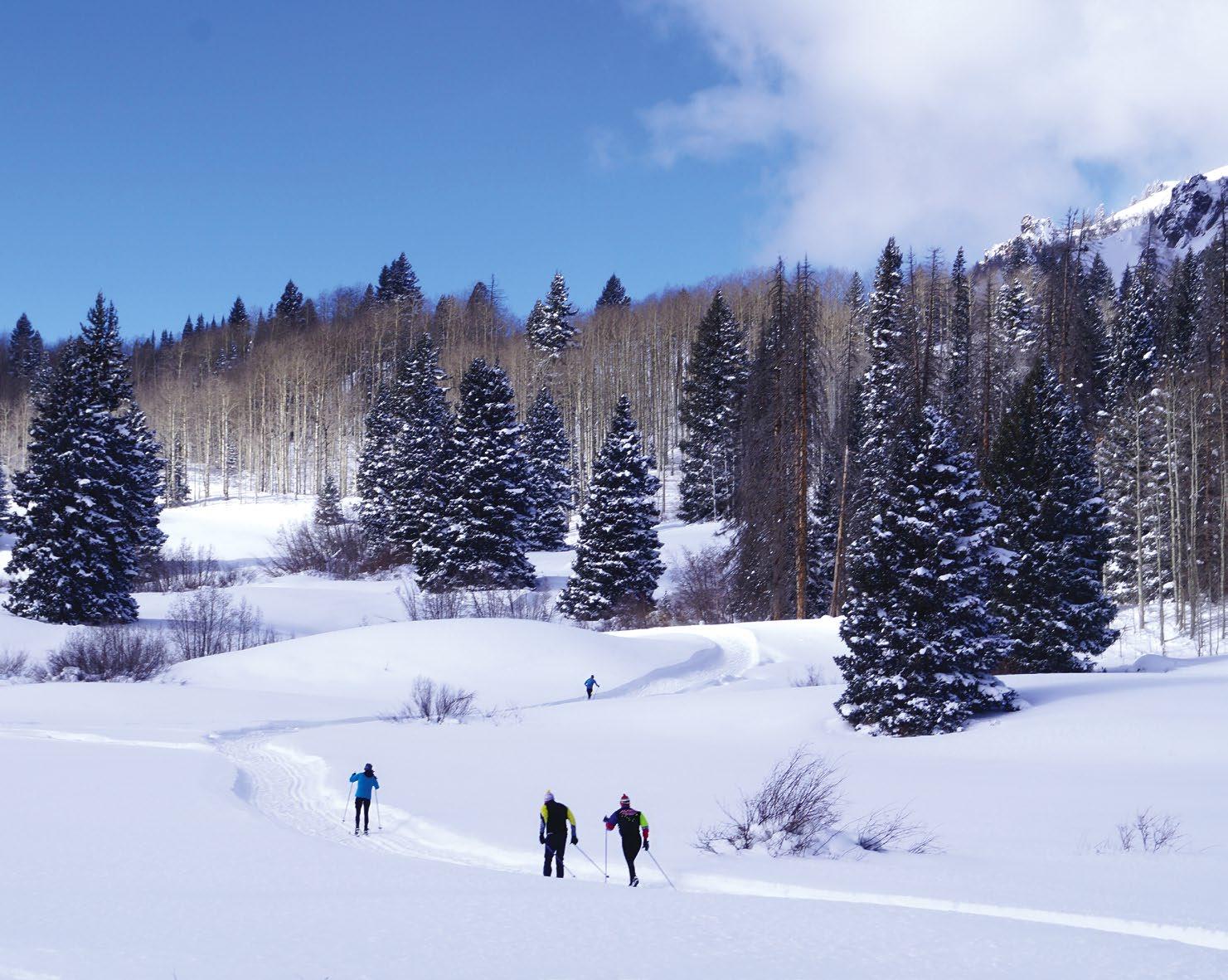
Beyond the excitement of the races, the Ski Classic has always been about building connections. Friendships and camaraderie flourish as participants share the challenge of the snowy course. For many, the weekend feels like a welcomed pause from the mainstream—quiet, refreshing, and deeply rooted in the spirit of the region.
The future of the Ski Classic looks bright. With younger volunteers stepping into leadership roles through the Chama Chile Ski Club (CCSC), the event is poised to evolve while staying true to its roots.
“I think it’s an important opportunity to showcase how beautiful it is here and to remind folks that winter recreation is fun,” says Faulkner. “I hope we can continue this tradition and introduce new enthusiasts to Chama.”
The event also thrives thanks to dedicated individuals like head groomer, John Beaver, who kept the Ski Classic alive in 2024 when it was at risk of disappearing. He continues grooming the course all winter long so locals and visitors alike can ski or snowshoe. Race director, Jenna Rhoads, a second-generation volunteer, also embodies the spirit
of carrying the tradition forward.
At its core, the Chama Chile Ski Classic is a testament to resilience, joy, and community. Whether racing across sparkling snow or cheering from the sidelines, participants take part in something much bigger than a competition: A celebration of Chama, its people, and the shared warmth of winter together. t
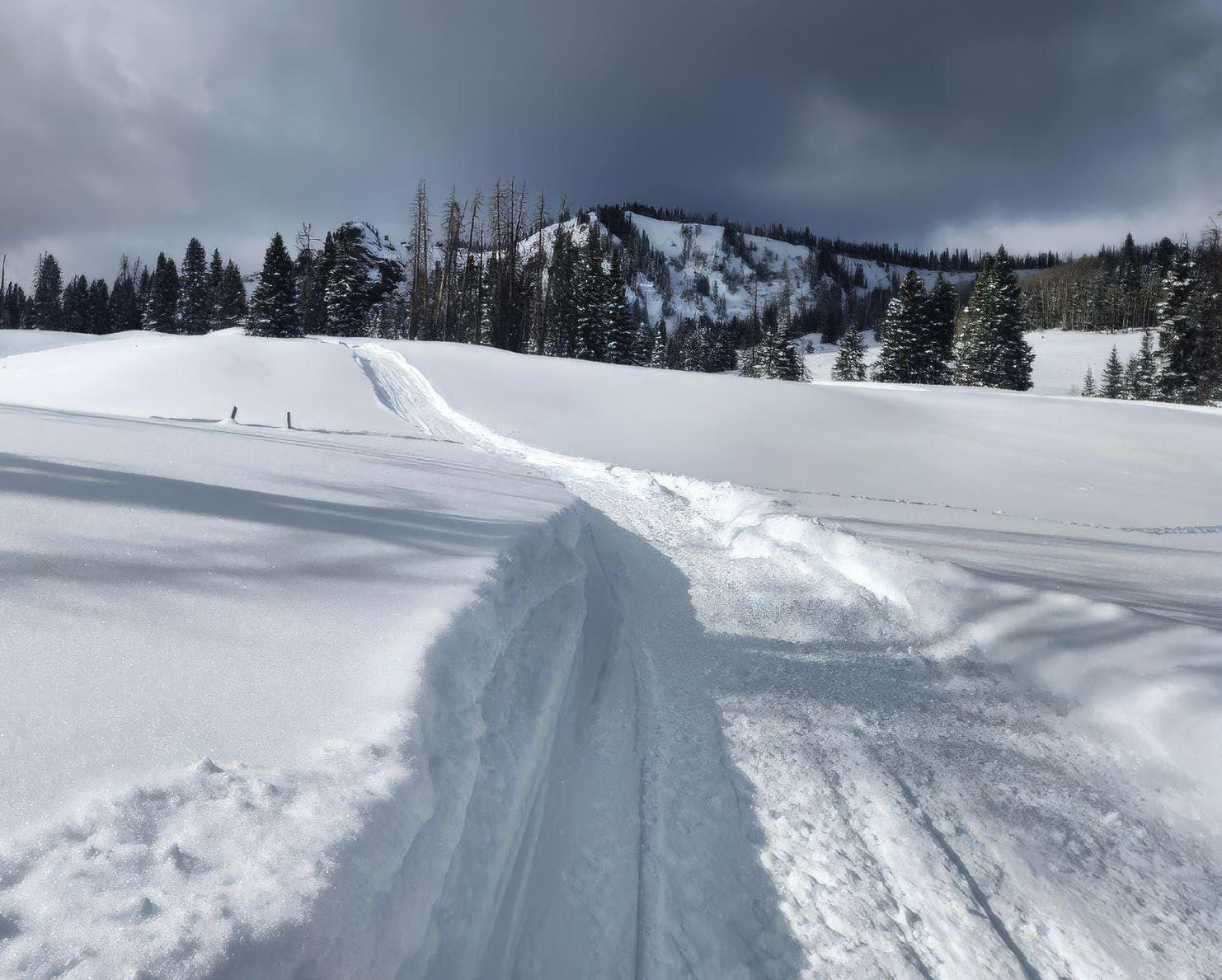
There are services in the community of Chama. Book a stay at one of the many lodges for the weekend. There are typically kids events and activities. Bring your own snowshoes and ski equipment.
Wear proper winter gear. Check the weather before traveling, as all routes to Chama are over mountain passes.
Ski Race
18k Freestyle Ski: 9AM
6k Freestyle: 9AM 12k Classic XC Ski: 9AM 6k Classic Ski: 9AM
1k/3k Rookie Snowshoe: 9AM
1k/3k Rookie Classic XC Ski: 9AM 12k/6k Snowshoe: 9AM
Event Details:
January 17-18, 2026 - 9AM
Registration: Online: chamachileskiclassic.com

Chama Peak Land Alliance Online: chamapeak.org

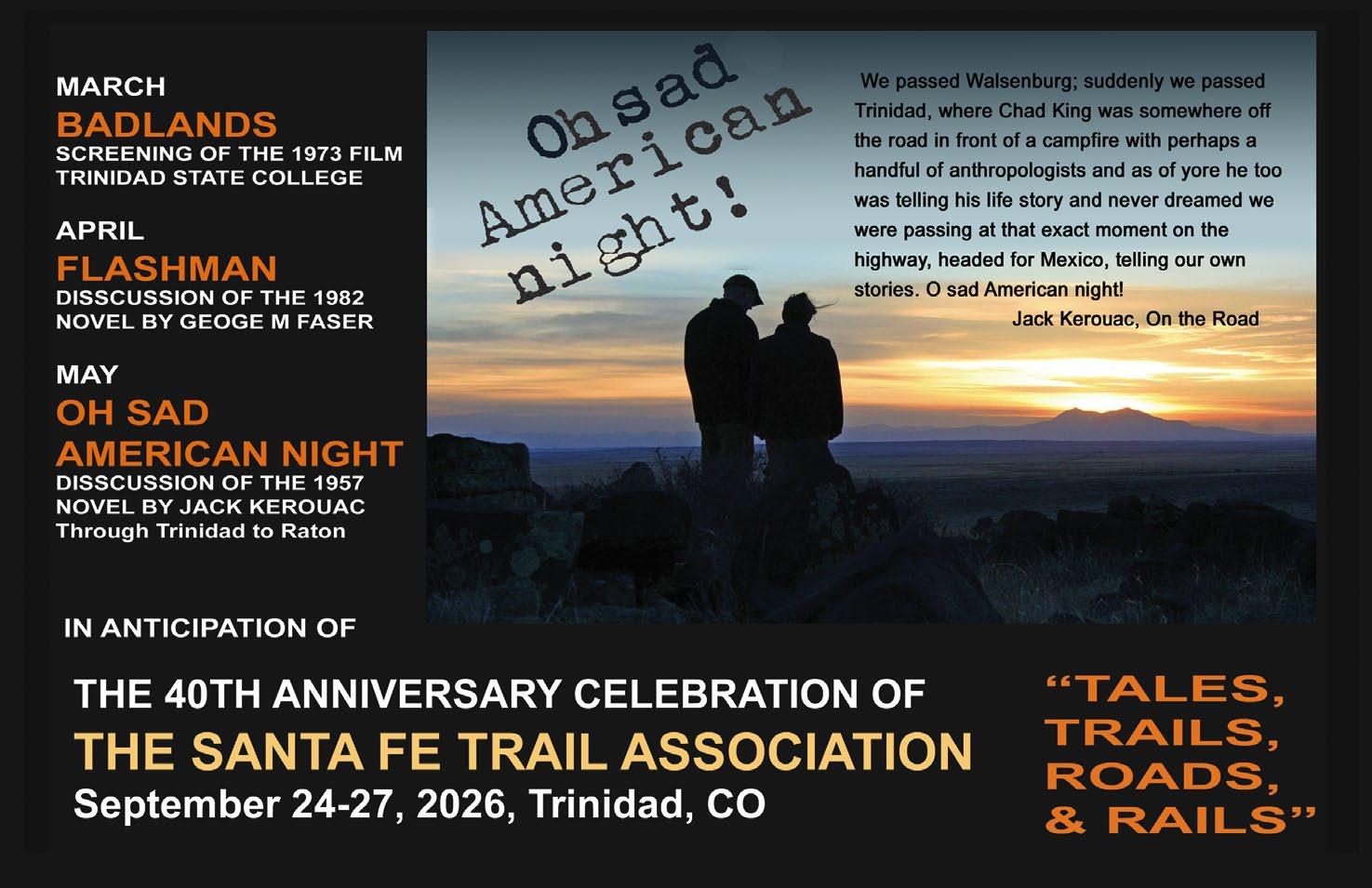



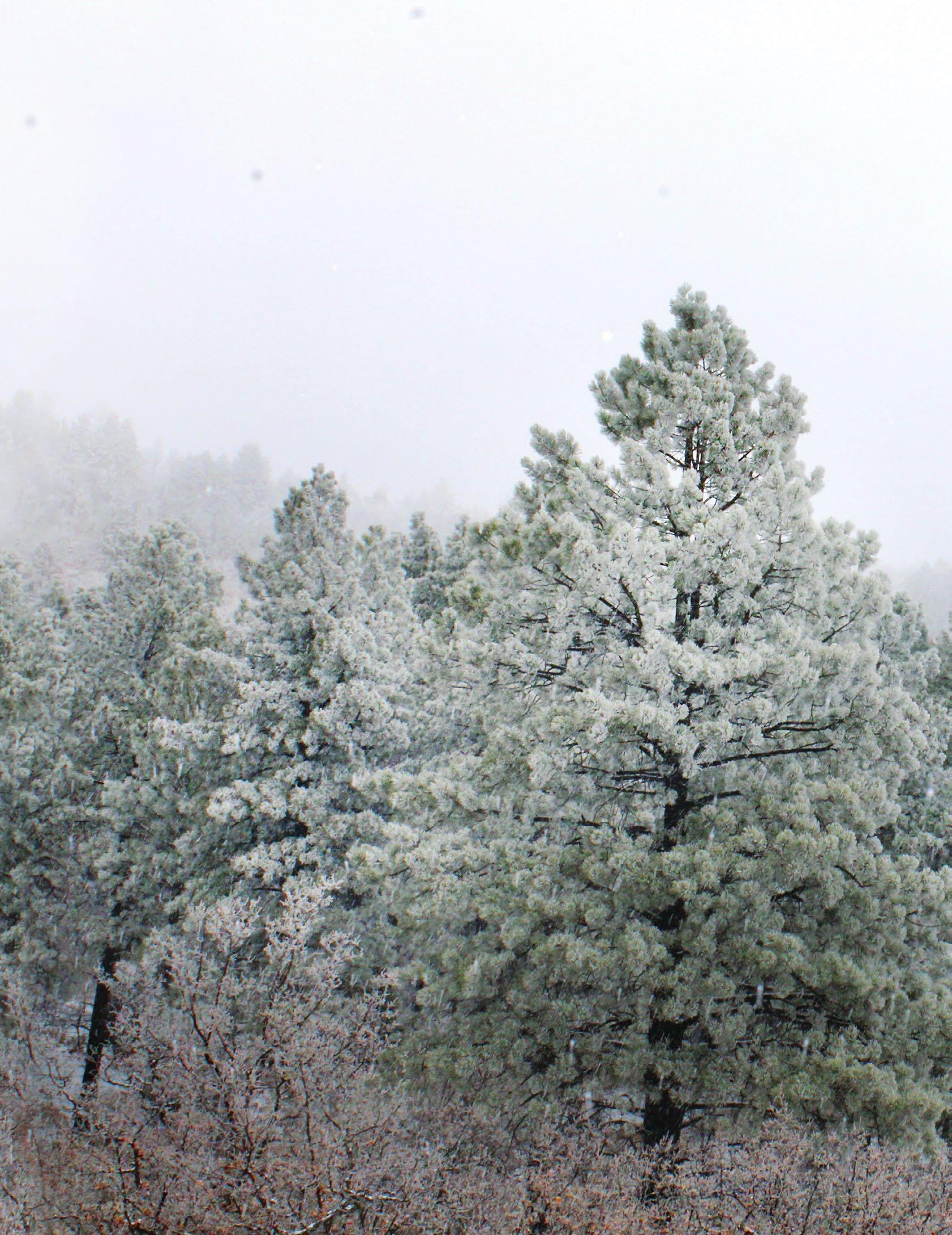

Maxwell National Wildlife Refuge | 180 The Rocky Mountain Bristlecone Pine | 186 A Crane Conversation: Celebrating Sandhill Cranes | 192 A fresh blanket of snow covers a grove of pines along Highway 518 south of Mora,
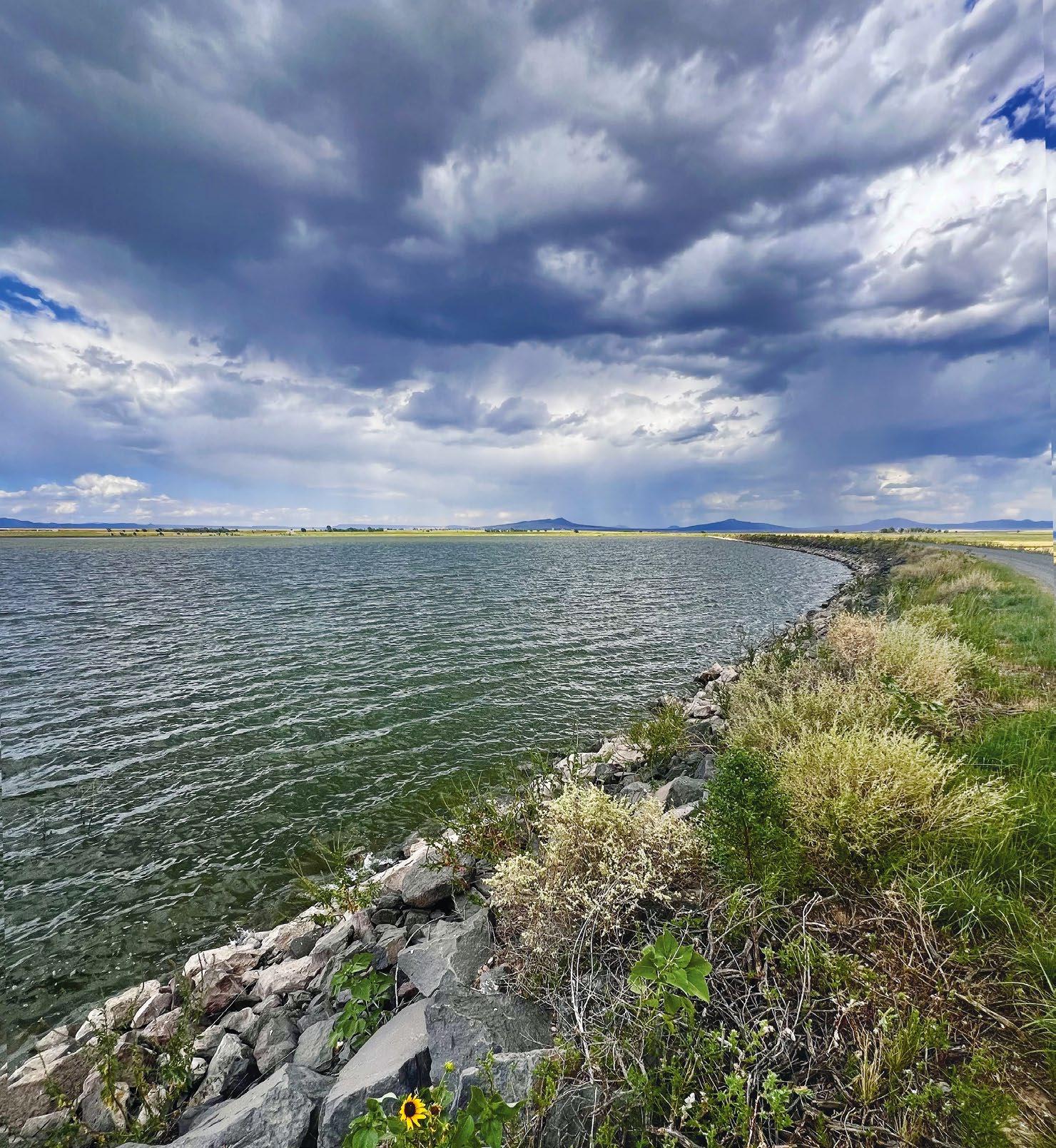
Written by Lisa Ragsdale
Tucked into the rolling grasslands of northeast New Mexico, Maxwell National Wildlife Refuge offers a rare chance to experience the rhythms of nature up close. This sanctuary, spanning more than 3,700 acres, is a haven for migratory birds, elk, pronghorn, and countless other species that call the high plains home. Each season brings its own spectacle— sandhill cranes circle overhead, songbirds fill the air with color and sound, and waterfowl gather on the refuge lakes. The quiet observer, seeking open skies and the subtle calm of tall grass waving in a prairie breeze, will appreciate this unexpected landscape. Maxwell invites you to connect with the untamed beauty of wild places.
At 6,050 feet elevation, the refuge spans 3,700 acres and is well known as a “birdwatcher’s dream.” Home to more than 278 species of raptors, waterfowl, songbirds, and shorebirds, the mix of wetlands, short grass prairies, and old woodlots, along with three small lakes, make the landscape ideal for migratory and resident species.
As part of the National Wildlife Refuge System, Maxwell joins Las Vegas National Wildlife Refuge near Las Vegas, New Mexico, and the Rio Mora National Wildlife Refuge and Conservation Area near Watrous, New Mexico. Established in 1965, Maxwell was placed under the authority of the Migratory Bird Conservation Act in August of 1966, specifically for a
migratory bird sanctuary and breeding ground for birds and other wildlife.
To support migrating waterfowl and cranes, the refuge plants about 250 acres of crops every year, as long as water supplies permit. They grow winter wheat and Triticale, a hybrid of wheat and rye, along with oats and barley. There are 700 acres of wetlands that include the three lakes, Lakes 12, 13, and 14. There are also two playa lakes, which are shallow, temporary lakes that form by collecting rainwater supplement from the wetlands in high-rainfall years. When they dry up, they leave behind a crust of salt and minerals called a saltpan. The lakes are part of the “Central Flyway,” one of North America’s four major migratory bird routes. This aerial superhighway stretches from northern Canada to South America
and passes right through New Mexico. Maxwell National Wildlife Refuge plays an integral part in supporting migrating birds each year.
The lakes provide open water, fish, and vegetation along the shorelines for nesting birds. Lake 13 is the centerpiece of the refuge, with a boat ramp open from sunrise to sunset, although boats are allowed at trolling speed only. Camping is available there from March through October on the west side of the lake. Bring your binoculars to get closeup views of sandhill cranes, ducks, geese, Wilson’s phalarope, and Longbilled Dowitchers.
Four short trails available to visitors grace the area—all are a mile or less and are easy hikes including Cottonwood Nature Trail, Lake 14 Trail, Prairie Dog Town Trail, and Prairie Trail. Primarily
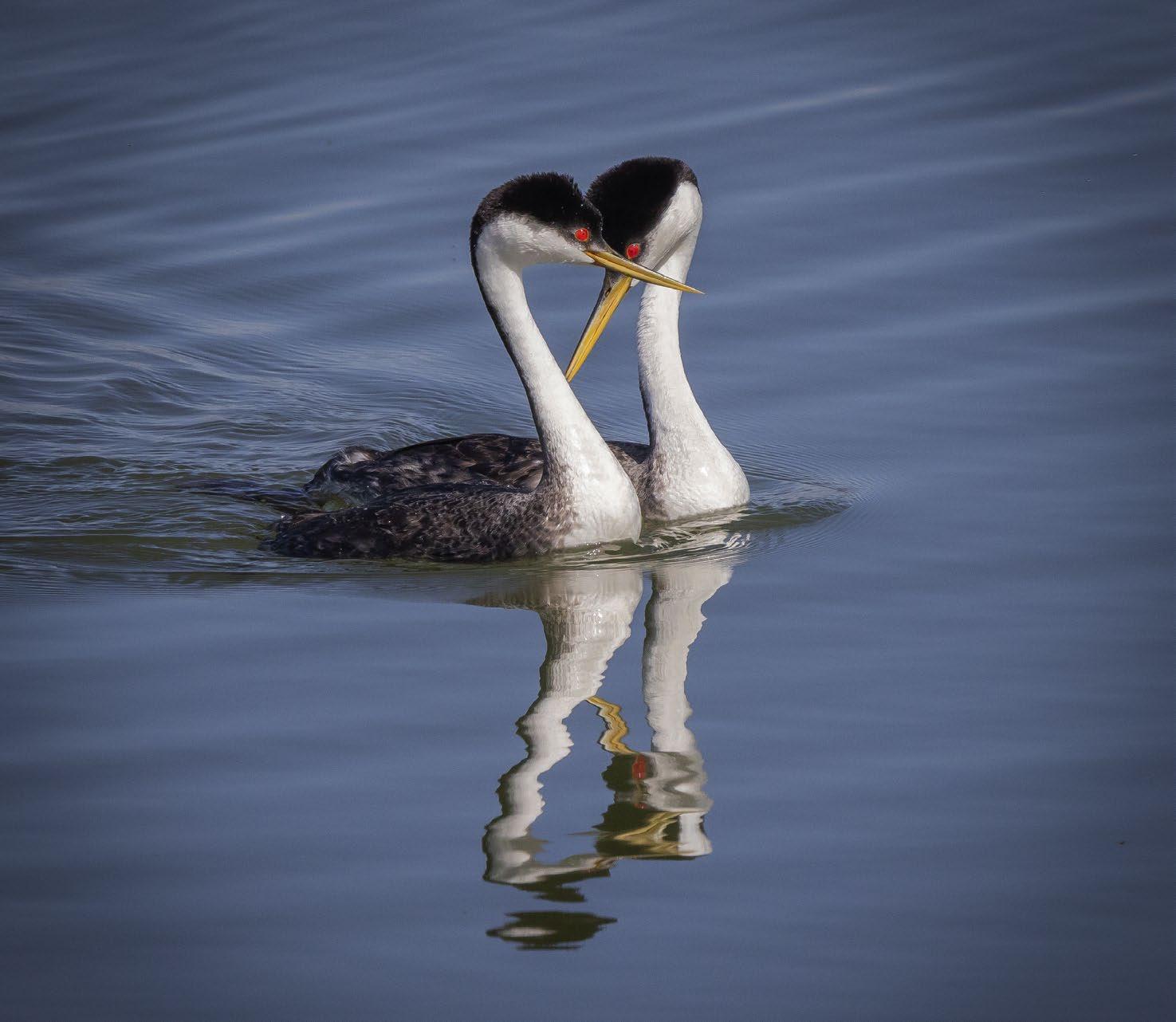
consisting of plains cottonwood, elm, poplar, and New Mexico locust, the woodlots are now home to raptors and songbirds, and support elk, deer, turkey, and coyote.
Winter is the best time to spot bald and golden eagles on the refuge. Arriving in late October to November, the raptors will feed at Stubblefield Lake, just a 10-minute drive from the refuge, and can often be seen resting within the refuge boundaries. The population peaks in February, so bring your snowshoes. The refuge averages about thirty
inches of snow each winter season between November and March. There are no groomed trails, so staying on the roads or open areas is best to protect wildlife.
It’s always best to contact the refuge before heading out to see if there are any restrictions to the public areas as they manage conservation efforts, such as prescribed burns, water manipulation efforts, and invasive species control. t
Visitor Center: 168 Lake 13 Road, Maxwell, NM 87728 (575) 375-2331
Online: fws.gov/refuge/maxwell
Hours: M-F 8:00 am - 4:00 pm
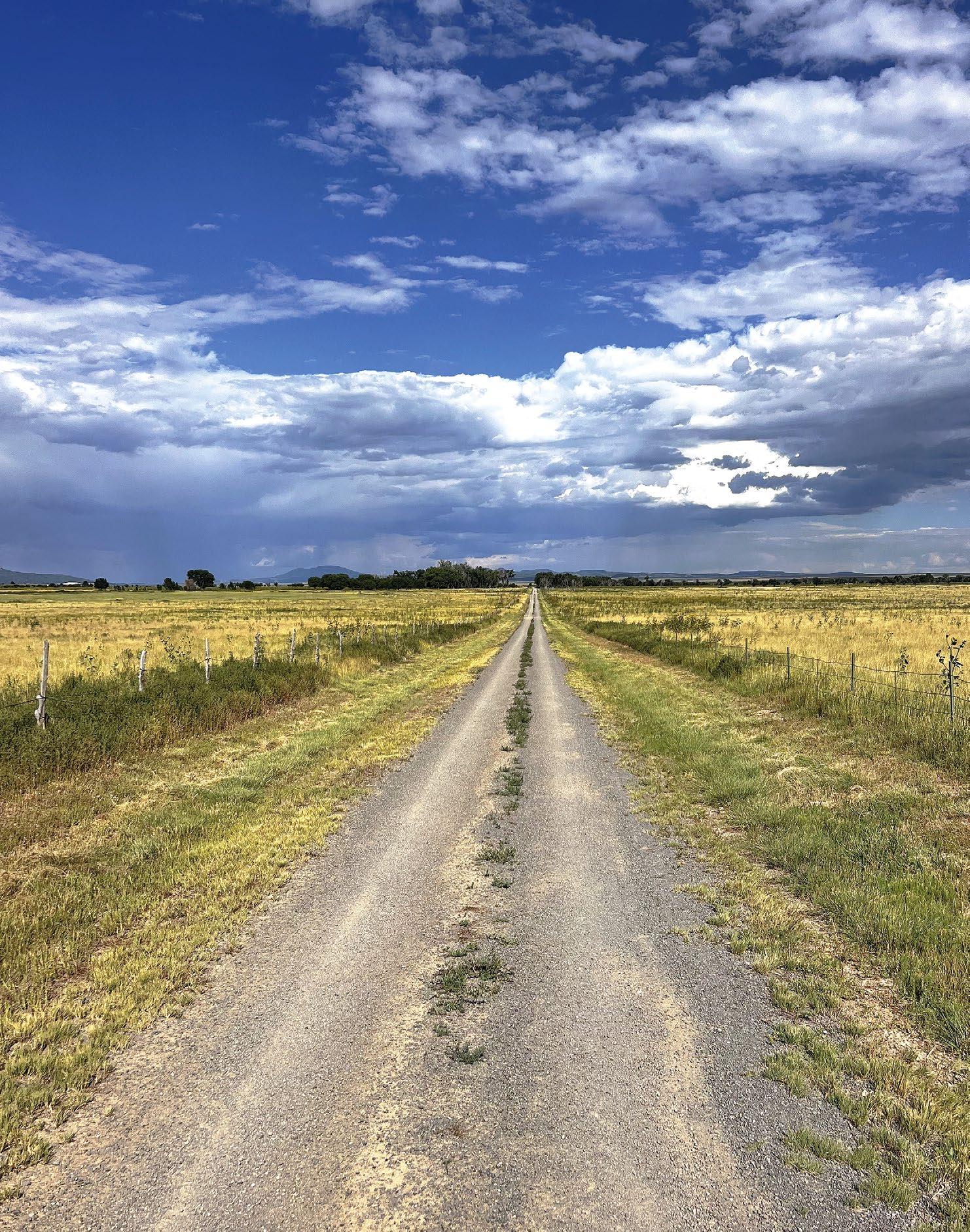
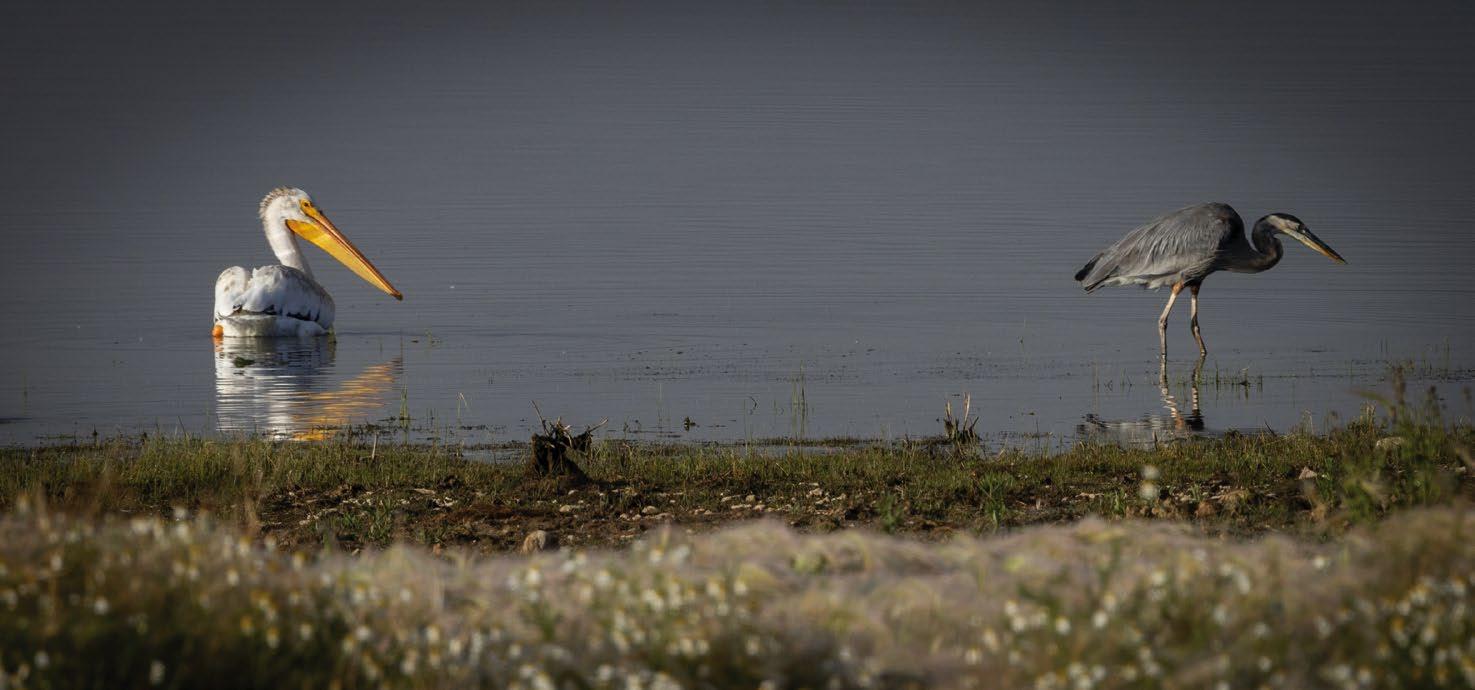
Maxwell National Wildlife Refuge offers seasonal access. Be sure to inquire about access prior to visiting in the fall, winter, and spring. All roads within the refuge are crushed gravel and are well-maintained. The visitor center is easily accessible and offers an opportunity to learn more about the property.
There are no disabled access trails in the refuge, however, most visitors can enjoy exceptional views and solitude from their vehicles.
There are no services close by the refuge. There is a fuel station with a convenience mart in the village of Maxwell.
Be careful. Watch out for rattlesnakes.
Just outside of the refuge and just across the road, spot a herd of camels!
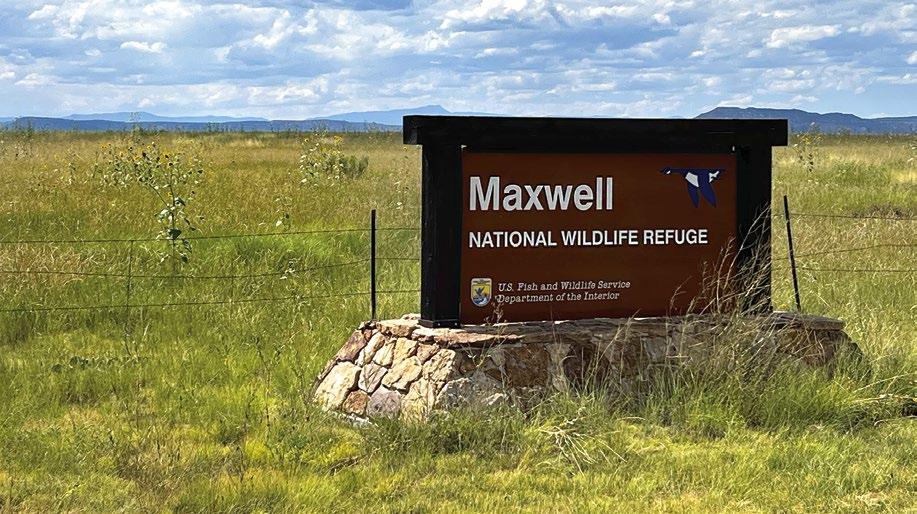
Total Acres: 3,699
Base Elevation: 6,050’
Peak Elevation: 6,070’ (approx.)
Managed by: U.S. Fish & Wildlife Service
Activities: Fishing, hiking, and birding
Historic Sites: 0
Hiking Trails:
Cottonwood Trail: 1-Mile Loop
Lake 14 Levee Trail: .81-Mile Trail
Prairie Dog Trail: .06-Mile Trail
Campground:
Camping is only available at Lake 13 which is a primitive campground. Reservations are on a first-come, first served basis with a 5-night maximum stay. There are no RV hookups available. Campfires are prohibited. There are two pit toilets available. There is currently no overnight fee to stay.



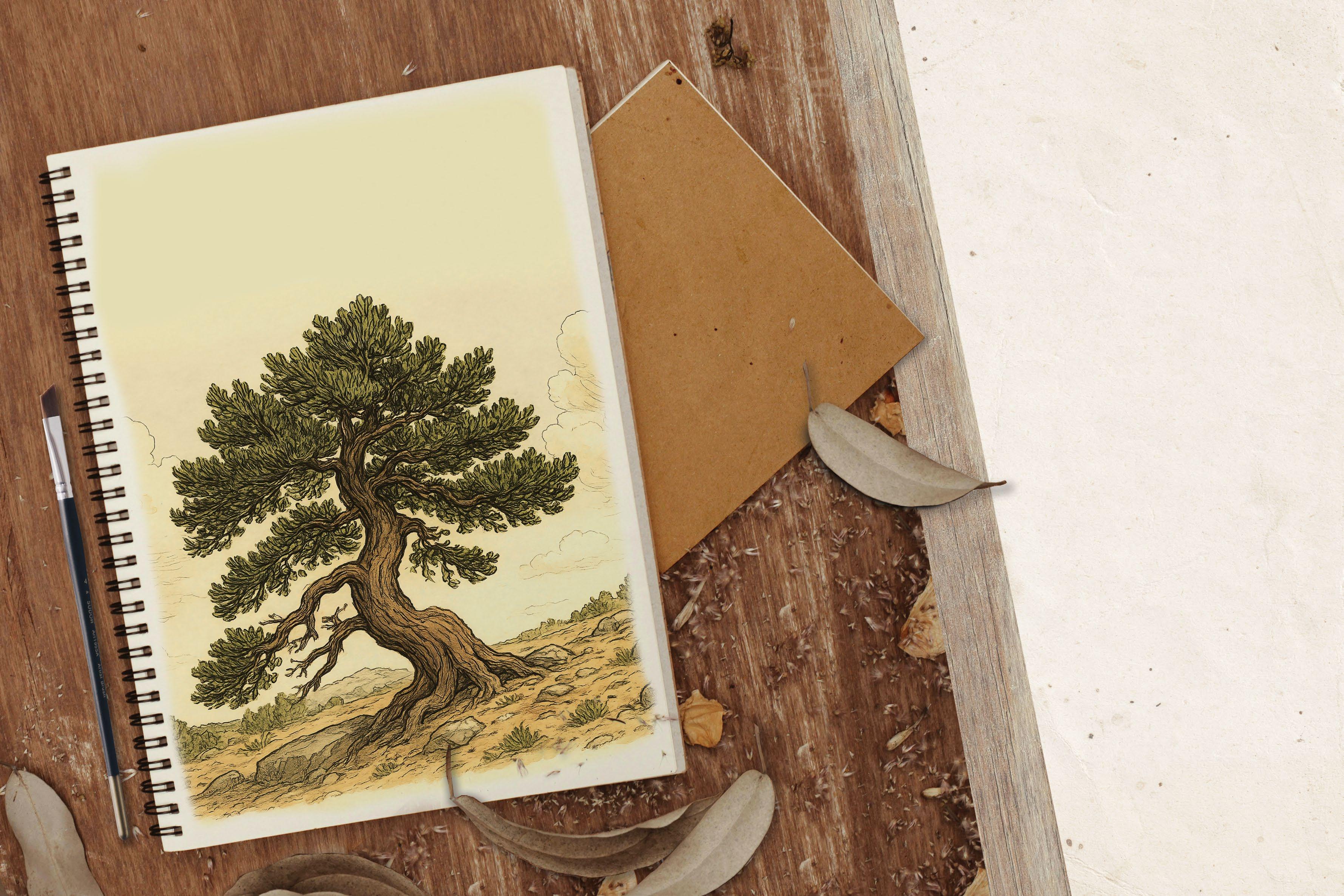

Without trees, humanity would not be possible.
By Collin Leuthold
Among the oldest living organisms on the planet, Bristlecone Pines—or Pinus longaeva—are found predominantly in high-altitude locations in California, Utah, and the Great Basin of Nevada. These resilient conifers can be older than the Pyramids of Giza, reaching 5,000 years old, giving us an opportunity to reflect on how— with perseverance—these lifeforms can withstand the trials of time and thrive in gnarly weather conditions where stress is a virtue. Bristlecones are arguably one of the most astonishing living entities on Earth.
Though Pinus longaeva are not found in our region of the Southern Rockies, its relative— the Rocky Mountain bristlecone pine—Pinus aristata—can be found in various high-elevation pockets of the Southern Rockies of Colorado, New Mexico, and in one small group on a high slope of Mount Humphreys in Arizona. The Rocky Mountain bristlecone pine is one of the most remarkable trees of the American West. Known for both its hardiness and extraordinary lifespan, with some specimens reaching as much as 2,500 years old, it’s one of the oldest living organisms in North America. They are a beautiful embodiment of the difference in how various flora thrive in different climate zones. With their weather-sculpted form, their twisted limbs illustrate movement even in their slightest characteristics.
Embodying the essence of a watercolor painting, Pinus aristata allows the imagination to wonder. Each individual tree stands in a peerless fashion, showing a vast span of possibilities of form. The rugged bark and winding trunks stand as an unparalleled expression of survival, and the experience of longevity leaves the bones of other plant species to deteriorate at the base of its exposed roots. These pines bear pollen cones, which are known to blush in tones of red and blue. However, the young seed cones tend to glow with a deep purple, marking them as rare jewels
among the cones of our region. At mature scale, seed cones range from the stretch of a dragonfly’s body to the curl of a traveling pipe. Each cone scale ends in a sharp bristle-like prong—hence the name bristlecone.
Coming across one of these pines, the observer may ponder the sheer time they have existed. Much like a bonsai tree, bristlecone pines grow slowly and develop character with age. These astonishing pines thrive at elevations ranging from 9,800 to as high as 11,000 feet. They showcase how the elements of nature dramatically affect the way
the world changes.
Regionally, Rocky Mountain bristlecone pines can be found in the Sangre de Cristo Mountains flanking the Colorado and New Mexico border from Salida down to Santa Fe. They can also be found farther north on various mountain peaks of central Colorado. In New Mexico, several examples can be found along the Elliot Barker Trail above Angel Fire, on trails above Santa Fe in the Santa Fe National Forest, and in areas within the vast Valle Vidal Unit of the Carson
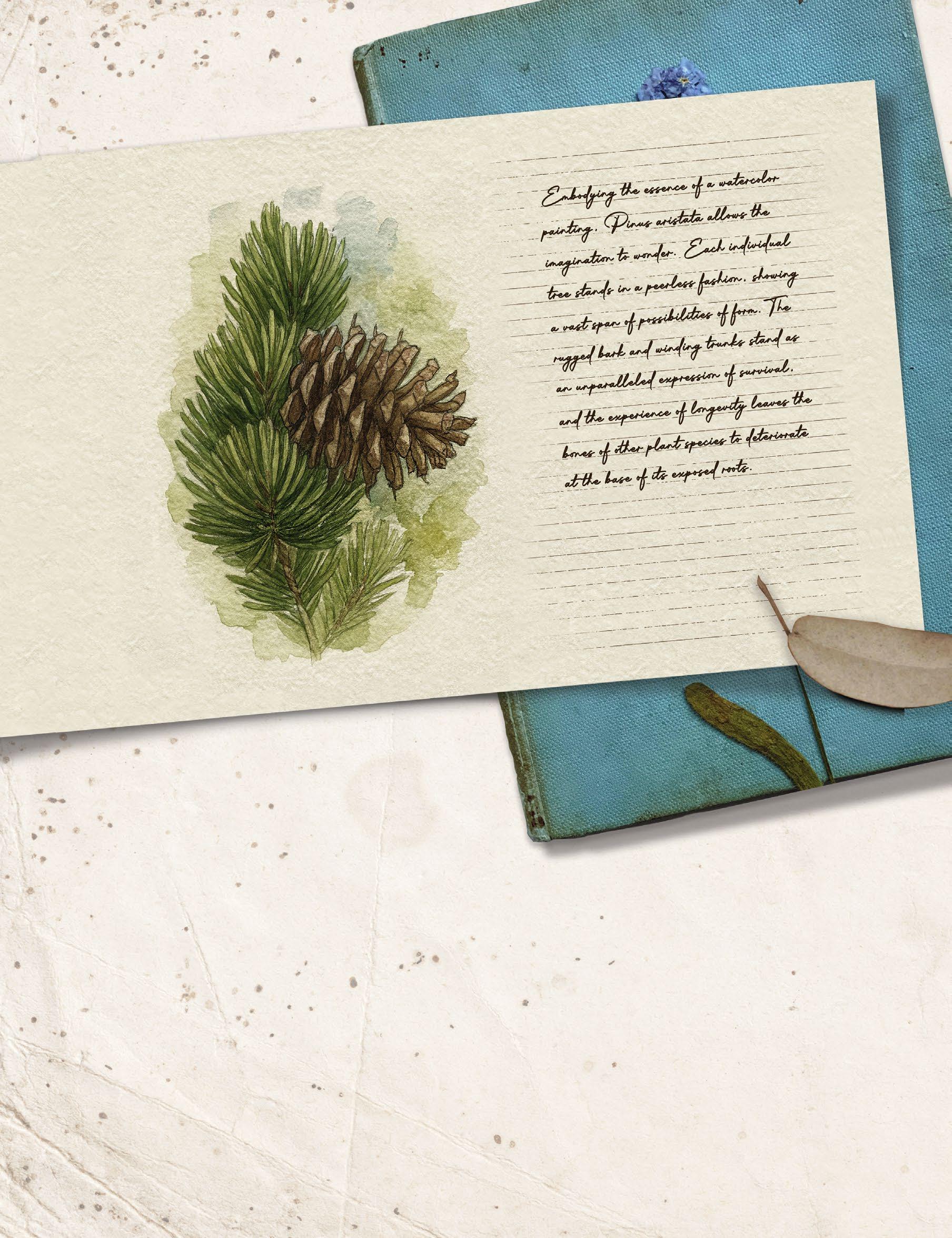
“While on the roughest ledges of crumbling limestone are lowly old giants, five or six feet in diameter that have braved the storms of more than a thousand years.”
—JOHN MUIR

National Forest. In southern Colorado, groves are nestled in the San Juan National Forest, and in pockets at high elevation around the “14-ers” above the San Luis and Cuchara Valleys.
In the case of Pinus aristata—many having survived tremendous ecological planetary shifts—age is not just a number. It’s a testament to wisdom and perseverance unlike any that humanity has ever endured. t
YouTube Video: Timeless Sentinels of the Rockies: Exploring Colorado’s Ancient Bristlecone Pines.

DIGITAL CONTENT:




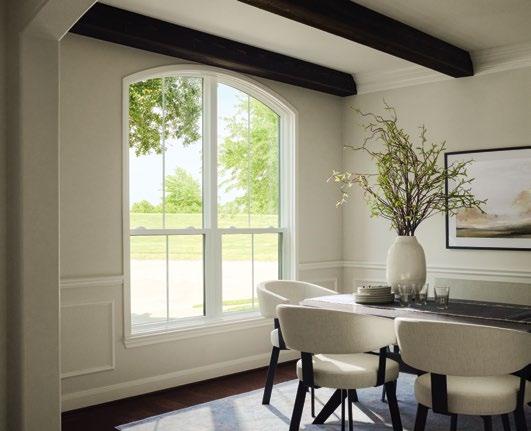

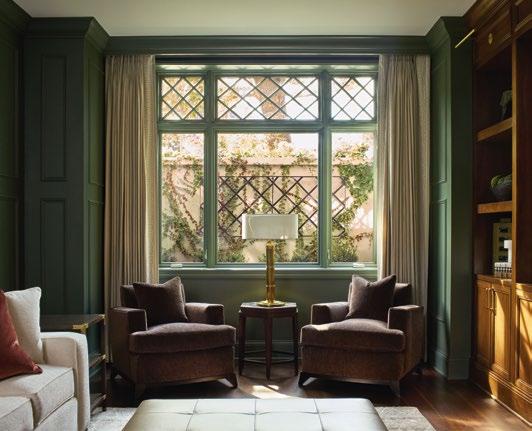






BY SHELLI ROTTSCHAFER
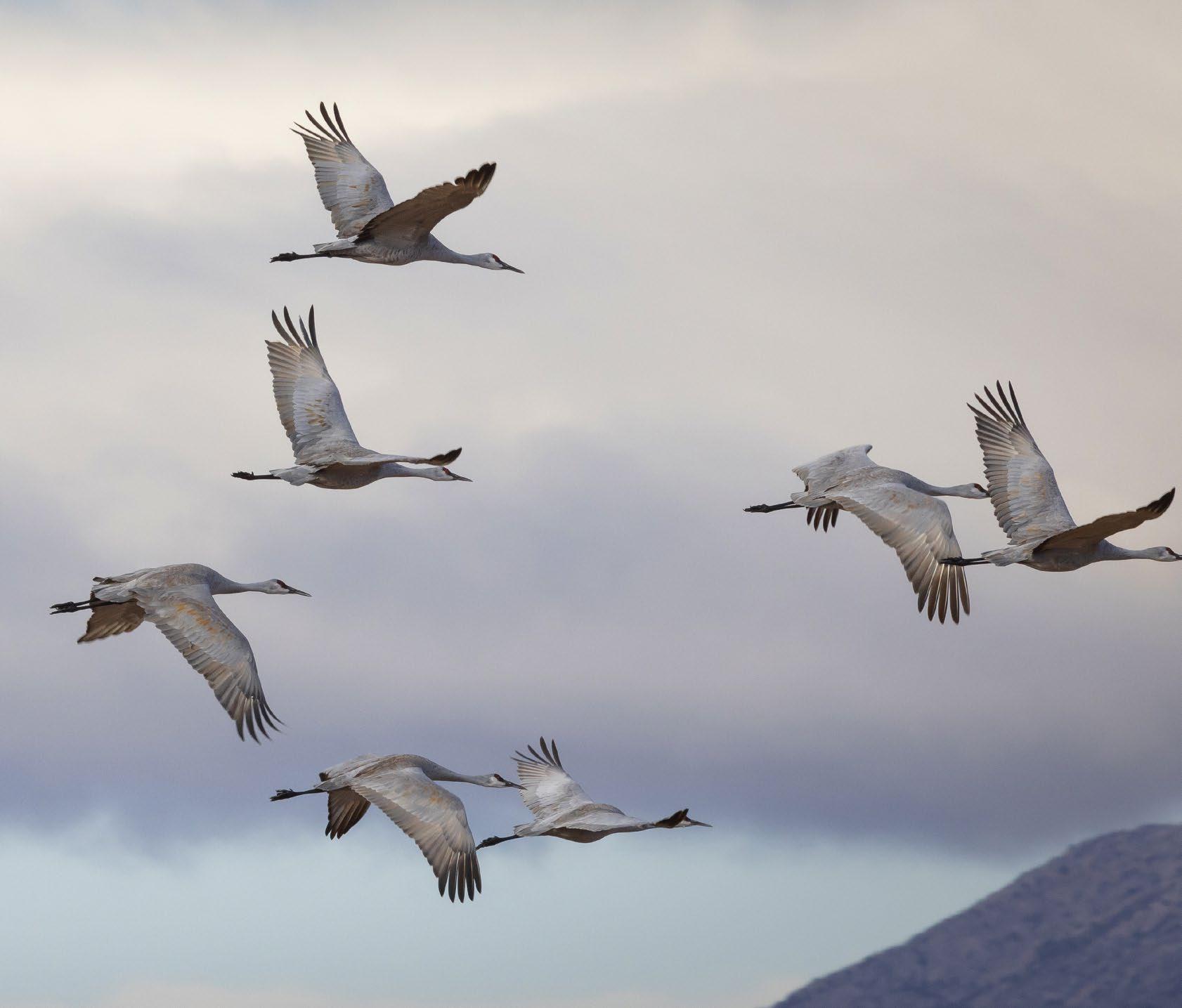
Bosque del Apache National Wildlife Refuge was established in 1939 as a critical stopover site for migratory waterfowl such as the greater sandhill crane and snow geese. The refuge is 57,331 acres, with over 30,000 acres designated as Wilderness—the highest protection status for our public lands. This was a task of love and dedication, a collaboration between the BLM,
the Forest Service, and dedicated scientists to preserve the wild spaces in Socorro county.
To celebrate this love of land and wildlife, the Festival of the Cranes was established to observe the annual migration of thousands of cranes that frequent the area each year. It began as a one-day community event. Since then, the celebration has grown in popularity and intent. As of 2025 the
Festival of the Cranes may be temporarily canceled due to a government shutdown—check their website.
To learn more about Bosque del Apache and the Festival, talked with Trisha Sánchez, Donor Care Manager for the Friends of Bosque del Apache National Wildlife Refuge.
Trisha explained the Festival of the Cranes has grown and transformed into a five-day Festival featuring over 100
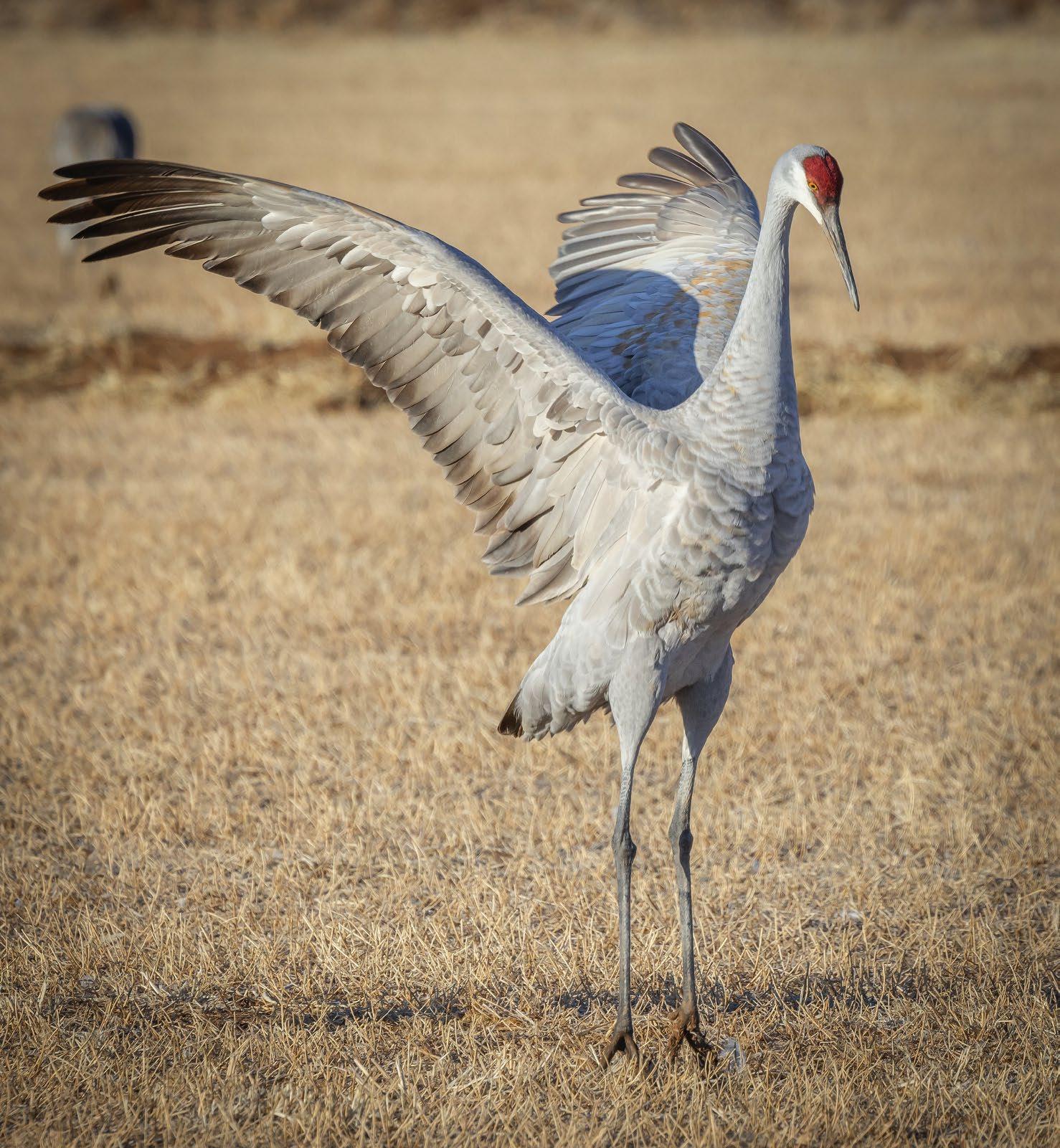
“When we hear his call, we hear no mere bird. We hear the trumpet in the orchestra of evolution.”
unique birding and photography workshops, tours, and hikes. It is planned and put on through the joint efforts of the Wildlife Refuge, with Friends’ staff and volunteers. Visitors from all over the world travel to learn more about Bosque del Apache and the magnificent sandhill cranes throughout the year, as well as in December for the crane migration.
SR: Trisha, when did you first begin working with and promoting the festival?
TS: I began working with Friends of Bosque del Apache in the Bosque Nature Store in 2016 and then moved over to work as the Membership Manager the next year. Because Friends has a small staff (two full-time employees and six part-time employees), our roles tend to overlap. We all feel very lucky to be able to be on the refuge so often. Bosque del Apache is a hugely important habitat. One of the largest and last remaining wetlands in New Mexico!
SR: What is an example of how the festival has changed since you began until now?
TS: During the pandemic years (2020 and 2021), we were forced to transform Festival of the Cranes into a virtual/online festival. (Thank goodness for Zoom!) It was difficult, and we certainly missed all the face-toface interaction. Yet, we felt very lucky to have access to technology, which allowed for the re-working of classes. We could still gather people together during a time when we all needed to be reminded of the calming effect of a connection to nature. Since 2022, the festival has been back in-person.
SR: Do these majestic, winged beings land in your own yard during migration?
TS: Yes, they do! I live a bit north in the Los Lunas area, which is still part of the Middle Rio Grande Valley, and on the crane’s migration route—the central flyway. So, I do see cranes in my area every day during fall and winter and are quite punctual. My family and I put corn out in the backyard for them. The cranes show up just after sunrise every morning, so no sleeping in. You can hear their bugles even from inside the house!
SR: What was it like to see your first sandhill crane?
TS: I am from Oklahoma and didn’t see my first sandhill crane until I moved to New Mexico in 2008. For me, they are fascinating and such unique creatures; it never gets old.
Over the course of my time living here in New Mexico, I have learned that welcoming the sandhill cranes back to the area each fall is indeed as much a part of the annual changing of the seasons as falling leaves and roasting green chile. It would not feel like late fall in the Middle Rio Grande Valley without the sights and sounds of the sandhill cranes. New Mexicans eagerly look to the skies for that first glimpse of them returning from their migration south every year.
SR: What is the migratory route of the cranes?
TS: At Bosque del Apache, we mostly welcome birds from the Rocky Mountain population of greater sandhill cranes, but we do also see some lesser sandhill cranes as well. After spending the winter with us, “our” birds migrate up to Montana, Idaho, Canada, and sometimes even up into Alaska to nest. The lesser sandhill cranes migrate through the Midwest and into Ontario, Canada.
SR: Are sandhill cranes endangered or threatened?
TS: Thankfully, no. sandhill cranes are not currently endangered or threatened. However, their population is closely surveyed and monitored by biologists from several partner organizations within the Central Flyway, including the U.S. Fish and Wildlife Service. We know that their population is stable, and that when circumstances change from year to year and location to location, they are adaptable.
SR: Do the cranes live in an extended family? Do they mate for life?
TS: Cranes do form long-term pair bonds (i.e. “mate for life”) and stay together year-round. Although if a crane’s partner dies, it will pair up with a new partner.
SR: What is their life cycle?
TS: A crane’s life cycle begins as a hatchling. The young are called colts. They form family groups wherein the young stay with the parents for a time (usually for about ten months or so after hatching), but juveniles are eventually driven off by the parents to find mates and establish their own territories. They will group up and merge into flocks of hundreds or even thousands of birds during migration times.
SR: Are some of the cranes tagged so that scientists can better track their migratory path? Do the same cranes return and is that tracked through tagging?
TS: Scientists with the U.S. Fish and Wildlife Service
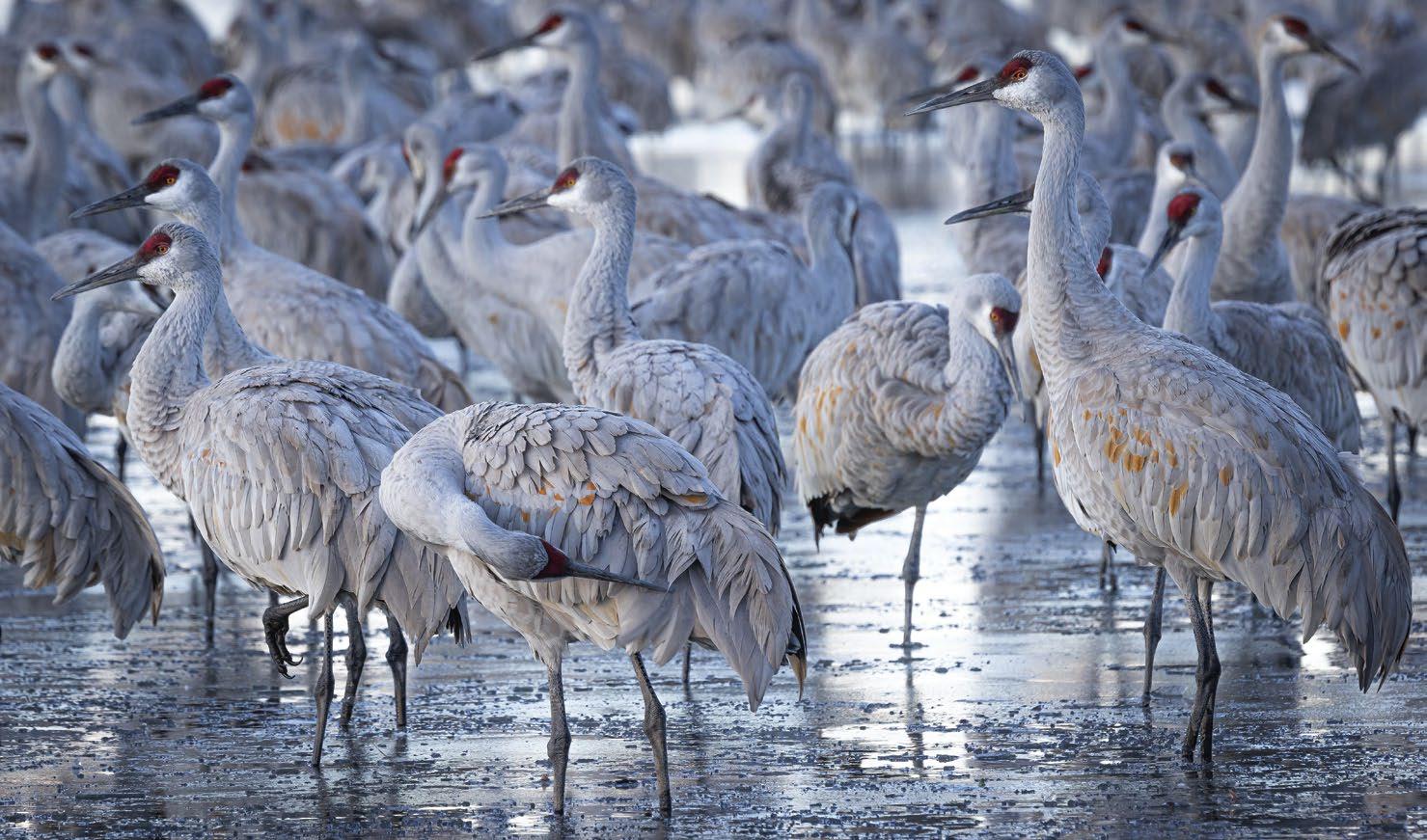
do conduct annual crane banding and data monitoring. From it, we know that cranes return each year to the same overwintering sites here within the Middle Rio Grande Valley, as well as utilizing their same nesting sites each summer at locations to the north.
SR: What is the best time of day or night to observe the cranes?
TS: Cranes tend to roost in large groups within the refuge wetlands at night, where they are safe from predators like coyotes. Then, they fly off the roost to feed in nearby farm fields during the daylight hours. Because of this behavior dynamic, the most exciting times of day to observe cranes on the refuge are usually at sunrise (when they can be observed flying off the roost in huge flocks), and just before sunset (when they will begin returning to the refuge wetlands and gathering up into small groups for the night.) Cranes can also be seen feeding in fields along the refuge tour loop during the day, although many do leave the refuge during the day to feed on farm fields all up and down the Middle Rio Grande Valley.
SR: How many volunteers are there for the Festival of the Cranes?
TS: The refuge relies upon an “army” of about thirty or so seasonal RV volunteers, not only to assist with Festival of the Cranes, but also to manage refuge maintenance, visitor interactions, and lead tours during the entirety of our busy season, which runs from October to February. Without their amazing dedication and efforts, we would not be able to successfully accomplish this feat each year.
SR: How many tourists, observers, and scientists does the Festival bring in?
TS: Festival of the Cranes brings in thousands of visitors to the refuge from all over the world, estimating the Bosque del Apache’s annual visitation to be approximately 200,000.
SR: How do you see science and creativity collaborate during the time of the festival?
TS: Friends and refuge staff collaborate year-round with research professionals from partner organiza-
tions, including scientists and students from New Mexico Institute of Mining & Technology (NM Tech) in Socorro, New Mexico. Ongoing research projects, which regularly utilize the refuge as a resource, are looking at biomimicry for producing more efficient drones, which I think is fascinating.
Bosque del Apache also serves as creative inspiration for countless artists and photographers throughout the year, as showcased by the dozens of submissions we receive each year in our Festival of the Cranes art and photography contests.
SR: How do the cranes inspire?
TS: Here at Bosque del Apache, the cranes are sort of like “the hook,” if you will. They attract the most attention. They’re majestic and graceful. There is something primal about their harsh, brassy call and their ancient connection to this area. They have been relying upon this land and this river for millennia; much longer than we have! They are magnetic. People are drawn to the refuge to witness their mysterious dances and the breath-taking sights of a flock of hundreds taking flight en masse, silhouetted against a brilliant New Mexico sunrise.
But once they are here, folks look around and realize that Bosque del Apache is also so much more—a magnificent and rare oasis in the middle of the desert, a true refuge in all seasons for countless species of hardy desert survivors, and we can count ourselves among them. Once you have visited the refuge and felt that soul-level peace, which comes from disconnecting from the distractions and stress of our daily lives, you sense that we were meant to be one with nature—part of it, not apart from it. It keeps people wanting to come back and experience that connectedness again and again. This is part of the magic that Bosque del Apache and the cranes provide.
My “crane conversation” with Trisha Sánchez focused primarily on the greater sandhill cranes that make their stopovers in Bosque del Apache. The same migratory path occurs north, along El Río Grande del Norte in Monte Vista, Colorado, which has its own Monte Vista Festival of the Crane (MVFC). However, this festival is held during the spring migration, every second weekend in March. In 2026 it will be held from March 6th to 8th.
The MVFC is in its 43rd year, having begun in
1983. When the festival originally was created, it was named the “Whooping Crane Festival.” However, the small whooping crane population was depleted from drought, mortality, and failed breeding. By 2000, there were only two mated whoopers that passed through the San Luis Valley. Now, the festival honors those who have survived; the greater and lesser sandhill cranes, who still make the SLV a stop on their route.
When I contacted MVFC, I learned that Amy Engle and her business Fable Communications coordinate the three-day Monte Vista Crane Festival. She explained her business works extensively with local nonprofits, and since 2021, Fable Communications has taken on everything from sponsorship outreach and ticketing, to marketing, logistics, and volunteer coordination for the MVFC. Fable Communications does this in collaboration with the incredible volunteer efforts of the Friends of the San Luis Valley National Wildlife Refuge.
I wanted to learn more, so I asked Amy, can you tell us a bit about the festival’s history?
AE: The Monte Vista Crane Festival was created to celebrate the annual spring migration of the greater sandhill cranes and to raise awareness about the Monte Vista National Wildlife Refuge. The idea was to combine education, community pride, and economic opportunity—inviting people from near and far to witness one of nature’s most spectacular events while supporting local businesses and conservation efforts.
SR: Amy, how has the MVCF evolved since you began in 2021 until now for the 2026 celebration?
AE: One of the biggest changes has been shifting to general admission ticketing. This makes the festival more accessible and gives visitors more flexibility. We’ve expanded programming—by adding more tours, more talks, artist workshops, a kids’ corner, and a mini film festival. We also work with Bosque del Apache’s festival in New Mexico and have begun developing a niche in helping birding festivals thrive.
Sandhill cranes have been migrating through the San Luis Valley (SLV) for centuries. Their landing pad is the Monte Vista National Wildlife Refuge, where they take advantage of the open water and wetlands where they may roost. From there, their migratory path leads to New Mexico’s Bosque del Apache, or northward, depending on the season.
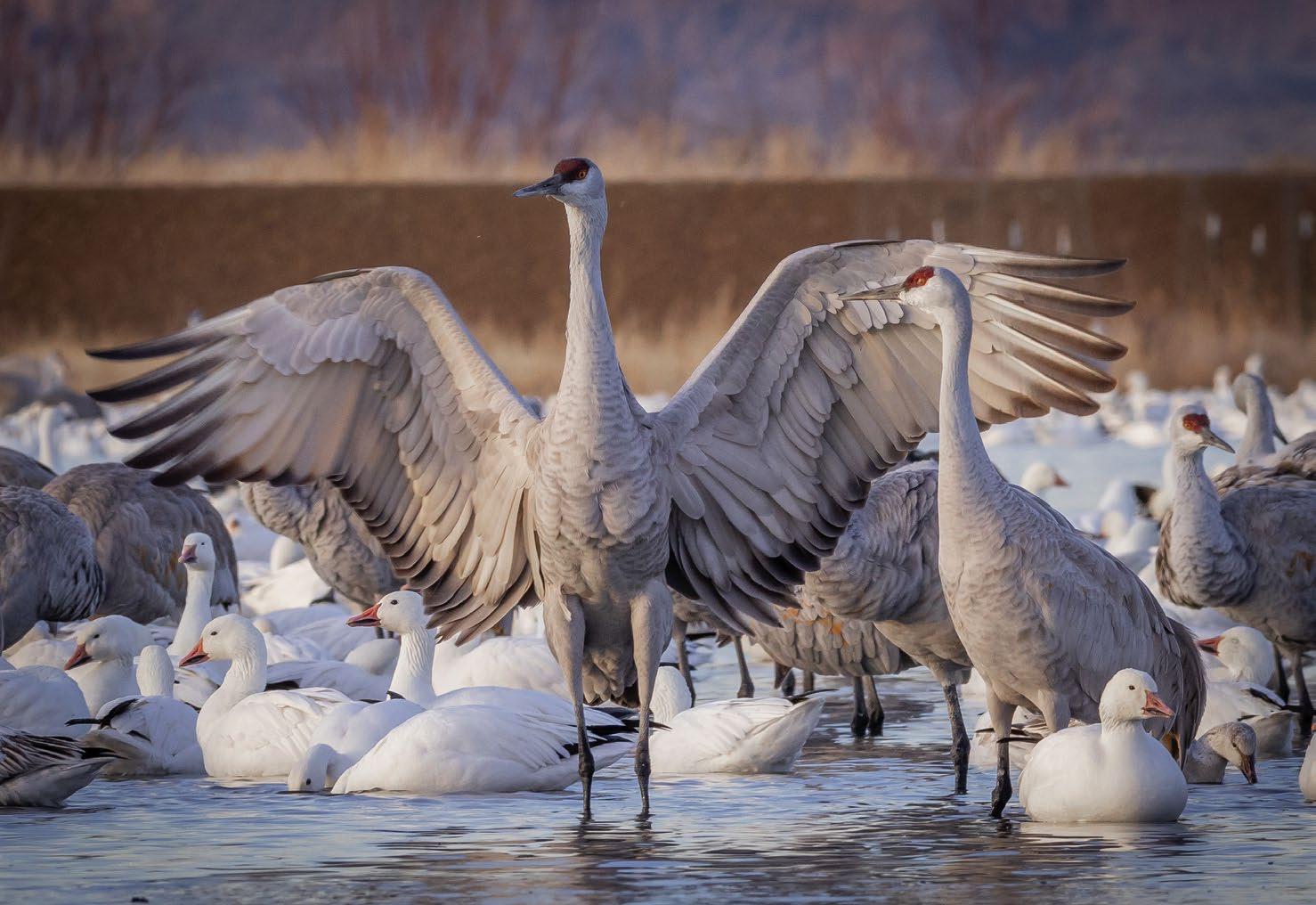
AE: I live in the San Luis Valley, so the cranes are part of my seasonal rhythm. Our ranch is just west of Del Norte, and we have cranes on our land every spring and fall. This year has been especially remarkable. We believe a pair actually nested here over the summer. That’s highly unusual, as sandhill cranes typically don’t nest this far south in the San Luis Valley.
SR: Do you remember when you saw your first sandhill crane?
AE: It was unforgettable. Their size, grace, and calls make them stand out even among the valley’s rich wildlife. For locals, they’re part of the seasonal calendar, and their absence would be deeply felt.
Greater sandhill cranes are about four feet tall with a six-foot wingspan. They generally weigh about twelve pounds and are uniformly gray, except for a red patch of skin on their foreheads. Similar-looking lesser sandhill cranes, which can mix in with the greater sandhill crane’s flock, migrate further east beyond the Con-
tinental Divide toward the Platte River in Nebraska, then the northern Midwest, and into Canada.
The migratory path of the greater sandhill crane has been observed since ancient times, evident in petroglyphs depicting these magnificent birds carved by Indigenous peoples. There is one glyph in particular, on a high rocky cliff in the San Juan Mountains, of a six-foot sandhill crane. The site was initially recorded in 1984, but the Rio Grande National Forest Service does not disclose its location for fear of vandalism.
AE: This is an example of why the greater sandhill crane conservation work is still critical. Habitat protection, safe migration corridors, and education are essential—and the festival helps with all of these. The festival is powered by roughly 50 to 75 volunteers each year, most through the Friends of the SLV Refuges. We draw 3,000 to 4,000 visitors annually from across the U.S. and abroad—birders, photographers, scientists, and families alike.
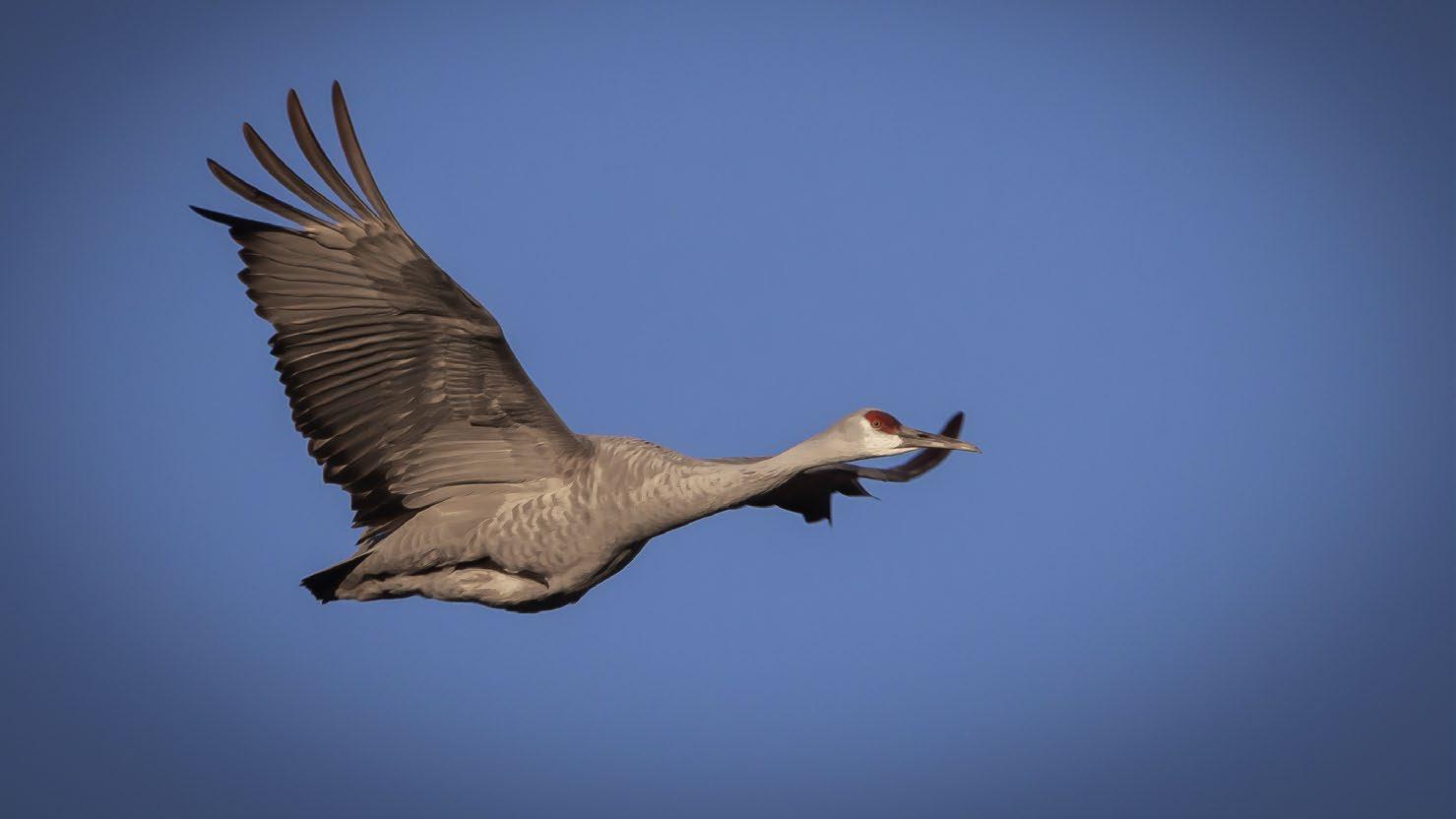
SR: It seems like there is an effort to include creative arts into the festival. How do you do that?
AE: Many birding festivals are known primarily for photography, but we wanted to lean into the broader artistic and inspirational aspects the cranes inspire— painting, sculpture, fiber arts, writing, and more. This year, we’re building on that momentum with expanded workshop offerings from local artists, giving visitors a chance to not just see the cranes, but to translate that experience into their own creative expression.
I asked Amy how she felt the cranes are an inspiration, not only to her as a local, but for visitors to the region. She explained: “The cranes’ migration is a story of endurance, connection, and the importance of shared landscapes. For us, they’re a reminder of why events like this matter—not just for bird lovers, but for anyone who values community and conservation.”
These unique festivals dedicated to sandhill cranes are a testament to the magnetism these birds hold. Those who watch them are inspired to soar their own figurative wings. The festivals are a unique intersection of conservation, education, and local culture. Like Amy said so well: “It’s hard not to get hooked once you’ve experienced them firsthand.” t
Check online before traveling as these events may be canceled due to a Government Shutdown.
1001 State Highway 1 San Antonio, NM 87832 (575) 835-1828
Online: fws.gov/refuge/bosque-del-apache
2025 Festival of the Cranes Online: friendsofbosquedelapache.org/festival/
6120 S Highway 15, Monte Vista, CO 81144 (719) 589-4021
Online: fws.gov/refuge/monte-vista
2026 Monte Vista Festival of the Cranes Online: mvcranefest.org




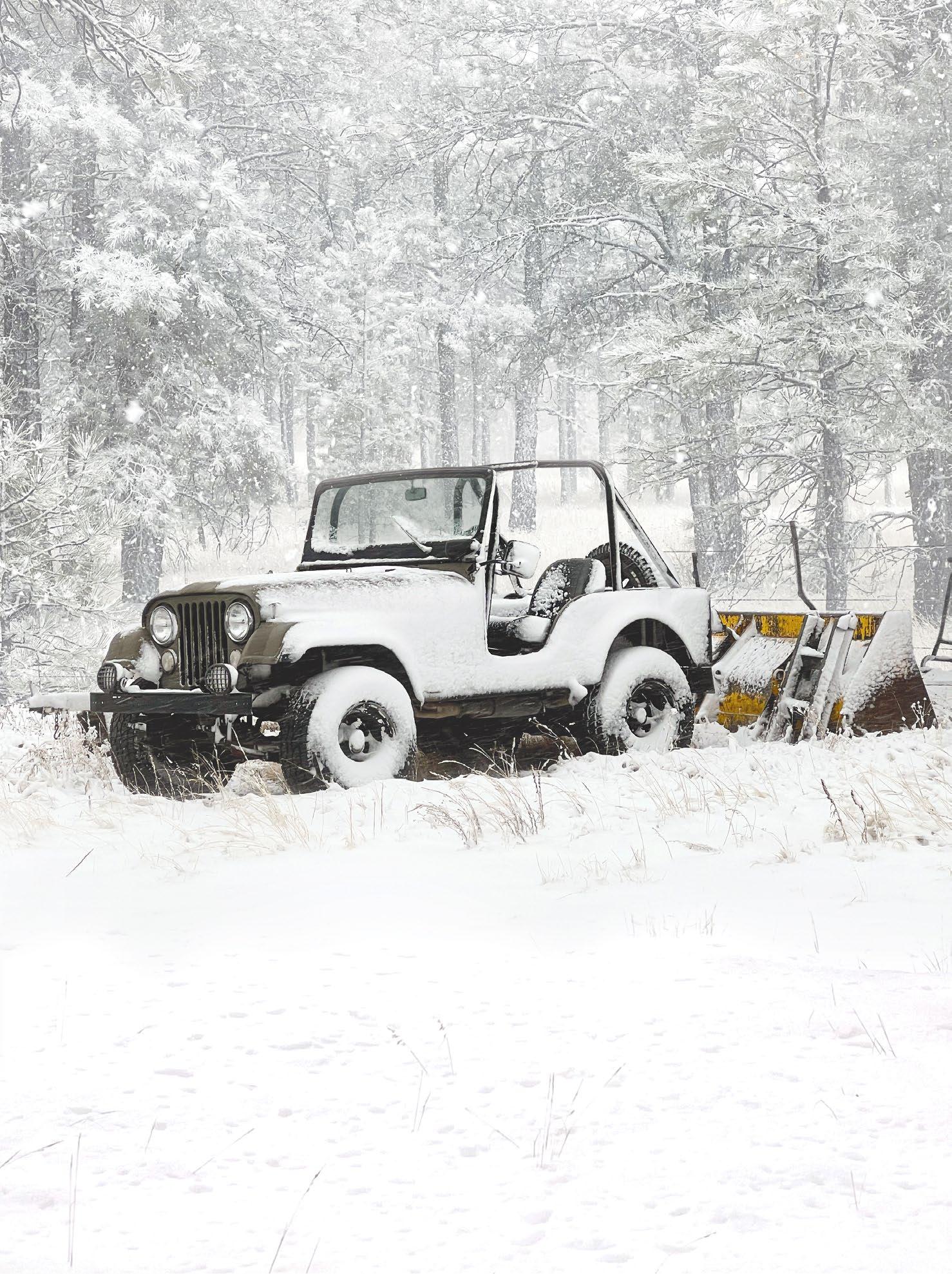
“To appreciate the beauty of a snowflake, it is necessary to stand out in the cold.”
—Aristotle
PHOTO | SCOTT LEUTHOLD