Oxford University Press is a department of the University of Oxford. It furthers the University’s objective of excellence in research, scholarship and education by publishing worldwide. Oxford is a registered trademark of Oxford University Press in the UK and in certain other countries.
Published in Australia by Oxford University Press
Level 8, 737 Bourke Street, Docklands, Victoria 3008, Australia.
The moral rights of the author/s have been asserted.
First published 2016 Third edition
All rights reserved. No part of this publication may be reproduced, stored in a retrieval system, transmitted, used for text and data mining, or used for training artificial intelligence, in any form or by any means, without the prior permission in writing of Oxford University Press, or as expressly permitted by law, by licence or under terms agreed with the appropriate reprographics rights organization. Enquiries concerning reproduction outside the scope of the above should be sent to the Rights Department, Oxford University Press, at the address above. You must not circulate this work in any other form and you must impose this same condition on any acquirer.
ISBN: 978 0 1903 5074 1
Reproduction and communication for educational purposes
The Australian Copyright Act 1968 (the Act) allows educational institutions that are covered by remuneration arrangements with Copyright Agency to reproduce and communicate certain material for educational purposes. For more information, see copyright.com.au.
Edited by Hannah Mae Cartmel
Typeset by Q2A Media Services Pvt. Ltd., Noida, India
Proofread by Jess Ni Chuinn
Indexed by Puddingburn Publishing Services
Printed in Singapore by Markono Print Media Pte Ltd
Oxford University Press Australia & New Zealand is committed to sourcing paper responsibly.
Disclaimer
Links to third party websites are provided by Oxford in good faith and for information only. Oxford disclaims any responsibility for the materials contained in any third party website referenced in this work.
DRAFT
Acknowledgement of Country
Oxford University Press acknowledges the Traditional Owners of the many lands on which we create and share our learning resources. We acknowledge the Traditional Owners as the original storytellers, teachers and students of this land we call Australia. We pay our respects to Elders, past and present, for the ways in which they have enabled the teachings of their rich cultures and knowledge systems to be shared for millennia.
Warning
Aboriginal and Torres Strait Islander readers are advised that this book (and the resources that support it) may contain the names, images, stories and voices of deceased persons.
Non-Indigenous readers should be aware that for some Aboriginal and Torres Strait Islander communities, showing the names and photographs of deceased persons may cause sadness or distress and, in some cases, be contrary to cultural protocols.
Printer please replace with your FSC logo
1.5 Skills
1.6 Specialised
1.7 Processing and modelling
1.8 Analysing the
1.9 Skills lab:
2.1 Rocks
2.2 Skills lab:
2.4 Experiment:
2.5 Sedimentary rocks
2.6 Experiment:
2.7 Metamorphic rocks
2.11 The age of a rock
2.12 Experiment: Making a fossil
2.13 Science in context: The locating and extraction of minerals relies on scientists
2.14 Science in context: Geological knowledge of Aboriginal and Torres Strait Islander peoples
2.15 Review: The rock cycle
3.1 Earth
3.2 Experiment: Cooling and layers
3.3 Forces cause tectonic plates to
3.4 Boundaries between tectonic plates can be transforming, converging or diverging
3.5 Tectonic plates can be constructive or destructive
3.6 Challenge: Modelling a tectonic boundary
3.7 Science in context: Engineering solutions in earthquake zones
3.8 Challenge: Design an earthquake-proof house
3.9 Review: Plate tectonics
4.2 Skills
4.3 Potential energy is stored energy
4.4 Experiment: What if the amount of elastic potential energy was increased?
4.5 Moving objects have kinetic energy
4.6 Heat can be transferred by convection, conduction and radiation
4.7 Experiment: Investigating heating by convection
4.8 Experiment: Testing insulating materials
4.9 Energy can be transformed
4.10 Electrostatics and electricity
4.11 Challenge: Making a simple torch circuit
4.12 Challenge: Demonstrating electrostatics
4.13 Current can flow through series and parallel circuits
4.14 Challenge: Making series and parallel circuits
4.15 Voltage is the difference in energy per charge between two parts of a circuit
4.16 Experiment: Investigating Ohm’s law
4.17 Science in context: Renewable energy can be used to generate electricity
4.18 Review: Energy
Module
5.1 All matter is made up of atoms
5.2 Elements are made up of one type of atom
5.3 The structure of an atom determines its properties
5.4 Atoms bond together to make molecules and compounds
5.5 Matter can be modelled
5.6 Elements can be classified as metals and non-metals
5.7 Experiment: Properties of the elements
5.8 Challenge: Identifying patterns in the periodic table
5.9 Review: Atomic structure
6.1 Physical change is a change in shape or appearance
6.2 Experiment: Melting chocolate
6.3 Chemical change produces new substances
6.4 Experiment: Decomposing copper carbonate
6.5 Challenge: Making caramel
6.6 Experiment: Observing chemical reactions
6.7 Chemical reactions can break bonds and re-form new bonds
6.8 Chemical reactions can be sped up and slowed down
6.9 Experiment: Effect of particle size on reaction rates
6.10 Experiment: Speeding up reactions with enzymes
6.11 Review: Physical and chemical change
7.1 All living things are made up of cells
7.2 Microscopes are used to study cells
7.3 Challenge: Getting to know your microscope .....................................................................................................278
7.4 Skills lab: Drawing cells
7.5 Challenge: Classifying using cells
7.6 Plant and animal cells have organelles
7.7 Experiment: Looking at organelles
7.8 Cells have different roles
7.9 Experiment: Plant and animal cells
7.10 Experiment: Microbes all around
7.11 Single-celled and multicellular organisms can cause disease
7.12 Science in context: Fungal cells can save lives
7.13 Review: Cells
Module 8 Surviving systems – transport
8.1 Systems are made up of cells, tissues and organs
8.2 Plants have tissues and organs
8.3 Challenge: Locating the stomata of a leaf
8.4 The respiratory system exchanges gases in humans
8.5 Plants and animals use different mechanisms for gas exchange
8.6 Sometimes things go wrong with the respiratory system
8.7 Plants and animals use different transport systems
8.8 The circulatory system carries substances around the body
8.9 Challenge: Measure your lung capacity
8.10 Challenge: Fish dissection
8.11 Challenge: Locating the xylem and phloem in a stem
8.12 Challenge: Modelling root cells
8.13 Experiment: Heart dissection
8.14 Sometimes things go wrong with the circulatory system
8.15 Challenge: Modelling blood flow
8.16 Review: Surviving systems – transport
9.1 The digestive system breaks down food
9.2 Experiment: Digesting protein
9.3 The digestive system varies between animals
9.4 Sometimes things go wrong with the digestive system
9.5 The excretory system removes waste
9.6 Experiment: Kidney dissection
9.7 Challenge: Brown paper body brainstorm
9.8 There are different ways of reproducing..............................................................................................................359
9.9 Parental care
9.10 Plant sexual reproduction produces seeds
9.11 Insect pollination plays an important role in our food supply
9.12 Experiment: Flower dissection
9.13 Human male and female reproductive systems
9.14 Science in context: Sometimes things go wrong with reproduction
9.15 Review: Surviving systems – digestion, excretion and reproduction
Module 10 Key connections: Literacy
10.1 Keywords identify the tasks in a question
10.2 Maps and diagrams
Introducing Oxford Science 8 for Western Australia (Third edition)
Congratulations on choosing Oxford Science 8 for Western Australia (Third edition) as part of your studies this year!
Oxford Science 8 for Western Australia (Third edition) has been purpose-written to meet the requirements of the V ictorian Curriculum Version 2.0 S cience. It includes a range of f lexible pr int and digital products to suit your school and incorporates a w ide v ariety of features designed to make learning f un, purposeful and accessible to all s tudents!
Key features of Student Books
The Science toolkit is a s tandalone module that e xplicitly teaches important S cience inquiry skills.
The Aboriginal and Torres Strait Islander Histories and Cultures cross-curriculum priority is addressed in both st andalone les sons and wi thin other lessons.
In each core lesson:
• a concept s tatement summarises the key concept in one sentence
• key ideas are summarised in succinct dot points
• key terms are bolded in blue text, w ith a glossary definition provided in the margin a set of check your learning questions are aligned to the learning intentions for the lesson. Lesson 1.2
Science as a human endeavour lessons explore real world examples and case studies, allowing students to apply science understanding.
The Test your skills and capabilities section provides scaffolded opportunities for students to apply their science understanding while developing skills and capabilities.
DRAFT
Practical activities appear wit hin each mo dule, directly after the core lesson they relate to Additional ac tivities are provided through Oxford Digital.
Challenges, Skills labs and Experiments provide students wi th opportunities to use problem-solving and cri tical thinking, and apply science inquiry sk ills.
Key features of
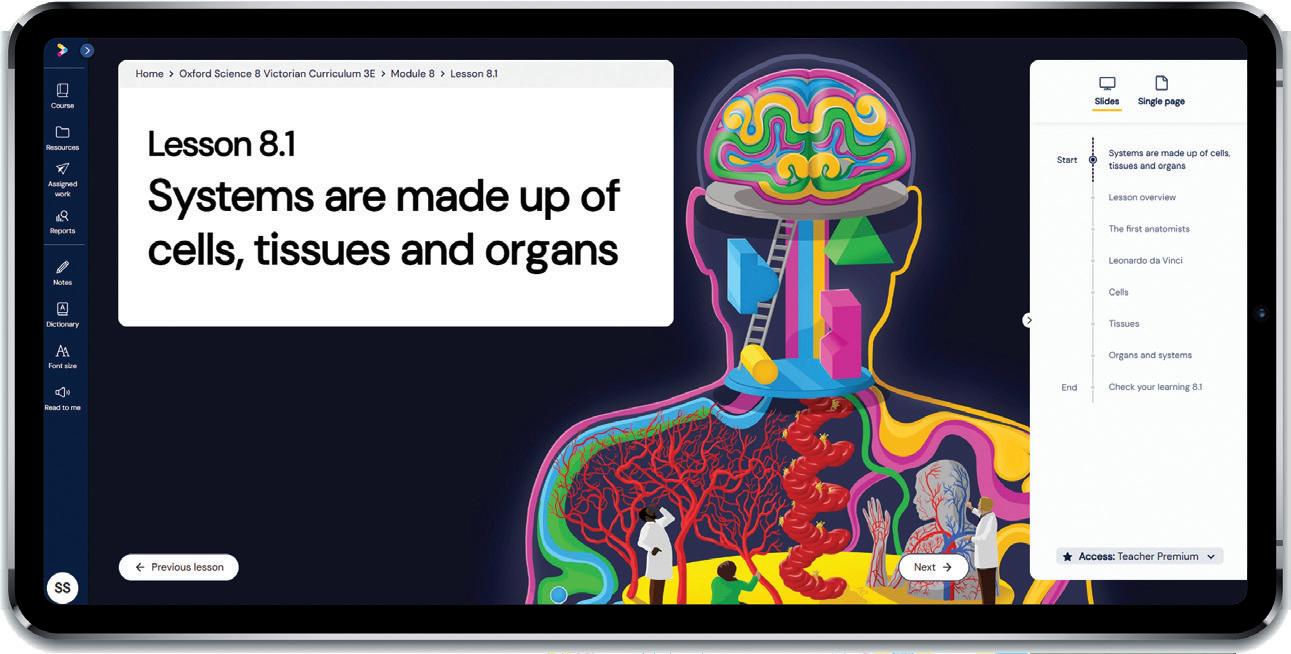
Oxford Digital has been designed in consultation with Australian teachers for Australian classrooms. The new platform delivers fully accessible, reflowable course content with videos, autoand teacher-marked activities, interactives and more embedded right where you need them. There’s also a range of unique features designed to improve learning outcomes.
DRAFT
As a student, you can:
> view all Student Book content in a fully accessible, reflowable format that’s delivered in bite-sized chunks so you c an work at your own pace
> use the “ Read to me” button to have any part of the course read aloud to you
> highlight, take notes, bookmark pages, or define words w ith the built-in Australian Oxford Dictionary
> watch hundreds of concise key content videos to help you revise anything you don’t understand, c atch up on things you’ve missed, or help you w ith your homework
> complete hundreds of interactive questions and quizzes as you work through the content and get the answers and results sent to you.
Oxford University Press
As a teacher, you can:
> elevate your teaching and reduce planning and preparation time with Live Lesson mode This is an Australian f irst that lets you upgrade from traditional print-based lesson plans to fully interactive, perfectly sequenced and timed interactive lessons complete with classroom activities that are ready to go
> personalise learning for every s tudent and differentiate content based on student s trengths and weaknesses. A ssign support or extension resources to any s tudent using a range of differentiation resources
> begin every lesson with ready-made learning intentions and success criteria
> revolutionise your planning, marking and reporting w ith powerful analytics on student performance and progress.
DRAFT
• As sessment report shows how s tudents are performing in each online interactive assessment, providing feedback for teachers about areas of understanding
• Curriculum report summarises s tudent performance against specific curriculum content descriptors and curriculum codes
For a complete overview of all the features and benefits of Oxford Digital:
> ac tivate your digital access (using the instructions on the inside front cover of this book) and click on “Introducing Ox ford Science 8 for Western Australia ( Third edition)” in the “About this course” menu.
Module
4 Energy DRAFT
Lessons in this module
Lesson 4.1 Energy can be transferred (page 154)
Lesson 4.2 Skills lab: Draw flow diagrams of energy transfer (page 158)
Lesson 4.3 Potential energy is stored energy (page 161)
Lesson 4.4 Experiment: What if the amount of elastic potential energy was increased? (page 164)
Lesson 4.5 Moving objects have kinetic energy (page 166)
Lesson 4.6 Heat can be transferred by convection, conduction and radiation (page 169)
Lesson 4.7 Experiment: Investigating heating by convection (page 175)
Lesson 4.13 Current can flow through series and parallel circuits (page 188)
Lesson 4.14 Challenge: Making series and parallel circuits (page 192)
Lesson 4.15 Voltage is the difference in energy per charge between two parts of a circuit (page 193)
Lesson 4.16 Experiment: Investigating Ohm’s law (page 196)
Lesson 4.17 Science in context: Renewable energy can be used to generate electricity (page 198)
Lesson 4.18 Review: Energy (page 204)
transferred describes energy that has moved from one object to another
Lesson 4.1 Energy can be transferred
Key ideas
→ Energy is the ability to do work meaning something can move and change.
→ Energy cannot be created or destroyed.
→ The transfer of energy describes when energy is passed from one object to another
Energy
DRAFT
For hundreds of years, scientists (and some mystics) have been developing theories about energy. While scientists like Nikola Tesla were able to control different forms of energy in the development of radios, electrical devices and X-ray photographs, mystics, such as Tesla’s friend Swami Vivekananda, collaborated to examine the links between the mass of an object and its energy.
All objects or groups of objects have energy (including moving objects, stretched objects and objects high off the ground). It is energy that gives objects the ability to change or move.
Energy cannot be created or destroyed. Instead, it is passed (transferred) from one object to another. It can sometimes be described as a property of an object or field.
Sometimes the energy will also change its form from one type to another when it is transferred. We will look at the different forms of energy in Lesson 4.3 Potential energy is stored energy (page 161), Lesson 4.5 Moving objects have kinetic energy (page 166) and Lesson 4.6 Heat can be transferred by convection, conduction and radiation (page 169).
The flow of energy
We have all felt the energy of the Sun on a hot day. It can warm anything left out in the Sun (Figure 1), including our skin.
Sun (light energy)
Playground slide (chemical energy)
Figure 1 The heat energy from the Sun can be transferred to playground equipment.
Plants are very efficient at absorbing the energy of the Sun. The energy is transferred from the Sun to the plant. This can be shown using a flow diagram where an arrow shows the direction of energy flow. The plant uses the energy to grow. Eventually, animals (including us) eat the plants and the energy is transferred to the animal (Figure 2).
We use the energy to function and carry out activities such as studying, riding a bike and walking (Figure 3). Our bodily functions and physical activity also produce heat that then warms the air around us (Figure 4).
Energy transfers for movement
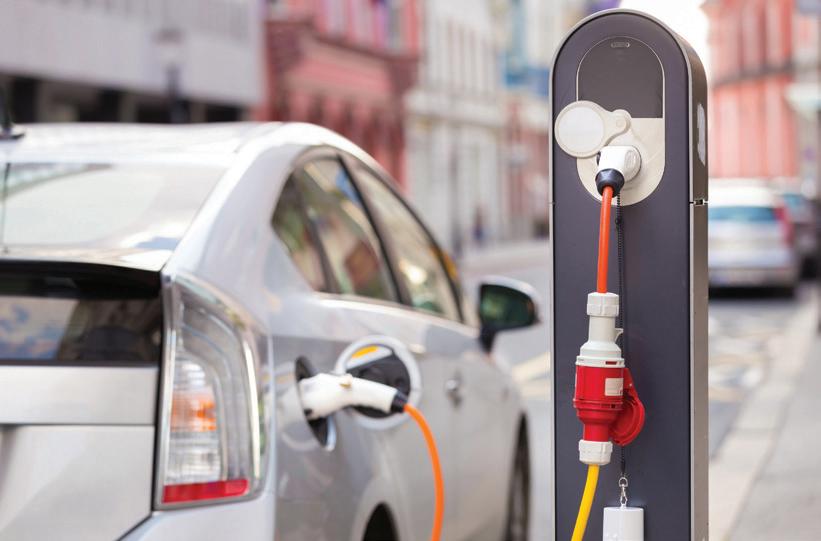
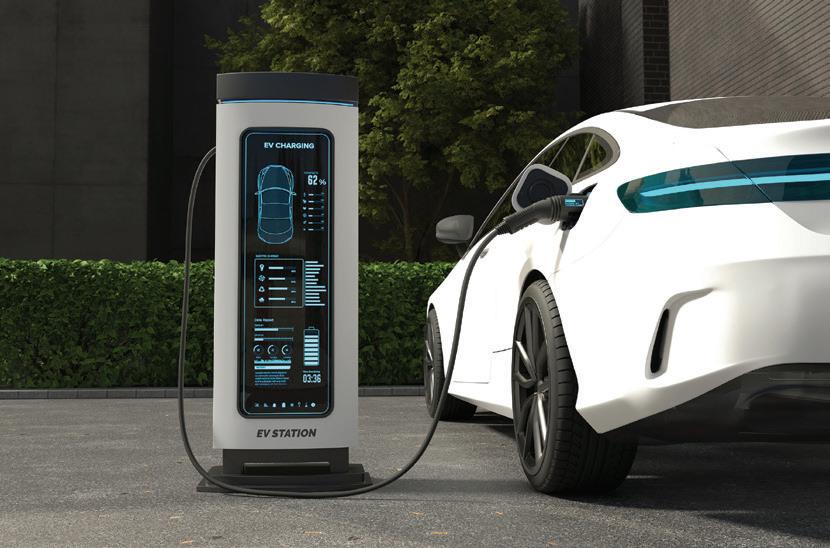
Electric cars are designed to transfer the energy stored in batteries, rather than petrol, to power an electric motor that makes the wheels turn (Figure 5). This transfer of energy can be shown using a flow diagram (Figure 6).
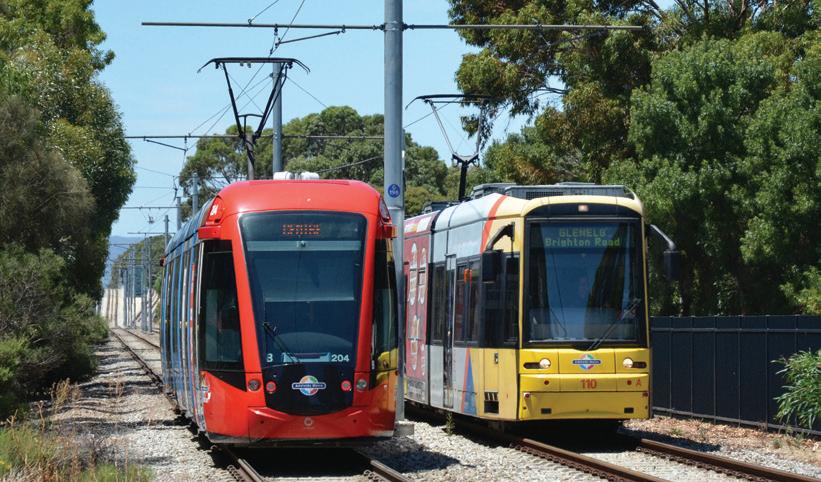
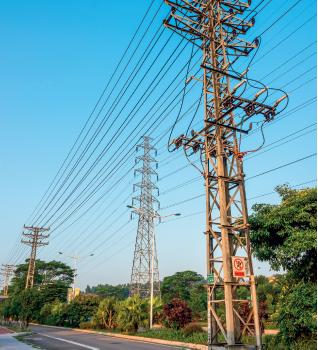
Public transport transfers energy too (Figure 7). Trams and metropolitan trains transfer the energy from overhead wires into the motor that makes the wheels move (Figure 8).
DRAFT
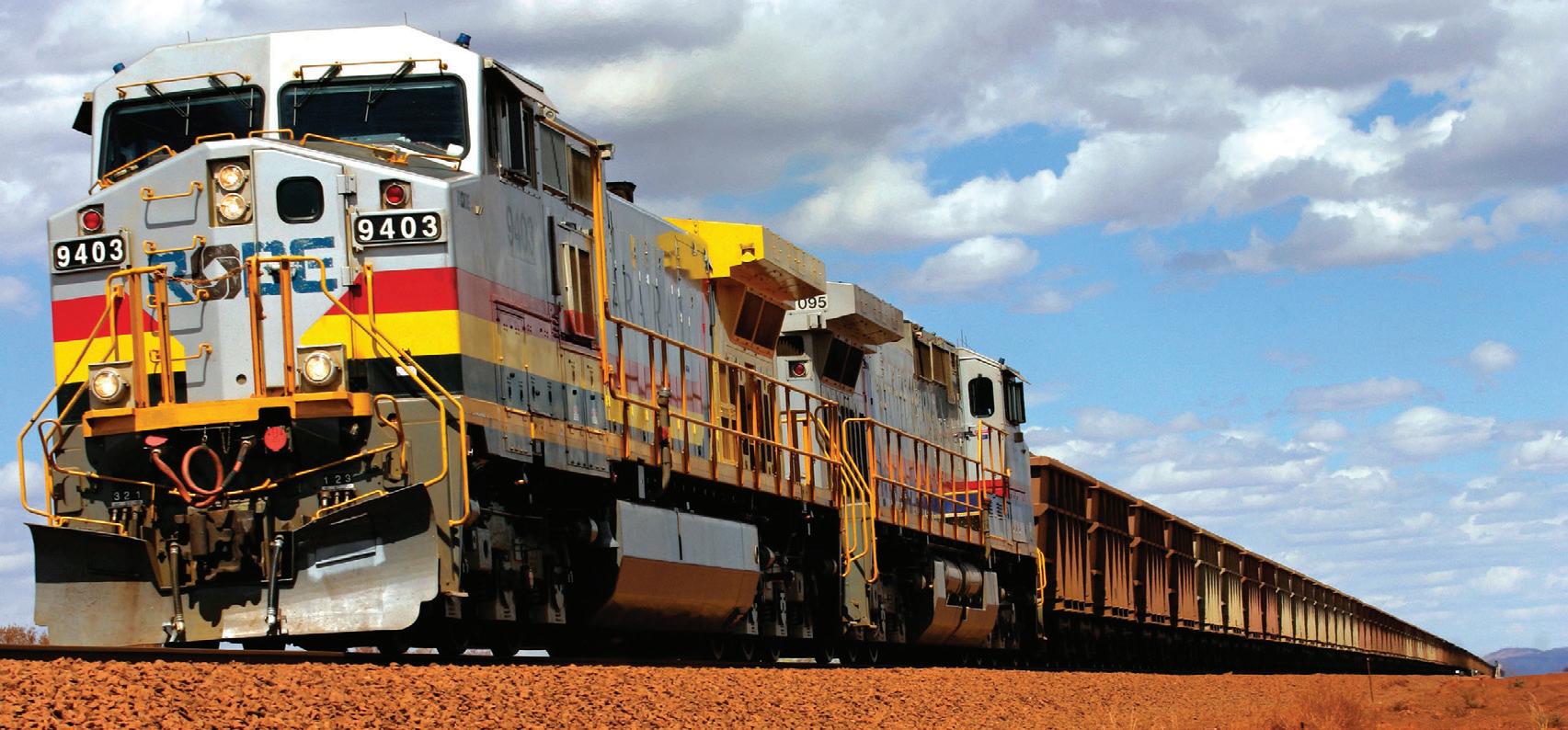
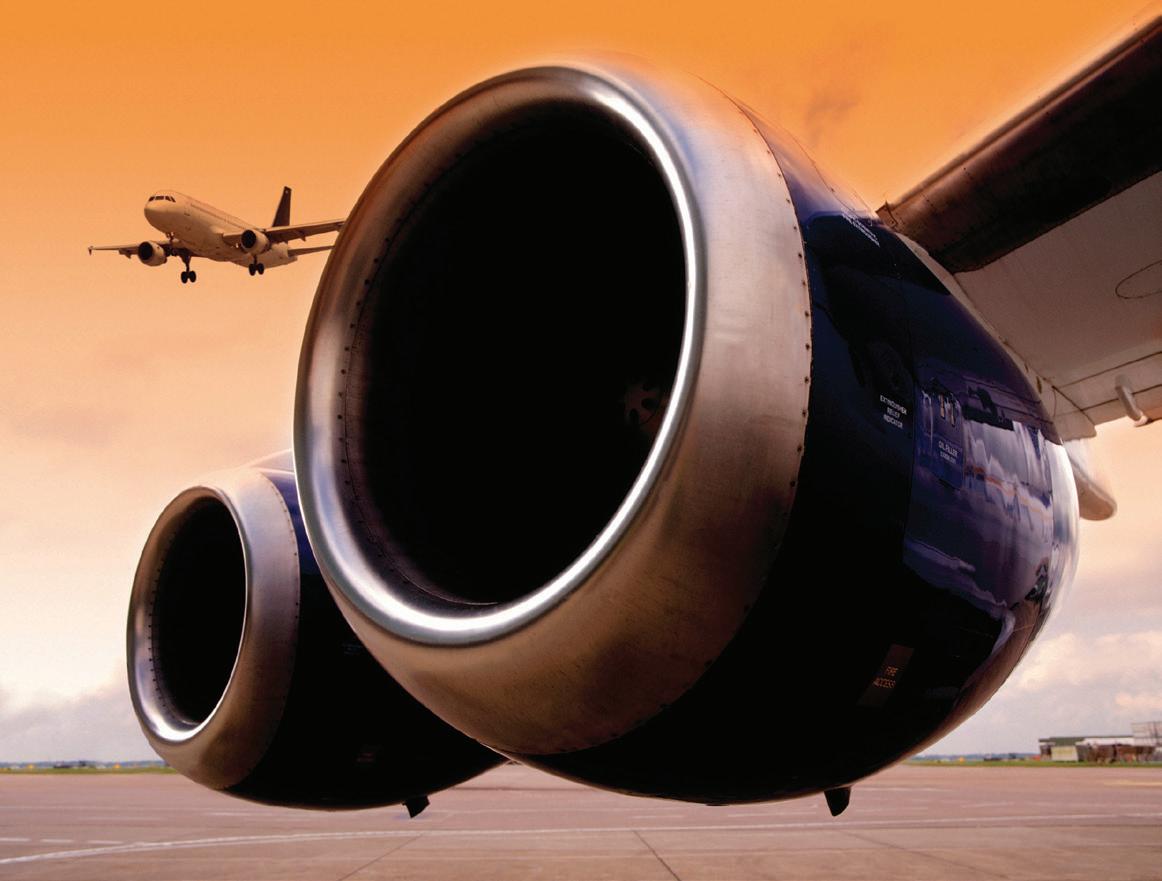
Trains that travel to country areas or interstate usually run on diesel fuel and don’t need overhead electrical wires (Figure 9). The engines in these trains burn diesel fuel, transferring the energy into wheel movement via the motors (Figure 10). Ships and planes (Figure 11) use a similar process in their engines.
Figure 2 We need the energy from plants to function.
Figure 3 We need energy to walk and carry things.
Figure 4 Heat energy can be transferred from us to the
Figure 5 Electric cars use an electric motor to send power to the wheels.
Figure 6 The energy stored in a battery is transferred to the wires, then to a car motor, and finally to the wheels of a car.
Figure 7 Powerlines provide electrical energy for public transport.
8 Energy in the wires transfers to the motor and then to the wheels of some trains.
9 Powerlines are not practical in rural areas, so diesel fuel is used.
DRAFT
11 Aircraft use higher-quality fuels than road transport vehicles to minimise weight and reduce wastage.
Wires (electrical energy)
Motor (kinetic energy)
Wheels (kinetic energy)
Figure
Figure
Diesel (chemical energy)
Motor (kinetic energy)
Wheels (kinetic energy)
Figure 10 The energy of the diesel fuel is transferred to the motor and then to the wheels of some trains.
Figure
Energy transfers for entertainment
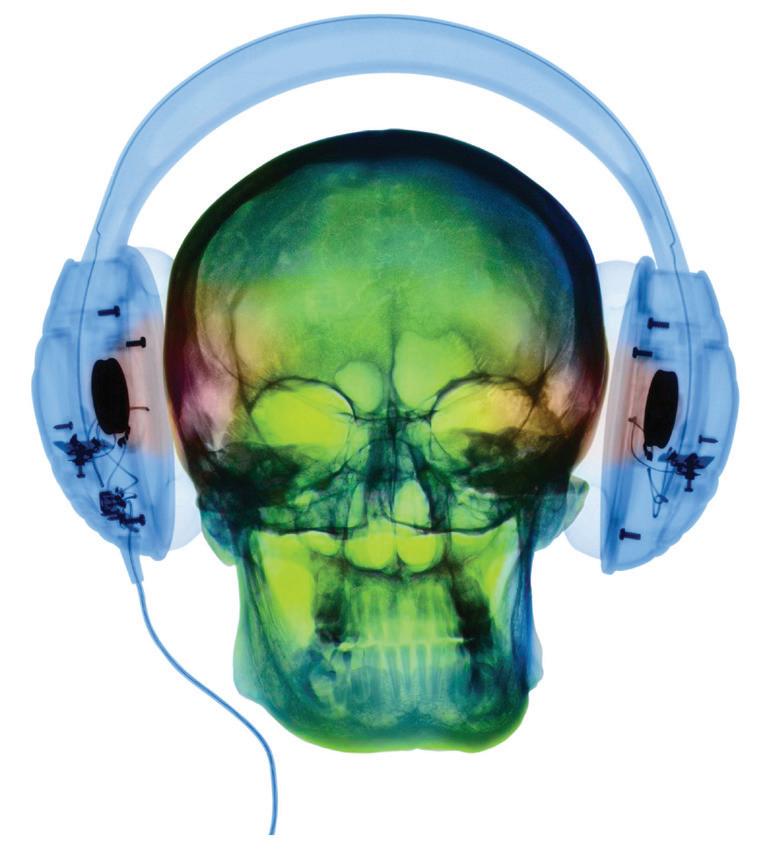
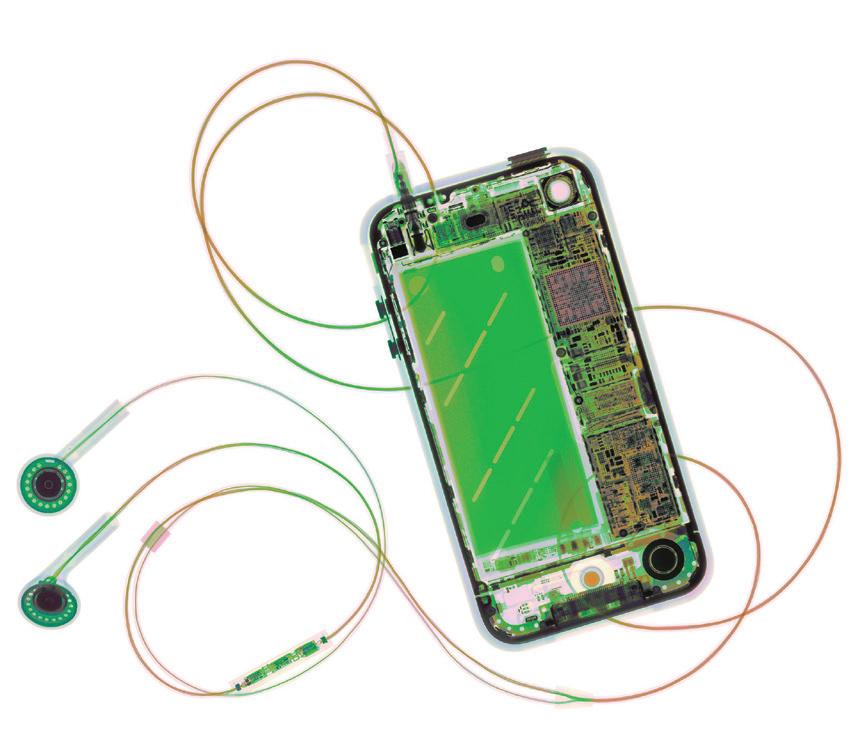
A mobile phone uses a speaker to produce the sound of a person’s voice or the various ring tones and beeps that the phone makes. Home phones use a speaker too, as do sound systems, headphones, radios and many other devices. They all transfer energy from a battery to the wires inside the speaker, then the energy is transferred to the speaker to make sound (Figure 12 and Figure 13).
A television remote control transfers energy from the device through the air as light energy, which transfers into the television set (Figure 14). In fact, most remote controls use infrared light, which is the invisible type of light usually associated with heat. The remote control sends a pulse of infrared light that represents a particular command, such as changing the channel or increasing the volume. An infrared light detector on the television receives the light signal and transfers it back into electrical energy, which then carries out the command (Figure 15).
DRAFT
remote control an electronic device used to operate a machine remotely (i.e. at a distance)
Figure 12 Headphones transfer energy in batteries to the wires and the speakers. The speakers transfer the energy to the air so we can hear the sound.
Figure 13 The internal components of a mobile device
Figure 14 A television remote control uses an infrared light-emitting diode (LED) to operate the television.
Battery Wires Light Television
Figure 15 Television remote controls transfer small amounts of energy to the television to carry out commands.
Check your learning 4.1
Check your learning 4.1
Retrieve
1 Define t he term “energy”.
Comprehend
2 Describe why the direction the arrows point i n a flow diagram is important.
3 Explain why country trains mostly use diesel fuel instead of electrical wires.
Analyse
4 Identify t he type of devices that the following energy flow diagrams could represent.
1 wi res → motor → air
2 battery → wires → light globe
3 food → muscles → bicycle
5 Create an energy flow diagram using Figure 16 and draw arrows to indicate the direction the energy flows between each object.
Apply
6 Determine t he ultimate source of all energy.
7 Sum marise the entertainment devices mentioned in this lesson and create flow diagrams showing the direction the energy is transferred between the different objects.
8 Diesel is a power source for many trains.
1 Create a flow diagram to show the energy changes that occur in the diesel engine of a train.
2 On ly about 30 per cent of the energy from the diesel is used to move the train. Suggest what happens to the rest of the energy.
3 Evaluate the law of conservation of energy that states “energy cannot be created or destroyed”. Does this mean the conservation energy law does not apply in this instance? Explain.
Lesson 4.2
Skills lab: Draw flow diagrams of energy transfer
Aim
To identify the transfer of energy between objects
What you need: Station 1:
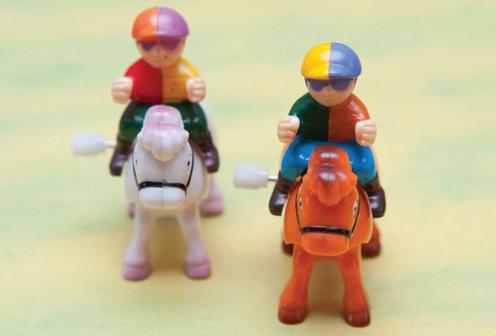
• A var iety of wind-up toys
Battery Wires Speakers or screen
Figure 16 Flow diagram
Station 2:
• Bat tery
• Small buzzer
• Wires Station 3:
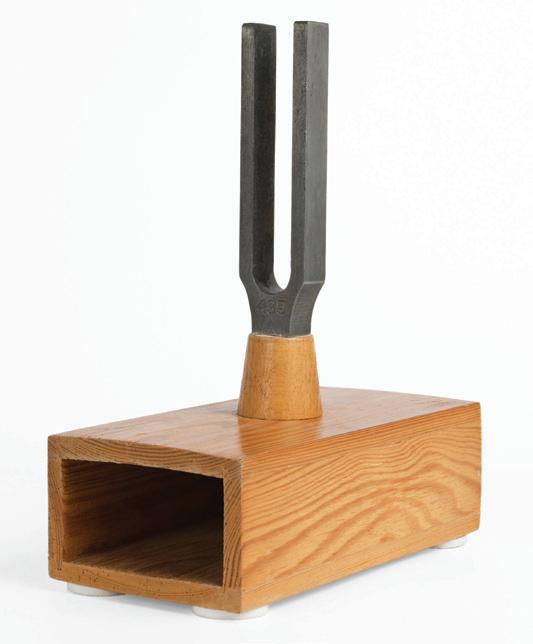
• Tun ing fork
Station 4:
• Plastic cup
• Water
• Tablespoon
• Sa lt
• Aluminium strip
• Copper strip
• 2 wi res
• Multimeter
Station 5:
• Plastic windmill
• Kettle
Station 6:
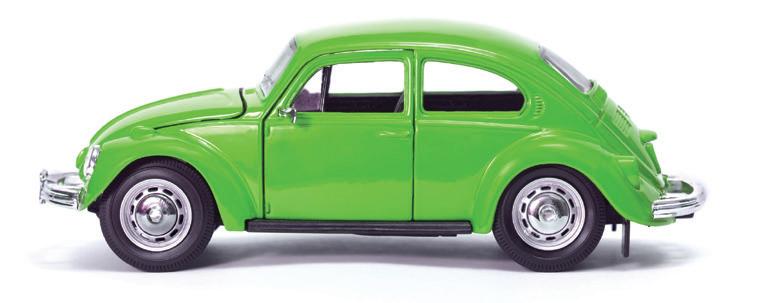
• Toy car
• Ra mp
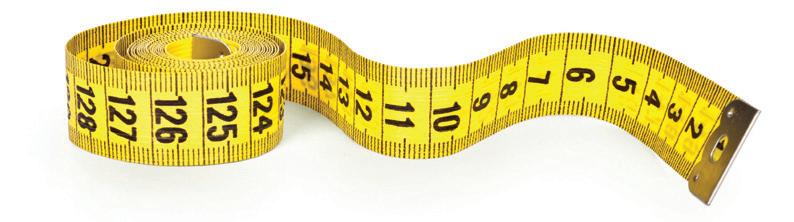
• Measuring tape
What to do:
Stations with different types of energy are spread around the room. Copy Table 1 into your notebook. Follow the steps below for each station and identify the object where you first see evidence of the energy (source), and the object where you last see the energy (output). Add the source and the output at each station to Table 1.
Station 1
1 Wind up the toys and watch them move.
Station 2
1 Connect the battery to a buzzer using wires.
2 Identify the source and output energy.
DRAFT
2 Identify the source and output energy.
Station 3
1 Gently tap the forked end of the tuning fork on a table. Sound is generated by vibrations.
2 Identify the source and output energy.
Station 4
1 Fill most of the cup with water.
2 Add 1 tablespoon of salt to the water.
3 Fold a strip of aluminium and a strip of copper over opposite sides of the cup so that one end is in the saltwater and the other end is on the outside of the cup.
4 At tach wires to the outside edges of the metal strips.
5 Connect the multimeter to the wires and adjust the multimeter so the voltage is measured.
Figure 1 What path does the energy take as it is transferred through the wind-up toys?
Figure 2 Use wires to connect the buzzer to the battery.
Figure 3 Where does the sound energy come from or transfer from?
6 Record the voltage generated by your chemical battery.
7 Identify the source and output energy.
Station 6
1 Set up the ramp so that the top end is 10 cm above the ground.
2 Place the car at the top of the ramp.
3 Al low the car to roll down the ramp and along the floor.
4 Measure how far the car rolled.
5 Identify the source and output energy.
6 Describe how you could increase this output energy.
Station 5
1 Blow on the plastic windmill.
2 Identify the source and output energy.
3 Hold the plastic windmill over a boiling kettle while being careful not to burn yourself with the steam. Hold your hand as far away as possible from the steam. Ensure there is plenty of water in the kettle so it doesn’t boil dry.
4 Identify the source and output energy.
DRAFT
Figure 4 Connect the saltwater battery to a multimeter.
Figure 5 A plastic windmill
Figure 6 A toy windmill acts like an electricity-generating turbine.
Figure 7 A toy car at a standstill
Figure 8 Tape measure Ramp
Figure 9 What path does the energy take as the car moves down the ramp?
Results
Copy Table 1 and use it to record your results.
Table 1 Energy transfer
Questions
1 Describe what is meant by “energy transfer”.
2 Identify which stations had energy transfer from one object to another.
3 Create an energy flow diagram for each station.
4 Describe the original energy source for all of the stations and all objects on Earth.
Lesson 4.3
Potential energy is stored energy
Key ideas
→ An object that has the potential (future ability) to do work has potential energy.
→ Elastic potential energy is stored when an elastic object is deformed.
→ Gravitational potential energy is stored when an object is lifted away from Earth‘s surface.
→ Chemical potential energy is the energy stored when atoms are bonded to each other.
→ Nuclear potential energy is the energy stored inside the centre of an atom.
DRAFT
Potential energy
Some objects can store energy. This type of stored energy is called potential energy There are many different ways energy can be stored. This allows it to be released or transferred at a later time.
Elastic potential energy
A trampoline has the ability to “store” energy, or hold it, for later use or if things change. The springs and the mat of the trampoline stretch under our weight and
Learning intentions and success criteria
potential energy energy that is stored in an object due to its properties, position and the forces acting on it
elastic potential energy the energy possessed by stretched or compressed objects
hold this stored energy. The more the trampoline springs and mat stretch, the more energy they hold. The energy is returned to our bodies when the springs and mat return to their normal position and throw us into the air. Energy that is stored through stretching or squashing is called elastic potential energy (Figure 1).
Gravitational potential energy
gravitational potential energy the energy possessed by an object raised to a height in a gravitational field
DRAFT
If we lift an object to a height, it gains energy in a gravitational field (Figure 2). This type of energy is called gravitational potential energy.
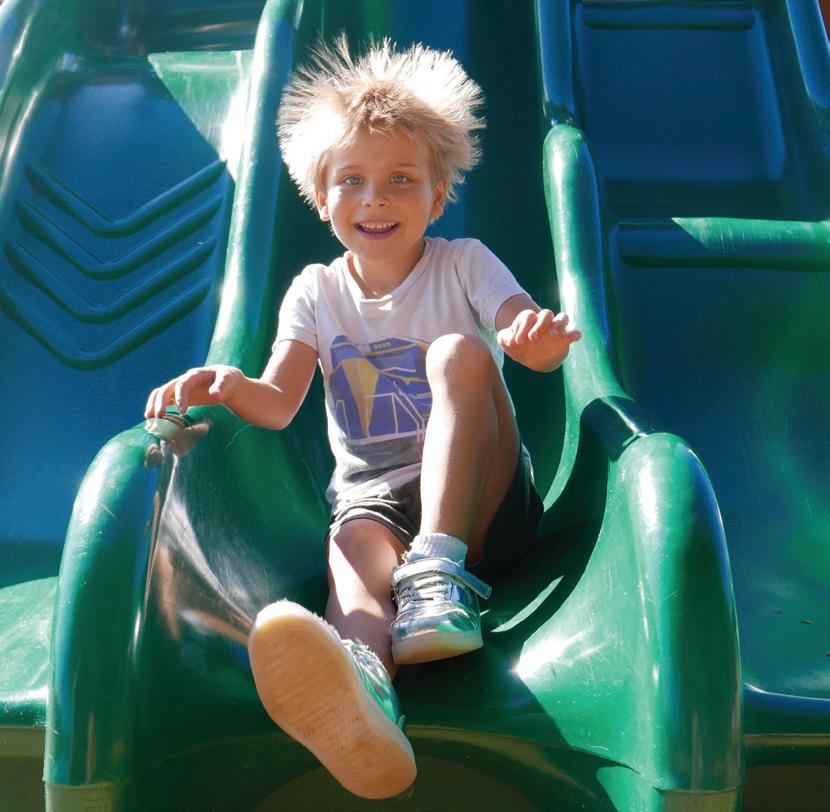
The larger the mass and the larger the height, the more gravitational potential energy the object gains. Have you ever noticed that falling a greater distance produces a greater “thud” and can hurt more? This is because of the amount of gravitational potential energy. As an object falls, the object’s gravitational potential energy can be transformed into other forms of energy. This happens when a person plays on a slide at the playground. The higher they climb, the more gravitational potential energy they get. When they slide down, the gravitational potential energy decreases. The person gains movement energy. They may also feel the friction of the slide as heat or even as a zap of static electrical energy (Figure 3).
Figure 1
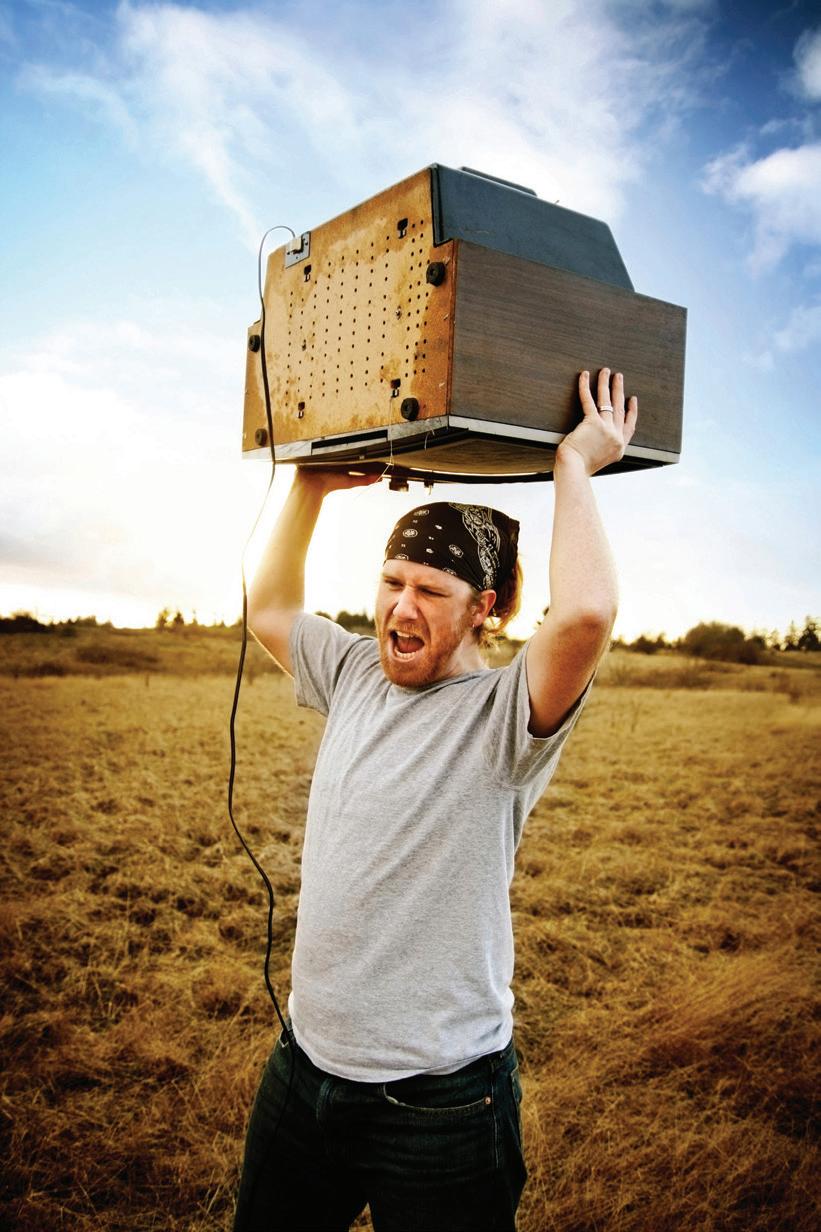
Figure 2 This television has gravitational potential energy when raised above the ground.
Figure 3 Plastic slides are great at zapping us with static electricity, although it depends on the weather and the clothes we wear.
Chemical potential energy
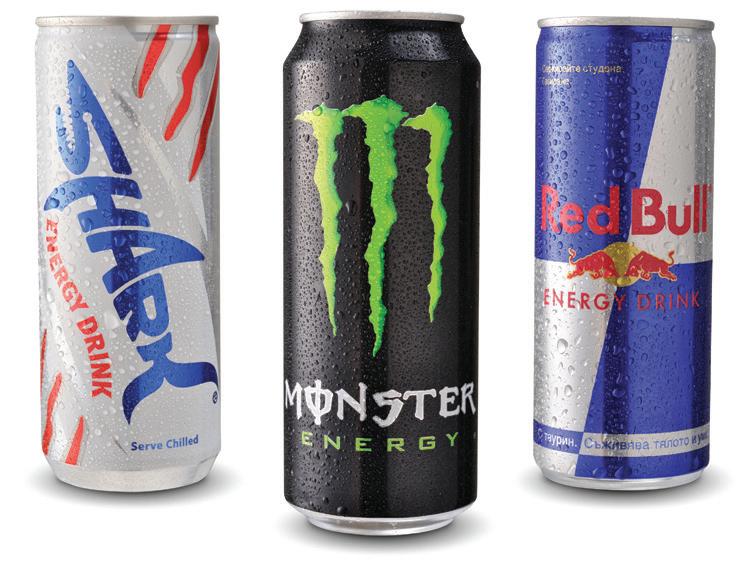
After we have done a lot of exercise, we often crave foods that we believe will restore our energy levels. These foods, like everything on Earth, are made up of chemical molecules. Energy is often used to produce large chemical molecules like sugar. The energy is released when the large chemical molecules are broken down into smaller molecules. When we eat or drink high-energy foods, the breakdown of the usually sweet things, releases stored chemical energy quickly (Figure 4).
The energy stored in chemical molecules is called chemical potential energy.
Fuels, such as natural gas and petrol, provide us with energy too. A Bunsen burner uses the burning of natural gas to provide heat for laboratory experiments. Petrol has chemical energy stored in it, as do explosives and batteries.
These devices all contain chemical potential energy that can be released when we need it. Some batteries can be recharged because the chemical potential energy can be replaced.
Nuclear energy
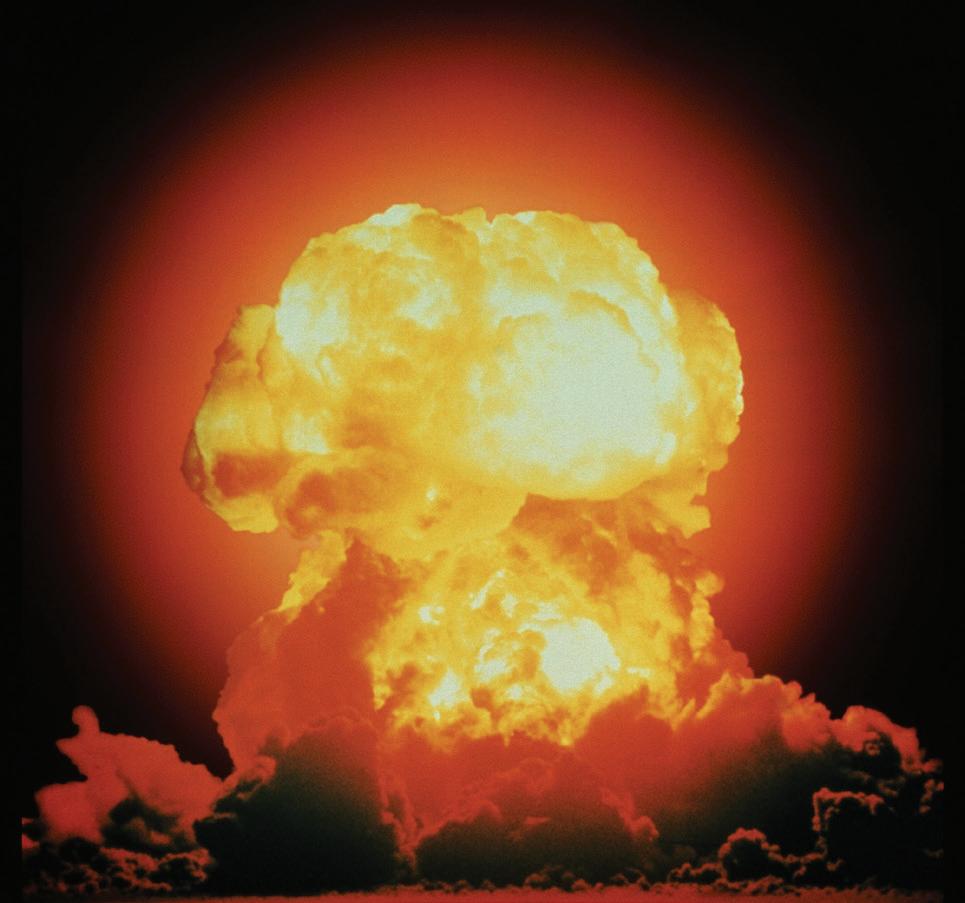
Although nuclear energy is used throughout the world, it is not used in Australia. Nuclear energy involves the reaction in the nucleus, or centre, of atoms. When atoms react in chemical reactions, they usually release only small amounts of energy. However, if the centres (nuclei) of those atoms can be made to react, the amount of energy released is much, much larger. In fact, the amount of energy released is so huge that it can cause massive amounts of destruction (Figure 5).
chemical potential energy energy stored in chemicals, e.g. in food, fuel or explosives; also known as chemical energy
nuclear energy energy stored in the nucleus of an atom and released in nuclear reactors or explosions of nuclear weapons; much greater than the chemical energy released in chemical reactions
Figure 4 Energy drinks contain chemical potential energy.
Figure 5 The energy released from a nuclear explosion is much, much greater than that from other types of explosions.
Check your learning 4.3
Check your learning 4.3
Retrieve
1 Define t he term “potential energy”.
2 Identify four examples of devices or situations that involve potential energy.
3 Recall the type of energy that is stored in a battery.
4 We get our energy from the chemicals in food. Identify the type of energy found in food.
Comprehend
5 Biofuel is an alternative source of energy that comes from burning organic matter to release the energy stored in plants. Identify the type of potential energy released in biofuel.
6 Identify four devices, other than those mentioned already, that can be given elastic potential energy.
Lesson
Aim
To investigate how elastic potential energy can be used to power a boat Materials
• Waxed cardboard (fruit boxes work well)
• Sc issors
DRAFT
• Rubber band
• Butterfly pins
• Water bath or swimming pool
• Measuring tape
7 Describe how a person might use a bow to shoot an arrow. Identify the type of potential energy used in this process.
Method
1 Cut out the waxed cardboard to match the d iagram in Figure 1.
2 Put the rubber band around the propeller.
3 At tach the propeller to the boat using butterfly pins.
4 Wi nd the propeller anti-clockwise (when viewed from the right side of the boat), place the boat in the water and release it.
5 Measure how far the boat travels.
Inquiry: What if more elastic potential energy was stored in the rubber band propeller?
Plan and conduct an experiment that answers the inquiry question.
1 Develop a prediction or hypothesis for your inquiry.
2 Identify the (independent) variable that you will change from the first method.
3 Identify the (dependent) variable that you will measure and/or observe.
4 Identify two variables that you will need to control to ensure a reproducible test.
Describe how you will control these variables.
5 Develop a method for your experiment. Write this method in your logbook.
6 Copy Table 1 into your logbook to record your results.
7 Show your teacher your planning for approval before starting your experiment.
Results
1 Complete Table 1.
2 Construct a line graph showing the effect of increasing the elastic potential energy of the propeller on the distance the boat travelled.
Figure 1 The parts and method of assembly for a rubber band boat.
Table 1 Potential energy experiment
Discussion
1 Identify t he type of data as either qualitative or quantitative. Justify your answer (by defining each term and comparing it to your data).
2 Explain why you made three attempts at each propeller rotation to determine the average distance travelled.
3 Identify the type of energy that the elastic potential energy was transformed into.
4 Your hands provided the energy to wind t he propeller. Describe where this energy came from.
Conclusion
Describe the relationship between the potential energy given to the propeller and the distance the boat moved.
DRAFT
Lesson 4.5
Moving objects have kinetic energy
Key ideas
→ Kinetic energy is the energy found in a moving object.
→ Moving heavy objects have more kinetic energy than moving light objects when they move at the same speed.
→ The faster an object moves, the more kinetic energy it has.
→ Kinetic energy can be converted to light, electrical, thermal and sound energy.
Kinetic energy
Kinetic energy is the energy of movement. Whenever objects or people move, they have kinetic energy (Figure 1). It takes energy to force an object such as a car to start moving. Once it is moving, the energy has passed to the car. It is this energy that is called kinetic energy. The faster the object is moving, or the more mass the object has, the greater the kinetic energy. Even objects too small to be seen can have kinetic energy.
kinetic energy the energy possessed by moving objects
Learning intentions and success criteria
Figure 1 Kinetic energy is the energy of movement.
Light energy
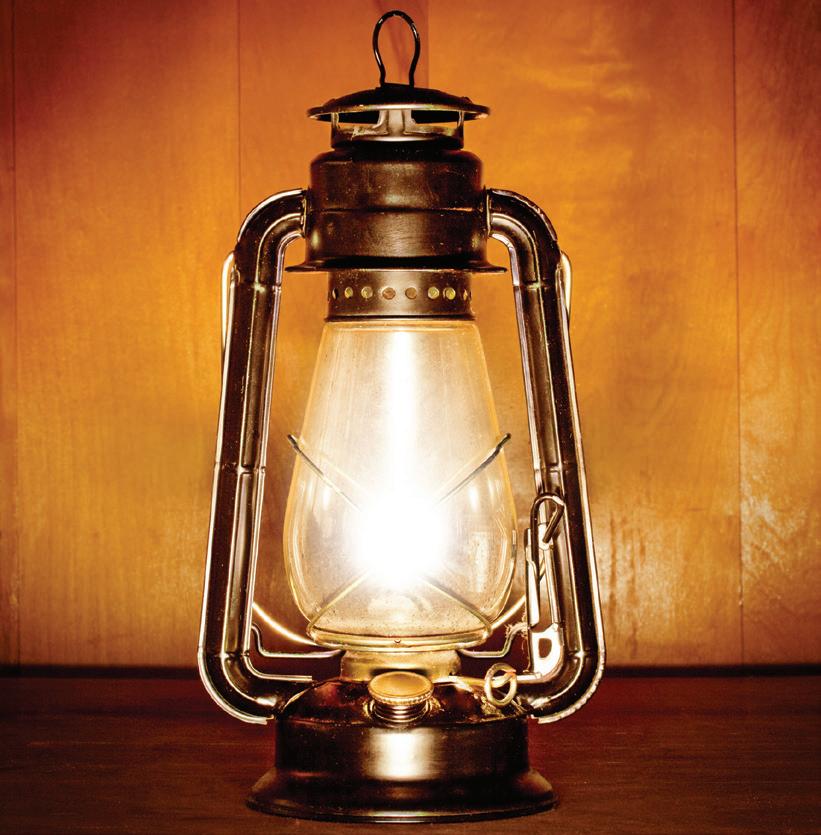
Light energy is essential to our lives, and people have invented lots of devices to help us see in the dark, including oil, kerosene and gas lamps (Figure 2). If two rocks are hit with one another, a spark is created. All the kinetic energy in the rocks is pushed from one to another at the point of impact. The conversion of kinetic energy to light energy occurs in a light globe when electrons move from a power source to the filament to emit light. The humble electric light globe revolutionalised the world and lead to easily portable light sources such as torches. But the best source of light is, of course, the Sun.
Light energy is one type of energy that our eyes can usually detect. It moves in small packets of energy called photons. The study of light energy is known as optics. There are many different forms of light energy and each form is a type of electromagnetic radiation that exists as part of the electromagnetic spectrum. The colours (red, orange, yellow, green, blue and violet) that we perceive with our eyes makes up a small portion of the electromagnetic spectrum called the visible spectrum. Other forms of light that exist outside of the visible spectrum such as ultraviolet light (UV), microwaves and X-rays cannot be seen with the naked eye.
Life is able to exist on Earth as our atmosphere blocks out harmful concentrations of UV, X-rays and gamma rays emitted by the Sun, while also dispersing the correct amounts of different light forms needed to sustain life. Plants rely on the light and heat from the Sun to make their own food, and the plants provide food for animals.
We are now trying to capture light energy as efficiently as plants do. The relatively recent invention of solar cells to turn light from the Sun directly into electricity is now used to power many devices, such as calculators, street lights and even cars.
Heat energy
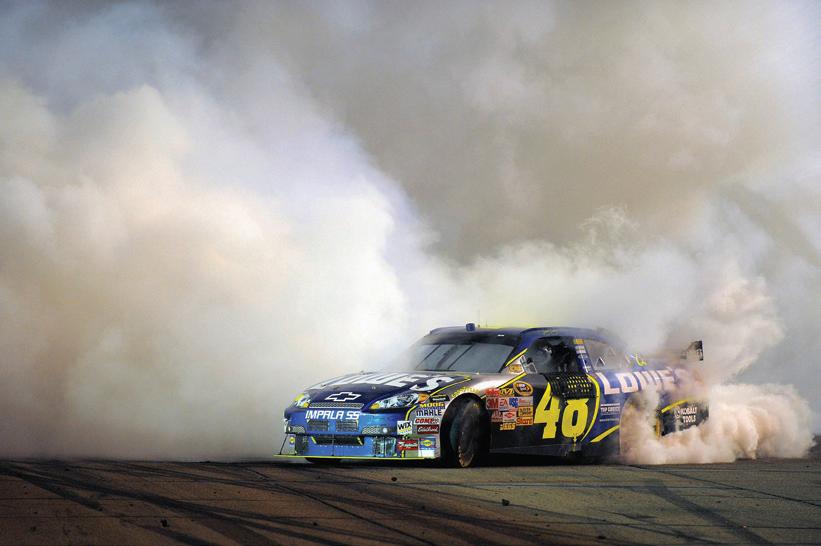
Thermal energy is energy associated with the random movement of particles of matter that make up an object. It is directly related to temperature, which is a measure of the average kinetic energy of particles of matter in an object or system. When something increases in temperature, its particles move faster and generate more thermal energy. Heat is the transfer of thermal energy from a hotter object to a colder object. For example, when you touch an ice cube it feels cool because thermal energy is being transferred away from your hands to the ice cube. Heat can be generated by friction, such as by rubbing your hands together or by the movement of a car’s tyres on the road (Figure 3). It is also commonly generated by burning chemicals or by electrical devices.
DRAFT
cell a device that transforms sunlight directly into electrical energy; is usually in the form of a panel; also known as a solar panel thermal energy the scientific term for heat energy
solar
Figure 2 Kerosene lamps were used for many years before the invention of electricity.
Figure 3 The heat of a ‘burn-out’ creates great clouds of smoke.
Electrical energy
All substances are made up of positive and negative electric charges that, when separated, have electrical energy. This means that they are in a state of excitement and are trying to get back together again. If the positive and negative charges are locked together in one area, such as a wire, the separated charges can easily move back together. As they try to connect, the electrical energy they had when separated gets changed into light, heat or movement that we see in electrical lights, heaters or motors.
Sound energy
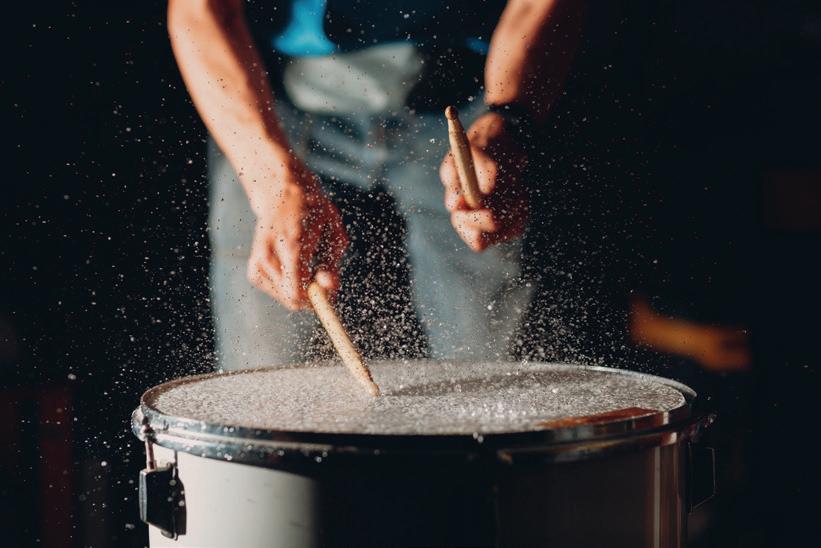
Have you been at a very loud concert and stood near the huge speakers? If so, you will remember that you not only heard the deep bass sound, but also felt it in your body. You can feel the same vibrations in the car if you put your hand on the dashboard when the sound system is on full volume. Sound is made when things vibrate. Every time you make a sound – whether it be playing a musical instrument or speaking or singing or even whispering – you are making vibrations (Figure 4). Vibrations are simply tiny movements back and forth. Vibrations can occur in gases, liquids and solid things, such as speakers. Energy is needed to make sound. For example, unless a drummer uses energy to hit the drums, the drum skin will not start to vibrate and will not make a sound. So, do you think sound energy is a type of kinetic energy? electrical energy
1 Recall t he scientific term for “movement
2 Identify what is moving in electrical energy.
DRAFT
3 Identify what is moving when a guitar produces sound energy.
4 Recall another name for heat energy.
5 Describe how solar cells are used in the transfer of energy.
6 Create a diagram to show the various forms of energy you can find in a whistling kettle of boiling water.
7 Identify t he features of a car that would absorb the driver’s kinetic energy in a collision.
8 Compare (the similarities and differences between) kinetic energy and potential energy.
Figure 4 Musical instruments use kinetic energy to produce sound.
Lesson 4.6
Heat can be transferred by convection, conduction and radiation
Key ideas
→ The energy from heat moves spontaneously from a hot material to a cool material.
→ Conduction occurs when the kinetic energy of particles is transferred.
→ Convection occurs when particles with high kinetic energy moves to another space.
→ Radiation occurs when particles or waves with kinetic energy are transmitted or radiated through space.
Heat transfer
In the earlier lessons, we have seen how energy can be transferred from one substance to another. The way the energy is transferred can vary depending on the type of energy that is being transferred. The transfer of energy can be modelled using wave or particle models to explain the movement of energy. Throughout this lesson, we will look at the different ways that heat can be transferred.
Modelling thermal energy
The particle model suggests that all things are made up of particles of atoms or molecules that have kinetic (movement) energy. Solid objects have vibrating particles that are bonded closely together. If thermal energy is added to a solid object, the particles start vibrating faster until they can move around one another. This increase of energy and movement turns the solid into a liquid. If more energy is added to the liquid, particles will start moving faster until they are able to break free and move freely as a gas (Figure 1).
DRAFT
When modelling thermal energy, it is important to consider the movement of the heat. Cold objects have less thermal energy and hot objects have more thermal energy.
Learning intentions and success criteria
Figure 1 Increasing or decreasing thermal energy can change the movement of particles and the state of an object.
conduction the transfer of thermal energy from hot objects to cooler objects by direct contact with no movement of material
Heating by conduction
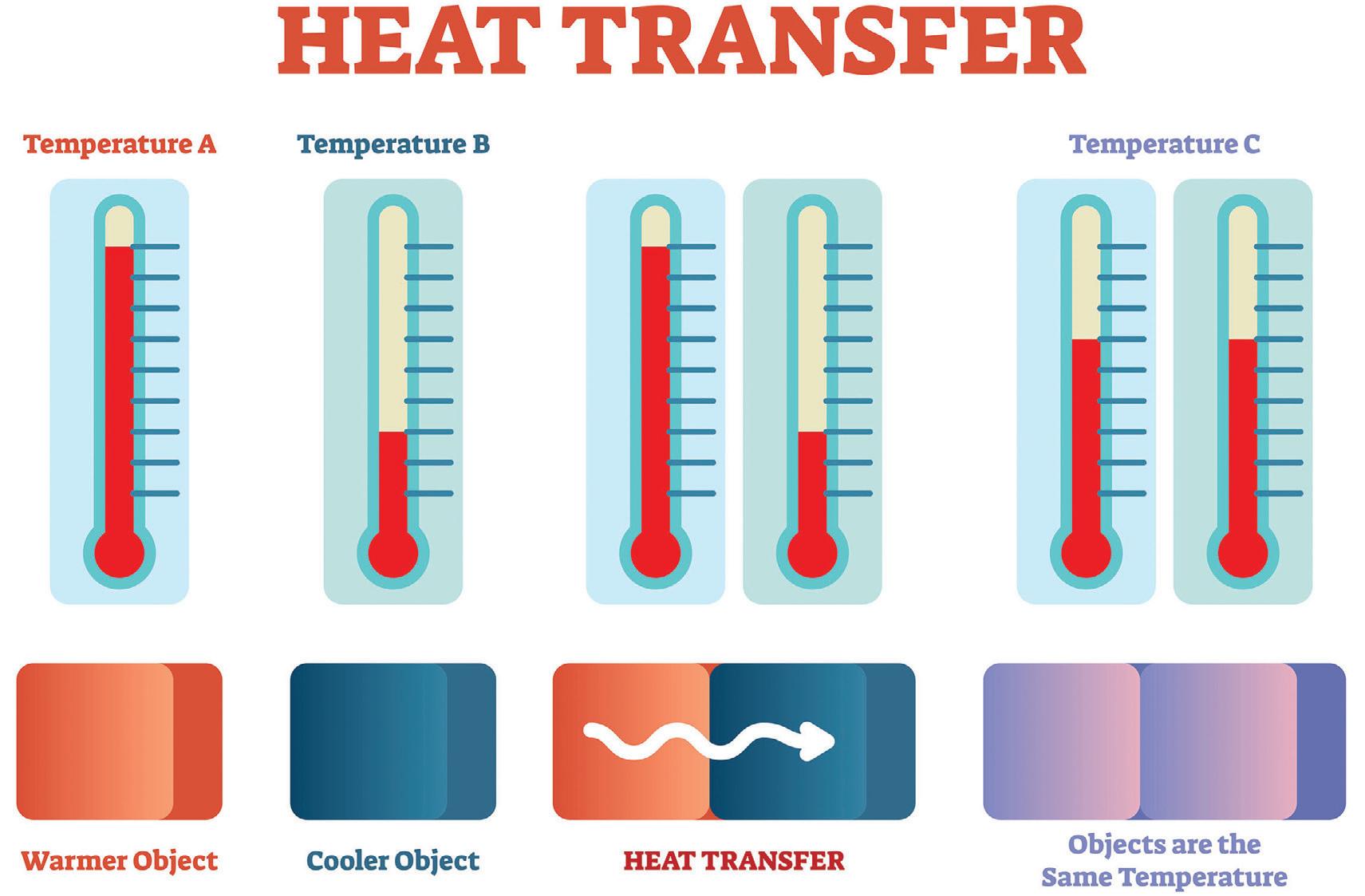
Heating an object by conduction involves the transfer of thermal energy between two objects that are in contact with each other. The energy is transferred from an object with high thermal energy to an object with low thermal energy (from hot objects to cooler objects) (Figure 2).
DRAFT
Figure 2 Thermal energy is transferred from an object of high thermal energy to an object with low thermal energy.
This continues until the two objects are the same temperature (i.e. they have equal amounts of thermal energy).
Consider what happens when we heat a saucepan of water on a gas burner.
1 When the gas burns, thermal energy is released.
2 The hot molecules in the gas flame move quickly and occasionally bump into atoms of the relatively cold metal of the saucepan.
3 Ki netic energy passes to the slowly vibrating atoms in the saucepan so that they vibrate faster.
4 The quickly vibrating atoms in the saucepan bump into other nearby metal atoms, transferring thermal kinetic energy to them. This heats the saucepan.
5 When the saucepan heats up, the thermal kinetic energy is transferred to the water inside it.
Although the thermal energy moves through the metal of the saucepan and into the water, the atoms in the metal do not change their positions – metal atoms do not move into the water.
Conductors and insulators
A thermal conductor is any material that allows thermal energy to flow easily through it. All metals are conductors of thermal energy, although some are better conductors than others. Thermal insulators are materials that slow down the transfer of thermal energy because the molecules don’t allow the thermal kinetic energy to flow very easily (Figure 3). Insulators such as socks, jumpers and blankets keep us warm in cold weather. They make it difficult for our “body heat” to escape, insulating us against the cold. Insulation in the roof and walls of a house prevents heat gain and loss during summer and winter. Insulation can hold thermal energy in or keep it out.
You can test the thermal conductivity of the different materials around you. If you put your hand on a metal object, it will feel cold to touch. This is because the metal conducts heat away from your hand, making it feel cold. If you touch a wood object, it will feel warmer than the metal object. In reality, both objects will be exactly the same temperature, but the wood acts like a thermal insulator, preventing the thermal energy from being conducted away from your hand. Because your hand is not losing heat, it will feel warm.
Figure 3 Vacuum flasks are designed to keep hot substances hot, and cold substances cold. To do this they must prevent the contents from losing or gaining heat – conduction and convection must be minimised. Careful choice of insulating materials and clever design make this possible.
a The plastic stopper is an insulator – it prevents heat loss or gain through convection and conduction.
b The glass walls are insulators – they prevent heat loss or gain through conduction.
c The vacuum between the walls is an insulator – it prevents heat loss or gain through conduction and convection.
d The silvered wall reflects heat – it prevents heat loss by radiation.
thermal conductor a material that allows thermal energy to flow through thermal insulator a material that prevents or slows down the transfer of thermal energy
DRAFT
Heating by convection
The particles in liquid and gas materials are able to move more freely than in solid objects. In these materials, thermal energy moves by convection. As the particles gain thermal kinetic energy, they are able to move away from the heat source. Tiny currents, called convection currents, carry the particles and their thermal energy across the liquid or gas until the heat is evenly spread.
convection the transfer of thermal energy by the movement of molecules in air or liquid from one place to another convection current the current or flow of air or liquid that results from the transfer of thermal energy through convection
Silvered wall Vacuum
radiation energy that travels from one place to another in the form of waves or particles electromagnetic radiation electric and magnetic forces or effects produced by an electric current infrared rays a type of electromagnetic radiation that is felt as heat ultraviolet ray a type of electromagnetic radiation that has high energy due to its shorter wavelengths
When we heat a saucepan of water on a gas flame, the following occurs.
1 Thermal energy transfers by conduction from the hot saucepan to the water molecules that are touching the metal.
2 The water molecules in contact with the metal gain kinetic energy and move faster than the molecules in the water above. Because they are moving faster, they take up more space. They are less dense.
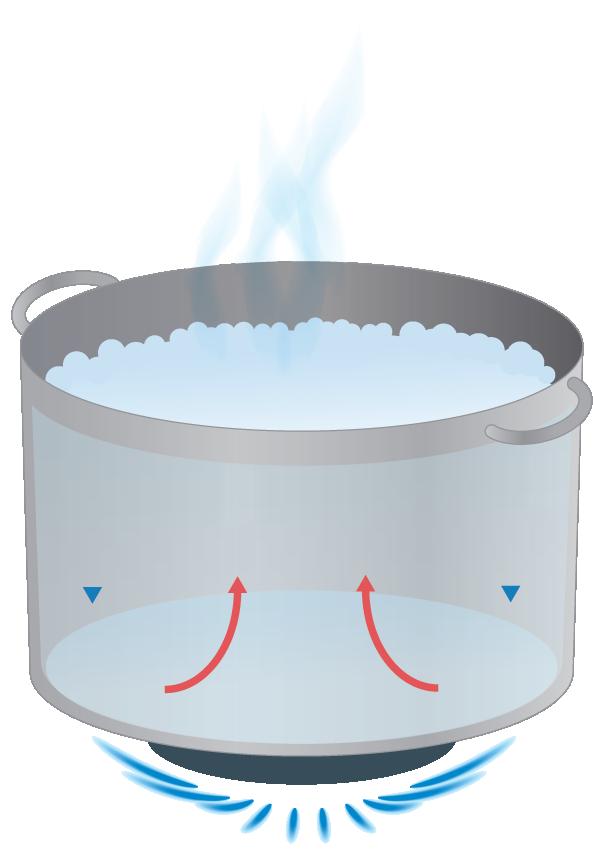
3 As a result, the heated (less dense) water molecules near the bottom of the saucepan begin to rise, leaving room for the cooler (more dense) water molecules to take their place (Figure 4).
4 The heated water molecules take thermal energy with them as they move.
We heat liquids from below because most of the energy transfer in liquids (and gases) takes place by convection. This process happens in the air. The Sun heats the ground and the warmed ground then heats the air next to it by conduction. The warmed air, being less dense than the cooler air above, rises, taking the thermal energy with it. This distributes the energy through a much deeper layer of air than could occur just by conduction from the ground. This process of convection in the air is what drives the weather on Earth.
Heating by radiation
DRAFT
4 The pot conducts the heat from the flame to the water. Convection currents are created in a saucepan of water when it is heated. The heated water molecules (shown in red) rise while the cooler ones (shown in blue) sink.
Heating by radiation or thermal radiation occurs when energy in the form of electromagnetic radiation is released by a heated surface. This energy radiates in all directions and travels at the speed of light directly to the point where it is absorbed. Radiation does not require a medium to travel through. Thermal radiation ranges in wavelength from the longest infrared rays to the shortest ultraviolet rays in the electromagnetic spectrum (Figure 5).
Cool molecules Cool molecules
Warm molecules
Warm molecules
Figure
The rate at which an object radiates or absorbs thermal radiation depends on the properties and temperature of the object’s surface. Objects that are good emitters are also good absorbers. For example, dark-coloured surfaces emit and absorb more radiant energy than light-coloured surfaces. A surface that absorbs all the radiant energy that comes into contact with it is called a blackbody. A blackbody does not reflect any light or allow any light to pass through it.
The heating of Earth by the Sun is an example of the transfer of energy by radiation (Figure 6). When we stand in sunlight on a chilly winter day, we can feel the radiant heat although the air temperature is very low. Or when we open the refrigerator door on a hot summer day, we can feel radiant heat loss to the inside of the fridge.
Radiant heat is the transfer of heat from a hot surface, and we see various examples in a house. For example, we might use an open-hearth fireplace to warm up our room and ourselves. Other producers of radiant heat in the house include radiant cooktops and some electric heaters. There are even home heating systems that work by heating surfaces such as walls or bathroom floors to then radiate heat to spaces in the house. Different varieties of radiant heating systems include electric, hydronic and air (Figure 7).
DRAFT
Figure 6 Heating by radiation is able to work in the vacuum of space as it does not involve particles. It is how we feel the warmth from the Sun on Earth.
Figure 7 A comparison of radiant heat through air heating and hydronic radiant heating in a house.
• Electric radiant heating systems pass an electric current through wires or coils to produce heat.
• Hydronic radiant heating systems boil and pump hot water into piping underneath the floor. This method is considered highly energy efficient as it is often the only heating system for the entire house.
• Ai r radiant heating systems pass warm air from ducts in the ground which then radiates through the room, but this method is the least efficient.
Check your learning 4.6
Check your learning 4.6
Retrieve
1 Identify two examples of situations where t hermal energy is transferred by:
1 conduction
2 convection
3 radiation.
Comprehend
2 Identify one example of where good thermal i nsulators and conductors are needed in everyday life. Describe the materials that are used in each situation.
3 Some modern saucepans have a copper bottom, steel sides, a plastic handle and a glass lid. Explain why each of these materials is used for particular parts of a saucepan.
4 Th ink of a situation where you can see expansion due to heating of a solid, liquid or gas. Explain what the molecules or atoms are doing to cause the expansion.
5 Fred and Jane conducted an experiment using a Leslie’s cube (metal cube) with four sides prepared in different ways: black, matte, white, shiny to determine the type of surface that radiates energy best. Their first measurement recorded the initial temperature from a specific distance
DRAFT
away from each different side of the cube. After filling the Leslie’s cube with boiling water, they measured and monitored the temperature change every 20 seconds for four minutes. After analysing the results, Fred and Jane concluded that the dark and matte sides of the cube were better at radiating heat than the white and shiny sides.
a Identify which two surfaces of the cube are good emitters and absorbers of heat radiation and which two surfaces are poor emitters and absorbers of heat radiation.
b Radiators tend to be painted with glossy or white paint for aesthetic purposes. Given the results of this experiment, what colour and texture would you recommend these radiators are painted? Justify your answer.
6 Refer to Figure 7 and outline the differences you observe between the air radiant heating and hydronic radiant heating. Justify your answer.
Analyse
7 Consider why scientists are happy to refer to thermal energy transfer as heating, even though in every case, something is being cooled. (HINT: Energy can sometimes be referred to as a property of an object. Can you have “cold energy”?)
Lesson 4.7 Experiment: Investigating heating by convection
Aim
To investigate heating water by convection
Materials
• Bunsen burner
• Tripod
• Heatproof mat
• 60 0 mL beaker
• Water
• Potassium permanganate crystals (or a few drops of food colouring)
• Dropper or pipette
Method
1 Set up the experiment as shown in Figure 1.
2 Fi ll the beaker with water. Put individual crystals of potassium permanganate on the bottom of the beaker, at the edge. Alternatively, add a drop of food colouring to the bottom of the full beaker using a dropper or pipette.
3 Heat the water gently over the Bunsen burner and observe the movement of the crystals. (If possible, use a small flame and no heatproof mat between the Bunsen burner and the beaker – you can do this with Pyrex beakers.)
4 Note the path that the coloured water takes from the Bunsen burner to the top of the water and back down again.
Figure 1 Experimental set-up
Results
Draw a labelled diagram showing the movement of the coloured water.
Discussion
1 Define t he term “convection”.
2 Define the term “conduction”.
3 Describe the movement of the coloured water.
4 Use the terms “conduction” and “convection” to explain how the movement of water particles changes as they are heated.
5 Use the movement of the particles in the water to explain the movement of the coloured water.
6 Plan an experiment to test the scientific question “What if a more dense solution was used?”
Conclusion
Describe what you know about heating water by convection.
Lesson 4.8
Experiment: Testing insulating materials
Background
Different materials have different thermal properties. The ability of a material to resist the transfer of thermal energy is called the R-value of the insulation. The higher the R-value, the more the insulator is able to resist the flow of thermal kinetic energy and the better it will insulate.
Aim
To test the insulating properties of different materials
Materials
• A variety of different materials with i nsulating properties (newspaper, tissues, cotton balls, Styrofoam, aluminium foil, petroleum jelly, Cheetos, etc.)
• 5 × 50 m L beakers
• Low temperature hot plate
• Scales
• 5 ice cubes (approximately the same size from ice trays)
• Stopwatch
Method
1 Develop a hypothesis identifying which materials will have the highest R-value.
2 Select four materials to test.
3 Add 2 cm of each material to the bottom of an individual beaker. Leave the fifth beaker without any material in the base.
4 Tu rn the hot plate on at a low temperature. Place each beaker on the hot plate so that they are exposed to the same amount of thermal energy.
5 Weigh and record the mass of each ice cube.
6 Place a single ice cube in the centre (on top of the materials) of each beaker.
7 Leave the ice cubes exposed to the thermal energy for 10 minutes.
8 Weigh the final mass of each melted ice cube.
9 Ca lculate the change in mass of each ice cube.
Results
Draw a table to record the initial mass, final mass and change in mass of each ice cube.
Discussion
1 Define the phrase “thermal insulator”.
2 Describe how the thermal energy of the hot plate was transferred to the ice.
3 Describe how the thermal energy affected the water particles in the ice.
4 Identify the material that had the: a highest thermal insulating property b lowest thermal insulating property.
5 Design a valid experiment that would investigate the question “What if the amount of thermal insulator was doubled?” Identify any assumptions that you might make when selecting the materials to test.
Conclusion
Describe what you know about the insulating properties of the different materials used in this experiment.
Lesson 4.9 Energy can be transformed
Key ideas
→ Energy that changes from one form to another is transformed.
→ Flow diagrams use arrows to show the direction that energy moves.
→ Electricity can be generated when turbines are turned by water, wind or coalgenerated steam.
Energy transformations
When energy is changed from one type of energy to another, we say it has been transformed. For example, in light globes, electrical energy is transformed into both light energy and thermal energy (Figure 1). When the energy in a battery is transferred to the wires in a circuit, the energy is transformed from chemical potential energy into electrical energy (Figure 2). Water at the top of a waterfall has gravitational potential energy. This is transformed into kinetic energy as the water moves down to the bottom of the waterfall.
Learning intentions and success criteria
The same thing happens when a pendulum or a swing in the playground is pulled back. When you pull back a swing, you also lift it higher into the air. This adds gravitation potential energy to the swing. When you let go of the swing, the potential energy is transformed into kinetic energy as the swing moves down. The swing is moving at its fastest speed when it gets close to the ground before it starts swinging up again. During the upswing, the kinetic energy is transformed into gravitational potential energy once more.
Before investigating energy transformations, there are a few things you need to know.
transformed describes energy that has changed into a different form
Figure 1 In a light globe, electrical energy is transformed into light energy and thermal energy.
Electrical energy
Chemical energy
Figure 2 A flow diagram showing how a battery transforms chemical energy into electrical energy.
Flow diagrams
How do we represent an energy transformation scientifically? Flow diagrams that use an arrow to represent the transformation process help with this idea.
1 The arrow points in the direction of the transformation.
2 The starting energy input is written at the back of the arrow.
3 The useful energy output is written in front of the arrow.
Sometimes there is more than one energy output, so we try to concentrate on the main one. The extra energy outputs are known as by-products or wasted energy. Think of how you would write the energy transformation in a light globe. What is the energy input? What is the main energy output? Is there a by-product (wasted energy)?
In some devices, several energy transformations make up an energy story, resulting in an energy chain. For example, the energy story in a mobile device would be described in the following way: “The chemical energy stored in the battery is transformed into electrical energy. The electrical energy flows through the wires to the headphones, where it is transformed into kinetic energy as the tiny speakers in the headphones vibrate. This is then transformed into sound energy, which our ears pick up.”
Figure 3 shows this energy story as a flow diagram.
DRAFT
Energy cannot be created or destroyed
One of the special characteristics of energy is that it cannot be created or destroyed. All energy must be stored, transferred or transformed. We can see this when we get on a rollercoaster (Figure 4). First, electrical energy is transformed into kinetic energy in the carts as they are moved to the top of the first rise. The carts usually stop temporarily at the top of the first rise. The kinetic energy has been transformed
Figure 3 Chemical energy in the mobile device battery is transformed into the sound energy that we hear.
into gravitational potential energy. As the carts start down the first slope, the gravitational potential energy is transformed into kinetic energy again. This process of transforming energy between kinetic energy and gravitational potential energy continues throughout the whole ride.
Not all energy transformations are 100 per cent efficient. Some of the energy is always transformed into heat energy. The best rollercoasters minimise the friction between the rails and the wheels so that more energy can be transferred between kinetic energy and gravitational potential energy, and the speed and heights of the carts can be maintained.
Generating electricity
There are many ways to generate electricity. Different technologies use different methods to turn a turbine.
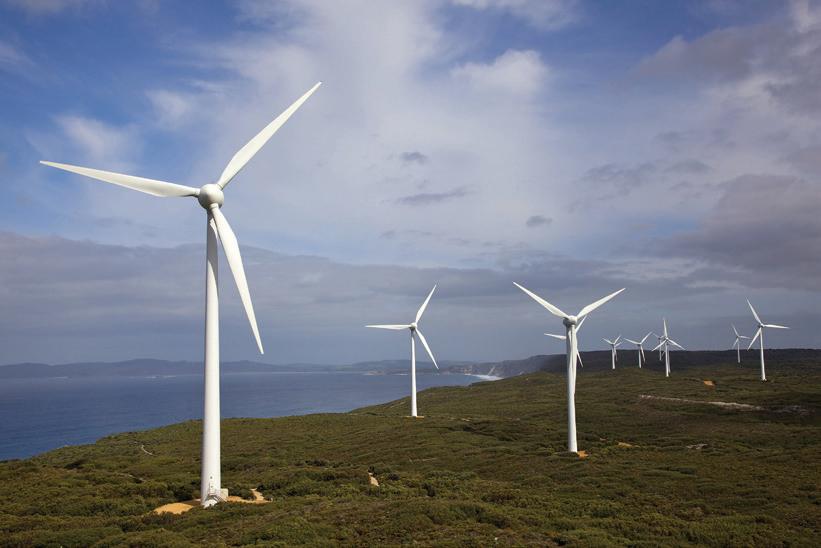
Wind generators use the wind to turn the turbines. The kinetic energy of the wind is transferred to the kinetic energy of the turbines. The turbines then transform this energy into electrical energy (Figure 5).
DRAFT
Hydroelectric plants have large dams that store water. The large amount of water is usually part of the way up a hill. Therefore, the water has gravitational potential energy. Pipes control the flow of water down through the turbine, transforming the gravitational potential energy into the kinetic energy of the turbines (Figure 6).
Figure 4 Rollercoasters constantly transform kinetic energy into gravitational potential energy and back again.
Kinetic energy of air
Kinetic energy of wind generator
Kinetic energy of turbines
Electrical energy of wires
Figure 5 The transformation of kinetic energy
Gravitational potential energy of water
Kinetic energy of water
Kinetic energy of turbines
Electrical energy of wires
Figure 6 The transformation of gravitational potential energy
University Press
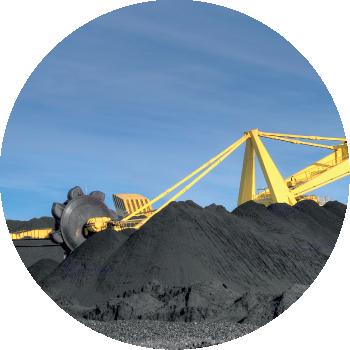
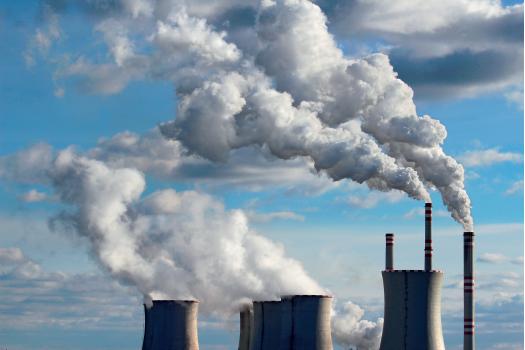
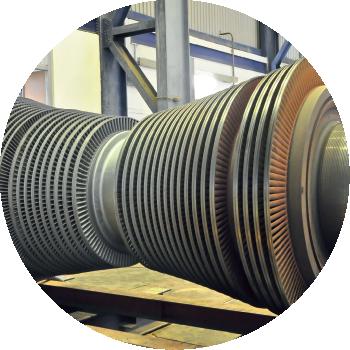
Coal-based electricity generators use the chemical potential energy in coal when they burn the coal to heat water. The resulting steam rises, forcing the turbines to turn and transform the kinetic energy into electrical energy (Figure 7).
Retrieve
1 Identify one way that energy can be transferred without being transformed.
2 Identify where the energy stored in coal comes from.
Analyse
3 Contrast (the differences between) energy transformation and energy transfers. Apply
4 Create a f low diagram for the main energy transformations in a moving car.
5 Create an energy chain that shows how we get our energy from eating an apple. (HINT: Start with the Sun!)
DRAFT
You use the electrical energy that comes from these generating plants for many different things: charging your mobile phone, cooking dinner and switching on a light. Energy may take many shapes or forms before you can use it.
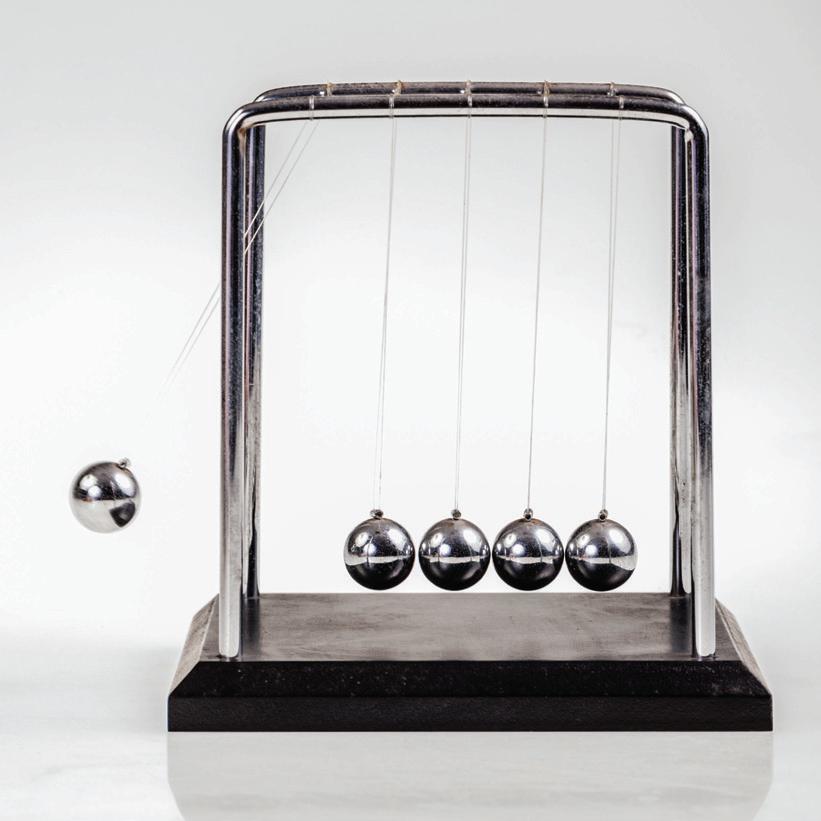
6 A New ton’s cradle has a series of metal balls suspended on strings (Figure 8). When the ball on the end is pulled back and released, the energy is transferred along the chain to
the other end, causing that ball to swing up into the air. Create a flow diagram to show the energy transformation that occurs in a Newton’s cradle.
Electrical energy of wires
Kinetic energy of turbines
Kinetic energy of steam
Chemical potential energy of coal
Figure 7 The transformation of chemical potential energy
Figure 8 A Newton’s cradle
Lesson 4.10
Electrostatics and electricity
Key
ideas
→ Electricity is the movement of electric charges.
→ Electrostatic charges occur when electrical charges are unable to move.
→ An electric circuit contains an energy source (a battery), a pathway (usually wires) and a load.
→ A closed circuit occurs when positive and negative charges can be separated and reunited.
→ The pathway of the charges can be represented by a circuit diagram.
Electricity
“Electricity” is a general term related to the presence and flow of charged particles. An electric charge can be either positive or negative. It is produced by subatomic particles (parts of atoms) such as electrons which carry a negative change or protons which carry a positive charge.
Electrostatic charge
Objects are normally uncharged – their atoms usually have equal numbers of positive protons and negative electrons. But when two objects are rubbed together, some of the electrons may be transferred from one object to the other. This causes the object with fewer electrons to become positively charged and the object with extra electrons to become negatively charged. This is called an electrostatic charge.
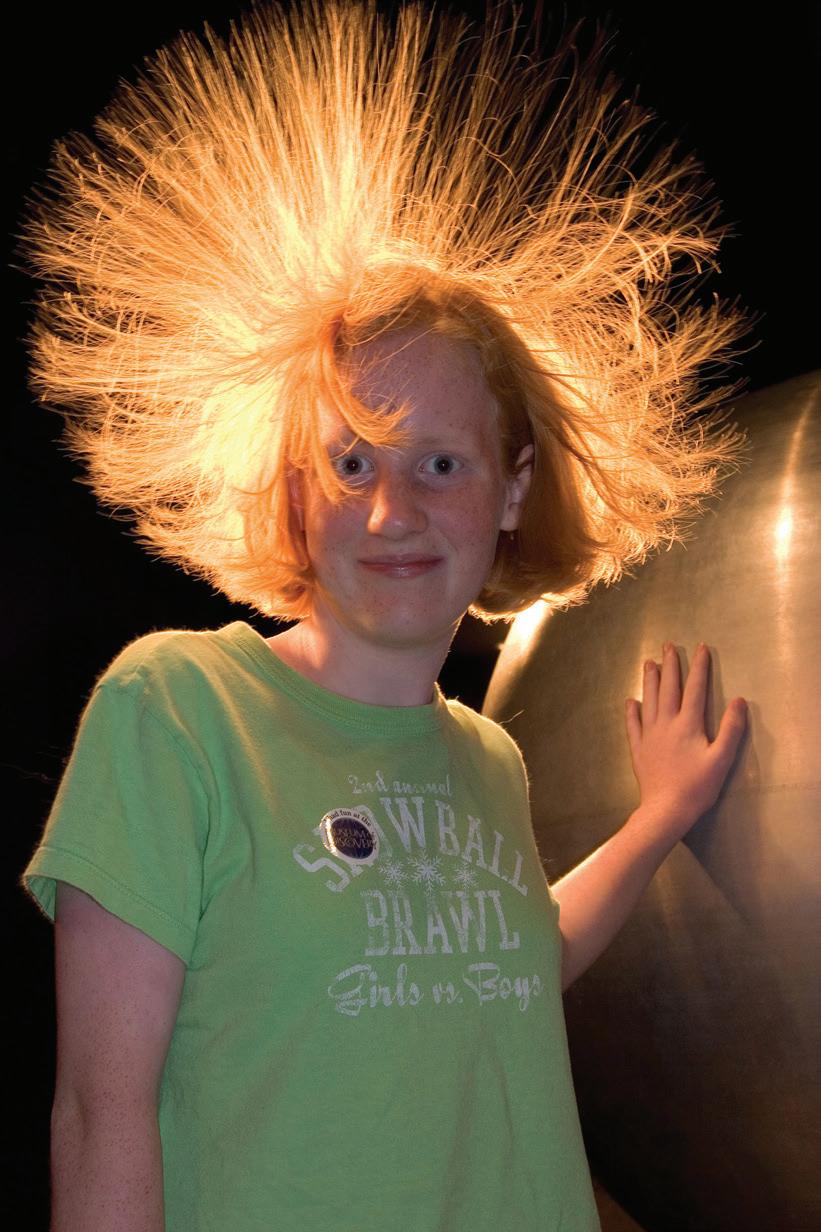
You can see examples of electrostatic charge when you rub a balloon against a woollen jumper and your hair stands up when you bring the balloon close to your head, or if you walk across a synthetic carpet and you get a small shock when you touch a door handle. In both these cases, the positive or negative electric charge stays on the charged object without moving. When the charges on an object are the same (both positive or both negative), then they are described as “like charges”. If the charges are different (one positive and one negative), then they are described as “unlike charges”.
DRAFT
The following are important rules to learn about electrostatic charges (Figure 1).
• Li ke charges repel.
• Un like charges attract.
• Charged objects attract neutral objects.
Learning intentions and success criteria
electron negatively charged particles that orbit the positively charged nucleus of an atom
proton positively charged particles that exist in the nucleus of an atom electrostatic charge an electrical charge that is trapped in an object such as a balloon
Figure 1 Like charges repel, and unlike charges attract.
van de graaff generator a machine that produces an electrostatic charge electrical potential energy energy a charge has based on its position in an electric field electric current the flow of electrical charge through a circuit negative terminal the point in the circuit where electrons flow out from positive terminal the point in an electric circuit where electrons flow into
When charged objects are close to each other, the small negative electrons are attracted to the positively charged object (unlike objects attract). If these two objects are brought close enough, the electrons will try to jump across the gap as a spark. This is what happens when the air particles in a cloud rub against each other and become charged. If the charges build up enough, a large spark (lightning) will move between the charges in the clouds or towards the neutral ground (charged particles and neutral objects are attracted to each other).
The Van de Graaff generator is a machine that produces an electrostatic charge by rubbing a belt (Figure 2). The surface of the dome can lose electrons and become positively charged. Anything that touches the top of the dome also becomes positively charged. If a person touches the surface of the dome, their hair can become positively charged, causing the strands of hair to stand on end and move away from each other. This happens because the positive charges in the hair strands repel one another (like charges repel).
DRAFT
2 Placing a hand on the Van de
generator causes negatively charged electrons to move from a person’s hair to the dome. The positive charges that are left in their hair strands cause the strands to repel each other.
Similar generators are used to accelerate particles in X-ray machines, food sterilisers and process machines, and in nuclear physics demonstrations.
Electrical potential energy and circuits
When unlike electric charges are separated, they gain electrical potential energy. This means that they are in a state of excitement, and the positive and negative charges try to get back together again. If a closed pathway is provided, the negatively charged electrons move along the wire to the positive charges, and as they do so, the electrical energy may transform into some other forms of energy, such as light to thermal (heat) energy.
The flow of electric charges from one place to another along a pathway is called an electric current. The particles in the closed pathway move, or are conducted, from the negative terminal of the energy source to the positive terminal. This is different to the historical term “conventional current” where the direction of the current is described as moving from the positive terminal to the negative terminal (Figure 3).
Figure
Graaff
As it is difficult to continually rub things together to separate charges and give them electrical energy, usually a dry or wet cell is used. A dry cell (for example, a torch battery) or a wet cell (for example, a car battery) uses a chemical reaction to continually separate charges and produce current electricity through wires. In a dry cell, the chemicals used to drive the reaction are in the form of a paste. On the other hand, the wet cell makes use of a combination of liquids such as acid and water. Dry cells are completely sealed and maintenance-free while wet cells need to be carefully maintained by monitoring the water level.
A closed conducting pathway is called an electric circuit. Electrical circuits must have an energy source (such as a dry cell), wires to carry the charges, and a “load”, which is any device that converts the electrical energy into heat, light or kinetic energy. Many devices have “gaps”, called switches, which control the flow of electricity in a circuit. Hence, electrically charged particles move around an electric circuit, carrying energy from the energy source, such as the battery, to the device that transforms the energy (such as a light globe, motor or heater). An example of the movement of electrical energy in a simple circuit is shown in Figure 4.
DRAFT
There are two types of current used in electrical circuits: alternating current (AC) and direct current (DC). In an alternating current (AC) circuit, the flow of electrons reverses direction 50 times every second. This type of current is used in electrical power points. In direct current (DC) circuits, the electrons flow in one direction only. This current is found in battery-powered circuits.
dry cell an object, such as a torch battery, that uses a chemical reaction to produce electrical energy, and the chemicals used are contained within a paste medium wet cell an object, such as a car battery, that uses a chemical reaction to produce electrical energy, and the chemicals used are liquid solutions electric circuit a closed pathway that conducts electrons in the form of electrical energy alternating current a circuit in which the flow of electrons reverses direction 50 times every second direct current circuits where the electrons flow in one direction only
Direction of conventional current Direction of electrons flow
Figure 3 Conventional current in an electric circuit
Wires
Battery
Light globe
Figure 4 A simple circuit: electric charges move from the battery through the wires to the light globe.
circuit diagram a visual representation to show the connections and components of an electrical circuit using lines and symbols ammeter an instrument used to measure the current in a circuit
Circuit diagrams
Circuits are represented by circuit diagrams. Each component of a circuit is represented by a symbol (Figure 5). The circuit in Figure 6A includes a light globe, a battery, connecting wires and a meter, such as an ammeter, to measure the electric current. This circuit is represented by the circuit diagram in Figure 6B. Connecting wires are usually shown as straight lines, and when they meet at junctions, they are often (but not always) joined at right angles. The longer line of the battery represents the positive terminal, and the shorter line represents the negative terminal. These terminals are where the wires are connected. When drawing a circuit diagram, you should always use a ruler and a pencil. All lines should be connected to indicate that there are no breaks in the circuit. A break in the circuit means the current is not flowing.
Measuring electric current
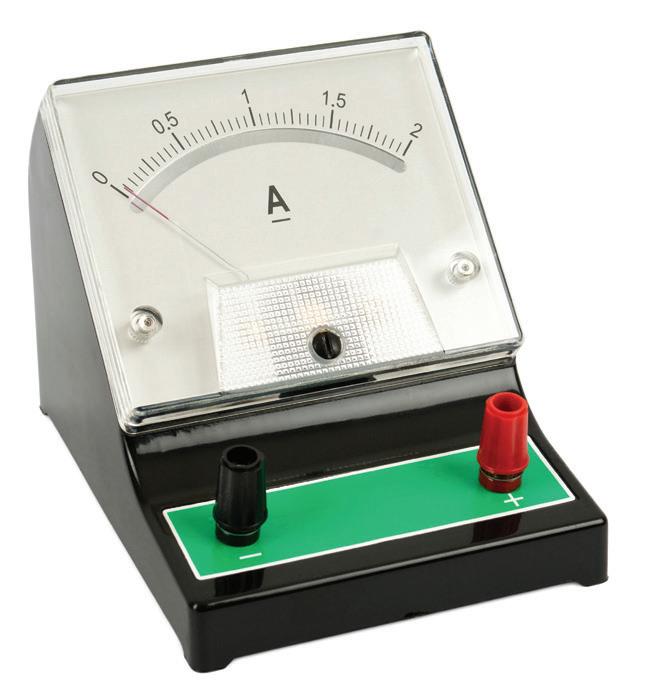
Electric current, or the flow of charge, is measured by counting the number of electrons that go past a point in the circuit in 1 second. The unit of measurement for current is amperes (symbol “A”). An ampere is a large unit of measurement of current, so smaller units, such as the milliampere (1,000 mA = 1 A), are often used. Traditionally, an ammeter (Figure 7A) was used to measure the current passing a
Figure 5 Some symbols used in circuit diagrams
Figure 6 (A) A simple circuit; (B) A circuit diagram of the simple circuit
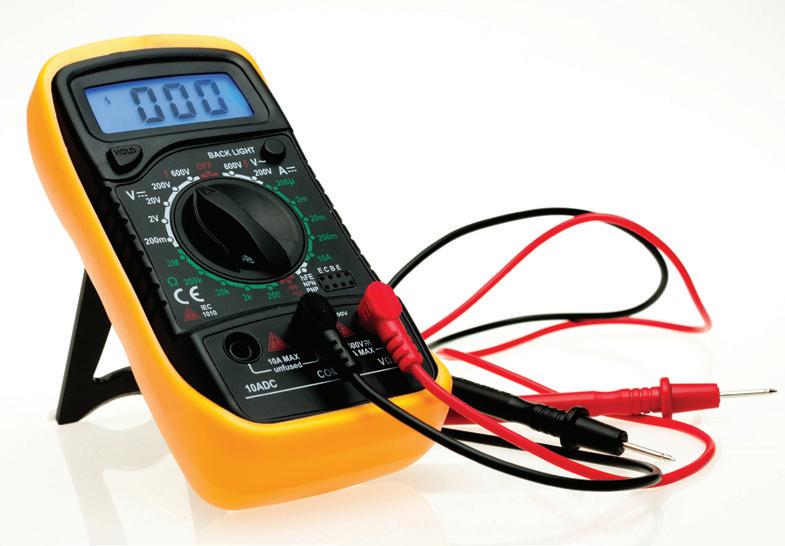
particular point in an electric circuit. The ammeter must be connected to the circuit so that the current flows through it. More recently, a multimeter (Figure 7B) is used to measure many different aspects of the circuit, including the current.
Electrical conductors and insulators
An electrical conductor is a material through which charged particles are able to move. An electrical insulator is a material that does not allow the current of charged particles to move. Most wires are made of copper, a metal, with a plastic coating around the outside. Copper is an electrical conductor – electrons are able to move through it easily. Plastic, however, is an electrical insulator. The wires are coated in plastic to prevent the current from being “lost” to the surroundings as it passes through the wires.
Some substances are better insulators or better conductors than others. It depends on how easily they allow electrons to move through them – that is, they offer less or more resistance to the movement of charges. Air is a good resistor, because it is difficult for charged particles to move freely through air.
Some substances, such as germanium and silicon, are insulators in their pure form but become conductors if they are combined with a small amount of another substance. These materials are called semiconductors.
Within a single silicon chip, very thin layers of silicon can be combined with other substances to make that layer a conductor. Complex microcircuits used in computing are made in this way.
Check your learning 4.10
Check your learning 4.10
Retrieve
1 Identify the three important rules about electrostatic charges.
2 Identify the difference between electrostatic charge and electric current.
electrical conductor a material through which charged particles are able to move electrical insulator a material that does not allow the movement of charged particles semiconductor a material that conducts electrical energy in one form and insulates against electrical energy in another form
3 Out line the direction of electrons in a circuit.
4 Na me an instrument used to measure current and state its unit of measurement.
Figure 7 (A) An ammeter or (B) a multimeter is used to measure electric current.
Comprehend
5 Describe how objects can be electrostatically charged.
6 Explain what happens where there is a gain in electric potential energy.
7 Explain the purpose of a battery in a circuit.
8 Identify the key components of a circuit and create a drawing of a simple circuit using appropriate symbols.
9 Suggest why circuit diagrams are used to represent circuits.
Analyse
10 Compare an electrical conductor and an electrical insulator.
11 Distinguish between semi-conductors and conductors. Provide an example.
12 Identify which of the globes in Figure 8 will transform electrical energy into light energy. Give a reason for your answer.
Lesson 4.11
Figure 8 Light globes Apply
13 If living organisms are good conductors and a ir is a good resistor, discuss why it would be dangerous to stand in an open area during a lightning storm.
Challenge: Making a simple torch circuit
Aim
To use a simple circuit to transform electrical energy to light energy
What you need:
DRAFT
• Pieces of insulated electrical wire with the ends stripped bare
• 1.5 V battery
• 1. 2 V torch light globe
• Ha nd lens
What to do:
1 Try different arrangements of the wires, battery and torch globe to make the globe light up. Draw each arrangement that you tried.
2 Use circuit diagrams to record some of the arrangements that work and some that do not.
3 Use the hand lens to look carefully at the filament in the globe. The filament is the tiny wire inside the glass of the globe – the part that glows brightly when the globe lights up. Draw what you see.
4 Use the hand lens to look at how a globe holder (the base of a globe) is constructed.
Discussion
1 Select one of the arrangements that did not a llow the globe to light up. Explain why this arrangement did not allow electricity to pass through the circuit.
2 Describe how the filament in the light globe is able to transform electricity into light and heat.
3 Describe how the globe holder connects the light globe to the circuit.
4 Some battery manufacturers claim that their brands of batteries last longer than other batteries. Create a design of an experiment that you could use to test this claim.
Lesson 4.12
Challenge: Demonstrating electrostatics
Aim
To model and explain electrostatic electricity
What you need:
• Rice Bubbles
• La rge plastic bag with tie
• Woollen cloth
• Plastic comb
• Sma ll pieces of paper
• Plastic rod or pen
• Bal loon pump
• Ba lloons
• Felt-tipped pen
• Str ing
• Tape
What to do:
Part A
1 Place some of the Rice Bubbles in the plastic bag. Blow air into the bag and seal it with the tie.
2 Rub t he woollen cloth over both the plastic bag and the comb.
3 Br ing the plastic bag and comb together.
4 Record what happens.
Part B
1 Place eight small pieces of paper on t he table.
2 Rub t he woollen cloth over the plastic rod or pen.
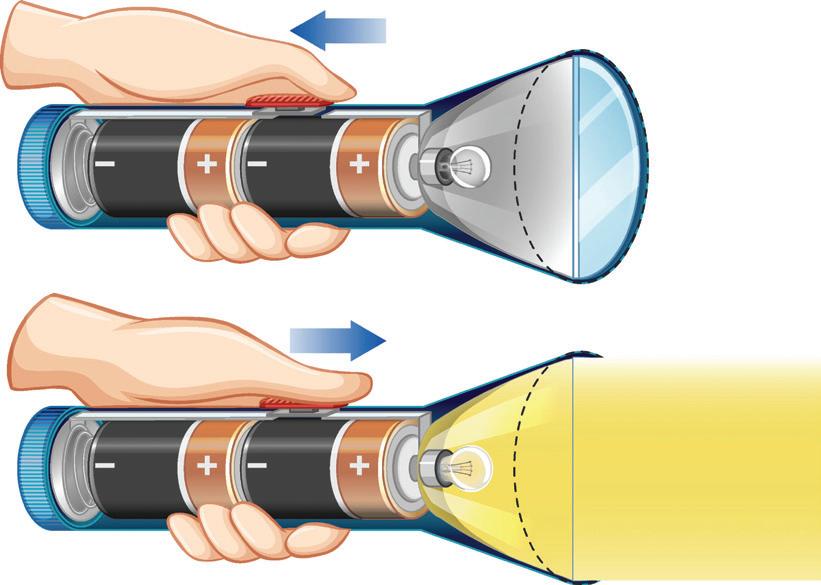
Figure 1 How does a torch work?
3 Record what happens to the pieces of paper when the positively charged woollen cloth is brought close to them.
4 Record what happens to the pieces of paper when the charged plastic rod is brought close to them.
Part C
1 Using the balloon pump, blow up a balloon a nd carefully draw a face on it.
2 Tie the balloon onto a string and suspend it from a doorway or ceiling using tape, so that it is level with your head.
3 Rub t he balloon face with the woollen cloth and walk towards it.
4 Record what happens.
– Identify the distance you have to be from the “balloon face” before it is attracted to you.
– Describe what happens if you put a piece of paper between you and the balloon.
5 Blow up another balloon and draw a face on it.
– Describe what happens when you bring it close to your suspended balloon.
Questions
1 Explain your observations in Part A, B and C using the terms “electrostatic charge”, “like charges”, “unlike charges” and “neutral or no charge”.
2 In Part B, explain why the pieces of paper moved as a result of the plastic rod or cloth by discussing the movement of charges.
3 Discuss what you think would happen if materials such as cotton, linen or bamboo were used instead of a woollen cloth.
DRAFT
4 Design an experimental method to demonstrate that opposite charges attract.
Lesson 4.13
Current can flow through series and parallel circuits
Key ideas
→ In a series circuit, the loads are connected one after the other, and the current is the same throughout the circuit.
→ In a parallel circuit, the loads are parallel to one another, and the current is shared between them.
→ A short circuit occurs when the electrical energy can move through an easier path with less resistance. Learning intentions and success criteria
Figure 1 Can you explain the attraction of the balloon?
Types of circuit
When two or more light globes are connected in a circuit, two different types of connection are possible. In a series circuit, the light globes are connected one after the other so that the current goes through one globe and then through the second (Figure 1A). In a parallel circuit, the circuit has two or more branches and the current splits between the branches (Figure 1B) and then comes back together.
Comparing series and parallel circuits
If two light globes are connected in a series circuit, then all the current (the electrons) passes through both light globes (Figure 1A). This is because all the components in the circuit are connected end-to-end in a single path. The current flows through each component one after another. This means the current is always the same at all points in a series circuit.
series circuit an electric circuit that has one pathway parallel circuit an electric circuit that has two or more pathways
However, if two light globes are connected in parallel, the current splits (Figure 1B). This means when the electrons reach the point where the wire splits, the electrons will travel along one path or the other. Part of the current passes through each light globe and then joins together again after passing through the light globes. This means the currents going through each light globe must be added together to determine the total amount of current coming from the battery.
Figure 1 (A) In a series circuit, the current is the same anywhere in the circuit. (B) In a parallel circuit, the sum of the current going through light globe A and light globe B is equal to the total current from the battery.
Figure 2 Traditionally, party lights were a series circuit. This meant that when one light broke, all the lights went out. Now, most modern party lights are arranged in a parallel circuit.
In a series circuit, a break at any point in the circuit (for example, from a switch) affects all the light globes in the circuit. In a parallel circuit, a break in one of the branches of the circuit affects only the current (and light globe) in that branch.
In a household, lights and appliances are connected in parallel so that:
• some appliances can be on while others are off (achieved by inserting switches)
• if one appliance fails, the others will still work (Figure 2).
Worked example 4.13A Calculating currents
If the current leaving a battery is 6 amperes (A), calculate the current travelling through two identical light globes if they are connected:
a in series
b in parallel.
Solution
If the light globes are connected in series, all the electrons flow through each light globe. Therefore, the current in each light globe is 6 A.
a If t he light globes are connected in parallel, the electrons are divided between the wires. This means the current is divided equally between the light globes.
b 6 A ÷ 2 la mps = 3 A in e ach light globe
DRAFT
short circuit when an electrical current flows along a different path from the one that was intended
Batteries in series and in parallel
Batteries may be connected in series or in parallel, in a similar way to light globes. When batteries are connected in series, each electron picks up a certain amount of energy as it passes through the first battery and then an additional amount as it passes through the second battery. This arrangement allows electrons to be given larger amounts of energy.
For instance, a simple torch normally has two 1.5 V batteries connected in series (Figure 3). As each electron passes through both batteries, it collects a total of 3.0 units of energy to light the torch globe.
When batteries are connected in parallel, each electron passes through either one battery or the other. This means each electron collects the same amount of energy as it would from one battery on its own. The advantage of this arrangement is that the two batteries last longer than either one of them would in the same circuit on their own.
Short circuit
A short circuit occurs when a current (moving electrons) flows along a different and faster path from the one intended. This can be caused by damaged insulation
Figure 3 Batteries in torches are connected in series.
that usually surrounds the wires or by another shorter conductor, such as water, providing an easy path for the electrons. Electric charges will always take the path of least resistance. This means that large currents can flow through any short path or conductor that allows the electrons to move most easily. Short circuits are dangerous because they can also lead to wires heating up from the fast flow of electrons, causing damage or even fire.
Fuse
An electrical fuse is a switch or thin piece of wire that burns up quickly when a large current flows too easily in a circuit. This causes a break in the circuit so the electrical energy stops flowing. This is to prevent damage to appliances from the high current. Most houses built today use safety switches that react faster than the older style fuse (Figure 4).
Check
your learning 4.13
Retrieve
Figure 4 A sudden increase in current will cause a fuse or safety switch to break the circuit. This stops the current from flowing and may prevent electrocution.
1 Recall t he advantage of having a safety switch or fuse in the electric circuits of your house.
Comprehend
2 Describe how you could determine whether the light globes in the party lights in Figure 2 are connected in series or parallel.
Analyse
DRAFT
3 Contrast t he movement of current in a series circuit and a parallel circuit.
4 Th ree identical light globes connected in series to a battery produced 18 A in current. Calculate the current flowing through each light globe.
Apply
fuse a switch or wire that stops the flow of current if it starts moving too fast
5 Infer i f the electrical appliances in a household are connected in series or parallel. Justify your answer by including an explanation about how series and parallel circuits work, including an example.
6 Double adaptors and power boards are devices that allow you to connect multiple appliances to a single power point. Explain whether these electrical devices use a series or parallel circuit. Justify your answer.
7 An electrician wanted to connect four light globes to a 6 A source so that two light globes had a current of 6 A and the other two light globes had a current of 3 A. Create a circuit diagram to show a possible arrangement of the light globes the electrician could use.
Lesson 4.14 Challenge: Making series and parallel circuits
Aim
To compare the current in series and parallel circuits
What you need:
• 2 × 1.2 V globes and holders
• 1.5 V battery and holder
• 8 connecting wires (with banana plugs or alligator clips)
• Sw itch
• Am meter or multimeter
What to do:
1 Construct four circuits, placing the switch so that it controls:
a both globes, with both either on or off at the same time
b one globe only, with the other on all the time
c the other globe only, with the first globe on all the time
d both globes, with one globe on when the other is off and vice versa.
Complete step 2 before you disconnect each circuit.
2 For each circuit, draw the circuit diagram to show the placement of the switch and globe/s to achieve the outcomes listed in step 1.
DRAFT
3 Connect an ammeter at different places in each circuit and measure the current at each point.
Questions
1 Describe t he effect of changing the location of the switch in a simple circuit.
2 Define the term “current”.
3 Describe how an ammeter should be connected to measure the current in a circuit.
4 Describe how the current did or did not change when the ammeter’s location was changed.
5 If your circuit did not achieve the outcome listed in step 1, explain what went wrong and how you resolved the issue.
Lesson 4.15
Voltage is the difference in energy per charge between two parts of a circuit
Key ideas
→ Voltage is a measure of the difference in electrical potential energy carried by charged particles between different points in a circuit.
→ Voltage can be measured using a voltmeter or multimeter in parallel to the circuit.
→ Resistance is a measure of how difficult it is for current to flow through part of the circuit.
Voltage
Each charged particle (electron) has energy as it moves in an electric circuit. This potential energy can be transformed into sound as it moves through a speaker or into light and heat if it moves through a globe. This means the electron has different amounts of energy before and after the speaker or light globe. This difference in energy for each electron is called potential difference or voltage
Voltage is measured by a voltmeter or a multimeter in the unit volts (symbol “V”). To measure the potential difference of a current, voltmeters are set in parallel across the two points in the circuit that you want to measure (Figure 1).
Batteries add energy to the charged particles. The amount of energy added by the battery can be determined by connecting a voltmeter in parallel to the battery. In a 1.5 V battery, each unit of charge receives 1.5 joules (symbol “J”) of energy as it passes through the battery (Figure 2).
In a series circuit, the potential energy contained by each electron must be divided between the different loads. This means a 12 V battery connected to two light globes in series may supply 6 V across each globe. If the two globes are connected in parallel, each electron moving through a light globe experiences the full 12 V and can convert it into light and heat.
potential difference voltage; the difference in the electrical potential energy carried by charged particles between two different points in a circuit voltage potential difference; the difference in the electrical potential energy carried by charged particles between two different points in a circuit
Figure 2 Each unit of charge in this battery has 1.5 J of energy.
Worked example 4.15A Calculating voltage
If a 6 V battery is connected to two identical light globes, calculate the voltage that can be transformed in each globe if they are connected: a in series b in parallel.
Solution
1 If the light globes are connected in series, the electrons must divide the voltage (potential energy) between t he globes.
Therefore, the voltage transformed in each globe will be 3 V.
6 V ÷ 2 light globes = 3 V in each light globe
2 If t he globes are connected in parallel, the electrons will separate at the fork in the wires and carry all the energy to each globe. This means the voltage (potential difference) transformed will be 6 V in each globe.
Resistance
resistance a measure of how difficult it is for the charged particles in an electric circuit to move
potentiometer a variable resistor that can adjust the output of voltage to a circuit and measure electric potential
ohm unit of electrical resistance; measure of resistance between two points of a conductor
DRAFT
The amount of current flowing in a circuit is determined by the resistance of the circuit and the voltage applied. The electrical resistance of a material is a measure of how difficult it is for charged particles to move through it. As charged particles move through the circuit, they collide with atoms in the wires and other components, causing some of their electrical energy to be converted into heat. Most connecting wires are thick and made of good conductors to minimise resistance. Other components are made of different materials and have higher resistance (Figure 3).
Toasters and heaters often contain high-resistance materials. The wires in a toaster are designed to convert a large amount of electrical energy into heat – enough to make the wires glow red-hot and brown the toast.
Resistors can also be deliberately placed in circuits to control or limit the current. A potentiometer is a type of variable resistor that can be adjusted by rotating a dial. Light dimmers and oven temperature controls are examples of potentiometers. Resistance is measured using a multimeter in units called ohms (symbol Ω).
Figure 3 Metal wires are low resistance while the plastic coating has high resistance.
Figure 4 Many types of resistor are available. The resistance of carbon resistors is indicated by the coloured bands on their plastic case.
Ohm’s law
Georg Ohm, a German physicist, discovered the relationship between voltage, current and resistance. Ohm found that the voltage drop across a fixed-value resistor is always directly proportional to the current through the resistor. This means that as the voltage goes down, the current will also go down. This relationship is known as Ohm’s law and is written as:
V = IR
where V is voltage in volts (V ), I is current in amps (A) and R is resistance in ohms (Ω).
To help us remember Ohm’s law, we can use the Ohm’s law triangle (Figure 5).
Worked example 4.15B Calculating resistance
Figure 5 The Ohm’s law triangle can be used to remember the equations for Ohm’s law. To find resistance, cover the R; the other two letters show you the formula to use. The V is over the I , so R = V I The same method is used to find current (I ). To find voltage, cover the V, and multiply I by R.
If a 9 V battery produces 6 A of current, calculate the resistance of the circuit.
R = V I
Solution
If V = 9 V, and I = 6 A, then R = 9 V 6 A = 1.5 Ω
Therefore, the resistance in the circuit is 1.5 Ω.
Check your learning 4.15
Check your learning 4.15
Retrieve
1 Define t he term “voltage”.
2 Define the term “resistance”.
3 Out line the purpose of potentiometer and identify an example of its use in a kitchen appliance.
Comprehend
4 Describe t he voltage across two light globes when they are connected: a in series b in parallel.
Analyse
5 Identify t he three equations that can be obtained by rearranging the Ohm’s law triangle.
6 Calculate the current flowing through a 44 Ω resistor when it has a voltage drop of 11 V across it.
7 Calculate the change in voltage across a 25 Ω resistor when a current of 50 mA (0.05 A) flows through it.
8 Calculate the value of a resistor that has a “voltage drop” of 8 V across it when a current of 0.4 A flows through it.
Lesson 4.16
Experiment: Investigating Ohm’s law
Aim
To investigate the voltage drop across and the current flow through a resistor, and to calculate an average value of the resistance
Materials
• 10 Ω resistor
• Volt meter
• Am meter
• 2–12 V power supply
• 3 ot her resistors with masking tape over their coloured bands
• Connecting wires
Method
1 Identify the 10 Ω resistor. It should be colour-coded brown, black, black.
2 Connect the circuit as shown in Figure 1. Connect the voltmeter around the resistor. Use the DC terminals of the power supply and start with the dial on 2 V.
3 Sw itch on the power supply, take the readings on the ammeter and voltmeter, and switch the power off again straight away (so you don’t overheat the resistor).
4 Repeat step 3 three times and record your measurements in Table 1.
5 Change the dial on the power supply to 4 V and repeat steps 3 and 4. Then change the dial to 6 V and repeat steps 3 and 4
7 Complete Table 1 for each of the t hree masked resistors and calculate their resistance.
8 Determine the average resistance of each resistor.
9 Remove the masking tape and determine the resistance values from the coloured bands of the resistors.
DRAFT
6 Repeat the experiment for the other three resistors, without reading their coloured bands.
1 Circuit set-up
Results
Copy and complete Table 1.
Table 1 Experiment results
Figure
Discussion
1 Use your results table to calculate the va lues in the last column.
2 For the three masked resistors, compare the accuracy of the values you obtained to the values indicated by their coloured bands.
3 Use the formula below to calculate the difference (error) between the two values as a percentage of the marked value. % error = marked value − average calculated value marked value × 100
4 Identify which value – the one obtained by reading the coloured bands or the one obtained from your calculations –provides the most useful measure of a resistor’s resistance. Justify your answer (by explaining how each value is obtained, describing which value is most relevant to use in a circuit and deciding which value provides the most useful measure).
Conclusion
Describe what you know about Ohm’s law.
solar cell a device that transforms sunlight directly into electrical energy; is usually in the form of a panel; also known as a solar panel photovoltaic cell (pvc) an electrical device that converts light energy into electrical energy; see solar cell
Lesson 4.17
Science in context: Renewable energy can be used to generate electricity
Renewable energy
DRAFT
Renewable energy is energy derived from natural resources that are replenished faster than they are consumed. Common sources of renewable energy include solar energy, wind power and hydropower. Bioenergy (energy sourced from organic mater) and geothermal energy (energy sourced from heat in Earth’s surface) are also becoming important sources of energy in some countries. Non-renewable resources are finite resources, meaning they are limited in supply and cannot be replenished as fast as they are used. Overuse of these resources risks depleting them forever. Fossil fuels like coal, oil, petroleum and natural gas are examples of non-renewable resources, these fuels also release carbon into the atmosphere which has a negative impact on Earth’s climate. Unlike fossil fuels, renewable energy sources like solar, wind and hydropower do not produce carbon emissions when generating electricity. Rather, they harness the abundant energy available from the Sun and natural processes and their potential to supply energy is yet to be fully harnessed.
Western Australia uses many types of renewable energy resources. It is also located in an ideal location for green hydrogen production. In this lesson, you will learn how scientists in different industries explore renewable energy and develop new initiatives and technology to reduce carbon emissions and advance Western Australia’s use of renewable energy.
Solar energy
Solar energy is made when solar cells (in solar panels) convert sunlight into electrical energy (?). Solar panels are a collection of solar cells called photovoltaic cells (PV cells). When light shines on the surface of PV cells, the light energy is transformed into electrical energy. The most efficient PV cells currently convert 30 per cent of the energy they receive from the Sun.
There are five types of solar energy: photovoltaic solar energy, thermal energy, concentrated solar power, passive solar energy and building-integrated photovoltaics.
Western Australia is one of the world’s most advanced adopters of renewable energy. In Western Australia’s main electricity network (Southwest Interconnected System), 35 per cent of houses already have rooftop solar and this is anticipated to rise to 50 per cent by 2030. On some days, the solar power from Western Australian homes can collectively generate three times as much electricity as the state’s largest power station. Scientists are working toward achieving Australia’s 2030 emission reduction target through the use of solar panels and battery storage systems.
Large-scale battery storage infrastructure is expected to improve renewable energy generation and help manage the stability of Western Australia’s energy system. Microgrids are localised electricity grids able to generate and store electricity for a specific area like a town or work site. The Onslow microgrid was the first in Australia to power a town using 100 per cent electricity from solar rooftops.
Advantages
and disadvantages of solar energy
Advantages of solar energy include that:
• solar energy is renewable
• solar energy is the most abundant energy source on the planet
• solar technologies are becoming more efficient
• solar panels are getting cheaper and can be an economic source of power
Figure 1 Steps involved in solar generation of electricity for domestic use.
a The solar cells on solar panels convert light energy from the sun into electrical energy.
b An inverter switches direct current (DC) power into alternating current (AC) which can enter the building.
c A meter records how much electricity flows into and out of the building.
d The unused electricity is collected into the public utility grid.
e Electricity derived from the solar panels powers equipment and appliances.
• solar energy technology generates minimal greenhouse gas emissions. Disadvantages of solar energy include that:
• solar energy is weather-dependent as it relies on the amount and quality of direct sunlight
• the manufacturing of PV cells and panels uses some hazardous chemicals and heavy metals.
DRAFT
Green hydrogen
Hydrogen can be used as an energy source. It produces heat when it is burned and can also be used in special fuel cells to produce electricity. Most hydrogen for energy use is obtained through non-renewable resources. However, renewable hydrogen also known as “green hydrogen” can be produced by electrolysis, where electricity is used to split water molecules into hydrogen and oxygen. As the source of hydrogen in the process comes from water rather than fossil fuels, it is considered renewable. Green hydrogen production can be made more sustainable if the electrolysis process is powered by renewable energy sources such as wind and solar.
On a relatively small scale, Western Australia has already introduced renewable hydrogen. A pioneering initiative to have renewable hydrogen as part of the microgrid has begun in Denham, Western Australia.
This initiative will continue with ongoing plans to retire state-owned coal power stations by 2030, beginning with Collie and Muja’s power stations. The Western Australia state government are currently investing in new green power infrastructure which will include battery storage involving 1,100 megawatts of capacity. One megawatt is equal to one million watts, and the average coal plant has a generating capacity of about 600 MW.
Advantages and disadvantages of green hydrogen
Advantages of green hydrogen energy use include that:
• hydrogen does not release carbon dioxide when burned
DRAFT
• hydrogen is a renewable energy source when it is produced during electrolysis
Rotor blades
Figure 2 Blowing wind causes the blades of a wind turbine to rotate. A series of gears speed up this rotation, and this mechanical power runs a generator, which produces electric currents.
• hydrogen can be stored as a fuel source for an extended period of time
• hydrogen can be used for many different purposes, such as generating electricity, powering vehicles, heating buildings and producing industrial chemicals. Disadvantages of green hydrogen energy use include that:
• hydrogen has a low density and compressing hydrogen is an expensive process
• producing and storing hydrogen can be expensive
• electrolysis can be expensive and consume a lot of energy
• there is a lack of infrastructure to support the use of hydrogen as a fuel source.
Wind energy
Wind energy is the kinetic energy of moving air. Wind turbines transform this kinetic energy into electrical energy. Each wind turbine consists of a tower that has a rotor with large blades attached at its top. When wind blows, the rotor blades begin to spin and turn a generator to produce electricity (Figure 2). Wind farms, which are collections of wind turbines, can be found both onshore and offshore (Figure 3). The electrical energy generated from wind farms is then passed through an onsite transformer to increase its voltage to the right level used by the national electricity system.
The Agnew Gold Mine in Western Australia is the site of the largest hybrid renewable energy microgrid in Australia. This microgrid includes wind and solar-generated energy, which provides 50 to 60 per cent of the mine’s energy needs. Scientists are working on delivering at least 400 megawatts of new wind generation capacity by 2030 for Western Australia. This could include building new wind farms, or expanding current wind assets such as the Warradarge and Albany Grasmere wind farms.
Advantages and disadvantages of wind turbines
Advantages of using wind turbines for energy include that:
• wi nd energy is a renewable energy source
• wi nd turbines have zero carbon emissions in their operation
• wi nd energy is free and can generate vast amounts of energy
• wi nd turbines are low maintenance.
Disadvantages of using wind turbines for energy include that:
• fluctuating wind speeds can cause efficiency problems
• wi nd turbines pose a threat to some wildlife, such as bats and birds
• wi nd turbines can contribute to noise pollution and create visual pollution.
Electric vehicles
Electric vehicles use electrochemical and electrostatic energy to create electricity to generate kinetic energy in the motor. Electric vehicles (EV) produce significantly less
Figure 3 Wind farms in Albany, Western Australia
carbon emissions than petrol-powered vehicles over a vehicle’s lifetime. An EVfast charging network is being developed across Western Australia to ensure access to EV charging stations (Figure 4) across regional and metropolitan areas. EVs are an example of how the future of energy can be efficiently managed from the way we generate, store and use electricity for the individual, community, industry, state and country.
Looking to the future: Renewable energy and sustainability initiatives
To achieve zero carbon emissions in the near future, many professionals must work together, including scientists, geologists, engineers and project managers. In Western Australia, strategic industrial areas (SIA) have been designated to run high profile sustainability initiatives. For example, Kwinana is a specialist centre for chemical and resource-based processing. The lithium site at the Kwinana SIA (Figure 5) produces enough lithium hydroxide to enable about one million EVs to replace regular vehicles on the road each year. This first lithium hydroxide refinery commenced operation from 2024 with another designated site at Kemerton in Bunbury.
Sustainability is also a high priority in the construction of new buildings. Since its opening in February 2023, Murdoch’s University’s Boola Katitjin (“Lots of Learning”) has set a benchmark for its sustainable construction (Figure 6). It is sustainable because it is built with Western Australia’s climate in mind; from the length of the external shading to optimise thermal comfort and reduce cooling, to automatic louvres, which welcome the “Freo Doctor” for natural ventilation. The entire architecture constitutes over 1,700 pieces of timber from sustainably managed forests, making up 70 per cent of its building. This makes it the largest mass-engineered timber building in Western Australia. Solar panels offset over 65 per cent of the building’s power use in peak conditions.
Figure 5 Tianqi's lithium processing plant in Kwinana, a strategic industrial area in Western Australia
Figure 6 Murdoch University’s Boola Katitjin (“Lots of Learning”) stands as a model for the sustainable construction of the future.
Figure 4 Throughout Australia, many public electric vehicle charging points provide free charging.
Check your learning 4.17
Check your learning 4.17
Retrieve
1 Identify three types of renewable energy.
2 Identify two types of non-renewable energy.
Comprehend
3 Outline the use of a source of renewable energy and explain how this can reduce carbon emissions.
4 Describe the advantages and disadvantages of wind energy.
5 Describe how an electric vehicle is energy efficient compared to a petrol-powered vehicle.
Analyse
6 Analyse three key features of sustainable construction using Murdoch University’s Boola Katitjn as an example.
Apply
7 Evaluate the use of hydrogen as a renewable energy source.
8 Discuss some of the achievements and challenges in Western Australia’s renewable energy initiatives.
9 Create a diagram to show how wind energy is generated from the wind turbines.
10 Sometimes, the development of large-scale renewable energy projects means having to displace local communities. The balance between national or state environmental benefits and local social impacts poses an ethical dilemma. Discuss the ethical issues presented by this dilemma.
Lesson 4.18
Review: Energy
Summary
Lesson 4.1 Energy can be transferred
• Energy is the ability to do work meaning something can move and change.
• Energy cannot be created or destroyed.
• The transfer of energy describes when energy is passed from one object to another.
Lesson 4.3 Potential energy is stored energy
• An object that has the potential (future ability) to do work has potential energy.
• Elastic potential energy is stored when an elastic object is deformed.
• Gravitational potential energy is stored when an object is lifted away from Earth‘s surface.
• Chemical potential energy is the energy stored when atoms are bonded to each other.
• Nuclear potential energy is the energy stored inside the centre of an atom.
Lesson 4.5 Moving objects have kinetic energy
• Kinetic energy is the energy found in a moving object.
• Moving heavy objects have more kinetic energy than moving light objects when they move at the same speed.
• The faster an object moves, the more kinetic energy it has.
• Ki netic energy can be converted to light, electrical, thermal and sound energy.
Lesson 4.6 Heat can be transferred by convection, conduction and radiation
Lesson 4.9 Energy can be transformed
• Energy that changes from one form to another is transformed.
• Flow diagrams use arrows to show the direction that energy moves.
DRAFT
• The energy from heat moves spontaneously f rom a hot material to a cool material.
• Conduction occurs when the kinetic energy of particles is transferred.
• Convection occurs when particles with high kinetic energy moves to another space.
• Radiation occurs when particles or waves with kinetic energy are transmitted or radiated through space.
• Electricity can be generated when turbines are turned by water, wind or coal-generated steam.
Lesson 4.10 Electrostatics and electricity
• Electricity is the movement of electric charges.
• Electrostatic charges occur when electrical charges are unable to move.
• An electric circuit contains an energy source (a battery), a pathway (usually wires) and a load.
• A closed circuit occurs when positive and negative charges can be separated and reunited.
• The pathway of the charges can be represented by a circuit diagram.
Lesson 4.13 Current can flow through series and parallel circuits
• In a series circuit, the loads are connected one a fter the other, and the current is the same throughout the circuit.
• In a parallel circuit, the loads are parallel to one another, and the current is shared between them.
• A short circuit occurs when the electrical energy can move through an easier path with less resistance.
Lesson 4.15 Voltage is the difference in energy per charge between two parts of a circuit
• Voltage is a measure of the difference in electrical potential energy carried by charged particles between different points in a circuit.
• Voltage can be measured using a voltmeter or multimeter in parallel to the circuit.
• Resistance is a measure of how difficult it is for current to flow through part of the circuit.
Checklist
Now that you have completed this module, reflect on your ability to do the following.
I will... I can do this. I cannot do this yet.
• Pr ovide examples of types of energy.
• Dr aw and interpret energy transfer diagrams.
• Define potential energy, elastic potential energy, gravitational potential energy, chemical potential energy and nuclear energy.
• De scribe examples of the different forms of potential energy.
• Define kinetic energy, light energy, electrical energy, thermal energy and sound energy.
• Pr ovide examples of objects that use or have kinetic, light, electrical, thermal and sound energy.
• Ex plain how heat is transferred by conduction, convection and radiation in terms of the motion of particles and waves.
• Define and provide examples of energy transformation.
• Dr aw energy transformation diagrams.
• Ex plain electricity generation using wind, water and coal.
• De scribe the difference between electrostatic charge and electric current.
• De scribe how electrical energy affects an electric charge.
• Identify the key components of an electric circuit.
• Ex plain why circuit diagrams are used to represent circuits and draw appropriate circuit diagrams.
• De scribe the differences in arrangement of series and parallel circuits.
• Define voltage and resistance.
• De scribe the different types of renewable energy such as solar, hydrogen, wind and use of electric vehicles.
• Identify the energy transformation involved in photovoltaic cells, hydrogen microgrids, wind turbines (wind farms) and electric vehicles.
Go back to Lesson 4.1 Energy can be transferred (page 154)
Go back to Lesson 4.3 Potential energy is stored energy (page 161)
DRAFT
Go back to Lesson 4.5 Moving objects have kinetic energy (page 166)
Go back to Lesson 4.6 Heat can be transferred by convection, conduction and radiation (page 169)
Go back to Lesson 4.9 Energy can be transformed (page 177)
Go back to Lesson 4.10 Electrostatics and electricity (page 181)
Go back to Lesson 4.13 Current can flow through series and parallel circuits (page 188)
Go back to Lesson 4.15 Voltage is the difference in energy per charge between two parts of a circuit (page 193)
Go back to Lesson 4.17 Science in context: Renewable energy can be used to generate electricity (page 198)
Review questions 4.18
Review questions: Module 4
Retrieve
1 Identify the correct definition for “energy”.
A the ability to heat or light things
B the ability to do work
C the ability to create movement
D the flow of electricity through a circuit
2 Identify which of the following is true about energy.
A energy cannot be created or destroyed
B energy is destroyed once it has been used
C energy is created constantly
D energy is precious because it is difficult to find
3 Identify which of the following correctly describes the energy transformation in a simple electrical circuit containing a battery and a light globe.
A battery → wires → light
B battery → light → wire
C electrical energy → light energy
D chemical energy → electrical energy → light energy
4 Identify which of the following is true or false. Rewrite any false statements to make them correct.
a Springs only hold stored energy when they are stretched.
b When an object is thrown up in the air, it gains gravitational potential energy.
c Sound energy is a type of potential energy.
d Petrol contains nuclear energy.
6 Identify a device that transforms:
a electrical energy into light energy
b elastic energy into kinetic energy
c electrical energy into sound energy
d gravitational energy into electrical energy
e ki netic energy into electrical energy.
7 Recall the type of energy musical instruments use to produce sound.
DRAFT
5 Identify the main form of energy in each of the following situations.
a water flowing slowly over a waterfall
b a rollercoaster at the lowest point of the ride
c the Sun coming in through a window on a sunny day
d a boy riding his skateboard
e a st retched rubber band
8 Identify each symbol (ammeter, battery, globe or switch) below.
9 Identify t he units of voltage, current and resistance, respectively.
a amps, ohms, volts
b ohms, volts, amps
c volt s, amps, ohms
d volt s, ohms, amps
Figure 1 Musical instruments use energy to produce sound.
Figure 2 Circuit symbols
Comprehend
10 Identify the circuit in Figure 3 as either a parallel circuit or a series circuit.
11 Explain why some substances are better conductors and insulators than others.
12 Describe two different ways electrical energy can be generated.
13 Explain why heat is generated in a light globe.
14 Describe the energy transformation and energy transfer in a torch.
15 Describe how current moves in a parallel circuit.
16 Figure 4 shows a block of ice melting.
a Describe what is happening to the molecules as the ice melts. Create a diagram to illustrate your answer.
b Explain where the energy to melt the ice comes from. Explain how the energy is transferred to the molecules of ice.
Analyse
17 Explain why a chemical engineer might be employed to design a new type of solar panel.
18 Contrast the number of energy transfers in the generation of electricity in solar panels and hydroelectricity.
19 Compare the energy transformation when electricity is generated by coal and water.
20 Connect these words and phrases with their correct meanings.
DRAFT
Word/Phrase Meaning
Kinetic energy
Nuclear energy
Potential energy
Elastic energy
The energy stored in a compressed spring
Another name for stored energy
The energy of an object when lifted up
Used widely throughout the world to generate electricity from atoms
Gravitational energy Possessed by all moving objects
21 Contrast t he terms “transform” and “transfer”.
22 Compare potential energy and kinetic energy.
23 The main job of a car travelling on the road is to produce kinetic energy in its wheels. Identify the other parts of a car that may demonstrate kinetic energy.
24 Th ink of your day today.
a Identify the different energy forms you have come across, possessed, used or witnessed.
b List them in order of use during the day.
c Consider which energy form was the most common and why.
Figure 3 Identify the circuit.
Figure 4 A block of ice melting
Battery (chemical energy)
Wires (electrical energy) Motor (kinetic energy) Wheels (kinetic energy)
Figure 5 A car produces kinetic energy in its wheels.
25 Compare c urrent and voltage.
26 Compare conduction and convection.
27 Calculate the current flowing through a 30 Ω resistor when it has a voltage drop of 12 V across it.
28 Calculate the voltage drop across a 50 Ω resistor when a current of 25 mA flows through it. Apply
29 Visit a local playground and consider the play equipment. Take a photo or draw a picture of a piece of equipment and determine what types of energy are demonstrated as a child plays on the equipment.
30 Create a flow diagram that shows the flow of energy when you are riding a bike. (HINT: Start with the Sun!)
31 Energy types rarely exist alone. They are a lways on the move, making things happen. Think about some of the things energy can do. For at least two of these, determine the type or types of energy involved. If more than one type of energy is involved, link the different types with arrows. Try to include as many different scenarios as you can.
3 a gas makes a better thermal insulator than a solid
4 neither convection nor conduction is a way of transferring energy through a vacuum.
33 Power lines carry electricity from power stations to cities and towns. They experience a voltage loss due to the high resistance along the lines according to Ohm’s law. Propose how the quantities of I and R could be changed to minimise this voltage loss due to resistance. (HINT: Consider how to decrease the resistance.)
DRAFT
32 Discuss, in terms of kinetic energy of particles, why:
1 convection can only occur in liquids and gases and not solids
2 when energy transfers by convection or conduction, the substance through which the energy transfers is also heated
Social and ethical thinking
34 Aboriginal and Torres Strait Islander peoples use possum, kangaroo and wallaby skin coats to keep themselves warm. Traditionally, the fur was worn with the fur facing towards the body to reduce heat loss. Use your understanding of the transfer of thermal energy to discuss the effectiveness of this strategy.
Critical and creative thinking
35 While clean energy projects like wind and solar farms are important in moving Australia towards a zero-carbon, renewable future, many of these projects are subject to Aboriginal and Torres Strait Islander peoples’ rights and interests, though most Aboriginal and Torres Strait Islander peoples have little to no legal input during the planning stages for these projects. Evaluate the importance of consulting the Traditional Custodians of the land you are working on or changing.
Figure 6 Pedal power
Figure 7 Power lines carry electricity from this power station to towns and cities.
36 Energy comes in many different forms. Create a poster that illustrates each type of energy using visual examples.
37 The massive earthquake and tsunami in Japan in March 2011 caused extensive damage to the Fukushima nuclear power plant, north of Tokyo, and created an emergency situation. Investigate this disaster and present a 2-minute news report to the class that highlights the issues surrounding the use of nuclear energy.
38 Use your understanding of current and voltage to create a model of the flow of electricity
Energy-efficient housing and energy transformations
In previous times, energy efficiency was important because people had limited access to energy supplies and their applications compared to today. People also understand better how energy can be transformed from one to another.
• Research how civilisations in tropical areas designed their homes to keep them cool and damp-free.
• Describe three types of energy-efficient practices that humans have used through the ages.
• Describe three ways modern humans can be energy efficient today.
through a circuit. You might use people or even an animation as your model.
Research
39 Choose one of the following topics for a research project. A few guiding questions have been provided for you, but you should add more questions that you want to investigate. Present your research in a format of your own choosing, giving careful consideration to the information you are presenting.
Rube Goldberg machine
DRAFT
• Compare the advantages and disadvantages of each energy-efficiency method used in the past and present.
Rube Goldberg was an American cartoonist who drew a series of complex machines that used a series of energy transfers and transformations to perform a simple task (Figure 9).
• Design your own Rube Goldberg machine by selecting a simple task that you do most days.
• Draw a picture that shows how this task could become more complex using a series of energy transformations and transfers.
• Identify each energy transfer and transformation that occurs in your machine.
Figure 8 Aerospace engineers at work.
Figure 9 A Rube Goldberg cartoon
Module
Atomic structure DRAFT
[STEAM project 1]
How can we build more energyefficient homes so that we live more sustainably?
Have you ever considered how much energy it takes to heat or cool your home? A study by the Australian Government found that homes contribute 10 per cent of Australia’s total carbon emissions. Reducing the amount of energy needed to heat or cool a home will not only save people money on their gas and electricity bills, it will make housing more sustainable.
NatHERS
The Nationwide House Energy Rating Scheme (NatHERS) is a rating system that is used across Australia to identify the energy efficiency of new homes. It gives a star rating out of ten for thermal performance (where ten stars is the most energy efficient). Computer modelling software assesses the design to estimate the amount of energy needed to heat or cool the home. The assessment is based on the local climate, the orientation of the home and materials that will be used in construction.
In much of Australia, new home designs must reach a minimum of seven stars to be approved for construction. There are many ways to improve the energy efficiency of your home. For example, if you insulate the walls, floors and roof, and use awnings (covers that extend over windows or doors), you can reduce the amount of energy needed to cool the home in summer. Or in cooler climates, if you design the home so that living areas are on the northern side, you can maximise the sunlight that is available to heat the home in winter.
DRAFT
Your task
Design and build a model of a new energy-efficient home that has a high energy-efficiency rating (more than six stars). Alternatively, design modifications for an existing home to improve its energ y e fficiency and reduce the cost of energy bills for the people living there.
Retrofitting homes
Not everyone wants to or can afford to build a new home. People who rent sometimes have little choice when it comes to the energy efficiency of their home, but this doesn’t mean that they need to have large gas and electricity bills. There are things that they can do to reduce the movement of thermal energy in summer or winter. Covering the floor with rugs, preventing heat from moving in or out of windows, and controlling windows to manage airflow are all ways to make a home more energy-efficient and liveable.
Figure 1 Infrared imaging shows warmer temperatures as red and cooler temperatures as blue. A building with insulation will lose less thermal energy to the outside environment in winter and will gain less thermal energy from the outside environment in summer.
HUMANITIES
In Geography this year, you will explore how the forecasted growth of Australia’s cities could impact their liveability and the challenges city planners face in balancing the demands of the things people need with the impacts on the environment.
In Economics and Business, you will study the housing market, the interaction between businesses and consumers in meeting consumer demands and when the government intervenes in markets.
To complete this task successfully, you will need to study seasonal weather patterns at the location of your energy-efficient home, to improve energy use.
DRAFT
Figure 2 Energy rating schemes help consumers to understand the energy efficiency of products or appliances. The more stars, the more energy efficient the product or appliance is.
You will find more information on this in Module 5 “Urban life” of Oxford Humanities 8 Victorian Curriculum
MATHS
In Maths this year, you will learn how to determine the area and volume of different shapes, using and converting between appropriate units. You will also learn skills for dealing with percentage changes in financial contexts. These skills will help you to quantify the costs and benefits of design features and predict the popularity of market incentives. You will perform calculations with and without digital technology.
To complete this task successfully, you will need to perform calculations for your model home, and then scale up to estimate the potential benefits of your design at a national level.
You will find help for applying these maths skills in Lessons 3.2 “Calculating percentages”, 3.3 “Mark-ups and discounts”, 8.3 “Area of quadrilaterals” and 8.4 “Area of a circle” of Oxford Maths 8 Victorian Curriculum 2E .
SCIENCE
In Science this year, you will learn about how energy can be transferred between objects and transformed (such as from the Sun’s light energy to electrical energy). You will also examine earthquake resistant materials used in construction.
To complete this task successfully, you will need to identify how each element of a home’s design can affect its heating and cooling needs, and how construction materials can affect a home’s stability.
You will also need to identify the elements that can be changed in a new home design, and compare these to the elements that can be changed in an established home.
You will find more information on this in Module 3 “Plate tectonics” and Module 4 “Energy” of Oxford Science 8 Victorian Curriculum
[STEAM project 1] The design cycle
To successfully complete this task, you will need to complete each of the phases of the design cycle.
Define
discover define communicate test
ideate build
Discover
When designing solutions to a problem, you need to know who you are helping and what they need. The people you are helping, who will use your design, are called your end-users. Consider the following questions to help you empathise with your end-users:
• Who am I designing for? How big is their family and home?
• Wh at factors might affect the liveability of the home?
• Wh at do they need? What do they not need?
• Wh at does it feel like to face these limitations on liveability? What words would you use to describe how it would feel to face these limitations?
Before you start to design your home modifications, you need to define the parameters you are working towards.
Define your version of the problem
DRAFT
To answer these questions, you may need to investigate using different resources, or even conduct interviews or surveys.
Rewrite the problem so that you describe the group you are helping, the problem they are experiencing and why it is important. Use the following phrase as a guide.
“How can we help (the group) to solve (the problem) so that (the reason)?”
Determine the criteria
1 Describe the orientation of the land where the home will be built or modified (include the location of sunrise and sunset, the angle of sun in the middle of summer and winter and any existing shadows).
2 Describe any existing energy-efficient features of the current home or design.
3 Describe how you will measure any improvement in energy-efficient features of the home.
Ideate
Once you know who you’re designing for, and what the criteria are, it’s time to get creative!
• Outline the criteria or requirements your design must fulfil (for example, improving heating or cooling of the home).
• Br ainstorm at least one idea per person that fulfils the criteria.
Remember that there are no bad ideas at this stage. One silly thought could lead to a genius innovation!
Build
Draw each individual design.
Include in the individual designs:
a labels for each part of the design
b the materials you will use for the home’s construction
c a description of how the modifications will improve the energy star rating of the home
d an estimation of the cost of applying the modifications. Present your design to your group.
Build the prototype
Choose and build two or three model homes for your group design (scale: 2 cm = 1 m).
Use the following questions as a guideline for your prototype.
• What materials will you need to build your model home?
• What sk ills will you need to build your model home?
• How wil l you test the effectiveness of your model home? (What will you compare it to?)
• How wil l you identify each energy-efficient feature of your model home?
• How wil l you collect data that supports your claims about energy efficiency?
Test
Use the scientific method to design and test the energy efficiency of your model home. You will test more than one design so that you can compare them, so you will need to control your variables between tests.
What criteria will you use to determine the success of your model home?
Conduct your tests and record your results in an appropriate table.
Communicate
DRAFT
Online resources:
Student guidebook
This helpful booklet will guide you step-by-step through the project.
What is the design cycle?
This video will help you to better understand each phase of the design cycle.
Present your home design as though you are trying to get your peers to invest in it.
In your presentation, you will need to:
• const ruct a labelled diagram of your model home in its orientation, including the location of sunrise and sunset, the angle of sun in the middle of summer and winter, and any existing shadows
• descr ibe the key energy-efficient features of your model home
• expla in how each energy-efficient feature affects the liveability of your model home
• expla in the principles that support your design (the importance of energy efficiency and how the existing landscape affected the design of the home)
• estim ate the cost of implementing your design
• expla in and quantify the benefits on a national scale if all new homes were to include your design features.
How to manage a project
This “how-to” video will help you to manage your time throughout the design cycle.
How to pitch your idea
This “how-to” video will help you with the “Communicate” phase of your project.
Across the world, climate patterns are changing and weather events are becoming more extreme.
In 2020, twenty per cent of Australia’s forests were burnt, a record-breaking thirty named hurricanes developed over the Atlantic Ocean and an extreme monsoon season in Asia caused flooding across a quarter of Bangladesh. Australia is particularly prone to natural disasters. Bushfires, flooding, drought periods and cyclones dramatically affect people’s lives and alter natural landscapes.
Natural disasters can be devastating for communities affected by them. Recovering from natural disasters also comes with huge economic costs. This can sometimes lead to a harmful cycle in which a nation gets stuck between experiencing disaster and responding to disaster.
[STEAM project 2] How can we use technology so that the impact of natural disasters is reduced?
Disaster management
Climate action is one of the 17 Sustainable Development Goals agreed to in 2015 by world leaders. One of the identified targets in combating climate change is to strengthen the resilience and adaptive capacity of all countries to natural disasters and hazards related to climate.
Your task
DRAFT
It is essential that communities prepare for disasters so as to reduce their impact. The United Nations Office for Disaster Risk Reduction (UNDRR) recommends using technology as part of disaster management. For example:
• wa rning systems in Japan that trigger emergency brakes in bullet trains if earthquakes are detected
• systems in sub-Saharan Africa that monitor rainfall data and analyse trends to forecast and build resilience to drought
Develop an innovative technology or strategy that will reduce the impact of natural disasters in your community. The technology or strategy should be useful and easy to use and address one (or more) of the steps of disaster management.
• at lases in China that record the risk of natural disasters, using location data from spatial technologies such as GPS.
After the 2019–20 Australian bushfires, it was argued that satellite technology, drones and mobile phone apps would have been extremely helpful for fighting the fires and communicating with the people affected.
Disaster management should include four steps:
• prevention – reducing hazards before a disaster takes place, so its impact is not as severe (e.g. building schools that are earthquake resistant)
• preparation – training people so they know how to act when a disaster happens (e.g. running evacuation drills)
• response – taking action during a disaster (e.g. emergency crews and volunteers taking on emergency operations)
• recovery – taking action to help people rebuild their lives (e.g. restoring services in a community).
Disaster management is an ongoing process that can occur like a cycle between the phases of prevention, preparation, response and recovery.
Figure 1 Hundreds of people (and animals) huddled on Malua Bay beach in NSW for almost 24 hours as bushfires tore through communities in the nearby Batemans Bay area.
HUMANITIES
In Geography this year, you will learn about landscapes and landforms and how they can be degraded by both human and natural causes. You will study a geomorphic hazard, its impacts on a place and various ways of responding to it.
In History, you might also study how past societies have dealt with disasters and managed their responses; for example, how Rapa Nui (Easter Island) inhabitants adapted to life without trees, how Shogunate Japan developed policies to sustain its forests, or how an unstable climate (including drought and heavy monsoons) affected the Khmer Empire.
To complete this task successfully, you will need to investigate a potential natural hazard in your local area. You will research any current disasterresponse plans related to managing such an event and gain an understanding of how various people and businesses in the community would be impacted.
DRAFT
You will find more information on this in Modules 2, 16, 17 and 19 of Oxford Humanities 8 Victorian Curriculum.
MATHS
In Maths this year, you will consolidate and extend your skills in describing and interpreting. This will include creating and analysing plots of non-linear data, investigating the use of sampling methods and broadening your understanding of measures of spread. You will also perform calculations with percentage changes in financial contexts. You will analyse and represent data, both with and without digital technology.
To complete this task successfully, you will need to weigh up the costs of your disaster-management technology or strategy against its potential benefits, including by estimating the likelihood of natural disasters and the severity of their effects.
You will find help for applying these maths skills and statistics in Lessons 3.2 “Calculating percentages”, 3.3 “Mark-ups and discounts”, 6.5 “Plotting linear relationships” and 10.1 “Collecting data and sampling methods” of Oxford Maths 8 Victorian Curriculum 2E
SCIENCE
In Science this year, you will learn about how the energy of the Earth over long periods of time generates forces that can melt rocks, produce volcanoes and make diamonds. You will also learn how the kinetic energy in the air and waves can cause damage to the surrounding environments during cyclones and tsunamis. The Australian bush also contains large amounts of chemical energy that is transformed into thermal energy during the summer fire season.
2 Floodwaters
To complete this task successfully, you will need to consider how energy is transferred and transformed during natural disasters. This understanding will allow you to predict and potentially reduce the impact of the disaster in your local community.
You will find more information on this in Module 2 “The rock cycle” and Module 4 “Energy” of Oxford Science 8 Victorian Curriculum .
Figure
near Sydney
[STEAM project 2] The design cycle
To successfully complete this task, you will need to complete each of the phases of the design cycle.
Define
discover define communicate test
ideate build
Discover
When designing solutions to a problem, you need to know who you are helping and what they need. The people you are helping, who will use your design, are called your end-users.
Consider the following questions to help you empathise with your end-users:
• Who am I designing for?
• Wh at natural disaster could they face?
• How often could this disaster occur, and on what scale?
• Wh at do they need? What do they not need?
• Wh at does it feel like to face these problems? What words would you use to describe these feelings?
• Wh at could the cost of such a disaster be in terms of lives lost, income lost, damage to private property and public infrastructure, and environmental impact?
To answer these questions, you may need to investigate using different resources or even conduct interviews or surveys.
Before you start to design your innovative strategy or technology, you need to define the parameters you are working towards.
Define your version of the problem
Rewrite the problem so that you describe the group you are helping, the problem they are experiencing and why it is important. Use the following phrase as a guide.
“How can we help (the group) to solve (the problem) so that (the reason)?”
Determine the criteria
1 Define the term “innovation”. Describe how much a strategy needs to differ from current practice to be considered innovative.
2 Describe how the natural disaster will affect the people in the community.
3 Describe how you could measure whether your solution will reduce the impact of the natural disaster.
4 Ex plain how you could determine what cost (price) should be acceptable for implementing your solution.
Ideate
Once you know who you’re designing for and you know what the criteria are, it’s time to get creative!
• Outline the criteria or requirements your designed strategy or technology must fulfil (for example, how many people will be helped, how much they will be helped, how long they will need the help).
• Br ainstorm at least one idea per person that fulfils the criteria.
Remember that there are no bad ideas at this stage. One silly thought could lead to a genius innovation!
Build
Draw each design strategy or technological idea. Label each stage of the strategy or part of the technology and explain how it will be used by the community. Include in the individual strategy or technology:
a the timeline for the activation of the strategy or technology (i.e. how long after the disaster will the idea be ready to be used?)
b the number of people and materials that will be needed for the strategy or technology to reduce the impact of the natural disaster
c a description of how the community will benefit from the strategy or technology.
Present your strategy or technology to your group.
Build the prototype
Choose and build two or three versions of the prototype strategy or technology for your group design.
Use the following questions as a guideline for your prototype.
• Wh at equipment do you have access to?
• Wh at skills do you have or will you need, to make your prototype strategy or technology?
• How could you model your strategy or technology if equipment is not available?
• How could you test the effectiveness of the prototype strategy or technology with the community?
Test
Use the scientific method to design an experiment that will test the effectiveness of your prototype strategy or technology. Alternatively, conduct a survey of the community to determine their opinion of the usefulness of the prototype.
Conduct your tests or survey your community, and record your results in an appropriate table.
Consider how you could use the results of the experiment or survey to modify your design.
DRAFT
Online resources:
Student guidebook
This helpful booklet will guide you step-by-step through the project.
What is the design cycle?
This video will help you to better understand each phase in the design cycle.
Communicate
Present your design to the class as though you are trying to get your peers to invest in your strategy or technology.
In your presentation, you will need to:
• describe how the natural disaster will affect your community
• describe your prototype strategy or technology
• describe how the prototype will reduce the impact of the natural disaster on the community
• describe the materials, people and money that will be required to have the required effect on the natural disaster.
How to manage your project
This “how-to” video will help you to manage your time throughout the design cycle.
How to define a problem
This “how-to” video will help you to narrow your ideas down and define a specific problem.
Glossary
Aabomasum
the fourth stomach of a cow accurate
how close a measurement is to the true or known value
aim
the purpose of an experiment alkali metal
an element in group 1 of the periodic table
alkaline earth metal elements with similar properties found in group 2 of the periodic table
alternating current
a circuit in which the flow of electrons reverses direction 50 times every second alveoli
tiny air sacs in the lungs where gas exchange occurs amino acid
small molecules that make up proteins ammeter
an instrument used to measure the current in a circuit
ammonia
a chemical waste product (NH 3) anomaly
a result that does not fit in with the pattern of data anther
the end part of a stamen (male part of a flower); contains pollen aorta
the major artery that carries oxygenated blood from the heart and divides into smaller arteries around the body apparatus equipment placed together for an experiment artery
atomic number
the number of protons in the nucleus of an atom
atomic theory
the theory that all matter is made up of atoms atria
the two smaller, upper chambers of the heart
B
binary fission
a form of asexual reproduction used by bacteria; the splitting of a parent cell into two equal daughter cells
binocular
using two eyes; a type of microscope blood
connective tissue that carries oxygen, nutrients and waste around the body blood test
a test carried out in the laboratory on a sample of blood to measure the amount of substances (e.g. cells, chemicals, proteins) in the blood.
bohr model
a model of the atom in which electrons orbit the nucleus in a series of defined orbits known as shells boiling point
the temperature at which a liquid boils and becomes a gas bronchi
the main airways that branch off into smaller and smaller ones in the lungs bronchiole
smallest airways that lead to tiny air sacs in the lungs
carrying capacity
the maximum number of a species that can find food and shelter in that environment catalyst
a substance that increases the rate of a chemical reaction without undergoing any permanent chemical change
categorical data
DRAFT
a thick, muscular-walled blood vessel that carries blood away from the heart under pressure arteriole
smaller artery asthma
a disease caused by narrowing airways atom
the smallest particle of matter; cannot be created, destroyed or broken down (indivisible)
Ccaecum
a small dead-end pouch that connects the small and large intestines capillary
a blood vessel with a wall only one cell thick; allows substances to pass into and out of the blood carpel
the female reproductive organ of a flower; includes the stigma, style and ovary
information representing characteristics; usually describes things by a name, label or a group causation
when the independent variable is responsible for the change in the dependent variable cell membrane
the barrier around a cell that controls the entry and exit of substances into and out of the cell
cell theory
theory describing the properties that all cells have in common cell wall
the outer protective and support structure of a plant cell cell
(in biology) the building block of living things
cellular respiration
the chemical reaction between glucose and oxygen that produces carbon dioxide, water and energy cervix
the narrow neck connecting the uterus and the vagina
chemical change
a process by which a substance is changed to one or more different substances.
chemical equation
a symbolic representation of a chemical reaction in the form of symbols and chemical formulas
chemical potential energy
energy stored in chemicals, e.g. in food, fuel or explosives; also known as chemical energy
chemical reaction
a procedure that produces new chemicals; same as chemical change
chlorophyll
a green pigment in chloroplasts that absorbs solar energy, which is used by plants in photosynthesis
chloroplast
organelle found in plant cells that transforms solar energy into chemical energy chyme
a mixture of acid, enzymes and digested food that leaves the stomach circuit diagram
a visual representation to show the connections and components of an electrical circuit using lines and symbols circulatory system
organ system that moves blood and lymph around the body, transporting oxygen and nutrients to the cells and removing waste products from the cells collision theory
a theory stating that the particles involved in a chemical reaction must collide in order to react colloid
a type of mixture that always looks cloudy because clumps of insoluble particles remain suspended throughout it rather than settling as sediment
column graph
a graph in which the height of the columns represents the number measured
combustion
a reaction that involves oxygen and releases light and heat energy compound light microscope
a microscope that uses visible light to enlarge images of very small objects compound
a substance made up of two or more types of atoms bonded together (e.g. water)
concentration
the number of active molecules in a set volume of solution
conclusion
a statement that "answers" the aim of an experiment condense
to become a liquid, from a gas conduction
continental drift
the continuous movement of the continents over time
continental shelf
a flat area under shallow ocean water at the edge of a continent
continuous data
data that are measured and can be any value
contraception
a way of preventing pregnancy controlled variable variables that remain unchanged during an experiment convection
the transfer of thermal energy by the movement of molecules in air or liquid from one place to another convection current
the current or flow of air or liquid that results from the transfer of thermal energy through convection converging boundary
the boundary between two tectonic plates that are moving together core
the centre of Earth
correlation
a relationship between two or more things corrosive
destructive to living tissues such as skin and eyes, or to some types of metals cross-pollination
the exchange of pollen and ova between different plants of the same species crust
the lithosphere, or outer layer of Earth cytoplasm
the jelly-like fluid inside the cell membrane that contains dissolved nutrients, waste products and organelles
diaphragm
a dome-shaped muscle attached to the ribs; moves up and down beneath the lungs diarrhoea
watery faeces
diatomic molecule
a molecule that consists of two atoms diffusion
the process whereby molecules move from regions of high concentration to regions of low concentration digestion
DRAFT
the transfer of thermal energy from hot objects to cooler objects by direct contact with no movement of material
conglomerate
a type of sedimentary rock that is composed of large, rounded rock fragments contained within a smaller, fine-grained matrix of sediments. connective tissue
the group of cells that provide connections to other parts of the body
Ddependent variable
a variable in an experiment that may change as a result of changes to the independent variable deposition
the process whereby sediment from different forms of weathering accumulates in layers desexing
a method of permanently preventing reproduction
the process of breaking down food into nutrients
direct current
circuits where the electrons flow in one direction only discrete data
data where the numbers can be separated into different groups discussion
a summary of findings, and analysis of the design of an experiment, including problems encountered and suggestions for improvement diverging boundary
the boundary between two tectonic plates that are moving apart dna (deoxyribonucleic acid)
a molecule that contains all the instructions for every job performed by the cell; this information can be passed from one generation to the next dry cell
an object, such as a torch battery, that uses a chemical reaction to produce electrical energy, and the chemicals used are contained within a paste medium
Eelastic potential energy
the energy possessed by stretched or compressed objects
electric circuit
a closed pathway that conducts electrons in the form of electrical energy electric current
the flow of electrical charge through a circuit
electrical conductor
a material through which charged particles are able to move electrical energy
the energy that results in the movement of electrons through a conductor towards a positive charge
electrical insulator
a material that does not allow the movement of charged particles
electrical potential energy
energy a charge has based on its position in an electric field electrocardiogram
a test to record the electrical activity of the heart
electromagnetic relating to the physical interaction between moving charged particles and the magnetic field that is created as a result
electromagnetic radiation
electric and magnetic forces or effects produced by an electric current
electron configuration
a numerical way of showing the number of electrons in each electron shell around a particular atomic nucleus electron microscope
a microscope that uses electrons (tiny negatively charged particles) to create images electron shells
a defined area of space in which electrons move around an atom’s nucleus electron
negatively charged particles that orbit the positively charged nucleus of an atom
electrostatic charge
an electrical charge that is trapped in an object such as a balloon element
a pure substance made of one type of atom
emission spectrum
the pattern of wavelengths (or frequencies) that appear as coloured lines in a spectroscope; it is unique to each element emphysema
a disease caused by broken down alveoli in the lungs
epiglottis
a flap of skin above the larynx that controls the passage of food and air, preventing food from entering the windpipe epithelial tissue
the group of cells that cover and protect the body equipment
items used in the laboratory to conduct experiments erosion
the process whereby broken bits of rocks and sediment are transported away, usually by wind and water ethical issue
a scenario where conflict can arise about whether it is right or wrong eukaryotic cell
complex cell that contains a nucleus and membrane-bound organelles external fertilisation
when the egg and sperm meet outside the bodies of the parents
extrusive igneous rock
rock formed at Earth’s surface by quickly cooling lava eyepiece
where the eyes are placed when using a microscope
Ffair experiment
where one variable is changed in a scientific investigation and all others are kept constant fallopian tube
tubes that connect the ovaries to the uterus fault
a fracture in rock where the tectonic plates have moved fertilisation
foliation
layering in a rock that occurs when the rock is subjected to uneven pressure fossilisation
the process of an organism becoming a fossil fragmentation
asexual reproduction that occurs when a new organism grows from a fragment of the parent
frost shattering
DRAFT
empirical based on what is verifiable by observation or experience rather than theory or logic endometrium
the lining of the uterus
enzyme
a chemical that helps make chemical reactions happen; a type of catalyst epididymis
a coiled tube behind the testes that carries sperm to the vas deferens
the process whereby two gametes (sex cells) fuse to produce a single cell fetus
an unborn animal or human after the embryo stage; in humans this is after 8 weeks of development
fishbone diagram
a visual diagram that is used to determine the root cause of an problem or issue
flow chart
a visual diagram that is used to present a problem or process as clear steps
a process of weathering in which repeated freezing and melting of water expands cracks in rocks, so that eventually part of the rock splits off fuse
a switch or wire that stops the flow of current if it starts moving too fast
Ggallstone
a hard substance or stone that is produced by the gall bladder
gamete
a sex cell; in humans, the sperm and egg cells
gas exchange
this process occurs when air is breathed in, air enters lungs and oxygen from that air moves to the blood; and at the same time, carbon dioxide moves from the blood to the lungs and is breathed out geologist
a scientist who studies rocks gestation
the length of time between fertilisation and birth
gills
a respiratory organ that allows gas exchange to occur in water
gluten intolerant unable to digest gluten
gravimeter
a device that measures the difference in gravity between one location and the next
gravitational potential energy
the energy possessed by an object raised to a height in a gravitational field group
(in chemistry) a vertical list of elements in the periodic table that have characteristics in common
H
haemoglobin
a protein inside red blood cells that carries oxygen from the lungs to tissues and organs in the body, and transfers carbon dioxide back to the lungs halogens
the group of elements in group 17 of the periodic table hazard
a potential source of harm or adverse health effect to a person or persons hermaphrodite
an organism that has both male and female reproductive systems
hot spot
a region where Earth's outer crust is thin and the magma is hotter than the surrounding area
hypothesis
a proposed explanation for a prediction that can be tested
Iigneous rock
rock formed by cooling magma and lava inbreeding
breeding of animals that are related, increasing the chances of genetic abnormalities appearing independent variable
a variable (factor) that is changed in an experiment index mineral
a mineral that only forms at a particular temperature and pressure; used to determine the history of the rock that contains the mineral infectious disease disease caused by the passing of a pathogen from one organism to another; also known as a contagious disease
inference the process of drawing conclusions based on evidence and reasoning infrared rays
intrusive igneous rock rock formed underground by slowly cooling magma
Kk-strategist
organisms living in stable environments who breed carefully keystone species
a species that interacts with a number of other species; its removal severely impacts the overall community structure keyword
a significant word that describes a topic or concept in the shortest and most descriptive way possible kinetic energy the energy possessed by moving objects
Llattice
a three-dimensional arrangement of particles in a regular pattern
lava
hot, molten rock that comes to the surface of Earth in a volcanic eruption line graph
a chart that shows a line joining several points or a line that shows the relation between the points liquefaction
when soil has very little strength and so behaves more like a liquid than a solid in an earthquake love surface wave
waves that produce a horizontal movement; they move parallel to Earth’s surface and perpendicular to the direction of the wave movement
Mmagma
mean also known as average is the total sum of values in a sample divided by the number of values in the sample melt
change state from solid to liquid menstruation
also known as a period; the process of the endometrial lining of the uterus breaking down and leaving the vagina mesophyll cell
the middle layer of cells in a leaf, located between the epidermal layers metabolism
DRAFT
a type of electromagnetic radiation that is felt as heat
integumentary exchange area
pockets of spaces inside small aquatic invertebrates who respire by diffusing gases in and out of their internal body fluid
internal fertilisation when the sperm fertilises the egg inside the body of an organism
semi-liquid rock beneath Earth’s surface magnetometer
a device that detects the difference in a magnetic field between one location and the next mantle
the layer of molten rock beneath Earth’s crust
mass number
a number that represents the total number of protons and neutrons in the centre of an atom
all the chemical reactions in the body metal
a substance, usually solid at room temperature, which is generally hard, shiny, malleable and a good conductor of heat and electricity metamorphic rock
rock formed from other rock due to intense heat and pressure method
a step-by-step procedure used to carry out an investigation microbiology
the science involving the study of microscopic organisms microorganism
a living thing that can only be seen with the use of a microscope microscope
an instrument with lenses that is used for viewing very small objects microscopy
the study of living things that can only be seen with the use of a microscope mid-ocean ridge
a series of underwater mountains that form as a result of tectonic plates moving apart and allowing magma to rise to the surface mineral
a naturally occurring solid substance with its own chemical composition, structure and properties mitochondrion
powerhouse organelle of a cell; the site of energy production (plural: mitochondria) mixture
a substance made up of two or more pure substances mixed together
molecular element
a molecule that contains two or more of the same atoms bonded together
molecule
group of two or more atoms bonded together (e.g. a water molecule)
molten
reduced to a liquid form by heating monatomic consisting of a single atom monocular using one eye; a type of microscope monotreme
mammals that lay eggs rather than bearing their young alive. multicellular
an organism that has two or more cells muscle tissue
the group of cells that allow the body to move
N
natural flora
microbes that live happily in our bodies
nectar
a sugary fluid that is produced by flowers to attract pollinators
negative terminal the point in the circuit where electrons flow out from nephron
a tiny structure in the kidneys that filters the blood nervous tissue
the group of cells that pass on electrical messages neutron uncharged subatomic particles, along with protons, form the nucleus of an atom
nitrogen-fixing
the ability to extract nitrogen from soil air spaces hence enriching the soil for plant growth.
noble gas
the stable gaseous elements in group 18 of the periodic table non-metal
numerical data
information expressed in numbers so it can be measured and hence used for calculation
O
objective lens
lens in the column of a compound light microscope observation
the act or process of collecting data about the world around us using our five senses
ocean trench
a deep ditch under the ocean along a tectonic plate boundary oestrogen
a reproductive hormone in females offspring an organism’s young, or child ohm
unit of electrical resistance; measure of resistance between two points of a conductor omasum
the third stomach of a cow onion-skin weathering
weathering of rock where the outside of the rock peels off organ
a group of tissues that work together for a purpose organelle
smaller part of a cell, each one having a different function osmosis
the movement of water through a selective membrane from an area of low salt concentration to an area of high salt concentration; occurs in root cells outlier
a data value that is outside the range of all the other results
ovary
parallax error
an error, or inaccurate reading, that occurs as a result of reading a scale from an angle parallel circuit
an electric circuit that has two or more pathways
parthenogenesis
asexual reproduction where a female fertilises her own eggs
particle model
a model suggesting that all substances are made of particles that are attracted to each other and can move about depending on the temperature. This model explains the properties of solids, liquids and gases.
DRAFT
a substance, usually in the form of a gas or liquid, which is a good insulator of heat and electricity
nuclear energy
energy stored in the nucleus of an atom and released in nuclear reactors or explosions of nuclear weapons; much greater than the chemical energy released in chemical reactions
nucleus
control centre of a cell that contains all the genetic material (DNA) for that cell
the female organ that produces eggs ovulation
the part of the menstrual cycle when an egg is released from the ovary ovum
the reproductive egg
Pp-wave
primary body waves, also known as pressure waves, that can travel through solid rock, liquid ocean and gases of the atmosphere
pathogen
microbe that can potentially cause a disease pattern
a repeated or predictable occurrence that could be a feature, an event or a sequence
peer review
a process where experts in the field check the quality of a piece of work before it is published to ensure that research is accurate, thorough and relevant
periodic table
a table in which elements are listed in order of their atomic number, and grouped according to their similar properties
period
(in chemistry) a horizontal list of elements in the periodic table peristalsis
the process of swallowed food being moved along the digestive tract by a wave of contractions
petroglyph
an engraving made into rock pharynx
the throat; connects the mouth to the oesophagus phloem
vascular tissue in plants that conducts food made in the leaves during photosynthesis to all other parts of the plant’s body photosynthesis
a process where plants absorb light to convert carbon dioxide and water to form glucose and oxygen.
photovoltaic cell (pvc)
an electrical device that converts light energy into electrical energy; see solar cell
pictograph
a drawing made on rock pie chart
a visual representation of data divided into slices that represent its quantity placenta
the organ that connects the developing fetus to its mother
placental mammal
mammal that has a placenta during the gestation period to nourish and allow for gas exchange to the offspring.
plasma
a straw-coloured fluid that forms part of the blood plate tectonics
the theory that the surface of Earth consists of a series of plates that are continually moving due to convection, ridge push and slab pull platelet
small disc-like cells in blood that are involved in forming clots pmi chart
a tool that looks at the plus/minus/ interesting aspects of an idea or decision pneumonia a disease caused by bacterial or viral growth in the lungs
pollen
a powdery substance for transporting the male gametes of flowering plants and cone-bearing plants; contains pollen grains that produce male gametes (sperm cells) pollination
fertilisation of gametes in plants pollinator
an organism that transfers pollen from one flower to another polymer
a long-chain molecule formed by the joining of many smaller repeating molecules (monomers) positive terminal
potentiometer
a variable resistor that can adjust the output of voltage to a circuit and measure electric potential precise
how close measurements of the same object are to each other prediction
a statement that forecast what may happen or what can be observed under specific conditions product
a substance obtained at the end of a chemical reaction; written on the right side of a chemical equation prokaryotic cell
primitive single-celled organism that has no nucleus properties
in chemistry, the characteristics or things that make a substance unique prostate gland
a walnut-sized structure surrounding the neck of the male bladder that blocks the flow of urine so sperm can move along the urethra proton
positively charged particles that exist in the nucleus of an atom
Qqualitative observation
an observation that uses words and is not based on measurements or other data
quantitative analysis
the process of analysing and interpreting numerical data
quantitative observation an observation that uses a number, such as a measurement
Rr-strategist
rayleigh surface wave
waves that roll like those on an ocean, but the particle motion is the opposite of ocean waves; as each Rayleigh wave rolls, it moves the ground up and down and forward and backward in the direction that the wave is moving reactant
a substance used at the beginning of a chemical reaction; written on the left side of a chemical equation
red blood cell
DRAFT
the point in an electric circuit where electrons flow into potential difference
voltage; the difference in the electrical potential energy carried by charged particles between two different points in a circuit
potential energy
energy that is stored in an object due to its properties, position and the forces acting on it
organisms living in unstable environments who breed rapidly radiation
energy that travels from one place to another in the form of waves or particles
rank chart
a visual representation used to arrange things based on a criteria ratio
used to compare how much of one thing you have to another
cell in the blood that carries oxygen around the body relationship
how two variables or things are connected to each other reliable
when an experiment can be repeated to produce the same results
remote control
an electronic device used to operate a machine remotely (i.e. at a distance)
reproducible results obtained by an experiment can be obtained again by others using the same method reproduction the production of offspring by a sexual or asexual process resistance
a measure of how difficult it is for the charged particles in an electric circuit to move result
the measurements and observations made in an experiment; they are often presented in a table reticulum
the second stomach of a cow ridge push
the force pushing the edges of tectonic plates away from each other when a ridge crest has formed rift valley
a deep valley that forms as a result of tectonic plates moving apart on land risk
the possibility of an activity or action that could happen and cause harm risk assessment
a process of working out the potential risks that may be involved in an activity rock cycle
the process of formation and destruction of different rock types
root cortex
the outer layer of a root in a plant.
Oxford University Press
root
a plant organ involved in absorbing nutrients and water rumen
the first stomach of a cow ruminant
Hooved mammals that chew the cud and have four-chambered stomachs.
Ss-wave
secondary waves, also known as shear or shaking waves, that travel only through solid earth scientific diagram
a clear, side-view, labelled line drawing, usually made using a sharp pencil scientific method
a process involving making an observation, forming a hypothesis, making a prediction, conducting an experiment, collecting the data, analysing the results and drawing conclusions
sea-floor spreading the theory that the middle of the ocean is spreading apart, forming new oceanic ridges
sedimentary rock
rock formed from compacted mud, sand or pebbles, or the remains of living things
seismic geophysical testing
the collecting of geophysical data such as differences in magnetic fields and gravity fields between different geological locations self-pollination
when both gametes come from the same plant semiconductor
a material that conducts electrical energy in one form and insulates against electrical energy in another form seminal vesicle
a pair of small pouch-like structures that provide a sugary fluid that assists sperm to travel along the vas deferens series circuit
single-celled
an organism that consists of one cell slab pull
the force pulling a tectonic plate beneath a less-dense tectonic plate
solar cell
a device that transforms sunlight directly into electrical energy; is usually in the form of a panel; also known as a solar panel solidification
the process of changing from a liquid or gas to a solid state solution
a mixture of a solute dissolved in a solvent sound energy
a type of kinetic energy produced when things vibrate, causing waves of pressure in the air or some other medium spiracle
external respiratory openings found on the thorax and abdomen of insects and some spiders spore
a tiny reproductive structure that, unlike a gamete, does not need to fuse with another cell to form a new organism stain
substance, such as iodine, used to make cells more visible under a microscope stamen
the male part of a plant, consisting of a filament supporting an anther standard notation this shows the symbol, atomic number, and mass number of an element in the periodic table stem
an organ that transports materials around a plant stereomicroscope
a microscope with two eyepieces that uses low magnification stigma
surface area
the total area of the surface of a solid object
surface area to volume ratio
the relationship between the area around the outside of a cell and its volume, as a fraction suspension
a cloudy liquid containing insoluble particles symptoms
the physical or mental signs of a disease system
DRAFT
the top of the carpel; where the pollen from the anther begins its journey to the ovary stomata
an electric circuit that has one pathway shell diagram
a diagram that shows the number of electrons in each electron shell around a particular atomic nucleus short circuit
when an electrical current flows along a different path from the one that was intended
tiny pores in the leaves and stems of plants that allow gas exchange between a plant’s cells and the environment subduction
occurs when one tectonic plate melts, slides or falls beneath another sublimation
a change of state from a solid directly to a gas
a group of organs that work together for a purpose
Ttectonic plate
a large layer of solid rock that covers part of the surface of Earth; movement of tectonic plates can cause earthquakes testis
the male reproductive organ that produces sperm (plural: testes)
testosterone a male hormone involved in the reproductive system
theoretical
based on the theory of a subject or an area of study rather than its practical application
thermal conductor
a material that allows thermal energy to flow through thermal energy
the scientific term for heat energy
thermal insulator
a material that prevents or slows down the transfer of thermal energy tor
a large, round rock produced by onionskin weathering trace fossil traces of an organism that existed in the past trachea
the large tube that connects the throat to the bronchi; carries air in and out of the body transferred
describes energy that has moved from one object to another transformed
describes energy that has changed into a different form
transforming boundary
the boundary between two tectonic plates that are sliding past each other transition metal
the elements in groups 3–12 of the periodic table
transpiration
the evaporation of water from the leaves, stems or flowers of a plant trend
a general direction in which something is developing or changing over time tsunami
a series of large waves that result from an underwater earthquake
Uulcer
an open sore on the inside or outside of the body
ultrasound
a way sound can be used to identify tissue or to shatter stones
ultraviolet ray
a type of electromagnetic radiation that has high energy due to its shorter wavelengths urea
a chemical waste product produced in the body and removed in urine
uterus
an organ in the female reproductive system; where the fetus develops
V
vagina
a female reproductive organ; a muscular tube connecting the outside of the female body to the cervix
valence shell
the outermost electron shell in an atom that contains electrons valid
when the design of the experiment will produce a result that answers the scientific questions van de graaff generator
a machine that produces an electrostatic charge vaporise
change state from a liquid to a gas; evaporate
vapour
gaseous form of a substance that is normally solid or liquid at room temperature (e.g. water vapour) variable
something that can affect the outcome or results of an experiment vas deferens
the tube through which sperm travel from the epididymis to the prostate
vascular bundle
a group of tubes in plant stems that carry water and nutrients around the plant vegetative reproduction
a type of asexual reproduction where part of a plant breaks off, forming a new organism with no need for seeds or spores; similar to fragmentation vein
a thin-walled blood vessel that carries blood back to the heart ventricle
the two large, lower chambers of the heart
vesicle
an organelle surrounded by a membrane and used by cells to store materials; a vacuole is a type of vesicle found in plant cells villi
small ridges in the small intestine that absorb nutrients from chyme volatile
describes a substance that easily becomes a gas voltage
DRAFT
potential difference; the difference in the electrical potential energy carried by charged particles between two different points in a circuit
W
wet cell
an object, such as a car battery, that uses a chemical reaction to produce electrical energy, and the chemicals used are liquid solutions white blood cell
an immune system cell that destroys pathogens
Xxylem
vascular tissue in plants that conducts water and dissolved nutrients upwards from the root and throughout a plant’s body
Zzygote
a fertilised egg
Index Index
A
abomasum 307
Aboriginal and Torres Strait Islander Peoples 7–12 anatomists 296 chemical changes, use of 229 controlled burning 237 Country 7 heat by-product, using 169 Indigenous science 8–11, 68 ochre 84, 229 plants for food or medicine, identifying 71 research protocols 25 rocks, knowledge of 74, 80, 88–9 scientific knowledge and skills 7–12, 68 seasonal calendars 8, 9 abrasion 92 accuracy 32, 33–6 calculations 34 data 46–9, 69 equipment 34 acid rain 92 aim (of experiment) 59 alternating current (AC) 189, 199 alveolus/alveoli 312–13, 318 amino acids 327 ammeter 189, 192 ammonia 327 amoeba 278 amperes 192 animal cells 277, 279, 280, 290 animal testing 343 anomalies 48 antibiotics 287–9, 309 anus 300 aorta 319 apparatus 27 arteries 320, 321, 324–5 arterioles 320, 321 artificial organs 342 assumptions 53 asthma 317 astrology 15, 16 astronomy 5, 9 atherosclerosis 324–5 atomic mass 213 atomic number 213 atomic theory 208–11
DNA (deoxyribonucleic acid) 269 donor (of organ) 330 Duchesne, Ernest 288 dyes 246, 247
EEarth and space science 5 Earth, layers of 118–21, 143, 145
emphysema 317 energy 150–85 cannot be created or destroyed 165–6 flow of 150–1, 154–6 kinetic 150, 151, 161–5, 181 nuclear 159 potential 150, 157–61, 181 solar 162, 177–80 energy audit 171, 174 energy chain 165 energy efficiency 170–6, 181, 184
Diprotodon optatum 100 direct current (DC) 189, 199 directly proportional relationship 41 disaster management 105, 348–51 discrete data 39 discussion (in report) 60 disease infectious 283 organisms causing 282–6, 290 symptoms 283
earthquakes 119, 124, 127, 131, 133 Australia 134–5 designing buildings for 138–43 earthquake-resistant materials 140 Japan 131 L’Aquila 146 liquefaction 140 magnitude 131 predicting 105 San Francisco 127, 131 tsunamis caused by 131 elastic potential energy 157, 160 electric bell 189 electric cars 151, 178, 179 electric circuits 188–205 circuit diagrams 189 definition 188 series or parallel 192–6 wiring a house 202 electric current 189 electrical energy 151, 152, 163–5, 188 electric motor 189 electricity 188–205 definition 188 generating 166–7 electromagnetic, meaning 106
electron 189 electron microscopes 264, 265 elements 209, 211–15 periodic table 209, 210, 212–13, 253 properties 212, 213, 214 representing 220 symbols 212, 220
rating systems 171, 344 reducing consumption 170–2 energy efficient homes 171–3, 344–7 insulation 172 passive design 171–2, 175 window design 172 energy transfer 150–6, 181 entertainment, for 152 heat as by-product 168, 181 heat energy 171 movement, for 151 transferred, definition 150 energy transformation 164–70, 181 electricity generation 166–7 heat as by-product 168–70, 181