Oxford University Press is a department of the University of Oxford. It furthers the University’s objective of excellence in research, scholarship and education by publishing worldwide. Oxford is a registered trademark of Oxford University Press in the UK and in certain other countries.
Published in Australia by Oxford University Press
Level 8, 737 Bourke Street, Docklands, Victoria 3008, Australia.
The moral rights of the author have been asserted.
First published 2016 Second edition
All rights reserved. No part of this publication may be reproduced, stored in a retrieval system, transmitted, used for text and data mining, or used for training artificial intelligence, in any form or by any means, without the prior permission in writing of Oxford University Press, or as expressly permitted by law, by licence or under terms agreed with the appropriate reprographics rights organization. Enquiries concerning reproduction outside the scope of the above should be sent to the Rights Department, Oxford University Press, at the address above. You must not circulate this work in any other form and you must impose this same condition on any acquirer.
ISBN: 978 0 1903 5090 1
Reproduction and communication for educational purposes
The Australian Copyright Act 1968 (the Act) allows educational institutions that are covered by remuneration arrangements with Copyright Agency to reproduce and communicate certain material for educational purposes. For more information, see copyright.com.au.
Edited by Maryanne Park
Typeset by Q2A Media Services Pvt. Ltd., Noida, India
Proofread by Lorna Hendry
Indexed by Puddingburn Publishing Services
Printed in Singapore by Markono Print Media Pte Ltd
Oxford University Press Australia & New Zealand is committed to sourcing paper responsibly.
Disclaimer
Links to third party websites are provided by Oxford in good faith and for information only. Oxford disclaims any responsibility for the materials contained in any third party website referenced in this work.
DRAFT
Acknowledgement of Country
Oxford University Press acknowledges the Traditional Owners of the many lands on which we create and share our learning resources. We acknowledge the Traditional Owners as the original storytellers, teachers and students of this land we call Australia. We pay our respects to Elders, past and present, for the ways in which they have enabled the teachings of their rich cultures and knowledge systems to be shared for millennia.
Warning
Aboriginal and Torres Strait Islander readers are advised that this book (and the resources that support it) may contain the names, images, stories and voices of deceased persons.
Non-Indigenous readers should be aware that for some Aboriginal and Torres Strait Islander communities, showing the names and photographs of deceased persons may cause sadness or distress and, in some cases, be contrary to cultural protocols.
Printer please replace with your FSC logo
1.5
1.6
1.7
1.8 Analysing
1.9
2.3
2.4 Challenge: Modelling the structure
2.5 Chromosomes
2.6 DNA
2.7 Mitosis
2.8
2.9
2.10
2.13 Challenge: Inheritance of colour blindness
2.14 Inheritance of traits can be shown on pedigrees
2.15 Mutations
2.16 Science in context: Genes can be tested
2.17 Science in context: Genes can be manipulated..................................................................................................113
3.1 Science in context: Darwin and Wallace were
3.2 Natural
3.3 Experiment: Natural selection of bean hunters
3.4 Species can diverge or converge
3.5 Experiment: Divergent and convergent evolution of big beaks and small beaks
3.6 Fossils provide evidence of evolution
3.7 Experiment: Popcorn dating
3.8 Multiple forms of evidence support evolution
3.9 DNA and proteins provide chemical evidence for evolution
3.10 Humans artificially select traits
3.11 Science in context: Natural selection affects the frequency of alleles
3.12 Review: Evolution
Module 4 Climate change
4.1 Atom structure, properties and chemical bonding
4.2 Experiment: Flame tests
4.3 Groups in the periodic table have properties in common
4.4 Experiment: Reactivity of metals
4.5 Non-metals have properties in common
4.6 Ions have gained or lost electrons
4.7 Metal cations and non-metal anions combine to form ionic compounds
4.8 Experiment: Conductivity of ionic compounds
4.9 Non-metals combine to form covalent compounds
4.10 Science in context: Nanotechnology involves the specific arrangement of atoms
4.11 Review: Chemical bonding
5.1 Synthesis, decomposition and displacement reactions can be represented by equations
5.2 Experiment: Direct synthesis with a “pop”............................................................................................................208
5.3 Experiment: Decomposing a carbonate
5.4 The solubility rules predict the formation of precipitates
5.5 Experiment: Precipitation reactions
5.6 Acids have a low pH, bases have a high pH
5.7 Experiment: Testing with pH paper
5.8 Acid reactions depend on strength and concentration
5.9 Experiment: Acid strength and reactivity..............................................................................................................223
5.10 Metals and non-metals react with oxygen
5.11 Experiment: Combustion of wire wool
5.12 Polymers are long chains of monomers
5.13 Experiment: Polymerisation of casein
5.14 Surface area, concentration, temperature and stirring affect reaction rate
5.15 Experiment: Factors affecting reaction rate
5.16 Catalysts increase the rate of a reaction
5.17 Experiment: Using a catalyst
5.18 Science in context: Reactions have many everyday applications
5.19 Review: Chemical reactions
6.1 Science in context: Aboriginal and Torres Strait Islander peoples have studied the universe for thousands of years
6.2 Skills lab: Using a star chart
6.3 Earth is in the Milky Way
6.4 Challenge: Understanding parallax
6.5 Experiment: Calculating the distance to the Sun
6.6 Stars have a life cycle
6.7 Scientists search for life
6.8 The galaxies are moving apart
6.9 Experiment: Investigating emission spectra
6.10 Evidence supports the Big Bang theory
6.11 Science in context: Technology aids cosmological research
6.12 Review: The universe
7.1 Displacement is change in position with direction
7.2 Challenge: Bringing graphs to life
7.3 Velocity is speed with direction
7.4 Experiment: The ticker timer
7.5 Skills lab: Using a motion sensor
7.6
7.7
7.8
7.9
7.10
7.11
7.12
7.13
7.14
7.15
7.16
7.17
8.1
8.2
8.3
8.4
8.5
8.6
8.7
Introducing Oxford Science 10 Western Australian
Congratulations on choosing Oxford Science 10 for Western Australia (Second edition) as part of your studies this year!
Oxford Science 10 Western Australia (Second edition) has been purpose-written to meet the requirements of the Australian Curriculum version 9.0. It includes a range of flexible print and digital products to suit your school and incorporates a wide variety of features designed to make learning fun, purposeful and accessible to all students!
The Science toolkit is a standalone module that explicitly teaches important Science inquiry skills. The Aboriginal and Torres Strait Islander Histories and Cultures cross-curriculum priority is addressed in both standalone lessons and within other lessons.
Lesson 1.11
Scientific responses to contemporary issues
In each core lesson:
• a concept statement summarises the key concept in one sentence
• key ideas are summarised in succinct dot points
• key terms are bolded in blue text, with a glossary definition provided in the margin a set of check your learning questions are aligned to the learning intentions for the lesson.
Lesson 6.1 Science in context: Aboriginal and Torres Strait Islander peoples have studied the universe for thousands of years
Science as a human endeavour lessons explore real world examples and case studies, allowing students to apply science understanding.
The Test your skills and capabilities section provides scaffolded opportunities for students to apply their science understanding while developing skills and capabilities.
DRAFT
Practical activities appear within each module, directly after the core lesson they relate to. Additional activities are provided through Oxford Digital.
Challenges, Skills labs and Experiments provide students with opportunities to use problem-solving and critical thinking, and apply science inquiry skills.
For a complete overview of all the features and benefits of this Student Book: > ac tivate your digital access (using the instructions on the inside front cover of this book) and click on “Introducing Oxford Science 10 for Western Australia (Second edition)” in the “About this course” menu.
Key features of
Oxford Digital has been designed in consultation with Australian teachers for Australian classrooms. The new platform delivers fully accessible, reflowable course content with videos, autoand teacher-marked activities, interactives and more embedded right where you need them. There’s also a range of unique features designed to improve learning outcomes.
DRAFT
As a student, you can:
> view all Student Book content in a fully accessible, reflowable format that’s delivered in bite-sized chunks so you can work at your own pace
>use the “Read to me” button to have any part of the course read aloud to you
> highlight, take notes, bookmark pages, or define words with the built-in Australian Oxford Dictionary
> watch hundreds of concise key content videos to help you revise anything you don’t understand, catch up on things you’ve missed, or help you with your homework
> complete hundreds of interactive questions and quizzes as you work through the content and get the answers and results sent to you.
viii Oxford Science 10 Western Australian Curriculum Oxford University Press
As a teacher, you can:
> elevate your teaching and reduce planning and preparation time with Live Lesson mode. This is an Australian first that lets you upgrade from traditional print-based lesson plans to fully interactive, perfectly sequenced and timed interactive lessons complete with classroom activities that are ready to go
> personalise learning for every student and differentiate content based on student strengths and weaknesses. Assign support or extension resources to any student using a range of differentiation resources
> begin every lesson with ready-made learning intentions and success criteria
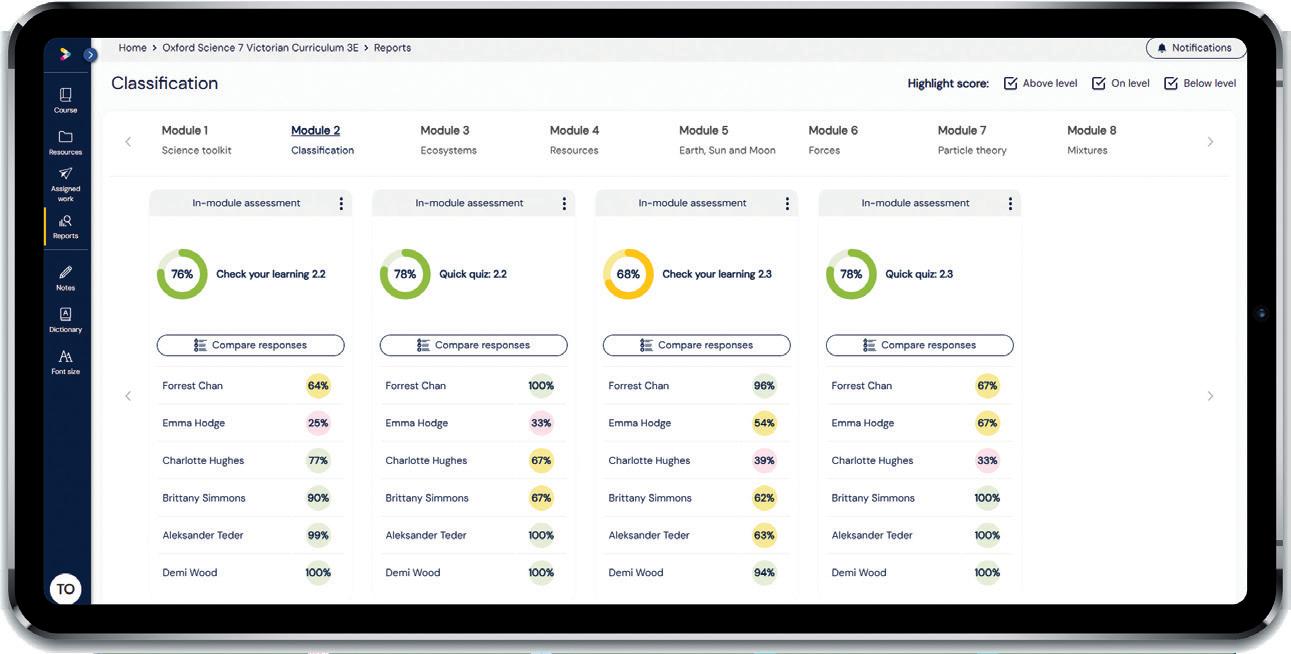
> revolutionise your planning, marking and reporting with powerful analytics on student performance and progress.
DRAFT
• Assessment report shows how students are performing in each online interactive assessment, providing feedback for teachers about areas of understanding
• Curriculum report summarises student performance against specific curriculum content descriptors and curriculum codes
For a complete overview of all the features and benefits of Oxford Digital:
> ac tivate your digital access (using the instructions on the inside front cover of this book) and click on “Introducing Oxford Science 10 for Western Australia (Second edition)” in the “About this course” menu.
Module 6
The universe
Overview
The universe is a collection of galaxies that includes stars, comets, planets and black holes. Telescopes and space technology are used to collect data on the universe. The Big Bang theory explains how the universe began and is supported by evidence of the red shift in light from stars and cosmic background radiation. Aboriginal and Torres Strait Islander peoples also have deep knowledge of the stars gathered over tens of thousands of years.
DRAFT
Lessons in this module
Lesson 6.1 Science in context: Aboriginal and Torres Strait Islander peoples have studied the universe for thousands of years (page 254)
Lesson 6.2 Skills lab: Using a star chart (page 256)
Lesson 6.10 Evidence supports the Big Bang theory (page 276)
Lesson 6.11 Science in context: Technology aids cosmological research (page 280)
Lesson 6.12 Review: The universe (page 285)
constellation a group of stars that form a pattern or picture
Lesson 6.1
Science in context: Aboriginal and Torres Strait Islander peoples have studied the universe for thousands of years
Introduction
While many people consider the ancient Greeks (400 BCE) to be the first astronomers, there is increasing recognition of early astronomers among Aboriginal and Torres Strait Islander peoples, who have been observing the movement of the stars for navigation, animal and plant behaviour, hunting, Dreaming stories and reflections of Earth for over 60,000 years. Aboriginal and Torres Strait Islander peoples continue to have many practical uses for what they observe in the night sky. The night sky is a calendar and an integral part of Aboriginal and Torres Strait Islander peoples’ cultures and spiritualities.
Aboriginal and Torres Strait Islander peoples’ calendars
Constellations are groups of stars that form a picture in the night sky. To many groups of Aboriginal and Torres Strait Islander peoples, the appearance of certain constellations at sunrise or sunset and how they track across the sky provide information on animal activity, which helps people decide what to hunt and when.
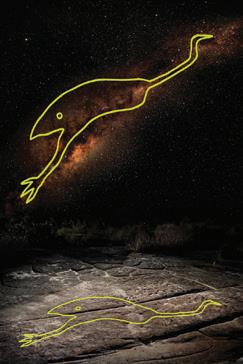
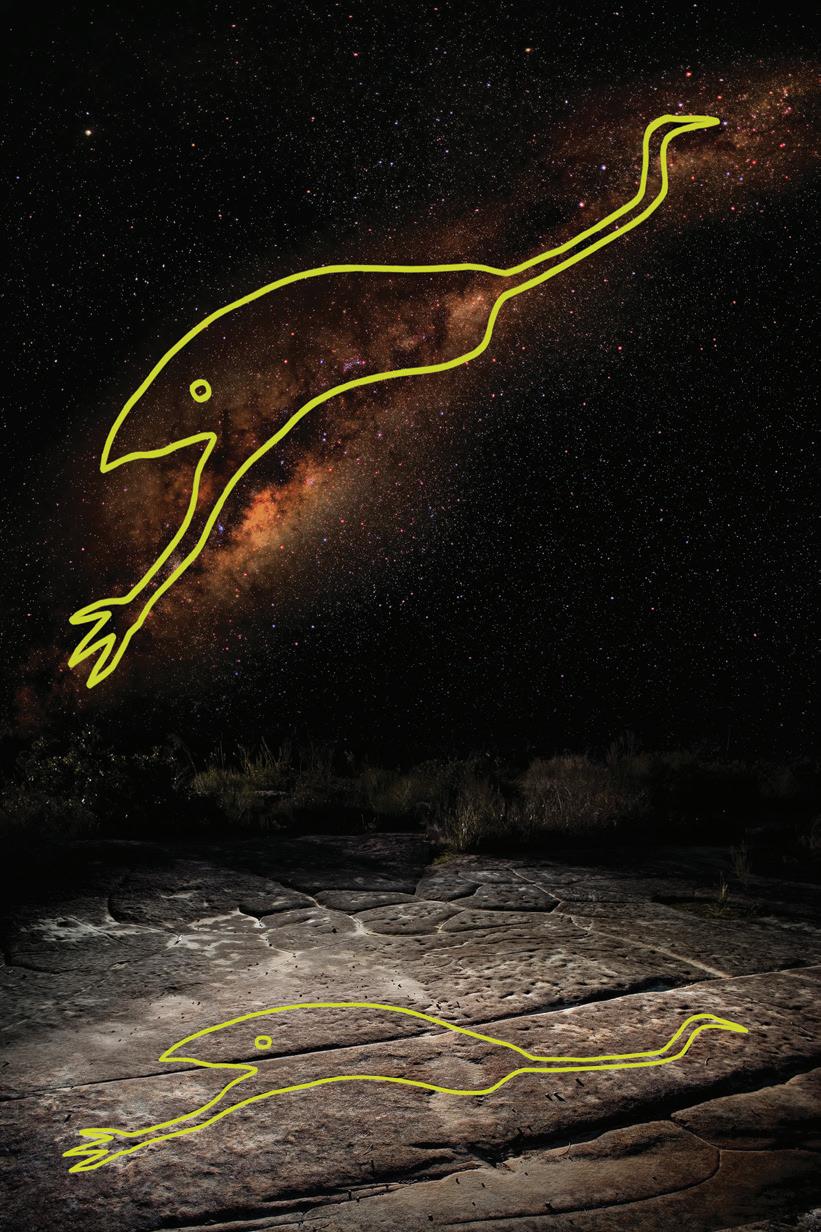
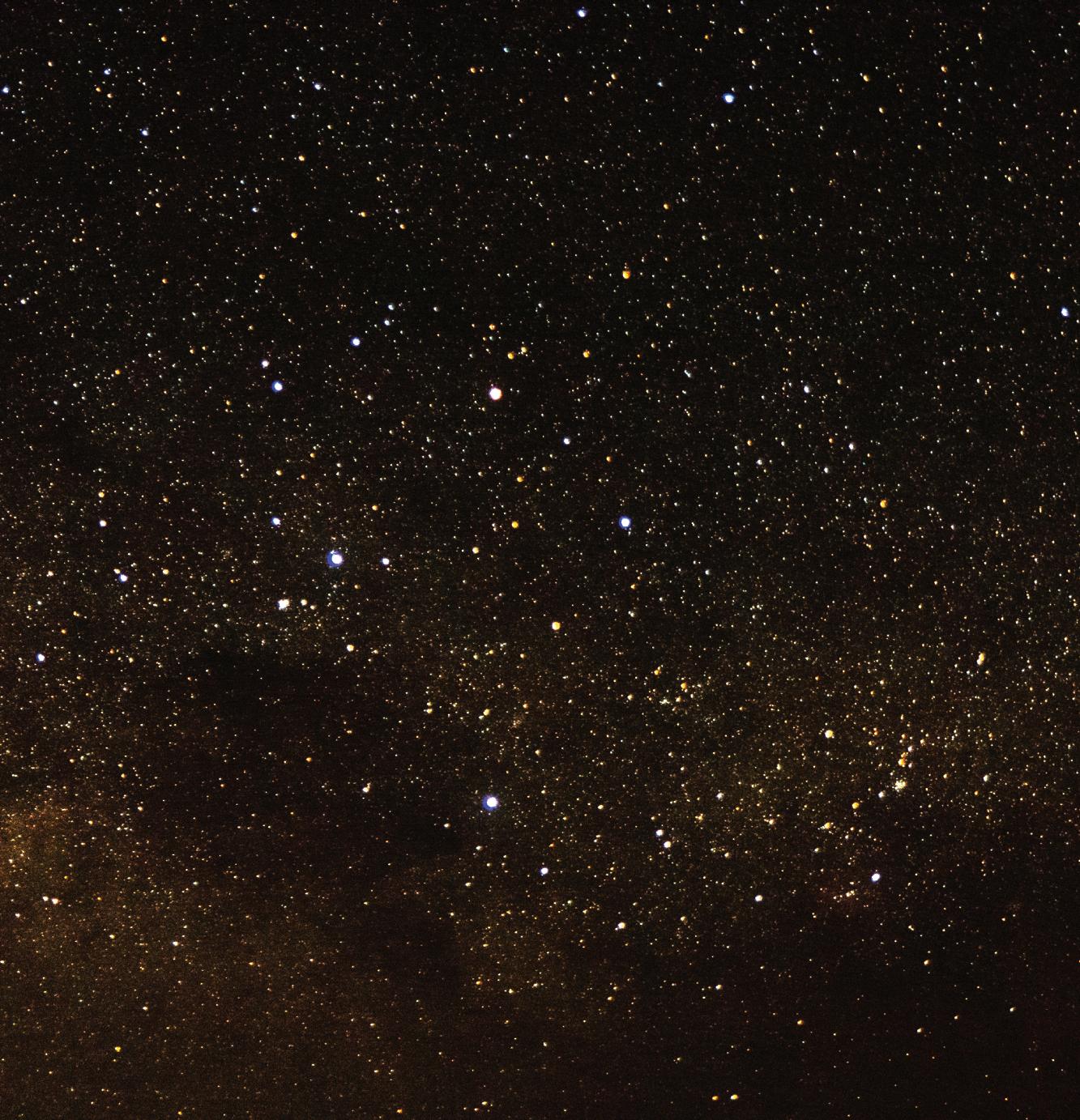
Many people in Australia are familiar with the whitish hazy band that appears across the sky. This is the Milky Way, which is our galaxy (a group of stars held together by their own gravity). Deep within the Milky Way is a dark patch that looks like an emu (Figure 1). Across Australia, there are many Aboriginal and Torres Strait Islander peoples’ stories about the emu in the sky. To the Wiradjuri people living on Country in central New South Wales, when the emu – known as Gugurmin – appears on the eastern horizon at sunset, the emus are nesting and there are no eggs to collect. Later in the year, Gugurmin appears directly overhead at sunset and it is time to collect the emu eggs. Stories are often told as a warning
Figure 1 The emu-shaped dark patch in the Milky Way tells Aboriginal and Torres Strait Islander peoples when it is time to hunt.
not to collect too many eggs or Gugurmin will disappear. This is sustainable practice and part of the seasonal hunting calendar.
To the Boorong people living on Country at Lake Tyrrell in Victoria, the appearance of the ancestral mallee fowl constellation, called Neilloan, during March and September signals that the bird is building its nest mounds. When the constellation disappears in late September or early October, it is time to gather the eggs.
To the Aboriginal and Torres Strait Islander peoples living on Country in the Gulf of Carpentaria, in northern Australia, a group of stars (called Scorpius by Europeans) appearing in the night sky in April means the wet season is over and soon the dry south-easterly winds will start. This forms part of their seasonal calendar.
Farming and navigating by the stars
Aboriginal and Torres Strait Islander peoples also plan farming by the stars. Torres Strait Islander peoples identify a constellation in the southern sky as Tagai, the great fisherman standing in a canoe. His left hand is holding a spear in the Southern Cross and points to the south. Tagai is used both for navigation and to identify the best time to start planting gardens at the start of the wet season (when Tagai’s left hand dips into the sea in November). This also forms a part of the seasonal calendar.
Torres Strait Islander peoples, being sea-faring fisherman, would use the constellation as a map to guide them safely home after fishing trips or visiting families on surrounding islands.
Stories in the stars
Aboriginal and Torres Strait Islander peoples are diverse and live in all parts of Australia. Each nation has its own language and Dreaming stories of the stars. Many of the stories are used to pass on information or explain lore and traditions.
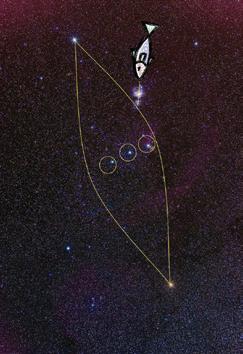
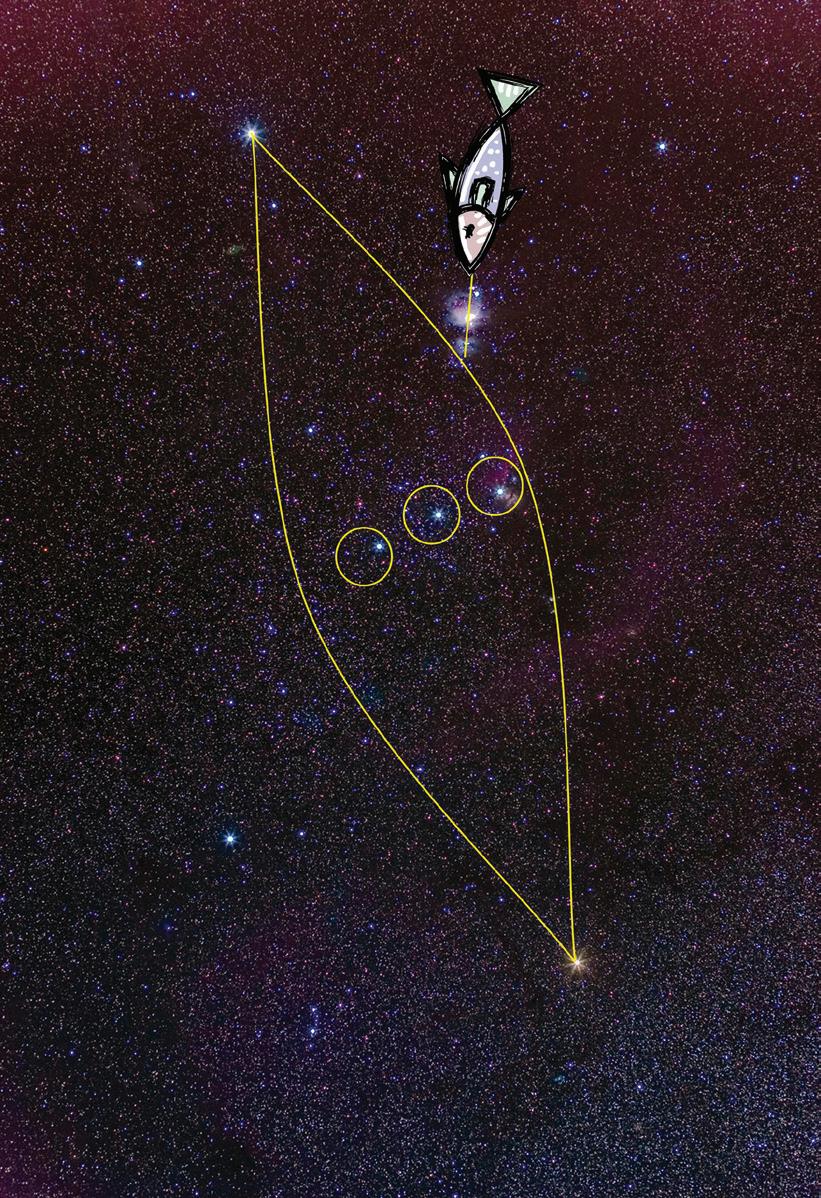
The constellation of stars called Orion by Europeans has different stories told about it by different Aboriginal and Torres Strait Islander nations. The Yolngu people of the Northern Territory call this constellation Djulpan. To the Yolngu people, Djulpan tells of three brothers of the King-fish (Nulkal) clan sitting side-by-side in a canoe. The cloud of stars in the nearby nebula are the fish, and the stars marking Orion’s sword are the fishing line. The three brothers are forbidden to eat any king-fish. The brothers catch king-fish after king-fish, but have to throw them all back. Eventually one of the brothers becomes so hungry he eats the king-fish. The Sun-woman (Walu) sees him kill the king-fish and in anger, creates a water spout that lifts the brothers up into the sky.
DRAFT
To the Napaljarri-warnu Jukurrpa people of Central Australia, this same group of three stars are a Jakamarra man chasing seven young Napaljarri sisters across the sky. The fleeing women found in a cluster of stars that is always ahead of the man in the sky act as a warning for the two groups to respect their differences.
Figure 2 Different Dreaming stories are used by Aboriginal and Torres Strait Islander peoples to explain the same constellation. The Yolngu people call the Orion constellation Djulpan.
Test your skills and capabilities
Early scientists
For thousands of years, Aboriginal and Torres Strait Islander peoples have observed and recorded the recurring patterns of star movement in the sky. Developing these Dreaming stories requires the use of many scientific skills, such as asking questions about the surrounding environment, making detailed observations, recording data (through oral traditions or painting landscapes), data analysis to recognise patterns, making conclusions, and communicating through paintings or oral traditions.
1 Identify the name of the Aboriginal and Torres Strait Islander peoples’ language group in your local area.
2 Describe a Creation story that is told through secondary sources (books or a trustworthy internet website) or primary sources (a local Elder). Remember to ask the permission of the Elder to write the story down.
3 Ex plain why it is important to seek permission and acknowledge the Elders when learning and repeating this kind of story.
4 Identify which science inquiry skills from the list below were used to develop the story, and describe how each skill was used.
– questioning and predicting
– pla nning and conducting –processing, modelling and analysing
– eva luating
– communicating
Lesson 6.2
Skills lab: Using a star chart
Context
Planispheres or star charts are very useful maps for locating various stars in the night sky. A star chart can be easily downloaded each month from the Skymaps website.
DRAFT
What you need:
• A copy of this month’s star chart. (Make sure you click on the southern hemisphere option.)
What to do:
1 Read the instructions on how to use the star chart. These are printed around the outside of the circular chart, along with other useful information about the chart.
2 Fi nd the south celestial pole (SCP), which is marked a few centimetres above south on the chart. This is just a place in the sky; there is no star nearby. Over the course of a night, the stars appear to rotate around this point. In the northern hemisphere, the North Star is located at the north celestial pole (NCP) and so it is used in navigation to find north.
3 Look at the bottom right-hand corner of the chart, which gives a key to the symbols on the chart. The star magnitudes give the brightness of the stars as viewed from Earth.
Questions
1 Identify t he location of the brightest star in the sky (Sirius).
2 Identify the star that is the second brightest in the sky.
3 Identify which star is brighter – Alpha Centauri or Beta Centauri.
4 Use your star chart to observe the night sky. Circle the stars and constellations you were able to identify
Figure 1 What constellations can you see? Lesson 6.3
Earth is in the Milky Way
Key ideas
→ Stars are large balls of gas that undergo nuclear fusion.
→ Stars that appear brighter are described as having a high apparent magnitude.
DRAFT
→ Larger, hotter stars that are further away have a higher absolute magnitude.
→ As Earth rotates, stars appear to move in the sky due to stellar parallax.
→ One light-year is the distance light travels in a vacuum in one year.
Introduction
The universe (all existing matter and space) consists of many different galaxies, stars (suns), planets (with and without moons), comets, and clouds of dust and gas. Understanding how all these objects evolve and affect each other allows us to understand how our nearest star (the Sun) will continue to change over time.
Learning intentions and success criteria
Check the next lesson for a linked practical activity or experiment.
galaxy a huge collection of gas, dust and billions of stars and their solar systems, all held together by gravity
Galaxies
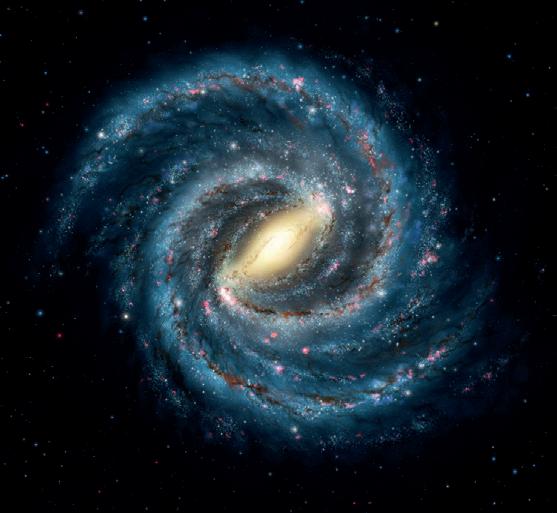
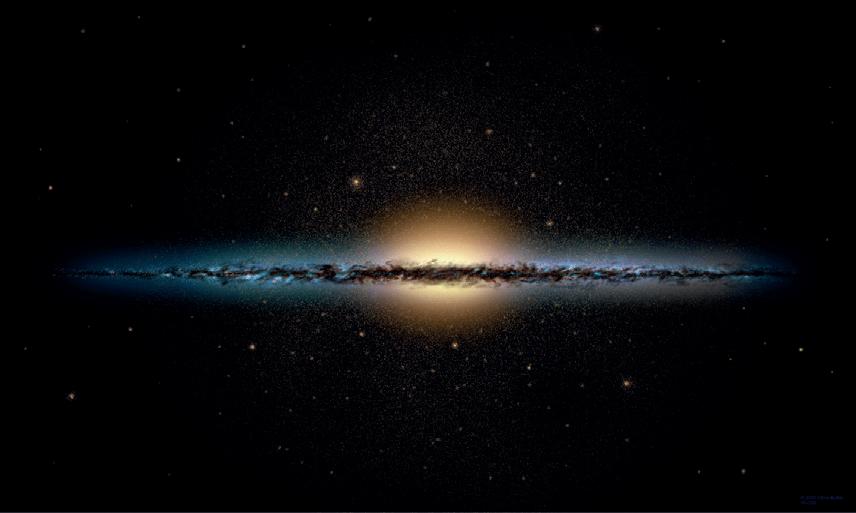
Our Sun is one of millions of stars that make up the spiral Milky Way galaxy. It is found on one of the tail ends of the flattened spiral. When you look up at a darkened sky (away from city lights), you should see a white ribbon of stars across one part of the sky. This is because you are looking across the flattened disc of the Milky Way galaxy (Figure 1).
A galaxy is a massive, gravitationally bound system consisting of stars, star remnants, gas and dust. Galaxies come in all shapes and sizes including spiral, elliptical and irregular. Galaxies are constantly moving away from each other. It is thought that the centre of the Milky Way galaxy contains a massive black hole that uses gravity to hold all the other solar systems in orbit. It can take approximately 250 million years for the Sun to orbit the centre of the Milky Way.
DRAFT
1 Earth is located in the spiral galaxy called the Milky Way. When viewed from the side, the galaxy is a disc shape that can be viewed across the night sky on Earth.
The solar system
Earth is a very small part of a group of planets that orbit the Sun. Our solar system consists of a single star (the Sun) with eight orbiting planets (Mercury, Venus, Earth, Mars, Jupiter, Saturn, Uranus and Neptune), five dwarf planets (Eris, Pluto, Ceres, Makemake and Haumea), and many moons, asteroids and comets, all bound together by gravity.
Earth is a relatively small planet that takes 1 year (365.25 days) to travel approximately 940 million kilometres around the Sun. This path travelled by Earth is called an orbit. Every 4 years we have a leap year. This adds an extra day in our calendar (February 29) to allow for the accumulation of the extra distance travelled by Earth each year.
Stars
nuclear fusion a reaction in which two lighter atomic nuclei fuse to form a heavier nucleus, releasing energy
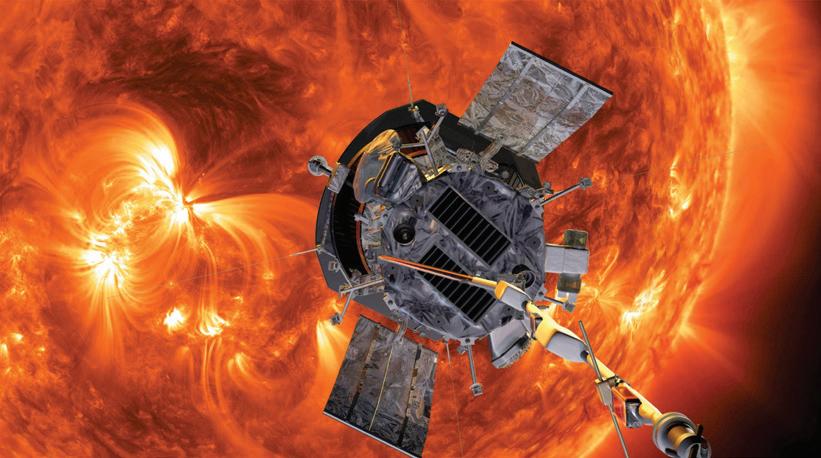
A star (including the Sun) is a giant ball of hot, glowing gases (Figure 2). Most stars are made almost entirely of hydrogen and helium. These gases are constantly colliding and reacting at the core (centre) of the star. When the atomic nuclei collide and fuse, they release energy to the star through nuclear fusion. This energy is emitted as light (and other forms of electromagnetic radiation) and is what we see when we look at the stars at night. Stars can be different sizes, masses, temperatures and brightnesses.
Bulge
Figure
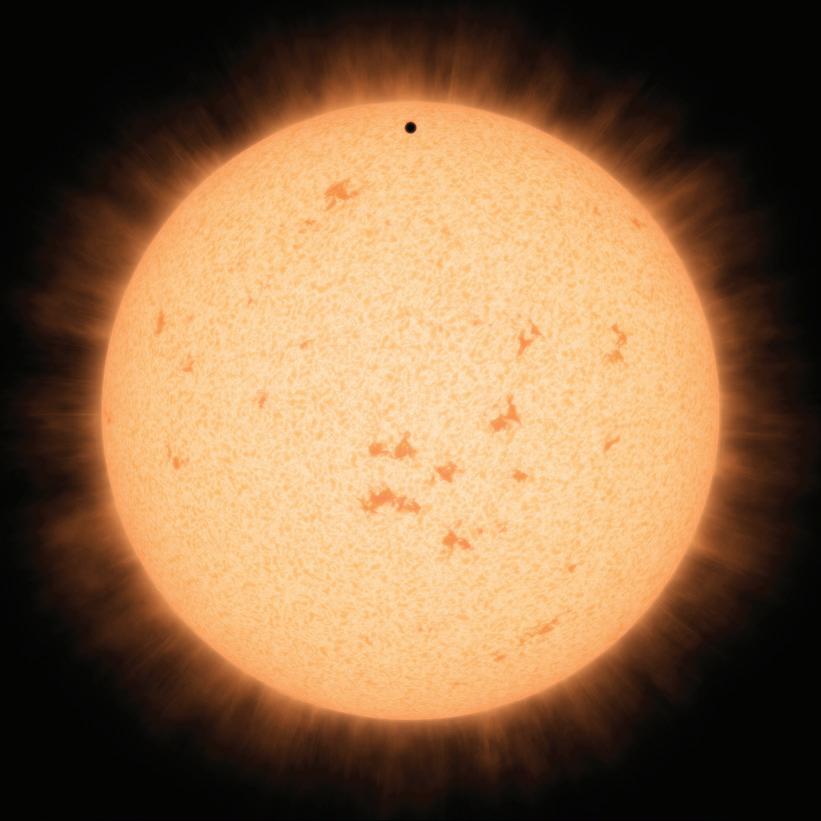
Figure 2 The Parker Solar Probe is being used to help enhance our understanding of the Sun.
What does a star’s brightness mean?
The brightness of a star viewed from Earth is measured on a scale called the apparent magnitude scale – a measure of how bright it appears to be. From Earth, the Sun is the brightest object in the sky and has an apparent magnitude of −27. In comparison, the full Moon has an apparent magnitude of −13. The closer the apparent magnitude is to zero, the dimmer the star is.
A star may appear to be quite bright because it is close to Earth, but it may not actually be very bright. For example, the Sun is not a very bright star compared with other stars, but it is the closest star to Earth.
The absolute magnitude scale measures a star’s brightness as if all stars were the same distance from Earth. This is an indication of its actual brightness or luminosity. Therefore, a star may have a high absolute magnitude but appear less bright to us because it is a long way from Earth (Figure 3).
3 Although stars A and B have the same apparent magnitude, A is more luminous and has a higher absolute magnitude than B.
In the constellation known as the Southern Cross (Figure 4), the stars Alpha Crucis (Acrux) and Beta Crucis (Mimosa) have the greatest apparent magnitude. Acrux appears brighter because it is actually two stars that sit close together, and it is closer to Earth than Mimosa.
apparent magnitude scale a scale for measuring the brightness of an object when viewed from Earth absolute magnitude scale a scale for measuring the brightness (luminosity) of objects from the same distance luminosity the actual brightness of a star (amount of energy it radiates); measured using the absolute magnitude scale
Distance from the Earth
Figure
Gamma Crucis
Delta Crucis
Epsilon Crucis
Alpha Crucis
Beta Crucis
Figure 4 The Southern Cross constellation
University Press
light-year the distance that light travels in one year
What does a star’s colour mean?
Another way of comparing stars is to analyse their colour. The colour of a star depends on its surface temperature. Blue stars are the hottest and red stars are the coolest. When we explore the life cycle of stars in Lesson 6.6 Stars have a life cycle (page 265), we will look at a method of displaying the star data in the form of a plot of absolute magnitude against star temperature.
Light-year
The universe that we can observe consists of all the stars, galaxies and other objects that we can see from Earth – it is enormous. We can only see these objects because light, or another type of signal, from these objects has had time to reach Earth and we can detect the signal.
Light travels very fast, at 300,000 km /s. The distance that light travels in one year is called a light-year (9,500,000,000,000 km). Light-years are used to measure the distance of stars from Earth.
The nearest star to Earth is the Sun, which is only 500 light-seconds away. This means it takes 500 seconds (approximately 8 minutes) for the light from the Sun to reach Earth. The nearest star in the Southern Cross is Gacrux (88 light-years away from Earth). The closest star to Earth, after the Sun, is Proxima Centauri, which is 4.2 light-years away. This means if Proxima Centauri exploded, it would take 4.2 years for the light to reach Earth and for you to see the explosion!
Worked example 6.3A shows how to use light-years to calculate distance in kilometres.
Worked example 6.3A Converting light-years to kilometres
Calculate the distance from Earth, in kilometres, of the Large Magellanic Cloud (LMC), which is 180,000 light-years away.
Solution
1Recall the number of kilometres in one light-year.
2Calculate the distance in kilometres by multiplying the number of kilometres in one light-year with the number of light-years to the Large Magellanic Cloud (LMC).
DRAFT
Stellar parallax
1 light-year = 9.5 × 10¹² km
distance to LMC = (9.5 × 1012) × (1.8 × 105 ) km = 9.5 × 1.8 × 10(12 + 5) km = 17.1 × 10¹⁷ km
Every night, the stars and planets appear to move across the night sky. During the night we can observe the “movement” of the Moon through the sky as it rises and, much later, as it sets. All stars “move” in the sky, although, because they are so far away, their movement is much less noticeable than that of the Moon.
This effect, known as stellar parallax, is used by astronomers to calculate the distance to nearby stars (stars closer than 100 light-years to Earth). Beyond this distance, spacecraft stellar parallax a change in the apparent position of a star against its background when viewed from two different positions
are needed to calculate the distance accurately. When a star is observed from two different positions (for example, in January and then six months later in July), its position relative to other stars may appear to be different (Figure 5).
Earth in January
More distant stars C
Figure 5 Measuring the distance to stars using stellar parallax. In January, star A, a close star, is in line with a more distant star, star B, but in July it is in line with star C. By measuring the parallax angle and knowing the radius of Earth’s orbit, the distance from Earth to star A can be calculated.
The nebular hypothesis
The Sun was formed at the same time as our solar system. The nebular hypothesis suggests that a spinning cloud of dust and gas, called a nebula, became our solar system some 4.6 billion years ago. Due to competing forces associated with gravity, gas pressure and rotation, the contracting nebula collapsed, flattening to form a proto-planetary disk. This spinning nebula collected lots of material in its centre, which explains why the Sun constitutes 99 per cent of the mass in our solar system.
In the process of forming the solar system, the nebular cloud of dispersed particles gathered into distinct temperature zones. Close to its core, temperatures were very high, so only condensation of metals and silicate minerals with very high melting points aggregated. Further from the Sun, where temperatures were relatively lower, we find condensation of lighter gas molecules of methane, ammonia, carbon dioxide and water. The temperature differences explain why the solar system has four inner rocky planets and four outer gaseous giant planets.
How was the Milky Way galaxy formed?
The Milky Way’s origin stretches far back, more than 13 billion years. It was formed through the merging of small galaxies and globular clusters from rare stars. During this merging, many galaxies with large systems developed; some larger stars were ejected into wide orbit, forming the galaxy’s halo, and smaller stars were mixed into the Milky Way’s central bulge (concentration of stars). The Milky Way disc continued to grow through gas flowing into it from the surrounding medium and continual merging with other much smaller galaxies.
nebular hypothesis a scientific explanation for how the solar system was formed from a vast, rotating cloud of dust and gas (a nebula) that condensed and collapsed under its own gravity nebula a cloud of gas and dust in space
halo a spherical cloud of stars surrounding a galaxy
Check your learning 6.3
Check your learning 6.3
Retrieve
1 Define the following terms.
a Star
b Galaxy
c Light-year
d Stellar parallax
2 Recall the name of the galaxy that contains our solar system.
Comprehend
3 Ex plain the process of nuclear fusion in stars.
4 Dr aw the Southern Cross constellation and describe what you know about the different stars in the constellation.
5 Ex plain why the Milky Way galaxy appears so large in the night sky compared with other galaxies.
6 Describe the nebular hypothesis and explain how this hypothesis accounts for the formation of the solar system.
7 Ex plain how the Milky Way Galaxy was formed.
Analyse
8 Compare absolute magnitude scale and apparent magnitude scale.
9 Calculate the distance (in km) to Beta Centauri at 525 light-years away from the Earth.
10 If a star that was 20 light-years away exploded today, calculate when we would see the explosion.
Lesson 6.4 Challenge: Understanding parallax
Aim
To determine how parallax affects what what you see
What you need:
• Whiteboard
• Wh iteboard marker
DRAFT
What to do:
1 Position a student in front of the class approximately 2 to 4 m in front of the whiteboard (if possible).
2 Wr ite a series of numbers across the whiteboard at the same height as the student.
3 Ask each member of the class to decide which number is in line with the student.
Questions
1 Explain why most members of the class see a different alignment of the student and the numbers on the whiteboard.
2 Relate this activity to the night sky. Explain what the following elements of the activity represent:
a numbers on the whiteboard
b student
c members of the class.
3 Ex plain how the results of this demonstration would be different if the student stood approximately 30 cm in front of the whiteboard.
Lesson 6.5 Experiment: Calculating the distance to the Sun
Background
This experiment uses ratios to determine the distance from Earth to the Sun. If you know the distance from the pinhole to the image of the Sun, the diameter of the Sun’s image and the diameter of the Sun, you can calculate the unknown – the distance to the Sun.
You will use the following symbols:
• length from the pinhole to the Sun’s image, L i
• distance to the Sun, L S
• diameter of the Sun’s image, d i
• diameter of the Sun, d S
You can write an equation using these four quantities. Try writing this equation or ask your teacher for help. It can be written in either fraction or ratio form.
Aim
To determine a value for the distance from Earth to the Sun using a pinhole screen, and to compare this with the known value
Materials
• Metre ruler
• Retort stand (about 76 cm in height)
• Clamp
• Coat hanger
• Sticky tape
• Needle or pin
• 2 × A4 sheets of paper
• Ca lculator
• Su n visible in the sky
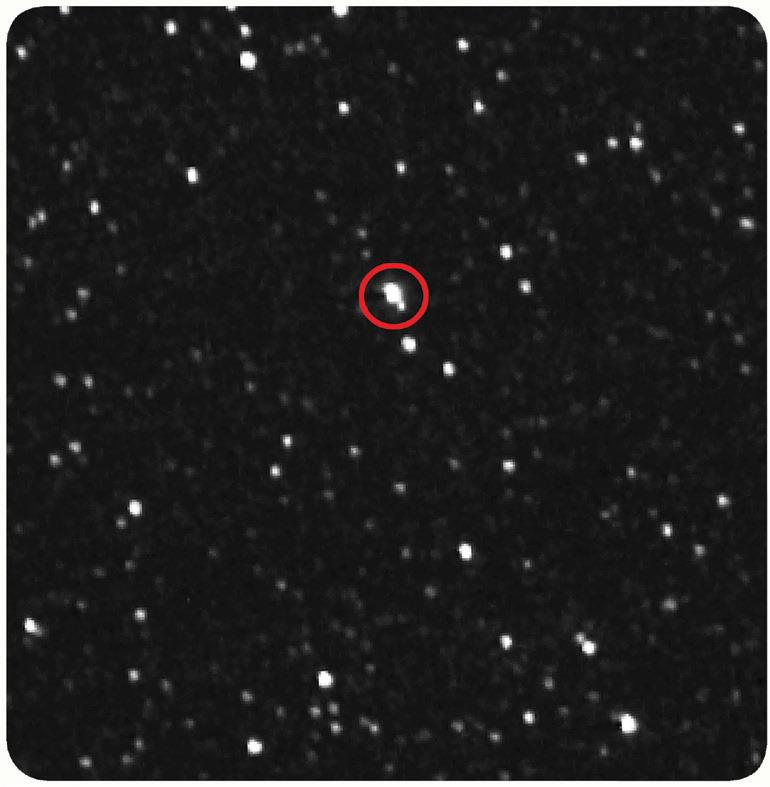
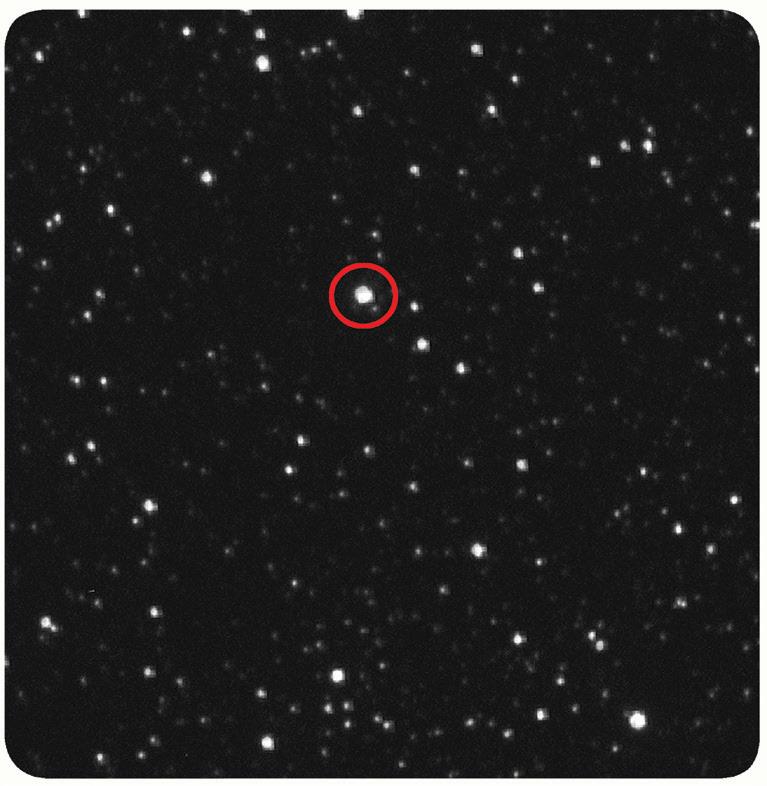
Figure 1 These images show two views of the star Proxima Centauri (circled). Image (A) was taken by a spacecraft 7 billion kilometres from Earth and image (B) was taken from Siding Spring Observatory in Australia. The star appears to be in a different position in each image. This is because of the parallax effect.
Method
1 Wrap a sheet of A4 paper around the coat hanger a nd tape it securely into place to form a screen.
2 Ma ke a tiny pinhole in the centre of the screen.
3 In t he centre of the other sheet of paper, draw two lines approximately 7 mm apart and measure the distance as accurately as possible. It doesn’t matter if they are not 7 mm apart, but measure them as carefully as possible and record this value.
4 Tape the A4 paper with the two lines to the top of the base of the retort stand, making sure that the two lines are centred on the base horizontally.
5 Clamp the pinhole screen horizontally so it is facing the screen on the base of the stand and is about 40 cm away from the base.
6 Go outside and point the screen with the pinhole at the Sun. Adjust the position of the pinhole screen along the rod so that the circle of light from the Sun through the pinhole falls exactly between the two lines you drew on the base of the retort stand. The circle of light needs to fill the two lines by just touching both lines. (Figure 1)
Results
1 Measure and record the distance between the t wo lines on the screen. This is d i in the equation.
2 Measure and record the distance between the two screens in millimetres. This is L i in the equation.
3 The accepted value of the diameter of the Sun, d S , is 1,392,000 km.
4 Use the equation to perform a calculation based on the measurements to determine a value for L S.
Discussion
DRAFT
1 The correct value for the distance to the Sun is approximately 149,600,000 km. Calculate the difference between L S and this value. Record this value as the “difference”.
2 Divide the difference by the correct value and multiply by 100. This converts it to a percentage and is called the percentage error. Round it off to the nearest whole number.
3 Identify two factors that contributed to this error. (HINT: Which measurements were not exact?)
4 Describe how these errors could have been minimised.
Conclusion
Write a conclusion for this experiment that relates the findings to the aim. Use the formula below to describe the percentage error of your measurement.
percentage error = your value − actual value (149, 600, 000 km) actual value (149, 600, 000 km)
Retort stand and clamp
A4 paper
Figure 1 Experiment set up
Lesson 6.6
Stars have a life cycle
Key ideas
→ Nebulae are large clouds of gas where stars are born.
→ Each star exists in a hydrostatic equilibrium between the gravitational pull to its centre and the release push of energy from nuclear fusion from its centre.
→ Small stars will cool and die, forming white dwarfs and black dwarfs.
→ Large stars explode in supernovas, releasing large amounts of light and energy.
Introduction
In the constellation of Orion lies a group of stars informally known as the Saucepan. Just above it is a misty patch, just visible to the naked eye. This is M42, or the Orion Nebula, a region of gas and dust in which new stars are just beginning to emit light. It is a stellar nursery, where stars are being born all the time. Our own Sun would have been born in a similar region. Throughout the universe, stars are at various stages of their lives. Young, medium, old and dying stars can be found, as well as exploded stars.
Very young stars called protostars are still gathering mass from surroundings gas and dust cloud and have not yet become dense and hot enough to burn hydrogen. Others, called variable stars, exhibit changes in brightness over time, due to various physical processes within the star or external factors.
Birth of a star
Across the universe are large clouds of hydrogen gas called nebulae. Even though hydrogen atoms are very small, they are attracted to each other by gravity. The more the hydrogen atoms gather together, the greater the attractive force. The hydrogen atoms in the centre of the cloud are under a great deal of pressure, causing the centre of the gas cloud to heat up. Eventually there is enough heat and pressure to fuse two hydrogen atoms together, forming helium. This nuclear fusion releases large amounts of energy in the form of heat and light. A star is born (Figure 1).
DRAFT
Learning intentions and success criteria
protostars condensed gas cloud in the early stages of star formation
variable star refer to stars whose observed light varies in intensity
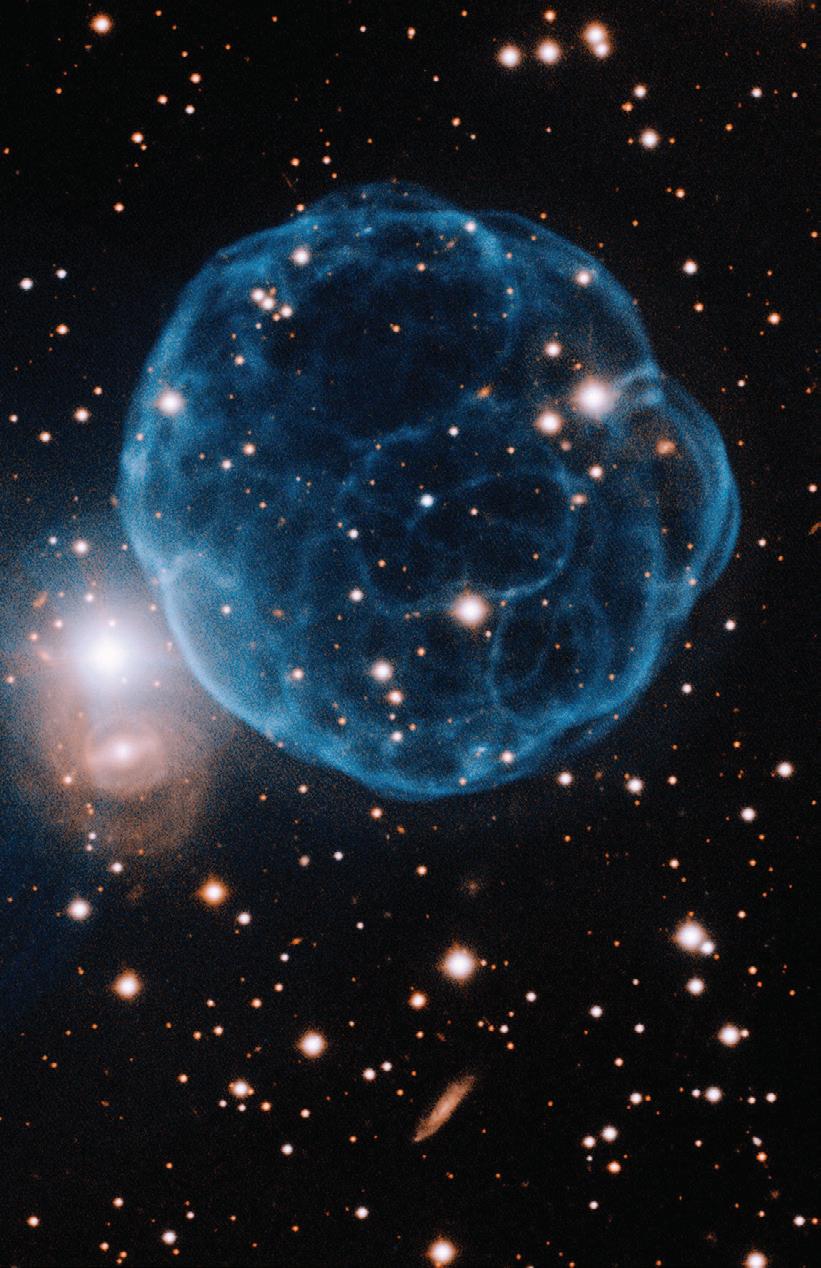
Figure 1 This image of Kn 61, a confirmed planetary nebula, was taken by Professor Travis Rector, University of Alaska, Anchorage, using the 8.1 m Gemini Telescope. The nebula appears as a blue bubble, and a bright star and spiral galaxy can also be seen.
hydrostatic equilibrium in relation to Earth’s atmosphere: a state of stability, with upward forces balanced by downward forces
main sequence star refers to stars in the most stable and longest part of their life cycles
red giant a star that has become large and bright with a cool surface, because it has run out of hydrogen fuel
solar mass equal to the mass of the Sun, approximately 1.989 × 1030 kg; astronomers use solar masses to compare the sizes and masses of stars and other astronomical objects planetary nebula a glowing shell of gas formed when a star dies
white dwarf a small, hot star that forms when a star (e.g. our Sun) runs out of fuel and slowly fades and cools
black dwarf a remnant formed when a white dwarf star cools and gradually fades away
supernova the explosive death of a star
Adult stars
The release of energy from the nuclear fusion of hydrogen sees gas particles transformed into heavier particles, while the force from gravity compresses these particles. These two forces become balanced so that the star stabilises to a consistent size. This balance of forces is called hydrostatic equilibrium. A main sequence star can maintain this balance between the forces for millions of years. The nature of a main sequence star is to actively fuse hydrogen into helium at its core, a process that generates energy and provides stability. A main sequence star, such as the Sun, is characterised by a stable balance between the outward pressure from the nuclear fusion and the inward pull of gravity.
Older stars
DRAFT
neutron star a small, highly dense star made mostly of neutrons
black hole a region in space of infinite density where gravity is so strong that nothing, not even light, can escape from it
Eventually the hydrogen available for nuclear fusion starts to decrease. As it runs out of hydrogen in the core, the surrounding layers of hydrogen is heated. Eventually the helium atoms start to fuse, forming carbon atoms. This form of nuclear fusion releases even more energy than hydrogen fusion. The star grows larger as the forces reach a new hydrostatic equilibrium. This cooling and expansion results in the formation of a red giant star (Figure 2). Our Sun will do this in about 5 billion years from now. Because of its size (1.989 × 1030 kg) or 1 solar mass) the Sun will eventually swallow up the inner planets of the solar system –Mercury, Venus, Mars and Earth.
Death of a star
Expanded, cool, hydrogenrich outer envelope
Helium is dumped into core
Eventually the amount of helium available decreases as well. As the outer regions of lighter red giants fade away, a planetary nebula is formed. Only the core of the star remains. Further nuclear reactions occur, increasing the rate of energy release and therefore the temperature. The core becomes white hot and the star is called a white dwarf. As this mass cools, the star gradually fades away to become a black dwarf.
Heavier red giants seem to have a different fate. The nuclear fusion process continues through various elements until iron is formed. Eventually, the star runs out of energy for fusion reactions and collapses. This increases the pressure and temperature to extreme levels. The resulting explosion is the largest explosion in the universe – a supernova.
After a supernova, the remaining core is extremely dense, and electrons and protons collide to form neutrons, creating a neutron star. Neutron stars are only tens of kilometres in diameter and are remarkably dense. A teaspoonful of neutron star material would have the same mass as 100,000 cars!
If a neutron star collapses even further, its gravitational pull and density become so huge that not even light can escape. These are black holes. As matter falls towards a black hole, X-rays are emitted. This is how potential black holes are detected in space, although their existence is still to be determined absolutely.
Helium-rich core Fusion Gravity
Hydrogenburning shell
Figure 2 How a red giant star forms
Mass and life cycle of stars
The amount of matter in a nebula that determines the mass of the star that is formed from it. The mass of the star dictates its core temperature and luminosity, which in turn, determines how quickly fuel is consumed and how long the star will last (Figure 3).
Most of a star’s life is in the main sequence stage, when it fuses hydrogen into helium at its core. Massive stars fuse hydrogen at a higher rate than the less-massive stars. Higher-mass stars burn fuel more rapidly and have relatively shorter lifespans (millions of years), and evolve into red supergiants, leading to core collapse supernova and forming either neutron stars or black holes. Lower-mass stars burn fuel more slowly and can live for billions of years; they evolve into red giants which cool to form white dwarfs and eventually become black dwarfs.
Our Sun is considered a medium-mass star whose lifespan of billions of years means it will eventually become a red giant and then a white dwarf.
Hertzsprung–Russell diagrams
In the early 1900s, Ejnar Hertsprung and Henry Norris Russell independently developed the idea of plotting stars on a graph. This method of displaying star data is called a Hertzsprung–Russell diagram, or H–R diagram. An H–R diagram is a graphical representation that classifies stars based on four main properties:
• lu minosity
• temperature
• colour
DRAFT
• spectral type.
Luminosity refers to a star’s intrinsic brightness, while temperature is a measure of the surface heat. H–R diagrams can be used to identify relationships between the properties of a star, including luminosity (absolute magnitude), stellar classifications and effective temperatures.
A change to a star’s brightness and temperature is interpreted as showing a star changing from one “type” to another. As a star’s properties change, it tends to shift from one position
Hertzsprung–Russell diagram a graph displaying star data, with the star’s spectral types (temperature) on the x-axis and its absolute magnitude (luminosity) on the y -axis
Gas nebula
Protostar Original mass <8 solar masses, red giant star Original mass >8 solar masses, red supergiant star
Variable star
White dwarf and planetary nebula
Core <3 solar masses, neutron star
Core >3 solar masses, black hole Supernova
Main sequence star
Figure 3 The life cycle of a star is determined by its mass.
SCIENCE OXFORD
Curriculum
Siew Yap
Helen Silvester
in the H–R diagram to another. In this way, the H–R diagram showcases the life cycle of a star. Most stars, including the Sun, fall into a narrow diagonal band called the main sequence (Figure 4).
How to read an H–R diagram
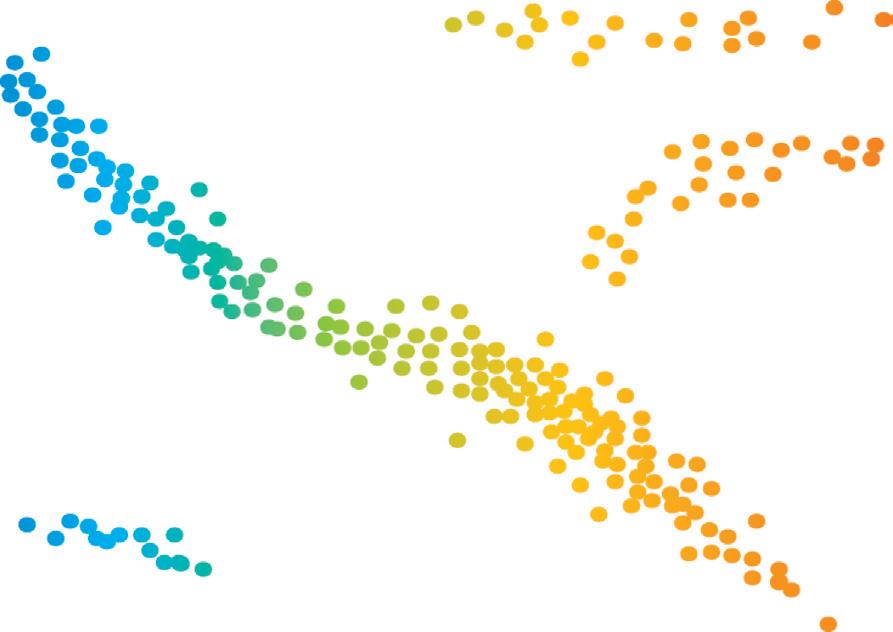
The hottest and brightest stars appear blue and are found in the upper left corner of the H-R diagram, while cooler and fainter stars appear orange/red in colour and can be found on the bottom right-hand side of the diagram. The main sequence connects the hot, bright stars to the cool, faint stars.
Figure 4 A Hertzsprung–Russell diagram
Check your learning 6.6
Check your learning 6.6
Retrieve
1 Identify the event that occurs between gas atoms that marks the birth of a star.
2 Define the term “nebula”.
3 Identify what is left after a supernova.
DRAFT
4 Identify which region on a Hertzsprung–Russell diagram contains stars that spend about 90 per cent of their lives burning hydrogen and helium at their cores.
Comprehend
5 Use a labelled diagram to explain the forces involved in hydrostatic equilibrium.
6 Describe a red giant star.
Analyse
7 Compare a white dwarf and a black dwarf. Apply
8 Create a flow chart to show the life cycle of a star the size of the Sun.
9 The Sun is 1 solar mass. Predict what will happen when hydrogen becomes limited in the Sun.
10 Blue stars are much larger than the Sun. However, they do not have enough energy to explode. Create a flow chart to show the life cycle of a blue star.
Main sequence
White dwarfs Giants
Lesson 6.7
Scientists search for life
Key ideas
→ The Goldilocks zone is the area around a star where liquid water might exist.
→ Transmission spectroscopy detects the light that is absorbed by gases in a planet’s atmosphere.
→ A star wobbles when an exoplanet’s gravity causes it to move slightly.
Goldilocks zone
All living things on Earth need water to survive. Water helps important chemical reactions occur in our bodies. Every reaction that keeps us alive needs water.
Water is special because it can dissolve more substances than any other liquid. It can also carry heat, has a high boiling and freezing point, and lets light pass through for photosynthesis. These things can only happen when water is liquid.
The Goldilocks zone is the area surrounding a star where conditions are just right for life, similar to that on Earth (Figure 1). The term comes from the story of Goldilocks and the three bears, where Goldilocks describes something ideal as “not too hot, not too cold, but just right”. In space, this means the distance from a star where the temperature is ideal for liquid water to exist on a planet’s surface – not too hot (where water would evaporate) and not too cold (where water would freeze).
Scientists are always looking for exoplanets (planets outside our solar system) in the Goldilocks zone around other stars, as they may also have the potential to support life. Not all stars are the same, though. Some stars are hotter or cooler than the Sun, and this affects where the Goldilocks zone is. For hotter stars, the habitable zone would be farther away, and for cooler stars, it would be closer.
Being in the Goldilocks zone doesn’t guarantee that a planet has life – other factors, like atmosphere and chemical composition, are also important! Venus is similar in size to Earth, but its thick atmosphere (containing carbon dioxide and clouds of sulfuric acid) traps much of the heat from the Sun, making it too hot for human habitation.
Learning intentions and success criteria
Goldilocks zone the area around a star where it is not too hot or too cold for liquid water to exist on a planet
exoplanet a planet that orbits a star outside of our solar system
Figure 1 The Goldilocks zone is an orbital area around a star where scientists are hoping to identify an exoplanet that might be suitable for human habitation.
direct imaging directly measuring the amount of light emitted from a star
Direct imaging and transmission spectroscopy
All planets orbit around a star. When an exoplanet passes in front of its star from our point of view (a transit), it causes a small dip in the star’s brightness.
Large telescopes like Kepler (2009) and TESS (Transiting Exoplanet Survey Satellite, 2018) have been launched into space to look for exoplanets in the Goldilocks zone. Both telescopes use direct imaging to continuously measure the amount of light produced by a star (Figure 2). Their measurements are compared to look for the small dimming of a star that is the sign of a planet’s transit. By measuring how much the star’s light dims and how long the dimming lasts, scientists can determine the size and orbit of the planet, and its distance from the star.
DRAFT
Figure 2 When a planet passes in front of a star, the amount of light reaching Earth will be dimmed enough for the Kepler or TESS telescopes to detect.
As the star’s light travels through the exoplanet’s atmosphere, some wavelengths of light are absorbed. Different gases absorb different wavelengths (Figure 3). The James Webb Space Telescope, which was launched in 2021, can be used to detect the spectrum of light that is transmitted through an exoplanet’s atmosphere. This will tell us if the atmosphere is appropriate for human settlement.
Detecting wobbly stars
The radial velocity method is used to find exoplanets by looking at the small movements or “wobbles” of a star. It is the gravitational pull of a star that causes the planet to orbit; however, the planet also exerts a gravitational pull on the star. Even though the star is much bigger, the planet’s gravity makes the star move a little. This movement causes the star to wobble. Scientists can detect this wobble by noticing changes in the star’s light. By studying the changes in light, scientists can find out if a large planet is orbiting the star, how big the planet is and how long it takes to complete its orbit.
Transmission spectrum of an Earth-like atmosphere
Figure 3 The transmission spectrum of an exoplanet can identify the gases in the atmosphere of a planet.
Life on Mars
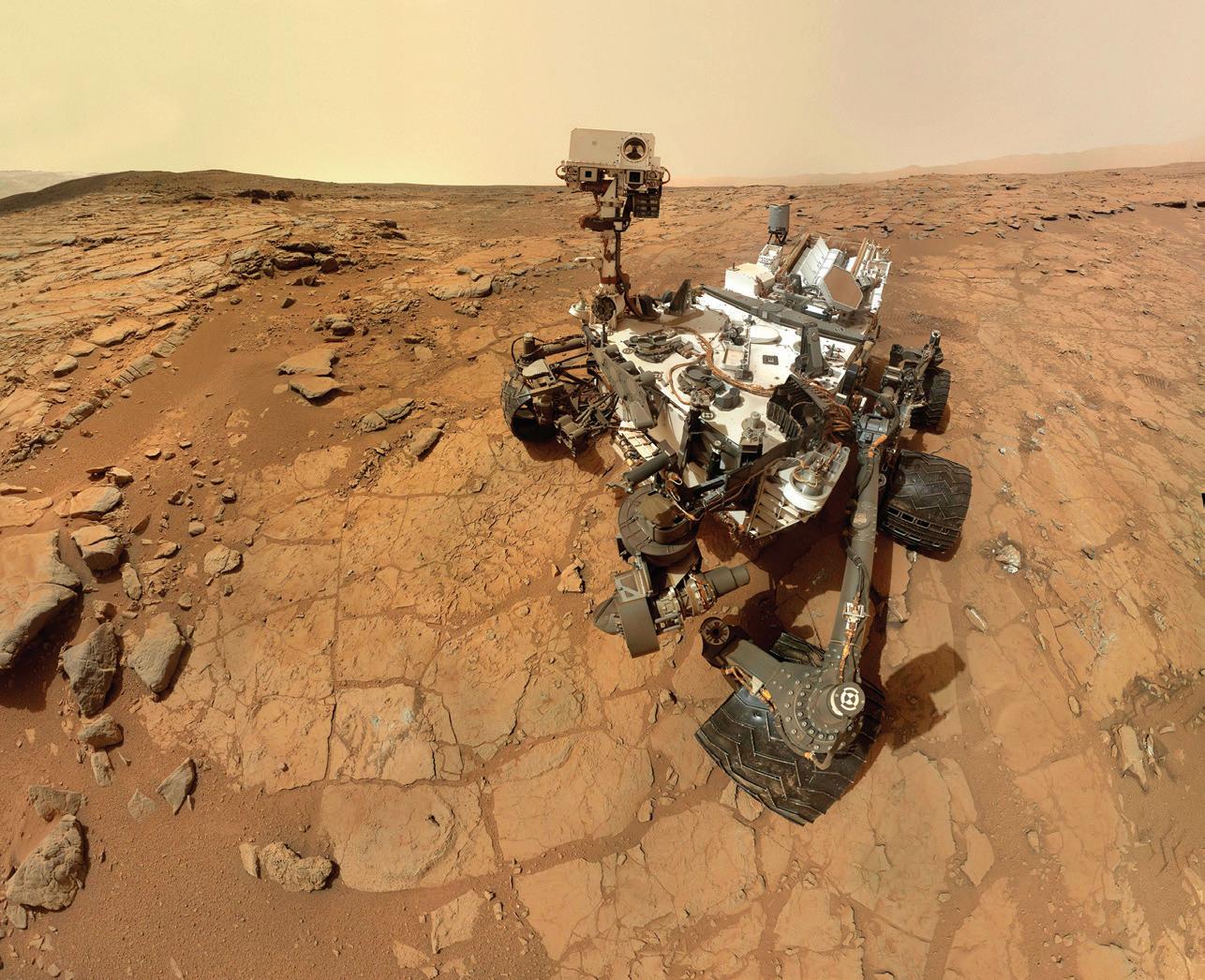
Data generated in the form of images, spectra and sensor readings through space missions (using rovers and probes) help us understand the geology and atmosphere of moons and other planets in the solar system. Scientists believe that Mars may have had conditions in the past, such as liquid water on its surface, that could support life. Photos of the surface of Mars suggest that there were once rivers and lakes. The rovers Curiosity (Figure 4) and Perseverance are using instruments to analyse soil samples and search for the molecules that are the building blocks of life. They are also examining the planet’s current conditions to see if it might still have bacteria and fungi in places like the suspected underground water. While no direct evidence of life has been found yet, these missions continue to collect data that could one day answer the big question: Did life ever exist on Mars?
Check your learning 6.7 Check your learning 6.7
Retrieve
DRAFT
1 Describe the Goldilocks zone.
Comprehend
2 Describe why water is important for life.
3 Describe what transmission spectroscopy can tell scientists about an exoplanet.
Analyse
4 Ex plain why hotter stars have a Goldilocks zone farther away than cooler stars.
5 Compare direct imaging used by the Kepler and TESS telescopes to transmission spectroscopy used by the James Webb Space Telescope.
Apply
6 Ex plain how the wobble of a star can help scientists detect an exoplanet and determine its size.
Figure 4 Curiosity Mars rover
Learning intentions and success criteria
Lesson 6.8
The galaxies are moving apart
Key ideas
→ Different types of galaxies exist, such as spiral, elliptical and irregular.
→ Elements absorb light energy in specific wavelengths, creating an absorption spectrum.
→ When the same elements return to a stable state, they release the wavelengths of energy as an emission spectrum.
→ The Doppler effect describes the change in frequency of a wave as an object moves towards or away from an observer.
Check the next lesson for a linked practical activity or experiment.
spiral galaxy a galaxy characterised by a flattened, rotating disk with spiral arms extending from a central bulge
→ A red shift in the emission or absorption spectrum of a galaxy indicates that the galaxy is moving away from the observer.
Types of galaxies
A galaxy is a large collection of stars, interstellar dust, nebulae and star remnants that are gravitationally bound together (as discussed in Lesson 6.3 Earth is in the Milky Way (page 257). Smaller galaxies consist of a “few” hundred million stars, while the biggest galaxies can consist of 100 trillion stars. There are various ways galaxies can be classified; for example, we can look at the shapes and physical features. Scientists sort galaxies into three main types: spiral, elliptical and irregular.
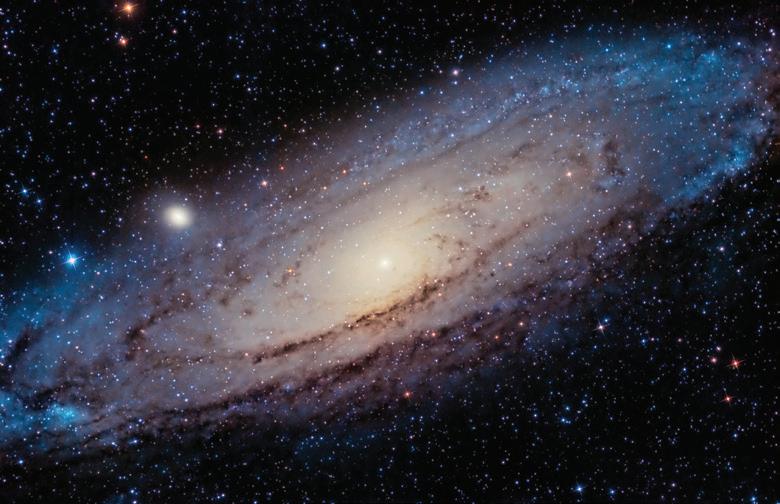
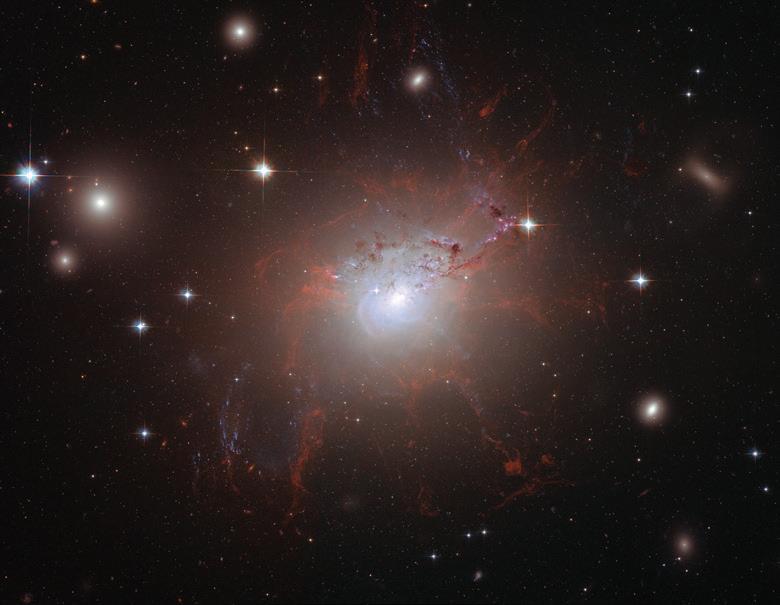
Spiral galaxies have a large central bulge, with a flattened surrounding disc with spiral arms (Figure 1). The Milky Way is an example of a spiral galaxy. It looks like a giant, rotating spinning wheel, with a flattened disc of stars and a central bulge. Spiral galaxies consist of a collection of old stars and star clusters, gas and dark matter. Younger stars are formed and located in the gas-rich arms which provides the materials needed for new star formation while older stars can be found throughout the bulge, disc, globular clusters and halo sections of the galaxy.
elliptical galaxy a galaxy characterised by a smooth, oval or elliptical shape
Elliptical galaxies have semi-spherical or elliptical (round to oval) shapes (Figure 2). They are rarer than spiral galaxies. Elliptical galaxies tend to have limited amounts of gas and dust, meaning they don’t produce many new stars. They also tend to be less organised in structure. Stars in an elliptical galaxy orbit around the core somewhat randomly and tend to be older than the stars found in spiral galaxies. Scientists believe that elliptical galaxies may have originated from collisions and mergers with spiral galaxies.
Figure 1 A spiral galaxy
Figure 2 An elliptical galaxy
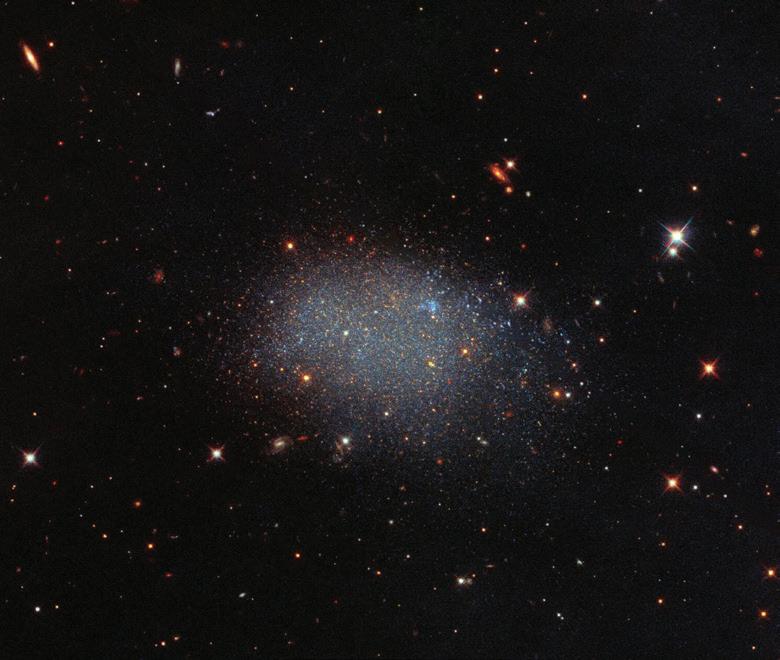
Irregular galaxies lack structure and organisation, and may have unusual shapes like straight lines, rings or small groupings of stars (Figure 3). They vary greatly in size, from dwarf irregular galaxies that are 100 million times the Sun’s mass, to large irregular galaxies that can weigh some billion solar masses. Irregular galaxies are thought to be created through galaxies interacting or colliding, which can result in a mix of old and young stars, depending on the make-up of the original galaxies. Irregular galaxies can hold enough gas and dust to form new stars.
Measuring the movement of stars
As a star undergoes nuclear fusion, it releases energy in the form of light. This is usually a full spectrum of light containing all the wavelengths and colours possible.
The outer layers of gas surrounding the star contain elemental atoms that absorb specific wavelengths of light energy that correspond to the movement of the electrons in their shells. When a particular amount of energy is absorbed, it appears as dark lines in the spectrum of light that leaves the star. This is called the absorption spectrum of a star because the wavelengths of light absorbed by the atoms are missing from the spectrum. The set of dark bands in the light spectrum is unique to the elements contained in the star.
Alternatively, if there is a nebula or gas cloud near a star, the elements in the gas will also absorb some of the energy from the star and become excited. Eventually the elements will return to their stable state and emit (release) the unique bands of light energy they absorbed. This is called the emission spectrum. It is the opposite of the absorption spectrum.
Figure 4 shows the absorption and emission spectrums of helium. The lines in each spectrum are in exactly the same positions.
Hubble’s law
In the 1920s, using the most powerful telescope in the world at the time, Edwin Hubble examined the spectra of light absorbed and emitted by the galaxies. He discovered that the absorption spectrum of a star can also reveal its velocity.
Doppler effect
When a racing car zooms past you, the pitch of its sound appears to change. This can be modelled by making a “yeee … owww” sound with your voice. The “yeee” is the high pitch of the sound from the car’s engine as it approaches you – the sound waves are being bunched
irregular galaxy a galaxy characterised by lack of symmetry, or lacking a defined, regular shape
absorption spectrum a spectrum with dark bands missing from the pattern, where the element has absorbed characteristic light wavelengths; the opposite of an emission spectrum emission spectrum the pattern of wavelengths (or frequencies) that appear as coloured lines in a spectroscope; it is unique to each element
Figure 3 An irregular dwarf galaxy
Figure 4 (A) Absorption spectrum and (B) emission spectrum of helium
doppler effect the apparent change in wavelength (or frequency) when the source of the waves or the observer is moving; responsible for the red shift of distant stars
up as the car speeds in your direction. This causes the lengths between the waves to be shorter, increasing the pitch, or frequency, of the sound. As the car passes you, the pitch you hear drops – that’s the “owww” part. The car is now speeding away from you and sending the sound waves back to you, lengthening their wavelength and lowering the pitch. The faster the car is travelling, the more pronounced the effect.
This is known as the Doppler effect, after its discoverer, Christian Doppler. The Doppler effect happens with ambulance and police car sirens; trains; fast, noisy objects; and light (Figure 5).
e ect
red shift the apparent decrease in frequency (towards the red end of the spectrum) of light from galaxies that are moving away from Earth
blue shift the apparent increase in frequency (towards the blue end of the spectrum) of light from galaxies that are moving towards Earth
DRAFT
Figure 5 The Doppler effect
Red
shift, blue shift
When Hubble looked at the absorption spectra of distant galaxies, he saw that the lines were shifted in the red direction of the spectrum. Red light has a long wavelength; blue light, at the other end of the visible spectrum, has a shorter wavelength.
A shift in the red direction, known as a red shift, indicates that the galaxy is moving away from Earth. The greater the shift of the emission light bands towards the red spectrum, the faster the galaxy is moving. A shift in the blue direction, known as a blue shift, indicates that the star is moving towards Earth. The greater the shift towards the blue spectrum, the faster the galaxy is moving (Figure 6).
Continuous spectrum
Emission or bright line
Absorption or dark line
Doppler
Figure 6 Red shift and blue shift
The universe is expanding
Hubble’s big discovery was that the more distant galaxies tended to have more red-shifted spectra and, hence, were travelling faster away from Earth. This discovery became known as Hubble’s law and provides compelling evidence for the Big Bang theory (discussed further in Lesson 6.10 Evidence supports the Big Bang theory (page 276).
Hubble’s law was followed up by a group of scientists, including United States–born Australian Brian Schmidt. Their research determined that the expansion of the universe is accelerating. As a result, Brian Schmidt was one of three scientists awarded a Nobel Prize in 2011.
Check your learning 6.8
Check your learning 6.8
Retrieve
1 Identify whether a racing car that has a higher pitch than normal (higher frequency) is travelling towards or away from you.
Comprehend
2 Ex plain the Doppler effect.
3 Describe how you would identify an absorption spectrum.
4 Ex plain why red-shifted light shows that a galaxy is moving away from Earth.
5 Out line the distinctive features of an irregular galaxy.
6 Compare spiral and elliptical galaxies.
7 Describe the Milky Way galaxy and explain why it is a spiral galaxy.
Analyse
8 Compare the emission and absorption spectra for helium, shown in Figure 4.
Big Bang theory the theory that the universe began as a hot, dense, single point at some time in the past, and since then has expanded and will continue to expand into the future
9 Figure 7 shows the spectra observed from three stars. Star A is at a fixed distance from Earth, whereas stars B and C are moving.
a Explain what the dark lines on each spectrum represent.
b Identify which star, B or C, is moving towards Earth.
Blue
Star A at fixed distance from the Earth Star B
Star C
Star isn’t moving towards or away from us
Figure 7 The spectra observed from three stars: A, B and C
Lesson 6.9
Experiment: Investigating emission spectra
Caution
Discharge tubes will get hot when in use. Do not touch. Turn off when not in use and allow to cool before handling. Keep electrical equipment away from water.
Aim
To use spectroscopy to investigate the light emitted by various elements
Materials
• Spectroscope
• Discharge tubes for different elements –hydrogen, helium and neon
• Power supply for discharge tubes
Method
1 Connect the equipment and darken the room.
2 Ai m the spectroscope at the discharge tube and observe the emission spectrum.
3 Repeat for each tube.
Results
Record the position and colour of the emission lines for each element. Present the results in a table.
Discussion
1 Compare t he emission spectra with the absorption spectra.
2 Each element has a distinct emission spectrum. Describe how this is used to identify the elements present in the universe.
3 Some light from a distant nebula can have lines missing from its spectrum. Explain the cause of these missing lines, and identify the information that scientists obtain from this information.
Conclusion
Explain how the light emitted from different elements varies.
intentions and success criteria
Lesson 6.10
Evidence supports the Big Bang theory
Key ideas
→ The Big Bang theory is supported by evidence that describes how the universe began.
→ The expansion of the universe is continuing to accelerate.
Introduction
How the universe began has been debated and studied by many scientists. In ancient civilisations, people believed that Earth was at the centre of the universe. Astronomers today theorise that the universe came into existence from a single, dense, hot point called a “singularity”. From this point, space expanded rapidly and silently – it wasn’t really a bang at all. Over time, the universe cooled, and matter (atoms) was formed.
Big Bang theory
The concept of the Big Bang was originally proposed in the 1920s, although it wasn’t called this then. In 1929, the US astronomer Edwin Hubble discovered that the spectra of light from galaxies implied that they were moving away from Earth. Hubble also found one of the most significant results in the history of the origin of the universe: that the further away galaxies were from Earth, the faster they were moving.
The speeds were enormous. In fact, it is not the galaxies themselves that are moving away; rather, space is expanding and taking the galaxies with it (Figure 1).
But what is the universe expanding into? Based on Hubble’s observations that the galaxies are racing away from each other, the obvious conclusion is that if you run things in reverse, rewinding the path of all the galaxies, everything must have come from the same spot. This idea led to the development of the Big Bang theory.
The Big Bang theory says that the universe started as an enormous amount of energy that eventually formed the subatomic particles called quarks. These quarks eventually formed protons and neutrons that (3 minutes later) cooled to 1 billion degrees Celsius. This allowed the protons and neutrons to fuse to form the nucleus of hydrogen (and some helium) atoms. Twenty minutes later, the fusion slowed and, for approximately 380,000 years, the mainly hydrogen nuclei were surrounded by a cloud of electrons. Further cooling allowed the electrons to form shells around the hydrogen nuclei, producing the hydrogen atoms we now know. It is thought to have then taken millions of years for the first hydrogen atoms to start nuclear fusion to form the first star.
As with all science, this theory is supported by many forms of evidence.
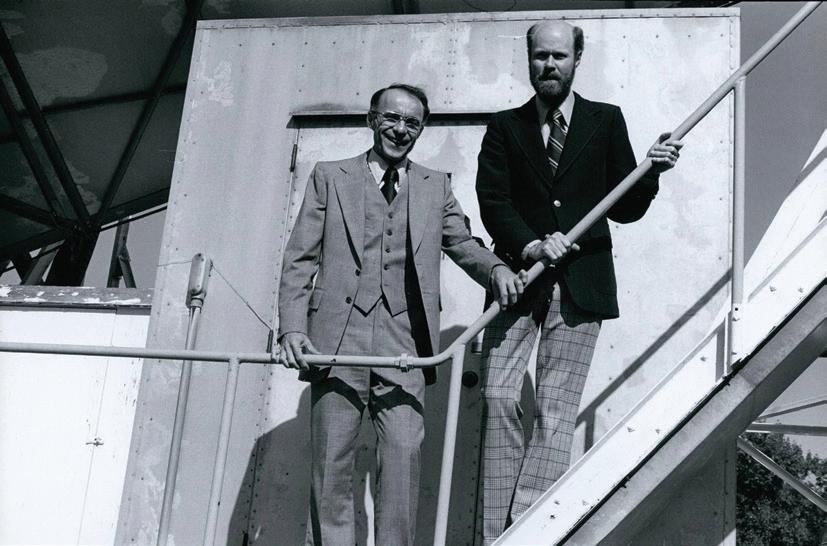
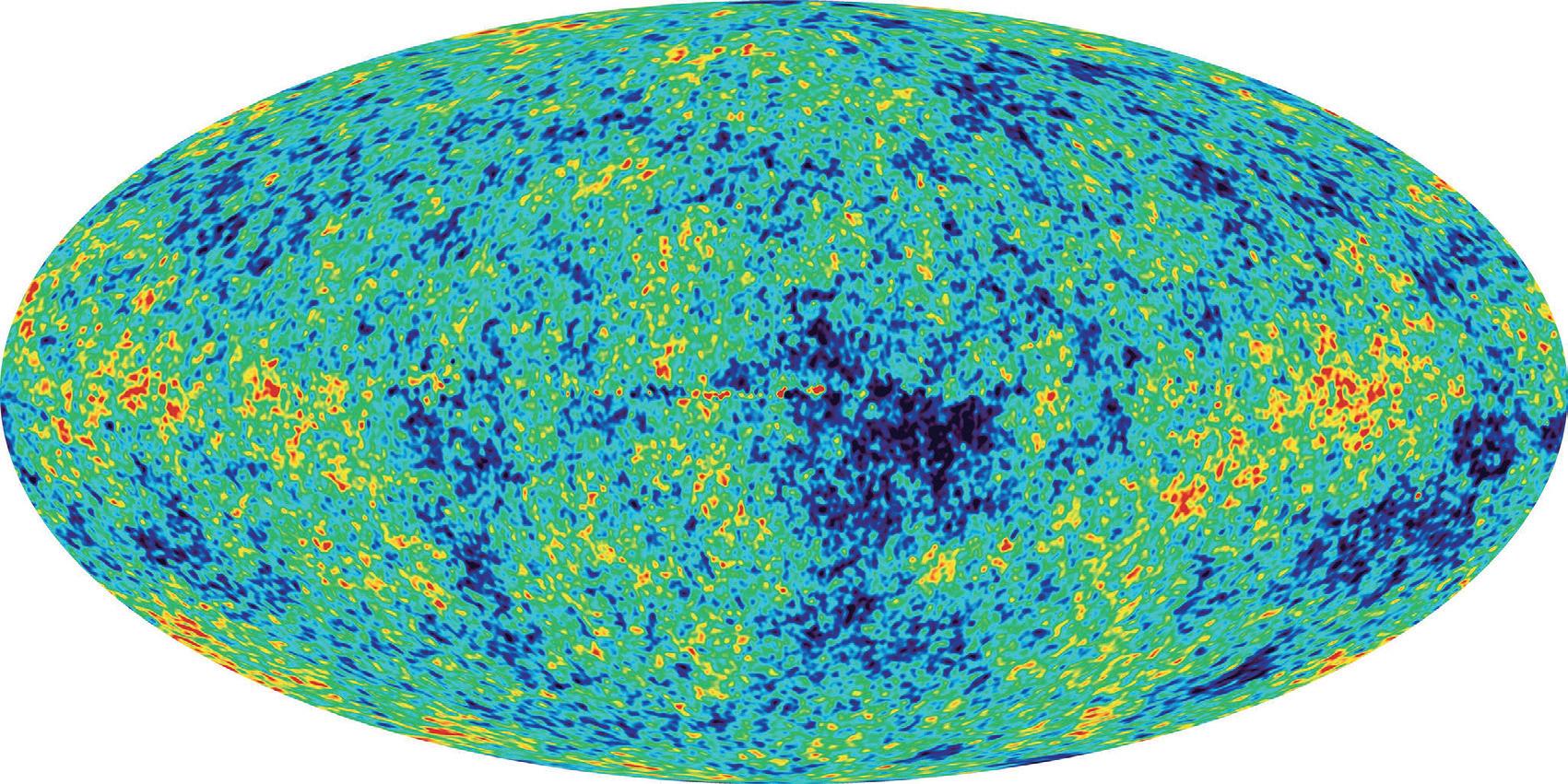
The concept of the Big Bang relied on the idea of the existence of some sort of thermal radiation. It was hypothesised that the enormous amounts of heat released as part of the Big Bang would still exist in a much cooler form. In 1965, two US scientists, Arno Penzias and Robert Wilson (Figure 2), found evidence that the leftover energy existed as background radiation.
While testing a new, sensitive, hornshaped radio telescope antenna, Penzias and Wilson found a strong background noise that was interfering with transmission. They weren’t trying to find it, they just happened to notice it. Being good scientists, they investigated where it came from and why it occurred. They found that this background noise was a form of electromagnetic radiation known as cosmic microwave background radiation (Figure 3).
DRAFT
The existence of cosmic microwave background radiation was one of the greatest discoveries of all time. It was so important that Penzias and Wilson were awarded a Nobel Prize in 1978 for their discovery.
Mixtures of elements
As shown by cosmic microwave background radiation, the universe has cooled since the Big Bang. As energy cannot be created or destroyed, the energy must have been converted into elementary matter. The simplest element that could have been made is hydrogen.
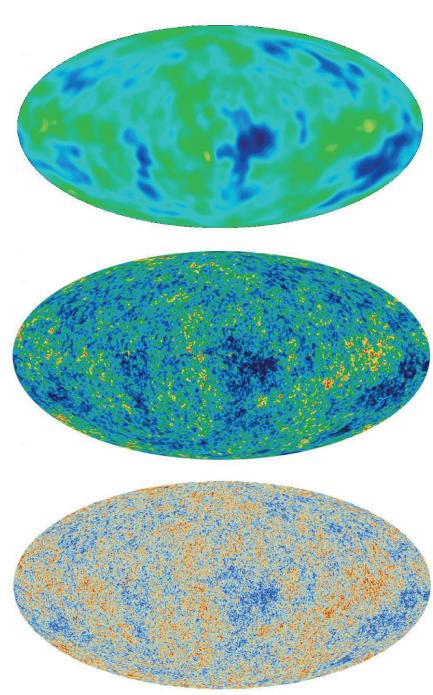
The amount of hydrogen (and subsequent heavier elements) formed should be proportional to the amount of energy available. If the energy caused the formation of matter, it would leave cool spots in the universe that are directly related to the mass of elements present. In 1992, the Cosmic Background Explorer (COBE) satellite detected these predicted ripples in temperature fluctuations, which are consistent with the formation of distant galaxies and old stars.
Figure 3 Fluctuations in the cosmic microwave background radiation are shown as temperature fluctuations over the sky. These fluctuations correlate with the formation of nearby matter.
left from early stages of the universe
Figure 2 Arno Penzias (left) and Robert Wilson (right) in front of their horn-shaped antenna, with which they discovered cosmic microwave background radiation.
The universe is changing
When we examine distant galaxies, we are also looking back in time. The light from these galaxies takes many years to reach Earth. As a result, scientists can see old galaxies that developed millions of years before our own Milky Way. Observations of how stars form are consistent with the energy changes predicted by the Big Bang theory.
All these observations have allowed astrophysicists to estimate that the universe is 13.7 billion years old.
Check your learning 6.10
Check your learning 6.10
Comprehend
1 Ex plain why the Big Bang was not a “bang” at all.
2 Describe the events that occurred during the Big Bang.
3 Define the term “cosmic microwave background radiation”, and explain why its existence is important.
Analyse
4 A theory is never final. Evidence is always needed to reinforce a theory. The Planck satellite was designed to examine cosmic microwave background radiation. Describe the evidence gathered about distant galaxies and old stars. Compare the information provided by the images from the different satellites in Figure 4.
Apply
5 Cosmic microwave background radiation has been called “ancient whispers”. Discuss why this name is appropriate.
6 Discuss one other example of evidence that supports the Big Bang theory.
COBE (1992)
WMAP (2003)
Planck (2013)
Figure 4 Images from the COBE (Cosmic Background Explorer), WMAP (Wilkinson Microwave Anisotropy Probe) and Planck satellites
Lesson 6.11
Science in context: Technology aids cosmological research
Introduction
As technology continues to advance, our ability to map and view the universe continues to improve. The improvement and development of supercomputers, radio telescopes and observatory facilities have led to the identification and imaging of new black holes and galaxies and contributed to our understanding of the formation and evolution of the universe. New technologies have also emerged with broader applications across industries such as computer science, health science, agriculture and environment management.
Australian Square Kilometre Array Pathfinder
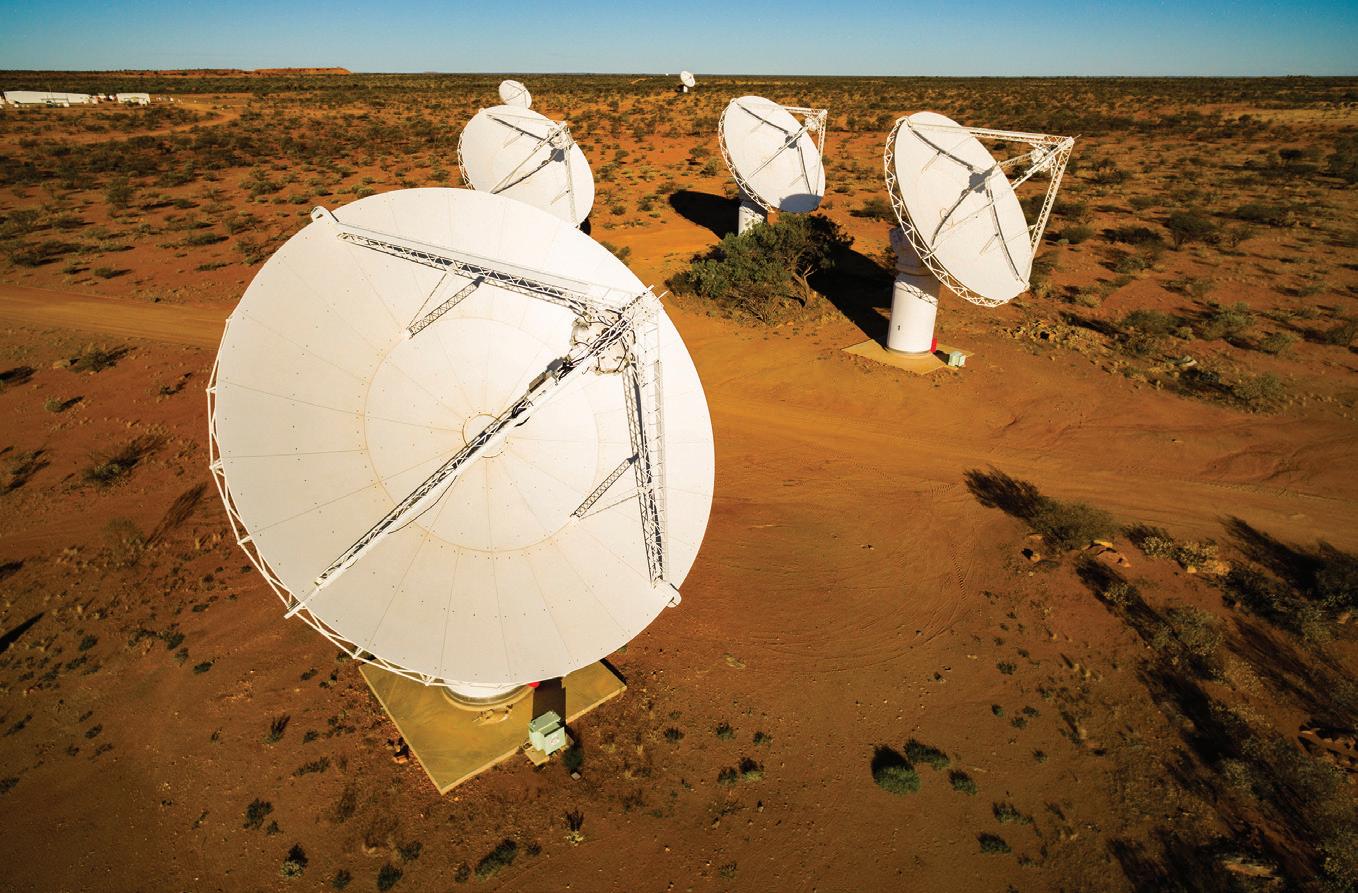
The Australian Square Kilometre Array Pathfinder (ASKAP) radio telescope (Figure 1) is found at Inyarrimanha Ilgari Bundara, the CSIRO Murchison Radio-astronomy Observatory in Western Australia. (“Inyarrimanha Ilgari Bundara” translates to “sharing the sky and stars” in the Wajarri language.) ASKAP consists of 36 large (12-metre wide) antenna dishes that work together as a single telescope.
The completion of this telescope – the world’s largest – took a significant step in March 2024, when the first of its more than 130,000 square kilometre array (SKA) antennas were installed across the observatory site on Wajarri Yamaji Country in the Murchison area. The apex of each antenna is attached with a phased array feed (PAF). The PAF acts as a “radio camera” and can detect radio waves millions of light-years away from Earth. Each PAF provides the ASKAP telescope with a large field of view to survey and detect millions of new distinct galaxies and black holes.
1 The Australian Square Kilometre Array Pathfinder (ASKAP) telescope at the Murchinson Radio-astronomy Observatory in Western Australia
Figure
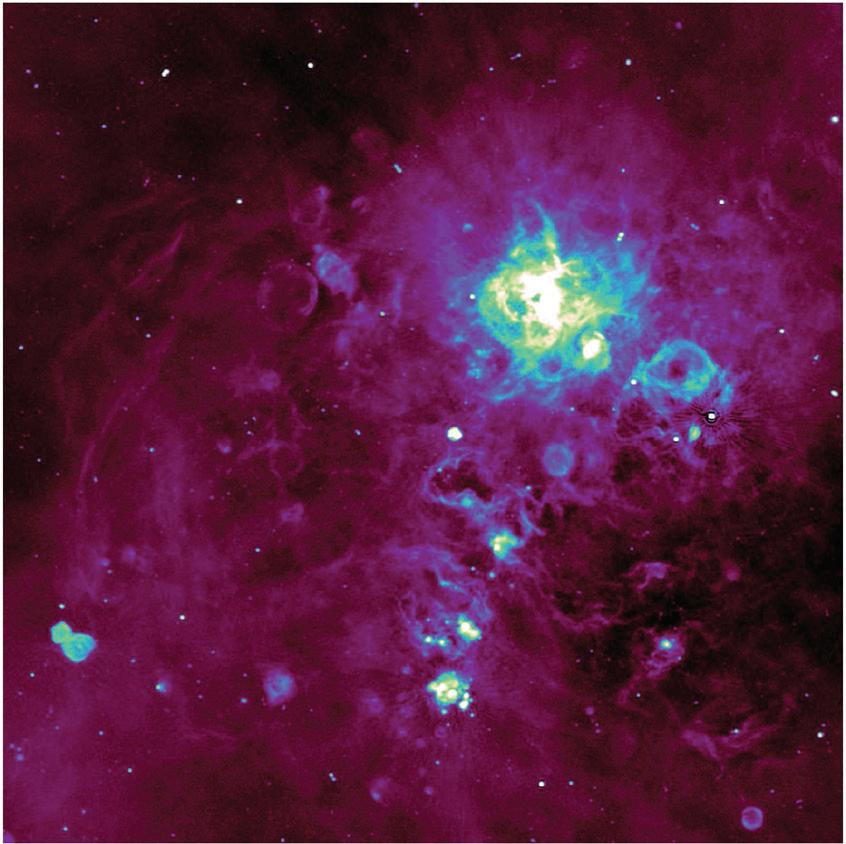
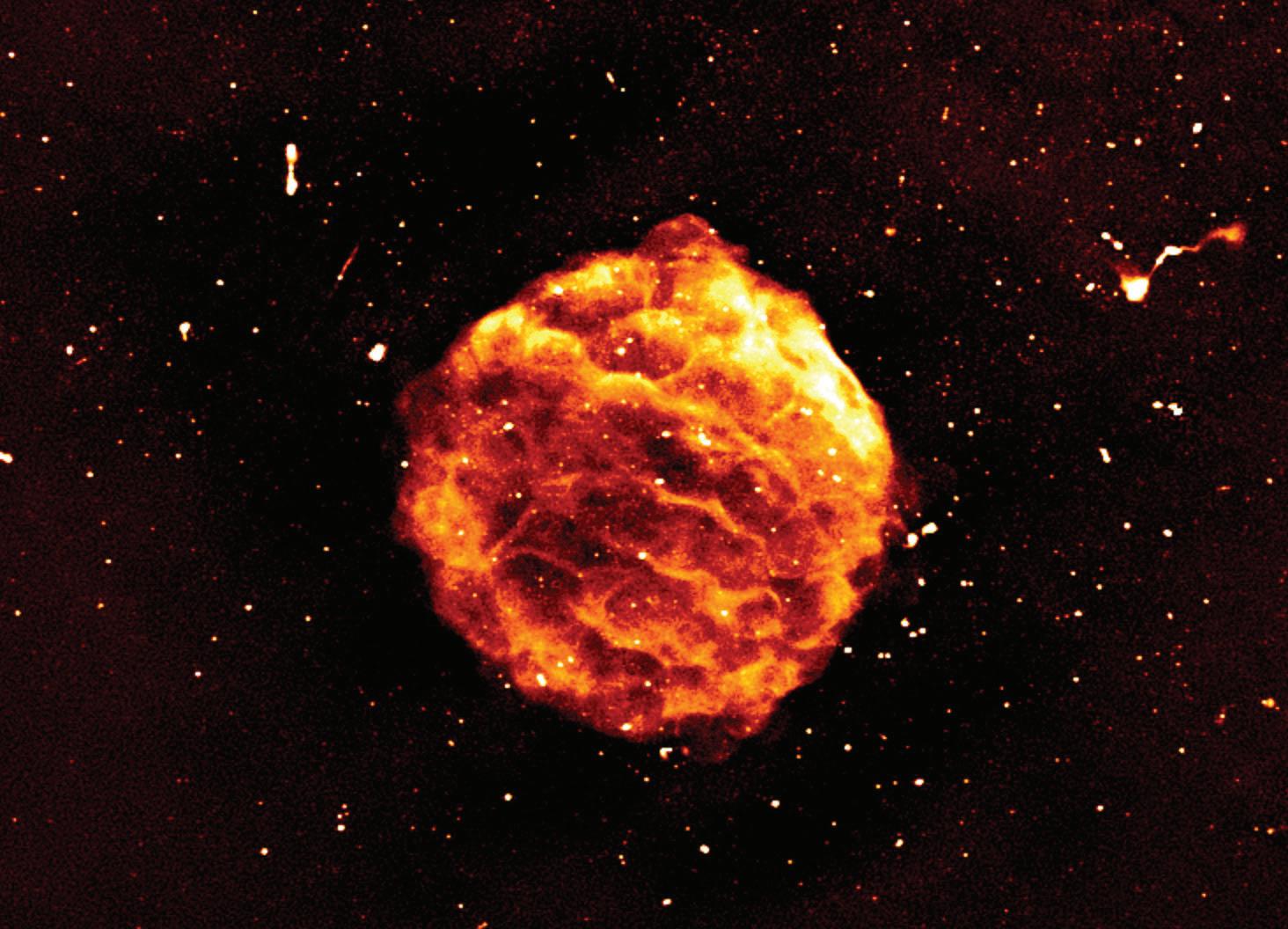
Data from ASKAP is generated at a rate of 100 trillion bites per second. This data is processed by supercomputing facilities in Perth’s Pawsey Supercomputing Research Centre, including Australia’s new supercomputer, Setonix, with integral research support by the International Centre for Radio Astronomy Research. Once processed, the data can be used to create optical images we can view (Figure 2). Setonix has remarkable imaging capacity and is able to produce highly detailed images of supernova remnants (Figure 3).
Figure 2 Image of the Large Magellanic Cloud, a galaxy neighbouring the Milky Way, created from ASKAP data
First fringes
3 Image of a remnant supernova produced by Setonix processing of ASKAP data
The intergovernmental, international Square Kilometre Array (SKA) project organised by the Square Kilometre Array Observatory (SKAO) involves the construction of two radio telescopes – SKA-Low in Western Australia and SKA-Mid in South Africa – that will operate as interferometers. Each SKA telescope integrates data from multiple antennas placed over great distances to act as one large dish.
In September 2024, SKAO was able to successfully correlate data from two SKA-Low stations in Western Australia. This milestone event is referred to as “first fringes” and signified that the SKA-Low can function as an interferometer.
Scientists have suggested that SKAO’s use of interferometry, the technique that collects data from the interference of electromagnetic waves, will enhance our understanding of the universe. SKA telescopes can provide some ideas about the early universe, the formation of galaxies and stars and the behaviour of magnetic fields on a cosmic scale.
DRAFT
For example, as a highly sensitive low-frequency radio telescope, it is capable of picking up faint signals from the first stars and galaxies that formed after the Big Bang. This is particularly useful for scientists to study the conditions of the early universe and how galaxies formed.
SKA telescopes can also map the large-scale structure of the universe by observing the red-shifted radio waves from the hydrogen gas. From this data, a three-dimensional map of the universe can be created, and this can provide new insights on how the universe has evolved over time. In addition, SKA telescopes can map the vast magnetic fields that cover the universe, pointing to the origin of magnetic forces and how these have shaped the universe.
interferometer instrument used to combine light or other waves from multiple telescopes or sensors to obtain higher resolution images and measurements than a single telescope could provide
Figure
Radio astronomy from the SKA project has led to development of new technologies. These technologies are used in important fields such as agriculture, environmental science, data science, medical imaging and advanced manufacturing. As with most space exploration projects, the SKA created technologies with broad applications. For example, phased technology used for communicating with hundreds of satellites in the CSIROconstructed ASKAP radio telescope has provided data from space to help industries such as agriculture, weather and natural disaster monitoring. The highly technical requirements of these instruments will also spur new innovations in data processing, signal detection and advanced computing.
Event Horizon Telescope
DRAFT
Black holes are regions in space where gravitational pull and density are so great that nothing, including light, can escape from them. The surface or “edge” of a black hole is called its event horizon. The event horizon is the boundary where the velocity needed to escape the gravitational pull of the black hole is greater than the speed of light. According to Einstein’s theory of special relativity, there is nothing faster than the speed of light, meaning the event horizon is the “point of no return”.
The Event Horizon Telescope (EHT) is a collection of radio telescopes from around the world that work together to image the emissions produced by supermassive black holes. The EHT is a collaborative project that uses radio telescopes from observatories in Europe, North America, South America, Hawai‘i and Antarctica. These telescopes all work to detect a specific target. Data from each telescope is transferred onto hard drives and sent to the MIT Haystack Observatory in the USA and the Max Planck Institute for Radio Astronomy in Germany. Once the data is processed it can be transferred into an image.
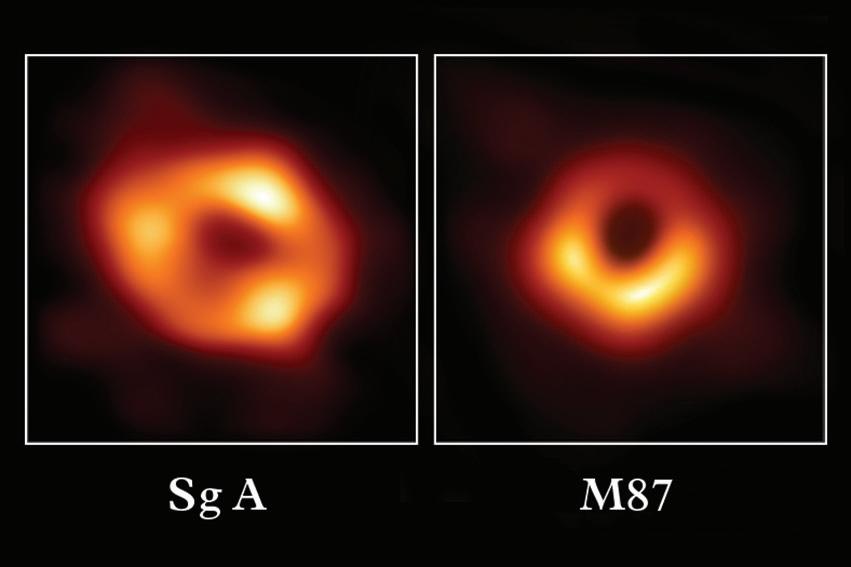
In 2019, the EHT produced the first confirmed image of the supermassive black hole M87. The mass of M87 is approximately 6.5 billion greater that of Earth’s Sun. In 2022, the EHT released the first image of the black hole Sagittarius A (Sgr A), a supermassive black hole located at the centre of our own galaxy, the Milky Way (Figure 4).
Advanced Resistive Exercise Device
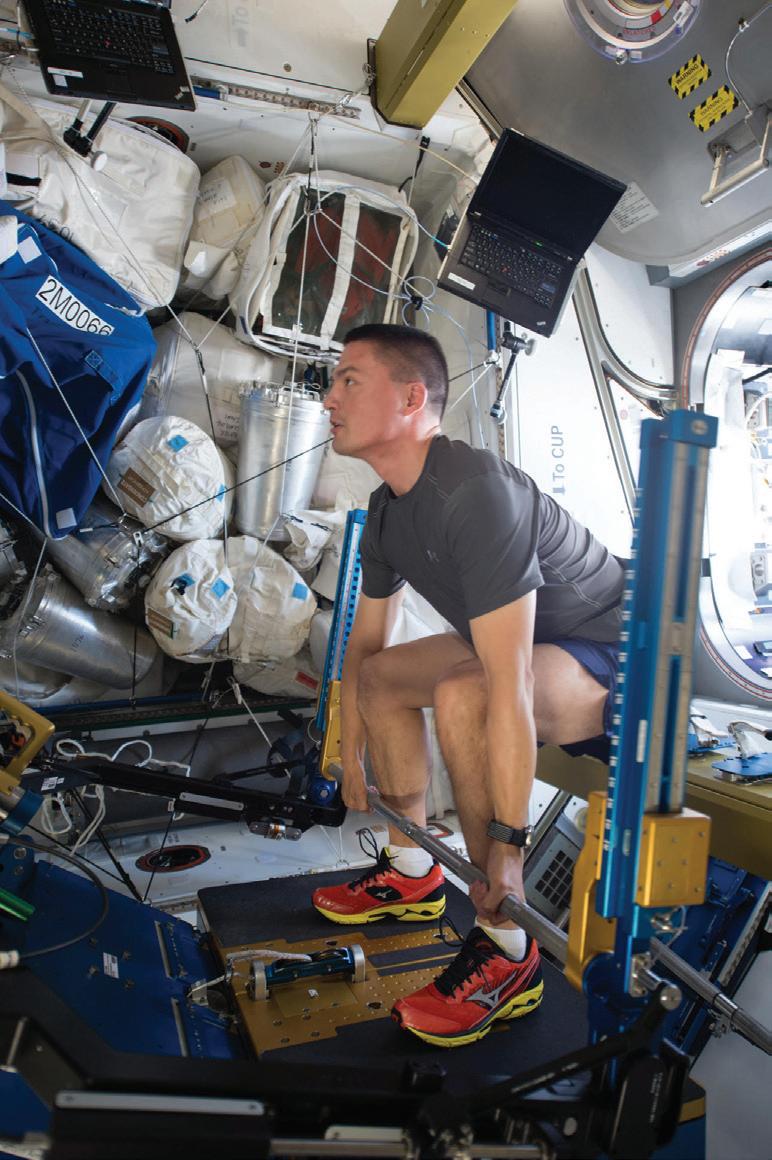
Astronauts play a key role in conducting cosmological research, however, travelling and living in space comes with a lot of challenges because space is so different from Earth. In microgravity, astronauts experience a condition where they feel weightless because there is very little gravity pulling on them. This lack of gravity affects their bodies in several ways. For example, astronauts’ muscles and bones can become weaker because they are used less and do not need to support their body’s mass. This can lead to muscle atrophy (wasting away) and a decrease in bone density over time.
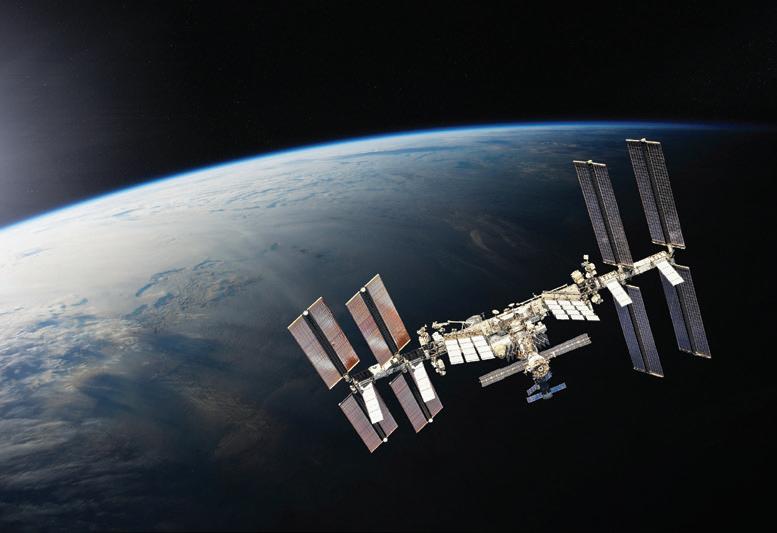
To help address this challenge, the International Space Station (ISS) has several exercise devices available for astronauts to use during space missions, including the Advanced
event horizon the boundary around a black hole at which no light or matter can escape
Figure 4 Images of the black holes Sgr A and M87 produced from EHT data
Resistive Exercise Device (ARED) (Figure 5). This machine has been purposefully designed to operate in a microgravity environment and contains mechanisms that allow for various resistance-based exercises (such as squats and bench presses) to be performed in a way that mimics the process and feeling of weightlifting on Earth. It helps astronauts keep their muscles strong and prevent bone density loss, facilitating long-duration space expeditions and the continuation of cosmological research.
Microgravity also affects the fluids in astronauts’ bodies. On Earth, fluid is pulled to the feet, and the heart needs to beat hard to push it back up from the legs to the heart. In microgravity, fluid is no longer pulled to the feet. Instead, it can gather in the upper parts of the body, causing headaches and eye problems until the body adjusts. This can also affect the way the heart works, making it more difficult to pump blood efficiently. Many of these changes are reversed when the astronauts return to Earth.
Satellites
A satellite is an object that orbits around another larger object, such as a planet or star. There are two types of satellites, natural satellites and artificial satellites. Earth’s moon is an example of a natural satellite while the Hubble Space Telescope and the International Space Station are examples of artificial satellites (Figure 6).
Artificial satellites are launched into space using rockets and many are equipped with solar panels to generate energy while in space. They have a range of different functions, from assisting with communication systems to collecting data about Earth and the universe.
The number of artificial satellites orbiting Earth has significantly increased in the past 5 years, and there are now over 11,000 active satellites in orbit. While many of these satellites play essential roles in our day-to-day lives and collect data that aids cosmological research, the use of artificial satellites has both benefits and risks.
Benefits of artificial satellites
DRAFT
Artificial satellites have many benefits. One is that they facilitate the remote sensing of Earth. This is when a satellite or a network of satellites are designed to collect and monitor data relating to the physical characteristics of Earth from a distance. For example, Landsat satellites managed by NASA and the United States Geological Survey are equipped with sensors that collect images of the surface of Earth at different wavelengths. Digital Earth Australia, a program developed by the Australian Government, interprets data from Landsat satellites to provide insights that help monitor and manage agricultural land and ecosystems in Australia.
Artificial satellites also play a large role in many communication systems. For example, the Viewer Access Satellite Television (VAST) service in Australia uses satellites to transmit television signals to rural and remote homes that are distanced too far from local television towers. Additionally, the Australian Defence Force uses satellites for long-range communications, which allows telecommunication to be possible even in areas that are highly remote.
remote sensing collection of data about a particular object from a distance
Figure 5 An astronaut using the ARED
Figure 6 The International Space Station is the largest artificial satellite.
space junk debris, equipment or machinery that has been left in space by humans
Satellites also provide valuable data that assist with space exploration. For example, the Mars Reconnaissance Orbiter (MRO) is a NASA satellite that captures data about the climate and geology of Mars (Figure 7). The MRO has aided the mapping of the planet’s terrain and is also used to relay data in other Mars exploration missions.
Risks of artificial satellites
7 The Mars Reconnaissance Orbiter (MRO) captures geological and climate data and assists with Mars exploration missions.
DRAFT
The use of artificial satellites can also pose a number of risks. For example, broken and unused satellites contribute to the large amount of space junk orbiting Earth. Space junk is a term used to describe debris or unused pieces of equipment or machinery left in space by humans. The greater the number of satellites in orbit, the greater the risk that they will collide into each other or into other pieces of debris. In low Earth orbit (160 to 2,000 km above Earth’s surface) space junk travels at an average speed of 7 km/s. At this speed, even a small piece of space junk can cause significant damage if it collides with another object. If a collision occurs, it not only threatens the operation of working systems but risks creating more space junk in the process.
Many companies are developing technologies to help reduce the amount of space junk orbiting Earth. For example, Japanese company Astroscale work with satellite manufacturers to install end-of-life devices on satellites prior to their launch. At the end of the satellite’s life, this device assists with deorbiting the satellite and guiding it to re-enter the Earth’s atmosphere where it can burn up. Technologies are also being developed to remove debris in Earth’s low orbit. An example of this is Triton, a satellite space debris remover developed by South Australian company Paladin Space.
Test your skills and capabilities
Communicating science ideas
1 Investigate t he Square Kilometre Array. Use the following questions to guide your investigation.
–Why was ASKAP built in Murchison, Western Australia?
–Wh at benefits are there in having so many countries involved with the ASKAP?
–Ot her than astronomers, what other researchers work on the ASKAP program?
–Why are super computers needed to interpret the data from ASKAP?
–Wh at are the researchers using ASKAP hoping to find?
2 Use your research to write a media release describing the Square Kilometre Array. Decide who is the intended audience and what media you will use to reach them. Consider their level of scientific knowledge when determining the style of language and illustrations you will use to describe the Square Kilometre Array.
Figure
Lesson 6.12 Review: The universe
Summary
Lesson 6.3 Earth is in the Milky Way
• Stars are large balls of gas that undergo nuclear f usion.
• St ars that appear brighter are described as having a high apparent magnitude.
• La rger, hotter stars that are further away have a higher absolute magnitude.
• As E arth rotates, stars appear to move in the sky due to stellar parallax.
• One l ight-year is the distance light travels in a vacuum in one year.
Lesson 6.6 Stars have a life cycle
• Nebulae are large clouds of gas where stars a re born.
• Each star exists in a hydrostatic equilibrium between the gravitational pull to its centre and the release push of energy from nuclear fusion from its centre.
• Sma ll stars will cool and die, forming white dwarfs and black dwarfs.
• La rge stars explode in supernovas, releasing large amounts of light and energy.
Lesson 6.7 Scientists search for life
• The Goldilocks zone is the area around a star where l iquid water might exist.
• Tr ansmission spectroscopy detects the light that is absorbed by gases in a planet’s atmosphere.
• A st ar wobbles when an exoplanet’s gravity causes it to move slightly.
Lesson 6.8 The galaxies are moving apart
• Different types of galaxies exist, such as spiral, elliptical and irregular.
• Elements absorb light energy in specific wavelengths, creating an absorption spectrum.
• When the same elements return to a stable state, they release the wavelengths of energy as an emission spectrum.
• The Doppler effect describes the change in frequency of a wave as an object moves towards or away from an observer.
• A red shift in the emission or absorption spectrum of a galaxy indicates that the galaxy is moving away from the observer.
Lesson 6.10 Evidence supports the Big Bang theory
• The Big Bang theory is supported by evidence that describes how the universe began.
• The expansion of the universe is continuing to accelerate.
Review questions 6.12
Review questions
Retrieve
1 Identify t he shape of the galaxy in Figure 1.
A Oblong
B El liptical
C Reg ular
D Cubic
2 Identify which of the following makes up nebulae clouds.
A Hel ium
B Ox ygen
C Lit hium
D Hydrogen
3 A light-year is:
A the same as stellar parallax
B the range of colours we see
C the distance light travels in 1 year
D the apparent change in wavelength when the source of the wave or the observer is moving.
4 Define the term “event horizon”.
5 Identify the correct definition for each of the terms in Table 1.
Table 1 Terms and definitions
Term Definition
Sun Groups of stars that are close together in the sky
Galaxy Theory of the creation of the universe in a huge explosion-like event
DRAFT
Star chart Everything that exists in space
Constellation Huge collection of stars held together by gravity
Universe Map used to locate and identify objects in the night sky
Big BangOur closest star
6 Catergorise the following in order of size from largest to smallest: neutron star, the Sun, white dwarf, red giant.
Comprehend
7 Describe t he Doppler effect
8 Describe why the scientists Penzias and Wilson won the Nobel Prize.
9 Ex plain why the Australian Square Kilometre Array Pathfinder (ASKAP) is an important tool for astronomers.
10 Describe the evidence that supports the Big Bang theory.
11 Ex plain why light-years are used instead of kilometres as a unit of distance in space.
12 Ex plain why it is difficult to judge the distance of a star by measuring only its brightness.
13 Ex plain how the night sky enables us to look back in time.
14 Ex plain the link between Hubble’s observations and the Doppler effect.
15 Ex plain why you cannot see stars (apart from the Sun) during the day.
16 Ex plain why we do not use light-years for measuring distances within our solar system.
Figure 1 The Andromeda galaxy
Analyse
17 Compare a white dwarf and a red giant.
18 Contrast the emission spectrum and absorption spectrum of an element.
19 Compare red shift and blue shift.
20 If t he Sun is 149,600,000 km f rom Earth and light travels at 300,000 km /s, calculate how long it takes for light to reach us from the Sun. Express your answer in minutes.
21 Calculate the distance (in kilometres) between E arth and each of these celestial objects.
a Altair star at 16.7 light-years
b Coalsack Nebula at 600 light-years
c Jewel Box star cluster at 7,600 light-years
22 If t he speed of light is 300,000 km /s, calculate the distance light travels in:
a 1 second
b 1 m inute
c 1 hour
d 1 d ay.
Apply
23 Create a diagram to explain why different stars are visible from different places on Earth’s surface.
25 Identify whether the following statements are true or false. Justify each answer.
a Al l stars are yellow and very hot.
b Al l galaxies are the same shape and size.
c The brightness of a star when viewed from Earth is its absolute magnitude.
d Bigger stars are usually hotter, brighter and burn for longer than smaller stars.
26 Ma ny cultures, including those of Aboriginal and Torres Strait Islander peoples, have beliefs about the origin of constellations based on observations. These observations are used for cultural and farming practices. Investigate Aboriginal and Torres Strait Islander peoples’ beliefs about constellations and how these were and are used. Discuss how these observations still influence how we view and understand the constellations today.
DRAFT
24 An swer these questions.
a Describe how the pitch of an ambulance siren changes as it races past you.
b Ex plain why this change occurs.
c Identify if the driver of the ambulance could hear this change. Justify your answer (by describing the Doppler effect, explaining how it would affect people in front of and behind the ambulance, and deciding if this will affect the sounds the driver hears).
27 Cr itically analyse the accuracy of the term “planetary nebula”. Suggest a more appropriate term. Justify your answer.
Social and ethical thinking
28 On 27 September 2007, the space probe Dawn was launched from Cape Canaveral at a cost of US$357 million, excluding the cost of the rocket (Figure 3). Dawn’s journey includes the exploration of the asteroid Vesta (in 2011) and the dwarf planet Ceres, between Mars and Jupiter (in 2015). Investigate and describe the information gathered by Dawn Describe how this information improved our understanding of celestial bodies. Use ethical reasoning to compare the cost of this mission and how the money could be spent on Earth.
Figure 2 The Sun
Figure 3 The Dawn space probe is on an interplanetary cruise.
29 Watch the movie Interstellar a nd investigate how the discovery of gravitational waves would help us understand the nature of the dark energy that is causing the universe’s expansion to accelerate. Have a class discussion about this.
Critical and creative thinking
30 Create an animation or comic strip explaining the Big Bang for Year 10 students who have not yet studied this unit. Include a simple explanation of all the evidence that supports this theory.
Dark matter
Vera Rubin studied the way galaxies rotated in the 1970s and discovered that there was extra matter in the universe that is invisible. This is now called dark matter.
• Compare ordinary matter and dark matter.
• Describe the evidence that supports Vera Rubin’s hypothesis of the existence of dark matter.
• Describe the composition of dark matter.
• Sc ientists believe that the universe started from the Big Bang and that it will expand before gravitational forces pull it back in to start the entire process all over again. Describe the effect dark matter has on the future of our universe.
Ion propulsion
The engines on some spacecraft use a unique, hyper-efficient system called ion propulsion.
• Define the term “ion”.
• Evaluate if such an engine could lift a spaceship from Earth’s surface.
• Identify the fuel used in these engines. Explain how this fuel produces thrust.
31 View a movie or television series about space. Describe its plot. Create a poster identifying the things in the movie that are scientifically correct and the things that are not.
Research
32 Choose one of the following topics for a research project. Some questions have been included to help you begin your research. Present your report in a format of your own choosing.
DRAFT
• Ex plain why large solar collectors are necessary.
• Describe the thrust produced by the engines.
Figure 5 Ion propulsion system in development by NASA
Figure 4 Vera Rubin operating a telescope at Kitt Peak Observatory
Gravitational waves
Einstein’s theory of general relativity predicted that gravitational waves would occur in spacetime when massive objects such as black holes and neutron stars collided.
• Explain what gravitational waves are.
• Describe the evidence that supports the existence of gravitational waves.
• Explain why this evidence was not discovered until 100 years after Einstein’s prediction.
Exoplanets
Australian scientist Penny Sackett has led teams of scientists in searching for exoplanets similar to Earth.
• Def ine the term “exoplanet”.
• Describe how astronomers search for them.
• Explain why the existence of these planets may be important.
• Describe the conditions that would be needed on an exoplanet for humans to survive.
Figure 7 Astrophysicist Penny Sackett
Figure 6 Laser Interferometer Gravitational-Wave Observatory (LIGO) gravitational wave detector in Louisiana, USA. LIGO first detected gravitational waves from the collision of two black holes in 2015. Oxford University Press
[STEAM project 1]
How can we use technology so that we improve the lives of people in the world’s poorest nations?
In Australia we are surrounded by technology every day. It is in the phones we use, the televisions we watch and the cars we drive. The term “technology” is used for any machinery or equipment that applies the scientific knowledge we have discovered. Wheels and computers are both examples of technology.
In high-income countries, emergency response teams often rely on technological data supplied by electronic sensors to respond to natural disasters such as storms, fires and plagues. Drones might be used to conduct search and rescue operations. Doctors can use technology to remotely diagnose people who are sick and to perform operations that save lives.
At the end of 2017, the number of high-speed mobile subscriptions in member countries of the Organisation for Economic Co-operation and Development (OECD) reached a milestone: more subscriptions than the number of people. These mobile phones have been used to alert people to natural disasters or to call for help in the event of floods and fires.
DRAFT
Technology is not just used for communication during natural disasters. It is also used to create medicine, improve farming practices and for education.
However, not everyone has access to technology.
Your task
Develop an innovative technology that will improve the life of a person or a group of people in a low-income country with limited access to digital technology.
The digital divide
The term “digital divide” is used to describe the gap between those who have access to digital technology – such as mobiles, computers and the internet – and those who do not. The Australian Bureau of Statistics has identified that almost 2.6 million Australians do not use the internet and cannot access technology in an emergency. Access is even lower in lower-income countries throughout Africa and Asia.
The OECD has identified that targeted innovation that uses technology can boost productivity, increase economic growth and help solve problems in society.
Figure 2 Technology has made attending a doctor’s appointment easier and more accessible for people who may have difficulty attending in person.
Figure 1 Technology can be used to enhance and improve agricultural practices.
HUMANITIES
In Geography this year, you will be learning about the spatial variations in human wellbeing globally. You will need to explore a range of factors that lead to inequalities, such as social, political, economic and technological differences. In Economics and business, you will explore variations in living standards between countries and how living standards can be improved.
To complete this task successfully, you will need to research the initiatives of international governments and non-government organisations (NGOs) aimed at improving human wellbeing, particularly regarding health. You should consider how technology could be effectively accessed, resourced and used by a group of people to address their health concerns.
DRAFT
You will find more information on this in Module 4 “An unequal world” Module 5 “Improving wellbeing” and Module 11 “Living standards” of Oxford Humanities and Social Sciences 10 Western Australian Curriculum
MATHS
In Maths this year, you will extend your skills in representing, comparing and interpreting data. You will use digital technology to work with data but also perform calculations by hand.
To complete this task successfully, you will need to find data to quantify the problem, to cost your interventions and to calculate a quantitative, evidence-based estimate of the likely benefits of your interventions. You will need to use skills in performing proportionality and other calculations with very large numbers, using scientific notation.
SCIENCE
In Science this year, you will learn how an understanding of evolution can contribute to the selection of desired traits (such as drought resistance) in plants and animals. You will also learn how genetic engineering can be used to develop medicines that will cure cancers and prevent disease.
To complete this task successfully, you will need to consider how the values and needs of different societies can influence the focus of scientific research. You will also need to consider the ethics of the technology that you will be offering to your selected individual or group of people.
You will find more information on this in Module 2 “Genetics” and Module 3 “Evolution” of Oxford Science 10 Western Australian Curriculum
[STEAM project 1]
The design cycle
To successfully complete this task, you will need to complete each of the phases of the design cycle.
Define your version of the problem
Rewrite the problem so that you describe the group you are helping, the problem they are experiencing and the reason it is important to solve it. Use the following phrase as a guide.
“How can we help (the group) to solve (the problem) so that (the reason)?”
Determine the criteria
1 Describe the limitations in energy, communications, transport and support personnel that will need to be considered as part of the solution.
2 Describe how many copies of the solution prototype will need to be made to make a difference in the country you have chosen.
Discover
When designing solutions to a problem, you need to know who you are helping and what they need. The people you are helping, who will use your design, are called your end-users.
Consider the following questions to help you empathise with your end-users:
• Who am I designing for?
• What problems are they facing? Why are they facing them?
• What do they need? What do they not need?
• What does it feel like to face these problems? What words would you use to describe these feelings?
To answer these questions, you may need to investigate using different resources or conduct interviews or surveys.
Define
Before you start to design your innovative technology, you need to define the parameters you are working towards.
3 Identify who could pay for the construction of the solution prototypes.
4 Describe the social culture that is experienced by the individuals and groups who are affected by the problem. Why might some technologies be viewed as unwanted or even dangerous?
Ideate
Once you know who you’re designing for and you know what the criteria are, it’s time to get creative!
Outline the criteria or requirements your technological design must fulfil (e.g. cost, size and weight for transportation, and cultural appropriateness).
Brainstorm at least one idea per person that fulfils the criteria.
Remember that there are no bad ideas at this stage. One silly thought could lead to a genius innovation!
Build
Each group member should select one design to draw. Label each part of the design. Include the materials that will be used for its construction. Include in the individual designs:
a a detailed diagram of the design
b a description of how it will change the life of your selected individual or group
c an outline of any similar designs that are already available to buy
d an outline of why your idea or design is better than others that are already available. Present your design to your group.
Build the prototype
Choose one solution and build two or three prototypes. The prototype may be full size, or it may be a scale model (10 cm = 1 m).
Use the following questions as a guideline for your prototype solution.
• What materials or technology will you need to build or represent your prototype solution?
• What skills will you need to construct your prototype design? Does your group have these skills, or who can teach you these skills?
• How will you make sure your prototype design is able to be used by your selected individual or group? Will they need training?
• How will you display or describe the way the prototype design will work?
Test
Prototype 1
Use the scientific method to design an experiment that will test the effectiveness and strength of your first prototype solution.
You will test the prototype more than once to compare results, so you will need to control your variables between tests.
W hat criteria will you use to determine the success of your prototype? Conduct your tests and record your results in an appropriate table.
Prototype 2
If your prototype will be used to help an individual, then you will need to generate a survey to test whether the prototype is appropriate for their use. (How would they use it? Would it make their work easier or harder? Would they consider buying it?)
Prototype 3
Use the information you have obtained from testing the first two versions to adapt your last prototype to be more effective and usable for the group you are helping. You may want to use the first two prototypes to demonstrate how the design has been improved over time.
Communicate
Present your design to the class as though you are trying to get your peers to invest in your designed solution. In your presentation, you will need to:
• outline the situation of the country in which your selected individual or group lives
• outline the challenges faced by your selected individual or group
• include a working model or a detailed series of diagrams with a description of how the prototype of the solution will be used
• include a description of how you changed your design prototype as a result of testing or feedback
• include a description of how the design prototype will improve the lives of your selected individual or group.
Student booklet
This helpful booklet will guide you step-by-step through the project.
What is the design cycle?
This video will help you to better understand each phase in the design cycle.
How to manage your project
This “how-to” video will help you to manage your time throughout the design cycle.
How to pitch your idea
This “how-to” video will help you with the “Communicate” phase of your project.
[STEAM project 2]
How can Australia
reduce its reliance on fossil fuels so that we protect the environment and the economy?
Fossil fuels such as coal, oil and gas are made from fossilised, decomposed organisms that aged over millions of years in the Earth’s crust. They contain carbon, which can be burned for energy. Due to the length of time it takes for these fuels to form as part of the carbon cycle, they are classified as long-term renewable sources of energy, sometimes called non-renewable.
Australia is a major user, producer and exporter of fossil fuels. Nearly 80 per cent of Australia’s electricity is generated from coal and gas. Seventy-five per cent of coal mined in Australia is exported, making Australia the largest net exporter of this fuel in the world. In 2019, it was reported that Australia was the world’s third-largest exporter of fossil fuels. Economically, the production and export of fossil fuels contributes hugely to Australia’s GDP, and the mining industry is an important employer.
DRAFT
Coal emits higher amounts of CO2 than oil or gas when used to produce energy. Measuring fossil fuel exports according to their potential to emit CO2 makes Australia’s carbon footprint per capita one of the largest in the world. This is contentious globally, particularly for nations most affected by a changing climate.
Your task
Research a short-term renewable energy and propose how it could be scaled and regarded as secure, reliable and affordable by the public. You must consider how it will reduce reliance on fossil fuels and protect the economy and the environment.
Renewable alternatives
To protect both the environment and the economy, Australia needs to focus more on short-term renewable energy. When deciding on energy alternatives, it is important that energy supply be secure, reliable and affordable. Short-term renewable energy sources include hydropower, solar power, wind power, bioenergy and ocean energy. Australia’s landscape is suitable for many of these alternatives, but large investments in technology are required. As we invest more in the technology that makes short-term renewable energy possible, the better we get at making it, the more affordable it becomes and the more demand for renewable energy grows (a cyclical process).
Figure 2 A solar farm in Canberra. Solar ener gy is a source of renewable energy.
Figure 1 Mos t of Australia’s energy is generated from coal. Almost 80 per cent of the coal produced in Australia is from open-cut mines.
HUMANITIES
In Geography this year, you will learn about environmental change and management. You will explore the environmental, technological and economic factors that have influenced the change and the consequences of human actions on the sustainability of the environment.
In Economics and business, you will investigate how the performance of Australia’s economy is measured and how Australia’s economic growth has depended on natural resources. You will explore the impact that environmental policies can have on Australia’s economy and living standards.
To complete this task successfully, you will need to understand how stakeholders such as governments, communities and businesses can work together to initiate environmental change and management plans that protect both the environment and the economy.
DRAFT
You will find more information on this in Module 2 “Changing and managing the environment”, Module 10 “Measuring economic performance” and Module 11 “Living standards” of Oxford Humanities and Social Sciences 10 Western Australian Curriculum
MATHS
In Maths this year, you will extend your skills in representing and interpreting data, including univariate, bivariate and multivariate data sets. This will include critical consideration of media reports that use statistics and present graphs. You will use digital technology to work with data but also perform calculations by hand.
To complete this task successfully, you will need to find data to quantify the problem, to cost your interventions and to calculate a quantitative, evidence-based estimate of the likely benefits of your interventions. You will need to have skills in performing proportionality and other calculations with very large numbers, using scientific notation.
SCIENCE
In Science this year, you will learn about the impacts of fossil fuel combustion reactions in the production of carbon dioxide and carbon monoxide. You will also examine how increased reliance on this form of energy has affected the way carbon cycles through Earth’s spheres, and how the resulting increase in greenhouse gases (including carbon dioxide) has led to enhanced global warming, which is contributing to melting sea ice and permafrost, rising sea levels and an increased number of extreme weather events.
To complete this task successfully, you will need to consider how energy that is generated can be used efficiently.
You will find more information on this in Module 6 “The universe” of Oxford Science 10 Western Australian Curriculum
[STEAM project 2]
The design cycle
To successfully complete this task, you will need to complete each of the phases of the design cycle.
Define your version of the problem
Rewrite the problem so that you describe the group you are helping, the problem they are experiencing and the reason it is important to solve it. Use the following phrase as a guide.
“How can we help (the group) to solve (the problem) so that (the reason)?”
Determine the criteria
1 What type of energy source are you trying to replace? How much of it is currently used and how is it used?
2 How will the renewable energy be used? Will it be easy for the user to access?
Discover
When designing solutions to a problem, you need to know who you are helping (your end-users) and what they need.
Consider the following questions to help you empathise with your end-users:
• Who am I designing for? Will I be helping the government or members of the public?
• What problems are they facing? Why are they facing them?
• What do they need? What do they not need? To answer these questions, you may need to investigate using different resources or conduct interviews or surveys.
Define
Before you start to design your solution for the potential replacement of fossil fuels, you need to define the parameters you are working towards.
3 Will the renewable energy require many changes in the vehicles or equipment being used? Who will pay for this change in infrastructure? How much will it cost?
4 How long will it take to generate the resources needed to make this renewable energy resource accessible and affordable for most people?
Ideate
Once you know who you’re designing for and you know what the criteria are, it’s time to get creative!
Outline the criteria or requirements your design must fulfil (e.g. type of equipment, number and amount of materials, area that needs to be covered).
Brainstorm at least one idea per person that fulfils the criteria.
Remember that there are no bad ideas at this stage. One silly thought could lead to a genius innovation!
Build
Each team member should draw one individual design. Label each part of the design. Include the materials that will be used to construct a model of the design. Also include descriptions of:
a what you see as the biggest problem with the energy source that you are replacing
b the renewable energy that you propose could be used instead
c how this renewable energy could be scaled up so that it can be used more effectively.
Present your design to your group.
Build the prototype
As a group, choose one design and plan how to model or build it. You may need to produce two or three to-scale prototypes for your group’s design. Keep each iteration so that you can show the progress of your ideas. Use the following questions as a guideline for your prototype.
• How will you replicate or model the renewable energy source?
• How will you model how the renewable energy will be used?
• What are the limitations of the renewable energy source? Will it produce enough energy for the equipment that currently uses fossil fuels?
• Calculate the number, density or requirements of energy sources in your area. How will your model provide for these demands?
Test
Use the scientific method to design an experiment that will test the limitations of your renewable energy prototype idea. You will need to model and test more than one prototype to compare results, so you will need to consider all variables between tests.
What criteria will you use to determine the success of your renewable energy prototype?
If your prototype will be used by a particular group of individuals, then you will need to generate a survey to test whether the prototype is appropriate for their use. (How would they use the alternative energy source? Would it make their life easier or harder? Would they consider buying it? How much would they be prepared to pay to access this form of energy?)
Conduct your tests and record your results in an appropriate table. Online resources:
Communicate
DRAFT
Present your design to the class as though you are trying to get your peers to invest in your alternative energy design.
In your presentation, you will need to:
• outline the energy needs of the selected individual or group you are supporting
• outline the energy challenges faced by your selected individual or group
• create a working model or a detailed series of diagrams, with a description of how the design prototype will be used to replace the current energy demands
• describe how you changed your design prototype as a result of testing or feedback
• describe how the renewable energy prototype will improve the life of your selected individual or group
• estimate the cost of production for each element of your energy design
• estimate the number of each element of your energy design required in your local government area
• estimate the total implementation cost to individuals or to local, state or national government bodies
• compare how this energy system could be implemented in developed and developing countries.
Student booklet
This helpful booklet will guide you step-by-step through the project.
What is the design cycle?
This video will help you to better understand each phase in the design cycle.
How to manage your project
This “how-to” video will help you to manage your time throughout the design cycle.
How to define a problem
This “how-to” video will help you to narrow your ideas down and define a specific problem.
Glossary
Aabsolute dating
a method of determining the age of a fossil, by measuring the amount of radioactivity remaining in the rock surrounding the fossil absolute magnitude scale
a scale for measuring the brightness (luminosity) of objects from the same distance absorption spectrum
a spectrum with dark bands missing from the pattern, where the element has absorbed characteristic light wavelengths; the opposite of an emission spectrum
acceleration due to gravity acceleration of an object due to a planet’s gravitational field; on Earth, g = 9.8 m/s2
accurate
how carefully, correctly and consistently data have been measured or processed; in science, how close a measured value is to the true value achondroplasia
a genetic (inherited) disorder of bone growth resulting in abnormally short stature and short limbs
acid
a hydrogen-containing substance that has the ability to donate a proton acid strength
how easily an acid donates a hydrogen ion in an aqueous solution action force
the initial force applied to an object in an action–reaction pair of forces active site
the region of an enzyme that substrates can bind to
adaptation
alkaline earth metal
elements with similar properties found in group 2 of the periodic table alkaline solution
a solution that consists of a base dissolved in water allele
a version of a gene; a person inherits two alleles for each gene, one coming from each parent allopatric speciation
a type of speciation where new species are formed as a result of geographic isolation
amino acid
small molecules that make up proteins analogous structures
structures in organisms of different species that have the same function but are structurally different, because they evolved independently; for example, wings in birds and bats anion
a negatively charged ion formed when an atom gains electrons apoptosis programmed cell death
apparent magnitude scale
a scale for measuring the brightness of an object when viewed from Earth artificial selection
the selection for or against traits in a species, as influenced by human intervention atom
basic unit of matter that cannot be broken down chemically atomic number
the number of protons in an atom autosome
a chromosome that does not determine the sex of an organism
Big Bang theory
the theory that the universe began as a hot, dense, single point at some time in the past, and since then has expanded and will continue to expand into the future binary fission
a form of asexual reproduction used by bacteria; the splitting of a parent cell into two equal daughter cells
biodiversity
DRAFT
a trait or characteristic that helps a living organism to survive and reproduce in its environment aim
the purpose of an experiment
alkali
a base that dissolves in water alkali metal
an element in group 1 of the periodic table
B base
a substance that has the ability to accept a hydrogen proton base strength
how easily a base accepts a hydrogen ion in an aqueous solution bias
discrimination against ideas, against people or in the collection and interpretation of information
variation in genes, species and ecosystems
bioplastic
plastic produced from renewable biomass sources
black dwarf
a remnant formed when a white dwarf star cools and gradually fades away black hole
a region in space of infinite density where gravity is so strong that nothing, not even light, can escape from it blind study
when the participants do not know if they are receiving the treatment or a placebo
blue shift
the apparent increase in frequency (towards the blue end of the spectrum) of light from galaxies that are moving towards Earth
Bohr model
a model of the atom in which electrons orbit the nucleus in a series of defined orbits known as shells by-product
form of energy released during energy transformation that is not the intended or primary output of the process
Ccarbon nanotube
a very small tube of carbon atoms, made synthetically carrier
a person who has the allele for a recessive trait that does not show in their phenotype catalyst
a substance that increases the rate of a chemical reaction without undergoing any permanent chemical change
cation
a positively charged ion that results from an atom losing electrons causation
when the independent variable is responsible for the change in the dependent variable chromatid
one side of the X-shaped chromosome that contains a double helix of DNA chromosome the form of DNA that is tightly wound around proteins before replication codon
a group of three nucleotides on mRNA collision theory
a theory which proposes that reacting particles must collide with each other with sufficient energy (activation energy) and with the correct spatial orientation for the reaction to occur combustion
a chemical reaction between a fuel and oxygen, which usually produces energy in the form of heat and light complementary base
a nucleotide base that pairs with its partner nucleotide on the alternative DNA strand; adenine pairs with thymine, cytosine pairs with guanine concentration
the number of active molecules in a set volume of solution
confirmation bias
when a scientist selects a method that will support the outcome they want constellation
a group of stars that form a pattern or picture
continental drift the continuous movement of the continents over time continuous data
information that can be any value, including decimals and fractions that are measured control group
correlation
the positive, negative or zero relationship between two variables
corrosive
a substance that can damage or destroy other materials
cosmic microwave background radiation
remnant electromagnetic radiation left from early stages of the universe covalent bond
a bond formed when two or more atoms share electrons
cross-linked polymer
polymer chains that are connected to each other by cross-links (covalent or ionic bonds) to form a threedimensional network
cryolite
a mineral that consists of sodium and aluminium fluoride cytokinesis
the splitting of a replicating cell into two cells
D
decomposition
a reaction that involves the breakdown of a compound into simpler substances
dependent variable
a variable in an experiment that may change as a result of changes to the independent variable diatomic molecule
a molecule which consists of two atoms dilute
containing a small number of solute particles in the volume of solution diploid
containing two complete sets of chromosomes
direct imaging
discrete data
information that can only take on specific and distinct values, such as whole numbers
discussion
an interpretation of the findings, including improvements to the investigation and suggestions for further investigation
disinformation
false content that is deliberately shared to mislead displacement
DRAFT
a group of organisms, chemical reactions or physical conditions that can be compared to the group that has had the independent variable changed controlled variable variable that remains unchanged during an experiment convergent evolution the process whereby unrelated organisms evolve to have similar characteristics as a result of adapting to similar environments
directly measuring the amount of light emitted from a star
directional selection
a type of natural selection where individuals with traits that are higher or lower than the average value for the population have a better chance of survival and reproduction directly proportional when the independent variable and dependent variable both increase or decrease
the change of position of a moving object in a particular direction displacement reaction
a reaction resulting in the displacement of an atom or group of atoms dissociate
break down into smaller components like ions, atoms and molecules distance
the length of the path travelled by an object
distillation
a separation process where a liquid mixture is separated into tis components by boiling and then condensing the vapours diverge
in relation to two species: to become more different over time due to different selection pressures, possibly becoming reproductively isolated
DNA (deoxyribonucleic acid)
a molecule that contains all the instructions for every task performed by the cell; this information can be passed from one generation to the next dominant trait
a characteristic that needs only one copy of an allele to appear in the physical appearance of an organism
Doppler effect the apparent change in wavelength (or frequency) when the source of the waves or the observer is moving; responsible for the red shift of distant stars
double displacement
a reaction in which two reactants exchange ions to form two new products
double-blind study
when neither the participants nor the treating doctors know if they are receiving the treatment or a placebo
E
early detection and predictive testing for adults
the testing of chromosomes for the presence of alleles that increase the probability of cancers forming elastic potential energy
the energy possessed by a deformed object that will return to its original shape elastomer
long chains of polymers occasionally linked together like a ladder electrolysis
a decomposition reaction produced by passing an electric current through a liquid or a solution containing ions electron
a subatomic particle carrying a negative electrical charge which orbits the nucleus of an atom electron configuration
a numerical way of showing the number of electrons in each electron shell around a particular atomic nucleus
electron shell
a defined area of space in which electrons move around an atom’s nucleus
elliptical galaxy
a galaxy characterised by a smooth, oval or elliptical shape
embryo
the initial stage of development when a fertilised egg (zygote) undergoes cell division to form basic tissues
emission spectrum
the pattern of wavelengths (or frequencies) that appear as coloured lines in a spectroscope; it is unique to each element
energy
the capacity to cause change or movement
energy efficiency
enzyme
a protein-based catalyst event horizon
the boundary around a black hole at which no light or matter can escape evolution
the gradual change in the genetic material of a population of organisms over a long period of time
evolutionary relationship
the way in which two species or populations are related with respect to their evolutionary descent
exoplanet
a planet that orbits a star outside of our solar system
explanatory model
a simple way to explain what and why something is happening and the relationship between variables extrapolation
estimating unknown values from trends in known data
F
F1 generation
the first generation of offspring produced by a set of parents
fertilisation
the fusion of a male gamete and a female gamete
fossil
the remains or traces of an organism that existed in the past fossil fuel
non-renewable energy sources from the remains of ancient plants and animals over millions of years; for example, coal, petroleum and natural gas fossilisation
the process of an organism becoming a fossil
frameshift mutation
gene flow
transfer of genes or alleles from one population to another gene modification (GM)
altering the DNA of an organism to produce the desired trait or characteristic
gene pool
sum total of all the genes (including alleles) present in a reproducing population or species
gene sequencing
determining the order of nucleotides for a particular segment of DNA
genetic code
DRAFT
a measure of the amount of useful energy transformed in an energy transformation process; usually expressed as a percentage of the input energy (e.g. 90 per cent efficiency is very good)
energy transfer
the process of energy moving from one place to another
energy transformation
the process of energy changing from one form to another (e.g. from electric energy into heat energy)
a type of mutation in which a nucleotide is added or deleted, causing a shift in the reading frame of triplets; usually results in a deformed protein
G galaxy
a huge collection of gas, dust and billions of stars and their solar systems, all held together by gravity
gene
basic unit of genetic material passed on from parents to offspring
the sequence of nucleotides in DNA, inherited from parent organisms genetically modified organism (GMO)
an organism that has had its DNA changed in a laboratory genomics
the study of all an organisms genes genotype
the genetic constitution of an individual or organism goldilocks zone
the area around a star where it is not too hot or too cold for liquid water to exist on a planet
gravitational potential energy
the energy possessed by an object raised to a height in a gravitational field group
a vertical list of elements in the periodic table that have characteristics in common
H
half-life
the time it takes the radioactivity in a substance to decrease by half halo
a spherical cloud of stars surrounding a galaxy halogen
the group of elements in group 17 of the periodic table haploid
containing one complete set of chromosomes in each cell; for example, a gamete is a haploid cell hardwater
water containing a high concentration of dissolved minerals
hazard
a dangerous substance or activity that can potentially cause harm or injury
Hertzsprung–Russell diagram
a graph displaying star data, with the star's spectral types (temperature) on the x -axis and its absolute magnitude (luminosity) on the y -axis heterozygous
having two different alleles for a particular trait; a carrier for a recessive trait homologous structure
structure that is similar in different species, because those species evolved from a common ancestor, but do not necessarily have the same function now; an example is forelimbs in different mammal species homozygous
having two identical alleles for a particular trait
horizontal gene transfer the transfer of genetic material (usually containing antibiotic resistance) from a bacterium to another bacterium that is not its offspring hydrocarbon
a molecule that contains only carbon and hydrogen atoms
hydrogen bond
a type of weak chemical bond between two groups of atoms; the bond between two nitrogenous bases in the DNA helix
hydrostatic equilibrium
in relation to Earth’s atmosphere: a state of stability, with upward forces balanced by downward forces hypothesis
a proposed explanation for a prediction that can be tested
Iindependent variable
a variable (factor) that is changed in an experiment indicator
interferometer
instrument used to combine light or other waves from multiple telescopes or sensors to obtain higher resolution images and measurements than a single telescope could provide interphase
a phase of cell life where normal functioning occurs interpolation
determining a value from existing values
inverse proportional when one quantity decreases the other quantity increases, or vice versa ion
an atom that is charged because it has an unequal number of electrons and protons ionic bond
a bond between a negatively charged anion and a positively charged cation ionic compound
a substance made up of a negatively charged anion and a positively charged cation
irregular galaxy
a galaxy characterised by lack of symmetry, or lacking a defined, regular shape isolation
the separation of a group of organisms from others of the same species, preventing them from interacting or interbreeding
Kkaryotype
a way of representing a complete set of chromosomes, arranged in pairs, in order of decreasing size kinetic energy
the energy possessed by moving objects
limescale
a hard white substance, mainly consisting of calcium carbonate, that is often deposited on the inside of kettles and pipes
linear polymer
long, single chains of polymers
litmus paper
a paper containing an indicator that turns red when exposed to an acid and blue when exposed to a base living fossil
DRAFT
a substance that changes colour in the presence of an acid or a base inertia
the tendency of an object to resist changes in its motion inference
the act of drawing conclusions based on evidence and reasoning input energy energy that is put into a device or system
L
Law of Conservation of Energy
a scientific rule that states that the total energy in a system is always constant and cannot be created or destroyed Law of Conservation of Momentum
a scientific rule that states that the total momentum in an isolated system does not change during a collision light-year the distance that light travels in one year
an existing species of ancient lineage that has remained unchanged in form for a very long time luminosity
the actual brightness of a star (amount of energy it radiates); measured using the absolute magnitude scale
M
machinability
the ability of a metal to be cut and shaped magnitude
the size or extent of something main sequence star
refers to stars in the most stable and longest part of their life cycles
maternal serum screening (MSS)
the genetic testing of fetal DNA found in the mother’s blood meiosis
the process that results in the formation of gametes with half the genetic material of the parent cell metalloid
a small collection of elements that have characteristics of metals and non-metals metal
elements on the left-hand side of the periodic table; they are malleable, lustrous, ductile and highly conductive method
the procedure followed in an investigation to collect data misinformation false content shared by someone who didn’t know it was false mitosis
the process of cell division that results in genetically identical daughter cells; allows growth and repair
molarity
the number of moles of solute dissolved in one litre of solution (M)
molecular compound
a molecule that contains two or more different atoms bonded together molecule
group of two or more atoms bonded together (e.g. a water molecule)
momentum
the product of an object’s mass and velocity monohybrid cross
a cross between two organisms with different variations at one gene location of interest monomer
a small molecule from which polymers are made mutagen
a chemical or physical agent that causes a change in genetic material such as DNA mutation
a permanent change in the sequence or amount of DNA
N
nacre
a combination of inorganic calcium carbonate and organic materials, usually produced as an inner layer by some molluscs
nanotechnology
the manipulation of individual atoms to form structures
natural selection when the natural environment selects for or against a physical characteristic nebula
a cloud of gas and dust in space nebular hypothesis
a scientific explanation for how the solar system was formed from a vast, rotating cloud of dust and gas (a nebula) that condensed and collapsed under its own gravity
negative control
neutron star
a small, highly dense star made mostly of neutrons
neutron
a subatomic particle located in the nucleus of an atom which has no electrical charge
newborn screening
the testing of chromosomes in a baby’s white blood cells for the presence of a genetic disease
noble gas
the stable gaseous elements in group 18 of the periodic table non-disjunction
the failure of one or more chromosomes to separate during meiosis; can result in an abnormal number of chromosomes in the daughter cells
non-metals
elements on the right-hand side of the periodic table
nuclear fusion
a reaction in which two lighter atomic nuclei fuse to form a heavier nucleus, releasing energy nucleotide
a subunit of a nucleic acid
O
observation
the act of carefully watching, usually using the senses to gain information and generate knowledge outlier
a data point that differs significantly from the main group of data output energy energy that comes out of a device or system; includes useful energy and waste energy oxidation
a chemical process where a chemical substance gains oxygen or loses hydrogen
peer review
a process in which experts evaluate the findings of a report before it is published period
in chemistry: a horizontal list of elements in the periodic table that have characteristics in common periodic table
a tabular organisation of all chemical elements in rows (called periods) and columns (called groups) according to increasing atomic number
pH scale
DRAFT
an individual test that checks that a negative result is possible in an experiment net force
the vector sum of all the forces acting on an object; also known as resultant force neutral
solutions that have a pH of 7 and are therefore neither an acid nor a base; an example is pure water neutralisation reaction
a reaction in which an acid and a base combine to produce a metal salt and water
Pparallax error
an error, or inaccurate reading, that occurs as a result of reading a scale from an angle
PCR (polymerase chain reaction)
a technique used to amplify specific sequences of genes
pedigree
a chart showing the phenotypes for an individual and their ancestors, usually over several generations; also known as a family tree diagram
a scale that represents the acidity or basicity of a solution; pH < 7 indicates an acid, pH > 7 indicates a base, pH 7 indicates a neutral solution
phenotype
the observable characteristics of an organism that result from an interaction between the genotype and the environment, e.g. height, eye colour and blood type
phylogenetic tree
a branching tree-like diagram showing relationships between different taxonomic groups
placebo
a substance or treatment that is designed to have no effect
planetary nebula
a glowing shell of gas formed when a star dies
polyatomic ion
a charged ion that consists of two or more atoms bonded together polymer
a long-chain molecule formed by the joining of many smaller repeating molecules (monomers) polymerisation
the process of joining smaller units (monomers) to form a long-chain molecule (polymer)
positive control
an individual test that checks that a positive result is possible in an experiment precipitate
a solid, insoluble compound formed in a precipitation reaction
precipitation reaction
a reaction used to produce solid products from solutions of ionic substances
precise
how close measurements of the same item are to each other
prediction
an outcome that is expected based on prior knowledge or observation protein
a chain of amino acids forming a complex molecule such as an enzyme or hormone proton
a subatomic particle carrying a positive electrical charge which is found in the nucleus of an atom protostars
condensed gas cloud in the early stages of star formation
punnett square
a diagram that shows all possible combinations of the alleles of two parents; it can be used to calculate the probabilities that particular alleles will occur in a zygote
pyroligneous acid
an acid consisting of 10% acetic acid (vinegar), acetone and methanol
Q
qualitative data that can be measured using categories quantitative data that can measured numerically
Rrandom error when an unpredictable variation in measurement occurs, resulting in an outlier result reaction force
the force acting in the opposite direction to an initial force reaction rate how fast or slowly a reaction proceeds recessive trait
a characteristic that is only expressed in the phenotype when two identical alleles are inherited red giant
relative dating
a method of determining the age of an object relative to events that occurred before and after reliable
consistency of a measurement, test or experiment remote sensing collection of data about a particular object from a distance reproducible
when the experiment can be repeated by another scientist in another laboratory risk
exposure to danger risk assessment
the process of identifying and evaluating potential risks, including how they can be mitigated and what to do if there is exposure to the risk
S salt
an ionic compound formed from ions which are ionically bonded and is overall electrically neutral scalar
having only magnitude (a numeric quantity)
scientific method
a process involving making an observation, forming a hypothesis, making a prediction, conducting an experiment, collecting the data, analysing the results and drawing conclusions
selection pressure
external factors that affect an organism’s ability to survive and reproduce selective breeding
single displacement reaction
a reaction in which a more reactive element displaces a less reactive element on a molecule smelting
a heating process used to extract a metal from its ore
solar mass
equal to the mass of the Sun, approximately 1.989 × 1030 kg; astronomers use solar masses to compare the sizes and masses of stars and other astronomical objects solution
DRAFT
a star that has become large and bright with a cool surface, because it has run out of hydrogen fuel red shift
the apparent decrease in frequency (towards the red end of the spectrum) of light from galaxies that are moving away from Earth relationship the connection between variables
the intentional breeding (by humans) of organisms with desirable traits within species to produce offspring with more of these desirable traits
semiconductor
materials with electrical conductivity between that of a conductor and an insulator
sex chromosome
a chromosome that determines the sex of an organism
shell diagram
a diagram that shows the number of electrons in each electron shell around a particular atomic nucleus
a mixture of a solute dissolved in a solvent somatic cell
all the body cells except for gametes (egg and sperm)
space junk
debris, equipment or machinery that has been left in space by humans speciation
a process by which new species form spectator ion
an ion that does not take part in a chemical reaction spectroscope
an instrument that separates light into its constituent wavelengths (or colours) speed
the distance travelled per unit of time spiral galaxy
a galaxy characterised by a flattened, rotating disk with spiral arms extending from a central bulge start codon
a sequence of three nucleotides (AUG) that starts the translation process stellar parallax
a change in the apparent position of a star against its background when viewed from two different positions stop codon
a sequence of three nucleotides (UAG, UGA and UAA) that terminates the translation process. substitution mutation
a form of mutation where one nucleotide is substituted for another; may or may not result in a deformed protein
substrate
a molecule that reacts with an enzyme superalloy
high-strength complex metal alloy resistant to extreme temperature and stress
supernova the explosive death of a star synthesis
a reaction that involves the building up of compounds by combining simpler substances, usually elements systematic error a repetitive error that is not removed by repeating the experiment
Tthermoplastic polymer
a polymer that softens and forms new shapes when heated thermosetting polymer polymers that do not melt or change shape when heated trace fossil
a footprint, trail, burrow or other trace of an animal rather than the animal itself transcription the process of copying the DNA that makes up a gene to messenger RNA transgenic
an organism that has a gene from another organism inserted into its own chromosomes transition metal the elements in groups 3-12 of the periodic table transitional fossil
a fossil or an organism that shows an intermediate state between an ancestral form and its descendants; also known as a “missing link”
translation
the formation of a protein from RNA; occurs on a ribosome
true breeding refers to identical individuals that produce offspring of the same phenotype when crossed
Uuncertainty
a quantitative measurement of variability in data
universal indicator
a solution that is used to determine the pH (amount of acid or base) of a solution
Vvalence shell
the outermost electron shell in an atom that contains electrons valid
when the design of the experiment will produce a result that answers the scientific question variable
something that can affect the outcome or results of an experiment variable star
refer to stars whose observed light varies in intensity variation
the differences in characteristic (traits) among individuals of the same species
vector having magnitude and direction velocity
the vector quantity that measures speed in a particular direction vestigial structure
a structure in an organism that no longer has an obvious purpose
Wwaste energy
DRAFT
output energy that cannot be used for the intended purpose of the device or system; by-product of energy transfer and transformation
water testing
a process of analysing water quality to determine the presence of contaminants to ensure water is safe for consumption
white dwarf
a small, hot star that forms when a star (e.g. our Sun) runs out of fuel and slowly fades and cools work
the energy transferred or transformed when force is applied to an object and the object is moved
Zzygote
a fertilised egg formed from the fusion of the female and male gametes
A
Aboriginal and Torres Strait Islander peoples allele frequency 129 calendars 254–5 cultural protocols 19 detoxifying cycad seeds 236
dyes and fixatives 245 energy-efficient practices 349–50 forces, experimenting with 335 kinship systems 100 stars, knowledge of 254–6 absolute dating 140 absolute magnitude scale 259 absorption spectrum 273 acceleration 304–8 due to gravity 305 force, mass and 311–17 Newton’s second law 311–14, 319 accelerometer 311a accurate/accuracy 13, 25 achondroplasia 102–3 acid 215–24, 246 concentration 217, 220 neutralisation reactions 221 reactions with metal 221 reactivity 220, 223 strength 216, 217, 218, 220, 223 action force 318–20 action–reaction principle 318–20 active site 241 adaptation 132 adenine 73, 74, 76 adult stars 266 Advanced Resistive Exercise Device 282–3 aim (of experiment) 53, 56 alkali 216 alkali metals 173, 182 alkaline earth metals 174, 182 alkaline solution 216 allele 68, 89–98, 128 allele frequency 129, 156 allopatric speciation 134 alloys, protective 251
amino acids 82, 151 ammonia 205 analogous structures 135 analysis 5, 38–44 analytical investigations 14 anions 181, 184 Anning, Mary 124 apoptosis 85 apparent magnitude scale 259 artificial selection 154 astronauts 282–3 atom 166 atomic number 166, 167 atomic theory 9–11 Australian Square Kilometre Array Pathfinder (ASKAP) 280–1 autosomal dominant trait 95, 96 autosomal recessive trait 95, 96 autosomes 95 average speed 298
B
base strength 216, 218, 220 bases 216–21, 246 bias 42–3, 64 Big Bang theory 275, 276–9 binary fission 155 biodiversity 115, 128 biogeography 144–5 bioplastics 243–4 black dwarf 266, 267 black holes 266, 282, 289 blind study 42–3 blue shift 274 Bohr model 167, 168, 170 Bohr, Niels 10, 166, 167, 170 by-products 340
petrol 225 pH 217, 218 pH meter 26 pH scale 217 pharmaceutical bias 64 phenotype 90, 92, 93, 97, 129 phenylketonuria (PKU) 110, 120 phylogenetic trees 151–2 placebo 42 planetary nebula 266 planets 257, 258, 261, 266, 269 planning and conducting investigations 5, 12–20 pollution control in cars 239 polyatomic ions 187–8 polymerisation 228, 230–2 polymers 228–32, 243–4 polynucleotide chain 73–4 positive control 14 precipitate 211 precipitation reactions 211–15, 244 precise/precision 13 prediction 8, 41 predictive genomic testing 58 protein 75, 151 DNA code for making 75, 80–2 evidence for evolution 151 protocols 19 protons 166, 170 protostars 265 Punnett squares 90–2 pyroligneous acid 222
QDRAFT
Pparallax 262 parallax error 29 PCR (polymerase chain reaction) 58 pedigree 100–4 pedigree diagram 36, 101 peer review 4, 48, 53 Penzias and Wilson 278 periodic table 166, 167 groups 166, 173–9 periods 166 PET 231
qualitative data 8 quantitative analysis 14 quantitative data 8 quantum computers 65 quarks 277 questioning 4, 7–11
Rradioactive dating 140–2 random errors 28 random samples 47 randomised study 42, 43 range 35 rare metals 250 reaction force 318–20 reaction rate 233–42 reactivity of metals 175–7 reading error 28
recessive trait 90, 96, 101 recording data 15 red giant 266, 267 red shift 274 referencing sources 54 relationships 39 relative dating 140, 141 reliability 4, 13, 41, 47–8 remote sensing 283 renewable energy 376–9 reproducible experiment 12, 13 reproductive carrier genetic screening 59 research skills 368–71 resultant forces 315 ribonucleic acid (RNA) 81 risk 16, 21 risk assessment 16–17 RNA 81 rockets 319, 321 Rubin, Vera 288 Rutherford, Ernest 10, 166
WWallace, Alfred 124, 127 waste energy 339, 349–50 water testing 213, 244 Watson and Crick 69, 70 weight 313 Weismann, August 125, 127 white dwarf 266, 267 Wilkins, Maurice 69 wobbly stars 270 work 341–2
XYZ
X-chromosome 95, 96 Y-chromosome 95, 96, 120 zero acceleration 305 zero net force 309 zygote 87
Acknowledgements
The author and the publisher wish to thank the following copyright holders for reproduction of their material.