The Oklahoma Historical Society
The Oklahoma Historical Society (OHS) is a private membership organization and state agency. The mission of the OHS is to collect, preserve, and share the history and culture of the state of Oklahoma and its people. Organized in 1893 by a group of territorial journalists, it has developed into one of the nation’s largest and most innovative historical agencies. Today the OHS operates museums and historic sites; publishes a historical journal, newsletter, electronic publications, books, and brochures; encourages and assists with historic preservation; and maintains several renowned research libraries.
The Chronicles of Oklahoma, published quarterly by the OHS, is distributed to subscribers and all OHS members. Each issue contains historical articles, photographs and illustrations, book reviews, notes and documents relative to the preservation of our history, and OHS Board of Directors meeting minutes.
Membership
Membership in the OHS is open to anyone who wants to share the excitement and wonder of state and local history. Annual dues are Basic $40, Family $75, Friend $100, Associate $250, Fellow $500, Director’s Circle $1,000, Partner $2,500, and Benefactor $5,000. Membership includes a subscription to The Chronicles; Mistletoe Leaves, the OHS bimonthly newsletter; and EXTRA!, the OHS email newsletter; as well as other benefits.
Membership applications and subscriptions should be mailed to: Membership Coordinator, Oklahoma Historical Society, 800 Nazih Zuhdi Drive, Oklahoma City, OK 73105-7917. Memberships also can be purchased online at okhistory.org/join.
Single copies of The Chronicles cost $7 each plus shipping (and tax for Oklahoma residents). Single copies may be ordered by calling 405-522-5214 or emailing museumstore@history. ok.gov.
Reprints
Requests to reprint copyrighted material from The Chronicles of Oklahoma must be submitted in writing to the editor. In some cases, permission also must be obtained from the author of the article for which the reprint is requested.
This publication, printed by Southwestern Stationary and Bank Supply, Inc., is issued by the Oklahoma Historical Society as authorized by Section 19, Title 53, O.S. A total of 2,800 copies have been printed at a cost of $8,645. Copies have been deposited with the Publications Clearinghouse of the Oklahoma Department of Libraries.
The Chronicles of Oklahoma (ISSN 0009-6024) is published quarterly by the Oklahoma Historical Society, 800 Nazih Zuhdi Drive, Oklahoma City, OK 73105-7917. Periodicals postage paid at Oklahoma City, OK.
POSTMASTER: Send address changes to The Chronicles of Oklahoma, 800 Nazih Zuhdi Drive, Oklahoma City, OK 73105-7917.
Responsibility for statements of facts or opinions made by contributors in The Chronicles of Oklahoma is not assumed by the Oklahoma Historical Society.
Copyright 2025, Oklahoma Historical Society
Editor: Anna L. Davis
Volume CIII Number 3 Fall 2025
Contents
An Improbable Story: The History of the Oklahoma History Center
BY BOB L. BLACKBURN
On November 16, 2005, the Oklahoma History Center officially opened its doors to the public. The opening marked a long journey of collaboration between state officials and workers at the Oklahoma Historical Society, with many highs and lows. Blackburn reflects on the history of building a new home for Oklahoma’s history on the twentieth anniversary of the building and the people that played a role in bringing the plan to life.
248
“Let My People Have a Right:” The Native Activism of Arapaho Chief Paul Boynton
BY CHRISTIANNA STAVROUDIS
In the early twentieth century, various Native American leaders championed the use of peyote as their right to the US government. One of the most vocal proponants of peyote was Paul Boynton, an Arapaho chief and alumni of the Carlisle Indian Industrial School. Boynton championed the use of peyote for all tribal members and strove to show that Native Americans were capable of handling their own affairs. Stavroudis worked with Boynton’s descendents to bring new research about his life and work to light.
Wildcatter “Ace” Gutowsky Strikes Oil West of Edmond
BY LARRY C. FLOYD
291
During World War II, the West Edmond Oil Field became one of the largest producers of oil in the United States’ war effort. With a war being waged by tank and by air, oil became an urgent commodity. The discovery of oil came at the hands of Assaph “Ace” Gutowsky, a Ukrainian emigrant, who had long believed that the Oklahoma oil industry would be revitalized if drilling happened in Canadian County. Floyd recounts the exploits of the famed wildcatter and his controversial doodlebugging that helped the United States win the war.
319
Volume CIII Fall 2025
Beck, David R. M., Bribed With Our Own Money: Federal Abuse of American Indians Funds in the Termination Era, reviewed by Joshua Clough
Maraniss, David, Path Lit By Lightning: The Life of Jim Thorpe, reviewed by Matthew Pearce
Nagle, Rebecca, By the Fire We Carry: The Generations-Long Fight for Justice on Native Land, reviewed by Grace Ellis
For the Record
Minutes of the OHS Quarterly Board Meeting, May 2, 2025
345
Minutes of the OHS Board of Directors Meeting of the Membership, May 3, 2025
Minutes of the OHS Board of Directors Organizational Meeting, May 3, 2025
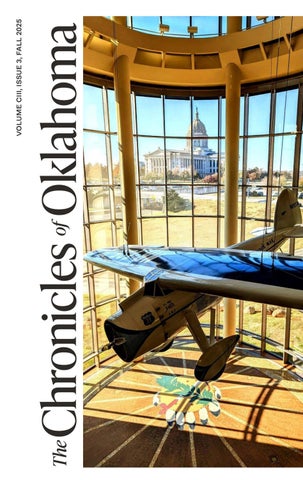
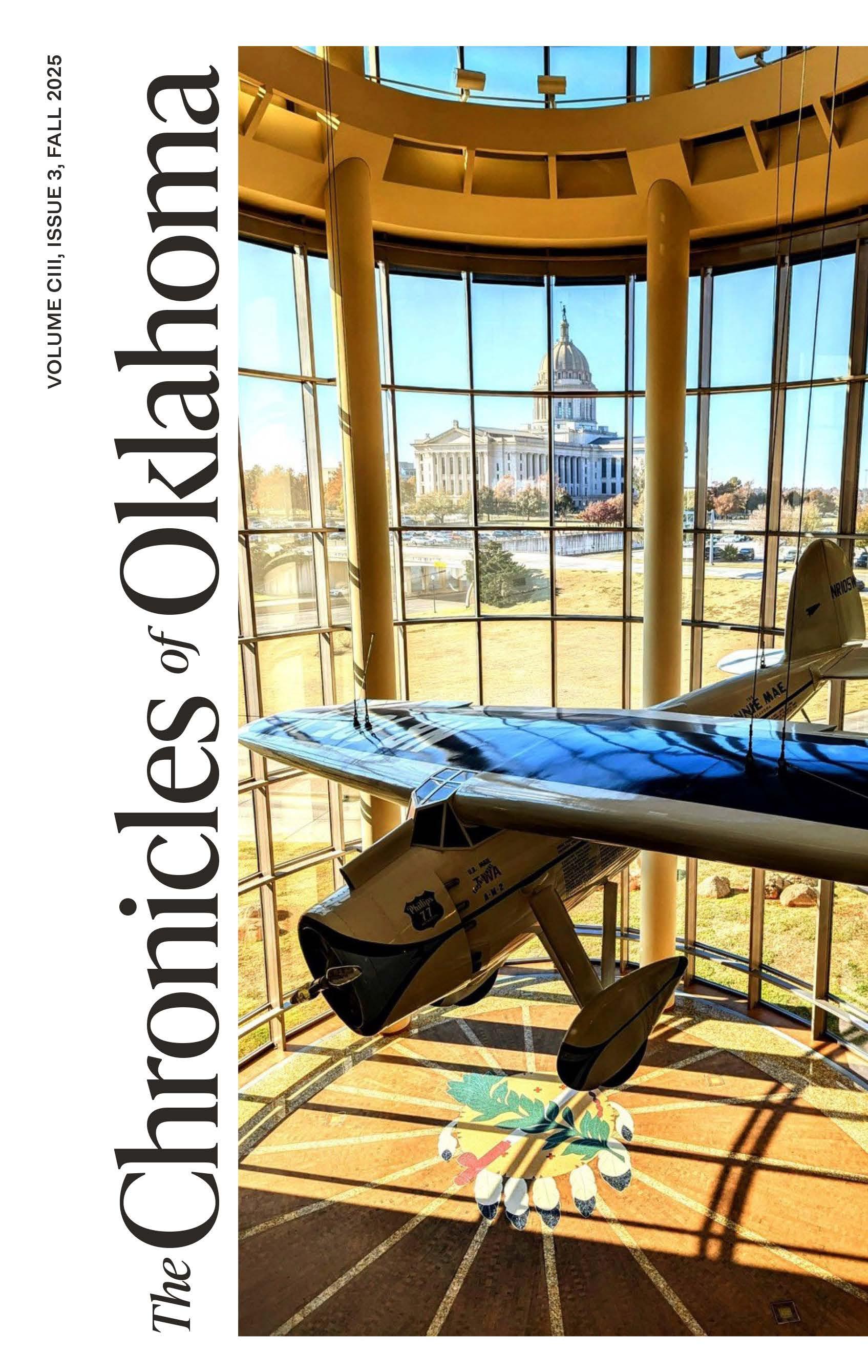
The Winnie Mae in the Devon Great Hall (image taken by Trait Thompson).
An Improbable Story: The History of the Oklahoma History Center
By Dr. Bob L. Blackburn*
Twenty years ago, on November 16, 2005, the doors of the Oklahoma History Center opened with a grand ceremony. For most people, it was a day to celebrate and look ahead to years of an improved ability to collect, preserve, and share Oklahoma history. For some of us, it was a day to look back on the twists and turns, the successes and setbacks that led to that celebrated day. This is a short history of that improbable story.
I use the word improbable because in 1997, when this story begins, no one would have expected a young conservative state with a small population and low tax base to build a $62 million, 215,000-squarefoot museum and archival masterpiece that would achieve status as both an affiliate of the Smithsonian and an affiliate of the National Archives. As with many turning points that make Oklahoma history so
fascinating, the only way to understand the story is to interweave opportunities seized and challenges overcome.1
The key to seizing opportunities is to be prepared, and we were in 1997 after a decade of raising standards, launching new projects, and assembling a leadership team that included members of the Oklahoma Historical Society (OHS) Board of Directors, staff, and volunteers who shared a passion for Oklahoma history. Leading the charge was J. Blake Wade, a retired US Army officer from Lawton who became OHS executive director in 1989. Blake brought to the table a take-charge personality, a problem-solving grasp of politics, and a willingness to share authority, which he did when he asked me to be his deputy executive director as a partner. I brought to the table my PhD as a published historian, my passion for historical collections, and a deep understanding of OHS institutional history dating to our founding by the Oklahoma Press Association in 1893. At our sides were empowered leaders on the staff, including Melvena Heisch in historic preservation, Kathy Dickson and Dr. Bill Lees in museums and sites, Sandy Stratton in special projects, Whit Edwards in living history, Bill Welge in research, Georgianna Rymer in administration, and Billy Nichols in finance. To use a sports cliché, we had a deep bench.2
For decades, OHS leaders had asked for better space to store collections and share Oklahoma’s story with the public through modern exhibits and enhanced research. The Wiley Post Historical Building, completed in 1930, was a beautiful neoclassical icon across from the State Capitol, but its casement windows, small galleries, light wells, temperamental heat, and humidity controls made it an ancient relic that had long outlived its purpose. Attempts to build an addition on the east side of the building failed first in 1982 and again in 1992. History would prove both failures providential.
As the OHS leadership team built credibility with constituents, legislators, reporters, and leaders in both the business and philanthropic communities, the planets aligned to open a new door of opportunity. Supreme Court Justice Yvonne Kauger, the godmother of the Sovereignty Symposium, Red Earth, and other historical ventures, cast her eyes on the OHS building as a perfect place to house the Oklahoma Supreme Court. A similar transformation had already been accomplished in Minnesota, where the state historical society received legislative funds to build a new museum and research center, and the
THE CHRONICLES OF OKLAHOMA
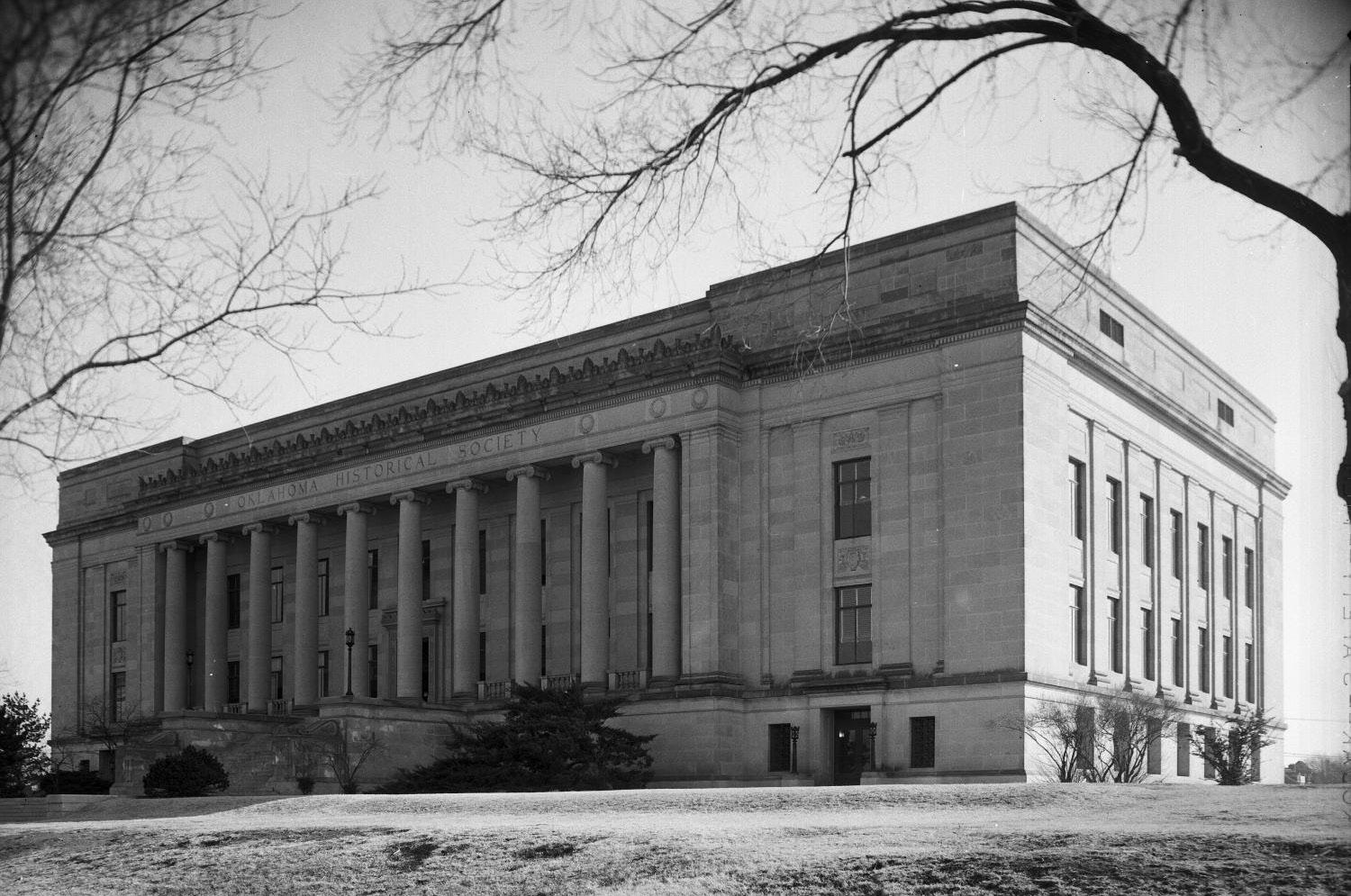
The Wiley Post Historical Building, completed in 1930 as the headquarters of the Oklahoma Historical Society, was designed with casement windows and light wells for air flow during summers and steam boilers and radiators for heat during winters. Although a beautiful neoclassical structure with marble floors and WPA murals, the building no longer served the needs of a modern research and museum organization by the 1980s. (22055.13305, Ray Jacoby Collection, OHS).
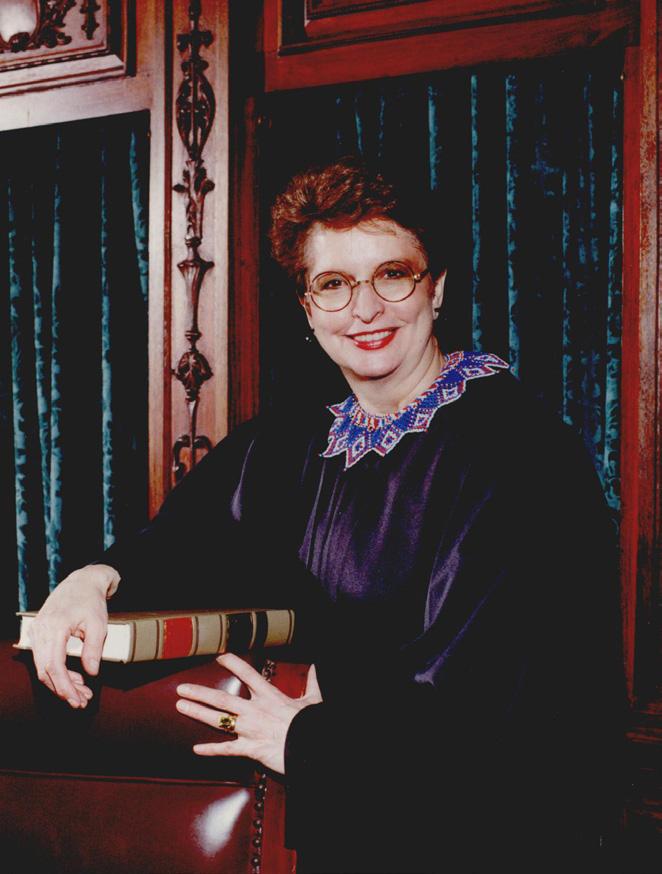
Supreme Court Judge Yvonne Kauger was an early champion for a new OHS museum and research center, in part to improve efforts to collect, preserve, and share history, but also to retrofit the Wiley Post Historical Building for the expanding appellate court system. (2012.201.B0323.0092, Oklahoma Publishing Company Photography Collection, OHS).
OKLAHOMA HISTORY CENTER
courts renovated and moved into their former historical society building. Justice Kauger’s vision got the ball rolling when she earned the support of Senate Pro Tem Stratton Taylor, a master dealmaker from Claremore, Oklahoma.
Adding momentum for a capital investment deal was Senate Appropriations Chairman Kelly Haney, a Seminole artist and tribal leader who wanted state support for what eventually would be named the First Americans Museum. According to Blake and Justice Kauger, Senator Haney believed his best chance to get a new Native American museum was to link it with a new building for the OHS. In the Oklahoma House of Representatives, which typically opposed anything originating in the Oklahoma Senate, support came from Speaker Lloyd Benson and Appropriations Chairman Jim Hamilton, who wanted state funding to acquire land north of the State Capitol to construct office buildings for state agencies, then leasing space elsewhere in Oklahoma City.
Rounding out the capital investment cheering section was Governor Frank Keating, a self-described history buff who told me when we first met in 1995 that he had spent most weekends while in Washington, DC, visiting museums and historic sites. Governor Keating also wanted a dome for the Capitol and a mini-urban renewal program around Lincoln Boulevard and Northeast Twenty-Third Street. The governor’s right-hand man working on a package to do all the above was Secretary of State Tom Cole, a historian with a PhD and a friend of mine since graduate school days.
Fortunately for our ambitions, state revenues exceeded expectations in 1997, so the legislature passed Senate Bill 175, creating a capital improvements revolving fund with $2 million for planning, land acquisition, and architectural concepts. Senator Haney was named chairman of the Long Range Capital Improvement Authority.3 When the Authority granted $200,000 to the OHS, Blake asked me and my right-hand partner, Sandy Stratton, to develop a plan for a new history center using the best consultants. On October 22, 1997, the OHS Board of Directors approved a plan to hire local architectural firm Glover-Smith-Bode to help us conduct a comprehensive national study to assess best practices, space needs, possible locations, costs, and themes for a new museum and research center.4
The planning process started with staff members. At the time, the State Historic Preservation Office was located in leased space in the
251
THE CHRONICLES OF OKLAHOMA
old Shepherd Mall. Melvena outlined a plan to bring staff, working files, and archival collections back into an OHS headquarters building. Working with the shorthanded staff in the State Museum, Sandy calculated space needed for exhibits, collections, and office space for an expanded staff. I worked with Bill Welge in the Indian Archives and Connie Shoemaker in the Library and Newspaper Room to anticipate storage needs for growing collections, more microfilm readers, and the onrushing transition to digital preservation and access.
While staff members worked on divisional plans, I drafted concepts for museum exhibits, and Sandy and the consultants reached out to constituents to determine top priorities. Focus group meetings included educators, journalists, family historians, and elected officials. We conducted a telephone survey of five hundred families, two hundred in the Oklahoma City metropolitan area and three hundred across the state, including Tulsa. As we gathered data, we presented suggestions to the various committees of the OHS Board of Directors. We followed with field trips for board members to trend-setting museums and libraries across the country, including the Atlanta Heritage Center, the Minnesota Historical Society, and the South Carolina State Archives. Each trip, each meeting with administrators, historians, educators, and archivists who had gone through a similar planning process, helped us focus on what might work best in Oklahoma.5
In February of 1998, just as the legislative session began, we released details of the plan at a press conference in a cramped gallery of the old Historical Building that clearly illustrated the need for more and better space. OHS Board president Dr. Marvin Kroeker, a history professor at East Central Oklahoma State University, described the importance of collections and ended with a call for action. “We will need the support of all Oklahomans if we are to be successful,” he said. “Saving our priceless heritage is too important for us not to.” Blake added that we were gaining support at the State Capitol. “We represent all seventyseven counties in the state,” he said, “and I believe we’re going to get a lot of support from legislators and Governor Keating.”6
With Marvin and Blake at my side, I presented a summary of the plan contained in two volumes filled with details. We needed approximately two-hundred-thousand square feet of space, at least eight acres of land for parking, and a bond issue for funding if we wanted to open the new facility by the centennial of statehood. I then provided
details, such as the need for eighty microfilm readers, two classrooms, forty thousand square-feet of collections storage, and museum exhibits that spanned all themes of Oklahoma history with an emphasis on Oklahomans at war, free enterprise, farm and ranch, the struggle for civil rights, American Indians, and cultural icons. The anticipated cost would be $46 million in state funding for the land, building, and environmental systems, with another $10 million in privately raised funds for museum exhibits and artwork. One reporter noted in her column that I repeatedly used terms and phrases such as “emotional connections” and “individual stories” to describe themes and “alive” and “dynamic” to describe design. That same reporter noted that I added a cautionary warning, “The OHS plan is an ambitious one.”7
It was ambitious, considering the political obstacles ahead of us. As we had learned many times over the preceding decades, political dealmaking behind closed doors can go in any direction with unanticipated surprises. For example, in 1992, on a Wednesday night during the last week of the legislative session, the OHS was on a list to get $10 million for an addition to the east side of the Historical Building. The next morning, that money was split between the University of Oklahoma and Oklahoma State University. With political factions fighting for their own priorities, final deals rarely end where they begin.
As the 1998 legislative session got underway, our team hit the speakers’ trail, sharing the story of what we needed and why. Blake continued his dialogue with Justice Kauger, a bulldog armed with homemade cookies on a quest to get our building, and Senator Haney, determined to get initial funding for his Native American museum. I spent many hours in the office of Secretary of State Tom Cole, a sympathetic supporter and close ally of Governor Keating, who had a seat at the table as negotiations advanced on several issues, including a possible bond issue.
I also roamed the legislative halls, where I had come to know many representatives and senators, as I sought funding for OHS field sites and museums and special projects in their districts. On the last day of the legislative session, a bill authorizing the sale of $320 million in revenue bonds passed the House and Senate, soon to be signed by Governor Keating. In it was $32 million for a new History Center. Although it was less than we needed, Senator Haney and Governor Keating pledged to do their best to get more funding during the next legislative session.8
THE CHRONICLES OF OKLAHOMA
Bond funds triggered a number of initiatives we had anticipated. Knowing we needed to raise millions in private funding, I recruited friends to create a 501(c)3 nonprofit support group that could accept and spend donations. I wanted the foundation not so much to raise money, but to convince people in the business and philanthropic communities that we had their peers on our team. On April 30, 1998, I met with Cliff Hudson, CEO and chairman of the board for Sonic: America’s Drive-in, and asked him to be the founding president. He agreed. Then I called on other friends, such as Charles Wiggin, a real estate developer; John Yoeckel, an oil and gas entrepreneur; and Jay Hannah, a banker and chairman of the Cherokee Constitutional Convention. The list initially grew to more than a dozen community leaders across the state.
The most critical decisions before us were where to build the History Center and who to design it. The plan approved by the OHS Board of Directors included three possible sites: one adjacent to the Harn Homestead on Lincoln Boulevard, a site near Lake Arcadia on I-35 offered by the City of Edmond, and land along the banks of the North Canadian River near the intersection of I-35 and I-40 offered by the city of Oklahoma City. After the bond issue was approved, the OHS Board of Directors added a fourth option, an eighteen-acre site on the northeast corner of Northeast Twenty-Third and Lincoln Boulevard across the street from the Governor’s Mansion. After Sandy and I presented a detailed analysis of each site with advantages and disadvantages, the OHS Board of Directors unanimously selected the site closest to the State Capitol across the street from the Governor’s Mansion.9
Selection of architects was a more complicated task dictated by a statutory selection process managed by the Construction and Properties Division of the Oklahoma Department of Central Services, a separate state agency. Blake, Sandy, and I wanted a competition, which had never been done under state law. When I explained the reasons to Robert Thomas, director of Construction and Properties, he called in his agency’s attorney, and they found a way to make a competition possible.
The OHS Board of Directors interviewed seven teams and selected three finalists to submit conceptual designs. Because we wanted to own rights to any part of the proposed designs that might be useful, we offered $35,000 stipends to each firm and gave them eight weeks to come back with a conceptual design and model. The winning team,
OKLAHOMA

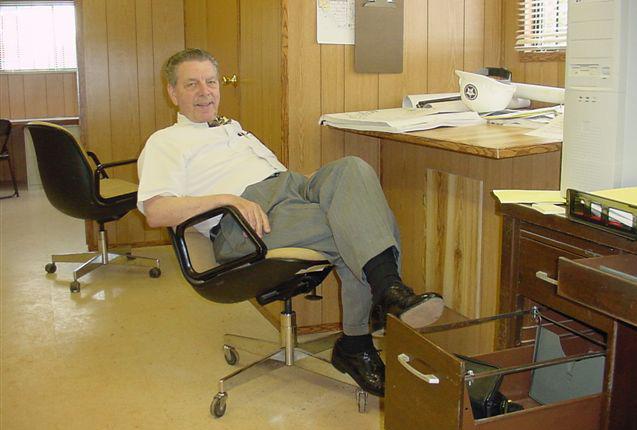
Among the many recruits who helped design, construct, and occupy the new Oklahoma History Center were Bill Moore (above), who expanded the film collection, produced many of the videos featured in the museum, and served as a “glue guy” in the words of Bob Blackburn, and Robert Thomas (below), the OHS deputy director who applied his architectural skills to making sure the “once in a lifetime” project was successful. (photos provided by the Oklahoma Historical Society Research Division).
THE CHRONICLES OF OKLAHOMA
selected by a blue ribbon panel and approved by the OHS Board of Directors, was a partnership between Beck Associates, an experienced library design firm based in Oklahoma City, and HOK, an international firm led by Gyo Obata, who had designed the Smithsonian’s Air and Space Museum; the Lincoln Memorial in Springfield, Illinois; the Missouri Historical Society in St. Louis; and the Museum of Science and Technology in Chicago.10
Blake and I knew we needed a proven leader who could work daily with the architects and exhibit consultants while we concentrated on getting a second bond issue, raising private funds, bringing in new collections, and launching additional projects that had to be ready by the time we opened the History Center to the public. From a strong field of candidates, we selected Dan Provo, who brought seventeen years of experience in museum design, construction, and management. An additional asset was his commitment to education and telling every part of the story. “We’re going to look into everything that went into the development of Oklahoma,” he told one reporter, “the good things and things that are more difficult . . . We can’t ignore any part of the picture.”11
With pieces of the planning puzzle dropping into place, Blake announced he was taking on a new challenge as director of the recently created Oklahoma Centennial Celebration Commission. As he expected, the OHS Board of Directors selected me to take his place and push the History Center to the finish line. I gladly accepted. On August 1, 1999, I became executive director of the Oklahoma Historical Society, the public/private organization I had served since 1979.
The smooth transition was fortunate because we had to make a critical decision before we signed contracts with the architects. When we received the $32 million bond issue on the last day of the 1998 legislative session, Governor Keating and Senator Haney reassured us they would help get us the other $14 million to pay for the History Center as conceptualized by Don Beck and Gyo Obata. True to his word, the governor asked for the money in his executive budget in 1999, but the legislature did not act on it. When the last gavel ended the session in May, we were still $14 million short.
On November 11, 1999, after a few months of considering options with our team, I drove to Frederick to confer with Speaker of the House Benson. He confided that there would not be any more funding.
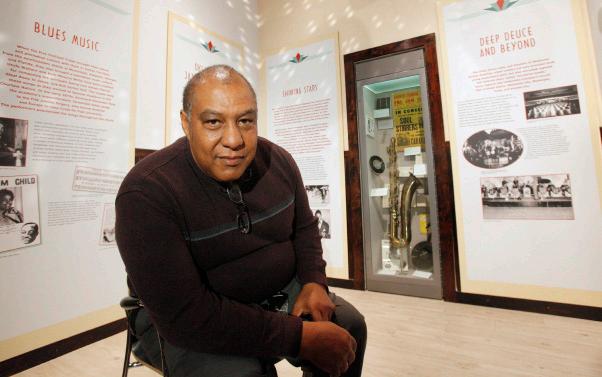
One of the first historians hired by Bob Blackburn was Bruce Fisher, who opened many doors to underserved communities throughout the state as planners tried to represent all themes and geographical sectors in the new research and museum facility. (photo provided by the Oklahoma Historical Society Research Division).
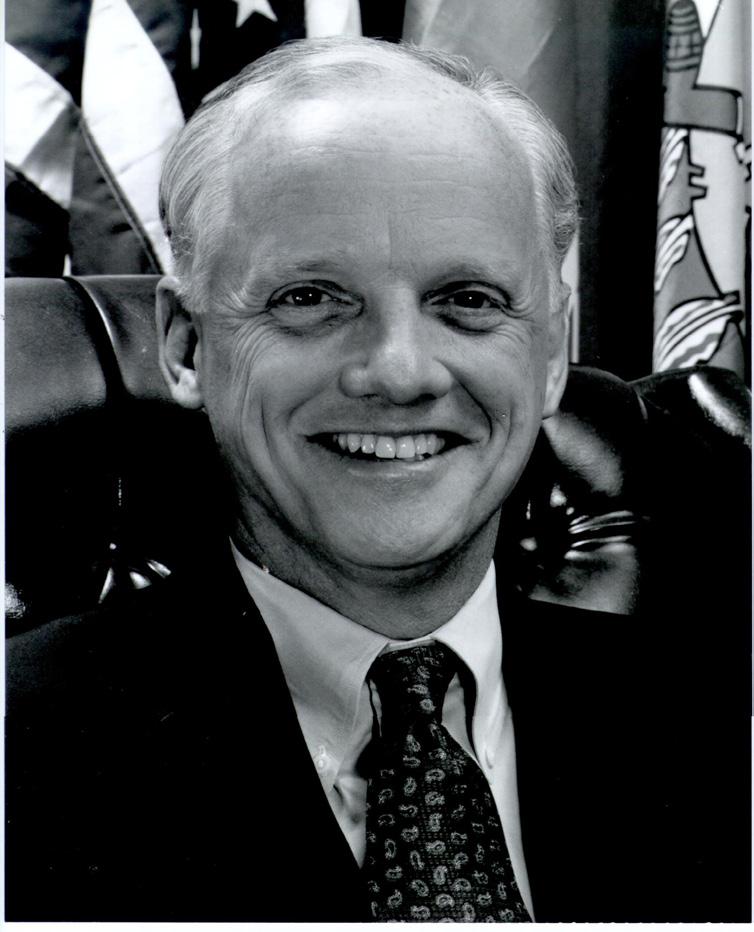
Governor Frank Keating introduced himself to Bob Blackburn as a “history buff” who wanted a first class History Center that would rival any museum and research center in the fifty states. (21596, Oklahoma Historical Society Photograph Collection, OHS).
THE CHRONICLES OF OKLAHOMA
His advice was to scale down the size and build something with $32 million. Although I did not like the message, I appreciated his honesty when it would have been easy for him to string me along. He was and is an honorable public servant.
I talked to Governor Keating about what to do. With his naturally positive enthusiasm and love of history, he said go for the full package with Smithsonian-sized ambitions. He said he still had two more years to help get us the money. I briefed the full OHS Board of Directors, shared with them my meetings with the speaker and governor, and told them I recommended that we stay on course, start planning for a $46 million construction budget, and split the project into two phases, the first to get an enclosed building for less than $30 million and a second to finish the interior. Board members asked questions, discussed the issue, and made a bold decision. We would not compromise and reduce the size or cost of the History Center. Without knowing what was over the next hill, we charged ahead.
Our decision to take a chance was based partly on the expanded leadership team we had assembled by that time. With Dan Provo and Sandy Stratton already on board, we needed a deputy director with complementary skills for a once-in-a-lifetime construction project. We needed someone who could stand toe-to-toe with architects,
258
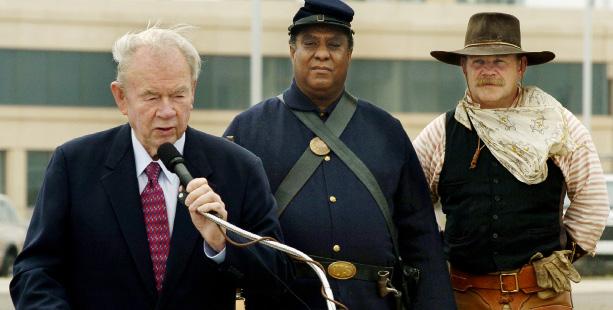
Former Governor and US Senator Henry Bellmon (left), standing in front of educators Bruce Fisher (center) and Whit Edwards (right), spoke at one of the many dedication ceremonies for the Oklahoma History Center. After his death, Governor Bellmon’s family donated his collections to the OHS. (photo provided by the Oklahoma Historical Society Research Division).
engineers, and construction supervisors as they turned our dreams into reality. I wanted someone who knew the state system of consultant selection and contracts and had enough self-confidence and creativity to get things done without blaming bureaucratic red tape for lack of action. I chose Robert Thomas, an experienced architect who had led his own firm before taking the job as director of Construction and Properties for the state. He agreed to accept my offer after a luncheon meeting at the Faculty House on July 9, 1999.
We also needed specialists with experience and connections in their professions. Bill Moore, a film and video producer who had made a series of historical documentaries while working full-time at the Oklahoma Department of Transportation, came onto the team and proved to be what I call a “glue guy,” a person who brings divergent opinions together and finds a way to finish complex projects. I recruited Bruce Fisher, a historian and son of Ada Lois Sipuel Fisher, the civil rights icon who had broken segregation in Oklahoma higher education. Bruce was respected in the African American community and anxious to bring in collections and content specialists. Others rising to the challenge from the existing staff included Laura Martin and Chad Williams in the library and archives, Jeff Briley and Mike Atkins in the State Museum, Max Nichols in public relations, and Terry Howard in finance. With Sandy, Dan, and Robert as corps commanders, we moved out like an army on the march.12
In keeping with the military metaphor, the OHS Board of Directors played the role of civilian control of all action on the battlefield. Throughout the planning and development phases, we reported monthly to the OHS Executive Committee and quarterly to the full board of twenty-five members. Typically, the senior team and I described what had happened, explained where we were in the process, and sought advice and approval about moving forward. The constant interaction with board members not only gave our team a chance to assess progress across divisional lines every month but also tapped into the combined experience and wisdom of board members from across the state. A complete list of the board members from 1997 to 2005 is included in the endnotes.13
Reading the minutes of those meetings reminds me that the History Center was not the only major project needing our attention and resources from 1999 to 2005. Anticipating increased funding rising from
THE CHRONICLES OF OKLAHOMA
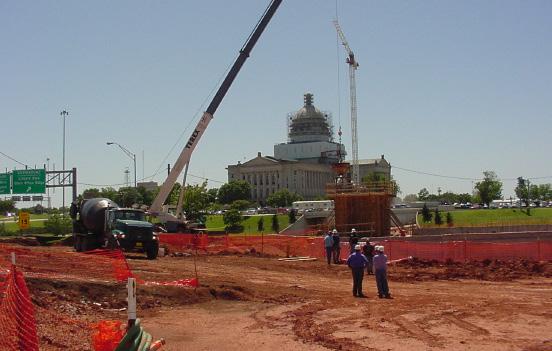
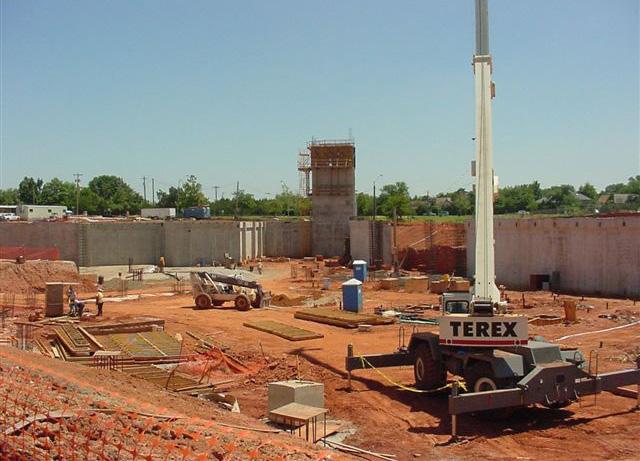
Manhattan Construction Company, the oldest corporation in state history, began excavation for the History Center in 2000. Among the many challenges faced during construction was the discovery of several uncapped oil wells. In the image above, notice the scaffolding around the new Capitol Dome then under construction. (photos provided by the Oklahoma Historical Society Research Division).
the enthusiasm for the upcoming state centennial, we spent an entire year assembling master plans for each of our thirty-two museums and historic sites, which required my attendance at community meetings and constant interaction with Kathy Dickson, Bill Lees, and Whit Edwards. We jumped at the opportunity to investigate, raise money, and recover remnants of the steamboat Heroine at an underwater archeological site where it sank in the Red River in 1838. With a federal grant, we started work on a new road, a bridge over Elk Creek, trails, and interpretive markers within the Honey Springs Battlefield.
Tapping the creativity of Dr. Dianna Everett, we launched a multiyear effort to research, write, and publish The Encyclopedia of Oklahoma History and Culture. We managed the Tulsa Race Riot Commission, with me as chairman and Larry O’Dell as my right-hand man, coordinating a steady stream of special projects legislators funded with additional appropriations. A few of the most time consuming were Hackberry Flats Interpretive Center, a lease to develop a new museum complex in Frederick, and plans for a museum in Grove dedicated to my childhood hero, Mickey Mantle. Then there was the full cycle of legislative hearings, budget preparations, and the lecture circuit where I was giving eighty to ninety speeches a year. It took time and energy folded into the daily tasks needed to keep the OHS running smoothly.14
The pace quickened after a groundbreaking ceremony on Statehood Day, November 16, 1999. Looking back on that ceremony filled with big band music, historians in period clothing, and speakers, perhaps the most important words were delivered by Mennonite minister and Cheyenne Peace Chief Lawrence Hart, who solemnly blessed the occasion. We needed the help. That month we added to the list of History Center deadlines when we were notified we had won a $588,000 federal grant through the Oklahoma Department of Transportation to build what we called The Red River Journey, an outdoor landscaped interpretive park that spanned two blocks north of the Governor’s Mansion.15 The project not only added to the list of deadlines we had to meet, but also required more fundraising to meet a twenty percent match.
By April of 2000, while Sandy planned a series of fundraising events across the state, Robert reported that the architects had completed the schematic design. Dan announced that he had moved his growing
THE CHRONICLES OF OKLAHOMA
museum staff of twelve people into a former bowling alley on North Lincoln Boulevard. The successful search for a museum exhibit design firm was announced that same month. The new partner was Haley-Sharpe Design, Inc., a British firm that had recently entered the Canadian and United States markets. The previous year, they had competed for four projects in North America, and won all of them. The creative director assigned to the History Center was Alisdair Hinshelwood, a gifted designer and strategist who was destined to be an important part of the OHS’s future for more than two decades by assisting with master plans for the Will Rogers Memorial Museum and the Oklahoma Museum of Popular Culture in Tulsa. In many ways, he became our team’s mentor in exhibit design.16
For the next six months, after an initial weeklong brainstorming session with senior staff, Alisdair and his associates communicated with Dan’s team through emails and conference calls to build on themes approved by the OHS Board of Directors. As they narrowed the focus to thirty-seven exhibit components in four large galleries, they worked on adjacencies based on subject matter and design elements. For consistency, Alisdair suggested a text panel template with a title, main message, secondary story, and tertiary additions such as photographs, captions, and sidebars. As the process progressed, Dan assigned each exhibit component to a staff member who would serve as lead curator. Even though I was busy with administrative duties, I asked to be the lead curator for four topics. In my mind, I was still a historian and anxious to learn a new skill.
While Dan’s and Alisdair’s teams focused on exhibits, the architects worked on construction documents, adding details to the conceptual design. As conceived by Don Beck and Gyo Obata, the History Center consisted of four separate structures, each with its own specific characteristics under one roof, connected by public spaces, an auditorium, and a grand atrium. The northwest three-story structure was for OHS staff with offices, board room, meeting spaces, and classrooms. The northeast three-story structure was for the library and archives, with the reading room on the ground floor and collections and staff offices above.
Facing the southwest were two two-story structures for museum galleries, connected to the other structures by a grand atrium topped by a dome, a flat-floor auditorium seating 240 people at eight-person
262
OKLAHOMA HISTORY CENTER
tables, a cafe, a second-floor bridge, and floor-to-ceiling hallways flooded with natural light during the day. Both ends of the hallway were enclosed by glass curtain walls, and the atrium featured a semicircular glass wall framing a view of the State Capitol, which we called Artifact Number One. Underneath most of the building was a thirty-foot-deep basement for collections, workspace, and mechanical equipment.
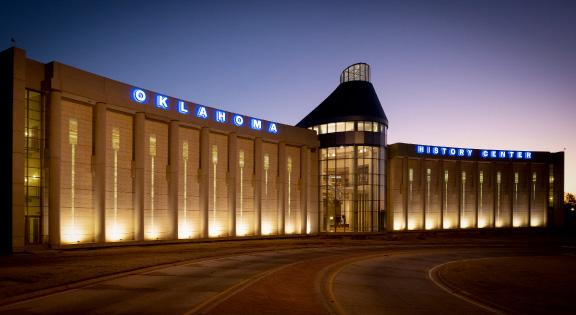
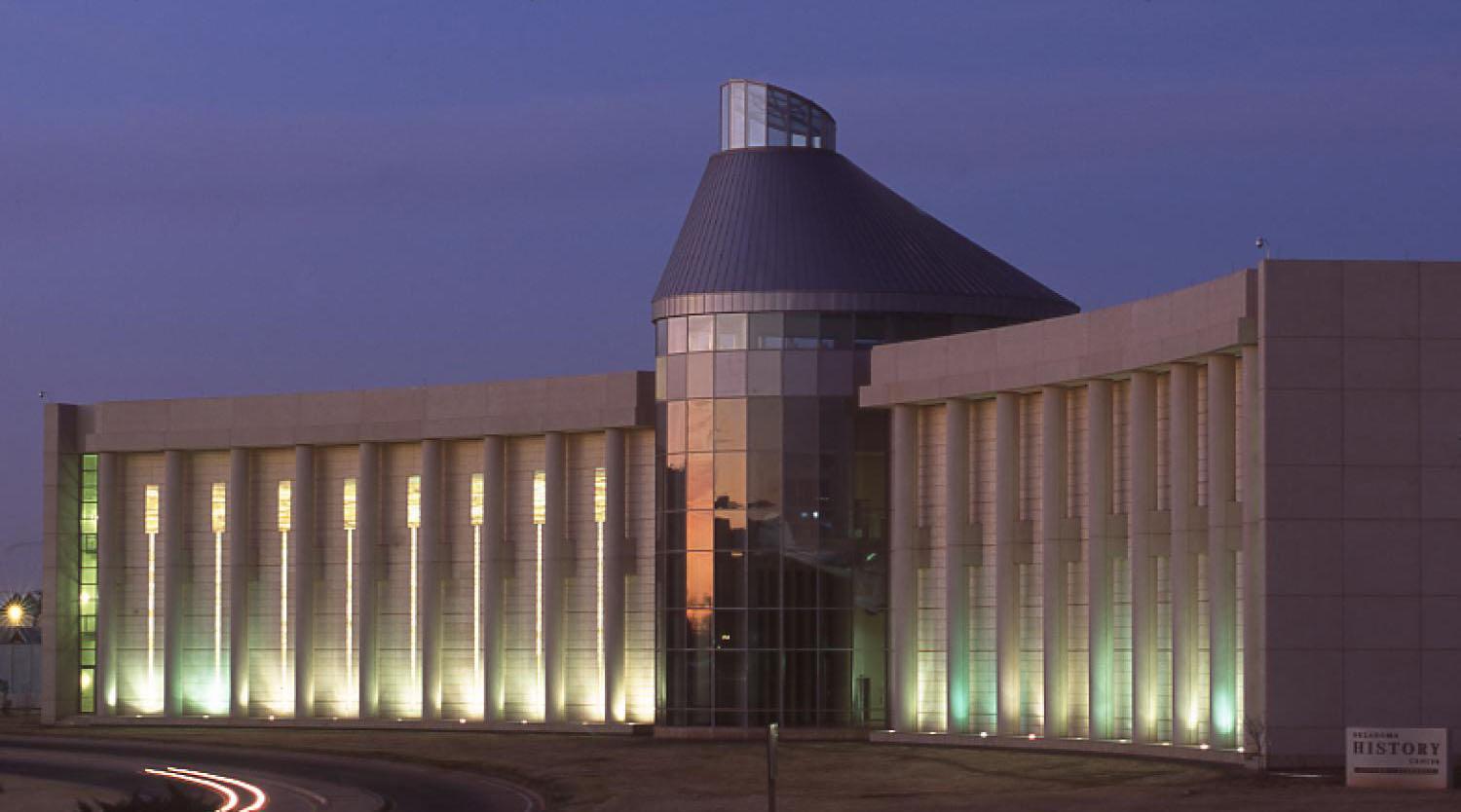
A challenge for the architects creating detailed construction documents was the overall footprint of the History Center. As they often commented, there was not a straight line anywhere. The two museum galleries were curved like arms embracing the State Capitol. The research and staff wings were also curved, but in a lazy S-shape configuration that anticipated future expansion. The exterior facade facing the Capitol featured neoclassical columns with backlit onyx curtain walls that radiated a warm golden hue at night. The rest of the building was clad with precast stone panels punctuated by bands of windows, giving the north facade strong horizontal lines with a main entryway distinguished by a covered portico off a circular drive.
Bridging the gap between form and function was more than just an architectural challenge; it was a communication challenge between us on the OHS staff, who knew what we wanted, and Beck Associates and HOK, who worked with architects and engineers to translate that
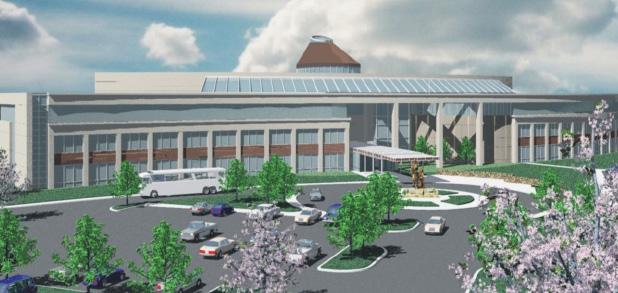
The architectural team of HOK and Beck Associates designed an S-shaped building that consisted of four large museum galleries on either side of a domed atrium (top of the structure), a wing for research collections (left), and a wing for a variety of meeting spaces, classrooms, and offices (right). (photo provided by the Oklahoma Historical Society Research Division).
THE CHRONICLES OF OKLAHOMA
into lines, shapes, and lists of materials. Fortunately, we had Deputy Director Robert Thomas as an intermediary who sat in all our planning meetings, knew the language of architecture and engineering, and had the courage to use his red pen for corrections and changes. With that advantage, Richard Ford on Beck’s staff met his construction document deadlines of thirty percent in October of 2000, sixty percent in January of 2001, and completion in May of 2001. The next step was getting the plans distributed that summer to solicit construction bids.17
Eight firms bid for the high-profile project, but the lowest and best came from Manhattan Construction Company, a family-owned firm that had started in Chandler in 1896 and moved to Muskogee where it became the first corporation to file papers with the new state in 1907. When Manhattan became our partners, Francis Rooney had his headquarters in Tulsa and offices in various cities across the west and south. Fortunately for us, John Jamison, a Manhattan project manager already working on the Capitol Dome, was named supervisor of History Center construction. His team started with demolition of the remaining homes on the site and started excavating the basement. By January of 2002, they had already hauled off six hundred truckloads of dirt and the big hole in the ground was only forty percent complete.18
Construction kept everyone on their toes. Robert hired experienced architect Jerry McKinney to be our eyes and ears on the ground at the site with our own trailer where we could hang our OHS hard hats. When there were questions or surprises, Robert was only a five-minute drive away, so he was a frequent visitor at least twice a day engaged in finding solutions. He made most decisions working with Beck’s and HOK’s team, but a few he kicked upstairs to me. I will never forget the day he came to my office and said excavators had found two oil wells that had never been capped. What should they do? I called the Corporation Commission and found out they could do nothing to help. I called the Oklahoma Energy Resources Board, and they said they could not do remediation on state land. When Robert told me it would cost $20,000 apiece to cap, I said do it. We would find the money later.
Manhattan proved to be an excellent partner. They kept the project on schedule and brought in the best subcontractors. Less that nine months after Manhattan crews moved onto the site, they had completed excavation, poured eighty-eight percent of all basement walls, and sunk piers for support columns. They found a firm in Arkansas to produce
264
the durable pre-cast stone and tapped W & W Steel of Oklahoma City to fabricate the $4.29 million worth of steel for the framework and dome. “I’ve been in this business for nineteen years,” said Bert Cooper, CEO and chairman of W & W Steel. “We’ve never seen anything like it . . . It’s pretty unique.”19
As designed by Beck and HOK, the sixty-five-foot by forty-five-foot dome was tilted toward the State Capitol, asymmetrical with horizontally concentric bands of steel tubes that weighed forty tons. “I don’t know that we’ve ever come across such a complex design,” said Cooper. To bend the steel tubes to precise curves, they engaged a roller coaster fabrication firm in Salt Lake City. They then assembled the pieces at their plant on West Reno Avenue in Oklahoma City using piano wire to ensure the beams were aligned correctly. When it was finished, the OHS leadership team was invited to view what looked like a contemporary work of sculptural art. Later, it was taken apart, shipped to the site, and reassembled one hundred feet off the ground, never to be seen again underneath metal roofing above and ceiling tiles below.20
As the superstructure rose from the red dirt, our hope for a second bond issue sank under the pressure of declining state revenues and budget cuts. During the 2002 legislative session, with the request for a bond issue included in Governor Keating’s executive budget for the third time, the pendulum swung the other way with a 4.75 percent cut in operating funds that a House staff member erroneously applied to the annual appropriation to make monthly payments on the first bond issue. Compounding both setbacks, our legislative appropriation subcommittee placed a hold on our verbal agreement to add $200,000 annually to the OHS base budget to ramp up for staff to run the History Center. The year before, the fourth installment had been reduced to $62,500.21
As we successfully fought to retrieve full funding to make our bond payments, all state agencies faced a series of budget cuts during the 2003 legislative session. On top of the $499,475 cut imposed at the beginning of the year, we were hit with two successive revenue shortfalls of $184,015 and $141,975 as legislative leaders warned agency directors that funding cuts the following year would likely be in the ten percent range. Reluctantly, the OHS Board of Directors approved my plan to freeze all hiring with forty-seven vacancies on a staff of 151 people, delay projects, close the OHS library to walk-in patrons, and declare an agency furlough for all employees, including me and Robert Thomas.22
THE CHRONICLES OF OKLAHOMA
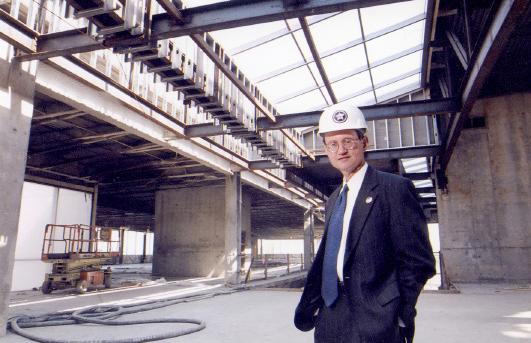
Dr. Bob Blackburn (above) gave many hardhat tours of the History Center while under construction as the OHS team kept the governor, legislature, press, and potential donors up to date on needs and progress. (photo provided by the Oklahoma Historical Society Research Division).
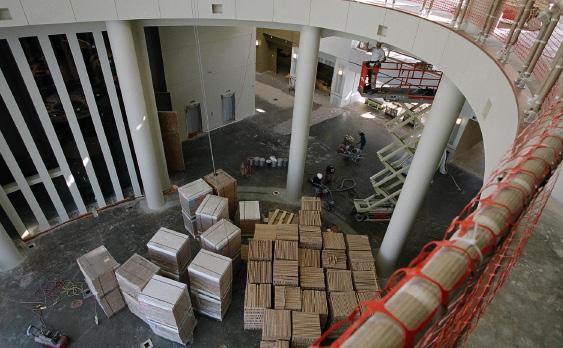
Looking down into the central atrium from the balcony, stacks of wood flooring were ready for installation. (photo provided by the Oklahoma Historical Society Research Division).
I saw my career coming to an end as Manhattan crews neared the end of Phase I construction. The History Center looked impressive, but there were no interior walls, finished flooring, furniture, fixtures, or exhibits. Within months, the construction site would have to be shut down, adding another $2 million to the final cost and derailing the fundraising drive that was just getting underway to pay for exhibits. Other than faint optimism, the only advantage we had was a steady stream of great press coverage over the previous two years that kept the History Center before elected officials and the public.23
On December 9, 2002, I took a chance and sent letters to all state senators and representatives describing the coming crisis if another bond issue was not forthcoming. The response was a deafening silence. I followed that with a series of meetings with Senate Pro Tem Cal Hobson on December 17, Senate Chair of Appropriations Mike Morgan on January 13, 2003, Speaker of the House Larry Adair on January 15, and House Minority Leader Todd Hiett on February 26. The story was the same each time. They were sympathetic but pointed out that the state was facing a $350 million revenue shortfall, a bankrupt Rainy Day Fund, and teachers about to be furloughed without pay across the state. They gave me little hope.
The only ray of sunshine at that low point was a meeting on January 15 with recently elected Governor Brad Henry and Scott Meachum, his director of state finance. I went to their office armed with a stack of evidence to lay before them. Before I got started, Scott in his best banker’s voice said, “Bob, relax, you can share your information, but we support another bond issue to keep construction going.” They agreed to put the recommendation in their executive budget.
As if schizophrenic, I started living two lives. While stalking the hallways of the Capitol in desperation and commiserating with staff who were being furloughed, we were at a critical point of fundraising. From January to May, 2003, I put on a happy face and stayed on the donation trail, meeting with Bill and Bob Ross at the Inasmuch Foundation on January 14, ONEOK officers on March 27, Tom Price at Chesapeake Energy on March 28, Walt and Peggy Helmerich on April 23, Larry Nichols at Devon Energy on April 28, and officers with the 1889ers Society on May 22. All would eventually make large lead gifts.
Renewed hope came on March 3, 2003. Armed with a new strategic plan, I got follow-up appointments with Senate Pro Tem Hobson,
THE CHRONICLES OF OKLAHOMA
Senate Appropriations Chair Morgan, and House Speaker Adair. I told them we did not need cash this year or the next if the legislature authorized another bond issue. As the hard-working state bond advisor Jim Joseph had taught me, we could capitalize interest accrued since the first bonds were sold and make payments on a new $18 million bond issue for more than two years. I suggested the burden of funding a second bond issue would be shifted to a future time and a future legislature when state revenues were in better shape, giving them a chance to claim at least one immediate victory on the battlefield of bad news. They did not like the optics of taking on new debt while furloughing teachers.
I went home that night, ran three miles trying to shake the blues, and retreated to my front porch, where I popped a beverage and started thinking about finding a job in higher education when I was fired for failure. Then my mobile phone rang. I answered, and it was Senator Morgan. “Bob,” he said, “we will give you a chance at a bond issue with three conditions . . . what you said about capitalizing interest has to be true and there cannot be any logrolling with other projects added to the bill.” Then he added the zinger. “You also have to get two-thirds of all members in both the House and Senate to sign a pledge to vote for the bill, which includes a majority of Republicans so this will not become a political campaign issue.” I distinctly remember that the second the conversation ended, I knew we would get the bond authorization. If I have ever had one, that was a vision.24
I lived at the State Capitol for the next two months from noon Monday to noon Thursday. I started with the leadership on both sides of the aisle, including Todd Hiett, minority leader in the House, and Jim Williamson, minority leader in the Senate, to let them know what I was doing. I then went to known supporters and legislators I had worked with, briefed them on the plan, and asked them if I could place a “yes” by their names on my roll call sheet. Most said yes, but some said no, the timing was not right. During my laps on the third, fourth, and fifth floors of the Capitol, I came to appreciate the role of legislative assistants in managing time. Some would put me on the schedule, tell me where I could intercept their boss, or encourage me to keep coming back. Some were hostile, which probably reflected their boss’s opposition, which I noted. Although he said he could not vote for a bond issue, Senator Willamson gave me a chance to speak to his caucus behind closed doors. I will never
268
forget a senator from the south side of Oklahoma City who stood up after my presentation and encouraged his colleagues to vote for it. By late May, I returned to a surprised Senator Morgan and showed him the roll call sheet with all my notes and pledges. I had the two-thirds he wanted in the House and Senate, plus five extras in case a member buckled at the last minute and withdrew their pledge. He said they would draft the bill and bring it to the floor for a vote the last week of the session. With only days left before adjournment, I was called into the office of the Senate’s legal counsel, who was drafting the bill. He told me there was a problem. The director of Central Services told him we could not capitalize interest on one bond to make payments on a second bond. I asked if I could call Jim Joseph, the bond advisor, or the bond attorney, Gary Bush. He said yes. I called Gary, who luckily answered, and asked him to tell the attorney what he and Jim had told me. He did, and the bill was drafted and submitted to the General Appropriations Committee before going to a vote on the floor. It passed both chambers with hours to spare.25
In the time I had spent chasing bond authorization, Robert Thomas, Dan Provo, Sandy Stratton, and their crews had never slowed efforts to keep the History Center project on schedule. With the bond money available in September of 2003, Robert used a new state statute to extend Manhattan Construction’s involvement through a construction management contract that opened the door to a more collaborative partnership, seeking subcontractors, with Manhattan earning a fixed percentage of each contract. Without that flexibility to respond to market conditions and monthly price fluctuations, we never could have brought the project in under budget.
The construction management contract helped Dan as well. As designed, the four exhibit galleries were big black boxes, each with approximately 8,200 square feet of space and twenty-five-foottall ceilings. All work on the walls, partitions, floors, light grids, and cases typically would have been bid out, a lengthy and timeconsuming process, but with the construction management contract, Manhattan hired each of the subcontractors after Dan and Haley-Sharpe provided construction drawings. When bids came in too high for some projects, Manhattan used their own crews and adjusted plans on the run while working with Dan and Robert.
269
THE CHRONICLES OF OKLAHOMA
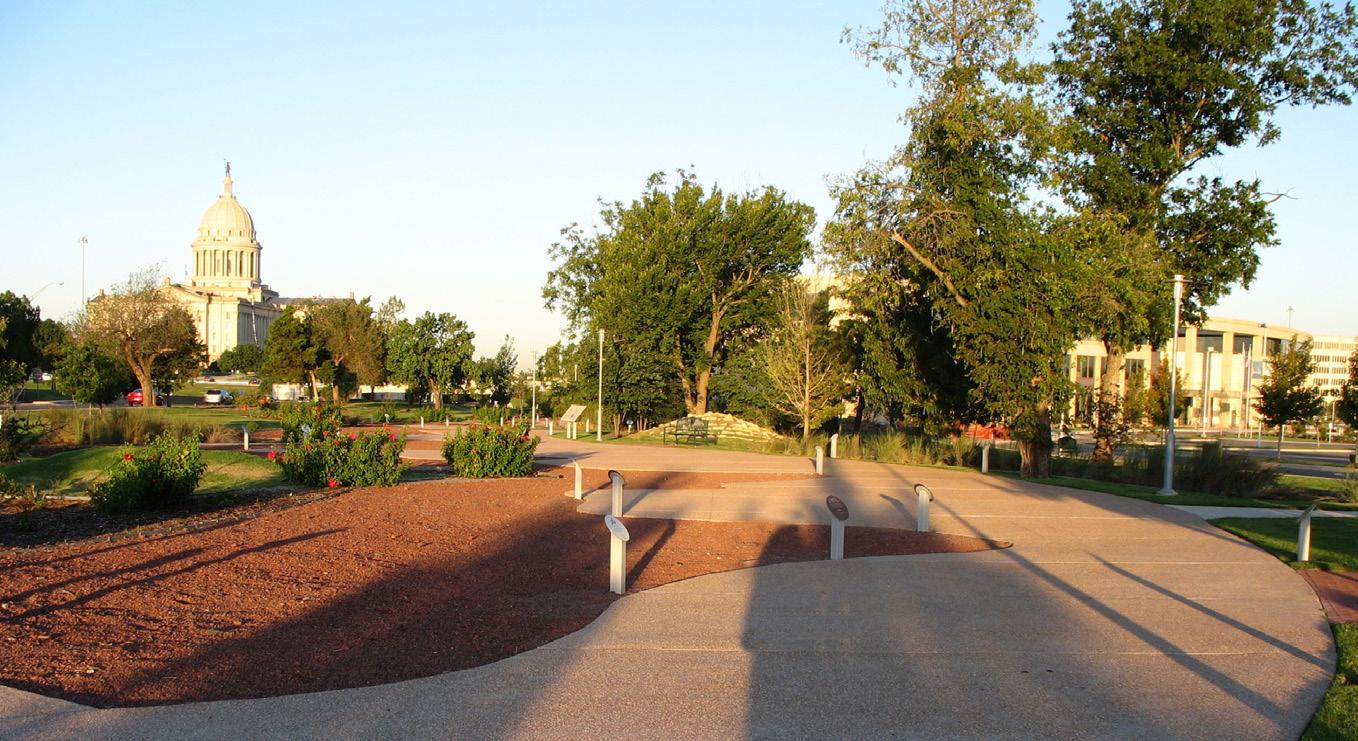
The Red River Journey, stretching east and west along the south side of Northeast Twenty-third Street, created an outdoor classroom with historical markers, crushed red granite representing water, and topographical features such as Mount Scott, the Arbuckle Mountains, and the Winding Stair Mountains. (photo provided by the Oklahoma Historical Society Research Division).
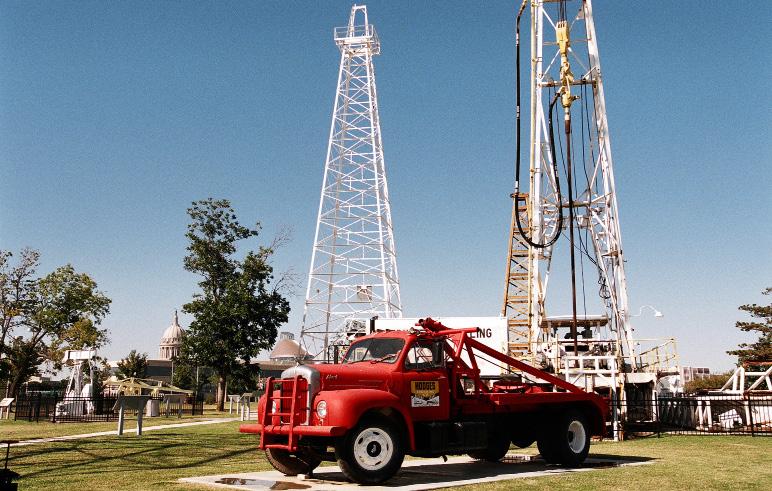
An early addition to the original plans for the History Center was an oil patch exhibit with historic drilling rigs, production equipment, and transportation. Devon Energy stepped up as the major sponsor. (23389.520.157, Jim Argo Collection, OHS).
To help visualize the use of horizontal and vertical space with topical adjacencies and shared design features, Alisdair and his associates at Haley-Sharpe created three-dimensional physical models of each gallery with moveable components that could shift as needed. By mid-2003, Dan’s team had divided the four galleries into more than fifty thematic zones and subzones. On the ground floor, one gallery was dedicated to the image of Oklahoma, with artifacts and interpretation from radio, television, movies, the arts, sports, and Wild West shows. The opposing gallery was dedicated to the story of American Indians in Oklahoma, with themes of tribal origin stories, spirituality, language, dwellings, lifeways, and notable leaders.26
Upstairs, one gallery included themes such as oil and natural gas, military history, transportation, and the story of African Americans in Oklahoma history. The facing gallery covered land runs, farms and ranches, domestic life, weather, law and order, schools, and government. Additional themes were addressed outdoors. The Red River Journey, combined themes of transportation, geography, and historical events as viewed in one region of the state. At the head of the river outside the glass partition at the south end of the grand hallway was a fountain surrounded by red granite boulders excavated from OHS board member Jack Haley’s ranch on the western slope of the Wichita Mountains. Those boulders also recreated a scaled version of Mount Scott, the highest mountain in the Wichita Mountains Wildlife Refuge.27
The largest outdoor exhibit, located next to the main entry onto the History Center grounds, was dedicated to oil and natural gas. The concept started when we saved two derricks from the Capitol complex. One was an oversized drilling derrick located behind the Wiley Post Historical Building that had to be removed during the Supreme Court’s expansion. After we stored it on the new site, Senate Pro Tem Stratton Taylor told me they needed to remove one of the work-over derricks on the west side of the Capitol. I asked for it, and Senator Taylor included funding to move and reassemble it on our new site. When word spread that we were developing an oil and natural gas outdoor exhibit, Sherman Smith, a veteran in the oil patch, offered to donate a portable drilling rig he had designed in 1947. Other donations followed, including the world’s tallest “Christmas Tree” of control valves donated by Gene Downing and a modified oil tank truck donated by John Groendyke.28
THE CHRONICLES OF OKLAHOMA
Many collections came in as we researched stories. Marvin Jirous, president of Sonic: America’s Drive-in in the 1970s, donated one of the four original Sonic signs after I interviewed him. Dr. Kenny Brown, a professor at the University of Central Oklahoma, found out we were assembling an exhibit on voting and convinced the university to donate a large collection of ballot boxes from every corner of the state. Currie Ballard, a collector who had loaned us many objects of African American history over the past decade, donated his entire collection.
One of the most significant donations came during planning meetings with a group of tribal elders funded through a grant from the National Endowment for the Humanities. After a planning session to develop themes, Otoe elder Joan Aitson told us she had her grandmother’s trunk of family keepsakes. Along with a buckskin dress and other personal items was a small piece of paper pressed between two pieces of cedar. When we looked at it, we discovered it was a Thomas Jefferson Certificate of Friendship given by Lewis and Clark to one of Joan’s ancestors as the explorers ascended the Missouri River in 1803. When she saw our reaction, she said she and the family would donate it. Dan had it appraised and found it was one of only two that had survived that perilous peace-keeping mission. It appraised for $1.2 million. We returned to Joan, a retired state employee, and said we would return the gift now that she and the family realized its value. The Smithsonian and National Archives contacted her with an offer to purchase the document. In an impressive act of generosity, she and her family said no, it should be in the History Center, where it could illustrate the story of two cultures advocating peace during turbulent times.
Several artifacts came in as long-term loans. As curator of the sports exhibit, I wanted a large object to pull visitors into the story.
272 Since 1997, we had been branding the Oklahoma History Center as an opportunity to expand collections. We did not have to wait long. One of the first major gifts was the Kilgen Theatre Organ and all of its pipes that had been purchased by E. K. Gaylord for WKY radio in 1937. We did not know what we might do with it, but we knew we wanted it. On September 23, 1998, soon after legislative approval of the first bond issue, I met with Stanley Lee, the former CEO of Leeway Freight Lines, to discuss a new home for his collections, then on display at a small museum in Oklahoma City. He donated the entire collection, including several trucks and hundreds of artifacts dating to the company’s founding by his father, Whit Lee, in 1931.
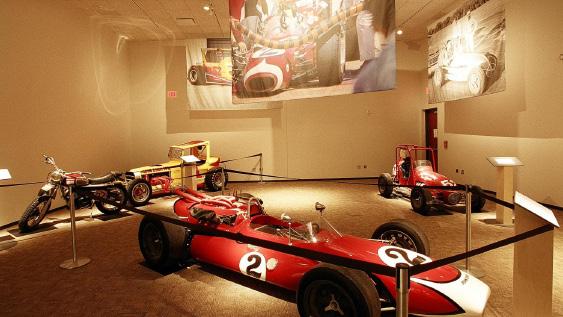
When I told a car collector I wanted a race car, he said I needed to talk to Jack Zink in Tulsa. I called him, joined him for lunch, and accepted an invitation to tour the Zink Ranch. He eventually agreed to loan us his car, which had won the Indianapolis 500 in 1956. Another nationally significant loan came in through the efforts of General Tom Stafford, the legendary astronaut from Weatherford. When Dan and Bill Moore told him we wanted a flown spacecraft, he used his connections and influence to get the Smithsonian’s Air and Space Museum to loan us the Gemini 6 capsule in which he had conducted the first rendezvous, a critical steppingstone to the Apollo mission to the moon.
Bruce Fisher, curator of the African American exhibit, established a lasting friendship with Clara Luper, who had led a series of sitins from 1958 to 1964 in the fight against racial segregation. As we earned her trust, she and her children donated her collections, including personal objects such as the eyeglasses she wore at the first sit-in at Katz Drug Store. An industrial artifact from the same period was donated following a meeting with Ed Malzahn, a founder of an international firm based in Perry, who had invented a small trencher called the Ditch Witch. When asked if he would loan us one of the original models, he said he would donate one and restore it.
The architectural plan for the History Center included a temporary gallery where the staff displayed race cars and motorcycles loaned to the museum from Jack Zink and his son Darton of Tulsa. (photo provided by the Oklahoma Historical Society Research Division).
THE CHRONICLES OF OKLAHOMA
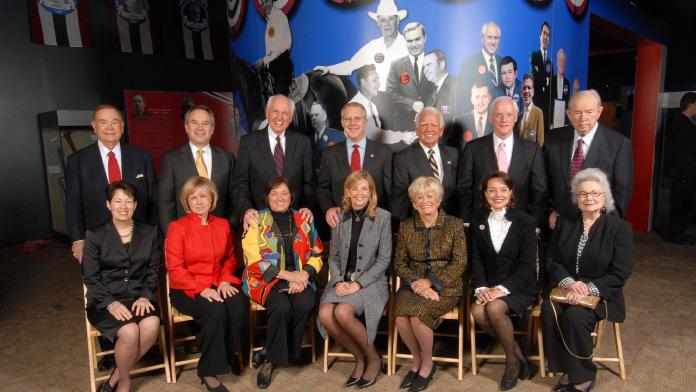
In 2007, with the History Center as an appropriate stage for state centennial events, the OHS sponsored an exhibit about governors and hosted an opening reception attended by seven former and present governors and their first ladies. The governors, from left to right, were David Boren, David Walters, David Hall, Brad Henry, George Nigh, Frank Keating, and Henry Bellmon. (photo provided by the Oklahoma Historical Society Research Division).
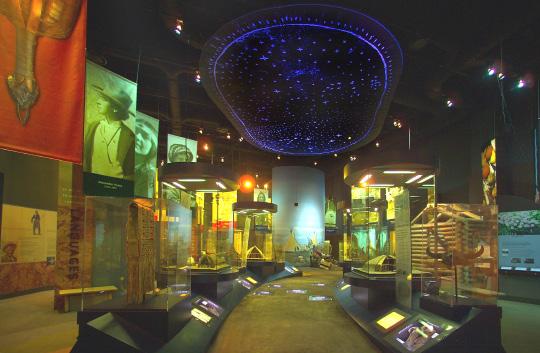
The American Indian Gallery was designed around themes suggested by a committee of tribal elders. The themes included origin stories, lifeways, spirituality, homes, and language. (photo provided by the Oklahoma Historical Society Research Division).
By the time we received the second bond issue, curators were working on more than fifty exhibit topics with 220 interactive elements. Some were computer-based learning tools, while others were video features that supported labels on artifacts and copy on exhibit panels. Some were hands-on stations where students could sit on a saddle or solve a puzzle. “We’re very determined to make this space alive,” Dan told one reporter, “where people can come every month of the year and find something new . . . we are already planning the replacements of the exhibits that will be installed when the museum opens.”29
Work on the History Center also attracted new archival collections. One of the largest single collections came from former Governor George Nigh, who said he had all his papers from a long career as governor, lieutenant governor, and university president. It is now one of the largest collections in the OHS archives. Bill Moore, who joined the staff in 1999, used his connections in the television community to bring in the WKY-TV film archives dating to the 1950s, including original film footage shot in the early 1900s, news features, and documentaries made by Emmy-winning producer Bob Dotson, who started his career at WKY-TV before going to NBC. Paul Strasbaugh, my coauthor on a book about the State Fair of Oklahoma and a former director of the Oklahoma City Chamber of Commerce, helped me bring in the chamber’s archival collection dating to 1898. The seven hundred volumes of source material collected under the watchful eye of Stanley Draper traced the economic history of the state.
With news of the History Center splashed across headlines, I got a call one day from John Dunning, a friend, well-known collector, and antique dealer, who said he wanted to show me his collection of political memorabilia scattered in three different locations. After convincing him to consolidate the collection in one room at the old Wiley Post Historical Building, John and I were surprised that it consisted of more than twenty thousand items dating to the 1890s, spanning topics from tribal elections and political buttons to banners, Bibles, and brochures. We purchased half of the collection with a grant from Aubrey McClendon, and John donated the rest. This one collection served as the heart of an exhibit on Oklahomans’ willingness to serve in government. The newfound success in aggressively seeking collections extended to fundraising. Throughout the 1990s, despite our rising ambitions, the ability to raise money in the private sector had been minimal. There
THE CHRONICLES OF OKLAHOMA
We sprinted off the starting line with grants from the federal government, the one area of fundraising that had been successful in the 1990s. Among those achievements, in addition to $700,000 for the Oklahoma Route 66 Museum, were grants for Honey Springs Battlefield, Forts Washita and Towson, the US Newspaper Project, and The Encyclopedia of Oklahoma History and Culture. After the first bond issue was approved in 1998, we applied for and won two grants from the National Endowment for the Humanities to bring in scholars and tribal elders to help develop a plan for the American Indian gallery. With Governor Keating’s help and his secretary of transportation, Neal McCaleb, we won several federal grants for a transportation exhibit, The Red River Journey, the excavation, conservation, and display of the shipwrecked Heroine, and the outdoor oil patch. McCaleb helped again when the Oklahoma Department of Transportation paid for traffic signals and turn lanes at the corner of Laird Avenue and Northeast Twenty-Third Street, which would have depleted $580,000 from our construction budget.30
As construction and exhibit planning started, Sandy staged a series of living history fundraising events designed to raise money and promote public awareness of the History Center project. The first, in April of 2001, was held on Northeast Second Street, the traditional commercial center of the African American community in segregated Oklahoma City. The Deep Deuce music event raised about $45,000 and generated newspaper headlines. The other two events staged later that year were held at the restored Harvey House in Waynoka and the historic Ambassador Hotel in Tulsa. Sandy and Whit Edwards recreated a USO show from World War II. A memorable highlight of that event was retired Air Force General Jay Edwards singing a song made famous by Bing Crosby. At retired General Billy Bowden’s suggestion, we served fried Spam as a historic appetizer.
Raising $10 million for exhibits and collections was a daunting challenge. Seeking advice on launching that effort, on March 20, 2001, I met with Lou Kerr, a family friend and philanthropist who knew the
276 were a few success stories, such as raising more than $300,000 in Clinton in 1993 to match a federal grant to build the Oklahoma Route 66 Museum, but more reflective of our shortcomings was the inability to raise enough money to match John Kirkpatrick’s offer of $20,000 for our endowment at the Oklahoma City Community Foundation. The History Center changed that dynamic.
landscape of foundations, corporations, and individuals who could make significant grants. I told her we had two options. One was to hire a fundraising firm to bring experience to the table but siphon off part of the proceeds as their fee and take their connections with them when they walked away. The other option was to conduct the campaign on our own. She said, “Bob, you can do this on your own and you need to transform the image of the OHS as a cultural facility worthy of grants long after construction.” To encourage us to take that leap, she directed me to a new foundation with funds to share.
After the collapse of the oil and natural gas industry in the mid-1980s, which brought chaos to the banking and real estate communities, the economy was improving after innovators in the oil patch developed new tools such as horizontal drilling and high-pressure hydraulic fracturing, just as the prices of oil and natural gas were rising. This time, instead of oil executives in New York City, Los Angeles, Houston, and Amsterdam leading the charge, the energy revolution was started and sustained by native Oklahomans such as Harold Hamm, Larry Nichols, Tom Ward, and Aubrey McClendon. Riding on the shoulders of the energy boom from 1998 to 2008, banks were prospering, and real estate developers were transforming the urban landscape. It was a fertile field for fundraising.
Lou told me to call Bill Ross, an attorney who was just then organizing two foundations funded by the late Edith Kinney Gaylord. I called and got an appointment at his historic First National Bank Building office. After OHS board member Denzil Garrison and I showed him the plans and images for the History Center, exhibits, and collections, he said he was a history buff and wanted to help. Still, the new foundations could not give money directly to a government agency. I said no problem; by statute, the OHS was a public/private organization with a 501(c)3 nonprofit support group that could receive the funds. After I made a presentation to his board of directors and got to know his son and future foundation president, Bob Ross, the Inasmuch Foundation made one of the first $500,000 donations we needed to switch the campaign from silent to public stages.
We decided to cap the kickoff grants at $500,000 instead of going for a seven- or eight-figure grant that might include a request for naming rights. The name of the new museum and research facility was going to be the Oklahoma History Center, plain and simple, owned by
THE CHRONICLES OF OKLAHOMA
We settled on seven $500,000 major naming rights because we had four museum galleries, one auditorium, one grand atrium, and a new street with a new mailing address. Each gift required numerous meetings, especially with corporations that needed buy-in from staff and board members. The quickest and most enthusiastic response came from Aubrey McClendon, cofounder of Chesapeake Energy and a man destined to change the philanthropic culture of Oklahoma City. He pledged $500,000. More deliberate but just as enthusiastic was Larry Nichols, CEO and cofounder of Devon Energy, who would later transform the shape of downtown Oklahoma City by constructing a fifty-four-story skyscraper and more than $110 million invested in surrounding public byways and parks. He pledged $500,000.
Another energy giant making a $500,000 pledge was Kerr-McGee Energy, led by Luke Corbett, who later facilitated the donation of all Kerr-McGee archival collections to the OHS when a Houston firm absorbed the company. One of our most structured pursuits focused on ONEOK, the parent company of the historic Oklahoma Natural Gas Company, headquartered in Tulsa. Starting with Ginny Creveling, ONEOK’s director of community relations, we worked our way up the corporate ladder to vice presidents, CEO David Kyle, and his board of directors. Their $500,000 pledge was the largest gift in the history of ONG or ONEOK. The last pieces of the major gift puzzle were provided by the Noble Foundation, based in Ardmore, and Dr. Nazih Zuhdi, whose name would thereafter be used as the address of the History Center: 800 Nazih Zuhdi Drive.
The quiet phase of fundraising also included several $100,000 gifts, some with naming rights. Martha Williams and her brother, Chuck Vose Jr., placed their father’s name, Charles Vose, on the north wing hallway. The south wing hallway was named the West Family Gallery with a donation from Elk City oilman J. Cooper West. Former Governor
278 and dedicated to the people of the state, past, present, and future. The History Center’s major components, indoors and outdoors, could be named for donors who contributed between $100,000 to $500,000. Naming rights for smaller donors were available by sponsoring $35 bricks on the grounds, $1,000 limestone pavers outside the entryway, $1,000 leaves on a sculptural piece of art mounted near the entry to the Research Center, and $5,000 limestone pavers inside the entryway. All donors giving $1,000 or more would be recognized by name on a permanent display on the third-floor bridge. It is still there today.
OKLAHOMA HISTORY CENTER
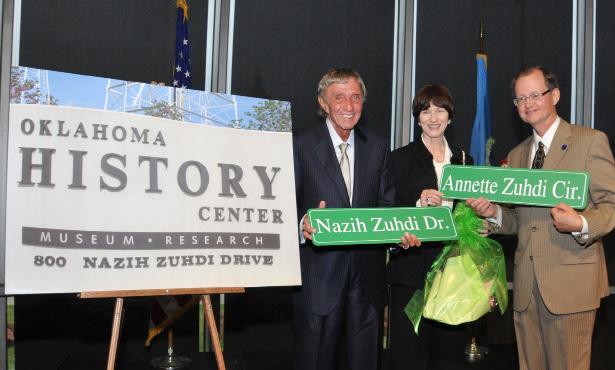
Bob Blackburn (right) with Dr. Nazih and Annette Zuhdi announced the naming of a new street and circle drive leading guests into the History Center. Their donation helped complete the $12 million fundraising drive for exhibits. (photo provided by the Oklahoma Historical Society Research Division).
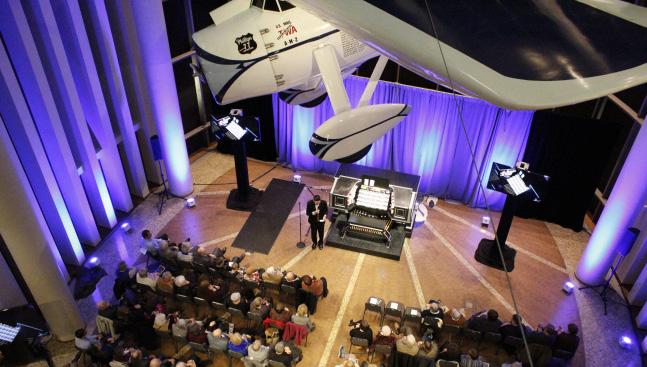
Since completion, a recurring event in the History Center has been a series of concerts featuring the historic Kilgen Theatre Organ, a rare organ restored and played through the generous leadership of Dusty Miller and Kimray Industries. (photo provided by the Oklahoma Historical Society Research Division).
THE CHRONICLES OF OKLAHOMA
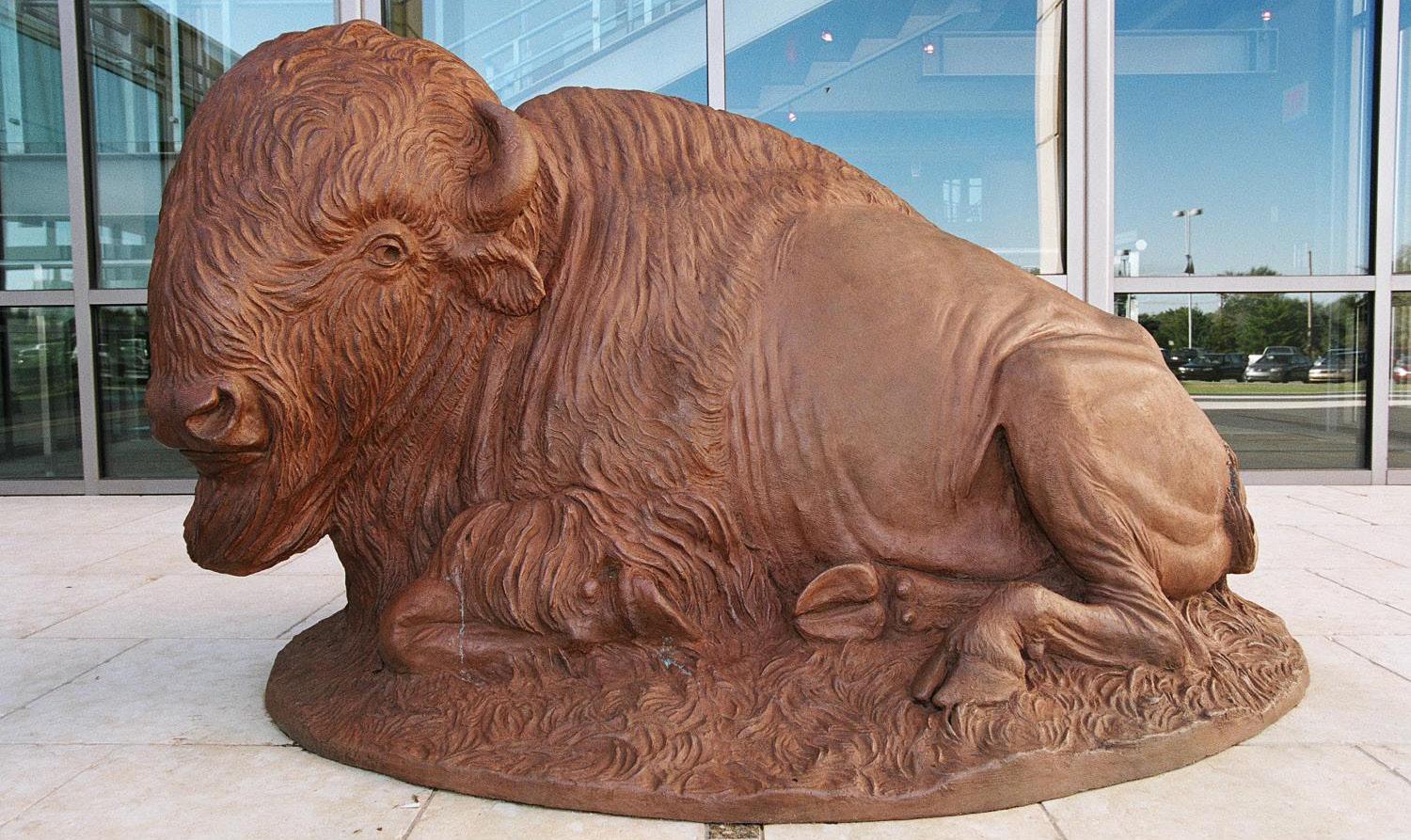
With funding from John Groendyke, Enid-based artist Harold Holden created the Monarch at Rest sculpture that sits by the front entryway into the History Center. (23389.520.256, Jim Argo Collection, OHS).
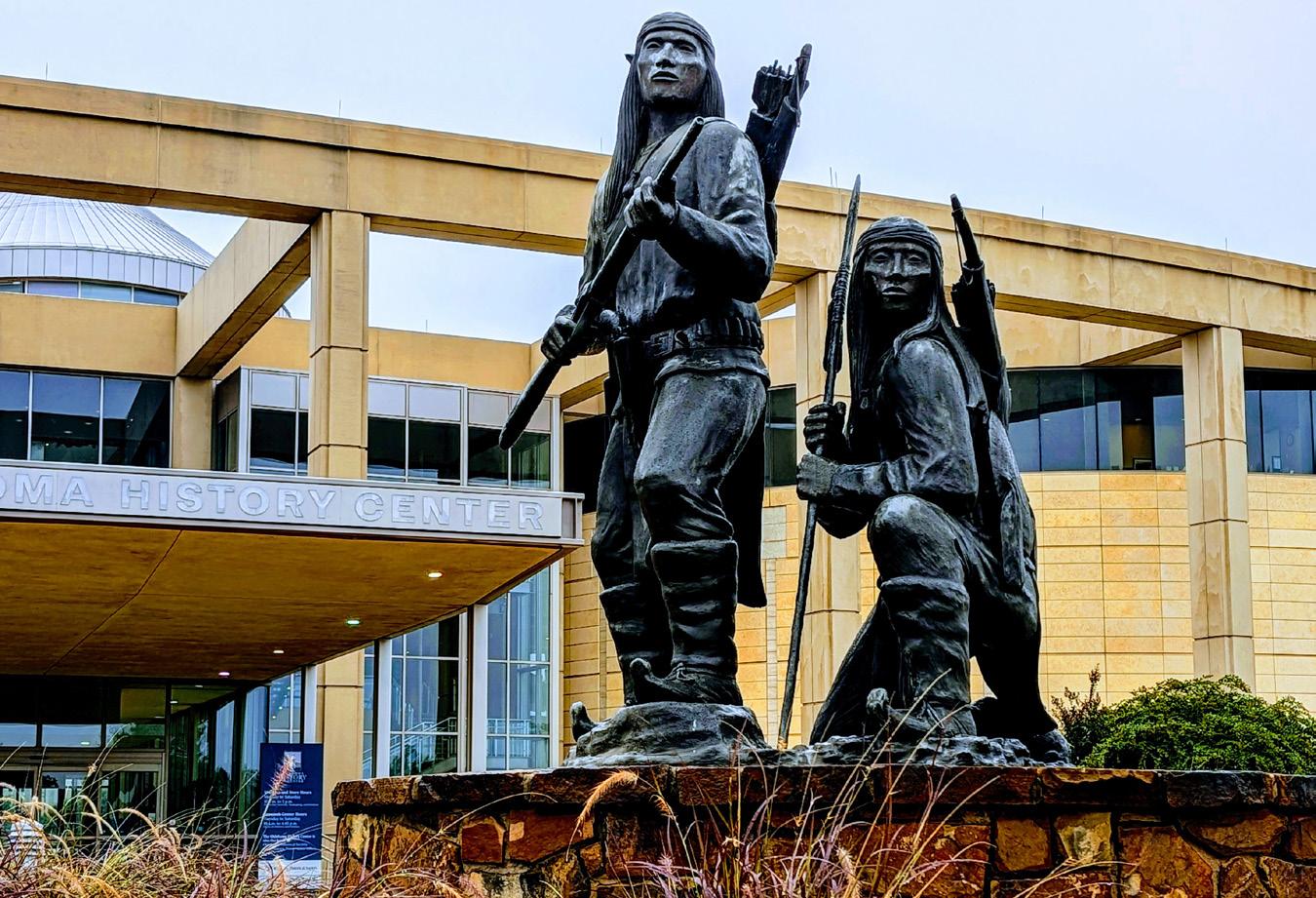
Unconquered, a monumental sculpture created by Indigenous artist Allan (Haozous) Houser (Chiricahua Apache) (1991–1994). The piece was acquired through a grant from the Inasmuch Foundation and mounted on a native stone pedestal funded by Cliff and Leslie Hudson. (photo provided by Trait Thompson).
David Walters and First Lady Rhonda Walters pledged $100,000 and earned naming rights to the plaza surrounding the headwater fountain of the Red River Journey. The Kirkpatrick Family Fund, led by Joan Kirkpatrick and Chris Keesee, offered a $100,000 gift to name the Research Reading Room for John and Eleanor Kirkpatrick.
The temporary exhibit gallery was named in honor of E. L. and Thelma Gaylord with a gift from the Gaylord family. Major gifts of more than $100,000 without naming rights came from John Zink, Marvin and Barbara Jirous, and Ed Malzhan. The Oklahoma City Federation of Women’s Clubs donated $110,000 to match the federal grant funding the Red River Journey. Walt Helmerich of Tulsa contributed $200,000 to pay for a full-scale replica of Wiley Post’s airplane, the Winnie Mae, which still hovers over guests in the Devon Great Hall. Other donors giving over $100,000 included the Oklahoma Energy Resources Board, Oklahoma Gas and Electric Company, and Garman Kimmell.
Several donors came back with major gifts time and again. Devon Energy invested another $500,000 to earn naming rights on the outdoor oil and natural gas park. The Ethics and Excellence in Journalism Foundation, endowed by Edith Kinney Gaylord and led by Bill and Bob Ross, added another $500,000 in multiple grants for the Research Center. Aubrey and Katie McClendon gave numerous personal gifts totaling almost $500,000 in addition to grants from Chesapeake Energy. The Inasmuch Foundation, the single largest donor during the campaign, came back with another $750,000 donation to acquire Unconquered, a monumental bronze sculpture created by native Oklahoman Allan Houser. John Groendyke of Enid added to the artwork greeting guests when he donated $100,000 to create Monarch at Rest, a bronze buffalo sculpted by Harold Holden, low enough with horns tucked into its mane so an entire class of first graders could sit on its back.
OHS board and staff members showed their personal commitment with donations. The children of longtime OHS board member Dr. LeRoy Fischer donated $50,000 for a specially crafted boardroom table and earned naming rights for their father. Chuck Wiggin and Chip Fudge, original members of the History Center foundation, each gave $40,000. In addition to Sonic’s gifts, Cliff and Leslie Hudson donated $25,000 to pay for the customized sandstone pedestal for the Unconquered statue. John Mabrey, an OHS board member from Tulsa, gave $25,000 to pay for the Oklahoma Family Tree. Other gifts contributing
THE CHRONICLES OF OKLAHOMA
to the cause included $10,000 from Barbara and Ralph Thompson, $10,000 from me and Debbie, $5,000 from Aulena and Gib Gibson, $5,000 from Bill Welge, and $1,000 gifts from several staff and board members. By the end of the campaign in 2005, more than five thousand people and organizations had donated more than $12 million in grants and gifts to the History Center, fulfilling the commitment made when the first bond issue was authorized in 1998.31 This confirmed my belief that generosity is one of the key attributes describing the character of Oklahoma’s people.
With money from the second bond issue for construction and raised funds for exhibits, it was a sprint to the opening ceremonies scheduled for November 13, 2005. Kyle Nelson of Manhattan Construction was a critical player down the home stretch. He worked with Dan and his staff to stage subcontractors for walls, light grids, flooring, and cases, often as changes were made on the run. He worked with Robert and Don Beck’s team to bring the building under budget. He also worked with my new fundraising director, Dr. Tim Zwink, and me as we led a seemingly endless parade of donors, reporters, and legislators through the construction site. I still have my well-worn hard hat hanging in my office at home.32
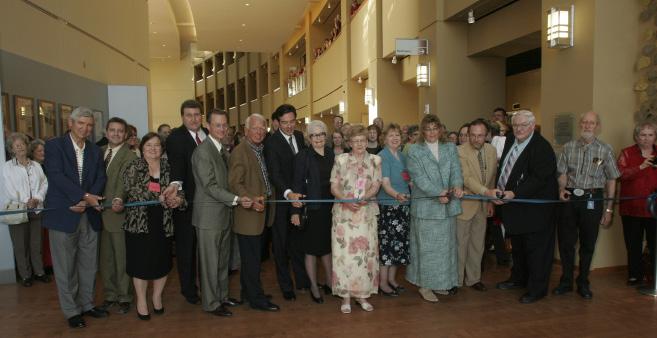
Those attending the grand opening of the History Center Research Center included, from left to right, Speaker of the House Lloyd Benson, architect Don Beck, OHS board members Billie Fogarty and Leonard Logan, Bob Blackburn, former Governor George Nigh, donors Christian Keesee and his mother, Joan Kirkpatrick, and Research staff and volunteers including Laura Martin, Bill Welge, and Chester Cowen. (photo provided by the Oklahoma Historical Society Research Division).
One disappointment in the summer of 2005 was a shortfall in legislative funding for staff members. When the project began in 1997, I made a deal with Senator Rick Littlefield, chairman of our appropriation subcommittee, to add $200,000 a year to our base appropriation to pay for the additional staff we needed to run an expanded operation. That worked for two years, followed by a couple of reduced amounts, totaling approximately $600,000, short of the $1,000,000 we needed for museum and research staff, housekeeping, and maintenance specialists. As a result, in July of 2005, we announced that the Research Division would remain in the Wiley Post Historical Building until the spring or summer of 2006. We eventually plugged the funding gap by transferring marketing funds to staff support and tapping the revenue earned for some operational expenses.33
A tidal wave of enthusiastic press coverage pushed aside that disappointment. Even before the opening was announced, the Daily Oklahoman ran a multipage story about the History Center titled “Black History in Oklahoma,” with subtitles such as “Blacks Due Historical Honor” and “Civil Rights History Told.” By summer, statewide newspapers carried stories with headlines such as “History Museum Needs Volunteers,” “Racing into the Past,” “Museum to Open Near State Capitol,” “Winnie Mae Rises Again,” “Oklahomans Honor Civilian Conservation Corps,” “New $54 million Center Tells State’s Story,” “History an Attraction to OKC,” “History Center Park Offers Oil and Gas Insights,” “Home on the Range,” “History Center to Open with Treasures of State Heritage,” “USS Oklahoma Remembered,” and “Historical Society Prepares for Opening.” Capturing the entire odyssey of developing the History Center from first steps to opening night was an eight-page insert in the Daily Oklahoman newspaper.34 The pull-out tab was titled “Embracing our Past: Opening Oklahoma’s Temple to History.” The coverage included photographs ranging from aerial views of the site and building details to artifacts and gallery diagrams. There were lists of donors, a short history of the OHS, verbal descriptions of all galleries, and an entire section called “Cool Stuff” that featured artifacts such as the Gemini 6 capsule, the Zink Indy race car, Mary Kay Place’s cowgirl outfit worn when she was Loretta Haggers on television, Woody the Birthday Horse from the Foreman Scotty Show, the world’s first parking meter, and the Osage war shield depicted on Oklahoma’s state flag.35
THE CHRONICLES OF OKLAHOMA
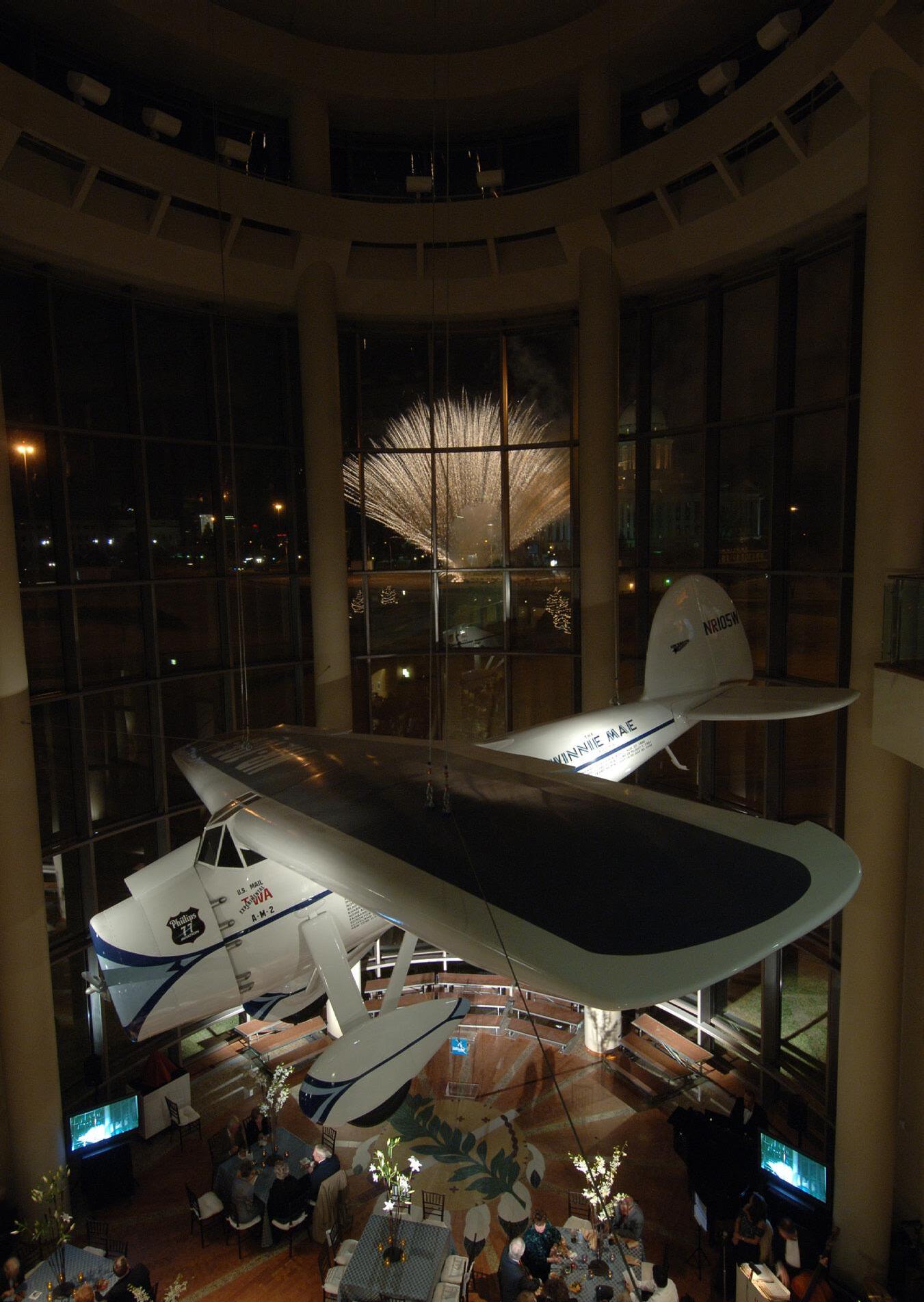
The History Center grand opening included tours, acknowledgements, videos, fine dining, music, and fireworks staged from the south side of the State Capitol visible through the glass curtain wall of the Devon Great Hall. (photo provided by the Oklahoma Historical Society Research Division).
To help plan the opening ceremonies, we partnered with J. Blake Wade, executive director of the Oklahoma Centennial Commission, and Lee Allan Smith, his fundraising and event planning specialist. With a healthy budget matching their spectacular dedication of the Capitol Dome in 2002, Lee Allan and his team created a keepsake invitation, chose the best caterers, commissioned ice sculptures in the shape of the History Center, and booked musical entertainers. The night before the opening ceremonies, our OHS curators, educators, maintenance staff, and administrators, including me and Dan, feverishly installed the last artifacts and rushed to clean cases and galleries.
On November 16, 2005, after eight years of planning, funding, and building the History Center, we hosted what reporter Joan Gilmore called a “glorious night.” Historical interpreters dressed as soldiers, pioneers, fancy dancers, and entertainers greeted guests at the front door along either side of a red carpet. Inside were tables of food piled high, beverages served in glassware engraved with the words “Oklahoma History Center,” and musical entertainment provided by Oklahoma opera singer Leona Mitchell, big band leader Al Good’s orchestra, the Ambassadors Concert Choir, classical guitarist Edgar Cruz, and the Oklahoma City University Choir. After I offered a welcome to the guests and thanked the many people and groups who had made the History Center a reality, a fireworks display began that framed the State Capitol seen from the Devon Great Hall beneath the Winnie Mae. As one reporter described the event, “Oklahoma’s Past Has a New Home.”36
The story of the Oklahoma History Center does not end there. As we had anticipated, the new temple of history changed our brand, supercharged our ability to collect, preserve, and share collections, and proved the success of our evolving business model based on a combination of state support, private fundraising, and earned revenue. By the time the History Center opened, we already had more than two hundred events booked for the coming year, a trend that would accelerate until we were booking more than four hundred events a year and generating more than $400,000 a year in revenue.
The brand of the OHS was enhanced as people and organizations recognized our insistence on higher standards, which we applied across the board at statewide museums and historic sites and to public programs and educational outreach. A symbol of that success was
THE CHRONICLES OF OKLAHOMA
being named a Smithsonian Affiliate, the first in Oklahoma, a special category of museums across the country that met the standards of our national museum flag bearer. Our national status was further enhanced as an affiliate of the National Archives, making the Oklahoma History Center the only institution in the nation that shared both honors. With the History Center experience fresh in our minds, bringing in and processing collections became our obsession, especially in the Research Division. Large donations included the Kerr-McGee Collection, more than one-hundred-thousand items, including public relations records, scale models of drilling rigs, corporate records, maps, and photographs. Even larger was the photographic archives of the Oklahoma Publishing Company, with more than one million images dating from the late 1920s to the late 1990s, each image with a caption taped to the back and a reference to the story it illustrated. Just as valuable were small collections ranging from political campaign materials and family movies to organizational scrapbooks and tribal records. With the ability to raise money for investments, we rushed headlong into the information age by scanning and adding search functions to collections in what we called the Gateway to Oklahoma History. Jennifer Towry, a new staff member of the Research Division, created a new, more useful OHS website.
The facade of the History Center facing the State Capitol was a blend of neoclassical columns, backlit curtain walls, and Indigenous motifs on either side of the central atrium dome. (23389.23.457, Jim Argo Collection, OHS).
Armed with the realization that we could now raise money with good ideas, we launched a series of museum exhibits such as “Oklahoma’s Governors,” “Energy to Grow: Oil and Natural Gas in Oklahoma,” “Another Hot Oklahoma Night: A History of Rock and Roll,” “Oklahomans in the Movies,” “Country Music and Hee Haw,” “Welcome Home: Oklahomans and the War in Vietnam,” “Crossroads of Commerce: A History of Free Enterprise in Oklahoma,” and “Oklahomans in Space.” Empowered by years of experience working with Alisdair Hinchelwood and his museum design associates, and supported by the Friends of the Oklahoma History Center, Dan and his team stretched every dollar raised. For the next twenty years, we raised an average of $1 million a year and created new exhibits at an average cost of $120 a square foot when the industry average was $300 or more a square foot. On top of that was creating a $12 million endowment dedicated to acquiring, conserving, and using collections. I was honored when the OHS Board of Directors named it the Dr. Bob Blackburn Collections Endowment when I retired.
The Oklahoma History Center was a turning point in the OHS’s history. For everyone who helped make it possible, from elected officials and donors to OHS board members and staff, it was a turning point in collecting, preserving, and sharing Oklahoma history. Looking back on that experience, it may have been an improbable story, but it was an incredible journey.
THE CHRONICLES OF OKLAHOMA
Endnotes
* Dr. Bob L. Blackburn, who earned his PhD in history at Oklahoma State University, is a former executive director of the Oklahoma Historical Society and the author or coauthor of twenty-eight books focused on the history of Oklahoma. He joined the OHS in 1979 as editor of The Chronicles of Oklahoma and started planning the Oklahoma History Center while he was deputy executive director. Although retired from the OHS, he is still busy writing books and contributing to museum development across the state.
The photograph on page 248 shows the replica of the Winnie Mae in the Oklahoma History Center’s rotunda, c. 2005 (photo provided by the Oklahoma Historical Society Research Division).
1 I am using a first-person voice for two reasons. Much of this story comes from the combined memories of us who navigated the History Center’s planning, legislative authorization, funding, and construction. Just as importantly, this is a story of people preparing for the future, making decisions, and getting the job done. I was lucky to be part of that team. When referring to specific meetings, agreements, and key dates, I will use references from press clippings and OHS Board minutes. Where there are no footnotes for meetings, I have used my calendar-diaries that I have kept since my first days at the OHS in 1979.
2 Melvena Heisch started work at the OHS in 1975 and served as deputy state historic preservation officer until 2017; Kathy Dickson worked more than forty years at the OHS and eventually became director of a combined museums and historic sites division of the OHS; Dr. Bill Lees was an archaeologist who managed the historic sites division for many years and conducted archaeological digs at numerous sites; Sandy Stratton was a historian who started her OHS career in historic preservation and became director of the Guthrie museum complex before joining Blackburn as a special projects director; Whit Edwards was a pioneer in the field of living history and made the OHS a national leader in educational programming; Bill Welge started his OHS career as a microfilm camera operator and rose to become director of the Indian Archives and the consolidated Research Division; Georgianna Rymer was J. Blake Wade’s right-hand partner who served in a number of positions including human resources director; Billy Nichols was an accountant who came to the OHS from the state auditor’s office.
3 Marie Price, “Committee Hears Agency Requests for New Projects,” Journal-Record, October 8, 1997.
4 Minutes of the OHS Board of Directors, October 22, 1997.
5 “Society Unveils Proposed Museum,” OKC Friday, February 6, 1998.
6 “Society Unveils Proposed Museum.”
7 Staci Roark, “Proposed New State History Center Would Triple Current Exhibit Space,” Oklahoma Gazette, February 25, 1998.
8 Jim Campbell, “Museum to Bring State History to Life,” Oklahoma Press Association Capitol News Bureau, August 2, 1998.
9 Marie Price, “Site Picked for $46 million History Center,” Journal Record, November 13, 1998.
10 Minutes of the OHS Board of Directors, January 6–7, 1999; Kathy Zehr, “OKC Firm to Design New $46 million Museum,” Ponca City News, April 22, 1999.
11 Jim Campbell, “New History Center Director Starts Work,” Stroud American, June 17, 1999.
12 Laura Martin started her career at the OHS when she was eighteen years old and rose to become a well-known genealogist and director of reference in the Research Division; Chad Williams came to the OHS with a degree in public administration and became director of Research; Jeff Briley came to the OHS from Tourism and Recreation and rose to become director of museum collections; Mike Atkins was a veteran teacher who joined the OHS staff as director of education; Max Nichols was an award-winning journalist who became the first communication director of the OHS; Terry Howard was a CPA who managed OHS finances as budgets grew from four million to more than ten million.
13 Grace Boulton, Bill Corbett, James Devore, Mary Duffe, LeRoy Fisher, Denzil Garrison, Aulena Gibson, Susan Guthrie-Dunham, Martin Hagerstrand, Jack Haley, Louise James, Sue Jones, Jim Kemm, Robert Klemme, Marvin Kroeker, Dan Lawrence, Leonard Logan, Guy Logsdon, Ruth Moran, Ken Rainbolt, Bob Schulz, Emmy Scott Stidham, Lewis Stiles, Barbara Thompson, Tim Zwink, Bill Gustafson, Paul Matthews, Dee Ann Ray, Alvin O. Turner, Eddie Faye Gates, Frances Stiles, Allen Wright, Sally Soelle.
14 Dr. Dianna Everett was a published historian who served the OHS as a grant-writing consultant, director of the Encyclopedia project, and editor of The Chronicles of Oklahoma.
15 “New Oklahoma History Center Groundbreaking Scheduled for Tuesday,” Durant Daily Democrat, November 15, 1999; Steve Lackmeyer, “Grant to Bring Mountains to Route 66,” Daily Oklahoman, November 7, 1999.
16 Minutes of the OHS Board of Directors, April 23, 2000; Ann DeFrange, “London Firm to Develop History Center,” Daily Oklahoman, April 16, 2000.
17 Minutes of the OHS Board of Directors Meeting, October 25, 2000, January 24, 2001, April 19, 2001, and July 25, 2001.
18 Minutes of the OHS Board of Directors, October 24, 2001; John Grenier, “Foundations for History: Concrete Poured for State History Center,” Daily Oklahoman, January 16, 2002.
19 OHS Board of Directors Minutes, January 23, 2002; Matt Maile, “W & W Steel Completes One of Its Most Complex Projects,” Journal-Record, November 29, 2002.
20 “W & W Steel Completes One of Its Most Complex Projects.”
21 Minutes of the OHS Board of Directors, July 24, 2002.
22 Minutes of the OHS Board of Directors, February 19, 2003, and April 24, 2003; Marie Price, “Historical Society to Sideline Some Facilities,” Tulsa World, Febuary 20, 2003.
23 Robin Maxey, “Funding for Oklahoma History Center Remains in Air,” Norman Transcript, March 3, 2003; Hilda Patti Howell, “Urgent Request to all Oklahoma History Buffs, Help Get the Word Out!,” Capitol Hill Beacon, April 10, 2003; Marie Price, “History Center May be Stalled Without Funds,” Tulsa World, March 23, 2003; Editorial Board, “Stops and Bonds: Museum Issue Needs Prompt Action,” Daily Oklahoman, March 27, 2003; Melissa Beggs, “History Center Lacks Funding for Construction,” Daily Oklahoman, April 3, 2003; Marie Price, “Putting a Higher Price on History,” Tulsa World, April 4, 2003; Bob Blackburn, “History Center to Serve Everyone,” Sunday Oklahoman, April 27, 2003; Editorial Board, Historical Challenge,” Claremore Daily Progress, May 13, 2003.
THE CHRONICLES OF OKLAHOMA
24 Marie Price, “Lawmakers Craft Bond Issue for History Center,” Tulsa World, May 8, 2003.
25 John Greiner and Jack Money, “History Center Funding OK’d,” Daily Oklahoman, May 15, 2003; Carmel Perez Snyder, “Governor Henry Signs Several Bills in Final Week of Session,” Oklahoman, May 29, 2003.
26 Karen Klinka, “Embracing our Past: Oklahoma History Center Opening,” Daily Oklahoman, November 20, 2005.
27 “Embracing our Past: Oklahoma History Center Opening.”
28 Jack Money, “Retired Rigs Highlight Legacy of State’s Energy Industry,” Daily Oklahoman, October 31, 2002.
29 Melissa Beggs, “Prehistoric: Think of Ways to Repackage State History,” Edmond Sun, September 19, 2003.
30 Minutes of the OHS Board of Directors, April 19-20, 2001.
31 Marie Price, “Donations Will Make History,” Tulsa World, September 30, 2003.
32 Dr. Tim Zwink was a professor of history and academic vice president at Northwestern Oklahoma State University before joining the OHS team. He later was named deputy executive director.
33 Jim Campbell, “Historical Library to be Left Behind Until Next Spring,” Seminole Producer, July 24, 2005.
34 Judy Gibbs Robinson, “Black History in Oklahoma,” Sunday Oklahoman, February 13, 2005; Karen Klinka, “History Museum Needs Volunteers,” Daily Oklahoman, September 14, 2005; “Racing into the Past,” Daily Oklahoman, September 30, 2005; “Museum to Open Near State Capitol,” Lawton Constitution, October 3, 2005; Carrie Coppernoll, “Winnie Mae Rises Again,” Daily Oklahoman, October 8, 2005; John Grenier, “Oklahomans Honor Civilian Conservation Corps,” Daily Oklahoman, October 15, 2005; Mitch Meador, “New $54 million Center Tells State’s Story,” Lawton Constitution, October 16, 2005; Jerry Shottenkirk, “History Center Park Offers Oil and Gas Insights,” Journal Record, October 24, 2005; “Home on the Range,” Enid News and Eagle, November 6, 2005; “History Center Opens with Treasures of State Heritage,” Anadarko Daily News, November 16, 2005; Sharon Burns, “Historical Society Prepares Opening,” Daily Oklahoman, November 14, 2005.
35 Karen Klinka, “Embracing our Past: Opening Oklahoma’s Temple to History,” Daily Oklahoman, November 20, 2005.
36 Joan Gilmore, “A Grand Opening,” Journal Record, November 22, 2005; “Oklahoma’s Past Has a New Home,” Home and Away, January/February 2006.
“Let My People Have a Right:”
PAUL BOYNTON
The Native Activism of Arapaho Chief Paul Boynton
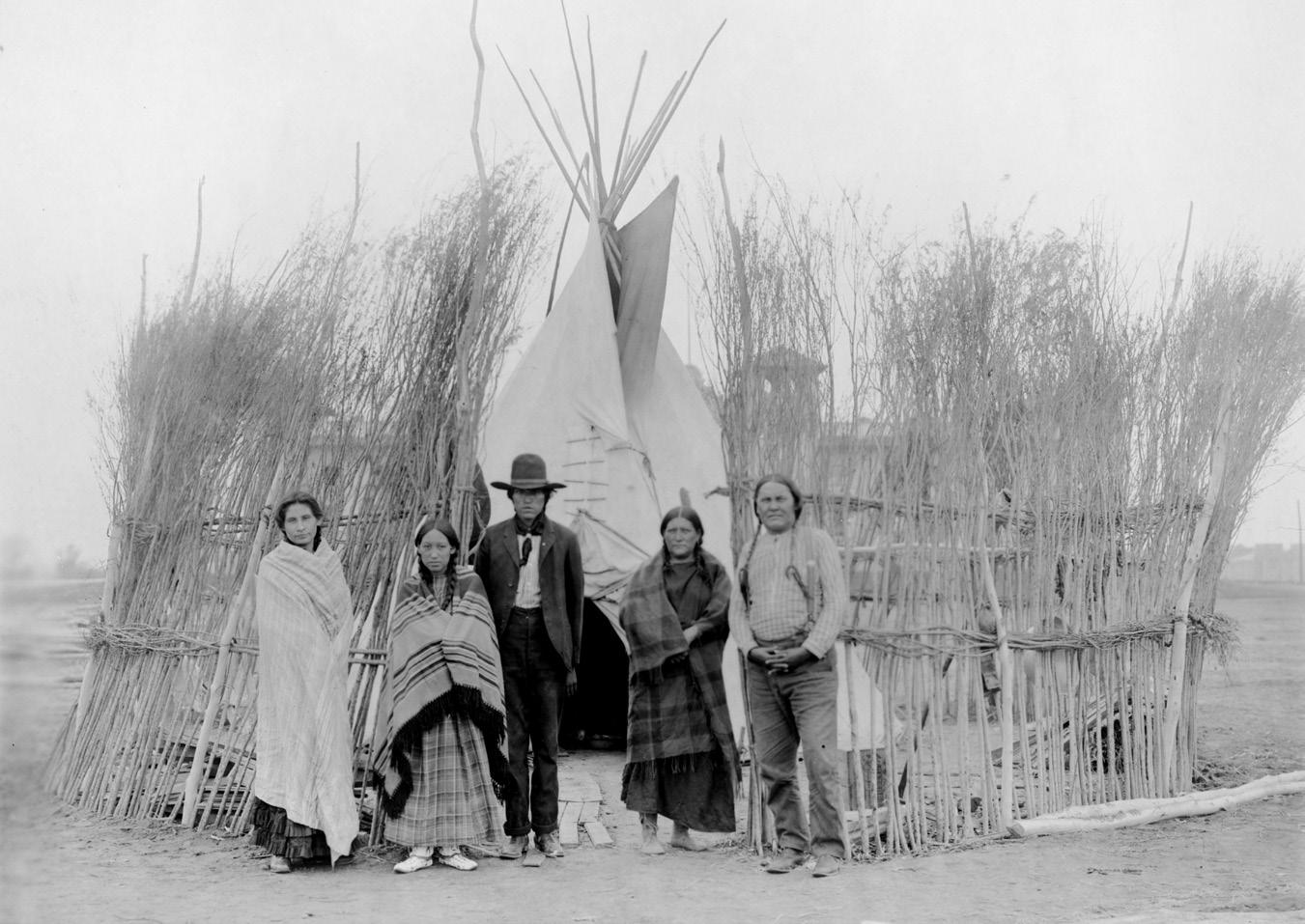
By Christianna Stavroudis*
The year 1885 was eventful and tumultuous in many respects: the first recorded closing of the Dow Jones Industrial Average was published; the Berlin Conference responsible for imposing colonial borders on the continent of Africa concluded; Canada executed Métis North-West Resistance leader Louis Riel; the Statue of Liberty arrived in New York Harbor; and Sarah E. Goode became the first Black woman in the United States to receive a patent from the US Patent and Trademark Office. In the fall of 1885, Carlisle Indian Industrial School was entering its sixth year. Founded by Richard Henry Pratt in 1879, Carlisle began publishing school newspapers, the first of which was Eadle Keatah Toh,
THE CHRONICLES OF OKLAHOMA
which later became The Morning Star. The Indian Helper, launched in 1885, was a newspaper read by both Carlisle students and the public that published short news items, poems, and stories, promoted assimilationist values, praised and chastised students by name, and featured riddles and puzzles. It was heavily edited by its white editor Marianna Burgess (a.k.a. “the Man-on-the-Band-Stand.”)¹
The November 13, 1885, issue of The Indian Helper printed the following unusual announcement: “We have a story written by one of the boys for the next Helper.”² Articles were not normally advertised in advance, let alone written by Carlisle’s student printers. What follows is the advertised story, which was published on the front page of the November 20, 1885, issue:
AN INDIAN STORY.
There was once an Indian man out hunting some turkeys. When he returned to his tent in the evening he found that some one had been there and stolen a piece of venison which was hung up on a tree, to dry. The man thought he would try to find the thief, so he followed his tracks in the woods. Meeting two young gentleman in the forest, he asked them if he had seen a person who carried an old rifle.
Yes, sir, said one of the two, why do you ask us?
‘Because, sir, to-day while I was out hunting some turkeys some one came to my tent and stole my deer meat which was hung up on a tree to dry. I know the thief had an old rifle, and it was a short one.’
‘How do you know that?’
‘I know it because the end of the gun made a mark on the bark of the tree against which the thief leaned it, and I could see by that it was a short one. I know he is a little man for he piled up a heap of stones to stand upon in order to reach the venison. I know he is an old man, because I can tell by his footsteps. He is clumsy and he turns his toes out. No young Indian ever turns his toes out. He had with him a small dog with a short tail.’
‘How do you know this?’
‘Because I saw his tracks. I found out that the dog had a short tail because I saw the mark it made in the sand where he sat down to wait for his master to steal the meat. Have you seen this man?’
PAUL BOYNTON
‘Yes, sir. Just a man as you have described passed us about an hour ago, but I think you are wonderful to tell all this about him when you never saw him.’
P. B.
(We do not know where P. B. got this story. Perhaps he read it in some book. What do you think?)³
Paul Boynton (Red Feather/Be’eekúúni’; 1868–1922)—a Cheyenne and Arapaho man who would be instrumental in founding the Native American Church and other Indigenous activism—can be identified as this story’s author via several details within the piece. The announcement about the story from the previous week’s Indian Helper narrows its author to one of the student printers. In an 1885 photo titled “Ten male student printers,” taken in Carlisle by John N. Choate, the only printer whose Anglo name bore the initials “P. B.” was Paul Boynton.⁴ Even if one were to interpret these initials as a shortening of the generic title “printer boy,” Paul Boynton left us with a familial watermark
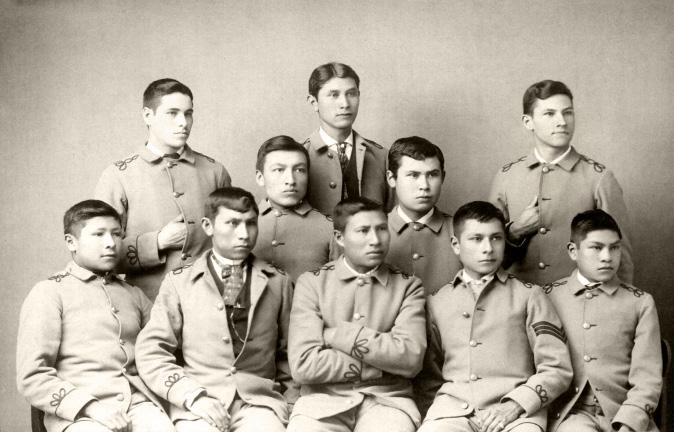
The printer boys from Carlisle Indian Industrial School. Paul Boynton (Arapaho) is seated in the front row, second from the left (20690.2, Mrs. Sidney Peterson Collection, OHS).
THE CHRONICLES OF OKLAHOMA
294 within his story, with the perpetrator in the text described as an old man who “turns his toes out.”5 Paul Boynton’s paternal grandfather was Stone Forehead, the Keeper of the Cheyenne Covenants, who was also known as “(He) Who Walks With His Toes Turned Out”.6 On March 15, 1869, four months after the Washita Massacre, Stone Forehead famously smoked the pipe with George Armstrong Custer. Whilst emptying the pipe’s ashes on the heal of Custer’s boot, Stone Forehead warned Custer that if he ever crossed a Cheyenne again, he too would turn to ash.7 In 1868, Boynton was born to Bitchea, an Arapaho woman, and Stone Forehead’s son, Fox Tail.
On October 22, 1883, Paul Boynton arrived at Carlisle Indian Industrial School with twenty-three other young Native men, ten of whom also came from the Cheyenne and Arapaho Agency in Darlington. Prior to founding Carlisle, Richard Henry Pratt had served as a guard to Native prisoners of war at Fort Marion in St. Augustine, Florida, from 1875–1878. Many of these prisoners were Cheyenne. The first class of students at Carlisle in 1879 included Fort Marion prisoners, who featured prominently in the early days of Carlisle press. Children from the Cheyenne and Arapaho Agency were sent to Carlisle soon after the school’s inception. In his autobiography, Pratt discussed recruitment strategies for his school and defined the Cheyenne and the Arapaho, along with the Kiowa and the Comanche, as “the Indians whom I knew and who knew me” and therefore the Nations he preferred to work with.8 Subsequently, Cheyenne and Arapaho chiefs leveraged their engagement with Pratt’s school with demands that would meet the needs of their people. In a letter from November 4, 1884, Pratt wrote to the Commissioner of Indian Affairs:
When I visited the Indian Territory last year after a delegation of pupils, the Arapahoes were far more energetic and earnest in sending their children than the Cheyennes. Both Powder Face and Left Hand, the principal Chiefs, sent their sons and daughters. It then occurred to Agent Miles and myself that if they were especially favored in some way for their spirit in the matter, it would be helpful to the cause, and it was our opinion there would be much less difficulty in securing girls if Indian women were allowed to see the School. I proposed to Powder Face and Left
Hand that they visit Carlisle this Fall and bring their wives, and that I would see to their transportation.9
A delegation of Cheyenne and Arapaho chiefs visited Carlisle in November 1884, with a commemorative photograph taken of the group in front of Devil’s Den at the Gettysburg battlefield site on November 28, 1884.10 One of the chiefs present was White Eyed Antelope, Boynton’s stepfather. Boynton came from a ceremonial family, which no doubt shaped his dedication to finding strategies to protect Indigenous ceremonial traditions, Native sovereignty, and his own spiritual life. White Eyed Antelope was an Arapaho Sun Dance priest and named Old Crow’s successor as chief Sun Dance priest for the Arapaho.11 Bitchea was a member of the Buffalo Lodge as well as the Dog Lodge, together with her husband.12 White Eyed Antelope’s presence at Carlisle in 1884 is especially significant given that the Code of Indian Offenses criminalized the Sun Dance in 1883. His visit to Carlisle and appearance in the photograph taken at Gettysburg along with other Arapaho Chiefs in Western dress appears to communicate a willingness to work together with the US government.
Destined for leadership roles within their Nations, the children of chiefs were strongly represented in boarding schools. Printing was the most specialized skill taught at Carlisle in the 1880s, and the chiefs were interested in having their sons learn this skill. In 1885, four of the ten student printers were from the Cheyenne and Arapaho Agency, including Paul Boynton. Boynton entered Carlisle as a second-grade student at fifteen or sixteen, having had two years of schooling at the Cheyenne and Arapaho Agency.13 During his years at Carlisle, Boynton learned the printer’s trade, worked on four different Pennsylvania farms in the context of Carlisle’s outing program, and served as a treasurer of the Standard Debating Club.
In addition to his “Indian Story,” Boynton appeared in the pages of The Indian Helper in several other notable instances. In the June 3, 1887, issue, Boynton is humiliated with the following news item: “Paul Boynton is in disgrace. The boy he has been going with is never out of disgrace. That boy will find himself in the penitentiary some of these days, we are afraid.”14 By contrast, the November 11, 1887, issue praises Boynton’s skills in public debate.15 One month before leaving Carlisle, the following quote attributed to him was printed in the June 7, 1889,
THE CHRONICLES OF OKLAHOMA
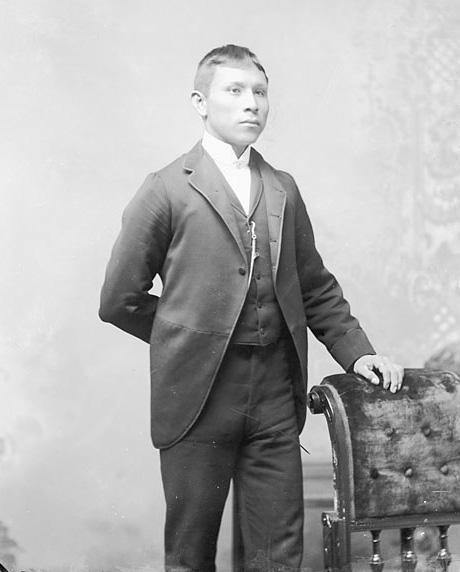
issue: “English education places the red man on the same level with his white brother and he stands side by side with him regardless of color. —Paul Boynton, Arapahoe [sic].”16 Boynton learned the rhetoric of the assimilationist establishment and the power of print media’s potential as a platform to build networks and a professional persona at Carlisle. Boynton would go on to use regional newspapers throughout Oklahoma Territory and, later, the new state of Oklahoma to help shape Cheyenne and Arapaho soft power in a predominantly settler readership.
Paul Boynton left Carlisle and returned to the Cheyenne and Arapaho reservation in the summer of 1889, one of the most significant and tumultuous periods in modern Cheyenne and Arapaho history. With the passing of the Dawes Act in 1887, implementation of allotment policy was soon a reality for the Cheyenne and Arapaho, the question being
Paul Boynton, 1889 (NAA_74024, National Anthropological Archive, Smithsonian Institution, Washington, DC).
under what, and whose, terms. In May 1889, a delegation of Cheyenne and Arapaho chiefs, including White Eyed Antelope, met with lawyers in Oklahoma City regarding claims to the Cherokee Outlet. Present at this meeting were four former Carlisle students: Leonard Tyler, George Bent, and Robert Burns (all three interpreting for the Cheyenne), and Jock Bull Bear (interpreting for the Arapaho).17 The meetings concerning the Cherokee Outlet can be viewed as an overture to a period of governmental negotiations with Cheyenne and Arapaho leaders that had the aim of breaking up their reservation and opening it up to white settlement. Most Cheyenne chiefs were staunchly against breaking up the reservation, whereas several Arapaho chiefs were open to negotiation. At negotiations with the Jerome Commission in 1890, Paul Boynton served as an interpreter for Chief Left Hand of the Arapaho. Chief Left Hand negotiated for larger allotments and a higher price per acre for surplus land. Boynton proposed that the government pay six percent interest on tribal funds held in the Treasury, instead of four percent.18
The Cheyenne and Arapaho interpreters of the allotment era constitute a major shift in Native representation at the negotiation table. Prior to the allotment era, Euro-American interpreters or Indigenous interpreters with a Euro-American parent were the norm. With the first group of Cheyenne and Arapaho leaving boarding school, the leadership had their sons and relations interpreting. However, US governmental officials saw an opportunity to bribe these young men to influence their Nation’s leadership. Boynton asked to be paid $500 for his interpreting work but was ultimately only paid $150 by agent Daniel B. Dyer.19 Arapaho Chief Jesse Rowlodge reported in an oral history interview that, sometime in the 1910s, Boynton and fellow interpreter Jesse Bent apologized to the Tribe for misrepresenting information to the chiefs. Rowlodge stated, “And [Boynton] declared, and acknowledged openly, and asked for forgiveness, that he knew he done wrong—done wrong to the people. He was paid to do that. He said he was going to live straight. Everybody heard him. I heard him.”20
Parallel to allotment negotiations, Northern Paiute prophet Wovoka (Jack Wilson) began preaching the Ghost Dance, which became especially influential among the Arapaho, who played a significant role in bringing the dance to other Plains Nations. In 1889, Chief Left Hand received a letter from the Northern Arapaho telling of a messianic leader.
THE CHRONICLES OF OKLAHOMA
Wanting to learn more, he sent Black Coyote and Washee to the Wind River Reservation to investigate, commencing a period of dynamic exchange via postal mail and train travel between Plains reservations.21 Paul Boynton was most likely involved in the Ghost Dance movement very early in its nascence. A letter from Thomas W. Potter, a former teacher at Carlisle, and former worker at the Cheyenne and Arapaho Agency, was published on the front page of the August 22, 1890, issue of the Carlisle Indian Helper: “Robert Burns and Cleaver Warden are clerking in the Agent’s office and are very efficient. Paul Boynton wears only blanket with face painted, and I have never seen him yet to know him . . . Leonard Tyler and other Carlisle boys are very active in their efforts to persuade the other Indians to take their lands in severalty and become individuals.”22 In an Arapaho text collected in 1893 by Bureau of American Ethnology ethnographer Albert Gatschet (mentor and colleague to ethnographer James Mooney), Boynton reported that the Ghost Dancers dance at his camp and claimed that Wovoka obtained his powers via Peyote; Boynton continues by stating that “we name [the one we pray to] White Man Above . . . because [Jesus Christ] was white.”23 This is the first recorded instance of Boynton contextualizing Native practice in Euro-American terms, a practice and strategy he and other Peyote leaders would use throughout their lives.
Omer C. Stewart—anthropologist and author of the seminal Peyote Religion: A History—designates the early 1890s as a period of “heightened religious fervor” in which the Ghost Dance and Peyotism spread simultaneously and in mutually beneficial ways,24 especially among former boarding school attendees. Former students played key roles in facilitating exchange via their English language skills; Grant Left Hand (Chief Left Hand’s son), Casper Edson, and Paul Boynton were all devotional leaders of the Ghost Dance and former Carlisle students.25 Historian Louis S. Warren states, “Wovoka’s insistence on the importance of education might have helped recruit these leaders by sanctioning their sacrifice—their years of loneliness and alienation in faraway schools—as spiritually significant.”26 To this day, a fundamental component of Native American Church members’ reverence for Peyote lies in the healing properties of their sacred sacrament. The Arapaho Sitting Bull, the primary Ghost Dance leader for the Cheyenne and Arapaho, is described by Cleaver Warden (Arapaho) in his 1918 testimony before a congressional committee as having been healed by Peyote. Warden
continues by detailing his own weak physical state upon returning home from Carlisle and his decision to join the society of Peyote men in search of healing:
I was a student at one time at Carlisle, Pa., and I know when I returned home I was in such a shape as Paul Boynton was. I know that, because I had a hemorrhage—if I wished to enjoy life and see the good doings of others I must do what they do, and of my own free will I consciously went and joined that society. I was made well upon that.27
It was in the early 1890s that Paul Boynton began to collaborate with James Mooney, an ethnographer from the Bureau of Ethnology, which was established—like Carlisle—in 1879. After 1897, the Bureau of Ethnology would become the Bureau of American Ethnology (BAE). The working relationship and friendship that began between Mooney and Boynton in documenting the Ghost Dance was one that would last until both of their deaths in the early 1920s. (Prior to being taken on by the BAE, Mooney was a printer.) Hired by the BAE in 1885, Mooney had gained a considerable degree of notoriety with his writings on the sacred formulas of the Cherokee in 1891. With his research on the Ghost Dance, Mooney embarked on one of his most ambitious and controversial professional projects, given the Wounded Knee Massacre of 1890. Mooney mentions Boynton by name in his writings on the Ghost Dance, which were published in 1896 as The Ghost-Dance Religion and the Sioux Outbreak of 1890. He is listed among Carlisle student informants and introducing a Ghost Dance song that Boynton had written upon seeing his deceased brother during the dance. This brother is most likely Bayard Boynton, who entered Carlisle at ten in September 1889,28 two months after Paul Boynton had left Carlisle. Bayard Boynton, however, fell ill with scrofula (tuberculous lymphadenitis) and was transported home with five other sick students in July 1890 upon the recommendation of Richard Henry Pratt.29 The Ghost-Dance Religion and the Sioux Outbreak of 1890 is ground-breaking due to Mooney’s use of the word religion to define the Ghost Dance, lending it legitimacy in governmental and academic circles six years after Wounded Knee. The ideas presented there arguably also formed the foundation for Mooney championing the formal chartering of Peyotism as a religion,
THE CHRONICLES OF OKLAHOMA
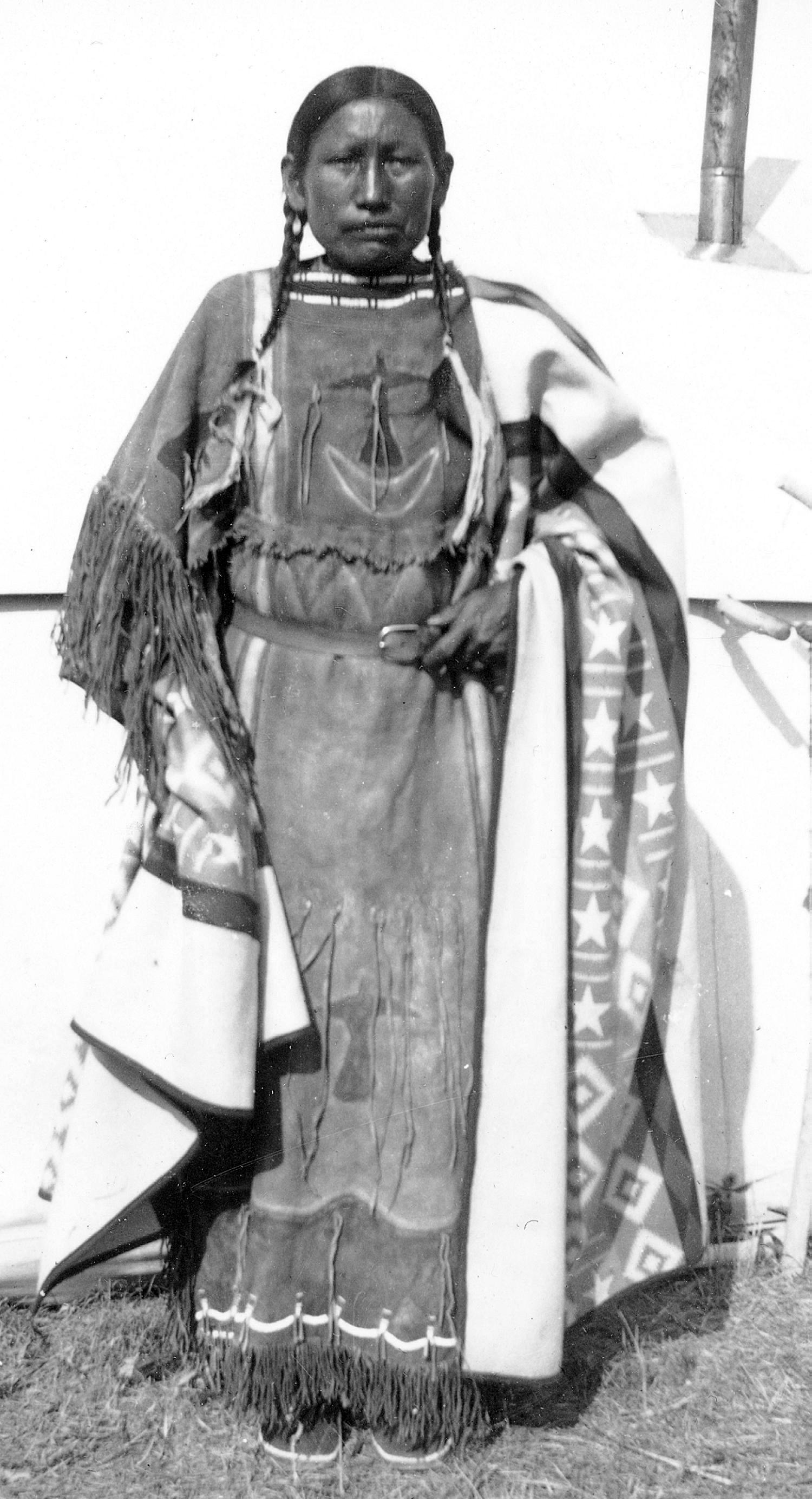
300 Chief Hail’s wife (Arapaho) in Ghost Dance regalia, n.d. (9573, Joseph O. Hickox Collection, OHS).
PAUL BOYNTON
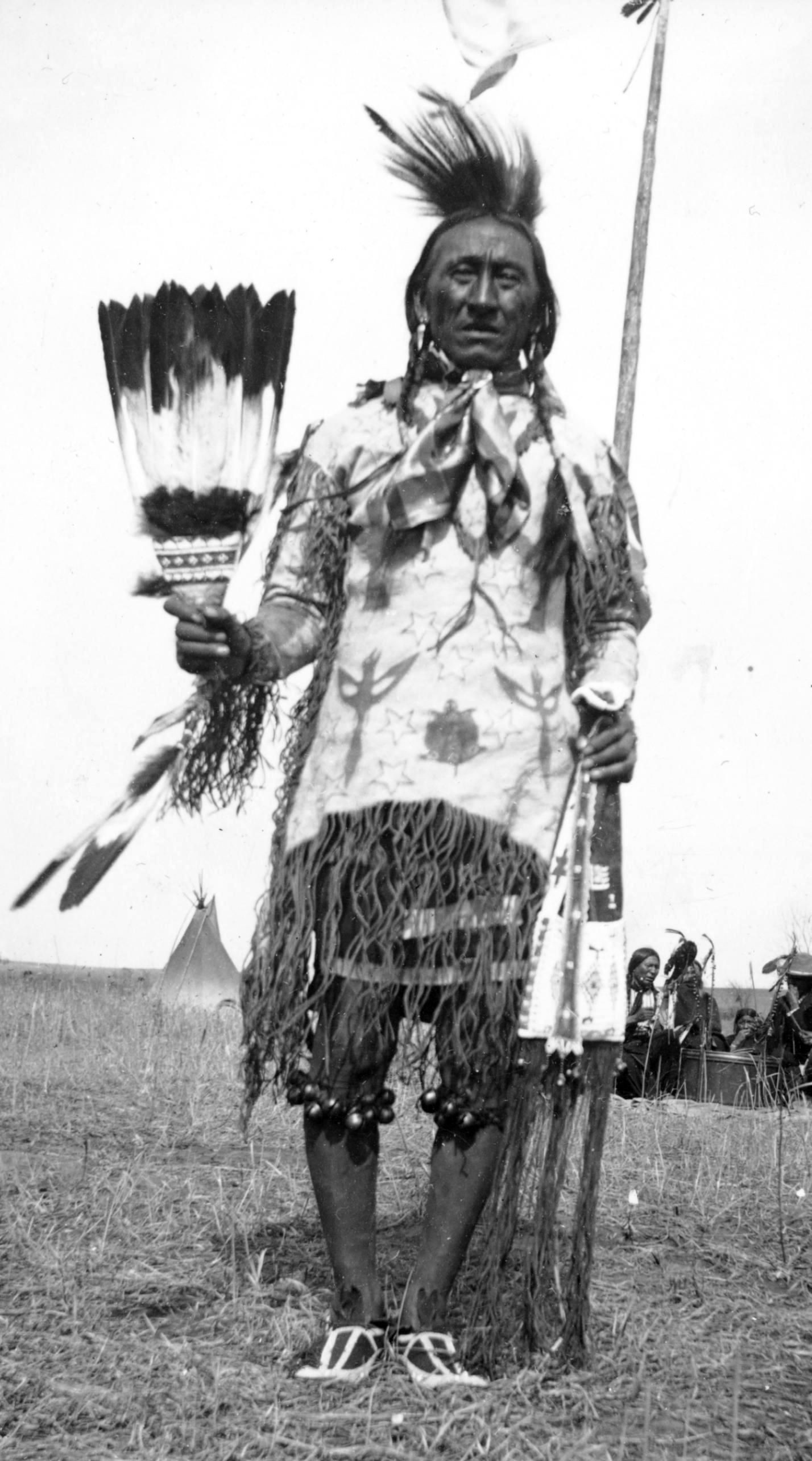
Chief Hail (Arapaho) in Ghost Dance regalia, n.d. (9563, Joseph O. Hickox Collection, OHS).
THE CHRONICLES OF OKLAHOMA
an idea that would take another twenty-five years to come to fruition with the chartering of the Native American Church of Oklahoma in El Reno in 1918. In an interview with Julia Jordan in 1967, Jesse Rowlodge, an Arapaho Peyotist born in 1884, states that the name for the Native American Church was suggested around 1903 or 1904, with early Carlisle students Cleaver Warden and Paul Boynton “formulat(ing) all those thoughts of Mooney”.30 When asked by Jordan in a later interview about the kind of impression James Mooney made on the Cheyenne and Arapaho, Rowlodge responded:
Oh, they just worshipped him. He’d ride with them. Stayed in the camps with them. In fact he was instrumental in this Native American Church. He told the boys to make a foundation of unity. He said, Stay together, and uphold your laws and name it some Indian-appropriated name. Say, for instance ‘Native American Church’ or some other name similar to that. So that advice was (the) way they named this Native American Church. And the Arapahoes started that. This Paul Bointon [sic] I was telling you about, he straightened out. He became a good peyote man.31
Here, Rowlodge could be referencing not only Paul Boynton’s dubious role in the negotiations for allotment policy but also to his multiple run-ins with the law at the turn of the century, including pleading guilty to introducing liquor to the tribes in 189932 and being charged with grand larceny in 1902.33 Boynton refers to this behavior in his testimony at the 1918 congressional hearing on Peyote when he stated, “When I used to use liquor I was out on the streets, probably not knowing half the time what was taking place during that day; my thoughts were not mine; I did not know them.”34
Nevertheless, the 1890s and early 1900s were a productive time for Paul Boynton. He accompanied a delegation of Native men to the Chicago World’s Fair;35 married his first wife, Medicine Sack, and had children; traveled with his mother, Bitchea, and second wife, Faith Morrison, to the 1907 Jamestown Exposition, to Carlisle, and to Washington, DC to obtain a patent to sell his land;36 and sold land to Lieutenant Governor George Bellamy, the first lieutenant governor of the new state of Oklahoma, a sale that allowed the city of El Reno to expand to the west.37 The land that Boynton sold to Bellamy is referred to as the
PAUL BOYNTON
Boynton Heights neighborhood of El Reno by realtors and city planners to this day and begins west of South Boynton Avenue. That El Reno bore the name of a Cheyenne-Arapaho man so early in its history is significant, especially as a majority of the first streets of El Reno were named after Fort Reno officers.38 Initially called Twelfth Avenue, Boynton saw the avenue named after him within his lifetime. The parallel avenues west of South Boynton Avenue are named for Presidents Millard Filmore and Franklin Pierce.
The timing of Paul Boynton selling land to Lieutenant Governor Bellamy in 1907 appears to be anything but coincidental. On February 9, 1907, Cheyenne Peyotists Reuben Taylor, Howling Wolf, and Percy Kable were arrested at the behest of Cheyenne and Arapaho Agency superintendent Charles E. Shell. In March 1907, these men were convicted of possessing mescal beans. In February 1907, Peyotists and Native leaders, including Comanche Chief Quanah Parker, convened before the Medical Committee of the Constitutional Convention in Guthrie to distinguish Peyote from mescal beans and explain Peyote’s role as a sacrament in their Christian worship. With Oklahoma slated for statehood, Shell pushed for a state law prohibiting Peyote and wrote to Bureau of Indian Affairs officer and prohibitionist W. E. Johnson, “I have no doubt that it will pass and if it does, it is all we need. I was assured by Lieutenant Governor Bellamy who is a mighty good friend of mine and who was the author of the original Mescal Bean statute and that he did not doubt that it would pass.”39 Charles Haskell, the first governor of the state of Oklahoma, had been a major proponent of prohibition since his days as a delegate at the Constitutional Convention and wrote prohibition into the Oklahoma Constitution, subsequently spurring Peyotists to educate the Legislature about Peyote not being an intoxicant. This climate threatened tribal sovereignty and the potential for the state of Oklahoma to continue to be an important center for the Peyote religion.
With statehood achieved via President Theodore Roosevelt’s proclamation on November 16, 1907, the First Oklahoma Legislature became tasked with implementing the resolutions of the Constitutional Convention. Three general statutes posed the greatest risks to Peyotists: section 1860, which outlawed medicine men from practicing among allotted Indians; section 1861, which prohibited possession, sale, or distribution of the mescal bean to any allotted Indian in Oklahoma; and section 1863, which defined persons guilty of violating either of
THE CHRONICLES OF OKLAHOMA
the statutes above as committing a misdemeanor, which translated to a fine ranging from $25–$200 or up to six months of confinement in jail.40 On January 21, 1908, the First Oklahoma Legislature met for morning and afternoon hearings on prohibiting the use of Peyote. The morning session took place before the House and was presided over by Representative H. Ashby; the afternoon session took place before the Senate and was presided over by Lieutenant Governor Bellamy. Comanche Chief Quanah Parker and three other Native men testified at the morning session. In the afternoon, four federal Indian agents— including Charles Shell—testified, followed by eight Native men. Paul Boynton was among these eight and made the following statement:
It is known that there is a great many denominations, but let us call this one of them—let us try to recognize it as one of the ways that the great spirit is talking to the Indians.
I thank you all that you do not pass a law in regard to this just because one or a few men do not like this—just because a few men do not like this at all why do you go to work and make a law? No, you have no reason whatever—common sense will always tell us that any religion that might be existing among the Indians would be constitutional. If you think they have a religion of their own, give them a right— that is what I am after—if my people think they have a religion of their own, give them a right to worship their religion. Give them a right. I do not think you got any right whatever, or any other denomination to interfere with this right. Let my people have a right—let them have their right because I have seen that it does them good.41
The morning and afternoon testimonies of the Native men present clearly made an impression on the representatives of the Legislature, most of whom had probably not seen Native leadership from such a variety of Nations gathered in one space and united in one cause before. Several of the Native men who testified had attended Carlisle, including Paul Boynton, James Waldo (Kiowa), and Otto Wells (Comanche). Capturing the emotionally charged nature of the day, anthropologist Omer C. Stewart writes, “One member of the legislature was so moved by the arguments of the Indians that he said: ‘I have been almost overcome by the talk of these Indians and I do not believe any legislature wants to rob these Indians of their religious rights. If I have
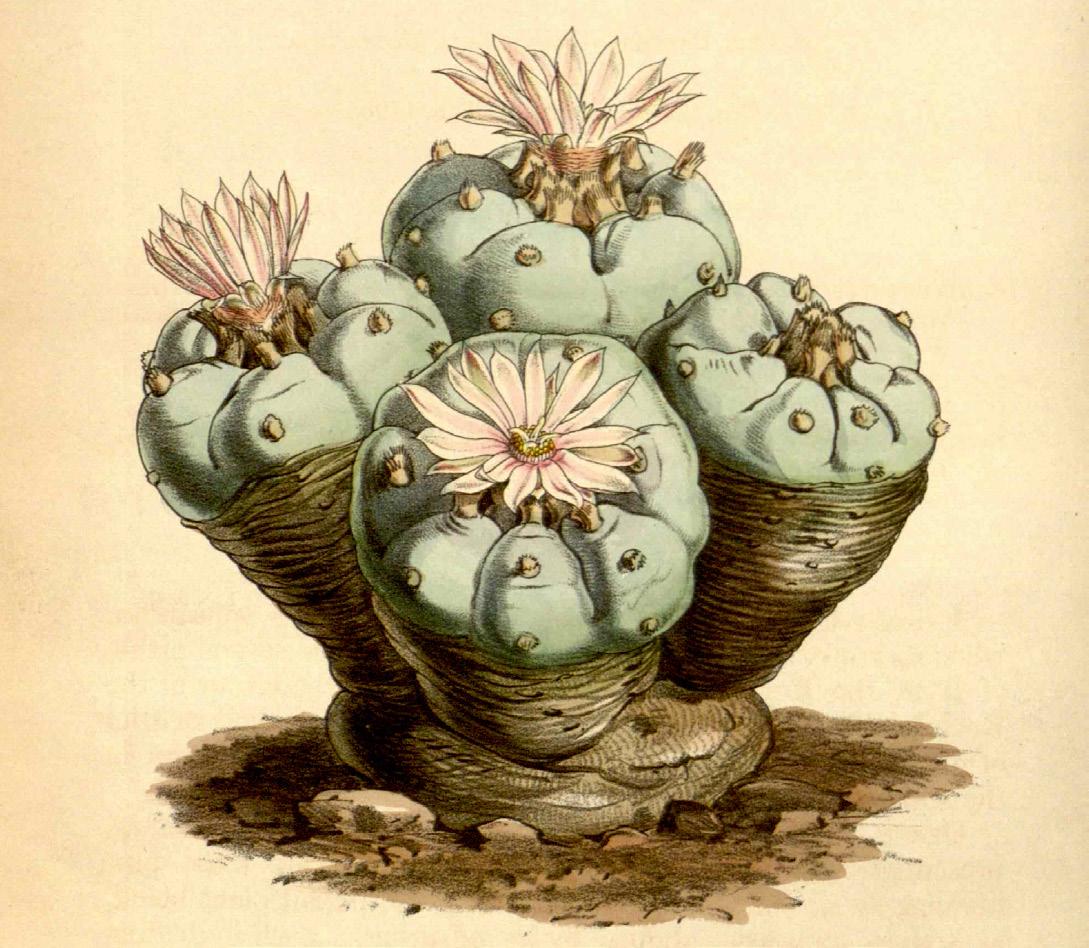
Sir William Jackson Hooker, Lophophora williamsii (peyote), 1847 (Curtis’s Botanical Magazine, Vol. 73, Missouri Botanical Garden, St. Louis, Missouri).
regard for any person on earth, it is for the aborigines of our country. It is our duty to protect their rights—religious or otherwise.’”42 Considering that the first legislation passed by the First Oklahoma Legislature on December 18, 1907, was the racial segregation of coaches and waiting rooms—Senate Bill One or the “coach law”—the Peyotists could certainly not have counted on their testimonies resonating with the representatives and senators present.
The sympathy the Peyotists found among members of the Legislature did not stop sensationalist reporters from framing some of the Native men who testified as incompetent. The following excerpt from the Searchlight’s report of the hearings attempts to ridicule Paul Boynton by implying that his repetitions indicated low proficiency in English:
Boynton’s English Failed: Paul Boynton attempted to reply but his English was so bad he repeated. He tried to tell that peyote was used for the rligious [sic] rite of the Indians, and according to the constitution of the government it could not be interfered with
THE CHRONICLES OF OKLAHOMA
by statute, but he was understood only by those who are accustomed to hear full bloods speak. One sentence that he burned into the minds of his audience was, ‘Let my people have a right.’43
By contrast, the Daily Oklahoman highlighted Boynton’s and Waldo’s stressing of religious rights: “Interspersed were speeches by Chief Parker and James Waldo of the Comanches and Paul Boynton of the Arapahoes [sic]. Waldo and Boynton pleaded for the religious rites and ceremonies of their tribes and held that the peyote does not produce the same effects as the mescal bean.”44 Regardless of how it was presented by the press, Boynton’s was clearly one of the standout testimonies of the hearings, and a ban on Peyote was avoided.
Several Native people and Peoples experienced tremendous financial gains at the beginning of the new century. Grazing leases and royalties on mineral rights made the Osage Nation one of the richest Nations in the world. One month before the Boynton Heights lot sale on May 11, 1909, Paul Boynton published the following in the El Reno newspaper The Republic:
Paul Boynton said Tuesday that he was going to have some fine neighbors on Boynton Heights. He hears that there is going to be quite a little city out his way and that the people who will locate there are the elite of the land. For the past two weeks Paul and his wife have been entertaining relatives and friends from the land of the Osages.45
Soon thereafter, Boynton announced his plans to build a “palatial residence” north of the land he sold.46 Given the proximity of the Cheyenne and Arapaho Agency at Concho (named for Superintendent Charles Shell in Spanish), Boynton was interested in creating a sphere of influence via proximity, an early example of Native influence on urban planning in the state of Oklahoma.
On June 21, 1909—the 1909 Summer Solstice—Superintendent Shell undertook an experiment in which he, according to and under the supervision of his physician J. S. Lindley, sought to “investigate the physiological action of the ‘mescal button’ by placing himself under its influence.”47 In his doctor’s report, Lindley describes the “objective symptoms” as partial dilation of the pupils, increased heart rate, and a “slightly flushed face” that gave way “to one of pallor.” Shell submitted
PAUL BOYNTON
a lengthy and detailed account of his experience entitled “Experience of Charles E. Shell While Under the Influence of Pellote (Peyote) on June 21, 1909,” in which he states the following about the peaceful effects he felt in drinking an infusion of Peyote buttons:
I was also languid and had a feeling of utter abandon. I laid down upon a comfort and yawned nad [sic] stretched almost incessantly. While my reason was apparently unimpaired, I had no desire to talk, but only to be let alone. My thoughts now began to rise to a very high plane. I seemed incapable of having a base thought, but all were of a high order. I seemed to have forgotten that there was any evil in the world, all was good and pure. I do not believe that any persons under the influence of this drug could possibly be induced to commit a crime, because crime is so foreign to the state of mind which exists. There was no business thoughts and none of the everyday routine of life. They were along the line of honor, integrity, and brotherly love . . . I had no inclination to do or say any absurd things that an intoxicated man does.48
In the closing paragraphs of his report, Shell summarizes his stance on Peyote as follows:
I did not see any spirits or hold any conference with spirits— celestial, terrestrial, or subterrestrial. This may have been because I did not erect any altar, beat a tom-tom, or shake a rattle . . . nor perform the ceremonies usually performed by the followers of the mescal lodge. I do not say this in mockery of the religion of these people, for religion is too sacred a thing to be made a mockery of, no matter how absurd or heathenish. I have insisted, however, that, in my opinion, the religious ceremony is only a cloak with which to cover this species of intoxication, for it is intoxication. . . . The continued use must necessarily, however, be injurious, as any drug which will produce the unusual conditions of the nerves which this produces must necessarily, by its continuous use, rob the nerves of their vitality. If this experience could be made universal and continuous, there would be no need of armies, navies, nor courts.49
THE CHRONICLES OF OKLAHOMA
Crucial here is Shell’s use of the word religion to describe Peyotism and his insistence that Peyote consumption constituted a “species of intoxication.” Shell’s 1909 report would serve as evidence by the anti-Peyotist camp in the February 1918 congressional hearing on Peyote, but it arguably dismantled two of the key arguments at the time: that Peyotism was not a bonafide religion (therefore unworthy of protection under the First Amendment) and that consumption of Peyote led to injurious behavior, both to oneself and to one’s Nation. In the 1910s, Peyotist arguments would pivot towards stressing the medicinal and healing qualities of the Medicine.
In April 1910, Paul Boynton was elected chief by the Arapaho, and the announcement of his election was printed in dozens of Oklahoma newspapers. The text for the lengthier El Reno Democrat article—which states that Boynton “owns a farm which is bounded on two sides by the city of El Reno”—is featured in the same April 14 issue that reports Boynton’s sale of the south forty acres of his allotment to the Harden Realty Company,50 indicating that Boynton sold his land strategically and exercised control over his public relations. In 1912, Paul Boynton completed the Carlisle questionnaire sent to former attendees and graduates that sought updated information about their lives. In his response, he stated that he was married to another boarding school attendee named Lucy Long, a Pawnee who attended the Chilocco Indian Agricultural School, was living in Greenfield, described himself lightheartedly as a “green horn half finished 8th grade student,” and wrote that he “own[ed] land” and was “interested in other lands.” To the last questionnaire item, “Tell me anything else of interest connected with your life,” Boynton responds in a telegraphic style, “Was an important Interpreter between the Cheys. + Araps + the Gov’t during the treaty of ’90. Have traveled over the U.S. on my own expenses. Am first tax payer from Chey. + Arap. Tribes. Am not depending on Gov’t, do not wish to, I am independent citizen, a voter.”51 A condensed and edited version of Boynton’s questionnaire responses appears in the May 3, 1912, issue of the Carlisle Arrow. Two important journeys that follow highlight Boynton’s use of his chieftainship as a platform for activism: one in 1913 to the Rosebud Agency with Arapaho Chiefs Young Bear, Little Bird, and Long Hair to discuss claims to the Black Hills with other Tribes, and the other to the conference of the Society of American Indians at the Haskell Institute in Lawrence, Kansas in 1915.
308
Established in 1911, the Society of American Indians (SAI) was the first national Native-led organization to promote Native rights and interests. Its members came from a variety of Native Nations. They were united both in their identities as Native people and, largely, as young professionals who had experienced Euro-American education systems. Decades prior, non-Native organizations such as the Friends of the Indian promoted assimilationist policies; the SAI provided a platform for Native leaders and intellectuals to discuss and deliberate the approaches that they had experienced firsthand. With enfranchisement via US citizenship for all Native people at the forefront of the SAI’s agenda, strategizing what groups to align themselves with began to take priority over representing a diverse range of Native views and perspectives. The SAI gradually became increasingly anti-Peyotist to garner the sympathy of non-Native progressives who were ignorant of what Peyote and Peyotism were and provided a large base of support for Prohibition. In 1914, the influential Lake Mohonk group stated its official support for a federal ban on Peyote;52 two years later, the SAI followed suit.
From 1916 onwards, the American Indian Magazine—the official publication of the SAI—regularly featured writing that demonized Peyote, framing it as an intoxicant like liquor and alcohol. The July–September 1916, issue presented the SAI’s “Cedar Rapids Platform” that had been discussed at the SAI conference in Cedar Rapids, Iowa, defining its third point as “Liquor traffic an evil,” and “urg[ing] unequivocally upon Congress the passage of the Gandy bill,”53 legislation introduced by South Dakota Representative Harry L. Gandy that proposed a nationwide ban on Peyote that ultimately failed to pass Congress. The 1917 spring number featured both an article by SAI president Arthur C. Parker entitled “The Perils of Peyote Poison,” and a reproduced article from The Riverside Press about Zitkála-Šá’s (Yankton Dakota) visit to the Glenwood Mission Inn in which “she spoke of a cacti which produces a narcotic more powerful and dangertous [sic] in its effects than any of those which the government now forbids the use of and she told how this poison was being given to her people by traffickers under the guise of religion”.54 The 1917 Spring issue also closed with the poem “The Red Man’s America,” by Zitkála-Šá, intended to be set to the melody of “America/My Country ’Tis of Thee,” whose second stanza characterizes Peyote as an obstacle to Native liberation and the third stanza mentions the failed 1916 Gandy Bill:
THE CHRONICLES OF OKLAHOMA
My native country, thee, Thy Red man is not free, Knows not thy love. Political bred ills, Peyote in temple hills, His heart with sorrow fills, Knows not thy love.
Let Lane’s Bill swell the breeze, And ring from all the trees,
Sweet freedom’s song.
Let Gandy’s Bill awake
All people, till they quake, Let Congress, silence break, The sound prolong.55
The 1917 summer issue of the American Indian Magazine featured an essay bearing the title “The Menace of Peyote,” written by Lyman Abbott. Abbott was instrumental in the Social Gospel Movement, a staunch proponent of temperance, an associate editor at Harper’s Weekly, and editor-in-chief of The Christian Union, a publication founded by Henry Ward Beecher, brother of Harriet Beecher Stowe. In his essay, republished from The Outlook, Abbott writes:
The few defenders of [Peyote’s] use present three arguments against its prohibition:
I. That is has some medical uses, as opium has. This is questionable.
II. That it destroys the appetite for whiskey. This is also questionable, the witness on this subject being about equally divided. But there is practical agreement that if it has such an effect the remedy is worse than the disease.
III. That it has become an instrument used in religious worship of the Indians, and that it is not legitimate to interfere with their
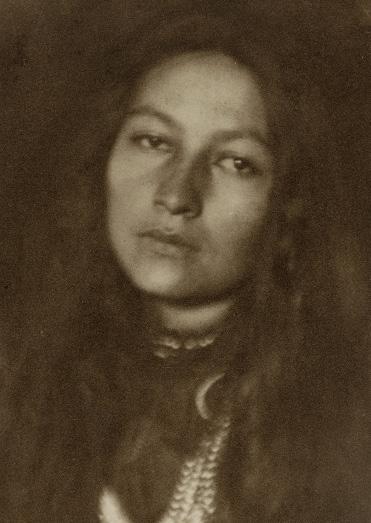
Zitkála-Šá (Gertrude Bonnin) (S/NPG.79.26, National Portrait Gallery, Smithsonian Institution, Washington, DC).
religious worship. If it were true that any practice employed in religious worship can never be interfered with, there would be nothing to prevent setting up in any of our cities a pagan temple, with prostitutes offering themselves under the name of religion as ministers to lust.56
Despite the failure of the Gandy Bill and other national attempts to outlaw Peyote, Representative Carl Hayden of Arizona drafted a bill (H.R. 2614) that listed Peyote as an intoxicant in the liquor traffic laws.57 In February and March 1918, hearings took place before a congressional committee to hear testimonies from both Peyotists and anti-Peyotists. Zitkála-Šá, Charles Eastman (Santee Sioux), and Richard Henry Pratt provided anti-Peyotist testimony at the February hearings.
THE CHRONICLES OF OKLAHOMA
Ethnographer James Mooney was present at both the February and March 1918 hearings, providing arguments in favor of the Peyotists. John N. Tillman of Arkansas, a former president of the University of Arkansas and Prohibitionist, presided over the congressional subcommittee. In 1924, he would declare himself a proud member of the Ku Klux Klan.58 Ten years after their testimonies before the First Oklahoma Legislature, Otto Wells testified at the hearing in February 1918, and Paul Boynton and James Waldo testified at the March 1918 hearing, joined by Cleaver Warden. Boynton served as an interpreter for the Cheyenne Chief Little Hand and provided one of the longest—and arguably most powerful—testimonies of the hearing in March. Paul Boynton’s testimony seems to have been influenced by both Charles Shell’s account of his experience taking Peyote in 1909 and the arguments that Lyman Abbott’s article “The Menace of Peyote” aimed to dismantle. Boynton’s statement begins by taking the form of the kind of testimony given in a Protestant church service in which a speaker talks of their personal journey to faith. He states:
Some of these men here of my own tribe, the Cheyennes and the Arapahoes, know just who I am and what I was—one of the worst gamblers, the greatest drinker. In fact, I was a robber, robbing the gambling tables, shifting the cards just to get the money from those people; and I heard that when they used peyote they would quit drinking . . . I wanted to prove it myself just to see—to find out if it had any power to make me quit drinking or not, and all my evil habits. Of course, I did not see into it at once, but gradually in time I began to see. There was something mysterious in this that I could not explain. . . . It had something to do with me— to raise my ideas, it seems like.59
Boynton proceeds to tell of his wife being ill for a six-month period in which she refused consultation from any doctor, Native or not, causing Boynton great distress. He decided to take matters into his own hands by making her a Peyote infusion. He prayed and gave her the infusion once it cooled; thirty minutes later, his wife felt the urge to vomit and then lay back down. When she awoke hours later, she showed him the “big lump” she had was no longer there. Boynton concludes his opening statement by saying:
312
Now, gentlemen, we have been accused by the parties, the church people probably, that this degenerates us. No. My own physical appearance ought to prove it to you. Do I look sick? There is not a thing I can complain of in my body. I use the herb. You see I am trying to express my thoughts in a sensible way. I would not say that the taste cured my taste of the whisky; the taste of this peyote cured the taste of my appetite for liquor; no, sir; I would not say that. But the idea, the principle in it—the religious, holy idea that I got in the effects of it—is what helps these men following this religion.60
Representative Tillman refuted Boynton’s claims, stating that, “God would not need this little peyote bean to work wonders with you,” and asks Boynton, “You think that is the only drug that he put any power in to cure human ills?” Boynton responded by stating, “I believe there is more than that; it cures sin, spiritually.”61 In the entirety of the hearings, this is the only time the word sin was used. In using Christian language, Boynton introduced a fourth argument to the congressional committee and all present: that Peyote is good Medicine that treats body and spirit—a sacred sacrament—and therefore cannot be classified as an intoxicant. Tillman proceeded to read toxicology reports, to which Boynton stateed that he knows nothing of the described negative side effects. Their exchange concluded with the following:
Mr. Tillman: You believe in faith cures and you think you can take these beans and cure yourself of diseases that white doctors, splendidly educated, graduates in medicine, and practicing for years could not cure, do you?
Mr. Boynton: Yes, sir.62
With H.R. 2614 failing to pass the Senate, the Peyotists’ efforts were once again successful. With a new urgency to protect their religious rights, a group of Oklahoma Peyotists chartered the Native American Church of Oklahoma on October 10, 1918, in El Reno. In article VI of the Articles of Incorporation, Boynton and Cleaver Warden are listed as two of the fourteen trustees who made up the General Council.
THE CHRONICLES OF OKLAHOMA
That same day, Boynton had the following news item published on the front page of the Greenfield Hustler: “Chief Paul Boynton has a service flag with one star for his son, Richard Boynton, who is Somewhere in France.”63 Richard Boynton Sr. enlisted in the US Army in March 1918, and trained in Fort Logan, Colorado,64 returning home at the end of World War I.
James Mooney traveled to Oklahoma in the summer of 1918, describing this time as a happy one, as he had been enthusiastically received by his Native friends and experienced a reprieve from his health ailments. He attended several different Nations’ ceremonies that summer, including the Southern Arapaho Sun Dance,65 while continuing his work with the Kiowa. This visit was Mooney’s last in Oklahoma, as BIA commissioner Cato Sells pressured Bureau of American Ethnology director Jesse Walter Fewkes to have Mooney removed in November 1918. The BAE then severed Mooney’s pay under the pretense of “underproduction,” but, in truth, it was largely for his involvement in defending Peyotism. Native American Church members sent money to pay for Mooney’s mounting medical bills until his death on December 22, 1921.66
Paul Boynton passed away at the beginning of September 1922 while visiting with Otoe-Missouria friends. They brought his body back to Calumet, where he was buried on September 9, 1922. The following obituary was printed on the front page of the El Reno American on September 14, 1922, “Paul Boynton, the citizen from whom Boynton Heights addition to El Reno received its name, passed away in Red Rock, Okla., last week . . . Internment was in the Calumet cemetery. The deceased was the father of Richard Boynton of El Reno. He resided here for many years, removing recently to Red Rock.”67
Returning to Paul Boynton’s 1885 “Indian Story” from the Carlisle Indian Helper, one sees themes that reflect his life and career. In the story, the Native man investigating the theft is multilingual, applies Native know-how to problem solve decades before forensics would become a formalized field of study in the United States, and approaches the gentlemen he encounters in the woods with a cooperative spirit that anticipates collaboration. In turn, they marvel at his skills and assist him. Boynton wrote this story in a place that was designed to erase his culture and identity as a Cheyenne and Arapaho man. Recognizing this, he chose routes in life that used his training as a printer
314
as a tool to contribute to the perpetuation of his People and other Indigenous Nations. In this, Boynton exemplifies Cheyenne scholar Henrietta Mann’s analysis, “the elders had said, . . . that such students were to be the means of maintaining the ways of The People. Their skills were new and strange, but time and experience would eventually transform them in culturally beneficial ways. They were the interpreters of culture.”68 It was in the boarding schools that pan-Indian identity was forged with budding leaders from a myriad of Nations uniting to collaborate on universally beneficial projects and aims. Many of these had Indigenous ceremonial life at their center.
As Paul Boynton was assisting other anthropologists and ethnographers with their accounts of his People, he was simultaneously creating a record in real time of his efforts in the newspapers of Oklahoma Territory and the young state of Oklahoma. As a printer, he was as aware of the roles that newspapers played in forming Oklahoman identity as the founding members of the Oklahoma Historical Society. Boynton made his mark on this intellectual landscape, just as he had in having a story printed at Carlisle that featured a Native detective who garners admiration from non-Native observers. Paul Boynton’s life demonstrates an enduring interest in living abundantly as both a Cheyenne-Arapaho citizen and a US citizen and ensuring this abundance for the future generations of his People. The Peyote activism that he and other Native people dedicated themselves to at the turn of the twentieth century continues to pave the way for future generations of Native leaders to exercise and uphold their Nations’ sovereignty.
THE CHRONICLES OF OKLAHOMA
Endnotes
* Christianna Stavroudis is from Elkhart, Texas and currently works as an instructor of English language and US cultural studies at the Cologne University of Applied Sciences. She holds an MSc in linguistics from the University of Potsdam and a graduate certificate in Native American studies from Montana State University. She is currently pursuing studies in Native American art history at the Institute of American Indian Arts. She wishes to thank Chief Paul Boynton’s descendants, Leah Elledge and Kelli Elledge, for granting permission to write this article. She dedicates this article to all members of the Native American Church. Cheyenne Peace Chief Gordon L. Yellowman Sr., who is the tribal historian of the Cheyenne and Arapaho Tribes.
The photograph on page 291 is of five Arapaho citizens, 1904 (2003652771, Library of Congress Prints and Photograph Division, Washington, DC).
1 Jane Griffith, Words Have a Past: The English Language, Colonialism, and the Newspapers of Indian Boarding Schools (University of Toronto Press, 2019), 54–5.
2 Indian Helper, November 13, 1885.
3 Indian Helper, November 20, 1885.
4 John N. Choate, Ten Male Student Printers, 1885, Cumberland County History Society, CCHS_BS-CH-034, https://carlisleindian.dickinson.edu/images/ten-male-student-printers-version-2-c1885.
5 Indian Helper, November 20, 1885.
6 William Wayne Red Hat Jr., William Wayne Red Hat Jr.: Cheyenne Keeper of the Arrows, ed. Sibylle M. Schlesier (University of Oklahoma Press, 2008), 127.
7 Red Hat Jr., William Wayne Red Hat Jr., 110–11.
8 Richard Henry Pratt, Battlefield and Classroom: An Autobiography (University of Oklahoma Press, 2003), 220.
9 “Proposal to Allow Four Chiefs and Their Wives to Visit Carlisle,” November 4, 1884, National Archives and Records Administration, RG 75, Entry 91, box 1, 1884-#21179, https://carlisleindian.dickinson.edu/documents/proposal-allow-four-chiefs-andtheir-wives-visit-carlisle.
10 William H. Tipton, Cheyenne and Arapahoe Indians, Agency and Carlisle Training School Officials and Pupils, 1884, Dickinson College Archives and Special Collections/ Carlisle Digital Resource Center, https://carlisleindian.dickinson.edu/images/cheyenne-and-arapahoe-chiefs-and-students-visiting-devils-den-1884.
11 “Old Indian Dead: Old Crow, Sachem in Arapaho Tribe, Expires at Ripe Age,” The Daily Oklahoman, May 4, 1904.
12 Loretta Fowler, Wives and Husbands: Gender and Age in Southern Arapaho History, (University of Oklahoma Press, 2010), 183.
13 “Paul Boynton (Red Feather) Student File,” National Archives and Records Administration, RG 75, Series 1327, box 3, folder 132, https://carlisleindian.dickinson.edu/student_files/paul-boynton-red-feather-student-file.
14 Indian Helper, June 3, 1887.
15 Indian Helper, November 11, 1887.
16 Indian Helper, June 7, 1889.
PAUL BOYNTON
17 Donald J. Berthrong, The Cheyenne and Arapaho Ordeal: Reservation and Agency Life in the Indian Territory, 1875-1907 (University of Oklahoma Press, 1976), 361–62.
18 William T. Hagan, Taking Indian Lands: The Cherokee (Jerome) Commission, 1889–1893 (University of Oklahoma Press, 2003), 70.
19 Berthrong, The Cheyenne and Arapaho Ordeal, 166.
20 Jess Rowlodge, interview by Julia Jordon, October 24, 1967, T-144, OU Libraries Digital Collections, University of Oklahoma, Norman, Oklahoma.
21 Justin Gage, We Do Not Want the Gates Closed Between Us: Native Networks and the Spread of the Ghost Dance (University of Oklahoma Press, 2020), 147.
22 Indian Helper, August 22, 1890.
23 Andrew Cowell, Alonzo Moss Sr. and William J. C’Hair, Arapaho Stories, Songs, and Prayers: A Bilingual Anthology (University of Oklahoma Press, 2014), 517–19.
24 Omer C. Stewart, Peyote Religion: A History (University of Oklahoma Press, 1993), 67.
25 Louis S. Warren, God’s Red Son: The Ghost Dance Religion and the Making of Modern America (Basic Books, 2017), 201.
26 Warren, God’s Red Son, 204.
27 “Peyote: Hearings Before a Subcommittee of the Committee on Indian Affairs of the House of Representatives on H.R. 2614,” (Washington Government Printing Office, 1918), 192.
28 “Bayard Boynton Student Information Card”, National Archives and Records Administration, RG 75, Service 1329, box 5, https://carlisleindian.dickinson.edu/student_files/ bayard-boynton-student-information-card-0.
29 “Request to Return Six Ill Students in June 1890,” June 9, 1890, National Archives and Records Administration, RG 75, Entry 91, box 630, 1890-#17687, https://carlisleindian. dickinson.edu/documents/request-return-six-ill-students-june-1890.
30 Jess Rowlodge, interview by Julia Jordon, December 12, 1967, T-172, OU Libraries Digital Collections, University of Oklahoma, Norman, Oklahoma.
31 Jess Rowlodge, interview by Julia Jordon, April 4, 1968, T-235, OU Libraries Digital Collections, University of Oklahoma, Norman, Oklahoma.
32 The El Reno Democrat, May 25, 1899.
33 The Oklahoma State Capital, November 27, 1902.
34 “Peyote: Hearings Before a Subcommittee of the Committee on Indian Affairs of the House of Representatives on H.R. 2614,” (Washington Government Printing Office, 1918), 182.
35 “In Paint and Feathers,” Oklahoma State Capital, May 6, 1893
36 “Indian Chief’s Son,” Watonga Herald, October 31, 1907
37 “Indian Chief’s Son.”
38 Carolyn Barker, History of El Reno (El Reno Carnegie Library Archives, 1991), 4.
39 Stewart, Peyote Religion, 137.
40 Denis Wiedman, “Upholding Indigenous Freedoms of Religion and Medicine: Peyotists at the 1906-1908 Oklahoma Constitutional Convention and First Legislature,” American Indian Quarterly 36, no. 2 (2012): 231.
39 Stewart, Peyote Religion, 137.
40 Wiedman, “Upholding Indigenous Freedoms of Religion and Medicine,” 231.
41 Wiedman, “Upholding Indigenous Freedoms of Religion and Medicine,” 236.
42 Stewart, Peyote Religion, 138.
THE CHRONICLES OF OKLAHOMA
43 The Searchlight, January 24, 1908.
44 The Daily Oklahoman, January 22, 1908.
45 The Republic, April 17, 1909.
46 “Indian to Build Home,” The Porter Enterprise, November 5, 1908
47 “Peyote: Hearings Before a Subcommittee of the Committee on Indian Affairs of the House of Representatives on H.R. 2614,” (Washington Government Printing Office, 1918), 26–7.
48 “Peyote: Hearings Before a Subcommittee,” 27.
49 “Peyote: Hearings Before a Subcommittee,” 28.
50 The El Reno Democrat, April 14, 1910
51 “Paul Boynton”, National Archives and Records Administration.
52 Thomas C. Maroukis, “The Peyote Controversy and the Demise of the Society of American Indians,” American Indian Quarterly 37, no. 3 (2013), 164.
53 “The Cedar Rapids Platform,” American Indian Magazine 4, no. 3 (1916), 223–24.
54 “Makes Earnest Plea for American Indian,” American Indian Magazine 5, no. 1 (1917), 63.
55 “The Red Man’s America,” American Indian Magazine 5, no. 1 (1917), 64.
56 Lyman Abbott, “The Menace of Peyote,” American Indian Magazine 5, no. 2 (1917), 134.
57 Thomas Constantine Maroukis, We Are Not a Vanishing People: The Society of American Indians, 1911–1923 (University of Arizona Press, 2021), 164.
58 William H. Pruden III, “John Newton Tillman (1859-1929),” The Encyclopedia of Arkansas, https://encyclopediaofarkansas.net/entries/john-newton-tillman-4662/.
59 “Peyote: Hearings Before a Subcommittee,” 182.
60 “Peyote: Hearings Before a Subcommittee,” 184.
61 “Peyote: Hearings Before a Subcommittee,” 184.
62 “Peyote: Hearings Before a Subcommittee,” 186.
63 Greenfield Hustler, October 10, 1918.
64 The El Reno American, March 14, 1918.
65 L. G. Moses, The Indian Man: A Biography of James Mooney (University of Nebraska Press, 2002), 204.
66 Alexander S. Dawson, The Peyote Effect: From the Inquisition to the War on Drugs (University of California Press, 2018), 60.
67 The El Reno American, September 14, 1918.
68 Henrietta Mann, Cheyenne and Arapaho Education, 1871–1982 (University Press of Colorado), 64.
Wildcatter “Ace” Gutowsky Strikes Oil West of Edmond
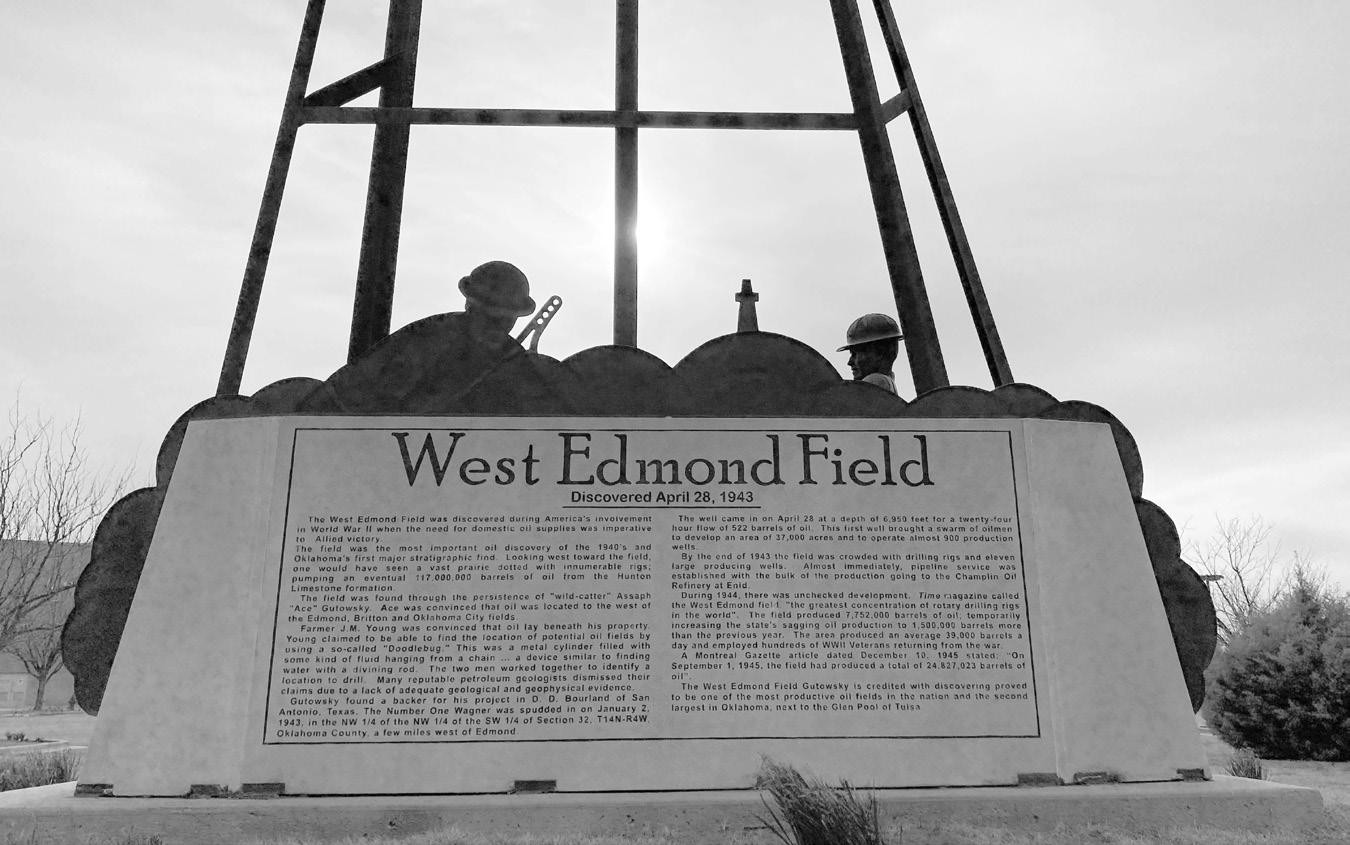
By Larry C. Floyd*
In the summer of 1943, Soviet and German armored units collided in a critical engagement around the Kursk salient in the Kursk oblast Ukrainian region of western Russia. Reading news account of this battle from Oklahoma, a Ukrainian emigrant named Assaph Gutowsky took a special interest as the German assault force of seventeen armored divisions met the even larger Soviet armored force. This clash of titans occurred only three hundred miles northeast of Gutowsky‘s boyhood home of Zhytomyr in present Ukraine. The Soviet army eventually stymied Hitler‘s forces in the largest tank battle in history. Nazi offensive capabilities in the Eastern Front ended with this decisive encounter. Allied leaders could clearly see
THE CHRONICLES OF OKLAHOMA
that the resurgent Soviet army was helping win Joseph Stalin‘s “war of machines,” as he predicted the fighting in World War II would become.1
Much of the international conflict’s war machinery ran on oil, and the United States and the Allies consumed almost seven billion barrels of it between December 1941 and August 1945. Of this ocean of oil used during the final four years of the war, the United States would supply six billion barrels. However, concern over newly discovered oil in the United States had been mounting since the nation‘s peak of 929 million barrels in 1937. In 1943, oil producers only added 212 million barrels to the nation‘s proved reserves. Amid global war, US war planners wondered if the nation’s oil industry could continue to meet the challenge.2
As the gas-guzzling German and Soviet war machines raged on the Ukrainian plains, a vast new oil pool in central Oklahoma— improbably discovered by Ukrainian-American wildcatter Assaph “Ace” Gutowsky—was being developed to aid the Allied war effort. In April 1943, Gutowsky’s gusher from the No. 1 Wagner discovery well in the northwestern corner of Oklahoma County set the nation’s petroleum industry abuzz. By the summer of 1944 the greatest concentration of rotary drilling rigs in the world bore into the twenty-seven-squaremile West Edmond Field, centered about fifteen miles northwest of downtown Oklahoma City, and ten major oil companies were pumping furiously from 102 producing wells. With eighty-eight more sites planned, Gutowsky’s discovery of the West Edmond Field gave the government a brief sigh of relief during the final years of the war.3
After twenty-eight dry holes and a bankruptcy over three decades of highs and lows, the indomitable fifty-seven-year-old Gutowsky would get the last laugh on his geologist friends who had advised him to quit as he doggedly drilled ten miles west of Edmond. He had relied heavily on findings from a doodlebug, the wildcatter equivalent of a water-seeking divining rod, to choose the spot to drill the No. 1 Wagner that started Oklahoma’s biggest oil boom of the war years. How could he not be laughing, at least to himself, when thinking of all those who had scoffed at his conviction that oil lay deep below in the Hunton limestone of northwest Oklahoma County?4
Born in November 1886 in the city of Zhytomyr in present-day Ukraine, Gutowsky grew up in a land buffeted by geopolitics—as it still is—contested and claimed in the nineteenth century by Prussia, Russia, Poland, and the Austro-Hungarian Empire. Political upheaval,
320
K. M. Gribanov, Russian playing card showing Zhytomyr, Ukraine, c. 1800-1839 (2018689354, Imperial Russian Playing Cards, Library of Congress, Washington DC).
Russian oppression, and lack of economic opportunity led many Ukrainians, officially Russians in the late 1800s, to leave their native land. Gutowsky became one of these emigrants, aided by Jewish smugglers on a harrowing journey across Europe and the Atlantic Ocean in 1902. He was fifteen years old when he arrived in Baltimore, Maryland, hungry and broke. Two older brothers had preceded him and started new lives in America.5
He made his way to Chicago to connect with his brother Otto. He built binders and mowers for two years while working for International Harvester Company, then took a job painting offices and home furniture. Leaving Chicago in 1907, Gutowsky relocated to Oklahoma just as it became a new state. He reunited with his brother Julius, who had already put down roots in Gotebo in Kiowa County. The younger Gutowsky managed to buy a small farm nearby.6
The state’s agricultural setting would have been familiar to the twenty-one-year-old. It was similar to northwestern Ukraine, a region of rich farmlands and the supplier of wheat to much of Europe. In western Oklahoma, Gutowsky lived in an area of several thousand other Russian-born emigrants, many German-speaking Ukrainians like him, who had made their way to the state’s farmlands. Nearly six thousand Russian emigrants were living in Oklahoma by the time of
THE CHRONICLES OF OKLAHOMA
statehood. They formed the second-largest group of European-born immigrants in Oklahoma, just behind Germans. The densest concentration of these former Russians was in Washita County, with its county seat at Cordell. Gutowsky’s thirty-acre farm was only about five miles south of the southern border of Washita County and its five hundred to six hundred Russian emigrants.7
In November 1908, Gutowsky married Augusta Ladwig, of Kingfisher, Oklahoma. The young couple settled on their Kiowa County farm growing kaffir corn, a species of sorghum, just east of Rainy Mountain Creek and near the township of Komalty, about five miles east of Hobart. By early 1911, the Gutowskys had sold their farm and purchased a half-section of land in Cooper township about three miles northwest of Kingfisher in central Oklahoma. He found modest success, lauded in a local newspaper as a “hustling farmer” who knew how to manage his fields.8
Assaph Gutowsky and Augusta Ladwig wedding portrait, 1908 (Photo provided by the author).
With the nation at war by June 1917, most Oklahoma farmers profited from increased demand for their crops. But Gutowsky found himself in a hospital recovering from surgery, facing mounting bills, and unable to support his family. At this bleak hour, a friend came to visit and offered to sell him some mineral stocks. With no funds to invest, Gutowsky referred the seller to someone else, resulting in a $660 commission to the desperate, recuperating farmer. The struggling father of four invested some of the money in two oil field developments. The small investment paid off beyond his wildest expectations, providing him with $70,000 in earnings within a year.9
Gutowsky’s early success in the petroleum industry whetted his appetite for more, and in September 1917, he and two others put up $50,000 in capital and incorporated Kingfisher Farmers’ Oil Company. By 1919, Gutowsky had started using the name “Ace” in lieu of Assaph. For the rest of his life, he would be known by this new moniker—a name he probably considered more reflective of his anticipated business success and one certainly more suited to his colorful, outgoing personality.10
Despite his initial success, by 1920, the putative oil entrepreneur was practically destitute but determined to succeed in his new career. Backed by Chicago investors, Gutowsky became the new Chi Oil Company president in the early 1920s. The Chicago money may have come from investors secured by his brother, Otto. Chi Oil drilled test wells northeast of Oklahoma City in early 1921 and more southeast of Kingfisher in 1924.11
Chi Oil‘s partnership with noted Oklahoma oilman John B. Nichols on a new test well gained media attention by early 1925, as did Gutowsky’s unconventional doodlebug that had pinpointed the drilling site about eight miles southeast of Kingfisher. The Chi Oil president defended his unconventional device for locating underground oil deposits, which he said had been purchased from a supplier in Germany. He made bold claims of using it to revolutionize the petroleum industry. “The public may laugh at oil finding machines all it vants,” he told a newspaper reporter in his thick accent. “But they have been proven in Europe, and this one I have has been tested on 400 wells already drilled and has not failed to indicate yet. When we bring this well in I am going to prove I know what I‘m talking about.”12
By 1928, Gutowsky purchased a new, eight-room house in south Kingfisher, described by the local newspaper as “modern in all respects
THE CHRONICLES OF OKLAHOMA
The wildcatter’s difficulties coincided with the nation’s sudden economic downturn late in 1929, but Gutowsky’s troubles were both financial and personal. The same day as the stock market crash on Black Monday, October 28, 1929, Augusta Gutowsky and son, Chester, were injured in an automobile wreck west of Yukon on US Highway 66. Augusta suffered a severely broken leg and other injuries, spending more than a week in a local hospital. Her injuries were followed by even more serious health issues in the next several years. She was hospitalized for special treatment in an Enid hospital in September 1933, and died the next month following a critical operation.14
Augusta’s illness and death accompanied a rapid decline in Assaph’s personal wealth, as did that of most US businessmen during the grim opening years of the Great Depression in the 1930s. With oil prices in Oklahoma hovering around sixty-six cents a barrel from 1931 to 1933, the Kingfisher businessman faced foreclosure on his personal properties. Confronting an impending bankruptcy and life as a widower in fall 1933, the forty-year-old Gutowsky met Marie J. Stone, a thirty-four-year-old widow from Oklahoma City. They were married in May 1934 in a civil ceremony in Bartlesville, Oklahoma, and took up residence in Oklahoma City.15
The Gutowsky name was much headlined in 1935 and 1936, but it was not the oilman making the news. LeRoy “Ace” Gutowsky had followed up his remarkable years as the “Crushing Cossack” at Oklahoma City University with a career in professional football with several teams. In 1935, he became a fullback for the Detroit Lions. By 1936, he had replaced the renowned Bronko Nagurski in the Lions’ backfield. Many rated Ace Gutowski Jr. as the best running back in the National Football League.16
The irrepressible Ace Sr., however, would not stay out of the news for long. Early in 1937, he took his revived wildcatting business to Jackson County in southwestern Oklahoma. By May, he had leased three
324 and is one of the better class of homes in Kingfisher.” He made an unsuccessful run for Kingfisher city commissioner early in 1929, touting his contribution to the county’s oil developments. The year was a highwater mark for Gutowsky’s fortunes, with his oil-dealings paying well and his two sons in the news as football players for the Oklahoma City University Goldbugs. LeRoy Gutowsky was the Goldbugs’ star running back. Yet misfortune lay just ahead for the oilman.13
large blocks and was planning several exploration wells. By August, he had three prospects underway near Hedrick and a fourth in northern Jackson County. Calling him a “colorful Oklahoma City independent,” the Daily Oklahoman newspaper gave him a new title, seemingly tongue-in-cheek, of “No. 1 wildcatter in Jackson County.” The oilman displayed his usual optimism. “I‘ve made two great fortunes and lost them,” he told a newsman. “I‘m making my third one now, here in Jackson County.”17
Despite Gutowsky‘s bluster, his wildcatting in Jackson County faded from the news without notable success. Late in 1938, his interest refocused on Kingfisher County where he had assembled a block of eight thousand acres northeast of Kingfisher for deep testing. At a cost of $110,000, an expensive test well was shut down at 8,330 feet in May 1939. Gutowsky took a large personal loss on this failed prospect.18
The struggling wildcatter directed his efforts outside Oklahoma in 1940. He had partnered with Edward C. Harvey, a noted Tulsa oilman, on an exploratory well northwest of Hot Springs, Arkansas, in 1941. Later in the year, Gutowsky’s interest turned to Little River County north of Texarkana, Arkansas, where he purchased 145 acres in fee. Apparently, little came from these explorations.19
As the United States turned its economic might to the war effort in early 1942, Gutowsky’s wildcatting reached a critical stage. His expensive efforts had paid back little for several years, and in January 1942, he faced a mortgage foreclosure on his north Oklahoma City house. No stranger to the vicissitudes of wildcatting, he forged on with plans for a test well in northwestern Oklahoma County about five miles west of the Edmond oil field.20
The small town of Edmond, north of Oklahoma City, had been tantalizingly close to a significant oil boom since 1930. The Edmond Field had opened that year with the Messer No. 1 discovery well located about four miles west and a half mile south of the town. However, low oil prices and overproduction in the Oklahoma City Field stunted exploration around Edmond in the 1930s. Yet throughout the 1930s and early 1940s, a few companies drilled largely east and north of the Messer well, trying to locate the main field. These explorations saw moderate success, but nothing to excite the Oklahoma oil industry.21
Edmond pioneer farmer James M. Young had watched the oil companies struggle to enlarge the Edmond oil pool. Farming west of
THE CHRONICLES OF OKLAHOMA
Edmond, he owned cropland near Edmond Road and Oklahoma Highway 74, about two miles northwest of the Messer No. 1 well. Young became convinced that the use of an oil-finding doodlebug could greatly aid the search for oil, just as a well finder might use a dowser to find water. Instead of a tree branch, a doodlebug operator used an elongated, hollow metal cylinder hanging by a watch chain. Loaded with “secret,” chemical ingredients, the cylinder would swing in a circle, Young contended, when deployed directly over an oil pool below the earth‘s surface. He believed a doodlebug operator’s success depended on his personal “body electricity.”22
Young began buying farmland west of Edmond based as much on the findings of his doodlebug as on the quality of the soil. His doodlebug told him that his recently acquired 320-acre tract about nine miles west of Edmond held oil at a depth of 7,000 to 7,100 feet. The sixty-four-year-old farmer called on former associate and doodlebug advocate Ace Gutowsky to help him explore the area.23
Fresh off his wildcatting disappointments in Arkansas, Gutowsky was nearing desperation by early 1942 when he agreed to work with Young. He had been impressed by Young’s offer to pay for the derrick and slush pit for an exploratory well. The oilman was probably
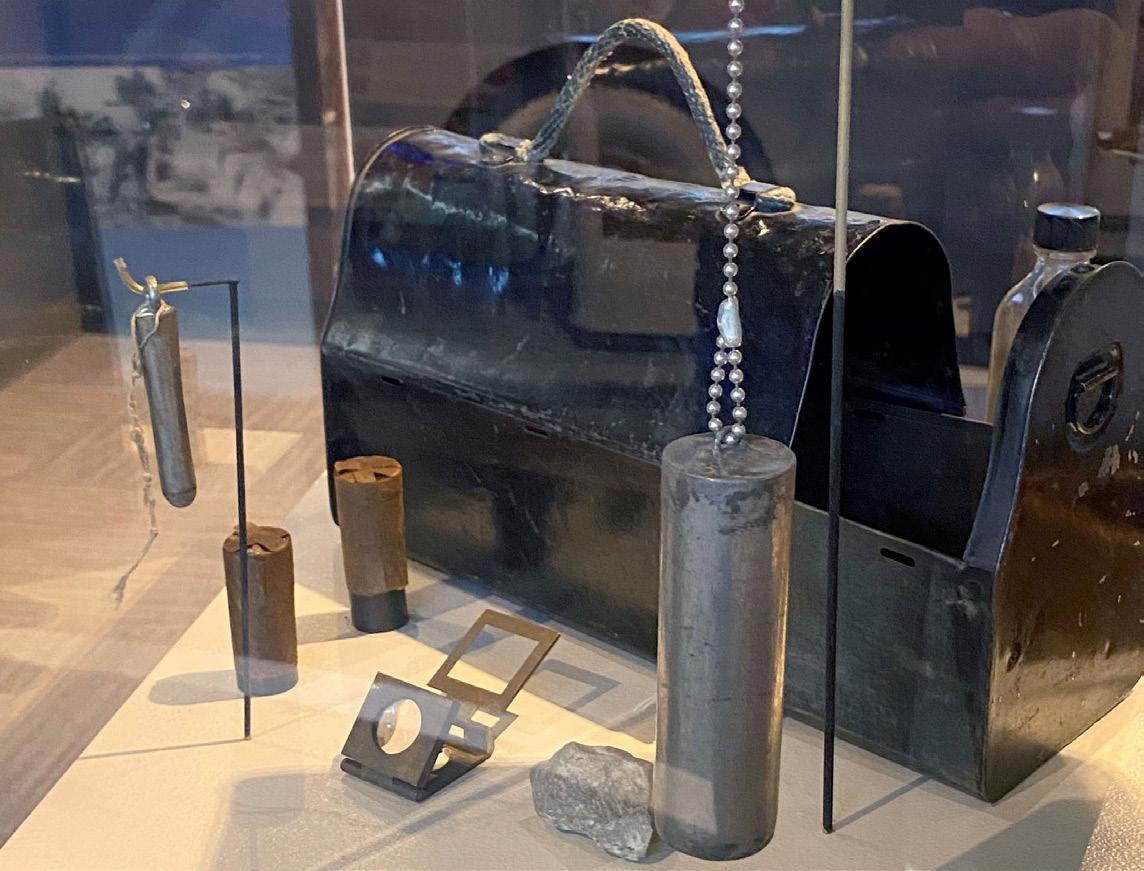
James M. Young’s doodlebug kit (photo provided by the author).
even more impressed when thirteen of his sixteen hired doodlebuggers agreed with Young’s positive assessment of the area. At considerable effort during the first half of 1942, the oilman blocked some nine thousand acres of leases straddling the eastern Canadian County line ten miles west of Edmond.24
Owing to a lack of geological and geophysical evidence, reputable petroleum geologists dismissed Gutowsky’s gamble. Yet he remained convinced of the area’s potential for oil. Desperate for money to fund an exploratory well, the destitute Gutowsky turned to San Antonio real-estate developer D. D. Bourland to join him as an operating partner on the first well, ceding to Bourland some of the leases in his large block. Still needing capital, the two made a trip to Chicago and convinced businessmen William J. Fox and Herbert Schmits to invest in their venture. For their funding, Fox and Schmits received a half interest on the considerable acreage Gutowsky had leased.25
The location of the exploratory well, the No. 1 Wagner, would be just southeast of the intersection of Edmond Road and Council Road on land owned by farmer Lem Wagner and adjacent to one of James Young’s farms. Young’s own land was not chosen for the initial test as the Edmond farmer said he did not want to appear too self-interested. State newspapers reported that the well site had been “made on the strength of a spiritualistic basis.” With Gutowsky stating in a letter to the Tulsa World that orthodox methods had been used, but added that while he “would not disdain their (spirits) assistance were they able to render it, the spirits had nothing to do with my well location.”26
At one time, the area had been heavily leased by major oil companies, but in recent years, most of those leases had been dropped, with many picked up by Gutowsky in 1942. After the September completion of the derrick, the oilman revealed just how rank the wildcat was. “There‘s not a thin dime of major company money in this deal,” he said. “I tried to get a few of them to support the well, but somehow they were either just out of cash or couldn‘t see the prospect.”27
Just before Christmas 1942, tools were moving for the test well in the Wilcox sand zone with Kerr-McGee and Company contracted to drill to an expected depth of 7,500 feet. Kerlyn Oil Company took four eighty-acre leases from Gutowsky’s nine-thousand-acre block. MidContinent Oil purchased three-quarter sections in this same block. The well was spudded in on January 2.28 By mid-January, the No. 1 Wagner
THE CHRONICLES OF OKLAHOMA
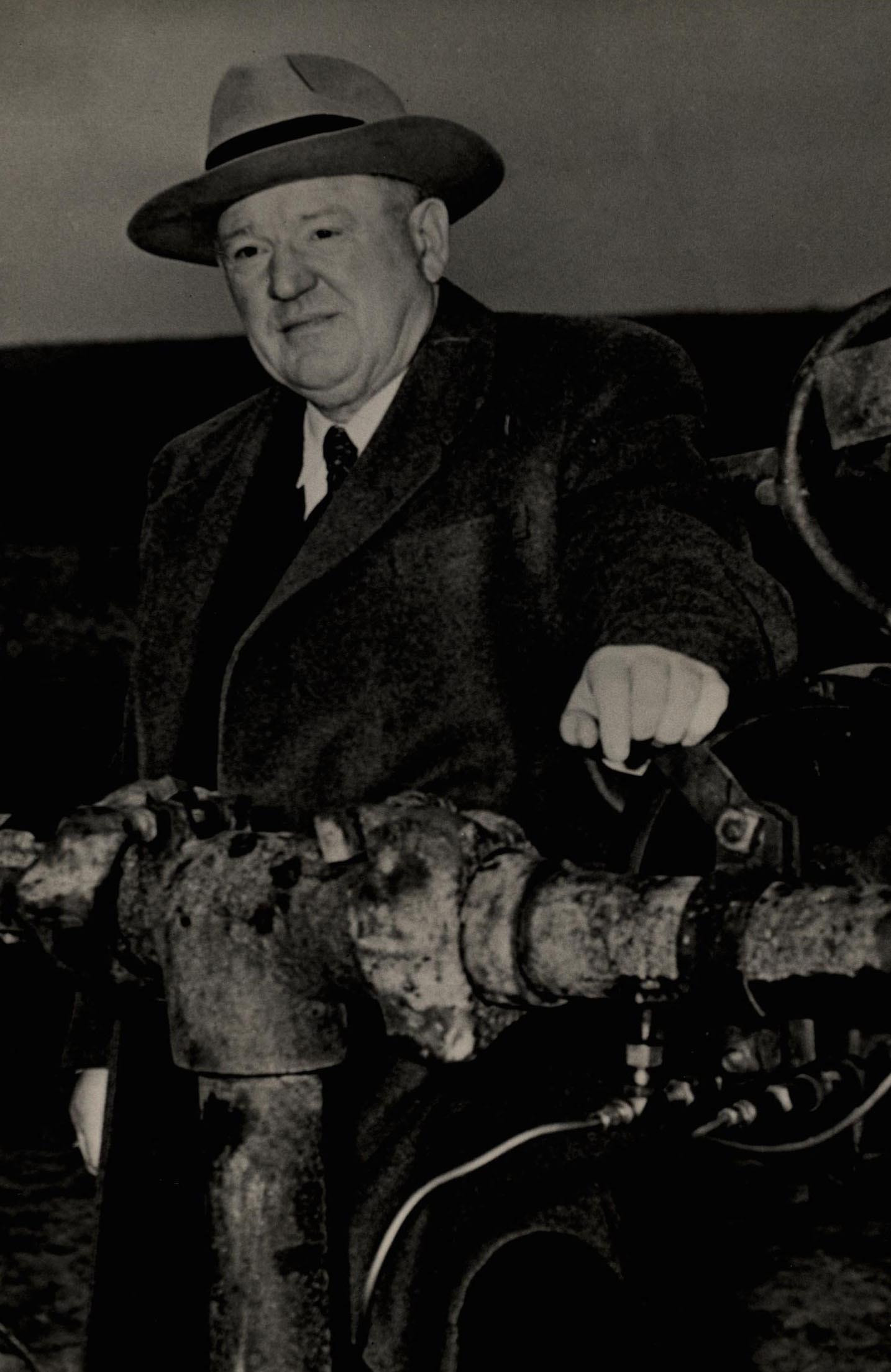
328 Ace Gutowsky, 1949 (2012.201.B0276B.0241, Oklahoma Publishing Company Photography Collection, OHS).
was at a depth of four thousand feet, and interest in Gutowsky’s leases grew. Skelly Oil purchased 160 acres of leases from his large block, and by March, Magnolia Petroleum and Sunray Oil had purchased some of Gutowsky‘s leases. The wildcat reached the Hunton lime zone at 6,877 feet and Sylvan shale at 7,235 feet. Drilling was stopped at 7,600 feet on March 18 while the Schlumberger oilfield services company conducted testing. The well was plugged back and pipe set at 7,100 feet for testing. The Schlumberger survey showed saturation, and the operators started looking for casing the last week of March.29 Monday morning, April 5, the casing was perforated at 6,950 feet in the Hunton lime zone. Oil flowed to the top of the derrick for about three minutes. Estimates on the size of the well ranged from fifty to seventy barrels per hour, with gas as high as five million cubic feet per day. Testing was delayed until tanks could be installed. It appeared Gutowsky just might have a discovery well for a new oil field.30
After spring rains delayed testing, the first clear indication of the well’s potential was not available for a week. On April 13, the well tallied head flows of 365 barrels in twelve hours after additional perforations. Continued improvements soon brought oil flow up to 719 barrels in a twenty-four-hour period. Champlin Refining Company began buying the oil and started construction of a six-mile pipeline.31
Still, even with longtime Daily Oklahoman oil journalist Claude V. Barrow calling the No. 1 Wagner “Oklahoma‘s most sensational discovery well in many moons,” initial trading and pricing in Gutowsky‘s large block of leases lagged behind expectations. The doodlebug geology credited with the strike may have tamped down excitement. After the Wagner well came in, it was reported that prominent geologists checked their earlier assessments and determined that their only error was not drilling the well or supporting Gutowsky. Some companies were waiting to see if the Hunton lime zone would “poop out” and if the discovery well might be only on the edge of the structure.32
Two more well locations were staked by the end of April—the No. 1 Young east of the Wagner well and the No. 1 Ringer to the west. After those two wells hit oil, operators in the new West Edmond Field were stretching in all directions by late summer. When the No. 3 Wagner, a south offset to the discovery well, blew wild in November, the new oil pool took on the look of a major field. In December, Gutowsky struck oil again with his own No. 1 Watson well northeast of Piedmont,
THE CHRONICLES OF OKLAHOMA
extending development of the West Edmond Field well past the Canadian County line.33
Two weeks before Christmas 1943, Gutowsky celebrated his newfound success with a party at his new suite of offices on the seventeenth floor of the First National Building in downtown Oklahoma City. A cross section of Oklahoma‘s oil industry was represented at the gathering, from oil blue bloods like H. H. Wegener to scruffy tool pushers Gutowsky had sweated with at sunbaked well sites. True to form, he entertained the crowd with his heavily accented, colorful speech, quipping that on the seventeenth floor he was now “high enough up I don‘t hafter breath [sic] the dust off the streets any more.”34
The discovery of oil must have been a delicious occasion for the once-desperate immigrant, former struggling farmer, and aspiring oilman. His energy, daring, perseverance, and luck was finally giving him the payday every wildcatter in Oklahoma dreamed of. He waxed philosophical at his celebration, remembering his Ukrainian roots and speaking with his heavy German accent: “Vy the people of Russia vould cry their eyes out for a chance to do what I and thousands of others have seen in America.” He obligingly recognized some at his party, singling out oilman Wegener: “Every time I get into trouble and need some money or anything, I just go to Herman.”35
As 1943 came to a close, eleven large wells were producing in the Hunton limestone in the West Edmond Field, and dozens of new wells were being staked. The field‘s development had been slow, but another oil boom was on in Oklahoma. By summer 1944, the West Edmond Field‘s 102 producing wells were spread over twenty-seven square miles, running mostly south to north from northwest Oklahoma County to southwestern Logan County. All this was achieved with only six dry holes. Eighty-eight more wells were drilled at year-end, and 150 locations in proved areas were awaiting drilling rigs.36
Military planners were pleased with Oklahoma’s oil boom, and the entire nation took note. The August 1944 issue of Time magazine featured an article entitled “West Edmond‘s Hour of Glory,” declaring that the oil field boasted the “greatest concentration of rotary drilling rigs in the world,” biting into the Oklahoma soil. The area‘s frenzied activity was generating a $500,000 monthly payroll and a major housing shortage. The article featured a photo of “wildcatter Gutowsky,” crediting the Oklahoman as “the man who started it all.” The article noted that
330
ten “major oil companies—including some that had rejected the field— were drilling furiously in the field he found, almost all under leases acquired from Gutowsky at high prices.”37
The West Edmond Field‘s 7,752,000 barrels in 1944 helped reverse the downward trend of Oklahoma‘s oil production since 1937. Output from the field soared in 1945, reaching a peak of 87,500 barrels per day in September 1945 just as the war ended. With an annual increase of 16 million barrels, Oklahoma would place third in oil production among U.S. states in 1945. The West Edmond Field made all this possible and greatly enhanced the state‘s contribution to the defeat of the Axis powers.38
By September 1946, the field‘s 731 producing wells had yielded a cumulative production in excess of fifty-three million barrels. Owned entirely by Philips Petroleum by July 1947, the field was unitized by the Oklahoma Corporation Commission, thereby forming the West Edmond Hunton Lime Unit. By January 1967, cumulative production from the 754 wells in the Hunton lime zone of the West Edmond Field had reached more than 106 million barrels of oil. Gutowsky‘s discovery well had led to Oklahoma‘s most significant oil discovery since the Oklahoma City Field in 1928.39
Gutowsky obviously relished his new life on the seventeenth floor, wheeling and dealing his holdings in the West Edmond Field. He took a few bows as an in-demand speaker at area luncheons and invested some of his recent earnings in purchasing a 387-acre improved farm three miles northeast of Kingfisher. But now that he had some winnings to gamble, he soon resumed wildcatting across the state. As the West Edmond Field continued to make headlines throughout 1944, Gutowsky‘s wildcatting also made some news. Yet he found nothing even close to his big score west of Edmond, and many of the news stories noted his latest exploration disappointments.40
After surviving a near-fatal heart attack early in 1945 in Hollywood, California, the oilman turned to a much different life outside Oklahoma. He purchased 1,200 acres of farmland and citrus fields in the Rio Grande Valley just north of McAllen, Texas. Sinking a half million dollars of his oil earnings into land and equipment, he considered this investment a better bet than an oil well. “Oil wells die in time,” he said in early May from McAllen‘s swank Casa de Palmas Hotel, “but citrus goes on growing.” The new citrus farmer was overseeing his new holdings
THE CHRONICLES OF OKLAHOMA
Time magazine issue featuring the West Edmond Oil Fields, 1944 (Image courtesy of Time/The
Vault).
from the prestigious hotel, where he and his wife entertained former Oklahoma Governor Ed Trapp, a visitor to the area.41
As peripatetic as in his wildcatting years, “Uncle Ace,” as some in the Oklahoma media began to characterize him, bided his time between south Texas, his old house in Oklahoma City, and speaking engagements in and outside Oklahoma. By 1947, as the Cold War heated up and the Soviet Union threatened world peace, Gutowsky became an anti-communist spokesman. “You don‘t know the inside of Russia,” he told a large congregation at a church in Springfield, Missouri, “It‘s worse than ever in history. . . . And there never will be peace until we get rid of Stalin and his gang. Stalin is worse than Hitler. Hitler killed the Jews, and Stalin kills everybody.”42
In addition to his large citrus fields, the revitalized farmer planted seven hundred acres of cotton and three hundred acres of black-eyed peas on his south Texas farmlands in 1947. Decrying the low prices for farm produce in the United States at the time, the outspoken Gutowsky felt obliged to bring this to the attention of President Harry Truman. “I was compelled to plow [three hundred acres of black-eyed peas] under, as I was not able to sell the vegetables at any price whatever,” he wrote to the president. “Therefore . . . it seems to me that this is inexcusable and unexplainable, while hundreds of thousands of men, women and children of Europe are crying for the most meager necessities of life.”43
Gutowsky and his wife planted their roots even deeper in south Texas by purchasing a large house in a subdivision adjacent to McAllen. The $42,500 house had been the residence of twenty-seven-yearold US Representative Lloyd Bentsen Jr., who would be the vice-presidential running mate of Governor Michael Dukakis in 1988. Some of the citrus fields previously purchased by Gutowsky had once been a part of the holdings of the Bentsen family, pioneer citrus growers in Hidalgo County.44
Planting almost 13,000 grapefruit and orange trees in the winter of 1948–49, it appeared the aging Texas citrus grower was content with his fruit farms. But the siren song of wildcatting proved too much. Early in 1950, while visiting Oklahoma City, he announced that his hired doodlebuggers had located several promising structures in southwest Texas. He planned ten wildcats that year alone. Uncle Ace was back in the oil business.45 His wells in Brown, Mills, and Motley counties in
THE CHRONICLES OF
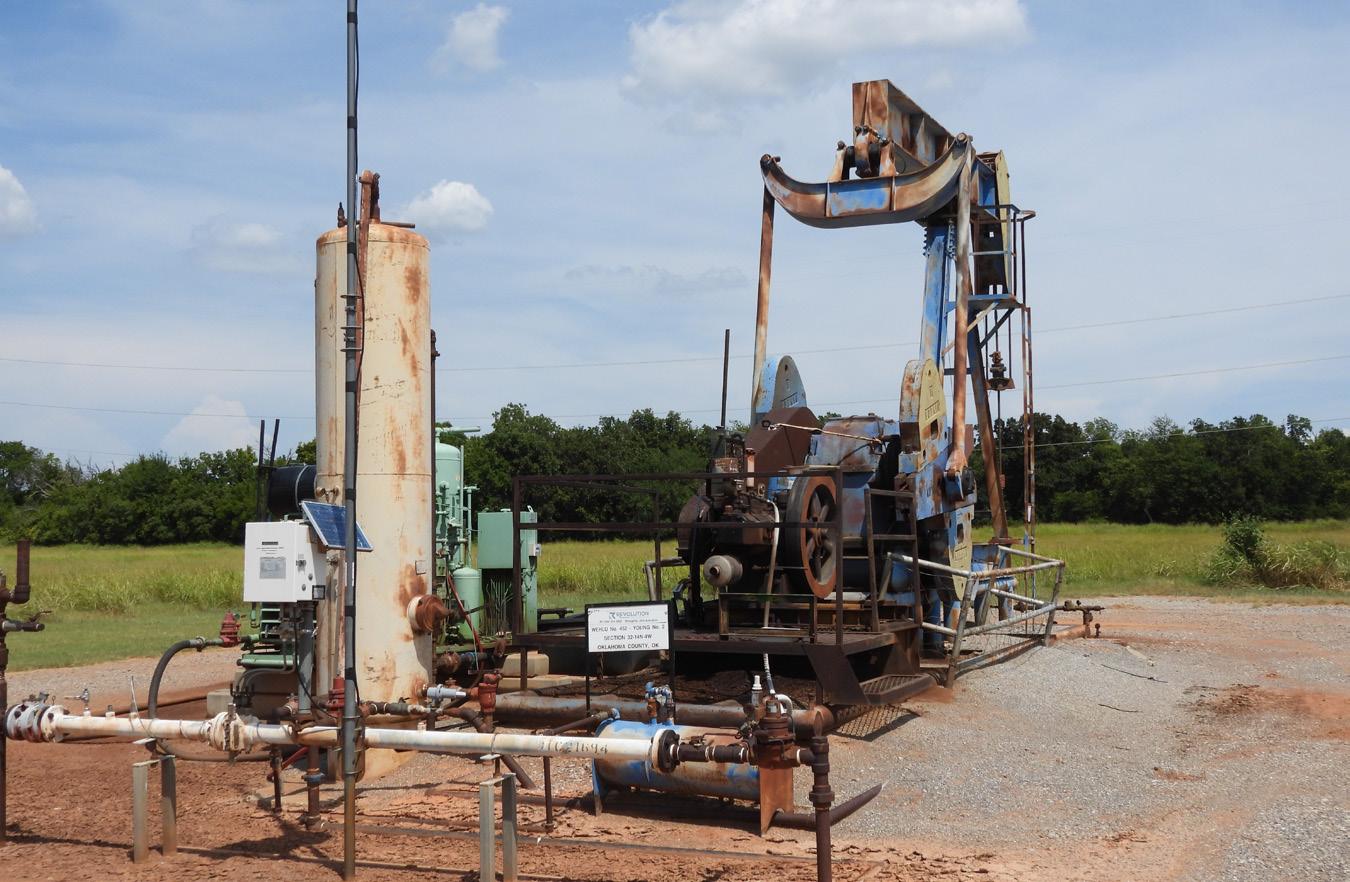
Texas had come to little before it became moot. Gutowsky was pronounced dead from a heart attack at Oklahoma City‘s Mercy Hospital while visiting with his wife in early April 1951. A number of news stories announcing his death pointed out that he had come to America with three pennies in his pocket, but left after making millions in the oil business.46
For over sixty years after Gutowsky‘s passing, his name was largely a footnote in the Oklahoma oil industry. In June 2014, the Edmond Parks Foundation unveiled its latest public artwork, West Edmond Oil Field, recognizing Gutowsky for his contribution. Displayed near the YMCA facility in Edmond‘s Mitch Park, the artwork includes a life-sized metal sculpture of two oilfield workers beneath a derrick and a marquee sign explaining Gutowsky‘s role in the oil strike and the importance of the field to Edmond‘s economic development and the wartime needs of the nation.
Young #2 well on farmland owned by Edmond pioneer farmer James M. Young, 2025 (photo provided by the author).
Endnotes
* Larry C. Floyd taught US history at OSU-OKC for twelve years and is a coauthor of Oklahoma Hiking Trails (University of Oklahoma Press, 2010), Stalking the Great Killer (University of Oklahoma Press, 2023), and Waiting for America (Turnkey Communications, 2024).
The photograph on page 319 is of the public artwork in Edmond’s Mitch Park commemorating the West Edmond Field (photo provided by author).
1 David M. Kennedy, Freedom from Fear: The American People in Depression and War, 1929-1945 (Oxford University Press, 2005) 601, 615.
2 Daniel Yergin, The Prize: The Epic Quest for Oil, Money, and Power (Free Press, 1991) 379; “Oil: West Edmond‘s Hour of Glory,” Time, Aug. 21, 1944, 87—8.
3 “West Edmond‘s Hour of Glory.”
4 “West Edmond‘s Hour of Glory.”
5 U.S. World War I Draft Registration Card for Assaph Gutowsky, June 5, 1917, Kingfisher, Oklahoma; “Gutowsky Tells Story of Escape,” Altus-Democrat, May 13, 1937, 1; “Gutowsky, Oklahoma Oil Operator Dies,” Fort Worth Star-Telegram, April 5, 1951, 45.
6 “Gutowsky Tells Story of Escape.”; “Ocean of Crude Is Discovered by Ace Gutowsky,” March 25, 1944, Oklahoma and Texas Oil News, 1; “Gleanings from Komalty,” Hobart Republican, Dec. 3, 1908, 8.
7 Charles Goins and Danny Gobles, Historical Atlas of Oklahoma 4th ed. (University of Oklahoma Press, 2006), 140–1; “Gleanings from Komalty,” Hobart Republican, Nov. 19, 1908, 7.
8 “Gleanings from Komalty,” Hobart Republican, 7; “Public Sale,” Hobart Republican, Nov. 3, 1910, 7; “Big Cotton Crop,” Daily Midget (Kingfisher, Oklahoma), Oct. 30, 1912, 1–2.
9 “‘Ace‘—He Who Laughs Last,” First National Building newsletter, fall 1943, 5.
10 “Local Citizens Organize Oil Co.,” Kingfisher Times, Jan. 24, 1918, 1.
11 “‘Ace‘—He Who Laughs Last.”; “Wildcat Opens New Pool Near Lawton,” Daily Oklahoman, Feb. 27, 1921, 18; “Five New Tests in Kingfisher Planned,” Daily Oklahoman, March 15, 1924, 11; “Drilling Is Started in Kingfisher Test,” Daily Oklahoman, Sept. 10, 1924, 9.
12 “Drilling Resumed in Kingfisher Wildcat,” Kingfisher Times, March 5, 1925, 3; Claude V. Barrow, “The Slush Pit,” Daily Oklahoman, Dec. 10, 1943, 16.
13 “New Homes Are Great Asset to Resident Dist.,” Kingfisher Times, Nov. 15, 1928, 1; “Gutowsky for Commissioner,” Kingfisher Times, March 14, 1929, 1; “Gutowsky, Bug Product, Stars in Pro League,” Campus of Oklahoma City University,” Dec. 6, 1935, 4.
14 “Mrs. Scott Is Still in Bad Condition After Crash,” Kingfisher Times, Oct. 31, 1929, 1; “Mrs. Ace Gutowsky,” Kingfisher Times, Oct. 26, 1933, 1.
15 “New Cases in District Court,” Kingfisher Free Press, May 31, 1934, 6; Kenny A. Franks, The Oklahoma Petroleum Industry (University of Oklahoma Press, 1980) 183; “Capital Couple Married Here,” Bartlesville Examiner-Enterprise, May 3, 1934, 10.
16 “Ace Gustowsky No. 1 Grid Man in Nation,” Kingfisher Times, Dec. 10, 1936, 1; “Gutowsky, Bug Product, Stars in Pro League.”
17 “Gutowsky Has Jackson Area Wildcat Lead,” Daily Oklahoman, Aug. 3, 1937, 9; “Gutowsky Tells Story of Escape,” Altus-Democrat, May 13, 1937, 1-2.
THE CHRONICLES OF OKLAHOMA
18 “Pit Completed for Deep Test in Banner Township—Drilling Operation to Begin Soon,” Hennessey Clipper, Nov. 3, 1938, 1; “Gutowsky Oil Test May Be Deepened,” Kingfisher Free Press, May 22, 1939, 1.
19 “West Arkansas Gets a Wildcat,” Tulsa World, March 16, 1941, 16; “Gutowsky Starts Arkansas Outpost,” Daily Oklahoman, Nov. 11, 1941, 17.
20 “New Cases, Civil,” Daily Law Journal-Record, Jan. 9, 1942, 1; “Gutowsky to Drill Oklahoma-Co. Test,” Kingfisher Free Press, Aug. 31, 1942.
21 “Messer Oil Test Opens Edmond Oil Pool,” Edmond Enterprise, Sept. 11, 1930, 1; “Here Is No. One Messer, Our Own 1,000 Barrel Oil Well,” Edmond Booster, Dec. 3, 1931; “New Play Starts in Edmond Oil Field As Pure Starts,” Edmond Booster, Aug. 21, 1942, 1.
22 “Services for James M. Young, Pioneer Resident, Set Wednesday,” Edmond Enterprise, June 18, 1957, 1; Dan Plazak, Doodlebugs and Dowsers (Texas Tech University Press, 2023), 200–1.
23 Plazak, Doodlebugs and Dowsers, 201–2.
24 “Okay, Laugh at Doodle Bug! Laugh at West Edmond, Too!” Daily Oklahoman, July 23, 1944, 18; Plazak, Doodlebugs and Dowsers, 204; “Wildcat Flows Over Derrick on First Test,” Daily Oklahoman, April 6, 1943, 12.
25 Bobby Weaver, “West Edmond Field,” The Encyclopedia of Oklahoma History and Culture; “Ace Gutowsky: Deeper Than the Bug in the West Edmond Field,” Edmond Sun, Nov. 13, 1962, 5.
26 “Okay, Laugh at Doodle Bug! Laugh at West Edmond, Too!” Daily Oklahoman, July 23, 1944, 18; “Spiritualistic Basis Denied by Gutowsky,” Tulsa World, Sept. 4, 1942, 24.
27 “Okay, Laugh at Doodle Bug!”; “Contract Signed for Wilcox Sand Test West of Edmond,” Daily Oklahoman, Dec. 20, 1942.
28 “To Test Wilcox Sand West of Edmond Soon,” Edmond Sun, Dec. 24, 1942, 6; Carl C. Rister, Oil! Titan of the Southwest (University of Oklahoma Press, 1949) 341.
29 “Skelly Oil Buys Gutowsky Lease,” Daily Oklahoman, Jan. 17, 1943; “Edmond Wildcat Is Seeking Sand,” Daily Oklahoman, March 20, 1943; “Edmond Discovery Results in Intensive Buying of Leases,” Tulsa Tribune, April 6, 1943, 18.
30 “Wildcat Flows Over Derrick on First Test,” Daily Oklahoman, April 6, 1943, 12.
31 “Waits New Test,” Daily Oklahoman, April 7, 1943, 17; “Gutowsky Well Flowed 365 Barrels in 12 Hours by Heads,” Daily Oklahoman, April 14, 1943, 18; Claude V. Barrow, “West Edmond Well Is Best Hit This Year,” Daily Oklahoman, April 18, 1943, 48.
32 Barrow, “West Edmond Well Is Best Hit This Year,” 48.
33 “West Edmond Pool,” Daily Oklahoman, April 25, 1943, 38; “West Edmond Play Spreads on All Sides,” Daily Oklahoman, Oct. 26, 1943, 16; “Edmond Well Blows Wild,” Daily Oklahoman, Nov. 23, 1943, 11; “Crews Bailing Oil Today at Piedmont Well,” El Reno Daily Tribune, Dec. 1, 1943, 1.
34 Claude V. Barrow, “The Slush Pit,” Daily Oklahoman, Dec. 10, 1943, 16.
35 Barrow, “The Slush Pit.”
36 Rister, Oil! Titan of the Southwest, 341-2; “West Edmond‘s Hour of Glory,” Time, Aug. 21, 1944, 86.
37 “West Edmond‘s Hour of Glory,” Time, 87-8.
38 Rister, Oil! Titan of the Southwest, 342; Braydn Johnson, “Petrophysical Study of the West Edmond Field, in Parts of Oklahoma, Canadian, Kingfisher and Logan
Counties, Oklahoma,” fulfillment of degree of master of science, May 2009, Graduate College of Oklahoma State University, 33.
39 Johnson, “Petrophysical Study of the West Edmond Field,” 33; Galen W. Miller, “The History of the WEHLU (West Edmond Hunton Lime Unit) Play from Conventional to Unconventional,” report adapted from oral presentation given at 2017 AAPG DPA MidContinent Playmakers Forum, Okla. City, Okla., May 2017.
40 “Gutowsky Is Club Speaker,” El Reno Daily Tribune, Feb. 16, 1944, 1; Barrow, “The Slush Pit.”; “The Doodle Bug Didn‘t Work in Grady County,” Chickasha Star, Juy 20, 1944, 1; “Hole Is Lost At Third Test Near Helena,” Daily Oklahoman, Jan. 21, 1945, 24.
41 “Oklahoma Oil Nabob Turn to Citrus,” Daily Oklahoman, May 5, 1946, 1.
42 “Devil Running Godless Russia, Baptists Told,” Springfield News-Leader, May 26, 1947, 5; “Running Tour,” Daily Oklahoman, May 27, 1947, 18.
43 “Man Ponders Food Scarcity, Surplus Crop,” Daily Oklahoman, Oct. 21, 1947, 2.
44 “Bentsens Sell McAllen Home,” The (McAllen, Texas) Monitor, Dec. 23, 1948, 1.
45 Barrow, “The Slush Pit,” 22.
46 “Gutowsky Quits Motley Wildcat,” Lubbock Morning Avalanche, Dec. 15, 1950, 33; “Ace Gutowsky, Finder of West Edmond, Dies,” Daily Oklahoman, April 5, 1951, 6; “Pennies Multiply Into Millions,” Sedalia (Mo.) Weekly Democrat, April 6, 1951, 4.
THE CHRONICLES OF OKLAHOMA
Book Reviews
BRIBED WITH OUR OWN MONEY: FEDERAL ABUSE OF AMERICAN INDIANS FUNDS IN THE TERMINATION ERA. By David R. M. Beck (University of Nebraska Press, 2024. Pp. ix. 225. $60.00 cloth, ebook).
Beck delivers a scathing indictment of Congress and the Indian Bureau that, if possible, casts an even more unfavorable light on the already draconian federal policy of termination. As the book’s name implies, tribes from across the country slated to have their federal trust status withdrawn by the US government (usually under the guise of “freedom” or “emancipation”) were forced to acquiesce to yet another ill-conceived Indian-policy-of-the-month or risk having their tribal monies frozen in the US Treasury for an uncertain duration. Beck seeks to discover how widespread this tactic was and trace its historical antecedents to previous federal Indian policies. He does so by examining six tribes subjected to bribery, three of which the government succeeded in terminating (the Menominee, the Klamath, and the Uintah and Ouray Utes) and three of which escaped the odious policy (the Three Affiliated Tribes of North Dakota, the Seneca of New York, and the Confederated Tribes of the Colville Reservation). The author groups the tribes together thematically based on the source of their funds that the federal government held in abeyance until they agreed to termination directives. For the Menominee and Klamath, it was federally mismanaged timber resources. For the Three Affiliated Tribes and Seneca, it was reservation lands inundated by dam construction. For the Uintah and Ouray Utes and Confederated Colville, it was judgment money from land claims.
The book’s first two chapters examine how the US government, since the treaty-making era, has used tribal monies as leverage to enact policy goals that often conflicted with both the best interests and expressed desires of Native nations. Federal and state officials, for
example, attempted to withhold interest income earned on Menominee ceded lands from an 1836 treaty to force the tribe to leave Wisconsin entirely and relocate to a reservation in Minnesota. Several tribes, including the Chickasaws in 1838, had to pay a portion of the cost for their forced removal from ancestral homelands. Once tribes were settled on reservations, agency expenses ranging from the salaries of Indian Bureau personnel to school buildings were often borne by Natives themselves (in violation of treaty stipulations and against the wishes of Indigenous peoples). This long history of federal abuse of tribal funds and resources, Beck notes, allowed Native leaders to identify immediately the inherent dangers of termination and work toward defeating the myriad tactics utilized by BIA and congressional bureaucrats to foist the policy upon them. Unfortunately, as the author spends the remainder of the volume detailing unique circumstances within tribal communities made it easier to sell termination to some Native nations than to others. Even when tribes adamantly opposed the severing of political ties with the federal government, duplicitous politicians and Indian Bureau personnel were not above passing termination bills anyway, equating the process of consulting with Indian communities as analogous to receiving said population’s consent.
The experiences of the Menominee Tribe of Wisconsin on its road to termination, described in chapter four, are similar to those that played out on the other five reservations covered in the book, save for the differing levels of coercion utilized by federal powers to bring about the stated goal of ending Indigenous polities in the US. The three part process played out in the same manner: the government grossly underpaid Natives for the value of their lands or mismanaged their resources; tribes sued the US and won large judgments that required Congressional approval in order to be disbursed; and federal bureaucrats made release of the funds contingent upon agreeing to immediate termination or the drafting of a plan to submit to termination at a future date (typically three to seven years). In the case of the Menominee, both the Indian Bureau and the USDA Forest Service badly mismanaged tribal timber resources and misspent tribal funds in violation of the 1908 LaFollette Act. After the tribe successfully sued the federal government and received an $8.5 million award in 1951, it petitioned Congress to issue a per capita payment of $1,500 to each Menominee citizen. Legislators agreed—so long as the checks were coupled with
THE CHRONICLES OF OKLAHOMA
a termination bill. When tribal members voted unanimously in support of the per capita payments, they inadvertently voted for a termination resolution, which was presented at a tribal meeting by none other than termination godfather Senator Arthur Watkins of Utah. Through a combination of bureaucratic sleight of hand and imperfect English-to-Menominee translation at the consultation with Watkins, the Menominee had the dubious honor of becoming one of the first tribes to be terminated in 1961.
While some of the six tribal case studies included in this volume will be familiar to those familiar with US Indian policy, by analyzing the methodology used to implement federal termination policy, Beck contributes significantly to our understanding not only of the power dynamics between Indigenous peoples and colonial authorities, but also of how some tribal nations blessed with abundant natural resources have been unable to break the cycle of generational poverty on their reservations. According to the author, the root of the latter problem lies in the government’s misinterpretation of its role as trustee to Indian nations. For most of its history, America has pursued its own policy goals at the expense of Native lives and resources. Relegated to this subordinate position, Indigenous peoples have suffered many of the ills and few of the benefits of economic development in the regions in which they inhabit. Only when tribes have been allowed greater control over their resources under federal trust protection (not freed from it) have they begun to flourish.
Joshua Clough University of Oklahoma Norman, Oklahoma
PATH LIT BY LIGHTNING: THE LIFE OF JIM
THORPE. By David Maraniss (Simon and Schuster, 2022. Pp. 659. $21.99 paper, ebook).
On May 3, 2024, President Joe Biden posthumously awarded James Francis Thorpe (Wa-tho-Huk) the Presidential Medal of Freedom for his achievements as a multi-sport athlete. Two years earlier, on July 10, 2022, the International Olympic Committee formally recognized Thorpe as the sole winner of the decathlon and pentathlon events at
the 1912 Summer Olympics in Stockholm, Sweden. Such recognition is long overdue. As David Maraniss shows in this best-selling biography, acknowledgement of Thorpe’s athletic prowess was juxtaposed by recurring injustices.
Maraniss admits that he is interested in the myths shrouding Thorpe’s accomplishments as much as he is in Thorpe the man. Thorpe is a quintessential example of Native persistence amid an era of racist policies that sought to destroy Native cultures, with Maraniss writing at one point, “At times he resisted. At times, he suffered. At times he thrived. And he survived” (p. 567). To that end, much of this biography assesses Thorpe’s limited options and choices amid individuals and institutions who sought to control him.
Carlisle Indian Industrial School, specifically football and track coach Glen Scobey “Pop” Warner, figures prominently. Thorpe attended Carlisle intermittently between 1904 and 1913. While the school’s role in destroying Native identities and cultural practices is well known, general readers may be surprised to learn the extent to which Carlisle embraced athletics (amateur and professional) to solicit funds and expand its reputation. Maraniss argues that Coach Warner and school officials knew that Thorpe had been paid to play minor league baseball prior to the 1912 Summer Olympics, violating his status as an amateur athlete, by having granted him leave from Carlisle to do so in the first place. Nor did they criticize how sportswriters employed racist stereotypes when chronicling and embellishing the achievements of Carlisle’s athletes. This discussion will remind readers not only of the flaws inherent within the American assimilationist project but also of the pernicious effects of corruption in college athletics.
Thorpe’s extended and immediate families figure prominently in this biography, which is fitting given their important role in promoting and preserving his legacy. A citizen of the Sac and Fox Nation, Thorpe married three times and had eight children. The narrative is enriched by private letters, oral histories, and public interviews that depict Thorpe’s efforts to provide for his family while struggling with alcoholism, injuries, and a lack of financial security. At one point, Maraniss labels Thorpe an “athletic migrant worker” forced to move from one team to the next in search of an adequate paycheck (p. 371). Thorpe moved to southern California to work in construction and as a film extra after his playing career, and family members remained committed to
THE CHRONICLES OF OKLAHOMA
promoting him as the world’s preeminent athlete after his death on March 28, 1953. Such work was not without strife, however, as seen in Patricia “Patsy” Thorpe’s efforts to bury her husband in the renamed town of Jim Thorpe, Pennsylvania, over the objections of his sons, who insisted that their father be buried in his native Oklahoma.
This biography is engaging and well-written. It should appeal to readers who wish to learn more about an extraordinary athlete who strove to maintain his identity in the face of those who took advantage of his immense talent.
Matthew Pearce
Oklahoma
Historical Society
Oklahoma City, Oklahoma
BY THE FIRE WE CARRY: THE GENERATIONS-LONG FIGHT FOR JUSTICE ON NATIVE LAND. By Rebecca Nagle (HarperCollins, 2024. Pp. 352. $32.00 cloth, ebook).
Half of Oklahoma has always been reservation land. The US Supreme Court ruled as much in McGirt v. Oklahoma (2020). The remarkable decision recognized a legal reality that the state had long ignored: Congress never terminated the Muscogee (Creek) Nation. Regardless, Oklahoma had policed the Nation since 1907, as though reservation boundaries no longer existed and treaties no longer applied. McGirt means that the period in Oklahoma history known as “statehood” can be understood as a century of illegal encroachment on Native land. Rebecca Nagle’s By the Fire We Carry chronicles how the forerunner to McGirt, Sharp v. Murphy, became a landmark case in federal Indian law that affirmed not only the Muscogee (Creek) Nation’s reservation, but also the enduring land bases of the Seminole, Cherokee, Chickasaw, and Choctaw Nations.
In 2000, the state of Oklahoma sentenced Muscogee (Creek) citizen Patrick Murphy to death for the brutal murder of another citizen, George Jacobs, on state land. But when public defender Lisa McCalmont reviewed the case, she found that the murder took place over a mile away from where the prosecutor had stated—on a tract where a Muscogee (Creek) family owned mineral rights. If the land was Indian
Country, a phrase that Nagle uses with respect to its legal denotation, then the state might not have authority to prosecute Murphy. The defense decided to make a bold argument. This land was still a reservation.
The book situates Sharp v. Murphy in a long history of injustice. Nagle aims to “catalog the cruelty” that remained unspoken during court proceedings (p. 4). Nagle traces this cruelty back to US law—to the way states engineered it, Presidents defied it, and grafters worked around it, all to thieve as much land from Indigenous Americans as possible. This process was acute in Oklahoma. Nagle avoids telling a story that ends with plunder. As her subtitle suggests, By the Fire We Carry narrates the Five Tribes’ unfinished fight for justice. Only this generations-long history can reveal McGirt’s profound implications.
Two centuries before, the US Supreme Court ruled that Georgia had violated “the supreme law of the land” under the Constitution (p. 76). The state had flouted treaties between the US and the Cherokee Nation when it enacted laws designed to wrest territory from Cherokee citizens. Worcester v. Georgia (1832) described tribal nations as “the undisputed possessors of the soil, from time immemorial (p. 76).” In other words, Georgia had no authority to remove Cherokee citizens from their land. The decision would become foundational to federal Indian law—and key in McGirt. It cemented a nation-to-nation relationship. Only Congress, not state governments, can broker agreements with tribal nations.
A citizen of the Cherokee Nation, Nagle grapples with the legacies of her great-great-great-grandfather, John Ridge, and his father, ᎦᏅᏓᏞᎩ, or Major Ridge. They signed a “wholly undemocratic and illegal” treaty that ceded Cherokee homelands (p. 105). Nagle interprets their action as a “betrayal”—but one that sought to protect Cherokee futurity. John Ridge and ᎦᏅᏓᏞᎩ believed that “Removal . . . was the only option in which Cherokees, as a people and a nation, would survive” (p. 96).
Removal treaties promised each of the Five Tribes that land in Indian Territory would belong to them in perpetuity. Yet federal policy sought to open reservations to settlers. In the late nineteenth century, Congress broke up tribal nations’ communal lands and allotted them to individuals. Nagle describes a vast network of corruption by focusing on one Muscogee (Creek) citizen. Millie Naharkey’s story concludes not with the guardian who leased her oil-rich land and pocketed the rent,
THE CHRONICLES OF OKLAHOMA
the grafters who kidnapped and assaulted her, the judge who found that she went with the men “willingly”—but with Naharkey’s granddaughter and the tribal citizens today who fight to retain their land for future generations (p. 174).
By the Fire We Carry argues that contemporary cases in federal Indian law must be viewed in the context of American colonialism. McGirt does not demonstrate that justice for Indigenous nations is inevitable, Nagle cautions—only that “in our democracy, it is possible” (p. 225). Even rampant land theft cannot erase a reservation. Indeed, tribal sovereignty is far more durable than many have assumed.1 This case calls on historians to question narratives that only document destruction. We must attend, as Nagle skillfully does, to the generations of tribal citizens who strategized against dispossession and pursued autonomy.
Grace Ellis
Yale College New Haven, Connecticut
1 On McGirt v. Oklahoma and the durability of tribal sovereignty, see Noah Ramage, “Sovereignty Is Not So Fragile: McGirt v. Oklahoma and the Failure of Denationalization,” American Historical Association Perspectives Daily 60, no. 5A (Summer 2022): https:// www.historians.org/perspectives-article/sovereignty-isnot-so-fragile-mcgirt-v-oklahoma-and-the-failure-of-denationalization-september-2022/.
For the Record
Oklahoma Historical Society Board of Directors Quarterly Meeting Friday, May 2, 2025, 1:30 p.m.
Call to Order
Compliance with Open Meeting Act. The regular quarterly meeting of the Board of Directors of the Oklahoma Historical Society was called to order by President Duke R. Ligon at 1:36 p.m. on Friday, May 2, 2025, at the Oklahoma History Center, 800 Nazih Zuhdi Drive, Oklahoma City, Oklahoma.
Pledge of Allegiance
Roll Call
Board members present: T. S. Akers, Jack Baker, Randy Beutler, Cheryl Evans, Ken Fergeson, Deena Fisher, Billie Fogarty, Ann Hargis, Karen Keith, Duke R. Ligon, Alan Loeffler, Patti Loughlin, Jonita Mullins, Shirley Nero, Lindsay Robertson, Donna Sharpe, David Sigmon, Kenny Sivard, Barbara Thompson, Jim Waldo, Weldon Watson, and Dan Lawrence (emeritus)
Board members excused: Michael Birdsong, Terry Mabrey, Carlisle Mabrey, and Greg Stidham
Declaration of quorum. Trait Thompson declared a quorum had been met.
Possible Discussion, Revision, and Vote to Approve the Minutes of the December 18, 2024, Special Board Meeting and the January 22, 2025, Quarterly Board Meeting
Ken Fergeson moved to approve the minutes of the December 18, 2024, special board meeting and the January 22, 2025, quarterly board meeting. Seconded by Barbara Thompson, the motion carried unanimously.
THE CHRONICLES OF OKLAHOMA
Presentation of Service Pin
Trait Thompson, executive director, presented Laura Martin, deputy director of the Research Division, with her thirty-five-year service pin. Mr. Thompson spoke on how Ms. Martin is an excellent person, coworker, and an incredible public servant. She can find answers to the most difficult historical research questions and genealogical research queries. Mr. Thompson said that even if Ms. Martin hits a wall in her research, she does not give up. Ms. Martin is a pleasure to work with day in and day out. The Oklahoma Historical Society (OHS) is a better place with people like Ms. Martin. She is the kind of person that goes above and beyond in everything she puts her mind to. Congratulations on reaching thirty-five years.
Treasurer’s Report
Donna Sharpe stated that the OHS has $1,763,511.11 in cash at the State Treasurer’s Office. The OHS has $200,354.03 invested in a Morgan Stanley account. This was originally a $150,000 investment. The OHS has $92,595.76 invested at Federated from an original investment of $150,000. The OHS has $15,884,224.66 invested in the Oklahoma City Community Foundation Endowment Fund. The total cash and invested funds of the OHS amount to $17,940,685.56.
Executive Director’s Report
Review of budget projections and expenditures from the 3rd quarter (January 1, 2025, to March 31, 2025). Gabby Hosek, chief financial officer, provided a review of the third quarter budget projections and expenditures. She stated that the funds were on track for this time of year. Ms. Hosek added that the report will show how more private funds were used, but she explained that this is due to the amount of revenue requested from the Bob Blackburn Endowment Fund used to move the Oklahoma Sports Collection from Guthrie.
Legislative update. Trait Thompson stated that S.B. 38, the sales and use tax bill to raise the cap from approximately $1.5 to 2.2 million, was held over due to the state being in a tenuous fiscal position. Mr. Thompson then spoke about HB 2439, the bill to clarify the OHS is exempt from surplus property statutes passed in House 78–12. However, due to a mix-up with the committee chairman, Mr. Thompson was told the bill would be heard and then was not. The bill now lies dormant and cannot be heard until next year. He added that the OHS is still able to sell surplus property and retain the proceeds based on existing language in Title 53. He goes on to say that it is in the best interest of the organization to ensure the language is clarified for future sales. Next,
Mr. Thompson updated the Board on HB 2673, the bill to amend the statutory language to allow for pledges made toward OKPOP to count toward the $18 million match from the state by November 15, instead of only money in the bank, authored by House Speaker Kyle Hilbert. Mr. Thompson said the bill initially stated no funds that had been gained before May 2023 would be counted. The bill would amend the date to May 2021. He said the vote from the House was 75–14. Mr. Thompson said the next step is a Senate floor vote and then to the governor. Lastly, the $3.5 million request for a new HVAC system has been lowered to $2.8 million after receiving a new quote. Mr. Thompson said the House and Senate have received the new request and are still carrying it in their budget proposals. He said this means the one-time request has not been denied.
Update on the 100th Anniversary of the Oklahoma State Flag program. Mr. Thompson thanked Nicole Harvey, director of the Oklahoma History Center Museum (OHCM), and her staff, for putting together the program on April 2. The lieutenant governor, Chief Standing Bear, Sue Allen from the Daughters of the American Revolution (DAR), and Nancy Williams from the Oklahoma Centenarians Groups, were among the speakers and guests of honor. Cruz Pulido, video production specialist, created a documentary that can be seen on the OHS’s YouTube channel. Mr. Thompson added that the Oklahoma City University’s choir performed, and it was a great centennial commemoration of the current Oklahoma State flag.
Preview of The Chronicles of Oklahoma new digital format. Anna Davis, editor of The Chronicles of Oklahoma, presented the digital preview of The Chronicles of Oklahoma. Utilizing the “flipbook” platform ISSUU, she showed the Board of Directors how to navigate the site and the hyperlinks within the digital format. Ms. Davis showed how she can see how issues are being interacted with by how long an article is being read and where it is being read by country or state. She informed the Board of Directors that when members are notified either through GovDelivery or when they renew their membership with the OHS, they can determine if they want to subscribe to the digital version. For further questions on the digital option, contact the Membership office at 405-522-5242.
Update on Legacy Capital Fund projects. Trait Thompson provided an update on the Legacy Capital Financing (LCF) funds projects. He said two firms have been selected to oversee the projects. One firm will oversee the construction of the Will Rogers Memorial Museum projects, while the other firm will oversee the remainder of the projects, including the barracks at Fort Gibson Historic Site. The Saving America’s Treasures Grant is a federal grant providing
THE CHRONICLES OF OKLAHOMA
match fundings to pay for the Fort Gibson Historic Site barracks project. Mr. Thompson mentioned some other projects that will utilize LCF funds, such as replacing the roofs on the structures in Perry at Cherokee Strip Museum and Rose Hill School and remodeling the visitor center at Spiro Mounds Archaeological Center. He also mentioned that Doug Hooten has been promoted to Construction and Maintenance manager and will oversee these projects for the OHS.
Update on the Inasmuch grant application. Mr. Thompson then updated the Board of Directors about the $50,000 received to cover school tours for the next two years, $400,000 to create a documentary film about Route 66 in Oklahoma, and possibly more to come in the upcoming months. He added that Brian Beasley, who also worked on the documentary about the Capitol restoration, will be involved with the filming of the Route 66 documentary.
Above and Beyond recipients for March. Mr. Thompson announced the recipients for the Above and Beyond award for March 2025. The recipients are Jason Hadley, Research; Jillian Helsley, OHCM; Sarah Biller, Research; Jim Meeks, Research; Erin Brown, Oklahoma Territorial Museum and Carnegie Library (OTM); Julia Moser, OTM; Michael Williams, OTM; Natalie Fiegel, OHCM; Jason Bondy, OHCM; Zane Woods, OHCM; Ashlie Daniels, OHC; Heather Franks, OHCM; Mallory Covington, Research; Doug Hooten, Museums and Historic Sites; Chantry Banks, Museums and Historic Sites; Jason Wiley, Research; Jessica Brogdon, Communications; Sarah Dumas, OHCM; Brandon Smith, OHC; Maurice Spruiel, OHC; Nicole Harvey, OHCM; Chad Williams, Research; Molly Hutchins, Honey Springs Battlefield; Jody Stamper, Hunter’s Home; Alaina Spencer, Hunter’s Home; Darrell Hill, OHC; Shirley Qualls, OHC; Carol Dire, OHC; and Edward Wade, OHC.
Update on Federal Programs Affecting the Oklahoma Historical Society
Mr. Thompson stated that what is going on at the federal level will affect the OHS. He said sixty percent of the State Historic Preservation Office’s (SHPO) funding, grants, and personnel opportunities come from the federal government. Lynda Ozan, deputy state historic preservation officer of SHPO, said a continuing resolution was proposed and signed in January. She said that once they are signed, they go to the Office of Management and Budget (OMB). The OMB then goes through the finances, figures out if the funds are available, and approves the notice of funding opportunity. Ms. Ozan said that for some reason, this notice of opportunity continues to sit at OMB, and no funds have been released for FY 2025 for SHPO, which started in October. She also stated that no money has been released for Sulphur from the destruction of the
tornadoes. Ms. Ozan said the funds will continue to sit there and that SHPO was told that upon the release of the president’s FY 2026 federal budget proposal, that OMB would act. She said there has been no indication that the notice of funding will be acted upon, so the SHPO continues to operate on the remainder of the FY 2024 budget and those funds will be depleted soon. The president released the FY 2026 budget today and there was no funding for SHPOs or tribal preservation offices. Ms. Ozan said that if the federal government follows through with the budget, the US will not have any SHPOs. The federal government has cut all grants except for the Historically Black Colleges and Universities (HBCUs). The HCBUs will get to maintain their grant programs, but all their grants will be canceled. Ms. Ozan said she does have talking points for those that contact their local elected officials. Trait Thompson added that people on the congressional level must hear what people have to say. He said that over the past five years, the OHS has received over $100,000 from the National Endowment of Humanities (NEH) for the Folklife Festival, the Pawnee Bill Wild West Show, and National History Day, which now includes students from over forty Oklahoma counties. Mr. Thompson also stated that The Gateway of Oklahoma History was made possible by an NEH grant and it has made a real impact for preservation. He emphasizes how big this budget cut for SHPO and NEH is for the OHS and the state.
Update on the Oklahoma History Center Museum
Nicole Harvey, director of the OHCM, spoke about the twentieth anniversary of OHC. On Saturday, November 15, there will be a free day, living history, tours, programs, and activities from 10 a.m. to 2 p.m. to highlight what the OHC does. Ms. Harvey said there will also be an exhibit opening, Dr. Matthew Pearce will be conducting oral histories, a private evening event to honor those who helped make the building happen, and Dr. Bob Blackburn is writing an article for The Chronicles of Oklahoma. Ms. Harvey then spoke about the upcoming exhibits at the OHC. She said the space exhibit is closed as they prepare to get the space capsule out of the gallery. The next exhibit to go in the gallery will be Route 66, just in time for the centennial. Ms. Harvey said Inaugural Impressions will close at the end of May and two smaller exhibits will replace it, they will cover pageantry and the twentieth anniversary of the OHC. Lastly, she mentioned the coach’s exhibit, which will be a companion to the sports exhibit. Ms. Harvey said the OHCM has a lot of programming coming up, National History Day next week, and America250 in 2026. She said there would be some programming, living history, and updating traveling trunks in preparation of America’s semiquincentennial.
THE CHRONICLES OF OKLAHOMA
Update on Oklahoma Historical Society Marketing Activities
Jessica Brogdon, director of Communications, said the OHS has started using paid marketing by showing thirty-second commercials on KFOR and their sister station throughout April, May, and June. Due to technical difficulties during the meeting, the sound could not be heard, but the commercial was still seen. Ms. Brogdon also mentioned the possibility of having an OHS advertisement wrapped on the Oklahoma City buses.
Discussion and Possible Action of Final Selection of Grant Awardees for the Oklahoma Civil Rights Trail Grant Program
Bridget Lewis, administrator for the Oklahoma Civil Rights Trail Grant Program, provided an overview of the grant process and said that twenty-eight of the thirty applications will be awarded funds, totaling $1,136,334.94.
Billie Fogarty moved to accept the final selection of grant awardees for the Oklahoma Civil Rights Trail Grant Program. Seconded by Ken Fergeson, the motion carried. Shirley Nero abstained.
Discussion and Possible Action on Using Funds from the Bob Blackburn Endowment Fund to Pay for Direct Care Supplies for Oklahoma Historical Society Collections Housed at the Oklahoma History Center.
Karen Whitecotton, deputy executive director, spoke about the need for curatorial supplies for the OHS general collections. She stated that no budget request was made for FY25 for curatorial supplies for the general OHS collections housed in the OHC. She added that supplies are dwindling and are desperately needed. The Board of Directors were given a list of supplies prior to the meeting to review. The list contained supplies needed for storage mount creation, artifact rehousing, framing, packing and unpacking/crating, and general day-to-day tools and supplies. Ms. Whitecotton mentioned that some supplies will last for twelve months or less (tissue paper and textile boxes), while others will last for years (HEPA vacuums). She ensures the supplies will make OHS Collections better equipped to operate the collections management program.
In summary, Ms. Whitecotton requests $6,500.64 for direct care supplies, $1,000 for estimated shipping, and $1,125.10 as a fifteen percent contingent fee for possible increases in price due to tariffs, shipping, etc. The total request from the Bob Blackburn Endowment Fund is $8,625.74.
Billie Fogarty and Cheryl Evans asked if a fifteen percent contingency would be enough to cover possible price increases. Ms. Whitecotton explained that
prices could change at any time. Ms. Fogarty and Ms. Evans agreed the request should be for up to $9,000.
T. S. Akers moved to approve using up to $9,000 from the Bob Blackburn Endowment Fund to pay for direct care supplies for the OHS collections housed at the OHC. Seconded by Jack Baker, the motion carried unanimously.
Discussion and Possible Action on the Following: OHS Dress Code Policy
LaChelle Westfahl, human resources director, reviewed the changes made to the OHS Dress Code Policy. The acronym “OHS” was added, the language was cleaned up, short shorts were added as unacceptable attire. Hats and appropriate shorts are acceptable when “dressing for your day.”
Deena Fisher moved to accept the changes made to the OHS Dress Code Policy. Seconded by Donna Sharpe, the motion carried unanimously.
OHS Tobacco-Free Policy
Ms. Westfahl reviewed the changes made to the OHS Tobacco-Free Policy. The acronym “OHS” was added in place of the full word or the word “agency,” the mention of the removal of tobacco receptacles was removed from the text, more examples of tobacco products have been added, the phone number and website for the tobacco helpline have been added, the name of the appointing authority has been changed to the Executive Director, “his/her” has been changed to “their,” and the policy efficacy date was removed from the end of the document due to the date being listed at the beginning.
Karen Keith moved to accept the changes made to the OHS Tobacco-Free Policy. Seconded by Cheryl Evans, the motion carried unanimously.
Discussion and Possible Action to Set the Fair Market Value of the Nuyaka Property Under 53 O.S. § 5.2 (A)
Trait Thompson stated the Nuyaka property has been appraised at $235,000 by Milo & Company, as stated on the invoice dated April 9, 2025. There was no further discussion on this matter as this subject has been talked about at previous meetings.
David Weldon moved to set the fair market value of the Nuyaka property. Seconded by Weldon Watson, the motion carried unanimously.
THE CHRONICLES OF OKLAHOMA
New Business
There was no new business.
Announcements
There were no announcements.
Adjournment
There being no further business, President Duke R. Ligon adjourned the regularly scheduled quarterly board meeting at 2:58 p.m.
Trait Thompson, Executive Director Duke R. Ligon, President
Oklahoma Historical Society
Board of Directors Meeting of the Membership Saturday, May 3, 2025, 10:00 a.m.
Call to Order
Compliance with Open Meeting Act. The annual Meeting of the Membership of the Oklahoma Historical Society was called to order by President Duke R. Ligon at 10:04 a.m. on Saturday, May 3, 2025, at the Oklahoma History Center, 800 Nazih Zuhdi Drive, Oklahoma City, Oklahoma.
Welcome
President Duke R. Ligon welcomed the Board of Directors, members of the Oklahoma Historical Society (OHS), staff, and guests. He thanked everyone for attending and hoped they enjoyed the Oklahoma History Symposium, which will begin shortly after the Board of Directors meetings.
Announcement of New Board Members
Randy Beutler, chair of the Nominating Committee, announced the results of the 2025 OHS Board of Directors election. The newly elected members of the OHS Board of Directors are: representing District 1, Kathy Taylor of Tulsa; representing District 3, Donna Sharpe of Checotah; and representing the state at-large are T. S. Akers of Oklahoma City, and Patricia Loughlin of Stillwater.
Swearing in of New Board Members
President Ligon swore in Kathy Taylor, Donna Sharpe, T. S. Akers, and Patricia Loughlin, who will serve three-year terms.
Annual Report to the Membership
Trait Thompson, executive director, gave President Ligon words of appreciation for serving as board president and aiding Mr. Thompson when it was greatly needed. He also thanked the Board for their service as each member
THE CHRONICLES OF OKLAHOMA
brings their expertise to their role and has served as great advisers to Mr. Thompson as he carries out his duties as executive director of the OHS. He also thanked the Board because being a board member is a commitment. Mr. Thompson appreciates the time they have given to help guide the OHS. He then thanked the membership for being present because the OHS could not do what it does without the membership.
“Good morning OHS members!
“I want to start off by thanking each of you for your steadfast and dedicated support of the Oklahoma Historical Society. The OHS has always been a membership organization and we could not carry out our mission without you. For four years, it has been my distinct pleasure to lead this wonderful organization of dedicated public servants who routinely go the extra mile to serve our patrons and the state of Oklahoma. Your support, coupled with their hard work, makes the OHS one of the finest historical societies in the entire United States.
“Speaking of our great staff, during last year’s legislative session, we accomplished something of which I’m very proud. Two years’ worth of lobbying paid off, and the legislature increased our base budget by $1 million to provide long overdue salary adjustments. Over eighty percent of our full-time employees received a salary increase as a result. Additionally, our minimum salary in the agency rose from $27,000 a year, to $35,000 a year for full-time employees. This historic pay adjustment brought our staff salaries into better alignment with similar organizations in our region, and I am thankful to the legislature that recognized this important need for our agency.
“During my time at the OHS, most of my political work has been focused on our state legislators just across the street. But in the last few months, I have had to turn my attention to our federal representation due to developments in the new administration. Just a few weeks ago, most of the staff at the National Endowment for the Humanities (NEH) was let go, and all of the grants were canceled, including those that fund the fifty-six humanities councils across the country, such as Oklahoma Humanities. The effective end of the NEH will have an impact on the OHS and all museums and cultural institutions in Oklahoma. Over the past five years, we have received over $100,000 in grants from the NEH or the Humanities Council for educational and programming activities such as the Folk Life Festival, the Pawnee Bill Wild West Show, and seminars on Indian boarding schools. In fact, our keynote speaker at today’s History Symposium, Loren Waters, was made possible by a grant by Oklahoma
354
Humanities. Perhaps most concerning is funding for the National History Day competition. Last year, 7,400 students from forty counties in Oklahoma participated in this rigorous competition based on research and a presentation of historical facts. In just a few days, students will be here at the History Center competing for a chance to go to nationals. Without NEH funds, our ability to hold the contest next year is currently in doubt.
“Things are not much better at the National Park Service (NPS). The State Historic Preservation Office (SHPO), which oversees the National Register of Historic Places program, historic tax credits program, Section 106 review, and other critical preservation functions, receives sixty percent of its funding from the NPS. Earlier this year, that funding was put in jeopardy when disbursements from the Historic Preservation Fund were placed on hold. Severe staff cuts at the NPS will impact the ability of our team to do its work, as many preservation project reviewers have been terminated or took early retirement. We are still in tenuous times as the Notice of Funding Opportunity (NOFO) to release FY 25 funds for the Historic Preservation Fund has still not been approved by the federal Office of Management and Budget, a full six months after the start of the fiscal year. And just yesterday, we learned that the president’s proposed budget includes cutting the Historic Preservation Fund in total, which would mean the end of the State Historic Preservation Office in Oklahoma and other SHPOs and TPOs, which are Tribal Preservation Offices, around the country.
“If historical education, programming, and preservation are important to you, I encourage each of you to reach out to congressional representatives and your US senators and please let them know how you feel.
“Now for some better news.
“Last year, we came to an agreement with the Oklahoma Sports Museum in Guthrie to receive all of their artifacts as they were preparing to close the museum permanently. This collection includes thousands of physical objects, photographs, and documents. We were happy to step in to ensure this collection stays in Oklahoma. It would have been easy for them to put these artifacts on the market and make money off of these things. But they wanted to make sure that these historical treasures stayed in Oklahoma. And we’re thankful for that. Removing this collection from Guthrie was nothing short of a herculean effort because we only had a couple of months before the new owners of the building assumed control. We will be processing the collection for the next several months, currently in off-site storage. We will be bringing it back in phases to the History Center. Thanks to our great exhibits team at the History Center, you can now see a few of the items on display in our new sports exhibit
THE CHRONICLES OF OKLAHOMA
that’s up on the third floor of this museum. I would like to thank the board president for the Oklahoma Sports Museum, Jack Herron, and the executive director, Richard Hendricks, for trusting us with this one-of-a-kind collection. I would also like to thank our many OHS staff members who marshaled together from all parts of the agency to come together and get this collection moved out of the building in record time.
“We are still moving forward with our capital construction and deferred maintenance projects at our museums and historic sites across the state. Last year at this time, we were close to finalizing the selection of our architects. Since then, our team of architects have visited each site, helped us to prioritize projects we can expect to undertake given the budget limitations, and worked to complete construction drawings. Just a few days ago, we selected our construction management firms that will oversee these projects across the state. Presently, we have two projects underway, the renovation of the Spiro Mounds visitor center, and the installation of new roofs on the structures at the Cherokee Strip Museum in Perry. Within the next few months, you will see many, many more projects starting across the state thanks to an investment by the legislature from the Legacy Capital Fund and to our deferred maintenance.
“Regarding member benefits, I am happy to report that The Chronicles of Oklahoma is going digital. Using the platform ISSUU, you will be able to receive a digital copy of the Chronicles if you choose. This program mimics a physical copy of the Chronicles in that you can use it on your Kindle or iPad and swipe to turn the pages. One of the features that I’m most excited about is the ability to install hyperlinks so that readers can click on a word or a topic and find more information on that subject very quickly. This is just one more way that we are working every day to modernize the OHS and to make it easier for our patrons to access all of our resources.
“Our Oklahoma history podcast, A Very OK Podcast, continues to grow and to reach people, not only in Oklahoma but throughout the country. In addition to listeners in Oklahoma, people from thirty-six states and the District of Columbia have listened. Most of our out-of-state listeners come from Texas and Colorado. To date, Dr. Blackburn and I have recorded forty-six episodes, with a total of over 53,000 episodes downloaded. If you haven’t had a chance yet to listen to the podcast, I would encourage you to check it out. A word of caution to our new board members and to any board member: you never know when I’ll call on you to be a guest. And many of you have answered that call.
“As we look ahead, we are planning for a couple of major milestone anniversaries. Next year is the 100th anniversary of Route 66. Our Route 66 Museum in Clinton will be a major stop for national and international tourists, and it
356
always draws rave reviews. Pat Smith and her team always make our patrons feel like they are visiting an old family friend when they come into the museum. Here at the History Center, we are preparing a new major exhibit on Route 66, which will be housed in the gallery where the Oklahomans in Space exhibit was previously located for the past five years. And, thanks to a $400,000 grant from the Inasmuch Foundation, we will be producing a documentary film about Route 66 with the same team that produced our films on the state capitol and the Battle of Honey Springs.
“And finally, this year marks the twentieth anniversary of the completion of the Oklahoma History Center building. It’s hard to believe that twenty years have gone by since the OHS moved into its new home. This building marked a giant step forward into modernity for the OHS and has led us to improvement in every aspect of our mission, from collections management to educational exhibits to programming to hosting first-class events and on and on. Later this fall, we will be hosting a celebration event for the twentieth anniversary, and I hope you will all come out and be a part of the festivities.
“And with that, I hope you will all have a great day here at the History Symposium and, once again, thank you for your support of the Oklahoma Historical Society!”
President Ligon added that as everyone knew, Mr. Thompson stepped in when Dr. Bob Blackburn retired, and had some big shoes to fill. While on several committees with the legislature, President Ligon knew Mr. Thompson’s reputation was second to none, he was well thought of, and during his time with the OHS, has worked very tirelessly and hard for the organization. President Ligon gave thanks to Mr. Thompson for all of his efforts on behalf of the Board of Directors.
Announcements
There were no announcements.
Adjournment
There being no further business, President Duke R. Ligon adjourned the annual Meeting of the Membership at 10:20 a.m.
Trait Thompson, Executive Director Duke R. Ligon, President
THE CHRONICLES OF OKLAHOMA
Oklahoma Historical Society
Board of Directors Organizational Meeting
Saturday, May 3, 2025, 10:15 a.m.
Call to Order
Compliance with Open Meeting Act. The annual Organizational Meeting of the Board of Directors of the Oklahoma Historical Society was called to order by President Duke R. Ligon at 10:20 a.m. on Saturday, May 3, 2025, at the Oklahoma History Center, 800 Nazih Zuhdi Drive, Oklahoma City, Oklahoma.
Roll call
Board Members present: T. S. Akers, Jack Baker, Randy Beutler, Cheryl Evans, Deena Fisher, Billie Fogarty, Ann Hargis, Karen Keith, Duke R. Ligon, Patricia Loughlin, Jonita Mullins, Shirley Nero, Lindsay Robertson, Donna Sharpe, David Sigmon, Kathy Taylor, Barbara Thompson, Jim Waldo, Weldon Watson, and Dan Lawrence (emeritus)
Board Members excused: Michael Birdsong, Ken Fergeson, Alan Loeffler, Carlisle Mabrey, Kenny Sivard, and Greg Stidham
Declaration of quorum. Trait Thompson declared a quorum had been met.
Congratulate and Welcome New Board Members
President Duke R. Ligon congratulated and welcomed newly elected board member Kathy Taylor of Tulsa. He thanked her for being willing to serve in her capacity. President Ligon then welcomed back T. S. Akers, Patricia Loughlin, and Donna Sharpe. He stated that it was clear how being on the Oklahoma Historical Society’s (OHS) Board of Directors is a privilege and a pleasure in many ways. President Ligon said it was a pleasure to be associated with fellow board members who are extraordinary. He then said that the OHS is fortunate to have board members who are very accomplished, experienced, and very nice people in general. President Ligon expressed that working together to accomplish the OHS mission is a
privilege for all of us. He added how it has been great to work with a body of gifted and committed people to accomplish that mission. It’s a real pleasure.
Discussion and Possible Consideration of Committee Appointments
The Board of Directors were provided with a list of committees to consider and review. President Ligon will announce the committee assignments at the July quarterly meeting.
New Business
There was no new business.
Announcements
There were no announcements.
Adjournment
There being no further business to discuss, President Duke R. Ligon adjourned the annual Organizational Meeting of the Board of Directors at 10:23 a.m.
Trait Thompson, Executive Director Duke R. Ligon, President
Annual Giving Campaign Donors
July
1, 2024–June 30, 2025
Donations and memberships make it possible for the Oklahoma Historical Society to chronicle the rich history of the state through its research archives, exhibits, educational programs, and publications. Thank you to all of these generous donors who have supported our mission to collect, preserve, and share the culture and history of the state of Oklahoma and its people!
$50,000+
Cherokee Nation Cultural and Economic Development, LLC
Inasmuch Foundation
Kirkpatrick Family Fund
Oklahoma City Community Foundation
Oklahoma Route 66 Commission
Oklahoma Sports Heritage Museum
$10,000+
BancFirst Charitable Foundation
Records-Johnston Family Foundation, Inc.
$5,000+
Barbara Klein
Chickasaw Nation
David Morgan
George Records
John and Jane Crain
Karl and Melinda Kinley
Larry and Polly Nichols
Linda and Duke R. Ligon
Mr. and Mrs. R.W. Lee Fund
Oklahoma Humanities
Phil and Gayle Roberts
$2,500+
Ann Felton Gilliland
Carolyn Watson Rural Oklahoma Community Foundation
James R. Waldo
Ken Fergeson
Kenyon Morgan
Linda B. Simonton and Tom Rueb
Raymond H. Jr. and Bonnie B. Hefner Family Fund
Virginia Hellwege
$1,000+
Alan and Deborah Loeffler
Ann Boulton Young
Barbara A. Reuter
Beatrix Barr
Bill and Dana Anderson
Bill and Karen Anderson
Burns and Ann Hargis
Catherine Cosner
Charles and Sharon Johnson
Chuck Wiggin
Cliff and Leslie Hudson
Clyde H. Schoolfield Jr.
Col. Bruce Ewing and Jo Ewing
David L. Sigmon
Deena and Tom Fisher
Dixie Sheridan
Don and Carol Kaspereit
Don and Nelda Shaw
Downing Holdings, Inc.
Dr. John Stuemky
Emily Busey-Templeton
Frank and Cathy Keating
George Washington’s Mount Vernon
Gerald and Jane Jayroe Gamble
Glenn and Arlene Ashmore
J. B. and Patti Saunders
Jack D. Baker
James Finch
Jamie Kilpatrick
Jerry and Nancy Cotton
Jim and Cherrie Hampton
Jim and Christy Everest
John Fischer
John Stinson
Judge Ralph G. Thompson and Barbara Thompson
Karen Keith
Keith Bailey
Laurie Williams
Lee and Sherry Beasley
Leonard M. Logan IV
LF Amis
Logan and Donna Sharpe
Lona A. Barrick
Lynn J. Bilodeau
Marva Madison
Michael and Joan Korenblit
Mickey and Debbie Clagg
Mustang Fuel Corporation
Paul and Judy Lambert
Puterbaugh Foundation
Randy L. Beutler
Richard James Family Foundation
Rick and Debe Hauschild
Sally Ferrell
Samonia Byford
Scaramucci Foundation
Steve and Julie LaFollette
Susan and Press Mahaffey
Susan Paschall
T. S. and Aeriel Akers
The Peyton Family Foundation
Tiajuana Cochnauer
W. Carlisle Mabrey III
Weldon and Cheryle Watson
Wes and Sandy Milbourn
Western Trail Historical Society, Museum of the Western Prairie
William B. French
$500+
Aulena Gibson
American Farmers and Ranchers
Cooperative
Anne Workman
Arnold and Patricia Brown
Billie Thrash
Charles and Nancy Potts
Christian Keesee Charitable Trust
Christina Lopez
Cynthia Zornes
Debby and Jimmy Goodman
Don and Beverly Davis
Ed Barth
THE CHRONICLES OF OKLAHOMA
Erica Alvarez-Stanton
Glenda Eisenhour Donor
Designated Fund
Gov. Bill Anoatubby
Jeanie Caldwell
Jerry W. Lewis
Jerry and Carleen Burger
John and Janet Hudson
Joseph and Carol McGraw
Kimray, Inc.
Laura McConnell-Corbyn
Magda Dimmendaal
Mary and Robert Haught
Melvena and John Heisch
Myra Ward
Neal Leader
Pat Cunningham
Phil and Nancy Hammond
Red Carpet Car Wash
Respect Diversity Foundation
Rick and Elizabeth Webb
Rick Lippert
Sidney Clarke III
Sterling and Cheryl Baker
Steve and Katheryn Potts
Steve Mason
Sue Hood
Tom and Cheryl Evans
Valerie Reese
Walter and Melanie Roth
Mike and Bonita Birdsong
Roberta Roads
Jody and Pat Smith
Greg and Ann Stidham
Grady County Historical Society
Rita Benischek
Oklahoma Sports Museum Association
Norick Investment Company Fund
Phil Kliewer
Renfro Family Foundation
Clyde J. Albright Fund
Robert Cary
Teresa M. Black-Bradway
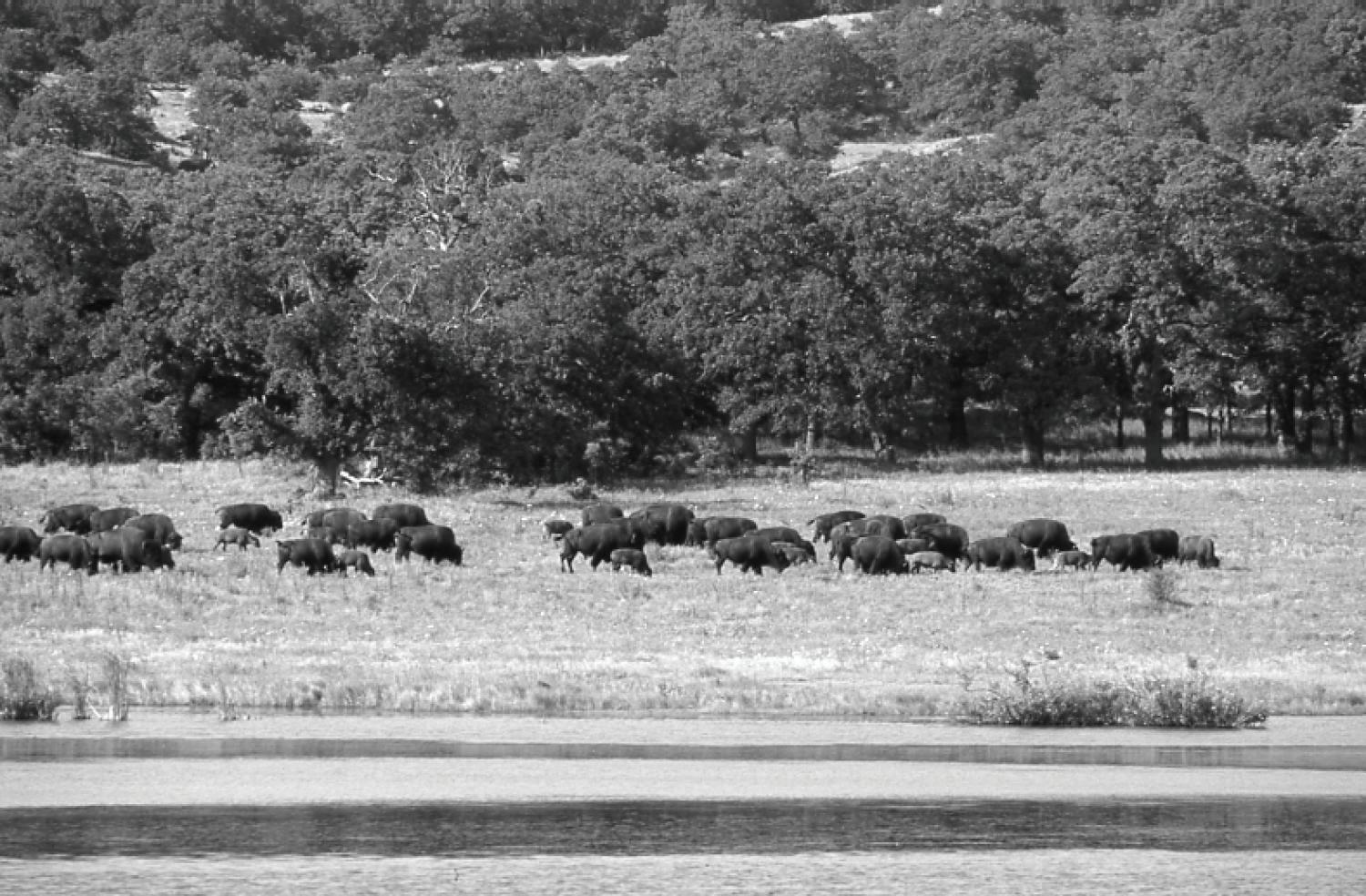
Join the Oklahoma Historical Society or renew your membership, and help preserve Oklahoma’s heritage for future generations.
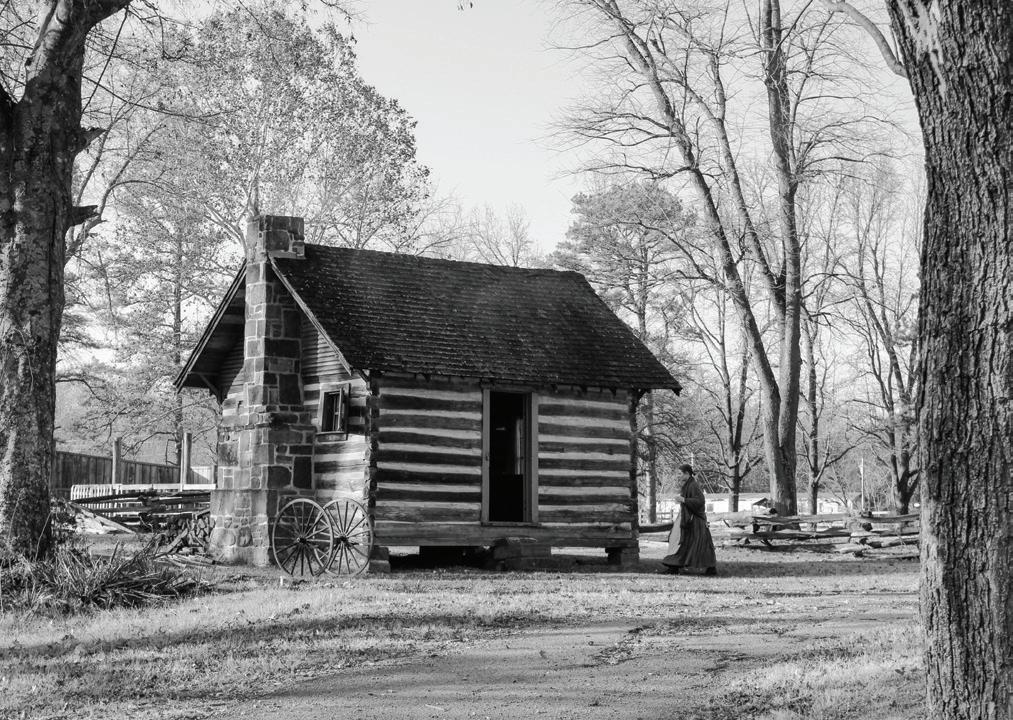
Oklahoma Historical Society memberships start at $40, and include unlimited admission to all OHS museums and historic sites. You will also receive a oneyear subscription to The Chronicles of Oklahoma, Mistletoe Leaves, and EXTRA! Visit okhistory.org/membership to view a full list of benefits and levels. You can easily join online or call our membership office at 405-522-5242
Take advantage of all that we have to offer and know that your membership provides vital support for the Oklahoma Historical Society!


History in Focus
Oklahoma’s First Heart Transplant
(2012.201.B1103.01135, Oklahoma Publishing Company Photography Collection, OHS)
Dr. Nazih Zuhdi was a pioneer in the field of cardiovascular surgery. On March 3, 1985, Zuhdi and his team at Baptist Hospital in Oklahoma City prepared to perform a heart transplant on Nancy Rogers. Rogers had been given weeks to live after Hodgkins disease weakened her heart. Though Zuhdi had never performed the operation before, he was confident in his abilities, and successfully completed Oklahoma’s first heart transplant when a donor heart was acquired from Georgia. Rogers’s daughter, Nanciann, visited shortly after the operation, guided by Zuhdi. Rogers died from complications of Hodgkins disease fifty-five days after her transplant. The words written on her car upon her release from Baptist Hospital were, “Outlive yourself. Become a donor.”
Full text of Volumes 1–100 of The Chronicles of Oklahoma are available free of charge online on The Gateway to Oklahoma History at gateway. okhistory.org. The tables of contents for Volumes 70–103 can be found online at okhistory.org/publications.
Oklahoma Historical Society Officers
Duke R. Ligon, PresidentKaren Keith, Vice President
Donna Sharpe, TreasurerGov. Kevin Stitt, Ex-Officio
Trait Thompson, Executive Director
Board of Directors
T. S. Akers, Oklahoma City*al
Jack D. Baker, Oklahoma City*5
Randy Beutler, Weatherford*al
Michael Birdsong, Choctaw**al
Cheryl Evans, Burlington**6
Ken Fergeson, Altus**4
Deena Fisher, Woodward*6
Billie Fogarty, Oklahoma City*al
Ann Hargis, Stillwater**al
Karen Keith, Tulsa*al
Duke R. Ligon, Oklahoma City**5
Patricia Loughlin, Stillwater*al
W.Carlisle Mabrey, Tulsa**1
Jonita Mullins, Muskogee*2
Shirley Ann Ballard Nero, Clearview**al
Lindsay Robertson, Norman*4
Donna Sharpe, Checotah*3
David Sigmon, Bartlesville**2
Kenneth Sivard, Idabel*al
Gregory R. Stidham, Checotah**3
Kathy Taylor, Tulsa*1
Barbara Thompson, Oklahoma City*al
James R. Waldo, Oklahoma City**al
Weldon Watson, Broken Arrow**al
G. Harold Wright, Weatherford**6
*denotes that a director is elected by the OHS membership **denotes that a director is appointed by the governor Number 1234 denotes membership district al denotes appointed or elected at-large
The Oklahoma Historical Society is governed by a twenty-five-member board of directors; thirteen are elected by OHS members and twelve are appointed by the governor. To ensure statewide representation, two members are elected or appointed from each membership district, and thirteen are elected or appointed at-large.
The Chronicles of Oklahoma Editorial Committee
Dr. Heather Clemmer, Southern Nazarene University
Dr. Joshua Clough, University of Oklahoma
Dr. Brian Hosmer, Oklahoma State University
Dr. Sarah Janda, Cameron University
Dr. Sunu Kodumthara, Southwestern Oklahoma State University
Dr. Michelle Martin, Independent Historian
Dr. Natalie Panther, University of Central Oklahoma
Dr. Matthew Pearce, Oklahoma Historical Society
Dr. John Truden, Sul Ross State University