•
REFERENCES Bigsten, A., Collier, P., Dercon, S., Fafchamps, M., Gauthier, B., Gunning, J.W., Oduro, A., Oostendorp, R., Patillo, C., Söderbom, M., Teal, F., Zeufack, A., 2003. Credit Constraints in Manufacturing Enterprises in Africa, Journal of African Economies 12(1), March, 104-25. Collier, P., Warnholz, J.L., 2009. Now’s is the Time to Invest in Africa, Harvard Business Review - Breakthrough Ideas for 2009, http://hbr.harvardbusiness.org/, February.
4
private sector & development
P
olicy-makers all over the world show a keen interest in the subject of SME financing. This can be explained by both the contribution that SMEs make to the private sector and the common perception that SMEs are credit constrained. These are significant factors for African economies where SMEs account for close to 50 percent of employment2. Furthermore, enterprise surveys conducted by the World Bank reveal that close to 40 percent of small firms and 30 percent of medium-sized firms perceive access to finance as a major stumbling block to the growth of their operations3.
African banking survey Maria Soledad Martinez Peria The World Bank Maria Soledad Martinez Peria is a Senior Economist in the Finance and Private Sector Development Team of the Development Economics Research Group at the World Bank. Her published work has focused on banking systems and access to finance in developing countries. She is currently conducting research on bank financing to SMEs, the impact of migrant remittances and the consequences of the recent financial crisis. Prior to joining the World Bank, Ms Martinez Peria worked at the Brookings Institution, the Central Bank of Argentina, the Federal Reserve Board, and the IMF. She holds a PhD in economics from the University of Berkeley and a BA from Stanford University.
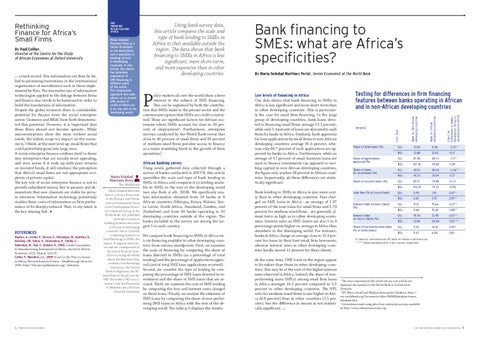
Using newly gathered data collected through a survey of banks conducted in 2007/8, this article quantifies the scale and type of bank lending to SMEs in Africa and compares it to lending available to SMEs in the rest of the developing world (see also Beck et alii, 2008). We specifically analyze information obtained from 16 banks in 8 African countries (Ethiopia, Kenya, Malawi, Sierra Leone, South Africa, Swaziland, Zambia, and Zimbabwe) and from 64 banks operating in 30 developing countries outside of the region. The banks included in the survey are among the largest 5 in each country. We compare bank financing to SMEs in Africa visà-vis financing available in other developing countries from various standpoints. First, we examine the scale of financing by comparing the share of loans directed to SMEs (as a percentage of total lending) and the percentage of applications approved (out of total SME loan applications received). Second, we consider the type of lending by comparing the percentage of SME loans devoted to investment and the share of SME loans that are secured. Third, we examine the cost of SME lending by comparing the fees and interest rates charged on these loans. Finally, we analyze the riskiness of SME loans by comparing the share of non-performing SME loans in Africa with the rest of the developing world. The table p.5 displays the results.
By Maria Soledad Martinez Peria1, Senior Economist at the World Bank
Testing for differences in firm financing features between banks operating in African and in non-African developing countries
Low levels of financing in Africa Our data shows that bank financing to SMEs in Africa is less significant and more short-term than in other developing countries. This is particularly the case for small firm financing. In the large group of developing countries, bank loans devoted to financing small firms average 13.1 percent, while only 5.4 percent of loans are allocated to such firms by banks in Africa. Similarly, bank approvals for loan applications by small firms in non-African developing countries average 81.4 percent, whereas only 68.7 percent of such applications are approved by banks in Africa. Furthermore, while an average of 47 percent of small business loans are used to finance investments (as opposed to working capital) in non-African developing countries, the figure only reaches 28 percent in African countries. Importantly, all these differences are statistically significant.
Variable
At the same time, SME loans in the region appear to be riskier than those in other developing countries. This may be at the root of the higher interest rates observed in Africa. Indeed, the share of nonperforming loans (NPLs) among small firm loans in Africa averages 14.5 percent compared to 5.5 percent in other developing countries. The NPL ratio for medium-sized firms is also higher in Africa (6.8 percent) than in other countries (5.1 percent), but the difference in means is not statistically significant. ...
SEs
13.05
5.44
-2.21**
MEs
13.88
12.83
-0.17
Share of applications approved (%)
SEs
81.40
68.73
-1.77*
MEs
82.36
70.68
-1.28
Share of loans for investment (%)
SEs
47.01
28.24
-2.36**
MEs
47.23
37.04
-1.27
Share of secured loans (%)
SEs
81.71
74.40
-0.73
MEs
83.29
79.33
-0.50
SEs
0.95
1.97
2.61**
MEs
0.81
1.79
2.51**
Interest rates on best clients (%)
SEs
11.12
15.66
2.22**
MEs
9.68
15.42
2.88**
Interest rates on worst clients (%)
SEs
15.43
21.45
2.63**
MEs
13.58
20.08
3.02***
Share of non-performing loans
SEs
5.47
14.47
2.05*
MEs
5.07
6.84
1.00
Share of total loans (%)
Bank lending to SMEs in Africa is also more costly than in other developing countries. Fees charged on SME loans in Africa - an average of 1.97 percent of the loan value for small firms and 1.79 percent for medium-sized firms - are generally almost twice as high as in other developing economies. Interest rates on SME clients are also 5 to 6 percentage points higher on average in Africa than elsewhere in the developing world. For instance, banks in Africa charge on average close to 15.6 percent for loans to their best small firm borrowers, whereas interest rates in other developing countries hardly exceed 11 percent for these clients.
t-test for differences in means developing- Africa vs. developing-non-Africa
ked to promising innovations in the international organization of microfinance such as those implemented by Kiva. The innovative use of information technologies applied to the linkage between firms and finance also needs to be harnessed in order to build the foundations of information. Despite the global recession there is considerable potential for finance from the social enterprise sector: Grameen and BRAC have both demonstrated this potential. However, it is important that these flows should not become quixotic. While microenterprises show the most evident social needs, the widest scope for impact on the economy is, I think, at the next level up: small firms that could potentially grow into large ones. If social enterprise finance confines itself to those tiny enterprises that are socially most appealing, and even worse if it ends up with poor returns on invested funds, it will reinforce the perception that Africa’s small firms are not appropriate recipients of private capital. The key role of social enterprise finance is not to provide subsidized money, but to pioneer and demonstrate that new channels are viable for private investors. Information technology potentially enables these costs of information on firm performance to be sharply reduced. That, to my mind, is the key missing link.
Bank financing to SMEs: what are Africa’s specificities?
Mean for African developing countries
... a track record. This information can then be lin-
Maria Soledad Martinez Peria is a Senior Economist at the World Bank and a specialist in banking sectors in developing countries. In this article, she shares her extensive experience of SME financing in different parts of the world. The comparative approach she uses allows us to situate SME access to credit in Africa visà-vis the rest of the developing world.
Using bank survey data, this article compares the scale and type of bank lending to SMEs in Africa to that available outside the region. The data shows that bank financing to SMEs in Africa is less significant, more short-term, and more expensive than in other developing countries.
Mean for Non-African developing countries
By Paul Collier, Director of the Centre for the Study of African Economies at Oxford University
SME financing in Sub-Saharan Africa
Firm Type
Rethinking Finance for Africa’s Small Firms
Loan fees (% of size of loan)
(% of total loans)
SE stands for small enterprises. ME stands for medium-sized enterprises. *,**,*** denote significance at 10, 5, and 1 percent, respectively.
The views expressed in this article are my own and do not represent the opinions of the World Bank or its Executive Directors. 2 IFC Micro, Small and Medium Enterprises Database. http:// rru.worldbank.org/Documents/other/MSMEdatabase/msme_ database.htm 3 Calculations made using data from enterprise surveys available at http://www.enterprisesurveys.org. 1
issue 1 MAy 2009 SMe financing in Sub-saharan Africa
5