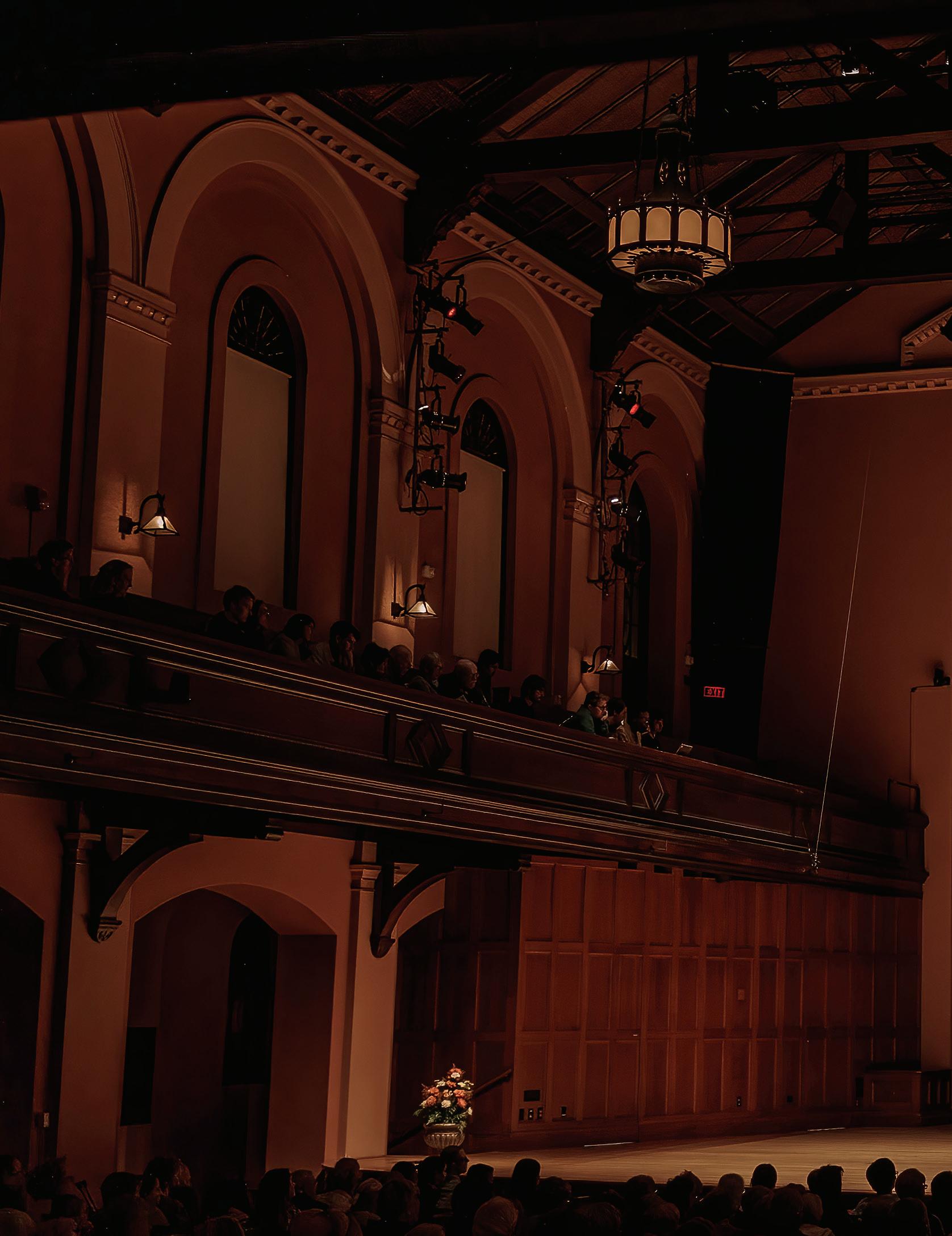
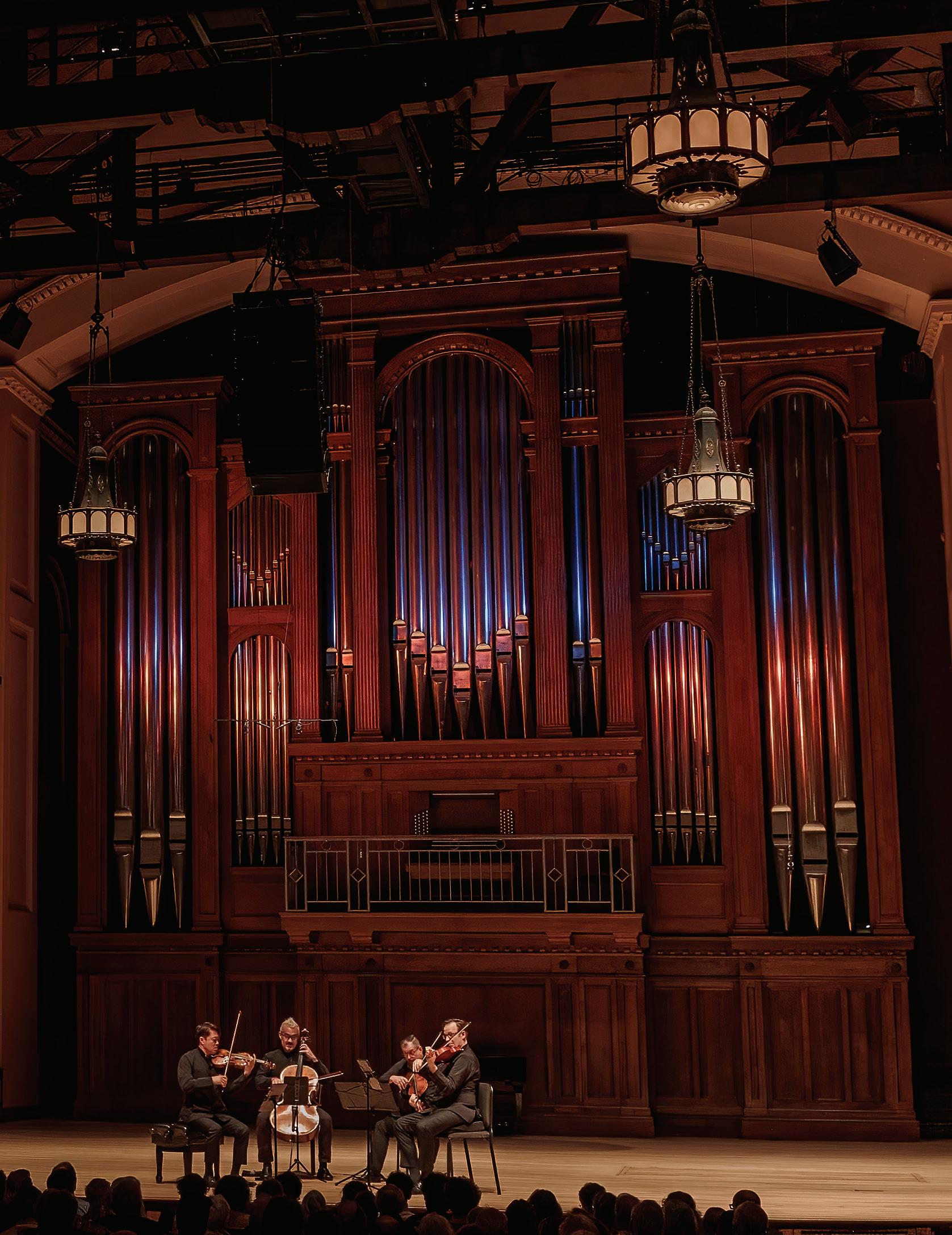
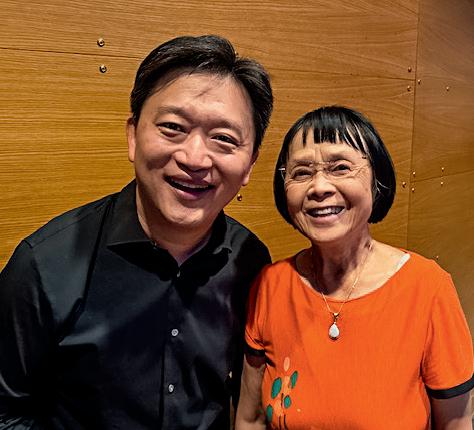
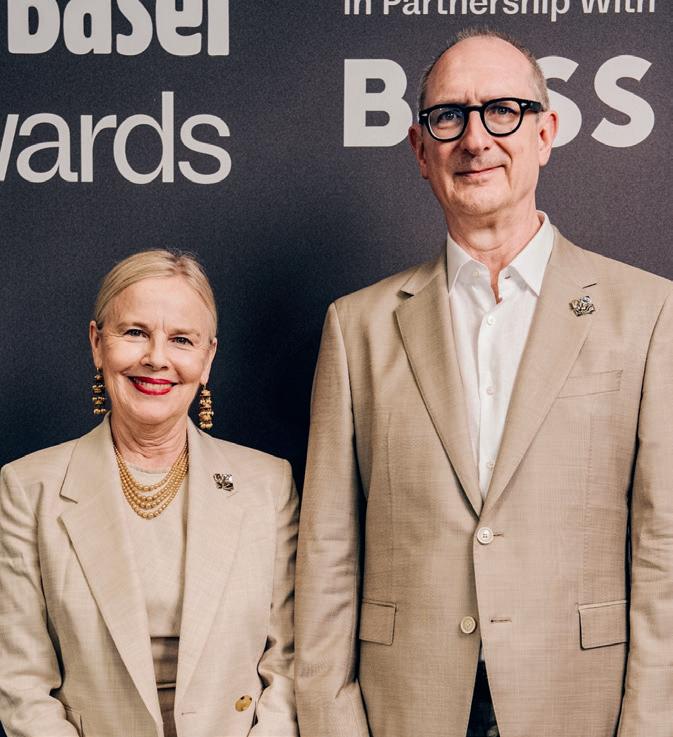
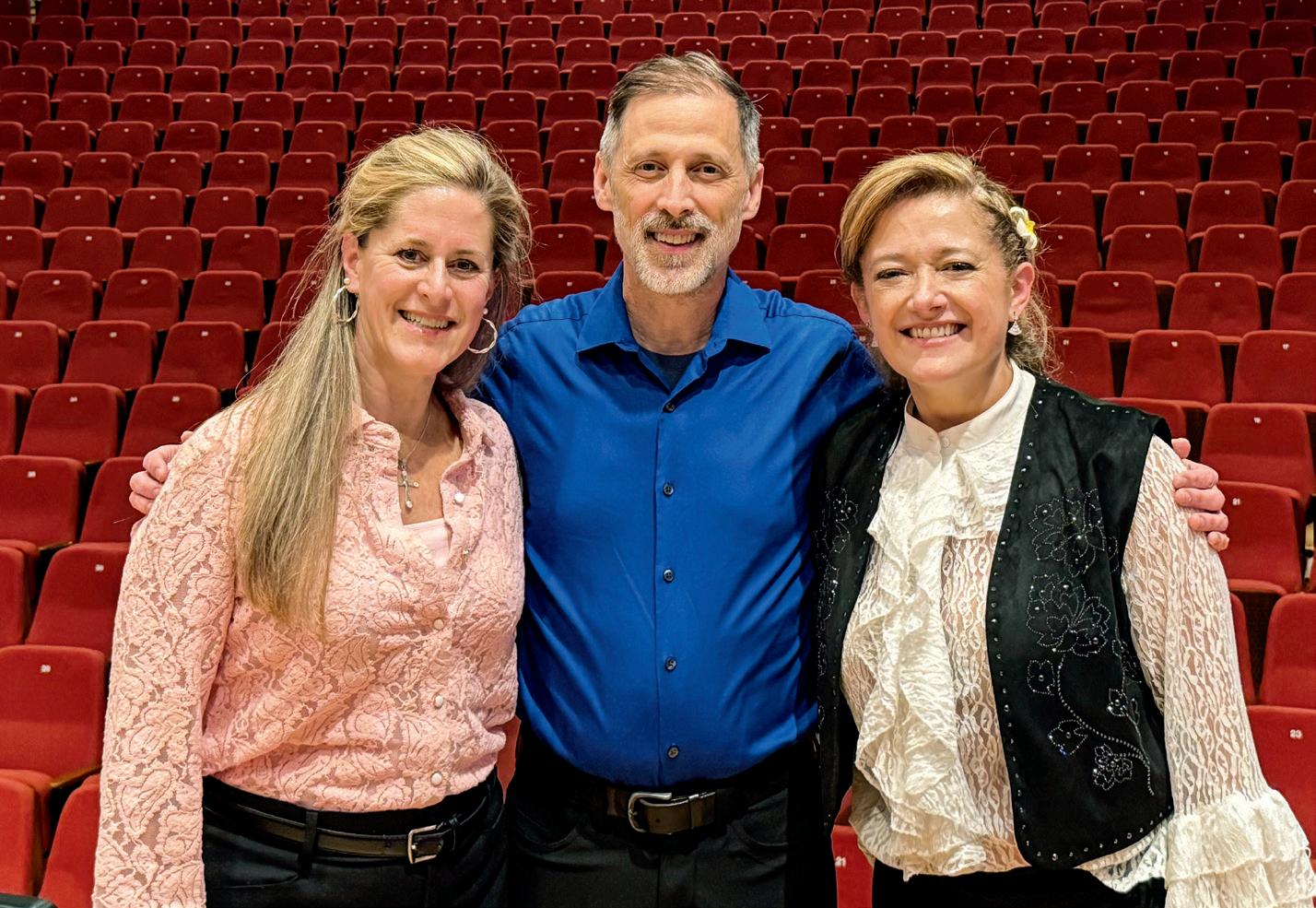
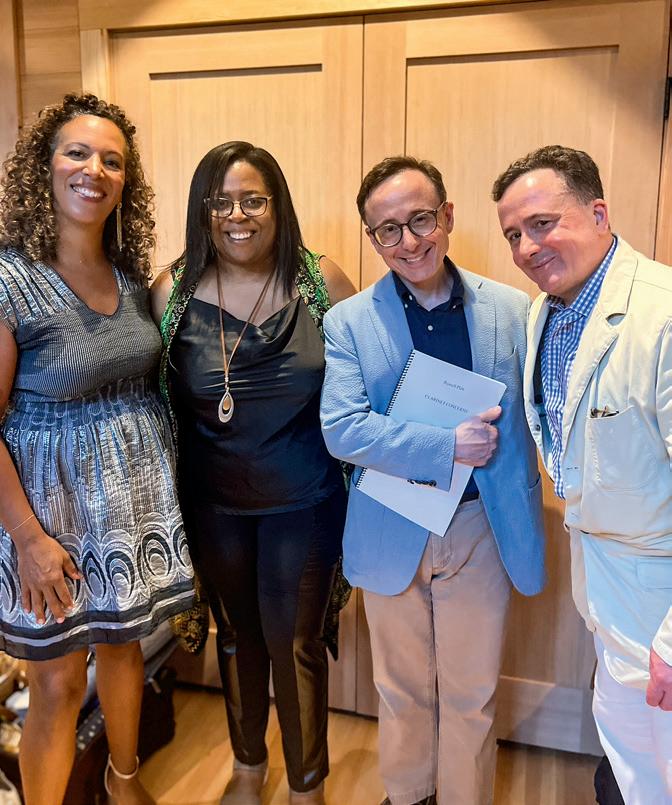
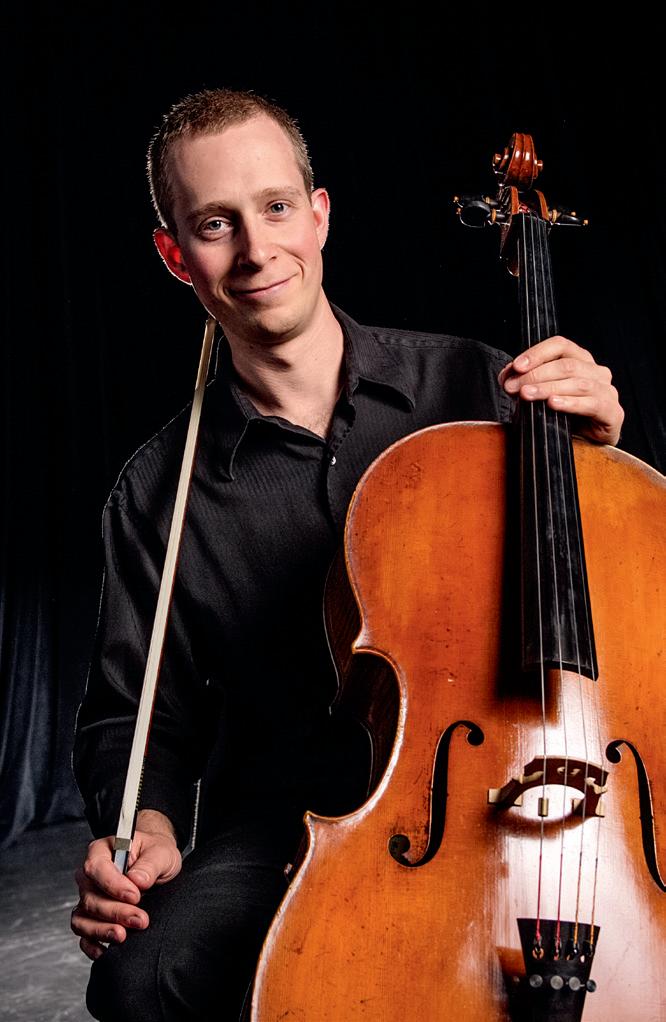
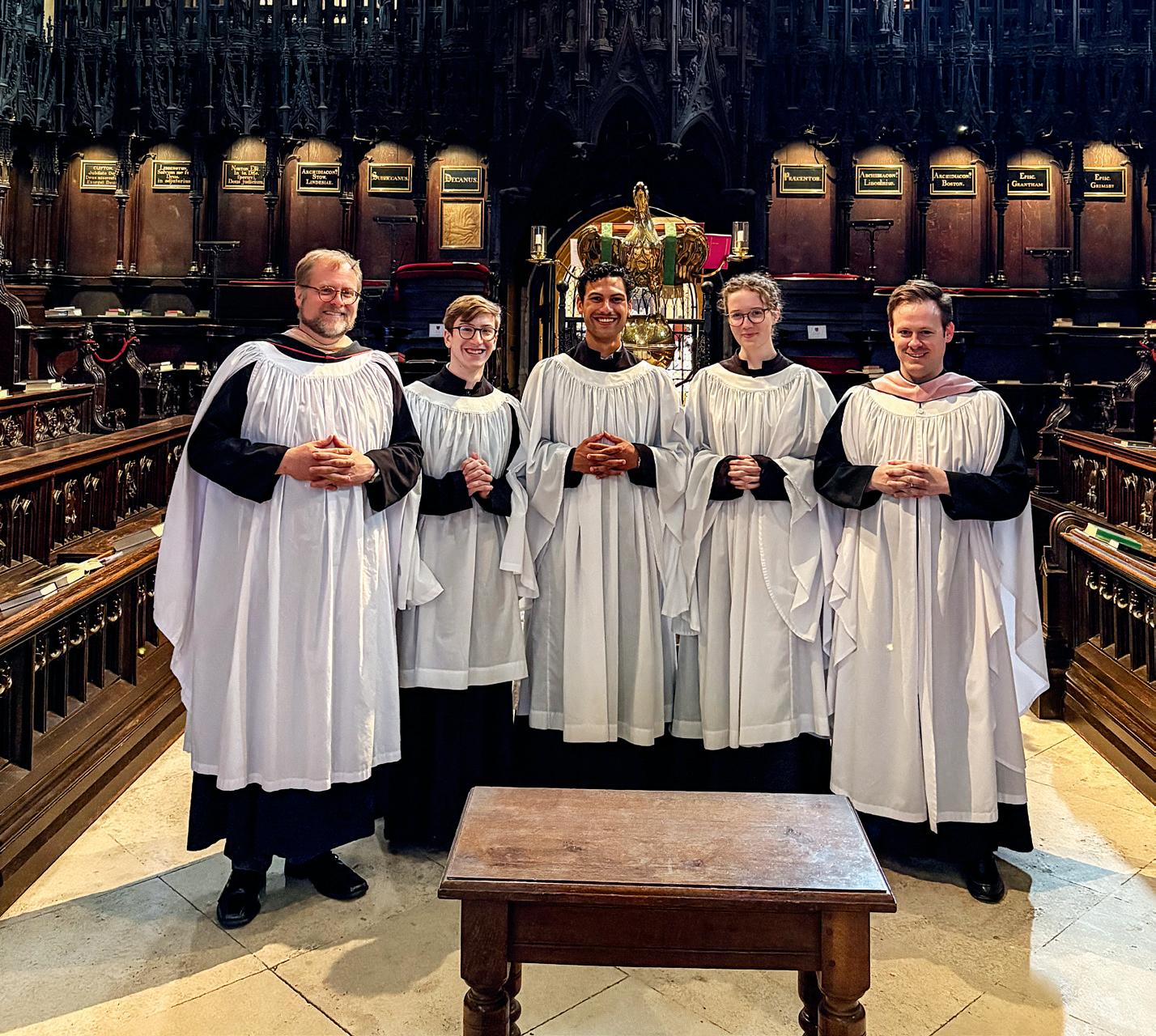
Founded at Oberlin, the Miró Quartet, which includes violinist Daniel Ching ’95 and cellist Joshua Gindele ’97, celebrated its 30th anniversary by performing the complete Beethoven Quartet Cycle during Homecoming Weekend.
Celebrating Carbon Neutrality, a Milestone 25 Years in the Making
AT OBERLIN, WE’VE LONG BELIEVED THAT PROTECTING THE ENVIRONMENT is an intentional and shared responsibility. From the significant to the small, thoughtful things we do, it can all make a difference globally.
Perhaps it’s biking from South Campus to an 8 a.m. class in the Science Center or carrying a sticker-covered water bottle everywhere. Maybe it is sorting lunch scraps at Stevie, finding a perfect sweater at the Free Store, or driving less.
Over the past four years, Oberlin quite literally laid the groundwork for the college’s future: transitioning our historic campus from a 19th-century reliance on fossil fuels to a 21st-century geothermal system that heats and cools our buildings using energy drawn from the Earth itself.
This work represented a crucial step in fulfilling the promise we made more than two decades ago: to achieve carbon neutrality by 2025.
Of course, the true measure of our commitment to sustainability—and the promise it holds—extends well beyond what we achieve on campus. We benefit the world through the impact of our graduates, who demonstrate the courage to imagine the possible and pursue it with integrity.
In this special issue focused on sustainability, you’ll learn how we achieved carbon neutrality—the Oberlin way.
You’ll also read about the impact of the Adam Joseph Lewis Center for Environmental Studies, the many ways sustainability shows up on campus today, and how faculty research and academic programs such as food studies are helping Obies change the world.
And, of course, you’ll meet alums applying Oberlin values in farms, offices, businesses, and kitchens around the world, advancing a more sustainable future in their own ways.
Yes, there is much to celebrate—but there also is much still to do. I am proud of how Obies embrace this world of ours, giving their energy, intellect, and optimism to improve it day by day. After all, each of us has the power to do good in this world, to make a difference.
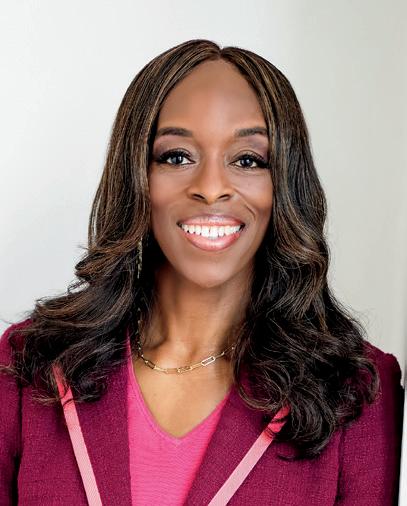
Carmen Twillie Ambar President, Oberlin College and Conservatory
Send letters to the editor, story tips, and pitches to alum.mag@oberlin.edu. If you are submitting a letter to the editor, please specify that your note is for publication and include your class year, location, and how your name should appear in print.
Editor
Annie Zaleski
Art Director
Nicole Fansler
Magazine Designer
Lesley Busby
Graphic Designer
Nick Giammarco
Director of Content and Social Media Strategy
Mathias Reed
Photo Coordinator and Project Manager
Yvonne Gay
Executive Director, Office of Communications
Kelly Viancourt
Vice President for Communications
Josh Jensen
The Oberlin Alumni Magazine (ISSN 0029-7518), founded in 1904, is published by Oberlin’s Office of Communications and distributed to alumni, parents, and friends of Oberlin College.
Office of Communications
247 W. Lorain St., Suite C Oberlin, OH 44074
Phone: 440.775.8182 Fax: 440.775.6575
Email: alum.mag@oberlin.edu www.oberlin.edu/oam
Oberlin Alumni Association
Dewy Ward ’34 Alumni Center 65 E. College St., Suite 4 Oberlin, OH 44074
Phone: 440.775.8692
Fax: 440.775.6748
Email: alumni@oberlin.edu www.oberlin.edu/alumni
POSTMASTER
Send changes to Oberlin College, 173 W. Lorain St., Oberlin, OH 44074
THE RAINBOW CONNECTION
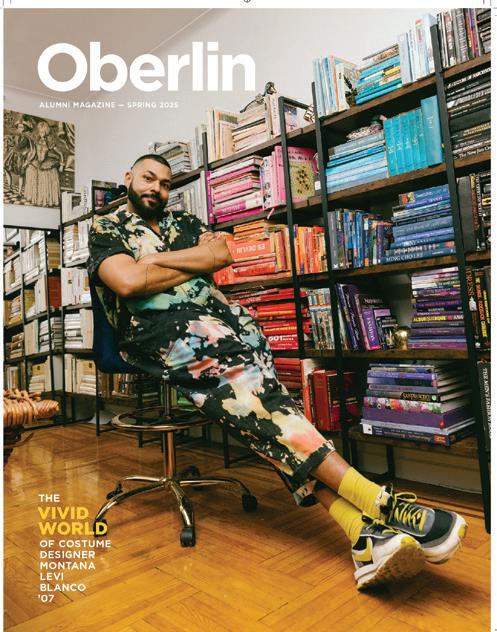
It is awesome to see in the cover photo that Montana Levi Blanco [“Treasure Hunting,” Spring 2025] organizes his books according to color! Alternatively, things spontaneously organize themselves by color whenever Montana is around, which is just as great! Bravo to the photographer Samantha Jane!
Jennifer Kahle ’85
San Diego
HISTORY LESSONS
I was moved by the article “The Body, The Host” on art and HIV in the Spring 2025 issue. Since graduating from Oberlin and moving to Boston in 2004, I’ve worked in HIV care and services—a path sparked by a class called STDs: Biology/History/Misery that was taught by the late biology professor Richard Levin. That course, and the stories of radical activism by marginalized communities fighting to save their friends, left a lasting impression. It’s heartening to see that new generations of Obies are learning this powerful and ongoing history, especially as familiar threats to this community reemerge.
Rachel Weidenfeld ’04
Boston
RADIO, RADIO
Your article about Obies taking the lead in podcasting [“A Pipeline to Podcasts,” Spring 2025] is also an appropriate way
to celebrate WOBC’s 75 years of broadcasting. Having graduated in 1968, I am aware that both Michael Barone ’68 and Robert Krulwich ’69 got their start at WOBC. The first time I heard their voices on the air, I recognized them and that they were fellow Obies. If I am remembering correctly, Robert was part of a group of us who had a comedy show on the air, with silly fake news and weather reports. I played “Mia Nice, the Weather Girl.” (Yes, those were the days when women were denied adulthood by being called “girl,” and before meteorolo gists regularly gave accurate weather reports on air.) We also performed Dylan Thomas’ A Child’s Christmas in Wales, more of a literary nature. I was a speechlanguage pathologist for 50 years, so the experience on air served me well! Here’s to 75 more years of WOBC!
Tawn Reynolds Feeney ’68 Conesus, N.Y.
ON THE COVER: THE BURST
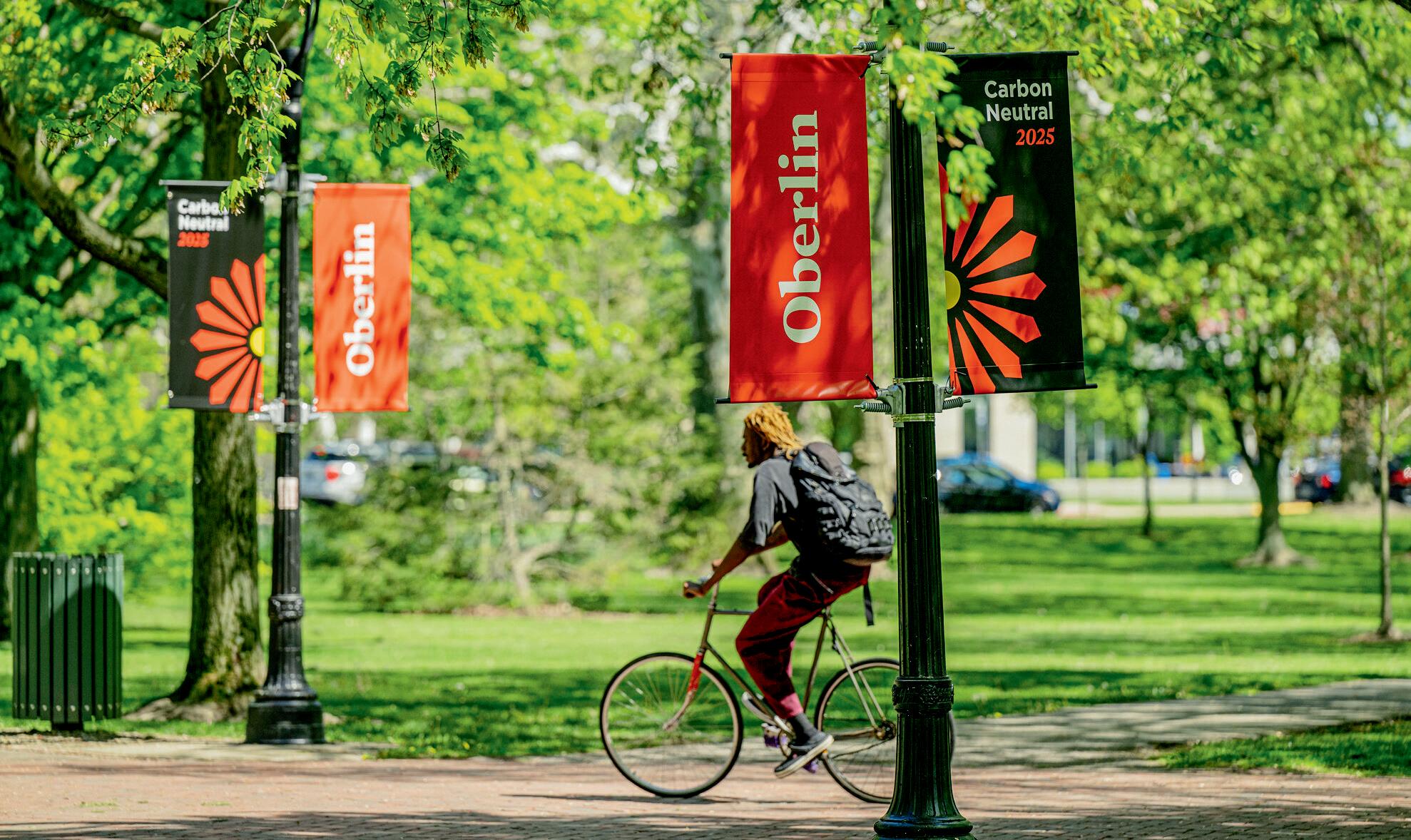
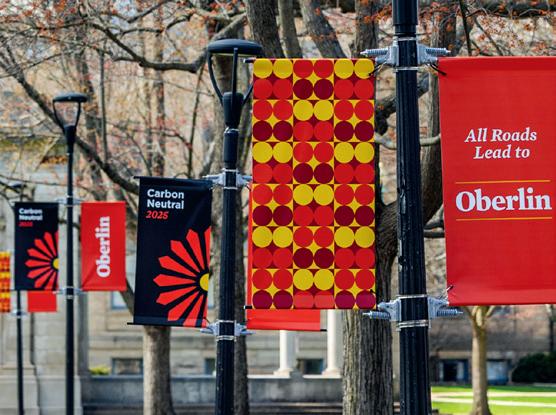
To commemorate Oberlin becoming a carbon-neutral campus in 2025, the Office of Communications’ design team led the creation of a distinctive brand mark: the Burst.
At the heart of the mark is a solid yellow circle representing the sun—an homage to Oberlin’s solar arrays, which supply roughly 12 percent of campus electricity. Sixteen angular petals radiate from this core at equal intervals, their form inspired by the distinctive pointed windows of Bibbins Hall. The gaps between petals subtly mirror the network of underground geothermal piping that now heats and cools campus buildings. By combining a floral form with architectural geometry, the design offers a fresh, nontraditional take on sustainability symbolism—one that feels rooted in Oberlin’s creative, free-spirited ethos rather than generic “green” clichés.
Around Tappan Square
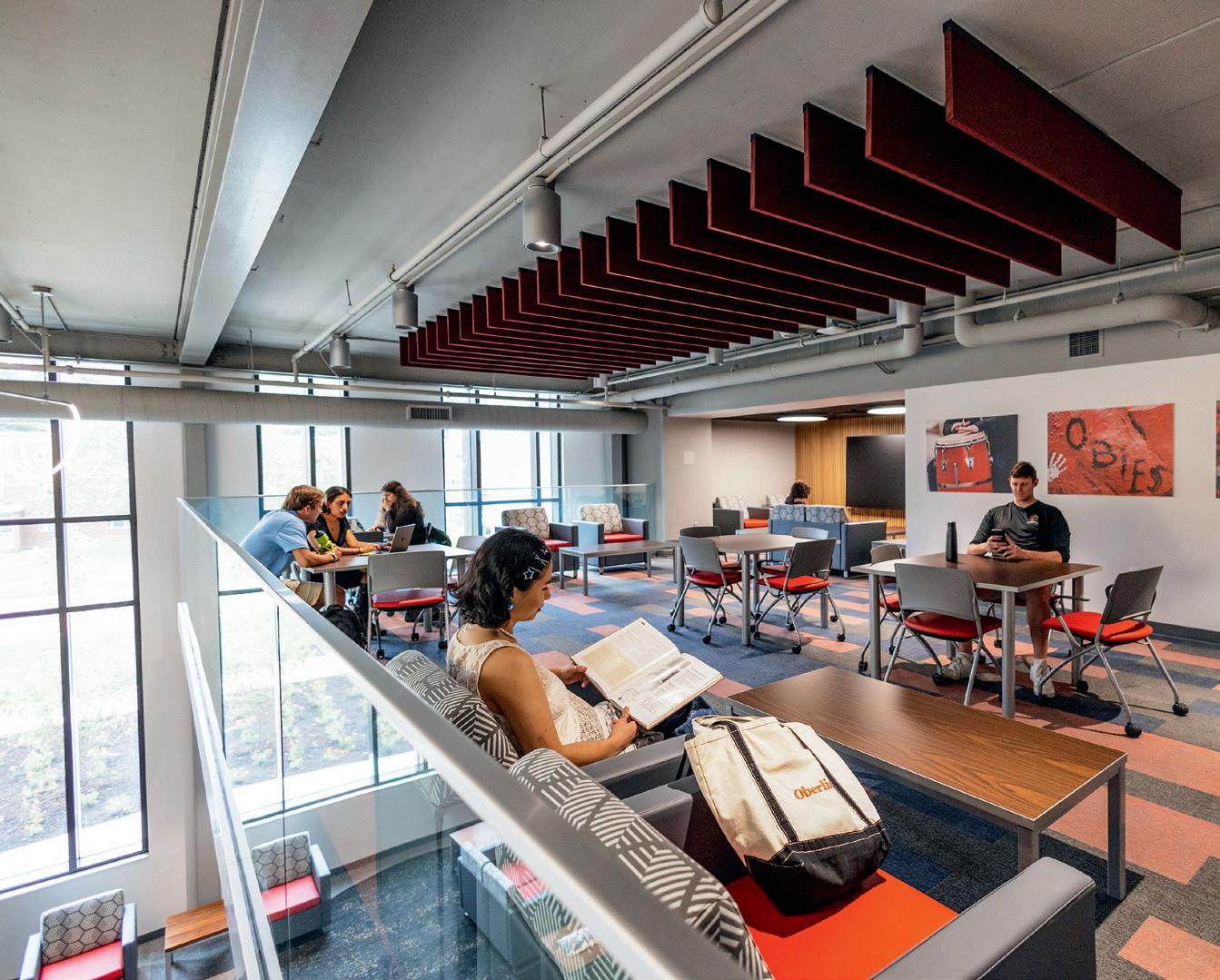
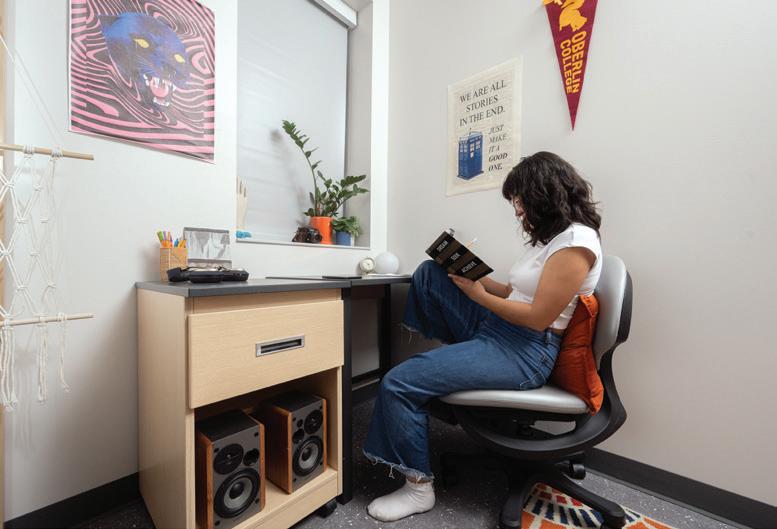
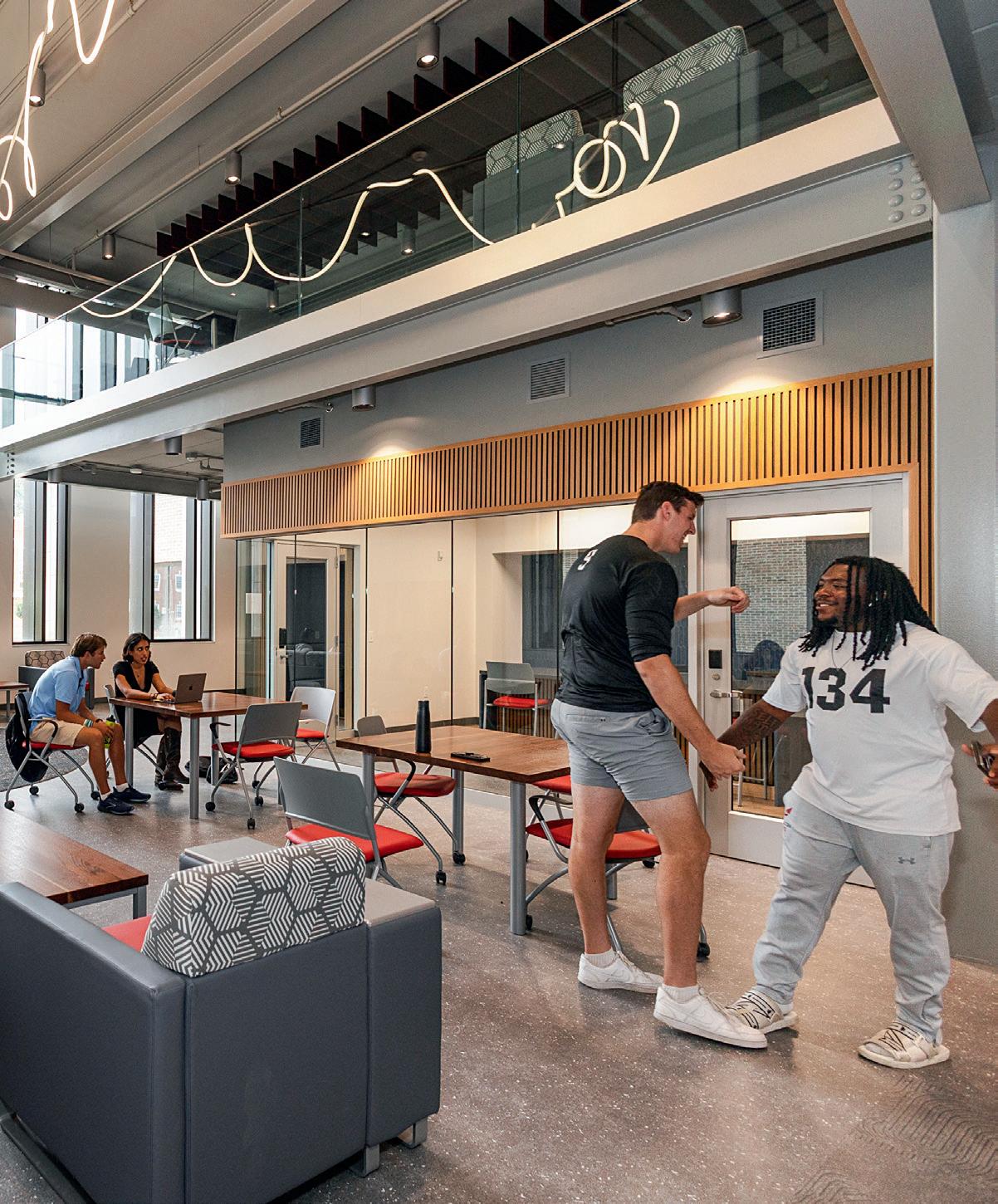
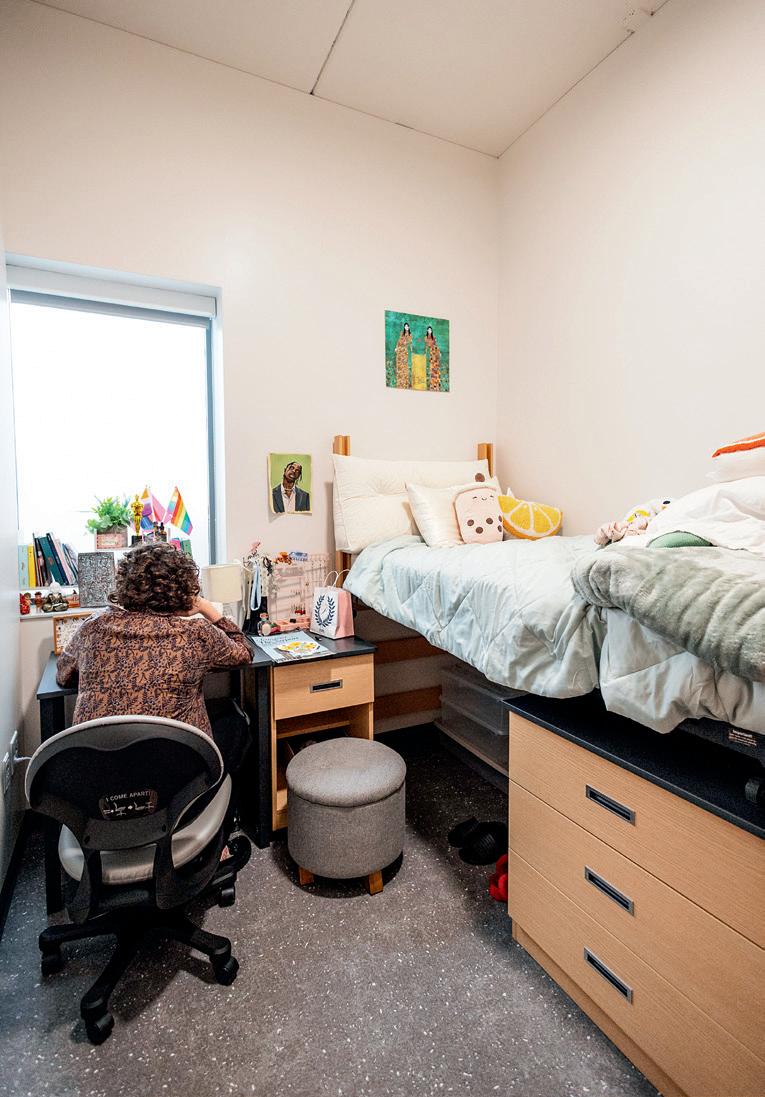
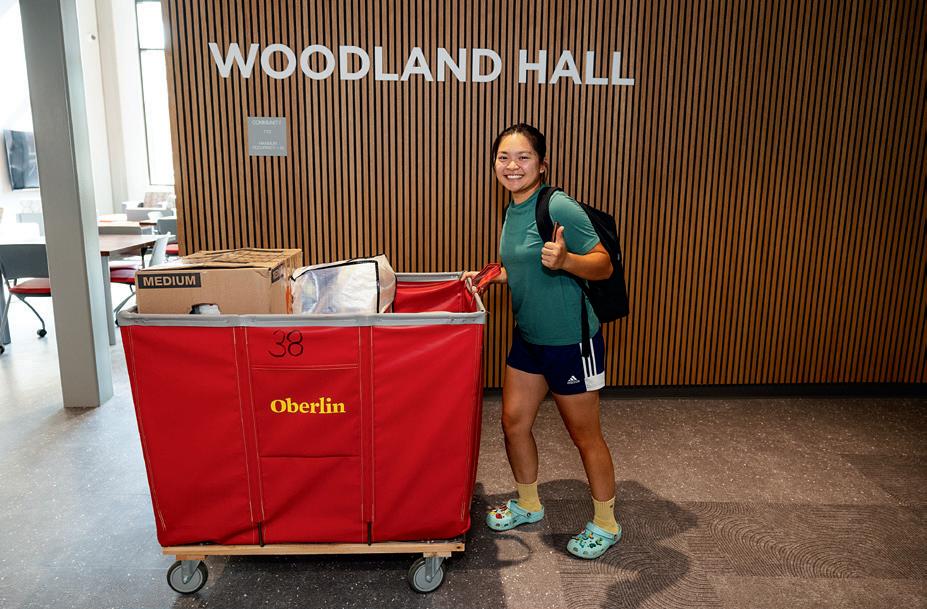
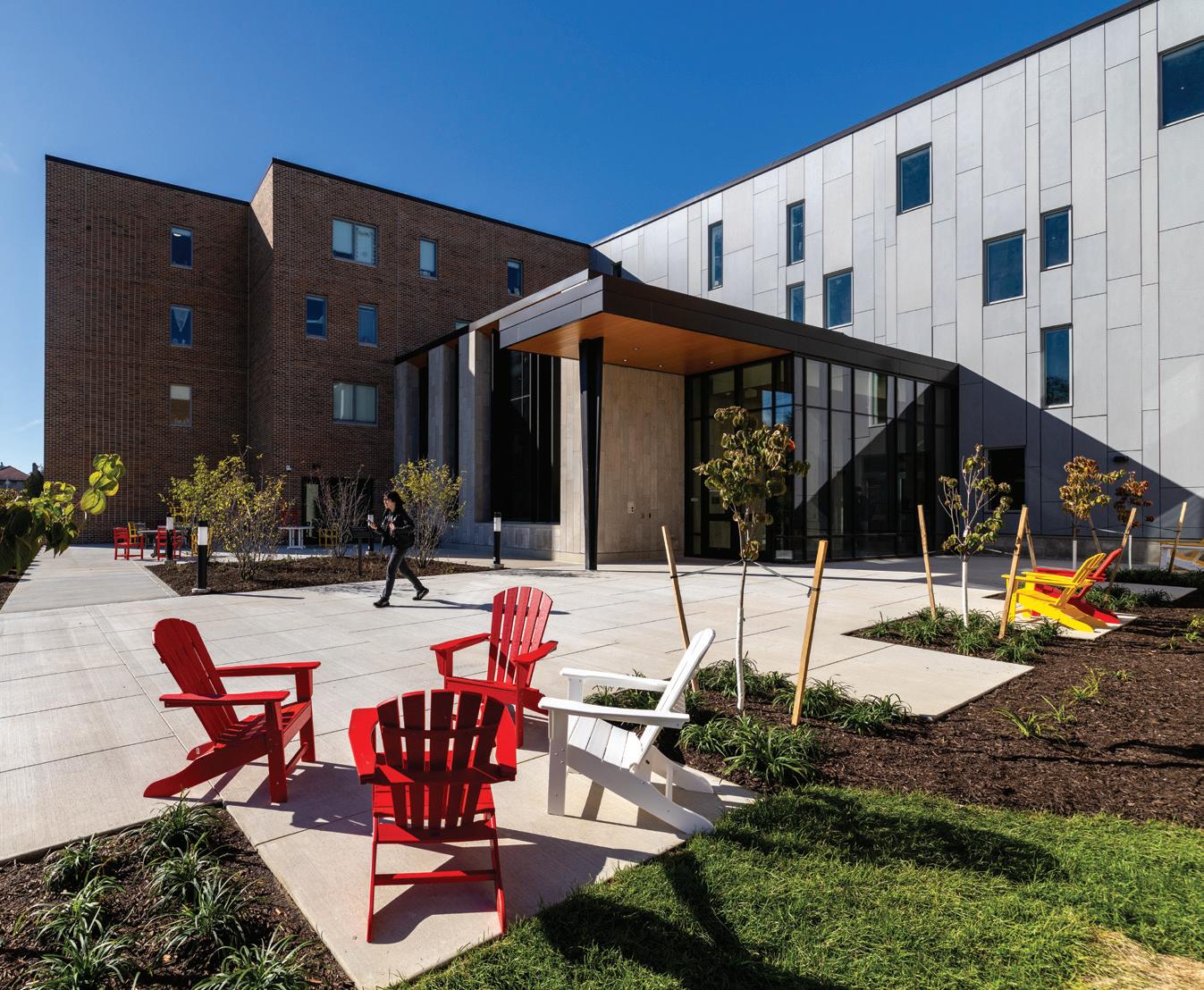
WELCOME HOME! In fall 2025, 402 Obies moved into Woodland Hall, a brand-new building that’s now the largest residence hall on campus. Located on Woodland Street near the north end of campus and conveniently situated between the Science Center and the athletics complex, Woodland is built with sustainability at the forefront: Designed to meet LEED Gold standards, the building is tied into the college’s geothermal heating and cooling system and features electric vehicle charging stations. Residents enjoy access to lounges and meeting rooms in addition to acoustically optimized music practice rooms and outdoor gathering spaces. A plaque installed in the courtyard pays tribute to the late Michael Kamarck ’73, a former trustee and biotechnology and pharmaceutical industry executive.
Around Tappan Square
Oberlin Announces Park Arts Partnership
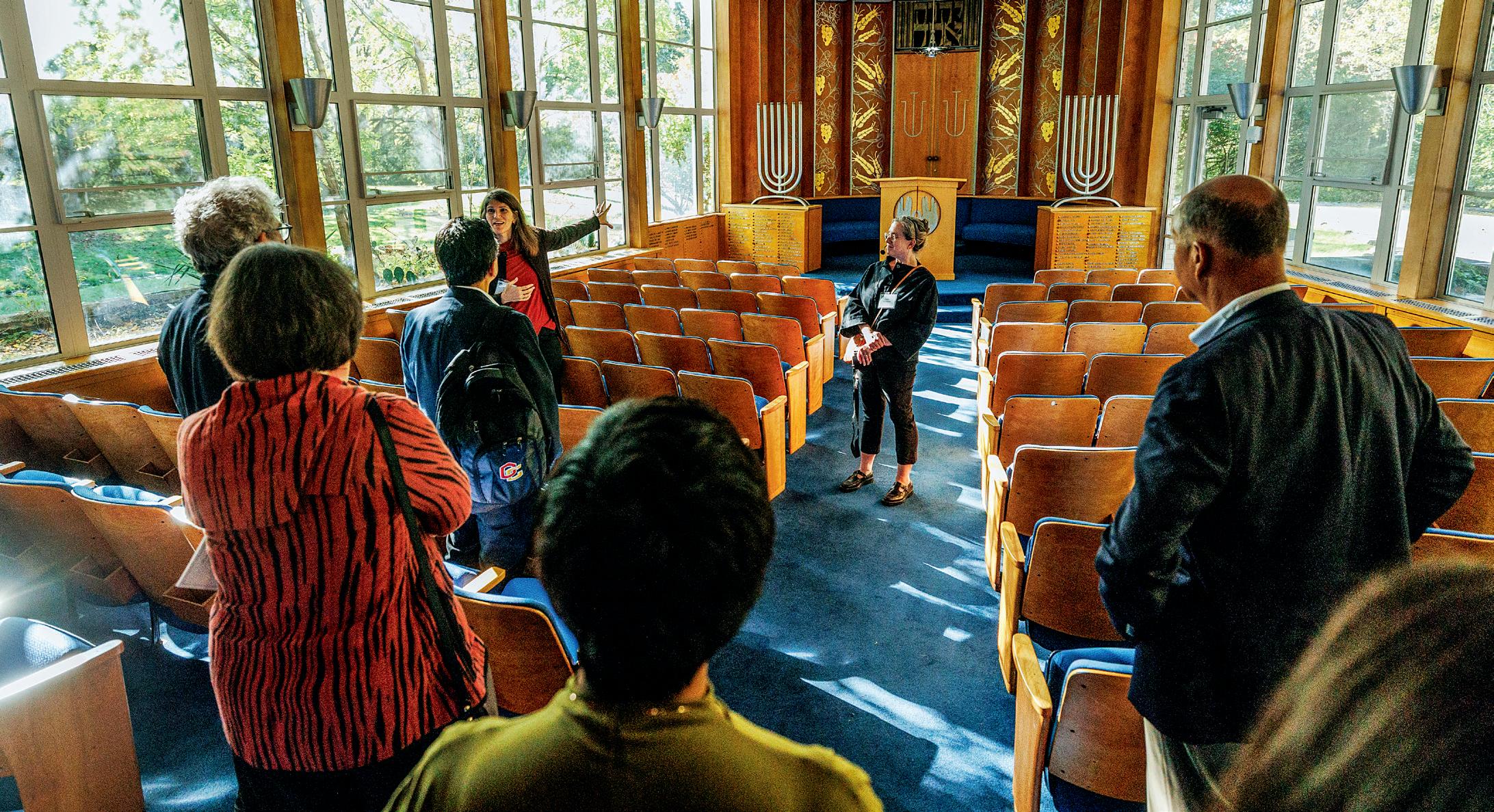
Starting in June 2027, students in Oberlin’s BA+BFA in Integrated Arts program will spend their fifth and final year living and working at a newly renovated collaborative space called Park Arts. Located at the historic Park Synagogue in Cleveland Heights, Ohio, Park Arts gives students 24-hour access to studios, rehearsal spaces, theaters, and production facilities. These amenities will enable Obies to fulfill their degree requirements by creating a large-scale, public-facing project, such as a performance, exhibition, or installation.
“This move provides an essential bridge from student life to professional careers in the arts,” says Julia Christensen, program director and Oberlin’s Eva & John Young-Hunter
Professor of Integrated Media.
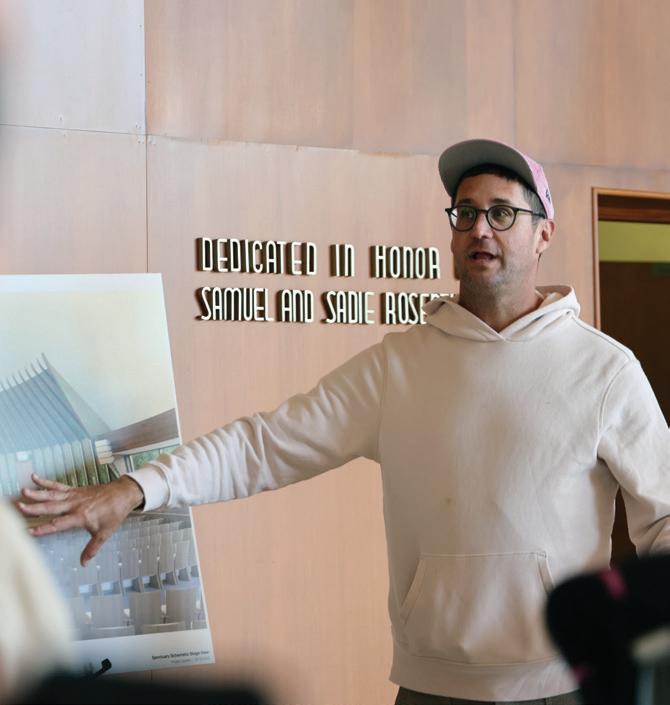
Sustainable Community Associates (SCA), a Cleveland-based team of Oberlin alums Ben Ezinga ’01, Josh Rosen ’01, and Naomi Sabel ’02, is leading the redevelopment in partnership with Friends of Mendelsohn, a nonprofit that seeks to preserve the historic campus. SCA purchased the site in 2023 and spent over 18 months working with
the congregation, the local Jewish community, area residents, and city leaders to shape the future of the space. Construction is currently underway.
Oberlin’s newly launched BA+BFA in Integrated Arts program is designed with collaboration in mind: Students work with visiting artists, faculty mentors, and Cleveland arts organizations through internships, commissioned works, and public programming. Park Arts also places Oberlin students near some of the region’s most distinguished cultural institutions, as well as Cleveland’s renowned performance venues and galleries.
“For artists, community connections are invaluable,” Christensen says. “Collaborating with Cleveland’s arts organizations, securing internships, and being immersed in a thriving cultural district will be transformative. At the same time, these emerging artists will bring fresh perspectives and energy to the broader Cleveland arts scene. It’s an exciting exchange.”
NEW SPACES
GENEROUS GIFTS
Alumni Donations Sustain Languages
In the last few years, several alums have made gifts to Oberlin to sustain language study at the college.
When Dr. Dorothy Koster Washburn ’67 was in her second year at Oberlin, she overheard two classmates talking about going on an archaeological dig in Wyoming. Her ears perked up: As a child, she was fascinated with an exhibition of ceramics she saw in Mesa Verde National Park. Emboldened, she asked if she could come on the dig, which was run by National Geographic and Harvard University’s Peabody Museum of Archaeology and Ethnology.
“I applied, and that summer, I was on the train going out [there],” Washburn recalls. “It was in 1965—and I have never looked back.” She earned a doctorate in anthropology at Columbia University and spent her career studying geometric design on pottery and other decorated artifacts using mathematical principles.
Through this work, she met Emory Sekaquaptewa, a Hopi scholar who introduced her to the Hopi language and Katsina songs. Studying these texts “brought front and center how important language is to people,” Washburn says. “Emory always said, ‘When a culture loses its language, it loses its culture, so you have to preserve these languages.’” In a nod to the importance of languages, Washburn gave Oberlin generous gifts for programming in Middle East and North Africa Studies (MENA) and a faculty position, the Dorothy Koster Washburn ’67 Endowed Lecturer in Arabic Language. Read a longer profile: go.oberlin.edu/dorothy-washburn
From a very young age, Edith Clowes ’73 was good at languages. “I was always imitating people without knowing what they were saying,” she says. “And my mother was a language wiz. She just adored learning languages.” Clowes followed in her footsteps, first learning
Update Your Address
Have you recently moved?
Share your new contact info online: go.oberlin.edu/oam-address-update
Submit a Class Note
You can now submit a class note (along with a photo) online: go.oberlin.edu/submit-class-notes
French and later German. Upon arriving at Oberlin, she packed a whole first-year Russian course (and part of the secondyear course) into a “very intensive” fall semester and Winter Term. She later earned a doctorate at Yale and taught Russian language, literature, and culture at the college level, eventually becoming the Brown-Forman Chair in the Humanities in the Slavic languages and literatures department at the University of Virginia. In 1998, Clowes helped start the Oberlin Center for Russian, East European, and Central Asian Studies (OCREECAS). This led to a scholarship to support Oberlin students studying Russian language and, as of fall 2025, the Edith W. Clowes Endowed Professorship in Russian. “[Language training is] a very intensive process, but also extremely exciting,” she says. “[It] changes a person for the better in terms of expanding their understanding of themselves and their opportunities in life.” Read a longer profile: go.oberlin.edu/edith-clowes
The late Harry “Pat” L. Patterson ’61 majored in math and earned a master’s in teaching. Education was his calling: He taught math at the International School Bangkok for nearly three decades. In 2025, Pat’s sister, Sue A. Bielawski ’56, honored her brother’s life and career with an endowed East Asian Studies support fund, which goes toward student instruction in a language within the East Asian Studies department.
Connect on Social Media OberlinCollege oberlincon groups/oberlin.alumni oberlincollege oberlincon oberlin-college
Around Tappan Square
WARM WELCOME
State of the Art
BY ANNIE ZALESKI
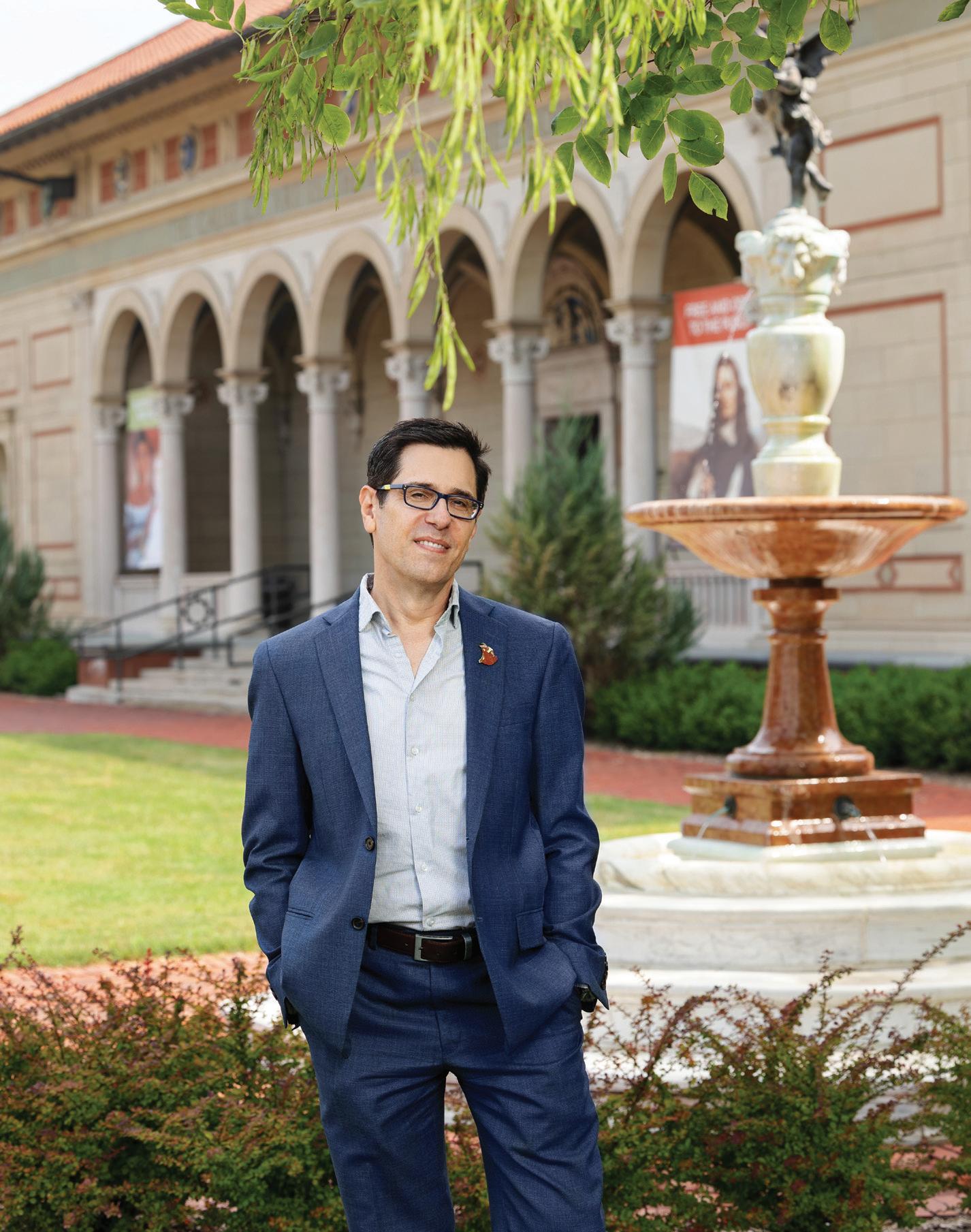
An interview with Jon Seydl, the new John G.W. Cowles Director of the Allen Memorial Art Museum
Over the summer, Oberlin welcomed Jon Seydl as the new John G.W. Cowles Director of the Allen Memorial Art Museum. Seydl, who previously worked for the Cleveland Museum of Art and came to Oberlin after serving as director of the Krannert Art Museum at the University of Illinois Urbana-Champaign, was already familiar with the Allen. He’s always had a “soft spot” for self-portraits by Michael Sweerts and William Hogarth in the museum’s collection. Years ago, he and the Allen’s former director, Andria Derstine, also worked on a project together that involved museum staff and Oberlin students. “They were so creative and hardworking and really imaginative,” he recalls. “It was a revelation.”
Seydl earned a bachelor’s degree in art history at Yale University and a doctorate at the University of Pennsylvania in early modern Italian ar t history, giving him a strong background in art from the Renaissance to 1800. “But the older I get—and the more I spend time in museums—I now tend to go to the things I know least about,” he says. “I’m always learning something brand new.”
Once Seydl began to settle in at Oberlin, both on campus and in the city—he says people recognize him by his adorable 30-pound dog, Lenny, a mutt “with a heavy dose of pit bull”—he took time to answer questions about his career and what he hopes to bring to Oberlin.
What drew you to the Allen Memorial Art Museum and Oberlin? I mean, who wouldn’t be drawn to the Allen? [Laughs.] There are a whole
bunch of reasons. I love university museums. I find them genuinely liberating places to work. You never have to make an excuse for research because research is actually valorized in an academic setting. The fact that you can work with faculty across disciplines is amazing. And Northeast Ohio was a draw for us.
The intense work the Allen does with students and faculty, along with the use of the collection, is incredible. In the summer, I was meeting faculty who were telling me about their work
with the museum. And it comes from so many different disciplines. The museum’s not just there for art history or studio art; it’s for the whole campus. What happens at all academic museums happens so much more deeply here, with such a high level of quality and diverse touch points. It’s really dazzling.
What drew you to this line of work? When I was a kid, my sister was the one with artistic talent, not me, and she took art lessons. This was in Lehigh Valley, Pennsylvania, and the only place to go
was the Allentown Art Museum. It was far enough away from our house that it wasn’t a drop-off/pickup situation; we had to stay. While we were waiting, we only had two options: One was to stay in the museum, and the other was to go shopping. I hated the shopping option— and I loved the museum environment.
It took me outside of myself into a completely different world. I loved the focused, contemplative environment, but also the one where I was interacting with my parents. We were all looking at things together and learning from scratch. Fundamentally, as a visual person, it was a great place in general. That always stuck with me. I interned at a local museum in high school and college, and I had a job at the campus art museum.
I’m old enough that mental health was not really a topic you talked about a lot in college. But in retrospect, I realized I was using time in the two campus museums at Yale as a way to rest, restore, heal, and pull myself out of ordinary life and step back and reflect. That’s a really important role for museums—what I often call sanctuaries. And it’s something I always want to emphasize to students, faculty, and really anybody who visits: Think of your museum as a site for mental health and wellness.
Don’t get me wrong: I also love coming into a museum when it’s incredibly lively and noisy and there’s a lot going on. These spaces—and the Allen is a really great example of that too—can go from calm to bustling to calm again in a really healthy and important way.
What do you want to bring to your position at the Allen?
Like any wise leader, you spend a lot of time observing first. The thing that I’m observing is that there’s some areas where it’s best in business, best in class, and it runs like clockwork. One area for growth I see for the Allen is community engagement. We do incredible work with the college, and we’re a really important part of the city of Oberlin. But I also recognize that we
are the museum for Lorain County, which is a place that is underserved by arts organizations. And I know there are ways that we could be a much stronger partner across the county. I have experience in precisely that work. It’s something I’ve done in my previous position. Opening the museum up in a more active way to a bigger community is something I’m really, really excited about.
As we like to say, “Art is for everybody.” You never know who’s going to see something in a museum that’s going to change the course of their life or give them a spark to think that they can be something unexpected. It’s so powerful. Literally inscribed into the frieze on the entrance to the building is, “The Cause of Art is the Cause of the People,” that William Morris quotation. I take that incredibly seriously. That really is like my guide stone. That’s what the building and the collection was created to be, to have that social importance for a much wider group.
And the thing that I like best is developing longer-term partnerships with community groups—to develop something that can be on a three-tofive-year arc, at the very least. That involves a really intense phase of trust-building in the beginning. But the museum can play a really important part in connecting students to the broader community. Our Gallery Guide program, for example, is one obvious way to do that.
What else do you want people to know about you?
I want to know people. I want them to introduce themselves to me. I don’t want the director’s office to feel like a thing that’s completely apart. I deliberately chose to live in the city of Oberlin. I loved living in Cleveland, but I really want to be here, and I want to be an active part of the community. It’s been great. And I feel like having a dog in Oberlin is the key to everything. You just meet everyone.
DUTY NOW
FOR THE FUTURE
In 2025, Oberlin reached its ambitious goal of achieving carbon neutrality, in large part by replacing the college’s century-old, fossil fuel-based heating system with geothermal energy. Call it the Oberlin Way: Sustainability isn’t just something we do during a certain month or in one building. Instead, it’s built into our everyday campus lives, through research, academics, student life, and more. Because of this supportive community, our alums are well-prepared for careers in sustainability, the environmental sciences and beyond. At Oberlin, we’re making the world a more resilient place, one thoughtful gesture at a time.
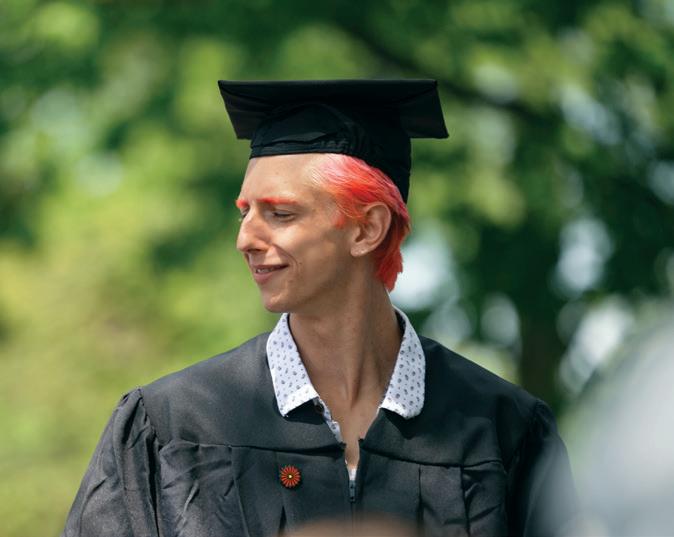
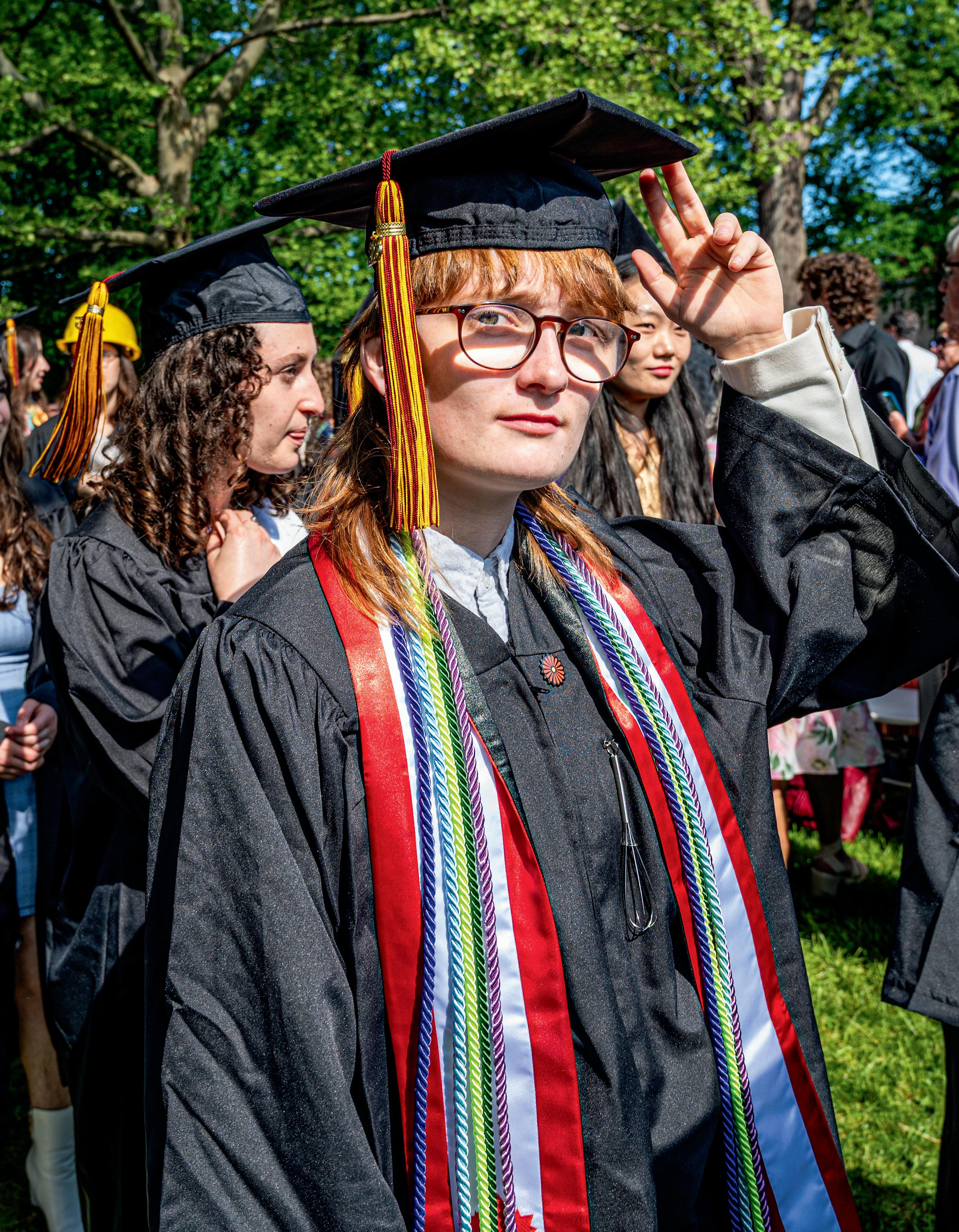
CARBON CELEBRATION The Class of 2025 wore pins signifying Oberlin becoming a carbon-neutral campus.
BY DYANI SABIN ’14
Vision Accomplished
How infrastructure, partnerships, and student involvement helped Oberlin achieve carbon neutrality.
LONG BEFORE GLOBAL leaders started to take climate change seriously, Oberlin was paying attention. In January 1978, Karen Florini ’79 took the Winter Term intensive Humankind Tomorrow. Each day, students heard lectures on different aspects of sustainability and the broad impact of climate change. “[This] really set the course of my life’s work,” says Florini, a former Oberlin trustee who’s also worked as a deputy special envoy for climate change at the U.S. Department of State. “I was already somewhat on that path, but that experience of that class ensured that I could never consider doing anything else.” Decades later, Oberlin’s early
warnings about climate change look increasingly prescient. Research showed that 2024 was the hottest year on record since scientists started recording temperature measurements in 1880—continuing a warming trend that’s accelerated markedly in the last decade. Climate change is driven by human-created carbon emissions, with electricity, transportation, and industrial production being the largest sources. The more carbon that’s released into the atmosphere, the bigger the impact: These atmospheric greenhouse gases trap heat, which warms the Earth’s surface. At our current rate of emissions, the temperature of Earth is expected to rise by at least 3 degrees Fahrenheit in the next few decades.
“The one thing that really matters most in addressing climate change [is] reducing emissions, because the only thing that matters to the atmosphere is tons of carbon pollution,” says Florini, a strategic advisor at the nonprofit C-Change Conversations.
Failing to reduce carbon emissions, she adds, has massive negative impacts on food and water systems and increases geopolitical tensions and the number of destructive global weather events. “It’s a pretty ugly picture,” she says, “including extreme heat, wildfires, droughts, and floods—with all the resulting impacts on health and the economy—all occurring with increasing severity and cascading into one another.”
Florini says the way to combat climate change is by taking action. In late 2024, Oberlin announced it was on track to reach a milestone almost 25 years in the making: achieving carbon neutrality by 2025. This milestone reflects a steadfast commitment to sustainability projects on the part of three college presidents and multiple city leaders, as well as collaborations with the city of Oberlin and student involvement.
“We know what to do to avoid these horrible outcomes; we just have to do it,” Florini says. “And Oberlin has done it— and that is why Oberlin should be very proud of what it has accomplished here.”
“Energy isprobably one of the single most—if not the single most—critical emission source to figure out how to transition to net zero.”
THE INFRASTRUCTURE DIFFERENCE
What put Oberlin over the top was the Sustainable Infrastructure Program (SIP)—the transformation of the college’s 100-yearold steam-heating system into a geothermal heating and cooling system that connects 60 campus buildings. Although Oberlin switched its energy source from coal to natural gas in 2014, the college’s central heating plant was still the largest source of on-campus emissions. Finding an alternative energy source was a crucial next step.
“Energy is probably one of the single most—if not the single most—critical emission source to figure out how to transition to net zero [carbon neutrality],” says Lyrica McTiernan ’04, a sustainability consultant who formerly worked on Facebook and WeWork’s sustainability teams and originally decided to attend Oberlin because of the Adam Joseph Lewis Center for Environmental Studies (AJLC).
The geothermal system is an underground roller coaster of pipes that transports water around campus and through the college’s central heating plant in order to heat and cool buildings and provide hot water. Creating the closed-loop system involved digging 850 geothermal wells beneath one of the practice fields on north campus. These wells, which drop 600 feet into the Earth, allow water in the pipes to pull heat from the Earth in winter and shed it in the summer. No matter the season, the temperature of the Earth remains the same, so the water leaving this field is approximately 55 degrees Fahrenheit. The central heating plant then uses heat pumps to chill or warm the water, which circulates through campus before reaching the field, where the loop repeats.
Geothermal energy is one of several
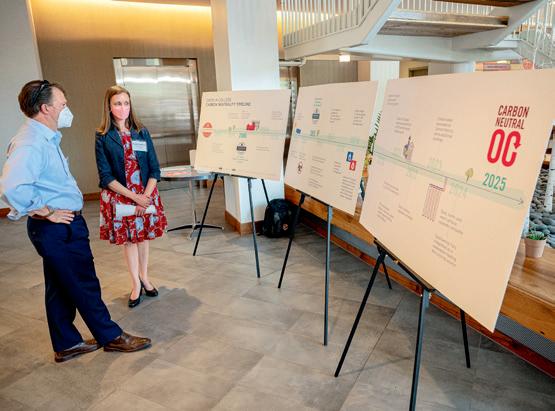
The Carbon Neutrality Timeline
Over the last 25 years, Oberlin became a national leader in campus-community sustainability partnerships, culminating in the college achieving carbon neutrality in 2025.
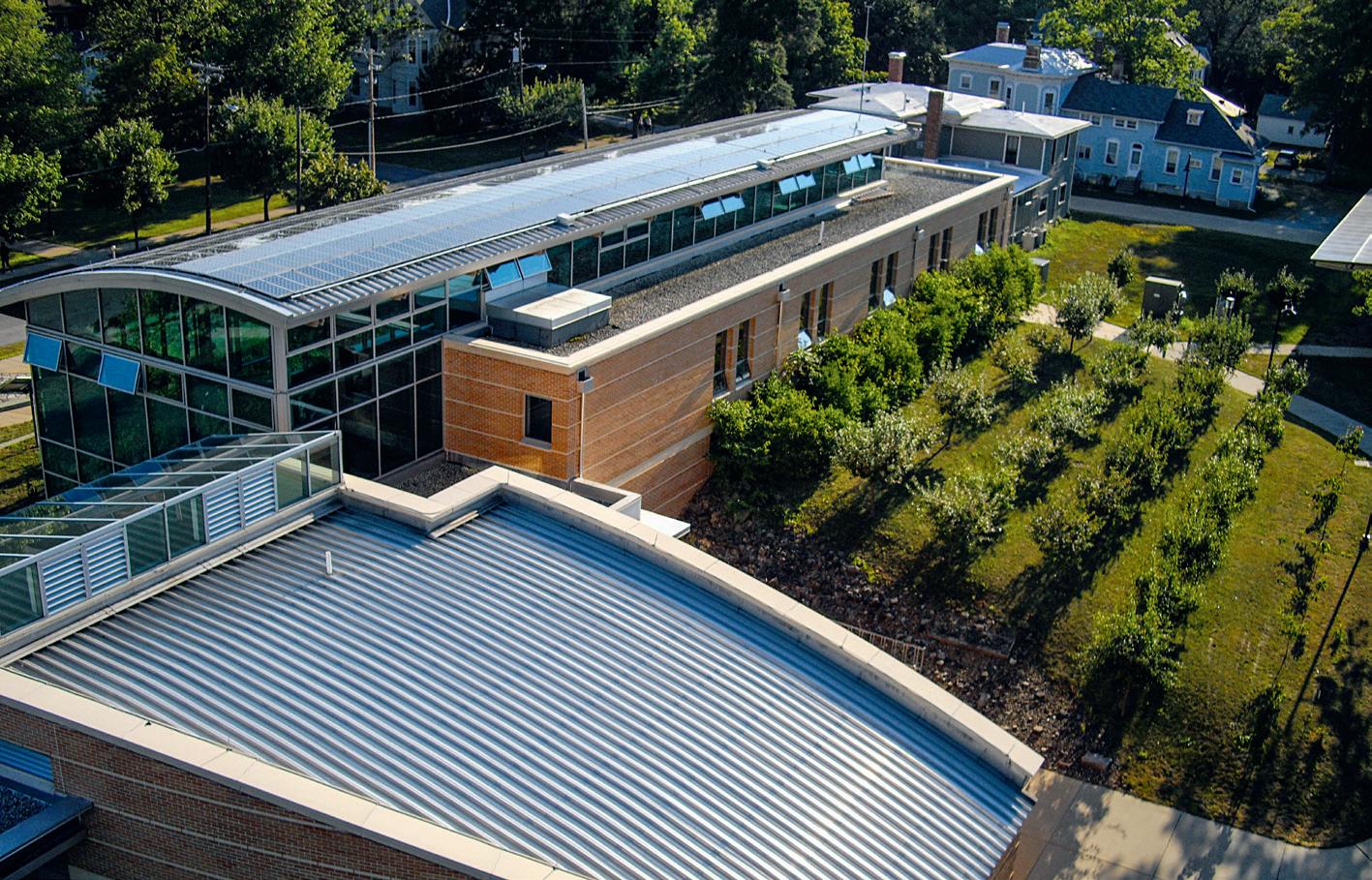
sustainable energy sources Oberlin is using to reduce emissions; for example, the college also has multiple solar arrays. While McTiernan stresses that a small amount of greenhouse gas emissions are inevitable even with alternative energy—among other things, you might still need to use backup generators in extreme weather—Oberlin has been successful using infrastructure to neutralize its carbon output. All told, the college has reduced roughly 90 percent of campus’s total emissions by switching to alternative energy sources.
“[Oberlin has] taken on the hardest part of the work by actually reimagining some of the most greenhouse gasintensive systems in their footprint and fundamentally redoing them in such a way that deeply decreases emissions,” McTiernan says. “That is the way to do it.”
To reach 100 percent carbon neutrality, institutions typically purchase carbon offsets, a transaction that involves paying another entity to reduce or remove a quantifiable amount of greenhouse gas emissions. Making sure that the offsets are high-quality is essential, says Claire Jahns ’03, whose
FROM THE GROUND UP The foundation of Oberlin’s new on-campus heating and cooling system is 850 geothermal wells.
2000
Under the leadership of Professor David Orr, then the director of the environmental studies program, Oberlin initiates a major study on the feasibility of campus carbon neutrality. The resulting report outlined ways to achieve this goal.
2001
The city of Oberlin adopts a Sustainability Resolution, preparing the way for concerted sustainability actions in the community.
2004
Oberlin’s Board of Trustees adopts a comprehensive Environmental Policy; in response, Oberlin pledges to use more renewable resources and prioritize environmental impact in campus decision-making.
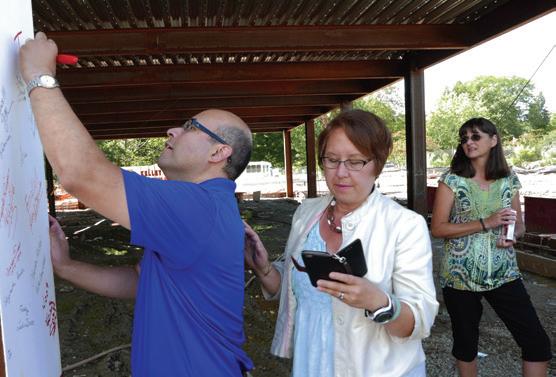
YVONNE
GAY (ABOVE), WALTER NOVAK
2006
Oberlin is one of the first U.S. colleges to sign the American College and University Presidents’ Climate Commitment, which advocates for carbon neutrality and emphasizes higher education’s role in shaping a sustainable society.
2009
Oberlin adopts its initial Climate Action Plan, which outlines the college’s goal of achieving carbon neutrality by 2025.
2010
background is in climate economics. “Offsets should be quantifiable, measurable, and verifiable; otherwise, they’re not good offsets.”
Oberlin partnered with its natural gas supplier to purchase high-quality offsets from a third party to cover things like gas used for on-campus buildings not connected to SIP. To account for things like employee travel (e.g., business trips and daily commutes) that contribute to the college’s total emissions, Oberlin chose the offsets provider Tradewater, which captures and destroys potent greenhouse gases like refrigerants and plugs up abandoned oil and gas wells that leak methane gas. In other words, these offsets are actively, permanently removing carbon emissions.
Thanks to the college’s extensive, upfront infrastructure work, Oberlin had to purchase only a very small number of carbon offsets—far fewer than many other colleges and universities that have reached carbon neutrality. This impressed Bridget Flynn, a former sustainability officer at the college, now a climate programs senior manager at Second Nature, a nonprofit that works with Oberlin and other higher education institutions on carbon neutrality and resilience. “Oberlin is an example that other campuses will be able to use,
Oberlin College, the city of Oberlin, and local stakeholders team up to launch the Oberlin Project. The partnership establishes a blueprint for sustainable development, climate resilience, and community engagement.
2012
A 2.27-megawatt solar array is installed on campus; it produces about 12 percent of the college’s electricity usage.
demonstrating tangible decarbonization on campus is possible.”
Further analysis indicates that Oberlin’s geothermal system not only reduces carbon emissions, but also saves 5 million gallons of water and 4 million gallons of sewage simply because steam isn’t leaking from old pipes. That’s another reason a major infrastructure project like this is so important, says Gavin Platt ’06, vice president of design at Acuity, which creates sustainable building management systems.
“Physical buildings and their supporting infrastructure don’t change very often,” Platt says. “How we manage our buildings and optimize their performance is usually the biggest and only lever we’ve got.” Greater change is possible when you have more levers, he adds: “Sustainability is both technical and cultural. It’s about infrastructure and policy, but it’s also about people and behavior.”
A TOWN-GOWN PARTNERSHIP
A great example of that is the relationship between the college and the city of Oberlin. “The city’s climate action
The Carbon Neutrality Timeline
2014
The campus energy system becomes coal-free by replacing its coal-fired boilers with natural gasfired ones.
plan is, in effect, the college’s climate action plan,” says Chris Norman, the college’s senior director of energy and sustainability. The college contributes about 25 percent of the city of Oberlin’s total greenhouse gas emissions, so the two entities have been intentionally working together on sustainability projects for decades. Among other things, this included the Oberlin Project, an early—and catalytic— town-gown partnership on sustainability; additionally, the city sold all of its renewable energy credits to the college in 2005. [See timeline for more.]
Committing to green energy has required taking risks; for example, in 2008, Oberlin City Council voted down a new coal plant contract and started sourcing contracts for alternative energy. “Doing the SIP and getting to carbon neutrality would have been really difficult without the city’s carbon-free electricity,” says Heather Adelman, the college’s sustainability manager and an associate director of the Oberlin Project. “The leadership it took on the
2016
Oberlin finalizes a tangible plan to achieve carbon neutrality.
part of the city, where they made longterm commitments to green energy, was crucial.”
“How we ma nage our buildings and optimize their performance is usua lly the biggest and only lever we’ve got ”
That relationship is key, says Brian Pugh ’08, the mayor of Croton-onHudson, New York, a village about the size of Oberlin, which he has led to become the No. 1 clean energy community in New York state. “The fact that a village of a little over 8,000 people is able to do things like this shows that it can be done,” Pugh says. “Oberlin would probably say the same thing—if a small liberal arts college in the Midwest can do this, maybe some of the mighty universities of the East and West with multibillion-dollar endowments could do the same.”
For a small town, having a large stakeholder like a college interested in purchasing green energy creates essential financial backing for sustainability projects. Pugh’s village works with Columbia University; Oberlin College, meanwhile, was that anchor for the city of Oberlin’s first renewable energy credits. It’s a mutually beneficial
2019
In collaboration with the college, the city of Oberlin approves a revised Climate Action Plan that includes a commitment from the city to provide 100 percent carbon-free electricity.
2019
The Board of Trustees approves a new oncampus energy system that replaces the century-old fossil fuel-based system.
relationship: The college ensured that its electricity came from a renewable source; in turn, this helped the city invest in long-term renewable energy contracts for electricity.
Jahns had been pushing for renewable energy credits decades ago while still a
student. She was at Oberlin right after the signing of the Kyoto Protocol, the first international agreement for nations to reduce carbon emissions. In response, Jahns formed a student activist group, Climate Justice, and worked with the campuswide sustainability group to get
2021
The Board of Trustees approves geothermal energy for heating and cooling on campus.
Construction begins on the Sustainable Infrastructure Program (SIP), a four-year project to upgrade and modernize the college’s energy system.
2022
After upgrading the energy system on South Campus in 2021, construction begins on North Campus buildings and a distribution pipe that will link to a geothermal well field.
2023
Oberlin begins construction of a geothermal well field with 850 wells.
the college to reduce emissions.
“One of my final memories of Oberlin is when I graduated in 2003,” she says. “I walked across the stage to accept my diploma, and I shook [then-Oberlin president] Nancy Dye’s hand, and she said to me—while handing me my diploma—‘We’re going to go ahead and buy those renewable energy credits,’ which is something Climate Justice had been really pushing for.”
Jahns, who founded the climate change strategy consulting firm Scale, is impressed with how the college has continued that commitment, which had seemed almost “pie in the sky” then. That Oberlin partially funded SIP using green energy bonds—becoming only the second higher education institution approved to use them to fund sustainable infrastructure—impresses her even more.
“Oberlin can teach other small and medium-sized institutions about how to leverage investor interest and climate finance to make really clear and permanent emission reductions possible,” Jahns says. “To see this massive investment in infrastructure— really transformational for the college’s infrastructure, period, but also for student life—the contributions that can have to student educations at Oberlin and careers afterwards is monumental.”
2024
The geothermal heating and cooling system comes online, and SIP concludes on schedule, with Oberlin installing 13 miles of heating and cooling pipe and connecting 60 campus buildings to the new energy system.
2025
Oberlin achieves carbon neutrality, fulfilling its decades-long goal.
OBERLIN ALUMNI MAGAZINE FALL 2025
ECO-CONSCIOUS CONSTRUCTION Opened in 2010, the Bertram and Judith Kohl Building, which is home to jazz studies, earned a LEED Gold designation from the U.S. Green Building Council.
ON-CAMPUS SUPPORT
The impact of what happens next at Oberlin is hard to quantify, but having this project physically on campus is important, says Justin Mog ’96, director of sustainability initiatives at the University of Louisville. “Oncampus things always have to be the first priority,” he says. “That’s where you discover these things and learn to care about them. It’s not just about the infrastructure of the campus; it’s the infrastructure of our minds.”
Mog emphasizes that having buy-in over time from the college administration also helped Oberlin achieve carbon neutrality. “It makes all the difference in the world,” he says, although he also credits the constant push of Oberlin students toward sustainability as one thing that shapes how the college reached its goals.
As a student, Platt was integral to the development of the technology that now drives the Environmental Dashboard, a campuswide energy monitoring system that shows electricity and water usage in real time.
“The overall idea was to make energy use more visible so students could connect their daily choices to Oberlin’s broader sustainability goals,” he says, noting that this experience led to his career in sustainable management systems. “It taught me that even small shifts in awareness can ripple outward and support larger systemic changes. As a student, I didn’t fully understand just how difficult these things were to pull off, and it’s humbling now to know how slow change could be. Looking back, I’m glad to have played a small part in it.”
“Oberlin is a laboratory for the future. Smaller institutions like Oberlin can be test beds for innovation. ”
Current students can take a
course with Professor of Psychology and Environmental Studies Cindy Frantz called Advanced Methods in Community-Based Social Marketing. As part of the class, students design and evaluate programs to promote sustainable behaviors like using cold water to wash clothes and taking shorter showers. Their research has led to tangible, campuswide programs, Adelman says, like stickers explaining when it’s efficient to have windows open, and a ban on single-use plastic water bottles. Moving forward, Oberlin has more work to do with the geothermal system, including connecting additional buildings and optimizing the system for efficiency. In the future, the college plans to transition the rest of the maintenance fleet to electric vehicles and imagine campus landscaping for biodiversity and resilience in extreme weather. Meanwhile, the city of Oberlin is talking about building an eco-industrial park with a geothermal
system built in from the start.
Starting in mid-October, UL Verification Solutions (UL Solutions) also embarked on a third-party review of Oberlin’s carbon-neutral status for 2025. This verification ensures the college continues to be on track with its sustainability goals—and going forward will be a model for other places to replicate.
“Oberlin is a laboratory for the future,” Platt says. “Smaller institutions like Oberlin can be test beds for innovation. That’s what we did there. And as it turns out, what happens on campus doesn’t stay on campus. Students carry those lessons into the world, and other schools and communities notice.”
And, as Florini notes, having realworld examples makes all the difference —“especially in responding to people who say it can’t be done,” she says. “The best response is to say, ‘Well, actually—we just did it.’”
Freelance science journalist Dyani Sabin ’14 is an author of speculative fiction and one of the first residents of the Kahn Sustainable Living Dorm.
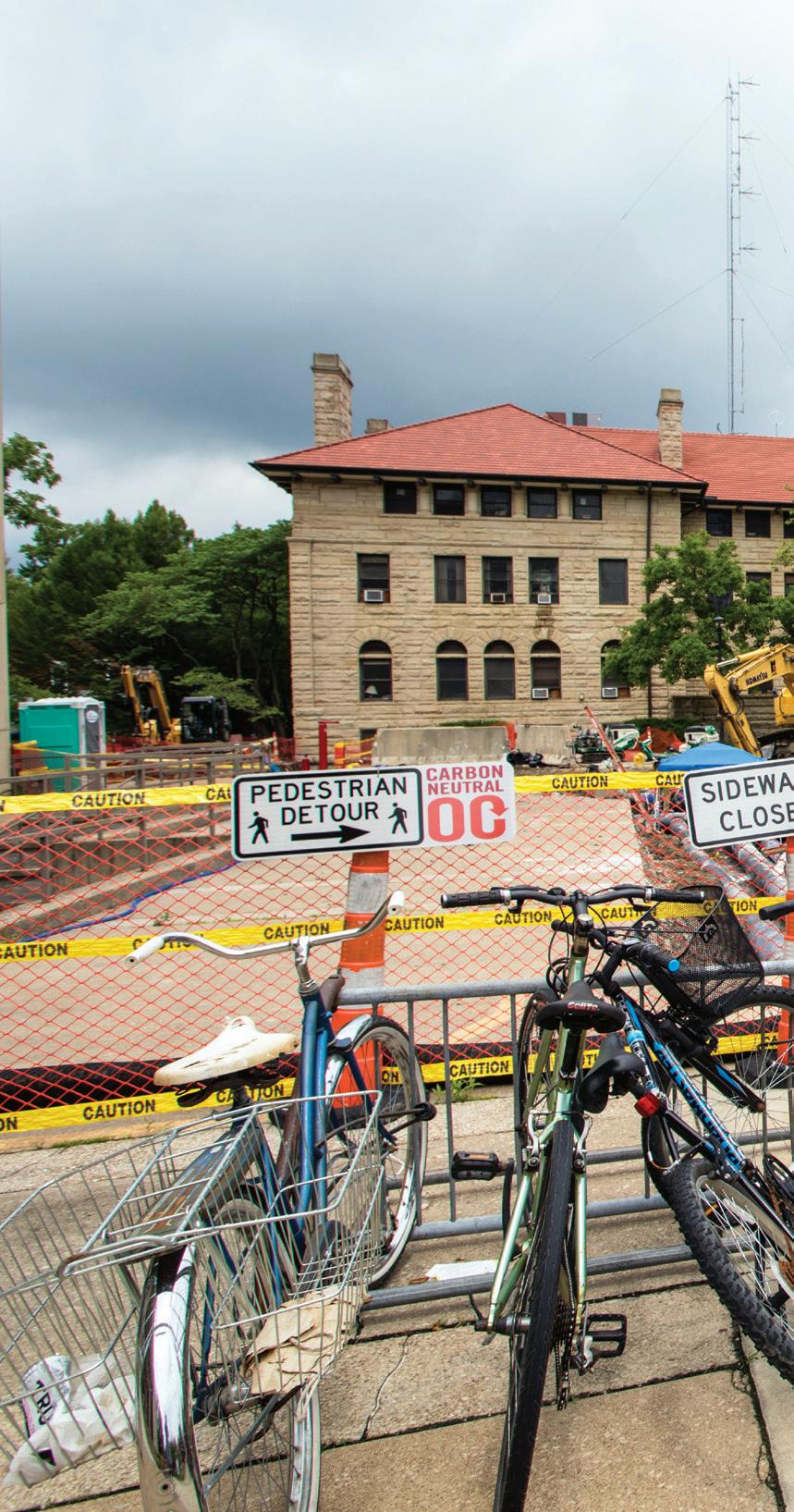
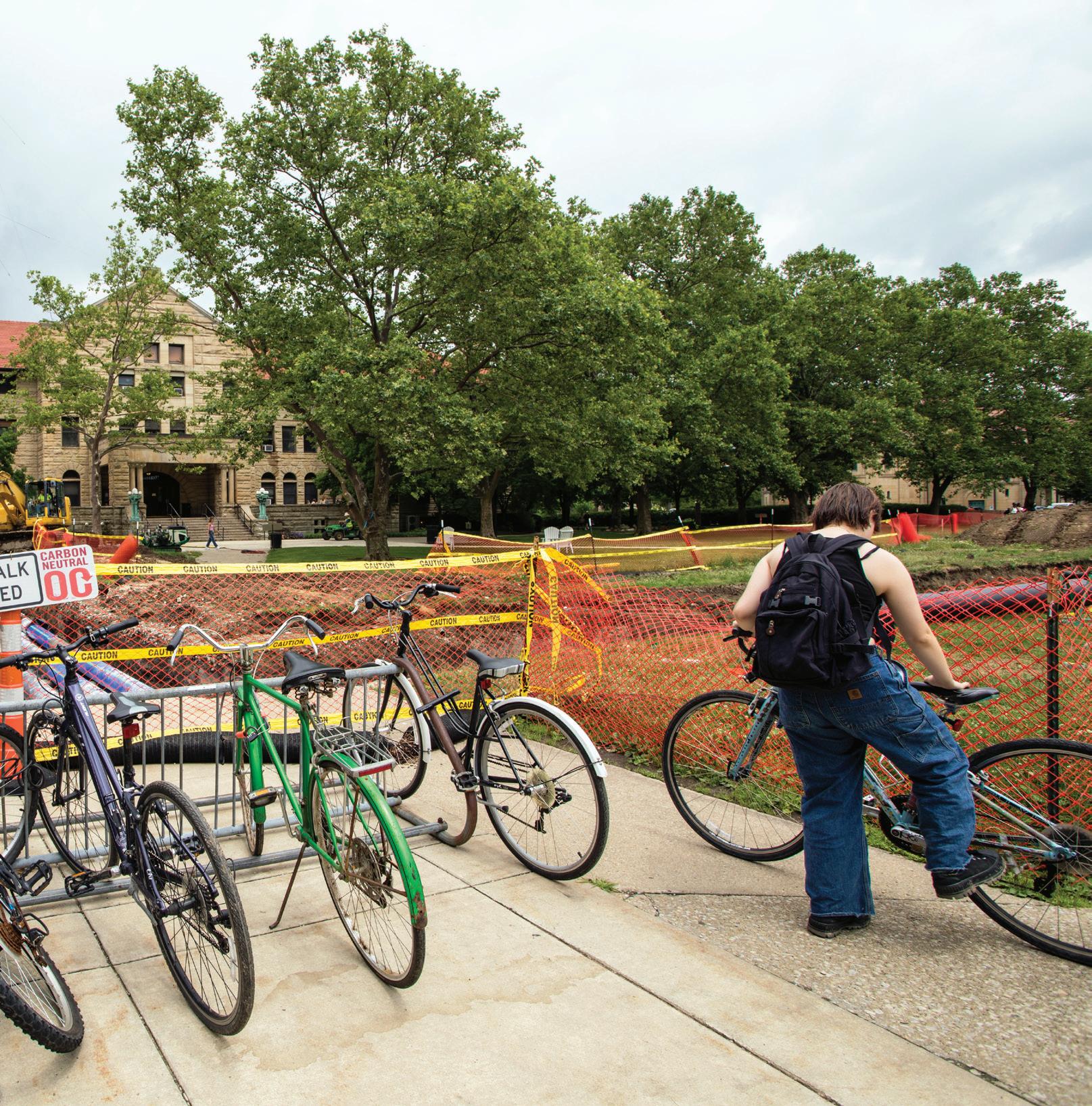
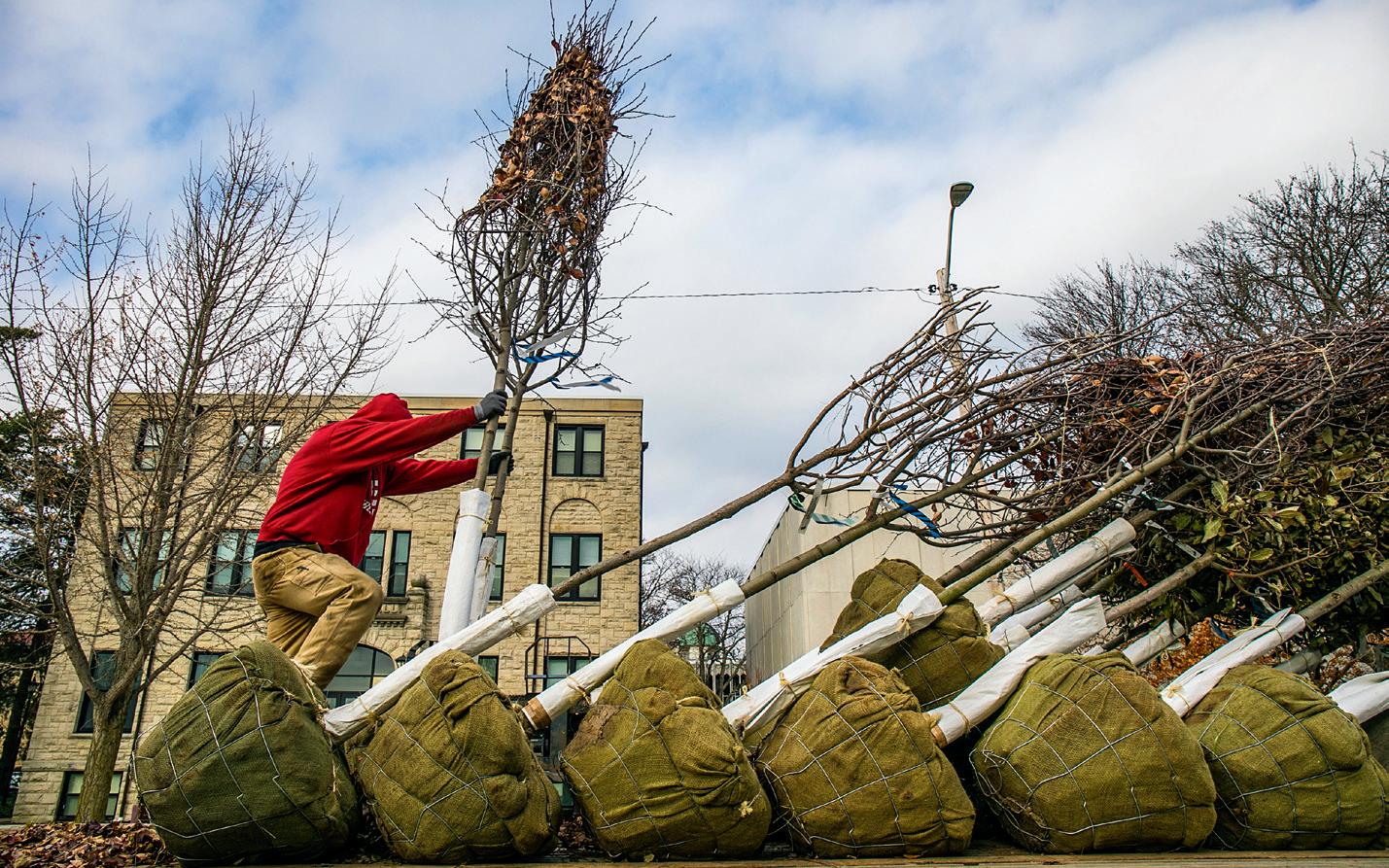
TAKING ROOT As part of on-campus construction for SIP (left), workers also planted new trees (above).
A nother Green World
How
sustainability shows up everywhere on Oberlin’s campus
1 THE ACADEMIC EXPERIENCE
In true liberal arts fashion, at Oberlin, sustainability isn’t just a topic covered in the environmental studies program. Students can study how it intersects with history (You Are What You Eat and Wear: Global Crops), politics (Environmental Policy), and music (Making a Sustainable, Inclusive, and Just Future: The New Industrial Revolution). Another popular class, Environmental Economics, explores how to use economic tools to understand the root causes of environmental problems, as well as potential policy solutions. “Environmental economics integrates ecological realities with economic decision-making frameworks,” says
“Environmental economics integrates ecological realities with economic decision-making frameworks.”
BY ANNIE ZALESKI
Associate Professor of Economics and Environmental Studies Paul Brehm, who teaches the class. “As a result, we can find policies that maximize social welfare—a combination of prosperity and sustainability.”
2 ON-CAMPUS INTERNSHIPS
Students interested in gaining environmental experience can intern with Oberlin’s Office of Energy and Sustainability (OES) on various teams that align with their interests (e.g., zero-waste, policy, and green grounds). The Resource Conservation Team is another popular internship option: This group oversees sustainability-geared initiatives the Free Store, Oberlin Food Rescue, the J-House Garden, and Big Swap, all of which emphasize the value of reducing waste and making resources available to the college and surrounding communities.
3 ECOREPS
Each residence hall has an EcoRepresentative (EcoRep), who is like “a green ambassador,” says sustainability manager Heather Adelman. “They’re meant to provide peer-to-peer support and interactions between students on sustainability topics.” In addition to hosting sustainability awareness events such as trivia nights or “Eco Jeopardy,”
they monitor buildings to make sure recycling and composting is being done correctly, helping students change their behavior to reduce water and energy use.
5 ALTERNATIVE TRANSPORTATION
No car on campus? No problem! The college has a free Saturday shopping shuttle that stops at major stores, while the city of Oberlin offers a free electric bus during the week
that makes a loop around major places. All-electric CarShare vehicles are also available for students to rent. For those who prefer two wheels, OES is also partnering with the Bike Co-op to hire bike mechanics so they can bolster the bike rental program.
6 SUSTAINABILITY TRAINING
At the start of this academic year, all incoming first-year and transfer students went through mandatory sustainability training to learn about the college’s commitment to carbon neutrality; how to get involved in oncampus sustainability efforts; and how their day-to-day behavior choices make an impact on Oberlin resource use.
7 MANAGING THE CAMPUS GROUNDS
Staff at Oberlin take care of campus from the ground up—literally. The grounds services team is looking
4 ECOLYMPICS
Launched in 2006, the two-week Ecolympics competition challenges buildings on campus and in the city of Oberlin to lower their carbon footprint. During Ecolympics, people who live or work in these buildings are encouraged to put extra thought into their electricity and water consumption, like shutting off lights when not in use or turning off the faucet when brushing teeth. Ecolympics exemplifies how individual behaviors add to our collective impact and contribute to our overall carbon neutrality. “We’ve even found that resource use stays lower after Ecolympics because people are creating new behaviors,” Adelman says.
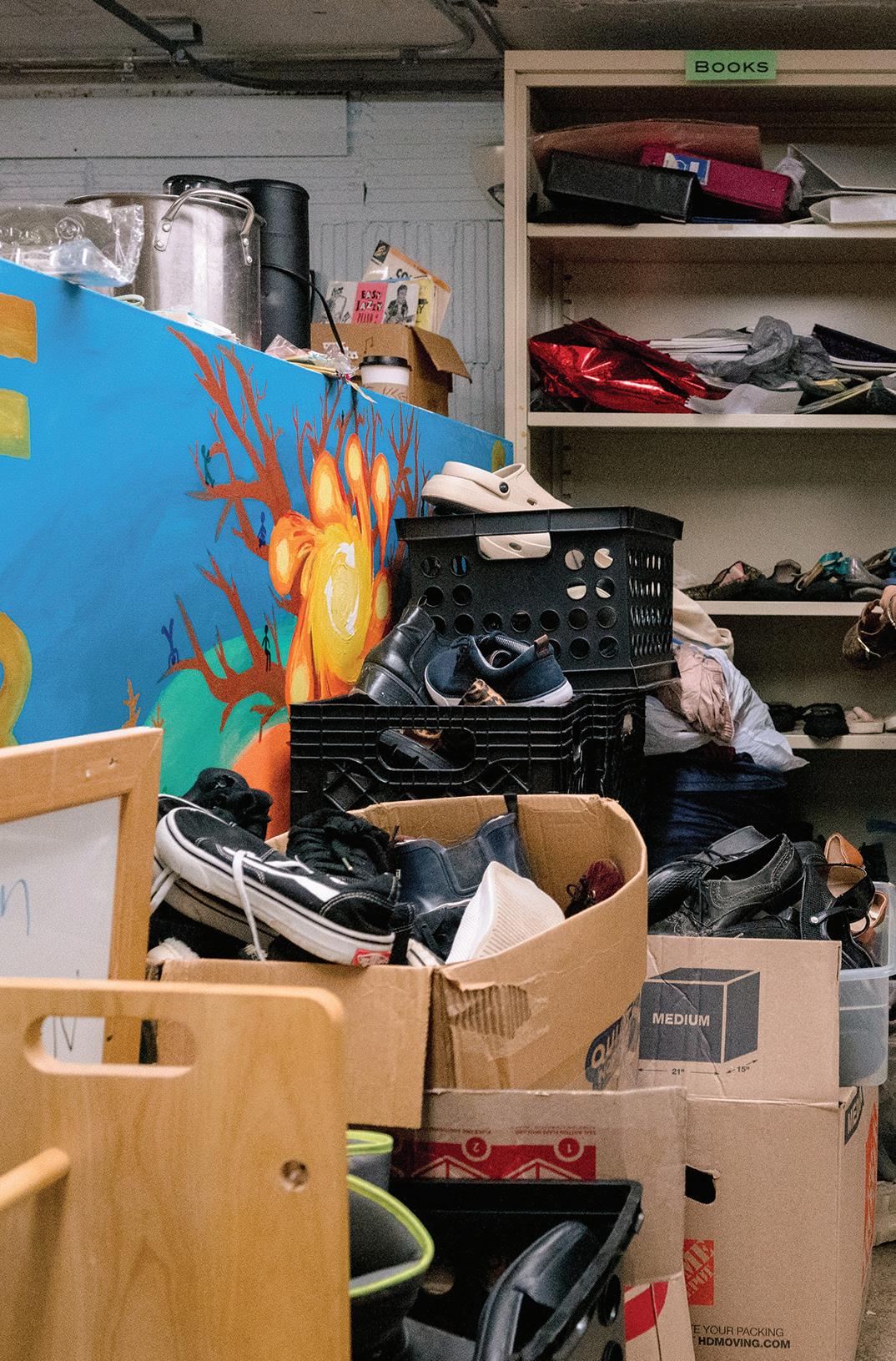
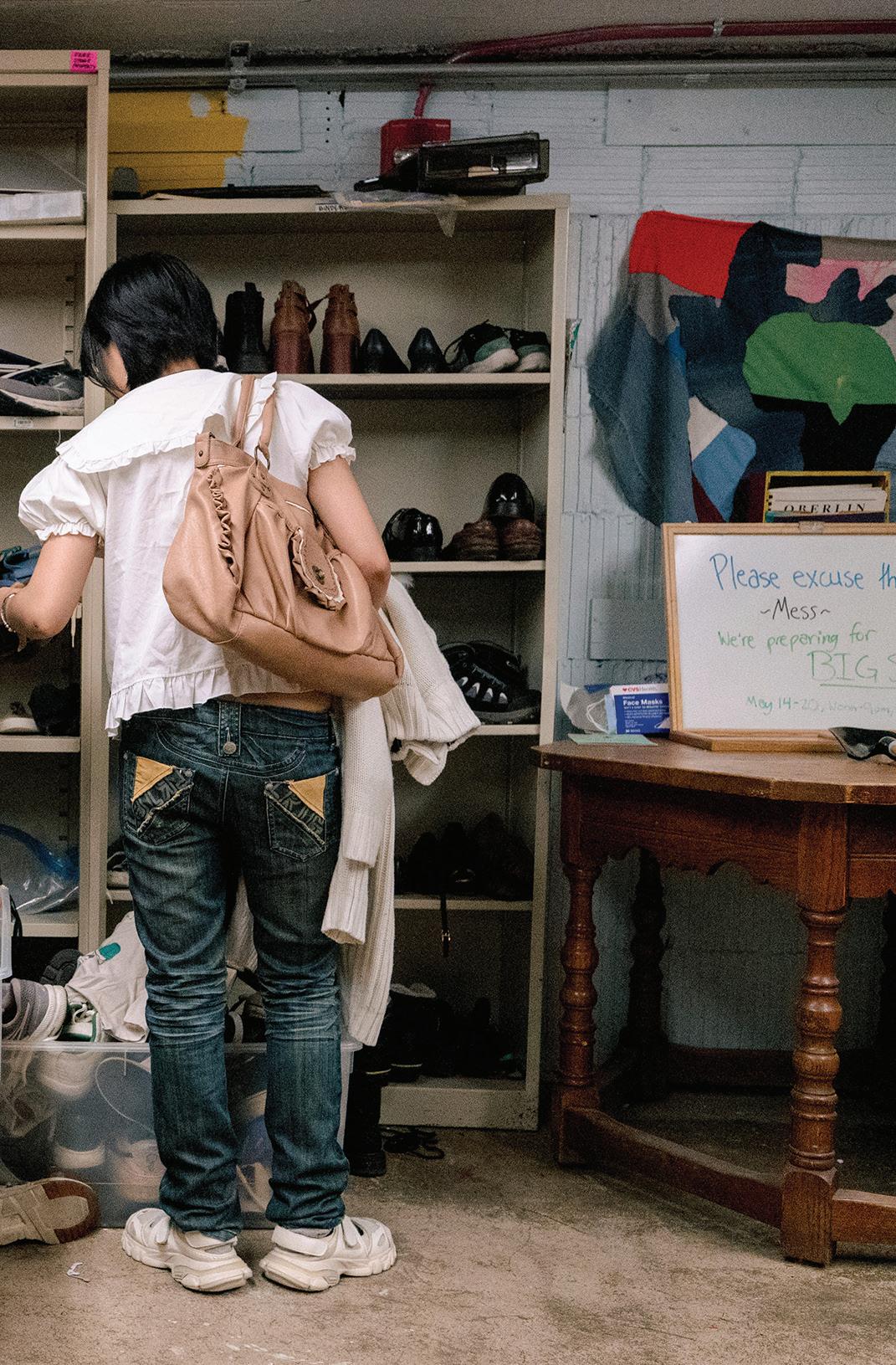
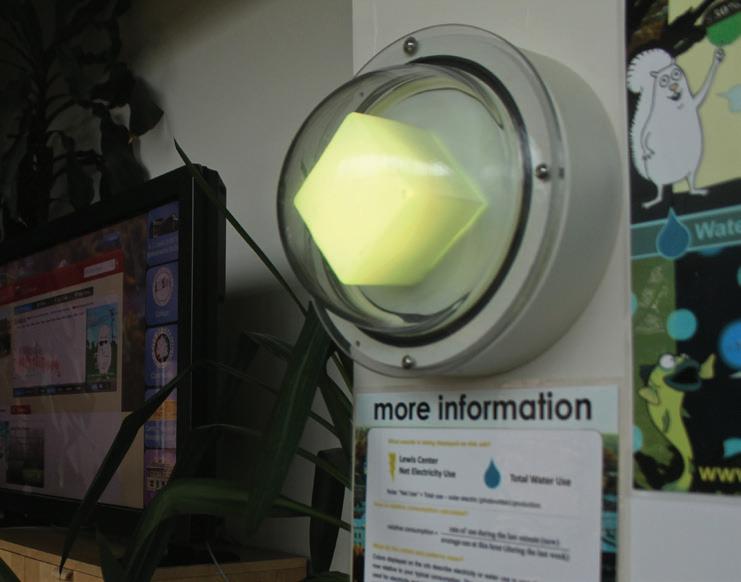
SUSTAINABLE EFFORTS A student goes shopping for treasure in Oberlin’s oncampus Free Store (top); an environmental orb gives green guidance (above).
for opportunities to reduce synthetic fertilizers on grass that needs to look perfect, like in Wilder Bowl and Tappan Square. Current pilot projects at the latter places showed so much promise that this work is expanding to the athletic fields and the lawn at President Carmen Twillie Ambar’s house. Several times a year, a flock of sheep arrives on campus to graze on
the solar array; consider them ecofriendly lawn mowers.
8
THE GREEN EDGE FUND
Established in 2008, the Green EDGE Fund is a student-run organization to support sustainability projects for the college and surrounding areas. The fund administers efficiency loans (earmarked for on-campus projects) and sustainability grants (for community or city projects). Over time, these grants have funded water refill stations on campus and materials for Ecolympics, along with solar installations at Oberlin Community Services and Oberlin City Schools.
9 SUSTAINABLE LIVING IN KAHN HALL
First-year students in Kahn Hall apply to live there and pledge to make sustainability part of their everyday life; among other things, they try to conserve water and energy, reduce waste, avoid bringing cars to campus, and minimize their negative impact on the environment. As of this year, Adelman is Kahn’s residential hall advisor, overseeing a variety of activities with and for students. First up: an invasive species removal from the woods behind the dorm.
10
ENVIRONMENTAL ORBS
Located in all large residential houses, Oberlin’s environmental orbs use pulsing and changing patterns of color to communicate each building’s current level of water and electricity usage. The real-time feedback communicates the dynamic nature of resource consumption and raises awareness about conservation.
Additional reporting by Lucy Curtis ’24
BY GINGER CHRIST
Building A Legacy
As the Adam Joseph Lewis Center for Environmental Studies turns 25, our world-changing alums carry its impact forward.
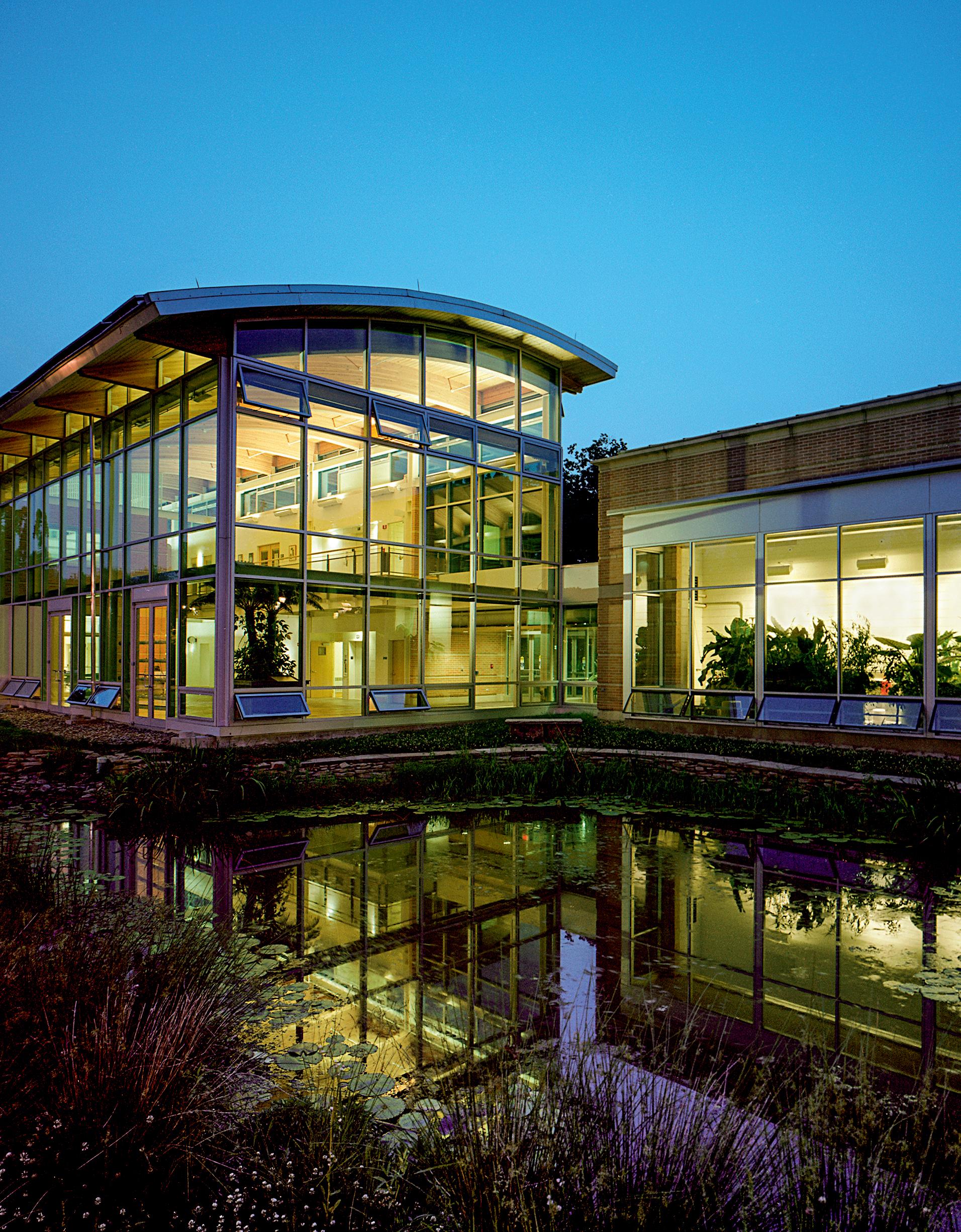
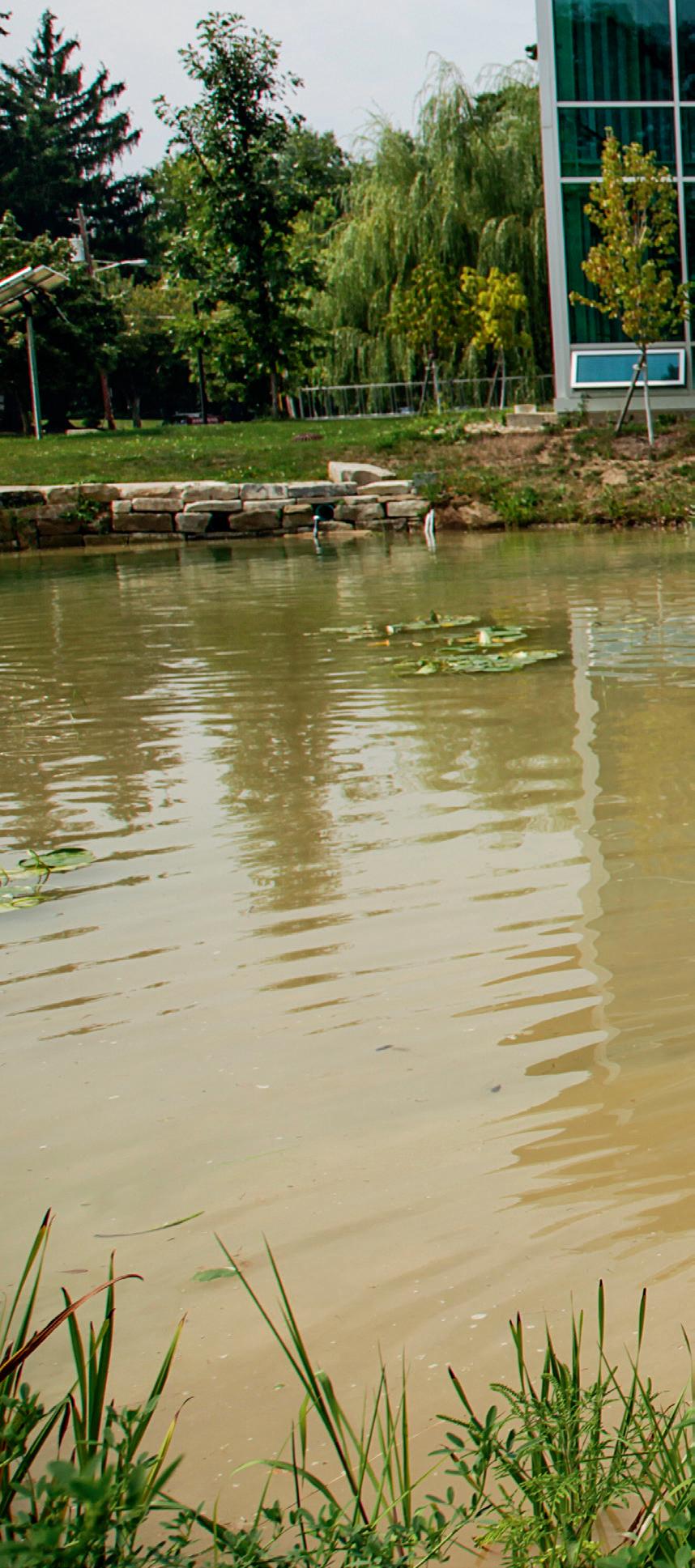
BEFORE A VISITOR EVER steps foot inside the Adam Joseph Lewis Center for Environmental Studies (AJLC), the building’s ties to the natural world are clear. On the south side, a seasonal sundial set to mark solstices and equinoxes stretches out before the glassencased atrium. On the southeast side, a restored wetland is visible from a stone amphitheater.
Inside, a welcome sign displays the Environmental Dashboard, which shows real-time data on resource consumption, and a 100-square-foot water sculpture rises to the ceiling. The sound of trickling water echoes through the plantladen two-story lobby.
Opened in 2000, the solar-powered AJLC, which Building Design + Construction magazine once named one of 52 “game-changing buildings” alongside the Gateway Arch in St. Louis and London’s Savoy Theatre, is considered a pioneer of the green campus movement. The space laid the groundwork for a one-of-a-kind experiential learning experience and the future of green building.
The AJLC also launched Oberlin’s sustainability journey and cemented the college as a leader in environmental innovation. For example, Oberlin achieved carbon neutrality thanks to its groundbreaking Sustainable Infrastructure Program, which involved replacing aging infrastructure with an eco-friendly system powered by 850 geothermal wells.
“[The AJLC] opened a door that a lot of people have walked through since,” says Lindsay Baker ’04, CEO of the International Living Future Institute, a nonprofit committed to advancing regenerative design.
Baker says that prior to the AJLC’s construction, there was an assumption that the built environment couldn’t be changed or influenced by new ideas—especially from students. “That building and the way that it was designed, built, and then
operated really busted that myth for a lot of undergraduates at Oberlin. We were told, ‘It’s possible to run buildings in a different way, to build them in a different way.’”
THE ORIGIN STORY
It all started with a rainstorm—or a few of them.
David Orr, who is now the Paul Sears Distinguished Professor of Environmental Studies and Politics Emeritus, had an office in the basement of Rice Hall, which flooded every time it rained.
“We had to build a building to get out of the wetland,” he quips.
With a grant from the George Gund Foundation to assess the possibilities for an environmental studies center on campus, Oberlin launched what amounted to a full-year building course. The college brought in a dozen well-known architects from across the country to present architecture and landscape concepts to students.
None of the options for using existing buildings panned out, so Orr and the students worked with the design team at William McDonough + Partners to create their vision for what would eventually become the AJLC.
“That building and the way that it was designed, built, and then operatedreally busted that myth for a lot of undergraduates at Oberlin.”
Orr, who envisioned using architecture as a tool to teach environmental lessons, saw the building as an opportunity for students to be involved in every step of the process, to help craft the very place where future students would learn.
For example, undergraduates have opportunities to oversee the Living Machine, which filters and recycles the
building’s wastewater by mimicking natural wetlands. The building also incorporates natural lighting and ventilation and employs a ground-source heat pump system.
“You don’t stop to say, ‘Can it be done?’ You say, ‘Should it be done?’” Orr says. “The thing I’m most proud of about the building is that it drove green building in higher education and elsewhere.”
Sadhu Johnston ’98, who now consults on green building and climate readiness, couldn’t agree more. “That whole experience really shaped my passion and interest in green buildings and green building policy,” he says. “It had a fundamental impact on my career path.”
Johnston and his now-wife, Manda Aufochs Gillespie ’97, were involved in the building during the design and construction phase; Orr later tapped the couple to lead a sustainable community symposium tied to the AJLC’s creation. Even after the building opened, they gave tours and engaged with donors and prospective students.
“At that time, the building was this kind of living experience that we were having,” Johnston says, comparing it to a physical manifestation of what was being taught in the classroom.
tools,” says Baker, whose organization currently leads the certification program. “We work with a variety of different organizations around the country to use their buildings in the way that the [AJLC] does.”
BUILDING A GREEN COMMUNITY OF PEERS
The AJLC’s influence can be seen not only in physical buildings, but also from the impact graduates of the environmental studies program—and the college—have had in the world.
Historically, Oberlin has attracted students who “want to make a change in the world” and “want to be agents of change,” says John Petersen ’88, the Paul Sears Distinguished Professor of Environmental Studies and Biology.
“The thing I’m most proud of about the building is that it drove green inbuilding educationhigher and elsewhere.”
Today, he says the right metaphor to show the building’s influence is to imagine someone dropping a stone into a still pond and seeing the ripples spreading across the water.
Baker notes that the AJLC was a living building before the existence of the Living Building Challenge, which recognizes buildings that are net positive in terms of their energy and water; are free of toxic chemicals; and have shown positive impacts on the community.
“One of the handful of ways that the [AJLC] has had a lasting impact is that it has inspired and helped to fuel the growth of this program that we run that is designed to help people design and build and then operate and use these kinds of buildings as teaching
“Everything we are here at this institution today—and not just this institution, but the [Oberlin] community as a whole—can be traced back to the AJLC and the ripples going out,” Petersen says. Through the building, the college was able to show “what it means to create something that’s truly novel and innovative” and “to attract creative, smart, entrepreneurial people.”
Baker, a leader in the green building movement, has used her experience at Oberlin with the AJLC to create market and regulatory mechanisms to change how buildings are built in this country and around the world.
“ Fundamentally, I would never have
understood the power of buildings to influence how we see the world if I hadn’t been in [the AJLC],” Baker says. “I got to learn that firsthand, and it’s enabled me to go and teach that lesson to many people.”
Baker’s work began right out of college, when she landed a position at the U.S. Green Building Council and helped create Leadership in Energy and Environmental Design (LEED)
standards. Those standards are the most widely accepted green building rating system and assess a project’s energy and water usage, materials selection, waste management, and indoor environmental quality.
After graduating from Oberlin, Johnston was unsure if he wanted to attend graduate school and turned to Orr, his advisor, for advice.
“He gave me this poke in the chest
and said, ‘We don’t have time for you to go to graduate school. Get out there and start working,’” Johnston says. “That really had an influence on me; I could continue to learn in school or continue to learn on the job.”
Johnston moved to Cleveland and launched a speaker series, “Redesigning Cleveland for the 21st Century,” that brought thinkers, leaders, and architects involved in the AJLC to
the city to speak at City Hall and in meetings with business leaders.
The series aligned with the creation of the Cleveland Green Building Coalition, where he served as founder and executive director. The group spearheaded a LEED-certified renovation of the Lorain Avenue
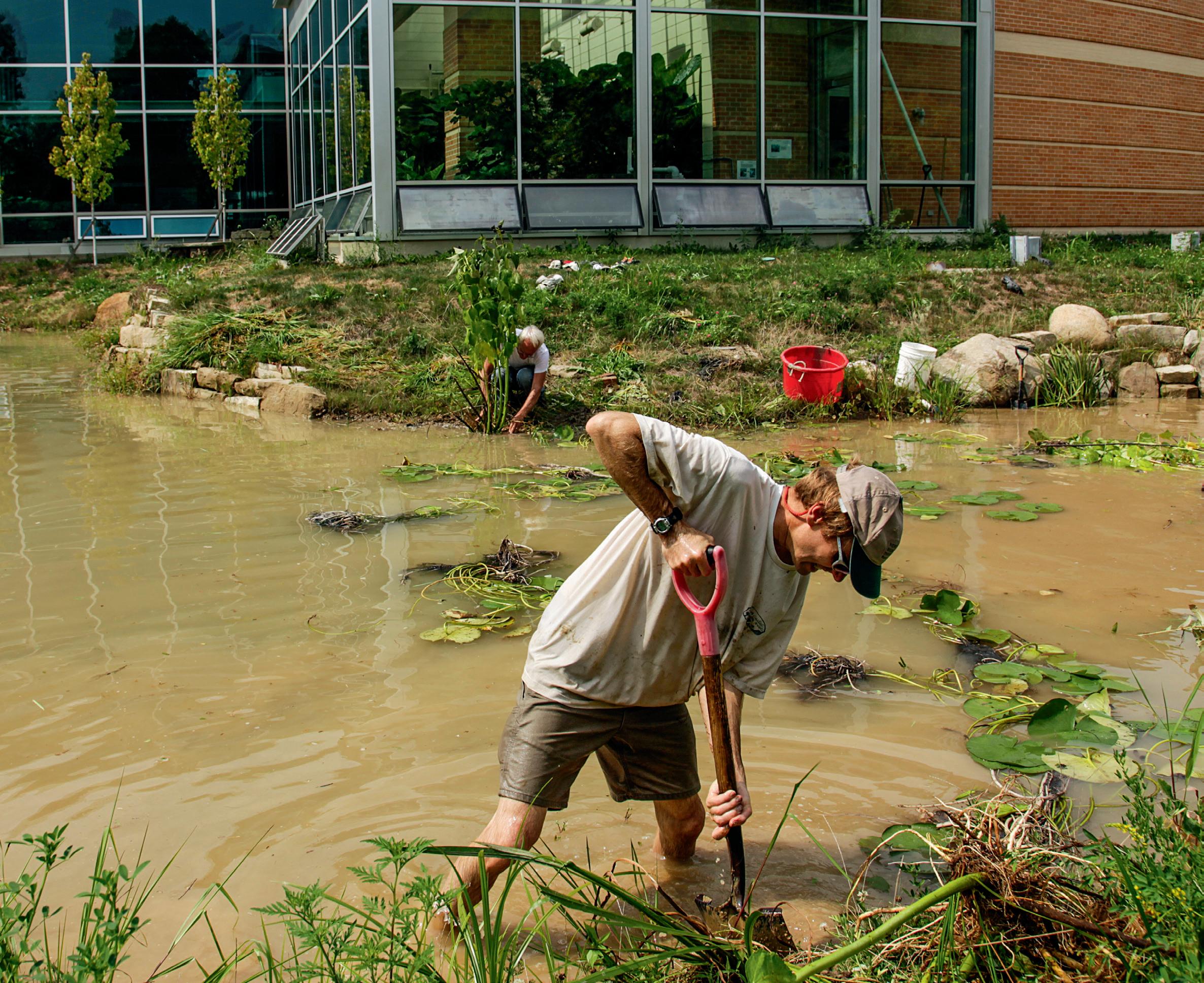
PUTTING DOWN ROOTS Students plant native species outside the AJLC.
Savings & Loan Building in Ohio City, a nearly 100-year-old building that was retrofitted with geothermal heating and cooling, solar panels, and a green roof.
Johnston went on to work as chief environmental officer for Chicago and a city manager for Vancouver, British Columbia, before launching his consultancy.
Today, he’s focused on bringing those green building concepts to smaller communities. Through a contract from the federal government with the Canadian Urban Institute, he works with communities to integrate climate readiness into their infrastructure. He’s also dedicated to green housing and implementing solar design and rainwater capture, which he first learned about in the AJLC design.
“Throughout my career, I’ve definitely anchored back to those experiences and lessons learned at Oberlin and, in particular, with the building,” Johnston says.
Grant Sheely ’19, who minored in environmental studies, was encouraged by Petersen to work at the AJLC while he studied at Oberlin. Sheely became a Living Machine operator, where he helped monitor the solar panels and meters and ensure the building was operating at net zero. At the same time, he did greenhouse gas accounting for the college and presented data and suggestions on how to reduce emissions.
That experience propelled Sheely into a career involved in buildings and their environmental impact. He worked as sustainability coordinator for a real estate company before training to award LEED and Energy Star certifications to buildings being constructed. He now works for the New Buildings Institute, which does building code development and helps jurisdictions achieve their goals.
“This whole path of buildings being my focus truly originated at the AJLC,” Sheely says. “There’s no way I would have been like, ‘Buildings are cool,’ without one of the coolest ones ever.”
GROWING A SUSTAINABLE FUTURE
Being an environmental educator involves teaching students the often hard truth about the problems plaguing the world, but also showing them a path to make that truth better and giving them hope, Petersen says. “Hope is about rolling up your sleeves and getting something done. I think that’s what this building has been so good at.”
Through the AJLC, Oberlin has been able to show students firsthand systems thinking—understanding the complexity of the world through the relationships among its parts.
“The thing that you try to teach students is that yes, there are a lot of problems to solve in the environment, but if you solve those problems right, you can solve them across society,” Petersen says.
At one point, the AJLC and adjacent solar parking pavilion comprised the largest solar array in Ohio. “Today, this building has a solar array that is dwarfed
A BRIGHT FUTURE Today’s Oberlin students continue to study and work in (and learn from) the AJLC (left and below).
by the solar array we have on the north end of campus,” Petersen says. “That’s how far we’ve come in these 25 years.”
Petersen and others have recently engaged in a series of envisioning sessions about the future of the AJLC, coined AJLC 2.0. They’ve identified physical things that need to be addressed, from heating to plumbing to electrical problems, and are considering how the building can inspire the next quarter century.
As Orr notes, the idea is to keep the vision not just going, but growing.
Having achieved carbon neutrality, Oberlin has an opportunity to build on the seeds planted by the AJLC, show others what is possible, and inspire the next generation of students to come to Oberlin, Petersen adds.
In other words, the true legacy of the AJLC is what change it brought about—and the trajectory it put the environmental community and Oberlin on, as he puts it.
“We have a unique moment right now,” Petersen says. “Oberlin is offering some hope right now with what we’ve done.”
Ginger Christ is a freelance journalist in Northeast Ohio.
BY ANNIE ZALESKI
Research Roundup
Every day, Oberlin’s faculty and students produce scholarly work that uncovers new insights into how we understand the world, particularly in sustainability and the environment.
The New Pollution
WHEN PROFESSOR of Chemistry and Biochemistry
Matt Elrod started studying pollutants, the major topics of conversation in his field were the detrimental health effects of ozone pollution (e.g., smog). Today, he says, the research is focused on small particles—for example, the pollutants produced by wildfire smoke or industrial processes. “Particle pollution is now understood to be a big public health problem around the world,”
“Particle pollution is understoodnow to be a big publicproblemhealtharound the world.”
Elrod says. “[In my Environmental Chemistry class] I talk about it in terms of, ‘There are multiple threats in the air that we breathe.’ The smallparticle kind of air pollution kills many more people worldwide than ozone pollution.”
One mystery is how these pollutant particles end up in the atmosphere. Not all of the gases produced by industrial plants are dangerous. Instead, chemical processes happening in the air transform these harmless substances into damaging ones. But how exactly does this happen? It’s a question Elrod posed in a 2025 ACS Earth and Space Chemistry article based on six years of research that looked at how a chemical emitted by trees “interacts with acids which humans have added to the atmosphere and creates these particles,” he explains.
Working in tandem with Associate Professor of Chemistry and Biochemistry Jason Belitsky and student researchers—including Rebecca Fenselau ’22, Ali Alotbi ’23, Caroline Lee ’24, Julia Cronin ’25, and Daniel Hill ’21—Elrod discovered something surprising. “The chemicals that come from trees can cause pollution, but only in combination
with human-added chemicals,” he says. That’s where the acids come in: They are a by-product of energy production with fuels containing sulfur. “Sulfur leads to acid formation—and acid formation is what allows these particles to form from natural chemicals.” In other words, he notes, this pollution is a “human-caused problem”—and any regulation taking aim at particle formation needs to target things that produce acids.
Solving this problem led Elrod and his lab to solve another problem related to how human-caused nitrogen pollution leads to particle formation; they published their findings in August 2025 in ACS ES&T Air. Three alums from the first paper were coauthors, alongside Molly Foley ’26, Serena Gaboury ’27, Daniel Pastor ’25, Drew Dansby ’23, and Galen Brennan ’17. Elrod notes that it can take years for research to impact policy, but his lab’s discoveries have the potential to make a difference in the future.
Great, Great Lakes
Associate Professor of Geosciences Rachel Eveleth grew up on Lake Michigan seeing how much people rely on the Great Lakes for things such as drinking water. At Oberlin, she saw an
MICHAEL HARTMAN
opportunity to expand the research on these crucial bodies of water.
“People weren’t thinking as much about the climate impacts on the Great Lakes,” she says. “They were more focused on harmful algal blooms themselves rather than the interactions with climate and carbon.”
Given her background in oceanography—she earned a doctorate in Earth and ocean sciences at Duke University—Eveleth began to apply some of the methods she was using in the open ocean to a system that “had more immediate, direct human impact,” she says. “Big picture, my research program is looking at interactions between climate and water, and mostly that looks at carbon cycling.”
Among other things, Eveleth and several other institutions have worked on a NOAA-funded collaborative project on the potential effects of the acidification of the Great Lakes. Her
research also examines the impact of the decline in ice coverage over the water during the winter. “There’s variability from year to year, but the trend is downward, and [the expectation is] that this will continue,” she says. “What does that mean for the ecosystem? What does that mean for the chemistry of the water, the water quality?”
Getting water samples via field work is key; for example, this could include going on boats on the western basin of Lake Erie. As part of a group called the Great Lakes Winter Network, Eveleth and her research collaborators f rom U.S. and Canadian institutions (including student Nyrobi Whitfield ’26) have also come together to do a series of “winter grabs” of samples. The Oberlin team augured through the ice off a dock in the Lorain Harbor.
The goal is to determine a baseline to inform research going forward. “We don’t know what the carbon budget
Marketing For Good
Are there ways to leverage advertising psychology for the good of the planet? Professor of Environmental Studies and Biology John Petersen ’88 and Professor of Psychology and Environmental Studies Cindy Frantz say yes: The pair coauthored a field study in the journal Sustainability that demonstrated digital signs were effective in fostering positive environmental norms and behaviors. Read more about their work: oberlin.edu/news/ marketing-good
looks like for Lake Erie, and we’re starting to put that together and figuring out what that means for longterm trends,” Eveleth says, noting that the algae blooms in particular affect whether the lakes are emitting or absorbing carbon dioxide.
Based on the carbon budgets they’ve seen so far, Lake Erie is “acting as a sink, so it’s taking up carbon dioxide from the atmosphere rather than releasing it,” Eveleth says, even in the winter. “How we put these carbon dynamics from the lake into large-scale climate models can impact what future climate projections look like. But it also can change our future predictions about pH.”
For more incredible research conducted by Oberlin’s faculty, read Volume 1 of the Oberlin Research Review, available at: oberlin.edu/research-review
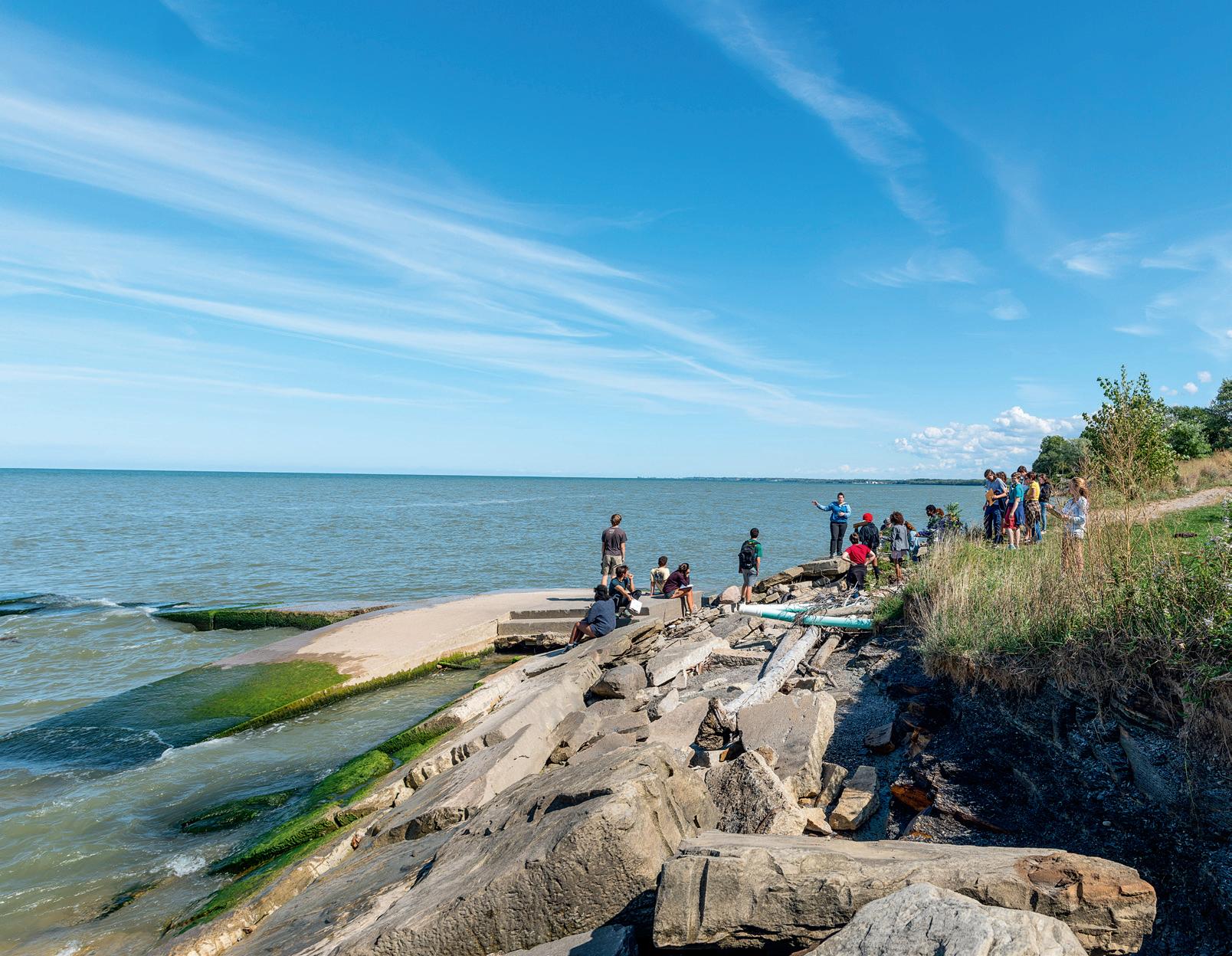
LAKE LORE In this geology class, Earth’s Environments, students spent the day visiting parks in nearby Vermilion, where they sketched the shoreline and thought about erosion and deposition of sediment and how that’s controlled by water movement.
BY ANNIE NICKOLOFF
Food for Thought
Oberlin’s academic offerings and Northeast Ohio’s unique agriculture scene are havens for students passionate about food studies.
AT VILLAGE FAMILY FARMS in Cleveland’s Hough neighborhood, peppers, tomatoes, green beans, and herbs flourish on the lots that once housed apartment complexes for the community. Bees buzz around the site’s hives while, just a few blocks away, traffic rumbles in and out of the city’s east side.
Last summer, Vic Zuno ’26 sank his hands in the dirt here, contributing to the farm’s day-to-day operations and assisting founder Jamel Rahkeera with the property as part of an internship centered on food justice, fulfilling the experiential requirement of Oberlin’s food studies integrative concentration.
But Zuno’s focus went deeper than the topsoil. Working with neighborhood teens, he created a new summer youth curriculum, designed to explore the intersections of urban farming, the environment, societal issues like redlining, and food sovereignty.
Zuno, who’s from Chicago. “I come from an area where there’s a lot of obstacles you have to jump over to get what should be given to you—like a good education, healthy food options, and safety in general. These kids have their own testimonies and their own struggles that they’ve overcome or are going through.”
The experience made a mark on Zuno. After graduating, he plans to look for similar opportunities in his career, working with sustainable organizations like Village Family Farms as a consultant in business development or community engagement.
“It’s been really powerful for students to be getting engaged in the local area beyond the town of Oberlin.”
“It took me back to my roots,” says
“It was a transformative experience,” he says about both Village Family Farms and food studies.
The integrative concentration is about more than food. Often, it’s about community. Since launching in 2023, the food studies program has empowered students to get involved with grassroots local organizations, kick-started entrepreneurial incubation projects on Oberlin’s George Jones
Memorial Farm, and strengthened connections between Oberlin and Lorain County Community College.
“It’s been really powerful for students to be getting engaged in the local area beyond the town of Oberlin,” says Jay Fiskio, professor of environmental studies and comparative American studies. “Students do get a lot of opportunities to do stuff in Oberlin if they want, but we have a lot of community partners in Lorain, Elyria, and Cleveland. That’s been really great.”
Oberlin’s approach to food studies is broad and interdisciplinary, focusing on history, foodways, and even neuroscience in addition to food justice and equity. The latter topics are important to Northeast Ohio communities. According to 2023 data compiled by Feeding America, Lorain County has a 15.4 percent food insecurity rate, and adjacent Cuyahoga County, where Cleveland is located, has a rate of 16.6 percent; both are above the national average of 14.3 percent. Locally, the nonprofit Healthy Northeast Ohio found that those rates increase in Black and African American communities (33 percent in Cuyahoga County, 32 percent in Lorain County) and in Hispanic communities (29 percent in both Cuyahoga and Lorain Counties).
At Oberlin College and in Northeast Ohio, the study of food is about more than just flavor: It’s about the systems and stories behind each bite.
AN ACADEMIC APPROACH
Rolling fields of towering cornstalks and lush, green soybeans surround Oberlin with typical Lorain County farmland. It’s quite different from Gavriella Perez ’25’s urban and suburban hometown of Pennsauken, New Jersey, seven miles from Philadelphia. Perez says healthy food wasn’t always accessible in their community, though credits her parents with showing how to source nutritious groceries and meals.
When Perez came to Oberlin in September 2022, the quiet, rural campus felt like “a complete 180” from their hometown. But there was some overlap. According to 2019 USDA food access research, which analyzed food access with and without a vehicle, much of Oberlin lacks easy access to nutritionally dense food—even with all the surrounding farms of corn and soy.
“Here we are in a county that is very food production heavy, but it’s very cash-crop heavy,” they say. “Corn, for the most part, most of it isn’t for human consumption. You will never eat that corn. That corn is going, maybe, 100 miles away.”
and agriculture, and even a French class where students sample wine and cheese.
In addition to her food studies classes, Perez completed an internship with chef Shontae Jackson’s Steel Farm and Gardens in Lorain in the summer after their second year. There, on land that once held an abandoned house, Jackson has regenerated and returned nutrients into the soil to grow things such as fruit trees, berries, and cacti in Northeast Ohio’s often unpredictable climate.
“She’s someone I’ve admired for years, and so being able to work with her was honestly a dream,” Perez says. “She’s also an amazing chef, and she’s able to also foster that, helping me actually work in kitchens, working in food service, being able to see what it’s like to be on the executive side of that culinary world.”
“Those decades and decades of connection and community created this fabric that enriched the soil in which the local food movement in Clevelandoutgrewof.”
Initially drawn to Oberlin for its environmental studies program, Perez quickly jumped into the food studies integrative concentration when it became available during their sophomore year because of her passions for culinary and agricultural studies. “It aligned with every interest I have,” Perez says.
Food studies includes a range of classes on healthy eating, Lorain County foodways, the Great Lakes’ Indigenous nations, restaurant labor, colonization
Perez used their experiences at Steel Farm and Gardens to research Northeast Ohio’s food ecosystem, and that segued into their capstone project, which analyzes Puerto Rico’s farming history and culture and the impacts of American imperialism. She hopes to continue her research in a graduate program.
“[Oberlin’s] a completely different food scene,” Perez says. “I was able to take the ways that food exists in Ohio as a whole and just transplant different ways of thinking to it.”
Plenty of Obies found passions for sustainability and agriculture on campus before the food studies program was established. So far, only two classes have graduated with the concentration as an option, says Fiskio.
“The food studies program is really new, but we’ve had students doing agriculture and food work for years before there was a program,” Fiskio says. “And that gives a better sense of what the f ield is—that it’s very interdisciplinary. It
stretches in all kinds of directions, and it’s really up to the students to direct where they want it to go.”
THE GREAT OUTDOORS
Sitting on the patio to George Jones Memorial Farm’s straw bale house, Leah Finegold ’20’s energetic dog Squash leaps jubilantly through the grasses near a garden’s rows of blossoming flowers.
Finegold found their way to a community-supported agriculture program thanks to their early experiences at Oberlin. As an
undergraduate, they were a part of the Oberlin Student Cooperative Association (OSCA) and worked as a food security associate for Oberlin Community Services. After graduation, Finegold worked at Bellwether Farm in Wakeman, Ohio, and for a low-income housing program for the city of Cleveland.
Today, they work at City Fresh, a nonprofit that sells locally grown produce boxes to Northeast Ohio community members at a reasonable price. The organization was another perfect fit for Finegold’s interests—and was just a mile away from Oberlin. (The college owns George Jones Memorial Farm and rents space to City Fresh.) Finegold is the program director of the organization’s farm box program, a
subscription of in-season, locally grown produce shares delivered weekly to various pickup stations in Northeast Ohio.
“I came to Oberlin knowing that I wanted to do at least something with environmental studies,” they say. “I explored a lot of facets of environmentalism during my time at Oberlin and really found food to be a connector of all of them and just something that I loved.”
In addition to City Fresh, George Jones Memorial Farm hosts a regular crew of student workers from Oberlin and a new incubator farm program with six farmers using land to work on agriculture projects. And, for the past decade, visiting environmental
studies lecturer Brad Melzer can often be seen out on the farm with his class of agroecology practicum students.
Depending on the season, the group builds garden beds, plants seeds, crafts water systems, and harvests crops— all while exploring the sciences of sustainable agriculture and ecology. Field trips bring students to urban farms in Cleveland, like Rid-All Green Partnership in the Kinsman neighborhood and the Ben Franklin Community Garden in Old Brooklyn.
These spaces spurred the local food movement in Northeast Ohio— something that’s reflected in some of the region’s most popular farm-to-table restaurants today, Melzer says.
“Ohio is an agricultural state as it is, but those community gardens, especially on [Cleveland’s] East Side, just have really deep roots of community,” Melzer says. “Those decades and decades of connection and community created this fabric that enriched the soil in which the local food movement in Cleveland grew out of.”
Small, biodiverse farms such as George Jones, along with the urban lots peppering Lorain and Cuyahoga County, are the future of the agriculture industry, Melzer says—and by experiencing these spaces firsthand, students create pathways for careers in fields like mycology, horticulture, environmental policy, and more.
Their work gives back to the land, too.
“It’s exciting because we’re just at the beginning of this programming,” Melzer says, “and certainly it’s created a renaissance here at the farm.”
Annie Nickoloff is a Cleveland-based journalist who has written for a variety of local and national publications. She enjoys taking care of her small garden, checking out live music, and playing pinball.
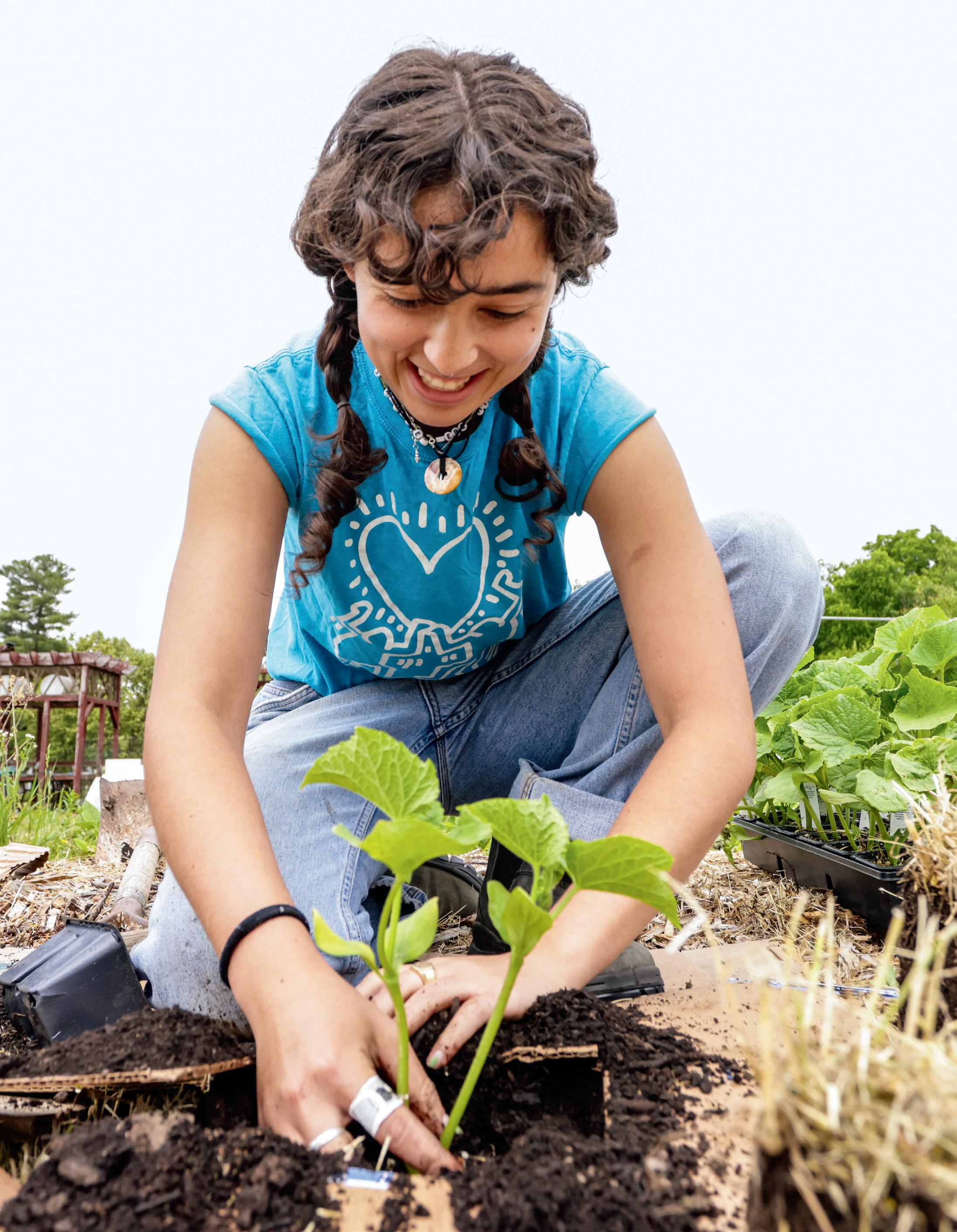
DIGGING IN THE DIRT Students tend to the land at Oberlin’s George Jones Memorial Farm.
Rooted In Purpose
Oberlin alums are building sustainability into successful careers in fashion, jewelry, business, and more.
FASHION FORWARD
MI LEGGETT ’17 LINED up outside of the Allen Memorial Art Museum for Art Rental every semester with one piece in mind: a Keith Haring. The art history major wanted Haring’s art in their space as a tool of inspiration: As a fashion designer creating pieces in their dorm roomturned-studio, Leggett was deeply influenced by Haring’s ability to use commercial objects to make explicitly political and queer high art accessible to the broader public.
Over the years, Leggett had remarkable luck with Art Rental, scoring pieces by Picasso, Jasper Johns, and Barbara Kruger. However, the Haring work evaded them each semester—until the spring of 2017, when they finally scored the piece they had waited for, Haring’s Untitled 1, from the series Untitled 1-6. The timing was perfect; by this point, Leggett had started Official Rebrand, an anti-waste,
gender-free fashion line.
Official Rebrand’s lines are full of inventive, one-of-a-kind hand-painted garments and custom layered pieces made from upcycling fabric. Imagine a skirt made entirely from discarded skirt hems that were stitched together, or a tank top patterned with a scan of a box of testosterone. Or you might pair a tank top ripped into something resembling a rib cage with a jacket covered in an abstract swan painting.
“Berlin has a culture of leaving outside,clothes much like Oberlin’s free bins and free store, providing me with endless material to play with.”
To date, Official Rebrand’s designs have received attention from publications such as the New York Times, Teen Vogue, Elle, GQ, and Them. “Creating upcycled, gender-free clothing is what I am meant to do and truly the best way for me to positively impact my community,” Leggett says.
At Oberlin, they began as an environmental studies major but as a first-year student quickly fell in love with the art history and studio art departments after taking an abstract painting class with then-YoungHunter Professor of Art John Pearson. “It rocked my world,” Leggett says. “It was a challenging time for me, socially
and emotionally, so having that studio space to retreat into was really important for me.”
As a student, they also found solace in their on-campus job at the ’Sco. “You have to make your own fun at Oberlin, so I was involved in a lot of event coordinating,” Leggett notes. “It taught me about production and logistical planning, which became really helpful later on as an independent artist. Be the party you wish to see in the world.”
This event planning experience led to involvement in Berlin’s queer arts communities during semesters abroad.
CUSTOM CLOTHING At left, a few looks from the newest collection by MI Leggett ’17 (above), founder of the fashion line Official Rebrand.
Official Rebrand—the name began as “an Instagram handle joke about me rebranding from liberal arts college girl to genderqueer artist in Berlin,” Leggett playfully recalls—began during that time of exploration, when they were collaborating with all kinds of artists.
This included an independent avantgarde fashion designer whose approach to reconstructing clothing inspired Leggett’s own wardrobe and outfits as they explored their gender identity. “I hadn’t come out as nonbinary yet, but I didn’t feel comfortable or like I fit into preordained gendered clothing,” Leggett says. “Berlin has a culture of leaving clothes outside, much like Oberlin’s free bins and free store, providing me with endless material to play with.
“I could limitlessly take things apart and put them back together, painting things as I went,” they continued. “I was playing around and figuring out what made me feel good. Making crazy outfits helped me develop a sense of how I wanted to show up in the world.”
Leggett turned this individual experimentation and expression into the more developed artistic practice that sustains Official Rebrand. They wrote a senior honors thesis on the brand and held an accompanying fashion show in the Hales Gymnasium locker rooms. Not long after, Official Rebrand was recruited to participate in an independent designer fashion show— Leggett’s first time showing their work outside of Oberlin and DIY art spaces in Berlin.
This led to running events for an art magazine, which Leggett says “set off a chain reaction” and led to the busiest year of their life. What had been planned as a post-graduation year of rest and generation quickly became a year of career acceleration: They hosted events at the acclaimed international art fair Art Basel, began working with individual clients, and eventually were scouted by the Council of Fashion Designers of America to be in a New York Fashion Week show.
Over the years, Official Rebrand has collaborated with the music platform Soundcloud to raise money for the trans support organization and crisis hotline Trans Lifeline; teamed up with Penguin Random House to create merchandise in support of a book release; and released a collaborative fashion collection with Arianna Gil ’17’s skateboard collective Brujas.
Leggett says they think fondly of those first years out of Oberlin when they were so green and excited by every opportunity that they said yes to all of them, whether they were ready or
not. “In retrospect, I was very glad I did [the New York Fashion Week show],” they say. “I didn’t know enough to know I wasn’t ready. I’m still learning how to be a proper designer now because I’m just doing things my own way. I am doing things that haven’t been done in the industry, which is what set me apart when I was starting out.”
Leggett also believes their art history and queer theory background helped them stand out amongst a sea of fashion school graduates vying for
attention in New York’s scene. Their ambition to take on opportunities has led them to a busy period of collaborations and new work projects, including as a visiting educator at Cooper Hewitt, the Smithsonian Design Museum.
Leggett says they draw energy from working collaboratively toward designing a better, more inclusive, and sustainable world. “It brings me a lot of joy to help people create outfits they do want to wear and feel like themselves in,” Leggett says. “I’ve had some existential crises—[like] maybe I should’ve been an
immigration lawyer or not dropped out of my environmental classes. But these days I’m sure that channeling my antiwaste design methods to help people express their interior selves and show up in the world how they want to is my calling.” —Serena Zets ’22
places. But while handling precious metals up close, they found themselves drawn to the same question. Where did these materials come from?
Given that the pair had both studied environmentalism in college, not knowing the answer “felt like a big disconnect,” Neal says. “Particularly knowing that the jewelry industry has been historically damaging to people and the environment.”
After the Oberlin alums reconnected at the wedding of a mutual friend, Kathryn Jezer-Morton ’04, their shared passion for sustainable jewelry became the company Bario Neal, which was founded in 2008 with locations in Philadelphia and New York City and has been featured in Vogue, the New York Times, and the Wall Street Journal
“We wanted to have this creative brand that was very design-forward but with a purpose built around sustainability, responsible material sourcing, and the social impacts of these materials at their site of origin,” Bario says. “We really do think of it as crafting future heirlooms.”
The company offers engagement rings, wedding bands, and custom and permanent jewelry. Some pieces play with texture, like a rippled metal pattern, while others feature precious gemstones like diamonds, sapphires, and emeralds. Bario says customers also ask the company to work with existing heirlooms, whether that be a treasured family piece or the memento of a marriage that has now ended. “We take those materials and redesign them, working with that client to make a piece that both reflects that history and carries it forward.”
JUST JEWELS
Anna Bario ’03 and Page Neal ’04 started making jewelry at separate times and
Bario, who came to Oberlin with an environmental science background, studied the psychology of climate change and did an off-campus apprenticeship that introduced her to
A SPARKLING GEM In their jewelry business, Anna Bario ’03 (left) and Page Neal ’04 (right) are driven by sourcing and sustainability.
jewelry-making. Neal, who majored in visual art with a concentration in sculpture, took a jewelry class after graduation and fell in love with the small-scale work and the ability of her creations to connect with people.
Before beginning production, the duo spent years doing research, going to conferences, and building relationships with the NGOs and artisanal miners who would help form their supply chain. They also developed the Bario Neal standard, an internal metric
that evaluates suppliers to ensure the ethical sourcing of diamonds, metals, and gemstones. The company pairs this focus on fair labor practices and environmental responsibility with the Fairmined Standard and the United Nations Sustainable Development Goals. Making their products in their Philadelphia workshop also helps reduce their environmental impact while supporting the local community. Neal notes that they intentionally partner with other small businesses within
their supply chain—because even though some overseas corporations now produce jewelry with traceable materials, “the way they are shipping and manufacturing them still has a significant energy cost.”
Conversations about sustainable and ethical jewelry have come a long way since the company was founded. “When we first started, we got a lot of stares in response to a lot of the questions we were asking and engaging with,” Bario says. Neal credits Oberlin with teaching its students how to take initiative and carve their own paths. “The focus at Oberlin was really about the learning, not the end result, which is a powerful life lesson.” —Stephanie Manning ’23
LOVELY AND LOCAL
Growing up off-grid in upstate New York taught Annika McIntosh ’01 some early life lessons about connecting with the environment. “We had the luxury of inheriting land, so we had land to raise cows, a big garden, and woods to get firewood from,” she says. That upbringing instilled an innate sense that “everything we do should be centered around this question of sustainability— making as little impact as we can on Earth.”
Her arrival at Oberlin coincided with an exciting time for the environmental studies department, with construction on the Adam Joseph Lewis Center for Environmental Studies nearing completion. Faced with grave messaging about the environmental and climate crisis, she says she found the most fulfillment in classes like botany or hydrogeology. “Personally, what made more sense to me was to focus on the wonder of what we need to protect.”
Today, McIntosh puts her energy toward appreciating Earth’s natural bounties through her company Hazel Designs, which offers local flowers for
IN THE FIELD Growing up off-grid in upstate New York taught Annika McIntosh ’01 some early life lessons about connecting with the environment (above); soil ecologist Jenny Soong ’07 now does field work all around the world (right).
weddings and events in the area around Bellingham, Washington. “I really love the lifestyle,” she says, as she gets to spend her days outside and working oneon-one with her clients. “For me, that’s also an aspect of sustainability — living a happy life.”
After graduation, McIntosh spent a few years in Montreal, where she helped found the food collective Midnight Kitchen at McGill University—an experience she credits to her time working in Oberlin’s co-ops. She then earned a degree in landscape architecture from the University of Washington before working in garden maintenance and landscape design around the greater Seattle area.
Starting to grow her own flowers then opened up a whole other area of interest. Concerned about issues in the mainstream flower industry, including poor working conditions and the reliance on herbicides, she “started educating myself about the practicalities of growing flowers, selling them, and using them, and also why that’s important.”
McIntosh is a member of Slow Flowers, a directory of florists who sell local, domestic blooms. The philosophy is similar to the Slow Food movement, which prioritizes “minimizing travel miles, maximizing nutrition, and keeping dollars spent locally,” she says. Through Hazel Designs, she offers custom arrangements, bouquet subscriptions,
and wedding flowers, plus garden consultations and design. For the flowers she can’t grow on her own, she buys from local farmers or the Seattle Wholesale Growers Market.
Weddings have become a particular focus for her, as she creates custom, low-impact flower designs for couples on their special day. “Weddings are already extremely wasteful,” she says, adding that she’s recently become involved with a network of environmentally conscious planners and vendors called Emerald Hour. “So we’re trying to educate people about that and offer some really delightful alternatives.”
She’s also been teaching the next generation via a garden class at her daughter’s school. “I really love working with kids and catching them at that stage where there’s still a lot of wonder,” she says. “It’s really important to understand all of the processes that have enabled a meal to appear on your plate or flowers to appear on your table.” —Stephanie Manning ’23
geothermal warming in Iceland; and worked in the Sierra Nevada mountains in California.
In her current role as a soil ecologist at Terradot—a company that generates and sells carbon credits to entities working toward carbon neutrality goals— Soong is continuing to think globally.
“My work very much focuses on climate change— how we manage the agricultural lands that we need for food, fiber, and fuel production in ways that are more sustainable.”
“My work very much focuses on climate change—how we manage the agricultural lands that we need for food, fiber, and fuel production in ways that are more sustainable, where we reduce our negative climate impacts and mitigate the climate impacts that agricultural systems have,” she says.
As part of this work, Soong conducts field work in farmlands across Brazil focused on “enhanced rock weathering,” she says. “ We grind up reactive rocks that would typically sit on the mountainside and weather very slowly—and absorb carbon dioxide from the atmosphere very slowly.
SEEDING THE FUTURE
When Jenny Soong ’07 was at Oberlin, she participated in taiko drumming, giving her a chance to perform in nearby Cleveland as well as around Ohio and Michigan. In the years since graduation, she’s had plenty of chances to travel once again. While earning a doctorate in soil ecology at Colorado State University, Soong researched the Kansas tallgrass prairie. As a postdoctoral student, she analyzed the tropical rainforest in French Guiana; looked at soil and
“[We then] add it to soils in lowerproductivity, acidic, wet, warm environments, like in Brazil, where it can help to stimulate crop productivity,” she adds. “Hopefully—and we need to measure it—but it also absorbs carbon dioxide from the soil.”
A San Francisco native, Soong had always been interested in nature and the outdoor world, along with how humans interact with nature, but she wasn’t sure what she wanted to study at Oberlin. However, she was excited to move to the Midwest so she could “see how we actually work the land, how we farm the land, where our food comes from,” she says. “Oberlin gave me that initial opportunity to have that liberal arts education and exposure to different fields
and different ways of thinking. That was a wonderful, eye-opening experience.”
Inspired by professors David Orr and John Petersen, Soong majored in biology and environmental studies and had a minor in politics. A class taught by Petersen was particularly formative: She “learned about the carbon and nutrient cycles that drive these natural energy and productivity systems. It’s the energy balance in the natural world. That struck a chord with me in terms of how my mind works—somewhat quantitatively, but where my heart was in terms of attraction to the outdoor world and these natural landscapes.”
In recent years, Soong’s work has turned to climate resilience. “How do we manage these agricultural systems in ways that not only help to slow down climate change, but also that are more resilient or resistant to big shocks in extreme weather events?” she says. “I think of my career [as] not just thinking about carbon accounting, but also about farmer economics and decision-making and businesses and how climate change is impacting people and their livelihoods in these agricultural communities.”
—Annie Zaleski
CULTIVATED BY CO-OPS
The English language isn’t kind to folks who flit about. People who don’t commit to a single professional track or favorite sports team are dismissed as dreamers, dabblers, and dilettantes. Rodger Cooley ’95 would tell you none of those terms do justice to the creativity and strength that stems from exploration.
“[When] envisioning how we bring complex ideas to life, there is no clear path,” says Cooley, whose multifaceted interests led to his 2017 appointment as executive director of the Chicago Food Policy Action Council, a nonprofit promoting food justice and
food sovereignty in the city. “You’re constantly having to respond to things that are always in flux.”
Like many alums working in food production and food policy, “Cooley started thinking about food systems while a member of the Oberlin Student Cooperative Association (OSCA). Uniquely, though, he rarely joined t he same dining co-op twice: Cooley prepared meals at Tank, scrubbed dishes at Old Barrows, and composted at Harkness. (“I got around,” he admits. “I was not monogamous.”)
Cooley took a similarly catholic approach to his studies, declining to focus on any one medium as a studio arts major. “I did oil painting; I did photography,” he says. “One of the best t hings was being able to jump around and have a safe container in which to try a lot of different things.”
Following graduation, Cooley moved to Chicago with four fellow alums. They settled into a West Loop warehouse with space for living and making art, two activities that frequently intersected. Most notably for Cooley, the friends
constructed a rooftop garden that was partly an installation and partly a tangible contribution to the community they’d begun to call home.
“We were living right next to a meat processor, but the neighborhood felt very industrial,” Cooley said of the treeless landscape he’d scan when he climbed up to the roof. “I became really interested in what it would look like to grow things, retaking urban spaces.”
Growing up in Sarasota, Florida, Cooley was surrounded by the standard suburban trappings that he now sees as distancing people from their food sources, including endless lengths of pavement and manicured lawns. But his grandfather took a different approach to his property in Lakeland, Florida. He grew citrus and kumquat trees, eventually converting his yard to a tropical fruit grove where bananas and papayas flourished.
Before he became a fruit hobbyist, Cooley’s grandfather was a pastor. He was one of many relatives who made careers of social service, with teachers, therapists, and nurses all represented in
MAKING A DIFFERENCE Rodger Cooley ’95 is executive director of the Chicago Food Policy Action Council (above); Christian Fioretti ’20 works in sustainability at international bank ING (right).
Cooley’s close familial circle.
“I was feeling a call to have more social benefit,” Cooley said. “Seeing land [in Chicago’s South Side] become vacant through redlining and disinvestment, [I wanted to] manifest a vision of real cultural foods that are almost impossible to find.”
So Cooley grew collard greens and mustard greens and okra on the warehouse roof, then expanded upon his urban agricultural work as a Heifer International project manager. While at the organization, he helped convene a local food justice summit, which has since become an annual free event; more than 1,000 people have registered for the next meeting.
“We wanted to bring together people with strong issues to find partners,” Cooley says, remembering various attendees saying, “Hey, I want to start a community garden,” or, “I’m really curious about farmers markets,” or, “I’m concerned about meals at my kids’ school.”
Connecting food activists and advocating for municipal policies that prioritize workers’ rights, animal welfare, and nutritional standards occupies most of Cooley’s paid time. At home in Chicago’s Avondale neighborhood, though, he’s still gardening. Of course, his plot isn’t devoted to any one kind of plant. He grows melons, gooseberries, kale, tomatoes, currants, herbs, and apples. —Hanna Raskin ’98
BANKING ON SUSTAINABILITY
Christian Fioretti ’20 grew up in Menlo Park, California, with nature-loving parents who stressed the importance of living sustainably. Given the regular wildfires and droughts in the Bay Area, Fioretti saw the effects of climate change up close. But as a kid, he did not wilt from existential dread: After watching a video about the impact of overfishing, a concerned Fioretti picked up litter at recess.
His focus today is a little larger than a playground. Today, Fioretti is part of the Sustainable Solutions Group at the international bank ING, a group that helps to “directly provide capital to lend toward sustainable projects and green projects,” he says. One example is a green loan, where eligible proceeds from the loan are allocated for purposes that have positive environmental impact, such as the construction of a solar farm.
“My favorite part of the job is learning about the different sustainabilityrelated projects that are going on,” Fioretti says. “The different types of climate technology— clean technology.”
Fioretti is also looking into “grid optimization technology” due to the increased use of artificial intelligence. “With AI, we’re going to have to expand the grid,” he says, since AI requires enormous amounts of energy to function.
seriously, he adds: “I see so many people committed to making this work.”
Oberlin was a perfect place to turn his concerns into a career; in fact, he credits the college for putting him “on that path of caring about the environment. When you’re a student at Oberlin, you learn about sustainability. You learn about the importance of climate change.” As an economics major and sociology minor, those topics naturally found their way into classes; favorites included Environmental Economics and Environment and Society.
“Seeing land [in SouthChicago’s Side] become vacant through redlining and disinvestment, [I wanted to] manifest a vision of real cultural foods that are almost impossible to find.”
As the env ironment grows volatile, even destructive, businesses are wise to embrace sustainability measures as a “future-proofing” tactic, he says. Luckily, companies are taking climate change
In his four years as an Oberlin student-athlete, Fioretti balanced rigorous academics and high-stakes athletics. He scored over 1,000 points during his basketball career and stands second all-time in assists—all of which helped guide the basketball team to a 15-12 record (and a North Coast Athletic Conference playoff game win) during his final year. After graduation, Fioretti earned a master’s degree at the University of Durham in the United Kingdom, where he studied management and international business while playing basketball for the school and taking more sustainability classes. Fioretti became an analyst at Bridge House Investors, an environmental, social, and governance (ESG) and sustainability advisory firm that works with the private equity sector. Today, he still plays basketball, although his most memorable assists now happen off the court. Having been at ING for a little over a year, Fioretti is hopeful about the future. “I’m learning from really intelligent and motivated people,” he says. “The wider picture motivates me on a day-to-day basis.”
—Pete Croatto
Tied Together in a Single Garment of Destiny
Sixty years have passed since the Reverend Dr. Martin Luther King Jr. spoke in Tappan Square at Oberlin’s commencement. Today, members of the Class of 1965 continue to reflect on their memories of that day—and the imprint that King’s remarks made on their lives.
By Alicia Smith-Tran ’10
Illustration By Lesley Busby
On June 14, 1965, the 483 graduates from the Class of 1965, their families, and other members of the Oberlin community (including what was reported as a record number of alums) gathered to see civil rights activist the Reverend Dr. Martin Luther King Jr. receive an honorary degree and deliver his speech, “Remaining Awake Through a Great Revolution.”
K ing’s commencement speech was the last in a series of visits he made to campus. According to the college’s archives, King delivered three talks during his first visit to Oberlin in February 1957, including one at Finney Chapel and another at the First Church of Oberlin. King was invited to speak on campus again in November 1963, but he could only deliver a two-minute speech
due to severe flu symptoms. Fortunately, King was able to give full remarks in 1964 when he delivered another speech on campus titled “The Future of Integration” shortly after winning the Nobel Peace Prize.
Although all of King’s speeches were memorable in their own right, the Class of 1965 likely remembers his final remarks at Oberlin on graduation day the most.
The day was extremely hot, recalls Lisa Hirsh ’65. “It was graduation, so you know what graduation’s like: Your mind is all over the place. You’re moving away from your friends and have no idea what you’re doing next,” she says. “So the day was a bit of a blur. But what I do remember is that it was absolutely extraordinary to have Martin Luther King [as our speaker].”
King’s speech emphasized the theme of “staying awake” and being alert to the injustices of the world. After summarizing the fable of Rip Van
Winkle, King elucidated: “The most striking fact about the story of Rip Van Winkle is not that he slept 20 years, but that he slept through a revolution. While he was peacefully snoring up on the mountain, a great revolution was taking place in the world—indeed, a revolution which would, at points, change the course of history. And Rip Van Winkle knew nothing about it; he was asleep.”
The crowd sensed the momentous nature of the speech, says Katy Dawley ’65. “King was extremely inspirational, talking about his experiences, about the Montgomery boycott, and about what was about to happen: Freedom Summer. He received a massive standing ovation. That was quite thrilling.”
Oberlin students have long had their eyes wide open and turned toward societal injustices, and the Class of 1965 was no exception. “We were all very politically active and very aware. People went down South to register voters and
COMMENCEMENT 1965. Dr. King processes with then-Oberlin President Robert Carr (left); signs an autograph (above); and addresses the crowd in Tappan Square (opposite page).
build houses, and there was a Carpenters for Christmas,” Hirsh says, referencing a 1964 civil rights effort led by members of the Oberlin community to rebuild the Antioch Missionary Baptist Church in Ripley, Mississippi, after it was burned down following the Mississippi Freedom Vote. “It was just in the water.”
The tendency of Obies to hyperfocus on righting wrongs is exemplified by Marcia Aronoff ’65, who shared that her engagement with social justice efforts sometimes meant that her classroom pursuits at Oberlin went by the wayside.
“It certainly made the commencement speech seem like the right culmination of our four years at Oberlin,” she says.
Following King’s speech, the Class of 1965 scattered as its members took the next steps in their formal education and budding careers. But his message and
Single Garment of Destiny
words stuck with the graduates, who departed Tappan Square and remained socially engaged during subsequent chapters of their lives.
“King challenged us to use [our] education to move forward and improve life in the United States,” Dawley says. “And people in my class did.”
Hirsh, for example, moved to Washington, D.C., for a position at the White House Conference on Children.
“It was a really cool time to be in Washington,” she says. “Lyndon Johnson was there, and it was the beginning of the War on Poverty. I got to meet the president and Lady Bird and began to think about policy, which I hadn’t done.”
From there, Hirsh had the opportunity to write for an urban affairs-focused magazine called City, where she covered welfare reform and large-scale law. “It was a dream job for a young reporter,” Hirsh recalls. One of her more memorable assignments required
a trip to rural Kansas to investigate the challenges physicians and patients faced in their efforts to provide and receive medical care. Hirsh says many of the issues she wrote about as a young journalist, including rampant physician shortages and difficulties obtaining food, remain relevant.
Like other Oberlin alums who pursue careers related to medicine and well-being, Dawley took a path that aligns with a part of King’s speech when he reflected on a trip to India and stressed the importance of serving disadvantaged groups: “How can one avoid being depressed when he sees with his own eyes millions of people sleeping on the sidewalks at night; no beds to sleep in; no houses to go into. And most of these people have never seen a physician or a dentist.”
Charged with a desire to improve access to health care, Dawley dedicated the majority of her career to promoting positive childbirth outcomes and advocating for marginalized women, serving as a midwife in a low-income area of Philadelphia. She later earned her doctorate in nursing and history at the University of Pennsylvania and directed the Midwifery Education Program at Philadelphia University.
While access to health care in the United States has grown since King’s speech with the establishment of Medicaid and Medicare shortly after the Class of 1965 graduated and the passage of the Affordable Care Act in 2010, Dawley echoed Hirsh’s concerns about health care access and decisions that may hinder social progress in ways that contradict the call made by King.
“I don’t know what will happen now with cuts to Medicaid, because that was the support that provided the prenatal care and the intrapartum care,” Dawley says, the concern evident in her voice. “I don’t know what’s going to happen to poor women in this country.”
As with Aronoff, the energy of the times so firmly pulled Grace Wittig Owens ’65 during her early
undergraduate years that she felt “guilty” spending her time in classrooms. Owens contemplated dropping out to spend more time doing civil rights work but was convinced to stay. She finished her undergraduate education at Oberlin, meaning she was able to see King at her graduation with her peers and hear a line from the speech that had unexpected ripple effects well into her adult years.
“All life is interrelated, and we are all caught in an inescapable network of mutuality, tied in a single garment of destiny,” King declared. Years later, Owens returned to this idea amid her social justice work in Idaho: She was part of the committee that advocated for establishing Martin Luther King Jr. Day as a holiday in the state.
“I came up with the idea of having pins made that were in the shape of Idaho with threads going across,” she says, alluding to her return to King’s “single garment of destiny” allegory.
The phrase stuck with her for so long because of how well she felt it described the community she was surrounded by during her upbringing. Having grown up with a single mother, Owens recalls that she often spent time with her mother’s diverse social network, many of whom held different social identities from her own.
“Our living room was always filled with her friends—and her friends were everybody,” she says. “So my two brothers and I grew up with Black, white, Catholic, Jewish, gay, [and] straight [people].” Another woman was “treated differently because she was allowed to have a dog around,” Owens remembers. “As a child, I didn’t understand that, but it was because she was blind. ... [These friends] were literally our family. They were the threads in our mutual garment of destiny.”
In another full-circle moment, Owens, who spent most of her career as a teacher, was later awarded the Dr. Martin Luther King Jr. Memorial Award by the National Education Association for her human rights efforts in Idaho.
In subsequent years, the message of King’s 1965 commencement speech continued to resonate at Oberlin in both classrooms and Tappan Square.
King’s numerous speaking engagements, including his speech in Tappan Square, served as a topic of academic inquiry for Leah Falk ’07 for a linguistic anthropology course at Oberlin. Falk had a particular interest in how King modulated his language to reach specific audiences and his ability to effectively deliver powerful messages to those tuned in to his guidance.
“I remember being struck by the thesis of the speech and its sort of poetic refrain, this idea of ‘Don’t stop paying attention,’” Falk says. “You can’t look away from change, which is kind of how I feel now. That really resonated.”
Fifty years after King made his speech on campus, Owens and other members of the Class of 1965 made their way back to Northeast Ohio for their 50th reunion, where they witnessed Michelle Obama addressing the Class of 2015 in the same space where King stood a half-century before. Obama foregrounded themes from King’s remarks, including the importance of staying alert and not shying away from
pressing social problems.
“I want to suggest that if you truly wish to carry on the Oberlin legacy of service and social justice, then you need to run to, and not away from, the noise,” Obama said. “Today, I want to urge you to actively seek out the most contentious, polarized, gridlocked places you can find. Because so often throughout our history, those have been the places where progress really happens.”
Owens noted how relevant King’s and Obama’s remarks continue to be today. “Having her talk about going toward the problems rather than away from them was really meaningful,” she says. “That’s what stays with me.”
Aronoff similarly expressed a sense of pride in her graduating class for persistently pushing for change and supporting causes that help the most marginalized segments of society. “People in our class have continued to be engaged, and it’s one of the things that brings me joy,” she says. “People who may not have been activists while they were at Oberlin have found important ways, whether through their church or through activities of an enormously wide variety, to make a difference in their communities and the country.”
A sense of urgency to seek out the “contentious, polarized, gridlocked places” continues to drive Hirsh, who still finds ways to take on King’s call to focus on improving nearby communities.
“I always have in my mind, ‘How can I contribute?’ I’ve recently worked on local political campaigns, and it makes a difference,” she says. “When I think of what Dr. King did, he not only charged us, but he did a major thing [by demonstrating] how to keep hope alive in desperate times. He modeled that you have to keep going, no matter what.”
Alicia Smith-Tran ’10 is a writer and the William G. Smith Associate Professor of Sociology and Comparative American Studies at Oberlin.
MICHELLE OBAMA addresses the graduating class at Oberlin’s 2015 commencement.
The MLK Internship Fund’s Impact
In 2015, the Class of 1965 honored its 50th reunion—and Dr. Martin Luther King Jr.’s speech at commencement—by establishing the MLK Internship Fund. This fund aims to address income inequality by providing financial support for high-need students to engage in career-enhancing internships and build critical professional networks. Over the last 10 years, 117 Oberlin students from the college and conservatory have received awards of at least $5,000 to pursue internships at law firms, music festivals, nonprofits, museums, and more. [At right, see what a few recipients are doing now.]
As the 60th cluster reunion approached in October 2025, the alum-led MLK Internship committee from the Class of 1965—Marcia Aronoff (who spearheaded the fund’s establishment), Peter Anderson, Lisa Hirsh, Monica Knorr, Terry Rosenberry, and Phil Singerman—worked with Class of 1966 presidents Charlie Heck and Wendy Solmssen Sommer and Taiyo Scanlon-Kimura ’15 on an ambitious $1.5 million fundraising campaign. The goal was to raise sufficient funds for the program to have an impact in perpetuity.
Following in the footsteps of the Class of 1965, the Class of 1964 and the Class of 1966 decided to name the MLK Internship Fund as one of their 50th Reunion gifts. Thanks to the generosity of Peter Kemper ’66 and Laura Powell Kemper ’68, the MLK Internship Fund has been endowed—a testament to the power of Oberlin’s community to come together and make a difference.
Single Garment of Destiny
MADELEINE HEARN ’27, who is pursuing a Bachelor of Music in cello performance, attended this summer’s Aspen Music Festival. Each day was filled with private lessons, rehearsals, studio classes, and masterclasses led by musicians she’s admired for years. Madeleine adds that a highlight was performing in Mozart’s Così fan tutte, as it taught her so much about collaboration, preparation, and the joy of making music in a professional setting alongside close friends. She also enjoyed doing gigs around town and teaching her own cello students through the Aspen PALS program.
’27
Taiyo Scanlon-Kimura ’15 has had a few chapters in his 10-year post-grad career. He majored in politics and East Asian studies at Oberlin and researched Japanese economic reform policy as an intern supported by the MLK Fund. He then completed fellowships in research, higher education, and sustainability. After stints with direct-service nonprofits, he joined University of California, Berkeley in 2024 as an analyst with the housing and dining services department.
’15
’23
Gideon Ampofo ’23 is an associate at Ares Management Corp., where he serves in the private equity group.He also runs two nonprofits, the League for Global Development and Africans Who Invest. To date, these have trained over 1,000 students across Ghana in personal finance and leadership.
SRIJIT GHOSH ’15 lives in Paris, where he leads product marketing at Qonto, a financial technology company serving small businesses across Europe. After Oberlin, he earned a master’s in international development at University of California, Berkeley and, with a passion for social impact at the grassroots, helped build tech startups in India and the UK. In between product launches and Parisian café-hopping, he continues writing poetry—keeping his creative flame alive just as brightly as during his Oberlin days.
’15
Class Notes
GOING GREEN In the January 1971 issue of the Oberlin Alumni Magazine, this photo of two unnamed individuals appeared alongside the headline “Homecoming Study: The Environment.” The occasion was a package of stories centered on a discussion topic during Homecoming the weekend of October 16-18, 1970: “Man’s Relationship with His Environment: Oberlin’s Responsibility.” The keynote speaker then was Robert Cahn, one of the three members of President Nixon’s Council on Environmental Quality.
1940s
1946
Earlier this year, past and future Obies gathered in Truro, Mass. This group included Anne Irwin, who celebrated her 100th birthday in May; Nora Spingarn ’29; Katherine Sanford Spingarn ’95; Daria Sanford ’91; Nils Mellquist ’93; David H. Sanford ’59; and Evan Spingarn ’91.
1950s
1951
Nancy Hubbard Hirsche sends an
update on her life since graduating from Oberlin. She was one of the first two women to teach at Williams College; had a five-year stint acting on As The World Turns; had an extensive singing career in recitals and with principal roles in operas such as The Marriage of Figaro and The Magic Flute; and created a touring show based on poems by Federico García Lorca that features accompaniment from a flamenco guitarist. “Though my life has mainly been as a singer and actress, I majored in French at Oberlin and then went on to Yale for my master’s degree in French,” Nancy shares. “My classes in French were excellent. I am now 96 but still performing!”
1954
Bette McDevitt writes in to share a memory of spring at Oberlin. “On those days when we had good weather, a sweet blend of instrumental and vocal music came to us as we walked past the conservatory. From the open windows came a grand cacophony of sounds: piano ripples, horns calling out, and an occasional drumbeat. It’s one of my best memories.”
1959
Diana Windham shares that she’s “living out the legacy of my Oberlin minor in art” and shares her oil and watercolor paintings via her website. “I have identified my work specifically in the name of human rights and freedom of expression,” Diana adds. “I am also truly thanking Oberlin for continuing to be such a symbol for freedom of expression and human rights just as it was when I had the great privilege of being there.” (dianawindhamstudios.com)
1960s
1960
Betty Boyd
Caroli’s new book A Slumless America: Mary K. Simkhovitch and the Dream of Affordable Housing (Oxford University Press) is a biography of the trailblazing advocate for public housing and urban reform.
Larry Kramer shares his excitement that Oberlin was “well-represented” at the three-week Sarasota Music Festival in June. “I have attended the festival for over 20 years and have never seen this many Oberlin connections.” Musicians involved included Stephen Coffey ’26, Jerver Hernandez ’22, Samantha
1962
Over the summer, Gallery THEO in Seoul, South Korea, presented a retrospective covering 65 years of Alice Dalton Brown’s work, encompassing 140 works, including 100 original paintings, props, and photographic materials.
“Oberlin meant a lot to me,” says Dave Eberhardt. “I, like famous classmates [Geoffrey] Ward and [Alan] Furst, am also a writer, if not famous. At 84, I remain active in poetry and the peace movement and am far to the left.” Dave notes he does a lot of physical therapy after colon and heart surgery but has “started a good correspondence with classmate Bill Stevenson” and “thinks fondly” of many others in his class.
KaiMay Yuen Terry celebrated her 85th birthday on June 4 by hearing Fei Xie ’04 performing Andre Jolivet’s Concerto for Bassoon. “What a melodious way to celebrate my birthday!”
1963
The Oak Trace senior living community in Downers Grove, Ill., named Dave Humphreys its first “Trailblazer” in honor of his community leadership and work in the local music and nonprofit scenes. A former IBM executive, Dave left corporate life early and founded the Two Way Street Coffee House, helped
launch the village’s Community Kitchen and the EQDG (EQuality Downers Grove) organization, and served on the DuPage County Board of Health.
Kathy Keip released a book, Growing Up in Detroit: Personal Sketches of Historic Detroit 1940s - 2020s, which shows photos of Oberlin and her junior year in Salzburg in 1962. Kathy’s first book, Alphabet Adventures, earned a Bronze Moonbeam Children’s Book Award.
1964
Ken Laufer has been composing ragtime music since the 1970s, when Gunther Schuller and the New England Ragtime Ensemble played Ken’s “12Note Rag.” More recently, pianist Peter Vinograde played selections from The Rag Tempered Piano —a collection of Laufer’s ragtime pieces in all 24 major and minor keys—in New York City at the Manhattan School of Music and the Madison Presbyterian Church.
In spring 2025, retired clinical psychologist Myron Bud Stern read “Macavity: The Mystery Cat,” by T.S. Eliot, and a trilogy of his own poems at a poem fest at the First Baptist Church of Greater Cleveland. Terry ’62
1966
John C. Morgan wrote his ninth book, Mr. Tux Finds a Home (Resource Publications), about a stray cat who taught him a great deal about living and dying. John retired from teaching philosophy but continues to write a weekly newspaper column in ethics.
1970s
1970
Richard Bentley writes in to congratulate his friend and classmate Roger Fratena ’71, the associate principal bass at the Dallas Symphony Orchestra, who retired in May after spending 54 years with the organization: “ Bravo, Roger!”
1971
Hillary Brown recently published Revitalize | Resettle: How Main Street USA Can Provide New Beginnings for America’s Climate-Displaced (Palmetto Publishing). “It explores two of America’s critical challenges: how to counter the economic decline and depopulation of rural towns and small legacy cities and at the same time
Kramer ’26, Jared Sta. Ana ’27, and Nicholas Woodward ’27
Kramer ’60
prepare them for receiving some of the millions of Americans displaced due to climate chaos.”
David Dickinson, now an emeritus professor at Vanderbilt University, was welcomed into the Reading Hall of Fame in December and now lives in Durham, N.C.
The Eastern Plumas Health Care Foundation established the Dr. Christopher Stanton Scholarship to assist EPHC employees pursuing advanced education and certification. In 2024, employees received nine scholarships totaling $17,000 for studies related to nursing, health information management, radiology, and becoming physician assistants. “This scholarship has deep meaning for me,” Chris says. “It carries on my legacy of caring for others for many years with humble kindness.”
1972
On Mother’s Day weekend, Suzanne Bernstein and daughter Miryam Coppersmith ’15 brought the eccentric women of Jenny Tango’s art zine Women of Chelm to life at the Westbeth Artists Housing and Center for the Arts
in New York City. Suzanne notes the show is “available for touring!” Info: miryamcoppersmith.com
At her 75th birthday party in June, Constance Fullilove-Cole “had the honor” of having multiple Obies attend the event, including Kalman Resnick ’70, Gayle Pinderhughes ’71, Ruth Spencer ’72 , and Bernice McIntyre ’72 . “We had a fabulous time talking, dancing, and sharing information about our lives,”
Constance says. “Oberlin brought us together over 50 years ago, and I am so happy to say that we have remained lifelong friends.”
Daniel Helfgott writes in with a life update: “On January 7, 2025, a wildfire roared through Pacific Palisades, Calif. My wife was at work, and I barely escaped with our dog, Kipling. Our house was completely destroyed, and we lost everything we owned.” David notes they did have insurance, so they will be able to rebuild. “But lost in that fire were all the works of renowned artist Gloria Helfgott, which can never be replaced. Events like this teach us that possessions, no matter how precious they seem, are truly fleeting. I hope my fellow Obies never have to go through something like this themselves. Stay healthy. Stay well.”
1973
John Barbour published Family Conscience: A Memoir of Four Generations (Cascade Books). “This thematic family memoir blends biography, oral interview, autobiography, essay, and cultural history as I depict how conscience was transmitted and transformed through the generations over the course of a century.”
Edith W. Clowes, the Emerita BrownForman Chair in the Humanities in the Department of Slavic Languages and Literatures at the University of Virginia, received the 2025 Distinguished Contributions Award from the Association for Slavic, East European, and Eurasian Studies (ASEEES).
1974
Nicole Dreiske, the executive director of the International Children’s Media Center, released two e-books in spring 2025: Mindful Viewing: Resource Guide for Youth Group Leaders & Parents and Movies Make You Smarter: Digital Viewing Guide for Teachers and Parents.
In April, after 40 years in the historic
Woodoff ’74
Fullilove-Cole ’72
preservation field, Jeremy Woodoff received the George McAneny Award for Unsung Preservation Leadership from the New York Preservation Archive Project (NYPAP). “Besides basking in the pomp and circumstance, I got to share the podium with President Washington,” Jeremy notes, as the ceremony was held in conjunction with the annual reenactment of the first inauguration of George Washington.
1975
Richard Mandell met up with Carol Price ’76 at the No Kings protest in New Haven, Vermont.
Pam Oken-Wright recently published her latest book, Embracing Challenges in Early Childhood Education: Flexible Protocols for the Thinking Teacher (Routledge).
1976
Andrew Fisk reports that he “finished my career in t he Silicon Valley” having worked at Computer Associates, Amdahl, Lotus, and Stanford Graduate School of Business. “Also a number of hellholes that were doomed from the start.” In addition to making films such as The Guy Knows Everything (386 Films), Andrew took up ocean kayaking in British Columbia. “Eagles overhead, orcas swimming up to my kayak, humpback whales splashing me, and unbelievable storms,” he describes. “[But] fate stepped in. My kayaking partner was a doctor from Quebec. We paddled well together.” Andrew notes he moved to eastern Canada and married the doctor, and we “had our amazing FrenchItalian-Ashkenazi daughter.”
Patricia A. McCoy recently published Sharing Risk: The Path to Economic Well-Being for All (University of California
Press). The book “draws on the nation’s tradition of risk sharing to argue that society should lift up families by pooling and spreading the financial risks that they now must bear alone,” she notes. Patricia is the Liberty Mutual Insurance Professor at Boston College Law School and a founder of the Consumer Financial Protection Bureau.
Adam Rudolph released Beingness, an album recorded live in concert at the Stone, a venue at the New School in New York City, on March 31 and April 1, 2023, with music spontaneously composed by Adam, Dave Liebman, and Billy Hart, associate professor of jazz percussion. Listen at adamrudolph.bandcamp.com
Best Lawyers named Kerry D. Staton Lawyer of the Year for Medical Malpractice Law - Plaintiffs, Baltimore, for 2025. He was also elected a fellow of the American College of Trial Lawyers and included on the 2025 Lawdragon 500 Leading Plaintiff Consumer Lawyers list. Kerry, also a fellow of the International Society of Barristers, is a founding and managing partner of Schochor, Staton, Goldberg and Cardea, with a specialized focus on medical
malpractice and wrongful death.
Randall Vemer received the Best Documentary Film Award at the Atlanta Short Film Festival in Spring 2025 for Boots on the Ground for Art, which recounts his experience teaching 18 military veterans oil painting.
1977
On April 6, 2025, the Broomfield Symphony Orchestra (BSO) presented the 1996 children’s ballet The Winter Flower, which was composed by Tobias Tenenbaum ’78 and orchestrated and conducted by BSO music director David Brussel. David retired from the horn section of the Colorado Symphony in 2018 but remains active as a conductor and pianist, while Tobias is a pianist, choral conductor, and educator.
Joseph L. Graves Jr.’s Why Black People Die Sooner: What Medicine Gets Wrong About Race and How to Fix It (Columbia University Press) is a “powerful and rigorous examination of the ways racism shapes health and disease,” notes the publisher. Joseph gives readers the “tools to dispel the fallacies and errors of racialized medicine, including an
Vemer ’76
understanding of evolutionary biology and human biological variation” and “debunks common misconceptions about race and health on topics such as high blood pressure, sickle cell disease, the microbiome, infectious diseases, and cancer.”
The second edition of Ken Perkins’ book Cognitive Behavioral Therapy for Smoking Cessation: A Practical Guidebook to the Most Effective Strategies (Routledge) was published in June. Ken is now an emeritus professor of psychiatry at the University of Pittsburgh and has moved to Chatham, Mass., at the southern tip of Cape Cod.
NH, a group of Jews opposed to Israeli atrocities in Gaza and the West Bank.”
1978
Over the summer, Jeffrey Fuerst produced three one-act plays in three off-off-Broadway theater festivals in New York City. He notes that writing and producing plays was “a bad habit” he picked up at Oberlin but “one that he has been pursuing with gusto since retiring from his job as a writer and editor in children’s media.”
Lori D. Ginzberg released Tangled Journeys: One Family’s Story and the Making of American History (UNC Press), a “vivid, multigenerational examination of a single family from slavery into freedom, focusing on its Black, white, and mixedrace members and their experiences in both the U.S. South and North.”
1979
Three different decades of Obies living in the Netherlands— Lisa Ross-Marcus, Nancy Mayer ’87, and Sarah Brown ’00 shared a delightful Friday night dinner in Amsterdam getting to know each other and sharing their Oberlin stories.
1980s
1980
Since graduating, Jan Mazur has developed a passion for ringing handbells in a group and solo and directing handbell choirs. “Ringing for worship and charitable causes is most fulfilling,” Jan says, and shares that in August, she performed concerts with a mass group of ringers in Slovenia, Croatia, and Hungary.
1981
Jim Drobnick was awarded the inaugural Art Basel Medal with Jennifer Fisher for their work as editors of the Journal of Curatorial Studies. Founded in 2012 to highlight the emerging academic discipline of curatorial studies, the journal was “commended for defining the direction of contemporary art, advancing critical discourse, and elevating underrepresented voices. [It] features investigations into the practice and history of curating, exhibitions and cultures of display.” Jim teaches at Ontario College of Art and Design (OCAD) University in Toronto.
Bob Sanders biked across the United States over the summer, 50 years after the last time he did it when he was a rising third-year at Oberlin. “This time I’m doing it for a cause,” he says. “My Ride Against War on Gaza (RAW Gaza) has been two years in the making, ever since I retired from more than 45 years of journalism in 2023.” Bob calls this ride “a return to my college roots,” as he took Yoga of Bicycling at Oberlin and has been biking ever since and was also active politically at Oberlin. “I’m back to my radical roots now, having started up a group called Not in My Name Freed ’85
Fuerst ’78
Chesley Maddox-Dorsey made the 2025 Most Influential Women in Radio (MIW) roster for Radio Ink magazine’s May issue.
1982
Tom Frieden, the director of the Centers for Disease Control and Prevention under President Barack Obama, authored The Formula for Better Health: How to Save Millions of Lives—Including Your Own (MIT Press). The book offers clear, hype-free guidance to prevent leading causes of disability and death. Tom now leads the global health nonprofit Resolve to Save Lives.
The North Dakota Chaplains Association named Jane Millikan the 2025 Chaplain of the Year. Jane is interim chaplain at Luther Memorial Home in Mayville, N.D.
1983
David Amlen earned his first Grammy Award as an engineer for recording Nicole Zuraitis’ How Love Begins, which won Best Jazz Vocal Album. He currently runs Sound on Sound Studios in Montclair, New Jersey; artists such as Darryl “DMC” McDaniels, Christian McBride, and the Goo Goo Dolls have recorded there. Under the name Dave & the Divas, David also recently released an album, Freedom, that features five original songs penned by his late sister
alongside Elton John covers.
Martin Zelder released his debut literary fiction book, Recovering Maurice (Atmosphere Press), a “moving and precarious tale about disabilities—both visible and invisible—humor amidst frailty, and a person’s often fitful search for healing in a world full of challenges.”
1984
Kevin Adler ’s first poem, “Kindle,” was published in the Maryland Bards Poetry Review 2025. After 30-plus years as a journalist and editor, Kevin now works part-time for a local parks department.
Peter Miller ’s documentary Marcella won a 2025 James Beard Award for Best Documentary. The film premiered on the PBS show American Masters and is available to watch on most streaming platforms. Read more about the film and Peter’s career at oberlin.edu/news/ cooking-cinematic-gem.
Cedric Merlin Powell was appointed associate dean for academic affairs at Howard University School of Law. Cedric previously served as Howard’s associate dean for faculty research.
Tim Wojan recently completed a fiveyear established scientist fellowship at the National Center for Science and Engineering Statistics (NCSES) within the National Science Foundation (NSF). In addition to developing the first survey to collect information on the decarbonization efforts of U.S. businesses, he also published an article in the Journal of Cultural Economics titled “Arts Avocations and the ‘Leonardo Effect’: Does Artistic Imagination Fuel Innovation?”
1985
Gwendolyn Freed was appointed president of Minneapolis College of Art and Design (MCAD) in April. Founded in 1886, MCAD is home to approximately
800 students from 45 states and 15 countries and is known for its innovative approach to art and design education.
Clifford Thompson’s Jazz June: A Self-Portrait in Essays (University of Georgia Press) explores the “deeper representative moments of life—the moments of wonder, hope, fear, uncertainty, humor, love, and epiphany— that make up human experience,” says the book’s publisher. “Through his reflections on literature, music, and film, Thompson—a Black American whose life is informed but not defined by race— embraces Black culture while remaining defiantly himself.”
Margaret Vetare released her debut CD, Strange as the Trees: Songs of The Incredible String Band, in November 2024. “Devoted to the music of the wildly eccentric late-’60s Scottish band whose songs evoked both the mysterious and the mirthful, the album in its simplicity seeks to serve for the uninitiated as a gateway to the serpentine originals,” Margaret says. Listen at margaretvetare. bandcamp.com.
JUST AFTER THE SCHOOL YEAR STARTED, a group of alumni had a Zoom session with Senior Associate Dean of the College of Arts and Sciences Laura Baudot and Associate Dean of Artistic Programming and External Relations Sally Takada, plus a few professors.
They talked about how new programs are put together—for example, we don’t cut other programs to add new ones—and how the faculty is involved. The conservatory talked a lot about the new music theater program and Park Arts, as well as some other new things on campus. For example, we admitted another Posse Scholars cohort from Texas.
I left the conversation feeling really good about how Oberlin is meeting today’s challenges. The information that Laura gave us was just magnificent, and so is everything that’s going on in the conservatory. The college is responding to the needs of prospective students more than other schools are doing. Oberlin is sustaining academic and artistic excellence by evolving how it delivers educational and experiential opportunities.
Similarly, my classmates and I are evolving in the way we sustain our relationships with one another. We’ve changed the way we keep in touch. We still send cards and letters, but now we also send texts and emails and use social media.
We’ve even found new ways to gather. When COVID-19 hit, the classes of 1970 through 1972 had our 50th reunion together as one cluster. To get people interested in the reunion, we did a bunch of Zoom programs, called Road to Reunion, leading up to the event. Some of these programs included a writers’ roundtable and a discussion about climate change.
We enjoyed putting the programs together so much that we have continued to meet and have programs, which we’re now calling Road to the Future. In October, we heard from alumni who have spent their careers in Asia, and in November, we talked to alumni who have spent their careers in Europe and Africa. In January or February, we’re having a music program, and then in March and April, we will have programs about AI.
We’re building off of the strength of our incredible alumni, who are so talented. These programs are helping to sustain our alumni network—and strengthen alumni connections. You should join us!
jan weintraub cobb ’71 President, Oberlin Alumni Association
1986
Gina Hausknecht coedited Shakespeare in the Age of Mass Incarceration (Routledge), a collection of essays about teaching, studying, and performing Shakespeare in prison, with chapters by theater artists, currently and formerly incarcerated actors, and college-inprison teachers and students. Gina is the director of Coe College’s Justice Learning Initiative, which includes both a college prison program and publicfacing community education about the impacts and challenges of incarceration and reentry.
Water engineer Peter Mayer received the 2025 Water Star award from the Alliance for Water Efficiency “in recognition of meaningful contributions, achievements, and impact in the water conservation, efficiency, and sustainability field.” Peter is the lead author of the “Residential End Uses of Water” studies, which were published in 1999 and 2016 and have a forthcoming 2026 edition. He has also worked with hundreds of water utilities across the country and in 2016 testified at the U.S. Supreme Court as Georgia’s expert on municipal and industrial water use.
Ann Vandenberg and Margaret Vetare ’85, who met in professor
Vandenberg ’ 86
Joaquin Marti nez Pizarro’s Chaucer class, reconnected in 2017 in New York City. Poetry brought them together again when Ann profiled Margaret’s WNYC 2025 Public Song Project submission “Shiloh”—Herman Melville’s Civil War poem “Shiloh: A Requiem” set to music— on her blog Lit Alive! (lit-alive.com).
1987
Chris Gillis and Eric Frohmberg ’85 first traveled to the coast of Maine together in 1985 and met up again this year “to reminisce about past adventures/misadventures and to create some new memories.” Eric lives in Readfield, Maine, and splits his time between being manager of chronic disease programs for the state of Maine and being a professional flytier. Chris resides in San Antonio and is employed by the Department of Veterans Affairs a s an occupational therapist.
Tanera Marshall was the dialect coach for The Brutalist and created characterspecific Hungarian or American accents with actors such as Adrien Brody, Felicity Jones, Joe Alwyn, and Raffey Cassidy. Brody won a Golden Globe, a
BAFTA, and an Academy Award for his performance. Tanera was also the dialect designer for Ann Lee, which is based on the life of the founder of the Shaker movement and stars Amanda Seyfried.
Russell Platt enjoyed several musical milestones in his 60th birthday year. The Buffalo Philharmonic included his Symphony in Three Movements on its album Contemporary Landscapes. In April, Russell’s Arizona Echoes: Sinfonia for Band, a commission of the College Band Directors National Association, had its premiere performance with the Vanderbilt Wind Ensemble under the direction of Thomas Verrier. And in the summer, the Maverick Concerts in Woodstock, N.Y., programmed two works from his catalog: Clarinet Concerto and the Mark Strand song cycle Eating Poetry with tenor Daniel McGrew ’15 and the Horszowski Trio.
Joe Reinstein and Hannah Higgins ’88 hosted a multigenerational Oberlin party that included Roberta Kramer ’86, Sam Kramer ’86, Max Condon ’17, Sara Hedberg ’19, Max Kramer ’19, and Zoë Reinstein ’17.
1988
In August, Eliot Borenstein released The Politics of Fantasy: Magic, Children’s Literature, and Fandom in Putin’s Russia (University of Wisconsin Press). In the book, Harry Potter “becomes a case study for larger questions about children’s culture, fan communities, and cross-cultural moral panics.”
Emperor Naruhito of Japan presented John Kodachi with the prestigious Order of Sacred Treasure, Gold Rays with Neck Ribbon. John received the award for his long-term legal representation of the consulate and volunteer service for nonprofit organizations. “I’m honored and humbled because it’s not every day that the Emperor of Japan, whose lineage dates back to 660 BCE, bestows an award on you,” he says. “If I had only studied Japanese harder back at Oberlin, I would have been able to read the entire certificate.”
Christopher Minarich and Sheryl (Galvin) Keane ’89 participated in the Harmonia Universalis Choir Festival in Quito, Ecuador, as members of the New Jersey-based choir Concordia Christi. Sofia Izurieta ’94, the founder and executive director of Quito’s Conservatorio Franz Liszt, created and hosted the festival. Christopher, who is
Minarich ’88
Platt ’87
concertmaster and assistant conductor of the Bloomfield Symphony Orchestra, is also celebrating 25 years teaching music to preschoolers at the Episcopal School in New York City.
1989
In May 2025, Cynthia Coburn, a professor in Northwestern University’s School of Education and Social Policy, was elected to the American Academy of Arts and Sciences. She studies education policy and is “continuing to try to fight the good fight to improve urban public schools in the face of attacks on scholarship, science, and education.”
Jeff Mihok records and releases music under the name Mihok; his latest release
is R30 Reed Organ and Percussion. “Having moved away from the pop song format a while ago, I now work with a more experimental, ambient, and instrumental approach,” he says. For Jeff’s vocal music, check out Winter Count, which features collaborator Steve Kelly ’89. Listen: jeffmihok. bandcamp.com.
1990s
1990
Victoria González-Rivera was promoted to professor of Chicana/o Studies at San Diego State University and was elected chair of her department.
Her newest historical monograph is 2024’s Five Hundred Years of LGBTQIA+ History in Western Nicaragua (University of Arizona Press), and she is working on a new manuscript that builds on her 2020 essay “Why My Nicaraguan Father Did Not ‘See’ His Blackness and How Latinx Anti-Black Racism Feeds on Racial Silence.” In May, Victoria was also delighted to have seen Steve Volk, emeritus professor of history, at a Latin American studies conference.
1991
Thom Schramm ’s poetry collection Thorn House (Yas Press) won the 2025 Granite State Poetry Prize. A blurb by Bruce Beasley ’80 calls the book “a deeply moving meditation on (simultaneously) affliction and purifying restoration.”
1992
Danit Brown’s new novel Television for Women (Melville House) is about “one woman’s search for the person she used to be as she navigates the aftermath of childbirth and the way it unravels relationships, expectations, and her sense of self.” Joanna Rakoff ’94 provided a blurb: “Rarely have I felt so seen by a depiction of early motherhood, of the maternal mental load, of the cataclysmic changes women undergo when an infant enters their lives.” Danit teaches creative writing at Albion College.
Jon Fad em played all of the instruments except drums on his new album, Thankful, a guitar-oriented collection of original instrumentals touching on rock, jazz, pop, funk, and soul that’s inspired by artists such as Jeff Beck, Stevie Wonder, Steely Dan, Frank Zappa, and Jimi Hendrix.
Howard Glickman recently mentored
Irwin ’46 (and friends like Sanford ’91)
Oberlin students participating in the Venue Renovation Challenge of the American Society of Theater Consultants and the U.S. Institute for Theatre Technology. The group won for their imagined redesign of Warner Center.
1995
Former art history classmates David Getsy and Elizabeth Otto ’94 received 2025 Guggenheim Fellowships.
Jeffrey Mandelbaum founded and is the artistic director of the opera company Opera Essentia. “For the past couple of years, three of our performers have been Obies,” Jeffrey says. “What we realized at our spring cast party is that each of us is also married to another Obie!” Couples include Dr. Kristina Giles (née Hendricks) ’05 and Gabriel Giles ’03; Katherine Lerner Lee ’19 and Colin Roshak ’18; and Jeffrey and Lucero Quiroga ’94.
1996
Avi Brisman coauthored Monstrous Nature and Representations of Environmental Harms: A Green Cultural Criminological Perspective (Temple University Press), which examines Mandelbaum ’95
“stories of monsters and disasters to address how the ways we depict and think about harms to the environment dissuade us from taking care of our planet and each other.”
Schanan Harris, who has served as a spiritual counselor for a nonprofit hospice program in the MinneapolisSt. Paul area for the last decade, was ordained in the United Church of Christ in March.
While visiting her dad and stepmom in their Oakland, Calif., retirement community, Susan Pearson was treated to an “Oberlin” dinner with fellow alums Ed Bonsey ’51, Rose Marien ’63, Nancy Erb ’61, and Julie Wilson Welch ’54.
1997
Elizabeth Askren was appointed director of the Yale Symphony Orchestra and an associate professor adjunct at the Yale School of Music. She is the founder and artistic director of Romania’s first opera studio, Transylvanian Opera Academy, and the creator of the multimedia edutainment initiative MaestraMagic!, which introduces young people to classical music.
Petersen Harris runs Temple Hill Publishing, which takes a novel approach to filmmaking and storytelling. Instead of optioning finished books, the company develops stories in-house that they believe would make great books, finds authors and publishers for them, and adapts these books for the screen after publication. Several Temple Hill-published books have made cinematic waves in 2025, including My Oxford Year on Netflix, The Map That Leads to You on Amazon Prime Video, and Clown in a Cornfield in theaters. The latter film is part of a hit ongoing book series with the next installment, Lights, Camera, Frendo!, due at Halloween 2026.
1998
Pia Bose created 3/4, an interdisciplinary reimagining of Maurice Ravel’s La valse through the previously unexplored lens of Edgar Allan Poe. Developed in collaboration with choreographer Julio Arozarena and video artist Baptiste Leydecker, the project “combines piano four-hands, dance, and visual narrative to reinterpret Ravel’s work as a psychological portrait of beauty unraveling into chaos,” Bose says.
Aerie ’00
1999
Aimee Lee released her second book, As Good as Our Tools (The Legacy Press), which is about toolmakers for Europeanstyle hand papermaking. Her hanji artwork is part of the Fibers of Becoming exhibition on display at the Allen Memorial Art Museum through May. In 2024, Aimee received a Creative Impact Fund award from Assembly for the Arts and an Individual Excellence Award from the Ohio Arts Council; additionally, Arts Midwest named her a Midwest Culture Bearer.
2000s
2000
The Fischoff National Chamber Music Association appointed Josh Aerie as executive director. Josh continues to work as a conductor and cellist and is a founding member of the Sylvan Trio, a flute-cello-piano ensemble that performs throughout the United States.
2001
Jason W. Prokowiew was named a 2025-26 Fulbright Scholar to Germany, where he continues his research on his
book War Boys, which recently won the Aurora Polaris Nonfiction Prize from Trio House Press. The book is “about my Russian father’s adoption by the Nazis who murdered his family at the start of WWII and the wartime trauma he carried into parenthood,” Jason says, noting he began the book at Oberlin in 1998 as a Winter Term project sponsored by Steve Crowley, a professor in the department of politics. Look for War Boys in July 2026.
2002
Sarah Green’s recently released second collection of poetry, The Deletions (University of Akron Press), was the 2023 Editor’s Choice for the Akron Poetry Series. Sarah also won a Pushcart Prize for her poem “Tinder,” which will be included in the 2026 Best of the Small Presses anthology.
Dr. Patricia Welch Saleeby has been appointed editor-in-chief of the international journal Health and Social Work. She serves in multiple leadership positions with health and social work organizations, including the World Health Organization and the Council on Social Work Education.
2003
Jonah Berman, Adam Schoenberg , and Abe Jaffe ’02 had the rare opportunity to get their families together when Adam was visiting the East Coast from Los Angeles in June. Adam is the chair of the music department at Occidental College; Abe is a trauma surgeon at Boston Medical Center; and Jonah is the site program manager at Google’s Cambridge, Mass., office.
2004
Stephanie Beasley, senior writer at the Chronicle of Philanthropy, was cochair of the Journalism and Women Symposium’s 2025 CAMP (Conference and Mentoring Program) in Washington, D.C. This national organization brings together working journalists, journalism educators, and researchers to share resources, training, and information about issues that affect women in the industry.
2005
Hannah Elnan is a freelance book editor focusing on memoir and LGBTQ+ fiction after 15-plus years as an editor at imprints of Penguin Random House. She would love to work on more books by fellow Obies! Visit: hannahelnaneditor.com.
Skinner ’05
Berman ’03
Wilson Skinner met up with Christy Lewis ’83 at the Cazadero Performing Arts Family Camp in Northern California. Christy has been teaching clowning for many years at the camp, in addition to her work as a teacher. Wilson, a teacher in San Francisco, says his family are “newish campers” and loved meeting a fellow Oberlin grad and being involved in various creative pursuits during the week.
2006
In July, Pooja Rangan released The Documentary Audit: Listening and the Limits of Accountability (Columbia University Press), which “develops a framework for understanding how documentary practices have, under the mantle of accountability, provided a moral cover for listening habits that are used to profile, exclude, and incarcerate.”
Daviel Shy shares that she wrote, directed, and stars in The Lovers, “a dreamy, soft sci-fi romance set and shot in pandemic Los Angeles.” The seven-episode series is available now on Amazon Prime.
2007
Corina Bardoff ’s short story “Barbara Blue” won the 2025 Kurt Vonnegut Speculative Fiction Prize and was published in the summer 2025 issue of North American Review. Prize judge Kevin Brockmeier described it as a story in dialogue with fairy tales that “offers all the classical satisfactions but that still, somehow, consistently surprises you with its narrative maneuvers and its wily sensibility, sending out sparks and pinwheels of the most extraordinarily vibrant prose.”
2008
City & State magazine named Brian Pugh a “Clean Energy Trailblazer” in recognition of his work as mayor of Croton-on-Hudson, N.Y., making the village the No. 1 Clean Energy Community in New York State.
2009
At the invitation of Adelia A.F. Johnston and Harry Thomas Frank Professor of Religion Cynthia Chapman, alums from Oberlin’s religion department gathered at the 2024 Society of Biblical Literature annual meeting in San Diego. Attendees included James Dobbins, emeritus professor of religion; Sari Gardner Fein; Jennifer Herdt ’89; Melissa Prager ’98; and Richard Wright ’84. “It was wonderful to see the many different directions our religion degrees had led us since our time at Oberlin,” Sari says.
Pianist-turned-illustrator Shelley Hanmo (formerly known as Hanmo Qian) has a new picture book, All By Myself (But Sometimes I Need a Little Help!) (Lerner Publishing Group). Written by author Elizabeth Everett, the book is Shelley’s illustrator debut and uses “vibrant and fun” cut-paper art to bring a child’s favorite activities to do (with help!) to life. To learn more about Shelley’s work, visit: junoniaarts.com.
2010s
2010
Daniel Abramson and Dara Adams celebrated the birth of their second child, Sander “Sandy” Bruce Abramson.
Maia Brown’s band Brivele—a Seattle duo that braids together Yiddish song, anti-fascist and labor balladry, folkpunk, and contemporary rabble-rousing in stirring vocal harmony—released its third album, Khaveyrim Zayt Greyt (Yiddish for “Friends, Get Ready”) on Borscht Beat. Maia says the album “traverses 19th- and 20th-century texts with present-day resonance: the poetry of censored leftist Yiddish writers newly set to music; new klezmer interpretations of old melodies; and a contemporary British anti-fascist ballad by the Young’uns.”
Sarah McConnell published a textbook on embryology, High-Yield Approach to Medical Embryology (McGraw Hill), that presents core concepts in human embryonic development and related clinical correlations using a streamlined, bulleted outline format. Pugh ’08
In July 2025, Kirk Rich, director of music at St. Francis in the Fields Episcopal Church in Louisville, conducted the parish’s first-ever international choir tour to Paris and the U.K. As choir-inresidence at Lincoln Cathedral, they sang daily services where William Byrd was organist between 1563 and 1572. Choristers included soprano Mae Harrell ’24, bass Evan Tiapula ’24, baritone Owen Metz ’27, and baritone David Kazimir ’99. Owen also performed Percy Whitlock’s Fantasie Choral No. 1 on the cathedral’s historic Father Willis organ.
2012
Erin Alcorn graduated from the University of Cincinnati CollegeConservatory of Music in August. For her dissertation, she recorded an art song by Lori Laitman in virtual reality (VR) that will be published on YouTube 360. “To my knowledge, this is the first art song performance published in VR,” Erin says. “For this, I won first place and the audience choice award in the University of Cincinnati’s GradNEXT Competition and Three Minute Thesis
competition.” Erin will continue to study VR application to classical music (and its effect on audience engagement) in collaboration with UC Digital Futures.
2014
Jane Capoz zelli is living in West Virginia, where she started her own business, Birds & Such Forest Management, specialized in creating habitat for forest songbirds and managing the land to enhance forest carbon capture. “Every acre counts!” Jane says. Visit the business at birdsandsuch.com.
Maddy Gold married Stephen Wenzel in February 2025. Eleanor Spielman-Sun and Anita Peebles officiated. Other alum guests included Maddy’s father, Thomas Gold ’70, uncle Richard Gold ’72 , and cousin Emily Carroll (née Warner-Reitz) ’04, as well as Will Thomas ’15, Mia
In June, Zachary Kisley graduated from Northwestern University’s twoyear nephrology fellowship program, where he earned the department’s Fellow Teaching Award. Zach spent two years on an oncology research team at Northwestern before starting medical school and then completed his threeyear residency at St. Louis University. He and his wife, Lauren, are moving back to St. Louis, where Zach will join a nephrology private practice group.
Mac Muir recently coauthored Cop Cop: Breaking the Fixed System of American Policing (Zando). “Among other things, it’s a snapshot-in-time perspective of the life of civilian oversight investigators and a broader critique of American policing from this unique vantage point,” says Mac, who
was recently the executive director of the Community Police Review Agency in Oakland, Calif.
2015
Nancy Roane and her husband, Indivar Jonnalagadda, welcomed their first child, Mohan James Roane, in February 2025.
2016
In early 2025, Max Bessessen received a Chamber Music America Artistic Projects grant for the octet project “Feet Don’t Change.” “Many of my heroes have used this grant to create work I love, so this is a tremendous honor for me,” Max says, noting that he and his band planned to head into the studio at the end of the year to record.
2017
Mina Huerta shadowed neurosurgeon Dr. Seth Hoffer ’96 for a Winter Term project while she was an aspiring doctor and neuroscience major. Today, Mina is a neurological surgery resident and works alongside Seth at University Hospitals in Cleveland. Mina “fell in love with neuroscience after working in Professor Gunnar Kwakye’s neuro lab,” says Mina’s roommate Brook Sabin, who also notes Oberlin’s neuroscience program connected the two doctors. “It’s an amazing, full-circle experience to see how he’s still playing such a key role in her development as a neurosurgeon. Winter Term done right, I think!”
Zoe Dubno’s debut novel Happiness and Love (Scribner) was released in September. The book follows a woman “over the course of one outrageous and insufferable downtown dinner party at the home of her estranged best friends: an artist and curator couple, whom she now realizes stands for everything she detests.”
2018
In May 2025, Leah Flax Barber released her debut book of poetry, The Mirror of Simple Souls (Winter Editions).
Young ’13, Bea Camp ’72 , and David Summers ’71
Rich ’10
Jessica Toltzis says her one-woman show Edie enjoyed “great success” at the 2025 Edinburgh Festival Fringe. The production won the Fringe Theatre Award and received positive reviews from The Stage, FringeReview, Corr Blimey, Butch-Femme Press, and grateful attendees. “After every show, audience members came up to me with tears in their eyes overflowing with gratitude because they felt that they had finally been seen, validated, and celebrated,” Jessica says.
2019
After three years of working as a substitute with the San Francisco Opera, San Francisco Ballet, and San Francisco Symphony and playing as guest principal with other Bay Area orchestras, Logan Bryck was appointed the utility horn of the San Francisco Opera Orchestra.
2020s
2020
Sophia Bass earned a Master of Music in composition for screen at the Royal College of Music in London and wrote a graduate thesis on the Academy Awardwinning film composer Howard Shore.
“My thesis is based on my conversations with Howard Shore outlining his unique creative and compositional processes,” Sophia says. “Our conversations, as well as the resulting essay, were executed with the emerging film composer in mind.”
2021
The sonic textures and group vocals of Kai Becker (aka Doghead) are featured on The Scholars, the latest album by Car Seat Headrest, as is trumpet by Andy Zicari ’20. Kai also did the cover photography and scored French horn sections for the album, a rock opera that Rolling Stone called “queenly.”
2022
Emily Newmark and a group of Oberlin alums cofounded a theater company in Chicago called the Village Theater, which aims “to create a safe space for exploration through intimate storytelling, community partnerships, and post-show dialogues.” The company launched two productions in 2025: Artemis Books and The Well-Meaning Man and Calypso; the latter was written by Jordan Muschler ’23. Emily and Clara Zucker are the co-artistic directors; Bailey McWilliams Woods ’21 is executive director; and Jane Hobson is director of marketing.
2023
Ella Halbert received an honorable mention for the 2025 National Science Foundation Graduate Research Fellowship Program. This past summer, she completed an internship at the Smithsonian Tropical Research Institute (STRI) in Panama. “My project focused on fruit bat foraging behavior and will serve as a launching point for my dissertation research, examining how bats use social information in foraging contexts as resource availability shifts throughout the year,” says Ella, who notes she was starting a doctoral program at the University of Tennessee, Knoxville in the fall and planned to return to STRI next summer to continue data collection.
Class Notes are prepared from a variety of sources but are drawn mainly from personal and professional news submitted by college and conservatory alums. What makes a good class note? When you’re proud to share something, we want to hear about it! Note: If you are submitting a class note on behalf of or about someone else, please obtain their permission first. For photos, acceptable file formats for print are JPGs and TIFFs. Please note that due to space and design considerations, we are unable to publish every photo or image submitted.
OBERLIN ALUMNI MAGAZINE FALL 2025
Gold ’ 14
Huerta ’17
Losses
Alumni
V12
Earl Biel
March 3, 2016
1946
Roxane Goldstein
November 22, 2019
Margaret (Peggy)
Winslow Maier
June 29, 2020
1947
Janice Bloomingdale
December 2, 2023
Margaret Thompson
Kearfott
August 19, 2021
John Meyer
September 24, 2020
Phyllis Perry
April 6, 2024
Joyce Roy
February 12, 2023
1948
Edith Schweser Dundon
July 23, 2025
Julia Hitchcock
April 27, 2023
1951
David Howard Wilder
March 23, 2025
Shirley Ann Kerslake
Southmayd
July 18, 2025
1952
Jane Chalmers Jukes
June 20, 2022
1953
James Winters
August 1, 2023
1955
Ruthanne DeWolfe
January 25, 2025
Carol (Perry) Frey
May 31, 2025
Leslie M. Lisle
April 13, 2025
Charles Mahnken
January 24, 2006
1956
Jean Anthony Coffman
August 27, 2024
Paul Glasoe
December 31, 2021
Barbara Sue
Harman Garvey
February 17, 2025
Dr. Delos D. Hughes
January 30, 2025
Fred Emil Zacharias
May 4, 2022
1957
Joe Hickerson
August 17, 2025
Peter J Sommer
March 25, 2023
1958
Bob Pendleton
April 23, 2025
1959
Jane Irving Bond
March 21, 2023
1960
Robert Alan Cook
June 27, 2025
Susan (Cowan) Knebel
November 2022
Sandra Kessler Woodward
March 19, 2025
1961
Cynthia Jean (Letts) Adcock
February 25, 2025
1962
Joel A. Jones
September 27, 2023
Alice (Fry) Run Lanntair
March 15, 2025
Jane Fildey Tugurian
May 23, 2025
Jonathan Weintraub
June 29, 2024
1963
John Henze Buehler, MD
July 6, 2025
1964
David Swain
March 14, 2024
1965
Robert Chartoff
March 16, 2022
Peter J. Rakay
August 21, 2025
Naomi Weinstein April 27, 2025
1968
The Very Reverend Father
Theodore Panchak, Jr. December 30, 2022
Leon Simson July 2, 2024
1969
William R. Skerratt
September 14, 2024
1971
Mary Fischer
November 2024
Margaret (Peggy) Rabin
July 28, 2022
Gerald “Jerry” Specht
February 6, 2025
1972
Bruce E. Breslauer
July 23, 2025
Kazuo Tokito
December 28, 2024
1973
Marty Dougan
July 15, 2025
1980
Paula Whitney Best 2025
1983
David T. Carbonneau
July 1, 2025
John Palombi
May 5, 2025
1991
Alice Kittrell (Karie) Harris
February 11, 2025
2000
Rob Reich
May 15, 2025
2007
Phillip K. Jones II May 22, 2025
2023
Heidi Scott
June 5, 2025
Faculty, Staff, and Friends
Robert Fuller ’56 10th President of Oberlin College
July 15, 2025
Alan W. Houseman ’65 Alumni-elected member of the Oberlin Board of Trustees
February 27, 2025
Daune Mahy
Professor of voice
July 31, 2025
Marlene Rosen
Professor of voice
August 5, 2025
Larry Shinn
Retired Danforth
Professor of Religion
April 2, 2025
*Please note this list represents losses that have been reported to OAM between February 19, 2025, and August 26, 2025. Any losses received after that will appear in a future issue.
Our alumni have asked Oberlin to share news of classmates passing in a more timely way, a request that can’t often be accommodated in OAM. We now add submitted death notices to an OAM webpage at www. oberlin.edu/alumni/losses that will link to online obituaries published by a newspaper, funeral home, or legacy website. This will offer readers a more timely announcement and a more complete picture of the lives and accomplishments of our deceased community members. Please submit death notices by emailing alum.mag@oberlin.edu with “Losses” in the subject line and a link to a published online obituary or a letter confirming the date of death and the class year of the deceased. You can also mail a printed obituary to Oberlin Alumni Magazine, 247 W. Lorain St., Suite C, Oberlin, OH 44074.
A Legacy of Giving
Delaney Fox ’25, who is pursuing a Double Degree in English and vocal performance, has embraced Oberlin’s limitless opportunities during her time as a student.
Only at Oberlin could she have explored her many passions, from serving as an Ashby Business Scholar and editor-in-chief of The Oberlin Review to studying Shakespeare in Italy, singing at the United Nations, and performing in baroque ensembles.
Inspired by the generosity of thousands of Oberlin supporters, Delaney has chosen to give back by donating to the Oberlin Annual Fund. Her hope is that other highly motivated and talented students will be afforded the same opportunities that she’s had.
Join Delaney in supporting the next generation of Oberlin students with a gift to the Oberlin Annual Fund today.
“Each of these experiences has shaped my Oberlin education, and would not have been possible without the scholarships I received,” she says.
To make your gift to the Oberlin Annual Fund, visit
or call 800-693-3167 to
“It’s important to not only study, but also contribute. And that would also mean pouring yourself and your own experiences into your music in the same way that I have ‘Wongole Wale’ on my debut album, or how Immanuel Wilkins plays djembe calls from West African folkloric music on his saxophone. That’s expanding the lexicon, at least rhythmically, of jazz improvisation.”
Tyreek McDole ’23, in a conversation with Jazzwise about his critically acclaimed 2025 debut album, Open Up Your Senses
“When we bring our contemporary politics to temper nostalgia, then we can make the spaces that we wish had been there in our youth. I think there is part of being queer that is: We are always trying to imagine a new world.”
Professor of Sociology Greggor Mattson, interviewed by WPXI (Pittsburgh) about his research into LGBTQ+ bars
“When I put on lipstick or get a manicure, I feel a little bit bolder. I love knowing that I’m helping others achieve that feeling, or just bringing a little joy to their days.”
Kelly Dobos ’00, speaking to the American Chemical Society about her work as a cosmetic chemist
“We have an expansive set of perspectives to offer on the direction of law and democracy. My generation is creating a melting pot of ideas, brought upon by living through turbulent global political events and holding firm to a strong desire for change. I am motivated to keep going forward because of their energy.”
Kash Radocha ’26, a history, law and society, and politics major, quoted in the New York Times about what she’s learned from other young people in her work
“As an artist, I’m drawn toward projects that are rooted in love. When I’m directing a play or a film, I’m always trying to find the love that ties the people here, that inspire[s] us to sing, dance, or do whatever.”
Associate Professor of Theater and Africana Studies Justin Emeka ’95, a director and writer whose documentary Songs of Black Folk premiered at the Tribeca Film Festival
“Theo looked beautiful in every dress—every sample size fit her perfectly—but we remained enchanted with the first, which cost 2,767 British pounds. I took dozens of photos, but none quite captured what was before me, this dream of the future.”
Jennifer Steil ’90, who’s living with ovarian cancer, writing in the New York Times about wedding dress shopping with her teenage daughter
“The image of her, and her sound, felt very new. It was very obvious that she had a strong vision for who she was, and what she wanted her music and art to be. And for a young woman to see that, it was very impressive.”
Martha Bayne ’90, co-editor of 2025’s Nothing Compares to You: What Sinéad O’Connor Means to Us, speaking to The Times (London) about the influential Irish musician
“I had just gotten a tape recorder, and I was out there talking to people. … You don’t have to ask for permission. You just go, and you interview someone that you’re interested in.”
Joe Richman ’87 on the impetus behind Radio Diaries during an appearance on Oberlin’s podcast Running to the Noise
“Sustainability is both technical and cultural. It’s about infrastructure and policy, but it’s also about people and behavior.”