See www.groundmag.ca to download articles and share content on social media.
See www.groundmag.ca for a digital, searchable, archival database, listing all articles, authors, subjects, key words, etc. published in Ground over the years.
2025-2026 OALA
Governing Council
President
Aaron Hirota
Vice President Justin Whalen
Secretary Matthew Campbell
Treasurer Paul Marsala
Past President
Steve Barnhart
Councillors
Matt Perotto
Cameron Smith
Kate Preston
Intern Councillors
Steven Shuttle
Khadija Kushalgadhwala
Lay Councillor
Karen Liu
Appointed Educator
University of Guelph Afshin Ashari
Appointed Educator
University of Toronto
Elise Shelley
University of Guelph
Student Representative Amber Mays
University of Toronto
Student Representative Benjamin Dunn
OALA Staff
Executive Director Aina Budrevics
Registrar Ingrid Little
Coordinator Olivia Godas
Membership Services Administrator Angie Anselmo
About
Ground: Landscape Architect Quarterly is published by Ontario Association of Landscape Architects and provides an open forum for the exchange of ideas and information related to the profession of landscape architecture. Letters to the editor, article proposals, and feedback are encouraged. For submission guidelines, contact Ground at magazine@oala.ca. Ground reserves the right to edit all submissions. The views expressed in the magazine are those of the writers and not necessarily the views of OALA and its Governing Council.
Upcoming Issues of Ground
Ground 73 – (2026)
Cycles
Ground 74 – (2026)
Courage
Deadline for story pitches
March 9, 2026
Now seeking submissions at magazine@oala.ca
Deadline for advertising space reservations: April 9, 2026
Ground 75 – (2026) D.I.Y.
Deadline for story pitches June 2, 2026
Now seeking submissions at magazine@oala.ca
Deadline for advertising space reservations: July 10, 2026
About OALA
The Ontario Association of Landscape Architects works to promote and advance the profession of landscape architecture and maintain standards of professional practice consistent with the public interest. OALA promotes public understanding of the profession and the advancement of the practice of landscape architecture. In support of the improvement and/or conservation of the natural, cultural, social and built environments, OALA undertakes activities including promotion to governments, professionals and developers of the standards and benefits of landscape architecture.
Needs You
Ground relies on OALA members, people from related professions, and those simply passionate about landscapes.
If you would like to contribute in any form, whether it’s writing, photography, or participating as a member of our Editorial Board, don’t hesitate to reach out to us at magazine@oala.ca
Ground Magazine represents the work of many passionate volunteers. If that sounds like you, come join the team!
You do not need to be an OALA member or landscape architect to contribute to either the Editorial Board or the magazine, and anyone who expresses interest will be seriously considered.
03/ Up Front Information on the ground (Sub)Urban:
08/ Placekeeping Scarborough: local landmarks tell one borough’s stories
TEXT BY FAIZAAN KHAN
12/ Round Table
What the Suburbs Can Teach us About Designing with Communities
MODERATED BY ALESSANDRO TERSIGNI
18/ Between Vision and Reality: Landscape Architecture and the (Sub)Urban Implementation Gap
TEXT BY JENNIFER ZHAO AND MAX LI, OALA
22/ Highways and Changing Urban Landscapes A Conversation with Paula Berketo
TEXT BY EVLYN SUN
28/ Letter From… Abu Dhabi
TEXT BY TERENCE LEE, OALA
32/ Notes A miscellany of news and events
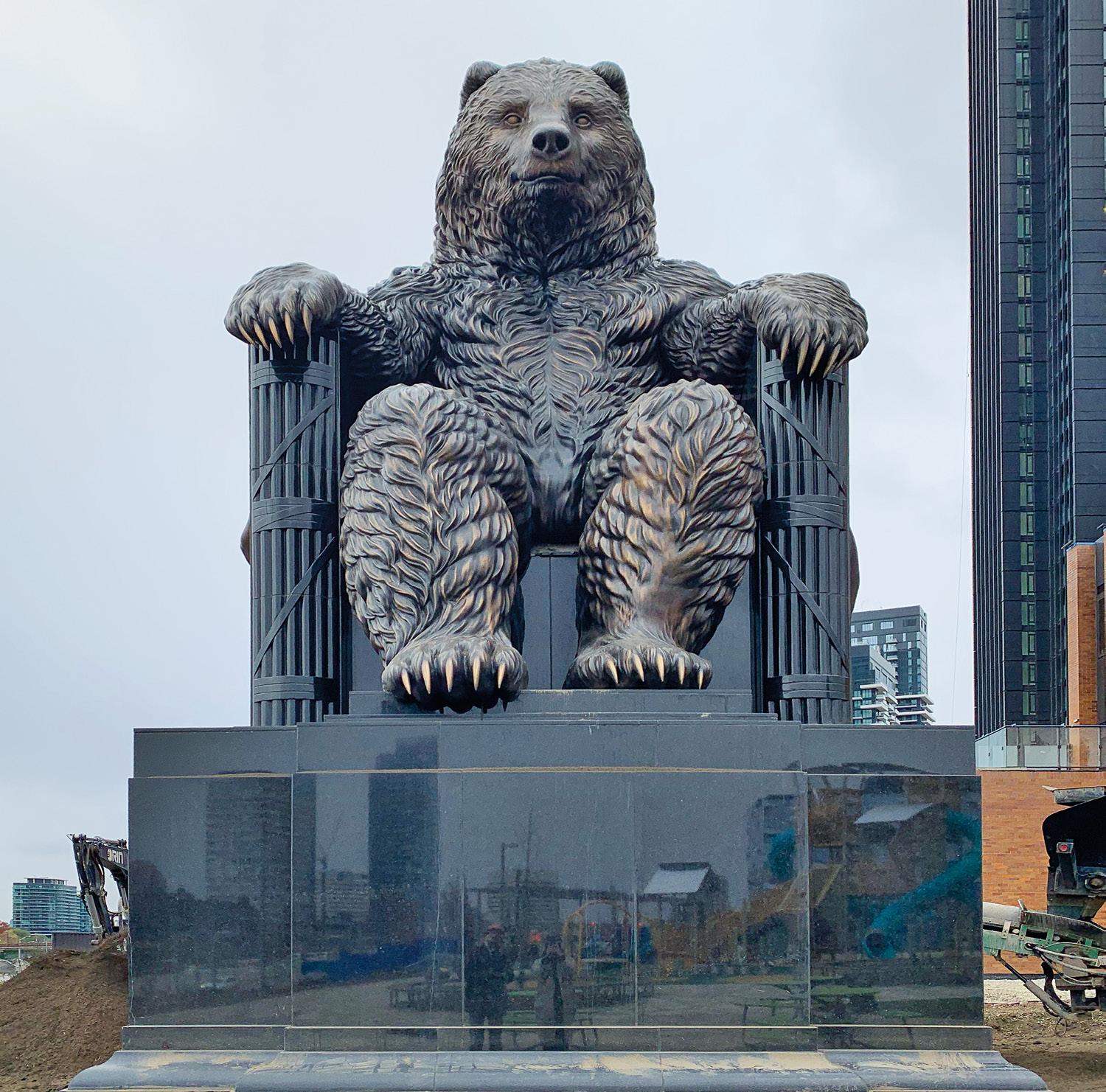
42/ Artifact The Bear(s): Eglinton’s new monumental matriarch and her subjects
TEXT BY NATASHA VARGA, OALA
President’s Message
“The test of our achievement is whether we are able to break away from our fragmented approach to this problem and begin to see the city as a whole, dealing with it as a complete organism.” — Edmund Bacon, Design of Cities
Since joining the OALA Council, I have been in awe of our profession’s natural ability to look at issues at a larger scale. It’s a skill that makes our profession special and unique. When we apply this to the discussion of the urban/ suburban divide, we understand a city is an ever-evolving “complex organism” that requires a deep level of thought.
In a similar manner, the OALA Council will also be looking at the big picture as our 2021-2026 Strategic Plan sets to expire and we develop the next 5-year plan for 2027-2031. It’s an exciting time to re-evaluate our strategic priorities and identify key action items.
We have much to look forward to in 2026. The OALA’s Annual Meeting of Members will take place virtually on Thursday, April 23, at 10 a.m. Registration takes place late March. The nomination deadline for student and intern members is March 30. And the deadline for Council nominations is March 31, 2026.
The annual OALA Conference takes place this fall in Kitchener. Details on the theme, venue, call for abstracts, exhibitors, and sponsors are available on the OALA website. I look forward to seeing and connecting with members during Octoberfest! I would also like to invite members to the CSLA Congress in Halifax, NS from June 4-6 at the Halifax Marriott Harbourfront.
The OALA will also continue to build its relationship with the Ministry of the Attorney General (MAG). In the past year we have made strides towards having a “seat at the table” with the Provincial government on critical issues, including budget consultations. We also continue to work towards the Practice Act, and had discussions last fall with the MAG, the Premier, and his staff. 2026 is also a municipal election year, and we will be using this opportunity to stress the importance of landscape architects to each municipality.
Finally, the deadline for the 2026 OALA Awards call for nominations is March 31, 2026. We are inviting OALA members to nominate deserving members and others for our annual awards and honours. Please visit the OALA website for more information.
Editorial Board Message
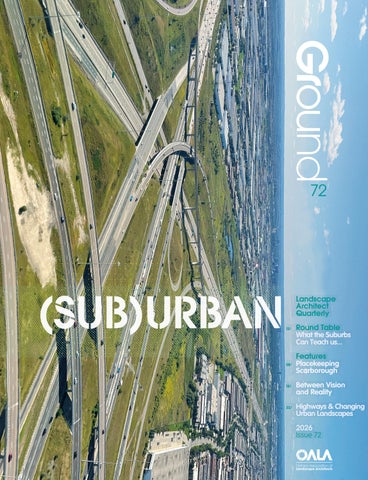
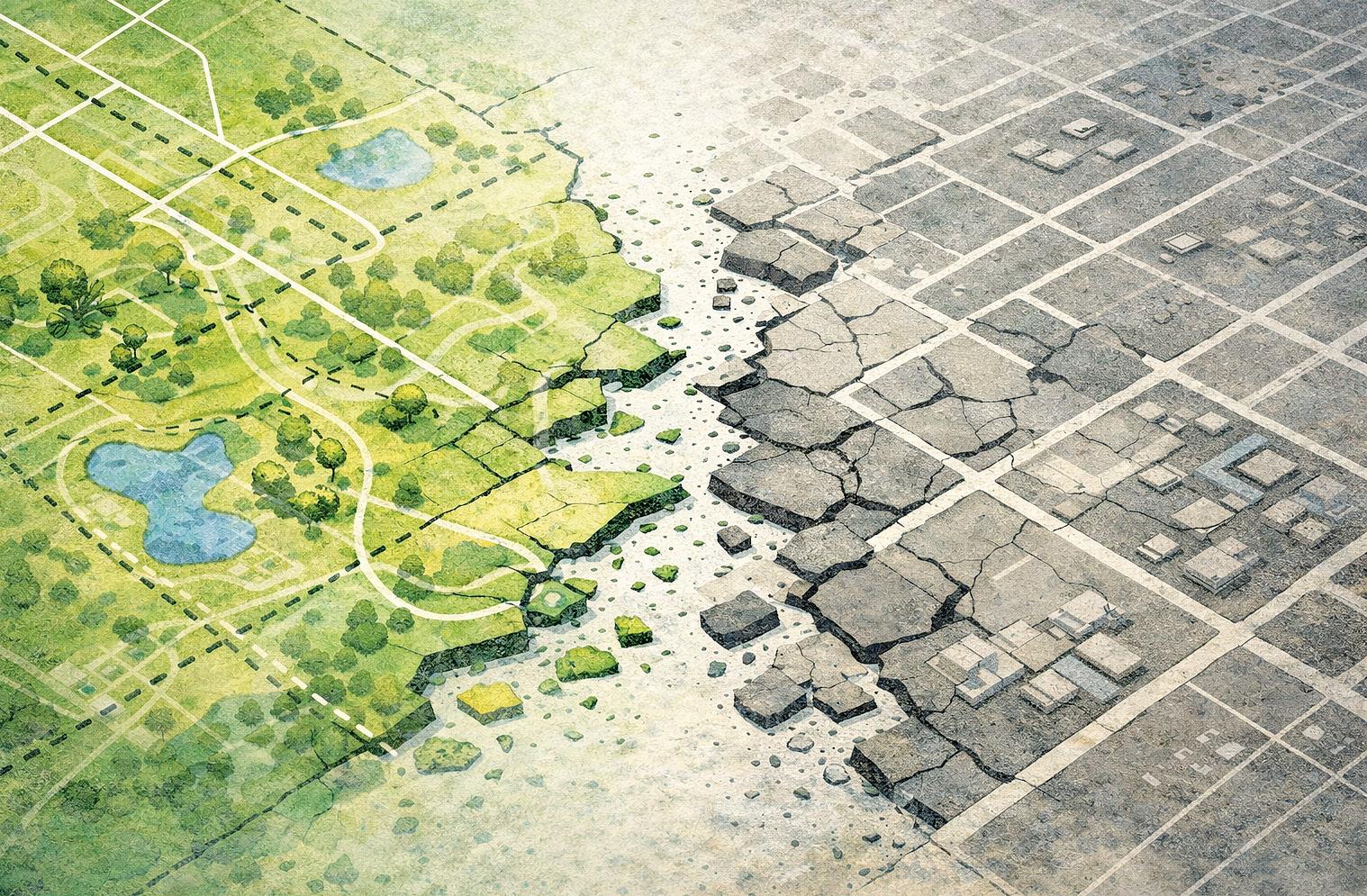
Ground 72 is organized under the theme of (Sub) Urban. This issue considers the term suburban from a few different perspectives. The most obvious of which are stories related to our suburbs. In this respect, we present a few different stories including a placekeeping story from Scarborough, an investigation of the gap between planning visions and built realities in our suburban edges, and an Up Front that considers the differences between urban and suburban teens.
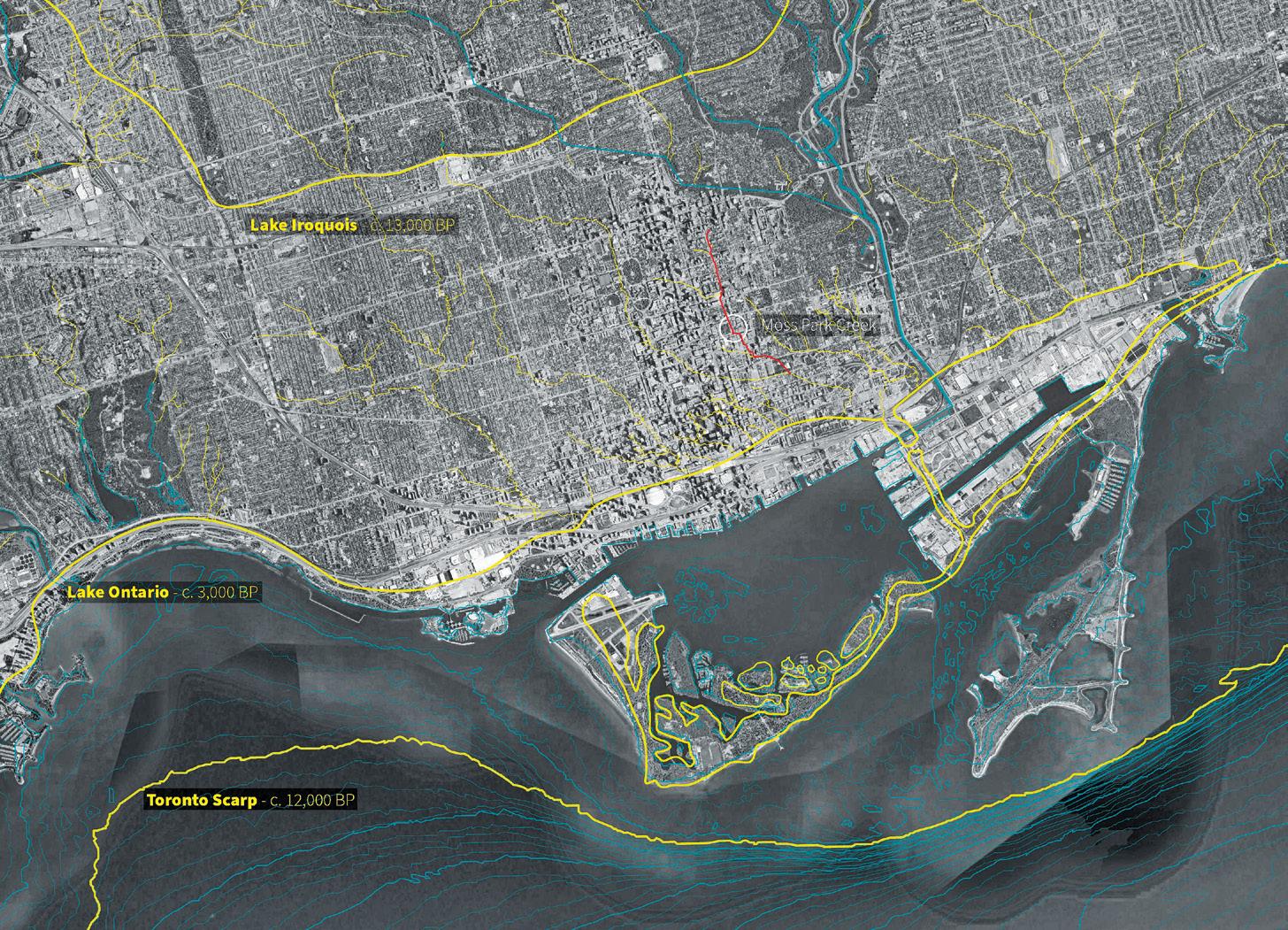
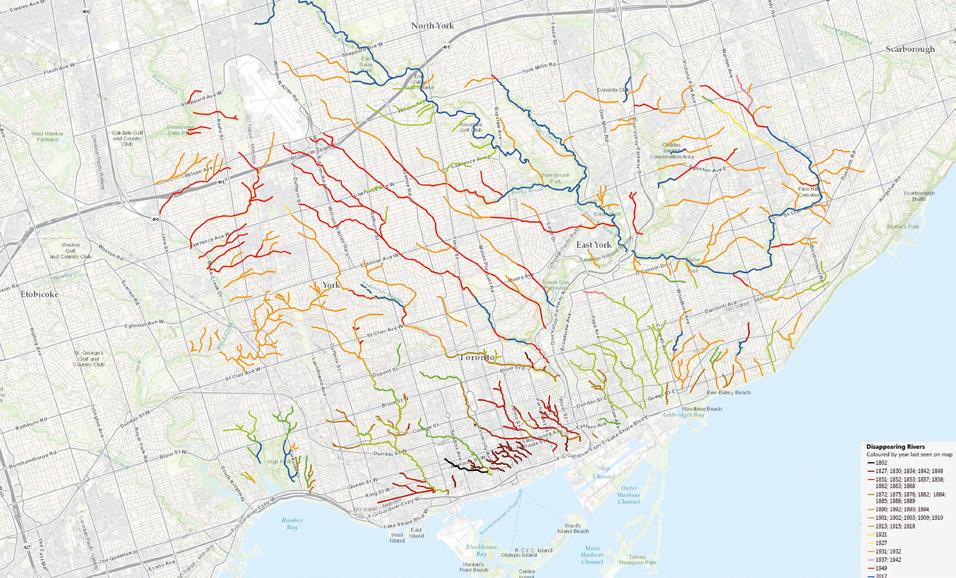
In another sense of the theme, we can consider (Sub) Urban to refer to our underground urban infrastructure. In relation to this, we present an Up Front from the OALA Justice, Equity, Diversity, and Inclusion Committee reflecting on a special event that was planned in conjunction with Lost Rivers to tour the buried Moss Park Creek and consider the long-term impacts we live with as a result of such actions. The article also covers an open discussion that followed where participants in the walk contemplated what it means to restore this and other lost waterways and improve our connection to natural water resources in our cities.
In the roundtable discussion we explore the continued proliferation of the suburban model as the go-to for new developments in urban peripheries, despite our understanding of the shortcomings of this type of neighbourhood. Does the promise of the suburb match the practical execution? Is there an opportunity for a new suburban ideal that we can celebrate? We invite you to read the discussion between our guest moderator and panel of academics and hope it inspires you to carry on the conversation with your networks and clients.
We would also like to take this opportunity to reflect on the last year of the magazine. In 2025, we’ve seen an influx of pitches being submitted in response to calls for submissions. The Board appreciates the increase in participation from the membership and look forward to continuing to build on this momentum in 2026!
There are lots of ways to participate, including submitting pitches for articles, reviewing recent landscape architecture media (books, podcasts, movies, etc.), submitting important events that would be beneficial for the membership to be aware of, or volunteering to organize a round table. Consider how you might like to be a part of Ground
MARK HILLMER CHAIR, EDITORIAL BOARD MAGAZINE@OALA.CA
Up Front: Information on the Ground
TOURS lost rivers
Since time immemorial, water and land have been shaped by each other in an unending interplay. The traces of these stories had been inscribed in the land and they have taught generations about environmental change over decades and centuries. In urban environments, these stories have been paved over and exist largely in subterranean spaces where the waters that shaped them have been relegated. For ages we have disregarded these watercourses and their enduring power in the name of expansion and development of our economic centres. Today, we reconcile with the impacts of these decisions and consider: where do we go next?
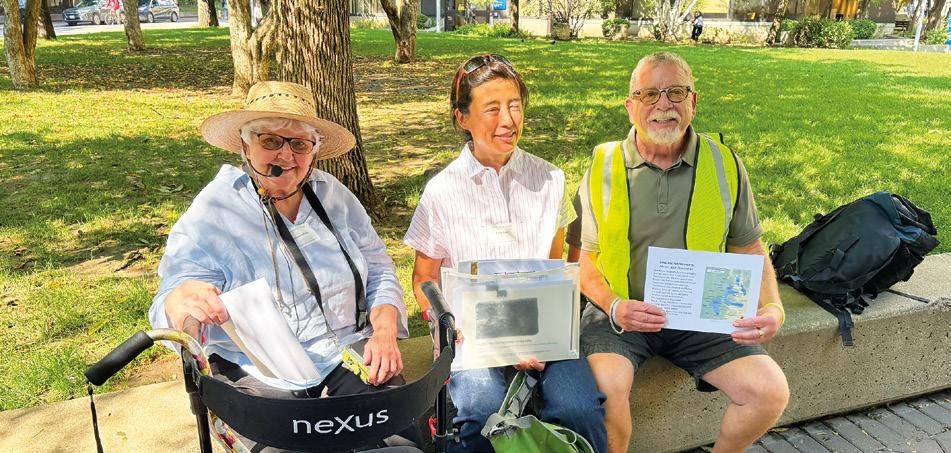
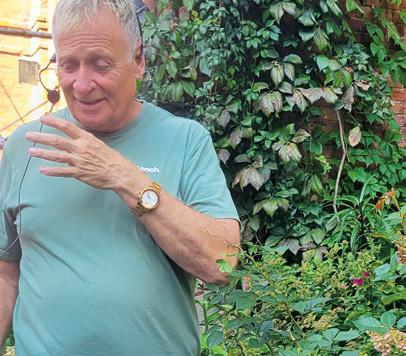
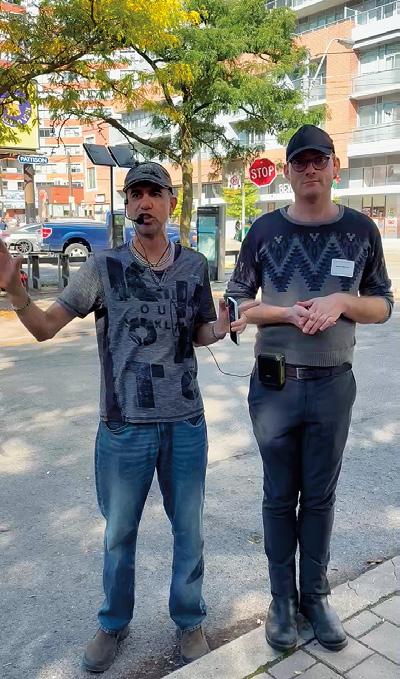
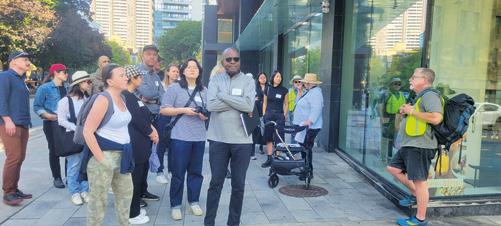
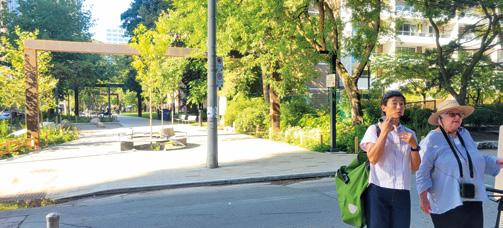
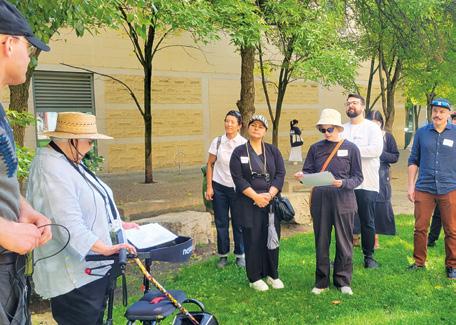
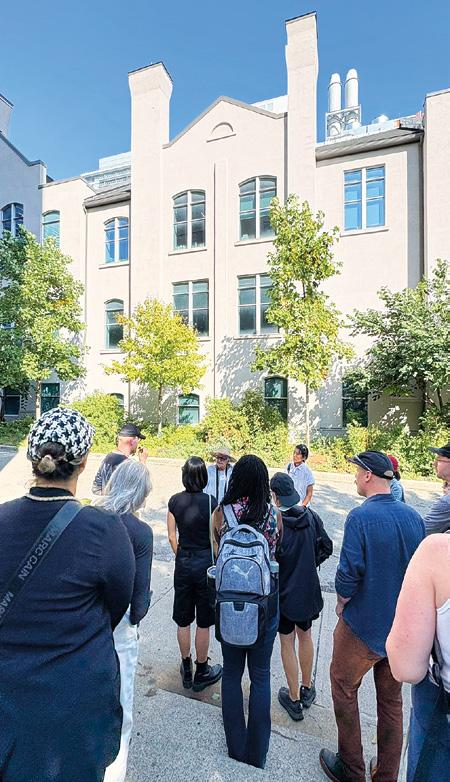
On September 26, 2025, the OALA’s Justice, Equity, Diversity and Inclusion Committee (J.E.D.I.), in conjunction with Lost Rivers’ Helen Mills, Adam Wynne, and Rene Fan, hosted a walking tour of the Church-Wellesley Village to unearth the secrets of the buried Moss Park
IMAGE/ ERA Architects
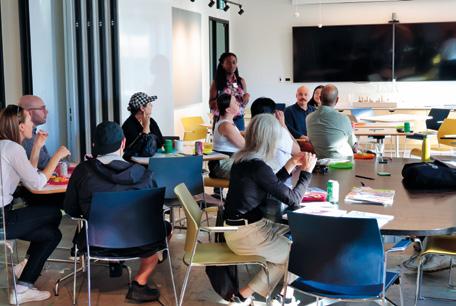
02/ Walking tour discussion at ERA Office, Toronto.
IMAGE/ Mina Markovic
03/ A wayfinding station during the walking tour.
IMAGE/ courtesy of OALA J.E.D.I. Committee
01/ OALA Walking Tour starting point on Toronto's Lost Creeks and Ancient Shorelines.
Creek. The tour wove together stories of wet basements, soaked core samples, sinkholes, sinking houses, and houses built above street level to stay above the muddy mire of the former creek path, with the queer histories of the neighbourhood. This gave context for the biocultural landscape that has evolved over the last seven generations to define the present day.
Indigenous peoples in Ontario and water is not just based solely on its being a lifegiving resource—water is a living entity with a spirit of its own.
With this understanding, we can begin to gain some context for the harm past actions have done to Indigenous peoples, their culture, and the living spirits of not just the water, but ‘all our relations.’
While we have come to realize the importance of daylighting and restoring rivers, the path to restoring them will require some fundamental changes in our attitudes towards city-building and impacts on existing long-established neighbourhoods. Projects like these need to be contemplated on different time scales—just look at the 30+ year effort to restore the mouth of the Don River.
The example of Moss Park Creek is interesting to contemplate. On the one hand, daylighting the creek would improve the resilience of the neighbourhood to manage climate events, mitigate many
The group finished the tour at the nearby ERA office for a free flowing conversation led by OALA J.E.D.I. Committee chair Zara Brown and J.E.D.I. Committee member and CSLA Reconciliation Advisory Committee Co-chair Grant Fahlgren. The conversation began with a land acknowledgement that touched on the concept of the 13 moons and how they are interwoven in Anishnaabe culture to provide spiritual teachings and foster a greater connection with the environment. Next, it drew connections between the work of un-erasing as it relates to Indigenous culture and the lost rivers. The deep spiritual connection between
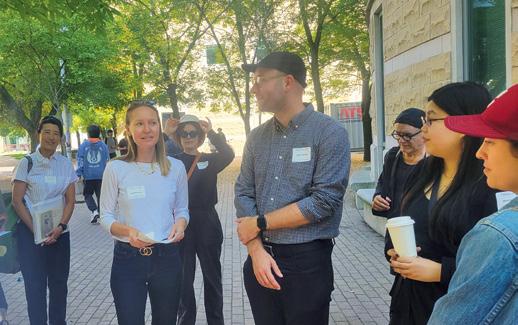
04-10/ Various stops along the river walk tour. IMAGES/ courtesy of OALA J.E.D.I. Committee
11/ Chatting on the tour. IMAGE/ courtesy of OALA J.E.D.I. Committee
13/ A bit of landscape on the tour.
IMAGE/ courtesy of OALA J.E.D.I. Committee
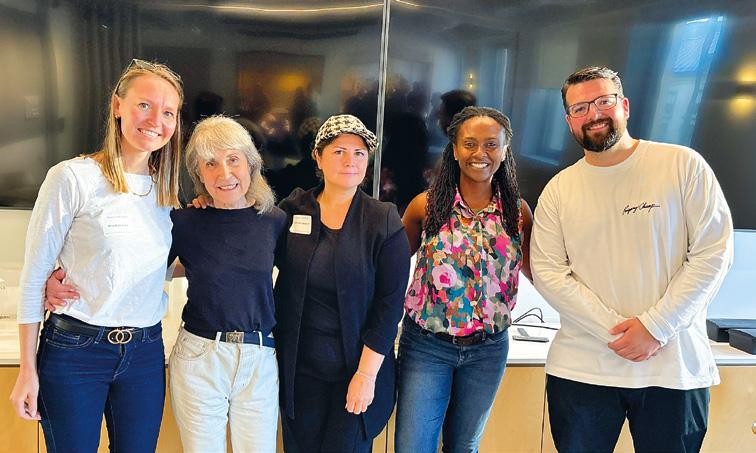
14/ A hang out after the tour.
IMAGE/ courtesy of OALA J.E.D.I. Committee
impacts currently felt by the buried river, and foster new connections to our water as a precious resource, even in cities. On the other hand, it could have a significant impact on a marginalized community who has had to fight for generations to establish and protect these important queer spaces built above the lost river. Weighing these outcomes and considering the impacts on our Indigenous communities that predate us becomes a dilemma.
pressure on city planners and elected officials across these prolonged timelines to work with developers to make the vision a reality.
As landscape architects, we act as stewards of the land and its people. Conversations like the one started by this event are complex and intertwined with consequences for humans and the earth. While progress may be slow, maintaining dialogue among us to understand our responsibilities and advocating externally for better city-building practices are essential next steps. The OALA is committed to having these difficult conversations and looks forward to more events like this one which will challenge our status quo.
15/ Gerrard Street East, Toronto. IMAGE/ courtesy of OALA J.E.D.I. Committee
TEXT/ MARK HILLMER IS A LANDSCAPE ARCHITECT, CHAIR OF THE GROUND EDITORIAL BOARD AND MEMBER OF
Therefore, we could contemplate a new approach to redevelopment that considers natural city-building lifecycles as opportunities to, piece-by-piece, begin to puzzle together a revitalized natural corridor over generations. A process such as this would require on-going buy-in and support which necessitates collaboration to avoid harmful impacts to the current community. So that they fundamentally understand how the health of their community is intrinsically tied to the health of the river. In which case, they become the champions of the project and maintain
OALA J.E.D.I. COMMITTEE. HE WAS
17/
IMAGE/ Emma Cervinka
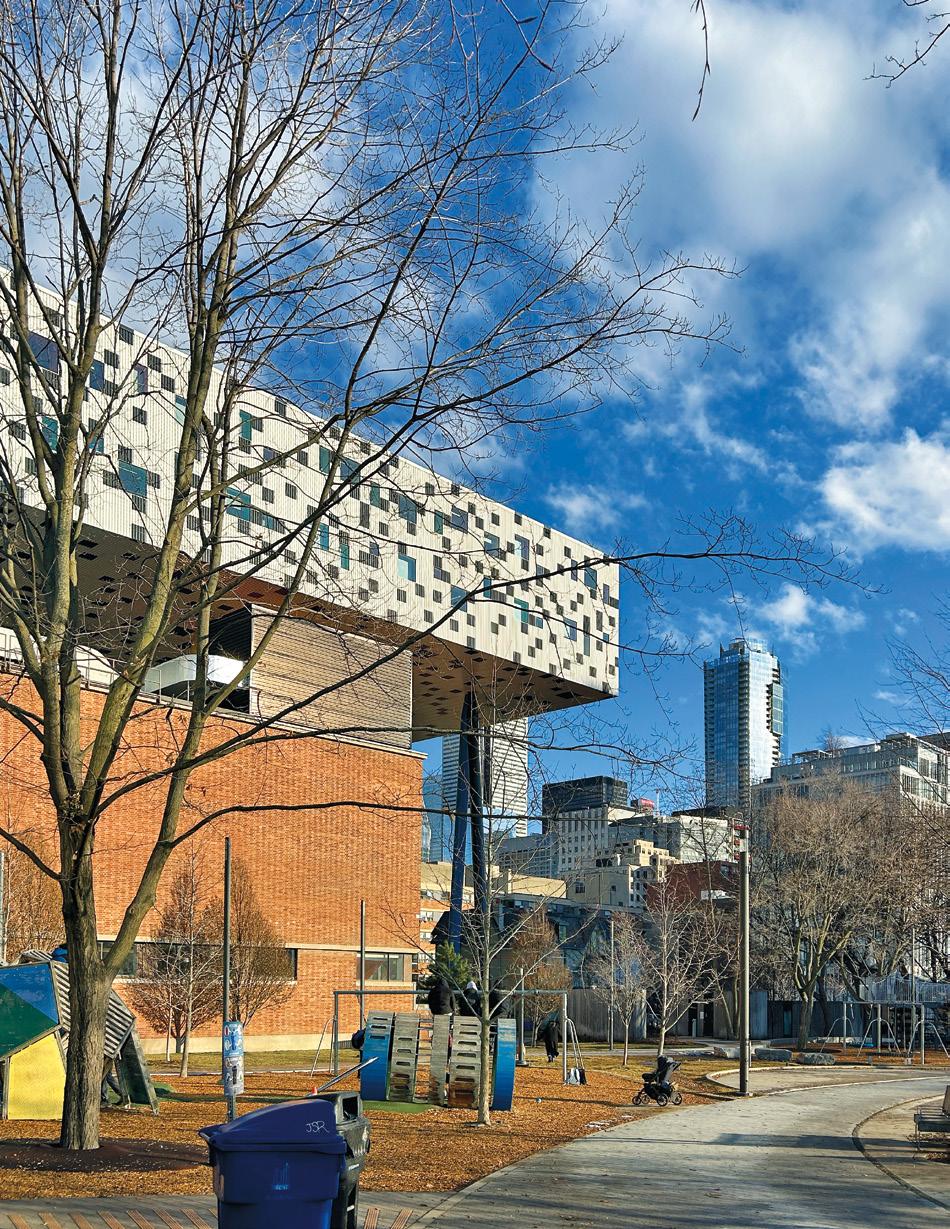
18/ Grange Park, outside of OCAD, Toronto.
IMAGE/ Emma Cervinka
When I tell someone I’m hoping to conduct research with adolescents, I get some funny reactions. However, when I reflect on my teenage years, living in the suburbs while attending high school in downtown London, I think about how different my life might have been if active travel infrastructure and public spaces had been designed with me in mind.
My teenage experience reflects a broader challenge: adolescents are often excluded from public spaces. In design practice, we tend to consider children and adults, but overlook this tricky, transitional “phase.” Teens have long been perceived as disruptive or characterized as “troublemakers.” This characterization can push them to the margins of public spaces, onto their phones, or to other places more conducive to deviant behaviours. Adolescence is a crucial stage
of development, where young people develop agency and autonomy, and build habits that can last a lifetime. Public spaces fulfill a range of these essential human needs, yet teenagers largely remain ignored and underserved by them.
The Role of Screens
Social media and screen use have introduced new barriers to adolescent participation in the public realm. A 2018 study by Twenge et al., showed a significant rise in teen depression and anxiety since the early 2010s, linked to the exponential growth of social media platforms. It is argued by psychologists such as Dr. Jonathan Haidt that social media and phones have created a “phone-based childhood” and replaced the “play-based childhood” essential for healthy human development. This shift underscores the urgency for physical spaces that fight digital isolation. With most teenagers having a phone, and screen use increasing with age, their inclusion
BEYOND SCREENS public spaces for teens
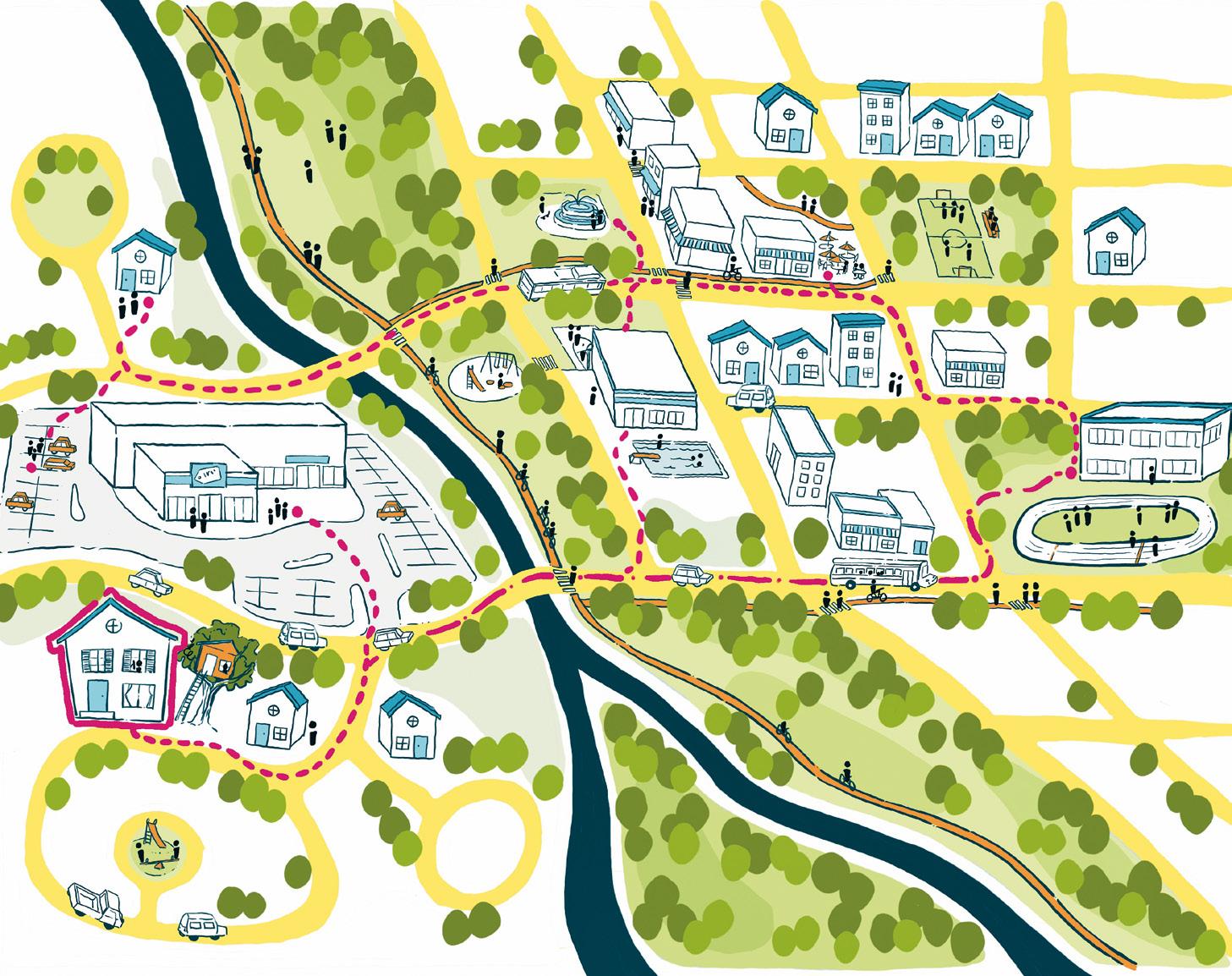
16/ A map of the urban/suburban divide in Ontario from a teenager’s perspective.
IMAGE/ Emma Cervinka
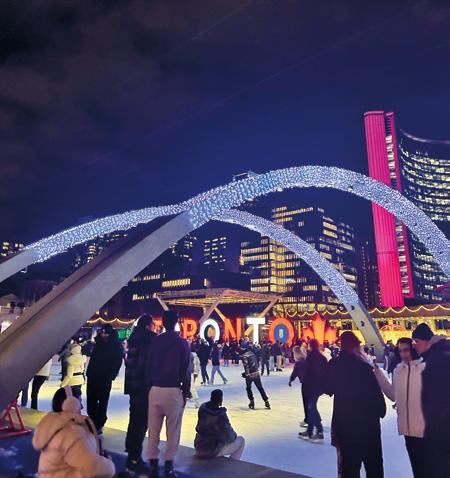
People enjoying the winter skating rink at Toronto City Hall.
and integration in the public realm has never been more important. As such, public spaces must compete with digital spaces by offering real value through connection, independence, and fun. While technology shapes how teens interact socially, physical infrastructure determines if they can access spaces that foster real-world connections. Creating destinations for youth alone is not enough—we also must allow safe access through different transit modes. The most exceptional park is useless if there’s no way to reach it without a car. The driver’s licence is a pinnacle of independence and autonomy for North American youth, especially in the suburbs. However, there is another important licence acquired in the teenage years: the independent mobility licence.
A Forgotten Licence: Independent Mobility
The independent mobility licence refers to the freedom to move around one’s neighbourhood without (direct) adult supervision. For instance, being able to walk or bike to a friend’s house. Independent mobility has been on a steady decline for decades, and it is widely acknowledged the built environment and car dependence plays a significant role in this decline. Independent mobility licences are typically incurred in late childhood or early adolescence, and depend on many factors, including perceived safety, parental permissions, distance, traffic concerns, cultural norms, and more—all of which are important, but first require a well-developed public realm and accessible transportation infrastructure.
As a teenager, I was limited by the childfocused public spaces and car-dominance of my neighbourhood. There were no bike lanes and many disconnected sidewalks, which motivated me to acquire my driver’s licence the moment I could. However, on lunch breaks in my downtown high school, good infrastructure allowed me to go out for lunch and visit parks and plazas with my friends. This independent mobility, afforded by street connectivity and local destinations, supported the development of independence and confidence. Similar to many young people, I learned to navigate the world and develop relationships with community members.
Designing for Teen Inclusion
When I go home today, I see improvements in footpaths and bike lanes that would have made it safe for me to bike to my best friend’s house before I got my driver’s licence. There are also more neighbourhood destinations I could have visited without feeling I was infringing upon children’s spaces, such as parks with flexible seating, multi-use plazas, and open spaces.
When we design for non-driving populations, such as youth, we also design for other vulnerable populations, including seniors, parents and caregivers, and those with disabilities. This opens up broader considerations and questions of mobility, safety, and cultural norms in the design process, moving towards a healthier, more active and engaged society overall.
Designing inclusive public spaces with teens in mind goes beyond aesthetics. It fosters mental health, independence, and community, with the potential to promote civic engagement and belonging for a lifetime. Let’s make youth visible in our design decisions and engage them as stakeholders of the public realm.
TEXT BY FAIZAAN KHAN
Feel the ground beneath you. Pavement and lawn weaving over and under each other. The grass tickles your ankles. Dirt, supple and relenting, damp from the stream and the fallen leaves that aren’t yet dry. Snow, piled up to your knees, compacted under the weight of unsteady feet trying to board the bus. Look around. Chipped paint plastered across slab towers. Children wading across seven lanes of traffic for a bag of chips. Sujood in the coin laundry. Sequins on carnival costumes and sarees shimmer alike. The uncles of today and aunties of tomorrow sip and spill tea in crumbling parking lots—undeterred by faded lines announcing where one car should end and the other begin. Storefronts with signs in languages you recognize but can’t read. Listen. Friends laughing. Pigeons cooing. Cars honking. Streams babbling. Waves lapping. Teens shouting. Trees whispering. It’s been two years but the echoes of the Scarborough RT screeching still ring in your head.
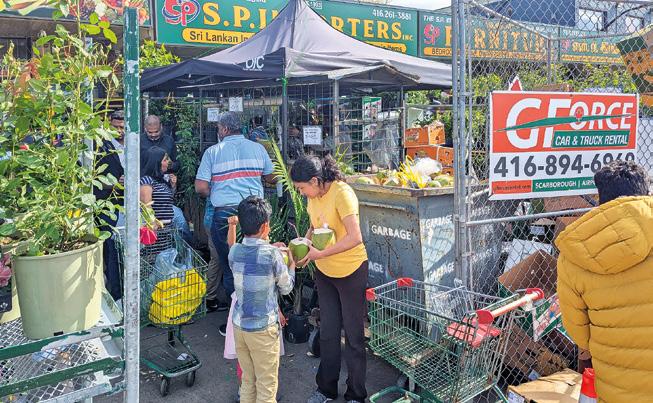
Breathe in—exhaust fumes, mowed grass, doubles, back-of-the-van mangos, unsanctioned park barbecue, weed, sulfur, green coconuts—breathe out.
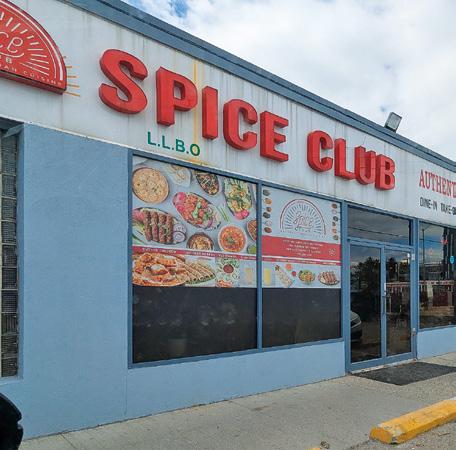
This could be anywhere. It’s only with the details that Scarborough comes into focus. The seven lanes of traffic on Lawrence Avenue. The chipped paint of a mural by Amir and the kids from the Boys and Girls Club. The bus shelter, blocked by a snowbank (the decommissioned 54 stop at the corner of Orton Park).
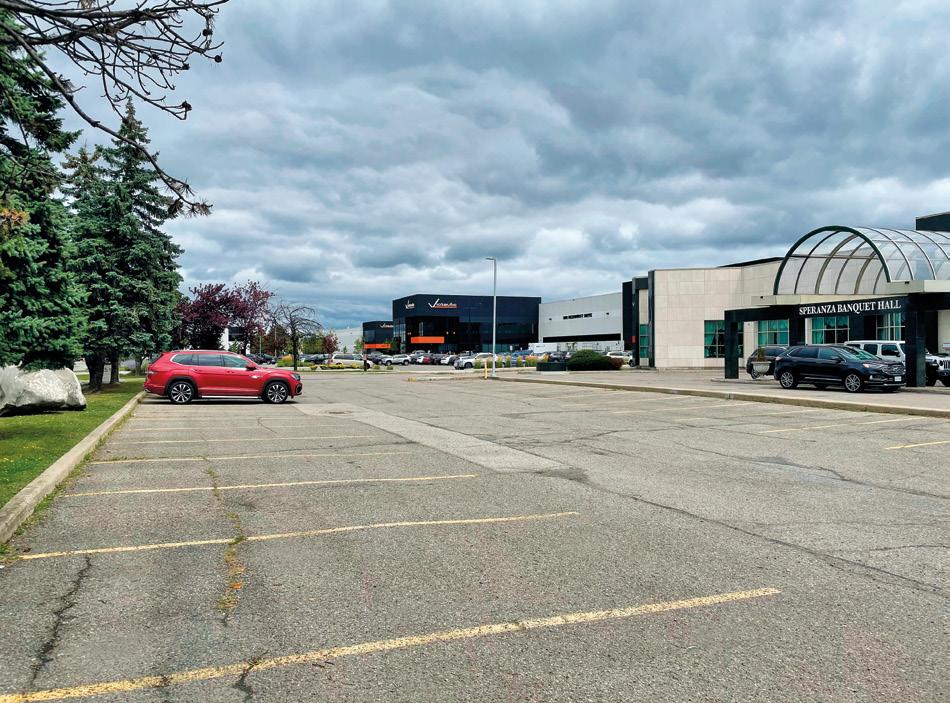
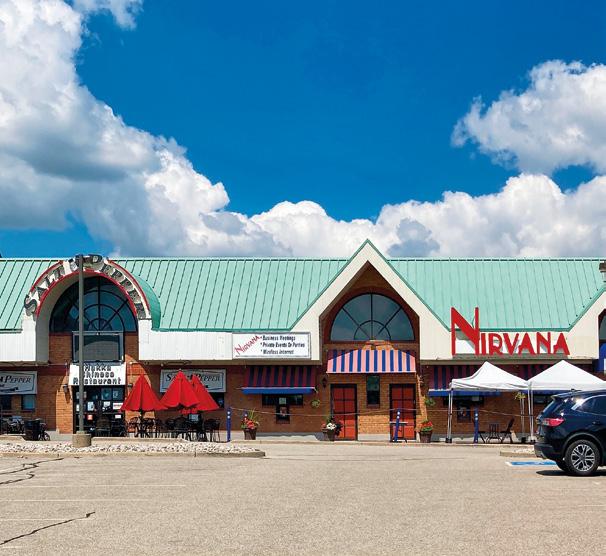
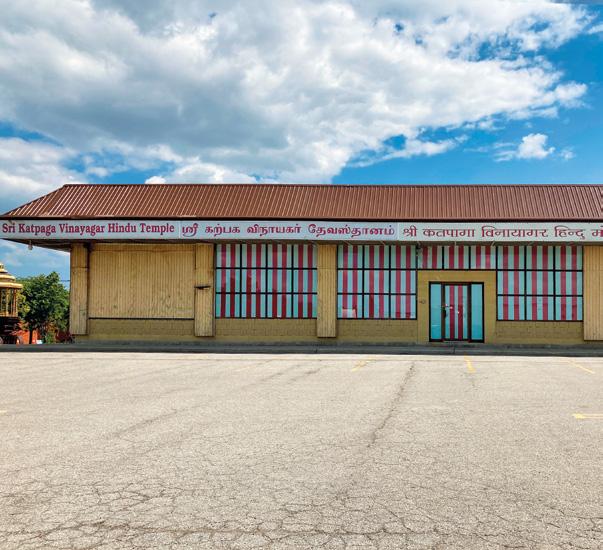
As a design student in 2017, I quickly learned Scarborough’s place in mainstream urbanism discourse. Overlooked, undervalued, and undesirable. Scarborough was a place to intervene, to redesign, to fix and to improve. I was no stranger to all the ways that this place didn’t work, but I also saw beyond that. I saw the beautiful contestations of the hostile urban form that we had inherited. The temples in old warehouses, the weddings in strip plaza banquet halls, and the Taraweeh prayers in gas station laundromats. There is something here in this place. When we redevelop a strip mall, a parking lot, a gas station, something is lost.
Preservation felt like a powerful word to me when I started doing this work. I love this place, and I want to preserve the parts of it that work. Given the chokehold that heritage preservation has on urban form, I thought it might be a useful placekeeping tool. Scarborough, in the way it exists today, is noticeably absent from the heritage canon. The way heritage value is prescribed in legislation is not so narrow that Scarborough can’t fit. It’s a willful ignorance weaponized along axes of power like race and class that exclude this place from the realm of heritage. To argue that a mall or plaza has no value, but a Victorian home or a farmhouse does, may seem arbitrary but it is an interpretation cemented in the colonial foundation of this framework. These are spaces now valued by the poor and racialized, so they cannot be
IMAGES/
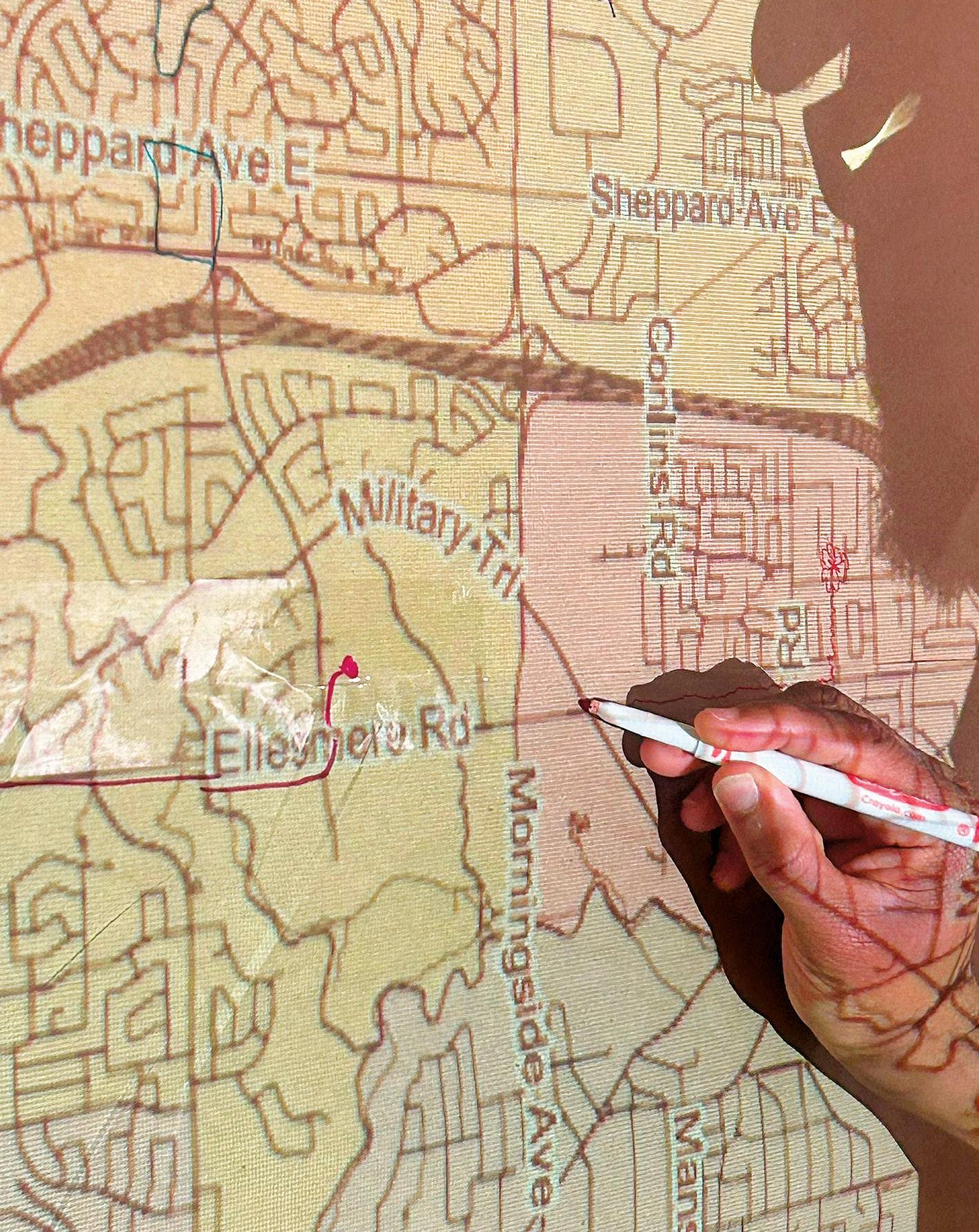
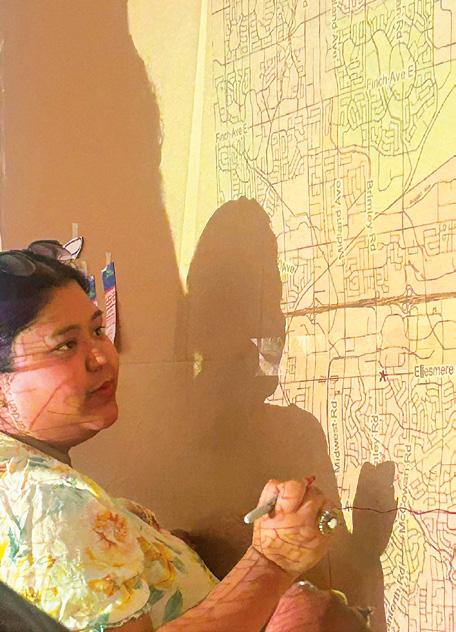
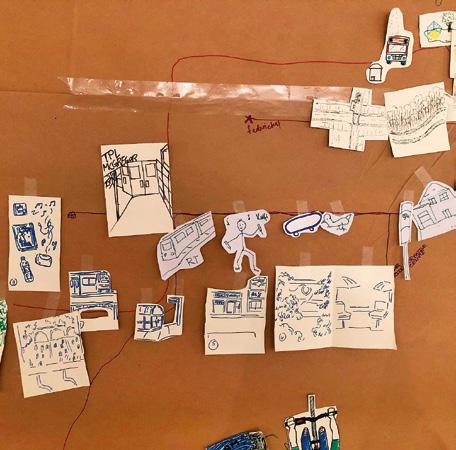
01/ Plotting out cultural landmarks in Scarborough.
IMAGE/ Faizaan Khan
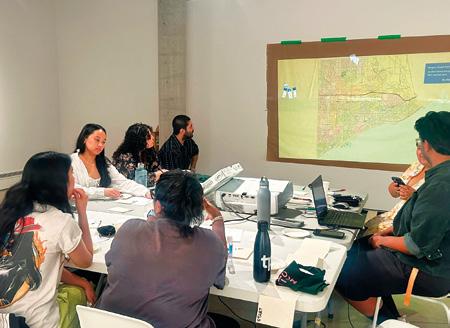
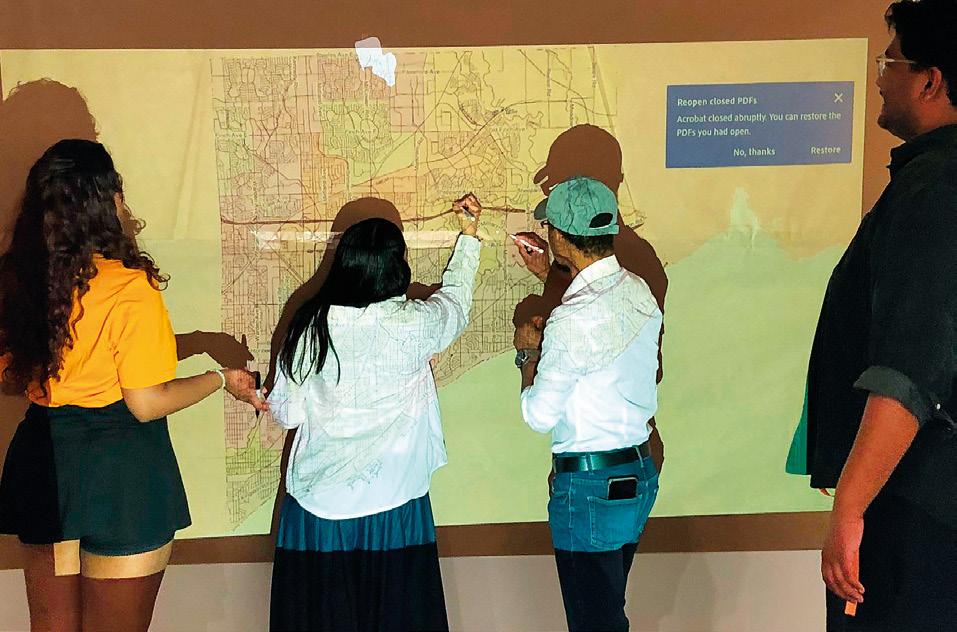
02-05/ A workshop for identifying Scarborough landmarks.
Faizaan Khan
worth preservation. So, yes, the heritage sector doesn’t really care all that much —the Architectural Conservancy of Ontario will not mobilize around a strip plaza any time soon, and the Ontario Heritage Trust has no interest in the Malvern Mall—but even if the will was there, what good does heritage policy do for us?
I used to think the goal was to begin to weave Scarborough, as it exists today, into the heritage canon. I was wrong.
Despite claims that diversity, equity, and inclusion are priorities in the heritage sector today, the existing heritage framework in Ontario is radically misaligned with the needs of marginalized communities, due to its preoccupation with the physical and tangible. You and I both know that this suburb was not designed for people. It was designed for cars. Cars with white people in them. Sure, Scarborough is now one of the most racialized and low-income regions of Toronto, but it wasn’t always. The people that live here inherited this built form. Scarborough doesn’t really look too different from how it did in the 60s—but it isn’t the same place is it? We can preserve brick and mortar, but without tools and infrastructure to support the communities that use these spaces, does the place remain?
This is a problem for all marginalized communities, but it is especially potent in places like Scarborough where the urban form is actively hostile. Here, preserving material form does more harm than good in many ways. Do you think people want to walk 10 minutes in the wrong direction just to reach a crosswalk? That they want to pray in laundromats and warehouses? That they want to sit in a parking lot instead of under a tree? It’s the function, not form, that warrants attention.
In its current expression, preservation has lost its teeth as both a rhetorical and policy
tool. There are surely good reasons for taking a physical preservation approach, like sustainability, but it is disingenuous to argue that the existing heritage preservation framework is necessary from a heritage and cultural equity perspective.
So what do we do with the un-preservable? The people, the communities, the rituals and practices, the feeling in your body? Too often, we do nothing. At least, not while the people and the practices still persist in place. We let displacement happen and then we commemorate what was once there. Displace, then commemorate. Displace, then write a book. Displace, then curate an exhibition. Displace, then put up a plaque. Displace, then rename. Commemoration is the tool we use to contend with the places we couldn’t or wouldn’t preserve. It is an outcome of a planning process that has failed to consider and protect marginalized communities and their spaces.
To that end, the Scarborough Landmarks project is an experiment in reframing commemoration from a planning and design outcome, to a tool in the planning and design process. The project uses commemoration and memory work as a method for understanding what a community values, and highlighting the social infrastructure that binds and nourishes while it’s still here. To identify our Scarborough Landmarks, we try to trace our most mundane journeys—our route to get groceries, to school, work, the salon, the park, wherever. We consider the signals that this place, now called Scarborough, sends us. How do the land, and the marks we’ve made on it, speak to us? How does the land tell us we’re almost at our destination, or that it’s too late to turn back if you’ve forgotten something?
We try to look beyond the mundane and think of the moments of joy on our trip. We consider who is on this journey with us, be it a friend, the neighbourhood cat, or a good book. We consider why, when given the prompt to think of a mundane journey, we picked the one we did. How do we fill these spaces with life? Scarborough Landmarks is an assertion that we are here. There are rich and varied lives in this place.
Scarborough forces us to look beyond the binary of tangible and intangible cultural heritage. The mall-walkers need a roof, but it doesn’t necessarily need to be this roof. The aunties need a place to sit, but not necessarily these seats. Scarborough asks us not to simply preserve material, but to understand the values this material holds, and how we might design new forms rooted in these values.
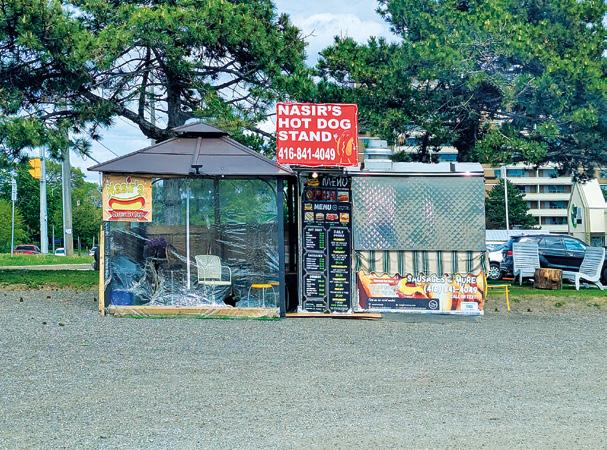
Change is coming, perhaps for the better. I welcome it. But will we get to stay and benefit? Will Nasir’s survive? The fruit stall? The coconut stand? Will the plaza with the streetlight last long enough to be anything interesting? Will the histories of these lands be considered, as futures are mapped and designed? The original stewards of these lands? The waves of immigrants? When we do finally get more human-centered design, and will any living here today experience it? Will their kids be here to skip across a street rather than sprint across a sevenlane road? Will they be able to afford to stay? Will they be welcome?
Ultimately, Scarborough Landmarks is an exercise in noticing. If we want to prevent displacement, we must name the places we value. We must acknowledge the marks we’ve made on this land that make this space the place it is. My aim isn’t to elevate any of these landmarks onto pedestals. I have no desire for all of the marks we’ve made on this land to stay, at least in the form they are now. Instead of scoffing at the idea a plaza, mall, gas station, parking lot, or sidewalk all have value to people, let’s understand why they are valued. So that, as change arrives, we might be resilient. The values might stay, adapted into new forms that enhance rather than replace what is here. Taraweeh prayers in a mosque, mangos without the exhaust fumes, shade for the aunties and uncles.
BIO/ FAIZAAN KHAN IS AN URBAN AND CULTURAL PLANNER, DESIGNER, AND RESEARCHER, ROOTED IN LAND NOW CALLED SCARBOROUGH.
FAIZAAN’S WORK FOCUSES ON CULTURAL HERITAGE, RACIALIZED URBAN PERIPHERIES, PLACE-KEEPING AND ANTI-DISPLACEMENT. HIS PRACTICE CENTERS TRUST, JUSTICE, EMPATHY, AND FUN. FAIZAAN HOLDS DEGREES IN PLANNING AND ARCHITECTURE, AND IS PART OF A ROBUST ECOLOGY OF ARTISTS AND CULTURAL PRACTITIONERS ROOTED IN SCARBOROUGH.
regulatory norms. Single egress buildings are forbidden in multi-unit housing, but multi-unit housing itself is forbidden in most cases. There’s a straight jacket of regulatory controls which is duplicated in the reactionary protectionism many people have—a fear of changing anything.
But there’s a pro that comes with that, which is a tremendous flexibility and possibility in suburban space if we just us to disregard their existing physical and cultural conditions, and that’s hugely problematic.
That’s resulted in a lot of adaptation and development of these beautiful cultural spaces, and emergence of social norms and practices these spaces weren't planned for. Employment areas, which were planned for industrial and employment-based uses because of the affordability of land, have become places for banquet halls, religious places, language schools, and food related businesses. A lot of ethnic entrepreneurship happens in those spaces.
The key to this is the affordability. Downtown, there is no affordability. So suburbs, partly because they’ve been left alone in terms of regulatory control, have seen many more thriving cultural spaces.
That’s partially why new immigrants are moving into suburban spaces: that’s where their people live. That’s where they can access immigration services and lawyers and their religious spaces and all the spaces catering to their specific needs. That’s why I always struggle with focusing too much on suburbs, I’m like, “Leave them alone, it’s thriving.”
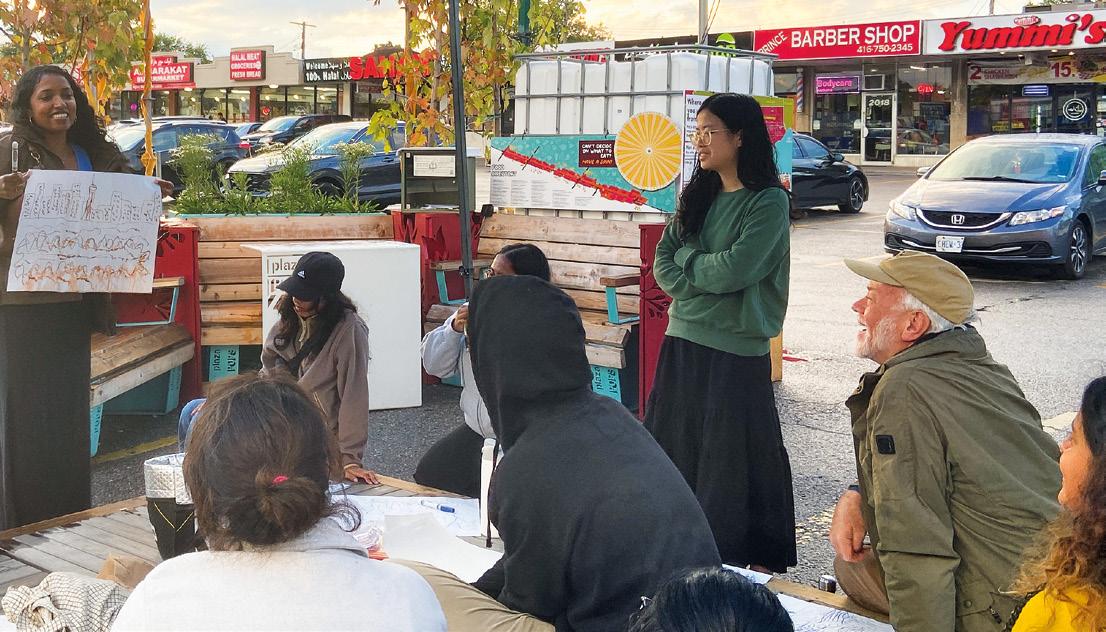
But now the development in the downtown and denser parts of the city have been exhausted because there isn’t much land left, so there’s more development happening in the suburbs. And because of that, we do need to pay closer attention. The plazaPOPS interventions creating public space in strip mall parking lots have led to the City of Toronto recognizing the importance of strip mall parking lots and the cultural relevance of those businesses beyond just the services they provide.
There is more attention being paid to the suburbs from a regulatory perspective now. But I’m still struggling with whether that’s a pro or con.
AT: The next question is about re-envisioning suburbs—with the added context of what Sneha just said about leaving them alone and Michael saying they’re not portrayed in a helpful or accurate way.
NL: It would be beautiful to loosen them up a bit and allow them to be appropriated and transformed. Because, as I said, there’s
a tight mummy bandage wrapped around so many. As Michael said, these are super curated, planned, designed landscapes, and that makes them brittle in the sense that we’re going through growing pains now.
But if we just relax and let go of some of these regulatory controls, the cultural norms and expectations are harder to deal with, but I would prioritize enabling appropriation and transformation, especially by first, second, and third generation Canadians. That’s important in big metropolitan areas where we’ve got a significant number of people arriving from elsewhere and bringing changes to bear. I have grads who tell me, “I’m having a difficult time trying to convince the regulatory people about the importance of allowing a second kitchen, because we need a hot kitchen and a cold kitchen,” which is normal in many cultures. That’s an example of where we need to take off some of the bandages.
But we should also be consulting the people with expertise on the ground. We need to be enabling, empowering, and listening to the households and communities bringing amazing life to these places. And it’s not new: we have research going back to the 1950s and early streetcar suburbs in big Canadian cities, where big waves of postwar immigration started to transform these spaces in exciting ways.
We need to figure out ways to allow suburban space to continue thickening up in terms of the mix: of program, activity, who owns what, on what time scales, who has access to what space for what activities, et cetera. And there are many great examples. I love the strip plaza main street phenomenon, which is an incredibly important incubator and emergent landscape of small business entrepreneurship. All sorts of interesting things are happening on the retail service front. My mom spent much of her life in Toronto trying to make duplexes and triplexes in so-called stable residential neighbourhoods. And a lot of that is happening, just secretly. Now we’re starting to daylight these things and normalize them. That’s why I say consulting, talking to the folks who have been occupying, appropriating, and transforming suburbs, should be the focus in re-envisioning.
MP: The whole basis for the research we do at ReHousing is people aren’t living one family to a home anymore. As Nik says, there are basement suites, multigenerational families, and student rooming houses we have no idea about because they’re under the radar. We need to learn from these without culturally squashing them with our excited architectural gaze.
Now I’m going to pose a totally opposite perspective: suburbs do need to be radically re-transformed in order to serve the residents that are currently there. They’re not equipped in terms of social services and infrastructure to serve the new populations living there. How we transform these spaces is the question. I am interested in revisiting how they were created in the first place, which is code, and then how we can recode that context. Zoning was the tool that resulted in what we have. How can we use zoning as a basis for re-imagining?
I don’t mean making new zoning rules, I mean looking at how the space is shaped. For example, there’s a school in the middle of every single-family subdivision. That’s a nonpublic space. Can that be reprogrammed as a community asset? Zoned along major avenues are commercial spaces, so how
can that be repurposed? In this way, you’re able to achieve scale and transformation in the suburbs. You’re not working bit by bit, you’re thinking at a large scale, while at the same time through individual spaces.
Then there’s time. These vast landscapes don’t change overnight. There’s a lot of elbow room and it’s exciting to imagine that any intervention is not going to be the last one that happens. You need to design in a way that recognizes something else is going to follow your intervention you can’t anticipate.
As an example of why this is important: mall redevelopments. Malls are some of the bigger spaces transformed for high density in suburbia, and are often approached with a master plan mentality: let’s clean the slate and make it new. But certain conditions make that impossible. Those plans are foiled by things like leasing terms, with some retailers preventing you from demolishing a mall all at once. So you end up with a big box store next to a high density tower. I think there’s something beautiful about that inability to control the underlying stuff that goes on and the need to think temporally.
SM: The biggest thing I dream of in my research is how do we, as planners, come up with policies specifically for the suburbs? One of the biggest problems in Toronto is that amalgamation happened, but Scarborough, Etobicoke, and North York are still very different in urban form from central Toronto.
I struggle with being able to read policy in a way that makes sense for both downtown and the suburbs. As an example, a lot of commercial space and street scape developments depend on BIAs. But the businesses in the suburbs are more spread out, so the BIA model doesn’t necessarily work in the same way. Heritage policies also don’t apply the same way in suburbs because the buildings are mostly new. Their tangible value is not the same as a colonial building downtown, which has a ton of institutional archival records to refer to. It’s a beautiful building. How do we think about these things?
One of my dreams with plazaPOPS has always been to come up with a suburban
Privately Owned Public Space (POPS) policy. The POPS policy downtown works because density is an incentive that works to provide publicly accessible spaces. How do we come up with incentives that work for the suburbs that don’t necessarily work for downtown?
Part of the struggle for many of these development projects is we’re applying the same economic focus of finding the highest and best use of the land that’s worked for downtowns and economic centres to the suburbs. That’s been problematic and will continue to result in erasing of a lot of the spaces that have come about because of the affordability of the suburbs and the lack of regulatory control.
I would love to see more design and planning models that work specifically for suburbs.
AT: One of my chief interests in the suburbs is the culture that exists there aesthetically, spatially, and environmentally. Suburbs engender a type of culture, and the culture that exists in those spaces also shapes what the suburbs are. It’s a feedback loop. So, how do you see the influence of culture in the suburbs?
NL: First, we have to recognize there are many cultures, many suburbs, and many kinds of suburban spaces. Different intersectionalities, assemblages, and ways in which suburban space and ideals are understood and accessed by diverse populations.
In some instances, the populations who live in suburban spaces are, as some stereotypes suggest, super protectionist and not interested in opening up what’s within the building envelope or how space gets used, et cetera.
We need to pay attention, at least in education in architecture, landscape architecture, and planning, to suburban space in all its diversity. That’s one of the ways in which these large populations deserve some of our attention and our care.
MP: There are some early generations of suburbs I’m particularly interested in aesthetically for a couple of reasons. One is they were generously built with a lot of room, and that has enabled the appropriation we’re talking about now. Whether it was the initial occupants of the suburbs, whether they be wealthy, white, or otherwise, or contemporary immigrants of various other backgrounds, that generation of space allowed everyone to add to their house, or place something in the parking lot that wasn’t there when it was initially built. There’s something exciting about the elbow room of those early generations of suburbs that are not designed in contemporary generations.
And then, stylistically and architecturally, there was an ethos of open-endedness and neutrality to architectural form at the time that actually made space for appropriation.
When Sneha talked about how industrial areas are being used as cultural spaces such as banquet halls, the quality of that occupation is so legible because the architecture is so boxy. What people do to a box somehow becomes more important than the architecture itself. It’s similar for strip malls. What I love about early strip malls is they’re boring, so all the signage around it is beautiful.
I get upset with contemporary zoning policy. Where I’m from in Atlanta, there’s way too much. There are rules that say “no more signage.” That upsets me because I love the suburban haphazard signage placement on a generic box building.
SM: There’s ethnic culture and civic culture, and I like that separation, especially as it applies to the GTA suburbs, because they are two critical problems. As planners and designers, we don’t know what to do with culture. So we distill culture and cultural value into either heritage or arts and culture organizations. That’s a problem in terms of the process and the tools we have to work with. Every time I’ve spoken to planners, it ends up being a messy conversation. Culture includes so many different things: practices, languages, foods, the more tangible things that we can see, but also traditions, ceremonies, and rituals.
The challenge is defining and talking about culture beyond just arts organizations and heritage. It’s why the framing of ethnic culture versus civic culture is interesting, because a lot of cultural work we see from a planning and design perspective incorporates civic culture. It’s sports stadiums and entertainment venues, things that appeal to everybody. There’s almost a fear of talking about ethnic culture because we worry if we plan and design for one ethnic community, it’s not going to work for another ethnic community. I taught a course at University of Toronto called Designing for Culture, and we talked about where everybody in the class was from and explored different cultures in the class. What we always found was there are many similarities between different ethnic cultures, and that fear dissipates when we have those conversations.
AT: There’s a prevailing perception the suburbs are awful places, cultural deserts, badly planned, and not walkable. But people love living in them. Many people love them for what they are. How should that inform the way we approach suburbs as city builders?
MP: When I consulted for an urban design agency doing a mall retrofit, they spoke to residents and asked questions framed to get them excited about a dense urban core coming to their neighbourhood. They said, “There’s a new transit line, you won’t have to drive anymore.” But residents said, “What are you talking about? My work is in the opposite direction.” When designers speak to people, it shouldn’t be about selling an idea, it should be to genuinely understand their daily lives.
People love living in a space with a yard where they can grill and their kids can play. The idea that designers have to convince people to live more densely because it’s better for them or the environment can be challenged in various ways. Underappreciating people’s love of having space leads us to envision only density. There are ways to achieve density while still having elbow room and space. That’s an interesting challenge.
NL: It’s not how dense you make it, it’s how you make it dense. We look at suburban and peri-urban spaces wearing urban glasses, as if we were Jane Jacobs angry at all these little boxes of ticky-tacky. We need to see what is beautiful, interesting, and original and in its own idiom. Good urban design in this ethnocultural tradition is learning from vernacular practices. Learn from how people have appropriated and transformed space, even if it was given to them in a ready-made form.
There’s a big challenge, in terms of professional education, getting over this methodological cultural “city-ism,” which is a kind of privilege. As Michael said, we shouldn’t be trying to convince people they shouldn’t want a barbecue and a garden. That’s never going to work. Instead, what are the promising pathways in terms of what people are interested in seeing change and what they’re already doing under the radar.
There are things people don’t want to see change. Maybe that’s the tree canopy, or roof lines. What are people’s comfort zones and how big are they? Those are exciting ways to approach spaces, while leaving our methodological and cultural city-ism at the door. A big part of it is teaching cultural competency.
SM: Something that exemplifies those “city glasses” is, when I began my research on banquet halls, I assumed these halls wanted to be closer to downtown so people wouldn’t have to drive there. The moment I started talking to owners and guests they told me they like these halls near highways so they can drive to them. Many South Asian weddings, especially Muslim ones, are dry. There’s no alcohol. So they have car bars in the parking lot. That can only happen when there aren’t residents in the area making noise complaints.
We need to start capturing the emotions and feelings. What is it about a space that is important to people and why? Maybe a design solution can still evoke the same emotions and attachments, but be more environmentally or economically sustainable. Because every person’s identity and culture plays a role in how they see and engage with places.
AT: Where do you see Canada’s suburbs in 50 years?
MP: The future of a place has a lot to do with its current status: how old it is, how much pressure there is for it to accommodate more people. If there’s a green belt around your city like Toronto has, that pressure is amplified. Whereas I’m from Atlanta, there is no green belt, and people can still drive forever and maybe that’s never going to change except around major commercial corridors.
But that’s an exciting project, actually: understanding what constrains or enables transformation in these contexts and to actually foreground our approach with them.
Some suburbs will be under tremendous pressure. Some will need to change. Some are going to continue being exactly what they are. I can’t say what the future holds.
SM: Having taught in both planning and design over the last few years, I’m hopeful. I see more and more diverse identities represented in both planning and design disciplines. More students are curious about how their identities and lived experiences can make them better designers and planners. There’s more sensitivity and nuance and less bulldozing.
Every person I’ve met who’s from Toronto has memories and attachments to a suburban space, they care for that space, even if they don’t even live there anymore. Those are all things that give me hope. We will see change in terms of the physical environment, but in terms of the culture, the care and attachment people have to places are going to continue.
NL: I share the hope. I hope and expect to see the diversity, richness, and weirdness increase. That happens as neighbourhoods mature. I am also optimistic we will see landscapes that are more reflective of the work we’re starting to do on truth and reconciliation and unpacking settler colonialism. And for diversification in terms of the financial and property regimes. I’m hopeful for more community land trusts to provide housing.
SM: The dream is, instead of learning from downtown and trying to apply that to the suburbs, we also learn from the suburbs and apply that to downtowns and other environments. Because the loose regulation of the suburbs has given rise to so much. Maybe that’s what we can learn: loosening the reins a bit actually creates better cities.
Landscape Architecture and the (Sub)Urban Implementation Gap
Ontario’s secondary plans often promise complete communities—transit-oriented, mixed-use, ecologically integrated, infrastructure-ready, and culturally responsive. Yet these aspirations frequently fail to materialize. Transit is delayed, green infrastructure is undervalued, housing diversity is restricted, and cultural landscapes are fragmented or erased.
This article explores the implementation gap: the space between planning vision and built reality through the lens of Ontario’s fastgrowing (sub)urban periphery. Drawing on municipal experiences and provincial policy frameworks, it highlights systemic issues including fragmented governance, rigid zoning, short-term economic drivers, and weak funding mechanisms.
Landscape architects are uniquely positioned to bridge this gap. Through early involvement in planning, infrastructure sequencing, ecological integration, and cultural landscape stewardship, the profession can shift from
post-approval beautification to systems leadership. Embedding ecological and cultural value into project economics reframes these assets as contributors rather than costs.
Closing the implementation gap requires redefining landscape architecture’s role as proactive, systemic, and central to shaping Ontario’s resilient, inclusive, and culturally rooted (sub)urban landscapes.
The Implementation Gap: Why Plans Don’t Deliver
Ontario’s planning frameworks—the Planning Act (Government of Ontario, 1990), the Provincial Policy Statement (MMAH, 2020), and A Place to Grow (MMAH, 2020)—call for compact, connected, ecologically grounded communities. Secondary plans describe transit-oriented, walkable, mixed-use neighbourhoods with integrated green spaces and culturally reflective public realms.
TEXT BY JENNIFER ZHAO AND MAX LI, OALA
IMAGE/ SimonP via Wikimedia Commons
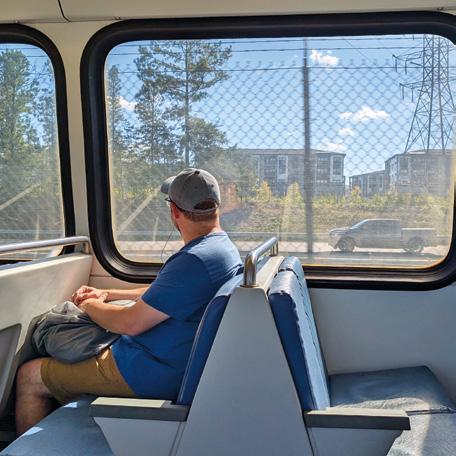
03/ On the train, passing through the suburbs in D.C.
IMAGE/ Jennifer Wan
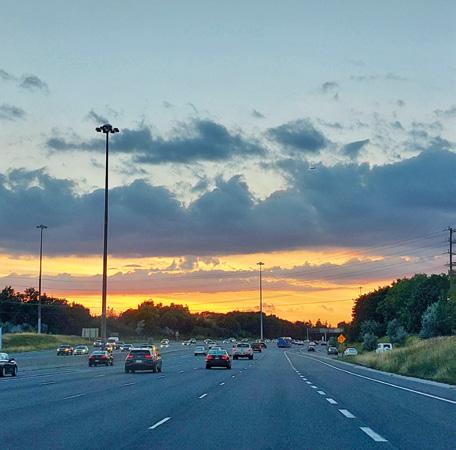
04/ Driving through Markham.
IMAGE/ Jennifer Wan
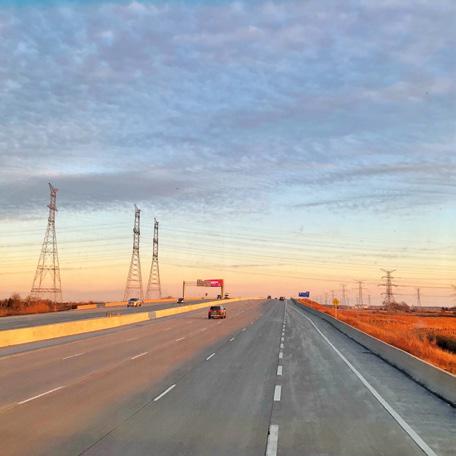
05/ Highway.
IMAGE/ Jennifer Wan
06/ Finch recreational trail, Toronto.
IMAGE/ Jennifer Wan
Yet in practice, development in (sub)urban growth areas often diverges from these principles:
• Transit lags years behind residential construction
• Block patterns are designed for vehicle throughput rather than walkability
• Default to low-density or high-rise housing, with limited “missing middle”
• Parks, schools, and amenities delivered late or on remnant parcels
• Natural, cultural, and agricultural landscapes are fragmented or erased
These outcomes stem from several recurring conditions:
• Developer pro formas optimized for speed and predictable returns
• Provincial and municipal funding constraints that delay infrastructure
• Weak or unenforced phasing tools that allow housing before amenities
• Late involvement of landscape, ecological, and public-realm disciplines
Landscape architects, trained in ecology, planning, engineering coordination, and public-realm design, are well suited to align design intent with implementation. But they often become involved too late to influence foundational land use, block structure, servicing, or ecological integration.
Secondary Plans: Why Good Intentions Don’t Guarantee Outcomes
Secondary plans outline land use, density, transportation networks, green space, and servicing strategies (Government of Ontario, 1990). They promise sustainable, equitable, connected communities (MMAH, 2020), but in fast-growing regions, these visions often fail to materialize.
Transit-Oriented Communities (TOCs)
Secondary plans frequently envision vibrant, mixed-use neighbourhoods around future GO stations, combining diverse housing, walkable blocks, integrated parks, and highquality transit (MMAH, 2020).
On paper, TOCs align with completecommunity principles. In practice:
• Transit arrives years after residents, reinforcing car dependency
• High-rise towers dominate while missing-middle housing faces regulatory and market barriers (Housing Affordability Task Force, 2022)
• Public spaces are often pushed to marginal parcels
• Green infrastructure—stormwater systems, tree canopy, permeable surfaces—is minimized, deferred, or omitted
The Influence of Pro Formas
A major driver of this mismatch is the traditional developer pro forma, which prioritizes short-term financial returns. Diverse housing types, early park delivery, and ecological infrastructure increase cost and risk, and are therefore frequently de-prioritized.
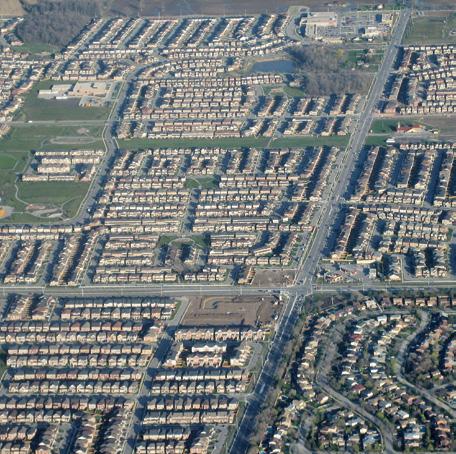
02/ Aerial of Milton, Ontario.
Municipalities facing funding constraints may approve development with the expectation that infrastructure will be provided later. This results in a sequence that prioritizes early sales over long-term livability.
Ultimately, secondary plans articulate vision, but implementation depends on infrastructure timing, economic modelling, and governance. Understanding where these systems fail is essential to understanding where landscape architects can intervene.
Infrastructure Arrives Out of Sequence
Common patterns in (sub)urban development include:
• Roads built before water, wastewater, or transit servicing
• Stormwater systems are sized for hydraulics but not designed for ecology or public benefit
• Schools, parks, and community facilities are delivered long after occupancy
Once road networks and pipes are set, car dependency becomes locked in, ecological connections break down, and opportunities for high-quality public space diminish.
Pro Formas Narrow Housing and Amenity Options
Standardized block and parcel sizes favour the production of predictable housing products. Missing middle and mixed-use buildings often require early adjustments to street patterns, utilities, and servicing— changes that are rarely accommodated in conventional pro formas.
Phasing Tools Are Weak
Development approvals often hinge on the belief that transit, parks, and community facilities will “arrive later.” Without enforceable triggers tying occupancy to infrastructure readiness, amenities are easily delayed or omitted.
Infrastructure
While public debate often focuses on housing types, the more critical gap in Ontario’s growth areas is infrastructure. Without timely and coordinated delivery, secondary-plan aspirations cannot be achieved.
Infrastructure spans grey, green, blue, and social systems, all essential to complete communities.
Grey Infrastructure
Roads, sewers, water mains, and utilities typically arrive first—sometimes before comprehensive servicing plans are confirmed. Early pattern-setting constrains future transit, limits block flexibility, and makes ecological retrofits difficult. The Auditor General reports that 18% of fasttracked MZO projects face significant delays due to inadequate water and wastewater servicing.
Green & Blue Infrastructure
Urban canopy, bioswales, wetlands, permeable surfaces, and restored waterways support stormwater performance, biodiversity and habitat connectivity, microclimate and heat mitigation, and a high-quality public realm. Yet these systems are frequently treated as optional extras.
Social Infrastructure
Parks, schools, community centres, trails, and places of worship shape daily life. But due to funding cycles and land competition, they are often delivered late or relegated to remnant parcels.
Consequences of Poor Sequencing
When infrastructure arrives late or out of order:
• Car dependency intensifies
• Flooding and water-quality issues worsen
• Parks and schools arrive years late
• Natural systems degrade through fragmentation
• Municipal financial risk increases as revenue tools shrink
How Landscape Architects Can Lead
Landscape architects can help define infrastructure as integrated, not siloed, by:
• Treating green infrastructure as required servicing
• Linking occupancy to infrastructure readiness
• Demonstrating lifecycle cost savings
• Mapping green–blue systems as continuous networks
• Integrating stormwater, soil, and ecology into streets and parks
• A holistic approach positions infrastructure not as a cost, but as a foundation for resilience and livability.
Ecological Systems:
A Missed “Sponge” Opportunity
Growth areas often border wetlands, creeks, woodlands, and agricultural lands. When integrated early, these systems can shape neighbourhood form. Late ecological planning, however, produces fragmented features that are disconnected from both environmental functions and public life.
Landscape architects can:
• Lead ecological network planning at the secondary-plan or subdivision stage
• Design stormwater and green infrastructure for environmental and community benefits
• Use natural systems to organize blocks, streets, and development limits
• Advocate for enforceable policies and funding for early implementation
• Connect parks, wetlands, corridors, and stormwater facilities into cohesive networks
Embedding ecological systems in planning enhances resilience, public value, and longterm performance.
Cultural Landscapes Are Part of Infrastructure
Cultural landscapes—Indigenous territories, historic farms, rural roads, hedgerows, heritage sites, and agricultural lands—often overlap with natural heritage. Together, they preserve memory, identity, and ecological value.
Landscape architects support cultural continuity through:
• Early cultural landscape assessments
• Collaboration with Indigenous communities and alignment with TRC Calls to Action (2015)
• Preservation or adaptive reuse of heritage structures, hedgerows, and waterways
• Integration of agriculture and food systems into open-space networks
Recognizing cultural landscapes as assets enhances ecological and social resilience, enriches community character, and reinforces a sense of place.
Aligning
Pro Formas with Ecological and Cultural Value
The developer pro forma remains a central gatekeeper. Traditional models prioritize yield and short-term returns, often minimizing green and cultural infrastructure.
Landscape architects can shift project economics by:
• Quantifying ecological performance and lifecycle savings
• Comparing green infrastructure to grey alternatives
• Evaluating long-term municipal operations and maintenance
• Advocating for tools such as density bonuses and expedited approvals
• Partnering with municipalities to secure early funding for parks, facilities, and green infrastructure
When ecological and cultural assets are embedded in financial models, they shift from perceived “costs” to recognized value contributors.
Landscape Architects: Bridging Vision and Delivery
Landscape architects play a multi-layered role in shaping complete communities:
• Influencing building form through grading, setbacks, circulation, and topography
• Enabling diverse building types by structuring block and parcel patterns
• Translating policy into place through applied design of buffers, parks, and corridors
• Leading the public realm with streets, plazas, trails, transit interfaces, and microclimate design
• Coordinating technical systems such as grading, drainage, soil protection, stormwater management, and construction phasing
By weaving ecological, infrastructural, cultural, and economic thinking, landscape architects move from beautifiers to co-creators of resilient, inclusive communities.
The gap between vision and reality in Ontario’s (sub)urban growth areas is persistent but not inevitable. When landscape architects engage early, they can influence the ecological, infrastructural, cultural, economic, and spatial foundations of community building.
As systems thinkers and regulated professionals, landscape architects integrate planning policy, ecological networks, infrastructure sequencing, spatial design, and cultural identity. By shifting from late-stage consultants to co-creators, they help ensure that Ontario’s planned communities become resilient, vibrant, and meaningful—transforming aspirational plans into lived reality.
07/ Sherwood Park, Aberta.
IMAGE/ Jerry "Woody" via Flickr
08/ Milne Park, Markham.
IMAGE/ Jennifer Wan
09/ Downtown Aurora.
IMAGE/ Bill Badzo via Flickr
10/ Silver Star Food Complex, Scarborough.
IMAGE/ Jennifer Wan
BIOS/ JENNIFER ZHAO, LANDSCAPE ARCHITECTURAL INTERN, IS AN URBAN DESIGN PROFESSIONAL AND INTERDISCIPLINARY ARTIST WORKING ACROSS PUBLIC AND PRIVATE SECTORS. HER PRACTICE BRIDGES PLANNING POLICY, ECOLOGICAL AND ENVIRONMENTAL PLANNING, AND COMMUNITY PLANNING WITH THE DESIGN AND IMPLEMENTATION OF INFRASTRUCTURE AND THE PUBLIC REALM.
MAX LI, OALA, IS A LANDSCAPE ARCHITECT FOCUSED ON REPOSITIONING THE PROFESSION AT THE CENTRE OF INFRASTRUCTURE PLANNING AND DELIVERY. WITH EXPERIENCE ON HALF OF ONTARIO'S TOP TEN TRANSIT PROJECTS, MAX ADVOCATES FOR EARLY INVOLVEMENT OF LANDSCAPE ARCHITECTS IN INFRASTRUCTURE SEQUENCING, ECOLOGICAL INTEGRATION, AND PUBLIC REALM COORDINATION. HE CURRENTLY LEADS LANDSCAPE ARCHITECTURAL AND URBAN DESIGN ON MAJOR TRANSIT PROJECTS FOR THE CITY OF MISSISSAUGA.
A Conversation with Paula Berketo
TEXT BY EVLYN SUN
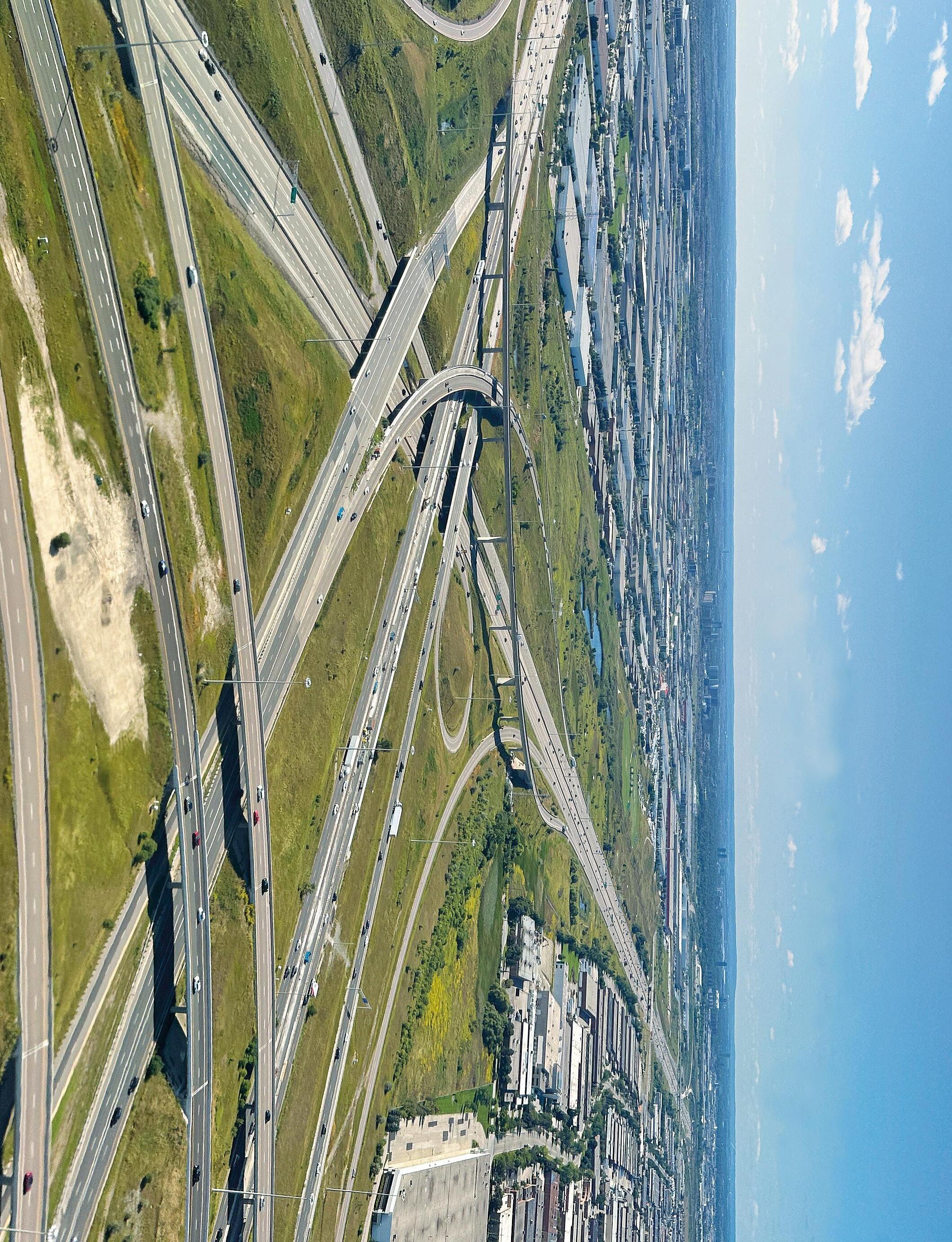
Most residents in Ontario are very familiar with the highway network, often driving to work, to run errands, or to see friends and family in other cities. Few of us live in places completely untouched by this system, as highways are woven into the fabric of our province. Highways serve as vital transportation networks that facilitate the movement of vehicles across regions. As a result, they also shape how cities grow, how suburbs expand, and how communities connect. Public discussions around highways often revolve around congestion, land use, sprawl, and environmental impacts. While these debates continue, designers and planners must navigate the highway network and the complex suburban-urban interface, taking into consideration how highways influence development, how design responds to differing contexts, and how infrastructure can adapt as cities and suburbs change.
To better understand how transportation infrastructure interacts with suburban-urban developments, I consulted with Paula Berketo, a landscape architect at Ontario’s Ministry of Transportation (MTO). Our conversation explored how highways both shape and are shaped by suburban–urban conditions, and what these dynamics mean for future planning and design across the province.
The relationship between highways and city planning in Ontario has always been reciprocal, as highways both respond to growth and catalyze it. “There is a direct relationship between the shape of suburban or urban areas and highways.” Berketo explains.
“Once cars can travel greater distances across a city or into the suburban areas, more people may move out of urban areas or new people from elsewhere may move into the suburban areas. The efficiency of the highways increases the number of vehicles on the highway. This leads to congestion which means the highways need to be expanded or new highways added. This leads to more new suburban areas leading to traffic congestion near the suburban areas then the cycle repeats.”
This cycle of mobility, congestion, and expansion has shaped much of Southern Ontario’s development and provincial highway network. “Beginning with the QEW in the 1930’s, development increased in the golden horseshoe area. This required adding more lanes and overpasses instead of level crossings with stop lights. Towns and cities then increased in size. The addition of highways 401, 406 and 427 helped to alleviate some of the
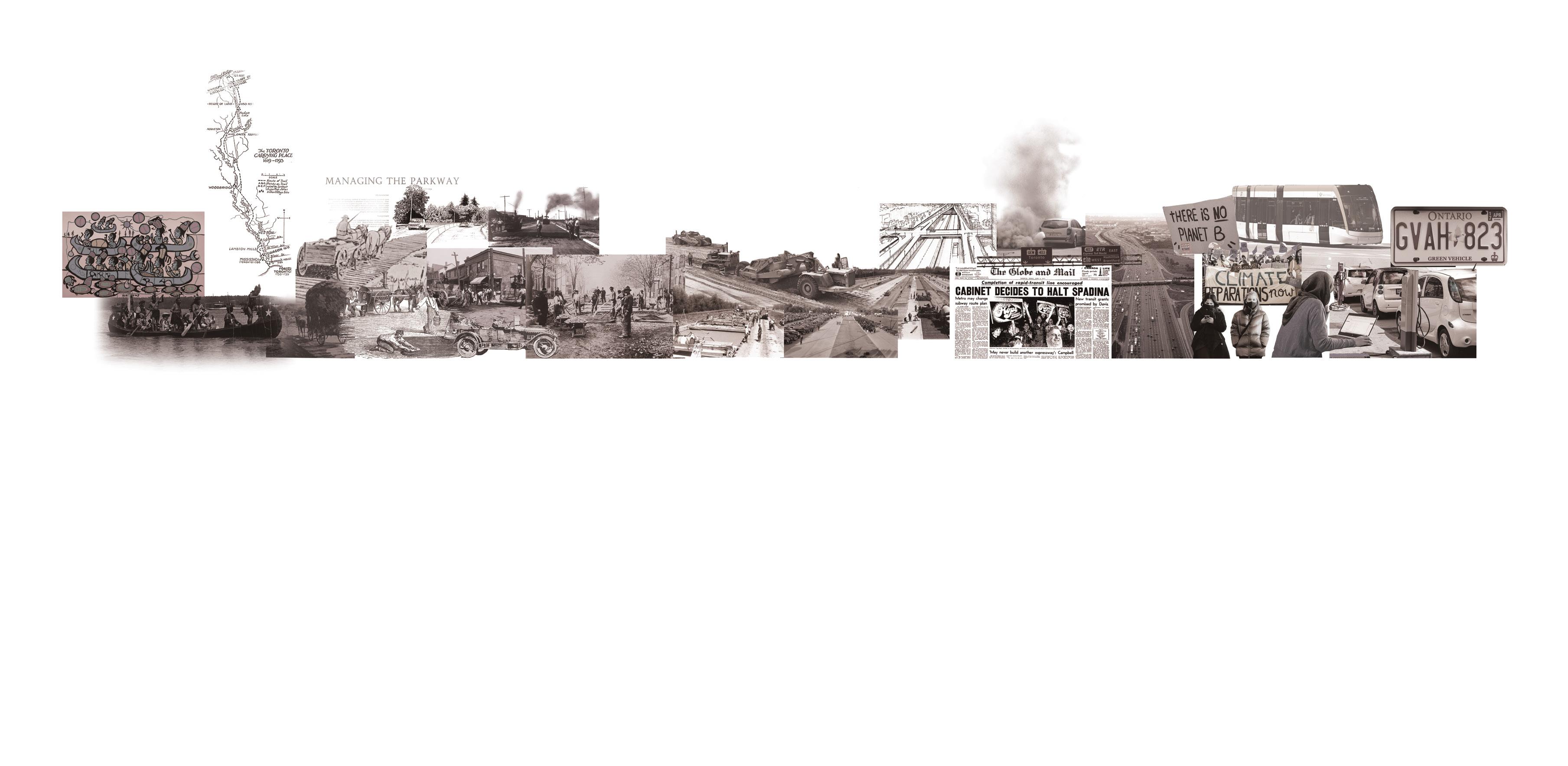
The Role of Highways in Urban Development
LANDSCAPE
AS VISUAL SCENERY MORE THAN 12,000 YEARS OF TRANSPORTATION WORKING WITH THE LAND
Precolonial Times
Indigenous nations travelled through For more than 12,000 years,different Ontario using water ways as their ‘highways’ Waterways were used for transportation, trade, and communication
resulting congestion. The 401, consisting of only several lanes at first, quickly grew to be the busiest highway in North America. Several decades ago, as rush hour traffic extended into an almost all-day affair, the 407 was put in place.”
Highways are not just passive infrastructure, they actively shape patterns of settlement, mobility networks, and regional development. As cities continue to evolve, understanding this reciprocal relationship becomes essential for planners and designers working in the dynamic urban and suburban landscapes.
How Urban Context Influences Highway Design
Highway design and planning depend heavily on the surrounding context, as urban and suburban areas bring different challenges, constraints, and priorities. In particular, the difference in the availability of land greatly affects highway design, requiring designers to adapt thoughtfully to each context.
“In the urban areas, land is at a premium, so the most necessary highway elements are built, pavement and bridges. Space
is limited so no planted centre medians in the space between the fence line and the edge of pavement,” says Berketo. “In these areas it is not likely to see wide green spaces or trees. Noise is more of a concern as you may have dense residential neighbourhoods closer to the highway resulting in noise barrier walls.”
Suburban corridors, by contrast, benefit from more generous right-of-ways, broader lanes, and larger interchanges. “The travelling lanes are more generous in width and there are more green spaces. Interchanges will be farther apart, as the
populated areas are more spread out. Noise barrier walls and express lanes are non-existent.”
These differences are especially pronounced in transition zones, where drivers move between dense urban streets and more open suburban corridors. Berketo says, “Design changes should be made gradually, so the driver has time to process the new design features such as lane width, shoulder treatments or speed. Environmental considerations such as wildlife fencing, wildlife underpasses, or treatment of
watercourses require different considerations. Within urban areas these items may be incorporated differently due to previous disturbances within the urban area.”
These differences demonstrate context-sensitive design is essential for highways. Highways must respond to their surroundings, balancing safety, mobility, and environmental considerations, while guiding drivers smoothly across urban, suburban, and transition zones.
The Dynamics of the Suburban-Urban Interface & the Future of Highways
As suburban expansion and urban densification continue, the demands placed on highways grow with more people, more goods, and more movement. “In these cases,” says Berketo, “the highway becomes even more critical to the movement of people and goods in a safe and efficient manner.”
“The demand for increased capacity will guide design as daily traffic volume increases. Drivers will want less rush hour traffic and efficiency, although this might not be possible due to spatial restraints. New highways further outside of the densely
05
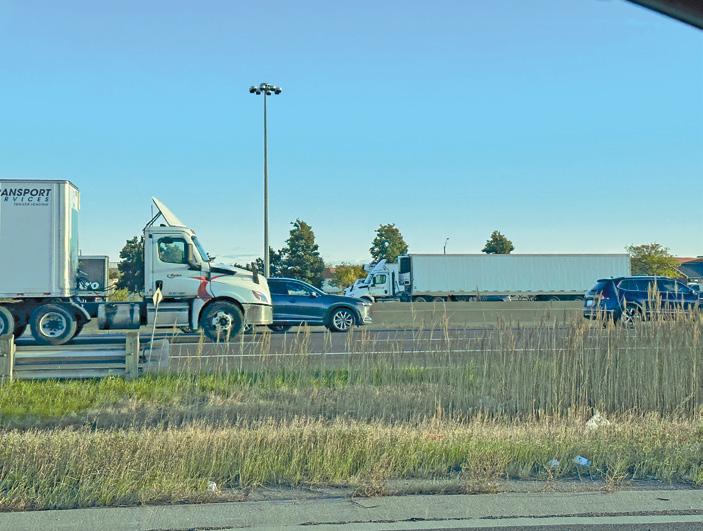
03/ Kings Highway 401, Hornby, Ontario.
IMAGE/ Ken Lund courtesy of Flickr, creative commons license: https://creativecommons.org/licenses/by-sa/2.0/deed.en
04/ A busy highway.
IMAGE/ Evlyn Sun
populated areas may be required to take some of the traffic away from the existing roads. Additional lanes may be required or incorporation of different types of lanes such as the high occupancy vehicle lanes. Additional land may be required for express lanes.”
Planning for the future, however, extends beyond simply increasing capacity. Climate pressures, shifting settlement patterns, and changing public expectations around transit, multi-modal networks, and sustainable design demand a more adaptive approach. “The response needs to be fluid and current. Designs must be proactive, as this is most economical and efficient,” Berketo emphasizes. Anticipating future needs rather than reacting is increasingly important, including technology shifts, new environmental standards, and evolving mobility patterns.
For planners, designers, and policymakers working at the suburban–urban interface, Berketo identifies several core priorities: “Safety, efficiency, and protection of the environment must all be considered. All involved must be up-to-date with the latest solutions for design and must be flexible in order to adapt for current and future trends.”
Concluding Thoughts
Highways are more than transportation infrastructure, they are key determinants of urban and suburban development across the province. They will continue to shape the future of Ontario by influencing where communities grow and how landscapes develop.
Recognizing highways as both influencers and products of the suburban-urban interface invites us to reflect on how these systems should evolve. The ongoing challenge for designers and planners is to create corridors that balance current needs with future adaptability, responding to growth while respecting the changing ecological, social, and urban contexts they traverse. As traffic demands increase and expectations around climate resilience, environmental stewardship, and community well-being expand, the future of our cities will depend on how effectively highway systems connect people while navigating the complex pressures of a changing landscape.
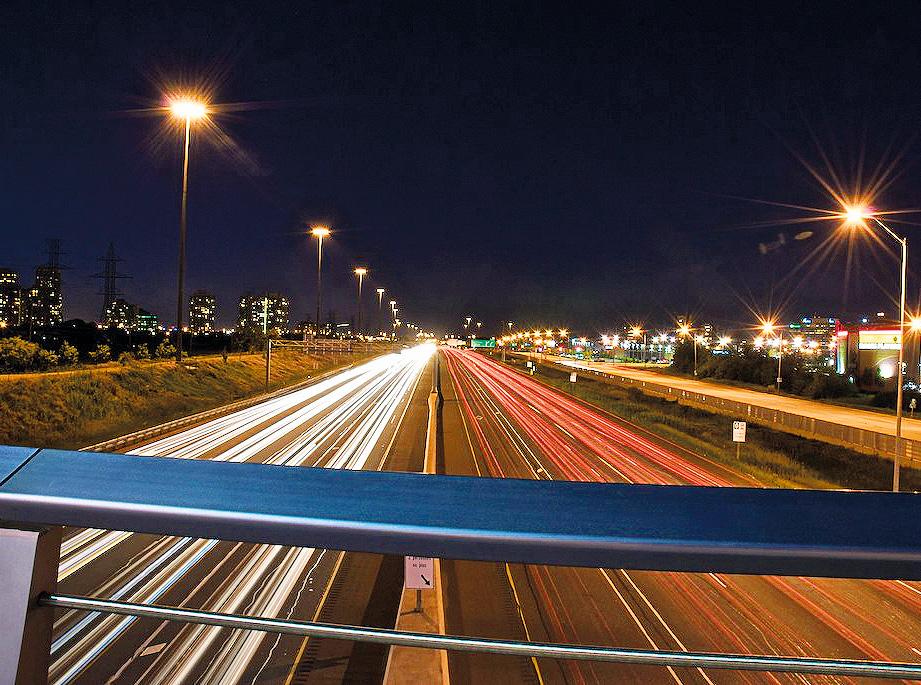
06/ A view of Highway 401, Toronto.
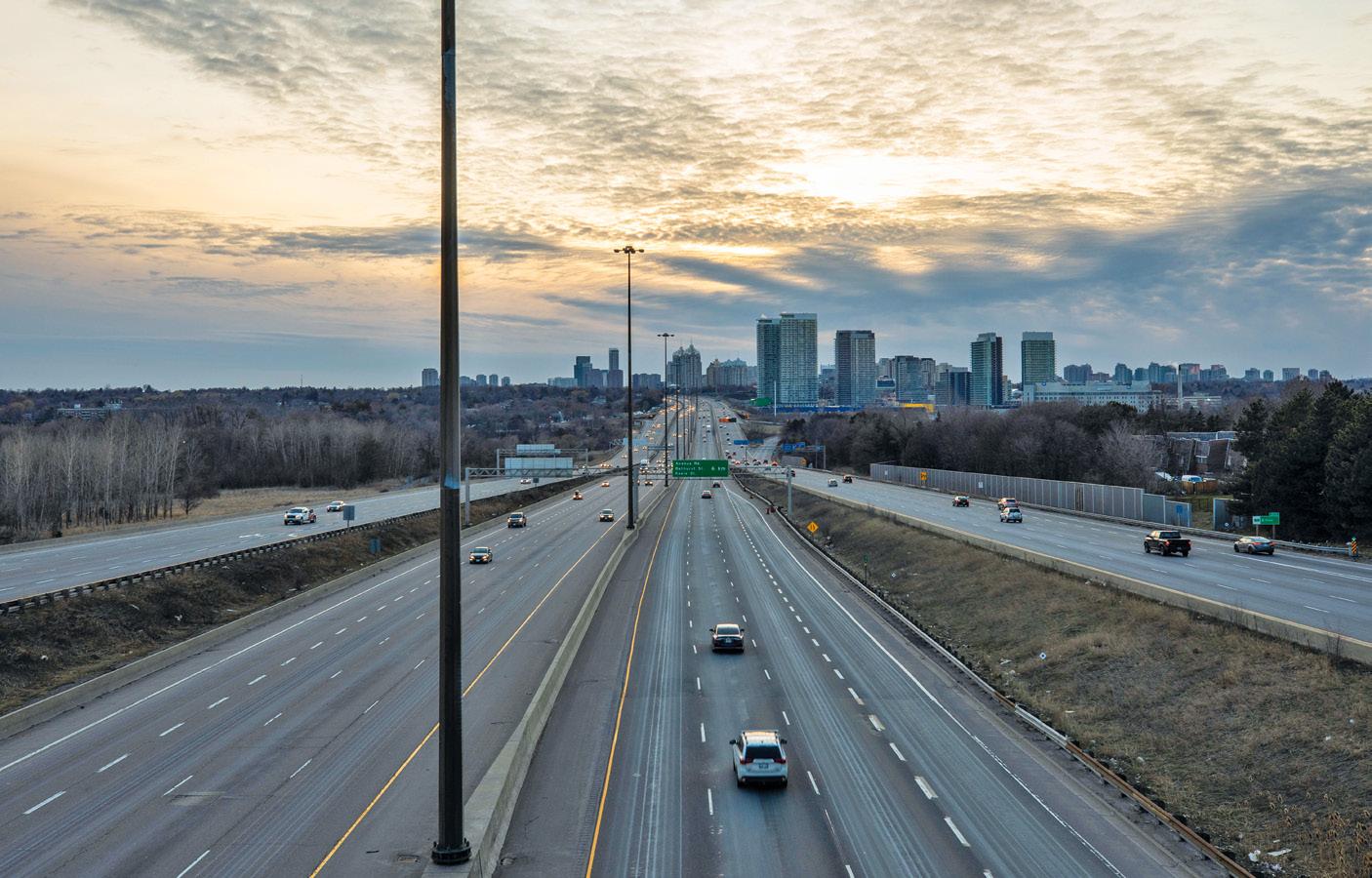
IMAGE/ by Roozbeh Rokni, courtesy of Flickr, creative commons license: https://creativecommons.org/licenses/by-sa/2.0/deed.en 07/ Highway 403 East, Mississauga.
IMAGE/ Gabe Ramos, courtesy of Flickr, creative commons license: https://creativecommons.org/licenses/by-nc-sa/2.0/deed.en 08/ Vaughan Metropolitan Centre from Highway 407, May 12 2025.
IMAGE/ Dillan Payne, courtesy of Flickr, creative commons license: https://creativecommons.org/licenses/by-sa/2.0/deed.en
05/ A highway lined with concrete medians.
IMAGE/ Evlyn Sun
TEXT BY TERENCE LEE, OALA
It’s ironic that the last article I wrote for Ground was about the importance of travel. Travel—if you’re up for it—can invigorate your mind, reset your priorities, and help you discover new places. In turn, you’ll likely discover something new about yourself. What could be more invigorating than moving halfway around the world to a place you’ve never been, familiar only through news media, magazines, websites, and perhaps a few old projects?
I had never planned for this. If you had told me a year ago I’d be living in the Middle East, I would have thought you were mad. But something strange happens when you yearn for travel—you go, and then you keep going until opportunities find you. You end up in a place you’ve only dreamt about—a kind of self-fulfilling prophecy. Distance becomes irrelevant when you realize it’s not about how far you go, but simply where: that next great destination, that next amazing building or landscape you’ve only seen on a website but now know exists in the real world—and possible to experience it firsthand.
For the past twelve months, I have been living and working in Abu Dhabi, the capital of the United Arab Emirates. In a country where over 80 per cent of the population are expatriates, the culture here is not defined solely by local Emirati history, but by a peculiar hybrid of global influences. From neighbouring Arab countries, East Indians, and North Africans to the farther corners of the globe—Britain, France, the Philippines, Australia, and New Zealand—local “culture” becomes a hodgepodge mix of the old and the new, Muslim and Christian, East and West.
As a landscape architect, I often find myself thinking that, while I’m lost in translation much of the time, I’m not lost in design. Our design lexicon may differ, often because the region follows the British system due to its colonial history. Whether we say “program” or “schedule,” I’ve learned to do a kind of live translation in my head (“deployment” = “task-task matrix”). But once you learn these translations, design is more or less the same and universal. That’s where the beauty of design lies. As
global citizens, no matter where we are, our needs are similar: housing, family, community, environment, commerce, and stability. These are not Western or Eastern ideas, they are human.
Design is always relative. Simple things, like a neighbourhood park, require the same design sensitivity whether in Toronto or Abu Dhabi. We’re all human; we need parks as places to relax, play, enjoy, and socialize. The details or execution may differ because of climate or materials, but it’s fascinating to see both the differences and familiarities in how design manifests across geographies.
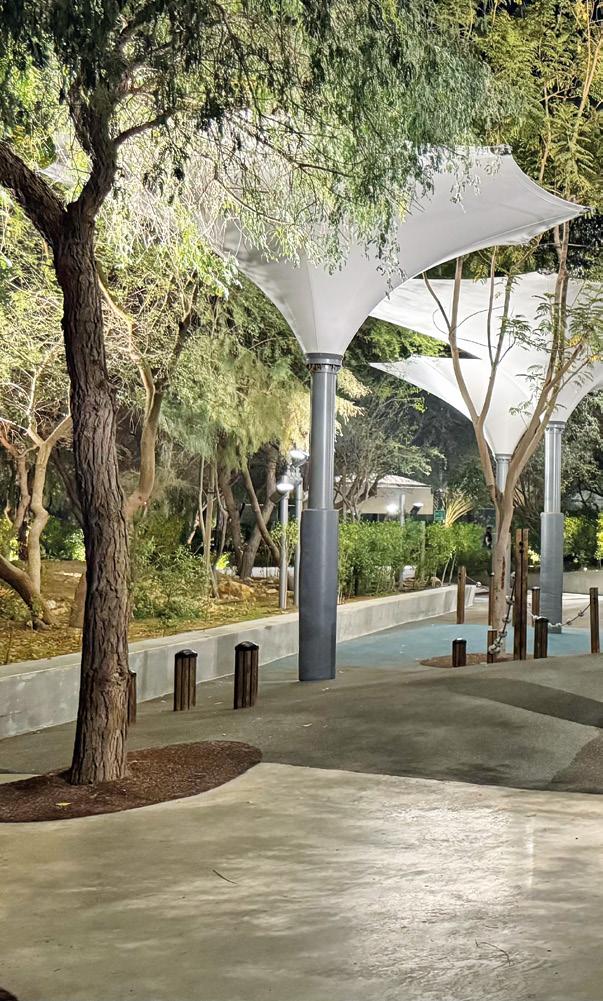
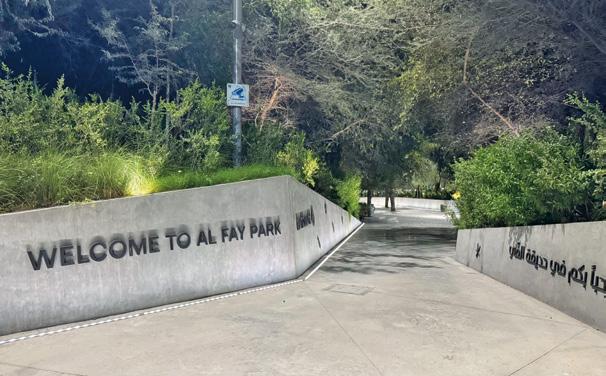
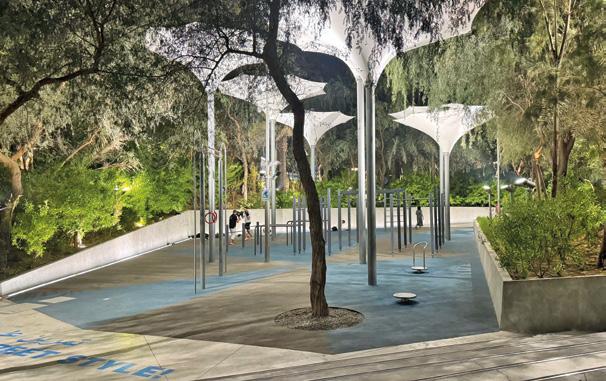
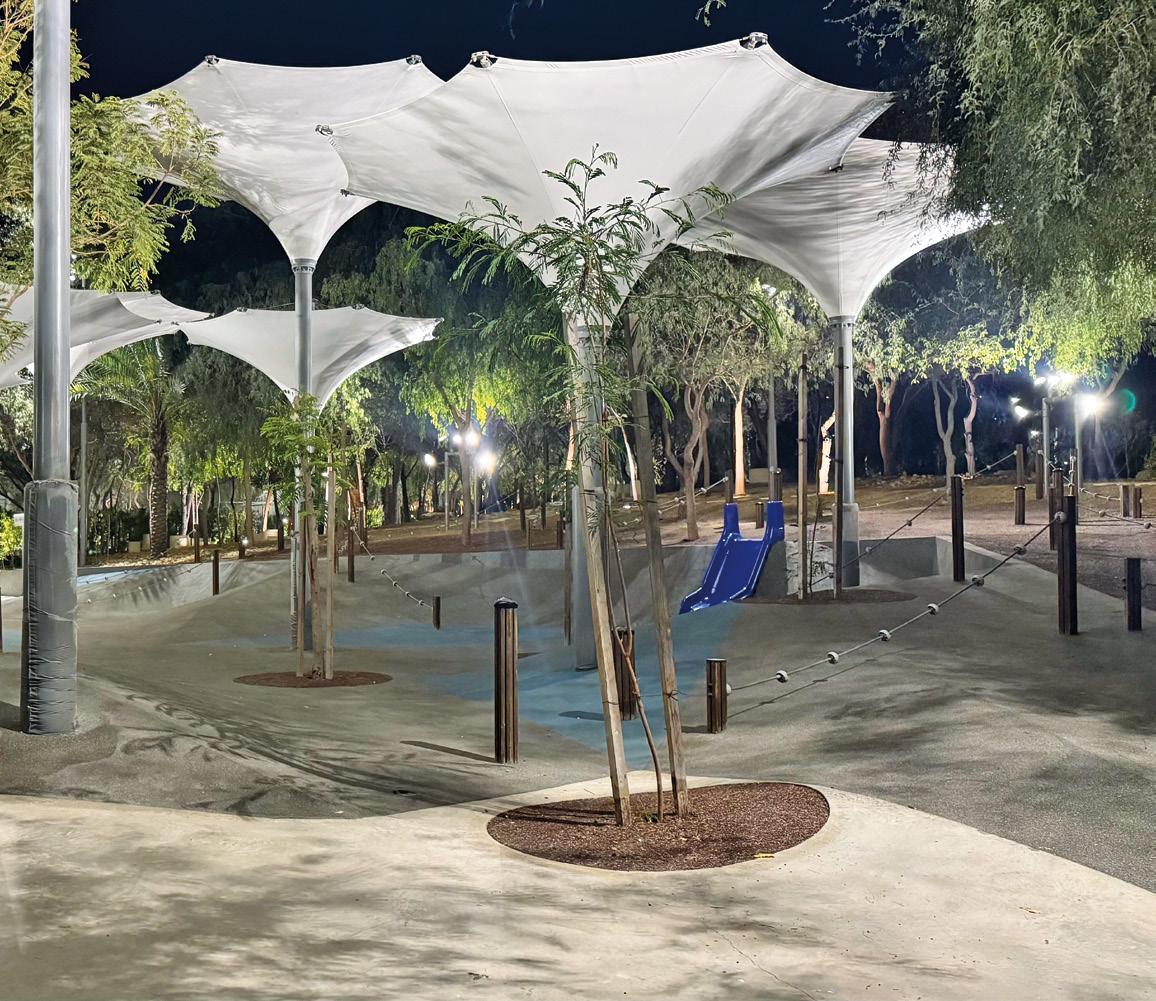
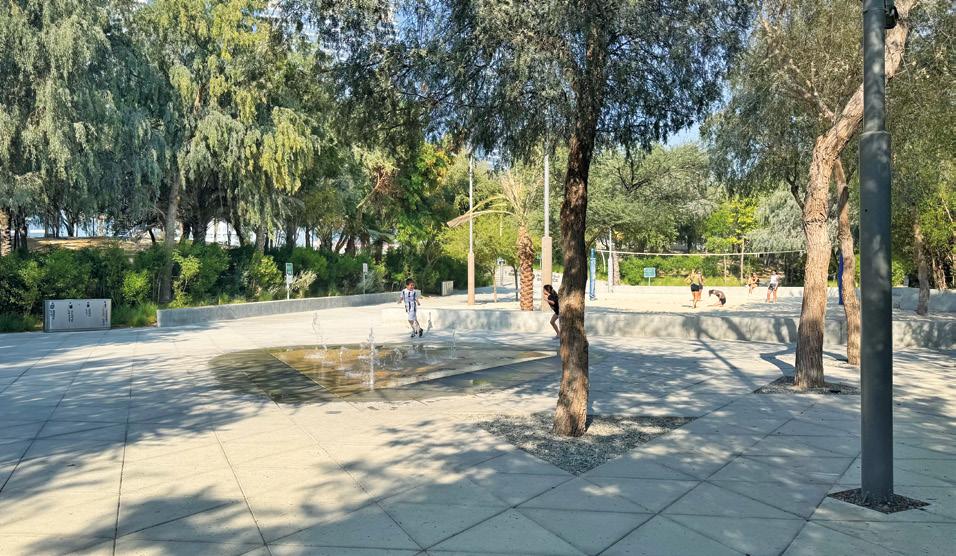
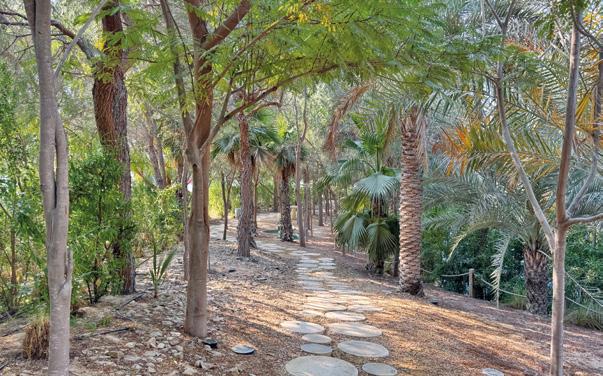
Al Faye Park in Abu Dhabi, designed by SLA, is a good example. I’ve visited this park multiple times—during the day and at night, when it’s filled with families and children. It’s clearly a local favourite. Designed with SLA’s oft-repeated motto “nature-based design,” it stands as a remarkable example of thoughtful adaptation to a harsh natural environment.
Despite the climatic extremes, SLA created a park that feels familiar to Western or North American sensibilities while being deeply rooted in its local context. With careful research and execution, the design team created a shady oasis packed with programmed spaces—an active play area, beach volleyball courts, ping-pong tables, ramped walls, and curbs for skateboarding. The park checks all the boxes: it is wellprogrammed, well-detailed, and wellexecuted by any global standard.
If you didn’t know it was in Abu Dhabi, you might mistake it for an urban park in New York or a lush neighbourhood park in Singapore. This isn’t to say that SLA has created an “international-style” park that could exist anywhere. Rather, it’s impressive that this level of comfort and ecological sensibility is possible here. Most of us know what an ideal neighbourhood park should be, but few have had the chance to execute one—especially in a place with summer temperatures average 40°C with an annual rainfall of just 89 millimetres.
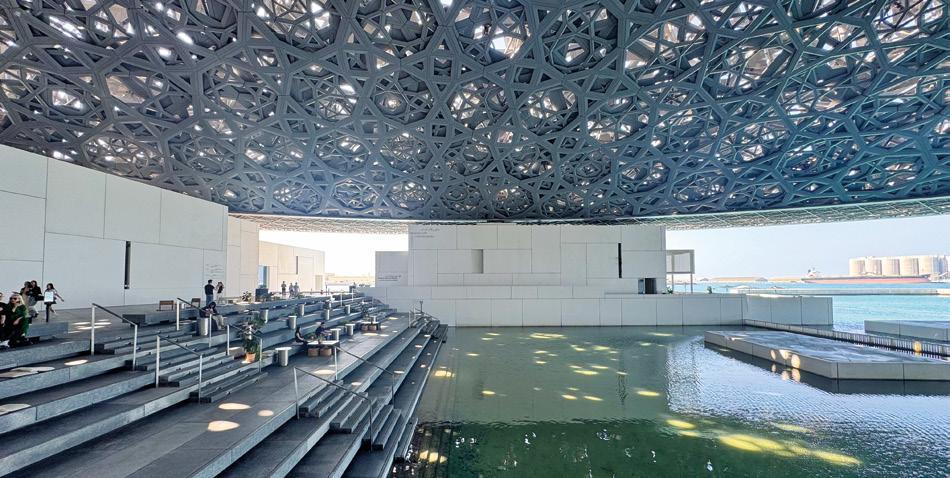
01-05/ Natural History, Abu Dhabi. IMAGES/ Terence Lee
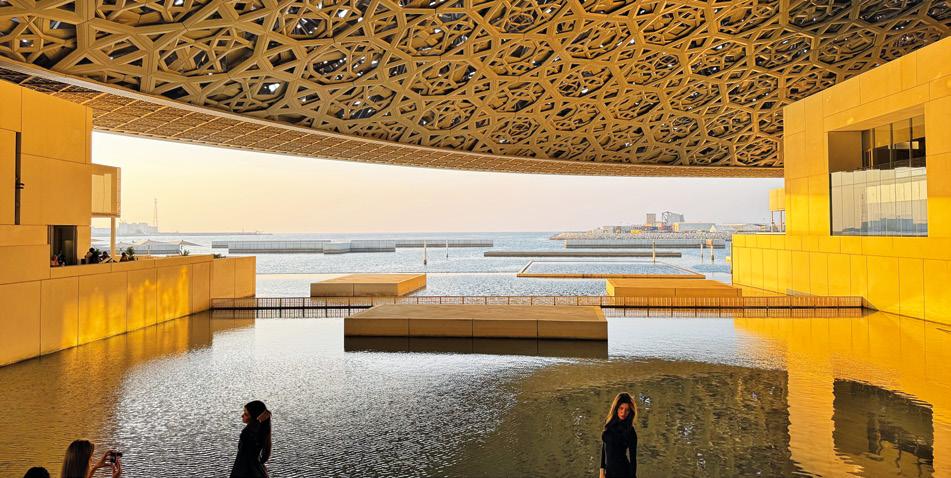
06-07/ Louvre Abu Dhabi.
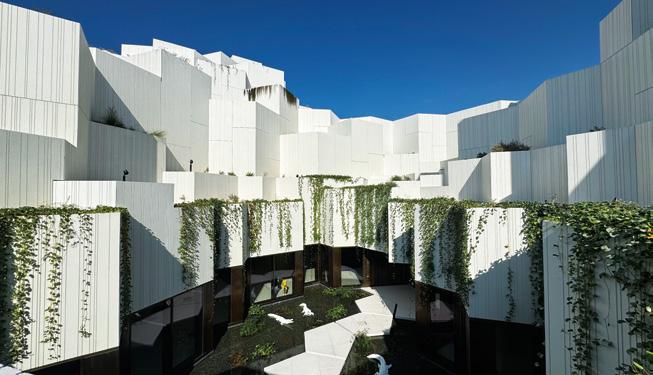
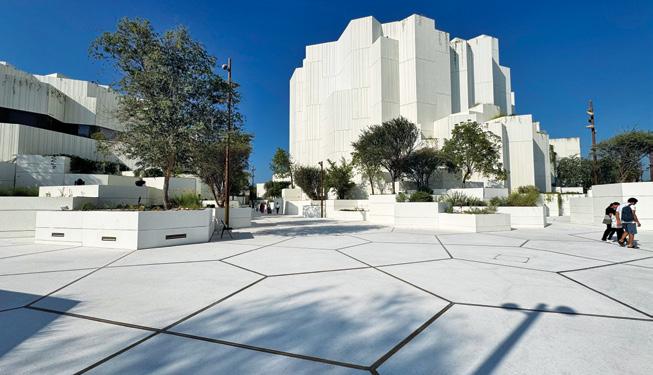
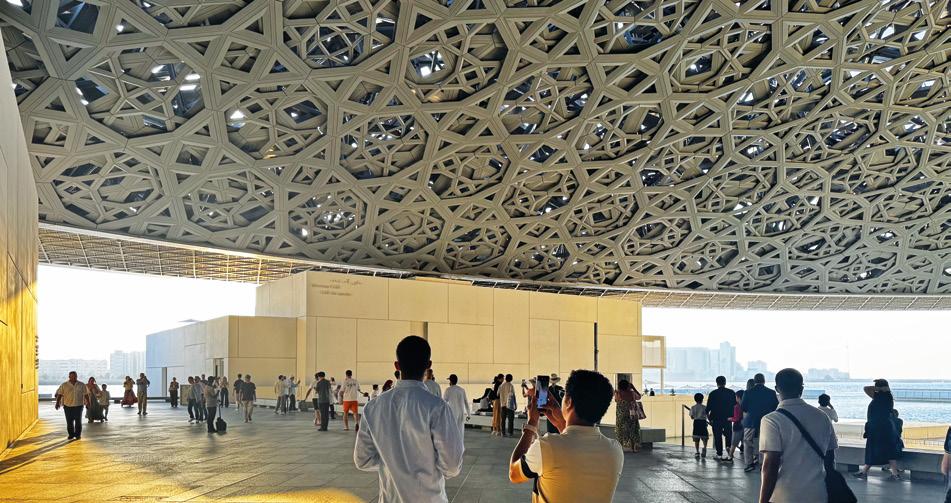
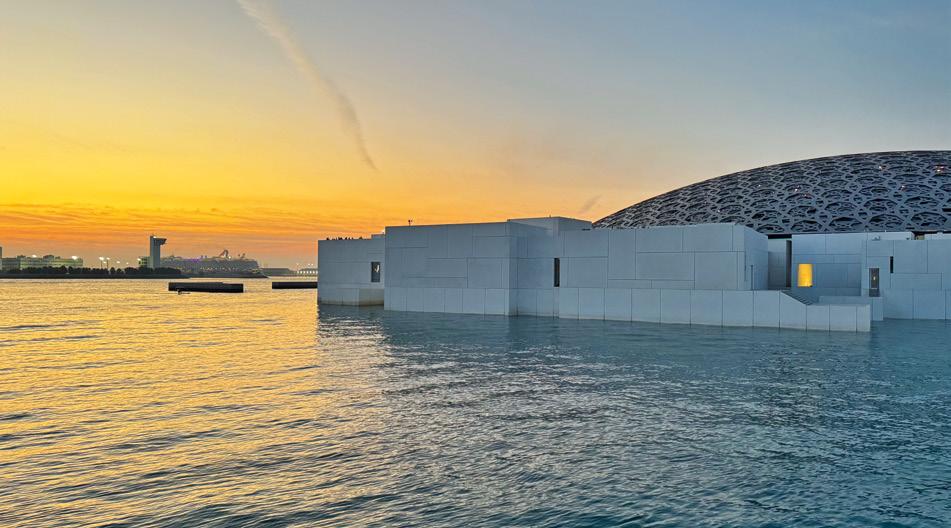
As landscape architects and architects working in this region, the expectations are high and demanding: design work must combine an impressive (sometimes seemingly impossible) “wow” factor with efficiency. From Dubai to Riyadh, cities are being built almost overnight. Vast new neighbourhoods and jaw-dropping buildings—once pure fantasy—are completed or nearing completion. On Abu Dhabi’s Saadiyat Island in particular, worldclass museums are shaping what will become one of the most impressive cultural precincts in the world: Louvre Abu Dhabi by Jean Nouvel, Natural History Museum by Mecanoo, Zayed National Museum by Foster + Partners, and the forthcoming Guggenheim Abu Dhabi by the late Frank Gehry.
These projects represent the ambition and optimism of the region—its desire to project itself onto the global stage. Yet amid this energy and spectacle, I find myself drawn more and more to the quieter projects—the ones that ground people in their environment rather than overwhelm them. Al Faye Park, in its modest scale and clarity, succeeds precisely because it responds to human needs and environmental constraints instead of defying them.
There is something deeply valuable about design that seeks harmony rather than dominance. The temptation here, surrounded by record-breaking towers and avant-garde forms, is to compete in the language of scale and novelty. But landscapes remind us that endurance—not instant impact—is
the true measure of success. Shade trees that take decades to mature, or soil systems that regenerate slowly, reward patience. A park that remains lively ten years after opening is more of an achievement than a structure that dazzles for a moment.
The Middle East offers a paradox: it is both a laboratory for future urbanism and a landscape of ecological fragility. Its extremes—heat, scarcity, and speed—test every assumption about how we build. Yet within those extremes lies an extraordinary opportunity to rethink what “progress” looks like. True progress comes from designs that endure, adapt, and teach. Parks like Al Faye demonstrate that beauty and pragmatism are not opposites—they are interdependent.
08-09/ Louvre Abu Dhabi.
IMAGES/ Terence Lee
10-15/ Al Faye Park, Abu Dhabi.
Terence Lee
Whether we build to impress or to serve the natural world—no matter how cold or hot the climate may be—it is always the designer’s responsibility to bring forth the best possible solution. “The best” can and should be debated, but our aspiration should be no less than the ideal design that serves both people and the planet. In the end, what matters most are not the headlines or the record heights, but the quiet, enduring spaces that give life its rhythm and meaning.
BIO/ TERENCE LEE, OALA, IS A SENIOR LANDSCAPE ARCHITECT, ASSOCIATE AT DIALOG. HE HAS OVER 25 YEARS OF EXPERIENCE THAT INCLUDE A WIDE RANGE OF PROJECT TYPES, AND HE HAS WORKED FOR THE PROFESSION’S MOST CELEBRATED PRACTITIONERS SUCH AS DAN KILEY, GEORGE HARGREAVES, PETER WALKER, AND THE MULTI-DISCIPLINARY FIRM AECOM. FROM URBAN INFILL DEVELOPMENTS TO INSTITUTIONAL CAMPUSES AND REGIONAL PUBLIC PARKS, TERENCE HAS LED THE DESIGN PROCESS FROM INITIAL CONCEPT TO FINAL BUILT PROJECTS.
Notes: A Miscellany of News and Events
gardens
In a ruling that hopefully resonates in municipalities across Ontario, a Mississauga man won a years-long battle with the City to save his naturalized garden.
Wolf Ruck intentionally cultivated a garden with native plant species, in the hopes of providing a habitat for wildlife. But he’s been receiving warnings from bylaw enforcement officers about his lawn since 2021. Some of the plants in his garden were on a “noxious weeds” list, and he was in contravention of a bylaw prohibiting plants above 20 centimetres.
Luckily, a Superior Court Justice ruled this bylaw against the garden infringed on the Charter right to free expression.
Municipalities all over Ontario have bylaws that essentially dictate the aesthetics of a lawn. Many have argued these bylaws shouldn’t exist, since aesthetics are subjective. And many of these regulations are counterintuitive: banning plants that are proven to benefit the environment, whereas the typical grass lawn, which is allowed, has many environmental drawbacks.
With any luck, this recent official ruling causes cities and towns to rethink their bylaws about lawns and gardens, and people are not only allowed but encouraged to cultivate beneficial urban habitats.
nominations
volunteers
The OALA is seeking volunteers to join the Justice, Equity, Diversity & Inclusion (J.E.D.I.) Committee, which helps advance the Ontario component of the CSLA JEDI Plan and supports the Association in embedding JEDI principles across our work.
What the committee does:
• Supports the implementation of OALA and CSLA JEDI Action Plans, including events, discussions, webinars, and resource sharing
• Advises Council, Committees, and Task Forces
• Builds partnerships with allied professions
If you're interested in joining, please email executivedirector@oala.ca
The OALA Honours and Awards are the highest recognition the Association can bestow on its members and the general public. Each OALA member plays an important part in the integrity and success of the program by identifying and nominating deserving candidates for the various awards. The OALA Awards complement the CSLA Awards and Honours Program which recognizes the work of members.
OALA members are invited to nominate deserving fellow members and others for awards and honours, to be presented at the OALA Annual Awards Ceremony.
Nominations are now being accepted for the 2026 OALA Honours and Awards. The deadline for consideration is March 31, 2026.
For information about award categories and submission guidelines, please visit: oala.ca/oala-award-nominations, or email memberservices@oala.ca.
conference
"Live, Work, and Play”. This is a classic phrase that is universally used, including by landscape architects, when designing spaces in the public realm. But... what would happen to the design of those spaces if we were to shake things up a bit and reversed the prioritization of those concepts, on occasion, to "Play, Live, and Work"?
Landscape architects are uniquely positioned, through a combination of technical expertise, artistic vision, and creatively thoughtful design skills to shape environments that can be functional, while at the same time inspire joyful connections between strangers that can result in healthier communities.
It is through PLAY that our profession can and does create moments of collective JOY through the intentional design of public urban places.
This year’s OALA Conference, titled “JOY: The Power and Purpose of Place," will explore bold ideas and innovative solutions that demonstrate how OALA members are leading the way in designing more vibrant and joyful environments that have the potential to heal social division and strengthen our societal resilience.
Join us in Kitchener, October 1-3, 2026, to share stories, spark your imagination, and celebrate the joyful potential of landscape architecture. Please save the date!
youth
The 1UP Conference is an annual event where young people from across Ontario come together to imagine, design, and build the future of our communities. Over two energizing days, join 200+ youth for hands-on workshops, inspiring speakers, design challenges, and real conversations about city-building, creativity, climate, and community. This year’s 1UP Conference theme is “Blueprint to Bloom!” The OALA is a proud Sponsor of this event.
The event takes place March 28 to 29, 2026. Learn more here: 1upyouth.org/ conference2026
intern reviewers
OALA is seeking Full Members who are interested in becoming a reviewer for Intern members. The role of the reviewer is to provide feedback and support an Intern’s progress throughout the professional development program.
To learn more about the role, please see the OALA Reviewer's Outline on the OALA website. If you are interested in becoming a reviewer, please email info@oala.ca
Reviewers can claim Continuing Education credits in Category 6.
02/ Education session at the 2024 OALA Conference in Niagara Falls.
IMAGE/ courtesy of OALA
03/ Zara Brown and Karen Liu, OALA J.E.D.I. Committee Chair and member at the 2024 OALA Conference in Niagara Falls.
IMAGE/ courtesy of OALA
in memoriam
William Ronald Fraser, OALA, CSLA
The OALA is saddened to announce the death of William "Bill" Ronald Fraser.
William “Bill” Fraser became a Full Member of the OALA in March 1970, after graduating from the University of Guelph, where he was among the first graduating classes to earn a degree in landscape architecture. He retired from professional practice in 1992 but continued to maintain his membership with the Association.
Below we share the obituary prepared by Bill's family.
Bill passed away peacefully on Wednesday October 22, 2025 at St. Joseph’s Hospital following a brief illness at the age of 92. Bill leaves behind his loving wife and partner of 67 years, Arlene, and his daughters Jennifer and Holly. He will also be greatly missed by his grandchildren Emily, Sarah, and Rajee.
Born and raised in Hamilton, Bill had a lifelong love of nature and plants and
loved being outdoors. He worked for a few years as a gardener at the Royal Botanical Gardens and was very proud of his contribution to building the Rock Garden. He later went back to school to become a landscape architect. He was part of one of the first classes graduating from the University of Guelph and the Ontario Agricultural College’s School of Horticulture.
Bill had a distinguished career with CMHC for 23 years. He was retired early, so decided to hang out his shingle and go into business for himself as an independent landscape architect. There are not very many towns in Southern Ontario that have not benefitted from his design touch. He passed his love of nature and gardening on to his daughters along with many life skills. Once he was retired completely, Bill became involved with Scouting and introduced a love of nature to another generation.
Bill lived his life simply and wished to keep his arrangements simple too. He has been cremated. In lieu of flowers a donation to the nature charity of your choice would be appreciated by the family.
new full members
Ontario Association of Landscape Architects is proud to recognize and welcome the following new full members to the Association approved at the January Examining Board meeting:
Stuart Cameron
Kearney Coupland *
Victoria Damone *
Wendy Duggan *
Liwei Han *
Jessica Karafilov *
Byron Lester
Tobias Mahne
Claire Merrick
forestry
Last June, a powerful wind swept through Samuel de Champlain Provincial Park, east of North Bay, and laid waste to the trees there. Thousands of trees were knocked to the ground causing devastation one Ontario Parks official told CBC looked like “a clearcut forestry operation."
But efforts have begun to remediate the damage done. The province has spent $4.75 million so far, in an effort to reopen the park, and Forests Canada has worked with Ontario Parks to plant 500 native trees.
The goal is to reopen at least part of the park by this spring.
expo
If you live in the Ottawa area, Landscape Ontario is once again hosting their Green Trade Expo from March 3-4 at the EY Centre.
According to the invite, “Green Trade Expo is the place to be for the green industry. Connect and build your network with professionals from all sectors.”
Jonathan Sagi
Hannah Soules
Kathryn Strachan *
Giang Tran
Sydney Truesdale
Alexander Williams *
Sara Zewde
Asterisk (*) denotes Full Members without the use of professional seal.
The event includes free admission to the two-day trade show with over 70 exhibitors on the floor, a free lunch each day, as well Plant ID and Hardscape ID challenges with cash prizes. There will also be educational seminars and networking events.
You can learn more at: greentradeexpo.ca
Elevating Outdoor Spaces
to stand the test of time Element Apartments/Fotenn Planning + Design
Douglas Park, Town of Fort Erie A Showcase of Canadian Manufacturing
Collaborate with us on your next project Douglas Park Collaboration Team:
Community & Connection Focus - Where Design Brings People Together
The most successful parks do more than look good—they become gathering places. By working with Canadian-based manufacturers, we help landscape architects create spaces that are welcoming, innovative, resilient, and built for everyday use. Playgrounds, splash pads, and shade structures come together to form:
• Cohesive, people-centred gathering spaces
• Spaces that encourage movement, interaction, and pause
• Environments designed with longevity in mind Thoughtful design. Trusted partners. Spaces that connect communities.
www.openspacesolutions.com for more information: contact Openspace Solutions today: janet@openspacesolutions.com | 519.580.7053
Play Across Generations™
Unite your community on common ground! Our multigenerational playground equipment brings everyone together for daring challenges, authentic adventures, and distinct fun. Browse our 2026 Buyer’s Guide for a full look at our products.
Take a look now! Scan the QR code to browse our full selection of products in our 2026 Buyer’s Guide or order your copy today at Playworld.com/Catalogs
Eglinton’s monumentalnew matriarch and her subjects
Sophia is already causing quite a stir: her presence looming large over Eglinton Avenue’s new Crosstown neighbourhood. The giant bronze bear on a black granite throne is Toronto's the latest animal statue. She stands 9.39 metres from the base of the plinth to the tips of her ears.
The statue is the most recent piece from Canadian artist Dean Drever, known for his work in Canada and abroad, often depicting large bears and other oversized animals in urban contexts. Titled “Big Bear and Friends,” the statue was originally cast in pieces in his studio, assembled by Drever on site, and consumed approximately 64,000 pounds of
concrete, granite, and bronze. The Big Bear is accompanied by six life-sized bronze bears dotted throughout the privately owned public spaces at the corner of Don Mills and Eglinton.
According to the artist’s statement, the bear is a benevolent ruler, “a reminder of sovereignty and what it means to have dominion over another.” Onlookers are encouraged to contemplate the power of bears as animals with no natural predators, but who are “prodigiously fair-minded.” Drever often uses this symbolism as a means by which to explore themes of oppression and compassion in the context of his Haida lineage. The bear, seated on a throne and gazing forward, asks us to contemplate how we look to the future with hope and responsibility.
The statue has drawn attention to the Crosstown LRT and the aptly named Big Bear Park, designed by The MBTW Group. The park is a welcome corner of public parkland for the residents of the 1,275 units in the sprawling new development. Yet, the statue itself stands entirely on private land, functioning more as an object to be observed than a feature to be engaged with. Nevertheless, visitors will undoubtedly be drawn to Sophia’s looming presence, and the sight of her alongside the newly restored brick facade of what was once IBM’s headquarters is, in and of itself, worth the visit.
BIO/ NATASHA VARGA, OALA IS A LANDSCAPE ARCHITECT WITH 10 YEARS’ EXPERIENCE IN CANADA AND EUROPE. SHE HOLDS A MASTER OF LANDSCAPE ARCHITECTURE FROM THE UNIVERSITY OF TORONTO AND CONTRIBUTES TO PUBLIC SPACE AND RESIDENTIAL PROJECTS, INTERNATIONAL COMPETITIONS, AND IS A MEMBER OF GROUND EDITORIAL BOARD.
The titular bear of Big Bear Park, Toronto.
Natasha Varga
TEXT BY NATASHA VARGA, OALA
natural pools
a pure, immersive experience.
Now available in a permeable plank
Unilock presents award-winning EcoTerra technology, unleashing a new, greener era in hardscaping.
Connect with a Unilock Representative to learn more about EcoTerra.