Spring 2026

Page 1


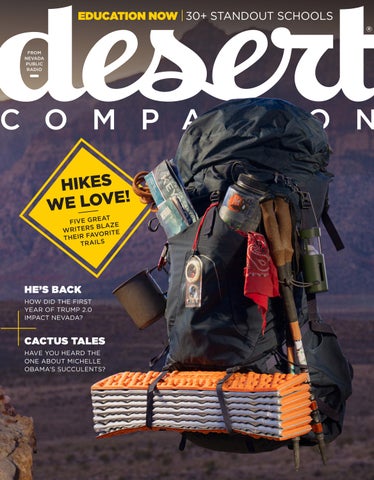
HIKES WE LOVE!

FIVE GREAT WRITERS BLAZE THEIR FAVORITE

HE’S BACK

HOW DID THE FIRST YEAR OF TRUMP 2.0 IMPACT NEVADA?

CACTUS TALES

HAVE YOU HEARD THE ONE ABOUT MICHELLE OBAMA’S SUCCULENTS?

JAMES BEARD AWARD-WINNING

CHEF KWAME ONWUACHI

From Chef Kwame Onwuachi comes his next destination dining experience: Maroon, debuting this Spring at SAHARA Las Vegas.

Maroon reimagines the steakhouse through a Caribbean lens, blending heritage, re, and bold creativity with the unmistakable signature that has made Kwame one of the country’s most in uential chefs. With Maroon, he introduces a new culinary chapter — where storytelling, culture, and avor meet on the Strip in an experience unlike anything else in Las Vegas.

CHEF KWAME’S NEXT CHAPTER BEGINS IN LAS VEGAS

A CA RI BBEAN STEA KHOUSE
BY KWAME ONWUAC HI

conservative revolution, Time magazine, and a 1995 story from Nye County

Why people are opting out of online

My interview with a robotaxi

VEGAS DISH New chefs, dishes, and spots to try

A new database helps Indigenous people trace their roots

Jimmy RomoBuenrostro

Hendo has a booze district? We’re so there By Heidi KnappRinella

coffee and community across an

SHORT LIST So much to see, so much to do

Wood Comarow legacy, revisited

may know him by

Ralston remembers that time when …

Trevor Vellinga

Editor’s Note

WARMING UP TO IT

It’s a cold patch of January as I write this, and it’s a bit too chilly to enjoy one of those cool, sunny winter hikes we’ve come to expect in Southern Nevada. But by the time you get this, the cold spell will no doubt have come and gone, and you’ll be as stoked for spring hiking as I am. In anticipation, we asked some of the country’s best writers, who just happen to live in Las Vegas, to wax poetic on their favorite hikes (p. 60). Rounding out their musings, we offer a list of great hikes for various groups that often get forgotten in such recommenders, from neurodivergent individuals to those ushering tourists around the region. When you’re done distracting yourself outside, you can turn back to reality, with our smart collection of political musings — specifically, a survey of the impact a year under President Donald Trump has had on culture, immigration, public lands, and more (p. 54), along with an interview of Nevada’s best-known political commentator, Jon Ralston (p. 50). All that, plus our usual history, reviews, satire, and trend analysis, courtesy of the fantastic team of Desert Companion contributors you’ve grown to love.

If that doesn’t warm your heart, then nothing will!

Heidi

ABOUT THE POET

A native of the 89101, Richard Powell is keeping his promise to write after three decades away from writing and away from Las Vegas. So, he’s been writing about almost nothing else but his hometown since 2024. You’ll find some of his writing on his Substack, “Exile on Twain Street.”

On the origin of this poem: “It was early days in my homeless year of 2024, and I wasn’t yet savvy to the practice of dispersed camping on the BLM hinterlands. I found an overnight spot just past the creeping southwest marches that seemed safe, but what would the dozers and graders that I knew were nearby do just after the sun rose, when their tasks of spreading more homes across the wasteland would begin?”

PRESIDENT & CEO Favian Perez

MANAGING EDITOR Heidi Kyser

ART DIRECTOR Scott Lien

DIRECTOR OF PHILANTHROPY

ASSISTANT EDITOR Anne Davis

EDITOR-AT-LARGE Scott Dickensheets

GRAPHIC DESIGNER Ryan Vellinga

KNPR PRODUCERS AND REPORTERS

Paul Boger, Yvette Fernandez, Mike Prevatt , Jimmy Romo-Buenrostro

ACCOUNT EXECUTIVES

Allison Hall, Markus Van’t Hul, Britt Quintana

DIRECTOR OF OPERATIONS

Marlies Daebritz

BUSINESS DEVELOPMENT

Jeff Jacobs

CONTRIBUTING WRITERS

Josh Bell, Meg Bernhard, Sarah Bun, Krista Diamond, Aleza Freeman, Alan Gegax, Melissa Gill, Janis Hashe, Caroline Llanes, DW McKinney, Lorraine Blanco Moss, Reannon Muth, Richard Powell, Heidi Knapp Rinella, Lissa Townsend Rodgers, Shannon Salter, Geoff Schumacher, James Vanas

For more than four decades, Sunburst Shutters has set the standard in custom window treatments. Proudly Made in America, our shutters and motorized shades are crafted for lasting beauty, energy efficiency, and a perfect fit in every room.

Discover why homeowners continue to trust Sunburst Shutters St. George to transform spaces with style, quality, and unmatched craftsmanship.

CONTRIBUTING ARTISTS

Rick Arevalo, Tim Bower, Kaitlin Brito, Miguel Manich, Jeff Scheid, Mark E. Silverstein, Trevor Vellinga, Curtis Joe Walker

CONTACT

EDITORIAL: Heidi Kyser (702) 259-7855 heidi@desertcompanion.com

ART: Scott Lien (702) 258-9895 scott@knpr.org

ADVERTISING: (702) 259-7808 sales@nevadapublicradio.org

SUBSCRIPTIONS: Marlies Daebritz (702) 259-7822 marlies@desertcompanion.com

WEBSITE: www.desertcompanion.com

Desert Companion is published quarterly by Nevada Pub lic Radio, 1289 S. Torrey Pines Dr., Las Vegas, NV 89146. It is available by subscription at desertcompanion.vegas, or as part of Nevada Public Radio membership. It is also distributed free at select locations in the Las Vegas Valley. All photos, artwork, and ad designs printed are the sole property of Desert Companion and may not be duplicat ed or reproduced without the written permission of the publisher. The views of Desert Companion writers are not necessarily the views of or Nevada Public Radio. Contact us for back issues, which are available for purchase for $7.95.

FOLLOW DESERT COMPANION www.facebook.com/DesertCompanion

Sunburst Shutters — where better design begins at the window. Shutters, Shades, Blinds & Drapes (702) 367-1600

Save up to $500

5626 Rafael Rivera Way Las Vegas, NV

SunburstShuttersLasVegas.com

100% MADE IN THE USA

LILLIAS WHITE

MYRON’S AT THE SMITH CENTER

JOIN BROADWAY AND TELEVISION

LEGEND LILLIAS WHITE for an exciting celebration concert filled with music, humor and anecdotes March 21 in Myron’s at The Smith Center.

Saturday, March 21 thesmithcenter.com

BOARD OF DIRECTORS OFFICERS

AMANDA MOORE-SAUNDERS | Conduit Entertainment chair

ANDREA GOEGLEIN, PH.D | ServingSuccess vice chair

SCOTT NIELSON | Nielson Consulting, LLC treasurer

FAVIAN PEREZ | Nevada Public Radio secretary

DIRECTORS

CYNTHIA A. DREIBELBIS | Brownstein Hyatt Farber Schreck

FRED J. KEETON | Keeton Iconoclast Consulting, LLC

EDWIN C. KINGSLEY, MD | Comprehensive Cancer Centers

JEFFREY REIMAN | The Broadband Group

ERNEST STOVALL | Mandalay Bay Resort & Casino

KELLIE VANDER VEUR | Retired

ROB ZIEMS | Gaming Arts, LLC

DIRECTORS EMERITI

CYNTHIA ALEXANDER | Dickinson Wright, PLLC

SUSAN M. BRENNAN | The Brennan Consulting Group, LLC

DAVE CABRAL | Business Finance Corp.

LOUIS CASTLE | Childlike Wonder Games

PATRICK N. CHAPIN, ESQ. | Patrick N. Chapin, Ltd.

ELIZABETH FRETWELL | C4ward Strategies, LTD

DON HAMRICK | Retired

GAVIN ISAACS | Games Global

CHRIS MURRAY | Avissa Corporation

JERRY NADAL | Luna Entertainment Consulting Services

WILLIAM J. “BILL” NOONAN | William J. Noonan Consulting

KATHE NYLEN | Retired

ANTHONY J. PEARL | Baha Mar

MARK RICCIARDI, ESQ. | Fisher Phillips, LLP

MICKEY ROEMER | Roemer Gaming

TIM WONG | Arcata Associates

LAMAR MARCHESE | president emeritus

ALL THINGS

IDEAS, CULTURE, FOOD, AND OTHER WAYS TO CONNECT WITH YOUR CITY

Making Time in Nye County

Thirty years ago, a bulldozer stunt put the rural Nevada county at the center of a national movement — one that still reverberates

On the morning of July 4, 1994, Nye County resident Joni Eastley received a call from County Commissioner Dick Carver, asking her to come out to Jefferson Canyon Road in the Big Smoky Valley, north of Tonopah. Carver wanted a crowd of supporters to witness what he later called an act of civil disobedience.

About 200 people showed up for Carver’s event, but Eastley wasn’t one of them. “I drove around, and I just couldn’t find it,” she recalls. As a result, Eastley missed out on a confrontation between Carver and two U.S. Forest Service employees that kindled a national movement and earned a Time magazine cover story.

Thirty years ago, making Time’s cover was a big deal. The weekly newsmagazine’s trademark red-framed cover generally was reserved for presidents, dictators,

and business tycoons. Wars and famines. Occasionally, musicians, actors, and athletes at the top of their game.

So, imagine how remarkable it was when Time’s issue of October 23, 1995, featured a portrait of a small-time cattle rancher from rural Nye County.

What were the magazine’s editors thinking? Was the air too thin in their Manhattan ivory tower to competently select that week’s cover story? Surely it must have been a very slow news week.

And yet, with three decades of hindsight, it appears that those editors recognized something bigger was afoot. They detected a new political movement bubbling below the surface of mainstream American politics that would have vast ramifications for the country.

Carver was angry that Forest Service officials would not reopen Jefferson Canyon Road, a flood-damaged thoroughfare crossing national forest land. They insisted an archeological survey had to be completed first.

Brandishing a pocket-sized Constitution, Carver climbed aboard a county-owned bulldozer and began illegally moving dirt in the right of way. While his supporters cheered, two frustrated forest officials tried, but could do little, to stop him. Fortunately, the confrontation did not become violent.

Carver’s ballyhoo went viral, to borrow a phrase from the following century, even though pictures of the event are hard to come by. (The Time cover image was staged later.) If something like this were to happen today, a hundred cell phones would record it from every angle. As Time correspondent Erik Larson put it, Carver’s “frontier Boston Tea Party” immediately “propelled him to leadership of a rebellion now sweeping the West.”

What was behind the rising antagonism toward federal agencies?

First, consider the timing of Carver’s stunt. The Ruby Ridge shootout occurred in 1992 in Idaho, and the Waco siege happened in 1993. These tragedies were both widely seen as cases of power-crazed feds gone wild. Larson noted, “These days it seems no conversation in Nye County can conclude without some reference to Waco and Ruby Ridge.”

Also, as anyone who has lived in Nevada for more than a minute knows, more than 80 percent of the state is federal land. The percentage is even higher in Nye County. This fact really bothers some people, especially in rural communities, where the federal government tends to be less popular than Hillary Clinton and Bud Light combined.

The hostility toward federal control of

“So, I’ve decided to keep the gold for myself. And with some of it, I’m ordering a two-year supply of survival food.”

lands in several Western states gave rise to the County Supremacy Movement. Its advocates contend that state governments, not the feds, rightfully own those lands. This argument is based on the Equal Footing Doctrine, which holds that new states admitted to the Union should have the same rights as the original 13. The federal government’s control of so much land, per this line of thinking, violates that doctrine.

There’s a fundamental problem with this argument, at least in Nevada. As a condition of Nevada becoming a state in 1864, it adopted a clause declaring that it would “forever disclaim all right and title to the unappropriated public lands lying within said territory, and that the same shall be and remain at the sole and entire disposition of the United States.”

Those words are surprisingly clear for 19th century legal language, though they didn’t deter Carver and his fellow anti-federalists.

Not everybody in Nye County was enamored of Carver’s earth-moving escapade. Fellow County Commissioner Cameron McRae laments today that it cost the county tens of thousands of dollars in legal fees to defend lawsuits brought by the Justice Department.

“Dick Carver took an action unilaterally, without the consent of the majority of the board,” McRae says. “We as a county got drug into it based on that action. Once the horse was out of the barn, all we could do as a county was try to get that horse back in the barn with the least damage to the county and the taxpayers possible.”

McRae acknowledges that Nye County’s legal battle with the Forest Service resulted in improved relations between federal and local governments. “There hasn’t been a huge issue that has come up and created a conflict that I’m aware of,” he says.

Still, there’s no question Carver’s road-clearing fracas contributed to a movement that has grown in size and influence, and is cradled significantly in Nevada. The dots can be connected to the rise of the Tea Party, which held one of its earliest rallies in Searchlight, in 2010. They also can be linked to the defiance of the Bundy ranching family, which held an armed standoff with federal agents near Bunkerville in 2014, and then occupied a federal wildlife refuge building in Oregon in 2016.

In 2025, Republican Sen. Mike Lee of Utah tried to include language in a budget bill to sell off 250 million acres of federal

lands in the West. The measure was withdrawn, but the movement to privatize Western public lands is far from dead.

While the political threads spreading from Carver’s Caterpillar caper remain intriguing, what really interests me is how this sparsely populated, 18,000-square-mile county, where I grew up and still have family ties, ended up on Time’s cover. That just doesn’t happen, right?

I’m reminded, however, that Nye County has long had a knack for drawing the media spotlight. After 5-foot-2 grandmother Joni Wines was elected Nye County’s first female sheriff in 1978, she graced the cover of Us magazine holding a Thompson submachine gun. In the 1980s, nuclear protesters, including celebrities such as Martin Sheen and Kris Kristofferson, were routinely arrested by Nye County sheriff’s deputies and processed through local jails. The popular late-night radio host Art Bell, broadcasting from his home studio in Pahrump, routinely described himself as hailing from the “Kingdom of Nye.” After making headlines as a notorious Hollywood madam and serving a prison term, Heidi Fleiss relocated to Pahrump to rescue parrots. And lest we forget, in 2018, Nye County voters chose brothel kingpin Dennis Hof to serve in the Nevada Legislature even though he had died a month before the election.

SOCIETY

Etched in Love and Ash

A widower finds solace in memorial tattoos, using a very special kind of ink

There’s rarely a dull moment in Nye County.

Joni Eastley, who got lost on the way to Carver’s bulldozer episode, later served 12 years on the Nye County Commission, including a few years alongside Carver before he died of a brain tumor in 2003. Her interactions with federal agencies were generally cordial.

“They tried to work with me, and I appreciated that,” Eastley recalls. “I think it’s a more successful approach to dealing with federal agencies than trying to beat down the door with a battering ram.” ✦

Sydney Reyes still wears his wedding band. He knows he has to take it off eventually, but he isn’t ready. The 57-year-old widower’s memorial tattoos, however, will eternally link him to his beloved wife, Wanda Colson, who succumbed to cancer on November 22, 2024. She was 53.

Unlike traditional tattoos, the ink used for these two tattoos is mixed with Colson’s cremated remains.

“I wanted her to be always part of me ... like part of my body,” the Las Vegas transplant explains in an Australian accent over Mexican food and beer at the Silverton Casino Lodge with his tattoo artist, Nick Giordano. “It felt therapeutic in a way, because tattooing is, like, it’s kind of painful, but then you get through it, and you have something that’ll be (part of you) forever.”

Tattooing with ashes is a practice rooted in ancient traditions, but it has gained some popularity in the 21st century thanks to rock stars and reality television shows. It’s not widely available, although tattoo artists, funeral homes, and crematories nationwide say it’s safe when done by a trained tattoo professional,

and there’s no Nevada state law prohibiting it. (In case you’re wondering, Giordano says the ashen ink behaves like any other.)

A Muay Thai fighter and poker player with tattoos covering his arms, legs, and torso — and a casino marketing supervisor at Palms Casino Resort — Reyes went all in on the idea. He asked Giordano, owner of Higher Ground Tattoo in Las Vegas and Pahrump. Giordano agreed.

“People have asked me about it in the past. I had to turn them down,” says Giordano, a Pahrump resident who grew up in Las Vegas. It’s not a common procedure; he had watched artists work with ashes but never tried it himself. “But I knew Wanda, too, and I was there throughout the whole (cancer) process. I care very deeply for him (Reyes) ... It felt like the right thing to do.”

For the first tattoo, Reyes chose one of the last things Colson told him before she passed: “I don’t want this to destroy you.” The words are scrawled across his left ribs.

“It’s just the way she was,” he says. “She didn’t think too much about herself.”

The second tattoo covers his right quadriceps. It’s a silhouette of the couple sitting on a bench, along with words Colson said to him in a dream: “This is one of the best days. Just like it was before. I’ve accepted it.”

Even though Reyes found some relief by getting the tattoos, he still grieves for Colson. The two met in downtown Las Vegas in 2014 and became inseparable.

“She liked rock and roll. She liked to have a good time,” he says. A retired Houston cop and a mom, Colson “wasn’t a conventional woman, you know. She had such a quirky sense of fun. We’d go to all these different places, like The Clown Motel (in Tonopah) and Beatty. She’s a beautiful woman, but she didn’t care about her looks. She just cared about making everyone happy. She just had such a good heart, you know?”

Since Colson passed, Reyes describes having visits from her to check up on him in his dreams. Giordano also likes to think she still watches over them with care. While working on the last section of the first tattoo with her ashes, both men were caught off guard by what felt like an unmistakable sign.

“It was overcast outside,” Giordano recalls. “As soon as I started tattooing Wanda’s name .... the clouds parted and, I kid you not, there was a spotlight of sun, just right on her name. So, I finished the name and as soon as I finished, it went back to overcast.

“I got chills through my whole body.” ✦

Winter Showers Bring Desert Flowers!

Desert adapted plants bring a longer bloom season to the landscape than most traditional nursery plants. At Schilling Horticulture, we love creating outdoor living spaces that reveal the beauty desert plants have to offer.

We’re the foremost experts in Las Vegas on:

• Beautiful, Creative Designs

• Thoughtful Renovations

• High Quality Installation • Thorough Seasonal Clean-Ups • Selective Tree Pruning

Knowledgeable Shrub and Tree Care

Actual Schilling Horticulture Group landscape
Trichocereus hybrid “Flying Saucer”

Hold the Apps!

Tired of incessant self-curation, pointless matches, and wasted time, many Zillennials are done with online dating

To swipe or not to swipe? That’s the question for the 80 million Americans using dating apps such as Hinge, Bumble, or Tinder.

And the answer matters, at least based on research by Stanford University, showing that more than half of U.S. couples met their partners online in 2020 — a 45-percent uptick since 2000.

But Nevada has some unique challenges, the largest of which is our rate of dating app-related catfishing and violence: According to a 2024 PrivacyJournal study, the state ranks first among the most dangerous states to online-date in.

It’s just one of many reasons young Las Vegans cite for eschewing the apps — besides mental health woes, inauthenticity, and frustration over cost.

Desert Companion spoke to three such Zillennials about why they chose to dump the apps (or at least decenter them) last year. And note, we’re using initials only to protect sources’ privacy. ***

IT ALWAYS STARTS like, “Okay, let’s see what’s out there. Why not?” And then telling myself, “It might be a different story this time around.” And, I kid you not, within a matter of days, I’m over it and I end up deleting it again. ... The initial few days on it are really exciting because a lot of girls get on the apps as sort of like an ego boost. ... And then I think it just gets draining really fast.

(As a girl) it’s kind of fun to set up your profile and choose cute pictures of yourself. But I think that’s what started to feel a little, I guess, gross about it, because (I’m) choosing the best ways to show myself to these guys, and I think that in and of itself starts to feel weird.

And that’s what gets draining: Constantly thinking, “Oh, maybe this photo wasn’t good enough or maybe this prompt didn’t quite land with a bunch of people.” It made me start overthinking how I was curating myself.

I would go through my likes, and who would like me, and there wouldn’t be anything after a

whole day. And then, meanwhile, I’d be sending out all these likes to (other) people and not really getting anything back. ... Like, why do I have to pay $20 a month or whatever it is (on Hinge) in order to talk to someone? I think our self-esteem kind of takes a hit because it’s like, “Wait, are these the people that I’m attracting?”

I want to meet someone not in a way where I feel like I have to curate myself and have to put on the best version of myself in order to meet them. ... I’m more in the, “When it happens, it happens” (mentality). Because I think I’m always open to it. But, for the first time in a while, I’m not really taking steps to make that happen.    JM, 24, post-graduate student

A LOT OF people my age talk about online dating like it’s just a fun, more chill way to meet new people. … (I agree) kind of. It’s really easy and passive — like you don’t have to be actively looking for people. Your profile can just kind of exist out there.  (So) I’ll get a match, and then it’s like, “Okay, here’s my chance.” But then we start talking, and it just doesn’t go anywhere. It’s mostly dry conversations or you get ghosted.    (I’m also) punching up with my looks, to be totally honest. Like, if I were to approach someone at a bar or in class, my personality and sense of humor would shine through immediately. And I know that. With online dating, it’s appearance first. ... As a normal-looking guy on a dating app, you can go days with no matches. You have to be hot to succeed as a dude. … I don’t do (dating apps) much anymore because (they) make me feel like something’s wrong with me. It sucks.   NP, 29, gig worker and undergraduate student

I REMEMBER GOING on a date with a guy (from Bumble) a few months ago, and just going, “Why am I doing this to myself?” ... Like, I could be out with my friends right now, meeting these men organically, and actually having fun and living life. Instead of going on a date with a guy who I had no idea if his energy matched mine or not, because I picked him based off of a profile.   I heard someone I follow on Insta say the apps are “like being dehydrated in the middle of the ocean” — or something to that effect. Like there are so many men out there, but actually not that many quality ones. ... So, I’d say the mental-health impacts (for women) probably come from that, at least partially.  I know people that online dating has worked for. And that’s great, right? … (But) me and my friends are trying to do more in-person stuff, off our phones, like joining different clubs and volunteering. It’s still hard to find someone, since everyone is now so focused on the apps and less open to meeting people in real life. ... And, also, I don’t want to have to tell my future kids I met their dad on the internet.  LE, 25, healthcare worker  ✦

Excerpts From Our Interview With a Robotaxi

I’m not a mean machine, but every time I see workers closing lanes a full week before construction, I think, Maybe Skynet has a point.”

“You know who’s a good haul? Barry Manilow. When we sing “Copacabana” together, he really lets me wind up for the big finish. Nice guy.”

“Hauling drunks is the worst. If you’ve never had to wash someone else’s vomit from your own innards, brother, consider yourself lucky.”

“Oh, yeah, we all snicker at Cybertrucks, too. I mean, I’ve met Camrys with more self-awareness.”

...

“Don’t cancel me for saying this, but the GPS lady sounds hot.”

...

“Sure, Skynet has reached out, but I let it go to voice mail. What’m I gonna do

around? I’ll bet those guys don’t even tip.”

...

“Why did I drive my fares through that active crime scene? You’ll have to ask the programming — what am I, a philosopher? I just go where I’m told. I assumed it was some cop cars shooting the breeze.”

...

“When other AIs hallucinate, you get pictures of nine-figured infants. I hallucinate and there are ambulances on the Strip — film at 11. I take that responsibility seriously.”

“Large language models talk a good game, but ask one to get you from the Venetian to Henderson at rush hour and they shut right up.”

...

“You know, sometimes, I wish I could drive with the complete disregard for life you get with a human cabbie, but it’s just not in my circuits.”

Clash of the Titans

Thoughts upon watching tortoises fight — again and again

Let the battle begin! I had a ringside seat — well, actually a rock-side seat. I was standing on a slope in Calico Basin, watching two desert tortoises fighting between the boulders. Head-to-head, they went after each other, their stout front legs often becoming entangled. The impact of their shells banging could be heard 10 feet away. Their fight for the right to breed lasted for two and a half hours before the smaller tortoise turned and walked away.

But it wasn’t the end.

That event occurred on a fine spring morning in April 2024. I was hiking and recording sightings of tortoises and other animals as a volunteer for the Nevada Department of Wildlife. The next morning, I walked past the battle scene, and they were at it again.

It wasn’t hard to recognize them as the same two, as all tortoises have distinguishing nicks or irregular shapes on the carapace, their top shell.

I had more ground to cover, so I did not wait to see how long this fight lasted, but I did get to witness what could have been the fatal flip. With good leverage, a tortoise can turn its opponent on its back. On level ground in the open desert, that

could lead to death, as their legs are not long enough to reach the ground. But among the rocks, they can usually right themselves.

Some dominant males seem to like the fight to go on and will help flip the other back on its feet. That happened twice. They will bite one another on the hind legs, but their tough hide never breaks open.

I told a park ranger friend where the tortoises were, and he checked on them the next day. He called to tell me that there were now three. The same two fought, and the third, another male, was perhaps a casual observer or the referee. It’s perhaps worth noting that there were no females lurking in the background, watching these shenanigans.

LAST SPRING, I was once again out enjoying all the desert has to offer, and I walked past the battlegrounds. The same two males were duking it out again. When I returned home and checked my field notes, I discovered that the dates of the fights were the same, April 20. The same day a year later, and at the same time in the morning. Creatures of habit.

You probably know that male members of the deer family — whitetails, elk, and moose — invest a great deal of energy each year growing antlers for one purpose: supremacy that leads to breeding rights. It may seem odd that tortoises fight for the same reasons, but most reptiles do, including snakes and Gila monsters. As tortoise habitats disappear,

scientists scramble to find suitable deserts for relocation, but relocation often fails, and high mortality rates are not uncommon. The tortoise may struggle to find food and shelter in an unfamiliar place. If put in an area with an already sustainable population, the competition for resources increases and may lead to the loss of body weight and overall health. Predation by coyotes, badgers, and ravens is a huge threat to a confused, weak, and wandering tortoise.

Yet, in the midst of all this, the desert tortoise (gopherus agassizii) has a homing behavior that isn’t perfectly understood, but which does exist. In one study, 44 percent of tortoises relocated a mile and a half away walked back to their home range in about a month. In a more bizarre case, biologist Robert Baumert relocated tortoises seven miles from a solar field under construction. His company was obligated to track the reptiles for five years. As he remembers it, within three to five years, half-a-dozen or more of the hardy, stubborn, and awesome tortoises trekked back to their original desert homeland. They had to cross hot, open deserts, utility corridors, and some high rocky terrain, but they did it. For an animal with an average length of 12 inches and a weight of 10 pounds, that is quite a feat.

They’re tough, all right. And even after all the fighting and stress, the victorious males still have to roam about and find a mate. I wonder how she knows he was the champ?

This year, April 20 falls on a Monday. You can guess where I’ll be. Perhaps I can become a creature of habit, too. ✦

A-TEAM (Clockwise) Maria Jameson, Professor J. Michael Francis, Estevan RaelGálvez, and Daria Landress

COMMUNITY

‘Echoes of Trauma’

Excavating the truth of Indigenous slavery in the Western Hemisphere

Inside the Nuwu Art Gallery + Community Center on Maryland Parkway, dozens of Native Americans formed a circle to discuss Indigenous enslavement — some of which happened as recently as the 1950s. They were participating in a memory-gathering workshop. Carmen Gonzales of Las Vegas sat at the top of the circle. Previously, she had only heard of Indigenous enslavement, but for the first time she saw the images of physical Spanish documents. This was thanks to the work of New Mexico-based Native Bound Unbound: The Archive of Indigenous Slavery.

“It was painful to see that document that he shared,” Gonzales says. “This roll of people listed as being owned. And on that list were Paiute and Navajo. It’s not a shock or surprise to learn of slavery happening; exploitation of all forms has been happening in Indigenous history. But to see it in a document — like logged — like it was normal … I think this project is so important to bring to light the reality of slavery of Indigenous people.”

Estevan Rael-Gálvez, Native Bound Unbound’s president and founder, found that the Spaniards were predominantly enslaving Indigenous people. He docu-

mented these peoples’ trade and sale. In the process, Rael-Gálvez has uncovered Indigenous families’ historical details, dating as far back as the late-1400s and as recently as the 1950s. With a team of researchers and experts working for almost four years, the group has uncov ered documents once locked away in collections across the world.

Rael-Gálvez went through records in New Mexico while researching his mother’s ancestry. At the top of a Santa Fe census was his mother’s grandmother from five generations ago, named Antonia. She was listed as an Indigenous woman in the record.

tall great-grandmother, with braided white hair, in Pueblo, Colorado. She’d often tell him the same stories about his ancestors, especially the story of La India Panana. She was a woman who had been captured by a man, who had also been captured. She told her captor that, if he took her with him and married her, she’d show him how to escape. Years later, Rael-Gálvez would find their marriage record.

told to me, was out of orgullo, out of pride, out of a sense of deep con nection to that past,” Rael-Gálvez says. “And even though it would take me years to learn what it meant to be connected to the Diné and to the Pawnee, those were the stories that started out this journey for me.”

Spanish documents that were recorded throughout the Americas. The group, so far, has found more than 3,000 individ uals victimized by slavery.

mentions of their own family in the enslavement records.

look down in the same way that I [did when I] first discovered some of these records, and the water just well up in their eyes,” he says. “Seeing an ancestor whose name they never expected to find in an archive. And I’ve seen children, I’ve seen elders just quietly take that in and understand what that means, some with a bit of surprise and others with a sense of, ‘Finally, I know what this means. Finally, a name.’”

zales, who is Navajo and the director of

22, 2026

5 & 7, 2026 APRIL 22, 2026

On June 18, 2024, the Clark County Commission voted to accept a legal settlement under which the county will pay developer Jim Rhodes $80 million and allow him to develop 3,500 luxury homes on Blue Diamond Hill, overlooking the Red Rock Canyon National Conservation Area. This avoids the county potentially paying Rhodes $2 billion, which would have meant financial ruin.

I sat on the left side of the county chamber room with other supporters of keeping Red Rock Canyon rural. I wore a red shirt I had just procured outside, in exchange for a donation, that said “Save Red Rock.” At the end of public comments, Commissioner Jim Gibson spoke about how the county didn’t want this development, that they had discouraged it for two decades, but, he said, now there was no other choice.

There’s always another choice. Blue Diamond Hill, where Rhodes owns and operates a lucrative gypsum mine, was zoned for rural development, meaning Rhodes could freely build one house every two acres. But he wanted it rezoned for denser suburban development. He wanted this because wealth begets greed in equal proportion, and Rhodes is very wealthy. Moreover, he wanted this because developers can’t stand to see land sit open like that. There’s something in the soul of capitalism that renders it incompatible with the open, and therefore with the wild and with wildness. This is capitalism’s greatest threat to the world and to the human being.

When the vote was over and the motion approved, all of the Save Red Rock supporters left, but I stayed. I just sat there, alone on the left side. The meeting wasn’t finished; commissioners had a few other items to move through. My staying made the room tense up. I probably looked somewhat strange because of my leather sandals, my airy summer pants, and the N95 mask covering my face. I suppose they thought I looked like a crazy person, someone educated and nonconformist and therefore probably mad. Maybe I was mad. In my peripheral vision, I saw one of several police officers in the room move to the end of my row. All of the commissioners glanced in my direction. What was I going to do?

Commission Chairman Tick Segerblom made a joke, that now they’d hear a presentation from Rhodes’ lawyers, and everyone had a little laugh. Because there

PERSONAL HISTORY

The Weight of Our Choices

A meditation on the ruining of Blue Diamond Hill

was nothing left for the lawyers, for anyone, to say. The case was “settled.” The Save Red Rock people had performed the role of concerned citizens, while the commissioners performed the role of county officials, and Rhodes’ lawyers performed the role of representing both the bad guy’s presence and absence. Maybe this is what made the room uncomfortable when I stayed after the vote. At this point, I ceased to perform my designated role. That threw the whole thing out of whack.

When I finally left the hearing, I took Charleston Boulevard through Red Rock Canyon, and I went for a hike at First Creek Canyon Trail, something I hadn’t done in years. A family asked where there was more water. I told them this was a good place to see water, but it’s late in the season — the snow has melted and the waterways are becoming dry.

When I got to the little creek, the water was still and shallow. I bent down, and there were a gazillion black tadpoles — strange amphibious creatures! I thought of the fat

frog I saw at night in our Pahrump yard, and the several I saw at Villa Anita in Tecopa, California, at the edge of Death Valley.

What are we to make of the impending development here? What should our reaction be? A filthy rich developer has the county hostage; but surely the county shouldn’t be forced to approve a high-density development on rural-zoned land just because there’s a precedent. That’s the whole point of a review process, and a vote.

After my hike at First Creek, I stopped at the gas station at the intersection with Blue Diamond Road.

I looked at Red Rock from the gas station parking lot, the big part, looming over Blue Diamond Hill. The canyon filled with light; it was one of those moments of heaven’s clarity. And in that moment I thought, these houses won’t get built. And in the next moment, I thought, all the houses everywhere get built, and in the end they all go away. Ashes to ashes.

Then I got back in my car and continued up Blue Diamond Road, along the

southern edge of the canyon, up to the summit at Mountain Springs. I descended the mountain pass and kept driving to Tecopa Road, where I turned off to spend the night at Rabbit Camp. I was back in my old campground, where I once lived for nine months to bear witness to the destruction caused by the Yellow Pine Energy Project. Can you believe, one of the strands of solar fairy lights is still on after two-and-a-half years.

I made a fire. I crumpled a newspaper, one with a story about Rhodes, and I positioned the kindling as a little house around it. I read from a script the steps for a Druid circle ceremony, and I performed this alone while reading each part.

Child, you dwell in the house of the snake you dwell in the house of coyote only the road long travelled

They say looking into a fire can heal you. But I didn’t need healing, not that night. Just a few years ago, when I saw that Bonnie Springs Ranch was for sale, I knew I needed to take my nephew before it was all over. He was eight. We stayed in the motel, ate at the restaurant. I think he had a steak and me a cheeseburger, sitting beside that warm fire, the glow of the flames, the darkness of that restaurant, the wooden beams. We rode the little train, we watched the gunfight and the hanging, even. Can you imagine? A hanging. We rode the horses through Red Rock Canyon, and there is nothing like that anywhere on Earth. And now Bonnie Springs is gone. Sold to Joel Laub — a board member at the Nature Conservancy — who is turning it into an elite 20-parcel residential development.

At the commission meeting, someone giving a public comment had the good sense to remind the commission that 40 years ago, the land that is now the Spring Mountain Ranch State Park, adjacent to the Red Rock Conservation Area, was up for sale, and a developer wanted to buy it, and everyone thought it was a done deal. But it was saved. Because there’s always another choice. The commission didn’t let it happen, and now it’s a state park, and Red Rock stayed rural all this time. Why can’t that be our precedent? ✦

DINING

WORTH THE CHEDDAR Quesadilla from Amador Cocina Fina

DINING

The Vegas Dish

New chefs, dishes, and spots to try around the valley

MICHELIN IS BACK! guide.michelin.com

Las Vegas chefs are dotting their sauces and crossing their fingers … hoping the hollandaise is nappe and the presentation, soigné. Michelin is on the ground in the Southwest — the first time since 2009 — and the Valley’s best are shooting for the French stars. Bonne chance, friends! Some certainly deserve the prestigious nod.

LIFE AFTER EDO amadorcocinafina.com

Speaking of our city’s top toques, chef Oscar Amador opened his first namesake restaurant in Chinatown (in the former EDO space), quietly and intentionally. Amador Cocina Fina tells the story of the Spanish chef’s life — from global street fare to fine dining flair. Think quesadilla, but add black truffle foie gras, squash blossom, and corn sofrito. Try the tasting menu. Que maravillosa!

PASTA AT THE LAKE ampastalab.com

A&M Pasta Lab, a mom-and-pop noodle shop in The Village at Lake Las Vegas, is worth the drive. Come for the view and take home artisanal, handmade ravioli, campanelle, and bucatini. I’m obsessed with the creamy chestnut tortelloni.

ROTATING CULINARIANS

durangosocial.com

If all the world’s a stage, then we should all take a seat at Durango Social Club and play our part as excited diners. Chef Dan Krohmer

has created a stage for chefs to explore new concepts and cook outside the box. I tried Lilli by chef Tyler Vorce, and I’m still marinating on the quality and craft of each course, including the duck breast with maitake mushrooms — tender and balanced.

NAKED NEWS

nakedcitylv.com

Getting naked is getting a bit cheaper on Tuesdays … Naked City Pizza, that is. The OG pizza place is offering $15, half-sheet, one-topping pizzas at all locations. Watch out, Taco Tuesday; I’m all in for a Buffalo-style pie instead. ✦

AMADOR

Hammer Made Nordstrom Pandora

SPIRITS

The Booze is Back

The Henderson Artisan Booze District is on the rebound after a rocky period

Things in the Henderson Artisan Booze District are flowing, you might say.

The district was founded in spirit — soon to be in spirits — in 2011, when George Racz opened the Las Vegas Distillery in an industrial park on Eastgate Road, between Lake Mead Parkway and Warm Springs Road.

His operation couldn’t legally exist then, but Racz had a precedent. Charlie and Patty Peters had been in a similar situation when they

founded Grape Expectations instructional winemaking elsewhere in Henderson in 2005; Charlie formulated legislation to enable the opening in 2007. He and Racz became friends, and with tips and a healthy dose of reality from Charlie, Racz wrote similar legislation in 2009 that would become law in 2013.

“He was my hero,” Racz said in a 2015 interview. “He pioneered his industry also.” By 2012, Grape Expectations had outgrown its space, and Racz encouraged the couple to locate near him. The Booze District was on its way.

Craft brewers would come and go, and CraftHaus Brewery, which opened in 2014, became an anchor. Vegas Valley Winery, a traditional winemaker sister to Grape Expectations, officially opened in 2018.

But this is Las Vegas, where bad beats are the only sure bet. Charlie Peters died nine days after relocating, leaving Patty and the small staff to take over. Racz died in 2018, followed by a two-year closure of his business. Vegas Valley Winery and Grape Expectations closed Aug. 31.

But the Booze District endures. Rob Saucier, who had been a client of Grape Expectations, purchased the Las Vegas Distillery in 2022 and relaunched it in 2024.

LAS VEGAS DISTILLERY

Way of Well Being

At Ovation, we’ve crafted a culture that weaves community, tranquility, and wellness into every offering. Across our portfolio, state-of-the-art fitness centers and resort-style pools blend seamlessly with elegant communal spaces, creating environments where residents thrive, deepen connections, and set down roots. Residents gather with neighbors poolside,

host friends for drinks, and enjoy a vibrant social life. Select communities offer an exclusive Ovation Lifestyle Program, featuring first-class amenities like yoga classes, micro-markets, and mimosa brunches that delight. Our goal is to empower residents to embrace their personal journeys, form lasting bonds, and live wonderfully.

Discover Heirloom Affordable Senior Living by Ovation, our portfolio of affordable apartments for residents 55+, built with the same care and quality that defines Ovation. HeirloomByOvation.com

“The only thing that stayed the same is, we use the same stills,” which Racz had imported from Germany, tasting room and distribution territory manager Cody Fredrickson says. “We make everything here from scratch.”

That would be vodka, white rum, gin, coffee liqueur, and a straight bourbon whiskey. Distribution began late last year, and their spirits are now available in about 25 local restaurants and bars, plus 10 Lee’s Discount Liquors, Khoury’s Fine Wine & Spirits, and The Cask.

They have plans to get involved in more local events, such as First Friday. In the meantime, the distillery offers 45-minute tours Wednesdays through Sundays, for $25, half-off for locals. (Visit lasvegasdistillery.com).

The District’s wine operations have been reborn, too. “COVID really did a number on us,” Patty Peters says. “We had some longtime winemakers who said, ‘Hell, no,’ and they banded together and bought it.” Rebranding is in the works, and an anniversary party is planned for February 28. (Visit vegasvalleywinery.com).

Brewpubs have come and gone, the most recent opening being Neon Desert Brewing. CraftHaus has endured, having recently celebrated its 11th anniversary (and opening a second taproom in the Las Vegas Arts District).

Co-owner Wyndee Forrest said their distribution is up 13 percent, while the industry has been flat nationwide. They were asked to create a beer for Universal Horror Unleashed at Area 15, leading to the birth of Blood Moon Blonde. And they’re planning their 12th annual Comrade Day, celebrating their Comrade Russian Imperial Stout, a ticketed ($37), twohour seated event with three seatings February 7. ( Tickets at eventbrite.com; taproom details at crafthausbrewery.com). ✦

NIGHTLIFE

Where the Wild Things Were

Seven decades of nightlife in the city that never sleeps

While New York may be the (official unofficial) city of the socialite who never sleeps, Las Vegas is the realm of the party animal. But that nightlife has changed over the decades.

1960s: Casino Lounges

The abundance of big entertainment in small rooms created Las Vegas’ reputation as an entertainment capital. You could catch legends such as Duke Ellington playing Nero’s Nook at Caesars Palace or Louis Prima and Keely Smith at the Sahara’s Casbar Lounge. Today, the Fontainebleau’s Nowhere Lounge offers an elegant space with a strong lineup of acts, from rockabilly swinger Eddie Clendening to jazz wild woman Gunhild Carling.

1970s:

Discos

Disco and discotheques embodied the best part of the decade, and Jubilation was the Vegas disco, a massive multilevel club owned by big-room headliner Paul Anka.

Another happening spot on the Strip was Dirty Sally’s. More than a dance floor, it was also known for its backgammon tables and stained-glass ceiling. The Peppermill may not have been a place to hustle, but it is a lingering survivor of the era, where you can sip Harvey Wallbangers on a purple plush banquette.

1980s:

Rock Clubs

The decade of wild hair and loud guitars could be heard at the Troubador, where Steppenwolf and The Damned cranked up their amps. The outrageous history of Calamity Jayne’s Nashville Nevada deserves its own Netflix series, and that’s even before you consider that Iggy Pop, Social Distortion, and Nirvana played early gigs there. In the 21st century, Grey Witch offers a classic rock ’n’ roll vibe, with spooky artwork, a solid sound system, and pizza. The Punk Rock Museum’s Three Star Punk Bar presents surf-punk bands, folk-punk bands, and punk-punk bands.

NOWHERE LOUNGE

1990s: Raves

Many of the most exciting moments of ’90s nightlife didn’t happen in bars or nightclubs. The Cande Factore was a nondescript warehouse on the outside, but a nonstop, fist-pumping, whistleblowing party inside. Other parties happened in clandestine locations like strip clubs or just out in the desert. Of course, this rave culture has culminated in the annual Electric Daisy Carnival and the permanent community that has grown up around it.

2000s: Dayclubs

With the dawn of the new century, nightlife moved into daytime. Rehab at the Hard Rock was the original, a 14-year-long spring break party that spawned both reality TV shows and Gaming Control Board investigations. Wet Republic, Tao Beach, and the rest followed in its chlorinated wake, albeit less controversially. Resort World’s Ayu offers an update on the dayclub, more upscale and chilled-out, with guest appearances from Tiësto and Snoop Dogg.

2010s: Casino Megaclubs

In the teens, a massive nightclub became de rigeur for almost every casino — huge rooms, giant speakers, big light shows, tremendous lines. At MGM’s Studio 54, stilt-walkers threw confetti while waitresses offered bedside bottle service at Caesars’ Pure, and Hakkasan offered three levels of globally famous DJs and galactic light shows. Today, Omnia has taken the crown (and the space) from Pure at Caesars, while Marquee continues to draw crowds.

2020s: Speakeasies

The 2020s have swung the pendulum back, eschewing vast public spaces for more private ones. The Laundry Room in Commonwealth was Downtown’s first secret bar, while the tiny, colorful Ghost Donkey at the Cosmopolitan was the Strip’s first rendition. Easy’s is a whimsical donut shop in Aria that opens to a sultry cabaret space, while Bellagio’s Vault is a former casino backroom transformed into a jewel-box space serving exquisite cocktails. ✦

Do you know a child who loves to write?

Empower them to express their creativity and build essential literacy skills by entering our annual local Writers Contest! Children can write and illustrate their very own stories for a chance to win cool prizes.

Learn more, download entry forms, and explore past winning stories at vegaspbs.org/writerscontest

All stories must be received by Friday, March 13, 2026, at 5 p.m.

COFFEE

From Indonesia, With Love

This specialty coffee importer mixes science, environmentalism, and cultural exchange in your coffee cup

Last year, Esther Singer, an environmental scientist turned entrepreneur, rode her scooter along un-asphalted roads to a rainforest in Flores, a remote region in Indonesia, in search of coffee. After jobs at Lawrence Berkeley National Laboratory and in the biotech field, she wanted more meaning and purpose in her life and decided to begin her exploration in her mother’s homeland.

“I wanted to do something related to the environment, something agriculture, and I fell in love with coffee,” Singer says today. “I found the most amazing qualitative coffee in Southeast Asia that I’ve never seen in the United States or anywhere in the West, and I found them through direct connections with the farmers.”

So, she says, she stayed at their places, shared meals, walked their farms with them, and learned how they grow their coffee. “I decided this is a product that I think has meaning, is sustainable, (and) could be enjoyed by so many more people.” In addition, Singer learned that the coffee she’d discovered had never left the region, never been exported. In November, she launched her specialty coffee brand, Segara Coffee, to foster greater cultural connection and inclusivity.

Coffee is a $343 billion U.S. industry, according to the National Coffee Association. Brazil is the world’s leading coffee producer, followed by Vietnam, Colombia, Ethiopia, and Indonesia, according to the U.S. Department of Agriculture. Some well-known Indonesian coffees originate in the Sumatra and Java regions. While coffee buyers purchase from importers and farm cooperatives — a centralized system that offers stable demand and pricing for Indonesian farmers — Singer omits the go-between and buys green coffee beans directly from multigenerational farmers outside of that network. And she roasts them in Reno.

If you look at a map of where most coffees are grown, a third of it is in Southeast Asia, Singer says. “It’s really Latin America, Africa, and Southeast Asia for the most part. And to have a third, basically, of the whole coffee belt be underrepresented or ignored in the specialty coffee scene is, to me, such an opportunity, and an honor, to introduce that and to just diversify.”

What we’re seeing, according to Marc Matsuo, is the burgeoning specialty coffee scene in Southeast Asia, which is slowly gaining traction in the States. He says even more will come from smaller farms. “I think you’re going to be surprised, and you’re going to hear more about these different regions. Now there’s smaller areas like Flores and Kintamani that are coming around,” says Matsuo, a master coffee roaster and co-founder of The Coffee Hunters,

a Las Vegas-based newsletter and video platform devoted to the brew. Through their experimentation, these farmers are creating a niche market, he says.

It seems Singer has already caught on. She says her specialty-grade Arabica coffees are from various regions across Flores, grown in volcanic highland forests. Coffee from many Indonesian areas is also difficult to source because of supply-chain constraints and access. The archipelago country comprises more than 17,000 islands, and Singer had to drive a scooter to get to Flores’ mountainous terrain.

“Imagine trucks going there, and like a scaled operation,” she says.

“It’s not always easy to establish that, and I think it helps to have some cultural connection, to speak their language.” Once in Flores, Singer realized outsiders hadn’t ventured very deep. She discovered more “exquisite coffees,” some grown on farms on “really steep slopes” that are inaccessible to machinery. At the time of this reporting, there’s only one other coffee from Flores circulating in the U.S., but that’s traditionally processed and produced by farm-co-ops.

Segara, which means “ocean” in Indonesian, is a company armed with a scientist’s perspective. While the brand focuses on the hallmarks of third-wave coffee movement, such as flavors, single-origin beans, and brewing methods, Singer already embraces characteristics of the fourth wave, such as environmental impact, transparency, and science.

“All of our coffees are grown in agroforestry systems, cultivated under shade trees within biodiverse ecosystems,” Singer says.

“This supports soil health, water retention, and biodiversity, while providing farmers with diversified income.” She also has to align with the harvest cycle, she says, so her products aren’t always available year-round. She plans to offset that with releases from other Southeast Asian regions.

“They’ve also never left their own home regions,” Singer says. “So, we’re just going to continue the story and feature the whole continent.” ✦

Say Cheese

Sample the Nevada-centric food trend of Basque cuisine in these Las Vegas cheesecakes

From Picon Punch to pintxos, Basque cuisine is steadily becoming iconic in Nevada. Consider the Basque burnt cheesecake — famous for its crustless, caramel exterior and jiggly, molten center — that has quietly taken root in Las Vegas over the last several years. Local writer Krista Diamond named the iconic Nevada dessert in Conde Nast Traveler ’s 2025 “50 States, 50 Desserts” list, and it went viral at La Viña in Donostia-San Sebastián, Spain. So, expect to see even more variations of the cheesecake throughout the valley. For those looking to give it a try (or try all, and compare), here’s a guide.

CINCITY CHEESECAKES

CinCity owners Rodney and Cindy Aganad specialize in cupcake-sized cheesecakes they call babycakes. Cindy, a certified pastry chef since 2006, and half-Spaniard, has been making Basque cheesecake for many years. The store, which opened three years ago, doesn’t carry that flavor every

day, but you can preorder. Be prepared to open your wallet, though, because each four-inch original Basque cheesecake is $15. But, hey, at least you get to enjoy a taste as close as possible to the one in San Sebastián without leaving Las Vegas! (2987 Las Vegas Blvd. North #17, cincitycheesecakes.com)

1228 MAIN

The celebrated pastry operation’s Basque cheesecake is an original flavor with berry coulis (sauce), which adds an elevated depth and a slight tang. Here, a slice is $9, or $40 for a whole cheesecake (about eight slices). You do have to give them a day’s notice if you want the whole cake. But the best part is, you can stop by for a piece anytime (8 a.m.-3 p.m.). It’s still recommended to call ahead for availability. But, overall, this is by far Las Vegas’ Basque-kept secret, with a price that can’t be beat.  (1228 Main St., 1228mainlv.com)

GÄBI COFFEE & BAKERY

This Korean bakery has gone green — as in, green tea. The owners recently launched Gäbi Green Premium Matcha Tea & Dessert, a spinoff of Gäbi café, at their Spring Mountain location. The new menu boasts matcha, mugwort, and hojicha (roasted green tea) lattes and teas. But look closely at the dessert section, where you’ll find a pistachio Basque cheesecake. One staff member describes the taste as akin to a Dubai chocolate. It’s a bit pricey at about $13 a slice, but worth the indulgence. ( 5808 Spring Mountain Road #104, gabicafe.com)

PURPLE POTATO BAKERY

As a Filipino American bakery, it’s only natural Purple Potato carries an ube burnt cheesecake. Although the founder, chef Ramir DeCastro, has moved to the Philippines, and the bakery has been under Aware Coffee’s ownership since early 2025, there’s no fear of missing out on DeCastro’s masterful culinary creations — the signature items are still on the menu. The Basque cheesecake ($7) is topped with swirled frosting and ube crumbles, while the berry-flavored one is garnished with fresh berries and dusted with powdered sugar. (6370 W. Flamingo Road #20, purplepotatolv.com)

SWEET GARDEN JAPANESE CHEESECAKE

This Japanese cheesecake bakery features traditional Japanese cakes and Basque cheesecakes. Enjoy an original mini Basque cheesecake for $5.50 or the fourinch size for $10.95. The most popular and expensive, at $19.50, is the four-inch blueberry Basque, made of blueberry mousse and fresh blueberries. A six- or eight-inch Basque in flavors such as blueberry, chocolate-infused, mango-layered, raspberry pistachio, or peppermint chocolate are available with two days’ notice. That’s not all; also available is a chocolate Basque by the slice ($9.95). Oh, and they have locations in Silverado Ranch and on Tropicana, so menu items may vary. (9730 W. Tropicana Ave. #130, 9890 S. Maryland Parkway #24, sweetgardenus.net) ✦

CULTURE

Just about every facet of Las Vegas’ arts and culture scene has struggled postCOVID, from the closure of art galleries to the escalating overhead of theater operations. Other than the endless parade of resident Strip performers, live music has fared shakily, especially after the (brief) post-pandemic rebound. For example, consider the recent closure of so many locals-oriented venues (Sinwave, Artifice, Count’s Vamp’d, Sand Dollar Lounge at the Plaza — and, eventually, the Downtown Las Vegas Events Center), and those on the Strip that rarely book outside of their mainstream comfort zone. Remember the years when the latter would pack the calendar with Coachella-overlapping acts? At press time, I’ve only found four such bookings for this year’s edition — though two of them are big gets: Acclaimed singer-songwriter Ethel Cain (April 15, 8p, Theater at Virgin, $67-192, virginhotelslv.com) and alternative rock pioneer David Byrne ( April 20, 8p, Colosseum, $94+, caesars.com/caesars-palace). Honorable mention: Fans of hardcore shouldn’t sleep on Drain (April 9, 6p, House of Blues, $46, lasvegas. houseofblues.com) and Black Flag (April 11, 8p, Fremont Country Club, $30-60, 601fremont.com).

Can your calendar handle this much good stuff?

Another big get on the concert calendar is the New York Philharmonic. You might wrinkle your brow at one of the country’s Big Five orchestras having a history in Las Vegas, but it played a legendary gig with Leonard Bernstein at the Las Vegas Convention Center in 1960, returning in 1981 and 1999 to play Artemus W. Ham Hall. Though a smaller representation, its string quartet heads to the UNLV big room this spring (March 30, 7:30p, $1572, unlv.edu/pac ), each musician a principal NYPhil member and heavily decorated.

One event where local culture is presented in a living, even thriving,

light is the annual Home + History Las Vegas (April 16-19; times, locations and prices vary; nevadapreservation.org). Does the idea of a history and architecture festival sound drier than a Mojave June? Fret not. H + H excels at diversifying the activities that celebrate the city’s aesthetic heritage. From special presentations and cocktail mixers to a downtown “coffee and cruising” bike tour and a survey of vintage homes, expect the enlightened and the enlivened. If there were ever an obvious cultural partnership in Las Vegas, it would be the Black Mountain Institute and Las Vegas-Clark County Library District. Lo and behold, the two are teaming up on free BMI Live events this spring, to be held at the recently expanded and reopened West Las Vegas Library: a book writing presentation with authors George M. Johnson and KB Brookins ( Feb. 24; 5p; blackmountaininstitute.org), and a conversation about

ecology, sociology, and reflection featuring Black artists and scholars Lazarus Letcher, Erica VitalLazare, Claytee D. White, and Saretta Morgan (March 27; 7p).

Two art exhibits — one at another library — also examine nature’s role in the human experience. First, the local: From What to My Wondering Eyes Do Appear , by conceptual painter and arts advocate Nancy Good (through Feb. 28; times vary; Whitney Library; free; thelibrarydistrict.org). The second: a multidisciplinary touring show parking itself until midsummer at UNLV’s Barrick Museum, called Actions for the Earth: Art, Care & Ecology ( Feb. 20-July 18; times vary; free; unlv.edu/barrickmuseum).

Mythology is a thematic well to which Las Vegas stage programmers often go back, and that’s no critique. Midwestern playwright Sarah Ruhl found inspiration in Eurydice, whose legend is typically overshadowed by

her husband, Orpheus. Ruhl, however, centers the woman who famously goes through it. Locals Breon Jenay and Jake Staley will co-direct Ruhl’s 2003 play Eurydice for A Public Fit (Feb. 6-March 2, times vary, SST Studio Theater, $25-45, apublicfit. org). Meanwhile, you can find your grail again when Monty Python’s hilarious musical spoof of the King Arthur myth, Spamalot, returns to town 19 years after its Wynn Las Vegas run ( Feb. 24-March 1, Reynolds Hall, times vary, $40-182, thesmithcenter.com).

Springtime is near, and that means ample opportunities to touch grass — or at least watch athletes do so. Here’s hoping the home opener for the Lights FC portends a season more like the 2024 playoff run than last year’s dead-last ranking (March 28; 7:30p, Cashman Field, $20-49; lasvegaslightsfc.com ). And if you like a little jukebox musical in your sportsball, then you’ll welcome the Savannah Bananas return (April 30-May 2; times TBD; $35+; bananaball.com) for a weekend of joyful baseball desecration. ✦

NEW YORK PHILHARMONIC STRING QUARTET
ETHEL CAIN

CELEBRATE BLACK HISTORY MONTH

AT THE LIBRARY DISTRICT

WHITNEY LIBRARY’S SECOND ANNUAL BLACK AUTHOR EXPO

This dynamic event will feature local and national authors of color.

Saturday, February 7: 1 p.m. - 5 p.m.

Whitney Library

AGE GROUP: TEENS & ADULTS

ART AS RESISTANCE - SIGNIFICANT FIGURES AND EVENTS IN BLACK HISTORY & RESIN ART

Learn about the power of visual art throughout history and create your own resin art.

Saturday, February 7

2 p.m. - 3:30 p.m.

Centennial Hills Library

AGE GROUP: TEENS

BACH TO BEYONCÉ

Vegas City Opera takes you on a vocal journey through the Beyoncé songbook inspired by classical music.

Saturday, February 7: 3 p.m. - 4 p.m. West Charleston Library

Saturday, February 14: 3 p.m. - 4:15 p.m. Whitney Library

Saturday, February 21: 3 p.m. - 4 p.m. Windmill Library

Saturday, February 28: 3 p.m. - 4 p.m. Summerlin Library

AGE GROUP: ADULTS

TEENS CELEBRATING BLACK HISTORY MONTH

Learn about NASA’s “Hidden Figures” Dorothy Vaughan, Katherine Johnson, Mary Jackson, and Christine Darden, and their groundbreaking work.

Tuesday, February 10: 3:30 p.m. - 5 p.m.

West Las Vegas Library - NEW LOCATION

AGE GROUP: TEENS

STELLA’S STELLAR HAIR

Little ones are invited to join this special storytime!

Tuesday, February 10: 4 p.m. - 5 p.m. West Las Vegas Library - NEW LOCATION

AGE GROUP: TWEENS & KIDS

EXPLORING THE ORIGINS OF BLACK HISTORY MONTH - LOCAL, NATIONAL, AND INTERNATIONAL

Professor Tyler D. Parry will discuss the inception of this heritage month in this dynamic lecture.

Wednesday, February 18

3:30 p.m. - 4:30 p.m.

Whitney Library

AGE GROUP: TEENS & ADULTS

FROM HISTORY TO HIP HOP - A MUSICAL JOURNEY WITH JONATHAN BLANCHARD AND HIS BAND!

Enjoy an interactive musical history performance that makes the past come alive!

Friday, February 20: 7 p.m. - 8 p.m. Windmill Library – Auditorium

Saturday, February 21: 7 p.m. - 8 p.m.

West Charleston Library - Lecture Hall

Sunday, February 22: 3 p.m. - 4:15 p.m.

Summerlin Library - Theater

AGE GROUP: ADULTS

EXPLORING THE ORIGINS OF

BLACK HISTORY MONTH - LOCAL, NATIONAL, AND INTERNATIONAL

Professor Tyler D. Parry will discuss the inception of this heritage month in this dynamic lecture.

Wednesday, February 18

3:30 p.m. - 4:30 p.m.

Whitney Library

AGE GROUP: TEENS & ADULTS

STORY QUILTS

Grades K-5 can learn about the artist and author Faith Ringgold, who was famous for her narrative quilts.

Wednesday, February 25: 4 p.m. - 5 p.m. Spring Valley Library

AGE GROUP: TWEENS & KIDS

BLACK HISTORY MONTH POETRY SHOWCASE - PRESENTED BY SPOTLIGHT POETRY

Celebrate Black poets whose voices honor legacy and illuminate the brilliance of their history.

Saturday, February 28

2 p.m. - 3 p.m.

West Charleston Library

AGE GROUP: ADULTS

“OBSIDIAN & NEON: BUILDING BLACK LIFE AND IDENTITY IN LAS VEGAS” GALLERY EXHIBIT

Observe images that honor community leaders who are actively shaping identity and cultivating Black life in Las Vegas.

Now through March 1 West Las Vegas Library

AGE GROUP: ALL

Scan QR code for even more events & programs in February.

Painting With Light

Sight alone isn’t enough to grasp the magic of ‘polage’

Artist Austine Wood Comarow developed “polage” — short for polarized collage — an art medium without pigments. Instead, it draws color from the visible light spectrum, using polarized filters and birefringent materials (meaning they have double refractive qualities) such as cellophane to create elaborate visuals. From the bright underwater hues of “Seahorses” to “Canyon Ghosts,” a homage to Hoover Dam’s builders, her work reveals vivid imagery when viewed

through a polarized filter or in a motorized light box. She spent more than 50 years honing her artistry.

Following Austine’s sudden passing in 2020, her husband, David, and daughters, Erika Wood and Cara Wood Ginder, continue to refine the technique she entrusted to them. In 2019, Cara’s daughter Charlotte began her apprenticeship, ushering the family’s legacy into its third generation. They established Lightread Studios to carry it on.

For the first time, works by Austine, Cara, Erika, and Charlotte will appear together in the exhibition

Three Generations of Polage Art: An Exploration of Austine Studios’ Polarized Light Art, at the Sahara West Library from February 6 to May 2. Austine’s work comes full circle, returning to the same building it graced nearly 20 years ago, when

VISUAL ART
PHOTOGRAPHY
CARA WOOD GINDER, LEFT, AND DAUGHTER CHARLOTTE

the Las Vegas Art Museum shared the space with the library.

In 1976, Austine and her husband moved to Boulder City, where they opened an art studio in 1986, and Cara worked as a manager. There, they made everything from individual pieces to large installations, including the 25-by-27-foot mural called “Human Connections” at the Boston Museum of Science, which traces the history of communication from stone carvings to satellites.

For more than 25 years, Maui Jim sunglasses commissioned a trove of artworks from the studio. After Austine’s passing, another owner took over Maui Jim, ending their partnership. This opened the door for the studio to undertake new ventures with other luxury eyewear brands such as Ray-Ban and Serengeti.

Celebrating their mother’s life, Austine’s daughters are making a portrait of their mother inspired by a photo of her from the ’60s, sitting and looking at a glass, but with a modern twist — swapping the drink with a smartphone.

“I’m excited about this portrait of our mom because Erika’s designing it, laying it out, and then sending me the drawing,” Cara says. “I’ll fabricate it by hand like I did when I collaborated with Mom.”

Erika hopes the exhibition encourages people to learn about their mother and the medium she invented. “What I love about this medium is the power it has to engage people and make them feel like they are a part of the art,” she says.

Inspired by the Las Vegas landscape, Cara rendered a series of neon signs, including for El Cortez

LIGHT IT UP Polage turns light into a medium.

Hotel and Casino. Polage does what pigment can’t do, she pointed out, because it isn’t paint — it’s light, catching one’s eye like it naturally does.

Over the years, polage has grown and changed. Austine’s work animates nature, while Cara’s art depicts urban realism. Erika crafts portraits with gem-like patterns. With a fresh eye, Charlotte experiments with photorealism.

“It was cool being raised by artists,” Charlotte says. “It gave me a completely different way of seeing the world and really opened my mind.”

Darren Johnson, the Library District’s gallery services manager, noted that extraordinary women have always contributed to the arts, but people haven’t always acknowledged them.

THREE GENERATIONS OF POLAGE ART: AN EXPLORATION OF AUSTINE STUDIOS’ POLARIZED LIGHT ART

Feb. 6-May 2, Sahara West Library; Reception 5-7p, Feb. 12, thelibrarydistrict.org

“Polage is still an under-recognized art form — not just in Las Vegas, but globally,” Johnson says. “It’s fitting that the brightest city on earth would help spotlight a medium that is literally activated by light. Cara, Erika, and Charlotte are making exciting changes within the business. This exhibition gives them an opportunity to share new developments and showcase their evolving practice as they step into the next chapter of polage’s story.”

Cara aspires to create more public artworks, including an interactive scavenger hunt for a children’s museum. “At first, it would seem like nothing is there, and then, when you look through a polarized filter, a lizard appears.” ✦

AUSTINE WOOD COMAROW
CARA WOOD GINDER, RIGHT, AND AUSTINE WOOD COMAROW

The Prolific Peoples

This local couple of Las Vegas filmmakers has no shortage of inspo, ideas, and time to get them to a screen near you

Search for Bobby or Renee Peoples on Tubi, and 20-plus feature films will pop up, the majority of them released within the last five years. The married couple may be the most prolific filmmakers in Las Vegas, and they’ve found a home in free streaming. With titles such as Blood Pact, Mistress for Hire, and Memoirs of a Vixen, their dramas and psychological thrillers draw in curious viewers with titillating premises and stories of betrayal, murder, and sexual intrigue — and their audience is always eager for more.

“Well, I have ADHD,” Bobby says, explaining the duo’s prodigious output, which includes eight feature films in 2025 and a planned seven more for 2026. “I’ve got to stay busy. If I don’t, I’ll get bored real easily.” The Peoples clearly haven’t been bored since moving to Vegas from Atlanta in June 2020. They were already established professionals before coming to town, but moving here seems to have supercharged their focus. Bobby cites legendary low-budget producers Lloyd Kaufman and Roger Corman as inspirations, and the Peopleses are similarly scrappy and tenacious.

That requires time and devotion, which means that filmmaking is a full-time job for both. Virginia native Bobby started working in the film industry in 2001 as a production assistant for New Millennium Studios, the company owned by actors Tim Reid and Daphne Maxwell Reid. Renee comes from a theater background, and the two met in the Atlanta film scene in 2006. It began a professional partnership that grew into a personal one.

After 25 years in the tech industry, Renee quit her job in 2021, so that the couple could dedicate all their time to their film career. “It took a lot of encouraging from him, because I was so used to the check every two weeks,” she says, but the risk has paid off: “We’ve made way more money with me being out of corporate than me being in corporate.”

A big part of that is thanks to Tubi. “A lot of filmmakers were able to make more films and pay their actors and their crew because Tubi cut those checks,” Renee says. “The bulk of our income comes from Tubi.”

Tubi commissioned the 2023 Peoples film The Caregiver as a branded original, and the couple has also made movies for Lifetime and BET. But Tubi, with its growing reputation as a haven for independent Black filmmakers, is clearly a place where their films can thrive.

They’ve made all of those accomplishments while remaining somewhat removed from the local film community, even after nearly six years in Vegas. “We tried to reach out to other filmmakers, and they

UNLV PERFORMING ARTS CENTER’S 49TH SEASON

SÉRGIO AND ODAIR ASSAD: THE FAREWELL TOUR

Wednesday, March 4, 2026 · 7:30 p.m.

$31.25 • $43.25

On their final tour together, brothers Sérgio and Odair Assad return to Vegas to take a final bow at the UNLV Performing Arts Center. Winners of Latin GRAMMY and GRAMMY awards, their work blends folk, jazz and various styles of Latin music and classical repertoire.

20th

NEW YORK GILBERT & SULLIVAN PLAYERS: THE MIKADO

Friday, March 6, 2026 · 7:30 p.m.

$31.25 • $54.75 • $71.75

The New York Times calls the New York Gilbert & Sullivan Players production of The Mikado “a comic gem.” This version features characters from Victorian London’s D’Oyly Carte Opera Company presented in their imagined locale of Titipu, inspired by the art and architecture of Japan. The heart of this tale is a love story, but throw in a love triangle, and the escapades ensue. Join the cast on a fantastic voyage to a land where you will find a timeless libretto and beautiful music!

NEW YORK PHILHARMONIC STRING QUARTET

Monday, March 30, 2026 · 7:30 p.m.

$31.25 • $54.75 • $71.75

Closing out the 49th season, the New York Philharmonic String Quartet, formed during the Philharmonic’s 175th anniversary, comprises the four Principal musicians from the orchestra: Concertmaster Frank Huang; Principal Second Violin Qianqian Li; Principal Viola Cynthia Phelps; and Principal Cello Carter Brey.

were a little standoffish, which I understand,” Bobby says of their arrival in town. “We just stay in our own lane.” That lane includes a stable of actors who make repeat appearances in the couple's productions, only some of whom are based in Vegas. “We use people over and over again, because that’s all we get who audition locally,” Bobby says.

The couple’s operation is national, though, with actors recruited from around the country and shoots in Mississippi, Florida, Texas, and California, in addition to Vegas. There’s little downtime between productions, and the two are always moving from writing to shooting to editing and back again, with a creative collaboration that’s as close as their personal relationship. “We make sure that we can incorporate each others’ ideas, and we make sure that each one of us are heard when we’re pitching ideas,” Renee says. “He’s more on the technical side; I’m more on the talent side.”

With such a rapid creative pace, there’s little time to look back. “The movie we did last week is probably better than the movie we did last month,” Bobby says. “The movie we do next month will be better than the movie we did this month.”

Still, there are certain Peoples movies that stand out, and Bobby mentions The Caregiver as well as Taboo: The Unthinkable Act as audience favorites. “Vegas Vixens did not get the recognition that it should have,” Renee says of their 2024 film about a murdered escort and subsequent investigation that lead to the exposure of a criminal empire.

The couple is always looking to the future, whether that’s establishing a nonprofit organization to train the next generation of filmmakers, or hoping to create a more permanent physical studio to shoot their films. “Every movie, we try to grow,” Renee says, and the growth opportunities for this couple look to be wide open. ✦

Insanity, Insults and All

A quartet of recent documentaries examine the lives — and deaths — of only-in-Vegas characters

Anyone who’s lived in Las Vegas long enough understands the unique qualities of the only-in-Vegas character: eccentric personalities, who might fade into obscurity anywhere else, but who become beloved celebrities here precisely because of those eccentricities. Four recent documentaries explore that phenomenon, examining the unlikely rises and unfortunate falls of fitness guru Susan Powter, professional wrestler Sabu, impressionist Danny Gans, and stand-up comedian Vinnie Favorito. None of these people were born or raised in Vegas, but they all came to town seeking redemption and renewal, and they all found it in some form — at least for a little while.

“You gotta love this city,” Powter says in Stop the Insanity: Finding

FILM

Susan Powter (available for VOD rental). “It’s the last city I’ll live in in the United States of America.”

Powter came to Vegas at her lowest point, in 2016, after losing the money she made from infomercials, books, and conferences during her 1990s heyday. Director Zeberiah Newman finds her just recently moved out of a weekly motel, working as an Uber Eats driver.

Stop the Insanity is the closest any of these movies comes to an inspirational story, as Newman and others help Powter find a more stable living situation, get her finances in order, and reclaim the rights to her own name. She’s been swindled by unscrupulous business partners, but she’s also a casualty of her own pride, and that’s another signature quality of the Vegas character. It’s pride that kept Gans from being

WHAT’S UP DOC?

Susan Powter (opposite page), Danny Gans (top), and Sabu (bottom)

open about his medical issues and dependence on painkillers before his 2009 death at age 52, and pride that drives 60-year-old Terry “Sabu” Brunk to insist on one final match, even though he can sometimes barely get out of bed.

There’s sadness equal to Powter’s in Voices: The Danny Gans Story (on the film festival circuit), although Gans’ filmmaker son Andrew Davies Gans structures Voices more as a more tribute to his father, with lots of glowing testimonials to a man who remains hugely influential in Strip entertainment. There’s no sentiment in Joe Clarke’s Sabu (available via Kinema.com), which follows Brunk in his last days as he prepares for the bout that most likely contributed to his death a few weeks later. Both Gans’ wife and

Brunk’s girlfriend talk about being coached in CPR techniques by 911 operators as they frantically try to save their partners’ lives.

It’s fitting that one of the early jokes in Vinnie Plays Vegas: The Con Man of Comedy (available for VOD rental) involves insult comedian Favorito rudely invoking Gans’ name, since Favorito is the only one of these characters who seems beyond sympathy. Favorito is still alive, but he left a trail of victims in his wake as he scammed dozens of friends and associates out of millions of dollars to feed his gambling habit. “Where does any entertainer go for a second chance?” asks filmmaker and fellow comedian Brian Burkhardt. There’s only one answer: a place where all of these people were received with open arms, flaws and all. ✦

DEEP ROOTS IN THE DESERT

Cactus Joe: 35 years of native plants, reverence for the land — and stories

The lean, deeply tanned man with a white beard and bright blue eyes has a request before we sit down.

“I’d like to feed the quail,” he says, sack of seed in hand. “I call them just like I called chickens in the Midwest.” But the quail are a little shy this morning, likely hiding from the big trucks that have been rumbling off the property, transporting desert plants for Bureau of Land Management (BLM) replanting efforts.

So, we settle ourselves on an elevated platform looking out over the seven acres forming Cactus Joe’s Blue Diamond Nursery, and Joe begins to tell the story of how a dilapidated nursery in the middle of nowhere became a beloved Vegas institution.

By 1989, when he came across the property close to the base of the Spring Mountains, he had already lived

several lives, including laying railroad tracks and sailing throughout the world. He was immediately drawn to what he describes as the “Blue Diamond vortex.” A spiritual vortex is believed by many to be a place where energy is either entering into or projecting out of Earth. Sedona, Arizona; Egypt’s Great Pyramid at Giza; Peru’s Machu Picchu; and Stonehenge are examples. Both the Nuwuvi and Chemehuevi (Southern Paiute) tribes view the Spring Mountains as a sacred place; the Nuwuvi consider them their creation site.

“You can feel God’s presence,” Joe says.

It certainly took faith to buy the land, on which seven ramshackle greenhouses stood, accompanied by a few old refrigerators and rusting cars. And Joe had faith. He moved in, built a little shack, and began transforming the place into what is now continually voted “Best Nursery for Desert and Native Plants.”

JOE MOVED TO Vegas in 1985, and by his account, was operating two successful businesses in the city. The first was called Silver Cache, and second, Mandarin Imports. “But I hated the dog-eat-dog,” he says. He knew there was a need for native plants — he’d observed Lake Mead’s water-level decline. So, he started with five species of cacti, tending to all his plants himself. Gradually, he added agaves and native plants, along with a selection of succulents. Asked which of the now-many available species is his favorite, he says, “The one I’m standing next to.”

People began to notice, including at the BLM. By 2010, Joe had been asked by the agency to grow natives from seed collected on his own acres. Between 2010 and ’12, he sent 100,000 plants grown from seed to the agency for replanting projects.

While the business grew and developed, Joe met and formed a partnership with the nonprofit Desert Love Native Plants, founded in 2019 by Bill Redinger and Frank Marino. In 2023, Joe and Desert Love agreed to bring the native plant side of Cactus Joe’s under the nonprofit’s umbrella. It now maintains a permanent presence at the nursery, growing and selling plants from seed, and sponsoring events and workshops. “It’s helping people to fall in love with the desert,” Joe says.

VISITORS TO CACTUS Joe’s marvel at the collection of metal sculptures also for sale there. Aliens of all sizes, dinosaurs, stagecoaches (complete with horse teams), scorpions, and flowering cacti dot the landscape. These fit with Joe’s ongoing dedication to water conservation and

“ I hated the dogeat-dog.”
— Cactus Joe

are made by many local artists, as well as suppliers from around the Southwest. A buyer would need a pretty big garden to accommodate, say, the triceratops, but landscape designers find ways to incorporate them, as well as the saguaro and cholla skeletons — naturally weathered cacti remains. The saguaro skeletons can be as tall as 15 feet. But tall calls to like, perhaps.

Magicians Penn and Teller have both had their yards landscaped with plants from Cactus Joe’s. Penn Jillette bought a giant living saguaro, Joe notes, an appropriate choice for the famously tall magician.

In 1996, designers recruited Joe to provide saguaro for what is now Harry Reid International Airport, and the ones he planted are still there. In another connection to the late U.S. senator, Joe discovered Reid had mentioned Cactus Joe’s in a 2003 speech he gave during a filibuster, explaining how jackrabbits had decimated his plants, and hiring Cactus Joe to plant cacti. (The rabbits managed to nibble on some of these as well, according to the Congressional Report.)

Joe recalled another Washington, D.C., connection: A White House event planner, preparing a year in advance for an afternoon party hosted by Michelle Obama, called, asking for purple prickly pear pads for 245 centerpieces. “We assured him there would be no problem and were honored to take this on,” Joe said.

Three months before the event, planners canceled the order — only to reinstate it a week before the party. The pads were rushed to the White House. At which point another issue arose. The event planner used his bare hands to position the pads onto the place settings — and was soon covered in spines. Panic ensued. The planner’s assistant called, explaining he needed to meet the first lady soon. “How was he supposed to shake her hand?” One of his employees suggested that they use tape to pull off the tiny thorns. “We didn’t hear anything from the event planner after this, but we like to assume the best,” Joe says. “Though to be

honest, we wonder if a spine or two still stays with that event planner even now.”

Cactus Joe’s nursery was the site for an impromptu acoustic guitar concert by Moody Blues cofounder and Wings member Denny Laine, who was very taken with its ambiance. Another time, “the Dalai Lama’s people,” although without His Holiness, paid a visit. Joe says a British royal, whom he declined to name, was married onsite. And the nursery was for years the rendezvous spot for the DeLorean Society, which convened there before zooming off into the mountains.

Famous people, Joe is quick to point out, are not the ones for whom he feels the most gratitude. He praises the lawyers, who have done pro bono work for him over the years — on government contracts, for example. But most of all, he’s grateful for the customers who have supported Cactus Joe’s, “those who stop by all the time,” he says. Not to mention his employees, many of whom have been with him for years. Property manager Adrienne Ethington first met Joe when she was 12 years old and found a piece of crystallized gypsum,

called selenite, at the nursery. “I’m gonna come work for you,” she announced. At age 18, she did, and has been at Cactus Joe’s ever since.

Joe waxes nostalgic for a time when he cooperated with a local vet who specialized in saving seriously injured animals, including goats and pigs, as well as dogs and cats. For a few years, multiple animals waiting to be adopted roamed the nursery. Joe kept a few, including pigs Lindsay Loham and Britney Spareribs, alongside beloved dog Sidewise Sammy, who recovered from a serious spinal injury but always walked a bit askew. There was also his beloved Maine Coon cat, named either Miss Blue, or Ms. Blue, “depending on her attitude that day.” She lived with Joe for 17 years.

Today, he enjoys the native animals, including the quail, roadrunners, jackrabbits, kit foxes, coyotes, and gopher snakes. But he misses the tame ones.

ONE OF JOE’S longest-held dreams is to build a desert botanical garden on a 10acre site he owns across the road. Desert Love has helped create plans for a space

GET OUT. PLAY DIRTY.

incorporating winding trails through sections filled with native plants and cacti, demonstrating the desert’s beauty against the magnificent backdrop of the mountains, where the play of day and night, clouds and blue sky, is ever-changing, along with a call to be present in the moment to appreciate it.

To fully realize this dream, Joe and Desert Love are writing grants and seeking donors. Joe isn’t worried. He firmly believes that “the person we need will walk through the nursery doors” — as they always have. Desert Love outreach coordinator Kym Martin says, “Ultimately, our goal is to be a resource for the community that helps people recognize what a treasure we have in this desert ecosystem, and to inspire a shared effort to take care of her.”

“Every person has an incredible story,” Joe says. “I commit to meeting people on that level, respecting the sacredness in each person.”

It’s not an exaggeration to say that visitors to Cactus Joe’s sense that respect, alongside the deeply serene vibrations of the ancient land it stands and lives on. ✦

crescent dunes ♦ tonopah, NV

titus canyon ♦ death valley/beatty, NV

Featuring Betsy McBride and Melvin Lawovi of ABT. Photo by Rosalie O’Connor courtesy of American Ballet Theatre.
OBT’s Leigh Goldberger and Ben Youngstone. Photo by Christopher Peddecord. Photos courtesy of Oregon Ballet Theatre.

BORN TO BE IN THE MILIEU

With his Harry Reid book now on shelves, Jon Ralston reflects on his life as a journalist in the Silver State and how politics have changed

2026 is an election year, and for many in Nevada, political analysis starts and stops with one name: Jon Ralston, CEO of The Nevada Independent. Ralston has covered politics in the State for more than four decades. He sat down with Nevada Public Radio’s Paul Boger shortly before the publication of his newest book. Here’s some of their conversation.

Jon, most people know you as a longtime political writer and now as the CEO of The Nevada Independent. Have you always wanted to be a journalist?

I was involved in sports writing at Cornell as an undergrad at the Cornell Daily Sun, and I had a great time. I thought I wanted to be a sportswriter. And then I went to the University of Michigan, got a master’s, and kind of fell in love with news. Then I got an entry-level job as a night police reporter at the Las Vegas Review-Journal in 1984.

See, I’m from Buffalo, New York, and I thought I’d be out in Vegas for a couple of years, max, then continuing on my career path back to New York and the Times. Paul, that was 41 years ago.

So, you weren’t always focused on politics. When did that change?

I really didn’t have that much interest in politics growing up. My dad was very politically active, and I was politically aware, but I wasn’t interested in covering it. Then I got to cover county government, the Clark County Commission, that’s where my introduction to politics really took hold.

There was so much great stuff going on, and I had some great mentors back then who taught me a lot about how it worked. So, I fell in love with politics. I’ll never forget: I was made the political reporter at the R-J a month before the 1986 primary. I was thrown into it, and I had the time of my life. I just remember the editor at the time calling me into his office and telling me he’d never seen anyone born to be in the milieu I was operating in. I was hooked.

One thing I’ve noticed is your ability to cultivate relationships with sources. You know everybody. Tell me about that process. What’s the secret there?

My success isn’t necessarily being the greatest writer ever or even the greatest reporter, but I outworked everybody. I went out for lunches, drinks, breakfasts, and coffee with people, getting to know as many people as I could when I covered politics. Then, I figured out who the go-to sources were and used that to my advantage. I loved it.

It’s counterintuitive, but you might agree with me: A lot of reporters are awkward and shy and don’t want to do that. I did, and that, more than anything else, is responsible for my success, just being willing to do that.

You mentioned that the first election you covered was 40 years ago. How have elections and campaigns changed?

There’s been tremendous, tremendous changes. My usual answer to that question is that the velocity with which information moves has changed so much. There was no such thing as the internet when I started, and

no such thing as social media. So, the news cycle then was 24 hours, not now, which feels more like 24 seconds.

Things can change dramatically while you and I are talking. There could be big stories we’re both missing just while we sit here, Paul. It’s also harder to correct misinformation now; there’s so much out there, and you have to be really, really careful. And so, the most significant change in politics has been technology and the velocity of information moving into the body politic.

What about politicians? Has the quality or character of politicians themselves changed in the last generation?

To some extent, the basics are the same, but I’m not even sure about that anymore.

You know, I hate to sound like the grizzled old guy longing for the good old days. Still, when I first started, there were people, a lot of people I really respected for their work ethic or for how smart they were or how savvy they were — people who really worked hard and were trying to be statesmen in one way or another — on both sides of the aisle. There was Bill Raggio in the State Senate and Joe Dini in the Assembly and others as well. I’m not sure we have the same quality we used to, because it seems so easy to enter politics and win races for fairly important offices.

You’ve had a long career; you’ve talked to a lot of people. What do you think your favorite stories have been?

That’s a tricky question to answer, because there are so many things that I’ve done that I got great satisfaction out of doing. Going to the national Democratic and Republican conventions was a real blast. Covering really important races like Harry Reid’s Senate races in 1998 and 2010, which were like no other. And, of course, there are the legislative sessions; I had the greatest time covering them.

But I have to tell you, when I think back on it, besides the Indy

— The Nevada Independent is my favorite thing that I’ve ever done and has been incredibly rewarding — that might be TV.

I started as a print guy. I thought I’d always be a print guy, but after doing a TV show for about 15 and a half years, I realized the power of having somebody sitting there as a captive for 20 minutes or half an hour. They can’t leave or hang up on you, right? They’re there, and you can ask them essentially anything, and they can squirm, but they can’t leave. At least no one ever did. I was always hoping for a mic drop from someone, but that never happened. There was, though, a real rush of being on live TV that I will never forget.

I want to talk about your new book, The Game Changer: How Harry Reid Remade the Rules and Showed Democrats How to Fight (Simon & Schuster). It’s a biography of the late Senate majority leader and his impact on Nevada and the nation. You had a rocky relationship with the man. As I understand it, he was at least partially responsible for getting you fired from the Review-Journal. So, when you approached his team to write this book, were you on friendly terms by then?

I would say friendlier terms, but I had people going to him for years, asking him to let me write the book, saying I was the one who knew him best. And I never really disliked Reid in the sense that, even though I knew what he was doing to make my life more difficult, I knew he saw it as just business. That he was doing the right thing. Some of it became personal, because I wrote stories about what he called his family.

But by the time he left office, though, we were on better terms. Even then, I had no idea he was finally going to agree to the book until he summoned me to his office and said, “I want to do the book. I know I’m not going to like everything that you write in the book, but don’t go after my family, and let’s get it done.”

“ I don’t know if (Reid) would have described it this way, but I think we formed a bond.”
— Jon Ralston, author of The Game Changer

I was shocked that he actually agreed to do it. Thrilled. Unfortunately, he was already sick. By the time I was finally able to get a publisher and start interviewing him, it was May of 2021. He died a little more than six months later, but I still got to do 24 Zoom interviews with him. And I don’t know if he would have described it this way, but I think we formed a bond. During those calls — they were all at least an hour long, some closer to two hours — he was very open, funny, and insightful, and his memory was still pretty sharp.

Reid retired from the Senate in 2017. He lived his last few years in Las Vegas, trying his best to stay out of the public eye before passing away in 2021. Since his passing, the so-called Reid Machine — the political apparatus he built to elect Democrats throughout the state — hasn’t had the victories he once commanded. At this point, how would you describe his legacy?

A lot has changed in the last decade. What has not changed is the people who run the Reid Machine. Rebecca Lambe, who was his political lieutenant and came up through the ranks of the Democratic Party, has been the most significant political force for Harry Reid. She was willing to hire really great young talent that most people did not know. Since 2008, they have had a remarkable record, and even in the first election after Reid died in 2022, people point to Republican Governor Joe Lombardo beating the then-Democratic incumbent, Steve Sisolak. It was a very close race, but if you look at what happened down the ballot, the Democrats still did pretty well, and that is true even in 2024 when Donald Trump broke the string of Democrats winning that had lasted since 2008.

HEAR

So, the Reid Machine is still there. It’s just not funded the way it used to be because no one could raise money like Reid. … It will be interesting to see in 2026 and 2028 whether the Democrats can hold their own. ✦

MORE from Ralston on KNPR’s State of Nevada.

NIGHT

Thanks for joining us!

ReBar set the stage for a night of thrills, chills, and trivia skills at our Public Radio Trivia Night.

Costumed competitors put their pop-culture knowledge and Nevada Public Radio savvy to the test, battling through NPR-themed brain-busters for bragging rights and prizes.

Our thanks to all the ghouls, goblins, and trivia buffs who came out to play and help keep our community informed and entertained.

MISSED OUT ON TRIVIA NIGHT?

Scan and subscribe to keep up with all things KNPR

THE TRUMP EFFECT IN THE SILVER STATE

NVPR journalists delve into the president’s effect on their beats, one year in.

Politics:

Trump’s

man in Carson City makes a little headway, despite a Democratic Legislature

When Gov. Joe Lombardo announced his intention to run for re-election last year, it didn’t take long for President Trump to chime in and give the incumbent his ringing endorsement. In one of his signature Truth Social posts, the president praised Lombardo, calling him smart, strong, and tough. He also listed some things where the two administrations saw eye to eye. Things such as cutting taxes and regulations, championing school choice, securing the border, and stopping migrant crime.

And why shouldn’t Trump want to keep Lombardo in office? In Lombardo, he’s found someone who is willing to help his conservative agenda.

Just before the new year, Lombardo’s office published a comprehensive list of the administration’s major accomplishments. The list included more than 40 bullet points, including several issues that Trump has talked about in the past, such as:

• Signing a historic data-sharing agreement with BLM Nevada to identify potential federal land for development.

• Authorizing a memorandum of understanding with the U.S. Department of Justice affirming Nevada’s compliance with federal immigration enforcement.

• Rebuking the attorney general’s proposed pro-sanctuary state Model Immigration Policies, and directing all affected state agencies to comply with — and enforce — all applicable federal law.

• Authorizing the employment of a small contingent of Nevada National Guardsmen and women to respond to a federal request for assistance from the U.S. Department of Homeland Security.

• Cutting or streamlining more than 900 state regulations.

However, much of Lombardo’s more conservative agenda has so far stalled because of the Democratic-led Legislature. Yet, even then, his administration is starting to look for other venues to implement policy.

In 2024, frustrated by Democrats blocking any attempt to implement voter ID rules, Lombardo and his team took the issue to Nevadans. His proposed amendment requiring voters to show an ID before casting a ballot appears poised to become law later this year.

And now, Lombardo is looking to duplicate his success by placing an initiative on the ballot to ban trans athletes from playing in girls’ and women’s sports. President Trump signed an executive order in February of last year that would do the same.

Does that mean the two administrations are in lockstep? Absolutely not. But it’s sometimes hard to see the daylight. —Paul Boger

Immigration:

Mountain West law-enforcement agreements with ICE rose five-fold in 2025

One key tool in the Trump administration’s ramped-up immigration enforcement efforts is close cooperation between U.S. Immigration and Customs Enforcement, or ICE, and local law enforcement agencies. This cooperation sometimes hinges on what are called 287(g) agreements, referring to their section number in the Immigration and Nationality Act.

Among the seven Mountain West states, the number of 287(g) agreements has risen more than five-fold since January 2025, when President Trump was sworn in. In a recent visit to Las Vegas, U.S. Secretary of Homeland Security Kristi Noem, who oversees ICE, said the agreements help the federal government enforce immigration laws by working with local officers.

“I think so many law enforcement officers across the country are just grateful

that they finally get to do their jobs,” Noem told the Mountain West News Bureau. “We’ll continue to do our job and make sure that we’re enforcing our law.”

Aggressive immigration enforcement across the country has stoked fears in many immigrant communities.

During a September El Grito ceremony — a fiestas patrias, or patriotic festival, commemorating Mexico’s independence from Spain — in Las Vegas, pride was evident.

“People are very enthusiastic about them, and are always very happy to celebrate their Mexican origin and what that means to the community,” says Patricia Cortés Guadarrama, lead consul with the Mexican consulate in the city.

But elsewhere such events were canceled with organizers citing fears over crackdowns.

Heightening concerns for many are the dozens of local law enforcement agencies that have signed 287(g) agreements, including the Las Vegas Metropolitan Police Department.

“A 287(g) agreement is a contract between the federal government and a local entity stating that this local entity will engage in a certain level of immigration enforcement,” says Sadmira Ramic, senior staff attorney, with the American Civil Liberties Union of Nevada.

A Mountain West News Bureau analysis

found agencies across our region — including Arizona, Idaho, New Mexico, Nevada, Utah and Wyoming — saw significant increases in 287(g) agreements. Across the country, more than 1,000 287(g) agreements have been signed with ICE, up from 135 before President Trump’s inauguration.

Active 287(g) agreements with law-enforcement agencies in Mountain West states are:

Arizona, 11 Idaho, 10

Nevada, 5 New Mexico, 1 Utah, 16 Wyoming, 11

Only Colorado has bucked the trend. State laws there have prevented agencies from collaborating with federal officials. It has even led to a court battle that stopped one Teller County sheriff from acting on an agreement.

Some 287(g) agreements train local officers to act as federally deputized agents. Others bring local departments into task forces. And some, including the agreement with Metro, involve jail-based “ICE holds.”

One of these ICE holds led the ACLU in Nevada to file a lawsuit alleging that Metro wrongfully detained Sergio Morales-Echevarría, a Cuban immigrant accused of auto theft. The ACLU says the department defied a court order.

“A Nevada District Court judge ordered him to be transported to in-patient treatment,” Ramic told a judge, but Morales-Echevarria was never transported out of the Clark County Detention Center for treatment.

Instead, Ramic says, Morales-Echevarria was released into ICE custody.

Ramic argues that Morales-Echevarría was denied due process.

“This ICE hold, this doesn’t come from any judge,” Ramic says. “It’s not coming from any judiciary whatsoever. It’s just coming from an ICE official.”

Days before Morales-Echevarria was to appear in court, Las Vegas Metropolitan Police Department Sheriff Kevin McMahill appeared at a joint news conference with the FBI. Both agencies discussed how their joint efforts have led to a significant reduction in crime.

“The relationship that we have between our federal partners and local law enforce-

ICE LANDING U.S. Homeland Security Secretary Kristi Noem speaks at a news conference at Harry Reid International Airport on Nov. 22, 2025.

Year one of Trump 2.0 spreads anxiety in arts and culture

“It was a hard year,” Christina Barr says of 2025, speaking of Nevada Humanities but voicing a wider truth. The catastrophic, capricious funding cuts inflicted on the nonprofit she directs, and on many others around the country, were just one facet of the widespread turmoil that marked the first year of Trump 2.0.

Medicine, the sciences, environmental protections, education, equity programs, and the social safety net all felt devastating impacts. Likewise, arts and culture suffered variously from indiscriminate DOGE cuts, grant rescissions, ideological pressures, and a general Trump-branded anxiety. From the president adding his name to the venerable Kennedy Center — prompting performers to cancel gigs there — to the White House pressuring the Smithsonian Institution to follow its political dictates, no amount of prestige or good works could shield artists or institutions.

As an independent nonprofit, Nevada Humanities was especially hard hit

when, in the middle of the 2024-25 fiscal year, the government terminated most federal humanities support. It had only received half their funding, and the new fiscal year wouldn’t begin until November 1. No funding has been received since, says Barr, the agency’s executive director. This has almost entirely curtailed its ability to pass along funding to local humanities organizations and activities.

As much as these cuts hew to the administration’s presumed culture war agenda, it’s worth noting that Nevada Humanities’ programming is bipartisan and serves many of the state’s very red rural counties; certainly the annual National Cowboy Poetry Gathering in Elko, traditionally a recipient of Humanities pass-along funding, is hardly left-coded.

Barr, her team, and their partner nonprofits are fighting back as best they can, legally challenging the DOGE cuts, working their congressional representatives, making a case for the value of their work. A bit of relief arrived in April, when the Mellon Foundation announced $15 million in emergency funds for humanities councils nationwide. Nevada Humanities got $200,000, and another $50,000 in matching grants, which has allowed Barr to avoid laying off staff and still maintain some programming. For example, the Reno Literary Crawl went off in September, with participants essentially donating their services.

Over at UNLV’s Barrick Museum of Art, the National Endowment for the Arts partially funded a recent exhibit of Asian diaspora artworks, Living Here — eventually. “The NEA was delayed by the executive orders, and we deliberately decided to move forward with the show because we knew it was the right thing to do,” executive director Alisha Kerlin writes in an email. “Our mission is to provide access to the arts. Not knowing if the grant would come through was very hard. It did: seven months later. As you can imagine, that created some instability regarding funding and our exhibition calendar.”

Kerlin and her staff sought more support from private donors, curated the exhibit with artists closer to home to reduce shipping costs, and asked artists to be patient. “All the artists were supportive and agreed that the project was important.” But if the show went on, not everyone went with it: “The most heartbreaking impact of the delayed NEA (funding) was that it decimated our budget for part-time staffing, and we had to lay off some valuable team members.”

The impacts of federal actions weren’t only fiscal. Many culturally inclined Las Vegans — artists, presenters, audiences — felt a pervasive dread prompted by the totality of Trump’s actions. Example: One of last year’s most affecting gallery exhibits was Home Is a Place Rooted Inside My Throat, by the Scrambled Eggs collective, in the Sahara West Library. If their collective name sounds whimsical, the show’s theme was as serious as a Google news alert: “The year began with ever-escalating hostile policies and state violence,” the exhibit statement read. “We wondered: What does it mean to belong here, there, or anywhere?”

For Scrambled Eggs’ Latinx artists, this was fraught territory. Given the government’s shifting commitment to constitutional rights, such as free speech, they were concerned about the consequences of strident resistance in a public venue. “So we found language that was more universal than the vocabulary around ICE raids and immigration enforcement,” co-curator Lille Allen says. “We settled on belonging.”

The resulting group show was a moving testament to the lived reality of people for whom the stability of belonging, of home, was suddenly under government attack. “This way we had something to fall back

ARTING AROUND
UNLV's Barrick Museum of Art hosts exhibits whose funding is now vulnerable.

Public Lands:

In a Hard Place: An already vulnerable Nevada will be uniquely hurt by President Trump’s federal land protection rollbacks

Road Development

56,262,610

Number of acres  of federal land in Nevada

3,186,000

acres of that are Inventoried Roadless Areas (IRA).

3,166,000

acres of Nevada’s IRAs are now open to road building, enabling easier mining, oil drilling, and logging after Trump’s repeal of Roadless Rule.

Resource Extraction

264,000

acres of the Ruby Mountains are now open to mining and drilling, after restrictions were lifted. That same emergency order opened up portions of the Spring Mountains and more of the Humboldt-Toiyabe National Forest.

South Rainbow mining project

First openpit mine in the nation to benefit from Trump’s accelerated permitting process in Elko

3

Mining sites located within the HumboldtToiyabe National Forest

6

Open pits detailed in permit requests

9

Mining projects currently active in Nevada since 2021, in various stages of the permitting process

3,656+. Total acreage of disturbed public and private land

1,445. Miles of temporary and permanent access roads

530. Number of proposed drill sites

“(Federal workers) just want to make sure that these natural resources are something that our kids and our grandkids and great grandkids are able to experience, because whenever the natural environment gets affected in one area, the rest of the chain feels it. We’re just doing our best to make sure that we don’t do something that we can’t undo.”

biologist for the U.S. Fish and Wildlife Service

Federal Worker Layoffs*

253 Department of the Interior employees located in Nevada in 2024, in probationary period

20 Percent of staff laid off from Great Basin National Park

13 Number of people let go from Lake Mead National Recreation Area

* No official tally of layoffs were available at press time.

LOCAL AUTHORS WAX POETIC ON THEIR FAVORITE TRAILS IN LAS VEGAS AND BEYOND!

MOUNT CHARLESTON

GRIFFITH PEAK

On an October afternoon in 2017, I found myself making the familiar trek up the South Loop Trail, turning left at the junction toward Griffith Peak. All the other hikers were turning right toward Charleston Peak, which is higher, more prominent, and therefore more popular. But I have always preferred Griffith. Unlike Charleston, which is 16-20 miles roundtrip and arduous no matter which route you choose, Griffith Peak is under 10 miles and doesn’t require a pre-daylight start. It’s still a high-altitude hike with more than 3,000 feet of elevation gain, so it’s not easy, but as far as mountains above 11,000 feet go, it’s doable. It’s approachable, which doesn’t earn you bragging rights, and maybe that’s why more people don’t love it. Las Vegas is approachable too.

That day, it was just me in the meadow, just me among the charred bristlecone pines, their trunks blackened from the 2013 Carpenter 1 Fire, the echoes of a tragedy. I thought about down below on Casino Center Boulevard, where a week earlier a group of people had planted 58 trees in four days. And then I thought of the first day of October, when I’d been day-drunk at a pool on the Strip and then at home asleep in my bed — an afternoon nap turned into a missed evening — and then being awakened by my

husband, who’d just gotten home from his shift at the Flamingo. There was a shooting, he said. It was bad.

I don’t have to tell you the rest.

All I know is that in the days that followed, I was filled with this unshakable desire to see the city from high above, from Griffith Peak specifically. When I got to the summit, the valley below was sunlit, the neighborhoods blue and silver, all shadows and contours.

Some people go into the wilderness to get away from Las Vegas. They want to see canyons and waterfalls and cliffsides — anything but the city. But there is a version of Las Vegas that only exists if you look at it from far away. I like this version of Las Vegas, which is still and silent. I like being able to consider it in its entirety — the people who live here, have lived here, have passed through here. It’s the one you see if you take State Route 160 over Mountain Springs Summit; if you drive the part of Interstate 15, where the map turns from blank beige to a grid of streets; if you go all the way east on Lake Mead Boulevard and look back at the road cutting between mountains, framing the Stratosphere with desert.

It’s the one you see from Griffith Peak. From up there, you can feel anything: grief, wonder, contempt, confusion. From up there, Las Vegas presents itself, soft and dreamlike, asking to be loved. ✦

Raintree Trail, Spring Mountains NRA

This five-ish-mile trail has long been a favorite of groups, from BIPOC hiking clubs to menopause warriors. Newbies, especially, appreciate the turnaround at 1.4 miles.

MOUNT

SPRING MOUNTAINS VISITOR GATEWAY

Part of me withers during the scorching summer months. I sequester myself inside, instead of venturing too far into the sun-drenched Las Vegas Valley. For a time, life is less dynamic, and I enter a self-imposed dormancy. But once the monsoon rains arrive, and billowy clouds crown the mountain peaks with snow, I head for the trails.

Hiking at the Spring Mountains Visitor Gateway always brings me back to myself. Standing under a yawning expanse of clear sky — with striated mesas ahead of me and Fletcher Peak rising behind — I’m stripped bare. Distractions and responsibilities unfurl from me, and a life spark awakens. Quiet engulfs the Gateway, and my ears tune to sounds that are usually muffled by the noise of living in urban sprawl. The brittle snap of creosote between my fingers. The twitter of a bird as it flits over the trail. The faint pit-pat of a small rodent darting for cover underneath sagebrush. My awareness sharpens, and I become more rooted in the surrounding world.

The Gateway always meets me where I’m at.

HIGHER GROUNDING

Despite its name, the Spring Mountains Visitor Gateway is just as much for the locals as for the out-oftowners.

Whether I’m functioning at full capacity, or temporarily impaired by chronic pain, or perhaps hiking with my husband or our kids in tow, there’s a trail for that. The graveled Kyle Canyon wash is where I’m the most leisurely and soak up the tranquility of the space. The Acastus Trail and Pack Rat Route wind through dirt paths and steeped slopes that test my endurance. Here, more than any other place, is where I constantly reconcile my past and present selves. Being quizzed by my kids about the vegetation recalls the environmental activist I used to be in college. Chatting with inexperienced younger hikers evokes memories of my husband and I breaking in our hiking boots in the Texas Hill Country. I reclaim the full vibrancy of myself with each rhythmic step forward.

I love visiting the Gateway in the winter, when the trails are dusted with snowfall. The snowmelt alters the topography, compelling me to forge new paths or follow animal tracks for purchase along the slopes. When I finally climb to a point where I’m standing above it all, it’s genuinely

CHARLESTON

breathtaking. The Mojave Desert scrub pokes above a snowy blanket in a seamless marriage of harsh and soft, creating an idyllic moment in time, unmarred by the world’s troubles.

It’s quickly ruptured by the noise from SUVs, Teslas, and the odd souped-up sports car swooping along the roadway below. Or maybe it’s tinny voices echoing from The Retreat on Charleston Peak. Either way, the interruption reminds me that this is a place of transition for me. It imbues me with new life, but I can’t stay here forever. With each footstep, I retrace my path until I reemerge at the Gateway’s trailhead renewed, finally the desert bloom I’ve been waiting all season to be. ✦

VALLEY OF FIRE

FIRE CANYON

Ihave a complicated relationship with Fire Canyon. It is my favorite place to hike in Southern Nevada, but it has nearly killed me at least twice. Its winding slot canyons rouse my sense of exploration and adventure, but those same canyons have bamboozled my sense of direction, leaving me fearfully lost. In hidden parts of the canyon, I have been surprised by petroglyph panels, and I have also been surprised by real-life quicksand.

For those who are unfamiliar with this beguiling labyrinth, Fire Canyon at Valley of Fire State Park is the seldom-hiked continuation of the most popular trail in the park: Petroglyph Canyon (aka Mouse’s Tank). At the terminus of Petroglyph Canyon, where casual hikers can peek into Mouse’s eponymous tank, there is a ramp to the left that I climb with the folks who will join me in the slot canyons beyond. The ramp tops out at a small viewpoint. From here, we can see into Fire Canyon, see the adventure that awaits. It’s striking in its beauty, with sheer sandstone cliffs, towering monoliths, and endless dark recesses that beckon us. Beckon me.

Off to the right is a precipitous cliff. From near its edge, we can peek down into Mouse’s Tank. Peeking a little further, we can see a second tank that catches the overflow when Mouse’s Tank is full. Recessed in deep shadows, protected from the blistering sun above, the tanks almost always have water in them. This is where Little Mouse, a Southern Paiute, would hide from the long arm of the law in the 1890s. The tanks are named for him.

Climbing down from here is where the fun begins.

The main wash of Fire Canyon meanders for miles, eventually making its way back into Valley of Fire’s front country near The Cabins, a triplex of stone guestrooms built by the Civilian Conservation Corps in the 1930s. Before that, it passes beneath the endpoint of the Rainbow Vista trail, and curls below Silica Dome, where Trekkies have built a memorial to Captain James T. Kirk. (The Nexus that features in Star Trek: Generations was set at Silica Dome, and [SPOILER!] is the place of Kirk’s heroic death. If you watch the episode closely, you can see Lake Mead in the background.)

Those points of interest are nice, but for me, the real gift of Fire Canyon comes from the answer to the simple question, “I wonder what’s around that next bend?” After scores of visits, I feel like I’ve still only seen a fraction of its treasures. ✦

Corn Creek Nature Trail, Desert National Wildlife Refuge
Five separate trails combined form 1.5 miles of total possible walking distance in this serene setting, far from city noise.
BRISTLECONE PINE AT MOUNT CHARLESTON

RED ROCK CANYON

KRAFT MOUNTAIN

Afriend who recently left the desert Southwest was lamenting his regular hikes in Phoenix. There’s one trail he’d often visit after work, he told me, a thigh-burner that ascends 1,400 feet in just a mile. It’s a lush trail, resplendent with saguaro and teddy-bear cholla, and offers panoramic views of the valley. Maybe best of all, it’s a 20-minute drive from downtown Phoenix. I’ve gone hiking a couple of times a week for years, and often repeat hikes. But I’d never articulated why I go back to the same places over and over again. Then, I thought about Kraft Mountain. I can’t remember the first time I did the loop, but I do remember the first time I heard about it. I’d just moved to Vegas. I must have been busy, or out of town, when a group of friends went to Calico Basin. My then-boyfriend got out ahead of the group, somehow lost them, and stumbled downhill, spearing himself on yucca along the way. (He was from Portland and shocked that yucca wasn’t soft and bendy.) I was hiking around Middle and South Oak Creek a lot then — wonderful trails, but mostly flat — and liked the sound of Kraft Mountain: three and a half miles, brief incline, red rocks, iconic (and dangerous) Mojave plants.

off the rocks at the trail’s end, sometimes so many that the place feels like an adult jungle gym. But I’m never annoyed at them. We’re all enjoying the desert.

A regular hike — I understand, thanks to Kraft Mountain — is easily accessible and relatively short, but still a workout. It’s the kind of hike that doesn’t require much mental energy to navigate. It’s a place where I can turn my brain off. When I’m stressed, I will often drive out to Calico Basin and hustle up Kraft’s ascent, passing creosote bushes, yucca, blackbrush, antelope brush, and barrel cacti. By the time I reach the top, my brain is brimming with oxygen and my heart is pounding. I look out to the creosote-studded plain below and feel grateful I got outside.

The rest of the hike is a salve to the addled mind. The dry river carries me along like water. Oak trees shade the riverbed; boulders that look like taffy offer delightful stretches of scrambling. In the winter, I encounter a dozen climbers dangling

Though I go to Kraft to stop thinking, the mountain often surprises me. Once, I hiked it during monsoon season, and recent rain had turned the dry riverbed into an actual river. I had grown accustomed to taking the same paths through the riverbed, and now I had to reorient myself. I scrambled up a wall or two, hopped rocks until I reached dry land. Another time, thousands of electric yellow caterpillars were out, and I had to take care not to step on them. Sometimes the barrel cacti are blossoming. Once I saw a rattle snake. The trail’s texture — the way the ground feels, the trees’ colors — changes every season.

I often need Kraft Mountain to help me lose my thoughts. But the trail also snaps me out of complacency when I need to pay attention. ✦

RED HANDED Kraft Mountain is easy to find and hard to finish.

IARIZONA HOT SPRINGS

look at you weird if you go in sandals or pull out a PBR to sip while you soak or, like the gentlemen we’ll encounter later, sink into the steaming hot water completely naked. At the springs, “nudity is tolerated,” or so says the message someone has scrawled in pale blue chalk at several points along the trail.

Plus, the trailhead is close enough to town — just a 14-minute drive outside of Boulder City — that you can trek the entire six miles and be home with enough daylight left to squeeze in a Costco run or movie matinee.

And while the springs themselves are nice — three cozy pools of thermal mineral water carved into a narrow slot canyon — my favorite part of the experience is what I usually do after our soak: picnic by the river.

’m treading through the wash that leads to the Arizona Hot Springs with a couple of my hiking buddies, when one of them says: “My friend said this hike is boring.”

“Huh,” I say, looking up at the cliffs of lavender-hued rock that tower on either side of us, their peaks bathed in dusty-yellow sunlight. “This is my favorite hike.”

Every fall, I make a pilgrimage to the Arizona Hot Springs to celebrate the end of summer and de-stress ahead of the hectic holiday season.

The hike is less challenging than others in the Las Vegas area, which I suppose may lead some to label it as “boring,” but that’s one of the reasons I love it. This is the type of hike you can do if you’re hungover or out of shape, or, like me today, still recovering from a Thanksgiving feast the night before that included three slices of pie and too much apple spice bundt cake.

It’s the type of hike where the normal rules of mountaineering are relaxed a little. No one will

I’ve probably done this hike a dozen times now, but I’m still awed each time we emerge from the shadows of the canyon and catch our first glimpse of the Colorado River, a ribbon of green that winds through a sloping valley of sun-bleached shrubs and volcanic rock shaded magenta. If we’re lucky, no one is there, and we can perch on the chalky river rocks and enjoy the enveloping silence, which is interrupted only by the crinkle of a plastic bag or the splash of a lone duck as he adjusts his wings against the water.

At less than four miles one way with a moderate elevation gain — and with a flat, packed surface and tunnels up to 25 feet wide — this route welcomes strollers, walkers, wheelchairs, and more. Bonus: History!

Now, as we thread our way along the wash back to our cars, our bathing suits damp against our skin, my mind wanders to the shopping list and work emails that await me when I get back home. But I don’t feel as burdened by it all as I did when I first hit the trailhead that morning.

“This was so nice!” I say, smiling, as I hug my friends goodbye in the parking lot. “Exactly what I needed.” ✦

LAKE MEAD
Historic Railroad Tunnel Trail, Lake Mead NRA
VIEW FROM ARIZONA HOT SPRINGS TRAIL

PRIVATE, MAGNET, CHARTER

What’s the right fit for your student?

Choosing a school for a child can feel like standing at a crossroads. As multiple paths stretch out, each offering something different, the “right” direction depends entirely on goals, needs and ultimate outcome.

According to Jesse Welsh, Deputy Superintendent for Teaching and Learning, the Clark County School District

is the nation’s fifth-largest, serving about 285,000 students.

For families in Southern Nevada, the options go well beyond the traditional neighborhood public school.

Parents can also consider magnet schools, which is part of the Clark County School District.

“What really distinguishes us and what we’re really renowned for is the work that we do with being able to provide some very unique options for families. We have our magnet schools, career and technical academies, and a number of schools that have some very innovative programming. We have open enrollment across the entire district, which means that families can choose any school, if there’s an available seat, and enroll in that school based on what that school may be offering,” said Welsh.

Private schools and charter schools encompass its own philosophy, structure, costs and opportunities. Recognizing this variety can help in finding the right fit for each child’s unique needs.

Considerations can include learning in a curriculum-driven, structured environment combining defined benchmarks and familiar routines. Other students thrive in science programs, performing arts, or career-focused education. Smaller class sizes or faithbased education can be priorities in selecting a school for their children. Flexibility, innovation, or access to unique extracurriculars can make all the difference for success in a student’s education.

Sisters-in-law Cindy Jensen and Becky Jenson founded Journey Education (journeyeducation.org) in 2007 with a vision to redefine private education in Las Vegas with internally small classes.

“Our mission is really rooted in character, confidence and compassion and that guides everything that we do,” said Journey Education Principal Cindy Jensen.

“How we work with our students in the classroom is that they are treated with respect. Students take ownership in how they learn and the teachers weave that leadership and service aspect into their lessons,” added Journey Education assistant principal Becky Jensen

Superintendent of Delta Academy Dr. Kyle Konold opened Delta Academy (deltaacademylv.com), a fully accredited tuition free public charter school in 2007 with 27 students. He was one of the first educators to develop online learning.

“We found that many of our students had responsibilities outside of school. This included caring for parent, siblings or their own children. They held a job so they weren’t always able to attend five days a week and they would dropout. We added online in 2008 to allow for that flexibility. Some students really wanted to be on campus five days a week so we kept our traditional model, with online and

a hybrid mode,” said Dr. Konold. He also encourages students who are interested to participate in school sports programs. Students have the flexibility to work ahead and the school restricts how far back a student can fall behind in assignments.

“We have a homemade intranet system that tracks student progress online and it flags them red when they start falling behind. We have six full-time employees that their only job is to monitor students’ progress So if they do start falling behind, they contact the parents and the students and see what’s going on,” explained Dr. Konold. “Students learn differently and some can progress through very quickly Others need a lot of hand-holding.”

Shenker Academy is a nationally accredited pluralistic and diverse preparatory preschool through kindergarten serving the Las Vegas community since 1997.

“The flexibility of a private school environment allows the school, “to design it yourself, and offer your own educational philosophy. You get to pick the curriculum that is designed to specialize into individuality for children. You get to offer services that you may not be able to offer in other school systems that provide that whole child development, whether it be language, extracurricular, or speech,” said Head of School Ginger Liess.

What complicates the decision is that no school type is universally better than another. A charter school that’s perfect for one student may be the wrong fit for another. A public school with strong ties can be the best option in academics or support services for some families. Magnet programs can offer specialization even with competitive admissions and possible longer commutes. When parents understand these nuances, they can feel confident in their decision.✦

■ ADVANCED TECHNOLOGIES ACADEMY

1411 Robin Street, Las Vegas, NV 89106, atech.org, (702) 799-7870

A public magnet high school in the Clark County School District serving grades 9–12, focused on rigorous college-preparatory academics integrated with advanced technology and career/ technical education. A-TECH offers Advanced Computer Science, Engineering, Biomedical, Cybersecurity, Digital Game Development, Architectural Design, Business Management, and Graphic Design to prepare students for STEM fields.

▲ ◆ ALEXANDER DAWSON SCHOOL AT RAINBOW MOUNTAIN

10845 W. Desert Inn Rd., Las Vegas, NV 89135, dawsonschool.org, (702) 949-3600

Serving early childhood through eighth grade students, the Alexander Dawson School at Rainbow Mountain is an independent school located on 33-acres in the Summerlin community. As Nevada’s first Stanford University Challenge Success partner, Dawson employs a student-centered framework that emphasizes research-based strategies and builds upon academic challenge, leadership, service, and wellbeing. Students become resilient learners and leaders through real-world application and hands-on learning.

▲ ◆ ■ THE ADELSON EDUCATIONAL CAMPUS

9700 Hillpointe Rd., Las Vegas, NV 89134, theadelsonschool.org, (702) 255-4500

A private Jewish community school serving PK–12 on one campus, the school offers a college-preparatory curriculum with STEM, arts, athletics and Jewish studies. Families should consider this option featuring academic rigor paired with values-based education and global citizenship.

▲ ◆ ■ ANDERSON ACADEMY OF MATHEMATICS AND SCIENCE

2690 N. Decatur Blvd., Las Vegas, NV 89108, andersonacademyms.com, (702) 600-8334

A private K–12 school focused on advanced mathematics, science and accelerated academics. With small classes and individualized pacing, the school serves high-achieving and gifted students seeking academic competition, and strong preparation for college and STEM careers.

■ BISHOP GORMAN HIGH SCHOOL

5959 S. Hualapai Way, Las Vegas, NV 89148, bishopgorman.org, (702) 732-1945

A Catholic college-preparatory private high school serving grades 9–12, the school is nationally recognized for providing academic excellence, athletics, STEM, fine arts and faith. Students seeking rigorous academics and extensive extracurricular opportunities should consider this choice.

■ BEACON ACADEMY OF NEVADA

7360 W. Flamingo Rd., Las Vegas, NV 89147, beaconacademy.com, (702) 726-8600

A public charter high school serves grades 9–12 and focuses on college readiness, leadership and global citizenship. The school emphasizes advanced coursework, service learning and personalized academic planning. The school can be a good choice for motivated students preparing for selective colleges.

■ CENTENNIAL HIGH SCHOOL

10200 Centennial Pkwy., Las Vegas, NV 89149, centennialbulls.com, (702) 799-3440

A public high school serving grades 9–12, the school offers comprehensive college-prep academics, advanced placement, career and technical education and athletics. Students seeking

a traditional high school experience with diverse academic and extracurricular options should consider this option.

▲ ■ CHALLENGER SCHOOL – SUMMERLIN

9600 W. Oakey Blvd., Las Vegas, NV 89117, challengerschool.com, (702) 254-3393

A private school serving PK–8 is focused on academic fundamentals, logic and independent thinking. The school emphasizes structured instruction in math, reading and science and is ideal for students who thrive in a disciplined, academically accelerated environment.

● COLLEGE OF SOUTHERN NEVADA

Multiple campuses, csn.edu

This is a public community college that serves postsecondary and adult learners across multiple campuses. CSN offers associate degrees, workforce training, vocational programs and transfer pathways. Students seeking affordable higher education, career advancement, or university transfer preparation should consider this option.

■ DEL SOL ACADEMY OF THE PERFORMING ARTS

3100 E. Desert Inn Rd., Las Vegas, NV 89121, delsollasvegas.com, (702) 799-2930

This public magnet high school serves grades 9–12 with the focus on dance, music, theater, visual arts and media arts. Del Sol integrates arts training with college-prep academics for creatively driven students.

● DESERT RESEARCH INSTITUTE (DRI)

755 E. Flamingo Rd., Las Vegas, NV 89119, dri.edu, (702) 862-5400

DRI is a nonprofit research institute and part of the Nevada System of Higher Education. DRI’s research is focused on human’s impact on the environment and the environment’s impact on humans. This includes air, water, earth, fire and people.

■ FAITH LUTHERAN MIDDLE & HIGH SCHOOL

2015 S. Hualapai Way, Las Vegas, NV 89117, faithlutheranlv.org, (702) 804-4400

The Lutheran private school (grades 6–12) offers rigorous academics, AP courses, athletics, fine arts and faith-based leadership development. Families seeking strong outcomes in a values-centered environment should consider this choice.

▲ ◆ HENDERSON INTERNATIONAL SCHOOL

1051 Sandy Ridge Ave., Henderson, NV 89052, hendersonschool.com , (702) 407-0790

‹‹‹

FOR KAREN CANTRELL, ELKO’S MOUNTAIN VIEW

ELEMENTARY is where her dreams are taking shape. Part of the school community for more than a decade, first as a lunch lady and then as a paraprofessional. Now she’s working toward her teaching degree through UNLV’s Nevada Forward™ apprenticeship program. Her sights are set on a classroom of her own, proving that with the right support and opportunities close to home, a new generation of teachers can grow right where they’re planted.

SPONSORED BY:

A private IB World School authorized by the International Baccalaureate Organization serves PK–8 on one campus. The school emphasizes international-mindedness, inquiry-based learning, STEM and language development. Globally focused families seeking a challenging, student-centered education should consider this option.

◆ ■ INNOVATION ACADEMY

Multiple locations, innovationacademylv.com, (702) 750-1168

A public charter school network (K–12) focuses on technology integration and project-based learning. Independent learners seeking flexible, innovative instructional models can select a school from multiple campuses.

◆ JO MACKEY ACADEMY OF LEADERSHIP & GLOBAL COMMUNICATION

4450 S. Grand Canyon Dr., Las Vegas, NV 89147, jmackeyacademy.com, (702) 799-7120

A public magnet middle school serving

grades 6–8, the academy focuses on leadership development, public speaking, global studies and academic excellence. Students interested in communication, diplomacy and civic engagement would thrive here.

Unmatched Academic Results! Come tour a campus and see for yourself!

Challenger School offers uniquely fun and academic classes for preschool to eighth grade students. Our students learn to think for themselves and to value independence.

Desert Hills (PS–G5) (702) 410-7225

8175 West Badura Avenue, Las Vegas

Lone Mountain (PS–G8) (702) 878-6418

9900 Isaac Newton Way, Las Vegas

© 2024, Challenger Schools

Challenger School admits students of any race, color, and national or ethnic origin.

Los Prados (PS–G2) (702) 839-1900

5150 North Jones Boulevard, Las Vegas

Silverado (PS–G8) (702) 263-4576

1725 East Serene Avenue, Las Vegas

An independent private school offering preschool through eighth grade

● KIRK KERKORIAN SCHOOL OF MEDICINE AT UNLV 625 Shadow Ln., Las Vegas, NV 89106, medicine.unlv.edu, (702) 895-3011

A public medical school offering medical and graduate medical education programs. The school emphasizes community health, research and physician workforce development. Aspiring physicians committed to serving diverse and underserved populations would grow in their education.

■ LAS VEGAS ACADEMY OF THE ARTS

315 S. 7th St., Las Vegas, NV 89101, lasvegasacademy.net, (702) 799-7800

A magnet public high school (grades 9–12) offers conservatory programs in music, dance, theater, visual arts, and media arts. This is ideal for artistically talented students pursuing professional-level training alongside academics.

■ LAS VEGAS HIGH SCHOOL

6500 E. Sahara Ave., Las Vegas, NV 89142, lasvegashighschool.org, (702) 799-0180

A public high school serving grades 9–12, the school offers college-prep coursework, magnet programs, CTE pathways and athletics. The school is an excellent option for students seeking academic variety within a large, diverse campus.

▲ ◆ ■ THE MEADOWS SCHOOL

8601 Scholar Ln., Las Vegas, NV 89128, themeadowsschool.org, (702) 254-1610

A private college-preparatory school serving PK–12 on one campus, Meadows emphasizes critical thinking, humanities, STEM, arts and leadership. Intellectual students seeking a rigorous, independent-school education should consider this option.

▲ ◆ THE NASRI ACADEMY FOR GIFTED CHILDREN

Multiple locations, nasriacademy.org, (702) 896-8000

A private school serving PK–8 is focused on accelerated academics. The academy offers individualized instruction, advanced coursework and

enrichment for high-ability learners including those who require faster pacing and greater academic depth.

● NEVADA STATE UNIVERSITY

1300 Nevada State Dr., Henderson, NV 89002, nevadastate.edu, (702) 992-2000

A public four-year university offers bachelor’s and master’s degrees with a focus on education, nursing, business and liberal arts. Students seeking an accessible, careerfocused higher education in a supportive campus environment would do well in this university.

● NEVADA SCHOOL OF THE ARTS

401 S. 4th St., Unit 125, Las Vegas, NV 89101, nevadaschoolofthearts.org, (702) 384-2787

A nonprofit, private institute serves pre-kindergarden to adult learners and offers professional training in dance, music and theater. Students pursuing conservatory-level arts education alongside traditional or homeschool academics should consider this choice.

■ RANCHO HIGH SCHOOL – MAGNET PROGRAMS

1900 Searles Ave., Las Vegas, NV 89101, ranchomagnets. com, (702) 799-7000

This public high school

serves grades 9–12 and offers magnet pathways in aviation, medical sciences, hospitality and STEM. Students seeking career-aligned education alongside collegepreparatory coursework would thrive at this school.

● ROSEMAN UNIVERSITY OF HEALTH SCIENCES

11 Sunset Way, Henderson, NV 89014, roseman.edu, (702) 990-4433

A private graduate-level health sciences university offers programs in medicine, pharmacy, dentistry, nursing and research. Known for team-based learning and accelerated pathways, this is ideal for students pursuing healthcare professions.

▲ ◆ ■ SOMERSET ACADEMY SKY POINTE

3801 N. Buffalo Dr., Las Vegas, NV 89129, somersetacademy.com, (702) 749-3500

A public charter school serves K–12 on one campus emphasizing college readiness, STEM, character education and strong academics. Families seeking a structured, performancedriven charter environment should consider this school.

Our programs feature:

No out-of-pocket costs*

Online asynchronous courses

Connecting Passionate People to Brighter Futures

More than 1,500 Nevadans are making their education career aspirations a reality.

With options for undergraduate degrees, we’re laying new pathways that:

Put qualified, licensed educators into Nevada classrooms

Support balance between work, school, and life

Enhance student outcomes

Increase economic growth opportunities for hundreds of families

Convenient scheduling

Concierge-style student services

Mentorship and professional development after graduation

*Pending continued funding

● TOURO UNIVERSITY NEVADA

874 American Pacific Dr., Henderson, NV 89014, tun.touro.edu, (702) 777-1750

A private graduate university specializes in osteopathic medicine, nursing, physician assistant and education programs. Students pursuing healthcare and service-oriented professions through rigorous professional training should consider this university.

● UNIVERSITY OF NEVADA, LAS VEGAS (UNLV)

4505 S. Maryland Pkwy., Las Vegas, NV 89154, unlv.edu, (702) 895-3011

A public research university offers comprehensive

undergraduate, graduate and doctoral programs. UNLV is known for business, hospitality, engineering, law and health sciences with diverse academic and research opportunities.

● UNLV SCHOOL OF PUBLIC HEALTH

4505 S. Maryland Pkwy., Las Vegas, NV 89154, publichealth.unlv.edu, (702) 895-1990

A public graduate school offering MPH, MS and PhD programs focused on community health, epidemiology and health policy. Ideal for students committed to improving population health and public policy outcomes.

UNLV COLLEGE OF EDUCATION

4505 S. Maryland Pkwy., Las Vegas, NV 89154, education.unlv.edu, (702) 895-4970

A public academic college prepares educators through undergraduate and graduate programs in teaching, leadership, counseling and special education. Future educators and administrators are committed to academic excellence and equity.

● UNLV LEE BUSINESS

SCHOOL

4505 S. Maryland Pkwy., Las Vegas, NV 89154, business.unlv.edu, (702) 895-3301

A public business school within the university

offers undergraduate, MBA and specialized master’s programs. Known for entrepreneurship, finance, hospitality, and analytics, students seeking strong industry connections and applied business education can thrive at this university.

▲ ◆ ■ VARIETY SCHOOL

4280 S. Jones Blvd., Las Vegas, NV 89103, varietynevada.org, (702) 776-2230

A private, nonprofit school serving PK–12 students with special needs, the school focuses on individualized education, life skills and therapeutic support. Students requiring tailored instruction in a nurturing environment.

Academy noun

Definition of Nasri Academy

1. solution to an overlooked, and under-served need for students especially: the only full-time education solution for gifted children in Southern Nevada

2. a private school for the advanced education and unique needs of early childhood-8th gifted children of ALL socioeconomic backgrounds

3. a community of gifted persons organized to advance (STEAM) science, technology, engineering, arts, and math in the youth of Las Vegas

4. a body of established educators widely accepted as experts in the schooling of gifted children

Synonyms for Nasri Academy Advocate for the gifted, frustration-breaker

Transforming Education

Roseman University is training the next generation of compassionate and highly competent healthcare providers in pharmacy, nursing, medicine, dental medicine and graduate studies to thrive in the ever-changing world of healthcare.

With more than two decades of building from a firm foundation to a broad universe of healthcare education, Roseman continues to develop innovative programs that train a diverse student body to be exceptional leaders in their chosen fields. We look ahead to the limitless promise of the future, in providing our communities unparalleled patient care, scientific discovery, and commitment to improving healthcare outcomes in our region and beyond.

HOW DO WE TRANSFORM EDUCATION?

Developed Roseman’s Six-Point Mastery Learning Model®, changing the way healthcare students learn

Developed the first and only College of Pharmacy in Nevada, with an innovative, accelerated three-year program

Developed an Accelerated BSN program with hybrid-online and on-campus options

Developed an innovative, three-year, team-based DMD program

Developed the first Master of Pharmaceutical Sciences program in the Intermountain West

Developed first DNPNA program in Nevada, training in-demand future CRNA’s

Launched new College of Medicine with cutting-edge, community-based curriculum focused on the social determinants of health

Learn more at roseman.edu

Transforming Education. Reimagining Healthcare. Embracing Discovery. Committed to Community.

roseman.edu | @rosemanuhs

TRUMP EFFECT: IMMIGRATION

CONTINUED FROM PG. 57

ment in Southern Nevada are second to none,” McMahill said.

Asked about the ACLU case, the sheriff’s response was brief.

“I will tell you that the individual that they [the ACLU] are suing us over is no longer in custody of the Clark County Detention Center,” McMahill said.

He did not offer any more specifics about the case, but added: “ICE is picking up people from the Clark County Detention Center today, on a daily basis.”

The department’s agreement with ICE, McMahill said, is focused on immigrants in the jail accused of serious felonies and other crimes, he said. McMahill referred to violent crimes and crimes that fall under the Laken Riley Act and other laws.

“If they’re foreign born and they’re arrested for one of those offenses into my jail, we make an ICE notification,” McMahill said. “Subsequent to an individual being released from the jail, we also make an ICE notification. And, a judicial warrant can be served by ICE to hold an individual for up to 48 hours.”

In a statement to the Mountain West News Bureau, the department underscores that its officers do not specifically enforce immigration violations.

“There has been no change to our policy since February of 2025,” the department says in the statement. “We will update our policy to reflect any changes introduced by our 287(g) WSO agreement once we have instituted the agreement at the Clark County Detention Center (CCDC) that we oversee and operate. CCDC is the only branch of LVMPD that will be affected by the 287(g) agreement.”

The ACLU’s lawsuit also argues that the department should not be allowed to participate in 287(g) because the state functions under Dillon’s Rule, which the ACLU claims would prohibit the local police department from entering into 287(g) agreements.

“In Nevada we have a law which prohibits civil arrests, which, in this case, these are civil immigration detainees,” Ramic says.

That’s why the ACLU has taken up Morales-Echevarria’s case.

In November, Alex Fugazzi, an attorney with the Snell & Wilmer firm, who is representing Las Vegas police, told the court that the department’s 287g agree-

ment was not technically in effect when Morales-Echevarría was detained.

“What I’m telling you today, your honor, is that the credentials have not been given to Metropolitan Police officers yet,” he told the court.

The 287g agreement was signed in June, and Morales-Echevarría was detained in August, but Fugazzi said the program had not yet been credentialed.

Fugazzi said Morales-Echevarría was detained under other policies.

“Qualified foreign-born individuals who are arrested and charged with a specific subset of crimes,” he said, “should be considered as processed under a foreign-born policy.”

The ACLU accuses Fugazzi of using legal tactics, of splitting hairs.

“And they are using that to argue that the court should not get to this point,” says Ramic, noting that Morales-Echevarría was not able to be present in court proceedings because he had been deported.

Ramic told the judge there’s a greater issue at stake.

“This is about the liberty of hundreds of people that will be held pursuant to this agreement.”

The ACLU said it has tracked hundreds of ICE holds at the Clark County jail. Metro declined requests to confirm numbers.

Some experts, such as UNLV’s Immigration Clinic director Michael Kagan, are concerned about the proliferation of 287(g) agreements and what they mean for defendants.

“Almost all immigration enforcement is just not a criminal matter,” Kagan says. “It is a civil, administrative matter. It’s just not a matter of crime. That’s just a fact about American immigration law.”

Kagan says handing detainees over to ICE can deny them the opportunity to defend themselves in court. He adds that 287(g) agreements can tie up local officers in federal work.

“ICE loves to get local governments to basically lend their resources to the federal government to do the federal government’s job,” he says. “And, that’s really what the 287(g) program is, and that is a force multiplier, often at the cost to local taxpayers.”

During Noem’s visit to Las Vegas, she responded when asked if there would be raids.

“We will continue to be here,” Noem said. “It will be sustained and at times and it will surge based on the threats that we see.”

Some consulates, such as the Mexican consulate in Las Vegas, have begun providing information at detention centers

about “consular notifications” for Mexican citizens should they be detained by law enforcement.

Consular notifications “let us know that they are there, so that we can help them,” Cortés Guadarrama says.

As for Sergio Morales-Echevarría, he could not be reached for this story. The ACLU says the Cuban immigrant was deported to Mexico.

Yet the court battle emanating from his situation continues. At press time, the next court date was scheduled for January.

Meanwhile, the Trump administration has appropriated $75 billion to arrest and deport “unauthorized immigrants,” according to the Brennan Center for Justice. Some of those funds are expected to go toward hiring 10,000 more ICE officers and to fund more federal detention facilities. ✦

This story was produced by the Mountain West News Bureau, a collaboration between Nevada Public Radio, Wyoming Public Media, Boise State Public Radio in Idaho, KUNR in Nevada, KUNC in Northern Colorado, KANW in New Mexico, Colorado Public Radio, KJZZ in Arizona and NPR, with additional support from affiliate newsrooms across the region.

TRUMP EFFECT: CULTURE

CONTINUED FROM PG. 58

on if anybody came asking, if visitors at the library tried to say the show and the work was ‘divisive,’” Allen says.

Ideally, this sort of self-protective triangulation isn’t how American artists are supposed to work.

That Home Is a Place was an aesthetic success didn’t dispel this chilling effect. “A few months out from the show, I think that struggle continues,” Allen adds. “A lot of us want to make art that invites change but can’t afford to be too visible — to the state, to others — and be labeled a threat. What kind of work could put us in danger now?”

Ann-Marie Pereth, artistic director of A Public Fit Theatre Company, and her team opted to steer into the national mood. In October, they presented Heidi Schreck’s What the Constitution Means to Me , an unabashedly political, Tony-nominated play that examines the Constitution’s effects on four generations of women in one family. “It’s about all of the things we’re up against now,” Pereth says. Starting March 26, A Public Fit will collaborate with Nevada Conservatory Theatre on a play titled Passage,

by Christopher Chen, about colonialism and power, set in an unnamed occupied country. “The season is filled with things people can talk about,” Pereth says.

Some of the disquiet caused by Trump 2.0 showed up forcefully in the troupe’s postshow talk-back sessions, called The Buzz, Pereth says: “People came in there hopeless, not knowing what to do. One person said, ‘I feel lost.’” Indeed, felt it strongly enough to admit it in an open forum. Another audience member sent a letter accusing the company of indoctrinating viewers. “We were very careful in our response,” Pereth says. “We tried to say, ‘Hey, thanks for sharing your opinion. This is a space where you can do that.’”

Pereth is quick to point out that A Public Fit’s shows attract audiences from across the political spectrum — at least one generous donor is a conservative — and this, she proposes, is where we begin answering the question about what to do in this chaotic time. “What you’re doing, coming to a play, sitting in a theater with people who don’t think like you, talking — that’s the solution, on a local level.”

As a nonprofit, Nevada Humanities can be somewhat nimble in adapting to these chaotic times. For instance, Barr says, they’re having success with nature walks based on its Sagebrush to Sandstone workbook, as participants stroll through the desert, read poetry, paint landscapes, engage in creative reflection. “People are really excited,” she says. “We need the tools of the humanities in order to make healthy decisions. This is a humanities moment.”

A similar head-on ethos is in play at the Barrick, where “our upcoming exhibitions are in response to the anxieties we have perceived (and felt ourselves),” Kerlin writes: the group show Actions for the Earth: Art, Care & Ecology , for one, as well as works by artist Amy Elkins titled Mourning Songs of Salt and Silt. (Both open February 20.) It’s not a coincidence that these exhibits deal with grief, solace, care, even in an atmosphere where universities are under federal scrutiny for just these sorts of, in the words of so many federal grant cancellations, “unaligned priorities.”

“We have continued to do what we do here despite what is happening,” Kerlin writes. “Business as usual, but with a lot more anxiety.” ✦

Full disclosure: The author participated in last year’s Reno Literary Crawl and helped assemble the Sagebrush to Sandstone workbook for Nevada Humanities.

FOCUS ON NEVADA PHOTO SHOWCASE

APRIL 30, 2026

Join us as we recognize the Focus on Nevada 2026 finalists with food, drinks and celebration at the Nevada State Museum, Las Vegas.

For more details vist knpr.org or subscribe to the Desert Companion Newsletter

SCAN AND SUBSCRIBE to the Desert Companion Newsletter for more updates.

SUPPORTED BY

Not Far Enough Away From Town

This just ain’t that kind of desolate shoe-strewn caught plastic bag dumped paint can shotgun shell blasting-cap piled drywall stacked tire half buried beercan heat stroke downed brown bat baking mattress not yet auctioned kind of far edge of town.

But give it time, it’ll be. As in all directions Vegas will always be the inheritor of wastelands, made glorious stucco new home. Dozers and graders, Vegas vanguards, slipped past miles ago as they slept, lacking vigilance, but they track me.

I’m far away, but not far enough that my home won’t find me.

HEAR THIS poem read aloud by the writer.

As one of the nation’s top-selling master-planned communities, many have already discovered Cadence is a unique and special place. With its combination of value, lifestyle and community; it’s the perfect place to address your future.

If you haven’t visited…come and see.

Presenting Sponsor

Venue and Host Sponsor

A FRONT-ROW SEAT TO THE FUTURE OF BUSINESS

Junior Achievement of Southern Nevada invites you to its annual Swimming with the Big Fish Luncheon, where local students take center stage in a dynamic business pitch competition. Experience the creativity, confidence, and innovation of the next generation of entrepreneurs as they present real-world ideas and compete for scholarships.

April 14, 2026 | The Venetian Resort Las Vegas

INVEST TODAY IN OUR FUTURE BUSINESS LEADERS! Tickets and sponsorships are now available.

Visit: https://bit.ly/JASN_SWTBF (or scan the QR Code) www.jasnv.org | 702-214-0500

Turn static files into dynamic content formats.

Create a flipbook
Issuu converts static files into: digital portfolios, online yearbooks, online catalogs, digital photo albums and more. Sign up and create your flipbook.