nä Adrienne Rewi
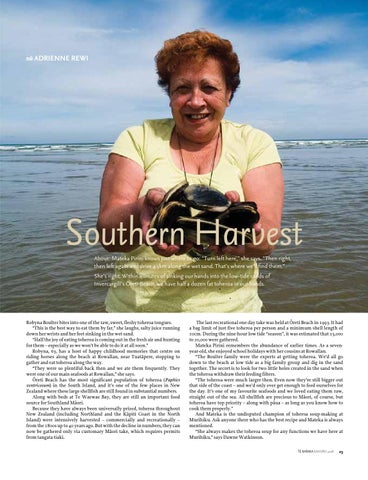
Southern Harvest Above: Mateka Pirini knows just where to go: “Turn left here,” she says. “Then right, then left again and drive 4.5km along the wet sand. That’s where we’ll find them.” She’s right. Within minutes of sinking our hands into the low-tide sands of Invercargill’s Öreti Beach, we have half a dozen fat toheroa in our hands.
Robyna Boulter bites into one of the raw, sweet, fleshy toheroa tongues. “This is the best way to eat them by far,” she laughs, salty juice running down her wrists and her feet sinking in the wet sand. “Half the joy of eating toheroa is coming out in the fresh air and hunting for them – especially as we won’t be able to do it at all soon.” Robyna, 63, has a host of happy childhood memories that centre on riding horses along the beach at Rowallan, near Tuatäpere, stopping to gather and eat toheroa along the way. “They were so plentiful back then and we ate them frequently. They were one of our main seafoods at Rowallan,” she says. Öreti Beach has the most significant population of toheroa (Paphies ventricosum) in the South Island, and it’s one of the few places in New Zealand where these large shellfish are still found in substantial numbers. Along with beds at Te Waewae Bay, they are still an important food source for Southland Mäori. Because they have always been universally prized, toheroa throughout New Zealand (including Northland and the Käpiti Coast in the North Island) were intensively harvested – commercially and recreationally – from the 1800s up to 40 years ago. But with the decline in numbers, they can now be gathered only via customary Mäori take, which requires permits from tangata tiaki.
The last recreational one-day take was held at Öreti Beach in 1993. It had a bag limit of just five toheroa per person and a minimum shell length of 10cm. During the nine-hour low tide “season”, it was estimated that 15,000 to 20,000 were gathered. Mateka Pirini remembers the abundance of earlier times. As a sevenyear-old, she enjoyed school holidays with her cousins at Rowallan. “The Boulter family were the experts at getting toheroa. We’d all go down to the beach at low tide as a big family group and dig in the sand together. The secret is to look for two little holes created in the sand when the toheroa withdraw their feeding filters. “The toheroa were much larger then. Even now they’re still bigger out that side of the coast – and we’d only ever get enough to feed ourselves for the day. It’s one of my favourite seafoods and we loved eating them raw, straight out of the sea. All shellfish are precious to Mäori, of course, but toheroa have top priority – along with päua – as long as you know how to cook them properly.” And Mateka is the undisputed champion of toheroa soup-making at Murihiku. Ask anyone there who has the best recipe and Mateka is always mentioned. “She always makes the toheroa soup for any functions we have here at Murihiku,” says Dawne Watkinson. te Karaka KAHURU 2008
23