Ecotourism
In Nam Et - Phou Louey National Protected Area, Lao PDR This brief outlines the ecotourism model implemented at the Nam Et-Phou Louey National Protected Area (NEPL NPA) in Houaphan Province, Lao PDR (Laos). The ecotourism products at NEPL NPA have been designed to create a direct link between conservation and tourism so that the money that tourists pay has a positive impact on encouraging local people to protect endangered wildlife. This is achieved through both direct employment of local people in service provider groups, and through incentives that provides benefits to a larger number of villages linked to wildlife conservation.
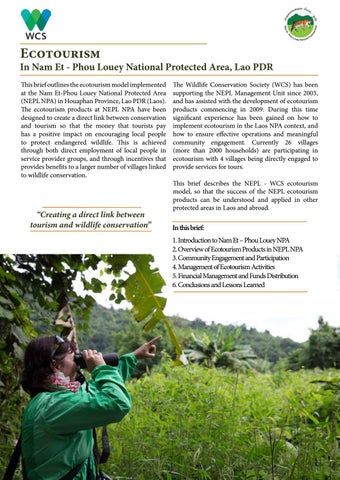
“Creating a direct link between tourism and wildlife conservation”
The Wildlife Conservation Society (WCS) has been supporting the NEPL Management Unit since 2003, and has assisted with the development of ecotourism products commencing in 2009. During this time significant experience has been gained on how to implement ecotourism in the Laos NPA context, and how to ensure effective operations and meaningful community engagement. Currently 26 villages (more than 2000 households) are participating in ecotourism with 4 villages being directly engaged to provide services for tours. This brief describes the NEPL - WCS ecotourism model, so that the success of the NEPL ecotourism products can be understood and applied in other protected areas in Laos and abroad.
In this brief: 1. Introduction to Nam Et – Phou Louey NPA 2. Overview of Ecotourism Products in NEPL NPA 3. Community Engagement and Participation 4. Management of Ecotourism Activities 5. Financial Management and Funds Distribution 6. Conclusions and Lessons Learned
1. Introduction to Nam Et – Phou Louey National Protected Area The NEPL NPA is located in the north-east of Lao PDR and is the largest protected area in country (410,720 hectares). Spanning nine districts across three provinces (Houaphan, Luang Prabang and Xieng Khouang provinces), the protected area is marked by steep mountainous topography, with elevation ranging from 336 to 2257 m. The NEPL NPA is remarkable for its rich wildlife biodiversity with a wide range of species, many endangered, including Tigers, Leopards, Golden Cats, Dholes, Northern White Cheeked Gibbons, Phayres Langur, Sun Bears, Asiatic Sun Bears, Binturongs, Otters, Hornbills, and numerous species of civets, pangolins, and other primates. Altogether there are 19 carnivore species including six species of wild cats, roughly fifty species of mammals and 299 species of birds. Living inside or immediately adjacent to the NPA are 30,000 villagers from 98 communities, many in some of the poorest districts of the country. There is a long history of human settlement in and around NEPL, with local people relying heavily on natural resources for their subsistence. To balance the protection of biodiversity, and the needs of local communities, the protected area is split into 2 primary zones: the Total Protection Zone (TPZ), where strict conservation is the primary objective, and no activities or access are allowed without permission, and the Controlled Use Zone (CUZ), where many villagers practice agriculture and day to day village activities. WCS has been providing technical assistance to support the NEPL Management Unit since 2003. During this time WCS and NEPL have gained valuable experience regarding a range of management activities including: law enforcement and ranger patrolling, ecotourism development and promotion, outreach activities for community engagement, and monitoring of wildlife, forest cover, and threats. Ecotourism activities at NEPL NPA have been developed to provide an alternative livelihood opportunity for local people, and designed to create a direct link between conservation and tourism so that the money that visitors pay has a positive impact on encouraging local people to protect endangered wildlife. This is achieved through active community involvement, and the creation of conservation linked financial incentive mechanisms. The primary aims of the tourism model are to: • Create additional income for local people - linked to conservation • Generate sustainable financing for protected area management • Increase awareness among local people and visitors about the importance of wildlife conservation
2
2. Overview of Ecotourism Products at NEPL NPA There are two ecotourism products at NEPL NPA: the Nam Nern Night Safari, and a series of trekking tours including ‘The Nests’ and ‘The Cloud Forest Climb’.
The Nam Nern Night Safari Opened in 2009, the Nam Nern Night Safari is a 24-hour boat-based tour into the core of the NEPL NPA. The trip involves night-time wildlife spotlighting: long-tail boats drift down the Nam Nern River looking for wild and endangered animals. Additional nature activities during the tour include bird watching, wildlife tracking, and a short morning hike. Visitors to the Night Safari stay overnight in traditional Lao bungalows built and managed by the community. The Night Safari has gained public recognition and international visibility as well as won the ‘World Responsible Tourism Award’ both in year 2013 and 2014. The project currantly employs directly around 40 families and involves 14 villages.
Trekking Tours In 2016, two trekking products with 2 to 5 day itineraries were opened: “The Nests” and “The Cloud Forest Climb”. The trek project benefits 12 surrounding villages and offers visitors an opportunity to track wild species such as leopards, bears and dhole using camera traps which are set up along the trail and maintained by tourists. The data from these camera traps is incorporated into the protected area wildlife-monitoring program. The Nests trek consist of moderate 2 and 3 day trekking options with an overnight stay in spherical baskets hanging from the trees. Near the campsite a wildlife observation tower has been constructed overlooking the Poung Nyied salt lick and offering opportunities to spot wildlife. The Cloud Forest Climb involves a more challenging 4 to 5 day trek up to the summit of Phou Louey (Elev.2257m) – the third highest peak in Laos and one of the few cloud forests in the region. This trek through the evergreen forest includes a homestay in a Khmu village at the start of the tour, followed by camping in jungle huts inside the NPA.
Trekking the Cloud Forest Climb
The Poung Nyied wildlife observation tower
3
The Nests
3. Community Engagement and Participation
Effective and meaningful engagement with communities is a key pillar of a NPA ecotourism program. If benefits and incentives are set up effectively, then tourism development can lead to increased and diversified income and encourage conservation friendly practices at the village level. In addition to the conservation benefits that accrue directly from the ecotourism program, the stronger links and trust that can be forged with local communities can support a much wider range of PA management objectives. Ecotourism benefits for communities at NEPL are through two main activities: providing alternate livelihoods with service provider groups, and through broader community engagement under the Ecotourism Benefits Fund (EBF).
3.1. Alternate livelihoods through the service provider groups Ecotourism service groups have been created in four villages to create employment opportunities for local people. All of the ecotourism sites, trails and infrastructure have been developed and are currently co-managed by people from these ecotourism villages in cooperation with the NEPL NPA. Most of the service group members are former hunters, today being involved in tourism activities as guides, porters, and boatmen. Additionally women service groups are developed providing handicraft, cooking and cleaning services. Each group member has been selected through an open interview process conducted by the NPA Management Unit, with low-income families prioritized in the selection process. In order to spread the benefits of tourism fairly in the village, each participating family is allowed to have membership in only one service group. Fees for the services offered by each group are pre-determined and agreed with villagers in the service group contract and included in the total cost of the tour. In addition to the pre-determined payments, a financial incentive based on visitor satisfaction and on encounters with wildlife (including direct sightings, animal calls, footprints, and scat) by visitors translates into a personal bonus for each of the service providers employed on the tour. All service provider wages and bonuses are distributed to the villagers just after the tour in the visitor’s presence. In order to receive the tourism-linked benefits, all service group members and their households must adhere to the conditions of the contract. Households caught violating the regulations risk losing their position in the service groups. Agreements and Contracting The benefits and obligations for both communities and the protected area that allow the ecotourism model to work are enshrined in a number of instruments: the Ecotourism Benefit Fund (EBF) agreement, service group contracts, and an overarching Community Conservation Agreement. The Community Conservation Agreement provides the framework for the NPAs engagement with the community, and is based on the land use plan developed for target villages. The EBF agreement and service groups contract specify the payment rates, code of conduct, penalties and other clauses specific to each activity. The figure on the right indicates how these agreements integrate with the ecotourism model.
4
3.2. Community Involvement through the Ecotourism Benefits Fund To ensure that communities are incentivised to support conservation efforts, and also share in the benefits that ecotourism brings to the area, an Ecotourism Benefits Fund (EBF) has been introduced. Every visitor taking part in a tour contributes to the EBF as part of the total tour price. All the 26-ecotourism villages engaged in the two tourism products can receive financial benefits from the EBF. To create a direct incentive for conservation, the NPA not only delivers to the villages a fixed amount of money for every tourist going on the tour, but an additional amount is provided depending on the numbers and type of wildlife encountered by the visitors on the tour. All visitors required to fill out a wildlife monitoring form at the end of the trip. To encourage conservation efforts, greater incentives are provided for sightings of rarer species. All collected information on seen wildlife during the tours is recorded on an online database and is further incorporated into the NPA’s wildlife-monitoring program. In addition to these positive incentives for conservation in the ecotourism strategy design, the benefit distribution agreement also outlines disincentives for breaking the protected area’s regulations. For example, if anyone from the ecotourism villages is caught violating the agreement, then the yearly EBF of the respective individual’s village is reduced. The amount of money levied from the law breaking villages is shared equally between other villages or allocated to the NEPL NPA’s Law Enforcement activities. The benefit accumulating can begin again in the next tourism season.
Marbled Cat
Red Muntjac
The money from the EBF is calculated and distributed yearly to all ecotourism villages based on the number of households. The EBF is used to support small-scale village development activities chosen by each village by popular vote, rather than distributing cash payments. For example previously the EBF has supported a medicine bank, materials to fix and build school infrastructure and community meeting halls, improvements to the village’s water sanitation and supply, and been added to existing revolving micro-finance funds.
During the first 7 years, the Night Safari ecotourism activity has generated more than $100’000 to the service provider village 5
4. Management of Ecotourism Activities
Managing ecotourism activities in NPAs requires a The ecotourism unit is responsible for various tourism strong understanding of both tourism business related business related tasks such as: operations (tour development, operations, sales and • Attracting visitors and building income marketing, etc.), and of the conservation objectives (Marketing, Communication, Sales) and values of the protected area (wildlife monitoring, • Ensuring a quality experience for tourists, law enforcement). analyzing tourist feedback and improving the tours to meet and exceed expectations The success of ecotourism activities relies on effective (Trainings, Operations and Maintenance) ongoing planning and management activities, and close communication between numerous actors such • Ensuring effective administrative and financial as: the NPA Management Unit and other government operations, and assess the socio-economic authorities, local communities, supporting NGOs and impacts on participating communities donors, visitors, private tour operators, and the media. (Accountability, Monitoring, Reporting) The NEPL NPA’s ecotourism unit currently consists of non-government, directly employed team members (guides and a tour reservation officer), supported by a WCS ecotourism coordinator and government ecotourism section head. This section directly reports to the NEPL Management Unit. Ecotourism is a relatively new activity for government departments tasked with protected area management, which are typically more focused on conservation and protected area management. For this reason, significant support may be required in the early years of product development and operations. Wildlife camera trap verification on trekking tour
Additional benefits to NPA Management from Ecotourism Activities. In addition to supporting local livelihoods, the ecotourism program can also support a range of other NPA operations and objectives. For example, the NEPL ecotourism products can directly and indirectly contribute to the following NPA programs: • Wildlife Monitoring, including: data collection, recording, and reporting of statistics • Natural Resource Protection and Law Enforcement, including: - Ensuring regular and financially self-sustainable surveys of the protected area - Identifying and communicating Illegal activities and - Communicating protected area regulations to communities • Education and Outreach. Disseminate knowledge to communities and visitors regarding: - The importance of natural resource and wildlife conservation - The local natural environment, culture and history
A well-managed and integrated ecotourism program can support the overall management objectives of the protected area, and support the broader social and development goals of the government. 6
5. Financial Management and Funds Distribution The NEPL NPA’s ecotours are non-profit ventures with the majority of the income from the tours directly benefiting the local communities. Visitors pay one fee for tours, however this payment is distributed in a number of ways to: • Village service provider groups • The EBF for participating villages • The NPA through the entrance fee • The district government office through the district tourism fee • Tour operators through commissions, and • The ecotourism operations account Example: The Night Safari tour price breakdown based on 2 visitors (2016): • 57% Benefits village revenues, 25% 10% 8%
• 8 % Government revenue (tourism district fee and NPA entrance fee), 57%
• 10% Tour operator commission, • 25% Ecotourism operation fund (salary, maintenance, trainings, marketing, etc)
Ecotourism as a Sustainable Financing Mechanism for NPAs and Local Governments Various mechanisms have been incorporated in the tour rates to raise funds for conservation activities. Over time it is anticipated that the funds raised through the tour fees, and the NPA entry fees, will grow to become a significant source of sustainable operational funds for the management of the protected area.
The development of ecotourism products in NEPL NPA would not be possible without support of WCS donors including the World Bank, The European Union, KfW Development Bank, and AFD (Agence Française de Développement). Financial support from WCS donors continues to assist the NEPL Management Unit while it gains the necessary experience and skills to manage the ecotourism products.
7
Conclusions and Lessons Learned The ecotourism products at NEPL NPA have led to gains in both community livelihoods and conservation outcomes, and are a source of pride for participating community members. These products and model implementation have been internationally recognized through the World Responsible Tourism Awards in 2013 and 2014 for community involvement in environmental and wildlife protection, and for the local prosperity and social equity the project fosters. This has been largely attributed to the establishment of the conservation linked incentive mechanisms and the close collaborations with community members, government agencies, tourism private sector and the NPA Management Unit throughout the development and operation of the products. Over the 8 years that the ecotourism program has been implemented, some important lessons have been learned: • Close collaboration with local community and government actors throughout the development and management of the ecotourism projects is essential • Transparency and equity of service group selection and funds distribution is key to maintaining trust • The link between conservation and tourism income must be clear and direct – simply improving villager incomes may not lead to improved conservation, however reducing poverty levels is an essential precondition for improved conservation practice at the village level • The stronger collaboration and communication between the NPA Management Unit and communities can lead to villagers becoming key allies in conservation, and ecotourism can provide a way to meaningfully connect with villages important for the protected area program • A clear strategy and pathway towards financial sustainability is essential from the start so that shorter term plans can support the overall long-term goals for the products and their integration into the overarching NPA management plan.
Developed by:
Nam Et-Phou Louey National Protected Area and Wildlife Conservation Society Laos First published in 2017 Updated in February 2018 For further information, please contact WCS Laos country office: Web: https://programs.wcs.org/laos/ www.NamEt.org Photo Credits: WCSLaos/NEPL NPA, Janina Bikova, Jay White, Dominique Le Roux
With support from:
European Union
6