
Kripa: “Children are victims to a system that limits their imagination”
ByChintan Girish Modi
Published on: Nov 04, 2025 07:45 pm IST
The artist and author on her book Art is a Voice, which won the BolognaRagazzi Award in the Sustainability category, and was shortlisted for the Neev Book Award Advertisement


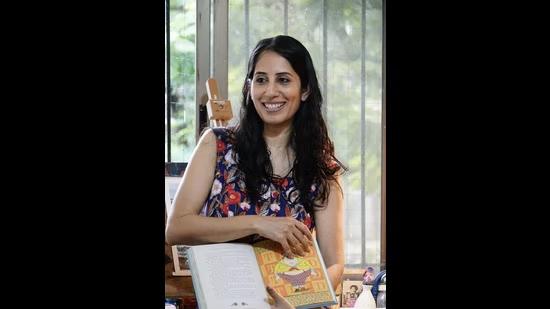
In 2002, when my parents were accompanying me to the National Institute of Design in Ahmedabad, for my entrance exam, a mob stopped the taxi that we were in. They asked my father to step out, asked him a few questions, and then let us go. At the peak of the Godhra riots, we managed to escape unscathed. The 10 days of being stuck on the college campus due to curfew was the time when I first began to probe, in my mind, privilege and religious identity. While we remained safe and well-fed on campus, the city around us was burning. Prior to this incident, I used to see cities, spaces and culture in a romantic and idealistic manner. Gradually, a shift began to take place in my drawing style, as I was no longer interested in aesthetics and idealism but rather in socio-political realism. Why did you zero in on the specific artists you have showcased in this book?
There are artists who are steadfast and devoted to their art and what they stand for by engaging with their subject for several years, like Sudharak Olwe, Vikrant Bhise, Ravi Agarwal and Sudhir Patwardhan. And then there are artists whose art is rooted in identity and community; like Prabhakar Pachpute, Gurjeet Singh, Sudipta Das and the Vayeda brothers. Both Shilo Shiv Suleman’s Fearless Collective and Shabnam Virmani’s Kabir Project exemplify a concerted collective of visual and performative art. These artists were narrowed down as their practice and work fit the 11 couplets in the book.
What kind of research went into this book? Were you able to interact with all the artists, or did you choose to focus only on their work?
Living in a metro city in India, coming with the entitlement of speaking English, which is the language of the elites, and wearing the badge and goodwill of my publisher Art1st
among people in the art world, it was fairly easy to access art works from high-handed art galleries, and interview and meet most of the artists featured in the book. The two artists I could not meet or interact with were Sudipta Das and Tushar and Mayur Vayeda. All the other artists were extremely generous with their time, to meet in person and discuss their practice at length. I did not focus merely on their art pieces but studied their art practice.
How did the book evolve from the initial idea to a physical object? What was it like to work with designer Rohina Thapar?
I wrote the verses as an angry response to a social media brouhaha over a political poster of mine. The poem was much loved and appreciated by my publisher, who commissioned the book. Rohina was introduced from the beginning of the project, and so her role was not only of the designer but she also helped formulate ideas. Rohina has an astute sense of aesthetics. She bears a keen eye for art. She understands the nuances and complexities of art and evidently has presented and laid out each of my illustrations and the artists’ works with great attention and style. The book’s design has minimal edits and an elegant font that stands out yet does not take attention away from the art. She is also the conceptual designer for the interactive elements of the book with its various fold-ins.
How did your academic training and your involvement in activism feed your vision for ArtisaVoice? Which organizations, collectives and movements do you work with?
I am associated with three organisations: Habitat and Livelihood Welfare Association, Red Boys Foundation, and Helping Hands Trust. All are based in Mumbai. These organisations deal with housing, rehabilitation and livelihood rights of marginalised communities. They also run community resource centres (CRCs), which double as libraries and tuition centres for their children. My association with these centres is to curate and facilitate library activities. While working closely with these communities, I come across stories of discrimination and injustice. When I visit international schools, I come across a lack of acknowledgment of privilege and a disassociation with communities that work as staff at the schools. The children in private elite schools, including my own children in their school, participate in mock United Nations and debate social justice but are often shielded from the problems of the local communities. The children in the CRCs sweep the place and clean the toilets themselves in their schools and centres, but the children in elite schools have staff to clean even an accidental spill of water bottles. Through detailed illustrations, I aimed to show these water, food and resource disparities and social intersections.
Your book has these powerful lines: “They tell me, paint flowers/I paint what I see/ Protests, blooming”. Who are these people who tell you what you should paint? What
gives you the courage to rebel?
9, a political journalist retorted at my anti-Citizenship Amendment Act (CAA) p that I must go paint flowers from my garden and leave the political reporting and writing to journalists like her. As a response to her narrow and limited idea of an artist being a visual pleaser, I wrote the lines ‘They tell me paint flowers, Me paint what I see, protests blooming’.
What gives me the courage to rebel is that, with time and age, I have been dissenting and discarding the set societal template of an ideal Indian woman, by dropping my last name, by marital divorce and reordering family and friends, by voicing against my upper caste indoctrination in family circles. Being an artist comes with an advantage of freely wearing my activist badge but standing up for social justice also comes with the disadvantage that funding and financing is often offered by complicit or illicit sources.
To what extent does the art curriculum in Indian schools provide an opportunity to explore art in this way? What are the restrictions and anxieties that teachers face?
In most government schools in India, the art period is limited to drawing stick figures on brown paper and calling it Warli art or ‘best out of waste’ craft projects. Most international schools are also a class apart where study tours take students to art galleries and museums in first world countries or invite Warli and other tribal artists to their literature festivals, and the children get a crash course in Warli art seated in airconditioned classrooms. Art teachers in schools double as prop and backdrop makers for Annual Day or as substitute teachers. The art period is regularly sacrificed for academic subjects as subject teachers are in a race to complete portions. Pre-primary teachers rely more on art and craft. There are ready to assemble craft DIY kits provided to each toddler to minimise mess and effectively complete tasks to impress parents on parent-teacher meet up days with bright display boards. Today, teachers are removed from the social and political context. Art is removed from provenance and community. Children are victims to a system that limits and controls their imagination, and takes away from them the agency to think critically and question.
How did you and your publisher navigate the logistical and financial challenges involved in bringing out such an exquisitely produced book?
750 rupees, which is the price of the book, is exorbitant even for elite urban children. The biggest challenge ahead of us was and is making the book accessible to children from all social backgrounds. The publisher had allotted free copies from the first print run to free community and aided school libraries. But it was merely not enough to hand books to libraries in remote places where language barriers make it inaccessible. An ongoing attempt is to physically visit libraries and schools in remote places across the length and
breadth of the country. The re-printing of the book faced financing challenges, which were sorted after much deliberation.
a Voice won the Bologna Ragazzi Award in the Sustainability category, and was shortlisted for the Neev Book Award. Having received so much love, if you could do a sequel, which artists would you feature?
If there was to be a sequel for Art is a Voice, I would like to include not only Indian artists but international artists as well. Palestinian artist Sliman Mansour documents the suffering of the people of Palestine in a visual language that stirs, moves and compels people everywhere to empathise. Dilara Begum Jolly, the Bangladeshi print maker, feminist and sculptor, creates works that unflinchingly depict discrimination and women’s issues. Khalid Albaih, the Sudanese political cartoonist, stubbornly refuses to succumb to threats and pressures by the political forces to silence him as he draws cartoons about human rights and civil rights.
ChintanGirishModiisajournalist, educatorandliterarycritic. Hisproseandpoetryhave appearedinvariousanthologies. Hecanbereached@chintanwritingonInstagramandX.
NextStory