@ Neev
Curriculum G6-8 Subjects Offered
Curriculum G6-8 - Subjectwise Details
Curriculum G6-8 - Assessment At A Glance
Curriculum G9-10 - Subjects Offered
Curriculum G9-10 - Subjectwise Details
Curriculum G9-10 -
@ Neev
Curriculum G6-8 Subjects Offered
Curriculum G6-8 - Subjectwise Details
Curriculum G6-8 - Assessment At A Glance
Curriculum G9-10 - Subjects Offered
Curriculum G9-10 - Subjectwise Details
Curriculum G9-10 -
“Our highest endeavor must be to develop free human beings who are able of themselves to impart purpose and direction to their lives. The need for imagination, a sense of truth, and a feeling of responsibility—these three forces are the very nerve of education.” ~ Rudolf Steiner
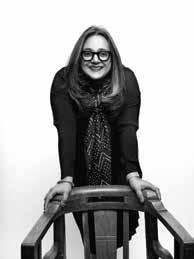
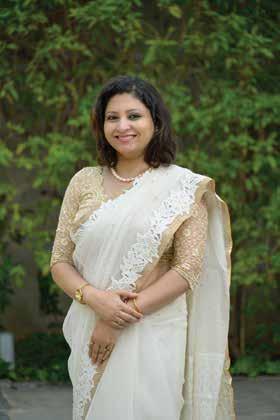
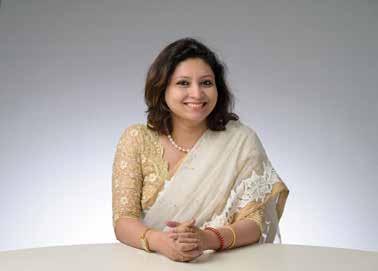
Education in today’s world has evolved far beyond traditional approaches. A holistic and stimulating environment is essential for nurturing the intellectual, emotional, social, and creative development of students in today’s world. At ICSE@NEEV I am proud to say, we are rising to this challenge and are providing each student with the tools and skills required to reach their full potential.
I believe every child is unique and possesses the innate potential to learn and grow. We are committed to providing personalized and innovative learning experiences that celebrate individuality and foster a lifelong love of learning, empowering each child to thrive and succeed. We provide a wide range of extracurricular activities to further develop students’ talents and interests, and to help them discover their passions.
Education here goes beyond the letters in the page of a textbook, and students emerge as confident young individuals, ready to face the evolving challenges of today’s fast-paced world. We inspire our students to question and learn by doing. We impart the knowledge and skills to pursue their dreams, while building integrity of character. In doing so, our students develop into confident, creative adults who not only pursue interesting and challenging careers but also are kind and caring individuals, adding value to the society, creating a better world.
Learning takes many forms here. Each student discovers their own potential in the learning spaces, art room, sports field or on the stage. There are several opportunities for each individual to explore and hone their unique talents. We encourage all our students to persevere, participate and take responsibility for their own development. Through their years at NEEV our students are happy to come to school, as each day is an adventure, with something new and exciting to engage them.
While CISCE curriculum incorporates global perspectives, preparing students to thrive in a multicultural and interconnected world, ICSE@NEEV adds the dimension of education rooted in the Indian context.
With NEP 2020 recommendations we have moved towards more modern pedagogical approaches through experiential learning, interdisciplinary learning, multi modal assessments and learning journeys to promote holistic development and critical thinking. Our vision is to create a community of lifelong learners who are well-equipped to succeed in the world beyond graduation. We believe in partnering with parents and communicating with them to evolve and share the vision of the school for its students.
We are ICSE@NEEV. We are tasked with molding the leaders of tomorrow. We welcome you to join the endeavor.
The Neev academy is an IB school that began in 2005 with the early years program and has been growing since then. Neev adopted the IB curriculum because it is progressive in approach and provides the student agency and flexibility necessary to forward the Neev design of education.
We always wanted to have an Indian curriculum school to cater to the learners who believe in the Indian values and methods of education. The ICSE program at Neev commenced in 2017. It is especially aimed at implementing the Neev design of education for learners who look forward to higher education in India. We want to groom our learners into becoming leaders and change-makers in India and for India.
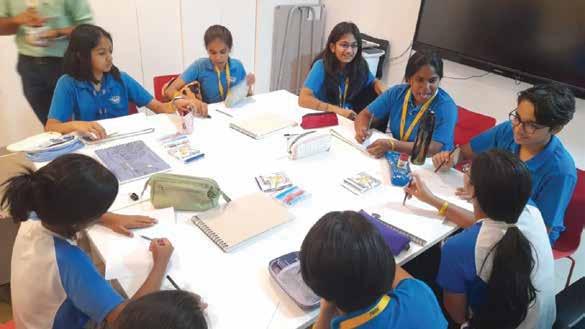
CISCE offers a well-structured comprehensive curriculum that emphasizes holistic education, including academics, extracurricular activities, and moral values and is well known for its academic rigour.
CISCE offers a well-structured comprehensive curriculum that emphasizes holistic education, including academics, extracurricular activities, and moral values and is well known for its academic rigour.
CISCE is recognized nationally and internationally, providing credibility to your academic qualifications preparing her/him for higher education in any part of the world.
CISCE is recognized nationally and internationally, providing credibility to your academic qualifications preparing her/him for higher education in any part of the world.
With NEP 2020 CISCE has moved towards competency-based education, promotion of vocational education, enhancement of teacher training, emphasis on technology-enabled learning. CISCE offers a flexible curriculum that allows students to choose subjects based on their interests and career goals. It incorporates global perspectives, preparing students to thrive in a multicultural and interconnected world.
With NEP 2020 CISCE has moved towards competency-based education, promotion of vocational education, enhancement of teacher training, emphasis on technology-enabled learning. CISCE offers a flexible curriculum that allows students to choose subjects based on their interests and career goals. It incorporates global perspectives, preparing students to thrive in a multicultural and interconnected world.
CISCE as a progressive, autonomous National Board has a rich legacy beginning in 1958 and has its roots in the Cambridge University Examinations, which were conducted in the country at the time. CISCE has always stood firm on its values and principles as stated in its Mission statement and Motto. Our commitment to the student community is unwavering in its stand. The CISCE has excelled in the field of providing a high standard of excellence in education that is reflected in its affiliated schools established over a century ago which still maintain high ideals with traditional values. English forms the base of all communication in the CISCE's global vision, this, in turn, leads to the enhancement and development of strong linguistic skills that are a prerequisite on the global platform.
In the ever-evolving world of education, CISCE has always stood out and pioneered many a change, always adopting and adapting to the global scenario and demands. Presently, with the release of the New Education Policy (NEP 2020) introduced by the Government and the changes proposed, CISCE too will be making suitable course corrections to be in sync with these proposals.
The Council for the Indian School Certificate Examinations conducts three examinations, namely, the Indian Certificate of Secondary Education (ICSE—Class X); The Indian School Certificate (ISC—Class XII), and the Certificate of Vocational Education (CVE—Year 12). The subject choices and syllabuses prescribed for these examinations are varied and aimed at nurturing the unique gifts of individual pupils.
CISCE has approximately 2750 affiliated schools across India (29+ States & UTs) and 5 countries abroad, as of date with 350,000 candidates for ICSE, ISC, CVE Examination 2022, and 130 subjects offered in ICSE and ISC.
The Council for the Indian School Certificate Examinations is committed to:
- Serving the nation's children.
- Ensuring high-quality educational endeavors.
- Empowering them to contribute towards a humane, just, and pluralistic society.
- Promoting introspective living.
- Creating exciting learning opportunities.
- Providing excellence in education.
To prepare the future generation of learners to meet the challenges of an ever-advancing knowledge-based society and a dynamically changing environment, it is imperative that learners are equipped with a repertoire of skills and a positive attitude with a sensitised perspective to become successful citizens in a globally competitive society.
The Curriculum caters to a varied and diverse range of individual differences, intelligence, and abilities and provides a plethora of opportunities to enjoy the learning experience through the integration of generic skills, values, and attitudes in key learning areas.
The Association helps upskill the teaching faculty and design a yearly common calendar. Furthermore, it enables the schools to organize and execute various competitions for the students of the member schools. Our ICSE students get the opportunity to participate in various Inter School competitions organised by KISA member schools.
Matters pertaining to the Karnataka Education Act, State Government Portal SATS, RTE, NEP, CISCE examinations,
List of competitions that would be conducted by KISA are discussed in the meetings of leaders and also matters pertaining to the national Body that is ASISC -India.
The Association helps upskill the teaching faculty and design a yearly common calendar. Furthermore, it enables the schools to organize and execute various competitions for the students of the member schools. Our ICSE students get the opportunity to participate in various Inter School competitions organised by KISA member schools.
Matters pertaining to the Karnataka Education Act, State Government Portal SATS, RTE, NEP, CISCE examinations, List of competitions that would be conducted by KISA are discussed in the meetings of leaders and also matters pertaining to the national Body that is ASISC –India.
English - Literature & Language
Second Language - Hindi, French, Spanish
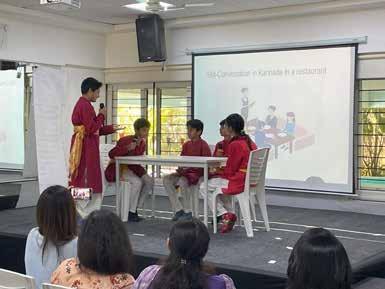
Third Language - Kannada
Social Sciences - History & Civics, Geography
Socially Useful Productive Work (SUPW)
Mathematics
Science - Physics, Biology & Chemistry
Computer Science
Art - Western Music, Visual Art & Drama
Physical & Health Education (PHE)
Aim:
- To develop and integrate the use of the four language skills i.e. Reading, Listening, Speaking and Writing.
- To enable the learner to communicate effectively and appropriately in real-life situations.
- To develop an interest in and appreciation of literature.
Curriculum:

Aim:
- To enable the students to use the language effectively and appropriately in everyday life situations.
- To develop an interest in the appreciation of Spanish/French.
- To create an intercultural awareness.
Curriculum:
A. Listening: To help the students learn a foreign language with correct pronunciation and acquire good speaking skills. It helps students pick up new vocabulary. It also helps to develop the ability to receive meaning by listening.
B. Speaking: To enable the students to develop linguistic fluency. To enable the students to express ideas fluently and coherently on specific topics in the target language.
C. Reading: To develop the ability to read actively and assimilate the information to answer a given set of questions.
D. Writing: Students must be able to translate a text, interpret and produce a grammatically correct text. To enable students to express their ideas and feelings in their own words.
Aim:
- To write, read and understand the local language.
- To understand and communicate with local people.
- Understand the local culture and the lifestyle.
Curriculum: Language Curriculum
Aim:
The aim for studying History is to understand the past and the connection it has with the present world. It will help students understand the world in which they live and plan for the future. Civics helps them to understand socio-political our life and Constitutional values.
Curriculum:
Grade 6
River Valley Civilizations (Mesopotamia, Egyptians, Harappan and Chinese)
The Vedic Civilization
Great Preachers - (Mahavira and Buddha)
Rise of Kingdoms and Republicans Empires (The Mauryas and the Guptas)
Local Self Government- (Rural and Urban)
Grade 7
Medieval Europe- Rise and Spread of Christianity
Rise and Spread of Islam
The Delhi Sultanate
The Vijaynagar and Bahmani Kingdoms
The Mughal Empire Making of Composite Culture
The Constitution of India.
Directive Principles of State Policy
Grade 8
A Period of Transition
The Growth of Nationalism India in the 18th century Traders and Rulers
British Policies and Impact
The Great Uprising of 1857
Socio-Religious Reforms
India's Struggle for Freedom
Aim:
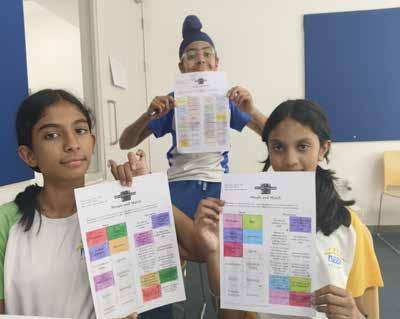
The teaching of geography in grades 6, 7, and 8 seeks to cultivate students’ spatial awareness and comprehension of Earth’s physical attributes. The curriculum also aims to develop an understanding of resource management, the intricate relationship between human activities and the environment, and the socio-economic factors influencing different regions. The curriculum aims to produce well-rounded individuals who are knowledgeable about the Earth's intricacies, culturally sensitive, and equipped to contribute positively to a sustainable future.
Curriculum:
Aim:
• Understand the basic structure of Mathematics: Arithmetic, Algebra, Geometry.
• Use abstraction to perceive relationships, to see structure, to reason about things, to argue the truth or falsity of statements.
• To see Mathematics as something to talk about, to communicate, to discuss among themselves, to work together on.
• Pose and solve meaningful problems.
Curriculum:
Aim:
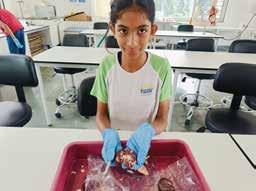
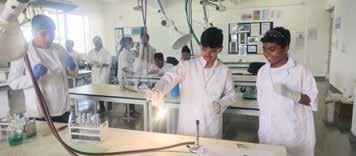
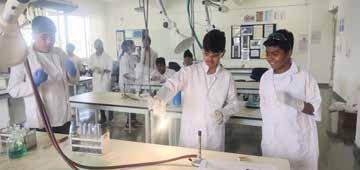
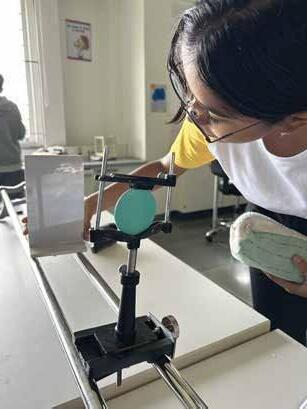
To provide students with a foundational understanding of fundamental principles and concepts related to science. At this level, the focus is on introducing students to the basic laws of science and their applications, fostering curiosity, and developing observation skills.
Curriculum:
PHYSICS
Basic Principles
Motion and Forces
Energy
States of Matter
Simple Machines
Sound and waves
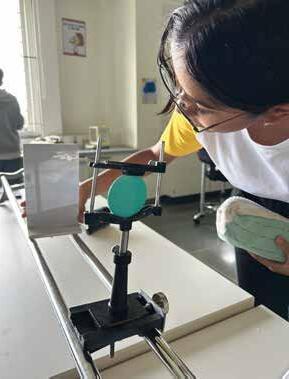
Light and Optics
Electricity and Magnetism
Scientific Inquiry, problem-solving, and mathematical application.
Basic Understanding of Matter
Atomic Structure
Chemical Reactions
Periodic Table
Chemical Bonds
Acids and Bases
Solutions and Mixtures
Chemistry in Everyday Life
Organic Chemistry and Nomenclature
Laboratory Skills
BIOLOGY
Plant Life
The Cell
Human Physiology
Plant Physiology
Habitat And Adaptation
Transport In Plants
Tissues
Life Processes
Ecosystem
Health And Biotechnology
Laboratory Skills
Aim:
Computer Science curriculum for middle school introduces students to the fundamentals of computer science and provides them with a foundation in programming and problem-solving skills. Students become competent, confident, responsible, and critical users of technology. They develop awareness regarding the developments and emerging issues concerning computing and society.
Curriculum:
Grade 6
Computer Categories And Languages Of Computers.
Data Organising Techniques And File Management.
Word Processor And Its Features.
Visual Effects And Presentation Software.
Game Creation Introduction And Scratch Programming.
Introduction To Html.
Online Surfing And The Internet.
3D Modelling
Grade 7
Computer – Hardware Components
Number SystemIntroduction
Computer Virus
Ethics And Safety Measures In Computing
Introduction To Spreadsheet
Database And DBMS
Html- Advanced Features
Programming & ProblemSolving
Grade 8
Os And Gui - Role And Functions
Spreadsheet - Functions And Charts
Algorithms And Flowcharts
Program Coding - Introduction To Java
App Development Networks
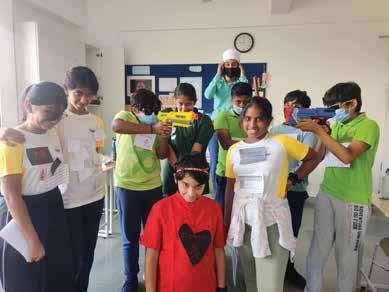
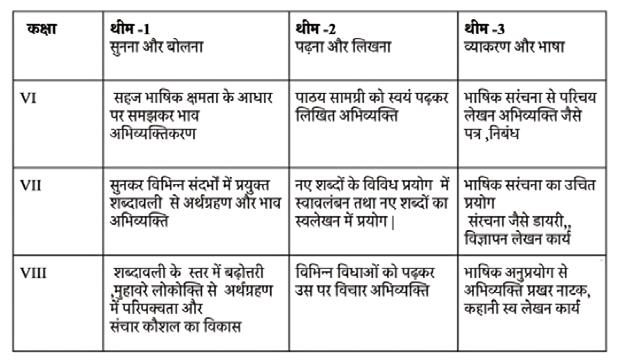
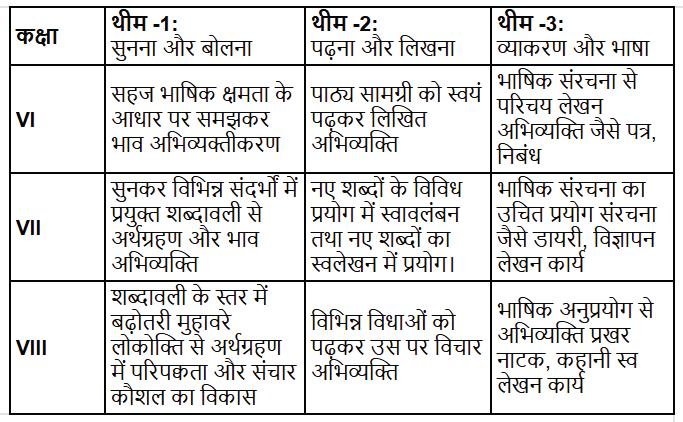
Aim: The emphasis of Art Education at this stage is on development of creative expression and expression through visual art forms. Art Education follows a theme based approach in this curriculum, wherein efforts have been made to provide suggestions for integration of Art Education with other curricular areas.
Curriculum: At the upper primary level the themes dealt with in the curriculum for Classes VI, VII and VIII are:
The unit test and term exam consist of written papers.
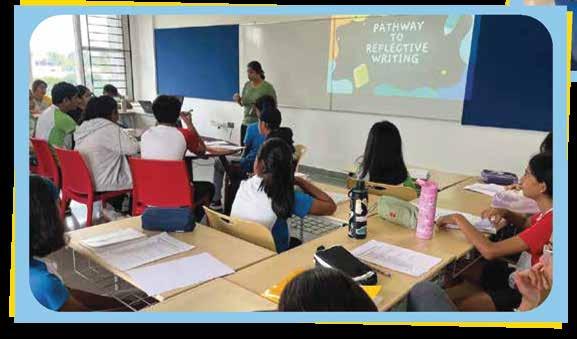
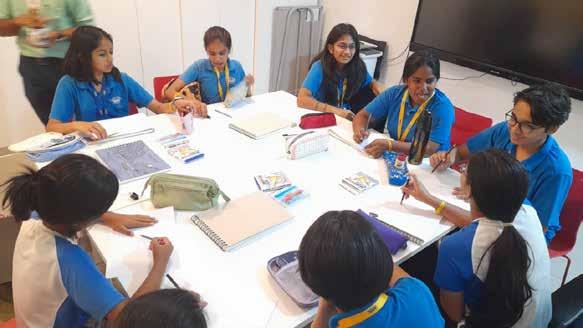
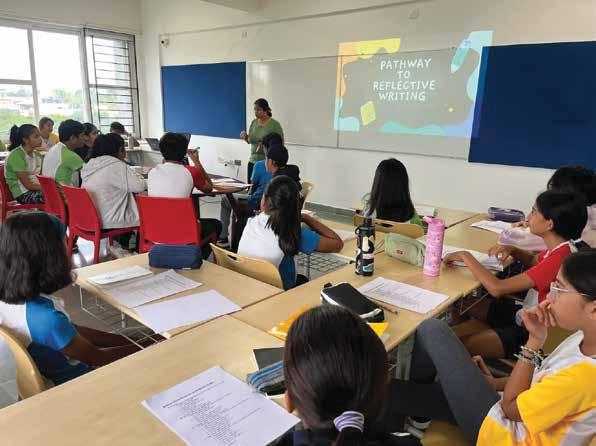
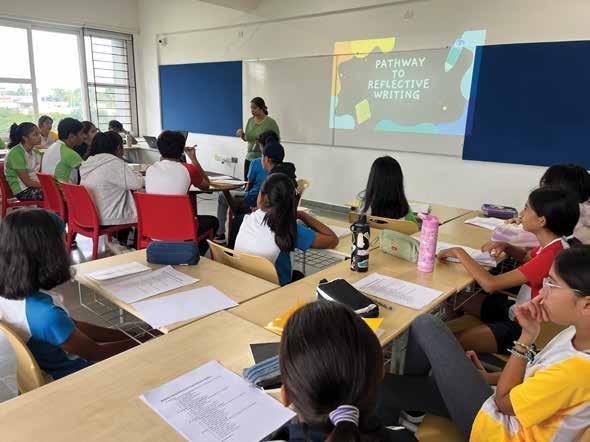
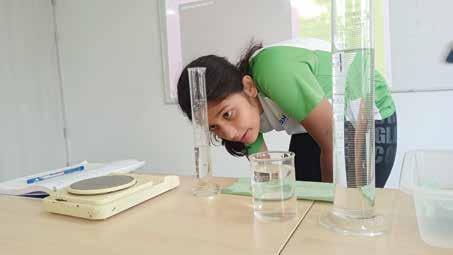
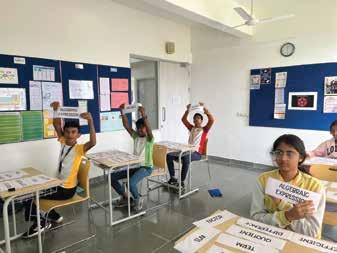
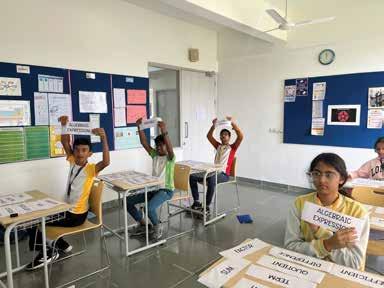
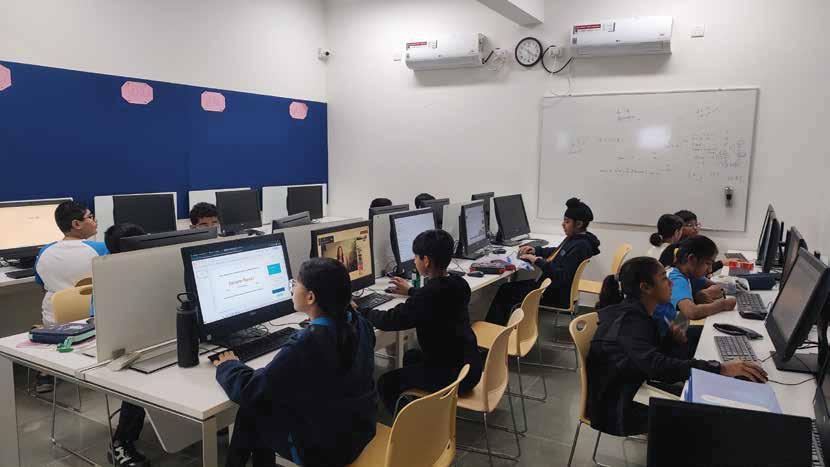
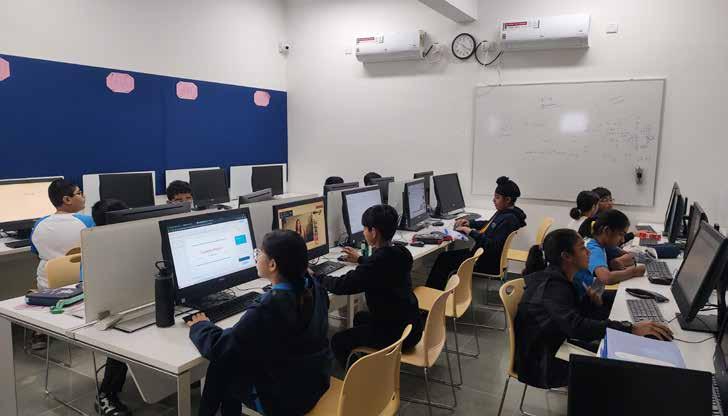
At ICSE@NEEV the internal assessment are multimodal empha sizes on higher order thinking skills. They are aligned with our Definition Of Learning (DOL), designed to develop skills through experiential learning. Students also engage in open ended projects of each subject that necessitate research, analysis, problem solving, peer reviews and presentation skills. Reflec tion-Integrated Assessment: Reflection is embedded in every aspect of the ICSE journey at Neev, encouraging students to think critically about their learning and personal growth. Struc tured opportunities for introspection ensure that students connect classroom knowledge to real-world contexts. By embedding reflection into the assessment process, students critically evaluate their own learning, recognize growth areas, and set personal goals.
At ICSE@NEEV the internal assessment are multimodal emphasizes on higher order thinking skills. They are aligned with our Definition Of Learning( DOL), designed to develop skillls through experiential learning. Students also engage in open ended projects of each subject that necessitate research, analysis, problem solving, peer reviews and presentation skills. Reflection-Integrated Assessment: Reflection is embedded in every aspect of the ICSE journey at Neev, encouraging students to think critically about their learning and personal growth. Structured opportunities for introspection ensure that students connect classroom knowledge to real-world contexts. By embedding reflection into the assessment process, students critically evaluate their own learning, recognize growth areas, and set personal goals.
To help the grade 6 students have a smooth transition into this assessment system, they are exempted from the unit test. The term 1 exam comprises 40 marks. Second term onwards they follow the above pattern.
Group 1 (Compulsory)
First language English
Second language (Hindi/French/Spanish)
History & Civics
Geography
Group 2 (Compulsory)
Science (Physics, Chemistry & Biology)
Mathematics
Group 3 (Compulsory)
Any One
Computer Applications
Economic Applications
Visual Art
Western Music
Compulsory grade subject - Socially Useful Productive Work (SUPW)
Listening
The student accurately understands the central idea of the discourse/passage, understands the context, and can correlate the ideas to other areas of knowledge.
Speaking
The student speaks with fluency and appropriate pronunciation; has full operational command over language and can articulate original relevant matter, rich in content.
Reading
The student reads and comprehends new passages from diverse contexts; can make appropriate inferences and express the central thoughts in the form of a succinct summary.
Writing
The student writes informative texts or imaginative stories to convey ideas, and points of view clearly with the appropriate planning, organization, and analysis; effectively use diverse styles of writing appropriate to the audience and chosen content.
Writing
Grammar
Parts of Speech
Direct and Indirect Speech
Active and passive voice
Synthesis of Sentence
Transformation of Sentences
Literature Writing
Comprehension
Summary
Informal Letter
Formal Letter
Notice
Narrative Essay
Descriptive Essay
Story Writing
Persuasive Essay
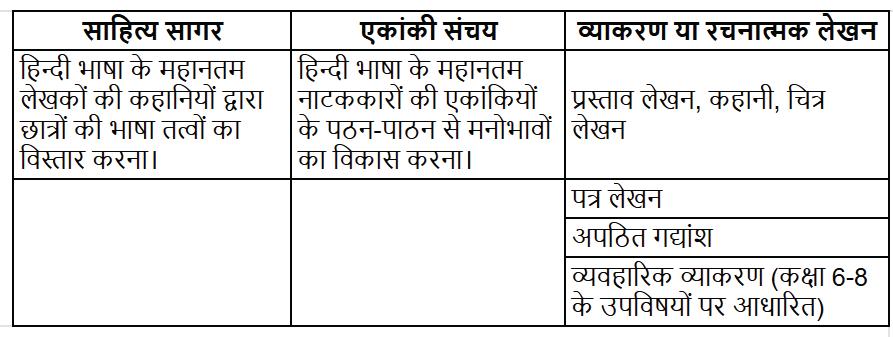

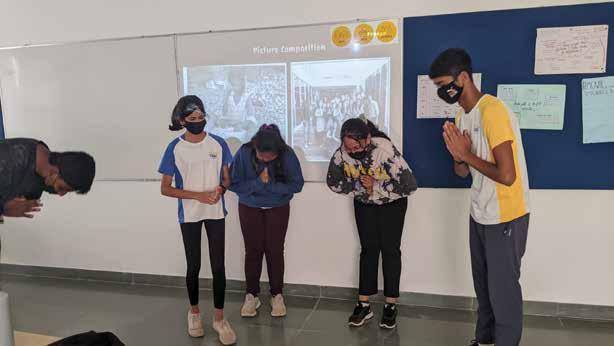
Aim:
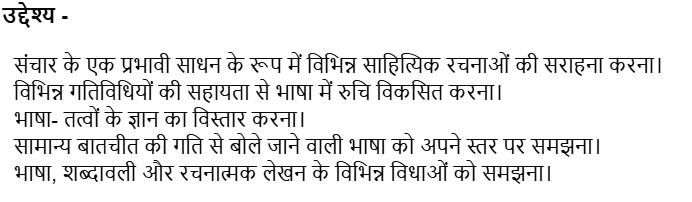
• The aim is to develop and integrate the use of the four language skills i.e. listening, speaking, reading and writing.
• To understand language when spoken at normal conversational speed in frequent everyday life situations.
• To appreciate the language as an effective means of communication patterns of the language, vocabulary, and constructions.
Curriculum:
A Listening : To develop the competency to understand a text of about 300 words dictated, completely and accurately.
B Speaking : To enable the students to develop linguistic fluency.
To enable the students to express ideas fluently and coherently where the topics will include narrating an experience, providing a description, giving directions, expressing an opinion, giving a report, relating an anecdote, or commenting on a current event
C Reading : To develop the ability to read actively a text of about 150 words and assimilate the information to answer a given set of questions.
D Writing : To enable students to express their ideas and feelings in their own words.
To develop the writing skills required to write, a composition which may include short explanations, directions, descriptions or narratives in Spanish or French.
Aim:
• To provide an understanding of the working of the Indian Government necessary to grow into responsible, enlightened citizens in a secular democracy.
• To enrich the understanding of those aspects of Indian historical development which are crucial to the understanding of contemporary India.
• To awaken a desirable understanding in the pupils of the various streams which have contributed to the development and growth of the Indian nation and its civilisation and culture.
• To develop a world-historical perspective of the contributions made by various cultures to the total heritage of mankind.
Curriculum:
The Harappan Civilization
The Vedic period
Jainism and Buddhism
The Sangam Age
The Age of the Guptas
Medieval India - The Cholas, the Delhi Sultanate, the Mughal Empire
Medieval India - Composite Culture
The Modern Age- Renaissance, Reformation and Industrial Revolution
Our Constitution and Salient Features
Mass Phase
The Contemporary World
Union Legislature The Union Executive The Judiciary
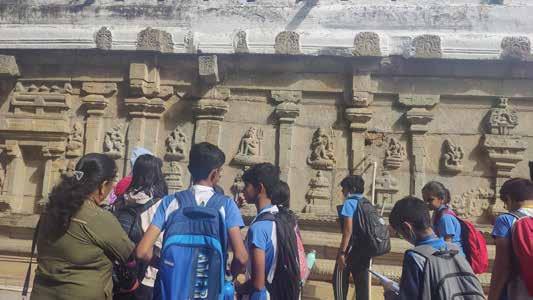
Aim:
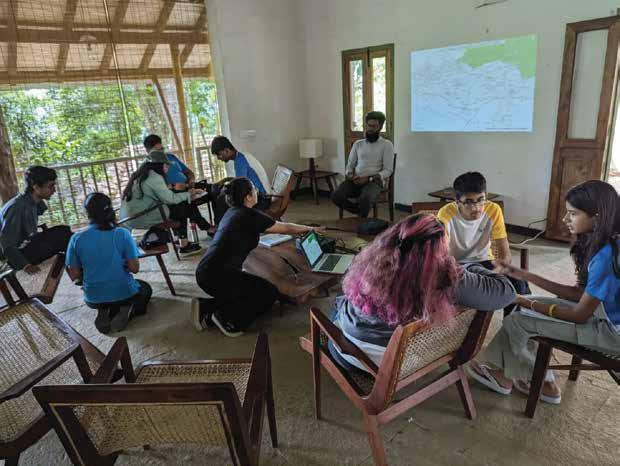
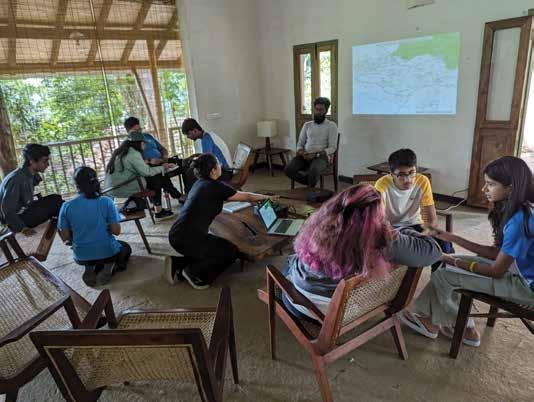
To cultivate a solid foundational knowledge of Earth's physical and human attributes. This encompasses developing spatial awareness, comprehending geological and environmental processes, recognizing cultural and economic influences, and honing critical thinking skills for analyzing spatial data and patterns.
Curriculum:
Aim:
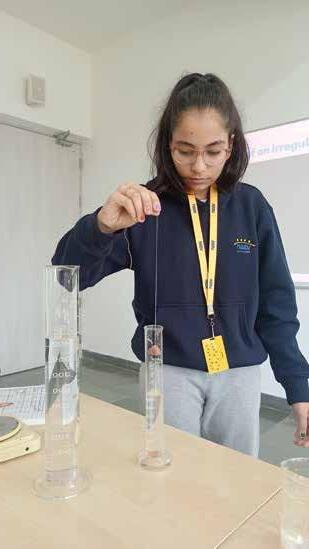
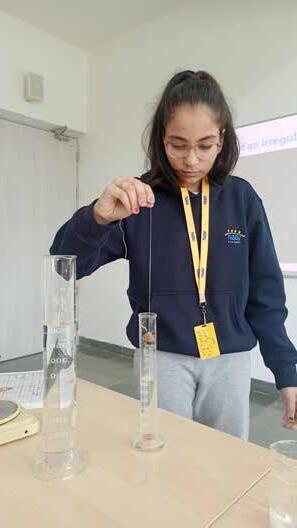
The aim of teaching science to grade 9 and 10 students is to further deepen their understanding of the principles and concepts of sciences and prepare them for more advanced studies in the subject. At this level, the objective is to develop critical thinking and problem-solving skills leading to a scientific temper.
Curriculum:
PHYSICS
Mechanics
Pressure
Work, Energy, and Power
Thermodynamics
Electricity and Magnetism
Optics
Heat
Sound and waves
Modern Physics
Atomic and Nuclear Physics
Scientific Inquiry and Data Analysis, Mathematical Applications
Advanced Atomic Structure
Chemical Bonding
Stoichiometry
States of Matter and Gas
Laws
Chemical Equilibrium
Acids, Bases, and Salts
Redox Reactions
Organic Chemistry
Electrochemistry
Environmental Chemistry
BIOLOGY
Flowering Plants
Plant Physiology
Diversity In Living Organisms
Diversity In Living Organisms
Human Anatomy And Physiology
Health And Hygiene
Waste Generation And Management
Basic Biology
Plant Physiology
Human Anatomy And Physiology
Population
Evolution
Pollution
Aim:
• To enable the students to solve mathematical problems of daily life.
• To enable the students to understand the contribution of mathematics to the development of culture and civilization.
• To prepare a sound foundation needed for various vocations. Mathematics is needed for various professions such as those of engineers, bankers, scientists, accountants, statisticians, etc.
• To develop in the child desirable habits and attitudes like hard work, self-reliance, concentration, and discovery.
Curriculum:
Aim:
The computer applications curriculum for Grades 9 and 10 aims to develop problem-solving abilities, logical reasoning, and creativity in students through the study of programming concepts and software development. The syllabus also aims to foster critical thinking by encouraging students to analyse and evaluate different technological solutions to real-world problems.
Curriculum:
Introduction To Oop Concepts
Elementary Concepts Of Objects And Class
Values And Datatypes
Operators In Java
Input In Java
Mathematical Library Methods
Conditional Statements
Iterative Constructs
Nested Loops
Computing And Ethics
More On Basic Input/output
Project Work
Revision Of Class IX Syllabus
Library Classes
Arrays (1d & 2d)
String Handling
User Defined Methods
Class As The Basis Of All Computation
Constructor
Encapsulation And Inheritance
Project Work
Aim:
To provide students with a foundational understanding of essential economic principles and their practical significance. The curriculum seeks to promote economic literacy, enabling students to grasp real-world economic issues, make informed decisions, and participate meaningfully in societal and global economic contexts.
Curriculum:
Meaning and Definition of Economics
Basic Economic Entities
Basic Problems of an Economy
Types of Economies
Characteristics of Indian Economy
Main Sectors of the Indian Economy: Agriculture
Main Sectors of the Indian Economy: Industry
Main Sectors of the Indian Economy: Services
Other sectors of the Economy
Economic Infrastructure
Social Infrastructure
Consumer Awareness
Elementary Theory of Demand
Elasticity of Demand
Theory of Supply
Factors of Production
Nature and Structure of Markets
The State and Economic Development
Meaning and Functions of Money
Commercial Banks
Central Banks
Inflation
Aim:
To acquire a knowledge of artistic terms, facts, concepts, theories, and principles in drawing and painting through imagination, creativity, expression, aesthetic sense, organization, observation and interpretation.
Curriculum:
Introduction to Still Life (paper 1) through the works of various artists
Learning about the proportions of still life making
Making simple pencil drawings placing the basic geometric forms
Observation study of simple objects
Introduction to imaginative composition (paper 3)
Framing Figurative Composition
Drawing Human figures in different postures and positions
Practising composition from last year's question paper.
Detailed observation study of the objects with watercolor. (paper 1)
Observation study of natural objects (like foliage study, dried twig study, etc) using watercolor
Working on finishing and detailing of observation study using watercolor.
Detailed still life study with 5 or more objects along with the drapery
Developing composition-making from regular and daily life experience (paper 3)
Making the imaginative composition using watercolor.
The final study on human figure details using watercolor.
Practising composition from last year's question paper.
Aim:
To develop a perceptive, sensitive, and critical response to music in its historical and cultural contexts, to stimulate and develop an appreciation and enjoyment of music through active involvement, to balance the demands of disciplined skills and challenging standards in an environment of emotional, aesthetic, imaginative and creative development and to develop performing skills, and so encourage participation in the wide range of performance activities likely to be found in the school and community.
Curriculum:
Grade 6
PART A
Musical Instruments
Sound production and playing techniques
Forms of Music
Definition, structure, and Analysis
Life and Works
Technology in Music
Electronic Music: Definition and scope, description of the Theremin and the Moog Synthesizer. 190
Basic knowledge of the following genres - Industrial, House Music, Drum & Bass, Dubstep, Electro House. DAW (Digital Audio Workstation)
PART B
Grade 4 practical exam of any recognised board like TCL, ABRSM, LCM
Life and Works
Life & works and unique contribution of the following composers: Bach, Handel, Haydn, F. Schubert, PI Tchaikovsky, J. Brahms, A. Dvořák.
Personal Experience as a Musician
For Group 1 and Group 2 subjects:
For Group 1 and Group 2 subjects:
• The Unit Test and Term Exam consist of written papers.
• The Internal Assessments can be multimodal, depending on the requirement of the subject and the cohort.
Students are expected to engage in a community service project throughout the year. They maintain records and evidence of their work. They are encouraged to do reflective writing about their service.
The school teachers assess the service project undertaken by the students and assign grades for SUPW.
The student cannot appear for the ICSE board examination unless s/he receives a pass certificate for SUPW from the school
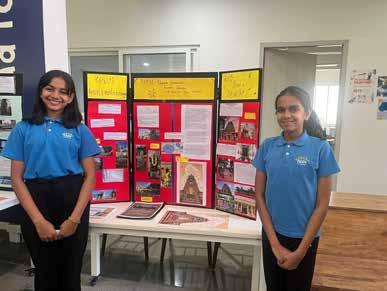
Since 2022-23, we have introduced interdisciplinary learning in the ICSE program. Interdisciplinary learning is a modern pedagogy that expects learners to approach real-life situations by integrating their learning from various disciplines. It deepens learning by breaking down the walls between disciplines and making learning contextual.
It has been structured into one learning unit comprising two main disciplines and Kannada as the supportive discipline. This interdisciplinary learning unit extends over a period of five to six months. The learning achieved by the students is presented to the parent cohort at the end of the unit.
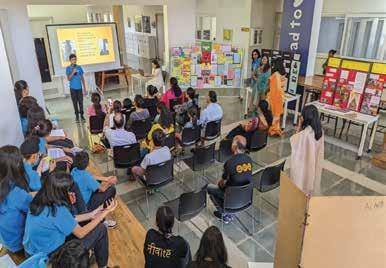
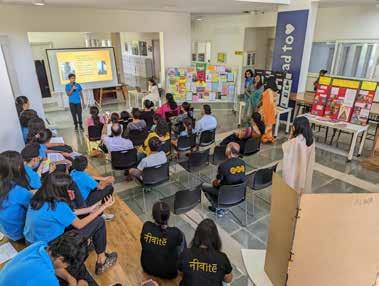
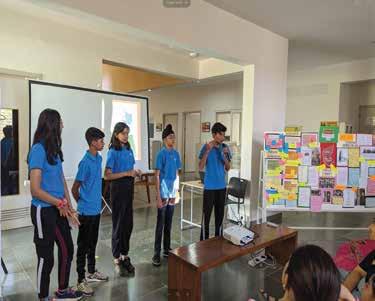
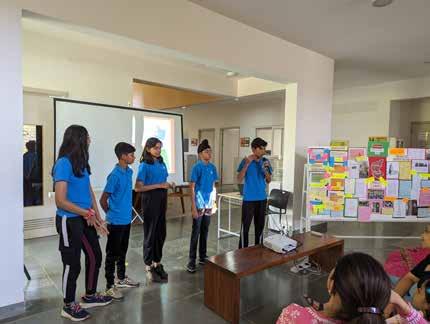
The ICSE board examination is a written examination conducted in the last week of February every year. It usually lasts for one month. Students from all ICSE schools across the country appear for this examination. The entire process is conducted and monitored by the CISCE. The results of this examination are declared by CISCE around the last week of May.
SSC results are taken from the best five of six subjects viz. English (compulsory), Second language, History & Geography, Science, Mathematics, and Electives.
The standard reached in Socially Useful Productive Work (Internally Assessed) will be shown on the result sheets by grades A, B, C, D, or E; A being the highest and E the lowest. A, B, C, or D indicates a pass and E a failure.
The National Admissions and Accreditation agency in the United Kingdom - UCAS (Universities and College Admission Services) has recognized the ISC at par with the Higher School qualification of the University of Scotland.
Is It Right For You? Deciding if the ICSE exam is right for you partly depends on how you learn and your future aspirations. The ICSE system is comprehensive but rigorous as it aims to provide practical knowledge and build analytical skills in students. The curriculum places emphasis on all the subjects and also has selection built into the process. Students who are interested in careers in management and humanities will find the curriculum to be better aligned. Additionally, the ICSE certification is recognized globally and due to the emphasis placed on English, students can gain a slight advantage compared to other Indian boards.
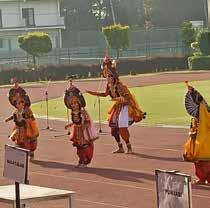
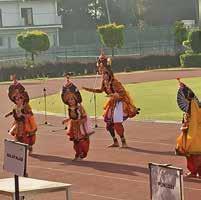
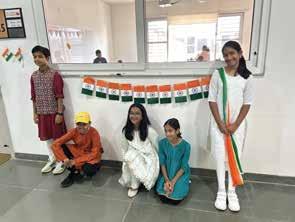
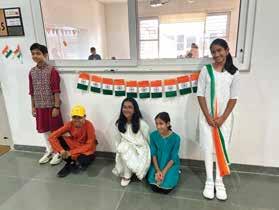
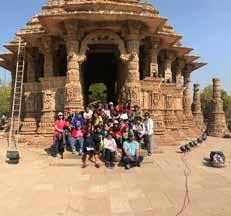
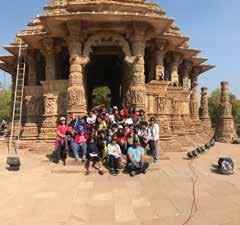
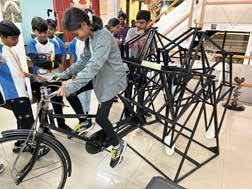
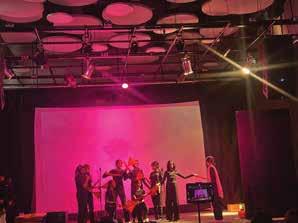
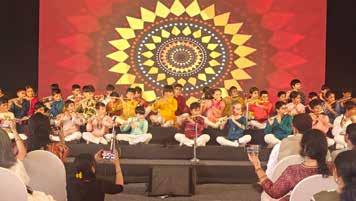
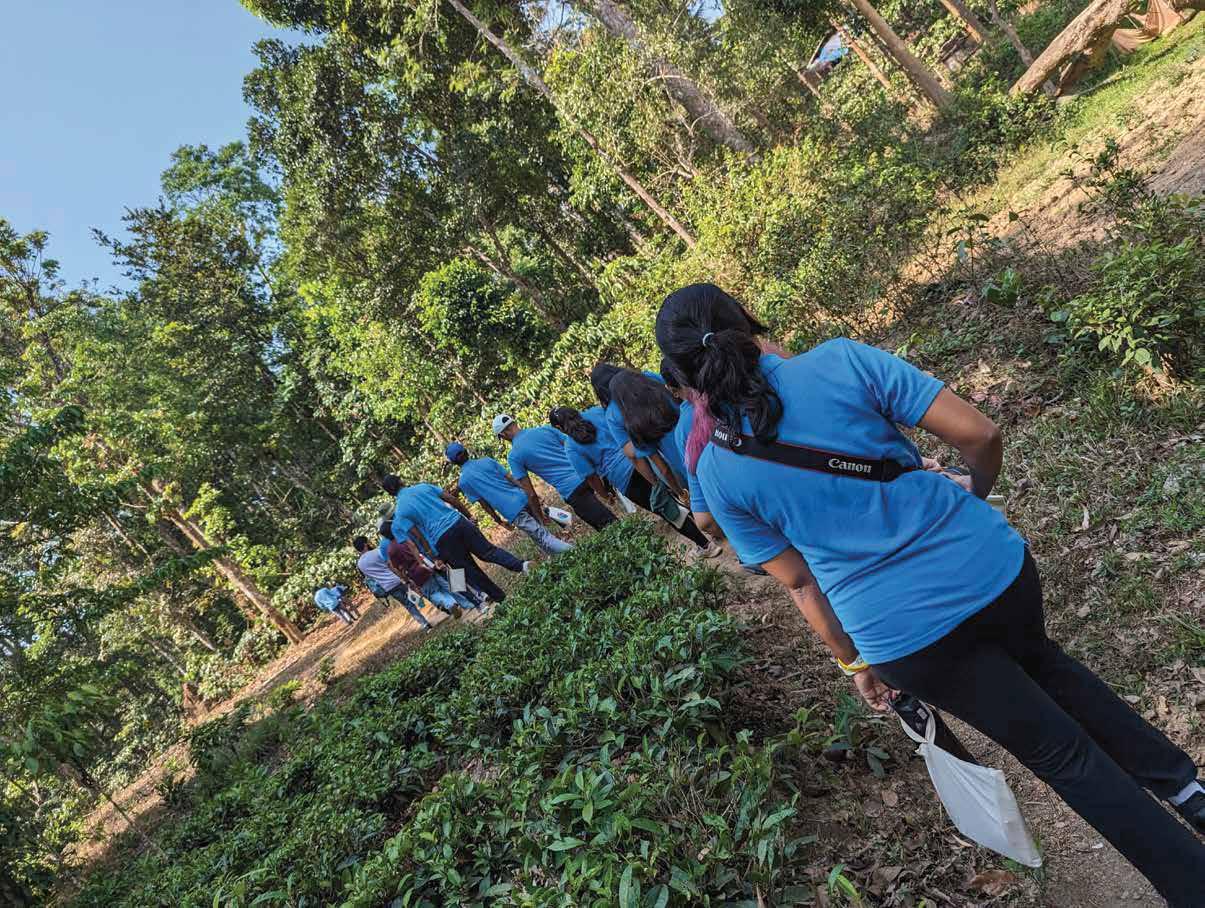
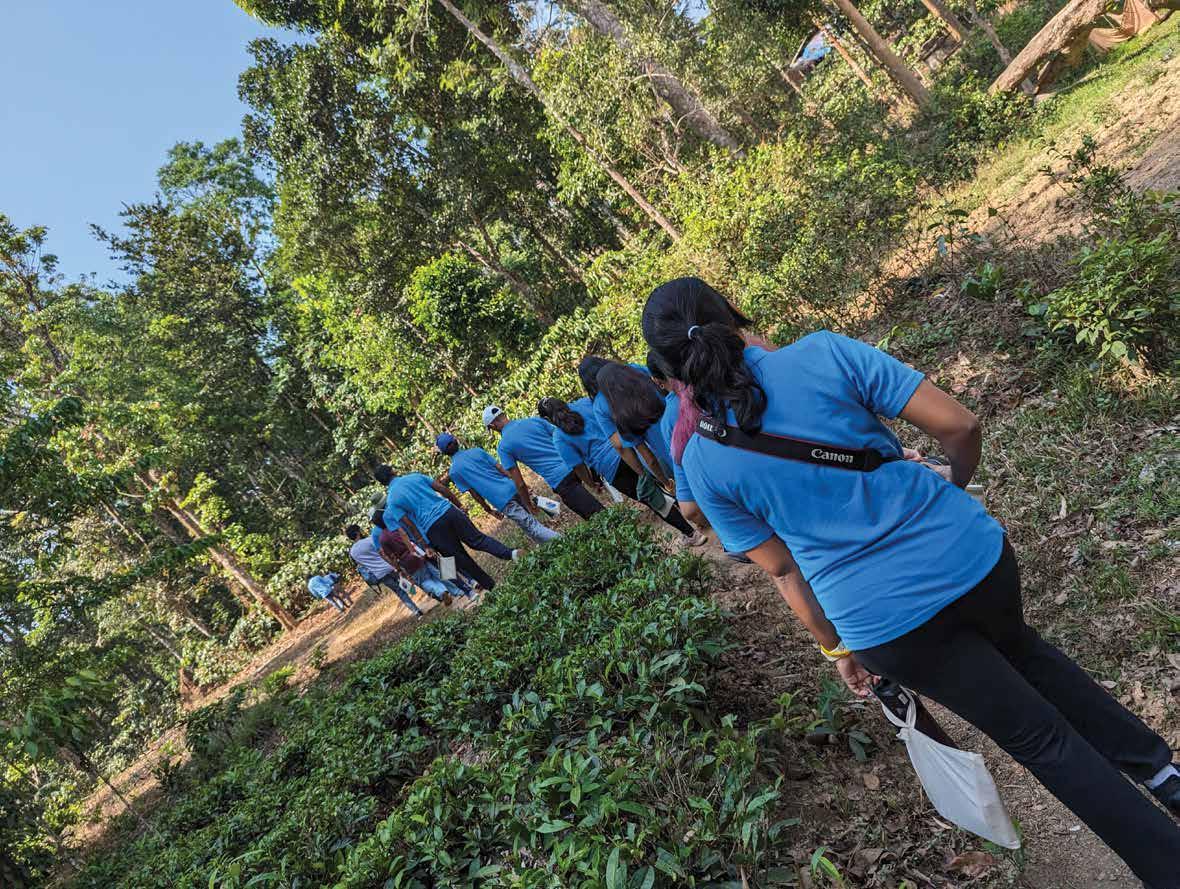
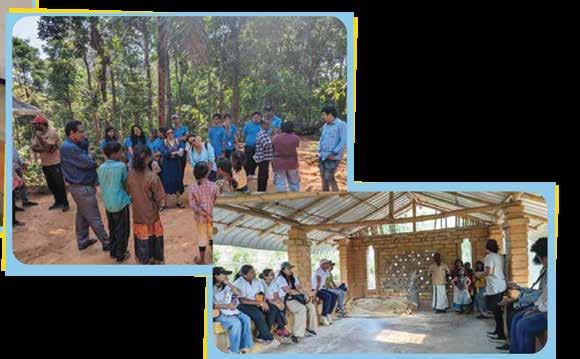
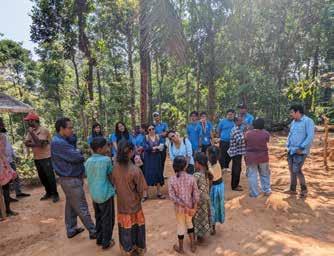
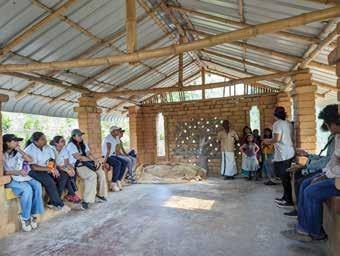
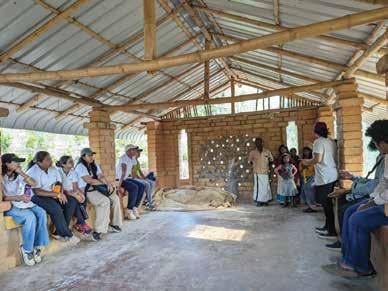
Every year on our learning journeys students explore the wonders of nature and experience the enigma of history, realizing India in all her reality and grandeur. Our DP learning journey, which typically takes place in grade 11, usually covers more than one north eastern state, to understand this distant part of India in an experience that naturally leads to a conversation on ‘what does it mean to be Indian?’ This learning journey has been organized to give our diploma programme students a chance to experience Nagaland, as it is in many ways representative of the entire region with the diversity of ethnicity and language, and as one of the world’s greatest biodiversity hotspots and for natural beauty, much of it protected by the indigenous knowledge and traditions of its peoples. Climate, landforms, economic progress and biodiversity act as the background for a conversation on culture and identity, and indigenous knowledge systems, as children push themselves intellectually with reading, thinking, questioning; socially by building self-awareness and relationships; and physically with a trek that is at once challenging and incredibly beautiful.
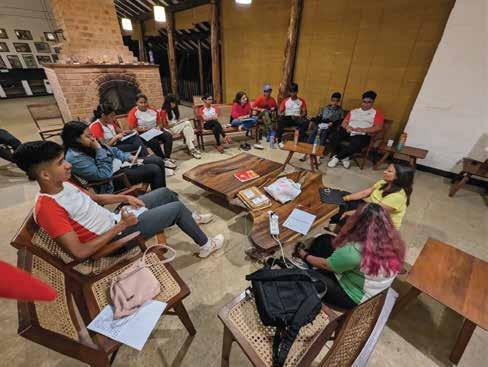
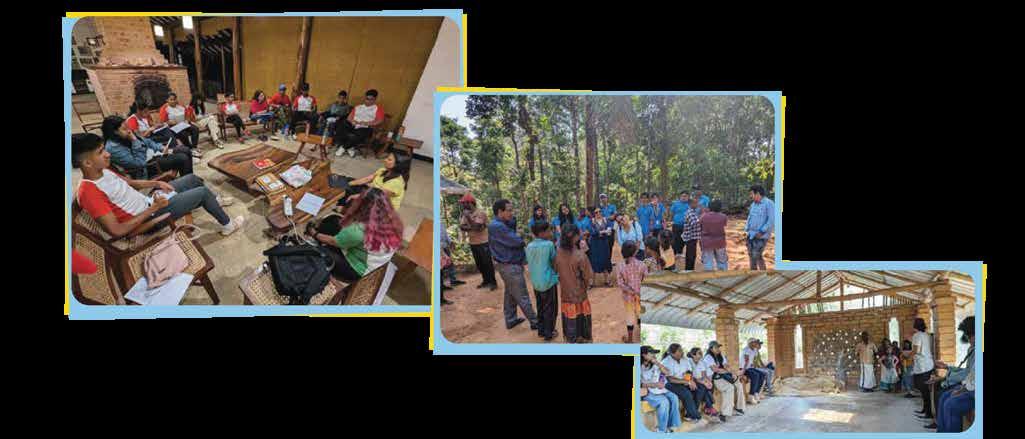
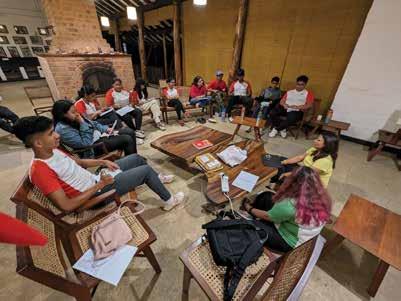
Student Advancement Cell (SAC) at Neev Academy provides each child with support, services and opportunities to motivate them in growing and exploring their interests and passions while recognising their strengths and challenges in turn assisting them to be - college, career and citizen ready.
• Academic support by the Learning Support team, helping in recognising and approaching challenges in meeting academic requirements.
• Social emotional support by the school psychologist includes proactive age and grade appropriate whole class lessons and individual skill building sessions with students who need additional support.
• College Guidance systematically services the high school students to increase familiarity with universities for easy accessibility and clearer understanding and tracks academic growth.
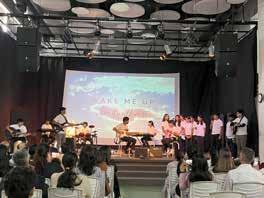
• Student life moves beyond core academics to provide opportunities to students to participate in events that build community spirit and showcase individual skills inside and outside of school.
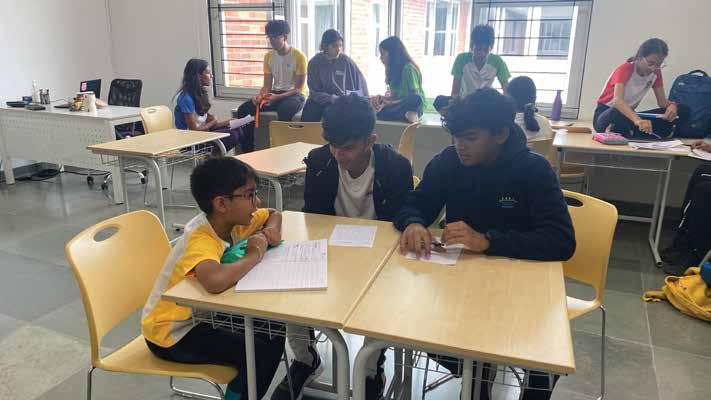
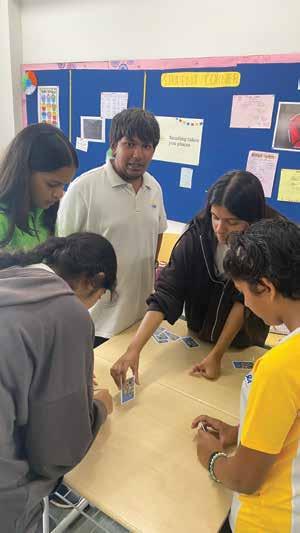
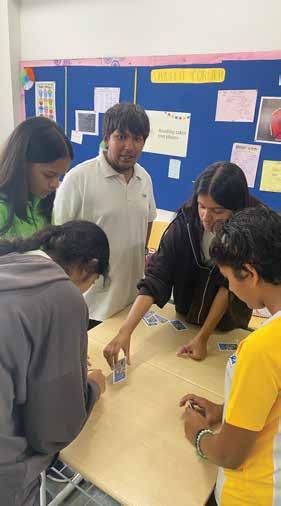
Students from the Executive Council, House Council and Neev Times participated in a team-building activity led by the school psychologist. This interactive session focused on enhancing their critical thinking, problem-solving, communication, and collaboration skills. The session concluded with small group discussions, where they formulated a common plan of action to achieve their goals for the year in alignment with the charter.
Ahmedabad University
Ashoka University
Atria University
Azim Premji University
Bennett University
BITS, Pilani
FLAME University
Krea University
Manipal Institute of Technology
Manipal University, Jaipur
O.P. Jindal Global University
PES University
Plaksha University
Shiv Nadar University
St Joseph’s College
National Institute of Design
American University
Arizona State University
Babson College
Baylor University
Binghamton University
Boston University
Brandeis University
Brown University
Bryant University
CalPoly Pomona
Case Western University
Catholic University
Colgate University
College of William & Mary
College of Wooster
Culinary Institute of America
De Montfort University
Denison University
Drexel University
Earlham College
Eckerd College
Emerson College
Emory University
Falmouth University
Fordham University
Franklin & Marshall College
George Mason University
George Washington University
Georgia Institute of Technology
Georgia State University
Hampshire College
Indiana University Indianapolis
Iowa State University
Ithaca College
Kelley School of Business - Indiana,
Bloomington
Knox College
Massachusetts College of Art & Design
Massachusetts Institute of Technology
Michigan State University
Middlebury College
Mount Holyoke College
New Jersey University of Technology
New York University
orth Carolina State University
Northeastern University
Occidental College
Ohio State University
Ohio Wesleyan University
OTIS College of Art & Design
Pace University
Penn State University
Pratt Institute
Purdue University
Radboud University
Rhode Island School of Design
Rensselaer Polytechnic Institute
Rochester Institue of Technology
Rollins College
Rutgers University
San Diego State University
Savannah College of Art and Design
School of the Art Institute of Chicago
Simmons University
Smith College
Stanford University
Stevens Institute of Technology
St. Olaf College
SUNY, Binghamton University
Swarthmore College
Syracuse University
Temple University
Texas A&M University
Texas Tech University
The New School, Parsons
Tillburgh University
Trinity University
University at Buffalo
University of Alabama at Birmingham (UAB)
University of Arizona
University of California, Berkeley
University of California, Davis
University of California, Los Angeles
University of California, Merced
University of California, Riverside
University of California, San Diego
University of California, Santa Barbara
University of California, Santa Cruz
University of Chicago
University of Connecticut
University of Illinois Urbana-Champaign
University of Maryland
University of Massachusetts, Amherst
University of Michigan, Dearborn
University of Michigan, Ann Arbor
University of Minnesota, Duluth
University of Minnesota, Twin Cities
University of Pittsburgh
University of Rochester
University of San Diego
University of San Francisco
University of South Florida
University of Southern California
University of Texas A&M
University of Texas at Austin
University of Texas at Dallas
University of Texas at Tyler
University of the Atlantic
University of Virginia
University of Washington
University of Wisconsin-Madison
Virginia Polytechnic Institute
Washington University in St. Louis
Wentworth Institute of Technology
Wheaton College
Wichita State University
Birkbeck University of London
Birmingham City University
Brunel University London
Cardiff University
City, University of London
Coventry University
Durham University
Hult International Business School
Imperial College London
King's College London
Kingston University
Lancaster University
Leeds
Trinity University
London School of Economics and Political
Science
London Southbank University
Loughborough University
Middlesex University
Newcastle University
Scholarships are ranging from $3,000 per year to $30,000 per year
Northumbria University
Oxford Brookes University
Queen Mary University of London
Queen's University Belfast
Royal Holloway
Sheffield Hallam University
SOAS University of London
Solent University
Trinity College Dublin
University College London
University of Aberdeen
University of Bath
University of Birmingham
University of Brighton
University of Bristol
University of Dundee
University of East London
University of Edinburgh
University of Exeter
University of Glasgow
University of Hertfordshire
University of Hull
University of Leeds
University of Liverpool
University of Manchester
University of Newcastle
University of Nottingham
University of Plymouth
University of Portsmouth
University of Reading
University of Sheffield
University of Southampton
University of St. Andrews
University of Strathclyde
University of Surrey
University of Sussex
University of the Arts London
University of the Creative Arts London
University of Warwick
University of Westminster
Bond University
Monash University
University of Melbourne
University of Sydney
Concordia University
Dalhousie University
McGill University
McMaster University
Ontario College of Art & Design
Queen's University
Simon Fraser University
University of Alberta
University of British Columbia
University of Guelph
University of Ottawa
University of Toronto
University of Waterloo
Wilfred Laurier
York University
Lasalle College of the Arts
Nanyang Academy of Fine Arts
Nanyang Technological University
National University of Singapore
Amsterdam University
École Polytechnique
Eindhoven University of Technology
IE University Spain
Leiden University
Maastricht University
TU/ Delft
Twente University
University of Groningen
Utrecht University
Nuova Accademia di Belle Arti (NABA)
University of Nottingham
Weill Cornell Medicine - Qatar
National University of Ireland, Galway
Royal College of Surgeons in Ireland
Hong Kong University
Academic honesty in an integral part of learning at Neev. To this end, students are introduced to practices that lead automatically to a culture of honesty. This includes providing students with the means and support to conduct research, the evaluation of sources, how to reference a source, how to avoid collusion and other forms of malpractice. The school takes a very strong stance against academic dishonesty. Students are cautioned that academic dishonesty might lead to the loss of the IB.