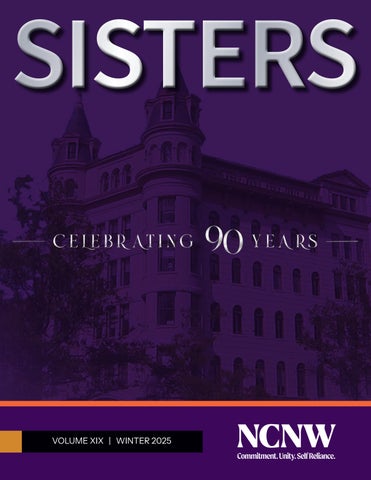
VOLUME XIX | WINTER 2025
CONTENTS 2 3 6 20 24 28 39 44 46 53 58 61 63 65 70 73
Message from the Chair
Last Will & Testament
75 76
Staff Directory
Message from the President Anniversary Features Dr. Mary McLeod Bethune Portrait Uncommon Height Award Gala Advocacy in Action – Social Justice Wall of the first NCNW quarterly magazine covers, displayed at the National Council of Negro Women first headquarters.
YACA Programs Development Section News Tempress “Tee” Solomon Upcoming Events New Legacy Life and Life Members Affiliate Spotlight NCNW/CLFA “Brothers in Service” Dr. Mary McLeod Bethune
In Memoriam
National Council of Negro Women, Inc. 633 Pennsylvania Avenue, NW Washington, DC 20004 202.737.0120 www.NCNW.org
Flashback articles appearing in this issue are taken from this yearbook. Issues faced then are some of the same issues NCNW tackles today.
COVER PHOTO: A time for reflection and celebration, Happy 90th NCNW!
Volume XIX | Winter 2025
1
Message from the Chair Dear NCNW Sisters,
A
s we celebrate 90 years of commitment to leading, advocating for and empowering women of African descent, their families and communities, I want to take a moment to discuss the importance of compassion in these tumultuous times. With the guidance of our eight past Presidents and Chairs, we have created an exceptional organization rooted in community care and service.
The compassion of our sections, and members cannot be overstated. Our Sections have seen those struggling with food insecurity and organized food drives. When travel to local polls was unattainable to some, our sections rented vans and buses to ensure everyone could exercise their constitutional right to have their voices heard. Leaders of our sections have travelled across the country to ensure they were educated on how to ethically engage with Artificial Intelligence (A.I.) and technology policy. It is this unwavering compassion that gives hope to a nation in turmoil right now, as we navigate cuts to essential services like healthcare and education. Over 300,000 Black women have lost their jobs this year, and yet hope and power persist. As Black women, we deeply understand our tremendous power to shape our future at the community, municipal, state, and local levels. We know that a community food drive is just as important as advocacy on Capital Hill. As I look into the future, I see progress and victory on the horizon, because of the tools laid forth by our Founder, Dr. Mary McLeod Bethune, and her successors. I am deeply humbled by the resilience seen in 1935, when Dr. Bethune was a young and brilliant Black woman from South Carolina demanding that the world see us, and the same fortitude seen in 2025 where millions of NCNW members and affiliates are using social media, podcasts, and grassroots organizing to ensure that our country never forgets our power.
“
As Black women, we deeply understand our tremendous power to shape our future at the community, municipal, state, and local levels.
2
NCNW.org
”
Yours in Service,
Dr. A. Lois Keith National Board Chair
Message from the President Dear NCNW Sisters,
T
his year has propelled our organization to the forefront of a fight to protect the things we hold most dear. We protected ourselves by exercising self-care. We protected our communities by organizing career fairs, economic empowerment webinars, and policy summits. And, perhaps most importantly, we protected our democracy by voting.
The imprint of powerful Black women has rippled throughout this turbulent year, as we have raised our voices to advocate for the continuation of SNAP funding during the longest government shutdown in U.S. history, empowered a generation of young Black female leaders with our groundbreaking BethuneHeights Changemakers Pathway (BHCP), and educated our communities on wealth building through the inaugural Resources for Investment, Savings, and Economic Empowerment initiative (R.I.S.E). Through every step, NCNW has proven to be an essential organization, powered by the commitment of our nearly 500 Sections. Now more than ever, we are proving that the intelligence, creativity, and work-ethic of Black women is quintessential to the American story. When we gather to push forward a common goal, we not only lift up ourselves, but we lift up those around us. In our 90th year of leading, advocating for and empowering women of African descent, their families and communities, it is important to acknowledge the journey we have taken and order our steps moving forward.
“
Now more than ever, we are proving that the intelligence, creativity, and work-ethic of Black women is quintessential to the American story.
”
This year, we honor all eight of our past National Presidents and Chairs, Founder Dr. Mary McLeod Bethune, Dr. Dorothy Boulding Ferebee, Vivian Carter Mason, Dr. Dorothy Irene Height, Dr. Barbara L. Shaw, Ingrid Saunders Jones, Dr. Johnetta B. Cole, and Dr. Thelma T. Daley. Each of these women ensured that NCNW remained both vital and relevant to national conversations that persist even until today under the leadership of our Board Chair, Dr. A. Lois Keith and me. I am sincerely grateful for their leadership and service and will continue to build upon this organization’s outstanding 90-year legacy, laid forth by intellectual giants. It is through their lens that we may perceive a more equitable future for Black women, fueled by justice and compassion. In Truth,
Rev. Shavon L. Arline-Bradley President and CEO
Volume XIX | Winter 2025
3
FLASHBACK
4
NCNW.org
FLASHBACK
Volume XIX | Winter 2025
5
NCNW PROUDLY CELEBRATES Proudly celebrating 90 years of leading, advocating for, and empowering women of African descent, their families and communities, the National Council of Negro Women (NCNW) has long been committed to unity and self-reliance. There has been a strong appreciation and absolute acceptance of the organization’s purposeful work, attributed to a strong understanding of the community.
T
he existence of NCNW is rooted in meeting the moment. We met the moment when Dr. Mary McLeod Bethune served as the only Black delegate at the founding conference of the United Nations in 1945, where she made significant contributions to the UN Charter. This year, as the United Nations turns 80, NCNW continues that legacy as the first Black organization to gain nongovernmental agency (NGO) status, formally marking it as part of the global community.
We met the moment again in 1967, when Dr. Dorothy Height built a community for single mothers in Mississippi, championing low-cost, decent housing through a community development initiative under the Johnson Administration. We met the moment in 2022 under the leadership of Dr. Thelma T. Daley, supporting forest ecosystems and economic stability in Haiti, Mali, and Senegal by planting 100,000 trees and promoting respect for our shared, interconnected global responsibility to the future of Mother Earth. And today, we are meeting the moment once more by creating generational wealth through the R.I.S.E. program—Resources, Investment, Savings, Empowerment—and by hosting a virtual job fair to help address the needs of the more than 300,000 Black women who lost federal jobs.
6
NCNW.org
of BUILDING A LEGACY of POWER
Volume XIX | Winter 2025
7
Dr. Mary McLeod Bethune Founder and 1st National President
Mrs. Vivian Carter Mason 3rd National President Dr. Dororthy Boulding Ferebee 2nd National President
Dr. Dorothy Irene Height 1st Chair and 4th National President
Dr. Johnetta Betsch Cole 4th Chair and 7th National President
NCNW.org
Dr. Barbara Shaw 2nd Chair and 5th National President
Dr. A. Lois Keith 6th Chair Dr. Thelma T. Daley 5th Chair and 8th National President
8
Dr. Ingrid Saunders Jones 3rd Chair and 6th National President
The “Bethune Doctrine,” the most organized body too large to fail, is rooted in values of integrity, accountability, justice, equity, fairness, historical reverence, empowerment, engagement, and stakeholder experience. These values remain central today. It was Dr. Bethune’s vision to form an organization that would bring together Black women’s organizations, pooling their interests to exert collective pressure where change was needed. This was radical at the time, for Black women to hold and exercise collective power. She set her sights on forming a power group that would systematically transform the economic and political foundation of Black women in the United States and around the world. This power group included Black women from every socio-economic background, bound by the common thread of Blackness and by the ways we learned, earned, and survived in the world. Today, we continue to strive to fulfill Dr. Bethune’s vision. Never losing its zeal, NCNW has maintained the longheld principles that have made it a center of influence among Black women and, ultimately, within the Black community. Over the years, it has actively worked to raise awareness of pressing community issues at the grassroots level that affect Black women, their families, and their communities. Its longstanding partnerships with societal institutions have built a coalition that increases the visibility of policy agendas and supports lasting outcomes.
Further progress cannot be made working in silos; the organization’s success is partially due to a unique culture underpinned by its passionate commitment to service. This intense dedication to service ensures that NCNW is responsive to the challenges that Black women, their families and communities face. It remains dedicated to uplifting communities through its “Core Four” - education, healthcare, economics, and social justice - that make a significant impact through results, while changing national conversations and ultimately behaviors. What we do know is that the past 90 years have been full of wins and losses, ups and downs, solutions and challenges that solidly places NCNW on the journey for the next 90 years. The “distilled principles and policies” that Dr. Bethune referenced will inspire us to keep a legacy of work forever strong and prepared for the future. Travel down memory lane, as we highlight some pivotal moments in NCNW history.
Volume XIX | Winter 2025
9
NCNW HIGHLIGHTED 1927
1946
✦ Dr. Mary McLeod Bethune first travels abroad to England, Spain, France, Netherlands, Belgium, Germany, and Switzerland.
✦ NCNW is granted non-governmental observer status at the United Nations.
1935 ✦ The National Council of Negro Women (NCNW) was founded on Dec. 5, by Dr. Bethune, and she becomes the first national president.
1949 ✦ NCNW hosts International Night, attended by President Truman, Madame Pandit, ambassador of India to the United Nations, and Dr. Ralph Bunche.
1940 ✦ NCNW organized international study tour to Havana, Cuba to study the Negro’s contribution to Cuban life.
1941 ✦ NCNW leads the push for desegregation in the military for Blacks and Black women to be included in receiving defense industry jobs, which leads to the President Franklin D. Roosevelt to sign Executive Order 8802, elimination discrimination in defense industry jobs and the creation of the Fair Employment Practices Commission and later became law.
1943 ✦ Dr. Bethune purchases the Council House on Vermont Avenue, near Logan Circle, in Washington, D.C., the first headquarters for NCNW as well as her home.
1944 ✦ NCNW compiles a roster of qualified American Negro Women to represent the United States at international conferences. ✦ Dr. Bethune is named an official/delegate to organizational meeting to draft a charter for the United Nations.
10
NCNW.org
1951 ✦ Dr. Dorothy Boulding Ferebee is elected the 2nd national president of NCNW.
1953 ✦ Mrs. Vivan Carter Mason is elected the 3rd national president of NCNW.
1954 ✦ Dr. Bethune travels to Caux, Switzerland to attend the World Assembly for Moral Re-Armament and work on campaign to end apartheid in South Africa. ✦ NCNW offers Life Membership.
TIMELINE 1955
1963
✦ Dr. Bethune dies May 18 at her home on the campus of Bethune Cookman College in Daytona, Fla.
✦ NCNW, the only women’s organization part of the original “Big Six,” was an integral part of the planning and execution of the March on Washington on August 28, 1963.
1956 ✦ NCNW hosts the Women United for Human and Civil Rights Conference.
1957 ✦ NCNW establishes sections.
1958 ✦ Dr. Dororthy I. Height becomes the 4th national president of NCNW. ✦ Dr. Height attends ceremonies in Accra, Ghana commemorating the new nation’s independence from colonial rule. ✦ NCNW institutes a Fair Share program from local council groups.
1959 ✦ NCNW establishes the Educational Foundation, which helped pay the tuition of 72 students who risk their lives and livelihoods for desegregation.
1961 ✦ Dr. Height was the only Black women to serve of on the Commission on the Status of Women under the Kennedy Administration.
1966 ✦ NCNW receives its federal tax-exempt status becoming a 501(c)(3) charitable organization.
1967 ✦ NCNW establishes Sisters United in the U.S. cities and the St. Thomas, Virgin Islands.
1969 ✦ NCNW protests the reduction of in availability of food stamps and the prohibitive costs by lobbying for food stamp reform, food for the elderly, food subsidy reform, and a repeal of food taxes through the 1970s.
1974 ✦ NCNW unveiled the Bethune Memorial, the first monument of an African American and a woman in a public park in the nation’s capital, in Lincoln Park on July 10.
Volume XIX | Winter 2025
11
1975
1988
✦ The NCNW International Division is formally established to promote relationships with African women’s organizations.
✦ The National Black Family Reunion expands to Atlanta, Philadelphia, Los Angeles, Chicago, Cincinnati, and Memphis, reaching millions of people.
✦ NCNW conducts a Peace, Equality and Development seminar in Mexico City during the World Conference and Tribunal of International Women’s Year/ Over 150 delegates, including 50 from African and Caribbean countries and more than 100 women form the U.S. attend and participate in the seminar.
1979 ✦ Official “Twinning Agreement” signed between NCNW and the United Union of Togolese Women. ✦ Member of the Federation of Senegalese Women’s Organizations (FAFS) visit NCNW section in cities around the United States in efforts to understand NCNW and its membership as well as start a “twinning” relationship between NCNW & FAFS.
1993 ✦ Under the Clinton Administration, through the NCNW, supported a program in Senegal from 1993-1996 that provided training and resources to the village of Dal Diam to develop a new well, health center, and various economic and educational programs.
1994 ✦ Dr. Height is awarded Presidential Medal of Freedom by President Willam H. Clinton.
1995
✦ NCNW members visit and meet with members of the Federation of Senegalese Women’s Organizations (FAFS) in Dakar, Senegal; official “Twinning Agreement” signed between NCNW and FAFS.
✦ NCNW moves to 633 Pennsylvania Avenue, NW, making it the only African American owned property on historic Pennsylvania Avenue between the Capitol and the White House.
1983
1998
1980
✦ President Ronald Reagan became the first president to honor NCNW as an organization at the White House.
1985 ✦ Two FAFS members from Senegal participate in the Nairobi Forum in Kenya sponsored by NCNW.
1986 ✦ NCNW hosts first Black National Family Reunion on the National Mall in Washington, D.C.
12
NCNW.org
✦ Dr. Height transitions from President to President Emerita.
2004 ✦ Dr. Height receives the Congressional Gold Medal, the highest civilian honor bestowed by Congress.
2005 ✦ In the wake of Hurricane Katrina, NCNW mobilizes sections to provide direct support, resources, and advocacy for displaced families, particularly Black women and children.
2008
2023
✦ NCNW sections nationwide play a major role in voter mobilization during the historic presidential election of Barack Obama.
✦ Dr. A. Lois Keith becomes the first Chair of NCNW in the new business restructure for the 21st Century marking the “New Era.”
2010 ✦ Dr. Height dies on April 20 in Washington, D.C.; President Barack Obama delivers the eulogy at her funeral. ✦ Dr. Barbara Show becomes the 2nd chair and 5th national president of NCNW.
2012 ✦ Ingrid Saunders Jones becomes the 3rd chair and 6th national president of NCNW.
2015 ✦ NCNW creates “4 for the future.” This set of pillars that ground NCNW advocacy, programs, and policy in core issues - health equity, economic empowerment, social justice, and education.
✦ Rev. Shavon Arline-Bradley becomes the first and youngest President & CEO of NCNW in the new business restructure for the 21st Century marking the “New Era.” ✦ NCNW partners with the Dorothy I. Height Education Foundation to establish and award the Project Height Scholarship Program, a scholarship dedicated to exploring the intersection of civil rights and technology. ✦ NCNW partners with the African American Policy Forum to lead the fight against bans on books and curriculum that teaches Black History in elementary, secondary, and post-secondary schools, Freedom to Learn.
2019 ✦ Dr. Johnetta Betsch Cole becomes the 4th chair and 7th national president of NCNW.
2020 ✦ NCNW President’s Circle is formed and announced. ✦ NCNW starts Good Health WINs, a program to promote and increase vaccination education among Black and Brown communities.
✦ NCNW announces a federal grant to implement the Affordable Connectivity Program in Mississippi and makes a donation to Humphreys County, Miss. residents after tornados.
2022 ✦ Dr. Thelma T. Daley becomes the 5th chair and 8th national president of NCNW. ✦ NCNW supported forest ecosystems and economic stability in Haiti, Mali, and Senegal by planting 100,000 trees and promoting respect for our shared, interconnected global responsibility for the future of Mother Earth in 2022. Volume XIX | Winter 2025
13
✦ NCNW participates in the 60th anniversary of the March on Washington.
✦ NCNW leads the fight to have President Biden propose a new rule to significantly expand coverage of anti-obesity medications for Americans with Medicare and Medicaid, recognizing obesity as a chronic disease.
2025 ✦ NCNW partners with the African American Policy Forum to lead the fight against bans on suppressing and whitewashing Black History at museums and historic sites, Hands Off Our History.
2024 ✦ NCNW holds first virtual #PurplePower Social Justice conference. ✦ NCNW implements the Eight-State/All-State Strategy to increase Black women and youth vote in the 2024 elections resulting in for ages 17-24, the initiative yielded over 1,900 total registered voters from nine states, plus Washington, DC, in specific, identified areas. Additionally, 2,137 Black women were registered across these designated areas. In total, 100,000 received voter education, 68,000 attended associated in person events and 32,000 virtually. ✦ NCNW launches Bethune Height Changemakers Program (BHCP), a program for collegiate members that focuses on professional development in the form of “Change Labs.”
✦ NCNW starts Resources for Investment, Savings, and Economic Empowerment (RISE), a program to address historical and systemic challenges that have created persistent financial education disparities in the African American community.
✦ NCNW holds a virtual job fair to address 300k plus Black women who lost their federal job. ✦ NCNW holds its first EdTechquity Summit, a conference focused on exposing and challenging the deliberate policies and practices of marginalized Black communities in digital spaces and classrooms.
14
NCNW.org
FLASHBACK
Volume XIX | Winter 2025
15
FLASHBACK
16
NCNW.org
FLASHBACK
Volume XIX | Winter 2025
17
18
NCNW.org
Volume XIX | Winter 2025
19
ORGANIZATIONS PARTNER TO UNVEIL
DR. MARY McLEOD BETHUNE IN HONOR OF WORK with
NCNW, Delta Sigma Theta Sorority, Incorporated, and the American Red Cross unveiled a commissioned portrait of Dr. Mary McLeod Bethune on Tuesday, Sept. 23 in Washington, D.C. at the national headquarters of the American Red Cross.
20
NCNW.org
PORTRAIT AMERICAN RED CROSS
Listen to Dr. Mary McLeod Bethune deliver speech, “What Does American Democracy Mean to Me?” at America’s Town Meeting of the Air in New York on November 23, 1939.
Volume XIX | Winter 2025
21
Dr. Bethune, an educator and civil rights leader, helped usher in a sustained presence of Black Americans working with the American Red Cross. She advocated for the desegregation of blood collection practices, hosted blood drives, and encouraged African American women to staff canteens. During World War II, Dr. Bethune served as director of the Florida Chapter of the Red Cross, helping to build bridges with the Black community through championing employment opportunities, disaster relief, and diverse representation on Red Cross regional and national boards. Artist Anita Easterwood painted the commissioned piece. Easterwood, based in Kansas City, Kan., is known for her portraits that celebrate Blackness through history, culture, fashion, and sisterhood, expressed through oils, sketches, and digital media. Her work can be seen in American Art Collector and the New York Times.
22
NCNW.org
The piece hangs in the Folgers Board Room at the Red Cross headquarters. Formerly the Central Committee Room, it was renamed in 2017 to honor the longtime commitment of the Folger Family to the mission of the American Red Cross. The room, with its signature long, solid wood table featuring sculpted trim and legs, has hosted over one hundred years of notable figures attending meetings, including Dr. Bethune. She is the first African American portrait to hang in the room, alongside notable figures such as John Clifford Folger, Lee Merritt Folger, Clara Barton, and Mabel Boardman.
Dr. Bethune, an educator and civil rights leader, helped usher in a sustained presence of Black Americans working with the American Red Cross.
Volume XIX | Winter 2025
23
NCNW Uncommon Height Award Gala The National Council of Negro Women (NCNW) returns with the Uncommon Height Awards Gala on Dec. 6 for the 19th year, marking 90 years of dedication to leading, advocating for, and empowering women of African descent, their families and communities. The biennial event will take place at the Marriott Marquis in Washington, D.C., with a new name, Uncommon Height Honors Gala, and structure. “This year marks our 90th Anniversary of the founding of NCNW, which makes this 19th biennial Uncommon Height event special. The vision of our Founder, Dr. Mary McLeod Bethune, is undisputedly relevant now,” said NCNW President & CEO Shavon ArlineBradley. “Dr. Dorothy Irene Height, for whom the event is named, carried out the vision of Dr. Bethune. Dr. Height was dedicated to lifting others who have made a difference in our world, which is why we created this great event. We are looking forward to a wonderful celebration that should not be missed.” This is the second gala under the leadership of NCNW Chair Dr. A. Lois Keith and Rev. Arline-Bradley. Dr. Johnnetta Betsch Cole and Carla Harris are co-chairs of this year’s event, with Toyota Motor Company of North America returning as presenting sponsors. Dr. Cole, a renowned anthropologist and educator, served as the fourth chair and seventh national president of NCNW, and is responsible for the new governance structure based on her experience serving simultaneously as the chair of the board and president. She pushed to move the organization into the 21st century while championing intergenerational leadership to ensure the work continues. A corporate titan, Harris is the Senior Client Advisor at Morgan Stanley, having completed a 30-plus-year career as a Vice Chairman and Managing Director. Throughout her career, 24
NCNW.org
BACK FOR 19th YEAR CELEBRATING
90 YEARS OF LEADERSHIP, ADVOCACY, AND EMPOWERMENT she has managed and executed billions of dollars in equity and equity-related transactions. She sits on three corporate boards and is the author of three books; her most recent, Lead to Win, received stellar reviews.
◆ Uncommon Changemaker will be presented to a changemaker under the age of 40. The honoree is Alena McQuarter for her contributions to humankind through science and technology.
NCNW Board Chair, Dr. A. Lois Keith, said, “We have two dynamic women who will be chairing the event this year. Celebrating our 90th Anniversary; we would not have it any other way. Their leadership, poise, and grace are second to none. Their dedication to the mission of NCNW and to the success of this event assures that our guests will partake in an evening to remember, as we pave the way for our centennial celebration in 10 years. Dr. Cole and Carla will set a very high bar. We are also excited for our new format, which allows us to honor the positive contributions of welldeserving recipients.”
◆ The Alexis M. Herman Achievement in Public and Community Service Award is named for The Honorable Alexis Herman, the first Black U.S. Secretary of Labor who served in the Clinton Administration and passed away earlier this year. This award will be presented to a Black public servant who is dedicated to the advancement of Black women, their families and communities. The honoree is Dr. Valerie Daniels-Carter for her volunteer and public service work that leads to change.
Under the new event name, Uncommon Height Honors, it remains the organization’s signature fundraising event, with proceeds used to fund programs of critical concern known as “Four for the Future” - health, education, economics, and social justice. For the 19th installation, in addition to the NCNW will bestow the prestigious Crystal Stair Award, which is given to an individual who demonstrates a lifetime devoted to the protection of freedom and pursuit of excellence in career and personal dedication to humanity as did Dr. Height. This award will be presented to both Congresswoman Maxine Waters and The Honorable Alex M. Herman (posthumously) for dedicating their lives to freedom, excellence, and humanity. Four new awards and the recipients honorees are: ◆ Uncommon Journalist will be presented to a Black journalist who is dedicated to reporting the facts to foster critical thinking and action for the betterment of Black women, their families and communities. This honor will be awarded collectively to Joy Reid, Tiffany Cross, Melissa Harris-Perry, and Karen Finney for their dedication to reporting the facts no matter the consequences.
◆ The Charles L. Franklin Associate Award, named for the late Charles L. Franklin, the husband of the late former U.S. Secretary of Labor Alexis Herman, will be awarded to a Black man who actively supports Black women and their causes. The honoree is Lonnie G. Bunch III for being the protector of Black history and culture, and ultimately the keeper of American history. In addition,the NCNW executive committee chooses honorees based on their positive and bold contributions, as well as their commitment to unity and self-reliance for Black women, their families, and communities. The honorees will be announced at a later date. The gala is named in honor of NCNW President Emerita, Dr. Dorothy Irene Height, who led the organization for over 40 years and achieved notoriety due to her immense contributions to economic justice, civil rights, and education. Founded in 1935 by Dr. Mary McLeod Bethune, an influential educator and activist, NCNW is an “organization of organizations,” comprised of over 350 campus and community-based sections and 37 national women’s organizations that enlighten, inspire, and connect more than 2,000,000 women and men. The NCNW mission is to lead, advocate for, and empower women of African descent, their families, and communities. Volume XIX | Winter 2025
25
Empowering communities and inspiring generations We proudly support the National Council of Negro Women and their vision of advocacy and empowerment. Together, we believe in creating opportunities that uplift communities and inspire future generations to lead with purpose and strength.
With the AAdvantage® program every journey becomes an opportunity to go further. Join today and see where the skies can take you.
26
NCNW.org
Volume XIX | Winter 2025
27
advocacy in action COMMENTARY
Code Without Conscience: How AI Discrimination Puts Black Lives at Risk BY JA’LIA TAYLOR, PH.D. Artificial intelligence is quickly becoming one of the most influential forces in our daily lives. From healthcare to hiring, AI tools are making decisions that affect who receives care, who gets a job interview, who is approved for a loan, and even who is targeted by police surveillance. These tools are often promoted as fair and objective. But in reality, they are frequently built on biased data that reflects a long history of discrimination. That bias does not disappear in the algorithm, it actually multiplies. And now, a new federal policy is threatening to make things even worse. President Donald J. Trump’s Executive Order titled ‘Preventing Woke AI in the Federal Government’ prohibits federal agencies from using AI systems that incorporate diversity, equity, and inclusion principles. This move attempts to erase the very safeguards designed to make technology more fair and inclusive. By barring the federal government from using DEIinformed systems, the Executive Order threatens to lock in existing inequities and deny critical protections to those who need them most.
When Technology Cannot See You: Bias in Healthcare
AI-powered hand hygiene systems have also revealed troubling design flaws, particularly for individuals with darker skin tones. Whether in hospitals or public restrooms, soap dispensers and faucets that rely on infrared sensors or computer vision often fail to activate when dark-skinned hands are placed beneath them. These systems were largely trained and tested using lighter skin tones, leaving many people invisible to the sensors. In environments where handwashing is essential for disease prevention and basic hygiene, this creates not just an inconvenience but a serious
28
NCNW.org
health risk. Failing to ensure these technologies work for everyone undermines public trust and perpetuates exclusion in one of the most basic daily functions. Racial bias in artificial intelligence is particularly dangerous in the field of healthcare, where it has already contributed to misdiagnoses and unequal treatment. Prostate cancer screening tools have failed to accurately detect risk factors in Black men, who already face higher mortality rates from the disease. Similarly, breast cancer detection tools often underperform for Black women due to higher breast tissue density. These tools are often trained on datasets that underrepresent people of color, making them less effective at identifying disease in non-white patients. Even algorithms used to determine who should receive follow-up care have mistakenly ranked Black patients as having fewer needs simply because less money was spent on their care in the past. These oversights are not just errors in code. They are systemic issues with real consequences for health outcomes.
Injustice by Design: AI in Law Enforcement
AI systems are increasingly being used by law enforcement to identify suspects, analyze risk, and monitor communities. But these tools are far from neutral. Facial recognition technology, for example, is notoriously less accurate when analyzing Black faces.
In one widely reported case, Robert Williams, a Black man in Detroit, was wrongfully arrested after an AI system misidentified him. He spent time in jail for a crime he did not commit because the technology could not distinguish between two Black men. Such errors are not isolated incidents. They are embedded in systems built without diverse data or oversight.
Locked Out of Opportunity: AI in Hiring
Bias in AI extends to hiring and employment, where algorithms are often used to screen resumes and assess interview performance. In one case, Amazon scrapped its internal hiring tool because it was penalizing resumes that included words like ‘women’s chess club’ or listed historically Black colleges. The system had been trained on resumes from past hires, most of whom were white men. As a result, it learned to prefer applicants who looked just like them. Even video interview tools have problems. These systems sometimes rate applicants poorly if they have darker skin or speak with regional or cultural accents. They might misinterpret facial expressions, tone, or speech patterns as signs of dishonesty or lack of confidence, when in fact they are simply signs of cultural diversity. Qualified candidates can be filtered out before a human even sees their application. The result is not just individual rejection; it is systemic exclusion from the workforce.
Digital Redlining: AI in Banking and Credit
AI is also used to determine who qualifies for loans, mortgages, and credit. These systems analyze historical data to assess risk, but if that data reflects decades of discrimination, the algorithm will too. Studies have shown that Black applicants are more likely to be denied loans than white applicants with identical credit profiles. This is not due to individual risk, it is due to the fact that biased data is being treated as neutral truth. When Black families are denied access to credit, they lose out on homeownership, education, and financial stability.
An Executive Order with Deadly Consequences
The Executive Order banning DEI from federal AI systems does not prevent bias. It prevents efforts to detect and reduce bias. Diversity in AI is not a political stunt. It is a life-saving necessity. By blocking inclusive AI tools, the federal government is setting a precedent that will ripple across industries. Developers may feel pressured to strip equity considerations from their products in order to win federal contracts. Agencies may be unable to choose tools that serve all Americans. And most dangerously, the communities who already suffer from inequality will be pushed even further to the margins. When AI systems do not see you, understand you, or account for your needs, they fail you. And when the government refuses to require fairness in these systems, it puts lives at risk. The Executive Order is not just misguided. It is a public health threat, an economic barrier, and a civil rights violation rolled into one.
Building a Better Future with Inclusive AI
Across the country, researchers, engineers, and advocates are actively working to correct bias in artificial intelligence systems. From developing diverse training datasets to conducting fairness audits and engaging impacted communities, these initiatives are essential to ensuring AI reflects and serves the full spectrum of American society. Ethical AI is not a radical idea, it is a responsible one. The federal government must play a leading role in establishing standards that center fairness, transparency, and equity. Artificial intelligence has the potential to drive transformative change, but only if its development is grounded in justice. Inclusive design and rigorous oversight must become the norm, not the exception. The path forward depends on our collective commitment to ensuring that the tools shaping the future do not repeat the injustices of the past.
Volume XIX | Winter 2025
29
ADVOCACY & POLICY BRIEFS BY BRASHANDA MCCOY
BLACK WOMEN CIVIC ENGAGEMENT HAPPENS IN GEORGIA
Director of Policy, Telecommunications, & Technology Dr. Ja’Lia Taylor and State Advocacy and Policy Manager Micah Jumpp hit the road to Columbus, Ga, in September, for a Civic Engagement Activation titled “Centering Black Women’s Voices and Leadership.” There, they engaged voters on the importance of civic participation and raised awareness about the urgent state of Black maternal health in Georgia.
To kick off ALC week, Federal Advocacy and Policy Manager Tyese Williams represented NCNW at a roundtable hosted by the Housing Authority of the Birmingham District and the Alliance to End Hunger. Joined by Government Relations Coordinator Brashanda McCoy, the duo engaged in a powerful advocacy session around housing and hunger, laying the groundwork for future programming and partnerships.
Tyese Williams and Brashanda McCoy pictured with the Housing Authority and Hunger Alliance roundtable panelists
Jumpp with NCNW Hampton collegiate section leaders
NATIONAL BLACK VOTE DAY TOOLKIT RELEASED & NCNW MAKES MARK DURING ALC
During the conference, NCNW hosted the powerhouse panel “Our Turn, Our Terms: Black Women Reimagining Power Through Policy.” Moderated by NCNW President & CEO Shavon Arline-Bradley, the panel featured Maya Wiley, president & CEO, The Leadership Conference on Civil and Human Rights, Demetria McCain, director of policy, NAACP, and Melanie Campbell, president & CEO, National Coalition on Black Civic Participation.
On Sept. 18, the team released the National Black Voter Day Toolkit, a dynamic call to action urging communities to fight against voter suppression through advocacy, education, and mobilization. The toolkit highlights threats such as gerrymandering and mail-in ballot restrictions, while empowering citizens to contact their elected officials, supporting the John Lewis Voting Rights Advancement Act, and championing fair access to the ballot box. September also marked a major highlight as the team prepared for the 2025 Annual Legislative Conference (ALC), held Sept. 24–28. 30
NCNW.org
President & CEO Shavon Arline-Bradley with panelists Maya Wiley, Demetria McCain, and Melanie Campbell for the 2025 Annual Legislative Conference
NCNW Leadership, HQ staff, and collegiate members pictured at ALC panel “Our Turn, Our Terms: Black Women Reimagining Power Through Policy”
Dr. Ja’Lia Taylor and Micah Jumpp pictured win Columbus, Ga. with NCNW members
Simultaneously, Jumpp traveled to Norfolk, Va, to help organize a rally in support of New York Attorney General Letitia James, who has faced politically motivated attacks for doing her job of holding power accountable and keeping justice blind. NCNW stood proudly in solidarity, echoing the message that resonated through the crowd, “When you come for one of us, you come for all of us.”
NCNW Advocacy and Policy team at ALC (unpictured: Taylor)
Together, they explored how Black women can wield strategic activism, coalition-building, and storytelling to defend rights, reimagine power, and chart a path toward long-term equity amid ongoing political challenges.
A&P TEAM HITS THE ROAD
Early October, the A&P team hit the road for a series of civic engagement activations across Virginia. On Oct. 24, A&P tabled alongside Hampton University collegiates during the homecoming tailgate, promoting breast cancer awareness and helping students confirm their voter registration status ahead of the Nov. 4 gubernatorial race.
NCNW in support of Leticia James during her first court hearing
Policy team sporting NCNW fans with Hampton University collegiate members for Homecoming 2025
Volume XIX | Winter 2025
31
October closed with another impactful campus activation on Oct. 28, at Virginia Union University in Richmond, Va., A&P hosted “Pizza & Politics: Why Local Elections Matter” in partnership with NCNW Virginia Union and Virginia State University collegiate sections, the Richmond Section, and Alpha Phi Alpha Fraternity, Inc. The panel inspired students to recognize the power of their vote and their role in shaping local democracy.
NCNW members with the policy team for the “Pizza & Politics” event held in Richmond, Va.
MEMBERS GET EDUCATION ON SNAP, NCNW HOLDS INAUGRUAL EdTechquity Summit
32
On Nov. 12, the team hosted the EdTechquity Summit, themed “Disconnected by Design: Reclaiming Education and Technology in a Time of Erasure.” Sponsored by the Internet and Television Association (NCTA) and lead by Taylor, this groundbreaking event convened federal government officials, including Congressman Glenn Ivey (D-MD) and Federal Communications Commission (FCC), Commissioner Anna Gomez, alongside policy experts, staffers, program directors, and higher education leaders to explore how to build a digital future rooted in equity and inclusion, tackling pressing issues such as broadband access, artificial intelligence, digital inclusion, and tech justice. The summit fostered rich dialogue, inspired collaboration, and set the stage for collective action toward a fairer, more connected educational landscape. As 2025 draws to a close, the A&P team is charting bold new strategies for 2026 continuing our mission to lead, empower, and advocate for women of African descent, their families, and their communities.
As the nation faced uncertainty during the government shutdown, A&P and Programs organized a national SNAP webinar on Nov. 6. Experts provided critical updates on the SNAP/EBT suspension and rising healthcare costs, equipping members with advocacy tools to support affected families.
Congressman Glenn Ivey supported the EdTechQuity summit by delivering remarks and answering questions for attendees regarding technology and policy.
NCTA - The Internet & Television Association proudly sponsored the summit. From left to right: Mansoor Khadir (NCTA), Taylor (NCNW), Arline-Bradley (NCNW), FCC Commissioner Anna Gomez, Russ Hanser (NCTA), & Traci Biswese (NCTA).
The summit featured a fireside chat with Arline-Bradley and Gomez.
NCNW.org
The Texture of Change Elevating textured hair education — so every texture thrives.
THE TEXTURE OF CHANGE , powered by L'Oréal's Professional Products Division, is a movement committed to transforming the future of professional beauty through equitable access to textured hair education for students and stylists. To advance our commitment, we've partnered with the Professional Beauty Association to form the Texture Education Collective to influence inclusivity of all hair types and textures in cosmetology state board licensing and beauty school curriculums.
Volume XIX | Winter 2025
33
NCNW Holds Virtual Job Fair
According to the Joint Center for Political and Economic Studies, the unemployment rate for Black women as of July 2025 was 6.7 percent. This is approximately double the rate of white workers. As a result, the National Council of Negro Women (NCNW) met the moment by hosting a job fair for federal employees who had lost their jobs in the past eight months. The virtual job fair was crafted to be very different from any other job fair. The job fair took on more of a coaching approach. It began with a welcome from NCNW President & CEO Shavon Arline-Bradley, followed by a brief motivational professional message from Charmion Kinder, a member of NCNW, who had recently had this same lived experience and is now employed at the same level outside of government. After, there were two sessions: 1) Panel Discussion of Hiring Managers from Wells Fargo and Amazon, where they discussed hiring practices of their companies, and 2) Resume Workshop - Resume Tips for Federal Employees by Erin Brown of R.I.S.E. Advisory Group, a member of NCNW, who also had the same lived experience and has started a career coaching business. After the two sessions, instructions were provided on how attendees can apply for jobs with both our partners. The organization’s aim was to communicate with its members, who were primarily displaced federal employees, not necessarily residing in the greater Washington, D.C. area, but across the country. It was open to NCNW members and members who are members of affiliate organizations to attend. This was a way to host a non-conventional virtual job fair that would allow participants to learn how to present their knowledge, skills, and abilities.
34
NCNW.org
NCNW remains dedicated to leading, advocating for, and empowering women of African descent, their families and communities through its commitment to unity and selfreliance. We aim to be a resource for Black women during this time by connecting them to a pipeline that will enable them to secure employment, as this was the overall goal. NCNW looks forward to holding a job fair in the Spring for graduating collegiate members.
FLASHBACK
Volume XIX | Winter 2025
35
FLASHBACK
36
NCNW.org
FLASHBACK
Volume XIX | Winter 2025
37
FLASHBACK
38
NCNW.org
[
NCNW YOUNG ADULT AND COLLEGIATE AFFAIRS (YACA)
YOUTH GROUPS SPOTLIGHT
[
T
he NCNW, Inc. Co-op City Youth Group was chartered on July 14, 2021, and is currently led by 3rd Vice President and Lead Youth Advisor, Nikita Singletary. The Youth Group provides leadership development, mentorship, and educational support for adolescent young women of African descent in the Bronx Community. Through monthly workshops and community partnerships, the Co-op City Youth Group works to address barriers such as limited access to resources, college readiness, and self-confidence by offering guidance on life skills, resiliency, and academic success. The overarching goal is to empower young women ages 12-18 to make informed decisions, pursue leadership opportunities, and reduce risk factors through education, mentorship, and positive community engagement. Programming is rooted in NCNW Core Four areas of concern: Economic Empowerment and Entrepreneurship, Social Justice, Health Equity, and S.T.E.A.M. & Education. Youth Group Advisors ensure these principles are upheld by teaching, modeling, and facilitating meaningful leadership-based activities.
Volume XIX | Winter 2025
39
F
rom September through November, the NCNW YACA Young Adult Women hosted their signature 1st Fridays Sisterly Check-Ins—a warm, judgement-free space created to uplift, empower, and strengthen young women across our sections. These gatherings blend open conversation with personal development, allowing members to unpack real-life challenges, celebrate wins, and nurture meaningful bonds rooted in sisterhood. Throughout the fall, the check-ins have evolved into a trusted touchpoint for connection—whether discussing career advancement, mental wellness, leadership development, or navigating life transitions. Participants leave feeling heard, supported, and inspired, with a renewed sense of purpose and community. The Sisterly Check-Ins continue to be a cornerstone of the Young Adult Women’s programming, reinforcing the NCNW mission by cultivating confident, connected, and empowered young leaders.
40
NCNW.org
NCNW YACA YOUNG ADULT WOMEN:
1ST FRIDAYS SISTERLY CHECK-INS — A SPACE FOR CONNECTION, GROWTH & SISTERHOOD
COMMENTARY FROM THE NCNW YACA COMMITTEE CHAIRS:
YACA: TAKING NCNW INTO THE NEXT 90 YEARS BY NCNW YACA CHAIRS GABRIELLE ROGERS, CHANELLE JOHNSON AND ARIEL ALFORD
A
s we honor the powerful 90-year legacy of NCNW, the YACA Committee stands proudly at the intersection of history and the future. We are the bridge between generations—the women shaped by timeless values and the emerging NCNW leaders committed to carrying its mission forward with innovation, courage, and purpose. YACA represents the next wave of NCNW leadership. Our youth groups, collegiates, and young adult women are not only learning the principles of advocacy, service, and sisterhood—they are actively applying them. We are using our voices, our talents, and our lived experiences to strengthen communities, elevate equity, and create sustainable pathways for those who will come after us. As NCNW steps boldly into its next 90 years, YACA is prepared to lead. We are embracing technology, expanding civic engagement, amplifying mental wellness, and cultivating leadership pipelines that ensure our organization remains relevant, responsive, and resilient. The work we are doing today is shaping the NCNW of tomorrow—one rooted in the wisdom of our founder and energized by the vision of our future. We are honored to serve, excited to innovate, and fully committed to ensuring that NCNW continues to thrive for generations to come. The next 90 years start now—and YACA is ready to carry the torch.
Volume XIX | Winter 2025
41
FLASHBACK
42
NCNW.org
FLASHBACK
Volume XIX | Winter 2025
43
PROGRAMS
RISE Program: Building Financial Confidence and Generational Wealth An NCNW Initiative for Financial Literacy & Economic Empowerment Preliminary Impact Snapshot – OCTOBER 2025 BY AFIA WILLIAMS
Empowering Communities Through Financial Education
This fall, the RISE Pilot Cohort brought together more than 300 participants from 27 NCNW sections across 12 states to learn, grow, and take charge of their financial futures.
These reflections show how RISE is not just raising awareness it’s sparking action and building confidence across generations.
A Shared Vision for Economic Empowerment
RISE embodies the NCNW mission to empower Black women, their families and communities through education and opportunity. Participants leave with tangible tools to manage debt, plan for the future, and pass on financial wisdom to others. By strengthening financial literacy at the community level, RISE helps close the racial wealth gap and promotes lasting economic mobility.
Guided by the leadership of Afia Williams, NCNW Senior Program Manager, and in collaboration with dedicated external partners, the RISE program delivered a six-week journey designed to transform knowledge into action. Together, the team equipped participants with tools to manage debt, build credit, plan for the future, and pursue entrepreneurship within a culturally relevant, community-based learning model.
Early Impact at a Glance • • •
•
90%+ participant satisfaction across all sessions 70–98% improvement in financial knowledge Over two-thirds plan to implement new financial practices immediately 94% rated facilitators as excellent or very engaging
Participants described RISE as “transformative,” “motivating,” and “a program that changes how you think about money and your future.”
Voices of the RISE Community
“I want to break generational curses in my family.” — COPPIN STATE UNIVERSITY SECTION “This program gave me clarity and confidence to plan for retirement.” — QUEENS COUNTY SECTION “I now have the tools to manage debt and start a business.” — GREATER AUSTIN SECTION
44
NCNW.org
What’s Next for RISE
Building on the success of this pilot, NCNW will: • • •
Develop a digital resource library with tools and recordings Introduce specialized financial learning tracks for youth, mid-career professionals, and retirees Continue to track participant progress through post-program surveys
Continuing the Journey
The early success of RISE shows that when communities have access to knowledge, resources, and support, they rise—together. With strong leadership, committed partners, and the resilience of the NCNW community, the RISE initiative is paving the way toward lasting financial empowerment and generational wealth for Black women and families across the nation, despite a challenging economic climate in the United States.
Listening, Learning, Leading: How Good Health WINs Is Building Vaccine Confidence from the Ground Up BY DR. SYNOVIA MOSS, NATIONAL PROJECT MANAGER, NCNW GOOD HEALTH WINS
I
n 25 cities across America—from Chicago, IL to Fayetteville, NC, and from Sacramento, CA, to St. Petersburg, FL— voices that are too often unheard in the nation’s health conversation are being heard. Through its CommunityBased Organization (CBO) Listening Sessions, the National Council of Negro Women’s (NCNW) Good Health WINs (GHWs) program is changing how communities discuss, access, and trust vaccines and preventive healthcare. The CBO Listening Sessions go beyond simple gatherings— they act as grassroots movements. Each session brings together community members, faith leaders, public health partners, and local advocates to have honest talks about barriers to care, trusted messengers, and ways to boost vaccine confidence and community health. Whether held in church basements, neighborhood centers, or soon on college campuses, these conversations are helping shape local action plans and national priorities.
In 2025, Good Health WINs reached 1.3 million people across 10,000 zip codes, engaging 700 CBO partners in 25 cities through CBO Listening Sessions that focused on authentic voices and lived experiences. These sessions have inspired new collaborations with federally qualified health centers, faith-based institutions, youth organizations, and local nonprofits, ensuring that communities are equipped to sustain education and progress in public health equity. To support education during respiratory illness season, GHWs also introduced the Respiratory Season Flipbook, a creative and accessible resource that helps families learn how to stay protected from flu, COVID-19, and RSV—further expanding the program’s reach into homes and communities. As NCNW celebrates its 90th anniversary, Good Health WINs stands as a living testament to the organization’s enduring mission: *to lead, advocate, and empower women of African descent, their families, and their communities.* The success of the Listening Sessions proves that when we listen deeply, we learn more—and when we lead boldly, we build stronger, healthier futures. From the power of conversation to the promise of action, Good Health WINs, like NCNW, is not just changing outcomes — it’s changing the narrative. It reminds America that health equity is not a dream deferred but a movement realized. And in the hands of NCNW’s women—visionaries, mothers, mentors, and messengers—this movement is unstoppable.
What makes Good Health WINs stand out is its dual approach: direct action and direct service. As a direct-action network, GHWs mobilizes trusted messengers to advocate for equitable vaccine access, influence public policy, and keep vaccine equity a national priority. As a direct-service model, GHWs meets people where they are— hosting vaccine clinics, health fairs, and community events that provide both education and compassionate care. From barbershops to beauty salons, GHWs transforms everyday spaces into centers of empowerment.
Volume XIX | Winter 2025
45
D E V E LO P M E N T
Show Some Love: NCNW and the 2025 Combined Federal Campaign BY STEPHANIE WEST
T
he Combined Federal Campaign (CFC) is one of the nation’s largest and most trusted workplace giving efforts, bringing together federal employees and retirees to support causes that strengthen communities across the country. Each year, the CFC invites donors to choose the organizations that reflect their values and their vision for a better world. National Council of Negro Women (NCNW) is honored to be part of this powerful tradition of generosity and service. This year’s theme “Show Some Love: Be the Face of Change” beautifully aligns with the NCNW mission. It reminds us that change can begin with a simple act of
For 25 years, Colgate Bright Smiles, Bright Futures has partnered with the National Council of Negro Women, Incorporated to bring oral health education to millions of children and their families in the United States. We look forward to continuing our valued partnership to “Make More Smiles”.
46
NCNW.org
kindness. A gift. A moment of service. A willingness to step forward and be counted. The companion message, “Show You Care,” highlights the role of volunteerism and encourages supporters to give both their time and their resources to the causes they hold dear. When donors select NCNW through the CFC, they help drive direct service and direct action in communities nationwide. Their support empowers women with financial tools, expands health education, strengthens leadership pathways for young girls, and fuels grassroots advocacy that lift Black women and their families and communities. To all who have supported NCNW in previous campaigns, thank you. Your generosity has made a real and lasting difference. This season, we invite you to join the movement, sign up and select NCNW and be the face of change. Use NCNW CFC Code 47004.
To learn more about Bright Smiles, Bright Futures and how to brush twice a day scan the QR code.
President’s Circle Spotlight
R
aised by a single mother of eight, Dr. Barbara Williams-Skinner learned early what it meant to belong to a community where “people helped people.” That spirit of interdependence would later define her leadership, advocacy, and lifelong commitment to service. When she arrived in Washington, D.C., after law school to work for Congressman Ron Dellums, Dr. WilliamsSkinner met Dr. Dorothy I. Height, a meeting that would shape her future. “I was struck by her elegance and her knowledge of history,” she recalls. “She didn’t pressure me to join anything. It was her kind spirit, her ‘How can I help you?’ approach that reminded me of the community I grew up in.”
A protégé of Dr. Height, Dr. Williams-Skinner continues to carry forward the values of love, service, and intergenerational leadership through NCNW. A founding member of the President’s Circle, she says her motivation was simple: “Leaders need a circle of people around them who have their back. I wanted Dr. Cole to know, ‘I’ve got your back.’” Dr. Williams-Skinner embraced Christianity through what she calls divine irony: “God connected this radical agnostic with an evangelist,” she laughs, referencing her late husband, the Rev. Dr. Tom Skinner. “But Tom showed me…love. The kind that respects the woman at the well and lifts those left by the side of the road.” Her faith now grounds everything she does, from leading the Skinner Leadership Institute to co-founding Faiths United to Save Democracy, a nonpartisan movement to protect voting rights. “I can fight for justice without becoming hateful,” she says. “My work begins with the belief that everyone is created in God’s image.”
Reflecting on the 90-year NCNW legacy, she adds, “Dr. Bethune would be so excited that NCNW is intergenerational. That we have so many talented, energetic Black, younger women working alongside elder women, and we’re learning from each other.” Her example stands as a testament to the truth she learned early and now lives fully: when people lift one another, entire communities rise.
Volume XIX | Winter 2025
47
CURRENT DONORS Stephanie Abbott Christine Abron Yvonne Acey C. Gloria Ackers Valencia Adams Sydney Adams Rebecca Adewumi Linda Akli Ameena Al-Amin Susan Alcorn Crystal Alexander Veronica Alexander Kimberly Anderson Monica Ansani Amanda Applegate Louise Arline Shavon Arline-Bradley Christine Arnold Wanda Arthur Alecia Asbury Brenda Ashanti Mamie Ashley Montia Austin Yolanda Bables Tomika Bacon Charlestine Bailey Dawn Tracy Bailey Charise Balaam Mildred Ballenger Thelma Barnes Tanetra Barrett Rosalyn Baugham Elder Frances Bell Danica Benson Phyllis E. Berry Esther Berube William Best Sheila Beverly-Skinner Glenn Bigonet Yolanda Bills Andree Biot Carmelita Black Mccaden Karen Blouin-Clay Eunice Bonaparte Marcia Bonnet Patrice Bonnett Johnnie Booker Jeannie Borden Sheena Bouchet Louise Bowens-Brown Janece Boyd Gwendolyn Boyd Karen Boykin-Towns Condencia Brade
48
NCNW.org
Shana Bradley Valerie Brand Donna Brazile Rhonda Briggins Ethel Briggs Kimberly Bright Lisa Brisbone Coretta Briscoe Roslyn Brock R. Sevena Brooks Daphne Brooks Dianna Brooks Dawn Brooks Ellis Angelia Brown Gwendolyn Brown Keisha Brown Josephine Brown Gail Brown Vanessa Brown Cassandra Brown Barbara Brown Erin Brown Charlette Brown Tina Brown Marilyn M. Brown Debbie Brown Cherie Brown Jackson Mary Burciaga Nelson Glenda Burnett Judith Buycks Iona Calhoun Amaia Calhoun Monica Callender Sonya Campbell Ida Campbell Phyllis Campbell Charlene Carey Teri Carlyle Junita Carn Emily T. Carroll Melanie Carter Linnie Carter Pinkey Carter Jeremiah Carter Janet Carter-Black Raphael Cassimere Jr. Sonya Cathey Jessica Chadwick Crystal Chambers Jennefer Charles Richard Charles Tammy Chewe Janelle Chism Olethia Chisolm
Tilena Chisolm Paula Christmas Sylvia Clapp-White Devona Clark Deborah Clay Angela Cloud-Simmons Anita Cobb Jasmine Cohen Arlyne Coker Tonjalyn Cokley Johnnetta Cole Glenn Cole Patrcia Coleman Donna Coleman Beth Coleman-Oliver Regina Cook Elsie Cooke-Holmes Jennifer Cooper Lynda Costen Latisha Cottingham Ruby Cotton Melissa Cottrell Lya Coulter Felicia Cowser Maggie Coxon Juanita Coye Bailey Jeryl Crawford Stacey Crooks Michele G. Crosby Jacqueline Culler Hope Cupit Charity Curry Ruby Dalcour Thelma Daley Janet Daley Jewel Daniels Rochelle Darville Chloretha Davie Sadie Davis Wanda Davis Anna Davis Phyllis Dawkins Nelsena A. Day Lafave Dean L. Dennis Diane Dewhirst Deborah Dias Jeanne Dickens Laroya Dickens Emily Dickens Regina Dickson Valena Dixon Phoebe Dixon Doreen Dixon
Felita Dooley Angela Dorsey Darlene Duncan Rochelle Dunham Darla J. Dunlap Bonita Durand Johnnie Durden Anna Dyson-Anthony Surae Eaton Janell Edmonds Cynthia Edwards Karla Edwards Peter Edwards Linda El-Amin Roxanne Evans Princetta Farries Valisa Farrington-Lynch Motunrayo Fasehun Toni G. Fay Tamara Felton-Howard Nadine Finigan-Carr Nancy Flake Johnson Ellen Flamer Elsie C. Fleming Maria A Flores Ronald Flowers Donna Forbes Deborah Foreman Gail Forest Deborah Foster Danette Foster Lisa Foust Pauline Frazier Essie French Preston Theljewa Garrett Karnisha Gasaway Latausha Gaskin Nia Gates Bobette Gillette Tiffany Gilliard Patricia Gilmore Kimberly Ginyard Regina Gladney Danielle Gleaton David Glenn Rosalyn Glenn Jahnara Glover Candice Glover Bullock Valerie Godfrey-Scott Andre Gonzaque Carla Gooseberry Robyn Gordon-Peterson Millicent Gorham Delores Grant Stacie Grant Deborah Grant
Julie Grant Tenea Graves Alexis Gray Loretta Gray Sandra Green Lillette Green Campbell Julie Greenberg Georgette Greenlee Pamela Greet Royston Brender Gregory Rodney Griffith Sheila Grumbach Erica Guillory Dominique Gunn Michele Hagans Roxy Hall Jessica Hamilton Susan Hardy Linda Hardy Erica Harris Rutha Harris Allie Harrison Lisa Harvey-Mosby Deborah Hayes Rita Haynes Ellen Haywood Latisha Hazell Cynthia Hebron Renata Hedrington Jones Angelene Hemingway Velma Henderson Gail Henderson Deneen Hendrick Dee Dee Henson Bonita Herndon Bertha Herring-Daniels Naomi Hill Hugh Kim Holland Arlene Holmes Annie Holt Carla Holt Tate Holt Labrina Hopkins Ada Horton Linda G. Howard Linda Howard Veronica Hudson-Thomas Lula Huff Taniqua Huguley Linda Hunt Candice Hunter Jemisse Hurd Bre Ingram James Ingram II Ethel Isaacs Williams Pamela Isabell
Sharon Jackson Beatrice B. Jackson Sandra Jackson R Jamille Jackson Gloria Jackson Dorothy L Jackson Malaika Jackson Jacquelyn Jackson Jessica Jackson Imani Jackson Ashley Jackson Vivian Jackson Anderson Sandra Jackson-Lett Zina Jacque Robin Jarvis Linda Jefferson Kimberly Jeffries Leonard Frances Jemmott Tangela Jenkins Jasmin Jenkins Evelyn Johnson Floristene Johnson Jacqueline Johnson Darthy Johnson Melanye K. Johnson Tyler Johnson Marisa Johnson Danita Johnson Mata Johnson Brooke Johnson Gwendolyn Johnson Iman Johnson Michelle Johnson Leslie Johnson Mollie Ann Johnson Williams Deborah Johnson-Blake Loreia Johnson-Flemister Mary Jones Michaelle Jones Toi Jones Shalonda Jones Ranada Jones Shannon Jones-Labeaud Vika Jordan Rachel Jordan Fuamoli Jordan Carol Joyner Sharon Kay A. Lois Keith Joan Kelley Vanessa Kellum Denise Kennedy M. Kgarana Kgama Casey King Eva King Kristie King
Volume XIX | Winter 2025
49
Charles King Arnett Klugh Gloria Knuckles Natalie Lambright Cheryl Lammy Esther Langston Penelope Lattimer Patricia Lattimore Clifton Lavenhouse Deborah B. Lawrence Giselle Lawson Mandisa Leachman Arlene Leblanc Fior Lebron Willa Lee Leslie Lee Lillian Lewars Yvonne Lewis Alicia Lewis Veronica Lewis Shirley Lewis-Johnson Shelby Leyland Wanda Liggins Jamie Lindsay Carla Lippett Mary Little Lillian Lockette Carol Long Jeanita Loper Mary Love Cynthia Lowe Lula Loynes Ruth Lugo Vanessa Lumpkin Jozette Lynch Stephanie M Lindsey Paula Madison Merline Malcolm Evelyn Mangin Tomeka Manigo Erika Manuel Judy Marshall Angela Marshall Antonio Martez Eva Martin Leona Martin Conchetta Mason Donald Mason Marilyn Massey-Ball Janice Mathis Chanluta Mathis Maxine Mathis Denee Maxwell Christine Mayo Darrolyn Mccarroll Alicia Mccord-Estes
50
NCNW.org
Cypriana Mccray Bethtrina Mccray Katrina Mcdow Jacquelyne Mcelwee Brown Deborah Mckinney Rosa Mckinzy Cambridge Lottie Mckoy Maudestine Mcleary Lekia Mcmillan Kesha Mcneil Tomellar Mcpherson Tere Meads Laurie Midgette Jacqueline Miller Pamela Miller Charlotte Miller Joann Miller Jearlene Miller Juanita Miller Valerie Milligan Joyce Mitchell Sierra Mitchell Latechia Mitchell Jayda Mitchell Carla Mofield June Monterio Ingrid Montgomery Sarah Moody Irene Moore Jacquelyn Moore Jylla Moore Tearte Sharon Moorer Geralund Morgan Smith Tiffanie Morris Lolita Moses Maria Moss Jordan Motley Wanda Muir- Oliver Deborah Ann Murgerson Brenda Murphy Michele Murphy Stephanie Murphy Marsha Myers-Jones Michelle Nealy Wanda Nelson Clara Nelson Camille Nelson Connie Nelson Rachquel Nesbit Constance Newman Tina Nixon Valerie Njie Felisha Norrington Susan Norwood Chinyere Nwosa Pamela Officer
Charitey Oglesby Sam Olchyk Reina Oliver Tisha Orphe Portia Osborne Ellynn Osborne Murray Patricia Outlaw Jacqueline Owens Priscilla Palmer Stuart Parker Aretha Parker Hazel Patterson Tameko Patterson-Winfield Jacqueline Payne Devon Payne-Sturges Kat Pearison Wendy Peebles Debra Peek-Haynes Angela Peeples Marie Penn Marcelle E. Penn Mathis Barbara Perkins Kathy Perkins Davaline Perry Lillie Mae Perry-Pettus Denise Peterson Patsy Peterson Susie Pickens Milton Pippens Kimberly Point-Owens Lolita Poplar Lafon Porter Tracy Portis Carolyn Poston Joy Powell Monnique Powell Kecia Pratt Rhonda Presha Irene Pridgen Julie Queen Joanne Rainey Ina Ramos Wisdom Randle Kathleen Rawlins Sasha Ray Dion Redfield Gervis Reed Stynus Reed-Brown Ashlon Reeder Lateisha Reynolds Louise Rice Sandra Richardson Patricia Richardson Mary Richmond Patricia Ricks Clevette Ridguard
Galen Ringo Karen Roberson Pamela Roberts Lelia Deborah Robertson Yvette G. Robinson Barbara Robinson Annalisa Robinson Cecily Robinson-Duffie Alonzo Rodgers Veronica Royster Dr. Rhonda Ruben Regine Rucker Michelle Russell Koco Russell Kimberly Rusununguko Empress Salley-Porter Patricia Sanders-Ford Shirley P. Saulsby Ingrid Saunders Jones De Anna Savere Cassandra Savoy Sheria Sawyer Edwards Elsie Scott Gloria Scott Waheedah Sharif Regina Shearer Ashley Shelton Lagena Sherman Sharon Sherrod Denise Short Wen Shyu Tiffany Sills Ayesha Simons Craig Sims Jr Tonia Smith Monica Smith Vivian L. Smith Jennifer Smith Barbara Montgomery Smith Victoria Smith Chere Smith Ervin Smith Adrienne Smith Kandace Smith Karen Smith Robert Snyder Tempress (Tee) Solomon Takreem Solomon Maxine Somerville Amani Southerland Kesha Spates Veronica Spears Dora Spencer Patricia Stanford Lillie Stewart Jennifer Stewart
Rogerline Stewart-Mckenzie Sharon M Stokes Karl Studnicka Mona Sumblin Matalina Jordan Alotta Taylor Anjanette Taylor Tracie Taylor Johnita Taylor Alexis Taylor Ann Terrell Judy Thomas Leslie Thomas Patsy J. Thomas Leslie Thomas Maybel Thomas Lachandra Thomas Willie Thompson Carolyn Tibbs Angela Tilghman Loretta Tillery Carolyn Tillery Venita Timpson Adreania Tolliver Vernessia Tolson Yolanda Tomlin Deborah Tucker Nila Tuckson Tyrissa Turner Nicole Turner Tina Tyson Wanda Tyson Sabrina Umstead Smith Kimberly Underdue Gladys Gary Vaughn Cheryl Vault Alison Wagonfeld Karla Walker Jamel Walker Uvonka Wallace Velada Waller Tykia Warden Delia Ware-Tibbs Brenda Washington Janice Washington Evetta Washington Alicia Washington Jarvis Waters Valarie Watkins Miranda Watson Phillip Watters Cecilia Webb Nikki Webster Leonie A. Wedderburn Karla West Marquesa Wethington
Cassandra Wheeler Jacqueline White Monique White Joan Whitehead-Freeman Perlie M. Whitley Jackquline Wilcher Harry Wilkes II Stephanie Wilkins Betty J. Williams Charlene Williams Valerie Williams Camille Williams Stephanie Williams Tanesha Williams Carolyn J. Williams S. Yvette Williams Ethel Williams Rhonda Williams Krista Williams Showne L. Williams Patrice Willoughby Donna Wilson Hilda Wiltz Samantha Wineglass Carla Winfield Adrienne H. Wooden D’Jaris Woody Annette Wooldridge Carole Woolfork Margaret Worthy Kiara Wright Karen Wright-Chisholm Arthuree Wriight Pauline Young Flora Young Arlynn Young Sandra Young George Young Joseph Young Gloria Young-Jordan Sigmon Zeleke
*Names in bold are supporters of the President’s Circle
Volume XIX | Winter 2025
51
Investing in science. Leading with heart. Vertex creates new possibilities in medicine so people with serious diseases can live better lives. We work with leading researchers, doctors, public health experts and other collaborators who share our vision for transforming the lives of people with serious diseases, their families and society. We’re proud to support the important and inspiring work of NCNW. Learn more at vrtx.com Vertex and the Vertex triangle logo are registered trademarks of Vertex Pharmaceuticals Incorporated. © 2025 Vertex Pharmaceuticals Incorporated
52
NCNW.org
SECTION NEWS NCNW East Oakland-Hayward Section Touches Lives Through a Panty Pantry Back in 2018, members of the NCNW East OaklandHayward Section were deeply moved after learning that, as part of sexual assault investigations, female victims often had their underwear retained as evidence and were sent home without their personal belongings. The realization that these survivors had not only endured the trauma of assault but were also left without essential undergarments prompted the section, consisting of more than 60 members, to take action.
In response, the “Panty Pantry” initiative was established to provide new underwear to women and girls who are survivors of sexual assault, human trafficking, domestic abuse, and homelessness. For more than six years, the NCNW East Oakland-Hayward Section has collected and donated thousands of pairs of underwear to organizations offering direct services to these vulnerable populations. The Panty Pantry is one of the major initiatives hosted by the East Oakland-Hayward Section. Founded by Mary McLeod Bethune 90 years ago, NCNW, is one of the nation’s oldest and most esteemed African American women’s organizations. The East OaklandHayward is one nearly 400 communitybased sections throughout the United States. There are ten NCNW sections in Northern California. The section welcomes donations to the Panty Pantry, and collections occur year- round, with ongoing efforts to ensure that those in need receive the support they deserve. To learn more about the Panty Pantry, or to contribute fiancially and make donations, please contact the East Oakland-Hayward Section of NCNW at eohncnw.org, or call (510) 253-2033.
Panty Pantry Committee members hosting a Panty Pantry collection at the 81st Avenue Library on September 21, 2024.
Dayton Section On Oct. 7, the NCNW Dayton Section volunteered at the Edgemont Solar Garden to promote economic stability and eliminate food insecurity. Rooted in history and growing into the future, the section members visit to the Edgemont Solar Garden was a twofold experience. When they arrived, the walls were filled with glimpses into the past of Edgemont, highlighting the influential members of the community and the resilience and creativity that have existed for so long. The space provided more detailed history collages that established the who and how of the Edgemont Volume XIX | Winter 2025
53
Neighborhood Coalition. This coalition saw an old lot with potential and transformed it into a thriving provider of fresh food, complemented by educational opportunities in gardening. Starting in 1985, this group planted the seeds for what would later become the “Grow With Your Neighbors” program, which has inspired over 90 community gardens in the Greater Dayton Area. They were even chosen to represent the United States in an international conference on community improvement.
to new soil. They saw how plants that are recognizable in the grocery store grow in their natural form. “Being there took me back to memories of my mother, aunt, and grandmother with their green thumbs and plots of land. It reminded me to be grateful for the ability to provide for oneself and one’s neighbors. I cannot wait to have my own farm-to-table cooking experience,” stated a young adult member.
The Dayton Section members had a lot of fun getting their hands dirty while transplanting some collards
The Dayton Section was invited back once the collards are fully grown to harvest.
CHICAGO CENTRAL SECTION (IL)
GREATER ATLANTA SECTION (GA) NCNW Chicago Central Section proudly joined the Sista Strut Breast Cancer Awareness Walk. Walking in unity to honor survivors, remember those we’ve lost, and support those still fighting.
COASTAL GEORGIA AREA SECTION (GA) The Coastal Georgia Area Section participated in the 2025 Annual Diversity Health Center Breast Cancer Run & Walk. Participants were able to get free mammograms, massages, and access vital health screenings that support early detection and wellness.
54
NCNW.org
The Greater Atlanta Section participated in the 30th annual American Foundation for Suicide Prevention (AFSP) Walk, coming together to support awareness, prevention, and community wellness. Members engaged with participants, promoted mental health resources, and helped raise funds to support lifesaving programs and research in suicide prevention.
GREATER BALTIMORE AND THE TOWSON UNIVERSITY SECTIONS (MD)
The Greater Baltimore and the Towson University Sections joined to celebrate the 82nd anniversary of the Greater Baltimore Section. The event recognized decades of service and community work, emphasizing fellowship and the bonds that sustain the section’s mission and members.
N.C. STATE COALITION SECTION (NC)
PHILADELPHIA SECTION (PA) The Philadelphia Section volunteered at Cradles to Crayons, a local resource bank addressing clothing insecurity for children and families. Members helped sort, organize, and prepare essential items to ensure every child has the basics they need to thrive.
POMONA VALLEY SECTION (CA)
The N.C. State Coalition of NCNW hosted a successful PurplePower Advocacy Day at the North Carolina General Assembly. Members met with legislators, discussed key policy issues, and strengthened their voices in advancing equity and justice in the state.
The Pomona Valley Section collected Thanksgiving food for families in need, providing meals and essentials to ensure a joyful holiday. Members organized, packed, and distributed the donations, supporting community members and helping to make the season brighter for local families facing food insecurity.
Volume XIX | Winter 2025
55
UNIVERSITY OF HOUSTON SECTION (TX)
WEST CHESTER UNIVERSITY SECTION (PA)
The University of Houston Section volunteered at the 9th Annual Share the Feast holiday turkey handout. Members helped distribute Thanksgiving meals and essential items, including toothbrushes and other oral hygiene products, to community members, supporting families during the holiday season.
VIRGINIA STATE UNIVERSITY SECTION (VA) The Virginia State University Section volunteered at the Chesterfield Food Bank, lending a hand with sorting, shelving, and packing food items. Their work helped streamline distribution efforts and ensured that neighbors in need receive healthy, dependable meals.
56
NCNW.org
NCNW West Chester University Section hosted a Menstrual Care Package Drive, collecting and distributing essential hygiene products to support students and community members in need. The initiative aimed to raise awareness about period poverty, promote health and dignity, and ensure that all individuals have access to necessary menstrual care.
FLASHBACK
Volume XIX | Winter 2025
57
NCNW Board Member
Tempress “Tee” Solomon
Receives NAACP Honor
N
ational Council of Negro Women (NCNW) National Vice Chair and Affiliate Assembly Co-Chair Tempress “Tee” Solomon received the prestigious Ella Baker Award, one of the highest honors for community activism, from the NAACP, at the 2025 NAACP Freedom Fund Dinner, held on Sept. 27, in Tampa, Fla. The annual event welcomed more than 1,000 supporters who gathered to honor leaders whose service strengthens families and advances equity across the Tampa Bay, Fla. area.
58
NCNW.org
Solomon received the award for her steadfast dedication to justice, civic participation, and community empowerment, which reflects the spirit and legacy of Ella Baker— leadership rooted in service, collaboration, and lifting others as you rise. She was also presented with her Silver Life Membership, a meaningful milestone that affirms her years of commitment to advancing civil rights and uplifting communities of color. An active member of the NCNW Tampa Metropolitan Section and a national leader within NCNW, Solomon continues to inspire women nationwide through her advocacy, mentorship, and unwavering belief in the power of collective action. She is celebrated for her remarkable achievements, visionary leadership, and tireless work in carrying forward the mission of our Founder, Dr. Mary McLeod Bethune. Her recognition by the NAACP is a powerful reminder of the transformative impact of NCNW women in communities across the nation.
Volume XIX | Winter 2025
59
60
NCNW.org
Upcoming EVENTS N C N W
C A L E N D A R
AFFILIATE EVENTS Women’s Missionary Society, AME Church Executive Board January 28-31, 2026 Baltimore, MD Women’s Home & Overseas Missionary Society, AME Zion Church Leadership Training Institute April 9-12, 2026 Ridgecrest, NC National Coalition of 100 Black Women, Incorporated National Leadership Conference July 6-10 2026 Washington, DC
&
A F F I L I AT E
Zeta Phi Beta, Incorporated Grand Boule July 6-11, 2026 Nashville, Tennessee Eta Phi Beta Sorority, Incorporated Grand Boule July 6-12, 2026 Nashville, Tennessee Iota Phi Lambda, Incorporated 72nd Boule July 18-24, 2026 Las Vegas, Nevada
E V E N T S
Sigma Gamma Rho, Incorporated 61st Biennial Boule July 22-26, 2026 Tampa, Florida Chums, Incorporated National Conclave October 16-18, 2026 National Coalition of 100 Black Women, Incorporated Biennial National Conference October 2026
Alpha Kappa Alpha, Incorporated 72nd Boule July 18-24, 2026 Las Vegas, Nevada
Delta Research and Educational Foundation Why join the All of Us Research Program?
Medical research hasn’t always seen you. We’re changing that. The All of Us Research Program is a large research program. We hope that one million people will join All of Us to help advance precision medicine. People who join will give us information about their health, habits, and what it’s like where they live. The program is a historic effort to accelerate research that may improve health by gathering data from at least one million people. By taking into account individual differences in lifestyle, environment, and biology, researchers will have the information to better understand health and disease. The more we know about what makes people unique, the more customized health care can become.
To start your journey: 1. Create an account at JoinAllofUs.org/DREF* 2. Complete the consent to join 3. Agree to share your electronic health records Scan to visit DREF 4. Answer health surveys All of Us Website 5. Give a blood and urine sample in person, or mail a saliva sample from home.* 6. Provide physical measurements like your height and weight.** *Call (202)-893-3072 to live chat with our enrollment consultants. **Participants will receive $25 after completing an in-person visit to provide samples and physical measurements. Participants who do not complete an in-person visit will not receive $25.
JoinAllofUs.org/DREF All of Us and the All of Us logo are registered service marks of the U.S. Department of Health and Human Services.
Volume XIX | Winter 2025
61
AARP_Work and Jobs.pdf
1
11/20/25
14:53
Work & Jobs
Tools and resources for experienced workers.
C
M
Y
CM
Get expert career advice and find the job search tools and professional resources that the everyday woman needs to sharpen their skills and get hired.
MY
CY
CMY
K
Visit www.aarp.org/work to become empowered to navigate your career journey.
62
NCNW.org
SISTERS New Legacy Life, Life, and Associate Life Supporters AS OF AUGUST 8, 2025 – OCTOBER 28, 2025
LEGACY LIFE MEMBER Ms. Samantha Affram Ms. Shirleen Anderson Mrs. Valissa Armstead Ms. Lera Battle-Mccullough Ms. Sharise Beatong-Wilson Ms. Busara Burns Ms. Junita Carn Rev. Carolyn C. Cavaness Ms. Mae Crosby Ms. Jere Eaton Mrs. Iris Gaddis-Hazel Ms. Angela Graham Mrs. Re’Gine Green Ms. Patricia Greenidge Ms. Linda Hardy Ms. Lelia Harris Dr. Nicole Harris-Hollingsworth Ms. Kimberly Havens McVea Ms. Wallicia Hayes Ms. Loranda Hellen-Thomas Ms. Jennifer Henry Ms. Arlisa Hunter Ms. Michele Jackson Dr. Aishia Johnson Ms. Tracy Johnson Mrs. Martisa Lovelace Ms. Elizabeth E. McFarland Garrett Ms. Asanta McKenzie Ms. Cynthia Morris Dr. Gloria Murray Ms. Hernitha Neat Robinson Ms. Hazel Patterson Mrs. Tanya Perkins-May Dr. Kimberly Purvis Ms. Nicole Reid-Christopher Ms. Leah Richberg Ms. Mattie Robertson Ms. Milele Robertson Ms. Lashun Rogers
Ms. Denise Sanders Dr. Nethel Stephens Ms. Tanisha Sullivan Ms. Glynnis Swan Mrs. Alicia Tutt Ms. Ayanna Vanderbilt Mrs. Sharon Watkins LIFE MEMBER Ms. Nena Abdul-Wakeel Ms. Sandra Addison Ms. Stephanie Anderson Mrs. Chautauqua Bailey Ms. Julia Battle Ms. Sharron Beckles-Walker Ms. Tonia Bellard Ms. Monica Benton Ms. Valerie Bracley Dr. Tracy Branch Waterman Ms. Jacqueline H. Brodie Ms. Cherise Brown Ms. Sherrie Bryant Mrs. Erika Bryant Ms. Joyce Buggs Rev. Khalida Burton Ms. Norma Jean Bute Ms. Kimberly Bynum Mrs. Starr Caldwell Ms. Tonja Carrington Ms. Bridgette Carson Mrs. S. Yvette Carter Mrs. Lania Carter-Johnson Mrs. Sharon Cates-Williams Ms. Vernell Charles Ms. Sandra Choute Mrs. Nikisha Clementin Ms. Makeeva Coston Ms. DeAndra Cowan Mrs. Diana Coye Ms. Angela Curry
Mrs. Andrea Davis Ms. Carole Davis Ms. Carla Dow Ms. Kim Dubois Ms. Stephanie Dukes Ms. Monique Easterling Ms. Daesha Evans Ms. Teresa Fennell-Ayala Dr. Sandra Elizabeth Ford Ms. Deborah Ford Mrs. Gloria Foster-Wimbley Dr. Rosalind Barnes Fowler Ms. Aja Frank Ms. Lenora Frazier-Williams Ms. Doris Funches Mrs. Simone Furse Mrs. April Gardner Asker Mrs. Deborah Gillis-Landrum Dr. Dionne Godette Mrs. Leslie Green Dr. Danielle R Green Mrs. Jasmine Hawkins Mrs. Gladys Henderson Mrs. Holly Housen Ms. Barbara Inmon Ms. Lois Jackson Mrs. Wilhelmenia Johnson Ms. Terri Johnson Ms. Lillie Johnson Mrs. Latanya Johnson Ms. Iris Jones Ms. Dawn Jones Ms. Te’Nisha Jones Mrs. Katrina Kerr Mrs. Tracye Knuckles-Magwood Ms. Arnetta Langham Ms. Elsie Langham Dr. Michelle Laws Mrs. Cynthia Layton Miss Janelle Layton Volume XIX | Winter 2025
63
Mrs. Vivian Leonard Dr. Shirley D. Lewis-Brown Ms. Donyale Love Ms. Charlotte Lyles Dr. Deborah Martin Ms. Stephanie Martin-Liggins Ms. Yolanda McCullough Carnes Dr. Tya Miles Dr. Wanda Miles Woodruff Ms. Linda Miller Ms. Jearlene Miller Mrs. Lottie Minor Ms. Christina Munnings Mrs. Terri Norman Ms. Robin Orr Mrs. Ruby Sheree Parnell-Booth Ms. Chivone Paulson Mrs. Dale Pelsey-Becton Mrs. Ruby Peters Ms. Darlene Petit Mrs. Larrynnee Pierre
Dr. Ina Ramos Ms. Kimberly Reed Mrs. Yvonne Sanderson Ms. Talisha Sandifer Ms. Trisha Scipio Ms. Angie Scott Dr. Angela Seay Mrs. Chalarra Sessoms Mrs. Cynthia Shepard Ms. Yvette Shields Rev. Antona Brent Smith Mrs. Yvonne Smith Ms. Tomika Sommers Dr. Robin R. Starks Mrs. Jacquelene Stewart Ms. Pearlina Story Ms. Lesia Swaringen Mrs. Erika Swaringen-Blankumsee Ms. Wanda Swift-Wilson Ms. Jahsha Tabron Ms. Kelly Tribble Spencer
Mrs. Lady Tucker Mrs. Lady Tucker Pollard Mrs. Denise Turner Alston Mrs. Brenda Turner-Mims Ms. Federrica Virtue Dr. Jessica Wallace Dr. Na’Khia Washington Ms. Leteria Moses Waters Ms. Wanda Welch Ms. Tobi West Mrs. Nicole Whitaker Ms. Denise Williams Ms. Tanesha Williams Mrs. S. Yvette Williams Rev. Heather Wills Ms. Tonya Wilson Ms. Mary Woodard Ms. Adrienne H Wooden Mrs. Brenda Woods Dr. Kisha Young
C H E E R S TO 90 YEARS YOUR ACCOMPLISHMENTS ARE THE
REAL
MAGIC THANK YOU, NCNW, FOR BEING A POWERFUL FORCE FOR GOOD. YOUR COMMITMENT TO MAKING YOUR COMMUNITY A BETTER PLACE IS INSPIRING, AND WE’RE HONORED TO PARTNER WITH YOU.
64
NCNW.org
Affiliate SPOT LIG H T
The Charmettes, Incorporated — Celebrating 75 Years of Undaunted Charm From Intimate Camaraderie to National Impact — A Legacy Born from Friendship and Purpose
In June 1951, two visionary friends— Gwendolyn Baker Rodgers and Frankie Drayton Thomas—recognized the need for an organization which would unite women who shared similar values, service-minded ideals, and a passion for community empowerment. They invited eight friends to join them, and soon after, The Charmettes, Incorporated was formed in West Palm Beach, Fla. This founding holds unique historical significance as one of the few African American women-led organizations created in the southern United States during an era of great social challenges. What began as a circle of friends has blossomed into a national force of sisterhood and service. Volume XIX | Winter 2025
65
Growing Beyond Borders From its beginnings, the founding chapter made a meaningful impact through programs supporting education, health, scholarship, and community development. As their work gained momentum, new chapters were established across Florida and, eventually, throughout the southeastern United States. Today, The Charmettes, Incorporated spans 20 active chapters and nearly 500 members across Florida, Georgia, North Carolina, South Carolina, Tennessee, Virginia, and the District of Columbia, with plans to expand into Texas and beyond.
A National Commitment to Cancer Eradication In 1981, The Charmettes adopted a transformative national thrust—to eradicate cancer during our lifetime. Since then, the organization has embraced a long-standing partnership with the Howard University Cancer Center, having contributed more than $1.1 million to the world-class research, which is performed within that facility. The organization is proud to fund research at one of the few HBCUs with a dedicated cancer research laboratory, specifically focused on understanding and addressing cancers which disproportionately affect African American communities. Further, though the studies of HUCC focuses primarily on African Americans, the outcomes are shared with all cancer research facilities such that it positively impacts people worldwide. In recognition of their longstanding generosity, the HUCC Chemotherapy Infusion Center was named “The Charmettes, Inc. Gwendolyn B. Rodgers Chemotherapy Infusion Suite” in 2006.
66
NCNW.org
Mission in Action At the heart of The Charmettes is a mission rooted in service. The organization’s mission statement reads: A sisterhood of dedicated women committed to improving the quality of life within our communities through advocacy, education, service, and support for cancer research. Beyond their cancer initiatives, chapters lead impactful programs focused on: • • • • • •
Health & Wellness Education Scholarships and Youth Leadership Development Anti-Human Trafficking Awareness Mental Health Advocacy Intergenerational Programming and Leadership Community Partnerships Across Local and National Institutions
A Legacy of Charm, A Future of Impact This year’s 75th Anniversary Diamond Jubilee, themed “Celebrating 75 Years of Undaunted Charm,” marks not only a celebration of achievements but a commitment to the future. In preparation for the next chapter, The Charmettes have announced the launch of an organizational Endowment Fund and Life Membership opportunities for its members. These initiatives will strengthen long-term sustainability and ensure the organization continues its mission with resilience and financial stability. “Charm is the Essence of a Woman’s Power,” the motto members often say—and throughout their history, the organization has demonstrated how charm, paired with determination and unity, can inspire generations and transform communities.
Looking Forward
As they stand on the threshold of the next 75 years, The Charmettes remain dedicated to uplifting communities through advocacy, education, and service and support for cancer research. With expanding chapters, new strategic partnerships, and a commitment to innovation, they continue to build a legacy which empowers women and strengthens lives across the nation. Together, The Charmettes are proving that the power of sisterhood, service, and “undaunted charm” can shape a brighter, more compassionate future for all.
FAST FACTS
• Founded: June 17, 1951 • Founders: Gwendolyn Baker Rodgers & Frankie Drayton Thomas • National Thrust: Cancer Eradication (since 1981) • Donations to HUCC: $1.1M+ • Motto: “Charm is the Essence of a Woman’s Power”
SIGNATURE PROGRAMS AND NATIONAL INITIATIVES
• Howard University Cancer Center Partnership • Anti-Human Trafficking Awareness • Leadership Training • Mental Health Initiatives • Youth Mentorship and Scholarships 75th Anniversary Activities include: • Three Educational Webinars – 75th Anniversary series • Historical Documentary – Showcasing legacy and founders • Scholarship Awards – National student recognition • Commemorative Yearbook – Honoring 75 years of history • Living Museum – Interactive historical exhibit To learn more about The Charmettes, Incorporated please visit: www.TheCharmettesInc.org, or @officialcharmettesinc on Instagram, or TheCharmettes,Inc. on Facebook
Volume XIX | Winter 2025
67
FLASHBACK
68
NCNW.org
Coke Florida 2025 NCNW full page ad 1.pdf
1
11/19/25
12:29 PM
C
M
Y
CM
MY
CY
CMY
K
CELEBRATING 10 YEARS
of Refreshing Florida
Founded in 2015, Coca-Cola Beverages Florida LLC (Coke Florida) is a family-owned Coca-Cola bottler serving over 21 million consumers. We are delighted to support the National Council of Negro Women, thank you for 90 years of leading, advocating for and empowering women of African descent. As the fourth-largest Black-owned business in the United States and one of the largest minority-owned businesses in Florida, we take pride in empowering Black women every day.
#CokeFlorida
COKEFLORIDA.COM ©2025 Coca-Cola Beverages Florida, LLC.
Volume XIX | Winter 2025
69
70
NCNW.org
RE: Charles L. Franklin Associates (CFLA) — The Supportive Men of NCNW! Dear Associate Supporter: We are excited to share that we have restructured the NCNW Charles L. Franklin Associates (CFLA) to ensure we are leading, advocating for, and empowering our members and affiliates better while permitting the Associates to continue supporting and protecting Black women as they engage in impactful direct service and direct action to aid in building our families and communities. This restructuring was made at the NCNW Convention in October 2024 and is reflected in the NCNW Bylaws, specifically regarding the category of “Men Only.” The change signifies that men are recognized as supporters, rather than members, properly defining the auxiliary-like intention; however, the mission, work, and support remain the same. We are eager to revive our connection with you through your involvement in a variety of upcoming national opportunities. Here is a glimpse of what is on the horizon: • •
• • •
A Call to Action: Join us for the Brothers In Service Sessions to be held during the NCNW Affiliates Assembly, Saturday, December 6, 2025, at the Marriott Marquis, Washington, DC. More information to come. Uncommon Height Honors Gala: Celebrate with us at this prestigious gala, where we will honor outstanding individuals who are making remarkable contributions to our community. We will be honoring the first-ever CLFA category presented to Lonnie Griffith Bunch III, an American educator and historian. Mr. Bunch is the 14th Secretary of the Smithsonian Institution, the first African American and first historian to serve as head of the Smithsonian. He was also the founding director of the Smithsonian National Museum of African American History and Culture (NMAAHC) from 2005 to 2019. Mentoring Cohort: Be a part of the transformative Bethune Height Changemakers Program (BHCP), where you can mentor and inspire female students eager to enact positive change. Virtual Policy Summit: Engage in important discussions at our virtual summit, focusing on critical policies that affect our communities and the voices of Black women. National Convention: Join us for the NCNW National Convention, October 21-25, 2026, in Atlanta, GA—a gathering of minds and hearts dedicated to our collective mission and vision for the future.
We would love to hear your thoughts on how you want to engage with us with these initiatives. Kindly use the QR Code below to complete the Engagement Questionnaire. Additionally, if you have not had the chance, we encourage you to renew your national associate supporter fee for just $75 by visiting https://ncnw.org/membership/. Your continued support is invaluable in furthering our mission! We look forward to embarking on this journey together and achieving great things in support of Black Women and the vital mission of NCNW! Yours in service, Harry E. Johnson, Sr. Chair, CLFA Andrew Bradley Co-Chair, CLFA Volume XIX | Winter 2025
71
Charles L. Franklin Associates (CLFA) CLFA Chair
Harry E. Johnson, Sr.
FACT SHEET
CLFA Co-chair
Andrew Bradley
About NCNW
VP Membership
National Council of Negro Women (NCNW) is an “organization of organizations,” comprised of nearly 500 campus and community-based sections combined and 37 national women’s organizations that enlightens, inspires, and connects more than 2,000,000 women and men. Its mission is to lead, advocate for, and empower women of African descent, their families and communities. It was founded in 1935 by Dr. Mary McLeod Bethune, an influential educator and activist, and for 40 years, the iconic Dr. Dorothy Height was president of NCNW.
CLFA Program Coordinator
Tyese Williams
What is the Charles L. Franklin Associates (CLFA)?
How does the Charles L. Franklin Associates (CLFA) accomplish its mission?
Named in honor of physician, activist, and supporter of NCNW, the late Dr. Charles L. Franklin Jr., The CHARLES L. FRANKLIN ASSOCIATES (CFLA) is an auxiliary of the NCNW.
CLFA accomplishes its mission by: Assisting/supporting a community or collegiate
What is the Charles L. Franklin Associates (CLFA) mission? The mission of the CLFA is to support and protect Black women, their families and communities. This is done through the organization’s programmatic focus, known as the “Core Four.” They are: Education
Health Equity
Economic
Social
Justice
David Glenn, Jr.
Justice
section.* Mentoring, as it pertains to life skills, young girls and boys Hosting webinars and training around the programmatic focus Attending national NCNW events Activating social justice/policy reform.
How do I become a Charles L. Franklin Associate (CLFA) member? Men can join via the NCNW website at ncnw.org or through a community or collegiate section. A list of sections can be found at https://ncnw.org/find-a-section/. Fees are as follows:
Collegiate Associate supporter fee is $25 per year National Associate supporter fee is $75 Associate Life supporter fee is $750 and paid once in a lifetime Associate Legacy Life supporter fee is $1,500 and paid once in a lifetime
*A section is an organized community or college group of active NCNW members.
National Council of Negro Women, Inc. 633 Pennsylvania Ave. NW • Washington, DC 20004 • ncnw.org
72
NCNW.org
Dr. Mary McLeod Bethune LAST WILL & TESTAMENT
S
ometimes as I sit communing in my study I feel that death is not far off. I am aware that it will overtake me before the greatest of my dreams – full equality for the Negro in our time – is realized. Yet, I face that reality without fear or regrets. I am resigned to death as all humans must be at the proper time. Death neither alarms nor frightens one who has had a long career of fruitful toil. The knowledge that my work has been helpful to many fills me with joy and great satisfaction. Since my retirement from an active role in educational work and from the affairs of the National Council of Negro Women, I have been living quietly and working at my desk at my home here in Florida. The years have directed a change of pace for me. I am now 78 years old and my activities are no longer so strenuous as they once were. I feel that I must conserve my strength to finish the work at hand. Already I have begun working on my autobiography which will record my life-journey in detail, together with the innumerable side trips which have carried me abroad, into every corner of our country, into homes both lowly and luxurious, and even into the White House to confer with Presidents. I have also deeded my home and its contents to the Mary McLeod Bethune Foundation, organized in March, 1953, for research, interracial activity and the sponsorship of wider educational opportunities. Sometimes I ask myself if I have any other legacy to leave. Truly, my worldly possessions are few. Yet, my experiences have been rich. From them, I have distilled principles and policies in which I believe firmly, for they represent the meaning of my life’s work. They are the products of much sweat and sorrow. Perhaps in them there is something of value. So, as my life draws to a close, I will pass them on to Negroes everywhere in the hope that an old woman’s philosophy may give them inspiration. Here, then is my legacy. I LEAVE YOU LOVE. Love builds. It is positive and helpful. It is more beneficial than hate. Injuries quickly forgotten quickly pass away. Personally and racially, our enemies must be forgiven. Our aim must be to create a world of
fellowship and justice where no man’s skin, color or religion, is held against him. “Love thy neighbor” is a precept which could transform the world if it were universally practiced. It connotes brotherhood and, to me, brotherhood of man is the noblest concept in all human relations. Loving your neighbor means being interracial, interreligious and international. I LEAVE YOU HOPE. The Negro’s growth will be great in the years to come. Yesterday, our ancestors endured the degradation of slavery, yet they retained their dignity. Today, we direct our economic and political strength toward winning a more abundant and secure life. Tomorrow, a new Negro, unhindered by race taboos and shackles, will benefit from more than 330 years of ceaseless striving and struggle. Theirs will be a better world. This I believe with all my heart. I LEAVE YOU THE CHALLENGE OF DEVELOPING CONFIDENCE IN ONE ANOTHER. As long as Negroes are hemmed into racial blocks by prejudice and pressure, it will be necessary for them to band together for economic betterment. Negro banks, insurance companies and other businesses are examples of successful, racial economic enterprises. These institutions were made possible by vision and mutual aid. Confidence was vital in getting them started and keeping them going. Negroes have got to demonstrate still more confidence in each other in business. This kind of confidence will aid the economic rise of the race by bringing together the pennies and dollars of our people and ploughing them into useful channels. Economic separatism cannot be tolerated in this enlightened age, and it is not practicable. We must spread out as far and as fast as we can, but we must also help each other as we go. I LEAVE YOU A THIRST FOR EDUCATION. Knowledge is the prime need of the hour. More and more, Negroes are taking full advantage of hard-won opportunities for learning, and the educational level of the Negro population is at its highest point in history. We are making greater use of the privileges inherent in living in a democracy. If we continue in this trend, we will be able to rear increasing numbers of strong, purposeful men and women, equipped with vision, mental clarity, health and education. Volume XIX | Winter 2025
73
I LEAVE YOU RESPECT FOR THE USES OF POWER. We live in a world which respects power above all things. Power, intelligently directed, can lead to more freedom. Unwisely directed, it can be a dreadful, destructive force. During my lifetime I have seen the power of the Negro grow enormously. It has always been my first concern that this power should be placed on the side of human justice. Now that the barriers are crumbling everywhere, the Negro in America must be ever vigilant lest his forces be marshalled behind wrong causes and undemocratic movements. He must not lend his support to any group that seeks to subvert democracy. That is why we must select leaders who are wise, courageous, and of great moral stature and ability. We have great leaders among us today: Ralph Bunche, Channing Tobias, Mordecai Johnson, Walter White, and Mary Church Terrell. [The latter now deceased]. We have had other great men and women in the past: Frederick Douglass, Booker T. Washington, Harriet Tubman, and Sojourner Truth. We must produce more qualified people like them, who will work not for themselves, but for others. I LEAVE YOU FAITH. Faith is the first factor in a life devoted to service. Without faith, nothing is possible. With it, nothing is impossible. Faith in God is the greatest power, but great, too, is faith in oneself. In 50 years the faith of the American Negro in himself has grown immensely and is still increasing. The measure of our progress as a race is in precise relation to the depth of the faith in our people held by our leaders. Frederick Douglass, genius though he was, was spurred by a deep conviction that his people would heed his counsel and follow him to freedom. Our greatest Negro figures have been imbued with faith. Our forefathers struggled for liberty in conditions far more onerous than those we now face, but they never lost the faith. Their perseverance paid rich dividends. We must never forget their sufferings and their sacrifices, for they were the foundations of the progress of our people. I LEAVE YOU RACIAL DIGNITY. I want Negroes to maintain their human dignity at all costs. We, as Negroes, must recognize that we are the custodians as well as the heirs of a great civilization. We have given something to the world as a race and for this we are proud and fully conscious of our place in the total picture of mankind’s development. We must learn also to share and mix with all men. We must make and effort to be less race conscious and more conscious of individual and human values. I have never been sensitive about my complexion. My color has never destroyed my selfrespect nor has it ever caused me to conduct myself in such a manner as to merit the disrespect of any person. I have not
74
NCNW.org
let my color handicap me. Despite many crushing burdens and handicaps, I have risen from the cotton fields of South Carolina to found a college, administer it during its years of growth, become a public servant in the government of our country and a leader of women. I would not exchange my color for all the wealth in the world, for had I been born white I might not have been able to do all that I have done or yet hope to do. I LEAVE YOU A DESIRE TO LIVE HARMONIOUSLY WITH YOUR FELLOW MEN. The problem of color is worldwide. It is found in Africa and Asia, Europe and South America. I appeal to American Negroes -- North, South, East and West -to recognize their common problems and unite to solve them. I pray that we will learn to live harmoniously with the white race. So often, our difficulties have made us hypersensitive and truculent. I want to see my people conduct themselves naturally in all relationships -- fully conscious of their manly responsibilities and deeply aware of their heritage. I want them to learn to understand whites and influence them for good, for it is advisable and sensible for us to do so. We are a minority of 15 million living side by side with a white majority. We must learn to deal with these people positively and on an individual basis. I LEAVE YOU FINALLY A RESPONSIBILITY TO OUR YOUNG PEOPLE. The world around us really belongs to youth for youth will take over its future management. Our children must never lose their zeal for building a better world. They must not be discouraged from aspiring toward greatness, for they are to be the leaders of tomorrow. Nor must they forget that the masses of our people are still underprivileged, illhoused, impoverished and victimized by discrimination. We have a powerful potential in our youth, and we must have the courage to change old ideas and practices so that we may direct their power toward good ends. Faith, courage, brotherhood, dignity, ambition, responsibility — these are needed today as never before. We must cultivate them and use them as tools for our task of completing the establishment of equality for the Negro. We must sharpen these tools in the struggle that faces us and find new ways of using them. The Freedom Gates are half-ajar. We must pry them fully open. If I have a legacy to leave my people, it is my philosophy of living and serving. As I face tomorrow, I am content, for I think I have spent my life well. I pray now that my philosophy may be helpful to those who share my vision of a world of Peace, Progress, Brotherhood, and Love.
NCNW Headquarters Staff ADVO CACY & PO LICY Ja’Lia Taylor Director of Policy, Telecommunications & Technology
Parys Grigsby Director of Executive Operations Lauren Dew Executive Assistant to CEO
Tyese Williams Federal Advocacy & Policy Manager
Winnie Thompson Senior PT Executive Assistant
Micah Jumpp State Advocacy & Policy Manager
H UMAN RESO URCES
Brashanda McCoy Government Relations Coordinator
C OMMUN I CAT IO NS Tonita Perry Chief of Communications Sandra Green Graphics Designer Ashante Corey-Bey Digital Content Specialist
D EV E LO PMENT Faridah Burnett Donor Relations Manager Stephanie West Development Manager
EX EC UT I V E O FFICE
Dalmyra Caesar Vice President of Human Resources
OPERATIONS Krystal Ramseur Chief Operating Officer Jonathan Townes Operations Manager Latarsha Small Finance Specialist Jade Walker Director of Data & Impact
Paula Young Human Resources Generalist
William Kruah Operations Administrator
LEGAL & COMPLIANCE
PRO GRAMS
Mareco Edwards General Counsel Tiffany Royster Associate Counsel John Wallace Legal Compliance Manager
Halima Adenegan Director of Leadership Programs Afia Williams Senior Manager of Programs Josette Fullard Program Administrator
MEMBERSHIP David Glenn, Jr. Vice President of Membership Danielle Tyson Membership Manager
Shavon Arline-Bradley Chief Executive Officer
Yolanda Sutton Membership Coordinator
Lisa Hargrove Chief of Staff
Robin Smith Membership Operations Assistant
Volume XIX | Winter 2025
75
In Memoriam
Dr. Paulette C. Walker NCNW Life Member
NCNW Life Member, former National Executive Board Member, and 25th National President of Delta Sigma Theta Sorority, Incorporated, and beloved line sister of NCNW 6th National President Ingrid Saunders Jones.
Marguerite Jane Allen Life Member Willie Coleman Life Member and Past Secretary of the Dekalb (GA) Section and Past President, Secretary, and Assistant Secretary of the DeKalb (GA) Pacesetter’s Life Guild
Michelle Lynn Peoples Member, Loraine County (OH) Section Wayne Morrison Husband of Angela Morrison, Life Member and Immediate Past President, San Francisco (CA) Section Washington (DC) Section
Rudolph Compton Smith Father of Olivia V. Smith, Legacy Life Member and State Convener, NJ State Coalition Sam Auston Underdue Father of Kimberly Underdue, Legacy Life Member and NCNW National Co-Chair, Social Justice Committee
Nettie Winston Jackson DeKalb (GA) Section
AS OF DECEMBER 1, 2025 76
NCNW.org
Volume XIX | Winter 2025
77
78
NCNW.org
Volume XIX | Winter 2025
79
80 NCNW.org
Sanofi congratulates NCNW’s on its 90th Anniversary. Sanofi is an R&D driven, AI-powered biopharma company committed to improving people’s lives and creating compelling growth. We apply our deep understanding of the immune system to invent medicines and vaccines that treat and protect millions of people around the world, with an innovative pipeline that could benefit millions more. Our team is guided by one purpose: we chase the miracles of science to improve people’s lives; this inspires us to drive progress and deliver positive impact for our people and the communities we serve, by addressing the most urgent healthcare, environmental, and societal challenges of our time.
MEDIA MONDAY
ELEVATING BLACK EXCELLENCE IN MEDIA TUNE IN LIVE ON NCNWHQ FACEBOOK AND INSTAGRAM
Tune on Mondays, twice a month, on IG and Facebook Live, NCNW President & CEO Shavon Arline-Bradley will have conversations with top Black media experts sharing insight and strategy, highlighting the importance of the Black press in telling stories for us, by us.
If you miss it LIVE on Mondays, catch it where you listen to podcasts.