What online dating says about Northwestern and our generation
Sleep Two Hours a Day Brew Your Own Cider
The Real House Moms of PanHel Meet the YouTube Star
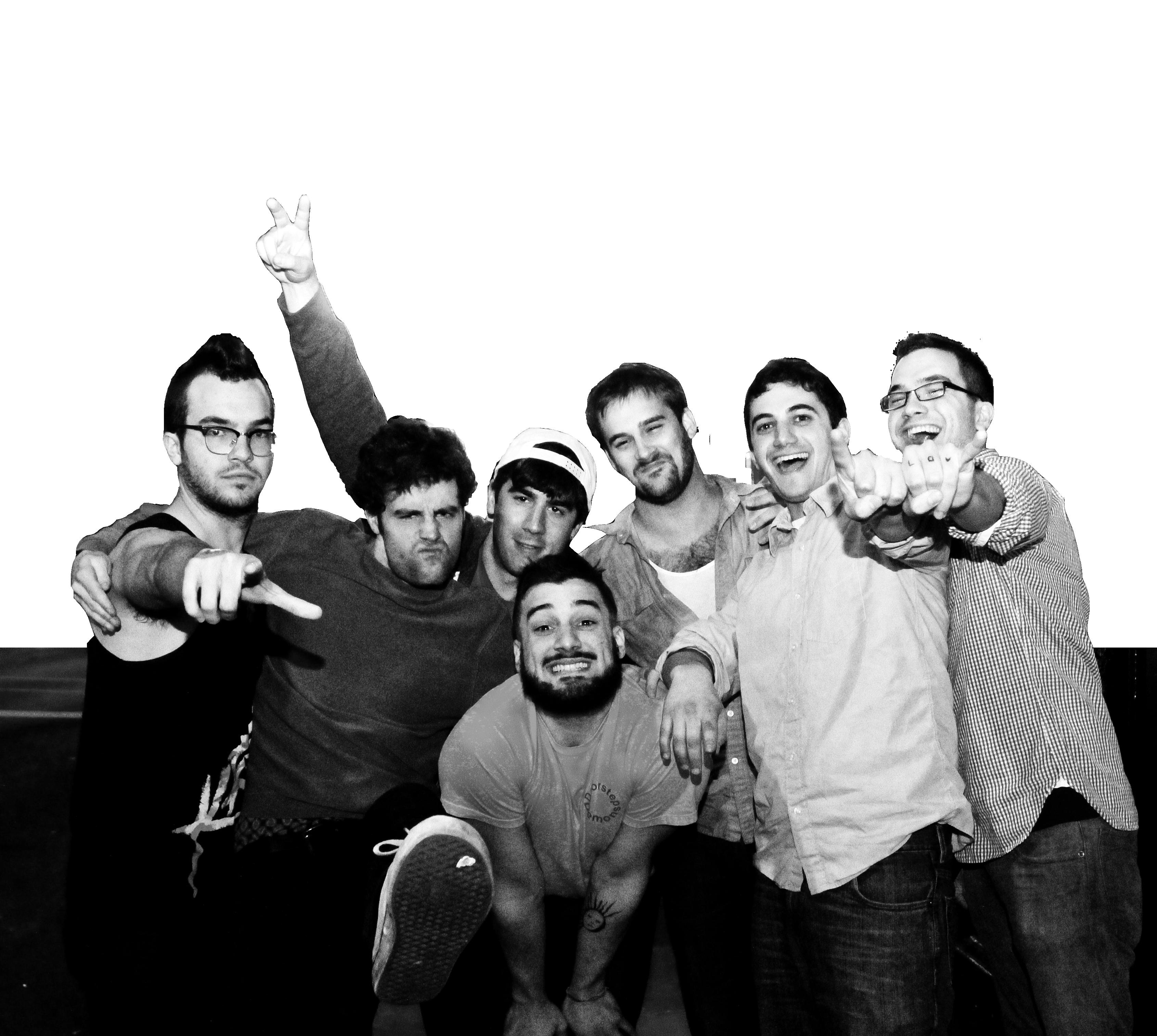
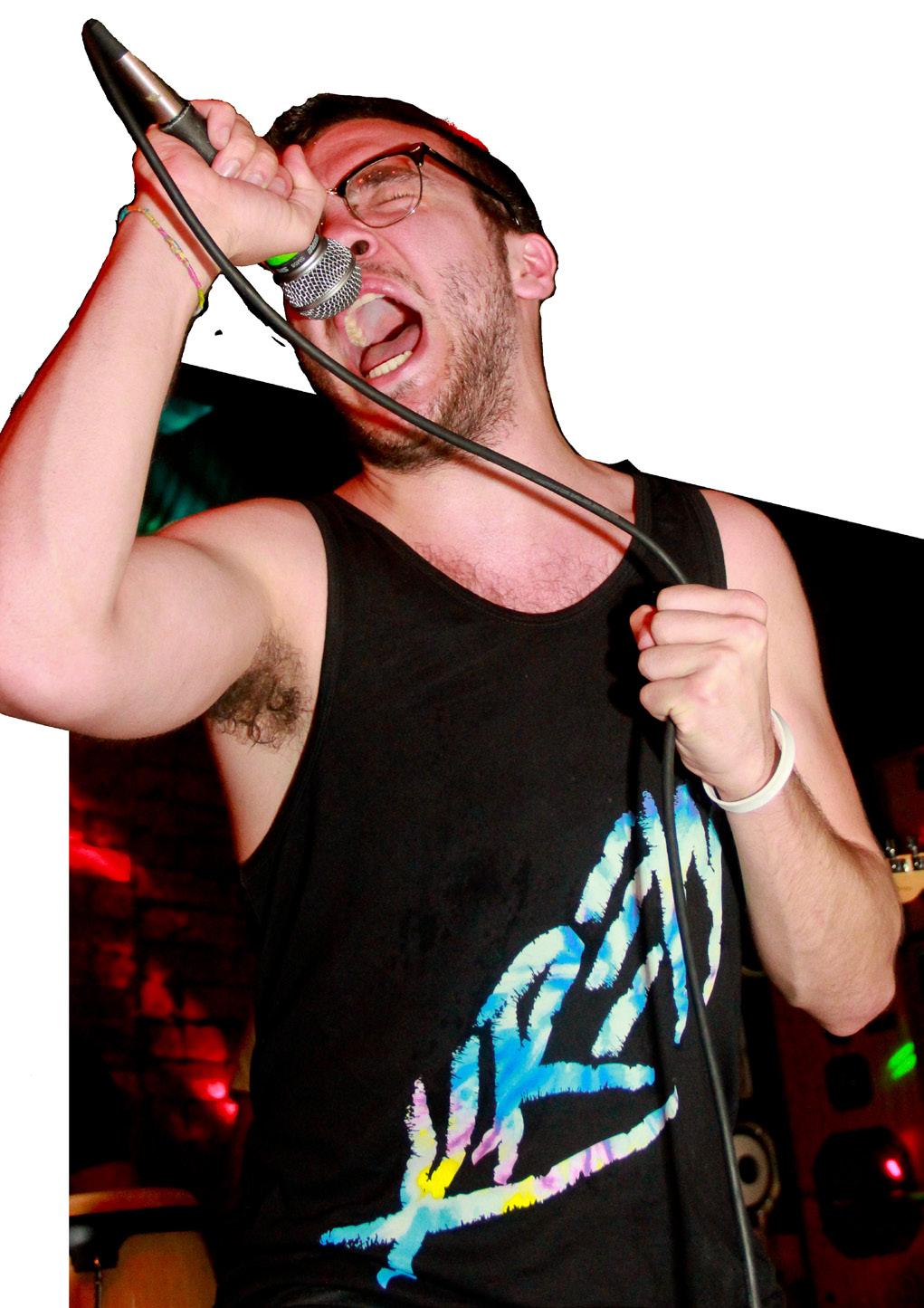
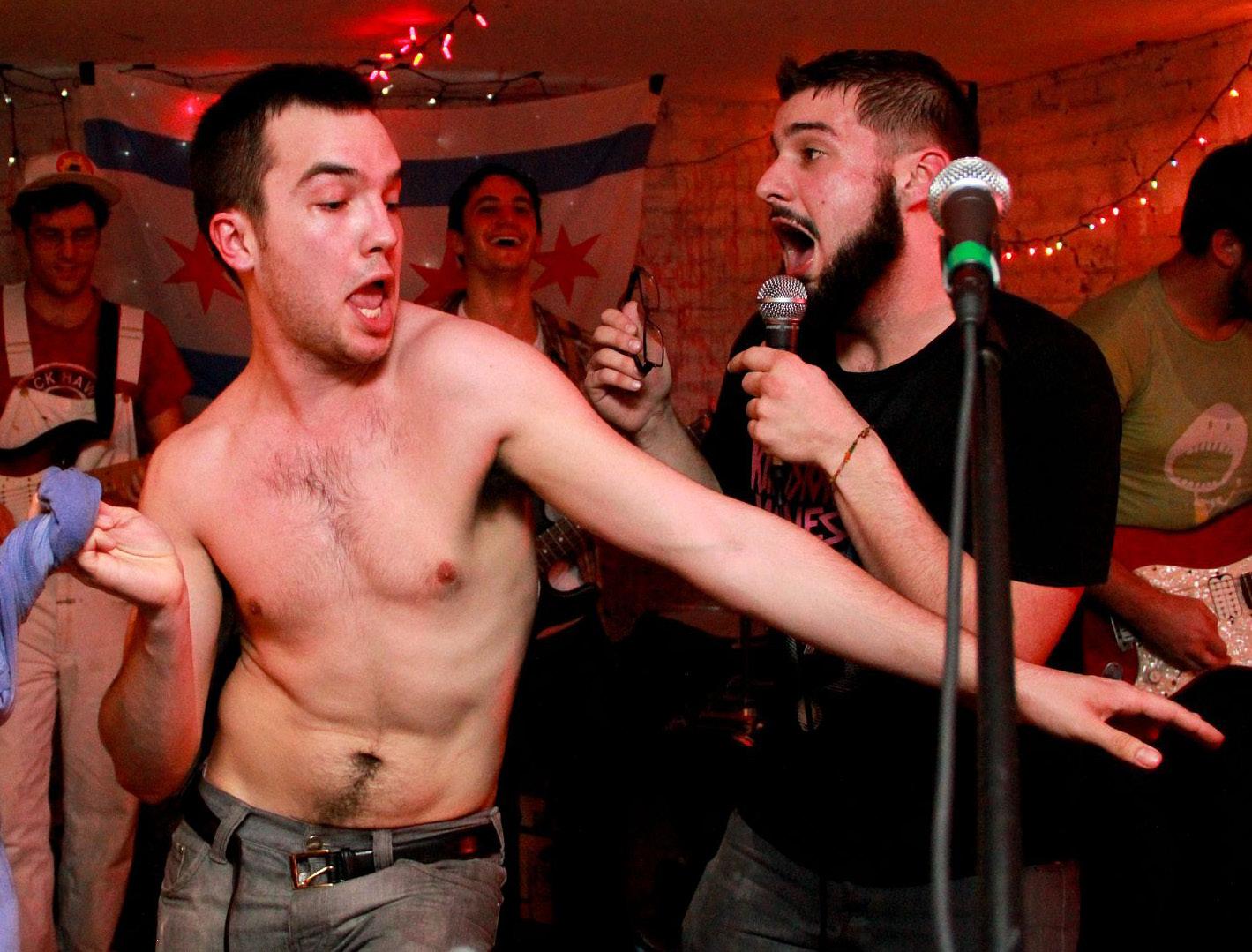
Broadcasting From the Trees Be Sneaky on Dillo Day Post-Grad Plans A Student Band That May Not Fail
What’s inside
Matt Connolly | Editor in Chief
Katie Tang | Executive Editor
Kevin Shepherd & Sourav Bhowmick | Managing Editors
Joe Drummond, Sean Kane & Nolan Feeney | Assistant Managing Editors
Julie Kliegman, Jordyn Wolking | News
Rachel Poletick | Opinion
Eddie Rios | Features
Stanley Kay | Life & Style
Laura Rosenfeld | Entertainment
Josh Sim | Sports
Sam Grossman | Politics
Shaunacy Ferro | Writing
Dan Schuleman | Photo
Erin Kron | Video
Tyler Fisher | Interactive
Mitch Armentrout, Priya Krishnakumar, Marcus Lee, Lydia Belanger, Gabe Bergado, Denise Lu, Eric Brown, Daniel Moran, Max Jones, Kit Fox, Alyssa Howard, z Gu, Natalie Krebs, Alex Zhu, Arpita Aneja, Alexis Sanchez | Assistant Editors
Feelin’ lonely? Not anymore! You can play with puppies.
6 EATS
Beat the heat by whipping up a batch of homemade ice cream.
22 PROFILES
The Smithsonian called, and they want his books.
28 STYLE
A couple of globe-trotters gave us the lowdown on style here and elsewhere.
34 TOWN
What’s full of hipsters and north of Ukrainian Village? Check this out and don’t get lost.
GENIUS QUAD SCOOP EXTRA
8 BREW YOUR OWN
Kick back with a cold one — that you brewed yourself.
12 POLYPHASIC CYCLES
You can sleep when you’re dead.
21 AERIAL SILK
She’s goin’ all Cirque du Soleil on our asses.
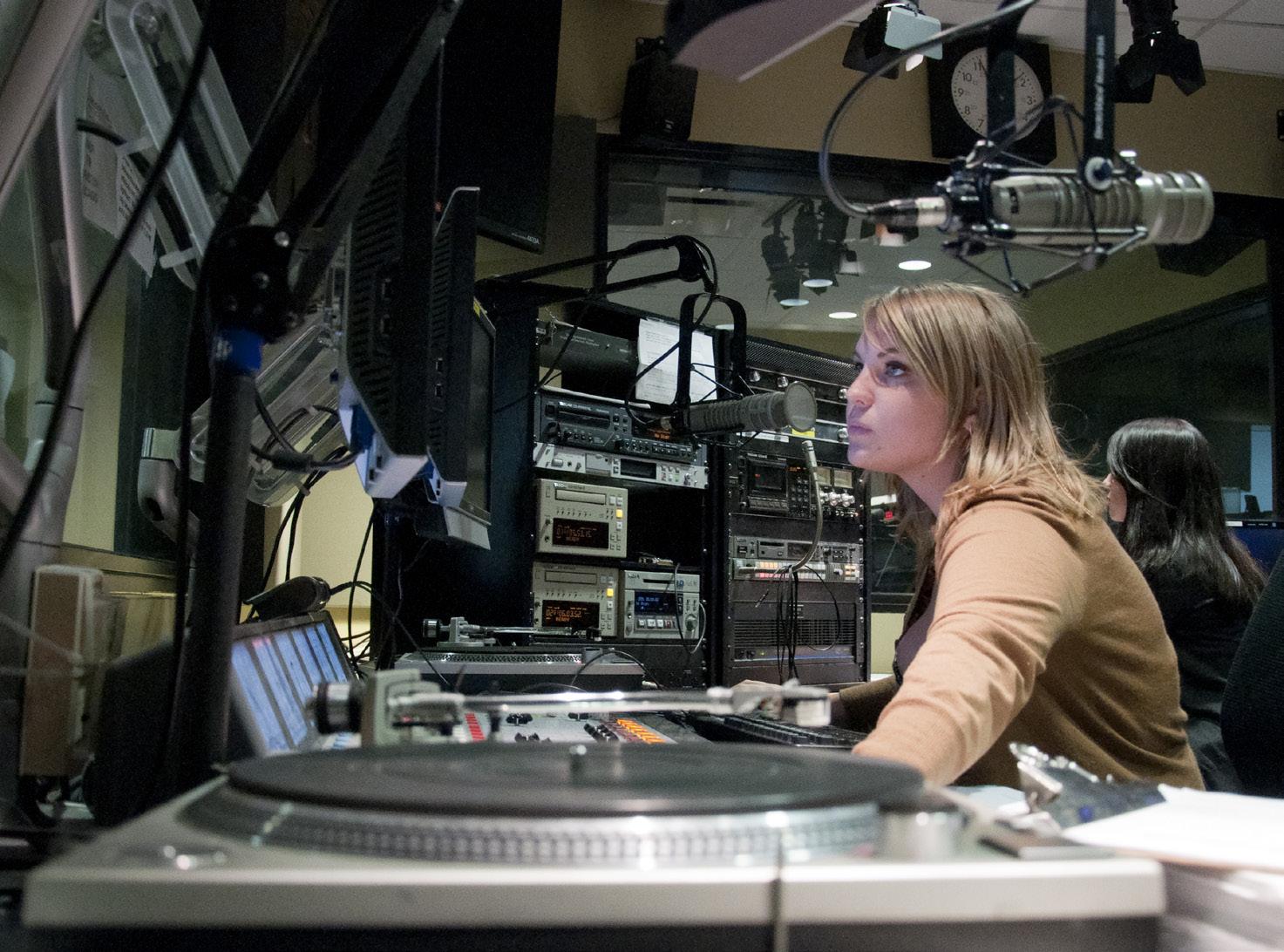
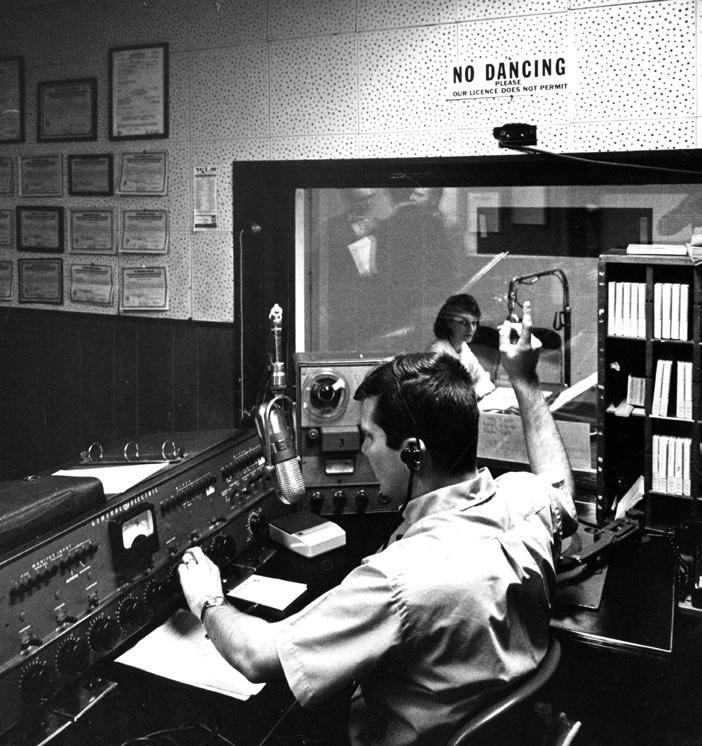
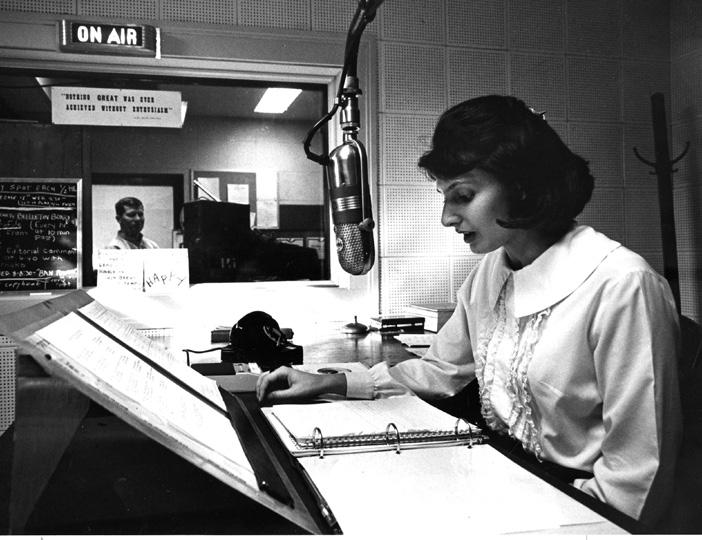
24 WNUR
They started rock on the Chicago FM radio waves.
NORTH BY NORTHWESTERN MAGAZINE
Sarah Adler | Editor
Shaunacy Ferro | Senior Editor
Lindsey Kratochwill | Senior Editor
Ariana Bacle | Associate Editor
Vanessa Dopker | Associate Editor
Camille Beredjick | Associate Editor
Laura Rosenfeld | Assistant Editor
16 HOME
Pick a potted plant.
27 MUSIC
Learn about lesser-known artists.
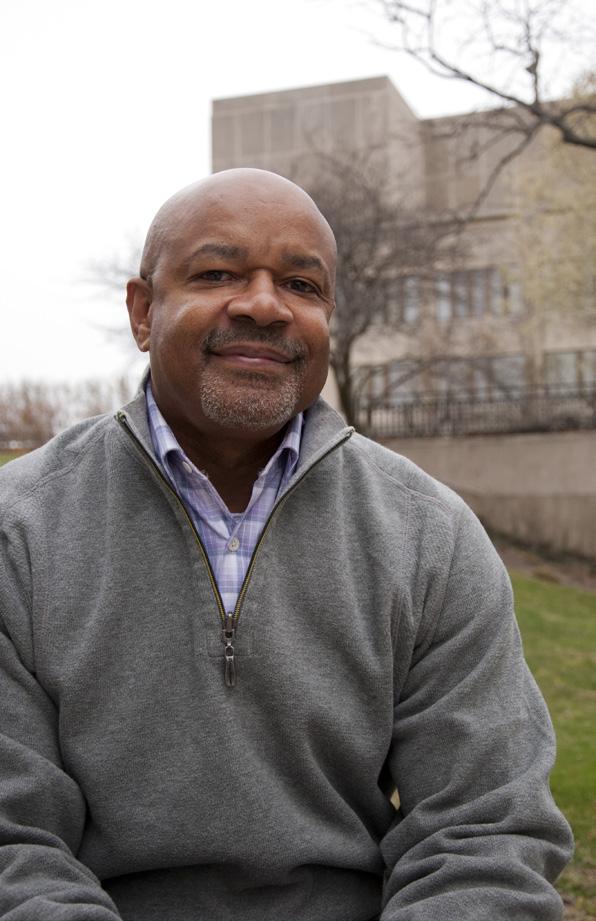
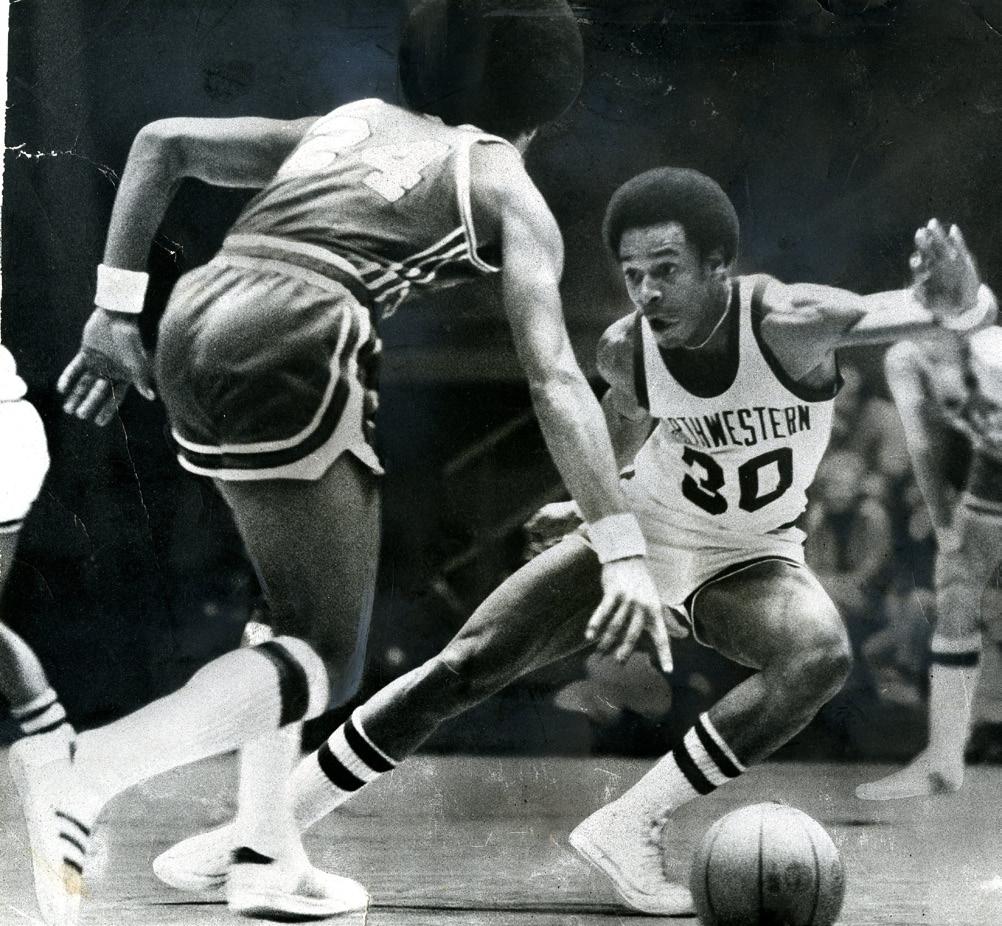
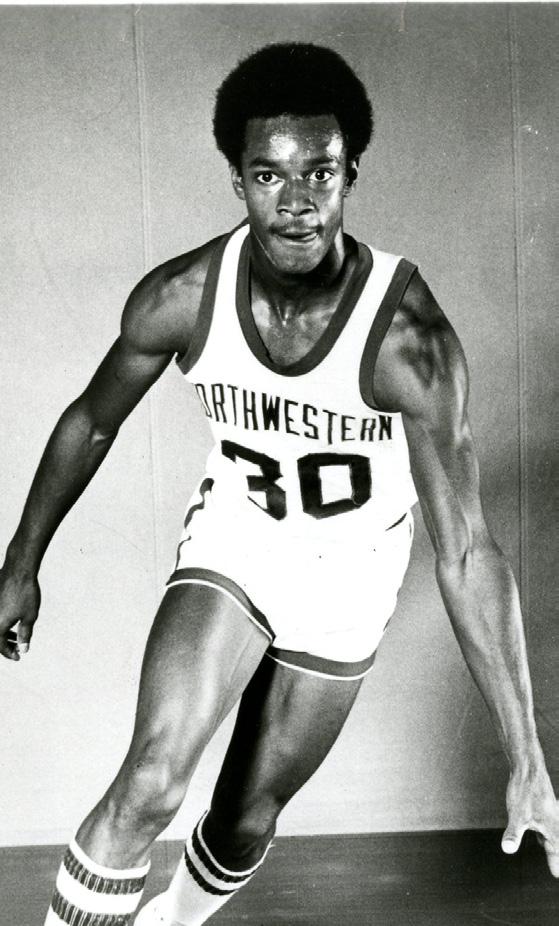
32 SPORTS Northwestern’s all-time leading scorer is quite the success.
Sarah Davidson | Creative Director
Katie Zhu | Senior Designer
Emily Chow | Associate Designer
Hilary Fung | Associate Designer
John Meguerian | Photo Director
Justin Barbin | Photo Assistant
Daniel Schuleman | Photo Assistant
Hannah Chung | Illustrator
NORTH BY NORTHWESTERN, NFP
BOARD OF DIRECTORS
Matt Connolly | President
Katie Tang | Executive Vice President
Sarah Adler | Vice President
David Ma | Treasurer
Sunny Lee | Secretary
45 FATE
Avoid certain cosmic destruction.
47 SCANDALS
With all the press we’ve been getting, what will we blow up for next?
30 ENTERTAIN Don’t let Dillo Day be a drag. Be a winner.
Dip Into Summer
Class up that bag of Tostitos with these recipes.
By Rhaina Cohen
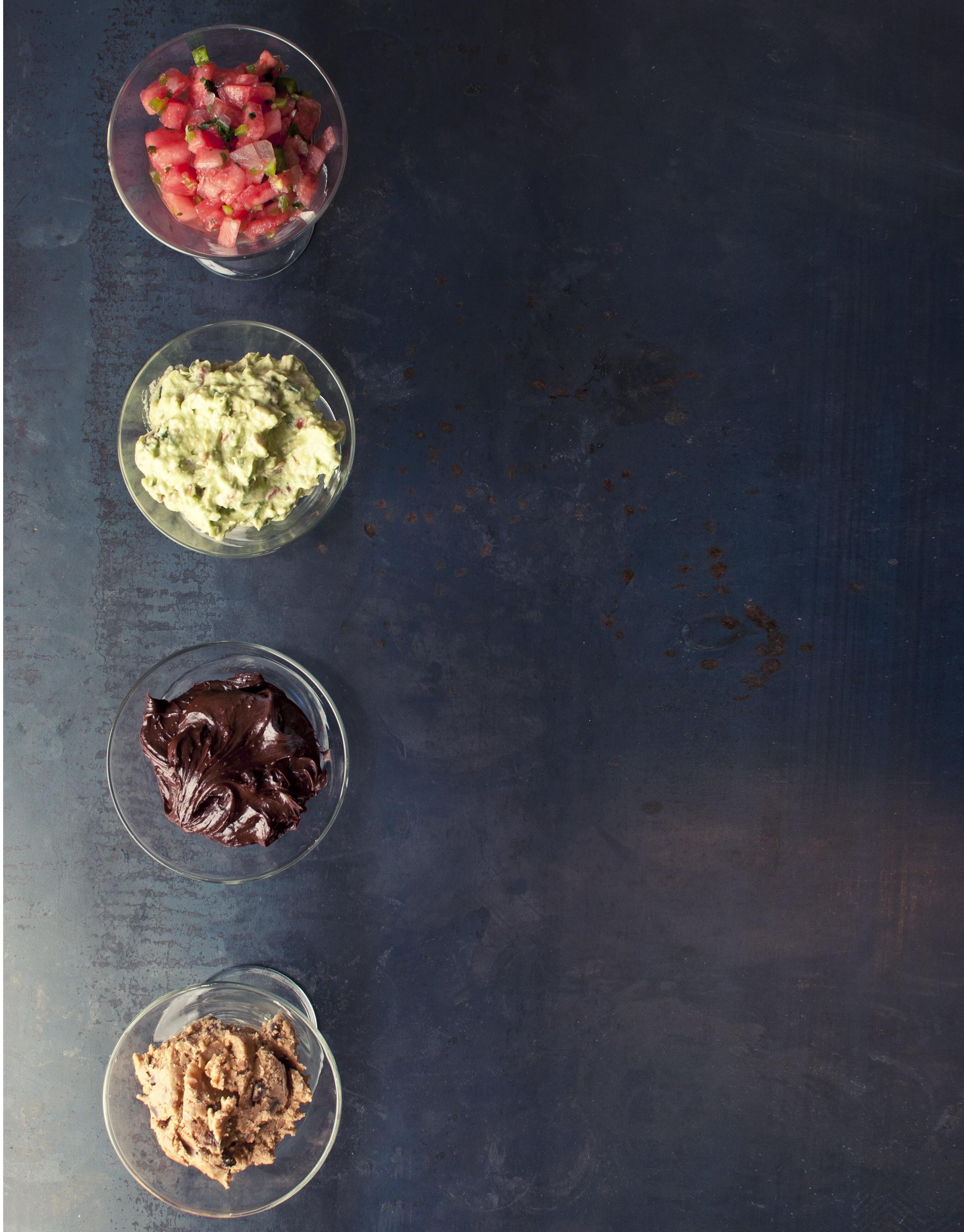
Your chips, fruit and crackers will be nude no more. Whether you’re in search of a sweet addition for dessert or a bit of a kick with chips, you’re covered. Simple but flavorful, these recipes will satisfy every taste bud.
FOOLPROOF GUACAMOLE
No need to run to Chipotle when you’re craving chips and guac. Requiring just six ingredients, this easy recipe is delicious with plantain, tortilla or pita chips.
2 peeled and pitted avocados
½ cup chunky salsa
Dollop sour cream
½ lime, juiced
Salt and garlic powder to taste
1. In a medium bowl, mash avocados.
2. Stir in salsa, sour cream, lime juice, salt and garlic powder.
3. Refrigerate for a half hour before serving.
WATERMELON SALSA
(Adapted from Larry Brodahl on allrecipes.com)
Add summer to your salsa with this recipe. The sweet and spicy flavors make an electrifying combination.
2 cups diced watermelon
2 tablespoons chopped onion
3 tablespoons seeded, chopped jalapeño peppers
2 tablespoons lime juice
½ tablespoon cilantro
1. Mix together watermelon, onion, peppers, lime juice and cilantro.
2. Cover and refrigerate for at least an hour before serving.
PEANUT BUTTER FUDGE DIP
This recipe will remind you of summer camp, when just about any food paired perfectly with peanut butter. Bananas and Oreos are particularly tasty with this dip.
1 ½ cup creamy peanut butter
3 cups powdered sugar
1 cup butter
1 cup crushed graham crackers
Optional: 2 cups semisweet chocolate chips
1. Melt butter in the microwave.
2. Pour melted butter into a medium- size bowl and mix with peanut butter, powdered sugar, graham cracker crumbs and chocolate chips.
WHIPPED CHOCOLATE DIP
With just a few ingredients and minutes to spare, you can prepare this light dip to accompany fruit, pretzels or graham crackers.
1 cup semisweet chocolate chips
1 cup Cool Whip
½ teaspoon vanilla extract
½ teaspoon cinnamon
1. Melt chocolate chips in a bowl.
2. Mix in Cool Whip, vanilla extract and cinnamon.
I Scream for Ice Cream
It’s better when it’s homemade. By
Julie Beck
Ben and Jerry think they’ve cornered the market on soothing sore throats and broken hearts, enticing you on your late night 7-Eleven run with their pricey pints and promises of pleased palates. But you don’t need them. You don’t even need an ice cream machine to enjoy the creamy treats you crave. All you need is a little prep time and a little patience.
BASIC VANILLA ICE CREAM
This simple sweet only takes 10 minutes to prepare. Mix in crumbled Oreos, peanut butter cups or whatever else your heart desires.
1 pint heavy cream
1 can sweetened condensed milk
¼ cup sugar
2 teaspoons vanilla extract
Pinch of salt
1. Beat heavy cream with an electric mixer on medium speed until fluffy.
2. Add sugar and salt; continue beating until the mixture forms soft peaks.
3. Mix in sweetened condensed milk and vanilla extract.
4. Place the mixture in a plastic container and freeze for four or more hours.
DARK CHOCOLATE ICE CREAM
Don’t make the mistake of thinking you can eat this in mass quantities — it’s richer than Morton O. Schapiro.
4 oz baking chocolate bar (60 percent or darker)
½ cup water
½ cup cocoa powder
½ cup sugar
1 ½ cups milk
2 cups heavy cream
Pinch of salt
3 egg yolks, whisked
2 teaspoons vanilla extract
1. Bring water to a boil in a small saucepan.
2. Place metal bowl on top of the saucepan and melt chocolate in it.
3. Scrape the melted chocolate into a medium saucepan over
low heat.
4. Add boiling water, cocoa powder and ¼ cup of sugar. Whisk until smooth.
5. Add milk, 1 cup of cream, salt and the rest of the sugar. Whisk ingredients together.
6. Separate out egg yolks in a separate bowl and whisk.
7. Pour about half of the chocolate mixture over the eggs, while whisking quickly to keep eggs from cooking. Then return the mixture back into the pan and stir.
8. Heat until almost boiling, then remove from heat and stir in the vanilla and the second cup of cream.
9. Chill the mixture in the fridge for at least three hours, then transfer to the freezer for at least four more.
HOMEMADE TOFFEE SHELL
That magic toffee sauce that hardens on contact with ice cream can be conjured in your very own kitchen, without any special ingredients or sorcerer’s apprenticeships.
8 tablespoons (1 stick) butter
¾ cup light brown sugar
1 teaspoon salt
½ teaspoon cinnamon
¼ teaspoon nutmeg
1 tablespoon vanilla extract
1. Melt butter and brown sugar together in a small saucepan over medium heat until sugar is fully dissolved.
2. Stir in cinnamon, salt and nutmeg, mixing thoroughly.
3. Mix sauce for five minutes or until completely smooth.
4. Turn heat to low and mix in vanilla extract.
5. Serve immediately from the stove, as the shell will start to harden at room temperature.
Keep Your Cool
Enjoy the best of Evanston’s cold drinks. By Alyssa
Howard
There’s nothing more gratifying than exchanging that knee-length North Face for a cardigan, no matter how interminably gradual that transition can be. And as we spend this last quarter basking in the warmth — fingers crossed — our drink choices should alter with the seasons. Ditch that grande nonfat caramel macchiato with skim milk that was your constant companion throughout Winter Quarter.
STRAWBERRY TROPICAL FREEZE
One size | $3.50
CAROLINA HONEY BREEZE
Small $3.25 | Medium $3.95 | Large $4.25
This drink emulates the sweet tea of the South and is made with loose leaf tea for a full flavor.
ICED COFFEE
This is Joy Yee’s take on a classic strawberry smoothie, with great consistency — not too thick, but also not too runny. Be sure to finish off the chewy tapioca pearls at the bottom.
Small $1.80 | Medium $1.95 | Large $2.05
Peet’s does this classic right — and cheap! This is a great companion for library nights that turn into mornings.
ARGO TEA
PEET’S COFFEE & TEA
JOY YEE’S NOODLES COSI KAFEIN
CANDYLAND SHAKE
Regular $4.95 | Large $5.95
The combination of Oreo, Butterfinger and Heath in one drink with your choice of vanilla or chocolate ice cream should violate the laws of excessive deliciousness. Notify the proper authorities.
ARCTIC MOCHA
Tall $3.49 | Grande $3.99 | Gigante $4.59
Coffee and chocolate blended into a frappe-like consistency with fewer calories from fat than a standard Starbucks Frappuccino — does it get any better?
DRINK
HOW TO Brew at Home
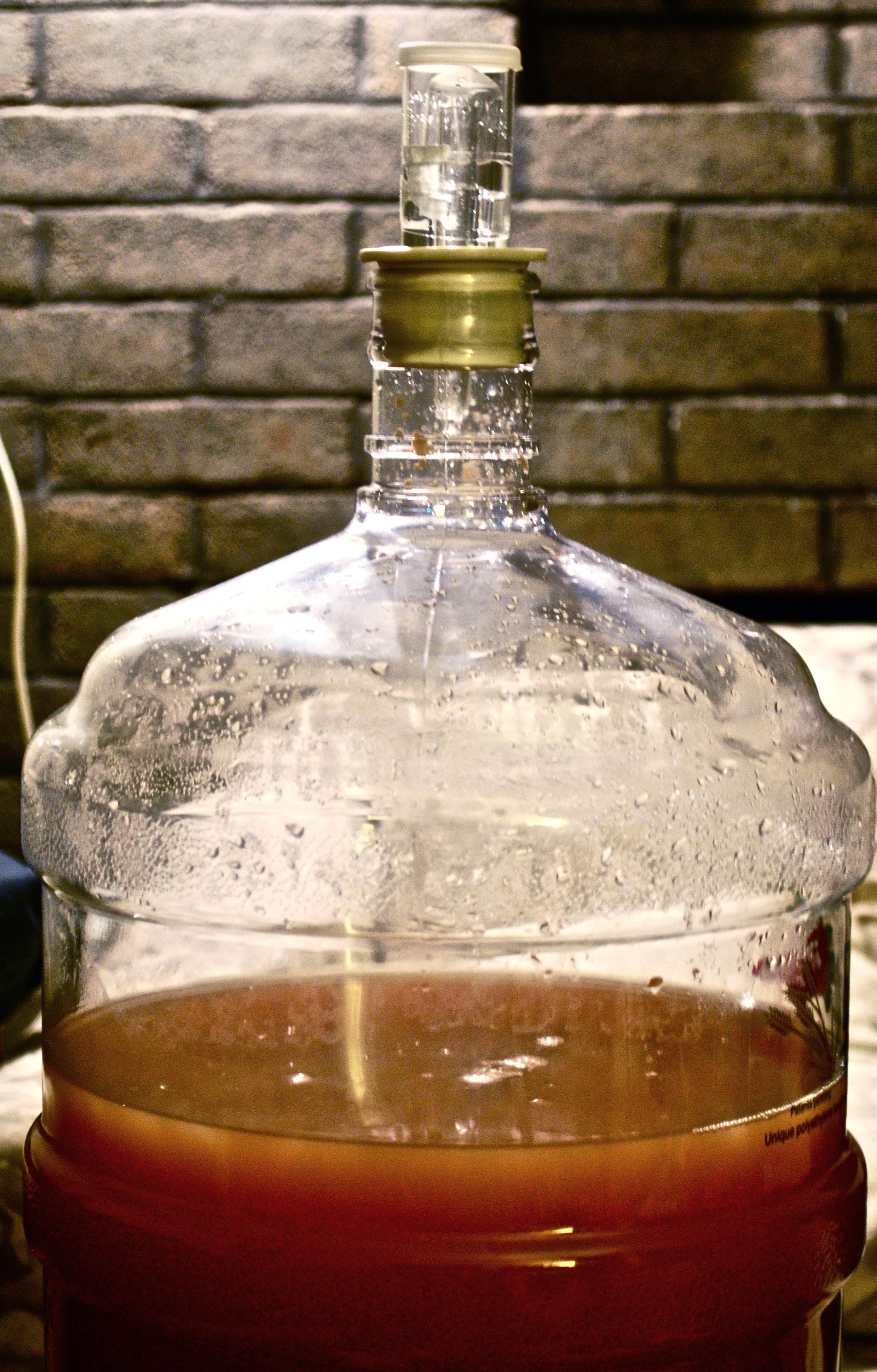
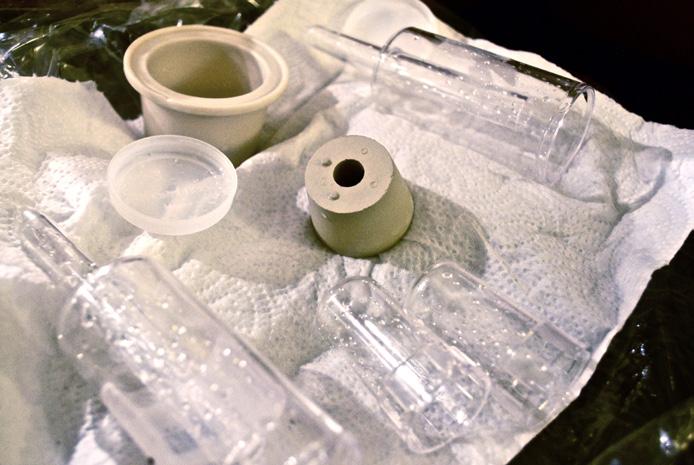
The simplest way to start is with a gallon of Whole Foods organic apple juice ($7.15), although any cider without added preservatives will do. This one is sold in a glass jug, which saves you the trouble of buying and sterilizing more hardware. For volume’s sake, however, you can buy a 3-5 gallon carboy from a homebrewing store. You will also need a rubber stopper, a funnel and an airlock to keep contaminates out. We picked up some
champagne yeast, yeast nutrients and assorted chemicals as well. All of the miscellany cost us under $15 at Brew & Grow on North Kedzie Avenue.
1. Sterilize everything you are working with to avoid letting organisms infect your brew. This can be done with a bleach, vinegar and water solution, but we recommend buying iodine or Star San. Bleach can be scary.
2. Funnel the yeast and nutrients into the cider. Optional: We put
Although brewing at home isn’t too hard, you still need to acquire the proper accoutrements before you can begin.
honey and brown sugar in first for flavor and to raise alcohol levels.
3. Place the stopper into the bottle and then fit the airlock in tight.
4. Fill the airlock with a little bit of sanitizer solution.
5. Leave the cider somewhere dark and 60-70 degrees Fahrenheit, and wait for the bubbling to begin! After a few weeks when the bubbling subsides, primary fermentation will be complete. At this point you should have a dry, tart farmhouse style cider, so many choose to back-
sweeten with organic sweeteners to taste.
If you want an extra touch of class, save some old bottles and soak them in hot dish-soap water until the labels can be peeled off. Fill ‘em up (but we don’t recommend capping, that’s trickier) and share with of-age friends and guests!
Check out makinghardcider.com and consult reddit.com/r/homebrewing, who we thank for helping us out on our journey, for more information.
Redefine BYOB and learn to DIY. By Max Brawer
photos: max brawer
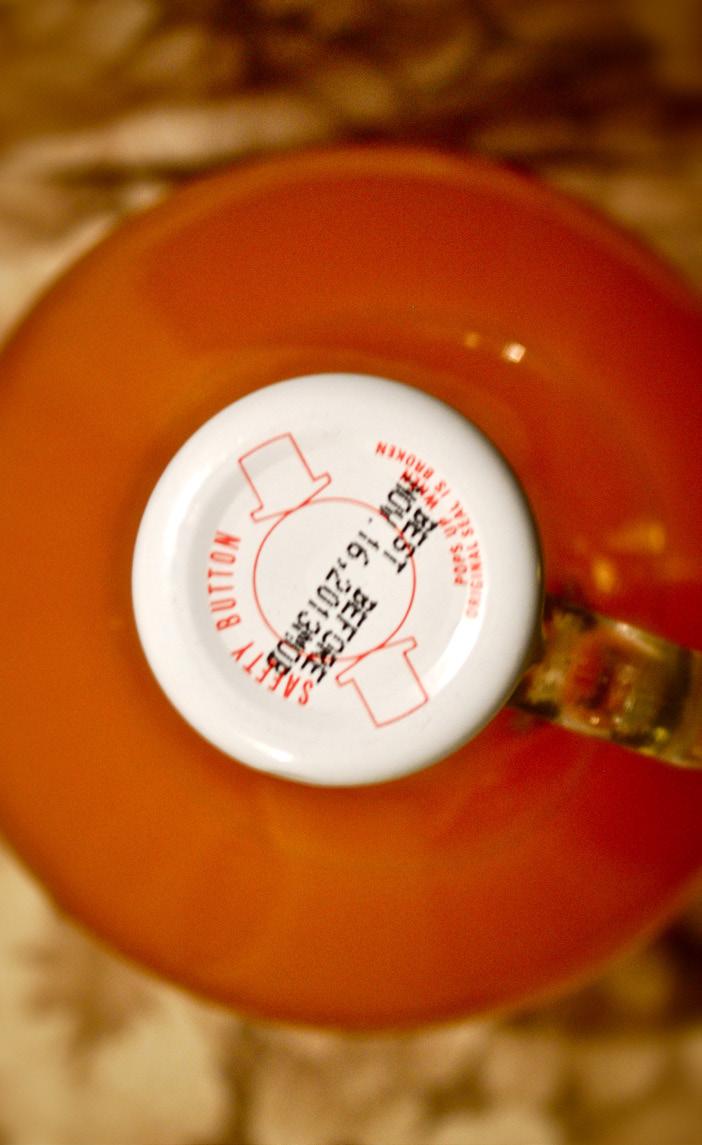
Do It Cheaper: Walgreen's Big Flats is $2.99 for a six-pack. But it may taste like it.
CAMPUS APPROVED BREWING
From research grants to lab requirements to journalism residencies, Northwestern undergrads have many chances to exercise those DIY muscles. One applied science that the school has yet to cover, however, is homebrewing — the crafting of alcoholic beverages.
Anyone who spends a nice night out with the right kind of hipster will likely learn that there is a complex world of liquor and beer out there — far across the jungle juice rivers and beyond the Blue Moon. By learning to brew, one can grow to appreciate the craft and diversity of alcohols.
While a brew or two makes for a good pet project, it’s an extracurricular for some. Such is the case for the Wesleyan Homebrewers’ Alliance, a chartered student group at the Connecticut liberal arts college. The Alliance started underground but has been recognized by the school for six years, working to bring about an era of “Wesleyan beer self-sufficiency.” They have 58 members and receive school funding for equipment, ingredients and labels. Wesleyan isn’t the only school with such a club but “no one does it on the same scale,” notes Sky Stallbaumer, Alliance co-President.
School-supported alcohol production is hard to fathom, but it is wholly legal if done to code. Fermentation must be supervised by a 21-year-old, but minors are allowed to be present (but can’t legally drink). The output can be distributed (not sold) only to family, guests and the brewmasters themselves. At Wesleyan, members pay dues to account for the product they get to take home.
If there’s ever to be a Northwestern Homebrewers’ Alliance, there have got to be homebrewers first. If you’re interested, try something simple. Only you can bring Northwestern to a state of beer self-sufficiency. Let’s make Frances Willard proud.
— Max Brawer
Right in Our Backyard
Fantastic beers brewed in our neighborhood. By Joe Drummond
Night after night, Northwestern students pound can after can of bilgewater without knowing any better. But fear no more! Local microbrews are a cheap solution to any student’s beer woes.
Microbrews are a bit pricier than Busch, Keystone or Natty, but they also usually have a higher alcohol content, so it’ll only take a couple pints before you’ve got a healthy buzz going. And even if this beer doesn’t get you seeing double, the flavor and complexity of a fine microbrew is rich to the point of being
stimulating, galvanizing and even, dare I say it — intoxicating. Enjoy a couple of these pints and you’ll end the night satisfied — with no hangover and no regrets.
By definition, microbrews are made locally and in small batches, but they can be bottled and sent almost anywhere. Both EV1 and Whole Foods carry a decent selection of bottled microbrews from Chicago and beyond. But if you want to properly enjoy a microbrew, get it on tap, or “draught” (pronounced draft), to use beer snob’s argot. This
requires a little adventuring and a passing ID, but it’s totally doable. There are plenty of bars in neighborhoods like Wrigleyville, Ravenswood and Edgewater that serve a wide variety of Chicago’s finest microbrews.
A microbrewery is a beer laboratory: The brewers are always experimenting. They usually release a variety of seasonal and limited edition beers, and they often come up with something completely new and different. Despite the constant innovation, they’ve got accessible, staple beers to get you started.
Goose Island: Green Line Pale Ale
5% ABV
Founded in 1988, the Wrigleyville-based brewery was bought out by Anheuser-Busch in March. So although Goose Island as a whole may be getting less “micro,” Green Line is available only within Chicago city limits and only on draught. The flavor is pretty basic, but it’s the best beer for your buck and it’s almost entirely locally sourced. An excellent first microbrew.
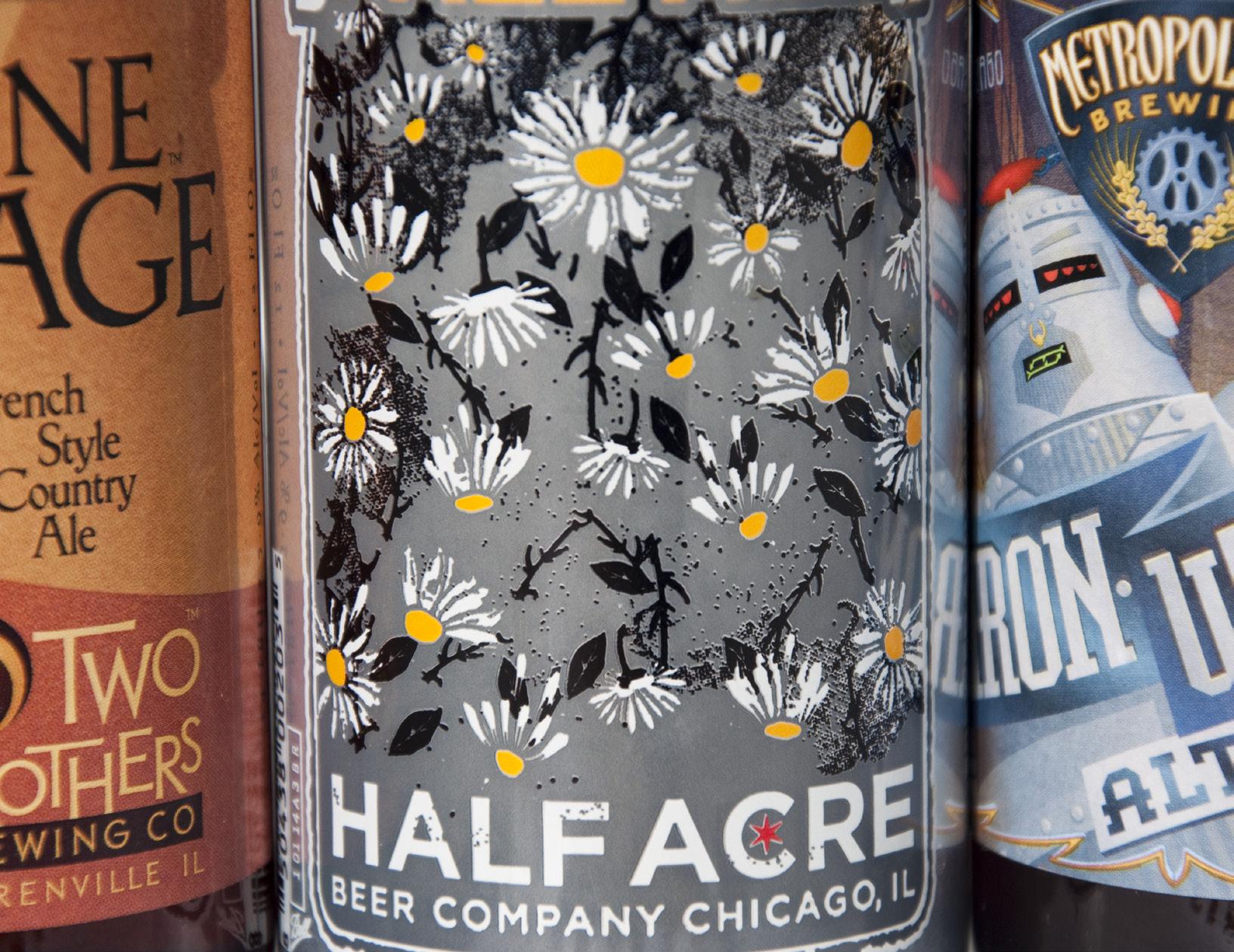
Half Acre: Daisy Cutter Pale Ale
5.2 % ABV
Half Acre is quickly becoming one of Chicago’s most acclaimed microbrews, and Daisy Cutter is their flagship beer. It’s nicely carbonated yet super smooth and tastes faintly of oranges, mangoes and peaches. As the weather gets warmer, this beer is perfect to drink in the afternoon at an open-air restaurant or out on the front porch.
Two Brothers: Domaine DuPage French Country Ale
5.9% ABV
The Two Brothers Brewery is actually run by two brothers in the west suburbs. Inspired by the time they spent in France learning the art of brewery, Domaine DuPage is hearty and could go with any meal. It has a creamy texture and tastes like straight caramel. If you’re looking for a candidate to make beer floats with, this is the one.
Metropolitan:
Iron Works Alt
5.8% ABV
Metropolitan Brewing is located in nearby Andersonville, and they offer tours a few times a month. Iron Works Alt is a rare German-style altbier, a type no longer crafted by most mainstream brewers. This copper-colored ale is slightly bitter at first, but after a pint or two (or twelve), it’ll taste like berries. When you drink this beer, get a greasy snack to go with it.
LOVE
Puppy Love
Fido won’t be jealous if you cuddle with these pooches. By
f you had more trouble saying goodbye to your pet than your parents when you came to college or if you miss the comfort and unconditional love that a furry friend provides, you’re not alone.
“As a freshman, I really missed my dog and cat from home,” says Rachel Basore, Weinberg sophomore. However, Northwestern housing policies prohibit animal lovers like Basore from having pets in the dorms. Fortunately for the less rebellious dorm dwellers or those off-campus residents who elect to be pet-free, there is an alternative to having a nonhuman companion of your own — one that helps the animals as much as it helps you.
“Volunteers are always welcome and there are really a wide variety of activities people can get involved in,” says Matt Gannon, manager of Chicago’s Red Door Animal Shelter. “Volunteers help with socializing with the animals,
fundraising, driving, etc. All of it goes back to the ultimate goal of helping the animals.”
In addition to pet adoption, the shelter has foster care and online adoption programs so that volunteers can choose their own commitment levels. But simple volunteering goes a long way.
According to Gannon, Red Door Animal Shelter has about 300 volunteers who lend a hand anywhere between a few times a year to several days each week.
What does that mean for the busy student? Instead of holing up in the library, students with some extra time and TLC can let off steam by cuddling with dogs, cats or rabbits and know it’s for a good cause.
“My volunteer work keeps me grounded in the real world,” says Basore, who began volunteering at PAWS Chicago in the fall. “I think that it’s very easy to get caught up in academics and extracurricular activities here at Northwestern. Volunteering gives me a chance to
Heather Devane
get off campus and to interact with people other than Northwestern students and professors.”
At PAWS, volunteers can choose duties according to the desired level of interaction with the animals.
“Many people choose to volunteer at the adoption center on the north side of the city because the tasks there involve much more interaction with the dogs and cats waiting for homes,” says Callie Sadler, a PAWS community outreach intern. “In our clinic volunteers spend time caring for the animals who have recently been taken in but who are not yet ready to move to the adoption center.”
Volunteers like Basore, who is the Northwestern site leader at PAWS, interact with the dogs and cats, clean the animals’ rooms and work with potential adopters to help them find a match.
“It does tug at your heartstrings,” says Basore. “Every time I go, I end up wishing that I could take one home with me.”
PLACES TO PLAY
Red Door Animal Shelter (773) 764-2242
2410 W. Lunt, Chicago
PAWS Chicago (773) 935-7297
1997 N. Clybourn Ave., Chicago
C.A.R.E. (847) 705-2653
2310 Oakton St., Evanston
The Anti-Cruelty Society (312) 644-8338
157 W. Grand Ave., Chicago
Animal Welfare League (773) 667-0088
6224 S. Wabash Ave., Chicago
Tree House Humane Society (773) 784-5488 ext. 228
1212 W. Carmen Ave., Chicago
Chicago Animal Care and Control (312) 747-1406
2741 S. Western Ave., Chicago
Felines, Inc. (773) 465-4132
6379 N. Paulina St., Chicago
We borrowed Cooper from Communication senior Barry McCardel.
photo: john meguerian
Cheese Fries and Garden State
The best moments in life are broments. By
Do you guys want to watch Garden State with me tonight?”
“Dude. Yes.”
“I’ve been looking for an excuse to watch that again.”
“Cool, I’ll drive us over then.”
“Wait, where?”
“Norris. They’re playing Garden State tonight.”
“Wait, they’re playing Garden State at Norris tonight?”
“I was just going to bring my DVD over, but we can do that, too.”
“Wait, you guys didn’t know they were playing Garden State at Norris tonight? You would have just been down in general to watch Garden State on DVD on my couch on a Saturday night?”
“Sure, man.”
“It’s a great movie.”
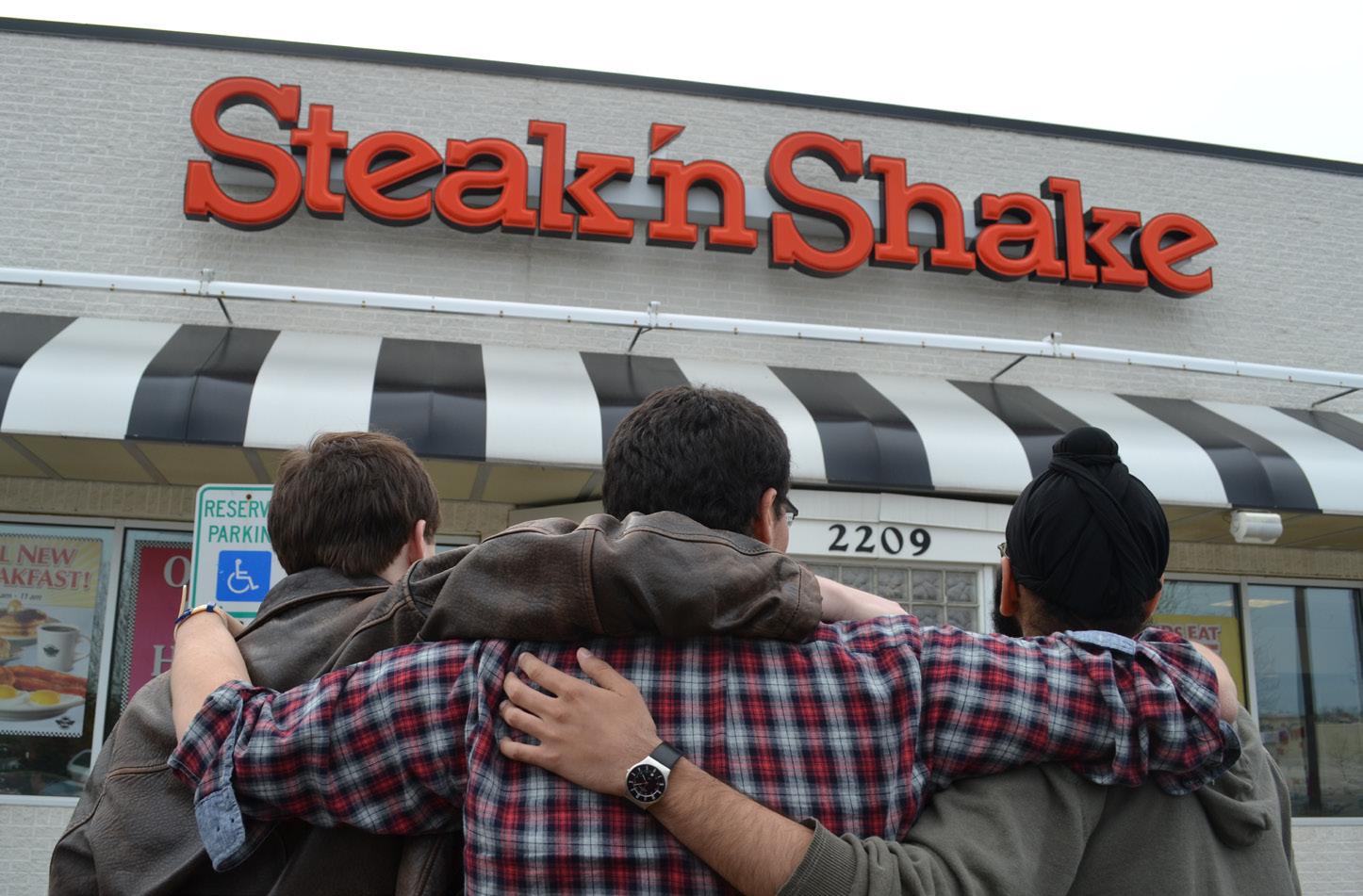
We didn’t end up watching Garden State that night. I think that was the night I drove us to the Steak ‘n Shake on Oakton at one in the morning, talking about school and work and girls and our futures, ravaging our bodies with burgers and cheese fries and blended milkshakes because we needed to feel gross about ourselves for a little while. One of them’s a writer with a knack for the hard sciences, like me (if you consider my linguistics as hard a science as his chemistry — which I do), and the other wants to be a doctor, like my father. I can’t help but think about the niche identities we establish for ourselves in college, how we seek out like-minded, familiar spheres of influence to supplement and complement our own.
“This was a terrible decision,” one of them might say. “Why did you bring us here, why did we come with you here?” the other might respond, but they’d be smiling. They know this isn’t the kind of thing you do alone. It’s a side of yourself you only show a handful of people in the entire world; a vulnerability, one that comes from washing down a plate of cheese fries with a peanut butter cup milkshake, that you only share with your best “bros,” and I know they’re having as good a time as I am.
Urban Dictionary describes a “bromance” as “the complicated love and affection shared by two straight males,” with a surprising number of definitions attributing the origin to Socrates and Plato’s relationship. I personally have never been a big fan of the concept. Samwise always freaked me out a little bit, how clingy he was to Frodo, and there was definitely a little something going on between Gene and Finny in A Separate Peace. “Han and Chewie,” my best friend from back home suggests, when I tell him the idea for this story, but I tell him their relationship always seemed a bit more like master and subject than a true “bromance.”
“Plus, the bestiality,” he posits. Apparently there’s no bestiality in “bromances.” “Murtaugh and Riggs?” he asks, and I tell him Lethal Weapon hasn’t been relevant for 10 years, ignoring that night last summer when we ordered two pizzas apiece and watched all of them in a row, afraid his
Dan Camponovo
Guy love: All the best bros bro out at Steak ‘n Shake.
parents would yell at us for raiding their basement mini bar. “Jay and Silent Bob,” he suggests, and I tell him he’s on the right track. There are 30 or 45 seconds of silence as we brainstorm together, trying to come up with the quintessential, be-all end-all example of a “bromance” before our minds reach the same conclusion. “J.D. and Turk,” he yells at me during my own eureka moment, shouting “Turk and J.D.!” like I had just won a race.
That’s how I know we’ve got it down. You can switch the names around and still have the essence of the “bromance” intact. A separate Urban Dictionary definition, which also hearkens back to Socrates (what is it with the Socrates arguments?) states that in a “bromance,” “the whole is greater than the sum of the individual parts.” The definition gives the equation “George Clooney and Brad Pitt (a classic “bromance”) is greater than George Clooney or Brad Pitt.” “The movie’s not called Hooch and Turner,” I tell my friend.
“Again with the bestiality,” he answers back.
There’s an episode of Scrubs where Turk and J.D. spend the day waiting for their shifts to end so they can go out to a steakhouse after work, just the two of them. “Steak Night,” they call the annual event, and even came up with a special duet for the occasion. All they want to do is put away their work lives and eat steak and feel gross about themselves for a while.
They didn’t end up going to “Steak Night” that night. I think that was the night they stayed in and had a beer with a patient who was about to die, talking about work and death and girls and life. They know dying’s not the kind of thing anybody wants to do alone.
“Man, what a good show,” one of them says in our booth at Steak ‘n Shake. “R.I.P.,” the other says. “It’s funny because it’s all true,” I say, dipping a cheese fry into my milkshake.
BEST BRO PUNS
Bromeostasis (n.)
Embodies the qualities necessary in total bro fulfillment. Optimal and godly level of “bro.” A sense of “broyalty.”
Bromentum (n.)
The driving force among a group of bros during a night of partying. As more bros party, the group gains bromentum.
Bromansion (n.)
* Adapted from Urban Dictionary *
A house of bros who have bromances with each other.
Bromand (n.)
A command given by a bro. Note: you must be a bro, not a ho, to give a bromand.
Re-doing Your REM
Imagine what you’d accomplish if you slept two hours a day. By
Remember the Seinfeld episode where Kramer tries to copy Leonardo da Vinci’s famed sleep patterns? The practice of taking short naps throughout the day instead of sleeping in one large chunk at night?
It’s called polyphasic sleep. For Kramer, it didn’t work out so well, but there’s a whole community of people dedicated to polyphasic sleep. I even tried it myself.
A quick briefer: Polyphasic sleep is based on the idea that rapid eye movement sleep, or REM, is all you really need. There are three major phases of sleep — light, deep and REM — and typically REM, which is when most dreaming occurs, occupies only about 20 to 25 percent of total sleep time. By training your body to enter REM right away, as opposed to the 90 or so minutes it usually takes, you can supposedly cut out the sleep you don’t need and live on naps alone.
There are a number of people who claim to live successfully this way, and they reside online in forums and blogs where they discuss all things polyphasic. They maintain polyphasic sleep logs, trade advice on beating the adaptation process and discuss the positives and negatives of going polyphasic.
The most popular polyphasic method is called the Uberman, which involves one 15 to 20 minute nap every four hours, around the clock. If you can make it through the extreme sleep deprivation of a brutal adaptation period, the claim goes, while adhering to the new sleep schedule with rigid consistency, your body will adjust its internal rhythm to match the
new pattern. And in theory, you’ll be able to comfortably stay awake for 22 hours each day. But you can’t oversleep. If you do, your body can’t learn to go straight into REM, and it won’t work.
I first came across the idea after a forensic doctor I’d met told me he sleeps just two hours a day. I’d heard of such things from passing mentions in articles I’d read about famous people like Cornel West and Gilbert Arenas, so I consulted Google. Right away I stumbled onto a whole set of Internet resources for something called polyphasic sleep. My burning question: Can this thing possibly be for real?
Philip Jacobson
The average person sleeps about seven hours a night, totalling about 106 days a year.
insomnia and night terrors after hearing about Fuller’s infamous “Dymaxion” pattern. She recently wrote a self-published book on the subject and currently maintains the Polyphasic Sleep Information Portal online.
ONE WEEK IN, HOWEVER, I BEGAN TO FEEL MY BODY BREAKING DOWN […] FOR WHATEVER REASON, I OCCASIONALLY OVERSLEPT.
I approached the story from both inside and outside. In addition to trying the Uberman myself, my reporting spanned science, history, sociology and anthropology. I interviewed psychiatry professors and sleep scientists. I researched the sleep practices of other cultures. I read about alleged polyphasers like Buckminster Fuller, Albert Einstein and Mircea Eliade.
The most interesting moment in polyphasic history to me, however, was its meme-like spread over the Internet. Tracing polyphasic back to its online inception, I came upon Marie Hetrick, who as a college student in 2000 coined the term “Uberman Sleep Schedule.” Hetrick told me she first experimented with the schedule to combat her
Another key polyphaser is Steve Pavlina, the popular personal development blogger whose site marked my introduction to the phenomenon. If polyphasic sleep sounds unbelievable, Pavlina makes it sound more than plausible. Pavlina tried the Uberman after reading Hetrick’s article and kept an unusually comprehensive log. Polyphasic bloggers frequently cite him as their introduction to the topic. There are others. Bill Turnbull, the BBC anchor who in 2006 tried the Uberman for TV (“It can drive you a bit bonkers after a while,” he told me). Josh Kornreich, a Carnegie Mellon junior, got involved in a polyphasic experiment based on the Zeo alarm clock, which uses an electronic headband to measure your brain waves and read your sleep patterns.
Personally, I designed a schedule for napping at 3, 7 and 11 throughout the day and night, with adjustments for class on certain days. I became a nomad, often crashing at the library or friends’ houses for several cycles at a time. The initial days were brutally hard, but on the fourth day I had my first breakthrough: I woke from a vivid dream feeling refreshed and alert, a sure sign of REM. I was optimistic that adaptation had begun to take hold.
One week in, however, I began to feel my body breaking down. When I played basketball, the result was stiff fingers, creaky ankles and sore knees. The problem was, I suspected, my inability to maintain absolute consistency, despite my best efforts. For whatever reason, I occasionally overslept. It got to the point where every one or two days, I would accidentally sleep an extra hour on a nap. Once, for example, I started reading a book at 4 a.m. After what seemed like a few minutes I glanced at the clock — more than an hour had passed.
The fact is, the vast majority of those who attempt the Uberman fail, unable to adhere to the strict schedule the process requires. As for myself, certain inconsistencies in my execution became apparent after I had already started. I would lay down for naps only roughly within their scheduled start times, for example, for class or whatever reason. No big deal, I figured at first, but interviewing more seasoned practitioners told me this wasn’t the case. By the time I realized, I had built up too much of a sleep debt to start anew.
Two weeks in, trapped in polyphasic purgatory, catching a cold and going comically insane, I called it quits.
I still don’t know if the Uberman is real. I can’t know. Hetrick and Kornreich were insomniacs, making it impossible to tell if sleeping polyphasically actually made them feel as good as they think it did. I can only deem my experiment inconclusive.
Would I try it again? Probably not. But I won’t rule it out — I still want to know.
photo: john meguerian
Chasing Pavement
These runs can help bring your beach body back. By Danielle
Moehrke
BAHA’I AND BACK
Length: Four miles from south campus and back, two miles from north campus and back This is the route for the runner who needs some pretty sweet landmarks to look at while running. Notable sights: the Arch, Tech (for those of us who rarely get off south campus), the frat quads in daylight, Grosse Point Lighthouse, Lake Michigan, the beautiful Baha’i House of Worship and the Wilmette Harbor.
LAKE LOOPING
Length: Two miles from south campus and back No need to run over mounds of dirt and gravel anymore — construction is finally complete, leaving a newly paved lakeshore path that starts at South Beach and winds a mile south of campus. It is great for an easy, breezy spring run, and if you get too hot at any point and don’t mind soggy shorts, the lake is pretty close.
CAMPUS LOOP
Length: A little over two miles
This Lakefill run is a classic and scenic route. It’s also a decent length and requires no turning around. You can also swap out Sheridan Road for a run straight down Orrington Avenue (one block west) to avoid embarrassment if you’d prefer not to have all your friends hear you wheezing as you pass them on their walk to class.
GETTING FIT WITH THE WII
It almost seems too good to be true. No gym membership, no cumbersome equipment, no 20-minute waits for the treadmill. With the Wii Fit by Nintendo, working out is as simple as turning on the TV and playing a video game. But can you really get adequate exercise without ever leaving your dorm room? The answer depends on which game you play.
SPECIALIZED WORKOUT
Inspired by NBC’s The Biggest Loser, personal trainer Jillian Michaels’ edition of Wii Fit allows users to tone specific body parts with both cardio and strength-building exercises. In each workout, Michaels
leads users through a warm-up routine, personally selected calisthenics (options range from swing kicks to pelvic thrusts) and then concludes with a brief cool down of stretching and light jogging. The newest version of the game even allows participants to virtually work out in exotic locations — think rugged beaches and tropical jungles.
WII YOGA
Wii’s version of virtual yoga provides step-by-step instructions to guide beginners through basic poses, such as the classic tree pose, warrior and half moon. The on-screen instructor critiques and provides feedback through the balance board, a white rectangular component that detects motion when participants stand on it. Wii Yoga is ideal for those looking to
FIT FOR LISTENING
Exercising always sounds like a good idea. But most of the time that good idea is lost to other good ideas, like watching Parks and Recreation on Hulu or stalking your elementary school best friend’s Facebook profile. Download these three free podcasts and embark on the road to fitness.
YOGAMAZING
This podcast is everything the name tells you, as long as you don’t mind listening to the instructor’s bad jokes and drawnout introductions. YOGAmazing has options for everyone, from girls with cramps to guys who drank too much last night.
BEING HEALTHY FOR BUSY PEOPLE
increase flexibility and balance and can be a great complement to cardio exercises, but the game alone probably isn’t strenuous enough to drastically improve fitness level.
JUST FOR FUN
Several Wii Fit games fall under the category of pure pleasure and fun without providing much physical activity. Although the hula hoop game effectively engages the core muscles and improves balance and coordination, other atypical exercises provide little physical benefit, such as the tightrope walking exercise. In theory, all Wii Fit exercises serve a specific body tightening purpose, but if you’re looking to drop those extra 10 pounds from Winter Quarter, you’ll probably have to turn off the TV and actually break a sweat. —Jenny McCoy
“I’m too busy to work out” is a student’s favorite excuse. Listen to this podcast, a nominee in the 2008 and 2009 Podcast Awards, for a range of tips on how to incorporate healthy habits like stretching and meditating into your crazy schedule.
MOTION TRAXX
Even looking out onto Lake Michigan from the treadmills in SPAC can get boring, so listen to this podcast to pump you up as you try to put some miles on your shoes. Each playlist fits a specific type of run — you can go through a coached treadmill workout or even “run 2 da drumz.” — Ariana Bacle
Serving the Students
There’s more to the O ce of Services for Students with Disabilities than hiring note-takers. By Julie
Kliegman
ichael Romanelli tried and tried to ace his tests with the same result: a struggle to finish on time. During some exams, he did not even have time to read all the questions.
But things changed for the Weinberg senior when he started taking advantage of the Office of Services for Students with Disabilities at the start of his sophomore year.
“I wouldn’t be doing as well as I am in school today,” says Romanelli. “I don’t think I would have the same plan as I do now, that being applying to medical school.”
He tested positive for attention deficit disorder after freshman year, something he attributes to a high school wakeboarding accident. Although he does not necessarily think his difficulties in class stem from ADD, Romanelli does appreciate using the center.
SSD provides Northwestern students with documented disabilities the services and accommodations they need to succeed in school. The most common requests are extra test time, a reduced-distraction testing room and notetaking services, says Alison May, who has a doctorate in learning disabilities and serves as the office’s assistant director.
May counsels Romanelli on a weekly basis — his neatly organized planner is a clear
product of their meetings.
She also handles more difficult cases. May sometimes needs to brainstorm what she calls “innovative accommodations,” or methods of finding a way for a disabled student to participate in the class while still adhering to the professor’s requirements.
“We may have something that requires a little bit of thinking,” says May. “It becomes more of a debate.”
She has had to think critically to solve a host of obstacles for students with disabilities. One example is working with Bienen professors to slow down listening pieces or play them several times so students with auditory memory issues can identify the meter, she says.
Barry Coddens, a distinguished senior lecturer in the chemistry department and Romanelli’s former professor, says he is able to accommodate students without major changes.
Coddens started teaching at Northwestern well before the SSD office opened in 1997. He says the process of helping students is more streamlined now.
“The one thing that I think [SSD] has done is it’s kept more students in the programs that they’ve selected as undergraduates, which I think is good,” says Coddens. “Once you go through the process of accepting a student to Northwestern, you don’t want to have them leave because of something that occurred in one particular class.”
Like Coddens, Romanelli urges students to seek the help they need, including going to a doctor if necessary. Although Romanelli only got tested after learning that similar resources were not available for students without disability documentation, he goes to the office without worrying about a possible stigma on campus.
“I think that some people can get this
understanding that [SSD] is almost like a crutch for people, because they do get more time on exams and time is a constraint for some students,” says Romanelli. “I don’t think a lot of students outside of SSD understand what great benefits it can offer.”
SESP junior Eupha McCrary uses the office to help her with a minor learning disability similar to dyslexia. She also sits on the SSD Student Advisory Board, which comprises a small group of students who strive to raise awareness about the office and get SSD students to form a supportive network.
“I think it would be an asset to the students if there was more of a community,” McCrary says.
May says that while the SSD community is usually reasonable when requesting accommodations, it is worth noting that SSD does not have to side with students. Some students hope to slide by with an “incomplete” mark in a class until they hand more assignments in instead of failing after missing several days, May says.
“In general, the professors seem to be surprised when we tell them we don’t have to bend over backwards,” says May. “Our office is designed to level the playing field, not to guarantee success.”
Romanelli says he wants similar resources to be available for all students. Before graduating, he plans to email University President Morton Schapiro to urge him to open additional counseling and study skills services for everyone.
McCrary agrees, saying that all students could benefit from some SSD services. She specifically prefers the office’s writing advice to the library’s.
“If I did have an academic problem that I really needed help with, I don’t know who I’d go to if I didn’t have the SSD office,” McCrary says.
The Dead Zone
Trapped in a not-so-hotspot? Take Internet connectivity into your own hands. By Patrick Svitek
Tired of battling that frozen loading bar beneath your Gmail account name? Here are some ways to sidestep either the university’s sometimes shaky Wi-Fi or Panera’s only-ifyou’re-sitting-in-the-kitchen free Interwebs.
TETHERING
The Gist: Tethering is the process by which one uses an Internet-enabled mobile device as a Wi-Fi modem for another device.
How It’s Done: Once a mobile device is configured for tethering, the service provider typically provides a USB cable to link it to a notebook. After this initial hookup, the user must enable tethering via the mobile device’s onboard operating system and then “receive” that Internet signal through a usually carrierprovided computer application.
Pros: Tethering allows for a more secure connection because it relies on digital data being transferred directly through the mobile device — imagine the difference between browsing using Starbucks’ open network and your private home network. In addition, tethering
Deep breaths. Gmail will be back in no time with these techy tricks.
can conserve the destination source’s battery power; if you’re tethering to an Internet-hungry laptop, the computer’s built-in Wi-Fi hardware, which incessantly munches on battery life, can be switched off.
Cons: Every wireless carrier maintains their own tethering policies that vary widely in price and functionality. For example, the tetheringenabled service plan for the AT&T iPhone is $45 a month for 4 GB of incoming and outgoing data. For the Verizon iPhone, the tetheringenabled service plan costs $20 a month for 2 GB of incoming and outgoing data. The lack of uniform tethering options across all carriers is a notable frustration.
And then there’s the inherent issue of connection speed, which may be slower because the tethering device is relying on USB input instead of internal hardware like most Wi-Fi modems built into notebooks. Plus, Wi-Fi usage drains a mobile device’s battery.
USB MODEMS
The Gist: Consider it tethering without the cell phone — a USB modem is essentially a flash-
drive-like plug-in that receives Wi-Fi from a service provider’s data network.
How It’s Done: The process is as straightforward as accessing a thumb drive — plug the USB modem into a USB port. Some service providers require USB modem users to first open a computer application that serves as a Wi-Fi portal with various configuration options, such as a username and password for access.
Pros: USB modems offer a less bulky alternative to tethering, which is not entirely friendly to on-the-go situations with its requisite connectivity cable and peripheral cell phone. Again, USB modems ensure browsing security because they avoid the vulnerabilities of a wide open Wi-Fi network.
Cons: Simply stated, USB modems are expensive. Most USB modems’ price points are on par with cell phones’, with Verizon’s LG VL600 4G offer setting customers back $150 with a two-year contract. In addition, USB modems can fall prey to spotty coverage. If your location is not lush with the divine connectivity of a 3G or 4G network, expect exorbitant roaming charges, just as if you made a cell phone call outside your coverage area.
MIFI
The Gist: It’s the closest any Wi-Fi-less user can get to creating their own mobile hotspot. MiFi devices are a line of compact wireless routers that can operate anywhere.
How It’s Done: Envision the Wi-Fi network of any private residence uprooted and freed to move about its surroundings. A MiFi router creates a Wi-Fi “cloud” accessible by nearby eligible devices. For example, a family of five on a cross-country road trip could convert their minivan into a Wi-Fi hotspot by storing a MiFi device in the glove compartment, Dad’s pocket, the back of a seat — wherever. The Internet user then accesses the MiFi connection, which typically relies on a cellular 3G or 4G network, like any other Wi-Fi bubble.
Pros: Most MiFi wireless routers are extremely portable. They also mandate caps on the number of computers that can access the connection, and they often have vigorous security features — pivotal points considering the user is basically constructing a mobile hotspot similar to their local coffee shop’s. And the most appealing aspect is obvious: a reliable Internet connection regardless of location (at least within the country).
Cons: Because MiFi devices are often cobranded with wireless service providers, prepare to dole out some serious currency. While most service providers’ price points hover around $100 to $200 for the actual hardware, they often require costly upgrades to existing plans or entirely new packages.
Contain Yourself
Fun size gardens bring spring indoors.
By Danielle Pierre
Longing to frolic outside when you’re trapped studying indoors?
Keep a fleeting patch of spring in your room year-round with container gardening.
Instead of a plot of ground, container gardeners plant in pots and vases. With just a ledge and a window, you can create a homey patch in your dorm room or apartment. McCormick sophomore Cindy Solomon keeps three plants on the windowsill of her Slivka single: a peace lily, an alocasia and a bamboo plant.
Hailing from Chesterfield, Mo., less than 10 miles from Babler State Park, Solomon says she misses the greenery of her hometown. Her container garden provides her with the green fix she needs in any season.
“It’s nice, even in the dead of winter, to see something green and actually growing when it’s really, really cold,” Solomon says. “They also just make the room happier.”
To try your hand at container gardening, choose plants that will thrive in little sunlight. The rays from your room’s solitary window may not be enough for studying, but they’ll be enough for plants like Solomon’s, cast-iron plants, jade plants and Chinese evergreens.
Plants need to be watered anywhere from daily to weekly. Pay attention to the moisture of the soil or the water level in the pot to know when it needs a drink, and make sure to keep note of the growth of your potted plants. If they get too big for their pot, they may absorb water and nutrients more quickly than you can replace them. The limited room could stop roots from branching out and inhibit plant growth.
Give your garden a little something extra by adding fertilizer to the soil. Different plants require different amounts and types of fertilizer; check the fertilizer analysis on the label (percentage by weight of nitrogen, phosphorus and potassium) to match it with the suggested ratio for your plant.
With the proper attention, your container garden should grow normally. Don’t forget about it when you leave for breaks, lest you come home to a shriveled brown mess on your ledge — leave your plants with a friend or bring them home if you can. Make sure they’re secure in the car or plane, though — Solomon had an African violet until spring break, when someone used a cup holder as a footrest without realizing her plant was stored inside.
photo: john
The Banging in 1-Red
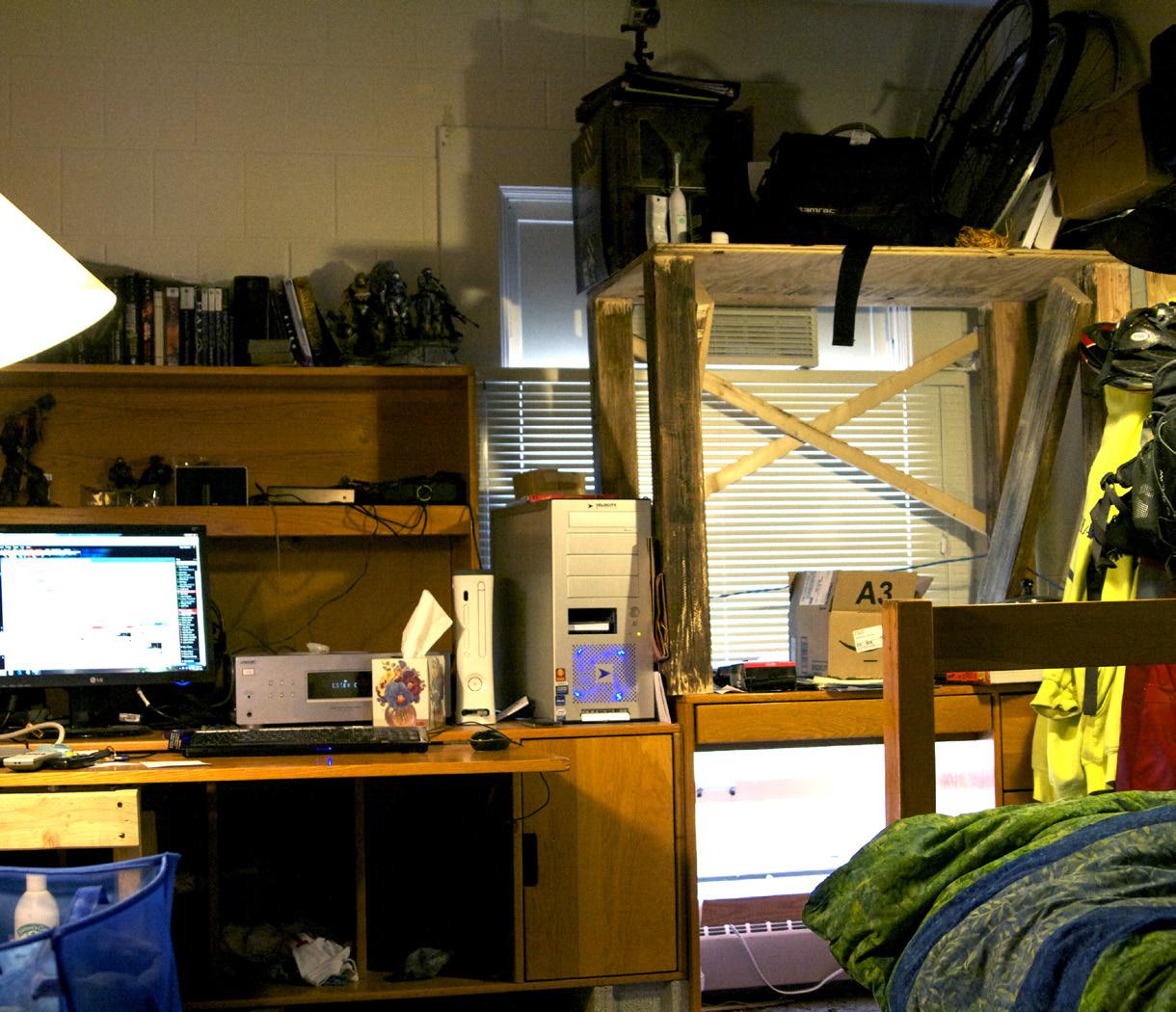
In the 1-Red suite of the Communications Residential College, a pile of sawdust and a circular saw sit on a curtain in the middle of the lounge floor. The door to Communication junior Nate Bartlett’s dorm room is propped open by a trash bin with an electric drill in it.
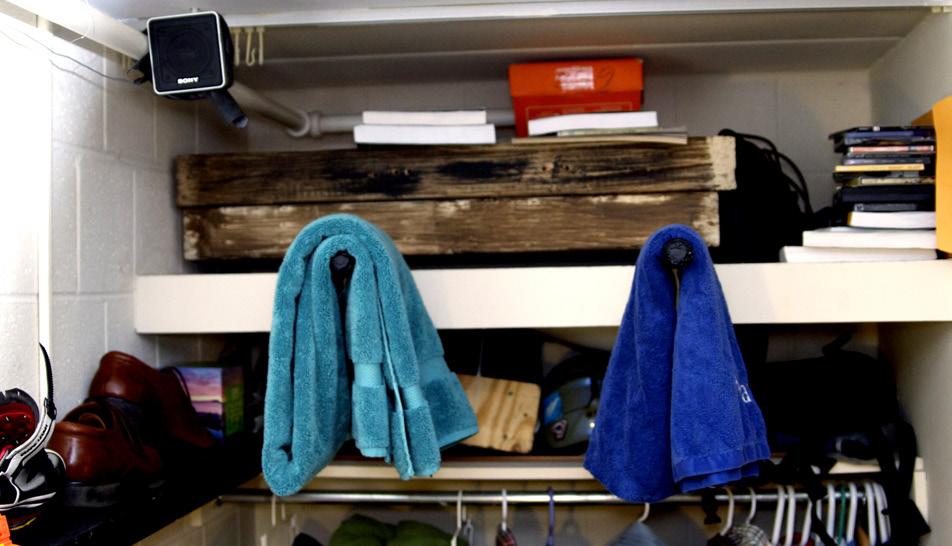
Inside, two four-by-fours, nailed together, rest on the closet shelf and window frame. A NERF gun and a leather shoe are mounted on them. A rack of nail hooks holds jackets. On the desk, a tall wooden shelf that Bartlett built holds four bicycle tires, a frying pan and an electric toothbrush.
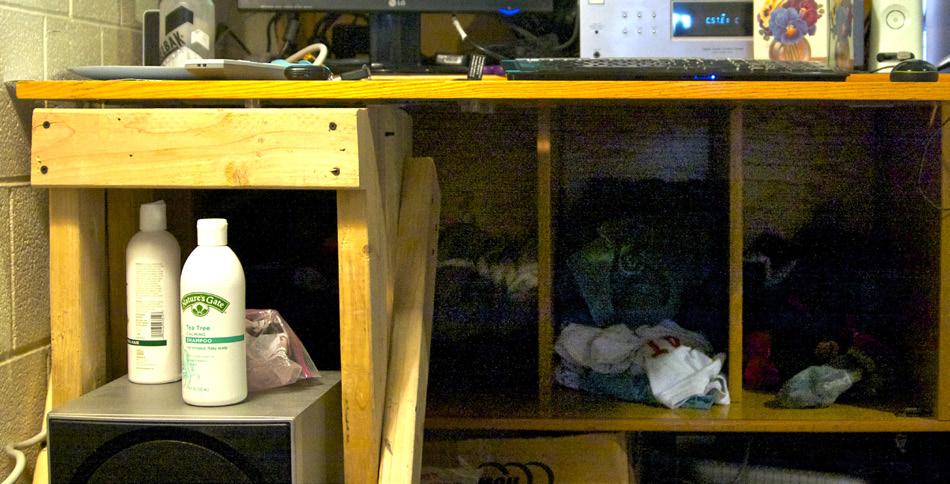
“I discovered that by rotating the cabinet on its side I could flip out the door and use it as a desk,” Bartlett says. “Now I have all this extra space to work on it.”
Bartlett pushed his bed into the closet, adding 26 inches. He says the room is more “functional” than about aesthetics, though his fading pink Mohawk and the three glow-in-the-dark stars on his ceiling argue otherwise.
Student Affairs has been lenient in letting him do his thing.
“One day I had my door open,” says Bartlett. “The CA on duty came in and was like, ‘cool.’”
Bartlett enjoys residential college community living and has lived in the same single for three years. Last summer, he was able to measure its dimensions with
future projects in mind.
Combining craftsmanship with his passion for performance arts, Bartlett helped to construct the set of this year’s Dolphin Show, Ragtime. He says he foresees himself in a career in set carpentry.
“The Dolphin Show buys a couple thousand dollars worth of lumber and at the end of the show they put most of it in a big dumpster,” says Bartlett, touching his homemade shelf. “These were some of the four-by-fours we used to hold up the catwalk.”
Bartlett’s resourcefulness has helped him derive handy scraps from other hobbies. He loves panoramic photography, and he has found ways to combine it with recycling and construction.
“Over the summer we were working on building some sort of raft for his camera out of old Vitaminwater bottles,” says Jai Broome, Medill sophomore and CRC resident. “We were going to float it by the Lakefill, but we just ended up floating it in a flooded parking lot after a thunderstorm.”
Bartlett’s ability to apply his creative brain to any task has also manifested itself through yet another hobby: cycling. In high school, Bartlett pedaled 30 miles roundtrip to school three times a week — a negotiation to fulfill a physical education requirement. In late summer 2008, prior to
Bartlett’s freshman year, he and his dad, both avid cyclists, biked 1,100 miles to Northwestern to continue the tradition. He chronicled the trip on biketoschool. wordpress.com.
Those spare wheels in the corner of his dorm room are part storage, part sentiment. But with biking comes the opportunity to build, and he has used some Dolphin Show leftovers to create jumps. He also saves old bicycle inner tubes, out of which he has not only fashioned a vest for a sculpture class, but also suspended some speakers from his ceiling pipes to create surround sound.
“Great acoustics in here,” says Bartlett, cranking up the volume on his desktop PC. Some of the artists in his iTunes library are Thievery Corporation, a DJ pair, and Ulrich Schnauss, a German electronica artist.
Bartlett’s collections of Halo graphic novels, fictional journals and action figures are part of his identity too, according to Shaina Coogan, Weinberg sophomore and CRC resident. Coogan has helped Bartlett build some furniture, and she says he is always looking for new projects.
“One day he was like, ‘Hey, do you want to help me saw some wood?’” says Coogan. “I’m never really surprised if I hear banging coming from 1-Red.”
MAKE A WINE CRATE SHELF
1. Nate Bartlett uses wooden planks and nails to create more hanging and storage space. 2. Towel racks fashioned out of aluminum rods.
3. Bartlett creates more desk space by turning his dresser on its side.
Tim “The Toolman” Taylor envies this kid. By Lydia Belanger
HOME
By the Board
What trinkets do you hold on to?
By Emily Ferber
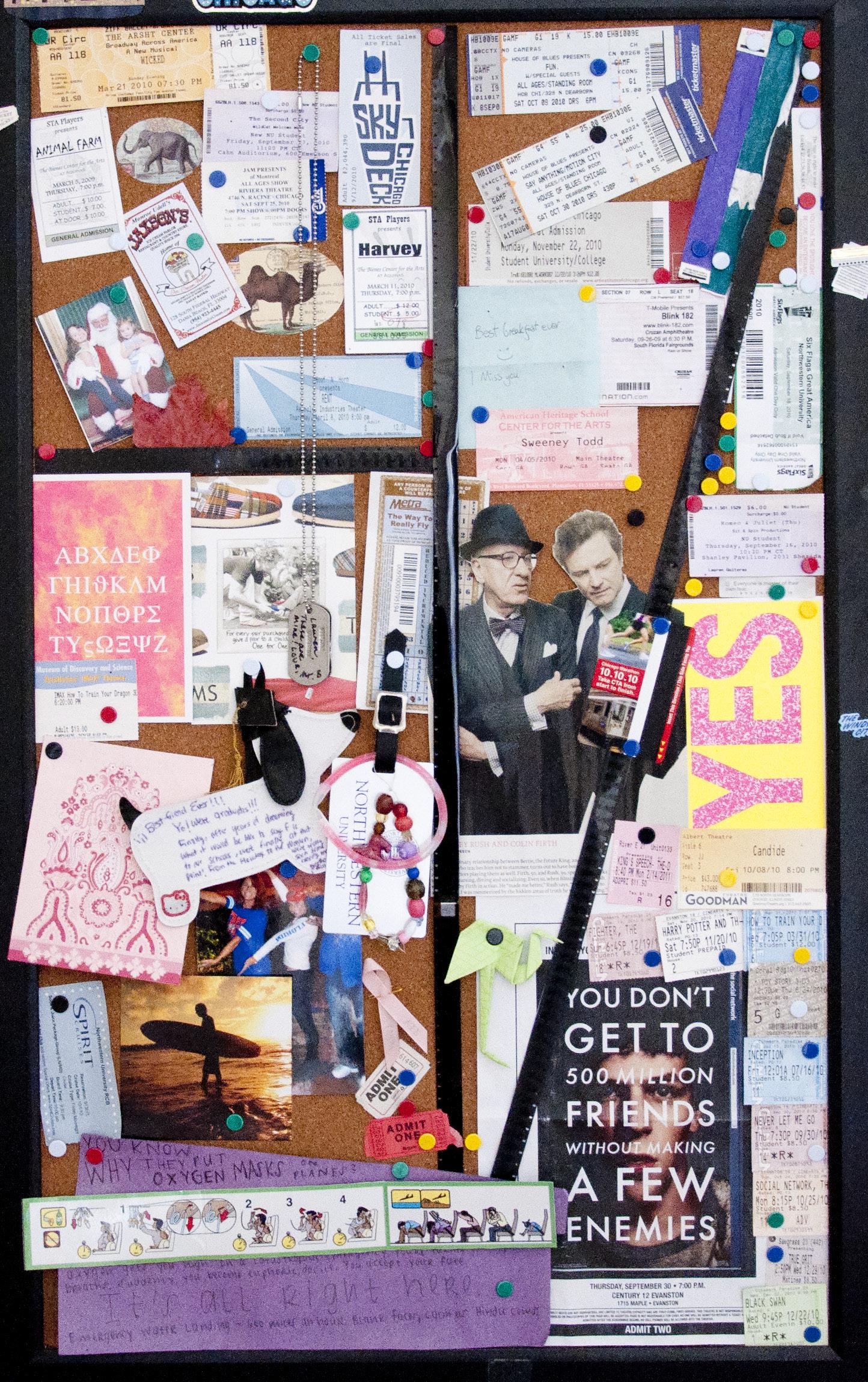
ollege is all about the new: new experiences, new friends, new ideas. In the midst of all this newness, Communication freshman Lauren Guiteras has figured out a way to remind herself of the old. Covered with movie ticket stubs, magazine clippings and pictures from home, Guiteras’ bulletin board is “a snapshot of my interests and my friends.” Referring to herself as “a selective pack rat,” Guiteras often rearranges the board to make room for her ever-increasing collection of snippets. “It’s really nothing terribly deep, but it’s a nice way to keep memories in sight,” she says.
CGuiteras wants to see her collection keep expanding. “I’d like to say I’ve saved things from 2010 when it’s 2030,” she says.
TICKETS
“I save tickets from concerts, plays and anything I really enjoyed. I have a lot of movie tickets, but also ones from events like our trip to Six Flags and the residential college yacht formal. I also save tickets from when I travel places in Chicago. Eventually I want to make an entire border out of tickets.”
CAMEL STICKER
“When I was visiting colleges in New Jersey, I found a stationery store with cool stickers that I’ve put here and on my computer.”
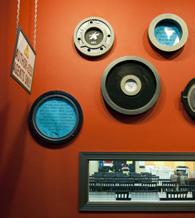
FILM REELS
“I did a summer film program and one of my TAs gave us old reels of film, and I decided to use them to make borders within the board. They’re pretty arbitrary. I move things around within their boundaries a lot.”
DOG TAG
“I did theater through high school. One of my favorite teachers starred in a play and my friend had him sign the dog tags he wore and sent them to me.”
NOTE FROM A FRIEND
“This was a note on a graduation gift from a friend. It reminds me of home. I really don’t get homesick but it’s nice to have reminders of friends. There are things I like to keep.”
PHOTO OF GEOFFREY RUSH AND COLIN FIRTH
“I clipped it out of Time magazine. I actually bought the magazine in order to save the picture. I really liked The King’s Speech.”
PURPLE NOTE
“When I was on a plane to Northwestern, I noticed the airplane’s safety manual was similar to the one in Fight Club. I thought it was funny and cut that part out of the manual. The quote from the movie is on the purple part.”
BRACELETS
“I went to a Catholic high school and my friend made a bracelet in a prayer service and she gave it to me.”
PICTURES
“I have one of my cousins with Santa and another of my best friends from home and her family in Florida.”
LUGGAGE TAG
“It was sent to me when I got into Northwestern, and I already had one on my bag so I put it up.”
ORIGAMI
“I like making origami, and it fit nicely in the triangle corner of the board.
QUAD
Hold on to History
The head archivist discusses the treasure trove below Deering. By Kit Fox
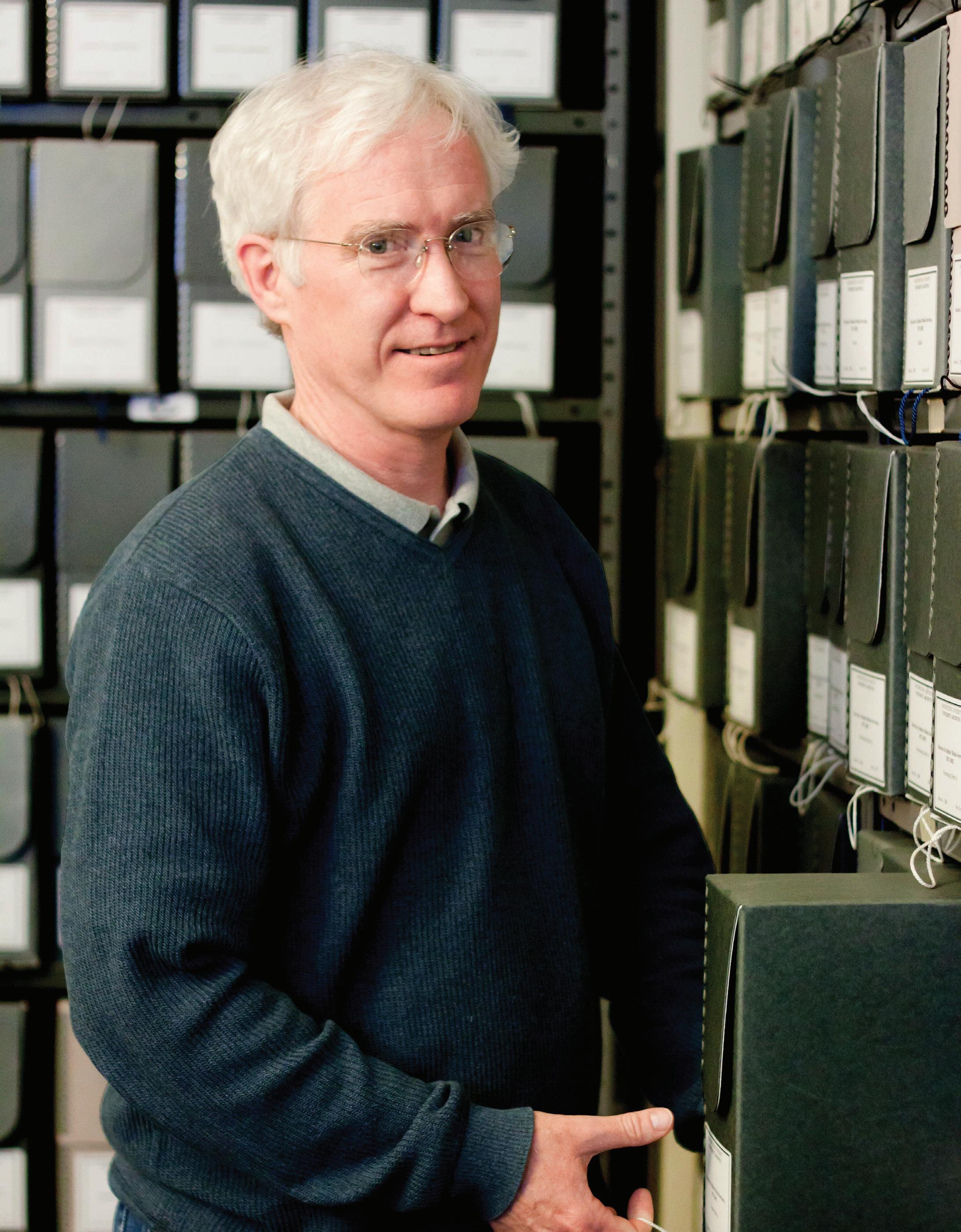
evin Leonard holds an eight-inch stack of yellowing file cards, the kind that haven’t been touched in over a decade and that probably won’t be seen again for another. In the bowels of Deering Library, the archives are part museum, part warehouse full of artifacts from the university’s 161-year history.
“Here it is, that one’s mine.” Leonard pulls a single card from the stack. Scrawled across the top in square blue letters are the words “Kevin Leonard 1976,” the first day Leonard came into the archives.
To Pat Quinn, the head archivist in 1976, that clear legible print was necessary in a time when there were no computers and everything needed to be written by hand; he offered Leonard a job. In class as an undergraduate history major, Leonard studied the past. In his work, he moved it in boxes.
When he graduated from Northwestern, his desire to teach was shot down by Chicago area schools. However, in 1980, Quinn gave Leonard a call about an opening at the archives and 31 years later, Leonard’s still there.
As the university archivist, he spends
the majority of his time hunting down people with significant ties to the university and convincing them that their old documents are valuable.
“I try to save something that otherwise would end up in a landfill or burned or lost to history,” says Leonard. “We save evidence of lives.”
Leonard admits he hasn’t added much to the landfill in his lifetime.
“Oh yeah, I’m a total whack job when it comes to saving stuff. You know the show Hoarders? I’m not that bad but I have every letter I have ever received since the age of 6,” he says. For Leonard, saving things is a way to combat the passing of time, a way of stopping it from drifting away.
“Very few people have an opportunity to have their words live past them,” he says.
Leonard is in charge of saving those words. Shelf after shelf and box after box, he feels his way through the university’s past. Good handwriting brought Leonard to the archives; history made him stay.
what’s going on around campus.
STUDENTS
Almost Famous
He’s a full-time student and a YouTube star. By
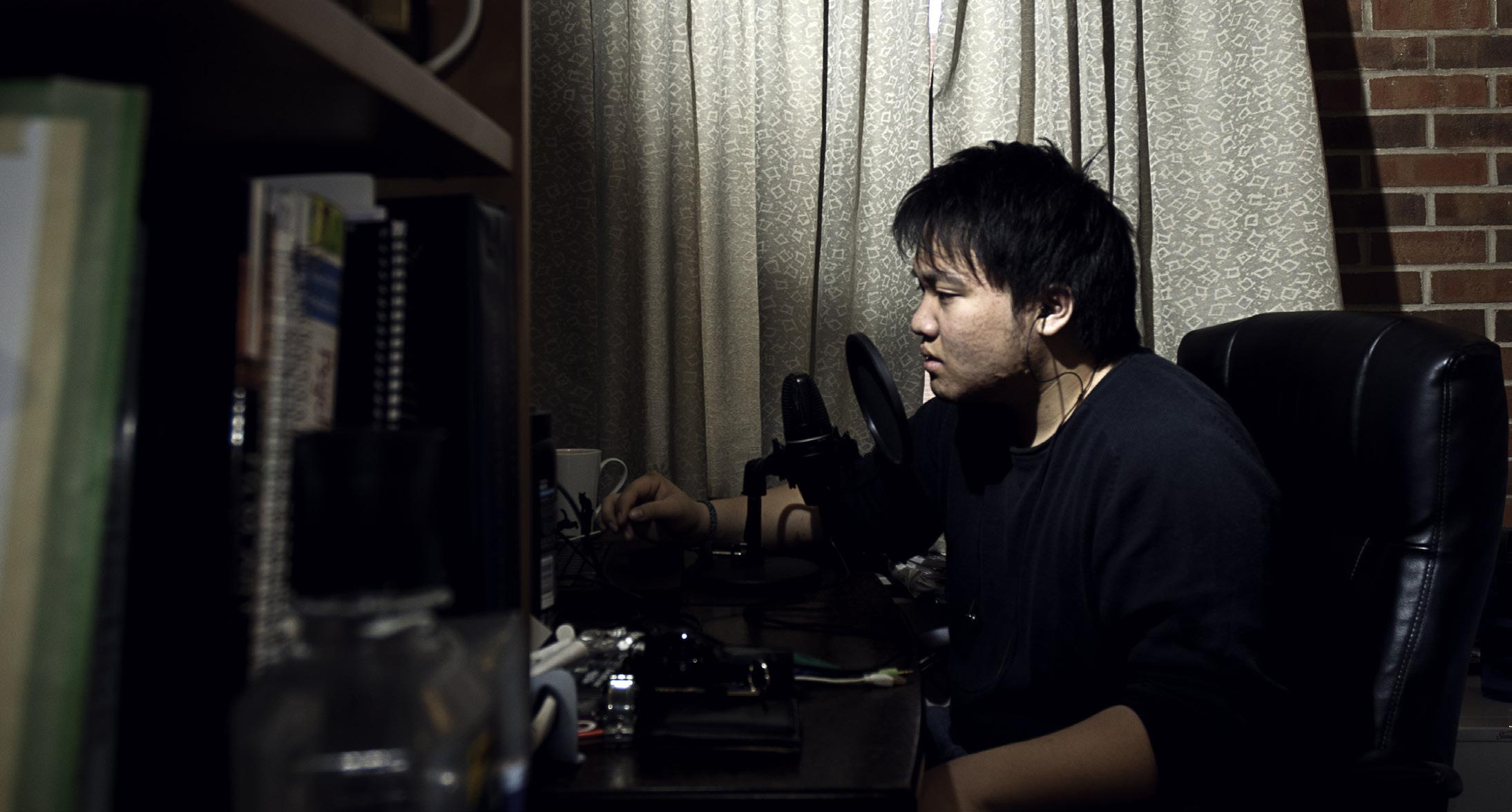
Music seeps through the cracks. It’s everywhere all the time.
That’s how it is in Felix Tsang’s life, anyway. His friends, future plans and daily life — they’re all about music.
“I sing in the shower,” says the Communication junior. “When I go places I listen to music. It’s a huge part of my life.”
On YouTube, Tsang is currently listed as the 13th most subscribed music account from Hong Kong. But he spent six months debating whether or not he should create one. Would he have time for it? Would it get in the way of his school work? Tsang’s friend Robynn Yip, who had already established herself as an Internet singer, finally convinced him to go for it in December 2009. He began uploading covers of Asian pop and American R&B songs.
Tsang’s early songs on YouTube appear against blank black screens “so that you guys can fully enjoy the music.” In YouTube’s vast, niche-based society, Tsang’s choices of recent and catchy, yet melodic tunes that showcase his vocals easily found an audience. This audience reached for him, grabbed him and pulled him straight to the top. Now Tsang is performing in fully produced music videos and singing songs that consistently rack up the views — his cover of Tamia’s “Officially Missing You” has surpassed the 200,000 views.
Tsang has always shared the spotlight, though. Friends and fellow singers have been a constant in his development as a musician and the evidence is all over his YouTube page. Through social media he reaches out to other Hong Kong singers and brings them together.
Annalise Frank
Last year he even hosted a showcase for Hong Kong YouTube talent, using the Facebook fan page he created to gather the performers, display their talents and follow their progress. He asked musicians to post videos. The first 10 people to respond participated in a live show in Hong Kong that Tsang organized.
A classically trained pianist for seven years, Tsang’s been around music all his life. He quit the piano at age 14 and discovered singing, which has “been my passion since,” Tsang says. Though it’s a musical outlet he’s never been formally trained in, the self-proclaimed amateur has been singing for years. He’s performed in musicals and done live charity shows, in addition to making himself known across the web as an artist.
“Fame and success would be a bonus, but for me it’s really just an outlet […] to do something I love […] to put it out there for everyone to appreciate,” says Tsang. “It’s really up to the world to interpret it their own way.”
Tsang says he finds that his Hong Kong music career and his life at Northwestern complement each other. He’s kept singing a big part of his Northwestern life through becoming part of the a cappella group Treblemakers, and planning the event he calls his “ultimate goal” at Northwestern. Tsang and Bienen junior Matthew Lee co-founded Quad A, the Asian American A Cappella Association, a group that participated in the first ever Quad A Show event. Groups from MIT, Yale, University of Pennsylvania and Washington University in St. Louis gathered together to celebrate their heritage and their talents.
255,074
Views on Tsang’s video, “Officially Missing You (R&B Cover Jayesslee JS) Tamia.”
64,225
Views on Tsang’s video, “Just The Way You Are (A Cappella) - Bruno Mars Cover.”
54,891
Views on Tsang’s video, “‘Rocketeer’ - Far East Movement ft. Ryan Tedder.”
* Numbers as of May 16, 2011.
“It was just amazing, [the finale] was like a wall of sound […] and it’s probably one of the coolest things I’ve ever experienced,” says Tsang. “And now that I have achieved this, I feel like I can move on to something bigger in my life.”
Tsang plans to return to his homeland of Hong Kong after he graduates. He’ll pursue artist management and someday, if his mission goes according to plan, he’ll own his own record label and discover young Hong Kong artists like himself. Reaching out to other musicians will always be a main focus for Tsang. The connection he makes with them is as essential in life as his connection with the music.
“I want to discover more people like me who love music and want to show the world,” he says. “I want to be the person behind it all.”
photo: john meguerian
DID YOU KNOW?
Floating, Not Flying
Bringing aerial arts to Northwestern is harder than you’d expect. By Gus Wezerek
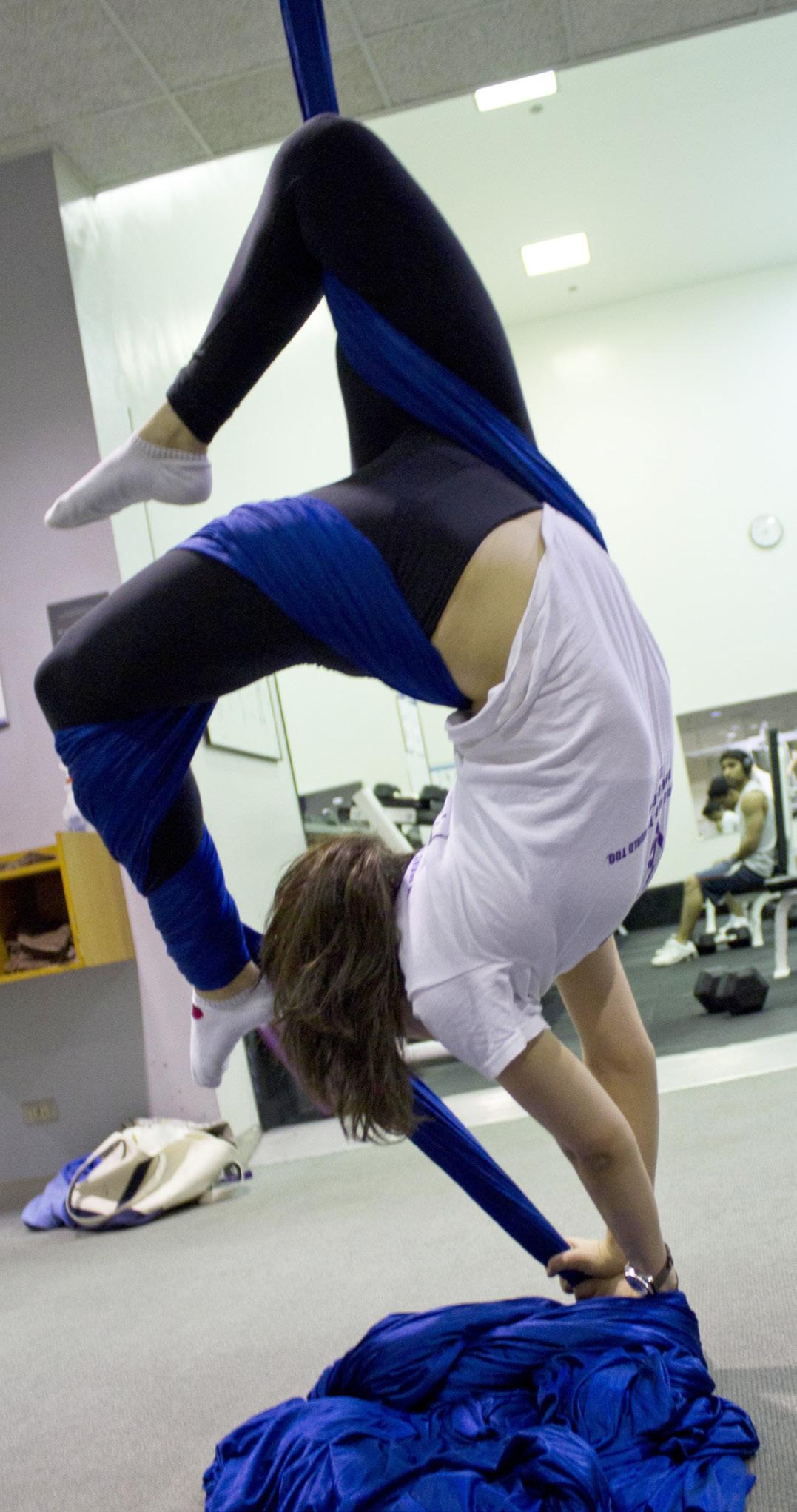
To understand the passion of Sophia Blachman-Biatch is to see her unroll from two giant streams of blue silk, 30 feet in the air, plummeting toward the ground so fast you think she — oh! — jerks to a stop, head upsidedown, four inches from the floor.
When the Weinberg sophomore arrived on campus last year, she immediately tried to convince others to do the same. “I printed out a picture of myself on silks and wrote, ‘Are you interested in doing this?’” she says.
A small group of students saw the posters and showed up at her dorm that night, curious how they too could twist and strain high above the ground. Having already written a constitution, BlachmanBiatch led a vote to inaugurate an acrobatic and aerial arts club they named Cirque NouveaU.
But unless you visit the private gym, where BlachmanBiatch pays to practice on trapeze
So instead, Blachman-Biatch practices on the second floor of SPAC. She hovers below a crossbar that connects two fitness systems, yards of unused silk pooling between stacks of metal.
“It’s so frustrating. There’s no space. There’s no height. There are people walking around. I get really embarrassed doing something that I want to look good, trying to perform it, but then everyone is kind of staring and I feel awkward,” she says with a sigh, pausing.
Then: “But it’s too much fun not to want to do it.”
Blachman-Biatch compares the strength-building SPAC sessions to “taking her medicine.” The silks are soft, but the workout is hard.
“I would also like to try some of the acrobatics, if possible, or at least the training that a beginner would need to get in the air,” I wrote in my initial email to Blachman-Biatch. “I work out four or five times a week, so hopefully fitness wouldn’t be a problem.”
“IT’S SO FRUSTRATING. THERE’S NO SPACE. THERE’S NO HEIGHT. THERE ARE PEOPLE WALKING AROUND […] BUT IT’S TOO MUCH FUN NOT TO WANT TO DO IT.”
— SOPHIA BLACHMAN-BIATCH
equipment, you’ll never see her or anyone from Cirque NouveaU actually perform.
“Every person I tell about silks asks me when my show is,” Blachman-Biatch says. We’re sitting in the SPAC lobby after practice, which I’ve taken part in for the second time this week. Halfway through her college career, Cirque NouveaU still hasn’t performed in front of a crowd.
The problem is the Northwestern bureaucracy, according to Blachman-Biatch. She says the Office of Risk Management cleared the group, now a conditional club, to practice. But when they went to Blomquist to rig her silk, Daniel Bulfin, director of recreational sports, suggested the group practice at a private gym instead.
“There is no one on my staff that can certify the installation of that apparatus,” says Bulfin. “To bring in a specialist just for one club, it’s not economically feasible.”
What a joke.
When my turn came, (the group practices twice a week for an hour and a half) I wondered why the person who had just finished was sweating.
“Just commit to the move. You have to commit,” says BlachmanBiatch, teaching me a basic pose, the straddle back. “Hold the silks by your head, one in each hand, and then pull your body over with your legs straight out.”
I took a breath and jumped, essentially trying to stop myself at the apex of a backflip. I thought if I leapt backward high enough, my legs would just flop over my head. But I pulled to heave my body over, forearms burning, abs locked tight. Acutely embarrassed, I realized that members of Cirque NouveaU do get to perform — every Thursday night for a gawking crowd of SPACrats and musclemen.
Eventually I inverted myself — success came when I listened to Blachman-Biatch and forgot about the hard floor below. Trust is essential in the circus arts.
“I think when people come
It would cost Cirque NouveaU $3,000 for an independent rig to perform in Cahn.
and try they get interested, but not many people are consistent,” says Cirque NouveaU co-president Antonia Yang. “They come once or twice and then it’s… ” The Weinberg freshman trails off.
When I ask her what it’s like among the rafters, swaddled in silk, Blachman-Biatch at first demurs, saying she can’t do the experience justice. But I get a sense later, when she describes her favorite moves: the controlled “three star” falls from above. “It’s like whipping through the air,
kind of like a roller coaster,” says Blachman-Biatch. “Except you get to choose what happens on the roller coaster.”
Blachman-Biatch will be abroad next fall and her co-founder, Communication senior Helen Kwok, is graduating. It’s a steep track to putting Cirque NouveaU in the air for Yang and Bienen junior Calvin Lee, the new co-presidents. But the thought of Cirque NouveaU reaching that height, all eyes on them, at last about to fall back down — it’s breathtaking.
Beyond Bibliophile
When the Smithsonian trucks pull up, they’re for him. By Anca
Ulea
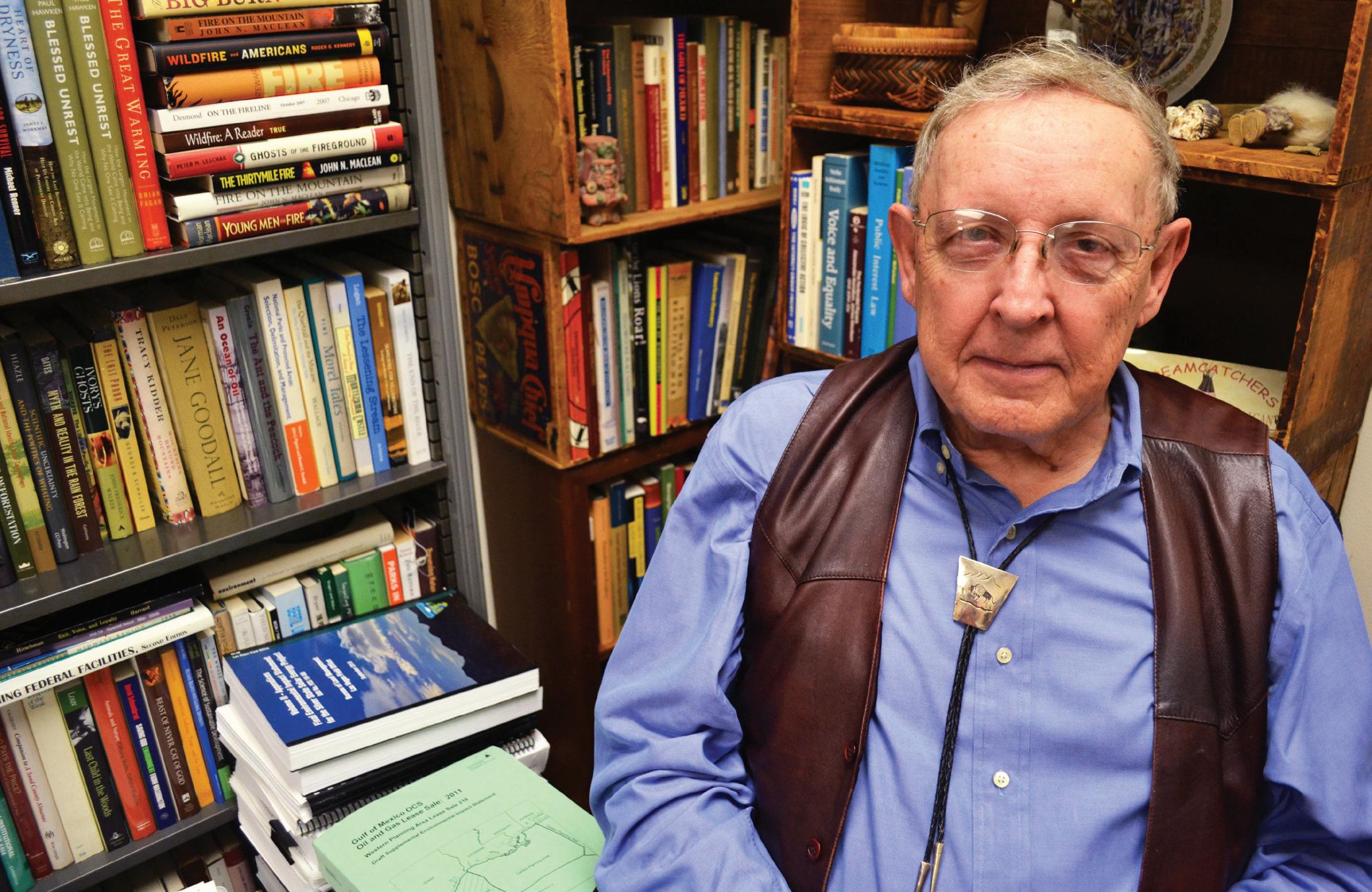
lthough officially retired since 2008, political science professor Paul Friesema is still teaching at Northwestern, as he has been since 1968. He’s known as the former director of the environmental policy and culture program, which he helped start in 2005. However, his legacy will live on, thanks to his enormous collection of books.
“I’m actually teaching as much, even a little more than I taught before I retired,” says Friesema. “They’re just not paying me much for it anymore. And I have a small office — I used to have quite a nice, big office.”
Friesema continues to teach as a professor emeritus of political science despite his retirement, because student demand for the EPC program exceeds the staffing for the program, he says. Professor Yael Wolinsky-Nahmias, who took over as director of EPC after Friesema’s retirement, says that Friesema continues to be a valuable asset to the program.
“I think almost every student in the program knows him or has taken his class,” says Wolinsky-Nahmias. “So I think even though he’s kind of retired — we’re still not letting him
go completely — he’s still part of the program in many ways. And I think the program has grown a lot in the past few years, but many of these things are really related to the seeds that he planted.”
His office in Scott Hall, the one that he jokingly complains is too small, is cluttered with books and Native American artifacts, a clear reflection of his life’s work and passion.
“I’ve been a book collector since I was in high school, maybe grade school, when my mother and dad gave me books,” says Friesema. “As I got into academics, I needed books for my own personal research, which was part of the incentive for my collection of large amounts of books.”
30k+
The number of books in Paul Friesema’s collection
Over the years, his collection, which he says consists of “more [books] than any reasonable person would ever collect” has grown to over 30,000 volumes, which he keeps in a basement on north campus, his home, his office and various storage units. Four years ago, Friesema began donating his books to the National Museum of the American Indian at the Smithsonian Institution, giving away about 14,000 volumes.
“[My wife and I] had always had in mind that it ought to go where it would be useful to and usable by American Indian people,” says Friesema. “It really is a huge collection — it may well be one of the largest and most complex collections that exists in private hands, which isn’t in a public library already.”
Initially, Friesema intended to donate the books to a Native American college, but found that because most of them were junior colleges, they were more in need of a general library as opposed to his specialized one.
Friesema has conducted international research on the environmental activism of indigenous people through university research grants. He says he hopes to continue his research through his retirement, but he is prepared to never finish his opus as a single book.
He says he gets his books through antiquarian dealers and from used book stores, but he also gets many of his volumes through his work as a university professor.
“Publishers like me to adopt their books in class, and they send me review copies and desk copies for my use,” says Friesema. “So the occupation is where a fair amount of books come in.”
After almost 43 years as a professor, he says he’s reluctant to stop working completely and enter retirement.
“Right now I’m doing virtually the same thing I was doing before I retired,” says Friesema. “I come in every day. I don’t want to not teach. I’m not really looking forward to retirement. I’m looking for other opportunities to continue to work.”
While you’re studying on the couch, Gamma Phi house mom Judy Ryno moonlights as an airport concierge for celebs.
Hey Mom, I’m Home
She may be a ectionately called your sorority’s house mom, but she won’t bake you cookies. By Ariel Roth eld
In the early hours of the morning, Lois Gibbons can be found walking along the lake. In the afternoon, she can be spotted running all over town from one errand to the next. And in the evening, she can be seen entering the Delta Gamma sorority house.
No, this 64-year-old is not a member of Delta Gamma. Rather, she is the sorority’s new house director, and you can call her Momma G. At Northwestern, 12 sororities make up the Panhellenic Association. Each sorority has a house on campus, as well as a house director who lives in and takes care of it.
“Our main objective is maintaining a safe,
welcoming and warm environment for the girls who live here,” Gibbons says.
However, a house director’s duty goes beyond putting on a smile. She is responsible for overseeing the sorority’s staff, helping to plan menus as well as scheduling maintenance and repairs.
“Every day is a busy day, but for me that’s a good thing,” Gibbons says with a chuckle.
Although she was never in a sorority, Gibbons’ first desire to become a house director occurred when she moved her daughter into the Kappa Delta sorority house at Northwestern.
“I met the house mom, peeked into her room and said, ‘Gee, this is not a bad idea.’”
After eight years of wishing, “all of the stars aligned and a miracle occurred,” she says. The chance to become a house director presented itself and Gibbons seized the opportunity.
“It is just the ideal situation,” she says as she sits down in her private living room. “I just retired and my children live in Chicago. This allows me to be close to them, have a place of my own and not have to worry about maintaining and landscaping my place.”
Like Gibbons, Chris Ellis took the position of house director for the Pi Beta Phi sorority out of convenience.
“I needed to change direction in my life and thought this was a good fit,” Ellis says.
Before being a house director, 64-yearold Ellis split her time between two jobs. She worked in retail and in a beauty salon.
“I have now been here for nine years and plan on doing it for a while longer,” Ellis says.
According to Ellis, one of the best parts of being a house director is the job’s flexibility. She has holidays and summers off and can maintain a life outside of Northwestern.
“It is extremely important to have other interests outside of the Greek community,” she says. “It makes you a more interesting person when you sit down with the girls.”
“I BECOME A
ROAD
MAP ON THESE KIDS’ LIVES, SOMETHING THEY WILL ALWAYS REMEMBER.”
— JUDY RYNO, GAMMA PHI BETA HOUSE DIRECTOR
Ellis works part time for an event planning company. However, she still manages to have weekly get-togethers with other house directors, such as Judy Ryno.
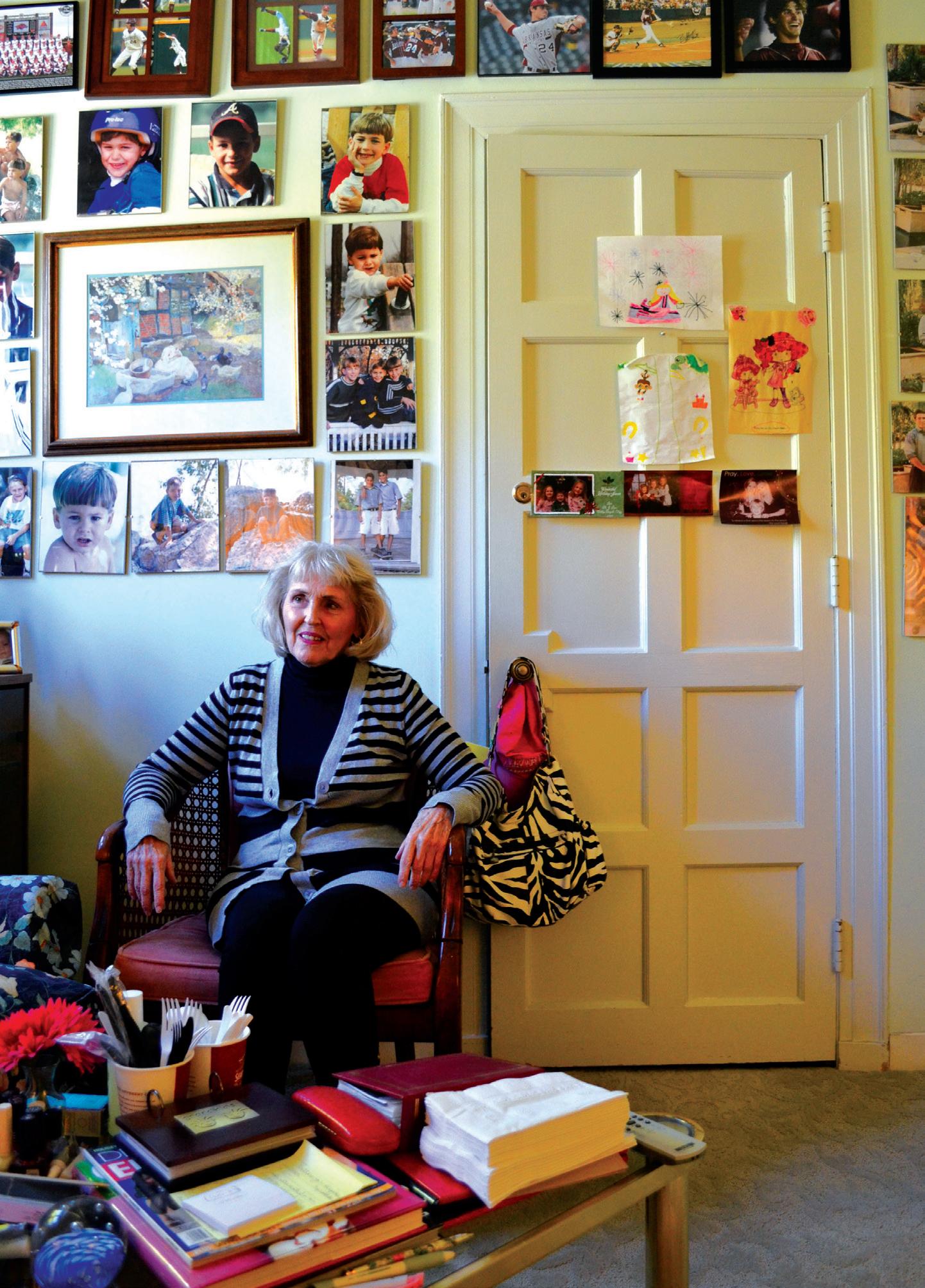
Ryno is no stranger to Northwestern or its Greek community. In addition to operating an airport concierge service, the 76-year-old has been the house director for the Gamma Phi Beta sorority for 20 years.
As a student, she was a member of Northwestern’s Kappa Kappa Gamma sorority, located next door.
“Things were so different from when I went to school and from now,” Ryno says.
Before sitting down to eat, Ryno grabs a salad from the sorority’s dining room. As she exits the room with the plate in hand, she stops and greets three different students. She knows them all by name.
“It is truly fascinating to watch these girls come in as freshmen and leave as seniors. I get to see how they learn and how they have changed. It is incredible,” she says.
Hundreds of pictures adorn the walls of Ryno’s private living room. Photographs of children, grandchildren and family of all ages showcase her life.
“At times it is difficult being a house director because you have to be strict, but I think it is a special job,” says Ryno. “I become a road map on these kids’ lives, something they will always remember. But the funny thing is that they’re like my family — I remember them too.”
CAMPUS
Transmitting Tradition
WNUR’s life has spanned more than 60 years, and there are no plans of slowing down the beats. By
DMarcus Lee
uring Monday’s late afternoon slot on radio station WNUR’s daily Rock Show, Weinberg seniors TJ Spalty and Julian Zlatev are 12 tracks into a set list that has probably never been heard on Chicago airwaves. But that’s the point.
“That’s sort of our M.O. at the station,” says Spalty. “Our goal is to broadcast underrepresented music to the Chicago area.”
The station has built a legacy around high quality student radio production since its creation in the 1950s — one that has transcended generations to maintain WNUR’s status as one of the top college radio stations in the country.
Spalty slides a knob down on the mixing board, and the ambient sounds of Virginian music collective Tanakh fade. For a moment, the Louis Hall studio gets so quiet you can hear a pin drop. Suddenly, Spalty’s classic disc jockey voice breaks the silence.
“You are listening to WNUR 89.3: Chicago’s Sound Experiment.”
WNUR adopted this slogan, which reflects a commitment to underground and experimental music, in 1995. That year, a $750,000 grant from the McCoy Foundation allowed for a complete facility renovation and warranted the station’s departure from the basement of Annie May Swift Hall where WNUR broadcasted for 45 years.
In the ’60s, however, a group of students at WNUR tried to break free of the old-fashioned instruction irrelevant in contemporary radio. To School of Speech (’67) alum Al Rettig, who worked at WNUR all four years of his undergrad career, that meant becoming more youth-
oriented, heavier into production and more aggressive to grab students’ attention.
“We were making rudimentary equipment work as best as we could,” says Rettig. “We decided that if learning about radio was any value to us, we had to start doing what radios were doing across the world.”
In 1965, in an attempt to keep up with commercial radio, WNUR became one of the first college stations to broadcast rock music regularly. It was the only Chicago FM station to do so at the time; rock music was played mostly on AM stations then.
This change came with a slew of other broadcasting advances at the station: from onair promotions and surveys of the top records of the week, to setting up broadcast lines on Long Field to do live coverage of the homecoming parade. Once, a student even broadcasted from a tree to promote a new programming schedule. When the faculty would get angry at their antics, Rettig says the students would let it roll off their backs.
“We were able to bring the station kicking and screaming into the 1960s,” says Rettig. “We were the people who started that march to keeping radio current, in step with what’s going on in the medium instead of behind it.”
Now, with the evolving face of radio decreasing WNUR’s role on campus, Kate Watson, Weinberg senior and general manager of the station, looks to make the station more of a media presence. WNUR updated their website this year and added a blog into the mix to provide more content-generating features that increase music coverage.
“We are not outgrowing radio,” says Wat-
Then and now: WNUR from 1960 to 2011
son. “But we want to become more dynamic in how we cover music.”
CDs and vinyl records still pour into the WNUR mailboxes, waiting to be heard. As other college stations build computer databases of MP3s, WNUR maintains its policy not to accept digital submissions. This has made the WNUR music library one of the largest college radio collections in the country.
“I see it as the way that we can integrate music that would be lost otherwise,” says Watson. “Our whole philosophy is that we are playing stuff that wouldn’t get airtime anywhere else. That is the standard in which we choose.”
The stacks are also instrumental in the mentoring process of DJ apprentices whose training consists of finding all types of albums in the library, according to Watson.
“We teach people rather than judge people,” Watson says. After going through the Rock Show’s process of training apprentices, DJs leave WNUR playing very different music from what they played when as freshmen.
Faculty Adviser Paul Riismandel finds this training model to be the key to the station’s success. Though he has only been at the station for three years, he has seen students pass along this passion for carrying on the history and mission of WNUR.
Riismandel says that the students are really good at passing on the WNUR way.
Rettig still remains in contact with people from the station. He says that this legacy of student collaboration has always been integral at WNUR.
“We learned a lot and taught each other,” Rettig says.
photo: emily
chow, older photos: courtesy of leonard iaquinta
Soak Up the Sun
A
n 2009, an idea came to then-McCormick juniors Phil Dziedzic and Ren Chung Yu, which led to a project called GRIN: Green It Now. The two members of Northwestern’s Engineers for a Sustainable World wanted to do something that would have a direct impact on the university’s sustainability.
IYu and Dziedzic had been involved with the solar car team, NUsolar, a group that annually raises funds to build and race a solar car. A solar panel would involve less engineering work, so the pair thought: “Let’s give it a try.”
The idea brewed in the back of their minds, as they did energy audits on smaller buildings to supplement the larger audits the university was performing.
Yu and Dziedzic started with GREEN House, doing audits and assessing the possibility of adding a solar panel. But there was one problem: The surface area of the roof wouldn’t support the array.
“Ford came to mind,” says Yu. “It was already LEED certified, and it was high profile.”
They began exploring the necessary contacts within the administration, leading them to Facilities Management, where they met Jim McKinney. The next step was to get McCormick School of Engi-
neering on board. Yu says these were the two pieces they needed to really start moving toward the hard part: fundraising.
Raising money and writing grants for funding were the crux of the project. In late 2009, Josh Kaplan, then a McCormick sophomore, joined the project.
“My first assignment was to write a grant proposal,” says Kaplan. “It was one of the smaller ones, and they had me write it.”
These grants could have been written by Yu or Dziedzic. Although it took Kaplan longer, he
ern Sustainability Fund on board, reaping the expertise of Weinberg senior Anthony Valente.
In 2010, Yu graduated and Dziedzic entered the master’s program at McCormick, passing the reins down to Kaplan and Valente. Regardless, Yu never worried that the project wouldn’t end up with a solar panel on the roof of Ford.
Sure enough, the team found out they had received a grant from the Illinois Clean Energy Community Foundation to pay 60 percent of the cost of the project, which amounted to about $65,000.
“I RAN TO PROFESSOR WOLINSKY’S OFFICE AND GAVE HER A BIG HUG.” — REN CHUNG YU
started challenging why they were doing certain things. This was important, because shortly after Kaplan got involved, they found out the state funding they had been banking on fell through. That left them, essentially, with just contingency funding.
“We thought it was because we hadn’t written a good proposal,” Kaplan says.
So they went back to the drawing board, reevaluating and setting up a framework of four goals. They also brought the Northwest-
Yu and Kaplan were in different places when they found out.
“I was away on co-op when the letter came. I had to go to a large meeting […] and I was just beaming,” Kaplan says.
When Yu found out, he was on campus and ran from the Allen Center to the Environmental Policy and Culture office. This was one of the happiest moments of his undergraduate career, he says.
“I was making calls to everyone the whole way,” says Yu. “I ran to Professor Wolinksy’s [director of EPC] office and gave her a big hug.”
All that was left was implementation. Facilities Management
This new solar panel system has microinverters that allow one panel to go out without losing the whole array, and a complete structure docking that works like a membrane, hinged together.
largely took charge, with McKinney taking the lead as project manager. Facilities Management took care of the safety and technical aspects, but they kept the Centennial Solar Panel System team involved throughout the process, allowing them to sit in on meetings and contribute to decisions.
The group raised $117,050 for the project, as well as in-kind services such as waiving fees and staff services. Yu believes this project is a prime example of what students can accomplish.
The CSPS provides green energy directly to the university, and he hopes that it will lead to further initiatives that will have immediate and direct impacts.
The CSPS team celebrated with grant contributors and members of the administration, though it never looked like they wouldn’t make it to this point. They were more reaching out and looking forward.
At the event, McCormick Dean Julio Ottino called the project a “great thing for all of Northwestern,” because potential applicants are starting to pay attention to environmentally conscientious campuses when choosing schools.
“We are dependent on things coming from the bottom up — the students driving the process,” Ottino says.
student-organized e ort puts solar panels on top of Ford. By Lindsey Kratochwill
CAMPUS
Space Case
Nestled between Tech and Garrett Evangelical Seminary stands Dearborn Observatory. A 38-foot aluminum dome made of ridged metal sheets houses Dearborn’s main attraction, a refracting telescope that the public can look through during observing sessions on Friday evenings.
Dearborn has served as the home of many scientific contributions in the field of astronomy. But what is not evident from a visit to Dearborn is the observatory’s slew of quirky directors and their achievements.
The road to these discoveries hasn’t always been easy. As a telescope operator and observing session host at Dearborn, Communication junior Laura Kick knows a great deal about the challenges astronomers faced. One story Kick tells visitors at Friday night observing sessions is that of professor and Dearborn Director George Washington “Jupiter” Hough.
When Dearborn caught fire in the early 1900s, Hough reentered the evacuated observatory twice in an effort to save 20 years worth
of research on the rotations of Jupiter and the sun. Friends watched in amazement as he entered twice and stopped him from going back in a third time. Amazingly, the telescope and Hough’s research were undamaged.
Hough was director of Dearborn from 1879 until his death in 1909. In addition to being the first observatory director to receive a salary for his position, Hough designed many meteorological instruments and discovered more than 250 double stars in his 30 years at Dearborn.
Dearborn has had its fair share of devoted researchers. Professor J. Allen Hynek is best known for his work on UFOs and his classification of alien encounters, which inspired Steven Spielberg’s 1977 movie Close Encounters of the Third Kind. Hynek also served as technical director of the film and made a cameo appearance in it.
Only a year after he came to Northwestern as the chairman of what was a small astronomy department, Hynek became Dearborn’s director in 1960. Hynek was also under contract with the Air Force at this point as a scientific adviser on Project Blue Book. First called Project Sign, then called Project Grudge, Project Blue Book was a UFO incidence investigation project Hynek worked on for 20 years. During this time he examined some 10,000 cases of UFO sightings.
Hynek began work with the Air Force in
1948 when he was still teaching at Ohio State University. At first a skeptic, he was hired by the Air Force to determine if incidents reported as UFO encounters could be explained astronomically. But Hynek soon began to believe in the existence of aliens and UFOs after encountering numerous cases that he could not disprove through science.
Hynek became an important name in the world of UFO research and went on to found the Center for UFO Studies in 1973, providing the public with reliable information on UFOs. He also wrote a book, The UFO Experience, published in 1972, in which he famously laid out the three kinds of close encounters. The first of these is when a UFO is sighted but leaves no evidence, the second leaves physical traces such as broken branches or fragments and the third is when contact is made.
As his celebrity grew, administrators at Northwestern became embarrassed, and they stressed that Hynek keep his center separate. In 1978, Hynek retired from Northwestern. Some say it was because of Hynek and his UFO research that Northwestern’s astronomy department merged with the physics department in 1977, though this has not been verified.
Though Hynek definitely had his fair share of eccentricities — such as his odd appearance, his choice to cover his office from ceiling to floor in pictures of UFOs and extensive research of alien encounters — his legacy doesn’t end there. Hynek also oversaw the growth of Northwestern’s astronomy department and made important contributions to the field of astronomy by being the first to successfully integrate television technology into telescopes, helping develop a proximity fuse for the Navy, working on the effort to put the first satellite in space and with a team creating a tracking station network for that planned satellite.
This history and his legacy have not disappeared. His work is now housed in the University Archives, but when Hynek was director, he kept his work in a large black metal safe with gold detailing. This safe sits in the foyer of the observatory today. Now, it holds a set of spare telescope keys.
Dearborn’s rich history does not end with the people who have cared for it. The 18.5-inch lens still in the observatory today was commissioned by the University of Mississippi in the hopes to house the largest telescope in the world. At that point, Harvard Observatory and Russia’s Poklovo Observatory housed the largest telescopes, both at 15 inches. With the start of the Civil War, transport of the lens from Massachusetts, where it was made, to Mississippi became nearly impossible.
The Chicago Astronomical Society acquired the telescope lens and began building an observatory for it in 1863. This was the first incarnation of Dearborn. The second came in 1889, while Hough was director. In 1939, 26 men using 600 jacks lifted Dearborn and, over three months, moved it 664 feet south. It took a tractor and two teams of horses. Its next update came in 1985 when renovations were made and finally, in 1997, when the new dome was installed. The rest is history.
Dearborn Observatory’s past is out of this world. By Christina Cala
Dearborn telescope is now at the Adler Planetarium.
SCOOP
Out of Obscurity
Let our music guru introduce you to the nine best artists you’ve never heard of.
al Grasso knows hip-hop. The McCormick senior has assisted hip-hop producers with their work since age 13. She raised herself on hip-hop, illegally downloading from peer-to-peer services like Napster and Limewire because her parents wouldn’t buy her the explicit material, and she contributed vocals to an upcoming artist in the DMV (the Washington, D.C., Maryland and Virginia area) by age 16. Eight years later, Grasso has been described as a “human Pandora,” so North by Northwestern curated a list from her of lesser-known artists that sound like your favorites.
VIF YOU LIKE BIG BOI: BIG K.R.I.T.
Big K.R.I.T. just released his latest mixtape, Of 4Eva rapper brings a new perspective on southern rap, referring to himself as “homegrown country shit” in contrast to the slick city rap of most other southern rappers from Houston or Atlanta. His two latest mixtapes, Return Of 4Eva and K.R.I.T. Wuz Here, are available for free online.
IF YOU LIKE LUDACRIS: MACHINE GUN KELLY
If you’re a fan of Ludacris’ bombastic, quick flow, then try Machine Gun Kelly — who is named not after the famous gangster, but for the speed of his rap. Along with Big Boi’s new favorite rapper Yelawolf, Machine Gun Kelly is seeking to overthrow Eminem as the preeminent white rapper on the scene, and with production from Lex Luger (“Hard in da Paint‚“ “H.A.M.”), he has the backing to do it. He released two mixtapes in 2010, 100 Words and Running and Lace Up
IF YOU LIKE LIL B THE BASED GOD: TYLER, THE CREATOR
Tyler, the Creator, and by consequence his rap group Odd Future Wolf Gang Kill Them All, made waves in the beginning of 2011 with their incessantly angry and explicit rap that seemed to come out of nowhere. Tyler is undoubtedly their leader, and his new album Goblin was released this May. In the video for “Yonkers,” a fiery, dark rap song that makes death threats to B.o.B and Bruno Mars, Tyler eats a cockroach, throws up and finally hangs himself.
IF YOU LIKE KID CUDI: CHIDDY BANG
Like KiD CuDi did on his early mixtapes by sampling Band of Horses’ “The Funeral,” Chiddy Bang appeals to the indie crowd by sampling bands like Radiohead, Passion Pit and MGMT for their brand of hip-hop. They produced a global hit with “Opposite of Adults‚“ but it only peaked at No. 90 on the U.S. Billboard Hot 100.
IF YOU LIKE N.E.R.D: CHRISTIAN RICH
Christian Rich might sound like one person, but much like N.E.R.D, they are in fact a production team. In this case, Christian Rich is a twin brother duo responsible for various hits by Lil’ Kim and Clipse. Still, much of their production discography has gone unappreciated by the general public, including their work for Raekwon and Chris Brown.
IF YOU LIKE KE$HA: UFFIE
If your pop life isn’t dirty and grimy enough with Ke$ha’s glitter-infested hits running the radio, Uffie may be just your bottle of Jack. As Gaga and Ke$ha seek to bring Europop to American dance music, Uffie uses her Parisian connections to legitimize her sound with Europe’s biggest producers, from Justice to SebastiAn. Her debut album, Sex Dreams and Denim Jeans, met mixed reviews but performed well on French and Belgian charts.
IF YOU LIKE WIZ KHALIFA: CURREN$Y
In the world of popular stoner rap, Wiz Khalifa is currently commercial king. In the critical world, no one holds a candle to Curren$y, whose recent albums made many year-end lists for 2010. Pilot Talk features Snoop Dogg and Mos Def and debuted at No. 39 on the Billboard 200, but didn’t have any big singles to propel Curren$y to the next level.
IF YOU LIKE DRAKE: NICKELUS F
Like former Degrassi star Drake, Nickelus F’s fame comes from unexpected places. Nickelus F won BET’s Freestyle Friday competition for seven weeks in a row back in 2007, which attracted the attention of the still up-and-coming Drake. They’ve worked together on Drake’s early mixtapes, but Nickelus F has his own material worth checking out too. His latest solo mixtape, Season Premiere HD is available for free online.
IF YOU LIKE LUPE FIASCO: J. COLE
J. Cole is another mixtape-only rapper who brings an intelligent lyrical spin to his flow, much like Lupe Fiasco (pre-Lasers). Although he’s the first artist that Jay-Z signed to his label, which now hosts Willow Smith and other stars, Cole has not reached the level of commercial stardom that his critical acclaim would seem to lend him.
STYLE Foreign Fashion
These chic international students put the rest of us to shame. By Tegan Reyes
here is style in every country, but what that means exactly can vary widely across cultures. And when you’ve grown up accustomed to something, anything else can seem a little jarring. But these two international students, Communication freshman Katarina Kosmina and McCormick sophomore Thomas Moreno weren’t scared away by American style. Instead of relying solely on their home countries for their fashion inspiration, the two see their styles as a mix between where they came from and where they are now. From surprise at sweatpants to a fascination with the hipster phenomenon, these two students discuss their thoughts on how style in America compares to style at home.
TKATARINA KOSMINA BELGRADE, SERBIA
Where do you shop in Serbia?
I shop at Mango. It’s a Spanish brand that is popular in Serbia. It is very classic, but at the same time, there is a lot of space to improvise with it. I also kind of like going through my mom’s and my grandma’s closet because they have awesome stuff. The bag I’m wearing is my grandma’s. Her friend made it. The sweater is my mom’s also.
What do you think is the difference between American and Serbian fashion?
In Serbia, there are girls who pay a lot of attention to what they wear a lot more than they do here. Hoodies and sweatpants are what people usually wear in classes here, but in Serbia if you are going to school, girls wear high heels and skirts and never, ever sweatpants or hoodies. They are really, really rare. Once in a month, you will go to school like that.
Do you prefer Serbian fashion or American fashion?
I do a mix. I don’t have the feeling that I could go to class in sweatpants. I would like to wear high heels more often here but I feel that people would look at me strangely because they’d be like, “Are you going to a party?”
THOMAS MORENO BOGOTA, COLOMBIA
How would you describe your style? That is difficult. Well, I lived four years in Paris for high school, so I would describe my style as
Percentage of the 508 undergraduate international students who are economics majors, according to the International Office
being more European because that is where I spent my four crucial years where you actually develop a sense of style.
Where do you shop in Paris? Colombia? I like a lot of different places. I like this place Massimo Dutti. I don’t really shop in Colombia. I only go back once a year normally for spring break, so it’s not to go shopping — just to visit.
What do you think is different about American fashion?
Well, of course, there are a lot of fashionable people here in the U.S., normally in the cities of course. If you go to Chicago, New York [there are] a lot of very well-dressed people. The thing that I have noticed the most is the hipster movement. That is what kind of shocks me the most. Which in a way it’s interesting. I like it.
Mile-high Style
Just because airports are gross doesn’t mean you have to be.
By Aja Edwards
Dealing with flight delays, broken down cars, crabby TSA agents and crowded vehicles together can be the epitome of a traveling nightmare. Despite the surrounding craziness, you can stay sane on the inside by picking the right travel outfit. Comfort is key while traveling, but an easy yet stylish outfit is 10 times better. If you feel sluggish after a long car or plane ride and the outfit of the day includes sweatpants and a sweatshirt, you will feel lifeless because you look it. The only rules to dressing travel-friendly: You are what you wear, and you feel how you look.
WOMEN
Clean and Simple
For a top, choose a basic tee that has some movement to it. Add some edge by letting the tee fall off the shoulder.
Beat the Chill
Temperatures are unpredictable, so it’s best to be prepared. Stuff a light cardigan into a tote bag, and get style points by picking one with an interesting detail, such as studs, zippers or odd buttons. If you get exceptionally chilly, throw a pair of socks into your bag and add a circle scarf, which is a great accessory that can double as a blanket.
Blinged Out … With Caution
Accessories can make an outfit, but while traveling, it’s key to keep them simple. Add an extra touch with studded earrings, a watch and a holdeverything bag. But don’t forget that more metal means more time spent in airport security.
You’ll Do a Lot of Walking
If your shoes leave you stumbling or leave blisters on your feet, forget them. Unless you’re a veteran heel wearer, stick to functional flat shoes like sandals or flats. A pair with flair can pull your outfit together. If you can’t go without wearing platforms, stick a pair of fold-up flats into your bag to save your feet from unnecessary pain.
Fresh Palette
Let your skin breathe and only apply makeup essentials: tinted moisturizer, mascara and blush. Your face will look rejuvenated after a long stretch of traveling, and you’ll feel renewed too. Tie your hair back into a teased ponytail, side braid or loose up-do so it’s out of the way.
A Word To The Wise
Regardless of your mode of travel, wearing colorless clothing can feel just as dreary as if you were wearing your Sunday morning sweats. Offset this worn out feeling with bright, vibrant colors, which will give you the small boost of energy you need.
MEN
Subtle Yet Sexy
Button-down plaids get the job done: They’re an easy throw-on-and-go garment and really attractive on just about anybody. The buttons add detail and if you want to pop a little more, don’t shy away from color.
Comfort Grungy
Everyone seeks comfortable clothing during long hours of traveling — just don’t settle for looking like a bum to do so. That being said, sweatpants are officially excluded. Choose jeans, shorts, whatever fits your taste. Just make sure they fit.
Hope for the Best, Expect the Worst
Traveling means being prepared, and this can mean more than double-checking that your ticket, ID, keys and money rest in their proper places. Be
smart and prepare for the weather too. Bring a light jacket that complements the rest of your look and mix in style with interesting zippers, buttons or other details.
Simplicity Is Bliss
Traveling is not the time to flaunt all your possessions, so leave accessories to a bare minimum. A watch, belt and backpack should do the trick. Not only do they add to the overall look, but they’re also useful — and they definitely don’t have to look as boring as they sound.
One Step, Two Step
While traveling, a great pair of shoes can make all the difference. A pair of sneakers, like classic Vans, perfects the travel ensemble. They’re easy to get around in, and they look good all the while. A pair of sneaks will take you far, both in distance and in style.
Weinberg sophomore Justin Clarke and Communication senior Carly Robinson look fly.
ENTERTAIN
Packing Heat
Conceal your goods this Dillo Day.
By Sean Kane
Dillo Day is rapidly approaching and that means some of us will soon be consuming large amounts of … erm … beverages. And because of Evanston’s open container law, carting around your … juice … out in the open is a big mistake. We’ve compiled a mighty list of flasks and bladders for your Dillo Day pleasure, but remember: The key to purchasing a good flask is concealment. So unless you’d like to show off that awesome, vintage Japanese tapestry flask that you picked up at that flea market to Evanston’s finest, keep it secret, keep it safe.
Here is the flask at its most functional. Something that lives in your pocket, bra, briefs or wherever else you may hide it. It doesn’t necessarily need to be pretty. Opt for the simple — and cheap — Visol flask. It holds 8 ounces, a little more than five shots. It’s functional, cheap and easy to use. And for a price that costs about as much as the cheap shit you’ll be putting in it, it’s perfect.
THIS IS NOT THE MALIBU SPICED RUM YOU ARE LOOKING FOR
Starwars 2 Hip Flask | $9.99 | www.mygifto.com
After 3 p.m., you’ll be ready for a Dillo nap. But taking a break and pacing yourself is not what Dillo Day is for. Save that for the University of Chicago’s Summer Breeze. Pop this little 6-ounce Sith Lord in your pocket, filled with just enough of the Force to rally through the night.
NICE JUGS
The WineRack | $29.95 | www.thebeerbelly.com
For those ladies feeling inadequate in the chest (and the liver), opt for the WineRack. There isn’t much more to say. It’s a bra that holds a bottle of wine (750mL). It also features a drinking tube like a CamelBak, so you don’t need to go through the trouble of surreptitiously pouring something out of your brassiere. In addition, with this flask, any NUPD search for hidden contraband can quickly turn into a lawsuit.
THE BABY’S DUE IN AUGUST
The BeerBelly | $34.95 | www.thebeerbelly.com
If you let yourself go over the winter and haven’t gotten around to losing those extra pounds, why not add some more with the BeerBelly? This artificial beer gut holds 80 ounces, which is more than a six-pack. The website also claims that it “pays for itself in less than 2 uses!” Make of that what you will.
MY OTHER FLASK IS A SAILBOAT
Stanley Classic Flask | $28.00 | www.urbanoutfitters.com
The Stanley Classic Flask is by far the best looking of the bunch. Featuring a classic, time-tested design from 1913, you’ll surely look hip for those two seconds every five minutes that you take it out of your pocket. For those with a mighty thirst, Stanley also makes a matching thermos. Best of all, both can be purchased at our very own Urban Outfitters on Church Street.
Sound Studios
Record the next rock hit close to home. By Denise Lu
The key to a brilliant album often lies in the hands of engineers that produce it. However, Chicago’s rich background as a well-established musical mecca can make it difficult to navigate the plethora of recording studios. Theresa Brooks, manager at Apocalypse Cow Studio, advises finding a “place where [you] can feel comfortable and be creative.” Communication senior and musician Doug Kaplan recommends finding engineers that “you’ll get along well with […] because recording an album could take multiple days of work and you need to be able to work well with the engineers to have a good experience.” Start your research here to find some good fits for you.
ELECTRICAL AUDIO
2621 W. Belmont Ave.
$450-650/day
World-renowned for highquality recording, Electrical Audio’s owner Medill alumna Steve Albini has worked with more than a thousand artists from the Pixies to Nirvana. Famous — or infamous — for his loyalty to analog recording, which offers a warmer, softer sound, Albini says Electrical specializes in live music recording: “All of our performing spaces and all of our equipment is designed to accommodate any number of players for playing together live.”
SOMA ELECTRONIC MUSIC STUDIOS
2001 W. Division St.
$350/day
Owned by Tortoise drummer John McEntire, highly sought after producer of Bright Eyes, Broken Social Scene, Wilco and Spoon, Soma specializes in electronic and rock music. “One thing that separates us is our synthesizer collection,” says engineer Andrew Hernandez. “We have a lot of vintage synthesizers that are pretty rare.” Soma also has a legendary Trident A Range console, one of 13 in the world, which marries analog gear with digital technology.
STUDIOMEDIA
1030 Davis St., Evanston
$500/day
Located in downtown Evanston, Studiomedia offers music recording, postproduction and an extensive voiceover service, with clients such as Pixar and Paramount. Communication junior Kara Goldsmith, a former intern, says Studiomedia has the facilities of a midsize studio that’s not quite as expensive as other big-name studios. “Studiomedia has the capability to do a lot in their studio,” she says, listing the video suite that freelance videoeditors often peruse.
B-SIDE AUDIO
1551 W. Chestnut St. $450/day
According to B-Side’s website, the studio is inspired by “a comfortable work environment that is both intimate and informal.” Communication junior Kelsey Wild, who has two releases, recorded an EP at B-Side. “I went in because the price was good and because they had some goodsounding acoustic pianos,” Wild says. “Since my music was piano-based, that was pretty important.” Wild also states that producer Neal Ostrovsky was “very easy to work with.”
AUDIOGENIX
7215 N. Oakley Ave. $400/day
Managed by Weinberg alum Ben Lieberman, AudioGenix specializes in vocal recording, being the go-to studio for many Northwestern a cappella groups. “What I do is try to be more of a producer,” Lieberman says. “I’ll come into their rehearsal ahead of time and help coach better dynamics, better phrasing.” He also does on-site recording, including student recitals. “It doesn’t really matter where you are, or the material you have. It matters what you know to do with it.”
Soma Electronic Music Studios on Division Street
Jumping Through Hoops
One alum athlete went to the NBA and beyond. By Josh Sim
At six feet tall with a salt-andpepper beard and dressed in a simple sweater and jeans, Billy McKinney hardly stands out. Tour groups, students and staff walk by without noticing the renowned individual sitting in Norris: the all-time leading scorer in Northwestern men’s basketball history, one of Northwestern’s few NBA alumni and current director of scouting for the Milwaukee Bucks.
The youngest of six, McKinney, 55, grew up nearby in Zion, Ill. Encouraged by his mother, McKinney labored to become a high school standout before accepting an offer to Northwestern, an interesting tale by itself.
Originally committed to Cal State Fullerton, McKinney’s ticket to visit California got lost in the mail. Assistant coach Rich Falk brought McKinney in to see Northwestern and head coach Tex Winter, and McKinney quickly fell in love.
“I wanted to be a part of something special and build something. That’s always been my nature,” McKinney says.
Not that he had many options: Marquee schools like Illinois, Marquette and Notre Dame didn’t come calling, and at the time, Northwestern was still scrapping for respect in a tough Big Ten conference.
Northwestern proved to be an eye-opener for the timid freshman. “You didn’t know what was ahead of you. My personality has always been to just jump in the water and swim and make the best of it.”
Despite his local success, people from home doubted he could ever make an impact in the Big Ten. Even if he was a scholarship-guaranteed student here, McKinney admitted being terrified of failing.
“I didn’t know if I was going to start, if I was going to play. I didn’t come here with any
goals like ‘Hey, I’m going to come to Northwestern and be the all-time leading scorer.’ I had received a scholarship and more than anything, I just wanted to prove that I can play,” McKinney says.
Winter wrung every bit of effort from McKinney, notably in a 1977 series against University of Michigan and its All-American guard Rickey Green, McKinney’s archrival. McKinney remembers the first game well: The host Wolverines won 102-65, leaving the Northwestern squad feeling “crushed, overwhelmed, embarrassed.”
“They beat us like we stole some government cheese that day,” says McKinney. “I remember Rickey out-hustling me on a couple of plays and Tex just chewing me out all game […] Tex would sometimes say, ‘When I yell at you, don’t pout. I want you to go out there and say, “Yeah, I’ll show that son of a bitch that I can play.”’”
Michigan visited Evanston later that year — ranked No. 2 then — and lost 99-87. McKinney showed his talent, scoring 29 points.
A trip to Lexington to play University of Kentucky also stands out in his memory. A late night incident prior to their 97-70 loss exemplified the hostility toward black players like McKinney.
“The night before, some of us had gone out to eat — we have several black players on the team — and we were coming back to the hotel and this car was going by and it backfired. And these guys are yelling ‘Niggers, go home!’ We were petrified — we thought we were being shot at,” McKinney says.
But like Michigan, Kentucky would fall victim to a case of payback, and No. 6 Kentucky would lose 89-77 at McGaw Hall the next year.
Following graduation in 1977, McKinney was selected by the Phoenix Suns in the sixth
round, but didn’t make a roster until the year after with the Kansas City Kings, coached by Winter’s friend Cotton Fitzsimmons. After seven years, general manager Jerry Krause signed both Winter and McKinney to the Chicago Bulls in 1985, and McKinney soon joined their scouting department. During his time, McKinney oversaw the drafting of all-stars Scottie Pippen and Horace Grant.
In 1988, McKinney was hired as the firstever general manager and director of player personnel for the Minnesota Timberwolves. From there, he took the same position with the Detroit Pistons, where his tenure was oft-criticized and difficult. He then spent nine years working for the Seattle SuperSonics before returning to Minnesota to do sports commentary. He got involved with the Milwaukee Bucks through childhood friend and general manager John Hammond, who McKinney actually hired for his first NBA job as Director of Scouting in Minnesota — a reciprocated irony.
NBA success hasn’t made McKinney forget about Northwestern. He still gets chills driving past Welsh-Ryan and feels “a tremendous amount of pride, just knowing how things were different, trying to get people to come out to games.” He was made honorary captain this year against Illinois and believes that increased success can give Northwestern the chance to become something special.
Northwestern’s all-time scorer is poised to give up his crown as leading scorer to rising senior John Shurna, who is likely to pass McKinney in next year’s season. And it’s about time, says McKinney. The record has held since 1976, before longer schedules, tournaments and a three-point line.
“Records are meant to be broken,” says McKinney. “If [Shurna] does break it, I’ll be the first one to call him up and congratulate him.”
Check out Billy’s old purple track pants in the University Archives.
photo: emily chow, older photos: courtesy of university archives and billy mckinney
Fixing Football’s Finest
When Persa went down, the team followed. By Danny Moran
“You just try to give pointers to the younger guys and help them be successful.”
— Dan Persa
Northwestern quarterback Dan Persa ruptured his Achilles tendon after a game-winning touchdown pass against the Iowa Hawkeyes in November, and the Wildcats lost their final three games of the season by an average of 25 points. When we sat in on an April 15 rehab session with Persa, he was six weeks ahead of his rehab schedule and will hopefully be able to give ‘Cats fans plenty more to cheer about this season.
On the play he was injured
“I just kind of threw it and I was looking, jumping up to see if [Demetrius Fields] caught it. I just put my foot down like I usually do and it just popped. It was, well, not painful. It was kind of more like a shock. I felt like somebody kicked me in the back of the leg. I just kind of laid there. I knew something was wrong.”
On watching the team lose their last three games from the sidelines
“It was tough because you always want to be out there helping your teammates and doing everything you can to help the team win. It was definitely a different role for me. It wasn’t too fun.”
On being named First Team All-Big Ten, despite missing the final two games of the regular season
“That was awesome. I think it’s a great honor coming from the coaches. I think those are the people that know the most about football so I was really happy with that honor.”
On rehab
“It’s going really well. I’m about five months out [since the injury] right now, about six weeks ahead of [the rehab] schedule. So I’m feeling pretty good.”
The original prognosis was being out 6-8 months, which would have had him back during the middle of May at the earliest and the middle of July at the latest.
“I’ll be fine by [training] camp. I should be cleared by the beginning of June.”
On being out during spring practice
[He still goes to every practice.]
“You get to build different relationships with people that you didn’t have with before. But I think it’s more like a coaching role ’cause you’re not out there with the guys. So you just try to give pointers to the younger guys and help them be successful.”
On being injured
“I think just not being able to do the things you like to do a lot. Like spring practice, running with the guys and working out with the guys. I mean, I still work out with them, but I’m doing different stuff. Just being removed from everything.”
On positives
“I think just patience and appreciating what you have. Not that I didn’t before, but this makes you appreciate it a lot more.”
On Heisman buzz
“It’s cool to be mentioned with that, but at the end of the day it’s all going to matter on how we play as a team. All I really care about is winning. If we win every game and I don’t get any awards, that’s fine with me.”
For what’s hot in other ‘hoods, check out the Life & Style Neighborhood Guide on northbynorthwestern.com.
Day Tripper
This hipster heaven is worth wandering.
By Tom Schroeder
If you’re looking to get into Chicago more often but don’t know where to start, try exploring Wicker Park, a neighborhood abuzz with hipster activity. The Damen stop on the Blue Line will put you within walking distance of some of the coolest shops, stops and restaurants around. Wander around aimlessly or check out some of our favorites.
QUIMBY’S
1854 W. NORTH AVE.
THE BORING STORE
1331 N. MILWAUKEE AVE.
The Boring Store window assures passersby that it is “indubitably, most certainly not a secret agent store.” Don’t let them fool you; the shop is full of clever spy-themed novelties. It also houses 826CHI, our city’s branch of Dave Eggers’ nonprofit that offers homework help and writing workshops for local young’uns.
If art’s your schtick and the local museums are getting old, the Flat Iron Arts Building boasts an unbelievable number of tiny studios and galleries. Best of all, it’s free. You’ll walk in, then spend hours feeling vaguely like you’re trespassing and imagining yourself as a rat in a maze — but the maze has really pretty things on the walls, so it’s OK.
Even on a street with as many creative storefronts as Milwaukee Avenue, it’s hard to miss Earwax. Garishly covered in brightlycolored decorations recalling oldtimey freak shows, you’ll stop in out of curiosity and stick around for the delicious, affordable food. Earwax specializes in vegan and vegetarian fare, but they’ve got something for everyone.
To call Quimby’s a comic book shop would be to egregiously pigeonhole it — the store carries all manner of miscellany (bookshelf labels include “Cryptozoology & Lore,” “Travel for Weirdos” and “Sk8 or Die”). There is a focus on carrying zines and works from small presses — one gets the sense that Quimby’s is helping to keep subculture alive.
MYOPIC BOOKS
1564 N. MILWAUKEE AVE.
One of the first things you’ll see upon entering Myopic Books is a medical mask attached to a plastic bag setup in a glass case. It’s advertised as Charles Bukowski’s dying breath, on sale for $18,000. This is a place where you can truly find anything. The store has three floors, on which every available surface has been filled with shelves of used printed matter.
The Search for Love
By Nolan Feeney
It starts with email. Within an hour of signing up for OkCupid, a 28-year-old in Toledo, Ohio wants to know “what’s up.” Other emails follow, delivering messages from individuals who tell me they, too, love Pokémon and Missy Elliott, both of which I mention in the profile I labored over instead of studying. Emails begin arriving every few days to tell me a hidden admirer gave me high marks of four or five stars and that I should start rating people, too. I awkwardly avoid instant messages from forward users with whom I have no clue what to talk about, while unintentional hilarity kicks in as the site suggests I date other Northwestern students I know offline. Weeks later, another email arrives to tell me some good news: The rating system had officially declared me “good looking” and now more attractive matches would show up when I log in. In turn, I would be shown to more attractive people, as if I had stumbled upon on a secret club of the web’s finest singles.
There are a number of free dating sites out there that college students are using, but OkCupid is the de facto gateway site for many Northwestern students and, increasingly, college students everywhere as younger people become a bigger part of the online dating landscape.
“We know that this is happening for a fact,” says Sam Yagan, co-founder of OkCupid. “Half of our users in Chicago are under 24. It’s definitely our biggest segment of the population.”
If the greater presence and diversity of dating sites devoted to serving America’s brightest is any indication — DateMySchool.com, eduHookups, nChooseTwo and GoodCrush, to name a few — the user experience and technology of these sites are also changing as more and more 20-somethings sign up. The industry has taken note — Match.com rolled out $50 million in February to buy the 7-year-old OkCupid and reach the younger, hipper crowd with which Match.com had not quite connected.
Laurel Stankus is part of that crowd. Hardly serious from the get-go, the Medill junior joined the site on a dare from a friend who challenged her to do something about the dating scene she so often complained of.
“And so I set up a profile and thought, ‘There’s going to be nothing but old men and creepy, ugly people everywhere,’ and I ended up meeting two of my exes and my current boyfriend through the site,” says Stankus, who has been dating her boyfriend for more than eight months. “It ended up working out.”
Online dating might seem unconventional — and perhaps a little unnecessary — for students on a campus with more than 8,000 peers who share the same workload, sleep schedules and social circles. But when it comes to the love lives of college students, convention has never applied.
“Dating on campus is not traditional by definition, really,” says Laurie Davis, the eFlirt Expert dating coach. “There is a social life that’s immediate and created for you, there are study sessions in the corner, there are people in your classes, there are lots of ways to facilitate your social life. But just because you can meet plenty of people doesn’t mean that you’re necessarily going to meet the right person.”
When Stankus finds me in the corner of Lisa’s, she waves and comes right over almost as if we weren’t meeting for the first time. Friendly and confident, she and I easily make conversation for a good 15 minutes before getting down to business. I’ve never had a more pleasant or less awkward time making small talk with anybody I’ve just met, and it becomes obvious online dating is not by any means her last resort. Instead, it’s her opting out of a Northwestern scene where students are either just hooking up or, as she was, jumping in too quickly.
“My mom was really shocked in my freshman year of college and was like, ‘You can go on dates with lots of people at the same time and pick one,’” she says. “I was like, ‘No no no, you go on one date with somebody and you’re dating.’”
Northwestern students aren’t by any means undateable, she says. Even College Prowler, the for-students-by-students alternative to the unwieldy Fiske Guide to Colleges, gives both girls and guys B+ scores, grades competitive
with, if not higher than, those of just about every other Chicago area school. As Stankus came to learn, dating prospects for the Ivy of the Midwest aren’t so hopeless — we’re just too busy to notice.
“Because we’re all high achievers in hard majors and we’re involved in a million clubs with endless resumes, we just run out of time,” says Stankus. “A date becomes ‘Let’s grab food at Lisa’s’ or ‘Let’s go to the library’ because you don’t have time to do something else. That’s something I kind of missed, the guy picking you up at your door and taking you to dinner. In college, what are you going to do? Walk up to their CSO and say, ‘I’m here to pick up Suzie?’ ‘Let’s walk to Burger King after the Keg together?’ It feels very grade school to me sometimes.”
to find anything close to a fulfilling dating life requires one to look elsewhere with help from the Internet.
“I don’t want to meet people that way, but, like, I’m gay,” she says. “If you’re walking down the street and see 10 people who are attractive, you have no idea which ones are gay, which ones are straight, which ones want to be in a relationship. Finding people online can take some of that guesswork out of it.”
And it’s not just Northwestern’s LGBTQ community that finds online dating to be a solution to limited dating pools. With diplomas freshly in hand, recent graduates can find themselves relocating to where the pickings are slim. Darren McRoy, who graduated from Medill last year, opened an OkCupid account during his sophomore year but never used the site seriously until he moved for a job to La Grange, Ill., a suburb about half an hour outside of the city.
Meeting in real life — the combination of happenstance encounters and random luck with strangers — doesn’t even exist where college students could find it in the first place.
“West Chicago is a wonderful place, but it is not an ideal place for 20-somethings,” says McRoy. “There aren’t many people between 18 and 35, there’s no nightclub scene. There’s nothing like that unless you go into the city.”
He found moderate success in the more than 10 months he spent using it, enough to encourage him to start a profile on PlentyOfFish, another free dating site notable for its high-profile product placement in a handful of recent pop music videos. Davis says McRoy’s situation isn’t so uncommon.
“A lot of my clients are just out of college because campus life is gone and so they need to focus their energy on using technology in their dating life,” she says. “Their social circle is a little bit smaller and they’re looking for new dating opportunities. It may not have been a focus while they were at college, so it’s a whole new world to them even though they’re so comfortable with technology.”
OkCupid’s channels for communication — messages, winks and instant messaging — aren’t that different from what Facebook offers. But while online dating may make it easier to find people, it doesn’t make interacting with them any easier.
Yet even a hand-holding, post-Keg Burger King excursion is easy to take for granted. As she sits next to me on a couch in the basement of the Communications Residential College, Carrie Heckel is charmingly dressed in a green cardigan with glasses, her curly brown hair slightly cropped on one side. She’s talkative, answering all of my questions in almost one fell swoop peppered with anecdotes from her dating history. But she doesn’t waste a word. In her mind, dating for gay college students is the “kiddie pool” of dating.
The Communication sophomore says the Internet certainly makes finding other LGBTQ people to date easier, but her feelings toward online dating are ambivalent. As was the case with Stankus, Heckel’s decision to take the plunge and join OkCupid was also on a whim — as much teenage boredom as it was dating dissatisfaction. Yet, it’s also clear from the way she talks about online dating that it feels somewhat mandatory, as if for a gay student,
“Plenty of things are troublesome about the site that make it difficult for guys,” says McRoy. “The biggest issue is that the general quality of males on the site tends to be douchey. You read through a girl’s profile and you’ll see things like ‘Don’t message me saying, “Hi sexy”’ or ‘Don’t use horrible grammar when you message me.’ I’ve been tempted at times to create a fake account as an attractive girl just to see what sort of absurdity comes through.”
Girls will tell you. For every five or six responses from seemingly legitimate, interested people, Stankus says, another four or five would be sketchier users, including a 75-yearold who asked her to move to Georgia in a few late-night messages. But even the typically annoying or creepy notes can highlight an unintentional entertainment value that often characterizes students’ experience.
“It’s always interesting to see what someone’s initial contact is,” says Stankus. “I hate guys who take their profile picture in a mirror of their abs with their phones. It’s like, ‘Really? You can’t find someone to take a picture for you normally?’” Quickmatch, a game-like feature on the site where users are shown random profiles and give star ratings to each, is another
vessel for voyeurism and anonymous judgment. Users get emails when another user gives them a four or a five, but they’ll also get emails for what the site calls a “mutual burn” — when both users give each other one star.
Features that go beyond strictly dating purposes have been a part of the site since the beginning. OkCupid is home to a number of personality quizzes as well as compatibility questions, a nod to some of OkCupid’s founders’ earlier web project, TheSpark.com. (Yagan was also part of the team behind SparkNotes). There’s also OkTrends, the official blog of OkCupid and a hilarious, inside look into the mines of data that are OkCupid profiles. Full of snarky commentary and raw insight, the blog pulls together charts and infographics about everything from whether vegetarians are more inclined to perform oral sex to figuring out what stuff white people actually like to whether the frequency of your Twitter use has any relation to the length of your relationships.
Yagan says OkCupid isn’t trying to be more than a dating site or another Facebook, but he’s aware dating profiles on the site can be used for more than just that.
“We get anecdotal evidence all the time that people are using the site to find roommates or make friends,” he says. “A good friend of mine who runs a start-up uses OkCupid to hire engineers. [She] puts on her profile, ‘I’m a CEO of a start-up’ and gets messages all the time. I don’t think that changes what we’re trying to do. You would never use eHarmony to hire engineers or find a roommate. These anecdotes suggest that we are recently very different and it’s resonating with a younger, web savvy population.”
The rise of college students in online dating has a lot to do with how online dating is evolving as an industry. Personal circumstance may push college students to explore online dating, but changes happening on the other side of the screen are also part of the pull. The label “online dating” may not even cut it anymore — that’s where social dating comes in. Social dating, where online dating meets social networking sites, where the profiles go beyond just a photo and a short bio, and where what you’re looking for, be it a hookup, friend or dating partner, is a little more flexible. Now, there are more options than ever before: How About We connects singles through common interests after users first suggest the dates they’d like to go on, while group dating sites such as Ignighter seek to connect young, busy singles in a no-pressure environment. Tastebuds finds dating partners by music taste, and can work with a pre-existing last.fm account, while nChooseTwo, which began at MIT and has expanded into other Boston area universities, allows users to match up their friends.
“Just like there’s someone for everyone, there’s
a dating site or a methodology for everyone,” says Julie Spira, the Cyber-Dating Expert.
How people access the sites is also becoming more flexible. Already, nearly 250 million Facebook users access the site through a mobile device. And mobile dating, either in the form of dating site apps for your phone or geolocation services that let you find singles nearby, is expected to become a billion dollar industry by 2013 according to Juniper Research. Zoosk — which claims to be the world’s largest social dating community — is a subscription service that has its own site in addition to a mobile app as well as third-party apps available for most social networking platforms.
Not surprisingly, these changes are finding an easy audience among college students and 20-somethings, the early adapters in social dating.
“Without question, it’s the younger demographics which are driving the technology, and the technology is embraced by the younger demographics,” says Steve Sikes of VisionSync, the company behind the Social Connect mobile dating app for Facebook. “It’s the younger demographics that are pushing the envelope. It’s the younger demographics which are letting us know what they want.”
For a trend in dating that’s only a few years old — Zoosk, for example, was founded in 2007 — social dating has done well for itself. Zoosk in particular announced this past February it had a 250 percent growth in annual sales. But the alternatives to the basic profile-browsing dating services, such as finding dating partners via phone or by geographic proximity can feel, if not a little bit sleazy, more open and forthright than what users are used to.
“It’s hard because users still want anonymity and privacy on dating sites,” says Yagan. “Most usages of the term ‘social’ imply some transparency or sharing with your network.”
Controlling who knows about your explorations in online dating can be the initial anxiety of singles on the web. Industry experts and dating coaches are quick to point out that the stigma of online dating has been gone for years, and oft-cited statistics from Match.com — one in five relationships start online — suggest they’re right.
But managing the stigma plays an important role in the online dating landscape for young people, and sites like DateMySchool.com, originally designed to connect students from different departments, have built their business around it. Balazs Alexa, one of the co-founders, says their approach is exclusivity, safety and security — and they’ve managed to reach 20 percent of Columbia University undergrads because of it, a commendable breakthrough for any dating site trying to tap into their target market.
“There haven’t been any successful college dating websites, none of them got 20 percent penetration,” says Alexa. “Because they don’t get it. It’s not just you throw the website out there. It’s not viral because people don’t want to be known on a dating website. That’s a very strong factor.”
Even the students who are open about their luck with online dating weren’t always so willing to share how they found their dates.
“Only recently have my boyfriend and I decided to tell people how we actually met,” says Stankus, who used to say she met her
boyfriend through a mutual friend at Loyola. “I think we had been together long enough that they knew us as people and as a couple and knew that it wasn’t this sketchy booty call fling. It was a legitimate relationship.”
Heckel and her ex-girlfriend also used to lie about how they met until she came clean to her parents as well as her friends, about five months into their relationship.
“It was a non-issue because we dated so long,” says Heckel. “Their generation is very hesitant, but our generation is different because we’re online.”
We, as college students, are the Net Generation. Listen to college students talk about the mechanics of their dating lives long enough and the Internet rears its head eventually. In 2008, the New York Times held a contest inviting college students to submit essays to its Sunday Styles column, Modern Love. Of the top four stories, two mentioned Internet dating and the wired lives of college students. Three years later, when the Times held the same contest this past April, the entries showed we’re more online than ever.
“In poring over these submissions,” wrote column editor Daniel Jones in the introduction to the winning essay, “we were struck by how routinely the Internet and smartphones are obliterating the geographical boundaries that used to define one’s dating pool.” Essays that once spoke of physical intimacy and little emotional connection were now pondering the reverse — and how technology filled the void.
“There’s a digital element to love,” says Spira. “A lot of dating has a web 2.0 element to it and intersperse communications online and offline. We can’t just rely on meeting someone in real life because we have all these technologies available and our friends are already on there.”
But Heckel says the meeting in real life Spira talks about — the combination of happenstance encounters and random luck with strangers — doesn’t even exist where college students could find it in the first place.
“A lot of dating interactions are based either through texting, emailing, sending a message through OkCupid or through Facebook,” says Heckel. “It really is online, but I don’t think people recognize that. There’s still this expectation that you’re supposed to meet people organically, that people are just supposed to see you and automatically go up to you and say, ‘Hey, do you want to go on a date?’”
Communicating with your significant other through Facebook and texts might not seem so revolutionary. But consider this: There’s CollegeACB, which is fraught with hot lists and crude curiosity about who’s out there. There’s the anonymous message system NU Post-It, which sets out to “get people talking more and to make people happy” one email at a time. And LikeALittle lays down faceless digital charm, typed out with as much effort as a bad pick-up line. If our whole lives are spent sharing the details of our day-to-day experiences online, and if Northwestern students are not strangers to engaging with those we don’t know, the idea of using the Internet to find someone to share those details with doesn’t seem so odd. Dating 2.0 has been here for years, having left its fingerprints all over offline and online traditional dating. But as for college students? We were never traditional to begin with.
where are we going?
Better file for a change of address.
// By Sara Grossbarth
After about 12 quarters in Evanston, seniors are preparing to finally walk the stage in June. Whether they’re staying close to home, adventuring abroad or continuing their studies, you can bet these soon-to-be alums will stay busy long after they’ve written their final papers as undergrads. Here’s what eight of them are doing once their days of Keg Mondays and football Saturdays are through.
South Dakota / Teaching on a Native American reservation
Collins put South Dakota, the smallest Teach for America corps, as her top choice when applying because of her love for rural communities. Though Collins won’t know exactly where she’s going until June, she’s thrilled. “It’s gonna be somewhere I’ve never been before and probably would have never gone it if it wasn’t for this opportunity,” Collins says. Though not sure what she ultimately wants to do, Collins says if she had to pick a “stereotypical profession” to enter, she would choose teaching. “The people who made the biggest impact on me were my teachers,” Collins says. “The idea of being that to someone else, that’s just the coolest thing ever.”
Rosalie Sangenitto | Radio/ Television/Film
Los Angeles, Calif. / Breaking into the film industry
For what Sangenitto is interested in doing someday — production design — she has to be in L.A. “You really do have to be there and be present so you can work right away,” she says. But this means her plans are nebulous. “You just have to trust that it’ll happen and just be nice to everyone and say yes to everything and hopefully something will work out.” Last summer, she interned at FOX for the show Friends With Benefits and some opportunities have already arisen for her to become a production assistant on shows once she lands in California. “That’s work I want to be doing and the department that I want to be in.” However, she says nothing’s really locked down, but that’s the way the industry is.
*source:
Corinne Ellis | Anthropology & Economics
New Haven, Conn. / Getting a master’s in divinity at Yale Divinity School
Growing up, Ellis always had a strong faith community. “I wanted to do something that would allow me to address these issues that I felt really seriously about for all my college career,” Ellis says. “The ministry came to mind because the church has always been a place of great comfort for me.” Going to Yale Divinity School puts her on the track to becoming ordained and gives her an opportunity to study how Christianity fits into the world and transforms people’s lives. “This is really something that I feel called to do, so I’m doing it!”
Accra, Ghana / Volunteering with a mobile eye clinic in rural villages
Grodinsky’s interest in African culture was inspired by her volunteer work with African refugees. She’s volunteering with Unite for Sight, an organization that aims to prevent blindness and vision loss worldwide. “The point is to provide eye care for people in rural villages who wouldn’t otherwise have access to treatment,” she says. She will travel throughout Ghana on daylong trips and see surgeries and global health initiatives at work up close. “That was a huge motivation for me to apply to this program,” she says.
Emily Grodinsky | Biological Sciences
Nicole Collins | Sociology & Gender studies
Brendan Lovasik | Biological Sciences & Economics
Barcelona, Spain / Researching organ donation and transplantation on a Fulbright fellowship
Since first seeing a kidney transplant at age 14, Lovasik has been inspired by transplant surgery. “It gives people a second chance with a new organ and a new start,” he says. “Frankly, that’s what I would like to do with the rest of my life.” Before heading to medical school, he will research organ donation models in the European Union, where many countries have a presumed consent system which has led to high donation rates. “I want to see if that’s a feasible method [in the U.S.]. It would really bolster my research experience as well as add a good deal of literature to a topic that really isn’t that well defined,” he says.
Justin Kim | Voice Performance
London, U.K. / Attending the Royal Academy of Music to get a master’s in music
“Every 11 years, I go to a different continent,” Kim says. “I was born and raised in Korea, came to the States at 11, so I’m on my third 11 years.” He’s ready to study his countertenor voice even closer in a city he fell in love with as a high school senior. “Europe is the place to be for a countertenor,” he says. While in Europe, Kim plans to travel to European houses where his favorite opera singer, Cecilia Bartoli, performs. As for the move to another continent, he’s not at all concerned. “I have a credit card and what can go wrong?”
Cara Gagliano | Linguistics
Zlín, Czech Republic / Working as an English teaching assistant on a Fulbright fellowship
Though one-quarter Czech, Gagliano didn’t feel attached to her heritage until traveling to Prague in high school. “It was just this instant attraction,” she says. “It’ll be really good to see the real Czech Republic, not where it’s full of tourists, somewhere where I can actually practice my Czech.” In this environment, Gagliano will get a closeup look at how Czech citizens grapple with free speech, something directly applicable to her dream career as a First Amendment lawyer.
Lindsey Henrikson | History & International Studies
Chongqing, China / Teaching English and learning Mandarin
Last year, Henrikson planned to study abroad in China to learn Mandarin, but her program got canceled last minute. Now, she finally has the opportunity to learn a language she’s never studied while teaching English to native Chinese speakers. She plans to incorporate games and American traditions into classroom activities. “I think Halloween will be a fun time because it’s probably something that they never really experienced,” she says. And she gets six weeks paid vacation for Chinese New Year, which means more time for learning Mandarin and traveling around Asia. “This seems like a perfect way to kind of take a year off, decide what I want to do and have an adventure,” she says.
was truly one of the best I’ve been to at Northwestern. Maybe it was because I had just the right amount to drink beforehand, or that we scored a Saferide to get there so we didn’t have to walk through the cutting January wind, or that I was with the right friends or that some unexpected faces showed up to the house a couple of minutes after I did. But what pushed the party over the edge was the band.
I first noticed the stage was close to ready when the rainbow lights started flashing. Cute choice for a band called whysowhite, I thought. I knew that a live band was going to play, but I didn’t know where in the house or when it would be. Then I saw that this so-called stage was actually just the corner of the basement surrounded by holiday lights and the blue striped, red starstudded flag of Chicago.
People started to crowd the basement, making a beeline from the back where the kegs were, to the front where the band was going to be. All seven members had to wiggle their way through the crowd to get to their instruments, which they set up themselves an hour before. Once they got there, though, they assumed the center of attention.
Immediately, all seven managed to make that basement explode. From their first song to their cover of The Darkness’ “I Believe in a Thing Called Love” to a dance-off between the three lead men, whysowhite turned that basement into their own personal Riviera Theatre.
The cops, the bane of every college party, were sure to come, I thought. How could a party this loud, this crowded and this late be allowed to continue? Before the last song, the guitarist calmed everyone down to
confront that problem.
“Are the cops here yet?” he asked the room.
“No!” replied the pulsating crowd.
“Well, then this one’s for you!” he yelled back into the mic as the keyboardist standing to his left jumped into the opening chords of Cee Lo Green’s “Fuck You.”
I took out my phone and wrote a message to myself reminding me of that moment, knowing that I would forget it as soon as my head hit the pillow later that night. Right then I decided I would write this article.
Before I got the green light for this article, however, I jumped at the opportunity to interview whysowhite for Mayfest’s newly minted music blog, May the Fest. I only knew the drummer, Weinberg senior Zack Levine, and reached the band through him.
I walked into the same basement where the party was, a house on Pratt called the Estate. They hold most of their practices in the same basement, but as I walked through the foyer I saw them sitting on dilapidated couches and torn armchairs. I stood against a wall and asked them to introduce themselves.
“I’m Dave ‘Big-Dick’ Sumberg. But they call me Dave ‘Str8-Boogie’ Sumberg and I play bass,” said the McCormick and Bienen senior.
“I’m Davis Haines and I also go by ‘D-Pop Fantastic,’” said the 20-year-old percussionist and one of the three front men.
“I am Nicholas McMillan and I sing. ‘Big Nick the Sun’ is my nickname too,” said the 21-year-old lead vocalist.
“Zack ‘Luscious’ Levine,” said the drummer.
“Charlie Moonbeam,” said the DePaul senior. Moonbeam, who plays keyboard, is the third of the three front men and the twin brother of Davis Haines, but he uses Moonbeam as his stage name.
“I’m Chris ‘Danger’ Miller, and I play the guitar,” said the lead guitarist, a Bienen senior.
“Charlie ‘The Funk Dr.’ Dwyer,” said the rhythm guitarist, a senior at DePaul.
After introductions, we started talking about their mix of musical styles and the mood turns hipsterserious.
“I’ve heard people describe us as the Beastie Boys, a little bit of Parliament Funk and Umphrey’s McGee — the jammier side of Umphrey’s McGee,” says Dwyer. “We’re structured more than a jam feel, but we still have a jam feel.”
“But we just tweeted like three days ago that we’re not the Beastie Boys,” McMillan shoots back. “It’s ‘cause there are three of us, and we’re white and we rap. Any hiphop group layers their vocals. The Beastie Boys are known for their rhythmic style, and we do not match their rhythmic style.”
All three front men — Haines, Moonbeam and McMillan — write their lyrics with precision and try not to cop out and add a lazy line to make the rhyme work. The whole band gets involved as well, having rap battles via text.
“And this is speaking for all three of us,” says McMillan. “It’s about phonetics, about how the word sounds in your mouth. It’s about syllables and forming the shape. It’s not always about the word, but about how you shape the word — the expression of it. Like ‘didactic
Busy”]. I specifically like that because it’s really choppy, it’s a quick rhythm and it is didactic syntax — so that’s the play on words.”
Levine, who provides the driving backbeat that the rest of whysowhite relies on, finds that the abnormally large size of the band — seven members in all — helps make whysowhite so engaging.
“I feel like the three — Nick, Davis and Moonbeam — can be completely focused on being front men at certain points in time,” says Levine. “And then there’s still fucking four of us in the back, working on the groove and the feel of the song.”
They manage to work in harmony for what they see as the meaning of the band and the message they want to spread. “[The name] is not about race, but it is about color,” explains McMillan. “That’s our slogan — whysowhite is a question. It’s about blankness; it’s about nothingness. We say question your life and fill in the blank spots. Make it colorful; make your life something that is not stale, that is not static, that is not white noise. We’re against blankness and blandness.”
Preparing for their first ever show at the DePaul Student Center on Oct. 14 was an early sign that whysowhite was something more serious than a dorm room jam band.
“We had been in a cave for three months leading up to that,” says Moonbeam. “Socially, we didn’t hang out with our friends as much anymore. […] We rehearsed all the time; all we talked about was whysowhite. And this was the culmination of that.”
“That was the moment we were like, ‘We’re in a band, but we’re taking it seriously,’” Dwyer adds.
was fucking great,” says Sumberg. “We had 60 to 70 people there for our first gig ever. People were dancing and singing. It surpassed our expectations and reaffirmed why we were playing together.”
Dance Marathon was whysowhite’s introduction to Northwestern at large. The first house party at the Estate was fun and gave some students a taste of what they could do. But for this show, whysowhite put themselves on the chopping block. Instead of their normal drunken and raucous crowd, they faced sleep-deprived dancers who wanted no more than a foot massage and a chair.
The Q&A for May the Fest was an introduction of whysowhite to Northwestern on the eve of their performance at DM. In the interview, Sumberg was optimistic about what they could bring to the tired and sore dancers. “I’m excited because danceability is something we think about a lot while putting our songs together. It’s going to be a challenge for everybody because we’ll be playing the 25th hour or something. It’s tough for them because they’ve been dancing, and it’s tough for us because it’s our job to keep them dancing. We really want to do it. Our approach to this set is less about what material of ours we can get out, but how can we get these people who’ve been up for an entire day to keep moving. And completely rejuvenate them.”
After more than 20 hours of dancing, I was excited to see them play from what I remembered at their first house party. I moved to the center of the tent to get a better view and waited for them to finish setting up. They came onstage and played a similar set to their house party, running through their original work and the same covers. Not surprisingly, they were dancing onstage harder than the students in the crowd. But their energy must have transferred to us below, because all of a sudden I was in the middle of a crazy pit as alive as the house party two months earlier.
All of that energy onstage is exactly how whysowhite wants to put on a show. They don’t plan on holding anything back. “We generally like to start shows by berating the audience for not having as much fun as we are,” McMillan says.
“People said that historically, that is a low point,” says Miller of the reactions he got from dancers after the 30 hours were over, “and it wasn’t quite so low.”
“Whysowhite executed their set perfectly at DM and the dancers seemed to really enjoy themselves,” says Catanese. “Overall, I felt as though the performance was a win for both the dancers and whysowhite, as they seemed to really enjoy themselves onstage.”
The first show ever featured Haines on the drum set because Levine hadn’t been found to replace him yet. Still, whysowhite began to
“That show [at DePaul]
Weinberg senior Jason Catanese, a Dance Marathon dancer relations co-chair and Battle of the Bands judge, selected whysowhite after their performance at Prairie Moon Feb. 21. “We ultimately selected whysowhite to perform at DM because we felt as though they could connect best to the dancers and hype of the crowd,” he says. “I think every person at BOTB would agree that their energy was contagious and it made you want to get up and dance. That is what we were looking for in a band and whysowhite delivered.”
My first whysowhite show for this story was at The Ace Bar in Lincoln Park. I was on their list so I didn’t have to risk using my friend’s fake ID.
The crowd was clearly different from their first house party in late January. They were mostly older working adults who came to the bar to blow off steam on a Saturday night in early April. All of whysowhite was hanging in the back, sipping beer and watching an opening band that sounded like Hootie & the Blowfish if Darius Rucker was white. The opener even played Cee Lo Green’s “Fuck You” with a country twang.
McMillan laughed, pulling my shoulder back so he could look at me. “We decided tonight not to play that song again.”
Whysowhite got
Chris Miller at The Ace Bar
onstage at The Ace Bar around midnight and played like they were in the basement of that first house party. It didn’t matter that some of their crowd was more than 10 years older than them. They still jumped around onstage like second-graders on a sugar high during recess. And surprisingly, they got most of the people at the bar to stay until they finished around 2 a.m.
At the show, McMillan made sure everyone watching was excited. “Are you guys having a good time?” he asked.
“Well, we like to have the best time in the room!” Moonbeam replied, and the band began playing a cover of The Beatles’ “I Saw Her Standing There.”
Before that show, I only thought of whysowhite as a college band, meant for college students because they were all college-aged kids. And it made sense: They threw an incredible house party unlike any other at Northwestern. But they carried the stage with professionalism at The Ace Bar, despite the fact that it was only their ninth show together.
Manager and DePaul senior Joe Anhalt has been with the band since its inception. He and McMillan worked together in an a cappella group at DePaul and currently share an apartment in Lakeview.
Anhalt’s view on the band is as exultant as McMillan’s tone is optimistic. “We are confident our sound will translate to any venue,” says Anhalt. “And we are equally as excited to start playing at new venues with a new audience.”
They earned a residency spot at The Ace Bar after only their fourth show together. After hearing about the band’s previous show at Lincoln Hall, The Ace Bar’s promoter offered them a chance to play. He was so surprised at the crowd they drew
after only three days of promotion through Facebook and word of mouth that he offered them a residency that night.
Frank Krolicki, editor of Chicago music blog Windy City Rock, knows the importance of social media to any band trying to get attention. He has seen bands rise and fall in Chicago over the years and knows why some make it and others don’t.
“From what I’ve seen, it’s pretty tough to impress people as a live band in Chicago,” says Krolicki. “You have to be really outstanding, and sometimes that doesn’t even seem to be enough to get people out. Not only do you have to be amazing at performing, you have to be really skilled at using social media and promoting yourself to get people aware of you and excited about coming out to see your show. Bands have to work hard.”
Getting the gig is every struggling band’s hope, and The Empty Bottle owner Bruce Finkelman sifts through the noise to find the perfect bands to play most nights at his Ukrainian Village bar and nightclub.
Finkelman finds artists through links sent by bands themselves or referrals from friends around town. “Basically you’re looking for music that’s relevant, music that has something to it,” says Finkelman. “I might not like it, but I’ll still understand if there’s something to it.”
The Empty Bottle has brought Passion Pit, Girl Talk, The White Stripes and Arcade Fire to Chicago in their 18 years of operation, so Finkelman has developed an ear for what could be the next big thing.
“There’s no specific type of band that gets the best reception,” says Finkelman. “It’s more or less if the band has something going for them — something that’s good. I think it all goes down to if they’re good at
what they do — if they’re passionate, if they’re true to their concept.”
A week after their show at The Ace Bar, whysowhite threw their second house party at the Estate. It was louder, longer, sweatier and drunker than what they threw the first time around. Buzz had built up a little more on campus: Word spread that they threw “the best party at Northwestern.” Or at least their Facebook event said so.
Before they finished their second song — “Renegade,” a whysowhite original — they blew a fuse and had to wait it out. Not a man to be deterred, Moonbeam grabbed a megaphone and controlled the energy of the crowd while the power to the amps and lights were down.
on campus. “This is what I thought college would be like,” Beard says.
Ambitiously, whysowhite are trying to break into the Chicago music scene. In six months, they hope to be playing regularly around Chicago.
“The idea of playing at Northwestern was kind of exotic at first,” says Moonbeam. “It was a no-brainer because a couple of guys in the band go here, but in the beginning we were planning on becoming a Chicago band. In order to truly represent Chicago, we believe that we need to be known and welcomed in every neighborhood.”
Krolicki, who has seen the demise of dozens of Chicago bands and the rise of a lucky few, believes that promotion can make or break
“THAT WAS HUGE FOR US. THE POWER WENT OUT THREE TIMES AND WE HAD TO ANALYZE THE ENERGY OF THE CROWD AND CALM THEM DOWN.” — MOONBEAM
Moments later, the power came back and the band jumped back to the spot where they were cut off.
The entire band agreed that their second party at the Estate was better than their first. If there is one barometer of how energetic their shows can be, it’s the state of their shirts after their encore, says Miller. “There is a direct correlation between how much we sweat and how much we play.”
“And that was the most we’ve ever sweat,” says McMillan of their second Estate party, finishing Miller’s thought.
The power failed twice more, but Moonbeam, McMillan and Haines kept the crowd entertained with some a cappella singing, improvised dance moves and more megaphone.
“Playing the kind of music we play, we have to be very conscious of the crowd’s energy,” says Moonbeam. “I think that’s one thing that I came away from our most recent gig, the house party we had [April 8]. That was huge for us. The power went out three times, and we had to analyze the energy of the crowd and calm them down. We were able to do that and keep rocking out. For us, that’s a really important skill that we have.”
After seeing whysowhite play in a basement packed with students, Weinberg senior Jackie Beard and Communication senior Elisa Redish were sold. “Everyone was jumping up around,” says Redish. “People around me were hitting their head on the ceiling. I’ve been to other parties there, but that [whysowhite] party was so crowded.”
Beard recognized the band as something stereotypical that she had been missing during her four years
the band. “Getting the word out in every way possible can make a huge difference,” Krolicki says. Playing an incredible live show isn’t enough in the Chicago music scene, and he thinks Facebook, Twitter and a band blog can help to make the jump from a novelty act to the real thing.
To spread their music and get more gigs, whysowhite is at work recording their first CD this spring and they hope to release it late summer or early fall. They’ve already written enough original material for a full-length album.
Finkelman has seen bands with promise and the right energy fail because they couldn’t focus on their future. The most frustrating part of his job is when he books a great sounding band that does nothing to promote the show at The Empty Bottle. Then they get onstage and play a great set to a handful of people.
Sharing comes easily for the band and they keep an active online presence through witty posts on Facebook and Twitter. They have also filmed a music video of their first house party at Northwestern, made a mini-documentary that features their original song, “Exhale,” and are accustomed to photographers snapping shots during their live sets. They’re confident that they will be heard locally and around the country. “This is a band with a message and a very powerful and unique voice,” says Anhalt. “It will be heard by millions, I kid you not.”
Whysowhite may be playing in basements now, but Moonbeam’s sights are set on something bigger for the future. “Northwestern has been good to us,” he says half-joking, half-serious. “But we think the world would be better.”
D-Pop Fantastic and Big Nick the Sun sing at a basement party on Pratt Court.
EXTRA
HOW TO
Cope With a Cosmic Disaster
It’s the end of the world as we know it. Do you feel fine? By Gabe Bergado
Gazing into the night sky, you realize that there’s a whole mess of cosmic things to worry about ranging from space masses to solar rays. With the help of physics and astronomy professor David Meyer’s knowledge of these worries, here’s a plan to ensure your survival in any of these situations.
You encounter friendly mole people, who greet you with open paws. Your new life begins as you adjust to low light conditions and realize that all those stories about rabid mole people were just a misunderstanding.
You go underground.
Bad choice. Your skin begins to sizzle off, and as you attempt to hide under the shade of a tree, the leaves catch fire and begin to fall on you. You die a fiery death.
You go tanning.
Sorry! You’ve been cosmically owned.
The asteroid shatters into a hundred pieces, which are still en route to Earth. The pieces spread all over the globe, causing massive damage to multiple continents and killing millions, including you.
The last of the asteroid finally collides with Earth’s surface, but it’s so small that it doesn’t cause a large blast — maybe just a crater the size of a Wisconsin dairy farm. You go to the site, only to find an alien that tells you to save the world using your baseball bat as a weapon and shooting fire out of your hands with psychokinetic powers. I thought Ness already took care of this?
You live the rest of your life in this fortress of renewable energy. You’ll survive off of vegetables that you grow in your greenhouse.
You build a house out of solar panels.
THE SUN IS WARMING UP AT AN EXPONENTIAL RATE.
A GIANT ASTEROID IS ON ITS WAY TO HIT LAND.
You shoot a missile at it.
A COMET HITS THE OCEAN, CAUSING A MASSIVE TSUNAMI.
CHOOSE A DISASTER
You build an ark and fill it with two of each animal.
You coast the waters until the ocean finally levels out again. In the meantime, you can partake in activities that this generation generally overlooks: milking cows, watching cockfights and riding horses (depending on the size of your ark, of course).
Submerged underwater, you come across the ancient city of Atlantis. With the advanced technology and all the shrimp you can eat, you’ll soon forget about life above sea level.
You build a submarine.
You go surfing.
Most of the asteroid burns away before it hits.
You build a spacecraft to take you into space.
You see the asteroid hit Earth’s surface, but are thankful that you and all your loved ones are safe in space. You’ll spend the next couple of years here while Earth rebuilds itself. In the meantime, you’ll work on your novel and live life like Zenon, girl of the 21st century.
A BLACK HOLE APPEARS EXTREMELY CLOSE TO EARTH.
The black hole is a timewarping wormhole.
Earth is transported to another dimension.
It continually transports you to two minutes before the wormhole sucks you in. Every time you get transported back in time, you attempt to escape your fate, but you never have enough time. Pun intended. You’re stuck in these two minutes for eternity — an ending worse than death.
Instead of “hanging ten” you’ll be hanging onto the last of the oxygen in your lungs until you drown.
Sorry! You’ve been cosmically owned.
The black hole has no special qualities
The dense mass of the black hole causes massive gravity problems on Earth. Eventually, all your internal organs will not be able to handle these g-forces, and they explode within your body.
Fortunately, you survive. Unfortunately, this is the dimension where it’s socially acceptable to wear Uggs with sweats, Helvetica doesn’t exist and cannibalistic cats are the size of blue whales.
The Great Beyond
The messy science of sudden life realignment. By
Nick Castele
There was a crowd in the street the night I thought I saw a man kill another man in Virginia Beach, Va. For years I have carried the image with me: the man sprawled on the concrete, the young people gathered around him. For years I haven’t been certain who of all those people was supposed to die, or what sort of death they were supposed to have. But I think of it often.
It was August 2008. There were four of us: a rising NYU senior, a rising sophomore at a southern university and two high school graduates. I was one of the latter. We didn’t know when we’d be together at home in Ohio again. We sensed we were at the edge of something new and terrifying. So we decided to run from it.
Three of us sped out of Cleveland at 4 a.m. We swerved through a channel of concrete barriers in the dark and watched the sunrise from the car in the foggy Appalachians somewhere above Pennsylvania. We crossed the Mason-Dixon Line. We ate waffles for breakfast. At sundown we rolled into Cape Hatteras, N.C., a beach village just south of the Outer Banks’ frenzied tourist zone.
We had a lot in common. All three of us were ending major phases in our schooling. We were also ending long-term romantic entanglements. We were single men. We faced a new world.
We camped beside the glassy expanse of Pamlico Sound, a lagoon that sits between the Outer Banks and the Carolina mainland. Mosquitoes bit us in the evening. It was the only time I’ve seen the Milky Way.
We met the fourth — the sophomore — in Virginia Beach a few days later. The only place we could afford to stay was a $90-a-night motel with broken door locks. It was jammed between a highway and a muddy river. I slept with a knife nearby.
The next day we moved to a campsite near a naval base. F-16s roared overhead. Somehow it felt safer.
At night we took a trolley to the city’s main drag — an ocean-side sliver of bars, trinket shops and sideshows. Musicians and magicians performed for tips on street corners.
We passed a preacher, a gigantic man. “Turn back from your Bob Marley ways,” he shouted. His sidekick, a much shorter man, brandished a sign on a tall pole. The sign bore a list of sins: fornication, adultery, lying, etc.
We walked on, but halfway down the street, we turned. The preacher was arguing with two men. One did all the talking; the other watched, smoking a cigarette.
The preacher was full of shit, the talking man said. He said he was in the military. They were yelling.
You better hope you don’t go to Iraq then, the preacher said. You better hope you don’t get killed
by an IED.
The preacher turned his back on the men and shouted something to the clumps of people passing on the street.
The smoking man stepped forward and punched the preacher in the back of the head. I heard a crack. The preacher fell and lay motionless. When paramedics carried him away, there was a small pool of blood on the concrete.
For years I thought the preacher had died. I marveled at the sick justice. Ready your soul for unexpected death, he had — in effect — told the two men, even as he insulted them. Was he ready for his own?
In June 2010 I discovered an online network of street preachers. They had written about the Virginia Beach attack. The preacher’s name was Mike. According to a blog post, he had survived.
“He was hospitalized for brain hemorrhaging and a broken nose FOUR DAYS later,” the post from September 2008 reads. “The local magis-
trate kept Bro. Mike in jail without a bond for four days on charges of disturbing the peace. So much for the Constitutional right to Freedom of Speech!”
The post ends: “Welcome to Communist China!”
One of my friends had a different take: “He antagonized and provoked an enormous drunk marine. What did he think was going to happen?”
We live in different corners of the country now. New York City, Shepherdstown, Las Vegas, Chicago. We talk when we can. It isn’t often.
Sometimes we mention the preacher. But we never talk about the deep current of fear he touched. The soldiers’ fear of losing their friends in war. The preacher’s fear of dying with an impure soul. The fear of sudden demise.
We feared growing apart. I fear it even more now. It is a small demise, but it would smash me like a punch to the head. Yet I’m ready for it. And I hope we’ll find good in it. Someday we’ll reconvene as better men.
Here’s Gawkin’ at You, Kid
How can Northwestern top its best year ever? By Nolan Feeney
The University of Chicago may be where fun goes to die, but thanks to our aspiring state school antics, we’re apparently now “America’s Greatest University.” Somehow, between neighbor-angering ragers, a budding rap star, legal issues and, lest we forget, a live sex toy demonstration, we’ve emerged with a notable, if tongue-in-cheek, reputation and a record-low acceptance rate for the class of 2015. Now that we’ve got the attention of the Interwebs, how do we stay awesome?
Students protest American Psychological Association investigation of Bailey through sex toy mail-in campaign. Your mailboxes shake with fear. Or maybe it’s the vibrations.
Using mine now! Ke$ha to play Dillo Day. Emerges from giant glitterspewing fucksaw.
Sorry man, my battery ran out
Which is worst: class on Fridays, Greek life or fatal diseases?
Diseases
Not to be outdone (allegedly) by UC Santa Barbara, NU gets its own STD. Introducing the Purp Herp.
Class TA found to be holding weekly orgy in Seabury. He calls it the 9 p.m. discussion sextion. Greek life
In a nod to Duke’s Karen Owen, sorority senior makes PowerPoint rating her sexual conquests. Fraternity Sigma Delta Douchebag not thrilled, but neither was she.
In the void left by @MayorEmanuel, @FakeMorty provides a healthy dose of university commentary, purple sweater enthusiasm and plenty of f-bombs. Go fucking ‘Cats!
Sailing team caught in Lake Michigan drug trade. #CokeFloats.
Just kidding! I don’t know anything about sports!
Are you still tickled by talk of the fucksaw?
Better be
Aspiring Gawker interns stage sex on the roof of Tech, then race to the nearest laptop in hopes of being the first to tip off the site.
Is Medill involved? Yes!
Are you sure? Don’t you want it to be awesome?
Is sex involved?
What’s Northwestern’s next big scandal? You decide!
START
What does Northwestern need more: student center or celebrities?
Celebs
Medill? I don’t even know what that is.
Norris sucks! New Student Center built on Native American burial grounds. Your guilt grows with every free Jamba boost.
Are you a hipster?
Yes No
Rebecca Black joins the likes of Selena Gomez and Nick Jonas, saying Northwestern is her dream school. Other awkward girls from “Friday” video undecided.
What’s more frustrating? Evanston or NU athletics?
Sports
When isn’t it?
Do you love social media?
Gawker discovers Medill students’ knack for jokes at the faculty’s expense. DeanLavineHoldingThings.tumblr.com goes viral.
Name change to Medill School of Journalism, Media and blah blah blah revoked because students can’t fit it on their resumes.
Real life brothel busted. Theatre kids say they were just fundraising for their new devised play, which, like, you’re totally getting a Facebook invite to whether you like it or not.
Willie the Wildcat shows up drunk to a game, sloppy and disappointing, kind of like our football team.
TIMELINE OF SCANDAL
The best of Gawker comments.
“At Chico, this wouldn’t even pass for brunch.” — Cheney Guevara
Oct. 14, 2010
Gawker Story: “Epic Rager at Northwestern: Drunks ‘Hollering About Bl** J*obs’ Frighten Children”
“Oh, I love Burgie Howard, he is a great guy and a good administrator that really cares about students. It makes me sad to see him skewered on here so much. [But] folks need to understand that Northwestern is a hot mess.” — Virginia(formerly Jen)loveshercurves
Oct. 26, 2010
Gawker Story: “Northwestern Students Reminded: No Blackface this Halloween”
“Does he go to the same Northwestern I did? Because my experience was a lot more like ‘Gettin kicked out of the libes at closing time/cause I got a paper due tomorrow and I’m way behind/Then I’ll play D&D while drinkin’ Kahlua & cream/didn’t even know we had a football team.’” — misswhatsit
Jan. 12, 2011
Gawker Story: “Tom Hanks’ Son is a Frat Boy Rapper”
“And this is why hands-on, in-person college classes will always surpass the University of Phoenix on-line and their ilk. In a choice between cyber and reality is there really any reason to go with the former?” — Nachofriend
March 2, 2011
Gawker Story: “America’s Greatest University Demonstrates ‘Fucksaw’ For Captivated Students”
Evanston
Summer is a great time to catch up, get ahead or try something new.
Choose from more than 300 courses
Immerse yourself in an intensive language or science sequence
Fulfill distribution requirements and get closer to your degree
Enjoy summer on Northwestern’s beautiful lakefront campus