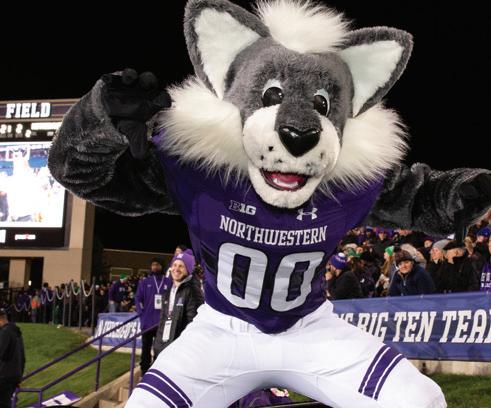
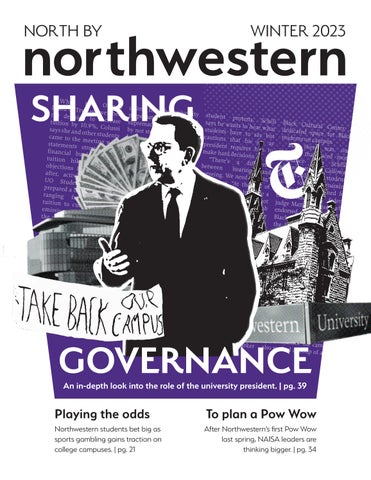
NORTH BY WINTER 2023 northwestern SHARING
When the Oregon claims that the university


When the Oregon claims that the university
the odds
Northwestern students bet big as sports gambling gains traction on college campuses. | pg. 21
An in-depth look into the role of the university president. | pg. 39
After Northwestern’s first Pow Wow last spring, NAISA leaders are thinking bigger. | pg. 34
What new Wildcard perk would you create?
Operational credit card that swipes out of NU’s endowment
The ability to remove one straight man from your discussion section each week
PRINT MANAGING EDITOR Jimmy He
ASSISTANT MANAGING EDITOR Mia Walvoord
EDITOR-AT-LARGE Brendan Le
SENIOR FEATURES EDITORS Naomi Birenbaum, Sela Breen, Emma Chiu, Yiming Fu, Maddy Rubin
ASSISTANT FEATURES EDITORS Jenna Anderson, Sam Bull, Chloe Rappaport
SENIOR DANCE FLOOR EDITORS Eva Lariño, Brooklyn Moore, Tessa Paul, Iris Swarthout
ASSISTANT DANCE FLOOR EDITORS Alyce Brown, Noah Coyle
SENIOR PREGAME EDITORS Lauren Cohn, Sari Dashefsky, Samantha Stevens
EDITOR-IN-CHIEF Ali Bianco
EXECUTIVE EDITOR Coop Daley
MANAGING EDITOR Kim Jao
ASSISTANT MANAGING EDITORS Hope Cartwright, Astry Rodriguez
DIVERSITY, EQUITY & INCLUSION EDITORS
Rafaela Jinich, Sammi Li, Ashley Sanchez
NEWS EDITOR Arden Anderson
POLITICS EDITOR Elliot Oppenheim
ASSISTANT EDITOR Rafaela Jinich
Guaranteed NU Men’s Basketball tickets for every game
ASSISTANT PREGAME EDITORS Katie Keil, Olivia Kharrazi
SENIOR HANGOVER EDITORS Julia Lucas, Julianna Zitron
ASSISTANT HANGOVER EDITORS Bennie Goldfarb, Natalia Zadeh
Get-out-of-jail-free (Wild)card
meal
ENTERTAINMENT EDITORS Conner Dejacacion, Jaharia Knowles
ASSISTANT EDITOR Kelly Rappaport
LIFE + STYLE EDITOR Ashley Sanchez
SPORTS EDITORS AJ Anderson, Miles French
INTERACTIVES EDITOR Annie Xia
FEATURES EDITOR Ryan Morton
ASSISTANT EDITORS Darya Tadlaoui, Sara Xu
OPINION EDITOR Christine Mao
CREATIVE DIRECTORS Hope Cartwright, Emma Estberg
PHOTO DIRECTOR Eloise Apple
DESIGNERS Pat Chutijirawong, Iliana Garner, Abigail Lev, Esther Lim, Michelle Sheen, Raven Williams, Allie Yi, Allen Zhang
Free mold test strips
CREATIVE FREELANCE
WRITERS Jackson Baker, Ali Bianco, Hannah Cole, Coop Daley, Audrey Hettleman, Sam Lebeck, Charlotte Varnes
PHOTOGRAPHER Tyler Keim
COVER DESIGN BY HOPE CARTWRIGHT & EMMA ESTBERG
PHOTO OF MICHAEL SCHILL COURTESY OF OFFICE OF THE PRESIDENT
PHOTO OF MONEY LISCENSED UNDER CREATIVE COMMONS
PHOTO OF KELLOGG BUILDING LISCENSED UNDER UNSPLASH
PHOTO OF PROTEST SIGN BY ADAM EBERHARDT/EMERALD
PHOTO OF UNIVERSITY HALL LISCENSED UNDER CREATIVE COMMONS
PHOTO OF NORTHWESTERN SIGN BY HOPE CARTWRIGHT
THE NEW YORK TIMES LOGO LISCENSED UNDER WIKIMEDIA COMMONS
CREATIVE WRITING EDITOR Amaya Mikolič-Berrios
ASSISTANT EDITOR Mika Ellison
MULTIMEDIA EDITOR Jade Thomas
GRAPHICS EDITOR Olivia Abeyta
ASSISTANT EDITOR Iliana Garner
INSTAGRAM EDITOR Sela Breen
TWITTER EDITOR Nozizwe Msipa
TIKTOK EDITORS Lianna Amoruso, Stephanie Kontopanos
PUBLISHER Julianne Sun
EVENTS MANAGER Ellisya Lindsey
FUNDRAISING Lele Sukman Demello
MARKETING Sam Stevens
AD SALES Nicole Feldman
The future belongs to those who understand the art and science of marketing communications.
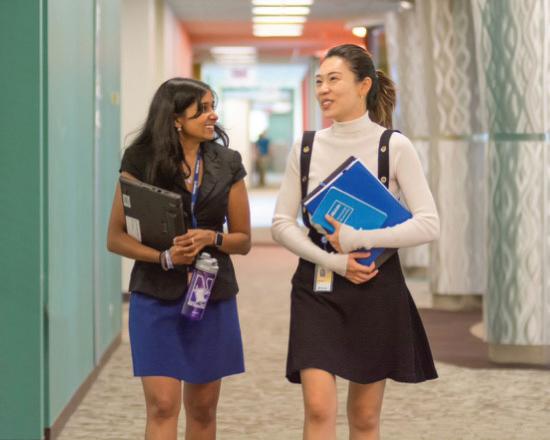
And that’s what you will learn at Medill IMC. You’ll create innovative marketing communications strategies and engage consumers in the digital age by working collaboratively with global companies, faculty and your peers. Our program will teach you the IMC “way of thinking” that focuses on understanding consumers and balances qualitative and quantitative data to build strong brands. Medill IMC will help set you apart from others in the industry and prepare you for the future. Take a Closer Look
www.medill.northwestern.edu

During one of the rst Sundays of Winter Quarter, I found myself having brunch with Mia, the magazine’s assistant managing editor. We bounced pitches o each other over wa es in my living room as I contemplated what it meant to lead a magazine. Throughout the next eight weeks, my de nition of leadership has expanded and evolved, threading itself through narratives cra ed by our reporters.
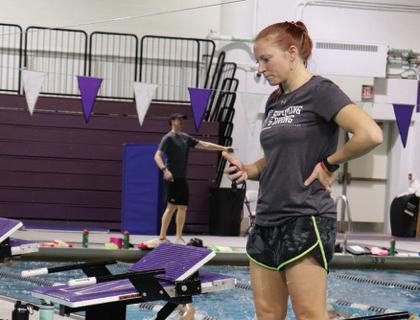
In our Pregame section, you’ll hear from three female DJs who are trailblazing Northwestern’s male-dominated mixing scene. Our Dance Floor section documents Northwestern swim and dive coach Katie Robinson’s commitment to excellence and explores the Associated Student Government’s critical role in elevating student voices.
Our Features section spotlights two Indigenous students who are ambitiously determined to organize Northwestern’s biggest Pow Wow yet. Meanwhile, our cover story, “Sharing governance,” delves deep into the pivotal role of the university president,
examining President Michael Schill’s past tenure at the University of Oregon and his vision for Northwestern’s future.
I’ve watched our team come together week a er week, braving the Chicago snow and wind to attend our evening meetings in the McCormick Foundation Center. I’ve watched them grow and motivate each other to be their absolute best. For me, leadership has been about creating an environment that fosters growth, learning and empowerment.
All of this had led to the magazine you now hold in your hands. It’s an issue I couldn’t be more proud of producing and could never have done without the support of editors, designers and writers. I hope this issue of NBN provides you with the same valuable insights and inspiration that it has given me.
Sincerely,





by tile, Northwestern students make their match.
WRITTEN BY NOAH COYLE // DESIGNED BY ABIGAIL LEV // PHOTO BY TYLER KEIM
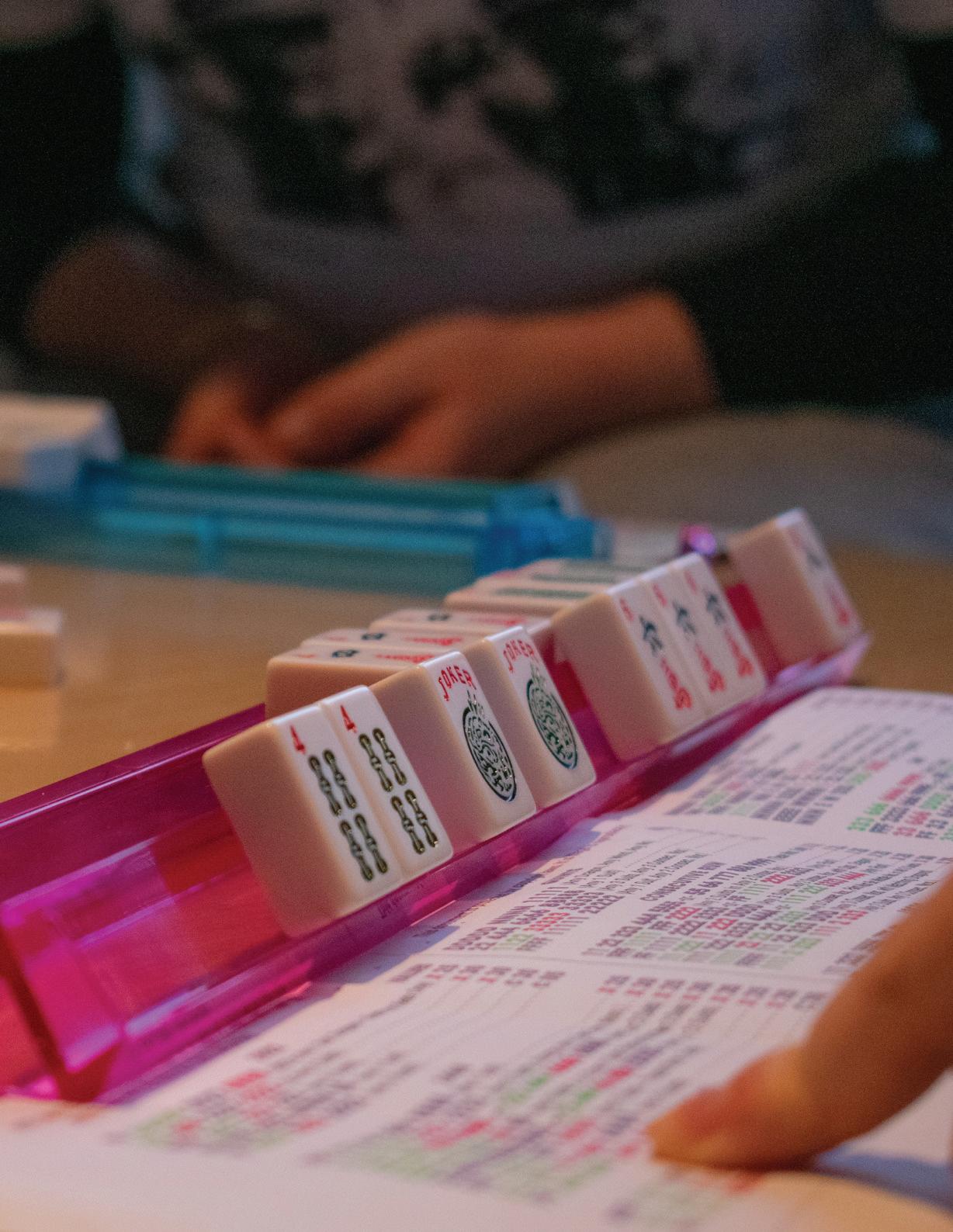
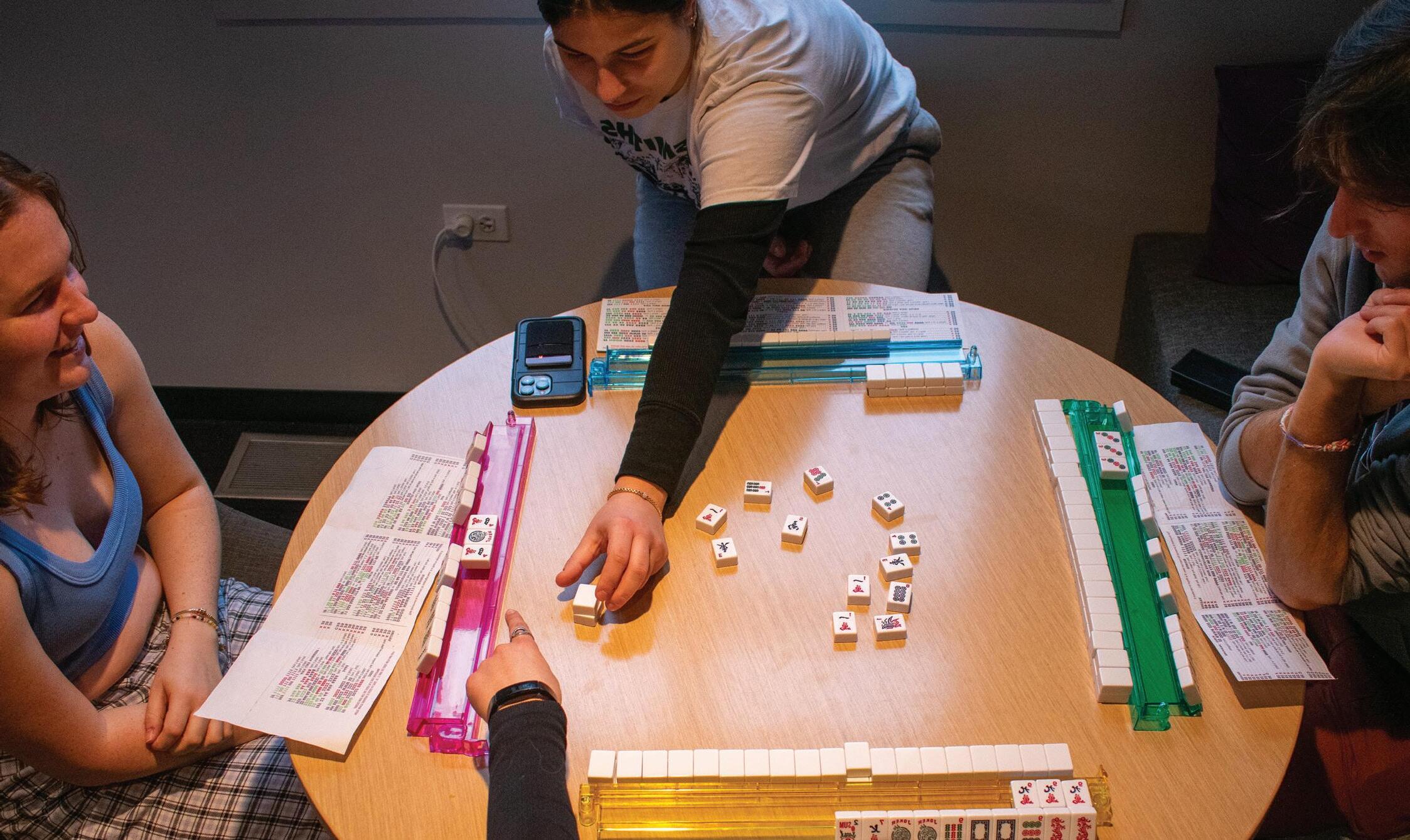
IIt’s 4:30 p.m. on a Sunday, and two students are dragging tables to the middle of the basement in Northwestern Hillel, the center for Jewish life on campus. As students seat themselves eight to a table, one retrieves a canvas bag and pours out an array of red-and-green-printed tiles. Passing around a Cheez-It box, a game of mah-jongg begins.
Mah-jongg is a tile-based game of Chinese origin. A er gaining popularity in Shanghai in the late 19th century, it was introduced to the United States in the early 1920s. The game has since become a preferred pastime of Jewish American grandmothers.
SESP third-year Wendy Klunk, Hillel’s Religious & Spiritual Life Co-Chair, founded the Mah-jongg Club last fall.
A er advertising
a practice session on Hillel’s Instagram and through a newsletter last October, she drew in six curious students — one of whom was SESP rst-year and Hillel member Brooke Fein.
“The rst meeting was very exciting,” Fein says. “I didn’t know what to expect. I didn’t know if people were gonna show up, but it was fun.”
From there, interest in the game grew in the Hillel community, and a group started to meet every Sunday.
While the goal of mah-jongg is to collect a matching set of tiles, the members of the club recognize another, more pressing objective of their meetings: Gossip. During the club’s two to three games every week, the participants go at a leisurely pace to chat as they play.
Another one of the Mah-jongg Club’s core tenets is inclusivity. The group is

students, regardless of skill level or if they are members of Hillel. To ensure that all who attend are able to participate in games, the club bends the rules of mahjongg to allow teamplay.
“I feel like at Northwestern, if you’re in clubs it’s either professional development or something for your resume,” Klunk says. “The Mah-jongg Club is really just for fun and for relaxing and for meeting new friends.”
At around 6:30 p.m., the nal round of mah-jongg draws to a close. The participants pack up their tiles, gather their belongings and leave to go about their evenings. Nearly all will be back next week to continue the tradition.

“The Mah-jongg Club is really just for fun and for relaxing and for meeting new friends.”
Wendy Klunk, SESP Third-Year

compares the prices of grocery store staples across Evanston.
or Northwestern students on a budget, grocery shopping can be a time-consuming tango of store-hopping while hunting for explored three popular Evanston grocery locations — D&D Finer Foods, Whole Foods and Jewelof some kitchen staples so you don’t have to. and

*Prices observed in January 2023.
SUGAR, 4 POUNDS
$2.99 $2.99 $1.99
$1.19 $1.49 $1.49
$3.99 $1.79 $1.99
$0.99 $0.79 $0.69
$1.59 $0.99 $0.99
$5.99 $1.99 $2.49
$3.29 $1.49 $0.99
$6.59 $6.39 $4.99
$8.99 $4.39 $6.49
$6.59 $4.49 $4.99
$2.99 $7.99 $4.99
$6.99 $5.99 $5.99
$3.99 $2.29 $2.99
$2.19 $4.49 $3.49
$7.99 $3.49 $7.49
$8.76 $3.79 $6.98 CHEERIOS, 1 BOX
$6.99 $5.69 $6.29 LENTILS, 1 POUND
$2.29 $3.19 $1.99 SPAGHETTI, 1 POUND RICE, 5 POUNDS TOTAL TEND CHANGE Item Count: 20 Time 07:02:46 PM THANK YOU TC# 1865 4588 0290 1963


Exploring the roles of Northwestern’s goal-oriented student sports team managers.
WRITTEN BY ELOISE APPLE // DESIGNED BY ALLIE YI
WWhen the Northwestern women’s volleyball team pulled an upset victory over Minnesota this fall, Weinberg secondyear Natalie Pizer couldn’t help but share in the excitement. As the team’s manager, Pizer spent hours doing data analytics, watching game footage and combing through statistics to strategize against their opponents. She felt as if her hard work had nally paid o
“[Fans] see the end product but not everything that goes into it,” Pizer says. “It’s nice that the coaches see how much we’ve worked because it’s not always very visible.”

Students can work as sports managers for various NCAA teams on campus, including volleyball, basketball and football.
The opportunity allows passionate students to immerse themselves in sports programs while also earning money.
When Medill second-year Massimo Cipriano isn’t in class, he spends most of his time working as the sports manager for the Northwestern Wildcats women’s basketball team.
Before practices, managers are in charge of preparing equipment, including basketball racks, towels and water. While players do drills, responsibilities range from running the scoreboards to rebounding shots. erward, the managers help clean up and head to the team meal.
to 24 hours a week. Although the time commitment makes it di cult to balance school, work and personal time, Weinberg second-year John Sprenger, the manager of the Northwestern Wildcats men’s basketball team, believes you have to be willing to make sacri ces in order to get the most out of the program.


As a Wilmette local, Sprenger grew up following Northwestern’s basketball team. For him, being a part of the organization he spent years watching has been a defining landmark of his Northwestern experience. He feels his role has grown beyond obligatory work responsibilities and provided him with fulfilling personal relationships with the players, coaches and fellow managers.

“It’s a very real-world responsibility,” Cipriano says. “Regardless of how low I am on the pyramid of basketball employees, there’s stu that I do that is very consequential and important for
Being a sports team manager requires students to build their academic schedule around practice times, with students working anywhere from 18
“At the end of the day, it’s the players playing,” Sprenger says. “But I do think that because we do so much with behind-the-scenes stu , when we do that correctly, it de nitely takes other things.”
Pizer says she’s forged strong relationships with both players and coaches on the women’s volleyball team. The coaches give her rides around campus and have written her internship recommendation letters.
At a banquet during the team’s senior night, the head coach called her up to recognize her contributions to the team in front of the whole room.
“I was like, ‘Wow, this is so cool,’” Pizer says. “He’s doing it in front of the whole team, all their parents — it was really nice that he was giving me that recognition.”

A Day in the Life of a men’s basketball manager

9 a.m. - 12 p.m.
Attend classes.
12 - 12:30 p.m.
Commute to Welsh-Ryan Arena.
12:30 - 4 p.m.
Set up practice with basketballs, pads, towels and water bottles. Help out during practice with rebounding, filling up water bottles and running the scoreboard.
4 - 5:30 p.m.
Finish practice, rebound for players after practice, clean up equipment and eat with the players and other managers.
5:30 - 6 p.m.
Commute back to campus.
6 - 11 p.m.
Arrive at dorm and do homework.
WRITTEN BY JULIANNA ZITRON // DESIGNED BY RAVEN WILLIAMS
ver 6,000 miles from Northwestern’s campus, Weinberg fourth-year Lu Poteshman arrives at Ruby Room in Tokyo, Japan, ready to take the stage as DJ Lu. Her usual audience consists of Northwestern students in the basements of o -campus houses or at A&O production events, but now, DJ Lu is eager to bring her music to an international audience.
Poteshman is not the only woman at Northwestern spinning tracks to get the party started. Back in Evanston, SESP fourth-year Haley Hooper plays a set at her friend’s party. Bienen second-year Lucy Rubinstein assumes her stage name, r00bies4ever, in Chicago’s underground music venue The Listening Room.
NBN sat down with three of Northwestern’s premier female DJs to discuss how they’re turning the tables in a traditionally male-dominated scene.
NBN: What is the origin story of your DJing career?
Lu Poteshman: I was always a musician, growing up as a classically trained violinist. But I sort of quit when I started college because it didn’t really t into my life anymore. Musically, it felt a bit restrictive. It didn’t have that freedom and individuality I wanted. So DJing was awesome because it’s all about freedom and individuality.
Haley Hooper to so many EDM and house shows when I was in high school. I became inspired by my favorite artist Rüfüs Du Sol in 2018 to get into this world of music. For my high school graduation gi to myself, I bought a DJ board o of Amazon and just started playing with the knobs and getting a feel for it. I did that for about a year. Then over COVID, I really

got serious about it and played sets in my basement every night of quarantine, just with my dog.
NBN: What does your mixing process look like?

Haley: The process of mixing is just going with whatever feels right in the moment based on how I’m feeling and how whoever I’m playing for feels. You can just operate from a sense of second nature because you know your music so well and you did your
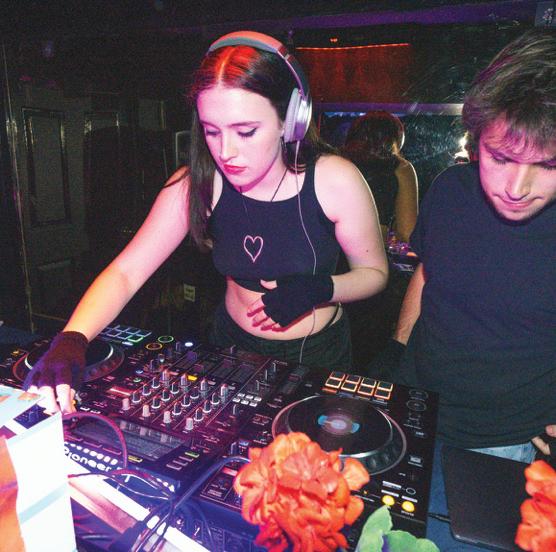

Lucy Rubinstein: I’m the total opposite. I plan out every single transition, I plan out exactly where I’m going to start the track, exactly where I’m gonna do what kind of mixing — I do it because I get really bad stage fright. If I rely on improvisation, that really freaks me out. I’d rather plan it out and know exactly how the sets are gonna sound and feel and exactly what knobs I’m gonna twist when.
NBN: What experiences have you had navigating the DJ scene as a woman?
Lucy: Part of the reason I joined Streetbeat, the show on WNUR, is because there were no girls. I was like, “Oh, I want to freak them out. I want to be intimidating.” When I was learning to mix, it was me and like six frat guys. It’s been such a great experience to meet other people like Lu and Haley and to really show Northwestern this isn’t just another hobby that’s dominated by white men.
Lu: When I joined Streetbeat, I was invited to someone’s show to learn how to DJ. I walked in, and there’s seven white
guys just in the room. It was genuinely scary to decide to enter that space and make a space for myself in there. It’s di cult sometimes to not see other people like me re ected in the DJ community, both at Northwestern and in the world at large.
NBN: How do you support other women DJs on campus?
Haley: I was trying to nd out about other female DJs through word of mouth. Anytime I hear about a girl DJing or was interested in DJing, I follow them on Instagram.
Lu: When we’re dealing with the lack of representation that we are with female DJs and DJs of color, I think just a mere presence can be very helpful. So I hope by being a part of Streetbeat, and being on the executive board of WNUR, I can just show people that it’s possible to be in these roles and in these spaces.

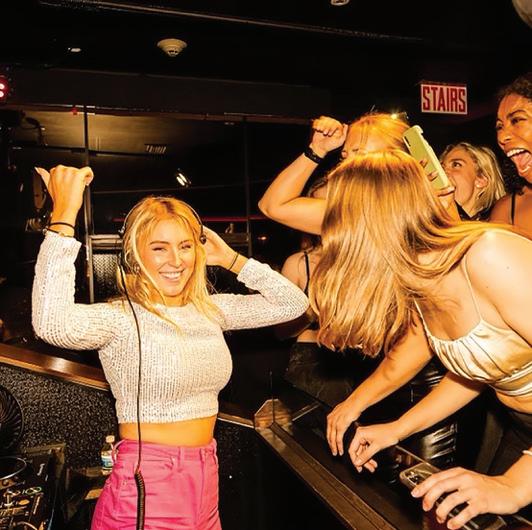
NBN: What do you wish people knew about DJing?
Lucy: Through WNUR and my own personal side project, I’ve been planning events to create new spaces where people that don’t want to be at either a frat party or a club downtown, for everyone to just have fun, express themselves and enjoy music and be social.
Lu: All the time people ask me “What is DJing? What are you doing back there?” My explanation is that 50% of it is picking the music and having a music library and curating the setlist. And then 50% is just blending the two songs together and creating those seamless transitions so you can tell a story with the music.
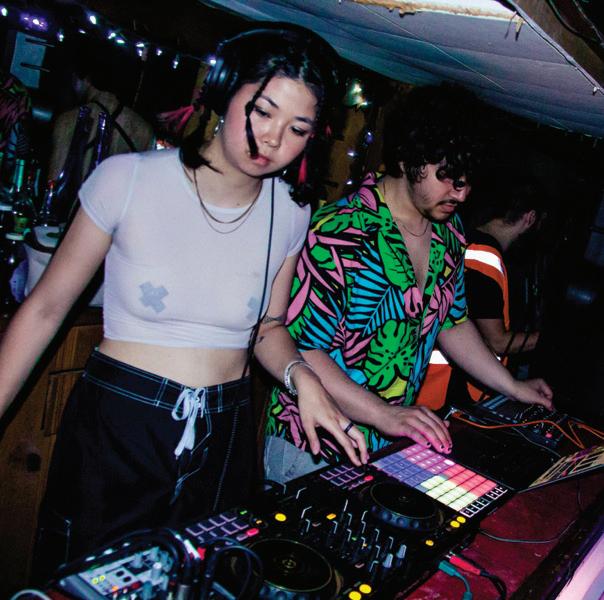
Haley: With DJing, when I rst thought about it, I felt really pressured to play what I thought people wanted to hear. I was like, “Oh, I have to play these songs because people hear them on the radio or whatever.” And that’s not the case. DJing is an expression of you, of what you want to do.
Lucy: The best thing you can do to support a DJ is dance.

WRITTEN BY HANNAH COLE // DESIGNED BY HOPE CARTWRIGHT
“M
“Medical or recreational?” “Flower or edibles?”
“Indica or sativa?”
These are some choices you might encounter when entering an Illinois dispensary. Following recreational marijuana’s legalization in 2020, Evanston buyers can now purchase the substance from a budding business: Zen Leaf.
Located at 1804 Maple Ave. in downtown Evanston, the dispensary is across from BLICK Art Materials and the newly reopened AMC Cinema, two strong options for a post-smoke sesh.
Weinberg third-year Devyn Coar rst visited Zen Leaf when she turned 21. She searched online for a weed strain that would meet her needs and went to pick up the product in person.
Upon entering the store, employees immediately asked Coar for her ID. A er verifying her age, they gave her the items in her online order. As per Zen Leaf’s student discount, she also received 10% o the purchase.
Sometimes choosing the correct product is a joint e ort. Dispensary sta members, or budtenders, are happy to make recommendations. Nicholas Covington, manager of Zen Leaf’s Evanston location, says the sta are friendly and eager to assist rookie customers.
“If you’ve come to a budtender and you’re asking 100 million questions, that’s their job to answer,” Covington says. “So, being a rst-timer, I always tell people to be okay with not knowing [about weed] when you come in, and you’re not going to be judged for it.”
Depending on what e ects the purchaser desires, budtenders recommend di erent strains. While sativa is described as energetic and social, indica is more calming. Coar says she’s been smoking indica lately since it helps her feel relaxed.
Zen Leaf employees want all their customers to ride the high, but they also need to weed out underage purchasers. Don’t try using a fake ID at a dispensary, kids. All potential purchasers will have to pass not one, but two scans of their identi cation.
“Just because you got through the rst door, we still need to con rm we aren’t selling to an underage person,” Covington says.
There are also numerous restrictions and laws in Illinois that regulate how dispensaries sell their products, how they’re taxed and where that tax money goes.
For example, Covington says dispensaries cannot openly display cannabis. Illinois recreational marijuana taxes are also higher than most states. According to the Illinois Department of Revenue, Illinois taxes 25% on products with a tetrahydrocannabinol (THC) level higher than 35% and issues a 20% tax on products with a THC level under 35%.
“By legalizing it, we are trying to
In contrast, New Jersey levies a 6.625% tax for all recreational cannabis, with some varying local taxes.
According to the Chicago Tribune, Illinois’ marijuana tax money o en goes toward Chicago neighborhood development and substance abuse treatment. The Tribune also reported that Zen Leaf’s taxes fund Evanston’s $10 million reparations program, which aims to provide Black residents with funds for housing payments and repairs as a redress for racial discrimination.
Jojo Holm, Weinberg third-year destigmatize it.
“The project’s founder Robin Rue Simmons said in an interview with Evanston RoundTable that using a cannabis tax was an apt way to rectify Evanston’s over-policing of the Black community for marijuana use.
Despite the high taxes, Weinberg third-year Jojo Holm doesn’t consider the prices unfair.
“We’re in Evanston, so I think it makes sense that it’s just a little bit more expensive,” Holm says. “It felt really reasonable to me.”
Covington says he believes cannabis helps people, whether through government funding like the reparations program or in customers’ day-to-day lives. Holm believes that smoking is a more positive experience compared to drinking and can also strengthen friendships.
“The reality is, by legalizing it we are trying to destigmatize it,” Holm says. “I think that’s really great.”


A list of top spots to use your Wildcard discount.
WRITTEN BY SAM LEBECK // DESIGNED BY NAPAT CHUTIJIRAWONG
A Wildcard can do so much more than swipe students into dorms and dining halls. It opens doors to discounts at restaurants, stores and more in Evanston and Chicago — if you know where to look. More than 100 Evanston and Chicago businesses o er Wildcard discounts, from 10% o meal purchases to reduced prices at workout classes. NBN has compiled a list of Evanston and Chicago locations to take advantage of your Wildcard bene ts.



Ovo Frito Café: A favorite Evanston brunch destination, the distinctive yellow building welcomes students and o ers those who present their Wildcards 10% o their meal.
Blind Faith Cafe: Located on Dempster Street, this sustainabilityoriented Certi ed Green Restaurant o ers students 10% o their vegetarian menu. Kilwins: Known for drawing in passersby with their wide array of ice cream and fragrant fudge, Kilwins o ers students 10% o their purchases as well as a punch card to encourage returning buyers.
JR Dessert Bakery: Founded 30 years ago and run by a mother-daughter duo, JR
Dessert Bakery o ers 10% o any bakery item. From cheesecakes to brownies, every baked good is made with all-natural ingredients (available by 14-minute drive or taking the 201 bus route and transferring to the 97 bus at the Howard Street and Ridge Boulevard stop).

Evans Nail & Spa: This Noyes Street nail salon o ers $10 o non-chip manicures with the purchase of a pedicure.
CycleBar: Presenting a Wildcard can give students 33% o an indoor spin class with certi ed instructors, complete with workout metrics a er their ride.
Lock Chicago Escape Rooms: Despite having Chicago in the name, this Evanston-based escape room o ers a 15% discount on all bookings with a Wildcard. They o er unique adventures with multiple endings.

Zipcar: Students over 18 can join the car rental service for only $25 using their university email and Wildcard.
uBreakiFix: This electronics shop on Chicago Avenue o ers 10% o repairs when students show their Wildcards at dropo or pick-up.
Af nity CPR Training Center: Students must call and mention the Wildcard Advantage to receive 15% o any class, including basic rst aid and CPR.
Silver Spoon: This cozy Thai restaurant o ers 10% o for students with an ID. Located just o the Magni cent Mile, Silver Spoon is a hidden gem for those looking for authentic Thai o the beaten path ( ve-minute walk from Chicago Red Line stop).
Leonidas Cafe Chocolaterie: With locations in both Evanston and Chicago, Leonidas’ European-style cafe and chocolate shop o ers 10% o purchases for students with a Wildcard (Central Street in Evanston, two-minute walk from Chicago Red Line stop).
Art Institute of Chicago: This world-famous art museum, home to renowned paintings, sculptures and photographs, o ers free admission to students who show their undergraduate Wildcard at the ticketing counter or a $19 student ticket online ( ve-minute walk from Monroe Red Line stop).
Lyric Opera of Chicago: Lyric Opera, a preeminent nonpro t center of arts, o ers $20 student tickets to select performances (20-minute walk from Lake Red Line stop).
Kingston Mines: The largest and oldest continuously-operating blues club in Chicago, Kingston Mines o ers free entry on Thursdays to 21+ students that show their school IDs (10-minute walk from Fullerton Red Line stop).
Life Storage: With a valid Wildcard, students receive 10% o the in-store rate for storage solutions in Chicago.
312 Elements Headshot
Photography: Students can receive 50% o the Essential Headshot package, a 60-minute session including unlimited clothing changes and a complete digital download of the session.
Mattress King Chicago: With the presentation of a Wildcard, students in need of a mattress can forgo paying sales tax with their purchase.

EN BY JENNA ANDERSON // DESIGNED BY ESTHER Y ELOISEAPPLE


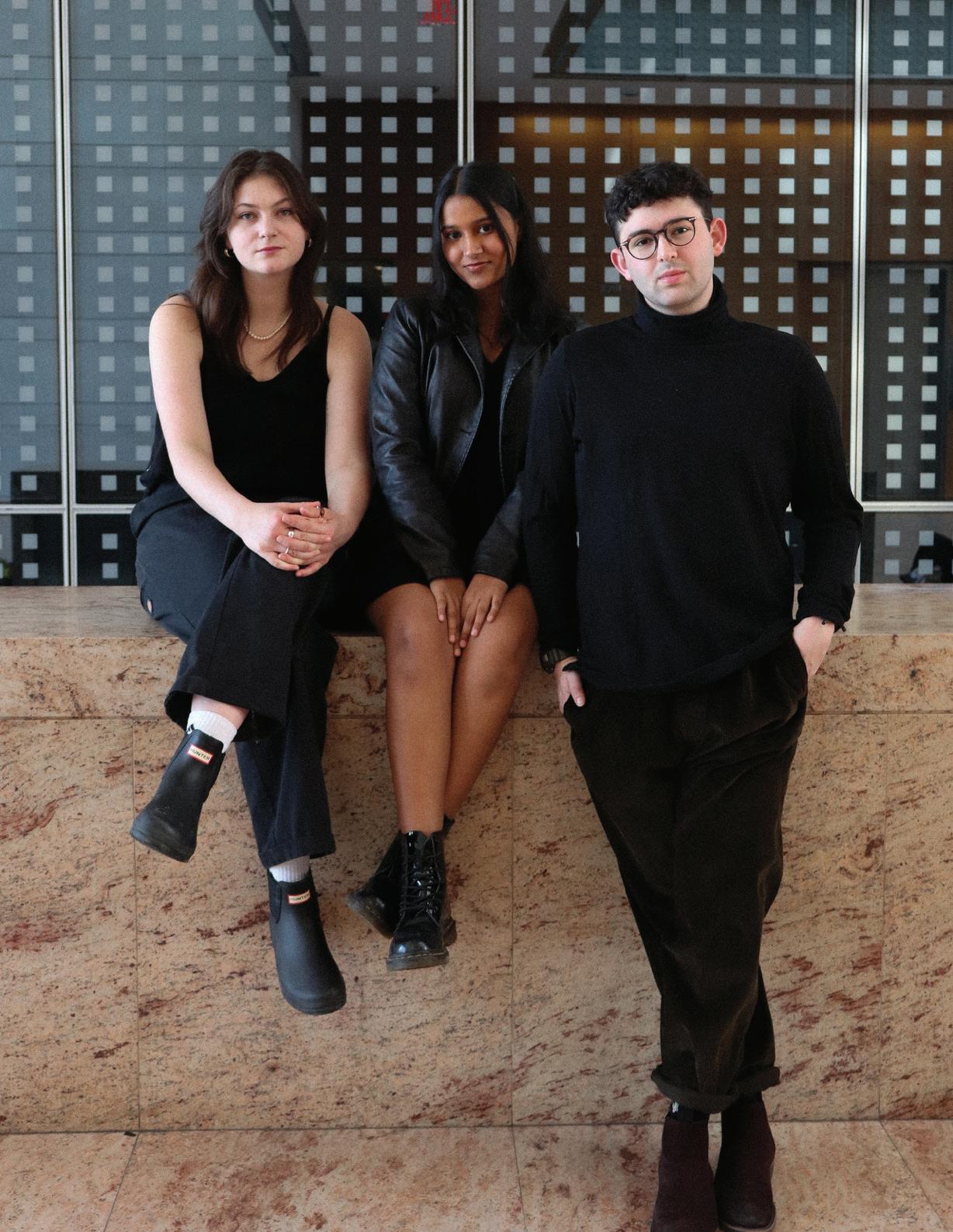
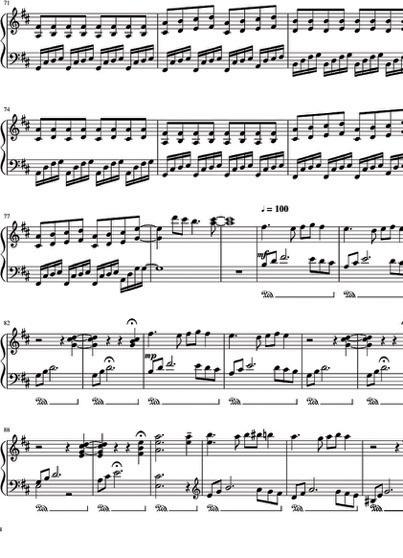
or student composers, music is more than a pregame playlist, car-ride jam or shower soundtrack. To them, music is an outlet for original artistic expression. With every bridge and chord, Mya Vandegri , Reva Sangal and Eli Gottsegen are developing their sound.
Mya Vandegri and the musicians of No Exit, a professional ensemble from Cleveland, Ohio, sat on the oor of a rehearsal room with an array of wine glasses. Drop by drop, they poured water for an hour until each glass rang with the desired musical note. The Bienen second-year was only 16 at the time, but she was already leading the rehearsal of her rst commissioned piece, “Non-Alcoholic Beverages.”
Vandegri composes modern Western classical music and describes her style as “experimental, contemporary, aesthetic.” The composition major from Wooster, Ohio, has plenty of projects in her portfolio, ranging from a solo piano piece to an orchestra arrangement. She spent the last 18 months working on her opera, “Creating Small Thunder,” which will premiere in April at the Wirtz Center for Performing Arts.
Vandegri started writing songs in elementary school. By middle school, looking for a challenge, she started composing instrumental music.
An early discovery that drew Vandegri to composing was her synesthesia. Synesthesia is a neurological phenomenon that links senses together; Vandegri says she associates sounds with colors. For instance, when she hears


hitting all the right notes.
a G major chord, she sees orange. (She told me my voice is army green and burgundy with a streak of yellow.)
“Any tonal noise has a little bit of a palette,” she says. “It’s like breathing. I forget it’s there.”
This phenomenon allows Vandegri to view sound as a “three-dimensional entity” — a noise, a color and a presence in the room. Vandegri says she uses her synesthesia to make her music “as full as it can be.”
Hans Thomalla, a German American composer and professor of music composition, has been working with Vandegri since she was a rst-year student. He admires her ambition to write her opera, which tells the story of a queer family in the rural Midwest.
“I nd it wonderful that she’s interested in such a broad concept of composition,” Thomalla says. “She’s quite aware of the world, and I nd this very impressive.”
Once Vandegri decides on the instruments and what she wants to write about, she gives herself the time and space to compose the music. But
her process isn’t linear — Vandegri explores an aspect she likes, then nds a place for it in the arrangement.
“Once I nd the destination, I build the world around it,” she says.
Vandegrift brings her finished composition to rehearsal, where she then collaborates with musicians to achieve her vision. After some rewriting and rehearsing, the piece is performance ready.
“It’s like giving birth in public,” Vandegrift says. “It might be a cute baby. It might be a bad baby. But it’s here.”
Vandegri plans on pursuing a career as a classical composer, speci cally in stage music. She says she’s grateful for the opportunity to create educational art — like her upcoming opera — in an environment that allows for mistakes and growth.
“I really don’t know what I’m doing,” Vandegrift says. “But I am here, and I have ideas. I’m trying to make the most of the opportunity of being at Northwestern and being able to write music here.”
Seated at the bench with her piano teacher, Reva Sangal placed her hands on the keys and prepared herself to perform at Carnegie Hall in New York City. At 14 years old, the Golden Key Piano Composition Competition had invited Sangal to the iconic venue to perform a piano duet she composed.
“I think I blacked out,” Sangal says.
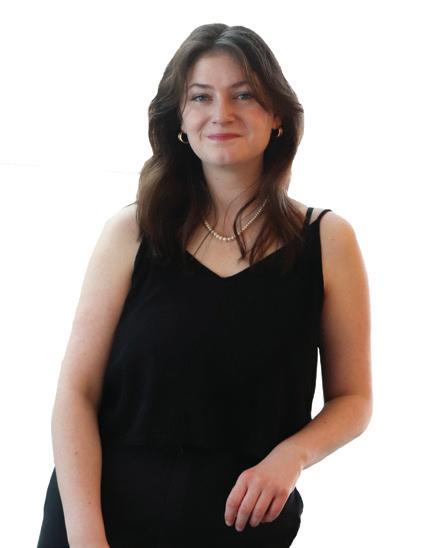
The Communication third-year from Princeton, New Jersey, now composes contemporary musical theater songs. She is one of three writing coordinators for The Waa-Mu Show, Northwestern’s annual musical written, produced and performed entirely by students. This year’s production, a romantic comedy titled Romance en Route, will premiere in May.
Sangal says she’s always loved music. She remembers being obsessed with the Bollywood song “Barso Re” as a kid, always asking her parents to play it in the car.
“Little me had taste,” Sangal says. “That was my earliest memory of a song that I was connected to.
At 11 years old, Sangal performed in her rst musical theater production as Eulalie Mackecknie Shinn in The Music Man Jr. She says she’s been a “theater kid” ever since.
Sangal took piano lessons growing up. By high school, Sangal says she was getting bored of playing sonatas, so her piano teacher encouraged her to write music. With no formal training, Sangal started improvising on the piano and composed her first duet.
A er her sophomore year of high



school, Sangal was accepted to a twoweek summer composition intensive at the Berklee College of Music. She expanded her composing from piano to a woodwind trio and string quartet. When COVID hit, Sangal experienced a bit of a writing lull until she joined Waa-Mu as a second-year.
“Suddenly, everything opened up again,” Sangal says.
Sangal applied to Waa-Mu with her classical compositions and started writing musical theater songs for the rst time with the group. As a writing coordinator this year, Sangal leads the 25-person Writing Room, a studentorganized seminar during Winter Quarter to compose The Waa-Mu Show.
Having a large team of composers makes the massive endeavor of creating a musical possible, but Sangal says it can get complicated because everyone has their own artistic identity. Luckily, she says this year’s group has been wonderful.




“I could not feel more blessed with the amount of talented people who are on our team,” Sangal says. “They all are ready to create a musical that ts a group voice.”

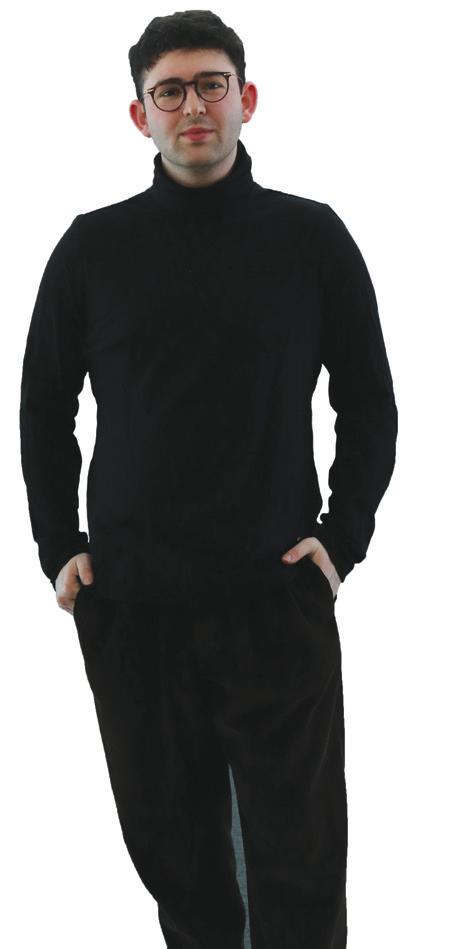
Communication fourth-year and Waa-Mu co-chair Mitchell Huntley has worked with Sangal since she joined the Writing Room last year. He says she’s a fantastic collaborator and leader.
“She creates a really fun and inviting environment,” Huntley says. “You feel free to try things out — throw spaghetti at the wall and see what sticks.”

A er Waa-Mu, Sangal will begin writing a musical for her undergraduate capstone project, but she isn’t set on a career as a composer. Sangal is pursuing a minor in Legal Studies and a career in law. Nonetheless, she says music will always be part of her life and encourages anyone with a love for music to compose.
“Anyone can write music,” she says. “It’s not something you need a certain brain for, or you’re born with it — I don’t believe that. I think talent is nurtured.”



During his freshman year, Communication third-year Eli Gottsegen had an assignment for Theatre 120-0, “Production in Context,” to interview a Northwestern theatre faculty member and present it in a creative way. He interviewed a costume designer while his friend, Communication third-year Sophia Talwalkar, interviewed a director.
Then they had an idea: Let’s make a song.
Instead of spending an hour on the assignment like the rest of the class, they spent 20 hours writing “Only a Few Tomorrows,” a musical theater song about a costume designer and director who were excited to collaborate but had to take (at least) two weeks o for a pandemic. They got an A.
“There is magic in that song,” Gottsegen says. “It’s really one of the most special things I’ve ever been a part of.”
Gottsegen, from Larchmont, New York, composes pop and musical theater music. As a rst-year, he wrote for The Waa-Mu Show and joined the Writing Board as a second-year. He’s still involved in theater as a performer, and he is currently comusic director of Thunk A Cappella. Next year, Gottsegen plans to write a musical for his capstone project.
For most of his life, Gottsegen only really considered himself a musician. His mom gi ed him a violin for his third birthday, and he started taking lessons at four. He also took guitar lessons and taught himself how to play piano.
Gottsegen started writing songs for his band in the fall of his senior year of high school and developed as a composer during the rst COVID lockdown.
“The spring of 2020 is when I really started being like, ‘I’m not just a singer anymore, I’m not just a musician. This is what I really love,’” he says.
When Gottsegen composes, he says the music comes naturally, but the lyrics are harder. Sometimes, Gottsegen is overcome with emotion and runs to an instrument, writing about his own experiences. Other times, especially for musical theater, he’ll draw from what he’s read and watched to write about someone else’s perspective.
“I get overwhelmed by the ‘me’ part of it. When I’m writing about someone else, it’s so much less complex,” Gottsegen


says. “Then the coolest part happens, where you look back at it a er and go, ‘Huh. Who was I really writing about?’”
Gottsegen’s former professor told him this was related to the self-referential e ect — people’s tendency to remember information better when it has been linked to the self.
“You can’t help but include the tiniest bit of your life in theirs,” Gottsegen says. “How many people have compared Alexander Hamilton and Lin-Manuel Miranda?”
It’s no surprise Gottsegen wrote “Only a Few Tomorrows” — a song about collaboration — with a partner. Talwalkar remembers going to Gottsegen’s dorm in

Bobb-McCulloch Hall at 11 p.m., sitting at the piano, and composing until 3 a.m. A er a few of these late nights, they pulled one nal all-nighter before the assignment was due.
“We were like two fanatic songwriters,” Talwalkar says. “He’s awesome to work with. He’s a perfectionist in the best way.”
Gottsegen isn’t sure what he’ll be doing in the future, but he knows it’ll be something related to music. It could be composing or performing — whichever door opens rst, he says.
“I’m learning. I’m growing. I’m changing,” Gottsegen says. “This is a journey, and I’m not anywhere near the end.”





Northwestern’s female pilots defy gravity and stereotypes.
WRITTEN BY KATIE KEIL


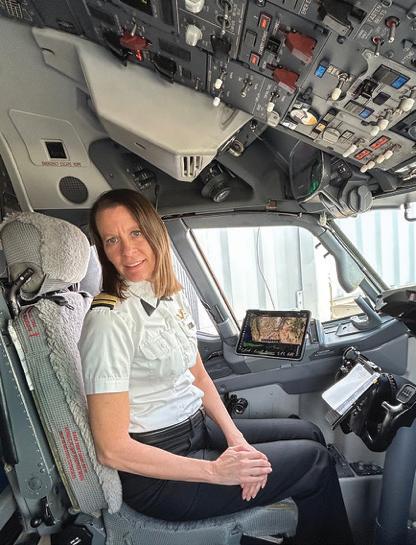
OOn a brisk February night last year, I met my doppelgänger. The brownhaired woman with dark eyes looked identical to me, except 30 years older and several inches taller. Her name also happened to be Katie.
Aside from our physical appearances, Captain Katie Overdiek and I shared one other striking similarity: We’re both female pilots in a male-dominated eld.
Since the age of two, I’ve dreamt of being an airline pilot. I began ying lessons at 14 and earned my pilot’s license in 2020 at 17 years old. According to national estimates, women make up only 8.4% of pilots worldwide, making it harder for aspiring female aviators like me to nd a community in the industry.
I’ve found my main support system in Northwestern’s Aviation Club, where I use my passion for ying to form new connections. Evanston’s proximity to numerous small air elds within the greater Chicago area makes aviation training relatively accessible, but a welcoming community of women helps immeasurably with navigating the eld.
I remember spending countless evenings at the platform of my local train station as a kid, watching the planes glitter in the night sky.
While many pilots typically join the aviation industry with help from family connections, women o en don’t have this privilege due to historical barriers to entry. Instead, many like myself tend to join out of sheer curiosity about aviation.
Although my introduction to the eld occurred on the ground, other women’s rst experiences happened through exposure. Weinberg fourthyear Tyler Greene began ying through a partnership between her local high school in Aspen, Colorado, and a ight institution at the nearby air eld.
“I just fell in love with it immediately,” Greene says. “I thought it was such a
special experience to be behind the controls and have something that you do physically change the course of a plane.”

The process of earning a pilot’s license can be expensive, with costs ranging from $6,000 to more than $20,000 depending on the speci own and ight time. Federal Aviation Administration (FAA) regulations stipulate that individuals must have at least 40 hours of ying experience.
Some schools, like Purdue University, offer aviation-related majors that allow students to build flight hours while earning their bachelor’s degrees. Flight instructor Kate Thurmond, whom I frequently flew with this past summer, graduated from Purdue’s program in 2022. She emphasized its impact on her professional development.
“I feel like it gave me more of a good background when it comes to what to stand on in aviation,” Thurmond says. “It gave me a lot deeper understanding of the aviation industry as a whole.”
Northwestern o ers over 100 majors and minors but no programs to study aviation, so interested students must independently seek out opportunities.

Greene shares a similar experience, citing her interest in exploring a field she wasn’t studying academically.
As I approached the Aviation Club table at Northwestern’s Fall Quarter club fair, Weinberg third-year Elie Clark jumped up and welcomed me enthusiastically, exclaiming, “We’ve been waiting for you to come by!”
Northwestern’s Aviation Club combines social and professional aspects of aviation, with activities including airline pilot presentations, discussions on student ight training and occasional one-on-one ights with the club’s president. Clark says many of these events helped her form bonds with other students interested in aviation.
“I really wanted to have some kind of a community, and the club gave me
“I knew I wasn’t going to be doing as much [with aviation] as I was at home,” Greene says. “I wanted to have some a liation to aviation and aeronautics.”
Northwestern’s Aviation Club welcomes individuals from all training backgrounds. As the treasurer, Clark is intent on reducing nancial barriers for those who may be interested in pursuing aviation but lack the resources to do so.
She is currently working on developing a scholarship program in memory of Daniel Perelman, a Weinberg rst-year who passed away last year in an aviation accident. Additionally, the club is organizing a yearly safety seminar in Perelman’s memory to promote awareness toward accident prevention.
“We’re all pilots, so we can honor him through aviation,” Clark says. “There’s still that connection.”



The male-dominated runway
One of the many problems women who aspire to join the aviation industry face is a lack of representation. Overdiek, the pilot I encountered last February, has rarely worked alongside other women while ying for a major U.S. commercial airline.
“In 15 years of commercial aviation, I’ve only own with 10 female pilots,” she says. At her airline, 6% of pilots are women.
As the rst female instructor at her ight school in New York, Thurmond has noticed a recent uptick in interest from female-identifying students. Still, the vast majority of those enrolled are male.
“It’s de nitely one of those things where it’s still skewed male-dominated, but there’s de nitely an in ux of women who are interested in it,” Thurmond says.
According to the FAA, 14.2% of student pilots in 2020 were women. To support these female pilots, non-pro t organizations such as Women in Aviation International (WAI) provide annual scholarships to increase access to training and other resources. This February, WAI provided $889,140 in awards during the 34th Annual Women in Aviation International Conference.
Both Thurmond and Overdiek have re ected on how their experiences as
“ In 15 years of commercial aviation, I’ve only flown with
Captain Katie Overdiek

as they’ve taken on leadership roles.
Whether it’s becoming an instructor or an airline captain, women take on greater positions which allow them to expand their platforms and advocate for more representation.
According to Overdiek, gender doesn’t, and shouldn’t, play a role in piloting ability.
“I wouldn’t say being a female is any di erent,” she says. “I don’t think there’s a di erence between male and female in terms of getting the job done.”
Since arriving at Northwestern as a rst-year this past fall, I’ve found it di to continue training given the lack of a formal program. Yet, my ultimate goal of becoming an airline pilot is supported by a community of likeminded women.
While Greene admits being a woman in aviation is intimidating at times, she acknowledges the bene of a tight-knit community.
“When you have more of a small environment and personal time with your instructor, I think that changes the whole game,” Greene says.
Northwestern’s Aviation Club provides the intimate network many aviation enthusiasts, especially those pursuing careers in the industry, seek out. The club continues to incorporate
activities, from airport tours to aviation safety presentations.
As Clark prepares to take on the club presidency this year, she hopes to turn Northwestern’s Aviation Club into an educational space, both for students who are already interested in aviation and for those who have little background in the field.
“It’s such a mysti ed industry,” Clark says. “People lose their minds when I tell them I have my pilot’s license. I’d like to make it a little less abstract.”





Northwestern students bet big as sports gambling gains traction on college campuses.
// DESIGNED BY NAPAT CHUTIJIRAWONG
according to the International Center for Responsible Gambling.
“Before I cracked the code, I was losing all my little 16, 17-year-old savings,” Liam* says. “I know the ect that it can have, and I know for pretty much every person out there that gambles, or for a lot of people that struggle with it, it causes a lot of problems.”

Over the past year, Liam* has consistently placed substantial wagers on an o shore site called Bovada. In December 2022, Liam* risked approximately $75,000 across 598 individual bets. Three hundred and een of them resulted in winnings. With a win rate of 52.68% that month, he pro ted around $2,000 — an average month for him.
Not all months are quite as successful, however. The week leading up to his major win with the Broncos resulted in a setback of almost $3,000.
TTgame was in full swing, but for Weinberg second-year Liam*, the real action was not on the eld but rather in the numbers across his computer screen. He had placed a $50 bet that Tim Patrick, the Broncos’ wide receiver, would catch at least eight passes during the game.
Seven catches in and Liam* was on the edge of his seat, eager for the next play. The ball was thrown, soaring toward its target, and Patrick reached his arms out. Liam’s* heart began to race, and a smile spread across his face.
Patrick made the catch, and Liam won $800. This sense of success, the rush of adrenaline and the excitement of the win was addictive — Liam craved this feeling.
Engaging in sports betting is not uncommon for many college-aged students. Approximately 75% of college students gambled during the past year (legally or illegally), with about 18% gambling weekly or more frequently,
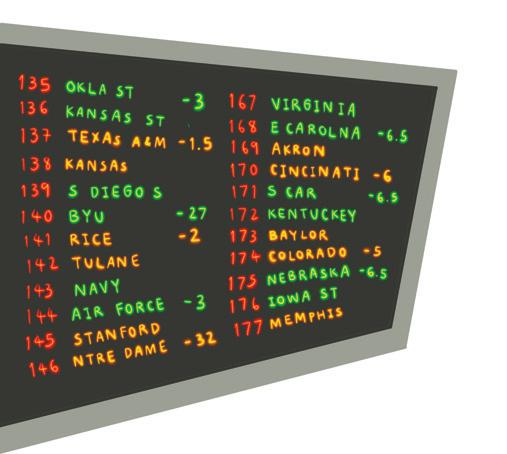
Gambling opportunities, previously available in only a few states, multiplied following the 2018 Supreme Court decision to legalize sports betting. The expansion of internet gambling and of sportsbooks — a place or website where a gambler can wager on various sports competitions — have intricately linked sports to gambling.
“I still was doing everything the same, but at the end of the day, I can’t control these NBA players or these NFL players,” he says. “They’re gonna play how they play, and there’s nothing I can do about it.”
Liam* rst introduced to online
75% of college students gambled during 2022
(International Center for Responsible Gambling)
a behavior like gambling, their brain’s reward system, centered around the release of dopamine, undergoes a signi cant shi . Over time, the brain rewires so that the individual experiences less positive satisfaction from anything other than the addictive behavior.
“Even in the face of negative consequences, they’re prioritizing the reward that comes from the addictive behavior, more so than the consequences that come along with that particular behavior,” Nusslock says.
With sports betting’s potential for fast money and instant grati cation, it’s unsurprising that many young adults and teenagers are immersed in it. It’s not only easily accessible — all that’s needed is a phone and internet connection — but socially acceptable and widely promoted.
The sports gambling industry is dominated by four licensed sportsbooks: FanDuel, Dra Kings, BetMGM and Caesars, which spend hundreds of millions of dollars on ad campaigns and celebrity endorsements. They entice new gamblers with “risk-free” bets or bonuses for their rst wagers.
As of November 2022, at least eight universities’ athletic departments have partnered with online sports-betting companies, according to The New York Times. These partnerships allow sportsbooks to advertise directly to students on campus, at athletic events and in students’ email inboxes.
In contrast to other industries selling addictive products, such as tobacco, there are no advertising rules speci c to the
sports betting industry at a federal level. This lack of oversight and regulation is particularly concerning for college-aged students who are susceptible to addiction.
While some students like Liam* treat sports gambling as a part-time job and dedicate a signi cant amount of time to researching bets with the goal of nancial gain, others bet small amounts, seeing it as a harmless addition to the viewing experience.
Communication third-year Caleb* bets purely for entertainment’s sake, putting $10 or $20 down as a way to deepen his engagement.
Caleb* bets by setting a budget each season and tracking his wins and losses.
“My mindset is that once I put a bet down, that money is gone, and if I win it back, it’s a bonus,” Caleb “Watching the game just to watch the game is fun, but it’s not as fun as when you have a team to root for. You cheer the whole time, you get invested and you feel like you have been a fan of that team for a while just because you have the money on it.”

the “vig” or “juice,” which is a fee charged by sportsbooks for taking a bet.
To bypass age restrictions, underage bettors o en turn to illegal intermediaries, known as bookies and agents. The bookie acts as a middleman between bettors and the agent, who has direct contact with the sportsbook. The agent is responsible for accepting bets from the bettors and placing them with the sportsbook,
used to work as a bookie for many of his friends at Northwestern but stopped due to the overwhelming workload and associated risks.

is if you really trust the people you’re working with because you can’t lose,” Bodhi * says. “If the people on your book lose money that week, then you get 15% of it. And if they win, then all you’re doing is transferring money.”
“ “ They’re prioritizing the reward that comes from the addictive behavior.
Robin Nusslock, Northwestern psychology professor


A major problem in the illicit betting world is people not paying what they owe. Because these bets are not made through a registered sportsbook, the entire system operates outside the law, and there is no legal recourse for collecting debts.
Bodhi* encountered this issue with one of his bettors who had fallen behind on paying what was owed.
“I told him the truth that he was scumming me. And I was like ‘I


realize this is shitty for you, but right now, I have a guy asking me for $2,000, and it’s not coming out of my own pocket, so you’re just fucking me,’” Bodhi * says. “He just felt bad enough and he probably wanted to bet again with me in the future, so he paid.”
Weinberg third-year James* initially approached betting as a leisure activity with friends but quickly began to optimize his strategy. James* now places substantial bets of up to hundreds of thousands of dollars per year, determined to beat the odds.
“It’s life-changing,” he says. “A few of us are under the guise that while it is taxing and tiring and stressful, it’s very much worth it.”

is over-adjusted, and given this, optimally wager on that.”
For Liam*, sports betting is about nding an edge over the oddsmakers through extensive research, analysis and a little bit of luck. He advises people interested in betting to never gamble more than they can and to never expect to win bets based on previous trends.
“
James* devotes extensive time to researching and analyzing his bets, yet he says he o en grapples with whether the opportunity cost is high enough. He and his friends always come back to the conclusion that as a college student, there is no other job that provides the nancial ts of sports betting.
“I wouldn’t say I have any particular says. “I couldn’t tell you who’s gonna win any game in particular, but I can analyze the markets and tell you where I think a [point spread for a game]


“That’s how they get you every time, and that’s why so many people lose,” Liam* says. “People think they know sports better than these billion-dollar gambling companies, but they just don’t at the end of the day.”
* Names have been changed to preserve anonymity.
People think they know sports better than these billion-dollar gambling companies, but they just don’t at the end of the day.
Liam*, Weinberg second-year
“




MOORE // DESIGNED BY ABIGAIL LEV
nscribed above the interior front doors of Deering Library is the phrase “aut legere scribenda, aut scribere legenda,” meaning “to read something worthy of being written” and “to write something worthy of being read.” Each day, students le in and out of Deering to ll this purpose.
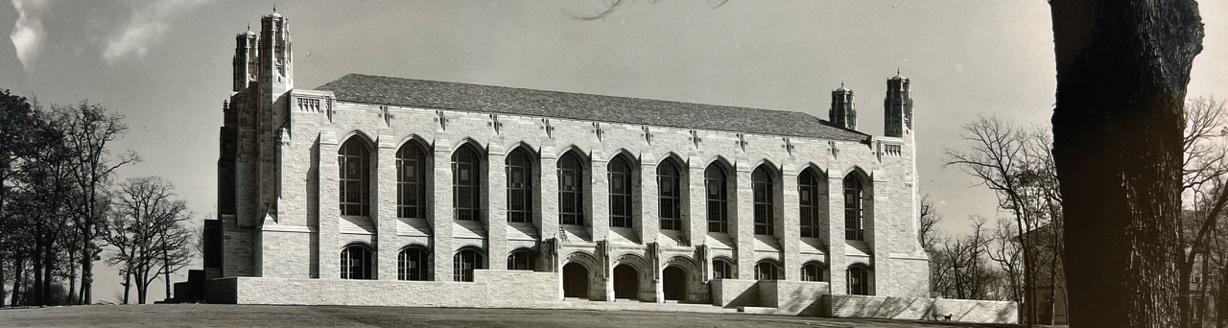
Ninety years ago, Deering opened its doors to its rst patrons. A welcome replacement for the previous Lunt Library, now Lunt Hall, Deering continues to stand as a campus landmark and a key embodiment of the Northwestern experience. Students can count on a quiet reading room, a picturesque garden landscape and a rolling meadow to support their studying. In celebration of Deering’s rst 90 years of existence, NBN is taking a look back on the library’s illustrious history.
When built in 1894, Lunt was widely regarded as the nest library in the West. But by 1919, when Theodore Koch became Northwestern Librarian, Lunt appeared dilapidated. Both the University collection and the student body had outgrown the space. Initially built to hold 100,000 volumes, Lunt housed 120,000 when Koch arrived. He immediately set out to improve the outdated library system.
“Mr. Koch came to the University at a time when our library was poorly organized and rendering only a mediocre
service. He at once injected new life into the organization,” Franklyn B. Snyder, Northwestern’s president at the time, said at Koch’s funeral service in 1941. “Indeed, it may be said that he put our library on the map.”
Koch submitted annual librarian reports to the university president, each time noting the desperate need for a new space.
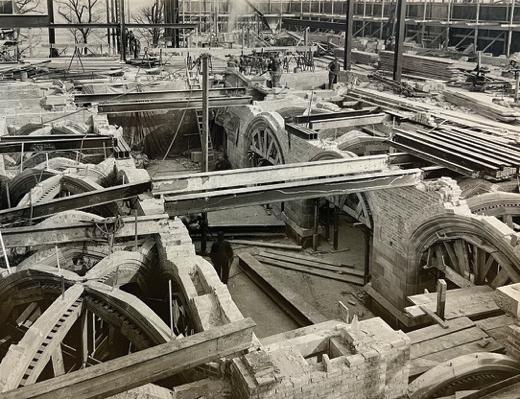
“Thousands of books have been boxed and stored in the basement of Fisk Hall on account of lack of shelf room in the Library,” Koch said in a 1921 report, 12 years before Deering opened. “Books are piled on the oor and on ledges.”
In 1929, Charles Deering donated $500,000, and the University immediately set the donation aside for a new library. Its location would display views of the lake on one side and of campus on the other.
The University hired famed collegiate gothic architect James Gamble Rogers to design the library. His previous works included Yale University buildings and Northwestern’s Chicago Campus. Koch chose the gothic style present today.
“No other architectural style, unless it be the Greek, has expressed more adequately the upward reaching of man’s spirit,” Koch said.
Deering opened its doors in 1933. Despite the building’s construction at the height of the Great Depression, it exudes opulence and grandeur.
Sculptor Rene Pail Chambellan completed the carvings featured in the library, like the Northwestern ‘N’ above the reading room. The edi ce is comprised of limestone and features 68 stained glass windows, each depicting mythological gures, literary references or historical scenes.
Koch served the University until his death in 1941, overseeing Deering’s construction and the transfer of volumes.
A er Koch passed, E e Keith served as the interim university librarian. During her tenure, Keith founded the Technological Library and acquired 25,000 volumes. She also oversaw the library during World War II when more students came to Northwestern to train at the Navy’s Midshipmen school.
The enrollment increase is attributed to the initiation of various military-adjacent training programs on Northwestern’s campus. As more men came to live in Evanston to study and train at Northwestern, the library struggled to serve all its patrons with
50% less staff members than before the war.
A er the training camps closed and men came home from the war, Northwestern again su ered from overcrowded buildings and struggled to provide housing to returning soldiers. Deering Meadow, out tted with metal tents, temporarily housed many veteran families.
As time went by, the university library collection grew. In July of 1950, Deering held a ceremony for the shelving of its one-millionth book — presented by Roger McCormick, who placed the rst on Deering’s shelves when he was 13 years old. By 1951, books outnumbered Deering’s shelving capacity.
“Its most urgent need is an addition to the building,” The Evanston Review wrote in 1951. “This not be an airy dream but a concrete necessity if Northwestern is to fulfill the purpose for which it has been shaped during a century’s growth and development.”
In 1967, Northwestern received a donation totaling $4.1 million, given by the Engleheart family. With this donation, Northwestern hired Walter Netsch and the rm Skidmore, Owings & Merrill. Architectural designs and expansion plans began. University Library, also known as Main Library, would be built with an underground attachment to Deering.
“The three towers of the new Main Library, opened in 1970, emphasized the antiquity of Deering’s design while also usurping its status as a state-of-theart library; this newcomer was the library that would see us into the electronic age,” Janet Olson says in her book Deering Library: An Illustrated History.
Main was an architectural gem at the time of its construction. The brutalist style had become popular during the mid-20th century, and its strikingly modern design garnered praise. John
McGowan, then the university librarian, described Main as “a distinguished building of rare architectural merit.”
“The new library had as much vision, theory and passion behind its planning as had gone into Deering, with a result totally di erent — re ecting the aesthetic of the times, advances in technology and new interpretations of the purpose of a library,” Olson writes, highlighting the juxtaposition of styles between Main and Deering libraries.
Even with Main’s construction and development, Deering was far from forgotten. Just months a er Main’s opening ceremony, anti-Vietnam War protestors used Deering as their backdrop. A er the tragic Kent State University shootings, anti-war students at Northwestern organized massive demonstrations on Deering Meadow.
During May of 1970, students held mock funerals on Deering Meadow and heard from various speakers, including Eva Je erson Paterson, a Northwestern student and famous activist. Almost 4,000 people attended daily protests at the site. O en an event locale or common meeting place, the area housed anti-Iraq
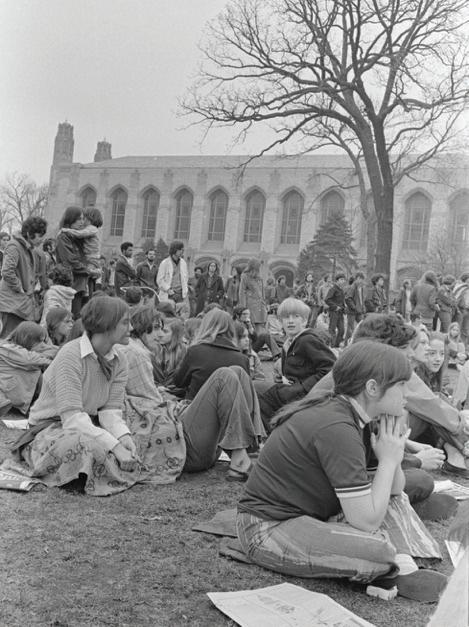
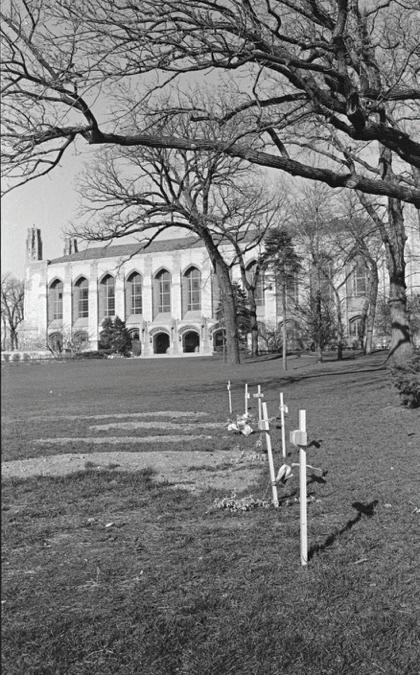
War protests in 2003 and a mental health awareness exhibit in 2015.
More o en, however, Deering and Deering Meadow host student celebrations, homecoming pep rallies and club pick-up games. You can nd dogs frolicking outside on the lawn and students hunched over computers inside, cramming for exams.
Every fall, new students “march through the arch” and nd their way to a ceremony on Deering Meadow, marking the beginning of their Northwestern career. Every spring, the Northwestern convocation takes place at the same spot.
The ceremony has hosted notable gures like the late Supreme Court Justice and feminist icon Ruth Bader Ginsburg in 1998, former President Barack Obama in 2006 and alumnus and comedian Stephen Colbert in 2011. Students sit with family and friends, waiting for their hard-earned moment of walking across the stage and receiving their Northwestern diplomas.
Deering is where students have gathered to shape their Northwestern experience — in the past, present and future.


WRITTEN BY CHARLOTTE VARNES // DESIGNED BY ALLIE YI // PHOTOS BY ELOISE APPLE
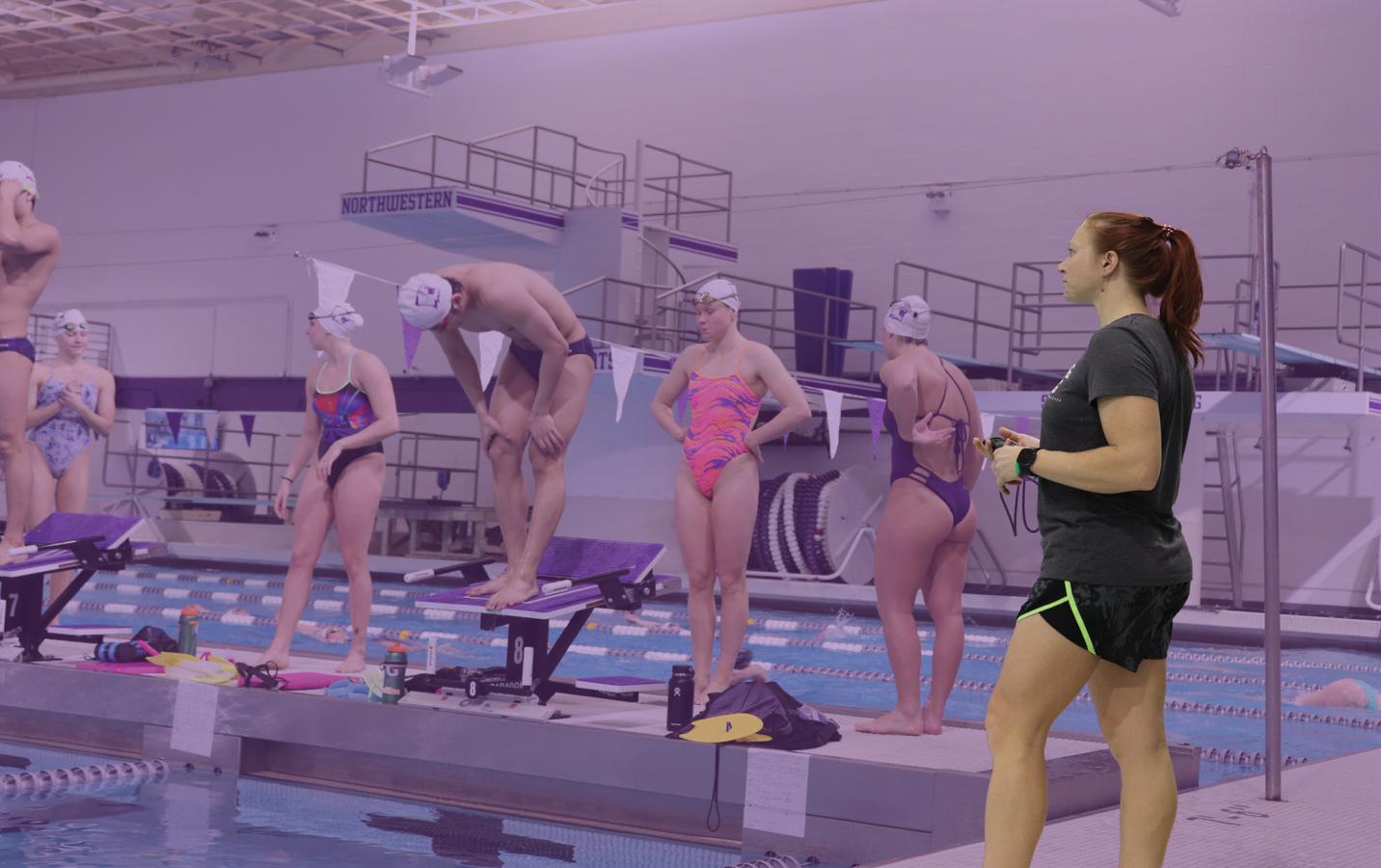
fateful phone call in June 2020 kickstarted one of the best days of Katie Robinson’s life.
Robinson, previously the associate head coach of swimming and diving at Northwestern, had recently interviewed for the head coaching position. A er one of the job’s early interview rounds, she cried, feeling certain she wouldn’t be hired.
When Robinson received the call from then-Athletics Director Jim Phillips in June 2020, she cried again. But this
my mantra: I don’t want to do this alone. I want so badly to do this with others and surround myself on this journey.”
Robinson is one of just two women coaching a combined men’s and women’s swimming program in the Power Five conferences, which includes the Atlantic Coast Conference, Big Ten, Big 12, Paci c-12 and the SEC. She is also one of just six female head coaches among all women’s and men’s swimming programs in the Power Five. Robinson is part of a
recognized the impact her coaches had on her both in and out of the pool.
“Some of the lessons they taught through swimming have stuck with me to this day,” Robinson says. “I just wanted to make a positive impact on other people.”
Robinson recalls a day when she was struggling at practice and felt embarrassed a er getting out of the pool. Her coach, Jill Sterkel, pulled her aside and told her, “‘Anybody can swim fast on the days it feels easy. It’s what you do when it’s hard.

“Katie, to me, was somebody who would embrace hard work and have fun with it,” Brackin says. “She could be making jokes or talking to her teammates or engaging while she was doing something challenging. I loved that about her.”
Robinson graduated from UT Austin as an 11-time All-American and was a Big 12 nominee for NCAA Female Athlete of the Year. She went on to serve as an assistant coach at the University of the
day and feels it’s normalized in the swimming world. It’s something Robinson experiences even among her swimmers at Northwestern.
“If I say something and my assistant coach, who’s a male, says the same thing, it’s received better sometimes from him versus me,” Robinson says. “[Gender bias] is something I think about a lot. It’s something I do my best to counteract.”

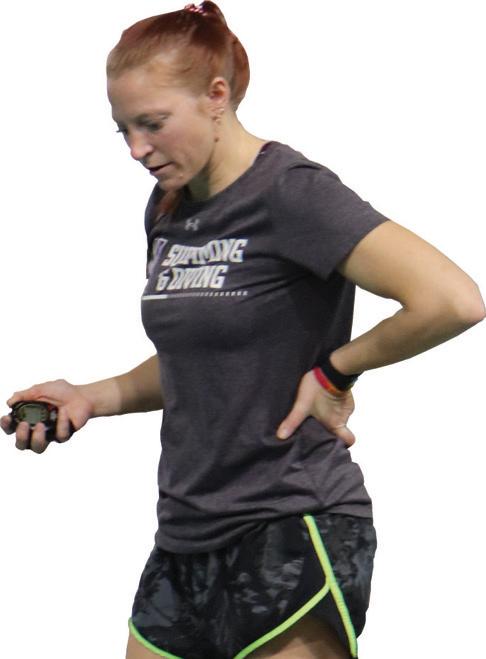
head coach at Northwestern, Robinson continues to lead the program to new heights. As of February, the women’s program ranks 20th nationally, according to the College Swimming and Diving Coaches
Championship in 2021.
For Robinson, these opportunities have been years in the making. She says she’s had a strong work ethic since she was young.
“I’ve always been somebody who [says], ‘Tell me what I can’t do and I’ll prove you wrong,’” Robinson says. “I’ve always had that chip on my shoulder.”
Robinson’s work ethic stands out to her swimmers as well. Public policy and administration graduate student Miriam Guevara says Robinson’s constant desire to learn, whether getting to know her swimmers better or improving as a coach, is inspiring and sets her apart.
balance being competitive, being erce and aggressive, [with being] light-hearted and joyful,” Guevara says.
Weinberg fourth-year and swimmer Ethan Churilla was part of Robinson’s primary coaching group during his freshman year. He says meets have led to some of the most memorable moments with Robinson.
Some Northwestern students opt for housing further from campus for cheaper prices.
WRITTEN BY IRIS SWARTHOUT // DESIGNED BY HOPE CARTWRIGHT
RRogers Park’s bustling energy is immediately discernible a er getting o at the CTA Jarvis stop. A coin laundry service sits beside a pet salon, and across the road rests a quaint cafe with a street-beat ambiance provided by the melodies of Earl Sweatshirt.
Charmer’s Cafe is one of Weinberg fourth-year Myckynzie Schroeder’s favorite places to study and grab a bite to eat. The spot, one of the many restaurants she enjoys in the area, is a ve-minute walk from her apartment on West Fargo Avenue. Rogers Park’s cheaper prices and later hours present a stark contrast to the early-to-bed eateries Northwestern students are accustomed to in Evanston.
“In the summer, [Rogers Park] had a lot of cool little arts festivals and salsa nights in the street,” Schroeder says, petting her cat Suki in the living room of her 13thoor apartment. “In the winter, it’s harder to nd that kind of stu , but there’s kind of always something going on nearby.”
Schroeder and her roommate Weinberg fourth-year Bintou Sonko’s
two-bedroom apartment costs $1,550 per month. Compared to Evanston’s prices, it’s not only a steal, but also better quality.
“I pay less for my apartment here, and it’s probably one-and-a-half times the size of our old place and it has so many more amenities,” Sonko says. “In my old place, the floors were really creaky. You couldn’t really get maintenance when you needed it.”
Neighborhoods close to Chicago’s downtown area are appealing to younger crowds looking for a bustling nightlife, a larger variety of cuisines and, like Sonko and Schroeder, cheaper rent. Though housing in Evanston is convenient for the more campuscentralized undergraduate student body, its rising prices push some students elsewhere.
Uptown, for instance, is within walking distance of Argyle’s Asian eateries and Andersonville’s main street. Driskill graduate student Ari Halle attends Northwestern’s Chicago campus and lives in an Uptown studio
apartment with their partner. They each pay around $500 a month for split rent and utilities.
Because they don’t own a car, Halle says the commute to campus is 45 minutes, including the walk to and from the Red Line and the ride itself. However, between their home and campus, they say there are plenty of restaurants and entertainment venues.
“It’s really easy for me to take the train two stops down and there’s a whole new group of restaurants because I’m in a completely different neighborhood,” they say. “I feel like I’ve definitely had to branch out and eat out at different restaurants a lot more.”
McCormick fourth-year Alex Cindric’s Lakeview East apartment is even closer to downtown Chicago than Schroeder’s. She pays around $800 a month for her room, a solid $100 cheaper than the Evanston rent prices she came across while looking for housing.
Cindric’s roommate, Segal master’s student Lindsay Lipschultz, says the
apartment’s accessibility to the CTA made the move appealing.
“In Evanston, it always felt like a major drag to go to a nice restaurant or a concert,” Lipschultz says. “Now, it’s like a 20-minute ride on the bus.”
Despite students’ positive experiences with lower rent prices closer to the city, others, like Evanston landlord Jeanne Laseman, have seen housing rates rise across Chicago.
Laseman currently lives in and leases out rooms in a house on the corner of Golf Road and McCormick Boulevard in Evanston, about a 10-minute drive, 13-minute bike ride or 45-minute walk from campus. She charges around $650 per month for a room, which includes utilities and laundry.
But Laseman says students haven’t been as keen to take her o er as she expected.
“I nd that kind of interesting, that dynamic, because I’m cheaper,” she says. “It’s just not the location that they want in Evanston.”
Laseman’s rent is an anomaly in a city where the average cost is around $900. Just a few years ago, Evanston’s high prices stood out like a sore thumb. But gentri cation, a process where lower-income residents are displaced to areas farther away from the city due to highpriced buy-outs, has made many places along the northern stretch of the CTA Red Line similarly expensive.
Evanston has always been on the high end of the spectrum. According to Laseman, the tax structure of the city accounts for an increased reliance on tenant funds.
Northwestern doesn’t pay property taxes despite continually expanding on city property, Laseman says. She adds that a multitude of non-pro t organizations and churches are also exempt from property taxes, which places a heavier tax burden on the small number of retail businesses that have become integral to the city’s revenue.
Apartments for lease are also subject to Evanston’s elevated property taxes, and as a result, rent prices have increased.
Kiley Korey, who has been taking private choral lessons at Bienen, chose an apartment in Rogers Park about two years
“ago when she moved to the Chicago area. The Rogers Park area is diverse and familyfriendly, she says.
According to her, rent prices in Evanston were exceedingly high at the time. But now, Korey is thinking about moving to Evanston to get more bang for her buck — that is, a quicker commute for the same price.
“Across Chicagoland and in Evanston, because rent prices are rising so fast, they’re pretty much on par with each other,” Korey says. “It’s expensive across the board.”
Korey adds that the CTA Red Line has been “unreliable” over the past few years, and she worries about her safety where she lives in Rogers Park.
“I don’t walk outside, even in the daytime, just for safety reasons, because there have been a couple of domestic violence disputes and shootings within a two-block radius of my place,” Korey says.
Across Chicagoland and in Evanston, because rent prices are rising so fast, they’re pretty much on par with each other. It’s expensive across the board.
“
While gentri cation accounts for the rising rent prices around Chicago,
Schroeder’s sense of safety is slightly di erent. Her neighborhood, she says, mostly consists of elderly people. She notes that a few graduate students and faculty members live on her block and says the area is “pretty safe.”
For Sonko, however, Northwestern’s institutional presence in Evanston has resulted in an additional layer of police accountability that Rogers Park doesn’t have.
Sonko says as a Black woman, the high racial pro ling in the Rogers Park area has
made her feel unsafe because the police are more willing to intervene forcefully in encounters with Black people in Chicago. On her way towards the Howard Red Line station, Sonko says she has seen multiple police cars stop Black individuals for simple traffic violations.
“If something were to happen to a Black [NU] student, [EPD and NUPD] have someone to answer to,” she says. “Whereas if something happens with a Black person walking on the street, the city of Chicago doesn’t care.”
Halle, who is white and non-binary, also feels uncomfortable with the high, largely unregulated, Chicago police presence. They highlight the Chicago police’s history of targeting visibly transgender individuals for arrests, particularly under the suspicion of sex work, as a key reason for their discomfort.
Still, Halle says that their whiteness helps protect them from forceful police encounters, which is o en targeted at Black residents. In the predominately-white North Side where Halle lives, they say their race helps them blend in.
“I don’t stick out as much and that makes me feel safer,” they say.
Schroeder and Sonko’s apartment has more security than their previous Evanston build. The pair’s sophomore year apartment on Noyes Street periodically had broken locks near the entryway, making the building essentially open to the public, according to Schroeder.
“Our units have these electronic locks on them.”
For some, the quality of housing in Evanston still leaves much to be desired. Medill fourth-year Kalina Pierga lived in Evanston during her sophomore and junior years and encountered a legal issue with her lease in September 2021.
A er nding out that her house on Foster Street contained mold levels above livable limits, she contacted her landlord, but ultimately received no assistance. She and her roommates backed out of their lease and had to nd last-minute living accommodations. The lack of landlord accountability made Pierga feel wary about the conditions of Evanston student housing.
“I think landlords in Evanston are used to naive college kids just picking a place and moving in and not really looking at leases or being picky about
“
health standards,” she says. “I’m sure a lot of other students encountered these situations, and they’re not in a position to have any type of background knowledge of real estate law.”
Pierga now lives at home in Barrington, Illinois, an hour away from campus, which she says has been easier since she will be conducting her Journalism Residency in Philadelphia during Spring Quarter.
A window in Schroeder and Sonko’s Rogers Park apartment unveils a crystal clear view of the Bienen School of Music. Schroeder continues to list her apartment’s amenities: laundry on every oor, a gym in the basement and a double-doored entrance with a part-time security guard.
She walks downstairs and reveals an all-access patio and storage lockers.
In her previous and much-older Noyes Street apartment in Evanston, laundry was in the basement, and a cluster of dead cockroaches occupied a hole in the wall. She says the apartment’s ambient temperature was once in the 50s for two weeks.
I think landlords in Evanston are used to naive college kids just picking a place and moving in and not really looking at leases or being picky about health standards.
“Kalina Pierga, Medill fourth-year
“This entire building very much feels a lot more secure,” Schroeder says.
For Schroeder, the move from Evanston to Rogers Park was worth it. When asked if she knew others who considered leaving Evanston, she says many are interested, but drawbacks like distance o en leave them discouraged.
“It feels like a lot. And I’m not going to say it’s not because there are de nitely times where my car hasn’t started in the morning and I’ve been late because I couldn’t just walk to campus,” she says. “It’s not all pros, but I do think overall, it balances.”
WRITTEN BY AUDREY HETTLEMAN // DESIGNED BY EMMA ESTBERG
WWhen Associated Student Government (ASG) President and Weinberg fourth-year Jason Hegelmeyer rst joined ASG his sophomore spring, he was a senator representing For Members Only (FMO), Northwestern’s premier Black student alliance. That same year, then-Senate speaker Matthew Wiley posted a racist meme in the ASG Slack and made insensitive remarks in a later Senate meeting. A er internal discussions about racism, Wiley eventually resigned and the Senate established a permanent FMO seat.
“That whole shi in ASG ushered in a whole new era of social justice and thinking about the work we do and the students and communities that we impact,” Hegelmeyer says.
ASG has consistently lobbied for e orts to improve the student experience. The Senate, cabinet and committees work with students and administration to enact change on Northwestern’s campus while honing their leadership skills. However, representing a student body of 8,000 undergraduates comes with its challenges, whether it be creating spaces for anyone to voice their opinions or ensuring legislation leads to tangible change once it reaches the administration.
In anticipation of ASG’s presidential elections this coming Spring Quarter, NBN examines the roles and responsibilities of Northwestern student government.
A er his tenure as FMO senator, Hegelmeyer began to consider ASG presidency. His campaign process began early Winter Quarter of 2022, when he picked SESP third-year Donovan Cusick as his running mate and they began reaching out to major campus groups, such as the Black Mentorship Program
(BMP), to gather feedback about what students wanted to see in ASG leadership. By the time the actual campaign began in April, Hegelmeyer says he had a good idea of what platforms were important to students. In BMP’s case, Hegelmeyer says, the group mainly wanted to ensure Black students were supported.
Undergraduate students elect ASG’s president and vice president every spring. The president and vice president then select their cabinet, which includes the executive o cer of justice and inclusion (EOJI) and chief of sta , as well as committee chairs.
ASG’s Senate, the organization’s legislative branch, is led by Speaker and Weinberg third-year Dylan Jost, Parliamentarian SESP third-year Dalia Segal-Miller and Deputy Speaker SESP third-year Leah Ryzenman. They lead school senators, who are elected by their respective school’s student bodies, and
President
Donovan Cusick
student group senators, who apply for seats and are approved by an internal committee. Groups represented this year include Alianza, Residential College Board and Athletics, among others.
Senate leaders and members hold seats for a full year, during which they write and pass legislation. The Senate also serves as part of a system of checks and balances for the Finance Committee, which distributes funds to student organizations and acts as a mouthpiece for students in conversations with administration. Senators o en join one of ASG’s 10 committees, which range in topics such as nance, student life and sustainability and work directly with university administration on short-term and long-term projects.
Jost says the Senate’s primary responsibility is to represent students.
“We’ve really made an e ort to make sure Senators are reaching out,” Jost says. “So having them hold o ce hours, talking to people in their dorms and trying to make sure they’re staying engaged.”
Hegelmeyer recalls his presidential campaign experience being “wildly draining.” He remembers going on YikYak, an anonymous social media app, a er a debate and seeing posts accusing him of being rude and annoying by interrupting and making faces at his opponents. He says he felt he faced a double-standard as a Black candidate, experiencing disproportionate criticism for his debate demeanor. While the experience caused a lot of stress for Hegelmeyer, he says it was eye-opening in terms of seeing how Northwestern treats its marginalized students.
“In the beginning, I really did truly want to support and represent the entire student body as much as I could,” Hegelmeyer says. “But I realized there are plenty of communities that don’t like me or respect me, and that’s perfectly okay. And I don’t have to pretend like our interests are exactly aligned.”
Communication fourth-year Jo Scaletty is also working to improve the experience of marginalized students as EOJI. The role, previously called “Vice President of Justice and Inclusion”, saw frequent turnover, leading to calls for reform in 2019. Scaletty says having someone speci cally working on equity and inclusion makes it more likely marginalized voices will be heard.
“There is much more of a tendency to stay within the status quo than there is to try to progress and realign priorities and work to establish social equality,” Scaletty says. “And so having someone whose speci c role and purpose is to further the ideals of social equality is incredibly important.”
One of Scaletty’s recent initiatives was expanding Books for Cats, a Northwestern program which loans financially eligible students textbooks and lab equipment for certain introductory courses. Scaletty collaborated with the Chair of Academics Brian Whetsell, to expand the program by starting a “lending library,” which allows all students to donate and borrow course books.
One of the most in uential ways ASG impacts student life is through funding. ASG distributes about $1.8 million in funding to student groups every year, which comes from the ASG Activity Fee
in each student’s tuition. Clubs currently obtain ASG funding based on a tier system. The more years a club is at Northwestern, the higher their tier and the more funding they are eligible to receive. Cusick recognizes that this structure prevents new groups from generating community on campus.
“It kind of guarantees that older events are just grandfathered into their money and they can expect it without much question or consideration,” Cusick says.
According to him, the Finance Committee spends a lot of time trying to make the funding process more equitable. Last quarter, the Senate granted all requests for student group funding, thanks in part to additional funds procured from university administration. Hegelmeyer says the biggest way students feel a tangible impact from ASG is through funding, so he was happy that all student requests were honored in this funding cycle.
Before the last ASG election, Chair of Communications and Communication third-year Zai Dawodu created a page on the ASG website with a timeline that gave students up-to-date information prior to election day. Dawodu says she sees ASG communications as a way to connect with students and make them feel heard. Dawodu believes her committee acts as a “pathway” between students and the administration. She hopes her committee’s work makes students more aware of the resources ASG can provide.
“I was scared that maybe it’d just be me, and then, people just wouldn’t care much. But people genuinely care,” Dawodu says. “It’s really great to see the passion being spread out.”
ASG frequently works directly with administration to voice student concerns. This collaboration has varying degrees of success, which is something Jost says can be frustrating for ASG members trying
to enact change. In January 2023, ASG introduced legislation to grant department status to Northwestern’s Asian American and Latina & Latino Studies programs. While the initiative passed in the Senate, the University did not put the change into e ect, citing budget and sta ng restraints.
“The point of ASG is really supposed to show ASG’s, and by extension, the student body’s stance on an issue,” Jost says. “That’s where a lot of people get discouraged over time, if they’ve been in ASG for a while, they see all this legislation being passed and not much being done.”
Scaletty saw a similar issue with the Gender and Sexuality Resource Center (GSRC). An ASG 2021 bill called to relocate the GSRC to a house on Sheridan Road. Almost a year later, the GSRC still occupies a room in Norris University Center that can hold only about 10 people.
Sustainability Committee CoChair and Weinberg fourth-year Sadie Bernstein, along with her committee co-chair, Weinberg second-year Alexis Schwartz, has tried to counter these feelings of hopelessness by implementing smaller-scale projects. These include using ASG’s budget to host an environmental justice panel with speakers that focus on the South Side of Chicago, or bonding events within their committee, such as vegan cooking classes, while they work toward completing large-scale projects.
“The University is really, really excited and motivated to get on board with our projects, so long as they don’t cost any money,” Bernstein says.
Because of this, she says, many sustainability e orts, like improving bird safety of campus buildings, have been di cult to implement. Bernstein says communication with administration typically happens in a “bottom-up” format, where department chairs are the ones meeting with ASG rather than administrative o cials that can implement change on a wider level. Recent talks with o cials like President Michael Schill, though, have made ASG members optimistic for change.
Given his interactions with Schill, Hegelmeyer says the new Northwestern president seems very receptive to student opinion and free speech. He pointed to Schill’s neutral response to campus events surrounding the Israel-Palestine con ict this fall as an example of how he is keeping the welfare of the entire student body in mind.
“I think he does support student experience, whether that be formal spaces like at ASG or activist spaces like NUCNC or Fossil Free,” Hegelmeyer says. “I look forward to seeing how he communicates and works together with all these groups on campus.”
Sadie Bernstein
Dylan Jost
In an organization as large and diverse as ASG, e ective leadership is essential. Hegelmeyer, Jost, Bernstein and others cite the same two factors they consistently see in successful leaders: listening and collaboration.
Bernstein says she appreciates how both Hegelmeyer and the previous president, Christian Wade, let her run the Sustainability Committee with little oversight. She says the level of trust they gave her made their leadership even more e ective.
Hegelmeyer says he relies heavily on the support of his cabinet and fellow ASG members, especially Cusick.
“Making sure you have a really good group of people working with you is so important. Not only to keep you organized, but to keep it fun. I like people who are interested in making change and want to have a good time doing it. I think that’s what makes it all worth it,” Hegelmeyer says.
Beyond the ability to impact students in large-scale ways, Cusick says, the people are what make ASG so rewarding. He says working with a group of passionate students makes e ective leadership easy.
Although Hegelmeyer does not foresee a career in politics, he believes the leadership experience will be helpful in whatever route he takes. For the rest of his term, Hegelmeyer plans to continue listening to his fellow ASG members and giving them a certain level of freedom in decision-making as they prepare for future ASG positions.
“When I think about the [executive] board or look at all the work that everyone is doing, I feel so excited and happy for the next wave, the next administration,” Hegelmeyer says. “I think whoever it is, they’ll do excellent work. I have con dence that every single person in ASG could be an amazing president and do awesome things. I will just be watching from a distance seeing what great stu they do.”
To a
After Northwestern’s first Pow Wow last spring, NAISA leaders are thinking bigger. plan
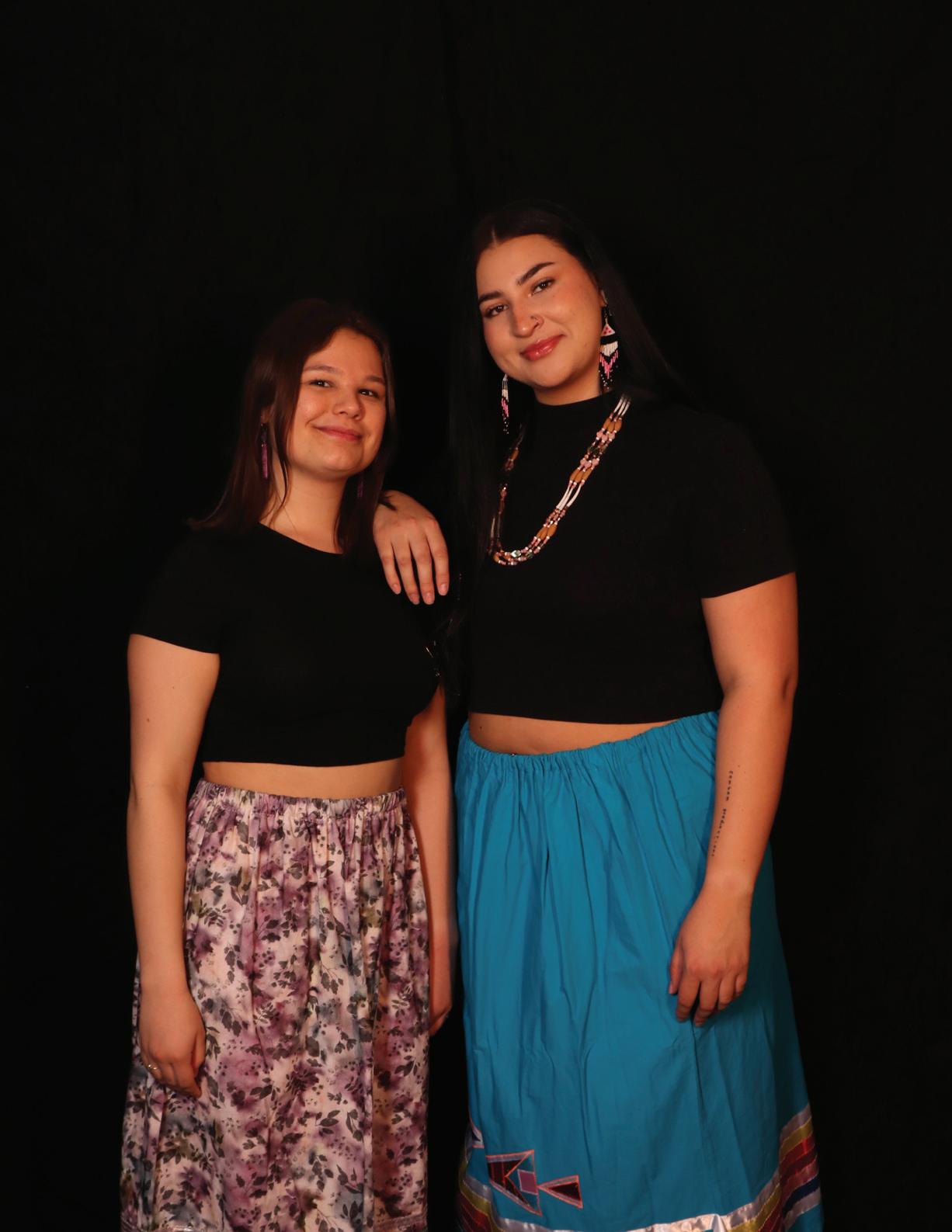
WRITTEN BY YIMING FU
DESIGNED BY HOPE CARTWRIGHT
PHOTOS BY ELOISE APPLE
SSESP second-year Alivia Britton, a member of the Little River Band of Ottawa Indians, was up and running at 8:00 a.m. on a Saturday. It was the morning of Northwestern’s rst Pow Wow, and she and the Pow Wow planning committee had been organizing the event for months. But as their noon start time approached, the only students she saw in attendance were her friends.
Northwestern’s undergraduate population hadn’t shown up like she thought it would.
“I was like, ‘Oh my gosh, everyone’s going to come, this is so cool.’ Why wouldn’t people come?” Britton says. “That was really hard for me to process.”
When NAISA, Northwestern’s Native American and Indigenous Student Alliance, put on their first Pow Wow last spring, over 500 attendees danced, ate and mingled in WelshRyan Arena. But at a school with over 8,000 undergraduates, students in NAISA are dreaming bigger for the upcoming event on April 22. This year’s Pow Wow planning co-chairs, Britton and Communication second-year Mel McDaniel, hope to turn the event into a hallmark tradition for Northwestern’s Native community.
“ more.
Alivia Britton, SESP second-year We’re capable of more. We want
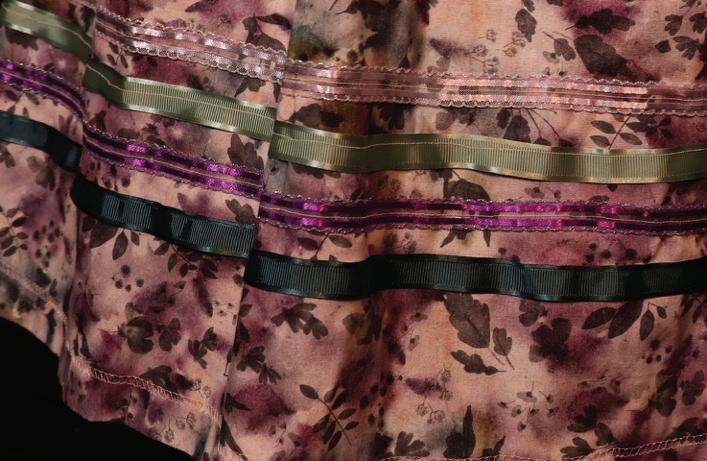
lead the Pow Wow planning committee with three faculty advisers, and everything is a team e ort. McDaniel says both her and Britton are perfectionists, and they’re going all out to make the event major.
“We want more,” Britton says. “We’re capable of more.”
Planning a Pow Wow isn’t easy.
“
Senior Assistant Director for Undergraduate Admissions and Pow Wow planning committee member Niyo MorazaKeeswood, who is Navajo and Chichimeca, has planned Pow Wows at his alma mater, Brown University, for seven years and danced in Pow Wows since he was young. He says the biggest hurdle is nances, which involve explaining what a Pow Wow is to di erent o ces at Northwestern, asking for funding, paying for a venue and providing hired singers, dancers and sta with any necessary accommodations.
Pow Wows provide a chance for Native students to celebrate their Indigeneity and for all students at Northwestern to eat, dance and learn more about Native cultures. Schools such as Brown, Dartmouth, Stanford and University of Illinois Chicago already have annual Pow Wows. But Aaron Golding, NAISA adviser and Multicultural Student A airs associate director, says Northwestern’s Native population hadn’t been large enough to pull one o until last spring. NAISA has about 10 members this year, and Golding says he’s seen the club triple in size since he started as an adviser four-and-a-half years ago.
Last year’s NAISA co-chair Isabel St. Arnold (SESP ’22), who is Keweenaw Bay Ojibwe, dreamt of putting on a Pow Wow. In her nal year at Northwestern, she asked Britton and McDaniel, both freshmen at the time, to help her pull it o
McDaniel, who is Tyme Maidu of Berry Creek Rancheria of Oroville, California, says 500 people was a good start for the
Opposite page: SESP second-year Alivia Britton (left) and Communications second-year Mel McDaniel (right) are organizers for the NAISA’s 2023 Pow Wow.
From there, planners have to think about who’s going to run the event. Every Pow Wow has some staple roles, Moraza-Keeswood says. First, there’s an emcee, the person with the knowledge and protocol of how a Pow Wow is run. The emcee teaches the attendees what certain dances are, what the background is and when people should and shouldn’t be recording.
Next, there’s an arena director who manages logistics and helps the emcee lead the event. The arena director makes sure the dancers are taken care of and that the area where people are dancing is properly respected.
Then there are head dancers, who lead tribal and intertribal dances. There are also teams in charge of advertising and outreach to bring in singers, drum groups, vendors and food. And to top it all o , Pow Wow planners have to coordinate with athletics and facilities and get the word out to the local community.
“It’s a lot,” Moraza-Keeswood says. “It’s a months-long process. And it’s a lot of relationship building that’s really essential in pulling o a Pow Wow.”
Despite the massive task at hand, Moraza-Keeswood says McDaniel and Britton have lled their roles with determination and grace.
“When I started organizing Pow Wows, it was a very chaotic process. We had an idea of what we were doing, but we were not necessarily as organized as they were,” Moraza-Keeswood says. “I’ll give them their owers because it’s well deserved.”
Britton and McDaniel juggle Pow Wow planning meetings with pre-planning meetings, general NAISA meetings and NAISA council meetings each week, in addition to a full course load and numerous other extracurricular activities.
Outside of the Pow Wow, McDaniel is a research assistant at a campus lab where she helps children who have bilateral sensorineural hearing loss with their language development. Britton works at the Learning Bridge Early Education Center and helps lead Alternative Spring Break, a program for Northwestern students centered around social justice in Chicago.
The two make a powerful team.
In preparation for this spring’s Pow Wow, McDaniel and Britton hit the ground running. They began planning in October, three months earlier than NAISA started last year, and they’re expecting to raise $36,300, tripling last year’s $12,000.
While McDaniel leads the creative side — sketching designs and planning visuals — she says Britton has impressive administrative skills and e ciently manages student nance and email outreach. The two met last year in NAISA but say they’ve grown much closer through their collaboration.
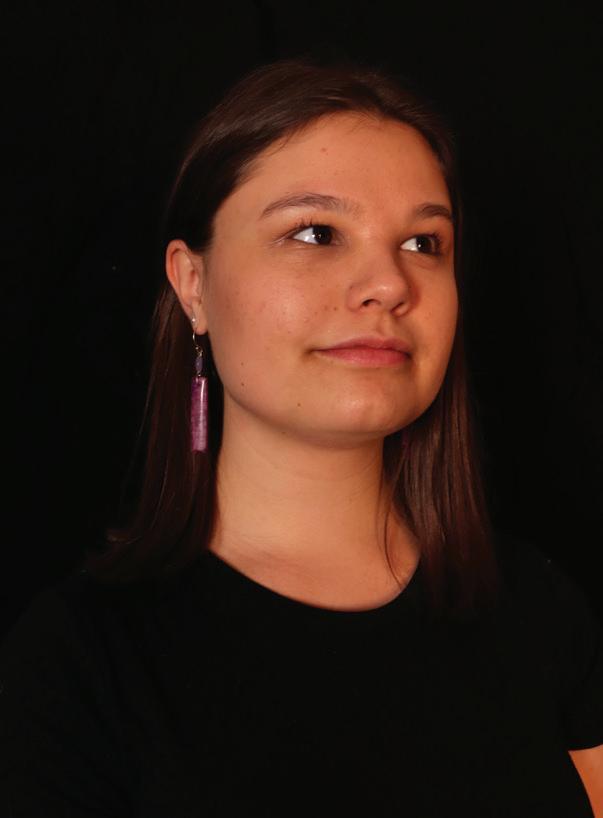
“We were the perfect people to be picked to work together,” McDaniel says.
“I love everybody in NAISA, but if I think about me working on the Pow Wow being paired with anyone else as a co-chair, it probably wouldn’t have worked [as well].”
McDaniel and Britton say they’re a strong partnership because they’re both driven, hard-working and know when to lean on each other for help. They also live near each other and love grabbing meals together and venting when they need to.
“We know each other pretty well, and we know each other’s limitations. If we’re stressed, we can rant to each other. We’re just really close,” Britton says.
“And complainers,” McDaniel adds jokingly.
The two want to make the next Pow Wow bigger. They want to bring in famous dance groups, more food, vendors, merchandise and housing accommodations for everyone involved. They hope to get professional signage they can use every year, instead of the handmade marker-written signs they used last year.
McDaniel also says she hopes to step up the Pow Wow’s marketing e orts. Last year, they had advertisements on TVs across campus, posters, banners at the Multicultural Center and the Center for Native American and Indigenous Research, along with social media posts and Chicago Public Schools newsletter blurbs. Their e orts this year will include sending out big email chains to reach the older Native community, and they hope to bring little “save-thedate” papers to other Native conferences they attend this year.
McDaniel says the two have been convening weekly for nearly a year to make things happen. At each meeting, she and Britton keep track of outreach to dancers, drummers and head sta , as well as grant deadlines and fundraising e orts.
“We’ve put in so much work for this. I’m always thinking about this Pow Wow. It’s always in the back of my mind like ‘Oh I’ve got to do this, and I’ve got to do this,’” Britton says.
Though it is a large task, Britton says it’s something they’re both glad to take on.
“It’s also such a blessing that we’re able to do this, and I just feel really grateful that I’m in a space where I can plan an event like this and get the money to put something on,” she says. “We’ve just put in so much work. I want something to come with it.”
For McDaniel, planning a Pow Wow is like bringing a piece of home to Northwestern.
Growing up near her tribal reservation in Nevada, McDaniel participated in games, celebrations and ceremonies. She remembers learning songs to sing while playing hand games with other kids at Pow Wows. But when she moved to New Mexico when she was eight, she felt she missed a lot of formative experiences, including learning her Native language and how to dance.
Now that she’s at Northwestern, McDaniel doesn’t get to go home o en. When she lived in New Mexico, she would drive back near her reservation every summer and winter to pick willow and gather materials to weave baskets. But now, McDaniel’s mother o en makes the trip alone.
“I don’t get to participate in a lot of the things that are meaningful to me, so when we bring that here, it feels like I have a part of my home and my childhood,” McDaniel says. “I
have my family both from California and Nevada coming in for the Pow Wow, so I also get to bring my home here.”
For Britton, planning this Pow Wow also means stepping into and celebrating her Indigenous identity, which she hadn’t been able to do as much before college. She was raised by her mother, who is white.
Britton says her memories of last year’s Pow Wow inspire the joyful atmosphere she hopes to recreate this year. She remembers everyone’s laughs and smiles, seeing Northwestern’s Native community and how proud everyone was.
“Thinking about how happy our community was last year at the Pow Wow, we just have to continue that,” Britton says. “If that’s one thing that I can ensure will happen on this one date every single year, I will do whatever I can just to see everyone’s smiles and to see all the generations come together.”
Jasmine Gurneau, Northwestern’s director of Native American and Indigenous A airs, says the Pow Wow opens up Northwestern’s campus to allow Native people into the space, not just as spectators but as the people actually dancing on the main oor. It’s a cultural celebration for both Natives and nonNatives to take part in.
Gurneau, who is a citizen of the Oneida Nation and a descendant of the Menominee, says she talked to a non-Native prospective student who was visiting Northwestern at last year’s Pow Wow. The student told her attending the Pow Wow made them want to apply to Northwestern because it showed the University cares about and highlights their Native American community.
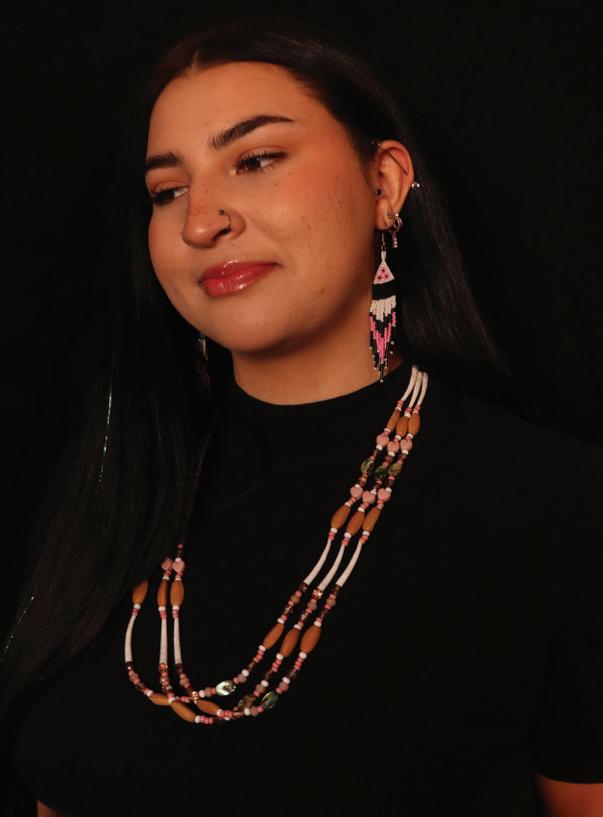
“And that’s when I was like, ‘OK, wow,’” Gurneau says. “This is so much bigger than a Pow Wow.”
Northwestern’s Pow Wow opens up the school’s multimillion dollar arena to the greater Chicago area. MorazaKeeswood says last year’s Pow Wow resulted in the most Native community members Northwestern has ever seen on campus at once.
The Chicago Native community is big, strong and diverse. While Illinois doesn’t have any federally recognized tribes, Chicago has the third-largest urban Native American population in the U.S., with over 65,000 Native Americans living in the greater metropolitan area and more than 175 tribes represented.
Britton says she hopes the Pow Wow will connect Northwestern with Chicago’s Native community and help bridge the gap between the University and the city at large.
“An institution like Northwestern can appear very colonizing and elitist, and at the end of the day, we’re just students, but we want to be in touch with the Native people whose land we’re on,” Britton says.
For McDaniel, watching other people step into their culture would make it all worth it. She says there are many other members of NAISA like her, who feel a disconnect in their Native identities. The Pow Wow serves as a milestone event to celebrate their Indigeneity.
“We’ve got some shy people in NAISA. And seeing them dance, it looks like they feel at home,” McDaniel says.
The Pow Wow is McDaniel and Britton’s passion project. They hope Northwestern’s community will show up in ways they failed to last year and that this year’s celebration will cement the Pow Wow as an event to look forward to for years to come.
“Beyond the scope of the Native community, everybody can enjoy a Pow Wow,” McDaniel says. “Dance a little, get a little food.”
Non-Native students can join in during the intertribal dances, Britton says, and it’s always fun seeing everyone on the dance oor together.
McCormick second-year Camille Layden met Britton as a Peer Adviser last spring. She says Northwestern’s administration and students “talk a big game” with land acknowledgments and allyship dialogues, but she feels it’s hypocritical when people don’t show up to events led by the school’s Indigenous community members.
“I see so many people with the stickers on their computers like ‘Council of Three Fires,’” Layden says. “I’m like, ‘Ok, put your money where your mouth is.’”
Layden, who is white, says she’s excited to attend this year’s Pow Wow and sees it as a special opportunity to be invited and welcomed into another community’s celebrations. Beyond acknowledgement, Layden says the Pow Wow is a great way to honor, experience and celebrate Native American history and culture.
McDaniel hopes to be involved with Pow Wow planning for the rest of her time at Northwestern and watch the event grow over time.

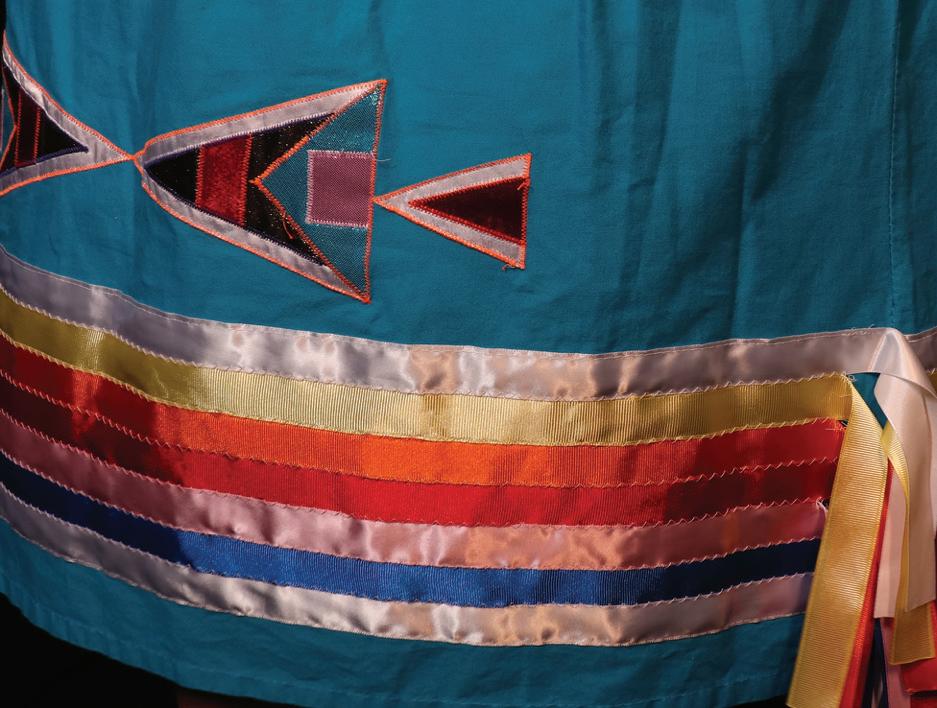
“We have to put in a lot of e ort now so people will continue to do it. I don’t want us to do four years of Pow Wow and then it dies. That’s another reason why we’re trying to make it so big and exciting. We don’t want it to stop when we’re done doing it,” McDaniel says. “That would be brutal. I would cry. I would cry a lot.”
This burden can be a lot to carry. McDaniel says students o en talk about wanting change, but ultimately it falls back on those students to create the systems for themselves and see them succeed. McDaniel says even if she and Britton don’t want to keep the Pow Wow planning role in the future, they need to create a binder and structure for it to continue.
“ “Everyone
Mel McDaniel, School of Communications second-year can enjoy a Pow Wow.
“So we’re doing it now,” McDaniel says. “Hopefully we’re inspiring other people to care later, so that it’s not all on us.”
For McDaniel and Britton, seeing the seats of Welsh-Ryan Arena lled with the faces of both loved ones and strangers would mean the world. It would mean all their hard work to build not just a landmark event, but a legacy, would have paid o
“I’m thinking about our little freshman, one of our freshmen in NAISA right now,” Britton says. “I want to do it for her. I want to prove that this is something cool. It’s worth it.”

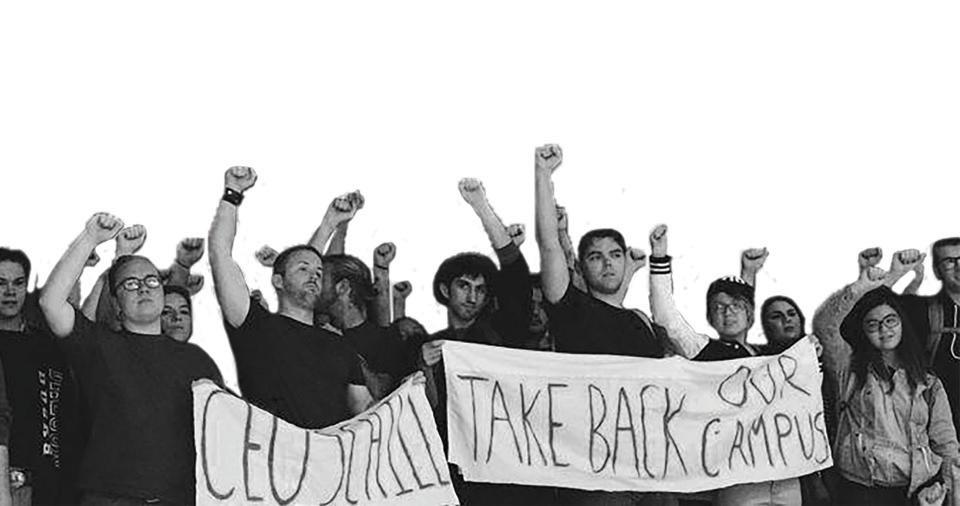
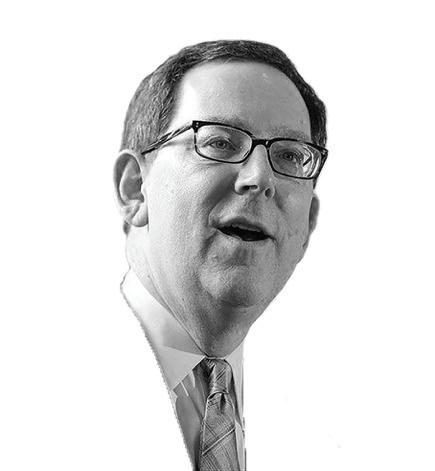
An in-depth look into the role of a university president.
Nothing about us without us.”
Chanting as they stormed the stage at the University of Oregon (UO) in 2017, dozens of activists from the UO Student Collective shut down then-UO President Michael H. Schill’s State of the University Address before it began.
In response, Schill penned an oped in The New York Times saying that while he respected student protests, blocking him and his speech worked against the University’s mission to promote open discourse.
“As with any important discussion, emotions can run high,” Schill wrote in his op-ed. “But the only way to create change is to grapple with di cult issues. Nothing can be gained by shutting them out.”
But for protestors like former UO student Elaina Colussi, shutting down Schill was a path to catharsis for students.
“Schill really made us all feel voiceless,” Colussi says. “The president’s o ce is the place that should be the voice for students.
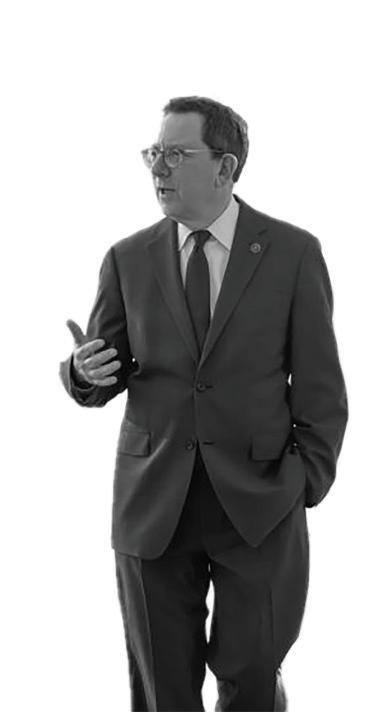
What else are you supposed to do except listen to everyone and then implement change?”
During his seven years as president of UO, Schill grappled with student protests, Title IX violations, faculty and graduate worker contract negotiations and more. In September, Schill began his tenure as Northwestern University’s 17th president.
Colussi’s perspective on the president’s o ce raises the question of what exactly a university president does and what community members — students, faculty and more — expect from the o ce. Schill understands this question well and discussed his role in an exclusive interview with NBN.
“My main thing is I may make a decision that people like, they agree with. I may make decisions that people don’t like,” Schill says. “But what I’m going to be is transparent, and I’m going to tell people what I’m doing, and I’m going to give them reasons for what I’m doing.”
president, on paper
Breaking down the role of Northwestern’s president means understanding what the University’s Board of Trustees considers critical for the role. A er former University president Morton Schapiro announced he was stepping down, the Board of Trustees established a presidential search committee and pro le of their ideal candidate.
The committee stressed a focus on a few initiatives: building upon Northwestern’s image as a top research university, committing to diversity and inclusion and continuing excellent nancial management. They searched for a leader with the inspiration, communication, passion and forethought they deemed necessary to serve as the school’s gurehead.
“The selection of Presidentelect Schill re ects the values and input of our community and institution and was informed by his deep commitment to research and academic rigor, his focus on student access and success, his commitment to diversity, equity and inclusion
and demonstrated administrative leadership,” Peter Barris, chair of the Presidential Search Committee and current chair of the Board of Trustees, told Northwestern Now. Schill boasts an extensive career in academia. Before his presidency at UO from 2015-2022, he served as the dean of the law schools at the University of Chicago and the University of California, Los Angeles. He also taught law at New York University and the University of Pennsylvania. He’s a rst generation college graduate, and his parents and sister reside in Chicago.
In his experience with higher education, Schill says his duties as a college president are multifaceted.
“Management of the university is a big piece of it, just making sure all of the various departments are working the way they’re supposed to be working, setting a direction for the university [and] working to come up with some strategic priorities to move the university forward,” Schill tells NBN
The logistics of moving the university forward can take many forms, according to Ryan Smerek, an associate professor and program director in SESP. Smerek says some college presidents can be “external,” focusing more heavily on fundraising and image-building, whereas others zone in on “internal” operations like curriculum development. Some presidents are a mix of both.
Schill’s external-facing e orts at
Schill really made us all feel office is the place that should be the voice for students. What else are you supposed to do except listen to everyone and then implement change?” “ “
Elaina
Colussi Former UO student and activist
up the university’s STEM-focused research. He oversaw the creation of the new Phil and Penny Knight Campus for Accelerating Scienti c Impact. Funded by two $500 million gi s from UO graduate and Nike cofounder Phil Knight, the buildings feature groundbreaking technology and architecture.
During Schill’s administration, renovations began on UO’s historic Hayward Field, the track and eld facility that hosted the 2022 World Athletics Championships. Under Schill, the university’s public funding campaign surpassed its $3 billion goal, and he nearly doubled the school’s endowment.
Smerek compares the role of a college president to that of a mayor of a small-town: managing crises, listening and discussing ideas with those in the community and understanding what the university can look like in the future.
“It’s like a big puzzle. You’ve got to be respectful of everything that’s happened and what’s going on, and you’ve got to learn. You’ve got to show willingness to learn,” Smerek says.
Smerek adds that large fundraising projects can be “signature wins” for presidents looking to leave a physical legacy at their universities. However, some at UO reported frustrations with Schill’s administration and the increased focus on donations.
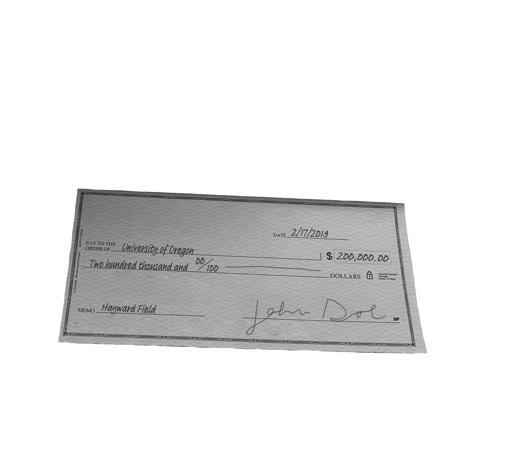
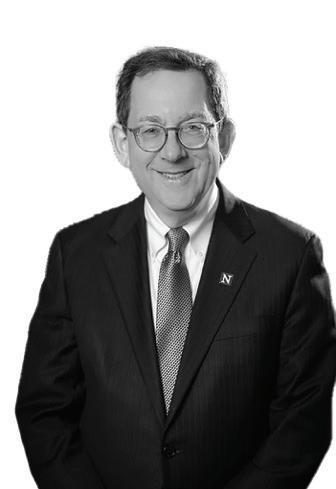
students who paid no tuition or fees, according to a report from the school.
“It does bene t students in the long run to, if [the president] can, build up the ranking and prestige of the university and transform it,” Tobin says.
On October 18, 2017, UO math professor Chris Sinclair walked into his o ce on UO’s campus and saw the temperature inside had broken triple digits, shattering his new glass whiteboard. This made Sinclair question where the university’s $1.4 billion endowment was going.
“It didn’t go to campus, it didn’t go to the people that were ful lling the mission of the university,” Sinclair says. “Universities do need to grow and expand and be taking on new things — I don’t have a problem with that. But when there’s so little, when the central campus is really running on fumes, it can be dispiriting.”
Instead, the money went toward what Sinclair calls “white elephants,” large vanity projects bankrolled by donors that highlighted existing asymmetries on campus.
UO class of 2022 alumna Jael Calloway noticed a similar pattern. While on campus, she says millions of dollars went to renovating and sta ng Hayward Field, while the Multicultural Center lacked the necessary funds and sta to be a key resource for UO’s 23,000 students.
“The funds, to me, aren’t re where they need to be re Calloway says.
Other students viewed investments into larger projects as a stepping stone for the university. Former UO student Michael Tobin says many donations went to nancial aid and scholarship programs. Four years into Schill’s tenure, the university reported investing into more pipeline programs for rst-generation students. In 2018, Oregon also had a 43% increase in the number of Pell Grant-eligible in-state
Yet as Schill’s tenure unfolded, some UO students became unhappy with the university’s nances, speci cally rising in-state tuition costs. In 2017, Schill wrote to the UO community stating his decision to recommend a 10.6% increase in in-state tuition to the Board of Trustees.
“I wish it were not necessary for us to increase tuition by these signi cant amounts,” Schill wrote.
“Although the vast majority of our lowest-income students will be spared from this increase by the PathwayOregon scholarship program, for some students a $945 increase will make attending the UO di cult or impossible.”
The increased price of in-state tuition stemmed from a lack of state funding, Schill says. In 2015, when his administration began, UO reported that only 6% of its operating budget came from state funding. Tuition and fees accounted for almost half.
“If you were an in-state student, and you were [Pell Grant] eligible, it
are unable to pay for some, most or all of their college, are essentially le to fend for themselves,” Colussi says.
Even her friends who bene ted from PathwayOregon had to work multiple part-time jobs or take out loans to cover housing, school books, food and more, Colussi says. Other UO students who chose to attend community college rst for a ordability, she says, still did not qualify for the tuition break once they transferred to Oregon.
Rising tuition is not unique to UO. The costs of in-state tuition and fees at public national universities increased 175% in the last 20 years, according to U.S. News and World Report. At Northwestern, tuition has been steadily rising for the past few years, including a 3.5% increase in 2022.
While Schill’s remarks to the UO community expressed concern over rising costs, Colussi and Tobin both recall how students grew frustrated a er Schill made comments advising
When the Oregon Board of Trustees weighed the decision to increase tuition by 10.9%, Colussi says she and other students came to the meeting with statements stressing the financial burden of the tuition hike. But their objections fell flat. Soon after, activists from the UO Student Collective prepared a list of demands ranging from freezing tuition to cutting carbon emissions. They organized the protest that prompted Schill’s op-ed in The New York Times and increased campus discussions about promoting open discourse.
“The most important value at a university is free speech,” Schill tells NBN. “If we can’t talk about ideas in a way that is not censored, it would be impossible for us to do our jobs and for us to educate you and for us to create knowledge.”
In the Times op-ed, Schill rejected students’ claims that the university perpetuated “white supremacy and fascism” by not stepping in to block hate speech or controversial activists. As president, Schill tells NBN that free speech is a right he will always defend, but he recognizes that exercising that right in hateful ways can negatively a ect the campus community. For protestors like Colussi, however, the op-ed represented more than just free speech — it was a testament to the privilege university presidents hold.
“For him to literally go to one of the largest publications probably in the world and whine and complain about how students — who literally just wanted to be heard — shut him down, it made me so upset I had to
take a break and take a few deep breaths, and then keep reading,” Colussi says.
When asked about student protests, Schill says he wants to hear what students have to say but cautions that his job as president requires him to make hard decisions.
“There’s a di erence between hearing and agreeing. We need to hear,” Schill says. “At the end of the day, I’ve got to make a decision, and I might not agree with you, but my job is to tell you I don’t agree with you and establish that.”
Schill says an example of open engagement with student protesters that created positive changes on UO’s campus was in 2016 when UO’s Black Student Task force organized a list of demands pertinent to Black students. A er discussions with the activists, Schill implemented a multicultural course requirement, renamed a university building named for a KKK leader and created the Lyllye Reynolds-Parker Black Cultural Center, a dedicated space for Black students on campus.
But there was one demand that faced more resistance from Schill’s administration, Calloway says. In 2015, Black students called for the renaming of Deady Hall, named for Oregon-native federal judge Matthew Deady who endorsed extreme anti-Black discrimination in the 1800s. Schill originally announced the university would not rename the building, arguing Deady had important political contributions that outweighed the severity of his racist views.
In 2020, UO’s Board of Trustees voted to rename Deady Hall a student pressure to rename the hall resurged during the Black Lives Matter protests. Calloway says the renewed discourse about racism and racial injustice on campus also pushed a group of anti-racist student activists to tear down UO’s pioneer statue. Schill condemned the destruction of the statue in an email to the student body, but it was never reinstated.
Calloway adds the lack of administrative outreach to student activists felt disrespectful.
“It was just a lot of emails and really no action, or if the action did happen, it was under a lot of pressure, so it didn’t seem very authentic,” Calloway says. “He just fell short with actually understanding where the student body comes from and recognizing our struggles as students, especially either as students of color or students from
Part of a university president’s role is creating working relationships with faculty, sta and graduate workers on campus. In November, Schill told Northwestern faculty in a webinar that “there isn’t any piece of the University that doesn’t rely on sta .”
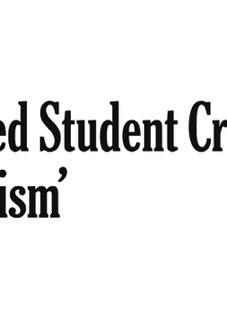
“Strategic priorities have to start from the faculty,” Schill tells NBN. “Presidents can’t just come in and say, ‘We’re going to do this.’ That’s not how academics works, because then you’re a leader with no soldiers to do the work … It’s got to be shared governance.”
Shared governance, however, can become more challenging as groups erent priorities. Schill says that graduate workers — a group that recently unionized at Northwestern as part of a greater national trend — have a dual role as university students and employees that can make shared governance di cult.
“Sometimes what you might do for employees is di erent and maybe not as appropriate for students, and so that becomes a hard issue,” Schill says.
In 2019, yearlong negotiations between UO administrators and the graduate workers union nearly brought thousands of graduate students to strike. The workers’ contract, as originally pitched, would have scaled back health insurance and put that money into higher wages. Graduate students strongly disliked the proposal, as many had families who also relied on university health insurance, says former UO graduate workers union president Rajeev Ravisankar. While the union eventually worked out a deal with the university, the ordeal created a strenuous relationship with Schill’s administration.
“You saw the making of this relationship where the Board of
Strategic priorities have to start from the faculty. Presidents can’t just come in and say, ‘We’re going to do this.’ That’s not how academics works, because then you’re a leader with no soldiers to do the work … It’s got to be shared governance .
Michael Schill Northwestern President
Trustees, President Schill and private donors seem to be coordinating in ways that cut a lot of us out of the process,” Ravisankar says. “That really represents Schill’s tenure.”
Full-time UO faculty members also reported di culties in engaging with Schill over several key issues. Sinclair served as president of the faculty union, United Academics, during Schill’s tenure and was frequently quoted in UO campus blogs for his criticism of Schill’s priorities.
The relationship between faculty and the administration became especially tense during the early days of the COVID-19 pandemic, Sinclair says. Already in a fraught budget situation before the lockdowns began, Sinclair says Schill met with faculty at the end of the 2020 school year to discuss salary cuts. Without the decrease in pay, Sinclair explains, the alternative option would cancel the health insurance of 211 fulltime sta in an e ort to recoup $100 million in funding.
“They didn’t actually say lay o , because our contract said they were obligated to give a continuing contract unless there were performancerelated reasons,” Sinclair says. It was “essentially” a layo
The faculty union pushed back before agreeing to salary cuts that would allow for $20 million in funding to be recouped. The school later received approximately $45 million in federal funding to help o set costs during the pandemic,
which stopped the cuts before they were implemented.
While Sinclair and the union believed UO would cancel the cuts altogether, they were instead told to wait for Schill to decide how to spend the money. Sinclair then penned a letter that would be released to the public should the pay reduction stay in place. UO backed down following his threat, so he never sent the letter.
UO is one of hundreds of universities that had to negotiate layo s, furloughs and contract nonrenewals because of budget shortfalls during the pandemic, according to The Chronicle of Higher Education Schill re ects on this issue, saying the negotiations were di cult but ultimately necessary.
“We didn’t want to cut compensation, yet we were facing a cli in terms of students, and so we wouldn’t have the money to be able to operate,” Schill says. “It was a hard time at every university in di erent ways, and I think we weathered it well. Probably over time, those scabs will be healed.”
However, Sinclair says the drawnout negotiations felt inappropriate at best and unethical at worst.
“Part of [the administration’s] obligation is to look out for the faculty as well as the students, but there’s some obligation to the culture and society on campus,” Sinclair says. “They not just dropped the ball but slammed it down.”
Schill’s tenure at UO began in 2015 during an ongoing sexual violence case involving three members of the men’s basketball team. Though the university settled the case, Title IX violations persisted at UO throughout Schill’s time as president.
“We were in a bit of di culty at that time,” Schill says. “We settled that case because I wanted to move forward rather than be going backwards all the time, and there was no good result in all of that because what had happened was awful.”
Smerek says another critical part of the presidency is crisis management. When faced with a challenge, the president takes action to remedy the situation and uphold the institution’s values. A er the 2015 controversy, Schill worked with the university to create a new Title IX o ce. The o ce aimed to “create and implement processes to improve the university’s handling of cases and further its work to end sexual harassment and sexual violence” while having a direct line to the president’s o ce, a UO spokesperson says.
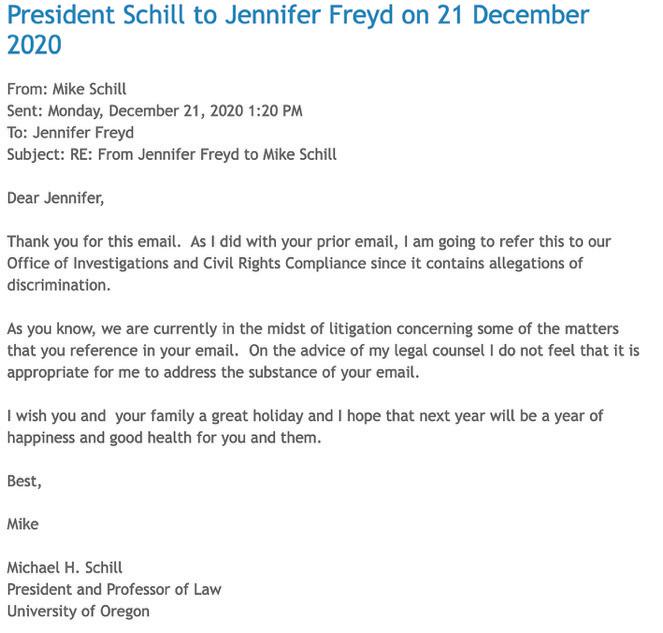
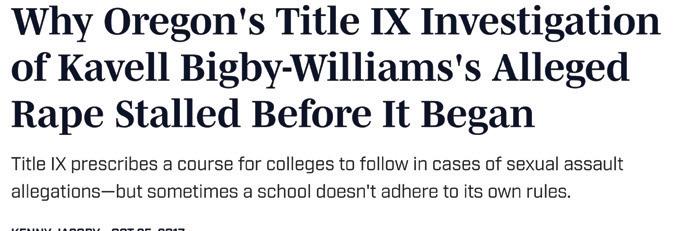
student and sports editor for UO’s student newspaper, investigated the university’s shortcomings for Sports Illustrated. He pressed Schill on whether his o ce had known of the Title IX violation during the basketball season.
“I don’t have any awareness of that. In any event, I can’t comment on an individual student,” Schill told Jacoby, according to his reporting. “What if I was asked by another reporter about you being obnoxious? Would you want me to tell them that?”
planned to retire from teaching and accept a bene ts package.
A er notifying the administration of her plans to retire, they told her that to receive the package, she would have to drop the lawsuit. In a series of emails with Schill, Freyd picked apart his arguments against her.
“We certainly think we righted the ship, and our Title IX policy actually became a national model, especially with the issue of mandatory reporting,” Schill says.
Despite this, the o ce fell under extreme scrutiny in 2017, when an investigation revealed that UO’s nationally-ranked men’s basketball team allowed a player facing sexual assault allegations to play for the entire season. The investigation found that UO’s Title IX o ce was noti ed of the potential o ense in late 2016 but never brought the issue to the Director of Student Conduct and Community Standards.
Jacoby said in an interview that the 2017 case felt re ective of a greater trend he noticed at UO.
“I just didn’t like the way that his whole administration handled sexual assault,” Jacoby says. “It felt like something they wanted to be completely handled internally and to not really be questioned about it, to not really have to answer publicly about it.”
In 2020, Schill confronted a di erent Title IX issue that UO litigated in federal court. A psychology professor, Jennifer Freyd, was in the process of suing the university for an $18,000 discrepancy in her wage compared to her male colleagues.
“UO defends itself in federal court for paying me less than the men by claiming that I am not ‘the same’ — that I have a ‘di erent’ job,” Freyd wrote in an email to Schill. “I am curious how one would justify a stated desire to treat me ‘the same’ on this occasion, but not in regard to my salary … I speci cally ask you as our university’s leader and a member of our faculty to let me know: If I do not drop my lawsuit will the university — your university — deny me my right to receive the 2021 retirement bene t?”
Schill did not respond to Freyd’s inquiries, saying it was not “appropriate” for him to discuss Freyd’s emails based on legal advice he had received.
Freyd went public by posting the emails on her blog and received national attention for the lawsuit. The university later settled and awarded Freyd $450,000.
“Always operate with the understanding that you might be wrong.”
Schill says that’s one of the biggest lessons he’s learned as a university president, understanding that in holding such a large o ce, his constituents will hold him accountable. When he hires administrators or speaks with students, he wants the community to feel empowered to disagree.
When it comes to handling campus issues that land on the president’s desk, Smerek says university administrations establish deans and department heads to navigate curriculum and classroombased policies. But larger campuswide debates, questions that re ect the campus climate, are o en taken up by the president.
Schill adds that a big part of his job is shared governance: having productive conversations with
students and continually growing his working relationship with faculty.
“I hope I’m transparent. I hope people view me as such,” Schill says. “I also hope they understand that I might disagree with them, and I’m going to tell them I disagree.”
Schill emphasized the importance of open dialogue throughout his time at UO. While some students disagreed with Schill on how and when open dialogue should occur, the ones who spoke out were the impetus for concrete changes.
“I would actually encourage [Northwestern students] to try and make the time to meet with him,”
Tobin says. “I don’t think he’s the guy who just sits around all day and thinks about ways to increase tuition. I don’t think it works that way. He is a guy who listens to students, and I think he cares about their concerns.”
But other students like Ravisankar are less optimistic about how open to dialogue and engagement Schill will be at Northwestern.
“One could get the impression listening to him that he is about inclusion and about consultative decision making, because he will make very limited spaces open for that, especially for students, but that’s really just a farce,” Ravisankar says. “He’s not alone in doing this. I think there are other powerful administrators and presidents that
I don’t want you to let me run out into traffic. Pull me back, I’m not always right .
do this. But these are the main things that I take from his time here.”
In his few months at Northwestern, Schill has already begun engaging with di erent constituencies on campus. He’s hosted dialogues with students, met with ASG leaders and taken tours of each of Northwestern’s individual schools, a process he calls a “listening tour.”
Schill will be formally inaugurated as president on June 2, 2023. By July of this year, Schill says he expects to draw on what he’s learned to present the University with a new strategic direction. Even a er his formal “listening tour” is over, he hopes the University’s constituents will keep him on the right track.
“I don’t want you to let me run out into tra c. Pull me back, because I’m not always right,” Schill says.
Colussi says students are in the best position to create change. While presidents view the university on a macro level, students are on the ground every day.
“Hopefully, he has learned from his time at UO and will take his experiences with us, grow as university president, listen to his constituents more and try to actually take their input,” she says. “If not, just protest. Shut him down.”

Thank you to all members of the NBN community who assisted with this piece.
“
Hopefully, he has learned from his time at UO and will take his experiences with us, grow as University president, listen to his constituents more and try to actually take their input. If not, just protest . Shut him down.
“
Michael Schill Northwestern President
Elaina Colussi
Former UO student and activist
Evanston’s small businesses struggle to survive in the post-COVID economy.
WRITTEN BY LAUREN COHN // DESIGNED BY MICHELLE SHEEN
Nina Barrett, owner and founder of Bookends and Beginnings, rst stumbled upon the storefront that would eventually become her business’s home during an assignment as a Medill graduate student. At the time, the hidden back-alley alcove was occupied by another bookstore: Bookman’s Alley. Barrett never planned on owning an independent bookstore, but when the previous shop went out of business in 2013, she was drawn back to the unique storefront.
Six months later, in the little alley behind Sherman Avenue, Barrett opened Bookends and Beginnings.
From perusing the shelves at Bookends to grabbing a late-night milkshake at Edzo’s, small businesses have long been a special part of Evanston living. Yet, three businesses have already closed in 2023 and over 30 have shut their doors since March 2020, with many more continuing to struggle. As rent rises, small businesses are facing a challenging and evolving nancial landscape.
CLOSING THE DOOR
Barrett vividly remembers discovering the space that would become Bookends, but an email she received from the store’s new landlord in August 2022 put everything she had built in jeopardy. She learned her rent
would increase by 125%, making the storefront too expensive to maintain. Barrett knew Bookends and Beginnings would either need a new home or have to close down for good.
“I’ll tell you that when I opened that email, my whole body went into ght or ight, like panic,” she says.
Eddie Lakin, owner and founder of Edzo’s Burger Shop, realized that his business was in trouble more gradually. He opened Edzo’s in the fall of 2009, and three weeks in, a New York Times food writer from Evanston wandered in. That October, Edzo’s was featured in “Grass Fed,” a Times food column.
“It kind of blew up, and we got coverage in all the local papers,” he says. “And then we were pretty much busy for multiple years a er that.”
Leading up to the pandemic, Lakin says Edzo’s saw a decline in tra c because of “little challenges along the way,” like a construction project in Fountain Square. However, he says nothing compared to COVID-19’s negative side e ects on turnout.
Lakin initially used federal loans to maintain a full sta and service, but those funds were eventually depleted. In late 2021, Lakin made the di cult decision to close Edzo’s Burger Shop.
He says closing the shop was a relief.
“I felt like it had been on life support for two years, and I had been constantly thinking of what to do next and how long am I going to keep this going,” he says.
After Edzo’s lease expired early this year, Lakin had to renegotiate with the building owner to find a
path forward for the restaurant that worked for both parties.
“I basically told him, ‘We’re going to have to make this make sense for me to be in this space for eight to 10 more years,’” Lakin says. “I’m not going to just reopen and start up again if I don’t think there’s a viable long-term future.”
He says the end of his lease felt like a good opportunity to try again with his shop. So, Lakin reopened the burger restaurant in September 2022.
Still, Edzo’s continues to struggle. Limited funds and a broken exhaust fan, which removes smoke and moisture from the air, forced the restaurant to temporarily close their dining room.
“It just was a crisis situation as far as being able to stay above water,” he says.
Now, Edzo’s Burgers has a GoFundMe, where Lakin periodically provides updates on the restaurant’s circumstances. He has raised $19,430 of his $40,000 goal.
Pascal Berthoumieux, founder and owner of Davis Street’s Patisserie Coralie, says Evanston’s business districts face tumultuous economic conditions. After five years of experience in the industry, he opened his store in Evanston in 2014. Now, Coralie has two more locations: one in the Pancoe NSUHS Life Sciences Pavilion on campus and another in the Loop.
“I’ve seen the town moving through phases, times they had less things happening and times where the city was really booming,” he says. “Now I think we are at one of the lowest points since I’ve moved to Evanston.”
As businesses struggle to stay a oat, Evanston is passing legislation meant to so en nancial burdens. The question is whether these initiatives are working.
Evanston received $43 million of state funding from the American Rescue Plan Act (ARPA) in July 2021. Serving as a support system for communities, ARPA stimulus checks have aimed to aid economic recovery since the pandemic. Of the funds, the city set aside about $10 million to speci cally address negative economic impacts.
Some ARPA funds are now reserved for the city’s Evanston Thrives Retail District Action Plan, says Annie Coakley, executive director of Downtown Evanston, a nonpro t organization tasked with providing general management to the city’s downtown area.
Coakley says Evanston Thrives allocates funding to a consultant team
that analyzes Evanston’s eight business districts. According to Evanston Thrives’ website, the program’s goals include celebrating each district’s unique identity and building a toolkit to ensure more equitable investment and support.
Evanston Thrives’ support process includes compiling focus groups and community surveys to understand what would be most bene cial for residents and Northwestern a liates. For example, 55.4% of Northwestern a liates surveyed said they would like to use their Northwestern Wildcards o campus.
Coakley says she looks forward to seeing the team’s recommendations. As director of Downtown Evanston, she doesn’t have a hand in policy, but her job is to make Evanston a place where businesses want to stay.
“Events, seasonal plantings, street maintenance, marketing promotions, social media and all of those things to generate a buzz, to keep your name out
there that we are top of mind when people are thinking of places to design or to shop,” Coakley says.
Downtown Evanston hosts promotions and events to generate crowds for stores and restaurants. February’s Hygge Festival ampli ed winter’s cozy and warm ambience through in-store hot chocolate and candles, among other products.
Clare Kelly, Evanston’s 1st Ward council member, says she hopes to work with the city to use ARPA funds to help local businesses. Kelly, along with Commissioner in Preservation Carl Klein, initiated the Legacy Business Program in June 2022. It aims to promote and protect businesses that have long called Evanston home.
Kelly says the idea came a er the council voted to allow the developer of Bookman’s Alley to create a pedestrian walkway. At the time, it seemed like an exciting way to boost the neighboring businesses, but Kelly says she grew
“I really do see it as part of what I hope is going to be reviving the heart of downtown Evanston.”
NINA BARRETT, OWNER OF BOOKENDS AND BEGINNINGS
concerned about long-term impacts on leases and assurances.
“We decided to launch a Legacy Business Program in order to really shine a spotlight on these businesses, to nd ways to support them, protect them and promote them,” she says.
To qualify as a legacy, an enterprise must meet three criteria provided by the city: They must have operated in Evanston for a minimum of 20 years, demonstrate a significant historical, economic, cultural or social contribution and commit to retaining the same physical characteristics and business traditions that contribute to its identity.
“What [Kelly is] trying to do with it is recognize all of the value that is in all of the relationships, all of the history, that is in the businesses that have survived,” Barrett says. “She’s trying to nd practical resources to help us.”
The program includes about 32 legacy businesses, but Kelly says the team has identi ed well over 200 others thanks to
submissions from community members.
Kelly asked Lakin if he would like to join the team determining the businesses qualifying for the Legacy Business Program. While Edzo’s Burger Shop hasn’t quite hit the 20year benchmark, Lakin says he is still interested in helping preserve other businesses in the area.
During Legacy Buisness Program meetings, business owners can come and brainstorm ways to improve the program. For instance, suggestions have included creating a mentor program between legacy enterprises and new businesses. The program also works on improving citywide policies.
For instance, Evanston’s Legacy Business Program is looking to add a question on various applications asking about how property developers plans to support existing businesses.
Kelly says that it has been stressful to hear about the skyrocketing rents small business owners face. These increases are a result of nationwide in ation
and Evanston developers’ upzoning — the practice of buying buildings and signi cantly increasing the rent.
“These are people’s livelihoods, and that they’re just subject to the whim of somebody doubling the rent from one night to the next is really painful to see,” she says.
Kelly says regardless of national trends, the threat rising rents pose to Evanston businesses shouldn’t be understated.
“We don’t just stand by and watch and say, ‘Well, this is just the trend,’ because no, we can do much better in our city,” she says.
A er Barrett’s property owner increased her rent by an unfeasible amount, she needed to nd a place to turn a new page with Bookends and Beginnings.
Soon, she found a storefront on Orrington Avenue and has since reopened this February.
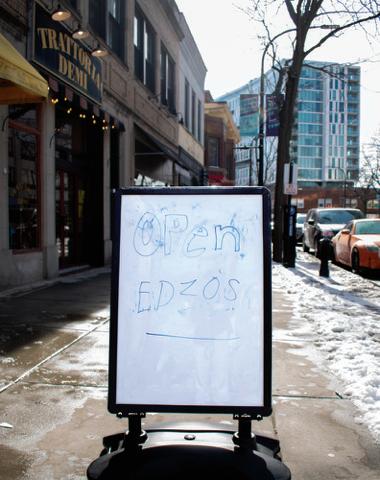
“We were so lucky that we were able to nd a new space that turned [out] by the miracle of commercial real estate pricing to be less expensive than what our landlord wants to charge for the two stores that we’re in now,” she says.
Barrett adds that the local government has no protections for small businesses in rent struggles like this. She hoped for funding from the city’s ARPA money, the same that supports Evanston Thrives, but the city decided she was ineligible.
Unlike federal loans and grants, the city decides how to allocate ARPA funds, and there’s no formal application to request money.
While Lakin hasn’t tried to ask for ARPA money, he says that he has found it relatively easy to obtain federal funds. He applied for the Paycheck Protection Program (PPP) and Economic Injury Disaster Loan (EIDL), both provided as COVID-19 relief. He says he submitted an online form with questions pertaining to his business’s nances. Soon, the money showed up in his bank account.
Lakin also adds that he gets updates when new grants from the city become available. He lls out all of the ones he’s eligible for.
“I think I’ve gotten like two or three small grants over the couple of years, but you know, every little bit helps,” he says.
Barrett ultimately secured $83,000 of funding from Evanston, and with the help of her GoFundMe that has raised over $100,000, she faces the prospect of moving with excitement rather than dread. She says it’s a heartwarming re ection of how people feel about her store.
“I feel like in nine years we’ve established ourselves in the community as an important community gathering space, as an important community resource,” she says.
Barrett adds the new store will have features her old location did not such as increased foot tra c and plumbing.
“I do see this opportunity for the store to mean more to even more people and for us to get customers that we’ve never had before,” she says. “I
really do see it as part of what I hope is going to be reviving the heart of downtown Evanston.”
Yet, Barrett still wishes the local government would do more for struggling small business owners. She says the government has an obligation to help private businesses if they want to retain them.
“Everybody is struggling. Even the businesses that you think look like they’re doing great, they’re all struggling,” she says.
Lakin says members of local government are doing their best to ensure they can provide equitable and inclusive support, but despite their efforts, receiving funding can still be a drawn-out process that requires lots of dedication.
“It just takes a long time, especially when you’re inventing new processes or parameters for a program that didn’t exist,” Lakin says. “You have to get momentum going and really push to get something set up and nished.”
From the outside of Bookends and Beginnings’ new location on Orrington Avenue, two expansive windows look into shelves of books and greeting cards set against dark teal walls. Black and gold balloons are strung around countertops stocking board games and socks, among other things. Two signs face outwards into the street: “We’re Open!” and “11AM6PM every day.”
Even as Bookends and Beginnings opens their new doors, small businesses across the city continue to struggle as rents increase and foot tra c goes down. While business owners like Barrett have
had challenging experiences with support in the past, government programs like Downtown Evanston’s e orts are aiming to upli and amplify the businesses that have long called the city home.
“People move to this neighborhood, this downtown, to be in a walkable community. They want to be able to walk to the services and goods that make a neighborhood,” Coakley says.
Residents can support small businesses through word of mouth and reviews, Coakley adds.
Lakin also encourages everyone to keep their money local. He says independent businesses provide more variety and depth in their services.
Berthoumieux agrees that independent stores provide a better experience. “That wealth stays here. It’s being put back into the community. It’s a good circle,” he says.

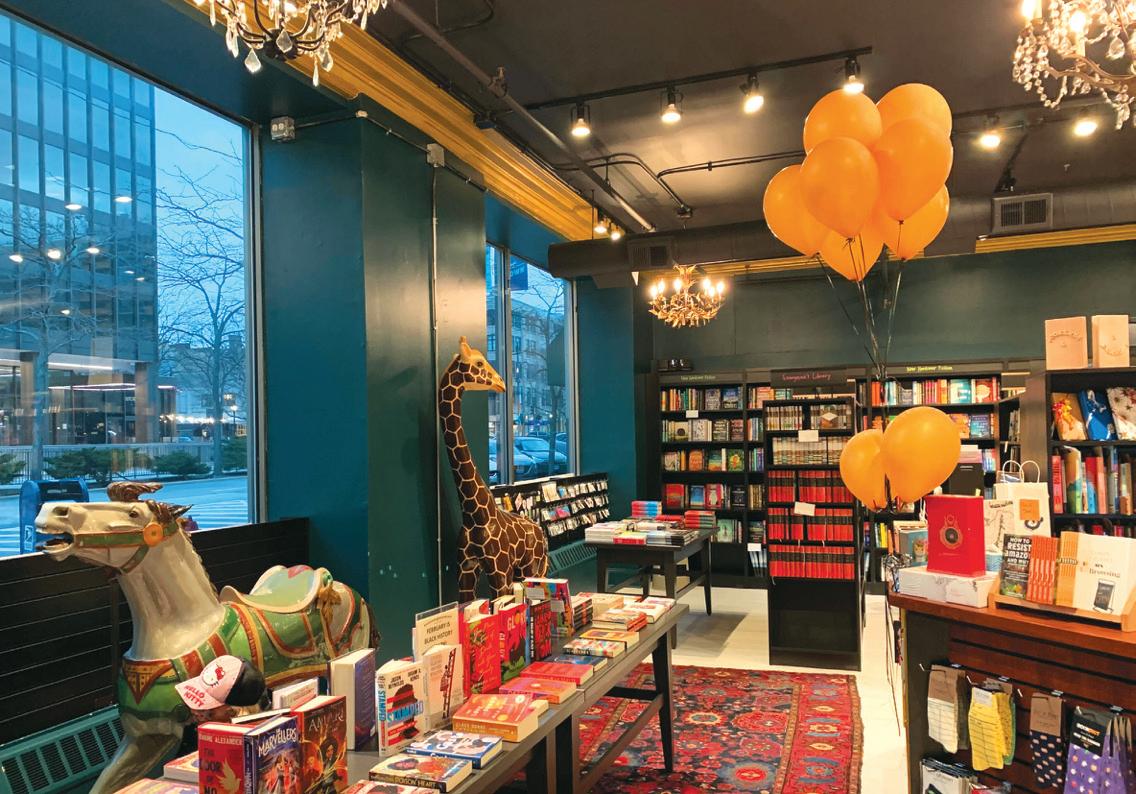
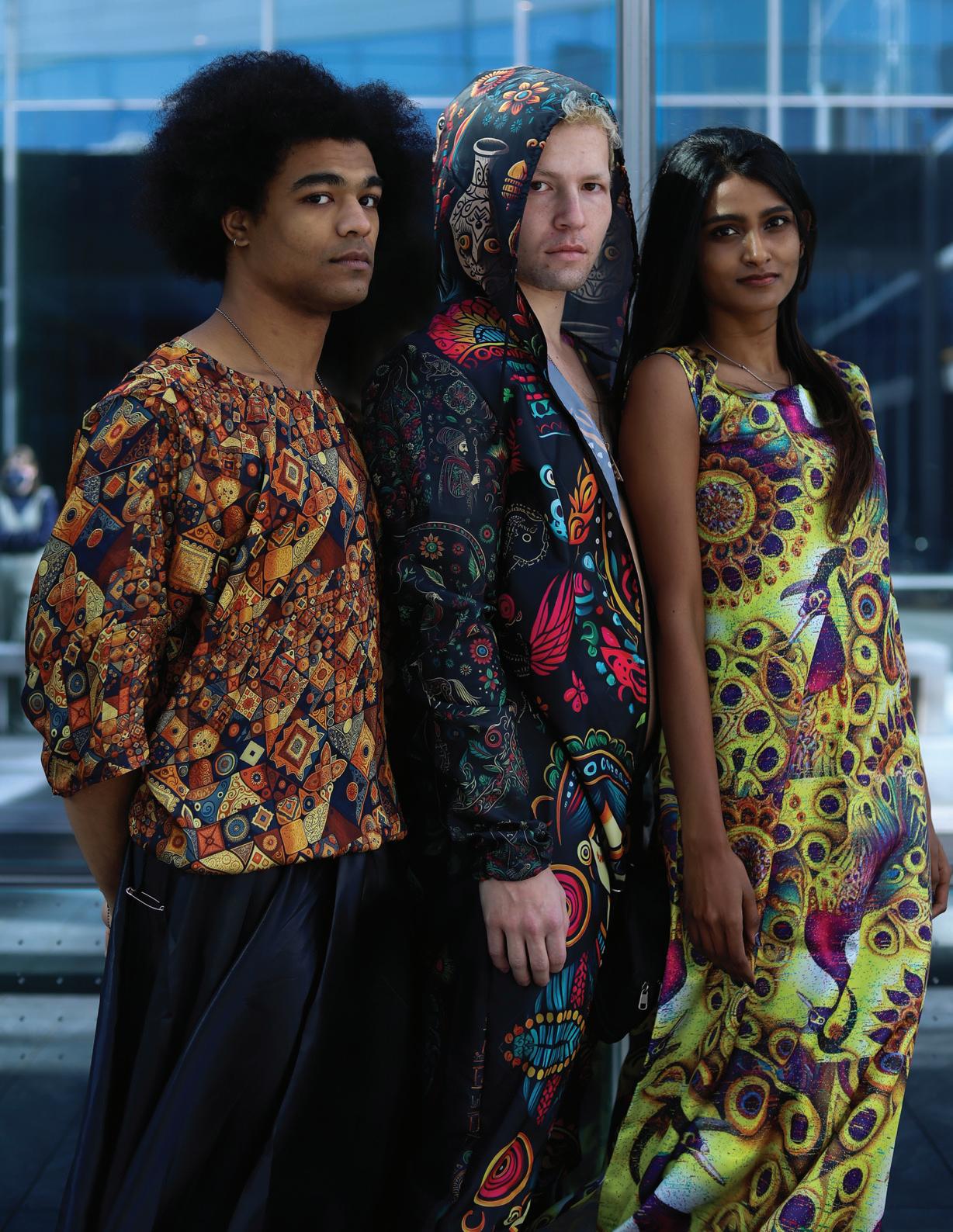
Northwestern students seek sustainable styles.
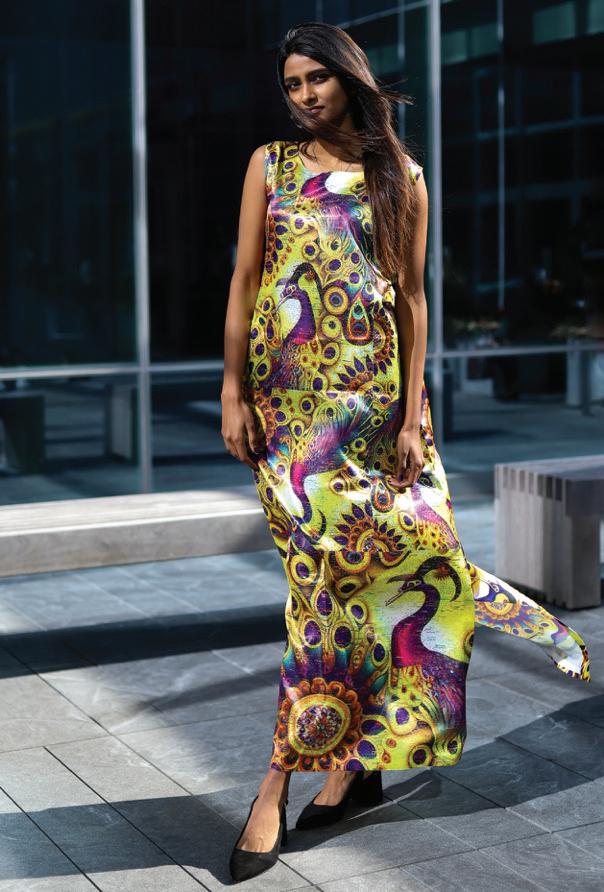
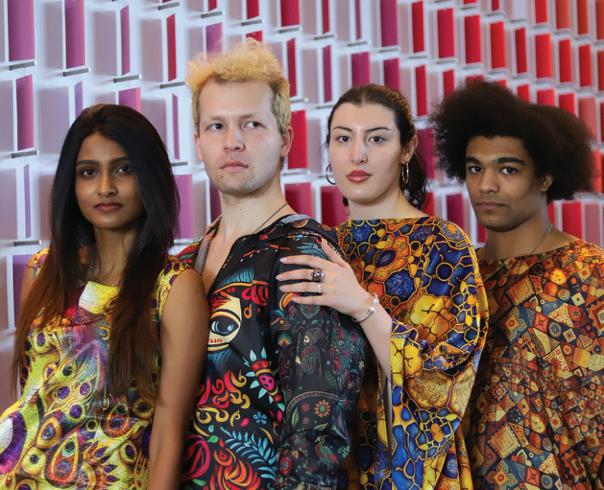
Cargo jeans with a reddish-pink graphic tank top. A sleeveless yellow ca an patterned with psychedelic oral designs. An upcycled blue button down paired with green army pants. A colorblocked tunic top styled with owing metallic bottoms.
These out ts cover an array of colors, fabrics and styles, but they all have one uniting factor: Each is composed of hand-chosen sustainable clothing items.
According to a 2019 report from the United Kingdom’s House of Commons Environmental Audit Committee, clothing production is the third largest manufacturing industry in the world, contributing more to climate change than international aviation and shipping combined.
A er recognizing the fast fashion industry’s harms — sacri cing sustainability to mass-produce cheap, trendy clothes — some Northwestern students have started rethinking their consumer habits. Instead, they are shi ing their interest to slow fashion, a growing consumer movement that emphasizes quality over quantity, reduced environmental impact and awareness of the resources and processes that go into producing clothing.
Slow fashion proponents advocate for the fashion market to move away from practices that exploit people, animals and the planet. They prioritize conscious consumerism through reducing the number of clothes one purchases and

discards. This can take the form of rewearing, repurposing and reselling clothes.
Kellogg Professor of Management and Organization Brayden King, who studies corporate social responsibility, says community building is integral to creating a market for slow fashion. He says communities help create demand, as they allow people to discuss their values and hold one another accountable for their market choices.
“Creating a venue for people to come together is probably the most important thing,” King says. “Even though we think of consumer choices as very individual-oriented, it’s kind of the opposite.”
Whether through friends with shared interests or student organizations, Northwestern students have found communities to explore slow fashion. Many students shop sustainably as a way to both make small changes to protect the environment and express their individuality through fashion.
McCormick and Communication fourth-year Sahibzada Mayed grew up in Pakistan and says they’ve seen rsthand how exploitative and environmentally damaging Western fashion can be. They have watched brands outsource their production to Pakistan and other South Asian countries, leaving awed clothing and waste behind.
While Mayed says they have always made an e ort to consume consciously, they have recently looked closer at creating more humane and ethical clothing.
Mayed launched their own clothing line, Naranji, at last year’s UNITY Charity Fashion Show, an annual student-run event at Northwestern. Since the brand’s launch, Mayed’s team has grown to four people, occupying roles such as community engagement director and brand strategy director. Naranji was featured at Asian Fashion Show Chicago and Rise New York Fashion Week.
Naranji features empowering designs and prioritizes ethical production methods, with all items made to order or produced in small batches. While this may mean a longer wait on the consumer side, it limits waste.
The brand’s clothing is produced by environmentallyconscious manufacturers in locations including Lahore, Pakistan. Mayed and their team employ local artisans for garment printing, digital printing, stitching and embroidery and incorporates locally harvested materials. By doing so, Naranji is further supporting local industries and preventing the carbon impact of shipping.
Another focus of Mayed’s brand is gender diversity. Naranji doesn’t use gender labels for its clothing, and pieces are styled across genders. For Mayed, this connects to sustainability.
“We’re consciously trying to think of who is wearing these clothes,” Mayed says. “I think once we started doing that throughout the process, there was a lot more intentionality in creating the garments.”
SESP fourth-year Lucia Shorr was involved in social justice organizing in high school and found sustainable fashion allowed her to incorporate her activism into daily life. Soon, stopping at the thri shop, L Train Vintage, on her way home from school became a frequent occurrence.
Shorr is now dedicated to slow fashion and has made it her mission to shop as sustainably as possible. For her, this means buying secondhand and from brands whose missions and practices align with her values.
“I’m interested in working in a sustainable fashion space, so it’s also been a passion project of mine for the last number of years to research di erent brands and do my best to shop from ones with values and material processes that I believe in,” Shorr says.
In 2021, Shorr and her friend, Weinberg fourth-year Leo Gilman, launched Sustainable Evanston to ll a niche in Northwestern’s slow fashion market.
At rst, Shorr says Sustainable Evanston was an accessible way for her and her friends to sell their used clothing. But the club quickly gained popularity. Shortly a er its founding, Sustainable Evanston partnered with the student organization Students Organizing for Labor Rights (SOLR) and donated 20% of their pro ts to the SOLR mutual aid fund. In 2021, they hosted their rst pop-up to raise money for SOLR, and in May 2022, they hosted their rst fashion show, complete with a live DJ.
Gilman says Sustainable Evanston has also fostered the growth of a community, the type that’s important for emerging markets like sustainable fashion to gain a large following.
“Especially with social media, we see so many clothes every single day, and it’s really easy to just buy stu from fast fashion,” Gilman says. “[With Sustainable Evanston] it was all on campus, so people could really get into sustainability and fashion, and then by extension, it formed a little bit of a community.”
Bienen fourth-year Louis Milne says he grew up with a sustainable mindset. His mom prioritized hand-me-downs, and when the budget his parents gave him wasn’t enough to purchase clothes from the mall, he would thri . His family o en went to a charity shop around the corner from Milne’s home.
“We would go there every week to just look [around] and nd stu ,” Milne says. “I think it largely comes from the culture of my family.”
Since coming to college, Milne says shopping secondhand allows him to dress stylishly while remaining within his budget.
Weinberg fourth-year Eliana Zuckernick rst served as Sustainable Evanston’s community coordinator. Now, she helps grow Sustainable Evanston’s community by posting
content to the organization’s Instagram page and planning upcoming events. She also hopes to start a monthly newsletter. Zuckernick appreciates the personal connection that exchanging clothing fosters.
“You know those pieces in your closet that you don’t want to get rid of because you used to love them and now you’re just tired of them, even though you still like them? It’s nice when your friends can wear them and continue the tradition,” Zuckernick says.
Zuckernick also believes one of the best ways to educate others on sustainable fashion is to wear it. When people compliment her out t and ask where she got a clothing item, she says responding with “I got it from Sustainable Evanston” is the best publicity.
Milne says his favorite way to introduce people to the joys of secondhand fashion is to take them thri ing.
“It’s such a fun way of introducing sustainable fashion without being sort of preachy,” Milne says.
As the slow fashion community continues to grow, part of the movement’s appeal is the way it — unlike fast fashion — allows wearers to exude individuality through distinctive clothing pieces.
“I love thri ing and used clothes and having that as a method of nding your own style,” Milne says. “It’s such a unique way of creating your own aesthetic.”
Gilman agrees, saying thri ing provides him with a oneof-a-kind wardrobe.
Shorr says the process of cultivating an individual style through thri ing is increasing popular. Despite her disappointment with how society has failed to prioritize climate change, she hopes the increasing demand for slow fashion will help facilitate a slower fashion industry, which could curb wasteful production and overconsumption.
“I would hope that in the coming years, fewer companies are producing clothing and there is an emphasis on reworking used materials and limiting production,” Shorr says. “I do not necessarily expect this to happen. But a girl can hope!”

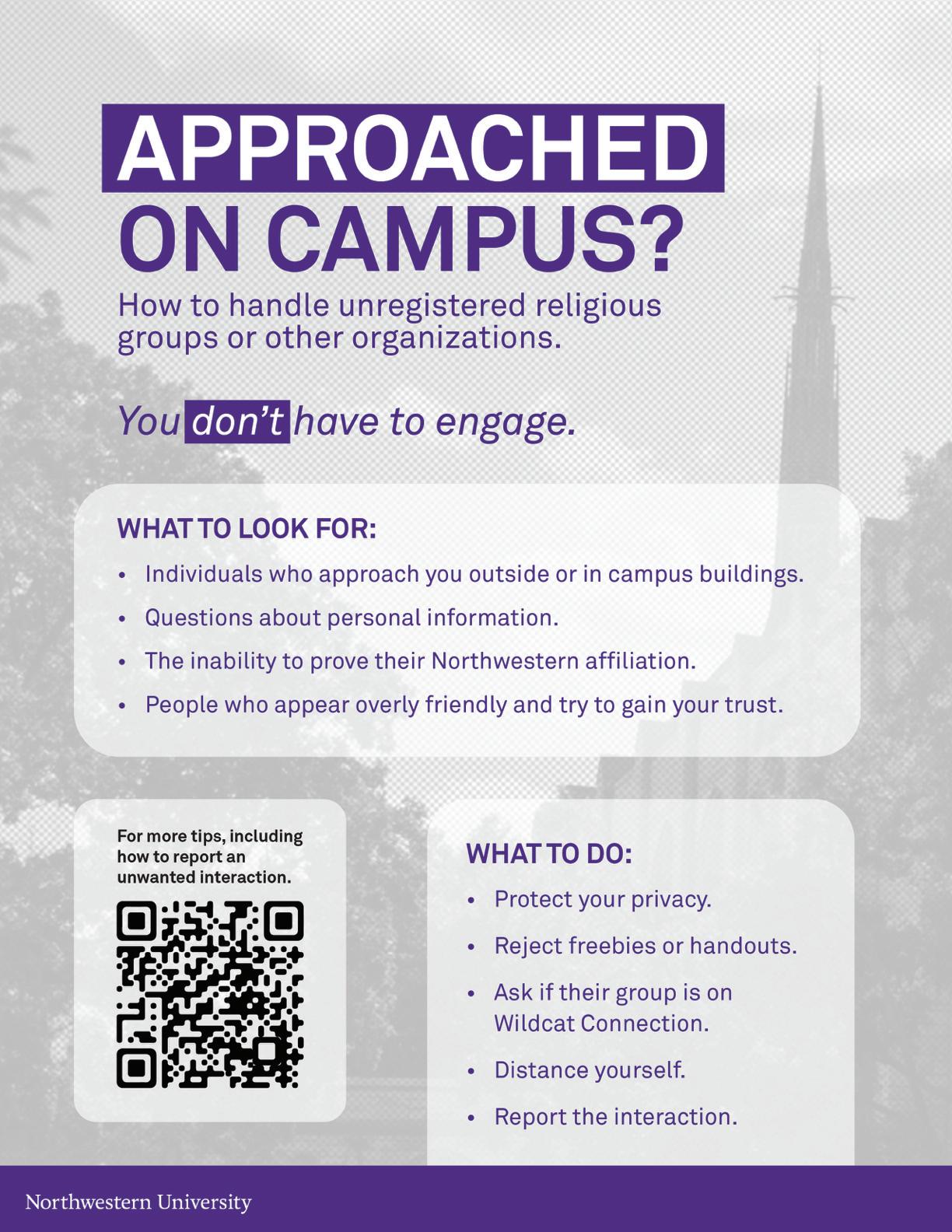

PHOTO
BY
ELOISE APPLE
WRITTEN & DESIGNED BY BENNIE GOLDFARB
Over the past year at Northwestern, I've accumulated a lot of stress. I’ve tried every trick in the book: getting ve hours of sleep, eating two meals a day and never working out. And yet, the stress persisted! So I came to the only logical conclusion — I needed to get my rst massage.
I wanted the best of the best. No fourstar joint would be good enough for my rst time. I scoured the one website I visited, Northwestern Athletics, and found my massage — a highly-coveted 30-minute session at the Henry Crown Sports Pavilion’s wellness suite.
For a mere $60, I booked my appointment for a Tuesday morning. I had no idea what to expect. My recent Google searches consisted of questions like “What to wear to a massage?” and “Are you supposed to talk during a massage?”
This was only my third time at SPAC, and what better reason than for a stranger to rub my body for 30 minutes?
The “wellness suite” is actually a purgatory-like space tucked in the corner of the Henry Crown Sports Pavilion. It is cold, insular and windowless, giving the wing an incredibly liminal vibe.
Tony, the front desk attendee, helped me sign a waiver upon my arrival. During our eeting time together, he told me his life story. You see, Tony is a musician on the side. And in case you were wondering, he spent quite some time on the coast of California before moving to Chicago with his wife, where she pursued a master’s degree. If you were really curious, he also lived in Colorado for a while. I was happy to share this moment with Tony.
Finally, the time for my massage arrived. I decided on the Swedish style (to connect with my 26% Swedish ancestry), and Allen, the massage therapist and
protagonist of this story, informed me that almost all Western-style massages originated in Sweden.
The lights dimmed, and my life was slowly transformed. I learned Allen had moved from Tampa Bay, Florida, where he rubbed some of the best athletes in the world. Now, he was here, working on a weak, 120-pound boy whose neck hurts because he spends most of the day playing on his iPad.
When I asked if athletes from Northwestern frequent the massage studio, he responded with something along the lines of “we get athletes… and we get guys like you.”
I decided my back and neck needed the most attention, and with that, Allen went to work. It was like the NASA scientists faking the rst moon landing. John Paulson betting against subprime mortgages in 2008. Me clutching a B in EA4 last quarter.
Allen whipped out some relaxing music, and I listened as the oils were transferred from bottle to hands. We started slow, but ramped up as time ticked on.
Yes, Allen was a masseur, but he was also a salesman. I was nearly sold on the idea of spending $120 a month on massages as a 19-year-old, until I thought about the fact that I’d be spending $120 a month on massages as a 19-year-old.
The 30 minutes passed too quickly. As I rose from the chair, I felt like a new man. Everyone wanted me to come back to the wellness suite, and not just because I spent $60.
The initial walk from 1838 Chicago to SPAC took 15 minutes, but it felt like ve on the way back. I walked at the speed of light. I was faster, stronger, smarter and dripping with oil. The Sheridan
crosswalk light counting down with only six seconds le was no match for my new body. I was nimble.
Before entering the wellness suite, I was sick with a cough, stressed from school and tired from a dire lack of sleep. A er this 30-minute Swedish massage (as well as antibiotics and eight hours of sleep), my life was forever changed.
Hating the Northwestern dating pool? Us too.
WRITTEN BY NATALIA ZADEH // DESIGNED BY ILIANA GARNER
HHow to Lose a Guy in Ten Days is among the most iconic romantic comedies ever created. This quarter, NBN is paying homage to this masterpiece by chronicling the most awkward and misguided things Northwestern students can do at the beginning of a relationship. Looking to stay uncu ed this spring? This article is for you.

Day One: I went on a date today! We’ve been LinkedIn DMing for two weeks, so I gured it was time to meet in person. During our lunch at MOD Pizza, I reminded him we’d basically been exclusive for half a month. He laughed and told me I was “so funny.” I’d say things are going really well.
Day Two: A er our date, I uploaded our text messages to Fizz so I could get feedback from the student body. Today, he texted me a screenshot of my post with two question marks, which was such a cool and enigmatic way to ask me on a second date.
Day Three: I was busy.
Day Four: We were trying to decide on a date location, so I told him Kellogg
is super picturesque. I didn’t expect him to know where it was since it’s a pretty underground campus spot, but we settled on a classroom near my old flame’s — and linear algebra professor’s — office.
Day Five: I was accidentally late to our date — my moped got snowed in. Tragic. However, we still really connected today. He started talking about his “Politics of Consumption” class, which I thought was a great segue for me to bring up my trust fund. He didn’t say a word for the rest of the date, but I imagine it was because he was mesmerized by my extensive knowledge of Pawn Stars lore.
Day Six: I saw him in periodicals! He was with his friends, so I thought it was a perfect opportunity to introduce myself and joke about which of them would be included in our wedding party. He put his head down on the table as I walked up. Poor guy! I couldn’t imagine how tired he must have been to nap in
the library, so I recorded some original lullabies for him to listen to at bedtime and sent them over. I haven’t heard back — I’m assuming they worked.
Day Seven: I had an econometrics midterm. I asked him to take it for me, but he said no. I’m so glad he believes in me!
Day Eight: I texted him about our third date plans, but he was busy, which was disappointing. A picnic in the Tech steam tunnels would’ve been perfect. Alas, he told me he has to work on a project in Mudd tomorrow, so I’m planning on surprising him there. Unfortunately, I can’t for the life of me gure out what to wear. He just friended me on Facebook, and a er my “Intro to Psych” lecture on Sigmund Freud, I think I might dress up as his mom.
Day Nine: Today was our third date, a pivotal milestone in our relationship. I searched far and wide before I nally found him and his DTC group. I think he pretended not to see me when I showed up in his mom’s signature khaki capris and striped long-sleeve, but he was probably just playing hard to get. Cheeky.
Day Nine-and-a-half: I’ve sent him a couple messages, seeing as we just had our one-week anniversary (three if you count our online courtship), but he hasn’t responded. Will report back soon. In other news, I discovered that my Spanish partner is the man behind our mascot! Maybe not all hope is lost. I’ve always had a thing for Willie. ;)



WRITTEN BY JACKSON BAKER // DESIGNED BY ALLEN ZHANG

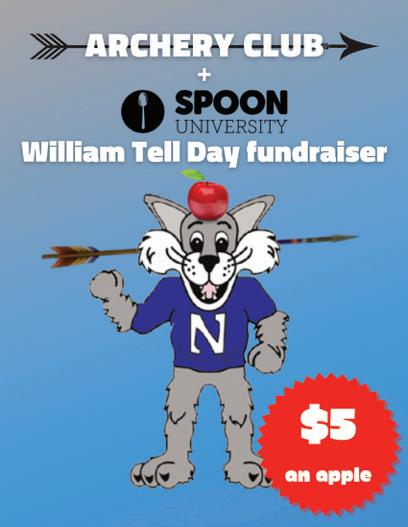



Join Archery Club and Spoon University for their annual William Tell Day fundraiser! Come learn about the Swiss folk hero and put yourself in imminent danger. Pay $5 to put the apple on your head or $10 to put the apple on someone else’s. Bows and arrows are provided. Participate at your own risk (or a friend’s)!

Purple Haze A Cappella and the Mime Club will be hosting a silent auction next week, and the highest bidder will receive a private a cappella show! They’ve been keeping it quiet, but the Mime Club has been practicing for months. This show is sure to knock your black-and-white striped socks o . (Disclaimer: No singing will be involved. Awkward dancing and smiling only.)

For this week only, the Cycling Club and NU Undergraduate Energy Club are selling ra e tickets in the Norris Wildcat Room. Three lucky winners* will get their mini-fridge or o -campus house powered by the exercise bikes for a week! You’ll forget all about the smell of sweat and pent-up cyclist rage when you remember what you’re doing for the environment. *Winners must bike themselves to power their own homes.



Is it that time of the month again? Reduce, reuse, recycle your blood! Volunteers from Menstrual Equity Activists and the University Blood Initiative will be operating collection bins at Norris all of next week. You know how the saying goes: One person’s menstrual blood is another person’s life-saving transfusion. Don’t miss your chance to donate!

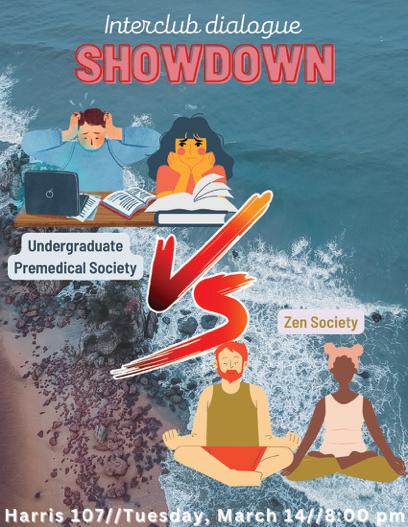
Don’t let your willy get chilly! Knitwestern and Sexual Health and Assault Peer Educators (SHAPE) will be giving away colorful, knit condoms and crochet dental dams in front of Tech for a voluntary donation. Keep things hot and steamy this winter by bundling up with some protection from the climate and chlamydia! Commissions are open for custom colors, textures and patterns. Email 9inchyarn@u. knitwestern.edu to place an order. All proceeds will go toward a ordable STD testing for students.

It’s the spectacle of the quarter! We’ve gathered the most high-strung and most laid-back students we could nd and put them in one room. Buy your tickets now to see the Undergraduate Premedical Society and the Zen Society participate in an interclub dialogue. We’re not sure who will crack rst! If a member of either side converts to the other, the entire audience will receive a free Xanax prescription and one-hour back massage.






The upcoming NU Curling Club and NU Powerli ing Club event is canceled. The event was planned as the result of a catastrophic vocabulary mix-up and is no longer feasible. Both clubs o er disappointed prospective athletes their sincerest apologies and encourage them to continue both curling and curling.
North by Northwestern, the South Asian Students Alliance and the Middle Eastern North African Student Association will be selling compasses for $3.60 during the last weekend of Winter Quarter. Their table will be at the Arch, so head south to make sure their fundraiser doesn’t!
store,
Senior Hangover editor Julia Lucas pens a letter.
WRITTEN BY JULIA LUCAS // DESIGNED BY RAVEN WILLIAMS
IIam writing to inform you of some important news. I wanted you to hear it from me, but I should warn you — our relationship is about to undergo a seismic shi thinking “What?” or “Who is this girl?” or “But we’re so close — like, maid of honor at my destination wedding close — how is it possible that I don’t have a meaningful understanding of your identity?” I know. Our many rendezvous in the cheap liquor aisle were so real. You, recommending that I try something less akin to rubbing alcohol; me, saving $1.75 by buying said rubbing alcohol. But despite the sincerity of our friendship, you’ve never seen me. Like, really seen me.

I know my face tells of a storied past, my wisdom enshrined in the dark circles under my eyes. But those dark circles are not from 24 years of trials and tribulations. They’re from two-and-ahalf years of the quarter system. Of course, you’ve noticed my youthful glow, which was actual youth and not just a good moisturizer. And when you commented on my shaky hands that I blamed on my morning co ee, I was actually just nervous to hand you my ID.
It all comes down to the ID. My “federal” identi cation. Listen, I know the gray-toned photo, paper-thin card and peeling lamination scream “I was o cially issued by the United States government,” but the ID you’ve taken from my trembling hands so many times was in fact issued by OldIronsides, not Uncle Sam. It was fake, counterfeit, a lie. I am truly sorry for deceiving you, but the threat of attending a frat formal sober was enough to drive me to commit a federal crime.
When you nally see the vivid color of my real ID, you might have to shield your eyes. Your arm might sag with the weight and strength of the plastic and a single tear might wet your cheek when you realize I am not that carefree, sun-soaked California girl you’ve come to know and love. I will soon enter your ne establishment as a Minnesotan organ donor, not a beachy, bitchy West Coast millennial. But I hope you’ll come to love the real me too.
As we build our new relationship, you should know a few things. First, I call my dad every time I buy beer, and he tells me which ones I’ll like. If you see me on the phone discussing local brews and defending my GPA, please don’t interrupt. Second, now that I’m of legal drinking age, I’m going to start buying more sophisticated drinks. Be prepared to set me up with your oldest whiskey (does Fireball expire?) or your hoppiest IPA. Lastly, I hope you can forgive my years of deceit.
You’ve been there for me time and time again. On Dillo Day, when I entered your store soaked in Four Loko and you still sold me another Four Loko. On game days, when we both watched in dismay as I checked out a handle of vodka and a minuscule bottle of MiO. Before nights out in Chicago, when you sold me a pack of shooters that I later duct-taped all over my body. You’ve provided me with so many memories — or lack thereof — and alcohol blankets through these cold Illinois winters.
You once wished me a happy 22nd birthday when it was my 19th. Now, I look forward to celebrating my 21st together. Let’s crack a hard kombucha over the cash register sometime. Cheers, until we meet again as our true, grown-up law-abiding selves.
With love,


Are you tired of rage cage? Do you bleed purple? Are you and your friends looking for a foolproof path to intoxication? Hangover has you covered. Get Wildcat wasted (or Wildcat hydrated, if you’re under 21) with campus’s newest, hottest and coolest drinking game.
(IF YOU CAN READ THIS, TAKE ANOTHER SHOT)

DRINK IF YOU’VE NEVER BEEN TO SPAC.

DRINK IF YOU’VE BEEN TO THE ROOF OF A CAMPUS BUILDING (IT WAS SPAC, WASN’T IT?).
You’ll need:
Your beverage of choice
A shot glass (or multiple, depending on updated COVID protocols)
A game piece (consider your bottle cap or the pull tab from a can)
A deep, burning desire to play board games
School Spirit
An excuse to get drunk
CALL YOUR PARENTS AND TELL THEM YOU’RE SWITCHING TO THEATRE. SEND A REJECTION LETTER TO YOUR EX FROM THEIR DREAM INTERNSHIP . . . OR JUST FROM YOU.


ASK IF ANYONE WANTS TO SPLIT AN UBER IN THE CLASS GROUPME.

DRINK IF YOU’RE HORNY.
DRINK IF YOU’VE BEEN REJECTED FROM A BUSINESS FRAT OR CAMPUS CONSULTING GROUP.
SEND YOUR PA GROUP A SELFIE.
DM AN NU FOOTBALL PLAYER WITH ADVICE ON THEIR GAME.
SEXT WITH A CLUB VIA WILDCAT CONNECTION.


DRINK IF YOU HAVE THE HOTTEST PARENT.
TEXT YOUR ROOMMATE THAT YOU HAD AN ACCIDENT IN THEIR BED.
DRINK IF YOU WERE ON STUDENT COUNCIL IN HIGH SCHOOL (CHUG IF YOU STILL ARE).
DRINK IF YOU HAVE THE LEAST LUCRATIVE MAJOR.

DRINK IF YOU HAD A HAMILTON PHASE (EXTRA DRINK IF YOU’RE A THEATRE MAJOR).
DRINK IF YOU’RE IN GREEK LIFE (YOU’RE ALREADY DRUNK, AREN’T YOU?).

WRITE A CANVAS DISCUSSION POST ABOUT WHY YOUR TA SHOULD GIVE YOU A CHANCE.

SEND A PRENUP TO YOUR MARRIAGE PACT.
(WITH A SHOT IF YOU’RE BRAVE)