LANGUAGES PATHWAYS Subject Guide
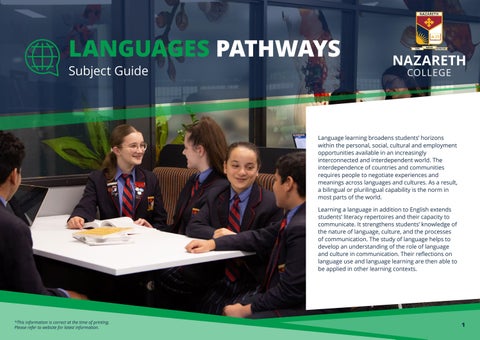
Language learning broadens students’ horizons within the personal, social, cultural and employment opportunities available in an increasingly interconnected and interdependent world. The interdependence of countries and communities requires people to negotiate experiences and meanings across languages and cultures. As a result, a bilingual or plurilingual capability is the norm in most parts of the world. Learning a language in addition to English extends students’ literacy repertoires and their capacity to communicate. It strengthens students’ knowledge of the nature of language, culture, and the processes of communication. The study of language helps to develop an understanding of the role of language and culture in communication. Their reflections on language use and language learning are then able to be applied in other learning contexts.
*This information is correct at the time of printing. Please refer to website for latest information.
1
LANGUAGES PATHWAYS Pathways Summary
IT
VCE ITALIAN (Second Language)
JP
VCE JAPANESE (Second Language)
CN
VCE CHINESE (First Language)
*This information is correct at the time of printing. Please refer to website for latest information.
2
VCE ITALIAN IT (Second Language)
VCE Italian as a Second Language focuses on student participation in interpersonal communication, interpreting the language of other speakers, and presenting information and ideas in Italian around the themes of the Individual, Italian-Speaking Communities and The World Around Us. VCE Italian as a Second Language provides students with the opportunities to communicate with others in Italian in interpersonal, interpretive and presentational contexts. Students can explore the relationship between language and culture and enhance their intercultural awareness. VCE Italian as a Second Language leads to a range of careers including tourism, hospitality, teaching, translating, interpreting, business, finance and I.T.
*This information is correct at the time of printing. Please refer to website for latest information.
3
VCE ITALIAN IT (Second Language) FOCUS AREAS
Unit 1
Unit 2
In this unit students develop an understanding of the language and culture/s of Italian-speaking communities through the study of three or more topics from the prescribed themes. Students access and share useful information on the topics and subtopics through Italian and consolidate and extend vocabulary and grammar knowledge and language skills. They focus on analysing cultural products or practices including visual, spoken or written texts.
In this unit students develop an understanding of aspects of language and culture through the study of three or more topics from the prescribed themes. Students analyse visual, spoken and written texts. They access and share useful information on the topics and subtopics through Italian and consolidate and extend vocabulary, grammar knowledge and language skills.
Key knowledge and skills include:
*This information is correct at the time of printing. Please refer to website for latest information.
•
oral language for participating in an informal spoken interaction.
•
a range of expectations of the participants in the spoken interaction.
•
conventions of text types and language for relaying information in writing.
•
vocabulary and grammar suitable for conveying information on the themes.
Key knowledge and skills include: •
differentiating between general meaning and specific meaning.
•
using strategies for identifying key concepts and information from written, spoken, visual and audiovisual texts in Italian.
•
conventions of text types and language for commenting in writing on information, ideas and opinions.
•
creating an original oral presentation in Italian that explains one or more aspects of culture.
4
VCE ITALIAN IT (Second Language) FOCUS AREAS
Unit 3
Unit 4
In this unit students investigate the way Italian speakers interpret and express ideas and negotiate and persuade in Italian through the study of three or more subtopics from the prescribed themes and topics. Students interpret information, inform others, and reflect upon and develop persuasive arguments. They access and share useful information on the subtopics through Italian and consolidate and extend vocabulary and grammar knowledge and language skills.
In this unit students investigate aspects of culture through the study of two or more subtopics from the prescribed themes and topics. Students build on their knowledge of Italian-speaking communities, considering cultural perspectives and language and explaining personal observations. Students consolidate and extend vocabulary, grammar knowledge and language skills to investigate the topics through Italian.
Key knowledge and skills include:
*This information is correct at the time of printing. Please refer to website for latest information.
•
vocabulary and grammar suitable for interpreting information, negotiating and expressing a preference.
•
oral language and behaviours required to effectively initiate, maintain and close a spoken exchange.
•
link ideas in a logical way.
•
use language that conveys intended meaning, considering cultural perspectives.
•
clarify decisions and ensure agreed outcomes are reached.
Key knowledge and skills include: •
ideas and concepts related to the selected subtopic.
•
vocabulary and grammar suitable for evaluative or persuasive writing.
•
conventions of evaluative or persuasive writing in Italian suited to the text type and audience.
•
language for analysing and comparing ideas in extended writing.
•
present information relevant to audience and purpose.
5
VCE ITALIAN IT (Second Language) ASSESSMENT
Unit 1 and 2 students complete School Assessed Coursework, which includes oral dialogues and presentations, a range of different writing conventions and viewing and reading activities. Unit 3 and 4 students complete School Assessed Coursework (50%), an external oral exam (12.5%) and an end-of-year external examination (37.5%)
*This information is correct at the time of printing. Please refer to website for latest information.
6
VCE JAPANESE JP (Second Language)
VCE Japanese Second Language focuses on student participation in interpersonal communication, interpreting the language of other speakers, and presenting information and ideas in Japanese around the themes of the Individual, Japanese-Speaking Communities and The World Around Us. VCE Japanese as a Second Language provides students with the opportunities to communicate with others in Japanese in interpersonal, interpretive and presentational contexts. Students can explore the relationship between language and culture and enhance their intercultural awareness. VCE Japanese as a Second Language leads to a range of careers including tourism, hospitality, teaching, translating, interpreting, business, finance and I.T.
*This information is correct at the time of printing. Please refer to website for latest information.
7
VCE JAPANESE JP (Second Language) FOCUS AREAS
Unit 1
Unit 2
In this unit, students access and share useful information on the sub-topics of relationships, personal identity and lifestyles and visiting Japan through Japanese, and they consolidate and extend vocabulary and grammar knowledge and language skills. Students focus on analysing cultural products and practices including visual, spoken and written texts.
In this unit, students explore how culture and perspectives may vary between communities. Students reflect on the interplay between language and culture and its impact on meaning, understanding, and the individual’s language use in specific contexts and for specific audiences.
Key knowledge and skills include:
*This information is correct at the time of printing. Please refer to website for latest information.
Key knowledge and skills include: •
nature of direct, indirect and rhetorical questions in Japanese
•
oral language for participating in an informal spoken interaction
•
•
a range of expectations of the participants in the spoken interaction, depending on age, status and other relevant considerations
differentiating between general meaning and specific meaning
•
•
conventions of text types and language for relaying information in writing
using strategies for identifying key concepts and information from written, spoken, visual and audiovisual texts in Japanese
•
•
presentation methods such as awareness and engagement of audience and clarity of information
conventions of text types and language for commenting in writing on information, ideas and opinions
•
vocabulary and grammar suitable for conveying information on the themes.
•
creating an original oral presentation in Japanese that explains one or more aspects of culture.
8
VCE JAPANESE JP (Second Language) FOCUS AREAS
*This information is correct at the time of printing. Please refer to website for latest information.
Unit 3
Unit 4
In this unit, students investigate the way Japanese speakers interpret and express ideas, and negotiate and persuade through the study of the prescribed themes. The students reflect on how knowledge of Japanese and Japanese speaking-communities can be applied in a range of contexts and endeavours.
In this unit, students build on their knowledge of Japanese-speaking communities, considering cultural perspectives and language and explaining personal observations. Students consolidate and extend vocabulary, grammar knowledge and language skills to investigate the topics through Japanese.
Key knowledge and skills include:
Key knowledge and skills include:
•
vocabulary and grammar suitable for interpreting information, negotiating and expressing a preference
•
cultural implications of issues for Japanese speakers and Japanese-speaking communities
•
oral language and behaviours required to effectively initiate, maintain and close a spoken exchange
•
vocabulary and grammar suitable for evaluative or persuasive writing
•
link ideas in a logical way
•
•
use language that conveys intended meaning, considering cultural perspectives
conventions of evaluative or persuasive writing in Japanese suited to the text type and audience.
•
clarify decisions and ensure agreed outcomes are reached.
9
VCE JAPANESE JP (Second Language) ASSESSMENT
Unit 1 and 2 students complete School Assessed Coursework, which includes oral dialogues and presentations, a range of different writing conventions and viewing and reading activities. Unit 3 and 4 students complete School Assessed Coursework (50%), an external oral exam (12.5%) and an end-of-year external examination (37.5%)
*This information is correct at the time of printing. Please refer to website for latest information.
10
VCE CHINESE CN (First Language)
The study of Chinese develops students’ ability to understand and use a language which is spoken by about a quarter of the world’s population. It is the major language of communication in China and Singapore and is widely used by Chinese communities throughout the Asia-Pacific region, including Australia. Studying Chinese can provide a basis for continued learning and a pathway for students into a number of post-secondary options. A knowledge of Chinese can provide students with enhanced vocational opportunities in many fields, including banking and international finance, commerce, diplomacy, and translating and interpreting.
*This information is correct at the time of printing. Please refer to website for latest information.
11
VCE CHINESE CN (First Language) FOCUS AREAS
Unit 1 & 2 This unit examines speaking, writing, listening and reading skills in the language. It extends the students’ ability in these areas related to the prescribed themes of self and others, tradition and change in Chinese-speaking communities and global issues. The areas are studied in an integrated way, as appropriate to the students’ linguistic needs and outcomes for the unit. Key knowledge and skills include:
*This information is correct at the time of printing. Please refer to website for latest information.
•
use appropriate tones, script and punctuation
•
compare and comment on experiences, opinions, ideas, feelings and reactions
•
use structures related to informing, explaining, persuading, agreeing and disagreeing
•
recognise stylistic features such as contrast, repetition and understatement
•
use stylistic techniques such as imagery, repetition, questions and exclamations.
12
VCE CHINESE CN (First Language) FOCUS AREAS
Unit 3 & 4 This unit examines speaking, writing, listening and reading skills in the language. It extends the students’ ability in these areas related to the prescribed themes of self and others, tradition and change in the Chinese-speaking communities and global issues. The areas are studied in an integrated way, as appropriate to the students’ linguistic needs and outcomes for the unit. The students are required to undertake a detailed study during Unit 4 of language and culture through literature and the arts. This detailed study should enable students to understand and appreciate aspects of language and culture through the study of texts drawn from literature and the arts, which focus on the selected sub-topic. It will include study of the author’s / director’s / composer’s intent, as well as the relationship between the context in which the text was produced, the text itself, the author and the audience. Key knowledge and skills include:
*This information is correct at the time of printing. Please refer to website for latest information.
•
use a range of text types and vary style and register for audience, context and purpose
•
ask questions, respond in some depth and build upon ideas of others
•
use registers for familiar and unfamiliar audiences
•
identify, compare and evaluate values, attitudes and beliefs expressed in a range of Chinese texts or procedures related to topics or a special area
•
understand the notion of ‘appropriateness’ and its relationship to purpose, audience and context
13
VCE CHINESE CN (First Language) ASSESSMENT
*This information is correct at the time of printing. Please refer to website for latest information.
•
Unit 1 and 2 students complete School Assessed Coursework, which includes oral dialogues and presentations, a range of different writing conventions and viewing and reading activities.
•
Unit 3 and 4 students complete School Assessed Coursework (50%), an external oral exam (12.5%) and an end-of-year external examination (37.5%)*
14
Manning Drive, Noble Park North, VIC 3174 PO Box 1289, Waverley Gardens, VIC 3170 Australia [+61 3] 9795 8100 enquiry@nazareth.vic.edu.au www.nazareth.vic.edu.au