Aboriginal Way Issue 48, Mar 2012
A publication of South Australian Native Title Services
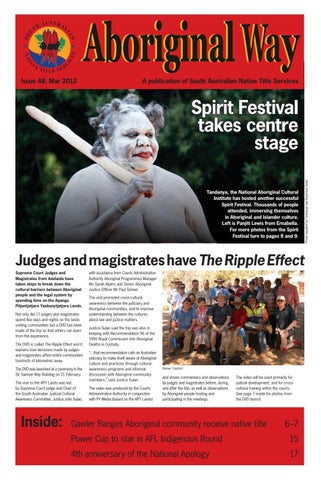
Tandanya, the National Aboriginal Cultural Institute has hosted another successful Spirit Festival. Thousands of people attended, immersing themselves in Aboriginal and Islander culture. Left is Panjiti Lewis from Ernabella. For more photos from the Spirit Festival turn to pages 8 and 9.
Photo supplied by Tandanya and Raymond Zada.
Spirit Festival takes centre stage
Judges and magistrates have The Ripple Effect Supreme Court Judges and Magistrates from Adelaide have taken steps to break down the cultural barriers between Aboriginal people and the legal system by spending time on the Anangu Pitjantjatjara Yankunytjatjara Lands. Not only did 17 judges and magistrates spend five days and nights on the lands visiting communities but a DVD has been made of the trip so that others can learn from the experience. The DVD is called The Ripple Effect and it explains how decisions made by judges and magistrates affect entire communities hundreds of kilometres away. The DVD was launched at a ceremony in the Sir Samuel Way Building on 21 February. The visit to the APY Lands was led by Supreme Court judge and Chair of the South Australian Judicial Cultural Awareness Committee, Justice John Sulan,
with assistance from Courts Administration Authority Aboriginal Programmes Manager Ms Sarah Alpers and Senior Aboriginal Justice Officer Mr Paul Tanner. The visit promoted cross-cultural awareness between the judiciary and Aboriginal communities, and to improve understanding between the cultures about law and justice matters. Justice Sulan said the trip was also in keeping with Recommendation 96 of the 1991 Royal Commission into Aboriginal Deaths in Custody. “…that recommendation calls on Australian judiciary to make itself aware of Aboriginal culture and practices through cultural awareness programs and informal discussion with Aboriginal community members,” said Justice Sulan. The video was produced by the Courts Administration Authority in conjunction with PY Media (based on the APY Lands)
Above: Caption.
and shows commentary and observations by judges and magistrates before, during and after the trip, as well as observations by Aboriginal people hosting and participating in the meetings.
The video will be used primarily for judicial development, and for crosscultural training within the courts. See page 7 inside for photos from the DVD launch.
Inside:
Gawler Ranges Aboriginal community receive native title
6–7
Power Cup to star in AFL Indigenous Round
15
4th anniversary of the National Apology
17
Native title campaigner ends 17-year career
South Australian native title claims update Adnyamathanha Flinders Ranges. Part settled through approved determination (March 2009) Balance of claim in mediation: Federal Court/National Native Title Tribunal.
Nukunu
Adnyamathanha 3 Flinders Ranges (application in relation to s. 47A and s. 47B of the NTA) In mediation: Federal Court
and Kangaroo Island. In mediation:
Adnyamathanha 4 East of Port Augusta extending beyond Quorn and Wilmington Not in mediation. Barngarla Eyre Peninsula. Not in mediation.
After 17 years of campaigning for native title rights in South Australia, Parry Agius, has resigned as Chief Executive Officer of South Australian Native Title Services.
Native Title Management Committees. The Congress brought native title claim groups together, uniting them to become one voice, so that they could form a powerful lobby group.
Mr Agius left the position in January. He is planning to pursue some personal interests and some private consultancies.
He also became editor of this paper, Aboriginal Way – the only Aboriginal community newspaper in South Australia.
Mr Agius was instrumental in changing the way non-Aboriginal people in South Australia viewed native title. He was also instrumental in establishing a public relations and media campaign aimed at informing South Australians of the truth about native title.
Mr Agius received the Prime Minister’s Centenary Award in 2000.
Initially native title rights and any negotiations about those rights were taken up by Aboriginal Legal Rights Movement, where Mr Agius helped establish the Native Title Unit in the mid-1990s. Mr Agius and native title staff promoted the rights and interests of Aboriginal people and established the statewide negotiation process, with the South Australian Government and other peak bodies. Those negotiations promoted relationships between Aboriginal and non-Aboriginal people and cross-cultural education and understanding, moving all parties away from an adversarial process to one where they could jointly identify ways in which native title could co-exist with other land interests. Mr Agius promoted not just native title, but all Aboriginal rights and causes. In 2008, Mr Agius oversaw the creation of South Australian Native Title Services after it was recognised as the Native Title service provider by the Federal Government. He was one of the key people involved in the establishment of the Congress of
2
A Churchill Fellowship was awarded to Mr Agius in 2005. He used the scholarship to travel overseas to learn how other indigenous cultures had tackled land rights and ownership. He brought that knowledge home to Australia and imparted it to native title groups and the Federal and State Governments. Over many years he has sat on many committees including the South Australian Aboriginal Advisory Committee (as Chair) and the Aboriginal Enterprises in Mining Exploration and Energy Limited (AEMEE). He is also currently a member of the Infrastructure Australia Reference Group, a national body set up by the Federal Minister to develop a national strategic policy framework and funding model for infrastructure planning and development in remote indigenous communities. Among his many career highlights is the establishment of the Aboriginal Foundation of South Australia in 2007; an organisation that assists native title groups to realise their native title agreements into commercial and sustainable projects. Parry Agius – his name is synonymous with native title in South Australia. He will be missed by all who have worked with him over the last 17 years. A recruitment process is underway to find a replacement.
Aboriginal Way, March 2012
Spencer Gulf Region Not in mediation. Ramindjeri Southern Fleurieu Peninsula National Native Title Tribunal. Tjayiwara/Unmuru Far northwest SA and adjacent to APY Lands. In mediation: National Native Title Tribunal. Wangkangurru/Yarluyandi Simpson Desert Region and extending into QLD. Part settled in
De Rose Hill-Ilpalka Aboriginal Corporation Compensation Claim Far northwest SA and adjacent to APY Lands. In mediation.
SA through approved determinations
Dieri 2 Eastern SA north of Lake Frome In mediation: Federal Court.
Wilyakali
Far West Coast Far West Coast SA In mediation: Federal Court. Kaurna Fleurieu Peninsula north to Port Broughton. In mediation: National Native Title Tribunal. Kokatha Uwankara Lake Torrens Region Not in mediation. Nauo Eyre Peninsula. Not in mediation. Ngadjuri Nation Southern Flinders Ranges In mediation: Federal Court/ National Native Title Tribunal. Ngadjuri Nation 2 Northeast of the Fleurieu Not in mediaion. Ngarrindjeri River Murray, Lakes and Coorong Region. In mediation: National Native Title Tribunal.
(September 2008, December 2011) In mediation: Federal Court/ National Native Title Tribunal.
East of Flinders Ranges near NSW border. Not in mediation. Wirangu 2 Eyre Peninsula and West Coast In mediation: National Native Title Tribunal. Yandruwandha/Yawarrawarrka Innamincka area. Not in mediation.
Pending determinations Arabunna Central SA including Lake Eyre Claim to be settled through approved determination 22 May 2012. Dieri Central SA east of Lake Eyre Claim to be settled through approved determination 1 May 2012. Information provided by the National Native Title Tribunal – visit www.nntt.gov.au for more about native title. For information on claim activity (other than mediation) contact South Australian Native Title Services.
ALRM appoints new Chief Aboriginal Legal Rights Movement has appointed Cheryl Axleby as is new chief executive officer. Ms Axleby is an Aboriginal woman with an extensive background in Aboriginal and Torrest Strait Islander community affairs. She replaces Neil Gillespie who left the organisation late last year.
Eringa and Wangkangurru/Yarluyandi achieve Consent Determination Native title rights for two Aboriginal groups have been welcomed with the seventh determination in South Australia and the sixth by consent.
land use agreement (ILUA) with pastoral lease holder in the area regarding the co-existence of native title and pastoral lease activities.
At a Federal Court hearing on 13 December at Bloods Creek, near Mt Dare in the far north of South Australia, Chief Justice Pat Keane made two consent determinations over claims from the Eringa and the Wangkangurru/Yarluyandi claim groups, to recognise their non-exclusive native title rights and interests in an area of approximately 20,000 square kilometres.
The Eringa native title holders are in the process of establishing a PBC (prescribed body corporate) called Walka Wani Aboriginal Corporation to deal with all native title business in the future.
Native title holder Marilyn Ah Chee celebrated the determination by singing and dancing on country and remembering those who started the native title process over 15 years ago. “It’s been a long time coming and we have lost a lot of family along the way, people who have been instrumental in driving us forward and for their guidance I am thankful,” she said. Ms Ah Chee gave a special mention to Brownie Doolan, Binji Lowe and Emily Churchill for their personal guidance and helping the community get to where they are today. “If it wasn’t for their knowledge and support we wouldn’t be here today, I feel privileged to be a part of the process and I speak on behalf of all the people, it is important that we celebrate our achievements together and remember those who started us on this journey.” Former SANTS CEO Parry Agius said 2011 had proved to be a positive and memorable year for native title. “The successful determinations illustrate a commitment by all parties to the native title process and how hard work and careful negotiation can result in favourable outcomes,” he said. “There have been some significant developments in native title in South Australia this year and the determinations today are a further example of what can be achieved when all those involved work together in a supportive and cooperative manner.” “SANTS has maintained its focus on providing quality services for native title groups through negotiation and congratulates the Eringa and Wangkangurru/Yarluyandi claimants for securing native title.” The consent determinations recognise the non-exclusive native title rights to access, hunt, fish, camp, gather and use the natural resources, undertake cultural activities, conduct ceremonies and meetings, and protect places of cultural and religious significance. In conjunction with the consent determinations the SA Government and the Eringa and Wangkangurru/Yarluyandi claimants will enter into an indigenous
Ms Ah Chee said it may be a struggle at first, it is about getting the community involved. “As a community we will want to get people involved and not just because they can read and write. People can learn from the people who are leading just like we have learned from our elders in the past. We may have to fit into the mould but we can do it our way because we have good leaders among us” The consent determination proceedings were the third for 2011. Previous consent determinations include Yankunytjatjara/ Antakirinja in 2006, Witjira National Park in 2008, Adnyamathanha People in 2009 and Antakirinja Matu-Yankunytjatjara People and First Peoples of the River Murray Mallee Region respectively in May and November last year. A further consent determination was made one week after the Eringa and the Wangkangurru/Yarluyandi determinations over the Gawler Ranges Claim Area. SANTS Principal Legal Officer, Andrew Beckworth, who appeared for the Eringa claim groups at the hearing said last year was an extremely positive year for native title in South Australia and congratulated the Eringa and Wangkangurru/Yarluyandi claimants on their determination. “It has been a privilege to work with these communities over the last 10 years and I look forward to working with Walka Wani and Irrwanyere Aboriginal Corporations to ensure that the native title holders are able to fully enjoy the exercise of their native title rights and interests and pursue their economic, social and cultural aspirations.” said Mr Beckworth National Native Title Tribunal Deputy President Chris Sumner said the consent determinations are an example of what can be achieved when all those involved work together. “All the parties involved in the process leading to today’s outcome are to be congratulated for their willingness to work together to resolve the applications and reach agreement about how they will work together and how the Eringa and Wangkangurru/Yarluyandi People rights will be recognised and protected.” The determinations have now finalised three claimant applications by the Eringa People that were lodged in 1996, 1994 and 2010, and part of an application lodged by the Wangkangurru/ Yarluyandi in 1997.
Top: Back row: Left to right: Edie King, Chief Justice Keane, Native Title Tribunal Deputy President, Chris Sumner, Valerie Fushtei Naylon, Huey Tjami, Marilyn Ah Chee, Keith Minungka, Andrea Nicholls. Front row: Left to right: Stephen Kenny, Andrew Beckworth. Middle top: State Government lawyer, Adrian Shackley, SANTS Senior lawyer, Andrew Beckworth. Middle bottom: Keith Minungka. Bottom: Dean Ah Chee, National Native Title Tribunal Deputy President, Chris Sumner.
Aboriginal Way, March 2012
3
Zed looking forward to being on the beat
Becoming the first Aboriginal police officer to graduate from the new South Australian Police Academy is an honour not lost on Zed McKenzie.
“It’s also a big honour to be able to serve
“This is a big honour for me and for my family,” he said.
as police the better. Bridging the gap,
The father of six, graduated during the opening ceremony for the new $53 million academy in February. He was among 25 cadets to graduate from the new training and development facility at Taperoo, in Adelaide’s northwestern suburbs. The graduates had completed a 29 week course.
my people, even if only in a small way. “I take this job very seriously and think that the more Aboriginal people serving helping them if they are in trouble – that’s where I come in. Probationary Constable McKenzie will be stationed at Coober Pedy. “I hope that I will make a good role model and that others may be encouraged to join the South Australia Police,” he said. “It’s a great job, helping others is
Zed had previously served as a Community Constable before deciding to become a fully-fledged police officer.
very rewarding.”
“It’s an honour and a privilege to wear this uniform, to serve the people of South Australia,” he said.
including the three youngest of his six
4
The graduation ceremony was attended by Zed’s wife and members of his family children, pictured above. They are twins, Bailey and Isabella, and Tyrell.
Aboriginal Way, March 2012
Ngadjuri native title claim registered The Ngadjuri community has achieved the registration of their Ngadjuri Nation #2 native title application. The registration happened on 20 January. The named applicants are Vincent Copley, Josie Agius, Quentin Agius and Vincent Branson.
The community is in the process of setting up an Aboriginal Corporation to deal with land exploration companies and all other matters related to native title. The chairperson of the Ngadjuri Nations Aboriginal Corporation, Quentin Agius
The claim area lies in the mid north of South Australia over country extending from Gawler in the south to Orroroo in the north.
said the community is in high spirits
Achieving registration now means the Ngadjuri community has the right to negotiate with other parties who are currently affecting their native title rights and interests.
with the exploration companies currently
now that the claim is registered. “The process has been long and the community is now preparing to deal set up on Ngadjuri land by exercising our rights secured under the native title process,” he said.
Simple letter sparks national interest and petition Yesterday was Day 13 of the New Year, 2012. And on this day, I attended the funeral of the eighth South Australian Aboriginal person to die – the eighth death in our small community this year. And it was only Day 13.
Above: Aboriginal advocate, Tauto Sansbury.
In January, Aboriginal advocate Tauto Sansbury wrote a letter about the number of deaths in the Aboriginal community. His letter was published in a newspaper which sparked interest from radio and online reporters. Soon lots of people were talking about the issue of premature deaths in the Aboriginal community. Now there’s a petition on line which has attracted almost 4000 signatures. By speaking up, his simple letter just might make a difference. Here is his letter.
These eight deaths are not of Aboriginal people who have lived to a ripe old age. The funerals were not celebrations of long and productive lives. No, they were all premature deaths, some of them violent, all premature and preventable. Aboriginal people are always at funerals. We attend out of respect for our people and community. We give our condolences and cry for our loved ones. On Friday the thirteenth it was the funeral of a young Aboriginal man, in his prime, who should have had so much to live for. Born 1990, died 2012. Death by suicide. I’ve been to too many funerals of similar circumstances. I watched a grandfather speak, an uncle sing a song to his dead nephew, and a procession of young cousins and friends, there to say their last goodbyes, too soon, too early for all of this.
The day before this I attended the funeral of an Aboriginal lady aged 52, ravaged by diabetes for many years. How sad that you’re considered an elder in the Aboriginal community if you live to age 50! And there were the six other Aboriginal funerals. Of the eight premature deaths, three were by suicide and another was violent. How can this be considered right for Aboriginal people, in the 21st century, in a first world country like Australia? And yet there is no mention of this continuing problem in the media apart from the obituaries, and the Aboriginal community itself reacts to this situation passively as if it’s acceptable and just the normal course of things. It’s not an issue for discussion or action, at any level of government or in any human rights forum. I tell you it’s not the normal course of things. Three young Aboriginal people have already committed suicide in this state in the first week and a half of 2012, and it’s not raised a ripple that they felt so hopeless that it was easier to end their lives than live in this ‘lucky country’. But lucky for who?
While death is the natural conclusion to life, it’s not natural for Aboriginal people to be dying of preventable causes at this rate, years and years before the rest of the population. And yet this is what’s taking place, as eight funerals in 13 days show. The government says it’s committed to Closing the Gap. This isn’t occurring. In some areas things are getting worse. I’m compelled to stand up and say something about what’s happening. Nothing is changing. It’s not just an issue for me to raise; we need to stand up as a community and say that this is unacceptable and something has to be done. And we too need to do something about it ourselves as Aboriginal people. We can’t just keep ignoring it, from generation to generation. This issue is not going to go away. It needs to be fixed, and this can only be done through proper advice and communication to government. Our destiny is not entirely in the hands of those in power. It’s also in our hands and it’s time to take control of it.
The petition is at https://www.change.org/petitions/sa-minister-for-aboriginal-affairs-fund-a-24-hour-aboriginal-crisis-centre-in-adelaide
Claims state laws are anti-mining rejected by Aboriginal leaders Aboriginal leaders have rejected claims by a mining company that the state’s Aboriginal Heritage Act is anti-mining. Argonaut Resources had claimed that the Heritage Act gives too much power to traditional owners to veto mining. The claims were made after the Full Court of the Supreme Court quashed a decision by former Minister Grace Portolesi to allow damage, disturbance or interference with Lake Torrens. In 2010 the South Australian Government granted Argonaut a licence to explore
land near Lake Torrens in a joint venture with Straits Resources. The joint venture parties had planned to drill for copper, gold and iron-oxide in parts of Lake Torrens and Andamooka Island. The government decision was appealed against by traditional owners. This was on the basis that they had been denied procedural fairness in respect of their request for a delegation of the Minister’s powers. Under the Aboriginal Heritage Act, if the traditional owners request a delegation of
powers, then the Minister must delegate those powers. In this case, the Minister simply ignored the request until the same day she authorised damage to the site. The court ruled in favour of the traditional owners, the Kokatha Uwankara and Andynmathantha people. The chair of the Andynamanthanha Traditional Land Association said that the objective of the Supreme Court Challenge was not to stop mining projects in the area but to question the government process, saying the Minister was required by law to consult with
traditional owners before deciding on exploration project applications. Traditional owners should be aware of any attempt to remove the delegations section from the new Aboriginal heritage act, which is expected to be released as a Bill or Amendment Bill later this year. The Attorney General has applied to the High Court of Australia for special leave to appeal against the decision of the Full Court of the Supreme Court. South Australian Native Title Service will update traditional owners of any action related to this matter.
The Roadmap to Close the Gap for Vision The Aboriginal Health Council of SA welcomes a University of Melbourne report The Roadmap to Close the Gap for Vision which calls for a $70 million investment in Aboriginal eye health over five years to bring Aboriginal eye health in line with other Australians. The Roadmap was launched in Adelaide in February by Minister Snowden MP. “The fact that 94% of the vision loss experienced by Aboriginal people is preventable or treatable means that this problem can be fixed.”
“The suffering endured by individuals and families is unnecessary and as the Roadmap points out, can be eliminated,” Chief Executive Officer Mary Buckskin said. “An important yet underfunded AHCSA initiative, the Eye Health and Chronic Disease Specialist Support program coordinates a team of visiting eye specialists to most regional and remote Aboriginal community-controlled health services in South Australia. There are currently five optometrists and six ophthalmologists in the program,” said Ms Buckskin.
Ms Buckskin strongly agrees with Professor Hugh Taylor from the University of Melbourne, who believes that investment in good coordination and management of eye care is essential in order to ensure that Aboriginal people don’t slip through the cracks in the health system. “AHCSA has run a Trachoma Elimination program since May 2011, which sees a team travelling across regional and remote South Australia conducting trachoma screening in collaboration with Country Health SA and local Aboriginal communities,” said Ms Buckskin.
“The screening has detected incidence of trachoma within Aboriginal communities and our main priority is to work closely with health services and assist with ongoing screening, prevention and treatment options for those affected by trachoma,” said Ms Buckskin. “It is encouraging to see that the Roadmap builds on community consultation and control,” said Ms Buckskin. “Our experience has shown that the best results occur when programs are run collaboratively with communities and adequate follow-up care is available.”
Aboriginal Way, March 2012
5
Gawler Ranges Aboriginal community receives native title by Consent Determination Barngala, Kokatha and Wirangu peoples have celebrated a significant legal determination which grants them non-exclusive native title rights and interests over 35,000 square kilometres of pastoral lands and national parks.
A further three ILUAs were entered into with the Government in relation to the national parks within the claim area. These agreements include comanagement arrangements for the Gawler Ranges National Park and Lake Gairdner National Park.
The Consent Determination was made by Justice John Mansfield at a specially convened Federal Court hearing at Paney Station in the Gawler Ranges National Park on 19 December 2011.
The Minister for Aboriginal Affairs and Reconciliation, Paul Caica MP attended the court hearing and signing ceremony at Paney in the Gawler Ranges National Park.
It was the fourth determination for 2011. The other determinations were Antakirinja Matu-Yankunytjatjara in May, The First Peoples of the River Murray and Mallee Region in November and the Eringa and Wangkangurru/Yarluyandi consent determinations in early December. SANTS senior lawyer, Andrew Beckworth, who represents the Gawler Ranges claim group, said that all parties involved should be commended for their efforts over the past 15 years, since the claim was lodged in 1997. “Today’s determination is a culmination of many years of hard work by all involved, it is probably one of the most comprehensive determinations we’ve seen here in South Australia and I hope that those present today can see what we’ve achieved and hopefully there will be more determinations like this in the future,” said Mr Beckworth. The Federal Court has recognised non-exclusive rights to hunt, fish, live, camp, gather and use the natural resources, undertake cultural activities including relating to births and deaths, conduct ceremonies and meetings and protect places of cultural and religious significance. Native title holder Elliot McNamara said the Consent Determination is an important achievement for the Aboriginal people in the area, and will see people work together to maintain the land. “It is a very significant day for us Aboriginal people in this area to be recognised as traditional owners. It is not only for us sitting here now; it is for our grandkids and great grandkids; we can move forward and say at least something has been achieved.” “Native title is not about Aboriginal people moving non-Aboriginal people off their land but how we can co-exist out here. Who better to help us look after our heritage and our sites in this area than the pastoralists and the people living in this area,” said Mr McNamara. In conjunction with the Consent Determination, the Gawler Ranges claim group also signed an Indigenous Land Use Agreement with the SA Government settling all compensation issues arising from their claim.
6
Minister Caica said it is a credit to all the people that were involved in achieving the determination and that their persistence has remained and their patience has remained. “The native title process in most people’s perspective takes a great deal of time and I understand that some frustrations occur during that period of time, but it is a complex issue and I am hopeful, given there has now been 11 native title determinations in South Australia, that a refinement of the process will occur naturally because of the experience that has been gained. “We know that the peoples of this region have had a connection to this land from the beginning of time and that’s been maintained, but it has to be recognised under law and that means that they can play a legitimate role in the management of this land as recognised native title holders,” he said. Minister Caica said it is a credit to all the people that were involved in achieving the determination and that their persistence has remained and their patience has remained. “The native title process in most people’s perspective takes a great deal of time and I understand that some frustrations occur during that period of time, but it is a complex issue and I am hopeful, given there has now been 11 native title determinations in South Australia, that a refinement of the process will occur naturally because of the experience that has been gained” “We know that the peoples of this region have had a connection to this land from the beginning of time and that’s been maintained, but it has to be recognised under law and that means that they can play a legitimate role in the management of this land as recognised native title holders,” he said. The Minister also attended the First Peoples of the River Murray and Mallee Region’s consent determination at Barmera in November last year. Further consent determinations for the Dieri and Arabunna native title claims are scheduled before June this year.
Aboriginal Way, March 2012
Top: Stan Starkey and Frank Reid. Middle: Mick Starkey with Minister Paul Caica. Bottom: Bob Starkey, Frank Reid and Stan Starkey.
Top: Left to right: Egils Olekalns, Kelly Scott, Vesna Vuksan, Osker Linde, Minister John Hill, Andrew Beckworth, Justice John Mansfield. Middles left: Elliot McNamara, Ken Smith, Georgina Reid. Middle right: Justice Mansfield, Howard Richards. Bottom left: Elliot McNamara. Bottom right: Howard Richards, Elliot McNamara, Andrew Dingaman, Ken Smith.
Aboriginal Way, March 2012
7
Raising awareness of the rights of Aboriginal Elders Did you know that there is an organisation set up to help elders and older people? It is called the Aged Rights Advocacy Service (ARAS). Based in Adelaide, they do good work around the state – upholding the rights of older people in aged care services and supporting people experiencing elder abuse. Lesley Johns with more. ARAS has an Aboriginal Advocacy Program which has been operating since 2003. Louise Herft, Team Leader, along with Aboriginal advocates,
Tina Summers and Colin Graham, put elders in touch with community-based aged care programs and other services. ARAS provides information about rights, entitlements and responsibilities. “Many older people do not know that they have rights when they receive aged care services, so when things go wrong for them they do not know how to resolve the issue,” said Louise Herft. “We can speak up on behalf of elders, with their permission, on issues that concern them.”
The abuse of older people is an increasingly reported problem in the community.
off people by taking their money or food, even their medication.
The Aboriginal community is not immune. Elder abuse is happening and it’s ugly.
“Elder abuse is defined as any act occurring within a relationship of trust which results in harm to an elder,” said Louise Herft.
The Council of Aboriginal Elders of South Australia calls elder abuse “a real dog act.” The Aged Rights Advocacy Service, which works in collaboration with the Council of Aboriginal Elders, says the community is gradually beginning to talk about elder abuse and how to put an end to it. ARAS and the Council of Aboriginal Elders have been working on a project, funded by the Attorney-General’s Department, “Preventing Abuse of Aboriginal Elders,” over the last 18 months, asking how elders would like to tackle the issue. “It’s important elders have control over their own lives, that they feel safe in their homes and communities,” said Tina Summers. Colin Graham added: “We understand that many people don’t like to talk about this issue, there is a lot of shame attached to it, and many people feel like it is just happening to them. But once we bring people together and they get talking, people soon realise the problem is quite widespread.”
Above: Left to right: Colin Graham, Louise Herft and Tina Summers.
Elder abuse is much more than physical abuse or threatening abuse, it is ripping
“It can include physical, sexual, financial, psychological, social abuse and neglect. For example, threatening an elder with not seeing their grandchildren, if the elder does not agree to the abuser’s demands, is a form of elder abuse.” “It can be quite frightening and isolating for elders experiencing abuse by family and friends or others they trust to look after them. ARAS helps elders with strategies to protect themselves from abuse and links them to services to reduce their isolation.” “In talking with elders, they tell us that they believe they can restore respect by teaching young people about their Aboriginal culture,” said Ms Herft. ARAS is presently seeking funding to hold a camp at which young people would learn culture and respect from elders in a traditional setting. It is hoped the camp can be held later this year. Anyone seeking further information can contact ARAS on 8232 5377 or toll free 1800 700 600.
De Rose Hill fencing project protects sites A fencing project has taken place on De Rose Hill Station to protect some sites from potential damage by cattle. The fencing was carried out after South Australian Native Title Services on behalf of the De Rose Ilpalka Aboriginal Corporation successfully sourced funding from the Indigenous Land Corporation. Funding was received through the land management program run by the ILC.
The Land Management Program is designed to assist Aboriginal and Torres Strait Islander landholders to deliver benefits by supporting projects that sustainably manage land and develop viable land uses.
a contractor was engaged by SANTS to carry out the work late last year.
Under this program, applications can be made for property-based projects like De Rose Hill, or property management planning.
The fences have now been constructed, and will hopefully provide the protection required to these important sites.
With the ILC providing money for the materials and construction of the fencing,
The contractor hired two Anangu people nominated by the De Rose Hill Ilpalka Aboriginal Corporation to assist with the labour.
This project was significant being the first of its kind supported by the ILC in South Australia to take place on native title land
occupied by non-Aboriginal pastoralists. The project was also supported by the pastoralists on De Rose Hill, and was made possible by their agreement to the fencing of particular sites. Significantly, this project provides the potential for other native title holders to apply for funding of similar projects. Applications under the Land Management Program close on 2 April 2012. For further information see the ILC’s website at www.ilc.gov.au
More support to tackle alcohol and substance abuse Aboriginal people living in and around Ceduna will receive a share of $20 million in funding from the federal government to help tackle alcohol and substance abuse.
delivered over three years, will help communities work with government and non-profit organisations to develop and implement Alcohol and Substance Abuse Management Plans.
The Minister for Families, Community Services and Indigenous Affairs, Jenny Macklin, said the Breaking the Cycle of Alcohol and Drug Abuse in Indigenous Communities initiative delivers on the Government’s election commitment to address the harm caused by alcohol and substance abuse through local, community-led solutions.
The locations receiving funding were selected on the basis of their high need for assistance to combat alcohol abuse and alcohol related harm and for the commitment which their community leaders and members have shown to taking action.
Tackling alcohol and substance abuse is key to building safer, stronger communities. The new funding, to be
8
The locations that will share in the funding are: • Ceduna and surrounds in South Australia • Bourke and Brewarrina in the Murdi
Aboriginal Way, March 2012
Paaki region as well as Condobolin in New South Wales • Doomadgee and Mornington Island in Queensland • Laverton and the surrounding goldfields region in Western Australia. These locally driven initiatives could include prevention activities and health education for young people, linking people with support services, providing assistance to pregnant and new mothers and working with local businesses about alcohol supply issues. The funding will also help communities to work with local service providers to deliver support services such as
education and skills training, prevention programs, referral services and harm minimisation measures. Alcohol and drug abuse devastates the lives of too many Indigenous people and their families, and the Australian Government says it is committed to tackling the harm it causes. The National Indigenous Drug and Alcohol Committee (NIDAC), which advises the Government on Indigenous drug and alcohol issues, has played an important role in delivering the Breaking the Cycle initiative. The Government will continue to receive advice from NIDAC as it works with local Indigenous communities to tackle alcohol and drug abuse.
Judges and The Ripple Effect
Clockwise from top left: Aboriginal Justice Officer Colleen Welch (Aunty Colleen) welcomed to country the 60 guests attending the launch of The Ripple Effect DVD in Adelaide on 21 February 2012; The Honourable John Sulan (left), Justice of the Supreme Court of South Australia and Chair of the SA chapter of the National Indigenous Justice Committee launched The Ripple Effect DVD in the presence of 60 guests, including South Australian Minister for Aboriginal Affairs and Reconciliation The Honourable Paul Caica (right); South Australian Sheriff’s Officer Tony Sgroi (left), Aboriginal Youth Justice Officer John Carbine (centre) and Commissioner for Aboriginal Engagement Khatija Thomas were among the guests at The Ripple Effect DVD launch in Adelaide on 21 February 2012; South Australian Senior Aboriginal Justice Officer Paul Tanner (left) and Courts Administration Authority Manager of Aboriginal Programs, Sarah Alpers, with The Honourable John Sulan, Justice of the Supreme Court of South Australia. Justice Sulan presented Sarah and Paul gifts in appreciation for their work in arranging the judicial officers’ trip to the APY Lands and the making of The Ripple Effect DVD.
Aboriginal Way, March 2012
9
Spirit Festival 2012 a showcase for our arts, m The Spirit Festival has been hailed an outstanding success, attracting thousands of people and showcasing the best of Aboriginal and Islander arts, music and culture. Hailed as the premier Aboriginal and Torres Strait Island Arts and Cultural Festival, it ran over the weekend of 24–26 March. Festival Manager, Carmel Young said
holding the Spirit Festival during “mad March”, when Adelaide hosts the Festival, the Fringe and the Clipsal 500 had been good for attendances.
Among the performers were Aboriginal
The Festival’s workshop program provided
singer Casey Donovan, Queensland funk
opportunities to learn weaving styles
reggae band Zennith, Glenn Skuthorpe,
of the Kaurna, Ngarrindjeri and Anangu
Warren Milera, Caper, Black Diamond,
peoples as well as a writers’ forum.
“There were a lot of people in the city and it was great to be able to expose some of those people to Aboriginal and Torres Strait Islander culture,” she said.
Beck Gollan, Ellie Lovegrove and local
“It was an amazing weekend. There really was something for everyone.”
band Kineman Karma.
One of the highlights was a night of traditional and contemporary dance,
The Spirit Festival was held in
hosted by Frances Rings and featuring
Mullawirraburka – Rymill Park, next to
more than 60 dancers from the APY
Tandanya. It was a free family event and
Lands, the Torres Strait, the Kaurna
it was drug and alcohol free.
and Ngarrindjeri Nations.
This page: Clockwise from top left: Kaurna dance group Taikurtinna; Kaurna elder Stephen Gadlabardi Goldsmith; Frances Rings (Bangarra) MCd the Spirit Dance Ceremony on Saturday night.; Tjanpi Desert Weavers from Central Australia performing on Saturday night at the Spirit Dance Ceremony; Kurruru Youth Theatre dancers performing ‘Elements’ choreographed by Artistic Director Deon Hastie; Kaurna dance group Kuma Kaaru performing at the Spirit Dance Ceremony; Tjanpi Desert Weavers from Central Australia performing on Saturday night at the Spirit Dance Ceremony. Photos: Raymond Zada.
10 Aboriginal Way, March 2012
usic and culture
This page: Clockwise from top left: The Torres Strait Islander dancers; Kuma Kaaru’s Robert Taylor plays Yidaki as part of the Welcome to Country on Friday night. Photo: Raymond Zada; Ellie Lovegrove, an emerging singer with CASM, performed at the Spirit Festival*; Vince Coulthard and Damien Hampton from Umeewarra Radio at the Festival*; Rehanna Coulthard, Dwaylene Brown, Sam Lee, Kirsten Brady, Damien Hampton from Umeewarra Radio with Casey Donovan*; Ngarrindjeri Miminar Kykulan Choir festival favourites performing the Ngarrindjeri language through song. *Photos: Gayle Mather
Aboriginal Way, March 2012 11
Aboriginal Heritage News To recognise the importance of Heritage and Native Title being considered together, the Aboriginal Heritage Branch (AHB) of the Aboriginal Affairs and Reconciliation Division (AARD) will have a small section in this newspaper to address what we are doing about important issues. The State Aboriginal Heritage Committee (SAHC) and the AHB are working closely with the Congress Heritage Sub-Committee and the South Australia Native Title Services (SANTS).
South East Heritage Site Recording and Conservation Workshop Aboriginal Heritage Branch officers Peter Birt, Perry Langeberg, and Catherine Bland conducted a Heritage Site Recording and Conservation Workshop at the Pangula Mannamurna Training Rooms in Mount Gambier on 5–6 March 2012. The two day workshop included up to 30 participants from the South East Aboriginal Focus Group, Department of Environment and Natural Resources, Forestry SA, South East Natural Resources Management Board and Bush Repair. Presentations on the Aboriginal Heritage Act 1988, (the Act) the Central Archive, South East archaeology, mapping and GPS, were interspersed with visits to sites near Mount Gambier and Port MacDonnell, which in turn led to AHB
staff recording a couple of new sites. The idea of the workshop was to assist people working in Natural Resources Management to gain an understanding of how the Act applies to their work and what to look for when they are in the field to make sure their projects do not negatively impact on heritage sites, objects and remains. Feedback from the participants was very positive and they are keen to do a follow-up workshop. Thanks must go to David New, Landcare Coordinator Aboriginal Communities with the South East Natural Resources Management Board for organising the workshop and members of the South East Aboriginal Focus Group for attendance and support.
Above: Workshop participants and AHB staff at Finger Point near Port MacDonnell.
This section sponsored by the State Government of South Australia 12 Aboriginal Way, March 2012
Aboriginal site card audit The Aboriginal Heritage Branch is currently undertaking an audit of the unregistered sites on the central archive, with a view to determining whether mass-registrations of sites, such as that recently conducted on the Yorke Peninsula, can be pursued in other parts of the state. The audit will also contribute to maintaining the accuracy of the data held on the central archive.
Registration The Aboriginal Heritage Act 1988 allows the Minister for Aboriginal Affairs and Reconciliation to determine (register) newly recorded or previously reported sites of his own volition. Sites can also be registered through the process outlined in section 12 of the Act. The submission of a site card to the AHB does not mean that the site is automatically registered. When a site card is submitted it is reviewed and if complete and to the current standard, will be held on the central archive as an unregistered or reported site until the opportunity to determine it arises. As the determination of sites requires consultation under section 13 of the Act, this process takes a considerable amount of time and resources to complete. As such, it is more cost effective to determine many sites at once than one site individually.
Why is registration important? All sites, including unregistered sites, are protected under the Act. However, in practice registered sites are easier to protect because they are: (a) proven to be sites in any legal proceedings; and (b) entered on the land title for the property they are located on. Where unregistered sites are damaged, the Minister for Aboriginal Affairs and Reconciliation might first be required to undertake a registration process to determine whether the sites are of significance before a prosecution can
proceed. Given the statute of limitations for prosecutions under the Act and the amount of time required for the registration process, such a delay would be undesirable. The notification of land owners is also important because awareness of sites means they can avoid unintentionally damaging them and may be held accountable for their condition. Many Aboriginal communities are generally supportive of registrations. The greater ease of prosecution provided by registration provides a more effective deterrent to potential offences, giving Aboriginal communities more certainty that their sites will be protected. Additionally, the legal proof gained through registration is often seen as particularly important, as it provides recognition within the legal system of the significance of Aboriginal heritage.
Process To satisfy the requirements of section 9(2) of the Act, registered sites must be described with sufficient particularity to enable them to be readily identified. As a guide to the practical implementation of this requirement, to be registerable all site records must contain: • a descriptive name in English as well as the Aboriginal name (if known); • location details, including grid references that can be corroborated on a topographic map; • accurate measured dimensions with directions or a north point on the sketch; • description of characteristics, nature or contents of the site; • photographs; • significance of the site according to Aboriginal tradition, archaeology, anthropology and/or history. All of this information is part of the site card which is our standard for determination.
As the AHB needs to make sure all of this information is correct before a site can be considered for determination we are currently checking all of the unregistered site cards, (approximately 4100 records) to check whether they are ready to be determined. Site cards, photos and accompanying documentation are reviewed to ensure that the information is complete. Maps, access information, site descriptions and site plans are then assessed for visual clarity and readability; with information cross-checked to ensure consistency.
When a report of an alleged offence is received, if there is enough information provided the AHB can initiate an investigation into the matter.
Investigations involve collecting evidence, which forms the basis on which the Minister for Aboriginal Affairs and Reconciliation can enact proceedings for prosecutions. Owing to the high standards of evidence required to successfully prosecute a case, proper investigation requires the skills and experience of a dedicated investigator. To assist us in this task, the AHB has recently engaged the services of a
If you have a question about heritage or want to be on our mailing list you can contact us via the people listed below. Manager Anne Stimson anne.stimson@sa.gov.au Ph: (08) 8226 8902 or
Current status The preliminary findings of the audit are that some sites are ready to be determined, some require updated mapping (which can be done in house) but many sites were inadequately recorded and will require a field visit to update the information before they can be considered for registration. It is hoped that the audit will soon be completed at which time the AHB will be in a position to determine the numbers and locations of sites that can be nominated for registration and, in turn, which communities to approach about the next steps in the registration process, including field verification programs. So far that audit demonstrates that many of the site recordings we hold on the Central Archive not been done to a registerable standard. If you wish to have your sites submitted to the AHB for nomination for registration it important to advise your site recorder that the recording must be carried out to a high standard. Site cards and site recording guides are available from the AHB on request and can be requested by Email on heritagesites.aard@dpc.sa.gov.au and also by phone on 08 8226 8936. Additionally the AHB can provide advice or training to communities wishing to learn how to record sites for themselves. Contact Senior Heritage Officer Peter Birt on 82267373 for further information.
Investigations under the Aboriginal Heritage Act 1988 The Aboriginal Heritage Branch, in the Department of the Premier and Cabinet, Aboriginal Affairs and Reconciliation Division, responds to complaints about offences under the Aboriginal Heritage Act 1988 (AHA), such as damage to sites or unauthorised sale of objects.
Aboriginal Heritage Branch
0401 124 391 Heritage Conservation Heidi Crow heidi.crow@sa.gov.au Ph: (08) 8226 8917 Community and Industrial Relations Ribnga Green ribnga.green@sa.gov.au Ph: (08) 8226 7052 Heritage Information Management Justin Wearne justin.wearne@sa.gov.au Ph: (08) 8226 8860 Register Searches heritagesites.aard@dpc.sa.gov.au State Aboriginal Heritage Committee Laura Najjar laura.najjar@sa.gov.au Ph: (08) 8226 6200 Fax number (08) 2260390 Location
trained investigator Mr Simon Roach. This has greatly increased our capacity in this arena and we are currently investigating a number of matters across the state. The AHB has produced a guideline detailing the steps for reporting suspected offences under the AHA. The guideline is available by contacting the AHB by email at heritagesites.aard@dpc.sa.gov.au or by phoning 08 8226 8936.
State Administration Building Level 13 200 Victoria Square/ Tarndanyangga ADELAIDE SA 5000 Postal address GPO Box 2343 ADELAIDE, SA 5001
This section sponsored by the State Government of South Australia Aboriginal Way, March 2012 13
Commissioner for Aboriginal Engagement questions lack of access to government progress Chief Executive Officer • Adelaide – based position South Australian Native Title Services Ltd (SANTS) delivers services to South Australia’s traditional owners that promote and protect their native title rights and interests in land and waters. As the Native Title Service Provider for South Australia our primary role is to serve native title claimants, ensuring we protect native title rights and interests and enhance the economic, social and cultural aspects of their lives. SANTS is a strong supporter of achieving land settlement through negotiating native title rather than litigation. We believe negotiation allows for positive relationships between Aboriginal people and the wider South Australian community. It also delivers sustainable benefits for all parties. SANTS prides itself on being a trusted adviser to the South Australian Aboriginal community and recognised as such by the Federal and South Australian Governments.
Commissioner for Aboriginal Engagement Khatija Thomas (pictured above) has hit out at the State Government for not updating her on the implementation of the recommendations contained in the To Break the Cycle Report. The report was delivered to the government in June 2007 and outlined a framework to address serious repeat offending by young people. Despite various requests for an update on the initiatives and engagement strategies planned to address Aboriginal youths at risk, the commissioner says she is yet to receive a progress report. “This is a long standing issue that is very important to the Aboriginal community. In fact I’m often asked about progress and regretfully I’m not able to provide a clear picture of the steps the government is taking to implement the recommendations,” said Ms Thomas. “I appreciate these things take time however it’s been almost five years since the Commissioner for Social Inclusion handed his report to the government.” “In that time we’ve seen youth reoffending rates amongst Aboriginal juveniles increase and we’re at a point where this group is 25 times more likely to be in detention than other Australians. This is reflected in adulthood; there are currently 435 Aboriginal people in
custody and 1588 non-Aboriginal people in custody in South Australia. To put it plainly, almost a quarter of people in custody are Aboriginal.” “The silence from the government on this matter is deafening. All I can surmise is that responding to serious repeat youth offending is clearly not a priority for this government.” Ms Thomas favours justice reinvestment which is also supported by former Social Justice Commissioner Tom Calma. Justice Reinvestment is a successful program run in the United States which diverts money from the prison budget to programs aimed at breaking the cycle in specific disadvantaged locations. The Corrections budget in this state exceeds $200million. “The principles of Justice Reinvestment are contained in the To Break the Cycle Report but it requires a long-term funding commitment; one which it appears this government is not willing to make,” said Ms Thomas. “I welcome an update on how the implementation of these recommendations is progressing. I would love to share this with the Aboriginal community; a community that desperately wants to be part of real, meaningful change that produces encouraging outcomes for their families and friends.”
14 Aboriginal Way, March 2012
The position of Chief Executive Officer is available as a fixed term contract of three years, subject to satisfactory performance against Key Performance Indicators, reporting to the Board. We are seeking an experienced, energetic, committed person of strong personal reputation, to work with the Board, Aboriginal communities, claimants and organisations on achievement of our purpose and Strategic Plans. You will have: • Previous executive management experience • Significant experience and credibility in working with indigenous communities • Capacity to lead the native title negotiation process and engage stakeholders • Experience in leading a diverse and multidisciplinary professional workforce • The ability to lead and implement change.
Your responsibilities will include: • Strategy Development and Implementation • Leadership and Management • Organisational Representation • Relationship Management • Governance A suitable remuneration package will be negotiated on the basis of the position and the experience level of the successful candidate, but is likely to be in the range equivalent to the SA Executive Service Level 1 in the public sector. A Job Specification is available from, and initial enquiries can be directed to, Wendy Taylor of Strategon (wendy.taylor@strategon.com.au; 0407 603 534), on behalf of the HR Sub-Committee of the Board. See also the organisation’s website www.nativetitlesa.org Applications close 5pm Friday 13 April 2012. Indigenous persons with the requisite skills are encouraged to apply.
Power Cup to star in AFL Indigenous Round
The incredible success of the Aboriginal Power Cup will be showcased to the nation in 2012 as it becomes a highlight of the Port Adelaide Football Club’s involvement in the AFL Indigenous Round. For the first time the event is a part of the AFL’s celebration of indigenous heritage and culture, with the boys and girls grand finals to be played at AAMI Stadium as curtain-raisers to the Power’s AFL Indigenous Round clash with North Melbourne on Saturday 19 May. The preceding two days will see more than 330 secondary students from 25 schools across South Australia participate in preliminary rounds at Alberton Oval. The Aboriginal Power Cup is in its fifth year. It combines sport and study in a unique program that has a growing record of encouraging aboriginal students to complete their secondary education. Coordinated by Power Community Ltd – the Port Adelaide Football Club’s community arm – the Aboriginal Power Cup has grown rapidly since the inaugural event in 2008, thanks to significant partnerships with Santos and the State Government and with additional support from Transfield Services, Beach Energy and UniSA College.
Minister for Aboriginal Affairs and Reconciliation Paul Caica said that the program’s benefits to participants were immeasurable. “The Aboriginal Power Cup encourages Aboriginal secondary school students to stay in school and find pathways to further education and future employment,” Mr Caica said. “2012 will bring the total number of students who have participated in the Aboriginal Power Cup, since the inception of the program, to more than 1,200. “Engaging Aboriginal students through sport is one important way of encouraging young Aboriginal people to continue with their schooling and to become active participants and leaders in the community.” In 2011, the State Government announced that it would provide $97,920 each year to Power Community Ltd through to 2013 to deliver the Aboriginal Power Cup program. Santos Chief Executive Officer David Knox said: “Santos is a keen supporter of initiatives that increase Aboriginal workplace participation, particularly in the energy sector.” “I am delighted to have two former Aboriginal Power Cup participants in the Santos team through school-based apprenticeships.”
Year 11 students from Windsor Gardens Vocational College, Marissa and Reanna began their apprenticeships with Santos in 2011, working one day a week at the Santos headquarters in Flinders Street during the school term and more during school holidays and they continue to excel in this new environment. “Our aim is to help young Aboriginal people reach their full potential through positive engagement, employment pathways and training opportunities such as these apprenticeships,” Mr Knox said.
forming nine-a-side teams. The event also includes a careers expo, cultural activities, workshops and a team breakfast. The semi-finalists are chosen on the basis of the participants’ combined school and football carnival results, with the winners of those games then going into the grand finals. The event has been highly successful in achieving its objectives of encouraging Indigenous students to complete their
The Aboriginal Power Cup program started in February, with the participants required to complete classwork that contributes to them acquiring their South Australian Certificate of Education (SACE). This includes study focused on a number of key curriculum areas, ranging from art and music through to lessons promoting good health, teamwork, leadership and life skills.
secondary education and prepare for life
“Football is often the motivator for the students, but the program also drives them to become fully engaged with other areas of learning, from designing guernseys to writing team songs, planning training schedules and setting goals,” Power Community Ltd general manager Darren Adamson said.
Indigenous students stay engaged with
Only students who successfully complete their classwork are invited to take part in the football carnival, with the participants
Further information on the
after school. “In 2011, more than 80 per cent of participants completed all the requirements of the SACE unit associated with the Aboriginal Power Cup,” Mr Adamson said. “That’s up from 70 per cent in 2010 and demonstrates how effective the program has become in helping their education and thereby preparing them for fulfilling lives. Teams have entered from as far apart as Ceduna and Murray Bridge and from Coober Pedy to Port Lincoln, along with 12 schools in the metropolitan area. Aboriginal Power Cup can be found at www.aboriginalpowercup.com.au
Aboriginal Way, March 2012 15
in memory An extraordinary man, an exemplary life
Reconciliation SA: There is Still Work to Be Done Reconciliation SA held its Annual Breakfast on the 4th anniversary of the National Apology to the members of the Stolen Generations, 13 February.
“The Intervention ditched many years of accumulated evidence that pointed to empowerment and inclusion as central to genuine long-term solutions to complex health and social problems.
Keynote speaker, Ms Pat Anderson, Chair of the Lowitja Institute, Co-author of the Little Children Are Sacred report and daughter and sister to members of the Stolen Generations gave a candid overview of the reconciliation work that is still desperately needed in Australia.
“It replaced them with a ‘get tough, quick fix’ rhetoric that made it clear where the problem lay: it lay with us, it was Aboriginal people who were to blame for the conditions in which we lived.”
“For myself, I would say first of all that the events in Canberra around Australia Day make a powerful argument for structural change in the way business is done in Australia,” she said.
© Copyright NPY Women’s Council.
“They make changes to the Constitution to recognise Indigenous people and prohibit racial discrimination more necessary and more urgent, not less.”
Family and friends, leaders and colleagues from the APY Lands, central Australia and interstate farewelled Mr Peter a much loved elder and ngangkari (traditional healer) on 8 March in Fregon in the APY Lands. Mr Peter was held in the highest regard by Aboriginal people for his unparalleled healing abilities and was responsible for a major shift in the broader understanding and acceptance of Aboriginal traditional healing through his public speaking and educational work. He was widely respected in the medical fraternity both nationally and internationally and believed that the best health outcomes for Aboriginal people would be achieved by collaboration between mainstream medicine and traditional healers. In 1999 he brought his skills as a ngangkari to NPY Women’s Council and with other ngangkari travelled widely around the country healing others and promoting the value of Aboriginal cultural healing practices. His wisdom and deep understanding of human affairs at a spiritual level gave him universal appeal across cultural and national boundaries, and he was revered for his generosity and compassion for those in need. A true gentleman, Mr Peter had an extraordinary ability to make people happy with his warmth, humour and charisma. Professor Marcia Langton, Patron NPY Women’s Council, said that his passing
She moved on to the Northern Territory Intervention and was highly critical of how her consultation and report had been used.
will be felt deeply across the Aboriginal nation, as a ngangkari, teacher and leader he has helped to bridge the cultural divide by helping to raise the understanding of Aboriginal ways of healing in the broader community. Among many accolades he was awarded the 2011 International Sigmund Freud Prize from the City of Vienna; the 2009 Mark Sheldon Prize from the Royal Australian and New Zealand College of Psychiatry (RANZCP); and 2009 Dr Margaret Tobin Award for excellence in the provision of mental health services to those most in need. As he described to a packed conference crowd in 2010: Today we work as ngangkari over a really extensive area of Central Australia. We do it together because we care; we want to look after people; that’s what we were taught. For us we are continuing a really long tradition of healing within our world, the Pitjantjatjara world. The skills, the way that I do my work, I was taught by my father and grandfather. I grew up in a family that was really strong and clear about the proper way to do things. And that is the way that I work today as a ngangkari … Today it’s really difficult for a lot of children – they find themselves in a really difficult situation. It’s not as clear as it was when I was growing up. In these times there are clinics within the communities and we work really closely with the clinic staff. We respect what they are trying to do and they respect what we are trying to do. We know there are a lot of problems and we work really closely together.
16 Aboriginal Way, March 2012
Many people at the breakfast were moved as Pat spoke of her four-year-old grandson attending the Apology and coming away saying “Sorry isn’t a doing word is it Nan?” For Reconciliation SA, the breakfast provided the opportunity to promote to the non-Aboriginal community that out of 54 recommendations in the Bringing Them Home report, 48 recommendations have not been fully enacted or have had no work done on them at all. Copies of the two page flyer There is Still Work to be Done are available through Mark Waters, State Manager Reconciliation SA on 0417 834 938 or email reconciliationsa@adam.com.au
4th anniversary of the National Apology Nearly 250 people attended a
key stakeholders, the evening was a
people, enjoying a community event with
community event held at Elder Park
chance for Aboriginal and non-Aboriginal
food, music and drinks.
to commemorate the 4th anniversary
people to come together and join
of the National Apology to members
members of the Stolen Generations
of the Stolen Generations.
as they remembered the day.
Organised by Link-Up, Journey of
Elder Park was an excellent space for this
the Apology was televised live, via a big
Healing, Reconciliation SA and other
gathering of Aboriginal and non-Aboriginal
screen, four years earlier. Others enjoyed
Members of the Stolen Generations enjoyed a private space for commemoration and reflection on the very grounds where
a family evening with face-painting, badgemaking, stone-painting and relaxing music. Stallholders included Aboriginal Legal Rights Movement, Australians for Native Title and Reconciliation and Turkindi. The event was sponsored by Adelaide City Council.
Aboriginal Way, March 2012 17
PBC meeting in Port Augusta Representatives from registered native title bodies corporate met in Port Augusta from 11–13 February for the first state-wide meeting to discuss managing native title. RNTBCs (also known as Prescribed Body Corporates) are corporations formed under the Native Title Act. Under the Act, Native title groups are required to form these bodies in order to ‘hold’ their native title rights and interests.
Representatives for groups soon to have a registered PBC also attended. The meeting was funded and facilitated by the Australian Institute of Aboriginal and Torres Strait Islander Studies and assisted by South Australian Native Title Services. Over the weekend, representatives were given the opportunity to discuss shared issues, challenges and achievements in relation to managing native title.
In addition, participants were also asked to identify what aspirations or vision they had for their respective RNTBCs and communities. A number of government representatives gave presentations on various programs and policies available for RNTBCs. Participants also discussed the proposal to establish a national representative body for RNTBCs. The meeting was held as part of the
12 month PBC support project run by the Native Title Research Unit at AIATSIS. The South Australian meeting followed state-wide meetings of Queensland RNTBCs in Cairns in October and Victorian RNTBCs in Melbourne in December. For more information on the PBCs call Aimee Kepa at the South Australian Native Title Services on (08) 8110 2800 or email aimeek@nativetitlesa.org
Above: PCB workshop in Port Augusta, February 2012.
in review
Our column in review features reviews and stories on Aboriginal writers, artists and musicians. We welcome your feedback and suggestions. So if you know of a new work about to published or an artist or musician please contact us on (08) 8110 2800.
Dingo’s Tree Dingo’s Tree is the latest release from Magabala Books. It is the story of Dingo, Wombat, Crow and their friends as they struggle to exist alongside the devastation of mining that is tearing up their beautiful homeland. This powerful children’s tale on the destruction and havoc that mining can cause to the land and community is both touching and hard-hitting. Author Gladys Milroy is from the Pilbara region in Western Australia. She was born in 1927 and was taken as a young child and placed in the Parkerville Children’s Home. Her people’s country is the Palkya country of the eastern Pilbara. Gladys’s story is told in her daugher, Sally Morgan’s book My Place. Gladys is also the author of the children’s book The Great Cold. Professor Jill Milroy is a Palyku woman too and the daughter of Gladys. She is Dean of the School of Indigenous Studies at University of Western Australia. Dingo’s Tree is available from March 2012 in bookshops and online from Magabala Books at www.magabala.com
18 Aboriginal Way, March 2012
paper tracker The Anangu Lands Paper Tracker is an online project of Uniting Care Wesley, Adelaide. The website tracks government commitments to Anangu (Pitjantjatjara and Yankunytjatjara people). It publishes accurate, up-to-date information on projects and services that are important to Anangu. The Paper Tracker aims to make it easier for Anangu to work with governments as equal partners. It helps Anangu make sure governments are following through on commitments. Aboriginal Way will assist Paper Tracker by highlighting some of the issues it is following. If you want more information on any of these items log on to www.papertracker.com.au
Anangu Lands: recruiting Community Constables South Australia Police receives funding to employ 12 Community Constables on the APY Lands and in Yalata. As at 5 February 2012, nine of these positions were vacant. In one community, the local Community Constable position, had been empty for over eight years. In 2011, SA Police conducted an evaluation of the Community Constable program. In November 2011, the Commissioner of Police approved the evaluation’s recommendations. The following month, a strategy to address the recommendations was completed. On 19 January 2012, the Minister for Police, Jennifer Rankine advised Paper Tracker that the evaluation’s recommendations focused on “employment conditions, training requirements and providing opportunities for Aboriginal Liaison Officers to qualify for Community Constable positions”. The Minister advised that “the process of implementation and reassessing strategies” was “ongoing”. Next Steps Paper Tracker recognises that there are significant challenges in recruiting and retaining suitable staff to work in community policing roles across Anangu communities. Nevertheless, the Paper Tracker has had difficulty in obtaining clear information from SA Police on the future of the Community Constable positions and their role in providing policing services to Anangu communities.
The Paper Tracker will ask the Minister for a copy of the Community Constable program’s evaluation recommendations and associated implementation strategy. Information provided in response to this request will be incorporated into this page as soon as it is received. The Paper Tracker will continue to report on SA Police’s effort to recruit and retain Anangu staff.
Coronial Inquest: six Anangu deaths In the second half of 2011, the Coroner’s Court conducted an inquest into the deaths of six Anangu men and women. The average age of the deceased was 38 years. All of the deceased came from Yalata or had strong connections with that community. The findings of the inquest were handed down on 4 November 2011. The Deputy Coroner found that severe alcohol abuse had “played a part either in the life or the death” of each individual, as had “homelessness and rough living”. The Deputy Coroner recommended that a 24-hour sobering up centre be established in Ceduna and that a separate “alcohol rehabilitation centre or facility” be “established on the west coast” of South Australia “well away from licensed establishments and other sources of alcohol.” The Deputy Coroner addressed these recommendations to the South Australian Minister for Health, the Australian Minister for Indigenous Health and others. Paper Tracker will ask each of these Ministers for information on their response to the coronial recommendations.
Mullighan Inquiry: third annual progress report In November 2011, the South Australian Government reported to State Parliament on the progress it had made implementing the recommendations of the Mullighan Inquiry into child sexual abuse on the APY Lands. This was the third of five annual reports that the Government is required to table in State Parliament. The Paper Tracker had hoped that the South Australian Government’s third report would be a significant improvement on previous ones. We are disappointed that this is not the case and that the
Government continues to respond in a way that greatly limits the ability to properly assess what recommendations have been fully implemented and what actual progress has been made. Shortly before the third report was tabled in State Parliament, ministerial responsibility for the preparation and release of future reports was transferred to the new Minister for Education and Child Development (Hon Grace Portolesi MP). On 6 January 2012, Minister Portolesi wrote that South Australia’s child protection system needed to be rethought and reformed. The Paper Tracker trusts these reforms will include improvements to the way the Government accounts for its ongoing response to the recommendations of what the Minister has described as a “ground breaking” inquiry into child sexual abuse on the APY Lands. Paper Tracker will continue to monitor the quality of the information released by the South Australian Government as part of the Mullighan Inquiry’s five-year reporting process.
APY Lands: 2012 election of APY Executive Board On 29 February 2012, the State Electoral Commissioner will conduct elections across the APY Lands for positions on the APY Executive Board. On 3 February 2012, a week-long nominating period commenced. Those Anangu who wanted to stand as candidates were required to lodge a completed nomination paper by 4.00pm on 10 February 2012. In total, the State Electoral Commissioner received and accepted 17 nominations. This included nominations from four Anangu women. No nominations were received for two electorates (Kaltjiti/Irintata/Watinuma and Watarru). For three electorates, only one nomination was received. In these cases, the following candidates were elected unopposed: • Anton Baker (Kanypi/Nyapari/Angatja electorate) • Milyika Paddy (Pipalyatjara/Kalka electorate) • Willy Pompey (Mimili electorate) Ballots to elect candidates for the other five electorates will be held on 29 February 2012.
Unanswered Questions Sometimes governments are slow to answer our questions. Here are two examples of where the Paper Tracker has sought information from governments but responses have not been forthcoming.
Impact of ATM fees on Anangu communities In 2010, the Federal Government established a taskforce to examine how Automatic Teller Machine (ATM) fees affect people living in remote locations. The taskforce provided a report on its findings to the Office of Australia’s Treasurer (Hon Wayne Swann MP) in February 2011. On 9 December 2011, the Paper Tracker asked the Treasurer for a copy of the report or a summary of its key findings. We also asked the Treasurer for an outline of any steps his office had taken, since receiving the report, to address the negative impacts ATM fees can have on people living in remote Aboriginal communities. Nearly two months later, none of the requested information has been provided.
State Plan: Anangu public sector numbers In October 2008, the South Australian Department of the Premier and Cabinet provided the Paper Tracker with some detailed information on the number of state public service employees based in Yalata, Oak Valley and the APY Lands who identified as Aboriginal. Two years later, in October 2010, the Paper Tracker asked the Department for some updated information. In January 2011, the Department advised us that the requested information was being gathered and would be sent to us as soon as possible. More than a year later, no information has been provided. On 9 December 2011, the Paper Tracker asked the Chief Executive of the Department (Mr Jim Hallion) for his assistance in resolving this matter. A response to this request has not yet been received. The matters listed above are just a sample of the types of issues being followed by Paper Tracker. If you’d like to know more you can contact them on (08) 202 5867 or subscribe to their newsletter at www.papertracker.com.au
Aboriginal Way, March 2012 19
SOUTH AUSTRALIAN NATIVE TITLE SERVICES
Level 4 345 King William Street Adelaide SA 5000
Editor Keith Thomas
Journalist Lesley Johns
Advertising Enquiries (08) 8110 2800
Circulation 10,000
Above: Steve Portelli, a Dreamtime Racing director with one of the cars.
Dreamtime Racing debuts at Clipsal 500 If you have any stories of interest to our readers, please address any correspondence to: editor@nativetitlesa.org
Aboriginal Way South Australian Native Title Services Level 4 345 King William Street Adelaide SA 5000 Ph: 8110 2800 Fax: 8110 2811 FREECALL: 1800 010 360
The Editor has the final decision on all stories and advertising that appear in this publication.
New V8 Supercars team Dreamtime Racing made its debut at the Clipsal 500 in the Dunlop Series on the streets of Adelaide, South Australia in early March. The new Dreamtime Racing team aims to evoke hope, opportunity and pride to the Aboriginal people of Australia.
Rob Palermo and MAC, Aboriginal youths Australia-wide will have the opportunity to apply through their local co-operatives groups to join the Team.
a mentor role with the Aboriginal team members to ensure their craft is developed to the highest level of Australian V8 Supercar racing.
Dreamtime Racing will have a host of skilled employees that will also undertake
For the record the team placed 9th overall during the Clipsal 50 event.
The car is based in Mildura and is the result of a partnership between private enterprise and Mildura Aboriginal Corporation (MAC). MAC is located in the city of Mildura, Victoria and is an innovative and successful organisation that provides a wide range of services to meet the needs of the local Aboriginal communities.
Stay in touch
Dreamtime Racing plans to engage corporate Australia to develop a host of key partnerships to support Aboriginal youth in training schemes as well as engage with the local communities groups throughout the country. Dreamtime Racing will undertake a number of community programs to leverage the racing platform including driver safety in Aboriginal communities and an apprenticeship employment program.
_________________________________ Postcode:_ _____________
The Aboriginal Employment Program will endeavour to employ Aboriginal youth in apprenticeship roles provided across all facets of race team operations. Under the guidance of Team Manager
20 Aboriginal Way, March 2012
Name:___________________________________________________ Address:_________________________________________________ ________________________________________________________
Phone:___________________________________________________ Email: ___________________________________________________ DX no:___________________________________________________ No of copies:_ ____________________________________________ Is this an alteration to our current records?
Yes
No
Would you like to be added to the mailing list?
Yes
No
Would you like to be sent regular information about SANTS?
Yes
No ISSUE 48