Issue 99
Spring 2025
A publication by South Australian Native Title Services
www.nativetitlesa.org
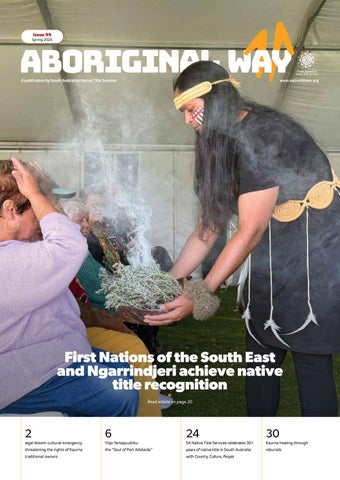
First Nations of the South East and Ngarrindjeri achieve native title recognition Read article on page 20
2
6
24
30
algal bloom: cultural emergency
Yitpi Yartapuultiku:
SA Native Title Services celebrates 30+
Kaurna healing through
threatening the rights of Kaurna
the “Soul of Port Adelaide”
years of native title in South Australia
reburials
traditional owners
with Country, Culture, People
Aboriginal Way South Australian Native Title Services
2
Algal bloom: cultural emergency threatening the rights of Kaurna traditional owners Statement from Allan Sumner, Kaurna Ngarrindjeri Traditional Owner on behalf of the Kaurna Yerta Aboriginal Corporation.
I speak with deep concern about the algal bloom that has contaminated our Kaurna coastline. What we are witnessing is more than environmental damage; it is cultural harm, spiritual disruption, and a direct threat to the rights of our people and the future of our lands and waters.
Living connection to Country Our connection to Country is not a concept; it is law, it is life, it is spirit. Kaurna people have walked, lived with, cared for, and sung to these coastal lands and seas for countless generations. This coastline is sacred to us. It holds our Creation stories, our ceremonial grounds, our ancestral knowledge. It is where we hunt, gather, heal, and teach. The sea is not just water; it is family. When the sea is sick, we are sick. When our waters are poisoned, it is not only fish and shellfish that suffer; it is our people’s spirit, our knowledge systems, our economic independence, and our ability to practice culture in a living, ongoing way.
Sovereign rights must be respected We are the First Peoples of this land. Our rights to access, care for, and derive livelihood from our waters are embedded in the foundational documents of this state, the Letters Patent of 1836, and in the law of our ancestors. These rights are not negotiable. They do not belong to us because they are written in legislation; they belong to us because we are Kaurna. This algal bloom is a physical symptom of a system that has too often excluded Aboriginal people from decisionmaking, from land and sea management, and from reaping the benefits of our resources. We will not accept being
sidelined while our Country becomes sick under the weight of mismanagement and climate change.
Impact on Kaurna cultural and economic life This ecological disaster has disrupted our food sources, our cultural practices, and our ability to connect with Sea Country. Traditional foods like fish and shellfish, essential to our ceremonies, diets, and teachings, have become unsafe. Kaurna families who fish, gather, and teach their children these practices are being forced to stop. Our tourism businesses, cultural guides, and marine operators, many of them built by grassroots Aboriginal people with a deep commitment to sharing culture, are facing cancellations, financial stress, and an uncertain future. We are being told to wait until the crisis is over. But for us, there is no “over” when culture and livelihood are under threat. This is our way of life. Without immediate support, we risk losing not just businesses but the next generation of Kaurna tourism leaders, educators, and cultural entrepreneurs. We cannot afford to see this damage ignored.
Cultural emergency For Kaurna people, what is happening now is a cultural emergency. Our knowledge systems, built over millennia, tell us how to care for these places. We know when the tides shift. We know when the waters change. We know when Country is speaking to us, and right now, she is crying out. Kaurna Yerta Aboriginal Corporation calls for a serious, coordinated, and respectful response – one that places Traditional Owners at the centre, not on the sidelines.
Issue 99 Spring 2025
3
Photo by Stefan Andrews. ‘Ardrossan Big Jetty Algae Bloom Underwater’, 20 July 2025. Photo supplied by Great Southern Reef Foundation.
We call for immediate action: Direct financial and structural support for Aboriginal tourism operators, marine businesses, and cultural guides who have been impacted by the algal bloom. Genuine partnership and leadership roles for Kaurna people in the environmental response and long-term planning for coastal and marine care. Integration of Kaurna knowledge systems with Western science to better understand the causes and cycles of algal blooms and prevent future occurrences. Protection of Kaurna cultural practices and rights, ensuring we are never again cut off from our Sea Country without clear plans for restoration, access, and support.
Act now in respect and partnership KYAC is committed to working with those who are ready to walk alongside us in restoring and protecting our coastline, not just for Kaurna people, but for all who call this place home. We want to see our waters healthy, our culture strong, our businesses thriving. But this will only happen if Aboriginal voices lead the way, not just respond to the damage. We will not allow our connection to Country to be treated as secondary to economic or political priorities. We are not stakeholders, we are rights holders. The algal bloom is a wake-up call. We can no longer afford to separate environmental issues from cultural ones, or economic recovery from cultural survival. They are the same. Kaurna people have always known how to live in balance with these lands and waters. We are ready to lead again. But we need action, respect, and meaningful partnership, not just words. Our Ancestors are watching. Our children are watching. And we are speaking now, not just to be heard, but to be listened to.
Aboriginal Way Editor: Keith Thomas Journalists: Joy Lothian, Isaac Selby Communications Officer: Caleb Sweeting Design and Printing: We Create Print Deliver Advertising Enquiries: aboriginalway@nativetitlesa.org Aboriginal Way is a publication of South Australian Native Title Services Level 6 27 Currie St Adelaide SA 5000 www.nativetitlesa.org Ph: (08) 8110 2800 Fax: (08) 8110 2811 FREECALL: 1800 010 360 If you have any stories of interest to our readers, please address correspondence to: aboriginalway@nativetitlesa.org The Editor has the final decision on all stories and advertising that appear in this publication.
Cover image: Ngarrindjeri women Rita Lindsay performs smoking ceremony at consent determination.
Allan Sumner speaking at the recent Kaurna reburials at Wangayarta.
WARNING: Aboriginal and Torres Strait Islander readers are warned that the following publication may contain images, names, and stories of deceased persons.
Aboriginal Way South Australian Native Title Services
4
Letter from the Editor Where is Tarrkarri? The First Nations cultural centre was promised to us in 2021, but since then the site has remained an empty lot on North Terrace. Tarrkarri means “the future” in Kaurna language. But its future is in limbo. At the project launch in December 2021, then Premier Steven Marshall said Tarrkarri was about “changing the narrative for Aboriginal people in this country” and celebrating the “incredible future for the oldest civilisation on this earth.” Planned as a landmark cultural centre, Tarrkarri will showcase more than 60,000 years of Aboriginal cultures through visual arts, language, performances, collections and education. As Aboriginal people, we know the importance of Country, culture and storytelling. Tarrkarri was meant to be a place where those stories could be shared with local, national and international visitors. Yet today, it sits unfinished – another empty promise to First Nations people. As a member of the Aboriginal Reference Group, I’ve provided guidance to the State Government to help ensure cultural protocols are respected and that the centre reflects the diversity and depth of our cultures. Kaurna Traditional Owners and cultural leaders contributed to the design, with landscape architect Paul Herzich helping shape the outdoor spaces. This was about more than aesthetics – it was about truth-telling, transparency and celebrating the oldest living cultures in the world. We understand the financial pressures governments face. But it is not acceptable that Tarrkarri remains in limbo while other arts investments continue to move ahead. The South Australian Government has put $115 million on the table. The Australian Government has committed $85 million. Still, there is no clear plan, no timeline and no certainty. Our call is simple: we want both governments to tell the public where Tarrkarri stands, to lock in funding, and to pursue private investment if needed. Most of all, we want action. Tarrkarri is a once-in-a-generation opportunity. Done right, it will be a legacy on Kaurna Country – a cultural institution that strengthens identity, brings people together, and draws the world’s attention to South Australia. At SANTS, alongside prescribed bodies corporate across our state, we stand ready to work with government to make sure Tarrkarri is delivered. Not as an empty promise, but as a living place that honours the first peoples of Australia. Keith Thomas SANTS CEO
First Nations Water Strategy The Department for Environment and Water has begun engaging with Traditional Owners to develop the Framework to Advance First Nations’ Water Interests. The framework aims to strengthen recognition of cultural authority in water management, improve access to water for cultural and economic purposes, and embed First Nations participation in decision-making. SANTS has contributed to co-design workshops and policy discussions to ensure Traditional Owners’ rights and aspirations are recognised in future water planning across South Australia.
Advertise in the quarterly
10,000 copies sent to SA & NT
Contact: aboriginalway@nativetitlesa.org
Native title claims update
Issue 99 Spring 2025
5
Update
Active claims Ngarrindjeri - Claim determined on the 24th of October 2025. Arabana 2 - High Court appeal was successful - remitted to Full Federal Court.
From policy to law: why aboriginal business needs 25% legislated, not promised Opinion Piece from Parry Agius, former CEO of SA Native Title Services, now Managing Director of Linking Futures For ten years, South Australia’s Aboriginal procurement policy has been treated as optional. Plans have been drafted, policies softened, targets overlooked. The result? A lost decade for Aboriginal business and community wealth. Aboriginal people know that contracts are not just about dollars. Every contract grows capability, community and futures. Yet when Aboriginal businesses are denied contracts, communities are denied footholds. For too long, Aboriginal families have been left to hope instead of plan, to dream instead of build. That loss is not just economic — it is deeply personal, felt in every home and every community. Wealth and choice were denied. Tier 1 companies keep 75% of the pie. Aboriginal business deserves its legislated 25%, not as charity, not as welfare, but as earned participation in South Australia’s economy. If 25% matters, it must be law. Plans can be ignored Policies can be softened. But law is binding. Law has teeth. The next 25 years could be the beginning of Aboriginal innovation at its peak — not just in government contracts but across industries, from construction to retail to technology. This is how South Australia can be remembered as the place that moved from welfare to wealth, from dependence to choice, and from division to shared pride. Wealth and choice are not just outcomes; they are tools of influence for generations to come. South Australians can be proud of that vision. Proud to vote for it, proud to stand for it, proud to build it.
Far West Coast sea claim – Full Federal Court appeal heard on 5th and 6th of November 2025. First Nations of the South East 1 and 2 consent determination held for 2 on the 24th of October 2025. First Peoples of the River Murray and Mallee 2 - consent determination negotiations ongoing. Malyangapa - consent determination negotiations ongoing. AMYAC Compensation - mediation ongoing. Yandruwandha Yawarrawarrka Part C - new claim filed over SA, Qld, and NSW in July.
Aboriginal Way South Australian Native Title Services
6
Yitpi Yartapuultiku: the “Soul of Port Adelaide”
Since opening its doors to the public in June, Yitpi Yartapuultiku, the new Aboriginal cultural centre in Port Adelaide, is filling a cultural gap Kaurna Elders in the area have spent nearly 30 years advocating for. Yitpi Yartapuultiku Port Adelaide.
The $35.2 million centre was purpose-built by the City of Port Adelaide Enfield council, the largest ever project they’ve undertaken, with one contribution of $4.5m from the federal government for the living shoreline at the banks of the Port River. Kaurna Elder Uncle Lewis O’Brien, who has spent his 95 years in the Port Adelaide area and has been involved in championing an Aboriginal cultural centre over the last three decades, says the centre has exceeded expectations. “This is a beautiful outcome now that we’ve got this place, it’s been worth the wait,” he said. The aim was for Yitpi Yartapuultiku, or the soul of Port
THE VISION’S ALWAYS BEEN RIGHT HERE, WE HAD EARMARKED THE WESTERN REGION PARK NEARLY 30 YEARS AGO”- SUSAN DIXON.
Adelaide in Kaurna language, to be a shared space for all people, both Aboriginal and non-Aboriginal, to learn, reflect and experience Aboriginal culture together. There’s a sense of relief, gratitude and amazement from local custodians that the space they have dreamt of has finally come to fruition. “The vision’s always been right here, we had earmarked the Western Region Park nearly 30 years ago,” said Susan Dixon, Kaurna custodian and Chair of the Advisory Panel. “We said we want this park; this has to be our cultural centre. So it amazes me now that it has actually happened here. It gives people down this way an open space to come to.” Kaurna custodians and the Yitpi Yartapuultiku Aboriginal Working Group shared cultural and historical knowledge with the City of PAE, Ashley Halliday Architects and WAX Design to ensure authentic cultural practices and narratives would be woven into the design. “We spent a long time talking to all the different people involved in making it and they all realised they should listen to us and I think they had a pleasant surprise with the ideas we came up with. Then they developed some of their own
Issue 99 Spring 2025
7
ideas as well, so it’s a blend of both and that’s the beauty of it,” Dr O’Brien said. Rodney Welch, Aboriginal Community Lead at the time, spoke highly of the way the community was brought into the consultation and included throughout the extensive design and construction process. “To be a part of the movement four or so years ago to get the community and council to come together to start talking and come up with what we’ve got today is the best process and engagement of community I’ve ever been a part of,” he said. “From my point of view of council and the way they went forward with the community - I’ve never seen anything better than that in my lifetime.”
An important part of developing the centre for the broader public was also knowing what to leave out to encourage further engagement and curiosity, Mr Welch reflected. “One of the things Uncle Lewis always talked about, particularly through the design process, is that you can’t tell the whole story. You’ve got to tell bits of it and allow people to sit and observe, then come back and learn some more. “That’s why we kept away from too much signage because you can read a sign and think ‘oh, I know it all now, see you later.’ But we are trying to maintain people’s curiosity, which can make them more engaged and want to go and do their own research too.”
Aboriginal Way South Australian Native Title Services
8
Footprints over the land Aboriginal Elders and cultural custodians Margaret Brodie and Tina Flanagan, who, alongside Susan Dixon, served as key advisors and on-site monitors during the development of the centre, recently joined her to take Aboriginal Way on a tour of the grounds. Each of the women have deep, multi-generational ties to the Port Adelaide area, with family histories intertwined with significant events in Aboriginal history, including the Stolen Generations and long-standing activism for land and culture in the region. “I’ll say our footprints are all over this place and beyond,” said Ms Brodie, standing on a rock overlooking pelicans floating by in the Port River. “I feel that if we don’t educate our younger ones today, we’re going to become extinct in our own world somehow, in our own Country.” Ms Dixon agreed with this sentiment. “We have to continue doing these things for our future Ancestors,” she said. “Putting this place here embeds us back into the community and we haven’t really been part of Port Adelaide, Enfield visually, but the landscape of our stories have.” “So this centre gives us back space to visually have signage and a space. But it’s not about slapping on some paint. It’s actually about truth-telling.” The importance of truth-telling and doing what is right is something the women kept returning to.
1
2
3 4
6
5
7
9
8
10
1
Ngangkinangka Women’s Place
2
Pangkarrila Men’s Place
3
Ngani Gathering Place
4
Ngunyawayitila Performance Place
5
Pari Witungka River Reed Place/Living Shoreline
6
Wardli Takana Spacious House/Cultural Centre
7
Warlturninthingka Between Place/Main Entrance
8
Kumangkangka Together Place/Event Space
9
Purkangka Place for the Elders
10
Purkana Padnipadniti Permit parking and loading only
Padnipadnitingka Public Car Park Ngunyawayiti Yarta Playground Welcome Desk Gift Shop Ngarkunthi Kuu Cafe Gallery
Map of
Yitpi Yartapuultiku THE SOUL OF PORT ADELAIDE
Toilets Changing Place Interpretive Sign
What’s there: Café A café space is open to the public seven days a week. There’s also a small space with gifts made by local Kaurna and Aboriginal artists. Quarterly exhibitions An exhibition space hosts various exhibitions, currently featuring a group exhibition Coming Together and Nunga Netflicks film program of First Nations artists until 6 December. Modern spaces for conference, events or training hire The space is available for between 8-240 people, with room for up to 2000 people outside. Catering and cultural services will also be available for bookings. Public events and free activities There’s a steady stream of free cultural activities and workshops led by Elders and staff often reaching full capacity. Playground Kids won’t be left out of a visit with a nature playground including water play in the bushland setting on Yitpi’s grounds. Cultural Ranger Willis Daveson on hand to care for and educate around local cultural knowledge, the Kaurna language and site significance through Yitpi native plants and the living shoreline. Kitchens set up for training 12 burners in the kitchen to deliver cooking training.
YOU HAVE A SOCIAL RESPONSIBILITY, AN OBLIGATION, TO YOUR PEOPLE. PEOPLE THINK THAT YOU SHOULD AIM TO HAVE THE BEST HOUSE OR THE BEST CAR, BUT A LOT OF OUR COMMUNITY KNOW THAT IF YOU CAN GO TO BED AT NIGHT KNOWING YOU’VE DONE THE RIGHT THING AND YOU’VE HELPED OUT WHERE YOU CAN, THAT’S WHAT’S MOST IMPORTANT,” - SUSAN DIXON.
1300 Old Port Rd, Port Adelaide Bookings for meetings, functions, conferences, catering and cultural services are now available. The grounds are open from dawn–dusk every day. The Centre building, café and gallery are open: 10 am–4 pm Monday to Friday 10am–2pm weekends and public holidays (plus other times for bookings and events)
Cultural custodians Tina Flanagan, Susan Dixon and Margaret Brodie at Yitpi Yartapuultiku.
Wirra Distribution: transporting stories from Country to the big screen In an industry dominated by mainstream voices, a cultural movement is emerging, one that highlights First Nations storytellers, questions the established norms and introduces impactful new perspectives to screens throughout Australia and beyond. “The reality is that this industry doesn’t give anyone a break. Everyone is out to ensure they have a sustainable career, and it is often at the expense of others. The industry is also risk-averse, meaning they don’t want to take a chance on anything,” Mr Akbar said. “I was hearing about bad experiences Aboriginal people were having with distribution companies and realised that there was zero choice but to work with non-Indigenous businesses. That’s not to say all distribution companies are unsafe, or that the bad experiences were culturally bad experiences. It’s just the nature of money. If your project is a risk, they pull out.”
A name that carries meaning Travis Akbar from Wirra Distribution.
Wirra Distribution is believed by its founder, Wongutha filmmaker Travis Arkbar, to be the country’s first and only 100% Aboriginal-owned and managed film distribution company. Mr Akbar said he had been advocating for change within the industry as a filmmaker. “I realised that I could be that change, and that if I could be, I should be,” he said. “It doesn’t mean I can make a change straight away, but I am going to certainly try and grow a business that works for everyone but make sure that Mob get a better run of it. Because from what I can tell, and I could be wrong, I’m not just the first 100% First Nations-owned distributor out there, but the first in general.”
A new wave of storytelling Wirra is at the forefront of a new era in Australian cinema. First Nations voices are no longer on the outer fringes but are shaping and reimagining the industry. The company was born from a desire to make space for stories often overlooked or undervalued by traditional distributors. “What I was specifically seeing is First Nations filmmakers trying to make the kinds of films we haven’t really made before; horror, thriller, action etc and that made the market nervous,” Mr Akbar said. “When one was released and was not an instant hit, I was hearing stories of distributors leaving similar projects. It leaves the filmmaker with nowhere to go. There needs to be a distributor that isn’t going to just up and leave.” Investors want to see a return on their investments, not just the nature of filmmaking, but business in general. But this leaves little room for risk and therefore for the industry to grow.
The name Wirra means “coolamon” in the Wongutha language, a traditional vessel used to carry food, water and symbolically, the essentials of life. Wirra Distribution acts as a modern coolamon, carrying cultural stories from communities to screens around the country and world. Wirra is grounded in tradition but built for today’s world by embracing digital technology, fresh ideas and bold storytelling, whoever they are told by. “But we are here to support First Nations films first and foremost, and if that means co-distributing with a bigger distributor just to ensure there is a First Nations voice at the table, or just giving advice, that is what we will do. Ultimately, we want to see Mob succeed in an industry that is tough for everyone, but tougher for some.”
Beyond the business: a vision for change While connecting cultural stories with audiences is the mission, Wirra was also born out of Mr Arkbar’s desire to see filmmakers get a fair deal. “I want to give filmmakers higher percentages than they would receive through traditional contracts,” he said. “Many distributors take half or more of the profits. I am committed to covering costs, but beyond that, I want to return as much as possible to the creators.”
WE WILL DISTRIBUTE ALL FILMS ALIGNED WITH OUR VALUES, WHETHER THEY CAN BE FIRST NATIONS FILMS OR NOT - WE WANT TO BE A SUSTAINABLE COMPANY, WHICH MEANS BEING OPEN TO ALL FILMS,” - TRAVIS ARKBAR.
Issue 99 Spring 2025
9
Aboriginal Way South Australian Native Title Services
10
‘Too Deadly: Ten Years of Tarnanthi’ Iconic festival celebrates with more than 200 works
Tarnanthi, the Art Gallery of South Australia (AGSA)’s festival of contemporary Aboriginal and Torres Strait Islander art, marks its tenth anniversary in 2025 with a major exhibition Too Deadly: Ten Years of Tarnanthi, alongside a statewide festival of exhibitions and events across 25 partner venues. Left to right/ The Ken Family – Tjungkara Ken, Sandra Ken, Freda Brady, Maringka Tunkin, Yaritji Tingila Young and Paniny Mick – with their collaborative work Kangkura-KangkuraKu Tjukurpa – A Sister’s Story, 2017.
Since beginning in 2015, Tarnanthi, which means ‘to spring forth and appear like the sun and the first emergence of light’ in the Kaurna language, has established itself as Australia’s leading First Nations arts festival. Over this time, more than 2.2 million people have visited Tarnanthi exhibitions and events, showcasing the ingenuity and expansive practice of contemporary Aboriginal and Torres Strait Islander artists. More than 9,000 Aboriginal and Torres Strait Islander artists and creatives have been able to present their work, building an understanding of First Nations art and culture for audiences in Australia and around the world. At AGSA until 18 January 2026, Too Deadly features major
Issue 99 Spring 2025
11
Ryan Presley, Marri Ngarr people, Northern Territory, born Mparntwe (Alice Springs), Northern Territory 1987, Blood Money - Infinite Dollar Note - Uncle Stephen Gadlabarti Goldsmith Commemorative, 2019, Brisbane. Courtesy of Milani Gallery.
installations and works of art from more than 200 artists that have been acquired into the gallery’s collection over the last ten years of Tarnanthi. Tarnanthi Artistic Director, Barkandji curator, Nici Cumpston OAM says, “Over the last decade, Tarnanthi has fostered opportunities for more than 9,000 First Nations artists at all stages of their careers, opening new pathways for creative talents. Tarnanthi has provided a platform for conversations, for deep listening and for important cultural sharing. Ten years on, Tarnanthi has its own ecology - ambitious, intergenerational, and embracing of both emerging and established artists working in any medium. It has been a privilege to champion artists’ voices through Tarnanthi and to bring world-class experiences with Aboriginal and Torres Strait Islander art to Australian audiences.”
Regional Tarnanthi – Woven within Stars Woven within Stars is the second exhibition from Tarnanthi’s award-winning Regional Tarnanthi program, presented in partnership with Country Arts SA. Many First Nations people learn traditional stories about Country and culture by looking up into the night sky and hearing ancient stories from Elders. With larger-than-life characters sketched among the constellations, the stars are literally the origin of many First Nations creation stories – in the cosmos where all life began. The starry sky represents a darkness from which light first appeared. We are all woven within stars, as every living being can trace its existence back to the beginning of creation and because we believe the beginning of creation by our Ancestors is spiritually present today. Woven within Stars considers how, from childhood, we carry stories that connect Country and culture, then retell them as adults. Yet often as we age, the meanings of those stories develop, and we start to understand them differently. Their works speak to the power, resistance and resilience of First Nations communities. The exhibition includes new and existing works by nine First Nations artists from regional South Australia, and is curated by Tarnanthi Regional curator Marika Davies, who said the exhibition is a chance for artists, many of whom are Elders, to share stories rooted in memory, Country and connection. “For some, this exhibition marks a return to artmaking after many years. It’s their moment to shine, to share their stories with us, and to leave something for the generations still to come,” she said. Woven within Stars will be on at Yarta Purtli Art Gallery in Port Augusta until November 16, before travelling to Fabrik in Lobethal from 30 November to March 1, 2026.
Reko Rennie, Kamilaroi, Gamilaroi, Gamilaraay people, NSW 2016-17, 4k three channel digital video. Photo: Justin McManus.
Aboriginal Way South Australian Native Title Services
12
MLDRIN takes federal government to court over Fractured Rock Water Resource Plan A confederation of Indigenous Nations from the Southern Murray-Darling Basin has challenged the Australian Government over what it claims is a continued failure to recognise First Nation water rights and to appropriately consult Traditional Owner groups regarding water resources. The Murray Lower Darling Rivers Indigenous Nations (MLDRIN) launched a Federal Court challenge against the Commonwealth’s handling of a Water Resource Plan (WRP) in October 2023. The decision was handed down in August 2025. This case was regarding groundwater, and it was argued that there was inadequate consultation with affected communities. MLDRIN’s court case focused on the Federal Government’s accreditation of the New South Wales Fractured Rock Water Resource Plan (Plan). MLDRIN argued that consultation with the affected First Nations was inadequate or non-existent The NSW Fractured Rock Water Resource Plan manages groundwater in fractures, joints, and cavities within rock formations across the Murray-Darling Basin in NSW. MLDRIN had been engaged by the Murray Darling Basin Authority (MDBA), the statutory agency in the Australian Government, responsible for planning the Basin’s water resources, to provide advice on whether the Fractured Rock Water Resource Plan adequately considered Indigenous Values and Uses under the Basin Plan. This engagement was to provide an assessment against 13 criteria set out in Chapter 10, Part 14, of the Basin Plan. Citizen of the Ngarrindjeri Nation and deputy chair of MLDRIN, Grant Rigney, said “not one of the criteria was rated as satisfactory by the First Nations participants during the assessment process and MLDRIN recommended to the MDBA that the Water Resource Plan not be accredited.” “Despite this advice the MDBA recommended that Minister Plibersek accredit the plan,” Mr Rigney said. “The Minister accepted the MDBA’s recommendation, and formally accredited the Plan, even though she did not have the Plan in front of her as required by law.” During the final hearing, Justice Stewart, who presided over the matter, heard from the Minister’s lawyers that the Minister conceded that she did not have a copy of the Plan before her, when she accredited it. Mr. Rigney said this raised broader questions about
WE, FIRST NATIONS, WERE NOT PART OF THE DIALOGUE. WE HAVE BEEN BROUGHT IN SPORADICALLY AND OFTEN ONLY IN SYMBOLIC WAYS AND ON THE GOVERNMENTS’, OR THEIR AGENCIES’ TERMS. BUT MEANINGFUL OUTCOMES AROUND WATER OWNERSHIP HAVE NEVER COME.” MR RIGNEY SAID. how many other plans may have been approved without full oversight. “If it happened with one, could it have happened with the other fifteen plans? That’s a question we need answered. Despite this question having been put to the Minister directly, and an independent senator putting this question on notice in senate estimates, we have not had a satisfactory answer.”
Protecting cultural knowledge During the legal challenge, MLDRIN secured a key victory in safeguarding cultural knowledge. During the Fractured Rock Water Resource Plan consultation process, many Nations shared sensitive cultural information including about environmental matters, with consultants engaged by the NSW government.
First Nations participants believed that a data use agreement with the NSW government would protect this knowledge. However, the Commonwealth tendered these Nation Consultation reports as evidence in support of its defence, without consulting with, or seeking consent from the participating Nations. This led to concerns that the information could be accessed by the general public via the court file. “Nations were worried that their knowledge could be accessed without their consent and misused,” Mr Rigney said. “The court agreed to make confidentiality orders, creating an important precedent.” Mr Rigney said that this court case illustrated the critical role that MLDRIN plays with respect to water justice in the Murray-Darling Basin, and beyond, by holding government agencies and governments to account.
MLDRIN as a vehicle for change MLDRIN was officially formed in the early 2000s, but its roots stretch back to 1998, when a group of seven Indigenous Nations gathered in Echuca to discuss the impacts of water policy on Country. Mr Rigney said those early conversations formed the foundation of a much broader movement for First Nations water justice.
“It started with a handful of Nations, just a few of us meeting to talk about what was happening to water on our lands”, he said. “Word spread, and by 2003 or 2004, we had formally become a confederation, representing Nation groups from Dubbo in New South Wales to the mouth of the River Murray in Goolwa”. MLDRIN provides technical support, Aboriginal Waterway and Cultural Flows Assessments (including training), and equitable access to the limited available resources, so Nations can pursue their own water goals on their own terms. “MLDRIN is an Aboriginal Community Controlled, member-based organisation. MLDRIN doesn’t tell Nations what to do. MLDRIN is our member Nations, and our member Nations are MLDRIN” Mr Rigney said. “We support Nations to achieve what they want to achieve. If they want to carry out an Aboriginal Waterway Assessment or build cultural governance frameworks, we can help with that.” This support includes navigating federal systems and advocating for policy reframing, particularly in areas where First Nations communities are excluded from decision making processes. The organisation has called for national legislation to enshrine First Nations’ water rights and pressured the Federal Government to enshrine the United Nations Declaration on the Rights of Indigenous Peoples (UNDRIP) into the Water Act 2007. UNDRIP is an international agreement that has been endorsed but not ratified by the Australian Government. While the full declaration was not adopted, Mr Rigney said getting its principles referenced as part of the 2027 Federal Water Act Review was significant as it will now need to be considered as part of that review. At its core, Mr. Rigney said, “MLDRIN’s work is about more than access to water. It is a fight for sovereignty, selfdetermination and human rights.”
MLDRIN as an advocate for member Nations Following decades of advocacy by MLDRIN and Nations, Mr Rigney said a core issue remains unchanged. Mr Rigney said First Nation peoples have been excluded from water ownership since the time of colonisation and have remained on the outside since then. “Despite this, MLDRIN continues to fight for its members,” Mr Rigney said.
THERE IS NO LEGISLATION IN AUSTRALIA AT THIS PRESENT MOMENT IN TIME THAT GIVES WATER TO FIRST NATIONS’ PEOPLE. NOT AT A STATE LEVEL, NOT AT A FEDERAL LEVEL,” MR RIGNEY SAID.
Issue 99 Spring 2025
13
Aboriginal Way South Australian Native Title Services
14
“You can’t put a dollar value on culture” Kaurna Yerta chair Mitzi Nam speaks out over planned golf course redevelopment. The South Australian Government is going ahead with the planned $50 million upgrades to the North Adelaide Golf Course to host the high-profile LIV Golf tournament, with “strict” Aboriginal heritage conditions in place, despite strong objection from some members of the Kaurna community. Aboriginal Affairs Minister Kyam Maher says 31 conditions will be imposed on the redevelopment which include the “preferred course of action” being to design around any Aboriginal remains or objects found and if that is not possible, to consult about a reburial with native title holders. Members of the Kaurna community, such as Kaurna Yerta Aboriginal Corporation Chair Mitzi Nam, are concerned over the potential interference with ancestral remains. “It’s like grieving all over again. These are our Ancestors; these are our Old People, and it has a lot of meaning to protect them and keep them at their final resting place, not for them to have to be dug up again and relocated somewhere else just for a minority of people,” she said. “When we move their remains, we’re upsetting their spirits. Their spirits are unrested, and it’s just really heartbreaking.” When pressed over why the development was proceeding, despite the concerns of the Kaurna community, Mr Maher said it was about finding the right balance. “To absolutely guarantee there’s no prospect of damaging any Aboriginal sites, objects or heritage, you would make sure that there was never any ground
disturbance anywhere in this country,” he said. “What we seek to do with these sorts of determinations is balance the quite rightful need to treat Kaurna heritage respectfully with where we are now in Australia.” Ms Nam argues that the Kaurna community is not against development, there have just been too many times where a location highly significant to the Kaurna community has been chosen, when other spaces are available. “We’re not against development. We know development needs to happen, but when it comes to something that’s just going to benefit a certain section of people, it’s not for the wider community. Not everybody plays golf, it’s not always going to be utilised. There are other open spaces that are available that would be and could be more appropriate, less distressing for us as Kaurna people,” she said. “The idea of Aboriginal remains being found and dug up makes me feel sick to my stomach. There have been far too many times and situations where this has happened and our feelings, our connections and our thoughts have never been considered during this; it’s very distressing that we could end up with another situation like what’s currently happening with development in the northern suburbs.”
Why is this spot important to the Kaurna community? Within the North Adelaide Golf Course, which itself sits
Kaurna Yerta Aboriginal Corporation Chair Mitzi Nam at Pirltawardli/Possum Park
Ms Nam’s copy of The Aboriginal Language of South Australia book, written by early German missionaries at Pirltawardli and passed down by her mother Possum statue at Pirltawardli/ Possum Park
IT’S ALL ABOUT THE MONEY, BUT THESE THINGS ARE PRICELESS TO US. YOU CAN’T PUT A MONEY TAG, A DOLLAR VALUE, ON OUR CULTURAL HERITAGE AND PROTECTING IT FOR FUTURE GENERATIONS,” - MITZI NAM, CHAIR OF KAURNA YERTA ABORIGINAL CORPORATION.
in the heart of The Adelaide Parklands, lies a sacred place known to the Kaurna people as Pirltawardli, meaning Brushtail Possum Home, a site that holds cultural, spiritual and historical significance to the Kaurna people. Pirltawardli was the location of the first mission established by German linguist missionaries Teichelmann, Schürmann and Klose who arrived in 1838, and a school. The Dresden missionaries immersed themselves in Kaurna culture, language and beliefs, going on to teach many Kaurna children and adults to read and write in their own language. It was at Pirltawardli that the Kaurna language was first recorded in written form, carefully preserved by the German missionaries, paving the way for its revival generations later. Ms Nam’s mother passed down her copy of a leatherbound book called The Aboriginal Language of South
$81.46 million
was generated for SA from this year’s LIV Golf Tournament. The Chair of Kaurna Yerta Aboriginal Corporation says Aboriginal heritage and remains can’t compete with that in the eyes of the government.
Australia, written by the early missionaries at Pirltawardli who then took it back to Germany and reintroduced it around 40 years ago back into the community here. This has helped form the basis of the Kaurna language’s resurgence in modern times. Other Kaurna artifacts repatriated from Germany in recent years were returned specifically to Pirltawardli, where documentation confirmed they belonged, though
Issue 99 Spring 2025
15
Aboriginal Way South Australian Native Title Services
16
Ms Nam remembers the repatriation ceremony there being memorable for the wrong reasons. “We started having conversations about a ceremony to bring them home and doing logistics, so involved the DFA and German embassy and lots of really significant people; it was really daunting to do this and bring them back to where they were gifted from, then there are all these golf balls flying around. It was like a kick in the guts.” she said. Ms Nam shared stories of sensing ancestral presence at the site, even seeing a possum return to the area repeatedly, which she interpreted as a sign from the ancestors. For the Kaurna people, this is not symbolic. It is real and it is sacred.
What are they doing there? The SA Government has approved a redevelopment to turn the existing golf course into a world class venue ahead of the major international LIV Golf tournament in 2028, which is backed by investment from the Saudi Arabian government. LIV Golf is a huge and growing tourism money-maker for South Australia. According to independent analysis from Vision Insights, this year’s tournament (2025) brought in $81.46 million to the state, up from $71.1 million in 2024 and $64.9 million for the 2023 event. The state government sought authorisation under the Aboriginal Heritage Act 1988 to undertake grounddisturbing works for this redevelopment which could include large-scale excavation, potentially up to 5m deep. This is despite a “high probability” of burial sites 1.5 metres underground, given Pirltawardli’s role as a gathering place for Kaurna people.
A lack of consultation From the outset, Ms Nam made it clear: the Kaurna people were not properly consulted. “It’s just really disappointing that during the processes of the talks of the expansion of the golf course there wasn’t any consultation or even conversations that were had
SO THAT’S ANOTHER SIGNIFICANT MILESTONE IN OUR JOURNEY THAT HAS NOW HAPPENED, AND TO THINK THAT IT COULD ALL BE TAKEN AWAY AGAIN…” leading up to these decisions,” she said. Despite the South Australian government’s public commitment to Aboriginal engagement, Ms Nam said the only interaction when considering the redevelopment was a single informal conversation with the Minister for Aboriginal Affairs over coffee, not the formal, culturally appropriate consultation required. The state government’s consultation process from that point consisted of a submissions process that was extended to enable further community feedback and one public meeting held.
Can’t compete According to Ms Nam, the issue is that Aboriginal heritage and remains cannot compete with that dollar value in the eyes of the government, despite the fact that cultural heritage could last indefinitely, if not desecrated, and that not even the Aboriginal Heritage Act protects them. “There are all sorts of memorials and protected spaces for wider community and different groups. The time is now to consider and be compassionate about our cultural sites of significance and preserving some of it for our future generations. You can save the face of a building because it’s heritage listed. But to be just willingly wanting to tear up spaces of significance to our people just does not give us any faith in what’s going to happen for our future generations.” Whilst heritage-listed buildings and non-Indigenous cemeteries are fiercely protected, when it comes to Aboriginal burial sites, governments often push forward in the name of profit or convenience. Listen to the full Aboriginal Way episode “Kaurna Traditional Owner speaks out over planned golf course redevelopment” on Apple Podcasts or Spotify.
Issue 99 Spring 2025
17
Aboriginal leaders unite in a push for national change
In a powerful show of unity, Aboriginal leaders from different sectors across Australia have come together, calling on the Federal Government to fulfill its long-standing promises to Aboriginal and Torres Strait Islander communities. Their collective message is clear: urgent action is needed to meet the targets set out in the Closing the Gap initiative. Their joint public statement marked the 18th anniversary of the United Nations Declaration on the Rights of Indigenous Peoples (UNDRIP), which was adopted by the UN General Assembly. Australia, one of four countries to oppose UNDRIP in 2007, came to adopt it officially two years later. The leaders who are publicly pushing for action are Social Justice Commissioner Katie Kiss, former commissioners Mick Dodson AM, Tom Calma AO, Mick Gooda and June Oscar AO and former federal politicians the Hon. Ken Wyatt, Linda Burney and Patrick Dodson. November marks two years since the Joint Standing Committee on Aboriginal and Torres Strait Islander Affairs inquiry into UNDRIP released its final report, after a yearlong inquiry.
Their statement: We call on the Albanese Government to respond by 22 November 2025 to the report of the Joint Standing Committee on Aboriginal and Torres Strait Islander Affairs inquiry into UNDRIP. We call on the Government to fully endorse its 6 recommendations. These provide a roadmap to improving the recognition of rights of Aboriginal and Torres Strait Islander Peoples and to commit to partnership and dialogue. This includes: Developing a National Action Plan to implement the UNDRIP in Australia, in partnership with First Peoples communities Amending legislation to formally include the UNDRIP in Australian law Establishing an independent truth-telling and treaty process.
It has been 16 years since Australia endorsed the UNDRIP, which stands as the most powerful tool to guide change in law, policy, and outcomes for Indigenous Peoples around the world. Yet, here in Australia we are still waiting for meaningful action to close the gap between rhetoric and reality. Each gap in the Closing the Gap framework reflects the impact of injustice and unmet human rights. While progress is being made on some targets, only 4 are currently on track. That tells us the pace of change is not satisfactory. Until governments are held accountable for upholding our rights, the gaps will not close. The cost of delay is devastating: loss of lives, families, culture, languages and opportunities. We also call for urgent reforms to address long term failures in our criminal justice and child justice systems by: Incorporating the United Nations Convention on the Rights of the Child into Australian law, including by legislating national standards for children in justice and corrections systems and raising the age of criminal responsibility (currently 10 years old under federal law) Establishing ongoing and independent monitoring and reporting on the implementation of the recommendations of the Royal Commission into Aboriginal Deaths in Custody (1991). Exploring options for the establishment of an independent statutory authority to investigate Indigenous deaths and critical incidents in custody. This is about justice. It is about lives. It is about holding governments accountable to the promises they have made. It is unacceptable that issues that were identified in the Royal Commission in 1991 remain unaddressed. Governments must act to prevent unnecessary contact with the criminal justice system - and above all, to stop preventable deaths in custody. Every year without action entrenches injustice. Commitments by state, territory, and federal governments are on paper. Now they must be delivered.
Aboriginal Way South Australian Native Title Services
18
Future Leaders Road Trip Teaching Aboriginal young people how to lead on Country.
A group of young Aboriginal people recently returned from SANTS’s inaugural youth leadership program, Future Leaders: Learning how to lead on Country. Fifteen participants, aged between 18 and 30, successfully applied to attend the once-in-a-lifetime experience that equipped them with new skills for their future. Starting at Port Adelaide on Kaurna Country, the participants heard from Kaurna Yerta Aboriginal Corporation Chairperson, Mitzi Nam, and were taken on a guided boat tour of the Port River with Kaurna Elder Alan Sumner. The participants then caught a plane to the heart of Australia for the historic 40th anniversary of the handback of Uluṟu-Kata Tjuṯa National Park to its Aṉangu Traditional Owners. From Uluru, they travelled back to Kaurna Country by bus, camping along the way. On their travels, participants met Traditional Owners at Uluru Uluṟu-Kata Tjuṯa National Park with Sammy Wilson and TJ Thomas, Mimili in the APY Lands with Rex Tjami, the Kanku-Breakaways with Ian Crombie, and Wilmington with Travis Thomas. SANTS CEO Keith Thomas said the idea of a road trip came about because SANTS wanted to offer support and skills to the future leaders of our state’s PBCs and Aboriginal organisations in a unique way and let them experience as many corners of South Australia as possible. “To be able to tie it in with the 40-year anniversary at Uluṟu made it an incredibly memorable experience. The aim is that the program strengthened young people’s connection to Country and culture, while supporting them as future leaders of their own land and waters.” Plans for a future leader’s trip were endorsed and supported by PBCs and discussed at forums across the state over the past year.
New Aboriginal-led housing body to tackle homelessness and help strengthen community
Future Leaders travelled back to Tarntanya (Adelaide) on a bus.
OUR OVERALL EXPERIENCE ON THE FUTURE LEADERS TRIP HAS BEEN AN EXCITING AND INSPIRING JOURNEY. WE’VE HAD THE OPPORTUNITY TO LEARN MORE ABOUT DIFFERENT ABORIGINAL CULTURAL GROUPS AND TO SEE HOW THEIR WAYS OF DOING THINGS. ALTHOUGH WE STARTED THE TRIP FEELING A BIT NERVOUS, EVERY TOWN WE VISITED WAS SO WELCOMING, WHICH MADE IT EASY FOR US TO ENGAGE, ASK QUESTIONS, AND CONNECT WITH THE COMMUNITY. WE ARE TRULY GRATEFUL TO SANTS FOR MAKING THIS INCREDIBLE LEARNING EXPERIENCE POSSIBLE,” JOINT STATEMENT FROM KASHAYLA DUCKFORD, ALLIRAH WILSON AND ZAHALI MILLER FROM FAR WEST COAST ABORIGINAL CORPORATION.
The program was built to include cultural learning which included welcome ceremonies, visits to heritage sites and storytelling from Elders and Traditional Owners. There were leadership workshops with skill-building activities and reflection guided by PBC and community leaders. Mr Thomas said there was an increase in confidence, leadership skills and cultural knowledge for all participants.
A new step towards Aboriginal self-determination in housing is underway with the establishment of an Aboriginal-led peak body dedicated to improving housing outcomes for our communities. In a first for South Australia, the State Government has committed $2.5 million over five years to support South Australian Aboriginal Community Controlled Organisation Network (SAACCON) in setting up the independent housing body. Head of Aboriginal Housing at SA Housing Trust Cheryl Axelby-Keeffe said the investment reflects a shared vision for a fair and inclusive housing system. “We are proud to support SAACCON in establishing a structure that will deliver lasting change,” she said. Advocating for culturally safe housing solutions will be its purpose, alongside developing a strong, Aboriginal community-controlled housing sector for the state. The aim is that it will not just provide buildings, it will also offer housing support services such as tenant management and culturally appropriate services. SAACCON lead-convenor Scott Wilson welcomed the opportunity to create real change in the housing sector. “This funding agreement is a powerful recognition of the leadership and expertise within Aboriginal communities. The Peak Body will be a vital platform for driving housing reform that is culturally grounded and community-led,” he said. “It reflects the trust placed in Aboriginal organisations to lead solutions that meet the real needs of our people,” SAACCON co-convenor Christine Thyer agreed. The organisation will engage with communities and Aboriginal housing and homelessness services to foster inclusive consultation. It will promote Aboriginal leadership and empower Aboriginal-led decision-making by championing housing needs across the state. Through strengthened partnerships between government and Aboriginal communities, it will promote innovation and uphold accountability in delivering improved housing outcomes. Minister for Aboriginal Affairs, Kyam Maher says this is a major step in reinforcing commitments towards Closing the Gap. “Establishing a peak body led by Aboriginal people to support South Australian Aboriginal communities is a key initiative to help us meet the housing Closing the Gap target and I’m pleased we have taken this meaningful action to help tackle this vital issue.”
Inma at the 40th anniversary of the Uluru-Kata Tjuta Handback. Nukunu man Travis Thomas teaching participants about land management at Wilmington. Cooking malu (kangaroo) with Uncle Rex Tjami at Mimili.
THE PEAK BODY WILL ENSURE OUR VOICES ARE HEARD AND OUR RIGHTS RESPECTED.” - SAACCON CO-CONVENOR CHRISTINE THYER
Issue 99 Spring 2025
19
Aboriginal Way South Australian Native Title Services
20
First Nations of the South East and Ngarrindjeri achieve native title recognition On Friday October 24, the salty winds of the Coorong carried a quiet sense of ceremony as two First Nations peoples - the Ngarrindjeri and the First Nations of the South East (FNSE) - gathered at 42 Mile Crossing to witness the Federal Court of Australia formally recognise their shared native title rights.
First Nations of SE members with lawyers and Justice Charlesworth following consent determination.
The consent determination acknowledges the continuing cultural, spiritual and historical connection of both groups to a significant stretch of land in South Australia’s southeast - Country that their Ancestors have walked, cared for and protected for countless generations. Together Ngarrdinjeri and FNSE have established Nori Native Title Aboriginal Corporation (named after the Ngarrindjeri word for pelican) and will operate under this joint title together. The determination area extends from Salt Creek, including the southern end of the Coorong National Park, down to the Granites and stretches inland towards Gum Lagoon Conservation Park, encompassing culturally significant sites such as Sandy’s Hut. Both groups have paid tribute to their Ancestors - to those who endured dispossession, maintained their laws and customs, and guided their descendants back to Country through the long process of native title recognition.
A Long Path to Recognition For the Ngarrindjeri, whose claim over the area was first lodged in July 1998, and the FNSE, who filed their claim in July 2017, this moment marks the culmination of years of dialogue, mediation and cultural reflection. In 2021, both claims were listed for hearing over this area. Ngarrindjeri and FNSE claimants held a series of private mediations to find a path forward based on mutual respect and cultural authority. They also regularly engaged with the Federal Court and the State of South Australia in conferences and discussions. These mediations did more than resolve procedural questions - they provided a forum for stories to be shared about families’ relationships to Country, and for cultural knowledge to guide legal outcomes. The Court recognised that the Ngarrindjeri and FNSE peoples maintained their traditional laws and customs, their connection to land and waters, and their responsibilities to care for Country.
Ngarrindjeri celebrate consent determination. Cheryl Saunders, Aunty Penny Bonney and Andrew BirtwhistleSmith following consent determination.
Speaking at the event, FNSE applicant Andrew Birtwhistle Smith described the day as one designated for both celebration and reflection. He emphasised that the determination brings together not just two claimant groups, but many families and lineages linked through shared history and responsibility. “It’s definitely a day of celebration, but we also need to recognise that our Ancestors walked this Country for thousands of years. To be formally and respectfully recognised, we must still go back to that system that once took from us - the same system that stole, that killed, that tore our communities apart. So it can be a bittersweet moment,” Mr Birtwhistle-Smith said. “It’s not one Country in that context; it’s many countries, many people, and many generations coming together. Taking the piece of paper away, what this means is recognition - on paper - that allows us to work together for the betterment of all of us.” While the determination represents a significant milestone, Mr Birtwhistle-Smith also noted that important work remains, particularly regarding water rights - an enduring area of cultural and environmental concern. “Our customs, our connection to Country - both our Ancestors’ and ours today - didn’t end at the foreshore. It extended way out, and it always will.”
FNSE reflect on journey For Aunty Penny Bonney, the determination is both a tribute to the past and provides tangible hope for future generations of FNSE people. “If I go back on my mum’s journey, my aunties, my uncles - it was a huge struggle. I’ve been part of that journey too,” she said. “For the future, when I look at my children and my grandchildren, I hope it will be an easier journey than what we’ve been through. We’re proud - proud Aboriginal people to be here on our land, our Country.”
Her reflections echo the sentiment of many Elders: that while native title cannot undo the harm of colonisation, it can be a necessary step towards recognition, healing and intergenerational continuity. Reflecting on the challenges of native title processes, Mr Birtwhistle-Smith said the experience illustrates both the value and the limitations of the legal framework. “From 2017 to 2025 - that’s a long journey. The system needs to change to make it easier for us to have recognition and acknowledgement on our own Country,” he said. “For us, there’s law - L-A-W - and there’s lore, L-O-R-E. Our lore is far older than the Federal Court of Australia. But to move forward, we have to work out how those two systems can come together.” Mr Birtwhistle-Smith acknowledged that while some have questioned the Native Title system, he believes engagement with it remains necessary to secure formal recognition and to strengthen collective management of traditional lands.
Issue 99 Spring 2025
21
Aboriginal Way South Australian Native Title Services
22
Ngarrindjeri Rritjarukar (Willy Wagtail) dancers.
A historic agreement under section 47c
a reflection mostly of the views of white people, what they noticed, what they cared to notice, what they cared to write down, oftentimes in ignorant and disparaging ways. “Today’s outcome has depended heavily on the work of experts engaged by the parties - historians, linguists, anthropologists, working to dig up the past, and turn it over and examine it. Their work is to be commended but let it not be forgotten that the applicant groups have been their key informants - it is the native title holders who themselves know their recent and their distant histories.” Justice Charlesworth further emphasised the categorisations that led to mutual recognition for both Ngarrindjeri and FNSE and their shared ancestral lands. “It could also be a clumsy way of pointing to something more fundamental, occurring in Aboriginal traditional law and custom in this area: it reflects what anthropologists describe as involving the interpenetration of people within an area. “There being no fixed boundary between them, under their own traditional laws and customs, not only in relation to the possession and occupation of land between their social organisation, as Penny put it to me before the hearing started, we’re all connected.”
Ngarrindjeri perspective
This determination is particularly significant for the South Australian native title framework and history. It represents the first time that native title has been recognised through an agreement reached under section 47C of the Native Title Act 1993, which allows for the restoration of native title over certain Crown lands where it might previously have been considered extinguished. The agreement notably covers portions of the Coorong National Park, Tilley Swamp Conservation Reserve, Gum Lagoon Conservation Park and Bunbury Conservation Reserve. By mutual consent, both the Ngarrindjeri and FNSE applicants agreed to a single determination over their overlap area, avoiding a protracted trial process and demonstrating how co-operation between First Nations groups can strengthen recognition and stewardship of Country.
Ngarrindjeri man, Grant Rigney, echoed Justice Charlesworth’s sentiments of frustration with the framework of native title while addressing the court, while also commending those who’d come before and played pivotal roles in the journey towards recognition. “One thing I take out of all this is that we are resilient and strong. We are still fighting for our lands and our waters and our human rights to be recognised in this country,” Mr Rigney said. “Our vision has always been five, 10, 15, 20, 30 generations down the track. That’s what we’ve been really needing to get to. It’s not about just you or I – it’s about the foundations we can leave. “This is not something that’s formed for us. This is a white man way. We know who we are. We know our families, we know our connections. Don’t get me wrong, for the non-Indigenous people - this is about you too. We want you to come for the journey as well with us. But it’s got to be on our terms.”
The court’s view
A shared future
Justice Natalie Charlesworth delivered a frank assessment of the wider native title framework and pursuit of recognition by Aboriginal and Torres Strait Islander peoples, while addressing those in attendance at the 42 Mile Crossing determination. “To make a native title application is to engage with European law. To have your rights under your own customs recognised, overarching all of that is the requirement that you need to engage with a colonial system and that didn’t involve choice,” Justice Charlesworth said. “The Native Title Act may be seen as the best that western minds could do - in setting down processes dealing with complex and important topics, it is not a perfect system. “I’ve had the opportunity to read some of the reports discussing these impacts on your Ancestors. Many historical records were lost and those that are not lost are
This determination represents not only the formal recognition of rights, but also the reaffirmation of responsibilities. The Ngarrindjeri and FNSE peoples are now able to act through their prescribed body corporate to manage these lands, engage with government, and protect sacred and cultural sites. Importantly, it stands as a public affirmation that their living connection to Country - through law, ceremony, language and kinship - endures. “We need to educate and show the young ones that this is a celebration,” Aunty Penny Bonney said. “Even if we weren’t connected by blood, we were connected by Country, and we grew up showing respect and connection.” “We’re still proud. Proud Aboriginal people to be here on our land, our Country.”
Investing in safer roads and water security for the APY Lands
The South Australian Government’s Country Cabinet recently visited the APY Lands to meet with people there and made some important announcements along the way. Major Road Upgrade Improves Safety and Access in APY Lands An important stretch of road in the Aṉangu Pitjantjatjara Yankunytjatjara (APY) Lands has had a significant upgrade, improving safety for drivers and access to essential services for remote communities. The upgrade of the Umuwa–Chandlers Road, which links the communities of Umuwa and Kaltjiti (Fregon) included pavement remediation, sealing of the road surface, new line markings and updated signage. These improvements have resulted in a smoother, all-weather road that reduces vehicle wear and tear and contributes to a safer driving experience in the area and will extend the lifespan of the road. The $14 million project plays a key role in supporting vital services such as food and medical deliveries across the APY Lands. It forms part of the broader Main Access Road Upgrade, a $156.78 million initiative jointly funded by the Australian Government ($125.42 million) and the South Australian Government ($31.36 million). Over the course of construction, the project supported 45 full-time jobs, with 30 workers based in a self-sufficient remote camp in Umuwa, located more than 1,400 kilometres from Adelaide. Importantly, the project also exceeded its Indigenous employment targets, with 33 per cent of the workforce made up of local Aboriginal workers. This latest development adds to more than 200 kilometres of upgraded roads across the APY Lands, including the route from Pukatja (Ernabella) to Iwantja (Indulkana), enhancing connectivity throughout the region.
Boosting Water Security for First Nations Communities in South Australia Several key projects to improve water security for First Nations communities across the state are now complete or underway, due to a joint $10.2 million investment by the Federal Government and the State Government through the National Water Grid Fund. At Iga Warta Homeland in the Flinders Ranges, two new bores and storage tanks totalling 290,000 litres have been installed, delivering safer, more reliable drinking water. The upgrade has also enabled local tourism and horticultural opportunities, replacing a previously contaminated bore system. In the APY Lands, major works are progressing in communities including Amata, Mimili, and Pukatja. These include drilling new bores, rehabilitating existing ones, and expanding monitoring systems to secure long-term groundwater supplies. The upgrades support five desalination plants supplying 35 million litres of safe drinking water each year. A separate $2.3 million project in Iwantja (Indulkana) is also underway, expected to further improve water access by mid-2026. Minister for Environment and Water, Murray Watt said this investment into water infrastructure is crucial to help people live on Country. “It’s great to see projects now completed in SA under the original $150 million commitment made in our first term to support First Nations communities,” he said. “This is what we’re all about; we’re helping ensure First Nations communities have access to drinking water that meets national guidelines. We’re improving community liveability and reducing barriers to staying on Country.” Additional works will support critical water needs in remote Flinders Ranges communities like Leigh Creek Station, Kakalpurannha, and Yappala. SA outback road, image courtesy of Department of Infrastructure and Transport.
Issue 99 Spring 2025
23
Aboriginal Way South Australian Native Title Services
24
SA Native Title Services celebrates 30+ years of native title in South Australia with Country, Culture, People
This year has seen SANTS embark on an ambitious project, documenting and reflecting upon the last three decades of native title in our state. Country, Culture, People is a tribute to the resilience, heritage and enduring connection to Country that defines Aboriginal identity. Country, Culture, People is made up of three parts: Native title display and VR experience at the South Australian Museum, bringing native title stories to life through art, technology, and storytelling. Gala Dinner honouring the achievements and struggles of communities across the state. Commemorative publication, offering a deeper dive into each Aboriginal group’s unique path to native title recognition. From the passing of the Native Title Act (Act) in 1993, to the first state determination in 2005 (De Rose Hill) to now, with more than 60% of SA determined, there is a lot to explore. While the Act has helped shape the relationship between Aboriginal people and the State by promoting reconciliation and respect for Aboriginal rights, people, culture and Country, it is not without its challenges. It can be a very long and complex process to reach native title recognition. It requires communities to demonstrate their continuing connection to Country by upholding traditional laws and customs while navigating a complex system.
IT IS A TESTIMONY TO THE IMPORTANCE OF TRADITIONAL LAW AND CUSTOMS, AND THE DESIRE TO CONTINUE PRACTICING THE OLDEST LIVING CULTURE ON EARTH. I HAVE HAD THE PRIVILEGE OF ATTENDING MANY CONSENT DETERMINATIONS AND IT IS IMPORTANT TO REMEMBER THAT WHEN A DETERMINATION HAS BEEN HANDED DOWN, NOTHING HAS BEEN GIVEN, IT IS A MERE RECOGNITION OF WHAT TRADITIONAL OWNERS ALREADY KNOW.” – MINISTER FOR ABORIGINAL AFFAIRS AND ATTORNEYGENERAL, KYAM MAHER
Issue 99 Spring 2025
25
Country, Culture, People native title display and VR experience. VR headset for Country, Culture, People. Inma performance at Gala Dinner.
SANTS has been there from the beginning as part of the Aboriginal Legal Rights Movement (ALRM) and continues to work alongside Traditional Owners on their native title journeys.
Native title display and VR Experience at the South Australian Museum You can still see our native title display Country, Culture, People in the foyer of the South Australian museum, providing an introduction and overview of the history of native title in our state. The immersive virtual reality (VR) experience has now concluded its run there, having had more than 3,000 visitors stepped virtually onto Country. If you missed the in-person experience, you can still explore the VR videos online at nativetitlesa.org/ countryculturepeople – just use your phone or mouse to navigate the 360° views. The VR experience allows audiences to be guided by Traditional Owners through their land and waters, exploring Country around South Australia such as: The secluded bay of Memory Cove in Lincoln National Park with Nauo Elders Uncle Jody Miller and Uncle Brenton Weetra. The internationally renowned wetlands near Raukkan on the shores of Lake Alexandrina with Ngarrindjeri Elder Uncle Clyde Rigney. An ancient Aboriginal engraving site near Woomera with Kokatha man Mick Starkey. Kingston South East with Meintangk/Moandik Elder Aunty Penny Bonney. We’re proud to have sparked conversations and new understandings of Country, culture and First Nations people. A big thanks to the Traditional Owners who generously shared their stories.
To find out more, scan this QR code or go to nativetitlesa.org/ countryculturepeople
Aboriginal Way South Australian Native Title Services
26
Gala Dinner During the last weekend in August, SANTS hosted a gala dinner at the Adelaide Convention Centre for Aboriginal groups to come together. It was a great opportunity to reflect on the last 30 years of native title and discuss future aspirations for Traditional Owners in South Australia. The evening brought together representatives from the 26 Prescribed Bodies Corporate (PBCs), Aboriginal community members from across the state, government stakeholders, political leaders, Aboriginal organisations and corporate sponsors. Led by MC Isaac Compton, it featured an insightful PBC panel discussion, keynote address from Justice John Mansfield, an address from Minister for Aboriginal Affairs and Attorney-General the Hon Kyam Maher, Inma dance performances and First Nations musicians. As Adelaide Lord Mayor Jane Lomax-Smith said upon attending, “native title is a milestone that has redefined the legal and cultural landscape of our nation”, so we think it well worth celebrating those who have been on its frontlines.
NATIVE TITLE CAN BE COMPLEX, BUT AT ITS CORE IT’S ABOUT RECOGNITION, RESILIENCE AND RELATIONSHIP WITH COUNTRY. COUNTRY, CULTURE, PEOPLE AIMING TO INSPIRE AND EDUCATE PEOPLE FROM ALL WALKS OF LIFE.” – SANTS CEO KEITH THOMAS
Publication Perhaps the most comprehensive element of this project is the commemorative Country, Culture, People publication, offering an in-depth overview of the history of native title in South Australia. Each PBC in the state is featured, with a summary of their journey to native title and what it means to them, alongside insightful pieces breaking down what native title is, the way native title is navigated through anthropology, and a breakdown of Country, culture and people in the context of native title. There is a limited print run, so get in touch at aboriginalway@nativetitlesa.org if you would like a copy, otherwise the electronic version will be available on our website nativetitlesa.org/countryculturepeople soon.
PBC panel discussion. Former SANTS CEO Parry Agius and wife Jill Agius with current SANTS CEO Keith Thomas and wife Lindsay Thomas. Country, Culture, People publication.
Are you enrolled to vote? Why it’s so important for First Nations Australians to vote. Voting is a powerful tool for all Australians. For Aboriginal and Torres Strait Islander people in particular, voting is not just about casting a ballot; it’s about reclaiming voice, agency and representation in a system that has historically excluded us.
Historical exclusion Aboriginal and Torres Strait Islander people were not allowed to vote for decades in Australia. It wasn’t until the 1960’s when laws were changed that we were able to enroll and place our ballot, and only in 1984 that we became required to vote like all other Australian citizens. That’s only 41 years.
Representation and policy influence Governments create policies that have real consequences for different groups of people. Marginalised or smaller groups such as Indigenous Australians can especially be impacted. Voting gives Aboriginal Australians a say in who represents us in parliament and how decisions are made on issues directly affecting our communities such as health, education, housing, land rights and justice.
The more Indigenous Australians vote, the stronger our collective voice becomes, making it harder to ignore. High voter participation sends a message that our communities are engaged and demand to be heard.
Issue 99 Spring 2025
27
Recognition and reconciliation Voting can help push forward Indigenous rights and protect our hard-won gains. Elected leaders who understand and respect Indigenous issues can help advance treaties, land rights, and self-determination. While some people may feel disillusioned with politics, change often happens from within the system. Voting is one way to push for leaders and laws that align with community needs and values.
Have your voice heard With so many issues on the table that relate to us, such as Voice, treaty, truth-telling and Closing the Gap, it’s more important than ever to have our voices heard. Being enrolled to vote is not just important for politics - it also meant having your say in the Voice to Parliament vote last year. Whether there’s an election coming up or not, every day is as good as any to ensure you’re enrolled to vote, and your details are up to date. It’s easy to do and will not take you long, just scan the QR code or go to aec.gov.au/enrol.
ARE YOU PASSIONATE ABOUT WORKING WITH YOUNG CHILDREN AND MAKING A DIFFERENCE IN YOUR COMMUNITY? Try our free, self-paced online ‘taster’ course to explore a rewarding career in early childhood education and care. Open to anyone, anywhere.
> Explore different job roles in early childhood education. > See how you can support children, families and your community. > Discover what a typical day looks like. > Learn about different course options. > Developed by TAFE SA’s Centre of Excellence in Early Childhood Education and Care.
Go to bit.ly/ececintro to start. Please share this with your networks.
RTO: 41026 | CRICOS: 00092B | IHE: PRV14002
KICKSTART YOUR FUTURE: AN INTRODUCTION TO CAREERS IN EARLY CHILDHOOD EDUCATION AND CARE IN AUSTRALIA.
Aboriginal Way South Australian Native Title Services
28
Historic fire management ignites Wirangu Nauo community Wirangu and Nauo Aboriginal Corporation (WNAC) and Firesticks Alliance have been working on a restoration project with Land Life, a dedicated team of scientists, ecologists and more, as part of their project to restore two billion hectares of degraded land globally.
Traditional fire stick used to start the burn.
The project site is the locale of Talia Station, a 2,000 hectare property on the western side of the Eyre Peninsula, a site left decimated by sheep grazing since Wirangu and Nauo peoples were displaced in the 1850s. Much of the restoration efforts focus on Drooping Sheoak woodland, of which around 95 percent has been cleared throughout the Eyre Peninsula. Early in the project Land Life and project partner Cassinia Environmental engaged WNAC to identify best practices for getting Traditional Owners back on Country and assisting in the rejuvenation of the areas adversely affected by this grazing and land degradation. On the week of the burns, Matthew Johncock commenced his new role as a Wirangu and Nauo ranger, providing the perfect opportunity to hit the ground running and utilise the revitalised practice of cultural burning. Mr Johncock spent the past three years working with National Parks and Wildlife Service SA, a common pipeline for Traditional Owners integrating into the ever-growing Indigenous ranger programs across the country. Matthew identified increasing youth participation and restoring native grasses and flora generally as some of the key motivations for taking up his new role. “The big fires scorch and burn the canopy and it’s just not healthy for our landscape, not healthy for the seed banks in the beds,” Mr Johncock said. “We’re trying to get back to the old ways of burning our land in a nice cool burn with just enough heat to the ground to crack them seeds open. “We try to bring them native grasses back to fight climate change and shortage of rains – we really need our native grasses to come back and slow down that water spread across our land.” These fire practices, run in conjunction with Firesticks Alliance, make the most of traditional fire making skills,
The local CFS were on hand to witness the WNAC burns All hands on deck clearing the scrub Local school children gather to watch the burns commence
“We’re not using any lighters or anything like that. We make our own fires with our sticks and get that up and going, we’re trying to make sure everything is as cultural as we can,” Mr Johncock said. “The fire will burn what it wants to burn so we just light it and then it does its thing, we’re not forcing it to do what it doesn’t want to do. It just burns under the green grass, the dead stuff underneath it and that helps get the seed bank cracked open and sprouting. “Just being out here is cultural practice alone – spending the days and connecting with the trees and the land.” Nauo director Jodi Miller attended the burns at Talia Station and said he witnessed positive outcomes for the young people and ranger participants who took part in the week-long process. “What’s happening today is that we’ve got a lot of guests from the local schools around the area and National Parks and Wildlife, fire brigade, all come in to have a look and see how it’s done,” Mr Miller said. “By the looks of it everybody enjoyed it and the kids were fascinated about it, it was eye-opening for everybody and really educational. The land worked on by the Wirangu and Nauo community members was bought by Cassinia Environmental, with the land designated as a place to regenerate trees as a carbon offset for the company’s environmental footprint. “The younger generation can get back on Country and get right into it and learn and educate on the issues they’ve missed out on growing up in and around Port Lincoln. “They’ve just loved the idea of getting back out on Country and by the looks of it they’re just quick learners. When I say quick learners, they’ve done this before, but they learned a little bit extra in these last few days. “With the government departments that come out and had a look at it, I think it was a bit of an eye opener for them.
THE KEY IS OBSERVING THE LAND, TRYING TO READ IT SO WHERE THE MOISTURE IS IN THE GRASS OR WHERE THE DRY BITS ARE. YOU CAN IMAGINE WHERE YOU COULD SEE WHERE THAT FIRE’S GOING TO GO OR WHERE IT’S GOING TO STOP.” JACK JOHNCOCK
Issue 99 Spring 2025
29
Aboriginal Way South Australian Native Title Services
30
Kaurna healing through reburials
Photo: Ben Searcy
The Kaurna community has laid to rest more Ancestors during an emotional ceremony at Wangayarta. The fittingly grey skies opened, and rain mingled with tears for many at the fourth and final repatriation ceremony on 21 October for Kaurna remains repatriated from the South Australian Museum, University of Adelaide, Aboriginal Affairs and Reconciliation and Edinburgh University. The southern mound is one of four reburial mounds at Wangayarta at Smithfield Memorial Park in Evanston South, created so that Kaurna Ancestors disturbed from southern parts of Kaurna Country last century can be reburied together. Kaurna Yerta Aboriginal Corporation (KYAC) Chair Mitzi Nam spoke on behalf of the Kaurna community. “We have now reburied Ancestors from the north, south, east and west of Kaurna Yerta - but this will not be the last reburial. There are still Ancestors here and overseas who must be brought home and laid to rest.
“I’D LIKE TO ACKNOWLEDGE THE PAST CHAIRS AND DIRECTORS OF KYAC, THE SOUTH AUSTRALIAN MUSEUM, AND EVERYONE WHO HELPED MAKE WANGAYARTA POSSIBLE,” MITZI NAM SAID.
Major “Moogy” Sumner and Uncle Jeffrey Newchurch at final Wangayarta Kaurna repatriation.
“We are deeply relieved that our Old People’s spirits can now reunite and rest peacefully.” Wangayarta is a dedicated memorial and reburial park designed by the Kaurna community in 2019/2020 as a pilot repatriation project in South Australia. Led by KYAC, the park was created to re-inter disturbed Ancestors held for decades at the South Australian Museum and Adelaide University. Emotional reburial ceremonies have been held at Wangayarta since December 2021 for Kaurna remains from the northern, western and eastern parts of Kaurna Country. The first Kaurna Ancestor reburied during that first ceremony at the northern mound had been at the museum since 1899. As Kaurna Ngarrindjeri Elder Major “Moogy” Sumner explains, Wangayarta was set up so the remains don’t have to sit in boxes in these institutions or return to where they were originally disturbed from. “We just hope that no one touches them again or puts them in boxes to sit in a museum or somewhere else for another 100 or 200 years,” he said. “That’s why this place, Wangayarta, was set up. If we took them back to where they got dug up from, there’s no room for
them there anyway. You’d be burying them in someone else’s home, someone’s got their house there now, or a farm or a factory or a railway track. So we need to protect this place to make sure that the old people here are not going to be dug up again.” During construction of the site, soil from the four corners of Kaurna Country was brought in and spread across the land. This was a way of bringing Country that Kaurna Ancestors had walked over in years gone past back to them in their final resting place. “This is a significant moment for the Kaurna community as their Ancestors are finally laid to rest on Country,” said Aboriginal Affairs Minister Kyam Maher. “Wangayarta stands as a powerful testament to Kaurna strength, leadership and enduring connection to their land. It is a place of truth,
KYAC Chair Mitzi Nam, Aboriginal Affairs Minister Kyam Maher and Chair of the SA Museum Board Dr Rob Saint AM carry Kaurna remains for reburial.
It was a fittingly grey day for the repatriation ceremony.
Uncle Jeffrey Newchurch surveys the containers of his Ancestors’ remains before the reburial. Photo: Ben Searcy.
healing and deep respect, and I honour the Kaurna Elders whose guidance has made this possible.” Major Sumner says the other crucial reason the site was established is to have somewhere for the Kaurna community to come and reflect and pay their respects to those who came before them. He invites the public to come and visit it for themselves. “I come here to sit down and just think about them. How long they spent away from their own Country, their own land, how long and why they were taken, you know? Anyone could come here, sit down and just think about them, because our Ancestors will help us physically and mentally,” he said. “If you’re reading this, come out and visit – it’s for everyone to come and have a look at what’s going on here. No big secret. It’s for everyone to learn about.”
Issue 99 Spring 2025
31
Aboriginal Way South Australian Native Title Services
32
SA PBC Chairperson forum and SA PBC youth forum A collaborative forum tailored to SA’s emerging and established leaders in native title was held between the 2nd-3rd of September on Ngarrindjeri Country at the Bridgeport Hotel, Murray Bridge. Leadership in native title is critical to the success of prescribed body corporates (PBCs) across the state and the combined forum encouraged current and future leaders to come together and share their experiences through the exploration of facilitated workshops and training initiatives. The workshop was convened by South Australian Native Title Services and engaged Jahna Cedar OAM to lead the workshop and bring her expertise in leadership to PBC leaders in attendance. Jahna is a Nyiyaparli woman from the Pilbara region of Western Australia and has more than 25 years of experience in Indigenous advocacy and social, cultural and corporate enterprise. PBCs from across the state opted to send a mix of directors, chairs and deputy chairs in representation, to
provide a mix from across the native title sector. The PBC Chairperson forum had the running title ‘Leading Now for the Future’ and the Youth component was titled ‘The Future is Now.’ Day one of the forum featured agenda items including demonstrating board leadership, mitigating strategy and risks, and the implementation of succession plans for PBCs. Local school teacher, Greg Kapany-Carter, attended the forum and described the sessions as a helpful tool for their own understanding of governance and flagged the potential flow-on effect for their students. “For our community we do need more younger people understanding a little more about governance because our Elders are getting older,” Mr Karpany-Carter said. “I work at a high school and definitely want to empower our kids a little more with self-belief. “I see potential leaders for our community so that’s what’s encouraged me to come along.” Nukunu Wapma Thura Aboriginal Corporation chair Travis Thomas mirrored this sentiment, noting the forum as an opportunity to consolidate messages across various PBCs.
WE CAN SHARE EXPERIENCE AROUND COMMON PROBLEMS AND CREATE BONDS BETWEEN PEOPLE WHO ARE UNDERTAKING THE SAME DUTIES AND RESPONSIBILITIES,” MR THOMAS SAID.
Issue 99 Spring 2025
33
Workshop at the PBC Forum.
“It’s our opportunity to share knowledge, we’ve made connections here talking to people. Some people here are new to this - we’ve been around a bit longer but sharing that knowledge is the traditional way.” Wirangu chair Harry Miller said leadership forums were critical, particularly for working out succession planning with youth in their community. “We’re all trying to find a way that we can all work on a common ground for common purposes. It’s important that we share our resources and our knowledge. “We’re looking at board management matrix, at competency level and support of professional development. While also looking inside our PBC for individuals interested in using these strategies as a course of action to support good governance.” Kaurna Yerta Aboriginal Corporation chair Mitzi Nam found the leadership forum useful and noticed common themes of governance within PBCs similar to KYAC’s. “There were some little things that aren’t always highlighted through general governance training,” Ms Nam said. “Especially around the decision making around the table, for instance for people thinking that a sustained or not supported vote, that if there is a quorum that you’re also responsible for a vote.”
I WORK AT A HIGH SCHOOL AND DEFINITELY WANT TO EMPOWER OUR KIDS A LITTLE MORE WITH SELF-BELIEF,” GREG KARPANY.
Heritage proposal for two sites in the Adelaide Park Lands Under the Heritage Places Act 1993, the South Australian Heritage Council (the Council) has a function to identify places of State heritage significance and to enter them into the South Australian Heritage Register. The Council is seeking to engage with interested groups on two proposals for heritage listing in the Adelaide Park Lands: 1. Adelaide Oval, Cresswell Gardens, Montefiore Hill, Light’s Vision Surrounds, Pennington Gardens West / within Tantanya Wama (Park 26), Adelaide Park Lands 2. Brougham Gardens, / Tantutitingga (Park 29) Would your group like to be consulted on these proposals? Would your group like to review and comment on a draft assessment report relating to the above two places? If your answer to either of the above questions is “yes”, please contact Heritage SA via email dewheritage@ sa.gov.au by Wednesday 17 December 2025. Phone 8372 7521 or visit Department for Environment and Water - How we assess State Heritage for further information.
At the PBC Forum.
The Council looks forward to hearing from you.
Aboriginal Way South Australian Native Title Services
34
On site with RMMAC rangers A small team of Aboriginal rangers in the Riverland has been making a significant impact that’s resonating far beyond the red gums and floodplains of the River Murray.
The River Murray Mallee Aboriginal Corporation (RMMAC) ranger team is blending traditional knowledge with modern science to protect cultural heritage, restore ecosystems and foster greater understanding between Aboriginal and non-Aboriginal communities alike. The program is growing, with plans to add new rangers over the next three years if funding is secured. Following the devastating floods of 2022-23, rangers have been restoring damaged cultural sites and discovering new ones exposed by the waters. They use mapping and monitoring techniques to track changes to sites over time and identify areas needing restoration or protection. Erawirung man, Glenn Chisholm, who grew up in the region, has been working as part of the RMMAC ranger program for several years. His passion lies in protecting cultural heritage, particularly ancient burial sites, drawing on traditional knowledge and pairing it with modern conservation techniques. “You’ll find something new every day, depending on where you go,” Mr Chisholm said. “I’m really dedicated to protecting burial sites and finding the right methods to do that. “The old fellas taught us a lot, and we try to combine that knowledge with science to get the best outcome.”
Preserving artefacts The ranger team has been stepping up its efforts to engage the broader community. RMMAC rangers have spent time visiting local schools and giving media interviews to spread a crucial message: if you find something on Country - leave it where it is and contact the rangers.
WE’RE NOT JUST LOOKING AFTER OUR PATCH. THE WORK WE’RE DOING IS INFORMING GOVERNMENT DECISIONS, SHAPING CONSERVATION EFFORTS AND EDUCATING PEOPLE ACROSS THE COUNTRY.” “It can be the smallest piece of stone - take a photo, come to the office, and let us know.” Every find adds to a growing cultural database, and the education campaign is also a powerful tool for reconciliation. “We’re teaching the non-Indigenous community: this is the river you love, but it’s also the Country we lived and thrived on,” Mr Chisholm said. The work done by RMMAC rangers (and ranger programs more widely) often carries the responsibility of educating the wider public on how best to act in a respectful manner on sites that may contain Aboriginal artefacts. “You wouldn’t drive over a cemetery in the city,” Mr Chisholm said. “But when a 4WD drives over a sand dune out here, people laugh. What they don’t realise is they could be driving over a 40,000-year-old skull. And once that’s damaged, that site is gone. That Ancestor can’t rest anymore.” RMMAC have been learning to identify new types of cultural artefacts, such as grindstones and inland campsites. Collaboration is at the heart of their approach. The RMMAC Rangers have worked alongside other ranger groups, including building stone walls with the Meningie Indigenous Ranger Program at Bonney Reserve and trialling ground-penetrating radar for detecting cultural sites. One of their most promising conservation projects involves the recovery of the Erawirung/Murray crayfish, a culturally significant species for many Erawirung peoples.
Issue 99 Spring 2025
35
RMMAC ranger Glenn Chisholm surveying Country.
A lost totem of the Erawirung people, the Murray cray was returned to SA waters in 2023 after becoming extinct in SA waters due to pollution, overfishing and river regulation. On May 16, 2023, 200 crays were relocated from parts of the NSW and ACT run of the Murray River with ongoing monitoring since then finding some crays had travelled up to 27 kilometres from the initial release point, an indication the restoration of their former habitat was working. “It was very significant to have them put back in the river here,” Chisholm says. “It’s a totem for a lot of our community members.” Working with universities like La Trobe and Monash, the rangers have contributed to studies on the impact of Mallee Looper caterpillars, feeding their data directly into government policy via the CSIRO. Their work also includes fish population surveys using electrofishing techniques in partnership with the Ngarrindjeri Aboriginal Corporation (NAC) Rangers. Over a week of surveys between Renmark and Blanchetown, the team recorded daily catches of the iconic Murray Cod, with up to 12 fish caught in a single day and one measuring an impressive 1.7 metres. “That shows the fish ladders are working and that conservation efforts, like the 1200 fingerlings released by Kingston Primary School, are paying off,” Mr Chisholm said.
Public reporting of cultural sites Mr Chisholm noted he understood people may be hesitant to self-report potential cultural sites on their properties but encouraged them to come forward as a means of aiding academic cultural heritage logs stored internally by RMMAC. He referenced a private property where an ex-teacher found a large burial area on their farming property.
She requested not to have the area mapped but went to efforts to fence it off themselves, a decision which RMMAC respected. “She’s written a book. She researched all the local Aboriginal history out there and has written a book about it and had that endorsed by a few First Nations mobs,” Mr Chisholm said. “They took that on themselves and we respected that decision, not to map it, but we know exactly where it is, the communications there and they will alert us if there’s any damage ever done. “They took the initiative to fence it off themselves and completely protect it. That’s the top story of working with a landholder.
Looking Ahead The RMMAC ranger team currently have four full-time members, ranging in age from 18 to their late 50s, with RMMAC endeavouring the triple their team through the Indigenous Rangers Program Expansion over the next three years. He also hopes to see regular ranger gatherings take place across South Australia; two or three-day events where groups can come together to share stories, skills and cultural knowledge. At its heart, the program is about more than conservation, it’s about connection to Country and creating pathways for future generations to walk in the footsteps of their Ancestors. From monitoring ancient burial sites to tagging crayfish and cod, the RMMAC Rangers are showing that their small team are up to the challenge of delivering vital outcomes for land, water, and community.
N o r t h e r n
T e r r i t o r y Irrwanyere Mt Dare Native Title Determination Eringa Part A Wangkangurru/Yarluyandi Proceeding Part A Proceeding
Tjayiwara Unmuru Native Title Claim Eringa
De Rose Hill Compensation Application De Rose Hill
Legend
Eringa No. 2 and Wangkangurru/Yarluyandi
MI NTA B I E
W e s t e r n
Native Title Determination Area (NNTT name shown)
( !
Yandruwandha/ Yawarrawarrka Native Title Claim
The Wangkangurru/ Yarluyandi Native Title Claim
Yankunytjatjara/Antakirinja
QC2025/003 Yandruwandha Yawarrawarrka People Part C
SC2013/001 Arabana No 2
External boundary of Native Title Applications coloured (NNTT number and name shown)
Dieri No. 3
Dieri
Arabana People ( !
Reserve/Park
CO O B E R P E DY
Adnyamathanha No 1 - Stage 3
SP2022/001 Antakirinja Matu-Yankunytjatjara Aboriginal Corporation RNTBC
Dieri No.2 Native Title Claim
Arabana No 2 - Part 1
Antakirinja Matu-Yankunytjatjara
( !
RO X B Y D O W NS
LE I G H C RE E K
Wirangu People Part A CE DU NA
Adnyamathanha People Native Title Claim No. 3
Gawler Ranges People
( ! ( !
WH YA L LA
Adnyamathanha, Ngadjuri and Wilyakali Overlap Claim Wilyakali
Nukunu Part A
( ! ( !
PO R T P IR I E
( !
PE T E RB O RO U G H
JA ME S TO W N
( !
Ngadjuri Nation #2
Barngarla Native Title Claim
Wirangu No 2 (Part B), Wirangu No 3 (Part B), Wirangu Sea Claim #2 and Nauo #3
Kilometres
Q UO R N
SC2011/002 Ngadjuri Nation #2 ( !
First Peoples of the River Murray & Mallee Region
CL A RE
Nauo People
Geocentric Datum of Australia 2020
PO R T LI N CO L N
( !
Nauo #2
(BE R RI !
Kaurna ADE LA ID E Peoples ! ( Native Title Claim
SC2019/001 First Peoples of the River Murray and Mallee Region #2 ( MU RR AY B R ID G E !
Ngarrindjeri and Others Native Title Claim
SC2017/001 First Nations of the South East #2 SC1998/004 Ngarrindjeri and Others Native Title Claim
South Australia Native Title Applications and Determination Areas As per the Federal Court (30 September 2025)
( ! BO R DE R TO W N
( KI N G S TO N S . E . !
SC2017/002 First Nations of the South East #1
MO U NT G AM B I E R
( !
Request for
Individuals and organisations can request free copies of this publication. Email details to aboriginalway@nativetitlesa.org or complete the form below and mail to Level 6, 27 Currie St, Adelaide SA 5000.
Radio & Podcast Listen:
Name: Email address: Permission to email (tick box) Electronic copy: YES
NO
Address: No. of physical copies: If you need to update your address or number of copies at any time, please email aboriginalway@nativetitlesa.org
Issue 99 Spring 2025
nativetitlesa.org/aboriginal-way-news
V i c t o r i a
Prepared by: Geospatial Services, National Native Title Tribunal 9/10/2025
Narungga Nation Native Title Claim
W a l e s
Barngarla (Port Augusta Proceeding)
( ST RE A K Y B AY !
Adnyamathanha No 1 - Stage 2
Nukunu (Area 2)
PO R T A UG US TA
S o u t h
( !
200
Adnyamathanha No. 1
Adnyamathanha People No. 2
WO O M E RA
SC2016/001 Far West Coast Sea Claim
100
( !
Kokatha People (Part!( A)
Far West Coast
NC2022/002 Malyangapa Combined Proceedings
Adnyamathanha People No. 1 (Stage 1)
Adnyamathanha People No. 1 (Angepena Pastoral Lease)
N e w
A u s t r a l i a
Land Tenure
0
Q u e e n s l a n d
Tjayiwara Unmuru Compensation Application