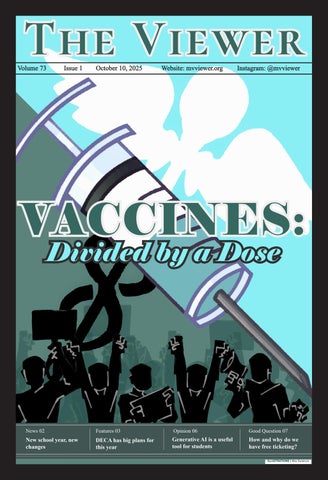
VACCINES:
Divided by a Dose


![]()


| Jadyn Heath-Hlavacek and Lale Akkin OPINION & DEBATES EDITOR AND PRINT EDITOR-IN-CHIEF
Astudent is considered to be continuing truant after missing three or more class periods on three different days, according to Ramsey County and Minnesota statute 260A. Last year, 31% of Mounds View students met the Minnesota criteria to be habitually truant, which is when a student misses one or more class periods on seven separate school days. That means over 500 students had seven class periods or more of unexcused absences. This school year, Mounds View implemented plenty of new updates to school policy, many relating to attendance.
Instead, when a student is skipping class periods, the school will take away their phone for the remainder of the school day. After calling the student’s parent or guardian for their cooperation, the phone will be held in student services with Administrative Assistant Gary Swanson, and the student can pick it up before leaving. If a student does not own a phone or bring one to school, nothing extra will be done, but any original consequences that come with truancy still apply.
Each classroom now has a hall pass kiosk, making it easier for students and teachers to create and manage passes. This is a way to record passes more efficiently while reusing old Chromebooks. Bathroom passes are also shorter now, with the time given decreasing from seven minutes to five. According to Associate Principal Staci Souhan, too many students were misusing the passes, even by using the remaining time to walk around rather than go back to class. “Kids aren’t using
In previous years, students would get lunch detention for unexcused absences, but that was not enough of an incentive to attend class, with many students continuing to have unexcused absences. Some schools take away parking permits as a consequence for absences, but Principal Rob Reetz disagrees with that idea. “I don’t feel like taking away a kid’s ability to get to school for purposes of not going to class is smart … it would be totally ironic for us to suspend a kid from school for missing class, or to give them in-school suspension for missing class because that just results in more missed class.”

Entrance to the cafeteria and where the lunch line forms.
Past lunch schedule
Students with first lunch
Period three: 10:39-12:04
• Lunch one: 11:11-11:36
Period four: 12:11-1:09
them to go to the bathroom,” she said. “They think it’s just a walk-around pass.”
However, last year some students struggled to find an unlocked bathroom even within seven minutes. That will not be an issue this year because all bathroom doors will be unlocked. A common misconception is that the doors were locked to avoid the use of electronic cigarettes in bathrooms. They were never meant to be locked in the first place; the custodians would lock the doors after cleaning and forget to unlock them in the morning. To avoid that again, Reetz told the custodians to keep the doors unlocked after cleaning.
The use of electronic cigarettes continues to be a problem at Mounds View. An option to combat it was to buy a smoke detector in each bathroom, but those are expensive and could easily be damaged by students. Instead, Mounds View has a hand-held device that detects e-cigarette smoke. Throughout the day, staff check the bathrooms with the device and may catch people who use them. This has been in place for years, but has not been emphasized to the

students until this year.
Mounds View has many emergency exit doors, but that also creates a safety concern regarding students leaving during the school day without staff knowledge or outsiders being let in. Students are required to only use the main entrance during the school day, and this year, they must scan in and out to ensure the school knows if a student is in or out of the building in case of an emergency. This new system helps record student presence more easily,
including students who go to Irondale every day. “We are required to keep students safe, to know where they’re at, and then to keep our building safe,” Souhan said. “We know exactly who’s in the building and who’s not.”
From attendance policy to safety enforcement, these changes at Mounds View will have real effects on students and staff, whether they see these changes as helpful or restricting.
| Jadyn Heath-Hlavacek and Lale Akkin OPINION & DEBATES EDITOR AND PRINT EDITOR-IN-CHIEF
In the past three years, Mounds View had four lunch times for students, with the first lunch in the third period. However, many problems arose from this schedule. The students who had first lunch had to also be in a fourth hour class with second lunch.
“So we had to match teachers together, and it ended up being the same teachers in the same blocks for the first couple of years we did it, and a lot of them got frustrated that they didn’t have more flexibility with their lunchtime,” said Associate Principal Benjamin Chiri. This complicated system created plenty of scheduling conflicts for students who had first lunch in third period along with a third or fourth lunch in fourth period. These issues are why the lunch schedule has changed back to three lunches this year.
a class, and teachers can easily switch lunches on days that they have an important activity such as a test or a lab. “Students have much more flexibility with their class scheduling, and teachers have more flexibility with their lunch schedule. So it’s a winwin in a lot of ways,” Chiri said. Lunches are now organized by subject rather than individual teachers, which allows teachers to communicate within their department easier. “It’s a lot more simplified, and we’re also not tied to the kids having the third and fourth hour block,” Chiri said.
The pizza line and the Ala Carte are also switched because the nature of the lines worked better. Last year, the Ala Carte had no clear entrance and exit, causing confusion for students and staff as well as enabling some to get away with stealing food.
Students with other lunches
Period three: 10:39-11:34
Period four: 11:41-1:09
• Lunch two: 11:41-12:06
• Lunch three: 12:14-12:39
• Lunch four: 12:44-1:09
Up until the COVID-19 pandemic, the school had three lunches. When the pandemic hit, they added another lunch to open up space for social distancing. Now, with COVID-19 no longer an issue and scheduling issues arising, the administration decided to condense it back to three.
Even when everyone’s schedule worked, lunches one and three split up class time. Now, only lunch two splits up
With fewer lunches, each one has more students. A primary concern for students after the switch was the crowding of the lunchroom and lunch line. On the first day of school, the line would not only reach the end of the hallway, but it wrapped around. However, after a couple of days, the lunch line moved much faster as the staff adjusted to the new system. Lunch staff reorganized the layout of the lines to make it more efficient. More self-service options are at the end so that kids are backed up waiting for lunch staff to serve them rather than crowding the area, and salad options are now in all three lines rather than just one, eliminating the need for students to navigate to other lines.
To deal with more people, the cafeteria has more lunch tables, and the staff lounge was repurposed so students can eat there. The staff lounge moved to the main office so that its old room could be repurposed to hold more lunch tables. The school plans on further developing the cafeteria and what used to be the staff lounge by adding new furniture and redesigning the layout. Along with other changes, the cafeteria can hold more people than before. “What feels like overcrowding is kind of more like students don’t want to sit close together,” Chiri said. “Yes, it feels crowded, but it’s not technically overcrowded, it’s within capacity, and there’s actually space that people probably don’t realize.”
The removal of lunch not only made all scheduling more flexible, it let staff figure out efficient ways to organize the cafeteria and lunch line flow. As the school year goes on, the cafeteria will keep adapting and get used to this change.
| Joey McVean SPREAD & NEWS EDITOR
ounds View Distributive Education Clubs of America (DECA) is entering the school year with new leadership and a new business model. As of this year, the Spirit Shop now operates as occasional pop-ups during school events. ”We’re doing a pop up at homecoming, then at communication nights and sports events so parents can buy stuff,” said senior Jayna Kavathekar. Mustang Mocha now occupies the space DECA previously set up their store.
Prior to this year’s changes, the DECA store was a shop that sold various Mounds View apparel. Now, with changes to the location and functions of the store, the advanced marketing class is undergoing changes as well. With business education teacher Rebecca Allard stepping down, the new advisors are business education teacher Philip Schut and former family and consumer science teacher Julie Coopet. “Mr. Schut puts a lot of emphasis on us stepping up. It’s like a pyramid. There’s co-presidents, vice presidents and then the whole leadership team,” said senior Scarlett Scholl.
The respective DECA leaders view the changes in a positive light. “I think it’s better for DECA members. A lot of times we would be working a lot of shifts, and we wouldn’t make any sales. I think this is more efficient because we’ll still make up for a lot of the sales. With Ms. Coopet running it, we’re really excited,” Kavathekar said.
“Personally, I’m happy with the changes. Last year, DECA was very established, but I think that this gave us the opportunity to kind of grow in new ways.”
Scarlett Scholl, senior
As a DECA advisor, Schut uses a more of a laissez-faire approach. “I want the students to be the ones making the decisions. I want them to be getting all the credit. But somebody still, ultimately needs to adjust it a little bit here and there,” Schut said. Schut believes that
allowing the students to play a larger role in running DECA will allow for more creativity and independence in making decisions. ”I want them to gain leadership. I want them to gain problem solving abilities and confidence with their problem solving. I want them to make choices and stick with them,” Schut said.
On top of being connected to the DECA store and sales campaign, students who participate in DECA are also able to compete in marketing and economics based challenges in local and regional events. “I’m excited for competition season, we’re putting a lot more time into learning the material this year for competitions,” Scholl said.
On the club side of things, there is a lot more that goes into running the DECA store than meets the eye. There are many ways to participate in DECA, including taking the marketing classes as well as showing up to the before-school meetings once a week with Schut. ”There’s two separate classes for intro to marketing and advanced marketing. Advanced marketing students are basically required to compete, and in In-

tro they’re not. There’s also the before-school club, which is staying the same,” Kavathekar said. For the Mounds View DECA leaders, faculty and students, the end of the old store is not the end of the program, but only the beginning of a new era of entrepreneurship and problem solving through pop up shops.
Looking to the future of the DECA store, club and classes, it is safe to say that the up- andcoming leaders view the transition in a positive light and are hopeful for the future of the program.


| Jadyn Heath-Hlavacek
OPINION & DEBATES EDITOR
An immune system is fundamental to almost any living multicellular organism, including humans. Viruses and bacteria can be found on most surfaces on Earth, many using other organisms and cells to self-replicate.
The immune system fights off these pathogens and it “remembers” what it has previously fought off to make sure that it can do its job faster and more efficiently the next time.
An immune system can remember past pathogens because of key identifying parts to them called antigens. This means that the next time it is exposed to a virus, the body will have antibodies to target those specific antigens at the ready. That process is called natural immunity, which is when someone’s body is exposed to a disease and can fight it better the next time after defending the body against it beforehand. When an outbreak occurs, many people’s immune systems will go through this process, protecting them from the effects of the pathogen.
Herd immunity is when enough of the population has an immunity to a specific disease, restricting continued spread.
However, herd immunity can be reached in a population without needing as many people to get sick and therefore defend themselves against the disease first.
Waiting for natural immunity to develop is risky for everyone involved, especially young children, older generations and those with weaker immune systems who could often get sick.
That is the very risk vaccines prevent and why they have developed so far. Vaccines contain weak and ineffective antigens of a specific disease, which cause an immune system to detect the threat and produce antibodies. Inserting these weak
or inactive antigens into a body allows for it to develop immunity without risk of getting sick, dying or spreading the disease.
This makes vaccines a unique tool in slowing or stopping the spread of a specific disease, since it does not require going into lockdown or letting natural immunity occur on its own. It lowers the risk to the lives of people with weaker immune systems until a society reaches herd immunity.
There is a major misconception among parents, however, that a child’s immune system can get “overloaded” with vaccines. However, the World Health Organization has looked into multiple studies and has stated that it does not support the hypothesis that vaccines weaken or harm immune systems.
There is also a common “disappeared diseases” misconception that states a vaccine is no longer required if the disease is uncommon or near-eradicated in the country. The reason why this is a misconception is that diseases such as polio and measles are still a major problem in other countries, and travelers can bring them to another country and infect unvaccinated people there. This happened to England in the early 2000s, when low vaccination rates allowed an outbreak of measles.
Another misconception is that hygiene and nutrition have more of an effect in countering diseases than vaccines. Although hygiene and nutrition are important, vaccines have shown to be much more effective. Between 1950 and 1963, there were between 300,000 and 800,000 cases of measles per year in the United States. Yet in 1968 after the vaccine was introduced, cases of measles cut down to just 22,000.

Since 1998, there have been an average of 100 cases per year or fewer, demonstrating the stark difference vaccines offer even in a society that already prioritized hygiene and nutrition.
Having schools require students to be vaccinated works well to establish a herd immunity and makes sure that the children who have not been pre-exposed to many antigens will still have the immune system to fight them, and schools and places where children intermingle will not be potential hotspots for the spread of disease. However, there still remains much resistance to vaccine mandates from parents who likely have more religious, social and political bearings.


Gabi Skiba FEATURES AND REVIEWS EDITOR
s of March 10, 2023, 81.81% of Americans received at least one dose of the COVID-19 vaccine, according to the Johns Hopkins Coronavirus Resource Center.
Since the invention of the first smallpox vaccine in 1796, people have been divided along scientific, social, moral and political lines about how vaccines should be utilized and administered by those in power.
The debate over vaccine mandates highlights a conflict between scientific evidence and ethical viewpoints. New scientific breakthroughs with vaccines have often clashed with anti-vaccine sentiment on the political and legal stage, fueling the fire of an already turbulent time in American politics.
On Sept. 3, Florida Governor Ron Desantis and Florida Surgeon General Joseph A. Ladapo announced that the state intended to, within 90 days, become the first to end all vaccine requirements. Desantis and Ladapo justified the decision by framing it as a matter of parental rights and bodily autonomy, but confirmed that they did not conduct a data review of how the move could affect public health. While the state health department can only end some mandates, state legislators are attempting to change vaccine laws. Many health officials worry about the ramifications of this decision, including the potential for epidemics and other states following Florida’s lead by reducing their own mandates.
Negative responses to such mandates are not new. In 1902, a minister in Massachusetts named Henning Jacobson refused to comply with his town’s order to be vaccinated for smallpox when an outbreak occurred in the area. Jacobson was fined five dollars, which he refused to pay, claiming that the mandate violated the state and federal constitutions. The dispute eventually made it to the United States Supreme Court, which made the landmark decision in Jacobson v. Massachusetts in 1905 to uphold the right of the states to enforce compulsory, or law-required, vaccine laws. Since the ruling, all 50 states have implemented vaccine requirements. The court ruled that someone can not use their belief against vaccination alone as an excuse to avoid mandates. However, a person can be exempted from vaccine laws due to physical condition or legitimate religious or philosophical beliefs. Minnesota has several vaccine requirements for children attending school. According to the Minnesota Department of Health, all students in kindergarten through sixth grade must be vaccinated for hepatitis B, polio, measles, mumps, rubella, varicella (chickenpox), diphtheria, tetanus and pertussis. Students in grades seven through 12 must have additional tetanus, diphtheria, pertussis and meningococcal ACWY vaccinations. While states decide how vaccines are mandated, federal recommendations play an equally important role in creating herd immunity. The administration of Robert F. Kennedy Jr., the U.S. Secretary of Health and Human Services, has come under fire in recent months, with some claiming he aligns with anti-vaccine ideologies. President Donald Trump appointed Kennedy, a past outspoken critic of vaccines, to lead the U.S. Department of Health and Human Services (HHS). In June, HHS replaced all 17 members of the Advisory Committee for Immunization Practice, which issues recommendations on vaccine use, and fired the director of the Centers for Disease Control (CDC) in August after she refused to comply with the administration’s agenda. Kennedy’s administration has been criticized for its handling of national health policy. According to the Texas Department of State Health Ser-
-vices, a measles epidemic in the Southwest U.S. resulted in 762 reported cases from January to August 2025, leading to the deaths of two unvaccinated children in Texas and an unvaccinated adult in New Mexico. These were the first recorded deaths of measles in the U.S. since 2015. Measles, a highly contagious disease known for skin rash and fever, was declared eliminated in the U.S. in 2000, but cases ranging from a few infections to even small epidemics have occurred in the past 25 years.
However, some states have found ways to counter the federal health administration.
Washington, Oregon, California and Hawaii formed a coalition called the West Coast Health Alliance, which will independently give health guidelines in those four states based on
scientific research instead of federal actions. In response to new federal COVID-19 guidelines, which restrict vaccines to people 65 years of age and older and those with high risk factors, Minnesota Governor Tim Walz signed an executive order in September going against federal recommendations and ensuring expanded vaccine access across the state.
While conflicts over vaccines have existed since their invention, America’s polarized political climate has brought the issue to the center of attention. The impacts of Florida’s unprecedented mandate ban and distrust in both the scientific community and the health administration will take years to fully understand. Americans are left to decide for themselves where the lines between science, morality and freedom lie.

While this may be the grand majority, containing a contagious virus depends on the full cooperation of a civilization. Practices like social distancing, quarantining and staying up to date with vaccines are all ways to contain viruses and keep people safe. However, these practices are hard to do for many people, and there has been growing skepticism around vaccines because some believe that they may be dangerous and do more harm than good.
Prior to its recent surge spurred by the COVID-19 vaccines, anti-vaccine sentiment has been around as long as vaccines have. Following the Vaccination Act of 1853, passed to contain smallpox in England, the National Anti-Vaccination League was formed in response to the mandatory vaccination of infants.
Anti-vax ideas developed in the United States in response to similar vaccination obligations. Organizations such as the Anti-Vaccination Society of America, founded in 1879, and the Anti-Vaccination League of New York City, founded in 1885, were some of the first such groups that contributed to the spread of anti-vaccine sentiment. Closer to the present day, groups such as Learn the Risk, Children’s Health Defense and the Informed Consent Action Network promote anti-vax ideals.
Vaccines developed by companies like Pfizer and Moderna offered vital support during the COVID-19 pandemic, yet some raised concerns regarding
the functionality and ethics behind the shot. A common point found amongst anti-vaccine discourse, specifically regarding COVID-19 immunization, mainly concerned the timeliness of the creation and distribution. The rapid development made room for doubt on the effectiveness and overall safety of the shot. Others expressed more complex theories such as the “COVID hoax,” a claim that discredits the virus as an attempt of population control.
Social studies teacher Kristin Heinz believes that theories around health crises increase political polarization. “I think that [people] used COVID as a way to divide the country even further; something that had nothing to do with politics was made political,” Heinz said. Conspiracies on social media platforms may influence a person’s decision of getting vaccinated. A now-debunked study published in The Lancet medical journal in 1998 asserts the MMR vaccine as the cause of autism, discouraging thousands of potential patients and their children from receiving their standard immunizations.
Parental vaccine hesitancy, another growing problem, raises the concern of if parents should have the ability to withhold a child from vaccinations, with some parents arguing that they should have the sole power to decide what their child is vaccinated with.
Despite the declared eradication of measles in the U.S. in 2000, continuous outbreaks since 2019 nearly downgraded the previous status, partly due to lowered vaccination rates and travelers from countries with the disease present. Countries lacking accessibility to vaccines, particularly develop-
ing countries in Africa and the Middle East, become extremely susceptible to disease, with some people born outside of the U.S. not immunized from deadly pathogens. Due to low vaccination rates, the infection rate of deadly diseases is significantly higher, with the CDC estimating that 20.6 million measles cases were reported in 2024. “My mom never got the HPV vaccine because she didn’t live in America,” said senior Leena Bassas. “They didn’t give vaccines like that in Syria.” Some groups can exempt themselves from vaccine requirements due to their religious beliefs. Regardless of the issues this could bring, the First Amendment of the U.S. Constitution guarantees freedom of religion and protects their right to remain unvaccinated if they have valid religious beliefs against it. Epidemics take a toll on not only the general livelihood but also economical, political and social climates. In the midst of a deadly plague, uproar, speculation and distrust is not uncommon to observe in societies. Disease-induced anxiety catastrophically weakens morale and trust, some of the most necessary factors involved in stopping the spread. While scientific evidence backs the effect vaccines have on disease control, some believe that the cost of losing liberty outweighs the benefit of immunization.

- Smallpox is the only human diesease to be completely eradicted by vaccination.
- mRNA vaccines contain the genetic instructions to a virus rather than an entire dead cell, stimulating immune response.
- Tetanus, a disease that naturally occurs in soil and animal feces, cannot be fully eradicated and vaccination is the only way to maintain protection.
- In less than a year, the COVID-19 vaccine was the fastest vaccine ever developed, shattering the previous record of 4 years for the mumps vaccine.
- After inventing the polio vaccine, Jonas Salk famously refused to patent it, stating: “The people own it. Could you patent the sun?”
On Sept. 10, 2025, Charlie Kirk, popular rightwing commentator, public speaker and co-founder of conservative organization Turning Point USA, was shot and killed at one of his trademark college events. Kirk was best known for traveling across the country and engaging in discourse with the public, sometimes in town squares and parks. He was primarily known for conducting these talks on college campuses and debating controversial and contentious topics with college students. Kirk was shot in the neck from 200 feet away while speaking at Utah Valley University. Given the divisive nature of the topics that Kirk discussed, he often received harsh backlash and opposition both online and in person by those he would debate. Topics like abortion, foreign and fiscal policy, gun regulations and separations of church and state were bound to cause people to argue, and that was the Charlie Kirk busi-
ness model. He used inflammatory language and debate tactics to portray his beliefs.
At the end of the day, Charlie Kirk was a man with feelings and a family just like anybody else. Allowing ourselves to forget this and see him more as a figure allows us to make fun or celebrate his death. It is OK to disagree with Kirk and his ideals, but the loss of a life is a loss no matter what. Death should never be celebrated. The

Because of Kirk’s controversial public perception, many people shared strong feelings either for or against him, his beliefs and his actions. In line with this, many people had strong reactions to his death of either celebration or mourning, with a wide spectrum in between. In the mainstream media, former MSNBC political analyst Matthew Dowd was fired for his on-air remarks in reaction. Dowd was recorded saying things like “Hateful thoughts lead to hateful words, which then lead to hateful actions,” as well as “You can’t stop with these sort of awful thoughts you have and then saying these awful words and then not expect awful actions to take place.”
The dismissal of Dowd is not an isolated occurrence. Indiscriminately of industry, there have been notable firings of staff.
Businesses like Nasdaq and Home Depot have also had fir-
ings due to comments from employees, and even professional sports teams like the Carolina Panthers fired a communications department team member for comments posted on his personal account.
from the university and simply spoke his mind. I find it hard to believe that these same people who gleefully cheered at the news would have the same reaction if Kirk said things that they aligned with. If we allow and propagate a culture that justifies a death just because of political disagreement, it becomes a dangerous precedent. Any dictatorship throughout history employs this same line of reasoning. The freedom of speech and expression of beliefs should never have to come with the fear of danger or, in cases such as these, death. Progress, innovation and the diffusion of ideas
is grown through discussion and debate, and if this discourse is prevented and its hindrance celebrated, it is a single road directed to danger and homogeneity.
enerative Artificial Intelligence platforms like ChatGPT, Claude and Perplexity have surged in popularity, reshaping how students write and revise. In fact, according to Semrush, ChatGPT ranks fifth out of the most visited websites in the world currently, showing just how deeply these tools have entered daily use. Yet schools remain divided on whether AI should be sanctioned for classroom writing.

AI is already a common resource in student writing. According to the Digital Education Council, 86% of students said they use generative AI in their studies. The most frequent uses
include searching for information and checking grammar. Treating these uses as academic dishonesty ignores reality: AI is rapidly becoming a workplace literacy. Still, sanctioning AI should not mean allowing it to “ghostwrite” essays. Students must still engage with their own ideas, arguments and voices, using AI as an aid in revision, clarity or polishing.
Critics argue that students should not rely on tools that prior generations learned to work without. According to Alliant International University, students' use of AI hinders their growth and strips them of their potential learning and intellectual growth. The concern is valid. AI shortcuts can be misused to bypass learning,
Nobody deserves to die just for stating their opinions. Speaking about controversial topics does not justify violence, no matter how many people may have disagreed with Kirk. Often, I have seen and heard things posted online and in person which celebrate and trivialize Kirk’s death. Kirk was well within his rights to say what he believed in the manner that he did. He had permission to speak

creating polished text without critical thought. Yet this objection overlooks the way technology evolves. Just as calculators did not erase mathematics but changed how it was taught, AI will not erase writing. Instead, it redefines efficiency. Resources like AI writing assistants are so readily accessible that refusing to use them could lead students to be slower, less competitive and ultimately less prepared. In a world where fluency in AI will be expected, not teaching or allowing these skills might cause students to fall behind.
That is why the sanctioning of these resources matters. Schools should allow AI for revision and editing, require students to disclose its use and integrate AI literacy into writing instruction. This approach balances accountability with opportunity. Students still draft
ideas independently, but can use AI to refine, restructure or polish. Such policies not only curb misuse but also prevent inequities between students who learn to navigate AI effectively and those who are left behind.
Of course, AI is not without its limitations. These resources can produce biased or inaccurate information, oversimplify complex ideas or even “hallucinate” facts entirely. In fact, according to the New York Times,
hallucination rates for a few AI systems were reported to be as high as 79%. Students who blindly trust these outputs risk incorporating errors or misrepresenting their arguments. This reinforces the idea that critical thinking and fact checking will continue, ensuring students remain active, analytical participants in the writing process.
Sanctioning AI in schools, then, should not mean uncritical acceptance. Instead, it should mean building clear policies, allowing AI in revision and editing, requiring transparency of use and teaching students AI literacy as seriously as grammar. Doing so could reduce the stigma around advanced tools, make writing more inclusive and ensure students learn both how to write with technology and how to think for themselves.
| Matthew Betti PRINT MANAGING COPY EDITOR
On Aug. 24, 2025, the popular illegal streaming website known as Streameast was shut down as part of a sting operation by Egyptian law enforcement and the Alliance for Creativity and Entertainment (ACE). The website, which had been visited over 1.6 billion times in the past year, allowed viewers to stream popular sports completely free. With around 80 associated domains, Streameast was the largest illegal live sports streaming operation in the world according to the ACE.
Kearney & MUSO measured 141 billion visits to piracy sites in 2023, up 12% since 2019
Unbeknownst to many, watching pirated content is actually illegal, even if it is rarely enforced. Most litigation is against those who download the pirated content and distribute it, especially if for a profit. Despite this, there have been cases where simply viewing pirated content has led to a law-

suit. In a 2014 New York court case Zuffa L.L.C. v. Pryce, the UFC successfully sued Price for $12,000 for viewing a pay-perview fight on a pirating website. Piracy websites are not anything new. They have been around for decades. They first originated during the 1980s with groups that created and distributed pirated content, known as “warez groups,” that used dialup modems to distribute their content. In 1999, digital piracy exploded again with the creation of Napster, allowing peo-
ple to access pirated content, mostly music, easier than ever before. The early 2000s only expanded this with the creations of networks like BitTorrent and LimeWire, which allowed users to download larger files, such as movies and software. By the 2010s, piracy evolved again; torrenting platforms like The Pirate Bay and Kickass Torrents eventually led to illegal streaming websites that allowed users to watch content directly, similar to modern pirating like with Streameast. Emerging soon af-
How and why do we have
| Grayson Then FEATURES & SPREAD EDITOR
Starting this fall, all home games and sporting events for Mounds View High School sports teams will be free for students. Several districts in the state have implemented this concept, and Mounds View has become the latest to do so.
The school board made the decision with the goal of promoting student attendance to home games. “The school board wanted to get more students attending all of our games, and they thought a good idea would be to allow all of our students to get a pass to get in [for] free,” said Activities Director Jim Galvin.
“There’s no reason not to go now.”
Stellan Feeman, junior
The proceeds previously generated from ticket sales went to the general district fund, but Mounds View does not currently have a way to make up for the cost. However, Principal Rob Reetz thinks the cost is worth it
to enable student engagement.
“I definitely don’t think that revenue needs to be generated based on student attendance,” he said. “We just want kids to go to games.” Reetz believes that the new system promotes student engagement in the activities offered at Mounds View. “If there are more students going to games, more aware of the things that their classmates are doing, to me that’s a positive,” he said. “Ideally, we get a really strong sense of school pride.”
Students have reacted positively to the change, citing the convenience of attending games. “It allows for more people to go to games who maybe weren’t able to before,” said junior Stellan Freeman. “There’s no reason not to go now.”
The move has already had an impact, with increased turnout at many events. By removing the monetary cost of attending games, more students have shown up to support their classmates. “We’ve had increased attendance at all of our fall sports,” Galvin said.
Another change with the ticketing system was the change with the app used by the school.
ter, in the late 2010s, Streameast quickly gained popularity for its wide range of available sports to stream while also not requiring any form of payment.
The market for pirated content has increased in recent years, and as technology continues to improve, worries over losses begin to mount. According to a 2025 study by Parks Associates, United States streaming services alone are forecasted to suffer a cumulative loss of $113 billion due to piracy by 2027. Also, visits to video piracy sites are rising: A study by Kearney & MUSO measured 141 billion visits to piracy sites in 2023, up 12% since 2019. Streameast’s takedown showcases the broad scale of digital privacy in the world today. The massive losses that these websites place on services like ESPN+ that offer these sports for fees have caused a greater demand for stronger protection, leading to shutdowns like Streameast.
The site was especially popular because it offered access to many major sport events blocked by streaming services’ fees or pay-per-view costs. As more and more streaming services fight for rights to certain events, accessing the right service for a certain sport gets more difficult. Along with that, the process is not affordable or convenient for many people. Sports that were once bundled together are now split across
platforms like ESPN+, Peacock or Amazon Prime. Streameast thrived on its accessibility to people, gathering all sorts of sporting events in one free space for viewers, even if illegally done.
Sports that were once bundled together are now split across platforms like ESPN+, Peacock or Amazon Prime. Streameast thrived on its accessibility to people, gathering all sorts of sporting events in one free space for viewers, even if illegally done.
While Streameast’s shutdown put an end to an illegal streaming website, it reveals a greater issue of rising costs and reduced accessibility of legal streaming services. For most people, paying for multiple services just to follow their favorite teams or shows is not realistic. Until there is a more affordable option, illegal streaming websites will continue to thrive.
“We switched from HomeTown Ticketing to Hudl ticketing, so it’s a different company,” Galvin said. While the app is different, the concept and ease of usage is the same. “It’s still electronic tickets just like you get anywhere else,” he said. Students can access their free pass either by using the Hudl Fan App or the link and unique code sent to their school email, and will be required to show their student pass for entry to sports events.
“I definitely don’t think that revenue needs to be generated based on student attendance.”
Rob Reetz, principal
In addition to home games being free, any Mounds View away games at Irondale High School will be free admission as well, with the same applied to Irondale students when they are at Mounds View. While tickets are free for Mounds View students, adults and students from

other schools must still pay for admission.
The new policy of free student admission intends to strengthen the community at Mounds View and give students a better opportunity to try new
experiences. “There’s a lot of really great things that happen on the court, the field, [or] the pitch,” Reetz said. “[Students should] be super proud of going to a school that does all these amazing things.”


3. When a student misses one or more class periods on seven separate school days, they are considered habitually ____.
5. What lunches are organized by.
7. Students will have free admission when Mounds View plays an away game against this high school.
9. The disease that the Vaccination Act of 1853 was attempting to contain.
10. Last name of man who refused to comply with town’s order to get vaccinated for smallpox.
1. Ranks fifth in most visited websites for August 2025.
2. What streaming service, then illegal, gained popularity in 1999 by letting people access pirated music for free?
4. Philip Schut’s approach for DECA leadership.
6. Weak or inactive parts of a pathogen.
8. Last name of former MSNBC political analyst who was fired for his on-air remarks in reaction to Charlie Kirk’s death.
