The Female Voice of the Reformation by S.M. Reed
Author Of Fiction, Author Of Faith: The Theology of Dorothy Sayers by Josephine Stringer
“Let us then pursue what makes for peace and for mutual upbuilding” (Rom. 14:19, NRSV)
The Female Voice of the Reformation by S.M. Reed
Author Of Fiction, Author Of Faith: The Theology of Dorothy Sayers by Josephine Stringer
“Let us then pursue what makes for peace and for mutual upbuilding” (Rom. 14:19, NRSV)
4 8 12 16 20
The Female Voice of the Reformation
A forgotten voice of the Reformation comes into focus through the life and writings of a woman who helped shape Protestant faith from the margins.
By S.M. Reed
Author Of Fiction, Author of Faith: The Theology of Dorothy Sayers
Novelist Dorothy Sayers used the power of story to invite readers to the mysteries of God.
By Josephine Stringer
Catharine Beecher’s Moral Theology
A pioneering educator and influential theologian, Catharine Beecher helped reform public thought about women’s education.
By Morgan Rae Esterline
“All Shall Be Well”: Julian of Norwich, Medieval Mother of Theology
Julian of Norwich’s visions and beautifully imaged theology reshaped Christian spirituality in the Middle Ages and beyond.
By Janet Warren
Read Women: Staff Picks and Reading Recommendations
Build your 2026 reading list with these books by female authors recommended by our staff at CBE!
Mutuality is published quarterly by CBE International, 122 W Franklin Ave, Suite 610, Minneapolis, MN 55404-2426.
We welcome your comments, article submissions, and advertisements. Visit cbe.today/mutuality
All Scripture quotations, unless otherwise indicated, are taken from the 2011 revision of the Holy Bible, New International Version®, NIV®. Copyright © 1973, 1978, 1984, 2011 by Biblica, Inc.™ Used by permission. All rights reserved worldwide.
Advertising in Mutuality does not imply organizational endorsement. Please note that neither CBE International, nor the editor, nor the editorial team is responsible or legally liable for any content or any statements made by any author, but the legal responsibility is solely that author’s once an article appears in Mutuality
CBE grants permission for any original article (not a reprint) to be photocopied for local use provided no more than 1,000 copies are made, they are distributed for free, the author is acknowledged, and CBE is recognized as the source.
3 From the Editor Reading Those Who Have Come Before
22 Annual Report
24 President's Message
Women Writers in Early Christianity: Their Courage, Leadership, and Legacy
25 Giving Opportunites
Editor: Carrie Silveira
Graphic Designer: Margaret Lawrence
Publisher/President: Mimi Haddad
Mutuality vol. 32 no 4, Winter 2025 Cover design by Margaret Lawrence.
Mutuality (ISSN: 1533-2470) offers articles from diverse writers who share egalitarian theology and explore its impact on everyday life.
Mutuality wouldn't be possible without gifts from our generous donors. Scan the QR code to support CBE publications.
From the Editor by Carrie Silveira

I was one of only three women in my college’s philosophy department. By my senior year, we had added two more female students to the program—progress, but we were still woefully outnumbered. In many of my classes, I was the only woman present. At my graduation, my parents gifted me a costume beard complete with bubble pipe so I would “fit in” with my philosopher colleagues. Just down the hall, though, the psychology department was made up almost entirely of women, with only a handful of men.
Why is it that some fields seem divided according to gender? Some might argue this reflects supposed natural or innate differences between women and men, “proof” of a complementarian division of specific areas for each gender. Others might see this as the result of a larger vicious circle: sexism paired with the way a field eventually becomes associated with the gender that dominates it. In time, that association draws in more people of the same gender and, intentionally or not, discourages the other.
For many of us, discovering women’s Christian scholarship can feel like opening a door we didn’t know existed. We often receive stories of women who grew up not knowing it was even possible for women to preach, interpret Scripture, or do theology. They share that reading the work of faithful, thoughtful women gave them language for a long-felt but unnamed calling and helped them finally imagine a place for themselves in ministry or academia. This is the power of representation: it allows us to picture ourselves stepping into these positions, reminding us that God has always called and equipped women, even when the church has not made space for them.
While men have historically received most of the recognition in fields like theology, philosophy, and biblical studies, women have been teaching, writing, and shaping Christian thought for centuries. Whether from the early church, the Middle Ages, or today, their contributions are essential. When women engage Scripture, they bring questions and insights others have overlooked. They challenge assumptions and expand our understanding of God, helping the church imagine a broader picture of the truth. The differences between genders are exactly why it is so important to have both women and men speaking into the church, working together to interpret Scripture, and doing theology side by side. When only half the church’s voice is heard, we miss out on half the wisdom and experiences God has given us.
In this issue of Mutuality, we turn the spotlight on the women whose work has strengthened the church. You’ll meet reformer Katharina Schutz Zell and novelisttheologian Dorothy Sayers. After that, read about a pioneer of women’s education in the United States, Catharine Beecher, followed by medieval mystic, Julian of Norwich. Finally, Mimi Haddad will guide us through a brief overview of impactful women from the early church through today. As the issue wraps up, you’ll also find a “Staff Picks” list to help you start building your own reading list—female authors who have especially shaped and inspired our team at CBE.
As you read this issue, I hope you are encouraged; you are not alone. May you go into the New Year confident in your calling, no matter the area, and stand tall on the shoulders of the women who have gone before.
Disclaimer: Final selection of all material published by CBE International in Mutuality is entirely up to the discretion of the publisher and editor. Please note that each author is solely and legally responsible for the content and the accuracy of facts, citations, references, and quotations rendered and properly attributed in the article appearing under his or her name. Neither CBE, nor the editor, nor the editorial team is responsible or legally liable for any statements made by any author, but the legal responsibility is solely that author's once an article appears in print in Mutuality


S.M. Reed
Many of the names that come to mind when we consider the Reformation—Martin Luther (1483–1546), John Calvin (1509–1564), Martin Bucer (1491–1551)—have one thing in common: they are male. Church history has a habit of erasing female voices, and the history of the Reformation is no exception. Women were also involved in the Reformation movement and their voices deserve
1497 1507
Katharina was born in 1497 to devout Catholic parents in Strasbourg, Germany. They valued social ethics and often criticized the wealthy aristocratic convents as hypocritical for not helping the poor.1 Katharina struggled with her Catholic faith from early on, trying to “achieve” salvation but constantly failing. When she first came across the teachings of Martin Luther through some of his tracts, Scripture “opened” to her, and she finally understood God’s mercy.2 She felt called by God to be a “fisher of people:”3
Ever since I was ten years old, I have been a student and sort of church mother, much given to attending sermons. I have loved and frequented the company of learned men, and I conversed much with them, not about dancing, masquerades, and worldly pleasures, but about the kingdom of God.4
to be heard! One of the most notable was Katharina Schutz Zell (1497–1562), an avid writer. While some of Katharina’s writing can be found in various anthologies or online, the most comprehensive collection may be found in the book, Church Mother: The Writings of a Protestant Reformer in 16th Century Germany, edited and translated by Elsie McKee.
1524 1523
Her initial plan was to never marry but to support herself as a weaver while ministering to God’s people.5 A visiting priest by the name of Matthew Zell (1477–1548) changed her mind. Zell was forty-five; Katharina was twenty-five. Zell preached Luther’s version of the Reformation, which Katharina already followed. He had a Latin education and many years of service as clergy. Nevertheless, he treated Katharina as an equal: “He much loved me and held me in great honor.”6
Luther had condemned the Catholic Church’s prohibition on clergy marrying, but there were still very few married clergy. Martin Bucer had been the first to marry in 1523; Later that same year, Matthew and Katharina followed suit. At the ceremony, both Katharina and Matthew took the Eucharist. However, taking the bread was forbidden for the clergy at the time, and drinking the wine was forbidden for lay people. Bucking tradition, both Matthew and Katharina took both the bread and the wine.7 This small act of rebellion foreshadowed much of their marriage and Katharina’s work to come. Katharina would later write about Matthew Zell:
He did not rule over or compel my faith; he also never put any obstacle in the way of my faith but rather much more he actively furthered and helped me. He granted and allowed me space and will to read, hear, pray, study, and be active in all good things, early and late, day and night: indeed, he took great joy in that— even when it meant less attention to or neglect in looking after his physical needs and running his household.8
“It will be seen that I have not acted according to the measure of a woman but have done faithfully and simply according to the measure of the gifts that God through His Spirit has given me.”
1535
This marriage brought about much controversy. Zell was officially excommunicated along with the other clergy who had married, but he continued to serve at the church in Strasbourg until his death years later. Katharina wrote and published her first official pamphlet to present her justification for their marriage titled, “Apologia for Matthew Zell on Clerical Marriage.” She argued it was better for clergy to marry as the unmarried were tempted to the use of prostitutes and abusing young girls.9
In response to the criticism of her first publication, Katharina wrote another defending her right to be heard. In it, Katharina never claimed equality.10 She wrote,
You remind me that the apostle Paul told women to be silent in church. I would remind you of the word of this same apostle that in Christianity there is no longer male nor female [Galatians 3:28] and of the prophet of Joel [2:28–29]: ‘I will pour forth my spirit upon all flesh, and your sons and your daughters will prophesy.’ I do not pretend to be John the Baptist rebuking the Pharisees. I do not claim to be Nathan, upbraiding David. I aspire only to be Balaam’s ass, castigating his master.11
1548
She strived to understand the meaning of suffering, how to provide pastoral care, and how to live a gospel life even through suffering.
Katharina wrote considerably on the topic of suffering, such as in her letter to the suffering women of Kentzingen, a German town near Strasbourg where protestants were experiencing persecution. She strived to understand the meaning of suffering, how to provide pastoral care, and how to live a gospel life even through hardship.12 She relied upon the example of Abraham who had been willing to give up Isaac (Gen. 22), and she looked at Christ’s suffering and his words to acknowledge him before man that he might also acknowledge us before God.13 She saw suffering as a testimony to the watching world. In a letter to women who had lost their husbands, Katharina wrote that suffering should be seen as “special fatherly gifts sent from God.”14
For indeed to an unbeliever it would look strange that God should give such gifts to His children, whom He loves! Such an unbeliever would much rather not be God’s child, but a child of the world, which does not treat its children that way: the world disciplines its children softly and tenderly. It is true, as Paul says, that faith is not everyone’s thing (cf. Eph. 2:8) and the worldly, that is, the carnal person cannot understand what is godly. But the spiritual, that is, the believing person (cf. Rm. 8:5–8), understands that God deals marvelously, surprisingly, with His own, completely contrary to the world and its children. . . .
So I beg you, loyal believing women, also to do this: take on you the manly, Abraham-like courage while you too are in distress and while you are abused with all kinds of insult and suffering. . . . Then you also are blessed.15
Two concepts were consistent key points for Katharina throughout her life and writings: sola scriptura and the daily ministry to the poor.16 Barred from formal education as a woman, she had to consistently make the most of what was available to her. She believed that a godly life was shaped and formed by the Word of God and set about to study it so that she could teach others.17 She also used inclusive gender language when quoting Scripture, which was ahead of her time. She had a very practical, down-to-earth writing voice threaded with humor and addressed real-life issues. There is great humility in Katharina’s writing. Clearly, she had a high view of God, and God’s grace extended to her. She saw herself as God’s servant.
I am a daughter of Sarah who believed, one blessed of the Lord, a child of God, a bride and fellow heir of His Son Jesus Christ, a purified shrine and temple of God the Holy Spirit, a companion who shares with all the saints the good things of heaven in eternal life. That is my glory, honor, joy, heavenly pride, and glorying in God and Christ, not in myself.18
This humility did not hamper the authority in her writing.19 Her other publications include expositions on Psalms and the Lord’s Prayer, and a four-volume book of hymns. It is likely she wrote even more which has been lost over time.20
1550
1562
Katharina was an influential Reformer and prolific writer, “one of the most outspoken women of the Reformation.”
Though Katharina never formally preached in a pulpit setting, she preached with her life. She was moved by the social gospel and lived accordingly, opening the parsonage to anyone in need, including refugees and traveling clergy.21 She believed the relief of the poor was a Christian duty.22 She took in and cared for a disabled nephew for many years23 and regularly visited the local prison to minister to the prisoners there.24 She was well-known for her compassion toward others and took that compassion to the city government to advocate for better treatment of the poor and homeless.
Upon her husband’s death in 1548, she had the opportunity to speak at his funeral. She encouraged people to hold to her husband’s teaching and to Christ. In her eulogy, she stated:
Christ has power to save us from sin, death, and hell, and to give us eternal life. In Him is all salvation, and in no other creature or work in Heaven and earth, for no one comes to the Father, or dares to think of coming to Him, except through this living Son of God, who should be honored as the Father is. 25
Katharina Schultz
Zell deserves to be remembered as a deacon, as a pastor, and as one of the foremost pastoral theologians of the 16th century. She demonstrated a “fearless pursuit” of the Christian life.
Though a layperson, Katharina was an influential Reformer and prolific writer,26 “one of the most outspoken women of the Reformation.”27 Her writings provide a unique perspective into a time of great change within the church. She was friends with Martin Luther, John Calvin, and Martin Bucer, and maintained regular correspondence with them.28 As such, their writings may have been directly or indirectly influenced by hers. Some say she helped to establish the basic tenets of the Protestant Reformation,29 and inspired the French theologian Marie Dentière (1495–1561).30
Katharina died on September 5, 1562, at the age of seventy-five. Historian Charlotte Methuen declared, “Katharina Schultz Zell deserves to be remembered as a deacon, as a pastor, and as one of the foremost pastoral theologians of the 16th century.”31 She demonstrated a “fearless pursuit” of the Christian life.32 Katharina had a “deep conviction that a believer’s whole life must be understood as a proclamation of Christ.”33 Though she didn’t read Latin or have formal training, Katharina should be recognized as a great theologian in her time. She lived out the roles of preacher and pastor through her life and actions. Anyone interested in learning more about the Reformation, church history, or theology would do well to read her works.
1. Elsie McKee, editor and translator, Church Mother: The Writings of a Protestant Reformer in 16th-century Germany, (Chicago: University of Chicago Press, 2006), 3.
2. Charlotte Methuen, “Preaching the Gospel Through Love of Neighbor: The Ministry of Ka therina Schultz Zell,” in Journal of Ecclesiastical History, 61, no. 4 (2010): 712.
3. Methuen, “Preaching the Gospel,” 712.
4. Christina Langella, “Katherina Schultz Zell,” Women of Christianity, November 15, 2011, womenofchristianity.com/katherinaschutz-zell-by-christina-langella/.
5. Joshua J. Mark, “Katharina Zell,” World History Encyclopedia , April 15, 2022, www.worldhistory.org/Katharina_Zell/.
6. McKee, 188.
7. Mark, “Katharina Zell.”
8. McKee, 188.
9. McKee, 74.
10. Ruth A. Tucker and Walter Liefield, “Katherina Zell,” in Daughters of the Church: Women and Ministry from New Testament Times to the Present (Grand Rapids: Academic Books, 1987), 183.
11. Quoted in Langella.
12. Methuen, 720.
13. Methuen, 721.
14. Methuen, 721.
15. McKee, 50–52.
16. Susan C Karent-Nunn, “Review of: ‘The Life and Thought of a 16th Century Reformer’ by Elsie McKee,” in Journal of Ecclesiastical History, 52 no. 1 (2001): 143.
17. Methuen, 724.
18. McKee, 212.
19. McKee, 25.
20. McKee, 33.
21. Mark, “Katharina Zell.”
22. Ibid., 13.
23. McKee, 24.
24. Mark, “Katharina Zell.”
25. Ibid., 107.
26. Karent-Nunn, 143.
27. Tucker, 182.
28. Langella.
29. Mark, “Katharina Zell.”
30. Mark, “Katharina Zell.”
31. Methuen, 728.
32. Karent-Nunn, 144.
33. Methuen, 722.

S.M. Reed holds two master’s degrees, one in Theology and one in Psychology. She was raised in church and has been involved in different ministry and lay leadership all her life. In 2024, she received the Alvera Mickelsen Memorial Scholarship for her pursuit of a Master of Divinity degree. You can read more from her on her blog: The Jaded Evangelical | SM Reed | Substack.


Q: What is the doctrine of the Trinity?
a: The Father incomprehensible, the Son incomprehensible, and the whole thing incomprehensible. It’s something put in by theologians to make it more difficult—it’s got nothing to do with daily life and ethics.
—Dorothy L. Sayers, Creed or Chaos?
In response to the reception of her successful Canterbury play, The Zeal of Thy House, Dorothy Sayers (1893–1957) wrote an essay bemoaning the misrepresentation of church orthodoxy. In the essay titled Creed or Chaos, Sayers argued that church doctrine was incomprehensible to the average layperson. While her question and answer are humorous (see quote above), Sayers was adamant that her dramatizations, like The Zeal of Thy House, did not make orthodoxy attractive:
It is the dogma that is the drama—not beautiful phrases, nor comforting sentiments, not vague aspirations to lovingkindness and uplift, nor the promise of something nice after death—but the terrifying assertion that the same God who made the world lived in
the world and passed through the grave and death.”1
This statement is just one of Sayers’ rich theological sentiments and may serve as an introduction to an almost forgotten theologian of the twentieth century.
Dorothy L. Sayers is often described as a lay theologian, but the adjective is superfluous.2 If the term “lay” is applied because Sayers did not formally study religion, then the beloved C.S. Lewis (1898–1963) must also be considered a layman despite his enduring theological import. Like Lewis, Sayers also studied languages and literature at Oxford, and both had a way with words. Their prowess with the English language coupled with their unique story-telling abilities made their theology palatable for
Josephine Stringer

the common person. Though both went on to become prolific writers, publishing fiction and nonfiction works, Lewis remains at the forefront of Christian imagination while Sayers is lesser known.
Theology is talk about God, more specifically, human conversation about God. 3 Sometimes this conversation happens in hefty theological tomes, like the Summa Theologica by Thomas Aquinas (c. 1225–1274), while others expound theology in a more pastoral voice, as in The Book of Pastoral Rule by Gregory the Great (c. 540–604) and Confessions by Augustine (354–430). Art and literature can also narrate theological truth, sometimes with more success than academic debate, and these were the tools that Sayers used so powerfully in twentiethcentury England.

an auThor of ficTion
After finishing her studies at Oxford, Sayers did translation and advertising work before writing a detective fiction novel titled, Whose Body? (1923).4 The success of the novel led to ten more books in the series, plus several short stories.5 Sayers proved an important contributor to the detective genre and served a term as president of the London Detection Club, a group of writers that boasted G.K. Chesterton (1874–1936) and Agatha Christie (1890–1976) as members.6 While Whose Body? is a far cry from Summa Theologica, the story nonetheless is full of theology. The idea that a popular fiction story can be theological may seem absurd but consider: the fulcrum of detective fiction is sin, the incessant problem of the human condition. The plot of murder is even more common in the genre, and death is a fundamental theological construct that is inextricably linked to several theological doctrines. Salvation, as understood in the Christian faith, is deliverance from the deadly consequences of sin. The Eucharist is a sacramental picture of the death of Jesus, a human death. The hope of heaven is a consolation for human suffering and death.7 More than an entertaining “whodunnit,” Sayers explored theology, especially life and death, in her fiction writing. Looking back at her body of works, she noted the continuity of her theological musing:
I know it is no accident that Gaudy Night, coming towards the end of a long development in detective fiction, should be a manifestation of precisely the same theme as the play The Zeal of Thy House, which followed it and was the first of a series of creatures embodying a Christian theology. They are variations upon a hymn to the Master Maker; and now after nearly twenty years, I can hear in Whose Body? the notes of that tune sounding unmistakably under the tripping melody of a very different descant; and further back still, I hear it again, in a youthful set of stanzas in Catholic Tales 8
After her success with the detective novels, Sayers was invited to participate in another type of creative writing: playwriting. It is this genre that solidified Sayers as an accomplished theologian. The dean of Canterbury Cathedral was hosting dramatic performances in hopes of reviving church attendance. T.S. Eliot’s Murder in the Cathedral was one of the first performances, followed by Thomas Cranmer of Canterbury by Charles Williams (1886–1945), a friend of Sayers.9 Williams had suggested contacting Sayers for a script which became the play The Zeal of Thy House. The play was so popular that additional trains were added to take passengers from London to Canterbury Cathedral.10 One critic wrote,
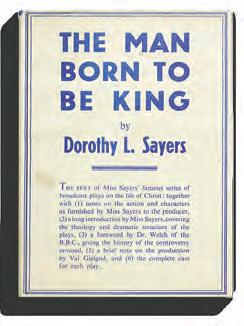
“Not only is this play sincere and impressive . . . it is good entertainment . . . an essentially serious treatment of theological questions . . . which with rare skill Miss Sayers has made at the same time dramatic.”11 Sayers wrote several more plays after that, but her most notable script was The Man Born to Be King, commissioned by the British Broadcasting Corporation to be read on the air. A close friend and biographer of Sayers, Barbara Reynolds (1914–2015), described the play’s reception:
The nation-wide response to The Man Born to Be King was overwhelming. Appreciative, even rapturous letters poured in from listeners of all ages, of a wide range of professions and callings, from laity and from clergy of all denominations. Thousands are still alive who heard the broadcasts when they were young and whose lives were lastingly affected by them.12
Sayers alternated between writing plays, novels, poetry, and short stories. As her faith became a more integral part of her life, she also began to write theological essays, like Creed or Chaos? (1940), as well as reflections on the state of the church in its cultural moment. Though Sayers did not write extensively about feminism, her essay Are Women Human? (1938) has been transformational for many even to this day.
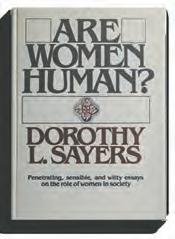
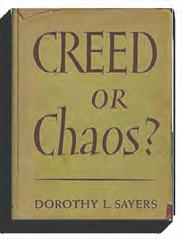
Despite her impact on English Christianity, Sayers had no illusions about herself and was well aware of her flaws. In 1943, the Archbishop of Canterbury wanted to present Sayers with an honorable Doctor of Divinity, but Sayers rejected his invitation. Reynolds notes the Archbishop’s praise, that Sayers’ plays “were one of the most powerful instruments in evangelism which the Church had had put into its hands for a long time past.”13 In her rejection letter, Sayers replied that “a degree in Divinity is not, I suppose, intended as a certificate of sanctity, exactly; but I should feel better about it if I were a more convincing kind of Christian.”14 Sayers set herself to the task of writing and there she stayed.
Though their repertoires had grown to include nonfiction theological treatises, both Sayers and Lewis
found fictional story to be an important method for conversing about theology. “Sayers' observations about the power of story were theologically grounded in her belief that truth and story were perpetually connected since God, the eternal truth, entered into human history in the incarnation of Jesus and that this was the ultimate story.”15
For Sayers, storytelling provided not only the means for theological conversation, but the reach: her theology was for the masses. Rather than academic tomes declaring her personal theology, Sayers wrote fictional stories that invited her readers to enter into a theological conversation. She wrote about the sins of humanity in her detective novels and the victory of Jesus in her evangelistic plays. Through her essays, Sayers desired to galvanize the church to better understand the gospel message. Scholar Crystal L. Downing writes, “When her faith was reenergized in middle age, Sayers did not change much in her desire to shock Christians, still disgusted by the way they had ‘certified’ Jesus to be ‘meek and mild,’ thus turning the ‘Lion of Judah’ into a ‘household pet for pale curates and pious old ladies’.”16
Dorothy Sayers died in her home in 1957 with a more than fifty publications to her name. Spanning several years and genres, Sayers's work continues to be important today. “As the label evangelical alienates more and more people in our own era, Sayers can guide Christians through cultural minefields, providing direction to those wary of belief and weary of evangelical language.”17 Storytelling can be a refreshing invitation to a theological conversation. To be better theologians, we should become better storytellers.
Notes
1. Dorothy L. Sayers, Creed or Chaos (Manchester: Sophia Institute Press, 1949), 19–25.
2. Laura K. Simmons, “Theology Made Interesting: Dorothy L. Sayers as a Lay Theologian” (PhD diss., Fuller Theological Seminary, 1999), ProQuest Dissertations & Theses Global.
3. Alister McGrath, preface to Theology: The Basic Readings (Malden, MA: Blackwell Publishing, 2008), x.
4. Dorothy L. Sayers, Whose Body? (New York: Harper Collins, 1923).
5. “About Dorothy L. Sayers,” The Dorothy L. Sayers Society, https:// www.sayers.org.uk/.
6. “About Dorothy L. Sayers.”
7. Alister McGrath, A Brief History of Heaven (Newark: Wiley & Sons, 2003), ProQuest eBook Central.
8. “Salute to Mr. G.K. Chesterton: More Father Brown Stories,” The Sunday Times, review, April 7, 1935, in Brown, “The Seven Deadly Sins in the Work of Dorothy Sayers,” 3.
9. Charles Williams was a member of the informal literary society, “The Inklings,” which also boasted C.S. Lewis and J.R.R. Tolkien as members. See Grevel Lindop, Charles Williams: The Third Inkling (New York: Oxford University Press, 2015).
10. Barbara Reynolds, Dorothy Sayers: Her Life and Soul (Kent: Hodder and Stoughton, 1993), 280.
11. "Play Bill at the Theatre," Illustrated Sporting and Dramatic News,
8 April 1938, 88.
12. Reynolds, Dorothy L. Sayers, 327.
13. Reynolds, Dorothy L. Sayers, 328–329.
14. Reynolds, Dorothy L. Sayers, 329.
15. Amy Orr-Ewing, “Truth, Story, and Pattern: Keys to Appreciating the Apologetic Contribution of Dorothy L. Sayers, " paper presented at the Marion E. Wade Center of Wheaton College, Wheaton, IL, January 23, 2024.
16. Crystal L. Downing, Subversive: Christ, Culture, and the Shocking Dorothy L. Sayers (Minneapolis: Broadleaf Books, 2020), 4–5.
17. Downing, Subversive, 2.

r aTher Than academic TomeS declaring her perSonal Theology, SayerS wroTe ficTional STorieS ThaT inviTed her readerS To enTer inTo a Theological converSaTion.

Dr. Josephine Stringer holds a PhD in leadership studies (Dallas Baptist University) and a master’s degree in women and theology (Northern Seminary). As the director of the Center for Women in Leadership, Dr. Stringer curates the Visual Museum of Women in Christianity, a visual exhibit of women in the history of Christianity.


Morgan Esterline

A lady should study— not to shine, but to act.”1
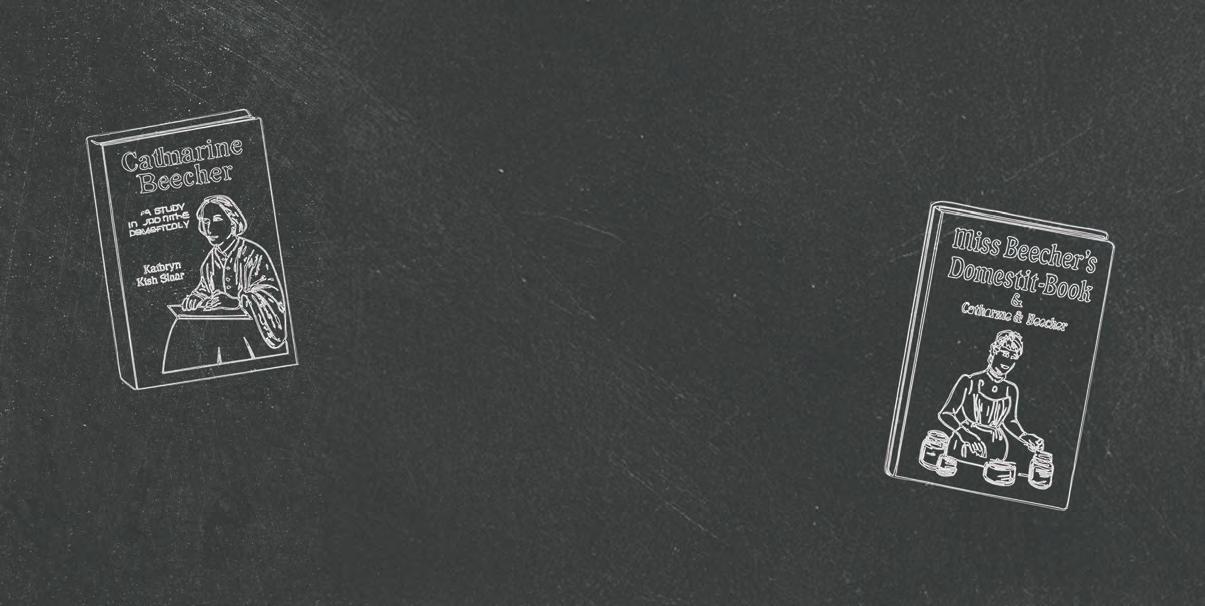
Catharine Beecher (1800–1878) thrived in the “domain of men”: religion, philosophy, and social politics. As an educator and author, she wrote more than twenty books as well as numerous essays, articles, and poems. Her expansive writing astonished both male and female readers, leading to financial success and multiple opportunities to lecture across the United States. She set a precedent for women’s involvement in public discourse, becoming part of the 19th-century American feminist intellectual heritage.2 She conversed with a public sphere that limited women’s influence to the home; ironically, the same sphere she claimed women should not enter. Her view of a robust, well-rounded education for women was aimed at enabling them to better fulfill their societal role as mothers.
Works like her Essay on Slavery and Abolitionism with Reference to the Duty of American Females emphasize this conviction while bringing to light the apparent incongruity in her beliefs. Beecher supported both women’s subordination and educated involvement in the public sphere.3 She was simultaneously traditional and radical; Christians who believe in women’s equal partnership and authority in society, church, and the home may gain much from her life and her writings while acknowledging her blind spots.
Beecher was the eldest of thirteen siblings, and eleven years older than her sister, famed abolitionist Harriet Beecher Stowe (1811–1896). Her mother died when she was sixteen, so she took on the responsibility of the household until her father remarried the following year.4 A Presbyterian minister, her father established a familial interest in social activism and religion. As a result, her siblings and half-siblings would go on to become suffrage leaders, abolitionists, and pastors. It was a time of profound cultural change in the United States: she was born in the days of American slavery and lived to see it abolished.5
In the nineteenth century, education for girls started at home and was focused primarily on social skills and manners rather than math, science, or literature, affirming these to be “male domains”. Beecher, however, attended the Litchfield Female Academy, founded by Sarah Pierce (1767–1852). There her education included disciplines traditional for girls and young women, as well as a careful blending of the “ornamental arts”6 with academic topics.7 Pierce’s educational philosophy and intellectual curriculum provide context for Beecher’s understanding of women’s roles and responsibilities. At the age of twenty, she readily disagreed with her fiancé and father’s interpretations of theology, causing tension in their relationships until her fiancé’s untimely death in 1822.8
She never married, choosing instead to dedicate herself to education, and continued to interpret the Bible for herself and encourage other women to do the same.9 Having studied Latin, philosophy, and mathematics, she did not shy away from difficult topics. As she began to write more and more, she argued for a unifying, Protestant moral code in Letters on the Difficulties of Religion and for free will in an essay in the Biblical Repository. 10
With the inheritance she received from her fiancé and the support of wealthy local wives, Beecher and her sister Mary opened Hartford Female Seminary in 1823. In her words, “the intelligent and influential women came to my aid and soon I had all I sought.”11 Carrying forward the impact of the Second Great Awakening (1790–1840), she went on to lead revivals at the seminary. Thanks to the success of the seminary and Beecher’s influence, several states opened women’s colleges, adding to the educational opportunities of women everywhere.12
Beecher was a paradox, holding a mix of both traditional and non-traditional beliefs. She believed women needed comfortable clothes that didn’t restrict movement, regular exercise, and knowledge about homeopathic methods to ease mental and physical pain caused by female anatomy, like menstrual cramping. She advocated for women to receive sex education, covering topics like contraception, menstruation, and childbirth. At the same time, her radical support for women’s education was based on culturally traditional beliefs that women have an innate moral superiority and thus a responsibility to teach other women as well as children.13 Women, she argued, should be kind, peaceful moral leaders for husbands and children (the boys as future voters and politicians and the girls as future moral leaders). To fulfill this role, women needed “as good” of an education as men.14

Beecher was a paradox, holding a mix of both traditional and nontraditional beliefs.
Beecher also contributed to contemporary theology. It is common for antebellum scholars to frame evangelical women, including female preachers, as social reformers rather than theologians—as rebels rather than curious thinkers. Scholars like Barbara Epstein and Sarah Evans interpret anger at subordination as the reason for women’s religious engagement in the 1800s.15 Dr. Mark David Hall, however, takes Beecher’s beliefs seriously, naming her “America’s first female [systematic] philosopher and theologian.”16 In her theological essays, she fearlessly critiqued highly influential male theologians “from St. Augustine to Jonathan Edwards,” writing “forceful, opinionated treatises on abstract theological concepts” and social issues.17 She criticized the damage from church structures that allowed the harassment of women without disciplining the men. Hall corrects an interpretation of Beecher’s beliefs as evidence of her leaving evangelicalism, claiming instead that she “abandoned the ‘harsher’ tenets of Calvinism while remaining in the evangelical camp.” She then “intertwined Calvinist thought— particularly the notions of submission,
self-denial, and self-sacrifice—with Common Sense philosophy.”18
Theologians, she believed, often do not recognize the basic nature of human minds as philosophers do. Some knowledge is simply common sense that all are capable of learning. Personal experience is a useful tool for learning because, while humans are sinful, most morality is learnable through reason, as demonstrated by the moral goodness in other philosophers and religions. Sin-inclined humans still contain human goodness and make free choices, even though they need salvation to be righteous in the sight of God. Therefore, they should have the freedom to learn. 19 Philosophers, on the other hand, all too often ignore the theological nature of human minds as created by a divine author. As such, they miss out on the reason why people should live moral lives: because of Christ’s redeeming love that saves us from sin. They also miss that living a moral life is not enough to gain true happiness, which comes from God. Thus, some knowledge is only revealed through God’s revelation, and it is God’s law that
reveals our moral obligation to not “destroy happiness or cause pain.” 20
Beecher reminds philosophers, theologians, and us that it is only through seeking after others’ happiness, obeying God’s command to love our neighbors as ourselves, that we experience happiness. Our “own happiness both for time and eternity” depends on doing good works for others, since a faith without works is a dead, fruitless faith. She implored evangelicals who have faith to follow God’s Law and practice holiness, combining theological and moral concerns.21 In her poem “Psalm CXXXIX [or 139],” she cries out:
O search me, Lord! and know my thoughts, forbid my feet to stray, But lead me from the paths of sin to everlasting day.22
Catharine Beecher was a radical thinker and theologian who revolutionized women’s educational opportunities and the philosophy behind loving our neighbors. The moral issues of her time differ from ours, but we must continue to recognize how theology impacts others in practice.
Our own happiness both for time and eternity” depends on doing good works for others, since a faith without works is a dead, fruitless faith.
The moral issues of her time differ from ours, but we must continue to recognize how theology impacts others in practice.

She saw the harm caused by slavery and women’s lack of education and worked to expand women’s opportunities even within the assumption of gender hierarchy. We would do well to learn from her profound impact while taking the fight for women’s equality even further.
Notes
1. Gladys S. Lewis, “’Moral Philosophy and Curricular Reform’: Catharine Beecher and Nineteenth-Century Educational Leadership for Women,” Forum on Public Policy Online 2009, no. 2 (2009): 4.
2. Catherine Villanueva Gardener. “Heaven-Appointed Educators of Mind: Catharine Beecher and the Moral Power of Women.” Hypatia Vol. 19, no. 2, (2004), 3.
3. “Catharine Beecher” CT Women’s Hall of Fame, https://www. cwhf.org/inductees/catharine-beecher.
4. Debra Michals, "Catherine Esther Beecher," National Women's History Museum, 2015, www.womenshistory.org/educationresources/biographies/catharine-esther-beecher.
5. Lewis, 9–12.
6. The “ornamental arts” include needlepoint, drawing, painting, music, and assorted hospitality skills deemed appropriate for women to maintain their ornamental status. Jennifer C. Core and Janet S. Hasson, “Female Education and the Ornamental Arts in Antebellum Tennessee.” Journal of Early Southern Decorative Arts, https://www.mesdajournal.org/2019/femaleeducation-and-the-ornamental-arts-in-antebellum-tennessee.
7. Litchfield Historical Society, “Litchfield Female Academy History,” The Ledger, https://ledger.litchfieldhistoricalsociety. org/ledger/studies/history_lfa.
8. Lewis, 3.
9. Lewis, 11.
10. Lewis, 9.
11. Lewis, 4.
12. Lewis, 1–3.
13. Lewis, 6.
14. Gardner, 2.
15. Hall, 66.
16. Hall, 67.
17. Hall, 68
18. Lewis, 10; Gardner, 2.
19. Hall, 71–72.
20. Hall, 76–77.
21. Hall, 77.
22. Brett Nelson, “Catharine Beecher (1800–1878).” Forgotten Poets, February 2, 2020. https://forgottenpoets.wordpress.com/2020/02/02/ catharine-beecher-1800-1878.

Morgan Esterline is a senior at Thomas More University, studying English, Creative Writing, and Philosophy. She is dedicated to the theology of women in her personal studies and is an apprentice for the Place Keepers Initiative which runs creative wr iting programs as part of the Urban Appalachian Communi ty Coalition (UACC) and the Originary Arts Initiative (OAI).
Janet Warren
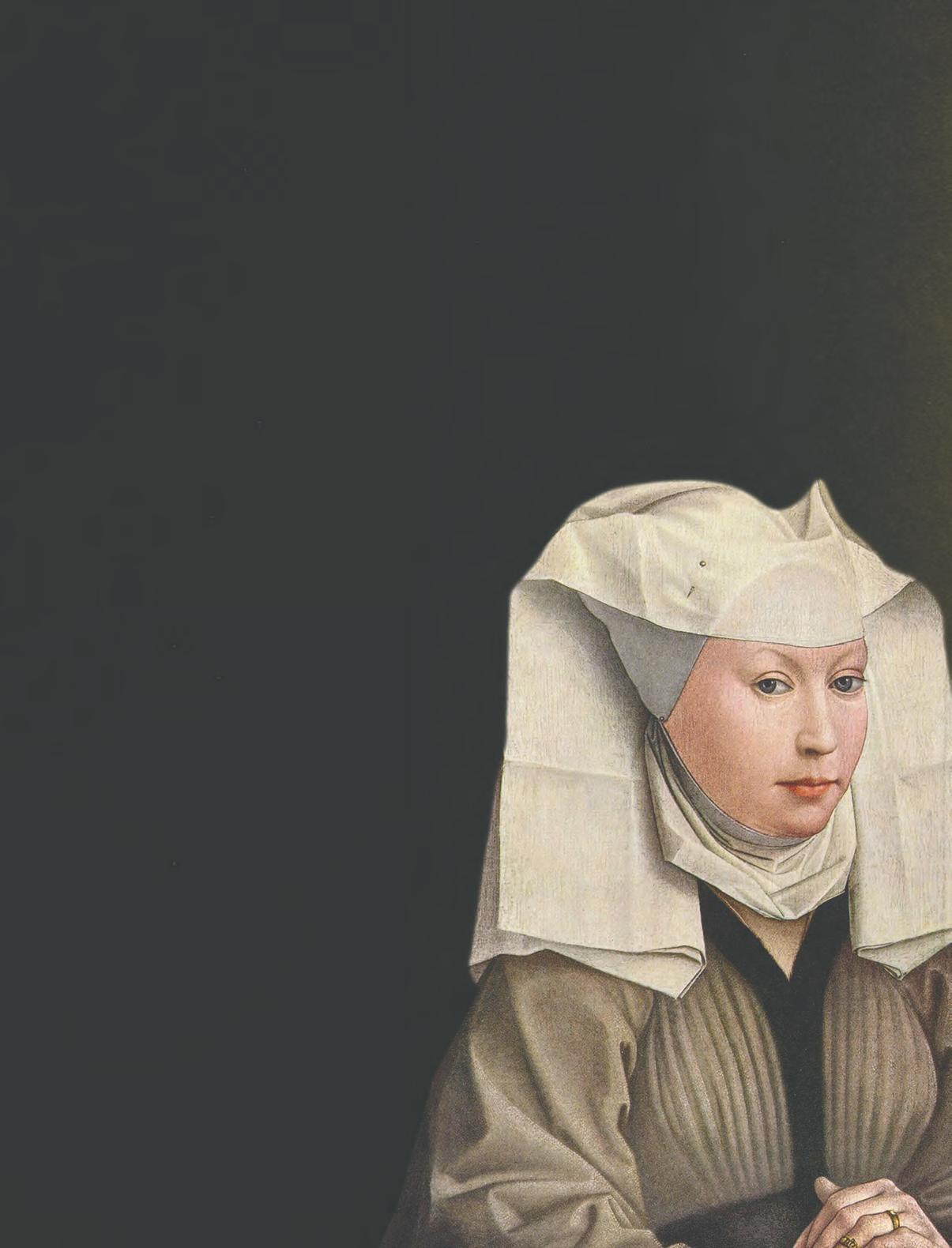
The remarkable woman known as Julian of Norwich (1342–1416) implored her readers: “quickly forget me.”1 Thankfully, her wish was not fulfilled, and her work, Revelations of Divine Love, enjoys more popularity now than it did in her time. This medieval woman did not set out to write theology but, after experiencing powerful spiritual revelations, was compelled to share them along with her reflections on divine love. Reputed to be the first female writer in English, Julian has left a rich legacy. Using distinctly feminine language, she provided profound insights on spiritual direction, prayer, the Trinity, the incarnation, sin, salvation, and sanctification.

Little is known about Julian’s life, not even her real name. She was likely unmarried or widowed and living with her mother at the time of her visions or “showings” as she called them, and she later served as an anchoress at St. Julian’s church in Norwich.2 Julian received these revelations in AD 1373 in or near this thriving medieval city. Its location on the east coast of Anglia meant that trade was plentiful. However, all was not well. England’s war with France and three separate recurrences of the bubonic plague in Norwich led to deep poverty, population loss, and political uncertainty.
The church in Norwich was also troubled; papal rivalry led to extravagant selling of indulgences and eventual war. Those who criticized the papacy, like John Wycliffe’s followers, were burned at the stake.3 Women who taught theology could also be burned as heretics.4 Commoners lived in great fear of judgment day; “death bed” paintings often depicted demons surrounding an ill person.5 There was a strong emphasis on sin, guilt, eternal punishment, and confession.6 Understandably, the spirituality of the time focused on coming to terms with death.7 Given a culture surrounded by war, illness and death, a church in trouble, and a theology focusing on sin and judgment, England in the Middle Ages was in desperate need of assurance that “all would be well.”
During this troubled time, Julian fell gravely ill. On her assumed deathbed with a priest in attendance, she experienced sixteen “showings”—visions that were a mix of visual (blood flowing from the crucifix) and spiritual. Soon after her recovery, Julian recorded these revelations in a Short Text (ST); some twenty years later, after much meditation, she wrote a longer, more detailed version—the Long Text (LT)—that included practical guidance and scriptural
interpretation. She had made three pleas: to see Christ “in the flesh” and “suffer with him,” to experience “bodily sickness,” and to receive the wounds of contrition, compassion, and “an earnest longing for God” (ST 1). Both her illness and her visions seemed to be answers to these pleas.
The Revelations of Divine Love, both the Short and Long Texts, were written to fellow Christians, or “those who would be saved” (ST 1, 6, 13; LT 9). In them, she described three types of visions: “bodily sight,” “words formed in my understanding,” and “spiritual sight” (LT 9). Although she viewed herself as simple and uneducated, her writing attests otherwise. A woman at that time would have had minimal formal education, but she demonstrated great familiarity with Scripture and the teachings of the church to which she frequently professed and advised submission.
In contrast to the surrounding grim spiritual atmosphere, Julian’s theology was enfolded in love and centered on the cross. Her monastic style of writing used imagery and allegorical methods of interpretation,8 as seen in her parable of the servant.9 Her concepts are strongly scriptural, well-integrated, and portrayed using distinct feminine language. In the Long Text she introduces the book as a “revelation of love” (LT 1) and ends it by summarizing the purpose of the showings:
ALL CREATION IS AS SMALL AS A HAZELNUT IN COMPARISON TO GOD’S LOVE; GOD IS “ENDLESS LOVE UNCREATED".

JULIAN RECOGNIZED THAT FAITH IS NOT SIMPLE. SHE BOTH MODELED AND TAUGHT THAT WE CAN SIMULTANEOUSLY QUESTION AND ACCEPT THE DIVINE MYSTERY.
“Our Lord’s meaning was love” (LT 86). In a dark and difficult time, Julian emphasized that love describes God’s attributes, his actions, and his very being. All creation is as small as a hazelnut in comparison to God’s love; God is “endless love uncreated” (LT 44). In Julian’s sixth vision, depicting a lord holding a banquet, she described the Lord as “homely and courteous” ( LT 14). In Middle English, “homely” is more than “familiar” or “intimate,” conveying an image of being “at home” with God, a uniquely feminine characterization for the time. In contrast to the medieval focus on fearing God, Julian was astonished that he would be so intimate with a sinful creature. Like Jesus’s command to “abide” in him as branches in a vine (John 15:1–17), she declared that God is our home, and we are his home. Elsewhere, she likened God to our clothing and believed our souls are knitted to God, again using feminine imagery ( LT 5, 6, 53).
Julian also presented a unique image of Christ as Mother (LT 59, 60). She described three aspects of motherhood and connected them to specific works of Christ: creative foundation, incarnation (Jesus’s assumption of human nature), and acts of “mothering” like feeding and disciplining. Like our natural mothers, Christ brings us into the world and nurtures us with tender love and wisdom, even suffering with us. Although other theologians had previously pointed out some feminine characteristics of God,10 Julian was one of the firsts to consider motherhood an attribute of God.
In the spiritually thirsty and distressed world of her day and ours, Julian’s writing leads us to Christ for a refreshing drink of love and a hand-knit baby blanket. It powerfully invites us into the contemplative life, demonstrating loving, listening, and theological toughness. Revelations of Divine Love is full of guidance that is practical, consistent, and well-integrated with her theology.
Julian encouraged Christians to seek God with diligence, patience, and absolute trust: “God, of your goodness, give me yourself” (LT 5). She noted three ways to know God: through reason, revelation, and the teachings of the Church—a concept ahead of its time, anticipating Wesley’s quadrilateral for theological reflection.11 Above all, Julian focused on the cross, recommending contemplation of the passion of Christ and reminding us of its help in spiritual warfare. God’s love is greater than we can imagine: “we are his joy” (LT 22), and we can relate to him as father, mother, and lover.
Julian also recognized that faith is not simple. She both modeled and taught that we can simultaneously question and accept the divine mystery, remembering that what is impossible for us is not impossible for God. Thus, we can “rejoice in him for everything which he reveals and for everything which he conceals” (LT 36). We should “wonder reverently,” “suffer meekly,” and accept some mysteries (LT 34, 47). “It is God’s wish that we should know in general terms that all shall be well, but it is not God’s wish that we should understand it now” (ST 15).
Julian offered much compassion to those suffering but no trite answers. She affirmed the experience of alternating joys and sorrows, believing that God protects and loves us in both. “All is well” only when we patiently trust in the triune God. Julian did not promise a trouble-free life but reassured us that the fiend is overcome and that, eventually, all our suffering will be taken away. Those who are suffering, therefore, are encouraged not to “fret,” “for if we knew him and loved him, we should be completely at rest” (ST 20). Rather than anxious or doubtful fear, we are to have “reverent fear” which “softens and comforts and pleases and rests us” (ST 25). She urged those in trouble to run to their heavenly Mother for help and to seek rest, not in created things, but in God, our true rest. Well ahead of modern psychology, she built self-esteem by pointing to the esteem God has for us. In contrast to her culture, she advised Christians that if we do sin, we are not to be unreasonably sorrowful, but to repent discreetly and then immediately turn to contemplate Christ.
Julian also taught Trinitarian prayer: we are to love God, praising him for creation, pray to Jesus for mercy, and supplicate the Spirit for help and grace. Knowing God and knowing self are intertwined: “prayer unites the soul to God” (ST 19, LT 43, 46). “Prayer is a new, gracious, lasting will of the soul united and fast-bound to the will of God” (LT 41). She exhorted readers to “pray earnestly even though (we) do not feel like praying” because it pleases God (LT 41). Julian also offered a model of how prayer works: God instills a desire within us, so that we then pray and give him the opportunity to fulfill that desire. Consistent with her theology of union, prayer involves reciprocity:
I am the ground of thy beseeching; first, it is my will thou shalt have it; after, I make thee to will it; and after I make thee to beseech it and thou beseechest it. How should it then be that thou shouldst not have thy beseeching? (ST 19, LT 41)12
People today are still seeking. They devour food, alcohol, drugs, and passive entertainment but remain unsatisfied. Even Christians too often busy themselves in church activities instead of spending time in passive delight in the Lord. Julian of Norwich’s work invites readers to “eagerly, attentively, and humbly contemplate God, who in his gracious love and eternal goodness wanted the vision to be generally known to comfort us all” (LT 8). The church needs to reintegrate theology and spirituality and refocus on the compassion of the cross. Despite the mysteries we must accept, we can rest in the assurance of the triune God that “all shall be well” “for the goodness of God is the highest object of prayer and it reaches down to our lowest need” (LT 6).
Notes
1. Elizabeth Spearing (translator). Revelations of Divine Love (Penguin, 1998), Short Text, ch. 6, henceforth referred to as ST; Long Text is abbreviated as LT
2. An anchorage was a room attached to a church housing someone who had devoted their life to prayer and solitude. One window of this room faced the outside where another woman could seek counsel. As an Anchoress, Julian would have followed the Anchoresses Rule Book or Ancrene Riwle which advised modesty, simple clothes, simple food, and some provision of spiritual advice. See Sheila Upjohn, In Search of Julian of Norwich (Darton, Longman and Todd, 1989), 14–8; Brant Pelphrey, Christ our Mother: Julian of Norwich (Darton, Longman and Todd, 1989), 19–22.
3. Upjohn, In Search , 26–8; Grace Jantzen, Julian of Norwich (SPCK, 1987), 10–11.
4. Joan M. Nuth, Wisdom’s Daughter (Crossroad, 1991), 19–21.
5. Upjohn, In Search , 46, 7.
6. Nuth, Wisdom’s , 117.
7. Jantzen, Julian , 59.
8. Pelphrey, Christ , 28, 34; Nuth, Wisdom’s , 9..
9. This describes a lord who sends his servant on an errand. The servant falls in a ditch and is distressed mostly because he cannot see his lord (LT 51, 52); see also Nuth, Wisdom’s , 9, 23, 24, 33.
10. E.g. Anselm, Bernard of Clairvaux; see Jantzen, Julian , 117–9; Nuth, Wisdom’s , 43, 4, 94; Francis Beer, Women and Mystical Experience in the Midde Ages (Boydell, 1992), 137, 152.
11. The “Wesleyan Quadrilateral” is John Wesley’s theological framework comprised of Scripture, Christian tradition, experience, and reason. Albert C. Outler (ed.), John Wesley (Oxford University Press, 1964).
12. The original Middle English captures this idea best.

Janet Warren (MD, PhD) lives in Hamilton, Ontario, where she works part time as a family physician and part time as an independent scholar in theology. She does sessional teaching at Tyndale University, Toronto, and has published four books and numerous articles. Her research interests include the integration of science and Christianity, pneumatology, demonology, healing, and Christian counseling. She is past president of the Canadian Scientific and Christian Affiliation, and a fellow of the American Scientific Affiliation.

JULIAN'S
WORK INVITES READERS
TO "EAGERLY, ATTENTIVELY, AND HUMBLY CONTEMPLATE GOD, WHO IN HIS GRACIOUS LOVE AND ETERNAL GOODNESS WANTED THE VISION TO BE GENERALLY KNOWN TO COMFORT US ALL."
As we continue our commitment to reading more women, our staff pulled together a few favorites for your Christmas wish list. These are the books we return to time and again—works that offer rich insight, fresh perspective, and the kind of wisdom that lingers long after the last page. We hope they inspire you, challenge you, and broaden your world as much as they have ours.


Daughters of Miriam, and Womanist Midrash

Harriet Beecher Stowe
Wilda Gafney
Commentary on Esther Hélène Dallaire
Women's Life in Greece and Rome : A Source Book in Trans lation
Ordained Women in the Early Church: A Documented History
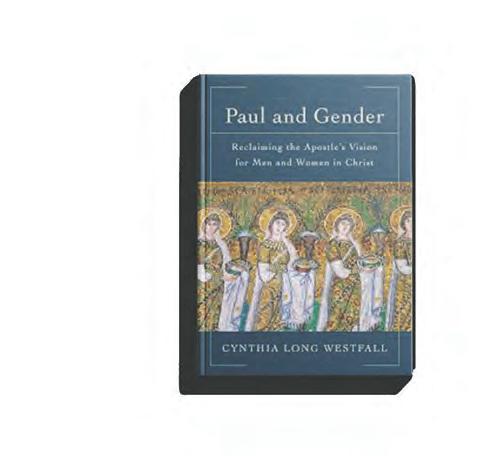
Paul and Gender: Reclaiming the Apostle's Vision for Men and Women in Christ
Handbook of Women Biblical Interpreters, Women in the Story of Jesus
God's Word To Women
No Time for Silence
Daughters of Wisdom
Egalitarian Christian Leadership, and Beyond Sex Roles
Marriage Made in Eden
Women and the Gender of God
All My Knotted-Up Life
The Very Good Gospel
Preaching Ephesians
From Widows to Warriors: Women's Stories from the Old Testament, and From Daughters to Disciples: Women's stories from the New Testament
Finding Phoebe
Mother, Mourner, Midwife
The Making of Biblical Womanhood
Nobody’s Mother
Mary R. Lefkowitz, Maureen B. Fant
Kevin Madigan, Carolyn Osiek
Cynthia Long Westfall
Marion Ann Taylor
Katharine Bushnell
Jannette Hassey
Ahida Calderon Pilarski
Aída Besançon Spencer
Alice Matthews
Amy Peeler
Beth Moore
Lisa Sharon Harper
Lynn Cohick
Lynn Japinga
Susan Hylen
L. Juliana M. Claassens
Beth Allison Barr
Sandra Glahn
CBE exists to promote the biblical message (Gal. 3:28) that God calls women and men of all cultures, races, and classes to share authority equally in service and leadership in the home, church, and world. CBE’s mission is to eliminate the power imbalance between men and women resulting from theological patriarchy.
CBE educates and advocates to ensure women worldwide know that God loves them and calls them equally to use their God-given gifts. When women discover that they are equally valued and called to lead and serve in God’s work, their lives are changed, and their faith is renewed. When women are given a voice, they often speak prophetically and confidently, declaring the gospel that they were previously unable to fully express.
Through radio, podcasts, award-winning publications, international conferences, student scholarships, and international partnerships, the biblical truth of mutuality is transforming lives, communities, and institutions. As one donor told us, “For the first time in my life I have experienced the gospel in all its fullness and freedom. I will forever be grateful that CBE puts forth such academically rigorous and thoughtful literature. The humility, grace, and love that is evident in everything you do has been refreshing to my soul and my new quest is to educate as many people as possible about your mission.”
In FY2025, more than 1.4 million people accessed over 4,000 free CBE resources, our highest documented year ever. This historic increase in website traffic, reflects the growing global demand for content that proclaims God created women and men to lead and serve together as equals. CBE’s expansion to diverse populations with little access to egalitarian content is evident in our web analytics and Google translate statistics that show a drastic rise in Spanish Google translate users, including a significant increase in visits from Spanish speaking countries like Mexico and Spain. Last year, the number of unique visitors to CBE’s website grew 48% to 1,469,705 . The increase in traffic is the result of several factors including improved marketing and SEO, alongside CBE’s Spanish radio spots on Christian radio, that includes CBE’s Spanish webpage loaded with egalitarian resources in Spanish.
CBE remains the world’s only nonprofit dedicated to exposing sexist interpretations of Scripture and advancing biblical equality. Through a vast global network , CBE’s resources empower churches, strengthen marriages, and reduce abuse by promoting mutuality between women and men.
CBE’s 2024 international conference, “Tell Her Story: Women in Scripture and History,” in Denver gathered over 300 global participants for worship, learning, and encouragement—including more than 20 leaders from Asia newly embracing egalitarian theology.
Your generosity makes this global impact possible. Thank you for equipping Christians worldwide with biblical truth, dismantling patriarchal distortions, and strengthening women and men to serve God side by side
Dr. Mimi Haddad, President/CEO
See CBE’s full annual report for April 1, 2024, to March 31, 2025, at cbe.today/annualreports.

August 7–9, 2026 | Chicago, IL
Crowne Plaza O’Hare Hotel & Conference Center
















President's Message by Mimi
Haddad
Thanks to the many women writers throughout history, we have today written witnesses of their lived experiences— not from onlookers, redactors, or family members overcome by strong emotions and motives—but their story in their own words. Because of this, historians, theologians, and Christians worldwide have, over the centuries, been emboldened by the unshakable faith and courage of women like Felicitas and Perpetua, early Christian writers, martyrs, and mothers. Their story, titled the “Acts of Perpetua and Felicitas” or Acta, 1 constitutes one of the earliest and most extensive written documents by a Christian woman. Composed by a young noble mother—Perpetua—martyred in Carthage, North Africa, in AD 203, her words provide the details of their suffering as Christians willing to face death rather than deny their Lord and Savior.
Arrested for her faith in Christ, Perpetua was still nursing her child when she was imprisoned along with her pregnant slave, Felicitas. Both women were professing Christians ready to endure torture, even death, for Christ. Under arrest and guarded closely by Roman soldiers, Perpetua managed to write an account of their suffering not only to describe the abuse by Roman guards, but also to provide family members with her spiritual perspective regarding her ill-treatment.2 Through the lens of her spiritual eyesight, Perpetua regarded her battle not as one of flesh and blood alone, but the result of a Christian’s struggle against spiritual forces promoted by Satan. Confident in Christ’s ultimate triumph, Perpetua wrote, “I knew I would win the victory.” Depleted of strength and unable to write further, Perpetua’s biographer described how she and Felicitas faced their deaths, glowing as “the wife of Christ, putting down everyone’s stare by her own intense gaze… as she was struck to the bone; then she took the trembling hand of the young gladiator and guided it to her throat.”3
Perpetua’s legacy may have inspired other women writers like the fourth century woman Egeria, an Italian woman who documented her Holy Land observations in “Poeregromato.” Letters from Egeria’s pilgrimage provide valuable details about Holy Week in Jerusalem, including specific rituals and practices common among Christians at the time. Her letters contain the oldest known description of a pilgrimage and contains one the most comprehensive accounts of Christianity in Turkey and the Middle East during this era.4
The writings of women flourished throughout the Middle Ages, significantly the writings of women mystics like

Hildegard of Bingen (1098–1179), a German nun and abbess overseeing a double monastery.5 Wielding tremendous political power, her book Scivias—Latin for “know the ways of the Lord”—explores Paul's writings, the O.T. prophets, and Revelation, alongside the corruption in the church of her day. Other women writers like Argula von Grumback (1492–1554) published letters full of scriptural interpretation, theology, philosophy, and wisdom, widely challenging corrupt leaders with logic and resilience: “What I have written to you is no ‘woman’s chit-chat’, but the word of God.”
Following their example, women of the Modern Missionary Movement were powerful writers, teachers, evangelists, and activists. Their legacy was thoroughly documented not only in secular news articles, but also through personally published works and biographies. Catherine Booth’s Female Ministry: or Women’s Right to Preach the Gospel succinctly shows how women’s gospel gifts and calling have been silenced in opposition to Scripture. In it, she notes that “we find from Church history that the primitive Christians thus understood it; for that women did actually speak and preach amongst them we have indisputable proof.” Supremely, in the writings of Katharine Bushnell’s God’s Word to Women, we have a cogent, systematic biblical analysis supporting women’s gifts, calling, and “great commissioning” in any sphere of service or leadership that Christ calls women to pursue.
CBE stands on the shoulders of these women whose sacrifice and victorious leadership is exemplified in written documents that God has graciously preserved for those who follow in their footsteps. May we study well their faith, their example, their courage, and their legacy through their writings as they reveal faithful lives of service to Christ our savior and king.
Notes
1. James Bridge. “Acts of Perpetua and Felicitas,” Early Christian Writings, updated November 12, 2025, https://www. earlychristianwritings.com/info/martyrs-cathen.html.
2. James Bridge, “Acts of Perpetua and Felicitas,” Early Christian Writings, updated November 12, 2025, https://www. earlychristianwritings.com/info/martyrs-cathen.html.
3. Perpetua and others, “From the Archives: The Martyrdom of Perpetua,” Christian History Institute, accessed November 12, 2025, https://christianhistoryinstitute.org/magazine/article/womenarchives-martyrdom-of-perpetua.
4. Egeria, “Holy Week in Jerusalem: A Pilgrim’s Description from around 380 AD,” Renovare, updated March 2024, https://renovare. org/articles/holy-week-in-jerusalem.
5. A double monastery was a religious community with both men and women living in separate but adjacent quarters, governed by a single superior and sharing a common church.
Your year-end gift to CBE will promote mutuality between women and men

Tax-wise strategies to multiply the impact of your generosity, while minimizing your costs and stress.
Whether your gift is an expression of love shared during advent, and/or given for a year-end deduction, generosity and sharing are the heart and soul of this time of year.
Avoid capital gains tax by gifting these appreciated assets directly to CBE and receive a deduction for the asset’s fair market value.
Have your required minimum distribution sent to CBE and it won’t be included in your adjusted gross income.
Streamline your giving through a donor-advised fund. If you have a donor-advised fund, please consider including CBE in your distributions.
Discover practical, tax-wise ways to support CBE with greater purpose and less stress. Watch Barnabas Foundation's "Strategies for the Giving Season" webinar for free at barnabasfoundation.org/interactive.
• CBE’s first place award for Mutuality in the Best in Class Competition hosted by the Evangelical Press Association. Themed, “Bullying in the Body: How Slander Divides the Church,” CBE’s awardwinning magazine is one you’ll want to read and share with family and friends.
• CBE’s devoted teamwork in many countries advancing Scripture’s teaching with a holy boldness as the Spirit releases women as gospel partners alongside men.
• CBE’s expanding global reach through our website, resources, publications, podcast, and Spanish Christian radio broadcasts.
• The generosity of donors and ministry partners around the world who freely give their time, talent, and treasure—may God richly bless each one of them!
• CBE staff as they host CBE’s 2026 International Conference—Made Whole: Healing the Body of Christ, August 7–9, 2026, in Chicago.
• The plans and needed funding for the development of a mobile app that will expand access to CBE’s resources.
• Pray for the Holy Spirit’s guidance as we work to reach new audiences through our radio spots highlighting Women in Scripture and Mission
• Growth in reach and impact of Mutuality Matters podcast episodes, and wisdom as we engage future guests to address biblical passages with clarity and grace.

Don't miss an issue! Sign up or renew your Mutuality subscription here.
Would you be willing to pray regularly on behalf of CBE? Join our prayer team to receive a full list of prayer needs on a quarterly basis, plus occasional urgent prayer needs. Please email us at cbe@cbeinternational.org to sign up.


CBE International (CBE) is a nonprofit organization of Christian women and men who believe that the Bible, properly translated and interpreted, teaches the fundamental equality of women and men of all racial and ethnic groups, all economic classes, and all ages, based on the teachings of Scriptures such as Galatians 3:28 : “There is neither Jew nor Gentile, neither slave nor free, nor is there male and female, for you are all o ne in Christ Jesus.” (NIV 2011 ).
MISSION STATEMENT CBE exists to promote the biblical message that God calls women and men of all cultures, races, and classes to share authority equally in service and leadership in the home, church, and world. CBE’s mission is to eliminate the power imbalance between men and women resulting from theological patriarchy.
• We believe in one God, creator and sustainer of the universe, eternally existing as three persons equal in power and glory.
• We believe in the full deity and the full humanity of Jesus Christ.
• We believe that eternal salvation and restored relationships are only possible through faith in Jesus Christ who died for us, rose from the dead, and is coming again. This salvation is offered to all people.
• We believe the Holy Spirit equips us for service and sanctifies us from sin.
• We believe the Bible is the inspired word of God, is reliable, and is the final authority for faith and practice.
• We believe that women and men are equally created in God’s image and given equal authority and stewardship of God’s creation.
• We believe that women and men are equally responsible for and distorted by sin, resulting in shattered relationships with God, self, and others.
• Therefore, we lament that the sins of sexism and racism have been used to historically oppress and silence women throughout the life of the church.
• We resolve to value and listen to the voices and lived experiences of women throughout the world who have been impacted by the sins of sexism and racism.


JOIN
Receive a year of print copies of Priscilla Papers , CBE’s academic journal, and Mutuality , CBE’s popular magazine. Subscriptions are available for individuals, churches, and libraries.
Learn more at cbe.today/subscriptions.
• Scripture is our authoritative guide for faith, life, and practice
• Patriarchy (male dominance) is not a biblical ideal but a result of sin that manifests itself personally, relationally, and structurally.
• Patriarchy is an abuse of power, taking from women and girls what God has given them: their dignity, freedom, and leadership, and often their very lives.
• While the Bible reflects a patriarchal culture, the Bible does not teach patriarchy as God’s standard for human relationships.
• Christ’s redemptive work frees all people from patriarchy, calling women and men to share authority equally in service and leadership.
• God’s design for relationships includes faithful marriage between a woman and a man, celibate singleness, and mutual submission in Christian community.
• The unrestricted use of women’s gifts is integral to the work of the Holy Spirit and essential for the advancement of the gospel worldwide.
• Followers of Christ are to advance human flourishing by opposing injustice and patriarchal teachings and practices that demean, diminish, marginalize, dominate, abuse, enslave, or exploit women, or restrict women’s access to leadership in the home, church, and world.
Connect with CBE online to learn more about us, enjoy the resources we offer, and take part in our ministry.
Visit our website, cbeinternational.org , to find thousands of free resources—articles, book reviews, and video and audio recordings.
Get news, updates, and free resources (cbe.today/news)
Follow our blog ( cbe.today/mutuality ).


If your church, seminary, school, or nonprofit agrees with CBE’s Statement of Faith and Core Values, join CBE as an organizational member to receive publications, discounted conference registrations, and more.
Visit cbe.today/orgmembers for more info.
Follow us on X @CBEInt ( x.com/cbeint ).
Find us on Facebook ( facebook.com/cbeint ).
Follow us on Instagram @cbeinternational ( instagram.com/cbeinternational ).
Follow us on LinkedIn ( linkedin.com/company/ christians-for-biblical-equality/ ).
Find us on YouTube (youtube.com/@cbeinternational).
Listen to us on Soundcloud ( soundcloud.com/cbe- international ).
International | 122 W Franklin Ave, Suite 610, Minneapolis, MN 55404-2426 | (612) 872-6898
CBE International 122 West Franklin Ave, Suite 610
Minneapolis, MN 55404-2426
Forwarding Service Requested
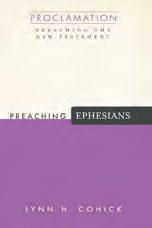
Preaching Ephesians: Proclamation: Preaching the New Testament Series
Lynn H. Cohick
Lynn Cohick brings together decades of research, writing, and teaching on Ephesians and makes it accessible to readers in this new volume in the Proclamation series. An ideal resource for pastors and students who want to understand Ephesians and its many complexities in a way that is comprehensible, useful, and even exciting.”—Michael F. Bird, Deputy Principal, Ridley College
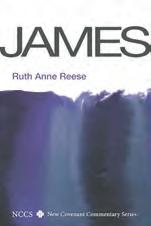
James: A New Covenant Commentary
Ruth Anne Reese
In the early days of the church, James taught a message of joyful endurance, resisting temptation, and putting into practice the truth of the word the church had received. This little book offered reflections on trials, sin, and desire; on the challenges of controlling speech in the context of community and the damage such uncontrolled speech can bring about; and on the dangers of wealth and autonomy. This ancient book offers wisdom for today as we too seek to live godly lives of prayer, purity, and care for one another in a world that seeks to pull us away from God.
Are Women Human? Penetrating, Sensible, and Witty Essays on the Role of Women in Society
Dorothy
L. Sayers
One of the first women to graduate from Oxford University, Dorothy Sayers pursued her goals whether what she wanted to do was ordinarily understood to be "feminine." Sayers did not devote a great deal of time to talking or writing about feminism, but she did explicitly address the issue of women's role in society in the two classic essays collected here. Central to Sayers's reflections is the conviction that both men and women are human beings and must be regarded as essentially more alike than different. Though written several decades ago, these essays still offer in Sayers's piquant style a sensible and conciliatory approach to ongoing gender issues.