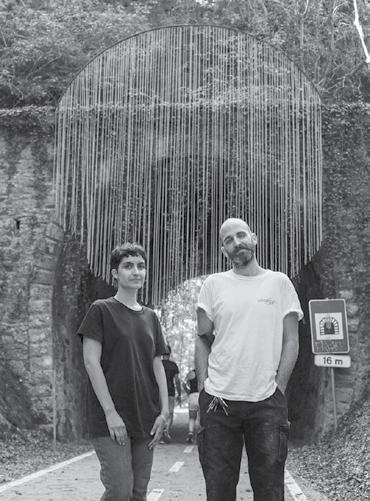
Collective established by a duo of architects from different cultures, yet sharing the same vision of artistic expression through the lens of spatial work, encompassing elements of land art, installations, and micro-architectures. Joana and Vincent are committed to challenging the concepts of ephemerality and circularity through a practice focused on participation, reuse and revitalization of unused spaces.
Through their research, projects, and engaged installations, this initiative aims to reshape our perception of spatial dynamics, moving towards a more circular and sustainable system, enabling city dwellers to understand and harness all potential available resources.
"O muro," or "the wall" in Portuguese, encapsulates the fundamental essence of architecture, exploring notions of materiality, boundary, and scale. It incorporates numerous metaphors within the collective imagination: an insurmountable barrier, a canvas for expression, and also, when breached, a gateway to freedom.
Rooted in their physical, cultural, and historical context, the installations crafted by the collective narrate and unveil the spaces they inhabit, always placing visitors at the core of their experiences.

+351 968 050 663
Rua da Industria 87 rdd 1300-304 Lisboa (PT) contact.muroatelier@gmail.com
Joana Tomas (French and Portuguese, 1989)
Raised in France by Portuguese parents, she has always navigated between two cultures that shaped her unique identity. Throughout her academic journey, she demonstrated a keen interest in engaging in participatory and self-construction projects, actively collaborating in various collective initiatives and multinational workshops. After several years working in architectural studios in Paris and subsequently overseeing various projects in France, she decided to return to Portugal. Now residing in Lisbon, she continues to travel, finding a sense of home in each place where she designs her installations
Vincent Rault (French, 1990)
After working as an architect in various french studios, he decided to move to Lisbon to further develop his artistic and architectural practices.
Through this shift, he explored new ways of working, ranging from urban agriculture to self-construction, always emphasizing a dynamic sharing of knowledge and collaboration with various stakeholders. Since then, he has been involved in several associative and collective initiatives in Lisbon, including social and educational gardens, participatory projects, and the co-creation of ephemeral cultural spaces.
www.muroatelier.com @muro.atelier
Muro Atelier
Muro Atelier works around 3 thematics :
+ REUSE
Through diagnosis and deconstruction, the collective wants to create a new practice, considering construction waste as a resource. The main objective is to analyze, deconstruct, stock, prepare and then reintroduce used construction materials into new projects, making our urban landscapes more sustainable. This practice is not only about construction : the objective is also to create a sector with new non-delocalizable jobs.
+ REVALORIZE
With these same used materials, Muro Atelier creates ephemeral, participative and self-constructed urban art installation, to question our public space and increase citizen interaction with art, architecture, circularity and construction. Those urban installations tend to mark a collaborative presence in the city, telling different stories that interpret a spatial, cultural and social context.
+ REACTIVATE
Waste is not only material. Our initiative temporarily occupies unused buildings to turn them into ephemeral cultural centers and open them to the public. It helps create a global community in a city that is everyday more gentrified. Through an association called NA ESQUINA, the collective co-created two of these experimentation centers, and one is currently his shared workspace for impact projects and artist residencies. With these experimentations, Muro Atelier wants to desacralize construction, art and architecture, and empower people to build their own city, through inclusivity and circularity.
Recent works
On going
On going
June 2024
April 2024
Jan. 2024- Mar.2024
March 2024
Oct.2023-Mar. 2024
Since 2019
September 2023
July 2023
June 2023
April 2023
June 2022
September 2021
May 2021
October 2020
September 2020
February 2020
October 2019
August 2019
June 2019
// Green Washing- Horizon Sancy 2024 - Sancy (FR)
// Ruines mirages - À Ciel Ouvert - parcours d'art actuel - Riorges (FR)
// Equipe - Arts éphémères - Marseille (FR)
// Kintsugi - Jardins du monde en Mouvement - Cité Internationale Universitaire- Paris (FR)
// O.R.N.I. Objetos Rolantes Não Identificados - LEPAC / ZET Gallery - Bairro da tabaqueira, Sintra (PT)
Winner of a competition for an artistic and participative residency centered around reused bicycles
// Aguas correntes - Premio Arte e sustentabilidade- Zet gallery / DST group - Barcelos (PT)
Winner of a competition for a permanent installation made entirely from reused materials // Sabão - Afurada Living Lab / GAIURB - Vila Nova de Gaia (PT)
Participative installation, 100% reused materials, tactical urbanism in a fishing village
// Na Esquina Principe Real et Moscavide - Lisbonne (PT)
Creation and management of two artistic and cultural third places in unused buildings in Lisbon
// Os Capelinhos - Loures( PT)
Participative installation, 100% reused materials, artistic residency and tactical urbanism in slums
// Loading Love Temple - DADDARA - BOOM Festival Idanha-a-Nova (PT)
Permanent installation for the artist DADDARA, at the BOOM Festival, // Edificios como bancos de materiais, GAIURB, Vila Nova de Gaia (PT)
Study and analysis of implementing a reuse program for the city’s urban planning department
// Forecast take over of Trienal de arquitetura - Lisboa ( PT)
Acceleration program around social empowerment and reuse, lecture series, and artistic installation
// Écume - Festival Parenteuf, Etang de Marelle, Chassy (FR)
Participative installation, 100% reused materials for a music festival
// Luar - Sever do Vouga ( PT)
Temporary installation on a tunnel as part of the Land Art Festival
// MANU - Granollers (ES)
Participative installation as part of Festival Mostra d’Art Urbà de Espai d’Arts Roca Umbert
// Bloom in Blue - Arras (FR)
Temporary and participative installation as part of 4e Biennale d’art contemporain Appel d’air
// L'échappée verte - Ypres (BE)
Temporary installation as part of biennal Open Sites - Sporen
// Lavomatique - Landivisiau (FR)
Temporary installation as part of Festival Hors les murs
// Mandala Moon - Paris (FR)
Temporary installation as part of Biennale d’art contemporain Génie des jardins
// Beauté locale - Montpellier (FR)
Temporary installation as part of Festival des Architectures vives
// Gardinus - Vimieiro (PT)
Permanent sculpture
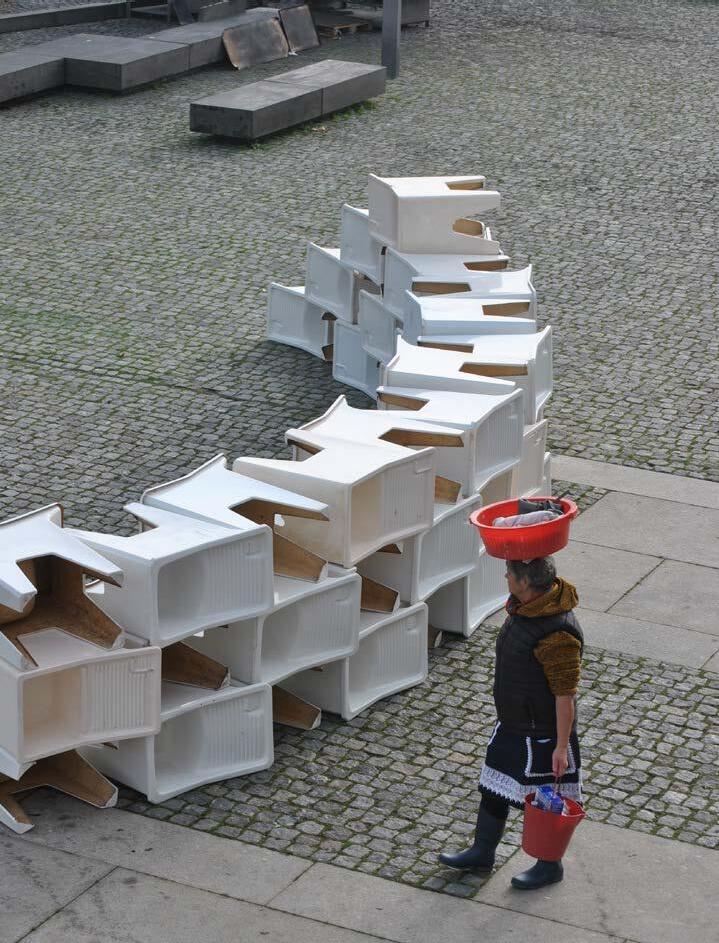
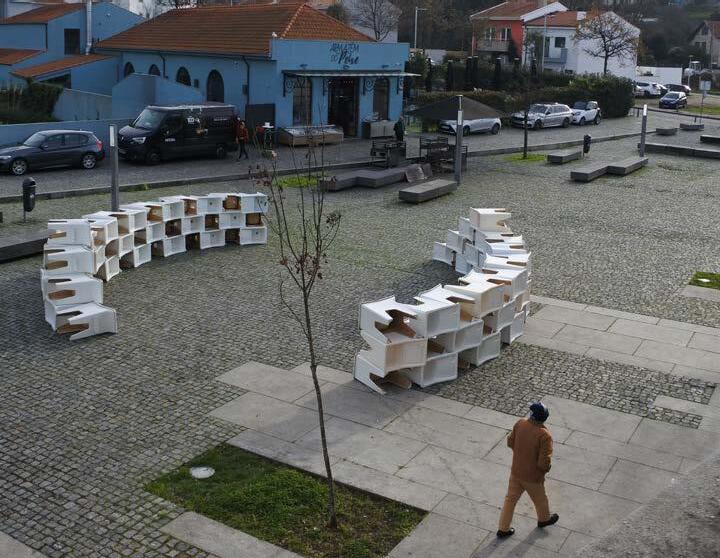
SABAO
Participative installation, 100% reused materials, artistic residency and tactical urbanism in a fishing village- São Pedro de Afurada, Vila Nova de Gaia, Portugal, October 2023- March 2024
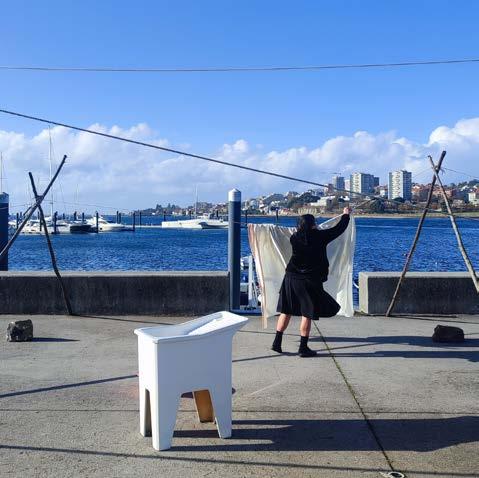
Through a consultancy mission focused on reusing construction materials for GAIURB (Vila nova de Gaia), we stumbled upon a hidden treasure: hundreds of abandoned washing tanks tucked away in a warehouse.
Driven by the aim to promote circular economy and inspired by the Afurada Living Lab, the collective decided to create an ephemeral artwork, a tribute to washhouses and the iconic clotheslines, breathing life into the market square for four months.
However, Sabão isn't merely a lifeless framework.
It will serve as the stage for the interwoven voices of the many communities that shape the soul of this city.
Each layer, every touch, and brushstroke will be the vibrant and fleeting expression of a people.
A tapestry in constant evolution, where each contribution becomes an indelible part of Afurada's history and identity.
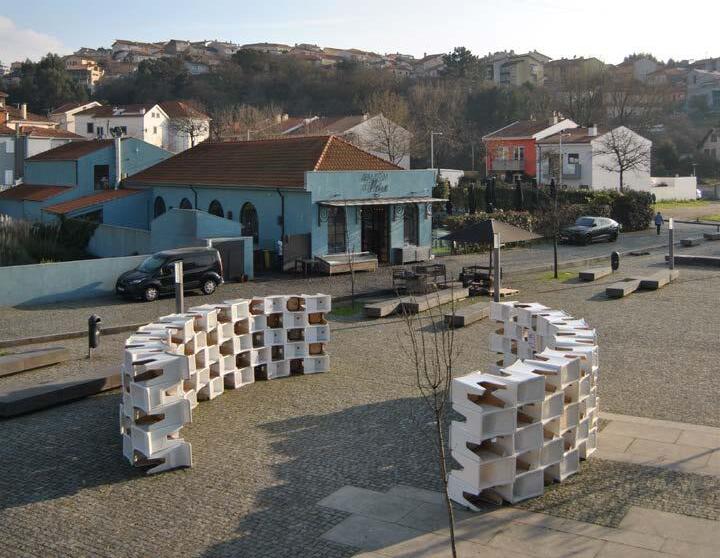
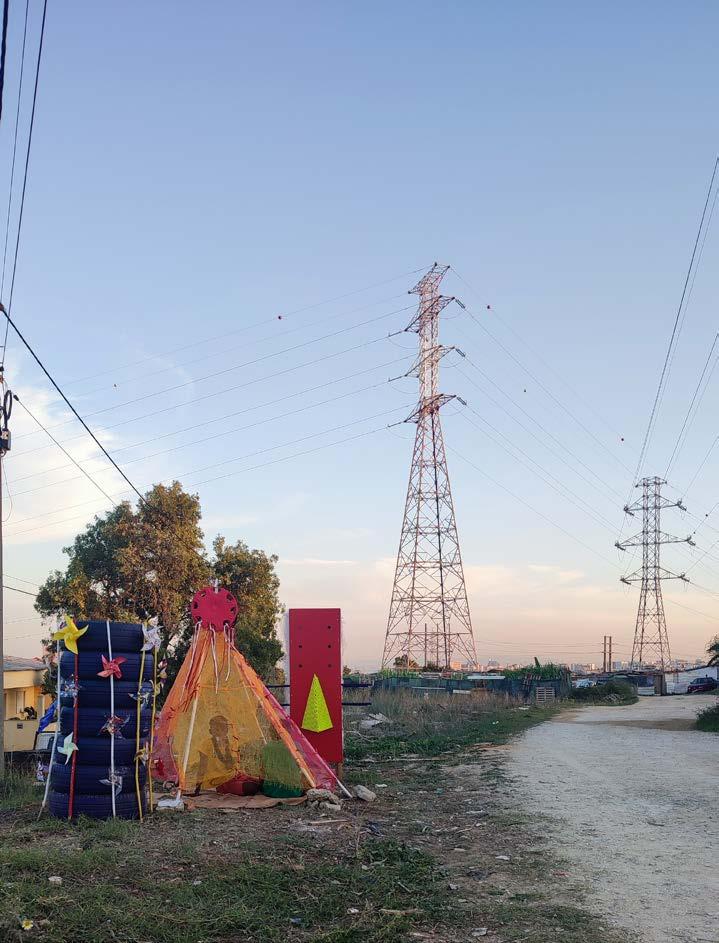
OS CAPELINHOS
Participative installation, 100% reused materials, artistic residency and tactical urbanism in a slum Winning project - Loures, Portugal, september 2023
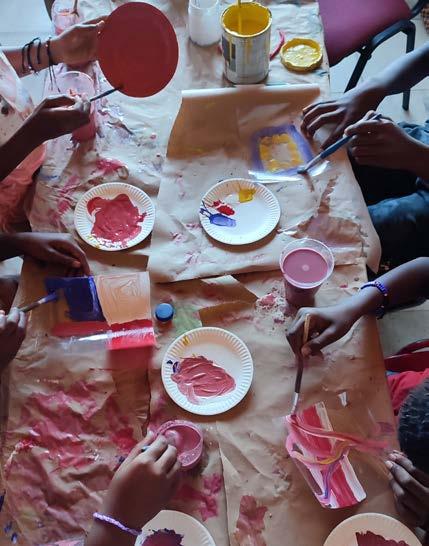
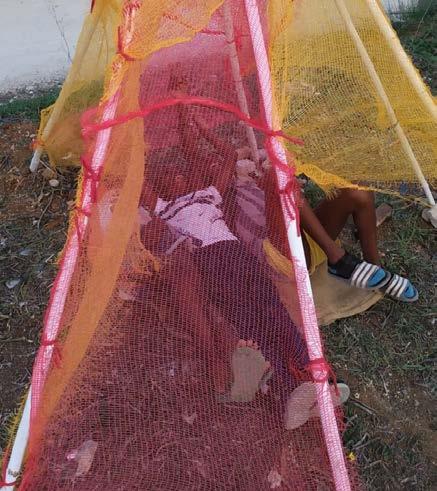
This residency, established within an informal neighborhood, resonates with our practice for several reasons. In an informal neighborhood, the notion of impermanence is experienced on the scale of a piece of the city and a piece of life, where strict necessity justifies construction.
Reusing materials, community participation, and temporary occupation aren’t new environmental architectural practices, but rather swift responses to a need that should be a guaranteed right by the state: the right to decent housing.
Through this lens, what is the role of the architect or artist? Isn’t beauty supposed to be a democratic right akin to the right to dignified housing? Can art be considered necessary in a neighborhood governed by utilitarianism and survival?
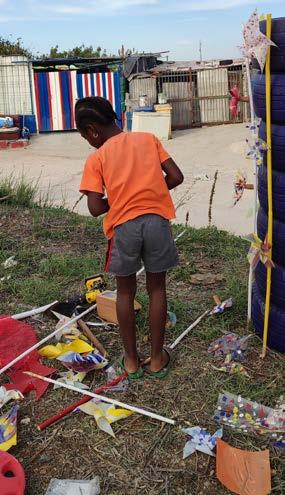
We collectively contemplated these themes while creating three sculptures in collaboration with local residents, utilizing available materials.
Inspired by Cape Verdean tales and legends where children take the form of magical beings to protect the inhabitants, the collective drew colors directly from the Cape Verde flag. Beyond the solutions art can offer in the context of an informal neighborhood, we firmly believe it can create a collective identity, inspire change, promote empathy, and foster dialogue between the public and institutions regarding the dignity of habitation.
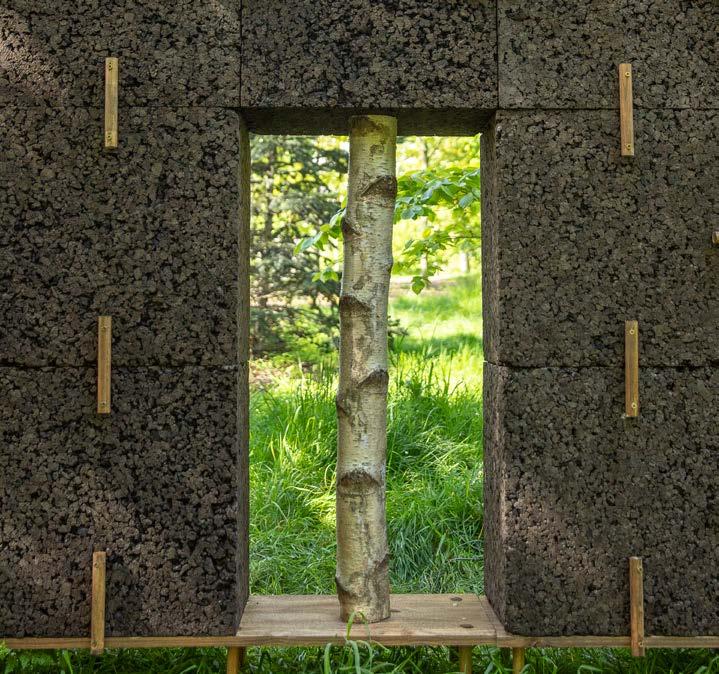
KINTSUGI
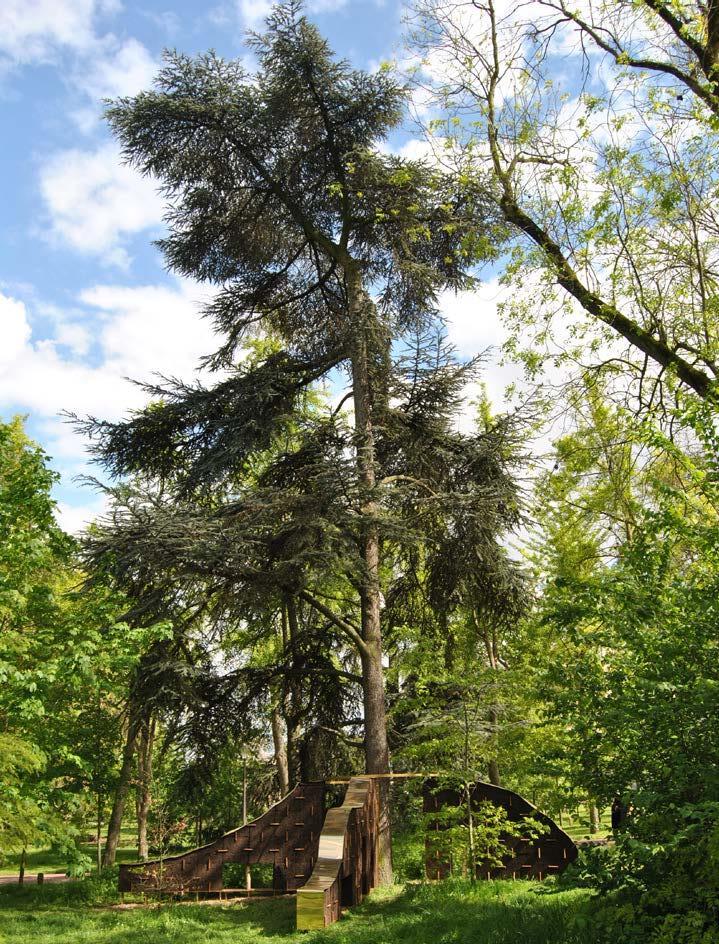
Jardins du monde en mouvement, Cité Internationale Universitaire, Paris, France, April 2024
Cork blocks, reused broom handles, brass, tree trunk, steel, paint
Dim : 10 m length, 8 m width, 2.5 m height
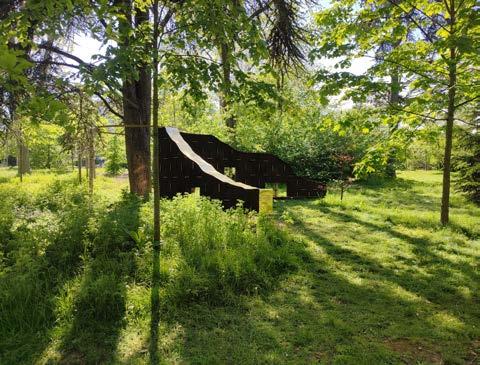
The concept of this installation is rooted in a Japanese craft technique: Kintsugi. Literally meaning "golden joinery" in Japanese, it involves repairing broken ceramics with tree sap tinted with gold.It is the art of resilience, an ode to imperfections, that enhances an object by highlighting its scars. Applied on the scale of a tree, this craft becomes, through the artwork, a proposal for reflection on the repair of life, regeneration, and the invisible bond. Developing around a tree in the park, the work mimics the patterns of scars or cracks in the ground left by the roots of the living being, as if the central tree became the impact point of the fracture. The project extrudes the roots, transforming them into a temporary architecture that reveals the invisible connections of the tree to its environment.
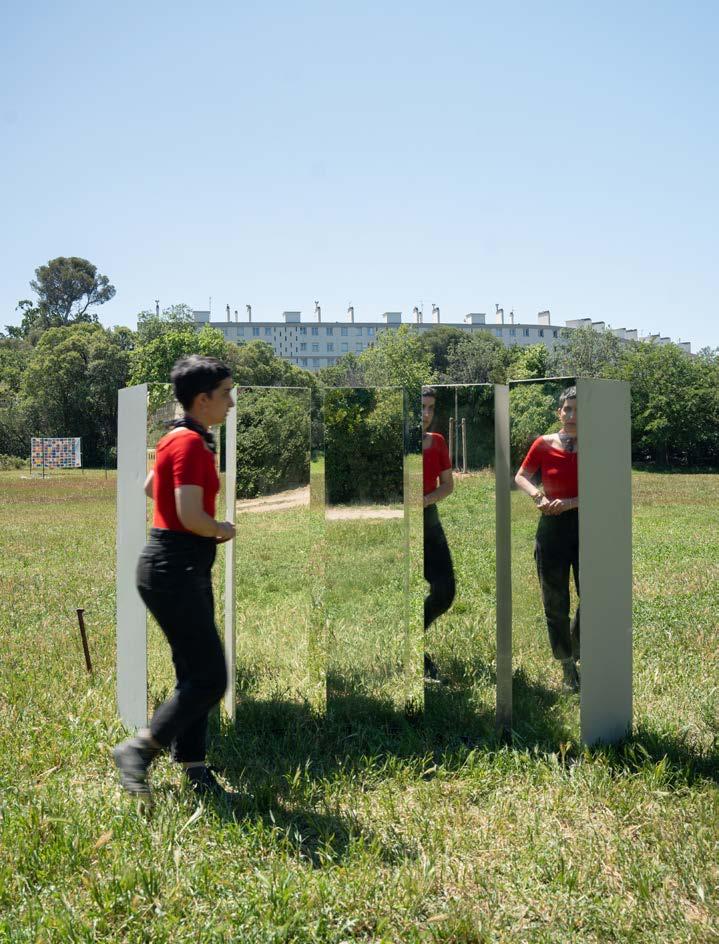
EQUIPE
Arts éphèmeres, Marseille, France, June 2024
Cork blocks, reused broom handles, brass, tree trunk, steel, paint
Dim : 2,5m length, 2 m width, 2.5 m height
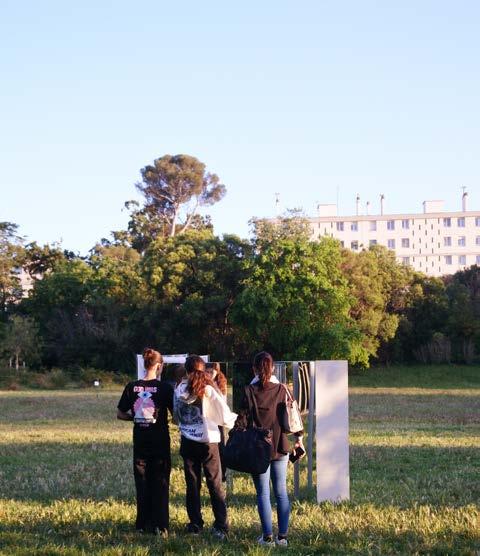
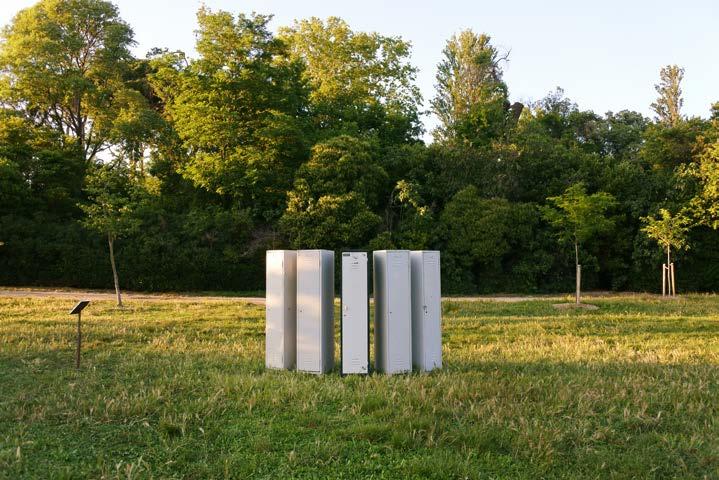
The locker, far from being just a piece of furniture, embodies the threshold between the athlete and the field, a space where vulnerability and encouragement intertwine, creating a zone of deep introspection. Mirrors in the locker rooms are key allies in this transformation. By confronting the viewer with their multiple facets, they embody a geometric transformation where body, anatomy, and movement create a visual choreography.
The installation consists of reused locker modules with attached mirrors. Their arrangement allows viewers to see themselves from various angles, observing a multiplication of their image. The locker, a ready-made object, represents the athlete's body, an intimate and personal space, constantly transforming through sporting trials. Its solitude reminds us that physical and emotional transformation is often an inner, solitary journey. Yet, the lockers come together as a team, showing that individual transformation often occurs within a community. Each element offers a window into the soul of sports, an immersion into the depth of physical and emotional transformation that every athlete experiences, both alone and in a team.
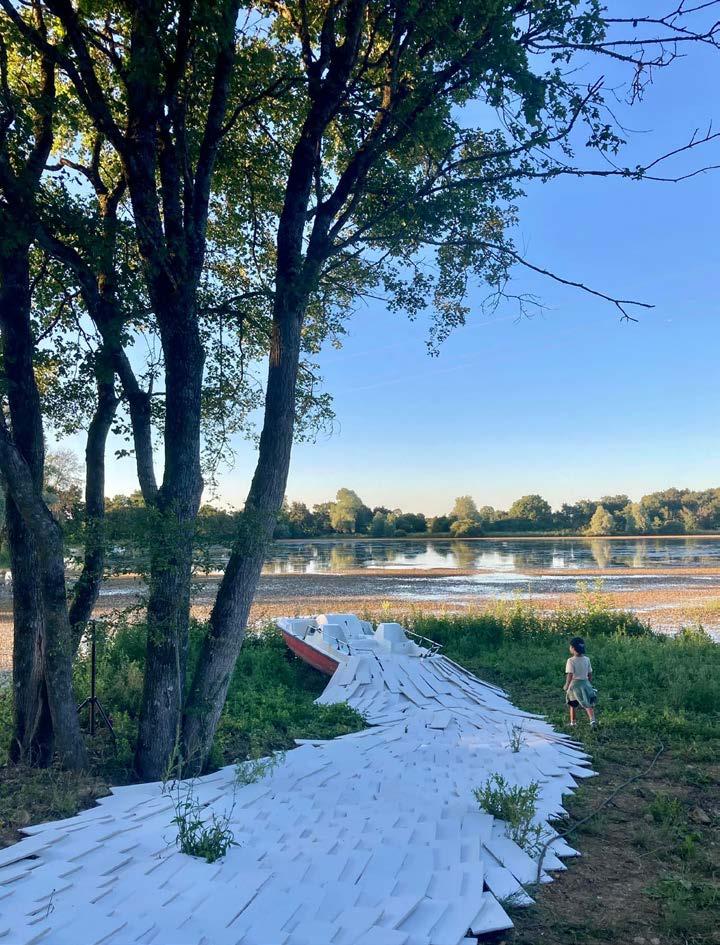
Parenteuf Festival - Chassy, France -June 2022
False ceiling panels - Dimensions =15 m x 2 m on the ground
ECUME
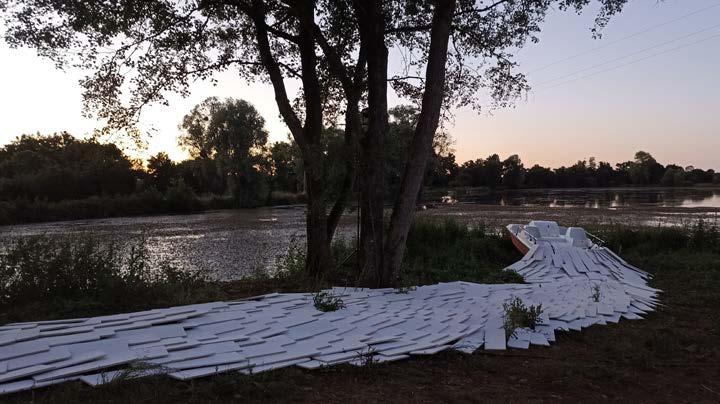
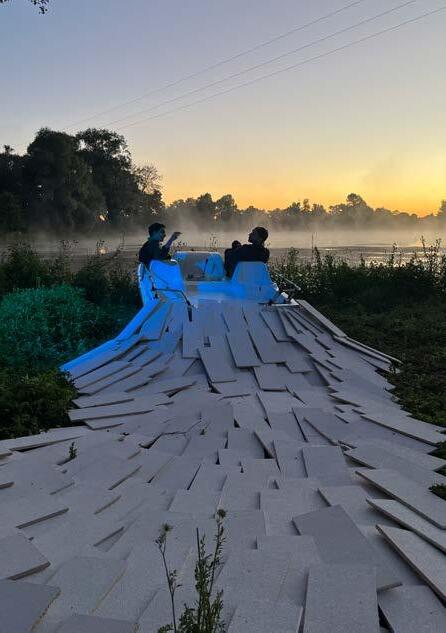
By the edge of the pond, where tranquil waters meet the dreams of creative minds, a boat rests at the water's edge, serving as the starting point for this intriguing artistic creation. Behind it, a trailing formation stretches gracefully and poetically, reminiscent of the frothy wake left by a boat at sea.
This illusion is the result of an arrangement of ceiling panel tiles, repurposed and meticulously arranged in scales. Each scale reflects the surrounding light, creating an ethereal glow that appears to dance with the water's reflections.
The calm waters of the pond create a striking contrast with the dynamic wake, offering viewers a moment of reflection on the interplay between serenity and perpetual motion.
The choice of materials, using repurposed ceiling panel tiles, adds an intriguing dimension to the installation.
The scales that compose the trailing formation recall the organic and random texture of froth while conveying a sense of lightness and fluidity. It's as if the froth itself has been captured and frozen in time, allowing viewers to contemplate it from a new perspective.
This installation goes beyond mere visual contemplation; it evokes deep emotions, reminding us of the transience of life and how moments of beauty and lightness can leave a lasting imprint.
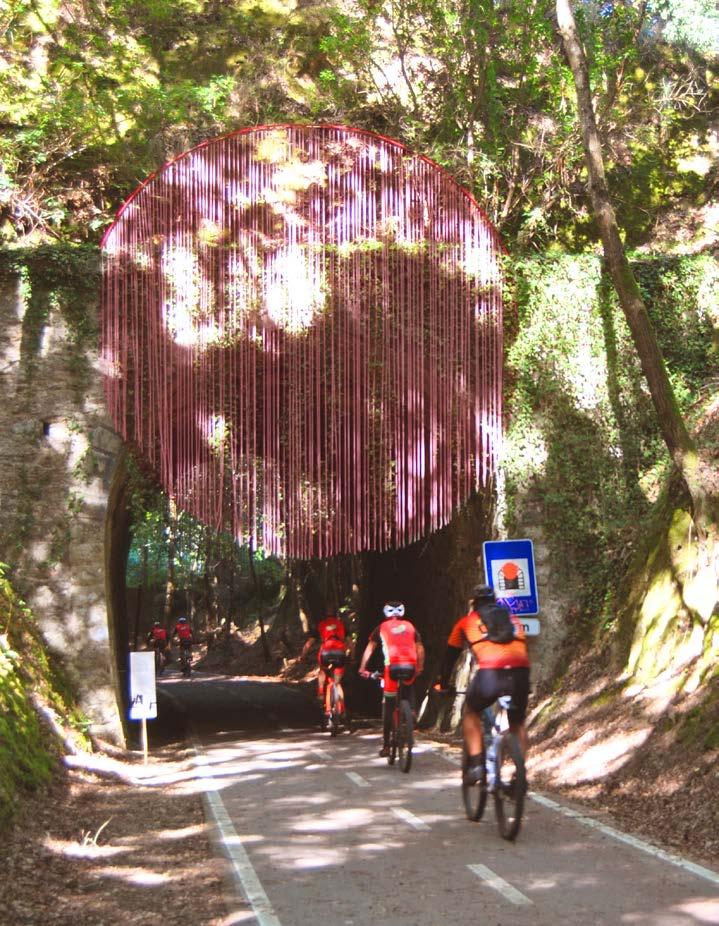
LUAR
Land Art Festival - Sever dou Vouga, Portugal
WINNER PROJECT - September 2021
Steel, exterior curtains - Dimensions = 5m diameter
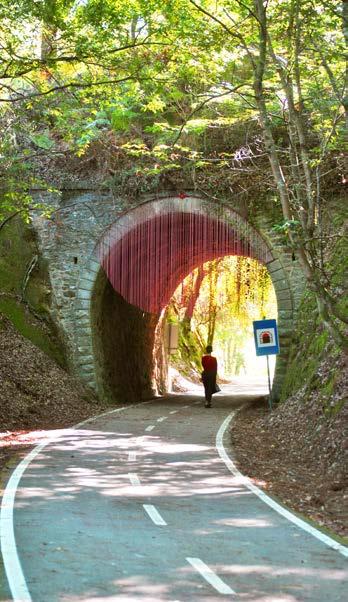
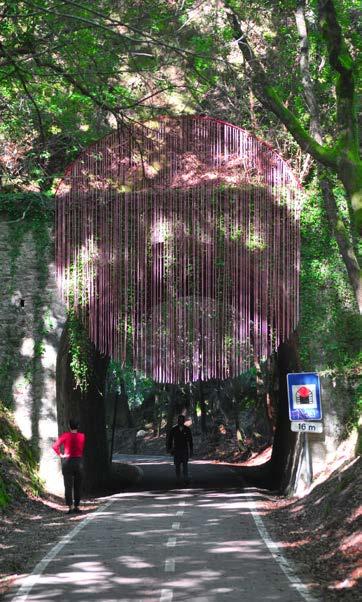
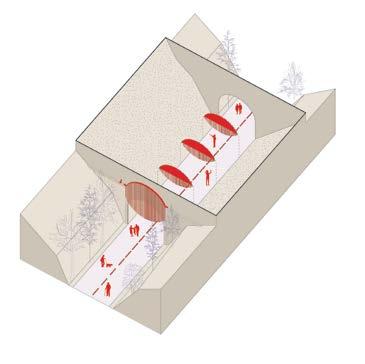
Situated on the site of a former railway tunnel, this moon-like structure at the entrance is not what it appears to be, inviting those who pass by to contemplate its threshold. Just as there are multiple phases of the moon, traversing a tunnel is, both physically and metaphorically, a journey from one state to another. Thus, the artwork accompanies the visitor inside the tunnel.
This red circle may evoke a traffic sign or a signal light for trains that once passed through here. However, if these signals are prohibitive, the materiality and lightness of the ribbon-like circle invite entry. Thus, the ribbons, resembling vegetation cascading at the tunnel's entrance, are actually curtains commonly found on the doors of Portuguese houses. We also wanted to integrate an everyday element into the material composition of the artwork, allowing an ordinary object to gain an extraordinary dimension outside its usual context.
The color red has also been one of the earliest used by humans in cave paintings, and just as humanity threatens the green of nature in our modern era, we hope this encourages people to see the landscape in a different light.
MANU
Festival la Mostra d'Art Urbà de Espai d'Arts Roca Umbert - Granollers , Barcelona, Spain- May 2021
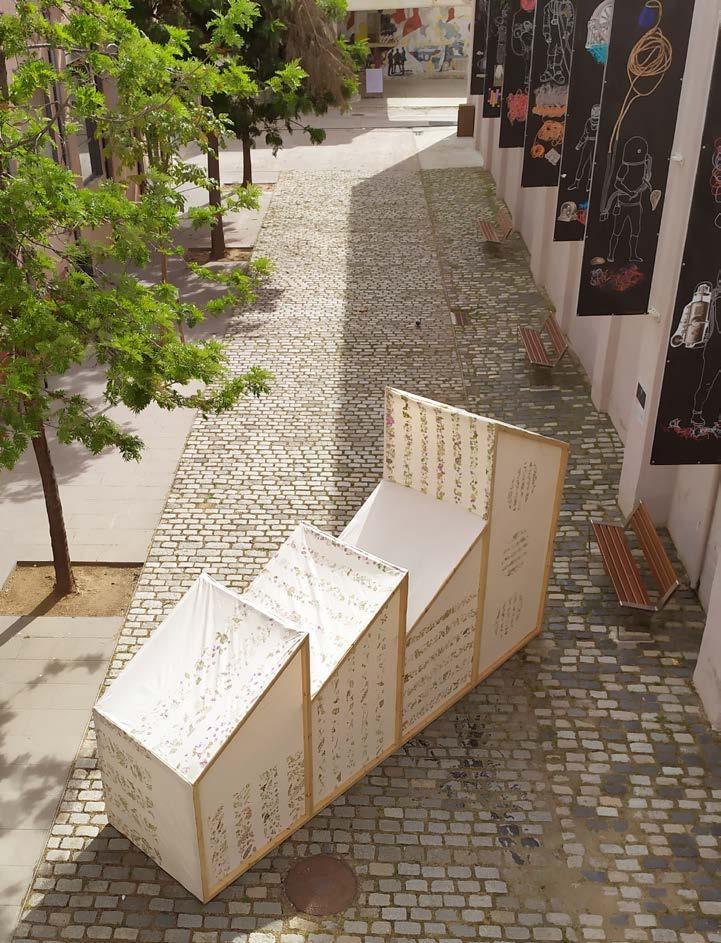
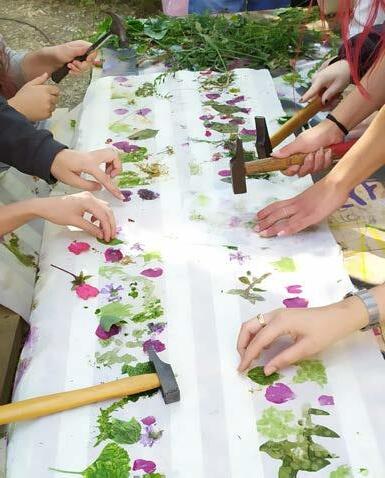
Zoomed Tataki of vegétaux on fabric, wooden structure, sound - Dim = 5 m x 1 m on floor, height 3 m
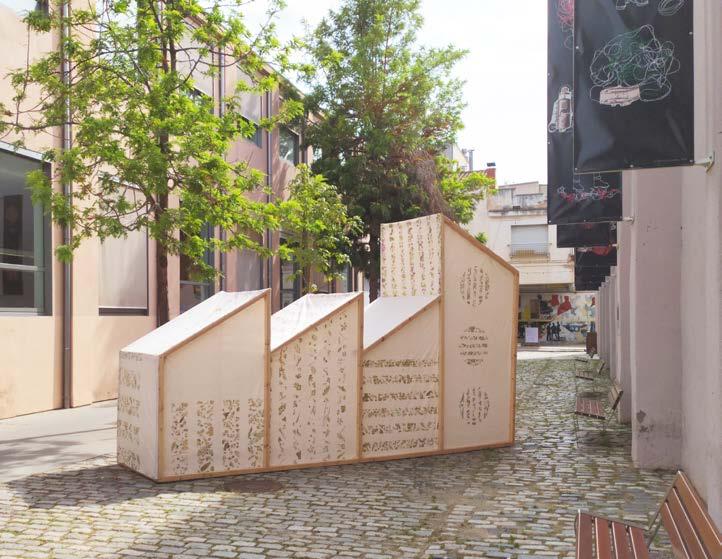
The starting point of our intervention lies in the fact that mechanization led to the formalization of industrial architecture. Factories became the home of machines, and cities transformed to accommodate them. From this perspective, we can say that the Roca Umbert factory is, in reality, a mechanical product.
As cities and societies evolved due to the industrial revolution, the arrival of machines had a direct impact on the lives of the working class, who began to protest for better working conditions. Luddism was a protest movement whose response was the destruction of textile industry machines using hammers.
To this day, the term neo-Luddism is used to describe distrust of technology, and yet, there is a growing appreciation for handmade craftsmanship and artisanal processes.
The work MANU is constructed through these three elements of reflection: industrial architecture, Luddism, and textile screen printing. It involves creating an iconographic replica of the Roca Umbert factory, made out of fabric. The textile material previously produced in this factory becomes an architectural covering.
LOCAL BEAUTY
Festival des Architectures Vives de Montpellier, France - June 2019
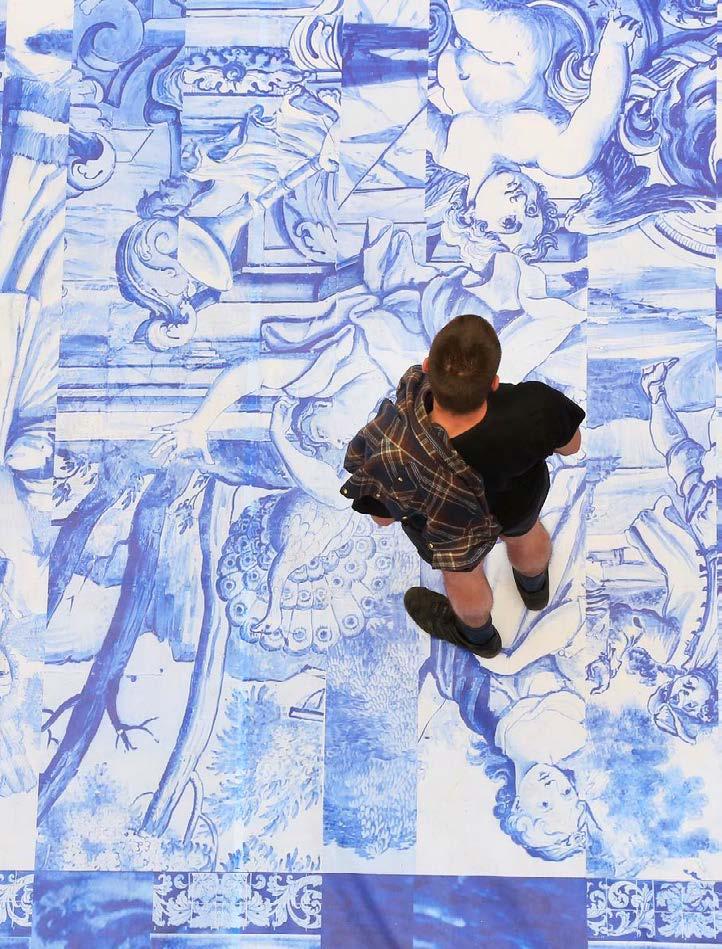
Micro-perforated canvas stretched over a wooden framework - Dim = 6 m x 7 m on ground, height 3 m
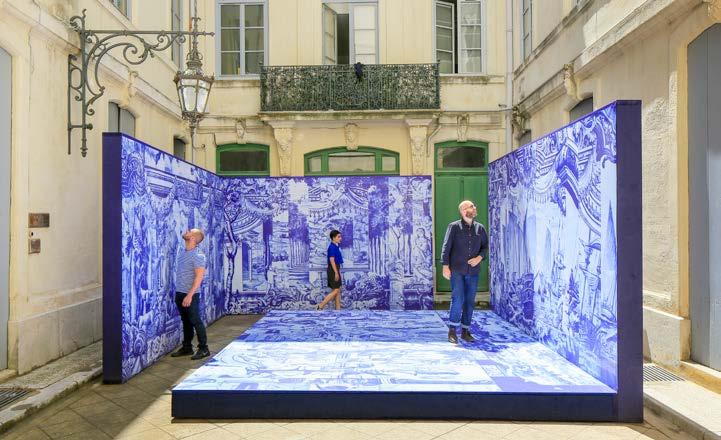
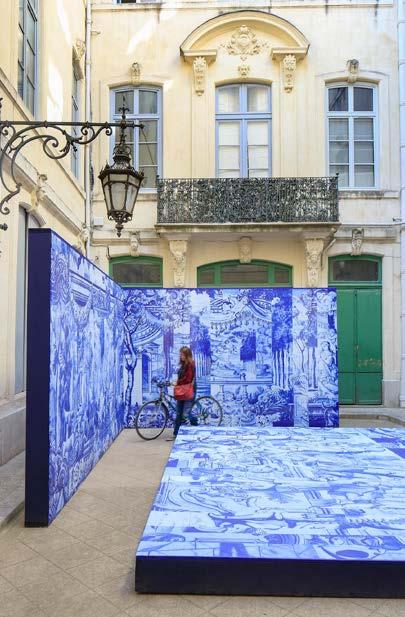
Entering a Montpellier courtyard and feeling immersed in a Portuguese landscape is the spatial experience that this installation aims to provide. The blue of the azulejos (traditional Portuguese ceramic tiles) introduces a new tone to the courtyard and carries the memory of another locality. Beauty takes shape here in the encounter of two heritage identities. This space of physical sharing manages to create a hybrid landscape that transports us. The ceramic element becomes a unit of space, and the installation adapts to the composition of the interior facades. By working with transparency, the frescoes overlap like a veil on the walls, offering a new materiality to the courtyard. With its baroque aesthetic codes, the azulejo reflects ornamental beauty in architecture. Often considered superfluous, it is the primary material of the installation here. The stories depicted in the frescoes emerge as one strolls through, allowing for a journey through contemplation.
BLOOM IN BLUE
Ephemeral installation on the theme of the footprint
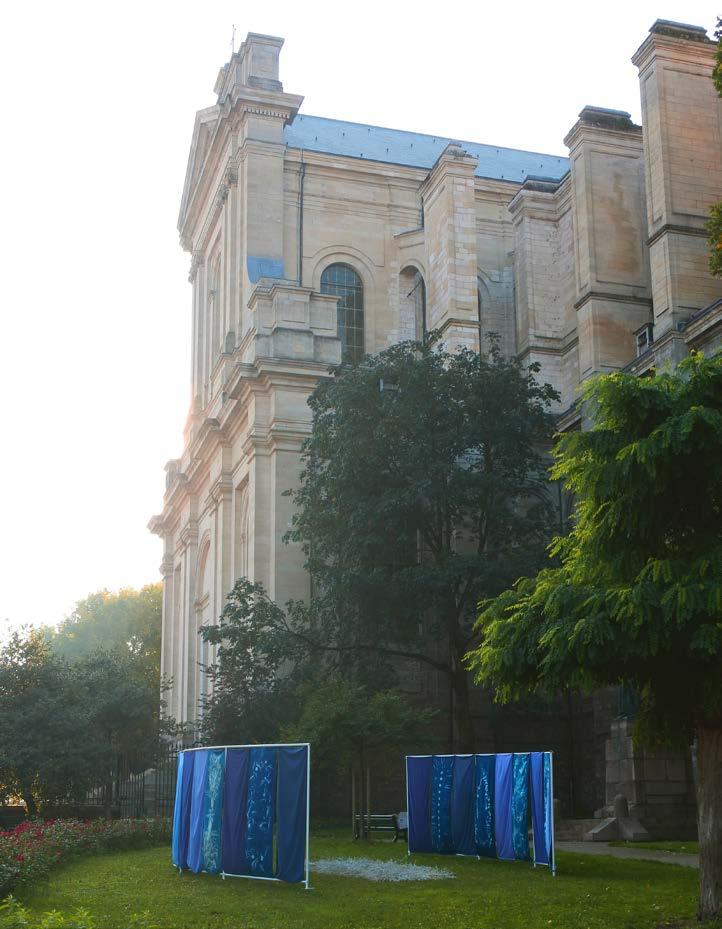
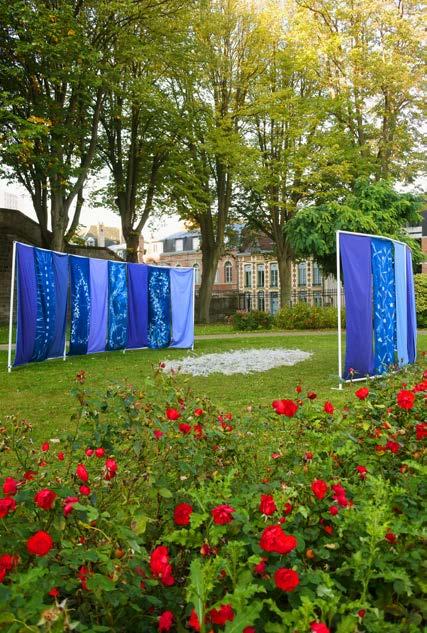
Appel d'air, Fourth edition, Biennale Internationale d'art contemporain, Arras, France- October 2020 Cyanotype on canvas and fossilization of flowers in plaster - Dim= 8 m x 4 m on ground, height 2 m
Forme générale de l’installation en plan
Decomposing of this symbolic element
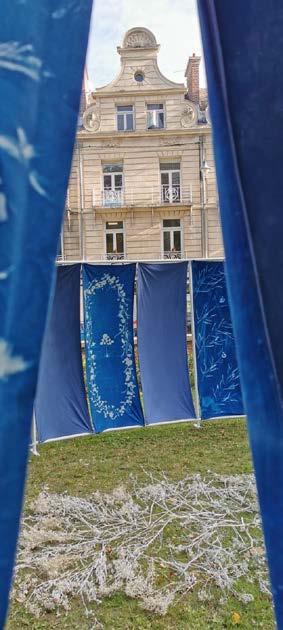
The installation draws its essence from one of the symbols of Arras' historical and artistic heritage: Arras Blue, which is cobalt blue applied to glazed porcelain, then fired at high temperatures. The imprint can be defined as the visible trace of an element that no longer exists materially but virtually, thanks to the expression of a negative that evokes its presence.
The idea of representing the negative of floral patterns using the color blue became evident through the cyanotype technique. This technique allows for the revelation, using sunlight, of white imprints of flowers on a blue background. It's as if one had shaken a sheet on which a floral pattern was present, and the flowers detached to fall to the ground and crystallize. The concept of the installation is based on this "double imprint" of the plant element. By using Arras Blue and the cyanotype technique, the installation creates a connection between local artistic heritage and contempaorary artistic expression while exploring the theme of presence and absence through the imprint of floral patterns.
 Porcelain and Arras blue
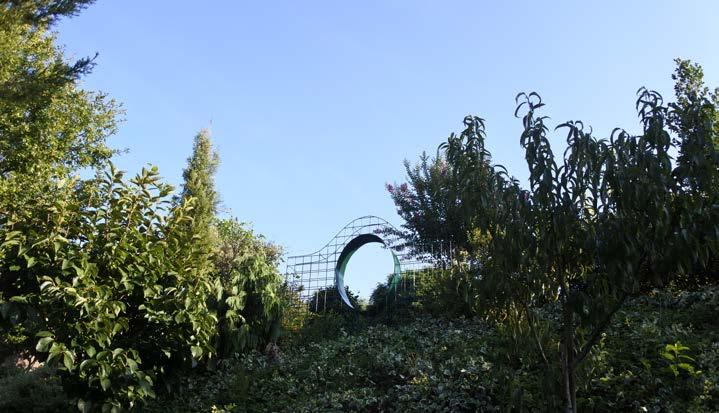
GARDINUS
Sculpture in a private garden - Vimieiro, Portugal July 2019
Sheet metal and welded wire mesh - Dimensions = 5 m x 1 m on the ground, height 2 m
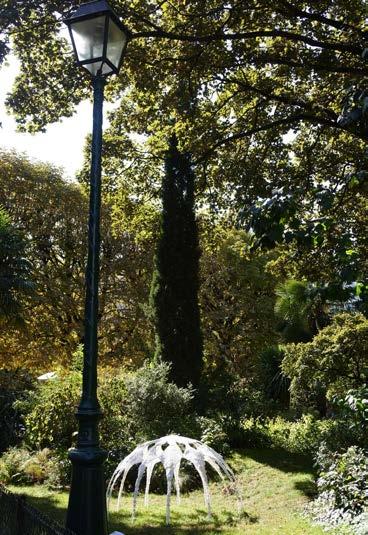
MANDALA MOON
Le Génie des jardins, 9th International Biennial of Contemporary Art, Paris, France - 2019
Embroidered mesh on a steel-reinforced dome
Dimensions = Diameter 1.50 m, h: 0.8 m
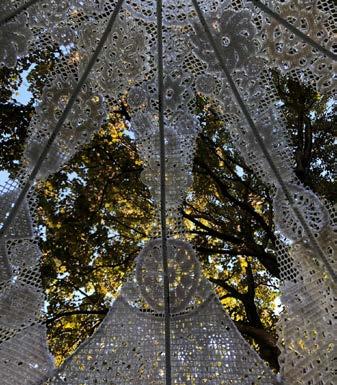
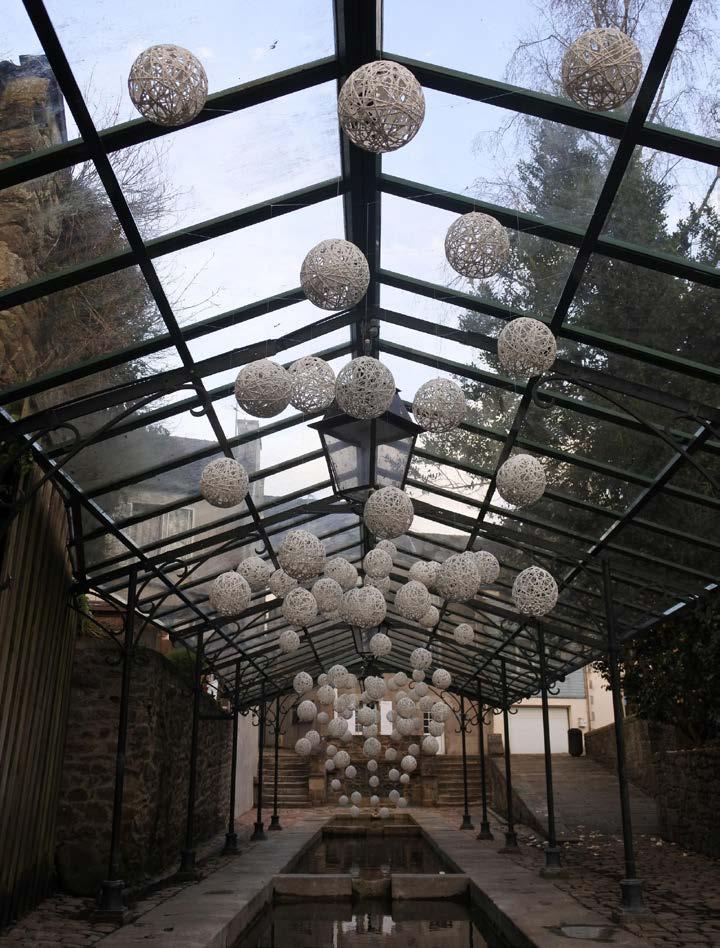
LAVOMATIQUE
Festival Hors-les-murs, Landivisiau, France
Installation in the Saint-Thivisiau washhouse-Winning project-February-July 2020
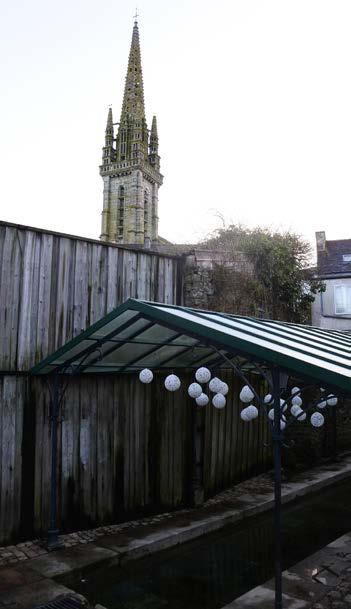
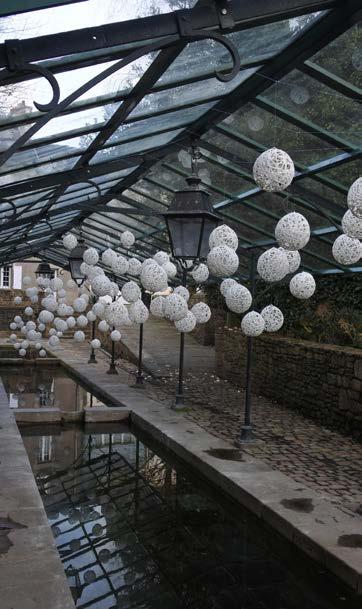
Lavomatique is a tribute to the not-so-distant history of the Saint Thivisiau fountain, in the form of a playful, plastic wink to the visitor. In days gone by, the water in these basins agitated under the efforts of the washerwomen, transforming the fountain into an animated space. The soapy water undoubtedly released bubbles that rose above the wash, light and ephemeral. The placement of white wool spheres suspended above the fountain's three fountain's three main basins, evokes the customs of a bygone era.
B / NOTE D’INTENTION
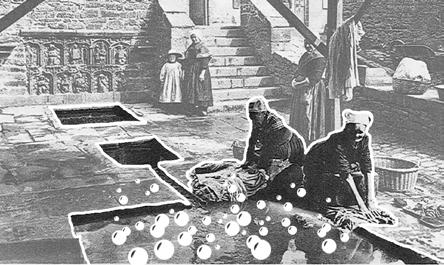
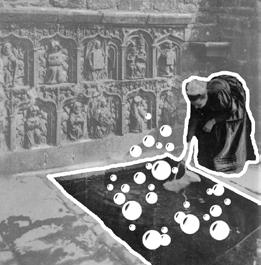
Lavomatique est un hommage à
ECHAPEE VERTE
Sporen Festival in Ypres, Belgium
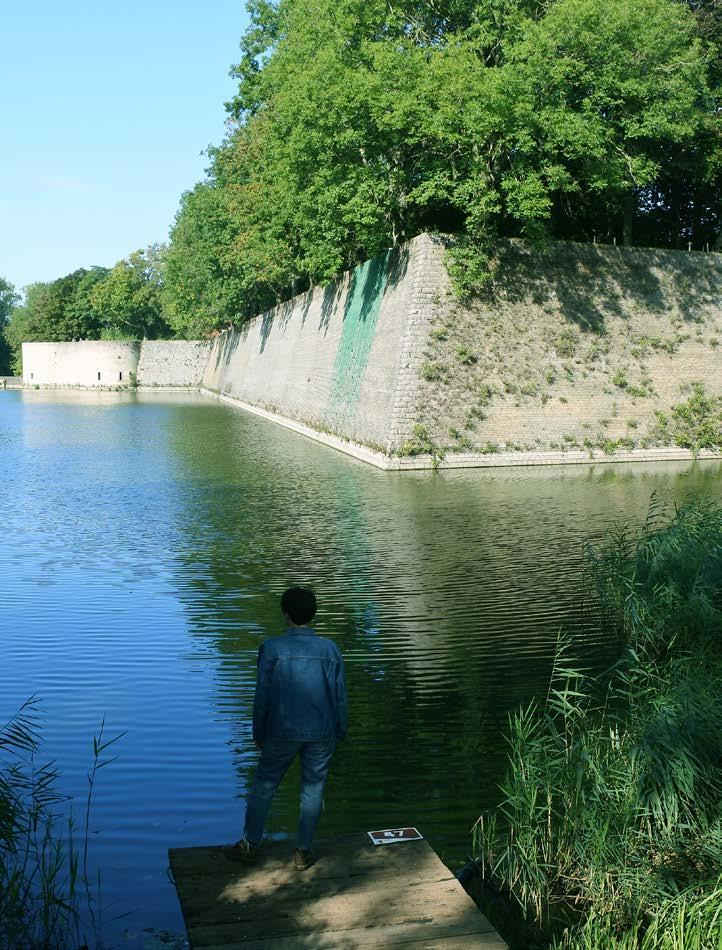
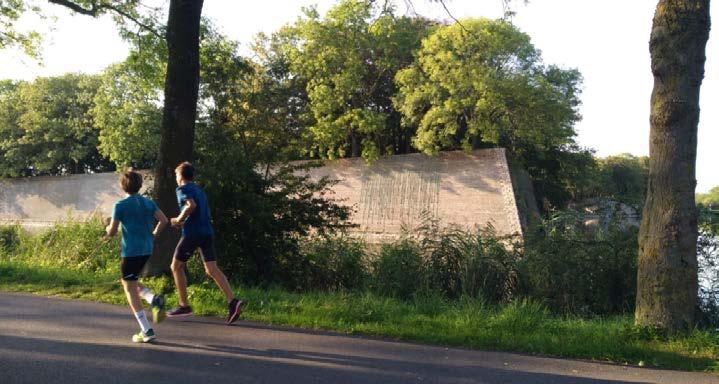
AWARD PROJECT - September 2020 - Installation on the theme of nature in the ramparts. Green suspended ropes and lifting weights - Dimensions = 8m wide and 10m maximum length
Longueur de la corde sur les remparts = Varie de 0.8 m à 3.5m
Hauteur 30 cm
Fondation 30 cm
Distance de la structure au muret existant = 1 m
Emprisetotale=6m Soit60cordestousles10cm
Rempartsexistants
Remparts existants
Vue côté remparts
Remparts existants
Muro Atelier // L'échappée verte // Page 11/12
The ancient defensive walls of Ypres now serve as a canvas for nature to reclaim its rights. These stone walls contain controlled vegetation that is eager to escape, cascading down the wall and reaching for the water. Like long vines hanging from the ruins of a forgotten citadel, these green ropes represent the plant life, using a metaphor associated with the idea of escape. One can envision an evolved nature preparing to break free from the confines of Ypres' walls, or perhaps it symbolizes a connection between water, vegetation, and stone, as if nature is inviting water to climb the city's ramparts. This site-specific installation, designed specifically for the walls of Ypres, aims to create a hybrid landscape, blurring the lines between the natural and the man-made, representing plant life through objects created by humans.
Niveau du sol
Niveau du sol
Niveau du muret existant
les10cmpourlamêmedimension
Vue côté promenade
Coupe / Détail d'accroche
Corde Planche bois de coffrage
Noeud
Pieu acier enfoncé dans le sol
Niveau du sol
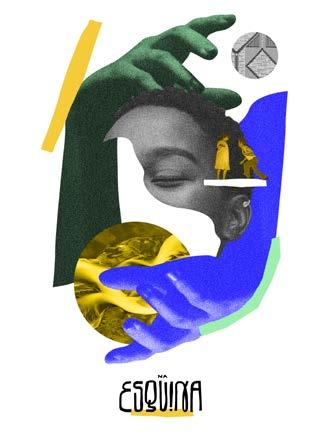
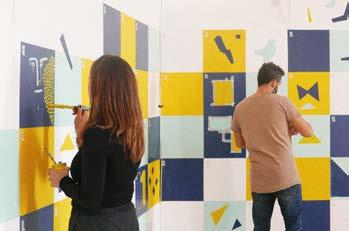
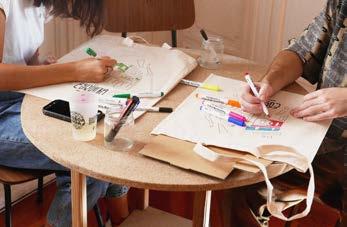
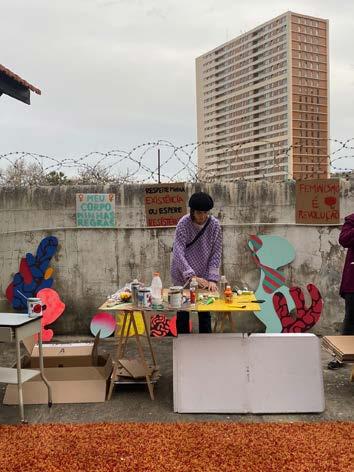
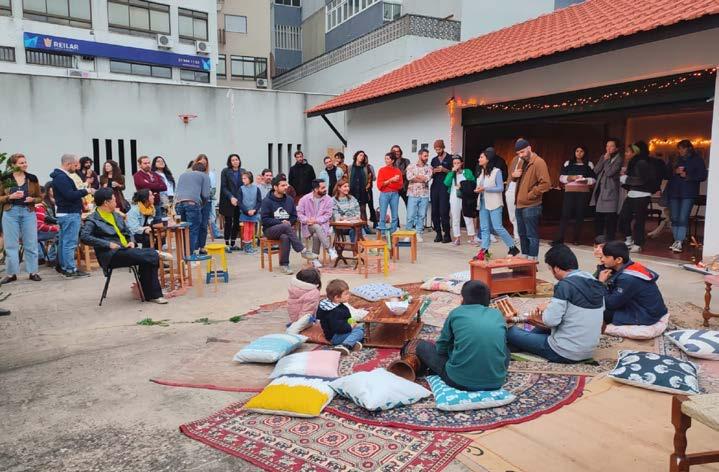
NA ESQUINA - PRINCIPE REAL
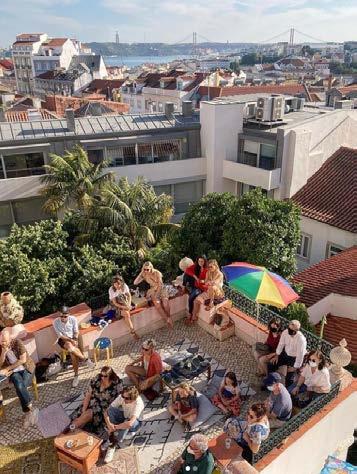
Temporary occupation in an unused palace, cultural center, musical venues, cowork, bar and restaurant Lisbon, Portugal, 2020-2021
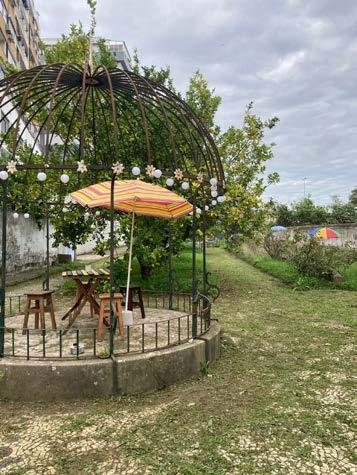
NA ESQUINA - MOSCAVIDE
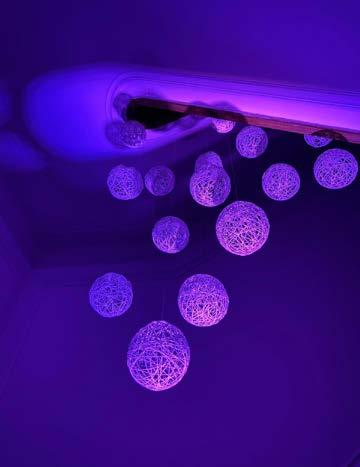
Temporary occupation in an unused house and garden, cultural center, shared office and artist residencies
SABAO
Participative installation, 100% reused materials, artistic residency and tactical urbanism in a fishing village- São Pedro de Afurada, Vila Nova de Gaia, Portugal., Under development
Through a consultancy mission focused on reusing construction materials for GAIURB (Vila nova de Gaia), we stumbled upon a hidden treasure: hundreds of abandoned washing tanks tucked away in a warehouse.
Driven by the aim to promote circular economy and inspired by the Afurada Living Lab, the collective decided to create an ephemeral artwork, a tribute to washhouses and the iconic clotheslines, breathing life into the market square for four months.
However, Sabão isn't merely a lifeless framework.
It will serve as the stage for the interwoven voices of the many communities that shape the soul of this city.
Each layer, every touch, and brushstroke will be the vibrant and fleeting expression of a people.
A tapestry in constant evolution, where each contribution becomes an indelible part of Afurada's history and identity.