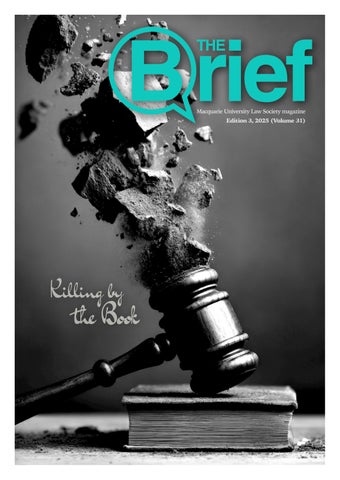
Macquarie University Law Society magazine Edition 3, 2025 (Volume 31)
Killing by the Book
Editor’s Welcome
There are many ways to kill.
A gun. A knife. A word. A vote. A verdict. But sometimes, all it takes is a book.
In a world full of uncertainty, our written law provides (at least) the perception that by following procedure, justice will be served. But this asks several questions:
• Can you follow all the rules and still do wrong?
• Can the law be used as a murder weapon?
• What happens when morality and legality collide?
This, here, is Killing by the Book. A place where destruction is not random - it is sanctioned, signed, sealed, and fully documented for those who dare investigate. In this world, villains are suited up, the murder weapon is a gavel, and the death is slow and painful.
So readers, I ask: what happens when the rules are wrong? What happens when we are too loyal to our word, or perhaps too tired to question it? Does ink stain more than blood?
With this, I welcome you to the final edition of The Brief for 2025! In what feels like a blip in time, we’ve written and edited through thick and thin to present yet another wonderful collection of work from our student body.
It is with this sentiment that I remain humbled and extremely grateful for the effort that goes into each of these editions.
It has been an absolute privilege and honour to work side by side with the amazing contributors for all our editions this year. To these contributors: I hope that in the years to come, you will be able to see how you started to find your voice through the hours of researching, writing, and editing, culminating in a mark left forever in these pages.
To the 2025 MULS executive team that have made this year of editions possible, I would not choose another group of dedicated individuals to weather the stormy and sunny days that go largely unnoticed. A special shout-out goes to our designer Nathan, especially considering his tenure working with The Brief EICs for the last 13 years!
Readers, its your support that keeps The Brief alive. Whether you’re flicking the pages to find what you’re friends have worked on or simply interested in the plethora of topics The Brief finds itself containing, we could not thank you enough. Read, keeping reading, and perhaps read some more.
Anya Maclure Editor-in-Chief, The Brief
President’s Welcome
I am delighted to welcome you to the third and final edition of The Brief, a special series of Macquarie University Law Society (MULS) publications for 2025.
In this edition, our student writers explore the topic of Killing by the Book - a fascinating examination of what critical thinking means when it comes to creating and applying the law. These articles feature a range of analysis on compelling legislation, defining decisions, and much more. They ask us to reconsider what we know of the law, and how we can do better.
As we close this chapter of what has been a transformative year for MULS, we reflect on The Brief’s role in shaping legal dialogue within our community. Entirely student-voiced, written and led, this publication remains a vital platform for amplifying diverse perspectives and fostering bold, critical conversations at Macquarie Law School. The depth and diversity of thought in this edition reflect the intellectual strength and moral curiosity of our students. Their experiences, insights, and passions are the lifeblood of our society, our law school, and the broader legal community.
MULS is proud to support The Brief, allowing students confront the complexities of the law, challenge convention, and contribute meaningfully to the evolving legal landscape.
Shuttershock or Adobe Stock, unless otherwise stated.
The print edition of The Brief is published triannually by the Macquarie University Law Society, Sydney, Australia.
Visit our website at muls.org
DISCLAIMER
All views expressed herein are those of the individual authors and do not reflect, in any way, the attitude of the Macquarie University Law Society. The Macquarie University Law Society does not accept any responsibility for the losses flowing from the publication of material in The Brief
ACKNOWLEDGEMENT OF PEOPLE AND COUNTRY
The Macquarie University Law Society acknowledges the traditional custodians of the Macquarie University Land, the Wattamattagal clan of the Darug Nation, whose cultures and customs have nurtured, and continue to nurture this land, since the Dreamtime. We pay our respects to Elders past, present and emerging.
Our Right to Protest in the Hands of the Police
Sarah Yeend [Edited by Maddison McCarry]
‘We do put a lot of trust in NSW police, and I believe that they exercise it judiciously’
- Chris Minns. Just months later, Hannah Thomas was allegedly assaulted by New South Wales (‘NSW’) police at a peaceful proPalestine protest, permanently disabling her.
Although not legislatively enshrined, the right to peaceful protest is protected under the implied freedom of political communication in the Australian Constitution. Protesting has directly impacted the development of rights of individuals in Australia, facilitating the right to vote for both women and Aboriginal and Torres Strait Islander peoples and aiding the progression of labour rights. In a country like Australia, the only western nation without a human rights act, protesting remains crucial to the protection of rights.
In response to an increase in anti-Semitic attacks across NSW, the Minns Government introduced the Crimes Amendment (Places of Worship) Bill 2025 (NSW) (‘the Act’), reforming hate speech and protest laws. Numerous human rights and legal bodies warned these laws would be ineffective in curbing antiSemitic crimes, with the Australian Lawyers for Human Rights pointing out the lack of correlation between such crimes and peaceful protest. Despite this, the Act was passed. This means that presently in NSW, the police may issue move on directions to any protest occurring ‘near’ a place of worship. There are few exceptions to this law, one being the discretionary powers of police to authorise protests near a place of worship.
The enactment of these protest reforms saw a variety of concerns surrounding the immense discretion granted to the police. The Human Rights Law Centre reflects these concerns with David MajiaCanales noting that “the law is so bad because it is not precise”. This sentiment is demonstrated through a key phrase of the Act that allows police to issue move-on directions for protests ‘in or near a place of worship’. Returning to the fundamentals of statutory interpretation one considers what constitutes ‘near’; 10 metres, 100 metres, 1 kilometre? The answer to this remains unclear, resting entirely with a police officer’s discretion. Despite legal and human rights
scholars voicing concern, and the risks of abuse of power when police discretion is overly broad, the NSW Premier Chris Minns was determined that such new powers would be exercised ‘judiciously’.
Unfortunately, it appears such faith was misplaced. Mere months after the enactment of the Act, Hannah Thomas was violently arrested by a member of the NSW Police, resulting in severe eye injury. Thomas was attending a peaceful pro-Palestine protest at SEC Plating that, perchance, was opposite a religious institution. NSW Police has stated the recent protest reforms relating to places of worship were not engaged in this circumstance. Despite this, court documents indicate prior to engagement with the protest, police were instructed to show ‘no tolerance’ towards the ‘unauthorised rally’. While definitive conclusions cannot be drawn, one must consider the impact of the Act on this event.
Prior to evaluating the impact of the recent protest reforms, it would be amiss to fail to consider the context of the event as a pro-Palestine protest. Concerningly, such protests appear to be increasingly targeted by police with a disproportionate intensity.
The alleged use of the phrase ‘unauthorised rally’ by members of the NSW Police when describing the above protest is troubling. Such terminology has been criticised by the United Nations Human Rights Council who note this language is incompatible with the concept of peaceful assembly as a basic right. Arguably, the utilisation of such language by NSW Police is underpinned by the Act empowering police to authorise protests near places of worship which would otherwise be prohibited. Human rights experts have argued such empowerment risks transforming the current system of police authorisation for some criminal immunity, into police permission to protest.
Protesting is a fundamental right underpinning democratic society. This right must be protected through clear, unambiguous legislation. By delegating discretionary powers to police to restrict the parameters of protesting, we risk losing our fundamental right to protest to an undemocratic, permission based system.
Since writing this article, the amendments have been deemed unconstitutional.
The Victims of the Migration Amendments
Sandy Elia [Edited by Peta Walton]
In December 2024, the Migration Amendment (Removal and Other Measures) Bill 2024 (Cth) came into effect as the Migration Amendment (Removal and Other Measures) Act 2024 (Cth) (‘MA Act’), which amended the Migration Act 1958 (Cth). The MA Act focuses on people who will be removed from Australia following a denial of their visa or protection visa. It would not affect those who are waiting for a decision on their protection application or asking for a review. The MA Act received widespread criticism across Australia and even internationally, being labelled as regressive and cruel by refugee advocates, community groups and legal experts. Consequently, the government is granted new powers to enforce removals through the MA Act. Supporters claim the MA Act protects the integrity of Australia’s migration system, yet critics argue it has entrenched injustice by punishing the vulnerable. This raises the question: justice for whom?
Since 1901, over 985 thousand refugees have come to Australia seeking protection. These individuals are unable to return to their own country at the risk of being persecuted due to their race, religion, ethnicity, political opinion, or even sexuality. In effect, they have come to Australia with the hopes of starting a new life, with the idea that our nation will, in turn, welcome them with open arms. Australia demonstrated its commitment to refugee protection when it became a party to the Refugee Convention in 1954, agreeing to ensure that people who meet the United Nations understanding of a refugee are not sent back to a country where their life would be threatened. This is the principle of non-refoulement - a cornerstone of our historical commitment to refugee protection.
Yet, the passing of the MA Act seems to be a sharp departure from the standards our country was confident in upholding in 1954, by empowering the Minister to direct those who are refugees and those who are to be deported to be removed forcibly back to a country where they may face persecution or death.
This government prides itself on the belief that unity is one of Australia’s most prominent strengths, recognising that “generations of Australians from all over the globe have given us this very precious gift.” However, this concept of unity and sense of community for those in refuge is now something they will never experience with the enforcement of the MA Act. It upholds such troubling developments as the allowance for the separation of families. This aspect of the MA Act should not be overlooked, as it directly affects the lives of innocent families. This means Australian citizens who await reunification with family members seeking refuge will be forcibly separated and eventually coerced to return to their home country. The effect on families contradicts the government’s professed values.
Even more troubling, the MA Act allows the Australian government to pay third countries to accept non-citizens, including recognised refugees. Contrary to the standards of the Refugee Convention, these laws do not require these third countries to be parties to the Convention. Additionally, the MA Act does not provide adequate safeguards to protect these refugees from harm or detention abroad, or even the possibility of refoulement to countries where they may face persecution. In practice, this shifts Australia’s responsibilities onto nations with fewer safeguards, thus eroding the principle of justice.
Ultimately, The Migration Amendment (Removal and Other Measures) Act 2024 (Cth), which amended the Migration Act 1958 (Cth) displays a selective application of justice in Australia as it privileges the security of citizens while denying fairness, equality and dignity to asylum seekers and refugees. In doing so, it stands in stark contrast to Australia’s obligations under the Refugee Convention, which enshrine protection, non-refoulement and equal treatment irrespective of nationality. This divergence forces us to confront an uncomfortable truth: under this legislation, justice becomes conditional – determined by citizenship rather than humanity.
Signed, Sealed, and Sanctioned
The Quiet Violence of Forced Sterilisation
Vania Raghuvanshi [Edited by Emi Davies Barnier]
Leah just turned 17 years old. Her guardians went to Court, seeking to have her sterilised. Leah is intellectually disabled and cannot give fully informed consent. Yet, the Court has granted the request to sterilise her. Beneath layers of statutes, guardianship tribunals and ‘best interest’ doctrines, the law signed off on deciding for her what she might or might not want for the rest of her life. Leah’s story isn’t a fictional article hook, but a grim reality for many. It is an uncomfortable reflection of what remains legally permissible under Australian law.
The Legal Machinery
In Secretary, Department of Health and Community Services v JWB and SMB (1992) (‘Marion’s Case’), the High Court held that decisions concerning the sterilisation of intellectually disabled children must be referred to a court of competent jurisdiction. Approval of the surgical procedure may be granted if sterilisation is found to be in the child’s “best interests.” This principle has since been embedded in legislation. For adults, the Guardianship Act 1987 (NSW) authorises tribunals to consent to non-therapeutic procedures (such as sterilisation) where the person lacks capacity and the treatment is deemed necessary and in their best interests. While intended as protection, this framework enables substituted decision-making that threatens the individual’s right to bodily autonomy.
Human Rights Breached
Involuntary sterilisation violates core international human rights. Australia is a party to the Convention on the Rights of Persons with Disabilities (‘CRPD’), which demands respect for physical and mental integrity (Art 17) and the right to found a family (Art 23). By permitting substituted decision-making for sterilisation, Australian law breaches these protections. The UN Committee on the Rights of Persons with Disabilities has repeatedly criticised Australia’s allowance of sterilisation without the free and informed consent of the individual. Australia’s
legal attitude has been described as a form of violence and discrimination specifically against women and girls with disabilities. Despite these findings, Australia maintains an interpretative declaration to the CRPD, effectively preserving domestic discretion to continue the practice.
Recognising the Right
Despite its gravity, forced sterilisation remains largely invisible. Tribunal approvals and medical justifications, often framed as menstrual management or pregnancy prevention, routinely appear in submissions and case files, but public data is sparse and fragmented. This lack of transparency serves as a shield, allowing approvals to continue clandestinely, avoiding public criticism or accountability. This vacuum reflects a deeper tension between disability, autonomy, and reproductive rights. Until forced sterilisation is openly confronted, its victims will remain unheard, and the law will continue to favour convenience over consent.
Reform the Law, Restore Autonomy
Australia must confront the legal and ethical failures that allow forced sterilisation to persist. Urgent reform is required at the national, state and territory levels to ensure consistency, accountability, and rights-based protections. While the Royal Commission’s recommendation of outright prohibition may seem ideal, it risks overlooking complex cases where individuals lack legal capacity for consent. In these circumstances, a nationally uniform legislative framework is essential, not to entrench the practice, but to regulate it transparently, limit its use, and embed safeguards. Crucially, governments should consult directly with people with disability in establishing frameworks, especially women and girls, through representative organisations. Those most affected by the law must be actively involved in shaping it, rather than continuing to be sidelined by it. Reform shifts the focus from institutional convenience to individual dignity, ensuring that disabilities do not become a justification for irreversibly violating bodily autonomy.
The Juxtaposition of Bail Laws
FOR Krishi Patel [Edited by Paneet Bains]
Bail laws are designed to balance community safety against the criminal law principle that an accused is innocent until proven guilty. In New South Wales, that balance is governed primarily by the Bail Act 2013 (NSW). However, in practice, the operation of bail in NSW has created a growing remand population of people detained before conviction, most particularly domestic violence defendants whose remand numbers rose by 24% from December 2023 to June 2024. The consequences result in personal, social, and systematic failures. People who need to support their families are left to wait in cells while their matters go through an overburdened system, and the presumption of innocence risks being hollowed out.
Increase in Remand Numbers
The scale of pre-trial detention has steadily increased in NSW, as well as at a federal level. The Australian Bureau of Statistics recorded a 13% rise in prisoners on remand between 2023 and 2024. These remand figures are important because they positively correlate with worse health, loss of housing, unemployment, and a greater chance of receiving a custodial sentence at final disposition. Several features of NSW bail practice help explain why remand numbers have risen and why the system can operate unjustly.
Recent Reforms
First, the increased cautiousness of courts, as seen through recent legislative amendments, has shifted thresholds for decision making in a manner that makes refusal of bail more likely. These rushed reforms risk undermining a fair and just trial and the presumption of innocence. The lack of pre-trial support and timely hearings makes detention the default option.
Discriminatory Impacts
Second, remand disproportionately affects vulnerable groups. Indigenous people and young people appear to form the majority of the remand population, which raises equality concerns and has humanrights implications that often go ignored. These ‘presumptions against bail’ can have discriminatory impacts and produce outcomes that are legally and ethically questionable.
Systematic Failures
Third, systematic failures such as court backlogs, stretched custodial capacity, and limited magistrate hours lead to accused people being detained for extended periods of time before their hearings. In 2024, the median time from arrest to the completion of trials in the District Court was a record high of 826 days. This long period could lead to police cells overflowing and being overcrowded. Most police cells are not equipped with the capacity or facilities to hold the increasing number of people in detention, which could lead to individual needs being ignored. Almost 52% of the prisoners in Australia have reported physical ailments, and one in two prison entrants had a mental ailment. With prison cells overflowing, catering to each individual’s needs would not be feasible and would most likely lead to health and mental conditions worsening. Moreover, indefinite and prolonged pre-trial detention where remandees are not separated from convicted prisoners most definitely is in breach of human rights against arbitrary detention and human degradation.
To that end, NSW’s bail regime currently produces outcomes that do not reflect the idea of fairness and justice. While community safety is the primary objective of these subjectively strict bail laws, there is an inherent imbalance between community safety and leaving all accused people to pay the price of a slow judicial system, despite the state of their innocence. What is truly needed is an evidence-led bail system, early hearings, and better mental and physical pre-trial support. Furthermore, some humane alternative to remand can be explored, as other options could mitigate the harm that is caused due to the contemporary system. Finally, the presumption of innocence should be more than just a perfunctory principle - it should be able to inform when and why liberty is denied.
AGAINST
Rachel Justic [Edited by Lucinda Wynn]
Bail laws remain within the crossroads of community security and individuals’ liberty, simultaneously condemned yet celebrated within the legal system. While criticised for impeding the presumption of innocence, its key function as community protection remains paramount, establishing necessity for the enactment of bail.
Preventative Basis
Limiting the legal right to the presumption of innocence is justified when viewed against community safety, preventing flight risks, protecting at-risk victims and witnesses, and reducing recidivism. Implementation of
bail is not a punishment but rather a societal protection measure to reduce further harm. It is recognised internationally that the presumption of innocence is not an absolute right. Liberty may be legally restricted when justified by public interest in recognition of the collective right to safety. In considering whether there is an ‘unacceptable risk’ that an accused would reoffend, fail to appear, or endanger others, including witnesses and victims, the rights of the individual are balanced with that of the community. The consideration is not whether the accused should be afforded bail or ‘punished’ for their crimes but it is rather a preventative framework. In aiming to broadly uphold justice for a wider range of stakeholders, as opposed to undermining justice, the system is founded in risk assessment as opposed to guilt assessment.
Balancing Rights and Protection of the Community While international law provides for all accused persons to be presumed innocent until proven guilty, this right must also coexist with the human right to security and protection, creating an innate conflict of human rights. In this regard, the debate centralises around whose inherent right is more greatly protected and extends beyond risk but into public interest. The Bail Act 2013 (NSW) embodies this balance of rights by ensuring pretrial detention only occurs when necessary to prevent further harm and ensures that decisions are grounded in evidence rather than prejudice, objectively considering safety without inequality or political influence. The avoidance of punitive language in the legislation itself emphasises the prioritisation of public confidence in the administration of justice. This recognises that while the presumption of innocence is a fundamental right, it may fall secondary to other public objectives, yet ensures those who are refused bail are not unjustly punished for circumstance or poverty.
In the recognition that there may be situational occurrences where illegitimate bail conditions are imposed that impede on the rights of an accused and are situationally disproportionate breaches of that right, as a rule, the current framework for bail laws provides a greater level of community protection than disproportionate punitive implications on accused. The current discourse focuses heavily on “tough[er] bail laws”, but for genuinely proportionate justice, evidenced assessment of risk remains necessary. With objective consideration, bail laws can remain just for victims, the community, and the accused. In balancing the rights of all involved, the current framework serves to more successfully protect a greater number of people.
Victors’ Justice or Selective Silence?
Examining the Roles of the International Criminal Court and the Responsibility to Protect Doctrine
Sophie Shanaaz [Edited by Zoe Pook]
AQuestion of Even Justice
The International Criminal Court (ICC) emerged from a global consensus that atrocity must be met with accountability, marking a formal progression from ad hoc responses such as the Nuremberg and Tokyo trials to a permanent institution grounded in law. Codified under the Rome Statute of International Criminal Court, the ICC enshrines the promise of neutrality, complementarity, and protection for vulnerable populations from genocide, crimes against humanity, war crimes and crimes of aggression. Two decades on from its inception, the extent to which the ICC has delivered on these aspirations remains ambiguous. Critiques of geopolitical silence and state actors circumventing scrutiny under the critical framework of ‘victor’s justice’ beg the question of whether the ICC operates as an impartial forum for global justice, or whether it reflects deeper asymmetries in who is held to account and when.
What is Victor’s Justice?
The concept of ‘victor’s justice’ denotes the disquieting reality that international criminal law, though intended to transcend political bias, often mirrors the geopolitical hierarchies it purports to discipline. From the postWWII, ad-hoc tribunals at Nuremberg and Tokyo to the modern ICC, justice has frequently followed the contours of power, shielding the perceived victors while scrutinising the opposing end. This criticism is
not new, but its persistence underscores the structural entanglement of legal accountability with political selectivity, going beyond mere prosecutorial bias to uncover a deeper normative ambiguity. International criminal law oscillates between moral ambition and instrumental function, performing a dual role as both a mechanism of justice and a tool of international order. By extension, the selection of instances to prosecute at the ICC is shaped as much by legal merit as by state consent, United Nations Security Council (‘UNSC’) dynamics and practical enforceability.
The Legacy of Victor’s Justice in Rwanda
These concerns were sharply illustrated in the ad hoc tribunals for Rwanda (‘ICTR’) during the 1990s. The ICTR was lauded for establishing important precedents but criticised for allowing the post-genocide Rwandan Patriotic Front (RPF) immunity from prosecution, despite credible allegations of reprisal violence. Here, complementarity (secondary jurisdiction) operated less as a principle of mutual reinforcement than as a mechanism of deflection, insulating allies from accountability while projecting the image of impartiality. When trials become performative, rather than reflective of even-handed justice, they risk becoming spectacles that reproduce hegemonic narratives rather than confront wrongdoing. Ultimately, victor’s justice is not a temporary flaw of transitional phases, but a systemic condition that must be constantly interrogated to ensure the ICC
evolves as more than a venue of symbolic discipline for weaker states.
Responsibility To Protect (R2P) Doctrine
While victor’s justice exemplifies partiality in legal action, R2P represents its antithetical failure in the moral and legal vacuum that results from inaction. R2P was conceived as a normative framework to overcome sovereignty-based paralysis in the face of atrocity crimes, however, its deployment has been shaped by strategic and political selectivity, alongside legal criteria. Having emerged from the 2001 report of the International Commission on Intervention and State Sovereignty, R2P reframed sovereignty as a conditional responsibility to shield populations from atrocity crimes. Introducing a three-pillar framework, the doctrine emphasises the state’s duty to protect, international assistance, and collective action if a state fails. Though not legally binding, R2P has since shaped discourse and UNSC practice on civilian protection. However, the doctrine remains an idealistic aspiration rather than a consistent instrument of global justice. Having faded into a prolonged coma, R2P in the modern era struggles to assert itself in a world where the veto power of the UNSC and realpolitik often override legal and ethical imperatives.
R2P’s Selective Silence on Gaza
The broad international approach to Gaza demarcates the R2P as a directly inverse mechanism to the ICC.
Despite extensive documentation of structural violence, repeated military incursions, civilian casualties and indicators of mass atrocity risk, the international community has consistently failed to operationalise R2P in any meaningful sense. The presence of political paralysis is not merely an omission reflective of the absence of qualifying conditions, but a reluctance to confront powerful actors or entangle in protracted territorial disputes. The ongoing atrocities in Gaza have now been officially recognised as amounting to genocide, with the United Nations Human Rights Council reporting that Israel has committed acts of genocide against Palestinians, including targeting civilians, inflicting conditions of life calculated to bring about their destruction, and incitement to genocide. As such, a deeper normative fracture in the R2P’s implementation is thus apparent to be contingent upon geopolitical expediency and not triggered by threshold breaches alone.
Moreover, R2P’s reliance on consensus and discretionary interpretation leading to selective application entrenches a ‘hierarchy of victims,’ where subjugated populations like that of Gaza are rendered juridically invisible out of a lack of diplomatic leverage or alignment with global powers. Hence, its core, systemic weakness lies in its operation primarily on moral appeal, vulnerable to deferral or abandonment. The contrast with the ICC’s formal legal mandate further highlights how both action through selective prosecutions and inaction via failure to intervene can be morally compromising.
Moving Towards Structural Consistency
Victor’s justice and selective silence coexist as two faces of the same coin, signalling that global justice mechanisms are not immune to the political architectures they operate within. The ICC’s partial prosecutions and R2P’s selective dormancy suggest that justice, whether enforced or withheld, often mirrors strategic interests rather than legal or humanitarian imperatives. Impunity may emerge not only from judicial bias, as highlighted in Rwanda, but from international inaction seen in the current situation in Gaza. If international law is to uphold its foundational commitment to universality, its institutions must confront the dissonance between principle and practice. Whether through more equitable prosecutorial standards at the ICC or the revitalisation of R2P with enforceable obligations, the pursuit of even justice requires recognising that silence, just as selectivity, can be an act of power.
Legislating for the Climate Crisis
Is Australia Doing Enough?
Ayushi Makhija [Edited by Alana Mazlin]
With the consequences of climate change becoming increasingly harder to ignore, the need for urgent climate action has grown stronger. The International Court of Justice (‘ICJ’) recently ruled that the responsibility to address this issue falls on States themselves, citing the importance of protecting the environment for ‘present and future generations’. Advisory opinions carry legal and moral weight, setting clear guidelines that States are generally expected to follow. However, Australia’s legal framework is not fulfilling its role in protecting the environment to the standard set by the ICJ. Australia’s ‘main national environmental legislation’ is the Environment Protection and Biodiversity Conservation Act (‘the Act’). This law creates a barrier to projects that may cause climate harm. However, in practice, notable omissions from the Act mean it cannot sufficiently prevent this issue. It fails to consider how cumulative effects build over time. It also fails to consider reduction of greenhouse
gas emissions, which is a significant focus of the 2018 Obligations of States in respect of Climate Change (‘Advisory Opinion’), and is argued to be important by scholars such as Rieder. Proposed changes do not seem promising, nor does Australia’s ability to ultimately meet these obligations moving forward.
The ICJ Advisory Opinion represents a key step forward in regulating climate change, by clarifying the responsibilities of governments with respect to climate change. This decision considers how principles of international law create obligations with respect to human induced climate change and the need for urgent response to protect human rights. Other key points raised are the ‘common but differentiated responsibilities’ highlighted in the Paris Agreement which Australia is signatory to, and imposition of legal consequences for states which do not comply with this decision. Further, the Act is concerned with ‘all actions or omissions’, imposing a positive duty on states. The effectiveness of the Act must be assessed in line with the standards set by the Advisory Opinion.
What is the Act doing Correctly?
The mere existence of a federal legislative framework preventing climate harm is positive. The Act allows the Minister to assess and approve actions that are likely to have a ‘significant impact’ on the environment, providing a barrier to potentially harmful actions. The Act’s scope extends to Commonwealth involvement on ‘Commonwealth actions and Commonwealth areas’. This ensures that the international impact of Commonwealth actions are considered, in line with the Advisory Opinion’s focus on international responsibility. Further, the Act recognises the ‘role of Indigenous People’, aligning with the Advisory Opinion’s consideration of the impact of climate change on the rights of Indigenous Peoples.
Cultural change is evident in the Act’s practical impact, making it common practice for lawyers to seek assessment under the Act. It has provided a legal basis for individuals and organisations to challenge acts which adversely affect the environment, with McGrath noting key cases such as Booth v Bosworth and Minister for Environment and Heritage v Greentree , where injunctions were granted against individuals who had committed acts that affected areas of environmental concern. Further, academics Godden and Peel note that courts have interpreted the Act to allow for indirect impact as well, with the Nathan Dam case finding that ‘significant impact’ can include ‘effects which are sufficiently close to the action to allow it to be said…that they are…the consequences of the action on the protected matter’. The presence of such a broad scope allows the Act to prevent a greater amount of actions which might otherwise adversely affect the environment.
Where is the Act Insufficient?
Despite this, the Act is overall lacking in its practical ability to prevent climate disaster to the necessary effect, considering Australia’s capacity to address the problem. The Act fails to account for cumulative action. Cumulative impact can cause significant damage to the environment if not addressed at an appropriate time, and as academic Dales highlights, damage cannot be addressed until it actually happens. This is in line with the issues identified by the Act’s Independent Review, which states that there is insufficient ‘comprehensive planning’ under the Act to effectively manage cumulative impacts.
Another area where the Act is not comprehensive enough is the omission of key matters of national
environmental significance, such as greenhouse gas emissions. This is particularly significant when considering the focus of the Advisory Opinion on anthropogenic greenhouse gas emissions as a requirement set out by climate treaties. Further, the Act has a problematic enforcement mechanism, which reduces the likelihood of breaches of the Act being challenged. The burden is placed unfairly on environmental groups to challenge decisions, and subsequently on courts to develop the law further in their limited power to set precedents through decision.
The review process of the Act only occurs every ten years. This is particularly significant considering the focus of the Advisory Opinion on the need for urgent action, and the smaller cycle of agreements like the Paris Agreement, which is reviewed every five years. The importance of a more frequent review becomes increasingly more prominent as the effects of climate change create extreme conditions.
The Act’s Negative Future
Despite a recent review being conducted of this Act, proposed changes do not seem likely to bring Australia’s legal framework closer to the standards set by the Advisory Opinion. The proposed Environmental Protection and Biodiversity Conservation (Reconsiderations) Bill 2025 (Cth) intends to reduce the power of the Minister to reconsider decisions. Such a decision, while attempting to increase certainty for businesses, is likely to exacerbate its existing issues regarding the environment by narrowing its scope further. Hence, the Act is unlikely to undergo positive changes to the extent that Australia will be effectively meeting its international obligations according to the recent Advisory Opinion.
Conclusion
The ICJ’s Advisory Opinion marked a significant turning point in addressing how governments should respond to climate change, clearly highlighting the importance of State accountability for both actions and omissions. This Advisory Opinion has further exposed the inadequacy of Australia’s current environmental law framework in meeting our international obligations. While the Act has some positive impact, Australia is not sufficiently addressing this urgent issue to the standards set by the ICJ.
When Pages Turn to Ash
The Legal Rituals that Erase Memory
Sanaaya Butala [Edited by Lianne Tacardon]
The ink never spilled and the gavel never dropped. Instead, with a regulatory threat and a flip of the switch, Jimmy Kimmel Live was pulled from the air indefinitely. Political upheaval, executive orders, and outraged online commentary posted on the platform X coincided with more than 6,870 books banned across 23 U.S states in the 2024–25 school year. Through speech, writing, and now social media, ideas have dismantled dictatorships, powered feminism, and driven racial justice movements. International law promises freedom of expression within limits, but the line between protecting the public and silencing individuals has blurred. From ancient edicts, to 1933 fascist book burnings, to 2025’s book bans, the tension between protection and control has hardened into policy. As Ray Bradbury warned, “You don’t have to burn books to destroy a culture. Just get people to stop reading them.” This article explores how legal censorship, dressed as protection, erases dissent, rewrites memory and manufactures social conformity.
Historical Origins of Censorship
Censorship didn’t begin in a courtroom; it began in a throne room, and is inherently intertwined with political power. The popularised sentiment ‘the pen is mightier than the sword’ rings true throughout history, where most political leaders, threatened by the emergence of conflicting discourse contradicting their governance, engaged in methods of censorship. Diverse education threatens conformity and incumbent political power by inviting contradicting opinions and alternative, yet compelling, perspectives. These varied opinions present the biggest threat to power.
Qin Shi Huang, the first Emperor of China, is simultaneously revered as a tyrant and the man responsible for the unification of China, and is an exemplary illustration of how written discourse affected political leadership. Despite his adept administration and military skills, the Emperor was as afraid of the inkbrush as he was of a sword. Therefore, with the knowledge of scholars disapproving of his methods, he ordered the capture and burial of 460 scholars who opposed his regime.
Subsequent scholars condemn his tyranny while also acknowledging Huang’s political genius. Huang believed that the past was irrelevant to the present he had created and therefore, the subjugation of scholars by way of their execution was an effective tool in sustaining conformity with ancient Chinese society. In this context, while not legitimised through statute, Huang effectively censored scholarship during his regime through the issuing of proclamations and actions.
Moreover, legal censorship is evidenced in the 1878 passage of the Vernacular Press Act 1878 (India) (‘Vernacular Press Act’), which affected publications in ‘Oriental languages’ and aimed to censor the topics of articles published in India. The 1878 statute forced editors of blacklisted newspapers to enter into government bonds. These bonds stipulated a year-long censorship which, if broken, would possibly result in the confiscation of their printing presses. While India’s Vernacular Press Act was a formal law enforcing censorship, the British government employed additional congruent methods which shaped public opinion. This occurred through the distribution of ‘official intelligence; selectively often favouring certain publications that had a pro-British stance such as The Pioneer. Inadvertently, the colonial British government
created a hierarchy of access, encouraging compliance and marginalizing critique until it became absolute. The British government often corrected false rumours in an attempt to promote honesty in journalism. In this case, the combination of legitimate censorship laws alongside the manipulation of access created the appearance of free speech, where ideas were not banned outright, but ones heard in the public sphere were controlled by the British government. Aligned with Bradbury’s aforementioned sentiments, this illusion of freedom awards greater control, as citizens governed by the powerful are unaware they are the victims of silencing.
Linked to many historical empires and downfalls, power and censorship are in a symbiotic relationship and inform one another. However, as history continues to progress, the legitimisation of censorship emerges, creating foundations for legal frameworks and present issues facing modern society.
Silencing by Statute: The Modern Face of Censorship
In ancient China, censorship was explicit, with scholars being punished upon promoting ideologies contradicting the Emperor’s regime. In colonial India, censorship was systemically embedded within publications, manipulating relationships of trust between the people and the British government whilst simultaneously encroaching upon the rule of law. Historically, there is a clear progression of censorship from outward attempts to control the public to engaging in subtle methods that shape and re-shape public opinion.
With the rise of social media and globalisation, domestic censorship laws are crafted to echo the sentiments of international treaties. Article 19 of the International Covenant of Civil and Political Rights (ICCPR) grants the protection of the right to freely express ideas and opinions subject to the rights of others and national security. The key problem lies within the interpretation of these sentiments.
On March 4 2022, Russia enacted new laws criminalising independent war reporting and imposed strict censorship on discussions of Russia’s war with Ukraine, issuing penalties of up to 15 years’ imprisonment. The law banned the use of words such as ‘war’ or ‘an invasion’ to describe the conflict, arguing that Russia’s actions in Ukraine were a ‘special military operation.’ The following day, Russian police raided an opposition newspaper due to allegations that their publications were engaging with anti-war protests and discrediting the Russian Armed Forces. Foreign media subsequently withdrew from Russia, and Russian outlets deleted previous related online posts and
refrained from reporting on the war. The nonprofit group Human Rights Watch argued that Russia’s draconian enactments compelled journalists to delete existing publications condemning the conflict and refrain from reporting on future incidents, distorting the historical record of the war between Russia and Ukraine.
As a party to the ICCPR, Russia is bound by Article 19. However, the nation argued that the introduction of stricter censorship laws subjugating this right were necessary, citing the need to protect Russia’s national security. Here, legal ambiguity combines with power to weaponise censorship and achieve control over civic populations.
When fact becomes a crime, memory becomes fiction and dissent becomes criminal.
In Iran, the 2022 Woman Life Freedom protests sparked by the arrest and subsequent death of Jina Mahsa Amini for improperly wearing her hijab marked the beginning of regulatory attempts to curb free speech. Also a party to the ICCPR, the Iranian government proposed a new statute relating to online speech in July 2025. The proposed passage of the Bill on Combatting the Spread of False News Content in Cyberspace (‘the Bill’) would award the government power to block online content that authorities deemed false information and increase punishment for those engaging in offensive online behaviour. Under the Bill, any online expression could constitute a punishable offence and was evidently designed to force conformity through eliciting fear within the community.
Ostensibly framed as protection, the proposed punishment of 15 years imprisonment – harsher than espionage or kidnapping – implies an underlying political motive. Poets, filmmakers, artists, and scholars would have been subject to the Bill. With these communities preserving culture and history through art, music and stories, the possibility of global change is put at risk through the Bill’s suppression of their artistic expression. While the Bill was withdrawn after significant backlash, its mere proposal is an alarming outcome in itself.
The law, symbolised by scales, carries the weight of ensuring justice through due process. However, the justice system may be weaponised and the silencing power of a statute kills more swiftly than a sword. With the rise of social media, there is no pervasive threat to the existence of free speech – rather, which narratives are given more weight and which are being overlooked presents a true risk. Ultimately, history may be written by the victors, but it is censored by lawmakers first.
Discriminating by Design
Section 22C and the Rights of Children
Sophia Jordan [Edited by Adriana De Castro]
Two co-accused stand before a bail authority. One is aged 17 years and 11 months, the other 18 years and one month. Their circumstances are identical, but the legal threshold for bail is not. Common sense might suggest that the adult faces the higher bar. Under the 2024 reforms to the Bail Act 2013 (NSW), the opposite is true.
In early 2024, amid media-driven concerns about rising youth crime in rural towns, the NSW Parliament introduced an additional bail threshold for certain children. The government claimed these reforms would ‘protect’ the community. And yet, Section 22C exemplifies the quiet violence of good intentions, a law that claims to protect society while steadily eroding the rights and futures of the young people it targets. Here, the law itself becomes the instrument of harm, sanctioned, procedural, fully documented, a slow, bureaucratic destruction of opportunity and rights.
The Murder Weapon: Section 22C
Section 22C applies to children aged between 14 and 18 who are charged with motor vehicle theft or a serious break and enter offence, and who are already on bail for a similar offence. Under Section 22C, the bail authority must not grant bail unless they are satisfied to a ‘high degree of confidence’ that the child will not commit another serious indictable offence while on bail.
As Justice Lonergan observed, Section 22C imposes a standard ‘unknown to criminal law’ and one that operates ‘in an unfairly discriminatory way’. This inconsistency becomes clear when comparing the threshold applied to adults in identical circumstances with that imposed on children under Section 22C. An adult accused of a serious indictable offence while on bail must only ‘show cause’ as to why detention is not justified. Indeed, as Justice Lonergan highlights, adults ‘do not have to demonstrate anything that would inform the court to a “high degree of confidence” about any matter at all’.
More disturbingly, adults charged with the most serious offences, such as murder, sexual intercourse with a child under ten, or serious domestic violence, are subject to the lower ‘show cause’ standard. Consequently, Section 22C not only imposes a higher bail threshold on children than on adults in identical circumstances, but it also sets a higher threshold for children charged with property offences than for adults accused of murder.
This is not merely harsh, it is discriminatory. Section 6 of the Children (Criminal Proceedings) Act 1987 (NSW) sets out the principle that ‘that children have rights and freedoms before the law equal to those enjoyed by adults’. Rather than uphold Section 6, Section 22C effectively reverses its intent. Instead of ensuring equal treatment, the law enshrines harsher measures for children than for adults. In doing so, the legislative framework is not simply flawed, it is structurally discriminatory.
The Victims: Young Offenders
The consequences of Section 22C are already visible. From June 2023 to June 2025, there has been a 34% increase in young people in detention across the state. Jackie Fitzgerald, Executive Director of the New South Wales Bureau of Crime Research and Statistics, directly attributes this to the increase in the number of young people on remand, which has grown 28% in the past two years. Rather than treating these figures as a warning, the government has framed them as a policy success. When extending Section 22C in April 2025, Premier Chris Minns celebrated that ‘alleged offenders are more than twice as likely to be denied bail’. For the government, rising remand rates were not a red flag but a measure of success. The question of whether the law actually reduces crime was left unasked.
The evidence on youth detention is unequivocal. Incarcerating children is not only harmful to their lives and futures – it is criminogenic. For instance, 88% of Indigenous children and 79% of non-Indigenous children released from detention return within 12 months. Further, research by Gatti, Tremblay and Vitaro found that childhood incarceration is one of the strongest predictors of adult recidivism. By increasing the threshold for young people to make bail and thereby increasing the number of young people on remand, Section 22C does not break the cycle of recidivism; it deepens it.
The Accomplices: Politics and Panic
So how did we get here? The answer lies in the politics of fear. As scholars have shown, bail law in Australia is increasingly driven by politicisation. This politicisation is often driven by trigger events that prompt media outcry for the government to ‘fix’ the bail system. Bail reforms then become less about evidence and more about optics, demonstrating that leaders are ‘tough on crime’ and, crucially, tougher than their opponents. The language of ‘community safety’ becomes the weapon of choice. Academics Auld and Quilter note that the mere invocation of community safety is treated as justification enough for sweeping restrictions on bail. Section 22C was no exception. Its introduction was hailed by the government as ‘decisive and immediate action’ in response to community demands to address youth crime, repeatedly emphasising its commitment to ‘community safety’.
Judicial Unease
The Supreme Court judiciary have been far from silent in expressing their unease with Section 22C. Judges have repeatedly described the provision as discriminatory and fundamentally at odds with the principles meant to guide the treatment of children in criminal proceedings. For instance, Justice Yehia found it ‘curious and troubling’ that children face a stricter test than adults, while Justice Rothman labelled Section 22C a ‘ham-fisted attempt’ to solve a political problem, and cautioned it may even be unconstitutional. This chorus of judicial concern highlights a stark tension between legality and justice, procedure and principle. Section 22C may be lawful, but as these judges make clear, that does not make it right.
Conclusion
Section 22C is more than a technical flaw in bail law – it is a deliberate legislative choice that punishes children more harshly than adults. It reflects a politics that prioritises reactive ‘tough-on-crime’ policymaking over the principles of justice and, importantly, over evidence-based approaches to youth crime. By turning equal treatment on its head, the law undermines the very protections it claims to uphold. This is killing by the book, a law that, on its face, follows process and speaks of community safety, but in practice entrenches harm, fuels cycles of incarceration, and strips rights from those least able to defend themselves.
Death by Procedure
The Australian Administrative Version
The algorithm followed all legal procedures to convert suspicion into financial debt, which caused both economic problems and emotional suffering for the victims. Robodebt revealed that rules can have harmful unintended effects, and even strict systems can be ineffective when human judgment is overridden by blind adherence to procedure. The Commonwealth Ombudsman found that using ATO data averages inflates debts, leading to inaccuracies due to the online system’s lack of user interaction. Administrative law’s flexible boundaries can lead courts to find decisions unreasonable, complicated by deference and legal complexity. Under the High Court’s materiality doctrine, public law errors are invalid only if they likely affect the outcome. Strict adherence to internal scripts may improperly exercise authority under sections 5(1)(e) and 5(2)(f)-(g) of the Administrative Decisions (Judicial Review) Act 1977 (Cth) (‘ADJR Act’). The research critiques strict protocols for compromising fairness, proposing modifications for dignity and oversight. It questions Australia’s commitment to fairness, revealing tension between legality and justice. The analysis highlights stagnation in human rights and accountability, showing how inflexible legal frameworks can lead to injustices through the selective application of legal principles.
BUREAUCRATIC DESIGN AS A WEAPON
From ‘Efficiency’ to Illegality
The primary method of the Robodebt scheme involved using annual ATO income data to calculate Centrelink fortnightly payments. The Royal Commission stated it ‘neither produced accurate results nor complied with the income calculation provisions of the Social Security Act 1991 (Cth). The Commission described how this system caused human suffering through its unfair and unlawful nature, which led to the possibility of debt collection from innocent people; what looked like neutral administration thus became state-sanctioned harm, executed by the book.
Automation and the Fettering of Discretion
The legal system allows automation to function, but it always holds people responsible for their actions. Section 6A of the Social Security (Administration) Act 1999 (Cth) authorises computer programs to make decisions ‘under the Secretary’s control’. That caveat matters. The exercise of statutory discretion by administrative officials through automated assumptions may lead to improper use of power under the ADJR Act, as it could result in ignoring essential factors, considering irrelevant information, or making unreasonable decisions. The automated system in Robodebt used average data to replace actual fortnightly earnings as evidence, demonstrating fettering, a shortcut that shackled discretion instead of guiding it.
Sujal Chadha [Edited by Makayla Nassar]
Unreasonableness and ‘Evident and Intelligible Justification’
In the famous case of Li, the High Court explained that unreasonableness is established where a decision lacks an ‘evident and intelligible justification.’ The implementation of income averaging transformed a factbased inquiry into an automated system that compelled individuals to prove their innocence, yet failed to meet Li’s standard. This system relies on a weak proxy that has not been validated through any investigation.
Materiality
and the Remedy Gap
The 2018 case of Hossain states that jurisdictional error requires a material threshold because noncompliance only invalidates a decision when following the rules would have produced a different outcome. Robodebt ’s design ensured that it often did. The system prevented debt from occurring because it failed to investigate the customer’s actual fortnightly earnings. Thus, the scheme’s architecture manufactured material errors at scale.
Procedural
Fairness and Coercive Design
The Commonwealth Ombudsman lost its legal power to obtain information in 2017, according to its annual report, while customers were required to explain discrepancies before an investigation could commence. The 2019 implementation review revealed that the system still faced problems with unclear rules, insufficient evidence requirements, and poor communication methods, which threatened to create unfair treatment for all parties involved. The existing statutory penalty system exacerbated the issue because the Social Security Act 1991, section 1228B (a 10% penalty), could apply to situations where the debt was created through algorithmic processes.
WHY PROCEDURE LET UNLAWFUL AUTOMATION FLOURISH
Materiality and the Thinness of the Remedy
Australian judicial review assesses if an error was material, focusing on the possibility of a different outcome. The ‘possibility of a successful outcome’ test requires self-represented welfare recipients to develop an alternative administrative process that complies with court standards. The High Court in MZAPC emphasised that applicants must establish historical facts that support the realistic possibility of a different outcome, creating challenges in proving compliance with automated processes, such as Robodebt
No General Duty to Inquire, and Why That Mattered Australian public law recognises inquisitorial powers in merits review; however, decision-makers have no general duty to investigate unless required to do so by statute. The doctrine gained widespread use in automated debt collection systems, which created the ‘averaging first, checking later’ system that required verification from those who had the least ability to prove their claims. The absence of a duty to obtain missing information during subsequent proceedings led to increased burden and maintained the existing mechanical system.
Litigation Culture and the Model-Litigant Obligation
The Commonwealth’s model-litigant duty mandates agencies to act with integrity and fairness, avoiding legal technicalities and baseless appeals, while fully supporting tribunals during merits reviews. Following Robodebt, the government acknowledges the need for retraining litigation teams on obligations, particularly regarding AAT decisions. Despite following legal procedures, current practices lead to forced medical interventions against defenceless patients. The oversight system introduced legal restrictions, as the Royal Commission found that insufficient external oversight limited opportunities for intervention. It noted that DHS and DSS misled the Ombudsman’s office, impeding effective scrutiny. The Commission recommended enhancing the Ombudsman’s powers through remote access to the Auditor-General Act 1997, section 33(3), emphasising the need for internal cultural development and the implementation of automated monitoring systems.
CONCLUSION
Robodebt revealed vulnerabilities in contemporary administration: the harsh reality that bureaucracy can adhere to all regulations yet still harm individuals in the process. Automation and strict recovery efforts often lead to problems, especially when transparency is lacking and individuals are required to prove damage, despite important information being withheld. To address this, courts should consider the scale and automation of decisions, agencies need to establish clear oversight protocols, and watchdogs must act promptly. Ultimately, administrative power should be evaluated based on its impact on human dignity, rather than mere adherence to rules. A lawful government must ensure that its procedures do not cause harm while maintaining control over its authority.
When AI Writes the Verdict
Dung Nghi (Yoong) Tran [Edited by Sharan Sidhu]
In a world where rules are meant to protect justice, they can just as easily become its undoing. The theme ‘Killing by the Book’ captures this paradox; one of its most pressing frontiers is the use of artificial intelligence (‘AI’) in legal practice. AI promises speed, efficiency, and greater access to justice, yet recent Australian cases of fabricated citations and disciplinary sanctions show that these benefits come with risks. Courts have begun to draw boundaries through practice notes and guidelines, while scholars stress that AI can only operate ethically when coupled with human diligence and oversight. The challenge then is not whether AI will kill law, but whether the profession can integrate it responsibly and ensure that innovation strengthens justice rather than undermines it.
The Ethical Lawyer and AI
The rise of generative AI in legal practice has reignited an age old question: what does it mean to be an ethical lawyer? Traditionally, the profession has emphasised high standards of conduct, as codified in the Legal Profession Uniform Law Australian Solicitors’ Conduct Rules 2015 (NSW) (‘ASCR’) r 4.1.3, which requires solicitors to act ‘competently, diligently and as promptly as reasonably possible’. Delegation to junior colleagues does not displace responsibility, this same principle must apply to AI, as a lawyer cannot outsource judgment.
The attraction of AI lies in efficiency. Systems such as ChatGPT can draft submissions, summarise cases, or generate contracts within seconds. Yet as Needham J has warned, these tools are ‘devoid of understanding or concepts of accuracy’. They can produce text that appears authoritative but is grounded in fabricated authorities, which is a phenomenon known as hallucination. Unchecked, this undermines the core professional duty of accuracy.
This problem is not limited to negligence. As journalist Neilson argues, AI ‘cannot ethically exist
without qualified lawyers’ overseeing its outputs. The absence of human verification creates systemic risk, exemplified by recent disciplinary cases. A Victorian solicitor was penalised and stripped of the right to practise as a principal lawyer after submitting AIgenerated citations that proved fictitious. Similarly, Rishi Nathwani KC apologised in 2025 after filing submissions in a murder trial containing fabricated judgments, delaying the matter by 24 hours. These examples show how failures of supervision compromise both client interests and duties to the court.
Reliance on AI without verification amounts to a form of procedural violence. Compliance with the appearance of form by filing submissions and citing cases may mask a lack of substantive diligence.
Court Responses to AI Misuse
Courts have recognised that unchecked reliance on generative AI threatens the administration of justice. In response, judicial officers and regulators are establishing boundaries between assistance and negligence.
In New South Wales, Practice Note SC GEN 23 prohibits the use of generative AI in preparing affidavits, witness statements, and expert reports without leave of the court. The rule reflects a simple principle: evidence cannot be mediated by a system incapable of discerning truth. This echoes Needham J’s warning that accuracy and integrity must not be sacrificed for efficiency.
Victoria and Queensland have issued similar guidance. Victorian courts require practitioners to certify that any AI-generated content has been independently verified, while the Queensland Supreme Court has reminded lawyers that reliance on AI does not displace their professional obligations. Collectively, these measures reflect judicial awareness that innovation must not compromise trust in the legal system.
Case law demonstrates enforcement. In Valu v Minister for Immigration and Multicultural Affairs (No 2), a lawyer’s reliance on ChatGPT to draft submissions with
fabricated citations led to referral to the Legal Services Commissioner. Likewise, in Luck v Secretary, Services Australia, the Federal Court struck out submissions citing hallucinated authorities. These cases confirm that formal compliance cannot substitute substantive integrity.
High-profile examples reinforce this message. In Nathwani’s case, Elliott J remarked that ‘[t]he ability of the court to rely upon the accuracy of submissions made by counsel is fundamental to the due administration of justice.’ Similarly, when a Victorian solicitor was disciplined in 2025 (the first Australian lawyer penalised for AI misuse), the sanction confirmed that AI errors are treated not as minor missteps but as breaches of professional responsibility. The clear message is that AI is no shield for negligence.
The Risks of AI in Legal Practice
Beyond accuracy, AI poses systemic risks to the ethical infrastructure of the profession. These risks cluster around confidentiality, privilege, and bias.
Confidentiality is the first concern. Under r 9 of the ASCR, solicitors must not disclose client information without authorisation. Yet many AI platforms are proprietary and cloud-based, raising uncertainty about how input data is stored or used. Inputting client information risks inadvertent breaches of confidentiality and even commercial misuse.
Privilege may also be undermined. Legal professional privilege protects communications made for the dominant purpose of legal advice or litigation. If lawyers use AI platforms to draft or review such communications, disclosure to third parties may amount to waiver. Needham J has cautioned against confusing surface plausibility with reliability, noting that once privilege is waived, consequences are irreversible.
Finally, bias and fairness remain critical. Large language models are trained on datasets that reflect social inequities. AI in the legal sphere risks replicating systemic discrimination. Predictive policing tools have disproportionately targeted minority communities, while risk assessment tools in sentencing have raised concerns of racial bias in the United States. In Australia, unchecked outputs may skew advice or case analysis in ways that are opaque, embedding discriminatory assumptions into argument. This is another form of procedural violence: harm masked by formality.
These risks are not hypothetical. The United States has sanctioned lawyers for submitting hallucinated AI authorities, and Australia has followed with its own disciplinary cases. The concern is systemic: if lawyers normalise reliance on unverified AI, confidentiality,
privilege, and equality before the law may all become casualties of technological enthusiasm.
Counterarguments and Benefits of AI
Despite these dangers, AI also offers potential benefits. Efficiency is the most immediate. Routine legal work is resource-intensive, and many clients cannot afford representation. Automating tasks such as discovery, contract drafting, or case summaries can reduce costs and allow lawyers to focus on complex matters. Research shows that junior lawyers using AI assistance demonstrate improved accuracy and productivity.
AI also enhances access to justice. It can provide plain-language explanations to self-represented litigants, particularly in areas like tenancy disputes or minor claims. Though imperfect, these tools may narrow the justice gap. It can be argued that refusing to adopt AI may itself be negligent if it denies clients affordable avenues to advice.
Further, AI can increase transparency. Some scholars suggest combining AI with blockchain to create audit trails, reduce hallucinations, and ensure accountability. Properly regulated, such tools could bolster rather than erode public confidence.
These arguments highlight the tension in framing AI solely as destructive. As Neilson acknowledges, AI cannot ethically exist without qualified lawyers, but in partnership it can augment efficiency and accuracy. The task is not outright rejection but developing ethical guardrails that preserve duties while enabling innovation. Lawyers must ensure that efficiency does not mask substantive harm, and regulators must avoid prohibitions that deny litigants access to affordable justice. The challenge is to chart a middle path, one where AI is a tool, but human judgment remains the safeguard.
Conclusion
The rise of AI reveals that following rules alone is no guarantee of justice. Australian cases of hallucinated authorities and sanctions against practitioners illustrate that the danger lies not in open defiance of law, but in hollow compliance with it. This is ‘Killing by the Book’: harm inflicted under the cover of procedure. However, AI also offers opportunities such as efficiency, access to justice, and greater transparency, if harnessed with proper oversight. The task is balance; regulators must enforce clear boundaries, and lawyers must preserve ethical judgment and vigilance. Ultimately, justice must remain guided by human judgement; otherwise, the integrity of the law risks being compromised.
The Massacre of Morality Mandatory Sentencing
Tara Bush [Edited by Pranaya Partheepan]
The legitimacy of the judiciary is dependent on ‘the acceptance of certain beliefs’ which are justified by morality. Morality is the standards that guide us in assessing what we should and should not do. In turn, they are normative claims about what ought to happen or be avoided. Morality emphasises that dignity is a significant legal norm and involves treating one another non-objectively. America has recently called for mandatory death sentences. This is a sombre reminder of how Australia’s mandatory sentences do not act as a deterrent. Rather, they undermine human dignity by risking breaches to the right to life, freedom from deprivation of liberty, freedom from arbitrary detention and freedom from cruel, inhuman or degrading treatment. The lack of proportionality escalates this risk. Trigg posits that pluralist societies avoid facing moral questions
by focusing on toleration. Mandatory sentencing is not something that we should remove from the table of debate.
Mandatory Death Sentences and Mandatory Sentencing
Political equality has been subverted following President Trump’s recent escalation of his unyielding crackdown on crime. On 26 August 2025, the President stated that his administration sought to reinstate the death penalty in Washington D.C., with all murder cases carrying a punishment of mandatory capital punishment. On a federal level, an executive order was signed on the first day of Trump’s administration to recommence sentences imposing the death penalty. However, the nation’s capital has not held the death penalty since a Supreme Court decision abolished the punishment in 1972 and outlawed it by residents in a 1992 referendum. Individuals’ membership in their
political community depends on human rights, which are underscored by morality. This is extirpated when mandatory state-sanctioned murder is enlivened, as it removes the ability for judges to make a judgment on the facts, circumstances, and evidence of the case. Trump’s call for this sentencing regime puts the right to life, due process, freedom from arbitrary deprivation of liberty, and not to be subjected to cruel, inhuman or degrading treatment in peril. There has been widespread scholarship on the morality of capital punishment itself, so it will not be further explored in this article. However, the use of mandatory sentencing in the United States and the exacerbation of imposing tougher punishments have been reflected in Australia’s increasing use of mandatory sentencing.
In New South Wales, the introduction of mandatory life sentences for murders of police officers was introduced in 2011. Parliament has enacted mandatory sentencing for a range of offences, most notably for cases involving ‘people smuggling’. There have been findings that mandatory sentences are arbitrary, do not act as a deterrent, are disproportionate and can inflict cruel or inhumane punishment. As such, mandatory sentences conflict with the core concepts of morality and dignity. The Law Council of Australia reported that a 15-year-old boy died while in custody after receiving a 20-day mandatory sentence for stealing stationery worth less than $100. Additionally, a 16-year-old with one prior conviction was sentenced to 28 days for stealing one bottle of spring water. The ‘blanket standard’ applied to criminal acts does not result in punishments that fit the crime.
The Importance of Proportionality
Dignity, the ethical core of international human rights instruments, should have a more prominent role in sentencing to reduce the risk of breaching human rights. The principle of proportionality is axiomatic to the sentencing process. Notably, Australia lacks a national bill of rights, and there is no express prohibition on disproportionate sentencing in the Constitution. The separation of powers is the primary method for attempting to achieve human rights protections through the constitution by finding laws invalid if they conflict with ‘the institutional integrity of the court’. Already, this raises concerns of morality as human dignity can be violated by treating individuals as ‘others’ or ‘a species apart from law-abiding citizens’, rather than persons with inherent worth. Additionally, it creates a more complex system for garnering human rights protection.
Minimum mandatory sentences weaken the judge’s ability to account for mitigating factors and eradicate sentencing on an individualised basis. This arguably leaves the exclusively judicial function of sentencing to the legislative.
While cases concerning the Eighth Amendment of the US Constitution have applied the test of gross disproportionality to mandatory sentences, it is posited by academic Gray that the imposition of capital punishment or a lengthy custodial sentence is not reflected in any penological theory. Similarly, the mandatory life sentences in New South Wales consequently lead to depriving a person of their liberty, agency, freedom of association and freedom of will. These are all important human rights in which a judge should present clear reasoning to justify such extraordinary measures being taken. Minimum mandatory sentences radically diminish the judiciary’s ability to do so.
Magaming v The Queen exemplifies Australia’s disproportionate sentencing when mandatory terms apply. The federal laws, concerning section 233C of the Migration Act 1958 (Cth), were challenged as they sought to sentence individuals who assist or arrange for the entry of five or more unlawful non-citizens into Australia at once, to a mandatory minimum of five years imprisonment. The Court upheld the sentencing, stating that a punishment being ‘too harsh’ was not constitutionally invalid, and the court did not consider whether a ‘prescribed level of penalty is necessary’ to deter conduct. The joint judgment gave no weight to the morality of sentencing someone for a minimum of five years without considering discretionary and mitigating factors. The law thus remains manifestly excessive as it interferes with someone’s autonomy rights.
Conclusion
Dignity upholds the rule of law. Mandatory capital punishment and sentencing can endanger an encroachment on the right to life, right to liberty and free will, and freedom from arbitrary detention. These human rights are international norms necessary for a harmonious society. In Australia, the lack of proportionality under mandatory sentencing regimes threatens the administration of justice. Dignity and morality must have a stronger role in judicial decision-making and legislative debate concerning mandatory sentences, particularly as they do not deter conduct, thus failing to satisfy any penological theory.
The New Macquarie Times Games
Thanks to the efforts of The New York Times, The Brief is proud to present games in lieu of our regular cryptic crossword. Regular cruciverbalists of an Araucarian disposition are encouraged to consider DA’s Friday offerings in The Sydney Morning Herald, whereas those with a fondness for the Ximenean style should consider The Australian. Wishing you the best, anyhow, in short — I have you, you only live once! (1, 4, 3)
CONNECTIONS
Find groups of four items that share something in common. Categories will always be more specific than "5-LETTER-WORDS," "NAMES" or "VERBS." Each puzzle has exactly one solution. Watch out for words that seem to belong to multiple categories! Not related to The New York Times’ Connections. Like theirs, it was stolen wholesale from the BBC’s Only Connect.
ANSWERS FOR CONNECTIONS:
SPELLING BEE
Create words using letters from the hive. Words must contain at least 4 letters. Words must include the centre letter. Letters can be used more than once.
WORDLE (Analogue)
Each guess must be a valid 5-letter word. The colour of the tiles will not change. Good luck!
Connection One: Sounds like a leader’s title
Connection Two: Names of roads in Macquarie University
Connection Three: Anagrams of Priestley 11 subjects
Connection Four: Surnames of NSW Chief Justices
The Case of the Missing Motivation
Vania Raghuvanshi [Edited by Francesca Martinez]
Writer’s Note: Consider this a courtroom of the mind, where I prosecute, defend, and preside as the judge. All parties are legally unfit for decision-making.
Silence. All stand. The Court of Semester Two is now in session. The Honourable Justice Procrastination presiding in the matter of The People v Motivation, brought forth for the wilful disappearance of Motivation during Week Nine of law school.
The prosecution alleges that Motivation deserted the defendant (yours truly), the second the readings became more menacing than the Equity & Trusts textbook.
• Exhibit B: The alarming number of UberEats receipts that were, ironically, “serving motivation.”
First witness: Amazon Prime testifies that Motivation was last seen fleeing the desk to take a “study break” to see if Isabella Conklin picks Jeremiah or Conrad. Next, TikTok takes the stand, smugly recounting endless doomscrolls that somehow devoured hours. The final witness, the MQ Library’s walls, confirms that while Motivation’s laptop was open, the tabs were suspiciously set to everything except LexisNexis.
In my defence, I argue that Week Nine is historically a battlefield for law students. The honeymoon glow of Week One has faded; no unit is interesting anymore. You no longer want to be a lawyer, assessments loom like storm clouds, and caffeine dependency enters dangerous territory. Surely, Motivation deserves leniency?
I rise, fumbling, unsure whether from nerves or the three energy drinks I’ve had. “Your Honour, while my client may have disappeared, evidence suggests exhaustion, not malice. Perhaps Motivation can be rehabilitated through small steps, one case note and journal article at a time?”
The courtroom holds its breath. It’s so quiet you can almost hear the Property Law students wiping their tears with Section 42 of the Real Property Act.
Justice Procrastination delivers her judgment (similar to your lecturers on your answers): “This Court finds Motivation guilty of absence. The defendant is sentenced to community service: mandatory appearances during revision week, aided by coffee, colour-coded planners, and group accountability sessions.”
As the orders are read, Justice Procrastination adjusts her tortoiseshell glasses and glares at my bibliography. “AGLC4 referencing?” she scoffs, scanning the footnotes like a marker itching to catch a missing pinpoint reference. “Objection sustained. Even I can’t make sense of that.” She slams the folder shut like the curtain call at the end of a very tragic play.
Case closed. Sentence to be reviewed in Week Twelve finals, where Motivation usually pleads guilty alongside every law student.
Dear reader, will you observe the proceedings with due diligence, or shall you face trial for your own procrastination? Tsk tsk, we all know equity only favours the clean-handed….and the caffeinated.
Death by the Footnote
Denusha Suthagar [Edited by Louise Kwine-Kwor-Man]
There is a book, spiral-bound, littered with sticky tabs and bleeding with highlighter ink. This book haunts me as it rests on my bedside table, next to my cup of water, seven chargers, and any shred of hope left for my social life. A book so important that it makes you question your caffeine intake and comfort level. A book so pretentious it even tells you how to cite itself.
Well, if you’re a suffering law student, you already know what I’m talking about. But if not, let me introduce you to the Australian Guide to Legal Citation (4th ed), or as it’s known amongst the damned, the AGLC4. This 347-page masterpiece of misery with 26 rules and countless subsections, slowly kills the spirit of every aspiring law student trying to submit their assignment on time. The AGLC4 is the must-have book for this summer — but only if your plan is to experience existential dread, sleepless nights, and quiet sobbing in the grey cubicles of the law commons.
While some see it as a citation manual, we law students see it for what it truly is: a book that strips away our sanity, binding us together through
collective trauma and caffeine. This collective suffering begins around week six and peaks around 9:28pm when you realise your assignment is due in less than three hours and you haven’t started to cite. Because no matter how many times you’ve used rule 1.4.1, you will still get it wrong. Instead of living out my 20s, my Friday nights are spent… citing. Do I italicise? Which law report series? Where does the pinpoint go? Is it a journal article or a speech disguised as one?
The AGLC4 is the legal world’s death by a thousand cuts, figuratively and literally. It doesn’t stab you or pull a trigger to kill you; it simply asks calmly to follow its exact, pretentious, and unforgiving rules. Because even when the research is flawless and the argument is compelling, if the formatting is wrong, it may as well not exist.
We learn the law by drowning in footnotes, too tired to question the absurdity of it all. The AGLC4 kills us slowly and quietly, its hands clean, its margins cold.
The murder weapon? A spiral-bound 347-page book.
Legally Not Mine
Nicholas Rugg [Edited by Sujal Chadha]
The law lies dormant beneath the creaking floorboards, for the title holder’s most enriching benefit breaking through the floor like the undead giving them the power to force me to vacate.
There was only one of my home, only one which had our heights in the doorframe in coloured pencil where the neighbours would sit together beneath the awning, and kept us safe from the rain.
Sir, you must understand the law needs to be exact. The law must be reliable for those with a greater interest, and you would not be without remedy.
Will I get my home back?
The new owner of the property, obtained their rights through legitimate means.
Will I get my home back?
No.
The Boxer
FEATURED
6 AM Fire Alarms Spark Rage for Single
Law Student
“I haven’t seen the sun in weeks and I can’t afford to see it now because of an alarm”
SYDNEY - Havoc is being wrecked at Macquarie University’s own Michael Kirby Law Building as fire alarms are reported to have been going off every morning at six for the last week. Despite being featured in several architectural publications for the innovation, many share concerns over the largely wooden interior and its potential to combust into flames at the sight of a candle.
We decided to talk to students on the ground to hear their perspectives. We found just one student affected.
“I just can’t deal with having to spend my time outside in the morning sun when I’ve come to use the exclusive law students space.”
“ And how have your peers using the spaces at those times reacted? ”
“Oh no, it’s just me in there actually those mornings. I can’t deal with other law students.”
“ So who joins you at the emergency assembly points? ”
“No one.”
Law students at Macquarie University remain otherwise largely unphased at such alarms, especially since a Macquarie spokesperson reported these alarms as drills that are “meant to occur early enough to test without bothering staff and students”. This comes as a stark contrast to years of false alarms at the University of Technology’s main building. Reports share that the university explicitly conducts fire training drills with new students every fortnight for their first year of study.
Classifieds
PERSONAL - 22, studying law/business at MQ.
Seeking LinkedIn connections (must have 500+ connections).
CAREERS - Seeking law student researcher for important research on best coffee on campus. Unpaid role. Must be able to purchase their own coffee. Must be able to sponsor the employer’s coffee. Immediate start.
Local Melbourne University Student Shocked by Coffee Quality in Performative Sydney Cafe
SYDNEY - A Melbourne University student has been caught off-guard by the quality of a double shot cappuccino last Tuesday morning. The twenty-seven year old found himself sipping contentedly before stopping to remember where he was.
“It really is half-decent for Sydney. I think the cafe’s Fitzroy-core decor really makes it feel like home.”
The cafe Capulus refused to comment on being “only comparable” to Melbourne-based coffee institutions.
AD: Socratic Roulette - The Boardgame for the Class Participation-Snob
Test your fate - just like in class! Spin the wheel to see if you’re called on for a case you promised you’d read in the first week of semester but never did. Includes mini gavel and panic bell. Case summaries sold separately.
Letters to the Editor
Dear Editor,
False fire alarms at 6am are not cool! I am very bothered!