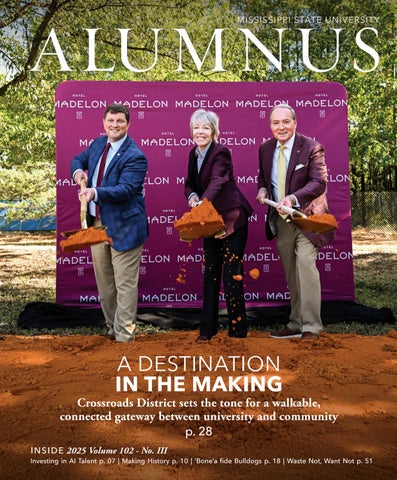
A DESTINATION IN THE MAKING
Crossroads District sets the tone for a walkable, connected gateway between university and community p. 28
Powering PROGRESS
MSU, LOCAL SCHOOL DISTRICT EMBARK ON PARTNERSHIP FOR NEW HIGH SCHOOL
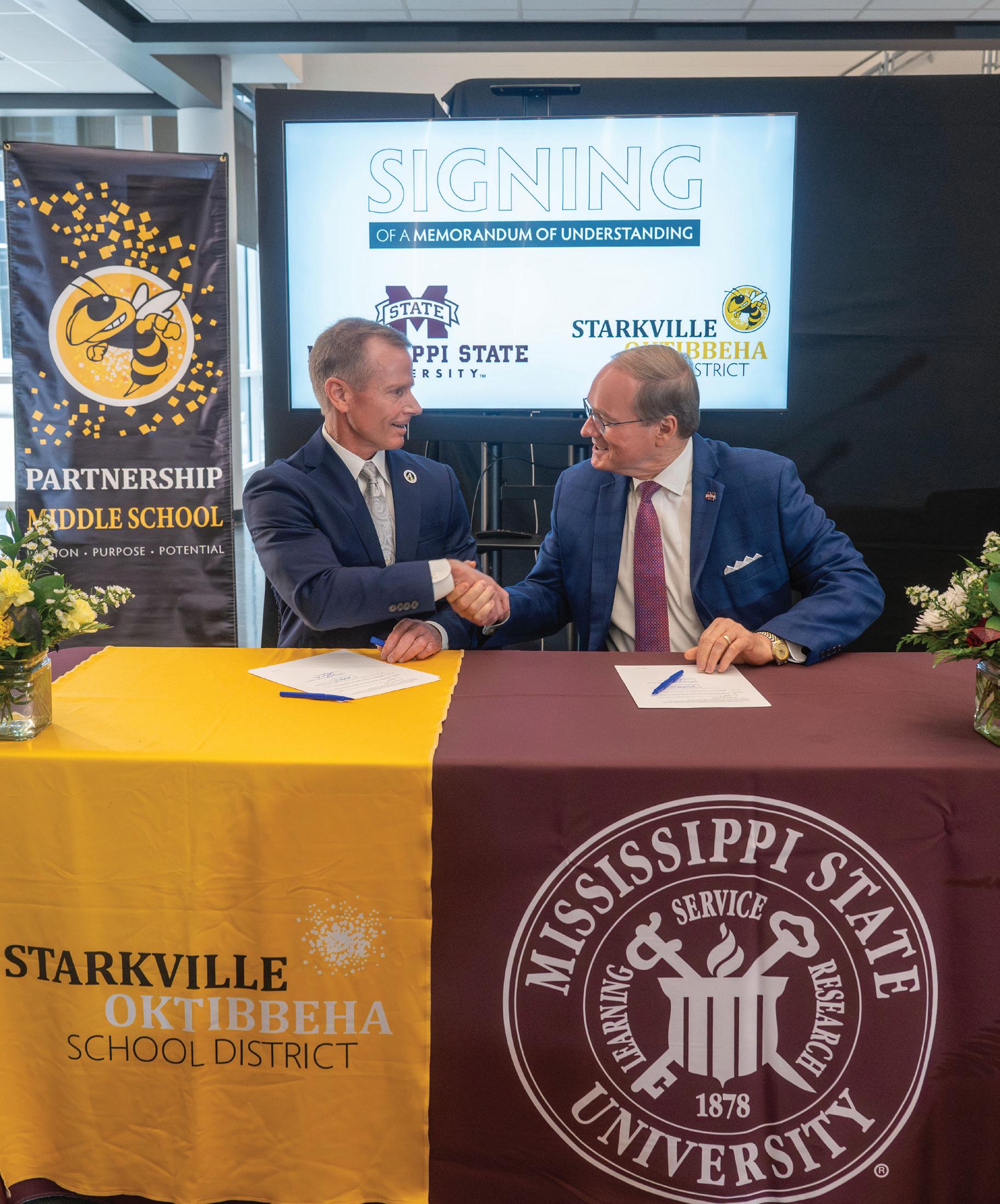
Building on the success and national acclaim of the groundbreaking Partnership Middle School, Mississippi State University has now signed a memorandum of understanding with Starkville Oktibbeha Consolidated School District to bring Starkville High School into the fold.
Opened in 2020 as a collaboration between MSU and the public school district, Partnership Middle School serves every middle-school student in the district through the state-of-the-art facility, while delivering lessons with cutting-edge, scientifically backed teaching practices.
The MOU outlines the district and university’s plan to expand that work to the high school and replace its existing outdated, outsized facility with a new, modern building on MSU’s campus.
University President Mark E. Keenum said this expansion of the MSU-SOCSD partnership will ensure the continued development of outstanding educational experiences for students in Oktibbeha County.
“By working together, we are creating new and exciting opportunities for students along every step of their educational journey,” Keenum said. “The new Starkville High School will be a true asset and resource for our community and a model for innovative teaching, learning, discovery, and career and technical education for school districts around the state and across the country.”
The announcement of the project coincides with excitement about Starkville High School earning its first A rating from the State Board of Education.
“It’s a new era of excellence for Starkville Oktibbeha Consolidated School District and our expanded partnership with MSU,” said Tony McGee, SOCSD superintendent. "We already know the outstanding variety of opportunities we’re providing high school students as a high-performing school. Through dual enrollment, an emphasis on STEAM and the wide variety of resources available on the MSU campus, this new high school will give our boys and girls a greater vision of what’s possible for the future.”
The project will include mutual benefits and positive impacts not only for the school district and university but also the city of Starkville, Oktibbeha County, Golden Triangle region and the state of Mississippi. It will address current space and functionality limitations at Starkville High School through construction of a facility of the same caliber that Partnership Middle School students now enjoy. The high school also would serve MSU by providing “increased learning opportunities for its students and teachers across the state of Mississippi,” while also serving to “augment workforce development initiatives in the region and assist the state of Mississippi in addressing the state’s labor participation challenges.” n
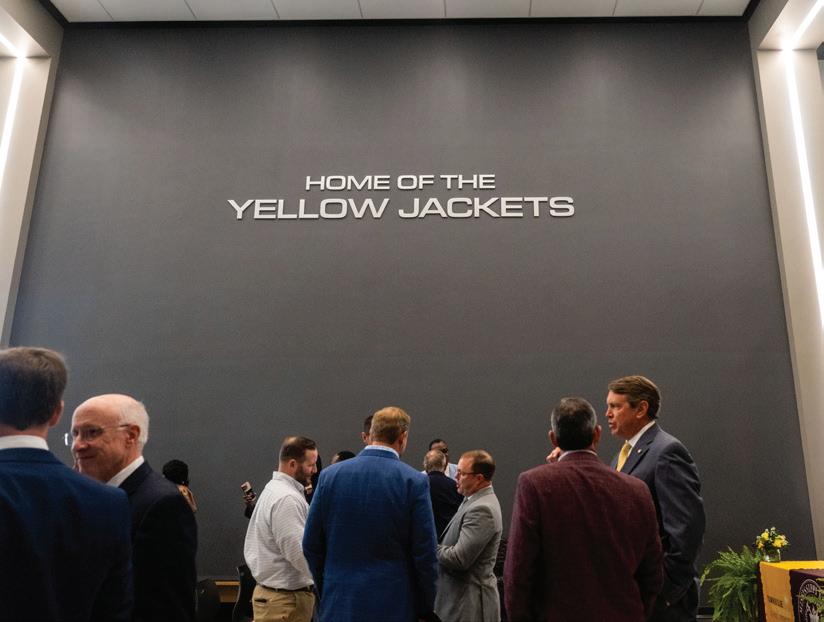
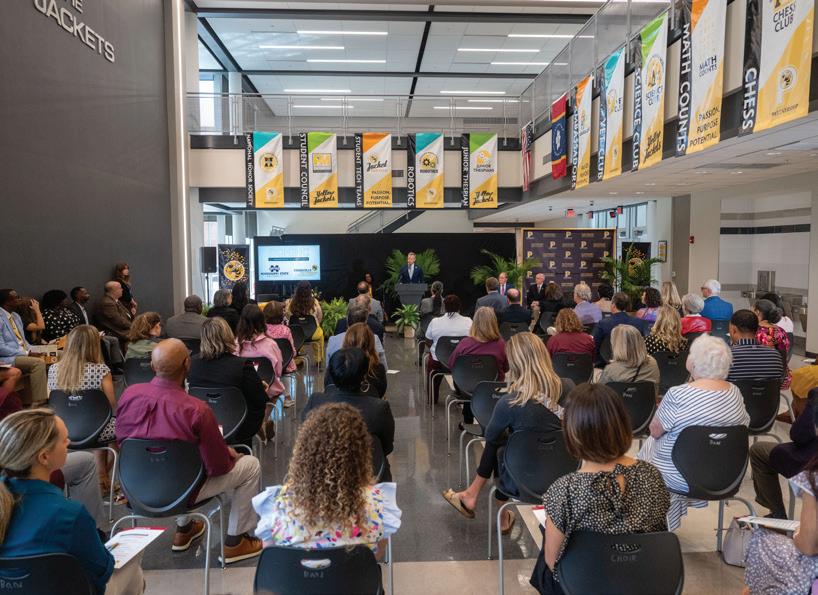
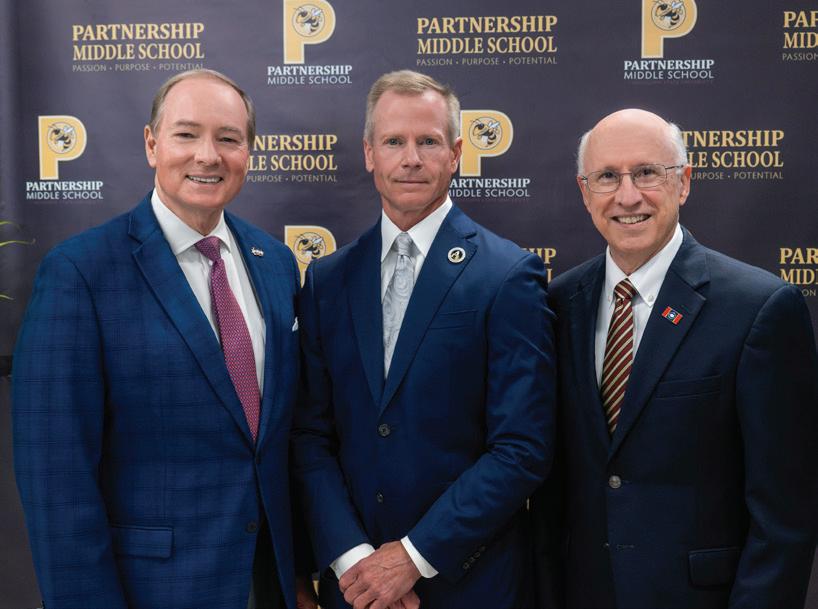
ABOVE: Mississippi State and Starkville Oktibbeha Consolidated School District representatives celebrate a new partnership for a cutting-edge high school to be built on the MSU campus. From left are MSU President Mark E. Keenum, SOCSD Superintendent Tony McGee and MSU Provost and Executive Vice President David Shaw. (Photos by Emily Grace McCall)
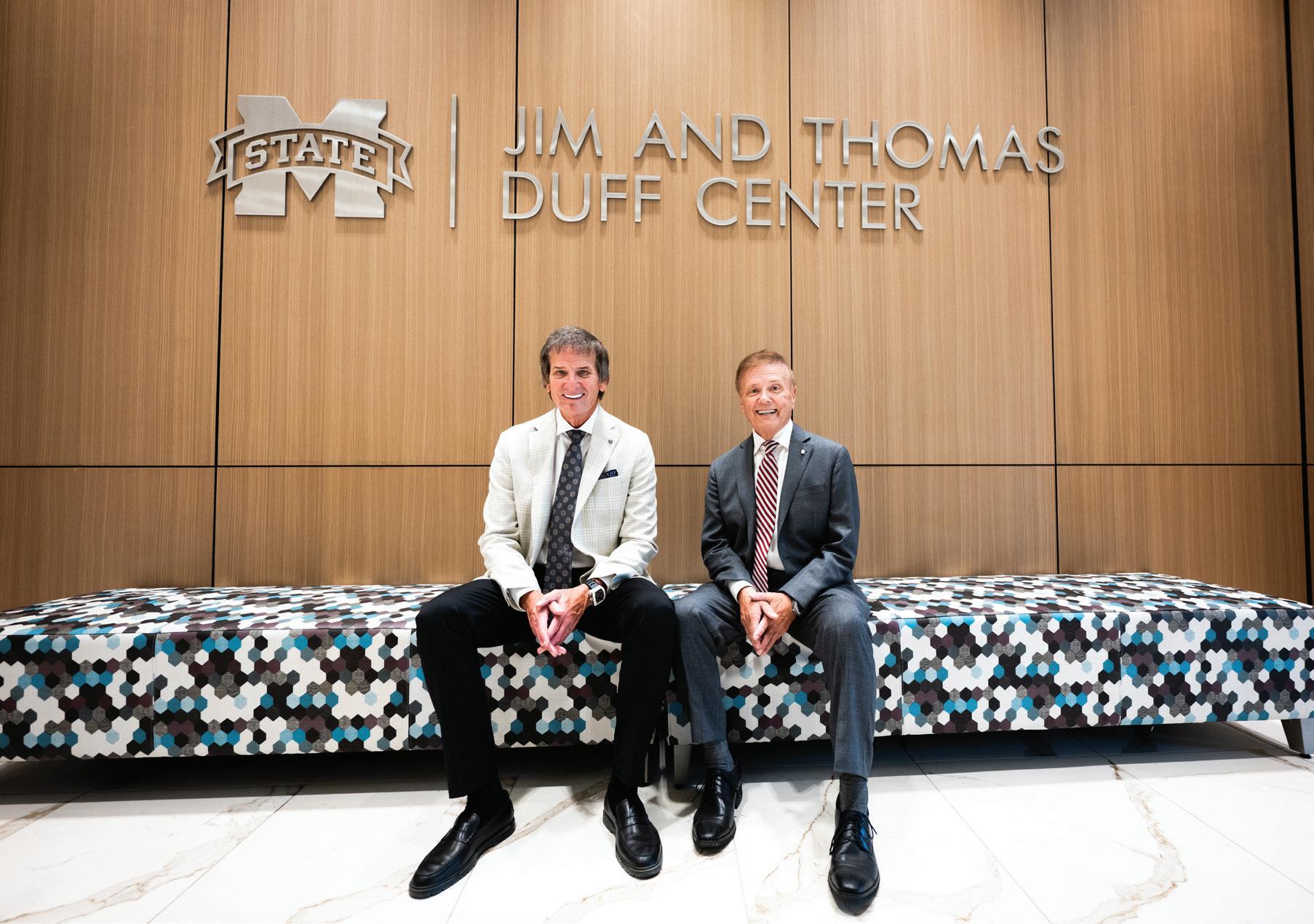
Jim (left) and Tommy Duff sit in the lobby of the newly dedicated Jim and Thomas Duff Center. One of the largest academic buildings on MSU’s campus, it unites under one roof the Department of Kinesiology and key programs of the Mississippi Institute on Disabilities–including the Autism and Developmental Disabilities Clinic, ACCESS Program, and Specialized College Services—creating
service. Photo by
Cockrell
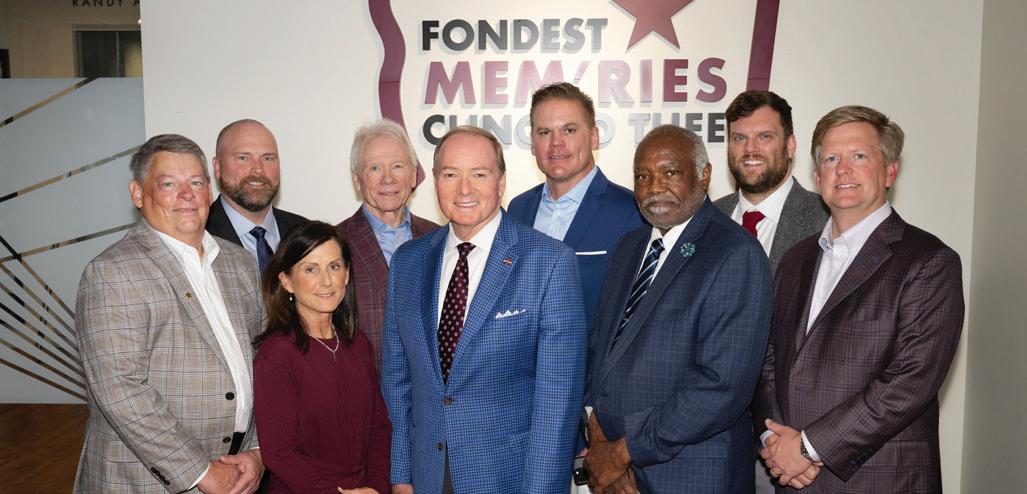
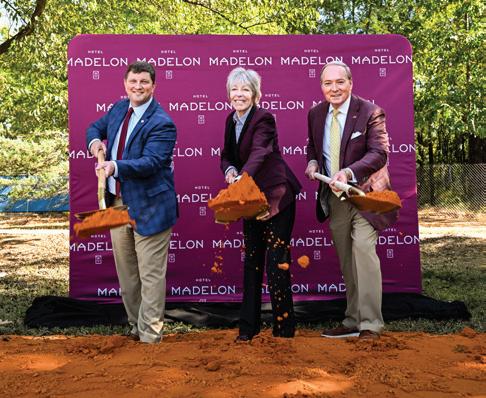
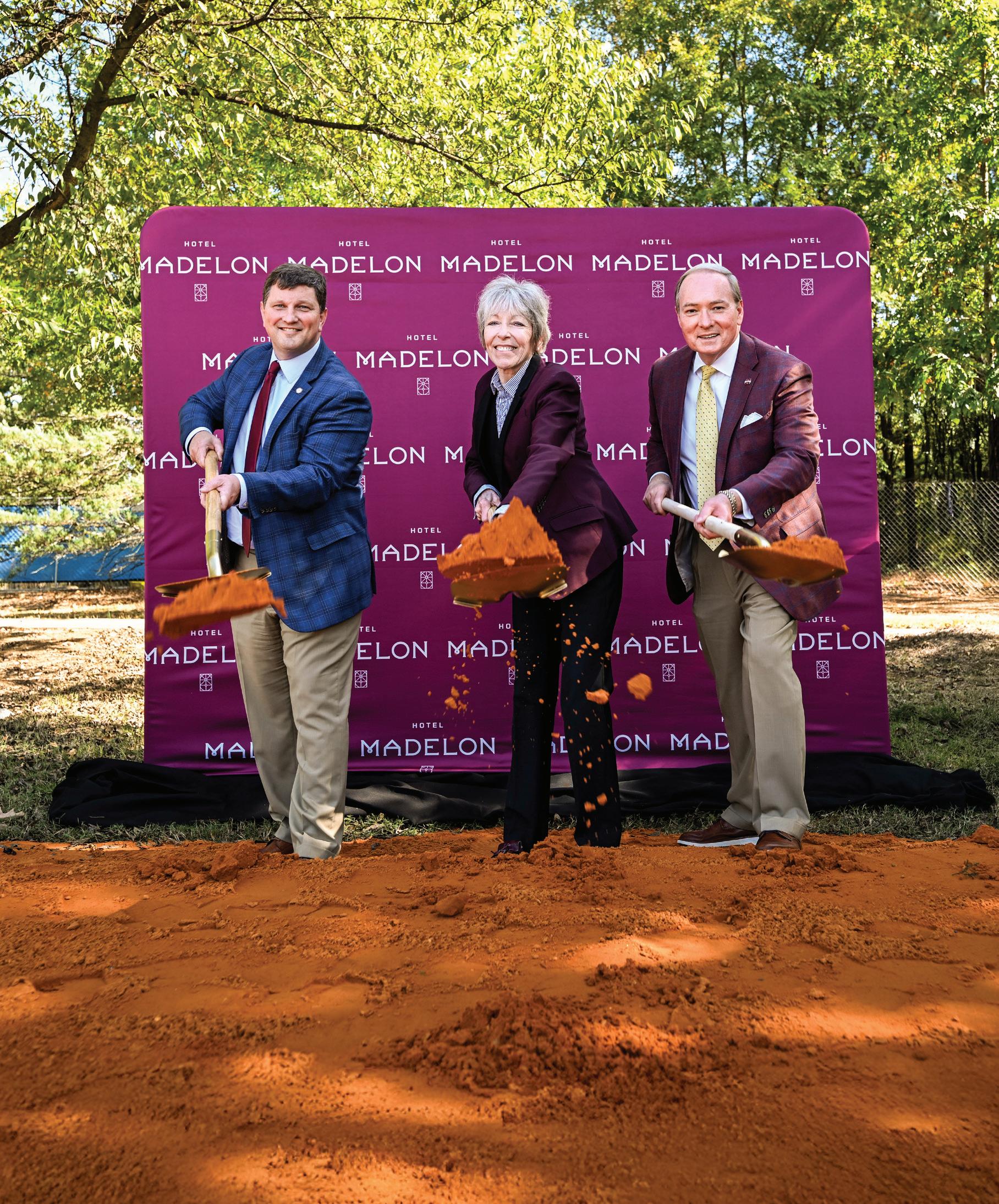
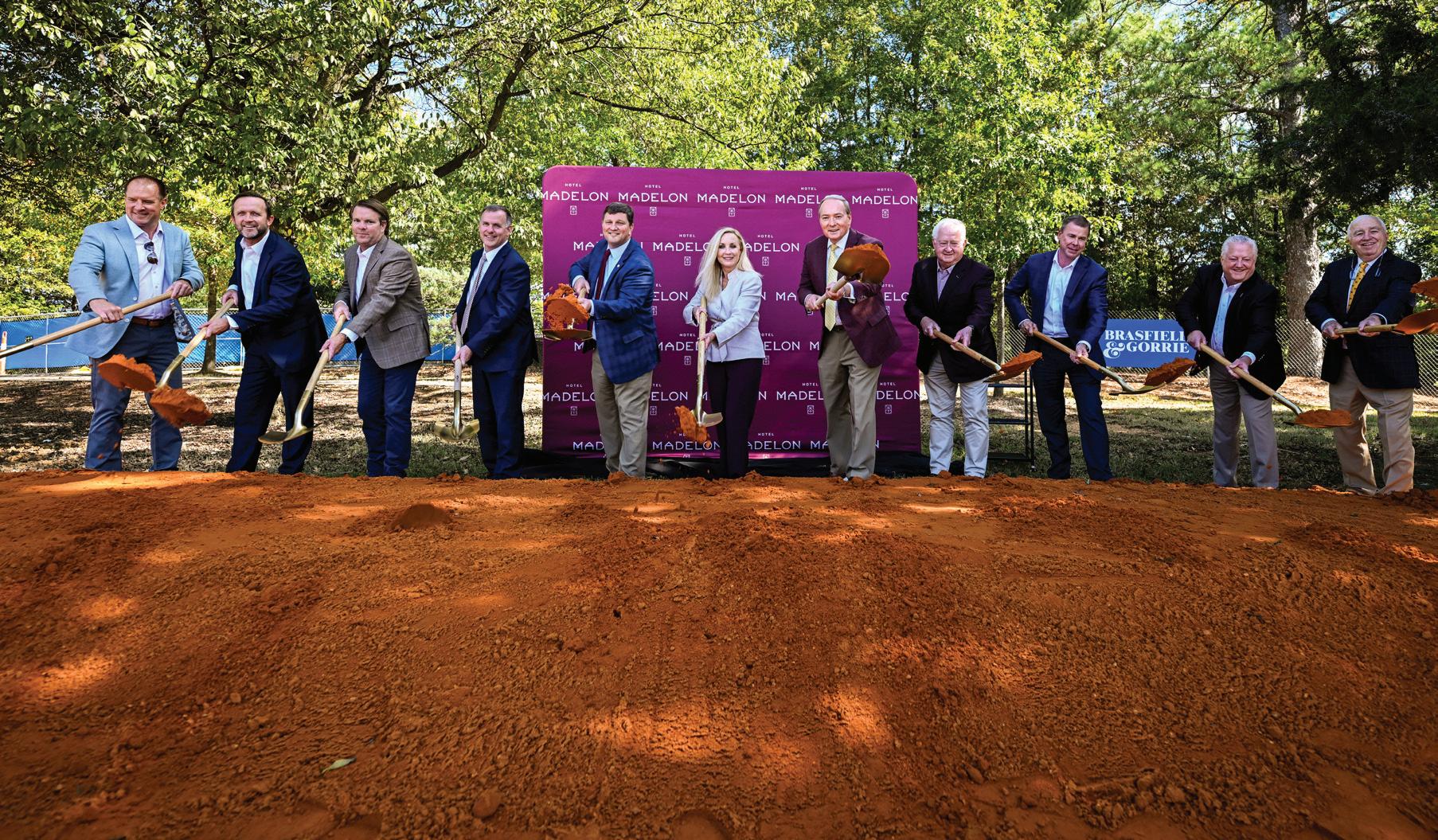
From left, MSU Foundation President and CEO John Rush, Starkville Mayor Lynn Spruill and MSU President Mark E. Keenum celebrate the groundbreaking of Hotel Madelon, a 122-room Marriott Tribute Portfolio hotel anchoring the new Crossroads District between campus and the Cotton District. Photo by Grace Cockrell
PRESIDENT
Mark E. Keenum, ’83, ’84, ’88
VICE PRESIDENT FOR DEVELOPMENT AND ALUMNI
John P. Rush, ’94, ’02
ALUMNI ASSOCIATION EXECUTIVE DIRECTOR
Jeff Davis
VICE PRESIDENT FOR STRATEGIC COMMUNICATIONS AND DIRECTOR OF PUBLIC AFFAIRS
Sid Salter, ’88
EDITORS
Susan Lassetter, ’07
Harriet Laird
WRITERS
Aspen Harris, ’26
Susan Lassetter, ’07
Mary Pollitz, ’16
Shunecy Pounds, ’14, ’18
Carl Smith, ’10
Kevin Tate, ’94
Anna Welborn, ’25
DESIGNER
Heather Rowe
PHOTOGRAPHERS
Grace Cockrell
Sam Baker, ’17
Emily Grace McCall, ’23, ’24
Beth Wynn
EDITORIAL OFFICE
P.O. Box 5325
Mississippi State, MS 39762
662.325.0630
slassetter@opa.msstate.edu
ADVERTISING
Leanna Smith
662.325.3360
lsmith@alumni.msstate.edu
Mississippi State University’s Alumnus magazine is published three times a year by the Office of Public Affairs and the Mississippi State University Alumni Association. Send address changes to Alumni Director, P.O. Box AA, Mississippi State, MS 39762-5526. Call 662.325.7000, or email cturner@advservices.msstate.edu.
Drive to Thrive
MSU PROGRAM GIVES STUDENTS
SUPPORT TO
REACH THEIR GOALS
Personal essay by Samuel Trotter with additional reporting by Susan Lassetter, Photos by Emily Grace McCall
In the following essay, Hattiesburg native Samuel Trotter, a senior in electrical engineering, shares his personal experiences with Mississippi State University’s Thrive Scholars Program.
Just five days after I turned 10, my mother passed away after a long—and hidden— battle with colon cancer. Losing her at such a young age changed me forever. My father—a long-haul truck driver who was on disability following a wreck that uncovered a brain tumor—was left to raise me and my four sisters as best he could.
Without my mother’s prayers, guidance and the traditions she kept alive, it felt as if the protection around us was gone. Our father kept us going with his disability checks, sometimes not knowing how we would eat from one day to the next. But watching him kept me motivated. I improved academically and after graduation enrolled at the University of Southern Mississippi, following my father’s advice to stay close to home.
I believed I could pursue my passion for electrical engineering there but upon discovering that program was unavailable at USM, I changed my major three times, reluctantly landing on nursing. But I followed my father’s example of resilience to persevere.
Then in 2021, just before the start of my junior year, my father succumbed to COVID-19. It was a devastating loss, and with both parents and all my grandparents gone, I was left without a traditional support system. These tragedies could have derailed my life but instead became the foundation for change. I’d had enough and felt like I had nothing to lose. So, I took a leap of faith and transferred to Mississippi State to pursue engineering—a bold decision that required starting over
academically and risking financial insecurity.
Adapting to MSU was daunting. I vividly recall crying in the library during my second week, overwhelmed by feelings of inadequacy and isolation. As a first-generation student in a competitive field, I felt out of place and unprepared. It didn’t help that my transfer GPA from USM was a discouraging 2.64.
“These tragedies could have derailed my life but instead became the foundation for change. I’d had enough and felt like I had nothing to lose.”
~ Samuel Trotter
At that point, I made a promise to myself: I would give it one semester to see if I could be successful. If I failed, I would return home. That mindset weighed heavily on me because I knew my future depended on the next three months. I worried constantly about the challenges: a lack of friends, lack of funds and the feeling of being behind my peers.
Then I found Thrive.
Through the Thrive program, I found an advisor who took the time to sit down with me, reassure me and show me the resources available to help me succeed. Those conversations gave me both encouragement and practical support. And, for the first time, I felt like I had someone in my corner making sure I wasn’t fighting these battles alone. It also touched something deeper. It helped
fill the void of family tradition I had felt since my mother passed. It gave a piece of it back. Suddenly, I again had a place to eat Thanksgiving dinner.
Since that turning point, I have excelled, maintaining a GPA higher than 3.2. I have also been blessed with professional opportunities that confirmed I was on the right path. I have completed three internships over as many semesters, including one semester in which I had five offers to choose from. These experiences have helped me grow tremendously, not just as a student but as a future engineer.
Thrive gave me not just support but also a sense of belonging and belief in myself. It connected me with resources and opportunities tailored to my needs, whether it was tutoring to improve my academics, organizations to help me find friendships or guidance on professional development.
Through Thrive, I learned how to turn weakness into strength; how to build a support system and lean on it when I needed it most. I am no longer just “figuring things out” on my own. I have a community that believes in me and wants me to succeed, and that sense of belonging pushed me to step out of my comfort zone, get involved and pursue opportunities I once thought were out of reach.
My father worked tirelessly despite his disability, and Thrive has helped me channel that same determination into my academics and my future. I went from feeling inadequate and wondering if I would be able to get a job, to mentoring others. Despite initially feeling lost and hopeless, Thrive dared me to dream and turn my dreams into reality. For that, I am forever grateful.
“Thrive gave me not just support but also a sense of belonging and belief in myself. It connected me with resources and opportunities tailored to my needs.”
~ Samuel Trotter
MISSISSIPPI STATE THRIVE SCHOLARS PROGRAM
Housed in the Division of Access, Opportunity and Success since 2021, the Thrive Scholars Program is one of many student-support initiatives at Mississippi State University.
Timothy Hopkins, who currently oversees Thrive as executive director of the Holmes Center for Student Success, said the program’s goal is to support students as they work toward their MSU goals.
“Thrive is really a circle of support for students,” Hopkins said. “We want to engage students with the opportunities that exist here at Mississippi State. But most importantly, we want to provide easy access to a supportive network and resources that really contribute to students’ academic success.”
While MSU offers a variety of supportive programs to students of all backgrounds,
Thrive is specifically tailored to students who have lost a parent, aged out of the foster-care system, have independent status or who are experiencing or at risk of homelessness.
“These students come to us without that personal support system that can be so important to success,” Hopkins explained. “Thrive steps in to fill that void. We help them create meaningful relationships and guide them to the tools they need to navigate life while at MSU and once they graduate.”
Hopkins said the program supports about 25 students each year, and participants either self-identify and apply or are recommended by someone at the university who recognized their need. Once part of the program, Thrive scholars meet with an advisor who develops an individualized support plan to help the students meet their goals.
Much of the program’s work involves connecting students to existing university resources and helping them to navigate the process of getting financial assistance or
accessing tutoring. It also helps students develop life skills. Hopkins said monthly Thrive Thursday gatherings bring students together and help them learn cooking skills, basic care skills and more.
“We’re helping them grow into well-rounded, self-sufficient, successful individuals,” Hopkins said.
The results of the program speak for themselves. Hopkins said he has seen students go from living in their cars and struggling to find their next meal to flourishing in a career. Or there are those, like Trotter, who grew from feeling isolated and alone to being part of a community. It’s those stories, he said, that show just how important Thrive is.
“People ask why I care so much about this program, but that’s easy: I’ve been there,” he said. “It’s a lived experience for me. I found my way through and am now helping others, but I can only wish there had been a program like this at my undergraduate institution.” n
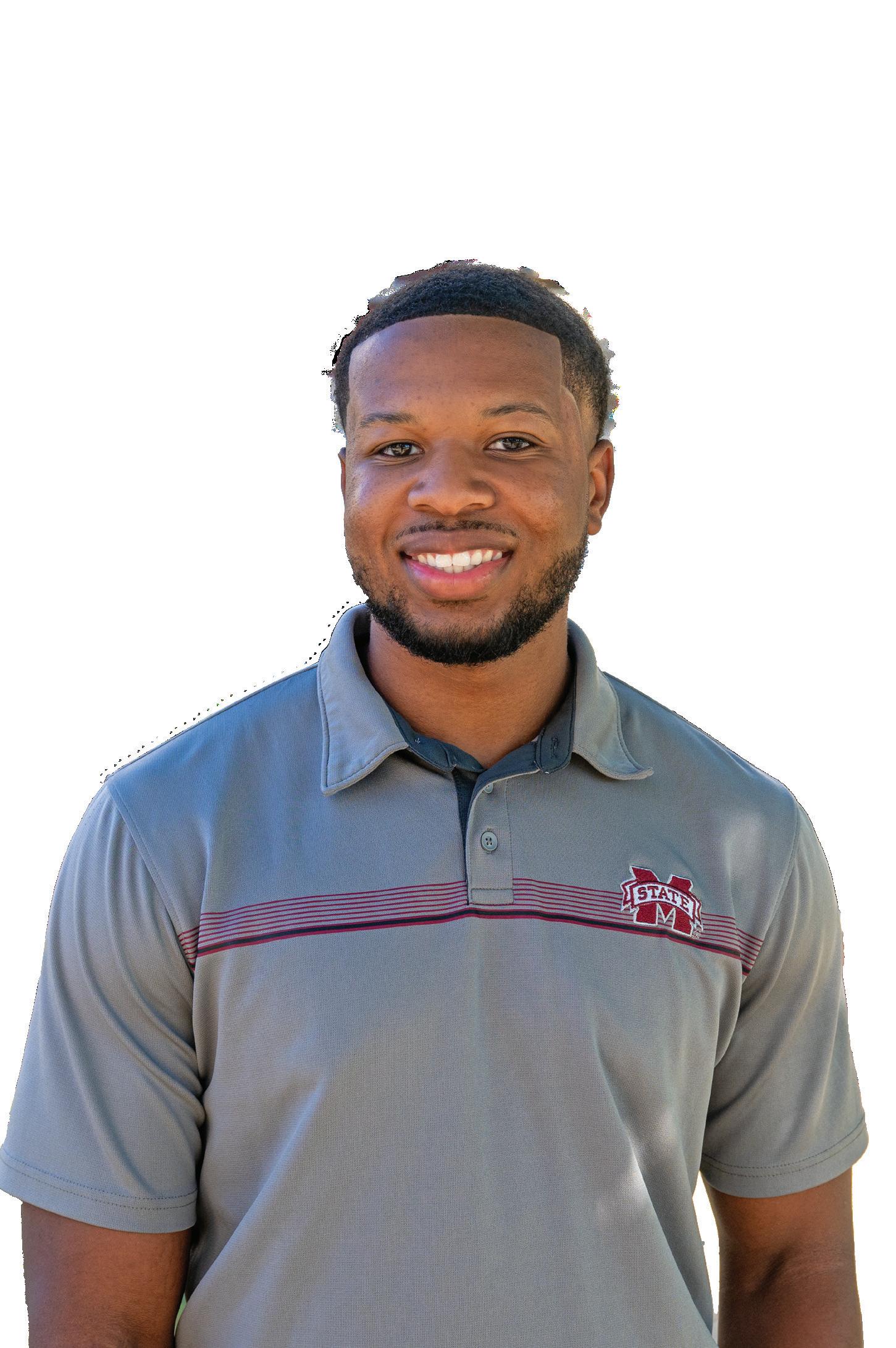
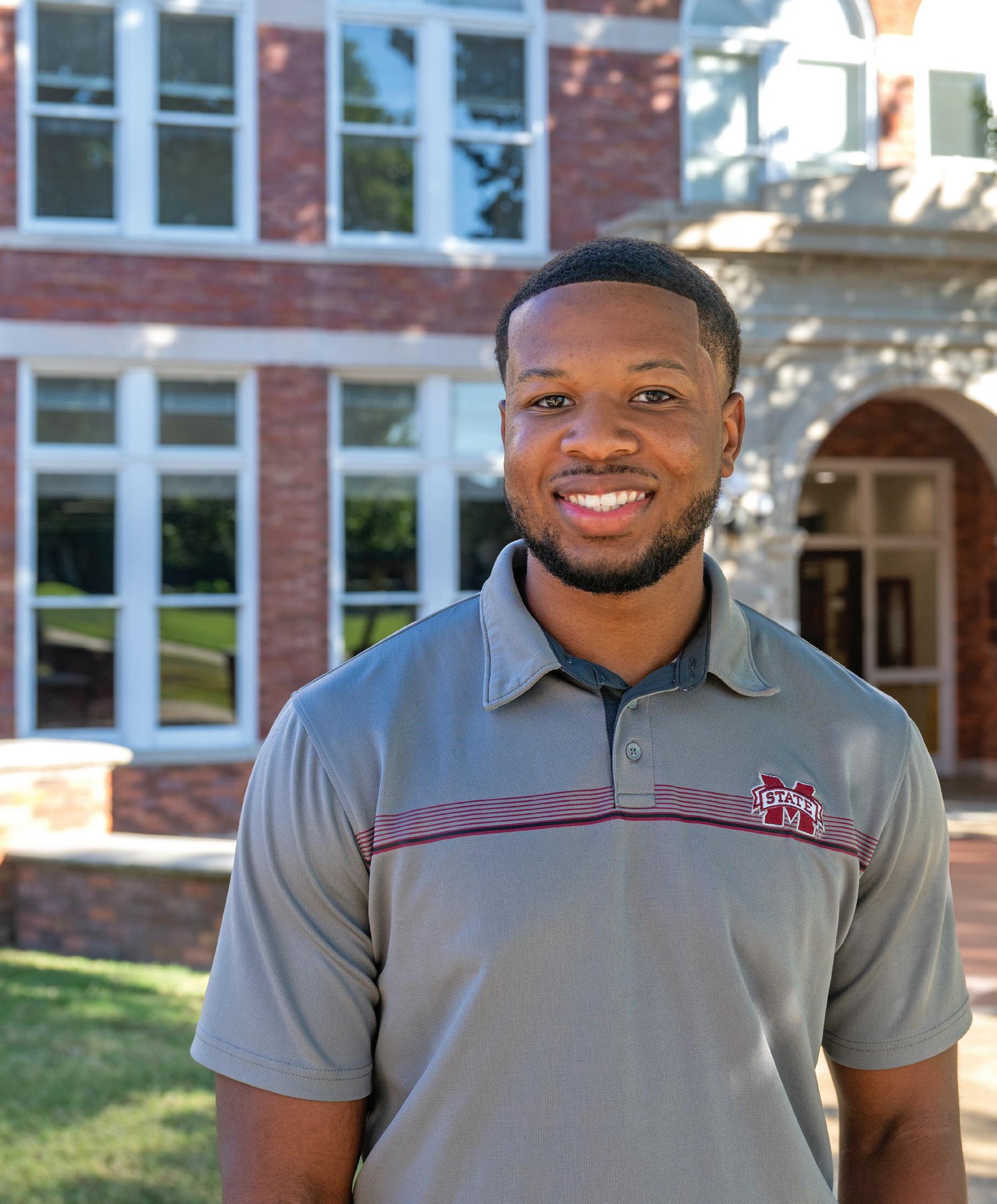
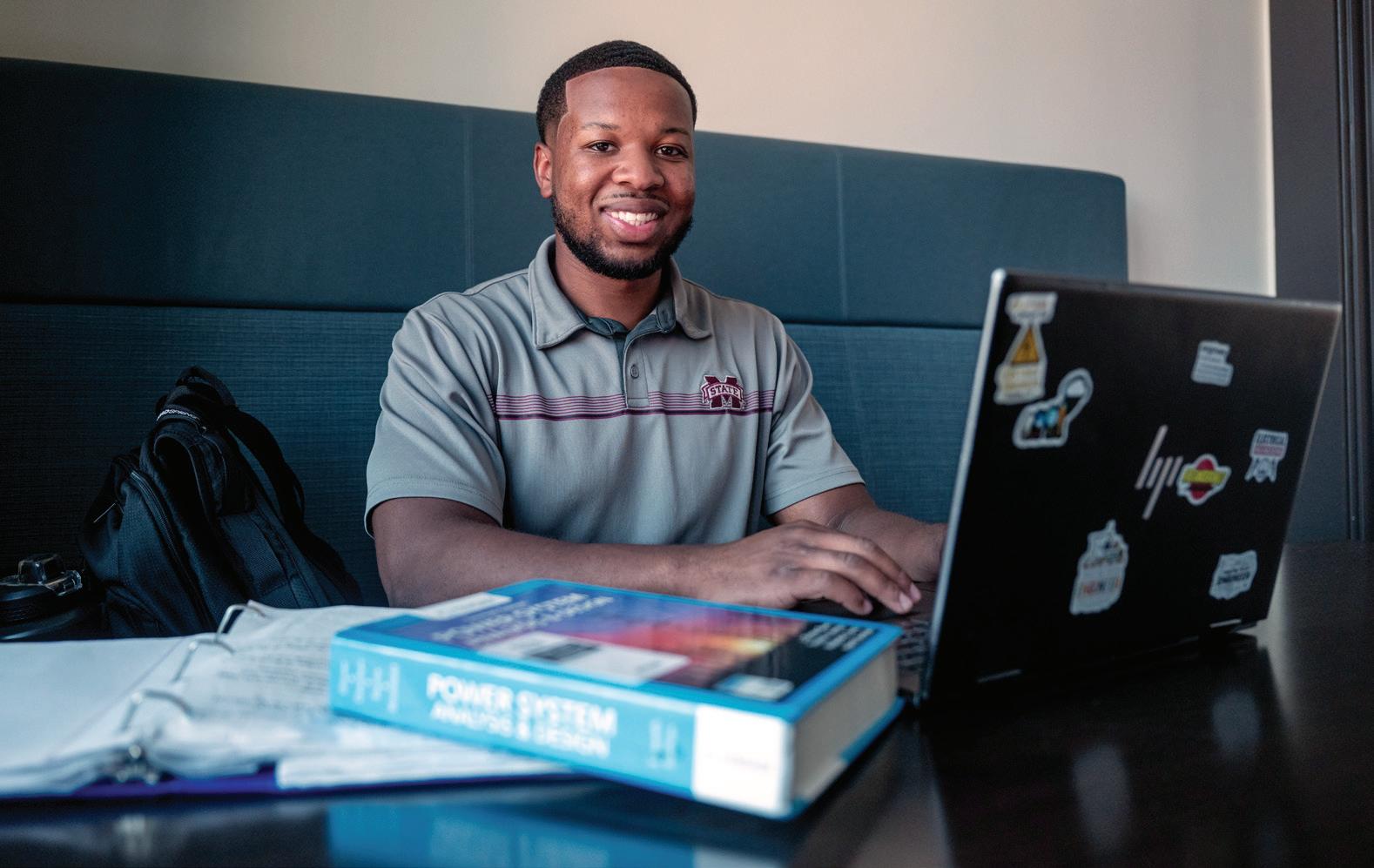
Senior electrical engineering major Samuel Trotter of Hattiesburg studies on campus. With support from Mississippi State's Thrive Scholars Program, he says he has overcome feelings of loss and hopelessness to turn his dreams into reality.
INVESTING IN TALENT
MSU RECEIVING $2 M TO SPUR AI EDUCATION, IMPLEMENTATION IN THE MAGNOLIA STATE
By Carl Smith, Illustrations by

Devin Chen is part of the first generation of Bulldogs using artificial intelligence to solve some of the world’s biggest problems. In his case: hunger.
As the son of restaurateurs, the junior cybersecurity major from Louisville understands how food brings people together. He also recognizes many Mississippians face food insecurity—when people either lack access to reliable sources of food or simply do not have enough to eat.
While there are many food banks and pantries across the state addressing this need for their communities, Chen had an idea: What if these organizations could come together in a single network to better distribute food to where it is most needed?
Through the skills he’s learning at Mississippi State and partnerships with
Amazon Web Services and the Hattiesburgbased food bank Extra Table, Chen is developing software to use AI and machine learning that will analyze statewide hunger data and food bank inventories to better route nourishment to where it’s critically needed.
Simply put: What he’s learning at MSU could feed those who need help the most.
Chen is part of a growing pack of Bulldogs exploring and advancing the uses of AI to take care of what matters.
Already an established national leader in AI and data science education, MSU will remain at the forefront of these cuttingedge technologies thanks to a new initiative and significant investment announced this summer.
In June, Gov. Tate Reeves launched the Mississippi AI Talent Accelerator Program,
or MAI-TAP. A partnership between AccelerateMS, the Mississippi Development Authority, Amazon Web Services and many of the state’s universities and community colleges, it is designed to supercharge the research, development and implementation of AI and related technologies and infrastructure in education and the state’s economy.
Through MAI-TAP, multiple universities will receive a combined $9.1 million in grants for advancing specific programs and initiatives based on their unique strengths and specialties.
As the state’s premier research institution, MSU will receive $2.2 million of the funding—the most given to any of the recipients. With its share, the university will establish an endowment and seek private matches for workforce and research initiatives. Specifically, MSU will add new faculty with
Heather Rowe using AI tools and reference images from OPA Photographers

the financial infusion and develop a graduate certificate in data center construction management—one of the first of its kind in the nation.
When announcing the program, Reeves called it a “bold step forward for Mississippi” that will ensure the Magnolia State leads the way in innovation and workforce readiness.
“We’re not just preparing for the future— we’re building it. This investment will help to ensure that Mississippians are equipped with the skills needed to thrive in a rapidly evolving digital economy,” he said. “This is about more than just jobs—it’s about opportunity.”
‘DAUNTING AND EXCITING’
To put into context how quickly researchers believe AI will transform the world, consider humanity’s advances in flight. It only took 66 years for people to walk on the moon after first taking powered flight at Kitty Hawk, North Carolina. Researchers believe AI’s far-reaching effect will revolutionize dayto-day life in similar leaps forward but in an even shorter time span.
Julie Jordan, MSU’s senior advisor for artificial intelligence and data governance, said it’s hard to picture what life will look like after 50 years of AI integration.
“It’s daunting, but it’s exciting and amazing at the same time,” she said of helping
spearhead MSU’s push as a leader in the emerging technology. “I can’t believe how fast this is moving, and even the experts have a hard time predicting five years out, much less 10 to 15.
“But this is a situation Mississippi State is proud to be in—we’re proud to figure out how to lead this and help the state. The way I see it, the most important thing we can do right now is upskill our people. They’re so important to this and how we transition in the future,” Jordan continued. “The bottom line is AI is going to be pervasive and ubiquitous. If we cannot help our people know how to take advantage of it, we will be left behind as a state.”
While she can’t picture what life with AI will look like in 50 years, she has a clear picture of what future success in AI education looks like at MSU.
“We want to turn out graduates that employers are knocking down our doors to hire because they’re well-prepared in the academics and skills of the day and, like Dr. Keenum always says, are prepared to be good citizens of this state and country, and give back to their communities,” she said. “His three principles of integrity, respect and hard work don’t change just because AI tools become part of our daily lives.”
Jordan serves as MSU’s representative
“AI and machine learning can help food banks work together so food goes where it’s needed most.”
~ Devin Chen
on the AI Workforce Readiness Council, a group created by MAI-TAP to oversee collaboration between the state, participating schools and industry. The council is chaired by Kollin Napier, a three-time MSU graduate who serves as director of the Mississippi Artificial Intelligence Network—the nation’s first statewide AI initiative integrating the blooming technology into education and industry.
“Mississippi is very much a partnership state. Others may have a single or maybe a couple institutions working on it, but nobody is tackling AI development as a state like Mississippi is,” Napier said. “The unique approach Mississippi State is taking—one that many other institutions are looking at and watching—is the interdisciplinary approach to AI education. MSU is creating students who are very skilled at multiple areas of computing technology.
“We’re showing companies that we’re producing talent here in the state,” he continued. “Combined with continued economic investments, we’re building a pipeline for these graduates to stay in Mississippi.”
MSU is among the first universities in the country to establish multidisciplined, AI-related degree pathways focusing on the coding behind the tools—OpenAI’s ChatGPT and Google’s Gemini, for example—and their
applications in the real world. The addition of a certificate in data center construction means the university will address the physical infrastructure supporting AI’s rapidly growing needs as well.
In 2024, the university became the first in the Southeastern Conference to launch a Bachelor of Science in artificial intelligence. Housed in the Department of Computer Science and Engineering, it focuses on subjects including machine learning, neural networks, natural language processing and computer vision that prepare graduates for specialized careers in AI development and research. This fall, the department began offering a master’s degree in the field, which includes 12 hours of electives allowing students to tailor their education to their interests.
This year, the state’s Institutions of Higher Learning also approved MSU’s newest college—the College of Integrative Studies, a cross-campus collaborative effort which houses the Bachelor of Science in data science, Master of Applied Data Science and a certification program for data science
pedagogy designed for educators.
Recipients of the undergraduate data science degree—another first of its kind in the Southeast—apply fundamentals to one of 10 concentrations offered across MSU’s other academic colleges. Like its undergraduate relative, the applied master’s degree’s curriculum offers practical, hands-on experiences tailored to students’ interests and hopeful career paths.
“From the academic side, we know the job market will need people to develop AI, use it and build the infrastructure supporting it, so we’re going to teach students all three,” said Jamie Dyer, College of Integrative Studies dean. “We have an opportunity to team up with everyone across campus and make AI universitywide instead of pigeonholing it.
“We want to be able to give students what they need to be successful,” he continued.
“If you want to build AI, we have a degree for you; if you want to apply AI, we have a degree for you; and if you want to build a building that runs AI, we’ll have a pathway for you, too.” n
“We’re showing companies that we’re producing talent here in the state. Combined with continued economic investments, we’re building a pipeline for these graduates to stay in Mississippi.”
~ Kollin Napier

Napier
Kollin
MAK I NG H I STORY
Mississippi State’s political collection details state, nation’s history
By Mary Pollitz, Photos by Grace Cockrell
People rarely realize when they’re making history. It’s only through the lens of time that things come into focus.
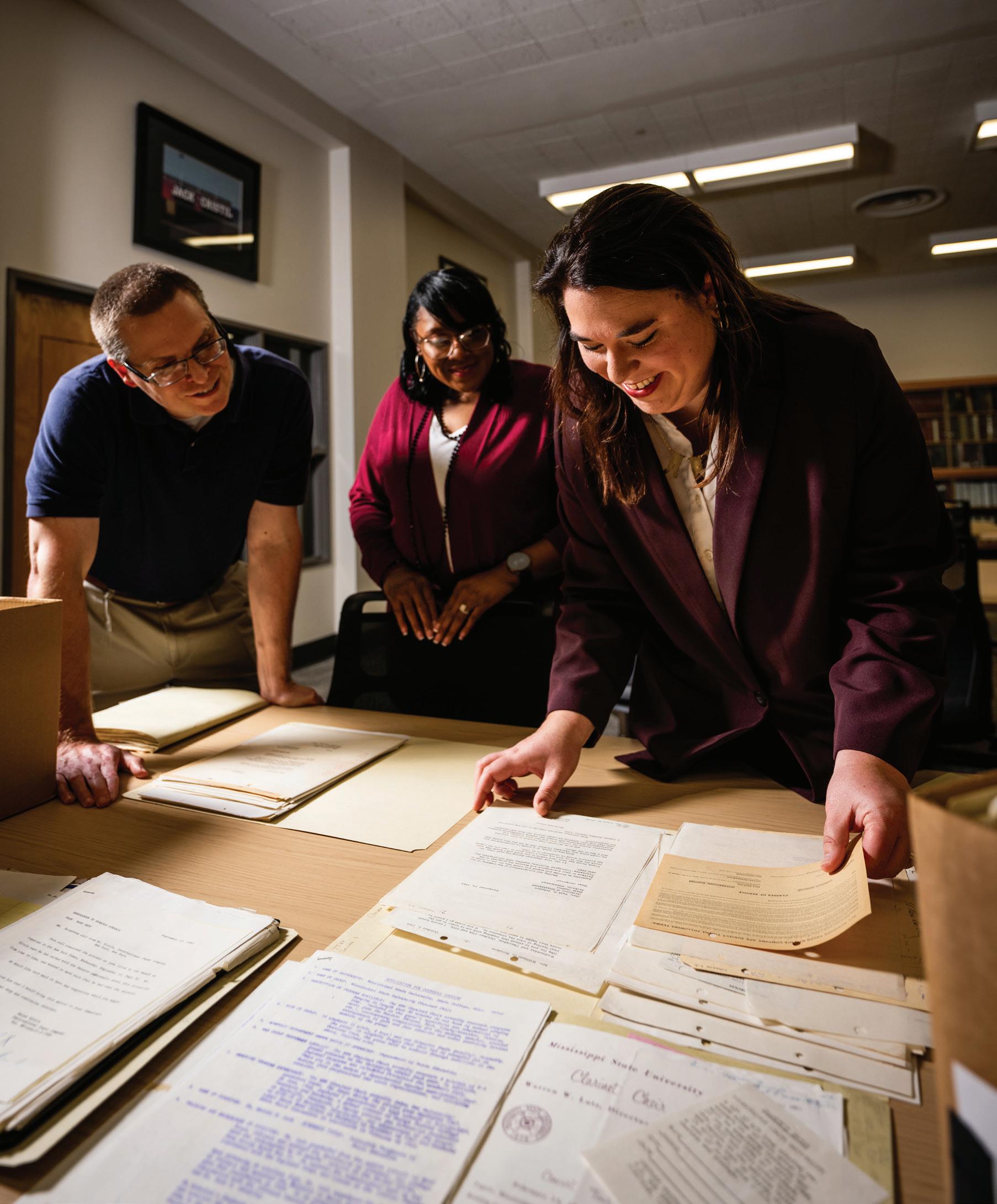
That insight comes from the handwritten letters that show a person’s state of mind; the notes in the margins that show thought processes; and drafts never published that highlight ideas considered but ultimately discarded. These are the personal, political and profoundly human stories preserved in the Mississippi Political Collection on the third floor of the Mississippi State University Mitchell Memorial Library.
These firsthand documents don’t show history; they show history in the making— an important aspect of putting historic events and decisions into context.
Established in 1999 with Sen. John C. Stennis’ donation of his personal and professional papers, the MPC now houses more than 100 unique collections and totals roughly 12,000 boxes of political history.
A 1928 Mississippi State graduate, Stennis is one of the university’s most storied graduates. His papers, which range from college recommendation letters

Mississippi State’s Division of Archives and Special Collections preserves the state’s political legacy through the Mississippi Political Collection,
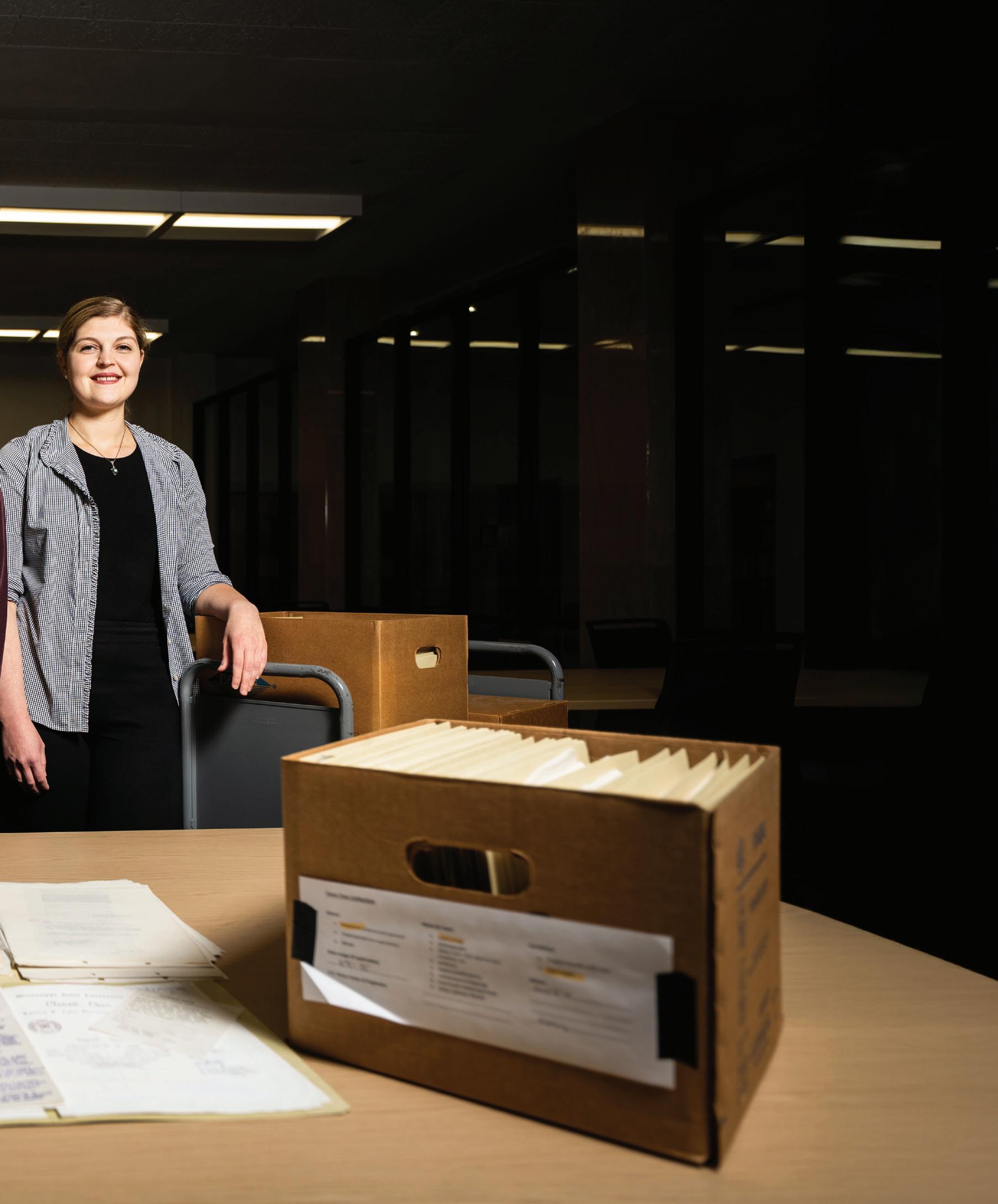
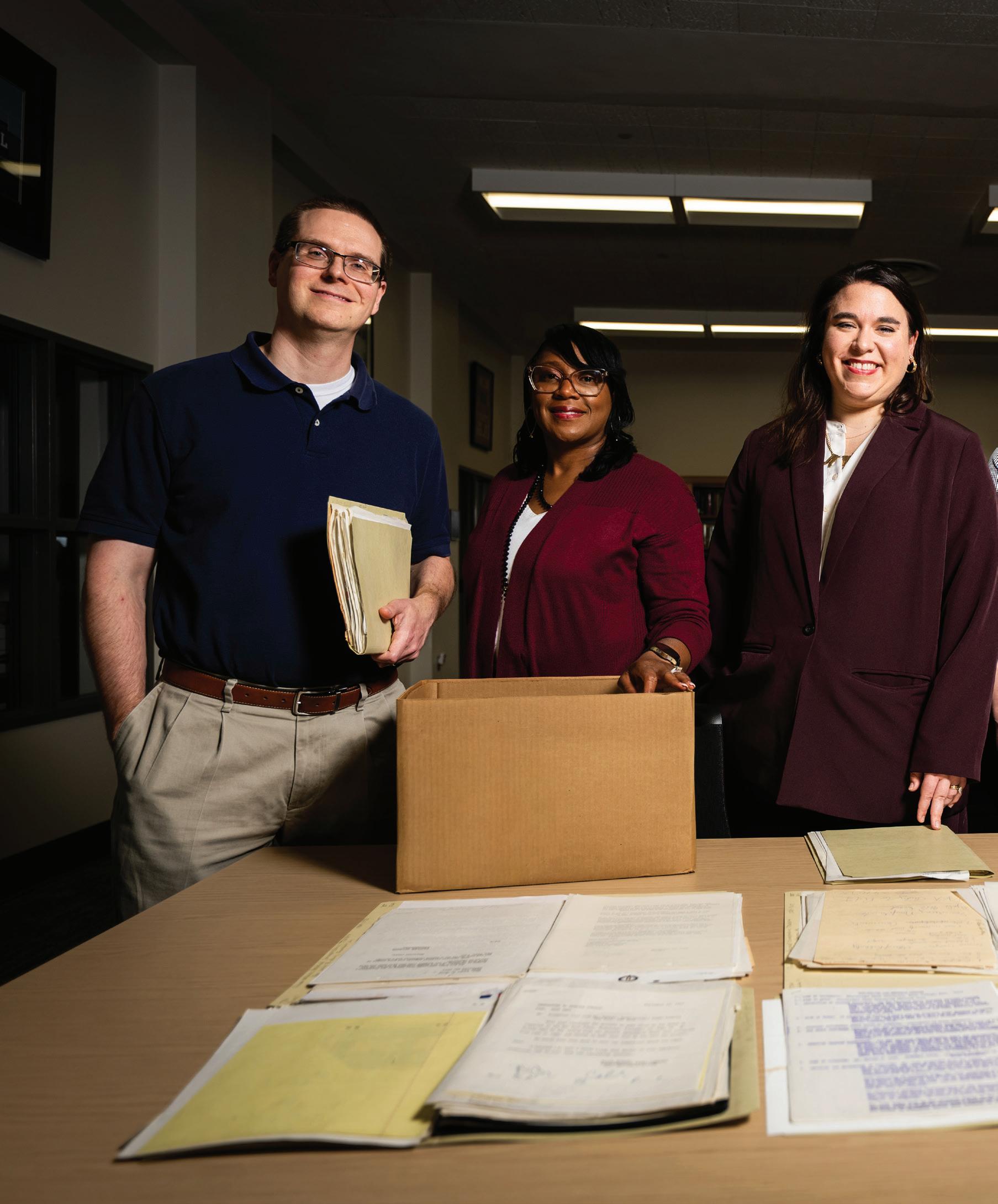
Pictured are (from left) David Nolen, professor and associate dean of archives and special collections; Donisha Smiley, library services coordinator; Kate Gregory, MPC director; and Lauren Geiger, assistant professor and digital archivist.
located on the third floor of Mitchell Memorial Library.
to handwritten notes of the Watergate hearings, capture an expansive era of American political history.
“He had one of the most massive congressional collections in America and we have original, primary sources from that time,” said Kate Gregory, director of the Mississippi Political Collection. “You can really sit down and see what Stennis thought.”
Totaling more than 4,000 cubic feet of materials, Stennis’ collection chronicles American politics from the Magnolia State’s perspective, touching on the Marshall Plan after WWII, the Vietnam War, civil rights legislation, the Reagan presidency and the IranContra hearings.
“We have a little bit from before he went to Congress, but the lion’s share of his collection is from his 42 years in office,” Gregory said. “In his papers alone, you can study American political history through the lens of Mississippi’s representative.”
CREATING A TRADITION
“You can literally see how a bill becomes a law,” Gregory said. “He started on that legislation in the 1970s and it took multiple congresses, committees and presidents before it passed.”
Gregory explained that the MPC exists for several reasons, but the largest goal is to preserve Mississippi’s political story as a public record.
teaching in the honors college for five years now, and we’ve used it every year.”
Pugh, who also serves as executive director of the Stennis Center for Public Service, first used the MPC as an undergraduate researcher himself. He now encourages his students to explore the archives for the same reason he still does: to find what’s not online.

“We’re in the business of people, not parties. You don’t have to win your election to be a part of this story. We’re not just documenting the players—we’re documenting the game.”
~ KATE
GREGORY
Stennis’ gift set a precedent for other public servants, sparking a tradition of Bulldog alumni entrusting their papers to their alma mater. Since that donation, the collection has expanded to include archives from notable alumni including G.V. "Sonny" Montgomery, Chip Pickering, Alan Nunnelee and Mike Espy, among others. However, the MPC accepts and holds donations from non-graduates as well.
“Through these files, you really see how the political system works, not just from the people sitting in elected office, but from the people behind the scenes,” Gregory said. “The correspondence, drafts, committee notes—this is how the sausage gets made.”
In Montgomery’s papers, researchers can trace the entire evolution of his work on the G.I. Bill.
“We’re in the business of people, not parties,” Gregory said. “You don’t have to win your election to be a part of this story. We’re not just documenting the players— we’re documenting the game. I want the whole, full scope—as complete a history as we can maintain. We put a lot of effort into getting all our collections publicly available and online as fast and as highquality as we can because people deserve to know what we have. It’s here for them.”
HOLDING HISTORY
Located at the heart of the land-grant university, the MPC serves as an asset to researchers and historians, as well as a classroom.
Brian Pugh, lecturer and public service mentor with the Judy and Bobby Shackouls Honors College, makes the MPC a cornerstone of his courses.
“If it pertains to Congress or the state legislature, there’s a 100% chance I’m taking my students there,” Pugh said. “I’ve been
“I want them to conduct research offline,” he said. “A lot of the information in these collections isn’t published anywhere else. You have to physically go there, and it’s such an amazing resource to have.”
PRESERVING MISSISSIPPI
For Gregory, the stacks of acid-free boxes and folders are more than paper. It’s the state’s collective memory spanning generations of leadership, debate and progress.
“Through this collection, we can see what the people of Mississippi communicated to their elected officials,” Gregory said. “What they wanted to see or not see, and what motivations they had that we are still talking about today. People come in here just to look at what past Mississippians did and what they thought about the national policies affecting the state.”
For Pugh, these kinds of records are immeasurably valuable.
“We have an absolute jewel here,” he said. “If more people utilized the collection, we’d continue to grow it even more than we have.”
For Gregory, that continued growth is what ensures Mississippi’s political story is saved, told, researched and used to continue to tell history through Mississippi.
“In other countries, they burn this stuff and it’s lost forever,” she said. “It’s so important to have this, because when you don’t know your own state’s history, you don’t know your country.” n

DUFF CENTER SUPPORTS MISSISSIPPI FAMILIES
In November, Mississippi State and its College of Education celebrated the dedication of the Jim and Thomas Duff Center. One of MSU’s largest academic buildings, it is now home to the Department of Kinesiology, as well as key programs of the university’s Mississippi Institute on Disabilities, including the Autism and Developmental Disabilities Clinic and ACCESS Program and Specialized College Services.
As a hub for assisting those with disabilities—with state-of-the-art laboratories, treatment rooms and offices—the Duff Center is enhancing Mississippi State’s ability to serve families in need. In his remarks during the ribbon cutting, MSU President Mark E. Keenum explained how this investment in essential services will grow the university’s reach from three to four times its original capacity.
Photos by Grace Cockrell
“Previously, our autism and developmental disabilities programs were scattered around campus,” Keenum said. "We were meeting critical needs, serving about 100 clients a week at the Autism and Developmental Disabilities Clinic, but the facilities were far from adequate. We knew we could do much more.
“Today, with our new treatment room space, we will be able to serve 300 to 400 clients a week, and that includes some who will need more intensive treatment,” he continued. “That just goes to show you how essential this new building is.”
The center is named for the Duff Brothers of Columbia, whose $15 million cornerstone gift, along with support from the Mississippi Legislature, made the center, which now sets the bar for disability support in the South, a reality.
“Mississippi State is really doing good things for the state, and we want to be a part of that,” said Jim Duff. “It’s important to us to give back because it makes a difference for a lot of people.”
As someone who experiences dyslexia, Jim Duff said he understands first-hand the difficulties of a learning disability and the brothers hope this new center will be an essential source of support for students in need of assistance.
“Education should bring out the best in everyone,” said Tommy Duff. “We hope this gift will enable a center where students can grow their skills and self-confidence. There are a lot of bright kids in our state and at MSU, and we want them to have the ability to realize their potential to compete and succeed regardless of their means.” n
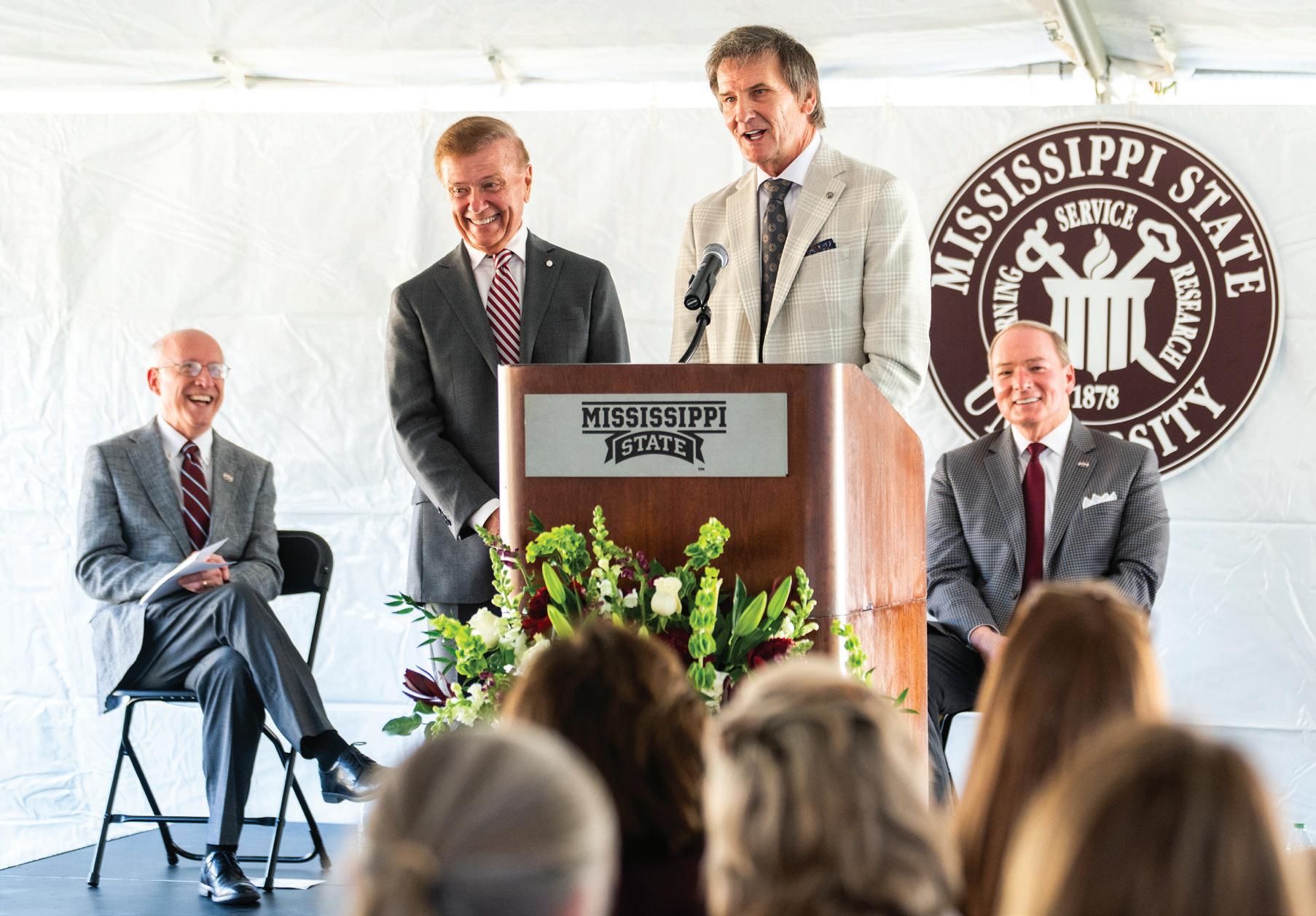
ABOVE: Tommy
and Jim Duff of Columbia give remarks during Mississippi State’s dedication of the Jim and Thomas Duff Center. Their cornerstone gift helped create the new home for the Department of Kinesiology and programs within the Mississippi Institute on Disabilities.
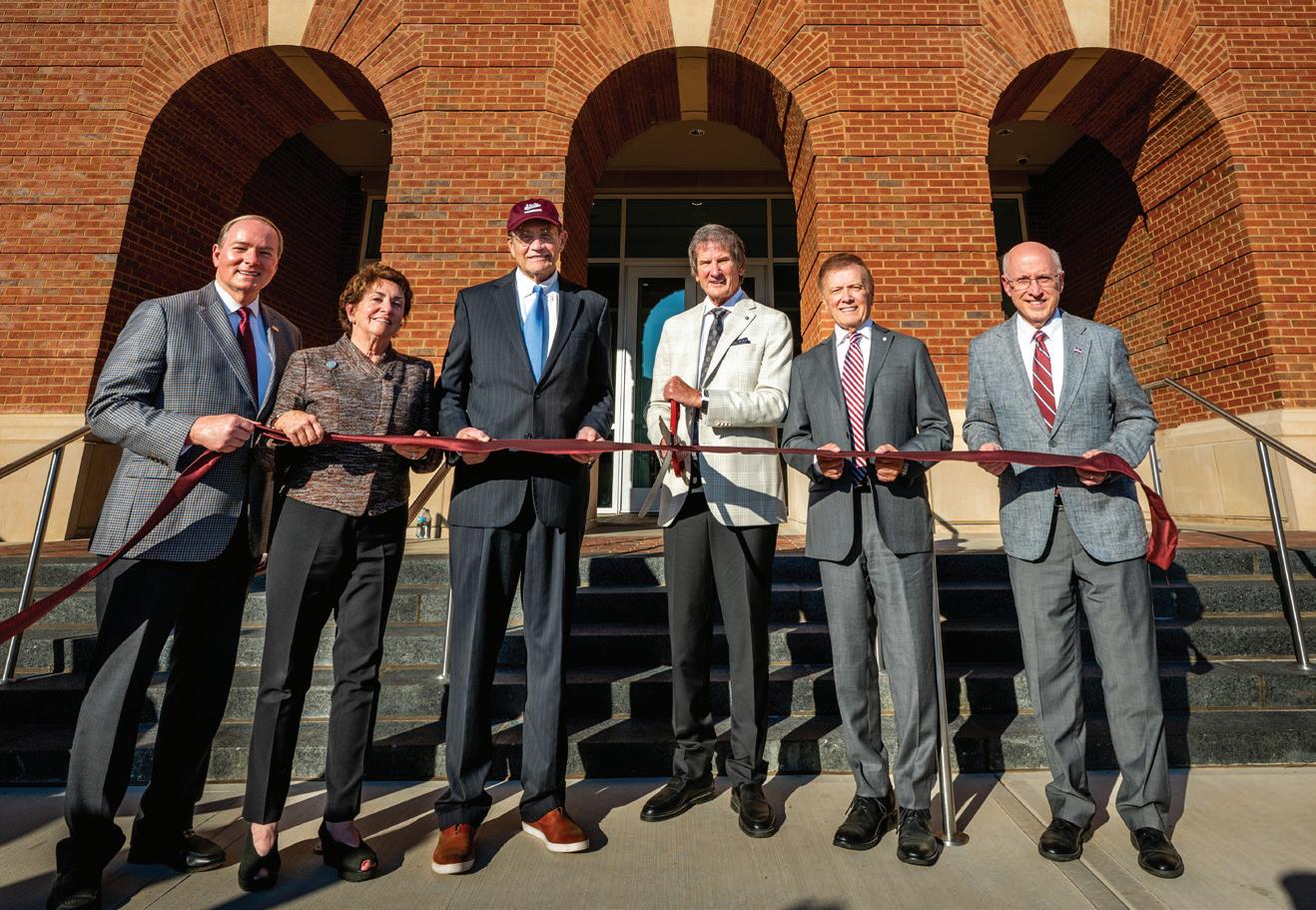
L-R: MSU President Mark E. Keenum, Lynn and Lt. Gov. Delbert Hosemann, Jim and Tommy Duff, and MSU Provost and Executive Vice President David Shaw
(left)
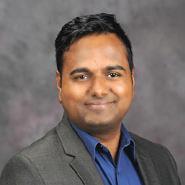
A Mississippi State University doctoral student in the Department of Agricultural and Biological Engineering has been awarded a prestigious NASA-affiliated fellowship through the Mississippi Space Grant Consortium. DAKOTA HESTER, a Tishomingo native, received the award for his innovative research that applies advanced artificial intelligence to accurately map land cover data using high-resolution 1-m aerial images.
One of crop science’s most respected professional societies is recognizing a Mississippi State faculty member as an outstanding early career agronomist. PRAKASH JHA, an MSU Department of Plant and Soil Sciences assistant professor, will receive the American Society of Agronomy’s Early Career Award at the ASA, Crop Science Society of America, and Soil Science Society of America’s joint meeting. The Early Career Award, which includes a $2,000 stipend, honors rising leaders who have made significant contributions to agronomy within seven years of completing their degree.
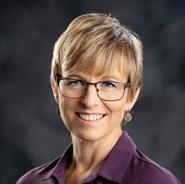
LESLIE BURGER, an MSU Department of Wildlife, Fisheries and Aquaculture associate teaching professor, received The Wildlife Society’s Excellence in Wildlife Education Award during the organization’s annual meeting in Edmonton, Alberta—an international recognition for her distinguished career of teaching, mentoring and preparing students for success in natural resource management.
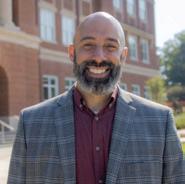
Mississippi State’s JORDAN SPENCER is now the director of the university’s ACCESS Program and Specialized College Services, a new unit that expands MSU’s support to students with intellectual, developmental and neurodiverse needs. Spencer oversees this unit, housed in the Mississippi Institute on Disabilities, that brings together the ACCESS Program and the expansion of unique programming for neurodiverse college students. It now incorporates the Autism Liaisons Program, focused on the success of degree-seeking students on the autism spectrum, and expands iREACH, a formalized program for neurodiverse students to build skills in self-advocacy, socialization and employment.
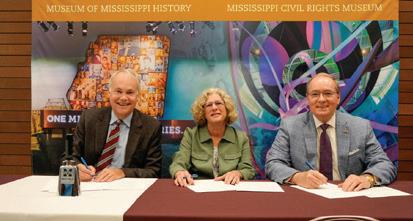
The Mississippi Department of Archives and History and Mississippi State University have signed an agreement to create a regional hub for education, research and workforce development at Historic Jefferson College near Natchez. MSU President Mark E. Keenum, MDAH Director Katie Blount and MDAH Board of Trustees President Spence Flatgard formalized the partnership, combining HJC’s historical resources with MSU’s academic strengths. The 19th-century campus will host yearround programming, including field schools, workshops and other hands-on learning opportunities.

MSU’s Riley Center was named Venue of the Year by the Mississippi Tourism Association which recognized the impact and accomplishments of the state’s tourism industry at its annual Tourism Awards Program, held during the Governor’s Conference on Tourism at the Vicksburg Convention Center.
Mississippi State University-Meridian’s Master of Physician Assistant Studies 2025 graduating cohort has achieved a 100% board pass rate, a hallmark accomplishment that corresponded with the program receiving continuing accreditation status.
Mississippi State continues its reputation as a top university for transfer students with its selection to the 2025 Phi Theta Kappa Transfer Honor Roll. MSU is one of 251 colleges and universities selected for the international honor roll, marking the eighth consecutive year the prestigious honor society for associate degree students has included the university.
Forbes is honoring Mississippi State University, the state’s leading land-grant institution, with a top spot on its 2025 America’s Best Employers by State list, ranking it third overall in Mississippi. The university is the state’s highest-ranked educational organization and highest-ranked Mississippi-headquartered entity.
The University also earned its 10th consecutive spot in The Chronicle of Higher Education’s Great Colleges to Work For program. MSU is one of only 54 four-year institutions and large institutions that achieved Great Colleges to Work For status.
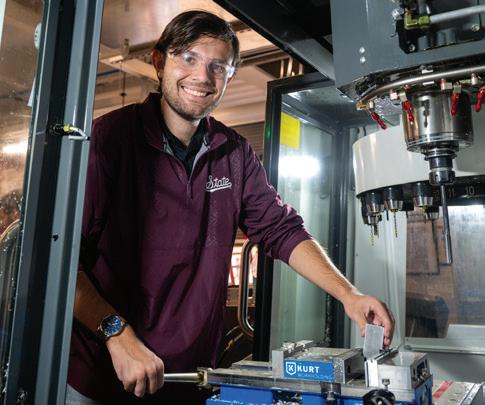
Mississippi State is offering free public training through its partnership with America’s Cutting Edge, a national initiative addressing the need for skilled workers in machining and machine tool technology. The program, launched in 2020 by the Institute for Advanced Composites Manufacturing Innovation and the U.S. Departments of Defense and Energy, aims to restore U.S. leadership in machining through innovation and workforce development.
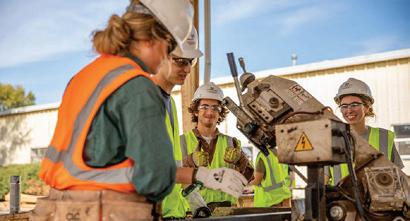
A new Master of Science in construction management at Mississippi State will further prepare students for leadership roles in today’s construction industry.
Recently approved by the Mississippi Board of Trustees of State Institutions of Higher Learning and housed in the MSU Department of Building Construction Science, the program allows students to pick one of two tracks—a research or professional track tailored to the diverse needs of professionals in the architecture, engineering and construction sectors.
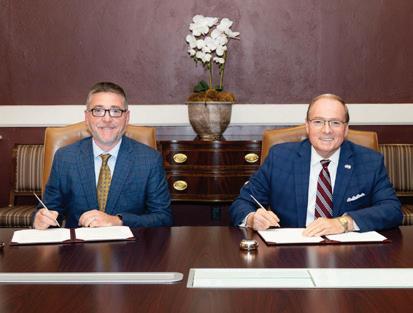
Mississippi State and East Central Community College in Decatur are partnering to create a seamless transfer pathway for culinary arts students to pursue a bachelor’s degree in culinology at the university.
MSU President Mark E. Keenum and ECCC President Brent Gregory signed a memorandum of understanding, giving transfer students the opportunity to earn this degree in a field with 100% job placement.
JORDAN TO LEAD MSU’S AI EFFORTS IN NEW ROLE; WILLARD NAMED INTERIM VP FOR RESEARCH, ECONOMIC DEVELOPMENT
By Sid Salter
Continuing its commitment to innovation and responsible leadership in technology, Mississippi State University President Mark E. Keenum announced the appointment of former MSU Vice President for Research and Economic Development Julie Jordan as the university’s first Senior Advisor for Artificial Intelligence and Data Governance.
Jordan transitioned from vice president to devote her full efforts to this new role, where she now leads the university’s strategic initiatives in artificial intelligence and oversees the development and implementation of comprehensive data governance. This new position reflects MSU’s commitment to advancing research and education while ensuring the ethical and effective use of data and AI.
Keenum said Jordan’s new position would “continue to demonstrate MSU’s emergence as a leader in AI as we serve our students, our state, and our nation’s rapidly expanding digital economy.”
“Dr. Jordan’s extensive experience and foresight have been instrumental in our growth as a research leader,” Keenum said. “Her new leadership position is vital for MSU as we pioneer the responsible adoption of these technologies across our campus, ensuring our position at the forefront of this new era of innovation.”
Since being named vice president in 2019, Jordan has overseen significant growth in MSU’s research portfolio and has been a strong advocate for the responsible development of AI.
Based on her leadership, Jordan was selected to serve as an ex officio member of the Mississippi Artificial Intelligence Regulation Task Force established earlier this year by the Mississippi Legislature. The group is designed to ensure that AI technologies are developed and used in a responsible, ethical, and transparent manner that aligns with the state’s values and missions.

Jordan also serves on the AI Workforce Readiness Council, established by executive order of Mississippi Gov. Tate Reeves last June, which is a partnership between AccelerateMS, the Mississippi Development Authority, and Amazon Web Services. The Council focuses on the development of artificial intelligence , machine learning, and technical capacities in Mississippi’s colleges and universities to support the multi-billion-dollar expansion of AWS in the state.
“This role is a crucial step in ensuring that MSU uses AI and data in a way that is not only innovative but also responsible and secure.” ~ Julie Jordan
The initiative, known as the Mississippi AI Talent Accelerator Program, or MAITAP, establishes a training infrastructure that benefits the broader technology and information sectors.
“I am honored to take on this new challenge,” Jordan said. “This role is a crucial step in ensuring that MSU uses AI and data in a way that is not only innovative but also responsible and secure. I look forward to working with our talented faculty and staff to accelerate university-wide adoption and set the standard for institutional data governance.”
Succeeding Jordan as interim vice president for research and economic development is Scott T. Willard, who previously was Dean of the College of Agriculture and Life Sciences and Director of the Mississippi Agricultural and Forestry Experiment Station, or MAFES.
“Dean Willard’s proven record of effective leadership and scholarship as a dean and director makes him the perfect choice to build on the momentum of our overall university research enterprise,” said Keenum. “His deep
understanding of our land-grant mission and commitment to interdisciplinary collaboration will serve our university well.”
Willard has been instrumental in growing the MAFES research profile and promoting innovative academic programs in the College of Agriculture and Life Sciences.
“I am excited to lead MSU’s research and economic development efforts and to support our incredible faculty and students,” said Willard. “MSU has a rich history of impactful, multi-disciplinary research, and I look forward to fostering a collaborative environment that drives discovery and innovation across all our fields.”
Darrell Sparks, a longtime Mississippi State faculty member with more than a decade of service, has been named acting dean of the College of Agriculture and Life Sciences and acting director of the Mississippi Agricultural and Forestry Experiment Station in Willard’s absence.
Sparks has served as associate dean for the university’s College of Agriculture and Life Sciences since 2022. He has held numerous leadership positions at MSU, including associate and interim state chemist, director of the Mississippi State Chemical Laboratory and faculty member in the Department of Biochemistry, Nutrition and Health Promotion.
A two-time graduate of MSU, Sparks earned his bachelor’s and doctoral degrees in chemical engineering.
“I’m excited to take on these new responsibilities for my alma mater,” Sparks said. “Our college prepares students to become leaders in agriculture and life sciences and our faculty members conduct research that advances agricultural productivity and innovation. We also lead in research in life sciences that improves health, well-being and quality of life for Mississippians. I look forward to continuing to support these outstanding programs from this new vantage point.” n
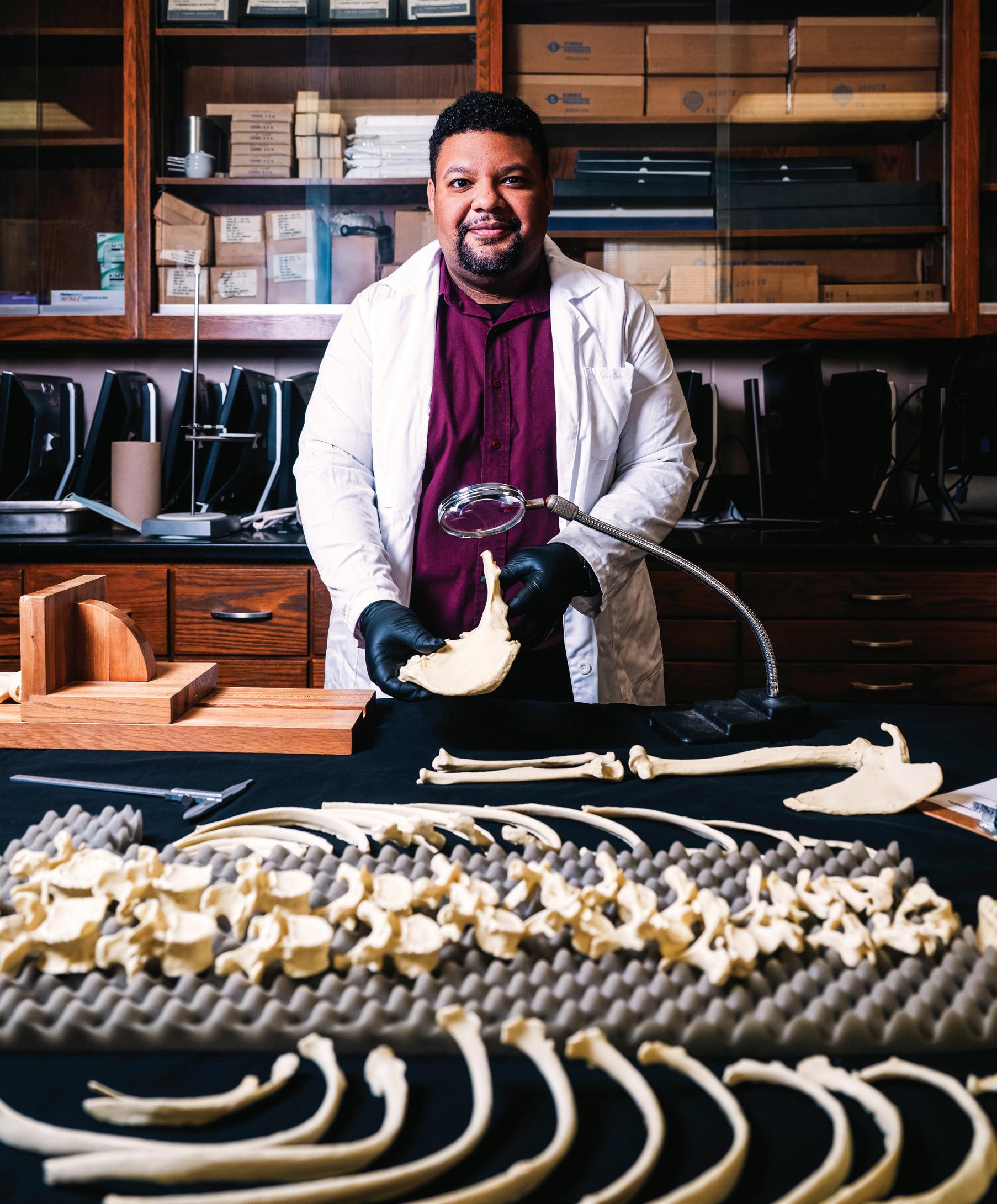
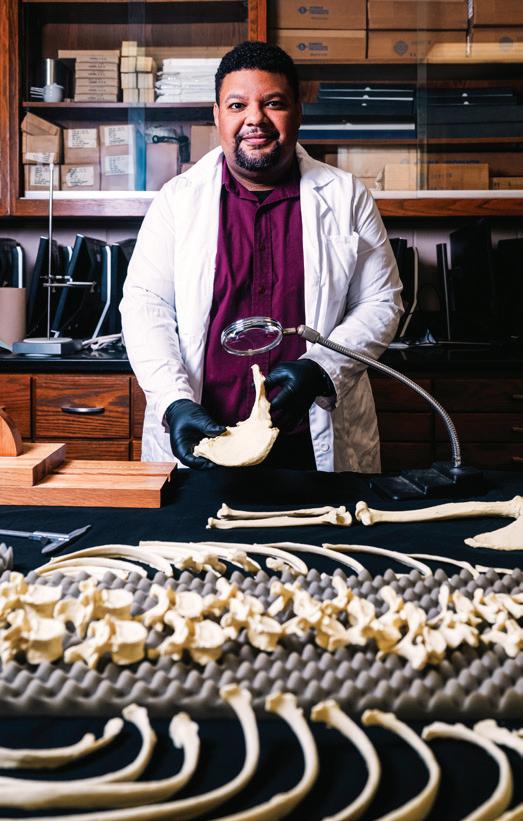
Jesse Goliath, an assistant professor of anthropology and director of the MSU Forensic Lab and Skeletal Histology Center, stands with replica models of human bone in what will soon be the center’s home in the Cobb Institute.
‘BONE’A FIDE BULLDOGS
IMSU forensics team partners with state agency
to solve Mississippi’s mysteries
By Susan Lassetter, Photos by Emily Grace McCall
magine sitting at your desk, going about your workday, when someone walks in and thrusts a bag of bones your way—a plastic bag containing a smattering of ribs and long bones among leaves, dirt and other debris that looks alarmingly like pieces of a human skeleton.
Suddenly, your day is split into two parts. The before, during which your biggest worry was meeting a deadline, and the after, when you’re enmeshed in a bona fide mystery worthy of true crime TV.
But this isn’t TV or the plot of a podcast. It’s something that really happened in 2015 at a small police department in Ohio.
The department’s officers did everything necessary to start an investigation. Questions were asked, reports were filed and the bag was emptied and cataloged. Then, Jesse Goliath, an Ohio State anthropology graduate student at the time, got a call.
directed university anthropologists to an area often used as a homeless encampment where the initial bones were found. Using methodical grid searches, the team recovered the rest of the remains, including the one piece of bone that positively connected their findings with what had been surrendered to police.
“We found this little piece of bone called a pseudo arthrosis—a faux articulation that forms over time,” Goliath recalled. “And that piece of bone fit perfectly into a portion of a lower-back bone from the bag. Between that, the lack of duplication of bones and the location, we were able to confidently say we found the complete skeletal remains of one individual.”
“Our database helps make sure these missing individuals aren’t just files in a drawer somewhere but out there and searchable in case anyone—law enforcement or not— comes across a lead.”
~ Jesse Goliath
“Law enforcement was given these remains—this partial skeleton—and knew there was likely more to be found,” he explained. “So, they contacted us to find the rest of the remains.”
Now an assistant professor of anthropology at Mississippi State, Goliath is one the first calls of law enforcement agencies across the Magnolia State when they need assistance to find and recover skeletal remains. Since his arrival in Starkville in 2021, he has led teams of MSU faculty, staff and students in the use of proven forensic methods and tools for field recovery work—a testament to how universities can serve their communities.
In the example of the partial skeleton delivered to police in a bag, law enforcement
Goliath explained that with the complete set of remains, the university team and law enforcement were able to determine the deceased was likely biologically female and had a history of healed fractures—compression fractures that indicated she had fallen or jumped from a significant height. While those injuries were not fatal, similar fresh fractures showing no signs of healing implied her cause of death was likely from another fall.
The cumulative skeletal evidence led police to conclude that the remains belonged to a woman named Kathleena Burke, known to authorities due in part to her tendency to jump from structures. She was reported missing the previous year, and her death was ruled accidental.
“Without the recovery work of anthropologists, they likely would have only ever had the bones that were turned in, and it would have been very difficult, if not impossible, to close the case,” Goliath explained.
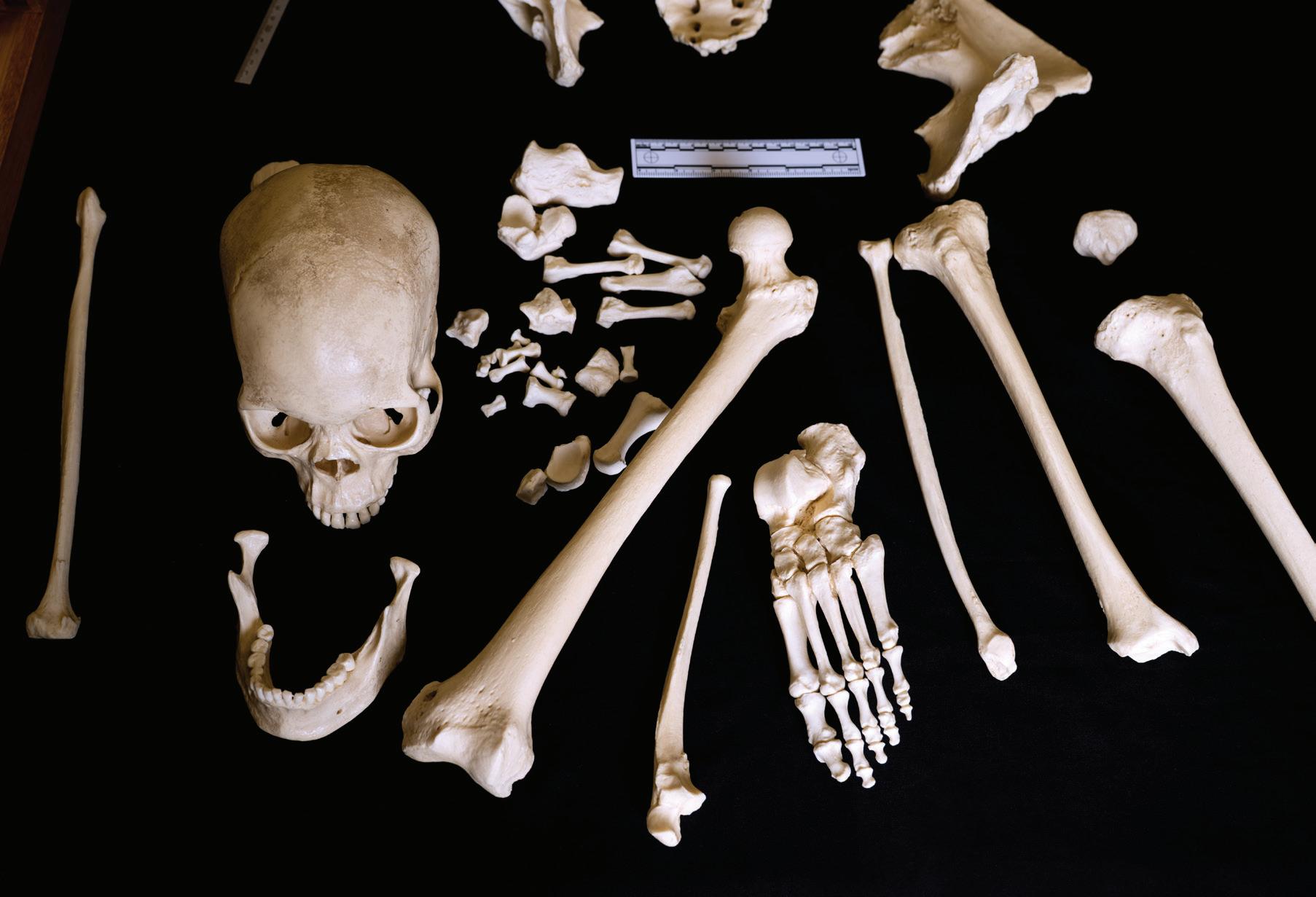
ABOVE: By examining skeletal remains, similar to the bone replica models seen above, forensic anthropologists can determine certain biological characteristics and uncover damage to bone that can help identify to whom the remains belong and their manner of death.
MSU created and houses the Mississippi Repository for Missing and Unidentified Persons. As of October, the database contained information on 1,613 currently missing individuals and 141 sets of unidentified remains, with cases dating as far back as the 1960s.
Goliath said this case from his grad school days has inspired and informed his work since joining the Bulldog faculty. In his time at MSU, he has assisted on recovery efforts or processing existing remains in 40 cold cases—25 of which happened in 2025.
Now, through a formal partnership between the Mississippi Department of Public Safety and MSU, the university will expand its forensic science research and education, while providing a much-needed service to the people of the Magnolia State.
Mississippi Department of Public Safety Commissioner Sean Tindell said the partnership is an example of how combining state resources and expertise can better serve the people of Mississippi.
“This gives us a dedicated anthropologist for the state who is embedded in an institution of higher learning, meaning we will always be on the forefront of the technologies, theories and science leading the
field,” he said. “It will also create a pipeline for the next generation of anthropologists who will hopefully join our department or the Mississippi Forensics Lab and help us solve cases.”
As part of its anthropological work, MSU also created and houses the Mississippi Repository for Missing and Unidentified Persons. This statewide database is a collection of reports about people who went missing in Mississippi, as well as a catalog of remains found within the state.
As of October, the database contained information on 1,613 currently missing individuals and 141 sets of unidentified remains, with cases dating as far back as the 1960s.
“Before this, the state of Mississippi did not have a centralized missing persons database,” Goliath explained. “Individual jurisdictions had their own records which may or may not have been reported to the
National Crime Information Center. But with this, there’s one place where law enforcement and the public can look for information about people who are missing in or are from Mississippi.”
The publicly accessible part of the database includes a basic biological profile—age, sex, ancestry and unique physical characteristics—of each missing person, as well as information about when and where they were last seen, their clothing, and in what direction and how they might have been traveling. The law enforcement side includes more detailed, but possibly sensitive, information.
“In law enforcement, a case can go cold in as little as 48 hours if no new information is discovered,” Goliath explained. “Our database helps make sure these missing individuals aren’t just files in a drawer somewhere but out there and searchable in case anyone—law enforcement or not—comes across a lead.”
The information that populates the database comes from a variety of sources, including federal, state and local law enforcement, private citizens, and a dedicated team of MSU staff and students who scour the internet for new or updated missing persons information.
Goliath said the repository also has partnerships with a variety of groups that support marginalized or at-risk populations and has become a resource for those who might not be comfortable speaking with the authorities.
“Sadly, not everyone who goes missing gets reported, but we’re doing what we can to report as many as possible,”
Goliath explained. “Some people come directly to us because we are not law enforcement but we get their case out there through the database.
“Some families have the advocacy and resources to enlist more help with their cases,” he continued. “Others need help navigating the process of filling out a missing persons report and accessing resources available to them. We’re trying to fill that gap with MSU anthropology by helping people be found and bringing resolution to as many families as possible.” n
‘Who you gonna call?’ MSU experts explain how, when to report found skeletal remains
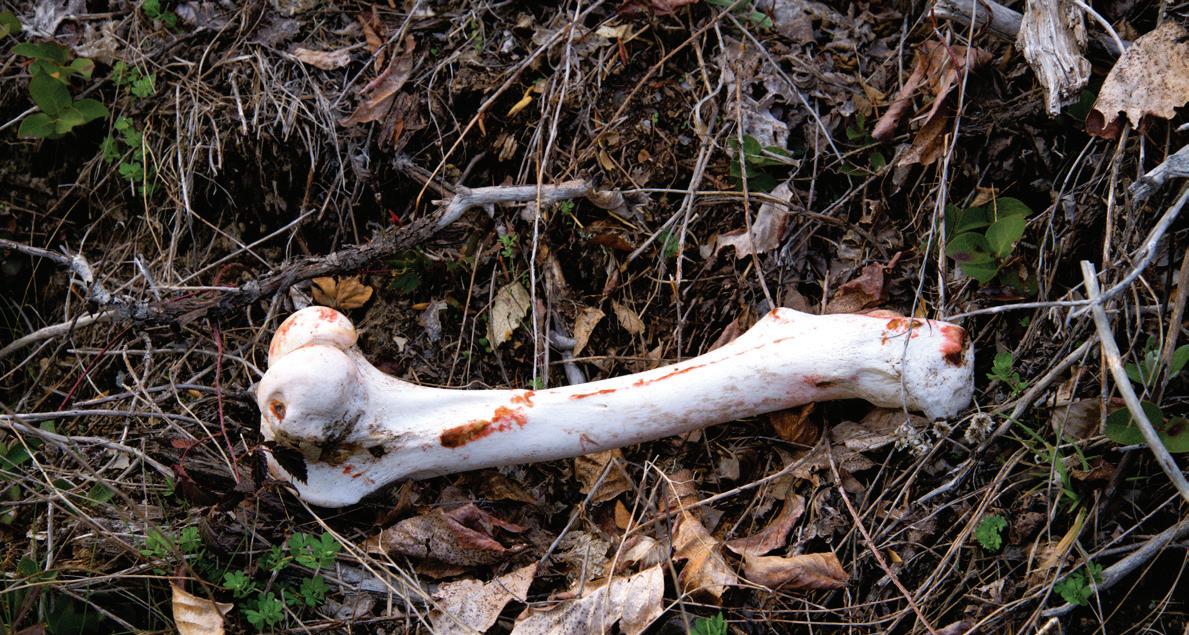
As director of Mississippi State’s Forensic Lab and Skeletal Histology Center, Jesse Goliath regularly gets asked, “Is this human?” by people who find bones in unexpected places.
Using his expertise as an assistant professor of anthropology, he can look for specific characteristics to determine the origin of a bone specimen. Some of these are visible to the naked eye, but others only become apparent under a microscope.
He said the animal bones most confused for human are the long bones of deer, which are roughly the size of adult leg bones, or the paws of bears or raccoons, which approximate the size and shape of adult and child-sized hands, respectively.
“One of the things trained anthropologists can see to help tell the difference between human and animal bones are muscle attachments and growth plates,” Goliath said. “If I can touch the bone, I can sometimes tell by the density as well.”
Goliath’s evaluations are informed by three degrees and more than a decade of experience. For the public, he says it’s best to contact local law enforcement agencies if you suspect skeletal remains are human or the result of a criminal wildlife violation, such as unauthorized hunting.
Even if the bones are animal and appear to be the result of natural causes, they could still hold valuable
ecological insights. Daryl Jones, an Extension professor in the MSU Department of Wildlife, Fisheries and Aquaculture, said many wildlife species are tracked or studied for research into their health, population size and habitat range.
In Mississippi, for instance, Louisiana black bears and deer are often part of multiyear, statewide studies. He said there is also important data to be collected if an animal’s remains are found outside its home range.
Jones suggests using a cellphone to photograph found remains and document the site. He said your phone’s mapping capability can also be used to mark the location.
“Dropping a pin on your phone’s map or using some brightly colored material to mark the site can help you or wildlife conservation officers return to investigate, if necessary,” Jones said.
In Mississippi, you can call 1-800-Be-Smart to report unusual animal sightings or remains, or to ask questions about area wildlife. Your local Extension office also has resources and experts available.
Jones said the Be-Smart hotline, or your state’s equivalent, is also important if found remains have a collar or tag indicating the animal was part of a research study. He added that MSU experts are always happy to take reports, help answer questions or discuss wildlife concerns. To connect with an MSU wildlife expert, call the Department of Wildlife, Fisheries and Aquaculture at 662.325.3830. n

FAMILY FOCUSED
World-renowned MSU research helps family businesses, students succeed
Story by Carl Smith, Photos by Beth Wynn
Even though business is good right now for the Coblentz family, nobody can clearly predict the future.
Patriarch Robbie has operated the awardwinning media production company Broadcast Media Group in Starkville for almost 30 years, and he and his wife, Bonnie, own two popular University Drive spots for food and drink— Dolce and L’uva Wine Room.
On paper, the next generation of Coblentzes—sons David and Mark—appear to
be perfect successors for the family businesses. But in reality, things aren’t that simple.
David, a two-time Mississippi State graduate, works as a video fellow with Bulldog football, helping film and edit practices and games. Mark, another Mississippi State graduate who is working on an MBA at MSU, gained notoriety for his culinary abilities early in life when he appeared on Food Network’s “Chopped Junior” and Fox’s “MasterChef Junior.”
Mark said he enjoys the many aspects of food service, “but there’s a big world out there, and I’m just not sure what I want to do” when it comes to staying and taking over. David, too, said he’s “letting things play out” and has “no definitive mindset” about the future of the family businesses.
So, questions linger for the Coblentz family: Who runs the businesses when Robbie and Bonnie decide to retire? Do they bring in outside management if their children choose other paths, or is it better to sell the entities they’ve put so much time, effort and money into?
“I’ve done video forever, and I love food. Seeing my sons follow in my footsteps a little bit has been fun to watch,” Robbie said. “It would be nice to have them buy in and take over, but I never want to burden my kids with the expectation that they have to do this—that they have to continue the legacy.
“When the time comes, we’ll all gather as a family and have these discussions,” he said. Uncertainty surrounding succession— like what the Coblentzes face—and how to successfully navigate it—are at the heart of what faculty with the MSU Center of Family Enterprise Research, or COFER, have focused on for years. Formally established in the MSU College of Business in 2008, the unit provides its findings, insights and resources to the public through The Family Business Bulletin, a quarterly report aimed at those starting, owning or wanting to acquire a family business.
“Succession has been and continues to be one of the most important issues facing
family businesses,” said Jim Chrisman, MSU’s Julia Bennett Rouse Endowed Professor in Management. “We hope our readers will be able to identify things in our research that will help them better manage their companies and achieve higher performance. For me, that’s the key part of what we do.”
Not only is the research these Bulldogs provide top notch, it is also plentiful. MSU is ranked first in the nation and second in the world for family business research by the Texas State University’s Family Business Research Productivity Ranking.
“This university feels like a place that when you visit, you immediately feel at home and welcome,” said Laura Marler, head of MSU’s Department of Management and Information Systems. “When you think of the idea of family, that’s what comes to mind when you think about Mississippi State.”
COFER doesn’t solely serve business owners. Its research is also used in Family Business Management, an undergraduate class taught by Chelsea Sherlock, an assistant professor of management. The course looks at the functions, issues, operations and dynamics of family businesses from a strategic perspective. Experiential learning is at the heart of the class, too. Students connect with family businesses and analyze their succession plans, ability to communicate their culture and story internally, and compare their values and visions.
Local businesses, including The Little Dooey, have connected with both researchers and students as they study these topics.
“Succession has been and continues to be one of the most important issues facing family businesses. We hope our readers will find insights in our research that help them manage their companies and achieve higher performance.”
~ Jim Chrisman
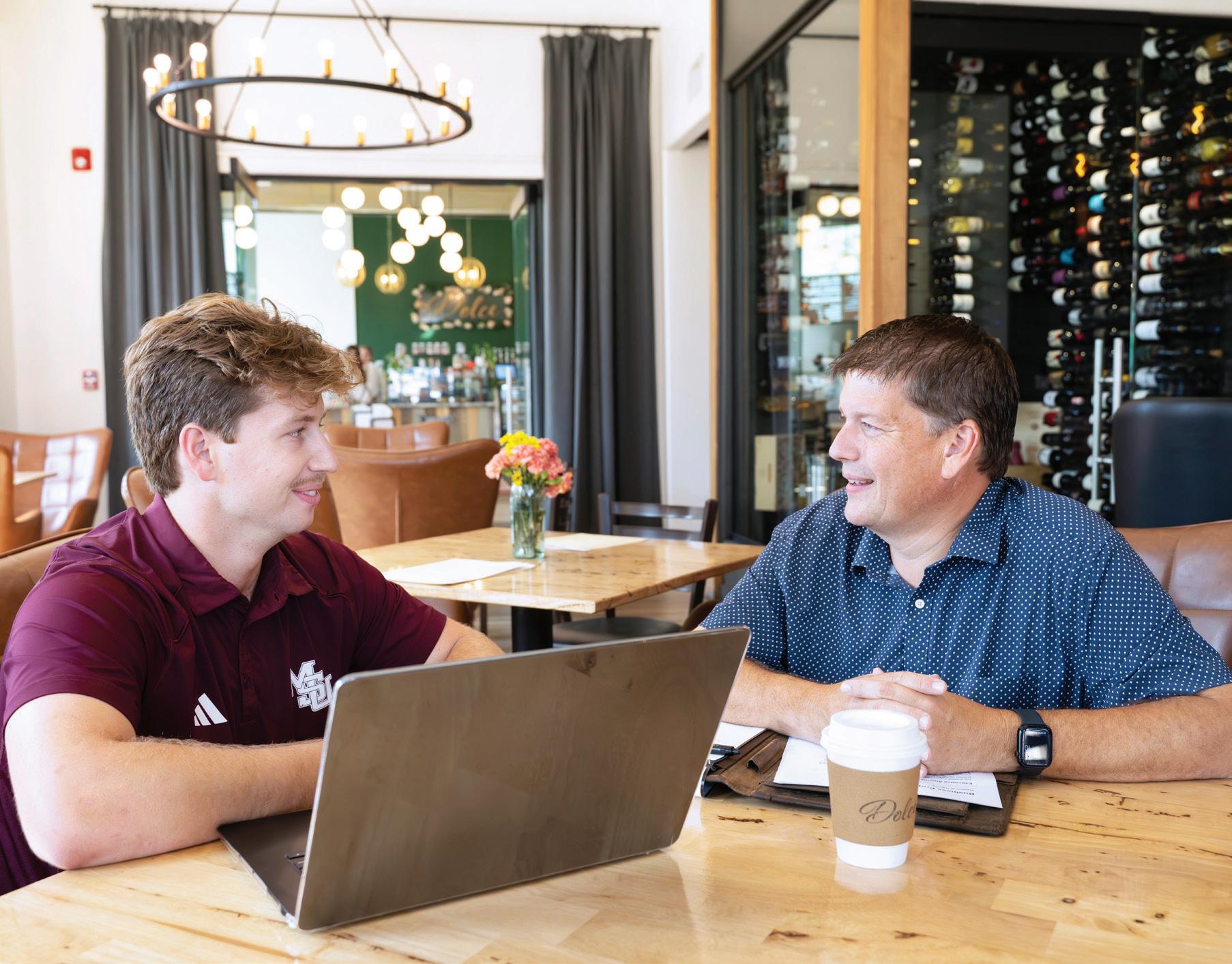
FAR LEFT: Robbie Coblentz (right) and son Mark discuss business operations at L'uva Wine Room, which Robbie co-owns. A student in MSU’s College of Business, Mark is learning about family business succession and, with brother David—a Bulldog alumnus—is weighing the options for his future.
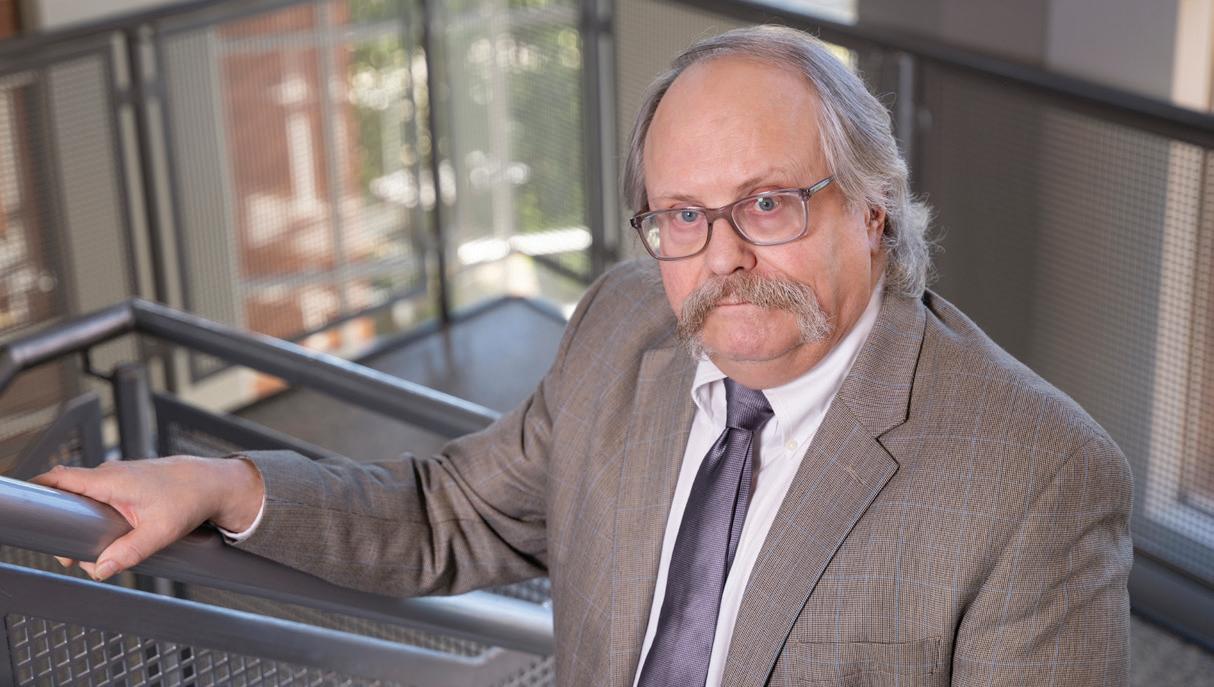
LEFT: Jim Chrisman, who leads research through MSU’s Center of Family Enterprise Research, focuses on what keeps family businesses strong across generations. As the Julia Bennett Rouse Endowed Professor in Management, he’s helping business owners apply proven strategies to build lasting success.
Laura Marler, the Jim and Pat Coggin
Endowed Professor of Management and head of MSU’s Department of Management and Information Systems, helps bridge research and real-world practice in family business education. She’s focused on giving students the tools to strengthen their own family firms and make a lasting impact across Mississippi.
“Our goal is to equip students to return to their family firms with the tools they need to lead them into the future generations.”
~ Laura Marler
Marler said this collaboration with actual companies is key to educating the next generation of business owners because many who take the class come from families running organizations.
She describes the class as “where theory and practice meet.”
“Family business is the most common form of business across the world, and it’s one of the predominant forms of business in our state. It’s not surprising that a lot of our students want to go back to a family firm,” said Marler, the College of Business’ Jim and Pat Coggin Endowed Professor of Management. “Our goal is to equip students to return to their family firms with the tools they need to lead them into the future generations.
“If you go through our department, you’ll see that most of our management faculty have studied family business, so we’ve built this synergy and stockpile of research and are now extending our outreach,” she explained. “When you think about the impact you could have across the whole state—what the department can do by taking research and translating it into practice—it is potentially transformative and very exciting."
If Mark Coblentz does decide to take over the food service side of his family’s businesses, he’ll walk into the situation more prepared after taking the class as an undergraduate.
“I’m sitting there thinking, ‘Wow, this is stuff I’ve seen before and we’ve been talking about,’” he said about the Family Business Management course. “All the case studies on companies and how they handled succession—they really opened my eyes on how intentional we have to be about succession. We need to hammer down expectations with intentionality, and these are conversations we need to be having.”
The College of Business hopes to add more family business collaborations to COFER’s work, as partnering with these companies not only helps them benefit from MSU faculty expertise but it also creates additional relationships for potential real-world case studies for business students.
“I’m very proud of what we’re doing here at Mississippi State,” Marler said. “It’s very meaningful for us to be able to give business owners the tools they need to be successful and to give our students skills and lessons to help them succeed, whether they go back to a family business or explore different career pathways.” n
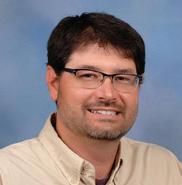
ERIC STAFNE, an Extension research professor, has been named a fellow of the American Society for Horticultural Science. It is the society’s highest honor. In more than 25 years of service to the nationally recognized society, he has served as president of its Southern region in 2019 and chaired a national ad hoc committee in 2023 to discover opportunities for supporting groups within the organization.
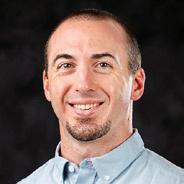
ZACHARY GILLEN, an assistant professor of exercise physiology at Mississippi State, received a prestigious national grant to advance his research in better understanding how different resistance training intensities maximize human performance. The National Strength and Conditioning Association Foundation’s Young Investigator Grant recognizes Gillen’s dedication to academic excellence and potential to make a meaningful impact in the field. He will use the $23,293 award to support his work in MSU’s Department of Kinesiology, where he directs the Resistance Exercise Performance Lab, which analyzes physiological and biomechanical responses to exercise.

Mississippi State Assistant Professor CANDACE LUKASIK is coeditor of a forthcoming book shedding new light on the intersections of theology, politics and ethics in Orthodox Christian communities. “Anthropologies of Orthodox Christianity: Theology, Politics, Ethics,” a Fordham University Press publication slated for release in November, is coedited by Lukasik and Northeastern University’s Sarah RiccardiSwartz. The publication anthropologically explores the entanglement of theology and politics among contemporary Orthodox Christians.
DALTON WHITT, an MSU doctoral student from Greenville, received the Dr. Will D. Carpenter Distinguished Field Scientist Graduate Assistantship. Whitt’s selection for the Carpenter Assistantship highlights MSU’s commitment to developing the next generation of agricultural scientists tackling today’s most urgent crop management challenges. The assistantship, funded through a $500,000 endowment, also provides a scholarship and stipend for Whitt, allowing him to continue his producer-focused work when other funds are unavailable.
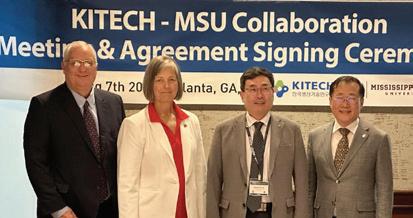
Mississippi State University and the Korea Institute of Industrial Technology have renewed agreements to strengthen joint research, innovation and workforce development in advanced manufacturing and industrial technology. The partnership, involving MSU’s Center for Advanced Vehicular Systems and KITECH’s Research Institute of Advanced Manufacturing Technology, includes plans to establish a joint Center for Root Technologies focused on core manufacturing processes such as casting, molding and welding.
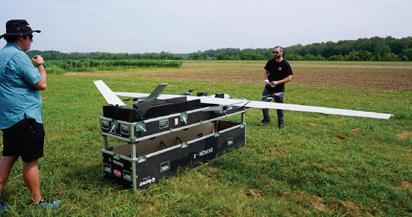
Mississippi State’s Raspet Flight Research Laboratory and Boeing’s Aurora Flight Sciences are partnering to advance unmanned aircraft systems for emergency response beyond the visual line of sight. The collaboration is developing a process manual to help first responders navigate the FAA’s BVLOS waiver process, which limits drone use to within visual range and can hinder time-critical missions such as search and rescue.
RESILIENT HOUSING RESEARCH
A cross-collaborative team of Mississippi State and Tufts University School of Engineering faculty received a $1.25 million National Science Foundation grant to promote resilient, affordable housing in rural communities. The three-year project will help the Mississippi Delta and Gulf Coast regions better manage housing risks through geosensing, artificial intelligence and participatory research, creating a multiscale decision-support platform.
TEACHER RESIDENCY GRANT
Mississippi State University–Meridian’s Division of Education has received a $1.2 million grant from the Mississippi Department of Education to strengthen and expand the state’s teacher pipeline. MSU is among nine institutions sharing nearly $3 million through MDE’s Mississippi Teacher Residency program, which covers tuition and expenses for up to 236 individuals seeking elementary and special education licensure.
BEHAVIORAL HEALTH WORKFORCE EXPANSION
Mississippi State is addressing the shortage of behavioral health providers in rural communities with a $1.16 million grant from the Health Resources and Services Administration. The fouryear award supports the Applied Behavior Analysis program in the College of Education, expanding community-based training for undergraduates to grow the paraprofessional-level behavioral health workforce statewide.
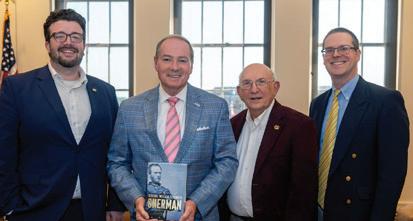
A new edition of Gen. William Tecumseh Sherman’s memoirs has been annotated by some of the nation’s leading Civil War scholars at Mississippi State University, marking 150 years since the work’s original publication. “The Memoirs of General William Tecumseh Sherman: The Complete Annotated Edition” is a Harvard University Press publication edited by MSU’s John F. Marszalek with Louie P. Gallo and David S. Nolen. The scholars’ work follows their 2017 release of a fully annotated version of Ulysses S. Grant’s historic memoirs.

Mississippi State is partnering with Amazon and agricultural technology company Arable to help Delta farmers conserve water and reduce costs. The project is part of Amazon’s global effort to become water positive by 2030—returning more water to the environment than it uses. MSU scientist and Extension irrigation specialist Drew Gholson said the initiative addresses growing pressure on the Mississippi River Alluvial Aquifer caused by rising demand for irrigation wells and acreage.
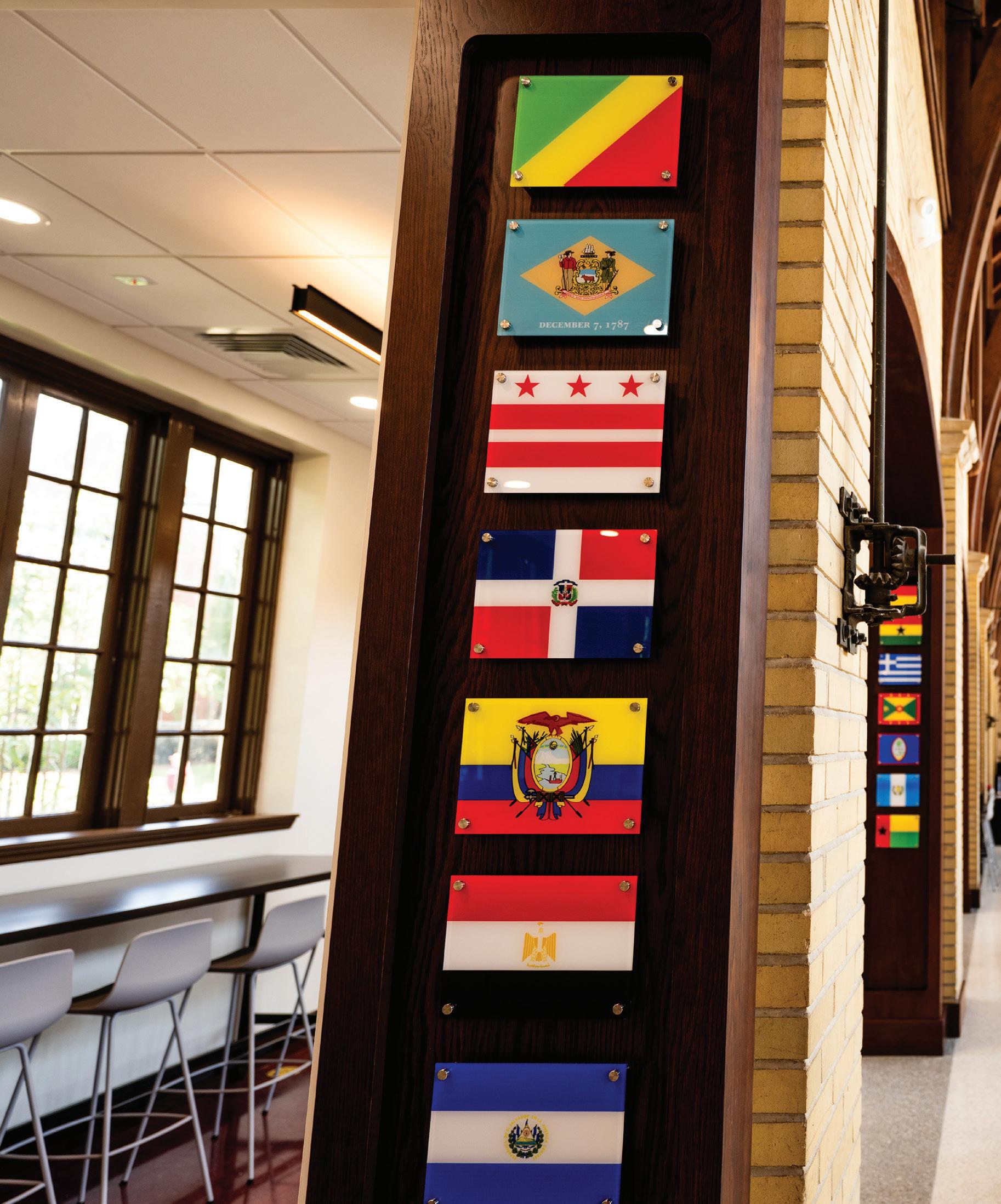
FUELING THE FUTURE
After closing for renovations, Mississippi State’s historic dining hall reopened in August with a fresh, modern look and variety of new fare for the next generation of Bulldogs. Perry Food Hall now features three dining concepts that offer unique, affordable choices including a Southern-style kitchen, a grill and a salad station.
Photo by Grace Cockrell

MSU BREAKS GROUND ON HOTEL MADELON, ANCHOR FOR NEW CROSSROADS DISTRICT
By Kevin Tate, Photos by Grace Cockrell & Submitted
Mississippi State representatives celebrate the groundbreaking of Hotel Madelon, the 122-room Marriott Tribute Portfolio hotel that will anchor the Crossroads District development between the university and Starkville’s Cotton District. Standing from left are Luke Chamblee, CAP Development; Saunders Ramsey, MSU executive director, Campus Services; Clay Scruggs, CAP Development; Jud Skelton, MSU Foundation, head of real estate strategy; John Rush, MSU Foundation president and CEO; Janet Carraway, MSU Foundation executive director of finance; MSU President Mark E. Keenum; Richard Puckett, West Side Funds, Inc. board; Jerry Toney, West Side Funds, Inc. board; Tommy Nusz, West Side Funds, Inc. board; and Rodger Johnson, MSU Foundation board chair.
Construction is underway on a new addition that will reshape the gateway between Mississippi State University and the Cotton District. Hotel Madelon will be a 122-room Marriott Tribute Portfolio hotel, which will include a full-service restaurant, rooftop bar and dedicated underground parking. The hotel, located at 910 University Dr., is set to open in the summer of 2027. The district it will anchor, including entertainment, restaurant, housing and additional parking venues, will be developed over several phases.
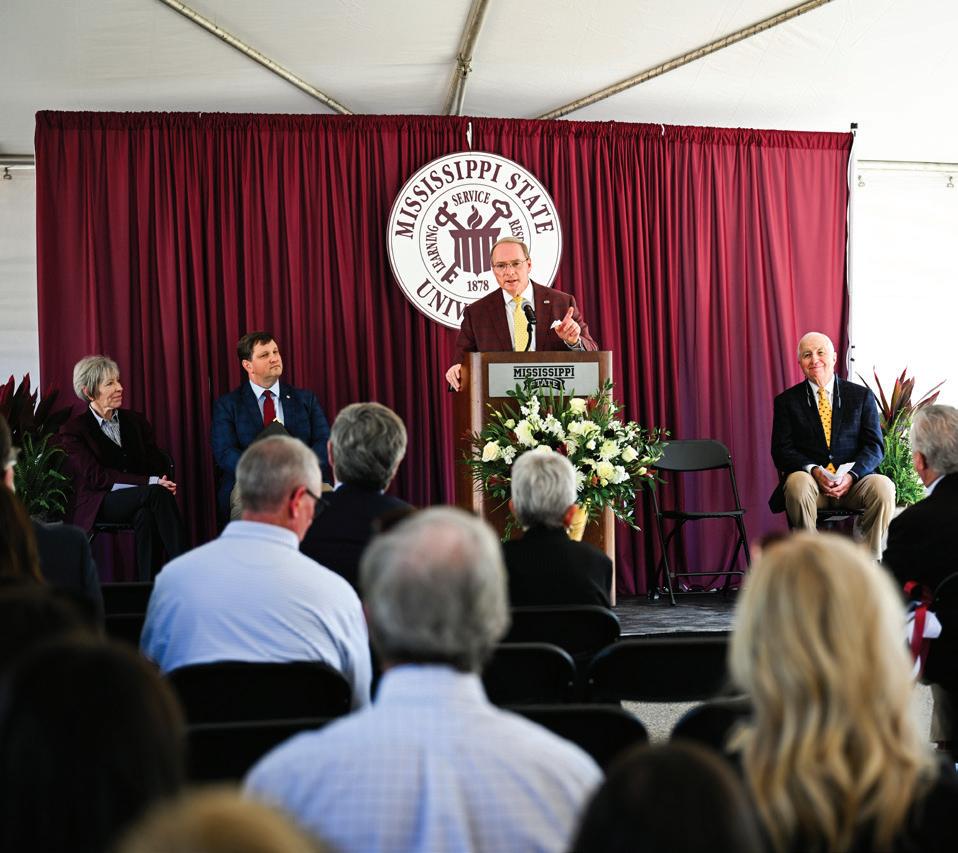
“This ceremony signifies so much more than a construction milestone. This groundbreaking represents the vision we have for our university and our hometown to be the very best they can be. Hotel Madelon will provide guests and visitors with an unmatched experience and be the catalyst that drives the development of future phases of the Crossroads District,” MSU President Mark E. Keenum said.
“What we are embarking upon today will enhance quality of life and create new and exciting economic opportunities for decades to come. I’m very proud that our university is once again leading the way as
"This groundbreaking represents the vision we have for our university and our hometown to be the very best they can be."
~ Mark E. Keenum
we strive to serve this community and the great state of Mississippi.”
Hotel Madelon, named in honor of the university’s original fight song, will be a boutique hotel, celebrating the legacy
of MSU and the culture of Starkville. The hotel is being positioned on a prime site that will offer stunning campus views and an overall design that will attract both visitors and locals.
Tribute Portfolio hotels are known for their story-driven designs, offering experiences rooted in the personality and history of their destinations. Hotel Madelon will combine MSU’s traditions, Starkville’s arts and culinary scenes, and the region’s rich cultural heritage into its design and guest experiences.
The hotel will be managed by Charlestowne Hotels, a leading hospitality management company known for operating distinctive, award-winning properties across the country. Charlestowne brings decades of experience in collegiate hospitality to the role.
The Crossroads District will lie between the university campus and the Cotton District, bounded approximately by




Set atop Hotel Madelon, the rooftop bar offers sweeping views of Mississippi State’s campus and the surrounding Crossroads District, pairing local character with a signature gathering space for guests and visitors.

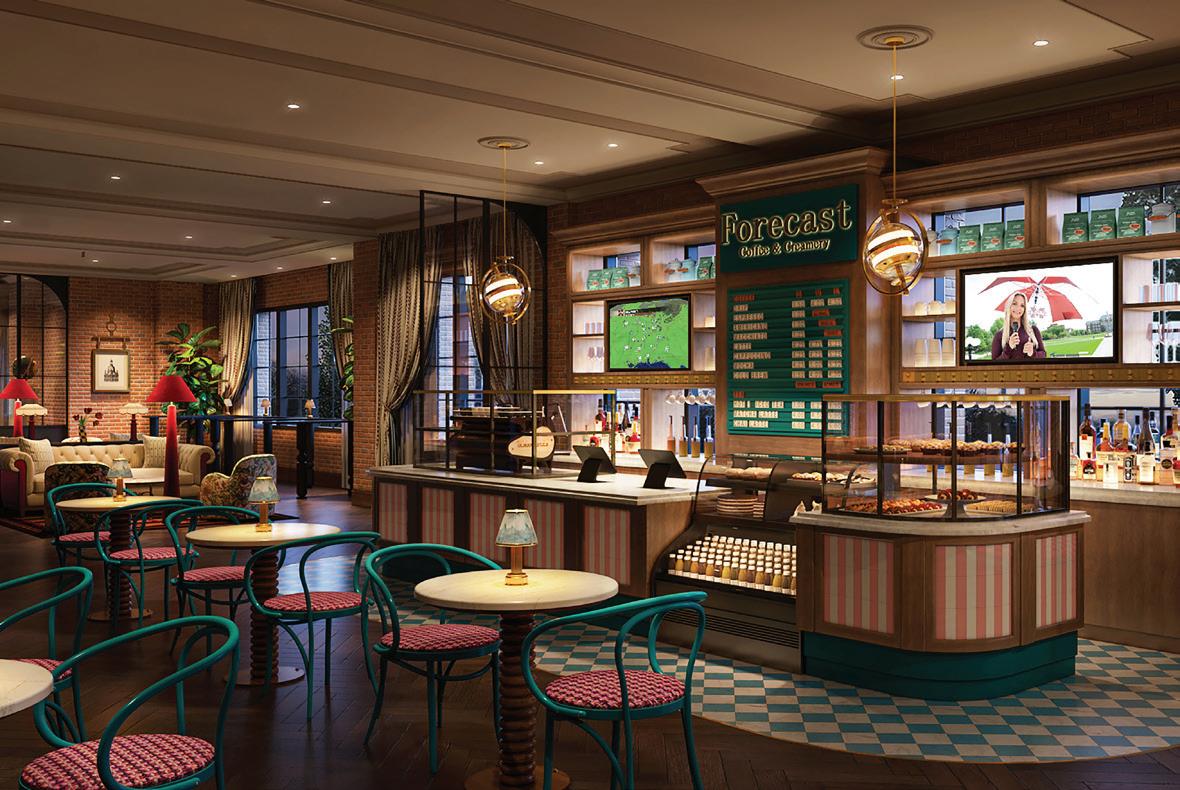
The Hotel Madelon’s full-service café brings together university tradition and Starkville’s creative energy, offering a warm, welcoming spot for dining, conversation and community within the new Crossroads District.
University Drive on the north and Highway 12 on the east and south, blending seamlessly into the Cotton District along Colonel Muldrow Avenue. It will feature a pedestrian land bridge connecting guests to campus across Highway 12 and create a smooth transition between the university and city communities.
"It will be a brand new place that feels like home to a guest from the moment they arrive."
~ John Rush
“Hotel Madelon is the anchor that will set the tone for the Crossroads District,” said John Rush, president and CEO of the MSU Foundation. “It will share some of the most familiar parts of our story, the parts that bring people here and bring people together. It will be a brand new place that feels like home to a guest from the moment they arrive.”
Restaurants, retail and residential developments along University Drive have long made the area attractive. Increasing the number of businesses in those economic sectors and doing so along a street that joins the campus to the city make for an ideal fit.
The project is being spearheaded by West Side Funds Inc. in partnership with CAP Development Group, Brasfield & Gorrie General Contractors, Cooper Carry Architects, KTGY, The Saturday Crowd, U3 Advisors, CBRE Hotels Advisory, CPLA Design+Planning, Thompson Placemaking, Charlestowne Hotels, Neel-Schaffer Engineering, Rich Perspectives and Walker Consultants. n

FUTURE PHASES: A HUB FOR INNOVATION, CULTURE, COMMUNITY
As development of the Crossroads District progresses, future phases will establish a zone offering year-round amenities for students, faculty, staff, residents and visitors. Key highlights include:
• ENTERTAINMENT DISTRICT: A hub with local restaurants, curated retail shops and dynamic entertainment venues that seamlessly connect the campus, Cotton District and downtown Starkville, bridging the town-and-gown relationship.
• CULTURAL AND HISTORICAL LANDMARKS: The development’s cultural centerpiece will include a new home for the Ulysses S. Grant Presidential Library, bolstered by an ongoing private fundraising effort through the MSU Foundation. This facility will showcase MSU’s distinction as one of only six universities nationwide to host a presidential library, further enriching the cultural significance of the district.
• SEAMLESS CONNECTIVITY: A planned pedestrian land bridge over Highway 12 will provide direct and safe access between the university and the development and city beyond, enhancing walkability for students, residents and visitors.
• RESIDENTIAL LIVING: On-site housing options, including faculty and staff residences, will add energy and year-round vibrancy to the district while supporting adjacent retail and dining establishments.
• INNOVATION AND RESEARCH HUB: State-of-the-art office and innovation spaces will attract researchers, startups and businesses, leveraging proximity to MSU’s world-class Thad Cochran Research, Technology and Economic Development Park.
• CONVENIENT PARKING: A 700-space parking garage is planned to be located on the north side of University Drive near the district.
The district’s location ensures unparalleled proximity and walkability to the MSU campus. It also creates a premier destination for the 3.5 million visitors drawn to Starkville annually for events, conferences and tourism. n

CYBER POWERED
Mississippi State takes the lead in state’s cybernetic growth
By
Susan Lassetter, Illustrations by Heather Rowe using AI tools and reference images from OPA Photographers

Over the last two years, Mississippi State University has made headlines with many new cybernetic partnerships, programs and investments.
Taken individually, each announcement further solidifies the university’s prowess in cyber science. Considered as a whole, these advancements don’t just fuel MSU’s reputation as a cyber powerhouse, they also establish the Magnolia State as a hub for emerging, high-tech business.
“Our university is uniquely charged with serving the entire state, and we have worked tirelessly to move Mississippi forward with innovative academic programs, transformative research and meaningful community engagement for nearly 150 years,” MSU President Mark E. Keenum said. “Today, groundbreaking advancements on our campus in high-performance computing, cybersecurity, data science and artificial intelligence are driving our mission to find solutions, meet challenges, create economic opportunity and prepare our students to be the leaders our state and nation need.”
From statewide partnerships to gamechanging research and degree programs filling growing workforce needs, MSU is looking to a high-tech future and preparing the state for big things to come.
leading the Pack
With ample space and easy access to infrastructure—like utilities and transportation—the state of Mississippi can fill many of the needs of new or growing businesses. What many people fail to realize is the Magnolia State also has the technical expertise to support the sophisticated needs of the tech sector—one of the fastest growing industries in America.
To marshal the state’s technological know-how and help industry see the state is the place to be, MSU spearheaded creation of the Mississippi Cyber Initiative, which recently broke ground on the Mississippi Cyber and Technology Center, its future 100,000-square-foot headquarters at Keesler Air Force Base in Biloxi.
“I think we’re at the beginning of changing the landscape of Mississippi,” explained Martin Rivera, MCI director. “People often don’t consider Mississippi to be a technology hub and are surprised this kind of technological work is happening here. But it is. And people are starting to realize that you don’t have to go to Alabama, California or Georgia to build your high-tech business.
“Mississippi State University and the Mississippi Cyber Initiative—we are solutions integrators,” he continued. “We identify needs, anticipate demands, define requirements and engineer innovative responses.”
Launched in 2021, the cyber initiative is a continuation of MSU’s existing partnership with Keesler—the epicenter of all U.S. Air Force cyber training. MCI brings together the state’s institutions of higher learning; local, state and federal government; military; and private industry to position Mississippi as a leader in cybersecurity. And in the world of tech-driven business and operations, cybersecurity is the key to economic development.
Recent statewide investments like the Compass Datacenters in Meridian and Amazon Web Services in Madison County are proof that MSU’s efforts are working. Valued at $10 billion each, these projects are the largest investments in the state’s history, which wouldn’t have been possible without the university’s cyber leadership.
“Cybersecurity is in everything we do,” explained Jim Martin, MSU’s associate vice president for corporate engagement and economic development. “It impacts every aspect of our lives. MCI pulls together a network to address these vulnerabilities.
“Cybersecurity is such an important element in artificial intelligence, autonomy, machine learning, high-performance computing—every aspect of business today,” he continued. “The cyber initiative really supports the theme of strength through collaboration. We’re addressing the needs, putting these solutions in place and showing that Mississippi is a place that can support your business needs and advanced innovation efforts.”

Solving Problems for Today—And Tomorrow
Credentialed as a National Center of Academic Excellence in Cybersecurity since 2001, MSU is one of only 12 universities in the country to have all National Security Agency cyber designations—cyber defense, cyber research and cyber operations.
The university has also established itself as an early leader in the emerging fields of artificial intelligence, machine learning and autonomy, all of which will be instrumental in the future of research and development, as well as emerging workforce needs.
Helping to power these efforts are MSU’s highperformance computing capabilities, which are powered by the university’s supercomputers known as Orion, Atlas and Hercules. Recent agreements with the National Oceanic and Atmospheric Administration and U.S. Department of Agriculture for $15 million and $4.5 million, respectively, have paved the way for the next generation of computing power for the AI-driven future.
Since 1996, 10 distinct MSU supercomputers have ranked among the most powerful in the world.
“We’ve been in the high-performance computing business for more than three decades now, and that vision from our leadership continues today with us making deliberate investments to be leaders in specific fields,”
“I think we’re at the beginning of changing the landscape of Mississippi. People often don’t consider Mississippi to be a technology hub . . . But it is. And people are starting to realize that you don’t have to go to Alabama, California or Georgia to build your high-tech business.”
~ MARTIN RIVERA
Martin said. “But we don’t just have the computers. We use them to drive research and power innovation. All the growth we’ve had in these areas gives us the capability to solve problems for our stakeholders.
“People are starting to realize just how strong we are in these areas,” he continued. “We have the infrastructure, the workforce and the capabilities that help bring companies here to invest in our state and see just how far we can take new innovation.”
Julie Jordan, MSU’s senior advisor for artificial intelligence and data governance, said the university’s long record of adopting and developing these advanced technologies makes MSU a “super implementor.”
That means MSU not only has access to the necessary components of big, sweeping technological advancements but also the expertise needed to bring it all together effectively.
“Not many places in the country have the people, experience, knowledge and infrastructure to manage supercomputing like what we have with our Applied Research Collaboratory,” Jordan said. “We’ve long been a leader in this, and that is attracting investment to the state.”
MSU’s Applied Research Collaboratory is a new umbrella organization that unites the university’s supercomputing capabilities with its centers focused on AI, autonomous vehicles, machine learning and, of course, cybernetic research. Bringing these individual units under a shared leadership helps the university encourage collaboration and
maximize its resources and expertise in these areas to better address today’s challenges and predict tomorrow’s needs.
“Research drives economic development when it’s done right, like what we do here with applied research, problemsolving and our growing capabilities,” Martin said. “It makes Mississippi very attractive for people and businesses looking to relocate.
“With us being responsible for more than 50% of the research expenditures in the state, we truly are the center of gravity to lead and make things happen,” he continued. “We are proud of the partnerships we’ve developed across the university and across the state with other institutions and stakeholders. It makes us stronger, and people now look to us as the solutions integrators for their toughest problems.”
Being solutions integrators and super implementors stems from the university’s roots as a land-grant institution. The focus on practical approaches—applied approaches— to teaching, research and service with the land-grant designation means the MSU family puts a premium on advancing the needs of its community. And with a presence in each of Mississippi’s 82 counties, that “community” extends to the whole state.
“MSU has a history of getting things done,” Jordan said. “When someone gives us a task to do, they know it will be done and it will be done well. We’re a good investment for their dollar and a good investment for their time, and when
people see that we’re involved, they know we have an eye out for their future, too.”
Jordan said the university is always looking to the needs of the future, and two of the biggest needs are figuring out what’s next for AI and what’s next for the cybersecurity realm.
“We tend to get out on the edge of things; to learn and develop those things before they become needed in daily life,” Jordan said. “We’re doing research that’s going to push the technology further, and we’re educating the students who will be able to go out and have careers in moving this science forward.”
Martin said that with MSU’s combination of leadingedge research, hands-on education and a drive to serve and lead, there is no reason the state’s I-10 corridor, for example, can’t be the next Huntsville, Alabama—long considered the high-tech hub of the Deep South.
“That’s the goal,” he said. “And that kind of success will spread—is already spreading—across the entire state, improving opportunities everywhere from the Delta and other rural areas to our population centers.”
Creating Tomorrow’s Workforce
Success for Mississippi State isn’t just measured in research investment and national rankings. Its most important metric is the success of its students and

“MSU has a history of getting things done, When someone gives us a task to do, they know it will be done and it will be done well. We’re a good investment for their dollar and a good investment for their time, and when people see that we’re involved, they know we have an eye out for their future, too.”
~ JULIE JORDAN
graduates. To help prepare these Bulldogs for the needs of tomorrow’s employment market, MSU has created new degree programs that will give them the knowledge and skills needed to not just find jobs but high-paying jobs that will help to shape the future.
“We provide the leadership for things like the Mississippi Cyber Institute and other high-tech collaborations, and we provide the research development to solve stakeholders’ unique problems,” Martin said. “But we also provide the graduates—the highly skilled workforce—these organizations need to stay competitive and profitable.”
Among the programs meant to serve the growing needs of a cyber-based workforce are bachelor’s degrees in cybersecurity, artificial intelligence and data science, as well as master’s degrees in AI; data science; applied data science; and cybersecurity and operations. There are also numerous certificates, minors and professional endorsements in various computing areas that Bulldogs can add to their resumes.
MSU recently received $2.2 million from the Mississippi AI Talent Accelerator—the most of any institution—to enhance its capabilities in AI and machine learning, including the development of a firstof-its-kind graduate certificate in data center construction management.
David Shaw, MSU’s provost and executive vice president, said each of these investments in furthering educational opportunities helps ensure a well-trained, knowledgeable workforce for tomorrow.
“We saw an opportunity and a need for these programs and knew it was important for our students to embrace these sciences that will be the backbone of the future,” he explained.
“Between cyber programs, data science, AI and autonomy, we are a very high-tech, forward-leaning university,” Shaw continued. “Combined with our land-grant status, that puts us at the tip of the spear for equipping people for tomorrow’s world.”
In addition to providing classroom education and hands-on experiences in laboratory and research situations, Shaw said the university has leveraged its partnerships to create internships and cooperative education opportunities for students. These valuable realworld experiences help graduates make an impact from day one in their careers.
“We’re taking care of what matters, and that’s what makes MSU unique,” Martin said. “We’ve really created a fantastic pipeline of well-educated students who understand the application of this science and can have a direct impact as soon as they hit the job market. They’re the most qualified students around.”

"We have the infrastructure, the workforce and the capabilities that help bring companies here to invest in our state and see just how far we can take new innovation."
~ JIM MARTIN
“Our applied approach means they’re not just learning facts and theories. They’re learning how to think and apply that knowledge to any situation because we’re not teaching for today we’re teaching for tomorrow.”
~ DAVID SHAW

The CyberCorps: Scholarships for Service program is one of the avenues available to Bulldogs looking to pursue education and a career in the cybernetic world. Sponsored by the National Science Foundation, CyberCorps is designed to provide financial support to both undergraduate and graduate students who will eventually join the workforce and increase the number of information assurance professionals capable of protecting the nation’s critical information infrastructure.
MSU’s CyberCorps program is the fourth largest in the nation.
“All of these things MSU has to offer form this connective tissue that brings together everything needed for successful, high-tech investment,” Martin said. “When all of these different initiatives and capabilities come together, it puts a big bull’s eye on the state of Mississippi and MSU as the place to go for new innovation.”
Shaw noted that being a hub for innovation also means our graduates know how to grow with the changing needs of their industries.
“With our approach to education, we’re producing graduates who understand how to continually evolve as the technology changes,” he said. “Our applied approach means they’re not just learning facts and theories. They’re learning
how to think and apply that knowledge to any situation because we’re not teaching for today—we’re teaching for tomorrow.”
Shaw credits the foresight of university leadership 30 or 40 years ago for setting MSU on the path to becoming a cybernetic powerhouse. That vision came largely in the form of the 1990s establishment of the MSU NSF Engineering Research Center for Computational Field Simulation. This center evolved into MSU’s High Performance Computing Collaboratory in the early 2000s and has long been the hub of the university’s computing power.
He said he believes the decision of today’s leaders— which includes rolling HPC2 into the Applied Research Collaboratory umbrella, establishing the Mississippi Cyber Initiative, pursuing advances in AI and machine learning, and creating the degree programs to accompany it all—will have the same lasting impact not just on the university but on the state as a whole.
“We have some of the best cyber programs in the country, and that’s because of decisions made a long time ago which have paid huge dividends, and we’ve only built on that success,” Shaw said. “I fully contend that if the state of Mississippi is going to move forward, the leader in that will be Mississippi State University.” n
INSPIRATION with a side of fries
MSU’s computing prowess has roots in friendships, foresight and French bread sandwiches
By Susan Lassetter, Photos by Grace Cockrell & MSU Archives
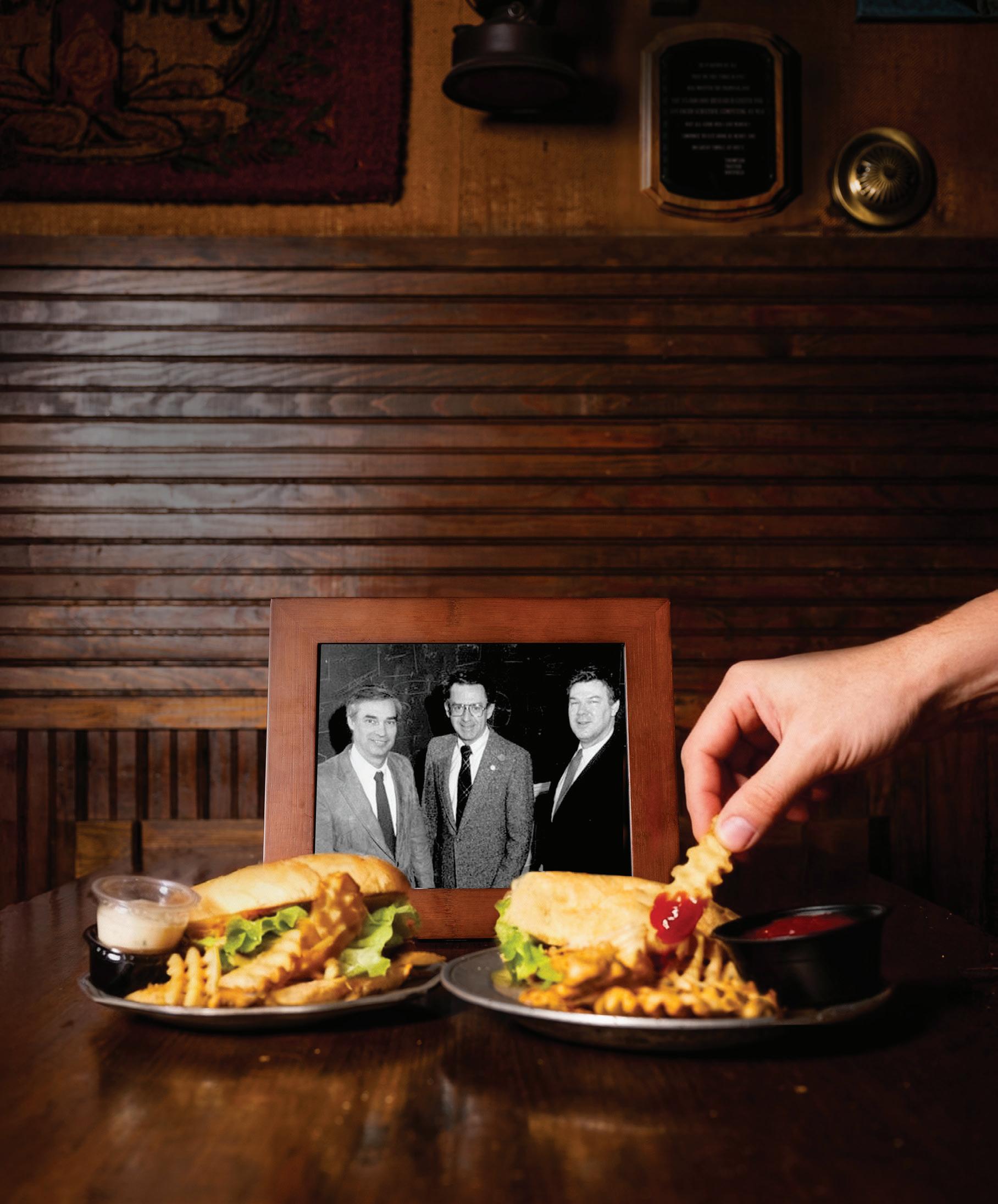
A plaque at Oby’s—a Starkville
eatery—commemorates the moment David
and
(pictured
to right in the framed
developed a plan that would propel MSU to the forefront of scientific computing and set the stage for decades of research advancement to come.
Cajun-themed
Whitfield, Joe Thompson
Don Trotter
left
photo)
As the state’s premier research institution, Mississippi State University brings in hundreds of millions of dollars in research funding each year. But that investment doesn’t just happen. Before the contracts are signed and checks are written, someone, somewhere must have a vision—an idea worthy of the time, money and manpower.
This is the story of one such idea. And it was born over po’boys at Oby’s, a Cajun-themed restaurant in Starkville.
In the late 1980s, MSU President Donald Zacharias was presented an opportunity too good to pass up. Sen. John C. Stennis wanted a proposal—a pitch for a $5 million building—and he needed it in 48 hours.
Don Trotter and Joe Thompson, engineering faculty members who were MSU Kappa Sigma Fraternity brothers, stepped up to the plate.
“Our department heads—Billie Ball in electrical and computer engineering and Charlie Cliett in aerospace—told us they needed a one-page proposal. They were good friends and encouraged collaboration between our departments,” Thompson recalled. “They put me, Don Trotter and David Whitfield on the task, so we went to Oby’s for lunch and talked it over.”
A 1961 physics graduate who was among the first Ph.Ds on the university’s aerospace engineering faculty, Thompson was a field-leading expert in the development of computational fluid dynamics, commonly known as CFD. Trotter, a 1960 electrical engineering alum who returned to his undergraduate department after an early career in Silicon Valley, was pioneering microelectronics. David Whitfield, who Thompson helped recruit to MSU, joined the team, bringing additional CFD expertise.
Trotter said that interdisciplinary approach— getting leading faculty from different academic departments to work toward the same goal—would turn out to be the key to success. He credits Ball, Cliett and Robert “Bob” Altenkirch, the engineering dean at the time who later became vice president for research, for encouraging the collaboration.
“We were interested in the synergy of our research,” Trotter said. “We wanted to find a way to combine our work to get the most out of both areas—taking their CFD and my microelectronics to perform more powerful computations and reliable simulations.”
Thompson added, “By the middle of that afternoon at Oby’s, we had a proposal to send Dr. Zacharias for a building that would combine the two areas.
“That’s the day,” he continued. “That’s the very beginning of advanced scientific computing at MSU, and there’s a plaque over the table at the restaurant to commemorate it.”
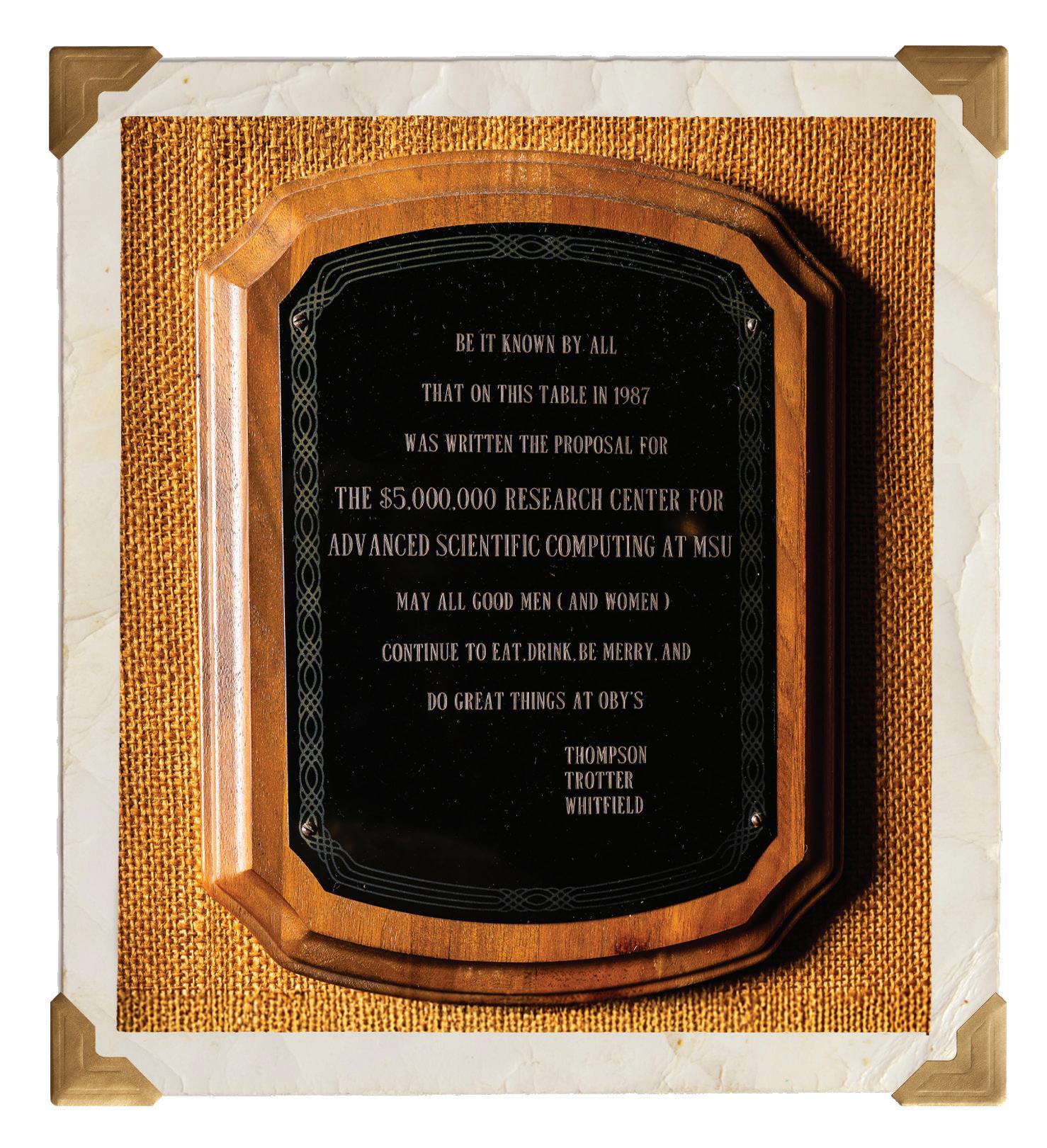
The proposal was accepted in August 1987, and the university was awarded $5 million— approximately $14 million today—for a new complex to be built in the then-new MSU research park.
With work underway for the physical space, Thompson said the team turned its attention to finding funding for the research it would house. The National Science Foundation had the answer.
“We had about $50,000 in research grants, but we needed something in the millions,” Thompson said. “That’s when we found the NSF Engineering Research Center program, which at the time was reputed to be one of the most competitive.”
Designed to support university-based interdisciplinary research centers across the U.S., the NSF ERC program was established in 1985. In the four decades since, it has funded 83 centers. When MSU applied in 1989, it was one of 43 in the running that year. Of those, the foundation visited seven universities. Only three received funding.
“That tells you what the odds were,” Thompson said. “The competition was stiff, but I thought we had done a good job, and we had something the other schools didn’t.

“That’s the day. That’s the very beginning of advanced scientific computing at MSU, and there’s a plaque over the table at the restaurant to commemorate it.”
~ Joe Thompson

“While the other guys were up there saying, ‘We have 10 rooms in a building,’ we could say we will have a whole building—that was one big factor,” he continued. “The other big factor was a commitment from Dr. Zacharias and the provost for 14 new, fully funded faculty positions. They had the vision. They were committed. And when I put those cards on the table, I knew we had a winning hand.”
Thompson got the call that the NSF pitch was successful while attending a meeting at Ole Miss.
“I went to a faculty member’s office to take the call, and I had to get through the rest of the meeting with a straight face because the formal, public announcement wouldn’t be for a couple of days,” he recalled. “Meanwhile, people back in Starkville were dancing in the hallways.”
Their success meant the MSU ERC would receive between $2 million and $5 million annually for the life of the award, which could be up to 11 years—provided the university passed two midproject “live-or-die” reviews.
The Beginning
Mississippi State officially launched the MSU NSF Engineering Research Center for Computational Field Simulation in 1990, with Thompson as director. The researchers were able to move into their Stennis-sponsored building in 1991.
“At the time, we couldn’t have known what it was going to become 30 years later, but we knew it was the start of something,” Trotter said.
Thompson said the university promised the Mississippi Institutions of Higher Learning board that the MSU ERC could provide a 3-to-1 return on the state’s investment—it doubled that return in the first year alone.
Then, in 1998, the university made a splash on the international stage when NASA turned to the MSU ERC for help. When John Glenn returned to space aboard the space shuttle Discovery for the STS-95 mission, a protective cover dislodged during launch. This could have led to catastrophic failure during reentry. Using its newly developed grid technologies—an advancement of computations fluid dynamics modeling—MSU was able to simulate the events and confirm the veracity of NASA’s solution to the problem. The work was completed in less than two days thanks to MSU’s expertise.
“They did the computation in around 36 hours—something that had taken NASA six months to complete,” Trotter recalled. “That was the objective of the MSU ERC: to make all those
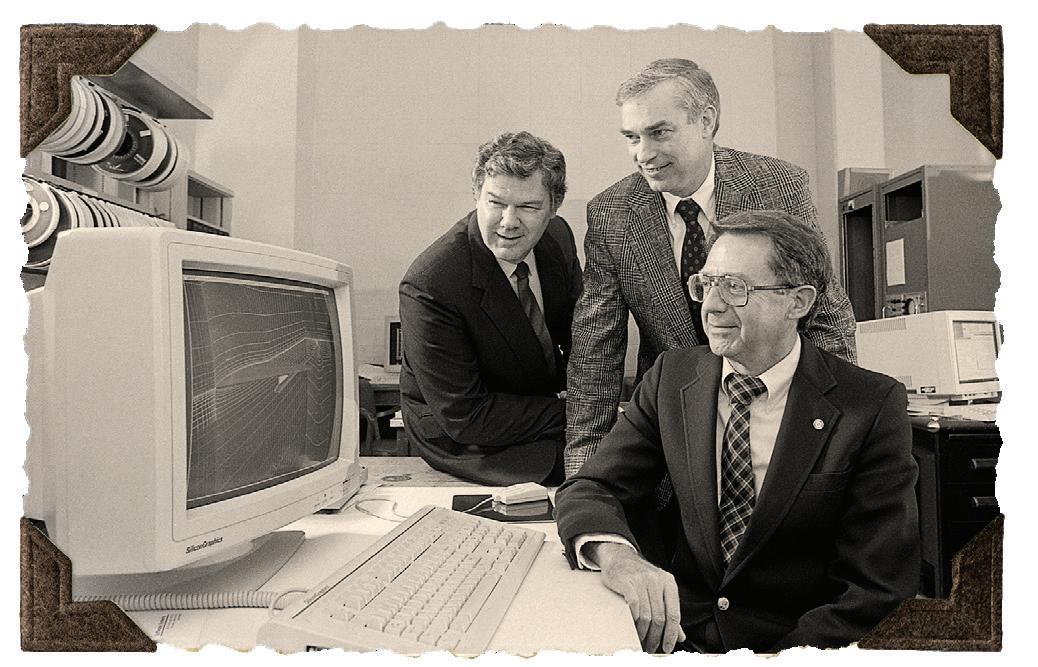
operations much more efficient, much quicker. It was a great example of what we were all about.”
With so much success, Mississippi State passed all the mandated mid-project reviews—one under Thompson’s leadership and the next when Trotter had taken the helm. MSU successfully completed all 11 years of its NSF ERC project, receiving approximately $55 million in funding over the life of the project—no small feat in itself.
Even more impressive, the Mississippi State University ERC successfully “graduated” from the program to become a self-sustaining research center.
“That’s the point of NSF’s ERC program. They get you started, then you go on to glory having secured outside funding for your work,” Thompson explained. “Most ERCs don’t make it to graduation, and even fewer find success when the NSF funding is done, but we did. We were one of their first success stories.”
The Next Phase
In 2001, the MSU NSF Engineering Research Center for Computational Field Simulation officially became the MSU High Performance Computing Collaboratory, known as HPC2, thanks in part to a significant investment from the state legislature meant to attract Nissan, and the leadership of thenuniversity President Malcolm Portera.
“When Nissan was looking to build a new factory in the South, a big part of why they came to Mississippi was the ERC," Thompson explained. “The legislature made a significant investment in MSU and HPC2 for the creation of another groundbreaking research center, CAVS, which would help support Nissan’s needs.”
ABOVE (L-R): Mississippi State engineering faculty Don Trotter, David Whitfield and Joe Thompson look at an early computational fluid dynamics model. The science combined Thompson and Whitfield’s aerospace engineering knowledge with Trotter’s research into microelectronics.
TOP RIGHT: University leaders and project partners ceremonially break ground on what would become home of the National Science Foundation’s Engineering Research Center at MSU.
RIGHT CENTER: A ribbon cutting marks the opening of the building that would become known as MSU’s High Performance Computing Center.
RIGHT BOTTOM: The High Performance Computing Center was renamed in 2014 to honor former university President Malcolm A. Portera. It was under his leadership that the former NSF Engineering Research Center found its footing to successfully “graduate” from the National Science Foundation program.
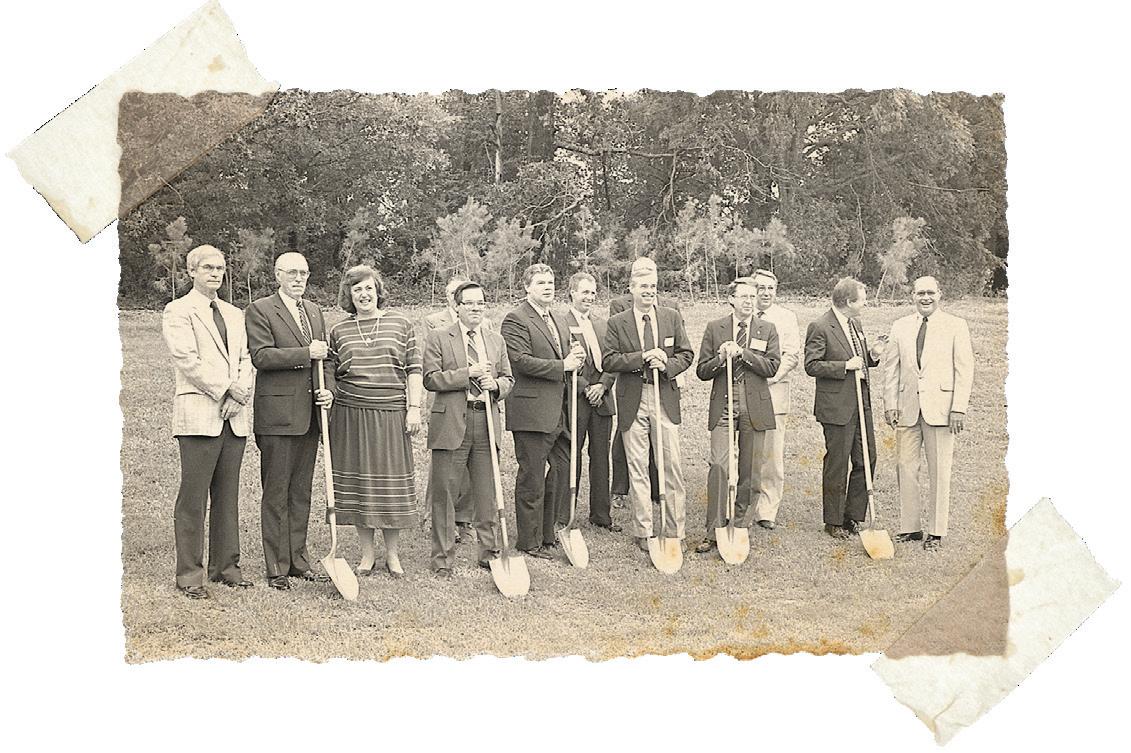
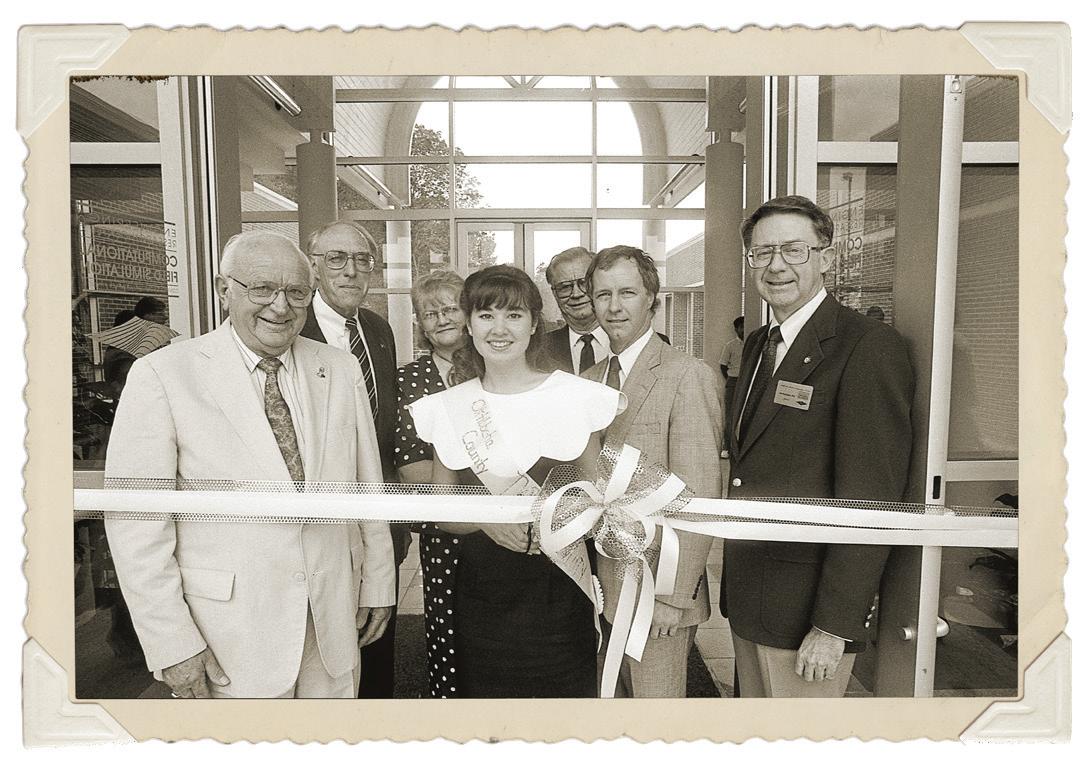
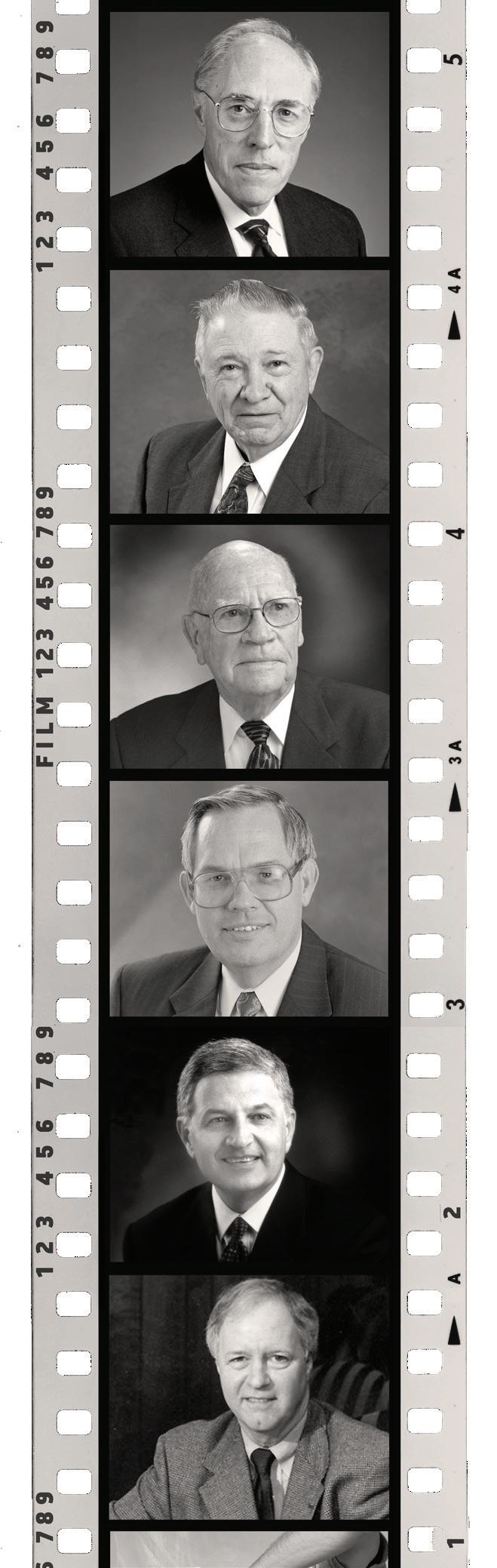

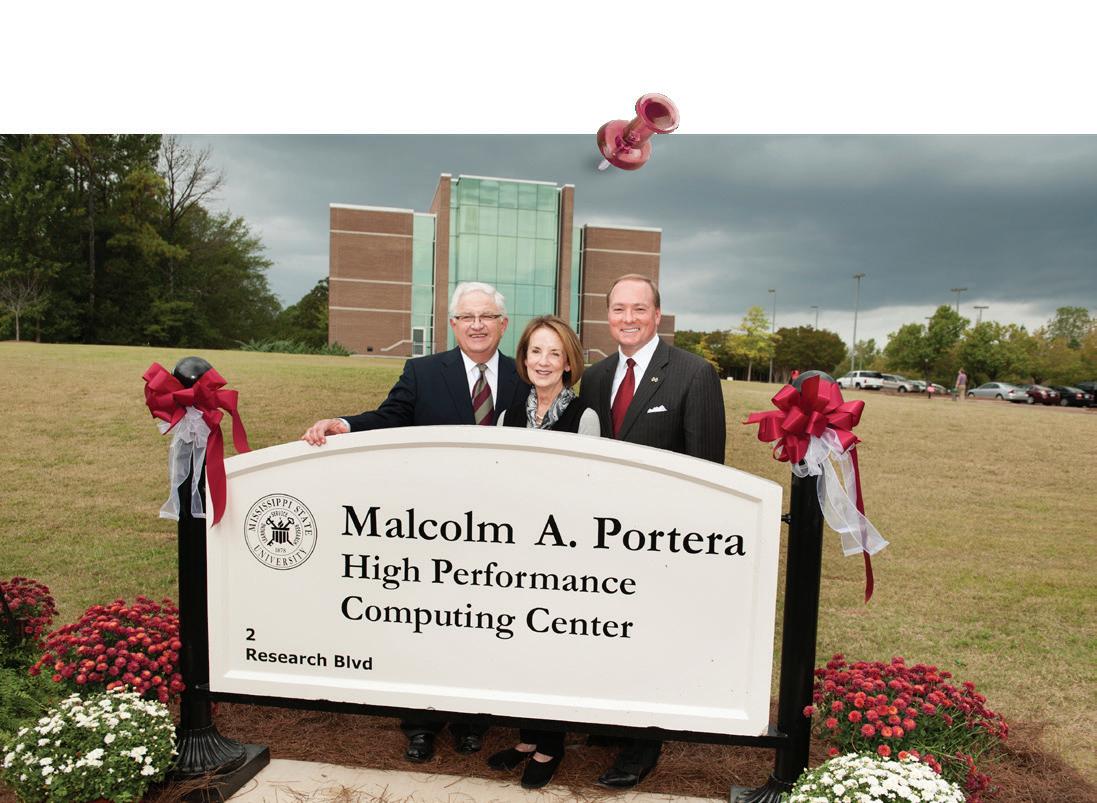
Zacharias
Ball
Cliett
Portera
Powe Altenkirch
The Center for Advanced Vehicular Systems, known as CAVS, became the research park neighbor of the HPC2 building—which was later dedicated in honor of Portera. CAVS was the first in a series of new research centers that would fall under the HPC2 umbrella.
Another major advance came from the U.S. Department of Defense High Performance Computing Modernization Program, when HPC2 was selected to lead a multi-university and industry team in support of DOD supercomputer centers across the country.
“Dr. Portera was on the road when I called to tell him we had won that $108 million competition,” Thompson continued. “An hour later, he was in my office with a bottle of champagne. I cannot give enough credit to those two presidents—Dr. Zacharias and Dr. Portera—and Dr. Ralph Powe, who was vice president of research when this all started. They saw opportunity and gave us the resources and support to make it happen.”
And the rest, as they say, is history. Specifically, a 35-year history that has led to $1.2 billion in research and development expenditures, and an incalculable impact on the education of generations of Bulldog students.
The Future
This year, the university announced the next evolution of high-performance computing at MSU with the creation of the Applied Research Collaboratory. This new umbrella organization will allow the centers to continue their focus on real-world problems while further facilitating interdisciplinary work.
MSU Chief Information Officer Trey Breckenridge, who previously served as director of HPC2 and is still an active researcher with the unit, said the original work of the MSU ERC really laid the foundation not only for high-performance computing but also for establishing the university as an international leader in the science.
“Back in the early ’90s, we weren’t just consumers of high-performance computing, we were developing it—both the hardware and the software that would make it what it is today,” Breckenridge said. “It was visionary leadership that brought that to fruition years ago, and it’s continued visionary leadership that’s maintained that status and is taking us into the future.”
Breckenridge credits MSU President Mark E. Keenum and his executive leadership team with the foresight to keep Mississippi State at the

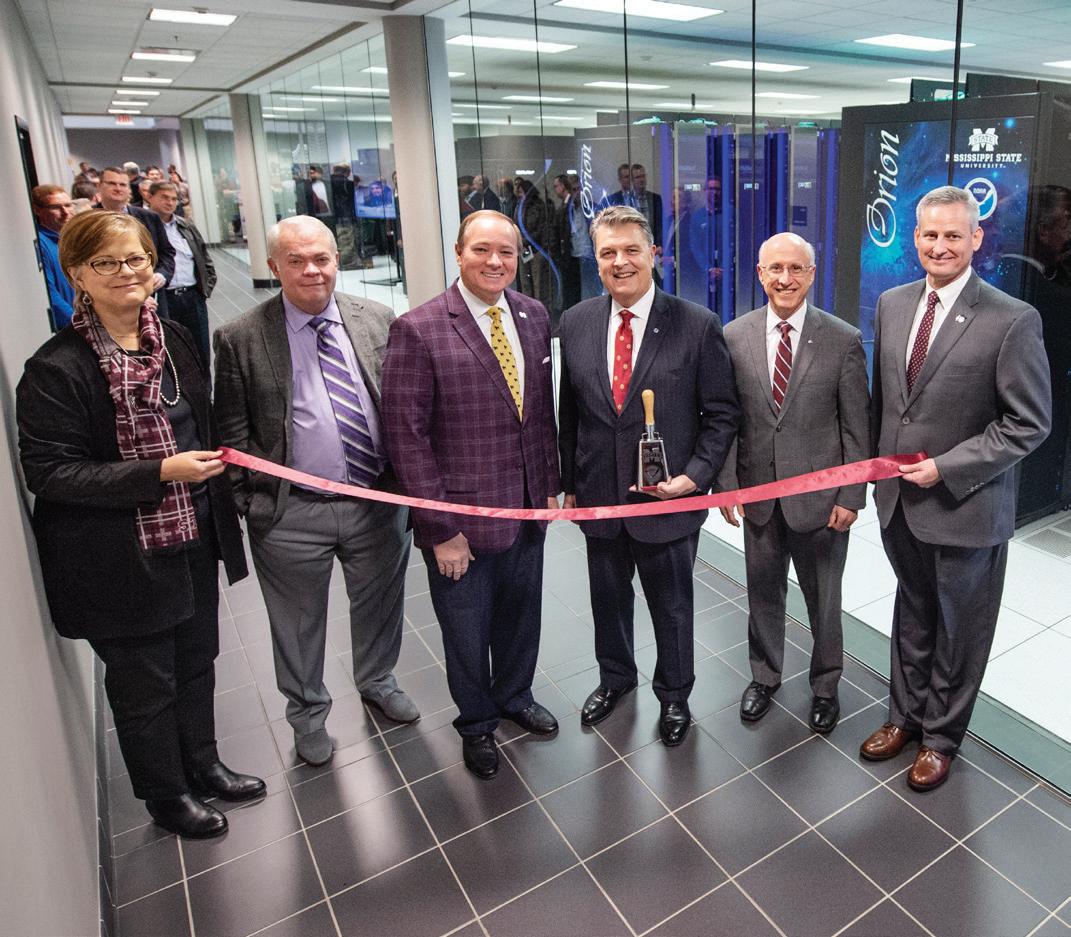
forefront of high-performance computing while also investing resources in emerging sciences that are going to reshape the world of tomorrow, the same way high-performance computing reshaped the world decades ago.
Artificial intelligence, cybersecurity, machine learning and autonomy are the computing sciences that will power the future, and Mississippi State is leading and will continue to lead in their development.
“Mississippi State is leveraging our historic experience and our expertise in these and emerging areas of computing science to keep us on the forefront,” he said. “Artificial intelligence—it is high-performance computing. You can’t have it without the machines that power it. We have the infrastructure and the vision to take things to the next level.
“We’re among a very elite number of U.S. universities that have been doing high-performance computing for as long as we have,” he continued. “And with leadership who continue to put a focus on that, while investing in the technology of tomorrow, we’re going to continue to lead the country in advanced, broad scientific research for decades to come. n
ABOVE: Mississippi State leaders and industry partners mark the ribbon cutting for the Orion supercomputer in 2019, advancing the university’s legacy of innovation.
“They had the vision. They were committed. And when I put those cards on the table, I knew we had a winning hand.”
~ Joe Thompson
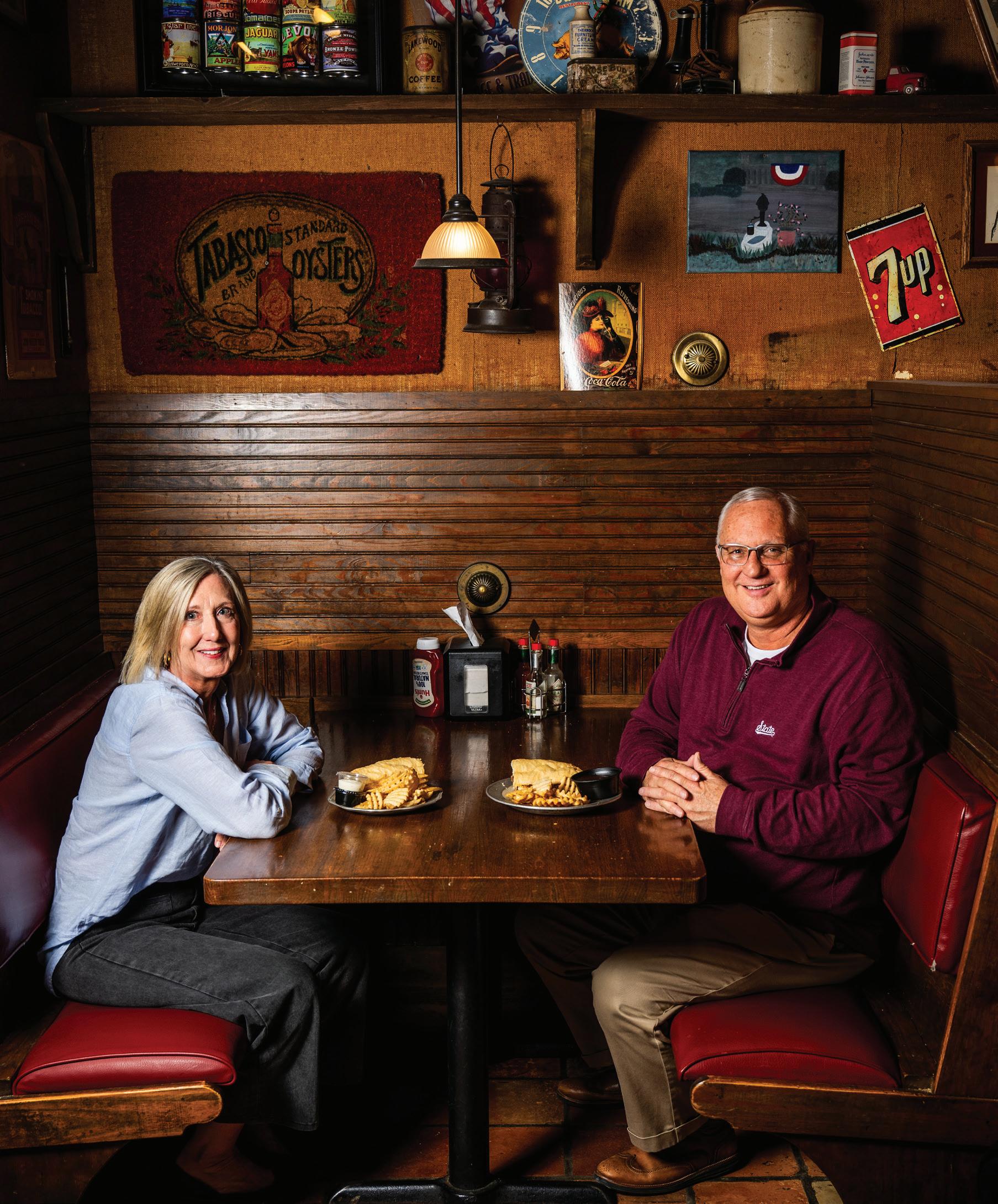
Dawn Reynolds, interim director of HPC2, and Clay Walden, executive director of CAVS, share a meal at the table where their respective world-renowned research centers first took shape.
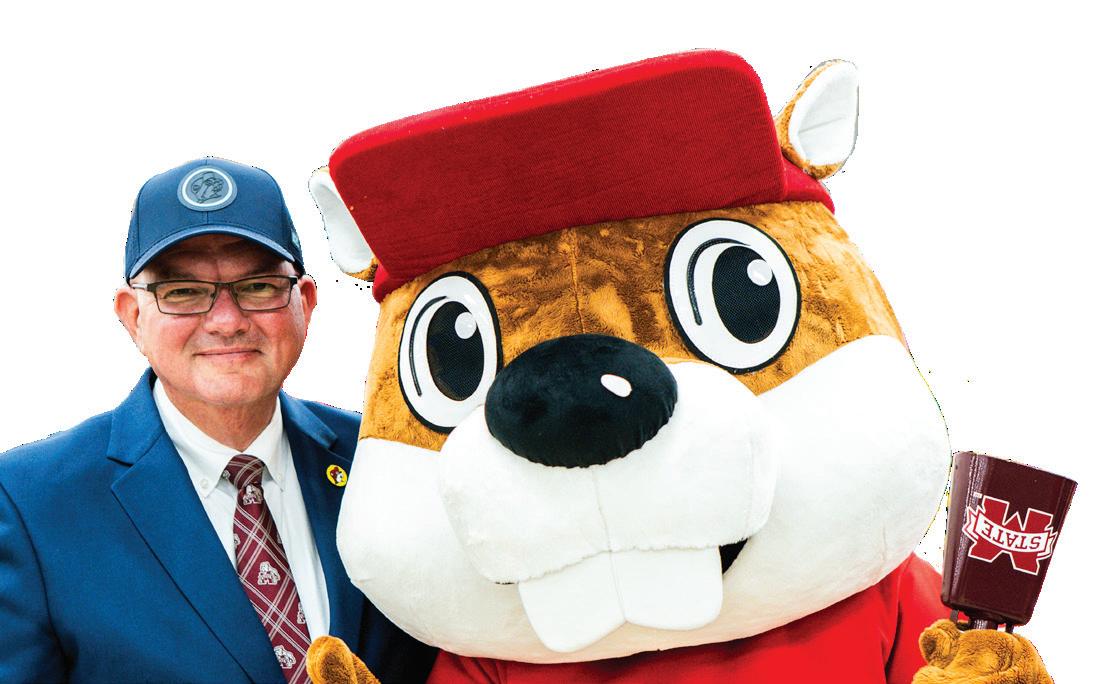
IT’S THE DESTINATION
MSU grad finds purpose, passion at roadside empire
By Mary Pollitz, Photos by Grace Cockrell
Richard Barkley says he was born with the hospitality gene. Watching his calm presence amid the opening-day chaos at the Pass Christian Buc-ee’s—the first Mississippi location—it’s clear how right he is. Barkley can’t help but serve: giving customers directions, checking on employees and offering passersby a taste of his favorite treat—salted caramel fudge.
A 1993 Mississippi State marketing graduate, he said he felt right at home back in the Magnolia State, surrounded by others who share his knack for Southern charm. It’s a quality, he says runs deep in both his alma mater and his company.
“We’re in the heart of the Hospitality State,” Barkley said in the Pass Christian Buc-ee’s warehouse. “When it comes right down to it,
Buc-ee’s is hospitality. We just fund it through brisket sandwiches, beaver nuggets and T-shirts.”
For the uninitiated, Buc-ee’s isn’t a pit stop. It’s the destination. It’s not a gas station; it’s a state of mind. But before the beaver-themed cultural phenomenon took the nation by storm, Barkley’s family couldn’t understand why he would quit his job in IT, uproot his family from Tupelo and move to Texas for a gas station.
Buc-ee’s proves even a pit stop can be a happy place. Known for its spotless bathrooms, aisles of Beaver Nuggets and brisket sandwiches worth the drive, the Texas-born chain has turned the everyday fill-up into a true road trip experience.

“They thought I was crazy, but now? My mother-in-law tells everyone she sees that I work here,” he said.
Barkley serves as one of the beaver empire’s regional directors of operations. In that position, he is tasked with a vital role that has millions of people walking through the automatic doors and smelling fresh barbecue. He protects the brand, which spans 54 locations and is still growing. In doing so, he attends every store’s opening day and ensures that each and every action goes according to plan.
“I put the right people in the right place, so we don’t hurt the brand,” he explained. “We focus on safety. We make sure everything is clean, everything is stocked, and we execute our policies and procedures. We’re not doing anything special. We are just doing customer service really, really
well. That’s what makes Buc-ee’s, Buc-ee’s.”
That kind of leadership has carried Barkley through more than a decade of opening days, long drives across country and thousands of tiny operational decisions that add up to a customer experience people don’t just remember but actively seek out.
As chaotic and packed as opening days can be, his calm presence is at the epicenter, embracing fans as they rush through the doors.
“It’s magic,” he said. “Everybody has a thrill they chase, and this one’s mine. There’s nothing else like it.”
A BEAVER AND A BELL
It was a single phone call, with a huge opportunity, that led Barkley to move his family from Tupelo to Texas.
“It's magic. Everybody has a thrill they chase, and this one’s mine. There’s nothing else like it.”
~ Richard Barkley
“We’re not doing anything special. We are just doing customer service really, really well. That’s what makes Buc-ee’s, Buc-ee’s.”
~ Richard Barkley
“It was a chance to help implement new software at a Buc-ee’s Travel Center,” he said. “It was their first big one with 120 gas pumps. It wasn’t the Buc-ee’s people know now, but I could see what it was becoming and I just really wanted to be a part of it.”
It’s easy, he said, to give your career to a brand that takes care of you.
That care was most evident in 2020 when he was diagnosed with throat cancer. Barkley said he never worried about his place in the company because Buc-ee’s gave him everything back and then some.
“They gave me the time I needed, no questions asked,” he said. “They supported me through everything. When I was cancer-free, I didn’t just ring a bell, I rang my cowbell.”
HOSPITALITY BUSINESS
Barkley said doing the right thing and taking care of people is at the core of the Buc-ee’s brand.
“I’m blessed to be a part of this organization,” he said. “We have owners who not only care about the employees but other people, too. Before we opened our store in Katy, Texas, Hurricane Harvey hit and really devastated Texas. We opened our
store for the National Guard and first responders because it was the right thing to do.”
For Barkley, that’s how you build a business, and that mindset of taking care of others was fostered on Mississippi State’s campus—his first and only choice for a college education.
“I don’t think I even knew there was another school I could go to,” Barkley said with a laugh. “I was going to go to Mississippi State from the start.”
From standing in the halls of McCool to now standing at the center of something uniquely American—a roadside revolution fueled by clean bathrooms, friendly faces and a beaver mascot that somehow became iconic—Barkley can now reflect on the life choices that have led him to where he is.
He confidently says while standing amid the high-octane world of beaver-branded brisket that he’s not just grateful for where he is—he couldn’t see himself anywhere else.
“People think it’s luck,” he said. “And maybe part of it is. But I always tell people: You have to do two things to get lucky—work hard and work smart. If you do those, then maybe, just maybe, you get lucky. But you can’t get lucky without doing those two things first.” n
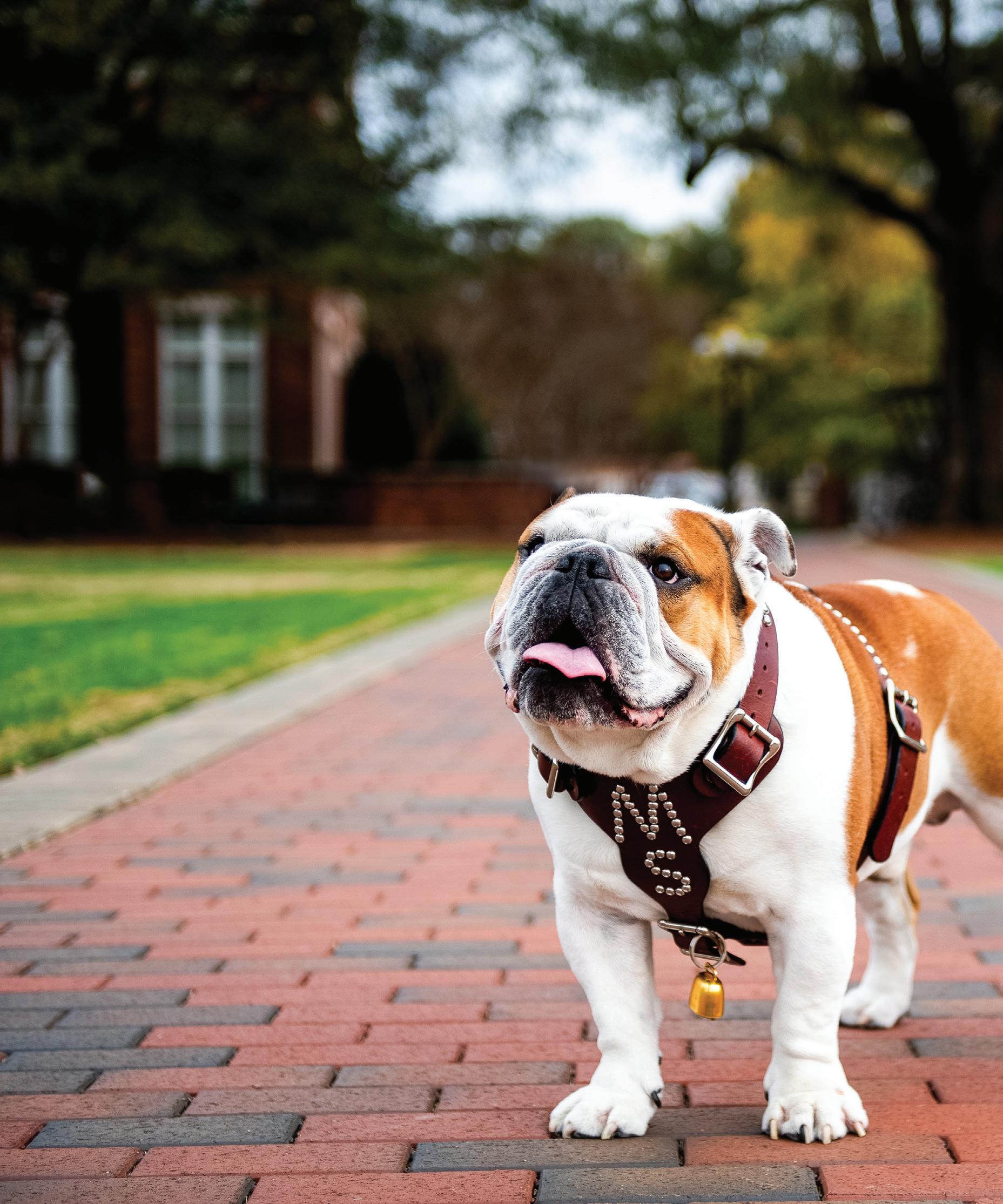
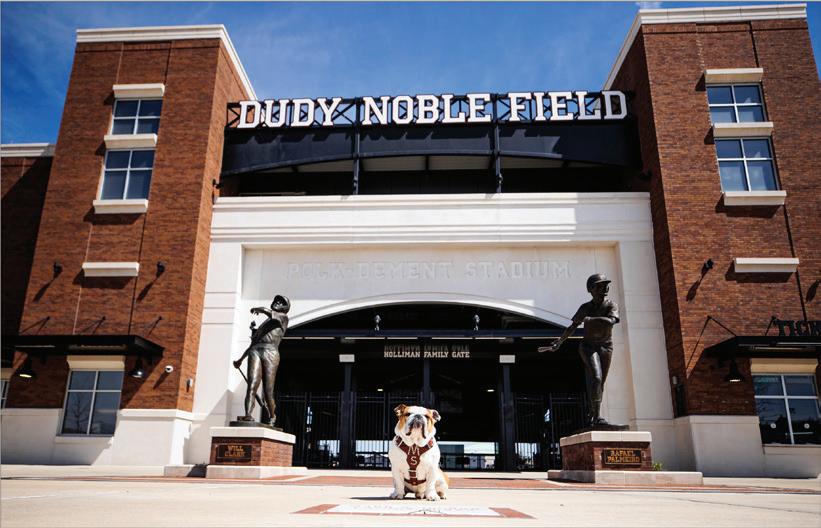

Enjoy beautiful pictures of familiar campus scenes that bring back special memories of your time at Mississippi State. The official MSU calendar has become a Bulldog tradition. With pictures by MSU’s own award-winning photographers, it’s truly a one-of-a-kind treasure. Order online today at msufoundation.com or call 662.325.7000.
A MAROON AND WHITE LIFETIME
Lifelong friends look back 70 years after Mississippi State graduation
By Aspen Harris, Photos by Grace Cockrell
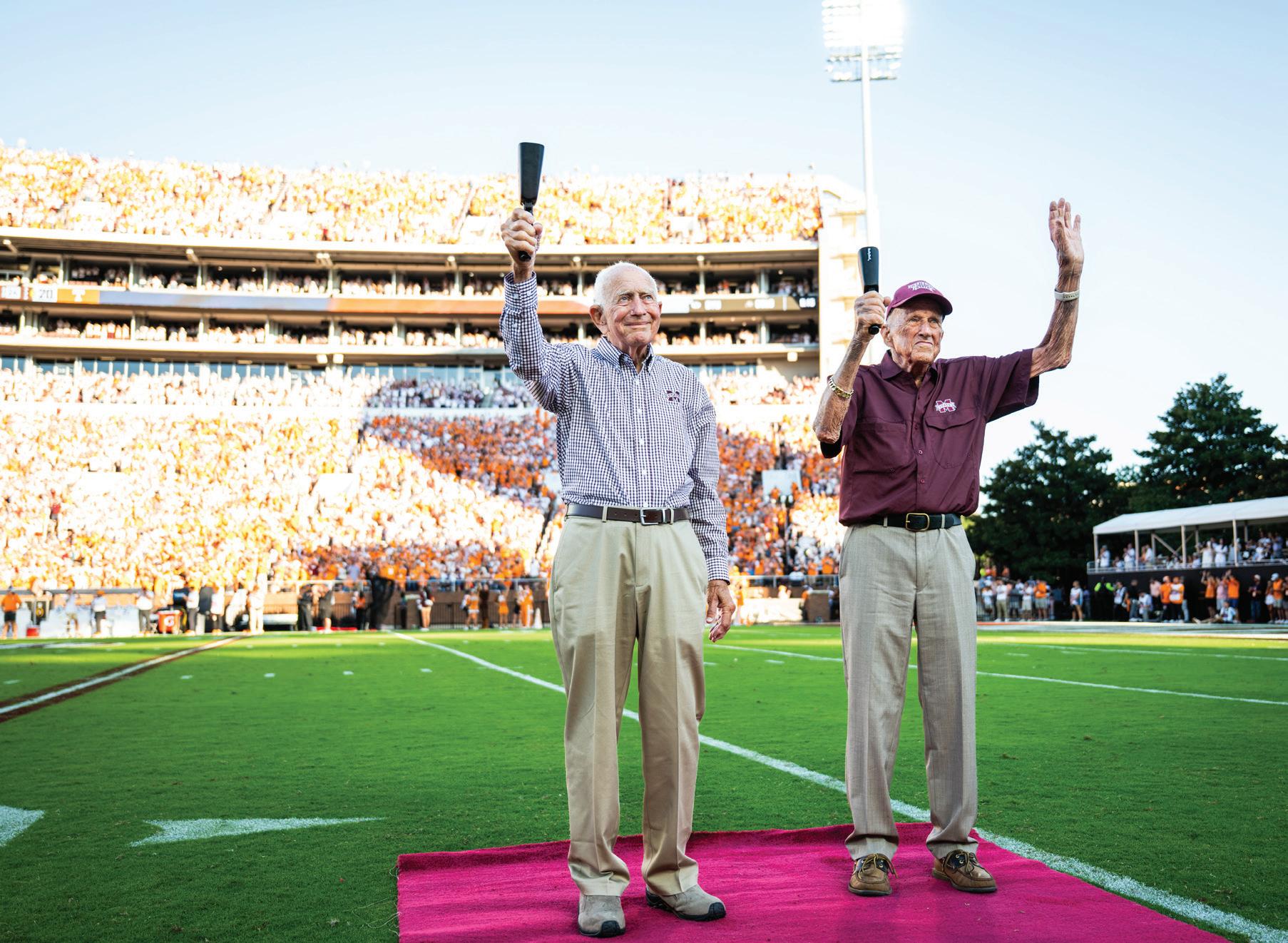
Roy Grafe is reserved and book smart. George McIntosh is outgoing and great with hands-on work.
Yet, the two Mississippi State University graduates and military veterans share something that overshadows their differences—a lifelong friendship.
“Their personalities are totally different, but that may be good,” Nell McIntosh, George’s wife, said. “It makes it better, I think.”
At the MSU vs. University of Tennessee football game, Roy and George were honored during the Salute to Service memorial in the third quarter. On the jumbotron, fans could see the pair smiling and ringing cowbells.
The moment was just one in the long list of things they’ve experienced together.
This year marks 70 years since George and
Roy graduated from MSU with bachelor’s degrees in mechanical engineering.
Roy, a Lucedale native, said he chose to study engineering at MSU because of a childhood neighbor.
“He told me early on that he was going to Mississippi State to study engineering. He was older than me, and I just locked in on that,” Roy said. “It sounded great to me. When people would ask me where I was going to school, I’d proudly say Mississippi State.”
Born in Vernal, George began his education at MSU in 1949 because his mother, who only had a third-grade education, insisted he go to college.
George said he remembers packing a footlocker with his belongings and being “dumped” off in front of the post office.
“Before I got my footlocker off the bus, two of my classmates sat me down and shaved my head. I didn’t get much hair back,” he said with a laugh.
George ultimately took time off from his education to join the Army National Guard and serve in the Korean War.
Even though they grew up living no more than 15 miles from each other, it wasn’t until George returned to MSU in 1952 that he met Roy.
“We just hit it off,” Roy said. “We liked basically the same things. It’s hard to believe that it’s been 70 years since we graduated.”
While students at then-Mississippi State College, George and Roy did almost everything together. They joined MSU’s Kappa Alpha chapter and lived in the offcampus fraternity house. They recall spending
Roy Grafe (left) and George McIntosh (right) wave to the crowd after being recognized during Mississippi State’s "Salute to Service" game at Davis Wade Stadium.
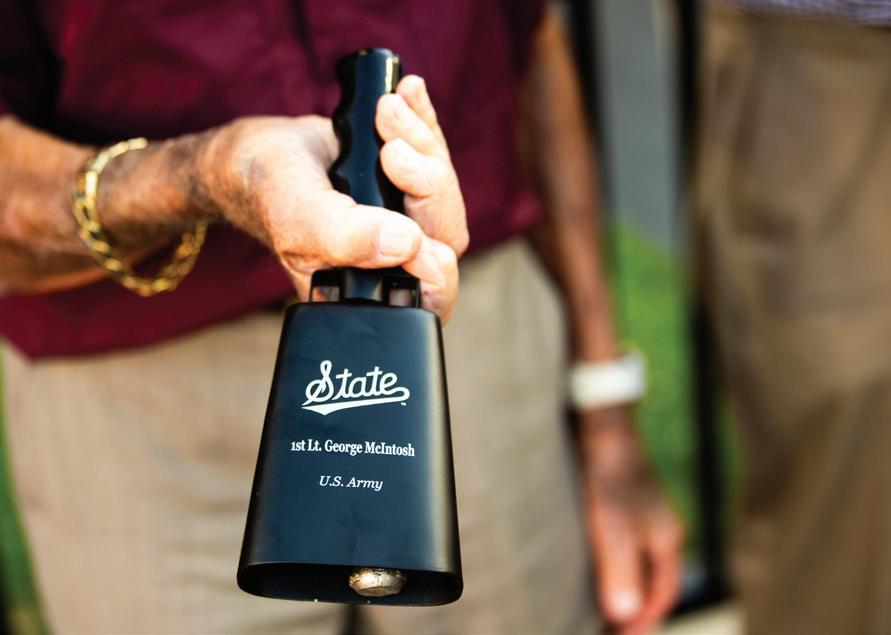
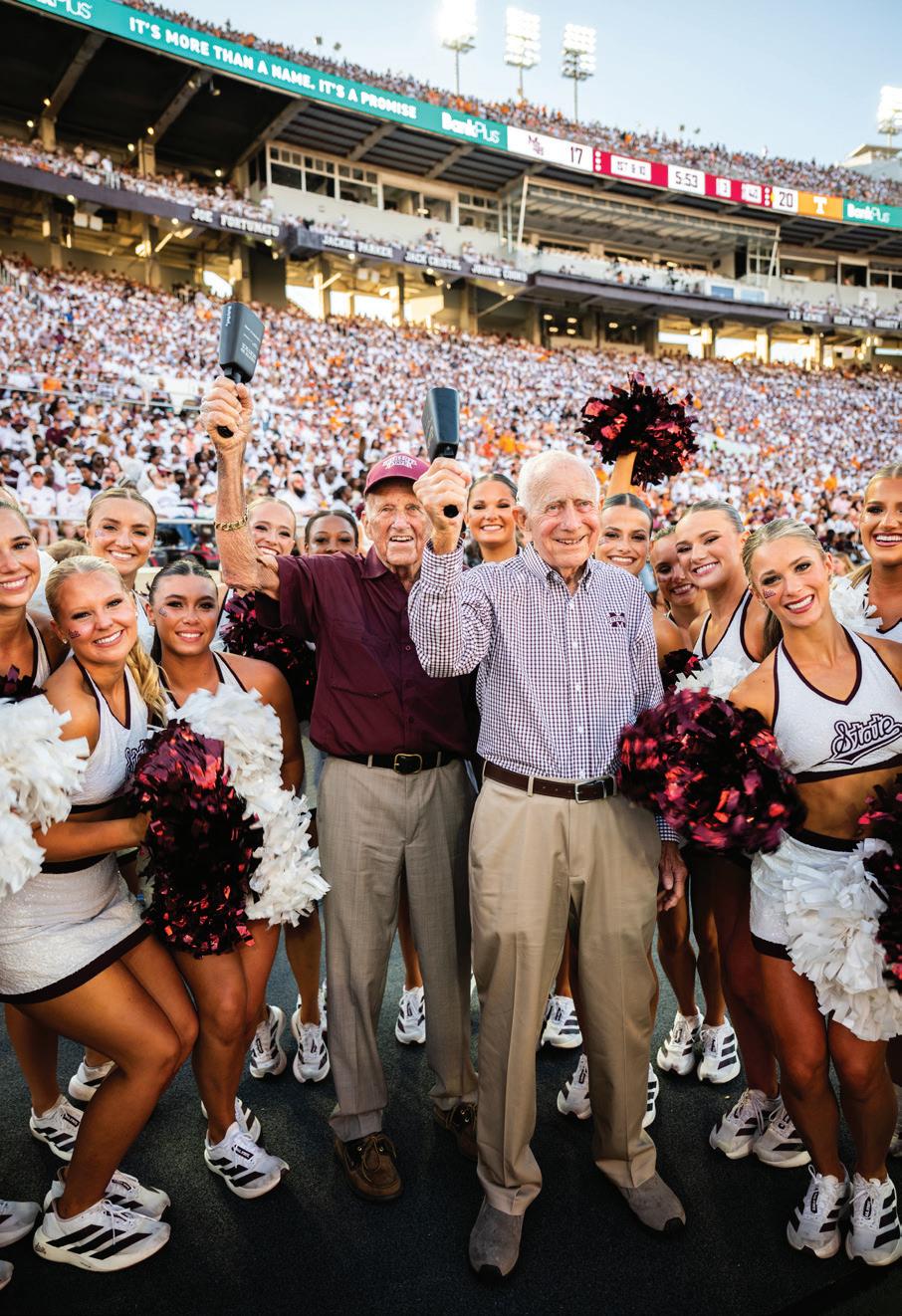
many hours studying over cups of coffee at The Grill—a campus hot spot at that time— and said they took several history classes together just because of a shared love for the subject.
Because George was the only one with a car, he and Roy would go home together when they could. On the long car rides back and forth to MSU, Roy would read his class notes to George to help them both prepare for upcoming tests. Through studying and easy conversation, the friends’ bond continued to deepen as they reached the end of college.
In 1955, George and Roy graduated, but with such a close bond, they looked for career opportunities that would keep them close.
George said they went around the country interviewing for jobs and received offers from each one.
“We went to Indianapolis, KimberlyClark up in Wisconsin, Ford Motor Company and more. Each one of them paid us to go there,” George said. “We decided all we were going to do is interview for the rest of our lives.”
Ultimately, Roy and George accepted jobs with the Allison Division of General Motors, a former aircraft engine manufacturer, in Indianapolis.
After a few months on the job, Roy decided to return home to Lucedale, where he married Kay, his late wife of 68 years with whom he has two daughters, Dawn and
Babette. He joined the U.S. Army’s Scientific and Professional Personnel Program and served for two years as a specialist third class.
Roughly two years later, George married Nell. The couple has two sons, Eddie and Alex—both of whom are MSU engineering alumni—and lived in Indianapolis until 1959. During that time George was promoted to a supervisory position and helped design the Allison 501 engine used in C-130 aircraft.
The McIntoshes joined the Grafes in Lucedale in 1964. They bought land and later built neighboring houses.
In 1966, George found a job with the U.S. Navy’s Supervisor of Shipbuilding in Pascagoula as chief marine engineer and
During a "Salute to Service" when the Bulldogs faced the University of Tennessee Volunteers at Davis Wade Stadium, lifelong friends and 1955 mechanical engineering graduates George McIntosh and Roy Grafe were presented with commemorative cowbells in recognition of their military service, celebrating the moment with fans from both teams across the stands.
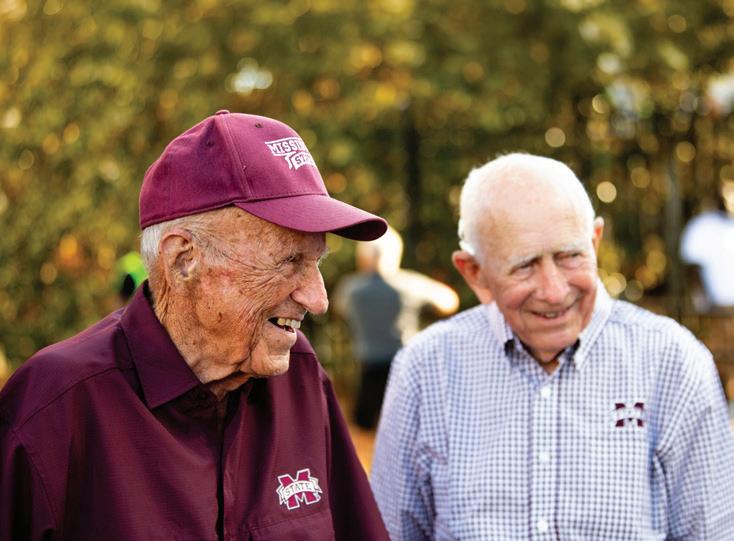
I think a good friend is valuable in whatever you’re doing, whether you’re going to school or working on a job. A good friend is always welcome.”
~ Roy Grafe
found a job for Roy as engineering supervisory manager, bringing their careers back together.
“When I had to move jobs, I would tell George, ‘I found a job there for you, too. Won’t you come on down and join me?’ He’d do the same thing for me. We had to move often because various plants kept closing, but we just stayed in touch," Roy said of the friends’ lifelong commitment to staying in each other’s lives. “It’s like that’s what we were supposed to do.”
During that time, they also worked at the Chrysler dealership Roy’s father owned. Roy was a salesman while George worked on the cars. They worked nights and weekends until the dealership sold in 1973.
In the late 1980s, Roy and George retired with over 30 years of service for the U.S. Department of Defense. However, George rejoined the workforce for about 10 years as a project manager with Ingalls Shipbuilding in Pascagoula.
Roy said it never crossed his mind in 1952 that his friendship with George would last so long. But looking back at their lives, the friends say they can’t imagine not having each other’s support through life’s trials and triumphs.
“I think a good friend is valuable in whatever you’re doing, whether you’re going to school or working on a job,” Roy said. “A good friend is always welcome.” n

COMBINE FOR NATIONAL HONORS
Two Mississippi State University senior ROTC cadets placed in the top 1% at this summer’s U.S. Army ROTC Advanced Camp.
MSU sent 25 cadets to compete against 5,800 participants at the national level. Wyatt Howell, a senior industrial engineering major from Athens, Alabama, earned a No. 6 national ranking, while Samuel Wilkerson, a senior wildlife, fisheries and aquaculture major from Vancleave, finished an impressive No. 46.
The 36-day training event held at Fort Knox, Kentucky, brought together cadets from universities across the nation. MSU has competed in the ROTC Advanced Camp since its inception in the 1950s. Howell’s top 10 finish marks as one of the university’s highest rankings in the Advanced Camp competition.
Brig. Gen. Andrew Rendon, MSU’s executive director of veteran and military affairs, said the cadets’ success underscores the university’s commitment to excellence in both the Army and Air Force ROTC programs— excellence which has earned the university a spot as one of the top 5 military friendly schools in the nation by VIQTORY, also known as GI Jobs.
“The distinction as a top military school simply validates the work we are doing across the university to support and care for our military-connected students, faculty and staff,” Rendon said. “Cadet Howell and Wilkerson’s unprecedented accomplishments highlight this excellence. I am super proud of these young men and also congratulate the work of our ROTC staff and leadership.”
Established during the first
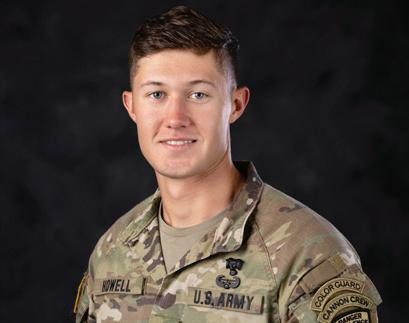
World War, the Reserve Officers’ Training Corps, known as the ROTC, has a long history on MSU’s campus. In that time, members of the Bulldog ROTC programs have served with honor in all conflicts in which the U.S. Armed Forces have been called on to fight.
From its early days through 1969, ROTC was mandatory for all male students. Today, the Bulldog Battalion, which includes both Army and Air Force ROTC, has approximately 100 students and cadets who volunteered for service. Those who complete the four years of coursework and training graduate with officer commissions in the U.S. Army or U.S. Air Force.
Including dependents, the military-connected community at MSU includes more than 3,000 students. All students who are current or veteran military members, or their dependents, are served by MSU’s Montgomery Center for America’s Veterans at Nusz Hall and a network of specially trained university personnel. n
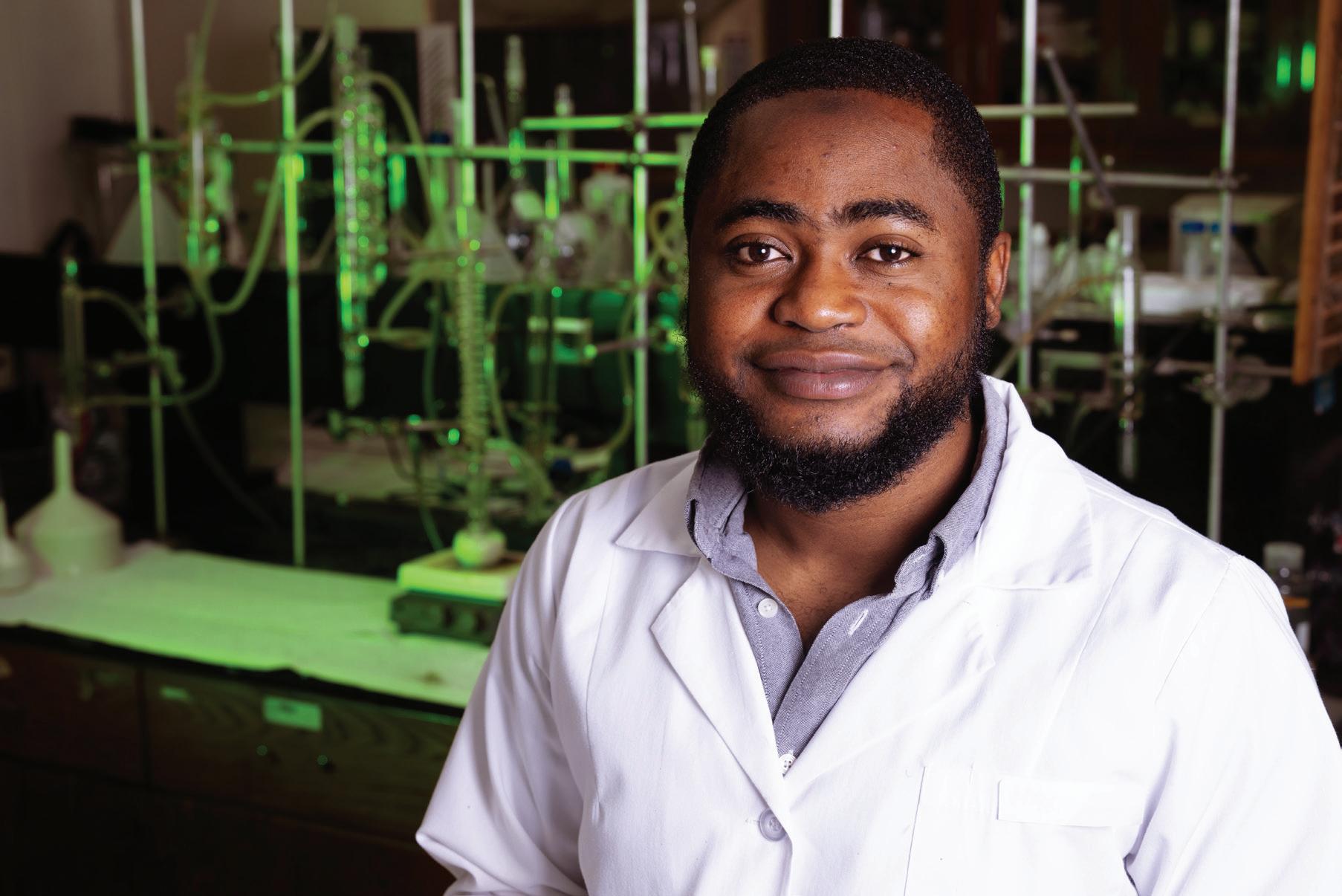
WASTE NOT WANT NOT
Graduate student makes the most of opportunities, natural resources
When opportunity knocks, Ridwan Ayinla answers— something he’s proven again and again and again.
First, he earned a bachelor’s in physics in his native Nigeria. Then, he seized the fully funded chance to earn a master’s in Malaysia, which he used as a launchpad for further graduate study in France before ultimately coming to Mississippi State on the advice of his mentor.
His goal: gain the education needed to find a sustainable solution to the world’s energy needs.
“In my opinion, Mississippi State was the best place to really explore my fullest potential in sustainability,” Ayinla explained. Not one to waste an opportunity, Ayinla earned a second master’s degree—this one
By Susan Lassetter, Photos by Beth Wynn
in chemistry—once he enrolled at MSU. He then joined the university’s College of Forest Resources’ doctoral program with a concentration in sustainable bioproducts.
“The world is not short on energy. We have abundant renewable energy in the sun, water and wind. The challenge lies in finding ways to efficiently store and distribute it. That’s where our work comes in.”
~ Ridwan Ayinla
Now, under the mentorship of Professor El Barbary Hassan, he is working to convert forest by-products into sustainable battery components that will provide cleaner energy for the world.
“The world is not short on energy,” Ayinla explained. “We have abundant renewable energy in the sun, water and wind. The challenge lies in finding ways to efficiently store and distribute it. That’s where our work comes in.”
The idea, Ayinla explained, is to take materials like pine bark or sawdust, which are normally treated as waste, and alter their makeup so they can store energy. Essentially, the MSU researchers are finding ways for wood products to mimic the role of lithium in batteries, offering a cleaner, safer, moreaffordable alternative.
“Lithium is great, however, it is nonrenewable, and mining it is dangerous,” he said. “Our materials can achieve close efficiency in terms of energy storage performance for less money and with far
“If you want to do groundbreaking science, you have to be interdisciplinary or have the ability to collaborate with people from other disciplines. Each field has a different understanding of these systems. To find solutions, we have to bring together the biological side, the physical side and the chemical side.”
~ Ridwan Ayinla
less toxicity. We’ve had great success with our lab-scale prototypes and are now working toward scalability and commercialization. We’re truly pushing the frontier of science forward."
Ayinla said his combined areas of study—physics, chemistry and forest products— give him the flexibility to understand energy in a comprehensive way—from its creation to its transfer, storage and use.
“Physics gives me a physical understanding of materials and helps me to examine materials differently, while chemistry helps me to understand the atomic and molecular makeup, and establish structure-property relationships,” he said. “By combining both, we can engineer materials to behave exactly the way we want. That’s the essence of innovation.”
In recognition for his work in sustainable energy, Ayinla earned a 2024 summer fellowship from the Electrochemical Society. He was one of only four graduate students globally to earn the honor, which came with a $5,000 award to expand his research. This year, he was one of only 35 selected globally for the American Chemical Society’s Chemical Abstracts Services Future Leaders Class of 2025. He also was selected for the inaugural leadership academy of the National Organization for the Professional Advancement of Black Chemists and Chemical Engineers.
Rubin Shmulsky, head of the Department of Sustainable Bioproducts, said Ayinla’s success is a
testament to the quality of education one receives at Mississippi State University.
“Our department takes great pride in being the destination of choice for innovative scholars from around the world,” he said. “In a world that’s increasingly reliant on electronics, Ridwan is a developing leader with a bright future.”
Ayinla said he believes his crossdisciplinary approach to education and research is the key to the future of scientific discovery.
“If you want to do groundbreaking science, you have to be interdisciplinary or have the ability to collaborate with people from other disciplines,” he said. “Each field has a different understanding of these systems. To find solutions, we have to bring together the biological side, the physical side and the chemical side.
“This is the diversity of science everyone is looking for today,” Ayinla added.
As he prepares to earn his doctoral degree this December, Ayinla credits his success to the cross-disciplinary opportunities and international collaborations he found at MSU.
“Mississippi State has wide wings that allow us to work with a wide variety of people and produce groundbreaking science,” Ayinla said. “Through my mentors and peers, I’ve built connections that span continents. I’ve learned from some of the greatest scientists both here and abroad, and I’m still finding opportunities to learn because I’m not done yet. I want to solve this problem of energy and do it in a sustainable way.” n
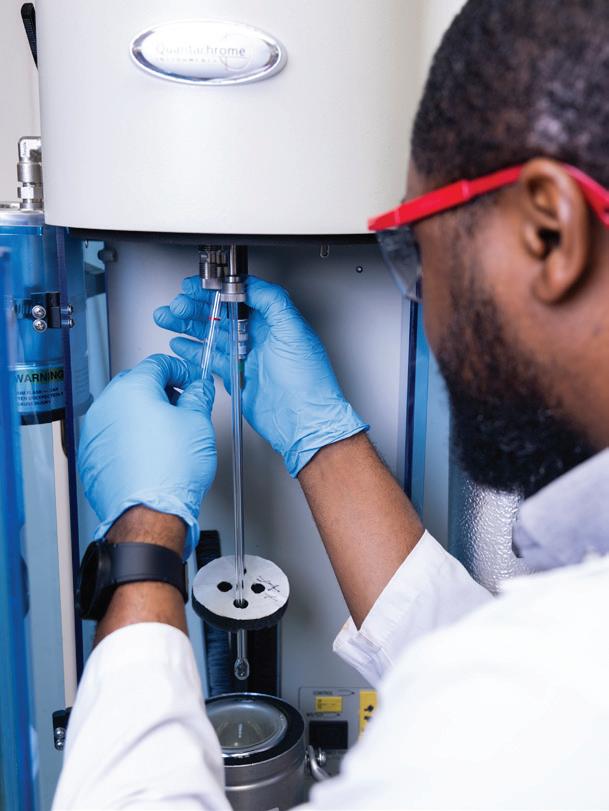
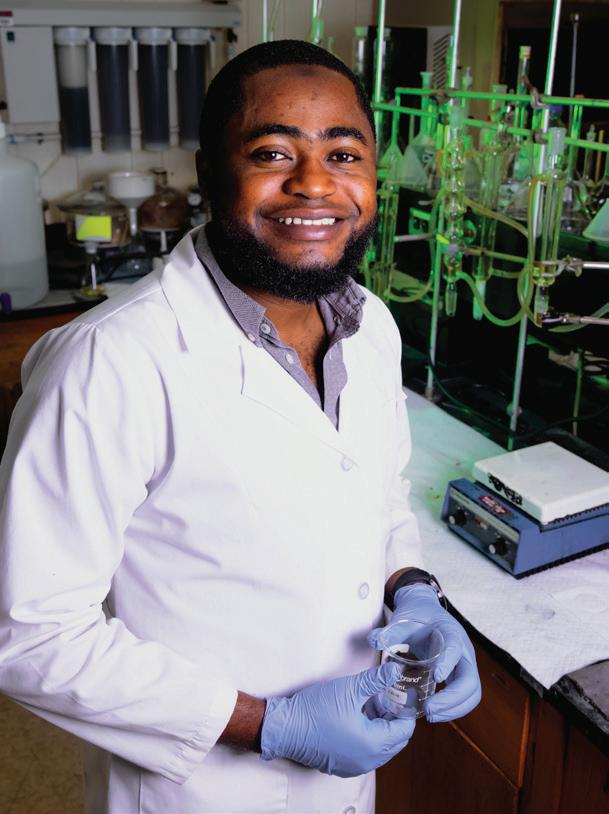
A native of Nigeria, Ridwan Ayinla came to Mississippi State to find sustainable solutions to the world’s energy problems. As part of the Department of Sustainable Bioproducts, the soonto-be doctoral graduate is working to turn timber processing waste into batteries that can store and distribute energy as efficiently as their traditional lithium-based counterparts.
THE TRUTH OF THE
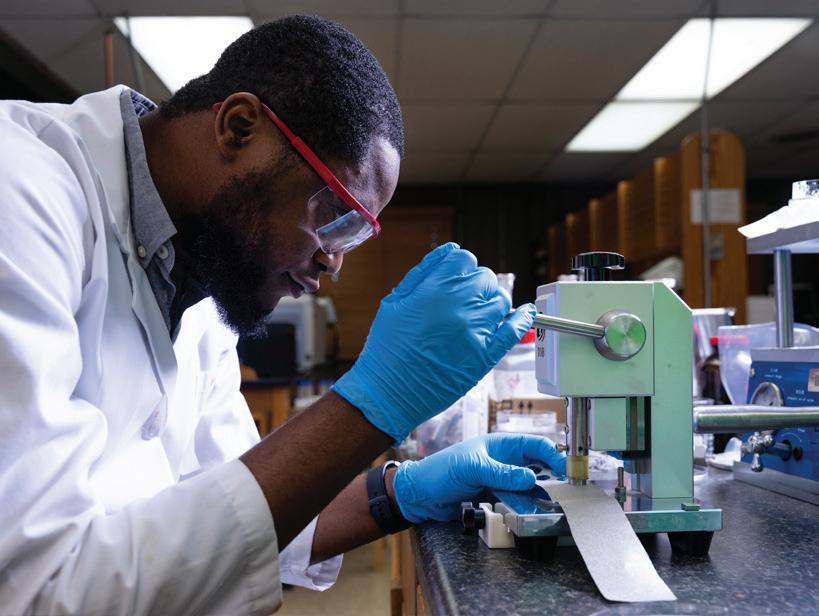
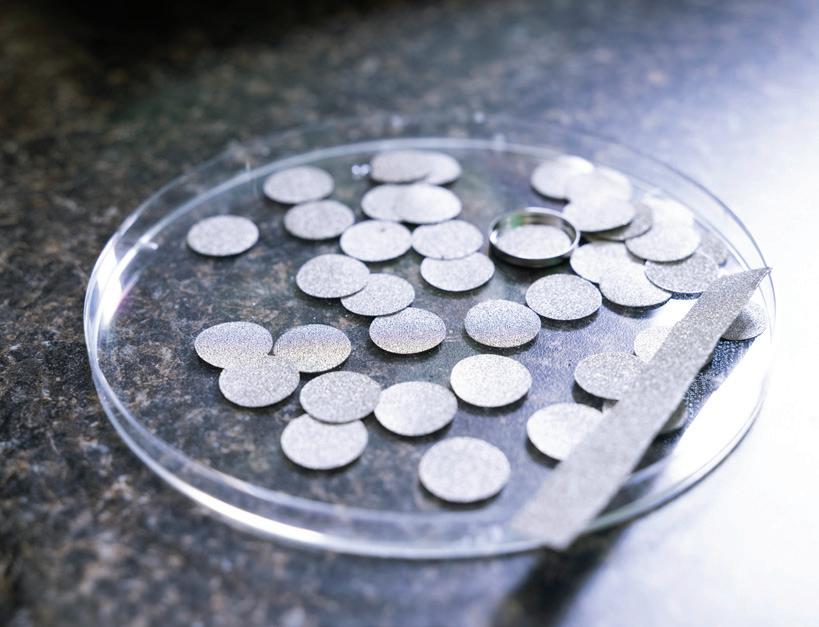
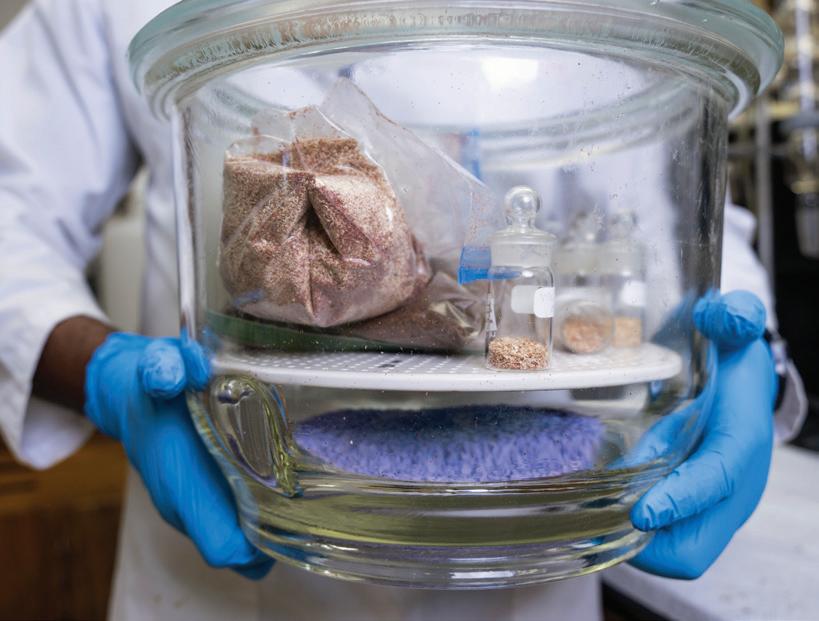
Listed as Li on the periodic table, lithium is the lightest-known metal, least-dense solid element and a highly conductive and flammable substance—traits that make it indispensable to modern battery production.
The U.S. Geological Survey estimates more than 80% of the world’s mined lithium is used in batteries, and that number increases every year as demand for electric vehicles, portable electronics and energy grid storage applications grows.
But for all its uses, lithium has one major drawback: It’s a nonrenewable resource. The limited amount on Earth is found in rock ore and underground brines, and can only be accessed through dangerous, costly and often-toxic mining processes.
The good news: Lithium batteries can be recycled. So, while scientists work to develop alternative ways to store energy that are less reliant on the element—like the batteries being developed by the MSU Department of Sustainable Bioproducts—conscientious consumers can help keep already-mined lithium in circulation and out of landfills.
To find a recycling drop off near you, search for organizations like Call2Recycle and Earth911 online. The Mississippi Department of Environmental Quality also has online resources, including tips to safely dispose of or recycle batteries. n
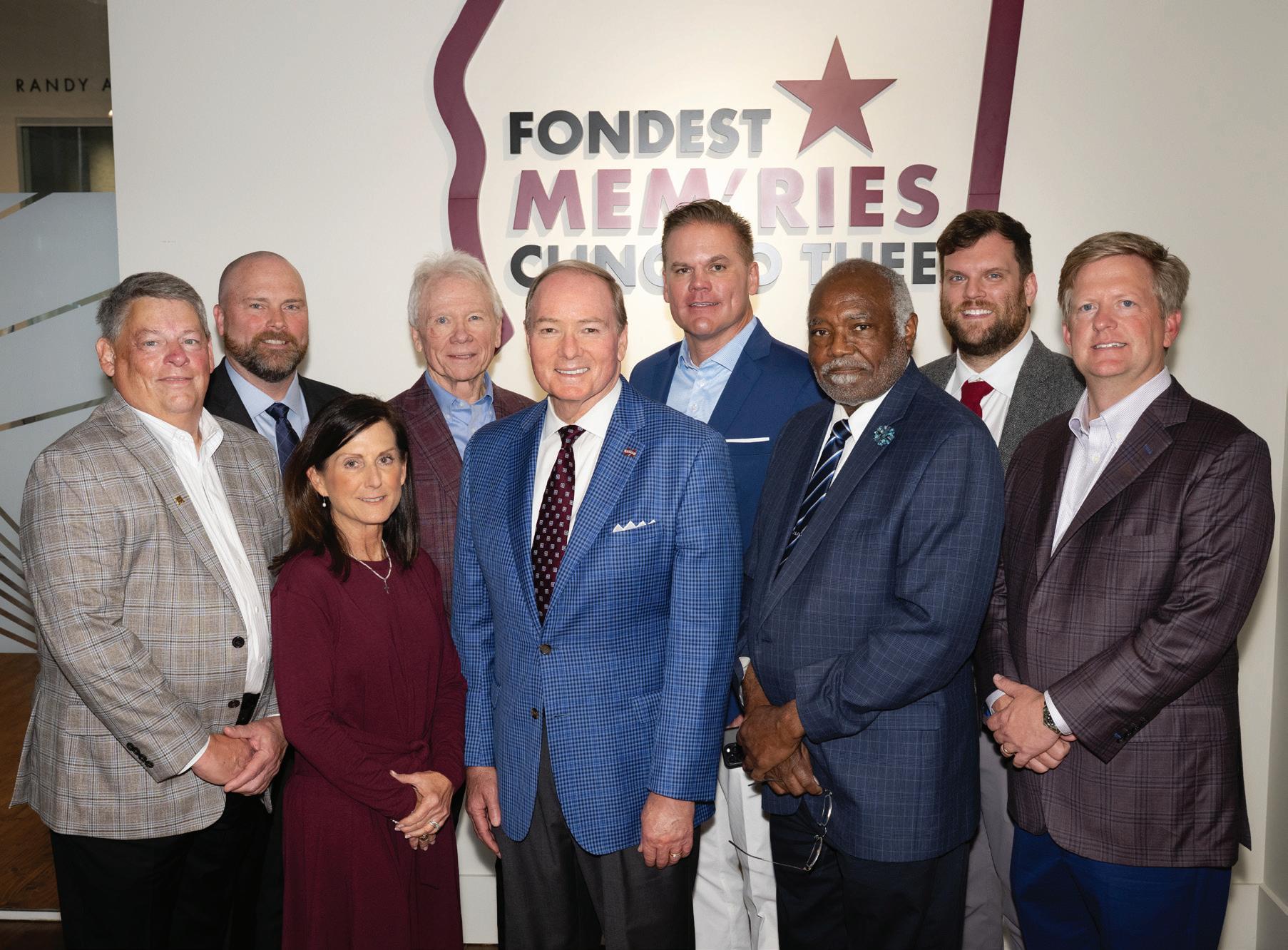
CELEBRATING EXCELLENCE
MSU Honors 2025 Alumni Fellows
By Anna Welborn and Shun Pounds
Mississippi State University has welcomed a new group of distinguished Bulldogs into its prestigious Alumni Fellows program. Sponsored by the MSU Alumni Association and eight of the university’s academic colleges, it recognizes alumni who have excelled in their careers and invites them back to campus to engage with students.
The Alumni Fellows program connects students with accomplished alumni who share their practical insights and professional expertise on the skills and mindset necessary for success. The event combines the experiences of professionals, the curiosity of students and the expertise of faculty members into a platform that enriches the educational experience at MSU.
“The MSU Alumni Association is proud to bring

exceptional alumni from eight of the university’s academic colleges back to our campus to share their experience and wisdom with our students,” said Jeff Davis, executive director of the MSU Alumni Association. “Since the Fellows program began in 1989, more than 300 alumni have participated in this unique program, and each and every year the class of fellows, their accomplishments and the impact they have on our students is truly remarkable.”
The legacy of the Alumni Fellows program is the lifelong recognition it provides to its honorees, further amplifying the spirit and pride of MSU’s extensive alumni network, which includes more than 169,000 individuals worldwide.
The following are this year’s distinguished honorees, organized by college.

COLLEGE OF AGRICULTURE AND LIFE SCIENCES
Ward Forest Bloodworth of Hernando serves as executive vice president at Helena Agri-Enterprises LLC, where he oversees national procurement and sales strategy for crop protection, seed, fertilizer and precision agriculture. With more than two decades of service at Helena, Bloodworth has held roles ranging from salesman to vice president, earning a reputation for strategic leadership and deeply rooted industry expertise. A native of Batesville, Bloodworth was raised in agriculture. His father owned Panola Farmers Service, an agriculture retail business, where Bloodworth’s early exposure to the industry fueled a lifelong passion for serving row crop growers. That passion led him to Mississippi State University, where he earned a Bachelor of Science in agronomy in 1998 and a Master of Science in weed science with a minor in agricultural business in 2002. He credits MSU for providing both the academic foundation and the lasting professional network that has shaped his success. Bloodworth served as the past president of both the Mississippi Agricultural Advisory Council and the Mississippi Certified Crop Advisors. He is a committee member of the Delta Council and serves on the board of directors and formally served on the executive committee of the Agricultural Retailers Association. He is also a board member of The Fertilizer Institute. Beyond his professional work, Bloodworth serves on the board of trustees and corporate board of Baptist Memorial Health Care Corp. and is a deacon at Desoto Hills Baptist Church. Named a Distinguished Fellow by MSU’s Department of Plant and Soil Sciences in 2022, Bloodworth remains involved with the university through service on the Plant and Soil Sciences Advisory Council and by mentoring students. Further, Bloodworth enjoys time with his wife, Lauren, and their three children—Max, Drake and Rivers. Whether on the golf course or cheering
for Mississippi State, Bloodworth remains deeply connected to his roots in North Mississippi and the land-grant values that shaped his path.
COLLEGE OF ARCHITECTURE, ART AND DESIGN
John David Lewis of Jackson is the executive director of the Mississippi Arts Commission, the state’s official arts agency. In this role, he leads and collaborates with staff and the board of directors to champion the transformative power of the arts across Mississippi. He regularly travels to communities throughout the state, engaging with artists, arts organizations and civic leaders to strengthen Mississippi’s creative landscape. Lewis earned a Bachelor of Architecture from Mississippi State University in 2015 and later completed a Master of Arts in urban and regional planning from Jackson State University in 2018. Initially drawn to architecture as a child with dreams of designing skyscrapers in New York, his field experiences at MSU sparked a deeper desire to enhance Mississippi communities through urban design and the arts, which ultimately led to a passion for public service. Lewis remains actively involved with MSU through end-of-semester architecture reviews, feedback to students and as a speaker for the School of Architecture’s Friday Forum series. He also serves on numerous arts and cultural boards, including America 250-Mississippi, the Mississippi Book Festival, the Mississippi Blues and Country Music Trails, the Mississippi Delta National Heritage Area, the National Folk Festival, and SouthArts. Deeply grounded in faith, Lewis credits the Lord for guiding his path, along with his family. He is an active member of Redeemer Presbyterian Church. His accolades include: 2024 MS Top 50, 2018 AIA Mississippi Friend of Architecture and three-time Visit Jackson Hometown Hero Award winner. Rooted in Mississippi and driven by purpose, Lewis remains committed to using the arts to make a lasting impact across the state.
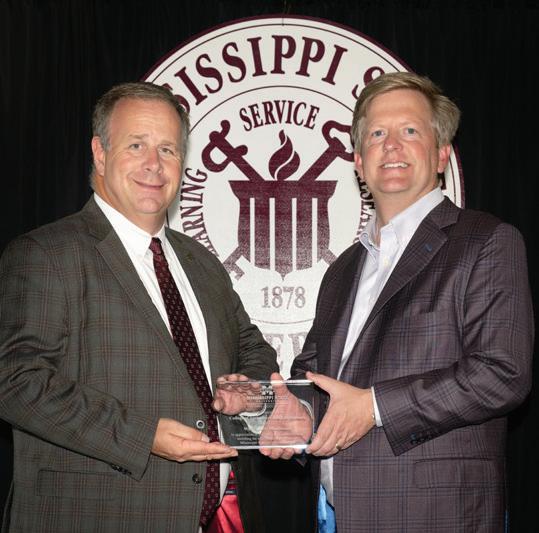
Interim Vice President for Research and Economic Development and former Dean Scott T. Willard and Ward Forest Bloodworth
Interim Dean Bimal Balakrishnan and John David Lewis
COLLEGE OF ARTS AND SCIENCES
Paul J. “PJ” Moore III of Spring, Texas, is an accomplished geoscientist with more than two decades of experience in geological research and exploration. A native of Vancleave, he earned a Bachelor of Science in geology from Mississippi State University in 2002 before earning a doctoral degree in geological sciences from the University of Florida with a focus on aqueous geochemistry and physical hydrogeology. While at MSU, PJ was influenced by his undergraduate advisor, John Mylroie, whose passion for science and adventurous approach to life helped shape his academic path. That inspiration, coupled with early encouragement from his aunt, a geologist herself, fueled his lifelong fascination with earth sciences. He credits MSU for laying the foundation for the scientist he has become. For the past 16 years, Moore has worked for ExxonMobil, most recently spending four years overseas as a research lead at ExxonMobil Research Qatar. There, he led projects focused on understanding coastal aquifers. Beyond his professional work, Moore has remained actively engaged in the scientific community. He has written more than 20 articles in peer-reviewed journals and served on the board of directors for the Karst Waters Institute for 15 years. He is also a longtime member of the American Association of Petroleum Geologists, the Geological Society of America and the National Speleological Society. A dedicated supporter of Mississippi State University, Moore established an endowed fund to benefit the geosciences department. He remains passionate about inspiring the next generation of scientists and representing MSU with pride wherever his career takes him.
COLLEGE OF BUSINESS
Jim Perkins of Ridgeland is a proud Mississippi State University alumnus and accomplished business leader with more than four decades of experience in the oil
and gas exploration, development and production industry. A native of Columbus, Perkins earned a 1981 Bachelor of Science in banking and finance from MSU. While at MSU, he earned membership into the Financial Management Honor Society and developed a lifelong loyalty to the university that continues to shape his personal and professional life. A chance interview with Shell Oil Company, originally meant for MSU petroleum engineering graduates, led to a job offer that ultimately launched a long and successful career. Perkins credits Shell’s world-class training and development programs for shaping his leadership and negotiation skills, and he remains grateful for the solid foundation laid by his MSU College of Business education. Over his career, Perkins served in several key roles, most notably as vice president of Bois d’Arc Energy Inc., where he was responsible for the business’s activities and the contract negotiations related to exploration, development and production of oil and gas. Earlier in his career at Shell, Perkins was part of the team honored with the prestigious 1992 President’s Award for Team Excellence. A steadfast supporter of Mississippi State University, Perkins gives back and pays it forward through two scholarship programs, the James “Jim” Pollard Perkins Endowed Scholarships and the James “Jim” Pollard Perkins Annual Scholarships. These scholarships help fund tuition for eight high-achieving and deserving MSU College of Business students. While living in Houston, Texas, Perkins was involved in community service by serving as a director with the Chevron Houston Marathon for five years. Perkins promotes Mississippi State University wherever he goes and believes no matter where life’s journey has taken him, Mississippi State University and Starkville will always be his home.
COLLEGE OF EDUCATION
Jim Hemphill of Starkville is a lifelong educator, strategic consultant and proud four-time graduate of Mississippi State University. A native of Jackson, Hemphill
Paul J. "PJ" Moore III and Dean Rick Travis
Jim Perkins and Dean Scott Grawe

earned bachelor’s and master’s degrees in physical education in 1968 and 1969, respectively. He completed an educational specialist degree in school administration in 1976 and a Doctor of Education in 1984. He began his career in the Starkville Separate School District, where he taught, coached and served as middle school principal during the early years of integration. Those formative years instilled in him the importance of resilience, relationshipbuilding and inclusive leadership. Hemphill went on to serve in senior advancement roles at Mississippi State University, the University of Pittsburgh, Converse College and Erskine College, before becoming special assistant and spokesperson for the Mississippi Department of Education. During this time, he served as its lobbyist to the Mississippi legislature, advocating for key legislative initiatives and funding for educational programs. He also spent a decade in corporate management and marketing in the student lending and servicing industry in Knoxville, Tennessee, and Little Rock, Arkansas. In 1998, Hemphill founded The Victor Group Inc., an independent consulting cooperative focused on strategic planning, executive placement and public relations for municipalities, nonprofits and educational institutions. Beyond his professional achievements, Hemphill honors the legacy of his father, and all WWII prisoners of war, as secretary of the board for The Kriegie Foundation. His decade-long research and involvement in an ARTE TV documentary reflect his passion for preserving history and educating future generations. An active Bulldog, Hemphill served as president of the MSU Education Alumni Association, faculty advisor to Kappa Alpha Order and member of the M-Club. He and his wife Pam share a deep love for family, with two children, four granddaughters and two greatgrandchildren. For Hemphill, Mississippi State has been more than an alma mater—it has been the foundation of a life devoted to service, learning and community.
JAMES WORTH BAGLEY COLLEGE OF ENGINEERING
Christopher L. Ewing of Memphis, Tennessee, is a proud Mississippi State University alumnus and accomplished business leader with more than 30 years of experience in engineering and technology.
A native of Cleveland, Ewing graduated summa cum laude from Mississippi State University in 1994 with a Bachelor of Science in mechanical engineering. Driven by an early interest in leveraging technology as a gateway to business, he has built a career centered on innovation, leadership, and company growth. Today, Ewing is the founder, chairman and CEO of Ewing | Kessler Inc., one of the largest independent building systems firms in the mid-South. The company delivers engineered solutions in air conditioning, power and energy management through four core divisions: engineered equipment, parts distribution, service and building automation systems. His leadership has shaped many of the region’s most notable projects, including the Cook Convention Center, FedEx Forum, Bass Pro Shops at the Pyramid and ServiceMaster’s downtown headquarters. A dedicated alumnus, Ewing serves as chairman of Mississippi State’s Mechanical Engineering Advisory Board and was named a Distinguished Fellow of the Bagley College of Engineering in 2009. Beyond the university, he is actively engaged in his community. He has served on the boards of Liberty University, Moore Tech, Rotary Foundation, YMCA and Bartlett Chamber of Commerce. In the private sector, Ewing contributes his expertise as a board member for several organizations, including Meta Games, Grit, WISPr Systems, LingoPal and Live Music Network. He credits Mississippi State with providing the relationships, mentorship and alumni network that have profoundly shaped his personal and professional journey. According to Ewing, the university’s closeknit community, academic rigor and strong engineering reputation made it the ideal place to begin his path.
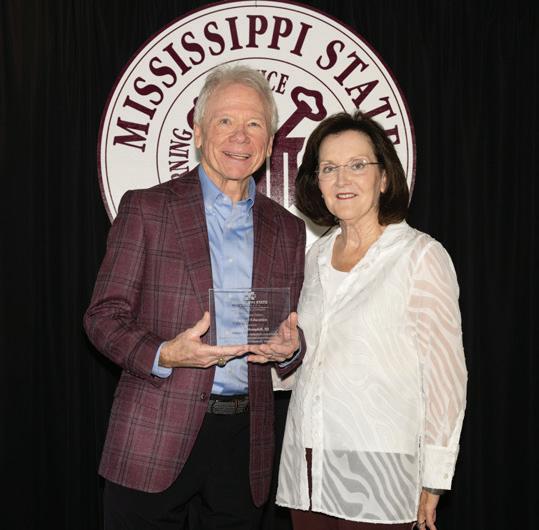
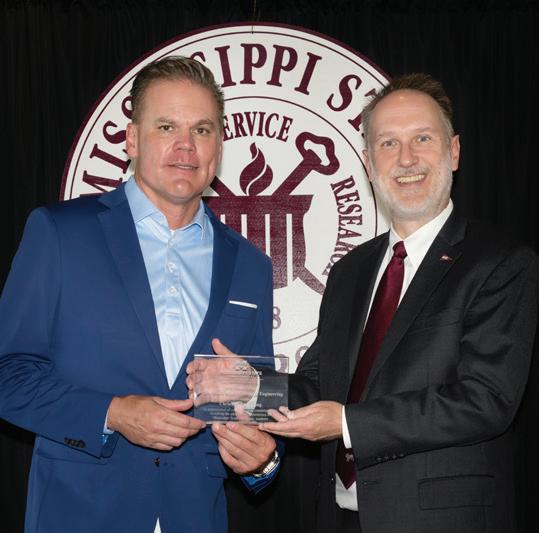
Jim Hemphill and Dean Teresa Jayroe
Christopher L. Ewing and Dean David Ford
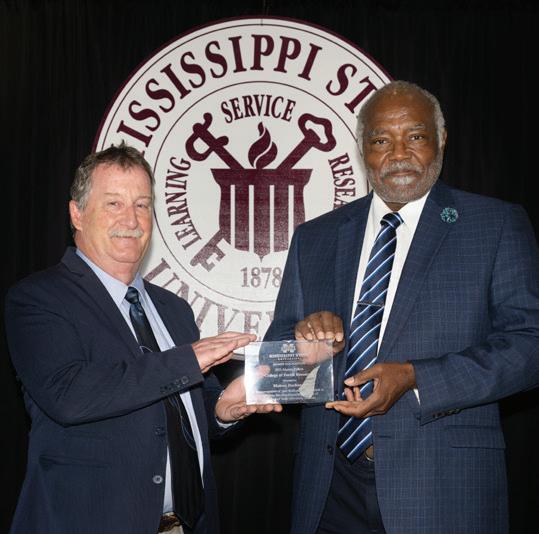
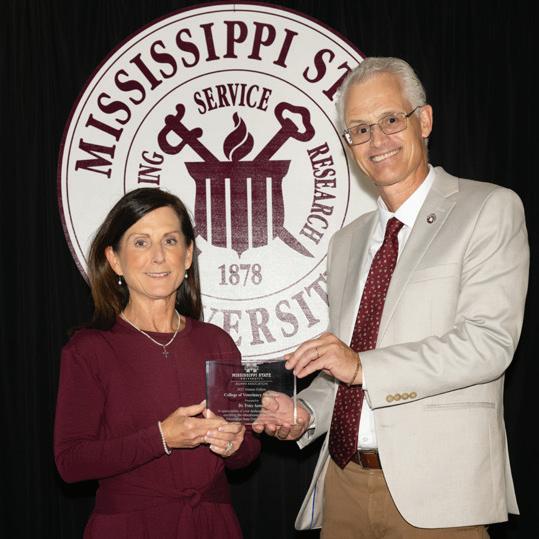
COLLEGE OF FOREST RESOURCES
Malone Buchanan, a native of Okolona, earned a Bachelor of Science in forestry from Mississippi State University in 1977. He is president of Standing Pine Forestry Services LLC, a Carthage-based business he owns and operates. His work focuses on timber appraisal, forest management, timber marketing and related services, allowing him to remain active in the field he has enjoyed for decades. Growing up on a dairy farm with eight siblings, Buchanan initially considered careers in music or business before MSU recruiters introduced him to forestry. Drawn to the opportunity to work outdoors, he found a profession that combined his interests with a fulfilling career path. Buchanan’s career began the day after his graduation, when he joined International Paper. Over the course of nearly 40 years with the company, he held roles in land and forest management as well as wood procurement, working in Lucedale, New Augusta and Vicksburg, and Bay Minette, Alabama. After retiring in 2016, he continued his work in the industry through his own company, offering independent forestry consulting services. He credits the university with not only preparing him for professional success but also fostering lifelong friendships that remain strong after 50 years. Buchanan has stayed connected to the university through philanthropic support and service on the dean’s advisory board for the College of Forest Resources. Active in his profession, Buchanan has served as treasurer of the Mississippi Society of American Foresters and as a board member of the Mississippi Forestry Association. His enduring affection for Mississippi State University continues to inspire his commitment to giving back, ensuring future generations can benefit from the same education and opportunities that shaped his own life.
COLLEGE OF VETERINARY MEDICINE
Dr. Tracy Acosta of Biloxi is a dedicated veterinarian, business owner, author and lifelong advocate for animal welfare and education. Originally from Gulfport, Acosta gained acceptance into Mississippi State University’s College of Veterinary Medicine through its competitive Early Entry Program and later received a Bachelor of Science in biological sciences in 1992 and a Doctor of Veterinary Medicine in 1996. Today, Acosta is owner and lead veterinarian of Acosta Veterinary Hospital and Four Paws Bed and Biscuit, where she oversees a full-service small animal practice offering medical, surgical, dental, grooming and boarding services. Beyond her clinical work, Acosta has been a voice for veterinary education and pet wellness across the state and nation. In 1999, she published “Your Dog’s Life: Your Complete Guide to Raising Your Pet from Puppy to Companion,” which led to a statewide book tour, including a stop at the MSU campus bookstore. She has contributed to national publications, written a syndicated pet-care column for more than two decades, hosted “Let’s Talk About Pets”—a local radio show— and spoken at veterinary conferences. The Mississippi Gulf Coast Chamber of Commerce, of which she is also a member, selected Acosta to participate in the yearlong Leadership Gulf Coast program for 2007–08. She often visits local schools to inspire children through educational talks about responsible pet care and veterinary careers. Acosta is a member of Our Lady of Sorrows Catholic Church of Biloxi, and her Catholic faith has remained a cornerstone in both her personal and professional life. A proud Mississippi State alumna, Acosta supports the university through her involvement with the M-Club, the Coast Dawgs alumni chapter, and the College of Veterinary Medicine’s admissions process. She lives in Biloxi with her husband, John, and their three beloved dogs: Sheldon, Howard and Penny. n
FAR RIGHT: Honored for their professional achievements and dedication to Mississippi State, the 2025 Alumni Fellows returned to campus to connect with students and share their insights during the annual recognition event.
Dean L. Wes Burger and Malone Buchanan
Dr. Tracy Acosta and Dean Nicholas Frank
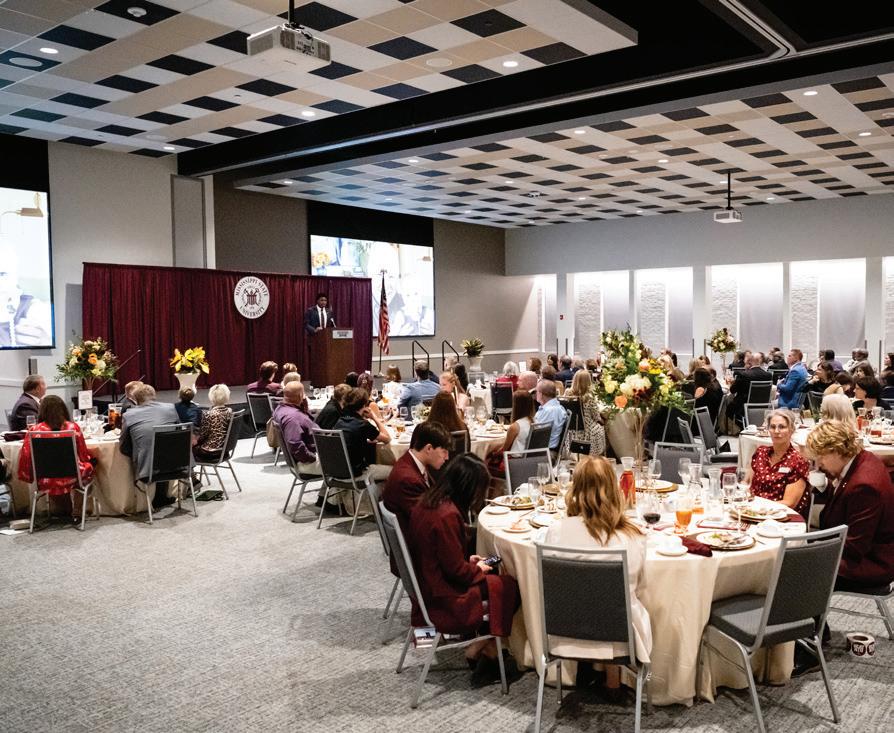
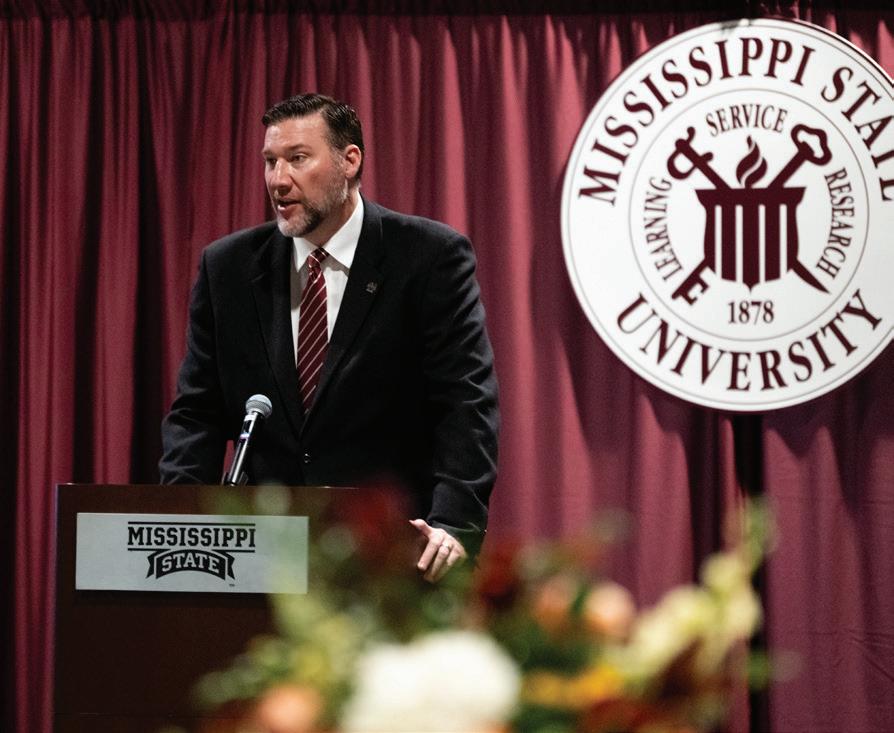
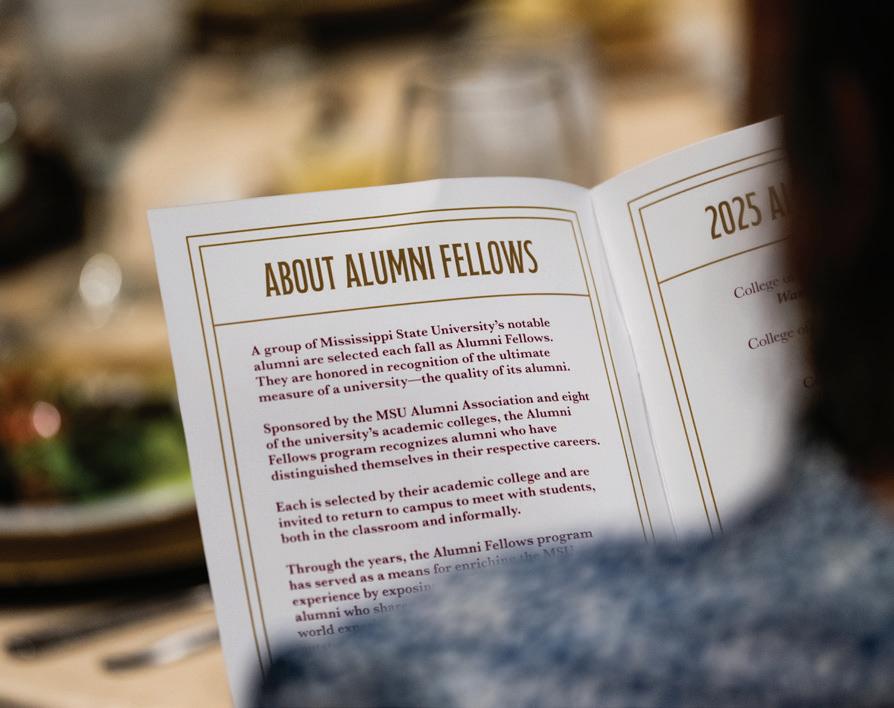














TAILGATING AT THE MILL
Bulldog faithful beat the heat during four exciting tailgates at The Mill this fall, where they enjoyed unlimited food, drinks and entertainment. Make plans to join the party next year and be part of the excitement!










































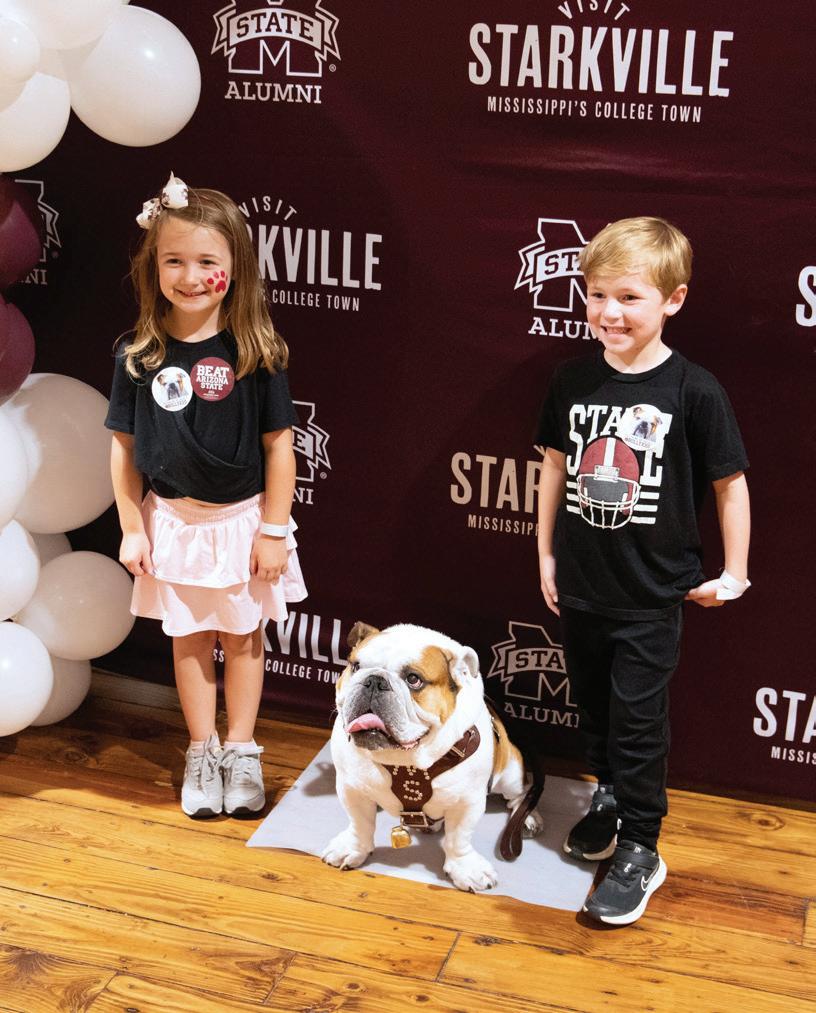









2025–2026 ALUMNI DELEGATES
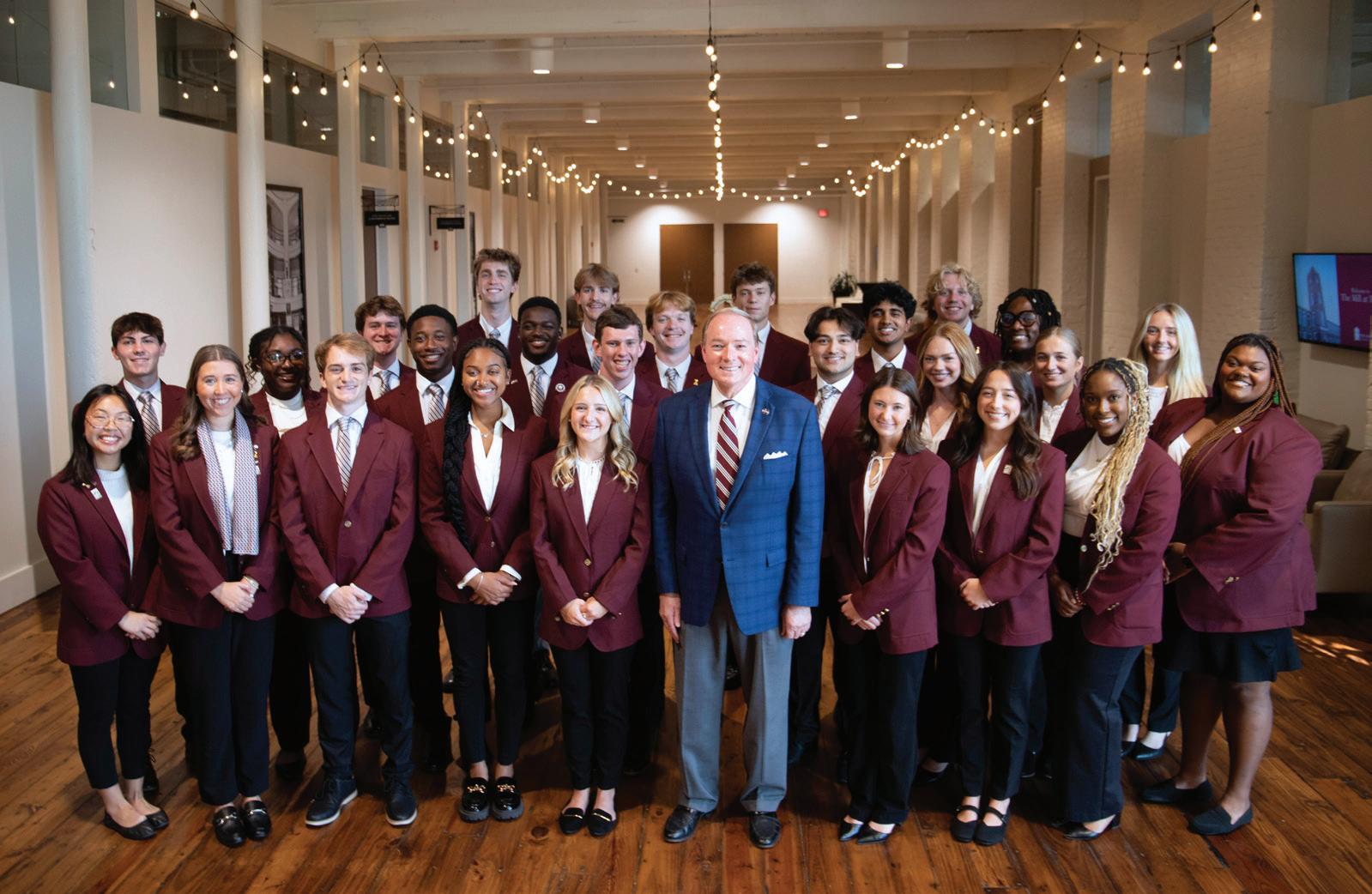
Tradition. Connection. Bulldog Spirit.
Founded in 1980, the Alumni Delegates organization helps the university and the MSU Alumni Association maintain strong ties with Bulldog students and the more than 169,000 living graduates of the land-grant institution. The 35-member group is often the first point of contact for graduates, friends and other special campus guests, and assists with tailgate gatherings, class reunions, class ring presentations and senior celebrations, among other events.
Over the past eight years, the group has distributed more than $100,000 generated through ticket sales from a “free tuition” drawing held each semester. Members also created the MSU Alumni Delegates Endowed Scholarship in 2015, which benefits entering freshmen and transfer students.
To learn more about MSU Alumni Delegates and see a complete list of current members, visit www.alumni.msstate.edu.
L-R: Prasanna Guduru, secretary; Hayes Henry, president; Audrey Jenkins, vice president of PR; Ronnie Charles Jr., vice president of member education
















Painting the Globe MAROON & WHITE
The Traveling Bulldogs program gives alumni the chance to explore the world together—building friendships, discovering new cultures and carrying Bulldog spirit to every corner of the world.

Through the Traveling Bulldogs program, Mississippi State alumni and friends explore the world together through river cruises, safaris and guided tours from Europe to Africa and beyond. Each trip blends adventure, culture and Bulldog camaraderie, turning travel into shared stories and lifelong connections. No matter the destination, the spirit of Maroon and White is always along for the journey.
Bryce Canyon National Park, Utah South Africa Rome, Italy
Spain
European River Cruise
Upper Antelope Canyon near Page, Arizona
Sedona, Arizona
Page, Arizona
Colorado River, Utah
European River Cruise

Cape Town, South Africa
Rome, Italy
Niagara Falls, Canada
Venice, Italy
Mackinac Island, Michigan
Colorado River, Utah Peru
South Africa
BULLDOGS CELEBRATE REUNIONS, ANNIVERSARIES WITH CAMPUS CELEBRATIONS
MSU Landscape Architecture
60th Anniversary
Landscape Architecture celebrated its 60th anniversary this fall. Guests enjoyed a welcome party at Dudy Noble Field, a campus walking tour, an open house at the LAED facility and much more.
MSU College of Veterinary Medicine Reunion
College of Veterinary Medicine alumni and their families gathered on campus for a lively two-day event enjoying tours, dinner, music, and the MSU Alumni Association pregame tailgate at The Mill before cheering on the Bulldogs as they faced the Northern Illinois Huskies.
Famous Maroon Band Reunion
Alumni band members returned to Starkville to support the Bulldogs and perform alongside the Famous Maroon Band during the game and at halftime. MSU stage band and jazz ensemble alumni also returned and joined a jazz reading session.
MSU Spirit Squads Reunion
Spirit squad alumni returned to Mississippi State for a weekend of memories, connection and Bulldog pride. They joined current cheer, dance and mascot teams to celebrate MSU Spirit’s legacy, then received recognition at Davis Wade Stadium during the game against Tennessee.
Cobb Institute 50th Anniversary
Mississippi State’s Cobb Institute of Archaeology kicked off its 50th anniversary with a multi-day celebration that featured a guest lecturer, fall festival, movie gathering on the lawn, live music, interactive outreach activities and guided museum tours. The weekend brought together students, families and community members for a fun and educational look at the institute’s legacy and future.
Volleyball Alumni Weekend
Bulldog volleyball alumni headed back to Starkville for Homecoming to enjoy a weekend of fun and games. They took in matches against Kentucky and Tennessee, and caught an exciting SEC football game between Texas and Mississippi State.
If you’re interested in organizing a reunion or anniversary event, please contact the MSU Alumni Association at info@alumni.msstate.edu

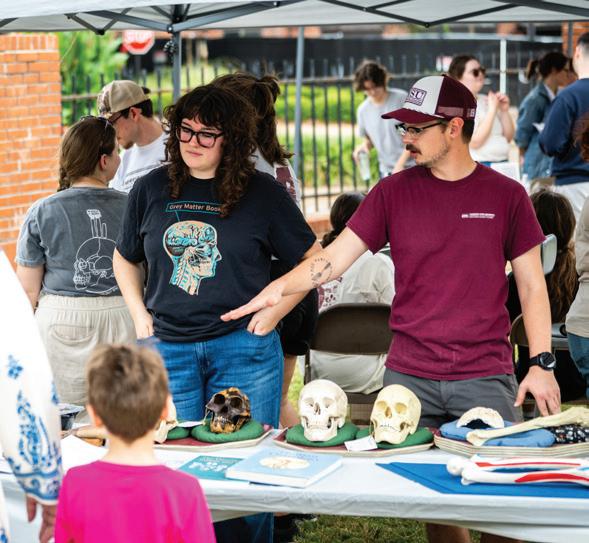
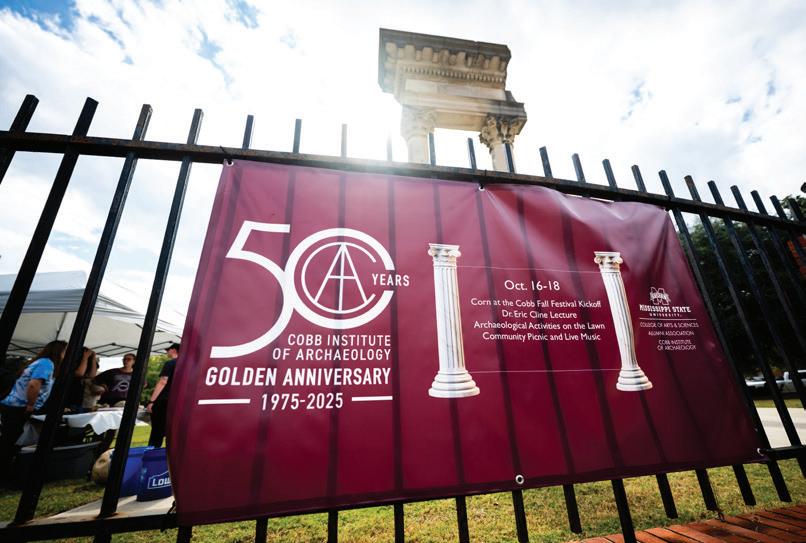

The MSU Alumni Association sponsors trips across the globe through the Traveling Bulldogs program. Itineraries are booked through 2026. Explore our website for more details at alumni.msstate.edu/travel or contact the MSU Alumni Association at 662.325.7000. Invite your friends and family, and start crossing destinations off your travel bucket list!
*All trips and dates are subject to change. Visit our website for the most current information.

Booking Trips for 2026 *
FEBRUARY 2026
The Luxurious Caribbean Sea
Finland: Arctic Magnificence
The Galápagos Islands
MARCH 2026
A Collector's Treasure: Australia & New Zealand
Portrait of Italy
Discover Egypt & the Nile Valley
Hawaii Three Island Adventure
APRIL 2026
Village Life Cotswolds
Enchanting Ireland
Across Spain & Portugal
Espionage & Intelligence: The Allied Secret Agents & Codebreakers of WWII
MAY 2026
Isles of the Mediterranean
Cruise the Norwegian Fjords
Great European Journey
Masters of the Air: The Mighty Eighth Over The Skies of Europe
Greece / Athens & Kalamata
JUNE 2026
Swiss Alps & the Italian Lakes
National Parks & Lodges of the Old West
Kenya Safari: The Big Five
Historic Baseball Tour
Easy Company
Battle of Normandy & the Liberation of Paris
JULY 2026
Majestic Vistas & Wildlife
Scandinavia & the Baltic Sea
Discover the Canadian Rockies by Rail
AUGUST 2026
Northern Italy
Exploring Iceland
African Expedition by Private Train
SEPTEMBER 2026
Scotland: Highlands & Islands
Landscapes & Lighthouses of Coastal Maine
Great Trains & Grand Canyons
OCTOBER 2026
Bordeaux to Lisbon
Rivieras of France & Italy
Intriguing India
Bali, Singapore, Thailand & Angkor Wat
NOVEMBER 2026
Macy's Thanksgiving Day Parade
DECEMBER 2026
A Royal English Christmas
Holiday Markets
Montreal & Quebec City
Christmas


WELCOMING THE NEXT GENERATION OF BULLDOGS
More than 45 chapters and clubs of the Mississippi State University Alumni Association hosted send-off parties for new Bulldogs. This year’s send-off parties, hosted by alumni volunteers, welcomed new students from across Mississippi and nine other states: Alabama, Florida, Georgia, Louisiana, Ohio, South Carolina, Tennessee, Texas and Virginia.
This MSU tradition, now in its 20th year, allows incoming first-year students, transfers and their families to celebrate with future classmates, alumni and friends, learn more about university life, and make connections before moving to Starkville.
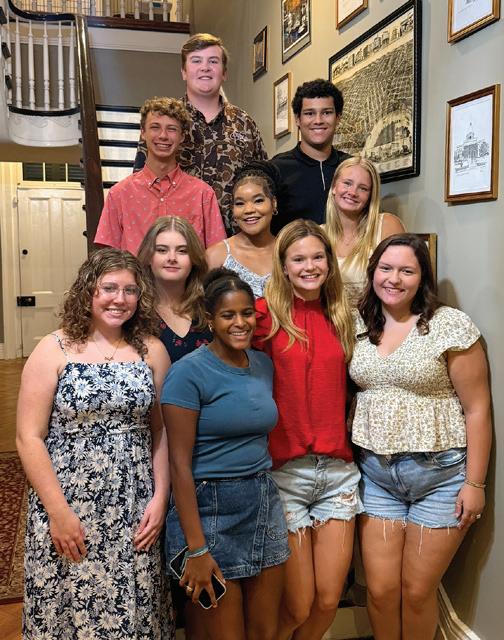
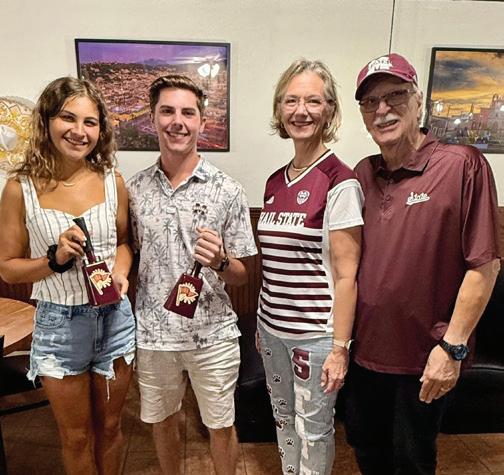
Atlanta, GA
Clarke County Union County
Pontotoc County
East Texas
Montgomery, AL
Monroe County Tulsa, OK
BULLDOGS HOST WATCH PARTIES ACROSS THE COUNTRY
MSU alumni around the nation gathered with their local alumni chapters to watch their Maroon and White Bulldogs fight, fight, fight on the gridiron this season!
NEW ORLEANS
ORLANDO
Washington County
Greater New Orleans, LA
Tuscaloosa, AL
MAROON REACH & IMPACT
Learn how your organization can connect with the powerful network of Bulldogs through customized opportunities that are tailored to help achieve your objectives.
Total Living Alumni
169,231
Top 6 Concentrated States (as of August 2025)
Mississippi (53%) Alabama (6%) Tennessee (6%)
Texas (5%) Georgia (3%) Florida (3%)
Addressable Alumni
100+
1,148 globally
145,034 digital 159,708 Active Members†
52,000 ALUMNI CHAPTERS AND CLUBS
†Denotes alumni and friends who have made a gift to MSU
For more information, contact Leanna Smith, Assistant Director of Alumni Partnerships & Business Development, at LSmith@alumni.msstate.edu or 662.325.3360.
WAYS TO PARTNER
The Mississippi State University Alumni Association hosts events and offers programs and services which are directly supported by our partnerships. We can create a customized package to help your organization maximize its resources and strategic goals.
ADVERTISING OPPORTUNITIES
PRINT: Alumnus Magazine, event signage and event promotion
Alumnus Magazine Distribution
u 2x/year Print, 1x/year Digital
u Reaches more than 52,000 active alumni association members
u Print Audience: Active alumni and supporters
u Digital Audience: All addressable alumni
DIGITAL: E-newsletters, social media, web, email and mobile app
ENGAGEMENT OPPORTUNITIES
Engagement opportunities through events and programs:
u Tailgates (home and away)
u Reunions and Alumni Gatherings
u Awards Banquet
u Reveille 25
u Senior Celebration
u Traveling Bulldogs
u + Other Annual Events
Senior mechanical engineering major Taylor Stigall of Brandon works at a CNC machining center in MSU’s IDEELab—a handson, advanced makerspace strengthened by alumni support
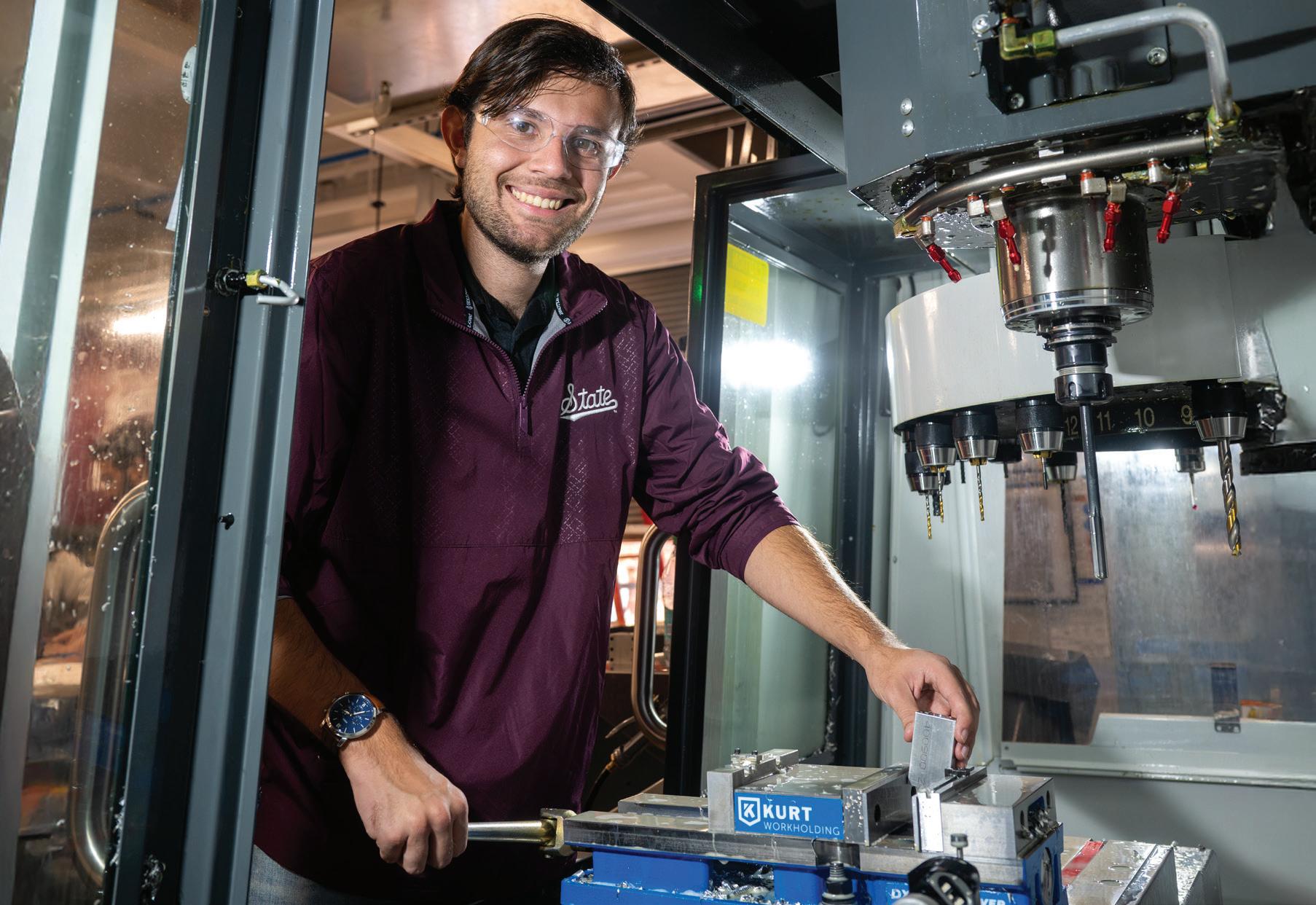
ENGINEERING EDUCATION EXTENDS NATIONAL LEAD WITH SUPPORT FROM KEY GIFTS
Mississippi State’s James Worth Bagley College of Engineering has long put a premium on practical education. In its Hall School of Mechanical Engineering, that hands-on learning gets a boost from the Innovation, Design and Engineering Education Laboratory, known as the IDEELab.
A hub for workforce development, cutting-edge research and collaborative industry partnerships, IDEELab helps ensure that MSU mechanical engineering graduates don’t just understand what they’re learning— they can put it into action.
To help ensure the future of this world-class education and outreach tool, 1961 aerospace engineering alumnus Bill
By Kevin Tate, Photos by Emily Grace McCall
Fondren Jr. has pledged financial support to IDEELab. Specifically, his gift will enhance the recruitment and retention of graduate students and aid in the growth of the opportunities and tools available through the lab.
“I wanted to give back to Mississippi State what my experience there gave to me 60 years ago,” Fondren said. “It thrust me onto the launchpad to go into the business world, into the real world, and live the life I have.”
Fondren said his gift benefits mechanical engineering, rather than his undergraduate major because he wanted “the money to go toward Mississippi State’s objectives and not mine.”
David Ford, dean of the Bagley College of Engineering, praised not only Fondren’s generosity but also his intention of doing what’s in the best interest of the university.
“Mr. Fondren called and asked me what I thought the most important initiatives in the Bagley College of Engineering were, and I pointed to the IDEELab and to attracting the most attractive echelon of graduate students, and he said that was what he wanted to support,” Ford said.
Fondren explained, “I wanted to get what’s in motion now to a higher level. I’m very glad to be able to help and give something back.”
A native of Cleveland, Fondren earned a master’s in industrial management from the
from Bill Fondren Jr.
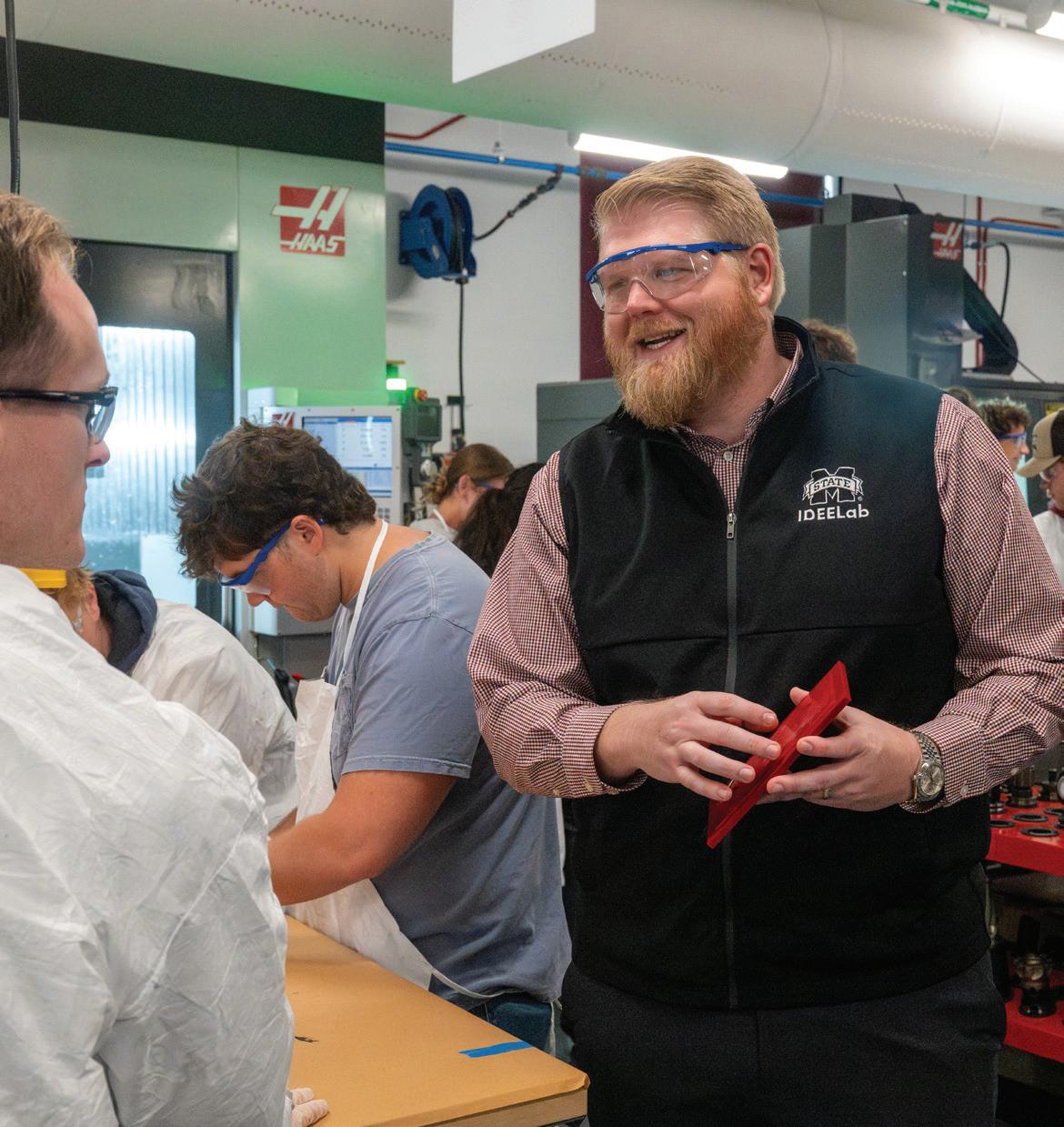
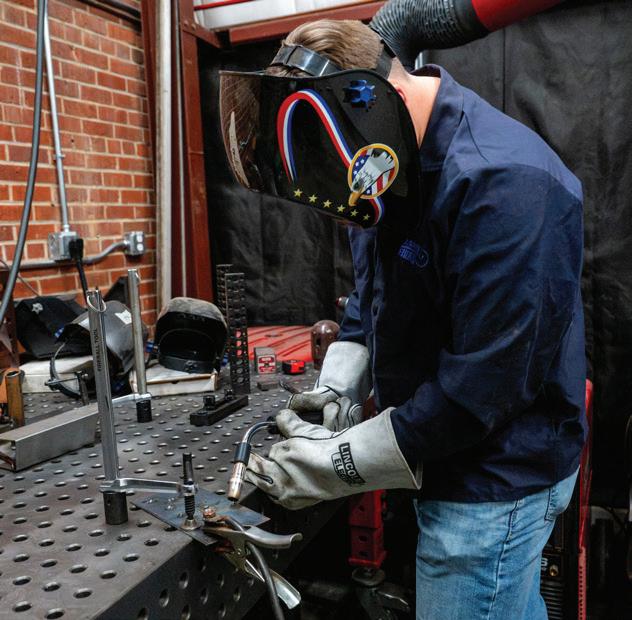
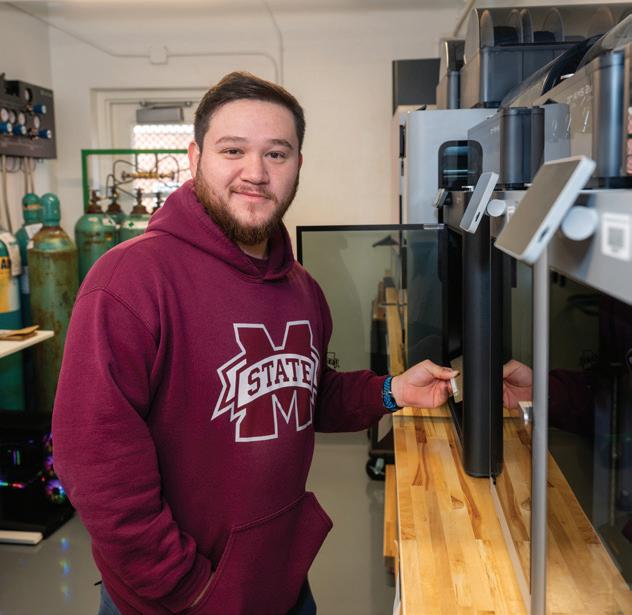
Massachusetts Institute of Technology in 1963. He served in the Army, working for the space program during the worldwide technological race to the moon. Following his time in the military, he worked for a number of companies before landing at Orgill Inc. There he rose through the ranks to ultimately be appointed president and CEO in 1981. He held that position for 24 years.
Under his leadership, Orgill expanded from being a regional distributor in the Midsouth to becoming a global entity serving retail customers in all 50 states, Canada and more than 60 countries worldwide. Fondren retired as chairman of the board at the end of 2012 after serving in that capacity since January 2005.
Since that time, Fondren put a lot of thought into what kind of legacy he would
like to leave, ultimately deciding his largest impact could come through supporting Mississippi State.
“I waited as long as I did to make the gift to Mississippi State because I wanted to reflect over the years and see what really did make a difference in my life,” Fondren said. “Family is No. 1 but when I looked to external factors and went back to something large enough to make a difference, I arrived at Mississippi State.”
Fondren said he was able to see a bit of his MSU experience in the ideas behind the IDEELab.
“When I arrived on campus at Mississippi State, I was there with people just like me, getting ready to go into the world to do what’s necessary to make a living, starting by getting an education,” Fondren recalled. “Mississippi State fit right into that,
“I wanted to give back to Mississippi State what my experience there gave to me 60 years ago. It thrust me onto the launchpad to go into the business world, into the real world, and live the life I have.”
~ BILL FONDREN
Ross Smith, director, guides senior mechanical engineering majors Collin Mullins of Kilmichael and Benjamin Gregory of Horn Lake in MSU’s Innovation, Design and Engineering Education Laboratory, known as IDEELab.
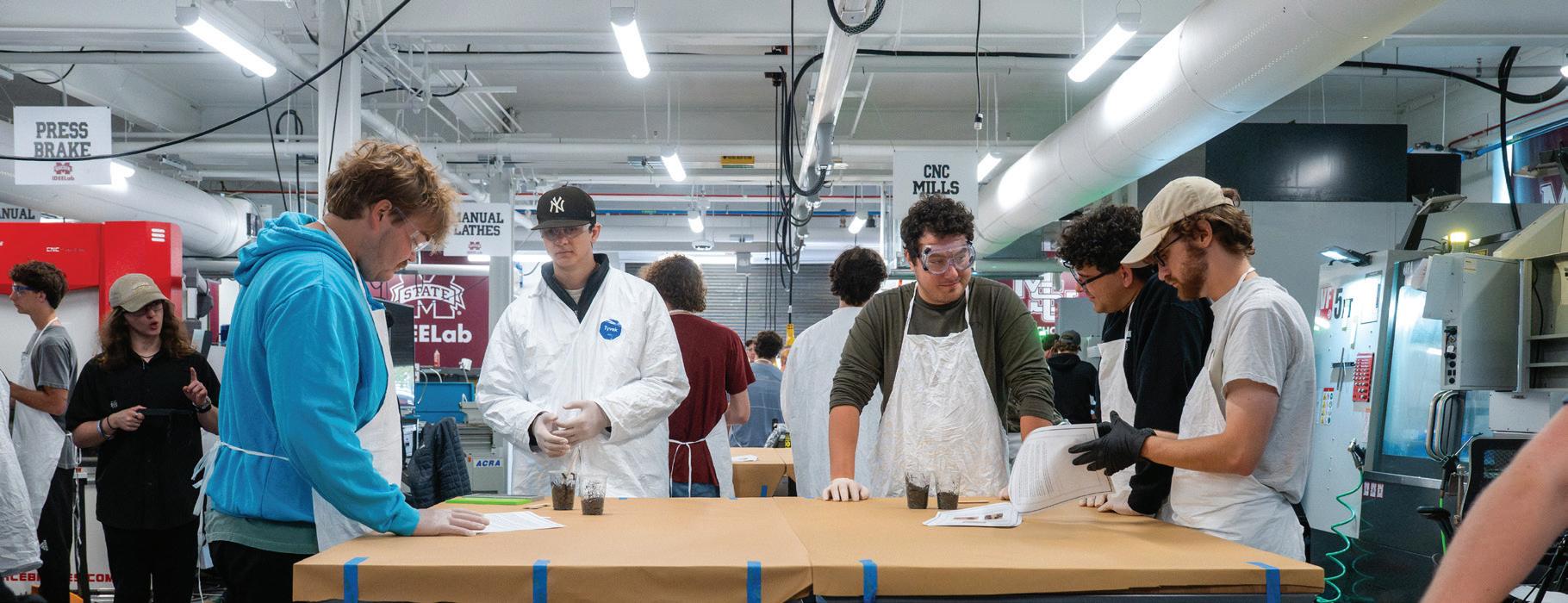
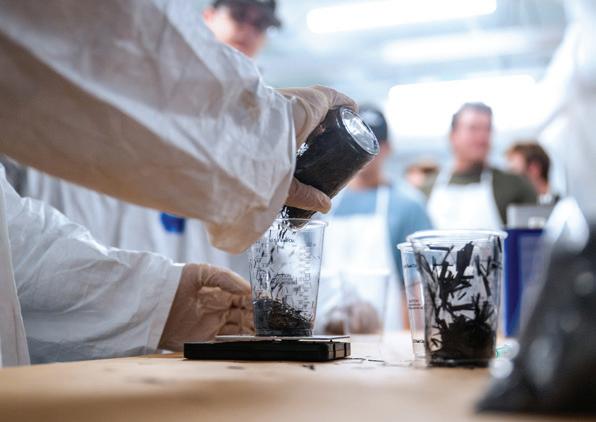
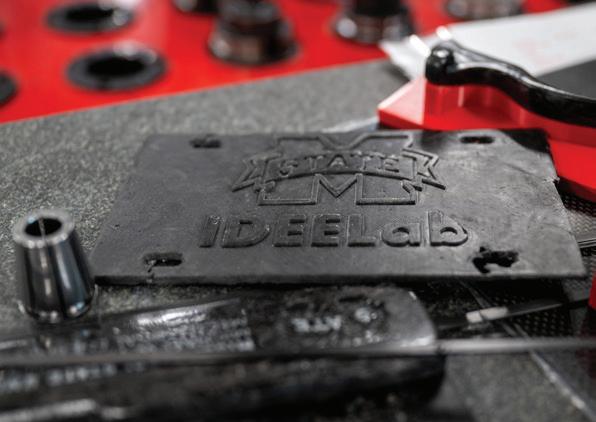
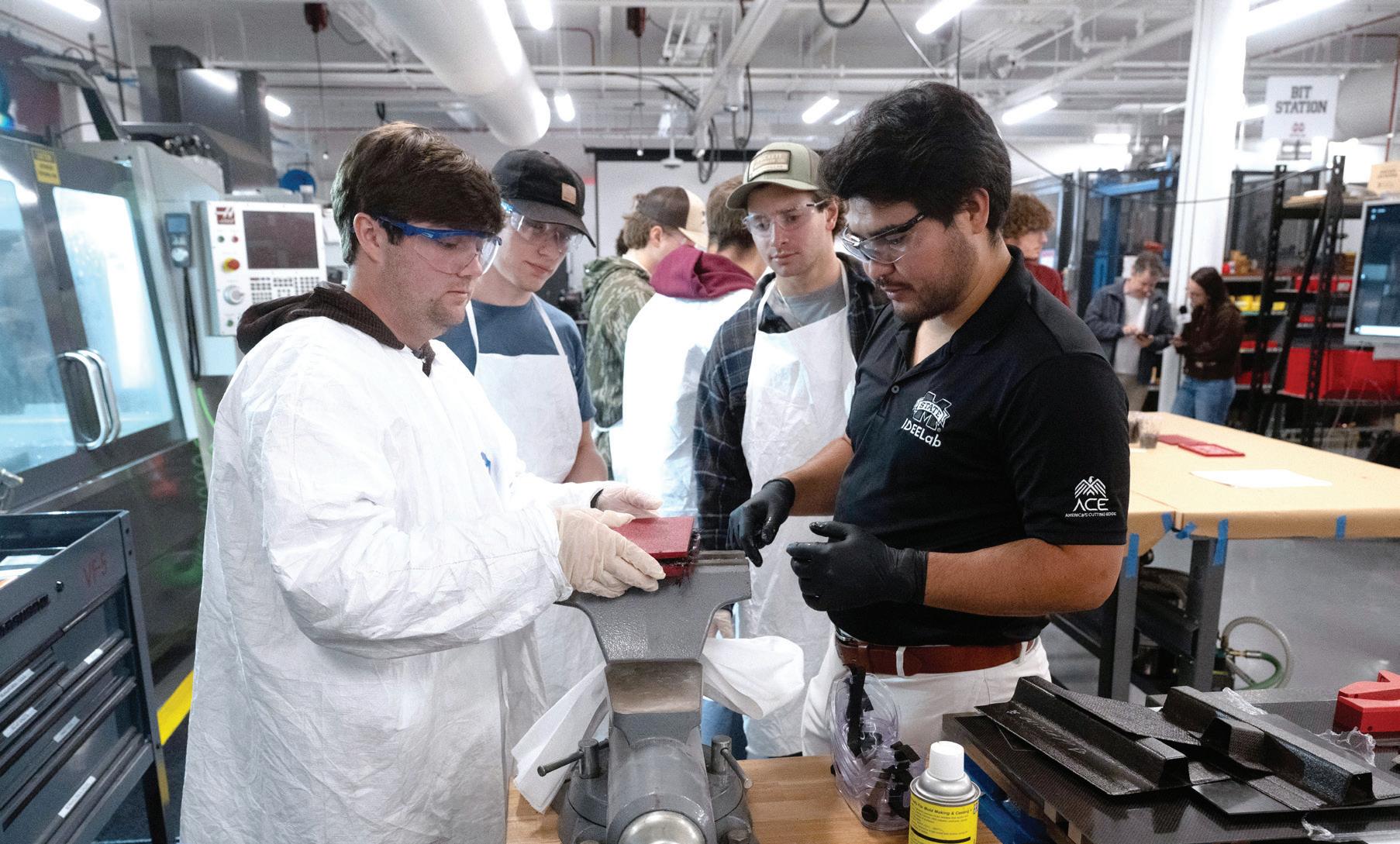
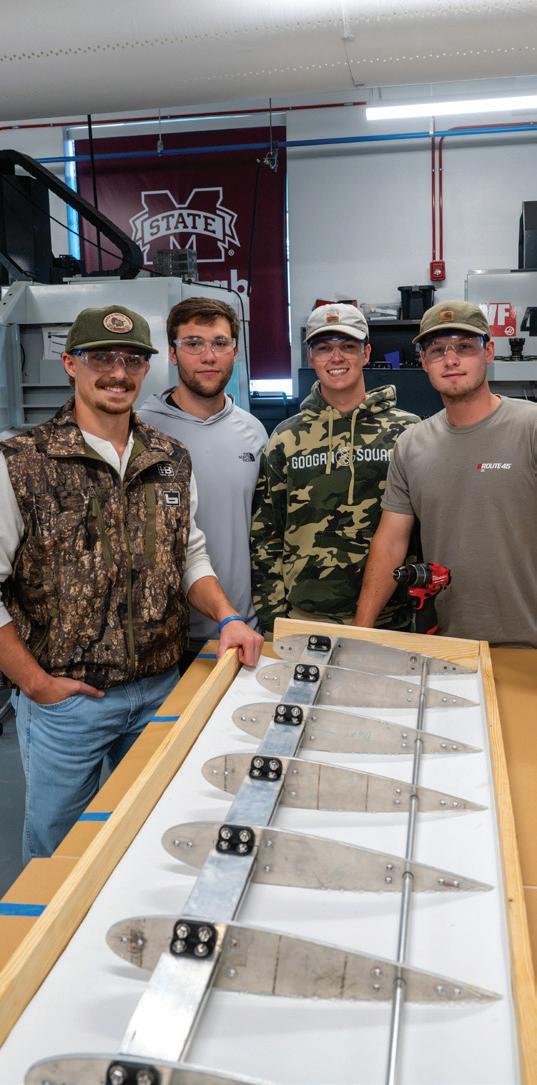
providing an education both inside and outside the classroom.”
Now, Fondren’s gift will ensure future generations get a similar experience through the IDEELab. Time in the lab is a requirement for those earning a mechanical engineering degree at MSU, but students—once they are certified in safety and operation—are encouraged to use the advanced machinery and tools to pursue their own projects or to earn industry-specific certifications.
The certifications students are encouraged to earn increase in complexity and difficulty, ultimately arriving at or surpassing the most technically demanding tasks modern automated industry can provide. Training for these certifications is provided without fee to engineers already employed in industries where such certifications are needed or need to be renewed, and the machines, their maintenance and any consumable material necessary for their operation are funded by endowments.
The lab’s equipment includes hundreds of pieces of industry-grade precision manufacturing tools, including computer numerical control—or CNC—cutting, milling and casting gear, 3D printers that use many different types of media, and much more.
onto the university campus where we work together with students and our people to showcase solutions for pressing engineering problems,” Kadiri said. “IDEELab is a huge investment where students solve problems and engage with engineering faculty, and the makerspace is an integral part of the model.”
The IDEELab is located on the first floor of Patterson Engineering Building, but a planned expansion will take it onto the second floor as well. The lab impacts approximately 1,200 students per year through required classroom engagement, plus another 500 students who use the lab through co-curriculars.
"We have millions of dollars of high-end equipment; realworld, industry-grade equipment at the students’ disposal. This is equipment students would encounter on the manufacturing floor of any large industry in the world."
~ ROSS SMITH
“This is not hobby-grade or tabletop gear,” said Ross Smith, director of the IDEELab. “We have millions of dollars of high-end equipment; realworld, industry-grade equipment at the students’ disposal. This is equipment students would encounter on the manufacturing floor of any large industry in the world.”
Haitham El Kadiri, director and PACCAR Chair of the Hall School of Mechanical Engineering, explained that IDEELab has long served as a pathway for connecting the university and industry, providing space and opportunity for students to address real-world problems in a hands-on way.
“In this educational model, we bring industries
Ford said having the IDEELab at hand has allowed for partnerships with industries who bring their problems to the university. Businesses including Taylor Machine Works, Aurora Flight Sciences and Milwaukee Tools have relationships with the university’s engineers allowing for externships–students employed by industries but working in the IDEELab on campus rather than on location with the industry itself.
“Every mechanical engineering student is touched by this interaction with industry, bringing the experience to students in other disciplines who may have missed it, and bringing more of it to those who’ve already experienced it otherwise,” Ford said. “The IDEELab is one of the top ideas in the country in engineering education because it’s proven to be really effective.”
Fondren said he is proud to know his support will help continue the world-renowned work of Mississippi State University, the Bagley College of Engineering and the Hall School of Mechanical Engineering.
Sixty years after Mississippi State set him on his path, Bill Fondren has returned to invest in the same foundation that launched his success. His gift will ensure generations of engineers will continue to build, create, and innovate to launch their own paths. n
The IDEELab gives students hands-on experience that bridges classroom learning and real-world application. Through the lab, students have access to professional-grade tools and work side-by-side with faculty to complete personal, academic and industrypartner projects.
BUILDING ON SUCCESS
FLINTCO INVESTS IN MISSISSIPPI STATE’S FUTURE CONSTRUCTION LEADERS
By Shun Pounds, Photos Submitted
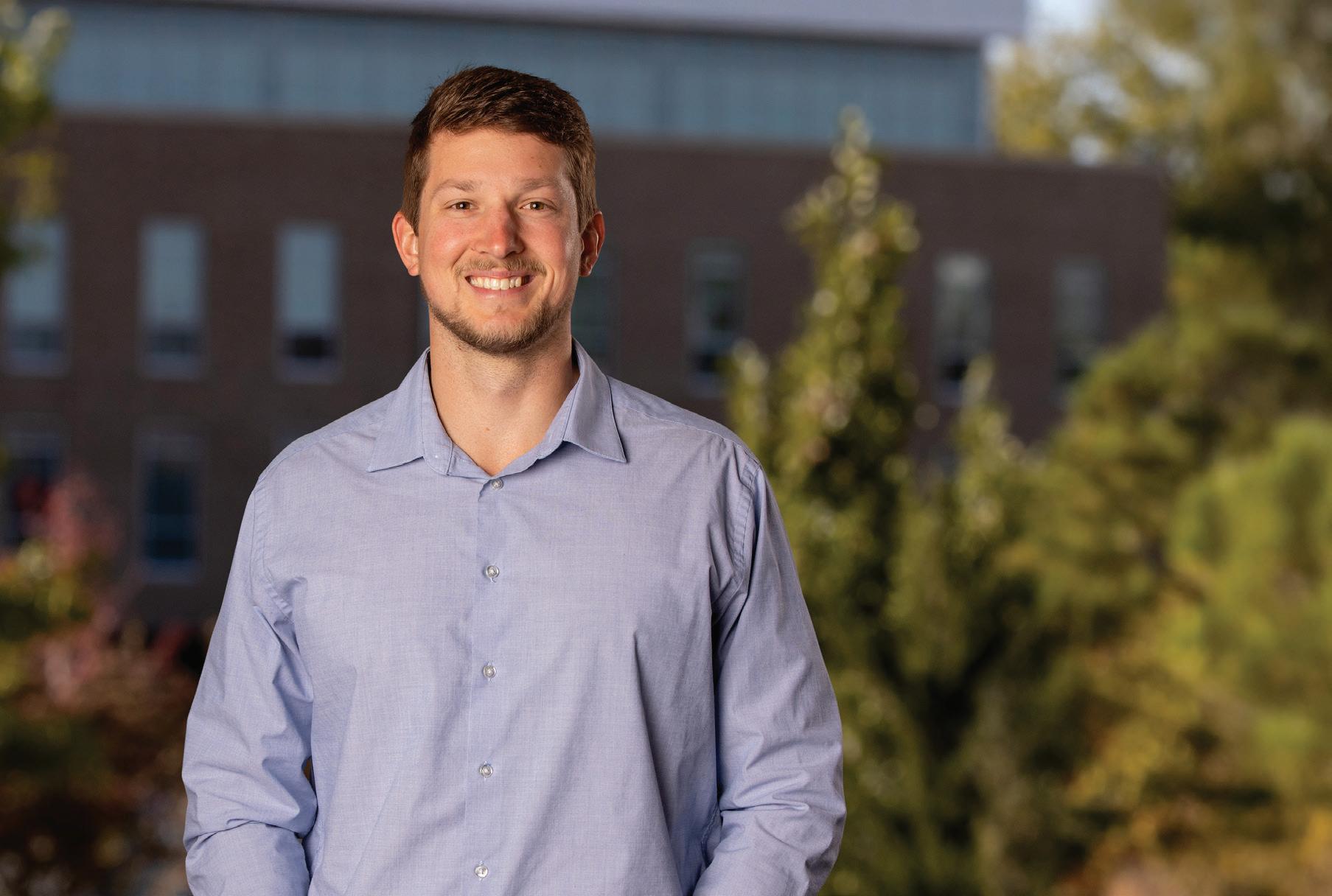
When Colton Cox headed to Mississippi State University in 2017, he followed the maroonpaved path of his parents, grandparents, brothers and countless other family members. But for the Brandon native who enjoyed working with his hands, MSU’s appeal went beyond family tradition. He was drawn to the Department of Building Construction Science, a studio-based program within the College of Architecture, Art, and Design that offered hands-on learning and real-world preparation.
For Cox and other department alumni, that education and career readiness led to a career with Flintco, a national leading construction company. Inspired by the Bulldogs among its ranks, the company has now established scholarship gifts to support future generations.
Danny Moeschle, vice president and area manager of Flintco’s Memphis, Tennessee, office and a more than 30-year veteran of the
company, praises what MSU’s programming provides the industry.
“Flintco has had great success recruiting students from the building construction program at Mississippi State,” Moeschle said. “They tend to be well-prepared problem solvers and critical thinkers who also have a work ethic that aligns with our culture.”
Established in July within the College of Architecture, Art and Design, the Flintco Endowed Scholarship and the Flintco Annual Scholarship will support students from the Memphis area who are enrolled in the college and maintain good academic standing. These scholarships will strengthen the pipeline of career-ready professionals entering the construction industry.
“Our investment in the program is a way to give back in honor of the people who are already on the Flintco team and to provide opportunities for future success stories,” Moeschle said.
Cox’s success with Flintco solidified the
company’s decision to establish the gift and support what they see from the program.
MSU’s building construction science program is one of only two of its kind in the country and is accredited by the American Council for Construction Education. With a curriculum rooted in collaboration, technical expertise and leadership, the program prepares graduates to manage both the business and the practice of construction. Students study in a simulated office environment called a studio, where they integrate classroom knowledge and problemsolving for real projects.
Cox quickly discovered the value of that immersive approach. He said professors pushed him to grow not only in technical knowledge but also in dependability, accountability and communication. Trips to active job sites in major cities such as Chicago, Illinois, and Washington, D.C., offered him a glimpse of what his future could look like.
UNIVERSITY OF MEMPHIS PEDESTRIAN BRIDGE/PARKING GARAGE
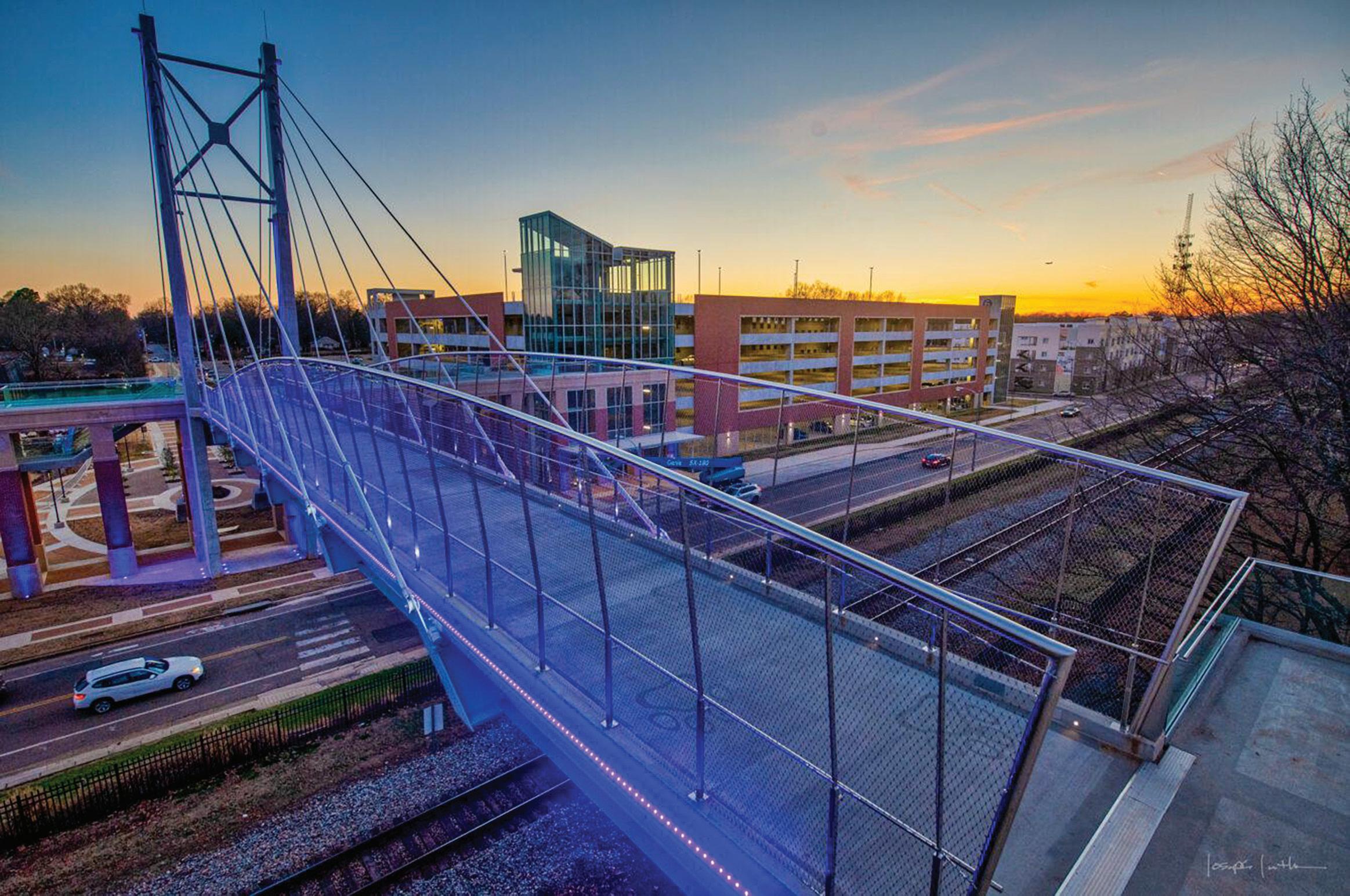
FEDEX FORUM
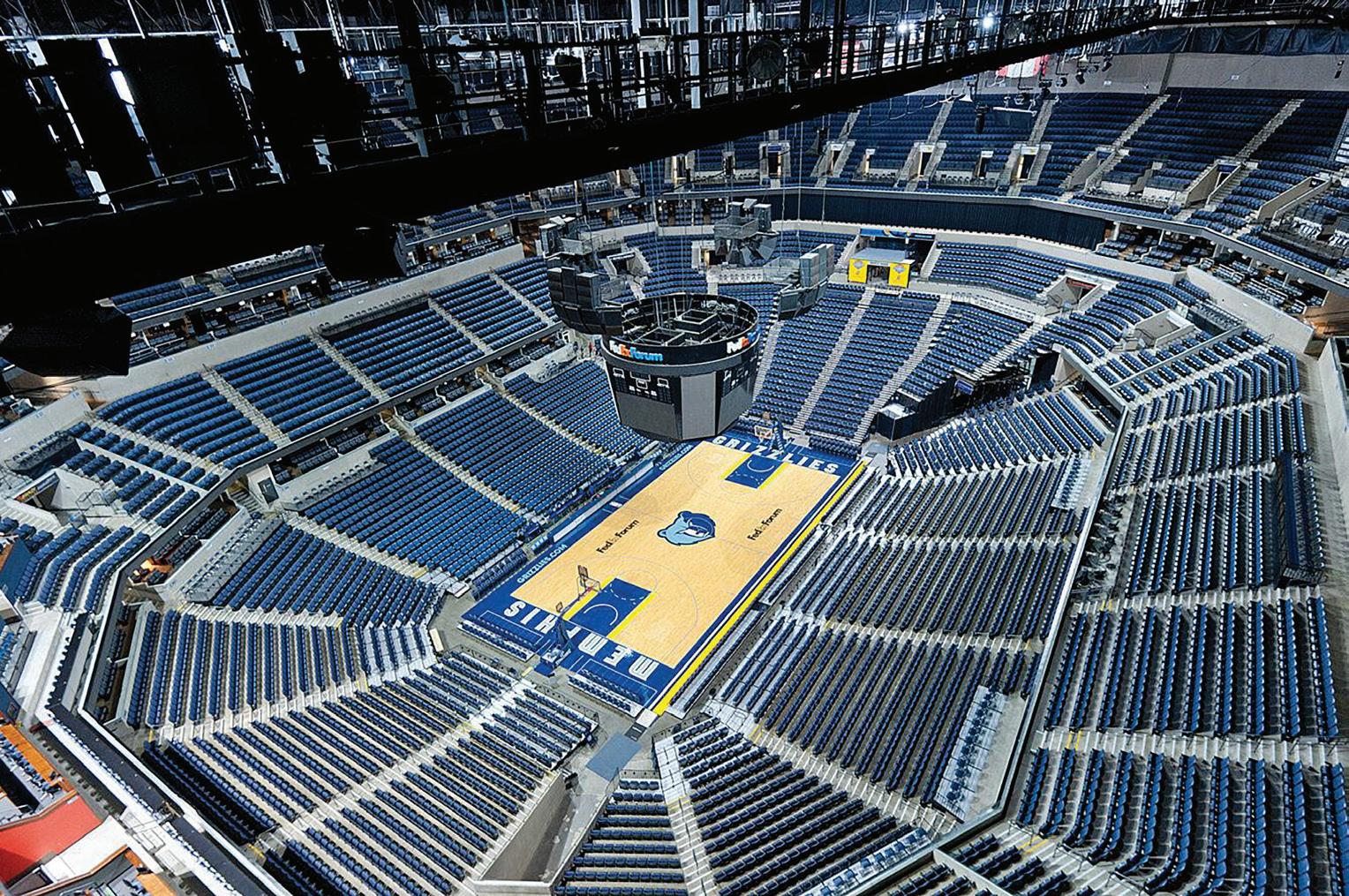
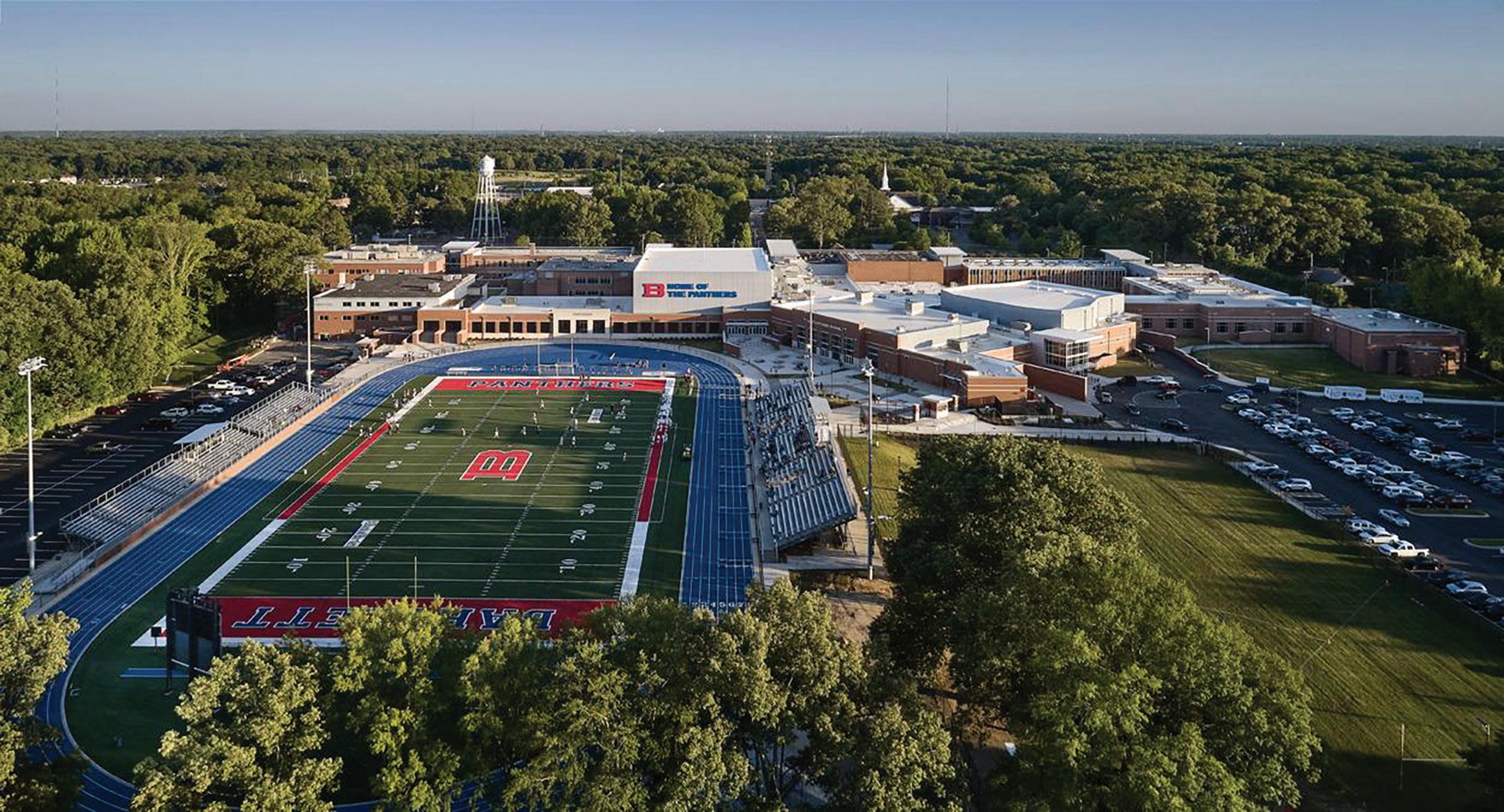
BARTLETT HIGH SCHOOL
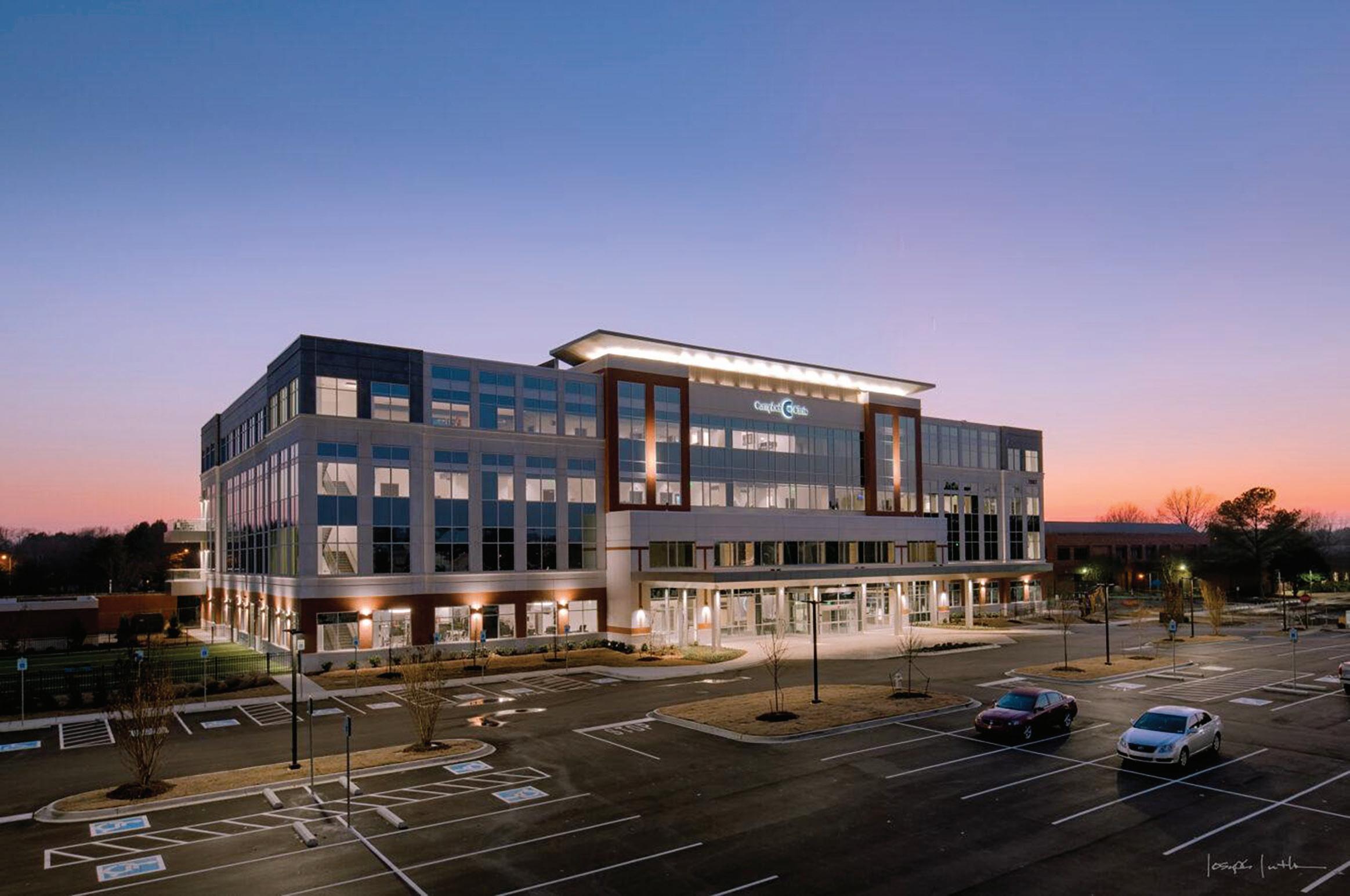
CAMPBELL CLINIC
Cox first met representatives from Flintco at an MSU career fair, which led to a summer internship with the company in 2018. Assigned to the renovation of the University of Tennessee Health Science Center, he coordinated with trade partners, tracked job progress and kept daily logs.
“Although the internship was only three months long, seeing constant progress on the jobsite and a building come to life was very rewarding,” Cox said.
His performance impressed Flintco leaders, who offered him a full-time position before his senior year. Cox returned after graduation in 2020 and quickly advanced through the company’s ranks.
He is now a project manager working on the team in charge of Flintco’s largest-ever project— an $850 million-plus expansion of St. Jude Children’s Research Hospital in Memphis.
“Colton is the perfect example of being able to make an immediate impact and being in control of your career path at Flintco,” Moeschle said. “Since joining Flintco, he has sought out and accepted progressively more challenging work and has become an integral part of our team.”
For Cox, knowing his story helped inspire Flintco’s gift is both humbling and affirming.
“It shows me the true value Flintco holds for its interns and the people it chooses to hire and develop,” Cox said. “I’m grateful to be part of such a great team and a company that invests just as much in its people as in its work.”
For MSU, partnerships like this underscore the long-term value of connecting industry leaders with academic programs. By investing in students, Flintco ensures not only the growth of its own company but also the advancement of the construction field as a whole.
“Emerging technologies are impacting many industries and construction is no exception,” Moeschle said. “However, the need for highly trained people will never be obsolete. We are making an investment in the future of people choosing our industry, which will benefit Flintco and the construction industry for years to come”.
As Cox continues to build his career, he remains grateful for the program that gave him his start.
“I hope to see the building construction program continue to mold the next generation of construction managers and workers,” he said. n

For more information about purchasing a Mississippi State University car tag, please visit alumni.msstate.edu/cartag
Further restrictions may apply.
* The Senior Living discount is only applicable to new residents of a Brookdale independent living, assisted living, or memory care community admitting under an executed residency agreement. Discount applies only to the monthly fee/basic service rate, excluding care costs and other fees and is calculated based on the initial monthly fee/basic service rate.
** The In-Home Services discount is only applicable to new clients of personal assistance services by a Brookdale agency under an executed service agreement.
*** A Short-Term Stay discount is only applicable to new residents of a Brookdale assisted living or memory care community admitting under an executed respite agreement. Discount applies to the daily rate.

1960s
Richard C. Shultz (B.A. political science, ’67) served five years on active duty with the Air Force. In Vietnam, he was a forward air controller flying the OV 10 Bronco aircraft. He then spent 15 years in the Air National Guard flying various aircraft at different locations across the U.S.
1970s
Steve Black (B.S. chemistry, ’70) was named a Pillar of Excellence by the University of Memphis Law Alumni Association. The award is presented annually to those who have made a significant contribution to the practice of law in their civic and professional lives. Black is the founding member of the law firm Black, McLaren, Jones, Ryland and Griffee in Memphis, Tennessee, where he has been practicing law for 52 years. He has been named Lawyer of the Year in Family Law for the Memphis-area Best Lawyers in America three times in the last six years.

Ginny Walker Shurlds (B. A. communication, ‘78) has released a new book, “Mississippi State from A to Z.” Written and illustrated by the Meridian native, the book contains rhyming verse and colorful, pen-and-ink and watercolor illustrations. The book is officially licensed by Mississippi State and takes children through the alphabet while introducing them to the university. Shurlds is a veteran elementary, gifted and visual arts educator, and says she was inspired by her grandson to teach the next generation about the Bulldog family.
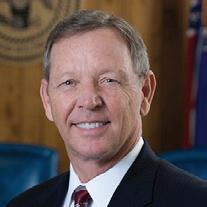
Mark Formby (B.A. art, ’79) was elected president of the Southern Association of Workers’ Compensation Administrators. A longtime public servant, he represented his district in the Mississippi Legislature for 25 years before being appointed to the Mississippi Workers’ Compensation Commission, which he now serves as chairman. In that role, he oversees key aspects of the state’s workers’ compensation system,
a vital part of both employee protection and insurance regulation. His leadership at both the state and regional levels continues to strengthen policy and practice across the South.
1980s
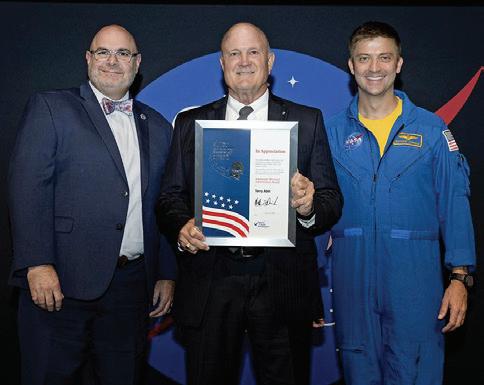
Terry Abel (B.S. nuclear engineering, ‘82; M.S. mechanical engineering, ’83) received the prestigious Silver Snoopy award from NASA, an honor given to employees and contractors for exceptional contributions to spaceflight safety and mission success. The Silver Snoopy is presented to less than 1% of the agency’s workforce annually and is given personally by astronauts. Each award includes a commemorative Snoopy pin that has flown on a previous Space Shuttle mission, adding to its significance. Abel works at Lockheed Martin as its technical liaison to the Marshall Space Flight Center, where he oversees all on-site activities, including efforts associated with the development of the Orion spacecraft, which is part of NASA’s overall Artemis project to facilitate human missions to the moon and ensure safe return. He also earned a Circle of Excellence award from Orion Program Manager Howard Hu of Johnson Space Center and, in 2017, he was one of just 14 to receive NASA’s Distinguished Public Service Medal, which is given to those demonstrating a level of excellence that makes a profound impact on NASA’s success. He was named an MSU Bagley College of Engineering Distinguished Fellow in 2016.
1990s
Marion Harris (B.S., M.A. mathematics, ’91, ‘93) is now president and CEO of AgFirst Farm Credit Bank. A native of Pascagoula, he previously served as chairman and CEO of Ford Motor Credit Company,
during which time he was named Auto Finance Executive of the Year by Auto Finance News. He has three decades of experience in the financial industry and serves on the board of Cerence Inc. and the advisory boards of Mobility Impact Partners LP and Harbinger Motors Inc.
Steve “Duke” Pigott (B.S. aerospace engineering, ’94), of Albuquerque, New Mexico, successfully summited Mt. Everest in May. It was the final challenge necessary for him to complete the Seven Summits—the highest peak on each of the seven continents. He is now one of only 400 recorded to have completed the feat. His Everest climb took 28 days, and, at the top, he stopped to take a photo holding an MSU pennant and play a guitar—which is now on display at the Hard Rock Cafe in Kathmandu, which lies at the base of the mountain.
2000s
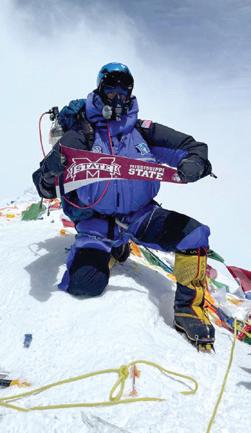
Mark R. Cheathem (Ph.D. history, ’02) was appointed the Heller Family Endowed Professor of History at Cumberland University in Tennessee. The author of nine books, he is director and co-editor of the Papers of Martin Van Buren, housed in the university’s Vise Library.
Dr. Hunter Butler (B.S. biological engineering, ‘03) was named the 2025 Tennessee Pediatrician of the Year. He is a physician at VIP Children’s Clinic in Springfield, Tennessee, an affiliate of Vanderbilt’s Monroe Carell Jr. Children’s Hospital, where he completed his residency. He was selected for the honor by the Tennessee Chapter of the American Academy of Pediatrics out of more than 1,200 pediatricians in the Volunteer State.
He earned his medical degree from Emory University School of Medicine where he was president of his class. Butler also serves as medical director for Robertson County Public Schools and advocates for children at the state level as a fellow of the Tennessee chapter of AAP.
2010s


Formerly with the Mississippi Attorney General’s office, Whitney Lipscomb (B.A. political science, ‘09) is now general counsel for the Republican Attorneys General Association. She also leads the Rule of Law Defense Fund. Widely considered among “those to watch” for future high-profile positions in Mississippi, she had served the state Attorney General’s Office since 2020 overseeing the civil, solicitor general, and opinions and policy divisions. She previously served as deputy chief of staff and counsel to former Mississippi Gov. Phil Bryant. She earned her law degree from the University of Mississippi School of Law and worked in private practice to begin her career.
Brad Phillips (B.B.A. business economics, ‘13) is U.S. FarmRaised Catfish’s 2025 Catfish Farmer of the Year for Mississippi. He manages Phillips Brothers Farms in Yazoo City, where he has been farming catfish—taking part in every stage of production—for more than 12 years. He serves on the boards for Catfish Farmers of America and The Catfish Institute.
Mac Flynt (B.B.A. management, ‘15) was named administrator of OCH Regional Medical Center, which was known as Oktibbeha County Hospital until its recent purchase by Baptist Memorial Health Care. Flynt previously held the same position at Baptist’s hospitals in Attala and Yazoo counties. He was part of the Bulldog football team while at State.
Whitney Swanson (B. Arch. architecture, ‘09) was selected to serve as office principal for HRD’s Brentwood, Tennessee, office. A professional services firm, HRD specializes in engineering, architecture, environmental and construction services. In her new role, she will lead and support the team of multidisciplinary professionals to foster a collaborative and inclusive culture while driving strategic growth across the region. She previously worked for Gensler, managing a multinational team on a $12 billion datacenter campus. In her early career, she served as a project manager at HDR, and worked at Alan Ford Architects PC, Seabold Architectural Studio PC, Midtown Partners Inc. and Mississippi State’s Jackson Community Design Center.
Frank M. Davis (B.S., M.S., Ph.D. entomology, ’61, ’63, ’65) 85, Starkville — A native of Greenwood, he was a member of the Bulldog tennis team while at State. Following his graduation, he spent decades as a research entomologist for the USDA and as an adjunct professor at MSU. He was awarded Emeritus status following his retirement in 1999. The Mississippi Legislature honored him in 2000 with a concurrent resolution marking his scientific contributions. In 2005, he was named a fellow of the Entomological Society of America. During his career, he authored or co-authored 163 publications and patented the “Davis Inoculator” which is used in insect rearing. That invention was essential in creating the first insect rearing educational program in the U.S., which now bears his name. An active member of his community, he served Starkville as vice mayor and on the board of aldermen. — Jan. 10, 2025
W.W. “Bill” Dungan (B.S. petroleum geology, ’55) 92, Madison — Having overcome polio during his childhood, Dungan was a cheerleader at Port Gibson High School and went on to become a collegiate cheerleader at both Hinds Junior College and Mississippi State University where he was a member of Lambda Chi fraternity. Following his MSU graduation, he joined Mobil Oil and earned a fellowship with Colorado School of Mines where he earned a master’s in geophysics. He later received an MBA from Oklahoma City University, where he was recognized with the Outstanding Student Award. At Mobil, he was promoted to vice president of exploration and was based in New York City until 1969 when he returned to Mississippi. He became the first manager of Garan Inc. and co-founded a contract oil exploration company. He served on the board of The Citizens Bank of Philadelphia, was a member of the Philadelphia Rotary Club, and president of the country club,
cattlemen’s association, and livestock association. — June 10, 2025
David Dougal Glasgow (B.S. physical education, ’62) 85, Utica — While at MSU, he was part of Bulldog basketball and track, contributing to MSU’s 1962 men’s basketball championship team. A lifelong teacher, coach and administrator, he was in education for more than 40 years. He began his career at West Tallahatchie High School and finished at Copiah Academy, with stays at Leland High, Oak Hill Academy, Greenville Christian and Canton Academy along the way. He was a member of the Mississippi Association of Independent Schools Coaches Association Hall of Fame. He worked as part of Samaritan's Purse in support of Operation Christmas Child. — June 19, 2025
Lisa Shipp Lake (B.S. biology, ’81) 66, Jackson — Following her graduation from MSU she worked for Southern Farm Bureau Life Insurance before following her passion for helping others into the physical therapy field. She completed a two-year program through the University of Mississippi Medical Center School of Physical Therapy. After her graduation, she began a career as a physical therapist. She worked at Mississippi Baptist Medical Center in Jackson as both a staff physical therapist and director of the department. She was president of the MSU Central Mississippi Alumni Chapter and served on the MSU Alumni Association board of directors. — Oct. 2, 2025
Robert Rule “Bobby” Maxwell (B.S. business and marketing, ’65) 82, Ruleville — A member of Kappa Sigma fraternity, he joined his father in business and later owned Maxwell Oil Co. until ultimately selling the business in 1985. He was a member of the Caulk Island Hunting Club and actively engaged with the Boy Scouts of America, 4-H and Future Farmers of America. — Sept. 6, 2025
Billy Joe “B.J.” Montgomery (B.S. chemical engineering, ’67) 81, Columbus — Following his MSU graduation, he joined Kerr-McGee Chemical Corp. He began his career as a process engineer and rose through the ranks holding positions such as pigment plant manager, production superintendent and plant services manager before being named vice president of overseas joint ventures in 1989. From 1993 until 1996, he served as managing director of KMCC Western Australia, overseeing operations and marketing with a team of 550 employees. Later, he held vice president positions in research and development and business management, and U.S. and Australia operations. A registered Professional Engineer, he was a member of the National Society of Professional Engineers and a past president of both the Tombigbee Chemical Engineers Club and the Center for Private Enterprise board of directors. He was also on the Prairie Girl Scout Council board of directors. — July 15, 2025
Lewis E. Slater (B.S. general business, ’61; MBA, ’67) 85, Brandon — He enlisted in the U.S. Army Reserves after his MSU graduation and spent six years in the Civil Affairs Unit in Starkville. He joined Walker Manufacturing in Aberdeen in 1963, then began a 45-year career with the Greater Jackson Chamber Partnership in 1969. He served as president of the American Chamber of Commerce Researchers Association and was designated a Professional Community Developer. He retired in 2014. — Aug. 11, 2025
Samuel Keith Winfield (B.S. accounting, ’70) 77, Starkville — He was a member of Lambda Chi Alpha fraternity while at State. Following graduation, he began his career in accounting with Arthur Andersen in Birmingham, Alabama. In 1973, he returned to Mississippi, where he joined Watkins, Ward and Stafford in Louisville before making his home in Starkville in
1984. As a longtime partner with WWS, Winfield became known not only for his dedication and steady guidance in the profession but also for his devotion to mentoring younger professionals. He served on the MSU Alumni Association board for 17 years, including terms as national president and treasurer. — Sept. 20, 2025
Joye Lucinda Woodard (B.S. petroleum engineering, ’83) 63, Clinton — A Lucedale native, she worked as a patent examiner for the U.S. Patent and Trademark Office in Washington, D.C. She returned to Mississippi, and after completing additional studies at the University of Mississippi Medical Center, worked as a medical technologist at the VA hospital in Jackson before returning to the patent office until retirement. — Sept. 11, 2025
Remembering DWIGHT DOUGLAS “D.D.” LEWIS
Dwight Douglas “D.D.” Lewis, one of only eight National Football League players to appear in five Super Bowls, died Sept. 16 in Plano, Texas. He was 79.
Anchoring the Dallas Cowboys’ “Doomsday Defense,” he was a two-time Super Bowl Champion linebacker. In 13 seasons with the team, he played 186 regular-season games, five Super Bowls and 27 playoff games. He was considered one of the franchise’s most respected leaders and served as defensive co-captain in the late ’70s. A three-time Cowboy MVP, he was named to Dallas’ Silver Anniversary team.
Lewis was chosen by the Cowboys in the sixth round of the 1968 draft based on his standout performance as a threeyear letter winner for the Mississippi State Bulldogs. During his time in maroon and white, he was named to the SEC AllSophomore Team in 1965; earned All-SEC
honors in 1966 and 1967; and took home SEC Defensive Player of the Year in 1967. In 2001, he was inducted into the National Football Foundation Hall of Fame. As the second Bulldog to ever earn a Super Bowl Ring—and ultimately possessing two—he was selected for the 2011 MSU Ring of Honor.
A native of Knoxville, Tennessee, he was the youngest of 14 children and named for two WWII generals—Dwight Eisenhower and Douglas MacArthur.



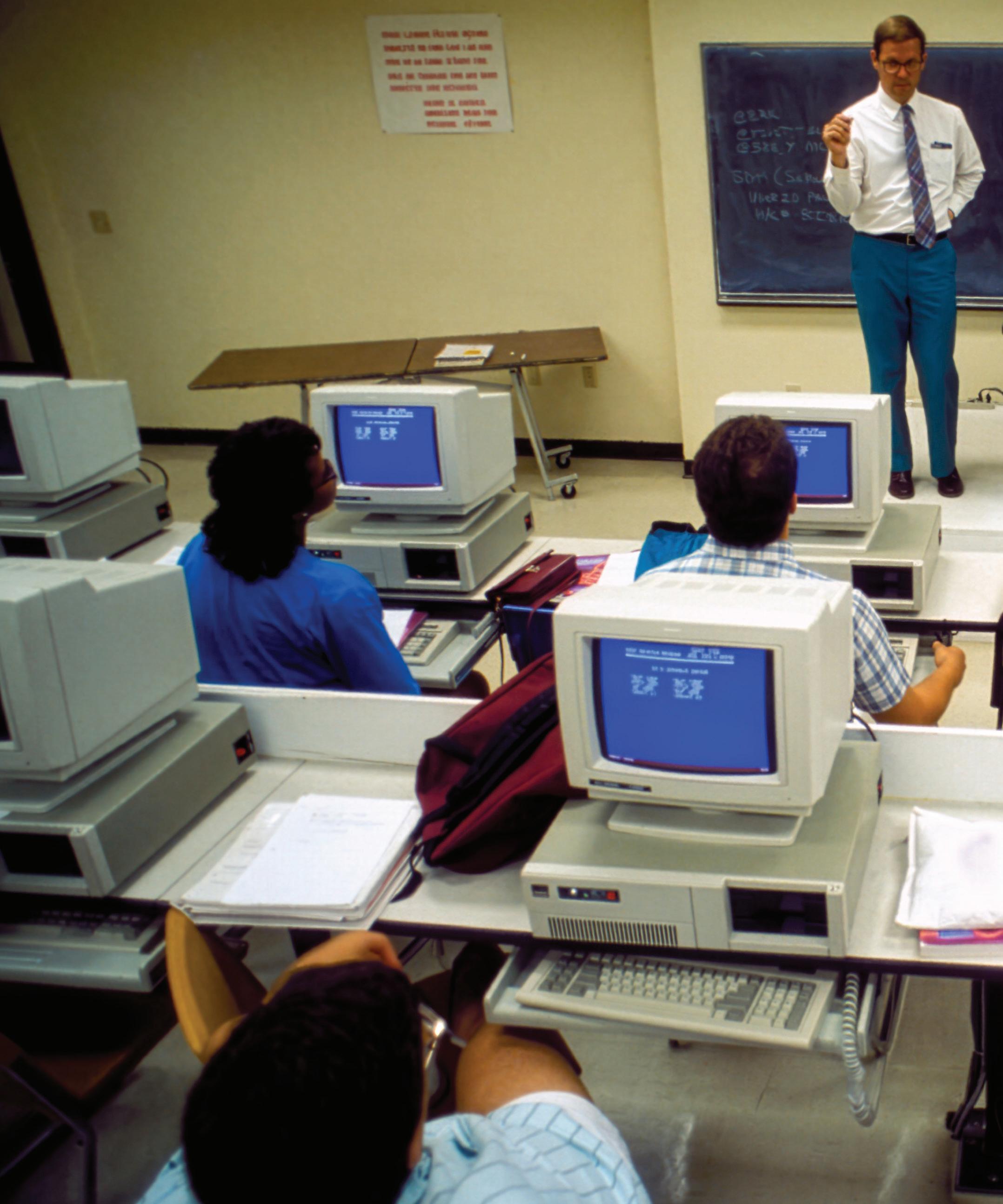
Found in the Office of Public Affairs photo archive, this image from 1998 shows a College of Business computer lab inside McCool Hall. Were you one of the students who studied here? Share your memories at alumnus.msstate.edu or by emailing alumnus@msstate.edu. Include your name, major(s) and graduation year(s). Your story could appear in a future issue.



www.alumni.msstate.edu
DUFF CENTER EXPANDS MSU’S REACH AND IMPACT
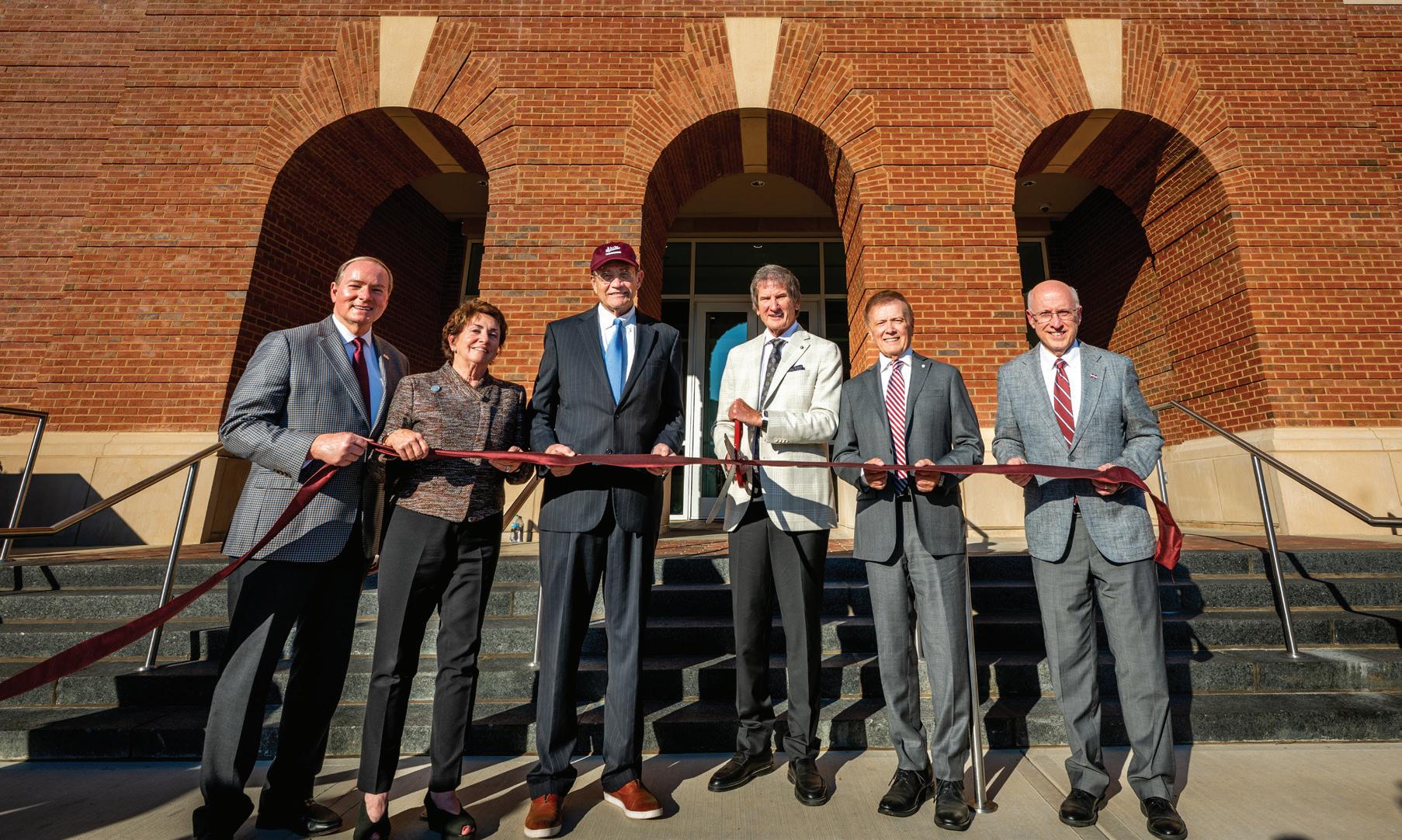
Mississippi State's new Jim and Thomas Duff Center—one of MSU's largest academic buildings—is now home to the Department of Kinesiology and key programs of the university’s Mississippi Institute on Disabilities. p. 14