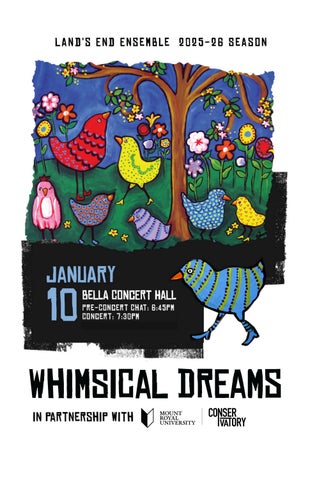
PROGRAM Pre-Concert Chat: 6:45 pm with Vincent Ho, Michael van der Sloot, and Laurie Matiation Giuoco delle coppie I. allegro barbaro (feat. Daryna Friesen) II. moderato non troppo (feat. Daryna Friesen) III. allegro pesante (feat. Luca Todea) IV. lento non troppo (feat. Josephine Wen) V. allegro molto (feat. Sora Kim) VI. adagio (feat. Sora Kim)
Omar Daniel (CAN)
Celestial Garden
Vincent Ho (CAN)
The Strange Highway Lux Aeterna
Gity Razaz (USA) Michael van der Sloot (CAN)
INTERMISSION Piano Trio No.2: Triptych This Mirror has Three Faces Lera Auerbach (RUS/USA/AUS) I. Prelude (Left Exterior Panel) Moderato libero II. First Unfolding (Left Interior Panel) Allegro appassionato III. Second Unfolding (Right Interior Panel) Tempo di valse IV. Tell’em What You See (Center Panel) Allegro assai V. Folding – Postlude (Right Exterior Panel) Adagio nostalgico In C Dorian +
Frank Ticheli (USA)
Terry’s Whimsical Dream of Fanciful Birds…in C Vincent Ho (CAN)
LAND’S END ENSEMBLE Maria van der Sloot (violin) Beth Root Sandvoss (cello) Susanne Ruberg-Gordon (piano) Students from the MRU Conservatory Flute: Sam Hooper, Delara Aghagani, Nora Morad, Gabrielle Marquis, Christine Lebeuf Brass: Abi Adedeji (horn), Charlie Reid (trombone), Henno Johnson (trombone), Ben Kyba (trombone), Rachel Lock (horn) Piano: Roswell Reyes, Kathy Pham, Hannah Hodjati Violin: Daryna Friesen, Sora Kim, Josephine Wen, Luca Todea, Bowen Li, Eden Swalm, Sophia Venter, Gemma Liaw, Alysse Li, Oliver Linton, Chan Ying, Patrick Vu, Katrice Shu, Sofia Toncheva, Jessica Muchiri, Elyanah Richardson, Roya Hodjati Viola: Sophie Ryskine, Hannele Agbunag, Ethan Mung Cello: Charlie Sunie, Curtis Fok, Phoebe Xu, Porter Allred, Takumi Rodgers, Aaron Janse, Brenna Le May, Mateo Barcan, Boyan Zhu, Cindy Ma, Sky Chen, Teaghan Krahn, Isaac Park, Carlos Duque Moreno, Oliver Cheng, Ben Swalm
Double Bass: Thomas Tas, Madeline Ryan, Kristin Cousins Percussion: Sydney Ball, Eric Chan, Emily Lyu, Abram Schwonik, Mattias Walker
Continuing our partnership with Mount Royal University Conservatory, we are thrilled to present our third concert of our residency featuring students of their music program! We bring you more exciting works that push the boundaries of today’s performance practices and sonic experiences: Omar Daniel’s Giuoco delle coppie, Gity Razaz’s The Strange Highway, Lera Auerbach’s Piano Trio No. 2, Michael van der Sloot’s Lux Aeterna, and Vincent Ho’s Celestial Garden. For our grand finale, we present one ensemble performing Frank Ticheli’s In C Dorian on stage and another performing Vincent Ho’s Terry's Whimsical Dream of Fanciful Birds...in C from the balconies, AT THE SAME TIME! Thanks to the support and permission of these two composers, this will be the first time these two works will be presented in this way, highlighting the stereophonic effects of the Bella Concert Hall through spatialized (separated) ensembles.
PROGRAM NOTES Giuoco delle coppie (2 violins) - Omar Daniel (CAN) My inspiration for this work is the collection of violin duos by Bela Bartok. His work takes the form of a series of miniatures, each one very specific in both ‘mood’ and technical challenges. Indeed, they were pedagogical pieces meant for students. My work uses Bartok’s principle of miniature ‘character pieces’, and aims to exploit the broad technical possibilities of the violin, as well as explore a game-like approach to the relationship of the two violins. So, both violin parts are equally challenging and interesting (I hope…), and they engage in a continuous ‘cat and mouse’ relationship throughout the work. www.omardaniel.com Celestial Garden (6-hand piano) - Vincent Ho (CAN) When I was proposed the idea of writing a 6-hand work for piano for the 3-member junctQín Piano Collective, my first reaction was ambivalence. What could I possibly do with three players on one piano? After some contemplation on it, I realized that I already think in these terms when composing orchestral music – composing in three layers (foreground, midground, and background). So, composing for the full range of the piano with three pianists involved came surprisingly natural for me and was a fun way to discover what can be done when given these parameters. The work is in five parts. The first is a prelude that is built on various coloristic gestures that are expressed as musical “brushstrokes”. A simple theme soon emerges (played in the mid-range by the middle player) that is continuously repeated, leading into the second part of the work. The lower player joins in with a groovy chord progression harkening the spirit of blues and jazz. The upper player then completes the texture with music inspired by the sounds of gamelan music. Together they create a polyphonic fabric of three distinct layers of music, each one inspired by different musical traditions – jazz, Chinese folk, and gamelan.
As the music builds to a climax, we are soon plunged into the third section – a fast-paced 3-part fugato. Each line “chases” one another while getting shorter and shorter in length, eventually getting caught up in a motivic frenzy. This then leads into a climactic dance that is propelled by a constant beat, as played by the lower player, while the middle and upper players unleashes with the gamelan-inspired music from before. The fifth and final part of the work is a postlude, built on other coloristic gestures like those of the opening prelude, that brings everything to a calm while providing relief from the highly kinetic journey that the players have undergone. www.vinceho.com The Strange Highway (cello octet) - Gity Razaz (USA) The inspiration for The Strange Highway comes from the eponymous poem by the Chilean writer and poet Roberto Bolaño, also the author of the novel, 2666. I was moved by the subtle but potent sense of desolation and vulnerability expressed through the poem’s powerful imagery. My attempt in writing the piece was to capture and recreate these emotions through rhythmic and violent opening and closing sections that engulf a lyrical, emotionally and dramatically charged middle section that uses dense, contrapuntal melodies and rich harmonies. www.gityrazaz.com
Lux Aeterna (cello ensemble) - Michael van der Sloot (CAN) Latin for "eternal light", the lux aeterna is usually encountered as a final movement of a liturgical requiem. In this case, it is the ending of a larger work of mine in the making, Missa borealis. The movement is scored for between 6-12 cellists with or without amplification performing from two open-form aleatoric parts where the performers move forwards or backwards in the music at their own individual discretion. still life locked in a crystal embrace, sweetest sound of silence, suspended peace of timeless night, and clarity of dreamless sleep an empty window to warmth forgotten without a thought nor love of dawn www.michaelvandersloot.com Piano Trio No.2: Triptych - This Mirror has Three Faces - Lera Auerbach (RUS/USA/AUS) I like the idea of exploring the dramatic, ritualistic side of music. In The Mirror With Three Faces, one can look at three different faces or roles of the same person or at three distinct personalities - each with its own face. Each character (i.e. instrument) may be isolated, in conflict, or in harmony with others and itself. This trio explores individuality and ensemble, harmony and conflict, one in three or three in one – that is the ambiguous nature of this work, structured in the form of a triptych. https://leraauerbach.com
In C Dorian (flexible ensemble) - Frank Ticheli (USA) Composed in the wake of the 2020 COVID-19 pandemic, this piece sprang from a need to create music for musicians during a time when full ensembles could not meet altogether in a closed space—a piece that could be played by any combination of instruments and in any number. An important catalyst for the piece is the 1960’s musical movement known as Indeterminacy. Works such as Terry Riley’s In C, John Cage’s Music of Changes, and Lutoslawski’s Venetian Games invite performers to make certain creative decisions within clear (and sometimes not so clear) structural frameworks. Marked by flexibility in terms of duration, instrumentation, and many other parameters, this now 50-year-old musical movement can now be seen as a kind of harbinger of our present day. It suggests one of many possible pathways forward as we seek ways to nurture live music during this challenging time. www.manhattanbeachmusiconline.com/frank_ticheli Terry’s Whimsical Dream of Fanciful Birds…in C (flexible ensemble) - Vincent Ho (CAN) During the 2020 COVID-19 pandemic there was a need for compositions that were adaptable to any instrumentation. A number of works were written to fulfill this need, such as Frank Ticheli’s In C Dorian and Thomas Adés’ Dawn. This concept was new to me and I was inspired to try my hand at it. As a starting point, I turned to Terry Riley’s famous work In C as a model. Riley’s piece represents the musical concept known as indeterminacy, where various aspects of a musical work are left open to chance or to the interpreter’s choice. This provides great flexibility in many areas – dynamics, duration, instrumentation, etc.
Similar to Riley’s work, I created my own collection of musical “cells” and cast them in the key of C major (with some cells using chromatic inflections). My piece differs from Riley’s in that I used many of the bird-like motifs and gestures I had been developing in my Whimsical Sketches of Fanciful Birds series (for saxophone). Thus, this work is my own take on indeterminacy, inspired by Riley’s In C, but expressed in my own way using motifs that evoke a gathering of birds. I dedicate this work to Frank Ticheli, whose own composition In C Dorian inspired me to follow this creative direction, and to Mathew S. James (Artistic Director of Timepoint Ensemble) for commissioning this work. www.vinceho.com
Thank you to this season’s supporters: