WOODSTOCK COMMUNITY TRUST Assisting Local Families
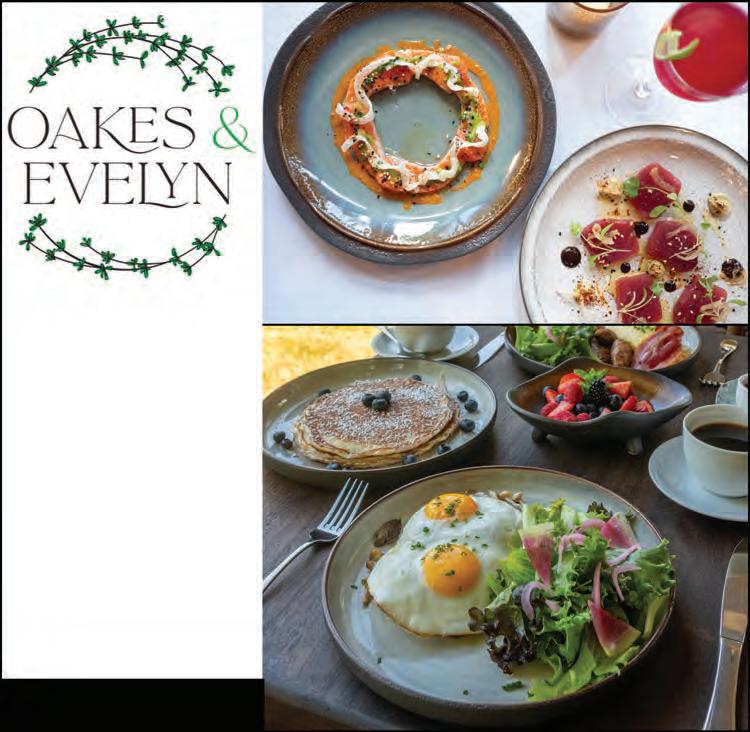
OAKES & EVELYN Fine Dining at The Jackson
WOODSTOCK HOME Gifts Galore!
Katherine P. Cox
By Stephen D’Agostino
By Susan B. Apel
Cassie Horner
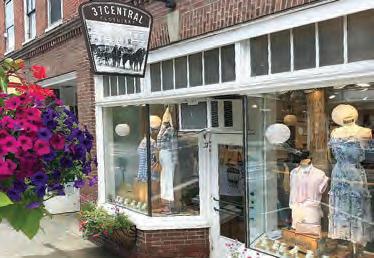
21 Central St, Woodstock, VT
MOUNTAIN VIEW PUBLISHING, LLC
135 Lyme Road, Hanover, NH 03755 (603) 867-9339
greateruppervalley.com
Publishers Bob Frisch
Cheryl Frisch
Executive Editor
Deborah Thompson
Associate Editor
Kristy Erickson
Creative Director
Ellen Klempner-Beguin
Art Director
Brad Wuorinen
Ad Design
Melanie Marston
Web Design
Locable
Inbound Marketing Manager Erin Frisch Newton
Advertising Ryan Frisch
KEEP US POSTED
Woodstock Magazine wants to hear from readers. Correspondence may be addressed to: Letters to the Editor, Woodstock Magazine, 135 Lyme Road, Hanover, NH 03755. Or email us at: dthompson@mountainviewpublishing.com. Advertising inquiries may be made by email to ryanfrisch@mountainviewpublishing.com.
As winter settles in for the next few months, we bundle up in our warmest coats, scarves, and gloves to venture outdoors. The weather forecast may call for snow, ice, sleet, or freezing rain, but as tough and sturdy New Englanders, we’re prepared for whatever Mother Nature throws at us. Besides enjoying the outdoor fun of skiing, ice skating, and sledding, it’s the time of year filled with festive celebrations and cherished traditions—it’s the holiday season!
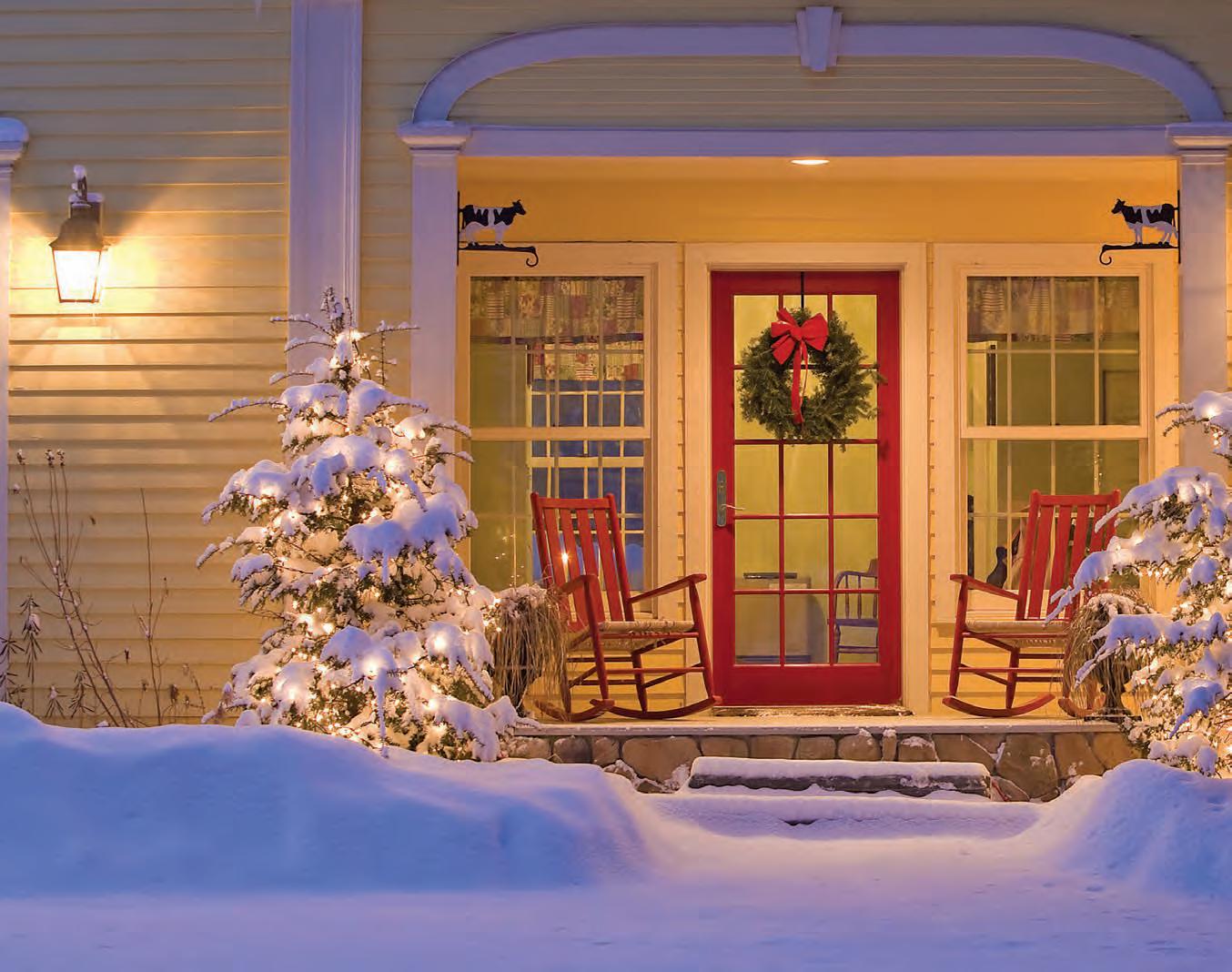
Everywhere you look you see twinkling lights, shimmering evergreen trees, and welcoming wreaths, creating an atmosphere of warmth and joy amid the winter chill. Families gather to share meals, exchange gifts, and spend time together. One of the most powerful aspects of the season is the emphasis on community, a time for reaching out to those in need. There are many opportunities to participate in charitable drives and community service, and many of our friends and neighbors step up to do their part all year long.
One such group is Woodstock Community Trust, whose mission is to “empower teams to carry out local projects to improve the quality of life in our community.” More than 70 volunteers now work on the eight projects under the Trust’s umbrella. Our feature story beginning on page 44 focuses on Local Deeds, but we’ll be doing a series of stories in the coming year on other groups they assist.
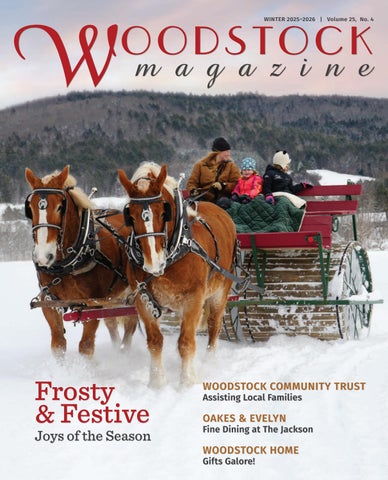
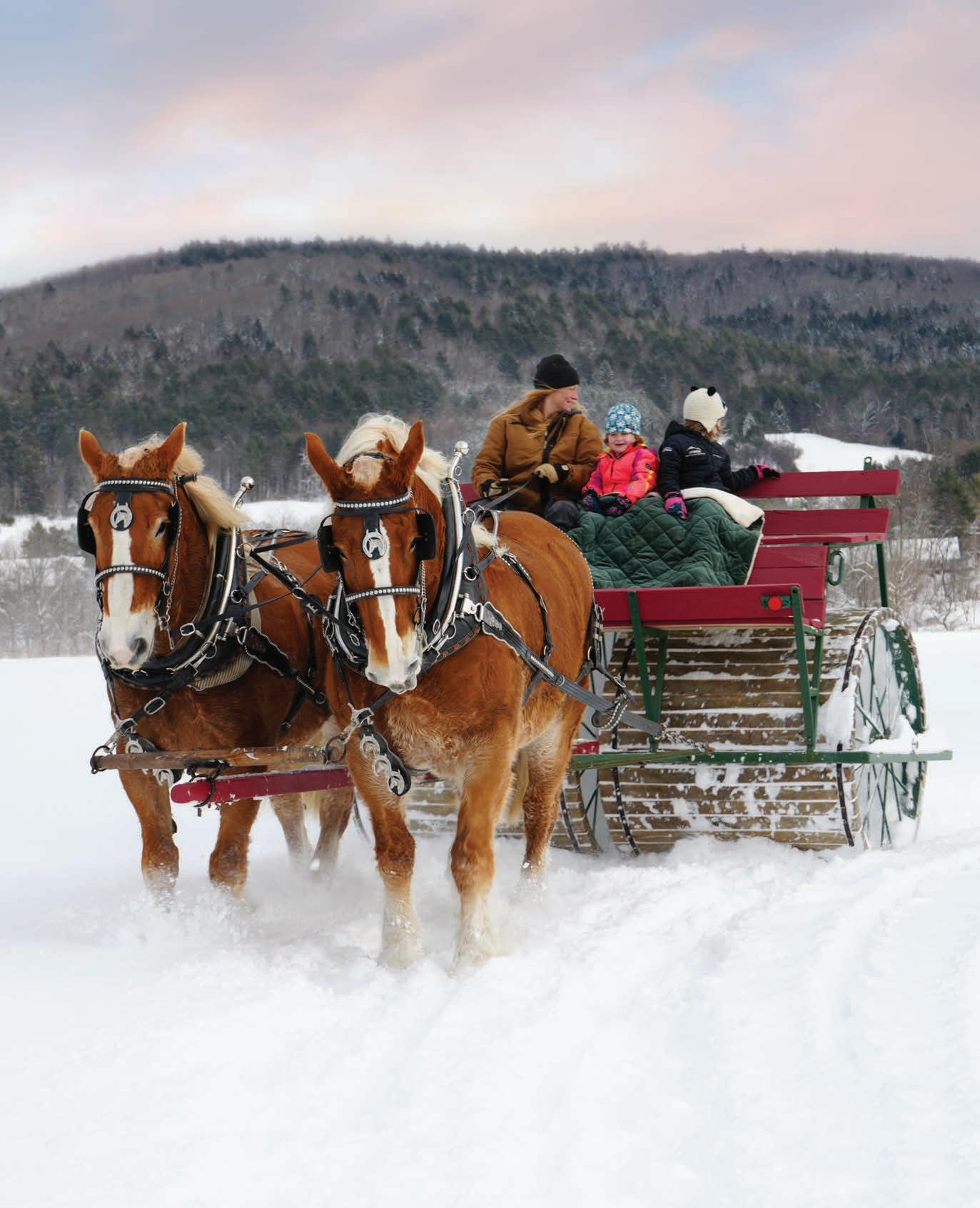
To warm winter’s chill, we’re visiting Woodstock Home to get you in the mood for the season (page 52). Owners Scott and Tara Layne’s charming decorations make the store warm and inviting, so drop in soon with your shopping list. We’re also taking time out to dine at Oakes & Evelyn at The Jackson, where Chef Justin Dain is preparing wonderful meals to savor in a beautiful, relaxing setting (page 62). The History Center’s article about past snowy winters in Woodstock highlights some charming old photographs (page 30), including a snow roller like the one shown on our cover. Nori Pepe of Billings Farm & Museum says snow rollers were used in the past to compress snow on downtown streets for horse-drawn sleigh traffic and mail delivery. It’s very special to know they’re still using a piece of this nostalgic equipment at Billings Farm.
Despite the chill outside, this time of the year brings warmth to our homes and hearts, reminding us of the importance of reflection, gratitude, and togetherness. Whether you celebrate Christmas, Hanukkah, or Kwanzaa, we wish you and your family a joyous holiday. Enjoy!
Susan shuttered a lifelong career as a law professor to continue an interest (since kindergarten) in writing. Her freelance business, The Next Word, includes literary and feature writing; her work has appeared in a variety of lit mags and other publications including Art New England, The Woven Tale Press, The Arts Fuse, and Persimmon Tree. She connects with her neighbors through Artful, her blog about arts and culture in the Upper Valley. She’s in love with the written word.
A full-time freelance writer and photographer, Lisa is a graduate of Dartmouth College who resided in the Upper Valley for another 25 years. She is the author of 13 books, including Best Hikes with Dogs: New Hampshire and Vermont, Hiking the White Mountains, and Hiking the Green Mountains. She covers all types of travel, outdoor recreation, and conservation topics for over 25 magazines. www.LisaBallardOutdoors.com
Pamela has been a journalist in Connecticut for more than 25 years and is the founder of PMB Writing & Consulting, providing editorial and marketing services to small and large businesses. She is also the author of Faithful Love, a contemporary romance-adventure novel. In her free time, Pamela enjoys playing tennis, gardening, drawing, and spending time with her daughter Alexis and her mini Goldendoodle Rafa and Mal-Shi Andy.
Kathy is a freelance writer and former writer and editor for The Keene Sentinel in Keene, New Hampshire. Her work has also appeared in the anthology Beyond the Notches: Stories of Place in New Hampshire’s North Country. She was also a writer and producer for Captured Light Studio, Inc., a video and interactive production company in Keene. Kathy likes to garden, travel, and hike, often combining hiking and traveling in one trip. She is a volunteer trustee on her local library board of trustees.
Nancy is the owner of Photos by Nanci, a photography business she started in 2009. She’s had a camera in her hand since she was in grade school and has honed her skills working for various newspapers: UMass Daily Collegian, The Campus Connection, The Valley News, and the Vermont Standard as well as Mountain View Publishing. She is also the codirector of the Covered Bridges Half Marathon race that takes place on the first Sunday in June.
Susan B. Apel
Lisa Ballard
Pamela Brown
Katherine P. Cox
Nancy Nutile-McMenemy
www.greateruppervalley.com/newsletter
Follow Us on Facebook www.facebook.com/greateruppervalley Find
www.greateruppervalley.com is proudly brought to you by: community sponsor
5 Places to Grab a Holiday Drink Unwind after work with friends over festive holiday drinks and cheerful conversation.
Positive Pie and Farmer and the Bell Open in Woodstock Woodstock, Vermont, has had exciting news with the opening of two new restaurants: Positive Pie and Farmer and the Bell.
The Upper Valley’s 2025 Holiday Gift Guide
Explore our hand-selected local favorites to make holiday shopping stress-free, fun, and filled with the local spirit!
ONLINE ADVERTISERS INDEX
Check out these local businesses in our directory.
3 PHASE LANDSCAPING, LLC
ALIGN INN VERMONT
BELLETETES
CALDWELL LAW
CAPPADOCIA CAFE
CARPENTER & MAIN
CHAPMAN’S GENERAL STORE
COLBY INSURANCE GROUP
CO-OP FOOD STORES
COPELAND FURNITURE
CROSSROADS ACADEMY
DARTMOUTH AUTHENTIC
DATAMANN
DB LANDSCAPING
DESIGNER GOLD
DR. NEELY-HANOVER ORTHODONTICS
DUTILLE’S JEWELRY DESIGN STUDIO
EYEGLASS OUTLET
FORE-U GOLF CENTER
GILBERTE INTERIORS
HANOVER EYECARE
HUBERT’S FAMILY OUTFITTERS
IVY IV AESTHETICS
JEFF WILMOT PAINTING & WALLPAPERING, INC.
LAVALLEY BUILDING SUPPLY
LITTLE ISTANBUL
LOCABLE
MARTHA E. DIEBOLD REAL ESTATE
MB PRO LANDSCAPE DESIGN
MORNINGSIDE FLIGHT PARK
MVP MARINE
POWERHOUSE MALL
RAMUNTO’S OF CLAREMONT
RICHARD ELECTRIC
RIVER ROAD VETERINARY CLINIC
RODD ROOFING
SIMPLY BEAUTIFUL EVENTS
STATELINE SPORTS
THE FLYING GOOSE
THE GILDED EDGE
THE HANOVER INN AT DARTMOUTH COLLEGE
THE PUBLIC HOUSE
THE WORKS CAFÉ
TOP STITCH
TUCKERBOX
UPPER VALLEY BUSINESS ALLIANCE
VILLAGE PIZZA VINS
WHITE RIVER FAMILY EYECARE WISE
WOODSTOCK AREA CHAMBER OF COMMERCE
WOODSTOCK INN & RESORT
For more information about how your business can get listed on our ONLINE BUSINESS DIRECTORY or for other online advertising opportunities, contact Ryan Frisch at (518) 365-0030 or email ryanfrisch@mountainviewpublishing.com.
By Cassie Horner
Billings Farm & Museum
Torchlight Snowshoe
A Magical Winter Stroll
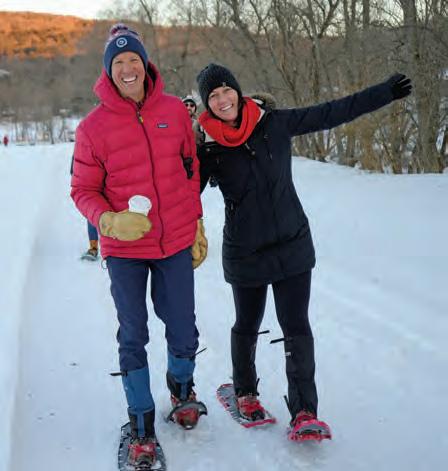
Snowshoeing is a great activity up here in the north country. In addition to being a fun way to get good exercise, you don’t need a lot of fancy clothing as long as you’re warm. You don’t even need fancy snowshoes, or to be particularly adventurous. And you can go at your own pace and still get a lot out of the activity and have the opportunity to contemplate the beautiful surroundings of winter.
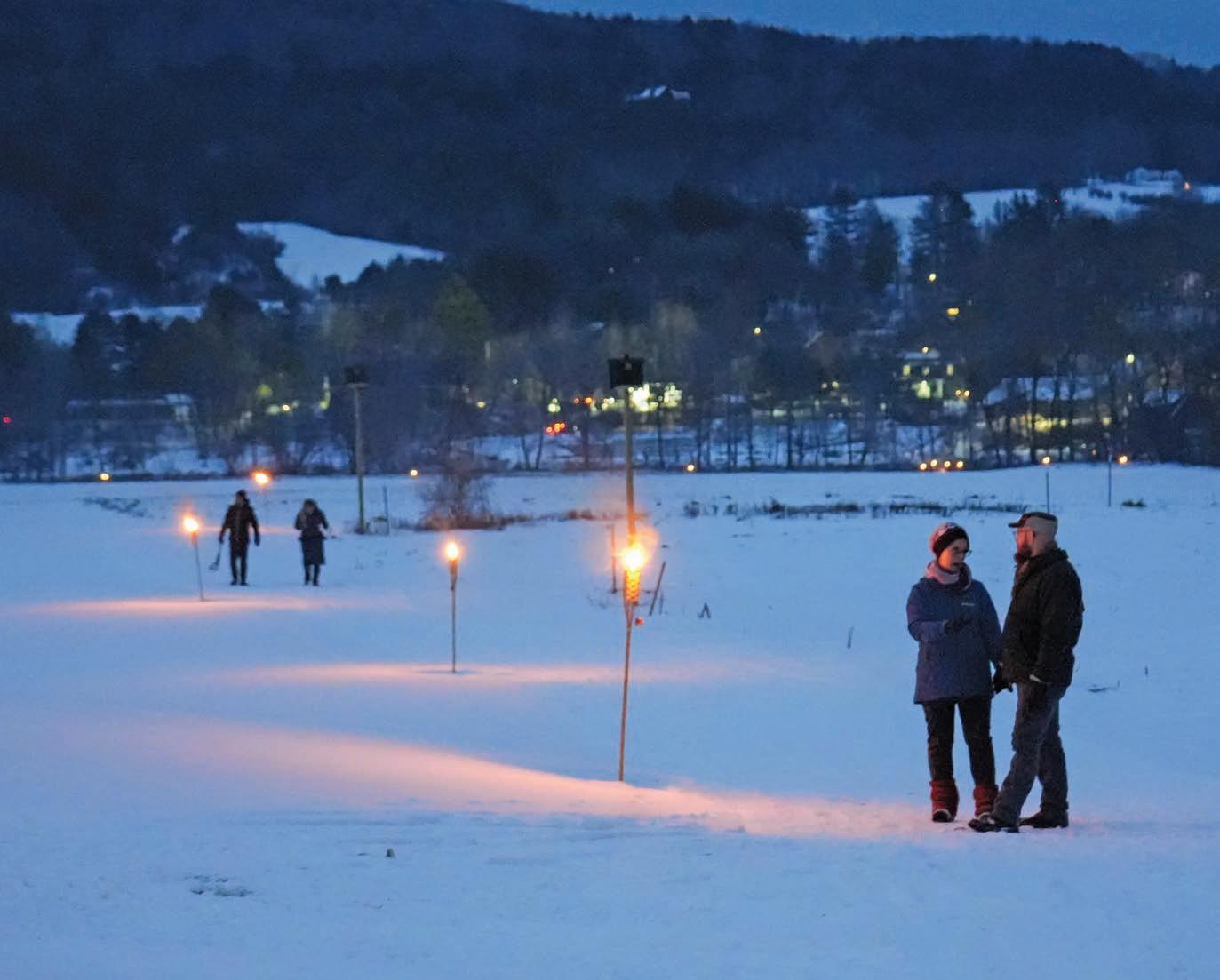
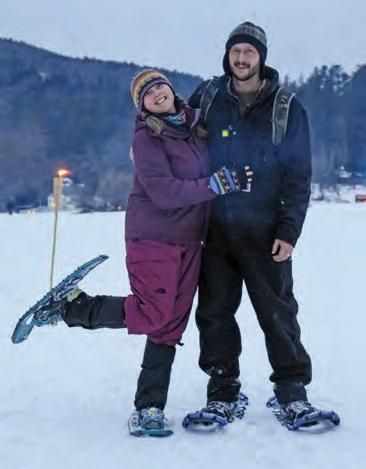
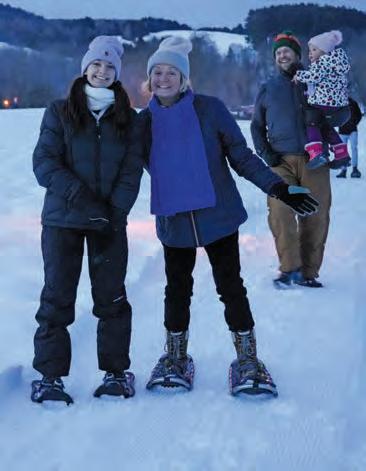
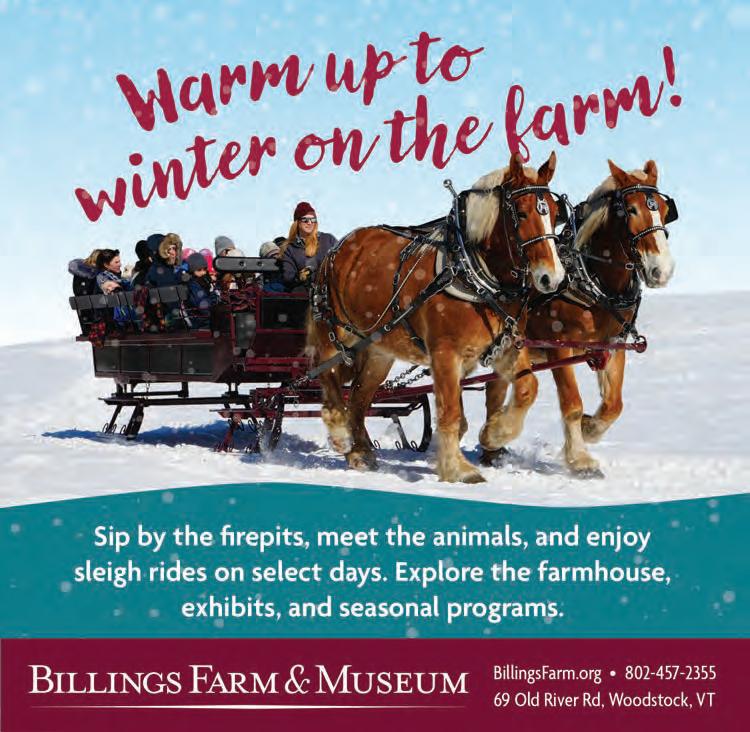
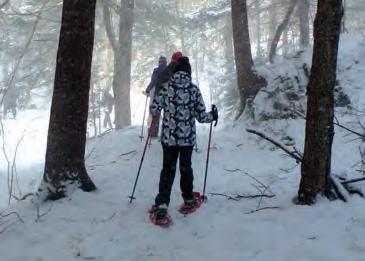
For a lovely outing with family and friends, visit Billings Farm & Museum in Woodstock for a magical torchlit stroll. Light up a winter evening on Friday, January 16 and Friday, February 13 from 4:30 to 6:30pm with a walk, ski, or
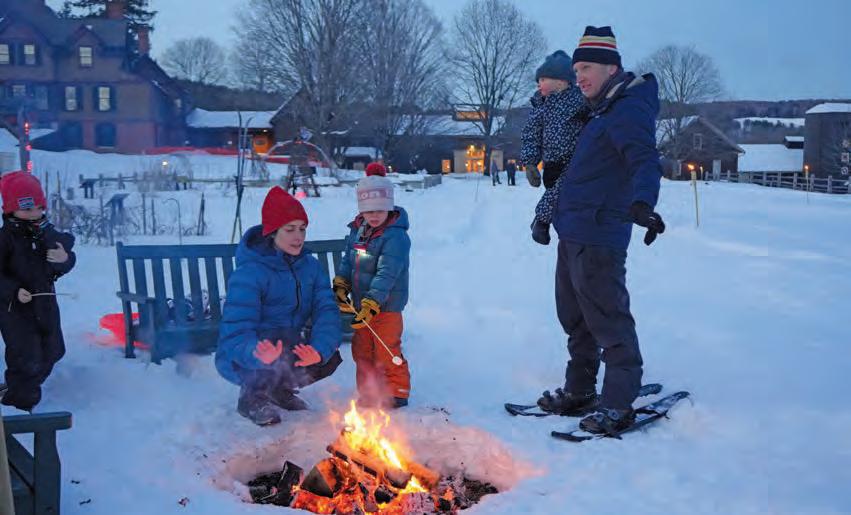
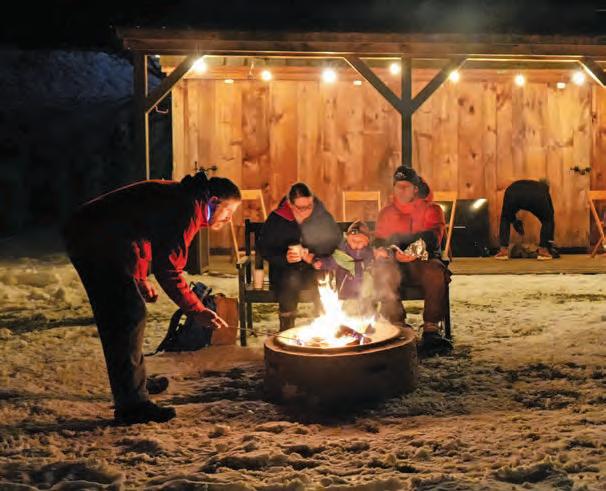
snowshoe along a torchlit path through the pastures at the farm. Meet educators to learn about the history of the landscape, the people who lived here, and the local wildlife. Gather by the fire to warm up and enjoy complimentary s’mores and cocoa.
Bring your snowshoes if you have them. A small number of adult- and child-sized snowshoes will be available to borrow, but it is recommended that people without snowshoes rent them in advance from the Nordic Center at the Woodstock Inn & Resort. The Nordic Center closes at 4pm. Bring a headlamp or a flashlight to enhance your enjoyment of the event as you navigate the
pasture between torches.
Participants may register in advance; tickets go on sale on December 1. Walkins are also welcome. The cost is $12 for adults, $7 for children (children ages two and under are free), and $5 for members (member children 15 and under are free). For more information and tickets, visit billingsfarm.org/torchlightsnowshoe/.
BILLINGS FARM & MUSEUM
billingsfarm.org/torchlight-snowshoe/
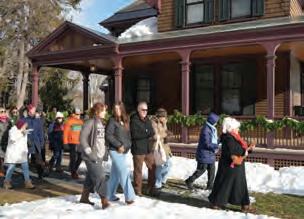
Guests enjoy walking, skiing, and snowshoeing along the torchlit Billings Farm Loop.
From adventures with loved ones to families and friends gathered around the fire toasting marshmallows for s’mores, the Torchlight Snowshoe event is a winter evening for all ages to enjoy.
30 Years of Ottauquechee Health Foundation
Meeting the Community's Health-Care Needs
In 1996, the estate of Woodstock philanthropist Gertrude Mertens supported the start of the Ottauquechee Health Foundation with a bequest. Almost 30 years later, the organization continues to help pay for some of the health and wellness needs of residents of Woodstock and eight other towns in the area. The nonprofit approves about 225 grants annually for a variety of medical services including dental procedures, physical therapy, eye care, and medical items such as hearing aids and lift chairs. Sometimes the grants are small—for example, paying $100 for a driver to bring someone to an appointment. Sometimes the grants are large—paying $5,000 for a
complicated dental procedure.
The grants fall largely into two categories, ranging from the Good Neighbor Grants to the homecare program that helps people stay home with the support of trained health-care providers. Ottauquechee Health Foundation also gives three to four scholarships each year. Community grants support programs such as Summer Soak that helps kids get outside, and therapeutic experiences with horses at MoonRise Therapeutics in Taftsville.
“We are experiencing an increasing need,” says David Sleeper, OHF’s executive director since February 2025. “We see an uptick in people applying for
The nonprofit approves about 225 grants annually for a variety of medical services including dental procedures, physical therapy, eye care, and medical items.
grants. We’re worried that with Medicaid changes there will be a flood of new people needing help.” Fortunately, OHF relies for part of its funding on an endowment that has grown from the original Mertens bequest. Eight of the nine towns make an annual appropriation for OHF at town meetings in March. OHF also receives funding from foundations, including the Green Mountain Foundation and the Jack and Dorothy Byrne Foundation, which made a $200,000 challenge grant in 2025. An annual mailing brings in money from citizens in local communities.
David brings years of experience working at nonprofits to his role at OHF. “My
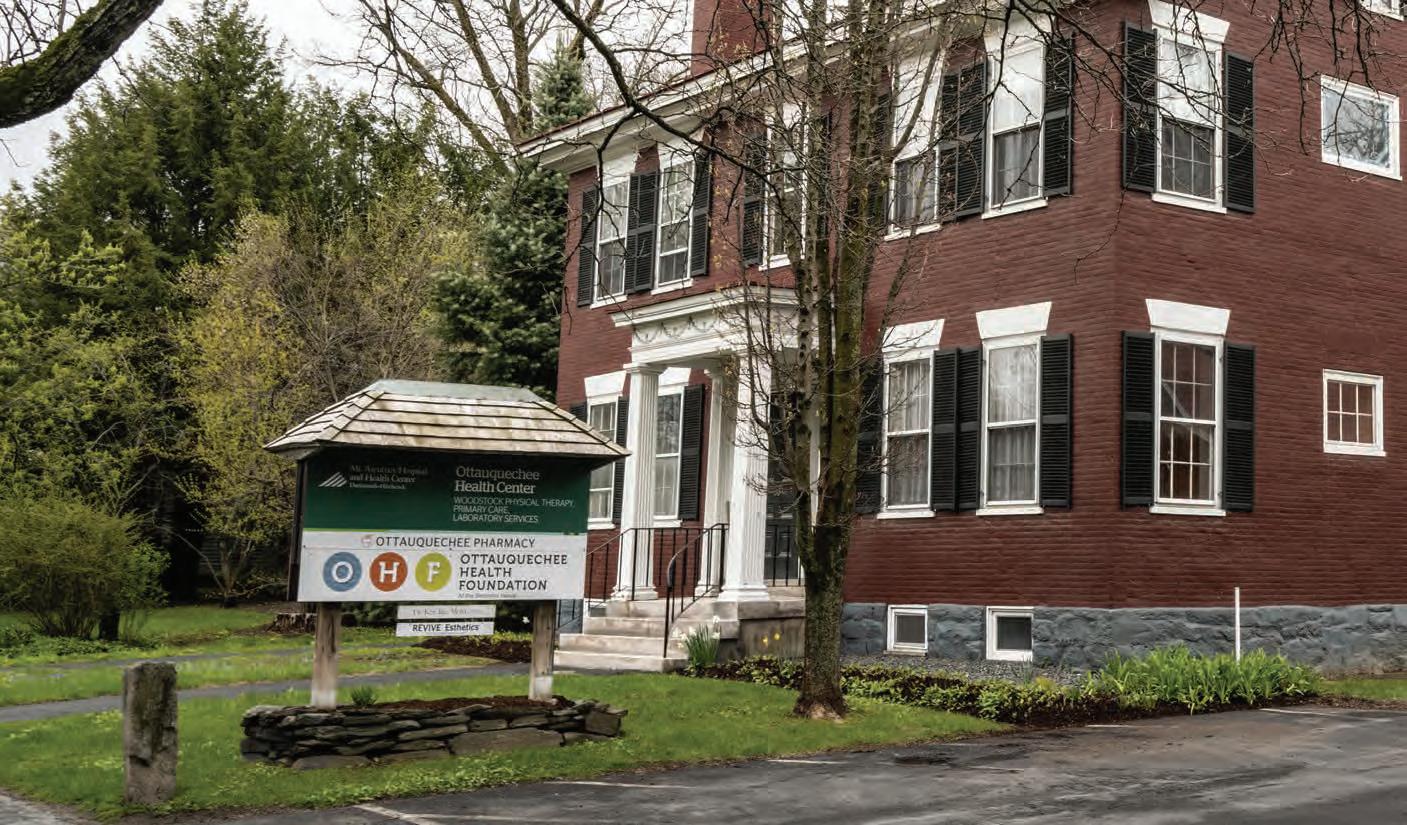
Simmons House at 30 Pleasant Street in Woodstock is home to the OHF offices.
job is to oversee the finances of the organization, including making sure our 10 tenants at Simmons House are happy, as well as Glad Rags, which uses the building’s basement for storage. I also work closely with our board of trustees, which sets policies for OHF, and with our talented staff, Lizzie Coelho, who oversees grants, and Grace McKeon, our administrative assistant.” His previous job was as executive director at Hubbard Brook Research Foundation, which supports one of the world’s longest-running ecosystem studies at the White Mountain National Forest in New Hampshire. He founded Vermont Magazine in 1989 and sold it in 2001.
David identifies the main challenge at OHF as meeting people’s growing health-care needs. “There are always challenges with running small nonprofits,” he observes. “We benefit greatly from working cooperatively with area nonprofits such as the HUB, Thompson Senior Center, local food shelves, community nurses, and others. We receive many referrals from the professional
medical community and from Carla Kamel, Woodstock’s Community Care Coordinator.”
For more information about OHF and how to apply for assistance, visit ohfvt. org or come to the office at the Simmons House at 30 Pleasant Street in Woodstock for an application. The nine
OHF towns are Barnard, Bridgewater, Hartland, Killington, Plymouth, Pomfret, Quechee, Reading, and Woodstock.
OTTAUQUECHEE HEALTH FOUNDATION
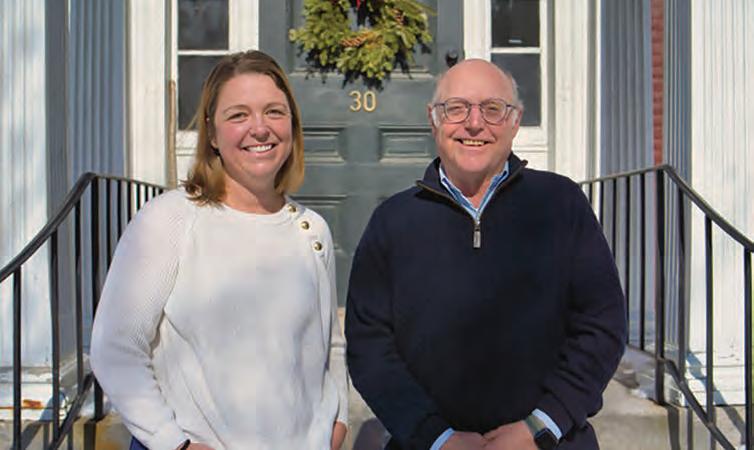
Lizzie Coelho, OHF’s grants coordinator, with David Sleeper, executive director.
West Woodstock Barns to Be Moved
Giving New Life to Old Structures
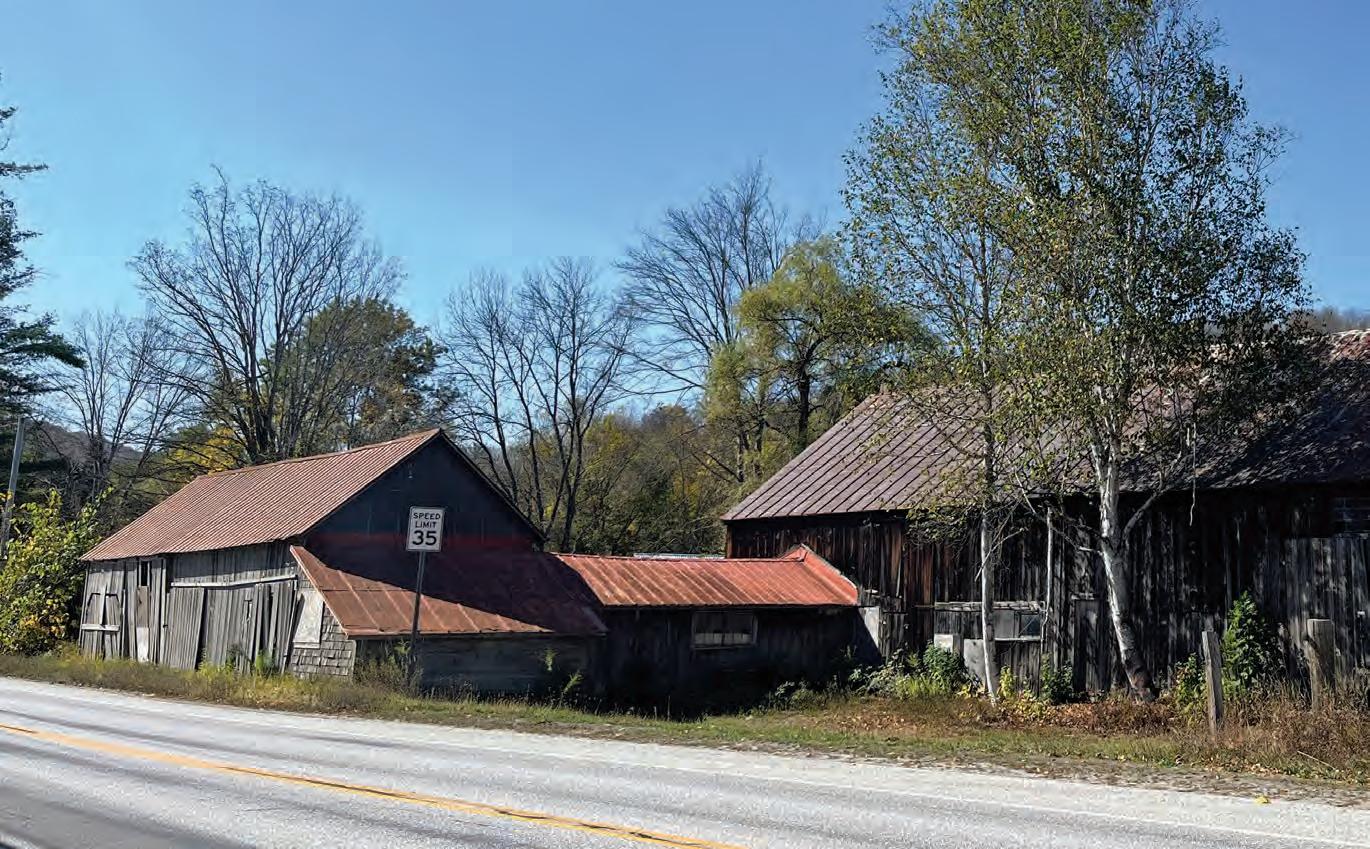
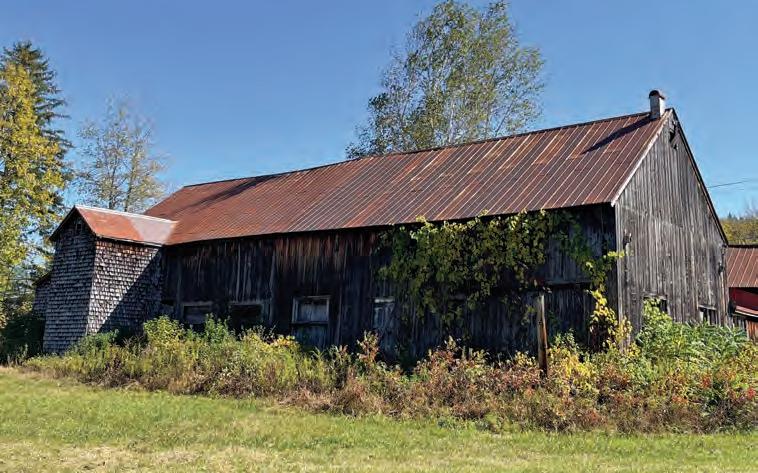
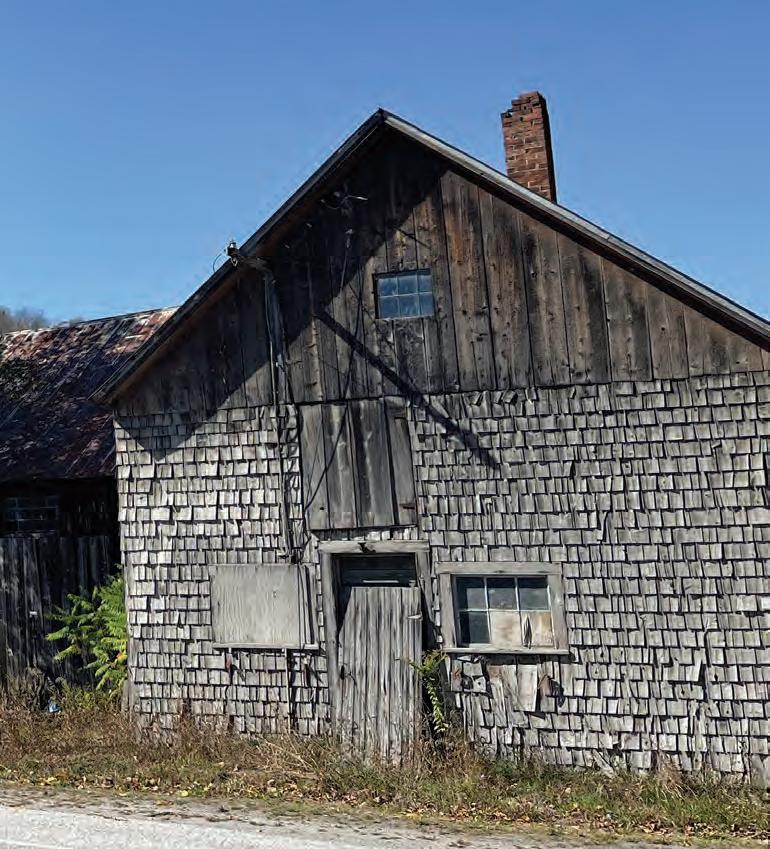
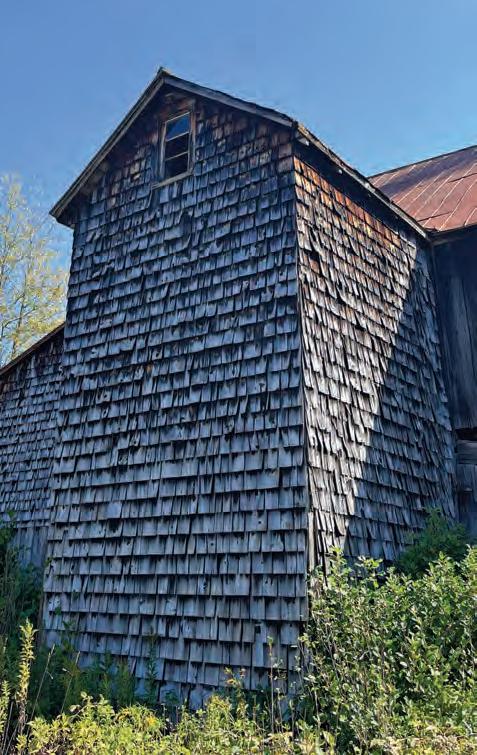
Abig change to the landscape of Route 4 in West Woodstock is coming this winter. Green Mountain Timber Frames of Middletown Springs, Vermont, will be removing and salvaging the landmark barns at the corner of Route 4 and Cox District Road. “It is sort of heartbreaking,” says Kit Nichols, whose family has owned the barns since the late 1960s. But the barns are so close to the road that years of snow plowing and salt have been hard on the structures. The best way to save them seems to be having them removed and repurposed.
In 1969, Kit’s grandfather Howard Nichols bought the four linked barns and farmhouse on Route 4 from Floyd Heselton in West Woodstock. Floyd had
The historic Heselton barns are currently owned by the Nichols family.
owned the property since about 1939, when he was reported to have had a foundation built for the farmhouse.
“I understood that one of the barns was built in the 1840s near the Ottauquechee River and moved up,” says Kit. “The other three date to the late 1800s or around 1900. In true Vermont fashion, they were added to and connected over the years. They were largely working dairy barns into the 1950s. Some of the existing cow stanchions are marked ‘Made in East Barnard.’ As Floyd aged, the farm got smaller and smaller.”
After Floyd sold the farm in 1969, he held an auction of his farming tools and equipment, along with six hens, a rooster, and a five-year-old registered Guernsey cow. It was the end of his farming career. But it was the beginning of a new life for the property. Pia Nichols, Kit’s mother, opened an antiques shop in the barns in 1977 that she ran from May to October until 1994.
“We kids would play in the barn and Floyd would be sitting by his flower
“The barns will have life somewhere else. It soothes my heart that they will live in another incarnation.”
— Kit Nichols, barns owner
gardens,” Kit says. “He was unbelievably generous. He’d let us kids pick flowers. ‘Take some to your mother,’ he’d say.”
The neighborhood was a wonderful place for kids. Kit recalls the kindness of Bob and Christine Jackson, who owned Seven Maples Inn (now The Jackson).
Summer play included visiting the river and a brook on Cox District Road, riding bikes to the Red Cupboard for candy, and biking to the Woodstock Recreation Center.
Joel Nichols, Kit’s father, was a concrete contractor. He stored materials in the barn, as did other local contractors such as John Doten, who rented space. Joel died in 2013 and Pia in 2021. The question popped up, “What are we going to do with the barns? They are clearly in bad
shape,” Kit says. “But they are beautiful and need to come down. The last thing I wanted was for them to end up in a landfill. The big barn is like a rural cathedral of post and beam. Where else are you going to find 20-foot hand-hewn beams?”
Enter Luke Larson of Green Mountain Timber Frames, the company that takes down old Vermont barns and saves the frames that are then reused in other structures in New England. “Luke is a historic preservationist at heart,” Kit says. “He reads the story of a barn from the way it was constructed.”
For Kit, taking down the barns is the best way to save them. “The barns will have life somewhere else,” she says. “It soothes my heart that they will live in another incarnation.”
A Charming Story to Share
Discover a local author’s Christmas fantasy
Enchanted Night Before Christmas is a fairy tale inspired by a real family tradition from turn-of-the-century rural Vermont. It is written by Michael Caduto, an award-winning author from Reading, Vermont.
Enchanted Night Before Christmas introduces us to the Sherman family, who doesn’t have much, but they take good care of one another and are generous to others, making gingerbread cookies as holiday gifts and decorating them to look like friends and neighbors. One Christmas Eve, after the family returns home from delivering their gifts and everyone falls fast asleep, something magical stirs, born in a star of snow, that will change their holiday—and their lives—forever.
Enchanted Night Before Christmas is a timeless fantasy that reminds us the most powerful gifts are the ones we give away. The story ends with a recipe for baking spicy gingerbread cookies from the King Arthur Baking Company in Norwich, Vermont. The book is published by Penguin.
ABOUT THE AUTHOR AND ILLUSTRATOR
Michael J. Caduto has written more than 20 books that have been published in numerous languages. The books have sold over 1.2 million copies worldwide and have received numerous awards, including the NAPPA Gold Award, Reading is Fundamental (RIF) Multicultural Book Award, Aesop Prize, Skipping Stones Award, and Storytelling World Award.
The book is beautifully illustrated by Igor Kovyar, who started drawing at the age of five and went on to receive a classical education in painting and drawing at the St. Petersburg School of Arts. Igor now works as a freelance illustrator, drawing and painting for magazines, books, advertising, and private commissions. He has illustrated more than 30 children’s books.
PROGRAMS FOR ENVIRONMENTAL AWARENESS & CULTURAL EXCHANGE (PEACE)
MEET THE AUTHOR IN WOODSTOCK
Saturday, December 20, 11am–12:30pm Norman Williams Public Library, Woodstock, Vermont.
Join the fun as Michael reads from and signs the book, then have fun decorating gingerbread. Cookies will be supplied by the pastry team at the Woodstock Inn. The program is cosponsored by the Yankee Bookshop. Space is limited and is on a first-come, first-served basis.
Prepare for a Winter Storm
Even during a mild winter, we all know that we’ll get at least one whopper of a storm here in Woodstock. The Centers for Disease Control and Prevention recommends the following tips to prepare and stay safe:
• Weatherproof your home. Insulate water lines that run along exterior walls, caulk and weather-strip doors and windows, insulate the attic, repair roof leaks, and cut tree branches that could fall on your home during a storm.
• Have your chimney or flue inspected each year. Install a smoke detector and battery-operated carbon monoxide detector. Test them and change the batteries twice a year. Also keep a multipurpose fire extinguisher nearby.
• Have your car serviced, replace windshield wiper fluid with a winter mixture, and keep the gas tank full.
• If you have to travel in a snowstorm, create an emergency kit for your car with a portable phone charger and extra batteries; hats, coats, mittens, and blankets; a windshield scraper and shovel; a flashlight with extra batteries; water and nonperishable food; a firstaid kit; cat litter or sand to help tires get traction; jumper cables; and hazard or other reflectors.
A Cup of Tea May Improve
Performance
DDID YOU KNOW?
Anti-inflammatory properties of ginger can reduce muscle soreness and circulation.improve
o you stay active outdoors all winter? You may want to warm up with a mug of green tea with ginger. A new study finds that green tea and ginger work both individually and synergistically to support endurance, fat oxidation, comfort, and recovery in a cold environment. Components in green tea (including caffeine) can enhance fat oxidation and increase energy expenditure, while ginger has anti-inflammatory properties and reduces muscle soreness and enhances comfort in cold temperatures by improving circulation.
Uplifting Aromatherapy
If the cold and darkness of winter have you feeling like your mood could use a boost, try aromatherapy.
“Essential oils are distilled from different plants, and they all have different [potential] actions,” says Yufang Lin, MD, of the Cleveland Clinic. Peppermint oil stimulates areas of the brain responsible for alertness, while lemon oil increases the neurotransmitter linked to lower levels of anxiety and depression. Rosemary stimulates mental clarity and focus, while sandalwood boosts attention and uplifts mood. Add few drops of pure essential oil to a cotton ball or a diffuser.
Keep Curious Pets Safe
If you’re planning to host Christmas or another family gettogether this winter, be aware that your pet’s curiosity and the scents of new people may lead them to rifle through your guests’ purses and winter coats. They could find medications, chewing gum, or other harmful items. Place your guests’ belongings in a coat closet or closed-off room where your pets won’t have access to them.
Sense of Purpose May Protect the Brain
Having a sense of purpose in life is not only personally fulfilling but may also protect against dementia. In a study of more than 13,000 people aged 45 and older, those who reported a higher sense of purpose had about 28 percent lower odds of mild cognitive impairment or dementia. The protective effect remained significant even if people had other risk factors for dementia or Alzheimer’s disease.
“Purpose is something we can nurture. It’s never too early— or too late—to start thinking about what gives your life meaning.”
— Dr. Thomas Wingo
“Our findings show that having a sense of purpose helps the brain stay resilient with age,” says senior researcher Dr. Aliza Wingo. Dr. Thomas Wingo adds, “What’s exciting about this study is that people may be able to ‘think’ themselves into better health. Purpose is something we can nurture. It’s never too early—or too late—to start thinking about what gives your life meaning.”
Lean Into a Hygge Lifestyle
The Danish term hygge (pronounced “hoo-gah”) is about taking time away from the rush of everyday life to be with the people you care about—or even spend time alone—to relax and enjoy life’s quieter pleasures. The term dates back to around 1800, and various definitions can be traced back to the Middle Ages, where a similar Old Norse word meant “protected from the outside world.” The setting is a cozy, quiet location. There is no agenda, just celebrating the small joys of life and taking the opportunity to unwind and slow down. The cold, dark, wet climate of Denmark—and Woodstock—makes winter an ideal time for hygge. Whether alone or with friends, gather the candles, comfy clothes, and soft blankets and enjoy special moments of relaxation and appreciation this winter and beyond.
DYK?
An Old Norse word similar to hygge meant “protected from the outside world.”
Woodstock Village in Winter
The beauty and challenges of a snowy season
By Cassie Horner
Photos courtesy of the Woodstock History Center
Woodstock is a lovely village made even lovelier by freshly fallen snow. Historical photos bring that beauty to a special kind of life as viewers drop into the past.
Most of the winter tasks that 21st-century residents and visitors take for granted were vastly different. Forget the noise of metallic blades mounted on big trucks to plow the paved streets. Forget the ease of turning a dial mounted on your home’s wall to increase the temperature. Forget a quick car trip to the grocery store to buy milk and butter. Old photos reveal the realities of the hard work needed to clear snow, heat homes and businesses, and stock the pantry.
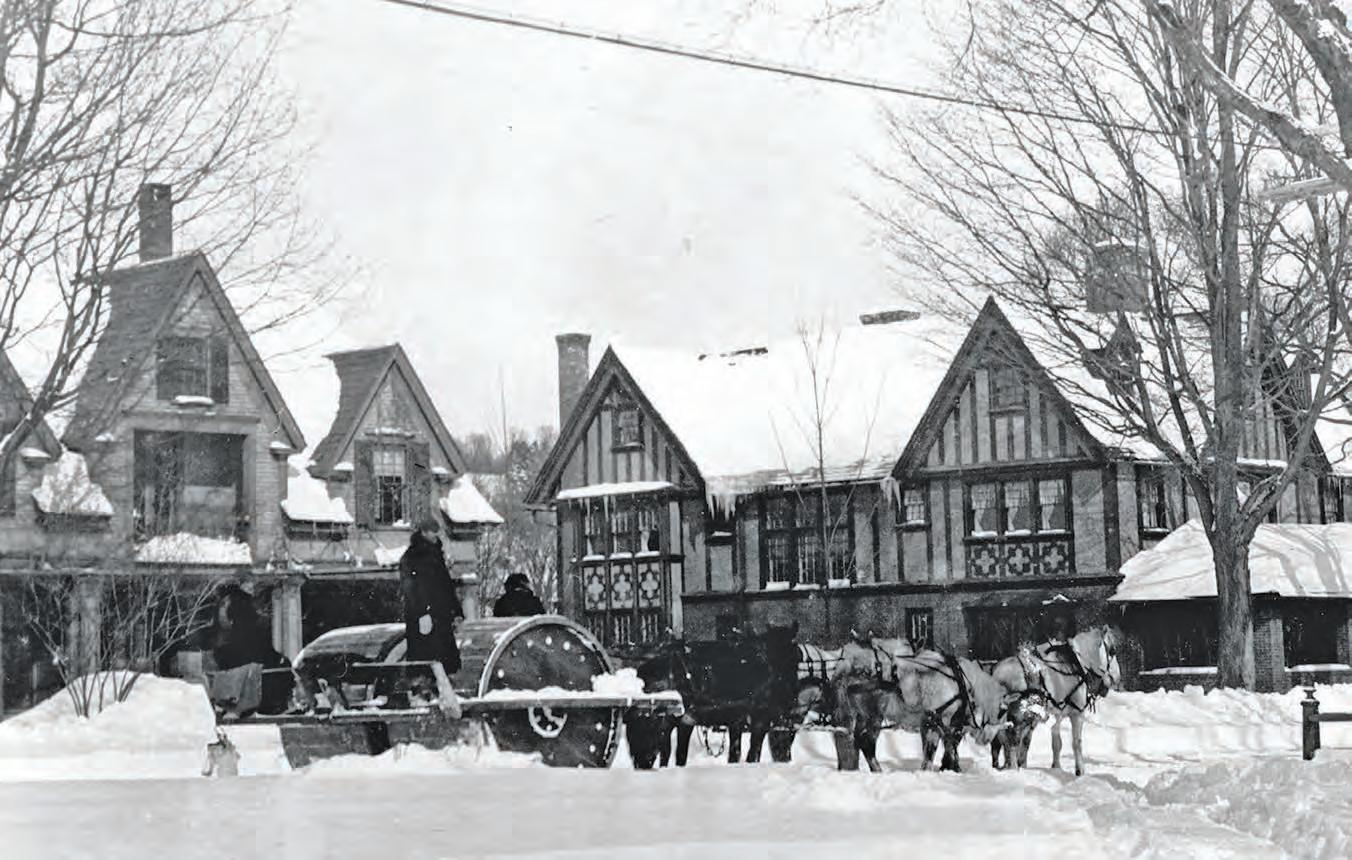
Top: Snow rolling near the Green, c. 1920.
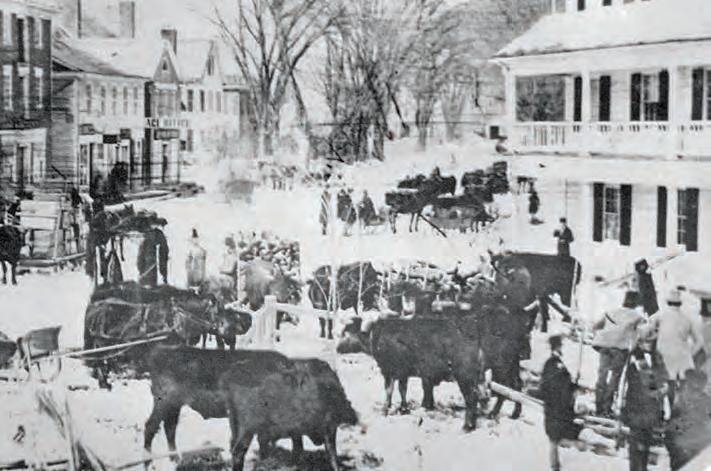
Above: Oxen deliver loads of firewood in the village square, c. 1859.
KEEPING WOODSTOCK GOING
A photo from 1859 captures the busy scene in the center of the village where multiple teams of oxen, guided by farmers, pull loads of wood on sleds. This product was in high demand in a cold, snowy winter when it was needed to keep woodstoves and fireplaces pumping out heat.
The main activity in another photo near the Village Green is a mystery until the equipment attached to the horses is explained. Long before snowplows, people used enormous wooden rollers to flatten the snow on the roads so they were passable for sleighs and sleds. Hitched to a team of horses or oxen, the snow roller featured an uncomfortable seat where the man holding the reins would be perched. No job was perhaps as cold and miserable.
As modern Vermonters and visitors clean snow off their cars or shovel a path from the door to the driveway, they would do well to remember the generations preceding them toiling and playing in the white stuff that falls anywhere from October through May.
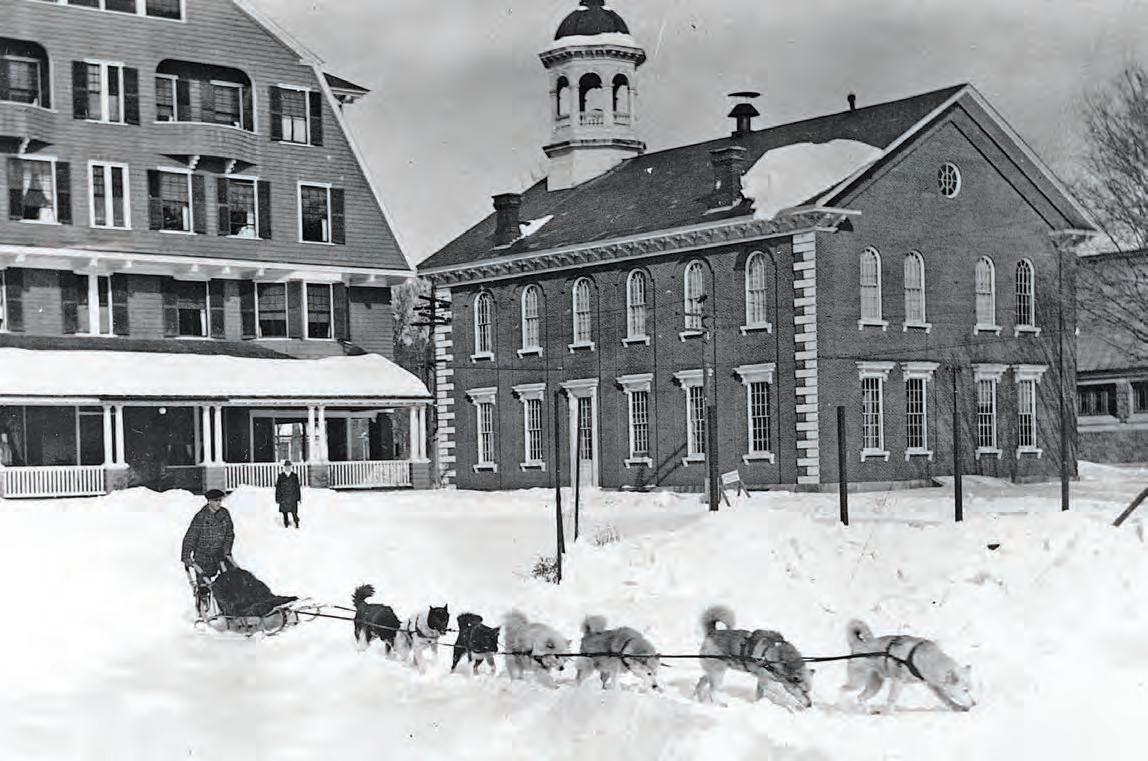
Above: Dog team behind the Woodstock Inn, c. 1930.
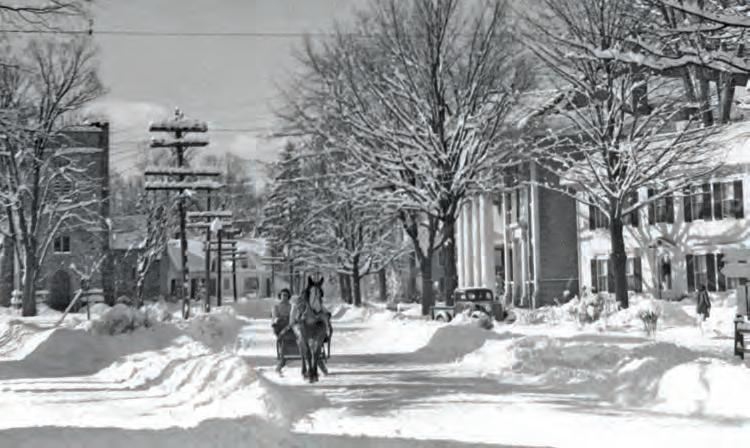
Right: Winter roads in front of Town Hall, c. 1943.
In later years when automobiles were common, men shoveled snow by hand in the center of the village, loading it into trucks that dumped the snow off the iron bridge on Elm Street into the Ot-
tauquechee River. In a winter with lots of snow, the dumped snow could pile up as high as the bridge. Maneuvering autos on slick plowed surfaces was a challenge, requiring that the hills be sanded.
Other men that toiled at their jobs all winter included the mailman delivering the mail by clambering through drifts
in front of people’s houses and G.W. Clarke, who delivered butter on Saturday in the village with his small sled pulled by one horse.
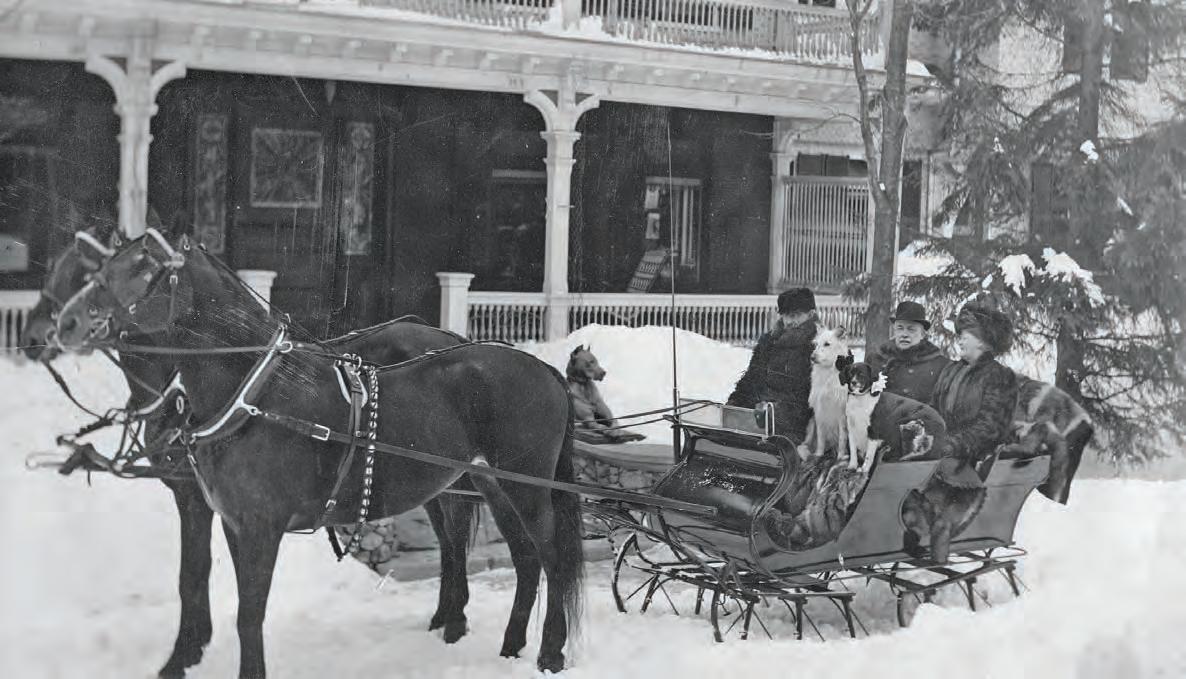
Transportation in the early days of the village depended heavily on horses and oxen. The romance of a horse-drawn sleigh is evident in a photo from the ear-
Frank and Lucy Mackenzie in a horse-drawn sleigh on Bond Street, early 1900s.
ly 1900s. The beautiful wooden sleigh is occupied by Lucy Mackenzie, her husband Frank (who founded the local humane society in her memory), and two dogs seated up front with driver Will Bradley. The group is stopped in front of the Mackenzie house on Bond Street.
DON’T FORGET THE FUN
If adults had some fun in the snow enjoying a sleigh ride or a walk through the quiet village, kids probably had more. In the 1930s, Harry Ambrose, who grew up in the village, was one of those kids. In his book The Horse’s Mouth, he recalls 19 inches of snow falling in 24 hours. “When we woke up on mornings it was snowing, we would just lie there until the fire whistle blew 22—no school!” he writes. Of course, no school meant kids didn’t need to get to the schoolhouse but could head straight for the ski slopes outside the village!
Harry recounts one series of adventures he and his friend Dean lived through in the village. When the snowplows cleared the streets, they pushed the snow into long piles between the roads and sidewalks. These extensive piles inspired the two boys to dig tunnels from the corner of Mountain Avenue to the Moore family home, with breaks only for driveways. This was an exciting and pretty safe activity, but Harry pondered what would have happened if the plow had come through to push the snow over more while he and Dean were inside a tunnel. They would have been trapped or even worse.
As modern Vermonters and visitors clean snow off their cars or shovel a path from the door to the driveway, they would do well to remember the generations preceding them toiling and playing in the white stuff that falls anywhere from October through May.
WOODSTOCK HISTORY CENTER
26 Elm Street
Woodstock, VT
woodstockhistorycenter.org
Cheers to the Holidays!
Festive picks from Woodstock Beverage
By Pamela Brown
Holiday entertaining season has arrived and with that comes festive dinners. When you add a complementary alcoholic beverage, it can make the meal more delightful. “I had my ‘aha’ moment with wine when I had Châteauneufdu-Pape with a meal and the wine enhanced the flavor of the food. I was already a food lover, then my head popped when the two came together,” says Clay Hillgrove, wine expert and proprietor of Woodstock Beverage who turned his love of wine into a 20-plus-year career as a professional wine buyer. Clay welcomes the opportunity to share his knowledge and expertise to help customers with holiday beverage selections.
FULL-BODIED REDS
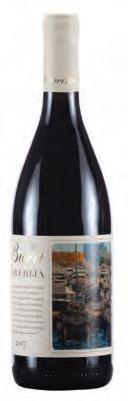
Red wines run the gamut from bold to fruity. “There’s nothing wrong with drinking wine on its own, but when you pair it with a food, that takes it to the next level,” says Clay, starting off with a powerhouse—Bura Galeria from the Dalmatian wine region of Croatia ($17.99, 13 percent alcohol).
“Most people don’t realize Croatia and its surroundings are like the cradle of early wine. It’s a good expression of its local heritage.”
Another Croatian choice is the dry yet crisp Pom Alo Plavina ($17.99, 13 percent alcohol), a unique take on the Croatian word pomalo meaning “take it easy.” Clay says
the organic red features the Plavina grape and offers easy drinking.
The Italians make a good red wine. Cantina Zaccagnini’s Montelpuciano d’Abruzza ($21.99, 13 percent alcohol) is crafted from the Montepulciano wine grape from the Abruzzo region of east-central Italy. “This full-bodied Italian everyday drinking wine goes good on a chilly wintry evening,” says Clay.
Not to be missed is the Illahe Grenache ($22.99, 13.5 percent alcohol) from a familyowned LIVE-certified sustainable winery in Oregon known for its aged in concrete, handpicked-at-night organic wine. “I love this winery for its product and its philosophies,” says Clay, noting the winery uses dry farming, a technique for growing grapes without irrigation. “The roots go deep into the earth and suck out the actual minerals and nutrients from the ground, which enhances the flavor profile, bringing out the best flavors in grapes.”
REFRESHING WHITES
A light, crisp white wine can be paired with a variety of dishes, even dessert. Lungarotti Vermentino ($13, 12 percent alcohol) is a dry white harvested from the Umbria region known as “the secret sauce” for good rosé. “All exceptional rosé has a bit of this to round out the palate. It’s an alternative to chardonnay. I find it has more character,” says Clay.
An easy white that pairs well with oysters or chicken is Le Petit Salvard Sauvignon Blanc ($16.99, 12.5 percent alcohol), an everyday version of Sancerre. According to Clay, you don’t need California 15.5 percent alcohol-based wines
for good flavor.
Looking for certified organic dry white? Try Rodica Malvediesel of Slovenia ($18, 12.5 percent alcohol), classified as a natural wine due to low human interaction and unfiltered spontaneous fer-
mentation. “It’s a fun on-the-edge wine for people who like to see what’s outside of the boundaries. Slightly sweet? You decide,” says Clay.
Rounding out his list is Rocks of Bawn Oregon Chardonnay ($19.99, 13 percent alcohol), a lightly oaked and handpicked fruit sourced from volcanic soils. “If Oregon lies on the same latitude of Burgundy, France, they should be able to produce good Chablis/chardonnay (same grape) and they do!”
SPARKLING SIPS
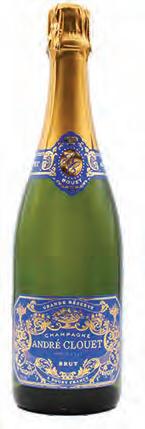
A divine champagne is a special way to celebrate the holidays. “The average person will step it up a notch during a holiday,” says Clay. His top pick is Andre Clouet Grande Reserve Brut ($56, 12 percent alcohol). Beautifully packaged, it’s pricey but worth it. “It has tiny bubbles that create almost a foam,” he
says, advising people not to be enamored of the well-known, mass-produced Vueve Cliquet. “It’s highly regarded and rather expensive, but mediocre. I’m sure in its day it was amazing champagne. As in cooking, when you quadruple the recipe, it doesn’t quite come out the same.”
LOCAL BEERS
For guests preferring something besides wine, beer is a tasty option. Clay specializes in 90 percent Vermont craft beer and has six cooler doors at his shop filled with four packs of 16-ounce cans. He offers a selection of unique and flavorful IPAs (India Pale Ale) featuring a slightly bitter, hoppy flavor. All local, they add to a meal while supporting the community.
“I chose three that are hazy Vermont-style IPAs because that’s what Vermont is known for. People actually call Route 100 the IPA highway.”
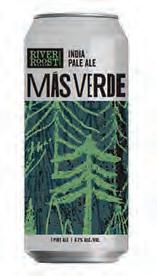
Mas Verde ($15.99, 6.7 percent alcohol) is produced
by River Roost Brewery in White River Junction, formerly Switchback brewery in Burlington. It has Citra and Chinook hops with a fruity flavor. Clay also suggests Green Mountain Gold made by Mount Holly Beer ($15.99, 6.7 percent
alcohol). The owner hand-selects hops to create a dank, resinous, hazy IPA featuring stone fruit, orange, and white grape.
“A newcomer on the Vermont scene, its product is dead on but little known,” says Clay, noting the can’s fun artwork. His
final selection is Built to Spill from Burlington’s Foam Brewing in Hinesburg ($15.99, 8 percent alcohol) with notes of citrus, pineapple, and tangerine.
DELICIOUS GIFTS
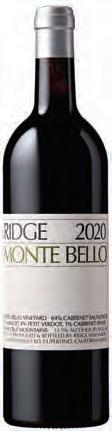
The holidays are a time for gift giving. Clay offers two lavish choices. Monte Bello (Red) from Ridge Vineyard ($305, 13.8 percent alcohol) is a lesser-known winery producing exquisite California wines, including this Bordeaux blend. “This wine is made only when the conditions are right—sometimes a year will go by with no Monte Bello,” he says. An exquisite champagne is Perrier Jouet Belle Epoque Rose Champagne ($310, 12.5 percent alcohol). “The package is beautiful along with the liquid,” he says of the flower-adorned bottle encasing a salmon-pink rose with notes of pink grapefruit and mandarin.
Selecting beverages should be fun and enlightening. “Trendy is bad; classic is better and stands the test of time,” he says. “You won’t grow your palette or your life unless you move outside the box.”
Try out Clay’s expert selections to make this season entertaining and thirst-quenching.
WOODSTOCK BEVERAGE
Unique Shopping, Dining, and Services
Abigail Zsenai Skincare & Wellness
World-Class Care for Mind, Body & Spirit
5 The Green, Suite 9 Woodstock, VT
www.agigailzsenai.com
Instagram ∙ @abigailzsenai
Substack ∙ @thewholebeautyedit By Appointment Only
5331 South Road, Route 106 South Woodstock, VT (802) 457-HORS (4677) TheStore@vthorseco.com www.vermonthorsecountry.com Always available. Please call (802) 356-6748 anytime.
FH Gillingham & Sons
16 Elm Street
Woodstock, VT
(802) 457-2100
www.gillinghams.com
Mon–Sat 8:30am–5pm Sun 10am–4pm
Introducing Woodstock Community Trust
Neighbors helping neighbors
One of the most beautiful aspects of living in and around Woodstock is something you won’t find on a postcard or in a travel brochure. It’s the spirit of community—neighbors helping neighbors.
Woodstock Community Trust captures that spirit and gives it practical shape and tangible impact. A nonprofit founded in 1997, Woodstock Community Trust is built on a simple but innovative idea: Create a single organization that provides administrative and financial services to multiple volunteer-driven community groups so that they can focus more efficiently on their core missions. The organization’s stated mission is to “empower teams to carry out local projects to improve the quality of life in our community.”
PROMOTING A VIBRANT COMMUNITY
More than 70 volunteers now work on the eight projects under the Woodstock Community Trust’s umbrella. Each project promotes a healthier and more vibrant community in its own distinctive way.
• Local Deeds helps people who work in the community buy a home.
• The HUB offers a community-funded confidential safety net to people who are struggling to make ends meet.
• Ottauquechee River Trail enhances
By Andrew Heyward, Trustee, Woodstock Community Trust
• East End Park maintains and improves a lively community space.
• Pride of Woodstock, Vermont supports the LBGTQ+ community and promotes diversity and inclusivity.
• Woodstock Village Conservancy connects, beautifies, and maintains public spaces.
• Mountain Views Education Fund helps enrich the educational, cultural, and civic experience of students in the area school district.
• Inner Rhythms provides tools for schools to strengthen mindfulness, resilience, compassion, and self-confidence in their students.
Behind the scenes, the Trust provides its projects with 501c3 nonprofit tax status; manages their back-office operations like bookkeeping, accounting, banking, insurance, and paying invoices; and offers support with donor management, legal contracts, marketing, and communications, freeing up each project to direct its energy into making a visible difference in the community.
Woodstock Community Trust’s board of trustees—all volunteers from the area—recently hired an interim executive director. Tesha Buss is an entrepreneur and former Vermont State Representative whose professional leadership will allow the Trust to
GET INVOLVED
Woodstock Community Trust’s purpose is to drive positive change by giving area residents the power to create a more resilient, inclusive, and beautiful community. You can help make that happen. The Trust welcomes any community member in Woodstock and the surrounding towns to get involved, whether as a volunteer for one of its projects, as a leader of a new project, or as a donor. Donors can support the core operations or direct their contributions to specific projects.
We also invite you to read the article in this issue of Woodstock Magazine about Local Deeds, an inspiring story of how one project is changing lives by helping people who work in the area buy homes. It’s the first in a series of reports about the work of Woodstock Community Trust. If you’d like to learn more, please visit woodstock communitytrust.org.
WOODSTOCK COMMUNITY TRUST woodstockcommunitytrust.org
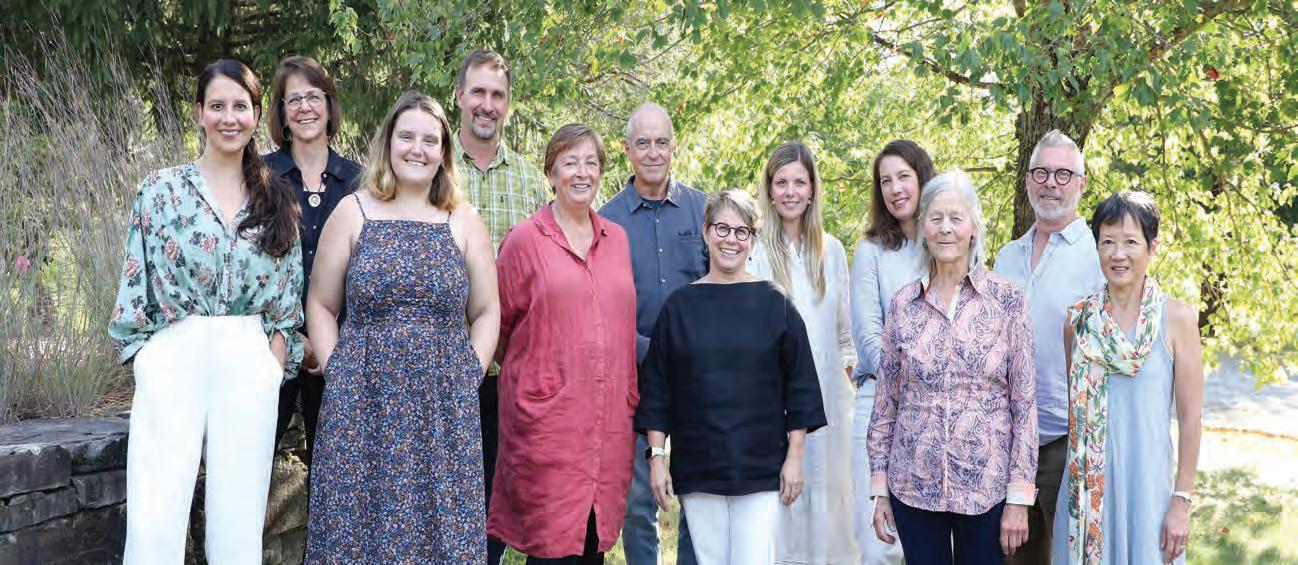
Below: The Woodstock Community Trust board of trustees. Front, from left: Mariza McKee, Emily Friedman, Jill Davies, Executive Director Tesha Buss, Nancy Winter, and Wendy Spector. Back, from left: Pam Mathews, Greg Olmstead, Andrew Heyward, Caitlin McCurn, Sarah Glasser
Local Deeds
A project of the Woodstock Community Trust helps area families
By Katherine P. Cox
otherwise noted)
The nationwide housing crisis has placed homes out of the reach of many working families, especially those who work in high-income areas. In the Woodstock region, workers in hospitality, schools, retail, the arts, and even health care who want to live close to where they work are struggling to find homes they can afford. Local Deeds, one of eight projects under the umbrella of the Woodstock Community Trust, was launched in 2024 to address that need by providing prospective homebuyers who work in the area the funds for a down payment in exchange for placing a deed restriction on their home. The project covers homes in Barnard, Bridgewater, Hartland, Plymouth, Pomfret, Reading, and Woodstock.
Photography by Donna Taylor Photography (unless
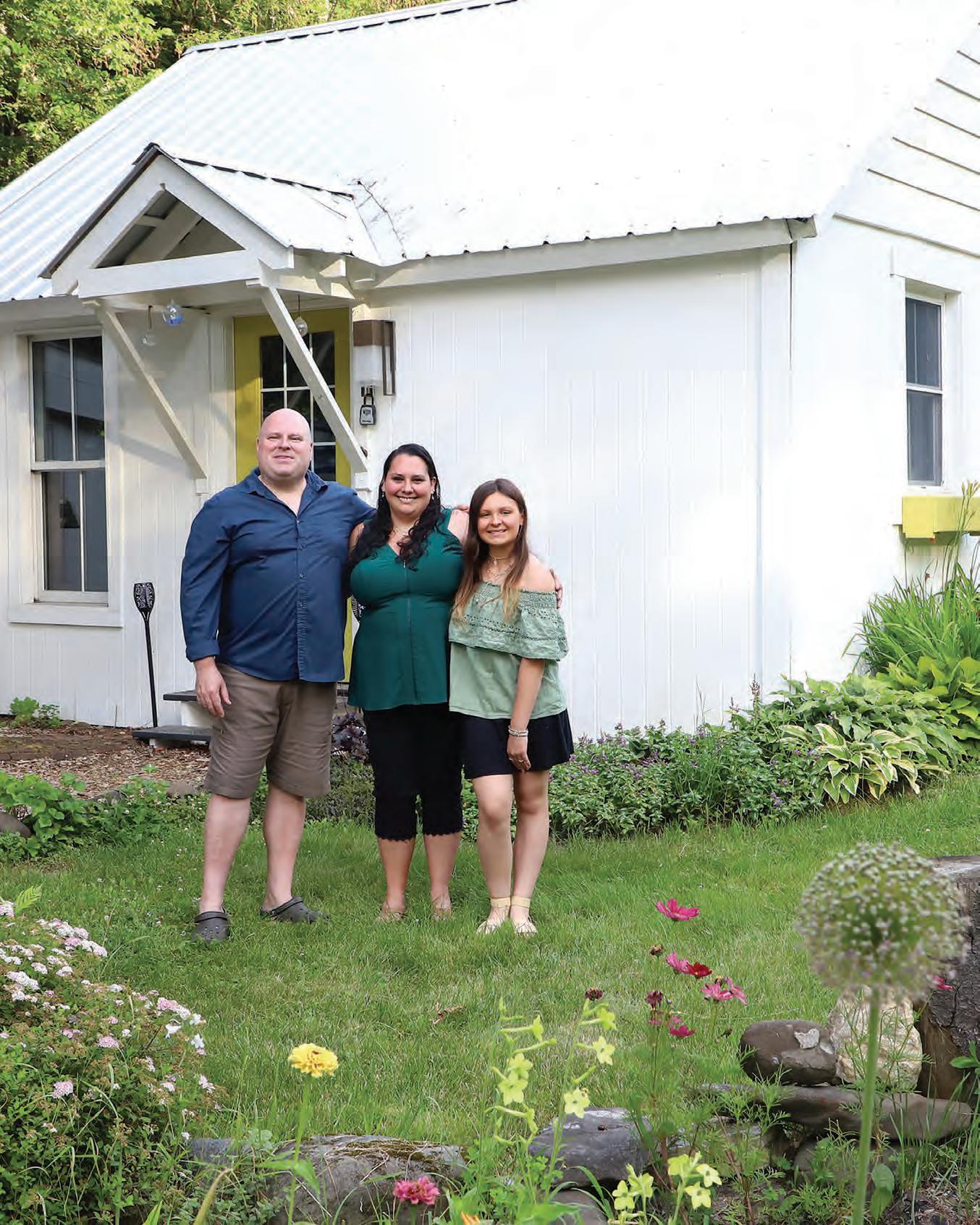
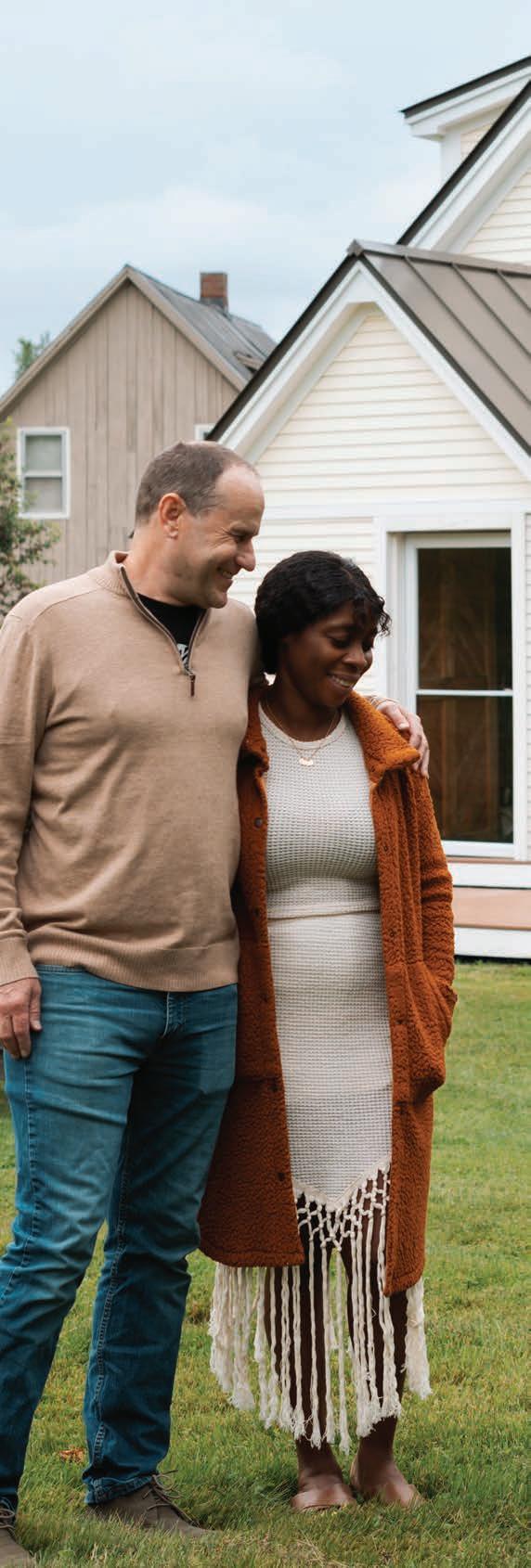
Sean, Ivonne, and Emily, a Local Deeds family, at their riverside cottage in Woodstock.
KEEPING FAMILIES IN THE COMMUNITY
Amy Spencer, a volunteer with Local Deeds, says the program has helped 20 local families buy homes, stay in the community, and keep their children in local schools. “The impact is massive,” she says. Local Deeds works with local employers to get the word out to their employees. “If the employees find a home, they work with a local bank to secure a loan and then work with us to get approval. After everything is approved, we wire the funds for the down payment to the lawyer handling the transaction, for up to 16 percent of the property’s market value.”
“That’s the benefit of the (Local Deeds) program. We are securing that house for a future local worker. It’s a guarantee that the house stays in the community for local workers.”
— Amy Spencer, Local Deeds volunteer
To be accepted into the program, homebuyers must abide by a deed restriction on the property that requires them to sell the house to another local worker when the time comes. “That’s the benefit of the program. We are securing that house for a future local worker. It’s a guarantee that the house stays in the community for local workers.” There are no income restrictions, but the homeowner must be employed in the area, work at least 25 hours a week, and the house must be within a radius of 16 miles from the Woodstock Town Hall. It cannot be a second home or an Airbnb.
Alison and Steve
LOCAL DEEDS FAMILY
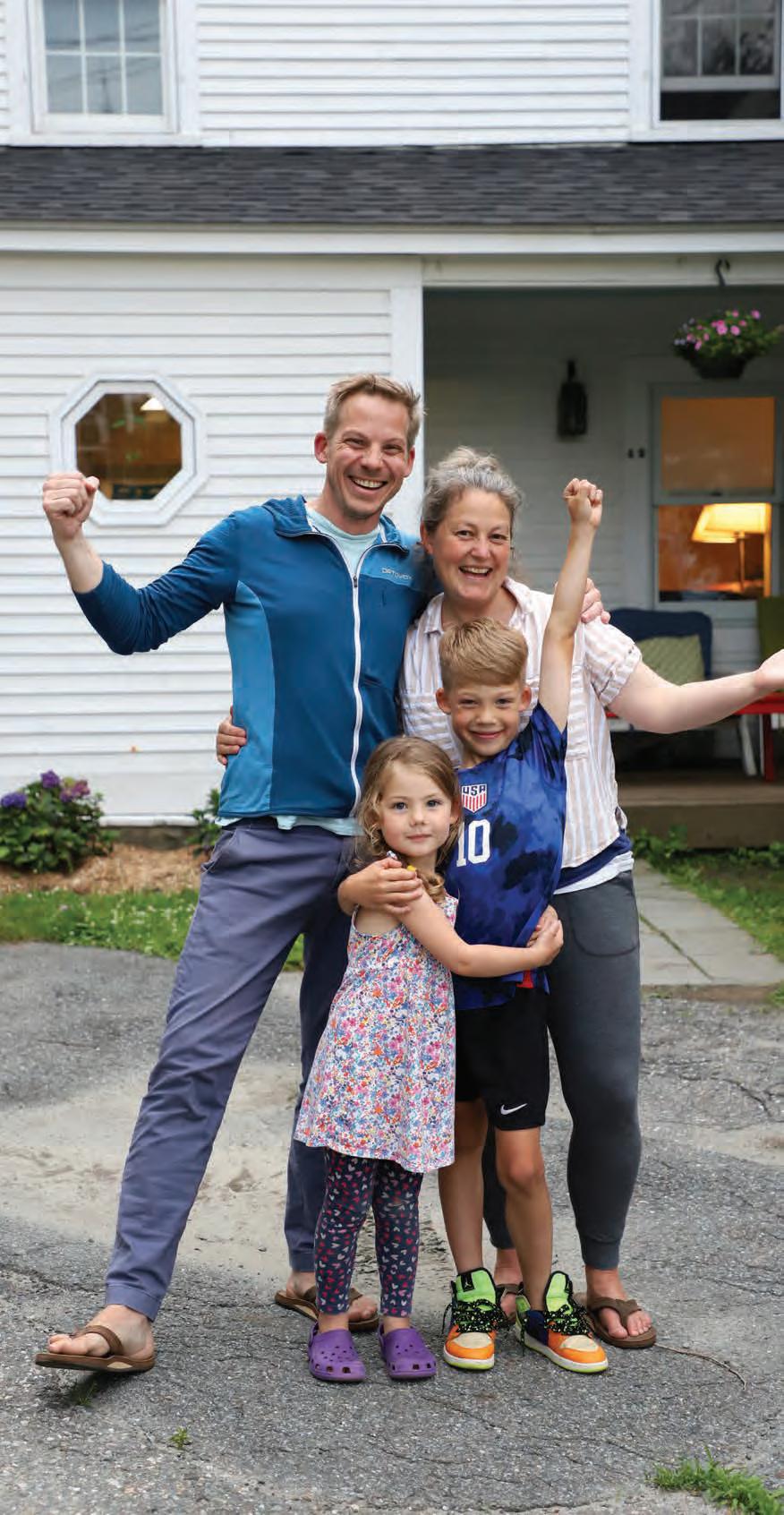
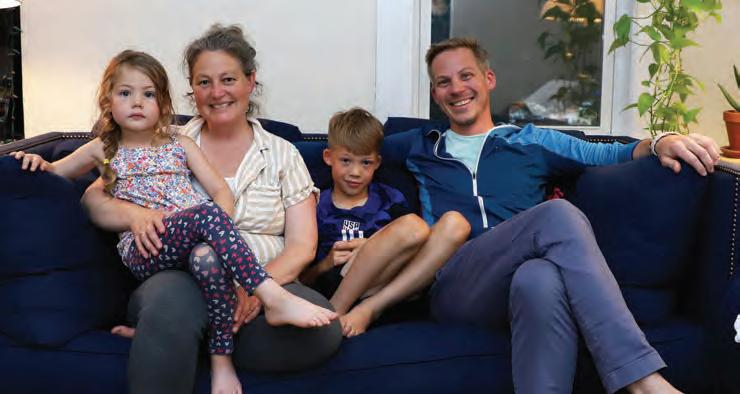
More than eight years ago, Alison and Steve moved to Woodstock from Brooklyn, seeking a quieter place to raise their kids. Alison, an elementary school teacher, and Steve, a media director for a research organization, found a duplex in Woodstock to rent and settled in to live in this area. After years of renting, the landlord informed them she was planning to sell the property and suggested they contact Local Deeds for help buying the home. They jumped at the opportunity. “Then I literally filled out the application in, like, 15 minutes. It all moved very quickly,” Steve says. Closing on the property was smoother than they expected. When it came to closing on the house itself, that process also ran smoothly.
For Alison, who currently teaches fifth grade at the Prosper Valley School, living and working in the same community is essential. “It’s wonderful for teachers to get to know the community. If I didn’t live here, I would probably go teach somewhere else.” Steve and Alison love the location and raising their two children in the village. “They get to be outside all day and come in for dinner. The level of freedom for kids is special in this neighborhood,” Alison says.
“(My children) get to be outside all day and come in for dinner. The level of freedom for kids is special in this neighborhood.”
— Alison, Woodstock resident and elementary school teacher
SECURE HOUSING AND SECURE EMPLOYMENT
“There is an affordable housing crisis in the Woodstock area,” Amy says of the impetus for this program. The crisis was spurred during the years of the COVID lockdowns “when people bought second homes and took housing out of the market for our local workers and raised the prices in general. We saw a lot of the people who live and work and make our community what it is being boxed out of owning a home here.”
The program is based on a similar program in Vail, Colorado. “It’s a similar community. We’re a tourist environment here and we have a lot of people who want to have second homes here. We started seeing teachers who couldn’t find housing or had to live an hour away. That’s a problem. We want our teachers to live in our community. We want people who work in restaurants to live in our community. These are people who are serving our community.” Amy says the program has helped a lot of educators, hospital workers, and workers in the service industry.
“When we tell the stories of the people we have helped, the response is overwhelmingly positive. A lot of the families we’ve helped have children and there is a sense of safety and security that comes with owning a house,” Amy says. “The rental market here is minimal, and when you live and work in a community and your kids are going to school but you don’t have housing security, your life is upended. You see the impact stable housing has on their children’s lives. A few months after one family was able to move into their own house, their daughter’s report card went through the roof.”
When teachers can acquire a home, it means the schools and the students have educators who will stay, Amy says. For the community, having stable employment means their employees build community ties and contribute to the culture. “Providing safe, secure housing gives people a sense of dignity,” Amy says, “and it’s stability for our town.”
Nadine and Zach
LOCAL DEEDS FAMILY
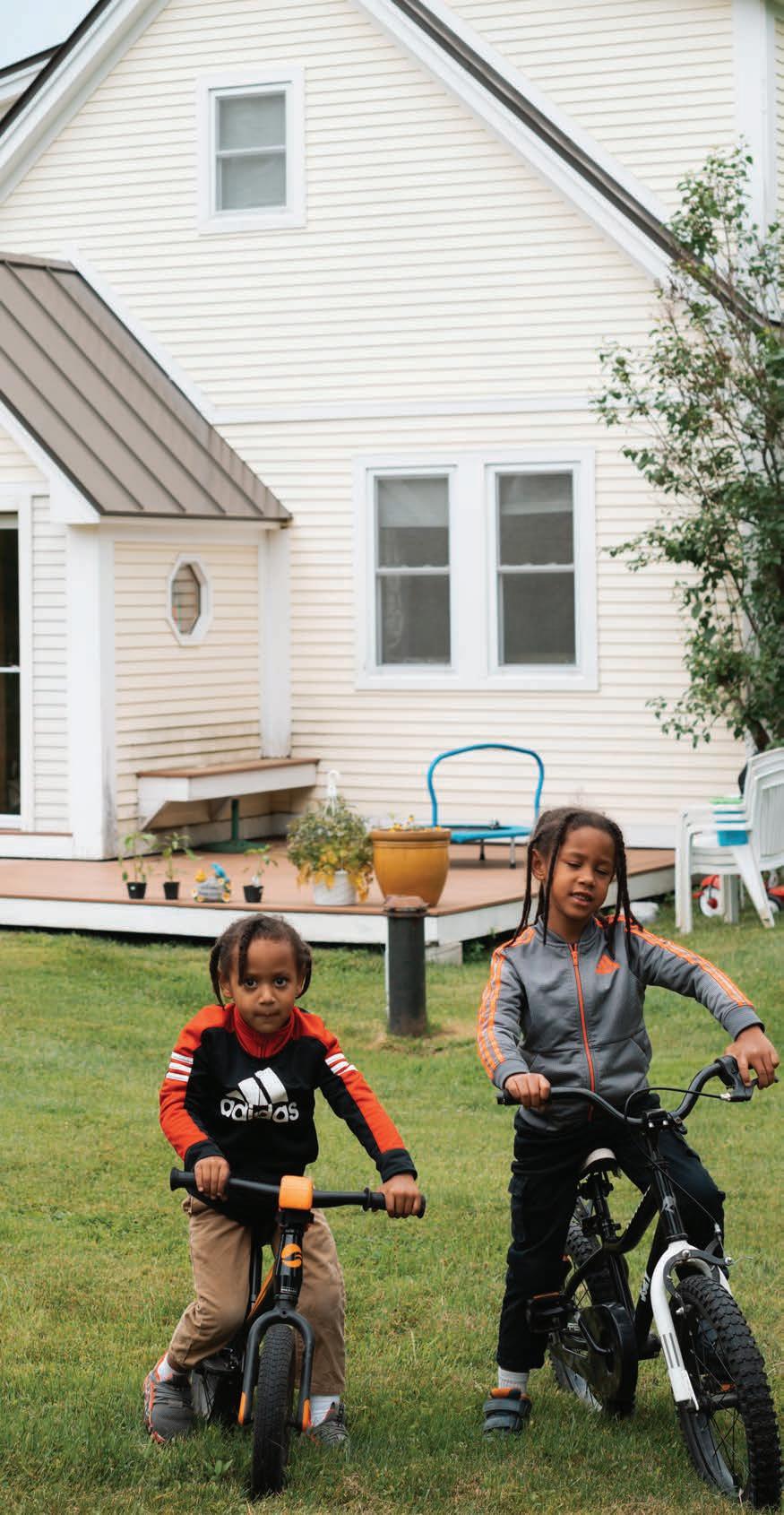
Nadine and Zach are the kind of family Local Deeds aims to help: artists, entrepreneurs, and parents deeply rooted in the community, yet nearly priced out of the possibility of making a permanent home in it. Zach, a Woodstock native, met Nadine in her home country of Haiti while he was living there and working with local musicians. Their band, Lakou Mizik, began touring the US and Canada in 2016 and currently performs locally at town halls, community events, and festivals. In 2018, the couple married and moved to Barnard, Vermont, renting the apartment above the Barnard General Store. They knew they’d quickly outgrow their apartment after they welcomed two sons to the family. Finding a home was difficult, and the pandemic housing market made things even more so. “We just felt totally priced out of everything,” Zach says. A friend mentioned Local Deeds, and suddenly, staying in their community felt like a real possibility. But even then, with both Zach and Nadine selfemployed, they worried they would not qualify. Working with Local Deeds, they were assured that Nadine qualified as a housekeeper and singer, and so the search for a home continued with a bit more hope. In August 2024, a friend mentioned he was thinking about selling his house just across from the Barnard General Store. Nadine and Zach contacted Local Deeds and, with the program’s help, bought the home. By December, they had closed on the house and settled into their new home.
In 2024, they also launched Panou—“ours” in Haitian Creole—a spicy peanut butter business. Zach calls it “the maple syrup of Haiti.” Panou ships around the Northeast to Haitian communities, and now, with the security of owning a house, they hope to scale production up to a commercial kitchen and sell in local stores as well.
“This house definitely would have been out of our reach without Local Deeds,” Zach says. For Nadine, a naturalized US citizen, safety has always felt fragile. Here she feels it’s safe to build a business at the kitchen table and to let two young boys grow up in a house that feels permanent.
“We just felt totally priced out of everything. This house definitely would have been out of our reach without Local Deeds.”
— Zach, Woodstock resident, musician, and entrepreneur
Photos by Mackenzie Hendricks.
PAYING IT FORWARD
Although some people hear about the program, which is funded by donations, through their employers, Amy says there is a lack of awareness of Local Deeds and how it works. “I want people to know the program is out there and we’re helping local workers in perpetuity by having the deed restriction on the house. This is an investment we’re making in the people that live and work in our community.”
“This is an investment we’re making in the people that live and work in our community.”
— Amy Spencer, Local Deeds volunteer
She continues, “The Local Deeds project is part of the Woodstock Community Trust,” and people can donate directly to it. “It’s easy to donate. Just go to the Community Trust website and click on the Local Deeds link. No donation is too small.”
Housing insecurity is a problem and Amy says Local Deeds is part of the solution that allows workers to live close to where they work. “The folks who are waiting on us in our restaurants, the folks who are teaching our kids, and the folks who are serving us in our hospitals and doctors’ offices, the people who are cutting your lawn—these are the people that provide services to us and I feel like we owe it to them to help them back. We would be nothing without these people. Our town would be nothing without these people, and we should invest in them. And with the deed restriction, recipients will be able to pay it forward to another family.”
Ivonne and Sean
LOCAL DEEDS FAMILY
Sean, a native Vermonter with years in restaurant management and hospitality, is now a paraprofessional in special education at the local middle/high school. Ivonne, originally from Chile, has over 20 years of experience as a high-end server and bartender. They have a daughter, Emily, who is in middle school in Barnard. They moved from Florida to Vermont in 2017, but despite full-time jobs and deep ties to the area, finding stable housing proved nearly impossible. They lived with family, rented a home that was reclaimed for renovations, and faced astronomical rental prices. Finally they purchased and moved into an RV, but with few housing options, they considered moving back to Florida. But they didn’t want to uproot Emily from her school and support system.
Then Donna, a friend and Local Deeds photographer, told Ivonne about Local Deeds. Despite concerns about waitlists, Ivonne approached the application with determination. Her persistence paid off. The bright cottage along Route 106, nestled beside a river, became more than just affordable housing—it became home. Emily immediately claimed the riverbank as her favorite feature, clearing invasive plants and building stone steps to the water as part of a school ecology project. The property even included
a mobile home that could be renovated and rented to another local worker under the Local Deeds deed restriction, providing both financial stability and an opportunity to pay the support forward.
“It’s just so much better,” Ivonne says of living close to work, school, and community. “We’re not constantly worrying about what’s next.” Staying in Woodstock has given Emily the stability to thrive. Now, finishing sixth grade, she recently excelled on her PSATs, scoring higher than 91 percent of Vermont grade six students in English. For Sean, “Home is peace of mind. It’s knowing we work hard, we pay for it, and it’s not going to be taken away.”
“Home is peace of mind. It’s knowing we work hard, we pay for it, and it’s not going to be taken away.”
— Sean, Woodstock resident and special education paraprofessional
Welcoming Woodstock Home
A warm place in a historic building adds another piece to the town's retail picture
By Stephen D’Agostino
Long before Tara Layne and her husband Scott became the coowners of Woodstock Home, her sisters-in-law, her aunt, and her cousin kept asking her when she would open a Christmas shop. Knowing that Tara had experience in retail owning a clothing store in Florida, and knowing that she loved Christmas, it seemed like a perfect match. Tara did open a store, but not the one her family expected. And in some ways, it wasn’t the way she and Scott expected.
Photography by Nancy Nutile-McMenemy
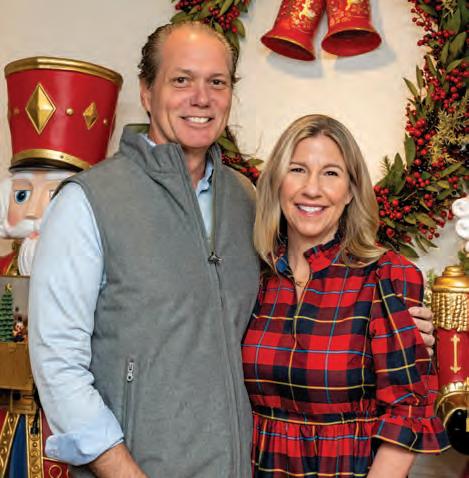
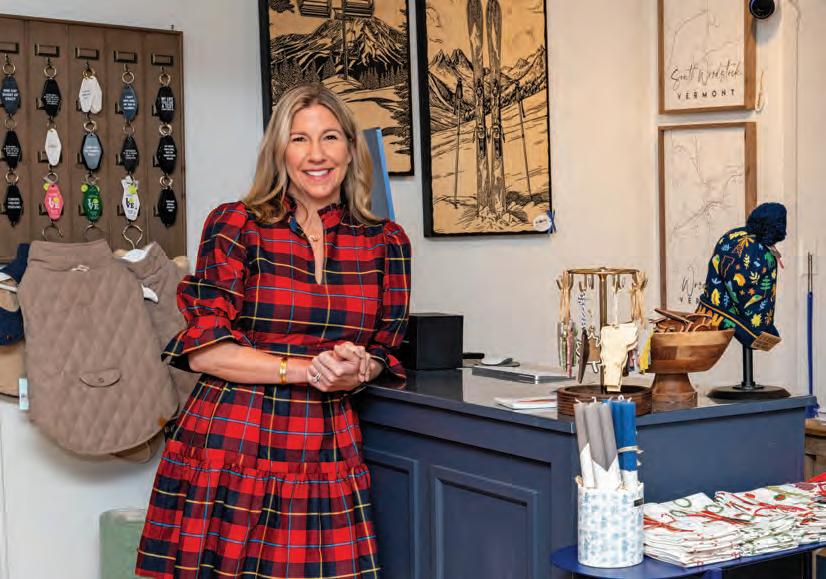
“From our home to yours.” Scott and Tara Layne.
“We chose pieces that were interesting, unique, and things that we would genuinely want in our home.”
— Tara Layne, co-owner
FALLING IN LOVE WITH WOODSTOCK
Until 2021, Tara had never been to Woodstock. Scott, who grew up on Long Island, came to town regularly as a child to visit his aunt. When the opportunity arose for Scott to share this special place with Tara, he was in for a surprise. “We drove into Woodstock,” Scott says, “and I said, ‘This has not changed a bit. It’s just the way I recall it from the last time’,” which was 30 years before.
Tara saw Woodstock with fresh eyes, and she fell in love. They planned another trip for the summer of the following year, and during that trip, on a whim, they bought a house in South Woodstock and moved to town.
While Tara was contemplating opening a shop, a spot at 1 The Green, the
building that once housed the White Cupboard Inn, became available. “At first I was hesitant,” says Tara. “It didn’t feel like a traditional retail space. But once we stepped inside and felt the warmth and natural light, it immediately felt like home.”
Being a place that once welcomed visitors, homeyness perhaps imbues the building. The 700-square-foot space Woodstock Home occupies has two fireplaces, a ceiling height similar to what you have in your home, and six-over-six windows.
THOUGHTFULLY STOCKING THE STORE
Tara and Scott signed their lease in February, went home, had a celebratory drink, and got to work ordering
You will always receive a warm welcome from Tara and her team at Woodstock Home.
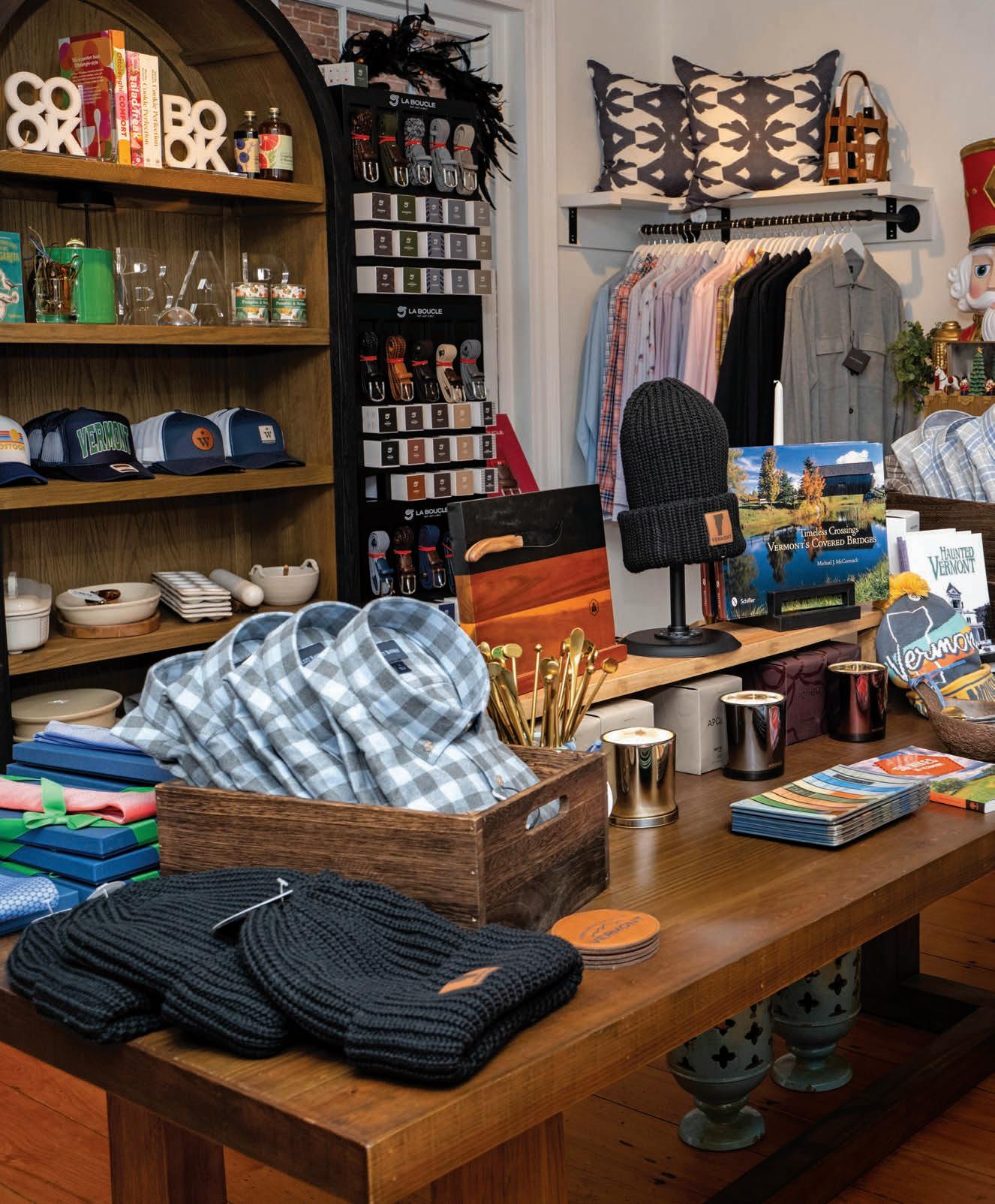
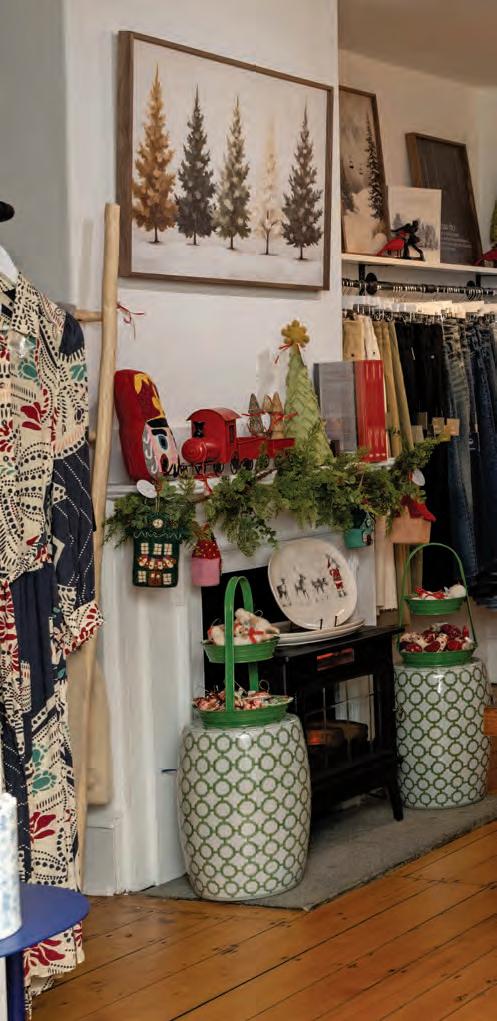
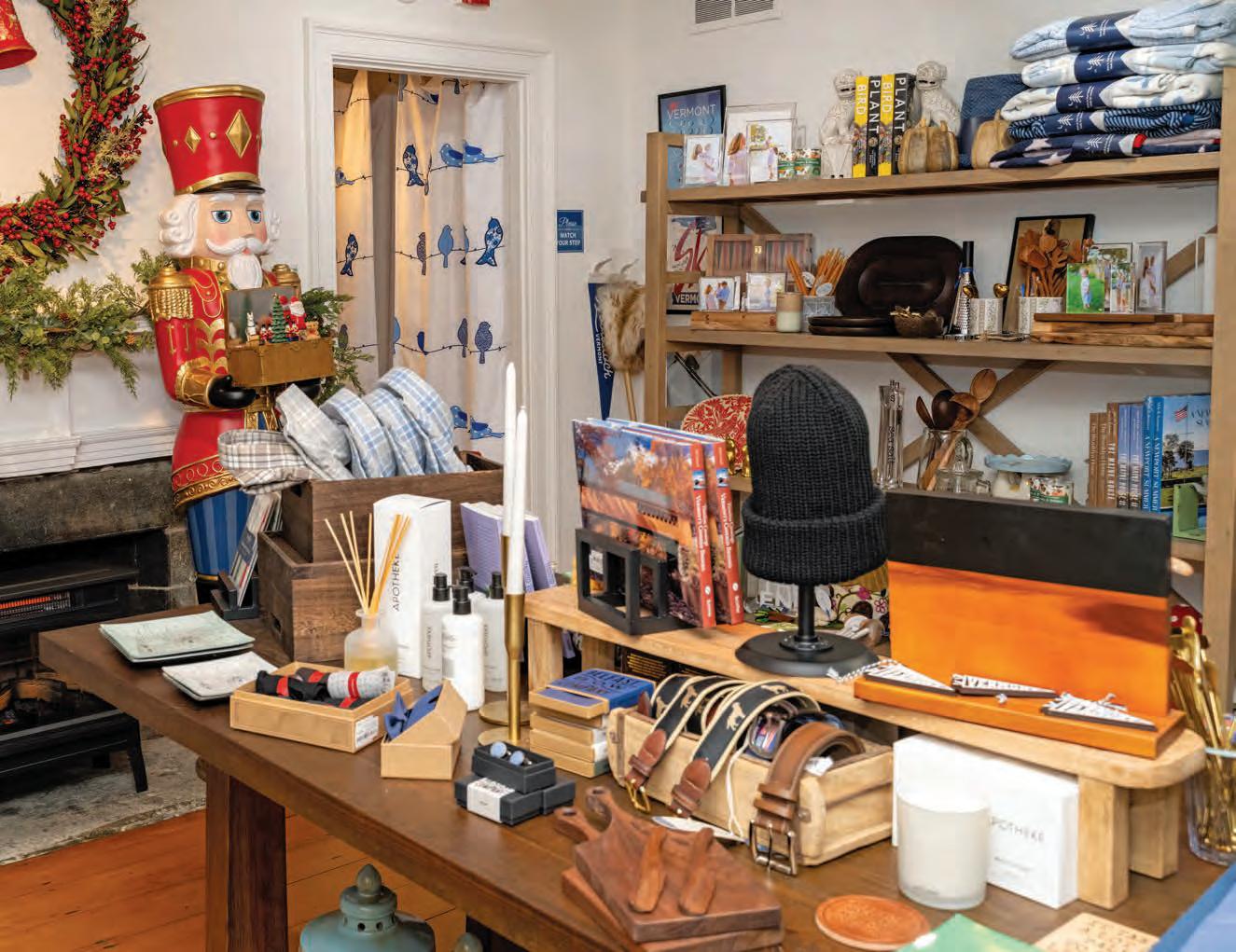
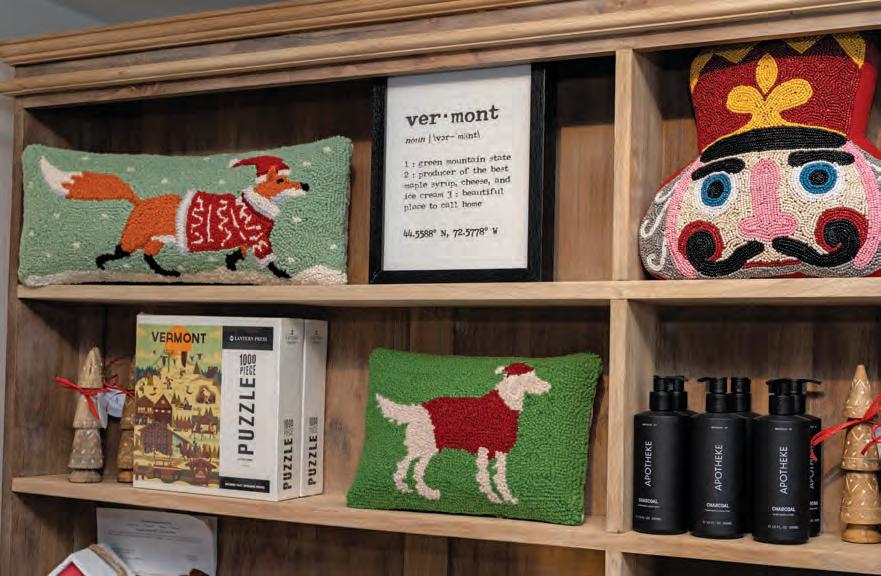
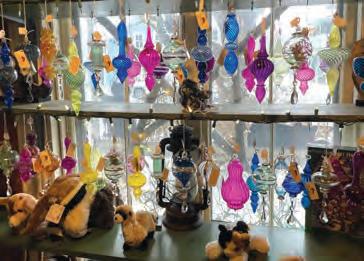
Top: From cozy corners to curated collections, Woodstock Home welcomes you. Browse winter pine art, garden stools, and trains for your home this holiday season.
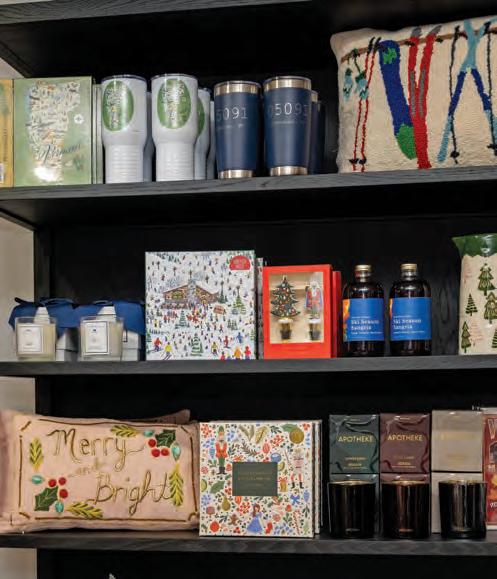
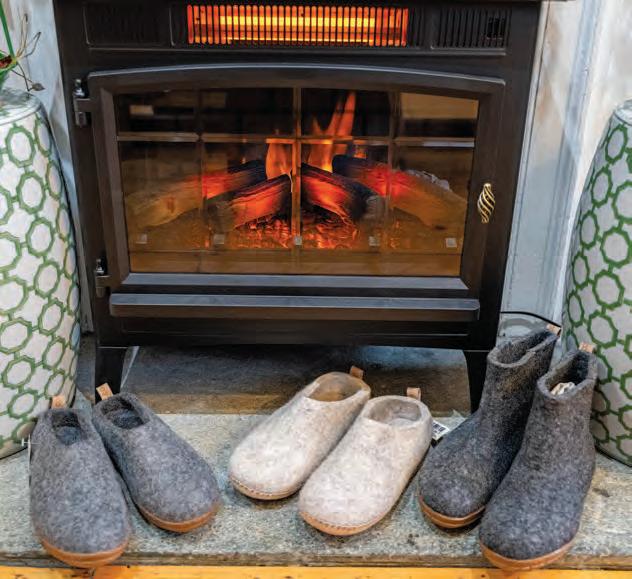
Bottom, from far left: Holiday gifts for all—thoughtful, timeless, and made to delight. Custom holiday pillows, candles, puzzles, and more. Where comfort meets craftsmanship—wool slippers worth lingering in and holiday sweaters made for magic.
“It’s amazing how many people [and he means guys] come to town for weddings and forget ties, belts, and socks.”
— Scott Layne, co-owner
merchandise for the shop. “We chose pieces that were interesting, unique, and things that we would genuinely want in our home,” Tara says. When they asked friends what they would like to see in the shop, one replied, “birdhouses.” So Tara brought in birdhouses.
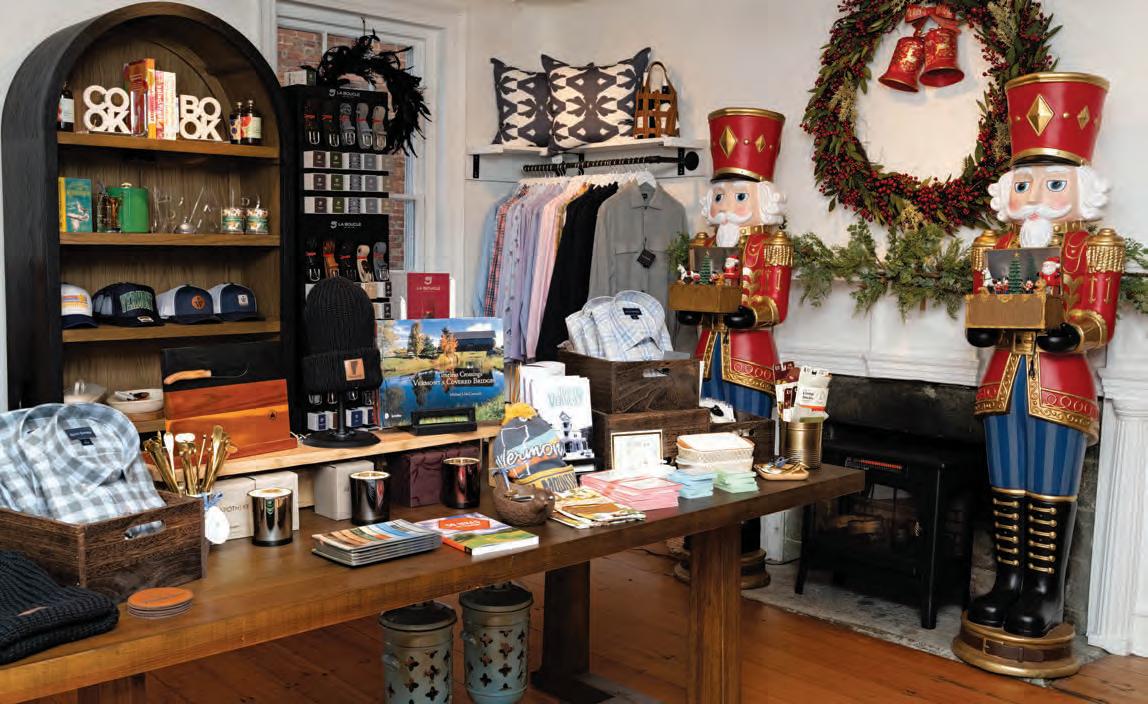
At Woodstock Home, beyond those lodgings for our feathered friends, you’ll find pillows, both campy and cultured; baseball caps and cowboy hats; stands for your cakes and ottomans for your feet; paintings by local artists and puzzles of local scenes; calendars to mark the days; and barware to celebrate the evenings. And, of course, our furry friends’ needs— or our needs for our furry friends—are well represented.
What is surprisingly different and re-
freshing about Woodstock Home is its selection and variety of clothing for men. Early in their ownership, Tara and Scott acted on a comment from a local, Joe DeNatale. Tara recalls that he came in one day and asked, “Why don’t you have any men’s clothing?” And while there was some, there wasn’t a lot. She promised Joe she’d get more.
Scott notes, “It’s amazing how many people [and he means guys] come to town for weddings and forget ties, belts, and socks.” Any fretful guest coming into Woodstock Home with his pants uncinched or his shirt open at the collar will feel relief upon spying the racks of belts, fun, vibrant ties and bowties, shirts, socks, and other accessories. The labels include Scott Barber, Paige, and others
Cozy heads, happy hearts.
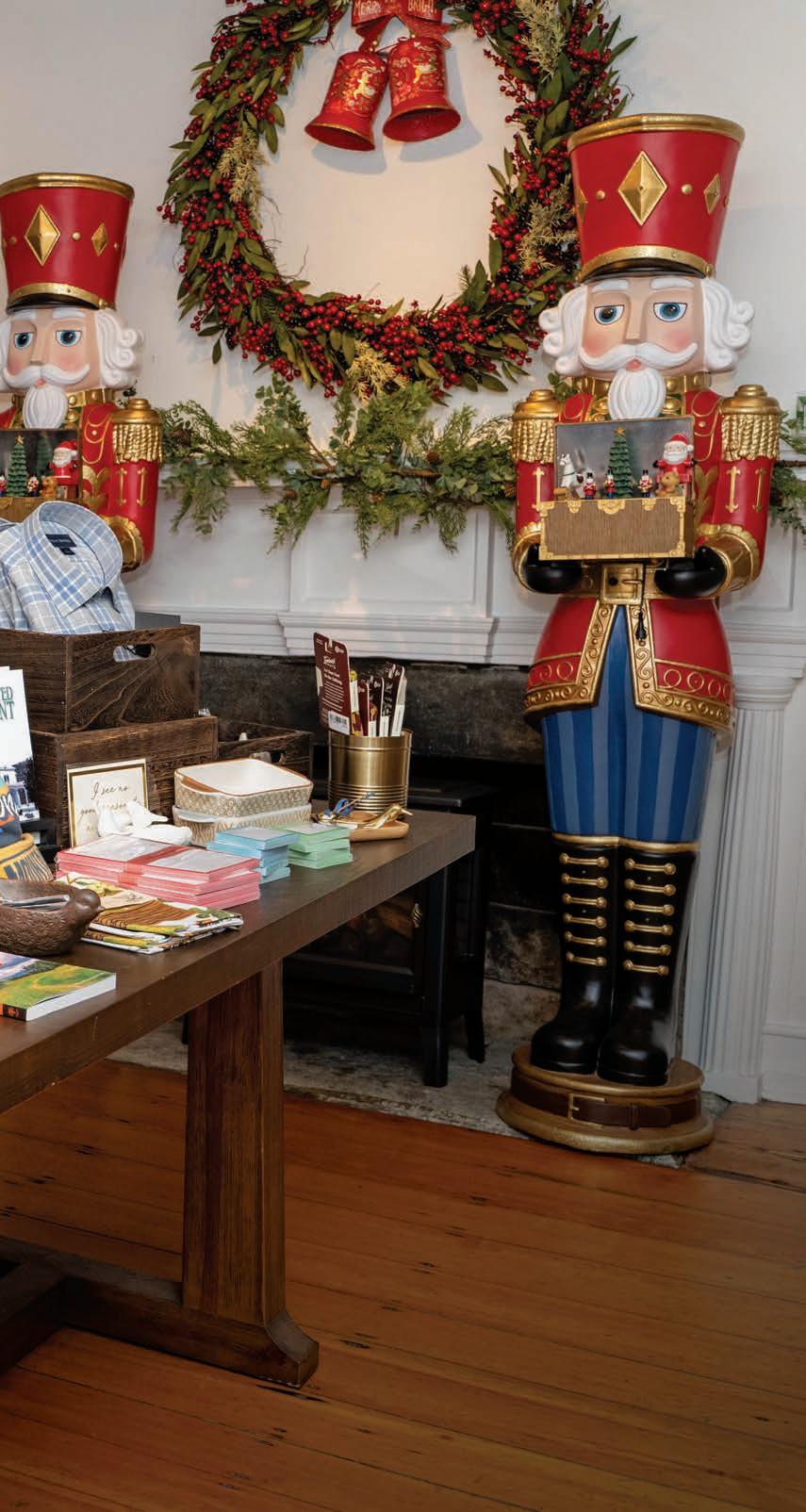
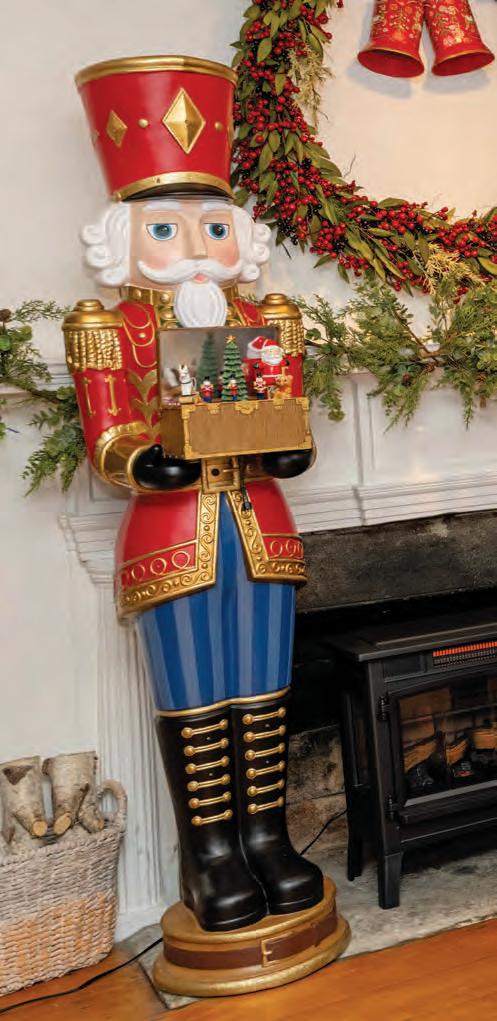
Top: Standing guard in style—Major Mistletoe and Sir Tinselton have officially reported for holiday duty.
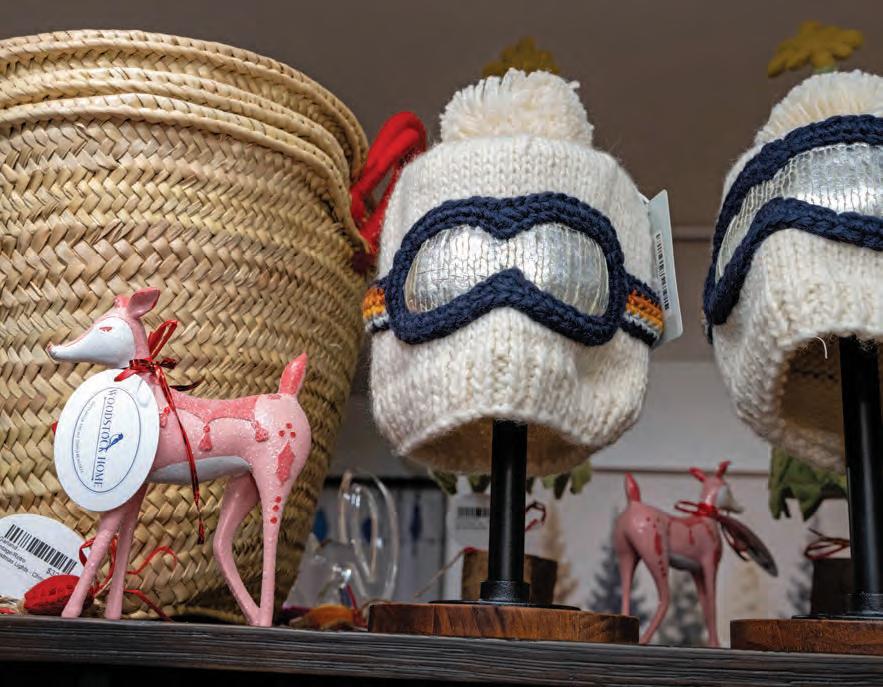
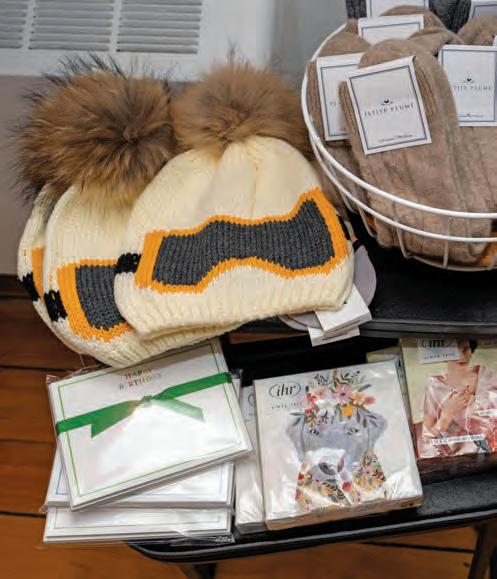
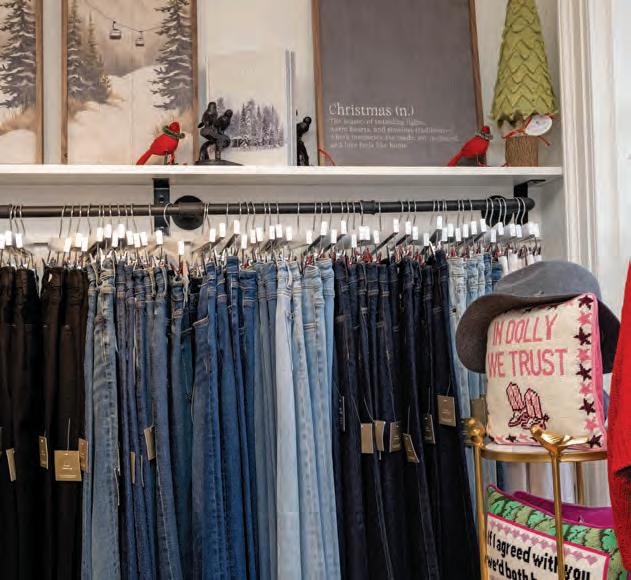
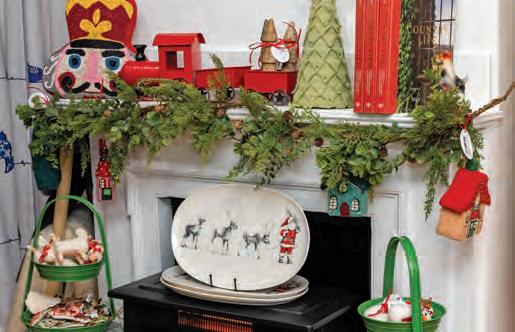
Bottom, from far left: From ski beanies to cashmere socks to beautifully crafted cards—a little something for all. Every wardrobe deserves the perfect jean. From festive platters to sparkling ornaments and whimsical train sets— Christmas magic awaits.
that fit the Woodstock vibe. The women’s line of clothing is more extensive; dresses, jeans, tops, sweaters, and more at various price points fill the racks.
SEASONAL MAGIC
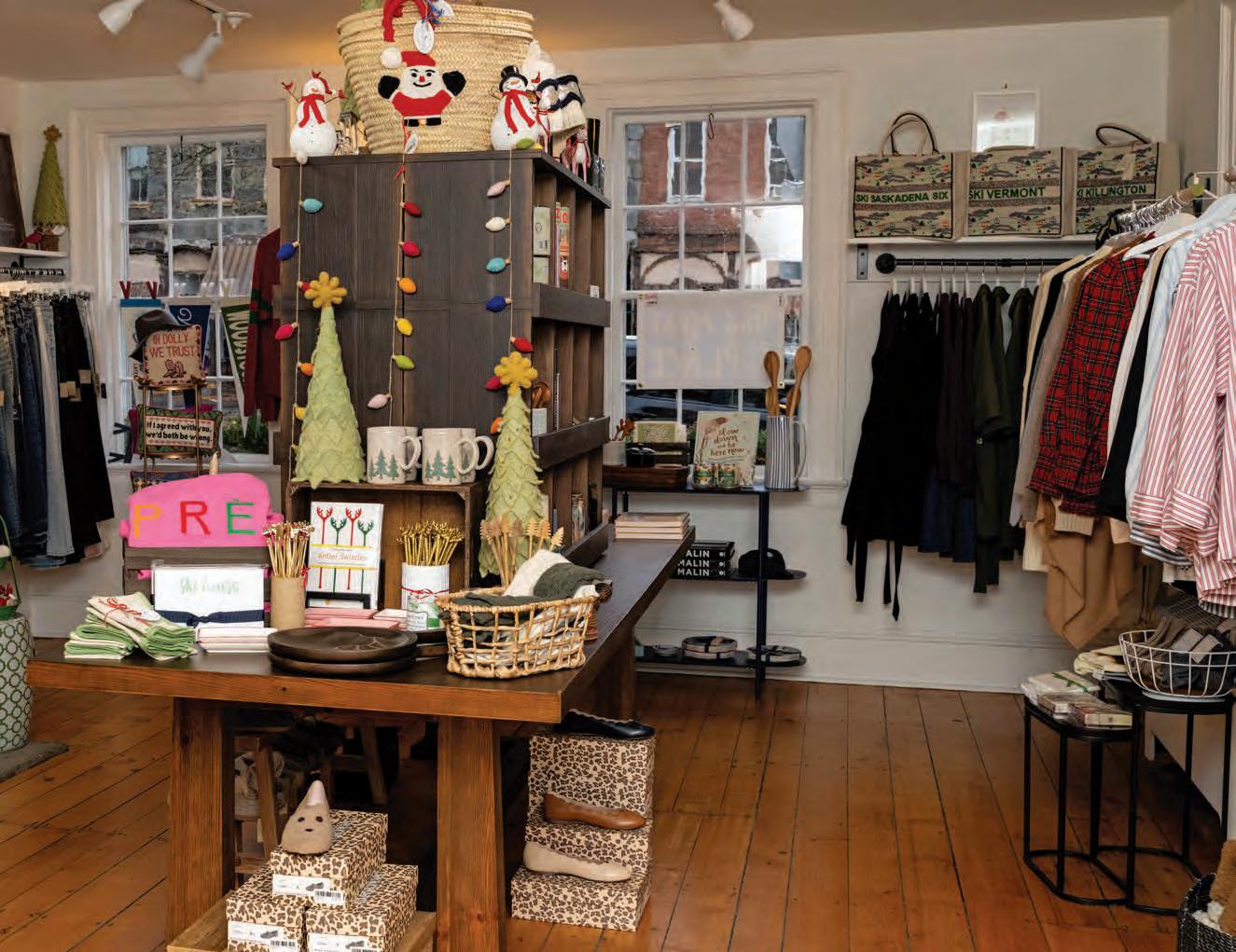
One of the challenges that had to be overcome, Scott notes, is that in a shop with lots of windows, there isn’t a lot of wall space for racks. Not a problem to Scott, though, who is an architect. He devised a solution—long rods running across the wall at about halfway up the height of the windows, the perfect height for browsing. Since the windows can’t be used effectively for merchandising, this clever configuration won’t sacrifice display space, only enhance it.
And though Woodstock Home won’t be able to create holiday window displays like those you might find at the shops on Central and Elm Streets, the seasonal warmth and magic will be on full display inside. Tara and Scott rented an extra two rooms upstairs from the shop just to store their holiday decorations. All that seasonal fare around the store will add to Woodstock Home’s already comfortable and festive mood, but Tara may go a step further. She’s negotiating with Santa himself to drop by for a visit. Time will tell if he can work the shop into his busy schedule.
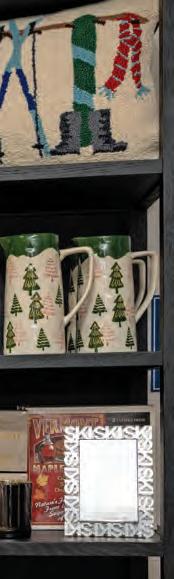
Whether Santa appears or not, the shop will be full of festive holiday gift ideas like fir-tree decorated pitchers and Ski Season Sangria mixes to add to them; holiday themed puzzles; ornaments for tree, wall, and table; and Christmas sweaters, but not the ugly kind. Woodstock Home will have wrapping paper, too, but if you’re wrapping-challenged, they’ll wrap your gifts for you.
Returning to the birdhouse conversation Tara and Scott had when they were dreaming of their shop, their friend also expressed another wish. She would like to never travel across the river to do her shopping. Scott echoes that same desire by relating stories
from his past. “I remember my grandmother saying, ‘I wish I could just walk and get you a birthday card, Scott, but I need your assistance.’ Or ‘I need somebody to take me here.’” Tara and Scott see the shop as being part of the bigger
Woodstock retail scene in which people can shop for not just gifts, but clothing, household needs, groceries, and other essentials without ever leaving the 05091. That would, indeed, make Woodstock home.
6 The Green Woodstock, VT (802) 432-3002
woodstockhomevt.com
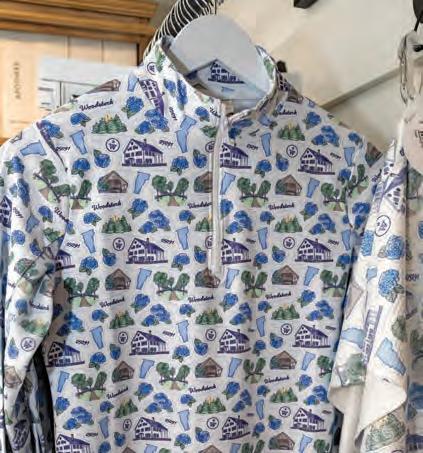
Above: Custom athletic apparel featuring the Middle Bridge, The Star at Mount Tom, 1 The Green, Vermont State Icon, Woodstock.
Quechee, VT For appointments call (802) 457-1116 or email Eleanor@shepardvt.com
Discover Oakes & Evelyn
Fine dining has returned to The Jackson in Woodstock
By Susan B. Apel | Photography by Nancy Nutile-McMenemy
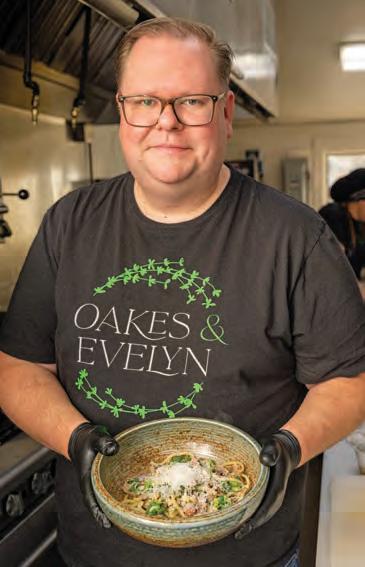
InJune 2025, Justin Dain, owner and chef at Oakes & Evelyn in Montpelier, opened a second location by taking over the dining room of The Jackson. (The new spot retains the same name. Thomas Oakes was Justin’s grandfather, and Evelyn Garbe was his great-aunt.) Justin had been contemplating opening an additional restaurant when he was approached by the hotel owners. “The timing, the location . . . everything seemed to align,” Justin says, and it dovetailed with his own professional desire to “stay creative and do new things.” Hotels are a familiar milieu. Justin has commanded the kitchens at the Boston Harbor Hotel, Reluctant Panther Inn and Restaurant in Manchester Village, Vermont, and before opening
LOCAL, SEASONAL DISHES
If you have dined at Oakes & Evelyn in Montpelier, the experience at the Woodstock location feels and tastes familiar. Both restaurants source from local purveyors like Black River Produce in North Springfield, Vermont, for meats, fish, and vegetables; proximity to Boston and Cape Cod guarantees fresh oysters. What’s on your plate could also come from Oakes & Evelyn’s own vegetable gardens.
The menus change with the seasons, and while they bear a resemblance to one another with a mixture of small and large plates, they are not identical. Each Oakes & Evelyn has a few unique dishes. Both, however, offer several dishes of crudo, sophisticated raw seafood such as Hamachi Crudo with aji amorillo and coconut sauce, peanuts, Szechuan oil, and cilantro. The crudo is a part of the menu that sets Oakes & Evelyn apart. Justin
explains that while working in Boston he developed an interest in raw fish, its seasonal nature, and the creativity involved in its different preparations.
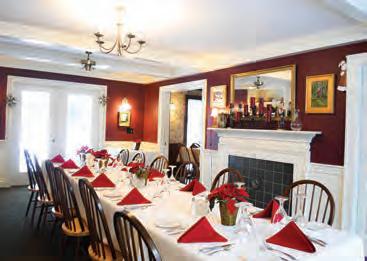
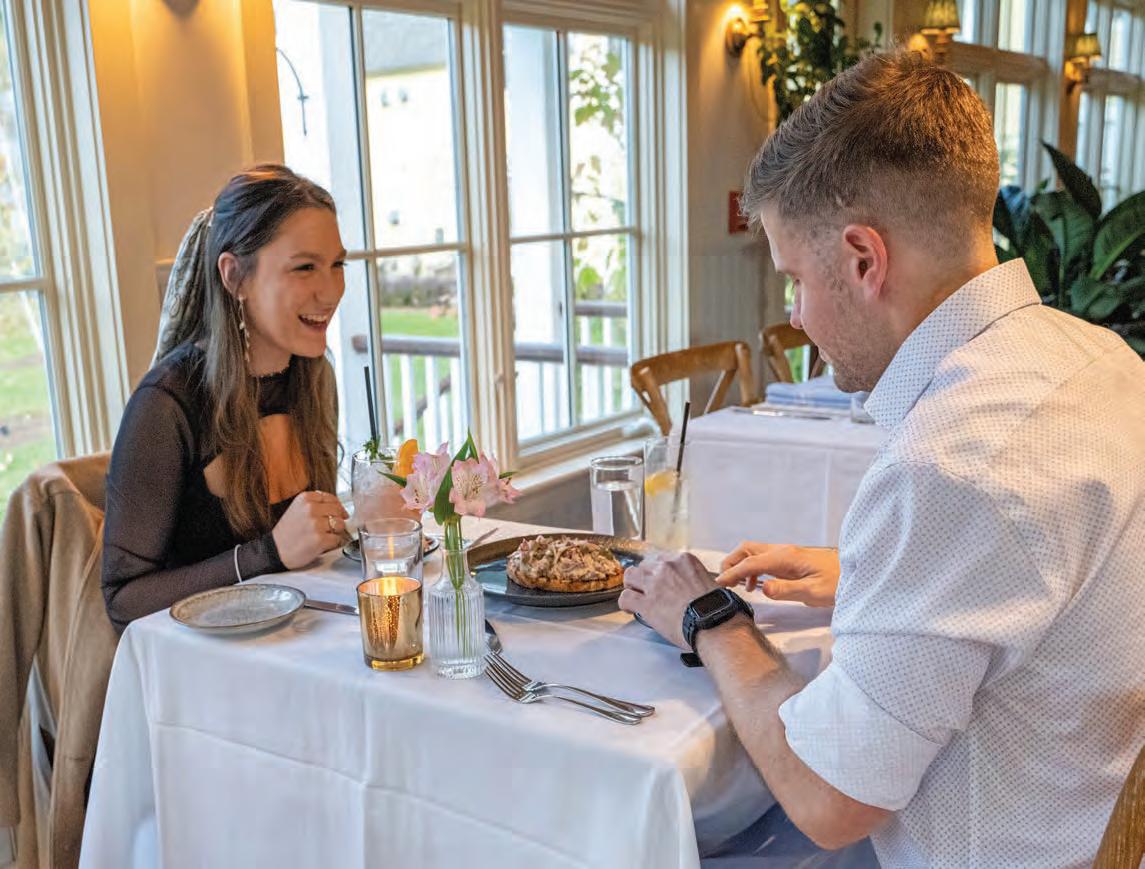
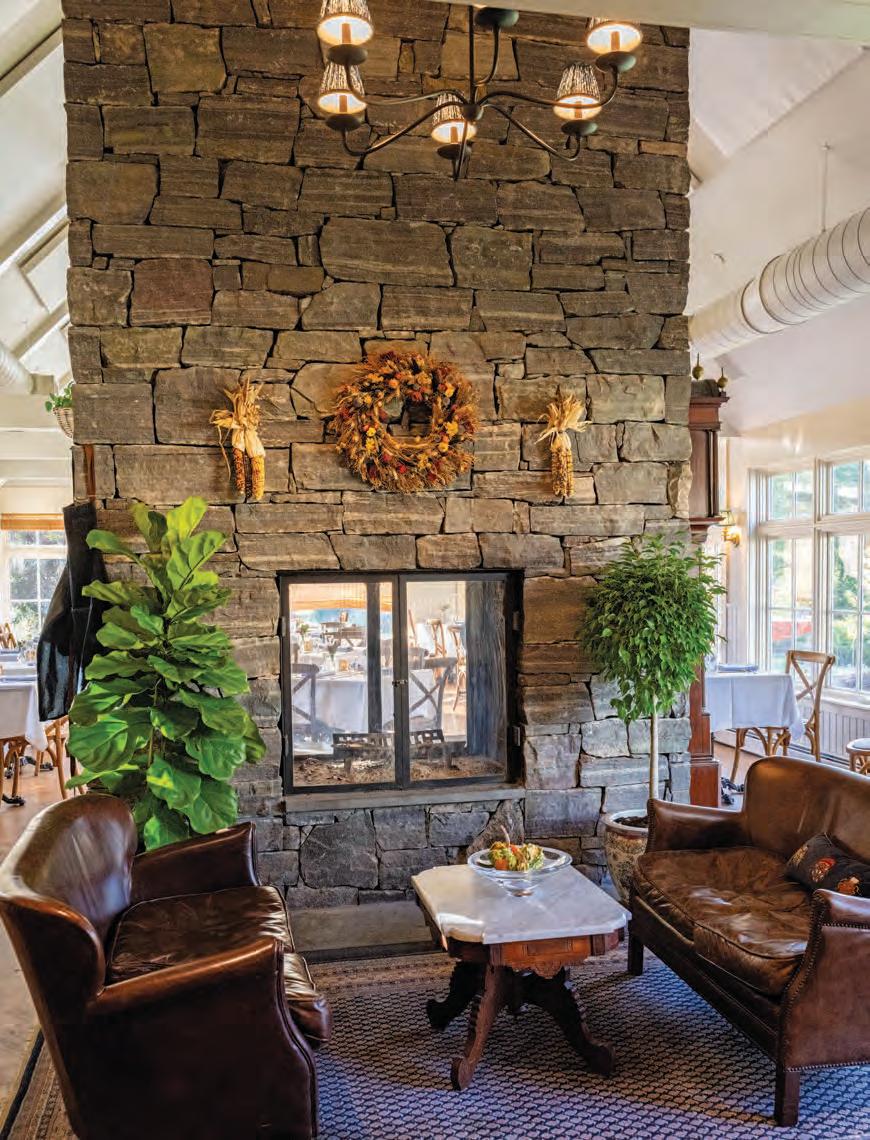
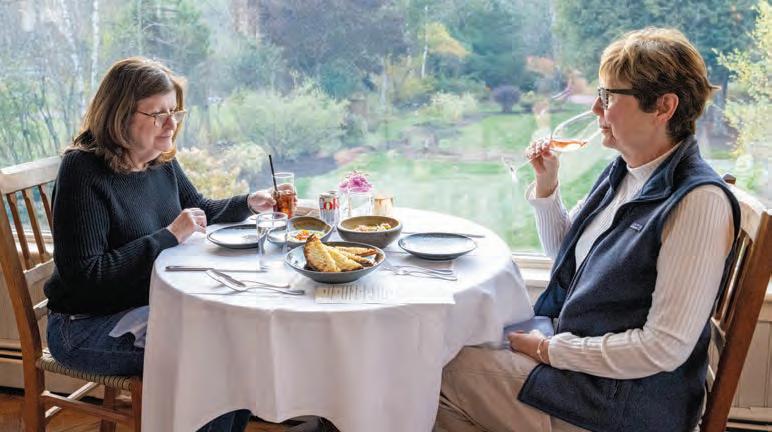
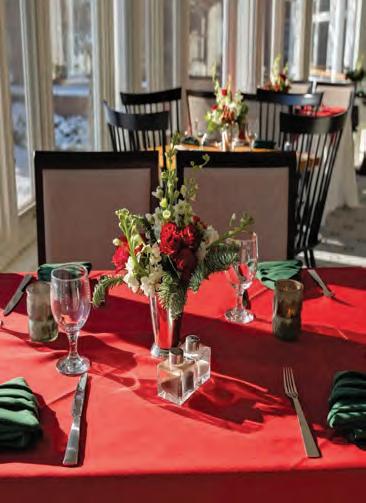
Previous patrons of the former restaurant at The Jackson may remember the commanding fireplace that still anchors one end of the dining room, a pleasant space with a herringbone wood floor and at the other end, large windows with a view of the landscaped gardens. Whether because of its history, the spaced tables, or the white tablecloths (which may be temporary, Justin believes, once they are able to improve the sound quality in the room), this new Oakes & Evelyn has a bit more of a New England upscale vibe.
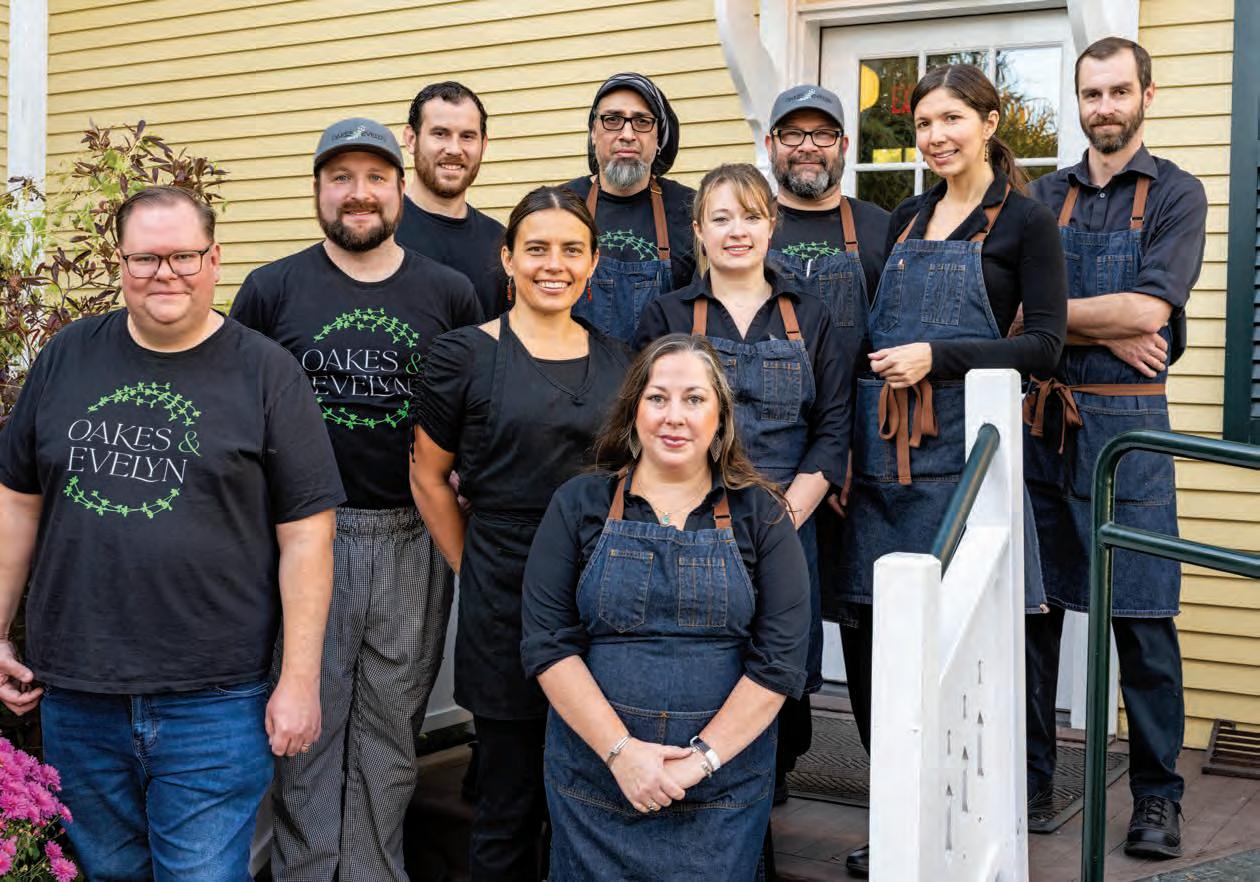
Top: Kitchen and serving teams get ready for dinner service.
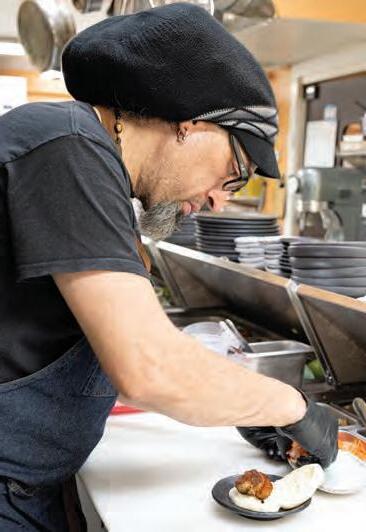
Above: Chef Robby plates Steam Buns.
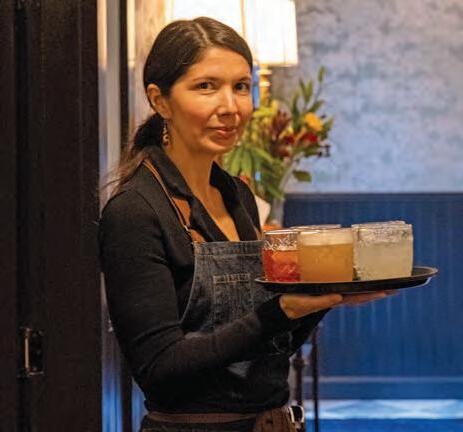
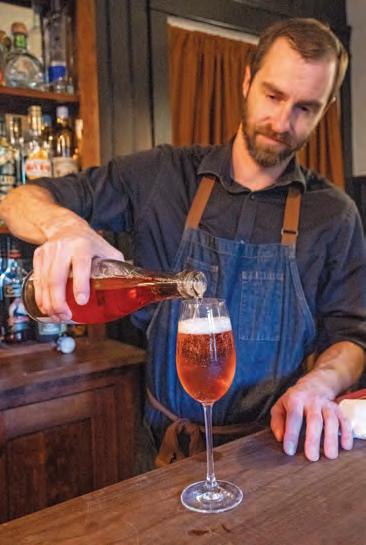
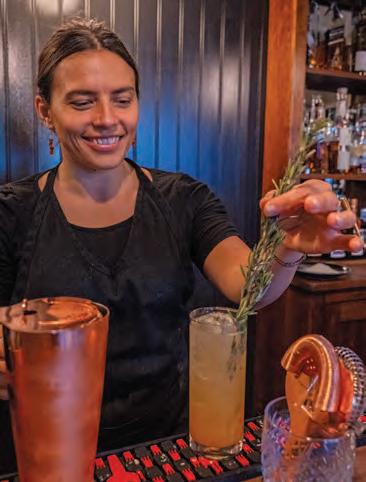
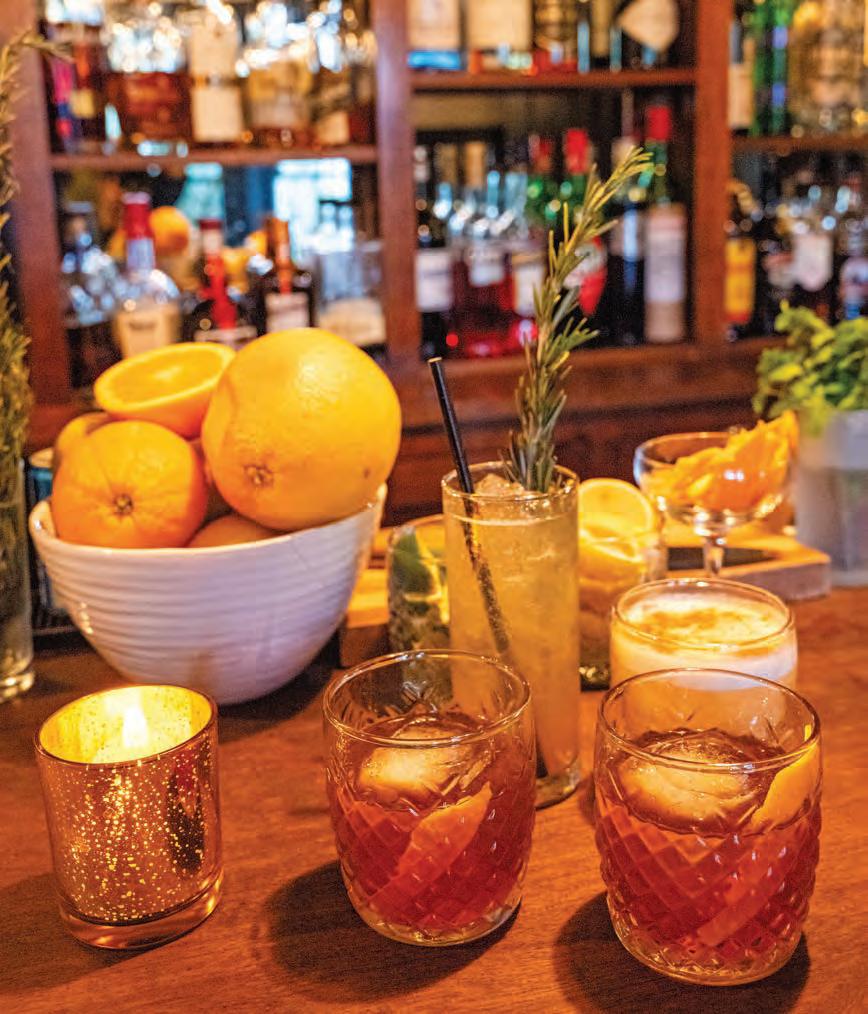
Opposite (clockwise from top left): Seating area for Oakes & Evelyn features a warm fireplace. Arron pours rose wine for guests. Rita garnishes holiday cocktails. Guests enjoy dinner viewing the gardens at The Jackson. Sabina delivers drinks to dinner guests.
FOOD THAT SPEAKS FOR ITSELF
Asked what changes he has seen over his years as a chef, Justin says, “technique . . . and simpler is better.” Gone are the days of gels and foams on overdone plates. Flavor is still key; fussiness is not. On its website, the restaurant promises to “ . . . put the ingredients first and execute them to the highest degree to make the local food shine and speak for itself.” As for clientele, their needs and requests have evolved over time too. Whether because of religious or health reasons, or simple preference, there is more of a demand for vegetarian and vegan items on the menu. Justin tries to
Asked what changes he has seen over his years as a chef, Justin says, “technique . . . and simpler is better.” Gone are the days of gels and foams on overdone plates. Flavor is still key; fussiness is not.
keep a number of those offerings available. And patrons are increasingly diverse. Montpelier has courted and serves primarily a local clientele. Because of the timing of the opening and the location, Oakes & Evelyn in Woodstock has been serving tourists from everywhere, although as the word has spread, local folks are becoming more frequent.
The talents of a team in each kitchen and a front-of-the-house staff are es-
sential to the success of Oakes & Evelyn. At a time when many restaurants and local businesses are facing an inability to recruit and retain staff, Justin says that opening a new restaurant in Woodstock presented challenges, at least in the beginning. Oakes & Evelyn advertised for staff through traditional advertising and social media. Word of mouth proved essential. According to Justin, having “happy employees and a happy place to work”
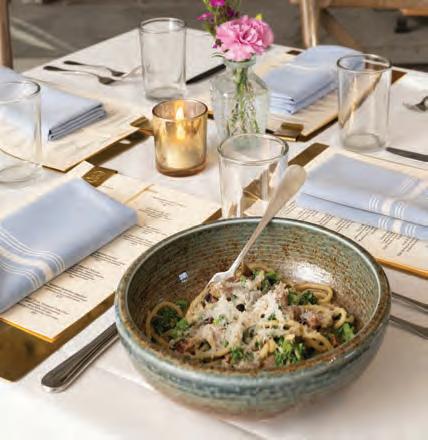
Clockwise from top left: Holiday cocktails for dinner guests. House-made Spicy Duck Confit Bucatini garnished with Parmesan cheese. Spicy Pork Belly Bao Bun.
Pumpkin Gnocchi with Kale, Wild Mushrooms, Bacon, and Sage
1 qt water
1 lb unsalted butter Salt to taste
20 oz all-purpose flour
1 cup Parmesan cheese (grated)
8 oz pumpkin puree
14 eggs
4 egg yolks
¼ lb slab bacon
1 oz canola oil
1/4 cup wild mushrooms
1/2 cup chopped Tuscan kale
1 tsp chopped sage
2 oz vegetable stock
1 Tbsp unsalted butter
2 Tbsp pecorino cheese
Chives to garnish
1Bring water, butter, and salt to a boil. Add flour and stir until fully incorporated.
2Place mixture in a stand mixer with the paddle attachment. Add Parmesan cheese and pumpkin puree and mix for 20 seconds. Slowly add the eggs and egg yolks one at a time.
3Place mixture in a piping bag with a large plain tip. Pipe small amounts of the mixture into salted simmering water for 1 minute and then shock the gnocchi in an ice bath. Reserve the gnocchi.
4Dice the slab bacon into small dice and slowly render in a sauté pan on low to medium heat until crispy. Cool and reserve.
5In a sauté pan over medium heat, add the canola oil and the wild mushrooms and cook until they begin to caramelize. Add a tablespoon of crispy bacon, kale, and chopped sage to the pan and cook until the kale has wilted.
6Add a cup of gnocchi to the pan with the vegetable stock and bring to a simmer. Once the stock is reduced by half, add the butter and pecorino cheese. Garnish with chives.
is one of the rewards of owning and running a restaurant. He is a believer in working alongside his staff and leading by example.
A LABOR OF LOVE
Justin, who lives with his family in Grantham, New Hampshire, puts considerable mileage on his car as he pings from home to one or the other—and sometimes both—restaurants. For the moment, Oakes & Evelyn at The Jackson is garnering more of his attention since it’s newer; his team in Montpelier is experienced and adept at keeping things running smoothly. And this second Oakes & Evelyn is serving not just dinner but also breakfast to hotel guests and the general public, which means that the chef may start and end each day there.
His own biggest challenge? “It has to be work-life balance.” With two restaurants approximately 60 miles apart from one another, and 60- to 70-hour work weeks spent on the road or on the job, keeping everyone happy is a dayto-day feat.
What makes the long hours worthwhile? In addition to creating a happy workplace, chefs love to feed people. Justin sees Oakes & Evelyn—in either location—as a “home for the community to come in and just have a great night.”
oakesandevelyn.com/jackson
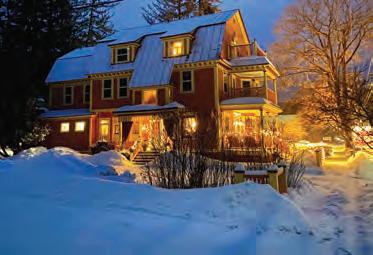
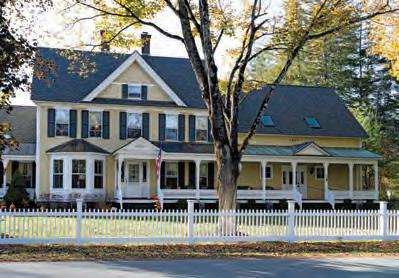
The Jackson in Woodstock.
OAKES & EVELYN
It’s Happening in the Mad River Valley
All Things Bright and Beautiful European and Vermont-made
Christmas Ornaments
27 Bridge Street Waitsfield, VT (802) 496-3997
Open daily 9am–5pm
Mad River Distillers
Whiskey and Rum Distilled in the Heart of Vermont's Mad River Valley Warren, VT (802) 496-6973
5523 Main Street Waitsfield, VT (802) 496-2500 www.themadrover.com @themadrovervt
Clearwater Sports "Putting People and the Outdoors Together" Skiing • Snowshoeing • Hiking • Paddling
4147 Main Street Waitsfield, VT (802) 496-2708 www.clearwatersports.com
Celebrating 50 years!
Artisans’ Gallery
20 Bridge Street Waitsfield, VT (802) 496-6256
www.vtartisansgallery.com
Open daily 11am–6pm
Mad River Massage Customized Massage Therapy
5677 Main Street Waitsfield, VT (802) 496-5638 www.madrivermassage.com
Wishing you and your family a merry and bright holiday season.
Les Trois Vallees
The Largest Ski Area in the World
Story and Photography by Lisa Ballard
No skier likes crowded slopes, and who doesn’t want lots of terrain to explore on a ski vacation? Perhaps that’s why large ski resorts are quick to point out how huge they are. Take nearby Killington Resort, nicknamed “The Beast” for its bigness. It’s the largest ski area in the Northeast with 1,977 skiable acres including Pico Peak, which is part of this megaresort but not connected by a trail or lift. Even without Pico (468 acres), Killington is still king of the Northeastern ski resort giants, followed by Sugarloaf in Maine at 1,360 acres.
Despite Killington’s largeness, ski resorts in western North America are more sizeable, by a lot! Powder Mountain, Utah–the terrain titan of the West–is quadruple the size of Killington, offering an impressive 8,484 skiable acres. Whistler Blackcomb, British Columbia, is a close second at 8,171 acres. That’s a lot of snow, enough to keep most skiers entertained on a weeklong ski trip. However, Powder Mountain and Whistler Blackcomb are but a third the size of Les Trois Vallees, the largest interconnected ski area in the world.
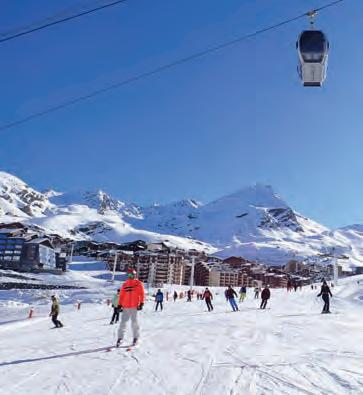
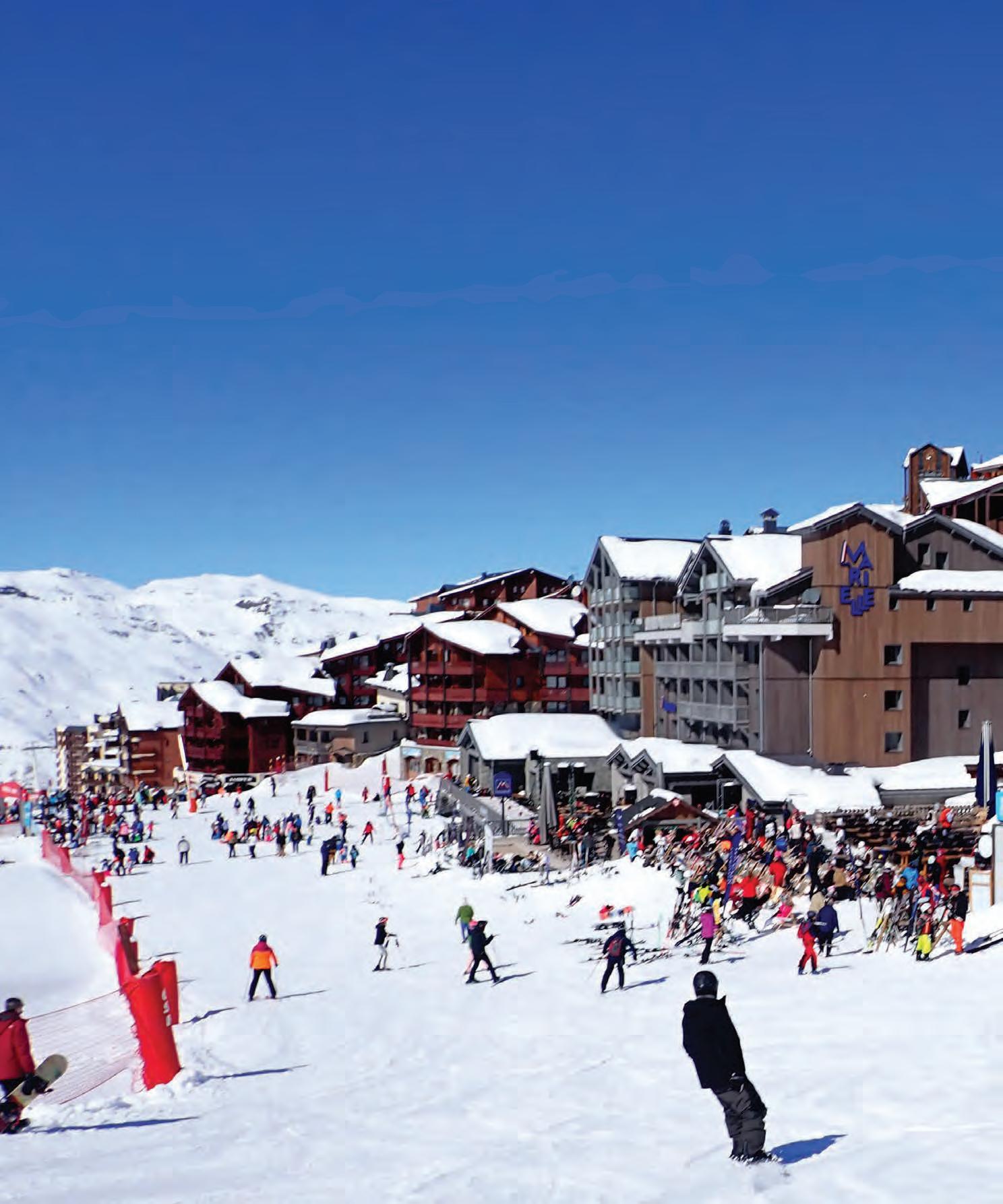
The base area at Val Thorens is a busy access point to Les Trois Vallees, but the crowds quickly thin as you head higher on the surrounding lifts.
A visitor can pick their village, then ski to the others using one pass, though it would take a while.
DISCOVERING VAL THORENS
Les Trois Vallees, which is French for “the three valleys,” sounds modest. Afterall, Killington boasts seven peaks, but Les Trois Vallees offers a massive 25,916 skiable acres. To access this network of 183 lifts and 375 miles of maintained trails, the area is speckled with several mountain villages, most notably Courchevel, Meribel, Val Thorens, and Les Menuires.
As a lifelong skier, I get bored easily lapping on the same slopes. Last winter, I traveled to Les Trois Vallee in hopes of finally finding a ski area with endless options. It fulfilled my wish, slope after different slope. Luckily, I didn’t need to decide upon a starting point. I opted for Val Thorens, mainly because my three skiing buddies–Carmen, Clemente, and Benedetta–picked a hotel there.
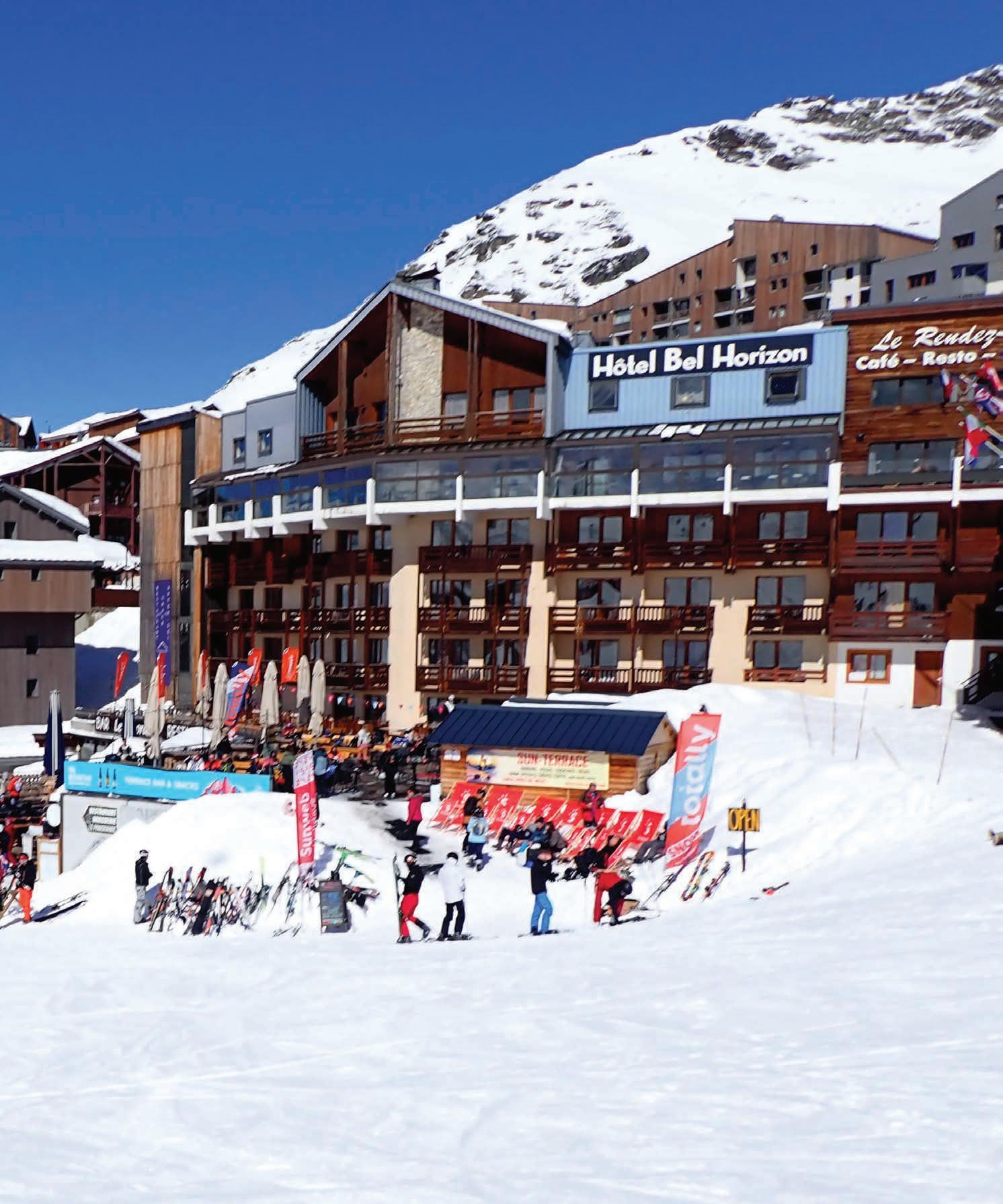
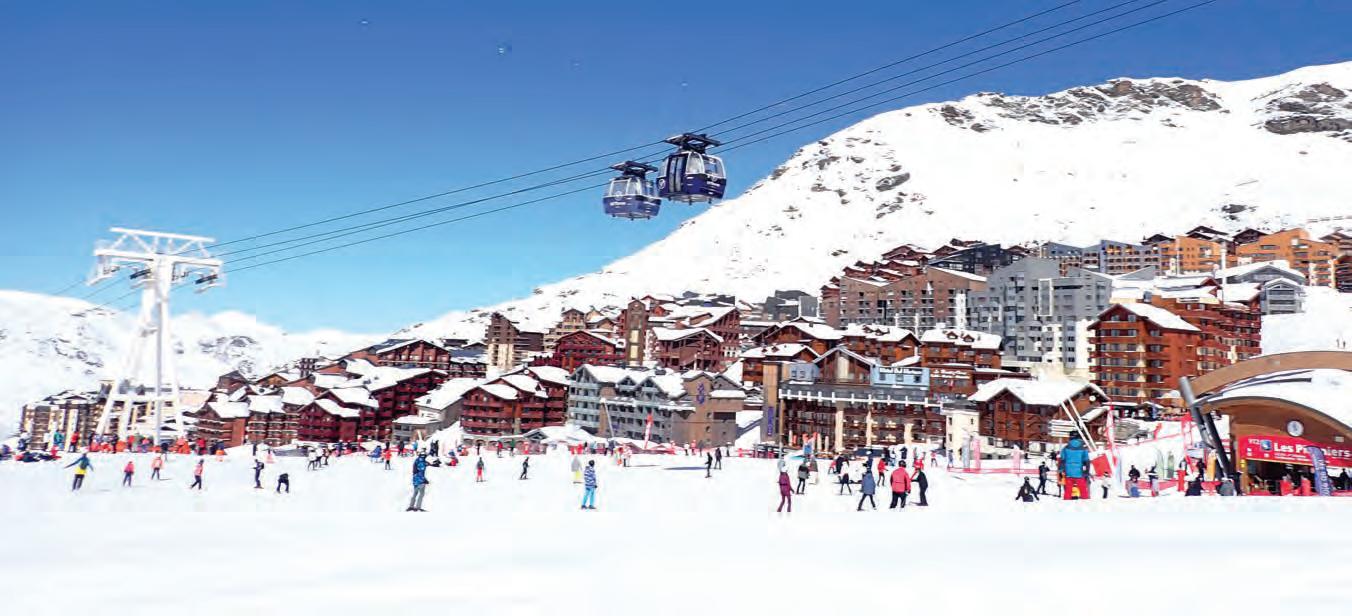
Val Thorens lies at the top of the same valley as Les Menuires. This mountain enclave of 1,000 full-time residents hosts a million skiers per winter. As you might guess, it’s 90 percent hotels, restaurants, and shops, but there’s a catch. It’s almost pedestrian only. Locals can drive along the narrow one-way streets to make deliveries, but visitors have to park in their assigned parking garage after unloading at their hotel. It’s not as onerous as it sounds. If you don’t want to walk somewhere, you can probably ski, at least to anywhere that’s downhill from your lodge, most importantly the ski slopes.
We booked rooms at the Hotel Marielle, which was part of a long line of hotels next to the ski slopes. It sounded perfect on paper, but leaving the hotel on skis was like trying to enter bumper-tobumper traffic on a multilane road. Immediately outside the hotel was a swarm of skiers of all ages and abilities, several cable cars heading in different directions overhead, a ginormous magic carpet, and multiple chairlift terminals. The four of us eased into the mayhem, then worked our way to a chairlift called Les 2 Lacs. Surprisingly, there was no line. Once on the chairlift, things got better.
The center of Val Thorens was not always so busy. Sixty-five years ago, it was merely an alpine stream that flowed from under breathtakingly scenic, glaciated
A view of the village of Val Thorens, which is mostly hotels, from the ski slopes.
A sign
between Val Thorens and Les Menuires is a popular spot for a photo.
peaks. The place enchanted real estate developer Pierre Schnebelen, who envisioned building the highest ski lift in Europe there. His dream eventually came true, but not at first.
In 1971, Val Thorens opened for skiing with three surface lifts and more marmots than skiers. A decade later and under an avalanche of debt, the ski area constructed its landmark Cime Caron cable car (tram). The lift held 150 people, the largest tram in the world at the time. It was replaced in 2019 by a newer tram that holds 135 people. Both the original and newer Cime Caron tram traveled to the top of its 10,500-foot namesake peak. Schnebelen’s dream came true, and it changed Val Thorens from a small, remote cluster of guesthouses into a major skiing destination. Hotels followed, including the Hotel Marielle.
Upon walking into the lobby of the hotel, I couldn’t help but notice Marielle Goitschel’s poster and ski racing memorabilia that filled the wall on my left. The French ski racer and her sister Christine were among the most prominent alpine athletes of the 1960s. Christine won the gold and Marielle won the silver in slalom during the 1964 Winter Olympics in Innsbruck, Austria. The sisters flipped the results in the giant slalom, with Marielle garnering the gold and Christine taking the silver. Marielle, the younger of the two Goitschel sisters, won again in the 1968
Olympic slalom in Grenoble, France. The two sisters used their fame to help promote Val Thorens to other skiers. Marielle built her hotel as the ski resort began to gain momentum during the 1980s.
SKIING AND DINING
As the Les 2 Lacs chairlift whisked us up the valley wall, we quickly forgot about the crowds below. Val Thorens is huge in its own right, a series of alpine snowfields that spill off the towering 12,000-foot Aiguille de Peclet and
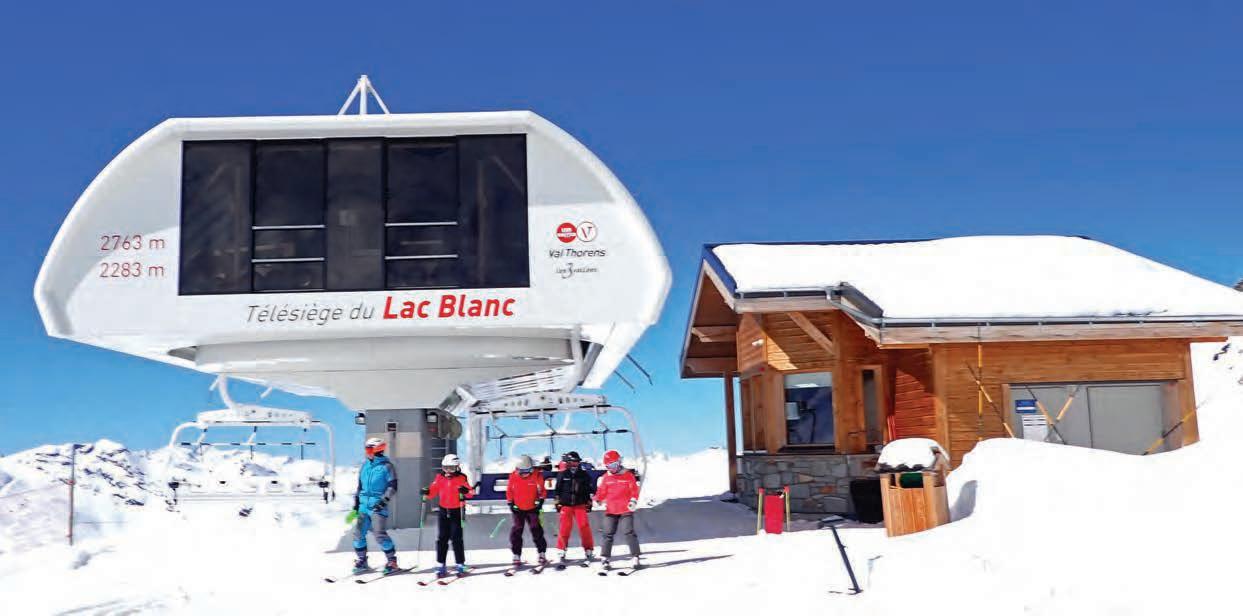
The top of this high speed six-pack translates to "Chairlift of the White Lake," but instead of a lake, skiers find miles of vertical snowfields to explore.
several neighboring summits down to the village. From Les 2 Lacs, we pieced together our own tour that included a ride up the renowned Cime Caron tram. The runs were too many to remember, and most were long and immaculately groomed. We stopped frequently to take in the stunning views of the ski area and the surrounding Alps, all above tree line.
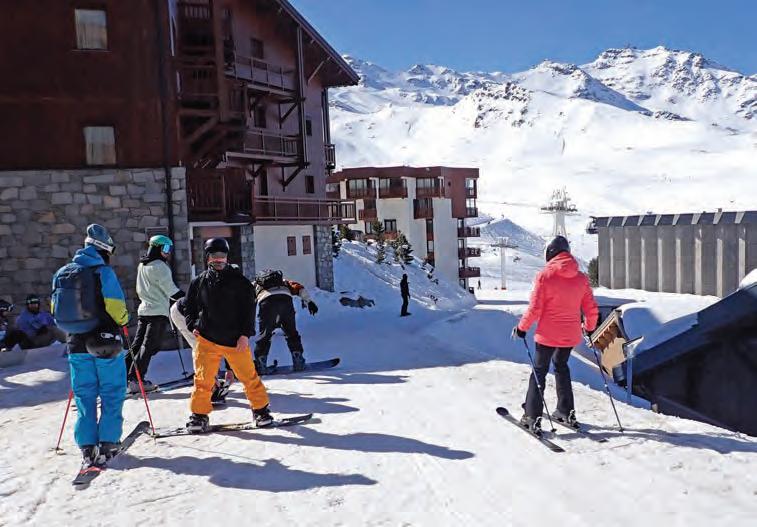
No car? No problem. You can ski from most hotels in Val Thorens to the slopes.
Insider Info
• GETTING THERE: The closest international airport with regular flights from the USA is Geneva, Switzerland (GVA).
• GROUND TRANSPORTATION: GVA is 125 miles (about three hours). The most hassle-free way to go to and from the airport to Les Trois Vallees is by shuttle service, about $60 one way.
• LODGING: Hotel Marielle, hotelmarielle.com/en
• LIFT TICKETS: Les Trois Vallees is an EPIC Pass partner. Or buy a multiday pass at the ticket window for about $70 per day.
• MONEY: France uses the Euro. For the best exchange rate, use a credit card that does not have a foreign exchange fee. VISA is widely accepted. Other credit cards less so.
• TIME ZONE: Les Trois Vallees is six hours ahead of Woodstock, Vermont, in the Central European time zone.
• WATER: Potable throughout the region.
• ELECTRICITY: France uses type E and C electrical plugs, which are both compatible with the 230V voltage. Type E has two round pins and a hole for a grounding pin. Type C has only the two round pins. Type C plugs fit into Type E outlets. Many hotel rooms also have USB and USB-C outlets, but plan to bring a converter to ensure you can charge your devices.
Nothing could have prepared me for such an expanse of winter eye candy. By 2pm, our legs on fire from the pleasurable exertion, we made our way back to the village in search of lunch and ended up on the deck of the Hotel Marielle. A pig roasted on a spit as a chef grilled other meats. A couple magnums of bright green Chartreuse liqueur were on display by the grill. The waiter asked if we would like to taste it.
Chartreuse is a legendary French liquor made from 130 herbs and other plants that Carthusian monks ferment together using a secret recipe that dates back to 1700s. The monastery where Chartreuse is crafted is only an hour from Les Trois
Vallees. It’s considered a local specialty, which made sense not only due to the monastery’s proximity but also because of its warm finish, the perfect complement to a day on the slopes. Of course, we all wanted to try it. “When in Rome . . .” as the saying goes, or in this case, France. Tantalizing one’s skis on the snow and
then one’s taste buds afterwards were the main reasons to go on a winter vacation anywhere in the French Alps. Val Thorens did not disappoint in either category.
EXPLORING LES MENUIRES
Even though we had skied less than half of Val Thorens, the next day, we followed
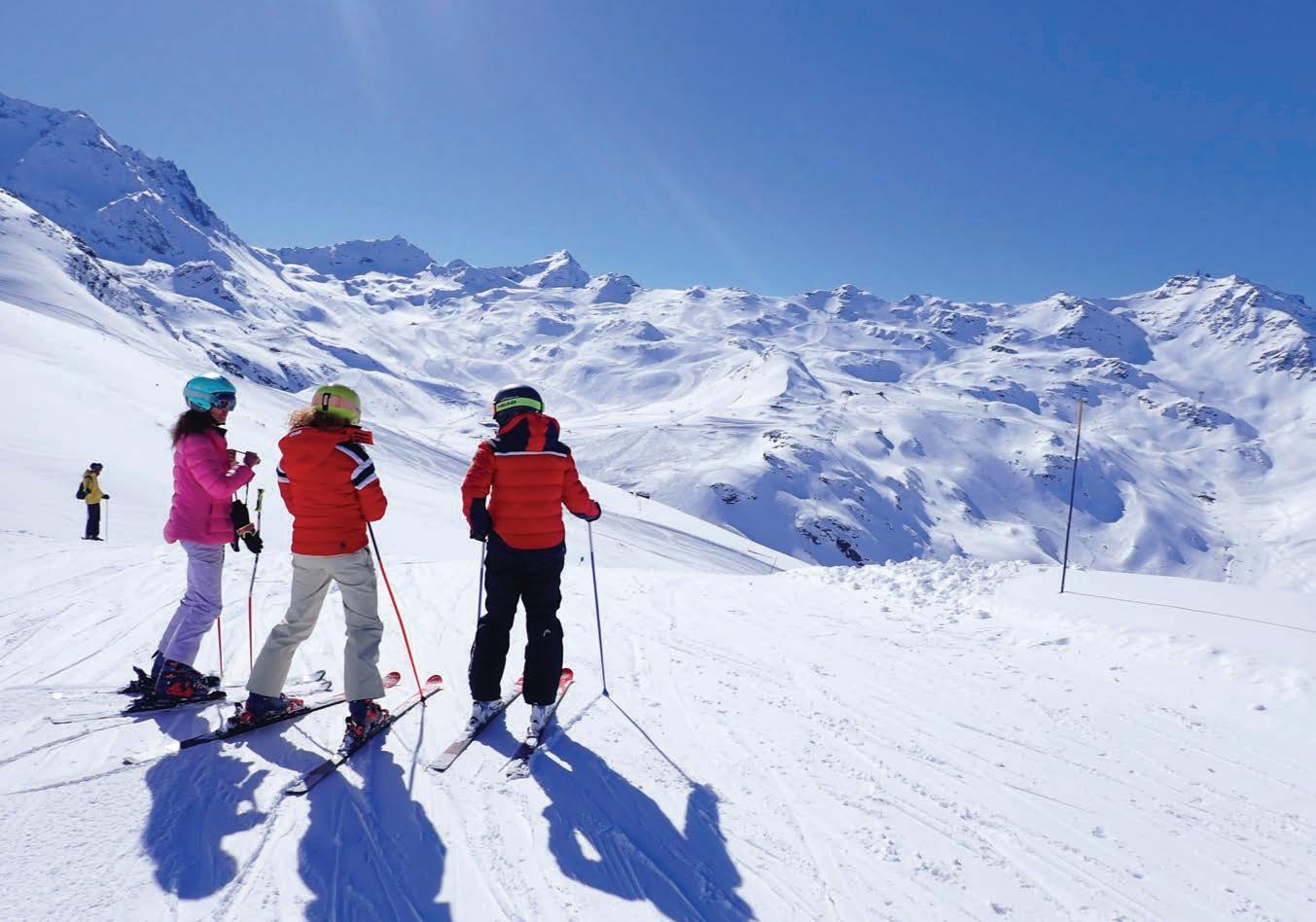
Above: Skiers pause to take in the massive alpine view. Les Trois Vallees has over 25,000 interconnected skiable acres!
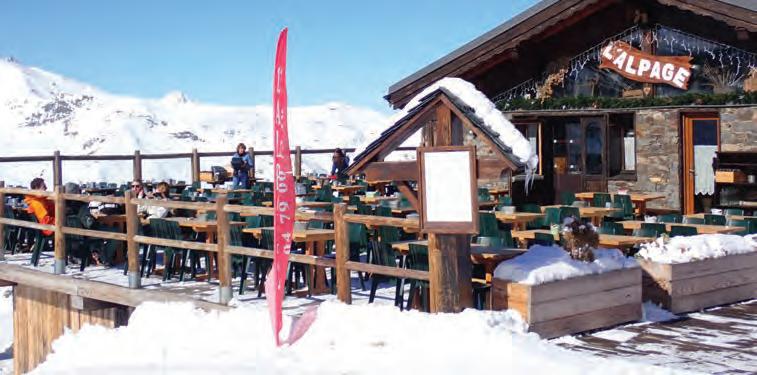
Right: L'Alpage, a mid-mountain hut in Les Menuires, is a favorite pitstop for skiers and snowboarders for its views and its menu.
an easy 2.5-mile run from our hotel down to Les Menuires. Once there, we skied the opposite side of the valley from the day before.
On one run, we discovered a trail called 4 Vents (“Four Winds”), which was next to a World Cup super G track. It was exhilarating to make high-speed turns down the corduroyed slope. We eventually came to a stop at a midmountain restaurant called L’Alpage. The building was half buried in the snow, but its deck was clear with a few people enjoying drinks and snacks and relaxing in the sunshine. We opted for hot chocolate, which was best hot chocolate I’ve ever had. The steamy drink was intensely chocolate, yet smooth and creamy. A cloud of freshly whipped cream drizzled with more chocolate floated atop the cocoa. It was heavenly!
As we savored each sip, we examined a trail map to figure out how to get back to Val Thorens. Based on the map, we skied to the Bruyeres chairlift, which topped out at Col de la Chambre, a dip in the ridgeline that would take us to Meribel if we crested it, or down to Val Thorens if we stayed on the same side.
“What about skiing to Meribel?” suggested Carmen upon seeing the sign to Meribel. “Let’s do that tomorrow,” said Benedetta, who had several more runs she wanted to check out in Les Menuires. Perhaps the biggest challenge of skiing Les Trois Vallees is figuring out where to go next. There’s so much terrain! But that’s also the greatest pleasure in going there—well, and the food. After all, it’s France.
Open Daily | 4:30pm-8:30pm
Trahan's Tavern
nightly at 4:30pm
opens
Children learn to ski as preschoolers in Les Trois Vallees.
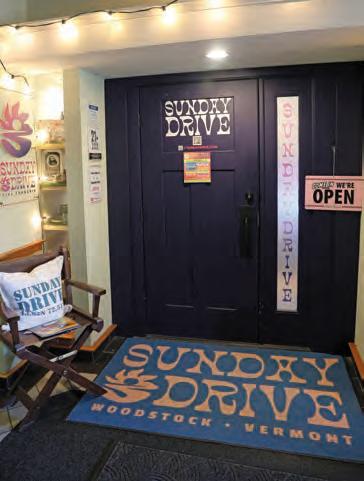
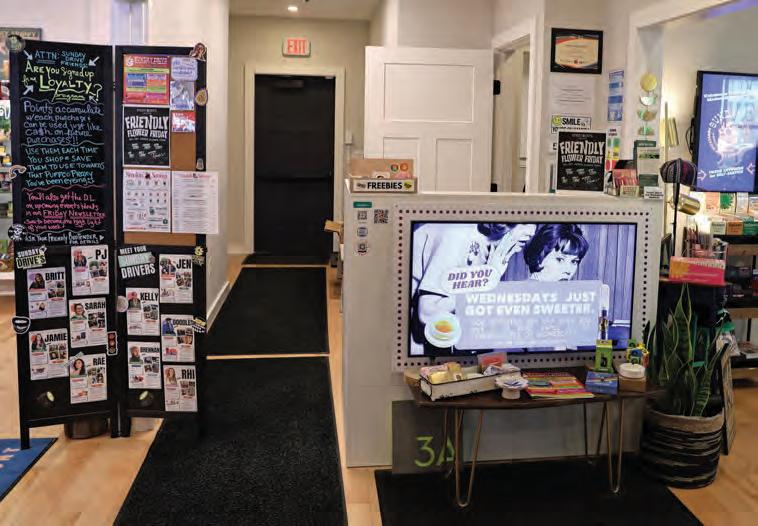
Sunday Drive Dispensary
Purveyors of fine cannabis
By Corey Burdick | Photography by Herb Swanson
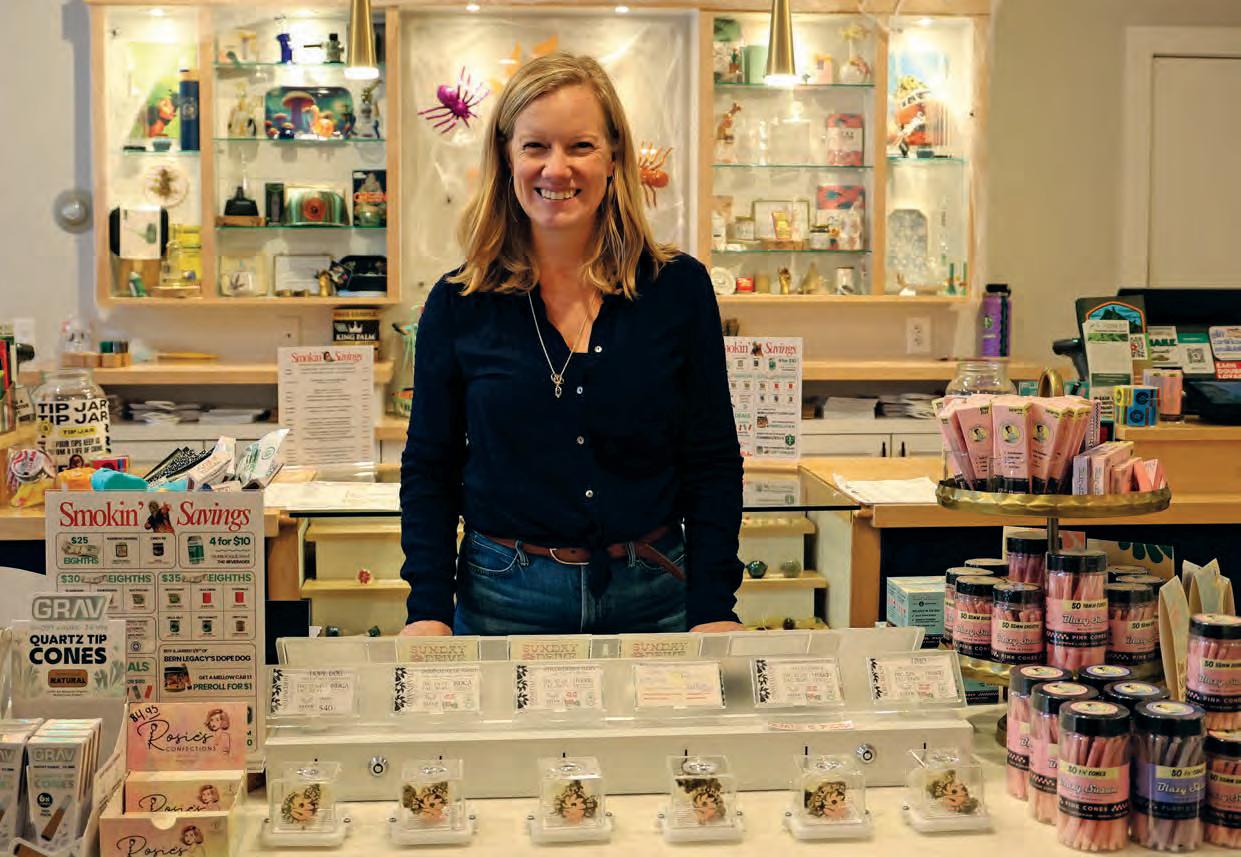
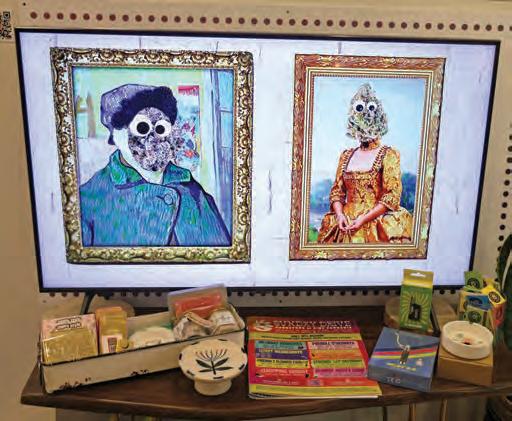
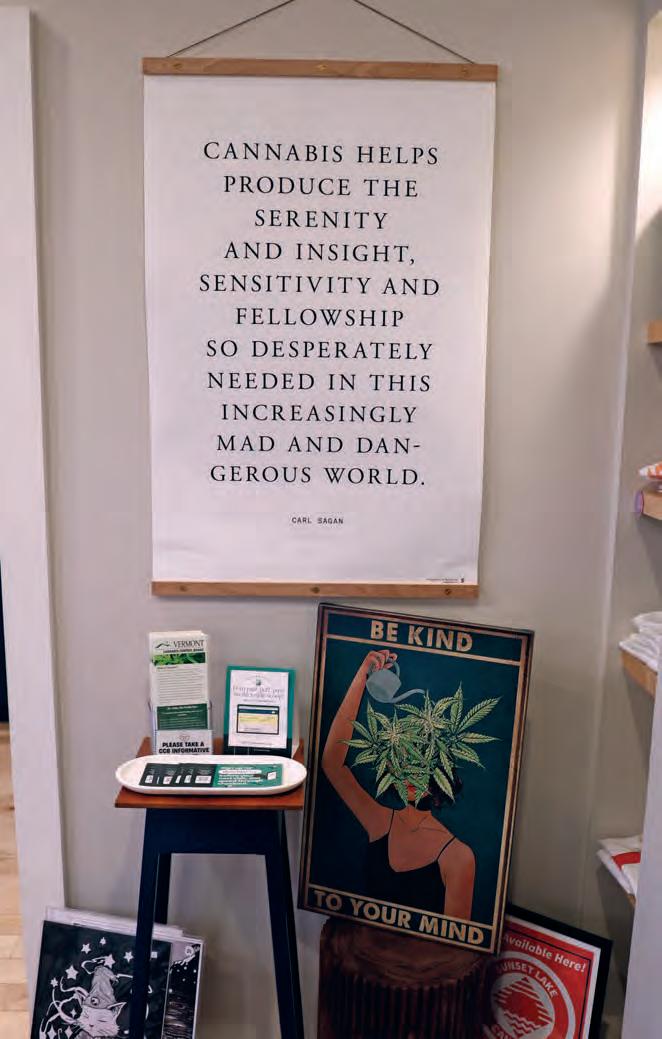
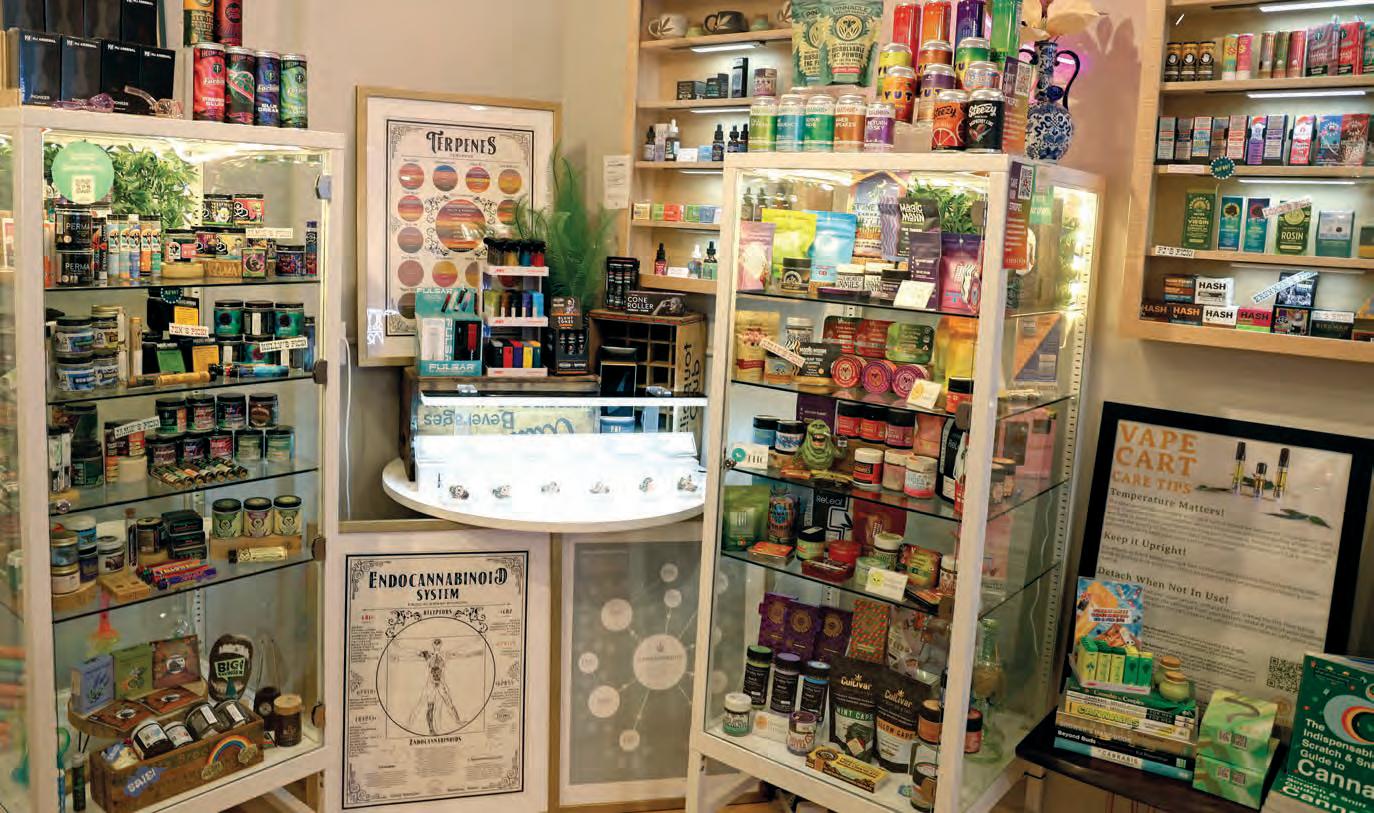
Sunday Drive Dispensary, which recently celebrated its third anniversary in Woodstock’s Gallery Place building, is not owner PJ Eames’s first foray into business ownership. You may know PJ from Clover Gift Shop, which she acquired in 2008. There, she made the shop her own and in 2016 introduced a CBD
line under the name Clover Apothecary. As this arm of the business took off, Vermont was working through the cannabis legalization process, and individual towns had to decide whether to allow dispensaries. Woodstock developed a committee to consider the option, and PJ joined to inform residents what it would be like to have a dispensary here.
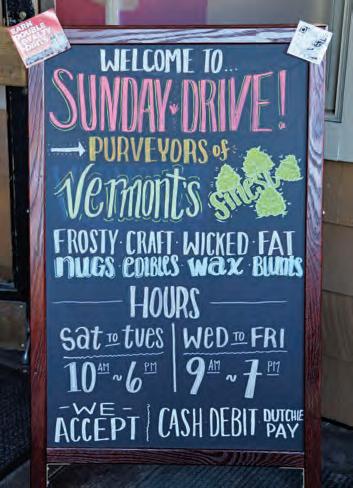
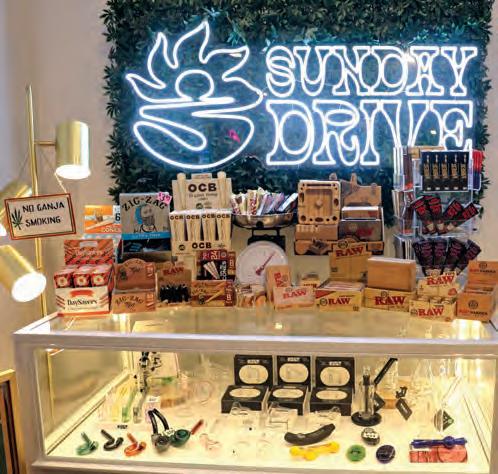
Above: Sunday Drive Dispensary Is open! Below: Owner PJ Eames stands behind the Bud Bar at Sunday Drive.
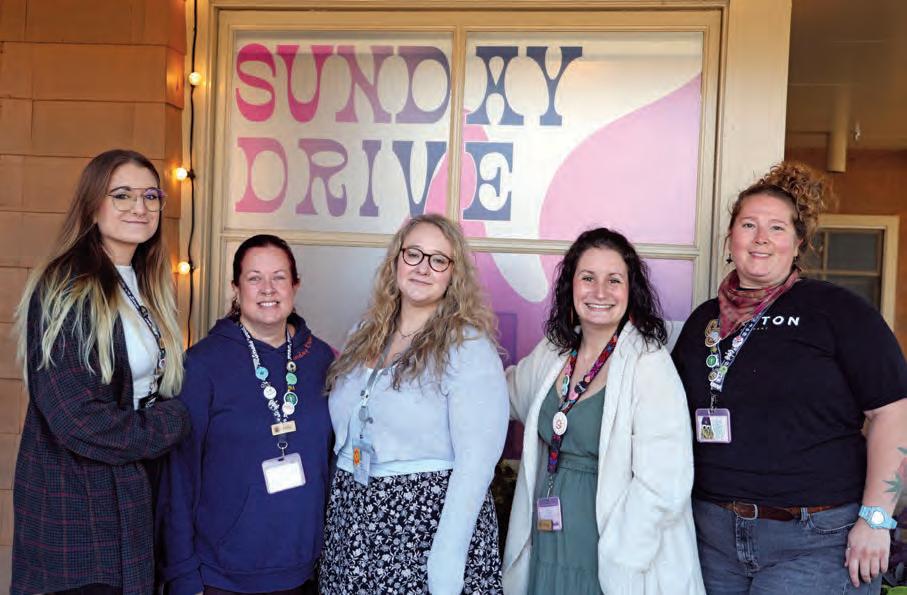
Already having sold CBD and having her own line of products through Clover Apothecary, PJ considered the idea of opening her own dispensary. She had a lot of support for the venture from the community and an experienced general manager ready to take the helm—Sarah Long, who had previously managed Clover Gift Shop. Now, three years in, her team includes nine employees, and the majority have been with Sunday Drive from the start.
“Everyone is happy to be here, employees and customers alike,” says PJ. “When
Clockwise from top: Smoking accessories on display at Sunday Drive. A Carl Sagan quote hangs in the store entrance. Budtenders and managers: Rae, Kelly, Brittany, Jamie, and D. Fun art is by Rae, Sunday Drive’s marketing manager.
customers walk in and I ask how their day is going, the answer is almost always ‘Better now,’ and that is very gratifying.”
WHAT TO EXPECT
From tinctures to concentrates, pre-rolls to bulk cannabis, there is a variety of options at Sunday Drive. When customers walk in, they are required by law to show
identification (it cannot be expired or temporary). The dispensary cannot accept credit cards, but it conveniently has an ATM available. The shop features a bulk purchasing space and also offers prepacked cannabis, edibles, pre-rolls, concentrates, and noncannabis merchandise such as hats, T-shirts, and sweatshirts.
There’s also a Bud Bar where little
Clockwise from top: Products on display are all Vermont made. Sunday Drive’s interior entrance. Sunday Drive merchandise includes T-shirts and hats.
boxes containing a big nug of flower are available for customers to see and smell prior to buying. Customers can either buy from a budtender directly or they can go to a kiosk in the store, scroll through the menu, and place an order to pick up from a budtender.
One of PJ’s goals is for people feel comfortable when they come in, whether they are complete cannabis novices or are looking to try something new. Her staff of budtenders is very knowledgeable, and she has seen employees spend an hour with customers answering questions. “When someone comes into the dispensary, we start the conversation by asking how they want to feel and what kind of consumption methods they prefer,” says PJ. This opens the door to exploration.
MAKING CANNABIS ACCESSIBLE
Making cannabis affordable, despite the 21 percent tax on purchases, is important to PJ. She offers daily deals to customers
that include the Monday Munchies (20 percent off edibles), pre-roll Tuesdays (20 percent off when you buy three or more), and double points to use toward future purchases on Saturdays and Sundays. For
residents of the Upper Valley and Rutland County, medical card holders, and veterans, a daily 10 percent discount applies. Additionally, PJ recently applied for a medical endorsement for Sunday Drive
The entrance at Sunday Drive features employee profiles and in-store daily deals.
and hopes to be offering services to medical card holders. These customers will enjoy a private area, will be able to buy up to two ounces instead of one ounce of cannabis per day, and will not be subject to tax. Sunday Drive also has an app, Sunday Drive VT, which is available in the Apple App Store. Customers can earn points with each purchase and use them as cash for future purchases.
PRODUCT SOURCING: IT’S ALL LOCAL
Since the product cannot cross state lines, Sunday Drive only sells Vermont cannabis. The products are tracked and registered with the Cannabis Control Board and are tested for pathogens, safety, and pesticides. This ensures quality compliance.
At Sunday Drive, local cultivators and craft producers abound. Some of the growers include Permaganix (Mount Holly), Forbins Finest (Barre), Backwoods Farm (Bridgewater), Turkey Hollow (Barnard), Edward’s Sungrown (Hartland), Mr. Tree, Bushy Beard (Northeast Kingdom), Upstate Elevator (Burlington), Bern Legacy (Burlington), and TriChome Ranch (Rochester). In addition, Birdman is one of only five cultivators with whom they work. They are “very small batch,” according to PJ, and customers anticipate arrivals from them. PJ and her husband James have their own Tier 1 (125 plants) growing operation, Sunday Farms in Sutton, Vermont. The cannabis is grown outdoors, trimmed by PJ, and sold on Sunday Drive’s bulk bar. PJ notes that on a Sunday drive, there’s no set destination and no need to hurry, and that’s exactly one of the comments she hears from customers: “We were just out for a drive.” Adventure awaits!
SUNDAY DRIVE
442 Woodstock Road Woodstock, VT (802) 332-0049
vtsundaydrive.com
THROUGH JANUARY 3
A Forest of Lights
Experience winter magic as thousands of lights transform the VINS Nature Center into an enchanted wonderland. After exploring the illuminated trails, warm up by the cozy campfire while enjoying hot chocolate, cider, and snacks available for purchase. Advance ticket purchase is required. VINS, 4:30–7pm vinsweb.org
A captivating holidaycreatingexperience joy for visitors of all ages!
PENTANGLE ARTS
31 The Green Woodstock, VT (802) 457-3981 pentanglearts.org
DECEMBER 26–28
Springsteen: Deliver Me from Nowhere
The story of legend Bruce Springsteen retreating to a New Jersey bedroom to record his iconic, haunting masterpiece: the 1982 album Nebraska. Town Hall Theater, 7:30pm
Exhibit: The Wonder Room ▴ Woodstock History Center woodstockhistorycenter.org
Exhibit: Hindsight 20/20 Woodstock History Center woodstockhistorycenter.org
Exhibit: A Child’s Life Woodstock History Center woodstockhistorycenter.org
MONDAYS
Poetry Group
Norman Williams Public Library, 4pm normanwilliams.org
TUESDAYS
Needlepoint Get-Togethers
Norman Williams Public Library, 10am normanwilliams.org
TUESDAYS
Baby Story Time
Norman Williams Public Library, 10:30am normanwilliams.org
THURSDAYS
Toddler Story Time
Norman Williams Public Library, 10:30am normanwilliams.org
THURSDAYS Knitters’ Meetup
Norman Williams Public Library, 2pm normanwilliams.org
THURSDAYS
Play Bridge at Norman Williams!
Norman Williams Public Library, 2pm normanwilliams.org
ALTERNATING THURSDAYS
Open Mic Night
Artistree, 7pm artistreevt.org
THROUGH JANUARY 3
A Forest of Lights VINS, 4:30–7pm vinsweb.org
DECEMBER 11
Enchanted Wassail Evening
Norman Williams Public Library, 6pm normanwilliams.org
DECEMBER 12
Children’s Stories for December Holidays
Norman Williams Public Library, 3pm normanwilliams.org
DECEMBER 12–14
Wassail Weekend
Woodstock Village woodstockvt.com
Mt. Tom North Street. By Byron Thomas (1902-1978), 1950, Oil on canvas. Loan from Richard Byron Thomas.
HAPPENINGS
Winter Celebration on the Farm
Billings Farm & Museum billingsfarm.org
DECEMBER 12–13
Rare & Vintage Book Sale
Norman Williams Public Library, 10am–4pm normanwilliams.org
DECEMBER 13
Holiday Ornament Making for Families Artistree, 10am artistreevt.org
DECEMBER 13
Ham Gillett Presents Dylan Thomas’s Lyrical Portrait of Holidays Past
Norman Williams Public Library, 12 & 1pm normanwilliams.org
DECEMBER 13
Wrensong Presents Songs of the Season
Norman Williams Public Library, 3pm normanwilliams.org
DECEMBER 13
Holiday Music in the Hayloft Artistree, 7pm artistreevt.org
DECEMBER 14
Cook It Speak It Around the World Winter Traditions: Tamales y Chocolate Artistree, 10am artistreevt.org
Norman Williams Public Library, 6pm normanwilliams.org
DECEMBER 19
Winter Carols BarnArts barnarts.org
DECEMBER 20–21
Woodstock Vermont Film Series Screening: Prime Minister
Billings Farm & Museum, 3pm billingsfarm.org
DECEMBER 20
Author Event: Michael Caduto: Enchanted Night Before Christmas
Norman Williams Public Library, 11am normanwilliams.org
JANUARY 6
Time to Talk Books: Discussion Group
Norman Williams Public Library, 5:30pm normanwilliams.org
JANUARY 10, FEBRUARY 14
Second Saturday Story Time Featuring Community Elders as Guest Readers
Norman Williams Public Library, 10:30am normanwilliams.org
JANUARY 13, FEBRUARY 10
What’s on Your Nightstand? Book Discussion Group
Norman Williams Public Library, 10:30am normanwilliams.org
JANUARY 15
Interplay Jazz Jam Session: Library After Hours
Norman Williams Public Library, 8am–5pm normanwilliams.org
JANUARY 16
Pride and Prejudice –Knitting & a Movie Artistree, 6pm artistreevt.org
JANUARY 21, FEBRUARY 25
Read Between the Lines: Book Discussion Group
Norman Williams Public Library, 4pm normanwilliams.org
DECEMBER 25
Christmas Day Buffet
Woodstock Inn & Resort woodstockinn.com
GET CONNECTED
Get listed on the greateruppervalley.com BUSINESS DIRECTORY and you will also be included on our printed list in every issue of WOODSTOCK MAGAZINE. (See page 17.)
HERE’S HOW!
Email Ryan Frisch at ryanfrisch@mountainviewpublishing.com, or call (518) 365-0030. Find out how you can connect with our readers. It’s easy, inexpensive, and another way to reach an affluent and educated audience.
SUBSCRIBE
Share the wonder of our beautiful area and the latest news all year long with a gift subscription. Friends and family who have moved away from the area will be especially appreciative. Be sure to order a subscription for yourself too!
Send a check for $19.95 for one year (4 issues) to Woodstock Magazine, 135 Lyme Road, Hanover, NH 03755. Or conveniently pay online using PayPal at www.mountainviewpublishing.com.
FEBRUARY 15–22 Magic of Maple Billings Farm & Museum billingsfarm.org
JANUARY 24
Ben Kogan Band Artistree, 7pm artistreevt.org
JANUARY 28, FEBRUARY 25
Zentangle Time
Norman Williams Public Library, 4pm normanwilliams.org
FEBRUARY 4
Literary Pairs: Book Discussion Group
Norman Williams Public Library, 1pm normanwilliams.org
FEBRUARY 19
Virtual Program: Paddling Through Time: The Long History of Canoes in New England Woodstock History Center, 6:30pm woodstockhistorycenter.org
FIND
ADVERTISERS INDEX
When
there’s snow on the ground, I like to pretend I’m walking on clouds.
— Takayuki Ikkaku, Arisa Hosaka, and Toshihiro Kawabata, Animal Crossing: Wild World