PRODUCEDBY
THE OFFICIAL MAGAZINE OF THE PRODUCERS GUILD OF AMERICA // MARCH | APRIL 2026
THE OFFICIAL MAGAZINE OF THE PRODUCERS GUILD OF AMERICA // MARCH | APRIL 2026
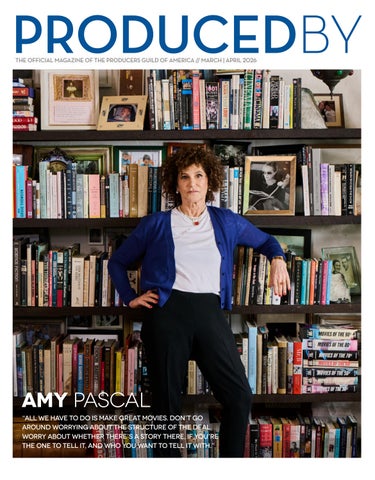
“All we have to do is make great movies. Don’t go around worrying about the structure of the deal. Worry about whether there’s a story there, if you’re the one to tell it, and who you want to tell it with.”
Darryl F. Zanuck Award For Outstanding
Producer Of Theatrical Motion Pictures
Guillermo del Toro, p.g.a.
J. M iles Dale , p.g.a. • Scott Stuber , p.g.a.
ONE OF THE YEAR’S BEST PICTURES WINNER
NATIONAL BOARD OF REVIEW
ONE OF THE YEAR’S BEST PICTURES WINNER
“A monument to the art of cinemacelebrating all that came before while looking to the future with a beating heart.”
NOT SOMETHING. SOMEONE.
“‘SINNERS’ IS A WHOLLY ORIGINAL AND POWERFUL CINEMATIC TAPESTRY, WITH
A SWEEPING NARRATIVE OF BOLD STORYTELLING
FOR YOUR CONSIDERATION IN ALL CATEGORIES INCLUDING

46 NO BOUNDARIES FOR THESE INNOVATORS PGA’s 2026 Innovation Award nominees use cutting-edge techniques to provide astonishing immersive experiences.
58 A PRODUCER’S ROLE IN A CLIMATE CHANGING WORLD
How our industry has influenced climate change discourse, and how we can build on that to effect real-world solutions.
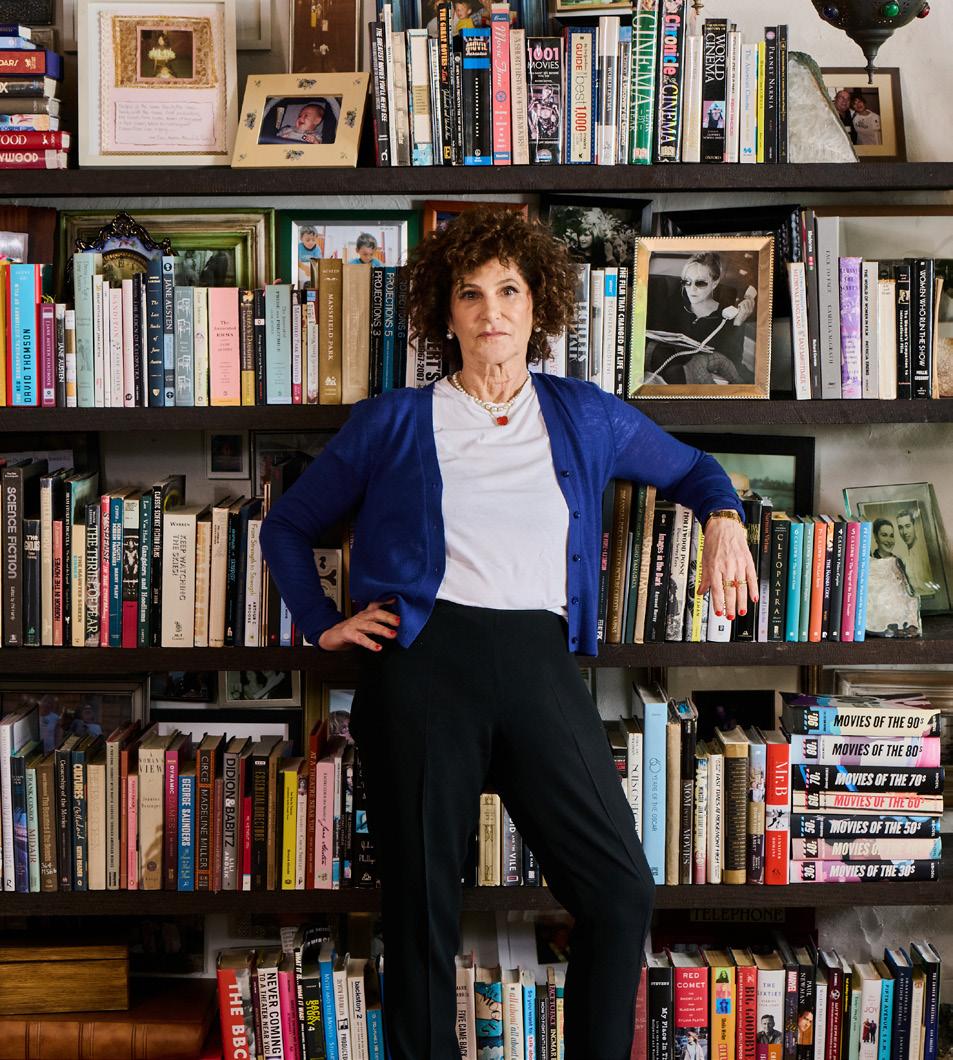
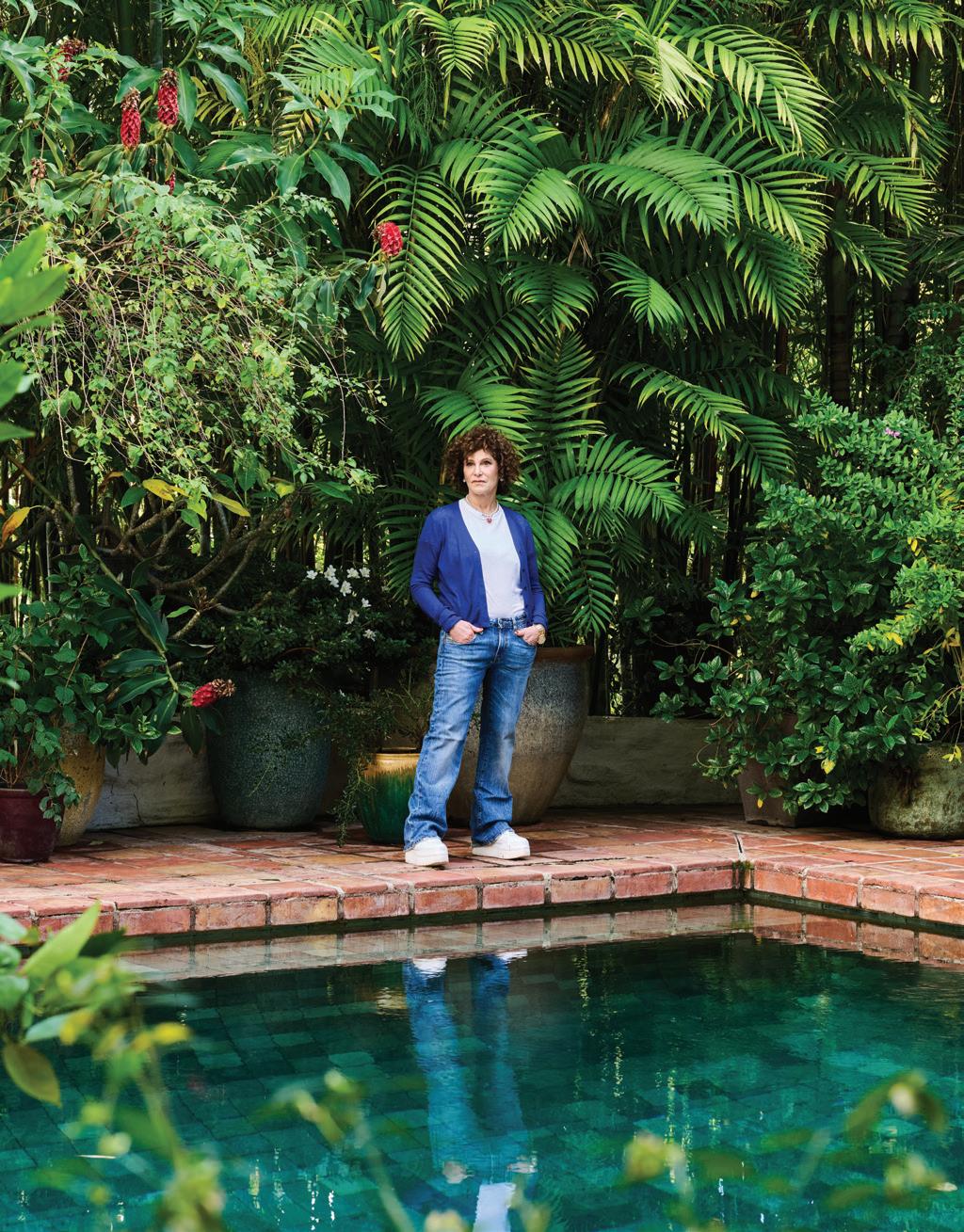
AMY PASCAL
Keen vision and devotion to story have carried the uber successful producer through multiple incarnations.





“Train Dreams weaves together memory, time and place to create an art piece worthy of the highest poetry. Across triumphs, turning points and tragedies, audiences are ultimately reminded that every moment is precious.”




BEST PICTURE
BEST CINEMATOGRAPHY



BEST ADAPTED SCREENPLAY
BEST ORIGINAL SONG – “TRAIN DREAMS”
BEST PICTURE
OUTSTANDING PRODUCER OF THEATRICAL MOTION PICTURES

Marissa McMahon, p.g.a. Teddy Schwarzman, p.g.a. William Janowitz, p.g.a. Ashley Schlaifer, p.g.a. Michael Heimler, p.g.a.



13 LETTER FROM THE PRESIDENTS
Stephanie Allain and Donald De Line salute PGA Award nominees and the power of community.
IN THE LIFE
Post producer Paul A. Levin’s daily regimen toggles creativity and management skills, scheduling and psychology. 20 ON THE MARK
Producers of three features detail the work they did to earn the Producers Mark. 30 NEW MEMBERS
Meet the PGA’s newest members and discover what makes them tick.
54 TOOL KIT
What the 2026 PGA Innovation Award finalists have in their respective bags of tricks.
66 MEMENTO
Showrunner and 2026 PGA
Norman Lear Award honoree Mara Brock Akil shares a blueprint for her career.


BEST ANIMATED FEATURE FILM • BEST ORIGINAL SONG “GOLDEN”
PRODUCERS GUILD AWARD NOMINEE


CRITICS CHOICE AWARDS
BEST ANIMATED FEATURE BEST SONG “GOLDEN”


WINNER GOLDEN GLOBE® AWARDS BEST ANIMATED FILM BEST ORIGINAL SONG “GOLDEN”
2
10 ANNIE AWARDS® NOMINATIONS INCLUDING BEST FEATURE



“GORGEOUS ANIMATION. A LOVE LETTER TO THE POWER OF VOICES BRINGING PEOPLE TOGETHER
OUTSTANDING PRODUCER OF ANIMATED THEATRICAL MOTION PICTURES .”

At the heart of ‘KPop Demon Hunters’ is a sincere story of self-esteem and embracing our deepest fears .





























BOARD OF DIRECTORS OFFICERS
PRESIDENTS
Stephanie Allain Donald De Line
VICE PRESIDENT, PRODUCING
Charles Roven
VICE PRESIDENT, PRODUCING TEAM
Steve Cainas
VICE PRESIDENT, EASTERN REGION
Tonya Lewis Lee
TREASURER
Yolanda T. Cochran
SECRETARIES
Mike Jackson Kristie Macosko Krieger
DIRECTORS
Bianca Ahmadi
Fred Berger
Parker Chehak
Melanie Cunningham
Mary Alice Drumm
Linda Evans
Samie Kim Falvey
Mike Farah
Jennifer Fox
Beth Fraikorn
DeVon Franklin
Donna Gigliotti
Jinko Gotoh
Bob Greenblatt
ASSOCIATE NATIONAL EXECUTIVE DIRECTOR
Michelle Byrd
CEO
Susan Sprung
EDITOR
Lisa Y. Garibay
PRODUCERSGUILD.ORG
Vol. XXII No. 2
Produced By is published by the Producers Guild of America. 11150 Olympic Blvd., Suite 980 Los Angeles, CA 90064
310-358-9020 Tel. 310-358-9520 Fax
1501 Broadway, Suite 1710
New York, NY 10036
646-766-0770 Tel.

Rachel Klein
Larry Mark
Lori McCreary
Tommy Oliver
Marc Platt
Joanna Popper
Lynn Kestin Sessler
PARTNER & BRAND PUBLISHER COPY EDITOR
Emily S. Baker
CREATIVE DIRECTOR
Ajay Peckham
ADVERTISING
Ken Rose
818-312-6880 | KenRose@mac.com
Bob Howells
PHOTOGRAPHER
Lauren Taylor
MANAGING PARTNERS
Charles C. Koones
Todd Klawin
It’s always a delight to start the new year by congratulating the remarkable producing teams whose projects have been nominated for the 37th Annual Producers Guild Awards, along with Amy Pascal, Jason Blum, and Mara Brock Akil, who were selected to receive the David O. Selznick Achievement Award, Milestone Award, and Norman Lear Achievement Award, respectively. We are grateful for the opportunity to celebrate their vision, innovation and persistence as inspirations for us all after one of the most challenging years our industry has faced.
This time last year, we were coming together to help colleagues whose lives were destroyed by the wildfires in Los Angeles. The resources that were created as an immediate response to the tragedy continued to grow and provide assistance throughout 2025. Among them was a partnership between the Guild and the Entertainment Community Fund to establish a fund supporting producers of film, television and emerging media affected by the fires. Producers Guild members also partnered with the Entertainment Community Fund and an industrywide coalition including IATSE, Motion Picture & Television Fund, SAG-AFTRA, DGA, WGA West, Teamsters Local 399, MusiCares, Dance Resource Center, AFM Local 47, Center for Cultural Innovation, Actors Equity Association 1915, American Guild of Musical Artists, Crew Nation, and the Entertainment Industry Foundation to provide seminars and resources. These included webinars on Emotional Recovery After a Disaster, a FEMA Appeals webinar and clinic, Managing Debt After a Disaster and Navigating FEMA for the Entertainment Industry.
Another tremendous industrywide effort paid off when, after months of highly coordinated advocacy by the Entertainment Union Coalition’s Keep California Rolling Campaign, the California Film and Television Tax Credit program was more than doubled, expanding to $750 million to help keep production, jobs, and industry investment in the state.
The Guild was proud to contribute to the campaign by sharing with legislators the producers’ perspective on how the expansion would benefit every stage of the production pipeline—and even more importantly, the tens of thousands of individuals whose livelihoods are dependent upon the health of our industry.
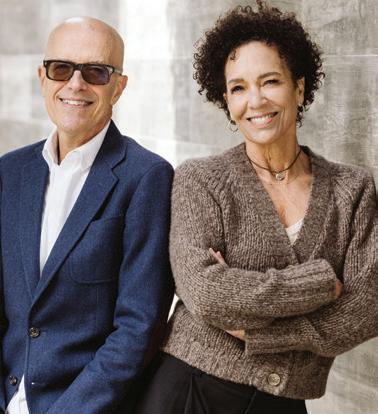
The year ended with renewed hope and cause for celebration. But plenty of work still needs to be done to get our industry back on a firm footing. The Guild’s commitment to this mission will be reflected in the robust slate of programming and new resources we have rolling out for producers over the coming months. We are motivated each day by how much has been achieved through the power of collective action.
Our thanks to every one of you for being part of our community, supporting one another and inspiring us all to keep going.

Stephanie Allain
Donald De Line
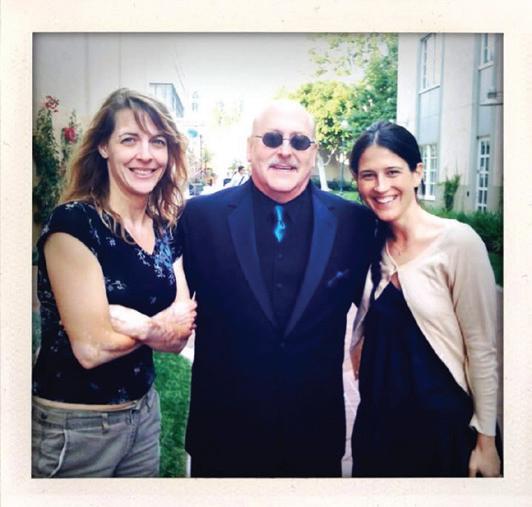
Veteran postproduction supervisor Paul A. Levin skillfully toggles creativity and management skills as he works with a cast of creative characters to deliver films on time and on budget.
Intro by Keri Lee
Starting as a production assistant on made-for-TV movies at CBS, Paul A. Levin explored every stage of production—from research during development to becoming the set PA during production, to the final phase, postproduction, where he thrived.
“In post, it was just the producer and me,” says Levin. “That’s where I learned everything, from editing to scheduling to music, titles, sound mix, ADR and VFX work.”
His hustle earned him respect. He was quickly bumped up to associate producer, with a growing reputation that led to a pivotal call from Orion Pictures. The caller was seeking a postproduction supervisor on a film, and Levin took the job. Five more films for Orion followed, laying the foundation for a rewarding career with credits such as Sleepless in Seattle, The Sixth Sense, The Departed, Julie & Julia, Ma Rainey’s Black Bottom, and Rustin




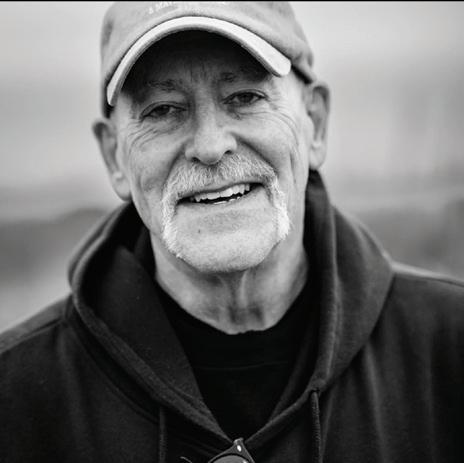
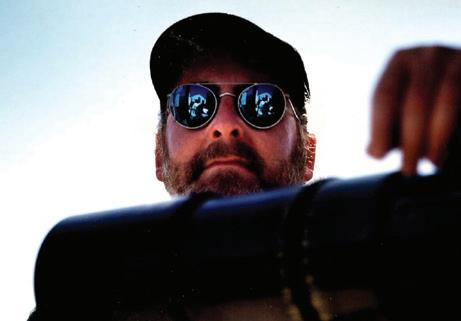
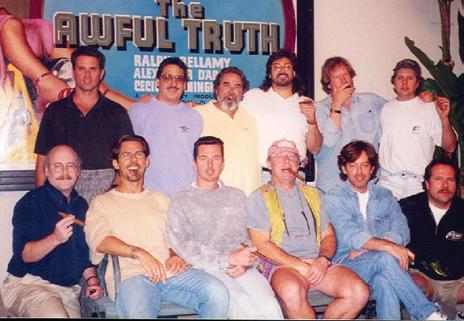
Today, from an office in New York City and various production facilities nearby, Levin orchestrates the myriad tasks and personalities involved in each phase of post to ensure that everything syncs up and ultimately delivers a film.
“It’s creative, and it’s managing,” Levin says. “And, sometimes, it’s being a psychologist, too.”
Each day is unique. The first thing I do when I get up in the morning is check all the emails that came in overnight. I live outside of New York City and commute via train each day. On the train, I begin to organize the day ahead.
A typical day could start with talking to the studio in the morning, updating them on our schedule. Or checking in with the picture editorial staff to see what they need. If we are scoring or mixing, I will pop over to the stage on my way in to make sure the day is going as planned. No day is ever the same. It is always an adventure waiting to happen.
When I’m starting a project, one of my first tasks is to create a post schedule. This requires some creativity. It’s a puzzle that needs to be put together correctly. I make deals for sound, color timing, and visual effects, calculating costs and timelines. I need to account for all departments working together toward the same goal: finishing the project on time.
When I publish schedules, I always say, “These are measuring sticks.” Most times, they work out as planned; however, sometimes problems arise. There may be differences of opinion regarding cuts, visual effects or music cues. This all can have a domino effect. But I’ve always held the philosophy that we can make it work. We will figure it out, and we will get it done.
There’s also the cast of characters I deal with daily—the director, editor, editorial staff, producers, post accountants, composers, the sound and music crews, visual effects team and, of course, the studio executives. These are the players who take the film and mold and shape it into the finished project. This team of individuals becomes family by the end of each film. And each film and family is always unique and special in their own way.
The exchange of creative ideas is most likely to fall into afternoon work. When you consider how many people there are in postproduction, it’s not just coordinating among all these roles; it’s coordinating with people in many locations.
I’m constantly checking in on the process and the overall progress. Creative changes can come up at any time, and when they do, I work with the director, editor and staff to incorporate them into our schedule and budget. My goal is to make sure this happens with little or no impact on our schedule.
Afternoons are when I do Zooms to check in with the studio and department heads. I am also on the phone daily with post accounting to go over cost reports and make sure the project is on budget. Additionally, I do a lot of in-person face time with the director and editorial staff to see how they are doing and find out if anything is needed or if there are any problems to solve.
If we have a mix going on, I visit the facility to see how it’s progressing. I check in to make sure it’s on schedule and that the music and sound teams have everything they need. I find it’s best to be in the room together. I’m a people person, and that’s what I like to do. Sometimes just giving the director and the editor a break from cutting to sit and talk about the process is good for everyone’s mental state, and also benefits the project.
I usually leave the office at a reasonable hour. I do a little decompression on the train. However, there’s often still work to be done. I’ll spend this time answering and sending emails, checking bids and deals from vendors, reviewing main and end title credits, reading a script, and fielding phone calls from the West Coast due to the time difference.
These conversations can cover any topic, from scheduling concerns to learning that there are additional notes from the studio that editorial will need to address immediately, to the biggest of them all: the release/drop date has changed.
In conclusion, when I decide to work on a film, it is because I have fallen in love with the script. If it’s a great story, I want to be part of it. The passion I feel fuels the desire to get the movie made and finished.
Advances in technology have brought changes to the industry. In some cases, things have gotten easier, and in other cases, more complex. I still enjoy the work. No matter what the technology may be, the process hasn’t changed—and it’s still a good process for telling a story.

PRODUCERS OF THREE RECENT FILMS PULL BACK THE CURTAIN ON THE WORK THEY DID TO EARN THE PRODUCERS MARK.
Innovation and dedication are requisites for any producer applying for the Producers Mark. But to earn the Mark, those producers must also demonstrate that they performed, in a decision-making capacity, a major portion of the producing functions on a motion picture.
Because each project offers its own unique set of circumstances, the challenges and triumphs vary wildly across budget, talent, location, distribution and more. But the denominator common to each producer who receives the Mark is the quality of their contribution to each phase of production—development, preproduction, production and
postproduction.
Here, the producers of three forthcoming features share details about their Mark-certifying work.
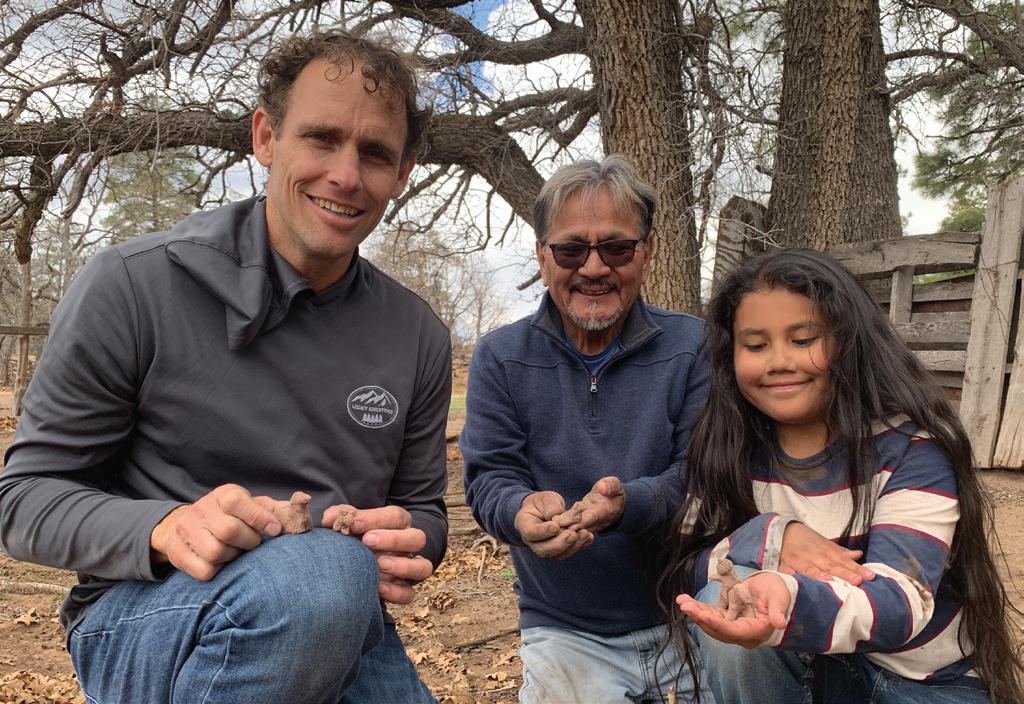
Finding Hozho
Travis Holt Hamilton, p.g.a.
Travis Holt Hamilton’s dramatic feature
finds a 70-year-old Native American Army veteran, Secody Yellowhair Nez— played by first-time actor and Navajo artist Frankie J. Gilmore—on the verge of an emotional breakdown when he gets the chance to offer a loving home to his terminally ill father.
When painful memories of childhood resurface, Secody must fight to forgive
his abusive father or live without hozho—a Diné (Navajo) concept that translates as beauty, peace, harmony, and balance—forever.
CONSIDERING THE TIGHT BUDGET ON THIS PROJECT, HOW DID YOU ENSURE THAT YOU HAD SUFFICIENT RESOURCES IN PLACE TO ACCURATELY REPRESENT TRADITIONAL NAVAJO TEACHINGS AND CULTURE?
Thirty years ago, I was introduced to the Navajo and Hopi Nations as a 19-yearold kid from Idaho who would spend the next two years serving the people and becoming acquainted. I don’t know

much when compared to the vastness and depth that is Navajo, both traditionally and historically. I learned much, but just enough to understand that I was out of its league by myself. It’s like seeing the Grand Canyon for the first time from an airplane, then taking a 12-day journey through parts of it on the Colorado River by boat. You soon realize you could spend a lifetime learning about the canyon and all the connections that surround and run through it.
Since those first two years living on the reservations, I have spent 30 years in and around Native country across the United States. I’ve been invited to visit over 80 reservations with my films and have established relationships of trust around Dinétah (Navajoland).
So the simple answer to your question is to triangulate various perspectives and opinions on the script, being open to advice from cultural advisors and story advisors, and, probably most important of all, writing from the heart. Prayer has
also been a huge part of the producing process for me.
The initial idea for Finding Hozho came up 10 years ago. I produced a couple of other features during that time, but kept working on the Hozho project, getting script notes from many readers, Native and non-Native alike, trying to find the balance of storyline, cultural sensitivity and the human heart connection that could make a powerful film if produced correctly. A decade of preproduction helped the 10 days of production go more smoothly, even though we experienced rain, hail, sunshine, clouds, sleet and snow. Money is only one resource to make a film happen. Time, love and determination are the other resources that outweigh the actual cash on hand for an indie filmmaker to tell a story that otherwise would never get told.
Finally, it’s about really trusting the producing process, or as my PGA mentor Dan Grodnik has said numerous times, “When in doubt, do the work.”
YOU HAD MANY FIRST-TIME ACTORS INVOLVED IN THIS PRODUCTION. WHAT WERE SOME OF THE CHALLENGES OF WORKING WITH THEM? DID HAVING LESS-EXPERIENCED ACTORS PRESENT ANY UNFORESEEN BENEFITS OR PLEASANT SURPRISES?
With determination and very limited cash, you learn to work with what resources you can afford and how badly you really want to get the movie made. First-time actors were a way to create opportunities for all involved to get a movie made with limited resources. I’ve had the privilege of putting over 100 first-time actors with speaking parts in my films, all of which have had theatrical runs. I really enjoy finding new talent and using the words in the credits “Introducing (new actor’s name).”
I learned to really love first-time actors, their excitement and their joy over being on a movie set. It helps us remember that making a movie is not life or death, but a great life experience, if we can set it
up right. I love finding individuals who I know can play the part, even though they never wanted to be an actor, and working to help them see that they have more talent than they thought they did.
Our lead actor in Finding Hozho, Frankie J. Gilmore, told me he hated cameras. When he was a boy, tourists would take his picture near Monument Valley, then go on to make fun of him. But I have known him for 25 years and we’ve established a trusting relationship. His performance was incredible. He’s the lead, yet he doesn’t say anything until around 83 minutes into the film, so he had to perform with everything but words. And he did it.
There’s a special joy in giving experience to Native first-time actors. When John Woo was making Windtalkers, he said he auditioned over 400 Navajos, and none of them had any acting experience. I thought, how do you get any experience at all so that you have enough experience to get the job? If there’s no opportunity, then it will be an endless cycle of no experience. We are changing that and have been for many years.
One of my joys was giving the actor Wade Adakai his first role in a film called More Than Frybread. He now has a recurring role on the series Dark Winds. There is so much talent in Native country that just needs an opportunity to be found.
I had to drive hours and hours to find some of the actors for Finding Hozho. The number of fluent Navajo speakers is dwindling. Add to that the factor of who wants to be in front of a camera and it’s an extremely hard casting challenge. No talent agency can help. I had to put my boots on and go to work, involving friends along the way. We would find an actor here, one in another state, and so on, handpicked when a good number didn’t even try out. Patience and trust in God that we would find the right people were definitely a part of the process.
A GOOD PORTION OF THIS FILM WAS SHOT IN ARIZONA ON THE NAVAJO NATION. WHAT ARE SOME OF THE UNIQUE CONCERNS A PRODUCER SHOULD ADDRESS WHEN DEALING WITH A TREATY TRIBE THAT IS TECHNICALLY A SOVEREIGN GOVERNMENT EQUAL TO THE UNITED STATES GOVERNMENT?
For me, it’s not a matter of a tribe being a treaty tribe, federally recognized, state recognized, a tribe in the process of becoming recognized, a settlement, an Alaskan village or any other situation. It’s really a matter of how the community wants to work through the permitting process. Is this the first time a film will be shot in this community? Is there a permit process already established?
I’ve produced films with five tribes over the years. I’ve had tribes that have said no and not allowed me to film. But it’s all part of the process. You look for ways it will benefit all
involved, and ask what’s the win-win. It’s a working collaboration with patience, kindness, vulnerability and transparency. It’s about building bridges with the goal that more films can happen in this community. The process can’t be heavy-handed with the mindset of, “This is how we make ’em in Hollywood, so you must comply!” That won’t get you anywhere. Doors will close very fast. Word of mouth will spread very quickly in Indian country, for better or worse.
It’s the conversations, the explanations, the walk-throughs on site, the script and storyboards, and ultimately the building of a relationship of trust as a person and a producer. That means pushing back in all the right ways about safety and the needs of the story while balancing sensitivity to the culture and community you are a guest in. Hiring locals is also a big help and step in the right direction, not only for the current project, but for future opportunities for all involved.
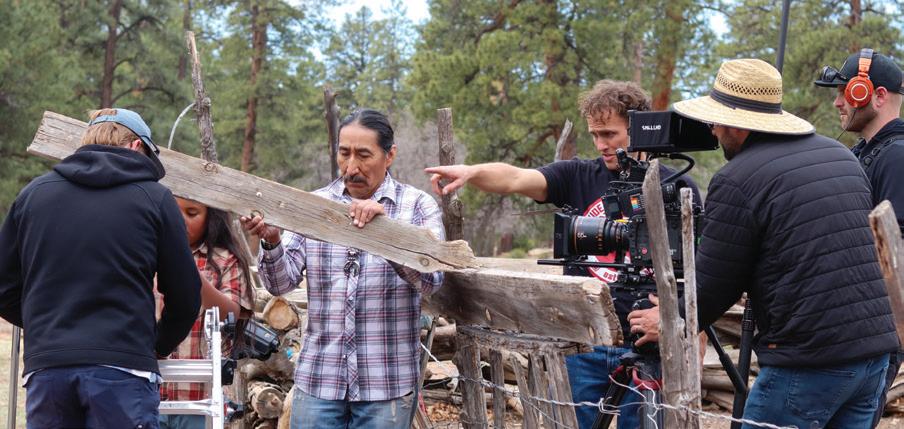
Producer Travis Holt Hamilton and DP Thomas Manning with actors Frankie Gilmore, Cheyenne Gordon, Camille Nighthorse, Chinn Chay and Braedyn Chay on set in Gilbert, Arizona.


THANKS THE PRODUCERS GUILD OF AMERICA AND PROUDLY CONGRATULATES OUR



AWARD FOR OUTSTANDING PRODUCER OF LIMITED OR ANTHOLOGY SERIES TELEVISION
AWARD FOR OUTSTANDING SHORT-FORM PROGRAM
AWARD FOR OUTSTANDING PRODUCER OF NON-FICTION TELEVISION


AWARD FOR OUTSTANDING PRODUCER OF EPISODIC TELEVISION - DRAMA
AWARD FOR OUTSTANDING SPORTS PROGRAM





DARRYL F. ZANUCK AWARD FOR OUTSTANDING PRODUCER OF THEATRICAL MOTION PICTURES


AWARD FOR OUTSTANDING PRODUCER OF LIMITED OR ANTHOLOGY SERIES TELEVISION






AWARD FOR OUTSTANDING PRODUCER OF ANIMATED THEATRICAL MOTION PICTURES


AWARD FOR OUTSTANDING PRODUCER OF LIMITED OR ANTHOLOGY SERIES TELEVISION

AWARD FOR OUTSTANDING PRODUCER OF LIMITED OR ANTHOLOGY SERIES TELEVISION



AWARD FOR OUTSTANDING PRODUCER OF DOCUMENTARY MOTION PICTURES



MARA BROCK AKIL ON RECEIVING THE NORMAN LEAR ACHIEVEMENT AWARD
AWARD FOR OUTSTANDING PRODUCER OF TELEVISED OR STREAMED MOTION PICTURES
AWARD FOR OUTSTANDING PRODUCER OF DOCUMENTARY MOTION PICTURES

DARRYL F. ZANUCK AWARD FOR OUTSTANDING PRODUCER OF THEATRICAL MOTION PICTURES
AND SALUTES OUR FRIENDS





AMY PASCAL
ON RECEIVING THE DAVID O. SELZNICK ACHIEVEMENT AWARD


Lars Knudsen, p.g.a. Ari Aster, p.g.a.
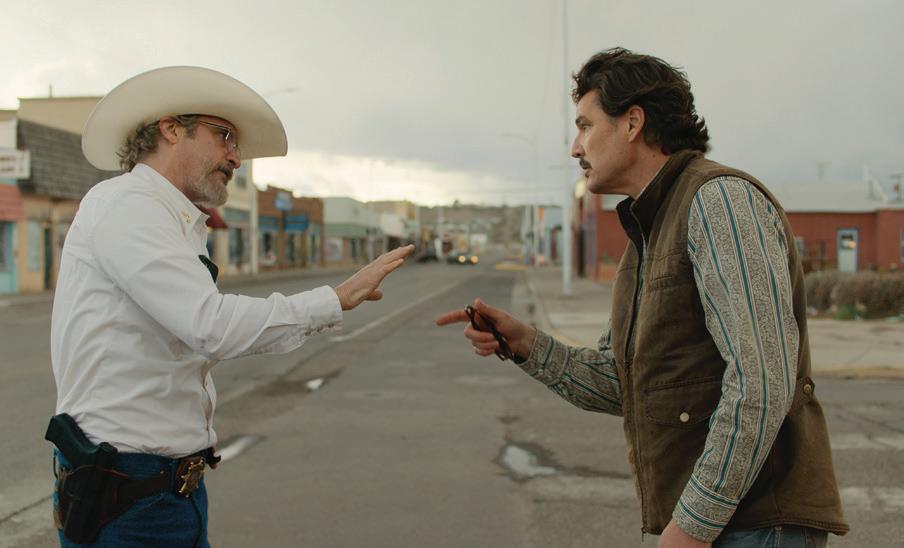
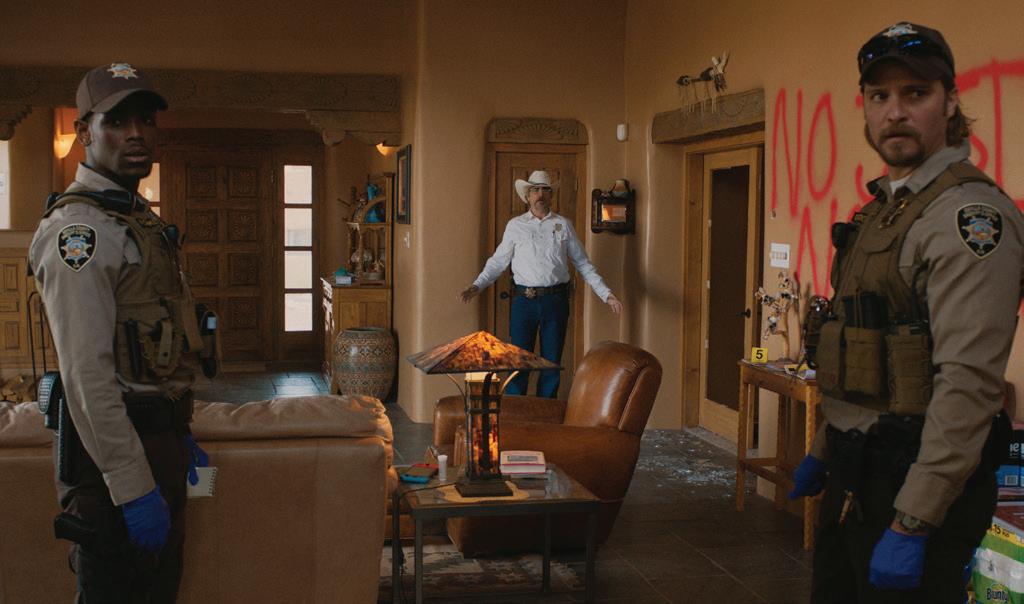
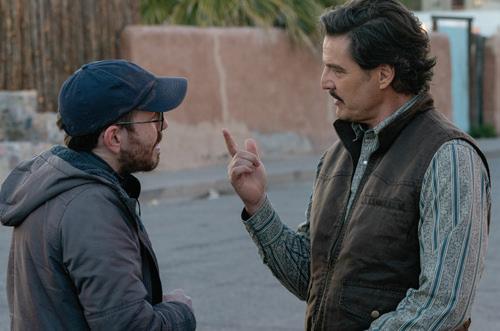
Written and directed by Ari Aster, who produced the film alongside Lars Knudsen, Eddington is a modern Western/ paranoid thriller set in the American Southwest during the tumultuous summer of 2020. The film stars
Joaquin Phoenix as small-town sheriff Joe Cross, who runs for mayor when progressive incumbent Ted Garcia (Pedro Pascal) attempts to modernize their dusty hamlet by attracting a new artificial intelligence data center.
The latest collaboration between Aster and Knudsen, whose previous films include Hereditary and Midsommar, takes the form of a classic showdown between two opposing
forces over the future of the fictional Eddington, New Mexico (population 2,345), as spiraling conspiracies and standoffs derail a citizenry pushed to the brink.
HOW DID YOUR LONGSTANDING CREATIVE PARTNERSHIP SHAPE THE DECISION TO FORM YOUR OWN PRODUCTION COMPANY, SQUARE PEG? IN WHAT WAYS HAS THAT COLLABORATION INFLUENCED HOW YOU DEVELOP AND SUPPORT PROJECTS COMPARED TO WORKING WITHIN MORE TRADITIONAL STUDIO STRUCTURES?
AA: Hereditary was our first experience working together. It was quite the gauntlet. Without going too far into
it—and at the risk of being cryptic—we were under the thumb of someone who had quite a lot of power over me and the film. This wasn’t a problem during prep or production, but once it came time to screen my director’s cut, this person entered the process and became quite the menace.
It was a very painful process, and for a long time it was not certain that we would make it through. Certainly not with the film intact, and perhaps not with it resembling anything I intended. It ended happily but was a torturous process.
LK: It brought Ari and I very close together. I had already produced many independent films under the banner of my first production company, Parts & Labor, and I had never gone through anything like the Hereditary grinder.
That experience—of finding a filmmaker whom I trusted implicitly and wanted to grow with—along with a lifelong dream of starting a producer- and directorled production company like Lars von Trier and Peter Aalbæk Jensen did with Zentropa in the ’90s, was the impetus for us starting Square Peg.
AA: I liked the idea of building something that could stand as a safe haven for filmmakers. If we choose to work with someone, that means we trust them and want to help enable them to make their film. If they or the film need to be defended, our job is to fight for them. Always. I also like having a company with Lars because I trust him so deeply as a person and as a producer, so I know that the filmmakers we work with will have the best possible support.
SQUARE PEG MUST FILTER THROUGH A LOT
OF IDEAS. WHAT WAS IT THAT CONVINCED YOU THAT EDDINGTON WAS A STORY WORTH PURSUING, AND WHAT CHANGED THE MOST FROM THOSE EARLIEST DRAFTS TO THE FINAL SCRIPT?
AA: I started writing Eddington in the summer of 2020. I wanted to try to wrestle with what was in the air at that moment, and I knew that, whatever should happen in the future, the period of late May to early June 2020 would always be relevant. We wanted to make an unconventional genre film that was inflected by a modern realism. A film that pulled back to give as panoramic a reflection of the country as possible, while still being limited in scope and telling a coherent story.
How to construct a coherent narrative about an incoherent miasma? It was a film about atomization, so each character needed
to be on their own island, living in their own curated reality, and this would inevitably lead to a sort of closureless, unresolved finale. How, then, to also make the finale satisfying and even spectacular in its way—not in any conventional sense, but in a way that honored the concerns of the project? Anyway, these were the aims. The script changed mostly by being cut down.
LOOKING BACK, WHICH STAGE OF PRODUCTION DEMANDED THE MOST FROM YOU CREATIVELY AND/OR LOGISTICALLY? WHAT LESSONS FROM EDDINGTON WILL MOST INFLUENCE HOW YOU APPROACH YOUR NEXT PROJECT?
LK: Eddington was an extraordinarily challenging, complicated and ambitious film to produce, especially during preproduction and production. Ari is
meticulous about every single detail in the film. He’s relentless. And because he pushes himself to his own creative breaking point, it inspires everyone— cast and crew—to do the same.
Unlike Ari’s past films, which in big part were shot on a soundstage or in one or a few bigger locations throughout the shoot, Eddington was shot on location all over New Mexico, from Albuquerque to Truth or Consequences, Madrid and To’Hajiilee. But the most challenging films and the ones that have something to say are the most rewarding and the ones that I’m the most proud of. Eddington is all of that and more for me.
The Bride!
Emma Tillinger Koskoff, p.g.a.
Maggie Gyllenhaal, p.g.a.
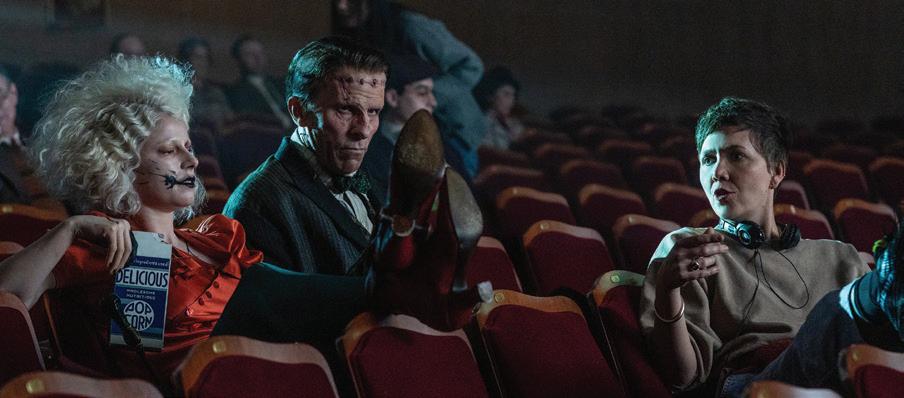
Alonely Frankenstein (Christian Bale) travels to 1930s Chicago to ask groundbreaking scientist Dr. Euphronious (Annette Bening) to create a companion for him. The two revive a murdered young woman, and the Bride (Jessie Buckley) is born. What ensues is beyond what either of them imagined.
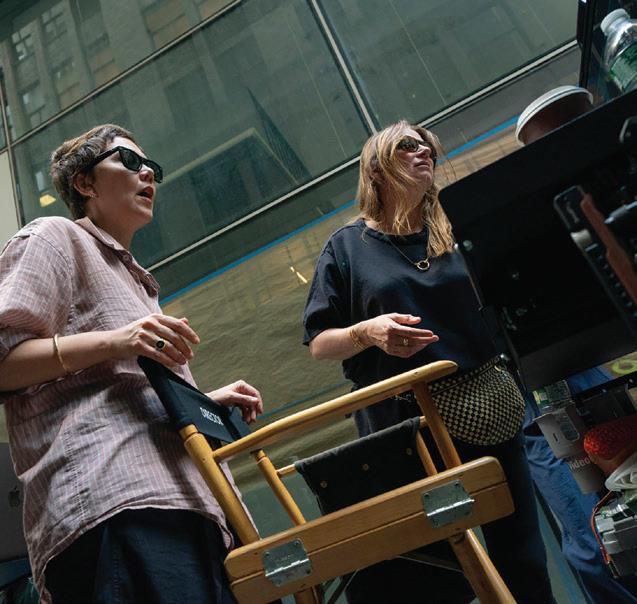
Producers Emma Tillinger Koskoff and Maggie Gyllenhaal joined forces to bring to life a bold take on one of time’s most compelling stories with The Bride!, which Gyllenhaal also wrote and directed.
HOW DID YOU BALANCE HONORING THE LEGACY AND EXPECTATIONS OF A WELLKNOWN CHARACTER WHILE ENSURING THE PROJECT FELT CONTEMPORARY AND DISTINCT?
MG: In the original Bride of Frankenstein (1935), the bride is only in the movie for maybe three minutes at the very end, and she doesn’t speak at all. But she’s made a real cultural impact.
THE PRODUCERS GUILD OF AMERICA THANKS THE SPONSORS OF THE



PRESENTED BY

SPONSORED BY





Why? I think it’s because the way Elsa Lanchester plays her is so radical and formidable and intense. I wanted that intensity, but at the same time, I felt free to do what I wanted, to imagine something that was my own. Frankenstein is its own thing and has been imagined in all sorts of ways. I really like that it holds a cultural place in our minds and in our mythology of monsters. Again, because there’s been so much bouncing off that original Mary Shelley mythology, I also felt free to let it bounce around my own mind.
CHALLENGES YOU FACED AS PRODUCERS WHEN DEALING WITH SUCH A PROSTHETICHEAVY PERIOD FILM?
EK: The prosthetics were a big deal. The look and the character were of the utmost importance. We had a luxurious 16-week prep, but we were right up against the SAG strike, and we couldn’t do anything until it ended. We started in mid-November (2023), but then you have all the holiday breaks, so we didn’t get into it until January. We had a really short amount of time considering
what we did with these prosthetics. We worked tirelessly to get it right and to reduce the time in the chair that it would require from Christian (Bale). We weren’t going to proceed with a finished product until it was right. We’re so proud of the look ultimately, but it was a nail-biter for sure. We did it in 12 weeks. We really got down to the wire.
MG: What was really important to us was that he looked like a real person. Yes, he’s a monster, but he could fit into our world. As soon as it tipped over too much into a Halloween costume, I was not on board.
EK: Maggie would always say, “I hired Christian Bale not only because he’s a brilliant actor, but because I want to see Christian Bale as Frankenstein.” So we kept needing to pull back on the prosthetics.
MG: But sometimes when you have a boundary or a box that you have to fit in, it creates something artistically interesting. That definitely happened here. It meant that we couldn’t mince our words and had to say exactly what
we thought very quickly.
I remember Christian saying to me, and this is not just about the makeup, “Walking with Emma must be like walking with a panther by your side.”
That was true from the very beginning, when she was like, “No, this is not good enough. Let’s not fuck around. We need to go in again. Let’s not stop until we’re all totally happy.” And thank God we did that.
Also, it’s very unusual to have a character in prosthetic makeup this long who is number two on our call sheet, someone who’s in almost every day. It meant that the way that we shot fundamentally had to be worked around.
EK: It was a five-hour ordeal every day in the makeup chair for Christian on top of the shooting day. I’ll never forget what he said to me: “You, me and Maggie are gonna get through this together. I’m gonna give you everything I’ve got until I can’t, and I’m gonna let you know when I can’t.” He would be in that chair four to five hours a day, and he would still give us a 10-hour (shoot) day. We could never have made our schedule or our budget, much less the
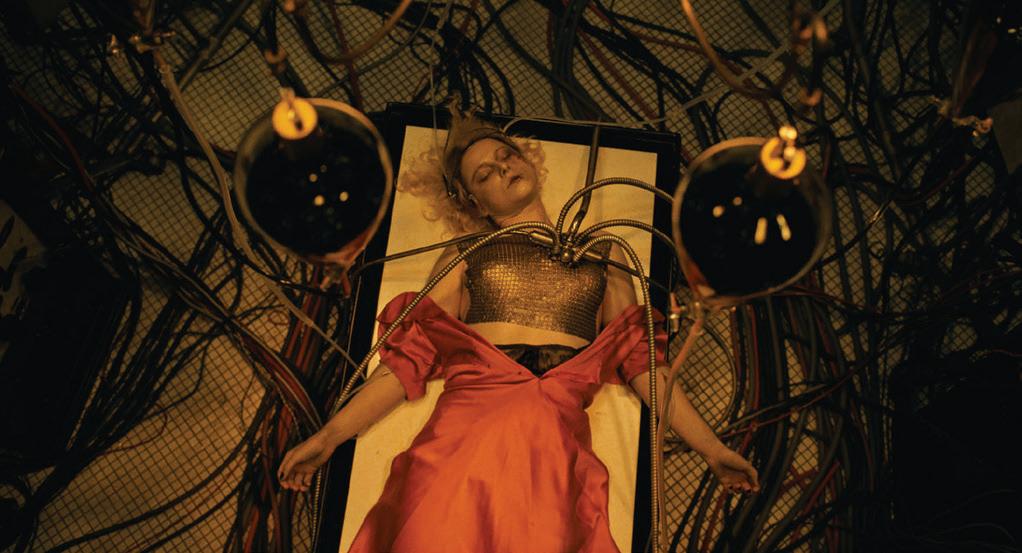
movie, if Christian had not done that. We were not in any way going to compromise the look of Frankenstein or the Bride. But we had to start shooting when we had to start shooting, and we could only start prepping when we could start prepping. So we had to throw every resource we had at it. We had to compromise in other areas to make the budget work, but we had Mike (Michael De Luca), Pam (Abdy), Jesse (Ehrman) and Cate (Adams) behind us at Warner Bros., championing us and supporting us.
About the period aspect: It’s tough to shoot in New York because of its gentrification. But I want to give a shout-out to New York with its increased incentives because we were able to travel upstate and create the individual looks as if we were on the road. In a perfect world, we would have gone to a couple of other locations, but New York made it possible for us to get out of the city and do our thing.
MG: The problem is, if you go upstate or you go right outside New York, you have Starbucks, Starbucks, Starbucks. That makes it really difficult to shoot
period (films). But we found this old sailor’s home at Snug Harbor in Staten Island for a beautiful, huge section of the movie. You never would have thought that you were in Staten Island. We built a lot of it with VFX and beautiful work by (VFX supervisor) Mark Russell and (production designer) Karen Murphy.
Also, we’re all from here (New York). We know it all, and we scouted it all, which made it possible to do that period work. The aesthetic has a real beauty to it, but you have to really look for it and know where to look.
LOOKING BACK, WAS THERE ANYTHING YOU WISH YOU HAD APPROACHED DIFFERENTLY EARLIER IN PRODUCTION TO MAKE POSTPRODUCTION SMOOTHER?
EK: I would have had a stronger approach to the VFX and production design marriage, and started Karen and Mark earlier. I would have liked to have them prep earlier and go into post with more clarity on some of our world-building.
Also, when we started the movie, Maggie said, “We’ll just have little VFX.” Then it suddenly grew, and that’s a big jump with a lot of complexities that I think none of us really anticipated.
MG: I had a crash course in what VFX can offer and how it offers it. I love the VFX in the movie. I think it’s very unusual, very real and very different. But part of the reason why VFX was difficult for me was because I didn’t want the kind of classic Marvel VFX stuff, and yet we had a lot of VFX shots in the movie. I think we got there, but that was hard.
I would have liked a longer, smaller prep, an extended period of time with very few people to really get the artistic side nailed down. On the post side—and I know VFX would probably raise their hand and say no way—I would also like a tiny beginning of post for just me and my editor, without the whole office space and everybody’s assistants. A little bit of protected artistic space where you’re not just spending all the money, but you can protect your mind space.
Produced By trains the spotlight on some of the Guild’s newest members, and offers a glimpse at what makes them tick.
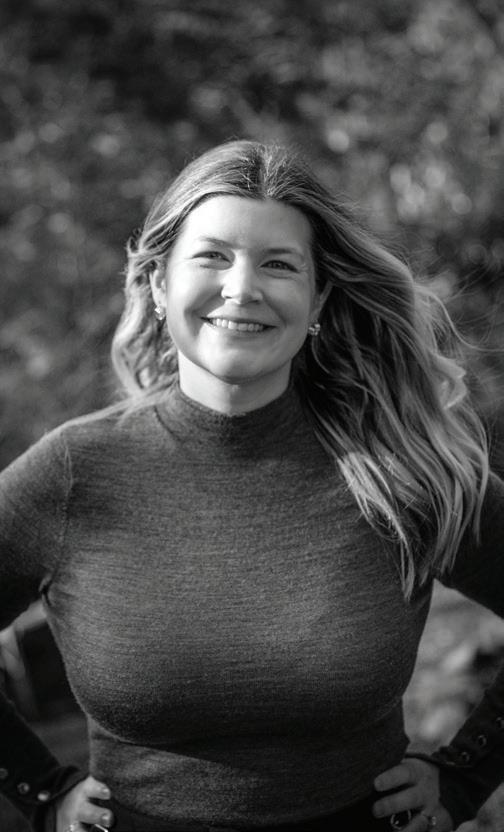
Chapel Folger is an executive visual effects producer and CFO of OnyxVFX, a boutique studio delivering high-end visual effects for film and television. She studied theater at Carnegie Mellon University before beginning her career in theatrical and film production.
Folger later transitioned into project management at Universal Creative and Walt Disney Imagineering, contributing to large-scale projects such as Fast & Furious: Supercharged and Avengers Campus at Disney California Adventure Park. In 2021, she helped launch Onyx VFX, where she oversees productions from preproduction estimating through final delivery. Her recent credits include Lessons in Chemistry (Apple TV), Welcome to Derry (HBO) and Paradise (Hulu).
What skills and experience have been most valuable to you in your career as a VFX producer, and why?
Managing people is often the most challenging aspect of any job, and my years as a project manager at Walt Disney Imagineering were instrumental in developing that skill. While there, I gained experience in staffing, budgeting and scheduling, and regularly led teams of 100+ from different disciplines, often with competing priorities. Learning how to align those teams around a shared goal taught me how to effectively communicate and drive results.
Today my work is a blend of producer, HR, and CFO, drawing on every phase of my career to support both the creative and operational sides of visual effects production at one of the first fully cloudbased VFX studios.
Lisa Donmall-Reeve
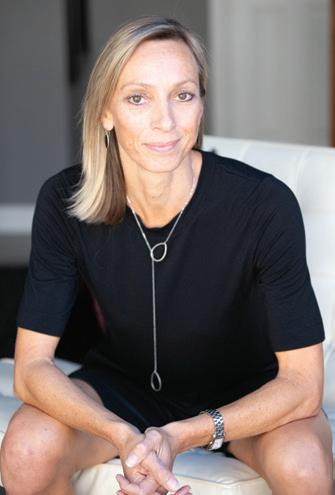
Born and raised in England and now living in LA, Lisa Donmall-Reeve enjoyed a successful career in theater before pivoting to film. She has a passion for collaborative storytelling. Her production company, LDR Creative, has earned more than 18 film festival accolades and enjoys a reputation for transforming short and feature-length film concepts into award-winning products.
Donmall-Reeve’s first feature, Uprooted: The Journey of Jazz Dance, streamed on HBO Max before becoming a valued resource for universities around the world. Other projects include Dr. Sam starring Alec Baldwin, RUTH, and Susan Feniger. Forked. Donmall-Reeve is proud to be part of the PGA community.
What was the most valuable piece of advice you received when you began producing, and how has that advice helped you grow as a producer?
“You ultimately work for the film.” This insight proved invaluable when I was raising funds to secure final music licenses on my first feature. Keeping what was best for the film and the story at the forefront of every decision helped me balance creative integrity with the realities of budget and available resources.
That principle has remained my touchstone. Being resourceful and creative while ensuring the film stays authentic and true to the director’s vision—and remaining flexible enough to pivot and problem-solve when needed—is perhaps my favorite part of the work. While this approach can lead to challenging days, the creative and collaborative reward is always worth it.
Finn
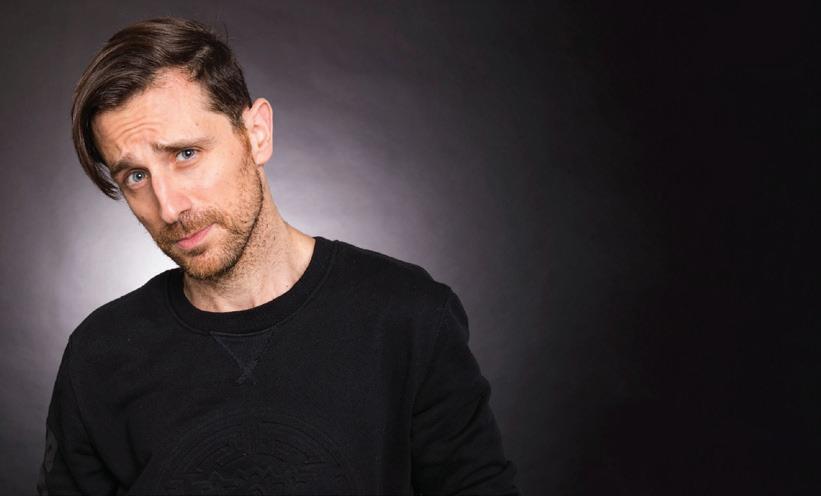
Josh Finn is an executive producer at Riot Games, the developer and publisher of League of Legends and Valorant, and the studio behind the Emmy-winning Netflix series Arcane. In his current role, Finn develops liveaction and animated film and TV projects.
Finn’s prior work spans films, shows, cinematics and documentaries, including the Paramount+ series Players from the creators of American Vandal and collaborations with Academy Award-winning animator Glen Keane. Finn was born in Washington, D.C. He is a graduate of New York University’s Tisch School of the Arts and received his MFA from USC’s Peter Stark Producing Program.
What skills and experience are most valuable for the unique projects you produce, i.e., live action within the video game space?
The best experience for adapting games is just being a player. If you love a game, that passion will hopefully manifest in authentic and resonant films and shows. So many of the best game adaptations come from game devs who were either the creators, producers or equal partners in adapting their work.
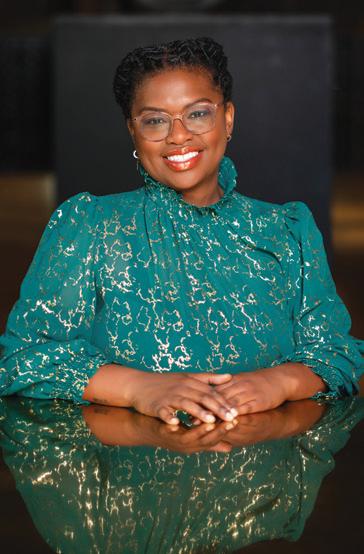
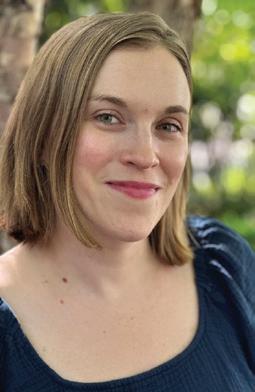
Nicole Welch is a Los Angeles–based production manager with over a decade of experience in unscripted, documentary, branded and live studio productions. She has worked across multiple networks and platforms, supporting productions in both field and office environments while overseeing budgets, logistics, schedules, vendors and cross-functional teams.
Known for calm, decisive leadership, Welch is trusted with complex challenges, from permitting and community relations to real-time financial decision-making. Her career has progressed from hands-on coordination to managing full-scale show budgets and network-level oversight, working with ABC, CNN, MTV, The Travel Channel, Eureka Productions, The ATS Team, Adidas, Happylucky, Good Trouble Studios and more.
What was the most valuable piece of advice you received when you began your career as a production supervisor, and how has that advice helped you grow as a producer?
The most valuable advice I received was to trust my judgment. I was reminded that if I was in the room, it was because I had earned the responsibility to make decisions. That advice helped me move past second-guessing and to focus on clarity, accountability and follow-through—especially in high-pressure situations.
Over time, trusting myself strengthened my leadership style and allowed me to communicate more directly and act decisively. It also reinforced the fact that no one has all the answers. Strong producers are defined by their ability to assess situations calmly, adapt quickly and move productions forward with confidence and respect.
Koenig
Kelsey Koenig has worked in independent documentary for over a decade and is currently the VP of production at Impact Partners, a New York-based fund dedicated to supporting powerful documentary films that address pressing social issues.
Since joining Impact Partners in 2012, Koenig has been involved with the financing and development of more than 100 projects including Sugarcane, Apocalypse in the Tropics and Mistress Dispeller, and has spoken on panels about funding, distribution and impact at workshops and other industry events around the world. In 2023, Koenig was named a Documentary New Leader by DOC NYC.
What skills and experience have best served you as a producer of independent documentaries?
Through my work at Impact Partners, I have had the opportunity to support close to 100 documentaries, most recently as an executive producer or co-executive producer. It feels like it’s never been harder to make an independent documentary, so supporting documentary filmmakers with creative guidance and strategy around funding and distribution is my top priority, and so gratifying.
I’ve witnessed the myriad ways docs are made and brought out into the world. I try to use those experiences in advising our films on the best path forward, while calling upon an amazing network of other producers and industry partners.
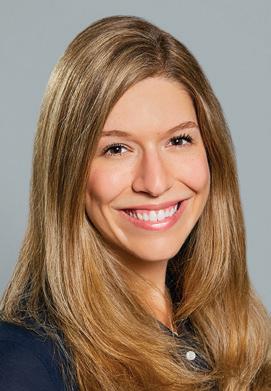
Drew Dockser is an Emmy Awardnominated creative producer with Silent House Productions, where he develops and produces a wide array of variety specials, awards shows and major live events across the media landscape. His multidisciplinary skill set encompasses the full spectrum of the creative process, from initial concept development and rendering to designing broadcast graphics and producing screen content. He prides himself on bringing meticulous attention to detail, fresh vision and a collaborative spirit to each project.
With Silent House Productions, Dockser has most recently been creative producer for Netflix Tudum 2025, the 30th and 31st Screen Actors Guild Awards, the Emmy Awardwinning NBC special Carol Burnett: 90 Years of Laughter + Love, the 98th Macy’s Thanksgiving Day Parade, Opry 100: A Live Celebration on NBC, and the upcoming 32nd Annual Actor Awards presented by SAG-AFTRA on Netflix.
What skills and experience have helped you succeed as a creative producer on high-profile TV broadcasts?
There are many skills, both technical and abstract, that go into creating a successful show. For me, these skills all serve the same function: communication.
Communicating ideas visually comes most naturally to me. It starts with creating a pitch deck that outlines the story through concept art and visual references. Maintaining a cohesive vision throughout the process ensures that the final result will look like what was initially pitched.
Creating visual presentations has been a fascination of mine since I was young. When it was my turn for showand-tell in the second grade, I taught my classmates how to make a PowerPoint presentation—every second grader’s idea of fun! I still use these skills, albeit in a more elevated form, to build creative decks, design graphics packages and produce digital content that encapsulates the visual identity of each show.
I’ve had some great mentors,
including scenic designers, creative directors and television producers, who have shaped and influenced my process. Through clear communication, a strong design sensibility, and technical understanding of how to deliver on the creative ideas, I’ve been fortunate to earn the trust of colleagues and enjoy the creative process with collaborators.
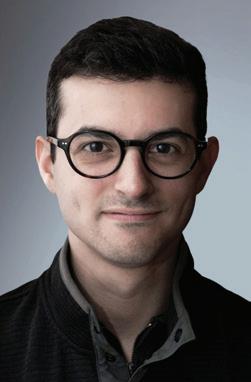
Kelly Lake is a coproducer at Illumination, where she has worked on many successful animation franchises, including Despicable Me, Minions, The Secret Life of Pets and Sing. She was the associate producer on Minions: The Rise of Gru (2022) and The Super Mario Bros. Movie (2023), and is coproducer on the upcoming Super Mario Galaxy Movie. Currently residing in Altadena, California, Lake is a native of Youngstown, Ohio, and a graduate of the UCLA School of Theater, Film and Television.
What skills have best served you as a producer of animated features? What skills would you advise someone to hone if they want to be a producer working in animation?
I sometimes tell people that producing animation takes your whole brain. It requires a lot of detail-oriented analysis and problem-solving within the pipeline, but it’s also very big-picture and requires you to be creative and emotionally engaged. I think I’ve been served by my ability to understand which side of my brain to tap into at any given moment in the process.
I would advise anyone interested in producing to hone their communication skills. It’s crucial for the producer to set expectations for the right tone and pace of communication so the team can deliver the best movie possible.
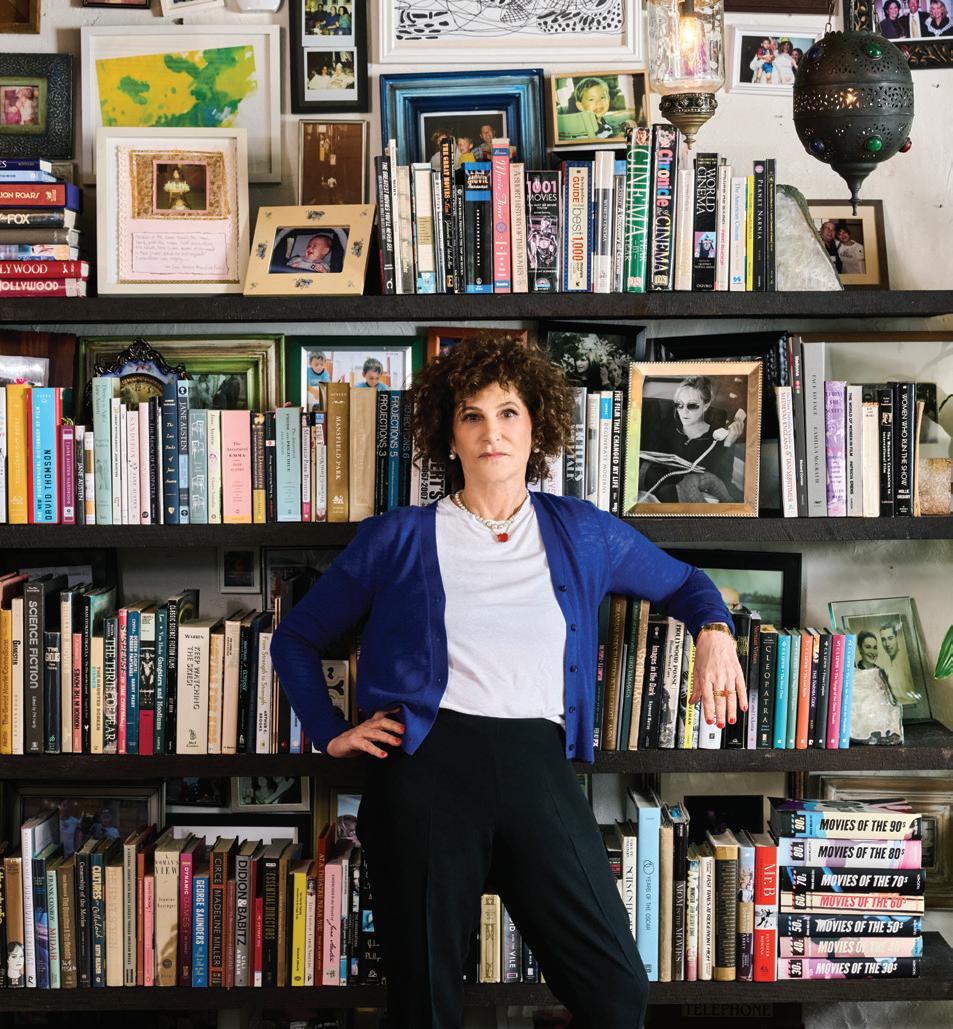
Amy Pascal has lived multiple incarnations in a toweringly successful career, each one characterized by vision, stamina and relentless devotion to story.
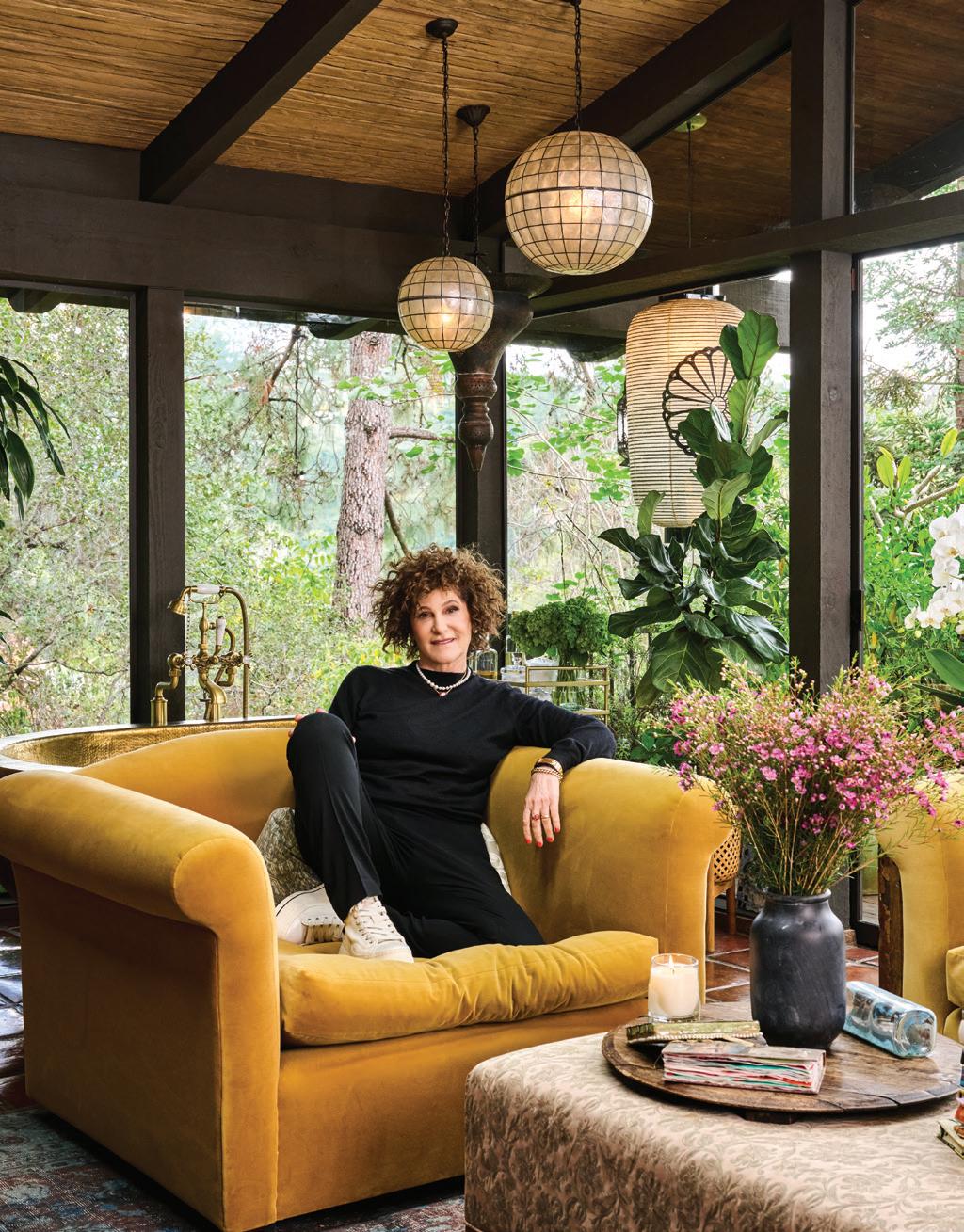
Let’s get this out of the way now: Amy Pascal has some cred.
Between 2006 and 2015, when Pascal served as chair of the Motion Pictures Group of Sony Pictures Entertainment (SPE) and cochair of SPE, she oversaw Bond titles Casino Royale and Skyfall, along with unforgettable features that included Superbad, Moneyball, The Social Network, Zero Dark Thirty, Captain Phillips and American Hustle
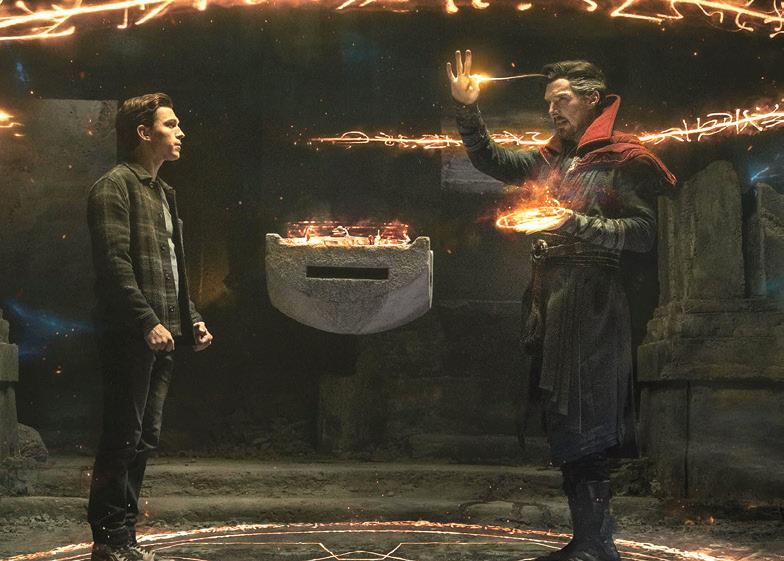
After leaving Sony, she launched Pascal Pictures and produced three Spider-Man films for Marvel Studios, including No Way Home, the sixth-highestgrossing movie of all time. The latest in the franchise, Spider-Man: Brand New Day, will be released later this year. Through her company, Pascal also produced two Spider-Verse movies, the first of which won the 2019 Academy Award for Best Animated Feature; a third, Spider-Man: Beyond the Spider-Verse, is currently in production.
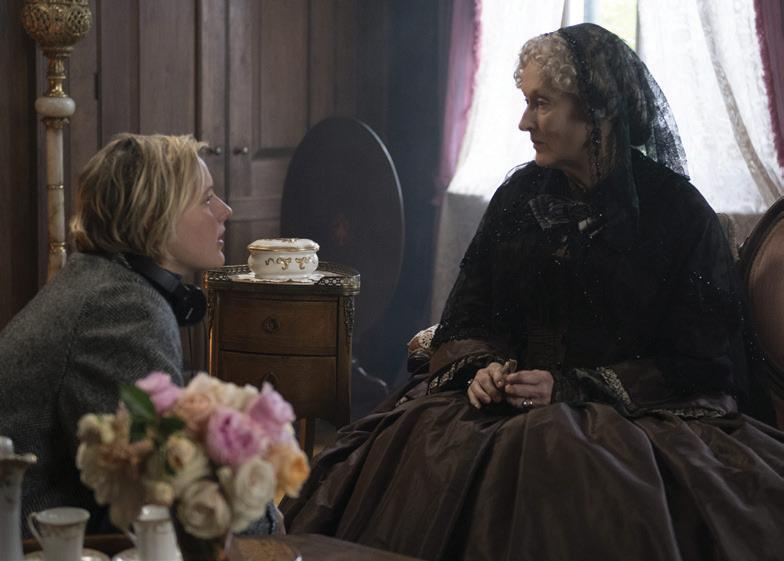
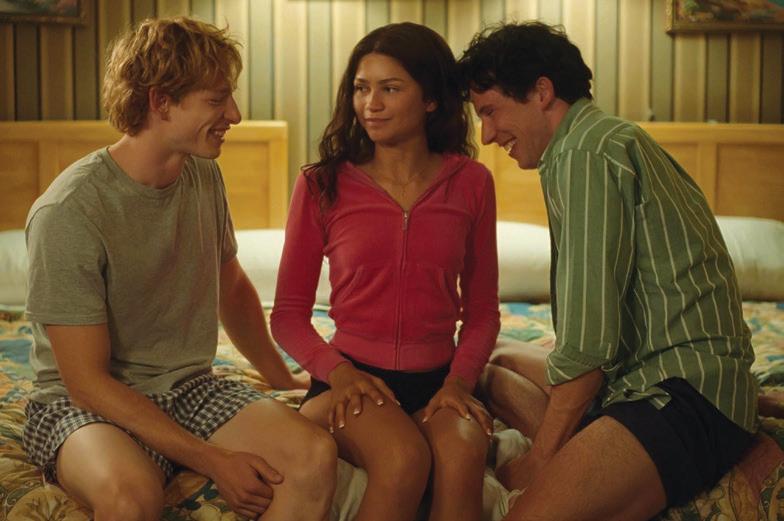
On the nonfranchise end of the spectrum, Pascal produced Luca Guadagnino’s Challengers; Greta Gerwig’s Academy Award Best Picture-nominated Little Women; Steven Spielberg’s Academy Awardnominated The Post; Aaron Sorkin’s Academy Awardnominated directorial debut, Molly’s Game; and Noah Baumbach’s Jay Kelly, which Pascal produced alongside David Heyman.
And that’s not all. The unstoppable Pascal is hard at work on a slate that includes Gerwig’s Narnia, based on C.S. Lewis’s timeless novels, and an adaptation of the thrilling sci-fi novel Project Hail Mary. In March 2025—right before Amazon MGM announced its first-look narrative feature deal with Pascal Pictures—Pascal and Heyman were announced as producers of a new Bond film for the studio.
Pascal will be the first to tell you that she didn’t amass this list of successes on her own. Throughout her career, mentors demonstrated over and over again what truly mattered, what was important to hold onto as she made her way through the industry. Her first boss, Tony Garnett, was a British producer who worked closely with director Ken Loach and had a long history of pushing the envelope while producing programming for the BBC.
“He taught me what mattered: writers, writers
and writers,” Pascal says. She was eventually hired away from Garnett by Scott Rudin, another mentor who shared Pascal’s love and admiration for writers. Another beloved paragon was John Calley, with whom Pascal worked closely when he was SPE’s chairman and CEO and she was head of Columbia Pictures.
Upon Calley’s passing in 2011, Pascal described their relationship as going beyond that of mentor and boss. “He was the most extraordinary and generous friend,” she said. “He had a steely business mind and the soul of an artist.”
Another inspiration was Dawn Steel, who fearlessly modeled the grace and tenacity it took to not only run a studio but also be the first woman ever to do so. “I loved her and wanted to be her,” Pascal gushes. She also cherishes the memory of producer Laura Ziskin, with whom she worked closely during her time at Columbia, as a best friend and creative and business North Star.
Along with guidance gleaned from their unique experiences and skill sets, each of these trailblazers modeled a quality that Pascal herself has unapologetically embodied: passionate individuality. “They were really who they were, and they didn’t bend to the wind,” she says.
In particular, the women who came before her— who had to fight harder than their male peers at every step—fueled Pascal’s mission not just to make movies, but to make movies about women.
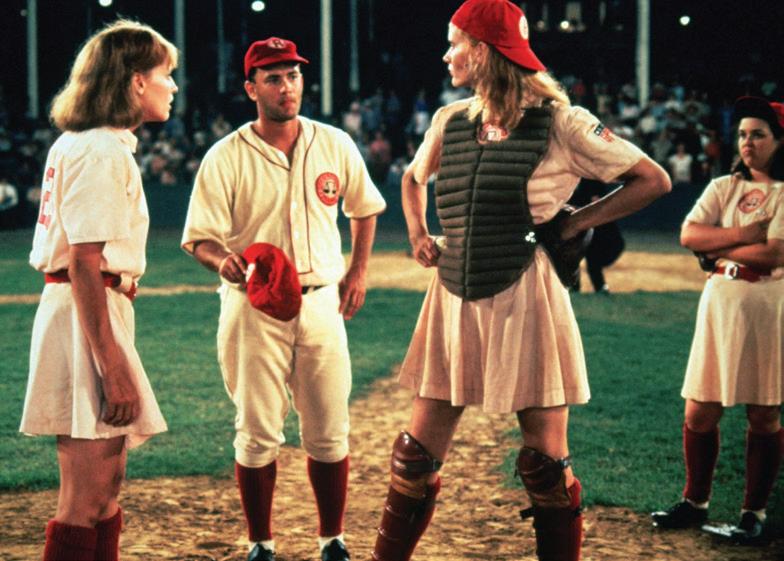
“I was known as the chick-flick studio executive, which was a derogatory term at the time,” Pascal recalls. “But I got to make A League of Their Own, Sense and Sensibility, Little Women, Single White Female and a lot of other movies I love because I knew that’s what I wanted to do. If other people didn’t want to do it, that meant there was a lane for me. Picking a lane doesn’t cut you off from things. It expands the world you’re living in.”
As a result, Pascal was able to champion creators who set a high bar for excellence in storytelling for the screen—voices and visionaries whom countless other filmmakers of any gender strive to emulate.
“I got to work with Nancy Meyers, Penny Marshall, Nora Ephron, Amy Heckerling and Greta Gerwig. All the greats. To me, they were everything.”

Pascal’s faith in these filmmakers meant everything to them in return. When Gerwig and Pascal began working together, Pascal told the writer-director that she ran Sony with the belief that everyone is as good as their best movie.
“She started from a place of faith in the talent, not the suspicion of risk. It is astonishing how rare that is, and it emboldens the directors she works with to strive for the grandest version of what they can do,” says Gerwig.
“Amy believed in us long before it made any sense. She just had a feeling and trusted it. That feeling is her superpower, and it will make your movie better,” say writer-directorproducers Phil Lord and Chris Miller, with whom Pascal has made eight features, including the Academy Award-winning Spider-Man: Into the Spider-Verse as well as the forthcoming streaming series Spider-Noir
Lord, Miller and Pascal’s collaboration began in 2009 with the animated feature Cloudy with a Chance of Meatballs. It wasn’t as auspicious a start as they had hoped.
“We had a bad screening of our first movie. The audience hated the ending. Amy plopped down next to us—wearing a denim jumpsuit and Converse—and said, ‘We’re about to learn a lot about your movie,’ and patted us on the back. In an instant, it reframed the whole experience and let us into the process,” recall Lord and Miller. “We were not a liability she was managing. We were part of the solution.”
Things went up from there. The trio’s collaboration continued through a Cloudy sequel, two 21 Jump Street films, and three feature explorations of SpiderMan’s Spider-Verse.
“Amy has an intuitive sense of story and emotional storytelling more than possibly anyone in the business. If a scene isn’t working, she knows why. If a scene is working, she is excited, and she gets you excited,” Lord and Miller add.
“ THE FIRST, LAST, AND ONLY THING AMY CARES ABOUT IS THE WORK. SHE LOVES THE MOVIES. SHE WANTS TO MAKE GREAT ONES. NOT JUST FOR MONEY OR RESPECT BUT FOR HOW THEY LAST, HOW THEY CAN SHAPE LIVES, HOW THEY CAN KEEP PEOPLE COMPANY, HOW THEY CAN GIVE PEOPLE DREAMS.”
—GRETA GERWIG
“But more important than her belief in you is how she is able to convince you that you are the greatest filmmaker in the world and the only person who can make this work.”
Noah Baumbach shares a similar sentiment. “Amy is able to read a script or watch a cut of a movie or a take of a scene on set and have an entirely pure reaction to it. She’s able to cut right down to what is working or not working. Her observations are both emotional and incisive,” he says. “She works on a movie the way she watches a movie. She sees it in an uncanny way and is someone you want standing next to you when you’re trying to make sense of it all.”
“Amy is by far one of the most passionate individuals I’ve ever met. She’s a true force of nature gifted with energy that is incredibly contagious and everlasting,” says Denis Villeneuve, who is directing the Bond film that Pascal and Heyman are producing. “I’m always impressed by her intelligence, patience and loyalty. She also possesses boundless curiosity and fully invests herself in her projects, researching and absorbing as much information as possible to support and guide filmmakers.”
He adds, “When Amy believes in someone or in a specific project, nothing can hold her back.”
“The first, last and only thing Amy cares about is the work,” says Gerwig. “She loves the movies. She wants to make great ones. Not just for money or respect but for how they last, how they can shape lives, how they can keep people company, how they can give people dreams. I have never met anyone less comfortable at a party and more comfortable on a set, in a production meeting, or in an editing room. She lives for the work, not the shiny bits around it.”
Pascal wholeheartedly believes that she is doing exactly what she was always meant to, even if she didn’t know how
to name it while she was growing up in Los Angeles. Her father was an economist at the Rand Corporation, and her mother owned an artists’ bookstore.
“We were not Hollywood people,” Pascal recalls. “They didn’t know anybody in the movie business.”
But they did know film.
“Watching movies was a really big thing in our house,” Pascal recalls. “On the weekends, my dad would take me to the Encore theater in Hollywood, where they would show Fred Astaire and Busby Berkeley movies and Footlight Parade and things like that. My dad loved movies, and I loved him, so I loved movies too.”
She acquired a drive to tell stories about people she cared about. She believed in her understanding of human nature, coupled with a knack for combining the business side of things with the artistic side. And that meant producing.
“It just felt like the right fit. I wasn’t an artist, I didn’t run around with a camera, I didn’t write anything, and I can’t even spell, but I just had a sense that this is what I could do,” Pascal recalls.
So upon completing college in 1981, Pascal took the first step that legions of other young hopefuls have taken to
get their foot in the door of the industry. She spent six years as a secretary for Garnett until Rudin hired her to become a vice president at Fox. In 1988, Pascal went to work for Steel at Columbia Pictures as vice president of production. There, she brought an array of classic films to life—Awakenings, Groundhog Day, A League of Their Own, Little Women and Sense and Sensibility, to name a few.
Pascal segued from Columbia to get Turner Pictures up and running. Her stint there was brief but impactful, making Michael with Nora Ephron and the Wings of Desire remake, City of Angels, as well as putting together Oliver Stone’s Any Given Sunday and Ephron’s You’ve Got Mail, which were eventually made at Warner Bros. after Ted Turner sold the company.
After this, Pascal returned to the Columbia-Sony family, where she continued to work her way up the ranks to become cochair of SPE in 2006.
Pascal’s love for her job was apparent in the heartfelt way she steered the studio. Gerwig found this out when she went in to pitch her take on the Louisa May Alcott classic Little Women—a take that has become almost as beloved as the novel it’s based on.

“I had loved the book when I was a child,” Gerwig recalls, “but when I reread it as an adult woman, I was struck that even from the very first line, money is at the forefront. Then I read about how much of Louisa May Alcott’s writing was an economic endeavor to save her family from dire poverty. That intersection of artistic expression and financial need was at the heart of what I understood the project to be.
“When I said that, Amy almost jumped out of her chair. I did not know how much that was at the heart of her journey as a studio head turned producer, but it was one of those brilliant moments where the song in my heart exactly matched the song in hers.”
Pascal is one of the few producers to receive two of the PGA’s highest honors: the Milestone Award, which she earned in 2010 as cochair of Sony Pictures Entertainment, and the David O. Selznick Achievement Award, which she will receive on February 28 for her body of work as an independent producer. Taken together, these awards recognize her depth of expertise and celebrate the value she has contributed to the industry as both a storied studio head and fierce entrepreneur, the path to which began upon her departure from Sony in 2015.
Looking back, Pascal is grateful for change.
“I was lucky. Not the way it happened, but that it happened. I got to embark on a whole new career. And although it was really scary at the time, I think in my heart of hearts, it was the job I was always meant to have,” she recalls.
Pascal could have simply stepped back, but instead she embraced a new role and immersed herself in every aspect of it.
“The way Amy has transitioned from executive to one of the most accomplished, nuts-and-bolts producers in the industry is nothing short of remarkable,” says Kevin Feige, producer and president of Marvel Studios. “She brings a singular, inspiring creative energy to every project she touches, balanced by a shrewd ability to make the hard calls and ask the tough questions.
“Simply put, she is the ultimate producer and the best producing partner I could ask for,” Feige adds. “And we’ve always bonded over a deep, shared love of Spider-Man.”
Pascal entered independent producing with advantages few newcomers have: powerful industry allies and a highly favorable Sony exit deal. But those advantages
brought challenges, too.
“I think in the beginning, because of the way the deal was structured, I’m sure some people were like, ‘What the heck is she doing here? We don’t need her,’” Pascal says. “That was hard, but I also understood it, because the thing about being on a movie set is, if you don’t know what you’re doing or what the requirements are, you are completely useless.”
The transition from studio head to boots-on-the-ground-producer enrolled Pascal in an entirely different school of hard knocks from the one that got her to the top of Sony.
She quickly realized that her former job had involved almost none of what independent producers do every day.
With characteristic candor, Pascal recalls a story about the first film Sony gave her to produce, 2016’s Ghostbusters
“Really early on, I went up to (director) Paul Feig to give him a note, and he replied, ‘Amy, I’m shooting the master.’ And I’m like, ‘Oh, my God.’ I had no idea what I was doing.
“When you run a studio, you think that you’re doing everything,” she adds. “You think you’re omnipresent and brilliant and that all your ideas and all the movies are yours. I thought I was producing. I found out that none of that was true. I had to learn a whole other language, which is what producing a movie is.”
Now, from story development to casting to production design, Pascal immerses herself in every facet of production.
“I’ve always had close relationships with writers, directors and actors, whether I was a studio executive or a producer. I believe in those people. We wouldn’t be here without them. They’re magic, and they have to be protected and pushed,” Pascal says.
“Those people are everything, but so are the people who do visual effects, the people who shoot the movie, the
“ I’VE ALWAYS HAD CLOSE RELATIONSHIPS WITH WRITERS, DIRECTORS AND ACTORS, WHETHER I WAS A STUDIO EXECUTIVE OR A PRODUCER. I BELIEVE IN THOSE PEOPLE. WE WOULDN’T BE HERE WITHOUT THEM. THEY’RE MAGIC, AND THEY HAVE TO BE PROTECTED AND PUSHED.”
—AMY PASCAL
production designers, and the wardrobe, costume and makeup people,” she adds.
“I’ve gotten to work more closely with
all those people as a producer than I ever did as a studio executive.”
Meryl Streep, who starred in Little Women and The Post, says Pascal’s producing style stands out for two things: her tender, unwavering support for a director’s vision and her relentless energy.
“She has run at top speed, full throttle, since I have known her,” says Streep. “I am in awe of her stamina and voracious appetite for engagement: with ideas, people, problems, snags and dreams. She is a dreamer and a doer, but she defers in the doing to the dreams of her director.”
“The producer’s job is to help the director remember why they wanted to make the movie in the first place,” Pascal says. “Over the course of a day, it’s really hard to remember that, because it’s getting dark out, people are late, things aren’t working, you didn’t get the shot that you wanted, and all you’re worrying about is getting that day done. I think it’s my job to inspire people to remember why they are doing what they’re doing—to make people feel safe to do what they do best.”
It’s difficult for Pascal to acknowledge the impact she has made through her leadership and commitment, and the good her work has brought to so many. She’s still trying to take it all in.
“When I ran the studio, I would have to take a walk around the campus to remind myself that I ran it. I never took anything for granted. Ever.”
Alongside her professional achievements, she built a solid marriage, raised a remarkable son and stayed close to her family—an accomplishment that deserves recognition, says Bryan Lourd, CEO and cochairman of CAA and Pascal’s longtime agent.
“I think that’s something people forget about, and don’t think about that consideration with men. For women, it is doubly hard. When you succeed, it’s something to be noted.”
One of the best locations in Los Angeles. Centrally located and convenient. 15 stages from 14K-28,274 sq.ft. including 4 audience-rated stages. Our production services team offers unparalleled customer care. We
Pascal’s formula for success isn’t complicated: “I work really hard.”
Years of leadership have taught Pascal to know and respect both her abilities and her limits. She’s as unafraid of being pragmatic as she is unafraid to dream, and that enables her to surmount difficulties in ingenious ways—as long as she puts in the work.
She describes how learning disorders have made fundamental tasks like reading script coverage nearly impossible. Instead of looking for shortcuts, she goes the opposite direction, throwing herself into reading the full script, book or other source material on which a screenplay might be based. It takes more time, but it allows her to spot details others might miss if they skipped over the entirety of a story.
“I’ve always read a lot and have always been interested in storytelling, writers and characters, so I think I have a pretty good sense of how a story should work. I can be kind of a canary in the coal mine,” Pascal explains. “My strength is that I’m not afraid to say what I think. I believe in telling the truth, because it gets you in trouble if you don’t.”
Gerwig values the way that Pascal has removed from their collaborations formalities, industryspeak and hedging. “I am looking for someone with whom I can get into it so I can sharpen the movie as much as possible, who never placates an ego but always protects the movie above all else,” Gerwig says.
Ultimately, what grounds Pascal is her devotion to the story.
“I know what I like, whether or not it’s in fashion,” Pascal says. “I can’t do something because I think it’s going to be commercial, or because I think it’s going to make money, or because that’s what the people want. I would die if that was what I had to do.
“Being a producer is really hard work. Over the last year and a half, I produced four movies in London, and that was really hard on me. It was hard on the filmmakers, too, because if you say you’re going to be there, then people rely on you to be there.”
But Pascal is grateful even for this challenge. It speaks to the formula she uses to characterize this business: luck and stamina. Sometimes things come together all at once, and you have to be ready.
“What makes her one of the all-time great producers,
executives and creative forces in our community is that she has a true love for stories and never loses sight of the business,” Lourd says. “She knows that it’s a privilege to get anyone to finance a story, to help an artist express themselves, and hopefully reach a global audience.”
After talking through the stories that move her and the filmmakers who shape them, the conversation naturally turns to what she seeks in the producers standing beside her.
“Hard work. People who work the way that I do. I have partners on a lot of movies now, and I really rely on those people to care as much as I do. I think people should do their homework, study, read and be prepared.”
Two colleagues who fit this bill are Rachel O’Connor, who has worked with Pascal for over 30 years and helped launch Pascal Pictures, and Isabel Siskin, who has been with the company for almost a decade. Thanks to them, Pascal’s development slate is rich and promising while also remaining keenly curated and well managed.
“We don’t need to have a million projects,” Pascal says. “It’s a very small company. We buy and get involved in the things that we really want to make.”
Pascal is no stranger to being knocked down and getting up again, to facing change with tenacity and courage. How does she think the industry will get through the frightening
challenges it finds itself in, and how will she do so herself?
“I believe that the kind of movies that I used to be able to make at the studio and loved, like Moneyball, can’t not get made, right? And they can’t only be made for television. We have to figure out how to make those kinds of movies at a price where putting them in a movie theater makes sense. A movie doesn’t have to be a blockbuster to be a good business proposition.
“I think the financial structure of movies has gotten out of hand. We’ll only be making big, huge movies, and I don’t think that will be satisfying to anyone,” she adds. “The way movies are being put together will kill itself. When firstdollar gross disappeared, everything changed. We’re at a time where we have to figure it out again.”
Pascal has no intention of stopping anytime soon. The future, with all its uncertainty, holds too much inspiration, hope and excitement for her. Too many remarkable filmmakers to work with. Too many powerful stories still to be told. And as she continues to do what she believes she was always meant to do, she’ll do it using the same simple, tried-and-true formula, while helping others to do the same.
“All we have to do is make great movies. Then other great movies will happen. Don’t go around worrying about the structure of the deal. Worry about whether there’s a story there, if you’re the one to tell it, and who you want to tell it with.”
How the nominees for the PGA’s 2026 Innovation Award have rewritten production rules, using cutting-edge technology and visionary creativity to give audiences absolutely unique experiences.
Written by Eve Weston
What do war, wheelchair dancers, space travel, big-wave surfing and a bad dream all have in common? Each is the subject of a distinct, gripping and inventive project nominated for the 2026 Producers Guild Innovation Award.
“What stood out to the jury this year was how these teams turned ambitious ideas into impactful, repeatable practices that expand the boundaries of storytelling,” says film and television producer Angela Russo-Otstot, colead of this year’s awards jury and chief creative officer of AGBO.
The Innovation Award honors productions that go beyond conventions by taking new approaches to program
format, content, audience interaction, production technique and delivery.
“Innovation shows up here not as a single breakthrough, but as the thoughtful integration of multiple technologies in service of story,” shares jury colead Joanna Popper, executive producer of Finding Pandora X, Breonna’s Garden and Master of Light Jury colead Maureen Fan, cofounder and CEO of Baobab Studios, adds, “Rather than just being novel, how much did this project create long-lasting impact to the way creatives create story? How much did it impact the audience? Will this innovation stand the test of time?”
Following are descriptions of the
nominated productions and the ingenious efforts behind them that are giving audiences unprecedented access to previously unimaginable experiences.
As Russo-Otstot says, “Innovation matters most when it opens new creative possibilities for audiences and can scale with integrity.”
THE CAMERA SOLDIER
Produced by TARGO / TIME Studios
How do we make D-Day feel personal? For Jennifer Taylor, the main character in this documentary, it inherently is. Her father, Richard, filmed the only
live-action footage of the first waves of soldiers landing on Omaha Beach.
“Every time you’ve seen a video of the actual D-Day landings in Normandy, it’s his footage that you’re seeing,” says Victor Agulhon, cofounder and CEO of TARGO.
Not that Richard spoke about it much.
In the mixed-reality experience that is D-Day: The Camera Soldier, the audience doesn’t become Jennifer. They join her on her journey to better know her father—or rather, she joins the viewer— in their home.
The Apple Vision Pro immersive experience begins with the audience in their own space, enjoying a window into Jennifer’s home, where they meet her in 3D video. As the viewer becomes acquainted with Jennifer and her story, the window expands, taking the audience on a journey with Jennifer to visit historic locations today through the magic of 180° video,
finally transporting the viewer to 1944 Normandy, painstakingly reconstructed and thoughtfully animated.
It’s what TARGO calls “growing immersion.” Along the way, viewerparticipants have opportunities (not obligations) to engage with 3D recreations of the very objects and artifacts they’ve just seen Jennifer sorting through. One might call it extremely innovative journalism. Or magic.
The sleight-of-hand required to bring this illusion to life is far from slight.
In fact, the team at TARGO built an entirely new media player inside their chosen development platform, the Unity game engine. No pipeline existed that could seamlessly integrate 2D footage, stereoscopic 3D video, 180° immersive video, and 180° interactive scenes. It does now, and has already won an innovation award from the Unity platform itself.
“All these technologies are islands. What we had to do was build the bridges and the networks that would connect all these islands to allow viewers to go from one island to the
other and to make it feel very seamless,” Agulhon says. “The best thing for us is that people don’t notice any of this, like this all happened in the background. It’s an extremely complex scaffolding, but it’s completely invisible to viewers.”
The other bits of wizardry are the suite of Blackmagic cameras that TARGO custom-built to film for this experience. Their power is great, but their footprint is remarkably small. And the Vision Pro app that contains the documentary experience is bewitching as well—it secretly scans the viewer’s room so that it can provide a custom overlay of historic film and video thumbnails on the space, creating a unique, themed viewing environment for each viewer.
But TARGO also recognizes the importance of sometimes showing what they have up their sleeve. They’re admirably transparent about any use of AI and cite the Archival Producers Alliance’s Generative AI guidelines as a useful resource. The film’s credits refer viewers to a website where they can learn more about the documentary’s use of AI. Additionally, where TARGO has used

Cameraman Richard Taylor’s combat footage is at the heart of D-Day: The Camera Soldier.
AI to recreate something, they make sure to show the original source. For example, a black-and-white photo in an album accompanies a larger, restored and colorized 3D version of the image.
Produced by Double Eye Studios and Kinetic Light
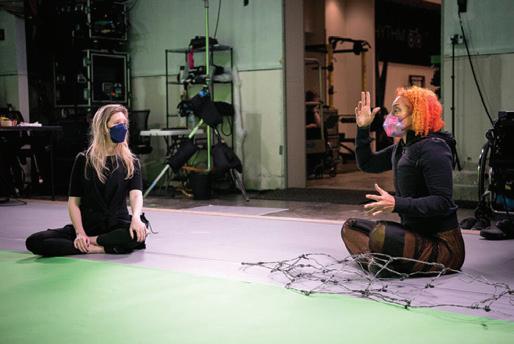
How can we give people of varying abilities equally rich cultural experiences? Kinetic Light, a disability dance company with a performance space in Brooklyn, New York—and an active touring schedule—wanted to reach more people. To do so, they enlisted Double Eye Studios, experienced in creating artistic entertainment in 360° and VR, and took inspiration (and the imagery of barbed wire) from one of Kinetic Light’s existing shows to create something new—not just new for them, but for the world.
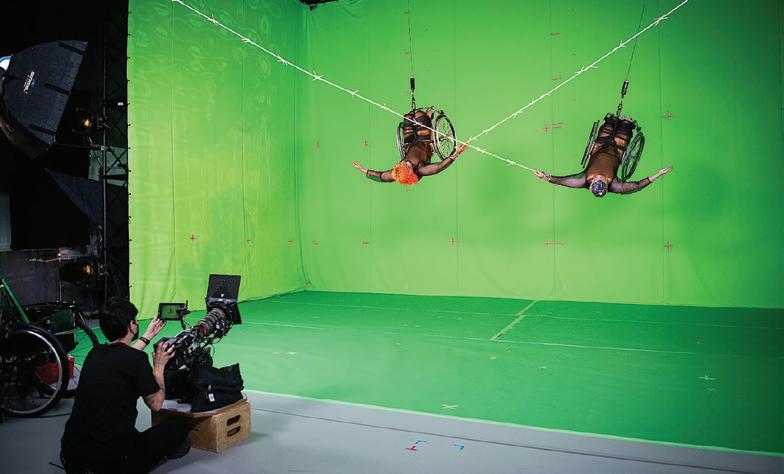
Given that Kinetic Light’s show has aerial choreography (aka, “flying on wires”), the first question was how to translate flying wheelchairs to VR. The second was how to have three dancers
play a thousand characters, which is no exaggeration.
Ultimately, it required a 20-foot green screen installed in-studio, which, explains Kiira Benz, executive creative director and founder of Double Eye Studios, meant that the color had to be keyed out for the dancers to be replicated into an army.
To do this, they needed to shoot in 2D, something rare and perhaps even ill-advised for traditional VR content, which this most certainly was not.
In an unconventional and creative move, Double Eye expanded rotoscoped 2D dancers into 3D, lit them, then imported them into the Unity game engine. Interestingly, this was a highly
•
• Guaranteed access to events and panels
• Special coverage throughout awards season
• One-click sign-up to Times entertainment newsletters like The Wide Shot, Screen Gab and Indie Focus
• The Envelope magazine print edition (available only to AMPAS, PGA and TVA members)
manual process. As LLMs have not been trained on a diverse population with diverse movement, the team couldn’t lean on AI. They used only human work for the actual production.
Once these imported “video cards” were in Unity, they were able to layer them in the foreground, midground and background to create the depth that was essential to this piece and the most evocative of Kinetic Light’s in-studio performances. But video playback has not historically been one of Unity’s strengths, so playback of hundreds of videos required some serious innovation. As Benz recounts, “When our engineer talked to the CEO of Unity and that team, they were like, ‘How have you done this?’”
Yet when you ask Benz about territory’s great innovations, she talks about accessibility. And she’s not talking about the dancers—they’re practically a red herring. While a barb by definition makes extraction difficult, this production—built on the imagery of barbed wire—has worked very
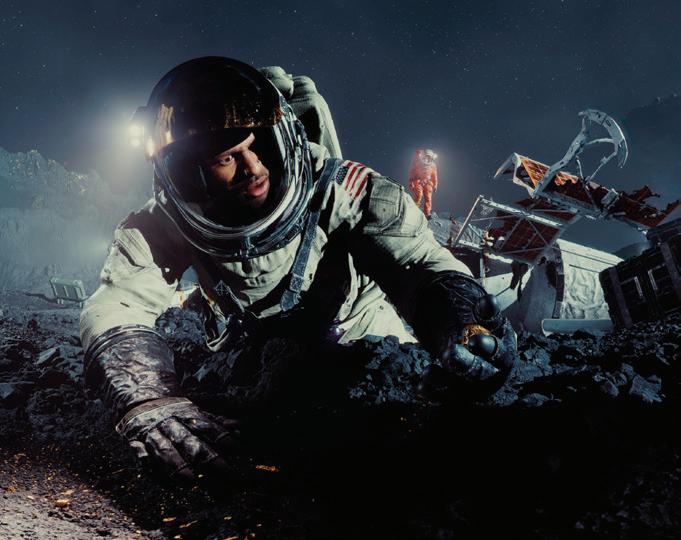
Asteroid, a 14-minute short, transports audiences into outer space.

hard to do exactly the opposite. Their mission is for all potential audience members to be able to extract meaning and multisensory experience from this multifaceted show.
territory features first-of-its-kind spatialized closed captions. This means that words show up in the physical space that the sound comes from. They are also size-correlated (louder words are larger), color-coded by character or world (e.g., wind or whips), and have the option of music closed captions, which relate what’s happening in the score. The audience member, whom the filmmakers have dubbed the “witness,” can select to have closed captions on or off. They can also select from five different audio description tracks. Since territory is the first PC VR experience built with Meta’s haptics studio, the witness also has the option to experience tactile feedback, either through the VR controllers or a haptic sculpture hanging from the ceiling in the viewing area that ran the score from wires. People in the headset could hold
the controllers to feel feedback, or they could choose to put their body into it and feel the score by leaning into the wires around the sculpture.
territory also has a screen reader; everyone starts with it on and it can be turned off by choice. (For reference, PC VR means a VR experience that runs off a desktop or laptop computer powerful enough to run demanding games and applications, unlike standalone VR headsets that operate independently.)
Between all of these affordances, there are 256 ways to experience territory, providing high repeatability and leveraging the choose-your-ownattention approach.
Produced by 30 Ninjas and 100 Zeros
What if the audience could have a real-time conversation with the lead character in a movie?
This 180° film, written and directed by Doug Liman of Swingers and The

Bourne Identity, is, as he tells it, “a short science fiction film about a group of unlikely—don’t even call them astronauts—attempting to get to an asteroid that’s passing near Earth so that they can mine it. They’re using an old Soyuz rocket, and it doesn’t go well. Only one of the five returns.”
“Movies always transport an audience to a new place. Swingers transports an audience to a new place. Bourne Identity transports you in a more
immersive way. Edge of Tomorrow, in an even more immersive way,” Liman adds. “With this technology, I wanted to send an audience into outer space and give them that experience.”
Asteroid also gives an audience the experience of talking with NFL star and actor DK Metcalf, who plays a fictionalized version of himself in the 14-minute short, which was built in Unreal Engine, even though the app that plays the movie is a Unity app. The
team trained Gemini, the Google LLM that powers the character, on nearly 1,000 pages of narrative content, which includes sample dialog, rules, triggers and research for example, who DK’s character is.
“From an innovation point of view, it’s one of the hardest things we’ve ever done,” explains Jed Weintrob, president and partner at 30 Ninjas immersive content studio. “We were working on a brand new platform,
Android XR, that didn’t exist yet, on a new piece of hardware—the Samsung Galaxy XR headset—that also didn’t exist yet, with a connection to Unity that was still in development, trying to tell a story and move a game experience through that platform.”
The Asteroid team also worked with Convai, the avatar studio that built the nonplayer character front end for the animated AI-character of DK Metcalf, who will never say the same thing twice.
During the short film’s credits, the audience has the opportunity to engage in real-time conversation with DK via a game scenario where they help rescue him from a virtual asteroid.
To help illustrate this experience, Weintrob provides a captivating analogy: “After watching Star Wars, if you could go back onto the Millennium Falcon with C-3PO at the same fidelity and resolution that you saw in the movie, that would be pretty interesting.”
Produced by Sphere Entertainment Co.
What if you could take the audience beyond the frame of a classic cinematic film? The team at Sphere, with some key partners, has done just that. They’ve extended The Wizard of Oz from its original 4:3 aspect ratio to fill 160,000 square feet, which, to put it mildly, is a lot of additional yellow bricks to lay. The magic takes place at the Las Vegas Sphere, the massive spherical entertainment venue.
Much like the characters in the film wishing, “If I only had a brain/ heart/courage,” the production team was hoping to find a wizard to give them what they were missing: super resolution, character limbs (not organs) and nonexistent performances. So who were they off to see? Google.
The team—which also included Magnopus and Warner Bros. Discovery—
used AI technology across the board. First they broke down every single shot in the original Wizard of Oz film, not just adding more pixels for pixels’ sake, but making sure that the nuance and detail were there. They used LLMs trained on material and references from the actual film.
Producer Jane Rosenthal likens some of the work to an archeological dig. The team was able to find a Technicolor workbook from a Technicolor cameraman who had worked on Gone with the Wind, a movie that used the same camera package as The Wizard of Oz. That allowed the team to figure out, for example, what lens a scene was shot with and use that to inform the look of the new bits.
It wasn’t just the digging that mirrored archeology—the team was also tied to a location in scorching weather conditions. “You have to really be in the Sphere while you’re mixing, looking at every frame,” says Rosenthal, who spent months in Las Vegas over the summer. “We can look at it in our test facility in Burbank, but you can only really see and feel it (at Sphere) because we have all these 4D effects, like when you’re in the tornado. You’ve got the wind, the haptics and the sound, and it all has to be conducted and mixed together.”
And perhaps like archeologists imagining the world of a find, the team used AI to “outpaint” the rest of the characters who, in the original, were cut off by the frame. Finally, because the audience in the Sphere can see so much more of any given set or location, the team used AI to generate performances for characters who may have been offscreen but are now in-scene—with the audience, in a way.
“You think of the art of storytelling, and how it transcends,” Rosenthal says. “It transfers from one person to another over the years. What we’ve been able to do is to take these technical advances and, working with hundreds of VFX artists, create something in the Sphere that has never been done before. It’s taking this extraordinary film and putting an audience in it.”
Produced by Cosm
What is it like to be in the ocean and see the world’s biggest waves coming at you? Heimiti Fierro, the Tahitian surfer followed by the film Big Wave: No Room for Error, knows well. As you may guess, it involves some crashing.
Fittingly, Big Wave only exists because director Bo Bridges dared to do some crashing of his own: at Dwayne Wade’s NBA party at the University of Utah. That’s where Bridges first saw the prototype for Cosm and realized that this was the question he wanted to answer for audiences that would ultimately flock to the then-forthcoming, now-extant, dome theater concept.
“I wanted to let people know how exhilarating and fun and wild it is, but I also wanted to bring the nonsurfer into a scenario where they could feel and breathe what it’s like to be around the ocean,” Bridges says. “The ocean’s my happy place, and I can’t get enough of it. I just wanted people to get into this space.”
This is no casual want—it’s the kind of urge that requires a deep dive, figuratively and literally. Bridges would free-dive to film footage, holding his breath one to three minutes at a time.
Hearing firsthand about the production experience, one can’t help but think that maybe no one else in the world could have pulled this off. Producing and directing the film required not only a deep understanding of the inner workings of extreme sports like surfing, but also the training, ability and stamina to actually get in the water and, to a degree, “do the thing.”
In addition, Big Wave required a technical understanding of which cameras to use and how to modify them for this first-of-its-kind task. For example, Bridges took a Sea Bob, a 4-foot-long underwater scooter, and built a custom apparatus to mount a big-water housing to the front of it to hold the camera.
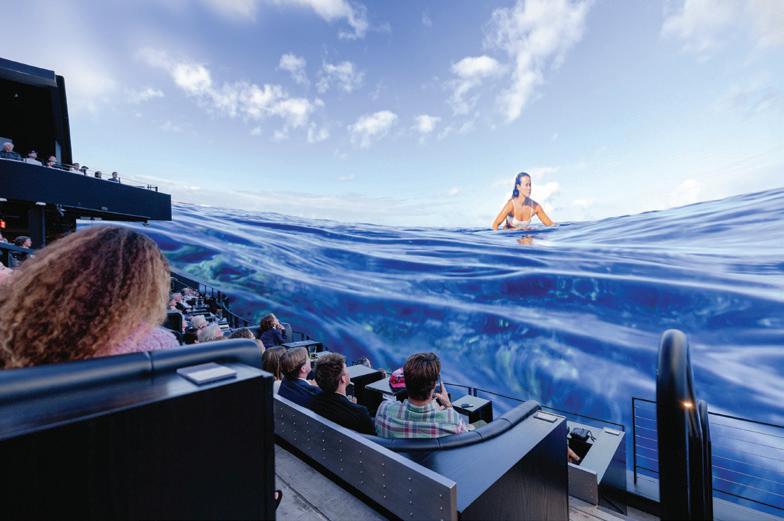
The production also required a strong network in the international surfing scene, the cultural knowledge to be able to appropriately and respectfully immerse oneself—and one’s crew—into a local surf scene, the weather literacy to monitor the globe for just the right kind of storm, and the producorial skills to pull together a crew in Tahiti on one day’s notice. It doesn’t feel far-fetched to say that it’s a miracle this film exists. The hope might be that, after watching it, the audience feels the same way about the ocean.
Special thanks to the 2026 Innovation Award jurors: Victoria Bousis, Albert Cheng, Nonny de la Pena, Maureen Fan, John Gaeta, Lisa Gregorian, Blake Kammerdiener, Jess Lee, Stephanie Mehta, Miles Perkins, Joanna Popper, Liz Rosenthal, Angela Russo-Otstot, Fidji Simo, George Strompolos, and Shicong Zhu.
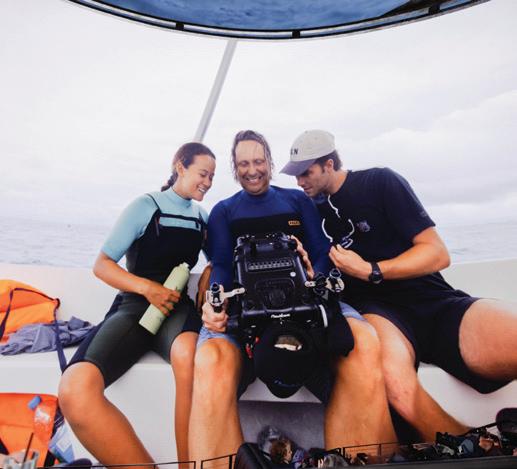
Above: Big-wave surfer Heimiti Fierro in Big Wave: No Room for Error. Below: Director Bo Bridges (center) reviews footage with Fierro and fellow surfer Clement Roseyro.
The 2026 PGA Innovation Award finalists’ must-have choices in hardware, software, AI and energizing beverages might surprise you.
written by Eve Weston
So, what does it take to be an innovator?
Perhaps there’s a certain je ne sais quoi that’s inborn. Or maybe it’s worth looking for certain commonalities to see what takes award-worthy producers from notion to nomination. As producers well know, there’s no detail too small. So, we’re diving into tool kits belonging to some of the producers of projects that are finalists for the 2026 PGA Innovation Award— Victor Agulhon (D-Day: The Camera Soldier), Kiira Benz (territory), Jed Weintrob (Asteroid), Jane Rosenthal (The Wizard of Oz at Sphere), and Bo Bridges (Big Wave: No Room for Error)—to surface the essentials that no game-changing producer can do without.
COMMUNICATORS
Is it an app? Is it a phone? It’s Superhuman!
“Superhuman has completely changed my relationship with email,” says Agulhon of the AInative email productivity app. “It’s built around reaching inbox zero. Everything is designed to help you process faster— there’s a shortcut for everything. It turned email from a growing to-do list into a gamified workflow, trying to hit zero every day.” Benz turns to two apps. “Every production needs

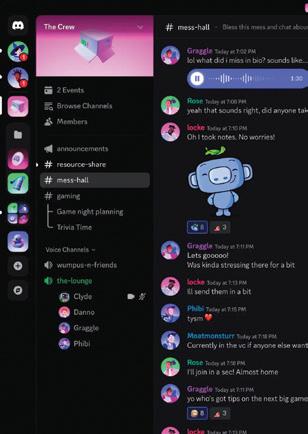

a great communication platform, and we love to use Discord (group chat) from pre- through postproduction,” she says. “We also use Discord in some unique ways in our VR theater productions.” Her team, predominantly their project manager, uses Asana as well. “On this production of territory, there were many pipelines taking place simultaneously, especially with all of the layers of accessibility being built in tandem with each artistic experiential design,” Benz says. “Being able to create many boards and keep the team organized was its own unique feat, and Asana was a great system.” For Rosenthal, producer of The Wizard of Oz at Sphere, suffice it to say, there’s no place like phone
More than half of the teams of the nominated projects consider artificial intelligence an essential part of their tool kit.
“I use them every day,” Agulhon says of his preferred LLMs, ChatGPT and Gemini. “They’re connected to our files and decks. They help me proofread, sharpen writing, stress-test ideas and bring a critical eye to work that’s hard to evaluate alone. They’ve basically become personal assistants for quick sanity checks.”

Weintrob relies on the same right-hand bots. “Gemini 3 made me largely make the switch from ChatGPT, which still knows me better than any other LLM, so I do go back to it from time to time,” he says. “Integration is the name of the game, and between Google Workspace, Nano Banana Pro, our (Google) Cloud accounts, and being able to answer just about everything, Gemini 3 is my go-to.”
“Our art department used Midjourney during our concept art phase,” Benz says of the AI image-generation tool.
“We haven’t replaced any roles in our productions with AI, but instead have chosen to empower our artists to use AI. Since AI image-based tools were fairly new at the beginning of our production, we made sure our environment artists had the training they needed to use the tools.”
It’s no surprise that our innovators lean on the latest tools for their eyes and ears and world-creating.
AirPods Pro and Pro 3, essential to Agulhon and Weintrob, respectively, block out the real world with their noisecancelling abilities and also let the real world in when needed. As Weintrob puts it, “Sometimes the smallest upgrades make the biggest difference, and the seamless transparency mode plus stellar noise cancelling and integration make this a key tool in the toolbox.”
Agulhon agrees. “Noise cancelling has genuinely changed my life. It lets me create a bubble of focus anywhere—in the office, while traveling, on set, or in a



café. With all the travel that comes with producing, being able to lock in anywhere is essential. It’s a total game-changer.”
And finally, the VR headset, which literally processes which world you’re in. With virtual reality, augmented reality, and mixed reality, we have myriad choices these days. Although for a couple of our producers, having a VR headset in their tool kit isn’t a
choice at all; it’s a necessity.
“In the production of territory, a VR headset is critical for the experience. However, in all immersive productions that I produce, from XR to immersive installations, even if the final experience isn’t a virtual reality experience, a VR headset is an incredible tool,” says Benz. “It goes beyond just previsualization and truly immerses you inside the world of the
experience, enabling you to test, ideate and feel. In territory, we built a custom spatialized closed-captions system, and it’s amazing to be inside a world where the closed captions are artistically designed around you.”
“Whether it’s an Apple Vision Pro or a Meta Quest 3, I always keep a headset within reach,” Agulhon says. “It’s how I review the latest versions of our projects, catch issues early, and stay connected to new releases across platforms. It’s really at the core of my routine.”
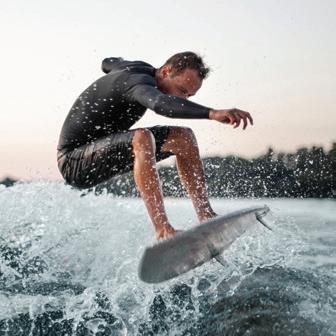

oxygen to my brain.” Pure function.
Like Rosenthal, Weintrob lists his vehicle for caffeine as an essential tool. His shots come from his restaurant-grade Pasquini Livia 90 espresso machine with Mazzer Mini grinder. “If you have to ask why one would need a restaurant-grade espresso machine, then you probably wouldn’t understand the answer,” he says.
Whether it’s an activity or a beverage, four out of five innovative producers find it essential to have something that energizes them. “I always want to get in the water. Once I get wet, I feel energized,” says Bridges, “I want to do something every day. I don’t want to be at a desk.” As long as he gets in a surf session before work, skis the slopes in the afternoon, or something similar, Bridges can work from anywhere.
For others, it’s not so much being in the water, as drinking some—lemon water to be exact. “You’re supposed to drink eight glasses of water,” says Rosenthal, “and that’s the only way I seem to drink water.”
But lemon water’s not her only invigorator. Rosenthal also relies on Diet Coke, a red-eye (coffee with a shot of espresso in it), and breathing exercises—not as woo-woo as that sounds. When asked why, Rosenthal says, “To make sure I’m breathing—to make sure I get


“Playing guitar is how I reset,” says Agulhon, “Even 10 minutes can break me out of mental loops after a day of logistics and screens. I often pick it up between work blocks and come back sharper and more creative. Just having my guitars within reach is comforting. It keeps me centered, even on the
pockets—simple and effective. Bridges has a he is never without. It’s loaded with a laptop, hard drive, and at least one camera with two or three lenses—fisheye, telephoto, and always his 24–105mm. “It can shoot both stills and video,” Bridges says. “I always travel with that, if nothing else.”
Ideas don’t do as well in stitched compartments; they need their own container. “For as much of an emerging tech nerd as I may be, I still love an old-fashioned notebook and pen. When directing or producing, I always carry a notebook with me to write down ideas, and also to sketch,” Benz says.
Bridges does the same. Weintrob, however, thinks a little bigger. For him, essential items include pads of giant Post-Its to stick on walls, and thick, purple Sharpie markers. Why? “Because to really see the big picture, I need to make a big picture,” he says.


As shapers of narratives, producers spark new thinking, imagination and cultural engagement that can create change on a global scale.
Written by Lydia Dean Pilcher
Lydia Dean Pilcher is cochair of the PGA Sustainability Task Force and a twotime Emmy-winning, Oscar-nominated producer of over 40 feature films and series. Her New York-based production company, Cine Mosaic, works with partners in Europe, the U.S., India, Africa and the Middle East. Pilcher collaborates with studios, unions, and UN Climate Change to foster clean energy transitions and climate-themed storytelling. As an educator and cultural strategist, Pilcher cofounded Global Rise: Stories for the Future. She teaches an interdisciplinary graduate course at the Columbia Climate School to inspire and craft compelling climate solutions in profound stories for film, television and the arts.
As producers, we are immersed in the power of film, television and media to shape culture. We’ve long known how stories can set agendas for what audiences think about and do. Narratives emerge and bring into focus what we care about, and they drive what we believe is possible. In this sense, I believe the most important skill for a producer to have is vision. It’s about the future.
In 1983, more than 100 million Americans watched the dramatic television movie The Day After, a portrayal of what life would be like following nuclear war. The movie sparked a national debate and increased worldwide awareness of nuclear risk—overlapping with ongoing UN disarmament efforts. The film became a reference point in policy debates and contributed to treaties created under the United Nations, including the Chemical Weapons Convention of 1993 and the Comprehensive Nuclear-Test-Ban Treaty of 1996.
The relationship between the entertainment industry and the United Nations became more intentional in the early 2000s, as an increasing number of movies highlighted humanitarian crises around the world. When key films like
Blood Diamond, The Constant Gardener and Hotel Rwanda powerfully reshaped public understanding of critical issues, the UN recognized the role that storytelling can play in humanizing policymaking and action.
As climate change discourse entered mainstream politics, then-Secretary-General of the United Nations Ban Ki-moon traveled to Los Angeles in 2011 to hold panels and meetings with industry leaders. He urged Hollywood to help raise awareness about climate change as the defining challenge of our time. He asked writers, directors, producers and actors to use their talent and narrative influence to highlight climate change and related UN priorities.
The United Nations Educational, Scientific and Cultural Organization (UNESCO) defines culture as the whole complex of distinctive spiritual, material, intellectual and emotional features that characterize a society or social group. It includes the fundamental rights of the human being, value systems, traditions and beliefs. These cultural elements, along with symbols and metaphors, influence the ways audiences absorb the stories we tell.
Today’s producing landscape involves deep collaboration with audiences as we seek to distinguish our work in a crowd-
ed marketplace of shifting values and a rapidly changing world. This holds particular relevance for an emerging industry-wide movement to acknowledge climate change in the stories we tell on screens. Climate touches everything. It affects our personal lives, systems and cultures on a global scale. Audience engagement around climate change can be more effective when scientific insight is delivered via narratives where ideas can be viscerally felt rather than just intellectually thought.
A current box office success, Avatar: Fire and Ash, belongs to a genre of mythic/ blockbuster climate movies that can shift cultural imagination. In the Avatar world, industrial extraction by humans devastates ecosystems and Indigenous societies on Pandora—a reference to fossil fuel extraction, mining and colonial resource grabbing on Earth. The film is about values, worldviews and systems change, which is exactly where many climate communicators argue the biggest leverage lies. But as in many cases, where is the public conversation? Work that moves beyond entertainment into spheres of cultural influence can often provoke audiences

to rethink social norms, power and responsibility. In its heyday, Norman Lear’s TV show All in the Family was the most-watched show in America. A 1975 episode boosted early public awareness of the dangers of chlorofluorocarbons (CFCs), man-made chemicals depleting the ozone layer, about which scientists had only recently begun to sound the alarm.
Michael (aka “Meathead”) grabs Gloria’s hairspray: Right here. This is a killer.
Gloria: Oh, so now my hairspray’s a killer!
Michael: Yeah, your hairspray, my deodorant, all spray cans. I read that there are gases inside these cans, Gloria, that shoot up into the air and can destroy the ozone.
Gloria: What’s the ozone?
Michael: Ozone is a protective shield that surrounds the earth that protects us against ultraviolet rays. Do you know what they can do?
Gloria: Yeah, they protect us from sunburn.
Michael: Sure, when the ozone is there, but when it’s gone, you can get skin cancer, and God knows what it will do to the plants and crops!
The episode created public discussion around the emerging environmental risk of greenhouse gases created by aerosols and refrigerants, leading to a significant decline in the sales of products like hair spray and deodorant, and prompting companies like DuPont and the aerosol industry to research alternative chemicals.
As part of his lifelong commitment to socially conscious storytelling and civic engagement, Lear helped normalize the idea that science belongs in popular culture, that ordinary citizens can debate planetary risk, and that comedy can carry moral weight.
The show’s influence, alongside
media attention, led to the U.S. ban on CFC-based aerosols in 1978. Public pressure created the political will needed for scientists and politicians to persuade leaders like Ronald Reagan (with concerns about the great outdoors and skin cancer) and Margaret Thatcher (a chemist and influential voice in policy and science) to take action leading to the international Montreal Protocol in 1987. This was the first treaty in UN history to achieve universal ratification by all countries.
The ozone hole over Antarctica is healing, and projections suggest a return to preindustrial levels by mid-century.
Public consciousness about global warming reached tentpole-movie level with Roland Emmerich’s blockbuster, The Day After Tomorrow (2004), produced by Mark Gordon. Despite being a science fiction film, it generated public conversations and activity, compelling people to Google “extreme weather events” and newscasters to begin using the term “climate change” in weather reports.
The same year, HBO released producer/director Spike Lee’s four-part documentary When the Levees Broke: A Requiem in Four Acts. The film exam-
ines the human, political and social consequences of Hurricane Katrina’s devastation of New Orleans in 2005, particularly the government’s response and the suffering of those displaced, with over 300,000 residents migrating out of the city.
Even now, the Louisiana coastline continues to erode into open water, at about 25 to 35 square miles each year. Some estimates equate this to a football field of wetlands lost every 100 minutes, primarily due to sea level rise, storms and land subsidence.
In 2006, as a young mother, I remember feeling my worldview shift as I watched An Inconvenient Truth, produced by Laurie David, Lawrence Bender, Scott Z. Burns and Lesley Chilcott. This American documentary film portrays former Vice President Al Gore’s slide-show campaign to educate people about global warming.
These events and films were game changers. They conveyed the high stakes of global warming to the general public in a storytelling format easily understood by people without scientific training.
An Inconvenient Truth won the Academy Award for Best Documentary Feature in 2007. Gore later received the Nobel Peace Prize alongside the Intergovernmental Panel on Climate Change
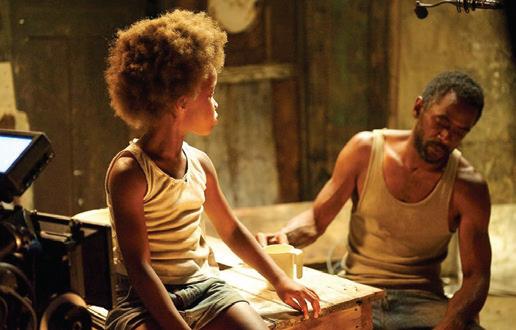


(IPCC) “for their efforts to build up and disseminate greater knowledge about man-made climate change, and to lay the foundations for the measures needed to counteract such change.” Climate change became a front-burner topic.
My PGA colleagues Mari Jo Winkler and Katie Carpenter and I began meeting over our common concerns that year. We flew to Tennessee to take part in Al Gore’s Climate Reality leadership training held over a weekend in a Nashville dance hall. We were all in. We formed PGA Green and, encouraged by Gore’s team, Katie’s company Green Media Solutions calculated the first production carbon footprint on Away We Go, a Focus Features film that Mari Jo was producing. The visibility of our passion kicked off PGA’s early work with studios, unions and guilds around sustainability on our sets, and rallied our responsibility as an industry to meet UNFCCC climate goals. (Read the PGA Clean Energy Call to Action at producersguild.org/sustainability.)
A modest-budget independent film, Beasts of the Southern Wild, produced by Dan Janvey, Josh Penn and Michael Gottwald, was filmed in the post-Katrina landscape. Directed by Benh Zeitlin, the movie blends magical realism, myth and social realism with the science of global warming—and erupted on screen with a new sensorial visual grammar. The film pioneered climate storytelling through a child’s perspective, following a sensorial logic where time collapses, and past, present and future coexist. Melting ice caps appear as aurochs—ancestral, imagined oxlike creatures—linking planetary systems to emotional memory.
The film was nominated for four Academy Awards, including Best Picture, which brought awareness of racism and environmental justice forward in the public conversation. People who live near oil refineries and wetlands bear a higher risk of climate catastrophes, as safety regulations frequently don’t pro-
tect these fenceline communities.
The IPCC was established in 1988 to provide policymakers with regular scientific assessments on the current state of knowledge about climate change. Thousands of scientists worldwide serve as authors to synthesize peer-reviewed climate research to create a scientific consensus to guide the United Nations Framework Convention on Climate Change (UNFCCC). Adopted in 1992, UNFCCC provided a forum for the Paris Agreement to build international cooperation around greenhouse gas mitigation, climate finance, resilience and adaptation.
In 2015, as PGA vice president of motion pictures and a cofounder of PGA Green, I represented our industry at the 21st convening of the annual UNFCCC Conference of Parties (COP21), alongside international film and TV groups. The Paris Agreement was adopted by 195 nation-states, agreeing to limit global warming to no more than 2 degrees Celsius (ideally 1.5 degrees Celsius) above preindustrial levels. The agreement mobilized a global response to climate change with “nationally determined contributions” (NDCs) supporting collective progress. At PGA, our focus was on sustainable production and decarbonizing our sets. We felt so hopeful.
Five years after the Paris Agreement was adopted, however, global warming continued to intensify. In 2020, the USC Annenberg Norman Lear Center’s Media Impact Project began to research what had become a veritable silence around climate on Hollywood’s screens. The Day After Tomorrow was the last blockbuster studio action movie to mention global warming.
Between 2019 and 2023, U.S. Congressional investigations revealed troves of corporate communications indicating multidecade campaigns by the oil and gas industries to undermine public trust in climate science, to delay regulation and to exaggerate scientific uncertainty, while controlling the narrative of energy
in American popular culture. The White House Effect, a 2024 documentary, charts the governmental shifts in environmental policy from a planetary consciousness in the ’60s and ’70s to a public narrative increasingly controlled by the petro nations and the fossil fuel industry.
As audiences can drive storytelling, it’s useful to pay attention to the Yale Program on Climate Change Communication, which documents trends in American levels of concern and attitudes about climate change over time. In 2022, Yale reported the highest levels of concern ever recorded since they began the surveys in 2014, with 70% of Americans saying they were worried about climate change. But when asked what they believed that percentage to be, study participants estimated 30% percent.
We are a supermajority, but we don’t know it.
During the COVID-19 pandemic, our focus on sustainable production at the PGA expanded into the realm of climate storytelling. Amid a time of great turbulence in our country, PGA Green produced the webinar “New Climate Narratives in a World of Racial Injustice and a Global Pandemic,” bringing a cultural lens to climate and storytelling
from producers, cultural leaders, writers and critics.
Our industry began to rally, recognizing the narrative power imbalance and the importance of our cultural forums to educate and evoke response. Many of the groups converging then on the forefront of climate and storytelling continue to provide education and consultancies championing efforts in our industry, including the Natural Resources Defense Council (NRDC), Rewrite the Future, the Writers Guild of America, Good Energy, Rare, and the Hollywood Climate Summit.
At PGA and WGA, creatives interested in climate storytelling began to express a desire to dive deeper into the complexity of science and globalized systems. But support was hard to find.
It also became apparent that we had no pipeline in our film and TV schools, or even a well-sourced knowledge base available to support popular storytelling about climate change on a larger systemic and cinematic scale.
Informed by teaching cultural strategy over five years in the Graduate Film program at NYU Tisch, I interviewed academics across the country who were
teaching climate storytelling in their own disciplines: English, engineering, humanities, science, history, architecture, narrative medicine, journalism and more. I designed a graduate course, Climatic Change: Storytelling Arts, Zeitgeist, and our Future, that brings together students from Columbia University’s Climate School and the School of the Arts in an interdisciplinary classroom.
Whereas top-down, data-driven science communication rarely moves the needle of public understanding, young minds in the Climate School are eager to take on the challenge of creating stories that translate this scientific and epic existential dilemma. In lively discussions, we track zeitgeist elements in our shifting culture, parallel to the changing climate. We seek to overcome the prevalent psychological distancing from our future and focus on solutions that can positively chart where we are going.
I teach storytelling through popular culture films like Dune (based on the climate fiction novel by Frank Herbert) and Black Panther (Ryan Coogler’s original vision of a protopia), as well as independent films like Beasts of the Southern Wild and international films like Jia Zhangke’s Still Life, which was made during the erasure of a culture by the construction of the Three Gorges Dam.
We also draw from television. Since the 1990s, The Simpsons has used satire to take on climate change themes including air and water pollution, public apathy and lack of corporate responsibility. Lisa Simpson, as a passionate activist, represents the show’s moral and scientific conscience on climate change. She organizes protests, petitions around issues of government inaction, supporting youth-led environmental concern.
Today’s successful showrunners are increasingly able to assert their agency in driving climate content in TV series. We’ve begun to see a wide range of climate representation from settings to themes, across genres and audiences in series such as The
Handmaid’s Tale, Grey’s Anatomy (S21), Hacks (S3), Industry (S2), Ted Lasso (S2), Reservation Dogs, Borgen—Power & Glory (S4) and Families Like Ours
In the course I teach, we discuss our human relationship to the natural world in movies and shows like Train Dreams, Nomadland and True Detective: Night Country. We consider films about nonhuman species, such as Hayao Miyazaki’s Spirited Away and Princess Mononoke, which explore moral complexity and decenter humans, allowing animals, spirits, forests, wind and even machines their own agency and ecological consciousness. We debate shows like Landman in order to explore media integrity, cultural tropes and disinformation, particularly around clean energy.
As current government priorities shift, aggressive special-interest disinformation and polarization in media narratives are fueling a detachment from our climate crisis. This exacerbates what Rob Nixon, professor in humanities and environment at Princeton, calls a “slow violence.” The incremental destruction over time is not always perceptible, distancing us from the real effects of climate change. Climate stories can fail if recognition comes after the consequences are locked in. Do we want our stories to mobilize action or merely memorialize loss?
Many of the climate students at Columbia are looking at climate change as a structural force that is reshaping culture, geopolitics and personhood. When I realized the students were naturally thinking in systems, something clicked for me—especially as the UN’s 17 Sustainable Development Goals (SDGs) established in the Paris Agreement represent systems. We keenly explore the work of Donella Meadows, a pioneer at MIT who viewed sustainability through a systems-thinking lens, with an eye toward identifying leverage points—places in a system where small changes can
lead to big shifts in behavior.
Research from FrameWorks Institute, which has been studying mindsets for 25 years, has found that “the system is rigged” mindset is among the most pervasive in American culture. This mindset can lead to an increased demand for change or result in fatalism— the conclusion that the problem is just too big to solve. Interestingly, research has also shown how stories that situate individual choices within their larger structural context (i.e., systems) can foster empathy, shift attitudes about who is responsible for solving societal problems, and build policy support.
A Columbia faculty member who took a particular interest in my class is meteorologist Andrew Kruczkiewicz. He is a senior staff researcher for the National Center for Disaster Preparedness and works with the Red Cross and other humanitarian groups. His research interests include how to strengthen the role of perception and cognition in the communication of climate and weather risk, primarily in the context of early warning systems, vulnerability assessments, and humanitarian decision-making.
In the summer of 2025, Andrew and I partnered to create a research project: Storming the Apocalypse: Disasters, Culture & Risk Perception. We proposed to address how data-driven climate science has failed to increase the public’s perception of risk. Without cultural translation, even the most effective solutions remain ignored. Through multiphase, interdisciplinary collaborations with a range of communities, we are cocreating four city-based case studies (New York City, Kampala, Rio de Janeiro and Bangkok). We focus on the power of storytelling arts, popular culture, systems thinking and ecocriticism to engage the emotional, cognitive and psychological dimensions of how people perceive risk.
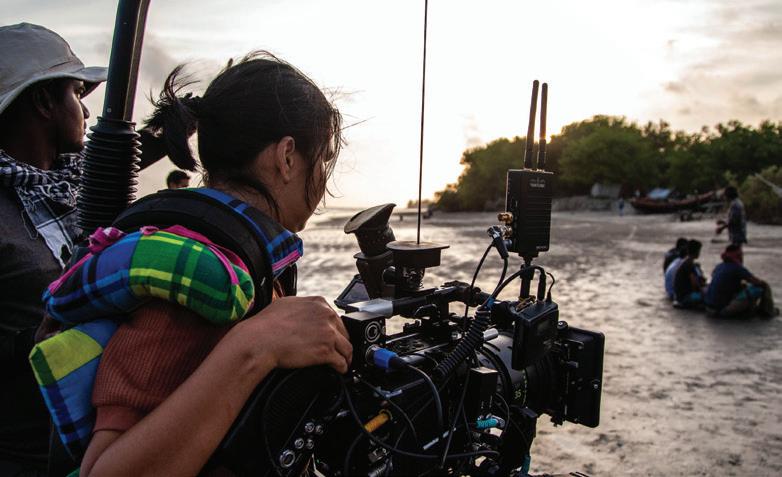
In the months preceding COP30, the Brazilian COP Presidency’s Action Agenda strategy was developed as a catalytic pillar to support climate action across communities. Citizens and experts were invited to propose tangible solutions and positive examples, and to collaborate in a Call for Plans for Accelerated Solutions (PAS).
In my role with the UN Climate Change initiative, Entertainment and Culture for Climate Action (ECCA), I proposed a PAS based on the research that Andrew and I had begun for a new storytelling model in climate communication training. This was an exciting opportunity to forefront cultural infrastructure as a foundation to align our work with the need for policymakers and negotiators to understand how culture can best be integrated into their work.
In November 2025, the Brazilian COP Presidency accepted our proposal into Action Group 19: Culture, Cultural Heritage Protection and Climate Action. As I set off for COP30 in Brazil—on the 10-year anniversary of the Paris Agreement—I mulled the Brazilian spirit
of collective effort, mutirão, and the ways culture and multilateral diplomacy can intersect.
At Belém, the gateway to the Amazon, 194 countries and 56,000 people came together. Representatives of national delegations, subnational governments, Indigenous people, businesses, media, scientists, academics and nongovernmental organizations were on the ground, committed to forging ahead on climate progress in high-level meetings as well as thematic events.
This was the largest Indigenous presence in the history of climate talks. Ultimately, countries made pledges to support land rights and finance for climate action for Indigenous peoples, Afro-descendants and local communities, acknowledging their role in protecting critical ecosystems.
ECCA Film & TV Steering Committee members Rezwan Shahriar Sumit (Bangladesh), Emily Wanja (Kenya), Solitaire Townsend (UK) and I attended on behalf of our network of over 900 members of the global film and television industry. In the face of reportedly 1 out of 25 participants at COP30 representing
fossil fuel interests, we brought support for new perspectives that could highlight the power of popular culture to provide education and climate solutions in the world of engagement and policy. Participating in panels, workshops and roundtables, we met with many global culture and climate stakeholders working in different sectors.
We announced a new initiative, Earth Witness: Story to Policy, to mentor and support filmmakers telling their stories of climate vulnerability with a priority on the Global South. Our goal: to use storytelling to galvanize connections between ministers of culture and ministers of the environment to create impact through policy.
During the conference we screened the first Earth Witness films from Mexico (La Mar), Bangladesh (A Flower in the Desert) and India (Under the Same Sun), addressing topics of sea level rise and forced evacuation, equity and girls’ education, and the largest national trade union in India for the women workers of informal economy (SEWA), who are supporting renewable energy and training women to repair solar panels.
ECCA also launched a Global Film & TV Survey in 15 languages to assess the level of work being done in the major screen industries around production decarbonization and climate-themed content. A scoping study for a development fund is underway.
Climate-altered settings in storytelling need not be neutral backdrops. They can encode political choices, ethics and futures. Narratives expose how governance, media, and markets reflect the relationship between humans and the natural world.
Many of us are keen to see cultural infrastructure integrated into our govern-
ments and systems in ways that inspire a spirit of mutirão. The term, which originated in the Indigenous Tupi-Guarani language, became a clarion call for international cooperation at COP30.
I’m reminded of Katniss Everdeen in The Hunger Games, produced by Nina Jacobson and Jon Kilik. Following a climate catastrophe, the Capitol fascist state in the former Rocky Mountains region of North America rules amid ecological collapse and resource scarcity. The Capitol relies on theatrical power—pageantry, costumes and televised violence—turning fire, drought, floods and predators into normalized entertainment.
When Katniss honors her fallen sister on national television and refuses to
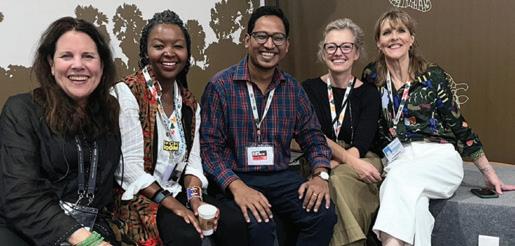
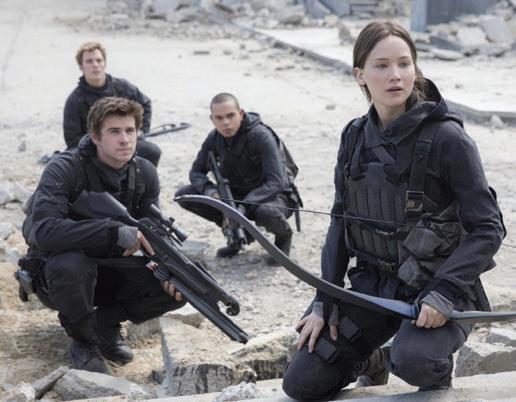
play the Hunger Games, she chooses compassion over cruelty. This destabilizes the spectacle and exposes the fragile and fabricated consent on which authoritarian power depends. Her defining act is her refusal to become the kind of person the system requires. The state falls because people stop consenting to its narrative reality.
Global culture has become a matrix of value systems that coexist with governments, from democratic to authoritarian. According to the Economist Intelligence Unit’s Democracy Index 2024/5, today less than 7% of the world’s population lives in full democracies, while around 40% live under authoritarian rule. The remainder live in flawed democracies or hybrid regimes. This trend over time reflects an ongoing global democratic decline.
Simon Stiell, executive secretary of the UNFCCC, sums up the mission ahead: “Cities, states and regions have become critical drivers of implementation…. We must follow a just, orderly, and equitable transition away from fossil fuels by mid-century; a tripling of renewable energy; a doubling of energy efficiency; and supporting efforts to halt and reverse deforestation and forest degradation by 2030.” As global temperatures continue to rise, cultural narratives that encourage new thinking, imagination and civic engagement in democracies are essential to solving the climate crisis.
As producers and storytellers, we have a vital role to play in shaping the world in which future generations will live. The stories we tell and who gets to tell them are critical. In my memory of COP30, I will always hold the spirit of mutirão as a broad, inclusive mobilization that goes beyond formal negotiations to emphasize a shared responsibility for climate solutions. It’s about our future.
This spring, the Producers Guild will launch its Sustainability Tool Kit to provide additional ideas and guidance for incorporating climate into your storytelling. Visit producersguild.org/ sustainability to learn more.
Written by Mara Brock Akil

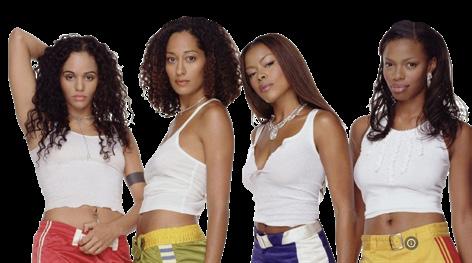
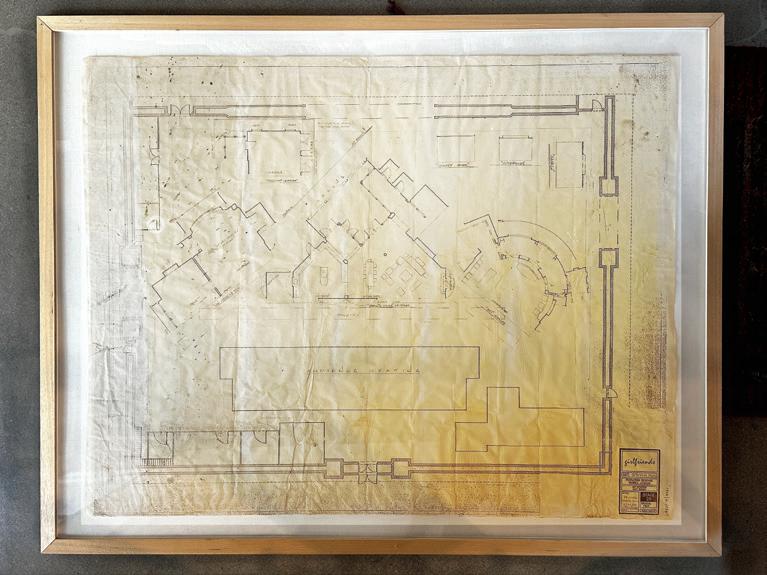
This floor plan was created by set designer Matt Bekoff and the late production designer Wendell Johnson for the pilot of UPN’s Girlfriends. This blueprint is a talisman representing the moment my career catapulted me into being the youngest Black showrunner of all time. Me, a young woman, trying to share what was in the hearts and minds of Black women living in LA in the year 2000. I wasn’t trying to make history; I was just trying to get our story right.
In 2020, my career took another leap. I entered into a deal with Netflix. I always dreamed of having a great office like so many of my stylish characters had, but the world went remote. Maybe working from home over Zoom would be our future. But just as our characters need a place to say their lines and execute their action in order to change the hearts and minds of our audiences through laughter, tears, and myriad other emotions, we artists need a place to create new, inspired stories.
So I couldn’t think of a better portrait to anchor my story27 Productions offices than this beautiful patinated relic—my spotting plans for Joan’s home, Joan’s office and the Girlfriends’ favorite hangout. There wouldn’t be a Forever without the foundation of stories Girlfriends told 25 years ago. It wasn’t just a TV show; it was a blueprint for my storied career as well as the first door so many craftsmen, artisans and performers walked through to live out their dreams.
Mara Brock Akil is executive producer and showrunner of Forever, and recipient of the 2026 PGA Norman Lear Achievement Award.