PRODUCEDBY THE OFFICIAL MAGAZINE OF THE PRODUCERS GUILD OF AMERICA // DECEMBER | JANUARY 2026
A WINNING COALITION HELPS SECURE TAX CREDITS FOR CA PRODUCTIONS
P. 97
FAITH-BASED STORYTELLING FINDS ITS MOMENT
P. 102
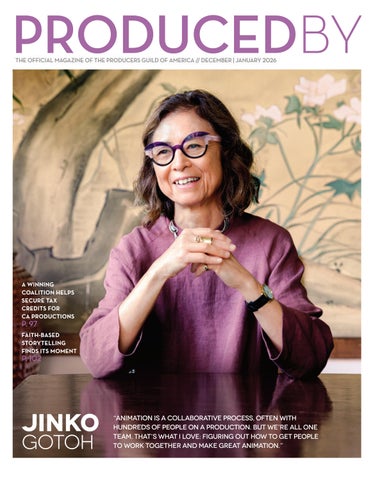
JINKO GOTOH
“Animation is a collaborative process, often with hundreds of people on a production. But we’re all one team. That’s what I love: figuring out how to get people to work together and make great animation.”
“THE Best Picture For Your Consideration in All Categoes including
Best Pictu
David Heyman, p.g.a. • Amy Pascal, p.g.a. • Noah Baumbach, p.g.a.
“All my memor “NOAH NOAH BAUMBACH’S BEST FILM.” “MADE WITH PALPABLE LOVE FOR CINEMA AND ITS MAGIC.”
“A PERFECT FILM.”
OF THE YEAR . ” 4 ctics choice nominations Best Picture
WINNER national board of view
including
WINNER
one of the year’s best pictus one of the year's best pictus
ies a movies.” “A FULLY FORMED KNOCKOUT KNOCKOUT.”
“A SUPERB CHACTER STUDY ABOUT NOT WANTING TO WAIT TOO LONG TO START LIVING.”
FILM.NETFLIXAWARDS.COM
IN A L L CAT EG O RIE S IN C LU D IN G
B E S T JAMES CAMERON, p.g.a. • JON LANDAU, p.g.a.
BEST JAMES CAMERON
DIR EC
PICTURE TOR
WINNER
TOP 10 FILMS OF THE YEAR
©2025 20th Century Studios DisneyStudiosAwards.com
FO R YO U R C O N S I D E R AT I O N I N A L L
11 B E S T P I C T U R E
CRITICS CHOICE AWARD NOMINATIONS INCLUDING
DISCOVER HOW GUILLERMO DEL TORO BROUGHT THE EPIC REIMAGINING TO LIFE
C AT EG O R I E S I N C L U D I N G
BEST PICTURE GUILLERMO DEL TORO, p.g.a. J. MILES DALE, p.g.a. SCOTT STUBER, p.g.a.
“A s t u n n i n g e p i c
with piercing humanity.”
A film by
Guillermo del Toro
FILM.NETFLIXAWARDS.COM
F O R
Y O U R
P G A
TO WATCH THESE PROGRAMS AND MORE, VISIT: www.PeacockFYC.com Passcode: PeacockFYC2025
A W
A R D S
C O N S I D E R A T I O N
T H E # 1 M OV I E O F T H E Y E A R
FOR YOUR CONSIDERATION IN ALL CATEGORIES INCLUDING
BEST PICTURE Z I N Z I C O O G L E R , p.g.a. S E V O H A N I A N, p.g.a. RYA N C O O G L E R , p.g.a.
FOR SCREE NIN GS AN D SPECIAL C O NTENT PLEASE VISIT W W W. WBAWARDS.C O M
“SMART, EMOTIONAL AND INGENIOUSLY CONSTRUCTED.”
F O R YO U R C O N S I D E R AT I O N
BEST
GREG SHAPIRO, p.g.a. • KATHRYN
“To say this is an important film
“A CRACKLING THRILLER. A TIGHTLY WOUND DYNAMO.”
ONE HELL MOTION PICTURE
“★★★★★. A TOUR DE KATHRYN BIGELOW IS A DI CRITICS CHOICE NOMINEE
FILM.NETFLIXAWARDS.COM
DIRECTED BY
KATHRYN BIGELOW
I N A L L C AT E G O R I E S I N C L U D I N G
PICTURE
BIGELOW, p.g.a. • NOAH OPPENHEIM, p.g.a.
for our time is an understatement.
OF A ACHIEVEMENT.”
FORCE. AN UNSHAKABLE FILM. RECTOR OF VIRTUOSO TALENT.” BEST EDITING KIRK BAXTER, ACE
WRITTEN BY
NOAH OPPENHEIM
“KATHRYN BIGELOW'S WORK HERE IS SUPERB.” “A WORK OF APOCALYPTIC POWER.”
5 BEST ACTOR
C R I T I C S C H O I C E AWA R D n om i nat i ons
Best Picture BEST ADAPTED SCREENPLAY
BEST CINEMATOGRAPHY
JOEL EDGERTON CLINT BENTLEY, GREG KWEDAR ADOLPHO VELOSO, ABC AIP BEST SONG “TRAIN DREAMS” - NICK CAVE, BRYCE DESSNER
“THE BEST OF THE BOARD WINNER NATIONAL OF REVIEW
BEST ADAPTED SCREENPLAY ONE OF THE
BEST OFPICTURES THE YEAR
WINNER ONE OF THE
BEST OFPICTURES THE YEAR
SCAN TO HEAR THE SWEEPING TRAIN DREAMS AUDIO JOURNEY
4
FILM INDEPENDENT SPIRIT AWARD n om i nat i ons
B E ST F E AT U R E
BEST DIRECTOR
BEST ACTOR
BEST CINEMATOGRAPHY
CLINT BENTLEY JOEL EDGERTON
ADOLPHO VELOSO, ABC AIP
PICTURE
E YEAR.”
MARISSA MCMAHON, p.g.a. TEDDY SCHWARZMAN, p.g.a. WILL JANOWITZ, p.g.a. ASHLEY SCHLAIFER, p.g.a. MICHAEL HEIMLER, p.g.a.
FILM.NETFLIXAWARDS.COM
F O R
Y O U R
C O N S I D E R AT I O N
I N
A L L
C AT E G O R I E S
INCLUDING
BEST PICTURE ADAM SOMNER SARA MURPHY PAUL THOMAS ANDERSON “‘ONE BATTLE AFTER ANOTHER’ DOESN’T SIMPLY MEET THE MOMENT; WITH EXTRAORDINARY TENDERNESS, FURY, AND IMAGINATION,
IT FORGES A MOMENT ALL ITS OWN, AND INSISTS THAT BETTER ONES COULD STILL LIE AHEAD.” – THE NEW YORKER
FOR SCREE NINGS AND SPECIAL CONTENT PLEASE VISIT W W W.WBAWARDS.C OM
F O R YO U R CO N S I D E R AT I O N IN ALL CATEGORIES INCLUDING
BEST PICTURE
Ram Bergman, p.g.a.•Rian Johnson, p.g.a.
WINNER NATIONAL BOARD OF REVIEW ONE OF THE YEAR’S BEST PICTURES
“ONE OF THE BEST MOVIES OF THE YEAR.” “RIAN JOHNSON caps off what might go down as
ONE OF FILM’S GREAT TRILOGIES.” “An enthralling puzzle-box whodunnit.
FUNNY, DARK, MOVING AND MEANINGFUL.”
FILM.NETFLIXAWARDS.COM
PRODUCEDBY DECEMBER | JANUARY 2026
70
JINKO GOTOH Jinko Gotoh is a problem-solver whose creative vision, determination and optimism has helped bring the world some of best animated films ever made.
FEATURES 86 PRODUCERS AS ENTREPRENEURS
102 FAITH-BASED STORYTELLING
125 RESPECT ON EVERY SET
Two seasoned producers discuss how embracing the mindset of entrepreneurship empowers their profession.
Producers are recognizing that audiences are hungry for inspiration—and that success boils down to well-told stories that engage people and instill a sense of hope.
97 POWER IN PARTNERSHIP
113 A NEW CLIMATE FOR REALITY TV
PGA and the Hollywood Commission are providing independent producers the tools and resources they need to ensure a protected, respectful workplace.
Extraordinary collaboration among entertainment unions, guilds and the PGA secured legislation that more than doubled California’s film incentive program.
26 producersguild.org | PRODUCED BY
Producers of unscripted television are positioned to depict climate change impacts and solutions without sacrificing entertainment or storytelling.
FOR YOUR CONSIDERATION
BEST ANIMATED FEATURE MICHELLE L.M. WONG, p.g.a.
2 CRITICS CHOICE N O M I N AT I O N S
BEST ANIMATED FEATURE BEST SONG “GOLDEN”
W I N N E R
NEW YORK FILM CRITICS CIRCLE
BEST ANIMATED FILM
“THE BEST ANIMATED FILM OF THE YEAR.” “A LOVE LETTER to the power of voices bringing people together.”
SCAN TO EXPLORE THE ART-OF BOOK
FILM.NETFLIXAWARDS.COM
49
ON THE MARK WITH GABBY’S DOLLHOUSE: THE MOVIE.
DEPARTMENTS 33 TREASURER’S REPORT
41 DAY IN THE LIFE
60 NEW MEMBERS
Careful planning and budgeting kept the Guild in strong financial shape throughout its 2024–25 fiscal year.
For Ralph Winter, producing content for the Las Vegas Sphere is a nonstop whirlwind of creating something entirely new.
Meet the PGA’s newest members and discover what makes them tick.
49 ON THE MARK
Enjoy a recap of events presented by the Guild in 2025.
35 TOOL KIT The Archival Producers Alliance’s Gen AI initiative offers practical guidance on using AI in a production.
The producers of three upcoming features detail the work they did to earn the Producers Mark.
122 SEASON’S GREETINGS
130 MEMENTO A priceless memory for Jinko Gotoh is captured in a treasured photo—and a magical snow globe.
28 producersguild.org | PRODUCED BY
BOARD OF DIRECTORS OFFICERS PRESIDENTS Stephanie Allain Donald De Line VICE PRESIDENT, PRODUCING Charles Roven VICE PRESIDENT, PRODUCING TEAM Steve Cainas VICE PRESIDENT, EASTERN REGION Tonya Lewis Lee TREASURER Yolanda T. Cochran SECRETARIES Mike Jackson Kristie Macosko Krieger DIRECTORS Bianca Ahmadi Fred Berger Parker Chehak Melanie Cunningham Mary Alice Drumm Linda Evans Samie Kim Falvey
Mike Farah Jennifer Fox Beth Fraikorn DeVon Franklin Donna Gigliotti Jinko Gotoh Bob Greenblatt
Rachel Klein Larry Mark Lori McCreary Tommy Oliver Marc Platt Joanna Popper Lynn Kestin Sessler
ASSOCIATE NATIONAL EXECUTIVE DIRECTOR Michelle Byrd CEO Susan Sprung EDITOR Lisa Y. Garibay PRODUCERSGUILD.ORG Vol. XXII No. 1 Produced By is published by the Producers Guild of America. 11150 Olympic Blvd., Suite 980 Los Angeles, CA 90064 310-358-9020 Tel. 310-358-9520 Fax 1501 Broadway, Suite 1710 New York, NY 10036 646-766-0770 Tel.
30 producersguild.org | PRODUCED BY
PARTNER & BRAND PUBLISHER Emily S. Baker
COPY EDITOR Bob Howells
CREATIVE DIRECTOR Ajay Peckham
PHOTOGRAPHER Phillip Graybill
ADVERTISING Ken Rose 818-312-6880 | KenRose@mac.com
MANAGING PARTNERS Charles C. Koones Todd Klawin
F O R YO U R C O N S I D E R AT I O N
BEST INTERNATIONAL FEATURE FILM
2
CRITICS CHOICE AWARD NOMINATIONS
WINNER
BEST FOREIGN LANGUAGE FILM
ONE OF THE YEAR’S BEST INTERNATIONAL FILMS
INCLUDING
“A PRECIOUS VIEWING EXPERIENCE.
Flows like a breeze through the streets of Taipei in a way that is fresh yet familiar.”
ANG LEE
“You can feel Shih-Ching Tsou and Sean Baker’s shared love of storytelling in every moment of this intimate and energetic film.
‘LEFT-HANDED GIRL’ WAS MADE WITH A LOT OF INGENUITY, VERVE AND HEART.” “A stunner of a movie.
EVERY FRAME BURSTS WITH LIFE.
Shih-Ching Tsou has made a love letter to nonconformists, and to the freedom one can feel when you simply stop caring about who the world wants you to be.”
A FI LM BY
S H I H - C H I N G TS O U
F ro m S h i h - C h i n g Ts o u a n d S e a n Ba k e r , V i s i o n a ry F i lm m a k e r s B e h i n d TH E F LO R I DA P R OJ E CT FILM.NETFLIXAWARDS.COM
Design : Benjamin Seznec /
F OR YOUR C ONSIDER AT ION IN A L L C AT EG OR IE S INCLUDING
BEST PICTURE MIKE GOODRIDGE, p.g.a. EDWARD BERGER, p.g.a. MATTHEW JAMES WILKINSON
“A WILD RIDE OF A MOVIE. COLIN FARRELL IS UNFORGETTABLE.” DEADLINE
FROM ACADEMY AWARD® WINNER
EDWARD BERGER DIRECTOR OF
ALL QUIET ON THE WESTERN FRONT AND CONCLAVE
FILM.NETFLIXAWARDS.COM
FROM THE TREASURER
A LOOK AT THE NUMBERS
T
he PGA began the 2024–25 fiscal year on a strong financial footing. Following prudent budgeting practices, the Guild projected lower revenues and higher expenditures than actual results. Through careful planning and budgeting, actual income and revenue streams surpassed projections, while costs remained below what had been forecast. The fiscal year-end financial statements on June 30, 2025, tallied a net revenue of $2,698,837. As is illustrated by the charts on this page, the Guild’s largest sources of revenue remain consistent: PGA Awards-related income and membership dues. Additional solid revenue streams throughout the year are brought into the Guild from sponsorship and Produced By magazine. Many Guild members suffered catastrophic losses due to the wildfires that devastated Los Angeles in January 2025, delivering another blow to the foundation of our industry after so much adversity over the past few years. In response, the PGA immediately partnered with the Entertainment Community Fund to establish a dedicated fund to support our members impacted by the fires. The Guild contributed a portion of the net proceeds from the 2025 Producers Guild Awards to this fund. In addition, the Guild’s Executive Committee approved a deferral on payment of membership dues of up to six months for members experiencing financial hardship due to the fires. The Guild remained committed to offering in-person and virtual opportunities for education and community building throughout the year. During the 2024–25 fiscal year, PGA members benefited from 262 events: 95 networking and social events, 39 committee meetings, 27 screenings featuring Q&As with producers, 55 panels and webinars, 35 straight screenings, five mentoring round-
2025 REVENUE
tables, five master class workshops, and the daylong Produced By Conference. The Producers Guild of America is a 501(c) (6) nonprofit, and its charitable arm, the Producers Guild Foundation, is a 501(c)(3) nonprofit organization. We have no shareholders, pay no dividends, and pay no taxes on our business-related income. All net revenue is either held in reserve to help the Guild maintain financial stability during difficult periods or invested in organizational improvements that strengthen member services, strengthen our impact on our industry and ensure our fiscal security. PGA members who would like to review a copy of the year-end financials or the budget should reach out to us at members@ producersguild.org. We are grateful for your continued support of the Guild.
PRODUCERS GUILD AWARDS MEMBER DUES AND FEES PRODUCED BY CONFERENCE MEMBERSHIP APP & INITIATION FEES O-1/O-2 PROFESSIONAL FEES PUBLICATIONS SPONSORSHIP MISC INCOME
2025 EXPENSES
STAFF & SELECT CONSULTANT COMPENSATION PRODUCED BY CONFERENCE PRODUCERS GUILD AWARDS RENT, OFFICE & GENERAL ADMIN MEMBER COMMITTEE BUDGETS
Yolanda T. Cochran Treasurer
PUBLICATIONS Please note: Proportions provided above are based on year-end actuals, and not final tax returns.
December | January 2026
33
TOOL K I T
SPOTLIGHT ON WORK OF THE ARCHIVAL PRODUCERS ALLIANCE The APA shares their Best Practices for Use of Generative AI in Documentaries, providing tools and recommendations for filmmakers, funders and distributors exploring this technology. Written by John Squire
W
hile working on her upcoming documentary On Top, director Haley Watson had a problem. She wanted her subject, Jaime, to read past diary entries to let the audience know what Jaime was feeling at a specific time in their life. In the time since Jaime wrote those entries, however, they had transitioned, begun taking hormones, and their voice had changed. Haley was worried having the voiceover read in a different voice would take the audience out of the story. Watson, who had done commercial work in the tech world, was familiar with what AI could do, and thought using an AI voice generator to recreate Jaime’s prehormones voice could be a solution. “We were able to bring Jaime through the entire process with us, and they’re very involved in how this comes together,” Watson said.
December | January 2026
35
TOOL K I T
Watson used a tool from ElevenLabs that could generate Jamie’s voice using audio clips from before they transitioned. Later, after Jaime recorded the voiceover, the tool would use the inflections of the earlier reading to create new audio in their pretransition voice. Synthetic media—audio or visual content that Generative AI creates from a prompt— is here to stay. While many producers rightfully have concerns about AI, cases like On Top show that, when used properly, it can enhance a project while remaining authentic to its artists and participants. “We are often asked if we are for or against synthetic media, but that’s a moot point,” says Stephanie Jenkins, a documentary and archival producer and codirector of Archival Producers Alliance (APA). She says that projects like On Top “show how filmmakers are using tools consentfully and thoughtfully in their work.” In addition to ethical questions, AI raises questions about more straightforward logistics. For example, how using AI-generated work affects a production’s insurance, rights issues where a lawyer needs to be involved, and what needs to be tracked when generating new media so that a production stands on solid legal ground. That’s where the APA comes in. The organization’s Gen AI initiative, spearheaded by Jenkins, has created Gen AI Best Practices guidelines to help preserve the journalistic values at the core of nonfiction filmmaking, while addressing universal filmmaking concerns. (Jenkins is also a PGA member and on PGA’s Production Innovation Task Force.) The APA was founded in 2023 by a group of concerned archival producers who saw a lack of transparency about how AI-generated images were being used, especially when they began seeing how GenAI was creating synthetic
36 producersguild.org | PRODUCED BY
primary source materials such as photorealistic images, which the public could perceive as real. The group published an open letter addressing these concerns in The Hollywood Reporter and got a bigger response than they could have imagined. They heard from countless filmmakers wanting concrete advice on how to use AI in a way that was both practical and ethical. With that feedback in mind, the team at the APA decided to dig deeper. They looked at current guild guidelines and spoke with AI experts, insurers, lawyers, and filmmakers at panels hosted by universities, film festivals and the PGA. One person they spoke with was Patricia Aufderheide, communications professor at American University, who came on as a senior advisor. Aufderheide created the Fair Use best practices guide that changed how Fair Use is used in documentary. “These best practices codes establish not only for the (documentary) field but for judges and potential litigants what the range of uncontroversial acceptable use is,” says Aufderheide. The Fair Use guide gave insurers the tools to be able to confidently insure works because
they understood what best practices were. The aim was for the Gen AI guidelines to do the same going forward. The result of all that work is the APA’s GenAI Best Practices Tool Kit. The document not only gives suggestions on how to approach ethical questions, but also the practical ones. It allows producers and their creative teams to focus on if and how Gen AI could benefit their projects. The Tool Kit gives filmmakers practical tools and guidance on how to use AI in a production, such as how to track synthetic materials and list them in end credits, while the Best Practices Guide looks at how best to use AI while staying true to primary sources and real people. While it focuses on documentary production, its advice on how and why to use AI and the importance of transparency applies to scripted projects as well. It also suggests having a cue sheet, much like one used for music or visual effects, to track all AI-generated content and its metadata. This allows productions to track what was altered, what tools were used, and what prompts or inputs were used to create the
FOR YOUR CONSIDERATION IN ALL CATEGORIES INCLUDING
BEST PICTURE
Kate Winslet • Kate Solomon
D I R E C T E D BY
K AT E W I N S L E T
FILM.NETFLIXAWARDS.COM
F O R YO U R C O N S I D E R A T I O N I N A L L C A T E G O R I E S I N C LU D I N G
BEST INTERNATIONAL FEATURE FILM
MICHÈLE & LAURENT PÉTIN
The Best “Picture of
the Year.”
testament of “Afilm love at its
deepest, an ode to cinema and its immortals.”
FILM.NETFLIXAWARDS.COM
TOOL K I T
content. This can be crucial for distribution, because AI tools might draw from copyrighted material, and because some AI-generated elements may be uncopyrightable. The APA recommends consulting legal counsel with AI experience and being transparent within the team and with distributors and partners. This information is also useful for obtaining errors and omissions (E&O) insurance. Gen AI material is also becoming more common in development materials like pitch decks and sizzles. Even though this material will never be seen by the public, Jenkins still recommends noting that the material cannot be used in the final product. Jenkins also advises being aware of the enormous amount of energy AI requires and factoring that into a decision to use it. “If you’re making a film about the effects of climate change, it is essential to consider what production tools you’re using (to make it),” she says. The computations required for AI to train and generate content require the servers running the models to burn through large amounts of electricity— which usually comes from carbon-burning power plants—and drinking-quality water, which is used to cool the systems. While the technology comes with many new considerations, it’s best to treat generative AI like any other asset that’s part of the production pipeline. Like all new tools, it can open up new storytelling opportunities when used appropriately. At the end of
the day, what matters most is the story you’re trying to tell and how you tell it. The resources and information in this story are the work of the Archival Producers Alliance. They are shared here for educational purposes only and are not vetted or endorsed by the Producers Guild. Read more about the Archival Producers Alliance’s generative AI resources at archivalproducersalliance.com/apa-genai-initiative.
December | January 2026
39
ALL PHOTOS COURTESY OF RALPH WINTER
A DAY IN THE LIFE
RALPH WINTER’S IMMERSIVE LIFE Producing content for the Las Vegas Sphere is a nonstop whirlwind laced with a constant sense of creating something entirely new. Intro by Keri Lee
H
aving already produced two legendary feature film franchises (Star Trek and X-Men) and many other TV and film projects, Ralph Winter waded gradually into the immersive world of Sphere Entertainment. It began with consulting gigs in between his feature films, shooting tests to help Sphere understand what it would take to capture the footage needed to bring these jaw-dropping projects to life. After a while, the opportunity to be involved in reinventing how people experience entertainment began proving irresistible.
So nearly four years ago, Winter decided to go all in as head of production at Sphere Studios. Today, he is still relishing that choice. As with most producing jobs, there is no typical day for Winter, but any given day might involve managing numerous teams, visiting sets on projects around the world, and wrangling the custom, 18K-resolution Big Sky camera’s massive output of data. He also regularly visits Big Dome in Burbank, where Sphere Entertainment creates and tests content for the much larger point of all this: the Las Vegas Sphere. Sphere’s 160,000-square-foot interior display wraps
December | January 2026
41
F O R YO U R C O N S I D E R AT I O N
BEST ANIMATED FEATURE Timothy Hahn, p.g.a. • Gregg Taylor, p.g.a.
CRITICS CHOICE AWARD NOMINEE
B E S T A N I M AT E D F E AT U R E
“One of the most VISUALLY STUNNING, FUNNIEST, and BEAUTIFULLY TO TOUCHING films of the year.” year “Effortlessly balances HUMOR, IMAGINATION, and HEARTFELT EMOTION.”
FILM.NETFLIXAWARDS.COM
A DAY IN THE LIFE
over and around audiences and includes haptic seats and environmental effects to enhance the feeling of being enmeshed in the Sphere experience. In addition to multimedia music residencies ranging from U2 to Kenny Chesney to No Doubt, Las Vegas Sphere presented Darren Aronofsky’s 2023 sci-fi documentary Postcard from Earth and is currently presenting an immersive Wizard of Oz experience that includes a tornado and the scent of poppies. The goal, Winter explains, is always to take you somewhere you’ve never been before. “The 60 frames a second, the haptics, the wind, the hot, the cold, the smells, the blowing leaves, all that stuff contributes to making it feel like you’re in a different place,” says Winter, adding that storytelling in the Sphere blends film, theater and sensory experiences. “We’re trying to invent a new way of doing this. And honestly, that’s what I think gets everybody up in the morning here— you’re changing the world. You’re inventing something new.” Doing so is often a matter of experimenting with technology, of trial and error, and of adjusting to and taking advantage of the constraints and opportunities this expansive medium offers. Yet ultimately, Winter says, visiting a Sphere set anywhere in the world looks much like any other TV or film shoot, as does the production pipeline and timeline. “You’re doing the same kinds of things—developing a story and prepping it, shooting it, posting it. The difference is all the 4D elements and the immersive nature of it,” he says, adding that they have a specific timeline for these elements: “The tornado happens here. We drop apples here. We have bubbles
Above: Winter (right) on the set of X-Men Origins: Wolverine with star Hugh Jackman and director Gavin Hood. Below: Winter on set in Albarracin, Spain, for The Promise with producer Edward McGurn.
December | January 2026
43
A DAY IN THE LIFE
On set in Albarracin, Spain, for The Promise.
here or snow, whatever it is. We try to think about that immersive experience along with the script and the story and the shooting. So it’s a little bit of 3D chess.” Winter’s clear enthusiasm for this game coupled with his passionate work as a member of the Academy of Motion Pictures Arts and Sciences and three guilds, including PGA, makes for days that start very early and end very late, underlining his admission that: “I am a big coffee drinker.”
have come in overnight from various locations. Basically, I’m just catching up. From there, I get through a shower and get into the offices here in Burbank. We’re based by the Burbank airport and by our Big Dome, which we use as our testing facility. It’s the same resolution as Vegas, but it’s one-quarter scale. So that allows us to test materials at least visually before we go up to Vegas. Vegas runs 24 hours a day, so it’s hard to get in there to look at stuff. It’s easier here in Burbank.
Morning Our management is in New York and typically we’re shooting something that’s not in Los Angeles, so my day usually begins very early. I’m probably on the phone to somewhere in the world by 7 a.m. just to get ahead of the issues and see how shooting is finishing up somewhere in Europe. So my day usually begins on the phone or with emails that
44 producersguild.org | PRODUCED BY
Afternoon It’s back-to-back meetings, just crazy Zoom meetings every hour, nonstop. Lunch is at my desk—I just keep going. Then it’s a combination of that and back and forth over to the Big Dome to look at the progress on different shows. It’s also a lot of strategizing: meetings, planning and
A DAY IN THE LIFE
Winter was drawn to the Las Vegas Sphere for its potential to deliver innovative immersive experiences.
preparation, preproduction, some postproduction viewing here on-site. It doesn’t really slow down until 7 or 8 o’clock at night. So it’s a long day. We try to pack stuff into weekdays, though it does spill over to weekends because our venues are open on weekends. Our best attendance is on Friday and Saturday nights. Someone here goes up to Vegas probably twice a month. Then we’ll be off for a week or two overseas on international shoots, helping with the crew or just being there to help make sure that shooting goes well. When we’re on set, it pretty much looks like anything you’d be doing on a television or feature set—similar 12-hour days, just trying to capture the storytelling and getting as many setups as you can. We’re using the same traditional grip, electric tools and crews. We’re doing a little more immersive audio, so our audio crew might look a little different. We also use visual effects to do cleanup. Our field of view is so wide—150 to 160 degrees—so we’re frequently taking out things that we just can’t move. But if you were visiting our set on location, it would look and feel like any television or movie set. We all like being on location and getting out of Burbank. It’s a good thing. It’s recharging and refreshing to be out there
capturing new material and doing it in a way that maybe you haven’t done before.
Evening I’m inspired by watching other movies, and now in Oscar season, it’s a big deal for me. I take my Academy voting seriously and my Producers Guild voting seriously. So I try to get out there to see everything. It’s also really inspiring to see how, even with traditional tools, everyone is pushing the limits and doing it in the stories that are told and the way they’re told. I’m big on “get to the theater and look at stuff.” I’ve got a nice TV at home, but I like going to the theater. It’s so much fun being with an audience, and I want to feel the storytelling with the audience. So yeah, it’s a long day. But when you feel like you’re changing the world, it goes by fast. It feels like we’re doing something no one else is doing, so that’s exciting. And I work with people that I really like being with, and that makes you want to come in to work. It’s rough out there for a lot of people right now. We’re very cognizant of that, and that we’re privileged to be working on this. We don’t ignore that. We don’t take that lightly at all.
December | January 2026
47
ON THE M A R K
ON THE MARK Producers of three recent films pull back the curtain on the work they did to earn the Producers Mark.
I
PHOTO COURTESY JASON LINDSEY
nnovation and dedication are requisites for any producer applying for the Producers Mark. But to earn the Mark, those producers must also demonstrate that they performed, in a decision-making capacity, a major portion of the producing functions on a motion picture. Because each project offers its own unique set of circumstances, the challenges and triumphs vary wildly across budget, talent, location, distribution and more. But the denominator common to each producer who receives the Mark is the quality of their contribution to each phase of production—development, preproduction, production and postproduction. Here, the producers of three forthcoming features share details about their Mark-certifying work.
CHILI FINGER
Jo Henriquez, p.g.a., and Sam Sandweiss, p.g.a. Starring Judy Greer, Sean Astin, Bryan Cranston and John Goodman, Chili Finger tells the story of a recently empty-nested mother (Greer) who discovers a human finger in her bowl of fast-food chili. When she blackmails the restaurant for a cash payout, the situation spirals out of control, and her life descends into chaos. The script was penned by Stephen Helstad and codirected by Helstad and Edd Benda.
FILM PRODUCTION IS ALWAYS A CHALLENGE, PARTICULARLY IN AN ECONOMICALLY CHALLENGED
REGION WITH LIMITED FILM INFRASTRUCTURE. HOW DID YOU NAVIGATE SHOOTING IN CHAMPAIGN, ILLINOIS? WHAT WERE SOME OF THE UNIQUE CHALLENGES ON BOTH THE CREATIVE AND FISCAL SIDES? Henriquez: It has its advantages and disadvantages like anything else. On the one hand, it’s true there are limited resources, but on the other hand, the resources that are available are much easier to acquire. There is less red tape to cut through, and people who are more excited to help and be a part of what we’re doing. For example, when we wanted to burn down a barn, it was as easy as a handshake. The fire department was excited to bring out a crew and take advantage of it as a drill opportunity.
Producers Jo Henriquez and Sam Sandweiss (center) are joined by writer/ codirector Stephen Helstad and codirector Edd Benda on the set of Chili Finger.
December | January 2026
49
ON THE M A R K
Henriquez: To Sam’s point, finding the right local partners is imperative. We did a lot of due diligence before partnering up. Then the big question becomes who do we hire locally, who do we bring in from nearby cities like Chicago, and who do we fly in from Los Angeles? Ultimately, we ended up with a great mix of people. More importantly, everyone was passionate about the film. Sandweiss: There were also some unique advantages to shooting in (nearby) Rantoul. Flyover had converted stage space that was previously a World War II airplane maintenance
hangar. Thanks to the half dozen industrial ventilation fans, we were able to shoot a great deal of our interior barn burn practically on their stage, while keeping the crew very safe. It ended up being a key part of what makes the scene so special.
IT’S A FASCINATING STORY AND A GREAT PREMISE FOR A DARK COMEDY. WAS SHOOTING IN THE MIDWEST ALWAYS CONTEMPLATED AS PART OF THE AESTHETIC OF THE STORY? Sandweiss: Absolutely. The filmmakers are originally from the Midwest, and Chili Finger was always imagined as a Midwestern story. The tone of the film, this blend of absurd humor and grounded realism, really depends on that regional backdrop. Shooting in Champaign let us capture that authentic sense of place and the kind of offbeat humanity that defines the region. You can feel it in every frame. Henriquez: Of course, the film credits and net budget also play an important
role in the equation. Early on, we looked at a number of cities and states. I think we ran about five budgets in different cities and even explored Canada at one point. Sam wisely pinpointed Champaign from the very beginning. Then we did a whole loop across the continent and ended back at Champaign. We eventually realized that, between the creative look and Illinois’ very healthy film credit, it was the best place to make this film. Sandweiss: Honestly, we were very lucky. Lucky that we found such a great group of people in Champaign, that our budget was the perfect sweet spot to shoot there, that they have this great tax incentive, and that it all happened to fit the creative so perfectly.
WAS THERE A CLEAR DIVISION OF LABOR BETWEEN THE TWO OF YOU ON THIS FILM, OR WERE DECISIONS LARGELY MADE COLLECTIVELY? Sandweiss: Jo and I made nearly every major decision together. We didn’t divide responsibilities so much as stay in constant communication—sharing every creative, financial and logistical call. There were times when one of us took the lead on something, like casting or financing, but nothing existed in a vacuum. Henriquez: Sometimes we’d literally just split a list in two. Sam would take half the cast and start emailing agents, I’d take the other half and start emailing agents, and we’d combine notes at the end of the day. The key here was that we always knew what the other was handling, and we kept a very clear, very organized checklist of everything that had to get accomplished.
Executive producer Sarah Herrman with Henriquez and Sandweiss.
50 producersguild.org | PRODUCED BY
Sandweiss: This was my first project with Jo, and it was clear early on that we had the same sensibilities while also
PHOTO COURTESY JASON LINDSEY
Sandweiss: The crews out there aren’t as deep as they are in Chicago, but we partnered with Flyover Studios, who have invested real time and care into growing the film community in Champaign. They were instrumental in connecting us with local crew and resources, and together we built a strong mix of experienced department heads and emerging regional talent.
FOR YOUR P GA AWARDS CON SIDER ATION
OUTSTA NDING P RODUCER
OF LIMITED OR A NTHOLOGY SER IE S TELE V ISION
6
CRITICS CHOICE N O M I N AT I O N S
B E S T
INCLUDING
L I M I T E D
S E R I E S
8
W
I
N
N
E
R
EMMY AWARDS ®
INCLUDING
OUTSTANDING LIMITED SERIES
W I N N E R
A F I AWA R D S HONOREE
ONE OF THE BEST T V PROGR AMS OF THE YEAR
“AN ALL-TIME MASTERPIECE.”
FYC.NETFLIX.COM
ON THE M A R K
possessing complementary skill sets. The collaboration works because there’s deep mutual trust and a shared understanding of what it means to protect a film’s vision. Producing independently means wearing every hat at once, and having a true producing collaborator makes that not only possible but enjoyable. Henriquez: I can’t underscore enough how important having a great producing collaborator is. I have found that it’s really hard to delineate who does what from day one, but if you have a great collaborator, you figure it out organically. There have to be qualities you admire about the other, there has to be mutual respect, there can be zero ego, and most importantly, everything is always first and foremost in service of the film. Also, it just makes everything so much better when your producing collaborator surprises you with a Nespresso machine at the Airbnb. Sandweiss: I found the partnership functioned best after Jo had his cup of coffee.
GABBY’S DOLLHOUSE: THE MOVIE
Steven Schweickart, p.g.a. Directed by Ryan Crego, the film adaptation of beloved children’s series Gabby’s Dollhouse sees Gabby (Laila Lockhart Kraner, reprising her role from the series) heading out on a road trip with her Grandma Gigi (Gloria Estefan) to the urban wonderland of Cat Francisco. But when Gabby’s dollhouse, her most prized possession, ends up in the hands of an eccentric cat lady named Vera (Kristen Wiig), Gabby sets off on an adventure through the real world to get the Gabby Cats back together and save the dollhouse before it’s too late.
WHAT NEW CREATIVE OPPORTUNITIES OR CHALLENGES CAME FROM COMBINING LIVE ACTION WITH ANIMATION IN THE FILM? This was the first hybrid feature to ever be produced at DreamWorks Animation. It was a tremendously exciting prospect
to pioneer this effort. The challenge and opportunity laid before us was to pull Gabby out of her bedroom on a soundstage and into the real world, creating a “catified” version of San Francisco that was believable and grounded in reality, while maintaining the whimsy that our core audience from the series has come to expect. Given that this was our first foray into shooting live action, we leaned heavily upon the expertise of our live-action production partners, Catchlight Studios, to aid in crafting a plan for the shoot in Vancouver and VFX work to follow. With the steadfast support and guidance of producers Marcei Brown, Jason Clark and Jessica Malanaphy, we were able to create a road map and execute our plan for completion. Challenges arose every day, as they do for any film production, but we had a relatively small budget and condensed schedule compared to other animated-hybrid films. This required our constant vigilance in regard to creative problem-solving, but we were able to cast our
PHOTO COURTESY LEAH GALLO / DREAMWORKS ANIMATION
Laila Lockhart Kraner (center) with director Ryan Crego and crew on the set of Gabby’s Dollhouse: The Movie.
December | January 2026
53
ON THE M A R K
stars and key talent, scout, plan and shoot a considerable amount of coverage in what felt like record-breaking time. Perhaps the most significant creative challenge and opportunity sprang from our need to shoot plates for our miniaturized characters to be animated and composited onto. Taking inspiration from macro photography, our DP Todd
Elyzen and VFX supervisors M. Scott McKee and Andrew Walker got our cameras as close to the ground as they could possibly go and entered drawers, purses, etc., leading to some believable yet fantastical footage. Another challenge came from the need to marry our completely CG-animated sequences with those shot in the
real world. We owe the success of those efforts to the color script plan generated by our production designer, Marcelo Vignali, and art director, Ellen Jin. With that, in concert with color correction at Universal Post led by colorist Jason Fabbro and M. Scott McKee, we were able to achieve a seamless experience for our audience from start to finish.
Animation meets heightened reality during production of Gabby’s Dollhouse: The Movie. Marcei Brown, Ryan Crego, Steven Schweickart, Jessica Malanaphy, Todd Elyzen and David Klohn on set.
54 producersguild.org | PRODUCED BY
DreamWorks launched the Gabby’s Dollhouse series on Netflix in January of 2021, and it has grown to become the most-watched kids series on the platform. Since the studio is in the business of producing incredible films and building franchises, it was a natural progression to start exploring what a feature film version of Gabby’s Dollhouse could be. The dollhouse is a portal to endless adventures in the show, so we felt we could expand her world and broaden the audience while creating a must-see theatrical experience for kids and their parents. This effort began with our director Ryan Crego’s story, which sets up the film with a flashback to when Gabby first receives the dollhouse, handcrafted by her grandmother, Gigi, as a small child. This short scene provides a backstory to the magic and lays a subtle through line for what’s to come. We’re off and running from that point forward. We bypass Gabby’s bedroom completely and jump right into the real world and the animated, magical realm of play. It didn’t feel necessary to revisit the set from the series. Gabby, played by Laila Lockhart Kraner, was all we needed
PHOTO COURTESY STEVEN SCHWEICKART
WHAT INSPIRED THE CREATION OF GABBY’S DOLLHOUSE FROM A SERIES TO A FEATURE-LENGTH FILM? HOW DID YOU BALANCE STAYING TRUE TO THE ORIGINAL SHOW WHILE EXPANDING THE STORY FOR A BIGGER CINEMATIC EXPERIENCE?
F O R YO UR P G A AWA R D S C O N S I D E R AT I O N
O U T S TA N D I N G P R O D U C E R OF EPISODIC TELE VISION - DRAMA
4
CRITICS CHOICE AWARD NOMINATIONS INCLUDING
BEST DRAMA SERIES
WINNER
A F I AWA R D S HONOREE
ONE OF THE BEST TV PROGRAMS OF THE YEAR
“A MASTERCLASS.
ONE OF THE BEST SHOWS ON TELEVISION.” “THE MOST SENSATIONALLY ENTERTAINING POLITICAL DRAMA SINCE ‘THE WEST WING’.” “ELECTRIC FROM START TO FINISH.”
FYC.NETFLIX.COM
F O R YO U R P G A AWA R D S C O N S I D E R AT I O N
Outstanding Producer of Episodic Television Comedy
5 CRITICS CHOICE AWARD NOMINATIONS Including
Best Comedy Series Best Actor Adam Brody Best Actress Kristen Bell
“On track to be
ONE OF THE BEST ROM-COMS IN TELEVISION HISTORY.”
FYC.NETFLIX.COM
ON THE M A R K
PHOTOS COURTESY (LEFT) AND CARYN CAPOTOSTO (RIGHT) COURTESY OF STATEOF OFHBO FIRSTS
to make our audience feel that they were in a familiar space and in good hands. One key aspect we wanted to keep alive from the series was Gabby’s direct communication with the audience. This was tricky and we needed to find the right balance so that it didn’t pull the audience away from the adventure. Films don’t often break the fourth wall, so we had to find key moments to do so without overwhelming audience members who might not be familiar with the show. I believe we achieved that balance. Beyond that, it was important that we elevate all aspects of our CG animation for a theatrical experience. All of our animated characters and the dollhouse needed to be updated, and in some cases redesigned, to deliver on the promise of a premium moviegoing experience. We kept this promise in mind throughout preproduction, while designing our new characters and environments as well. Camera work also played an important role in this effort. Led by our head of layout and cinematography, Scott Cullen, we were able to add real personality to the camera, creating the sweeping
and dynamic movement audiences come to expect from animated features. Elevating the performance of our animated characters and taking them on a journey with real stakes also played an essential role in building upon the series. Ryan’s story sets this up by propelling our characters into situations where they experience real peril and have to make tough decisions. Gabby and Vera, voiced by Kristen Wiig, also have a real arc and grow throughout the story. As a result, they needed to display some real, grounded emotion, something that isn’t often seen in content targeting a younger audience. Our head of character animation, CJ Sarachene, accepted this challenge and led animation teams at two studios—CGCG, Inc., and Assemblage Entertainment—to deliver exactly what was needed.
WHAT WERE SOME OF THE BIGGEST CREATIVE OR TECHNICAL CHALLENGES IN PRODUCING THIS MOVIE? My philosophy as a producer is that of a supporting role. My job is to support the director’s vision in concert with
the overall objectives of the studio and make suggestions while not tipping the scales with a weighted finger, all while making everyone on the crew feel valued and encouraged. There was no shortage of opportunities for me to add creative input, all of which I feel are represented and beautifully executed in the final product. But the real creative and technical challenges for me stemmed from the delicate balance of driving an aggressive schedule while making the crew feel that they’ve been provided a safe space to create. Having once been an actor and artist myself, I try to pull from that experience to lead with empathy. There was no shortage of opportunities for me to do this while creating this film. Every day presented new hurdles to leap over, and I needed to keep a calm and steady demeanor through each and every one, while remaining firm on the overall objectives. I believe that this is the primary challenge for every producer who receives the Producers Mark. In my opinion, every challenge and opportunity falls under that specific umbrella.
State of Firsts chronicles Sarah McBride’s triumph as the first transgender person elected to Congress.
December | January 2026
57
STATE OF FIRSTS
Jenna Kelly, p.g.a., and Justin Lacob, p.g.a. State of Firsts is an all-access documentary following Sarah McBride’s historic run to become the first transgender member of Congress. Throughout her campaign, she navigates the complex terrain between activist and electoral strategies for change, confronting mounting pressure from her constituents. On the night that Sarah wins, so too does Donald Trump, underscoring a nation intensely divided and sending Sarah to an increasingly hostile new workplace.
YOUR FILM FOCUSES ON SARAH MCBRIDE’S VICTORY, BECOMING THE FIRST TRANSGENDER CONGRESSPERSON. ARE THERE UNIQUE SECURITY
AND ACCESS ISSUES THAT COME INTO PLAY WHEN THE SUBJECT OF THE FILM IS NOT ONLY A MEMBER OF CONGRESS, BUT ALSO THE SUBJECT OF THREATS AND PUBLIC BACKLASH?
and production roles. For example, our director Chase Joynt and editor Chris McNabb are queer and trans creatives who brought a deeper understanding of Sarah’s experience and the broader implications of her journey.
Jenna and Justin: Filming an elected official, particularly the first openly transgender member of Congress, came with heightened scrutiny, and that meant safety was always top of mind. The access we were granted—inside the halls of Congress, behind closed doors during meetings, during election events, at the DNC, and within Sarah’s personal circle—was built on a foundation of trust that was established since Jenna and Sarah went to college together at American University over a decade ago. This allowed us to coordinate closely with Sarah’s team throughout production and plan our security needs accordingly. Sarah has faced consistent public backlash ever since she ran for her first public office as a Delaware state senator, and we had to be extremely mindful about how and when we filmed. We intentionally used a small and nimble crew to avoid drawing extra attention, and we would switch to shooting from a distance when necessary.
YOUR STORY WAS UNFOLDING IN REAL TIME AS YOU WERE GATHERING FOOTAGE. DID THAT PROVE CHALLENGING FOR OBTAINING FINANCING IN TANDEM WITH THE ACTUAL MAKING OF THE FILM? WHAT WERE SOME OF YOUR BIGGEST OBSTACLES AND SUCCESS STORIES IN OBTAINING FUNDING?
WAS IT IMPORTANT TO YOU TO HAVE REPRESENTATION BEHIND THE CAMERA AS WELL? WHAT ARE SOME EXAMPLES OF MEASURES YOU TOOK TO BE INCLUSIVE AND SUPPORTIVE IN THE ACTUAL FILMMAKING PROCESS?
Justin Lacob and Jenna Kelly at Tribeca FF premiere.
58 producersguild.org | PRODUCED BY
Jenna and Justin: Representation was a core value of the project, not just in front of the camera but behind it. We made a strong effort to assemble a team that reflected the story we were telling, bringing in LGBTQ+ crew members, women, nonbinary and underrepresented voices in key creative
Jenna and Justin: Yes, the story was unfolding in real time, from Sarah’s campaign trail to her swearing-in and early days in Congress. In fact, our original vision for the documentary was centered on the campaign and was set to end with her winning and being sworn in. But when the bathroom backlash began, we realized that was going to be central to the film. So we adapted our plans to keep filming, while editing simultaneously. Because these events were developing so quickly, traditional doc financiers couldn’t keep up. Many potential partners wanted to see a completed arc before committing, but history was being written in real time as we filmed. We had to be scrappy, self-fund key shoots, and piece together grants and investments as momentum grew. Our biggest obstacle was convincing financiers that this wasn’t just a political film, but a deeply human story about courage, identity and resilience. The real success story is that persistence paid off. As footage came in and the scope of Sarah’s win became undeniable, we were able to attract backers who believed in the importance of preserving this moment in history with care and nuance.
PHOTO BY JAMIE MCCARTHY FOR GETTY
ON THE M A R K
“
Beautifully crafted with ” emotion and humanity
MEMBER SPOTLIGHT
NEW MEMBERS Produced By trains the spotlight on some of the Guild’s newest members, and offers a glimpse at what makes them tick.
Ali Brown Ali Brown brings extensive production and storytelling knowledge to her roles as president/partner of award-winning production company Prettybird and Academy Award-nominated creative studio Ventureland. Under Brown’s leadership, Prettybird’s work has been recognized on the global stage, and is considered a powerhouse in brand storytelling and talent development. Alongside Prettybird partners Kerstin Emhoff and Paul Hunter, as well as Oscar-winning producer John Battsek, Brown cofounded Ventureland—a creative studio working across all silos of entertainment. The company’s dedication to telling impactful stories and shepherding artists’ visions is reflected in their compelling scripted and unscripted offerings. Credits include the Emmywinning Beckham docuseries, Oscar-nominated Bobi Wine: The People’s President, Apple TV’s Government Cheese, and Emmy-winning docuseries Searching for Soul Food. Most recently, Brown executive produced Netflix’s American Manhunt anthology. Internationally recognized for her creative vision and dedication to inclusion, Brown has served on multiple industry juries and sits on the boards of Manifest Works and Minorities in Film.
What skills have best served you as a producer in the nonfiction/unscripted space? The best advice someone gave me about producing was to deliver all information like the pilot of a plane. Whether you need to tell folks it’s gonna get bumpy or you let them know that you’re landing early, if you deliver all information calmly and show you’re in control, you’ll inspire confidence in all around you. I wish I could say I always do this, but I do keep it front of mind, and it’s gotten me through some tough conversations. Honing those powers of communication and confidence is key when producing anything, but especially when the script isn’t laid out for you.
60 producersguild.org | PRODUCED BY
F O R YOUR P G A AWA R DS C O NS ID E R AT I O N
OUTSTANDING PRODUCER
OF LIMITED OR ANTHOLOGY SERIES TELEVISION
CRITICS CHOICE NOMINEE LIMITED BEST ACTOR IN ASERIES MATTHEW RHYS
“★★★★★.
TOP-TIER TELEVISION. ABSOLUTELY WONDERFUL TO WATCH.”
“EXCEPTIONAL.
THRILLS IN ITS MYSTERY AND PSYCHOLOGICAL SUSPENSE.”
EMMY® AWARD WINNER
EMMY® AWARD WINNER
FYC.NETFLIX.COM
FOR YOUR PGA AWARDS CONSIDERATION
OUTSTANDING PRODUCER OF EPISODIC TELEVISION – DRAMA
“A CROSS-GENERATIONAL ALL-TIMER.”
★★★★
“ BLOCKBUSTER SET-PIECES.”
“★★★★ A TELEVISION BEHEMOTH. THIS SORT OF EPIC EVENT TV FINALE FOR A BIG-BUDGET, YEARS-LONG SERIES MAY WELL BE ONE OF THE LAST OF ITS KIND.”
“CRAFTED WITH AS MUCH CARE AS THE SERIES EVER HAS BEEN. GRADE: A.”
FYC.NETFLIX.COM
MEMBER SPOTLIGHT
Cheryl Dunye Cheryl Dunye emerged in the early 1990s Queer New Wave. Her debut feature, The Watermelon Woman, won the Teddy Award at the 1996 Berlin International Film Festival. Her acclaimed short Black Is Blue was named one of IndieWire’s 2015 Top Five Must-See Feminist Films. Dunye has made more than 15 films, including Mommy Is Coming and (for HBO) Stranger Inside, which earned her an Independent Spirit Award nomination for best director. She also directs prestige television, including Queen Sugar, Dear White People, The Umbrella Academy, Bridgerton and Lovecraft Country, for which her episode “Strange Case” earned an NAACP Image Award nomination.
What skills and experience have best served you as a producer, especially when it comes to bringing stories from underrepresented perspectives and voices to the screen? Proud to be a member of the PGA. I produce the same way I make film and television—with lived experience, sharp instincts and a real commitment to story and community. At Jingletown Films, I back voices that deserve the screen and build teams that deliver. Ready to bring that fire within the PGA community.
Amanda Drake Amanda Drake is a Canadian line producer whose work spans acclaimed festival titles and major studio collaborations. Her recent projects include Jane Schoenbrun’s Teenage Sex and Death at Camp Miasma (starring Gillian Anderson and Hannah Einbinder) for Plan B and Mubi, and Jon Turteltaub’s The Best is Yet to Come (starring Matthew Broderick and Alan Ruck) for MRC and Lionsgate. Previous credits include A Nice Indian Boy, which premiered at SXSW, It’s a Wonderful Knife (Beyond Fest), The Dead Don’t Hurt (TIFF), Cold Copy (Tribeca), and Kristen Stewart and Steven Yuen’s postapocalyptic romance Love Me (Sundance).
What skills have best served you as a line producer of feature films? Absolutely the best skill that has served me as a line producer is a sense of humor. You can prep and rehearse as much as possible, but on the day, things will shift. Your attitude toward those changes can take you from “reluctant compromise” to “creative inspiration!” What we’re doing is our dream job, and it’s often incredibly bizarre. We can have heated discussions about the best way to crush someone’s skull or how to make walls from candy. To avoid getting lost in the details, it’s important to keep looking at the bigger picture.
December | January 2026
63
MEMBER SPOTLIGHT
Derl McCrudden Journalist Derl McCrudden produced 20 Days in Mariupol and is executive producer of 2000 Meters to Andriivka, documentaries by Ukrainian director Mstyslav Chernov. He is also head of global news production for the Associated Press. Originally from Glasgow, Scotland, McCrudden is based in London and sits on the news agency’s editorial leadership team. McCrudden previously spent almost 20 years in broadcasting, mainly working on national television news programs where he made thousands of hours of TV. He has worked on six continents, operated in hostile environments including two wars, and worked as a consultant helping develop new programming.
What producing skills have been most valuable for you as both a documentary film producer and the leader of global news production for AP? The art is in the listening and adapting and instilling a culture of collaboration. There’s no such thing as a monopoly on good ideas, and they can come from anyone. Being attentive to what seem like passing remarks can capture the spark that changes any project for the better. My first boss had a gem: There’s no such thing as a stupid question, only stupid mistakes. So I ask a lot of questions and encourage others to speak up when they don’t understand something. The devil’s advocate can catch a mistake hiding in plain sight, or make a great idea better.
Pallah Noella Pallah Noella is a film producer based in Vancouver, Canada. Her career began in Montreal, where she worked on the vendor side of visual effects and gained her first on-set production experience, sparking her interest in producing. She has four years of experience working as an on-set visual effects coordinator and has worked on large-scale productions such as Percy Jackson and the Olympians seasons 2 and 3 and Avatar: The Last Airbender season 1. Noella is highly involved in the Vancouver indie film community and has produced four short films in the past two years, including The Company, which she also directed (2025) and ‘FôrƏst (2023), which won the The Kids Are Alright Audience Choice Award at the Vancouver film festival Run N Gun. She continues to build experience on major studio productions while producing independent films, developing a well-rounded perspective across both worlds.
What skills would you advise a producer to hone if they want to get started as a VFX producer? Much like selecting the right department heads, proper crewing is one of the most important skills to develop as a VFX producer. It’s vital to assemble a team that not only has the right technical abilities but also works well together. Each VFX role, from the assistant to the data wrangler to the editor, contributes distinct expertise that must come together seamlessly for the project to succeed. Strong communication keeps the workflow efficient and helps avoid delays. A well-balanced team creates an environment where efficiency can thrive and challenges are easier to tackle. A strong VFX producer leads by example, setting a tone of respect, collaboration and clear communication from the start. When a team feels supported and connected, they bring their best work forward. The stronger and more cohesive the team, the smoother the production will run.
64 producersguild.org | PRODUCED BY
FOR YOUR PGA AWARDS CONSIDERATION
OUTSTANDING PRODUCER OF EPISODIC TELEVISION - COMEDY
“RETURNING TO NEVERMORE LOOKS AS GREAT AS EVER.
THE WORLD OF THE SERIES CONTINUES TO GROW IN SCOPE AND SURPRISES.”
“★★★★” “★★★★” “★★★★”
FYC.NETFLIX.COM
FOR YOUR PRODUCERS GUILD AWARDS CONSIDERATION
OUTSTANDING PRODUCER OF EPISODIC TELEVISION (DRAMA)
“A WILD-RIDE
POLITICAL THRILLER. James Marsden and Sterling K. Brown are mesmerizing together. Julianne Nicholson is excellent.”
+ THE NEW YORK TIMES +
“GRIPPING. The performances are terrific.”
+ A.V. CLUB +
“HHHH. An absolute winner.”
+ THE GUARDIAN +
MEMBER SPOTLIGHT Julie Cavaliere Julie Cavaliere is a Peabody-nominated writer, director, producer and actor who specializes in emotional and darkly comedic storytelling that blends traditional craft with emerging technology. Her projects have been featured by Inc. Magazine, The Guardian, Forbes, Variety and The Hollywood Reporter. Her films have screened in competition at Cannes, Tribeca, and the Venice International Film Festival, where she screened her directorial debut, R eimagined Volume I: Nyssa. She began her career as part of the producing team on Cop Show with Colin Quinn, Seth Meyers, Michael Che and Chris Rock, and currently serves as writer, director and producer on Meta’s animated anthology series Reimagined, whose third installment premiered at SXSW and which garnered Cavaliere a nomination for the PGA Innovation Award.
What skills have best served you as a producer of VR/immersive experiences? What serves me most as a producer who blends traditional storytelling with emerging technology like AI or XR is adaptability and curiosity. Tech is always changing, and my background as a multihyphenate has taught me to stay flexible and humble, pulling only what I need from new tools to elevate the story I’m telling. Everything I use expands the creative but never comes at the expense of it. I love living in the unknown, experimenting, and even being wrong when it leads to something better. The ability to translate emotional, character-driven ideas across new mediums and to collaborate openly with my team has been key to creating experiences that feel both deeply human and distinctly forward-looking.
Annie Laks Annie Laks is from Chicago and earned a B.A. in journalism and communication arts from the University of Wisconsin. She joined Paramount Pictures in 2009 as a creative executive, working on movies such as Up in the Air, Young Adult, Dinner for Schmucks, Jeff Who Lives at Home, Footloose, No Strings Attached, The Guilt Trip and Flight. In 2016, Laks rose to SVP of Paramount Animation, where she worked on The SpongeBob Movie: Sponge Out of Water. In 2019, she joined Shondaland as SVP of creative content. She is a co-EP on Bridgerton, Grey’s Anatomy and Station 19.
What has been the most valuable piece of advice you’ve received that has helped keep you calibrated throughout your producing career? I’ve been lucky to learn from some fantastic mentors who have helped shape me into the producer that I am today. The piece of advice that sticks with me the most, and guides my work, is to always fight for the project you believe in and not take anything personally. At the end of the day, we are all working toward the same goal—to make the best movie/show/material possible.
December | January 2026
67
MEMBER SPOTLIGHT
Nathalie Seaver Nathalie Seaver began her career as a researcher for Terrence Malick and an intern for Francois Truffaut in Paris, which led to creative executive positions at Universal, MGM, Warner Bros., and Showtime. As EVP of Foothill Productions, she is credited as executive producer or coexecutive producer on a tightly curated roster of films that premiered at Sundance for six consecutive years and boasted several Oscar short-listed or nominated titles, including Death by Numbers, The Martha Mitchell Effect, Lead Me Home, and Desperate Souls, Dark City and the Legend of Midnight Cowboy. Recent releases include Art Spiegelman, Disaster Is My Muse; Carville: Winning is Everything, Stupid; and Maestra. Upcoming titles include Coexistence My Ass, The Dating Game and SPEAK. Seaver also independently produced the short film Women Laughing.
What skills do you use most as a producer of independent documentary films? What advice do you have for producers who are working to put indie docs together? A key skill in producing indie docs is constant and clear communication, and with that is writing, a skill I use every day for critical outreach to all departments, notes, shaping a storyline, etc. Another underrated skill is to trust both your own instincts and practical answers. Case in point: When considering a project, I ask: Why would I watch this film? Will it make me feel something? How is the narrative fresh or elevated? Does it inspire on a bigger level? Then I ask: Who is the best team for this project? You may assemble the best people to work on a film, but just as essential is asking if they are all aligned and respectful of one another. You’ll all be working together for the next two to three years and will want to look forward to daily interactions, not dread them.
68 producersguild.org | PRODUCED BY
Platforms now select far fewer docs, with fees a fraction of what they once were. Right now, it is essential to keep budgets lean, remain nimble and pivot with creative problem-solving on a daily basis. While screenings at many festivals is great exposure, remember to build into your budget the costs of bringing protagonists, too; they’ll further engage your audience. Finally, the best advice I ever got was to anticipate “edit fatigue” and plan for a new editor with fresh eyes a few months into that process.
70 producersguild.org | PRODUCED BY
Bridge
BUILDER Jinko Gotoh is a problem-solver whose creative vision, determination and optimism has helped bring the world some of THE best animated films ever made. Written by Keri Lee Photographed by Phillip Graybill
S
ome people discover their life’s passion in a middle school math class. Most find it later in life—after high school, at college or a pivotal job, or maybe even in a Grandma Moses moment in their twilight years. For Jinko Gotoh, the discovery arrived early, at age 7, courtesy of Disney and two talking dogs. Watching Lady and the Tramp, dubbed in Japanese, in Tokyo’s iconic Hibiya Theater, vastly expanded Gotoh’s already vivid imagination. Visiting Astro Boy creator Osamu Tezuka’s studio soon after and seeing his paintings and layouts codified her dream: One day, she too would make animated movies. That dream lurked quietly through her rocky immigration to America, her parents’ insistence on practicality (she earned a BS in applied math before her MFA in film), and her launching a successful company producing commercials back in Japan. Then, one night after filming a Sanyo ad with Bon Jovi on a New York City rooftop, Gotoh went to see Who Framed Roger Rabbit?, and that early dream roared back to life.
December | January 2026
71
BRIDGE BUILDER
“Coming out the door of the theater, I was like, ‘Oh my god, this is going on! Why am I sitting here making commercials?’” Gotoh immediately began orchestrating a pivot into animated films. Two years later, aided by her technology background and connections from commercial production, Gotoh was hired as CGI producer on the Warner Bros. live-action/animated comedy feature Space Jam. Her next stop was director of digital production at Walt Disney Animation Studios. A string of successful projects with increasing producing responsibilities followed, culminating in Gotoh earning the Producers Mark for two 2019 films: Sergio Pablos’ BAFTA-winning/Academy Award-nominated film Klaus and The Lego Movie 2: The Second Part. For Pablos, Gotoh’s gift as a producer is her ability to protect the film while also masterfully guiding the numerous teams and stakeholders involved in animated production. “An animated film is an incredibly complex endeavor with many moving parts, and I’ve seen many get lost and overwhelmed by it all. Jinko has this uncanny ability to diagnose at a glance, and to design a plan of action that’s custom-made for each of the many challenges one encounters during a production,” says Pablos. Klaus was particularly challenging, being Pablos’ first film as a director and the studio’s first full film. “But Jinko would plow through every time, leading the team with a firm and fair hand,” Pablos says. “I am certain we would not have succeeded if not for her guidance.” Currently, Gotoh is applying her skills as a producer on Sony Pictures Animation’s Spider-Man: Beyond the Spider-Verse. Getting from that darkened Tokyo theater to the final installment in the wildly successful Spider-Verse trilogy required the grit, intelligence and determined optimism that she has become known for along the way.
72 producersguild.org | PRODUCED BY
Gotoh with Justin Thompson and Alice Brooks at a screening of Spider-Man: Across the Spider-Verse, presented to Altadena, California, eighth graders impacted by the Eaton Fire.
It also required an ability to build bridges between disparate cultures— including tech people and creatives, production teams and directors, and creatives and financiers. Gotoh first discovered her talent for this at an early age.
THE ART OF THE BRIDGE BUILD When 8-year-old Gotoh and her family boarded a flight from Tokyo to a new life in the United States, she was thrilled, her mood lit by the vision of her soonto-be new home that she’d fallen in love with watching Lady and the Tramp on the big screen. “In the film, America just looked like
such a magical, colorful place. And for me, moving here wasn’t scary at all—it all felt like magic,” Gotoh recalls. “Then of course, when I got here, it wasn’t like that at all.” Once her family moved into their Pasadena home, the vibrant, beautiful world Gotoh had imagined gave way to an all-too-real one of racial epithets scrawled across their white garage door, and rotten tomatoes splattered on the panels of her mother’s new AMC Rambler. She explores these experiences in her published poetry, including in “Sagashite Iru Kodomo (Child Who Seeks).” That neither she nor her younger sister spoke English further complicated their arrival in America,
FOR YOUR PGA AWARDS CONSIDERATION
OUTSTANDING PRODUCER
OF LIMITED OR ANTHOLOGY SERIES TELEVISION
“One of the Best Television Shows of the Year.” NEW YORK MAGAZINE
FYC.NETFLIX.COM
BRIDGE BUILDER
yet Gotoh was determined to somehow make it all work. “For my mother, coming here was really, really hard,” Gotoh recalls. “All she wanted to do was go back. But for us, it wasn’t about going back. For us, it was like, ‘How do we make our life here? How do we make it be great here?’ I realized I was being judged for what I looked like, but I wasn’t going to let it stop me. I still wanted to excel. I still wanted to pursue my dreams.” Finding a way to thrive in this strange new world became a sort of boot camp for Gotoh’s career to come. She found that if she organized things— clubs, events, projects—she could feel like she was part of something in a social world initially bent on excluding her. Gradually, she learned to build bridges between cultures, to honor her Japanese heritage while also listening to and understanding the stories of others. This bridging ability would come in handy.
BRIDGING ART AND TECHNOLOGY In the 1990s, animation was transitioning from the optical effects that powered Roger Rabbit into the digital era. On Space Jam, Gotoh’s first industry job, new digital tools gave the artists—many of whom were part of the Roger Rabbit team—more control because they could immediately see
what they were compositing. But the big leap in animation technology was still unfolding. Gotoh was director of digital production at Disney when the CGI era began in earnest on Dinosaur, which she characterizes as “a huge endeavor” that involved almost a one-to-one ratio of artists to technologists. The latter built the technology so that artists could build the film. “I got there at a very exciting time. We had to figure out everything—how to create skin, how to create muscles, all of it. Even how to animate,” says Gotoh, adding that, at the time, no one outside Pixar knew how to animate in CGI. “So we built the tools.” With her grasp of both worlds—art and technology—Gotoh was able to mediate the constant communications required between animators and technologists as they figured out everything from how to create fur and skin to how four-legged dinosaurs versus two-legged lemurs actually moved. Tamara Boutcher was production manager on Dinosaur and has known Gotoh for more than 30 years. Throughout that time, she says, Gotoh has always focused on storytelling and
From left: Gotoh with Women in Animation secretary Julie Ann Crommett at the 2024 Annecy International Animation Festival; with Klaus teammates Sergio Pablos and Marisa Roman at the 2020 Oscars Nominees Luncheon; Gotoh announcing Women in Animation’s ‘50-50 by 2025’ gender parity initiative at the 2015 VIEW Conference.
how to engage audiences visually to bring them into a movie’s world. “She assembles talented teams to create compelling worlds using any method necessary, never deterred by challenges in style or technology,” says Boutcher. “She is undaunted when others say that a style is not feasible for a feature-length film. She will figure it out to get the story up on the screen. Her unwavering determination and creativity define her work.” Gotoh sees parallels between the early days of CGI and the disruptions AI is bringing to the industry now. She also sees a lot of fear—understandable, real-world fear about job losses, IP and many other issues. At the same time, she worries that if people are too focused on what they fear, the industry will lose opportunities to influence the development and use of AI. “People ask me about AI all the time, and I say, ‘It’s just a tool, and we can’t be afraid of this tool. If we want to influence how AI is going to change our industry, we have to embrace it and
December | January 2026
75
BRIDGE BUILDER
work with the technologists to achieve what we want it to do’,” says Gotoh. “I don’t want AI to take over artists’ jobs. I want artists to be able to use AI as a tool to create things that we haven’t been able to visualize before.” With generative AI, Gotoh believes protecting artists’ rights is essential. But the industry has yet to create relevant business models, and there is not adequate legislation to ensure that protection, whether for existing rights like IP and copyright or for emerging ones like protecting artists’ voices and likenesses—all of which Gotoh says is clearly and urgently needed. At the same time, Gotoh recognizes that AI is not going anywhere but forward. She is interested in its abilities to transform the ways artists can create and tell visual stories. She is always asking questions to further this interest: “How does AI work to create that next shift, like when animation went from 2D to CG? What’s the next thing? I don’t think anyone knows, but I’m excited to think about the kind of visual innovations machine learning will make possible.”
THE PATH TO PRODUCER Gotoh left Disney for Pixar, where she was an associate producer on Finding Nemo. After that, she left Pixar to do what she’d always wanted—work on innovative animated movies that took risks, including Shane Acker’s 9 and the French film The Illusionist, directed and cowritten by Sylvain Chomet. It was a period in which Gotoh applied her accumulated experiences to create environments in which teams could excel. It also sharpened her abilities to address the inevitable problems that arise in animation’s long-haul production process and to get across the line films worthy of the effort. Underlying Gotoh’s problemsolving approach is her determination and her optimism. “If something isn’t working, there’s a good reason, but there’s really nothing you can’t solve. Usually it’s just figuring
76 producersguild.org | PRODUCED BY
out how to get people to work together,” says Gotoh. “Often artists are used to working in certain ways and might struggle or be challenged by a new director’s particular style. My job is to talk with them, to listen to the issue, and also to get them to understand we’re all here to support the filmmaker’s vision. And our job is to figure out how to do that. That’s the human element of it all. Without that human element working, you can’t make great art.” Gotoh loves working with people, building a team and creating an environment that lets artists do their best work. Often, she is brought in on films where production is in progress and the teams are already assembled, yet the true work of team building has yet to begin. For her, the first priority is to find out what’s happening on teams, to talk with supervisors and the artists, and to assess what’s working and what’s standing in the way of people doing their best work. “Animation is such a collaborative process, often with hundreds and hundreds of people working on a production. And now, so much of our animation industry is being outsourced,” says Gotoh. “But I keep saying to everyone: Don’t worry about that. Don’t worry about who gives you the paycheck. We’re all one team. We’re all doing this together. That’s what I love: figuring out how to get people to work together and make great animation. That’s how we get great films.”
‘LIKE A JEDI MASTER’ When Gotoh is called in on films already in production, she looks for something in the story that matters to the world, whether it’s in the theme or in a character. Doing so helps keep her focused on the film’s ultimate importance as the months and often years go on. Finding that hook to fuel her work was easy on The Little Prince, a 2015 French animated feature directed by Mark Obsorne. In it, a young,
BRIDGE BUILDER
“You just have to keep going. You have to go follow your passion, go follow your heart. Passion is what keeps us alive. Passion expands us beyond fear, so we don’t even think about being afraid.” —JINKO GOTOH overscheduled girl recaptures her childhood spirit after meeting the Old Aviator (voiced by Jeff Bridges), who introduces her to his adventures in the classic Antoine de Saint-Exupéry story. When production hit a rough patch, Osborne pushed to bring Gotoh onto the project for her expertise across production as well as her appreciation for the creative aspects, which was a voice he very much wanted in the room. “I’ve never felt more fully supported in the midst of the chaos of production than I felt working with Jinko. She had a very careful and sensible approach to any problems that arose, any stresses that occurred, or any disasters that befell production—and there were many,” says Osborne, who characterized her multifaceted approach to problemsolving as being “like a Jedi master, and almost clairvoyant at times.” “Whenever we had issues, especially technical ones, she could rally all the forces necessary within the production to see a way through,” Osborne adds. “And when creative issues caused obstacles, she never shut down the creative aspect of the process. She always found a way to support it.” Osborne says Gotoh’s ability to
achieve the “always treacherous balance” between creative vision and production demands was what impressed him most. He believes this ability is the only reason that The Little Prince was able to be completed in the way that it was. “It’s a movie full of creative expressionism and beautiful flaws. Those kinds of details can be choked out of the finished film through the rigorous production process that exists in animation,” Osborne says. “Jinko is aware of how important those bits of magic are, and she finds every way possible to make sure that the whole crew never forgets about how delicate and important the balance is.”
KLAUS AND LEGO 2 Being an independent producer during a time when most animation producers were studio-based let Gotoh take on projects that fed her love for new challenges and her passion for innovation, in both storytelling and visuals. One such project was Klaus, the thematically rich Santa Claus origin story. When Pablos first approached her about it, she loved the story but was dubious about its prospects.
December | January 2026
77
FOR YOUR CONSIDER ATION
PHOTO COURTESY OF NETFLIX
BRIDGE BUILDER
Gotoh-produced Klaus won seven Annies, a BAFTA and an Academy Award nomination for Best Animated Feature.
“I told him, ‘It’s a lovely story, but maybe you should write a children’s book, so you’ll have some IP,’” Gotoh says. “But then he went away and got funding to make this incredible teaser.” When the two met up soon after, Pablos showed Gotoh his teaser. Gotoh immediately got it. “I said, ‘Sergio, we’re gonna make this movie,’” Gotoh recalls. While Klaus went on to industry acclaim—including winning seven Annie Awards and a BAFTA for Best Animated Feature, and being nominated for an Academy Award in the same category—getting there was fraught with challenges. For starters, it was an original Christmas story, and they struggled to find funding. Also, Pablos was intent on using 2D in an era when it was viewed as flat and a thing of the past. When they began pitching the project, Gotoh told him not to mention the 2D aspect at first and to wait for someone to
comment—as they inevitably did—on how they achieved such an interesting look with CGI. Then Pablos could explain it all—after it had proven its value. It’s an example of a small but essential tactic that Gotoh brought to Klaus. She would bring many others that contributed to its success. Before that success could unfold, however, another unexpected challenge arrived. They were a year into pitching and looking for funding for Klaus when Gotoh got a call from Warner Bros., offering her Lego 2. After discussing the project and meeting Dan Lin, Gotoh was eager to work on the sequel. So, after assuring Pablos that she would do everything possible to continue supporting Klaus, she took the job. “Lego 2 was a huge movie and there was a lot of pressure,” says Gotoh. “But I was excited to work on a franchise. It was like, if I’m going to work on a franchise, there isn’t a better one to work on. I couldn’t have been more thrilled.”
Lin says that he and executive producers Phil Lord and Chris Miller wanted Jinko on the film as a fellow producer so that she could help them guide the film’s creative aspects as well as oversee the day-to-day operations. “It’s rare to find a producer who has skills in both creative storytelling and physical production, and Jinko is strong in both areas,” says Lin. “She’s tough when she needs to be, but also nurtures filmmakers when that is required.” Lin says he was equally thrilled with her approach to problem-solving, which entailed getting everyone on the big, high-stakes project in a room to talk out pivotal issues. “On Lego 2, there were many voices— the producers, the director, the studio, the animation vendor and the Lego company. Naturally, we didn’t agree on everything,” says Lin, adding that when the inevitable stumbling blocks arose, Gotoh was always the one to call the leaders together to hash them out.
December | January 2026
79
BRIDGE BUILDER
“She is someone who doesn’t have to be the loudest voice in the room, but she knows how to get things done in an effective way. She is a producer I rely on to get movies made and finished.” While on Lego 2, Gotoh continued working with Pablos and the team in Madrid on morning calls several times a week. After Lego 2 production wrapped, she headed back to Spain, where she found the Klaus team in crisis. “There was a particularly tricky moment during production when we were trying to figure out how to organize the cleanup department in order to deliver in time,” Pablos recalls. “Some members of the team were convinced that it could not be done. Others thought the current plan was just fine. It was chaos. Jinko calmly looked over the charts and production reports, heard everyone out, and laid out her plan.” That plan included outsourcing some of the cleanup work to get the help they desperately needed to deliver the project to Netflix on time and on budget. Gotoh led that effort under what Pablo says was incredible stress and production pressure, accomplishing what they all thought was impossible. When asked about her experience in returning to Madrid and Klaus, Gotoh characterizes the chaotic situation as simply a problem to be solved. “It was a lot of fun,” she says, without a trace of sarcasm. The results of those final-hour efforts is a holiday movie that ranks among many a critic’s top 10. Although released in 2019, the movie’s setting—the far north fictionalized European city of Smeerensburg—seems uncannily like the dark side of America today, with people divided, warring, and not wholly articulate on the whys of it all. “To me, what’s so magical about that story is that you start in this dark place and then, because of this relationship between these two characters, you’ve transformed the whole world,” says
80 producersguild.org | PRODUCED BY
Gotoh with The Little Prince production designer Alex Juhasz, director Mark Osborne, and actor Riley Osborne in 2014.
Gotoh. “That’s what is beautiful about that story. The world really needs that.”
OPENING ACCESS AND OPPORTUNITIES Gotoh’s keen interest in contributing to the world extends beyond her producing work on films to her passionate advocacy for women and underrepresented groups and genders in her work as vice president of Women in Animation (WIA), a member of the board of governors for the Academy of Motion Picture Arts and Sciences, and as a PGA board member. WIA supports and advocates for women and underrepresented genders in animation, VFX, and gaming. Marge Dean, Skybound Entertainment’s head of animation and WIA president, said the organization was initially struggling to get funding when Jinko stepped in and set a goal of raising enough money to bring on a full-time staff. The money was raised within six months, says Dean, which transformed the trajectory of WIA. “Jinko’s approach to everything she does is complete commitment,” says Dean. “Once she makes a decision that something needs to happen or
change, there’s no stopping her until it’s done. She is dogged and determined to accomplish the target. I don’t know anyone who’s more strategic and resourceful than Jinko.” Gotoh, Dean and the entire WIA team have impacted many lives in animation worldwide. After the COVID shutdown shuttered WIA’s in-person mentoring groups, they launched an online mentoring platform. Because mentees had to apply to work with particular mentors, who in turn had to accept them into their mentoring circle, the implied contract solidified commitment on both sides. As a result, the platform has been hugely successful, and more than 3,500 women and underrepresented genders from across the world have participated. Gotoh says she loves being a mentor, and currently mentors people through several different organizations. But it was only through her early work with WIA that she realized how important it is—and how lucky she is to have achieved success without the benefit of such support. “I’ve been very fortunate, because if I had had to rely on role models, I wouldn’t be where I am today,” Gotoh
FOR YOUR PGA AWARDS CONSIDERATION
OUTSTANDING PRODUCER
OF LIMITED OR ANTHOLOGY SERIES TELEVISION
CRITICS CHOICE AWARD NOMINEE
BEST ACTOR
FYC.NETFLIX.COM
IN A LIMITED SERIES
CHARLIE HUNNAM
BRIDGE BUILDER
says. “That’s why I have to help the next generation by making sure that they have role models to help them pursue their dreams. Without that, it can really be just such a struggle.” Dean says that from the start, she was impressed not only by Gotoh’s unmovable commitment to justice and fairness, but also by her deep love for art and artists. Yet it wasn’t until she arranged to meet Gotoh at an animation event dinner that she understood the magnitude of her colleague’s impact. Dean arrived early and found the room filled with animation dignitaries—primarily men—whom she recognized but didn’t know personally. “When Jinko walked into the restaurant, everyone reacted. Their rugged and reserved faces softened and warmed at her entrance. They all were eager to give her a hug,” Dean recalls. “I realized at that point that my colleague was one of the most beloved people in animation. Clearly, she had touched everyone in the room and made their lives better for it.”
In addition to her work with WIA, Gotoh is one of two elected governors, along with Marlon West, representing the Animation Branch on the Academy’s Board of Governors. Producer Bonnie Arnold, who previously served as an Academy governor, echoes Dean’s assessment of the impact Gotoh has had in her field and her advocacy work. “Jinko has such a long history in the animation field and just has huge fans. So many people know her, love her and certainly respect her,” says Arnold, adding that being on the Academy Board of Governors requires dealing with many different branches and people. “One of the big challenges is just knowing when to listen and when to speak up. And Jinko very quickly found her footing in that. Having the variety of experiences she has in production really helps,” Arnold says. “She’s worked in so many areas, from studio to independent features to her work with CGI. She’s just been such an asset.”
Gotoh lost her home in the 2025 Eaton Fire, but was able to recover the metal box containing her parents’ ashes thanks to assistance from a rescue dog team from Northern California.
December | January 2026
83
BRIDGE BUILDER
ANIMATION BEYOND BORDERS Gotoh’s passion for animation is rooted in the process of creation as well as the potential she sees in the future of the field. Being active in animation internationally—both through her work on films and in advocacy organizations— she is quick to highlight the fact that animation is a medium. While it is seen and celebrated mainly in four-quadrant family films in the United States, its diversity is far greater across the world. “The medium itself is so expressive, whether you’re doing experimental films or adult animation or fantasy or science fiction or horror—whatever,” Gotoh says. “There are so many different stories to tell, and people are using this medium to tell all kinds of stories.” Gotoh cites the 2017 drama The Breadwinner, the searing documentary Flee, and 2024’s Oscar-winning adventure Flow as just a few examples of what’s possible in animation. And with the increasing availability of cloud storage and open-source technologies such as Blender, overhead and costs of animation are dropping dramatically, making it more accessible to more creators. Gotoh points out that animation is a perfect medium for films like Jonas Poher Rasmussen’s Flee, which tells the story of Rasmussen’s high school friend and his heart-wrenching escape from war-torn Afghanistan. “It is a compelling story that’s important to be told. And it could never have been told if it wasn’t animated,” says Gotoh, citing the sensitive nature of the film and the need for the man’s anonymity. The combination of animation’s increasing accessibility and Gotoh’s confidence in American and international audiences’ hunger and openness for new stories, particularly from diverse filmmakers, is just one of the reasons she is so optimistic about the future of the film industry.
FIRES AND THE FUTURE Few people would regard 2025 as a
84 producersguild.org | PRODUCED BY
“It’s rare to find a producer who has skills in both creative storytelling and physical production, and Jinko is strong in both areas. She’s tough when she needs to be, but also nurtures filmmakers when that is required.” —DAN LIN stellar year on planet Earth. But for film industry people still searching for their bearings after the pandemic and the production shutdowns, restarts and strikes, January 2025 was an unfathomably cruel start to the year for everyone. Most certainly including Gotoh. Aiming for an overnight escape from the Eaton Fire’s smoke and ash, she took her dogs and her toothbrush to stay with a friend. The following morning, a neighbor sent a text with a video showing Gotoh’s house on fire. It, along with almost every other house on their close-knit cul de sac, had burned to the
ground. All Gotoh salvaged from the site were her grandmother’s ring and, thanks to a small team of rescue dogs from Northern California, a metal box containing the ashes of her parents. Gotoh—still mourning the loss of her beloved partner, the writer Bernie Hafeli, less than a year before—shifted into problem-solving mode. “Everyone grieves and suffers in different ways. I was like, OK, I have to find a home for my dogs. And make sure all my neighbors were OK because we had a lot of elderly on our street,” says Gotoh. “I was so busy trying to make sure everything, everyone, was OK. It was a good six months in when I realized I wasn’t OK.” It was a feeling she sat with and let sink in. Eventually she did what Gotoh does—not out of naivete or forced positivity—but because like that producer who sees a problem blocking a film’s path or that shy immigrant girl staring at a world that wasn’t at all what she expected, Gotoh simply had to figure out how to move forward and make it better. And to know that she could. “When I was 8 years old, I was passionate about so many things that motivated me, and they kept me going, regardless of all the stuff that was happening around me,” she says. “You just have to keep going. You have to go follow your passion, go follow your heart. Passion is what keeps us alive. And passion expands us beyond fear, so we don’t even think about being afraid.” Today, a big part of what keeps driving Gotoh forward is her intense gratitude and passion for this industry and the people who make it work and who make stories that matter. “We only get to do this once. Just because things are in a horrible state in some ways doesn’t mean that there aren’t opportunities. There are. We have to keep seeking out those opportunities and keep creating, and keep highlighting those artists and creators who inspire our audiences so that they will keep going too.”
FO R YO U R PG A AWA R D S C O N S I D E R AT I O N
OUTSTANDING PRODUCER
OF LIMITED OR ANTHOLOGY SERIES TELEVISION
WINNER
A F I AWA R D S HONOREE
ONE OF THE BEST TV PROGRAMS OF THE YEAR
4
CRITICS CHOICE AWARD NOMINATIONS INCLUDING
best limited series
FYC.NETFLIX.COM
THE PRODUCER AS
Entrepreneurship isn’t always a term associated with producing, but it’s a mindset that can marry the business with the creative—the work that producers do every day. Here, producers Jason Michael Berman and Diana Williams share their approaches.
G
rowing up dyslexic, Jason Michael Berman learned to read and write using methods that taught him to think and work outside the box, to leverage his strengths to help overcome obstacles in unique ways. This approach served him well when he decided to become a producer. Rather than fearing the challenges and amount of multitasking required by the job, the nonlinear thinking and tactics he had honed while growing up allowed him to look at the big picture of a project from a nontraditional perspective, connecting dots in innovative ways, and operating not just as a producer but as an entrepreneur. Berman is the founder and president of A/Vantage Pictures, which he launched this year—after a decade as president of Mandalay Pictures—to develop and produce elevated, commercially driven films rooted in culturally resonant storytelling and bold, director-led vision. Underlying that mission is the entrepreneurial approach that helped him successfully produce entertaining and impactful films, including The Birth of a Nation (2016), Nine Days, Air, Burning Sands, Uncorked, Little Evil, and Highest 2 Lowest, a contemporary reimagining of Akira Kurosawa’s High and Low directed by Spike Lee. Berman earned his degree from the USC School of Cinematic Arts, where he has been an adjunct professor since 2013. For over a decade, the course he created, Entrepreneurship and Entertainment, has taught students how to apply a take-charge, entrepreneurial approach toward building a producing career. Diana Williams’ credits span indie film, studio franchises, scripted and unscripted episodic content, video games, podcasts, and location-based experiences, making her a quintessential producer-as-entrepreneur. She is the CEO and cofounder of Kinetic Energy Entertainment, a multiplatform venture studio that partners with creators at the intersection of story and technology to develop and produce story-based IP. Kinetic’s slate includes the pending TV series adaptation of The Gatecrashers comic, sim video
86 producersguild.org | PRODUCED BY
game Political Arena, podcast series Founder Hustle, YA sci-fi adventure Space Hoppers, immersive/ interactive experience studio Creative Aya, YouTube animated series Guardian Rogue Rangers, and a TV series in development at HBO. Kinetic also advises companies that are utilizing cutting-edge technologies to innovate in traditional entertainment categories. Prior to Kinetic, Williams was the creative development and franchise producer for Star Wars at Lucasfilm, overseeing film and TV, mobile and console video games, and publishing. She cofounded ILM Immersive, the lab behind the Academy Award-winning VR experience Carne y Arena. Her producing credits include Our Song; Room 237; Sylvia Drew Ivie; Method to the Madness of Jerry Lewis; and Dear Mom, Love Cher. She was also a production consultant on BET’s Let the Church Say Amen, Gun Hill Road, and The Kenya Barris Project. Produced By asked these innovators about the concept of entrepreneurship as it applies to producing, and how producers at any stage of their careers can feel empowered by embracing this mindset.
INTERTWINED TERMS JASON, WHAT DOES ENTREPRENEURIAL PRODUCING MEAN TO YOU, AND HOW DO YOU TEACH THIS CONCEPT TO YOUR STUDENTS? JMB: Entrepreneurial producing is approaching your career in a nonlinear, outside-the-box way, thinking about how you can connect the dots in a way that will allow you to get your projects created. Creative people aren’t always thinking that way, because entrepreneurship is mostly a business term. But it can apply to the creative process as well. For me, the words “entrepreneur” and “producer” are intertwined. I don’t think you can be a producer without being entrepreneurial. You’re dealing with artists and the business side. You’re having to get everybody moving in the same direction. Then you’ve got to get a lot of people to champion your cause because you’re trying to bring a major asset to life that hopefully has global commercial appeal. That’s a Herculean task. The agendas and the initiatives of all these different people are not always the same. As the producer, you have to keep everyone paddling in the same direction. A lot of people approach their desire to create art traditionally, within the systems that are the norm—whereas I’ve always wanted to think outside the box. I’ve made 32 movies, and I credit my entire career to thinking in a nonlinear way about how to approach the procurement of projects, the development process, the financing process, all of it. A lot of changes have happened within the entertainment industry since I started at USC. The
December | January 2026
87
THE PRODUCER AS ENTREPRENEUR
idea of being entrepreneurial felt foreign when I first began teaching it. Now it’s not, because people are aware that they need to be entrepreneurial to exist. USC is more of a studio-focused school because that’s where most of the professors are coming from—the LA studio world. When I approached the dean of the USC film school and the head of the entertainment business division back in 2012 about starting my course, I’d made five independent films. I said, “I think there needs to be a class at USC that really focuses on getting your first project made and what it takes to do that in an entrepreneurial way.” The curriculum, which my coinstructor and I built from the ground up, teaches a skill set based on the desire to be in charge of the destiny of a project and your career—not relying on other people’s approval. At first, this mostly lent itself to independent film. But it ultimately ended up being applicable to everything having to do with Hollywood. A lot of the skills I’ve been teaching are now applicable to more than just making an independent project. Everything now needs to be done more entrepreneurially. Even studios have to be more entrepreneurial in terms of how they’re putting their projects together. I tell my students that if they want to stick out and create something that’s all their own that can help launch them, don’t do it within a system. If you’re doing it within a system, you’re always relying upon somebody else saying yes to you to be able to move forward. I try to inspire students to think entrepreneurially about what they can create. Be the controlling force behind it without having to rely on anyone else. To start, I encourage them to think entrepreneurially about what they could accomplish when they got out of film school. What is the type of project that you can make? What is the budget size? How can you promote yourself?
88 producersguild.org | PRODUCED BY
Diana Williams credits her Gatecrashers comic book series (below, at ComicCon) for leading to the launch of her company, Kinetic Energy Entertainment.
DIANA, WHAT DOES THE CONCEPT OF ENTREPRENEURIAL PRODUCING MEAN TO YOU? GIVEN THE ECONOMIC AND TECHNOLOGICAL CLIMATE WE’RE IN, SHOULD MORE PRODUCERS BE OPERATING ENTREPRENEURIALLY? DW: I really do equate the words “entrepreneurialism” and “producing.” I’ve always considered myself an entrepreneur because the definition is someone who starts and runs a business. Part of the issue people have with that term is this forced separation between
“THE BEST PICTURE OF THE YEAR.” The Horror Show
“A MODERN MASTERPIECE.” A Shot
“THE MOVIE OF THE MOMENT.” Next Best Picture
FOCUS FEATURES PRESENTS IN ASSOCIATION WITH FREMANTLE ANDFOCUS CJ ENMFEATURES PRESENTS IN ASSOCIATION AN ELEMENT PICTURES SQUARE PEG CJ ENM PRODUCTION ANIN ASSOCIATION ELEMENT WITH PICTURES PITH ANDSQUARE FRUIT TREE PEG ENTERPRISES CJ ENM PRODUCTION “BUGONIA” IN ASSOCIATION A YORGOS WITH PITHLA aHALKIAS film yorgos lanthimos EMMA STONE JESSE PLEMONS AIDAN DELBIS STAVROSEMMA STONEby AND ALICIA JESSE PLEMONS SILVERSTONE AIDAN DELBIS S CASTING MUSIC MUSIC SOUNDCASTING SOUND COSTUME COSTUME BURNVENDITTI BURN DESIGNER BY JENNIFER VENDITTI CSA BY JERSKIN FENDRIX DESIGNER JOHNNIE BY JENNIFER CSA BY JERSKIN FENDRIX DESIGNER JOHNNIE EDITOR YORGOS DESIGNER JENNIFER JOHNSON MAVROPSARIDIS , ACE,JENN BFE FOR YOUR CONSIDERATION IN ALL CATEGORIES EXECUTIVE EXECUTIVE DIRECTOR OF CODIRECTOR OF COPRODUCERS YOON YOONROBBIE SANG RYAN HYUN, BSC,KHANISC KWON MARKMALIPAN BYRNE CHRISTIAN VESPER SANG HYUN SEB SHORR KHAN KWON JANG J PHOTOGRAPHY ROBBIE RYAN, BSC, ISC PRODUCER KASIA MALIPAN PRODUCERS PHOTOGRAPHY PRODUCER KASIA PRODUCED PRODUCED BY ED GUINEY, p.g.a. ANDREW LOWE, p.g.a. YORGOS LANTHIMOS BY ED GUINEY , p.g.a. EMMA , p.g.a. ANDREW STONE, p.g.a.LOWEARI, p.g.a. ASTERYORGOS LARS KNUDSEN LANTHIMOS, p.g.a., p.g.a.MIKYEMMALEESTONE JERR SCREENPLAY DIRECTED SCREENPLAY DIRECTED ED GUINEY ANDREW LOWE BY WILL TRACY BY YORGOS LANTHIMOS BY WILL TRACY BY YO
BEST PICTURE , p.g.a.
, p.g.a.
YORGOS LANTHIMOS, p.g.a. EMMA STONE, p.g.a. ARI ASTER LARS KNUDSEN, p.g.a. MIKY LEE JERRY KYOUNGBOUM KO
FOCUS FEATURES PRESENTS IN ASSOCIATION WITH FREMANTLE AND CJ ENM AN ELEMENT PICTURES SQUARE PEG CJ ENM PRODUCTION IN ASSOCIATION WITH PITH AND FRUIT TREE ENTERPRISES “ EMMA STONE JESSE PLEMONS AIDAN DELBIS STAVROS HALKIAS AND ALICIA SIL SOUND COSTUME JENNIFER VENDITTI CSA MUSICBY JERSKIN FENDRIX DESIGNER JOHNNIE BURN DESIGNER JENNIFER JOHNSON EDITOR YORGOS M EXECUTIVE DIRECTOR OF COPHOTOGRAPHY ROBBIE RYAN, BSC, ISC PRODUCER KASIA MALIPAN PRODUCERS YOON SANG HYUN KHAN KWON MARK BYRNE CHRISTIAN VESP PRODUCED BY ED GUINEY, p.g.a. ANDREW LOWE, p.g.a. YORGOS LANTHIMOS, p.g.a. EMMA STONE, p.g.a. ARI ASTER LARS KNUDS SCREENPLAY DIRECTED ©BY WILL2025 FEATU BY YORGOS LANTHIMOS TRACY FOCUS CASTING BY
© 2025 FOCUS FEATURES LLC.
© 2025 FOCUS FEATURES LLC.
Sign up at FocusInsider.com for exclusive access to early screenings, film premieres and more. For more on this film, go to FocusFeaturesGuilds.com.
THE PRODUCER AS ENTREPRENEUR
Jason Michael Berman (right) on the set of Nine Days with first assistant director Evan Lai-Hipp, writer/director Edson Oda, director of photography Wyatt Garfield and executive producer Mark C. Stevens.
creative and business in this industry. I think that has led to the self-inflicted wound we’re suffering from right now. Producers are part of the creative team. We need to stop fighting against the word “entrepreneur” just because you think it only means business. We are in a world where everyone needs to be a self-starter, which producers have always been. I don’t know how many producers think of themselves as businesses. That’s a problem. A business is an ongoing concern. It is something that allows money to come in that you are able to then spend on the next thing. That’s a business. Being an entrepreneur is just about how you look at the thing in front of you and organize it. If you are a producer who leans toward financing, you have to understand all the tax codes, find the financiers, work with the investor groups and always be gathering information about it all. If you are someone who is great at development, you are finding the material, the writer, and you are putting it all together. If you are someone whose strength is more in production, you are asking who to put on set who is wildly creative and understands the mission—the mission being, let’s get this PRODUCTION let’s get this podcast EDITOR movie done, let’s get this game done, DESIGNER done, let’s get this TV show done. I think where it gets a little confusing is when you’re within a system where someone else has said, “I need these things
N WITH FREMANTLE AND CJ ENM ANTHIMOS AND FRUIT TREE FILM ENTERPRISES “BUGONIA” A YORGOS LANTHIMOS FILM STAVROS HALKIAS AND ALICIA SILVERSTONE PRODUCTION DESIGNERJOHNSON NIFER JAMES PRICE YORGOS MAVROPSARIDIS, ACE, BFE JAMES PRICE
JOON MARKHWAN BYRNEHANDAE CHRISTIAN RHEEVESPER SEB SHORR JANG JOON HWAN HANDAE RHEE RYE, p.g.a.KYOUNGBOUM ARI ASTER KOLARS KNUDSEN, p.g.a. MIKY LEE JERRY KYOUNGBOUM KO ORGOS LANTHIMOS
done.” So maybe you don’t feel as entrepreneurial, but the spirit is always there. You are still trying to organize and put things together, managing them, and being creative in that management to get to the end product. Some producers might never have thought of themselves as being entrepreneurial because this is what we’re told to do: Find material, develop material, and bring it to a studio. Steps that don’t feel entrepreneurial. Finding the material is entrepreneurial, but the well-worn path of going to the studio is where you can feel like you’ve lost that spirit. But once you get into that studio, man, you gotta bring the entrepreneurial spirit back. It’s a different type of navigation that we need now. Firstlook deals are going away. Finding money and distribution has become more challenging. When things get challenging, entrepreneurial spirit is what wins. So how does that happen today? How do we, as producer entrepreneurs, start to rethink how we are in this next era of entertainment? Being entrepreneurial is looking at who you are, what skills you have, where you want to be, and how to pivot toward that area. It’s looking at many factors and deciding how you put them together to create a brand or a mission. Mission is the internal, and brand is the external. Your external has to reflect your internal.
“BUGONIA” A YORGOS LANTHIMOS FILM LVERSTONE DESIGNER JAMES PRICE MAVROPSARIDIS, ACE, BFE PRODUCTION PER SEB SHORR JANG JOON HWAN HANDAE RHEE SEN, p.g.a. MIKY LEE JERRY KYOUNGBOUM KO URES LLC.
December | January 2026
91
THE PRODUCER AS ENTREPRENEUR
FORMS AND FUNCTION JASON, YOUR CLASS WAS DEVELOPED AT A FILM SCHOOL, BUT IS PART OF BEING AN ENTREPRENEURIAL PRODUCER REMAINING OPEN TO WHATEVER EVENTUAL FORM YOUR STORY TAKES, WHICH MAY NOT BE A FEATURE FILM? JMB: I teach that you may start out thinking that your story should be this, but as you explore it, you have to keep asking, what are the budget ramifications? It may make more sense to do it as a podcast, as a short film, as a series, or even as a documentary. Part of the course involves the students developing their project presentation to pitch to investors. When we first started the class in 2013, a majority of the pitches were independent films. By 2023, they were podcasts, short films, web series, regular series—they were so diversified. I had been encouraging that the entire time. The ecosystem finally caught on.
DIANA, IS IT A WISE ENTREPRENEURIAL CAREER CHOICE FOR PRODUCERS TO ALWAYS CONSIDER DIFFERENT FORMS FOR THEIR STORIES RIGHT FROM THE START? DW: It’s not about you as the producer; it’s about whether the story wants to go there. You can want to go somewhere, but maybe your script shouldn’t go there. If you have a film script that you think would be great as an audio drama, you should absolutely think about it. Does that mean that you should go
92 producersguild.org | PRODUCED BY
and do it? Absolutely not, unless you really understand it in your bones and know how to do it. There are producers who make podcasts, there are producers who make mobile games, there are producers who really know these things. Their title may not be producer, but there are incredible editors who operate as producers who put together comic books and graphic novels. Work with them. Stop trying to do everything yourself. If you don’t know how to do it, you’re going to make a terrible piece of content, because you haven’t brought it into your world, you haven’t thought about how the whole thing fits together, how that makes it a beautiful doorway for someone to come into your world. Producers need to start thinking less about the platforms and more about the audience. Too many producers now don’t think about the audience, perhaps because they are thinking, “I just need to get that executive to green-light it and cash-flow it, because that’s the only way I’m getting paid.” The focus is on that executive, not the audience. That’s left to the distribution and marketing department. They don’t understand the heart and the soul of why you have spent years, sometimes decades, working on that story. Everything is just a beautiful doorway in which you are beckoning an audience. You are begging them to come into your story world. Maybe the door into that world will be a book, cosplay, a TV series, a video game. Being entrepreneurial is looking at what you have, whether it’s an article you read, an idea in your head, an idea from a friend, a game that you’ve played, and asking, “What can I do with this? Who am I bringing around to make sure we can do this?” Being entrepreneurial is also asking what you can put around that story to protect why you found it interesting.
THE PRODUCER AS ENTREPRENEUR
is trying to hit. That might be true for some, but if you really know what you’re doing, you’ve opened up enough windows into your world for someone to come in on your terms.
PUTTING IT ALL TOGETHER DOES BEING ENTREPRENEURIAL AS A PRODUCER APPLY EQUALLY TO EVERY PART OF THE PROJECT PIPELINE, FROM DEVELOPMENT TO MARKETING?
From left: Berman (second from left) with director Spike Lee (orange cap) and the Highest 2 Lowest team; Berman (right) at Skywalker Ranch for the sound mix of The Birth of a Nation with BTS director Dwight Wilson II, producer Kevin Turen, writer-director Nate Parker, and producer Aaron Gilbert.
Business, technology and franchise are what are going to protect that thing. For example, I love vampires. But if I wanted to do a vampire story, I’d have to start by thinking what would make mine special, what would make other people excited. Once you know what makes people excited about your story, you have a backbone to speak to any kind of question or naysaying that comes at you. You have thought it through intelligently in terms of different angles—the financing, the distribution possibilities, maybe some of the marketing, but also the heart of it, which is: Why do we care? We’re making stuff for other people, but we’ve forgotten this rule. This is an industry in which the revenue comes from somebody else saying, I want that thing. I hear so many filmmakers say, “We didn’t think about the audience at all,” and I’m like, “Then, why are you doing this? Why didn’t you just make it for yourself using your money?” We should have respect for everyone, and at least think about who would want to come. Ask who would pay for this. Some people find that crass, like it’s taking away the art. But ask it this way: Who else will feel as deeply as I do about this story? Who else will laugh as hard at this joke? Sometimes people feel that thinking about the audience means that they are taking away their own creativity, that they are bending their will to an unknown quadrant that marketing
JMB: It’s definitely in the development. What is it worth developing that you feel that you’re at the level to accomplish? It’s also in the packaging phase: How do you approach agents? How do you approach talent? Does it make sense to get a certain executive producer on board that can lend their name? If it’s based on a true story, how are you going to approach the people who have the rights to it? Then, when you’re thinking about finding the right financiers, you don’t need them to be a traditional financier. People who may not be your traditional film investors may connect emotionally to your story. One of the financiers of our first movie, which was about a police officer in Baltimore, was a former police officer who made a lot of money in real estate and wanted to invest in the film because he could connect emotionally with the story. Ask if your project speaks to a socially and culturally relevant cause, like a documentary does. If so, are there nonprofits or foundations out there that may make a charitable donation to your feature film? If you’re planning to do things in a different way, like environmental sustainability, market the fact that you’re doing something that’s good for the environment. That could be of interest to people you’re trying to raise money from. If you’re an independent producer, build an audience even before you start making the film. Start an Instagram page and create content about the way that the story’s being brought to life. We used to do these behind-the-scenes vignettes that we would post online to help build up a fan base, which can help with distribution. Of course, you have to make sure that you’re capturing the content while you’re making the movie. A lot of these things have evolved now. Even the studios are doing them. But many students in film school have to be encouraged to think about these things because they’re new to the system. Maybe they’re already active on social media personally, but they’re not linking it with the film they want to do. That’s that outside-the-box thinking. Zoom out of the focus of the movie, think about all these other connectivity points, and try to pull them together. I tell my students that just sitting in New York and LA trying to raise money is probably not the best route. People in those cities are way overexposed to what we do. If you’re telling a
December | January 2026
93
THE PRODUCER AS ENTREPRENEUR
story in another city, whether it’s Dallas or Denver or St. Louis or Cincinnati, there are patrons of the arts in those cities and others who want to see great stories get told. You’ve got to go embed yourself in those places and get to know people.
DON’T GO IT ALONE WHO ARE THE MOST IMPORTANT PEOPLE FOR AN ENTREPRENEURIAL PRODUCER TO HAVE ON THEIR TEAM? JMB: I think an entrepreneurial line producer is number one, because we’re all trying to figure out how to make things within a certain price point. You need somebody who is really willing to get their hands dirty to figure out how to do that. Also coproducers, associate producers, or an executive team that takes on those roles. It means a lot to have an entrepreneurial studio executive. They’re few and far between, but if you can find them, they’re invaluable. The people at A24 are that way because entrepreneurism was inherently built within the culture of that company. Your director has to be entrepreneurial, too, because they have to figure out ways of getting things done in terms of the assets you may need to get the movie set up or the financing raised. They need to see that your approach is not compromising their vision, but really trying to execute it in a particular way. DW: The two things I think about are who is going to protect and who is going to push. Protect being like, man, if you’re gonna step out on that cliff, do you have a parachute, a helmet, the right kind of gear to be on that mountain? That’s your lawyer and your accountant. Who is going to push you? If anything, that’s the tech side. I know a lot of producers don’t want to talk about tech. All tech is doing is asking, how do you want to do this? When do you want to do this? And so, who’s there to push you out of your comfort zone? Then your protector is there to make sure that if you’re taking that step, here’s what you need. For me, I just care about story and where it wants to go. I am not format- or media-led. I am story-, audience- and technology-driven. All three are married together. I then think about where is protection and where is push. For example, your lawyer can be a good one to push as well as protect, but you gotta find the right lawyer. I’m always talking trademarks, patents and copyright, and asking, what are the new models we can look at? What are the new deals? We’re in an era in which we need new models. But those models have to protect everybody, because getting to something new means that there’s going to be quite a few mistakes. When you’re like, I want to try this, that’s when a good lawyer comes in to say, time out! Have you thought about this? This both pushes and protects.
94 producersguild.org | PRODUCED BY
CASE STUDIES WHICH OF YOUR PROJECTS WERE THE MOST ENTREPRENEURIAL IN SPIRIT AND EXECUTION? JMB: The Birth of a Nation was about a slave rebellion in the 1830s that was written by, directed by, and starred the same person. With Nine Days, we were filming two movies in one. You have the film within the world of all the television screens within the character’s home, and then you have the actual movie that’s being shot around it. We basically needed two different productions. Nine Days was going to cost $5 million and The Birth of a Nation was about $8 million. Both were very ambitious and both were also the writer-director’s first feature film (Nate Parker and Edson Oda, respectively). Highest 2 Lowest had been in development for 35 years and had around $15 million in costs against it. It had a lot of rights issues because of all the scripts that had been drafted. It was based on a Kurosawa film, which was based on a novel. Spike (Lee) didn’t get involved until after we cleaned up the chain of title and got the writer to write the script. And that writer was a first-time-produced screenwriter who came up with a fresh and original way to reimagine the original film. That made it worth making, because it had social and cultural relevance.
THE PRODUCER AS ENTREPRENEUR
Williams on stage at a 2025 Hollywood X event at Fox Studios in Los Angeles.
Those three films all seemed impossible. They all had challenges that had to be figured out entrepreneurially every step of the way, especially the two that were made with outside financing and no studio behind them. DW: I’ll say (comic book series) The Gatecrashers, which really launched (my company) Kinetic. I came up as an indie producer, as did one of my good friends, Zach Mortensen. One year, we were at a Christmas party and talked about how we wanted to make comic books. The idea came from wondering, where is medical care going in the future? I got into a story about how the only way to get into an ambulance in China is to pay. Then we discovered that 30% of ambulances in the U.S. were privately owned. What happens if they all become privately owned? What if you’re poor? We started building from that nut. That was creative entrepreneurism, where we looked at a big subject and found a way in. We call it “near-fi” as opposed to sci-fi, as in, this could happen. Quite a few things in our comic book have now come true. We had gotten through Issue 5 when we started getting interest from networks and film companies and studios. Eventually, we landed on one for a TV series and sold it. Now, has it been made? Of course not. It’s been in development for God knows how long. That goes to the brokenness of the system. But this also shows what entrepreneurialism can get you because, sure, we could have navigated to film. But we chose to navigate a different path. That became the backbone for Kinetic. That’s entrepreneurism. You have to pivot.
TWO-WAY STREETS WOULD YOU SAY THAT THERE IS SOMETHING TO BEING AN ENTREPRENEURIAL PRODUCER THAT LENDS ITSELF TO GIVING BACK? IS A CERTAIN AMOUNT OF ALTRUISM BUILT INTO SUCCESSFUL ENTREPRENEURSHIP? JMB: Yes, 100%. When you’re entrepreneurial, you have to rely on yourself to be the leader, but you also need a lot of people’s support, people who are going to back you and champion you. I’ve had those champions with everything I’ve done. They gave of themselves. So I always felt the obligation to give back to others, to try to help them accomplish something. That was the reason
teaching became so important to me. It goes back to my growing up dyslexic and having incredible teachers who helped me to overcome a big obstacle in learning. It’s interdependence with an independent approach. You have to have both. And you’ve got to be entrepreneurial even in the ways that you approach that. For example, when I was an undergrad, I wanted to learn from people who were anywhere from 5 to 10 years older than me, so between my freshman and sophomore year, I partnered up with a graduate student who was trying to make his thesis film to help him raise the money. I needed to raise $40,000, but I knew that the concept of the short film alone wouldn’t raise the money. How do you make this stick out more? So I said, let’s create a set where all the department heads are all graduate students and all the seconds and thirds are undergrads, so that we’re creating a real, practical, educational environment. And we used that narrative to raise money for the short film, because it wasn’t just about making the short film, it was also about creating an educational experience in the process. It comes down to how do you create the most amount of value in doing something for everyone involved? The other thing that’s important about being entrepreneurial is that you have to think about it being a two-way street. How do you create the most value for everyone involved? If it’s just a one-way street, you’re not being entrepreneurial. Everybody’s gotta benefit. DW: I’m a pragmatic optimist, and I want everyone to be one. If I can help in that endeavor because of my background and my experience, I will. We are going to the next era of entertainment, which means we need mindset shifts. You cannot bring the same mind, the same model, into where we are going, which is going to be fundamentally different. We are already seeing it. If we’re going to this next era, we need new minds. New does not necessarily mean young. This is not an age thing; this is a mindset thing. It is just saying, how are you going to think a little differently to form these new models, a new way to protect creators, a new way to protect creative, and to get them to the audience? That’s my job. I want more people to be thinking that way. So if I’m able to help, I will. If you want to call it altruistic, sure. I can’t do this alone. I need other people who are also going to be kind.
December | January 2026
95
FOR YOUR P RODUC ER S GU I L D AWA R DS CON SI D ERATI O N
OUTSTANDING PRODUCER OF EPISODIC TELEVISION (COMEDY)
“FUNNIER THAN EVER. TELEVISION’S MOST JOYFUL OFFERING.” DAILY BEAST
“H H H H. BRILLIANT.” THE TELEGRAPH
PARTNERSHIP
POWER IN
How a winning coalition of entertainment unions, guilds and the PGA secured legislation that more than doubles California’s film incentive program. Written By Paula Bernstein
I
t was a much-needed dose of good news last summer when the California state legislature approved Governor Gavin Newsom’s proposal to more than double the state’s film incentive program—from $330 million to $750 million annually. Years in the making, the win was the culmination of an intense, monthslong campaign to curb runaway production and to keep film and TV jobs in California. “Given the economic climate in the state and all of the difficult choices before elected leaders, we knew this would be a challenge,” says Entertainment Union Coalition (EUC) president and DGA western executive director Rebecca Rhine. “But the unions came together in an unprecedented way.” For a production community that had endured years of back-toback disruptions, the win was hard-earned. Corporate consolidation, shrinking global production, escalating competition from other states and countries with more generous tax incentives, and the fallout from devastating wildfires had all combined to create a sense of urgency. “The message was clear: If you want to keep California strong in the face of everything that’s coming, don’t let the industry disappear,” says Kathy Garmezy, EUC strategic advisor. From the moment Newsom introduced the proposal, Hollywood unions, independent producers and key industry stakeholders came together to align their priorities and to present a unified front. “What was remarkable about the whole endeavor was the ability of all of the industry unions to come together to speak in one voice, which then brought the support of all of the unions throughout the entire state,” says Thom Davis, president of the California IATSE Council. Through months of coordinated advocacy, the coalition successfully ushered the California Film and Television Jobs Act 4.0 into law—thanks in no small part to the leadership of Rhine and Garmezy, who helped rally the team. “None of this would have been possible without their leadership,” says Susan Sprung, CEO of the Producers Guild of America.
A WINNING COALITION
The EUC—a coalition representing the American Federation of Musicians, California IATSE Council, Directors Guild of America, LiUNA! Local 724, SAG-AFTRA, Teamsters Local 399, and Writers Guild of America West—launched its Keep California Rolling campaign in February 2025. Together, they mobilized their 165,000 members, as well as key constituencies from across the state, to rally behind the cause.
December | January 2026
97
POWER IN PARTNERSHIP
Above: Union and guild members representing the Entertainment Union Coalition (EUC) at a lobbying day at the California state capitol in Sacramento.
PHOTOS COURTESY OF EUC
Below: PGA President Stephanie Allain and former PGA President Lori McCreary joined EUC representatives, Governor Gavin Newsom, community leaders, and local officials at Burbank's Ranch Lot Studios for a press conference on July 2, 2025, announcing the expansion of California’s Film and Television Tax Credit Program.
98 producersguild.org | PRODUCED BY
POWER IN PARTNERSHIP
CRAFTING THE MESSAGE
The message was clear: California’s grip as the world’s entertainment capital was slipping. Without state action, thousands of middle-class jobs—and the vast network of businesses that depend on them—were at risk of leaving the state. Productions don’t just hire crews; they feed them, house them, and keep countless caterers, hotels and dry cleaners busy across the state. That ripple effect extends beyond Hollywood to the rest of the state. “We knew early on that the story we wanted to tell was about working families and what this industry brings to California,” said Rhine. “The goal was to create as many jobs as we could and to have the jobs be working-class family jobs throughout the state.” Part of the challenge was pushing back against the perception that tax credits merely pad the pockets of wealthy Hollywood producers and stars. Lawmakers have long fretted that their constituents might not approve of what they might view as handouts to studios at a time of budget cuts and
Michael Cooper Jr., Regina King and Lovie Simone behind the scenes of the Netflix series Forever, a beneficiary of California's tax credit expansion.
PHOTO COURTESY ELIZABETH MORRIS/NETFLIX
Sprung and the PGA valued the opportunity to work with Rhine and Garmezy on the Keep California Rolling campaign. “They were great partners. We loved working with them,” says Sprung. “They listened to all the producers’ concerns and tried hard to achieve as many things as possible.” Collaboration allowed unions and guilds to magnify their efforts. “From the start, SAG-AFTRA and our sister unions understood that unity was our greatest strength,” says Kerri Wood Einertson, SAG-AFTRA executive director of government affairs and public policy as well as vice president of the EUC. “We may represent different crafts, but our collective members all depend on steady, local production work.” The EUC led a massive letter-writing campaign, sending more than 100,000 letters to Sacramento urging support for SB630 and AB1138, which would expand production tax credits and broaden eligibility for the program. “Keeping production jobs in California benefits workers across the entertainment industry, and having members of all of the entertainment unions speaking collectively to legislators about Program 4.0 was very powerful,” says WGA West political and legislative director Shelagh Wagener. Without collaboration, “it never would have happened,” says Lindsay Dougherty, secretary-treasurer of Teamsters Local 399. “It would not have gotten done with only the Teamsters working on it or only SAG working on it. We needed to all work together.” While hundreds of film workers headed to Sacramento to make their case directly, others invited lawmakers to see production in action across California. “It was important to showcase the strength we have when we work together. It was a huge team effort,” says Alex Aguilar, secretary-treasurer of LiUNA! Local 724.
economic uncertainty. The EUC knew they had to dispel that notion if they wanted this campaign to succeed. “It was through the stories of the workers who had been impacted by the relocation of jobs that we were able to convince the legislators that this was not a corporate giveaway, but an investment,” says Davis. It was essential for the EUC to emphasize that the film incentive program chiefly benefits below-the-line workers— those who rely on steady paychecks and health coverage to support their families. “My union, Local 724, 75% of our membership is minority, the most of any union or guild in Hollywood,” says Aguilar. “I represent people who are working people, construction workers and janitors. If they’re not working, their families aren’t getting fed. They’re not paying bills.” To drive that message home, Aguilar says it was essential for vendors and small business owners to testify in Sacramento. Hundreds of members attended in person, while an EUC-produced video reinforced the reality that workingclass jobs were at risk. “Each member of the EUC brought unique things to contribute to the campaign,” says Garmezy. “Some were more effective at getting people on the ground to show support, and others had relationships with different legislators in different parts of the state.”
December | January 2026
99
WHAT WAS REMARKABLE ABOUT THE WHOLE ENDEAVOR WAS THE ABILITY OF ALL OF THE INDUSTRY UNIONS TO COME TOGETHER TO SPEAK IN ONE VOICE, WHICH THEN BROUGHT THE SUPPORT OF ALL OF THE UNIONS THROUGHOUT THE ENTIRE STATE.” —THOM DAVIS, PRESIDENT OF THE CALIFORNIA IATSE COUNCIL
THE ROLE OF PRODUCERS Producers also played a pivotal role, offering firsthand insight into what it truly takes to keep production rooted in California—from navigating tight budgets to managing location logistics and balancing the rising costs of labor and infrastructure. They understood firsthand the economic pressures and competition driving projects out of state, as well as the cascading impact those losses have on local jobs, vendors and small businesses. “Having producers involved was essential because they decide where projects get made. Their insight into budgeting, financing and production logistics helped shape a tax credit program that’s both competitive and workable in the real world,” says
LORENZO SISTI / PRIME © AMAZON CONTENT SERVICES LLC
POWER IN PARTNERSHIP
Fallout relocated to California for season 2, thanks to the state’s tax credit expansion.
Einertson. “By working with producers, we could ensure that the incentives were strong enough to attract productions while still serving the interests of performers and crew.” The push to expand California’s film tax incentive underscored exceptional industry unity, with producers, guilds and below-the-line workers aligning behind a shared goal. “Expanding the California tax incentive strengthens the entire industry,” says Wagener. “Having that perspective represented by PGA and independent producers along with the crew, actors, writers, directors, laborers and musicians showed how unified the industry is in support of keeping production in California.” According to Garmezy, securing the California Film and Television Jobs Act 4.0 required balancing what was needed to enable producers to shoot in California with the reality of what could pass in Sacramento. “PGA was a strong and effective voice for producers because Susan Sprung’s advocacy
was grounded in that understanding,” Garmezy says. Rhine agrees, adding, “This industry is dependent on all its stakeholders working collaboratively to find the path forward. Susan and the PGA were key in making connections, facilitating conversations and helping to bridge gaps.” Compromises were part of the deal, but the mission never wavered: Get the bill passed by the deadline and get Hollywood back to work ASAP. With the clock ticking and production jobs on the line, the coalition doubled down—coordinating strategy, finetuning messaging and maintaining pressure on lawmakers until they crossed the finish line. The goal wasn’t only to win a policy fight; it was to jump-start a stalled industry and to prove that when Hollywood labor unites, meaningful change can happen. “At the end of the day, we did the best we could for as many stakeholders as we could. I think the results speak for themselves,” says Rhine.
December | January 2026
101
Faith-Based
Storytelling Finds Its Moment PRODUCERs are recognizing that audiences are hungry for inspiration—and that success boils down to well-told stories that engage people and instill a sense of hope. Written by Paula Bernstein
102 producersguild.org | PRODUCED BY
I
t takes a certain amount of faith to produce any film or TV project, but what about stories involving faith? In recent years, as consolidation and risk aversion reshape Hollywood, studios and streamers are increasingly turning to faith, family, and inspirational content—a relatively low-cost, advertiserfriendly, broadly appealing play. Recognizing an underserved market, major players such as Netflix, Amazon, Lionsgate and Lifetime, among others, are moving into the faith-based space. The trend has been encouraged by the success of recent faith-based TV hits such as House of David, the Biblical historical TV series that premiered in February 2025 on Amazon Prime. It drew more than 40 million viewers, and was quickly renewed for a second season. In 2025, episodes of the biblical drama The Chosen made just over $20 million at the U.S. box office, impressive considering that was just before it went to streaming. Angel Studios found success with The King of Kings, an animated retelling of Jesus’ life that grossed $77 million worldwide. Of course, this isn’t the first time that Hollywood has turned to faithbased content. “From the beginning of the studio system, Hollywood relied on the Bible as the source for blockbuster movies. Think of The Robe, The Ten Commandments, Ben-Hur—those were religious epics,” says producer Douglas B. Maddox. “The Bible was the original IP.”
December | January 2026
103
FAITH-BASED STORYTELLING FINDS ITS MOMENT
PHOTOS COURTESY OF MEILANI DARBY AND JUSTIN DAVIS
From left to right: Dr. Holly Carter on the set of Lifetime’s Thou Shall Not Commit Adultery; on the set of MergeTV’s Food for Thought; Carter, producer Adam Shepherd and director Roger Bobb on the set of Lifetime’s Christmas Everyday.
A BOOM IN FAITH AND FAMILY But for many producers, the label “faithbased” feels limiting. They emphasize that these stories don’t have to be overtly religious. Instead, they highlight universal values like hope, resilience, family, community and perseverance. “I don’t tag myself as a faith-based producer. I’m a producer who happens to be a woman of faith. I call this inspirational content,” says Dr. Holly Davis Carter, who has been steadily building a career around faith-focused storytelling. Now, as studios and streamers race to court audiences with inspirational stories, she’s in more demand than ever. “I’ve always done faith-focused content, even when it wasn’t popular,” Carter says. “Now that it’s getting popular, I’m like, ‘Here I am! I’ve been doing this my entire career.’” Carter has become one of the most sought-after producers in the faith and family space. As president and CEO of Relevé Entertainment and MergeTV, she has deals to develop faith-based projects
104 producersguild.org | PRODUCED BY
for Lifetime and Hulu. Merge TV is her own streaming platform, which is available through In The Black Network. In 2020, The Clark Sisters: First Ladies of Gospel, a Lifetime original movie that Carter executive produced, became the network’s highest-rated original in years. Next up, Carter is working with Lifetime to develop a slate of movies inspired by The Ten Commandments. Like Carter, Maddox considers himself a storyteller. “The films I do get pegged as faith or Christian, which is fine, but they’re more storytelling about family structures, looking at inspirational moments, redemptive themes, and trying to find the heart language of an audience.” Maddox credits the recent boom with creating more opportunities. “We’re starting to see a little bit more of an openness, which is exciting for me personally. I’ve got a whole lot of productions I can pitch now because of House of David and other hits.” Some producers are reimagining existing projects to fit within the faithbased space. Veteran producer Danielle
von Zerneck had been developing a film about nurse Nichole Jolly, a real-life hero of the 2018 Camp Fire, when she learned that Lifetime was looking for content for its new faith-based film slate. “We hadn’t initially thought to focus on Nichole’s faith, but we realized how important Nichole’s faith is to her story,” says von Zerneck. “We didn’t just slap a faith-based label on it. Her faith was there from the beginning, but we just brought it to the surface, which the real Nichole was happy about.” Faith in the Flames: The Nichole Jolly Story premiered on the network in July 2025. Academy Award-winning filmmaker Richard Trank, who spent decades at the Simon Wiesenthal Center producing Jewish-themed films for Moriah Films, recently launched Sea Point Films and Media with a similar goal. The films he makes aren’t necessarily about religion. “We’re telling stories to inspire people and to attract a big general audience. We didn’t just set out to make films for Jewish people,” says Trank, whose documentary Never Stop Dreaming: The
FAITH-BASED STORYTELLING FINDS ITS MOMENT
Life and Legacy of Shimon Peres was acquired as a Netflix Original in 2022.
The business model for faith-based content often breaks from the Hollywood norm, relying less on studio financing and more on mission-driven investors or grassroots crowdfunding. Some productions are fully funded by fans, who vote on which projects move forward—a strategy that’s proven successful for Utah-based Angel Studios, home to 1.6 million paying members of its Angel Guild. Through his company Reserve Entertainment, producer Darren Moorman has worked with Angel Studios on multiple projects, including 2024’s Sight, a true story of a Chinese immigrant who became a worldrenowned eye surgeon. “I like the Angel Studios model because their audience tells them in advance what they want to see,” says Moorman. In addition to a limited theatrical release, Sight is available to stream on Angel, Angel Studio’s streaming service. Across the ecosystem, many faithdriven films are powered by grassroots support from church groups, nonprofits, and believers aligned with particular messages. “On the nonprofit side, you’ve got individuals and foundations that might want to get a faith message out into the public,” says Maddox, who executive produced the independent film The American Miracle with funding from the Patterns of Evidence Foundation. Another example: the Come and See Foundation is a 501(c)(3) nonprofit that is funding the sequel to The Chosen. “From a funding standpoint, faithbased investors are still out there,” says Trank, whose company has three documentaries in the works—two in production, Always 28 and The Road Home, and another in development, Toto & Coco, which is simultaneously being developed as a narrative project. For Always 28, Trank said he has partnered with a nonprofit, Operation
PHOTO COURTESY GETTY IMAGES
FINANCING FAITH
Above: Robert Kessel, Amber Sealey, Daniel Stiepleman, Peter Saraf and Dan Angel with their 2025 Peabody Award for Out of My Mind. Right: Angel on the set of If I Run with star Kat Graham and Fezziwig Studios partner Barbara Fisher. PHOTO COURTESY OF DAN ANGEL
Benjamin, which is dedicated to memorializing the Jewish soldiers who fought in U.S. wars. The film is about the efforts to bring a Jewish-American soldier’s body home. The AntiDefamation League is backing The Road Home, a feature-length documentary written and directed by Trank, about Israeli life after October 7. “They might not expect huge returns. They’re motivated more by impact and message,” says Trank, who
says the film will have an educational impact campaign.
THE PRICE IS RIGHT Budgets for faith-based films vary widely, but the genre often benefits from a fiercely loyal fan base—audiences eager to spread the word and, in some cases, help finance the projects themselves. An engaged audience helps to reduce marketing costs because the campaigns rely on word of mouth and
December | January 2026
107
church and nonprofit promotions. Moorman saw modest theatrical box office returns for 2025’s Green and Gold ($1.7 million), a story about a farmer who bets on the Green Bay Packers to help save his farm, released theatrically by Fathom Entertainment. “We didn’t spend much on P&A, and we had some amazing partners (including the Green Bay Packers and Midwest burger chain Culver’s) that sponsored the film and helped to market it,” says Moorman. Green and Gold is now streaming on Angel as part of a larger deal. Though Moorman won’t reveal the film’s budget, it was likely in the $1 million to $2 million range. Part of the appeal of the faith-based model comes down to economics. “We’re not making $100 million movies,” says producer Dan Angel, president and CEO of Fezziwig Studios. “We make them for a price, with a built-in audience and a recognizable star—and that makes them almost impossible to fail.” But recognizable stars cost money, so these projects are not made for $1 million, either. Though Angel won’t share numbers, sources say midbudget faith-based films like these have budgets in the $10 million range—or more if they feature recognizable stars. Lifetime faith and Christmas movies generally fall within the $1 million to $4 million range, according to one producer, noting that most faith-based films don’t require expensive special effects or far-flung shooting locations. Dan Angel recently wrapped A Dog’s Perfect Christmas for Netflix’s Christmas 2026 slate. The story, an expansion of the hit A Dog’s Purpose brand, attracted name stars, headlined by Mary Steenburgen and Dennis Quaid. “A lot of the stories are true stories about people of faith, but we’re not hitting you in a way that makes you feel uncomfortable. We’re not trying to preach to audiences,” says Angel, who executive produced Rescued by Ruby (2022), a Netflix hit based on a
108 producersguild.org | PRODUCED BY
Above: Ahmos Hassan (third from right) at the 2024 Burbank Film Festival with the cast and crew of Cash for Gold. Right: Hassan on the set of Cash for Gold with lead actor, writer and codirector Deborah Puette.
PHOTOS COURTESY OF C4G LLC
FAITH-BASED STORYTELLING FINDS ITS MOMENT
IN 2004, I DIDN’T THINK ABOUT IT.
TV can be full of ups and downs. But I’ve been fortunate to work with gracious people who want to help others. Paying it forward is important to me. You want to give back to those that may be hitting hard times. Life in this business can knock you on your butt, and MPTF is like that hand that comes out of nowhere: “Come on, get back on the horse. We got you.”
Caring is Infinite, since 1921
Read more about Monica Macer’s story and find out how you can help ensure the safety net for the entertainment industry for the next 100 years at MPTF.com
FAITH-BASED STORYTELLING FINDS ITS MOMENT
true story about a state trooper and his rescue dog.
COMFORT CONTENT FOR CHRISTMAS “There’s a built-in appeal for Christmas content,” says von Zerneck, who says she’s proud to have executive produced the first Christmas movie centered on a lesbian relationship for Lifetime, Under the Christmas Tree (2021). As with many Christmas movies, it’s not overtly religious. Set in Maine, the film focuses less on any religious aspects of the holidays and more on romance, eggnog, and the challenge of seeking out the perfect tree, all while finding romance. “Christmas content is something you can watch with your great aunt, your dad, and your kids. People are stressed and looking for comfort,” says von Zerneck. Carter, who recently executive produced Christmas Everyday with Grammy-winning singer-actor Brandy Norwood for Lifetime, wants to provide comfort while also “giving the audience a good story with values— with redemption, with entertainment, and with a message.” A film doesn’t need to be a Christian story, per se, to be set during Christmas. For example, the 2025 independent film Cash for Gold. “Some people joke that it’s a Muslim Christmas movie because it’s a Christmas movie with significant Muslim characters. But there’s no reason that someone who isn’t Muslim is going to think ‘this film wasn’t made for me,’” says Ahmos Hassan, a Muslim American producer who launched Chariot Entertainment in 2017 to produce content featuring Muslim characters beyond Hollywood’s go-to portrayals of terrorists and taxi drivers. “There’s been a misconception of Muslims for a long time,” says Ahmos, who hopes that his films can help to make a small difference. “The universal way we can reach each other is through well-told stories that have faith within them. As long as it’s not promoting
“A LOT OF THE STORIES ARE TRUE STORIES ABOUT PEOPLE OF FAITH, BUT WE’RE NOT HITTING YOU IN A WAY THAT MAKES YOU FEEL UNCOMFORTABLE. WE’RE NOT TRYING TO PREACH TO AUDIENCES.”
-Dan Angel divisiveness, then you achieved something—forgive me if this sounds corny—to make the world a better place,” he said. Other religious holidays and stories stemming from traditions can make for compelling cinema, and faith-friendly storytelling seems to travel well. Producer Namit Malhotra is encouraged by the worldwide success of RRR, which, though not a faith film per se, relies in part on concepts from sacred Hindu literature. Malhotra is the executive producer of the two-part film Ramayana, based on the Hindu epic, which will bow globally in time for Diwali 2026. It will likely be the most expensive film ever produced in India, and Malhotra expects it to appeal to audiences worldwide. “This isn’t a presentation of religion. This is a presentation of culture,” says Malhotra. “Spirituality is the cornerstone of Indian culture. You get a point of view that goes beyond the obvious and beyond logic.” Malhotra says he wants the film to serve as a salve for the world during a challenging time. “Beyond making an epic that promises all the spectacle and
entertainment and cinematic storytelling at its best, what’s more important is that there is a whole ingrained spirituality,” he adds. “I feel good about what we’re trying to bring to the world.”
WITH OPPORTUNITY COMES CHALLENGE Despite the momentum, insiders warn that the faith-based boom isn’t a guaranteed gold mine. “From a business standpoint, it might look attractive,” says Angel, “but it’s still like pushing a boulder up a hill. You have to do it for a price, or with IP or a known star, to get buyers to say yes.” Despite the possibility of built-in viewership or promotional partners, there are no shortcuts with faith-based projects. “You still have to do the heavy lifting and produce it like any other movie—follow best practices, secure funding, make the film, get it distributed, and find your audience,” says Maddox. Still, in uncertain times, the demand for faith-filled storytelling is only growing. “People right now need hope and inspiration,” says Carter. “They need stories that remind them what’s possible.” ¢
December | January 2026
111
“The Best Picture Of The Year.” JOBLO
FOR YOUR CONSIDERATION IN ALL CATEGORIES INCLUDING
BEST PICTURE Craig Brewer, p.g.a.
John Davis, p.g.a.
John Fox, p.g.a.
“Uplifting, Heart-Wrenching, And Wondrous All At Once.” MASHABLE
Sign up at FocusInsider.com for exclusive access to early screenings, film premieres and more. For more on this film, go to FocusFeaturesGuilds.com.
© 2025 FOCUS FEATURES LLC.
he Producers Guild has a long history of helping producers navigate ways to bring more sustainable practices into their productions. We invited Cyle Zezo, executive director of Reality of Change, to share how producers working in reality can explore new ways of connecting with audiences through incorporating sustainability into their projects.
Producers of unscripted television are uniquely positioned to depict climate change impacts and solutions without sacrificing entertainment or storytelling. Research shows that audiences will applaud the effort. Written by Cyle Zezo
December | January 2026
113
A NEW CLIMATE FOR REALITY TV
Much of the entertainment world’s sustainability work has traditionally focused on operational footprints— reducing transport, shifting to cleaner energy sources, reducing waste and moving away from single-use plastics. But audiences respond to a different urgent reality: Viewers overwhelmingly want to see the challenges and practical solutions related to environmental issues reflected authentically on screen. Unscripted television is exceptionally well suited to meet this moment. Built around real people (or heightened versions of them) in the (often aspirational) real world, this sector has an unparalleled opportunity to meet audience demands by surfacing sustainable behaviors and innovations that people want to see, as well as the lived experiences and values that viewers already share. But these are too infrequently reflected or acknowledged in our unscripted entertainment. Last November, my organization, Reality of Change, which supports sustainability efforts in the unscripted entertainment sector, and Rare, a
114 producersguild.org | PRODUCED BY
global environmental nonprofit, rolled out the Greener Reality Pledge, an update to a pledge first announced at Realscreen in February. The Pledge was created and endorsed by an advisory committee of execs and producers from more than 30 unscripted studios and production companies, and serves as an acknowledgment of the important role of the unscripted sector in helping to realize a more sustainable world.
THE POTENTIAL OF REALITY
Over the past few decades, unscripted television has had a reciprocal, mutually reinforcing relationship with the wider culture. It has elevated unknown individuals to cultural icons, accelerated shifts in fashion, food, and design trends, and continues to engage in an ongoing dialogue with viewers about our culture’s social values. Parasocial relationships—the sense that you know and are invested in that person you see on screen—impact your views of what’s status-elevating, important and even normal in your own
life. It’s similar to the effects of real-life relationships with friends and family. But even a few minutes engaging with a show you’ve never seen before can activate existing beliefs about a topic and give you confidence in your intention and ability to positively alter your own behavior. Research recently published by Rare and Reality of Change shows that viewers of a plant-based challenge in the food competition series Recipe for Disaster had more confidence in their ability to reduce meat consumption, a major emissions contributor. They also saw plant-based foods as healthier and more socially beneficial than the control group did, even though the benefits of plant-based eating were not discussed in the show. This suggests that people who already held these beliefs were activated by seeing plant-based foods presented in a positive light.
PRESENTING CLIMATE ORGANICALLY
Sustainability is by no means absent from the discourse on screen. In
PHOTO COURTESY OF NETFLIX
Queer Eye’s Fab Five show off their Kia EV-9.
fact, a 2024 USC Annenberg Media Impact Project report titled “Climate Unscripted: The Reality of Climate Change and Sustainable Solutions in Unscripted Television” found that 75 climate-related keywords were mentioned across broadcast and cable unscripted series more than 28,000 times in a six-month period. Some of these were more overt than others, but given that they preceded widespread commitments like the Greener Reality Pledge, they also support some important notions. One is that sustainability can show up naturally in unscripted entertainment because many of its subgenres specifically align with key sustainability areas. Tackling food waste and exploring ways to incorporate more plant-based eating make complete sense in a cooking series. Reducing energy costs and pursuing electrification are right at home in home-build and design shows. And, of course, there’s travel, fashion, business, science, lifestyle and many other prominent unscripted topics rife with both environmental problems and solutions. Another notion is that sustainability can be presented in organic, relevant ways that don’t detract from entertainment value. This is demonstrated in the Recipe for Disaster research, echoing the results of research Rare has conducted examining, in part, the entertainment value of climate and sustainability on screen in scripted series And Just Like That and Grey’s Anatomy. While Extreme E - The Electric Odyssey is a very sustainability-forward concept— showing high-performance electric SUVs in off-road racing action— Paranormal Caught on Camera cited sea-level change to explain upticks in Loch Ness Monster sightings, a less obvious but perfectly natural way in. In other examples, food shows can feature vegan options and composting without lecturing about their impacts on the planet.
A NEW CLIMATE FOR REALITY TV
Producers can be intentional about representing climate information and solutions without being didactic or shoehorning something in where it doesn’t fit. This is great news, because doing so is exactly in line with what audiences tell us they want.
ACKNOWLEDGING THE SUPERMAJORITY
A supermajority of Americans, just like people all over the world, accept the reality of climate change—approximately 70%, according to the spring 2025 report by the Yale Program on Climate Change Communication; a mere 15% don’t. They also believe we have a responsibility to mitigate the consequences of climate change for future generations—74% according to This Is Planet Ed and Capita. And they overwhelmingly welcome the idea of climate solutions surfacing in the entertainment they watch—71% per research by Rare. Despite the number of climate keyword mentions outlined in the USC study, though, it still feels generally quiet out there, as our entertainment has not caught up with viewer mindsets and preferences.
SO WHY SO QUIET?
Those viewer mindsets and preferences are clear but often misunderstood. A 2022 study in Nature Communications showed that 80% to 90% of Americans significantly underestimated prevailing levels of concern about climate change and support for mitigation policies. That indicates a pervasive misconception in our society that “other people” don’t care about climate issues—a fatally incorrect assumption that is similarly expressed by execs and producers to potentially disastrous effect. This can show up as a network exec assuming audiences don’t want to see sustainability in their shows (as demonstrated, they are wrong), and producers self-censoring for fear of
rejection by the network. In entertainment, omission can itself be a choice, and viewers can experience this as the culture around them not deeming it important, contributing to their own hesitation to talk about it. Too often producers wait for a prompt or permission where it’s not needed. If you’re telling a great story where a sustainability topic or mention may be relevant and organic, why not approach it just like you would any other relevant theme in the show? Don’t preemptively can it. If it doesn’t work, edit it down later. One could make the argument that absences of environmentally friendly messages on screen affect viewers just as much as the presence of such messages.
THE ABCS OF SUSTAINABILITY
Another reason for this is that the perception of what constitutes a “sustainability story” has often been too narrow. Of course a network is not going to respond favorably to a climate pitch if its image of these narratives is science and issues docs, while their bread and butter is dating and competition. Issuefocused documentaries are important and have clearly mobilized audiences to take action, but they are by no means the only way to represent sustainability on screen. To clear things up, Reality of Change has a tip sheet that promotes broader thinking about sustainability: The ABCs of Climate Storytelling. Each letter represents a different level of attention trained on the environmental theme or actions. Stories explicitly or implicitly about environmental issues are classified as A Stories. Think Down to Earth with Zac Efron, The End Is Nye, and even OMG Fashun! on E!, which orbited a consistent and overt sustainable raison d’être. B Stories are differentiated as organic arcs, subplots, and things like challenges in a competition series that shine a
December | January 2026
115
A NEW CLIMATE FOR REALITY TV
spotlight on relevant issues or solutions within otherwise nonenvironmental narratives. Next Gen Chef, for example, challenged its participants to incorporate common food waste into a baked dish. Deadliest Catch was confronted with climate change as a subplot since warming seas depleted crab populations and forced boats into more dangerous waters. Lastly, casual integrations represent the smaller lifts, such as highlighting talent unplugging the EV before hitting the road, choosing the plant-based option at a restaurant, or mentioning the cost, efficiency and convenience benefits of a home upgrade in a reno show—an upgrade that also happens to be sustainable. In addition to typically being seamless, these seemingly small actions can punch above their weight and actively resonate with audiences.
WRITE IT IN
We know that sustainability can show up at multiple levels, but the ABCs of Climate Storytelling is just a framing device, not a how-to guide. To maximize a show’s on-screen environmental potential, the creative production team can lay some groundwork, helping to create conditions for on-screen moments to surface naturally. This can be as robust as fully writing and developing narrative bits like an eco-friendly date or a green challenge— for instance, a sustainable-design challenge in Project Runway. It can also be as simple as thinking through where you’re filming and what will be on screen. When planning set designs, producers can ensure there are functioning compost bins, for instance, or as in series like The Great British Baking Show and Harry Potter: Wizards of Baking, use induction stoves as the default in their kitchen sets. When selecting a location, you may consider setting a scene (depending on the creative of the show) at a high-end plant-based restaurant or a date at a
116 producersguild.org | PRODUCED BY
native plant nursery. Perhaps a season of a nature-set competition series could take place on rewilded land—anywhere that “sustainable place” can make its way into dialogue, behavior, and even visuals such as signage. Brand partnerships can be a win all-around if approached with care. The Fab Five took to driving a Kia EV-9 in Queer Eye’s final season, and the British version of Love Island featured an eBay partnership promoting preloved fashion.
CLIMATE AS LIFESTYLE OR CAREER
Climate change is already wreaking havoc in the U.S. and around the world, with climate-fueled weather disasters traumatizing and displacing everyday Americans, while other Americans take to the front lines as heroes fighting to save them and their homes. People continue to adopt sustainable lifestyles like minimal or zero waste, “buy it for life” shopping strategies, plant-based eating, and car-free living. Hobbies can be inherently sustainable, such as thrifting, repurposing used items, and organic and native gardening; or they can be impacted by a changing climate and collapsing ecosystems, like scuba diving and snorkeling, mountain climbing, hunting, and really any nature-based pastime. Careers increasingly have sustainability connections, as well. These can be overt—Love Is Blind fan favorite Taylor Krause is a clean hydrogen expert, and it was charming to see her talk about it. They can also be indirect. Think sustainabilityminded chefs, firefighters, farmers, and architects, to name a few, who can also sing, dance, race, and strategize—while having a great backstory to tell. Given the level of concern shared by a supermajority of Americans, people with environmental connections, whether through careers, hobbies, lifestyles or experiences, are already
A storytelling tip sheet for keeping climate in mind developed by Reality of Change.
appearing in nearly every unscripted series, whether or not those connections are made overtly clear. However, the fact that everyday people care about and are already involved with sustainability will become evident when we offer them the opportunity to talk about it. That can be by way of a simple background package that tells us who they are, the recounting of an extraordinary experience that brings tears to our eyes and makes us want to cheer them on, or the simple decisions and voiced values that make them human. Just like any other entertaining beat in a show, surfacing sustainability can add relevant substance, drama, and celebratory moments while, at the very least, maintaining the entertainment value—but often leveling it up in fresh, contemporary and exciting ways .
AN ICE ROAD WITH NO ICE?
A simultaneous benefit and unfortunate fact is that reality TV producers have a true front-row seat to what’s going
FOR YOUR PRODUCERS GUIL D AWA RD S C ONSIDER AT ION
OUTSTANDING PRODUCER OF EPISODIC TELEVISION (DRAMA)
“ONE OF TV ’S BEST SHOWS.
This is a masterclass in how to end a sharp, politically imperative show in times of moral crisis.” COLLIDER
“‘THE HANDMAID’S TALE’ returns to form in
A PROPULSIVE FINAL SEASON.” A.V. CLUB
YOUR PRODUCTION HERE! FOR THE FIRST TIME IN YEARS, FOX STUDIO LOT STAGES ARE AVAILABLE FOR BOOKING! One of the best locations in Los Angeles. Centrally located and convenient. 15 stages from 14K-28,274 sq.ft. including 4 audience-rated stages. Our production services team offers unparalleled customer care. We have a historic backlot, offices and support spaces, amenities and more. CALL JOHN “SMITTY” SMITH AT 310.369.5365 FOR YOUR TOUR AND LET US BID ON YOUR NEXT PROJECT
PRODUCTION SERVICES
Come for the Production. Stay for the People. www.foxstudiolot.com
A NEW CLIMATE FOR REALITY TV
on in the world. Many work in the field in remote places embedded in real communities, working with or depicting the lives of real people. Some of us are seeing explicitly what happens when the effects of a changing world strike those places. What happens when life doesn’t go Below Zero? Or Deadliest Catch has to be reframed around a lack of anything to catch? What’s the fate of Ice Road Truckers if there’s no ice? The fact of filming “in the real world” also means that the effects of these crises will force their way into our production and narrative realities. Selling Sunset was filming in LA when the devastating fires swept through the region in January 2025, affecting production and altering the context of the show’s narrative in real time. Similarly, the Canadian series Todd Talbot’s Passive House was originally planned as a sustainabilityfocused home design show, but ultimately turned into a very different
kind of climate story. Why? The zeroemissions house, whose progress the producers had been documenting, burned down in 2023 during Canada’s worst wildfire season on record before the show finished filming. These are direct climate impacts that are affecting the realities of the stories we’re telling. Whether it’s planned for or not, climate change is here, it’s getting worse, and it’s going to continue to rear its head in reality—and in turn, in reality TV.
TALKING THE TALK
In this time of rapid change, it’s important that we “walk the walk” through our production carbon footprints, our individual professional engagement, and our company policies. But “talking the talk”—a unique entertainment industry specialty—may be the shift we truly need, a way to lift our societies over critical positive tipping points toward both resilience and a more solution-oriented way of thinking.
Making unscripted television that resonates requires extraordinary skill. It is, of course, never unplanned, but it also hardly ever goes according to plan. Unscripted producers are adept at plotting out the conditions from which story unfolds, sometimes with significant structure and often with requisite open-ended flexibility. They act as guides during the production process, and then take everything that was filmed, complete with the twists and surprises, and mold it into entertainment that not only hits, but through which we can see ourselves—raw, diminished, glamorized, heightened, or dramatically distorted—in ways unlike in any other medium. The same skills that gave us iconic shows that have reflected, instilled and responded to our cultural values have the potential now to be a key catalyst for cutting through our booming silences. We can celebrate modernday heroes and future-conscious trendsetters, uncover and engage with solutions simple and complex, and help inspire a prosperous and regenerative future that will benefit everyone. ¢ Cyle Zezo is the founder of Reality of Change and executive producer of Recipe for Disaster. Zezo was previously head of alternative programming at The CW Network, where he was responsible for new series development, current series, and all network specials, and supported the digital team with original unscripted entertainment.
PHOTO COURTESY OF THE CW
The series Recipe for Disaster featured a plant-based challenge that viewers responded to positively.
December | January 2026
119
from the guild! Thanks for taking part in MORE THAN 260 networking and educational events in 2025!
122 producersguild.org | PRODUCED BY
December | January 2026
123
FO R YOUR PRO DUCERS G UILD AWARDS CO NSID ER ATIO N
OUTSTANDING PRODUCER OF LIMITED OR ANTHOLOGY SERIES TELEVISION
“HHHH. AN ASTONISHING TALE OF JUSTICE’S FLAWS.” THE GUARDIAN
“GRIPPING and PERSUASIVE.” THE HOLLYWOOD REPORTER
P G A AT YO U R SERVICE
RESPECT ON EVERY SET PGA and the Hollywood Commission have collaborated to provide independent producers the tools and resources they need to ensure a protected, respectful workplace.
I
ndependent filmmaking has always carried both magic and risk. Tight budgets, fast schedules, and intimate crews can foster extraordinary creativity—as well as conditions where blurred boundaries, stress and power imbalances thrive. For independent productions without HR departments or the compliance staff of larger studios, this gap is especially stark. And yet these are the very spaces where new voices, urgent stories, and diverse talent often break through— spaces that require the most protection. The Producers Guild and the Hollywood Commission are both dedicated to creating an ecosystem of accountability, offering their own independently developed training and resource materials. The Guild and Commission have recently collaborated to connect the dots between training, prevention, policy and access. They are harmonizing documents and definitions, removing
barriers to entry for smaller productions, and pledging to amplify each other’s resources so that every set, regardless of budget, can uphold a standard of respect. Their efforts are built on a simple belief: every producer has the opportunity to lead the way. Both the PGA and the Hollywood Commission now operate within a unified framework, sharing a Code of Conduct, using a common set of definitions, and offering easy-to-adapt policy templates. The result is a resource package tailored not only to protect but to empower so that independent producers set the proper tone from preproduction rather than scrambling to react after issues emerge.
SUPPORTING LEADERSHIP “Producers are the first people on a production and the last off. The culture of the set flows directly from their leadership,” says Producers Guild
CEO Susan Sprung. “The Set Etiquette Training program was created for producers to give the entire producing community tools they can actually use in the fast-paced, high-pressure environment of a shoot.” The program is designed to bridge the gap for independent producers who don’t have the resources of a studio behind them. “It’s a practical and powerful resource that was built with that reality in mind,” Sprung adds. “When you have a tool like this, you’re not just avoiding problems, you’re setting the expectations and culture of your production.” That leadership begins before the shoot even starts. By using the Set Etiquette tools and following up with the Set Etiquette Training, producers make respect part of the production design itself. This sets a professional, clear baseline for every department from day one. “When crews feel protected, when
December | January 2026
125
P G A AT YO U R SERVICE
they know the culture is respectful, they do better work. It’s not just the right thing to do for people; it’s the right thing to do for the production,” says Malia Arrington, executive director of the Hollywood Commission. “As workers move from gig to gig, they have no way of knowing if they are on a safe or an unsafe set,” she adds. “It’s up to producers to set the tone.” Arrington emphasizes that real change flows from the top. “Harassment and bullying thrive in environments of generalized disrespect. Producers are in a unique position to change that. This program equips them with the tools to make safety and respect lived values.” In Arrington’s view, the collaboration between the Producers Guild and the Hollywood Commission shows what’s possible when leadership, data and values align for the benefit of the entire creative community. “Respect on set is not just the right thing to do—it’s good business,” she says. Training programs reduce risk, retain top crews, and help productions avoid costly grievances and delays. For producers, the benefits are clear. Protecting people means protecting the project itself, supporting everything from creative breakthroughs to onschedule wraps.
BRINGING THE TRAINING TO SET The PGA’s Set Etiquette Training program (producersguild.org/set) provides participating productions with virtual or in-person interactive harassment-prevention training conducted during preproduction with producers, cast and crew. Led by an experienced attorney, the training is flexible in scope and length, tailored to your production’s needs. Tools provided by the training include: • Guide for Independent Production Companies: Practical steps for production leadership to follow. • Guidelines for a Safer Workplace:
126 producersguild.org | PRODUCED BY
•
•
• •
What you need to know to maintain a safe and professional work environment. Code of Conduct: A template Code of Conduct that can be tailored and shared with cast and crew before training. Guidelines for Set Responders: Clarifies the roles and responsibilities of designated set responders. Incident Log for recording and addressing complaints. Glossary of Terms: The shared definitions and industry language developed jointly by the Producers Guild of America and the Hollywood Commission.
Set Etiquette Training is available to any U.S.-based production—including features, documentaries, series and more—regardless of PGA membership. To be eligible, productions must have at least 20 cast and crew members or be a signatory to the I.A.T.S.E. Low Budget Theatrical Agreement. Productions must also be independent; that is, not directly financed or produced by a major studio/streamer, and typically without a dedicated HR department. Productions must be able to schedule Set Etiquette Training during preproduction and select two designated individuals to act as set responders. Finally, the production must agree to distribute a Code of Conduct— which the training can help tailor to the specific production—and agree to follow program guidelines. Productions will also receive legal
support that includes access to up to two hours of free legal consultation in order to discuss questions or issues related to topics covered during Set Etiquette Training. Additional legal support is available at the attorney’s standard rates.
A COMPREHENSIVE PARTNERSHIP The Hollywood Commission complements PGA’s approach with its own Respect On SetTM Program, a practical framework and resource hub designed to help film and television productions build safe, respectful and accountable workplaces. Developed by the Commission in collaboration with industry partners, Respect On Set provides producers, department heads and crew with actionable tools—including guidance, sample policies, training, reporting pathways and on-set support resources—tailored to the realities of entertainment production. Unlike generic workplace compliance approaches, Respect On Set is built for the unique structures, pressures, and culture of the production ecosystem, especially independent and low-budget projects that often lack dedicated HR or legal infrastructure. The initiative combines prevention and response tools, entertainment-specific education, and implementation support to help productions meet their obligations, respond effectively to concerns, and foster environments where everyone— particularly the most vulnerable workers—can do their jobs with dignity and safety.
P G A AT YO U R SERVICE
A 2025 survey conducted by the Hollywood Commission reported that 58% of producers believe programs like Respect on Set make it more likely that harassment or abuse will be addressed on low-budget sets, and 75.7% of producers believe programs like this are essential to implementing safety and accountability standards across all productions, not just studio-backed ones. The suite of resources includes two types of training: Bystander Intervention, focused on providing accessible strategies and skills to address unwelcome behavior; and Respectful Sets and Harassment-Free Workplaces, a scalable harassmentprevention and bystander intervention training that integrates bystander intervention techniques and unconsciousbias training through the study of real-life scenarios and case studies. The Hollywood Commission also offers the MyConnext Resources and Reporting Tool for safer workplaces. Users can connect with the commission’s ombuds office to get neutral, independent, confidential guidance on their options at myconnext.org/about. Also available is the Entertainment Industry Helpline, a noncrisis helpline to help entertainment workers address workplace harassment, discrimination, bullying and other forms of abuse. Details can be found at hollywoodcommission.org/helpline.
HOW RESPECT TRANSFORMS SETS The measure of any program is its real-world impact. Producers who have rolled out these initiatives credit them for changing both the mood and the outcomes of their shoots. “This program gives indie productions easy, cost-free access to carefully designed training and support. It is an invaluable resource,” say producer Paula Manzanedo and executive producer Amy Jarvel. “It sets the right tone from the very start of prep, and shows our crews that respect matters on this set.”
FIVE REASONS TO USE SET ETIQUETTE/RESPECT ON SET RESOURCES •
They’re free.
•
They help set the tone early. One short session during prep changes the atmosphere.
•
They fill the HR gap. Independent sets get clear Codes of Conduct, sample policies, and documentation tools.
•
They’re built for production. Trainers use real on-set examples, not abstract lectures.
•
They make better films and TV. Crews that feel safe are more creative and committed.
“Making Happy Hours was one of the best experiences of my career,” says Celine Rattray, producer and co-CEO of Maven Screen Media. “The atmosphere on our set was joyful and collaborative, and the team felt safe and protected. The training we did contributed to this.” The experience of these producers underscores a central message: Effective training doesn’t just respond to problems—it prevents them and fosters a sense of shared commitment. “The idea of dedicating part of a production meeting to this training was brilliant,” says Derek Bishe of Box Seven, who intends to use Set Etiquette Training on every one of his productions. “It immediately sets a professional tone.” The PGA and the Hollywood Commission continue outreach not only to producers and crew, but also to financiers, regional commissions, insurance providers and festivals. Their advocacy is clear: Every indie production should be aware that these resources exist, and every responsible
producer should consider these programs a new industry baseline. Independent film is built on trust, improvisation and collaboration. Producers are at the helm, and without their leadership, no story gets told, no set truly runs smoothly, and no emerging talent thrives. The best producers use every tool at their disposal to keep their production on track. By embracing Set Etiquette Training and Respect On Set training and resources, today’s indie leaders make a statement: Respect is nonnegotiable. In a moment when audiences demand more, when emerging professionals are watching for role models, and when every set can make a mark for better or worse, the message is clear: Respect is not a luxury. It is the foundation of creativity, trust and staying power. And it can be built into every production well before the first shot.
December | January 2026
127
The VIP club just for awards voters. Your free membership includes: • Free digital edition of The Envelope magazine • Guaranteed access to events and panels • Special coverage throughout awards season • One-click sign-up to Times entertainment newsletters like The Wide Shot, Screen Gab and Indie Focus • The Envelope magazine print edition (available only to AMPAS, PGA and TVA members)
Join for free. latimes.com/envelope1
MEMENTO
Snow Day Written by Jinko Gotoh
N
estled in the southeastern French Alps, Annecy is a magical place, with cobbled streets, winding canals, and a crystal blue lake—like you see in a picture book. Every June, thousands of animation professionals and students gather from around the globe for the Annecy International Animation Festival. What made Annecy 2019 special was that it was five years after Sergio Pablos had pitched me Klaus at Annecy 2014—where I said, “Sergio, it would make a great children’s book.” At the following Annecy, Sergio showed up with a teaser piece he had animated. Was I ever wrong! I was completely sold and said, “We need to make this movie!” We were now inside a large snow globe at Annecy 2019, celebrating early Christmas in anticipation of the upcoming release. I cherish this photo because it’s a reminder of the power of imagination, hope and resilience.
130 producersguild.org | PRODUCED BY
BASED ON A TRUE STORY
“‘WICKED: FOR GOOD’ IS A MASTERPIECE. IT’S JUST WHAT WE NEED.”
“ITS SINCERITY, HEART, AND BELIEF IN A BETTER WORLD ARE INSPIRING.”
“...the movie is a testament to diversity (species included) as a common good as well as to love, friendship and solidarity.
IT’S ON THE SIDE OF KINDNESS, WHICH IS ITSELF, WELL, A BALM.”
B E ST P I C T U R E PRODUCED BY
universalpicturesawards.com
MARC PLATT p.g.a. DAVID STONE © 2025 UNIVERSAL STUDIOS