124 OCT/NOV 2021 www.arc-magazine.com
Stairway to Heaven 18 Degrees use light to take clients on a visual journey through Freshfields Bruckhaus Deringer offices.
YORGO LYKOURIA • [D]ARC SESSIONS • CARMELA DAGNELLO WORKSPACE LIGHTING • [D]ARC ROOM POP-UP • CLEAN LIGHTING COALITION
reggiani.net
A miniaturized yet high performing, integrated track lighting solution.
INCLINE
Discover Incline, a new range of linear lighting that combines high performance and cutting-edge optics in just 14mm.
ArcMagazine_Issue 124_INCLINE_2021.indd 1
13/10/21 17:02
KKDC Kyoto Showroom open
Visit us in Japan at our new purpose built showroom/workspace & learn about the latest KKDC architectural LED technologies alongside our new Italian Deco Lighting collections Lighting Design: STYLE MA’TEC,. Ltd/Architect: FujiwaraMuro Architects Builder: Yamada Construction Co. Ltd/Electrical Contractor: iTechnos
13–18 March 2022 Find us at Hall 4.2 Stand H81 Frankfurt am Main
NEW
Micro 50 Introducing the NEW Micro 50 family from the multi-award-winning alphaLED brand, by Projection Lighting. This seamless family is a miniaturisation of the popular micro range and are an ideal solution for residential, retail and hospitality projects.
Choose Light. Choose LITE Offering a wealth of specifically chosen proven LED technologies to fulfil the lighting needs of any architectural project. From application support and specification to ecology reports and site surveys, LITE provides extensive levels of service before the project has even begun. Once completed, LITE will still be there for our clients, offering aftercare and health checks to ensure the lighting in your project remains efficient and effective.
key features: • Up to 1000lm output • 15°, 25° & 35° beam angles • Xicato XOB – 5-year warranty • Downlight available in fixed and washer • Downlight (45mm cut out, 50mm bezel) • Cylinder available in surface and pendant • Cylinder (60mm diameter, 275mm height)
alphaLED products available in the UK via LITE
LITE Brand Partner
@alphaled_ |
@lite_architectural |
@ LITE Architectural
Contact the LITE team on archsales@lite-ltd.co.uk
@alphaLED
Organised by
In collaboration with
Supported by
Trophies created by
www.darcawards.com
2020 WINNER
2020 WINNER
2020 WINNER
2020 WINNER
The Iron Bridge, UK
Acropolis of Athens and Monuments, Greece
The Copenhagen Panorama, Denmark
Norwich Cathedral, UK
2020 WINNER
2020 WINNER
2020 WINNER
2020 WINNER
Santa Marina Hotel Welcoming Tunnel, Greece
Magical Shores at Siloso, Singapore
Search of the Glow, Taiwan
Grow, Netherlands
2020 WINNER
2020 WINNER
2020 WINNER
2020 WINNER
Carousel of Light, Italy
Acropolis Lights - Audiovisual Launch Event
minimumMAXIMUM - LAM32 Experience
Nano Tini - DGA
2020 WINNER
2020 WINNER
STRUCTURES: Best Exterior Lighting Scheme Low Budget
SPACES: Best Landscape Lighting Scheme Low Budget
ART: Best Light Art Scheme Bespoke
KIT: Best Lighting Products Decorative
Coordinates - Flos
STRUCTURES: Best Exterior Lighting Scheme High Budget
SPACES: Best Landscape Lighting Scheme High Budget
EVENT: Best Creative Lighting Event
KIT: Best Lighting Products Technology
DALI Gateway - Casambi
Entry deadline: 17th December 2021
PLACES: Best Interior Lighting Scheme Low Budget
ART: Best Light Art Scheme Low Budget
KIT: Best Lighting Products Exterior
PLACES: Best Interior Lighting Scheme High Budget
ART: Best Light Art Scheme High Budget
KIT: Best Lighting Products Interior
DON’T MISS YOUR CHANCE TO ENTER! Did you know there were over 14,000 votes cast at last year’s [d]arc awards? If you’ve been part of a great lighting project or have a new product you want to shout about, then entering the awards is the perfect way to showcase it to the lighting and design community. The [d]arc awards are a unique concept utilising arc and darc magazines’ reputation as being the most widely read and respected international lighting design publications in the world. In collaboration with creative consultants Light Collective, the peer-to-peer awards process provides a unique opportunity for every practice to get involved. So what are you waiting for? You may just be a winner…
ww
The Ultimate Lighting Tool For Museums
JADE Zoom
Tunable White series
Zoom range 11° - 60° Matches daylight spectrum 2700K-6500K colour temperature control range DMX 512, Wireless DMX 512 & Casambi Bluetooth control
CRI≈ 96 on all colour points between 2700K-6500K! R9≈ 95
info@cls-led.com
CLS 2021 fcs v4Nieuw.indd 1
•
www.cls-led.com
06/10/2021 08:31
040 Carmela Dagnello Following her research into gender equality in the lighting industry, we talk to WIL ambassador for the UK, Carmela Dagnello, about her findings.
Contents
OCT/NOV 2021 016 018 020 022 026 036 038 107 118 120 122 124 136 138
012
Editorial Comment Headlines Eye Opener Drawing Board Spotlight Snapshot Briefing Karolina Zielinska-Dabkowska column 40 Under 40 LEDFlex Event New Products Manufacturer Case Studies Event Diary Back Page Bucket List
www.arc-magazine.com
048 GreenLight Alliance: The Next Step In this GreenLight Alliance column, Bob Bohannon and Kristina Allison give us an insight into the newly published CIBSE SLL Technical Memorandum, TM66.
052 [d]arc sessions review The first ever [d]arc sessions event took place at the Royal Myconian Hotel in Mykonos, Greece this October. We look back on a successful debut.
056 Yorgo Lykouria Following the success of Zumtobel’s Ambitus in this year’s Red Dot Awards, arc speaks to its designer, Yorgo Lykouria, about his design approach and attitude towards light.
104 To LED or not to LED The Clean Lighting Coalition explains the issues surrounding the disposal of toxic mercury from old lighting fixtures, and what we can do to help.
110 [d]arc room pop-up @ Design London review Held at Greenwich Peninsula’s Magazine exhibition venue as part of Design London, [d]arc room pop-up welcomed more than 12,000 visitors to [d]arc media’s first in-person event in two years.
064 Toranomon Hills Business Tower, Japan Following its success at the IALD Awards, arc speaks to Sirius Lighting Office about its Radiance Award winning scheme. Pic: Fumito Suzuki
Projects
OCT/NOV 2021
072 100 Liverpool Street, UK Speirs Major has created a striking lighting scheme for the 100 Liverpool Street retail and office redevelopment in London, characterised by one of the largest bespoke chandeliers in the UK.
080 Akin Gump, USA One Lux Studio collaborated with Gensler to create a bright, open, airy environment for legal firm Akin Gump’s new Dallas offices.
082 600 West Chicago, USA Lighting designers at Schuler Shook played an integral role in the redevelopment of Sterling Bay’s 600 West Chicago office building, creating a bright and lively space for its tech clients.
092 Freshfields Bruckhaus Deringer, UK Lighting designers at 18 Degrees created a unified, seamless lighting scheme for leading legal firm Freshfield Bruckhaus Deringer’s new Bishopgate headquarters.
100 Workspace Lighting case studies An assortment of manufacturer case studies covering their latest workspace lighting projects.
014
www.arc-magazine.com
EDITORIAL
Front cover: Freshfields Bruckhaus Deringer, London, UK (Pic: Tom Lee)
Editorial
Managing Editor Helen Ankers h.ankers@mondiale.co.uk Editor Matt Waring m.waring@mondiale.co.uk Contributing Editor Sarah Cullen s.cullen@mondiale.co.uk
Commercial
Managing Director Paul James p.james@mondiale.co.uk Head of Business Development Jason Pennington j.pennington@mondiale.co.uk Media Sales Manager Andrew Bousfield a.bousfield@mondiale.co.uk Media Sales Executive Adam Syme a.syme@mondiale.co.uk
Back in the real world... The last couple of months has seen us return to the world of real life events... As I sit writing this, I’m still basking in the glow of our return to the
world of live, face to face events. As you may recall, at the time of our
last issue we were just about to head down to London for [d]arc room pop-up @ Design London - our first in-person event in nearly two years. I’m delighted to say that the show, and its accompanying
[d]arc thoughts programme of panel discussions was a huge success; while it was a little strange actually being out and about at a trade
show again (with the awkward hug/handshake/fist bump greetings), it was amazing to see everyone in real life again. A huge, heartfelt
thank you to everybody that attended, exhibited, and took part in the [d]arc thoughts programme - we couldn’t have done it without you! Speaking of events, we’ve also not long returned from the beautiful Greek island of Mykonos for the debut edition of our brand-new
networking and specifying event, [d]arc sessions. This exciting event is built around connecting people involved in lighting specification projects around the world in an intimate, exclusive setting. And
so it was that a highly curated guestlist of specifiers and suppliers gathered at the stunning Royal Myconian Hotel for two days of
Events & Marketing Manager Moses Naeem m.naeem@mondiale.co.uk
networking, socialising and face to face meetings - a very welcome
Design
behind laptop screens. We couldn’t have imagined how well this
Design Manager David Bell d.bell@mondiale.co.uk Production Mel Robinson m.robinson@mondiale.co.uk
Corporate
Chairman Damian Walsh d.walsh@mondiale.co.uk Finance Director Amanda Giles a.giles@mondiale.co.uk Credit Control Lynette Levi l.levi@mondiale.co.uk [d]arc media Strawberry Studios, Watson Square Stockport SK1 3AZ, United Kingdom T: +44 (0)161 476 8350 www.arc-magazine.com arc@mondiale.co.uk
change of pace after spending so long working remotely, meeting
event would have been received (again, a huge thank you to all who
came and made it the success that it was), and we’re already putting plans in place for the next one - watch this space!
With all of this going on, it’s been a challenge finding the time to put a magazine together as well! (However did we manage in years gone by??) That said, I’m incredibly proud of the content that we have
lined up for you. We speak to WIL ambassador for the UK Carmela Dagnello about her eye-opening research into Gender Equality in the lighting industry (absolutely essential reading), while I also
spoke with design extraordinaire Yorgo Lykouria. We also have some beautiful workspace projects from the likes of Speirs Major, Schuler Shook, Sirius Lighting Office, and our cover stars 18 Degrees. Enjoy the issue!
Printed by Buxton Press To subscribe visit www.arc-magazine.com or call +44 (0)161 476 5580 arc, ISSN
17535875, is published bi-monthly by Mondiale Publishing, Strawberry Studios, Watson Square, Stockport, Cheshire, SK1 3AZ.
Matt Waring Editor
Subscription records are maintained at Strawberry Studios, Watson Square, Stockport, Cheshire, SK1 3AZ. Proudly Supporting
016
www.arc-magazine.com
NEWS
Headlines Sally Storey publishes new book on residential lighting design (UK) - Founding Director of LDI aims to showcase up-to-date information on lighting trends and technologies. Sally Storey, Founding Director of Lighting Design International and Creative Director of John Cullen Lighting, has published a new book in partnership with RIBA Books. Entitled Inspired by Light: A design guide to transforming the home, the book aims to provide practical insight to designers with an abundance of visual inspiration on successful lighting solutions and schemes – from the fundamental principles of lighting design, to working with LEDs, to advice on lighting unusual spaces. Accompanied by lavish photography and accompanying lighting plans, Inspired by Light looks to showcase the most up-to-date information on trending and lighting technologies that aim to transform how light is used within a space. Speaking of the new book, Storey said: “With the arrival of LEDs, which revolutionised the industry, I felt that a book that explored how to use this new tool would be of benefit to the industry. There is very little advice currently available for designers and the design savvy to fully understand
how to select LEDs. The outlining of all the important technical elements within the book is critical to the understanding and proper selection of LEDs, and to illustrate the various techniques that can be used and how they are important to distinct styles of interior. “Good LED technology has allowed for greater opportunities and benefits within the industry, due to its miniaturisation, which allows for more discreet integration into architecture and joinery. With LEDs lasting longer than ever before, it is so important to get the lighting right from the outset or it will be a costly mistake.” Throughout the book, Storey draws inspiration from across the UK and around the globe, including a contemporary villa in Dubai and an alpine chalet, and presents a variety of interior and exterior real-world projects old and new, large and small. With its visually engaging and approachable style, it is hoped that the book will provide a fascinating insight into current and emerging lighting technologies, and will appeal not only to architects and designers, but anyone interested in making the most of lighting at home or at work. Inspired by Light is available now on the Riba Books website. www.lightingdesigninternational.com www.johncullenlighting.com
[d]arc room pop-up @ Design London a success (UK) – [d]arc room returned to London for special pop-up event Returning to London for its fifth year, [d]arc room hosted a special pop-up event at Design London (previously 100% Design), which received a staggering 12,478 attendees. Recognising the capital’s profound influence over architecture and design specification, [d]arc room pop-up was a new and enhanced event experience underpinned by the wealth of knowledge of both [d]arc media and Media 10, organisers of Design London. In previous editions of 100% Design, the lighting contingent was sporadically positioned throughout the exhibition. This year saw [d]arc room pop-up as an established lighting area within Design London. The pop-up featured a highly curated selection of lighting brands providing a unique platform for suppliers and designers to meet at what was the mustattend event during London Design Festival. Confirmed exhibitors included Seoul Semiconductor, Franklite, Delta Light, ILP, iGuzzini, John Cullen Lighting, Thorlux Lighting, Mesh, Tryka, IALD, Nichia/ Formula Luci, Light Lab, Ray Lighting and SLL. The pop-up event also showcased this year’s [d]arc awards light art installations based on the theme The Spectrum. Displayed on the Magazine Mezzanine for the duration of Design London, a [d]arc night party celebrating all this year’s awards winners was also be held on the Wednesday evening. This year’s installation teams included: Arup / Lumascape; Buro Happold / TLS; Hoare Lea / Seoul; Lighting Design International / LedFlex; Nulty / Erco; and Studio-29 / Kingfisher Lighting. A series of lighting talks, [d]arc thoughts, also took place on the Magazine Mezzanine. The panel discussions were a huge success, drawing large audiences each day to listen to an esteemed line-up of industry professionals discussing topics around lighting, plus a special series of Diversity in Lighting. www.darcroom.com www.designlondon.co.uk
018
www.arc-magazine.com
Pic: Sam Frost Photos
Pic: © Buro Happold
Sustainable wooden poles bring designs to life. Born in a Finnish forest. Produced responsibly. Playful, elegant, dramatic—whatever mood you want to convey, our decorative wooden poles are the natural choice. Visit us at valmontstructures.eu/arc3.
Project Lead: Lighting Design Collective Oy Lighting Designer: Lighting Design Collective Oy Installation: Vantaa, Finland Product: Custom Koli “Orrella”
020
www.arc-magazine.com
EYE OPENER
Morph TE Austria
Australian multimedia artists Nicolas Perillo (Augmentl Studio), Joshua Batty and Mitchell Nordine (MindBuffer) have come together as mentl.lab to create a groundbreaking new kinetic artwork, titled Morph TE (Taggenbrunn Edition). Morph TE resides within the permanent exhibition Zeiträum, curated by celebrated multimedia artist André Heller. The exhibition, which opened to the public in July 2021, is presented in the beautifully renovated Burg Taggenbrunn in Sankt Veit an der Glan, Austria, situated above Weingut Taggenbrunn. Morph TE is described by mentl.lab as “an exploration of the relationship between humanity and robotics”. In an age of endless automation and cold, technological prevalence, Morph TE “sheds light on a new kind of artificial life”. Timely in its reflection of humanity’s symbiosis with machines, yet timeless in its embodiment of symmetry and naturally inspired movement, Morph TE is both a creative endeavour and a deep dive into technological anthropomorphism. Composed of more than 80,000 LEDs inside custom-made hexagonal panels, 486 motors and an even greater network of computers, Morph TE
demonstrates the emergence of complex behaviour through well-orchestrated simplicity. Developed, designed and built in its entirety by the mentl.lab collective, Morph TE is the result of three artists whose relentless ambition has led them through a deep rabbit hole of hardware design, software design and engineering to realise their vision. The piece’s deeply considered artistic expression, observed outwardly in the visible compositions of light, movement and sound, can likewise be found in the inner compositions of steel, hand-shaped copper, folded aluminium, precision carbon fibre and custom electronics. An entirely custom software architecture acts as a many-armed conductor for the vast digital orchestra of light, motion and music. Its bespoke design allows for harnessing foundational mathematical formulae through the simulation of natural systems and biologically inspired movements and interactions. mentl.lab added: “A testament to exceptional engineering and design, and the unrelenting passion of its creators, Morph TE is the breath in the lungs. The heart in the chest. The ghost in the machine.” www.mentl.net
Photography: Augmentl Studio
www.arc-magazine.com
021
Drawing Board
Pics: © teamLab, courtesy of Pace Gallery
teamLab Borderless Hamburg Germany Art collective teamLab is bringing its Borderless collection of immersive installations to Germany, with teamLab Borderless Hamburg: Digital Art Museum due to open in 2024. Based on the concept that everything exists in a borderless continuity, teamLab Borderless Hamburg will be an immense world of art consisting of immersive works that transcend boundaries. Housed permanently in Hamburg’s new Digital Art Museum, teamLab Borderless Hamburg will cover 7,000sqm of labyrinthine floor space with ceilings up to 10-metres high. Intended to be a single, continuous world of artworks, teamLab Borderless Hamburg will be a vast art space where visitors can immerse themselves in a borderless, everchanging art, wandering freely, exploring with
022
www.arc-magazine.com
intention, creating new worlds with others and discovering. The works physically move between rooms, communicate and influence one another, form relationships with people, transcend boundaries, and sometimes intermingle in this seamless space. A statement from teamLab said: “teamLab Borderless Hamburg is based on the concept that everything exists in a borderless continuity. In order to understand the world, people separate it into independent entities, creating boundaries in order to comprehend it. Art has also been treated as independent works. Through this exhibition, teamLab aims to create a single world in which various artworks form relations with one another and exist in a continuity without boundaries, giving visitors the chance to rethink their perception
of the world in its entirety and to discover beauty in continuity itself. “The boundary between artworks, the boundary between people and artworks, the boundary between the self and others, and the boundary between the self and the world; people assume these boundaries naturally exist, but teamLab hopes that experiencing teamLab Borderless Hamburg will encourage people to question boundaries instead of assuming that they exist.” Located in the Elbbrückenquartier in the east of Hamburg’s HafenCity, the Digital Art Museum will be the first and largest European digital-only museum where visitors can experience digital art. Founded by entrepreneur and visionary Lars Hinrichs, the Digital Art Museum is a dynamic art space to house immersive art offering multidimensional and multisensual experiences. Following his motto, “Everything that can be digital will become digital,” Hinrichs continuously aims for new, visionary ideas in the digital sector; an active investor in the technology space in Europe and the US, he pushes boundaries with the new opportunities that digitisation offers, whether in technology, business or art. Following this philosophy, the Digital Art Museum in Hamburg will offer a completely new art experience for people across Europe. As one of Germany’s primary locations for business, research and education, Hamburg, and it’s HafenCity district in particular, is an ideal location for the museum. Speaking of the upcoming teamLab Borderless Hamburg exhibition, Hinrichs said: “With teamLab’s immersive artworks, we are at the verge of a new epoch of art. It is not only consumed but interacted with, and I wanted to make this unique feeling experienceable for as many people as possible. With the Digital Art Museum, this vision becomes a reality.” www.teamlab.art
www.arc-magazine.com
023
drawing board
Nine Elms Linear Park UK Nine Elms Linear Park is a new, publicly-accessible park that is a key component of the overarching masterplan for Nine Elms, originally developed by Transport of London in partnership with Wandsworth and Lambeth councils. One of central London’s last remaining industrial districts, Nine Elms is the final section of South Bank to see extensive redevelopment as vast brownfield sites are now being transformed to form a new residential and business quarter in the heart of London. The Linear Park creates a “Green Ribbon”, linking the various residential and commercial developments along Nine Elms Lane, while also establishing new pedestrian links from Nine Elms Lane to the new developments at One Thames City, Embassy Gardens and Nine Elms Park. The design and delivery of the coordinated public realm design for the Linear Park required the active collaboration of developers R&F Properties (One Thames City), EcoWorld Ballymore (Embassy Gardens) and Royal Mail Group (Nine Elms Park), with the support of the local planning department at Wandsworth Borough Council. The blend of hard and soft landscapes utilises a consistent palette of robust materials and finishes that reinforce the vision of creating One Linear Park. The lighting scheme, designed by Equation, supports this vision by applying identical lighting strategies and luminaire typologies
024
www.arc-magazine.com
throughout the external parts of each development. This is to ensure a seamless transition between public spaces being delivered over an extended period by the developers of various sites. The lighting strategy for the Linear Park has been designed to create clearly defined and legible spaces after dark while also bringing a clear lighting hierarchy that responds to the uses of each space. Equation also aim for the lighting to be sympathetic to the local context and take into account the existing “as built” lighting on adjacent sites. Further to this, the lighting will create a welcoming nighttime ambience while avoiding glare and visual discomfort, as well as any potential light pollution or trespass. The overall scheme has been conceived as a series of lighting layers comprising functional, accent and feature lighting elements that work together to reveal and enhance the landscape, while promoting intuitive wayfinding. It is hoped that the new lighting will also encourage the active use of the public realm after dark by providing optimum levels of good colour rendering and warm white light. Enhanced levels of vertical illuminance on roads and footpaths will also ensure good facial recognition, which promotes a sense of personal safety, security and wellbeing for all users. www.equationlighting.co.uk
Efficient powerful light source with stylish focal points: these STUDIO LINE pendant luminaires direct their LED light both upwards and downwards providing pleasant lighting and a high degree of visual comfort. Elegantly suspended, velvet black or white metal shields, combined with a choice of three metallic interior colour choices – brass, copper or aluminium giving these DALI controllable luminaires their very special character. BEGA Lighting UK Ltd · Fetcham Park House · Lower Road Fetcham · Surrey · KT22 9HD · UK · Tel. No. +44 (0) 1306 882 098 info-uk@bega.com · www.bega.com
Das gute Licht. For a stylish ambiance.
Spotlight Borås Art Pavilion Sweden 2021 marks the 400th anniversary of the Swedish city of Borås. To commemorate this landmark occasion, while coinciding with the Borås Art Biennial, the Borås Art Museum launched a competition for a new pavilion to be constructed on the city’s river. The hope was that the pavilion would serve as a space for reflection and conversation about art and the city’s development. The seventh instalment of the Borås Art Biennial was centred around the theme Deep Listening for Longing and was curated by Stockholm-based Ulrika Flink and London’s Amanprit Sandhu. The concept alludes to the value of being humble enough to listen deeply to each other, to ourselves, and to the world and environment around us, while also exploring new forms of collectivity – something particularly topical given the current state of the world. OkiDoki Arkitekter won the competition, with a pavilion design that reflected the Biennial’s theme. The main concept for the structure was built around creating a physical, common space that would make it easier to build relationships. Rickard Stark, Creative Director and architect at OkiDoki, explained: “The purpose of the design is to
026
www.arc-magazine.com
bring an artistic experience to visitors. We wanted to open up new ways of using public space and making art available to more people. The pavilion will form a “third space”, a hub aimed at encouraging social relations through access to culture.” Designed in response to the theme of “Deep Listening”, the pavilion is a braided wooden megaphone facing the sky – a symbol of sound and communication. Inside, an open circular space has been designed so that all visitors can sit equally. Floating in the water, the relationship between the city and the river is further strengthened. “We wanted to build a floating meeting place for the city’s different relationships, both physical and social/ cultural,” continued Chiara Carucci, lighting designer at OkiDoki. “Here, people should meet as physically as possible, a Tinder for the whole of Borås in a braided heart that pulsates rhythmically through sound waves and light.” Lighting adds another layer of communicating the values and purpose of the pavilion, while also creating an engaging environment and vibrant atmosphere for visitors.
SPOTLIGHT
“I hoped the lighting could convey the design intention, as well as the concept in its entirety. Visitors are able to not only enjoy the spectacle from the exterior, but are invited to walk on the water to reach the interior. The lighting therefore triggers a response and curiosity in visitors, inviting them to enter and join the conversation,” Carucci continued. Light fixtures were integrated into the pavilion, creating a sharp reflection of the structure on the water. Traxon’s Archishape 2.0 RBGW dots were used across the pavilion, which were accompanied by Vexica Flexiline strip lights underneath the benches, adding a lower scale, diffuse light. A button at the entrance of the pavilion triggers a special scenario that both signals the presence of people and creates a different environment; the dots pulse and change colours in vertical waves, simulating an electrocardiography. The pavilion’s appearance also changes throughout the day becoming the focal point for many of the events in the Borås Art Biennial. Supported by professional programmer RIchard Bertilsson, OkiDoki created an original visual scenography to produce dynamic effects of light and colours. Alongside the pulsing heartbeat scene triggered by visitors, three main scenes were created: an amber/white setting, with a very slow dynamic, enhancing the natural colours of the pavilion; two sets of very dynamic colour changing happening at half past the hour – one from orange to red to amber, mimicking waves in a bid to exaggerate the warmth of the wood, and another with purple tones and a more random movement; the final scene is the “Borås Lights” – only visible for 10 minutes in late evenings, this scene is aimed at engaging late night workers and younger members of the public with blue to green colours. The scenes are naturally influenced by daylight, with dimming settings varying and decreasing lightly after dark. Since completion, the pavilion has been positively received and well attended by the public, to the extent that the municipality is planning to extend its tenure into the winter so that visitors can appreciate its after dark lit effect. “The pavilion has not only become an attraction of this edition of the Biennial, but also offered a living experience to the public,” concluded Carucci. “The pavilion is inviting, welcoming and visitors gladly interact with the structure, to meet or take the time to contemplate.” www.okidokiarkitekter.se
Pics: Lasse Olsson
www.arc-magazine.com
027
SPOTLIGHT
Pics: Yukikazu Ito
Search For Light Italy During this year’s Milan Design Week, Lighting Planners Associates founder Kaoru Mende partnered with Nitto for an immersive exhibition, entitled Search For Light. The exhibition explores the expressions and possibilities of Nitto’s new light control technology, Raycrea. During this turbulent time of change, the company felt a strong sense of purpose to take on the challenge of developing technology that will create new excitement and surprise. By partnering with Mende, the team was able to showcase this technology in a beautiful show of light. Situated on Via Tortona, Milan from 5-10 September, the exhibition consisted of three areas: Play with Light, Light is Material and Light in Architecture. On entering the exhibition, visitors first encounter Play with Light – a labyrinththemed space that draws on the features of Nitto’s Raycrea technology. Within the space, panels with Raycrea film are illuminated, with
028
www.arc-magazine.com
the resulting layers of light and colour providing visitors with a unique experience, akin to floating through a forest of light. The second area, Light in Architecture, introduced a range of light expressions based on Mende’s philosophy of learning from nature. Presenting a selection of the lighting design pioneer’s architectural lighting works and video interviews, the space explored the application of Raycrea technology in architecture and urban spaces. The final space, Light is Material, focused on the technology and features of the Nitto product. The space introduced the material’s potential uses in a wide range of applications, including architecture, interiors, lighting equipment and other products, landscapes and artistic expressions. www.lighting.co.jp www.nitto.com
E
Jilly linear The track downlight for high co-working spaces In keeping with modern, dynamic working environments in which office layouts are constantly changing and adapting, Jilly linear provides efficient lighting for workstations in compliance with standards.
With the track as the infrastructure, Jilly linear can be rearranged at any time in offices that are flexibly used. www.erco.com/jilly-linear-t
- Flexible light for high office spaces to heights of 5m - 6700 lumens for 500lx on the work surface - For office workstation lighting as of UGR<16
Light is the fourth dimension of architecture 210910_ERCO-Jilly_linear_track_236x333-EN.indd 1
10.09.21 07:46
Spotlight
Pics: Daan Roosegaarde
Lotus Oculus Italy Renowned designer Daan Roosegaarde created a “living artwork” for this year’s Milan Design Week. Entitled Lotus Oculus, the piece was situated at the Modern Art Gallery Milan, and was commissioned by Bulgari for the exhibition Metamorphosis. Made up of of hundreds of light-sensitive flowers, Lotus Oculus uses smart foils that respond to light and heat, meaning the piece unfolded itself and created a mesmerising play of light and movement. The light-sensitive wall interacted with the viewer by unfolding its flowers, as if breathing, allowing light to shine through. With this play of light, the piece sought to activate the architecture of its historical setting within the Modern Art Gallery. The specially developed material and design by Studio Roosegaarde was inspired both by nature and the radical use of material in the history of Bulgari. Lotus Oculus also paid homage to the grandeur of the Pantheon and continues this legacy by creating an organic architecture of movement and shadows – a dynamic dialogue that Roosegaarde called “Techno-Poetry”. He described the tangible connection between light and material as “a metamorphosis of nature and technology”. “The Lotus series started in 2010 as ongoing research into smart surfaces. In search of a new harmony between people and the environment, Lotus Oculus is the new work of art, and a pilot for a more organic type of architecture.” www.studioroosegaarde.net
030
www.arc-magazine.com
Mocca Three is always fortunate
High-quality illumination with a combination of direct and indirect light
intra-lighting.com/mocca
The Living Lantern Australia/Taiwan After a year of turmoil and uncertainty, design practices NEON and Frankie Boyle Studio wanted to collaborate on a project that would illustrate the responsiveness of humankind and how we are capable of adapting to change and working together when we face new situations. The resulting project, The Living Lantern, has been designed to be inviting, offer a sense of hope and joy, and re-activate the public spaces that have sat quiet during lockdowns. Taking the lantern as a universal symbol of brightness, transcendence and guiding light, The Living Lantern is a kinetic light installation, where a dynamic, wind-responsive outer membrane opens and closes to filter light from its core. Visitors are invited to spend time observing an object in constant transformation – the intention was for the piece to have a meditative effect, as the structure continuously evolves according to the interaction between the wind powered movement and animated light sequences. The artwork has two “modes”; in the day, visitors experience a version where the artwork’s timber materiality is expressed, while after dark the artwork is activated with light, much like a real-life lantern. The Living Lantern employs a kinetic mechanism that NEON has used on a number of previous projects; a component constructed of Koskisen Thin Plywood, which is counterweighted with a steel nut and bolt. The mechanism used means that the component sits horizontally when there is no wind, but lifts up and down when there is a breeze to close up the structure. When it came to illuminating the artwork, Frankie Boyle of Frankie Boyle Studio said: “I felt strongly that the light should reflect and build upon the personality of the lantern’s breathing membrane. The light sequences have been designed to evoke a meditative state in the viewer in a similar way to when we observe a candle flicker over time. “With this in mind, rather than having a noticeable beginning and end, the sequences on the Living Lantern are abstract and in constant transformation. This approach means that people are able to spend as much or as little time with the artwork as they choose. “We purposely decided not to make the lighting interactive or responsive, instead it is designed to act as a portal for the viewer to access their own inner world. “From a technical standpoint, the lighting for the lantern was developed on a volumetric platform that allowed sequences to appear to be moving three dimensionally around the sculpture. This dramatically changes the appearance of the lantern, but also the environment surrounding it as it is bathed in coloured light.” First shown in Brisbane, Australia as part of the World Science Festival and Curiosity, a 17-day event that celebrates science, technology, engineering, arts and maths, The Living Lantern is currently on show in Hsinchu City, Taiwan as part of the Taiwan Light Festival and will then appear at numerous locations worldwide as part of a five-year global tour. www.neon.uk www.frankieboylestudio.com
Pic: Sarah Marshall / Pixel Frame
032
www.arc-magazine.com
SPOTLIGHT
www.arc-magazine.com
033
SPOTLIGHT
Pics: Jianquan Wu
Shuifa Information Town Industrial Exhibition Centre China Located in the Changqing Economic Development Zone, 20km away from the centre of Jinan sits the Shuifa Information Town Industrial Exhibition Centre. At the heart of an ongoing development bordered by farmlands, the clean, pure, stone-like building appears to emerge from its surroundings like an alien form. The sharp, angular building’s façade features two ‘layers’ – the punch plate of the building surface, and the main body of the building. A combination of floodlighting and internal light transmission from between the two layers gives the façade a gentle glow – the floodlighting serving to emphasise the overall scale of the building and showcase its block-style architecture in a more intense fashion. Lighting designers at Beijing Puri Lighting Design utilised 100W LED floodlights, set to 4000K to highlight the cool finish of the exterior. The focal point of this floodlighting is concentrated on the corners of the building, providing the site with a strong sense of integrity. The internal light transmission between the two layers of the façade is realised by linear uplights and projection lamps. With a colour temperature of 3000K, this interior light transmission creates a feeling of warmth emerging beneath the pure white light of the outer façade. Since the open area percentage gradually becomes smaller from the base of the building to the roof, the light transmission in this space gradually fades out. When the top of the building is reached, the density of the punch plate changes accordingly, making it more opaque. However, ‘coincidental’ floodlights make up for this at the top of the building, which is emphasised in another form of light at night. With the use of pure white and a warm yellow light to demonstrate the
034
www.arc-magazine.com
exterior, the building appears as a clear spring, flowing from cracks in the stone. Inside, visitors are welcomed into a striking, four-storey atrium. A triangular skylight brings natural light into the space, while two connecting bridges in the void activate the interconnection between the different floor spaces – their mirrored finishes reflecting the entire atrium space to create the impression that they are floating in air. The design of the atrium gives the site a strong visual impact, like a suspended box full of mystery and modernity. A stark contrast from the façade’s crisp, sharp lighting, the interior is bathed in rich, rendered colours. A full colour LED scheme brings dynamic colour changes – from a deep, passionate red to a cool, mysterious blue – shrouding the space in a vibrant, immersive atmosphere. At the base of the atrium lies a vast model city; the focal point of the atrium, the lighting designers installed two sets of track spotlights to highlight its importance. Additional lighting was installed to other key areas on the first floor, from the reception space to key model displays. The designers combined stretch film ceiling, accent lighting and overall lighting to express and showcase these spaces. In the industrial exhibition hall on the second floor, the lighting designers used an approach akin to museum lighting, combined with local and accent lighting to meet the needs of the indoor façade design and display content. www.purilighting.com
Photo: François Guillemin Luce&Light_Arc_09-2021.indd 1
CAVES CHAMPAGNE JOSEPH PERRIER CHÂLONS-EN-CHAMPAGNE, FRANCE LIGHTING DESIGN: LUMESENS FEATURED FIXTURE: BRIGHT 2.4
30/07/21 14:06
LINE LIGHTING DESIGN Founded by Mustafa Akkaya, the newly-formed Line Lighting Design is already making waves across Turkey with a number of high-profile projects. Here we look at some of the standout works from the new studio. FNN Sustainability Centre Adana, Turkey FNN Sustainability Centre was designed with multiple functions, such as containing historical documents, a museum that includes machines and equipment, and office spaces. The main architectural element was a steel structure that was used in overall spaces, as well as covering the façade with metal perforated sheets. Instead of illuminating the façade from outside, the lighting designers preferred to use interior lighting elements for the façade illumination, leaving it in silhouette. The shell also prevents the building from heating up by creating air pressure differences in mid-spaces and blocking direct sunlight. The ceiling of the office interior spaces was covered by wood strips. To highlight the ceiling elements, linear lighting fixtures with 3000K colour temperature were located between those strips besides narrow beam spotlights illuminating the office desks. Wood strip elements were also used in other interior spaces such as conference hall and circulation areas. The wall surfaces and the ceiling of the conference hall, which were covered by wood strips, were emphasised by linear diffused lighting fixtures while illuminating the space in appropriate lighting levels. On the other hand, the stage is highlighted by narrow and medium beam spotlights. While providing all these, the FNN Sustainability Centre has been awarded the LEED Platinum Certificate with its ability to generate 45% of the energy used in the building with landscape area uses, plant selection, lighting design and photovoltaic panels.
Adas Gallery İstanbul, Turkey Adas Gallery was created by merging a car repair shop and office with an adjacent apartment that only receives daylight from the north façade. There are two main interior design functions of the space. The first one is to create spaces for the exhibition, atelier, and lounge purposes. The second is to provide a storage area for its consistently growing archive. Because of different functions, the space needed flexibility in its lighting design solution. In order to provide this flexibility within the space, the ceiling is divided into three lines with continuous tracks, and four different types of lighting fixtures from narrow beam to diffuse lighting were chosen for providing flexible solutions according to the needs of the space. Thus, the space can be converted to different moods by using different light beam angles according to its function.
036
www.arc-magazine.com
SNAPSHOT
Flormar Concept Store İstanbul, Turkey Founded in Milan, Flormar was acquired by the Şenbay Family in 1970 and began production in Turkey; as one of the world’s leading make-up companies, it also has a 21% share in the colour cosmetics market of Turkey. Focusing on foreign operations since the year 2008, Flormar has come a long way in order to become a global brand with 650 shops located in 250 cities in 104 countries. As one of the top 500 exporting companies in Turkey, Flormar provides added value to the country’s economy by reaching customers across the world through its presence in over 40,000 retail outlets. After a long time, Flormar decided to make changes to its store’s concept. The colours and concept of the old store was black and dark, which has been completely changed to a colourful and bright view. Flormar store’s design concept is friendly, cool and young. It’s a space where teenagers can create their own experiences with their friends while connecting to the brand. The lighting and patterned schemes feature a family of light sources, wall patterns and decorations, which allows different moods to be created, while maintaining continuity. Diffused lighting fixtures with different body colours reflecting the brand’s new identity provide appropriate illumination level on the surfaces without creating any sharp shadows. Medium beam spotlights with high CRI 95+ and 4000K colour temperature highlight the products and show the right colours of the products.
Xanadu Resort Hotel Antalya, Turkey Xanadu Resort Hotel is located in the Belek Tourism Center in Antalya, right next to the Mediterranean Sea and in direct proximity to countless historical and tourist attractions. With a total area of 184,000sqm, the hotel offers a highclass, all-inclusive service to guests from all over the world and combines comfort with luxury for an unforgettable holiday experience. Thanks to its mystical architecture, pillar-framed paths and an antique-style pool, the Xanadu Resort Hotel takes its guests on a journey into times long gone. When the Xanadu Resort Hotel decided to undergo a renovation, Line Lighting Design was appointed to deliver lighting design for façade, landscape and exterior spaces such as restaurants, pubs and lounge areas. By taking into consideration its historical look and mystical architecture, the lighting design concept
was created by accentuating the architectural elements with a warm white colour temperature of 2700K and amber coloured light. All the pillars around the pool are lit by narrow beam uplights at an amber colour temperature. The landscape elements are illuminated by mixing two different colours, an amber and warm white 2700K. One of the most important ideas was to create balanced lighting in the landscape between dark and bright points whilst creating a dramatic atmosphere. Layers of light were also created by using different lighting intensity levels according to the importance of the landscape units such as sculptures, trees and bushes. It was also important for Line Lighting Design to prevent the light pollution for respecting the sky, and also for the guests to see the clear sky in their summer holidays.
Line Lighting Design Line Lighting Design is an independent architectural lighting design & consultancy company based in İstanbul, Turkey. Its aim is to bring a new line to your life by shaping the atmosphere of the space in which you live, with its creative and passionate team from the lighting design field with different architectural and technical backgrounds. Line Lighting Design’s main goal is to harmonise the role natural and artificial lighting play in revealing the built environment besides creating aesthetical and attractive spaces for everyone by using the power of light whilst dealing with functional and comfortable issues. This awareness emerges in the way its design team consciously plays with the relationship of light and shadow, resulting in spaces that are made both more active and accessible through the use of light. www.lineld.com
www.arc-magazine.com
037
BRIEFING
Clemens Seipelt In August of this year, Lichtvision Design expanded its footprint in the Far East with the opening of a new studio in Shanghai. arc caught up with Clemens Seipelt, Regional Director Asia at Lichtvision, to talk about the new office and the benefits that it will bring to the practice. How did you get into lighting? I was fascinated by lighting while jobbing at a stage and event production company when I was a teenager. I was then introduced to the field of architectural lighting design by friends and their studies at the University of Applied Science in Hildesheim, Germany. Can you give us an overview of your career to date? I studied the field of design with a Bachelors at HAWK in Hildesheim, Germany and one year at PUCP in Lima Peru. I then gained a Master’s of architectural lighting design at KTH Stockholm Sweden. Since graduating, I’ve worked as Lighting Designer in Lima, Peru, Berlin, Germany, Santiago, Chile, and to date have worked for seven years now in Hong Kong with Lichtvision. Can you give us a bit of background on Lichtvision as a studio? How has it grown and changed over the years to get to this position? Since around 2008 Lichtvision has worked on projects in Asia. Firstly, working remotely out of Berlin until we finally opened an office in Hong Kong in 2012. The office and team have been slowly but steadily growing from one to nine people in the Hong Kong office now. Hong Kong has always been a fantastic hub connecting east and west and a great city from where to enter the Chinese market. A large amount of our projects are actually located in China. The idea and dream of an office there was always there, as Hong Kong’s reach isn’t as far. We can concentrate on the greater bay area but northern and eastern China is still very far away. Clients want you to be close. It was ok, but never ideal. The pandemic however hindered us from travelling there altogether. So we adapted to the situation and opened an office to be flexible in the region. We’ve immediately felt the positive response. What led to the opening of Lichtvision’s Shanghai office? China is such an incredibly big market with so much potential and opportunities. Being part of this big wave of innovation and architectural development possibilities is exciting and fun. Every city is developing in their own way and is developing fantastic new buildings, landscapes and environments and it feels great to be a part of it. The bulk of our projects are located in China. Simply being local reduces travel costs and allows us to be more agile and cost efficient - flexibility and speed is a must in China. Working remotely is difficult, especially in pandemic times where travel is extremely restricted. What benefits do you hope the new Shanghai office will bring to the wider Lichtvision team? Expanding all of our mindsets, cultural exchange, and opening up our office even further to the east. ‘Getting out there’ and becoming an even more global and culturally inclusive team. Especially the team’s direct exposure to a wider market of Chinese designers bringing along cultural differences and design approaches.
038
www.arc-magazine.com
How will the new office impact the firm’s work in the Far East? Having an office within China now, we will be able to travel freely within the biggest market for us. In the short run, we can finally catch up on some overdue construction site visits or attend mock-ups in person for ongoing projects. We are now being present again and able to meet face to face, which is a big advantage. In the long run we will be more cost efficient and flexible, saving costs on air tickets when attending meetings in China, let alone the time spent travelling. As Regional Director for Asia, what will your role be within the new Shanghai office? As we keep most of the Shanghai office administration here in Hong Kong, I’m mainly responsible for the office management, administrative and operational capabilities, maintaining good contact and relationships with our existing partners and clients. A big part of my work will be to extend our client and partner base. Lichtvision already has a base in the Far East with its Hong Kong office. How will the opening of the new Shanghai office affect this? With our office in Hong Kong we are already very present in the greater bay area (Hong Kong, Macau, Zhuhai, Shenzhen, Guangzhou) but still far away from northern and western China. Now with this new set-up and a presence in Shanghai we are able to cover the region pretty well. The ongoing pandemic challenges us a lot as travel between Hong Kong and China is extremely restricted and until now only possible with very good reasons and lengthy quarantine procedures in both locations. Having a presence in China allows us to travel freely and a total game changer. What have you got lined up for the new studio? We have a few really exciting retail projects for a big German sports brand in the making. Furthermore, we currently support GMP Architects, which won a big competition for an outstanding revitalisation scheme of an old 860-metre-long old stainless steel factory. It will be turned into a wonderful complex featuring the new main location of the Shanghai Academy of Fine Arts, a museum, library, retail and F&B.
What do you think the future holds for the lighting industry? Covid brought quite a bit of pressure onto the lighting market. We can definitely feel a more competitive environment. It is a challenge, but we need to roll up our sleeves, adapt and deal with it. China is investing a lot and there are lots of opportunities. Hence why we are looking forward to the future. www.lichtvision.com
C
M
Y
CM
MY
CY
CMY
K
The Fight For Equality Carmela Dagnello, UK Ambassador for Women in Lighting and Senior Lighting Designer at WSP, recently carried out a survey examining gender equality in the lighting industry. Here, she tells us more about the findings.
W
hen the Women in Lighting initiative was
first formed in 2019, its primary aims were to
provide a platform for women to network and share stories, to raise the profile of female
designers and encourage women to achieve more in the industry.
In a relatively short space of time, the project
has taken the lighting world by storm and has done incredible
things to showcase the amazing work of women in the industry. However, while it has helped to create more equality in terms of
female representation on awards panels, conference line-ups, and
so on, some issues remain surrounding implicit inequalities within the workplace.
To that end, Carmela Dagnello, UK ambassador for Women in Lighting and Senior Lighting Designer at WSP, has undertaken a research
project looking into gender equality in the lighting industry in terms
of the pay gap, diversity in leadership roles, sexism and harassment.
Since entering the world of lighting design seven years ago, Dagnello
has been an active member within the lighting community, although it wasn’t until she applied for her Master’s at Hochschule Wismar in 2014 that she realised that lighting design was a career she wanted to pursue.
“In Italy, I studied industrial design, my aim in a previous life was to be a product designer,” she said. “When I was at university
[Politecnico di Bari], I got a job in a lighting showroom, mainly selling pieces from Italian and international decorative lighting brands.
“When I was working in the showroom, I always really liked how
the light was coming out of the products. But I never thought about
architectural lighting, because I was not aware of what architectural
lighting was until I decided to move out of the country, and I applied for a DAAD scholarship to complete a Master’s in Germany.”
040
www.arc-magazine.com
women in lighting
www.arc-magazine.com
041
2
1
3
1. One of Dagnello’s in progress works is an unconventional office space that incorporates human centric and biophilic lighting during the day, and transforms into a nightclub in the evening. 2 & 3. Amongst Dagnello’s completed works is ICON, the creative hub for digital marketing brand THG Studios. Spanning 160,000sqft, the site houses a rage of studios and workspaces designed with innovation and collaboration in mind. 4. When she first joined WSP, Dagnello was inspired by the huge infratructure projects within its portfolio. She is currently working on the HS2 project, including the Curzon Street Station in Birmingham.
Dagnello studied Architectural Lighting Design
I didn’t know what London was or what I would
the multifaceted aspects of light and lighting
followed her recommendation and started to apply
at Hochschule Wismar, where she learned about design. “Since I was interested in lighting
products, I wanted to understand more what was
behind the product. Not the production itself, but how the designers were thinking about how to
create certain effects of lighting. It was my first experience of holistic lighting design, and this is how I became interested in the psychology, science, the architecture, the art – so many
different aspects of lighting that I never considered before,” she continued.
“Both during my studies in industrial design and later on, I went to Salone del Mobile in Milan so
many times, looking at products and wondering why they were so useful or beautiful – what’s
behind them? What is the key that makes this
product beautiful? I’m now basically translating these questions into lighting design, always
thinking ‘how can the lighting work within this
space? How can we make this space beautiful?’” During her studies in Wismar, Dagnello met
professor and fellow WIL ambassador Karolina
Zielinska-Dabkowska (“I love her, her integrity and dedication to the profession have always
inspired me.”), who advised her to spend her second-year internship in London. “I never
imagined in my life that I would come to London.
042
www.arc-magazine.com
find, I never had this London dream,” she said. “I for internships. I was accepted to Atelier Ten and
stayed with them for a year. It was mind-blowing. “I was struggling for so many years in Italy to find what I wanted to do, but the moment I put myself into lighting, I found the light at the end of the
tunnel. I finally, for the first time in my life, did what I felt was right for me.”
Following her internship with Atelier Ten,
Dagnello worked for a couple of manufacturers, before joining WSP in 2018. “At a certain point, I found WSP, and I didn’t know much about them, but I knew that they were engineers
working on lighting projects such as London
Bridge Station. I met with Sacha Abizadeh [UK
Creative Lighting Associate Director at WSP] for the interview, and he showed me a variety of
projects that he has done, and I was inspired by
these huge infrastructure projects as something that would really challenge me.“We don’t have any limitations in the kind of projects that we
accept here, so it means that your mind can be
challenged all the time, thinking about different spaces, different users, different ways you can apply lighting.”
Dagnello added that working as part of a larger engineering firm has helped her broaden her
women in lighting
4
“The moment I put myself into lighting, I found the light at the end of the tunnel. For the first time in my life, I did what I felt was right for me.” Carmela Dagnello, WSP
knowledge and skillset, not just from a lighting
[Stammers] and she was really supportive and
not only the scope and the size of the project, but
thought ‘if I become UK ambassador for Women in
design perspective, but in other fields as well. “It’s also the interdisciplinary collaboration that we have here, which I think is really important for lighting
designers,” she said. “You don’t need to be an expert of ventilation, mechanical or structural engineering, but you can make other people’s knowledge your
own and use it to integrate better, to innovate, to do something different, something new.”
Alongside her work with WSP, through which she is currently working on several high-profile projects
including the HS2 Old Oak Common station and “an unconventional office space that combines human
centric and biophilic lighting, transforming at night into a real nightclub”, Dagnello has been actively
involved in the Women in Lighting project for the past two years, eventually becoming the UK ambassador
earlier this year – a role that came very easily to her. “I remember I went to a WIL event in February
last year and I said to Katia [Kolovea] ‘I want to do something, tell me what I can do’. But then Covid happened; I was still participating and following the activities, but I was still not sure how I could contribute to it.
“Then one day, Katia said to me ‘you told me you
wanted to do something – do you want to become
the ambassador?’. I took a bit of time to reflect about it, if it was maybe too heavy, but I spoke to Sharon
encouraging. So I took my time, and after a while I
Lighting, I really want to do something that is good for women’. I still didn’t know what I could do, but I thought it doesn’t matter how much time it took,
I was going to put in the effort and figure it out, so I accepted.”
As is the case for every ambassador around the
world, one of Dagnello’s main responsibilities is
to serve as a point of contact to local designers and help to foster a sense of community. However, the
size of the UK market means that this duty is slightly different for her.
“In places like Brazil, Mexico and Italy, they are very active. Giorgia Brusemini, the Italian ambassador, is amazing. She has created a real community,
organising Brilliant+, a shared moment where women can learn and share something together. In Italy,
consultants work mainly by themselves, they own their own studio or they’re architects that work as
lighting designers as well. Women in Lighting there has fostered a sense of mutual aid, for example – if
someone has a problem, or needs some resources to deliver a project, they can call each other.
“Here in the UK, the background is different,
everything is bigger. Consultancies for instance
already have larger groups of people and the level of
competition is high. So I wondered what I could do to
www.arc-magazine.com
043
women in lighting
“I would love to educate women to recognise certain behaviours in ourselves and try to overcome that, because I think women should not be afraid of getting the same opportunities and respect as anyone else. I don’t see why this is not happening.” Carmela Dagnello, WSP
Dagnello working on some mockups for the Art Strategy of HS2’s Curzon Street Station.
bring some benefits to the UK lighting community.”
Alongside the individual stories, some of the most
Solidarity movement for Gender Equality, HeForShe,
equality between male and female respondents. For
Taking inspiration from the United Nation Global Dagnello set up the survey examining gender
equality within the lighting industry. Her goal was
to dive a little deeper into less visible issues such as gender equality, biases, and some of the everyday issues that women face, both in the industry and society as a whole.
She explained: “Here, in the lighting industry issues are not related to figures – in general you see the numbers of men and women in offices are quite
balanced. I wanted to do something that looks a bit deeper behind the numbers.
“I wanted to investigate if there were actually
other issues going on, for example the gender pay gap, differences in leadership roles, sexism and harassment.”
The survey, which had nearly 150 respondents,
asked a series of quantitative questions relating to
participants’ personal information and professional experience; it also gave respondents the space to
anonymously share stories on instances of gender inequality that they have either witnessed or
experienced themselves. It is here that Dagnello found the most eye-opening data.
“What we could see was that people have this drive
to talk about their experiences. Through the survey,
we’ve given people the chance to liberate themselves of what they’ve probably only told to relatives
or friends, never in public. Having the survey be
completely anonymous, we’ve given them the chance to finally get these things out.”
044
www.arc-magazine.com
alarming data came in the discrepancies in perceived instance, 94% of male participants perceived a higher grade of equality in the workplace, compared to only 59% of women, while 88% of men also thought that
every gender gets equal opportunities, compared to 50% of women.
“On one hand, we can say that lighting is a good
industry because there is a good balance between men and women, especially in design consultancies. It’s a little different when you look into manufacturers and engineering, which are both still more maledominated. At WSP, the lighting team is quite
upstream; there are 11 of us, of which seven are women, some in leadership roles.”
The stories were particularly illuminating when
it came to the issues of sexism and harassment,
with many participants sharing their own shocking
experiences of discrimination, both in the workplace and on-site. While in some respects this is not
new information, Dagnello believes that by giving
participants the chance to get their stories out in the
open, it will help to encourage more dialogue and lead to more actionable change going forward.
“I also saw through the survey that many women are having problems reaching the higher levels – maybe because sometimes their companies don’t have the right policies or the right mentality and they’re not aware of how to fight for that.”
There is also another aspect to consider within the
data. Dagnello explained: “When I was working on this, I watched so many TED Talks about female
Explora S
ar
The Explora® Star Pendant, designed and manufactured in the UK by Hacel, presents an artistic and unique lighting statement. As part of the Explora® range, the Explora® Star showcases a translucent yet reflective design offering direct and indirect lighting. The stylish luminaire can be easily linked to create an array of imaginative configurations. Complementary Wall Light and colour changing options complete the range, offering a diverse choice of architectural lighting. Hacel’s range of innovative LED luminaires can incorporate the latest Bluetooth Low Energy control platforms, offering intelligent, revolutionary wireless lighting control.
H i s t o r y Knowledge Vision T r u s t
www.hacel.co.uk
women in lighting
empowerment. Women don’t realise a lot of the
because I saw other people being hurt by these
knowing it, because in the past we have been in the
I wanted to try and regulate things, I wanted people
time that they put themselves in the shadow without shadows for so long that it has become natural to us: don’t say anything, don’t speak up, don’t be loud. I would love to try to educate women to recognise
certain behaviours in ourselves and try to overcome that, because I think women should not be afraid of getting the same opportunities and receiving the
same respect as anyone else. I don’t see why this is not happening.”
As such, Dagnello is hoping that the survey will help
to increase men’s awareness of the gender inequality
that exists within the workplace. “Women sometimes
don’t recognise some forms of harassment, like being talked over or mansplaining. But men, even more,
don’t recognise them. And this is the other side of the coin, because if we need to fight for equality, we need to fight together. We need men. We need to raise
awareness. If you are aware of something, you can fight it. If you’re not aware, you can’t.
“But recognising the issues is the first step towards taking actions. With this survey, I wanted to put
everything on paper so that people can say ‘OK, we’ve got a problem now, I didn’t know that there was a
problem. What do we do next?’ I hope that this would inspire someone.”
As for her own experiences, Dagnello believes that she “has been lucky” in that she hasn’t had any personal
behaviours, and I think I have a sense of justice that to speak up. Even if you speak up with friends, with
partners, tell them the things that happened to you,
otherwise nothing is happening, nothing is changing.” Looking forward, Dagnello hopes that this survey will act as a catalyst to raise awareness on gender equality and “how we can empower ourselves in different
aspects of our life”. She also hopes to follow up with some “empowering sessions with women” so that
they recognise inequality when they see it and know
how to call it out. By providing these opportunities for
women to share their stories, she is hopeful that it will have a lasting effect going forward.
“Sometimes people don’t know what to do when
subject to gender inequalities. They don’t know how
to speak out, and not everyone is so strong that they can do so by themselves,” she said. “I think that
human beings learn by example, but if you’ve never seen someone else do something, you don’t know
where to start, and it’s hard to be the first person. You
need to be strong and have lots of courage to be able to do that.
“Maybe if we provide the tools to women, to learn to change little things, we don’t need to have a
revolution of the whole world, but we will be able to live a little better.”
The full survey is available to view on the Women in
experience of harassment or discrimination for being a
Lighting website.
“I think what made me undertake this survey is
www.wsp.com
woman, but she has seen it happen to other people.
046
www.arc-magazine.com
www.womeninlighting.com
A render of the proposed station concourse for HS2 Old Oak Common, one of the most highprofile projects that Dagnello is curently working on.
Pieces of Heaven #LEDmadeinGermany #LEDplayedinBerlin
stay connected schnick.schnack.systems /SchnickSchnackSystems @schnick.schnack.systems
Studio 14 is open. rbb rearranged their studio in the 14th floor of the rbb-Fernsehzentrum in the city center of Berlin, Germany. Intended to be a studio as well as a club, a restaurant, an eventlocation and a large scale meeting room, the Studio 14 invites people to be closer to heaven. Depending on the purpose of the room furniture the lighting can be changed between fun and functional. Our rgbw-tiles D50 are used in clusters to lighten the room with an outstanding lightquality and to connect the ceiling to the sky. Photo by KOY + WINKEL Fotografie
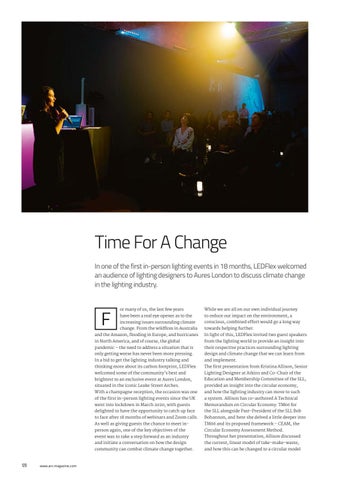
The Next Step Bob Bohannon and Kristina Allison give us an insight into the newly published CIBSE SLL Technical Memorandum, TM66, which offers advice and guidance on how to create a circular economy in the lighting industry.
T
he life expectancy of some commercial
buildings is just 30-40 years. Whisper it quietly, but Bob is not a huge fan of some Victorian
architecture, but driving past Hampton Water Pumping station the other day, he realised that this glorious building appears to have
beautifully performed its function for some
150 years. Alarmingly, building and demolishing a series of 40-year
buildings, rather than a single 150 year one, often yields a higher GDP figure. We don’t measure the environmental impact.
We have to make better use of the resources embodied in our lighting equipment, an unthinking linear economy of Take (resources from the environment), Make (products in factories), Waste (dispose of products into the natural environment) is increasingly no longer
acceptable. Product durability and adopting the Circular Economy is the part of the solution to maximising resource usage, keeping (in our case) lighting assets at their highest value, i.e., as an effective luminaire for as long as possible.
A team of us got together and we started listening, consulting,
learning, engaging and what is soon to come out of that process is a document and a suite of three tools. The objective being to give
information to all, not to tell people they are doing it wrong, but to
show how they can do it better. We wanted to enable supply push by creating a nuts-and-bolts tool for manufacturers and to stimulate
demand pull by giving specifiers and clients the questions they need to ask.
The document is CIBSE SLL Technical Memorandum TM66 on
Creating a Circular Economy in the Lighting industry, to be published October 2021. It describes the background to the Circular Economy in general, including the drivers behind its adoption, but most
importantly it gives guidance on how the circular economy affects
each sector of the industry, what opportunities it may bring them and what to do next.
At the same time comes the publication of SLL’s Circular Economy Assessment Method for Manufacturing (CEAM-Make) which
allows manufacturers (or specifiers if they so wish) to assess the
performance of their luminaire and its supporting ecosystem in terms of its Circular Economy performance. The tool accepts the complexity
that sustainability questions bring, but converts that to a simple, easy to understand star rating. The objective is to move as many products and manufacturers from zero to hero (4) as quickly as possible by
giving them the detailed issues to consider. The assessment method is weighted to cover differing products, comprehensive and covers
product design, manufacturing, materials and supporting ecosystem. The CEAM-Make may be a little too in depth for a busy specifier to use every time they need to choose between luminaires, or in the
transition period where manufacturers have not yet fully completed their CEAM-Make assessments. Therefore, we created CEAM-
Design, being a specifier support tool. You could almost think of it as a triage tool, being essentially the most important questions to ask a manufacturer.
All the tools in the suite have been created in full consultation with people knowledgeable in the field, from manufacturers to product designers, lighting designers and end users. The tools will be
updated, but the hope is that they will deliver the practical know-
how, understanding, and a level playing field for claims that make Bob Bohannon, LIA Head of Policy & Academy, SLL Immediate Past President
048
www.arc-magazine.com
Kristina Allison, Senior Lighting Designer, Atkins, SLL Education Committee Chair
an already green industry in terms of its product’s in-use energy performance, truly sustainable.
greenlight alliance
2
1
3
1. The front cover of the CIBSE SLL Technical Memorandum TM66: Creating a circular economy in the lighting industry. 2. The modular design of Stoane Lighting’s ZTA range allows for reuse of components. Some parts, such as this surface mount, can be reused across multiple ranges. 3. A screenshot from the CEAM spreadsheet.
Roger Sexton Stoane Lighting
For Stoane Lighting, TM66 couldn’t have been more welcome.
harness improved technologies (e.g., LED modules becoming more
weren’t holes in our approach and to market our luminaire designs
at the installation. For the same reason there is also some leeway
We needed a metric on the Circular Economy to be certain there mapped on a neutral foundation. We had carried out embodied
carbon analyses on certain luminaires with CIBSE’s TM65 and, at a
efficient, or gear losses decrease) or to cater for a changed need mechanically and thermally.
whole company level, had accreditations from B Lab and EcoVadis.
Manufacturing
we lacked.
Assembly to Site’ needed some thought. For our submission we
It’s the specific Circular Economy assessment on our products that Honoured to test drive TM66, we put part of our ZTA range through the CEAM process. It took considerable time to compile our ‘book
of evidence’ for the four blocks of questions. Skimming from the 66
number of questions, below we just highlight one per section to give a flavour of the topics covered. Design
Repairability and upgradeability are focused on. ZTA design permits
Localisation sliders, e.g. ‘Geographical Distance from Final
assumed Edinburgh to London, but we think this question leads the way to a ‘CEAM Project’. We scored well with the ‘Average Supply
Chain Partner geographical distance from final assembly location’ question. With Stoane Lighting, all of our parts are designed and
made in-house or we use local specialist machinists, paint shops
and anodisers, etc. Only the optic, driver and LED module come from overseas.
easy access to (no glue) and replacement of light sources, optics and
Materials
(as also called for in Article 4 of Eco Design Regulation 2019/2020).
ZTA luminaire is aluminium, which is infinitely recyclable. The
drivers with common tools and without damaging the luminaire
The ZTA range has extra fixing holes to facilitate subsequent use of different component types due to discontinuation of originals, to
Recycling is questioned here. The main material used in the
aluminium we buy (from Derbyshire) has a recycled content of
65-85%. Recycling components comes down to modular design. If
www.arc-magazine.com
049
greenlight alliance
All of Stoane Lighting’s fixtures can be completely disassembled for maintenance, should parts need to be swapped out or replaced. This means that specifiers don’t need to replace the whole fixture, thus reducing waste.
components are common across the ranges, or even indeed across multiple ranges,
then the likelihood of being able to reuse
Reaction from GreenLight Alliance Members:
components increases. Ecosystem
The norm for remanufacturing involves a factory return – but what if this isn’t
possible? Say a building is in constant usage. This section therefore questions related
services that are available. Stoane Lighting
can drive a mobile workshop to installation to carry out repairs or upgrades.
We appreciated the thoroughness of the
TM66 review and scored well. But we can see
where we must make improvements – we did not score high marks everywhere. We do not use, other than for making prototype parts, 3D printing (we are not convinced yet by 3D
printing of aluminium but watching progress in that industry). In terms of recycling our
own waste we are making our very first steps
Mark Ridler BDP
I think TM66 is a massive achievement. The rigour, intellectual background, ethical motivation, detail and structure are excellent and hugely commendable. CEAM checklists are exactly what has been called for from the lighting community in order to evaluate product CE performance, communicate this to clients and defend from product substitution. Not all the criteria are objective, but most are, and I think are sufficient to make a defendable specification. There will be debates no doubt around the weighting applied to certain criteria and the detail of the criteria themselves. But the whole of TM66 is conceived as a document intended to evolve. Future modification is very likely, not least so that it can respond to a fast-paced sustainability agenda. This is a beginning, not the end. As a designer, I am pleased that the checklist is a manageable beast. Most of the designer credits can be assessed when viewing a sample and it will have the benefit of encouraging a CE mind-set with designers at all levels of experience. It will likely generate a healthy debate too. We have to acknowledge that implementation will incur work for early adopters. Work that will not necessarily be compensated by clients. It will take work too for manufacturers, but I hope not too much compared to the preparation of EPD’s or other technical information. Whilst the administration of CEAM should not be too challenging for new products, it may be for small manufacturers with a long history and many legacy products. The fact that a professional body sits behind this gives it great authority and I’m looking forward to seeing if it will be incorporated as points for other sustainability standards – e.g., BREEAM and/or WELL. Not only would this drive momentum but it would also demonstrate to the wider construction industry the leadership role that lighting has taken. There are manifold challenges to implementing circular economy principals. A checklist alone will not remove all impediments, but they are a very significant component for success. The SLL team should be commended, and I am convinced it has a very great chance to bring about meaningful change.
with melting down machine room offcuts
and using gravity die casting to make 100% recycled aluminium pendants.
I will be interested to see how generally the industry and standardisation bodies evolve in the context of the Circular Economy.
The market reaction to our uptake of TM66 has been positive. We are being asked for
TM66 assessments of our luminaires before the guide’s publication. One such request
came from Buro Happold who want to use our Tadpole luminaires for an installation
connected with COP26 this year in Glasgow which will be covered in a future article in this series.
www.greenlight-alliance.com www.sll.org.uk
www.thelia.org.uk
Kevan Shaw
EFLA | Kevin Shaw Lighting Design At last! TM66 provides a comprehensible standardised scoring system for Circular Economy aspects of lighting equipment. If we believe in Circular Economy principles as designers and specifiers, we must start using this, now. The more we badger manufacturer’s reps and salespeople with the questions necessary to complete these spreadsheet assessments, the sooner they will get the message that they have to engage with Circular Economy principles. The draft of TM66 is delightfully readable compared to most technical memoranda, is insightful and, by including detailed case studies for both manufacturers and projects, demonstrates that this is doable now. The CEAM Design spreadsheet is pretty straightforward, though we should probably do some CPD, I would guess less than an hour in an interactive webinar should do, to help us all score the same way for the same luminaires. If we want CEAM to succeed we need to use it and advocate for its inclusion within the established standards such as BREEAM, LEED, WELL etc. Also, we need to persuade the various regulatory authorities to incorporate the scoring into future regulations, this will come from widespread adoption of CEAM within the lighting business. One slight thought from the draft text is the expectation of luminaire life is as low as 5 to 10 years. I find this to be rather short. I think we should expect a minimum of 15 years initial service life with 25 years plus for a long life or maintained product. We know this is possible and already ask for this on projects. I am also keen to see the emergence of an organised market for second life luminaires. This will include remanufacture and refurbishment but more importantly the essential reverse logistics and financial inducement for contractors to carefully remove and hand over recovered lighting equipment. When that is in place, we will know we have a truly circular economy for lighting.
www.stoanelighting.com This series is curated by Roger Sexton of Stoane Lighting, roger@mikestoanelighting.com
050
www.arc-magazine.com
Perfecting light for a luminous future.
We advance the quality of LED light to achieve extraordinary results on a wide range of applications. Our state-of-the-art optical solutions help create light that enhances wellbeing, functionality, safety and sustainability.
BR AND VIDEO
Together with our customers and partners, we enable and strengthen a shared ecosystem of light.
Pics: Gavriil Papadiotis (www.gavriilux.com)
052
www.arc-magazine.com
[d]arc sessions
Greece Lighting This October, the Royal Myconian Hotel in Mykonos, Greece, was home to the first ever [d]arc sessions – a new specifying and networking event from [d]arc media and Hix.
M
aking its debut at the beautiful, five-star
lighting consultants, and Staffan Tollgård, Creative
[d]arc sessions is a brand-new event
Covid world and how the global pandemic has impacted on
Royal Myconian Hotel in Mykonos, Greece,
Director of Tollgård Design discussed design in a post-
organised by [d]arc media in association with
their approaches, if at all.
Hix, built around connecting people involved in lighting
On the second day, the topic of sustainability and the
exclusive setting.
Director at UNStudio, Laura Suico, Senior Lighting
the drive for [d]arc sessions was to get specifiers and
Specifier Service at eldoLED; the final panel talk saw Rose
specification projects around the world in an intimate,
circular economy was discussed by Filippo Lodi, Associate
In an era when every business trip must be accounted for,
Designer at Foster + Partners, and Gé Hulsmans, Director
suppliers together for a series of one-to-one meetings,
Murray, Director of These White Walls, Sabine De
show, where there is no guarantee of who you are going to
cover issues surrounding equality in the design
For the inaugural edition of the event, held from 5-7
free-flowing, open discussion welcomed participation
specifiers (lighting designers, architects, and interior
about one of the biggest issues in the design community.
Mykonos for two days of face to face, in-person meetings,
presentation from Eleftheria Deko, who shared with the
months of remote working and webinars.
award-winning lighting design for the Acropolis of
away from the hectic hustle and bustle of a typical trade
Schutter, founder of Studio De Schutter and Sanjit Bahra
see.
community. From race to gender and sexuality, the
October, a curated guestlist of 20 suppliers and 40
from the audience, leading to a very positive dialogue
designers) made the journey to the stunning island of
The conference programme was capped off by a keynote
networking, and socialising – a welcome relief after 20
audience the story of the incredible, multiple [d]arc
Over the course of two days, four dedicated Speed+Sync
Athens. The inspirational talk was a big hit with the
“sessions” saw suppliers and specifiers attend a series of
delegates in attendance, who were moved by the passion
discuss the latest products, projects, trends, and
Following the Speed+Sync sessions, the event made use of
leads, specifying products, and forming new working
spread across its multiple restaurants each night. Here,
Alongside the Speed+Sync sessions, the event featured a
continued conversations initiated earlier in the day.
biggest topics. On the first day, Sanjit Bahra, Director of
some traditional Greek plate smashing and sirtaki dancing
20-minute meetings where they could sit down and
and enthusiasm that Deko put into this landmark project.
innovations in the industry, with the goal of generating
its five-star surroundings with evening entertainment
relationships.
delegates enjoyed exquisite local food, socialised and
series of panel discussions around some of the industry’s
On the final evening, additional entertainment came with
DesignPlusLight, Stephanie Harris, Senior Designer at dpa
to the soundtrack of Zorba’s Dance.
www.arc-magazine.com
053
Looking back on the event, Paul James, [d]arc media Managing
sessions and panel discussions.”
absolutely delighted with the response from our delegates to this
said: “A fantastic group of people coming together from across
“The delegates’ enthusiasm and positivity, coupled with the
gave both designer and manufacturer time to discuss products and
“[d]arc sessions is a unique event and a new way to get specifiers and
know each other, which was so nice.”
Director, said: “[d]arc sessions was an unmitigated success. I was
Paul Shoosmith of Light Forms, UK distributor for Brick in the Wall,
new event in the lighting specification calendar.
Europe to discuss lighting and enjoy the beautiful surroundings. It
beautiful surroundings, made [d]arc sessions a pleasure to organise.
their company in a relaxed and enjoyable format – with time to get to
suppliers to network with each other. Based on the feedback, both
Amongst the specifiers in attendance, Darren Orrow, Director at into,
“We will be organising more [d]arc sessions next year and we are
sessions – a seriously well organised event connecting industry
groups thoroughly enjoyed it and got so much from it.
said: “Well done to [d]arc media and Hix for putting together [d]arc
currently looking at new locations, starting in the Middle East. We
leaders in lighting design. Some great new partnerships established
hope to welcome even more delegates in the future.”
over a series of informal meetings, lunches and dinners. The
Manager of Business Development EMEA at Martin, said: “Many
Laura Suico of Foster + Partners added: “It has been an incredible
experience, the perfect format to share our insights to designers and
new trends for the future. I think the format works really well and
on sustainability just to mention a few key points for our industry.
feeling more relaxed compared to when we are in our offices.”
forward to the next!”
sessions really stood out from the usual ‘conference’ events, and I
surprised about the good result and response, this being our first
about LED drivers than I knew existed.”
in contact with the appropriate people and have the choice to meet
great to be among so many lighting colleagues again, and to also
good vibes.”
thank the [d]arc media team for the invitation to participate and to
“[d]arc sessions proved to be the perfect event for networking with
bravo to the [d]arc team and everybody involved for all the efforts to
Among the delegates in attendance, Leif Orkelbog-Andresen,
beautiful location and sunshine was a bonus.”
thanks to the team behind [d]arc sessions. It has been an incredible
experience, the perfect format and location to share design ideas and
architects. In return we got updated on needs, trends, and the future
the informal context helped the networking a lot, everyone was
The setting at Mykonos also helped and we are looking very much
Meanwhile, Rose Murray of These White Walls added: “[d]arc
Jose Peramo, Key Account Manager at Sakma, added: “We are very
feel quite honoured to have joined you all – and I have learned more
time at this kind of event. In my opinion, the format is perfect to get
Eleftheria Deko continued: “After the Covid lockdown periods, it was
with whom you’re really interested in – good talks, good feelings and
share our journey of the lighting of the Acropolis. I would like to
Henri Uutela, Business Development Manager at LEDiL, added:
share with everyone our experience of this amazing project. A big
lighting industry professionals. The opportunity to sit down face-to-
face with lighting designers and architects and discuss lighting topics and trends was brilliant. I also enjoyed industry insights from
054
www.arc-magazine.com
bring the lighting community together.” www.darcsessions.com
[d]arc sessions
www.arc-magazine.com
055
056
www.arc-magazine.com
INTERVIEW
Union of Opposites Following the success of Zumtobel’s Ambitus in this year’s Red Dot Awards, arc speaks to its designer, Yorgo Lykouria, about his design approach and his attitudes towards light.
F
or many designers, be they lighting designers, interior designers, product designers or
architects, their raison d’etre is to create
beautiful, sculptural works of art. But as the old adage of ‘form follows function’ would denote, it’s essential that these works of art are not
merely superfluous and serve a purpose too.
This is one of the core philosophies of designer, architect, film maker
and writer Yorgo Lykouria. Founder and Creative Director of Rainlight Studio, Lykouria has built a career on the apparent contradiction of beautiful yet purposeful designs.
“Rainlight Studio was conceived on the idea of a ‘union of
opposites’,” he told arc. “It’s about this idea that design and
business have to come together somehow. We’re not artists creating something that somebody will like or not like, we’re working for
industry, and we have to create something that has a purpose, has
a sense of beauty that the market will recognise and that serves the needs of the people.
“At the same time, there’s an aspect to design that is purely esoteric and cultural, intellectual and poetic, beautiful and timeless that touches your soul.”
Referred to by many as an “Industrial Poet” for his contemporary, humanistic approach, which goes beyond the senses to engage a
sense of wonder, Lykouria originally studied mechanical engineering, before completing a Master’s in Architecture at Dalhouise University in Halifax, Nova Scotia. “I wanted to be a car designer, but in the
process of studying mechanical engineering I realised that I’m not cut out for physics. I’m fascinated by it intellectually, but I didn’t want to spend my life doing that,” he explained. “I switched to architecture, because I discovered that there was something in
architecture that really appealed to me, this idea of doing something for society.
“You’re born into this world and the table is already set, the house is already built, and we live in it. And yet, things start to fall apart,
they get boring or out of date or irrelevant, so the idea that we have
to constantly refresh that for who we are as a society really fascinated me and I thrive on it.
www.arc-magazine.com
057
1
1. Designed by Lykouria, Zumtobel’s Ambitus pendant won the Best of the Best award at the 2021 Red Dot Awards. 2. The Nagare collection of lounge furniture was designed by Rainlight Studio in collaboration with Japanese office manufacturer Okamura. The range, inspired by the changing ways in which we work, brings a gentle sense of movement and quiet haven to the workplace. 3. Aura, designed in collaboration with Tecna, was created with the purpose of providing “a cocoon for meditation and solitude within the buzz of modern-day life.”
058
www.arc-magazine.com
“But in architecture I was always a bit of an
As such, Lykouria explained that his typical
I thought about things in a different way than
fingerprints”, creating something that stands
society and art, as much as how a building stands
particular “signature style”. He continued:
In 2002, Lykouria established his self-titled,
refresh who I am as a designer, to constantly
multidisciplinary practice for 12 years. From
“It serves my own impulses as a designer, as a
the same entity, but Mark II – improved, newer,
with a sort of language or identity or fingerprint
“The improvement is this idea of unity of
can recreate that feeling for every project, which
Lykouria, I was more insular in my approach to
deserves their own project.
identity, my ethos, etc. Of course, that remains,
hard for designers because we have certain
industry, to society in a much better way.
time, a blank page, is terrifying.”
in some ways, I was like that, in that I believed in
page feeds into Lykouria’s overall design
to protect. I think what changed my thinking
take inspiration from any external sources. “The
of years to write screenplays, to work on a novel
like the state of things in design where you see
culture taught me that the creator of the work
mood boards – I think that is soul destroying
matters. When you talk about stories, it’s the
opportunity to come up with an idea. The minute
“I became really immersed in the idea of
you’re going to do, it’s preordained.
human aspect to that. If you look at stories
I’ve been saying for the last two decades. It’s
tells us something.”
have an open mind and allow ideas to come in.
outsider in a way, because even as an architect
design approach is to “not leave any
most; I was interested equally in philosophy and
alone in its own right without being tied to any
up and how a connection comes together.”
“What’s great about this is that it allows me to
London-based studio which he ran as a
grow and explore with every single project.
here spawned Rainlight. “Rainlight is very much
creator in a bigger way than having to get stuck
better, stronger, faster,” he said.
or whatever you want to call it. I’m free, and I
business and culture. When I was running
is also great for the work because every client
things, I was more focused on my language, my
“I don’t want to replicate things, and that’s
but I found a way to connect to clients, to
fascinations. So, to start with a clean slate every
“It sounds like I was a monk or something, but
This idea of starting every project with a blank
this idea of design as a pure thing that we have
approach, to the point that he doesn’t seek or
dramatically was taking a little break of a couple
inspiration comes from within,” he said. “I don’t
and make short films. Being immersed in that
people go into Pinterest to get ideas or create
is not the important part, it’s the work that
because what you’re doing is denying yourself the
narrative that matters, not the storyteller.
you flood your mind with forms, then that’s what
narrative, because I realised that there’s a very
“‘Design begins with an open mind’ is something
through all of time that still connect with us, that
about finding that state of mind where you
Interview
“Light is not a functional thing, it’s poetry. It completely changes the experience of a space. Without light, there is no form.” Yorgo Lykouria
3
2
My process is to live life in a way that I’m
This belief came after the realisation that
entirely from a formal point of view and try
film, books, other experiences. Everything
dead end”. “The problem with it is that it
these facets come in and when I’m in the
really conscious and present, they infuse
we’re talking about design and doing things
also exhausting, and also very consuming
you need them.
project, it’s platonic forms. It doesn’t belong
from one plane to another.
school, I didn’t look at references or
“For me, that created a kind of backbone
of consciousness from people, because if
I was struggling with ideas because I was
austerity in some way. I don’t like to do
or if you’re sitting on a chair that someone
it over and over again, I became more
be beautiful, but it still has to have intention,
You’re not walking through the woods,
my subconscious and being able to draw
decorative, but every piece and every form
person who is making those experiences, you
between your consciousness and your
With a varied back catalogue of work
the people that use them to give you a sense
you practice it.
Lykouria has a wealth of experience in
One of the latest designs from Lykouria and
or psychological – there’s something about
feel that he has a particular specialism in one
developed by Zumtobel. The fixture, which
something you can talk about per se. It’s like
from each sector on everything he does. “For
Red Dot Awards, is inspired by natural light
writes a song, it’s intuition, you just have to
doing a little stool to sit on, or whether we’re
basic function of natural light to enhance
Across his diverse portfolio of work,
every project is special and deserves a place.
In combination with a perforation on the
by some as minimalism. However, he
poet once said that the architect has to
accentuated ring-like shape that creates an
minimalism, I call it clarity, and this is the
The idea of this is that you could look at a
associations with natural light phenomena.
meaningless or superfluous in design – the
an engineering viewpoint or a materials
a harmonious light distribution, even when
and attention.”
and nothing else, or you could look at it
angles.
constantly being fed, whether it’s art, music,
minimalism as an approach “is a complete
to interpret it as a poetic statement. All of
feeds the imagination, and when you are
has no identity,” he continued. “So when
midst of design, it’s really invigorating and
into your being and things come out when
for industry or companies for people or a
because I find my mind constantly switching
“Even when I was a student in architecture
to anybody.
“I would say that our work steals moments
magazines, and there were projects where
to the process of design, which has this
you’re in a room that someone designed,
forcing myself to be alone. But by doing
things that are decorative for instance; it can
designed, that experience is impacting you.
fluent in that connection with that part of
that things in nature do. A flower can appear
for instance, it was created. And so, as the
things out of it. It’s creating a motorway
and colour has a purpose.”
have an obligation to do something good for
subconsciousness. But you can only do that if
spanning architecture and product design,
of joy.”
“I really believe that design is a bit mystical
multiple sectors, but despite this, he doesn’t
Rainlight is the Ambitus, a lighting fixture
it where it’s not just a method, it’s not just
particular field. Instead he is able to draw
won a Best of the Best award in the 2021
when a potter makes a pot, or a musician
me, every project is special, whether we’re
sources such as the sun, and mimics the
be in the moment.”
doing a light to light up a space, or a chair,
spatiality for a more conscious experience.
Lykouria’s approach could be classed
“Carlo Scarpa, the architect/designer/
underside, the lamp showcases a visually
has a different term for it: “Instead of
have a triple mind, the mind of a thief.
aesthetically pleasing effect to evoke various
idea that you’re not doing things that are
piece of architecture or design purely from
At the same time, the round shape produces
things that you’re doing have real sharpness
viewpoint or a construction viewpoint
the luminaire is viewed from different
www.arc-magazine.com
059
interview
Yorgo Lykouria speaking at Zumtobel’s Light Talks. (Pic: Matthias Rhomberg)
060
www.arc-magazine.com
Lykouria has had a longstanding appreciation for light,
ethos of the fluorescent light fixture, which all
as “the primary element of architecture”. “When I
minimal and streamlined, and we managed to create
of architecture, so it looked at light and acoustics and
had ever done, but it was at the end of the life of the
talked about in architecture. You couldn’t really define
The advancement of lighting technology, and the
define how you design that. You can talk about where
a guiding factor in Lykouria’s approach for the
ever talked about the phenomenological aspects of
this wonderous, amazing thing that was a total
“For me, light is not a functional thing, I would say
and, in its time, for the 50s, 60s and 70s when we
the experience of a space, it’s so important. Everyone
gridded world of architecture, that linear geometry
that lighting is the thing that makes and defines and
masterpieces, every line is exactly where it should be,
you don’t see things. You could take a simple box, a
as well, so when we look at a building at night,
becomes a beautiful space, because of the light.
“Fast forward five decades where we’re not so
just look at a concrete box, it’s always that shaft of
doing things that are really complex, whether they’re
splendid and beautiful. Light is everything, and that’s
geometries. Suddenly you wonder where there’s place
about light because any moment is curated and made
on a tower project in Sharjah in the UAE, designing
time. I think that’s what light brings to things.”
and at the top, and it flips at the midpoint where it
ago, partnering with Siteco on the production of a
every level it was a different footprint.
technologist from Siteco who was a brilliant mind.
made sense, it was impossible because if you looked
dating back to his architectural studies, describing it
started to look the same. I wanted to do something
did my thesis, I was exploring the immaterial aspect
this beautifully elegant, simple fixture that no one
the experience of space in a way that wasn’t really
fluorescent tube.”
how one experiences a space, but you also couldn’t
departure from fluorescent fixtures to LED was
you want a column or a wall or the stairs, but nobody
Ambitus. He explained: “The fluorescent tube was
architecture. That part fascinated me.
departure from the filament lamp. It did great things
that it’s very strong poetry. It completely changes
had modernism and very austere geometry and the
needs to be aware, architects as much as clients,
worked beautifully. When you look at these old
interprets a space. Without light, there is no form,
it’s perfection, and the lighting follows that structure
white cube, and light it in such a way that it suddenly
everything’s in the right place.
“If you look at the work of Tadao Ando, if he were to
disciplined about form, we’re challenging geometry or
light, that moment of where the light is that makes it
fractal geometric forms or whether they’re fluid
why I love theatre and concerts and film; cinema is all
for the florescent tube. I realised this as I was working
perfect, and you can live in this poetic state all the
the interiors. The building was triangular at the base,
Lykouria first worked with light around 20 years
becomes a hexagon, so the geometry changed and at
fluorescent light fixture. “I worked with a lighting
“When we were trying to lay out a lighting grid that
I asked a lot of questions and challenged the whole
up at the building, if you had anything linear it
INTERVIEW
“The worst kind of lighting is when you put a grid over a space and have uniform lighting that creates a mist of nothingness, where everything has the same intensity and it’s just bland. That’s why people hate offices.” Yorgo Lykouria
wouldn’t work. So I realised that the only way to
Lykouria is hopeful that the Ambitus will help
I tried to find one and it didn’t exist in the market.
workspace. “The worst kind of lighting is when
survey, we couldn’t find a single reference that was
lighting that creates a mist of nothingness, where
“The most challenging lighting fixture is the
bland. That’s why people hate offices and respond
and you need no glare, so you need uplighting
because that’s just the machine, it’s not for people.
demands. It’s not just creating a donut and lighting
spaces, spaces with a certain colour of light. I love
light. It’s not good light in any application.
different experiences. This is part of what makes
in engineering and architecture came together, I
this bland sameness all through the day, nothing
by technology and driven by a good technological
because you can create different atmospheres
Further to this, a “strong, symbiotic relationship”
different spaces.”
technical details. “It was a really great sparring
has more plans to work with lighting, with a new
continued. “I said to them that I wanted an
that, the world is his oyster.
designer to love it, I wanted an architect to love it;
future holds,” he said. “We’ve got several projects
possible sense, so you should be able to take it
that move; whether that’s boats or planes, that’s
“In the beginning, Zumtobel were very respectful
“I just look forward to the next project, every
to do. I kept challenging and poking and pushing
your knowledge, test your experience, and for me it
engineers and designers to then bring more to the
can continue to grow Rainlight in this way, to grow
integrated team, they were very hands on.”
relevant in the world.”
solve this was to do a circular point source of light.
to bring a new light, a new ambience to the
Even today with Zumtobel, when we did the market
you put a grid over a space and have uniform
an office luminaire.
everything has the same intensity and it’s just
office luminaire – we’re using computer screens
badly to this whole idea of the corporate office,
and increased control, there are a lot of technical
“My approach is to allow there to be some darker
it – yes, you can do that, but it’s not a good office
the idea of being in a space where you can have
“This was where my experience and background
an office environment so stressful, you can have
was adamant in this project that it had to be driven
changes. Light is really important in that respect
basis of design.”
and emotional states so a person can move to
with Zumtobel helped in developing the finer
Following the success of the Ambitus, Lykouria
match, and I wanted it that way,” Lykouria
fixture currently in progress with USAI. Beyond
engineer to fall in love with it, I wanted a lighting
“The exciting thing is that I don’t know what the
it had to have excellence as a design object in every
on the go right now. I would love to design things
apart and wonder at how minimal and elegant it is.
something that I hope will be in my future.
of the design and they wanted to do what I wanted
project is an opportunity to grow and learn, to test
for more and more, and that engaged them more as
doesn’t end, it’s an ongoing thing. I hope that we
table and to share in the process – we became an
the team and the culture and do more work that is
Designed explicitly for the office environment,
www.rainlightstudio.com
062
www.arc-magazine.com
1. Ambitus takes its inspiration from natural light sources such as the sun, and mimics the basic function of natural light to enhance spatiality for a more conscious experience. 2. Lykouria worked with Scavolini on BoxLife - a first-of-its-kind, fullyadaptable micro-living concept. The system is designed to optimise space within a dwelling area by concealing functions in compact ‘boxes’ that are deployed when needed.
The First Diamond Certified LED SunLike natural sun spectrum LEDs are the world’s first LEDs to produce light that closely matches the spectrum of natural sunlight, delivering human-centric lighting. The light sources with SunLike Series LEDs more accu accurately show the color of objects as they would appear in natural sunlight. It is optimized to natural light spectra and color rendition Rating “Diamond” based on IES TM-30-20 Fidelity intent from UL Labs. https://verify.ul.com/verifications/520
It delivers considerable benefits of significant vivid color, detail contrast, and homogeneous quality of light.
www.seoulsemicon.com info.europe@seoulsemicon.com
Radiant Design Following its success at the IALD Awards, arc speaks to Sirius Lighting Office about the Radiance Award winning lighting design of the Toranomon Hills Business Tower in Tokyo, Japan.
PROJECT DETAILS Toranomon Hills Business Tower, Tokyo, Japan Client: Mori Building Co. Lighting Design: Sirius Lighting Office, Japan Architect: Ingenhoven Architects, Germany Photography: Fumito Suzuki
064
www.arc-magazine.com
workspace lighting
www.arc-magazine.com
065
workspace lighting
The vast entrance lobby of the Toranomon Hills Business Tower is characterised by an 11-metre high mirrored ceiling, with towering white terracotta walls that coexist alongside trees, a waterfall and various art objects.
066
www.arc-magazine.com
L
ocated in the sleek, stylised, ever-
would both respect and emphasise the beauty of the
IALD Radiance Award winning
As such, the lighting designers developed a concept
growing metropolis of Tokyo, Japan, the
architectural atmosphere.”
Toranomon Hills Business Tower
that highlights the building’s beautiful architecture,
features a lighting scheme to match its
and particularly in the entrance space, connects it to
building users.
hall has the architectural concept of an ‘Extending
Toranomon Hills Business Tower was to be a space
exterior spaces into one existing domain. We
while functioning as a refreshing, revitalising space
being to try and extend the outside lighting scape
The entrance space for the tower is characterised by
“The second was to use fixtures that could change
white walls that coexist alongside trees, a waterfall
daylighting conditions. For example, the morning
Sirius Lighting Office, which was tasked with
then transitions to a slightly warmer colour
with the scheme.
reaching a deeper colour temperature at nighttime,
explained: “The Toranomon Hills area is comprised
of natural scenes.
are still under construction. We had to consider
together the narrative of the concept, while fulfilling
existing structures with the other ‘to be completed’
health and comfort of the office workers throughout
“We also had to acknowledge that the Business
The decision for the lighting to transition
business, as well as having fast and easy
to create a scheme in tune with building users’
We were challenged with creating a design that
the lighting designers.
surroundings, while improving the wellbeing of
its surroundings. Totsune continued: “The entrance
Designed by Ingehoven Architects, the goal for
Boundary Line’ that connects the interior and
that improved the motivations of businesspeople
adopted this into our concept, with the first motive
for visitors.
into the interior.
an 11-metre high mirrored ceiling, with towering
colour temperature in order to match the exterior
and art objects. Lighting for the tower came from
scene starts at a bright, cool colour temperature,
creating something “innovative and sophisticated”
temperature for the afternoon hours before finally
Hirohito Totsune, President of Sirius Lighting Office,
altogether creating an unnoticeably seamless series
of four towers - two are already complete, while two
“These two design elements work to seamlessly tie
skilfully harmonising the lighting design of the
the additional motive of benefitting the mental
buildings.
the entire day.”
Tower serves as an international hub for global
throughout the day, following the natural light cycle
transportation access to the international airport.
circadian rhythms was a conscious one, proposed by
1
“The designer’s original image was a continuous,
the entry lobby space had to fulfil the duty of
argued that this effect could bring an energetic
having a borderless connection. This was executed
bright white atmosphere,” Totsune recalled. “We atmosphere during the day, but could also have the potential risk of impacting on the workers’
relaxation at night. We considered a way that
would promote a more natural, healthier work environment through our lighting design. An essential piece to this concept work was by acknowledging the natural daylight and
considering how to extend it even further into the space as a whole.”
Within the entrance space, the vast walls are
formed of white terracotta louvres with a glossy glaze; the lighting method here was carefully determined to eliminate glare while creating
dimensionality and bringing out the texture. As
such, narrow downlights mounted in slits on the ceiling illuminate the wall, with matting applied
only to the front edges, The glossy finish is then lit by recessed floor lights on the side of the louvres, where the risk of glare was lower.
Totsune elaborated on the key architectural
considerations within this space: “The white
terracotta wall is the main symbol for the entrance lobby, we set this at the peak lux level for the
space. In addition, the middle ground making up
068
www.arc-magazine.com
accomplishing the architectural narrative of
by utilising dimmable and tunable fixtures in order to seamlessly adjust to that of the exterior.
“Another key figure to the space is the vegetation:
we had to consider what type of lighting this would need in order to effectively grow indoors. With the help of a professional botanist, we were able to
hand pick fixtures with the appropriate amount of
light, and at the correct spectrum to wholly provide the proper nutrients to the trees at a similar rate to that of natural sunlight.
“While fulfilling these objectives, we were able to maintain a clean ceiling atmosphere for the
architecture by recessing all the fixtures in the already-created ceiling slots designed by the architect.”
Concerning the mirrored ceiling surface, Totsune explained that one of the main worries was “the
potential for reflected glare to occur on the ceiling
from the light source of inground, recessed fixtures along the terracotta wall”. “We solved this by
using a densely pitched LED fixture including a
specially built-in light seal, which was measured to the millimetre in order to cut off glare while keeping the same intended effect.
workspace lighting
2
3
4
“We also realised that concentrating too much on
“For the complex artwork, we used 3DCG to
decreasing the lighting effect of the wall, therefore
of fixtures we needed in order to accomplish this
reducing the glare could result in a risk of
we tested repeatedly until we found the most ideal result to satisfy both ultimatums.
“On another note, being that the ceiling directly
reflects the floor surface, we also considered how to beautifully light the ground surface in the entrance space in order to cast a beautiful reflection.”
With a number of different elements within the lobby space alone, from the vegetation to
waterfalls, to sculptures and art pieces, there was a risk that designers at Sirius Lighting Office would need to over-illuminate the area to properly
highlight each individual object. However, for
Totsune, it was about looking at the overall picture, rather than the separate pieces.
He explained: “Out of all of these features, our
question wasn’t primarily to ask what objects we should emphasise, but rather how all these elements could appear harmonised as one complete art piece.
“For the waterfall lighting, we visited the mock-up many times to understand how many fixtures we
needed and at what pitch they needed to be placed in order to yield the most beautiful result.
discover which angle, pitch, lux level and number effect. However, we were finally able to meet up with the artist herself to ask what her ideal
lighting concept was, where we ended up using a
DALI controlled system involving 30 fixtures, each with their own separate addresses and dimming levels to create a near zero shadow effect.”
Looking further up the building, the façade
1. Horizontal fins on the side of the building are gently illuminated, adding to the inviting feel of the entrance lobby. 2. The narrative of the entrance lobby extends into the building itself, with clean lines of light complementing the interior architecture. 3. Sirius Lighting Office developed the lighting in the surrounding exterior with the intention of softly beckoning workers into the building. 4. When designing the lighting for the entrance lobby, rather than emphasising the individual elements, such as the artwork or waterfall, the intention was to make the space feel like one harmonised, complete art piece.
features rows of horizontal fins. At the lower
levels, these are illuminated to guide people into the lobby, while higher up, LEDs embedded into their edges project slowly moving images,
reminiscent of clouds seen in Japanese ink
paintings. Designed to harmonise with the
surrounding night view, the lighting on these fins is one of the first examples of exterior lighting in Tokyo to visualise the natural environment.
Totsune explained how the lighting for these fins fits into the wider architectural design: “In the
overall composition of the complex’s hierarchy, a
juxtaposition of horizontal façade elements on the
newer towers gave way to the ‘aesthetically vertical in nature’ Mori Tower. These horizontal fins, when viewed from afar, nonchalantly portray the
abstract appearance of overlapping hills, giving
www.arc-magazine.com
069
workspace lighting
narrative to the site programme. Not only do these
Since the project was completed, it has been
role in the sustainability of the building, acting as a
than the IALD Radiance Award - the top honour at
entering the building.
Awards. While Totsune was grateful for the
to illuminate the fins, we imagined looking up at
remained humble when looking back on the project.
serve as an aesthetic device, but also play a major brise soleil system to block direct sunlight from
“When coming up with the lighting design concept the façade and seeing these beautiful overlapping fins ascending seamlessly into the sky. However,
gaining plaudits around the world, none greater this year’s IALD International Lighting Design recognition, describing it as an honour, he
“We believe that this was one of the most high-
end projects worked on and produced by our firm.
keeping in mind that the entrance lobby was the
At first glance, we can agree that it is a beautiful
the potential risk that over lighting these fins
involving maintenance, cost, space and
tower and surrounding context, as well as
extremely talented group of people that worked
‘eye catcher’ of the project, we carefully considered could cause, both aesthetically as a whole to the
project. However, we had to face many challenges construction. If it weren’t for the help of the
economically for the client.”
together to solve these issues, this project
thick, high-tech boxes housing linear lighting
can confidently say the project has become more
For the fins at the top of the building, 300mm fixtures were installed, each with their own
separate DMX signal automatically programmed to
wouldn’t have become a reality. Because of this, we beautiful and meaningful to us.”
He concluded: “We hope that there will be even
turn on during nighttime to softly portray moonlit
more attention drawn to lighting design in Japan
The use of clouds was something that Totsune feels
of our audience. We wouldn’t have made it this far
clouds passing by the night sky.
pays homage to traditional elements of Japanese culture. “Since ancient times, Japanese people have had a yearning to be closely connected to
things of nature. In creating this nighttime sky scene, we felt this was to be something of a comfortable and familiar sight.”
070
www.arc-magazine.com
In the entrance lobby. a tunable lighting system was specified, transitioning from a cool 5000K in the morning to a warmer 3000K in the evening. This creates a seamless series of natural scenes designed to benefit workers’ mental wellbeing.
and hope that we can continue to touch the hearts without the help of the clients, architects,
designers, construction workers and all the people involved. We are very thankful to all these people
who helped make this beautiful project a reality.” www.sirius-ltg.com
lighting specified Daiko Electric Zero DN Lighting Seamless Line Iwasaki Electric LEDioc Koizumi Lighting Technology X-Pro Modulex Museum Series Moriyama LEDs Bar Panasonic ArchiLine Tokistar Gradient HB Yamada Shomei Lighting Compact Spot Neo Yamada Shomei Lighting Unicorn Neo
Tunable White Lighting Reimagined eldoLED signature LightShape technology with eldoLED LED drivers enables Tunable White, Human-Centric Lighting (HCL) in modern workspaces. The must-have solution for your upcoming HCL projects. As-seen in ‘t Handelshuys.
Specify LightShape: eldoLED.com/technology/lightshape
PROJECT DETAILS 100 Liverpool Street, London, UK Client: British Land Lighting Design: Speirs Major, UK Architect: Hopkins Architects, UK Interior Design: Universal Design Studio, UK Landscape Design: Gillespies, UK Photography: James Newton
072
www.arc-magazine.com
workspace lighting
Head in The Cloud Speirs Major has created a striking lighting scheme for the 100 Liverpool Street retail and office redevelopment in London, characterised by one of the UK’s largest bespoke chandeliers, The Cloud.
A
chieving a BREEAM Outstanding rating, the 100 Liverpool
Street large-scale flexible retail and office redevelopment
is the latest stunning project to join the esteemed profile of lighting design for Speirs Major.
Located adjacent to Liverpool Street Station and its future Crossrail Station in London, 100 Liverpool Street underwent an extensive
strip-out, rebuild and extension to provide a sustainably-constructed, 48,300sqm, lettable office space.
Speirs Major worked closely with Hopkins Architects and interior designers Universal Design Studio (UDS) to conceive the lighting scheme for the vast space, including, arguably, the UK’s largest chandelier constructed to date, dubbed The Cloud.
The UK-based lighting designers developed the lighting schemes for
external after-dark identity, ground floor and mezzanine retail arcades, office entrance lobbies, roof terraces, the second-floor lobby and
atrium, as well as shared amenities such as the atrium stair, bike store, changing rooms and WCs.
arc caught up with Senior Partner of Speirs Major, Mark Major, to
discuss the lighting journey for the expansive building. “We were
initially approached by British Land to bid for the project. 100 Liverpool Street was the first project in Broadgate that we worked on, but since
then we have prepared a full site-wide strategy and we are working on
several other projects, including 1 Broadgate with AHMM, and Exchange Square with DSDHA,” he said of winning the project opportunity.
www.arc-magazine.com
073
workspace lighting
1
2
3
1. The ground floor Octagon Mall retail arcade in an important circulatory route that is enhanced by the sinuous geometry of the lighting channels, while the ceiling design encourages a gentle flow of movement. 2. In the entrance lobbies, key vertical surfaces are illuminated with washes of light, while highlights to artwork, furniture and planting contribute to the warm ambience. 3. Speirs Major’s work on 100 Liverpool Street included the lighting schemes for external after-dark identity, ground floor and mezzanine retail arcades, office entrance lobbies, roof terraces, the second-floor lobby and atrium, as well as shared amenities such as the atrium stair, bike store, changing rooms and WCs. 4. On the outdoor planted terraces, soft lighting within the planting and under the soffit accentuates the textures and helps to soften the indoor/outdoor transitions.
074
www.arc-magazine.com
“We were given an outline brief through a
interior design approach, we focused on creating
the lighting brief were developed collaboratively
would support a buzzing, social, collaborative
Architects and UDS, allowing for a more flexible
“The lighting supports the experience of these
The ground floor Octagon Mall retail arcade also
mode of arrival (e.g., by train, tube, foot, bicycle)
route, linking the station, Liverpool Street,
– busy and focused or meandering, browsing,
by the soft reflections of shoppers and the
describe and enhance these journeys, visually
the ceiling design encourages a gentle flow of
building in moments of dwell. We have a lot of
of brightness, which manages any contrast when
public realm spaces, galleries – as with this
ensuring the retail frontages have prominence.
hugely important and often underrated.”
as two distinct parts – the retail arcade
provide access to the office space. In each a
office development. For the retail space, the
a strong external identity while promoting
flow – supporting intuitive wayfinding between
furniture, and planting contribute a warm
1 Broadgate (in the future), while amplifying
in collaboration with UDS provide a sense
arcade. The office project also has an element
Lighting is also integrated into the handrails
people make through the buildings should
maintenance and provides additional visual cues
schedule of areas and scope, but the specifics of
great atmosphere in the ‘public’ spaces that
between ourselves, British Land, Hopkins
environment.
and creative approach.”
journeys, which can vary depending on the
serves as an important east-west circulatory
and the mood and motivation of the individual
Bishopsgate, and Broadgate Circle. Enhanced
socialising, etc. We designed the lighting to
sinuous geometry of the lighting channels,
defining and connecting spaces and areas, and
movement. This is achieved by crafting a balance
experience with this type of lighting – airports,
moving between inside and outside, while also
project, for all these the lighting of circulation is
Major explained: “The project can be viewed
Two entrance lobbies, to the south and north,
connecting to the wider public realm, and the
wash of light onto key vertical surfaces supports
lighting narrative concerns creating a sense of
legibility and wayfinding. Highlights to artwork,
Liverpool Street Station, Broadgate Circle and
ambience, while the distinctive pendants chosen
the presence of the retail offer within the
of human scale and essential task lighting.
of flow – we considered what the journeys that
of the escalators, which avoids problematic
feel like and, in line with the architectural and
that aid in wayfinding.
Vista
VistaFlood VF001 24V / 6.5W / 468 lm 117°
VistaSpot VS001 24V / 8.5W / 358-419 lm 12°/24°/34°/40°
VistaMini Flood VF002 24V / 1.5W / 119 lm 120°
VistaMini Spot VS002 24V / 1.5W / 93-104 lm 14°/28°
workspace lighting
2
1
1. The geometry for The Cloud - one of the largest bespoke chandeliers constructed in the UK - is entirely derived from the architecture, considering elements such as the cladding grid. 2. The illuminated ceiling of the cafe bar follows a similar language of materials to The Cloud, while the use of tunable white light helps to tie the spaces together and enhances the sense of design cohesion. 3. The low-level exterior lighting also supports views out through the glazing from the office interiors, while causing minimal light pollution.
076
www.arc-magazine.com
3
Upstairs, the second-floor lobby and atrium hold
a design team settled on having just one large
flexible working areas. Again, highlights are
simple, and practical solution that could be
the clear legibility and wayfinding. Appropriate
of the piece is entirely derived from the
feature lighting pieces in zoned areas, such as the
cladding grid,” explained Major.
“Architecturally speaking, we considered how we
such as the impact of the hanging points on the
revealing materials, textures, and colours. For the
disposition, the form evolved to perfectly occupy
define the boundaries, making the spaces more
the design as a simple ring from which we would
“The atrium required special consideration,
a series of downlights, the latter providing the
exposed staircase, and the multiple viewpoints
The blades draw on the language of materials
hanging lighting objects within large voids in a
cladding and interior design – light coloured
this could bring several benefits. By creating a
ensuring that the chandelier also visually belongs
space can both provide a sense of human scale,
“There is a similar language in the materials used
From a practical point of view, it also puts the
also features tuneable white light, helping to tie
The hanging object referenced here by Major
of design cohesion. The design was modelled
constructed in the UK, known as The Cloud.
designs of blades to create the soft, light, cloud-
the main reception, café, informal meeting, and
object, rather than a series of objects – a clean,
added to selected vertical surfaces, reinforcing
executed at the right scale. In fact, the geometry
ambiences are achieved with further task and
architecture, considering elements such as the
reception desk, seating areas and workstations.
“We also needed to consider practical issues
would address each space, defining zones, and
cleaning cradles. So, in terms of form, size and
second-floor lobby, light to the perimeter helps
the exact space it needed to. We conceived of
legible and creating a sense of depth,” said Major.
hang blades that reflect and soften the light from
with its bold conical shape, vast size, dramatic
functional and ambient light to the atrium below.
from the offices. Having had the experience of
that Hopkins and UDS used in the architectural
number of projects over the years, we knew that
perforated metal with softly curved edges –
point of reference, hanging an object in such a
to the building.
while also emphasising the grandness/volume.
for the illuminated ceiling in the café bar, which
light where you need it.”
the spaces together and enhancing the sense
is thought to be the largest chandelier ever
extensively in 3D and mock-ups, testing various
“We started by sketching some ideas, and as
like effect we wanted.”
workspace lighting Lighting the perimeter of the atrium spaces helps to define the boundaries, making the space more legible and creating a sense of depth beyond the main focal point of The Cloud.
“Because of the dual nature of the blade (one side
increased flexibility (i.e., not being tied to a desk).
differently depending on which way round you
work that is drawing people back, so more fluidity
And, if you look closely, the perforations in the
to natural light, and biophilic design approaches
light and creates further ‘cloud-like’ textures – so
lighting has a huge role to play – supporting
this hugely ambitious idea to reality required a
to return to. In this sense, the design for the
design team and with the manufacturing partner,
proved incredibly forward thinking in its design.”
bravery from the client. But it has become a very
involved due to the close working relationships
and it truly brings something very special to the
certainly an ambitious project but highly
Continuing higher into the building, the top five
feature lighting for the bar/café area would be
a series of outdoor planted terraces and amenity
attention to detail stretches much further right
the soffit accentuates the textures and helps to
swept up the plaster cones for the downlights that
safe and easy circulation. The low-level exterior
integration of the linear channel lighting that
from the office interiors and spectacular views
its own design challenges.
lighting pollution.
the level of collaboration between the members
lighting for the office spaces here, Major spoke
the client. That gave us the confidence throughout
workplaces generally. He said: “Trends that had
once agreed, we would get the support to see them
on employee wellbeing and staff retention have
“We see it as one of the great workplace projects
Having worked at home for many months, people
execution.”
matte, one side reflective) the effect reads slightly
Interestingly, it seems to be the social aspect of
walk – a nod to the natural variation of a cloud.
in layouts, more breakout and social spaces, access
blades create an interference pattern that scatters
are coming to the fore. For all these aspects,
essentially more clouds within the cloud. Bringing
the design of workplaces that people will want
huge amount of work and collaboration within the
communal spaces for 100 Liverpool Street has
Stoane Lighting, and a corresponding amount of
Overall, the project was such a success for all those
important part of the signature of the building,
between all parties. Major concluded: “It was
space.”
rewarding. Just the chandelier design and the
floors include setback offices, which open out onto
considered ambitious in their own right, but the
spaces. Soft lighting within the planting and under
across the whole project, from details like the
soften the indoor/outdoor transitions, supporting
soften their effect across the ceiling to the clean
light also supports views out through the glazing
grazes the walls at the perimeter – each aspect had
from the terraces out across the city, with minimal
“What made this project so satisfying though, was
Despite not being directly involved in the
of the team, and the engagement and support of
of an evolution her perceives in the lighting of
the project that our ideas would be listened to, and
already begun to emerge, such as increased focus
properly delivered.
been accelerated by the Covid-19 pandemic.
we have completed, both in terms of ambition and
are keen to retain some of the advantages of
www.smlightarchitecture.com
078
www.arc-magazine.com
lighting specified acdc Eclipse Ares Lighting Vincenza 360 (via Lightworks) Bega Exterior Recessed Ceiling luminaire Erco Quintessence Round iGuzzini iRoll 65 iGuzzini iRound iGuzzini Laser Blade InOut Ceiling iGuzzini Laser Blade InOut Wall iGuzzini Laser Blade Wall Washer iGuzzini Laser Wall Washer iGuzzini Palco InOut iGuzzini Platea Pro iGuzzini Reflex Adjustable Round iGuzzini Reflex Round iGuzzini Reflex Super Comfort iGuzzini Underscore InOut KKDC TANA SP 007 LED Linear Vario LEDflex SKYLLA White (via Architainment) Lucent Lighting Pinhole Edge 90 Accent Lucent Lighting Pinhole Edge 90 Fixed Lumino Vector V20S Rosco ELD Tape VariWhite Ultra Schreder Yoa Maxi Stoane Lighting Exterior LED Channel Stoane Lighting STX2.111 Stoane Lighting Path Bandit Stoane Lighting Bespoke Atrium Pendant Vice Lighting U060 Lightway Grazing baffles
Images cour tesy of dpa lighting consultants and Dennis Irvine Studio. Photography: James Balston Photography
Designers and installers can specify projects with confidence knowing that Rako can control all light sources including smooth dimming of LEDs. System integration is easily achievable, linking lighting to audio-visual, security systems and curtain and blind control. Rako’s scope of projects is far reaching, from restaurants, hotels and spas to churches, residential and luxury MDU developments.
With users enjoying the ability to recall a scene, or mood of lighting at the touch of a button, a swipe of a smartphone or by voice command. Designed and manufactured in the UK, Rako offers an unparalleled range of products backed by a project planning and support service that is second to none.
Legal Requirement One Lux Studio collaborated with Gensler to create a bright, open, airy environment for legal firm Akin Gump’s new Dallas offices.
D attorneys.
esigned by architects at Gensler,
in the space’s architecture were heavily
Texas was developed to attract
combination of architectural lighting details
the new Akin Gump office in Dallas, and retain the next generation of
The space capitalises on the abundant natural light to create an airy, open and inviting feel. This plentiful daylight is complemented and
enhanced by an architectural lighting scheme
designed by One Lux Studio, which collaborated closely with Gensler.
The design for the office space was an exercise in the layering of surfaces and play of light.
Angular themes and white on white materiality
080
www.arc-magazine.com
considered in the lighting design. As such, a
and custom decorative fixtures creates a visually appealing work environment that supports the functional intent of each area.
On entering the offices, a white coffered ceiling
above the reception is integrated with miniature downlights that reflect light off the floor and softly back onto the ceiling, showcasing the
coffers’ detail and dimension. These compact, high-output LED sources neatly fit between
coffers, discreetly illuminating surrounding
surfaces, while balancing incoming sunlight for
workspace lighting
a bright, inviting first impression.
LED strips integrated at alternating sides. Spill
lighting elements are complemented by a
adjacent panel to bring an added layer of depth.
Beyond the reception, the architectural
custom pendant at the central staircase; this is
threaded through all three storeys of the office,
producing a single, unifying design feature that opens up to a large communal break room. One Lux Studio created the decorative
installation with individual pendants hanging from cords at various levels.
The circulation corridors are characterised by a unique three-dimensional design element
nicknamed “Potato Chip ceiling panels”. These were constructed in a repeating pattern with
light from the linear fixtures falls onto each
The design team also paid special consideration to energy consumption, with the overall
lighting design accomplished at just 0.7W per square foot power density. Code mandated
vacancy sensors and daylight harvesting was
accomplished using wireless controls, with local dimmers also giving office workers additional control over their own environment. www.oneluxstudio.com
PROJECT DETAILS Akin Gump, Dallas, TX, USA Client: Akin Gump Strauss Hauer & Feld Lighting Design: One Lux Studio, USA Architect: Gensler, USA Lighting Specified: Acolyte, Axis Lighting, Flos, Kreon, Nanometer Lighting, Pinnacle Lighting, USAI
www.arc-magazine.com
081
Ring of Honour Lighting designers at Schuler Shook played an integral role in the redevelopment of Sterling Bay’s 600 West Chicago office building, creating a bright and lively space for its tech clients to meet and interact.
PROJECT DETAILS 600 West Chicago, Chicago, IL, USA Client: Sterling Bay Lighting Design: Schuler Shook, USA Architect: The Lamar Johnson Collaborative, USA Interior Design: Charlie Green Studio, USA Photography: Kendall McCaugherty, Hall+Merrick Photographers
082
www.arc-magazine.com
workspace lighting
www.arc-magazine.com
083
workspace lighting
2
1
T
wenty years ago, Chicago’s historic
Román, Senior Lighting Designer at Schuler
building was redeveloped into a
their progress, conduct lighting calculations for
Montgomery Ward catalogue
tech destination known as 600
West Chicago. Now, under Sterling Bay
ownership, the property has received the WELL
Health-Safety Rating and has been transformed again to meet the unique needs of today’s workforce. 600 West Chicago features an expanded retail experience to serve both tenants and surrounding neighbours,
modernised tenant amenities, updated
interiors, and a renewed focus on accessing the outdoors.
The team at lighting design studio Schuler
Shook played a pivotal role in the building’s
most recent transformation, brought onboard by the project’s architect Lamar Johnson
Collaborative (LJC). Asked to review the lighting design and validate the ideas developed up to
that point, Schuler Shook soon found that the lighting design was going to become a more significant component for the project.
“When we joined the design team, they had
finished the schematic design phase and were
preparing to provide an update to the client for the design development phase,” said Laura
084
3
www.arc-magazine.com
Shook. “At this point, we were able to review the concepts suggested and provide new
lighting design ideas. We also participated in the client presentation to obtain the owner’s approval of the design.
“The interior designers – Charlie Green Studio – came to the table with specific concepts in many areas, which we then confirmed and
developed. The overriding narrative was to
provide a bright space, with visual clarity and visually stimulating lighting with attractive decorative features.”
One of the main challenges of this project was to transform the lobby and adjacent spaces of the warehouse into bright, invigorating, and comfortable areas that felt open and easy to navigate. This approach was required to
facilitate the flow of almost 7,000 people a day that pass through the 21,380sqft lobby to work in the multiple technology companies such as
Groupon, Uptake, Tempus, and Big10 Network, that are housed in the building.
The huge oculus in the lobby at 600 West
Chicago is a key focus of the space and an area
that Schuler Schook was heavily involved with.
1. The lobby’s central oculus sits beneath a vast skylight, filling the space with natural light during the day. The challenge for the lighting designers came in trying to replicate this daylight after dark. 2 & 3. In lighting the lobby’s adjoining spaces, Schuler Shook utilised a range of decorative fixtures that are enhanced and highlighted with architectural lighting that remains hidden in the background.
Illuminate your world, your way.
Revolutionary PowerSync™ Technology combines the convenience of standard wiring methods with the power of high-speed, digital dimming and color control. It integrates power and data in one cable, significantly reducing installation and maintenance costs over time. Best of all, PowerSync works with a range of standard protocols, so you can illuminate your world, your way.
Casino Montreal, Montreal, Canada
ARCHITECTURAL & FACADE LIGHTING Learn more. Visit lumascape.com
1
1. The central oculus feature is backlit by a series of Luminii’s Matrix light sheets. Each 12x12in sheet provides 455 lm/sqft at a CCT of 3500K, creating a crisp, bright and airy feel. 2. General lighting in the lobby interiors comes via Meteor Lighting’s DUO4 cylinders, with wall grazing courtesy of Lumenpulse’s Lumenfacade and Ecosense’s Trov Graze fixtures. 3. Decorative elements were carefully and curated by the interior design team to sit in harmony with the architectural lighting, while achieving the industrial chic aesthetic.
The design team wanted to highlight a sculptural
behind the membrane. The LED system was dimmed
located at the perimeter of the oculus opening.
penetrating the space via the skylight above and
struggling with fixture placement, considering it
choice for the oculus LED system was static 3500K,
“One idea discussed was to graze the vertical fade of
In terms of key architectural lighting considerations
mobile that features in the space, with fixtures However, according to Román the team was
produced glare from the various viewing angles.
the oculus. This approach was discarded as it would have required introducing a cove at the bottom of
as tuneable white was cost-prohibitive.
on this project, there were several concerns the designers had to keep in mind throughout. The
existing lobby had very dark finishes and several
came to mind, ‘what about making the vertical face
addition, several partitions in the space made
discussed the benefits of using a back-lit tensile
daylight contributions from adjacent windows and
of the oculus the lighting element in itself?’ We
hard surfaces that created acoustical concerns. In circulation in the lobby cumbersome, blocking
fabric as a means of providing a soft glow to
the skylight above the oculus.
or any glare concerns. The whole team was excited
traverse the space in the morning and afternoon
accentuate the sculptural mobile without hot spots about exploring this solution.
“The next step was to conduct several mock-ups.
“Considering this and the amount of people that during rush hours, the new architectural design
‘opened up’ the space visually and functionally –
This is where the idea came to fruition successfully,
allowing more daylight into the space,” continued
features of the space,” continued Román. “The
that blocked the flow of people were relocated to the
making it one of the most visually captivating luminous membrane also contributed to the
acoustic absorption of the space, which was an added benefit.”
In terms of lighting levels achieved by the
illuminated oculus, a 40-fc average was provided
using a low output LED matrix concealed six inches
www.arc-magazine.com
adjacent lobby windows. The colour temperature of
the oculus to conceal the fixture.
“While reviewing the renderings, an inspiration
086
throughout the day to match the daylight levels
Román. “In addition, existing security checkpoints
perimeter of the lobby, eliminating the bottle-neck issues associated with the previous scheme.
“Another major contributor to the visual clarity of the lobby was providing lighter value finishes for horizontal and vertical surfaces. The lighter
finishes, coupled with general broad lighting
workspace lighting
“One of the main challenges was to transform the lobby and adjacent spaces into bright, invigorating, and comfortable spaces that felt open and easy to navigate.” Laura Román, Schuler Shook
2
3
delivered by cylindrical fixtures with uplight and
“For the most part, architectural lighting was
spaciousness that the client desired. To further
cylindrical pendants that provide soft direct and
textured vertical surfaces added visual interest.
interior design team then carefully curated and
frames indirectly and lighting coves, created the
chic style that was in harmony with the
downlight distributions, created the sense of
contribute to this solution, grazing with light all the Other methods of lighting, such as highlighting door perfect visual canvas that demonstrates the success of this lighting design.
completely concealed from view, except for the
indirect general illumination. With this in mind, the selected decorative fixtures to achieve an industrial architectural lighting.”
While internally the building had experienced
“Fixtures were dimmed throughout the day to
several interventions throughout the years, thereby
daylight.”
it came to the façade lighting, there were some
team worked hard to acknowledge the building’s
renovation and the Riverwalk corridor.
conserve energy and balance electric lighting with Throughout 600 West Chicago, the entire design
sparing the design team from any constraints, when restrictions while working on the exterior drop-off
history, while also creating something that felt more
“In the exterior drop-off renovation, the team was
created opportunities to showcase the building’s
weren’t allowed to perforate the façade to secure the
contemporary. With some wonderful ideas, they history. “There is a corridor that was used by
internal messengers, who used roller skates to move
not able to surface mount fixtures because we
fixtures to the building,” added Román. “This was a major limitation for the façade lighting, which was
quickly through the building,” said Román. “In
restricted to in-grade fixtures or fixtures concealed
fixture with roller skate wheels and hanging sockets
In the Riverwalk corridor we couldn’t trespass the
these corridors, a decorative custom-made mobile
with exposed antique A-shaped LED lamps delivers a whimsical effect to a rather functional space. As well as this, a mechanical wall was rescued from
storage and displayed in the main corridor; we added a soft halo of light with the simple use of an LED strip concealed behind the frame.
in the new landscape areas.
public’s right of way, and change the existing
lighting which is part of the City of Chicago scope.
New lighting was restricted within the boundaries of the private property. For this area, existing
fluorescent and metal halide floodlights were replaced with LED decorative sconces.”
www.arc-magazine.com
087
workspace lighting
Reflecting on the success of the project,
create an inviting and invigorating space.
all of the original design goals established
workspaces to be bright, vibrant and either
Román said: “We are proud to have retained by the client, architect and interior designer. We did this without changing nor steering
the design team away from their vision. We were able to employ lighting technology,
such as the dimmed back-lit membrane to reach their goals and enhance the space. Every detail and lighting effect came together dynamically while being in coherent harmony.”
And with the project one of several
workspaces from Schuler Shook to be
recognised at this year’s IALD Awards, Román added: “We have been lucky at
Schuler Shook to have designed for a range of project types. In the case of corporate
projects, especially the ones intended for
tech tenants, it can be easy to fall into the trap of designing basic and functional
lighting that meets the code. Luckily, this team designed for people and the project
shows that the right design approach with architects, interior designers and lighting
designers working as a cohesive team, helps
088
www.arc-magazine.com
“We think it is so important for corporate
allow daylight penetration or mimic daylight
The existing lobby previously had very dark finishes and hard surfaces that created acoustical concerns. The new lighting elements open the space up, providing better visual clarity and lighter value finishes for both horizontal and vertical surfaces.
if this valuable resource is not available in
the space,” continued Román. “The visually appealing and luminous quality apparent in
this project proves that a lobby and adjacent
corridors that are easier to navigate visually, will provide the perfect opportunity to socialise and mingle. The previous
intervention was dark and acoustically loud
and raised the stress level of an already hectic commute. Now, the lobby feels brighter and more spacious, we can see the patrons
stopping for coffee in the morning, drinks in
the late afternoon, and throughout the day to take a break.
“We would like to thank Sarah Jacobson from LJC and Jenn McCord from Charlie Green Studio, for leading a talented group of
designers, vendors and contractors into achieving this beautiful architectural transformation.”
www.schulershook.com
lighting specified Bega Ingrade BK Lighting Denali Ecosense Trov Graze Focal Point Equation Lumenpulse Lumenfacade Lumenpulse Lumenfacade Nano Luminii Kurba Luminii LL Luminii Matrix Lutron Controls Meteor Lighting DU04 Pinnacle Lighting Edge Targetti Zedge Mini Techlighting Aspen 15 XAL Move It 1.5
Scope Mini Sconce by
Luxuriously discreet. Scope Mini Sconce is an ambient wall light that combines high-quality materials and finishes with simple yet elegant design details. The 1.25-inch diameter cylinder is available in multiple lengths and finishes and can be accented with either powder coated aluminum, anodized aluminum, brushed brass, or pressed glass gems.
insightlighting.com/scopeminisconce
Scope_Sconce_Ad_ARC.indd 2
8/9/2021 8:41:05 AM
Working Without Windows AHMM uses ERCO lighting technology to transform a basement into a vibrant and dynamic workspace.
W
hite Collar Factory may be one of London’s
that the others didn’t, like an eight-metre floor-to-
but its basement was never intended to
hall. This was enough to convince AHMM co-founder
most pioneering new office developments, become a workspace. However, when plans
to turn this space into a restaurant failed to materialise, the building’s architects, Allford Hall Monaghan Morris (AHMM), saw an opportunity to challenge previous
assumptions. This 983sqm space, whose only source
of daylight comes from four small skylights, has been
cleverly transformed into a flexible creative hub for 110
of AHMM’s staff, all thanks to a human centric lighting scheme with an innovative lighting system from Erco. The fit-out is very much in keeping with the
experimental spirit in which the building was
envisioned. Inspired by the expansive and adaptable
workspaces of Frank Lloyd Wright’s iconic Johnson Wax Headquarters, AHMM and developer Derwent London
had embarked on a five-year research project to prove that new-build offices can be every bit as inspiring as converted industrial buildings. White Collar Factory is the result of that research. With its large, flexible
floor plates and high ceilings the building sets a new standard for the sector.
The basement was more difficult to turn into a
functional office than the storeys above, which all boast full-height openable windows. But it also had features
090
www.arc-magazine.com
ceiling height, which created the feeling of a grand
and design principal Simon Allford that the space could
become an extra studio for the practice’s growing team. “Fundamentally it had everything we would look for in a project, except windows,” he said. “We take the idea that no space is impossible, every space can become magical. It becomes a design exercise about making that work.”
With the limited amount of daylight on offer, Erco’s human-centric lighting system plays an important
role in bringing natural variation to the workspace over the course of a day. The Atrium Double Focus pendants help to support the circadian rhythm, with dimming
capability, tunable white light and glare control. These can-shaped pendants bring the high ceilings into the lighting scheme, casting illumination both up and down to create the appropriate mood for different
moments. They are supported by Jilly track downlights in the single-storey spaces, which use wide and oval
beam distributions dedicated to work environments.
The track downlights ensure that light is directed only to the places where it’s needed, to increase visual
comfort. Pantrac track lights also feature, illuminating the walls to make the space feel more open and
workspace lighting
expansive. This increases the perceived brightness of rooms since humans’ perception is stimulated more by illuminated vertical surfaces rather than by light on a horizontal plane.
“You look at scene-setting, you look at the changing nature of the body,” says Allford. “The goal is to show it’s possible to create dynamic lighting conditions even when you’re dealing with a
windowless space. It’s this idea that you’re not looking at holes in
the ceiling, you’re looking at sources of light landing on surfaces.” The changing nature of today’s workplace, particularly in light
of Covid-19, meant that flexibility had to be ingrained within the
interior from the outset. One way AHMM achieved this was Jack, a
modular system consisting of box-like plywood cassettes. The Jack
system makes it possible to create meeting rooms that can be taken down and reconfigured in a matter of hours. Here, this means that the office can be adapted as the size of the team grows or shrinks.
The Erco system supports this need for flexibility. On the one hand
with the Casambi Bluetooth control system. Using an iPhone or iPad, the Bluetooth-enabled luminaires can be easily programmed to suit new layouts. Additionally, the track downlights can be physically
rearranged by mounting them in a different part of the track. Each
desk is also equipped with its own Lucy task light, giving employees more control.
As London begins its recovery from the pandemic and companies adjust to routines that combine a return to the office with some
continued working from home, Allford believes that the new, more
flexible models of working will only serve to strengthen the creative culture in office buildings like White Collar Factory.
“Years ago, in a famous furniture shop, I saw this sign that said,
work is not a place you go, it is a thing you do,” he said. “You could
Pics: Martina Ferrera © Erco
say the pandemic reinforced that idea, but I fundamentally disagree. I think work is a place you go to do things. That idea of leaving your
home, coming into a different kind of environment and meeting with people is the culture of creativity. It’s absolutely vital.” www.erco.com
www.arc-magazine.com
091
The Magic Circle Lighting designers at 18 Degrees created a unified, seamless lighting scheme for leading legal firm Freshfield Bruckhaus Deringer’s new Bishopsgate headquarters.
092
www.arc-magazine.com
workspace lighting
PROJECT DETAILS Freshfields Bruckhaus Deringer, London, UK Client: Freshfields Bruckhaus Deringer Lighting Design: 18 Degrees, UK Interior Architect: ID:SR, UK Photography: Tom Lee
www.arc-magazine.com
093
workspace lighting
Throughout the Freshfields Bruckhaus Deringer offices, 18 Degrees paid special attention to transitional spaces, using light as a wayfinding tool to guide staff and clients through the building.
094
www.arc-magazine.com
F
reshfields Bruckhaus Deringer
create a comfortable environment for the office
leading legal practices and a member of
Degrees, explained: “We wanted to make sure that
London-based solicitors. The company has recently
of the client staff still work with paper documents
to a new development at 100 Bishopsgate in the City
stages, we took inspiration from volumes of light.
Lighting designers at 18 Degrees worked closely with
established that it couldn’t just be downlighting; we
strategy for both the front and back of house areas
light, and different options for people.
Paul Beale, Co-Founder of 18 Degrees told arc about
could implement different layers of light – not just
(Freshfields), is one of the world’s
workers. Maria Favoino, lighting designer at 18
the prestigious ‘Magic Circle’ of
they were happy with the light levels, because some
relocated its headquarters, moving from Fleet Street
and spend a lot of time reading. Within the mock-up
of London.
We studied the different layers of light, and
interior architects ID:SR to develop the lighting
had to do something more that would give us diffuse
of the new workspace, spanning 15 storeys.
“There were daylighting studies looking at how we
the collaborative nature of the project. “ID:SR are
with a table lamp, for instance, but maybe with an
you to use this light in this place’, instead they told
user of the space, and at the same time creating this
– the look, the feel, the type of people using the
or the break areas, for example. It was also
needed. When your collaborators think that way, it
light, to give the user the feeling of being in a
The collaborative approach in the design led to a
“That sort of fluidity in terms of how a space can be
interior design, forming a part of a visual journey
why those layers of light are built in,” Beale added.
through to the client-facing areas, the practice
or table lamps, as well as the standard lamps that
Beale continued: “The spaces had to make sense
“It’s a lighting scheme designed for people. We
through the journey of the building. Lighting had to
300-500lx on the desks. No one talked about lux
While light was used as a wayfinding, navigational
to feel, who is going to be using the space, how they
not restrictive in their work. They don’t say ‘we want
uplit element too. The central part was defining the
us what they were trying to achieve with the space
wayfinding element to help them to the coffee point
space – and asked us to instruct them on what was
important that these spaces have a different level of
always leads to the best outcomes.”
different space, taking a break from work.”
lighting system that sits in harmony with the wider
adapted to different uses throughout the day, that’s
that takes visitors from the reception spaces
“It might be an uplight, or light directed at the wall,
floors and back of house areas.
come from above.
visually, when you go from the reception, right
didn’t look at it with the approach of getting
support and reinforce that concept.”
levels. The conversations were all about how it has
tool within the building, 18 Degrees also aimed to
arrive at the building and what that journey is.”
2
1
3
Taking a special focus on the people using the space
interface with the user can be something really
designers, because of the wide scope of people
While the increased controllability aids staff
also led to a number of challenges for the lighting working for Freshfields. Beale continued: “We’re
catering to everyone from fresh-faced graduates who might be 21-22, through to some of the partners who may be in their mid to late 70s. As our eyes degrade and our eyesight deteriorates with age, how do you light a space that caters for a 78 year old that isn’t going to be too bright for the 22 year old? “We had to cater to a really wide range of
demographics within the same space. That led to
sophisticated controls, and then the challenge was
how we do sophisticated controls without a massive,
complicated control panel. We had to keep it simple.” To do so, 18 Degrees managed the various layers of light through the lighting control system. This included the introduction of elements such as
presence detectors and daylight sensors linking to the window blinds, which in turn resulted in a more
simplified control system for the end users. “A lot of elements don’t need to engage with an interface if you’ve got an inherently tunable system,” Beale
continued. “And then the fine grain control can come from the users. If it’s arranged in such a way then the
096
www.arc-magazine.com
simple, and that’s what we’ve got here.”
wellbeing, the project has also been carefully planned to minimise its environmental impact too.
Freshfield’s tenancy is powered from 100% renewable energy, and the LED system and associated controls helped the project to achieve a BREEAM Excellent
sustainability rating. The new fitout has also resulted in a 30% energy saving compared to Freshfield’s previous location.
And Beale believes that the decision to use top quality fixtures helped in achieving this status. “We’ve got
really good quality lights in there. The light within the space has a very high colour rendering, etc. You walk into the space and one of the first things that you
notice is that the colours are really vibrant. Because of that we didn’t need to put too much light into the space to make it feel well lit.
“Sometimes, projects that have an environmental
agenda can tend to feel gloomy, or like they’re trying a
little bit too hard, and as a result you don’t end up with a very nice space. Here, you walk into the space and
think “wow, this is a really nicely lit environment”.”
The high quality architectural fixtures throughout are
workspace lighting
4
offset by a range of beautiful decorative pieces,
provide the ambient lighting throughout.
chandeliers in the reception spaces. This again was
rooms there is a blackout blind and then a sheer
from large pendants in meeting rooms to striking built on a strong collaborative relationship between 18 Degrees and ID:SR.
“It was a real collaboration between the interior
designers and ourselves. Fortunately, they have a
superb design sensibility.” said Beale. “We’ve got
a custom Roll & Hill pendant in one of the meeting rooms, which is more of a sculpture. It’s just incredible. We’ve got a few really beautiful signature pieces like that throughout.”
Favoino added: “We always collaborated and
selected items based on what the space would be
used for, what team would be working there, etc. The interior designers were always open to our
suggestions. They were also really careful about
the materials as well. There were metallic finishes in some areas, while in others it was softer. It was always in balance with what was surrounding it – the carpet on the floor, etc.”
To allow the decorative flourishes to take centre
stage, 18 Degrees opted for more hidden, recessed architectural fixtures – a combination of
spotlights, downlights and linear track fittings
“We hid so many lights, for instance in the meeting hanging down. There are concealed lights behind
the sheer curtain tracks; all you see is a wonderful
glow to the drapes. You can’t see the light fittings, but you get this beautiful effect. This was just one of the layers that we introduced into the scene
within that room to give the client the flexibility to use it for a whole range of different functions.” The use of hidden lighting elements is also on show at the striking central staircase. A huge, spiral structure connecting the client-facing
1. To encourage movement throughout the building, staircases were transformed into defining features within the space through dramatic elements such as handrail lighting. 2. Because of the multifaceted spaces and uses within the building, and the wide variance in age of its users, 18 Degrees developed a lighting control system that, while diverse in its offering, was simple to use for the client. 3. The use of high quality lighting fixtures gives the light an excellent colour rendering, allowing the colourful interiors to become much more vibrant. This approach meant that 18 Degrees could reduce the number of fixtures within the space, without losing the quality of light. 4. In the meeting rooms, concealed lighting hidden behind sheer curtain tracks brings a wonderful glow to the drapes, creating a beautiful effect within the space.
floors, the staircase is one of the highlights within
the workspace, but rather than shine a spotlight on it, 18 Degrees opted for a more subtle approach, illuminating it with recessed handrail lighting, courtesy of The Light Lab.
“The staircase was a key part of the project, and a combined effort from all parties,” Favoino
continued. “The architect wanted to create this
sculptural element between the client floors. We
thought about how we could highlight this in a soft way, and decided to just use handrail lighting.”
Beale added: “It’s one of the main focal points of
www.arc-magazine.com
097
workspace lighting
the space. I don’t think there is any one singular
The level of consistency that a more integrated
moments, but that’s certainly one of the
Beale believes makes it stand out as a piece of
While many projects of this type may employ
it allowed his team to truly make a difference,
of house, client-facing areas, a more integrated
may not have been possible.
focal point, instead there are a whole series of highlights.”
the services of a lighting designer for the front approach was taken for Freshfields, with 18
Degrees delivering lighting in all spaces. This
approach brings to the project is something that architectural lighting design, not least because whereas in other, less coherent projects, that
“One of the best things about this project has been that we were able to design the lighting
enabled a seamless visual transition between
not just for the front of house, but to the wider
company’s most valuable asset and linking
“The reason that we get out of bed in the
Beale explained how the lighting provides a
our work. You can only make a marginal
the spaces, acknowledging that the staff are the their work environment with their wellbeing.
space,” he concluded.
morning is to try and make a difference through
sense of connection throughout the building:
difference if you’re lighting a space that
temperature and quality of light, colour
seconds to then sit at a desk where they don’t
“There is a consistency in terms of colour
rendering, etc, but within that, there’s scope for varying the intensity of light to suit the
someone is going to walk through for 25 see that light again until they go home.
“We had the privilege of lighting spaces that
operation and the mood of the space, whether
people are going to experience day in and day
video conferencing, or circulation on the stairs.
very young to the very old. That is so rare as a
it’s a reception space, a dining room, a room for “Each of those spaces can have its own
personality and some might be lit from
overhead, some might be lit more with lamps,
and then spaces for video conferencing become a bit more technical with a higher degree of control. But there is a consistency with the
colour temperature and quality of fittings.”
098
www.arc-magazine.com
The striking central spiral staircase connects the client-facing floors. The sculptural structure is gently illuminated by soft lighting recessed into the handrails, courtesy of The Light Lab, which creates a magical, glowing effect.
out throughout their careers, ranging from the specialist lighting consultant, and that was the highlight of the project, for me, being able to make a difference across such a vast scope.” www.18degs.com
lighting specified Cooledge Tile Interior Delta Light Super-Oh! 120 SBL Down-Up Dim5 EncapSulite MT70-F-Elipse Erco Compar ETC Selador D40 Studio Tungsten iGuzzini iPlan Easy iGuzzini Laser Blade XS iGuzzini Laser iGuzzini Laser Blade iGuzzini Laser Super Comfort Kemps Architectural Lighting Azuna H KKDC SEN Louvre KKDC TiMi Glow LEDFlex Micro Side View Neon Lucent Lighting Micro 40 Accent Lumino Vector V20 Superlinear Radiant Centura 40 Reggiani 48V track within high surface/suspended profile Reggiani Yori Evo The Light Lab Glowrail Zumtobel Onlite Comsign
www.encapsulite.co.uk
LEDEX-22 REMOTE DRIVER •
• •
•
• • • • • • • • •
22mm Diameter, super bright, spot free, single lengths up to 3m Aluminium UK manufactured choice of colours. Cable UK manufactured, military grade, clear double insulated PFA 10 AMP rated -75 - +260°C able to pass through a 3.5mm hole M3 nut/bolt slot and cable channel Wire suspension Surface mount clip Rod mount up to 1.5m Diffuser EU manufactured 960°C GWT spot free 45° angle bracket End cap UK manufactured VO rated built in cable restraint. EU Branded LED’s 50,000hr and 72,000hr available, along with 80 and 90 CRI coloured and RGB options, all dimmable, 2700K, 3000k, 4000k, 6500k
For further information Telephone: +44 (0)1525 376974 Email: reply@encapsulite.co.uk
workspace lighting
Premier Position London’s newly renovated Premier Place office complex features a bright, sleek and stylish reception area, illuminated with Applelec’s LED Light Sheet.
A
pplelec’s LED Light Sheet has been
the slim 6mm profile option, ensuring the clean-
reception area of the renovated office
was maintained.
specified to bring illumination to the complex, Premier Place in London.
Premier Place is situated in the architecturally
varied destination of Devonshire Square. Designed by Stiff+Trevillion Architects, the 1990s office
block has been completely reimagined, creating a modern and sophisticated structure that is
targeting BREEAM Excellent for sustainability. At around 22,236sqm, the commanding office
complex features vast sheets of glass where floor to ceiling window panes flood the interior of the
building with natural light, providing a bright and airy space. Upon entering Premier Place, visitors
are greeted with a sleek and stylish reception area,
where a dramatic double height ceiling is revealed, creating a capacious and elegant room.
As part of the interior scheme for the reception, Applelec’s LED Light Sheet has been chosen to provide backlighting to create an impressive
illuminated focal point. Positioned at high level above the seating area and the lift lobby, 47
Applelec LED Light Sheet panels were created in
100
www.arc-magazine.com
line and minimalist design of the lighting scheme Created in a 3000K option, the Applelec LED Light Sheet panels deliver smooth illumination and
complement the light, spacious aesthetics of the central space. Integrated to backlight sections of opal acrylic, the light panels deliver a seamless
and gently diffused back-illumination, helping to create a relaxing and calming environment.
Daniel Campbell, Director of Stiff+Trevillion said:
“To reinforce the premium design of Premier Place, the lighting aspect for this project was carefully considered. With the feature wall positioned in
such a prominent location and with so many light panels required, it was vital that the integrated LED units were reliable and delivered bright,
consistent backlighting. Knowing Applelec LED
Light Sheet is manufactured in the UK provided us with a sustainable, locally sourced product with a
solid reputation for quality and ensured the desired aesthetics were delivered.” www.applelec.co.uk
Lighting Design: DANILOF Light + Visual Perception Studio Lead Lighting Designer: Thanos Danilof Illumination partner: Luce Ataliotis (Hellas) Ltd
workspace lighting
Sustainable and Smart In the co-working space of Handelshuys in Uden, Netherlands, a smart, customisable lighting solution was required to suit the many tenants’ needs. eldoLED LED drivers and wireless control modules made this customisation a reality.
S
ince 2019, the Handelshuys
lighting is set up in consultation with the
grant people rights to creatively adjust the
Netherlands, has been renting
user interface in the art studios, classrooms,
Other tenants prefer a simple switch with
variety of creative professions. The activities
“The new owners of Handelshuys were
“The eldoLED driver was chosen based on
factory range from furniture making and
solution that was flexible enough to meet
of eldoLED’s Casambi integration is the
Originally built in 1950 with a floor area
Wijdeven, Technical Sales Engineer,
outside of the driver, which increases range
was preceded by extensive renovation, for
were no tenants yet - so nobody knew what
building, lighting can comprise 80% of the
cooperated on developing a unique wireless
this in mind, tunable white LED lighting
delighted about the enhanced service, but
was to make the building’s outdated lighting
rented areas. In this way, occupants’ widely
The building manager was also surprised
smart and low maintenance.
level and colour can be adjusted to create
tenant has their own attractive, customised
building: downlights and panels. Downlights
artisanal workshops, for example, can be
electrician or IT expert.”
in the high-traffic areas such as corridors.
The LED fixtures reused the wiring and
stability of the wireless solution -
intervals – keeping energy consumption to
wireless system for optimum ease of use and
building with many hard-to-reach corners
levels to be automatically adjusted in the
required at a particular location, installation
“This was an exciting project that we wanted
someone is still present.
it becomes part of the system. It’s also easy
of communication, we were able to deal
equipped with eldoLED drivers – are
running through the walls.
people have always assumed that a wired
in each room is connected to a Casambi
Lighting added: “We use the Casambi
reliable. Now we can take on future wireless
on Bluetooth Low Energy. In some rooms,
eldoLED driver. The building owner can
www.eldoled.com
business centre in Uden,
tenant. Tenants have access to the Casambi
lighting in their own space using an app.
out workspaces to people in a
and a LED lighting company’s office.
several different functions.
of the 55 businesses of this former corset
looking for a sustainable, smart lighting
its quality and reliability. A major advantage
ironworking to cookery and web design.
tenants’ varied requirements,” said Stefan
fact that the antenna is placed on the
of some 6,000sqm, the 2019 reopening
eldoLED. “Quite a challenge, because there
as well as ease of use. In a shared office
which Tronix Lighting and eldoLED closely
needs the lighting would have to fulfil. With
energy bill. The building owner is not just
lighting concept. One aim of the renovation
with Casambi control was installed in the
also with the savings this system provides.
affordable, scalable, economical, flexible,
differing requirements can be met. Light
regarding the light’s adjustability. Each
Tronix installed two types of lighting in the
a unique atmosphere in each room, while
lighting solution without the need for an
are fitted with eldoLED drivers and used
optimally lit for working purposes.”
“We were pleasantly surprised by the
The white lights are dimmed at regular
existing space. The building owners chose a
Handelshuys is quite a large, complicated
a minimum. Use of sensors allows lighting
flexibility. Whenever a new light switch is
and steel structures,” continued Wijdeven.
evening in any part of the building where
is almost immediate. Within two minutes
to tackle together. Thanks to short lines
Tunable white lighting panels – also
to repurpose rooms since there’s no cables
with any issues immediately. Traditionally,
installed in the rented spaces. Lighting
Maarten Verbruggen, Director of Tronix
system is always more convenient and
network and provides wireless control based
technology and built-in intelligence of the
projects with great confidence.”
102
www.arc-magazine.com
arc advert - october 2021.pdf 1 08/10/2021 16:05:22
Project: Premier Place Location: London Designer: Stiff+Trevillion Product: Applelec LED Light Sheet
C
M
Y
CM
MY
CY
CMY
K
ILLUMINATING THE POSSIBILITIES
Find out more about our Applelec LED Light Sheet advancements and customer support:
light panel has built a reputation as the go-to backlighting solution, bringing light to beautiful, exciting and inspired lighting designs.
www.appleleclighting.co.uk sales@appleleclighting.co.uk 01274 774 477
ANNIVERSARY OF APPLELEC LED LIGHT SHEET
To LED or not to LED: The Global Opportunity to Remove Toxic Mercury from Lighting The Clean Lighting Coalition explains the issues surrounding the disposal of toxic mercury from old lighting fixtures, and what we can do to help.
“G
ood for public health, the environment, energy saving, carbon saving and the climate crisis… so why is there any resistance?”
Most professionals in the lighting
design community reading this are likely already only specifying LED lamps in
their designs, without context for global issues surrounding the continued use of so-called legacy technologies. As
developed and industrialised markets increase efforts and
regulations to limit the manufacture, sale, distribution and
installation of mercury-containing fluorescent lamps, underregulated markets must not become dumping grounds for
outdated, environmentally damaging lighting products. In
emerging economies, fluorescent lamps are still one of the
market leaders, often having a greater market share than the more efficient LEDs. Professionals influence policy makers; this article is a global call to action to stop environmental
dumping of legacy, toxic technologies in emerging markets. Until a decade ago, fluorescent lights were viewed as the
energy-efficient alternative to less-efficient incandescent and halogen lights. Fluorescent lighting however contains
mercury, a known neurotoxin that is extremely hazardous to
people and the environment. Mercury is on the World Health Organisation’s top 10 most dangerous chemicals to public
health. Mercury exposure can affect the nervous, digestive and immune systems, as well as the lungs, kidney, skin and eyes. While the risks associated with mercury in fluorescents were tolerated as a necessary trade-off for the efficiency benefits,
this is no longer necessary given the widespread availability of LED alternatives.
Typically, less than 10% of mercury [in fluorescents] is recovered. A 2016 report by the Danish Environment
Protection Agency found that Denmark had achieved an overall lamp collection rate of only 36%. Note that Denmark has one
of the highest collection rates in the EU. In the United States,
recycling rates have been reported at 29% for industry recycled
fluorescent lamps and CFLs, and at only 2% for consumers. The case is similar in other wealthy countries that have systems in place for electrical and electronic waste management;
recycling is still limited as the small size and weight of lamps makes them easier for consumers to dispose of in general
waste. When it comes to emerging markets, there is hardly any infrastructure to deal with any mercury hazardous waste and most of it ends up in the environment.
Availability of Mercury-Free Direct Retrofits
Today, thanks to major advances in LED technology, there are mercury-free LED replacement lamps available to replace all types of fluorescent lamps – different sizes, lengths, ballast types (i.e., magnetic/starter and high frequency electronic), colour temperatures, and regular, high output and ultra-
high light output levels. Lamps are also available that are “universal” and can operate on a variety of ballasts and
input power configurations. This approach to the design and marketing of the products removes barriers to upgrading to Nyamolo Abagi, CLiC
104
www.arc-magazine.com
mercury-free LED lamps by enabling the end-users to continue to use the same luminaires, and simply change the lamp.
Comment
Mercury releases during the lifecycle of fluorescent lamps contaminate the atmosphere, land and water. This may occur during manufacturing, or result from lamp breakage during installation, when spent lamps are comingled with general household waste, during collection or transport of discarded lamps, during processing or recycling of spent lamps, or when lamps are landfilled or incinerated.
A Global Ban on Toxic Lighting
economies, fluorescent lamps are still market leaders. Without
say farewell to outdated, inefficient fluorescent technologies and
may take years due to lobbying efforts of fluorescent lamp suppliers.
This year, global lighting markets have a unique opportunity to accelerate the transition to an LED future. LED companies and
intervention, a global transition to clean super-efficient LED lighting
campaign to remove exemptions for mercury in lighting under the
The Clean Lighting Coalition Leads the Global Lighting Transition
In May 2021, the 36 parties (countries) representing the African
aiming to leverage expert knowledge and clean lighting stakeholders
stakeholders can support this transition by endorsing a global Minamata Convention on Mercury.
region to the Minamata Convention on Mercury, proposed
an Amendment to eliminate special exemptions for mercury in
general illumination lighting products. The Convention, named after the city of Minamata, Japan, which experienced widespread mercury poisoning after wastewater from a nearby chemical plant was
discharged into the sea, was launched in 2013 with the goal to “Make Mercury History” by eliminating the use of mercury in products and processes worldwide. The Convention, now made up of 134 parties,
The Clean Lighting Coalition (CLiC) is an independent campaign to transition global markets to safe, cost-effective, and energy-
saving LED lighting by removing the exemption for fluorescents in the Minamata Convention. The Coalition brings together LED
companies, associations and stakeholders to prove market readiness
for this global transition. If the African Lighting Amendment (ALA) is adopted at the upcoming Convention of Parties (COP4), it would lead to a global phase out of toxic, mercury-laden fluorescents by 2025.
phase down and regulation of the use of mercury in a number of
LED Companies Signal Environmental Responsibility & Commitment to Equity
control of emissions to the environment.
LED companies can affirm their commitment to environmental
entered into force in 2017 and has been successful in the phase out, products and processes e.g. dental amalgams, mercury mines, and Despite this progress, the Convention includes special exemptions
for mercury-based fluorescent lighting products, citing insufficient cost-effective alternatives across global markets. However, the
rapid development and increasing accessibility and affordability of mercury-free LED lighting makes the exemption unnecessary.
An Equitable Transition to Clean Lighting
In Europe, policymakers have been actively working to remove
inefficient, toxic mercury-containing fluorescent lighting from the
market. On 1 September, 2021, the revised lighting regulations under
the EU Ecodesign Directive went into force banning retrofit CFL.i and T12 fluorescent lamps. The EU also recently published draft revisions to the regulations on hazardous substances that will ban the sale of
virtually all fluorescent lamps in the EU in 12-18 months. However, in contrast to their ambitions at home, the EU also proposed an
amendment to the Minamata Convention that would continue to
allow the sale and export of banned mercury-containing fluorescent lamps to other parts of the world.
As wealthy countries and developed economies like North America and Europe lead the transition to LEDs, the rest of the world must not be treated as a dumping ground for outdated, mercury-laden fluorescents. In unregulated markets, particularly in emerging
By joining CLiC and supporting the phase-out of fluorescents,
protection. Recent national disasters ravaging the globe – heat
waves, hurricanes, storms, wildfires, are showing that action on
mitigating carbon is not misplaced. In the lead up to the upcoming 2021 Climate Change Conference (COP26), the latest Energy
Transitions report recommends six actions that, if agreed upon
and implemented during the 2020s, will make it possible to deliver the Paris agreement and limit global warming to 1.5C. Action
#6 is reinvigorating energy and resource efficiency. Eliminating
exemptions for fluorescents under the Minamata Convention will
remove 232 tonnes of mercury pollution from the environment, both from the lamps themselves and from avoiding burning of coal in
power plants. It will also save 3.5 gigatonnes of CO2 emissions from power plants (cumulatively between 2025-2050).
Supporting the ALA is a low-hanging fruit on climate action, a
sentiment well echoed by lighting designers Perkins&Will: “To
reduce carbon at the earliest stage of the design has the potential for the largest reduction of carbon.” www.cleanlightingcoalition.org
To support the global transition to clean, energy-efficient
LED lighting, sign the CLiC Industry Pledge or reach out to the
CLiC Industry Engagement Lead Nyamolo Abagi at nabagi@
cleanlightingcoalition.org.
www.arc-magazine.com
105
Scan the code to subscribe to our newsletter and save 15% off on your first purchase! Receive new features, inspirations and reserved promotions.
research
In Search for Answers: Light4Health Online Course of Health Research for Interior Lighting Design Asst. Prof. Dr. Karolina M. Zielinska-Dabkowska IALD, IES, CIE, MSLL, RIBA, presents the work of Light4Health Consortium. She explains how the dialogue that was initiated by this project will continue to share research knowledge and exchange best practices across the lighting community.
T
hree years ago, when I wrote an article in arc
Partnership Project, which investigated the impact of light on health,
Factor? (arc no. 108 Feb/Mar 2019), my
disciplinary course was developed, intersecting lighting design and
called: Human Centric Lighting. The New X
intention was to raise questions in relation to
the new topic and to find solid, research-based answers in the years to come. Today, I am
happy to report that the lighting community,
with the Light4Health Online Course of Health Research for Interior Lighting Design, has a useful tool, and consortium members have
managed to close the gap between research and practice/application, and translate complex research into an ‘easy to digest’ format for end users.
What assured me about the quality of the content, is the fact that
scientists such as Dr George Brainard and his Lighting Research Lab team, have joined this project as worldwide experts to advise about the physiological aspects of light and lighting. They also provide
guidance on the use of appropriate lighting matrices. This includes
tutorials on the use of CIEαα-opic Toolbox. Thanks to this knowledge,
wellbeing, and the indoor environments we live in. A novel cross-
health research via the selection of the most relevant health research methods, tools, and findings in Neurology, Photobiology,
Neuroendocrinology, Neurobehavioral Studies, and Psychophysiology of Perception, as well as Behavioural, Cognitive and Environmental
Psychology. This knowledge was then introduced into lighting design curricula that higher education institutions can adopt. The project involved experts from Neurology, Light and Health Research, Lighting Design, Architecture, and the Built Environment.
Underpinned by scientific research, the light4Health project,
supports richer understanding about informed lighting designs for
domestic, educational, healthcare and other types of premises. The project’s inclusion of work by TJU for NASA, ensures that lighting design and performance will now be optimised for human health and wellbeing.
I’m hopeful lighting professionals will be confident enough in using
Course Content
by either lighting students or practitioners through self-study. This
presents different available tools, concepts, and research findings to
circadian protocols. The course content is open access and free to use includes the syllabus and materials for Higher Education providers and external designers to use in whole, or in part, within their designs or lecturing.
Course Description and Goals
‘Light4Health’ (L4H) was a three-year Erasmus+ Strategic
The online course includes five educational modules. It
inform lighting design. This is achieved in two distinct ways: (1) by exposing students to knowledge and examples of lighting-related
health research in different fields of psychology and physiology; and (2) by guiding students to learn how to conduct their own evaluation and data collection: by identifying what can be measured, and how measurements are interpreted.
www.arc-magazine.com
107
“Great foundation and online platform. Would expect more content, as well as depth, to further develop and build upon over time, along with new research findings.” Florence Lam, Fellow and Global Lighting Design Director, Arup
Course Modules Module 1: Introduction to health-related research for lighting design Provides participants with a short history about light and health, and why we need to consider health as part of lighting design. The effects of light on the human body are also covered with an introduction to aspects of the physics of light and the physiology of vision.
Module 2: Review on lighting basics and health and wellbeing research topics
Provides a review of lighting basics and lighting-related aspects of health. Included is daylight in architecture, daylight’s impact on
health, and, in general, the neuroendocrine, neurobehavioral, and
circadian effects of light on the human body. The psychology of light
# Title Speaker Module 1: Introduction to health- related research for lighting design 1.1 Introduction. Why do we need to Karolina M. Zielińska-Dąbkowska, PhD, Assistant Professor (HSW) discuss health as part of lighting design? 1.2 History of light and health Michael F. Rohde, Professor (HSW) 1.3 The effects of light on the human Lyn Godley, Associate Professor (TJU) body. Part 1: Physics of light and George C. Brainard, PhD, Professor (TJU) physiology of vision John P. Hanifin, PhD, Assistant Professor (TJU) Ben Warfield, Operations Support Specialist (TJU) Module 2: Review on lighting basics and health and wellbeing research topics 2.1 Daylight and lighting Ellen Hansen, PhD, Associate Professor (AAU) complementing the qualities of dynamic light in a space 2.2 Daylight. Interplay of daylight in Rodrigo Muro, Lecturer and Program Director (KTH) architecture 2.3 Effects of daylight on health. Federico Favero, Lecturer and PhD Candidate (KTH) Nature and architecture impact on health 2.4 Psychology of light. How light is Lyn Godley, Associate Professor (TJU) used as a visual trigger for psychological and behavioral impact 2.5 The effects of light on the human Lyn Godley, Associate Professor (TJU) body. Part 2: Neuroendocrine, George C. Brainard, PhD, Professor (TJU) neurobehavioral, and circadian John P. Hanifin, PhD, Assistant Professor (TJU) effects Ben Warfield, Operations Support Specialist (TJU) 2.6 Glare from artificial light sources in Bipin Rao, Research Associate (Presenter) (HSW) indoor environment Karolina M. Zielińska-Dąbkowska, PhD, Assistant Professor (HSW) 2.7 Understanding flicker from artificial Karolina M. Zielińska-Dąbkowska, PhD, Assistant Professor (Presenter) (HSW) light sources in indoor Bipin Rao, Research Associate (HSW) environment Module 3: Software, measuring devices and evaluation tools 3.1 Physiological metrics Lyn Godley, Associate Professor (TJU) 3.2 Software options Georgios Triantafyllidis, PhD, Associate Professor (AAU) 3.3 Subjective impressions. Ute C. Besenecker, PhD, Associate Professor (KTH) Assessment techniques for Foteini Kyriakidou, Lecturer (KTH) subjective impressions of lighting in a space 3.4 EEG measurements for lighting Georgios Triantafyllidis, PhD, Associate Professor (AAU) 3.5 LIMO test Bipin Rao, Reasearch Associate (HSW) 3.6 Tour of Jefferson Lighting Ben Warfield, Operations Support Specialist (TJU) Research Lab Module 4: Standards and Best Practices 4.1 Daylight. Metrics and evaluation Niko Gentile, PhD, Associate Senior Lecturer (Lund U, KTH L4H guest lecture) 4.2 Manchester recommendations. Lyn Godley, Associate Professor (TJU) Part 1: Recommendations for healty daytime, evening, and nigth-time indoor light exposure 4.3 Manchester recommendations George C. Brainard, PhD, Professor (TJU) Part 2: Additional background 4.4 Design integration. Measurement Ute C. Besenecker, PhD, Associate Professor (KTH) and design criteria, criteria for physiological impact and visual perception 4.5 Best practices. An introduction to Karolina M. Zielińska-Dąbkowska, PhD, Assistant Professor (HSW) healthcare lighting Module 5: Application and examples from research and practice 5.1 Architectural Lighting Design Bipin Rao, Research Associate (HSW) Examples: For Working and Educational Environment 5.2 Healthcare lighting design: Arve Olsen, Design Director (Light Bureau, KTH L4H guest lecture) Maggie’s Cancer Care Center and Paloma Plumed Martin, Lighting Designer (Lightbureau, KTH L4H guest lecture) Old See House 5.3 Lighting & Autism Gergios Triantafyllidis, Associate Professor (AAU) 5.4 Case Study. Therapeutic lighting John P. Hanifin, PhD, Assistant Professor (TJU) applications for hospitals 5.5 NASA Case Study. Therapeutic John P. Hanifin, PhD, Assistant Professor (TJU) lighting applications for space 5.6 Spectral modelling. Energy Sarah Safranek, Lighting Research Associate (PNNL, KTH L4H guest lecture) Impacts and Considerations for Jessica Collier, Associate Lighting Research Engineer (PNNL, KTH L4H guest lecture) Light and Health Spectral Modelling 5.7 CaseStudy. Double Dynamic Ellen Hansen, PhD, Associate Professor (AAU) Lighting Part 1+2 5.8 Dynamic Lighting. Studies on Lyn Godley, Associate Professor (TJU) dynamic light, biophilia, and beauty, and applications for their combined use in healthcare
is also introduced; more specifically, how light is used as a visual
trigger for psychological and behavioural impact. In addition, the topics of glare and flicker are discussed.
Module 3: Software, measuring devices and evaluation tools
Table 1 This table provides a detailed overview of the lectures within the programme, divided by module, alongside the speaker’s name. © Light4Health Project
This module investigates software, measuring devices, and evaluation
Who is behind the course?
for the physiological impact of lighting, and different software and
University of Wolverhampton (UK), Thomas Jefferson University
tools. Metrics are presented which can be used to assess the potential measurement tools are discussed. In addition, some assessment techniques for subjective impressions of a space are presented. Finally, a tour is given of the Jefferson Lighting Research Lab. Module 4: Standards and best practices
Provides an overview of standards and good practices. Metrics for daylight evaluations are presented, and the “Manchester
Recommendations” for healthy daytime, evening, and nighttime
indoor light exposure are introduced. Moreover, design integrations are discussed. This involves employing measurements and design criteria for physiological impact and visual perception.
Module 5: Application and examples from research and practice
Provides application examples and case studies from research and practice. In this context, several examples of light and health research are presented. This includes project examples from
workspaces, and educational and healthcare environments. Specialty applications (e.g., space travel, users with autism), and concepts of spectral modelling for light and health considerations, double
dynamic lighting, biophilia and information on therapeutic lighting applications are also included.
108
www.arc-magazine.com
The Light4Health consortium partners consisted of six universities, (USA), KTH Royal Institute of Technology in Stockholm (Sweden), Hochschule Wismar, University of Applied Sciences: Technology,
Business and Design (Germany), Aalborg University in Copenhagen (Denmark), and ITMO University in Saint Petersburg (Russia).
Each partner was selected according to their contributions to the project topics. All of them have a vast and fruitful experience of higher education transdisciplinary curriculum innovation
development with international partners, using digital educational platforms. All participating personnel members have research
expertise in fields related to lighting and design, including some EU-funded projects. Four out of six partner organisations have
strong Master’s study programmes in Lighting Design. UoW and TJU
have no Lighting Design Master’s study programme as yet, however, TJU’s concentration in Lighting Design addresses developments in multidisciplinary approaches for lighting with a hands-on
curriculum with students from a range of academic programmes. Spearheaded by Jefferson’s Industrial Design Department, this Lighting Design Education curriculum applies cross-discipline
education to Lighting Design across 10 departments, including Industrial Design, Architecture, Interior Design, Engineering, Animation, and Medicine.
research
“This would be an invaluable resource for anyone working with light, as there are gaps in everyone’s knowledge that could be at least partially addressed by this course.” Ruth Kelly Waskett, SLL President, Senior Associate, Hoare Lea
Members of the L4H consortium during a project transnational meeting in Copenhagen, Denmark in 2020. © Light4health project
The following individuals were involved in the preparation of the
There are also 10 associated partners who supported the project with
schools:
DE, (until January 2020), Università Iuav di Venezia/IT, Vicenza
course contents that were created and piloted during the summer
Thomas Jefferson University • Lyn Godley, Professor
• George C. Brainard, PhD, Professor
• John P. Hanifin, PhD, Assistant Professor
• Ben Warfield, Operations Support Specialist KTH Royal Institute of Technology
• Ute C. Besenecker, PhD, Associate Professor • Foteini Kyriakidou, Lecturer
• Iris Molendijk, Research Engineer,
• Federico Favero, PhD Candidate, Lecturer Hochschule Wismar
• Karolina M. Zielińska-Dąbkowska, PhD, Assistant Professor • Michael F. Rohde, Professor
various expertise, equipment, and feedback: VIA-Verlag company/ Institute of Architecture/IT, Roma Tre University/IT, Tallinn University/EE, Janowicz Architekci/PL, eldoLED/NL, Seoul
Semiconductor/EU, QLAB Laboratory of Light/PL, Solemma/US, GL Optic/PL.
This course has been extensively reviewed by design practitioners e.g. architects and lighting designers, academics in the fields of
lighting and health research, and students. The course was launched
in August 2021 and it received a very positive response. As the online course becomes embedded in higher education curricula, it will
continue to inform designers and young practitioners to develop innovative ideas to improve building performance and improve environments that support light for health.
Several of the partner universities are already using Light4Health
resources in their teaching, and indications are that it will be more
widely incorporated (e.g. 73% of academic reviews indicated they are likely/highly likely to incorporate the materials in their teaching).
• Bipin Rao, Research Associate
Architects, lighting manufacturers, and lighting practitioners that
Aalborg University (AAU)
materials, expressed a strong interest in using the materials to
attended launch and dissemination events, or reviewed the
• Georgios Triantafyllidis, Associate Professor
inform their activities.
• George Palamas, Assistant Professor
extensive, does not encompass the full extent of the work
• Ellen K. Hansen, Associate Professor
The L4H consortium partners acknowledge that the content, while
• Emmanouil Xylakis, Research Assistant
undertaken in health-related lighting design research. The current
University of Wolverhampton
the future. Comments and suggestions are still welcome.
course content is subject to refinements, updates, and additions in
• Ezekiel Chinyio, Senior Lecturer
www.light4health.net
ITMO University
online at https://course.light4health.net
• Paul Hampton, Head of Department
• Natalia Bystriantseva, Associate Professor
The course is accessible from a Moodle learning management system
• Dmitrii Ingi, Research Assistant
• Valeriia Lukinskaya, Research Assistant
Asst. Prof. Dr. Karolina M. Zielinska-Dabkowska is a chartered RIBA architect and an award winning practicing lighting designer. She is also an Assistant Professor at the Faculty of Architecture, Gdansk University of Technology, Poland, and co-founder of GUT LightLab, where she conducts research on various aspects of light and lighting in the built environment. She is actively engaged in the work of international organisations such as the International Association of Lighting Designers (IALD), the Illuminating Engineering Society (IES), International Commission of Illumination (CIE) and International Dark-Sky Association (IDA), providing guidelines and sharing best practice for nighttime illumination in the built and natural environment. She has participated in a number of international conferences, and has written articles for national and international publications. Karolina joined Women in Lighting (WiL) in March 2018 as an Ambassador for Poland.
www.arc-magazine.com
109
Pics: Sam Frost Photos, unless otherwise stated
Out from the [d]arc [d]arc room pop-up, held at the new Magazine exhibition venue as part of Design London, welcomed more than 12,000 visitors to [d]arc media’s first in-person event in two years.
R
eturning to London for its fifth year, from 22-
programme from [d]arc media in two years.
pop-up event at London’s new design show,
included project focuses from Speirs Major and Kate & Sam
25 September [d]arc room hosted a special Design London (previously 100% Design).
Taking place at Magazine London, a striking new venue
situated on the banks of the River Thames, the inaugural Design London boasted a highly curated selection
of cutting-edge furniture, contract interiors brands and lighting, as well as emerging talent, high-end collaborations and a diverse talks programme.
Over the course of four days, 12,478 visitors attended
[d]arc room pop-up, as part of Design London, which welcomed the architecture and design community to London’s new creative hub in North Greenwich.
[d]arc room pop-up provided a dedicated area for high-
end architectural and decorative lighting brands to show their latest product innovations. Exhibitors included
manufacturers: Delta Light; Franklite; Formula Luci Italia; iGuzzini; John Cullen Lighting; Light LAB; Mesh; Nichia; Ray Lighting; Seoul Semiconductor; Thorlux; and Tryka along with associations IALD; ILP; and SLL.
Upstairs on the Magazine Mezzanine, the [d]arc
thoughts talks programme saw highly esteemed design
professionals take to the stage to discuss the latest topics within lighting and design - the first in-person talks
110
www.arc-magazine.com
Over the course of three days, the diverse programme Lighting Designers, who discussed the [d]arc award-
winning Norwich Cathedral, and Mayfair Townhouse Hotel respectively.
The programme also featured in depth panel discussions surrounding exterior lighting with Gary Thornton (The
Lighting Police, Nulty), Alison Gallagher (Arup), Aiman Shah (Isometrix Lighting Design) and Daniel Lemajic
(TLS); lighting control with Mark Sutton Vane (Sutton Vane Associates), Nicola Agresta (Inverse Lighting
Design), Ellie Cozens (Foundry) and Miguel Aguado
(Lutron); and sustainability and the circular economy with Bob Bohannon (The LIA), Sofia Hagen (Hagen Hinderdael)
and Arfon Davies (GreenLight Alliance, Arup). Meanwhile, product designer Samuel Wilkinson and Simeon Chilvers of Cameron Design House examined how technology is pushing product design forward within the decorative
lighting sector. In another decorative-focused panel, Anna Burles (Run for the Hills), Marvin George (Foundry), Mark Harper (Dernier & Hamlyn) and Scott Richler (Gabriel
Scott) broke down the current trends within decorative
lighting while looking at the challenges within the sector,
and assessing whether Brexit is impacting what is possible
[d]arc room pop-up
Pic: Sarah Cullen
Pic: Sarah Cullen
Pic: Sarah Cullen
on a project and influencing design.
The pop-up event also showcased this year’s [d]arc awards
hosted by darc Editor Sarah Cullen, which aimed to address
of The Spectrum. Displayed on the Magazine Mezzanine for
Alongside this, a series of Diversity in Design panels was the difficult discussions around how the industry can be more inclusive of everyone regardless of their gender, ethnicity or sexuality.
In the Gender Equality panel, Krishna Mistry (Mistry
Lighting), Ruth Kelly Waskett (SLL President, Hoare Lea), Marcus Steffen (MS Lighting Design) and James Poore
(JPLD) discussed the recent Women in Lighting survey on gender equality in the lighting industry; while the Queer Equality panel saw Colin Ball (BDP), Sophie O’Rourke
(Nulty) and Emma Cogswell (Skills Army, IALD) examine LGBTQ+ inclusivity within the design sphere, discussing
what companies and associations can do to create a safe and inclusive workspace.
In the final Diversity in Design panel on Race and Ethnic Diversity in Lighting, Rouwaida Dugawalla (light.func),
Alexandria Dauley (United in Design) and Seraphina Gogate (Nulty) continued the discussion that began in darc on the
representation and presence of ethnic minorities within the lighting design community.
The three-day programme received high praise from
visitors for its broad coverage of industry topics, project focuses and wider societal issues.
light art installations, which were based around the theme
the duration of Design London, a long-awaited [d]arc night party celebrating all of this year’s awards winners was also held on the evening of 22 September.
This year’s installation teams included: Arup / Lumascape; Buro Happold / TLS; Hoare Lea / Seoul; Lighting Design International / LedFlex; Nulty / Erco; and Studio-29 /
Kingfisher Lighting. Continue reading to take a closer look at this year’s beautiful installations.
[d]arc media Managing Director Paul James said of the
pop-up event: “It was great to finally have [d]arc room back again after a two-year hiatus. The quality of the exhibitors and visitors was outstanding and I was very happy to see
[d]arc room, together with the [d]arc thoughts conference
programme and the [d]arc awards party, as such an integral part of Design London, who I thank for hosting us.
“It took a lot of hard work and effort to get the event up and running this year so I was delighted it was such a success. “As an organisation, [d]arc media is constantly evolving, so I am looking forward to coming back next year with an
exciting new event for the lighting and design community.” www.darcroom.com
www.arc-magazine.com
111
[d]arc night
THE SPECTRUM During [d]arc room pop-up, we finally held a belated [d]arc night party to celebrate last year’s [d]arc awards winners, while also showcasing a series of light-art installations created by our supporting partners designed around the theme The Spectrum. Here, the design teams tell us all about their installation concepts.
BLOOM
Hoare Lea & Seoul Semiconductor
Bloom is the appreciation of the coming of spring after a long winter of lockdown, the kaleidoscope of colour that revitalised us after months of isolation. This lighting installation captures the spectral diversity of flowers seen throughout gardens across the UK, these colourful spaces reconnecting ourselves not only with nature but with friends and family once again. This installation is an exploration of light and material that captures the intrinsic qualities of flowers in bloom. Central to the installation are the Sunlike LEDs, whose light spectrum mimics the properties of the sun. This light is filtered through dichroic films which selectively pass and reflect different colours of light, saturating the installation with changes in colour. The cyclical nature of the bloom has also been captured through material reuse, re-imagining materials from the [d]arc awards 2019 and bringing it new life through form and texture. Bloom seeks to capture growth, renewal and colour back into our lives.
EQUIPMENT: Lumitonix Linear Z 280-26 Sunlike 4000K
BUBBLES
Arup & Lumascape When we found ourselves creating support groups called ‘Bubbles’ during the 2020 lockdown, we began to think about the world in which we have been living in, how we can Zoom together virtually but be physically separated by the two-metre rule. The Arup and Lumascape lighting installation titled Bubbles plays on this idea, and as they responded to the theme of Spectrum, they gathered an impression of rainbows, the visible light spectrum, pride, solidarity, and hope. The installation imagines two bubbles floating close to each other in space, almost touching but not quite. Formed out of a lightweight geodesic structure, dichroic and reflective panels transmit and reflect colour and light between the two. There are two openings, one into each bubble and the concept allows visitors to enter, be close but separate, and interact in a unique way. Lumascape, supported by Architainment, provided lighting and controls to dynamically switch the flow of light in the space, activating the surfaces of the bubbles to create ever-changing colours. Being in a Bubble has been a lonely experience for many, we hope this playful installation spins the experience into a colourful one as normality resumes.
EQUIPMENT: Lumascape Omnio LED OM1 with narrow beam 112
www.arc-magazine.com
C-19th HOLE
Lighting Design International & LEDFlex It all began over a pint of beer, crazy golf, and an Indian feast. As with many brilliant ideas, the concept was developed having fun. Of course, it was also influenced by these hard past two years where Covid-19 deeply affected our lives. Therefore, the concept was to create an installation where people could have fun and forget these times of solitude and uncertainty. Nothing beats overcoming obstacles like crazy golf! The design team developed the Spectrum theme by playing with colour saturated lights and obstacles in matching shade: this adds an extra level of difficulty to the game, as players are challenged to identify the position of the disappearing elements on the way. The “spectrum” is also proposed as separation of the components of the lights on numerous golf balls hanging from the very top of the installation, creating different shades of colour with a dreamlike atmosphere.
EQUIPMENT: LEDFlex Ultra bright 60 RGBW LEDFlex Ultra bright 96 RGBW LEDFlex Rigid optico LEDFlex Ultimo 16 TV RGBW 2700K pixel LEDFlex RGB dots LEDFlex 180D, 212D, 222D & Digidot 4 universe controllers
COLOURED RAIN
Buro Happold & TLS International
More than any other time, much of the stimuli we perceive in our digitally-led lives is visual and virtual. And yet, our need to connect with natural elements is stronger than ever. Inspired by Banksy’s street art Nola and Skurktur’s deliberate interpretation of the original piece, this interactive installation, Coloured Rain, aims to provide a sensory experience and a playful twist to the wintery days ahead of us. Responding to this year’s theme Spectrum, visitors were immersed in light, colour and sound. To implement the concept, TLS’s versatile products and wide applicability are showcased, maximising the use of single LED addressability and programming. The installation also aims to remind us of the environmental importance of rain. Despite our negative reaction to rainy days, rain notably replenishes wild vegetation, contributes to air cleansing, is responsible for redistributing water, and creates extremely beneficial negative ions.
EQUIPMENT: TLS LumiCloud, with Vega RGB light engine at 70mm square pitch TLS LumiFoil diffuser TLS LumiCloud with Sola light engine 60mm square pitch TLS LumiFoil diffuser TLS LumiTex with custom print TLS TRX TLS TDPC controllers with Madrix Version 5 software www.arc-magazine.com
113
[d]arc night
THE SPECTRUM HIDDEN MESSAGES Nulty & Erco
Visual perception and emotion are traditionally considered separate domains. Although, our mental estate determines how we perceive our world, how we remember it, and which decisions we take. It’s fair to say that our emotions need to be recognised to understand our lives better and comprehend why we do what we do, as emotions routinely affect how and what we see. The Coronavirus crisis is unlike anything we’ve experienced before. It has had dramatic consequences on our daily lives, both positive and negative. The “hidden messages” want to explore and discover how the successive lockdown restrictions have affected our daily lives, revealing those hidden emotions through an adapted light spectrum. The installation aims to reminds us how important it is for us to understand ourselves better, the need to become aware of our emotional moods and reflect upon how they have influenced our behaviours. All emotion is energy, and this energy can be positive or negative. So, think about how perception of anything can be altered just by these energies. We are more than the sum of our parts, all victim to unperceivable currents of rationale and reasoning, desperately trying to avoid shipwreck, longing for paradise.
EQUIPMENT: Erco RGBW 43W Eclipse Lens wallwasher ERCO RGBW 43W Eclipse Zoom spotlight Casambi Bluetooth
TWIST AND SHOUT
Studio-29 & Kingfisher
After enduring lockdown and months of isolation, now is the time to let our inner child play. Studio-29 and Kingfisher took the Spectrum theme and memories from our childhood to turn their installation into an audience participation piece. Rather than standing on the outside looking in, they wanted the audience to be fully immersive and become integral to the installation. The concept was to create spinning wheels emitting various colours of light, and when they are spun fast enough light traces create spheres of colour. The challenge was how to create the spinning effect - the solution came from our childhood, playing in the playground on the swings. We would lie on our belly and wind up the swing’s chains, tighter and tighter, higher and higher and then release to spin frantically until we are shot out at the end. Using the Kingfisher Cinep luminaire and a Kingfisher control system, the design team created customised sequencing to perfectly highlight architectural features or produce unique scenes. This control system is a pixel-led programme allowing bespoke displays, speeds and colour blends. Great memories that put a smile on our face as an adult.
EQUIPMENT: Kingfisher Cinep 114
www.arc-magazine.com
Introducing Fira The small but powerful, dynamic projector
With its elegant, geometric form and compact size, Fira is a highly versatile dynamic luminaire, designed to enhance architectural environments through precise illumination.
Want to know more? Watch our Fira video
Developed as a joint collaboration between Pulsar and DW Windsor, the high performance range is available with a choice of dynamic LED light sources, including RGBW, RGBA and Tunable White.
pulsarlight.com
Exquisite Exhibitors Held during Design London, [d]arc room pop-up welcomed the lighting community back into the world of physical events for the first time in nearly two years. Here, we take a look back at the exhibitors that took part in the event.
iGuzzini iGuzzini presented Superrail, it’s new miniaturised track (only 25mm wide), which can be composed into infinite lengths in a continuous and seamless manner. Superrail can be installed as a recessed, minimal and frame, ceiling and/or suspended system. This means that spotlights can be integrated on top, while LED modules can be inserted underneath for general lighting, offering a dual solution of seamless direct and/or indirect lighting as connecting the spotlight does not interfere with the continuity of the lighting line underneath. www.iguzzini.com
The Light Lab Established in 2002, The Light Lab has spent the past 19 years bringing together combined experience of working with light, new lighting technology, manufacturing and project management to deliver highend architectural lighting installations. The Light Lab can tackle the most complex of projects that require an extra level of integration and detail, where off-the-shelf solutions compromise the design integrity. The Light Lab presented various examples of the bespoke lighting solutions it is able to provide at the show. www.thelightlab.com
Tryka Tryka unveiled the multi award-winning SPA. This family has everything to fulfil the lighting needs of all hospitality environments. Showcased in a number of different styles, including pendant and floor lamp options, SPA has four key principles: Modular, Connected, Synchronised, and Competent. These principles comprise aspects such as common engines and modular build, adjustability and ease of installation, digital beam shaping, wired or wireless app control, optical options, lumen performance, common components, sustainable manufacturing and regulatory compliance, while retaining a technical excellence. www.tryka.com
Formula Luci Italia For more than 20 years, Formula Luci Italia (FLI) has provided the market with innovative lighting tools and solutions that synthesize style and effectiveness. With a focus on functionality, design and product customisation, FLI is the official technical lighting supplier for multiple luxury fashion brands. The lighting brand co-exhibited alongside Nichia, showcasing how its LED chips integrate seamlessly into its product range to create beautiful, even light, ideal for retail environments. www.formulaluci.com
Thorlux The Flexbeam from Thorlux combines high performance low glare lighting with a luminaire body that provides acoustic attenuation, designed to absorb unwanted reverberation and echo, making it ideal for environments where audio clarity and efficient, well-controlled lighting is required. Flexbeam incorporates nanoprism optical control with a range of glare reducing reflectors, allowing luminaire brightness to match the needs of the user for optimum comfort. www.thorlux.com
116
www.arc-magazine.com
[d]arc room pop-up
Mesh Lighting Mesh exhibited the Tago by L&L Luce&Light. Tago is a drive-over LED linear profile with built-in power supply, particularly suitable for architectural lighting for urban façades. Available in three lengths (30/50/100cm), the body comes in three different configurations: recessed flush for a minimalist look, recessed with rebated frame or surface mounted using brackets with two pivot points. The wide range of optics, recessed to ensure visual comfort, includes elliptical, wall washer and wall grazing optics, each tiltable by ±20°. The light output can be controlled using DALI or 0/1–10V dimming, with the driver integral to the luminaire. www.meshlighting.co.uk
Nichia Nichia, the world’s largest LED manufacturer and inventor of the high-brightness blue and white LEDs, teamed up with Formula Luci Italia to present its H6 series. The new H6 mid power LED and COBs deliver the highest multi-level boost in colour rendition and efficacy whilst maintaining the outstanding lifetime expected from Nichia. Indeed, the H6 series delivers a color rendering index (CRI) of 90 while maintaining a level of efficacy seen in standard CRI 80 LEDs. www.nichia.co.jp
Ray Lighting Ray Lighting’s latest product launch is the ‘Shoal’. Named so for its shallow depth, the Shoal is an ideal light for use in small or thin spaces, such as under cabinetry, wardrobes, cupboards, shelves and low void areas. Measuring just 11mm deep in recess, with a diameter of 68.5mm, the Shoal is the thinnest recessed light on the market. As with all Ray Lighting products, the Shoal is flicker-free, with BlueBalance Technology and full spectrum detail, meaning stunning colour and texture with a CRI of 97. www.ray.lighting
Seoul Semiconductor SunLike natural sun spectrum LEDs are the world’s first LEDs to produce light that closely matches the spectrum of natural sunlight, delivering human-centric lighting. The light sources within SunLike Series LEDs more accurately show the colour of objects as they would appear in natural sunlight, and are optimised to natural light spectra and a colour rendition rating of Diamond, based on IES TM-30-20 Fidelity Intent from UL Labs. SunLike LEDs deliver considerable benefits of significant, vivid colour, detail contrast and homogenous quality of light. www.seoulsemicon.com
Delta Light Delta Light showcased one of its latest innovations, Soliscape, which is a collaboration with UNStudio. With the aim of humanising spaces, Soliscape is a versatile and flexible lighting system, specifically designed to create user-centric environments. Ideal for use in offices, hospitality, retail, and public spaces. In addition to Soliscape, Delta Light lit up [d]arc room pop-up with other luminaires from its extensive portfolio, currently featured within the Lighting Bible 14. www.deltalight.com
John Cullen Lighting John Cullen Lighting introduced the Lecco, a new IP66-rated floor washer. Designed to be placed at floor level, it skims light across the floor with no shadow gap. The thin slot in the faceplate creates a striking beam of light that can be softened with an optional glass accessory. It comes in stainless steel, bronze and primed plus a flush variant. The output is 50lm with 30mm x 80mm faceplate and 37mm depth. www.johncullenlighting.com
www.arc-magazine.com
117
40 under 40
Choose Light Led by Filix Lighting and Light Collective, the 40 Under 40 Awards has returned. Here, they tell us more about the revamped awards.
T
he widely lauded 40 Under 40
Gunzberg (NDYLight, Australia); Randy Reid
the Lighting Design Awards, but
Sicangco (Christine Sicangco Lighting
Awards was previously part of
while that is no longer running,
all is not lost.
Filix Lighting, which used to sponsor the
awards, has taken it on, and with the help of Light Collective, is actively looking for the
Class of 2021. The award has been running
for the past five years, starting in 2016, and has had 200 recipients to date.
The newly relaunched 40 Under 40 website is now live and open for nominations.
Applications will close on 12 November for
nominators, and 19 November for nominees to enter supplementary information.
The revamped website features a profile of all 2020 winners and comments from past
winners, while the 2020 winners also share the reason that they ‘Chose Light’ to help inspire others.
The awards programme for 2021 features
an international judging panel, with judges including Paul Traynor (Light Bureau,
UK); Regina Santos (Light Fusion, UAE);
Elias Cisneros (333 Luxes, Mexico); Aviva
118
www.arc-magazine.com
(Designing Lighting, USA); and Christine Design, Philippines).
The 40 Under 40 awards is a unique annual competition designed to showcase young and outstanding individuals who work in
a creative capacity with the application of lighting in architecture. Nominations are accepted from international candidates
under 40, and nominators must cite why they believe they are exceptional.
Candidates should be passionate about lighting, display outstanding talent
and potential, and have demonstrable
achievements in the field. A full list of rules
and frequently asked questions are available on the awards website.
Winners will be announced and celebrated
in an online event on 15 December. Winners will also be awarded a “Golden Ticket” that entitles them to a special visit to the Filix factory in the Istrian region of Croatia. www.40under40.events www.filixlighting.com
www.lightcollective.net
Compact form factor + dynamic colors & whites
SCAN ME
FLOOD ONE EO HIGH OUTPUT, OUTDOOR RATED LED FLOODLIGHT DYNAMIC WHITE & COLOR VERSIONS AVAILABLE BUILT ON THE AMS PLATFORM (ACCLAIM MODULAR SYSTEM) QUICK SHIPMENT NO MATTER THE CONFIGURATION 100-277V . IP 66 . 0-10 or DMX/RDM . IK07
FLOOD ONE EO
FLOOD ONE EO COLOR SOLID STATE SOLID PERFORMANCE
ACCLAIMLIGHTING.COM
Time For A Change In one of the first in-person lighting events in 18 months, LEDFlex welcomed an audience of lighting designers to Aures London to discuss climate change in the lighting industry.
F
or many of us, the last few years
While we are all on our own individual journey
increasing issues surrounding climate
conscious, combined effort would go a long way
have been a real eye opener as to the
change. From the wildfires in Australia
and the Amazon, flooding in Europe, and hurricanes in North America, and of course, the global
pandemic – the need to address a situation that is only getting worse has never been more pressing. In a bid to get the lighting industry talking and
thinking more about its carbon footprint, LEDFlex welcomed some of the community’s best and
brightest to an exclusive event at Aures London, situated in the iconic Leake Street Arches.
With a champagne reception, the occasion was one of the first in-person lighting events since the UK went into lockdown in March 2020, with guests
delighted to have the opportunity to catch up face
to face after 18 months of webinars and Zoom calls. As well as giving guests the chance to meet inperson again, one of the key objectives of the
event was to take a step forward as an industry and initiate a conversation on how the design
community can combat climate change together.
120
www.arc-magazine.com
to reduce our impact on the environment, a towards helping further.
In light of this, LEDFlex invited two guest speakers from the lighting world to provide an insight into their respective practices surrounding lighting
design and climate change that we can learn from and implement.
The first presentation from Kristina Allison, Senior Lighting Designer at Atkins and Co-Chair of the
Education and Membership Committee of the SLL, provided an insight into the circular economy,
and how the lighting industry can move to such a system. Allison has co-authored A Technical Memorandum on Circular Economy: TM66 for
the SLL alongside Past-President of the SLL Bob
Bohannon, and here she delved a little deeper into TM66 and its proposed framework – CEAM, the Circular Economy Assessment Method.
Throughout her presentation, Allison discussed the current, linear model of take-make-waste,
and how this can be changed to a circular model
event
of make-use-reuse-remake-recycle. However, this
responsibility does not just fall on manufacturers, and she provided advice on how designers, specifiers and
project managers can raise the profile and awareness of the circular economy.
The second presentation of the night came from Neil Knowles, Founder and Director of Elektra Lighting.
Three years ago, Knowles made the decision to shift to a four-day working week, and since doing so has seen an improvement in productivity with no drop
in turnover. Knowles was keen to stress the benefits
that such a move could bring, both in terms of mental wellbeing, and also the environment. Research
has shown that a 10% reduction in working hours
annually leads to 12.1%, 14.6% and 4.2% reductions in carbon footprint, ecological footprint and CO2
emissions respectively, while a nationwide four-day working week would reduce the number of miles
driven by employees travelling to work by 558 million miles per week.
With an audience of more than 50 lighting designers
in attendance, the event was positively received, and
went some way to kickstarting the conversation about climate change in the lighting industry.
Andrew Greenwood, Sales Director at LEDFlex, said of the event: “It was great to collaborate with our
colleagues in the industry and to see how they were equally passionate about the subject.
“We all want to make a difference. Some of us are
not sure where to begin from. Through this event we are glad to have taken that step forward and initiate
a conversation as an industry so that together we can implement changes and make a difference.” www.ledflexgroup.com
www.arc-magazine.com
121
New Products
A look at some of the latest products and innovations to hit the market from across the lighting industry.
Flexglo F2222 Clear Lighting Flexglo F2222 meets the lighting design requirements where a wide luminous surface yet visual comfort is needed for a direct view of the façade, delivering rich colour-changing and animation choreography effects via DMX control. The structure adopting ClearTech TwinFlex and PinBoost further enhances the robustness of the PCB and LEDs inside when bending. The branded silicone material plus C-Mask treatment on the emitting surface endow it with features of self-cleaning and UV resistance to maintain the authentic colour much longer. www.clearlighting.com
Interoperable Tunable White Solution eldoLED Amplify your Quality of Light with this eldoLED Tunable White solution: DUALdrive LED drivers with eldoLED BLE radios and Casambi wireless control. eldoLED’s DUALdrive family incorporates its signature LightShape technology — the colour science behind dynamic white and incandescent Dim to Warm lighting. eldoLED drivers and technology bring your Human-Centric Lighting visions to life while remaining flickersafe and ensuring seamless deep-dimming. www.eldoled.com
Ilona-Zoom LEDiL Ilona-Zoom is a patent pending rotation zoom optic enabling an infinitely adjustable beam from 13-48° in a compact package. This zoomable beam without axially moving parts allows creation of simpler, more compact and cost-efficient luminaires. IlonaZoom packs the most punch and has the highest efficiency in the industry with a wellcontrolled cut-off. With excellent tunable white capabilities Ilona-Zoom is suitable for a wide range of applications, including retail, showrooms, museums, and theatres. www.ledil.com
Orion 2 ELR The new Orion 2 is a series of micro pinhole downlights that is small and versatile, designed with ELR’s signature modular concept to be paired with ELR 20 series LED modules. Even with a minuscule aperture of just 15mm in diameter, the Orion 2 is able to produce up to 748lm output at up to 40° beam angle with the aid of X-Beam converging optical lens that are equipped on ELR LED modules to maximise luminous efficiency. www.elr-group.com
Vates Bright Special Lighting Vates downlights are designed as the perfect lighting tool for both darklight technology and wallwashing, to meet the challenges of various applications such as offices, shops, museums and restaurants. Its embedded Darklight technology delivers high efficiency and visual comfort. Due to its source and components that are smartly set inside the fixture, its UGR degree is significantly low. Vates downlights come with a frame or trimless option and removable shades without tools. www.bright.gr
Flex Tube SC G2 Acclaim Lighting Flex Tube SC G2 is a flexible, single colour, indoor/outdoor LED strip, available in multiple colour temperatures and mounting orientations. It comes in a 7m spool or custom-built lengths to suit project requirements and features a highly durable second-generation silicone body, which is outdoor rated and high impact resistant. www.acclaimlighting.com
122
www.arc-magazine.com
new products
Koli Wooden Poles Valmont Decorative Koli wooden poles from Valmont Structures are naturally captivating and sustainably resourced. These square tapered Koli columns bring unique personality to pedestrian and traffic areas through natural beauty and creative application. Valmont harvests the raw materials from sustainably managed, PEFC certified forests and manufactures the shafts from GL28h gluedlaminated timber. www.valmontstructures.eu
EOS Keypads Rako The EOS range of wired and wireless keypad controllers from Rako blend a classic, timeless design with easy-to-use and customisable control that will appeal strongly to specifiers and their clients. The attractive, screwless design of the EOS keypads create a clean, uncluttered aesthetic, with seven different finishes to suit contemporary or more traditional interiors. Recessed into each plate are six push buttons, offering a reassuring, tactile interface that allows easy configuration to suit client needs with custom engraving also available. www.rakocontrols.com
Aart Hacel The new Aart range by Hacel combines a contemporary style and minimalistic design with powerful performance and functionality. The elegant power spots feature an adjustable beam and are available in a choice of lumen outputs up to 3,485lm. The Aart is available in Midi and Micro sizes and is ideally suited to retail, art galleries and museum applications. Hacel’s innovative LED luminaires can incorporate the latest Bluetooth Low Energy control platforms, offering intelligent, revolutionary wireless lighting control. www.hacel.co.uk
Athena Expansion Lutron Athena, Lutron’s newest architectural lighting and blinds control system, is getting even better. A brand new touchscreen now gives you easy access to customise the environments. Behind the scenes, Athena’s flexible DIN panels make it simple to control any load type under one system. The system further expands with the new DALI emergency-testing feature built right into the Athena app, and offers extended third party integration capabilities. www.lutron.com/europe
D Series Schnick-Schnack-Systems With the D series, Schnick-Schnack-Systems is addressing equally demanding lighting designers as well as architects because this video-controlled RGBW series is equipped with high quality and efficient RGB LEDs as well as white LEDs with excellent colour rendering features. The LED modules of the D series are easy to control with video sources. An internal colour processing takes care of the pixelperfect conversion from RGB to RGBW. www.schnick.schnack.systems
Green Applelec LED Light Sheet Applelec Supplying the design industry with the first, fully environmentally friendly light panel, Applelec Lighting announces the launch of their Green Applelec LED Light Sheet. Manufactured at the brand’s West Yorkshire premises, Green Applelec LED Light Sheet has been developed to help improve its carbon footprint, whilst still delivering a premium backlighting product. Providing a more sustainable option, Green Applelec LED Light Sheet is the first light panel to utilise recycled and recyclable materials. www.appleleclighting.co.uk
www.arc-magazine.com
123
case study
Pics: James Newton
Higher Power The [d]arc award-winning lighting for Norwich Cathedral, designed by Speirs Major, is complemented by an intuitive, easy to use control system, courtesy of Lutron.
F
or centuries, architecture has
encompassed all the interior areas of the
Perceptions, they chose Lutron’s Quantum
humanity’s connection with
presbytery, ambulatory, six chapels, two
The lighting design team developed layers
worship were constructed in forms that
Through their design, they sought to amplify
lighting that could be combined within the
and wonder—when washed in daylight or
unique architectural elements and objects of
illumination for any service or celebration.
early electric lighting and lighting control
to improve the electrical infrastructure
foundation layer provides general lighting
to present these incredible structures in a
community events, concerts and tourist
reading. Another layer bathes the limestone
of detail they contained, delivering a more
usage and enhancing safety for churchgoers.
Lights highlight the liturgical elements and
As one of the great medieval churches of
project has been recognised as truly
uplighting expresses the soaring volumes
example of the way that architecture
both an IALD Award of Excellence and the
Each lighting effect can be individually
dramatically enhanced with modern lighting
Of course, there can be a great chasm
brightness, but the lighting design team
the existing tungsten-halogen system -
system is intended to be used and the way it
curated lighting scenes that are perfectly
ever incorporated into the structure - with
The design team was well aware of this fact
certain tasks or occasions. The scenes can
energy hungry and expensive to maintain.
be easy for church staff and clergy to use.
throughout the day or tweaked manually by
dusk activities that took place within the
loved cathedrals in the country was both a
press at a local wallstation. The ability to
turn off rooms, and even large areas of
Having a good quality, intuitive, and reliable
of a larger scene enables users to tailor an
enormous energy waste.
success of the project,” said Mark Major,
of the different spaces.
Speirs Major led the re-lighting effort, which
with systems integrator Bruce Kirk at Light
played an important role in
cathedral - the nave, aisles, choir, crossing,
lighting control system.
a higher power. Places of
ancillary rooms, and a historic library.
of general ambient, task, and accent
inspired and instilled a feeling of awe
the beauty of the cathedral, highlighting its
Quantum system to build the perfect level of
illuminated by candlelight. Unfortunately,
liturgical significance. Further, they aimed
In the nave, for example, a flexible
systems lacked the flexibility and nuance
to facilitate broader use of the space for
for everyday activities - circulation and
way that adequately showcased the level
visits while at the same time reducing energy
walls in light, creating a warm ethereal glow.
constrained religious experience.
The result is breathtaking, and the lighting
other objects of cultural significance. Soft
England, Norwich Cathedral is a perfect
incredible across the industry. In 2020, it won
and sculptural forms in the vaulted ceiling.
can stand the test of time and still be
PLACES - High category of the [d]arc awards.
controlled and is dimmable from 0-100%
design. In 2015, the church sought to replace
between the way a stunningly designed
went a step further and created specially
only the second installation of electric light
actually is used to support daily operations.
attuned to meet the illumination needs of
something better. The existing system was
and required a lighting system that would
be programmed to change automatically
It was also inadequate for the many after-
“Lighting the interior of one of the best
clergy and staff from an iPad or with a button
cathedral and was limited in its ability to
privilege and an enormous responsibility.
control the lights individually or as part
the church that were not in use, creating
control system was very important to the
atmosphere to perfectly suit the many uses
Award-winning lighting design practice
Senior Partner, Speirs Major. Working
www.lutron.com/europe
124
www.arc-magazine.com
SEE ART IN ITS BEST LIGHT
VORSA FRAME
VORSA FRAME
SPOTLIGHT
The revolutionary Vorsa Frame produces a perfect, even light and precisely frames any object creating a self-illuminating effect. True colour phosphor technology ensures art is seen in its true light.
JohnCullenAdArcMay_June21V1.2.indd 1
01/04/2021 11:02:30
case study
Three Little Birds Lighting Design Collective worked with Tehomet to design custom wooden poles to illuminate a newly-redeveloped park in a fun and playful manner in Vantaa, Finland.
I
n the Finnish town of Vantaa, sitting
the playground in a fun, playful way that engages with
recreation area and playground was
surrounding wildlife.
alongside the Tikkurila riverbank, a
recently renovated by local architecture
firm LOCI Landscape Architects. The result of a
landscape architectural competition, the inspiration
for the new park came from the beautiful surrounding nature, with the hope that it will sit at one with the wider landscape.
Lighting for this new-look park, and the Åvik
playground within this area, was designed by Lighting Design Collective (LDC). The starting point for the lighting scheme was to create more space for the
playground by placing area lighting on its edges, leaving more room for an illuminated landmark in its centre.
LDC worked closely with Tehomet on the development of a custom-made lighting pole onto which fixtures could be placed. Titled “Orrella”, which basically translates to “On a perch”, the wooden poles are designed to resemble trees, with the luminaires appearing as birds sitting atop its branches.
The luminaires - in this instance iGuzzini’s Palco
InOut fixtures - highlight items and objects within
126
www.arc-magazine.com
the children, while remaining in keeping with the
The team at LDC designed the form of the Orrella poles, with structural designers at Tehomet completing the
structures, taking into account architectural, strength, technical and manufacturing issues. The use of
PEFC-certified domestic wood allowed the poles to sit perfectly within the park, harmonising with nature.
The “branches” of the poles, onto which the lighting
fixtures sit, are constructed of steel internal arms, clad in wood, while the pole shaft itself is glued, laminated timber, making it a self-supporting structure.
Speaking of the project, and the collaboration with
LDC, Ola Muttilainen said: “At Tehomet, we love for our poles to tell a story and be connected to their
surroundings, so this was an ideal project for us. It was a very natural process, and very rewarding for us to
work with high profile designers at LDC and help them to realise their wildest dreams.” www.woodenpoles.com
www. valmontstructures.eu/arc3 www.ldcol.com
proled.com ALUMINIUM PROFILES & PLASTIC COVERS photo: frieder blickle
case study
Ahead of the Game By utilising Nichia’s Light So Good technologies, the EDEKA store in Wiesbaden-Sonnenberg, Germany is able to showcase is produce in a bright, vibrant manner.
N
ichia’s LED technologies are increasingly being used
install dynamic lighting in which the colour temperature changes
level. The most recent project is an EDEKA store in
Optisolis products are ideal for illuminating goods such as fruit
in retail to push the shopping experience to the next
throughout the day.
Wiesbaden-Sonnenberg, Germany, which opened its
and vegetables. They can be used to produce a light spectrum that
doors in May and is equipped with a lighting solution entirely based
comes closest to that of the sun, while at the same time UV emission
The owners of the store engaged Prof. Dipl.-Phys. Werner Lorke
on perishable goods while fruit and vegetables shine in the best
the project. As part of his consulting work with iO Interdisziplinäre
Vitasolis provides brilliant white light and a wide wavelength
and brings together the fields of architecture, technology, and art.
compared to other products has a positive effect on the human
that presents the store’s merchandise in the best possible way
with Optisolis products provide shoppers with an image that is
do this, he selected Nichia’s ‘Light so Good’ technologies, which
the dairy section. High CRI Optisolis illuminating the dairy products
Optisolis, and Vitasolis.
light coming from Vitasolis is suitable for illuminating the aisle.
he had already gained over several years with another EDEKA branch
contrast between space and merchandise thanks to its broad
the influence of light on people is enormous. Thus, lighting generally
of light is extremely easy on the eye. As such, the technology also
all our activities here, in terms of introducing new illumination, have
lighting makes waiting times more pleasant for visitors. A total of
“Based on this experience, our advice to retailers is to look at lighting
have been installed at EDEKA in Wiesbaden-Sonnenberg.
In the confectionery department, for example, a solution with
concept,” states Lorke. “The secret lies in the optimal mix of colour
1 tunable white LED and COB, it is possible to create good contrast
www.nichia.com
on Nichia’s technology.
is essentially non-existent. As a result, it has a positive effect
and his interdisciplinary team of experts to plan and implement
possible light.
Objekte, the physicist focuses on product and exhibition design
spectrum for pleasant illumination. A strong cyan component
He was tasked with developing and employing a lighting concept
circadian rhythm. Aisles illuminated with Vitasolis in combination
and creates a positive shopping experience for the customer. To
inspiring and very pleasant – a solution ideally suited, for example, in
significantly enhance the quality of light: 2-in-1 tunable white,
presents the merchandise more naturally while the natural white
For the Wiesbaden-Sonnenberg project, Lorke drew on the experience
Lorke applies Vitasolis for two reasons: one, it allows for a good
in Wiesbaden. Above average sales figures in this store prove that
spectrum and low contents of yellow spectrum. Two, its quality
represents a great opportunity for retailers. “We are proud to say that
perfectly meets the needs of any counter areas. Here, the comfortable
more than paid for themselves within a few months,” he emphasised.
around 500 luminaires from all three ‘Light so Good’ technologies
as a sales tool rather than as an expense.”
“Ultimately, each product group in the store requires its own lighting
adjustable colour temperature has proven successful. Thanks to 2-in-
temperature, colour spectrum, and contrast.”
between the merchandise on display and the aisles, as well as to
128
www.arc-magazine.com
Aquaretum Zürichsee, Zürich, Switzerland Photo: Michael Roggon, www.metallatelier.de
LIGHTING WATER Your water will shine constantly at the highest level. More at www.wibre.de
THE NEW 4.0290 HEAVY-DUTY MULTI-TALENT UNDER AND ABOVE WATER IP68 IP69 15m immersion IK11 316Ti
MADE IN GERMANY. SINCE 1919 | WWW.WIBRE.DE WIBRE Elektrogeräte GmbH & Co. KG · Leingarten/Germany · +49(0)7131 9053-0 · info@wibre.de
Anzeige_236x333.indd 1
PIONEERS IN IP68-LIGHTING U N D E R WAT E R L I G H T I N G | E X T E R I O R L I G H T I N G
05.08.21 14:07
Urban Regeneration Lighting fixtures from L&L Luce&Light help to highlight the architectural wonder of the newly redeveloped Church of San Giovannello in Marsala, Sicily.
T
he former church of San Giovannello in Marsala, Sicily
part of the church, using the ancient technique of lost-wax casting.
space for cultural and social events.
arched portal and casting it in bronze. In the same spirit of making
has recently undergone a redevelopment to become a Founded in the 14th Century by the Chiaramonte
family, the interior was restored in the 17th and 18th centuries in full Baroque style, with the creation of side chapels built
into the thickness of the walls and decorations of cornices and
superstructures typical of the artistic taste of the period. In 1943,
during the Second World War, bombs hit the church, demolishing the apsidal area and leaving the entire building without a roof or most of its perimeter walls. The project to renovate the exterior,
overseen by local architect Domenico Nuzzo, began in the 1950s with the reconstruction of the portal. This consisted of two ogival rings
constructed with wedges and resting on small columns with stylised capitals in the Chiaramontan style, a Gothic art movement that
developed in Sicily in the 14th century. Shortly afterwards, work was interrupted and did not begin again until 2018, when the architect Giovanni Nuzzo, Domenico’s son, was appointed by Marsala City
Council to complete the project begun by his father with the help of his son, also called Domenico.
In completing their family mission, the two architects reforged the
broken links in the urban fabric, rescuing this space from weeds and neglect. They reconstructed the entrance arch, the most distinctive
130
www.arc-magazine.com
This involved creating a plaster cast of the stone that makes up the the reconstruction obvious without altering the site’s historical
authenticity, the architects recreated the collapsed perimeter wall
with 53 vertical cor-ten panels, some of which are bent to symbolise the suffering of the war. The spaces between the panels allow
passers-by to see inside, especially in the evening when the lighting is on, and the panels are outlined against the light.
Light has enabled this location to take up its place in Marsala’s
history again in its new guise en plein air, thanks to the lighting provided by L&L Luce&Light fixtures. In the apsidal area,
reconstructed like a stage set, a long vertical slit is made even more
dramatic by the light of a Bright 1.0 recessed fixture emphasising its inner thickness. The minimalist Neva linear profiles with elliptical optics that light the external wall highlight the remains of the
variegated plaster, while the same profiles, with 11° narrow optics, pick out the partially reconstructed pilasters, accentuating the
cornices and arches. The choice of cor-ten outdoor Kleo projectors mounted on posts reinforces the sense of a new urban look for the former church of San Giovannello. www.lucelight.it
case study
Pics: Mulvey & Banani Lighting
Streets of Fire Toronto’s Bloor Steet has been given a new lease of life, with a creative and inspiring lighting scheme powered by Pharos enlivening the street’s 63 “Urban Campfire Benches”.
A
s part of a city beautification project, commissioned by
holidays, calendar events, and other special occasions.
Toronto’s Bloor Street has undergone a transformation,
lighting through two fire-shaped buttons installed on every bench.
the Bloor-Yorkville Business Improvement Area (BIA), with regeneration works including new pavements,
As an added experiential element, visitors can interact with the
These house touch sensors, and there is an added ‘Easter Egg’ feature
public art installations, landscape elements and street furnishings.
if the user discovers the correct input sequence.
conceptualised and created by Mulvey & Banani Lighting.
the Installation Replications feature in Pharos Designer, where
This was all underpinned by a creative and inspiring lighting design, One of the most striking features of the project is the “Urban Campfire Benches” - 63 outdoor benches with a 270º circular shape that are
Adding new lighting looks is also easy as the system utilises
the programming for just one bench is updated, then the same programming can be effortlessly uploaded to every controller.
made from wood, granite and stainless steel. Designed to celebrate
As well as the LPCs installed into each of the 63 benches, there are six
with colour changing LEDs that resemble their namesake campfire.
total of 69 LPC 1s for the entire project. The six master controllers,
from Pharos installed within it. Pharos Architectural Controls was
minute overrides to the set programme. This enables the control of
art, business and community, the benches are illuminated after dark Each Urban Campfire Bench has a Lighting Playback Controller (LPC)
master control stations that also use Pharos LPC 1s – making a grand one on each block, allow the BIA to perform any short notice or last-
appointed to the project through Luminism, which was responsible
colours and effects across all of the benches. This feature is made
custom fabrication. The LPC 1 is an all-in-one control solution
power line communication. Lumentalk is a leading solution from
for the integration of the project, as well as several elements of
that features lighting design flexibility, standalone 24/7 operation, and powerful integration and remote management features. These
possible by using Lumentalk, which is a proprietary DMX over
Lumenpulse that allows lighting control data to flow over existing high voltage lines. In addition to the Lumentalk solution, the fixtures in the
controllers allow for the dynamic, precise, and fully customisable
benches have been supplied by another of Pharos’ partners, GVA.
brightness and colour for any individual bench via an integration link
Controls, said: “The Bloor Street Urban Campfire Benches are an
pre-programmed lighting effects, as well as on-demand control of to head end controllers.
Each of the 63 benches are completely autonomous, and while fiery orange is the most common colour for the lighting of the
Urban Campfire Benches, the Pharos LPC ensures that the benches automatically adjust to an array of different colours that suit a full year’s programme of diverse events, based on the seasons, public
Michael Grosse, Technical Sales Manager for Pharos Architectural incredible demonstration of a creative approach to enliven street
furniture. They epitomise the role that lighting and lighting control can have on an area and a structure. The Pharos team are thrilled to
have been part of this innovative project that has transformed such a popular and patronised street in the wonderful city of Toronto.” www.pharoscontrols.com
www.arc-magazine.com
131
Lighting Up the Workout Fixtures from Acclaim Lighting help to create an energising and motivating environment for members of the Panthera gym in Assendelft, Netherlands.
P
hysical exercise doesn’t have to be
components are Flex Tube Pixel and the Flex Tube
team of young and ambitious people
flexible, direct view LED strips that features RGB
boring, just ask the Panthera fitness
who have a love for sport and working
out. Instead of the boring layout of a commercial
gym, they surrounded themselves and their clients in an energetic atmosphere supported by lighting
to increase motivation and maximise individual and group training programmes.
“Our gym is all about a healthy and happy
lifestyle. We create this by seeking a perfect balance between sports, nutrition, work and private life,” said Niels Klappe, Manager and personal trainer at Panthera. “Our focus is mainly on sports: the
combination of the expertise of our trainers and the
endless possibilities in our gym provide the optimal challenge, every workout.”
Spanning more than 5,300sqft in Assendelft,
Netherlands, the Panthera gym includes training space, divided into a spacious fitness floor and a recently renovated group training room with
strategically placed lighting. The major lighting
132
www.arc-magazine.com
Mounting Channel from Acclaim Lighting. They are control of every 4.9ins (125mm) section. Flex Tube
Pixel features a highly durable outdoor and impact rated housing. There are even IP68 rated for wet applications, regardless if its sweat or sanitised cleaners.
For precise lighting control, the gym uses Pixel Driver 1, an SPI driver that features an adjustable DMX start address, pixel grouping configuration. They used 21
Pixel Driver to control 140-metres of Flex Tube Pixel
and 140-metres of Flex Tube Mounting Channel. The controls were supported by seven APS-300-24-IP, a 300W /12.5A 24VDC damp location power supply. It
features a 100-277VAC input, over-current and overvoltage protection.
Klappe said: “The lighting contributes to having fun in training, which increases motivation and better
results. That is why we ensure that training is not only hard, but also a pleasure.”
www.acclaimlighting.com
case study
Lift Off DW Windsor has delivered an intelligent exterior lighting solution for Space Park Leicester.
L
ocated close to the National Space Centre, Space Park
Lighting controls were also an important consideration for the
between the University of Leicester, the City and the
ability to set up and manage dimming regimes remotely was crucial.
Leicester has been developed through a partnership Leicester and Leicestershire Enterprise Partnership
(LLEP). The new facilities will provide a mix of teaching, laboratory,
office and collaboration space, allowing like-minded individuals and
organisations to work together and drive growth in the space sector. World-leading research will be undertaken at Space Park, as well as many educational development opportunities with access
to high-tech facilities and capabilities. The site will also be the UK headquarters for the National Centre of Earth Observation,
contributing to the urgent work needed to tackle climate change. Designed by architects Shepheard Epstein Hunter, the building
features a contemporary style that reflects the high-tech facilities
housed within. It was therefore essential for the exterior lighting to fit within this design, providing the necessary illumination whilst integrating into the architectural plan.
DW Windsor was appointed to supply the external lighting
equipment for the project by the University of Leicester’s electrical team. Kirium Pro, Kirium Wall and Kirium Bollard luminaires were
chosen to illuminate the building’s exterior and surrounding areas. The Kirium range offered flexibility to the designers with multiple
light distribution and colour temperature options. Furthermore, by
specifying products from the same family, the designers were able to bring a level of uniformity to the scheme.
University. In addition to providing increased energy savings, the CMS (Central Management System) functionality was integrated within the luminaires, adding digital intelligence to the lighting infrastructure.
Discussing the project, Matthew Boylan, RM M&E Technician for the
University of Leicester, said: “Space Park is an ambitious project, and we wanted to ensure there was a modern look to the building. It was important to use solutions that will stand the test of time, and look clean and contemporary for the years ahead.
“We were impressed by DW Windsor’s quality and range, which is why it was one of our approved suppliers for the University. Their
Kirium portfolio is a perfect match for Space Park, and having the ability to choose all of the solutions from one family, to provide a cohesive look, was a significant benefit.”
Kieron Jarvis, Area Sales Manager for DW Windsor, commented:
“Space Park is a unique project and needed high-quality lighting solutions to fit the design of the building.
“The Kirium family of products addressed all of the different
requirements of the lighting scheme at Space Park, making it a
practical and aesthetically pleasing solution. With a range of flexible
options, we were able to match the products to the exact needs of the project with no compromises.” www.dwwindsor.com
www.arc-magazine.com
133
Please contact Radiant for more information, to see demo samples, or for a presentation
Quay Club, Canary Wharf, London Lighting design by MBLD Photography by MBLD
Euclid 60 system. Matching in-ground IP 68 and ceiling-mounted downlight IP 66 versions. LED linear lighting system with high-output LED light engine and custom 3-ply opal diffuser. The diffuser runs from end to end, providing long seamless lines of light with no gaps between individual luminaires.
www.radiantlights.co.uk | +44 ( 0 ) 208 348 9003 | david@radiantlights.co.uk | London, N6 5JW | All products designed by
arc ad OCT-NOV 2021.indd 1
19/10/2021 16:31:03
ADVERTISERS INDEX Acclaim Lighting.......................... 119
Feelux............................................. 95
Proled........................................... 127
ACEVEL........................................... 15
formalighting................................. 39
Pulsar............................................ 115
Alto.................................................. 77
Hacel Lighting................................ 45
Radiant Architectural Lighting..... 34
Applelec Lighting......................... 103
Illumination Physics.................... 101
RAKO............................................... 79
Archiproducts.............................. 106
Insight Lighting.............................. 89
Recolight...................................... 139
Bega................................................ 25
Intra Lighting................................. 31
Reggiani............................................ 2
Bright Special Lighting.................. 67
John Cullen Lighting.................... 125
Schnick-Schnack-Systems............ 47
Clear Lighting............................... 135
KKDC................................................. 3
Seoul Semiconductor................... 63
CLS-LED.......................................... 10
L&L Luce&Light............................. 35
Tryka L.E.D................................... 4, 5
Colors............................................. 11
LED Linear.................................... 140
Unilamp.......................................... 13
[d]arc awards............................... 8, 9
LEDiL............................................... 51
Valmont.......................................... 19
eldoLED.......................................... 71
Ligman............................................ 17
Wibre............................................ 129
ELR.................................................. 61
Lite/AlphaLED.............................. 6, 7
Zeplinn......................................... 135
Encapsulite.................................... 99
Lucent Lighting.............................. 75
Erco................................................. 29
Lumascape..................................... 85
ADVERTISING ENQUIRIES SHOULD BE MADE TO JASON PENNINGTON. TEL: +44 (0) 161 476 8350 EMAIL: J.PENNINGTON@MONDIALE.CO.UK
of e tim ge* Event DIARY t n a ct cha e r or t to c c es bje t a u ll d n. S A E: atio T O lic *N ub p
Event Diary Industry events to note in your diary for the months ahead. LIGHTFAIR INTERNATIONAL 25-29 October New York, USA
LED EXPO NEW DELHI 18-20 November New Delhi, India
SURFACE DESIGN SHOW 8-10 February London, UK
www.lightfair.com
www.led-expo-newdelhi.in.messefrankfurt.com
www.surfacedesignshow.com
HONG KONG INT’L LIGHT FAIR 27-30 October Hong Kong, China
THAILAND LIGHTING FAIR 24-26 November Bangkok, Thailand
LIGHT + BUILDING 13-18 March Frankfurt, Germany
www.hktdc.com
www.thailandlightingfair.hk.messefrankfurt.com
www.light-building.messefrankfurt.com
WORKSPACE DESIGN SHOW 4-5 November London, UK
ARCHITECT@WORK 26-27 January London, UK
LEDUCATION 15-16 March New York, USA
www.workspacedesignshow.co.uk
www.architect-at-work.com
www.leducation.org
LEDFORUM.21 DIGITAL 5 November Online
LIGHT 26-28 January Warsaw, Poland
INALIGHT 17-19 March Jakarta, Indonesia
www.ledforum.com.br
www.lightfair.pl
www.inalight-exhibition.net
EXPO LIGHTING AMERICA 9-11 November Mexico City, Mexico
INTEGRATED SYSTEMS EUROPE 1-4 February Barcelona, Spain
LEDTEC ASIA 26-28 May Ho Chi Minh City, Vietnam
www.expolightingamerica.com
www.iseurope.org
www.ledtecasia.co
136
www.arc-magazine.com
STAND OUT FROM THE CROWD
The International Lighting Design Survey is the ultimate annual worldwide directory for the architectural lighting design industry, featuring a comprehensive listing of independent lighting designers and suppliers around the globe. To make sure that you are included in the 2022 edition, email ilds@mondiale.co.uk with your up to date information.
www.arc-magazine.com/ilds
THE BACK PAGE BUCKET LIST Curated by
#24 JPLD / James Poore “Follow our stars under a painted sky We’ll leave the world behind.” Martin L Gore
What: Striving to experience the joy and purity of unadulterated natural light in all its forms. Where: Far out at sea on a becalmed, still ocean with a clear, cloudless sky. How: On a sailing yacht or at anchor, as still as possible, just simply sitting on deck absorbing the complete silence, stillness and purity of an uninterrupted sunset, the colours, the shift as night and darkness slowly envelops, watching the stars appear sometimes mirrored by bioluminescent plankton. Finally, as the night draws to an end and the sun re-appears on the horizon, the warming glow and reassurance it brings as it peers over the horizon. When: Anytime, but probably in the summer so you can also feel the warmth of the sun on your skin as it rises over the horizon. Why: I love light, the mystery of light and the simple, yet powerful effect it has on us both physically and spiritually. I am particularly fascinated by the interplay of light with water and how it reflects, refracts and reinterprets it. As lighting designers, we often strive to emulate and encompass that exciting, ethereal, joyous, comforting or reassuring feeling that light gives us, the reality is we will never surpass nature, for it will always have the upper hand to amaze and astound us.
Photo of Sunrise over the Solent taken by James Poore on an old iPhone.
138
www.arc-magazine.com
www.jpld.co.uk
P
&
C
OM
L
M
ER
UM
IR
M
S
CI
A
LA
ES L
Y
W
ALL CO E VE LE RE D C B T
BA TT ER
S IE
S TEIOM I NS L AT CAREGUL I REEE
IN
A
FREE
FREE LAMP RECYCLING BATTERIES & ELECTRICALS
FREE collection and recycling and FREE container for sites collecting over 1000 lamps each quarter. As a non profit organisation, Options available for smaller low cost quantities. recycling service. Giving you a complete WEEE service.
WEEE GUIDE YOU A team of WEEE experts to help with your paperwork. All consignment notes are FREE.
info@recolight.co.uk
WE COVER THE UK Recolight operate the UK’s largest collection network for fluorescent and LED lamps.
SETTING THE TONE IN ILLUMINATION!
XOOLINE™ – The all-round lighting instrument for a wide range of applications.
www.led-linear.com/xooline