Further your public sector risk management education without leaving the office!
20 26
This Webinar series features top presenters delivering risk knowledge right to your desktop.
REGISTER AT primacentral.org/ webinars
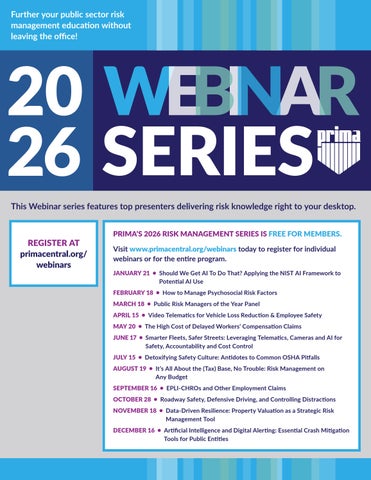
PRIMA’S 2026 RISK MANAGEMENT SERIES IS FREE FOR MEMBERS. Visit www.primacentral.org/webinars today to register for individual webinars or for the entire program. JANUARY 21 • Should We Get AI To Do That? Applying the NIST AI Framework to Potential AI Use FEBRUARY 18 • How to Manage Psychosocial Risk Factors MARCH 18 • Public Risk Managers of the Year Panel APRIL 15 • Video Telematics for Vehicle Loss Reduction & Employee Safety MAY 20 • The High Cost of Delayed Workers’ Compensation Claims JUNE 17 • Smarter Fleets, Safer Streets: Leveraging Telematics, Cameras and AI for Safety, Accountability and Cost Control JULY 15 • D etoxifying Safety Culture: Antidotes to Common OSHA Pitfalls AUGUST 19 • It’s All About the (Tax) Base, No Trouble: Risk Management on Any Budget SEPTEMBER 16 • EPLI-CHROs and Other Employment Claims OCTOBER 28 • R oadway Safety, Defensive Driving, and Controlling Distractions NOVEMBER 18 • D ata-Driven Resilience: Property Valuation as a Strategic Risk Management Tool DECEMBER 16 • A rtificial Intelligence and Digital Alerting: Essential Crash Mitigation Tools for Public Entities
2026 JANUARY 21 | 12:00 PM – 1:00 PM ET
Should We Get AI To Do That? Applying the NIST AI Framework to Potential AI Use SPEAKER: Kelvin Coleman, Managing Director, Route 2 Strategies Artificial Intelligence has demonstrated significant value in enhancing individual efficiency and effectiveness. However, the question arises: should we seek to minimize our reliance on AI, or should we embrace its use to the fullest extent possible? We will analyze the question through the lens of the NIST AI Risk Management Framework (AI RMF), a comprehensive guideline that assists organizations in identifying, assessing, managing, and monitoring the risks posed by artificial intelligence.
FEBRUARY 18 | 12:00 PM – 1:00 PM ET
How to Manage Psychosocial Risk Factors SPEAKER: Ira David Daniels, Ph.D., CSD, VPS, Founder/CEO, ID2 Solutions, LLC This presentation will introduce the idea that psychosocial hazards and their associated risks are not only present in every workplace but are often precursors to physical hazards and risks. The presentation will describe strategies for identifying, assessing, and mitigating psychosocial hazards and risks, and the resulting harm to individuals’ mental health and the organizational culture.
ATTENDEE TAKEAWAYS: 1. Gain a greater understanding of the NIST AI RMF
ATTENDEE TAKEAWAYS: 1. Attendees will be exposed to a research-based definition of a psychosocial hazard and a standardsbased definition of psychosocial risk
2. Gain a greater understanding of polymorphic emerging technology
2. Attendees will be exposed to the primary sources of psychosocial hazard exposure and the associated risk
3. Be able to compare use cases in the NIST AI RMF
3. Attendees will be exposed to descriptions of the types of harm associated with psychosocial hazards and risk 4. Attendees will be exposed to strategies that can aid in managing psychosocial hazards and risks
Register at primacentral.org/webinars
2026 MARCH 18 | 12:00 PM – 1:00 PM ET
Public Risk Managers of the Year Panel SPEAKERS: Sean Catanese, EMPA, ARM, Enterprise Risk Manager, King County, WA Megan Damato, Esq., Director of Risk Management, Town of Greenwich and Greenwich Public Schools Sherri Adams, ARM, WCCA, Chief Risk Manager, City of Kansas City, MO Allie Matthews, Risk Management Administrator, City of Tucson, AZ (Ret.) Jeffrey L. Green, ARM-P, Risk Manager, Larimer County, CO Join a panel of PRIMA’s Public Risk Managers of the Year as they share how they’ve approached uncertainty, built trust across departments, and supported smarter decisions in their organizations and the communities they serve. These leaders bring hands-on experience from local government, education, and other public service work. The session offers practical insights for anyone working in public risk management.
APRIL 15 | 12:00 PM – 1:00 PM ET
Video Telematics for Vehicle Loss Reduction & Employee Safety SPEAKER: Dan Foster, SVP of Casualty Loss Control, Munich Re Specialty Learn how video telematics can dramatically reduce vehicle-related losses while improving driver and employee safety. This webinar will explore how combining video, GPS, and real-time data helps organizations understand the root causes of incidents, coach drivers more effectively, and protect both people and assets. We’ll walk through practical use cases, implementation tips, and how to turn insights into measurable results. ATTENDEE TAKEAWAYS: 1. How video telematics reduces risk and loss 2. Ways to improve driver and employee safety 3. Key steps to successful implementation
ATTENDEE TAKEAWAYS: 1. Tools and strategies for building a strong risk program 2. Tips for engaging stakeholders and gaining support 3. Lessons learned from real-world challenges and successes 4. Most importantly: Your questions answered
Register at primacentral.org/webinars
2026 MAY 20 | 12:00 PM – 1:00 PM ET
The High Cost of Delayed Workers’ Compensation Claims SPEAKER: Mark Pew, Provost/Founding Partner, WorkCompCollege.com Delayed reporting and slow initial action can turn a manageable injury into a costly, contentious workers’ compensation claim. This session will discuss common reasons for delay and the repercussions of those actions/ inactions, such as increased medical costs, indemnity exposure, and litigation risk, which complicate and prolong the return-to-work process. ATTENDEE TAKEAWAYS: 1. Understand the common causes of delay in claims processing and medical treatment 2. Itemize the costs associated with delayed recovery and return-to-work 3. Describe watershed moments that can reveal themselves when earlier intervention is required 4. Identify communication tools and potential workflow adjustments to de-escalate tensions
JUNE 17 | 12:00 PM – 1:00 PM ET
Smarter Fleets, Safer Streets: Leveraging Telematics, Cameras and AI for Safety, Accountability and Cost Control SPEAKER: Kay Al Mannai, Chief Executive Officer and Chief Financial Officer, Hartford Parking Authority This webinar highlights how the Hartford Parking Authority (HPA) uses Samsara’s telematics, camera technology, and AI-driven analytics to create smarter fleets and safer streets. Participants will see how real-time data improves driver accountability, supports proactive maintenance, and strengthens liability protection. Case studies will show how detailed video and GPS evidence have resolved insurance disputes, reduced claims, assisted law enforcement in solving crimes, and identified staff who may benefit from additional training. The session will also explore strategies for gaining union support, leveraging city purchasing power to reduce implementation costs, and embedding telematics into budgeting, fleet planning, and risk management processes to enhance safety and operational efficiency while keeping streets safe. ATTENDEE TAKEAWAYS: 1. How telematics, cameras, and AI create smarter fleets by reducing liability, improving efficiency, and controlling costs 2. How real-time fleet data helps achieve safer streets by supporting law enforcement, verifying driver actions, identifying staff training needs, and providing clear documentation that unions can agree upon 3. How organizations can gain union support for implementing telematics and leverage city consortium purchasing power to secure reduced pricing — while embedding these technologies into budgeting, fleet planning, and risk management strategies
Register at primacentral.org/webinars
2026 JULY 15 | 12:00 PM – 1:00 PM ET
AUGUST 19 | 12:00 PM – 1:00 PM ET
Detoxifying Safety Culture: Antidotes to Common OSHA Pitfalls
It’s All About the (Tax) Base, No Trouble: Risk Management on Any Budget
SPEAKER: Matt Phillips, MS, MBA, Safety and Risk Manager, Hanover County and Hanover County Public Schools (VA)
SPEAKERS: Megan Damato, Esq., Director of Risk Management, Town of Greenwich and Greenwich Public Schools Sara Lowenthal, Director of Safety and Risk, City of Hartford, CT
Safety culture isn’t built on compliance alone. Join Matt Phillips as he explores eight common “poisons” that sabotage workplace safety—and the practical “antidotes” to overcome them. Walk away with real-world strategies to promote shared accountability, proactive learning, and lasting cultural change. ATTENDEE TAKEAWAYS: 1. Safety culture goes beyond compliance—continuous improvement is essential 2. Outdated practices and attitudes can be challenged and replaced with innovative, safer methods 3. Everyone shares responsibility for safety; it cannot rest solely on the safety manager 4. Proactive learning and prevention mindsets reduce incidents and build long-term resilience
Whether you’re a small, medium, or large public entity, managing risk is essential—but it doesn’t have to break the bank. This presentation explores effective, scalable risk management strategies tailored to fit organizations of any size and budget. Learn how to identify key risks, prioritize them based on impact, and implement low-cost or no-cost mitigation measures that align with your goals. ATTENDEE TAKEAWAYS: 1. Budget-friendly solutions for risk monitoring and control 2. Real-world examples of cost-effective risk responses 3. Learning how to identify and prioritize key risks to a public entity 4. Prioritization techniques to focus on high-impact risks
Register at primacentral.org/webinars
2026 SEPTEMBER 16 | 12:00 PM – 1:00 PM ET
OCTOBER 28 | 12:00 PM – 1:00 PM ET
EPLI-CHROs and Other Employment Claims
Roadway Safety, Defensive Driving, and Controlling Distractions
SPEAKER: Marilyn Rivers Principal, Rivers Risk Consulting
SPEAKER: Ariel Jenkins, CSP, CPCU, ARM-P, ARM-E, AIDA, MBA, Assistant Vice President, Risk Control, Safety National
Join us for a focused session on navigating today’s complex employment-related risks and understanding how Employment Practices Liability Insurance (EPLI) can protect your organization. This webinar will highlight the key benefits of EPLI coverage, clarify the types of issues and claims these policies typically address, and walk you through best practices for responding to claims from regulatory agencies. Whether you’re looking to strengthen compliance or reduce organizational exposure, this session will offer practical insights you can use immediately.
This training highlights the critical risks of distracted and unsafe driving, emphasizing that even brief lapses in attention can lead to severe consequences. It covers defensive driving strategies, including proper following distances, mirror adjustments, safe intersection practices, and awareness of pedestrians, cyclists, and inclement weather. Special focus is placed on reducing distractions from mobile devices and multitasking, supported by real-world accident statistics and scenarios. The session includes tailored safety considerations for law enforcement and other high-risk driving environments.
ATTENDEE TAKEAWAYS: 1. Benefit of having EPLI coverage 2. Educating on the issues/claims covered by EPLI policies 3. How to respond to claims from regulatory agencies
ATTENDEE TAKEAWAYS: 1. Recognize distracted driving risks through data, reaction times, and safe communication practices 2. Apply defensive driving skills with safe distances, proper mirror use, and hazard anticipation 3. Adapt to conditions by adjusting for weather, visibility, and vulnerable road users 4. Commit to safety protocols for backing, load securement, and operational driving
Register at primacentral.org/webinars
2026 NOVEMBER 18 | 12:00 PM – 1:00 PM ET
DECEMBER 16 | 12:00 PM – 1:00 PM ET
Data-Driven Resilience: Property Valuation as a Strategic Risk Management Tool
Artificial Intelligence and Digital Alerting: Essential Crash Mitigation Tools for Public Entities
SPEAKERS: Michael Domin, President, Insurance Valuation Group Natalia Szubbocsev, CAIB, CRM, MBA, Business Development Consultant, Insurance Valuation Group
SPEAKER: Harry Earle, Associate Director, Law Enforcement Risk Control, J.A. Montgomery Consulting
In a climate of inflation, supply chain volatility, and shifting regulatory frameworks, property valuation has quietly become one of the most consequential inputs to public sector risk management. This session unpacks how replacement cost assumptions are shifting under current economic pressure, and why relying on outdated figures can expose public entities to underinsurance, misaligned capital planning, and slower recovery after a loss. Attendees will explore how accurate, current valuations feed directly into budgeting, reserve adequacy, and emergency preparedness, turning a routine compliance task into a genuine strategic asset. ATTENDEE TAKEAWAYS: 1. Why replacement cost assumptions are shifting under current economic pressure. 2. How outdated valuations expose public entities to underinsurance and capital planning gaps. 3. How accurate, current valuations strengthen budgeting, reserve adequacy, and emergency preparedness. 4. How to build annual valuation reviews into your risk management cycle using authoritative cost indices.
This webinar explores the extreme vulnerabilities associated with police and other first responder vehicle operations and delivers meaningful takeaways for crash mitigation. Traditional crash prevention measures have often focused narrowly on emergency driving. However, all aspects of emergency vehicle operation must be examined, taking today’s technology into account, to help prevent and adequately investigate first-responderinvolved crashes. Many first responder agencies drastically underutilize vehicle-to-vehicle digital alerting systems, telematics, Collision Avoidance Systems (CAS), and Advanced Driver-Assisted Systems (ADAS). This session explores the risks of inconsistent usage and lack of policy guidance on available vehicle technology. ATTENDEE TAKEAWAYS: 1. Understanding how first responder-involved crashes are a growing concern and how an effective general non-emergency driving crash prevention program can also help mitigate crashes 2. Learn how police departments can and should use today’s technology to mitigate crashes, such as vehicleto-vehicle digital alerting systems, telematics, GPS, vehicle manufacturer Collision Avoidance Systems (CAS), and Advanced Driver Assist Systems (ADAS) 3. Participants will find the resources and materials highly beneficial, including an overview of the role of supervisors in collecting and reviewing motor vehicle crash reports to improve safety
Register at primacentral.org/webinars