X-Country
.ALL-AMERICANS
I, II
1i,I:
Led by runners like Bill McChesney of South Eugene, Oregon, and teams like Deerfield, Illinois, the 1976 All-America Cross Country team is one of the strongest in history. Presently knee-deep in outdoor track, these runners .can credit their present success .to their efforts last fall on the long distance courses of America.
By Marc Bloom
. l e nation's leading scholastic dis-. tance runners are presently knee-deep in outdoor track, preparing for state finals and hoping to achieve performances that will justify the long, hard training they have endured since the heat of last summer. The runners who seem unbeatable, who are just waiting for that perfect spring day to post a 4: 10 mile or snap 9:00 for two miles, can most likely trace the origins of their current success t<i last fall's cross country season. The autumn jaunts around the rolling terrain of sweet-smelling surburban golf .courses and up and down the dusty hills of municipal parks are now paying dividends for aspiring national champions. There are no hills on a 440 track; not much cinder is still around either. High schools have tagged along with the colleges in putting down fancy all-weather surfaces. It all comes down to clicking off lap times with consistency. Those who can handle a hot pace from gun to tape will find their names in the headlines and the record books. Many of them excelled in cross country, and it was that springboard that propelled them toward track success as well. Many of these stalwarts were listed in National Prep Sports' 1976 High School All-American Cross Country Team at pre-season. They were the nation's top fifty harriers last fall; they are listed in alphabetical order. There .is a unique quality to any cross country All-American. team. In other sports there are many positions that reduce the number of candidates for a given honor. For example, in football, quarterbacks are judged with other quarterbacks, linemen with other linemen, and so on. In cross country, .there is only one event the race; and there is only one position the runner. More than 100,000 teenagers ran high school cross country last fall. Consequently, the athletes selected represented quite a distinct group. These youngsters were chosen only on the basis of their cross country record for PREP I APRIL-MAY 1977
the 1976 season. Their state championship performances weighed most heavily, although all of them did not win state titles. State qualifying and invitational events were also given significant consideration. Some harriers competed in interstate contests, enabling further comparisons. Track times do not count, and any mention of them is done only to illuminate the runner's talents. It was a .rough season for injuries. Several of the leading '75 harriers, who, naturally, were pre-season picks last fall, were victims of ailments or illnesses of sufficient impact to derail their expectations. The weather did not cooperate much either: it was the coldest autumn on record
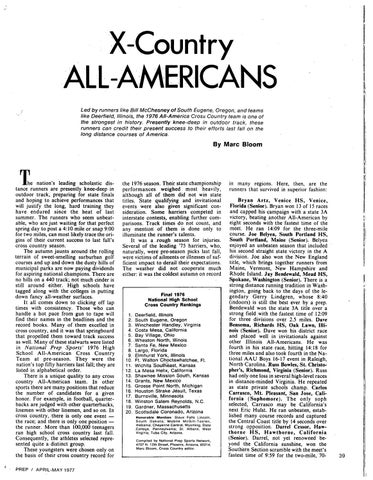
Final1976 National High School Cross Country Rankings
1. Deerfield, Illinois 2. South Eugene, .Oregon
3. Winchester Handley, Virginia 4. Costa Mesa, California 5. Bay Village, Ohio 6. Wheaton North, Illinois 7. Santa Fe, New Mexico 8. Largo, Florida 9. Elmhurst York, Illinois 1 o. Ft. Walton ·choctawhatchee, Fl. 11. Wichita "Southeast, Kansas ·12. La Mesa Helix, California 13. Shawnee Mission South, Kansas 14. Grants, New Mexico 15. Grosse Point North, Michigan 16. ·Houston Strake Jesuit, Texas 17. Burnsville, Minnesota 18. Winston Salem Rey[wlds, N.C. 19. Gardner, Massachusetts 20. Scottsdale Coronado, Arizona Honorable Mention: Sioux Falls Lincoln, South Dakota; Mobile McGill- Too len, Alabama; Cheyenne.Central, Wyoming; State .College, Pennsylvania; St. Albans, West Virginia; Tuf?a City, Arjzona. Compiled by National Prep Sports Network, 4707 N. 12th Street. Phoenix, Arizona, 85014, Marc Bloom, Cross Country editor.
in many regions. Here, then, are the runn«rs that survived in superior fashion: Bryan Artz, Venice HS, Venice, Florida (Senior). Bryan won 13 of 15 races and .capped his campaign with a state 3A victory, beating another All-American by eight seconds with the fastest time of the meet. He ran 14:09 for the three-mile course. Joe Belyea, South Portland HS, South Portland, Maine (Senior). Belyea enjoyed an unbeaten season that included his second straight state victory in the A division. Joe also won the New England title, which brings together runners from Maine, Vermont, New Hampshire and Rhode Island. Jay Bendewa1d, Mead HS, Spokane, Washington (Senior). There is a strong distance running tradition in Washington, going back to the days of the legendary Gerry Lindgren, whose 8:40 (indoors) is still the best ever by a prep. Bendewald won the state 3A title over a strong field with the fastest time of 12:09 for three divisions over 2.5 miles. Dave Bensema, Richards HS, Oak Lawn, Illinois (Senior). Dave won his district race and placed well in invitationals against other lllinois All-Americans. He was fourth in his state race, hitting 14:18 for three miles and also took fourth in the National AAU Boys 16-17 event in Raleigh, North Carolina. Russ Bowles, St. Christopher's, Richmond, Virginia (Senior). Russ had only one loss in several high-level races in distance-minded· Virginia. He repeated as state private schools champ. Carlos Carrasco, Mt. Pleasant, San Jose, California (Sophomore). The only soph selected, Carrasco may be California's next Eric Hulst. He ran unbeaten, established many course records and captured the Central Coast title by 14 seconds over strong opposition. Darrel Cessor, Hawthorne HS, Hawthorne, California (Senior). Darrel, not yet renowned beyond the California sunshine, won the Southern Section scramble with the meet's fastest time of 9:59 for the two-mile, 70-
39
II