THE VOICE OF BLACK MINNESOTA SINCE 1934 MULTIMEDIA
U.S. stops processing immigrant requests following D.C. shooting
By Jasmine McBride Editor
ASHINGTON — Following a Thanksgiving Day shooting in Washington, D.C., that left one National Guard member dead and another critically injured, the Trump administration announced Friday it is halting all asylum decisions, citing public safety concerns.
Joseph Edlow, director of U.S. Citizenship and Immigration Services (USCIS), said the agency is pausing decisions “until we can ensure that every alien is vetted and screened to the maximum degree possible.” On social media, Edlow added,
“The safety of the American people always comes first.” The decision follows remarks from President Donald Trump, who called for a “sharp crackdown” on immigration from what he described as “third world” countries. On Truth Social, Trump wrote, “I will permanently pause migration from all Third World Countries to allow the U.S. system to fully recover. Only REVERSE MIGRATION can fully cure this situation.”
Shooter and immigration context Authorities identified the shooter as Rahmanullah Lakanwal, a 29-year-old Afghan national admitted to the United States in
2021 after working with the CIA to fight the Taliban. Lakanwal was involved in an ambush-style attack in the nation’s capital.
While Trump described the incident as a “terrorist attack” and called Lakanwal a “savage monster,” Afghan community leaders urged caution against stereotyping an entire population.
“Even as we pursue accountability, one individual’s alleged actions cannot be allowed to define, burden, or endanger entire communities who had no part in this tragedy,” said Ashraf Haidari, founder and president of Displaced International, which provides support to displaced people worldwide.
■ See SHOOTING on page 5
Minnesota’s Somali community at center of national debate over TPS, fraud claims
By Jasmine McBride Editor
he Somali American community in Minnesota has become a focal point of national controversy following President Donald Trump’s November 21 announcement calling for the termination of Temporary Protected Status
described Minnesota’s Somali population as “ripping off our country and ripping apart that once-great state,” citing health and human services fraud as justification for his proposed policy change. If implemented, the TPS termination would directly affect roughly 430 Somali immigrants in Minnesota, many of whom have lived in the state for decades.
(TPS) for Somali immigrants. The president linked the community to widespread fraud in state programs, sparking pushback from civil rights groups, political leaders, and local officials.
In public remarks, Trump
Political leaders push back Congresswoman Ilhan Omar strongly condemned the rhetoric, praising state and federal lawmakers for standing with the Somali community. “It is unfortunate that we are led by a president who does not understand the laws of this land,” Omar said. “The temporary protected status for Somalis expires in March 2026, and anyone with that status has 60 days after for it to have any impact on them. The president cannot terminate that status for only one state. We see you, and we stand with you.”
lison echoed Omar’s concerns, noting that while presidents have authority over TPS designations, they cannot wield that power to discriminate against a particular ethnic group or target a single state.
Minnesota honors Gordon Parks with living memorial
By Scott Selmer Assigning Editor
n a snow-lashed winter afternoon on Nov. 30 at Landmark Center, Minnesota lawmakers, cultural leaders, and members of the Gordon Parks family formally announced the creation of the Gordon Parks Living Memorial, a long-awaited public tribute to the legendary photographer, filmmaker, author, and humanitarian whose artistic journey began in Minnesota and reshaped global culture.
The announcement coincided with what would have been Parks’ birthday and came just months ahead of the 20th anniversary of his death in 2026, marking a poignant moment of reflection and forward-looking purpose.
“This is a monumental statement that we are making as a society,” said State Sen. Foung Hawj (DFL–St. Paul), chair of the Senate Legacy Committee and chief author of the memorial legislation. “The Living Memorial to Gordon Parks must be completed because it honors one of America’s greatest storytellers. Gordon Parks represents the very best of Minnesota and the very best of St. Paul.”
The Minnesota Legislature approved $150,000 in initial Legacy Amendment funding to launch the memorial’s de-
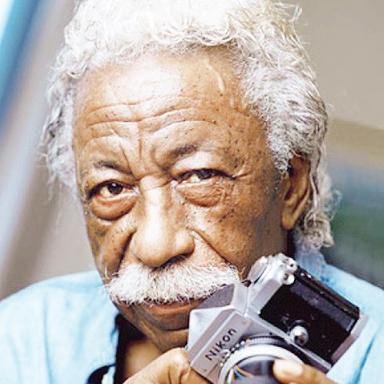
Gordon Parks (1912–2006), influential American photographer, filmmaker, and writer, will be honored with a new Living Memorial in St. Paul. Parks rose from a challenging childhood to become a celebrated photojournalist for “Life” magazine, a filmmaker, author, and humanitarian. Creative Hall of Fame
velopment. Additional funds will be raised through public and private partnerships. Unlike traditional monuments, the memorial is being designed as a living space for education, youth engagement, and artistic development, rather than solely a physical statue.
Legislative backing across chambers
State Rep. Samakab Hussein (DFL–St. Paul), who carried the companion legislation in the House and serves as vice chair of Legacy and Finance,
described the project as both historical and aspirational.
“Gordon Parks was more than a photographer, he was a storyteller. He was a fighter for justice,” Hussein said. “He showed the world what dignity should look like. I want my kids to look at downtown St. Paul one day and say, ‘I can be like him. I can dream.’”
Hussein emphasized that the memorial also addresses long-standing inequities in who is honored in public spaces, providing a platform for historically underrepresented voices.
Cultural and educational impact
The Minnesota Humanities Center, a legacy-funded organization and partner in the project, pledged long-term educational collaboration.
“By sharing how you see the world, you can shape and impact the direction of the world,” said Kevin Lindsey, CEO of the Minnesota
Humanities Center. “Gordon Parks’ life proves that every person matters, every child matters, and that’s a powerful lesson for Minnesota.”
Tracey Williams-Dillard, publisher of the Minnesota Spokesman-Recorder, emphasized the homegrown roots of Parks’ journey. “It means so much to remind people that Gordon Parks started his photography career right here at the Minnesota Spokesman-Recorder, formerly known as the Minneapolis Spokesman.” she said. “His legacy is part of our legacy.” Officials envision a broader ecosystem attributable to Parks’ influence, including a permanent Gordon Parks exhibit at Minneapolis–St. Paul International Airport.
Attorney General Keith El-
Following a shooting in Washington, D.C., the Trump administration announced a pause on asylum decisions, citing public safety concerns.
The Somali community of Minnesota is at the center of a national debate over Temporary Protected Status and allegations of fraud in state programs.
Gordon Parks’
Metro Minnesota braces for hemp ban
By Clint Combs Contributing Writer
After months of closeddoor lobbying from major alcohol groups, Congress approved a hemp-market ban tucked into the federal funding bill that ended the government shutdown. Minnesota producers warn the measure will shutter legal businesses, upend supply chains, and effectively reinstate federal prohibition. The ban is scheduled to take effect in November 2026.
Minnesota growers and manufacturers say the economic damage will arrive long before that date. Farmers typically purchase seed by March and plant in spring, meaning uncertainty now threatens the entire 2026 season. Processors and beverage makers say contracts, equipment investments, and retail relationships will begin collapsing as soon as distributors pull back.
“For the first time, we could reach markets that we’ve been locked out of for decades,” said fourth-generation farmer Angela Dawson, CEO of the 40 Acre Co-op. “Because, if you haven’t noticed, farmers aren’t really incentivized to grow food for people. We’re actually told that’s the quickest way to lose our shirts. Organic farmers, family farmers, are struggling to make ends meet.”
Dawson said Minnesota’s 2023 cannabis legalization law opened opportunities that helped keep her farm
alive. “Hemp really changed the game for me in 2020. It 10x my farm revenue. It let me innovate. I created my own compliant strain,” she said.
Minnesota’s hemp beverage industry, deeply intertwined with craft breweries and liquor stores, is considered the most vulnerable. The federal ban targets hempderived gummies, candies, oils and THC-infused drinks that have become fixtures at breweries and liquor retailers statewide.
“Overnight, a legal, regulated product in Minnesota would be pushed back into the shadows.”
“It is also a criminal justice issue,” said Rep. Ilhan Omar, co-chair of the Congressional Cannabis Caucus. “Overnight, a legal, regulated product in Minnesota would be pushed back into the shadows. We will see confusion, selective enforcement, and the possibility that ordinary workers and small business owners could face criminal penalties for something that was legal yesterday, based on decades of failed drug policy.”
Sen. Mitch McConnell, who championed federal hemp legalization in 2018, argued the new provision “will keep these dangerous products out of the hands of children, while preserving the hemp industry for farmers.” He said he wants to “restore the original intent” of the Farm Bill before retiring. The alcohol industry itself was split. The Distilled Spirits Council, Beer Institute and Wine Institute supported an immediate removal of hempderived THC from the market. But 54 beer, wine and spirits distributors across 26 states urged Congress not to ban the products, noting that as alco-
hol sales decline nationally, hemp beverages have created jobs and stabilized revenue.
Brewers say even the phase-out timeline will destabilize inventory and supply chains. Fulton Brewery owner Ryan Petz said distributors will pull out well before the ban takes effect. “I would say it’s about six months,” he said. “They’re going to stop buying it way before it goes illegal, because they don’t want to be stuck with a whole bunch of products that’s illegal to have.”
Petz said his customers embraced hemp beverages after sampling them in states that legalized cannabis more
than a decade ago. “It’s kind of meeting our already existing consumer base,” he said.
Liquor retailers say the ban undercuts substantial investments made to comply with Minnesota’s hemp regulations.
“Liquor stores are safe and trusted places for these products to remain,” said Surdyk’s Inc. owner Melissa Surdyk.
“For generations we have operated under strict regulations, including rigorous ID verification, staff training and close attention to customer safety.”
Bellboy, a beverage distributor, spent more than $250,000 building its hemp division, which now accounts
for roughly 16% of its business. “So far this year alone, we have given out over $65,000 in commission,” said
CEO Keith Donnovan. “Bellboy represents approximately 12 hemp companies, and 10 of them are located here in Minnesota.”
Manufacturers say they may not survive. “The hemp ban would be absolutely detrimental to the business’s health… these machines that we bought to make this product cannot be returned,” said Kevin Hillard of Insight Brewing. “If we don’t sprint to the finish on this we are not going to make it.”
Workers say the hemp industry has provided stability as alcohol consumption declines. Only 54% of U.S. adults say they drink alcohol, the lowest level since 1939, according to a 2025 Gallup poll. Fulton employee Justin Janicikin said hemp beverages helped create consistent work. “Flexible schedule, friendly environment, good pay, great product, great spot,” he said. “The change of pace is always evolving. It keeps my life interesting.”
Omar criticized the process that produced the ban.
“Oftentimes, when lobbyists are trying to get something through that is not popular with the American people, they will do it in the dark,” she said.
Clint Combs welcomes reader responses at combs0284@ spokesman-recorder.com.
Rochester mentor Andre Crockett among seven Minnesotans honored
By Jasmine McBride Editor
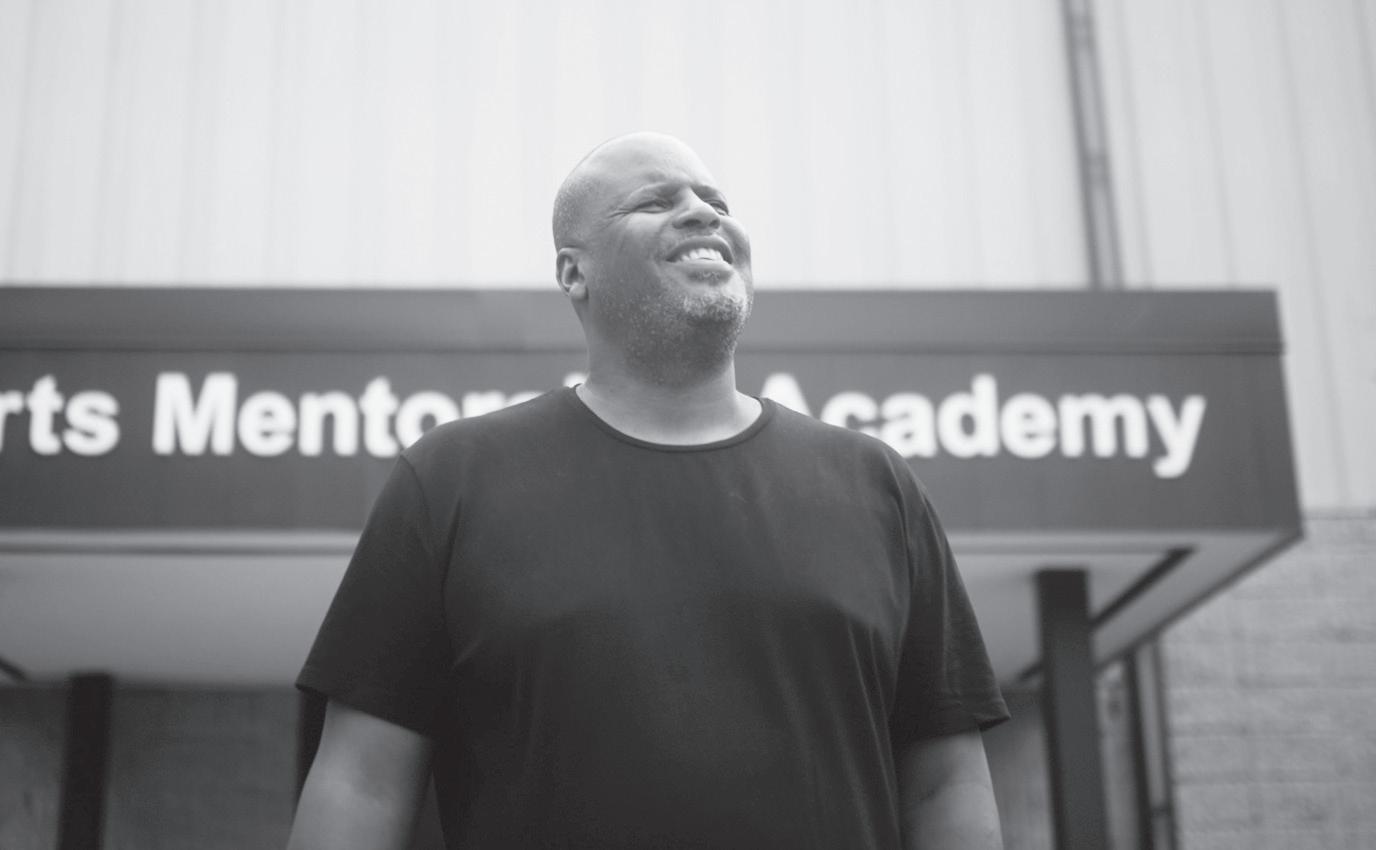
Andre Crockett, founder of the Sports Mentorship Acade-
my in Rochester, is one of seven Minnesotans recognized with the 2025 Virginia McKnight Binger Heart of Community Honor, a statewide honor celebrating individuals whose work strengthens community bonds and expands opportunity.
Crockett launched the Academy in 2008 after the death of his nephew, hoping to give Black and Brown youth alternatives to gangs and violence. Drawing from his own college-basketball background, he brought middle school students to local campuses to learn life skills, athletic development and mentorship.
“The program changes trajectories not just for the kids, but for the whole community,” Crockett said. “One young man who started with me in seventh grade is now a coordinator and will eventually succeed me at the organization.”
A more diverse Rochester, but with persistent gaps Rochester has grown more racially and ethnically diverse over the last two decades. According to the 2020 U.S. Census, the city’s population of 121,395 is about 8.8% Black, roughly 7.8% Asian, and approximately 6.6% Hispanic or Latino of any race.
In the city’s public schools, the diversity is even more pronounced: the district reports that roughly 56.3% of students are white, while about 15% are Black, 9.6% Asian, 11.4% Hispanic, and 7.3%
identify as two or more races. But demographic diversity has not always translated into equal opportunity. For example, in recent years less than 20% of Black and Hispanic students in Rochester’s schools have been proficient in math, compared with about 50% proficiency among white and Asian students. That gap and the broader challenges that often accompany a diversified population — including economic disparity, overrepresentation of youth of color in the justice system, and fewer community resources for marginalized groups, are part of why programs like Crockett’s matter. By offering mentorship, structure, support and access to athletics and academic encouragement, the Sports Mentorship Academy helps fill a void that statistics help reveal but don’t solve. Several program alumni have gone
on to coach in local schools, and many parents, inspired by their children’s progress, have pursued higher education.
Honorees from across Minnesota
The 2025 Heart of Community honorees include, besides Andre Crockett:
• Siham Amedy (West Central region), a Moorhead-based advocate promoting access to food, housing and social services, and leading efforts to welcome newcomers through community events and coalitions.
• Joshua Jones (Northwest region), whose outdoor youth programs on Red Lake Nation combine recreation with cultural values, serving foster care youth, those from juvenile detention, and physically limited youth.
• Paul Nelson (Northeast
region), who created the Sawtooth Mountain Clinic’s Oral Health Task Force, ensuring affordable dental care for children, pregnant women, low-income adults and seniors in rural Cook County, dramatically reducing childhood cavities.
• Sai Thao (Metro region), co-founder of arts organization In Progress, which supports youth and adult artists in storytelling and creative expression, especially amplifying marginalized voices.
• Wanetta Thompson (Central region), who provides free cultural heritage art classes to Ojibwe youth and leads community workshops to build understanding across Indigenous and non-Native neighbors.
• Julie Walker (Southwest region), co-founder of Marshall Pride and a longtime advocate for LGBTQ+ inclusion,
working through local nonprofits and community institutions to make her region more welcoming.
The Heart of Community Honor is awarded jointly by the McKnight Foundation and the Minnesota Council of Foundations. Since 1995, the award has recognized 333 Minnesotans whose work, largely grassroots and often under-recognized, has strengthened communities statewide. Each recipient receives a $10,000 cash award and is celebrated at a formal reception.
Since 1995, the award has recognized 333 Minnesotans whose work, largely grassroots and often under‑recognized, has strengthened communities statewide. Each recipient receives a $10,000 cash award and is celebrated at a formal reception.
Why representation matters
Crockett called the award “a testament to the trust families placed in me,” adding, “I couldn’t do this without them.” For many in Rochester, the recognition feels less like a personal honor and more like a spotlight on a community that aims to grow together, across differences.
For more information about the Sports Mentorship Academy, now transitioning to its first independent recreation center in Minnesota, interested community members can reach out to Crockett via Facebook.
Jasmine McBride welcomes reader responses at jmcbride@ spokesman-recorder.com.
In a city like Rochester, where the Black population is under 10%, and Black and Brown students often face systemic educational and social challenges, representation matters. Having leaders like Andre Crockett who share lived experience with those they serve can build trust, open doors, and offer opportunities that might otherwise be out of reach. Crockett’s work offers not just sports or mentorship, but affirmation, community, hope and a sense of belonging for youth who need it most.
Fulton Brewery owner Ryan Petz says hemp-derived drinks helped the business break even in 2025 after declining alcohol sales during the pandemic. Clint Combs/MSR
Andre Crockett, founder of the Sports Mentorship Academy Courtesy of Andre Crockett
Walk by FAITH!: Heart health and community in Minnesota
By Jasmine McBride Editor
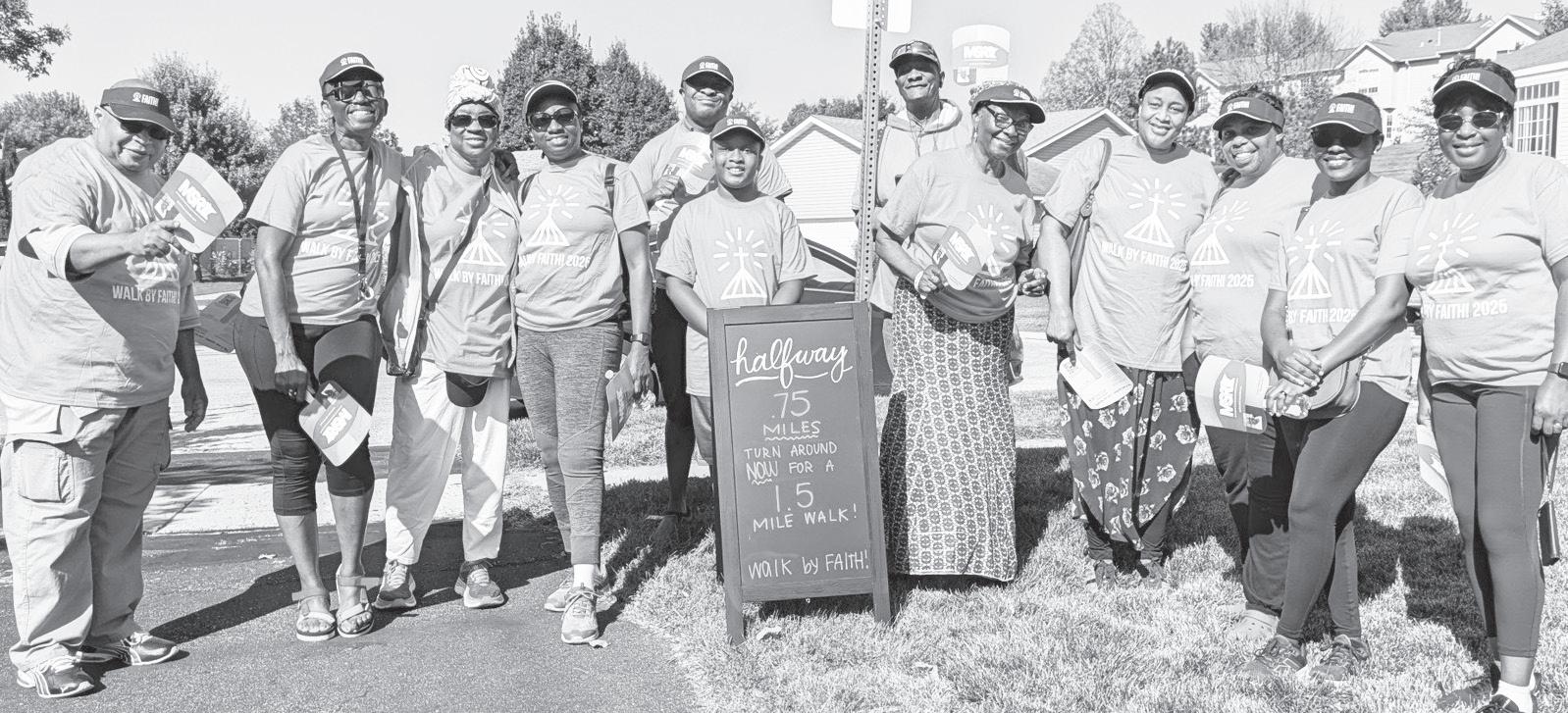
St. Paul and Rochester churches recently came together for the Walk By FAITH! events, a program designed to unite congregations, study participants, and community leaders around heart health and wellness. The events drew strong turnout from participants across both cities, highlighting the commitment of local faith communities to promote healthy living.
St. Albans Church in St. Paul and RCCG Chosen Generation in Rochester were recognized as the top participating churches. Pastor William Land of St. Albans Church described the experience as both personal and communal.
“As I reflect on this experience, it is not just a personal journey for me, but rather a community of believers who have dedicated their lives to pleasing God in every way — mind, soul, and body. That is why it is called the FAITH program. It promotes healthy living, healthy thinking, and healthy relationships, which are essential for maintaining a healthy heart. It is like a kiss
from someone you really love; everything about it makes you feel better,” he said.
Participants praised the events for their energy and camaraderie. Rev. Marcia Wyatt of New Hope Baptist Church said, “Walk By FAITH! came at a key point in our experiences at New Hope Baptist Church. We have been making good
“Hosting the Walk By FAITH! events was a God inspired vision to unite our partnering churches, study participants, and community leaders in a shared commitment to achieving the best heart health possible.”
gains, and it was what was needed to give us a boost. It was exciting to hear members share that they could have continued walking a little longer and a little further. It was also a blessing to share this experience with other participants of the program. Lots of energy, lots of laughs and smiles. Great FELLOWSHIP!”
First Lady Brenda Granison of New Creations Ministries
Church of God in Christ (COGIC) highlighted the program’s broader impact. “At New Creations Ministries COGIC, walking together strengthened us physically, spiritually, and collectively. We are proud to support Techquity as it brings health equity, access, and lifesaving heart health awareness to our community,” she said.
A God-inspired vision
Dr. LaPrincess Brewer, founder of the Walk By FAITH! program, described the events as a “God-inspired vision to unite our partnering churches, study participants, and community leaders in a shared commitment to achieving the best heart health possible. We encouraged everyone to truly ‘walk the walk’ — embracing physical, emotional, and spiritual well-being on their personal journeys. We are deeply grateful to our leaders for their steadfast support, generous words of encouragement, and for walking beside us in solidarity.”
When asked what inspired her to start the program, Brewer said she saw an opportunity to combine faith and well-
ness in a way that addressed health disparities in Minnesota’s African American communities. “We wanted to create something that not only promoted physical health but also strengthened spiritual and emotional well-being. The idea is to engage communities where they are, in ways that feel supportive and empowering,” she said.
Bringing health and technology together
Alongside the walking events, the Techquity By FAITH! initiative focuses on expanding digital access and promoting health equity. Brewer explained that technology can be a vital tool in improving health literacy and reaching communities that have been historically underserved. “Access to information is critical,” she said. “Techquity helps participants connect with resources that can prevent disease and manage their health proactively. It also allows congregations to share knowledge and foster community support for healthier lifestyles.”
Brewer shared examples of success from partner churches.
Frog Tree Farm celebrates Black legacy, Fourth Annual Harvest event
By Alaysia Lane Contributing Writer
Black joy and agricultural resistance were at the heart of the fourth annual “We Are the Harvest: A Sankofa Celebration of Black Legacy & Joy,” cohosted by Frog Tree Farm and Three Rivers Park District. Minnesota’s oldest multigenerational Black-owned farm, run by Peace Mitchell and Michael Birchard, partnered with the district to expand the event from a small community gathering into a full day of youth activities, live demonstrations, and panels featuring Black farmers and entrepreneurs.
Framed by the principle of Sankofa, the idea of moving forward while honoring the past, the event offered a rare space where community support counters systemic obstacles. Attendees visited vendor stations, participated in educational panels, and engaged in interactive experiences designed to reconnect with the land, cultivate economic opportunity, and celebrate cultural heritage.
“You cannot move forward in the present if you do not know about the past,” said Nicole Fernandez, cultural liaison with Three Rivers Park District. “This event is about engaging community members, reconnecting, supporting gardens, and networking.”
“We Are the Harvest” began in 2022 as the “Black Microbusiness Event,” emerging from Mitchell’s student
retreats at North Hennepin Community College. During the retreats, participants made wreaths, which led a friend, Renee Dosman, to suggest selling them at Midtown Global Market. The small fundraiser quickly proved successful. Originally intended to cover taxes and land expenses, the event grew into a community-centered tradition focused on connection and uplift rather than profit.
“That little suggestion turned into something much bigger than we imagined,” Mitchell said.
Wreath production shifted as the event evolved, from dreaming of selling thousands to crafting around 100 highquality items that directly support youth and farm programming. “Now it’s a celebration of community, culture, and supporting Black entrepre-
neurs,” Birchard said.
Frog Tree Farm hosted its Black microbusiness events at the Isaac Walton League building, a small conservation clubhouse in Brooklyn Park. This year, the partnership with Three Rivers Park District allowed the event to move to the new Mississippi Gateway building, expanding space for vendors, panels, naturalists, and even animals, including raptors, for a more interactive experience.
“You cannot move forward in the present if you do not know about the past.”
Frog Tree Farm’s roots stretch back decades. Originally part of Mitchell’s family
“Some churches have created walking groups, virtual workshops, and heart health challenges, all enabled through Techquity. Members are using tablets and online resources to track their progress and encourage one another, which has strengthened both their hearts and their connections.”
Community leaders step up
The program has drawn support from local leaders, pastors, and city officials, reflecting a collaborative approach to public health. Brewer emphasized that the events are designed to foster partnerships across the public health and faith sectors. “When churches, leaders, and health professionals come together, we can make a bigger impact. It’s about showing that health is a community effort, and every step counts,” she said.
Looking ahead
Brewer said Walk By FAITH! and Techquity By FAITH! will continue to expand in the coming years, reaching more churches and participants statewide. She hopes the model can inspire similar programs nationally. “We want to see more communities empowered to take control of their health while staying rooted in their faith. This is about sustainable wellness, not just oneoff events,” she said.
The recent events reflect a larger movement to integrate faith, fellowship, and wellness. Participants and leaders alike praised the energy, enthusiasm, and tangible health benefits, reinforcing the role of community-based programs in promoting heart health and equity in Minnesota.
For more information, visit www.faith4heart.com.
Jasmine McBride welcomes reader responses at jmcbride@ spokesman-recorder.com.
Black farmers.
“It’s about creating the infrastructure that didn’t exist for us and our ancestors,” Mitchell said. “There is a need for structural support where Black farmers can thrive and sustain generational wealth.”
Birchard emphasized that the bill is grounded in lived experience. “We know what it takes to grow crops, run a farm, and maintain a community space,” he said. “The problem is that many of our peers don’t have the same access to land, financing, or training.
This bill is a step toward leveling that field.”
The legislation did not advance this session, but
Birchard said it lays the groundwork for ongoing discussions about expanding access to land, funding, and resources for Black farmers. Frog Tree Farm has also collaborated with state lawmakers and the Minnesota Department of Agriculture to expand emerging farmer programs and support Black farm ownership. Their efforts have helped increase Minnesota’s Black farm count from 39 to roughly 150.
holdings, the farm has grown into a hub for communityfocused agriculture. Mitchell and Birchard now operate the farm together, combining tree farming, a demonstration garden, and youth programming with efforts to connect Black communities to agricultural practices. Their work extends beyond production to advocacy for systemic changes that increase access to land, funding, and equipment for Black farmers.
Earlier this year, the pair focused on addressing longstanding inequities in agriculture. The Black Farmers Bill, a package of 2025 Minnesota legislation chief-authored by Representative Mary Frances Clardy and supported by State Senator John Hoffman, sought to expand access to land, funding, and resources like farming equipment for
That spirit of growth and collective uplift was visible throughout “We Are the Harvest.” More than 15 vendors, including Minnesota Africans United, Chocolate Milk Club, MNI SOTA Mortgage Co., Shining Lights Farm, R Roots, Intentions Enrichment Center, and Kalahari Foods, offered herbal goods, homemade crafts, and community resources. Fees were waived for several small businesses at the event.
“We want to lift up people who show up and stand with us,” Mitchell said.
Reflecting on the event and their work, Birchard recalled a lesson from his mentor, the late freedom rider Mark David: activism can feel “selfish,” but when it stems from an internal compass, it is a personal desire to do what feels right.
Both Mitchell and Birchard acknowledged the weight of community trust and the pressure not to disappoint, but they approach it with the same dedication they bring to the land.
Alaysia Lane is a multimedia journalist and commerce writer based in Minneapolis.
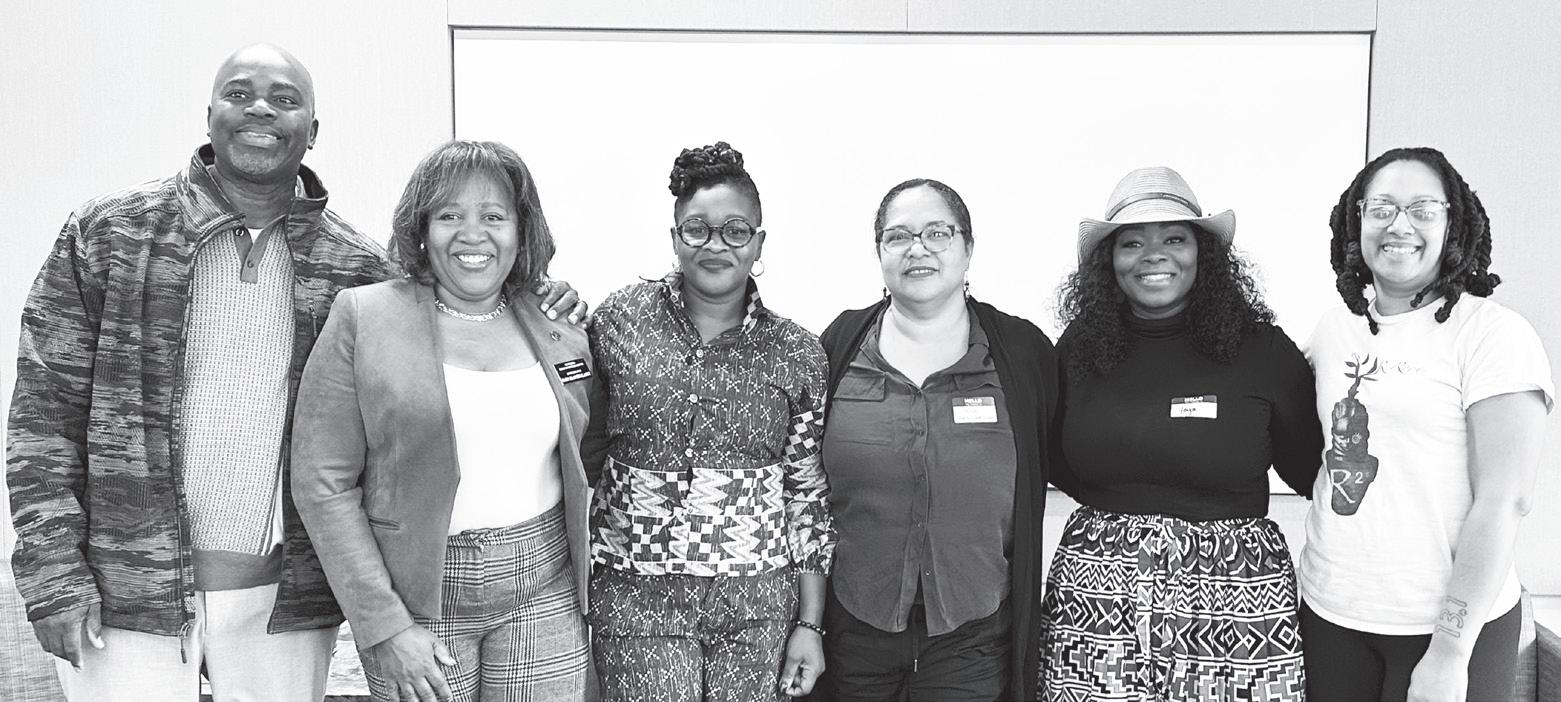
Panelists from the Voices of Black Women Farmers in Minnesota (L–R): Patrice Bailey, assistant commissioner of the Minnesota Department of Agriculture; Rep. Mary Frances Clardy; Anita Fondikum of Shining Lights Farm; Peace Mitchell of Frog Tree Farm; Yaya Cochran of Mahogony Farms; and Queen Frye of R Roots Garden. Photos by Michael Birchard
Michael Birchard and Peace Mitchell’s niece at Frog Tree Farm’s vendor stand.
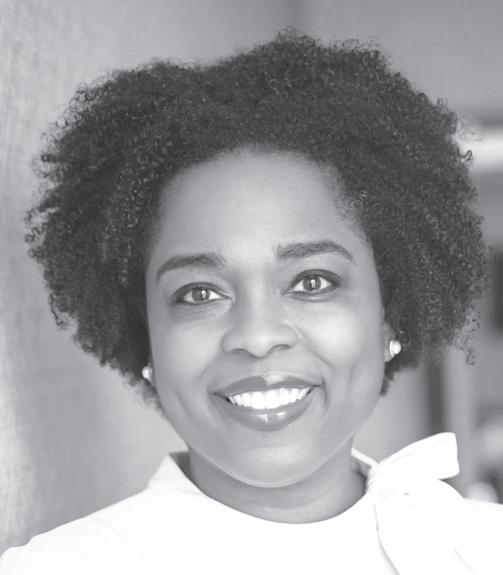
Dr. LaPrincess Brewer, founder of the Walk By FAITH!
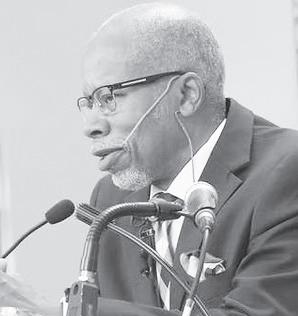
Pastor William Land of St. Albans Church
Rev. Marcia Wyatt of New Hope Baptist Church
First Lady Brenda Granison of New Creations Ministries Church of God in Christ (COGIC)
Walk By FAITH! Rochester attendees. All photos courtesy of Walk By FAITH!
Walk By FAITH! St. Paul attendees
Black Business SPOTLIGHT Five-Star Chuck
By Scott Selmer Assigning Editor
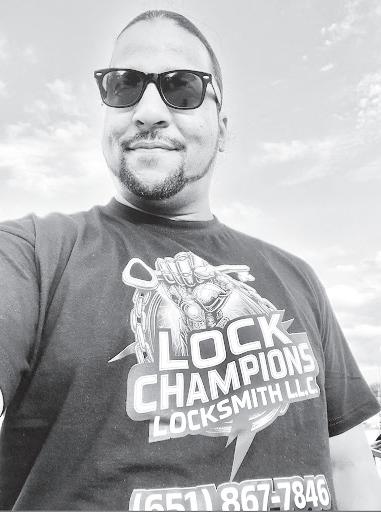
One early winter morning in Oakdale, Minnesota, the cash drawer at a HomeGoods jammed shut with the night’s revenue locked inside. Management needed it opened immediately. The call went to one man: “Five-Star Chuck.”
Less than an hour later, Charles “Chuck” Bradley was on site, opening the drawer with practiced precision. The store opened on time, the crisis disappeared, and another five-star review quietly reinforced the nickname he’s earned many times over.
Bradley owns Lock Champions Locksmith, a Blackowned, Twin Cities–based 24/7 mobile locksmith service that extends into western Wisconsin. His business rests on the three principles he lives by: timing, trust, and professional service. “All of it comes down to showing up,” he said. His motto: “On time. Every time.” Bradley was born in 1981 and raised in Arkansas before moving north to Minnesota in search of steady work. “There wasn’t a lot of opportunity back home,” he
said. “I heard Minnesota had work. So I came.” He entered the trades through the Union Apprenticeship School in Lino Lakes, later working on major projects including U.S. Bank Stadium, Minnesota State University–Mankato, and the University of Minnesota.
“You must prove yourself over and over again.”
By his late thirties, the physical demands of construction were taking a toll.
He shifted careers into locksmithing, spending more than seven years working for other companies – training coworkers, outperforming expectations, and building his skillset. What he didn’t receive was advancement. “I trained people and watched them get promoted over me,” he said. “I outworked everybody, but didn’t get the pay or recognition.” That frustration became fuel. Lock Champions Locksmith was born.
Locksmithing is a profes-
A locksmith built on trust
sion built on trust: entering homes, opening vehicles, and accessing businesses. Bradley says that as a Black man in the industry, he must prove his credibility repeatedly. “You must prove yourself over and over again,” he said. “Customer service. Time management. Showing up.” Bradley works alone: no employees, no dispatchers, no middlemen. When someone calls, he answers. “I try to get there in 30 to 40 minutes,” he said. “Most car lockouts take under a minute. Houses… sometimes seconds.”
His verification process is strict: IDs, photos, receipts, documentation, and full recordings for every job. Safety is essential, especially during late-night calls. Sometimes police arrive, alerted by neighbors unfamiliar with the situation. Bradley stays calm. “I show them I’m with the homeowner. I’m just doing my job.” He chooses not to carry a weapon. “I’m a peaceful man,” he said. “I don’t want violence tied to my business.”
Another pillar of Lock Champions is what Bradley calls budget-friendly service. “If someone has $100 and another locksmith wants $300, I’ll still open that door,” he said. “I’d rather make something than nothing, and help somebody.” That philosophy has earned him loyalty, word-
of-mouth referrals, and more than 10,000 completed service calls. “People remember how you treat them when they’re stuck,” he said. In 2025, he expanded his service area into western Wisconsin, including Hudson. “I just want more people to know we exist,” he said.
At home, Bradley is a fulltime single father to his seven-
year-old daughter. “Stability matters,” he said. He maintains a disciplined routine, clean appearance, daily grooming, and intentional presentation.
On the job, he wears custom Lock Champions shirts in blue, black, and white. Off the job, he’s known for being sharply dressed. “Presentation is part of trust,” he said.
His community work is
extensive, though he rarely speaks about it. He gives away clothing, shoes, food, and money to people in need. Once a year, he empties his closet for community giveaways. More impactfully, he trains young men in locksmithing for free. One encounter began when a struggling father asked for help on a Minneapolis street corner. “I didn’t just give him gas money,” Bradley said. “I gave him a trade.” That man went on to work in locksmithing for several years. “I believe in helping people build skills, not just survive a day.”
Bradley describes himself as faith-based, driven by prayer and purpose rather than fear. “I’m out here doing the right thing,” he said. Lock Champions continues to grow through Google, Apple Maps, social media, and online reviews — the engines behind his “Five-Star Chuck” reputation. In five years, he envisions expansion, more reach, and deeper visibility. “Just growing,” he said. “More people. More service. More work.” In a city where trust is currency, Five-Star Chuck keeps earning interest — one emergency, one lock, one life at a time.
Scott Selmer welcomes reader responses at sselmer@ spokesman-recorder.com.
Charles “Chuck” Bradley Courtesy photo
Suspension of immigration decisions
The pause affects asylum applications and other immigration requests from countries previously flagged under a June White House proclamation, including Afghanistan and several African nations such as Chad, Sudan, and Somalia. The Department of Homeland Security confirmed it has halted immigration requests from Afghanistan and is reviewing all asylum cases approved under former President Biden. DHS did not respond to further requests on when decisions will resume.
Legal experts warn that sweeping halts to asylum processes can create significant backlogs, prolong uncertainty
for vulnerable populations, and may face legal challenges. Most asylum seekers undergo extensive vetting before admission.
munity, home to the largest Somali population in the U.S., has also been a focus of Trump’s statements. While he insisted the D.C. attack
“This ain’t over,” Ellison said. Governor Tim Walz acknowledged fraud exists in Minnesota but emphasized it is being investigated and prosecuted fairly. During a November 30 “Meet the Press” interview, he said, “We cannot allow the demonization of an entire community based on the actions of a few.” Walz highlighted the Somali community’s contributions as educators, healthcare workers, entrepreneurs, and cultural leaders, calling them integral to Minnesota’s social and economic fabric.
Fraud allegations and investigations Minnesota has faced highprofile fraud cases in recent years. One of the most promi-
Community reactions
Trump has repeatedly linked immigration from Somalia and other countries to crime and social welfare strain, drawing criticism from civil rights groups. “Immigrants are entitled to protection under international law, and that should be given due process,” said Jeremy Laurence, spokesperson for the U.N. Human Rights Office in Geneva.
Minnesota’s Somali com-
nent involves Asha Farhan Hassan, who was indicted for a scheme that bilked taxpayers out of $14 million through her autism therapy provider, Smart Therapy LLC. Texas Congressman Tom Emmer claimed the fraud funneled money to Al-Shabaab, though authorities have not confirmed any international links. An anonymous Minnesota Department of Human Services employee told local media that fraud in the state’s health and human services programs exceeds that of much larger states, blaming systemic governance failures. The employee called for external auditors and new leadership to restore trust in government services.
Civil rights advocates have decried the targeting of the Somali community. CAIR-Minnesota, the Council on AmericanIslamic Relations’ state chapter, called the political rhetoric “dangerous” and said it “puts
was unrelated to Somalis, he added, “Somalian gangs have caused a lot of trouble,” citing alleged criminal activity in the state.
Civil rights and immigrant advocacy groups emphasized the need to separate criminal accountability from ethnicity or national origin. “Fraud and crime are issues that law enforcement can handle,” said Jaylani Hussein, executive director of CAIR-Minnesota.
“But demonizing an entire
Somali and Muslim families at risk.” Executive Director Jaylani Hussein said, “Fraud harms everyone, but demonizing an entire community for the acts of individuals is not accountability. It is collective punishment.” He added, “When politicians turn entire communities into symbols in their political battles, they stop talking about policy and start playing with people’s lives… This rhetoric doesn’t stay on television or social media. It shows up in our neighborhoods, our mosques, our schools, and our workplaces.”
National security context Trump connected his Somali TPS announcement to broader national security concerns, linking Somali immigrants to crime and fraud. He also cited a recent ambushstyle attack in Washington, D.C., involving two National Guard members and an Af-
community for the actions of a few is not only inaccurate, it is dangerous.” Matthew Soerens of World
ghan suspect, asserting a connection between immigration policy and domestic security. Critics say conflating isolated criminal cases with an entire ethnic community fuels xenophobia and distracts from factual investigations. CAIR-MN warned some narratives echo foreign influence campaigns aimed at inflaming divisions in the United States.
diverse, and economically engaged, with many members participating across party lines. TPS provides temporary legal protection to individuals from countries experiencing conflict, allowing them to live and work in the U.S. until conditions stabilize. Legal experts emphasize that a president cannot arbitrarily revoke TPS to target a single state or eth-
“We see you, and we stand with you, and we will make sure we do everything we can to help make sure your status is adjusted before March of 2026.”
nic group.
Omar stressed the importance of separating criminal accountability from collec-
Relief, a faith-based refugee organization, echoed the sentiment: “Regardless of the alleged perpetrator’s nationality, religion or specific legal status … we urge our country to recognize these evil actions as those of one person, not to unfairly judge others who happen to share those same characteristics.”
Looking ahead
As USCIS and DHS review asylum applications, community leaders stress that public responses should focus on facts and fairness rather than broad policy measures driven by fear. Lakanwal’s vetting and service illustrate the complexity of the U.S. immigration system, underscoring the need for rigorous screening rather than blanket restrictions.
Jasmine McBride welcomes reader responses at jmcbride@ spokesman-recorder.com.
tive punishment: “We want to make sure that their new home stays their forever home.”
Looking ahead
The debate over Somali TPS and fraud allegations in Minnesota highlights broader national tensions over immigration, public services, and political rhetoric. While authorities continue fraud investigations, community leaders and elected officials are calling for restraint and the protection of vulnerable populations.
Hussein concluded, “Respect for voters should not end after election day. Our community will not be used as a political football. We deserve safety, dignity, and the same respect as any other American community.”
Jasmine McBride welcomes reader responses at jmcbride@ spokesman-recorder.com.
Veteran journalist Don Shelby, who with Dr. Robin HickmanWinfield championed the airport exhibit, reflected on Parks’ human-centered approach to the camera.
“Gordon Parks didn’t take pictures of landscapes, he took pictures of human beings,” Shelby said. “You couldn’t look into the eyes of his subjects without seeing the humanity and the story behind their lives.”
A living memorial, rooted in youth
The effort is being led by Dr. Robin Hickman-Winfield, Parks’ grandniece and longtime cultural organizer. She stressed that the memorial will be shaped alongside young people at every stage.
ian,” she said. “He believed in when his dear friend James Baldwin says, time for lovers of humanity to find one another. That’s who he was. But he reflected in his final days about being a young black man trying to survive on these streets out here. What did I really do? He questioned his own legacy, and I had to remind him. I said, Uncle Gordon, don’t worry. We’ve got this.”
poem from Parks’ later poetry collection, “The Mother’s Lane,” was recited in honor of his mother, Sarah Parks, whose influence deeply shaped his worldview and artistic voice.
Speakers noted Parks’ long engagement with incarcerated youth through letterwriting programs and community storytelling, as well as his mentorship of emerging artists and journalists across decades. Hickman-Winfield shared moments when young people, inspired by Parks’ life, retraced his journey from St. Paul to Fort Scott, Kansas, standing at his resting place and recommitting themselves to creative purpose.
“We’re not playing,” Hickman-Winfield said.
Next steps
“Every step along the way, young people will be learning the process of creating,” she said. “Any artist who can’t get with that can’t be part of this project. This is why it’s taken so long, but delay does not mean denial.”
Hickman-Winfield traced the project’s origins back more than 20 years to shortly after Parks’ death, including early public memorial concepts and statewide education efforts tied to his life. She also reflected on Parks’ final years, sharing his concern for
young people caught in cycles of violence and despair.
“Before he passed away, we spent a day of me getting my instructions, and after dinner with tears in his eyes. He asked me, baby, what happened to black boys? He loved all young people. He loved all people. He was a humanitar-
Family, poetry, and legacy
Several members of the Parks family were recognized at the announcement. A
While final design and placement details have not yet been made public, St. Paul Parks and Recreation officials indicated that a replica of a proposed statue may be unveiled this spring.
The memorial is expected to be in downtown St. Paul, near sites connected to
Parks’ career.
Beyond the sculpture, organizers said the memorial will include:
• Youth-led public art creation
• Educational programming
• Oral history and digital storytelling
• Film, photography, and journalism training
Despite the gripping cold outside Landmark Center, the announcement inside carried both celebration and responsibility, affirming Minnesota’s role in shaping a life that would go on to influence the world.
“Today we celebrate not just the day Gordon Parks was born,” one speaker said, “but the reason he was born.”
Hickman-Winfield closed the event with the words that now shape the mission of the Living Memorial itself:
“This is not just a statue. This is a living memorial. And young people will be walking in Uncle Gordon’s footsteps every step of the way.”
Scott Selmer welcomes reader responses at sselmer@ spokesman-recorder.com.
Community and legal protections
The Somali community in Minnesota is politically active,
A National Guard member stands in Washington, D.C. Officials say all asylum decisions are temporarily halted while immigration cases from certain countries are reviewed.”
(L-R) Dr. Robin Hickman-Winfield, Amy Mino, Rep. Samakab Hussein, and Sen. Foung Hawj at the Minnesota Legislative Appropriations Announcement Ceremony honoring Gordon Parks, Nov. 30, 2025. Scott Selmer/MSR
Arts & Culture
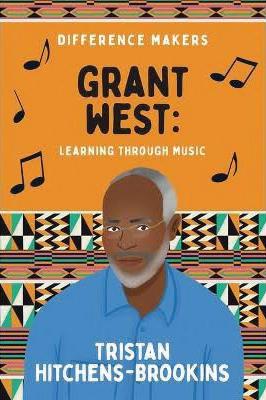
How Grant West helped students find their musical voices
By Alex Nellis
For nearly four decades, Grant West has been a guiding force in St. Paul’s arts and culture landscape — an educator, advocate and community builder whose belief in the power of music has shaped generations of young musicians. As cofounder of Walker West Music Academy, West has helped students discover their talents while creating one of the region’s most inclusive and culturally rooted music communities.
West’s journey into music began thousands of miles from St. Paul, in Wyoming, where his childhood piano teacher, Ms. Daisy Bates, recognized his perfect pitch. Bates pushed him to pursue rigorous practice and encouraged him to use his talent to uplift others. West credits her with planting the seed that would ultimately grow into his life’s work.
From housing advocate to cultural leader West moved to St. Paul in 1966 and quickly became involved in the community. His first work was with the St. Paul Urban League, where he assisted Black families seeking housing and confronted the segregation that shaped many neighborhoods at the time. The experience, especially the advocacy and mentorship it required, helped establish him as a respected community leader. While working with the Urban League, West also taught
music to Black children in local churches. Drawing from his own experience with Ms. Bates, he emphasized teaching to each student’s unique learning style. He believed music education could be a bridge to confidence, culture and connection, especially for young people who rarely saw their musical potential represented or encouraged. His dedication eventually led to an unexpected opportunity: a chance to perform with legendary entertainer Sammy Davis Jr. West took it as a sign to keep honing his craft even as he continued teaching.
formed a friendship rooted in shared values and a vision for a school that could nurture students not only as musicians but as thinkers, collaborators and community members.
Their dream became reality the following year when they opened Walker West Music Academy, which today stands as one of the longest-running community music schools founded by African Americans in the country.
Opening the school required creativity — and sweat equity. Affordable buildings were scarce, and the pair ultimately secured a former
At his core, West believes music brings people together, whether through a shared rhythm, a classroom lesson or a community performance. His lifelong dedication to ensuring every child has access to that experience has changed St. Paul’s cultural landscape for the better.”
Building a music school from the ground up In 1987, West met another music educator, the Rev. Carl Walker. The two quickly
barbecue restaurant with just enough room for lessons. Unable to hire cleaners, they prepared the space themselves, scrubbing floors and
transforming the building into a place where students could develop both skill and artistic identity.
From the beginning, Walker West Music Academy drew students from across Minnesota. Families were eager for a school that embraced cultural expression, emphasized musical traditions often overlooked in mainstream arts programs and taught life skills alongside
scales and chords.
West and Walker ensured the school remained accessible.
When families struggled to pay for lessons, they offered alternatives: parents could volunteer around the school, and teachers would accelerate instruction so students could progress even if they weren’t able to stay long-term. Their philosophy was simple, talent should not be limited by finances.
A lasting legacy
Four decades later, West’s influence resonates throughout St. Paul and beyond. Many of his former students have performed internationally, including at prestigious venues and even the White House. Others have become educators themselves, continuing the cycle of mentorship that shaped West’s own early years. But West’s impact is measured in more than accolades.
Through the Urban League, his church teaching and ultimately Walker West Music Academy, he has helped foster belonging, pride and connection in the Black community. His school’s approach, blending musical technique with cultural history and personal growth, remains central to its mission today.
At his core, West believes music brings people together, whether through a shared rhythm, a classroom lesson or a community performance. His lifelong dedication to ensuring every child has access to that experience has changed St. Paul’s cultural landscape for the better.
For more on West’s life and work, see “Grant West: Learning Through Music” by Tristan Hitchens-Brookins.
Alex Nellis is a recent Communication graduate who grew up in Saint Cloud, Minnesota. He is passionate about social justice and has completed graduate certificates in Gender Studies and Cultural Diversity.
A Celebration of the Life of
Ellis Franklin Bullock Jr.
Sunrise September 11, 1945 — Sunset November 14, 2025
Born September 11, 1945, in Louisville, KY,
November
14, 2025, in Minnesota. He is survived by his daughter, Courtney; son-in-law, Tafadzwa; grandsons Lauden, Munesu, and Jaxson; extended family in Kentucky; and dear friends. He was preceded in death by his wife, Jane, and his parents, Ellis Sr. and Sunshine.
Ellis was a writer for the Star Tribune, executive director for Jostens, and executive director for the Grotto Foundation. He served on numerous boards, including the Science Museum, Twin Cities Jazz Festival, National Center for Non-Profit Boards, Independent Sector, Minnesota State Arts Board, United Way, Metropolitan State University, Turning Point, ServeMinnesota, the Ordway, and the Urban League.
He attended the University of Kentucky and was a member of Alpha Phi Alpha, the Boule, the Monitors, and The Forty Club. Honor of Life will be held at Walker|West Music Academy, 650 Marshall Ave., St. Paul, MN 55104, on December 18 at noon.
Minnesota Spokesman-Recorder December 04, 2025
Ellis Franklin Bullock Jr. passed away
Courtesy photo
Education
A system under strain Minnesota parents wait months for child care support
By Lizzy Nyoike Contributing Writer
Minnesota families seeking child care assistance face growing delays, rising waitlists, and deepening uncertainty, even as the state invests millions in early-learning programs designed to help lowincome families access stable, high-quality care.
According to the Minnesota Department of Children, Youth and Families (DCYF), more than 7,215 children were waiting for Early Learning Scholarships as of October 2025. That’s more than double the 3,256 on the waitlist a year earlier.
Wait times for the Child Care Assistance Program (CCAP) are also rising and spreading beyond Hennepin County. Nine Minnesota counties now have a combined 2,282 families waiting for CCAP’s Basic Sliding Fee program. In 2024, only four counties had waitlists, most in Hennepin. Families in nearly every metro county now face limited access.
The most dramatic increase is in the Early Learning Scholarships program. The waitlist
more than doubled in a year, driven in part by a new, easier online application process.
“For Think Small, it’s almost like this change happened overnight,” CEO Cisa Keller said. “We basically went from no waitlist at the end of last fiscal year to over 7,000 families today. These are families we know are income-eligible. We know their children would benefit from this service, but there’s not enough funding to support them.”
Much of the surge occurred within five months after a onetime investment the Legislature approved in 2023 ended. Temporary funds had boosted the program to $197 million in fiscal years 2024 and 2025. Starting in fiscal year 2026, the appropriation is now estimated at $101 million, roughly half the previous amount.
For parents navigating waitlists, the effects are immediate and severe. Families may rely on friends or relatives for free
or low-cost child care, which can be inconsistent or unstable. Some take on debt, delay paying bills, or sacrifice other basic needs. Others must turn down jobs or reduce work hours.
“Lack of affordable, consistent child care can impact a parent’s ability to find work, go to work, or attend school,”
DCYF said in a written statement. “It limits economic stability and the opportunity to provide for their family.”
For young children, un-
stable early learning can mean missing crucial developmental milestones. High-quality, consistent early education supports social and emotional regulation, especially during the first five years when the brain develops rapidly. Without stability, children may enter kindergarten behind their peers.
“We want to make sure families aren’t forced to choose between quality and affordability,” Keller said. “Quality shouldn’t be a luxury. It should be the
“These are families we know are income eligible and meet all requirements, but there isn’t enough funding to support them.”
baseline.”
Child Care Aware Executive
Director Candace Yates said funding changes have worsened an already challenging situation. Families are increasingly relying on relatives or neighbors for temporary care.
Minnesota’s child care sys-
tem is funded through a mix of federal and state dollars, with programs serving similar but distinct needs. CCAP receives nearly equal funding from both sources, about $226 million federal and $228 million state. Early Learning Scholarships are fully state-funded and provide income- and age-based support until children enter kindergarten.
Minnesota stands out nationally for keeping families eligible for Early Learning Scholarships until kindergarten, a factor that has driven demand.
Keller said even strong programs cannot reach their potential without adequate funding. “Families know they’re eligible. They know the program is available, but they can’t access it,” she said.
Despite these challenges, Minnesota remains generous in early-learning policy. But when investments are temporary, the system becomes unstable, leading to long waitlists and uncertainty for families.
Lizzy Nyoike is a Hubbard School of Journalism & Mass Communication student
Rondo elder urges action on literacy
By Alex Nellis
Rondo community elder Mary K. Boyd has dedicated her life to education and child development, drawing on decades of experience as a teacher, administrator and community advocate. Born and raised in the historic Rondo neighborhood, Boyd built a career shaped by connection, mentorship and a belief that every adult has the power to help children thrive.
Boyd began her professional journey in the classroom, holding roles as a talking-typewriter instructor, youth advocate and director of Street Academy. She later stepped into leadership in Saint Paul Public Schools, serving as vice principal at Hazel Park Junior High and principal at both Central High School and the Area Learning Center. She broke barriers as the district’s first Black assistant superintendent.
“Too
A growing literacy crisis
Education has never been more important, yet literacy continues to slide nationwide.
The National Assessment of Educational Progress reported in 2022 that 37% of fourth graders read below a basic level. In Minnesota, only 31% of Black students met reading proficiency standards. The consequences, Boyd said, reach far beyond the classroom. Research shows that reading well improves long-term health outcomes, employment opportunities and overall well-being. Boyd said this makes the current decline in literacy a public health crisis, not just an educational one.
From her years as a teacher and administrator, Boyd said many students struggle to see how school connects to their lives. When coursework feels irrelevant, she said, students often disengage, leading to gaps that compound over time.
few children’s books feature Black characters or reflect the lived experiences of Black children. Choosing books that affirm children’s identities can help them engage more deeply with reading.”
Her work extended beyond K-12 schools. Boyd taught at several colleges and served as interim dean of graduate education at Hamline University. She also held key roles in Ramsey County Social Services, including interim director of Family and Children Services and interim child protection manager. Today, she leads her own consulting firm, MKB Associates.
Across all of these positions, Boyd said her work has remained rooted in teaching, connecting and understanding the obstacles that prevent children from reaching their full potential. She said one challenge continues to overshadow all others: literacy.
But she is clear: the burden shouldn’t fall on children.
“The way school is set up, and how teachers approach learning, has a significant impact on student success,” Boyd said. Traditional instructional methods, she added, don’t always meet the needs of diverse learners. While every child learns differently, schools often operate as though everyone learns the same way.
She said prescribed approaches to education can leave many students behind.
Today’s young people also face challenges tied to social media and individualism, which can distance them from their communities and weaken the support systems that help them thrive.
Reimagining education:
The role of first educators
Boyd’s experiences have fueled her belief that education must extend beyond school walls and that communities play an essential role in children’s lives. Inspired by the work of Dr. Patricia Harbour Moore and the Kettering Foundation, she founded the Every Body’s In movement. Its message is simple: everyone has a role to play in education.
“The language of education is not always the language of the community,” Boyd said in an interview with Youthprise.
“The schoolhouse should partner with the community, so that the community will support the schoolhouse.”
Boyd’s philosophy centers on the idea of “first educators.”
When she and her husband had children, she vowed to be their first educator — the adult who nurtures, guides and champions them.
Parents, she said, fill three roles: mentor, teacher and cheerleader. Mentors help children navigate life’s choices. Teachers impart lessons and values. Cheerleaders offer unwavering belief and encouragement.
But Boyd emphasizes that community members can be first educators, too. She said children flourish when the adults around them — neighbors, elders, coaches, faith leaders or family friends — invest in
their growth and affirm their worth.
Being a first educator, Boyd said, does not always mean formal mentoring. It is a mindset: treating every child with acceptance, sharing wisdom when appropriate and consistently believing in their abilities.
The Rondo community, she said, modeled this for her. The adults she grew up around saw every child as part of a collective story. Their investment shaped her views on how communities
can raise and support children.
Boyd believes that embracing the first educator model can strengthen children’s resilience and engagement, especially in moments when schools alone cannot meet their needs.
A call to action
Boyd encourages communities to take responsibility for fostering children’s success, especially in literacy. Change, she said, does not happen all at once — but begins with individual acts.
Embrace the first educator role.
Small actions can set the foundation for broader change.
Adults can model curiosity, encourage positive choices and serve as trusted supporters in children’s lives. When more community members adopt this mindset, culture shifts.
Encourage children to read.
With 69% of Minnesota’s Black students reading below proficiency, Boyd said literacy must be treated as urgent.
Parents and caregivers can read to children nightly, make regular library visits and explore local bookstores. Plant-
ing People Growing Justice offers resources on building a love of reading.
Seek out culturally representative books. Representation matters, Boyd said. Too few children’s books feature Black characters or reflect the lived experiences of Black children. Choosing books that affirm children’s identities can help them engage more deeply with reading. Boyd said literacy is a shared responsibility, and that communities have the power to change outcomes.
“Anybody can teach others something new,” she said. “When community members take the initiative to be first educators, that’s when children will flourish.”
Alex Nellis is a recent Communication graduate who grew up in Saint Cloud, Minnesota. He is passionate about social justice and has completed graduate certificates in Gender Studies and Cultural Diversity. For more information on the reading crisis, visit Planting People Growing Justice Leadership Institute at www.ppgjli.org.
Mary K. Boyd
Education Evolving
Opinion
DevSecOps Engineer: Plymouth, MN
By Rashaad Thomas
“White people are trapped in a history they do not understand; and until they understand it, they cannot be released from it.” — James Baldwin, The Fire Next Time
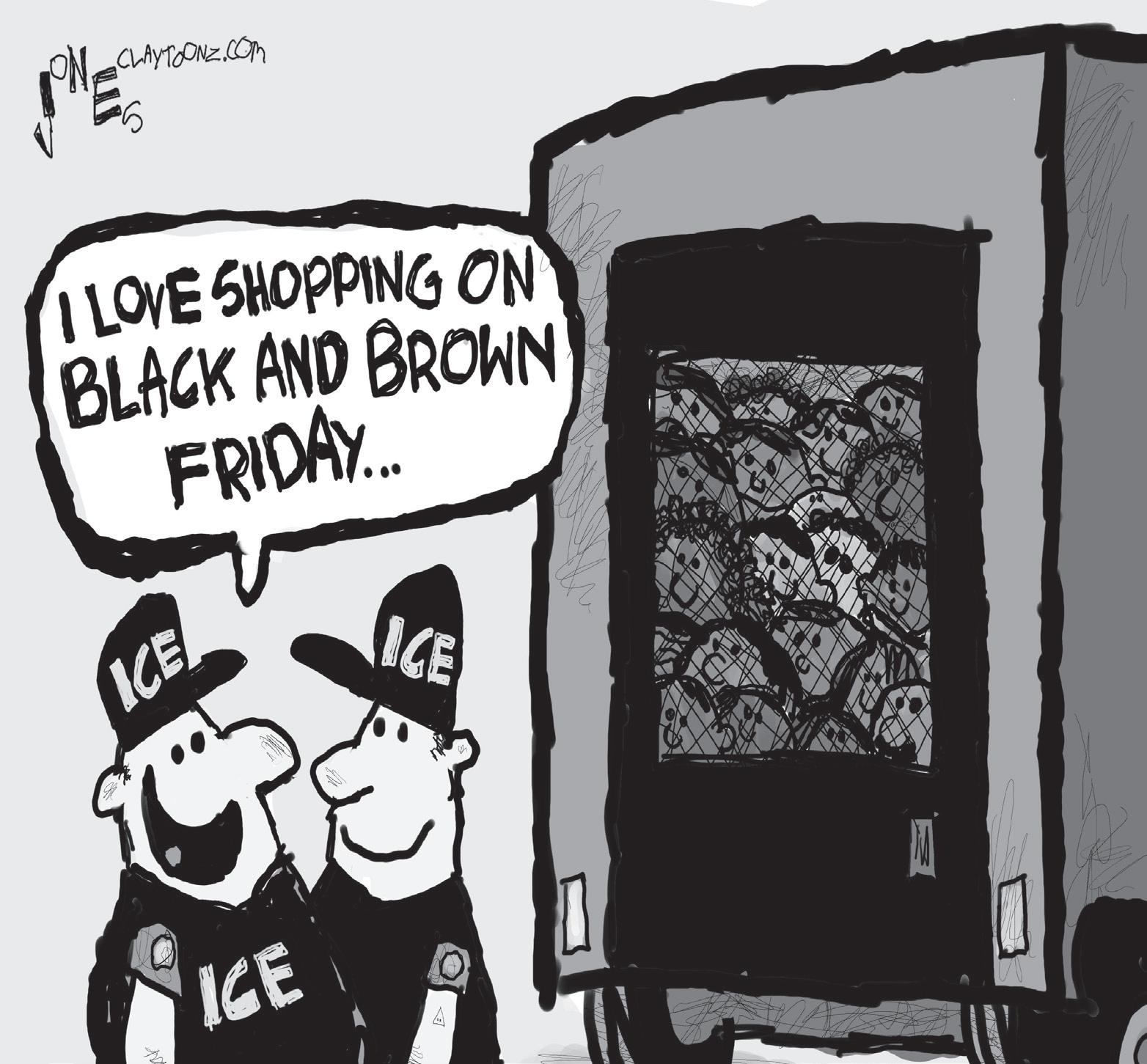
The United States Immigration and Customs Enforcement (ICE) raids are not a new invention of law and order. They are the evolution of slave patrols — by another name, in another uniform, in another century, but with the same mission: “Make America White Again.”
President Trump is stripping all references to slavery from national parks and the Smithsonian Institution in an effort to erase American history. He claims exhibits like the “Scourged Back” promote “corrosive ideology” and “unfairly disparages Americans.”
He embraces a long American tradition of reshaping history to obscure injustice, clearing a path to revive America’s ugliest machinery of racial control.
Slave patrols, or paddy rollers, hunted and captured Black people in the antebellum South, enforcing terror under the guise of “law and order.”
Established in 1704 in South Carolina, they were formally abolished after the Civil War but evolved into the Ku Klux Klan, lynch mobs, and modern policing. Today ICE uses the
same logic — state-sanctioned violence to intimidate and abuse communities of color.
The ruins of segregation remain visible. Redlining denied Black and Brown families opportunities to build wealth and shaped political maps, weakening political power. In neighborhoods once marked “hazardous,” police presence remains pervasive, trapping generations in cycles of poverty.
ICE raids, detention, and deportation rely on surveillance programs like ImmigrationOS to track undocumented people, residents, and citizens alike. Families are torn apart during marriage, citizenship, and naturalization processes. These practices are not about safety, but domination and whitening America.
IT Company seeks DevSecOps Engineer to integrate security practices into DevOps workflows, automate security checks, and ensure the safety of cloud infrastructure. Work closely with development and security teams to enhance the security posture of applications and systems. Build and Configure delivery environments by using CD/CI, Agile delivery methodologies. Create and assist in performing various types of tests. Perform troubleshooting. Generate customized reports. Offered Salary: $116,480.00 to $116,500.00/yr. Send resumes to: HRD, VITS Consulting Corp., 14264 23rd Ave N, Plymouth, MN 55447. Minnesota Spokesman-Recorder
By Justin Pearson and Sacoby Wilson
As corporations race to build massive data centers for AI and cryptocurrency, Black and fenceline communities are disproportionately affected. These centers consume vast energy and water resources while emitting pollution. Boxtown, on the south side of Memphis, is a stark example.
The people of Boxtown are fighting back. Memphis Community Against Pollution (MCAP), in partnership with the Center for Engagement, Environmental Justice, and Health INpowering Communities (CEEJH INC), monitors local air quality and uses the data to challenge xAI’s operations. Some turbines have been removed, and part of the facility shifted to grid power, but more work remains.
under the federal AI Action Plan are accelerating data center construction, with Black communities in Bessemer, Alabama, and Prince George’s County, Maryland, targeted.
2. Don’t take the bribe. Local governments may chase tax revenue at the expense of public health. Residents must hold elected officials accountable.
History warns us where this leads. In 1989, five Black and Latino teenagers, the Central Park Five, were wrongfully accused of rape. Donald Trump inflamed hysteria with fullpage ads demanding, “BRING BACK THE DEATH PENALTY. BRING BACK OUR POLICE!” Decades later, similar narratives persist. President Trump calls Black and Brown children
submissions@spokesman-recorder.com
submissions@spokesman-recorder.com
ads@spokesman-recorder.com
submissions@spokesman-recorder.com.
“roving bands of youth,” justifying militarized policing and invasive operations in communities like Washington D.C. Minor infractions, from jaywalking to fare-dodging, become criminalized, devastating lives.
The consequences are deadly. On Sept. 8, 2025, the U.S. Supreme Court ruled that ICE may use race and language as proxies for citizenship, legalizing racial profiling at the federal level. This mirrors slave patrols’ mandate and Arizona’s SB1070 law. Racialized communities are now legally hunted, harassed, and criminalized under the guise of public safety.
Facing recruitment challenges, ICE has lowered standards to expand its force. Secretary of Homeland Security Kristi Noem announced that the agency will waive age limits for applicants, echoing historical tactics where Black and Brown individuals were coerced into policing their own communities. ICE continues that legacy, perpetuating fear and control.
On Sept. 30, 2025, federal agents conducted a pre-dawn raid in a predominantly Black Chicago neighborhood, arresting 37 people, most of whom were U.S. citizens. These raids are not about public safety; they are about intimidation, control, and maintaining racial hierarchy.
Yet resistance persists. Across the country, volunteers, lawyers, organizers, and churches act as a modern-day Underground Railroad, providing sanctuary and protection from detention and deportation. Every act of care is resistance, proving that love, courage, and community can foster freedom even under oppression.
As George Santayana warned, “Those who do not remember the past are doomed to repeat it.” From mass incarceration to mass deportation, ICE raids, police surveillance, and detention centers are modern “slave patrols,” proof that “Making America White Again” remains business as usual.
This article first appeared in New York Amsterdam News. It has been edited for length. For more information, visit www. amsterdamnews.com.
Founded by formerly enslaved people, Boxtown has long borne the brunt of industrial pollution, hosting 18 facilities that release toxins into the air and water. Its cancer rate is four times the national average, and it ranks second nationally for asthma-related ER visits. Last year, Elon Musk’s xAI built “the largest AI data center on the planet” nearby, bringing methane-fueled turbines without proper permits. Peak nitrogen dioxide levels jumped 79% near the facility. Living near pollution sources is linked to higher rates of asthma, respiratory disease, and other chronic conditions. Structural racism ensures that Black Americans are 75% more likely to live near hazardous facilities. Children in these areas face missed school days and long-term economic and health consequences.
Environmental justice activists have long fought similar harms from landfills, sewage plants, and industrial facilities. Their lessons are clear for communities facing data center threats:
1. Find out if your neighborhood is next. Relaxed regulations
3. Do your own research. Communities can monitor air quality themselves to gather reliable evidence, as MCAP and CEEJH have done.
4. Contact elected officials. Know zoning laws, understand approval processes, and organize neighbors to ensure no polluting facility is built without community consent.
The fight in Boxtown illustrates the urgent need for vigilance. Data centers may promise economic growth, but they should not come at the cost of Black communities’ health, safety, and lives.
This commentary was originally published in Word in Black. It has been edited for length, but retains original language. For more information, visit www. wordinblack.com.
By Susan Breedlove
Walking through Theodore Wirth Park, you might notice a colorful garden with children tending rows of vegetables and a giant chair that beckons visitors to pause. This is the J.D. Rivers Children’s Garden, a living testament to the vision of Ada Collier Rivers and her late husband, J.D. Rivers, who recognized decades ago that access to land, nature, and hands-on learning could transform the lives of North Minneapolis youth.
What began in 1982 as a modest effort inspired by a Minneapolis Grain Exchange centennial project has become a cornerstone of community engagement. Each summer, children and teens cultivate crops, harvest produce, and learn the value of healthy eating. High school youth gain employment and mentorship, while local volunteers and university partners guide the next generation of gardeners and community leaders.
Ada Collier Rivers, a lifelong Northsider and retired nurse, helped make this pos-
sible. She saw early on that gardening was not just about growing vegetables, it was about growing resilience, responsibility, and connection. Through her work, children learned more than agriculture; they learned about community, leadership, and sustaining a legacy of care for the people and the land around them.
Today, as urban communities across the country grapple with food insecurity, shrinking youth programs, and disinvestment, the Rivers’ vision offers a blueprint. Investing in spaces where children can learn, create, and lead is more than charitable, it’s essential. Gardens like the one in Theodore Wirth Park foster education, nurture health, and build the social fabric of our neighborhoods. They are living laboratories for equity and empowerment.
The J.D. Rivers Children’s
Garden is a reminder that the greatest gifts we can give our communities are those that cultivate people, not just crops. Ada Collier Rivers’ legacy is not only in the plants growing in the garden but in the generations of youth who carry forward the values of stewardship, joy, and community leadership. In honoring this work, we recognize that when we invest in our children and neighborhoods, we are planting seeds for a stronger, healthier, and more equitable future.
This op-ed was inspired by Ada Collier Rivers, a lifelong North Minneapolis resident, community leader, and co-founder of the J.D. Rivers Children’s Garden, who turned 100 in 2025. Her century of life and service is a reminder of the power of dedication, community, and legacy.
Employment & Legals
Residential Home Supervisor, (Multiple Positions), Relief Homecare, LLC, Burnsville, MN
Coordinate the operations of group homes and personnel; Program documentation at a high level, ensuring extensive daily documentation and all documentation is up to date. Train and oversee the staff’s data collection and regularly review and collect and monitor the program data collection. Attends quarterly and annual meetings with residents; Responds to emergencies situations as needed; Provide support and oversight as needed Provide periodic training and oversite to compliance-related task. B.A or B.Sc required. Re-
Phone: 612-827-4021 FOR BILLING INQUIRIES & TEARSHEETS
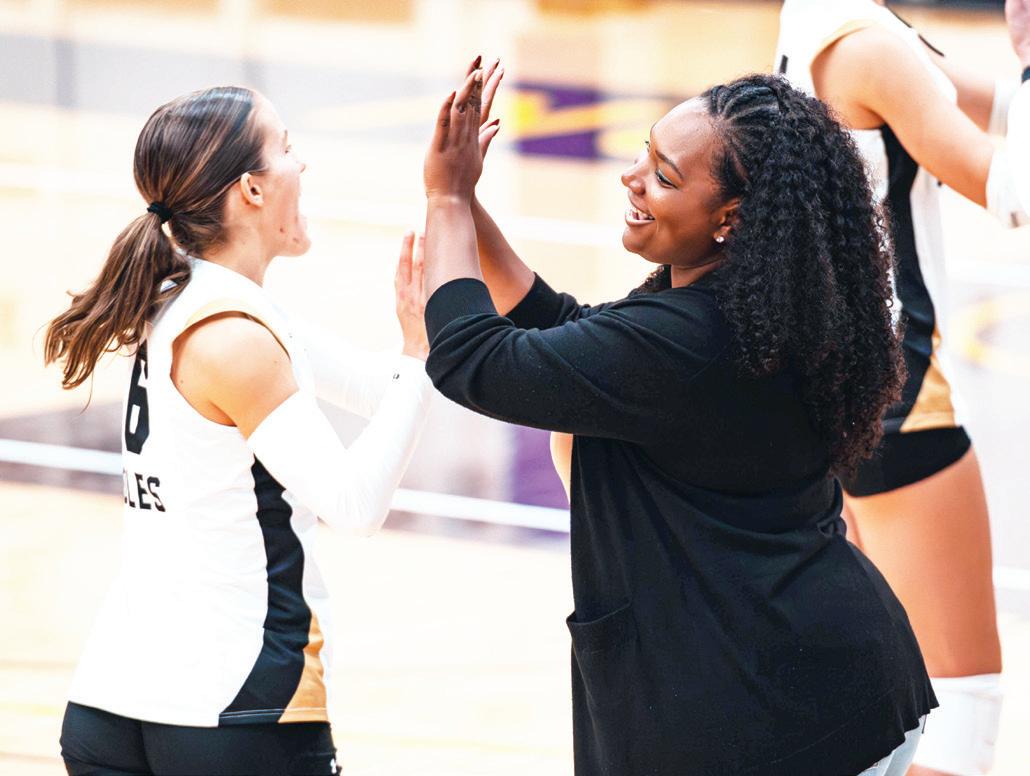
coaches since 2013-14— 48%. In this year’s regionals, Wood and Asbury head coach Tiffany Horton were the only two Black head coaches in the field. Horton, like Wood, was named her conference’s coach of the year.
“I had to congratulate Tiffany and let her know how proud I was,” Wood said.
“Our representation hopefully makes an impact and is making a difference in volleyball communities around us.”
said. “When I gave up basketball and found volleyball, my dream transferred to coaching at the highest level in volleyball. My goal has always been to be a college head coach, and DIII philosophy really aligns with my values.”
VIEW
Continued from page 10
Please proof, respond with email comfirmation to ads@spokesman-recorder.com The MSR handles billing digitally. This means you will get e-tears and emailed invoices unless you specifically request a hard copy.
anchor and has hosted the network’s WNBA studio show and College GameDay coverage for women’s college basketball.
Netflix hires first full-time sports anchor Netflix recently signed Elle Duncan as its first full-time sports personality and anchor. Duncan joined ESPN in 2016 as a SportsCenter
Netflix reportedly also pursued fellow ESPN star Malika Andrews, but Andrews signed a new long-term deal to remain with the network.
Charles Hallman welcomes reader comments to challman@ spokesman-recorder.com.
ultimately up to each newspaper. Ads may need to be decreased/increased slightly in size to fit your column sizes. Please do not bill for these ads. If you have questions, please call MNA at 612/332-8844. Thank you.
Wood’s first season at St. Olaf ended 19-10, with a MIAC playoff berth. She started her coaching career in Ohio and Indiana at the high school and club levels after graduating from Ursuline College in 2015 with a double major in sports management and business administration, and a minor in coaching. She arrived at St. Olaf in 2024 after four seasons as Illinois College head coach, where she won conference coach of the year in her final season. She previously held assistant positions at DePauw University (2018–19) and three seasons at Cuyahoga Community College. Interestingly, Wood didn’t
Wood emphasized that St. Olaf’s success is meant to be sustainable, not a oneseason phenomenon. “Continuing to schedule tough opponents and recruiting well are big priorities,” she said. “People know about St. Olaf, but they haven’t seen us as a powerhouse. Our challenge now is to prove consistently that we’re an NCAA competitor.”
game. The shirts listed victims’ names and featured a police shield to acknowledge Dallas officers ambushed at the same time.
newspaper has agreed to participate in the Minnesota Display Ad Network program by running in the main news section of your newspaper (not the classified section of your newspatimes, advertisers may request a specific section. However, the decision is ultimately up to newspaper. Ads may need to be decreased/increased slightly in size to fit your column sizes. not bill for these ads. If you have questions, please call MNA at 612/332-8844. Thank you.
“If people don’t see us for how capable we are, we’re going to prove it and continue to prove it,” she concluded.
Finally… Former Gopher WBB player Gadiva Hubbard, now in her second season as North Florida assistant coach and basketball operations director, was on the bench as the Ospreys defeated Bethune-Cookman 61-57 in the Osprey Thanksgiving Classic last Friday.
Charles Hallman welcomes reader comments to challman@ spokesman-recorder.com.
“I told my captains, ‘I want us to use our voices for change. I don’t know what it looks like,’” Reeve said. The players held a pregame press conference, with Reeve notifying the league, not seeking permission.
The Lynx, one of Minnesota’s most successful pro sports franchises, four championships in seven years, set a standard for racial justice advocacy locally and league-wide.
“I was incredibly proud of our franchise for stand-
ing behind us,” Reeve said. “We’ve tried to get involved in legislating locally…to impact lives. I want our players to feel empowered. Did we make a difference in the community, in their lives, and across the country?”
“I believe that when the unaffected, White people, other marginalized groups, recognize they can be af fected, that’s when change happens,” Reeve concluded.
Finally… The latest Seton Hall Sports Poll reports 58% of Americans support a potential WNBA players’ strike. At press time, no new collective bargaining agreement had been reached, the 30-day extension expired Nov. 30, making a strike or owners’ lockout possible.
Charles Hallman welcomes reader comments to challman@ spokesman-recorder.com.
Sports
Wood leads St. Olaf volleyball to historic season
licia Wood guided St. Olaf to one of the school’s best volleyball seasons ever, finishing the MIAC regular season undefeated at 11-0 and earning the league’s top seed in last month’s postseason tournament in her second season on the Hill in Northfield, MN. The Oles captured two of the league’s four major awards: Wood was named MIAC Coach of the Year by the coaches, while senior Morgan Ryan repeated as MIAC Defensive Player of the Year.
Although St. Olaf fell in five sets to Saint Benedict in the MIAC finals, the team earned an at-large bid to the NCAA Tournament, advancing to the round of 32 in the DIII Regionals before losing in five sets to regional host Illinois Wesleyan. The squad finished 27-9, the most wins since 2010.
ear the end of the Nov. 24 “Finding Forward” event at St. Thomas, school President Rob Vischer asked Minnesota Lynx Head Coach Cheryl Reeve what women’s sports issues deserved more attention. Her answer was simple: “women coaches.” Ironically, if the 2026 WNBA regular season starts as scheduled, there will be zero Black female head coaches. Noelle Quinn, the only Black female coach, was fired by the Seattle Storm after five seasons. Now in her second year as a head coach in the upcom-
“Yes, very glad that we were able to get to the NCAA tournament, finish in the second round, and make history again for our program,” Wood said in a phone interview with MSR last week. “A lot to be proud of.” Wood also made history as the first MIAC coach of color
to win the league’s top coaching honor. When asked about diversity in the sport, she noted that representation among Black athletes and coaches is growing.
“Yes, very glad that we were able to get to the NCAA tournament, finish in the second round, and make history again for our program. A lot to be proud of.”
“I think the diversity among the athletes is growing, especially in DIII,” Wood said. “The most representation of Black athletes is in Division I and II. Division III is significantly lower, but it’s growing from a head coach perspective as well.”
NCAA racial demographics reported in February showed that DIII saw the largest percentage increase in Black head
Cleaning up notebook
By Charles Hallman Sports Columnist
BA ticket prices: Timberwolves among the most expensive
A new study shows the Minnesota Timberwolves are the sixth most expensive NBA team to see live.
Using SeatGeek data, Japanese iGaming hub eSportstars. io analyzed ticket prices from all 30 NBA teams, ranking them from highest to lowest average cost. The Los Angeles Lakers top the list at $365.75, followed by Golden State ($279.47), Boston ($247.96), New York Knicks ($238.49), Dallas ($215), and Minnesota ($189.43). Charlotte fans get the best deal, with an average ticket price of just $82.
Brain injury awareness in sports
Earlier this year, the Drake Education Fund sponsored a webinar on brain injuries. Dr. Desiree Boyd, an associate professor of neurology and pathology at Mt. Sinai School of Medicine, was the only Black panelist on the six-person discussion, “Brain Injury in Sport: How We Have Failed Athletes and Their Families.”
“I’ve been involved in the assessment of brain-related injuries since the ’90s and graduate school,” Boyd said. “I’ve developed an expertise in neuropsychological assessment with a special emphasis on etiologic factors that influence measurement.”
“It’s a tricky measurement,” she stressed. “Neuropsychological testing isn’t a brain
scan, but it’s more accessible and can track performance over time. My goal is to increase awareness, be a resource to the panelists and participants, and generate interest on campuses that currently don’t provide neuropsychological evaluation support for student athletes.”
Los Angeles Lakers top the list at $365.75… and Minnesota at
SCORE Act faces congressional delay
According to an October Gallup poll, the Republicancontrolled Congress’ approval rating has fallen to 15%, down
11 points from last year.
Before the month-long government shutdown, 31 Division I conference commissioners, including four HBCU leaders, sent a letter urging passage of the SCORE (Student Compensation and Opportunity Through Rights and Endorsements) Act (H.R. 4312). The bill advanced out of two House committees this summer but lacks the 218 votes needed for a full floor vote, as Republican leadership delays action.
“We urge Congress to pass the SCORE Act to bring long-term stability to college sports,” read the October 10 letter. “To have that legislation open up fair compensation for student athletes is something we’re excited about,” SWAC Commissioner Charles McClelland told MSR during conference basketball media days in Birmingham.
■ See CLEANING on page 9
ing Unrivaled 3-on-3 league, Quinn recently told reporters,
“It’s not by accident; I believe it’s intentional. Representation is possible when leadership chooses to make it possible.”
women of color, Black women. It’s inexcusable not to have Black female head coaches.”
Last season, the WNBA had only three Black coaches: Quinn, Chicago’s Tyler Marsh, and Sydney Johnson in Washington. Next season, only Marsh and Johnson, both men, remain.
The “Finding Forward” series aims to “help build trust, foster empathy, and move forward together.” Reeve, a recent guest, discussed her role as a racial ally, among other topics.
you are White, being a racial ally means that you use your White privilege to challenge everyday racism.”
Reeve recalled the sum mer of 2016, an inflection point around police shootings of Black people. She shared a personal experience: being pulled over by police and real izing, “I’m White, I can move.” Coaching primarily women of color, she emphasized the im portance of understanding the issues their families face daily.
“It’s obviously a big miss,”
Reeve told MSR after the event.
“It’s concerning. We’re going to continue to bring that to light, not just women’s coaches, but
According to Utah State University’s “Racial Healing Handbook” (2021), “A racial ally is someone who actually supports others who are experiencing racial injustice…If
That summer, following the deaths of Alton Sterling and Philando Castile, Reeve sup ported her players wearing warm-up T-shirts with Black Lives Matter before a home
Alicia Wood Photos courtesy of St. Olaf Athletics
Alicia Wood Photos courtesy of St. Olaf Athletics
Charles McClelland Photos by Charles Hallman/MSR Elle Duncan
Amaya Battle Ronnie Porter Alayna Contreras Tessa Johnson Liv McGill