LIDS
Editor
Amanda Moore
Design & Illustrations
Sonia Monti Writers
Michaela Jarvis
Greta Friar
Grace Chua
Carlos Eduardo C de Souza
Proofreading
Vendi Pavic
Photography Credits
Portrait of Sertac Karaman credit Andy Ryan 2024. Portrait of Manish Raghavan credit Qudus Shittu, 2024.
Photos of Nils Sandell and Marija Ilic courtesy of the interviewees.
Portrait of Sirui Li credit Stephen Sullivan. Photos of Sirui Li and Yi Tian credit Rui An.
Photos of LIDS 2024 Graduation Celebration credit Shyla Putrevu.
Massachusetts Institute of Technology
Laboratory for Information and Decision Systems
77 Massachusetts Avenue, Room 32-D608
Cambridge, Massachusetts 02139
lids.mit.edu
About LIDS
The Laboratory for Information and Decision Systems (LIDS) at MIT, established in 1940 as the Servomechanisms Laboratory, currently focuses on four main research areas: communication and networks, control and system theory, optimization, and statistical signal processing. These areas range from basic theoretical studies to a wide array of applications in the communication, computer, control, electronics, and aerospace industries. LIDS is truly an interdisciplinary lab, home to over 150 graduate students and post-doctoral associates from EECS, Aero-Astro, and many other departments across MIT. The intellectual culture at LIDS encourages students, postdocs, and faculty to both develop the conceptual structures of the above system areas and apply these structures to important engineering problems.
Table of Contents
A Message from the Director 06. Algorithms and AI for a Better World 08. The Best of Both Worlds: A Love of Abstract Math Leads to a Career Developing Real-World Solutions 12. Nils R. Sandell, Jr.: A Phased-Array Career Aimed at Public Service 18.
Marija Ilic and SmartGridz: Enabling a Resilient Energy Transition
Sound Bytes with Carlos Eduardo C de Souza
LIDS Seminars 2023-2024 LIDS Community
LIDS Graduation Celebration
LIDS Awards and Honors
2024 LIDS Student Conference New LIDS Faculty
A Message from the Director
Thank you for reading our 20th volume of LIDS/All magazine!
The 2023-24 academic year saw our community grow and thrive as we welcomed new faculty and students, advanced research in critically important domains such as autonomy, sustainability, and society, while continuing to play a major role in shaping education and research as part of the Schwarzman College of Computing.
This year, brought in new faculty and ideas from Earth, Atmospheric, and Planetary Sciences (EAPS), Electrical Engineering and Computer Science (EECS), Economics (Econ), Mechanical Engineering (MechE), the Institute for Medical Engineering & Science (IMES), and the Sloan School of Management.
In this volume, we highlight the work, research, and activities of our community of PIs, students, alumni, and research staff.
A profile of PI Manish highlights his research push towards better solutions to longstanding societal problems. Recent alumna Sirui Li, PhD ’25 SES + Statistics shares how her love of abstract math unexpectedly led her to work on real-world problems like fixing traffic congestion, improving workflows in factories and train stations, or speeding up how quickly a package gets delivered to your door. In another article, alum Nils Sandell takes us on a journey of invention, entrepreneurship, and public service – from a Bell Labs fellowship, to studying and teaching at MIT and LIDS, leading LIDS spinout Alphatech, and finally, leading DARPA’s Strategic Technology Office.
In a 5Q, LIDS Postdoctoral Research Fellow
Carlos Eduardo C de Souza shares about his research interests and how he came to be a part of this very special LIDS community –don’t miss his “top 3” recommendations! And, in the second installment of our new
feature focused on LIDS start-up culture, we highlight SmartGridz, a start-up launched by LIDS Senior Research Scientist Marija Ilic that aligns with her multi-decade mission to understand how to model, simulate, monitor and control electric power systems to make them more efficient and address societal challenges – and yes, prevent blackouts and other disruptions.
We hope you enjoy reading about the exceptional people in our community in this volume – we look forward to the next 20 installments!
Best,
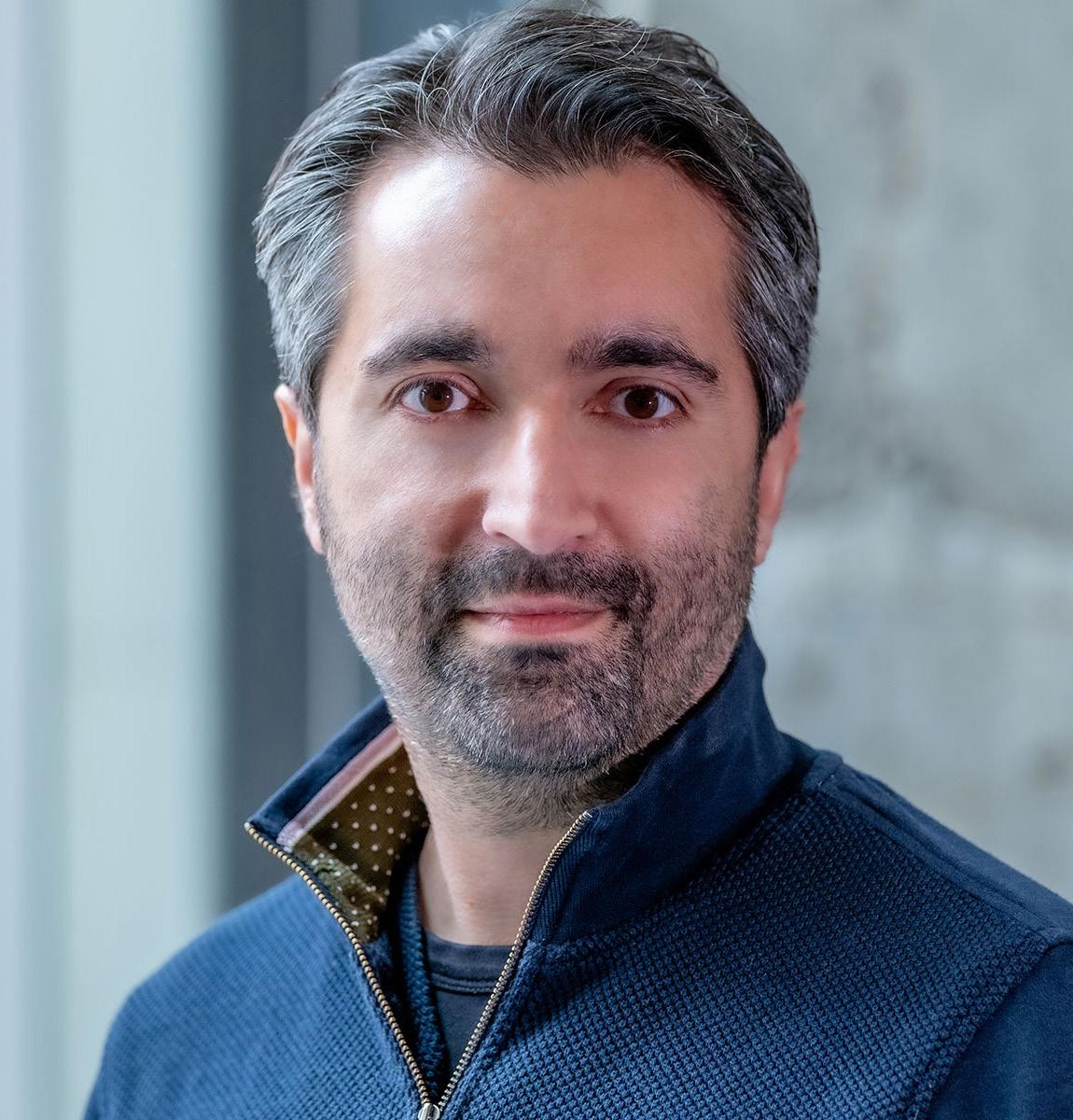
Sertac Karaman, Director
Algorithms and AI for a Better World
By Michaela Jarvis
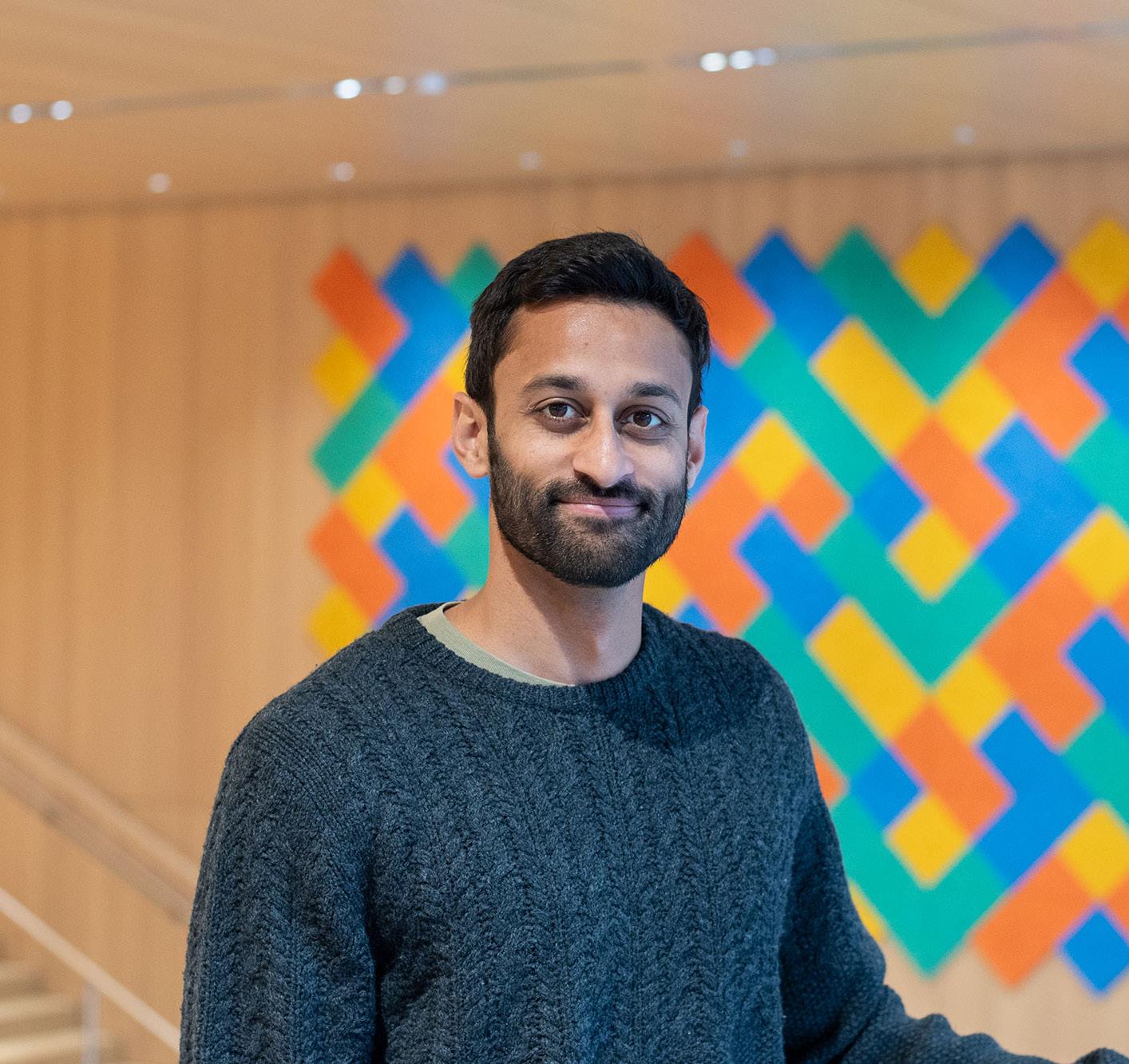
Professor Manish Raghavan wants computational techniques to help solve societal problems.
Amid the benefits that algorithmic decisionmaking and artificial intelligence offer –including revolutionizing speed, efficiency, and predictive ability in a vast range of fields – Manish Raghavan is not only working to mitigate associated risks but is seeking opportunities to apply the technologies to help with pre-existing social concerns.
“I ultimately want my research to push towards better solutions to long-standing societal problems,” says Raghavan, the Drew Houston Career Development Professor who is a shared faculty member between the MIT Sloan School of Management and the MIT Schwarzman College of Computing in the Department of Electrical Engineering and Computer Science, as well as a principal investigator at the Laboratory for Information and Decision Systems (LIDS).
A good example of Raghavan’s intention can be found in his exploration of the use of AI in hiring.
Raghavan says, “it’s hard to argue that hiring practices historically have been particularly good or worth preserving, and tools that learn from historical data inherit all of the biases and mistakes that humans have made in the past.”
Here, however, Raghavan cites a potential opportunity.
“It’s always been hard to measure discrimination,” he says, adding, “AI-driven systems are sometimes easier to observe and measure than humans, and one goal of my work is to understand how we might leverage this improved visibility to come up with new ways to figure out when systems are behaving badly.”
Growing up in the San Francisco Bay Area with parents who both have computer science degrees, Raghavan says he wanted to be a doctor. Just before starting college, though, his love of math and computing called him to follow his family's example into computer science. After spending a summer as an undergraduate doing research at Cornell with Jon Kleinberg, professor of computer science and information science, he decided he wanted to earn his PhD there, writing his thesis on “The Societal Impacts of Algorithmic Decision-Making.”
Raghavan won awards for his work, including a National Science Foundation Graduate Research Fellowships Program award, a Microsoft Research PhD Fellowship, and the Cornell University Department of Computer Science PhD Dissertation Award.
In 2022, he joined the MIT faculty.
Perhaps hearkening back to his early interest in medicine, Raghavan has done research on whether the determinations of a highly accurate algorithmic screening tool used in triage of patients with gastrointestinal bleeding, known as the GlasgowBlatchford Score (GBS), are improved with complementary expert physician advice.
“The GBS is roughly as good as humans on average, but that doesn’t mean that there aren’t individual patients, or small groups of patients, where the GBS is wrong and doctors are likely to be right,” he says. “Our hope is that we can identify these patients ahead of time so that doctors' feedback is particularly valuable there.”
Raghavan has also worked on how online platforms affect their users, considering how social media algorithms observe the content a user chooses and then show them more of that same kind of content. The difficulty, Raghavan says, is that users may be choosing what they view in the same way they might grab bag of potato chips, which are of course delicious but not all that nutritious. The experience may be satisfying in the moment, but it can leave the user feeling slightly sick.
Raghavan and his colleagues have developed a model of how a user with conflicting desires — for immediate gratification versus a wish of longer-term satisfaction — interacts with a platform. The model demonstrates how a platform’s design can be changed to encourage a more wholesome experience. The model won the Exemplary Applied Modeling Track Paper Award at the 2022 Association for Computing Machinery Conference on Economics and Computation.
“Long-term satisfaction is ultimately important even if all you care about is a company’s interests,” Raghavan says. “If we can start to build evidence that user and corporate interests are more aligned, my hope is that we can push for healthier platforms without needing to resolve conflicts of interest between users and platforms. Of course, this is idealistic. But my sense is that enough people at these companies believe there’s room to make everyone happier, and they just lack the conceptual and technical tools to make it happen.”
Regarding his process of coming up with ideas for such tools and concepts for how to best apply computational techniques, Raghavan says his best ideas come to him when he’s been thinking about a problem offand-on for a time.
He would advise his students, he says, to follow his example of putting a very difficult problem away for a day and then coming back to it.
“Things are often better the next day,” he says.
When he's not puzzling out a problem or teaching, Raghavan can often be found outdoors on a soccer field, as a coach of the Harvard Men’s Soccer Club, a position he cherishes.
“I can’t procrastinate if I know I’ll have to spend the evening at the field, and it gives me something to look forward to at the end of the day. I try to have things in my schedule that seem at least as important to me as work to put those challenges and setbacks into context.”
As Raghavan considers how to apply computational technologies to best serve our world, he says he finds the most exciting thing going on in his field is the idea that AI will open up new insights into “humans and human society.”
“I’m hoping that we can use it to better understand ourselves.”
The Best of Both Worlds: A Love of Abstract Math Leads to a Career Developing Real-World Solutions

By Greta Friar
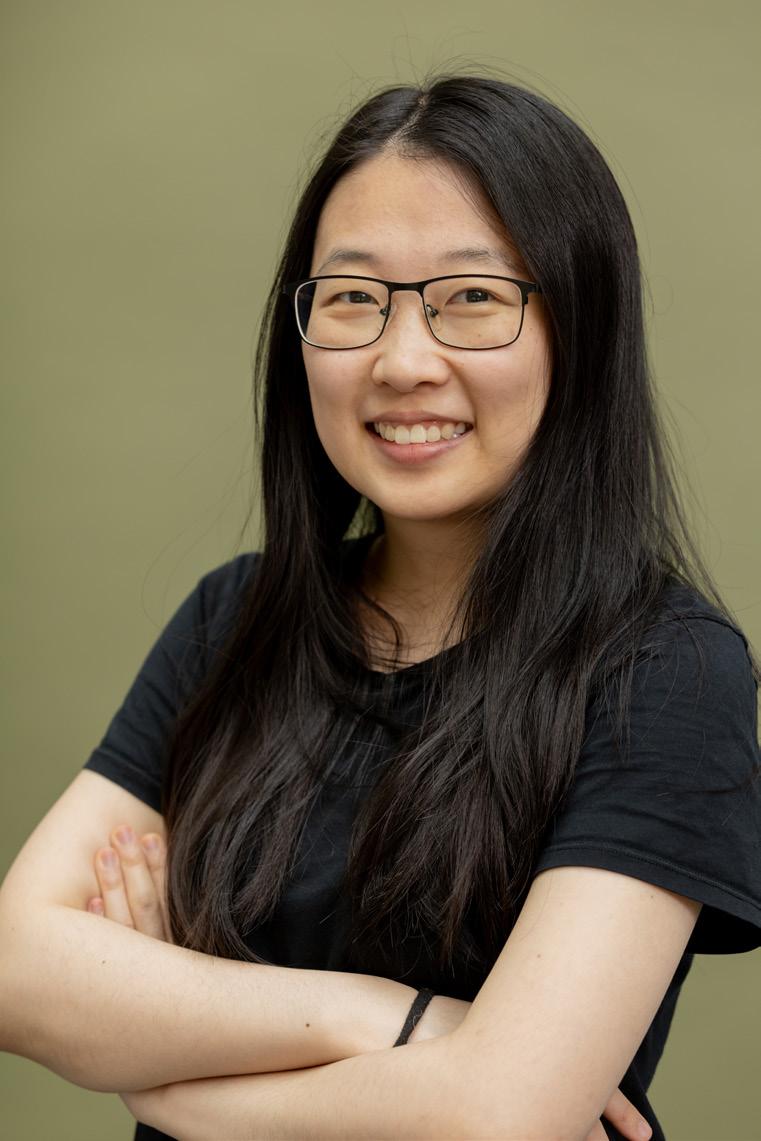
Sirui Li, PhD ’25 SES + Statistics, has developed strategies to solve many different real-world problems using machine learning, classical algorithms, and hybrid approaches that combine the two, but when she started her PhD, she never would have guessed that her work would touch on so many areas.
“When I entered the field, I just loved doing rigorous proofs. I had no idea that I would be working on problems like fixing traffic congestion, improving workflows in factories and train stations, or speeding up how quickly a package gets delivered to your door, but it’s very interesting to work on projects that could actually improve daily life,” Li says.
The release of Alpha Go, the machine learning program capable of beating professional Go players, during Sirui’s undergraduate years at Washington University in St. Louis made her realize that machine learning could be applied to problems that she cared about. Sirui grew up playing Go, and she found it fascinating how Alpha Go used the same sort of math that she was learning to win at a game she loved to play. She became interested in how her work in abstract mathematical spaces could lead to real-world solutions.
Sirui entered MIT’s doctoral program in Social and Engineering Systems (SES), which focuses on solving social problems using computation and math. She joined the lab of Cathy Wu, an associate professor in the Department of Civil and Environmental Engineering and the Institute for Data, Systems, and Society and a principal investigator in LIDS and began working to improve modern transportation systems by figuring out how to solve problems in that area more efficiently, as well as developing proofs to guarantee the performance of new technologies and approaches. At MIT, Sirui worked on problems including large scale vehicle routing as used by ride-sharing apps, using autonomous vehicles to control traffic flow and ease traffic congestion, and efficiently assigning trains to platforms within a station to increase the number of on-time departures.
Many of the problems that Sirui works on are combinatorial optimization problems, in which there are a finite number of discrete possible solutions and various constraints. For example, in the case of scheduling trains, solutions must involve a whole number of trains, platforms, and switches, while constraints include the number of available switching platforms, the time it takes a train to turn around, the number of platforms available, and so on. These problems tend to be NP-hard, meaning there is no fast method for solving them.
There tends to be a large, discontinuous solution space that must be searched relatively blindly. Researchers chip away at these problems by improving how efficiently they explore the solution space and how good they are at ensuring the solution they find is (near-)optimal.
Classical approaches to solving such problems use long-established algorithms called solvers.
These algorithms tend to find accurate solutions that approach the true optimal solution eventually, but it can take them an incredibly long time to do so, often too long to be used in real-world problem solving. Figuring out which solver to use on each part of the problem can also take a very long time. Machine learning approaches are much faster, but they require a lot of computing resources—sometimes more than are available—and they are not always accurate, especially when faced with scenarios that differ from what they have been trained on. For example, in the case of routing ride-share cars, a machine learning program might be very good at routing cars within a familiar city, but not able to provide good solutions in a dissimilar city. However, machine learning approaches can be re-trained over time, and so are ultimately more adaptable than solvers.
During her time at LIDS as a member of Cathy Wu’s lab, Sirui worked on ways to get the best of both worlds—combining the advantages of solvers and machine learning—using a hybrid approach called learning-guided optimization. The approach works like this: first, Sirui and colleagues do performance profiling of a solver-based approach to figure out which step takes the most time. Then, they train a machine learning program to speed up that step.
For example, in the case of scheduling problems, such as scheduling trains at a station or jobs at a factory, the solver completes the scheduling on a rolling basis, moving forward in time as it solves the previous time period. The least efficient part of the process is that the solver must recalculate its solutions at the overlap between time periods, as some of its plans will need to be revised to account for changing needs and constraints in the later period. The solver doesn’t know which plans need to be recalculated, so it redoes all of them. The researchers trained a machine learning program to figure out which components of the plan do not need to be recalculated.
Now the solver can ignore those, speeding up the whole process. Learning-guided optimization approaches provide users with the accuracy of solvers, while benefitting from the efficiency of machine learning.
The diversity of topics to which Sirui has applied this and other problem-solving approaches is due in part to her love of collaboration. When she joined Cathy Wu's lab, the group was small, but it grew over the course of her PhD. Sirui’s favorite part of her time at MIT was discussing problems with colleagues from the lab, often doing so over snacks acquired in the nearby LIDS Lounge.
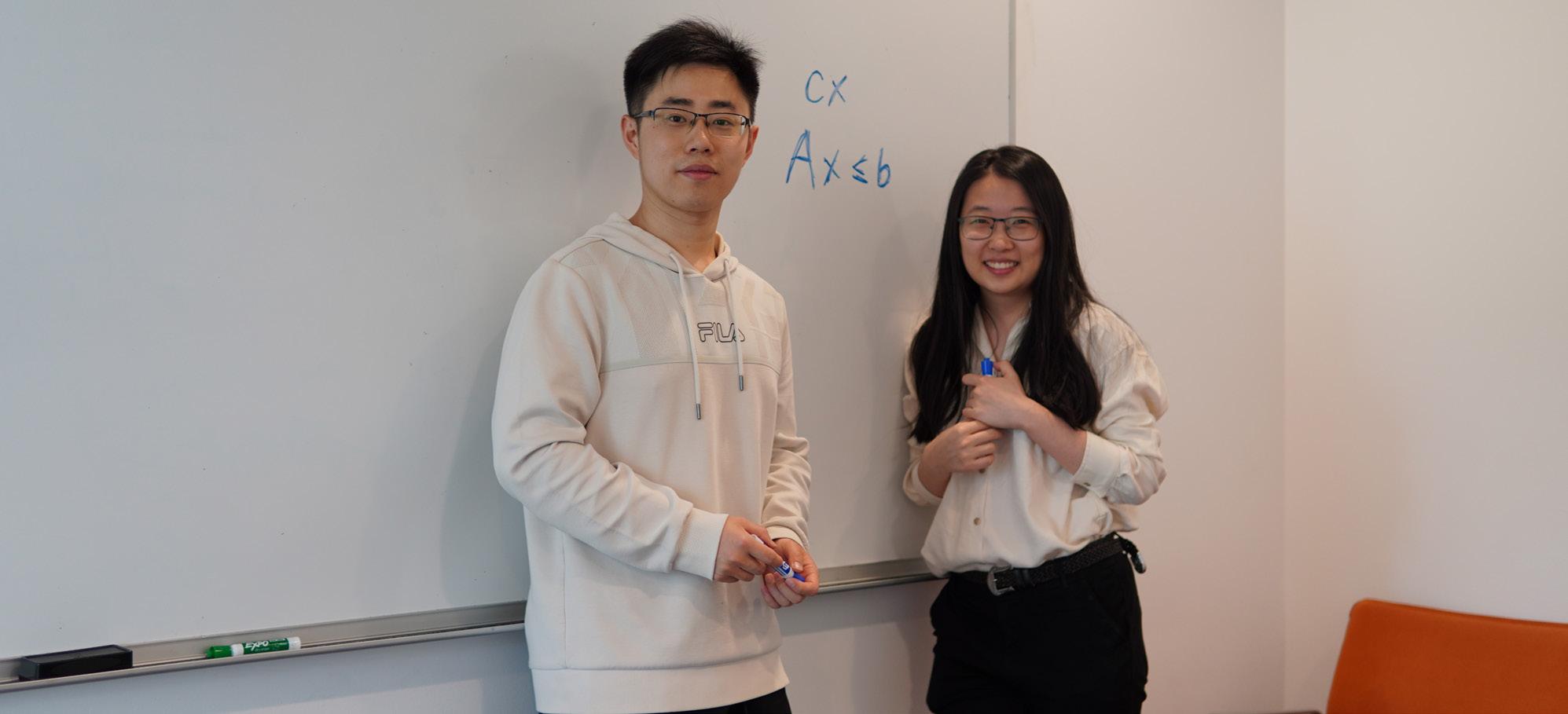
LIDS alumni Sirui Li PhD ’25 IDSS and Yi Tian SM ’21, PhD ’24 EECS. Credit Rui Ai SM ’25 IDSS.
“
I cherished our brainstorming sessions, because often we would go in with no idea how to move forward with a project, and after some time brainstorming, we would often have many creative ideas that would lead to a paper.”
Sirui and her labmates also bonded by playing ping pong and badminton.

Additionally, Sirui and Cathy would reach out to authors of recent papers of interest from other institutions to see if they could work together. Cathy also connected Sirui to a friend at the University of Illinois UrbanaChampaign, Roy Dong, who ended up becoming a frequent co-author. In each case, Sirui found that combining forces led to better solutions—much like combining machine learning and classical solvers.
Sirui is graduating this summer, and has already begun her new job as a senior research engineer at Microsoft Research.
Always interested in exploring the latest technology and approaches, Sirui is working on how to use large language models (LLMs) to solve optimization problems. In particular, she is currently focused how to translate natural language requests into properly formulated problems that an LLM can solve.
“I’m excited to see how we can use LLMs to let more people outside of the field formulate optimization problems,” Sirui says. After all, in Sirui’s experience, bringing together different approaches—such as might be suggested by people with different expertise—tends to lead to the best solutions.
LIDS alumni Sirui Li PhD ’25 IDSS and Yi Tian SM ’21, PhD ’24 EECS. Credit Rui Ai SM ’25 IDSS.
A Phased-Array Career Aimed at Public Service
By Grace Chua
Tom Swift, the Space Race, and Tech-Company
Dreams
In sixth grade, Nils Sandell caught the eye of his high-school basketball coach. At 5’10, the lanky youngster harboured dreams of shooting hoops in the NBA. Little did he know he’d already topped out at his adult height.
“I never grew another inch. Around 9th grade, I figured I’d better make alternative career plans.”
And what plans he made. Since grade school, young Nils had been inspired by the Tom Swift book's featuring a dashing young inventor who brought to life everything from rocket ships to underwater sea-copters.
“At an early age, I got interested in the idea that I should have a technological company someday,” Sandell said.
These were exciting times, too. The Cold War was in full swing, and the USSR and United States had just sent astronauts to space.
In pursuit of his entrepreneurial ambitions, Sandell studied electrical engineering at the University of Minnesota, then won an engineering fellowship at the legendary Bell Telephone Laboratories, the research facility responsible for the development of transistors, lasers, and other communication technologies.
There, he worked on a project that shaped the trajectory of his career: the Safeguard anti-ballistic missile system. Bell Labs was responsible for designing a way to protect the US’s Minuteman nuclear missile silos from attacks, and Sandell’s work there involved phased array radars, high-speed missiles to intercept incoming attacks, and the algorithms to guide and control them.
An advisor at Bell Labs suggested he attend graduate school under Michael Athans at MIT, who was soon to become Director of LIDS.
“It was the start of a long and rewarding relationship,” Sandell said.
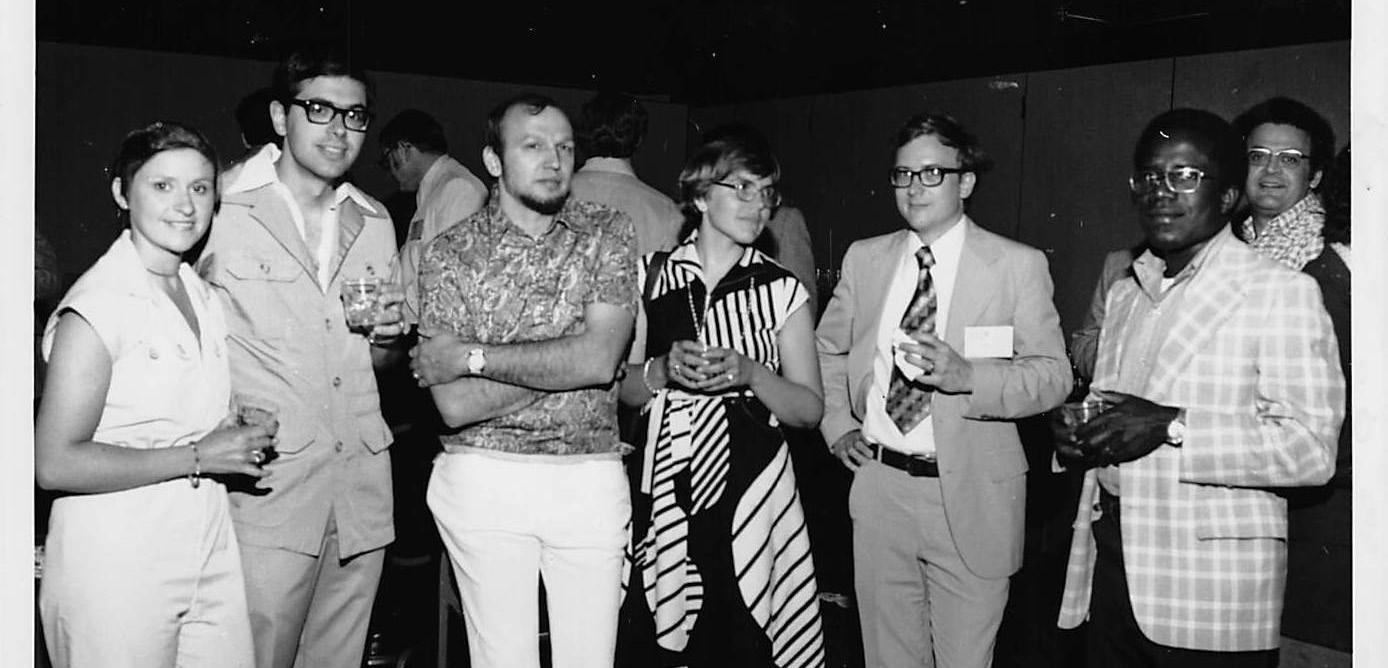
and colleagues
LIDS as a Launchpad
In that era, it was somewhat unusual for a LIDS graduate student to not want to become a professor. While at LIDS, Sandell took some courses at the Sloan School of Management, including a course in ‘New Enterprises’ that involved interviewing a company’s founders and writing a business plan. “Back in that day, that was quite unusual, and of course it was also very helpful in preparation for starting a company.”
Ironically, when Sandell graduated with his PhD, MIT was looking for a new control theory professor. Athans encouraged him to apply. Sandell got the job and did well, serving as an assistant professor from 19741975 and then an associate professor from 1976-1979.
At the time, optimal control had a number of ambitious applications, ranging from aircraft guidance to controlling the American economy.
Sandell
at a post-Eckman Award celebration. (L-R) Yvonne Sandell; Nils Sandell; Roger Brockett (formerly LIDS); Mrs Johnson; Tim Johnson '68 Economics and EECS, SM '69 EECS, PhD '72 EECS; and Earl Barnes, researcher at IBM.
A LIDS project sought to apply optimal control to the digital fly-by-wire systems of NASA’s F-8 aircraft, but when the project faltered, it marked a shift in Sandell’s thinking towards the advantages of robust control –maintaining the control system’s performance despite uncertainties and flaws in the model used to design it.
“This experience had a great influence on my thinking. I learned to be cautious in relying on simulation models — the real world is a very complicated place and computer models never capture it perfectly.”
Sandell gave credit to his excellent mentors and thinkers at MIT, such as Bill Davenport (Wilbur Davenport, ScD ’50 and chair of the Department of Electrical Engineering) and former LIDS directors such as Robert Gallagher and Sanjoy Mitter.
Not all his recollections were academic. On his lunch breaks, he would walk across Massachusetts Avenue to the gym to play pick-up basketball with graduate students and janitors alike. He played tennis with Alan Willsky (LIDS director from 2009-2014 and Professor Emeritus of Electrical Engineering & Computer Science) and was on the LIDS softball team with him.
Sandell worked hard, played hard, and started a young family with his wife, Yvonne. He was a rising star––in 1977, the American Automatic Control Council awarded him its prestigious Donald P. Eckman Award for outstanding achievements by a young researcher under age 35.
Still, he was restless. In 1979, together with Athans, Willsky, David Kleinman and Sol Gully, Sandell cofounded Alphatech, Inc., serving as President and CEO. At last, his entrepreneurial ambitions were back on track.
Addressing Real-World Security Challenges and the Dawn of Artificial Intelligence
The Alphatech team set about securing a number of government contracts. During the 1979 energy crisis, for instance, the company won a Department of Energy contract to develop an optimization algorithm for scheduling electric power systems.
Other contracts came from the Department of Defense. Alphatech built on basic research from universities to develop software prototypes for planning, battle management, automatic target recognition, and target tracking. As the company grew, it built its own research capabilities as well as expertise in deploying and fielding its software applications.
Alphatech, grew into a widely respected research company with a broad set of capabilities in defense technologies. For example, the company had three distinct artificial intelligence groups: one group focused on artificial neural networks, the
second group focused on computer vision applications such as automatic target recognition, radar or optical image recognition, and the third group worked on logic-based forms of AI with explicitly programmed rules. Later, at DARPA, Sandell was struck by how quickly neural networks outperformed classical image recognition and what was possible with massive amounts of data.
When the company was acquired by BAE Systems in 2004, Sandell became the Vice President and General Manager of BAE Systems Advanced Information Technologies (AIT), as Alphatech was renamed. “I hung around long enough to make sure that the company docked successfully with BAE Systems,” he quipped.
He retired from BAE Systems in 2010. But his career was far from over.
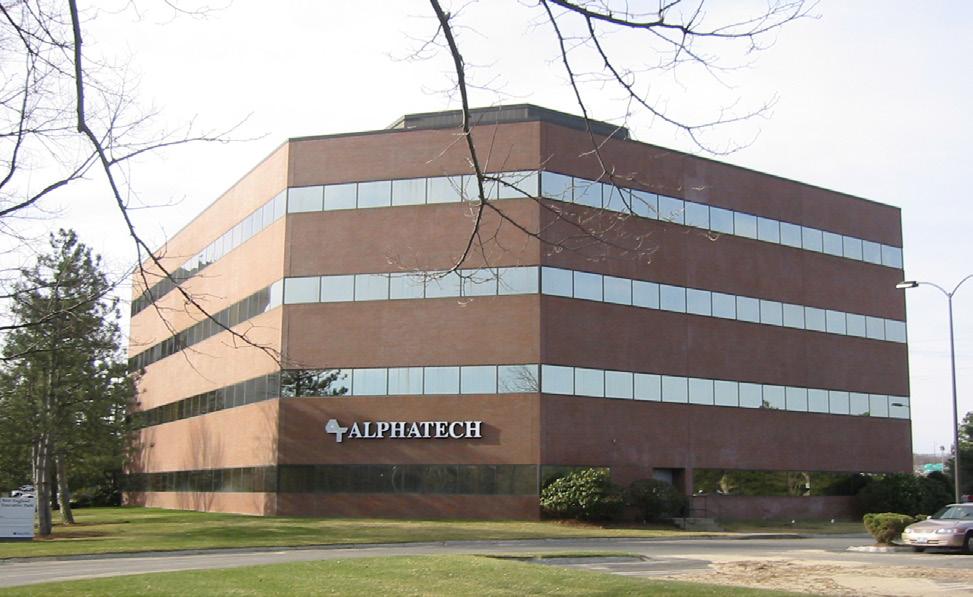
Alphatech Headquarters, 2003.
DARPA’s Strategic Technology Office and a Second Retirement

In addition to his technical expertise, Sandell had always been keen on public service. The US was embroiled in the Vietnam War while he was in university and graduate school, and several of his high school classmates saw active combat. Sandell, the son of a World War II veteran, tried to apply for the Reserve Officers’ Training Corps (ROTC) but was rejected due to poor eyesight.
So, after BAE Systems, Sandell first consulted for DARPA, the government agency overseeing emerging defense technologies, then led its Strategic Technology Office (STO), which focused on hardware programs.
Sandell skiing. Courtesy Nils Sandell.
As STO director, Sandell found himself in the position of deciding how and where research and development budgets should be distributed, having to consider how emerging technologies might evolve to fit the nation’s needs in the next five to ten years, and having to convince potential naysayers. For example, a decade ago, Air Force pilots or Navy ship commanders might have written off uncrewed vehicles––but today, drones and unmanned vessels are central to military strategy and tactics.
Another accomplishment was initiating a strategy to address highly contested environments with ‘peer competitors’ that are on a par with one’s military might. And the office had to do all this in a cost-effective manner.
After three years of commuting back and forth from Massachusetts for the role, Sandell felt he had put things on a good course at DARPA, and he retired again in 2016.
Since then, he has served on the Department of the Air Force Scientific Advisory Board, a volunteer position, and has been its chair since 2022; the board advises the Air Force on science and technology matters.
In his spare time, Sandell is an avid cyclist and skier. He and his wife Yvonne split their time between Massachusetts and Waterville Valley in New Hampshire.
He is well and truly retired from basketball.
Sandell graduates from the University of Minnesota
1970-71 1970 1979 1977
Awarded Donald P. Eckman Award by the American Automatic Control Council for outstanding young researchers in control theory
Together with Michael Athans, Alan Willsky, David Kleinman & Sol Gully, starts Alphatech Works at Bell Labs
Tom Swift Jr. novel series published by Grosset & Dunlap
The United States enters the Vietnam War Vietnam War draft
Awarded PhD from MIT
On MIT faculty The Safeguard ballistic missile defense system achieves full operational capability
2004 2010 1979
Second US energy crisis, triggered by Iranian Revolution Alphatech acquired by BAE Systems Retires from BAE Systems
Marija Ilic and SmartGridz: Enabling a Resilient Energy Transition
By Grace Chua
In April 2025, catastrophic power outages plunged much of Spain and Portugal into darkness for several hours, once again emphasizing the need for improving electricity service resiliency.
Large integration of renewables makes resiliency more critical and challenging. If the world is to decarbonize, renewable energy must make up a larger share of electricity generation. Meanwhile, the growth of AI and data centers means electricity demand continues to rise. How should electricity systems integrate more renewable resources and meet burgeoning demand?
Economic efficiency is another challenge. The United States power grid is not run as a single grid. Rather, it is managed semi-autonomously by regional electricity transmission and distribution operators. Within each of these regional grids, electricity producers bid for the opportunity to provide electric power. How do you coordinate producers across multiple regional grids so electricity supply meets demand at the lowest possible price over the widest area?
Finally, changing weather will continue to drive power outages. For example, a 2021 ice storm took out power across Texas for several days and ultimately incurred close to $200 billion in damages.
How might grid operators minimize outages and increase reliability and resilience with the equipment they have?
Enter SmartGridz.
“What happened in Europe didn’t have to happen,” says LIDS Senior Research Scientist Dr Marija Ilic, referring to the blackouts in Spain and Portugal. She could just as easily have been referring to her youth in the former Yugoslavia, where blackouts and power cuts were a fact of life.
For nearly five decades, Ilic has been on a mission to understand how to model, simulate, monitor, and control electric power systems to make them more efficient and address societal challenges – and yes, prevent blackouts and other disruptions.
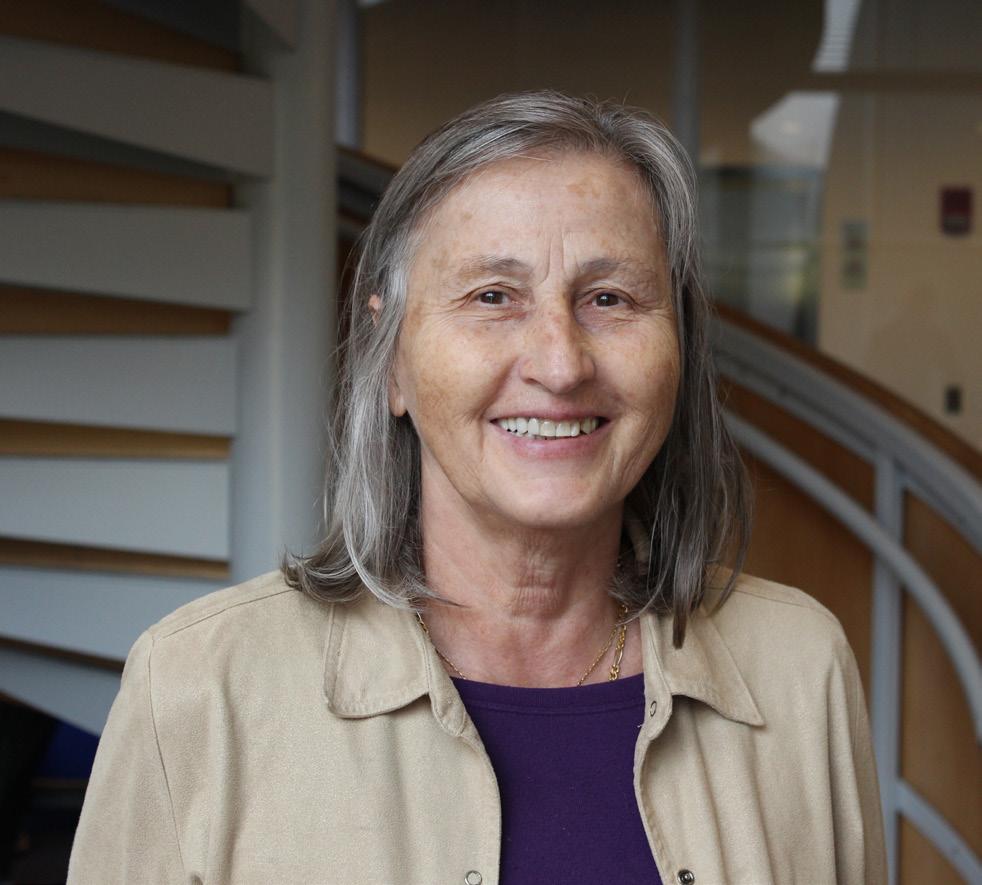
In 2002, Ilic was working to model electricity systems: not just the physical grid infrastructure with information about power for each part of the electric power system, but also the possibilities and constraints of electricity pricing and markets amid a wave of national and state-level deregulation at the time.
SmartGridz, which she founded that year, began life as an experiment suggested by a New York grid operator. Charles ‘Chuck’ King, then-vice-president of the Electricity Market at New York Independent System Operator (NYISO), had a problem.
The US Federal Energy Regulatory Commission, or FERC, was exploring the possibility of combining three existing Northeast electricity markets into one for greater market efficiency.
At the time, multilateral trading was tricky: a seller in New York State had to get approval from the NYISO while their buyer in New England had to get approval from the New England operator. This was called the ‘seams’ problem; too many such hurdles could halt transactions before they even began. How could these markets be best coordinated to achieve optimal economic and physical efficiency?
King, who happened to be an industry advisor on a doctoral thesis by one of Ilic’s early MIT doctoral students, Jeffrey Chapman, approached Ilic for help. “Chuck wanted to know if there was a software solution in which these markets clear, they coordinate, and they get optimal solutions while maintaining their independence,” Ilic said.
With $150,000 of funding, Ilic formed a company that was initially called New Electricity Transmission Software Solutions (NETSS) – now today’s SmartGridz – and brought on Electrical Engineering and Computer Science professor Jeffrey Lang.
In a summer of work, the company produced a proof-of-concept using real market data and smaller representations of the New York and New England markets.
The team discovered that the real bottleneck to trading in the Northeastern US has been sub-optimal voltage profile, which prevents trading power across large distances. This led to the company-IP which solves a challenging, large-scale nonlinear optimization problem called the AC Optimal Power Flow problem, accounting for both real power (the usable electrical energy in an alternatingcurrent circuit, measured in MegaWatts) and reactive power (the portion of power needed to keep current flowing as entropy increases, measured in MegaVars). Not modeling voltage variations and only optimizing real power leads to several fundamental problems, notably to a difficult coordination of individual markets, and solutions which are not physically implementable.
To test the concept on real-world data, NETSS / SmartGridz applied the same sort of modeling to consult for utilities. “It was just the two of us in stealth mode, convincing utilities to give us their most challenging problems.
We did a lot of this in our spare time for no money,” Ilic said. “Financially, we were not out for the kill. We just wanted to test the technology.”
SmartGridz’s AC Optimal Power Flow software models a whole power grid to guide operators on how much power, from which sources, should be channeled through which transmission lines, by adjusting plant dispatch and voltage-related set points and other controllable equipment. It also helps compute electricity pricing according to real-time demand and supply.
This can help operators schedule maintenance and plan for the future, such as managing new renewable generation capacity while keeping new transmission lines to a minimum. In extreme weather, it can provide guidance for where to reroute, reduce or cut power so that service to critical infrastructure is maintained. Earlier this year, Ilic and her colleagues published a paper showing that the software, used in conjunction with dynamic monitoring of weather and energy use, could make Puerto Rico’s grid more resilient and help grid operators integrate new solar generation and battery storage in future.
Now, Ilic and Her Team Feel SmartGridz Is Ready
to Scale.
The software has attracted interest from both grid operators and renewable energy developers who want to know how to add capacity to the system while utilizing the same infrastructure more efficiently. More recently, it became obvious that the same technology can help power-hungry hyperscale data centers connect to the complex power grid.
Just before the COVID-19 pandemic, SmartGridz attracted investor interest and funding; today, it has a small team comprising a CEO, a chair, and directors of engineering and innovation.
Its first order of business is to make its AC Optimal Power Flow software much more user-friendly. While the software is proven, it’s not yet easy for potential customers to use.
Most importantly, SmartGridz must now earn the trust of utilities and show prospective clients that its software-guided optimal resource allocation is better than other alternatives. Like most large companies, utility operators have a stable of established
vendors, and introducing a new one can feel risky.
One way in, Ilic believes, is to pilot the software in a ‘sidecar’ pattern, in which software is deployed alongside rather than in place of other applications. Doing so would help demonstrate the value of SmartGridz’s software with little risk for the client.
Today, Ilic serves as chief scientist of SmartGridz, bringing her expertise to the company and helping make and strengthen its industry connections. She also continues to do research, teach, and supervise graduate students at LIDS. Her LIDS team is developing an open-source tool Dynamic Monitoring and Decision Systems (DyMonDS) Digital Twin to help explain the potential of integrating demand-response mechanisms to balance the demand on power grids, or evaluating the impact of data centers, energy storage, electric vehicles, microgrid energy communities, and other elements of any given electricity system.
The objective is to show how these grid users can all collaborate interactively toward making the most out of what is available.
The most immediate challenge is showing how, all else being equal, one can serve large data centers without interrupting high quality service or making the service too expensive to others. The goal is to work with different users and generate very large sets of meaningful data through this open access process to ultimately support powerful AI/ML tools.
Ultimately, Ilic sees SmartGridz’s software helping to optimize for any performance objective, be it generation cost or societal welfare.
The overarching mission is to ensure software-enabled affordable, clean, and resilient service.
“The vision is to have dataenabled software for advising on the most effective decisions in both operations and longer-term planning.”
&A Q
Sound Bytes with Carlos Eduardo C de Souza
What do you do at LIDS and what excites you most about your research?
I am a postdoctoral researcher at LIDS, currently working in the fields of quantum information science and quantum transport in nanostructures. In quantum information science, my main interest is designing new algorithms for parameter estimation in open quantum systems. These systems interact with an environment, causing dissipation and information loss and are more realistic than idealized closed quantum systems. Because quantum systems are never completely isolated from their environment, open quantum systems are essential models for developing quantum technologies. I am also developing algorithms for entanglement distribution in quantum networks, with the objective of optimizing the transmission of information encoded into quantum systems located at distant nodes of the network.
In quantum transport—a subfield of nanoscience and condensed matter physics—I focus on creating new mathematical techniques to study transport statistics in ballistic cavities and disordered wires, using tools from random matrix theory and statistical mechanics.
Quantum transport is also related to materials science, with a broad range of technological applications. Although strange at first, quantum mechanics is a beautiful theoretical framework, with elegant mathematical structures and intriguing philosophical consequences that challenge our intuition. I have also conducted research in wireless communication, using chaotic dynamical systems to encode information and designing pseudo-random number generators based on chaotic maps over finite fields.
What excites me most about research—not just my own, but scientific research in general—is the thrill of exploring the unknown. We are never sure where our research will lead us.
Sometimes we are successful when solving a research problem, but most of the time something unexpected happens and we need to go back or start again. Research often involves pursuing paths that may lead nowhere, which requires passion and resilience to navigate the unavoidable setbacks and frustrations. Yet, this is what makes science so exciting. Moreover, it not only drives technological advances that transform our lives but also reshapes our understanding of reality.
Working in science carries both a profound sense of excitement and deep responsibility, as we contribute to the body of knowledge and innovation that has driven human progress for centuries.
What brought you to MIT and LIDS? What did you do before coming to MIT?
MIT has long been a center of excellence in research, and LIDS is at the forefront in the fields of information science, networks, and control. I am very lucky and grateful to be part of it. What brought me here was of a funny sequence of coincidences. I was a postdoc back in Brazil and attended a conference where I met Professor Moe Win. He was going to Rio de Janeiro after the conference but Rock in Rio was happening and because of that the prices of the hotels were prohibitive.
He decided to stay a few days in Porto de Galinhas, a town close to my hometown, Recife. Then, maybe by fate, we ended up on the same flight, and we had a conversation while waiting in the line at the airport.
We talked about science, research interests, and much more. It was this encounter by chance that set the stage for this incredible opportunity. Joining his group has been an amazing experience, where I learn new things every day and I am always improving as a researcher. I will carry this experience forever and I can say that joining his group was a gift.
What is your favorite thing about the LIDS Community?
The LIDS community is very special. It is filled with incredibly smart and curious people, making it the perfect place to strike up a spontaneous conversation about science, research, technology, or general culture and walk away inspired. Many great ideas have been developed here, and new ones are being born every day. But what stands out the most to me is the community’s diversity—people come from all over the world, bringing unique perspectives and experiences. One moment, you might be discussing the technical details and intricacies of a complex theorem; the next, you are learning how to produce the subtle sounds of a different language.
Being at LIDS often feels like engaging in a daily cultural exchange. I also really appreciate how welcoming the LIDS community is. It truly feels like being part of a big family, which is especially meaningful for those of us far from home.
What are your top 3 movies, books, shows, artists, musicians, and/or things to do in and around Boston?
This is tough! My favorites tend to change over time, but as of now, here is how I would list them:
Three movies �� ��
The Lord of the Rings Trilogy — this trilogy is an epic in every sense. I still get chills thinking about the journey, the depth of the world, and the emotional impact.
2001: A Space Odyssey — a haunting, visionary masterpiece. Kubrick’s exploration of humanity, technology, and the unknown is as beautiful as it is unsettling.
The Dark Knight Trilogy gritty, intelligent, and emotionally resonant. Nolan redefined what superhero movies could be, specially with Heath Ledger’s unforgettable Joker.
Three books �� ��
Crime and Punishment by Fyodor Dostoevsky — possibly the greatest psychological thriller ever written. It does not just grip you, it wrecks you, transforms you.
One Hundred Years of Solitude by Gabriel Garcia Marquez — everyone should experience the saga of the Buendia family and the magic town of Macondo. Garcia Marquez’s fantastic realism is as enchanting as profound.
The Metamorphosis by Franz Kafka — “When Gregor Samsa woke up one morning from unsettling dreams, he found himself changed into a monstrous vermin.” — the most unforgettable opening line in the literature. Shocking, grotesque, and brilliant.
Three artists/musicians �� ��
Eddie Van Halen — in my view the most innovative guitarist ever. Guitar history split into eras: before Eddie and after Eddie.
Jason Becker — his story is so sad! It’s impossible listening to his music and feel nothing. I really like how he mixes his compositions with classical music. Just listen to End of the Beginning. He composed it and while he could not to record the song himself due to ALS, another guitarist brought it to life. Knowing his story makes it even more emotionally impactful.
Beethoven and his Symphony No. 9 — the timeless masterpiece. It is one of the biggest achievements of human history. It is said that when Beethoven composed it, he was almost deaf, which is astonishing. Unfortunately, it was performed by Boston Symphony Orchestra a few months ago, but the tickets were sold out and I could not go.
I usually do not watch TV shows, so I would not say I have a list of favorites. One that left a strong impression on me is the Brazilian soap opera Pantanal — Its storytelling, characters, and connection to the natural world are unforgettable — a unique piece of Brazilian television that stands apart. ��
I do not really have a favorite restaurant. I enjoy exploring new places and trying random spots. That said, I have found that many restaurants in Boston lack that warm, home-cooked, home-made feel — something I am always searching for. But I have been lucky to discover that kind of food in places like Roxbury, Dorchester, and some of the smaller cities around Boston — where you can still stumble upon hidden gems with real, soulful cooking. Nevertheless, I have been to several places around Cambridge and Boston that I highly recommend.
One of my favorites is Muqueca, a Brazilian restaurant named after a traditional stewed seafood dish — it is as authentic and flavorful as it gets. I also love the brisket sandwich at The Smoke Shop BBQ in Harvard Square; it is consistently excellent. When it comes to burritos, nothing beats Felipe’s or Orale in Cambridge. For something spicy and satisfying, the dry hot chicken or boiled fish in spicy broth with fried rice from 5 Spices and Mulan never disappoint.
For Indian cuisine, the best spot is The Maharaja in Harvard Square—but make sure to go with an Indian friend who can help you order well and explore the best dishes. And if you are craving traditional Brazilian snacks and desserts, Pastelaria Vitória in Somerville is a hidden gem worth visiting.
SM & MEng received by PhD received by
Laurentiu Anton, SM
Omar Bennouna, SM
Nicholas Bonaker, MEng
Cathy Cai, MEng
Luke de Castro, SM
Sathwik Chadaga, SM
Parmida Devarmanesh, SM
Jessica Ding, MEng
Rujul Gandhi, MEng
Adib Hasan, MEng
Kihyun Kim, SM
Miroslav Kosanic, SM
Charles Lyu, SM
Joseph Morales, MEng
Veronica Muriga, MEng
Chanwoo Park, SM
Kirsi Rajagopal, MEng
Vallabh Ramakanth, SM
Edgar Ramirez Sanchez, SM
Daniel Shen, SM
Oswin So, SM
Joshua Sohn, MEng
Grace Song, MEng
Ashkan Soleymani, SM
Zipei (Penny) Tan, MEng
Anzo Teh, SM
Cem Arda Tepe, MEng
Samuel Ubellacker, SM
Boris Velasovic, MEng
Caroline Vincent, SM
Wei-en Wang, MEng
Tanay Wakhare, SM
Guanpeng Andy Xu, MEng
Mingxin Yu, SM
Songyuan Zhang, SM
Abdullah Alomar
Pasquale Antonante
Moise Blanchard
Adam Block
Enric Boix Adsera
Charles Dawson
Alireza Fallah
Patrik Gerber
Gil Kur
Haochuan Li
Varun Murali
Tin Nguyen
Sarath Pattathil
Manon Revel
Joshua Robinson
Sohil Shah
Miriam Shiffman
Austin Stromme
Felipe Suarez Colmenares
Amir Tohidi Kalorazi
Vishrant Tripathi
Xinyu Wu
Zhongxia Yan
Xiyu Zhai
LIDS
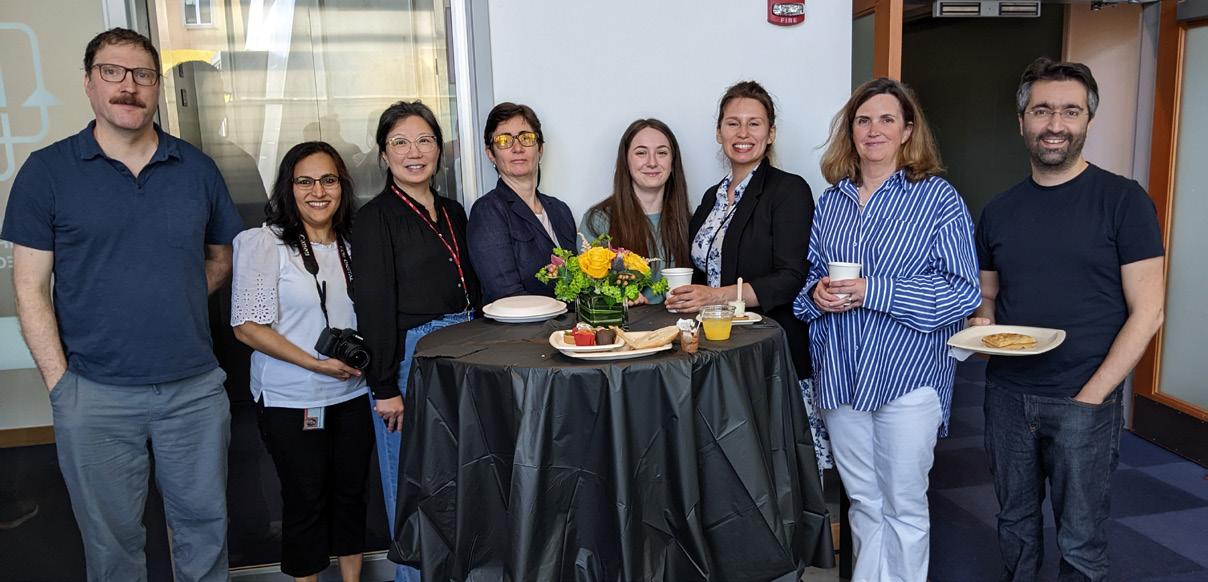
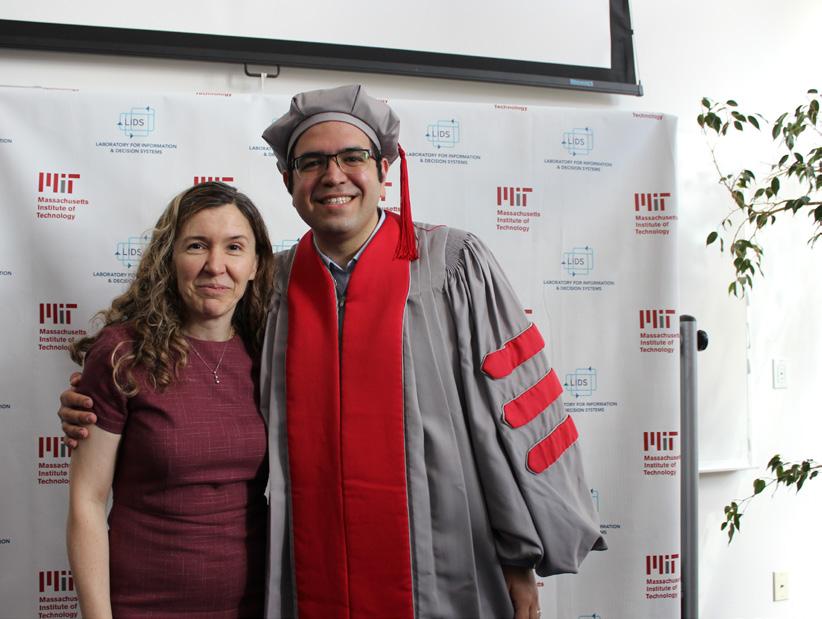
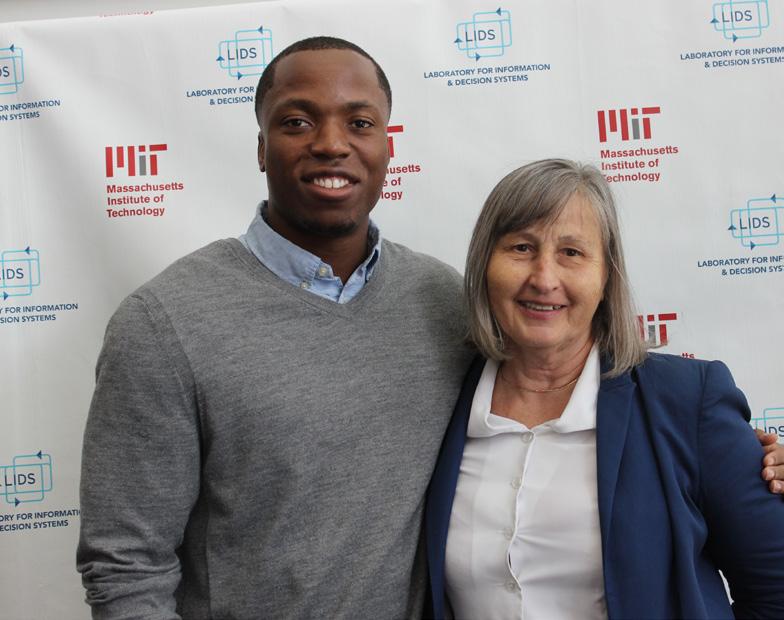
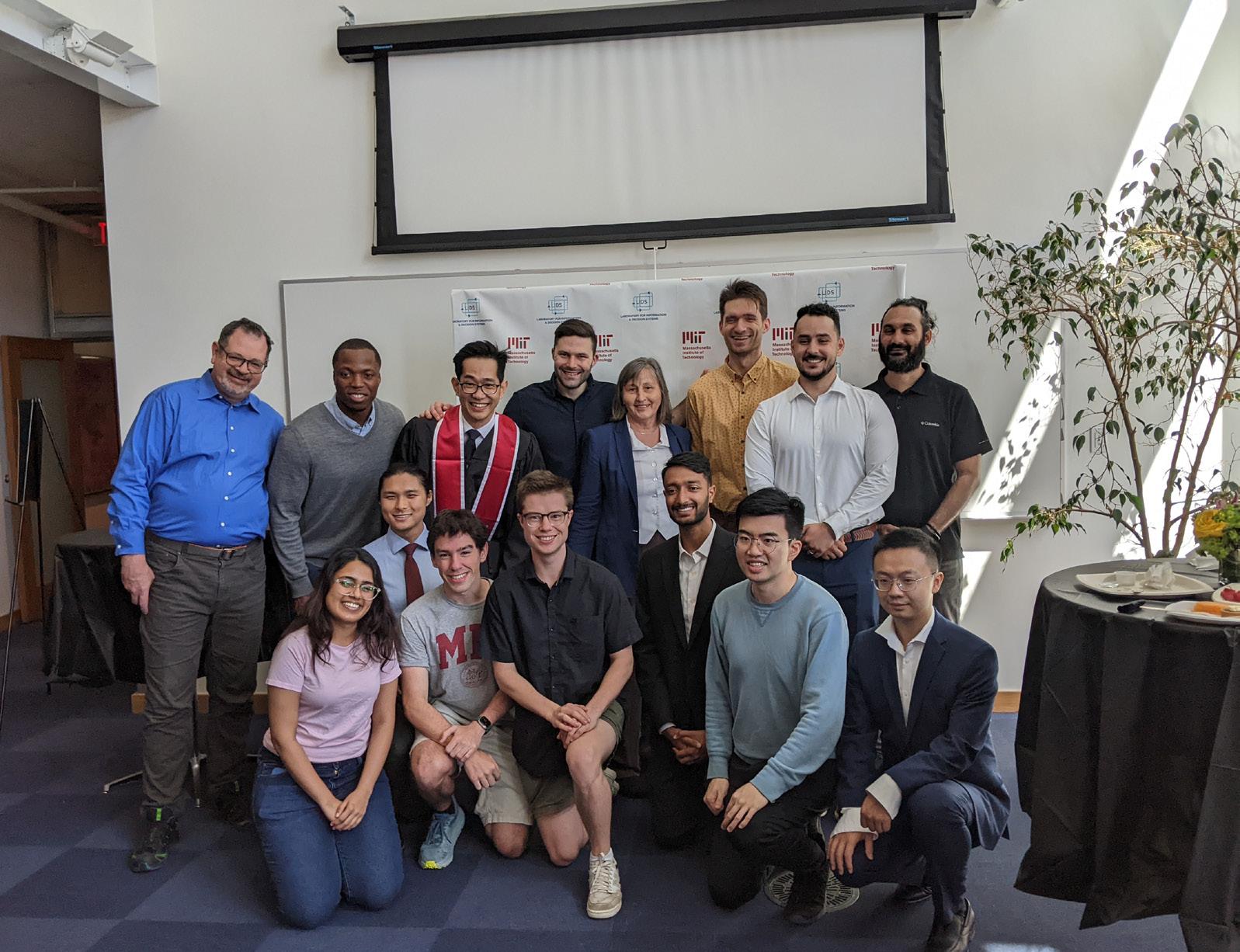
Graduation Celebration
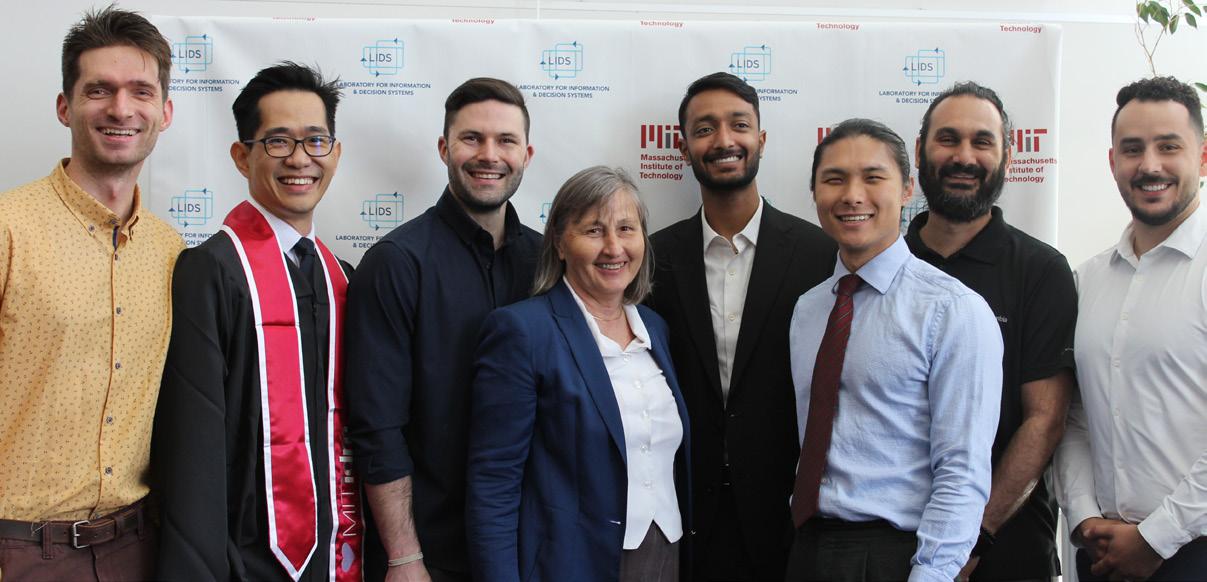
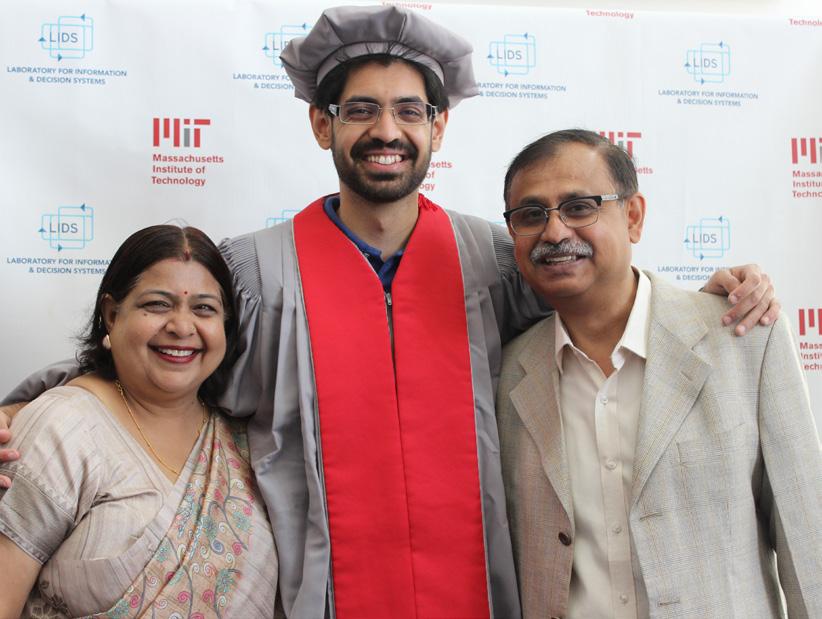
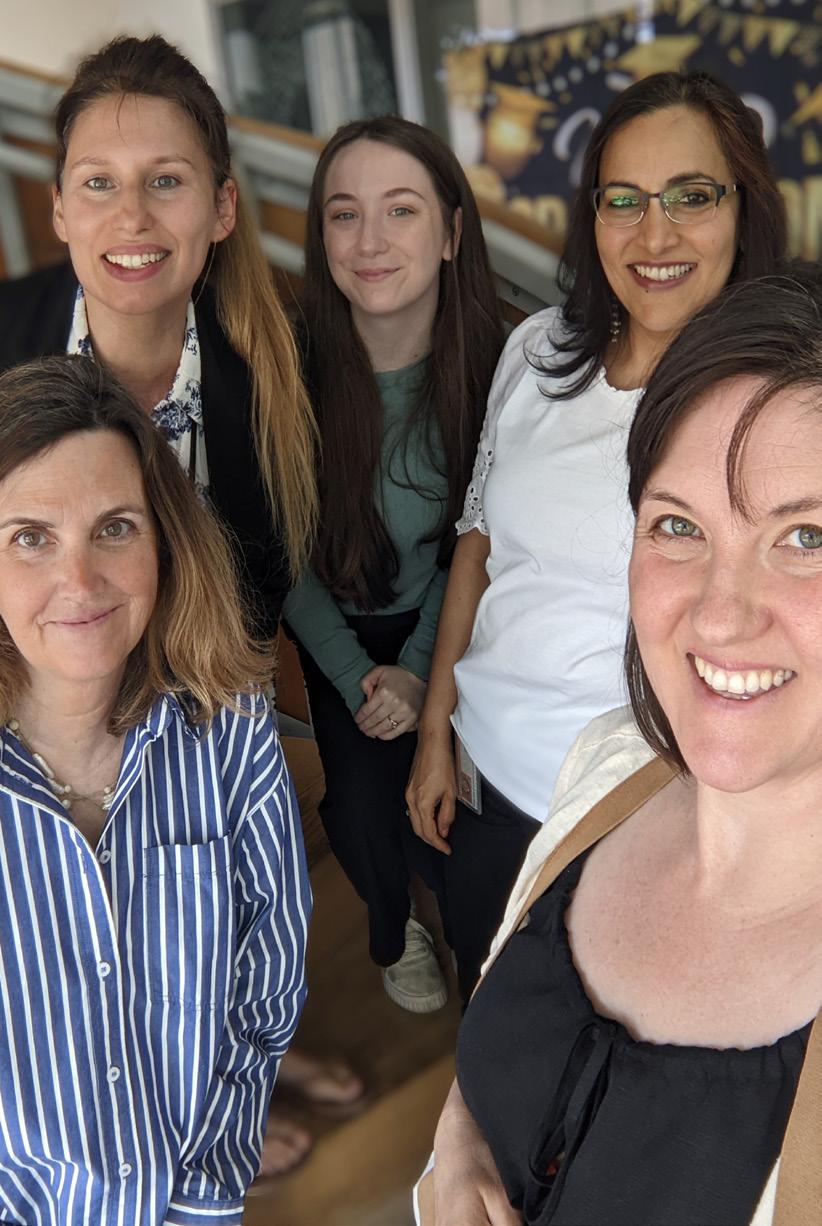
CLASS 2024 of
AWARDS
Professor Pulkit Agrawal received an IEEE 2024 Early Academic Career Award in Robotics and Automation
Professor Gabriele Farina received the 2023 SIGecom Doctoral Dissertation Award for his dissertation, “Game-Theoretic Decision Making in Imperfect-Information Games Learning Dynamics, Equilibrium Computation, and Complexity”
Professor Gabriele Farina received an Honorable Mention for the ACM Doctoral Dissertation Award for his dissertation, “Game-Theoretic Decision Making in Imperfect-Information Games Learning Dynamics, Equilibrium Computation, and Complexity”
Professor Marzyeh Ghassemi received a Google Research Scholar Award for her work, “Addressing Intersectional Clinical Fairness with Unknown Demographic Attributes”
Professor Marzyeh Ghassemi received an NSF CAREER Award for her project “Ethical Machine Learning in Health: Robustness in Data, Learning and Deployment”
Professor Marzyeh Ghassemi was named a winner of the 2023 MIT Prize for Open Data by the MIT School of Science and the MIT Libraries
Professor Song Han and team won first place in the Quantum Computing for Drug Discovery Challenge for “QuantumNAS: Noise-Adaptive Search for Robust Quantum Circuits”
Professors Jonathan How and Luca Carlone received an IEEE Transactions on Robotics KingSun Fu Memorial Best Paper Award for their paper "Kimera-Multi: Robust, Distributed, Dense MetricSemantic SLAM for Multi-Robot Systems"
Professor Yury Polyanskiy was elected a Fellow of the IEEE for “contributions to information measures and finite-blocklength information theory”
Professors Manish Raghavan and Devavrat Shah were awarded a MIT Schwarzman College of Computing seed grant for their project “Human Expertise in the Age of AI: Can We Have Our Cake and Eat it Too?”
Professor Manish Raghavan received the Google Research Scholar Award for his work, “Synthetic Data Generation from Aggregate Data with Applications to Privacy and the US Census”
Professor Caroline Uhler received a National Institutes of Health New Innovator Award
Professor Kalyan Veeramachaneni was awarded funding from the Appalachian Regional Commission (ARC) in support of the ongoing project “Forming the Smart Grid Deployment Consortium (SGDC) and Expanding the HILLTOP+ Platform”
Professor Martin Wainwright was awarded 2024 Guggenheim Fellowship
Professor Sherrie Wang received the Best Paper Award at the International Conference on Learning Representations Machine Learning for Remote Sensing (ICLR ML4RS) Workshop 2024
Professor Ashia Wilson was named a winner of the 2023 MIT Prize for Open Data by the MIT School of Science and the MIT Libraries
Professor Ashia Wilson and her group received the best paper award at ACM FAcct 2024 for their paper, “Algorithmic Pluralism: A Structural Approach To Equal Opportunity”
HONORS
Professors Navid Azizan and Patrick Jaillet, have been recognized as Leading Academic Data Leaders in the Chief Data Officer (CDO) Magazine “Leading Academic Data Leaders 2023 List”
Professors Tamara Broderick and Caroline Uhler were elected to the Institute of Mathematical Statistics's (IMS) Fellowship
Professor Luca Carlone was granted tenure by the Department of Electrical Engineering and Computer Science, effective July 1, 2024
Professor Priya Donti was named to the Vox “2023 Future Perfect 50” List
SEMINARS
2023-2024
Amir Ali Ahmadi
Princeton University
“Complexity of Finding Local Minima in Continuous Optimization”
Dominic Groß
University of Wisconsin-Madison
“Beyond Low-Inertia Systems: Grid-Forming Control Foundations for Converter-Dominated Power Systems”
Seth Flaxman
Oxford University
“Inferential Artificial Intelligence (iAI): Case Studies in Computational Statistics, Machine Learning, and Global Health”
Calin Belta
Boston University
“Formal Methods for Safety-Critical Control”
Eduardo Sontag
Northeastern University
“Control-Theory Concepts in Systems Biology and Algorithms: Responses to Inputs, Transients, and Asymptotic Behaviors”
James Anderson
Columbia University
“Collaborative Learning for Control”
Ankur Moitra
MIT
“Learning from Dynamics”
Jesús Rodríguez-Molina
Technical University of Madrid
“Blockchain in Smart Grids: Steering Sustainable Development Goals Forward”
Urbashi Mitra
University of Southern California
“Digital Cousins: Ensemble/Multi-Scale Learning for Markov Decision Processes”
Tamer Başar
University of Illinois at Urbana-Champaign
“Multi-Agent Dynamical Systems: Equilibria, Learning, and Asymptotics”
Daniel Liberzon
University of Illinois at Urbana-Champaign
“Entropy and Minimal Data Rates for State Estimation and Model Detection”
Jason Speyer
University of California, Los Angeles
“Real-Time Robust Multivariate Estimator for Dynamic Systems with Heavy-Tailed Additive Uncertainties”
R. Srikant
University of Illinois at Urbana-Champaign
“Why Is RLHF Data-Efficient in Policy Optimization?”
Naira Hovakimyan
University of Illinois at Urbana-Champaign
“Safe Learning in Autonomous Systems”
Francesco Bullo
University of California, Santa Barbara
“Contraction Theory for Optimization, Control, and Neural Networks”
Na Li
Harvard University
“Representation-Based Learning and Control for Dynamical Systems”
Sanjog Misra
University of Chicago
“Structural Deep Learning”
LIDS Community
LIDS students and postdocs continued to play a key role in organizing our activities for the 2023-2024 academic year, building on the popular weekly LIDS & Stats Tea Talks by adding Autonomy and Climate themed Tea Talks and continuing to coordinate weekly socials. Our committees also organized the annual LIDS barbeque and ice-skating events, as well as the LIDS Student Conference, and more.
THANK YOU to all the STUDENTS, FACULTY, and STAFF who made these a success! We’d like to thank here, in particular, the student and postdoc organizers:
LIDS Climate Tea Talks
Daniel Shen
Aron Brenner
LIDS Social Committee
Chirag Rao
Sathwik Chadaga
Max Daniels
Aron Brenner
Bunyamin Kartal
Ufuk Keskin
LIDS & Stats Tea Talks
Committee
Fathima Zarin Faizal
Jung-Hoon Cho
Chanwoo Park
LIDS Autonomy Tea
Talks Committee
Members
Gioele Zardini
Soumya Sudhakar
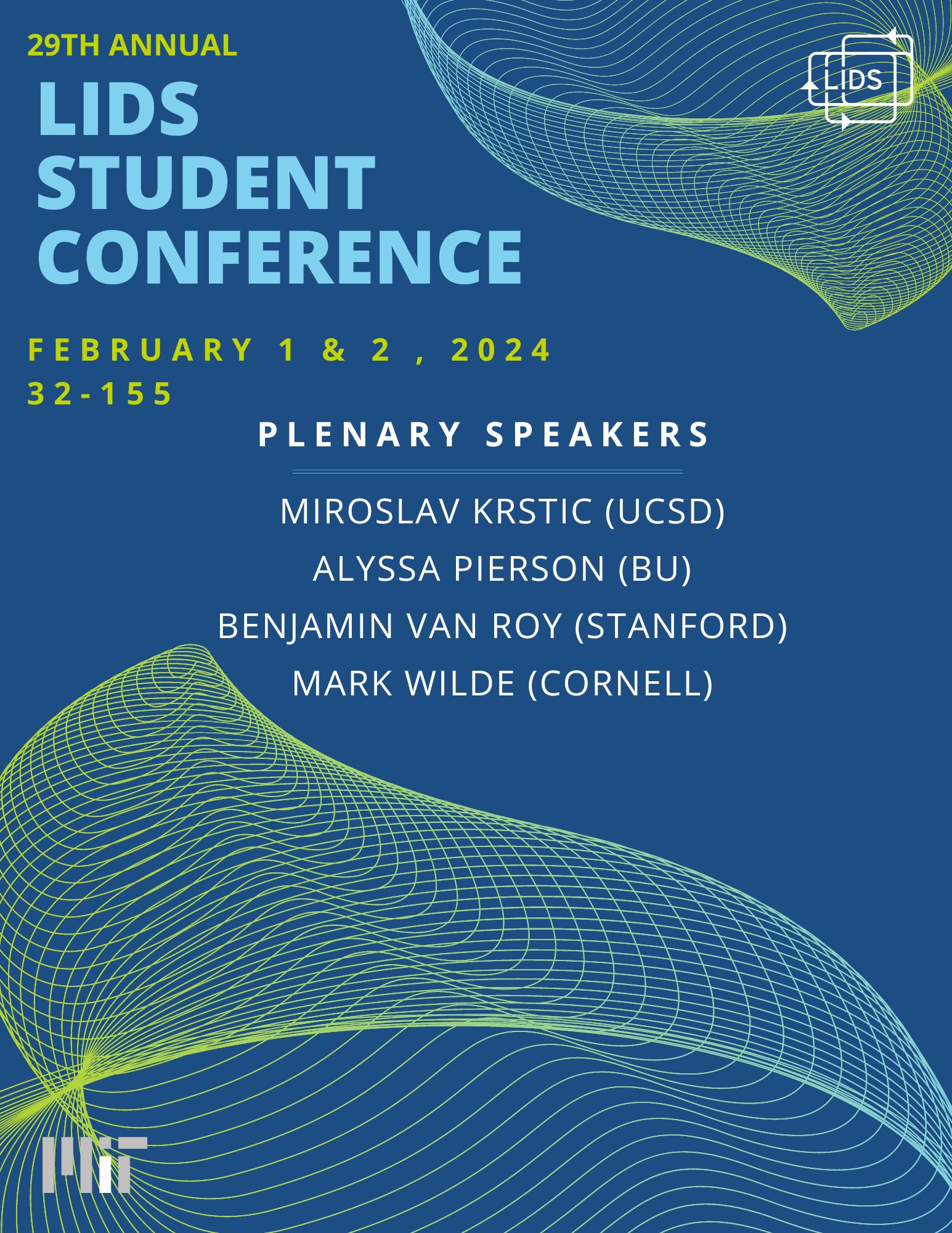
The annual LIDS Student Conference is a student-organized, student-run event that provides an opportunity for graduate students to present their research to peers and the community at large.
The conference also features a set of distinguished plenary speakers. The 2024 Student Conference marks 29 years of this signature lab event.
Student Conference Chairs
Maison Clouatre
Max Daniels
Andrew Fishberg
Bunyamin Kartal
Ufuk Keskin
Lukas Schmid
Plenary Speakers
Miroslav Krstic (University of California San Diego)
Alyssa Pierson (Boston University)
Benjamin Van Roy Stanford University)
Mark Wilde (Cornell University)
Student Speakers
Songyuan Zhang
Kunal Garg
Charles Dawson
Zeyu Jia
Vallabh Ramakanth
Chenyu Wang
Theodore Grunberg
Guoqing Wang
Reese Pathak
Abhin Shah
Hannah Schlueter
Kaan Sel
Mehrdad Ghadiri
Rohan Alur
Sean Sinclair
Vishwak Srinivasan
Jiayu (Kamessi) Zhao
Zikai Xiong
New LIDS Faculty
The faculty members within LIDS are principally drawn from the departments of Electrical Engineering and Computer Science (EECS), Institute for Data, Systems, and Society (IDSS), Aeronautics and Astronautics (AA), and Civil and Environmental Engineering (CEE). However, LIDS has long been interdisciplinary, and recent research foci, combined with the pervasiveness of the analytical methodologies advanced by LIDS researchers, has broadened our collaborative scope even further. Some of the many entities at MIT with which LIDS has a strong relationship include: the Computer Science and Artificial Intelligence Laboratory (CSAIL), the Research Laboratory of Electronics (RLE), the Operations Research Center (ORC), the departments of Brain and Cognitive Sciences (BCS), Earth, Atmospheric, and Planetary Sciences (EAPS), Mathematics, Mechanical Engineering (MechE), the Institute for Medical Engineering & Science (IMES), MIT Department of Economics (Econ), and the Sloan School of Management.
LIDS has been strengthened this year with the addition of new faculty members. Several additional faculty have committed to joining the lab in the coming academic year, as well, all bringing an invaluable range of perspectives and talents to our community.
Assistant Professor Abigail Bodner joined MIT with shared appointments in the departments of Earth, Atmospheric, and Planetary Sciences (EAPS) and Electrical Engineering and Computer Science and the MIT Schwarzman College of Computing. Her research interests span climate, physical oceanography, geophysical fluid dynamics, and turbulence. Marzyeh Ghassemi, Associate Professor in EECS and the IMES, recentered her practice in LIDS this spring. Her “Healthy ML” group focuses on creating and applying machine learning to understand and improve health in ways that are robust, private, and fair. Assistant Professor Manish Raghavan joined MIT with shared appointments in the Sloan School of Management, the Department of Electrical Engineering and Computer Science, and the MIT Schwarzman College of Computing.
His research interests lie in the application of computational techniques to domains of social concern, including online platforms, algorithmic fairness/discrimination, and behavioral economics.
Ashesh Rambachan joined LIDS and Econ this year as Assistant Professor. His research interests are primarily in theoretical and applied econometrics with a focus on applications of machine learning in economics and causal inference. This year, Sherrie Wang joined MIT as Assistant Professor with joint appointments in MechE, LIDS, and IDSS. Wang’s Earth Intelligence Lab at MIT uses novel data and computational algorithms to monitor our planet and enable sustainable development with a focus on improving agricultural management and mitigating climate change, especially in low- or middle-income regions of the world.
Stephen D. Bates joined LIDS and MIT’s Department of Electrical Engineering and Computer Science (EECS) as Assistant Professor this year. Through his research, Bates works to understand uncertainty and reliable decision-making with data, developing tools for statistical inference with AI models, data impacted by strategic behavior, and settings with distribution shift with applications in the life sciences and sustainability.