SALMAGUNDY
The Official Student Newpaper of Miss Porter’s School
Fall Issue 2025
Fall Issue 2025
By Jiayi (Jessica) Lin ’27 Editor-in-Chief
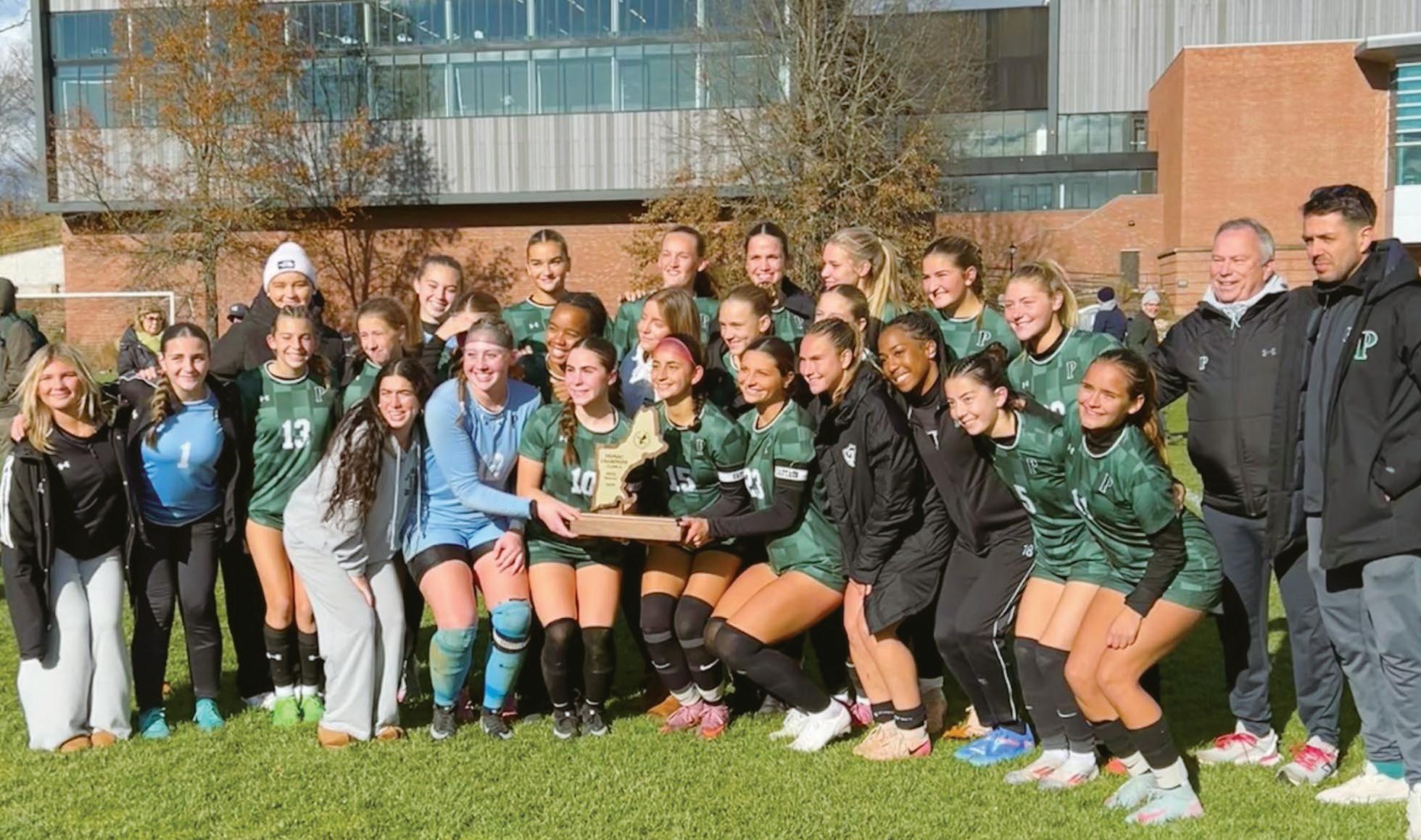
For the first time ever, Porter’s Varsity Soccer is Founders League Champions, WNEPSSA Class A Champions, and NEPSAC Class A Champions all in one season.
Porter’s won the final game against Westminster 2-0 on Nov. 16, taking the title. This win was especially special for the seniors on the team, with securing a triple championship season.
Goalkeeper and Captain Ellie Westcott ’26 let no balls by her. “I love these girls so much, they truly are my family,” Westcott said.
She added that the girls gave 100% to achieve their goals. “I am so proud of this team, and can’t think of a better way to end my senior season.”
Fellow Captain Lauren Ricapito ’26 felt the same pride. “We had so much spirit and we wanted it
more than anyone else,” Ricapito said.
The team had 18 wins – including 15 shutouts –one loss, and two ties during the season.
Fellow Captain Paige Murphy ’26 felt grateful for the win. “We were able to go out with a bang,” Murphy said.
By Charlotte Hannich ’26 Staff Writer
Nolan Oxley, a former faculty member at Miss Hall’s School, has joined the Miss Porter’s School’s admissions team this year, bringing several goals, aspirations, and insights with him.
“What I plan to bring would be my authentic self,” Oxley said. “I enjoy working at a school where I can be silly at times, but really, I would say one of my passions is storytelling.”
A theater minor in college, Oxley said his background helped shape his love for sharing others’ stories.
Oxley credits this passion as the reason he has remained in the field of admissions.
“The storytelling, the getting to know the students, knowing what they’re doing, what classes
they’re loving, how Porter’s is shaping them into who they’re going to be, and sharing those stories with prospective families,” he said fuels his passion.
As he begins his first year, Oxley said his main goal is to get to know the Porter’s community.
“When you’re in your first year, your goal is to really absorb what the community is,” he said.
“My goal is to listen and know why people are here.”
Oxley said he first connected with Porter’s while representing Miss Hall’s School at school fairs, where the schools were often placed side by side. “I got to really hear from each of them why they love working here. Maya, Janet, Katie, Sarah, Liz, everyone, this sense of pride for Porter’s,
this sense of belonging that the staff have,” he said.
“Moving is not fun, but to not be a part of this place, I felt I had to join it.”
Now working in admissions at Porter’s, Oxley said his favorite part of the job is his colleagues.
“The fact that I get to call them my colleagues but also friends,” he said. “I think if the admissions team loves working together and we have fun in the office, it really translates to this, you guys would get a sense if we didn’t like working together.”
Oxley also handles international admissions and will travel to Asia this year to meet with
By Annie Tang ’26 Staff Writer
Young people have a responsibility to humanize immigrant narratives, especially in a country shaped by centuries of diverse cultures, an immigration rights advocate told Miss Porter’s students and faculty earlier this month.
“How do you define American?” Jose Antonio Vargas asked the students and faculty.
Vargas, a Pulitzer Prize–winning journalist and author of “Dear America: Notes of an Undocumented Citizen,” spoke about the power of storytelling in shaping the national conversation on immigration.
His talk was part of the Miss Porter’s Kalat speaker series on civic engagement.
Vargas was 12 in 1993 when his mother sent him from the Philippines to the U.S. to live with his grandparents. As a teen, he discovered that his green card was fake. This began a life marked by fear and a constant pressure to “lie, pass, and hide.”

Eventually, Vargas pursued a career in journalism, using his reporting to explore issues of immigration and identity. As an adult, he decided

to publicly reveal that he was undocumented, challenging conventional ideas of what it means to be American.
“Is being American defined from papers and documents? Or by a deeper comprehensive understanding of identity?” he asked the audience.
Vargas, who founded the advocacy group Define American, encouraged students to challenge stereotypes and think critically about what it means to be American in a nation built by immigrants.
During his talk, he presented statistics, graphs, and clips of comedian Trevor Noah discussing immigration to give students concrete evidence about the realities of the issue. His activism and reporting led him to uncover the long and often overlooked history of immigration in the United States.
“I didn’t know that most immigrants came from Ireland, or that Germans faced discrimination,” Vargas said, as he showed the audience a map highlighting the diverse ethnicities and races that have shaped every corner of the United States.
By Dora Zhu ’28 and Leanne Liang ’28 Staff Writers
This year, freshmen at Miss Porter’s School were greeted with a brand-new policy: all technology must be turned in by 10:30 p.m. on school nights. This rule, which applies only to ninth graders, was introduced by administrators as an effort to promote healthier sleep habits. While the school views this change as beneficial, it sparked mixed reactions among the freshman class.
The policy was proposed after growing concern about students’ sleeping schedules. According to administrators, many students stay up late with their devices, whether it be completing school work or chatting with friends on social media, which can lead to health issues and fatigue.
Some freshmen have shown appreciation for this nudge towards reducing late-night screen time. “I was not expecting to support this policy,” said Melina Tang ’29. “But I do feel better rested and have an easier time falling asleep without my device.” Others found additional perks from this enforced technology break, such as mentally separating schoolwork from relaxation. Supporters of the policy believe that it can instill healthy habits in students early on, fostering a balanced relationship with their technology.
Alongside the positive feedback, other freshmen have voiced differing views on the necessity of this new policy. “I don’t really like the new policy because it’s kind of annoying having to go
down and put down our devices every night,” said Josie Chirco ’29. “So I would change how long you have to do it for, maybe just the first trimester.” While acknowledging the benefits the policy brings, some students are also questioning whether the inconvenience outweighs the positive outcomes. Freshman more skeptical about the effectiveness of the policy ground their opinion in the burden it adds to their nightly routines and its limited personal impact.
Will administrators ever listen?
By Claire Shen ’28 Layout Editor
When Makoto Suzuki ’26 first arrived at Porter’s as a freshman, she expected the usual nerves that come with starting at a new school. What she didn’t foresee was the added pressure of being an international student.
“I had to adapt to a new environment, new country, new tradition and new culture,” she said. “Everything changed in how to dress, how to interact and which language to speak. The anxiety just doubles.”
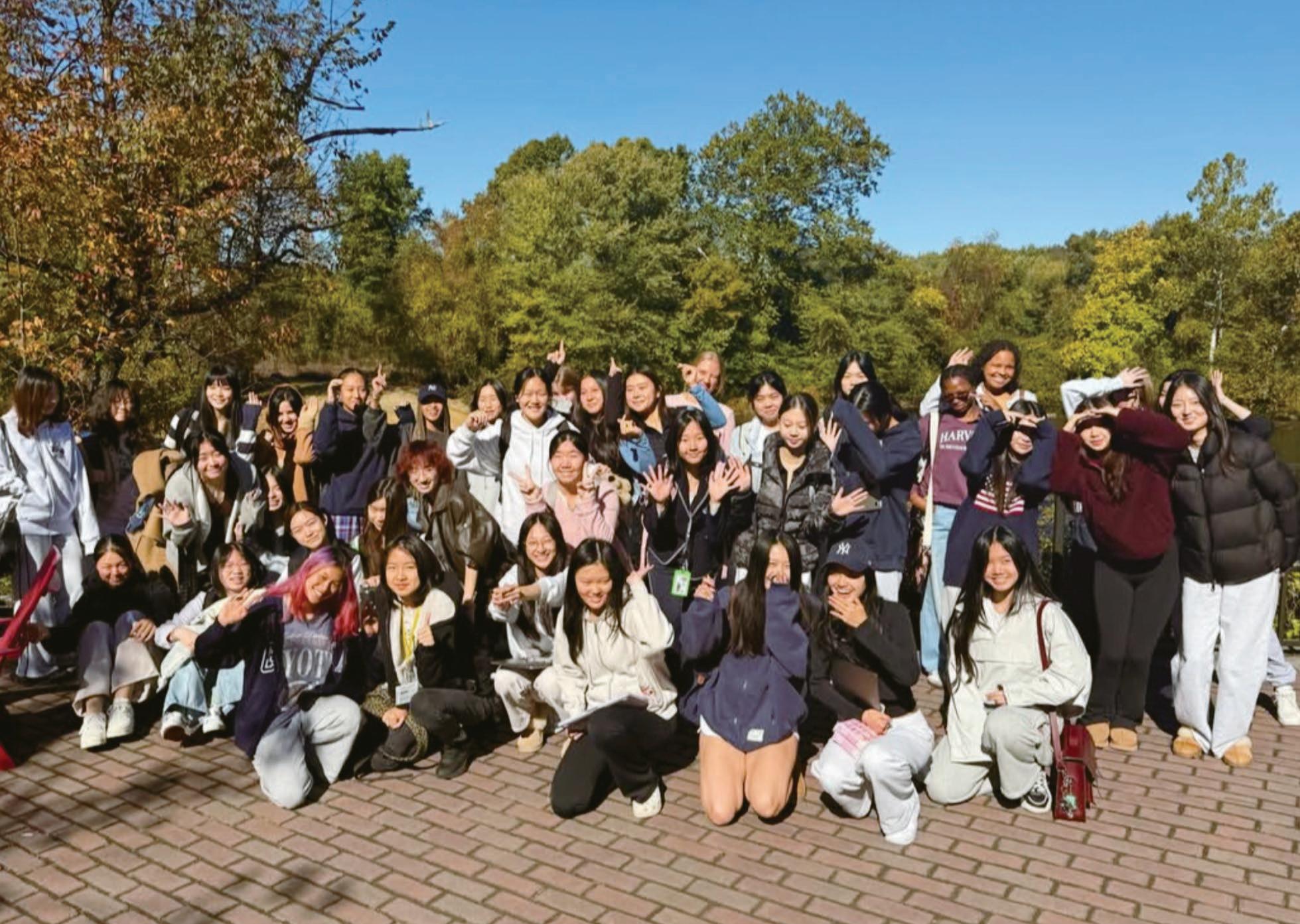
She eventually found guidance through faculty who worked closely with international students. The support not only eased her transition at Porter’s, but also shaped the way Suzuki supports others as a leader in the International Student Affinity (ISA). With more than 50 members, ISA contributes actively to campus life through activities, regular meetings, and communal dinners.
“I could feel how much the school community appreciates and values international students,” said Melina Tang ’29, current ISA member. “ISA gave me a lot of emotional support, and I know I can reach out to ISA anytime.”
This emotional grounding becomes increasingly important under the current political climate.
International students, Suzuki said, carry a constant awareness of legal and political un-
certainty, especially when traveling.
“Even when you’re traveling legally, there’s stigma,” she said. “People worry about being stopped at customs or questioned unexpectedly. You never know when or to whom something might happen.”
For Suzuki, ISA is a resource and provides a space to navigate those uncertainties with communal support and understanding.
The role ISA plays today is almost unimaginable compared to when it was first founded 20 years ago. Santiago Enrique, director of the Institute for Global Education and a faculty advisor for ISA,
has watched the group evolve during his years at Porter’s. Though ISA began solely as a resource for logistics and transportation, it has now become critical to community building.
“Today, it’s about creating conditions where everyone in the school feels seen,” Enrique said. “We realized that belonging isn’t something we create for one group. It’s something the entire school has to recognize.”
For students navigating life far from home, ISA has become the place where that belonging takes shape.
By Olamina Palm ’28 Staff Writer
Globally, more and more schools are increasing their usage of artificial intelligence: with Miss Porter’s School being no exception. However, Porter’s takes on a different approach, as conversations around AI are centered around respon-

sible use and transparency of AI rather than undisclosed usage.
Maureen Lamb, chair of Miss Porter’s AI Task Force, said the school does not plan to remove AI as a tool, but instead seeks to accurately prepare students for a world where AI plays a central role.
“Porter’s wants students to use it effectively and to prepare for the greater world, and the greater world is using AI,” Lamb said. “We need to teach students how to use it effectively. I don’t see a future where we ban AI or block it, but there will be parameters on how we use it.”
The school’s approach mirrors a national trend. The Center for Democracy and Technology reported that 86% of students and 85% of professors have engaged with AI. The majority of teachers using AI employ it to develop a curriculum, assist with assignment grading or personalize learning.
At Porter’s, the AI Task Force emphasizes the importance of clarity and ethics, especially when
AI operates behind the scenes. However, the mission of an increased ethical usage of AI raises the question of whether students should always know when AI is shaping their learning.
Lamb believes students have the right to know. “Clarity on both sides is good,” she said.
However, the CDT says maintaining transparency is a challenge for many schools. Many still lack guidance on the risks and proper use of AI, despite the fact that around half of instructors and students nationwide have gotten some sort of training or information on it at their schools. Teachers who rely heavily on AI are more likely to report negative consequences, such as the AI system not treating students fairly and damaging the school’s trust with the community.
“AI should enhance education but not erase the human element,” Lamb said.
Miss Porter’s School’s fall crew team will no longer be recognized as a varsity sport at the annual Varsity Banquet starting in 2025, after a decision by the athletic department and varsity coach Robin Neschke.
“We asked the equestrian and crew coaches this fall if they want to be involved for both seasons of sports awards to avoid the repetition.” Assistant Athletic Director Taylor Johnson said. “The no awards/speech for crew was not the athletics department’s decision,” Johnson added. “We were notified crew would be joining, but just in the video portion, by crew coaches.”
Neschke told the team the decision was meant to make the spring season feel more special. “As a multiseason sport, our team is recognized each spring at the varsity banquet,” she said. When the athletics department reached out, Neschke talked to the team captains and concluded on participating in the fall banquet through the music video. “Saving our awards and speeches for the spring would make that event feel more meaningful and reflective of the full year of racing,” Neschke added.
The change marks a shift from previous years, when fall crew took part fully in the banquet.
Lillian Swenson ’26, one of the captains, said it was difficult to accept this change as a senior. “I was pretty shocked that crew was being brought down, and not every other sport that has multiple seasons,” said Swenson.
She added, “I just think it could’ve been handled better.”
Fellow captain Sofia Garza ’26, didn’t fully register the impact of the change until hearing her teammates mention skipping the banquet entirely. “I was like, wait yeah, we’re not getting recognized at all,” Garza said. “We’re literally just going to be sitting there for an hour and a half doing absolutely nothing when I could be doing my homework.”
Karma Elwan ’29, the only novice on the team, said she was surprised by the decision. “This decision was unfair in my eyes because making it on fall crew felt like a really big ac-
By Lauren Jang ’29 Staff Writer
Two weeks before pre-season, after 4 years of coaching at Porters, Jazna Stannard informed the Athletics Department about her departure to be the head coach of The Taft School’s varsity volleyball team.
On Oct. 15, emotions ran high in the Crisp Athletic Center gym as the Miss Porter’s School varsity volleyball team played against Taft, led by Stannard.
By Jiayi (Jessica) Lin ’27 Editor-in-Chief

complishment,” Elwan said. “I’m sure everyone has something they’re proud of from this season and wants to be recognized for that.”
Other team members shared a similar feeling.
Eliza Mikheev ’27, who has been on the team since the spring of her freshman year, said she understands the reasoning but is disappointed by the decision. “Sometimes fall crew isn’t respected as much as other sports,” she said, “and I think the girls on our team deserve that respect.”
Third captain Lily Jones ’26 felt the Varsity Sports Awards as a highlight of the season. “While I am very grateful we were able to go
Annie Tang ’26, the team’s co-captain, reflected on the challenges faced playing against Stannard. “We felt more pressure to win the game,” she said.
The team had a strong desire to prove themselves. “We wanted to prove Jazna wrong and win the game,” Tang said.
Despite losing to Taft, Tang found value in the experience, “I thought talking to Jazna was good closure for the team and I,” Tang said.
She understood that Stannard’s departure was the best choice for her and had nothing to do with the Porter’s team.
Shannen Giselle Penn ’27, co-captain of the volleyball team said the game felt surreal. “She
this year, the team deserves to be recognized for their hard work and dedication alongside the other varsity sports,” she said. What makes the night special for Jones is how it allows “the team to come together and celebrate each other, which we deserve to be able to do.”
Mikheev hopes the school will find a way to celebrate the effort undertaken by fall crew in future seasons. left, and then the next time seeing her she is in another team’s uniform,” she said.
“The only difference with this game is that we kept looking at Taft’s side, rather than focusing on our own team,” Penn said. When asked if she found closure Penn said, “Jazna needed more closure than any of us, but I would’ve been fine without it.”
After the game, Jazna spoke to returning members of the team for over 40 minutes. Chloe Jenkins ’27 said she wished she had more time to talk with her former coach.
Playing against Stannard had an impact on Penn. “Seeing her on the other side of the net made me want to win the game even more,” she said, “but I didn’t view her differently than any other competitor.”
By Ejin Chung ’28 Staff Writer
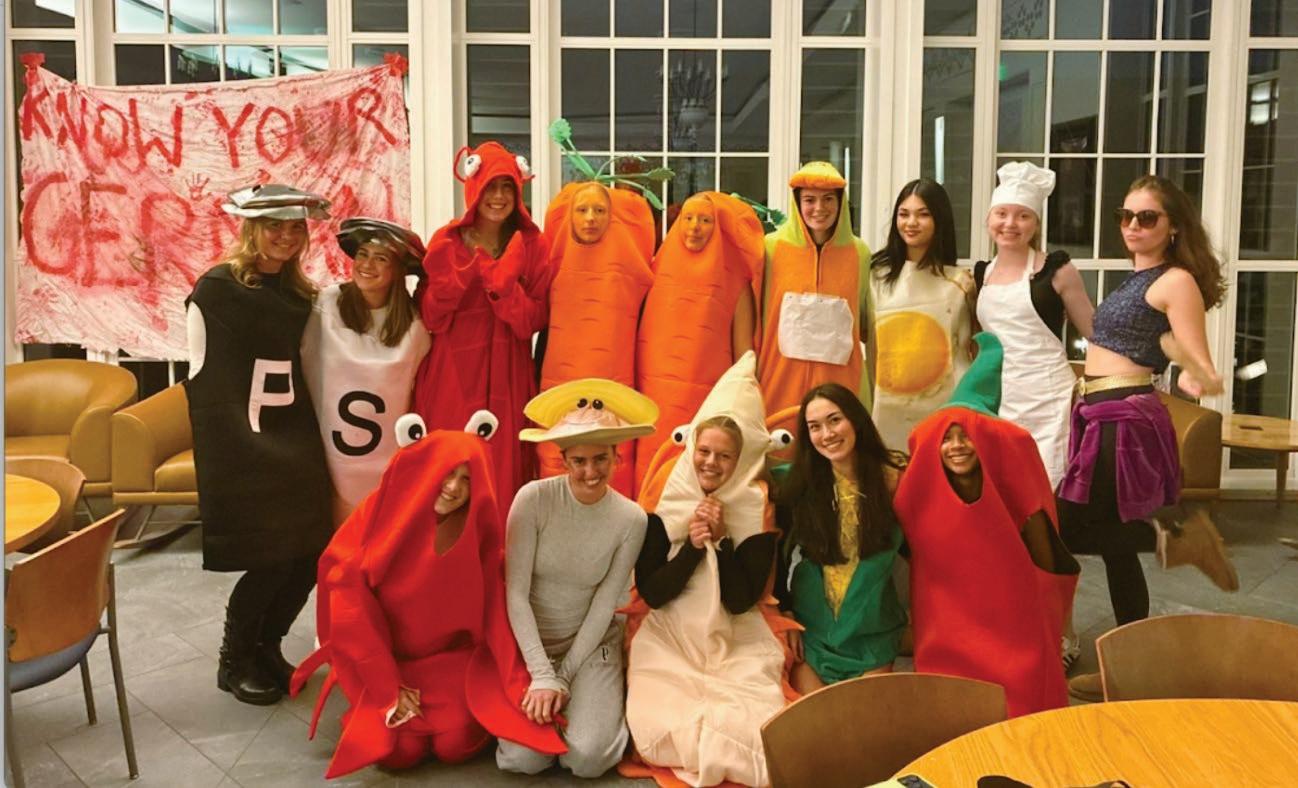
Halloween has always been one of the most anticipated times of year for students. The excitement begins weeks in advance with conversations about costumes, room decorations, and candy. The dining hall is decorated with bright orange pumpkins, and paper bats appear on the classroom windows. But when the day finally arrives, the reality doesn’t match the buildup. For many students, Halloween at Porter’s does not live up to the hype, and it’s time to admit that the school needs to put much more effort into Halloween celebrations on campus.
“I think most students just get excited to go off campus or go home instead of staying for the events at Porter’s,” Charlotte Peterson ’28 said. “Even the Halloween banquet, almost nobody really goes to it anymore.”
Peterson’s comment shows that while there’s enthusiasm in theory, the actual day often feels anticlimactic. Students are so uninterested in on-campus events that they’d rather leave than participate. If Halloween is supposed to be a major, joyful tradition, why are so many seats at the banquet empty? The message is clear: What Porter’s is offering right now isn’t enough to keep students here.
Still, not everyone feels that way. For some, Halloween remains a highlight of the fall term, the day when students get to be silly and creative.
“My favorite part of Halloween on campus is the costume contest because I love seeing how much effort people put into their costumes,” Sivan Reznichenko-Elhibir ’28 said.
She added, “This year was much better than last year because the day before Halloween was German, which means we didn’t have homework.”
Reznichenko-Elhibir’s experience proves something important: When the school actually gives students time and space to enjoy Halloween, the day improves. It shouldn’t take a lucky schedule for Halloween to feel fun.
Many students have offered suggestions to improve Halloween celebrations at Porter’s. Ideas include a Halloween dance in the Crisp Athletic Center with nearby schools, a haunted dorm competition, pumpkin-painting nights, and Halloween-themed weekend activities. These ideas are not unreasonable demands; they are thoughtful, realistic ideas that could easily make the day more engaging.
Right now, Halloween at Porter’s feels like a missed opportunity. We have a creative, energetic community that is more than capable of turning Oct. 31 into something unforgettable, yet we keep settling for a version of Halloween that many students describe as anticlimactic. If the school truly values student voice, then it needs to prove it — not with a few decorations, but with events that students actually want to attend.
Overall, Halloween at Porter’s could be a time of laughter, community, and creativity. With real innovation and genuine commitment, Halloween could evolve from a day that “doesn’t quite live up to the hype” into one of the most joyful days of the school year. As pumpkins fade and the decorations come down, one thing is clear: The Porter’s community has no shortage of energy or ideas. What’s missing is action.
If Porter’s wants students to enjoy Halloween on campus, it must start putting much more effort into Halloween because right now, the school is the one not living up to the hype.
By Lisi DeLaO ’29 Staff Writer
Students without a gluten intolerance or allergy should not take from the designated gluten- aware portion of the servery. This section is small, as it is designed for a limited number of people. When students who do not have a gluten intolerance or sensitivity take from the already limited supply, the food balance is thrown off.
The allergen-free choices have improved over the past few years, but these new options have attracted more students to this section.
Whenever there’s a new gluten-free dessert, it disappears almost immediately. Students within the gluten-free community have reported people without dietary restrictions taking these desserts and snacks.
Marta Linnéa Rupf ’28 has multiple dietary restrictions, including gluten.
“I have come across many people stealing gluten-free food,” Linnéa said. “Purley because they don’t want to wait in line.”
Part of the food theft could be due to genuine confusion. The signs indicating the gluten-aware section are easy to overlook, especially by New Girls who are still becoming comfortable eating in the dining hall. However, at other times these behaviors are intentional, and they need to be addressed.

As someone with a gluten intolerance, I have dealt with these issues firsthand. Anything new or exciting disappears extremely quickly, and if it returns, it usually takes days — if not weeks.
During tight lunch hours, it is understandable that the servery can become crowded and time-consuming, making the gluten-free section seem like a convenient alternative. Taking items from the gluten-aware section also increases the chance of cross-contamination. Some people have celiac disease and are incredibly sensitive to even small traces of gluten. This is not only inconsiderate but also potentially dangerous.
Requesting Flik Independent School Dining to prepare larger amounts of gluten-free meals would be wasteful. The quantity of food is intended for the number of people who have these dietary restrictions. Instead, students who are not gluten-free need to be informed not to take from this section.
One person’s impatience should not compromise another’s ability to eat a full meal.
By Gabbi Carpentier ’27 Staff Writer
Have you ever been in a situation where you were really craving a snack from the Daisy but nothing seemed like it would satisfy your craving? It might be time for the Daisy to expand its options and for students to have a bigger say in what’s on the shelves.
Ava Johnson ’27 feels the same way. “I’m always hungry,” she said. “And then I walk into the Daisy, and I see some stuff. But nothing exactly fits my appetite. I feel like it’s the same things every time.”
Johnson would like to see more Gatorade flavors, Swedish Fish, and more gas station-like snacks, such as those found at the Hawk’s Nest
at Avon Old Farms.
Michael Bergin, Chief Financial and Operating Officer, is very proud of the current state of the Daisy. “It is rare that I walk by the Daisy and don’t see a student or faculty member using it,” Bergin said.
However, Bergin said he and Lisa Gilmore, controller and primary overseer of the Daisy, are open to feedback from the community regarding the Daisy.
A Google feedback form would help give a voice to all members of the community to use
regarding what is and isn’t offered in the Daisy.
“A form would urge students to have a place to go to make recommendations anonymously and give feedback,” said Johnson. She implied that it can be intimidating for students who don’t know the adults in charge that well to go up and give their opinion on different issues.
Giving adults feedback can be scary, but there are ways to anonymously submit requests.
“You can talk to way more people in a survey than you can talk to in a one on one conversation,” Bergin said.
By Pippa Daykin ’28 and Caitin Tyrrell ’26 Staff Writers
From ultra-mini Uggs to Lululemon keychains, what does it look like when a Porter’s girl is given the freedom to express herself?
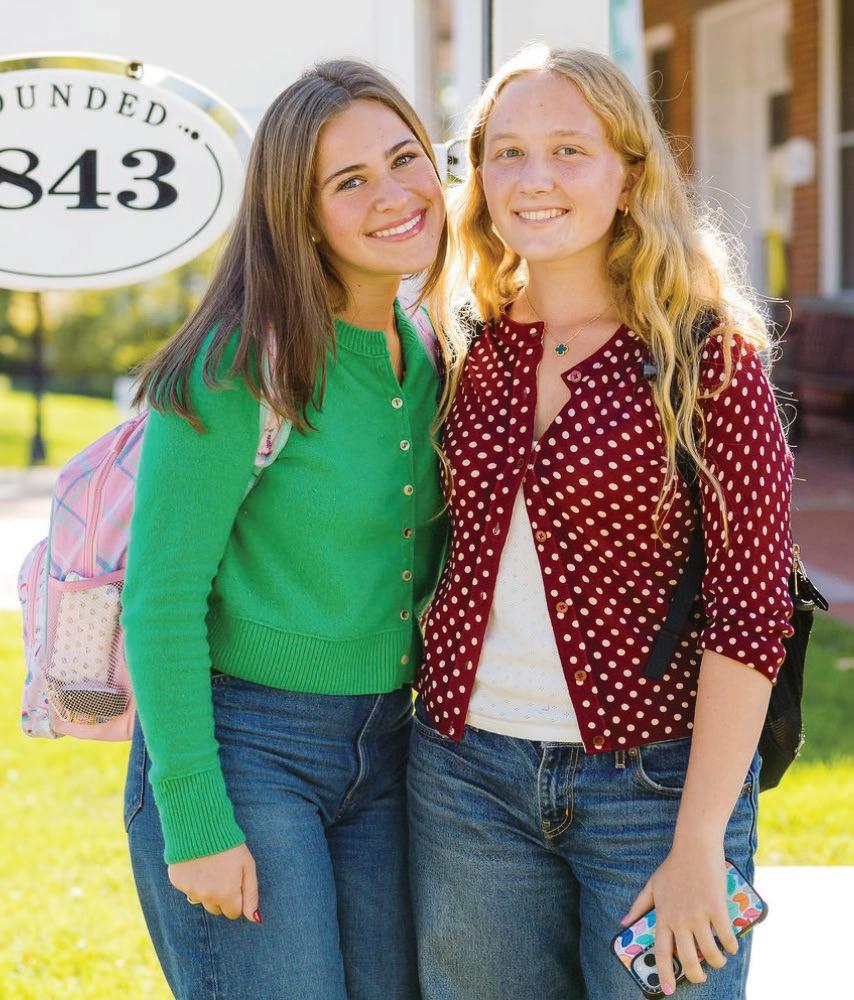
“It’s very jeans, sweater, skirt, bag,” Sarah Glaspey ’28 said. “In middle school, it was embarrassing to dress nicely, but here, it is quite the opposite.”
There has been a sudden takeover of Longchamps and Goyard bags in the Backpack Lobby. But how does individuality take a role on our campus, when it can appear as though everyone is dressed the same?
How comfortable students feel expressing
themselves often depends on their age. Freshmen tend to dress in sweatpants, and older students are in more put-together, intentional outfits. “You only see leggings and a sweatshirt with the younger generation,” said Addie Bagley ’29.
It’s not just the New Girl class. Many seniors reflected on their style evolution, reminiscing on wearing pajamas and high-waisted pants during freshman year.
Kendall Manuel ’26, Tenley Davis ’26, Campbell Robertson ’26, Caroline Callahan ’26, and Pearl Spence ’26 believe they’ve developed into a nicer style. They “feel more comfortable with [their] style after going through a few years of high school.”
Is a student’s change in style typically fueled by judgment from peers or from within?
Some students said that they believe Porter’s has a supportive and judgment-free environment, while others feel as though their style can be judged by their peers. The insecurities they felt were in their freshman year, as they were adjusting to a new community and wanted to fit in with their peers.
However, as these seniors matured, so did her clothing. What once felt like judgment from peers shifted into an acceptance of everyone’s unique style.
Porter’s students all eventually outgrow their freshman year style.
The “look good, feel good” mentality appears to be the most popular reason for a change. By approaching the day with a well-dressed outfit, students feel better both in and outside the classroom, increasing their productivity, energy,
and self-esteem.
Robertson and Spence believe that dressing well for school has become a part of their morning routine. Instead of dreading waking up and going to classes, students look forward to their routine of putting on a nice outfit to make themselves feel ready for the day.
The unofficial uniform at Porter’s isn’t a trend. It’s the choice to dress for yourself.
Oxley Continues
prospective and current families, and Ancients.
“I love that admissions every day allows me to reaffirm why I love the school,” Oxley said when asked what his favorite part of working in admissions at Porter’s has been.
Oxley said seeing the school through the eyes of students reaffirms the community spirit that defines Porter’s for him.
Beyond admissions, Oxley advises the Gender and Sexuality Hub and the International Student Affinity.
“Prior to Porter’s, I was always a house director, so I was always in the dorms,” he said. “I’m transitioning out of that in my new role. I love that I still get to interact with students outside of just admission.”
Interaction with students and building positive relationships within the Porter’s community are also things Oxley works to accomplish.
“I always try to be a positive, fun presence because I feel like students need the reminder,” he said. “I believe students get too caught up in schoolwork or too caught up in the pressures that the world is placing on you.”
By Rochelle Lu ’28 Staff Writer
The art world is mourning the death of Agnes Gund, an Ancient of Miss Porter’s School, who died Sept. 18. She was 87.
Renowned as an innovative art collector, philanthropist and advocate for social justice, Gund made a significant impact on both culture and education. Yet, before she left her mark on the contemporary art world, she walked the same paths we do today, as an Ancient of Miss Porter’s.
Born in Cleveland in 1938, Gund attended Miss Porter’s, where she first discovered her passion for art. Within the school’s art studio, she found a sense of purpose and possibility. She frequently credited her art history teacher, Sarah “Sally” MacLennan, with igniting that lifelong passion. She said the late teacher “seemed to recognize that I had an eye for looking at things, that my whole nature was tuned to being visual.”
After graduating from Miss Porter’s in 1956,

Gund earned a degree in history from Connecticut College and a master’s degree in art history from Harvard University. Her career took her to the Museum of Modern Art in New York, where she served as board president from 1991 to 2002. During her tenure, Gund oversaw an $858 million expansion, including a new building designed by Yoshio Taniguchi, and helped lead a merger with the P.S.1 Center for Contemporary Art in Queens, now MoMA PS1. She remained president emerita until her death.
“I wanted to do something that would make a real difference in people’s lives.”
Gund’s influence extends far beyond museum walls. In 2017, she founded the Art for Justice Fund, using proceeds from the sale of a Roy Lichtenstein painting to support criminal justice reform.
“I wanted to do something that would make a real difference in people’s lives,” she told The New York Times.
Gund also stayed connected to Miss Porter’s. In 2019, she served as honorary co-chair, alongside Oprah Winfrey, on By Women, For Tomorrow’s Women, an all-women artist auction at Sotheby’s benefiting student financial aid at the school. The event reflected Gund’s lifelong mission to empower women through art and education.