The Miscellany News
miscellanynews.org
April 23, 2026
Slow Pulp takes over the Nircle Senior Brendan Kennedy, Sophia Marchioli Assistant Arts Editor, Columnist
O
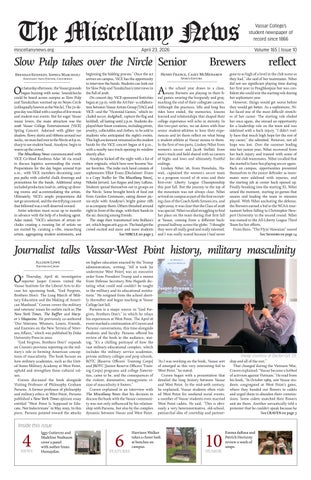
n Saturday afternoon, the Vassar grounds began buzzing with noise. Soundchecks could be heard across campus as Slow Pulp and Tanukichan warmed up on Noyes Circle (colloquially known as the Nircle). The 72-degree day was filled with a surplus of live music and student-run events. But for eager Vassar music lovers, the main attraction was the 2026 Vassar College Entertainment (ViCE) Spring Concert. Adorned with glitter eye shadow, flowy skirts and ribbons around our necks, we marched over to the Nircle at 6 p.m. sharp to see student band, Anodyne, begin to warm up the crowd. The Miscellany News communicated with ViCE Co-Head Kwabena Adae ’26 via email to discuss logistics surrounding the event. Preparations for the day began around 6:30 a.m., with ViCE members decorating campus paths with colorful chalk drawings and promotions for the bands. Additional setup included production load-in, setting up dressing rooms and accommodating the artists. Ultimately, ViCE’s ample preparations did not go unnoticed, and the electrifying concert that followed was a well-deserved reward. Artist selection must occur up to months in advance with the help of a booking agent. Adae stated, “ViCE’s selection of artists includes creating a running list of artists we are excited by, curating a vibe, researching artists, aggregating student sentiments, and
Vassar College’s student newspaper of record since 1866
beginning the bidding process.” Once the act arrives on campus, ViCE has the opportunity to interview the bands. Students can look out for Slow Pulp and Tanukichan’s interviews in the Fall of 2026. On concert day, ViCE-sponsored festivities began at 3 p.m. with the Art Fair—a collaboration between Vassar Artists Group (VAG) and ViCE—and the “Vicennial Games,” which included soccer, dodgeball, capture the flag and kickball, all lasting until 5 p.m. Students displayed their finest creations, including prints, jewelry, collectables and clothes, to be sold to students who anticipated the night’s events. This high excitement remained as the student bands for the ViCE concert began at 6 p.m., with a nearby taco truck opening its window shortly after. Anodyne kicked off the night with a list of their originals, which have now become Vassar favorites. The indie rock band consists of sophomores Elliot Evans [Disclaimer: Evans is a Copy Staffer for The Miscellany News], Nikolai Jerrard, Leo Kogan and Joey LaRosa. Students spread themselves out in groups on the Nircle. Some brought bowls of food out from Gordon Commons, eating dinner picnic-style with Anodyne’s bright guitar riffs to accompany them. Others thrashed around right in front of the stage, with their hands in the air, dancing among friends. The stage then transitioned into Bedlam’s set, which began at 6:45 p.m. The band got the crowd excited and more and more students See NIRCLE on page 5
Volume 165 | Issue 10
Brewers
Henry France, Casey McMenamin Sports Editors
A
s the school year draws to a close, many Brewers are playing in their final games wearing the burgundy and gray, marking the end of their collegiate careers. Although the practices, lifts and long bus rides have ended, the memories, lessons learned and relationships that shaped their college experience will echo in eternity. In this two-part series, we sat down with four senior student-athletes to hear their experiences and let them reflect on what being a student-athlete at Vassar means to them. In the first of two parts, Lindsey Nihei from women’s soccer and Jacob Stellitti from men’s track and field shared with us careers of highs and lows and ultimately fruitful endings. Lindsey Nihei ’26, from Honolulu, Hawaii, captained the women’s soccer team to a program record of 16 wins and their first-ever Liberty League Championship this past fall. But the journey to the top of the mountain was not always clear. Nihei arrived on campus as part of the first recruiting class of the Coach Keith Simons era, and right away, it was clear that the Class of 2026 was special. Nihei recalled struggling to find her place on the team during that first fall at Vassar, coming from a different background halfway across the globe. “I thought they were all really good and really talented, and I was really scared because I had never
reflect
gone to as high of a level in the club scene as they had,” she said of her teammates. Nihei did not see significant playing time during her first year in Poughkeepsie but was confident she could win the starting role during her sophomore year. However, things would get worse before they would get better. As a sophomore, Nihei faced one of the most difficult stretches of her career: The starting role eluded her once again, she missed an opportunity for a leadership role on the team and was sidelined with a back injury. “I didn't really have that much high hope for the rest of my career,” she admitted. However, not all hope was lost. Over the summer leading into her junior year, Nihei recovered from her back injury and trained with some of her old club teammates. Nihei recalled that she started to have fun playing soccer again. Back on campus, opportunities presented themselves to the junior defender as teammates were sidelined with injuries, and the starting job at center back opened up. Finally breaking into the starting XI, Nihei seized the moment, starting 20 games that season and leading the team in minutes played. With Nihei anchoring the defense, the Brewers earned a bid to the NCAA tournament before falling to Christopher Newport University in the second round. Nihei was named to the All-Liberty League Third Team for her efforts. From there, “The Flyin’ Hawaiian” soared See Seniors on page 14
Journalist talks Vassar-West Point history, military masculinity Allison Lowe Editor-in-Chief
O
n Thursday, April 16, investigative reporter Jasper Craven visited the Vassar Institute for the Liberal Arts to discuss his upcoming book, “God Forgives, Brothers Don’t: The Long March of Military Education and the Making of American Manhood.” Craven covers the military and veterans’ issues for outlets such as The New York Times, The Baffler and Harper’s Magazine. He previously co-authored “Our Veterans: Winners, Losers, Friends, and Enemies on the New Terrain of Veterans Affairs,” which was published by Duke University Press in 2022. “God Forgives, Brothers Don’t” expands on Craven’s previous reporting on the military’s role in forming American conceptions of masculinity. The book focuses on how military academies, such as the United States Military Academy at West Point, uphold and strengthen these cultural values. Craven discussed the book alongside Visiting Professor of Philosophy Graham Parsons. A former professor of philosophy and military ethics at West Point, Parsons published a New York Times opinion essay entitled “West Point Is Supposed to Educate, Not Indoctrinate” in May 2025. In this piece, Parsons pointed toward the attacks
Inside this issue
4
NEWS
Iggy Gutierrez and Madeline Nusbaum cover a panel with author Iman Humaydan.
on higher education enacted by the Trump administration, writing, “All it took [to undermine West Point] was an executive order from President Trump and a memo from Defense Secretary Pete Hegseth dictating what could and couldn’t be taught in the military and its educational institutions.” He resigned from the school shortly thereafter and began teaching at Vassar College last fall. Parsons is a major source in “God Forgives, Brothers Don’t,” in which he relays his experiences at West Point. The April 16 event marked a continuation of Craven and Parsons’ conversations, this time alongside students and faculty. Parsons offered his review of the book to the audience, stating, “It’s a chilling portrayal of how the vast military-educational complex, which includes the military service academies, private military colleges and prep schools, ROTC [Reserve Officers’ Training Corps] and JROTC [Junior Reserve Officers’ Training Corps] programs and college fraternities, came to be, and the consequences of the violent, dominative, misogynistic vision of masculinity it fosters.” Craven explained in an interview with The Miscellany News that his decision to discuss the book with the Vassar community was not only influenced by his relationship with Parsons, but also by the complex dynamic between Vassar and West Point.
6
FEATURES
Image courtesy of Declan Gill '29. “As I was working on the book, Vassar sort of emerged as this very interesting foil to West Point,” he stated. Craven began with a presentation that detailed the long history between Vassar and West Point. In the mid-20th century, he explained, Vassar students often visited West Point for weekend social events; a number of Vassar students even married West Point cadets. He said, “This is obviously a very heteronormative, old-school, patriarchal idea of courtship and partner-
Harrison Walker takes a closer look at benches on campus.
10 HUMOR
ship and all of the rest.” That changed during the Vietnam War, Craven explained: “Vassar became a hotbed of activism against Vietnam.” He read from his book, “In October 1969, 200 Vassar students congregated at West Point’s gates, where they handed out flowers to cadets and urged them to abandon their commissions. Some cadets snatched their flowers and ate them. Another sarcastically told a protester that he couldn’t speak because he See CRAVEN on page 3
Emma daRosa and Patrick Horiszny review a week of soups.