The Miscellany News
Vassar College’s
Vassar College’s
Julian Balsley News Editor
Beginning on Friday, Feb. 6, multiple local businesses participating in the Arlington Bucks program were unable to accept Arlington Bucks as payment. The outage lasted between five and 13 days for each business. The Miscellany News spoke to Bagel World, The Crafted Kup, Dollar One Yard, Fika and Hygge, MyMarket and Pizzeria Bacio (Bacio’s). Multiple locations described losing business while the server was not working, but largely reported that the issue had resolved after about a week.
According to an automated message on the support number of DishOut, the third-party provider that runs the Arlington Bucks system and provides local businesses with Arlington Bucks card readers, “The service disruption preventing transactions from being processed is occurring at our gateway provider, the front end transaction processing engine we use for transaction processing.” According to multiple local businesses, DishOut resolved the problem by remotely updating the card readers. “Before this outage, we had not experienced such a widespread issue with the third-party card processing vendor,” Vassar Associate Chief Information Officer for Operations and User Services John Collier told the Miscellany by email.
All students on the dining plan are given $115 worth of Arlington Bucks per semester
to spend at local businesses participating in the program. Arlington Bucks were added as an extension to the dining plan in Fall 2017.
Most described a similar situation: On or around Friday, Feb. 6, each business’ Arlington Bucks reader stopped working. Then, five to 13 days later, the readers began working again. Most businesses had no communication with the provider and returned to business as usual when Arlington Bucks started working again.
According to Collier, the service outage originally occurred around 8 p.m. on Feb. 6. Computing and Information Services (CIS) learned of the outage on Monday, Feb. 9, at which point they notified Campus Activities to inform local businesses. DishOut told CIS that most businesses’ terminals were working again by Tuesday, Feb. 17, Collier wrote.
Multiple students said that they avoided going to local businesses after trying and failing to use Arlington Bucks. Audrey Wood ’28 experienced the outage at The Crafted Kup around Feb. 7. “Once it didn’t work I didn’t want to go back until I heard that it was working again,” she commented in a written communication. Similarly, Mira Saturen ’28 told the Miscellany, “I’ve avoided Crafted ’cause I don’t wanna spend real money.” Saturen estimated that she avoided using her Arlington Bucks two to three times once they stopped working.
According to Crafted Kup Manager Ryan

Annie McShane/The Miscellany News.
Bosch, while baristas get cash tips at the counter, credit card tips—including Arlington Bucks—are split among all employees. During the outage, the extra income from Arlington Bucks tips was lost because, according to Bosch, students tip more with Arlington Bucks than with their own money. Bosch estimated that tips were down over 60 percent during the outage. Vassar administrators did not respond to a question from the Miscellany about whether businesses would be compensated for lost revenue due to the outages.
After her Arlington Bucks failed at MyMarket, Rosie Perkinson ’28 went to a grocery store further away because she felt MyMarket’s prices were higher. As of publication, she has not returned to MyMarket because of uncertainty about whether her Arlington Bucks will work. Samuel Eisenberg ’29 tried and failed to use his Arlington Bucks at both MyMarket and Bagel World. “I didn’t want to go to MyMarket again to buy anything else with cash, so I decided to wait to go back until I heard it was working again,” he told the Miscellany via email. “I feel that if we are given this allotment of $115 to spend, I shouldn’t have
to rely on my own money to buy things like toothpaste or even snacks.”
During the outage, some businesses, like MyMarket and Bacio’s, called DishOut to ask about the issue. A Bacio’s employee described being transferred between representatives many times on Monday, Feb. 9 and Tuesday, Feb. 10. The reader began working at the restaurant on Wednesday, Feb. 11 and has had no problems since. MyMarket was told over the phone that their reader had been updated. Their server began working again on Sunday, Feb. 15.
Only Fika and Hygge described the provider proactively calling them to say that their reader had been updated, although the call came multiple days after the problem had been resolved.
The Crafted Kup’s server was down the longest. The cafe’s reader also went down on Feb. 6 and only began working again on Wednesday, Feb. 18. Throughout the outage, Bosch told the Miscellany, The Crafted Kup called DishOut at least once every day. Each time, they have received an automated message acknowledging the issue. According to Bosch, DishOut contacted everyone in the area except The Crafted Kup to tell them about the card reader updates. Bosch found out when a Miscellany reporter told him every business’ Arlington Bucks were functioning except The Crafted Kup’s, at which point he called DishOut again. The Crafted Kup’s reader began working again that day.
Brendan Kennedy Assistant Arts Editor
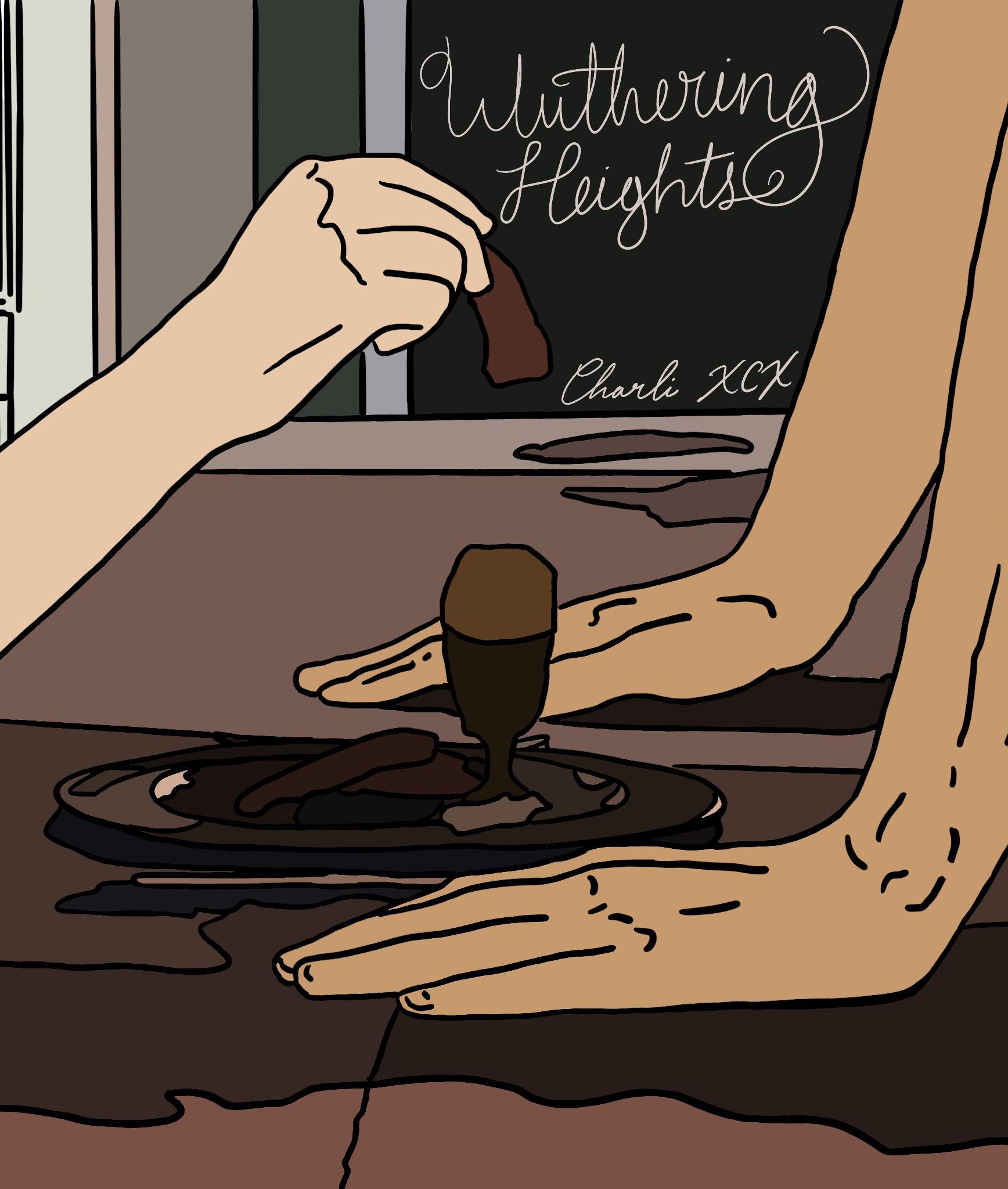
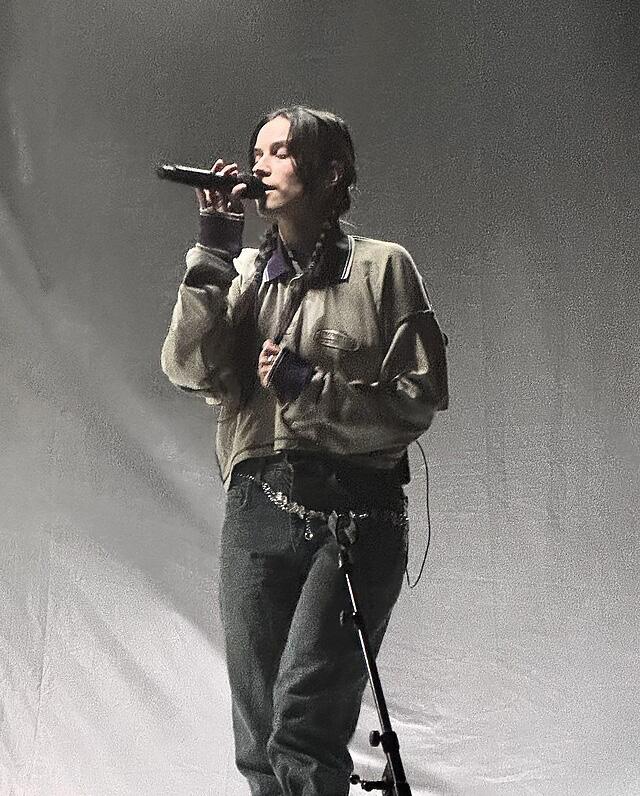
Charli xcx was confronted with the impossible. Following up “Brat Summer”—the fashion and lifestyle microtrend that spawned from her 2024 megahit album “BRAT”—seemed unimaginable. How could Charli, who acknowledges the pop culture phenomena as her climax within the industry, move on from the moment? Many predicted that Charli would follow “BRAT” with something similar in sound: club beats filled with aggression, rawness

courtesy of Wikimedia Commons.
Hadley Amato reports on Poet Gold's recent event in the Aula.
and grit. Instead, she chose to spin her pop diva persona into something more harsh, gothic and surprisingly…Victorian?
Enter Emerald Fennell’s new adaptation of “Wuthering Heights,” an overdrawn, lackluster period piece starring Jacob Elordi and Margot Robbie, released on Feb. 13. Apart from being a shallow interpretation, the film—based on the novel by Emily Brontë—has sparked intense criticism for its “whitewashed” casting and lack of substance. The movie itself is strange, horny and confused; it is peculiar that Charli would pick this endeavor for her next project. Nevertheless, Fennell’s hope for Charli to contribute a song for the film quickly turned into a greater venture. Thereupon, longtime fans of Charli, like myself, were aghast when she announced that her next album would be inspired by Fennell’s version of “Wuthering Heights.”
Initially, I was skeptical of Charli’s ability to ride the coattails of “BRAT” into something more “serious,” trading in her scandalous, party-girl persona for embroidered silk and soft-boiled eggs. But critically, I was curious how Charli would transform her sound into, quite literally, a different landscape. And with the arrival of the first single, “House,” this past November, Charli proved she was ready to conquer a more isolated, gloomy project.
The genius of the eerie “House,” which
Grace Finke lists sports that should be in the next Winter Olympics.
likely informed her choice to release it first, resides within the complete tone switch Charli establishes within her sound. Sounding of “nails on a chalkboard,” the grotesque strings that build at the forefront of the song settle within a cavernous, haunted atmosphere of deep bass and cracking synths. The song is vague, but impactful. Aided by vocals from John Cale (yes, the one from the Velvet Underground), the pair shrieks and fractures, setting the strange resonance “Wuthering Heights” entails: “I think I’m gonna die in this house.”
Whether the album deserves to be called a full Charli xcx album remains unanswered. There certainly are elements of classic Charli scattered throughout. “Chains of Love,” for instance, is a remnant of Charli’s typical synth-pop anthems with its autotuned, electronic pulse. The similar “Eyes of the World” interplays Charli’s sharp voice with Sky Ferreira’s mysterious eloquence. The duo switches between intense moments of blurry strings and staggering percussion, resulting in a sound like that of Charli’s 2013 album “True Romance.”
Charli’s experimentalism, however, still shines. The use of strings throughout “Wuthering Heights” is perhaps her most ambitious production choice, though a successful one. “Wall of Sound” maintains
the unnatural feeling of “House” but slowed down, resulting in an overtly emotional listening experience as Charli describes overwhelming, addictive love through the lens of anxiety. Similarly, both “Dying for You” and “Seeing Things” accelerate with plucking twines and keen, stretched vocals from Charli, akin to courtship-esque, ballroom dances during the late 18th century. “Out of Myself” showcases profound cello and quippy drums, scattering the feelings of fresh love during the “honeymoon phase.”
The overall implementation of orchestral crescendo throughout the project creates glaring apprehension in the listener, spewing the off-putting effect the film inspires. To that end, Charli’s mastery as an artist lives in the fact that she did not view the film before making her album. With only access to the screenplay, the film’s uncomfortable, gothic imagery still exists within Charli’s work. Her songwriting is strongest in the tracks that break from the fierce strings, instead focusing the production on blazing, lively synths. “Always Everywhere” exhibits Charli dipping into previously undiscovered fields of poetic description, utilizing symbolic elements from the novel: “On the water, your face on top of mine / A fever dream of mirrored features, hungry eyes.”
Henry France profiles Baseball Pitching Coah Beth Greenwood.

EDITOR-IN-CHIEF
MANAGING EDITOR
SENIOR EDITORS
CONTRIBUTING EDITORS
NEWS EDITORS
ARTS EDITOR
ASSISTANT ARTS EDITORS
FEATURES EDITORS
OPINIONS EDITORS
ASSISTANT OPINIONS EDITOR HUMOR EDITOR
ASSISTANT HUMOR EDITORS
SPORTS EDITORS
DESIGN EDITORS
ASSISTANT DESIGN EDITORS
COPY EDITORS
GRAPHICS EDITOR
ASSISTANT GRAPHICS EDITOR
PHOTO EDITOR
GAMES EDITORS
SOCIAL MEDIA MANAGER
LIVE EVENTS CHAIR WEBMASTER REPORTERS/COLUMNISTS
PHOTOGRAPHER CARTOONIST COPY STAFF
Allison Lowe
Luke Jenkins
Kathryn Carvel
Darja Coutts
Madeleine Nicks
Clara Alger
Carina Cole
Soren Fischer
Hadley Amato
Julian Balsley
Grace Finke
Aurelia Harrison
Brendan Kennedy
Yaksha Gummadapu
Sydney Jones
Jacob Cifuentes
Ian Watanabe
Zoe Rodriguez
Emma daRosa
Wren Buehler
Noah Daube-Valois
Henry France
Casey McMenamin
Molly Delahunty
Lucas Seguinot
Teresa Garcia-Green
Hannah Wells
Sadie Bakken-Durchslag
Paige Hahn
Anabel Lee
Annie McShane
Noa DeRosa-Anderson
Makenna Brown
Sadie Keesbury
Felix Mundy-Mancino
Mia Liloia
Denver Brown
Hunter Farhat
Eduardo Culmer
Armaan Desai
Noah Duncan
Jackson Hrebin
Lora Janczewski
Eli Lerdau
Evan Seker
Erin Thatcher
Amritha Dewan
Andrew Chu
Catriona Chapman
Nikola Parker Cooperman
Elliot Evans
Rebecca Lubin
Tess Novack
Holden Thomson
Julia Weber
• VSA Senators received a presentation from Associate Dean of the Faculty and Academic Resources Kelly Duncan about Vassar College’s priority and planning process, and the College’s goals for 2026 and beyond.
• Senators brainstormed areas that the College can improve in and things that the College could be doing better in a workshop. Two of the things they argued for were for Vassar to invest in more accessible infrastructure on campus and in Poughkeepsie, and for the College to focus on improving existing buildings before building new ones.
• The Senate passed a resolution restricting all members of the VSA from using generative AI or language learning models in official work passed in the senate.
• A constituent joined the Senate to voice their concerns about diplomas only being printed in Latin.
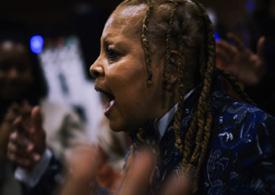
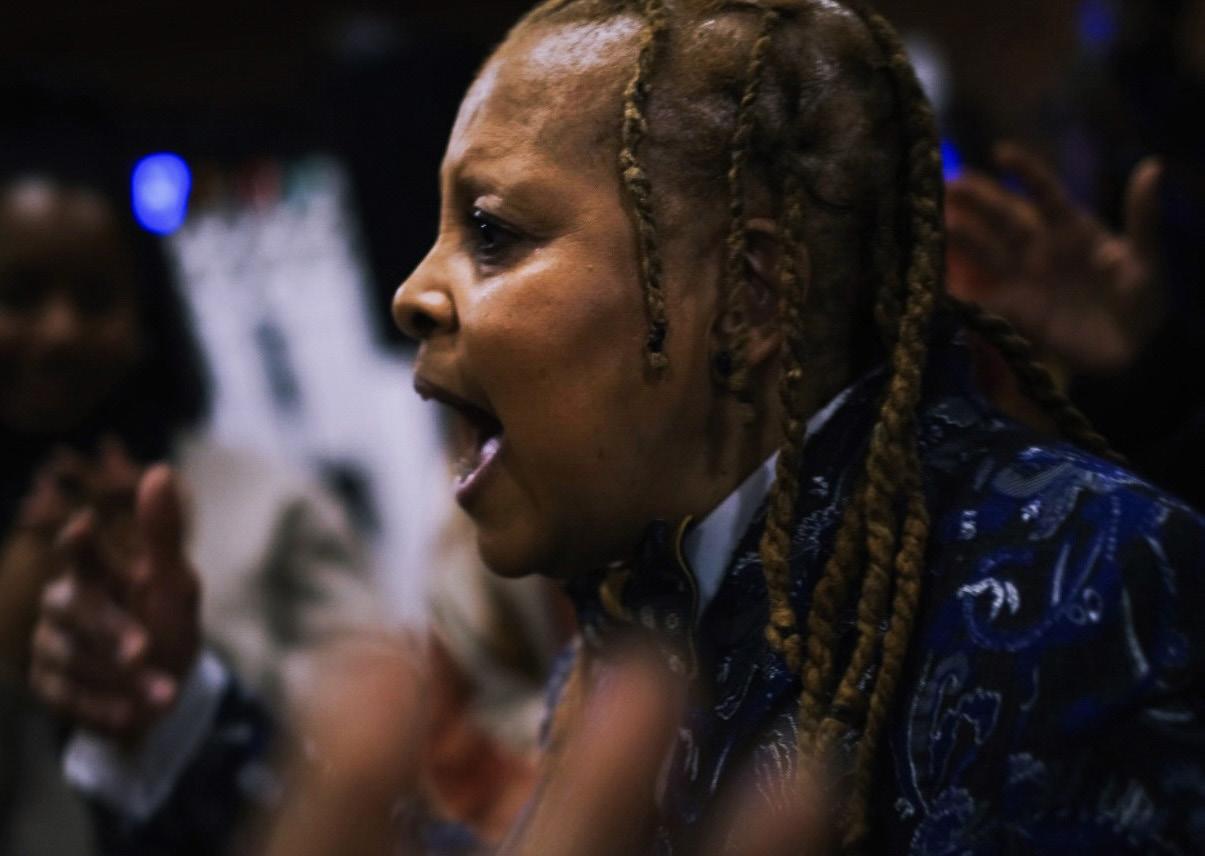
On the evening of Feb. 19, local artist Bettina “Poet Gold” Wilkerson came to Vassar College to perform original poetry, backed up by a cast of regional musicians and local artists of all ages. The Aula was packed with students and community members.
What followed was a multi-media expression of political struggle, local history and Black pride. The openers of the evening were two children who, together, performed a poem they had written. Their poem titled “Pledging your allegiance” set the tone of the evening. “I pledge my allegiance to no flag, of no United States of no America, and to no republic, for which nothing stands, one nation, under your description of God, unindivisible, with no liberty and no justice for all,” the middle schoolers boldly proclaimed to the crowd. “I won’t put my hand over my heart for something that never held mine,” the two girls concluded. Their poem was met with a standing ovation from the audience.
“I think it highlights where youth are in this moment. That they are awake, that they are thinking, that they are themselves. They have agency,” said Vassar Associate Professor of Political Science Taneisha Means, who helped organize the event. Shanti Garcia ’28 also reflected on the impact of the students’ poem: “It was really beautiful to see that they were allowed space to read their poetry… I never thought about the Pledge of Allegiance as a kid. We did it, but for them to be so young and already understand that you don’t have to accept the rituals that schools tell you to do was really awesome.”
Members of Vassar’s Black Student Union then performed poetry, singing and dance, followed by Poughkeepsie rapper Jaydee Great. After the openers, Poet Gold walked out with a band of four vocalists, a keyboardist and drummer in tow—all local musicians coming from Newburgh, Poughkeepsie and New York City. The showcasing of local artists resonated with Garcia, who commented, “I love that we could contextualize where we’re at, to give them respect in their artistry, while also acknowledging that they know Poughkeepsie better than us.”
Throughout her set, Gold focused on a central theme that she terms, “Be the poem.”
“Imagine sunsets with orange hues across the sky, when the stars ascend the blanket at night, when things go dark, be the light in your life. Be the poem,” she shouted passionately into the microphone. After the show, in an interview with The Miscellany News, Gold elaborated on what “being the poem” means to her: “It means aspiring and doing self work, becoming your best self according to your own terms… ‘Be the poem’ is tapping into your love, your spirit, your hope and being authentic to that.”
Though centered on celebrating one’s spirit, Gold’s performance was also deeply political, with a strong reverence for both Black and Poughkeepsie history. This was evident in one of her pieces, “No Plaques on Market Street.” The poem was a meditation on the history of enslavement in Poughkeepsie, and the lack of recognition on slavery from the City today. “Poughkeepsie, New York! There are no plaques on Market Street, no monuments, no statues, no declarations stating slaves once stood and died here,” Gold bellowed in between the harmonious chants of her background singers, “Run off to freedom! Run off to freedom! Freedom, freedom, freedom.”
In the interview, Gold elaborated on some of the historical context that went into creating the poem. “Market Streets were known for marketing people. Black people,” she explained. “So, that resonated with me, and I wrote the poem.” According to Celebrating the African Spirit, enslaved Africans were “indispensable” to the development of Poughkeepsie and the greater Hudson Valley. They were forced to perform essential labor on roads, ships, mills and homes, and Poughkeepsie’s Market Street became a central hub where these human beings were bought and sold. Gold’s performance also focused on Poughkeepsie’s present. Towards the end of the performance, she addressed the audience directly about what can be done to help alleviate what she believes are the struggles on Poughkeepsie’s Main Street. “Main Street, Poughkeepsie, is hurting, and there are a lot of great minds trying to put stuff together and spending lots of money trying to ‘think-tank’ this. But we’ve been ‘think-tanking’ it for years. I’m gonna keep it real… I think that this is an opportunity to have cross-conversation between Vassar, Marist [College] and Dutchess [Community College], and even the Culinary [Institute of America], and see how we can change the
way Main Street looks.” She added, “There’s something more that can be done. And I think that that something has to come partially from the colleges.”
Downtown Poughkeepsie has faced severe disinvestment as a result of 20th century urban renewal, IBM’s presence in the region and suburban sprawl. After the show, Gold elaborated on some specific things that could be done for Main Street: “I think, one, a conversation with some of the business owners there, finding out what it is that they need… And then also conversations with the unhoused. People are afraid to have conversations with the unhoused, but they’ll give you the answers.”
Means echoed Gold’s sentiment about Vassar helping: “Vassar is a powerhouse in terms of its financial resources. Their funding can help realize dreams, in terms of initiatives and programs that require funding.” She continued, “I would say [Vassar] has a responsibility. We are here in this space, and our presence here has absolutely impacted different systems, and the way that things operate and happen here. The school districts, for example, wouldn’t be the way they were, if it also weren’t for larger institutions and interests, Vassar being one of them.”
In the middle of her performance, Gold led what she described as a “wake.” She invited the audience to get out of their seats and come to the center of the room, to join in song. She told them: “This is about community. This is about people connecting with each other. I don’t care if you’re
Republican or Democrat, you're independent, green, blue, yellow. I don’t really care. What I want is your energy, and what I want is you to connect with each other, and what I want is for you to be awake.”
As she gathered everyone together, she encouraged the audience all to raise their hands and chant to the beat of her song, “I’m awake.” The whole audience came together as she swayed with them, conducting their shouts: “I’m awake, I’m awake, I’m awake.”
After the show, Garcia pointed out the wake as one of her favorite parts: “I loved it. Before, I would look around the room and they would play the music and people were kind of reserved. As an audience member at a Vassar event you kind of put on a performance of like, ‘I’m here and I have to listen to you, and I’m gonna take it all in,’ but it was unorthodox… And I think people kind of tore down their walls of performance by going in the middle.”
Gold explained her motivation behind the wake, and why she chose to organize the crowd under the mantra. She explained, “We must rise. We must acknowledge that there is still community. There is still connection, and the only way I can get you really to acknowledge that is if you get up out of your seat and live that. Live that with each other… I know we may have phobias, it’s okay. Let’s lean into some trust, because whether you like it or not, we are going to need ‘we.’ And we should be awake to that. Don’t allow your fear to put you into a silo. We’re a community.”
Even with its uncanny themes and stirring production, Charli, alongside longtime collaborator Finn Keane, refuses to abandon the addicting pop hooks and memorable refrains that she is often celebrated for.
The catchy “Altars”—which details the agony of placing a romantic relationship on a pedestal, only to face betrayal and emotional destruction—strums along a pounding beat as Charli’s vocals soar through. “My Reminder” lyrically beams Charli’s empathic emotions while energetically jumping along the track’s playful production. It is clear that even with the dark themes and sinister period romance that “Wuthering Heights” provides, Charli is reluctant to completely abandon her pop sound for something alternative, cinematic and just plain creepy.
And perhaps that is my biggest quarrel with “Wuthering Heights” as a project. While Charli triumphs in delivering an addictive pop album—the likes of which are already present in her extensive discography—I was left wanting more. The deepening, otherworldly expectation set off by “House” revved up audiences for a record more reminiscent of sound by artists like Ethel Cain. Instead, Charli chose to play it safe. “Funny Mouth,” the epic closing track, promises eminence with mournful, jarring strings overlaid with “cyberpunk” glitches. Yet when the song seems to be approaching a significant experimental cul-
mination that would rise above anything Charli has created before, it crumbles to silence, the strings quietly fading into the background.
It is not to say “Wuthering Heights” is a mundane album. Numerous moments of the work left me yearning to run through rainy moors toward my obsessive lover. And still the audience is able to fully grasp the all-consuming emotions of Cathy, the wild and raw protagonist of the film, and the intense passion between her and Heathcliff. Charli has surely explored new realms of experimental production that work in her favor: blending hyper-pop with orchestral, brutal soundscapes. Still, most of the tracks give in to her usual distorted vocals and driving synth-based production as seen on “BRAT.”
After viewing “Wuthering Heights,” I was left with unease. Sure, the album captured the compulsive love themes and dreadful emotions the film required, but I am not sure if it was necessary. Fennell aimed for camp, and perhaps Charli xcx was the only solution. But with a film that so heinously adapted a classic novel with exaggeration and distraction, Charli’s work was merely a casualty along the way. Is this album what Brontë pictured for her infamous novel? Probably not. The record is a compelling but frustrating companion to Fennell’s film: had Charli produced a similar project detached from “Wuthering Heights,” perhaps it could have been her next big “moment.”
Reflecting on ‘folx’: a 112-track album about hating your job
interest them will probably interest those just like them as well.
Ihave been reckoning with how I view music and art as a whole—what makes a good piece, do I “enjoy” art properly, etc. I have been a “music nerd” in the traditional sense for so long that I have grown tired of the conventional circuit of acclaimed albums, new and old. Instead, I have found more and more enjoyment in pursuing and occasionally uncovering obscure or unconventional art purely for the sake of it, not necessarily bound to their inherent quality. At the same time, I have had a stubborn, maybe even slightly performative, resistance to pursuing musical projects based
Instead, I have found more and more enjoyment in pursuing and occasionally uncovering obscure or unconventional art purely for the sake of it, not necessarily bound to their inherent quality.
on assumed novelty—you know, unconventional style mashups, weird-sounding genre and artist location combinations; the type of stuff that gets a few shallow videos made about it on TikTok and then becomes obscure again. There are also projects that seem to lean into these novelties for the sake of it, usually by online music nerds who know that the weird genre covers, tracklists and genre combinations that
On the surface, you would think all of these things apply to “folx” by friends&.
A “glitch-pop” “rock opera” with strong elements of “cosmic country?” A somewhat hidden, convoluted narrative about labor in the 21st century? One hundred twelve tracks, about half of which are a few seconds long with extended quotes from sociological texts as titles? The track titles for the actual songs having, like, five parts to each of them? The tracklist is over 10,000 characters! And why would they title the album that, out of all things? There is no denying there is a great amount of novelty to the project, but the rule for me, and I think for most, is that it does not matter as long as there is significant substance in the album beyond its external quirkiness. I certainly expected something unique and exciting. I discovered the album a few days before its release when the only ones who had heard it were friends of the group, some of whom I knew, who all seemed to treat the project with intense reverence beyond what they may normally do for their friends. I first listened to the project 30 minutes after its release when I was abruptly reminded of its existence by a friend; as I listened, I found it difficult to dispute that aforementioned reverence, and found myself more and more inclined to feel the same way.
“folx” is about a lot of things, as the Bandcamp description—along with the album’s extensive “citations” list and its informal description written by numerous collaborators simultaneously in one now-lost Google Doc—will tell you. I could probably spend this entire article listing things the record is about, but to summarize some of the major themes
mentioned in the description(s): It is about labor in the 21st century, the effect of capitalist accelerationism on art and folk music especially, the concept of the internet “shitpost” as an art form and various related elements of the personal life of jc of friends&.
No matter how unprofitable or how little direct influence it has on mainstream popular culture, independent art is alive and well and will be for as long as art itself is—and I do not know if anything before “folx” has ever made me feel so sure of it.
The album is his brainchild of eight years, created in an unspecified amount of collaboration with members of the friends& collective, the existence of which seems to have largely been defined by the buildup to this project. Listed in the aforementioned citations list of over 200 items, you will find the album samples from old folk and country music, late 2000s/early 2010s pop music, video games, “My Little Pony,” The Beatles and Hatsune Miku. You will also find that most of the track titles are quotes from sociological texts by Karl Marx, Mark Fischer and Gilles Deleuze and Félix Guttari. Only by listening—and probably reading the lyrics for each track on bandcamp—
can you find how all of this contributes to a singular, balls-to-the-wall narrative that could take a whole seminar to analyze.
There is a chance absolutely none of the above made this album sound appealing to you, let alone gave you a good understanding of it. While I do think “folx” is an amazing album, what I find more important is how enigmatic it is. It makes you do weird things like listening to it until 3 a.m. the night of its release when you have to wake up at 7:30 a.m., or writing a whole article about it when you have the most work you have had for the entire semester.
You could try to evaluate it as objectively and critically as you want, but what more could a work of art hope to do? Writing this article feels less like a comprehensive review, which I do not think I am capable of for this album—merton’s pseudo-official review on Rate Your Music is infinitely better and worth a read if you are interested in cultural theory at all, which I usually am not. Instead, this article is more of an expression of how much gratitude this album has made me feel for the continued production of authentic, hopeful art in the face of, you know, everything—a significant theme of the album itself.
There is this sentiment I see sometimes that truly independent music is dead or waning, or has been hijacked by “industry plants” and “nepo babies.” But how are you going to assess patently non-commercial music by its commercial success? No matter how unprofitable or how little direct influence it has on mainstream popular culture, independent art is alive and well and will be for as long as art itself is—and I do not know if anything before “folx” has ever made me feel so sure of it.
IalwaysSophia Marchioli Guest Columnist
find myself looking for music that fits the current season. If you are looking for the perfect album for the cold, gray, soggy days we have been having, it is “choke enough” by Marylou Mayniel (stage name Oklou). Released just over a year ago in Feb. 2025, Oklou’s electronic masterpiece is euphorically eerie and never boring. It culminates in a unique combination of ethereal nostalgia for a few niche times in pop culture while pulling in this “choked up” fear for what the future holds. Throughout the entire album, Oklou’s delicate voice feels like it is just about to crack. She maintains a thick layer of mystery, keeping the listener guessing. But, never do we ever truly know: Who is Oklou?
As a new mom and rising artist, Oklou’s success story has been more of a slow burn. As a child in central France, she took piano lessons, eventually going into a music conservatory where she studied classical music with a focus on piano and cello. In the 2010s, she began working with different collectives and releasing small demo projects on the internet. This archival discography still exists on platforms like YouTube and SoundCloud. “Avril,” her first EP as Oklou, was released in 2014. What is evident across her discography is a slight shift in style over time. Oklou’s early work feels more upbeat and electronically obvious, sounding DJ-esque. However, an ominous tone has slowly seeped into her music, displayed on her 2020 album “Galore” and becoming even more present on “choke enough.” The musical approach seems to speak for itself as more muted and resounding in the blues and greys of “choke enough’s” cover art and music videos.
The 2025 album is layered with meaning and recollection. Oklou calls upon ’80s nostalgia with the sounds of cartoon birds, which can be attributed to her passion for classic cartoons—which she hopes to share with her newborn son, Zakaria.
Simultaneously, she folds in a significant amount of stylistic choices from Renaissance music. On “ict,” a distant trumpet fanfare opens the song. “forces” features a melancholy organ blaring over Oklou’s trademark digital fuzz in the background. A digital flute dances behind her delicate voice on “want to wanna come back.” To add in another layer, she also maintains some Y2K nostalgia with her heavily saturated, auto-tuned voice. Additionally, the clothing choices, filters and subjects of the album’s accompanying music videos pay homage to this era.
This is all contrasted by more modern choices on songs like “blade bird,” which features acoustic guitar and a slightly more predictable composition with a repeated chorus and a formal bridge, lending itself to the pop category. All this proves how beautifully Oklou can transcend genres, switching between them across the album and within single songs, too.
Lyrically, she often pulls inspiration from childhood memories. “plague dogs” owes its name to the animated film of the same title; it is a movie about two dogs, Rowff and Snitter, referenced in the song, who are subject to lab testing. The song “harvest sky” references La Fête de la SaintJean, which she celebrated as a child in her hometown, Poitiers. Its lyrical simplicity—repeating “dance for a harvest sky”—is contrasted with the production behind the lyrics: a melodically medieval tune made from sped-up, electronic instruments. However, she also writes about her future, referencing her pregnancy in “family and friends” with a line concerned about whether she will miss cradling her belly. She also expresses a tension, “They said to me, ‘you can’t escape’ / One life into your name,” possibly projecting the theme of the album, a choked-up fear of life decisions and changes. These lyrics demonstrate Oklou’s uniqueness: she can artfully hide meaning behind thin lyrics while remaining instrumentally and melodically complex. Despite most of her lyrics appearing
indecipherable, they are strengthened and complicated by the backing track, where listeners can really understand her musical background. Her past as a DJ is clear in the intricacy of the electronic instruments. Ironically, this style is complemented by her classical training, illustrated by the choices she makes about those electronic instruments and the melodies of her songs. “choke enough” feels seasonally relevant right now with the quiet, icy tone it in-
vokes. The grandeur she somehow builds behind the digital hum in the backdrop of the songs resembles a still, snowy forest. The album’s tone feels darkly compelling due to its mystery. It has gotten me through all of this February and last. I encourage all listeners to return to this album, for it has more meaning than one may initially gather. Oklou has effectively curated a niche feeling through her unique background and collection of memories.

Sydney Jones Features Editor
While watching a movie or TV show, have you ever noticed a familiar set of stairs, a branded sweatshirt or a certain town mentioned in passing which starts with a P and rhymes with bitsy? Did you rush to the internet, or for the weaker of us, Fizz, for answers or validation? I certainly have, and since coming to Vassar, I am continuously impressed by the number of actors that have graced our sidewalks and the volume of movie and TV projects that have featured our campus, ranging from overhead shots to building interiors—see “Frances Ha,” below.
While more references than you might expect come from well-known productions like those of the hallowed halls of Studio 8H or the set of “Friends,” some are slightly more niche—“The Muppets Take Manhattan,” anyone?—and may remain unknown to the Vassar community. Now, thanks to a donation and over 20 years of work from alumnus David Ezer ’95, almost a century of Vassar’s history on film, TV, music and even in literature and cartoons, can be found in one place: the website, Vassar On Screen.
Over the weekend, I watched upcoming commencement speaker Noah Baumbach ’91’s “Frances Ha” and was struck by the magic that comes with recognizing interiors I frequent on the daily. The film features a title card with a Poughkeepsie PO Box number (does anyone have Box #59968?) and the interior of a dorm and hallway on Main House’s fifth floor, as well as the exterior of Lathrop House for an unnamed upstate college’s summer program. Stepping down the everyday set of stairs leading out from my dorm had suddenly become a little more special. I also remember Netflix’s “The Four Seasons” filming over the 2024 October break of my first year and, when the show
was released, watching Steve Carell play frisbee on the Nircle (Noyes Circle) and Tina Fey take a seat on the library steps. I immediately showed these moments off to whoever would watch.
Associate Professor and Chair of Film Erica Stein explained, in written correspondence with The Miscellany News, how Ezer put together these and many more examples of Vassar’s representation in the media to create Vassar On Screen. “David initially reached out to see if there was a student who might like to work with him on updating and maintaining the site in the future [...] He had developed a sophisticated tagging system, digitized and uploaded hundreds of clips, and added commentary for each post,” wrote Stein. “In order to publish the site for Vassar, we worked with CIS (Computing and Information Services) and with David to import everything to our servers, and then reformatted everything for the new site.” And it truly took the help of a community to get the site ready to be shared with the community.
Stein shared that additional site maintenance was done with the help of the Film Department’s screening technician, Geri Cosenza, as well as administrative assistant Peter Rednour. Ezer also donated more of his time recently to update the tagging system and commentary, which sit alongside each entry.
Although these Vassar cameos are certainly special to see and flaunt, why take the time to create such an extensive database? Stein explained that these references are more than just pop culture easter eggs, and there are already plans to further incorporate the site into the Film Department’s curriculum. She shared that students in classes like FILM-175: “Introduction to Screen Arts” and FILM-209: “World Cinema” can use the database to learn how to build visual
associations and do research on film.
In the fall semester, just before the site’s official launch, Theo Rollet ’29, who has plans to major in film, was chosen to begin working with Ezer in his campus job as a film shop assistant. Each week, Rollet sorts through and classifies entries to make it easier for users to navigate the site.
“That means sorting through a lot of clips from the early days of cinema onwards. I’ve now reached the end of the 90s, and have been looking through a bunch of sitcoms,” wrote Rollet.
Navigating the site myself, I was intrigued by the alternative media and literature sections. Reading Donna Tartt’s novel “The Secret History” just before first-year movein surprised me with one of my favorite— though admittedly unsettling when consid-
"That means sorting through a lot of clips from the early days of cinema onwards."
ering the similarities between the fictional Hampden and our campus—Vassar references to date. So I wondered about the possibility of collaboration across disciplines to expand the site even beyond the scope of the Film Department, and how they might plan to expand those non-film-related sections.
Stein explained that although the departments have not yet collaborated, they do have plans for the Film Majors’ Committee and other students to continue developing the different categories.
As for Stein’s favorite entries from the database, she expressed, “I've personally
The winter goes on without lights
Mary Lemza Guest Columnist
After almost two years, I finally had a chance to go home. I could not have chosen a better time, or so at least every person I went on to meet jokingly told me.
From day one, I learned the drill: As soon as the lights go up, no matter the hour, charge everything, boil eggs for the next couple of days, put on the kettle, pour hot water into the thermos, fill the kettle up and start again. The electricity disappears as suddenly as it appears, if at all, and not always according to schedule. Compared to most, we are lucky, as although living on the outskirts, we are still in the capital city of Kyiv.
On the night of Jan. 7, Dnipro and Zaporizhzhya lost electricity after Russian attacks on critical infrastructure. Some 800,000 people were left without light, many without heating as well. Around Jan. 9, the Russian attacks on Ukrainian power plants intensified. At 2 a.m., wrapped in a red fuzzy blanket in the hallway, my mom and I tracked the movement of drones through alert messages in Telegram channels. That night, there was a risk of ballistic missiles. Even the president, in his daily video, insisted everyone take the warning seriously and go to a shelter. Unfortunately, we did not have one nearby.
Four drones are headed to the left bank of the city, the latest Telegram alert informs. Two rockets approach the city. I text my brother. Three drones towards the center.
They maneuver – whatever that expression might mean in military jargon. One moves towards the right bank. Two go further west. One disappeared. Two shot down. One hit, they say. One apartment was reduced to debris in a span of seconds. Two more drones are approaching. Three pictures of a building on fire. One missile shot down. One video of a drone going through the wall of a building scarred. Casualties unknown. A motor sound appears from the east up above, grows louder, quieter again, is followed by a hissing and then a sharp, explosive sound. All clear.
“They must have shot it down,” Mom says, “Let’s go sleep.” That night, and for many nights after, this sequence would start again with my mom’s sharp “Get up! Fast!” and continue in a phone-lit hallway. This drill, too, one learns by heart. It was four: four lives were taken away with one drone.
Some nights were quieter than others. Some mornings were more difficult to start. Some pictures from the night before were harder to look at. Some numbers were harder to face. Some days, the heating batteries were warm. On Jan. 13, my mom and I worked in the kitchen with hats on our heads. One pair of pants and a single sweater no longer provided enough warmth indoors. In some parts of the city, the indoor temperature dropped below 50 degrees Fahrenheit and continued to steadily decline. The joke of the day was that the best way to make yourself warm in the apartment is to strip down, go out in the snow
always loved the running gag about Vassar on BoJack Horseman, which becomes a way of tracking a director's waning fame and reputation. One of the best known ones is from ‘Some Like It Hot’ (1959), which I particularly love because it's an older film, but the joke—Marilyn Monroe's character is lying to impress someone who's also got something to hide—still works perfectly well today.
If you look at the 1920s-30s section of the site, there are also a lot of fascinating invocations of the college, as well as a 1931 film, ‘She Goes to Vassar,’ that was actually shot on location by a former student and contains a lot of footage of what daily life on campus was like at the time.”
So even if you are not taking courses in the Film Department or using the database for research, it can be rewarding to scroll through all the years of listings—you might not know what you will find—or simply use the search function to find the episode where that one character makes a Vassar reference that you just cannot quite remember.
One of my favorites I found while exploring? A video sent with acceptance letters in 1990 and 1991, which describes “One Night at Vassar.” Though the size of the computer the “student” narrator uses would surely not fit on my desk today, and the name “AC/DC” has fallen out of style, it is nice to know the charm of late-night debriefs with friends and Gordon Commons “talk fests” have remained staples of student life for 30 years and counting.
And, if you find a reference not already included on the site, Stein said students are encouraged to send tips to the Film Department email, film@vassar.edu. You could help document another piece of Vassar history, and maybe find some magic for yourself, too.
and walk back in. A group of parents and their kids build an ice fort out of frozen water mixed with food coloring: if it is just as cold indoors, you might as well go outside. Despite returning to my home for a month, I was a tourist, a curious passerby. What was to me a temporary inconvenience remains an unpredictable, inescapable daily reality to thousands. The absence of electricity shone light on the many disparities: some windows remained lit up in houses with no electricity; some mornings continued to start with a coffee and a warm meal; some spend their last savings on gas to keep warm; some stand in hour-long lines on bus stops since other kinds of transport could not run without electricity; some were able to leave. Here and there, open-air kitchens served soups and tea, volunteers distributed warm clothes, and proactive youth delivered food and medicine to the elderly. In emergencies like these, for many, even a little support is crucial for survival.
Another running joke among Ukrainians: each winter we say, “This is the worst one yet,” only to repeat the phrase yet again in a year. This time, the Russian tactic had been civilian exhaustion. With not a single power plant in Ukraine left intact by February 2026, the entire country had experienced weeks without heat, electricity and running water to varying degrees of severity. In negative four degree Fahrenheit temperatures, their absence had posed a lethal risk to many. As we look forward to warmer weather, Russian attacks continue. Their
target remains set: civilian infrastructure, power stations and our hope. Although the technicians and emergency services in Ukraine work without break, hundreds of thousands of people remain without consistent access to light, heating and running water in severe winter conditions.
Being back with the Vassar community, I cannot help but think of home and be grateful for all the utilities that have become so easy to take for granted. Having gone through some of the most extreme cold in the past few weeks, imagine doing so without light, without heat, without water. For many of our students and staff with families in Ukraine, the problem does not end with the news or reading this article.
To raise awareness and support the many members of our community with families and friends in Ukraine, for the fourth year now, the Vassar Alliance For Ukraine (VAFU), for which I am treasurer, held a vigil for Ukraine on February 24. The vigil was open to Vassar and the broader Hudson Valley community.
This year, the central theme of the vigil was childhood in times of war, and thus, we continue to turn the attention of the community to the global effort of the Ukrainian World Congress to raise funds for generators and fuel for the educational institutions and hospitals around the country. Even the small acts of support make a great difference — do look out for VAFU posters on campus and in your email, and do not be a stranger.
Lilly Kinney Guest Columnist
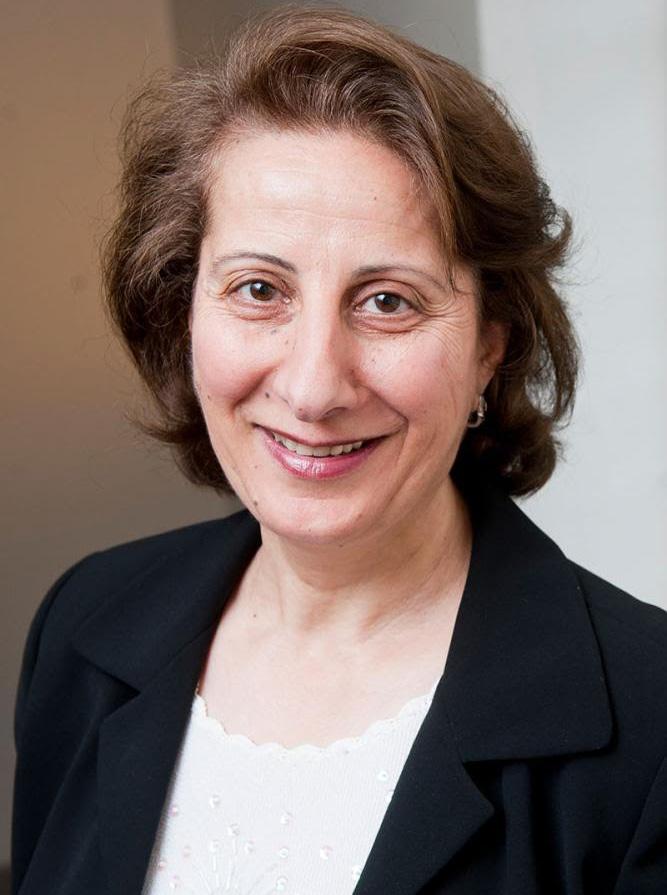
Whether you are tackling your language requirement or maybe pursuing language studies full time at Vassar, you will find yourself in the same boat as the rest of our student body. We all undertake the similar endeavor of learning a new language in some capacity during our time here. I admit that I have begun to enjoy my 9:30 a.m. walk to Chicago Hall for my morning Arabic class. I am greeted every morning by my lecturer in Arabic, Tagreed Al-Haddad, who never fails to make the intimidating task of learning a new language something to look forward to. I have grown to love my mornings spent in our Arabic classroom, and I think many others who take Arabic with Professor Al-Haddad would agree. This week, we drank our morning coffee in Chicago and laughed over the fact that we can both enjoy coffee well into the evening and still sleep soundly. She has spent many nights with a hot cup of coffee by her bedside, and admittedly, so have I—those late-night study sessions will do a number on you.
Professor Al-Haddad grew up in Amman, Jordan and graduated from the University of Jordan in 1990 with a B.A. in Public Administration and a minor in Teaching and Education. After her studies, she spent 12 years working as a school principal before obtaining a High Diploma in Education from the Al-Balqa Applied University in 2005. Shortly
after, she moved to the United States to begin her teaching career at Vassar. Professor Al-Haddad has been teaching Arabic language in the Africana Studies Department at Vassar for 15 years now. “The language chose me. I did not choose the language,” she shared with a laugh. “They [Vassar] interviewed me, and they said, okay, we need your Arabic. And then when I came, it was like I found myself. This is my right place. I love teaching at Vassar. Teaching Arabic opened the door for me to discover myself. I felt like I was meant to be a teacher,” she explained.
As we chatted, she highlighted the importance of the Africana Studies Department, Vassar’s oldest multidisciplinary program. Faculty of the department includes professors from an array of fields and students from all majors, ranging from history to film to cognitive science, who find themselves taking Africana Studies classes. To Professor Al-Haddad, the connections and diverse backgrounds of students and faculty alike that steer the department are what make it so special to her. “I love to create this connection with others. Just to put students together, to learn more languages, they feel like there is a community. They have to know each other,” she said. It made me think back to my first day in her classroom last semester. I had finally decided to embark on the bittersweet journey of learning Arabic, training my brain to write from right to left, shedding tears over the massive amounts of grammar rules and re-
alizing I would have to articulate alphabetic sounds I did not even know existed. Our class was small, only 11 students in total. We were strangers at the beginning, as many of us had never even seen each other around campus. In just a few weeks, we had grown to be friends, connecting over learning this beautifully frustrating language together.
I asked Professor Al-Haddad why she thinks language learning is so important for students today. She explained to me how important it is for students to recognize their connection and proximity in the global context. Language learning and cultural studies bring awareness to global inaccuracies often promoted through popular media, news channels and social media. “In my mind, there’s a lot of things, but from my experience, it's cultural empathy and understanding. Especially nowadays with the world, what’s going on in the world, I feel this is very important.” She notes this empathy developing in real time as students become interested in the language and culture. “I enjoyed seeing them learn the language. I love teaching and learning—they are the best two things in my life. I noticed students interested in the language and in the culture, so I started doing activities and they enjoy doing it. I enjoy seeing them happy,” she said.
Nobody is immune to unconscious biases or predisposed assumptions about another culture whether it is intentional or not. The good news is that the human brain is mal-
leable, and language learning can serve us all well in being more aware of what exists outside our own life bubbles. When you learn to speak with others, you learn to empathize, to understand and to connect. You might even learn a neat little fact about your own native language. Each time I say the words coffee, sugar, orange or algebra, I remember that they, along with hundreds of other words and phrases, were derived from the Arabic language. And, as you sleepily walk with a coffee in your hand to your 9:30 a.m. language class, think about all the cool movies you will be able to watch without subtitles one day.
“But I do have to say that's my little thing,” Sigrid Nunez told me about the genre she has coined in her novel “The Friend,” winner of the 2018 National Book Award. When asked about the novel’s genre, Nunez delineated where she intended the book to land: “I want [‘The Friend’] to read like memoir…I think of it as sort of like a faux-memoir or faux-auto-fiction.” Known for her synthesis of wit, philosophical inquiry and moral responsibility, Nunez’s novels situate themselves curiously between genres. Since writing “The Friend,” Nunez has written two additional novels, “What Are You Going Through” (2020) and “The Vulnerables” (2023), both of which adhere to this amalgamation of genres. On the topic of fiction versus nonfiction, Nunez made one thing clear with her signature acuity: “And as far as I'm concerned, it's all true.”
Sigrid Nunez came to Vassar College on Feb. 12 to deliver the honorable Alex Krieger ’95 Memorial Lecture, a series that has hosted authors Jeffrey Eugenisides, Zadie Smith and Michael Chabon in past years. The week of Nunez’s visit was a particularly potent week for aspiring writers, as Dinaw Mengestu, an Ethiopian novelist and MacArthur Fellow selected to be the 2026 Writer-in-Residence, was also on campus. Nunez’s lecture, which took place in the Martel Theater at the Vogelstein Center for Drama and Film, included short readings from “The Vulnerables” and “The Friend,” as well as a Q&A with novelist and Professor of English on the Helen D. Lockwood Chair Amitava Kumar. I had the pleasure of sitting down with Nunez in The Heartwood lobby prior to her lecture to ask her about her work.
Nunez is a literary encyclopedia. In the short time I spent with her, it was impossible not to notice her abundance of literary knowledge. This proficiency became in-
creasingly obvious when I asked her about the formidable quantity of anecdotes and literary quotations in her work. She humbly admitted that she does not have to research to acquire her quotations, though she does use a commonplace notebook to keep track of quotations and newspaper clippings, a fact she revealed later that evening. These elements are staples of auto-fiction, such as in Maggie Nelson’s “The Argonauts” or “Bluets,” works that Nunez agreed are similar to what she gravitates towards.
In her signature red spectacles, Nunez explained to me that constructing protagonists whose vocations are writer-based allows for this excess in quotation. She humored me by pointing out how odd it would be for a registered nurse protagonist to be entertaining quibblings about Flannery O’Connor. However, there does seem to be a stigma attached to writing writer-characters, according to Nunez: “Generally, you don't want to write a book about a writer, you know. It's kind of frowned upon…”
The list of topics a writer must not write about continued later that evening, when Nunez talked about the pandemic. Perhaps one of the most striking moments of the lecture was when Nunez asked the audience a question: Why is it that we go through something that happened once in a century, and we are asked not to write about it? Kumar and Nunez discussed the stigma behind writing “the pandemic novel” and the irony surrounding such limitations. Nunez used the word "strange" to describe public attitudes towards the pandemic as she answered one audience member’s question on the topic of COVID-19. Listening to Nunez emphasize these attitudes was the part of her lecture that stayed with me most. Hearing her speak was like having a light bulb turn on within a room in one’s mind, a room that has always been there, though never illuminated. She shone her wisdom onto all of our blind spots.
Earlier that week, when listening to Di-
naw Mengestu’s lecture on his novel “Someone Like Us,” I was compelled by the way Mengestu suggested that not all fictional characters must be empathized with; empathy is not mandatory. This sentiment prompted me to ask Nunez how she decides what level of intimacy or distance is appropriate for a given story, specifically as it relates to “The Friend,” “The Vulnerables” and her acclaimed New Yorker story “Greensleeves.” Nunez told me that she never wants to write a character that is unlikable on purpose. For example, the mentor in “The Friend” was not written maliciously: “I'm totally unaware of making a decision.” Empathy is, rather, something that happens naturally. Nunez informed me that Mengestu’s claim resonated with her: “And I agree with Dinaw. I don't think that you're required to show empathy for all characters, or anything like that. I think what your job is, is to create the character as a full character with different sides. And then just see what happens, I mean, to present them in all their humanity.” Nunez went on to explain how wrong it would be to force empathy down a reader’s throat or, on the other end of the spectrum, hatred. Even in her short stories, such as “Greensleeves,” in which the characters are far from her lived experience, she does not plan empathy.
Though a master of the novel, Nunez avidly writes short stories. She shared this with the audience while announcing the publication of an upcoming collection of 13 short stories in July. During her discussion with Professor Kumar, she riffed on the pressure of the short story after Kumar asked her about the difference between anecdotes and stories. While anecdotes fit nicely into a novel, Nunez proposed that the demands of the short story are unforgiving to anecdotes. She jokingly reminded us that we have all heard someone, at some point, rave about a novel, even though a substantial part of it was lacking. This simply does not exist in a short story, according to Nunez.
It was not long before the topic of her Q&A turned to mentorship. Nunez spoke with Professor Kumar about two formative mentors she had: Elizabeth Hardwick and Susan Sontag. She shared that she began working for Sontag nearly accidentally, when, after moving to New York City, a friend of a friend paired the two of them up because Nunez’s apartment was near Sontag’s, and Sontag was recovering from cancer and needed someone to dictate her work. While Hardwick, whom she met when studying at Barnard, was abrasive and severe towards Nunez’s work, saying “I would rather shoot myself than read this story,” Sontag encouraged and motivated Nunez to read as much as possible—Didion, Rilke and Woolf in this case. Her attitude towards Hardwick was not malicious or hyperbolic, nor was her attitude towards Sontag overly sentimental.
Towards the end of her lecture, Kumar asked Nunez which authors she believes are most important to be reading. While she initially protested against listing specific authors, advocating for natural novel selection, she eventually caved, listing Ben Lerner, Tim O’Brien, Jamaica Kincaid and Rilke. These authors, many of whom incorporate nonfiction into their fiction, are the same authors Nunez has taught in her own course titled “Fiction as Autobiography, Autobiography as Fiction”—a course some audience members may have recognized due to its appearance in “The Friend.”
By the end of the lecture, Nunez seamlessly established herself as a beacon of literary thought and as a voice capable of astounding written reflection. As Nunez spoke her final words of the night, she told the audience she was not supposed to be a writer. Sigrid Nunez was supposed to be a dancer. It is because of this failure in dance that she so earnestly turned towards writing. Thank goodness for that, for without this initial failure, we may never have gotten to experience such literary wisdom and erudition from Nunez that evening.
Students vexed by unexpected Nutella tricks they didn’t learn in school on midterm
Samuel Eisenberg Certified Hater
Ihate everything. Well, not everything, but most things. My hatred is broad and deep. Walking around campus this week, I’ve seen too many happy people. I thought it necessary to share seven things I hate so that everyone can stop being so positive all the time. That’s one for each day of your happy little week. It’s really getting on my nerves.
1. I hate people.
People are awful things. People are the reason why I got sick. People are the reason why only the weird bruised apples are left after lunch at the Deece. People are the reason why I have to talk in the morning and, frankly, at all during the day. People are the reason why I have to be scared to lift a toilet lid out of fear of
what I may find.
2. I hate geese, but more specifically and less specifically, I hate wildlife.
I don’t need to slink around the gaggles of gross geese every time I leave my dorm, and I certainly don’t need to worry about being sprayed by one of the 372 skunks on campus. You know what? I’m counting people as a part of this category. I won’t repeat any grievances then; I hate repeating things. See above if you’re curious.
3. I hate goose poop.
I want to be living my best life as Tiny Tim, tiptoeing through the tulips, but alas, it’s not tulips, but goose poop instead.
4. I hate the hole in the stairs leading outside from Raymond’s north side.
I’m shocked this isn’t bigger news. In response to the gaping hole that opened up in the stairs, Facilities Operations has developed a brand new technology and innovation in the field of metalworking. Somehow, against all odds, they have discovered a way to weld a metal plate with nothing other than steam. This revolutionary breakthrough was confirmed in a work ticket status update, which clarified that not only had the carpentry work been completed (apparently with invisible metal), but the steam work for the metal plate welding was in progress. I guess it’s still in progress, but it only seems to be making the hole bigger. I fear they misunderstood the ticket’s request.
5. I hate the Express ice machine. I like an iced drink. I don’t like a drinked ice.
6. I hate the little tiny pull-out desk things in the Sanders Classroom auditorium. I’m tall. I know. However … This is absurd. If I can’t fit my pen on the desk, how do you expect it to fit my pen,test, calculator, blue book, drink, snack and weed that I save for a bathroom break? It’s really unacceptable. People couldn’t have been that much smaller back in the day.
7. I hate Raymond’s water. I have a suspicion. I think the dryers and the pipes are connected. There is no other explanation for why there are pieces of grey fuzz in my water. “Refill, Reduce, Refresh” my ass. It’s like drinking out of a swimming pool filled with belly button lint. And that’s not even taking into account the lead. Though, I can’t complain too much. I’m starting to grow fond of the sweet taste.
Grace Finke Slippery Slider
Iamnot exactly known to be a fan of sports. I notoriously feigned illness my freshman year of high school so that I could earn credit for being on my school’s junior varsity volleyball team without playing a single game. However, I love the Winter Olympics. I was puzzled, though, by the selection of events. I understand that there may be some “safety concerns” when dealing with ice and snow, but that didn’t stop me from wondering: Where’s the creativity?
The Winter Olympics may have ended, but my inquiries persist. Thus, here are the events I expect to see at the French Alps in 2030.
We all remember the childhood thrill of three-legged races: the struggle to coordinate a mess of limbs, the slight discomfort of being yoked to your counterpart and the numerous face-first landings in a half-dead lawn. I personally don’t understand why this activity needs to be reserved for the warmer months. In this sport, the flimsiest rope binds two speed skaters together as they precisely balance their paces and rhythms across the ice. It’s the perfect combination of nostalgia and athleticism.
I am so tired of seeing people on the ice who know what they’re doing. I am no physics major, but there is no way it’s possible for all these athletes to perfectly balance on the thinnest blade after just landing a septuple-axel-lutz-double-spiral-mcflurry. Why was everyone so scandalized when “Quad God” Ilia Malinin fell twice? I think two falls should be the minimum. Where’s the representation for people who still need to lean on a stack of buckets to make it across the ice? In a competition riddled with “skill” and “discipline,” I choose equality.
Bucket Stacking
Speaking of buckets, this next sport brings
us back to my third-grade physical education class, where instead of playing dodgeball, we practiced Cup Stacking. This Olympic event occurs at a public ice rink, where skaters attempt to construct and deconstruct a fourtiered tower of five-gallon buckets. The buckets are not provided—rather, they’re grabbed from the hands of a three-year-old just learning to skate, or a 21-year-old who really shouldn’t be on the ice. While a rope ladder is provided to each athlete, it is seldom used as the adrenaline of the sport usually results in an astonishing display of aerodynamicism.
Doubles Snowboard
While I have never stepped foot on a snowboard, I imagine the experience is quite similar to skating; as I cruise around campus on my Hello Kitty skateboard, I always think, this would be so much better with another person! Picture an extra-wide snowboard, leaving merely a centimeter between the two athletes. The frontman provides balance, while the snowboarder in the back is responsible for steering. Who knows, maybe they will even lightly embrace to improve coordination.
Snow Shoveling
One of the most frustrating things about winter is needing to dig everything out of the snow. Why do I need to work out my forearms just to open a door? I truly believe that shoveling snow is a sport in and of itself. In this Olympic event, athletes will begin on top of a 20-foot pile of snow and will compete to see who can dig the deepest tunnel in five minutes. Of course, nobody knows how they exit their tunnels, as the audience will have probably left by the time they emerge.
Reverse Curling
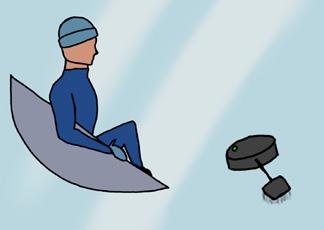
Curling truly fascinates me. What are we trying to achieve here? Why are we sweeping? Heck, why not have a Roomba do it? Thus, reverse curling is born. The participant travels across the ice in a dense granite dish while a glitching Roomba with a small broom attachment clears the path. The athlete must maintain the most exquisite core strength
to follow the Roomba’s sudden movements wherever it goes, even if it’s far from the finish line.
Uphill Skiing
My favorite part of any ski race is the run uphill. However, I never understand why skiers need to disregard their technique and equipment at this step. This event isolates this segment of the race and requires that skiers maintain proper form, using their poles to hoist themselves up the hill. Snow may pile onto the skis and into their boots, but what is winter without the tactile nightmare of cold, wet socks?
Snow Angels
Growing up in California, I felt like I missed out on so many important childhood experiences that came with a proper winter. One of those was the creative process of lying down in the snow and flailing my limbs so that I could imprint a blob wearing clothes with a degree of bagginess you could only find at Vassar College. This Olympic event bridges the gap between sports and arts. Participants must work on their angels for two minutes, taking extra care to prevent their body heat from melting the snow. They will be grad-
ed on their angel’s precision, depth and, of course, visual appeal.
Penguin Skeleton
Every day, I wonder how we can bring more whimsy to the Olympics. I find myself captivated by the pure joy and exhilaration penguins experience when gliding across the ice. Inspired by their semi-aquatic counterparts, skeleton participants will now race without their sleds, their hand-sewn suits instead insulated with a modest layer of lab-grown blubber and lined with soft synthetic feathers. It may not be the most efficient way to travel across the ice, but boy is it joyful.
Roald Dahl’s Luge
Everyone in my life is sick of hearing me talk about doubles luge. However, I think they just don’t get it. I, too, was confused at first why this needed to be a two-person job. But now I say, the more the merrier! Inspired by the sleeping arrangement of Charlie’s grandparents in the 1971 classic film “Willy Wonka and the Chocolate Factory,” the event will have athletes fit onto an extra-wide luge in alternating directions. Is it safe? Probably not. But what’s more thrilling than joyriding down the ice, entangled in your peers’ legs?

On Tuesday, Feb. 24, the Frances Lehman Loeb Art Center officially announced plans for its next temporary exhibition. The exhibition, titled “Tumblr in 2010: The Fandoms of our Lives,” will be an exploration of fanart on the website Tumblr throughout the 2010s. This rather unorthodox theme has come as a major shock to many museum stakeholders, particularly donors who fear what may happen to their generous gifts. This is of special concern given that there is not currently any 2010s Tumblr fanart in the Loeb’s collection, and it will surely be a huge expense to acquire enough pieces for the exhibit. These questions will go unanswered no longer, however. I’ve gotten access to all the details thanks to an anonymous whistleblower who reached out to me, as they “think this idea is really weird.”
Curator Phannie Wolfstar has been a long source of controversy in the museum world, thanks to her immense focus on erotic fandom art. She’s been quoted as saying, “Every museum is incredibly lacking in Tumblr art. I mean, that website is a veritable treasure trove of high quality art that’s never been displayed in person! We need to think more radically about what deserves space on a museum wall. Drawings of Dan and Phil in maid costumes have just as much artistic value as anything else.”
What has artistic value and what doesn’t is certainly debatable. What isn’t debatable, however, is that an exhibit of this nature is indeed a radical departure from what the Loeb has historically presented. My anonymous source, who we can refer to Secnarf Beol, warns us that this exhibition may not be as temporary as the Loeb wants us to believe.
“This goes way deeper, man,” Beol told me. “This isn’t just a few galleries for a few months. I mean, I could keep quiet if I was only going to have to look at the softcore Harry Potter prints and the weeb Thomas Jefferson stuff for a few months, but they want to take this bigger. Wayyy bigger. They want to replace everything in the Loeb.”
I know, I know, this may be shocking to all of you. Is this really a new era of the Loeb? Is it time to say goodbye to Van Gogh, Rembrandt and Stettheimer and hello to
user drarry_daddy? Beol assures me that everything they say is true. But is this news so upsetting for everyone? Definitely not. Students have had all kinds of reactions, with some echoing Beol’s sentiments that this exhibition undermines all the art history and cultural value that the Loeb represents, but just as many saying that they welcome the change.
One student, Sam Destiel ’27, is ready for a mix up at the museum. “I mean, the Loeb has been displaying prominent works of artwork for the good of our academics and the broader community for forever. And honestly, why not display stuff that we all care about? Is there not room for both Rembrandt and Remus Lupin? Can we not learn from both Bucky Barnes watercolor paintings and the Hudson River School landscapes? I mean, who is even deciding what’s ‘good enough’ anyway? It’s not like just anyone could’ve done this art. Could you capture Dan Howell’s dimple perfectly? I think not. When God sings with her creations, will 2010s Tumblr artists not be part of the choir?”
When told about the rumor that the Loeb is considering replacing EVERYTHING in the collection with 2010s Tumblr art, Destiel’s smile spread even further across his face. “I think that’s a great idea! I mean, I get why people will be sad to see some of the other stuff go. I love oil paintings as much as the next guy. Still, at least it’ll be easy to confirm the Tumblr art displayed wasn’t created by proponents of slavery or homophobes. Can the same be said of everything in the Loeb right now?”
In a rarely granted interview, Phannie Wolfstar walked me through some of her thought process in planning the new exhibition. “Emma, I’m going to be frank. It is absolutely outrageous that people don’t regard 2010s Tumblr artists as just as good as any of those dead guys you learn about in ART 101. Do you know how hard it is to accurately depict what Captain Kirk would look like if he was goth and married to Spock? No, I didn’t think so." Wolfstar continued, saying "For too long, art history has been a story of young people, especially young women, getting pushed out of the canon, disrespected, written off as “unserious” artists and excluded from the walls of museums. How many female artists do you think are displayed in art museums across the United States? In contrast, how many depictions of the naked young fe -

male form, created by older men of course, are on display in those same institutions? I want to be clear, this exhibit is far from silly. Why should this naked art be considered any less important than that naked art? I hope this exhibition is a chance for everyone who visits the museum to consider what art is to them and where that conception comes from. Also, I reallyyyy love Wolfstar art and not enough people talk about it anymore. So, that’s a pro for me too.”
When asked about the rumor that everything in the Loeb is going to be replaced with the best of the best 2010s Tumblr ship art, Wolfstar simply giggled and left me with a few last words: “Oh Emma … You know my motto … I never curate and tell!”
What the future holds for the Loeb, I can’t say for certain. What I can tell you is that this exhibition is sure to be provoking… in one way or another… for everyone. Until next time, dear readers, live long and prosper.


ARIES March 21 | April 19
Emma daRosa Hopeful Abandoned Child
Everyone needs to read the first “Boxcar Children” book at least once. It’s the only way to understand certain people. Why did we all want to be abandoned children keeping milk cool in a waterfall and caring for our little brother so badly? Something to chew on there…

TAURUS April 20 | May 20
I think you should read “The Sweet Life in Paris” this week. There’s this really great chocolate cake recipe in it. Also, it’ll give you undeserved hope that you’ll find success after college even if you spend all your savings travelling around Europe first.

GEMINI May 21 | June 20

CANCER June 21 | July 22
Have you ever read “The Hobbit”? It’s actually insane that people HAVEN’T read “The Hobbit.” I thought everyone did that in ninth grade, get on that! Then, listen to “The Ballad of Bilbo Baggins” by Leonard Nimoy. Arguably more important than his time as Spock.
Looking for a little adventure this week? You absolutely need to read “ANON PLS” by Deux Moi. Don’t write it off as a silly “The Devil Wears Prada” rip-off sort of thing at first. It’s so much deeper and crazier than it seems. The drama is deliciously twisted, perfect to spice up your evenings.

LEO July 23 | Aug. 22
You should read the book “Educated” this week. It’s really good. Completely changed my life. Fair warning though, it will make you feel really bad about yourself that you’ve had so many more opportunities than her and are doing worse, AND it’ll make you want a Ph.D.

LIBRA Sept. 23 | Oct. 22
Try reading “A Forbidden Rumspringa” this week. It may sound like just a cheesy Amish romance book, but it’s not. It’s basically the “Heated Rivalry” of Amish Romance books. I swear, it’s just what you need to destress this week. No more Foucault for you, it’s time for #amishangst.

SCORPIO Oct. 23 | Nov. 21

SAGITTARIUS Nov. 22 | Dec. 21

CAPRICORN Dec. 22 | Jan. 19

AQUARIUS Jan. 20 | Feb. 18
You should read “More: A Memoir of Open Marriage” this week. To be clear, I have nothing against open marriages, none of my business. I do have something against all the evil people in that book. It’ll be helpful for you to know what not to do when opening your relationship.
Oh, you want a reading recommendation too? How about you try READING your READINGS for CLASS at the COLLEGE you ATTEND. How about that, asshat?
Definitely read “All the Beauty in the World” this week. You’ve been a little emotionally stagnant and this one will get the tears flowing. It’ll also make you SO grateful to go to school so near to NYC. You’re gonna want to bring it with you to The Met!

PISCES Feb. 19 | March 20
Nervous to go home for break and once again confront the awkward tension between you and your mom now that you’re growing and far away from her and you kind of feel like you don’t know each other anymore? Try reading “Just Like Mother” this week. It could be worse!
Try reading “Boys in the Boat” this week. Those guys had to work together during the literal Great Depression and compete in the Olympics in a fascist country. Good thing that won’t happen again in 2028 … Anyway, if they can do that, you can get through this group project. VIRGO Aug. 23 | Sept. 22
You should read “The Sun Does Shine: How I Found Life, Freedom, and Justice” by Anthony Ray Hinton this week. No jokes, just a genuine recommendation. Can you get off my case? There’s only so many funny ways to recommend a book. I regret this theme. Anyway. Read that book.
WhatJacob Cifuentes Opinions Editor
you are about to read is not really an argument or a call to action. It is a plea. It is a prayer in the dark.
As you have undoubtedly heard, we are living in “historic times.” As I wrote last semester, governments around the world are being restructured due to the frustrations of the masses. This is a symptom of what Prime Minister of Canada Mark Carney, in his recent speech to the World Economic Forum, called the fading of the Western-maintained “rules-based order.” At Davos, in response to President Trump’s actions concerning Venezuela and Greenland, he remarked, “That the strong can do what they can, and the weak must suffer what they must.” These actions have isolated America on the world stage and left our nation as a despised exemplar of arrogance and greed. If I am to give Trump any kudos for his insufferable decade of vast political influence, it is that he finally ended the facade of America’s moral superiority.
Within our borders, Immigration and Customs Enforcement (ICE) agents have killed at least eight people since the beginning of the year, including two American citizens, which has caused mass outrage, specifically in Minneapolis. Based on New York Times reporting, these killings were unjustified and morally reprehensible. As I said last year, nobody is safe from being detained or brutalized by the current administration. Some have pointed out that this rise in the Trump administration’s rash behavior is correlated to a rise in the normalization of white supremacy and other
bigoted ideologies.
This current world is bleak. We are being presented with a future of multipolar barbarism—a world order where might makes right and minorities are further subjugated. However, there is hope.
As America’s 250th birthday approaches, it is due time to center this empire on something other than its fascism. Our nation has been referred to as a “melting pot” due to its diversity of ethnicities and ideas. This current immigration “issue” is the result of decades of marketing, whether you wish to call it propaganda or not, that America is a shining city on a hill. It has been said that the downtrodden of the world can escape their plights and find a refuge in a nation that will support them. This is an incredibly beautiful yet tragically unattained dream. America’s history is almost defined by division and exploitation. Over just the last six years, America has wrestled with— and ignored—its racism to the point where it seems that there is no escaping it, just as the slipping of its grasp on global dominance seems inevitable.
If America’s twilight means an opportunity for societal transformation, then let that change be this: a society centered on being a refuge for all. One where the policy’s focus is on caring for the poor rather than funding wars or funneling wealth to the elite. In the rubble of the old world order, let there be a society of altruism and humanism that lies in its place. A true shining city upon a hill.
Now, I can hear the screams of rebuttals approaching. Yes, this wish is utopian. No, I do not care if you label this as socialist, woke or even un-American. In reality, it is
Christian. “Looking at his disciples, he said: 'Blessed are you who are poor, for yours is the kingdom of God. Blessed are you who hunger now, for you will be satisfied.’” (Luke 6:20-21). A little over half of America’s population is Christian, which makes me hope that, in these dark times, we will turn to the Gospels for the answers to our questions of right governance. The Bible is packed full of ideas related to a truly just future society—Matthew 25:40, Galatians 3:28 and Isaiah 1:23 to name a few.
"O Bhagavat, if in that Buddha country of mine the beings who are born there should not all be of one color, that is, a golden color, then may I not obtain the highest perfect knowledge.” This passage is from a different scripture, The Sutra on the Buddha of Eternal Life. Here, a Buddha named Amitabha vows to create what is called a “Buddha country” or “Pure Land.” In this country, there is one golden color that all beings share. While this may be interpreted as a wish for a homogeneous population, I see the golden color as a unifier despite all differences. In the case of America, the differences are literal racial and ethnic color. I see America’s diversity as its only saving grace.
Just as Amitabha hopes his creation will be of a unified people, he vows that anyone who recites his name will be granted entry. This means that his country’s only barrier to entry is ignorance of its existence—unless one has sinned so greatly that they are bound for hell, but that technicality is irrelevant to most of us. If we, as people coming from all over the world, can actually create a welcoming and ethical society, such as Amitabha’s country, then my prayer will have been answered. To many of us,
minorities and those of mixed race, a welcoming society is not just a privilege; it is existential. Just 50 years ago, my existence as a product of an interracial marriage was illegal in many parts of the country. I cannot bear to watch my home slip back into a place where someone like me is deemed unwelcome or even a criminal for being born. While, as my preface states, the reality I dream of seems wildly different from our own, and I cannot conceive of the practical means by which to form this reality, I still think it is important to ponder. Without keeping this utopian vision in the back of our minds, I cannot see any political action that is “worth it,” so to speak. What is the worth of a a political movement, with a goal of a better society, that does not seek to move beyond xenophobia, racism and exploitation?

Noa De-Rosa Anderson/The Miscellany News.
Eli Lerdau Columnist
In March 2014, militants from the Islamic State of Syria and the Levant (ISIS) captured the Syrian city of Raqqa, turning it into a hub for their operations across the Middle East. Syria, then under the control of the dictator Bashar al-Assad, could not liberate itself. In 2017, the Kurdish-led Syrian Democratic Forces, a multi-ethnic coalition of rebel militias, fought to liberate the city. Kurdish forces proved to be critical in the fight against ISIS, liberating Mosul, Iraq, in 2019 and leading the counter-insurgency effort. Kurdish forces lost tens of thousands of fighters, and as Ilham Ahem, a Kurdish leader, said, “The entire world owes these troops who fought against ISIS.” Yet, while the Kurdish people led the fight against ISIS, our NATO ally, Türkiye, has long led a fight against the Kurds. The United States has time and time again abandoned them in their time of need. The United States allows for the continued oppression of the Kurds by our ally, abandons them in Syria and the American left stays all but silent. This is something we cannot allow to continue. Vassar College is a place where international justice and freedom for all are core values. To truly embrace this doctrine, which so many of us hold dear, we must push back.
Following the outbreak of the Syrian Civil War in 2014, Kurdish groups in Syria formed a militia to defend themselves against both Islamist militias and the genocidal forces of Bashar al-Assad. When ISIS laid siege to Kobani in northern Syria, Kurdish forces fiercely resisted. When
pro-Assad militias, with Russian backing, attempted to attack critical infrastructure, it was Kurdish forces who fought back. In the early days of the campaign against ISIS in Iraq, it was Kurdish fighters who offered the most effective resistance. Kurdish fighters, known as the Pashmerga, fought tooth and nail to liberate Yazidi civilians from genocide. They broke the siege of Sinjar, operated prisons for captured ISIS fighters and continued counter-insurgency operations until their capitulation in Syria.
The United States, however, continues to support Türkiye’s oppression of the Kurdish people. In Türkiye, forced resettlements, assimilation schools and military occupation are commonplace. The Kurdish language was officially banned entirely until 1991, banned from public broadcasting for another decade and remains suppressed today. When the Kurdish people rose up for freedom in 1984 under the Kurdistan People’s Party (PKK), the Turkish government responded with a campaign of terror lasting into the 2010s. Kurdish villages were destroyed, two million Kurds were expelled, and the government collaborated with the far-right militia, the Grey Wolves, to engage in state-sponsored terrorism. This campaign spread into Syria following the Kurdish uprising in 2014. Turkish forces invaded the Kurdish area of Afrin in 2018 and, with the help of a state-sponsored militia known as the Syrian National Army (SNA), launched a campaign of ethnic cleansing. The Türkiye-SNA forces engaged in the forced conversions of Yazidis, the mutilations of the bodies of Kurdish women, the bombing of water plants and the use of chemical weapons. The Turks even allowed their territory to be used by
ISIS as a way to further suppress the Kurdish people, allowing ISIS militants to cross into Syria, traffic weapons and sell oil to Turkish buyers.
Even with this blatant campaign of genocide against the Kurdish people by Türkiye, the United States supports the Turkish state. We allowed the Turks and their militia allies to invade Syrian Kurdistan, continued to sell weapons to Türkiye, and supported the new Turkish-backed Syrian government in its recent offensive against and defeat of the Kurdish forces in Syria. The United States, which had used the Kurds as the long arm of its war against ISIS, forced the Kurds to relent on their aims to maintain independent defensive capabilities and give up autonomy. While the new Syrian government disarmed the Kurds, including Kurdish women’s battalions, we stood by and did nothing.
But the U.S. government is not the only place where Kurds have been abandoned. Progressive activists barely remember the Kurdish cause, forgetting about their struggle and allowing ourselves to embrace a system of tunnel vision in our fight for global justice.
Ask many progressives, even on a campus such as ours, to point to Kurdistan on a map and most would be dumbfounded. If one were to poll the people here who consider themselves people engaged in justice if they knew anything about the Kurdish struggle, they would be blown away by the lack of knowledge. A committed few travelled to Syria and Iraq to join international volunteer battalions with the Kurds, a larger but still relatively small group protested when the United States allowed the Kurds to be defeated. And yet, the wide majority
of progressives are silent. This silence cannot continue. The PKK has, under intense pressure from Turkish security forces backed by the United States, laid down their arms. Kurdish political leaders across Türkiye are imprisoned, and protests are violently suppressed. Videos of Syrian government forces beheading Kurdish women fighters have surfaced across the internet. Kurdish autonomy in Syria is rapidly diminishing, and the Kurdish minority in Iran—rebelling since the 2022 murder of Jina (Mahsa) Amini—continues
The United States allows for the continued oppression of the Kurds by our ally, abandons them in Syria and the American left stays all but silent.
to fall under vicious state repression. Just as progressives must criticize the United States for abandoning the Kurds, so too must we criticize ourselves. We have failed the Kurdish people. In their moment of great despair, we must stand up and support them. We have the duty to demand that our government supports them and the duty to protest as we have for other oppressed peoples. Just as we support the fight for freedom from Ukraine to Palestine, we must fight for freedom in Kurdistan. Maya Angelou’s words apply to Kurdish people as they do wwuwto others: “None of us can be free until everybody is free.”
Zach Silbergleit Guest Columnist
Iamnot a political strategist or even a political science major. I am simply a citizen who has made observations. It is up to the readers to decide what to make of them.
The country is entering 2026 in a state of visible instability. Everything is more expensive. Unemployment is well above the norm. A mission to supposedly rid Minneapolis of violent illegal immigrants has resulted in rights being violated and the killings of two American citizens. The midterm elections are also coming up later this year. To say that 2026 has been very similar to 2024 would be met with much skepticism. However, I have noticed key patterns that lead me to this conclusion: Republicans will lose decisively in 2026 for many of the same reasons Democrats lost in 2024. To be fair, the party with control of the White House usually loses control of Congress during the midterms. However, the degree and margins to which they lose control can vary. I predict Republicans will lose control of Congress—certainly the House of Representatives, and possibly the Senate as well.
The first pattern is gaslighting. As 2024 demonstrated, gaslighting may be more politically damaging than outright lying. Here is a thought experiment to help illustrate this. Chuck is a 25-year-old working-class, blue-collar worker in New Mexico. Chuck is busy with his job and family, so he is not able to read a lot about politics. He is only really able to watch important addresses, speeches and debates or something that goes so viral he cannot ignore it. Chuck is not registered with a political party and 2024 was the first
presidential election he was eligible to vote in. Chuck is perceptive enough to recognize obvious contradictions and he knows that President Donald Trump lies a lot. However, he is too busy to fact-check, and some of Trump’s claims and promises sound plausible enough that Chuck believes them. Chuck saw a couple of former President Joe Biden’s notable speeches in 2024 and was surprised by how many high level Democrats said that he was not mentally declining and that people like Chuck were ageist. Then the first presidential debate happened, and Chuck was again told by Democrats that he needed to ignore his eyes and his ears. Chuck trusted his own observations, yet party leaders asked him to doubt them. Fast forward to 2026, and Chuck is outraged, this time by the right. Like most people, he saw the shooting of Alex Pretti and he was furious. Not just at the shooting, but by the efforts of high-ranking Republicans like Secretary of Homeland Security Kristi Noem to gaslight him into believing that Pretti was a domestic terrorist who provoked Immigration and Customs Enforcement (ICE) officers. To Chuck, the facts appeared just as clear as Biden’s decline had seemed two years earlier. The second pattern was an abandonment of key principles. The circumstances that led to former Vice President Kamala Harris becoming the Democratic nominee were unique and by no means her fault. However, they illustrate how much moral credibility the Democrats forfeited due to Biden’s delayed withdrawal. By waiting until July to withdraw from the race, Biden left Democrats without time for a competitive primary, and Harris became the nominee by default. She spent the next three-and-a-half months labeling Trump
as a threat to democracy—rightfully so—while simultaneously not having been chosen by the people in a primary. However uncomfortable it may be, Trump emerged from a competitive primary process, while Harris did not. Therefore, the painful truth is that Donald Trump was elected more democratically than Kamala Harris would have been.
Fast forward to today. In defending the shooting of Pretti, some Republicans and Trump officials, including FBI Director Kash Patel, have emphasized that he was armed, using rhetoricsuch as, “You can’t bring a gun to a protest.” First of all, Pretti was disarmed before he was shot 10 times. Second of all, such rhetoric seems to blatantly go against the Second Amendment, which is a cornerstone of conservative political positions. In doing so, members of the administration appear willing to sideline not only the Second Amendment, but also core First and Fourth Amendment protections such as freedom of assembly and the protection against unlawful searches and seizures. These are fundamental principles—like the primary vote—that voters are being asked to ignore. Likely, most voters will not.
The final pattern is simple: Voters support the party they believe will address their problems. But before voters trust a leader to solve their problems, they must believe that leader is honest about what those problems are. Gaslighting erodes trust. Abandoning principles erodes credibility.
And refusing to acknowledge economic anxiety, instability or government overreach erodes confidence. In 2024, Democrats paid the price for that erosion. In 2026, Republicans are on track to do the same.
Sitting down to watch Bad Bunny’s halftime show, we caught a little bit of the first half of the Super Bowl and its many ads. We were face-to-face with a Serena Williams ad we had already become familiar with as subscribers to Disney+: the ad for Ro marketing FDA-approved over-the-counter GLP-1s. Millions of households across America tuned in as we re-experienced Williams’ tumble off the pedestal we had given her we placed her on. We were shocked. The existence and rapid rise in accessibility of GLP-1s was not a secret to us. But Williams, a 23-time Grand Slam winner and four-time Olympic gold medalist, is a real-life superhero to us. To watch her star in a campaign titled “Healthier on Ro” during one of the biggest televised sporting events felt like there was nowhere to hide. Here it was, on the big screen: the death of a role model. GLP-1s, or glycogen-like peptide-1s, are hormones produced by the body that manage blood sugar levels, appetite and metabolic health. Here is how it works: When you start eating your Gordon Commons breakfast, GLP-1 is released into your bloodstream, your pancreas begins to release insulin, and your blood sugar rises. You finish your meal and head to class, where your digestion continues, and your blood sugar levels begin to drop. Your stomach then produces a hormone called ghrelin, which prompts you to start scanning the Gordon Commons lunch menu. But Ozempic, Wegovy and the products sold by Ro are all synthetic medications that contain an active ingredient: a GLP-1 receptor agonist, usually in the form of semaglutide or tirzepatide. When you administer these drugs, the agonist imitates naturally occur-
ring GLP-1 hormone activity and regulates insulin secretion while slowing down the emptying of the stomach. This, in turn, lowers your appetite and introduces a plethora of potential health complications.
While Ro boasts its long list of FDA-approved GLP-1 compounds, numerous competitors offer GLP-1 compounds that are not currently FDA-approved. Despite an early February statement from the FDA naming its intent to restrict the use of GLP-1 active pharmaceutical ingredients (APIs) in non-FDAapproved compounded drugs, the market remains flooded with unregulated peptides. And the stamp of FDA approval does not make this ad feel any less like a personal betrayal from a childhood superstar.
In critiquing the weight-loss ad, we acknowledge the use of these drugs, such as Ozempic, to better treat individuals with type 2 diabetes and health implications caused by obesity; however, the target of Williams’ ad is neither of these demographics. The Ro website graphics flaunt Williams in athletic clothes and the message that you too can “be healthier” by taking a GLP-1. In an interview with Oprah Winfrey, posted on the Ro website, Williams recounts that, despite working out for over eight hours every day, she could not lose weight. Only because of Ro did her weight begin to reduce, her body begin to change and her confidence go up. That is not necessarily a health benefit, and yet it is being marketed as one. The body insecurity created by beauty standards that are impossible to naturally or healthily obtain is now profitable in a new way, further reinforcing that same beauty standard. Williams’ struggles with body confidence are portrayed as having been solved by Ro’s miracle GLP-1s, discouraging us—and Williams—from addressing why
we feel inadequate in the first place. No one breaks free, and Williams and her husband, Alexis Ohanian, an investor and board member of Ro, make millions of dollars.
If Williams, whose body has committed truly unrivaled, impossible athletic feats alongside post-partum health complications, can say that weight loss is what made her feel completely confident and comfortable in her skin … What hope do the rest of us have? The message that even the Greats have body image issues, and we are not alone, is replaced by the reality that we are all fighting a losing battle against patriarchal body standards. We are left feeling hopeless. The Williams-Ro ad felt like a harsh dose of reality, a reminder of where we, as women, stand in the fight against norms, rules and systems. Once again, we are being told our bodies will never be enough.
At least we had a time where Willams was an inspiration to us. For us and millions of others, Williams was a figure who pushed us to believe in ourselves, our potential and to never give up on ourselves. Now in our 20s, we are equipped with the awareness to reject the narrative Ro is pushing and instead angrily write an op-ed about our childhood female role model using our adoration for capitalistic gain. But what about the younger kids who did not ever see Williams’ Nike “It’s Only Crazy Until You Do It” ad? Who do they have to look up to? The answer to our strife here may require dismantling our demanding parasocial relationships with celebrity athletes, specifically women of color celebrity athletes like Williams, who do not owe anyone perfection and are doubly scrutinised. But in the meantime, we leave you with some advice: Never meet your heroes; they might try to sell you weight loss drugs.
If you could give Vassar a new mascot, what would it be? And why?
"Postal worker."
-Julian Balsley ’28
"A 'Brewer' is too vague. I propose a singular beer, something classy, like Michelob Ultra."
-Luke Jenkins ’26
"The whomp whomps. These marvelous creatures determines the changing of the season and are natural inhabitants of this campus."
-Rebecca Rodriguez ’26
"I think we should go beyond brewers and make Matthew Vassar our new mascot. Each founder’s day will be themed on our mascot and everyone will dress up as Matthew Vassar to honor our founder."
-Berk Meral ’28
"Matt the Cat, a nice, fluffy, gray housecat that probably really, really likes me."
-Angela Moon ’28
"Ferret? Playful and lowkey pretentious?"
-Joy Zhang ’27
"A dragon. Because Vassar is mysterious and cool."
-Shawn Li ’28
With the NFL season concluding, fans, management and coaches are now shifting their focus to the draft, which is scheduled for April 23 to April 25 in Pittsburgh. The draft provides teams with the grueling decision of selecting players from a pool of hundreds of talented collegiate athletes.
Whether it be to reshape their team, fix the missing pieces of their game, or make trades for already proven stars, the NFL draft is an undoubtedly consequential event. That being said, the purpose of this article is to establish a preliminary mock draft for the first round.
For each of the 32 selections, I will assume no trades will occur, and I will provide a brief reasoning for each of these selections given the team’s needs.
1. Las Vegas Raiders: Fernando Mendoza, Quarterback, Indiana University: The Raiders tried and failed with the Geno Smith experiment. Mendoza’s Heisman-caliber abilities provide a much-needed spark for Vegas.
2. New York Jets: Arvell Reese, Linebacker, Ohio State University: The Jets’ defense was last in turnovers. Reese’s disruptive presence is mandatory for this struggling team.
3. Arizona Cardinals: Jeremiyah Love, Running Back, University of Notre Dame: A Heisman finalist, Love will mesh well in Arizona’s run-heavy scheme, which has struggled with Kyler Murray’s injuries and inconsistencies.
4. Tennessee Titans: Rueben Bain Jr., Edge Rusher, University of Miami (FL): The Titans’ defense lacks flashiness. Drafting the Atlantic Coast Conference Defensive Player of the Year will provide Tennessee with a solution.
5. New York Giants: Carnell Tate, Wide Receiver, Ohio State University: Jaxson Dart proved the Giants are on the right path. Drafting Tate could put the Giants in playoff contention.
6. Cleveland Browns: Makai Lemon,
Wide Receiver, University of Southern California (USC): I think the Browns will give Shedeur Sanders another shot. Lemon’s agility will enhance Sanders’ play.
7. Washington Commanders: Caleb Downs, Safety, Ohio State University: The Commanders’ secondary was heavily underwhelming this year. Downs’ defensive IQ will create stability for Washington.
8. New Orleans Saints: Spencer Fano, Offensive Tackle, University of Utah: This could be a reach, but Tyler Shough needs to be protected. Fano did well for Utah’s offense.
9. Kansas City Chiefs: Francis Mauigoa, Offensive Tackle, University of Miami (FL): The Chiefs’ offense collapsed, largely due to Patrick Mahomes’ lack of an offensive line. Mauigoa’s strength will keep Mahomes away from pressure.
10. Cincinnati Bengals: Peter Woods, Defensive Tackle, Clemson University: The Bengals have ignored their defensive woes. Woods’ talent is comparable to Aaron Donald’s dominance. This is a no-brainer.
11. Miami Dolphins: Jordyn Tyson, Wide Receiver, Arizona State University: The Dolphins’ offense has failed to get it together. Tyson’s smooth route-running should give Miami’s quarterback some leverage.
12. Dallas Cowboys: David Bailey, Edge Rusher, Texas Tech University: This is not a major need for the Cowboys, but Bailey’s explosiveness and athleticism are too game-changing to pass up.
13. Los Angeles Rams: Mansoor Delane, Cornerback, Louisiana State University (LSU): The Rams were getting beaten up by talented pass offenses. Delane will provide depth to their secondary.
14. Baltimore Ravens: Keldric Faulk, Edge Rusher, Auburn University: The Ravens put up an embarrassing 30 sacks this season. Faulk will create much-needed defensive pressure for Baltimore.
15. Tampa Bay Buccaneers: Sonny Styles, Linebacker, Ohio State University: Styles is one of the most versatile athletes in this entire draft, a perfect choice to
clean up the Buccaneers’ defense.
16. New York Jets: Ty Simpson, Quarterback, University of Alabama: This is a hefty reach, but the Jets desperately need a quarterback. Simpson’s dual-threat ability and short-pass game will be optimal.
17. Detroit Lions: Jermod McCoy, Cornerback, University of Tennessee: The Lions’ secondary has major holes. McCoy, although injured this past season, has proven to be a shutdown cornerback.
18. Minnesota Vikings: Avieon Terrell, Cornerback, Clemson University: Brother to Atlanta Falcons star AJ Terrell, Avieon’s aggressive play will benefit another spotty defense.
19. Carolina Panthers: Denzel Boston, Wide Receiver, University of Washington: Bryce Young has lacked weapons since coming to Carolina. Tetairoa McMillan was the first step, and now, it is time for Boston.
20. Dallas Cowboys: Olaivavega Ioane, Offensive Guard, Penn State University: The Cowboys lack a consistent run game. As injuries pile up, it is crucial to add some depth to their offensive line.
21. Pittsburgh Steelers: Kadyn Proctor, Offensive Tackle, University of Alabama: We saw what happened to Aaron Rodgers against Houston. The Steelers desperately need offensive line help, and Proctor has been talked about as a generational talent since last year.
22. Los Angeles Chargers: Kayden McDonald, Defensive Tackle, Ohio State University: The Chargers frontline pressure has not been ideal. McDonald’s unusual production as a defensive tackle makes him an intriguing prospect.
23. Philadelphia Eagles: Kenyon Sadiq, Tight End, University of Oregon: Grant Calcaterra is likely to become a free agent, and the Eagles need to develop a short-pass game for Jalen Hurts.
24. Cleveland Browns: Caleb Lomu, Offensive Tackle, University of Utah: No matter who the quarterback is for Cleveland, he will need help. Lomu’s core strength and quickness will be vital.
25. Chicago Bears: Caleb Banks, Defensive Tackle, University of Florida: The Bears lack a major presence at defensive tackle. Banks’ massive frame and physical play will solve this.
26. Buffalo Bills: KC Concepcion, Wide Receiver, Texas A&M University: The Bills have lacked a certified wide receiver for years. Concepcion will provide a deepthreat option for Josh Allen.
27. San Francisco 49ers: Emmanuel McNeil-Warren, Safety, University of Toledo: The most injured defense in the NFL needs depth. Although a reach, McNeil-Warren has a big frame and an aggressive playstyle.
28. Houston Texans: Christen Miller, Defensive Tackle, University of Georgia: This Texans defense is one piece away from being unstoppable. Miller and his power will be that piece.
29. Los Angeles Rams: Monroe Freeling, Offensive Tackle, University of Georgia: With Matthew Stafford back for another year, his lack of mobility means he will need protection. Freeling’s frame and elusiveness will come in handy.
30. Denver Broncos: Chris Bell, Wide Receiver, University of Louisville: Besides Courtland Sutton, Bo Nix lacks a bona fide receiver room. Bell’s physical play is something the Broncos should consider.
31. New England Patriots: Emmanuel Pregnon, Offensive Guard, University of Oregon: We all know why the Patriots lost Super Bowl LX: poor quarterback protection. Pregnon will protect Drake Maye so that he can actually make plays.
32. Seattle Seahawks: CJ Allen, Linebacker, University of Georgia: Seattle already has a superstar defense. Why not add some depth with a guy with excellent body control and toughness?
With over two months until the draft, questions remain unanswered. As time progresses, news emerges, and draft stocks will continue to rise and fall. No matter what, I can confidently say that these 32 individuals have a strong chance of becoming NFL stars.

Our goal with Brewers Ballin’ is to feature Vassar athletes who starred for their team the week previous to publishing. If you would like to nominate an athlete, please email hfrance@vassar.edu.
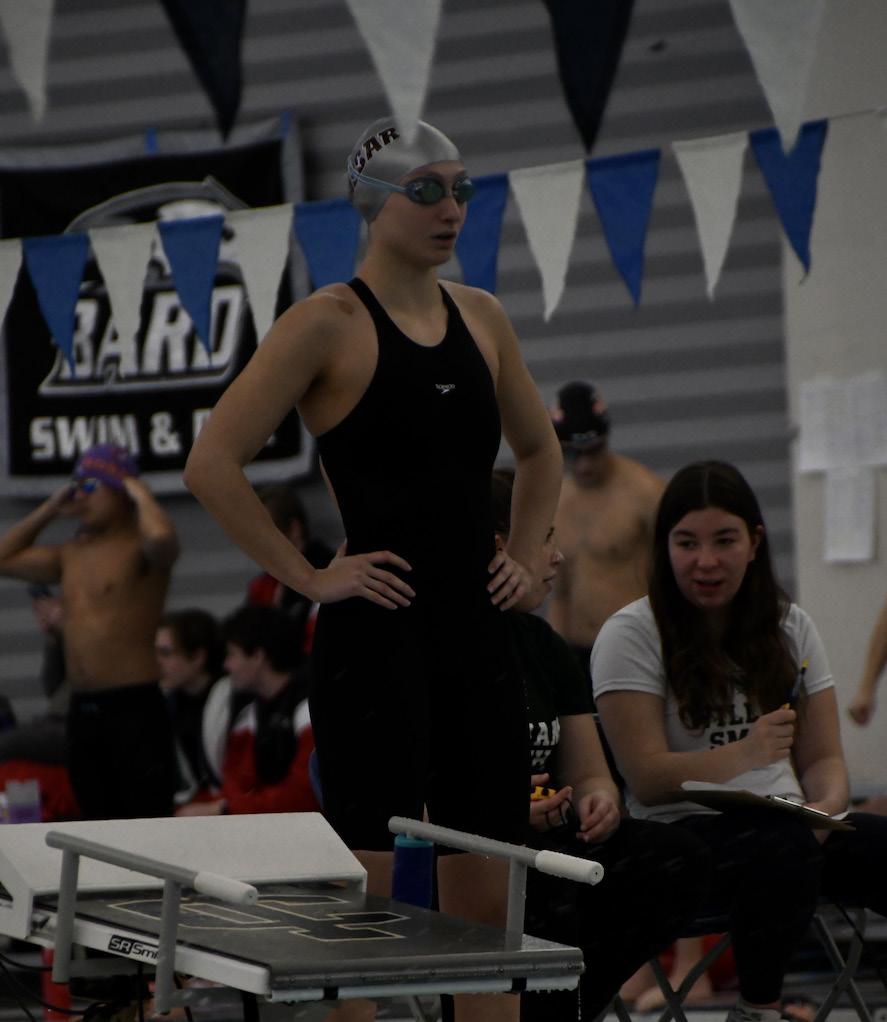
Men's Lacrosse L, 9-12 @ University of Hartford
Men's Basketball L, 73-76 @ Ithaca College
Men's Volleyball
W, 3-1 vs. Kean University
Name: Adelaide (Addie) Weiner
Team: Women's Swim & Dive
Year: Senior
Stats: At this year’s Liberty League Swim and Dive Championships, Addie Wiener won gold in the 500 yard freestyle for the fourth consecutive year. Wiener’s dominance in the event helped Vassar’s women’s swim and dive team to a top-five finish at the Liberty League Championships this year. She anchored the 400 yard medley relay that came in fourth place as well as the 800 yard freestyle relay that came in fourth, came second in the 200 yard freestyle and came third in the women’s 1650 yard freestyle.
Statement: ““I’m so grateful for my four years swimming with VCSD, and this Lib Leagues was a special way to close out my senior season. Winning the 500 for the fourth consecutive year and finally breaking the record I’d been chasing, despite battling a shoulder injury for much of the season, made the moment even more meaningful. Leaning on my mental toughness and the unwavering support of my friends, family, coaches, and teammates gave me everything I needed to succeed. It’s incredibly bittersweet to step away from a sport that has been such a defining part of my life, but the lessons I’ve learned and the family I’ve made are things I’ll carry with me into the future.”
Women's Lacrosse W, 16-9 @ Drew University

Women's Basketball W, 50-43 @ Ithaca College
Men's Volleyball W, 3-0 vs. Arcadia University
Emilia DiLiberto ’27 sets Women's Lacross record
In the Women’s Lacrosse team’s season opening victory over Drew, DiLiberto won 11 draws to push the junior’s career total to a school record 157 controls.
Swim & Dive put on strong showing at Liberty League Championship
The men’s team finished seventh while the women’s team earned a fifth place result at the 2026 Liberty League Championship.
Basketball teams start Liberty League Playoffs
Men's basketball came from behind to defeat Skidmore 67-64 to advance to the Liberty League Semifinals.
Men's Lacrosse vs. Oneonta College
Friday, February 28th
Weinberg Field @ 1:00 P.M.
Henry France Sports Editor
In 1866, the Vassar Resolutes and Vassar Liberties formed the first women’s baseball teams in the United States. About 160 years later, Vassar’s baseball team is now home to Pitching Coach Beth Greenwood, the first American female catcher in NCAA baseball history and a member of the first Women’s Pro Baseball League draft class. Greenwood’s baseball career has been a story of steadfast determination and commitment.
Greenwood grew up in New Hampshire and attended the University of Rochester. While the college athletic recruitment process is turbulent for most, hers was uniquely opaque and challenging. Greenwood said in an interview with The Miscellany News, “When I was looking at colleges, there were less than 10 women who had ever played collegiately, and none had played my position.” Talking with coaches, Greenwood was hungry to let her merit and talent speak for themselves, but because of her sex, many coaches overlooked her altogether. Though many women play NCAA softball, NCAA baseball is open to men and women, but few women actually play. “There's a lot of coaches that I emailed, and the second they saw I was a woman, there was zero interest. Or coaches would flat out say that’s why they weren’t interested before they saw any video. I mean, I don't know, at least watch video and tell me I suck.” Greenwood ended up at the University of Rochester, where she tried out for the baseball team and eventually got cut during her first year at the school. The softball coach was intent on recruiting her, but she had no interest. Softball simply never spoke to her. At that point, Greenwood was one of the top 40 women's baseball players in the United States; the top 20 qualify to play for the World Cup team. Her dream had always been to play for the national team. She made a promise to herself to try out for the University of Rochester Varsity Baseball team all four years. Greenwood’s determination was steadfast: “If I got cut all four years, I owed myself that opportunity. Twelve-year-old me wouldn’t have been able to imagine that I would have been able to get to that point.” After playing on the club team freshman
year and then on the Varsity practice roster sophomore year, Greenwood earned a spot on the team in her latter two years of college. Greenwood was the first female catcher to appear in an NCAA baseball game when she appeared as a pinch-hitter and catcher in a victory against Clarkson on April 25, 2021. Her ability to balance a degree in mechanical engineering with college athletics pales in comparison to the unrelenting drive to break into a space that she knew would not be easy to thrive in. Thanks to a strong support system from the coaching staff and fellow players, Greenwood found a spot on the team where she supported their efforts just as much as they supported hers: making the women’s national team.
After graduating from college, Greenwood got a job doing research and development with the Philadelphia Phillies, but she knew her place was on the field. One day at the Phillies’ facility, a handful of coaches had the day off while Greenwood was there working. She found her way down to the field, and a couple of players happened to need someone who could throw batting practice (BP) pitches for them. Of course, Greenwood had taken these pitches, likely thousands at that point in her career, but she had not thrown much BP. She seized the opportunity and found herself in with the players: “That’s kind of how I accidentally started coaching with the Phillies, because all of a sudden, I could do it.”
About a year later, still working towards her national team goal, Greenwood made the top 20 roster in 2023 and played in the World Cup qualifier year, where the team went 5-0. They then went on to get silver in the World Cup tournament.
After returning to the Phillies, Greenwood weighed her next steps. She knew coaching in the big leagues would be a challenge like no other, and she still wanted to play ball. The Phillies told her that she would have to decide between coaching full-time and playing baseball.
Greenwood pursued the Division III college coaching scene because it would allow her to continue working in baseball while keeping her summers free for international and professional competition. Her meeting with Vassar confirmed her interest in the institution: “When I interviewed here, I wasn’t sure if the college scene was
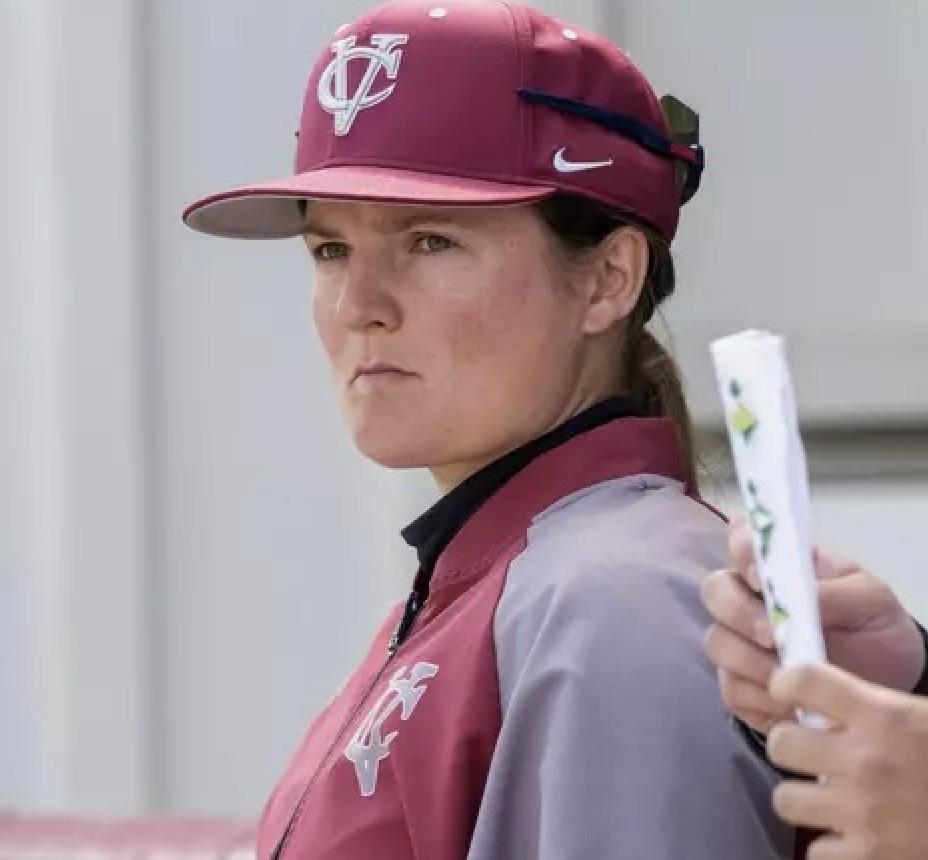
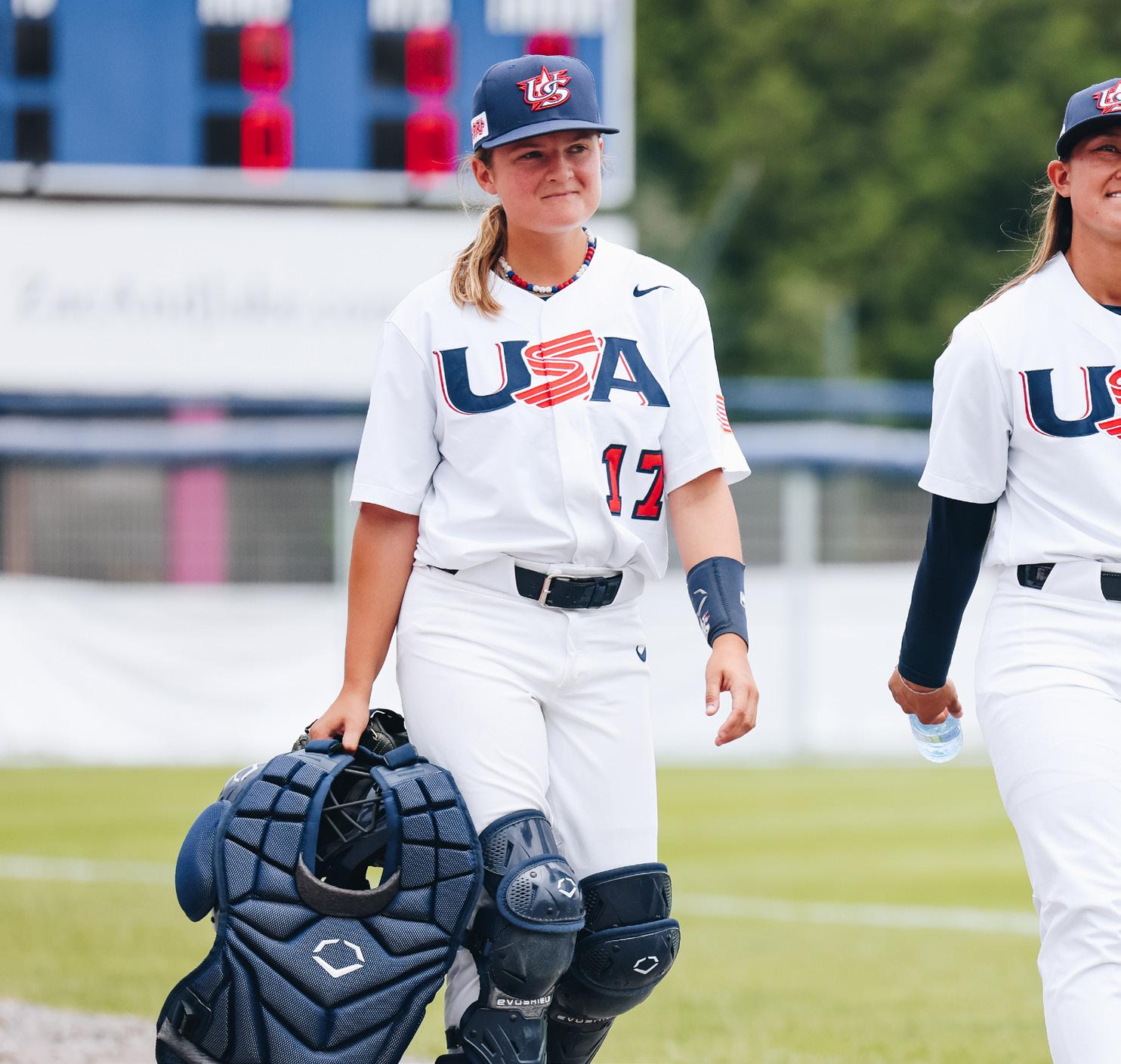
what I was looking for, but then kind of meeting the players last year and the head coach [Tad Skelley] and I were aligned on a lot of things player development wise, and supporting me and what I was trying to do.” Head Coach Tad Skelley told The Miscellany News, “She [Greenwood] is exceptionally intelligent, has a tremendous work ethic, and quickly demonstrated how deeply she cares about our players and our culture. Her continued pursuit of a professional playing career also makes her highly relatable to our athletes, as she experiences the same successes and failures they encounter in the game of baseball.”
Within the team at Vassar, there was no ambiguity: Greenwood was as qualified and fit for her position as one could possibly be. Outside of Poughkeepsie, there was less support. “I know there’s schools that don’t always have the nicest things to say about me being hired, and they’ve vocalized that to Tad [Skelley].” Greenwood continued, “When I was younger, I felt I had to prove something, and I think all of us still feel that to an extent. Now I’m much better about ‘I’m just doing my job, and people are going to have things to say about it, and I’m just going to do my thing.’” Coach Skelley told The Miscellany News, “Externally, there have been some mixed reactions, but that’s beyond our control, so we’ve chosen to focus on what we can do collectively to move the program forward, which I know has been at the forefront of all Beth does.”
Greenwood has been at Vassar for over a year and has been embraced by coaches and players alike. Pitcher Daniel Wellner ’26 told The Miscellany News, “She really understands how to manage a game and how to help pitchers make smart decisions in big moments. She challenges us every day and holds us to a high standard, and she truly makes everyone around her better. She's one of the most fantastic coaches I've had in my life.” Fellow pitcher, Addison Lee ’26 added, “On the technical side, her knowledge of pitch calling theory that she gained through her catching experience is incredibly important to our staff's success. She also provides the catchers with high-level drill work and mechanical help that was previously absent from their practice routines. On a cultural level, the success that she has seen in baseball has been inspiring to everyone on the team. We're all super proud to have her as an integral
part of our coaching staff.”
When she was interviewing at Vassar in December of 2024, there were whispers of a possible professional women’s league. She had discussed this with Skelley, who was in full support of her professional pursuits, along with the rest of the athletics department and personnel at Vassar. Strength and Conditioning Coach Alice Read welcomes Greenwood into the varsity weight room, where she continues to work towards her professional season, and Skelley is glad to provide flexibility for Greenwood around summer player recruitment.
In November, the Women’s Pro Baseball League (WPBL) held its inaugural draft. The draft was six rounds, with the first three rounds of players earning guaranteed contracts. Greenwood was drafted to Boston in the third round, punching her ticket to her hometown team on a guaranteed contract. The league’s first season will feature four teams—New York, Boston, San Francisco and Los Angeles—and will be a four-week regular season starting in May with a two week post season.
Looking ahead, Greenwood will focus on preparing for her WPBL season with Boston as well as this summer’s tryouts for the national team. The upcoming women’s baseball World Cup will be held in Rockford, IL, at the International Women’s Baseball Center (IWBC). The IWBC is home to decades of women’s baseball history and will now be a viable site for international competition thanks to a donation of over $2 million from New York Mets owner Steve Cohen.
Since she was a child, Greenwood had her sights set on professional baseball. In sixth grade, she wrote a poem, declaring her dream of professional baseball: “When you’re eleven, the world’s not so scary and you think you can conquer the whole thing.” For Beth Greenwood, while the world of professional baseball may have been scary at times, there is no doubt that she has and continues to conquer it. Having broken ground in the NCAA, played for her country, worked for a professional organization and now drafted to her hometown team, Greenwood is raising the bar with each step she takes. She told The Miscellany News, “That little kid would be freaking out right now.” Well, just wait until that little kid sees what Beth Greenwood does next.
By: Luke Jenkins and Carina Cole

ACROSS
1. Acronym for companies that conduct their business practices responsibly
4. To remove a substance by drawing out
6. Longer than x-ray, shorter than visible light
7. Castrates a male animal
8. A tour from Taylor Swift, but only one of them
By: Beverly Renshaw
DOWN
1. Feminine version of Carl
2. Acronym for a Georgia art school
3. Surname of "Wide Sargasso Sea" author
4. Winter Olympics Sport, very scary sledding going feet first
5. Almost never?
DOWN
1. Polite address to a Gustavo
2. Grapes, in Guadalajara
3. Withered vegetation
4. Was the seventh month, pre700 BCE
5. Age, in Andalucia