[Disclaimer: All students quoted in this article will be referred to anonymously out of concern for their safety].
On Thursday, Feb. 5, an event hosted by the Engaged Pluralism (EP) program featuring Steven Cash ’84 was disrupted by a group of students and community members. Cash’s lecture, entitled “The State of Democracy and its Uneasiness with Race, Disability, and Non-normative Subjectivity,” was originally scheduled to take place from 5:30 to 7 p.m. in Rockefeller Hall 300. A large portion of the event’s audience protested in a variety of ways, including yelling over Cash, chanting, clapping and holding signs. As a result, the event was canceled 40 minutes after it began. Protestors cited Cash’s involvement in creating the USA PATRIOT Act and the Department of Homeland Security (DHS), as well as his work in the Central Intelligence Agency (CIA).
Cash worked at the CIA from 1994 to 2001. In 2001, Cash joined the professional staff of the Senate Select Committee on Intelligence, where he worked on the USA PATRIOT Act, which was passed 45 days after Sept. 11 and effectively expanded law enforcement’s surveillance and investigative powers. The Act disproportionately affected Arab and Muslim Americans,
who were frequently targeted by law enforcement and faced increased rates of xenophobia and hate crimes.
Additionally, Cash was instrumental in the Homeland Security Act of 2002, which consolidated 22 federal agencies into the DHS in order to streamline intelligence and border security. In 2006, Cash entered the private sector, where he worked as a consultant focusing on intelligence issues. He returned to government work in 2022, pivoting to the DHS Office of Intelligence and Analysis, where he served as Senior Advisor to the Under Secretary.
Currently, Cash is the Executive Director of The Steady State, a nonprofit organization of over 370 former national security officials that utilizes intelligence tactics to assess the status of American democracy. The Steady State speaks out against the threats to democracy enacted by the Trump administration. The organization’s most recent Accelerating Authoritarian Dynamics report stated: “We assess with high confidence that the cumulative effect of the Trump Administration’s ongoing actions indicates that democratic backsliding continues. While some institutional resistance exists and may be growing, the trajectory poses both immediate and long-term risks to constitutional order and national security.”
Cash previously visited Vassar in Sep-
See Protest on page 4
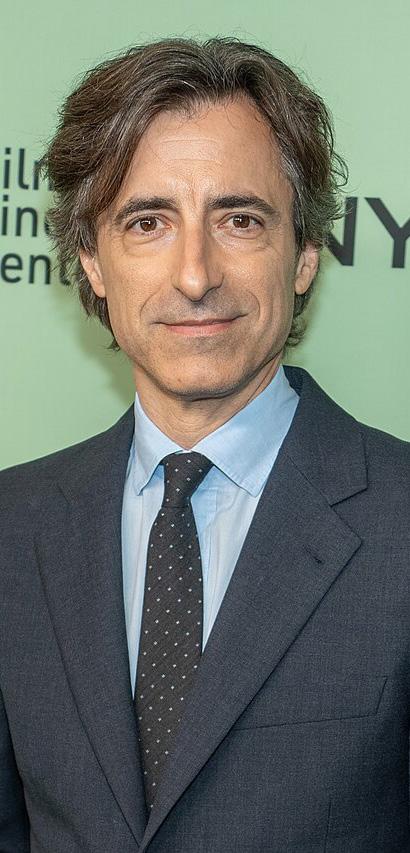
Noah Baumbach ’91 to deliver address at 162nd Commencement
Luke Jenkins Managing Editor
OnFeb. 9, 2026, Vassar College announced that filmmaker and screenwriter Noah Baumbach ’91 will deliver a speech at the 162nd Commencement to the Class of 2026. The graduation ceremony will occur on Sunday, May 24, 2026.
A Vassar alumnus, Baumbach was raised in Brooklyn, New York. He graduated from the College in 1991, four years before his directorial debut “Kicking and Screaming.” Producer Jason Blum ’91 worked on the film after rooming with Baumbach at Vassar.
Baumbach’s success has only grown since. Some of his notable directing credits include “Marriage Story,” “Jay Kelly,” “Frances Ha,” “White Noise” and “The Squid and the Whale.” He has also co-written “Fantastic Mr. Fox” and “Barbie,” among other popular works. Baumbach has received four Academy Award nominations, as well as nominations from the Golden Globes and Writers Guild of America.
Vassar reopens library's 24-hour section
Jackson Hrebbin Reporter
In January 2026, the 24-hour section of the Frederick Ferris Thompson Memorial Library reopened to the public after undergoing extensive renovations. Construction began on May 21, 2025, and the space remained closed throughout the summer and the fall semester. The renovations include a new entrance, several new windows, new conference rooms, six new group study rooms and significantly more seating.
The Vassar College administration celebrated the section’s reopening by hosting an open house on Monday, Feb. 9. President of the College Elizabeth Bradley, Director of the Libraries Andrew Ashton, and Senior Lecturer in Urban Studies and American Studies Lisa Brawley delivered remarks about the scope of the project and the opportunities it will provide students. Dozens of administrators and faculty members attended the event to hear the speakers and witness the official ribbon-cutting ceremony.
Bradley spoke briefly during the open house to thank those involved in planning and executing the project. She specifically highlighted Dean of Strategic Planning and Academic Resources Marianne Begemann, Project Managers Sarah Hayes and Maryann Pilon and Lalinthip Maholarnkij, the project’s architect. Bradley added, “We’re also so
Brendan Kennedy recaps
thankful to the many alums who gave and thought ahead and were philanthropic, that really made this possible. And there were more than one, and many we didn’t know were going to donate, which we were just thrilled about. And the space is being used widely. Clearly, it's meeting a need. So let’s enjoy.”
Ashton, who spoke after Bradley, discussed the project’s logistics and timeline, explaining that the planning process took nearly five years and noted that the idea to
renovate originated from the College’s need to make the library more accessible. Due to an absence of ramps, the library’s main entrance is inaccessible to people in wheelchairs, forcing those with mobility issues to enter the library from the north entrance. However, Ashton explained that making the north entrance more welcoming was only part of the project, and that the north entrance’s close proximity to the 24-hour section created an opportunity for the library Vassar College’s student newspaper of record since 1866
Isabel Holmes reports from the Vassar snow globe.
Sophomore quits spoons
Jay Fu Guest Columnist
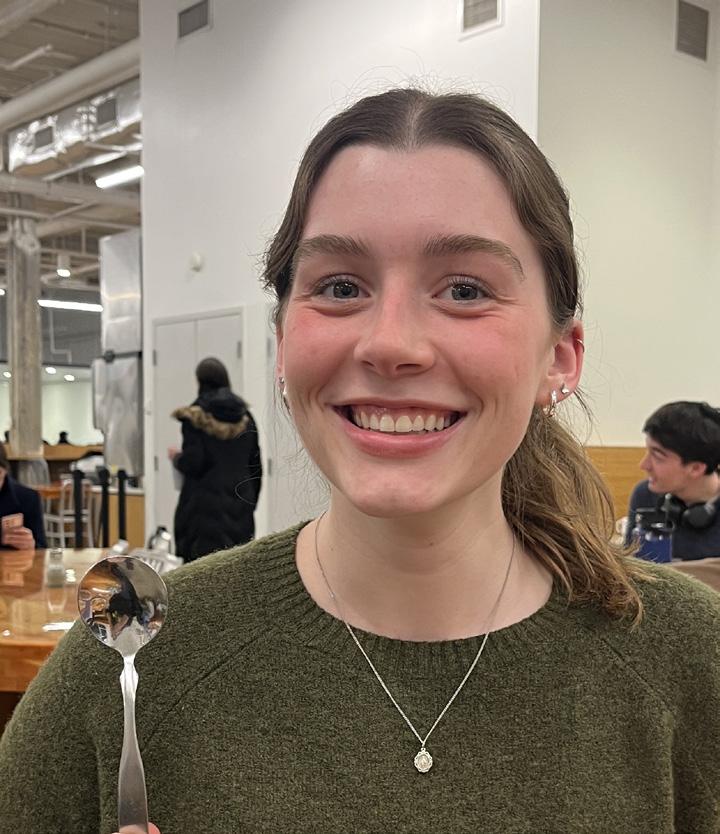
Beginning in January 2025, Annie McShane ’28 [Disclaimer: McShane is the Graphics Editor for The Miscellany News] gave up spoons. Around February of last year, when most New Year’s resolutions began to wane, she held strong. Months later, she endured the long, hot days of ice cream season with only cones and forks at her disposal. Dinners at Gordon Commons, commonly known as the Deece, bracketing summer break failed to end her streak. Finally, this past January, McShane returned to her regular rotation of utensils. McShane was inspired by a college student on TikTok who was in the habit of completing personal challenges—sleeping on the floor every day, for example. With the help of her family and friends, McShane brainstormed her own challenge, hammering out rules and affordances in the lead-up to January. Ladles at the Deece were okay, but otherwise, forks replaced spoons in all circumstances. “I love potato soup,” McShane confessed, and for the full year, she had relinquished it.
The notion of arbitrarily “going without”—of voluntary loss—may be so antithet-
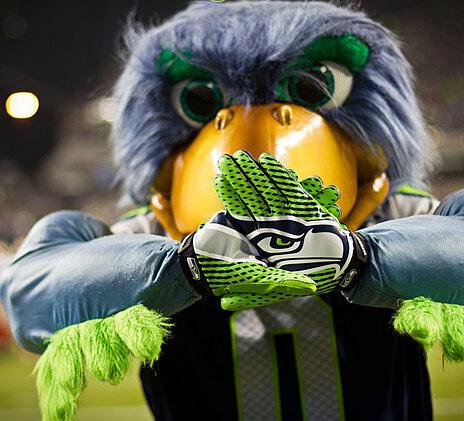
Alex GoughSchnapp recounts the Seahawks Super Bowl win.
Image courtesy of Amritha Dewan '28.
Image courtesy of Wikimedia Commons.
THE MISCELLANY NEWS
EDITOR-IN-CHIEF MANAGING EDITOR
SENIOR EDITORS
CONTRIBUTING EDITORS
NEWS EDITORS
ARTS EDITOR
ASSISTANT ARTS EDITORS
FEATURES EDITORS
OPINIONS EDITOR
ASSISTANT OPINIONS EDITORS
HUMOR EDITOR ASSISTANT HUMOR EDITOR
SPORTS EDITORS
DESIGN EDITORS
ASSISTANT DESIGN EDITORS
COPY EDITORS
GRAPHICS EDITOR GAMES EDITOR
SOCIAL MEDIA MANAGER LIVE EVENTS CHAIR WEBMASTER REPORTERS/COLUMNISTS
CARTOONIST
COPY STAFF
Allison Lowe
Luke Jenkins
Kathryn Carvel
Darja Coutts
Madeleine Nicks
Clara Alger
Carina Cole
Soren Fischer
Hadley Amato
Julian Balsley
Grace Finke
Aurelia Harrison
Brendan Kennedy
Yaksha Gummadapu
Sydney Jones
Jacob Cifuentes
Ian Watanabe
Zoe Rodriguez
Emma daRosa
Wren Buehler
Noah Daube-Valois
Henry France
Casey McMenamin
Molly Delahunty
Lucas Seguinot
Teresa Garcia-Green
Hannah Wells
Sadie Bakken-Durchslag
Paige Hahn
Anabel Lee
Annie McShane
Sadie Keesbury
Felix Mundy-Mancino
Mia Liloia
Denver Brown
Hunter Farhat
Eduardo Culmer
Armaan Desai
Noah Duncan
Jackson Hrebin
Lora Janczewski
Evan Seker
Erin Thatcher
Andrew Chu
Nikola Parker Cooperman
Elliott Evans
Cooper Jaffe
Gabrielle Lyman
Ren Nicolau
Tess Novack
Julia Weber
Library 24-hour section reopens after renovations
Continued
staff to reimagine the section and address other needs: “I’m really proud that we were able to rethink this north entrance as almost a second main entrance, a real community space that you can enter into and really be inclusive for all members of our community…but we also recognized the need for more spaces for student and faculty support.”
Brawley, the former Director of the Learning, Teaching and Research Center (LTRC), spoke about why she believes the renovated area will facilitate more proactive student and teacher learning. Brawley argued, “[Renovations] provide much-needed convening spaces for the LTRC, the peer mentoring, and faculty and student workshops of the Writing Center, the Quantitative Reasoning Center and the inclusive pedagogy programs.” She also cited the additions of easily movable furniture, whiteboards, projectors, comfortable seating and small breakout spaces for peer consultation as key factors that make the section more conducive to academic work.
In an interview with The Miscellany
News, chief architect Lalinthip Maholarnkij spoke about the intention behind her design choices. “We wanted to give more space to the students as a common space,” she explained, “like a gathering space…so that it’s not always a space where you’re studying, but where you are also sharing new ideas.” Additionally, Maholarnkij shared that the vibrant colors throughout the space were designed to capitalize on natural lighting to make the addition feel brighter and more alive: “Sunlight is the key. In the daylight, the room needs to be active. The sunlight comes through the colors on the perimeter and goes inside the large room so that everything feels connected.”
In addition to speaking at the open house, Ashton sat down with a Miscellany reporter to elaborate on the thought process that went behind the renovation. He pointed out that many of those leading the project felt the original design and purpose of the 24-hour section had become obsolete: “[The 24-hour section] was mainly designed as a computer lab when desktop computing labs were a thing that colleges needed to provide… It just increasingly felt that having a large space
that was primarily designed for desktop computing wasn’t really where students are right now. So we wanted to rethink it as more of a warm, welcoming community space with breakout spaces.”
Ashton also shared his hope that the new, welcoming design of the section would draw students interested in conversation away from quieter sections of the library. “We get a lot of complaints about noise in the library,” he explained. “So we were hoping that by making this end of the library…more of a vibrant kind of community space that has a very different feel from the historic part of the building, that people who want to work in a group and maybe want to be a little bit loud will sort of gravitate that way.”
Since reopening, many Vassar students have returned to the 24-hour section and benefited from its services. When asked to compare the renovation to the old section, Matthew Freire ’27 said, “It’s just very colorful, it’s very playful, it’s just good vibes compared to the last one. It wasn’t bad, I just didn’t want to stay there, and here I actually feel like I can engage and stay in one place.”
Rachel D’Agostino ’26 echoed Freire’s comments, adding, “I think it makes our library more competitive with other college campuses, because we have the draw of a more vintage, antique-feeling library that feels more historic, but also has the appeal of a modern facility that feels more minimalist than most of the maximalist art on the Vassar campus.”
Reflecting on what else could be done to improve the library, Freire and D’Agostino agreed that they want larger and more accessible bathrooms. Ashton emphasized his commitment to provide more bathrooms to the library in the future, but also shared other ideas he has for improvements, like decorating the courtyard with student artwork. Above all, as he continues looking to find ways to improve the library, Ashton said that he wants student feedback and ideas: “Just keep giving us constructive feedback… We were thinking of putting up a QR code with a virtual suggestion box…and you can talk to somebody at the front desk, you can talk to me, you can talk to anyone who looks like they work here and it’ll always get to the right place.”
Peter Kornbluh gives talk on Venezuela
At2:01 a.m. on Jan. 3, 2026, over 150 U.S. military planes flew over Venezuela, bombing multiple locations to disable the country’s air defenses. U.S. forces entered the presidential compound in Caracas, dragged Venezuelan President Nicolás Maduro and First Lady Cilia Flores from their beds and ferried them to New York. The United States killed at least 83 people: 47 Venezuelan troops, 32 Cuban soldiers and at least four civilians. More than 112 were injured. Some international law experts have called the seizure illegal.
Hours later, U.S. President Donald Trump stood before reporters at Mar-a-Lago. “We are going to run the country until such time as we can do a safe, proper and judicious transition,” Trump declared. He explained that the United States would also seize Venezuelan oil assets, which he claimed Venezuela “stole” through nationalization.
Peter Kornbluh told the audience of Rockefeller Hall 300 on Feb. 4, “There has never been a moment in the post-World War II era since Franklin Delano Roosevelt declared the Good Neighbor Policy in Latin America that a president has so baldly undertaken this type of operation and proclaimed himself in charge of another country, and then said, ‘And I’m taking its main natural resource, which is what we want.’” Kornbluh is a Senior Analyst at the National Security Archive (NSA). He has written prolifically on Latin America, especially Chile and Cuba. The archive is a research center dedicated to declassifying secret government documents and democratizing information about the U.S. government’s actions. (It is unrelated to the National Security Agency, a branch of the U.S. Defense Department.)
In his talk, Kornbluh argued that the Trump administration’s foreign policy in Latin America is a return to the “golden age of U.S. empire building” of the turn of the 20th century. The United States went to war with Spain, seizing the Philippines, annexing Hawai’i and occupying Puerto Rico, Guam and Cuba. Gunboat diplomacy reigned: The U.S. Navy and Marines backed a small Panamanian independence movement against Colombia to build the Panama Canal, intervened in Nicaragua in 1912 and occupied Haiti from
1915 to 1934. These blatant violations of Latin American countries’ sovereignty were justified by President Theodore Roosevelt through the “Roosevelt Corollary” to the Monroe Doctrine. The doctrine, declared by President James Monroe in 1823, warned European powers that the United States would not tolerate further colonization in the Americas. In 1904, Roosevelt declared the corollary: Through adhering to the Monroe Doctrine, the United States would be “reluctantly” forced to intervene in Latin America as an “international police power” to prevent instability.
At Mar-a-Lago, Trump argued that seizing Maduro was in line with Monroe because of Venezuela’s “gross violations” of U.S. foreign policy principles. “The Monroe Doctrine is a big deal, but we’ve superseded it by a lot,” he said. “They now call it the Donroe [Doctrine]… Under our new National Security Strategy, American dominance in the Western Hemisphere will never be questioned again.”
“I see a direct line from the Monroe Doctrine to the Donroe Doctrine,” Kornbluh said, “from gunboat diplomacy to what the military code-named Operation Absolute Resolve in Venezuela.” He explained to The Miscellany News, “Trump has returned to the open era of ‘This region is ours, and we’ll do to it—in it—what we want and what we can.’” He continued, “It is a recycling of an onerous, dark history. That past history holds a lot of lessons for the future. So far, those lessons are being ignored.” Kornbluh defined the Donroe Doctrine through a quote from the White House’s new National Security Strategy: “The United States must be preeminent in the Western Hemisphere as a condition of our security and prosperity—a condition that allows us to assert ourselves confidently where and when we need to in the region.” Furthermore, Kornbluh argued that the Donroe Doctrine was a fundamental shift from the United States invading, funding military dictatorships and rigging elections in at least 13 Latin American countries during the Cold War. In those cases, Kornbluh contended, the U.S. government at least felt bound enough by international law to try to hide its illegal actions or justify them as furthering democracy.
On the other hand, in a recent interview with The New York Times, Trump said, “I
don’t need international law.” When asked if there was a limit to his power, he responded, “My own morality. My own mind. It’s the only thing that can stop me.” Another difference, Kornbluh told the Miscellany, is the frequency of threats: “It’s a constant thing now. One day, it’s a threat to bomb parts of Mexico to take out the cartels. The next day, it’s a threat to Chileans that they better not have a trade agreement with China.”
Vassar Assistant Professor of History Daniel Mendiola, who specializes in Latin America and attended the talk, told the Miscellany, “[It was] pretty convincing, the argument that in harkening back to an age where the United States was very overtly imperial, that we’re essentially admitting now, or embracing, that we are an empire.” However, he contended, the difference between covert and overt action may be less stark for Latin Americans. “I think the way a lot of people in Latin America are experiencing it, that visceral experience is probably not that different than the things that were happening in the Cold War and really never stopped happening,” he said. Esther Cull-Kahn ’26, who attended the talk, commented, “I think the biggest danger in representing Trumpism as an aberration is it erases all of the horrible things that the United States has been responsible for in the past, and especially Iraq and Afghanistan.” Cull-Kahn, a history major, is writing her thesis on the Iran–Contra affair and the history of the U.S. military intervention in Latin America during the Cold War.
According to Kornbluh, Trump has learned from the Iraq War that nation-building is too expensive and dangerous: The government is now doing “remote control imperialism.” “There’s no U.S. military presence there,” Kornbluh said of Venezuela. “He is using coercion, which, in this case is control over all the external revenues that Venezuela can get from its oil, because we are taking the oil and we are selling it ourselves in order to basically hold the leaders that we have left behind there, feet to the fire.” Vassar Professor of Political Science on the F. Thompson Chair Katherine Hite wrote to the Miscellany, “The administration’s ‘surgical’ approach, aimed primarily at taking out a leader who virtually no one wished to defend, together with no U.S. continued ‘boots on the ground,’ makes organizing against Trump’s Venezuela campaign challenging, no matter how terrible
Trump’s actions.” Hite organized the talk and has known Kornbluh since they worked together at the Institute for Policy Studies decades ago.
Kornbluh warned that Venezuela was not a one-off: Cuba is next. “Trump has made it absolutely clear that he wants to get rid of the communist government there,” Kornbluh told his audience, “and open up Cuba to the United States fully again and take over Cuba as the United States once had in those first 30 years of the 20th century.” On Jan. 11, Trump posted on Truth Social, “THERE WILL BE NO MORE OIL OR MONEY GOING TO CUBA - ZERO!” On Jan. 29, he signed an executive order declaring Cuba’s threat to U.S. national security and foreign policy a national emergency and pledging to impose tariffs on any country that directly or indirectly gives Cuba oil. “He can create social collapse in Cuba if all the lights go out,” Kornbluh explained. Without oil, Cuban electricity, water pumps and refrigerators would fail. Cars and hospital equipment would be unusable. Phones could not be charged, effectively cutting Cuba off from the world and one another. Kornbluh compared this to President Richard Nixon’s plan to prevent Communist Chilean President-elect Salvador Allende from taking power in 1970: “Make the economy scream.”
The day after his lecture, Kornbluh spoke about his work at the NSA and answered student questions at a small lunch organized by Hite in the Political Science lounge. Kornbluh has been instrumental in major document declassifications at the NSA. He personally indexed thousands of files after the Iran–Contra scandal broke. After Pinochet was arrested in London in 1998, Kornbluh called for President Bill Clinton to declassify 24,000 secret documents on the dictator. “Peter’s work is dedicated to democratizing, to making public, making transparent U.S. foreign policy, both historically and now,” Hite told the Miscellany via email. “If we didn’t have the real historical past, which is arguably most concretely represented in secret documents, we wouldn’t have a basis for understanding what went wrong in the past, what went right in the past,” Kornbluh told the Miscellany. “It’s invaluable to have a historical record, and particularly in this day and age when there’s a constant effort to deny what history really was.”
Julian Balsley News Editor
Steven Cash ’84 talk protested by students, community
Continued from Protest on page 1 tember, where he delivered a talk on the state of American democracy. His Feb. 5 talk, which was moderated by Professor of Political Science on the Margaret Stiles Halleck Chair Sidney Plotkin, was set to address similar concerns.
Prior to the event, the Vassar Students for Justice in Palestine (VSJP) Instagram account posted a pamphlet entitled “Department of Hatred and Surveillance: Vassar Celebrates Surveillance Stooge.” While the VSJP account digitally distributed the pamphlet, students interviewed by The Miscellany News emphasized that the disruption was organized independently of any student organization. Outside the auditorium, several students distributed print versions of the pamphlet, which detailed and condemned his career. It read: “EP claims to promote healthy dialogue, but in fact platforms fascism by validating Cash’s misleading self-promotion as a voice of ‘democratic’ governance. By honoring Cash’s work and inviting West Point officers and cadets to campus, Vassar is complicit in US domestic terrorism and genocidal violence.” The pamphlet concluded, “Real unity requires knowing our enemies: the ideas, institutions, and procedures that maintain western hegemony. We must condemn ICE, the DHS, the PATRIOT Act, the CIA, the ongoing War on Terror, Zionism, and American militarism as part of the same imperialist project. The ultimate obstacle to liberation is the surveillance state that Cash helped create.”
Cash resigned from the DHS on Jan. 20, 2025—President Donald Trump’s Inauguration Day. In his resignation letter, which he posted on LinkedIn, Cash wrote: “Intelligence agencies, particularly domestically focused ones, have often been tools and engines of authoritarianism and dictatorship. I am proud to have been part of an Intelligence Community whose culture includes a recognition of how dangerous intelligence agencies can be to our democracy.” He continued, “I fear that a President Trump will end our democracy. I cannot, in good conscience, be a part of that.”
Students who participated in the protest explained to The Miscellany News that Cash’s current anti-Trump stance did not dissuade them from protesting his past work in the federal government. One student said, “I think it’s absurd to act like being against Trump is enough, because so many people are against Trump, and so many people are against Trump and want to do the same things Trump is doing at a slower rate. They want ICE to deport people and tear families apart like they did under the Obamas. And they want them to do it less noticeably. And that’s not acceptable.”
The demonstration follows widespread national protests against Immigration and Customs Enforcement (ICE), which serves as the principal investigative arm of the DHS. In 2026 alone, eight people have either been killed by federal agents or died in ICE custody. ICE held a record-high number of individuals in detention—73,000—in January 2026, and the organization plans to greatly expand its detention capabilities. This includes a proposed local detention center, set to be located in a Chester warehouse. Director of EP and Associate Professor of Education Kimberly Williams Brown began the event, telling the audience, “We understand palpably that this is a tough moment and that people are having
a hard time figuring out how to engage each other during this moment, who to trust and what to do… My hope tonight is that as Professor Plotkin and Mr. Cash speak to you, that you too will become clear about how to direct your anger and righteous indignation at those who have corrupted the experiment of a deeply flawed but complex nation state, and that you will engage them with nuance and curiosity to hear how together we may create coalitions across our differences.”
As Cash began to address the audience, several students stood up and raised signs, which included phrases such as: “I like my ICE crushed,” “Fuck the PATRIOT Act” and “He is not on our side.”
In response, Cash stated, “I’m pretty sure a lot of people in this audience don’t have much in common with me, other than being associated with Vassar. I’m a former CIA officer, I specialized in covert action. And most recently, I was a senior advisor for the Office of Intelligence and Analysis at the Department of Homeland Security.” At this, several boos erupted throughout the crowd.
Cash continued: “So why am I here? Because if we don’t do anything, we are not going to vote again. And it’s not an issue that can be taken on by old guys like me. This is your moment. The students here, you need to do something.”
Throughout the event, students periodically interrupted Cash to challenge his career and his motives. One student said, “How can you claim to support dialogue when you come to this movement doing anything less than begging for the forgiveness of families whose blood you have on your hands?” Upon being asked to follow the Q&A format of the event, another student yelled, “No dialogue with fascists!”
Another student questioned why Cash received his Medal of Merit from the CIA. He responded: “It was in furtherance of a directive from the President endorsed by your Representative in Congress. Actually, [it was] to support a movement against a dictator overseas.”
Each student who interrupted Cash was escorted out of the auditorium. In response to each removal, members of the crowd clapped, stomped and cheered, drowning out both the protesting speaker and Williams Brown’s calls for students to protest silently or ask a question. The event continued in this manner for approximately 30 minutes.
Cash frequently responded to students’ accusations directly. In one such instance, he stated, “So the point is that we are in a place in American history that we have not been before. And maybe it is the result of inequity and anti-democratic tendencies, but we are at a point of no return. And so if we are not able to have the kind of dialogue which clearly we were not able to have tonight, we will lose.”
He continued, “And I can tell you the Ministry of Interior in other countries is not going to respect and escort you gently out while you scream at me. We are not going to be living in a country where we can sit, for now more than half an hour, and have this kind of back and forth. You will be crushed. None of you will survive.”
At this point, Plotkin addressed the crowd for the first time, saying, “This morning, on the front page of The New York Times, was a story that went into some details about state universities in the United States, on this day, at this time whose faculty members’ syllabi must now
go public, go before state legislature. If those syllabi dare to criticize anything about the United States and its history, then God save those faculty members because they are done… Do you think Vassar is somehow insulated from the forces that work in this society?”
Shortly after Plotkin’s statement, audience members began arguing with one another. At 6:10 p.m., Williams Brown announced that the event would be cut short. She stated, “People are screaming at each other, and so at this point, it doesn’t feel safe to be in this space anymore, which feels very disappointing to me. So we are going to cancel the event.”
“It was terribly disappointing,” Cash told The Miscellany News the next morning. “What was also concerning, I mean, if I had been able to speak, one of the things that I would have said is in dictatorships that my organization has spent a lot of time looking at, one of the things that the dictator tries to do is create events like last night, in which organizations and people who are trying to organize against them are split.”
Cash claimed that the DHS, at its inception, was widely supported. “The pressure to do something after 9/11 was intense,” he said. “It wasn’t some right-wing conspiracy that created DHS. It was an overwhelmingly bipartisan effort, overwhelmingly supported by the American people.”
While the Homeland Security Act of 2002 was ultimately passed by Congress and signed into law by President George W. Bush, it was not without opposition. Several advocacy groups, including the American Civil Liberties Union (ACLU), raised concerns about the potential degradation of civil liberties that the DHS could enact. In 2002, the ACLU released a statement calling the proposal “constitutionally bankrupt” for its lack of privacy and civil rights protections. In 2022, the ACLU similarly called upon the Biden administration to fundamentally reconstruct the DHS, writing, “The Biden administration has shifted away from the Trump administration’s use of DHS to police protests and abandoned several abusive programs. But in too many ways, DHS remains on course to continue imperiling civil liberties.”
Throughout the event, several students condemned the role that Cash played in laying the groundwork for the current administration’s abuses of power. “On the Department of Homeland Security, I would have said when we created it, and I did work on creating it, we were very well aware that we were creating a very dangerous, large organization. And we built in lots and lots of guardrails in there,” Cash stated. “I think those guardrails are being stripped away. The Department of Homeland Security is becoming what we tried to have it not.”
Cash pointed toward the Trump administration’s increased human rights abuses, emphasizing that students at colleges such as Vassar must take a stand. He said, “One of the things I would have ended with is some variation of a call to action. I really do think this is your generation's moment…People are getting killed. We have thousands and thousands of people in what can only really be called concentration camps. We are shutting down a lot of academia.The media has been largely cowed. People are afraid for their jobs, afraid for their personal safety.”
In his interview with The Miscellany News, Cash also acknowledged the protes-
tors’ Instagram post, which quoted him as having said “We are generally the bad guys” in May 2025. “Well, there’s more to that sentence,” he said. “I am very well aware that people with my skillset and my profession overseas are usually the bad guys… The whole point is, once you make the decision as a democracy that you need people with my skills, you also wanna constrain them. You wanna keep them on a leash.”
President Elizabeth Bradley addressed the event in an email sent to the Vassar community on Feb. 6. It stated: “I understand from some audience members that the repeated and coordinated verbal interruptions—which included students shouting profanities at the speaker—were difficult and, at times, frightening to witness. The atmosphere in the room made any meaningful dialogue or productive discussion impossible, despite the speaker’s attempts to engage cooperatively… Vassar endorses peaceful protest, and some students stood quietly and held signs that did not obstruct the speaker. Other protesters shut down speech and impeded the ability of our community to dialogue, learn, and grow.”
In written correspondence with The Miscellany News, Williams Brown similarly echoed disappointment in the event’s cancellation. She wrote, “The protesters had worked to create an agitated and verbally charged state. When we weighed the safety concerns, it seemed best to cancel before anyone, including the students who protested, potentially got hurt.”
Students who participated in the protest, meanwhile, claimed the disruption sought to build community. In an interview with The Miscellany News, one student said, “I think it was a really beautiful collective moment. A lot of the messaging sounds negative when it’s like, ‘We don’t want Steven Cash, we want to abolish ICE,’ when it’s a lot of what we don't want. But I think that that disruption and that event was a building of what we do want.”
In terms of the administration’s response to the protest, the student stated, “I noticed and was really concerned in the email that [President Bradley] made a distinction and said that some people protested peacefully by holding up signs, and some people disrupted. All these disruptions fit in the category of peaceful protests, and to separate those, I think, is really misleading and is scary, because that’s a tool straight out of the DHS playbook, and that’s what we’re fighting against.” The student continued, “Dissent isn’t gonna happen on their terms. If it fits every framework laid out by the dominant power perfectly, is it protest? Is it dissent?”
Another student echoed the collaborative atmosphere of the protest, saying, “The thing that stood out to me the most was how students that weren’t involved in the planning at all were joining in the discussion. The main thing was clapping that would continue after someone got walked out… It felt really good. I felt like we had the student body behind us.”
In written correspondence with The Miscellany News, one student wrote, “Cash himself is not the root of the issue, nor is any individual point of ideological disagreement I may have with him. The problem is the way that an event like this erases history and prevents accountability as far as his implication in the War on Terror’s legal and bureaucratic infrastructure is concerned.”
Artists speak out at music industry’s loudest night
Brendan Kennedy Assistant Arts Editor
Every award season claims to be historic, but this year’s Grammys might actually deserve the designation.
I always look forward to the Grammys, not because I find any particular merit within the awards, but plainly because they are rather amusing. Truthfully, the past year of music, and therefore the nominees for this year’s ceremony, were not anything I was particularly enthusiastic about. Snubbing Lorde’s “Virgin,” my favorite album from the past year, from the awards did initially create personal skepticism in the academy and almost turned me away from tuning in to the broadcast altogether, but honestly, my pop-culture-obsessed self could not resist the urge to find out who would take home wins in the major categories. So there I sat through the prolonged ceremony, slowly sinking into a stiff couch as the modern music scene attempted to “give it their all” on the screen.
Typically a night of musical shocks and snubs, this year’s Grammys ceremony additionally accompanied the United States’ growing protest against the U.S. Immigration and Customs Enforcement (ICE) in a major fashion. Throughout government condemnations, stirring performances and questionable award winners, the 68th Annual Grammy Awards brought an array of crucial remarks and notable pop culture moments that warrant discussion.
The first noteworthy performance of the night saw Sabrina Carpenter prancing around the airport-decorated stage, brightly singing her hit single, “Manchild.” Carpenter’s charisma and creativity shined, and her live vocals were, in typical fashion, on-par with the studio version of the song. Remarkably, Carpenter did not take home any awards this year for “Man’s Best Friend” despite being nominated for six categories. In my opinion, I do not believe the album artistically deviated enough from her previous work, “Short n’ Sweet,” to warrant any
awards. Still, it is clear Carpenter is having fun, sustaining her honest self-discovery of the complexities of modern romance through her music.
The first award of the night, Best Rap Album, was delivered to Kendrick Lamar for “GNX.” Lamar would later take home Record of the Year alongside SZA for “luther,” making him the most decorated rapper in Grammys history. While I do not believe “GNX” holds up to some of Lamar’s previous work, his impact upholding intricate storytelling and high-level production within the hip-hop industry is apparent, cementing him as one of the best rappers of all time.
The Best New Artist spotlight was undoubtedly the most buzzworthy moment of the show where a continuous medley highlighted the nominees consecutively. The Marías kicked off the performance with a tranquil, blue-stained snippet of “No One Noticed.” Smooth and seductive, the band shined in their segment, placing The Marías as a distinct new artist to keep track of. Addison Rae followed, transforming the Grammys parking lot into a lustful, bubbly display of her artistry. Though vocally shaky, Rae enthusiastically sang “Fame is a Gun” as backup dancers twirled her around the gray, underwhelming backdrop. Afterward, KATSEYE chaotically ran between different sets, chanting their single “Gnarly” as the group’s dancing noticeably outperformed their vocals. Other highlights include Leon Thomas’ stylish delivery of “MUTT,” which matched the song’s relaxed character, and Lola Young’s slowed-down rendition of “Messy,” which shockingly proceeded to win “Best Pop Solo Performance.” The evident low points of the medley included Alex Warren’s off-beat singing of “Ordinary,” where he was dramatically lifted into the air as he frantically scrambled to find the track, and sombr’s dull showing of “12 to 12.”
However, the pinnacle moment of the show presented itself in Olivia Dean’s classy, passionate performance of her hit single “Man I Need.” Dean exhibited an effortless star power the other performances lacked,
joyfully swaying to the beat as her captivating vocals swirled around the stage and into the audience. As expected, she won “Best New Artist” where, after ecstatically celebrating her achievement, she swiftly took the stand to denounce ICE. “I’m up here as the granddaughter of an immigrant. I’m a product of bravery, and I think those people deserve to be celebrated,” she contended. Despite the enormous amount of notable personage that filled the Crypto.com Arena, perhaps the most substantial presence in the room was the attendees’ extensive objection to ICE. Dean was followed by a wave of call-outs and disapprovals from the music scene’s most important figures. After winning Best Urbana Album for “Debí Tirar Más Fotos,” Bad Bunny reiterated his continued abhorrence of the federal law enforcement agency, speaking “ICE out” into the microphone as cheers roared around the room.
Justin Bieber beamed his maturity and growth within the industry with a “stripped-down,” intimate performance of “Yukon” dressed in only his underwear. Earlier, choosing to wear a more composed look on the red carpet alongside his wife, Bieber showcased anti-ICE pins alongside other singers such as Joni Mitchell, Carole King and Billie Eilish. Eilish, who took the stage to accept Song of the Year for “WILDFLOWER,” continued the disapproval by cursing the federal agency, expressing the importance of continued protest and reverberating the hope she felt in the room: “No one is illegal on stolen land,” she conveyed. Similarly, speaking with reporters backstage after her win for Record of the Year, SZA pronounced, “It’s incredibly dystopian that we’re dressed up and able to celebrate accolades in the material world, and people are getting snatched up and shot in the face on the street.”
Continuing with the awards, Best Pop Vocal Album was presented to Lady Gaga for “MAYHEM.” Her eccentric, personal rock rendition of “Abracadabra” featured unique camera movements, tight choreography
and peculiar accessories, showcasing classic Gaga; put your paws up! Continuing, Tyler, the Creator’s performance of “Thought I Was Dead” and “Sugar on My Tongue” was rambunctious and raw though typical for what he normally presents in concert. Similarly, Bruno Mars’ natural allure commanded the stage when he sang “I Just Might,” a standard, though blazing, song from Mars’ extensive catalogue.
Rounding off the evening, Album of the Year went to Bad Bunny, who became the first artist to win the category for a record sung entirely in Spanish. In my view, “Debí Tirar Más Fotos” is a groundbreaking, punchy album that transcends typical reggaeton boundaries: an excellent winner for the category. Taking the stage for the second time, he spoke in his native language and proudly continued his support for immigrants: “I want to dedicate this award for all the people who had to leave their homeland, their country to follow their dreams.”
Altogether, it is clear that this year’s Grammys extended beyond the accolades and transformed, as a broadcast with 14 million views, into an important space for political protest in a country trapped inside a difficult period. And despite online outcries from President Trump himself following the broadcast, the ceremony surpassed regular pop-culture discourse and stamped its place in the surging outcry against the modern U.S. government.
Annie McShane/The Miscellany News.
‘PAPOTA’ mocks its own success
Vera Giraudo Guest Columnist
With five Latin Grammys and, as of last Saturday, one Grammy under their belts, the Argentinian music duo Ca7riel & Paco Amoroso came out of their first awards season victorious. The Argentine pop-rock-jazz-funk-trap duo have taken to the international music scene, and now that they are in the spotlight, they have done nothing but mock their own fame.
Ca7riel & Paco Amoroso first met in primary school at six years old. As childhood friends, the duo grew up playing music, Paco playing the violin and Ca7riel (pronounced Catriel) playing the guitar. In 2011, at 16 years old, they formed a proggy rock band—blending rock with classical and jazz music—called Astor and started pursuing solo careers.
Over the course of almost a decade, Paco and Ca7riel started gaining a following across Argentina and other Latin American countries. Their trap album “BAÑO MARÍA,” released in 2024, gained them a large fan base across Argentina. However, their international success happened almost overnight.
In October 2024, the duo performed on NPR’s Tiny Desk, an online concert series that has cultivated a cult following for its raw, unplugged atmosphere. In compliance with the auto-tune-free, acoustic rules of Tiny Desk, the duo wrote new arrangements for their electronically produced trap songs, catching the attention of listeners from all over the world with over 48 million views.
After the overwhelming success of their
Tiny Desk concert, the duo released the EP “PAPOTA,” an Argentine slang word that means “steroids.” Composed of five Tiny Desk Recordings and four new studio-recorded songs, the EP was released alongside a short film telling a fictionalized account of their rise to the international stage. The film is bizarre and trippy in a way that suits the album.
The EP’s crowning jewel is “#TETAS”— which translates to #TITS. The song recounts a conversation between a comically greedy American music producer named Gymboland convincing the duo to sell out and win the fictional “Latin Chaddy” award. Like a devil on their shoulder, Gymboland tells them to use hashtags, take steroids—or papota—to get the “ideal” bodies and use online American slang like “glow up” and “vibe check” to turn them into stars. Ca7riel and Paco Amoroso take his advice, thus producing an over-the-top parody of “on-trend” pop music. The chorus’ backtrack pays homage to ’90s pop stars like the Backstreet Boys and Britney Spears while they sing, “bring the dab back.”
Between its lyrics and production, the song parodies sellout artists and mocks the music industry’s tendency to turn artists into products. Their mocking is almost self-deprecating, as they admit to having glamorized commercial success themselves. After all, by parodying sell-out music, “PAPOTA” sort of becomes the music it critiques. A lot of their lyrics are gimmicky, and they can only be ironic up to a point. “EL DÍA DEL AMIGO,” or “FRIEND DAY,” for example, is a cliché-filled song about the power of friendship: sweet, fun and easy to swallow. The duo embraces the hypocrisy
of their work in a playful way. In an interview with the Grammys, Paco explained, “There's something in liking something you think you shouldn’t; in the end, pop always wins you over.”
The EP also explores the pressure to conform to the U.S. music industry, which has dominated mainstream music. This tension is also personified in the Gymboland character, whose thick American accent becomes a running joke in the song “#TETAS.” The duo’s song “IMPOSTOR,” for example, discusses the pressure to learn English in order to cater to American audiences. Poking fun at their use of English in their music, the suggestion is met with the exclamation, “oh shit!” Despite this, their work—while having many U.S. influences— remains clearly targeted to the Argentine public. A lot of their songs feature English lyrics; however, this is more in line with a broader tendency among Argentinians to use American slang. By jamming each song with thousands of Argentine pop-culture references and slang, Ca7riel and Paco become Argentine cultural ambassadors in their own right.
Making fun of everything and everyone, Paco and Ca7riel delivered a satirical, ridiculous genre-blending EP that does not take itself too seriously. “PAPOTA” and its accompanying short film feels like a bit taken to the next level. It is downright silly but, paired with their musicality involving elements of pop-trap, jazz fusion and hip-hop, the project makes for an incredibly fun listening experience.
Fresh off the heels of “PAPOTA”’s success, Ca7riel and Paco Amorso have already started promoting their upcoming album: “Top
of the Hills.” Set to be released on March 19, 2026 alongside another short film, “Top of the Hills,” the album promises nothing short of the same ridiculousness as “PAPOTA.”
Their fresh artistic focus became clear at the Grammys, where the duo sported allbeige outfits, serene smiles and an Erewhon bag filled with stress balls and magnesium pills—a complete turnaround from their typical colorful, flashy looks and animated expressions. Later that night, when asked by an interviewer what they were going to do to celebrate their Grammy win, they answered: “vitamins, supplements and breath.”
Just last week, it was announced that Sting—yes, Sting from The Police—is their new musical mentor. In the Instagram Reel announcing the partnership, Sting takes on the role of a soft-spoken guru who owns a retreat dedicated to helping famous people handle the turmoils of fame. He also announced his role in “Top of the Hills” as a producer and featured artist, promising that the album will provide listeners with “the first steps to becoming a true free spirit.”
The duo’s upcoming album promises more bizarre, satirical and maximalist genre-warping music poking fun at wellness culture and luxury spirituality retreats. For “Top of the Hills,” Ca7riel and Paco Amoroso will abandon their young, overwhelmed, sell-out artist personas and perform as the out-of-touch, reborn spiritual celebrities. If “PAPOTA” has proved anything, it is that Ca7riel & Paco Amoroso are incapable of taking anything too seriously, including themselves.
Fame is a gun, and Addison points it blind at the Grammys
Guneet Hanjra Guest Columnist
As the words “Olivia Dean” left Chappell Roan’s mouth, Punxsutawney Phil practically slammed his tiny rodent fist on the ground and vowed to curse us all with six more weeks of winter. Somewhere between the snub and the shadow, Addison Rae’s “Addison”—arguably one of the most important “pop bibles” of the past year—was left out in the cold. With tracks like “Fame as a Gun,” “Headphones On” and “Diet Pepsi” going viral, and a tour that left many audience members feeling as though they were witnessing “In the Zone”-era Britney Spears, one question lingered at the Grammys: What went wrong? In a year where pop desperately clung to nostalgia, was Addison not the rare artist who understood it without being consumed? And if Addison did not win Best New Artist, maybe it was proof that the industry is always six weeks behind the weather. Back in 2019, Addison was among the first to gain TikTok fame for dancing strictly with her arms, before the pandemic made everyone follow suit. Her viral moments were confined to a very specific archetype: the ditzy Hype House girl. The Hype House was less a collective than a content system: a rented mansion, inhabited by TikTokers, designed to manufacture viral personalities through repetition and trend participation. Being instantly recognizable mattered more than being distinctive; personality was flattened into an archetype. Riding off her Hype House fame, in 2021, Addison released “Obsessed,” complete with a music video that prompted many well-meaning spectators to offer her similar advice: Dance with your arms, and arms only.
As she began styling herself in the likeness of dancer Lexee Smith—now a close friend—and drawing inspiration from the holy trinity of pop womanhood—Britney, Madonna and Gaga—a star was born. Or, perhaps she was going through puberty. For listeners who were musically attuned to the lineage of Britney breakdowns, Madonna reinventions and Gaga demos that thrived in spaces outside of the radio, Addison’s early leaks and EP felt instantly like cult, or club, classics. Her 2023 EP, “AR,” featured “Nothing On (But the Radio)”—an unreleased Lady Gaga demo—and “2 die 4” with Charli xcx, signaling a more refined taste that transcended the likes of her TikTok peers. And no one can forget the first time they encountered the “Von Dutch” remix snippet featuring Addison’s scream slicing through the track like a slasher-film jump scare. More horror movies with Addison as the lead, please.
And then last summer, June 6, came “Addison,” the album. Not much needs to be said about a project this assured. Pop excellence, trip-hop, if you will. It was no surprise when Addison was nominated for Best New Artist and what fans worried about was not the nomination, but the win itself. Ultimately, winning would require the industry to admit what it so often resists: that seriousness and camp can coexist and a girl who came from TikTok still understands Portishead.
Addison arrived on the red carpet in white, classically Monroe, playful like herself and camp in a Björkian way that felt intentional rather than ironic. Wearing custom Alaïa, her neckline plunged down her torso, adorned or perhaps unadorned. The skirt was all classic Grammys in the front,
forming an inverted triangle that reached the floor, yet standard Addison in the back, transforming into a mini in essence. It evoked Björk’s swan dress or Marilyn’s moment in “Gentlemen Prefer Blondes,” yet still landed as something distinctly Addison. As she said in a Red Carpet Interview, the Alaïa dress “is just absolutely gorgeous… so I’m really lucky to be wearing it. I feel like the luckiest girl in the world.” Playful. Camp. Fun. And yes, iconic. And yet.
Pop culture has never quite known what to do with pop stars who arrive unserious and one day decide, audaciously, to become serious artists. Madonna was the center of satanic panic before she was an icon; Britney was dismissed as manufactured bubblegum long before anyone took her ambition seriously; Gaga was once a punchline in a meat dress. In each case, legitimacy arrived only after suffering made the narrative respectable. Addison skipped that part. She studied the greats, honored the demos, screamed when screaming was necessary. Yet, her roots were too playful, too algorithmic, perhaps too openly ambitious to garner respectability. She pivoted towards the arts, instead of crawling towards it. Her ambition, without penance, reads as manufactured, especially when it comes in lip gloss. So when the Grammys handed Best New Artist to Dean, it was not about joy versus seriousness; Dean is allowed her fun. More so, Addison has always had fun. She has never disavowed her Hype House and ringlight era. She has never disavowed the bubblegum of it all, and pop culture has always been suspicious of those who look like they are having a good, yet unorthodox, time while reaching for more.
Addison Rae began her Grammys debut performance by quite literally sneaking in, riding on the back of a truck as though she were contraband rather than a nominee: a not-so-subtle nod to the ongoing insistence that she does not belong there. Across social media, many were quick to claim her vocal performance was poor. But to focus solely on pitch is to miss the point entirely. As Addison performed, she was not necessarily proving that she deserved fame; she was staging the anxiety around her presence in it. In a culture obsessed with gatekeeping serious stardom, her crime remains the same: She is a Tiktoker that went under a serious rebrand.
As “wanted” posters were plastered backstage, Addison tore them down anyway, moving forward with a hunger that felt almost impolite in its transparency. Paired with the closing shot—Addison shamelessly chasing after the Grammy, reaching for it, only for it to remain just out of grasp—the performance became a perfect illustration of her lust for fame. She does not deny it. She does not pretend she is above it. She admits she is a work in progress, and she wants more; fame is a gun, after all. The stardom-obsessed Addison does not win and her final wink feels deliberate. She will be back.
And back she is. Just a few days after declaring herself the patron saint of camp and dance floors at the Grammys, Addison has stepped fully into her pop-provocateur chapter in her latest Instagram post: swathed in black leather, flushed in hot pink lace and crowned with red hair. Where will AR2 take us? Only Addison knows, but one can hope it takes her to fame, and the Grammys, yet again.
Meeting the sophomore who gave up spoons for a year
Continued from spoons on page 1
ical to our basest impulses that we imagine it best by turning it into a game. For example, lipograms are a form of constrained writing where a writer avoids using particular letters; like Connections and Scrabble, they are classed as “word games.” On the other hand, social media health trends such as “75 Hard” espouse a set of strict, rigid rules—any transgression means instant failure. My own experience with pure, physical willpower ended poorly. Years ago, in the midst of an unforgiving cross-country workout, the well-intentioned team captain shouted at us laggards, “So what’ll it be? The pain of discipline, or the pain of regret?” It did not help.
But without a doubt, McShane is disciplined. Besides spoons, she has previously given up TikTok and soda for Lent, processed sugar for headaches and pork—simply because she likes pigs. She is a fan of reality TV shows like “Survivor” and refers to her own competitiveness with calm candor. During high school, she played volleyball for two years and basketball for three. “I’m competitive while the game’s happening, but when it’s over, it’s like, we had fun,” she explained. McShane remained generous with her insights, and as I lobbed question after question, I was not reminded in the least of the unforgiving characters oft-associated with self-improvement culture.
When I asked McShane about her plans for 2026, she gave me an exclusive about a scrapped challenge: giving up the color orange. At first, she imagined she would avoid eating or wearing anything orange, but the overall framework quickly became cluttered. Like, what about touching orange? McShane recalled thinking, I wish I didn’t have to do this. “Wait,” she had realized. “I don’t.” McShane is going abroad in the fall, and she did not want to make a challenge that would prevent her from having new experiences.
With the spoons, however, McShane’s challenge was executed in its entirety without a single cheat day, but she planned for contingencies beforehand. “I was really paranoid at first,” she confessed. She worried over what would happen if she accidental-
ly used a spoon early on. Would she break a year into cumulative days or keep track of how often she erred? However, once McShane began, she did not entertain giving up. “I was never a super strict resolution person,” McShane insisted, but perhaps that is the crux of a successful challenge. After all, habits need not be forged in the spirit of heroic stoicism to be valuable. A month ago, Forbes published an article excitedly announcing the first meme of 2026: “365 buttons.” The trend originated with TikTok user @flylikeadove’s comment: “I’m getting 365 buttons, one for each day, because I want to do more stuff and I’m scared of time, so I want to be more conscious of it.” When I first saw this, I thought, What? Many other users thought, What? After a series of inquiring replies, @flylikeadove finally stated, “Hey, so it actually only has to make sense to me for me to do it and I don’t feel like explaining it to anyone else.”
Less than two weeks after the Forbes article, the story of the buttons even debuted on Saturday Night Live. I mentioned the buttons to McShane, and she immediately understood. Despite her long, spoon-less stretch, McShane prefers the strange, additive resolutions over resolutions that subtract. “[New Year’s resolutions] can be so negative. It’s more fun just to do something fun,” McShane encouraged. It is now February again, around the time of the year when New Year’s resolutions begin to wane. Habits shake under their own
weight, and a broken streak might as well be an omen. We are all taking ourselves too seriously. The coming months care little about our past, so if we are playing the long game, we may as well contextualize discipline as a positive endeavor—to do something fun and keep doing it.want to do more stuff and I’m scared of time, so I want to be more conscious of it.” When I first saw this, I thought, What? Many other users thought, What? After a series of inquiring replies, @flylikeadove finally stated, “Hey, so it actually only has to make sense to me for me to do it and I don’t feel like explaining it to anyone else.” Less than two weeks after the Forbes article, the story of the buttons even debuted on Saturday Night Live. I mentioned the buttons to McShane, and she immediately understood. Despite her long, spoon-less stretch, McShane prefers the strange, additive resolutions over resolutions that subtract. “[New Year’s resolutions] can be so negative. It’s more fun just to do something fun,” McShane encouraged.
It is now February again, around the time of the year when New Year’s resolutions begin to wane. Habits shake under their own weight, and a broken streak might as well be an omen. We are all taking ourselves too seriously. The coming months care little about our past, so if we are playing the long game, we may as well contextualize discipline as a positive endeavor—to do something fun and keep doing it.
Venturing into stories from the Vassar snow globe
After only half a week of classes at Vassar College, it felt as though the campus was launched back into the quiet of winter break when it received nearly 18 inches of snow. There had only been three short days of class, and students were just settling back in after a month-long winter recess. There was a lethargic energy to the slow revival of the academic schedule. Then, overnight, Vassar woke up to a campus painted white.
Students marched head down with their hands in their pockets to Gordon Commons, sliding on the soft covering that accumulated too quickly to be plowed. As you followed the path to Gordon Commons, an already enormous snow fort grew bigger on Noyes Circle. It would soon develop even more igloo caverns compartments than it had originated with, becoming a campus spectacle. Common areas became the new designated study spot for students while the library was closed. Amy Melchior ’29 spent some of her day in the Rose Parlor
in Main Building. She shared, “I spent my time lounging in the Rose Parlor with my friends [...] watching the snow fall from the windows. We took a nice walk around Skinner Hall and listened to Joni Mitchell. It was great getting to experience the most intense snowstorm I’ve ever seen in my first year at Vassar. It’s a great way to start the semester.” While the snow was encouraging a more studious inclination to stay inside, it served in tandem as a break from what can be a stressful return to the school routine. Melchior was not the only student to intersperse her day of studying with a venture outside. Maddie Nussbaum ’29 also spent the bulk of her day inside, marveling at the novel amounts of snow falling outside, for whom this much snow was not a common occurrence: “I spent a lot of time in the Rose Parlor with my friends, doing work and watching the snow come down. And I bundled up and walked around, because I’ve never really seen snow like this in DC.”
Beyond the dormitories, the Residential Quad stood silent with very few pedestrians braving its paths. Vassar was totally
immersed in a quiet snow globe of life, except for one spot: Sunset Hill. Sunset Hill was teeming with life as the day continued and students flocked to the opening right along the edge of a frozen Sunset Lake. Bundled in winter gear, students carried cardboard boxes they had taken apart, newly purchased sleds and even a table to bury in snow, creating a jump. As the snow accumulated, so did the sledders at the hill. At the top, small groups huddled together to maintain warmth as they pushed their friends down tracks of packed down snow. Sledders raced down the hill each in their own variation of the tradition—some snowboarded, others went down in twos, some went stomach first. At the bottom, the sleds slowly came to a stop at the completely covered frozen lake. Kayla Mcgovern ’29 watched from the bottom as people slid to a stop at the edge of the lake. “From the hill I could see people flying down, going over jumps and stuff. It was really fun,” she noted. Even as the sky darkened, the stream of sleds continued, but the snow did not cease even as the hill began to empty.
The snow day at Vassar was long and,
for most of us, was a quiet one. The snow got rid of the usual sound of the occasional cars, it softened footsteps and beckoned students into the warmth of the buildings, but it was also a joyous reunion of students with a school they had left for a month. Almost in synchrony with the return of the students was the snow that made being away from home easier and sparked excitement for a new semester.
Annie McShane/The Miscellany News.
Isabel Holmes Guest Columnist
Annie McShane/The Miscellany News.
Image courtesy of Karen Mogami '24.
Tracy O’Neill talks memoir, ‘Woman of Interest’
Picture a woman living in a new city when the pandemic hits, waking up every day wondering if she will find a person before they die. The woman: Tracy O’Neill. The person: Cho Kyu Yeon, her Korean mother whom she only met once before being sent away for adoption.
This was my first impression of Tracy O’Neill, Associate Professor of English and author of “Woman of Interest,” published in Spring 2024. I was an incoming freshman, reading books by Vassar faculty in the midst of the humidity-filled lethargy that summer brings, and I did not get far into O’Neill’s memoir before I knew I wanted to meet her. The book centers on O’Neill as she searches for her birth mother. O’Neill follows leads and tracks her down in Korea, crossing the world during the height of COVID-19, to meet her. This investigation leads her to some extraordinary people, beginning with the hiring of a private detective known only as Joe Adams—a nondescript name fit for a pseudonym.
“Keep the lights off,” she told me. This was my second first impression of O’Neill. I entered her office at precisely 5 p.m., and the world was already dim. She said the lights
were ugly. We would speak in the dark. She was dressed in all black—black top, black pants, even black boots with thick soles— leaving only her face to stand out in contrast. I wondered if, since working with a private investigator, she took meetings like them.
I was not far from the truth. The memoir, especially the first half, is intentionally written like a mystery novel. The detective Adams looms large in the story despite his short on-page time. He is the hook that drew me in when I began reading, though I only ever saw glimpses of him: former weapons smuggler, spy, world traveler—for reasons far from tourism. He was the kind of person I thought lived separately from us normal people. I could not fathom how O’Neill came to patronize him.
It turns out, there was a lot I forgot about the pandemic.
“The book really begins at a moment that I would say, both culturally and personally, were about a loss of faith in institutions,” she told me, referring to the massive distrust of and reasonable doubt placed on governments and the information they distributed in the pandemic. This disillusionment in institutions is what led her to hire a private investigator—a profession so far from most people’s lives that many would not consider under
normal circumstances. O’Neill said that in the face of broken public systems, the investigation became a “private pursuit.”
This is far from the only time the zeitgeist of the pandemic colors the story. After tracking down her eomma (Korean for mother) and contacting some members of her family, O’Neill flies to South Korea to meet them. At this point, she has yet to fully uncover the circumstances surrounding her birth and adoption and is hoping that the people who were there could give some answers. While she is staying with them, Wonyi—O’Neill’s cousin— leaves her a letter that purports to clear up the details. The only problem: The letter claimed Cho Kyu Yeon, her eomma, had miscarried, yet her child was reading the letter. Her family was lying to her. “Even when I desperately wanted to believe everything, I simply couldn’t,” O’Neill said. “It really would’ve, I suppose, required me to be the sort of person who believes that drinking bleach was going to cure COVID.” During this time, she was also confined to Wonyi’s apartment because of South Korea’s quarantine for international travelers, so she could not leave. Not that she wanted to, of course.
Despite being trapped in an apartment with a family that she felt she could not trust, O’Neill never indicates that she was scared.
“My biggest fear was that I was going to walk away having no sense of this person at all,” she said. The need to find Cho Kyu Yeon, to know her before she died, made all other dangers seem small.
When they do meet, the deception continues. Cho Kyu Yeon appears as a woman so obsessed with vanity and what her daughter thinks of her that she refuses to admit she had willingly given her up for adoption. She holds adamant to a falsified narrative, one scientifically impossible. “In some ways, that fear is what happened. I don’t really understand the inner life of my mother,” O’Neill said. Then she corrected herself, “my eomma.”
In the reflective final chapter of the memoir—entitled “Postmortem”—O’Neill writes of moving past her fixation on Cho Kyu Yeon. But this may have been optimistic, at least to think it would happen quickly. “I do wonder sometimes if I’ve fully moved on from it because I haven’t written a lot since I wrote ‘Woman of Interest,’” she told me. In writing, she had spent so long in her own head, writing over and over again about her obsession, that she now had trouble writing characters with different voices.
After she said this, the room had grown so dark that she had to turn on the bright, ugly, yellow lights.
Seeking what is wise from Mormon wives
One fateful evening, I climbed the stairs of my Terrace Apartment into the kitchen to get some water, and I ended up staying for 45 minutes. I posted up like a dad in front of the TV as the voice of Taylor Frankie Paul of “The Secret Lives of Mormon Wives” lured me deeper and deeper into a trance. This was my introduction to the show, and I have now seen all 29 released episodes.
“The Secret Lives of Mormon Wives” first aired in 2024 and follows a group of women who first gained popularity via their TikTok group, known as MomTok. While many of the women are no longer a part of the Church of Jesus Christ of Latter-day Saints, they were all Mormon at one point in their lives. Whether they were raised in the Church, converted at 16 with the wish to find stability as Layla Taylor did, or converted for a current partner, all the women can speak to the traditional Mormon values they disagree or agree
with. When I first watched the show, I expected an updated version of the 2010s reality TV show “Sister Wives”; I could not have been more wrong.
The show is full of sex-positive talk, occasional alcohol and coffee consumption, ketamine therapy and revealing clothing: all things that the traditional Mormon frowns upon. One of the more recent episodes even featured a MomTok-hosted Pride ally event and took a stance against Utah legislation HB 257 and HB 77. These bills ban the display of Pride and transgender flags on government property and require individuals to use bathrooms, locker-rooms and changing facilities which correspond to their sex assigned at birth in public schools and government-owned buildings.
I possessed an aversion to reality TV before “Mormon Wives.” I could not find interest in watching celebrities, following heavily edited narratives or an atmosphere that pits women against each other while. Initially, I had the same reaction to the first minutes of “Mor-
mon Wives” that I caught glimpses of in the kitchen. So what about this show made reality TV so captivating to me all of the sudden? In all honesty, it took the whole of the first season for me to feel for the show. I didn’t feel connected to the women, couldn’t look past their pettiness hiding their raw insecurity, and I felt like watching was a waste of time. My influence for watching in the beginning was a way to spend time with my housemates—I wanted in on their routine gathering in front of the TV each night—but it soon became me who was asking “‘Mormon Wives’ tonight?” I have given a lot of thought as to why I enjoy this particular show so much, and I think I can attribute it to the episode where Mayci Neeley of the show opens up about the experiences that influenced her memoir Told You So. For context the memoir covers her experience losing the father of her baby while pregnant at 19, an abusive relationship, and her growth between college and young adulthood. With this episode it finally clicked that this show really was about sister-
hood. The women often ironically refer to the sisterhood found in the show, and in turn mock Mormonism, but there really is no other word to refer to the support the women offer each other. While at times it does feel a bit trauma-dumpy the experiences brought to the screen are, and unfortunately at some times, very relatable.
The conclusion I reached from my deep dive into why I enjoy this show is that reality TV actually is awesome. While there are definitely still aspects of the show that my friends and I criticize, such as the silence on certain political issues and overall hyper consumerism portrayed, the episodes do provide a comforting voyeurism and insight to how these women interact with one another. Even if I was not thinking critically while watching, I do believe that the content alone takes a positive step forward in encouraging women to share their stories, and I hope that there are some current Mormon women out there that feel seen by the show.
Annie McShane/The Miscellany News.
Jared Palumbo Guest Columnist
Catherine Phillips Guest Columnist
Breaking News
From
the desk of Emma daRosa,
Humor Editor
Leonardo DiCaprio chosen as commencement speaker: "I can date one of you for four years!"
Tight finances force Heracles to take up additional labors
Heracles has long been considered the greatest hero of Greek legend, renowned for his 12 labors, his singular rage and for dressing like an animal several thousand years before furries were invented. Despite his extraordinary feats, however, paparazzi photos prove recent rumors that the mighty hero has come up on hard times. With his retirement fund dwindling, Heracles has been forced to perform additional labor to make ends meet.
“Yeah, honestly, I was just running low on drachma, but with a 5,000-year gap in my resumé, I couldn’t exactly find a nineto-five. Fortunately, I’m more of a gig work guy anyway,” he said, pulverizing a feral pig’s skull with his club. “Like, for instance, right now I’m doing invasive species removal.”
Perhaps the most prominent of Heracles’
new labors has been his position as an Uber driver. While his speed is unparalleled, his rating sits at 2.5 stars, with riders complaining of his reckless driving, intense road rage and the bottles of poisoned satyr’s blood that he keeps in his glove compartment. “He ran over like three people at least,” reads one review, but the rider adds that they “got to [their] meeting on time tho.”
Initially, Heracles reports, “I was mostly just killing monsters. But there aren’t that many, and people tend to get weird about it these days. How was I supposed to know Bigfoot was a big draw for tourists?” He went on to list several other creatures he had slain, including a chupacabras, eight horses that were “giving [him] a massively bad vibe,” and Mitch McConnell.
“Nowadays, I kinda just do whatever I can get paid for. Ah, shit, I gotta do a Cameo real quick. Hey, Tim Wilkinson from Daytona Beach!” His other recent
tasks have included such unpleasant work as dredging the Hudson River, cleansing the land of Arby’s and demolishing beloved Raymond Avenue businesses, but Heracles adamantly refuses to do “anything I don’t fuck with. Morally, ethically, if it just icks me out, whatever.” He has categorically turned down any military jobs, saying, “War is all fucked up these days. Back in olden times, it was just two horny guys fighting over their oiled-up sidepiece, and if someone got speared to death, well, that’s part of it. Not anymore, man. Have you seen this?” he asked our interviewer, producing the Wikipedia page for “Israel.”
As for the future, Heracles is thinking big: “I’ve been thinking about starting a small business, honestly. Once I have the capital, I think I could rake in some serious cash selling cookies, or, like, beating people dead with my big, thick, gnarled club. Wait, beating my big, thick, gnarled club… I’m gonna have to get back to you.”
Heracles isn’t the only hero of Greek myth and legend to find himself struggling with bills. Odysseus spent a few weeks driving for Lyft, but is currently lost somewhere in Los Angeles with a drunk guy who needed a ride home; Jason insists that he will launch a second Argo, but needs investors to do so. Outside of the Greek pantheon, similar problems have emerged: Tlaloc has pioneered Infamix, a baby-based dietary supplement, Maui is trying to make it in the world of pro wrestling and Thoth has masterminded a pyramid scheme.
The only mythological figure that seems happy with present economic conditions is Sisyphus, who says that filling out job applications is “on the whole basically the exact same as pushing a boulder up a hill for all eternity. Actually, maybe a little bit less productive than that.”
As of press time, Heracles has announced that, should money continue to be tight, he will be starting an OnlyFans.
Wren Buehler/The Miscellany News.
Wren Buehler Labor Organizer
WHOREOSCOPES
Emma daRosa Mozzarella Munch
ARIES March 21 | April 19
Here’s a last-minute guide to Valentine’s gifts since I know you procrastinated! Woman: Heart-shaped chocolate-flavored red rose bubble bath. Man who doesn’t go to Vassar: Whiskey knife socks. Man who goes to Vassar: Matcha wired headphones. Those who exist outside the gender binary: Three to seven Reese’s hearts.
TAURUS April 20 | May 20
Don’t be tempted to lick anything sticky off your lover this weekend. Chocolate syrup, whipped cream, orange marmalade, NONE OF IT! It’s a scam, it’ll get everywhere, it won’t be hot. Try something easier to clean up. Perhaps shredded cheese?
GEMINI May 21 | June 20
When people tell you to pee right after sex, or you’ll get a UTI, they really mean that. Like… they really mean that. Just… be careful this weekend, it can be… well… I shan’t say more.
CANCER June 21 | July 22
My boyfriend got put in a group chat this week with all the other people who made a reservation at this restaurant for Valentine’s Day. Your week will feel the same. Confusing, privacy-invading and full of angry people who didn’t know about the prix-fixe Valentine’s menu.
LEO July 23 | Aug. 22
It’s not too late to ask someone to be your Valentine!!! It is too late to be picky, though. If I were you at this point, I would just post up outside the Deece and scream, “PLEASE HOLY SHIT BE MY VALENTINE FUCK I KNOW I WAITED TOO LONG PLEASEEEEEEEEE!!!”
VIRGO Aug. 23 | Sept. 22
If someone puts on sexy lingerie for you this weekend (you lucky bastard), please, for the love of god, don’t just try to rip it off. That’s so rude. You need to appreciate it. Look at it with a critical and decolonial lens. Write a 250-300 word response and reply to at least two classmates.
LIBRA Sept. 23 | Oct. 22
Under no circumstances should you purchase a Valentinogram from the Vassar Devils to be delivered during your partner’s high-pressure sports practice. That would be “very distracting” and “upsetting for the whole team.” Allegedly.
SCORPIO Oct. 23 | Nov. 21
You guys are going to have the best Valentine’s Day. Like you’re going to wake up, and there’s going to be heart-shaped pancakes, heart-shaped eggs, heartshaped hashbrowns. I guess you might just have a great breakfast?
SAGITTARIUS Nov. 22 | Dec. 21
Put the glitter glue down, man. I know making valentines for everyone you’ve ever smiled at is really fun, but the glue fumes are making you hallucinate. This isn’t even your horoscope. You were born in June!
CAPRICORN Dec. 22 | Jan. 19
You’re going to get super lucky this weekend. While your roommate is getting lucky, you’re going to be taken in by a wise and sympathetic senior who’s all too familiar with the biting sting of sexile.
AQUARIUS Jan. 20 | Feb. 18
Don’t give anyone one of those giant teddy bears holding a heart this weekend. Sure, it’s all fun and games on Saturday, but riddle me this: What the fuck are they supposed to do with that on Sunday? “Oh, yeah, I love displaying giant seasonal stuffed animals year-round.” Shut up.
PISCES Feb. 19 | March 20
Your week is going to be very chocolate-covered strawberry-esque. That is to say, it will be overpriced, dull and watery in taste (given that it’s not strawberry season) and chocolate is going to be exploding everywhere!!!
We must end study abroad in Israel
Eli Lerdau Guest Columnist
As I enter the second half of my freshman year here, I am beginning to think about my future as a Vassar student, namely in terms of studying abroad. Nearly half of all Vassar students study abroad. Not surprisingly, we have sponsored programs across Europe—in Bologna, Paris, Berlin—along with approved programs all over the world. Much to my surprise, Vassar offers two approved programs in Israel, one on a Kibbutz (a small village in rural Israel with roots in political Zionism) and one with the Hebrew University of Jerusalem. We offer these programs despite the ongoing genocide in Gaza. We ignore that Palestinian students cannot travel freely, and college students in Gaza cannot study as the universities have been decimated by Israeli bombs and 20,000 children in Palestine will never grow old. Studying abroad normalizes the policies of the nation, and they allow for a regime of terror to continue. To operate or approve of a study abroad program is to recognize the policies of the nation it is in as acceptable enough to justify study, even when said policies are horrific. Vassar, by approving these programs, tacitly endorses the genocidal policies of the state of Israel.
When Russia invaded Ukraine in 2022, Vassar, like many schools, suspended its study abroad program in Russia, while we have maintained a program in Israel since the beginning of the genocide in October of 2023. Colleges and universities canceled programs as they did not consider Russia a safe and healthy place for studying and to serve as statements against Russian acts of aggression, yet refuse to hold Israel to the same
standard. By all accounts, travel to Israel is risky; flights are regularly halted and, every few months, the United States comes to the brink of war. Just as Russia is committing a genocide in Ukraine, so too is Israel in Palestine. In September 2025, the United Nations Independent International Commission of Inquiry on the Occupied Palestinian Territory, including East Jerusalem, and Israel issued a report confirming that, without question, Israel is committing genocide. The state has launched a war of starvation, blocking humanitarian aid, targeting civilians, engaging in systemic sexual violence and espousing genocidal rhetoric eerily reminiscent of the Nazis. Why do colleges, including ours, continue to send students to Israel? Does it mean we as an institution endorse genocide? By continuing study abroad programs in Israel, we have shown that we are willing to accept some genocide, but not others. This must change; all genocides are evil and we must demonstrate this.
Perhaps the justification is that studying in Israel does not equate to joining the Israel Defense Forces (IDF) and partaking in war crimes. We know, of course, that international students here do not sign on to the invasion of Venezuela or the occupation of Minneapolis. However, merely abstaining from war crimes does not absolve one of guilt. To encourage or support, even if tacitly, is itself a form of guilt.
This implicit approval, which allows for the continued genocide, is exactly the focus of my critique. To endorse our students studying in Israel is to sanction the actions of a genocidal regime. Study abroad programs do not exist in a geopolitical vacuum; they exist as forms of soft power and institutional endorsement. The brutal violence in Gaza
and the West Bank is sustained not just by Israeli power but by the legitimacy lent to Israel by the international community. The genocidal policies of Israel are unique in their total reliance on soft power programs for their continued existence. Unlike other nations that commit atrocities where American universities operate study abroad programs, Israel relies heavily on this soft power for its continued existence and to justify its actions. It is international willingness to accept Israel’s genocide as acceptable, which allows it to
I believe in studying abroad, in opening up our horizons to other perspectives, but not in Israel—not when they are committing a genocide and existing as an apartheid state.
continue; it is international unwillingness to end arms sales or sanction the Israeli government, which allows it to act with impunity, and this is all upheld by our participation in their soft power programs. Every student we send to Tel Aviv is a message that our institutional values are such that we accept the behavior of the state of Israel.
I ask us to remember our parents’ time in college, when South Africa was an apartheid state. They could not study abroad in Johannesburg, yet we can study in Jerusalem despite the genocide and apartheid regime. Would we allow a program in Berlin circa 1936 or Turkey during the Armenian Geno-
cide? Other universities have joined in this debate, and some, like Pitzer College, have taken the critical step to close programs in Israel. We must join Pitzer and demonstrate our commitment to justice and set an example for fellow elite universities. Many remember the intensity of discourse around Israel since the genocide began, but we cannot refuse to act for justice in the face of fear of conflict. Closing this program would be a representation of our commitment to an ethical world and our refusal to sanction injustice.
Since the beginning of the invasion of Palestine in 2023, tens of thousands have been killed, millions have been displaced, mass starvation has ensued and there are no signs of this genocide slowing down. The stories of Hind Rajab, a Palestinian child whose family vehicle was shot 355 times by IDF soldiers, and the mind-numbing amount of other children who will never grow up to attend college or even high school should make our stomachs turn. We should feel stricken with sadness over this mass slaughter, and I believe many of us are. With this in mind, we must reject institutional attempts to normalize it. Those who believe in justice and oppose senseless murder have the duty to oppose these programs. I believe in studying abroad, in opening up our horizons to other perspectives, but not in Israel—not when they are committing a genocide and existing as an apartheid state. Vassar must end approval for studying in Israel, for if we do not, we are no better than universities that sent students to Berlin in 1936, no different from those who called for institutional silence in the face of South African apartheid and no better than the conservative students so many of us love to critique.
Should we avoid pretentiousness at all costs?
Zoe Anaya Guest Columnist
Being perceived as an uncaring person is scary. I am hesitant to do things that come off as performative, such as reading a paperback in public or going to the Frances Lehman Loeb Art Center to draw pictures. The idea of passersby categorizing me among people who performatively do things for attention discourages me from bringing my hobbies out of my dorm room and into public spaces. Although I do wish to enjoy my magazines, books and all the other ways I engage with media outside of a screen, it scares me that some people might think I do these things not because I care but because I am seeking attention. The root of this issue is the fact that making connections with the physical world requires a sense of discomfort that comes along with
Every time I feel awkward sitting alone at a table, my first instinct is to pull out my phone.
being awkward yet genuine. My phone has become a sort of home base. Every time I feel awkward sitting alone at a table, my first instinct is to pull out my phone. Likewise, each time there is a lull in the conversation, everyone takes out their phone for a brief moment to revisit “home.” My phone contains so many
familiar things that can transport me from one uncomfortable place to an environment that I have meticulously designed to feel personal. As soon as I open my phone, I see a photo of my dog, all of my apps are in the same places each time I swipe and all my friends are in a queue, as though they are waiting for me to text them. I can step from one conversation in the real world to another by dialing a number. All of these aspects have contributed to my connection with my phone, but the connection I have with it has become more comforting than the interactions I have with real people.
Similarly, using digital versions of physical media has vastly altered my perception of analog media simply because of the lack of accessibility. For some reason, books have become daunting to begin and a burden to carry around. This is why I have tried to transition to using physical versions of all the commodities that I relish about my phone, such as reading real books and listening to my cassette tapes. It seems that I have grown more comfortable retreating to my home base than existing in the actual space around me.
I have recently purchased a magazine so I could find another outlet to stare at pretty photos of clothes and read articles about celebrities while also limiting my time on social media. The magazine feels more special than my phone because, at its core, it is a stack of photographs that could easily be folded or warped by water. Carrying around a physical magazine is not like carrying something small like my phone that I could put in my back pocket, nor is it something that would find its way back to me should I leave it on a table by accident; if someone
leaves their phone somewhere, we try to find its owner, but if someone forgets their magazine, the initiative to locate its owner is less pressing. To me, the fact that it is a piece of tangible media and subject to damage makes me feel like I must protect it, for it symbolizes cultural capital. Looking at someone reading a magazine is different than looking at someone with their phone out because we all know what it is like to stare at a phone. Choosing to read it feels like I am making an intellectual choice to be “unplugged” and mysterious. However, we seldom see people reading this way in public because we are told it is pretentious or performative to be different. We mistake being genuine with performative displays of cultural capital. Perhaps the discomfort of leaving my phone—the space that I have curated to feel so comfortable within—is amplified when I begin to fear
We mistake being genuine with performative displays of cultural capital.
being perceived as performative. The truth is, fear of pretentiousness is a trap. Online trends tell us to blame men for being pretentious every time they pull out Betty Friedan’s “The Feminine Mystique,” but perhaps they are not reading for attention and simply wish to learn about its contents. Perhaps they care. Perhaps they do not, but either way, they still choose to open up the book and read what is inside. What
is important is what people receive from activities such as reading rather than focusing
What is important is what people receive from activities such as reading rather than focusing on how they appear while doing so.
on how they appear while doing so. I have come to realize that, as a liberal arts student, much of my life is pretentious just by nature. I suppose class trips to art museums, annotated books by Plato and weekends spent in the library sum up my experience so far. Just listing these items makes me feel like I am trying to perform as an intellectual, but these are typical things that most Vassar students experience. They care to learn about artwork, they annotate books because they wish to understand, and they study all weekend long because they have a big exam. Maybe we do these things because they contribute value to our lives, not because we would like to come off a certain way. But even so, who cares?
Unfortunately, standing in silent elevators will always be awkward, and eating at the Deece alone will always feel strange… until you notice that everyone is struggling with the same feeling. However, interacting with the physical world, whether that consists of the things or people around you, can make the world feel more like home.
OPINIONS
Your home state is unimportant (and so is mine)
Jared Palumbo Guest Columnist
Igrew up in Connecticut. It is a small footnote on the map, about which the most common thing said is “it’s close to New York,” and the second is “it’s close to Boston”—the third is a half-baked take on New Haven “apizza”; Sally’s is the best. I have known for a long time that the rest of the country rarely gives Connecticut a second thought. Yet, I will often find myself defending the Nutmeg State and claiming its greatness, particularly now that I am living out-of-state and making friends from across the country.
Who are you more likely to vote for: someone who only discusses policy, or someone who discusses policy and tells you that your decision will shape the greatest state in the nation?
I have become surprised with myself. Sure, I loved growing up in Connecticut, but I rarely found myself arguing—even playfully—for its absolute excellence. Now, in the wee hours of the morning, you can find me listing the great people of Connecticut—Mark Twain, Katherine Hepburn, Helen Keller—firing their names like grapeshot
over the walls of Fort Trumbull, fruitlessly trying to claim that my state has influenced history more than California.
Last year, these names sat in gold lettering across from my office door when I worked— well, interned—in the state legislature.
“Connecticut Hall of Fame,” the wall read. I was employed by Rep. Jillian Gilchrest (D18), a state representative now running for Congress in the first district (remember to register to vote!). Working in the state government, I think, is where much of my conviction for Connecticut’s greatness originated. In fact, it is almost impossible to avoid such convictions while working there. The jurisdiction of the government is limited to its borders, so everyone in the building is focused exclusively within that area. The state seal is plastered everywhere, instilling a sense of pride. Then, of course, there are the politicians. Being elected officials, they are beholden to the people of the state—they need their vote.
Who are you more likely to vote for: someone who only discusses policy, or someone who discusses policy and tells you that your decision will shape the greatest state in the nation? Politicians are incentivized to push grandiose narratives, and repetition of such messaging fosters, at least in those campaigning and those working around them, a sense of greatness. If it were unimportant, why would we be talking about it? Granted, this belief is not necessarily a fabrication. Some people do genuinely believe in the superiority of their home state, absent any political messaging. However, I think this often comes from a lack of exposure, from people not seeing what other states have to offer.
Over the winter break, I left the com-
fort and safety of my home for the shadow realm: New Jersey. My father, a born-andbred Long Islander, instilled in me a playful,
Over the winter break, I left the comfort and safety of my home for the shadow realm: New Jersey.
but genuine, disdain for the Garden State: “It’s always on fire… it smells… the food is nasty.” There was no end to his grievances. I will admit, in my limited experiences in New Jersey, I tended to agree with him.
This journey, however, was different. No longer was I a transient wanderer, passing through on the way to brighter things. This time, I was a welcome guest, brought to a friend’s home, someone who could show me more than the bottom-of-the-barrel that I stumbled into on my previous trips. What I saw was largely similar to Connecticut. Sure, the Garden State Parkway pales in comparison to the Merritt Parkway, but the trees looked the same; the cars looked the same; the drivers were worse; the people were the same. Connecticut and New Jersey are close in size, while New Jersey has nearly 6 million more residents, so everything was denser and a little closer together. There were some architectural differences in homes, but everyone was living life the same way I was, the same way everyone I knew was.
What was the point of trying to say any
state is better than any other? All it is is people—people living in an area. I will admit, political and governmental differences do matter. Connecticut recognized gay marriage in 2008, it has protected abortion access since the 1990s and it is one of the many states suing the Trump administration for numerous allegations of illegal action. Things like this are important to me—especially when considering where I want to work or live. There are arguments to be made about which state government is the most progressive, or which serves its citizens the best, but those are not the arguments I am concerned with. I take issue with the assertion that a state as a whole—from its government, to its landscape, to its culture, to its people, both notable and ordinary—can be argued to be better than another in any way, not relying on pure emotion and bias.
Sure, I loved growing up in Connecticut, but I rarely found myself arguing— even playfully—for its absolute excellence.
Every state is great. Every state is a mess. I do not want to hear about what makes your state great or my state bad. Just tell me what about it matters to you—your favorite pizza shop, that one gorgeous view that no one knows about, the place where you first fell in love. Those matter; your state itself is irrelevant. Maybe that is mean, but, hey, I grew up in New England.
Image courtesy of Karen Mogami ’28.
Brewers Ballin': Greenberg sets career high
Our goal with Brewers Ballin’ is to feature Vassar athletes who starred for their team the week previous to publishing. If you would like to nominate an athlete, please email hfrance@vassar.edu.
Brewers Ballin’
Men's Volleyball vs. Widener W, 3-1
Women's Basketball vs. Bard College W, 63-41
Name: Sacha Greenberg
Team: Men's Basketball
Year: Senior
Stats: The senior guard posted a season-high 19 points in a victory over Bard College to add onto a strong final campaign. Greenberg has averaged just under six points per game on over 40 percent shooting. With over four rebounds per game, Greenberg is a threat on the offensive glass as well as a reliable free throw shooter, averaging around 80 percent from the line over his collegiate career.
Statement: “This season’s been about the details. The small moments -- practices, bus rides, just being around the guys -- have made it the most poignant season. Being a senior makes you realize you’re going to miss the ordinary things, and that’s what makes all the sacrifices worth it. I’m excited to make the most of these last regular-season games and can’t wait for the playoffs.”
Recent Results
Men's Basketball vs. Bard College W, 81-70
Men's Squash vs. Connecticut College L, 0-9
Last week in Vassar Brewers sports
Women’s T+F sets new school record
Lainie D’Auria ’28, Lianna Camille ’28, Claire Seguin ’29 and Maddie Seguin ’29 set a new Vassar record with a time of 1:48:02 in the 4x200 relay, narrowly missing the podium at fourth overall.
Shea Fitzgerald ’27 earns Liberty League honor
The junior guard averaged almost 24 points per game as the Brewers went 2-1 against Bard, Skidmore and RPI.
Elodie Ware ’29 named Liberty League Rookie of the Week
Ware ’29 averaged 9.7 points, 3.3 rebounds, 1.7 blocks and 1.3 assists on an efficient 40% field goal percentage over the week. This is Ware’s first career Liberty League award.
Upcoming Match Spotlight
Women's Tennis vs. Smith College Walker Bays @ 11:00 AM Saturday, February 14
Image courtesy of Sacha Greenberg '26.
Milano Cortina welcomes 25th Olympic Winter Games
On Friday, Feb. 6, Italian President Sergio Mattarella declared the 2026 Winter Olympic Games open, and with that, for the first time in Olympic Winter Games’ history, two cauldrons were lit. For 16 days, the cauldrons, one in Milan and another in Cortina, will stay ablaze, marking the celebration of sport and excellence. Over 2,900 athletes from 92 different countries will compete in this year’s Games, each with the hopes to stand on one of the 116 medal event podiums.
The opening ceremony of the Games was a star-studded affair, with performances from the great and powerful Andrea Bocelli
and the queen of Christmas, Mariah Carey. But the real stars of the opening ceremony were the volunteers and the people behind the scenes. An army of 1,250 volunteer performers, 500 musicians, 70 hair dressers and 110 makeup artists all contributed to the spectacular ceremony in the San Siro stadium in Milan. After the performances ended, the Parade of Nations followed, but it may well have been just another fashion show in Milan. Team USA donned white Ralph Lauren wool coats, Team Mongolia sported Goyol Cashmere outfits inspired by the Great Mongol Empire of the 13th to 15th centuries and Team France wore sleek blue snowsuits with cream-colored puffer jackets.
Leading the way for Team USA was speed
skater Erin Jackson and bobsledder Frank Del Duca, who were selected as flag bearers via a vote by fellow Team USA athletes. Jackson is competing in her third Olympic Games, and is looking to defend her historic 2022 gold medal, where she became the first Black woman to win an individual gold medal at the Winter Games. Vice President J.D. Vance looked on from the audience as the Team USA delegation marched, but when his picture was shown in the stadium, he was met with staunch jeers. Perhaps one of the most compelling storylines of this Olympic Games is the fearless return of 41-year-old American skier Lindsey Vonn. Last year, The Miscellany News published an article about Vonn’s brave return to skiing after myriad battles with in-
juries. The gold medalist has always taken a bold approach to the slopes, claiming an unprecedented number of world championship titles and being one of six women to win world championship titles in all five major alpine skiing events. But for her bravery, she has also suffered. Leading up to her highly anticipated return to her fifth Olympic Games, Vonn suffered a fully torn left ACL during a training session. She crashed on a practice course in Crans Montana, Switzerland, but was still able to slowly ski down the mountain, eventually getting airlifted to receive medical attention nearby. Hours later, Vonn announced via Instagram, “I know what my chances were before the crash, and I know my chances aren't the same as it stands today, but I know there's still a chance and as long as there's a chance, I will try." For most individuals, returning to unsupported walking after a complete tear of the ACL would require months of recovery and physical therapy. For Vonn, a return to gold in perhaps her last chance at Olympic glory would require a knee brace and grit.
Early on Sunday, Feb. 8, Vonn stood atop the race course, amped up and ready to attack. She pushed out of the gates and met the course on Olympia delle Tofane in Cortina d'Ampezzo with her trademark fervor. On the opening turn of the course, Vonn cut too tight, clipping an early gate on the run and spinning out onto the snow. This time, she could not get up and finish the run. Racing was halted, and Vonn was dramatically airlifted out via helicopter minutes later. Vonn went into surgery shortly thereafter. Whether or not this will be the end of Vonn’s turbulent career is yet to be known. But one thing is for sure: If Vonn hangs up the skis, she will undoubtedly go down as one of the greatest and most resilient competitors to ever hit the slopes.
In the halfpipe, Chloe Kim of Team USA enters this Olympic Games looking to accomplish a feat no snowboarder has yet to pull off: three consecutive halfpipe gold medals. In 2018, at the PyeongChang Games, Kim shook the world, winning a gold medal at just 17 years old. Four years later, she did it again. Now, the 25-year-old snowboarder will be holding off a strong field in her third consecutive Olympic Games as she vies for another gold.
On the ice, men’s and women’s hockey will feature scorching competition. After a fiery 4 Nations Face-Off just last year, men’s hockey will have all the drama you could hope for in Team USA and Canada’s highly anticipated rematch.
And the stories go on.
The United States sets the global precedent for sports competition. Individuals across state lines scorn one another for the baseball cap they wear or the jersey they don on Sundays, but for two weeks every two years, the nation unites. We learn the rules to curling and decide on our favorite bobsledder. We might not be familiar with the sport, but does this matter? No. If they have the stars and stripes on, they have our support.
Between Feb. 6 and Feb. 22, over 90 countries will ski, sled and skate in hopes of snagging the hundreds of medals up for grabs. Four years ago in Beijing, the Netherlands took home the highest number of medals with 37, including 16 gold medals. Germany finished second, while the host nation China followed in third. As the Games heat up and medal counts rise, athletes as young as 15 and as old as 50 will unite around a common cause: channeling years of training for moments as short as 60 seconds. Do not forget to tune in!
Casey McMenamin & Henry France
Sports Editors
Image courtesy of Karen Mogami '24.
Seahawks dominate Patriots in Super Bowl LX
Alex Gough-Schnapp Guest Columnist
For this year’s Super Bowl, meant to be the best two teams in the league clashing for 60 minutes, the matchup felt more like one team struggling to keep up with a juggernaut. Many who tuned in were able to watch an electric performance by Kenneth Walker III, who won the Super Bowl MVP award with a staggering 135 yards on 27 carries, which helped propel the Seattle Seahawks to a 29-13 victory over the New England Patriots in Super Bowl LX.
Through the first three quarters of the game, it was a defensive battle as the Patriots managed to hold the Seahawks to only 12 points, and the Seahawks held the Patriots to an impressive zero points. At the start of the fourth quarter, it was looking like potentially the first shutout in NFL Super Bowl history as the Seattle defense, nicknamed “The Dark Side,” was hounding Drake Maye the entire game. They had forced him to have three turnovers and eight punts. One of the turnovers turned into a touchdown for the other team. Maye, who was regarded as a top quarterback during the regular season, was not following through on his regular season performance. This was a
theme of the playoffs for the Patriots, who needed the aid of the defense in every game to support Maye’s lackluster showings.
The Patriots’ defense allowed a record of 8.7 points per game leading up to the. Super Bowl. To really show how impressive this is, a touchdown is worth seven points and a field goal is worth three points. Meaning, for the last three games, the Patriots’ defense has given up fewer points than a field goal and a touchdown combined. Unfortunately, when the defense stepped up, the offense seemed to dwindle, as the common theme for many games was that the offense would score late into the game once the defense had already put on a good performance. In the end, it came back to bite them in the biggest game of the year. Even with the Patriots’ defense holding the Seahawks to just one touchdown the entire game, the offense could not manage to get anything done until late into the fourth quarter, once the game was already out of reach.
During the halftime show, we saw a spectacular performance by Bad Bunny and some musical cameos from Lady Gaga and Ricky Martin. The show highlighted what it means to be an American and demonstrated the rich culture of Latin America.
The difference in star power on both lineups was the main source of the game’s lopsidedness. The Seattle Seahawks lineup features many players who were regarded highly in their position throughout the year, including Jaxon Smith-Njigba, the Offensive Player of the Year, Keneth Walker III, who was a huge asset to the team during the regular season and Cooper Kupp, who won the triple crown only five years ago. This was alongside a defense which had allowed the least amount of points throughout the season and the second least yards per play. The defense features draft picks like Devon Witherspoon and Byron Murphy II to go alongside developed players like Leonard Williams and Julian Love.
Their defensive line was a constant threat the entire playoffs; their best performance before this Super Bowl game was their National Football Conference divisional matchup against the San Francisco 49ers as they dismantled them in a 41-6 victory.
Moving to the Patriots’ Super Bowl roster: their second-year quarterback Maye with offensive weapons like Rhamondre Stevenson, Stefon Diggs, Kayshon Boutte and Mack Hollins. On the defensive side, the star of the team was Christian Gonzalez. Aside from Maye and Gonzalez, the play-
ers that they had brought in to boost this offense had left other organizations or were injured going into the year. The offense happened to be a bunch of rejects from other teams that were cobbled together to form an okay-looking offense, not a team that would make it to the Super Bowl. Even with this reality, Maye and the rest of the Patriots organization can be proud of the fact that they even made it this far. There are teams in the last 20 years with star-studded line ups who have not made the Super Bowl themselves.