M MILITARY SYSTEMS & Technol-
MILITARY SYSTEMS & Technology www.militarysystems-tech.com
The Defence Suppliers Directory Magazine
FEATURING... SVENSKA ADVENTURE TACTICAL NANUK
NORD-LOCK ST ENGINEERING TELEDYNE QIOPTIQ
QUANTUM FAUN TRACKWAY CALIAN
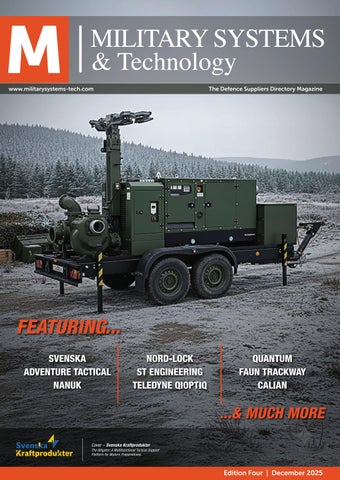
...& MUCH MORE Cover – Svenska Kraftprodukter The Alligator: A Multifunctional Tactical Support Platform for Modern Preparedness.
www.militarysystems-tech.com
1
E. sales@militarysystems-tech.com Edition Four | December 2025
T. +44 (0) 1884 258019
M MILITARY SYSTEMS & Technology
PRODUCTS, TRAINING & CONSULTANCY
For Counter EO expertise worldwide E: info@eoduk.com www.militarysystems-tech.com
T: +44 (0) 800 193 5735 2
T. +44 (0) 1884 258019
www.eoduk.co.uk E. sales@militarysystems-tech.com
M MILITARY SYSTEMS & Technology
CONTENTS 4
Adacore - Strengthening Security and Cyber Resilience
e welcome you to our fourth and final edition for this year, 2025.
W
As an established web portal for the International Defence & Aerospace Industry, we strive to provide a comprehensive and detailed listing of Military Equipment Suppliers, Products and Services. This magazine is designed to keep you up-to-date with latest news and events within the Defence Industry’s Governing Bodies, Organisations and Companies.
10 16 18
EOS - Remote Weapon Systems Piedrafita - Engineering to Succeed Leafield Cases - Next-Generation Protection for Next-Generation Kit
22
G&H - Optical Engineering for Laser Threat Detection and Protection
24 48 56
Teledyne Qioptiq - Dominating the Dark ST Engineering - Redefining Tomorrow’s Battlefield Nord-Lock - Virtual Environment to Advance Aerospace and Naval Bolting Solutions
58
Quantum - Merging Advanced Stabilization with Modular Platforms
74
Adventure Lights - SAdvancing Soldier Safety and IFF Superiority
A Multi-Media Portal for the International Defence & Aerospace Industry For more information, technical guidance or the latest subscription packages available for Military Systems, please contact us where one of our team will be more than happy to advise you.
76 78
Faun Trackway - Enhancing Military Mobility Argon - Moving from hoping we are ready to knowing we are
86
Calian - Powering Innovation, Interoperability, and Readiness
94
Svenska Kraftprodukter - The Alligator: A Multifunctional Tactical Support Platform for Modern Preparedness
T: +44 (0) 1884 258019 E: tony.nutt@militarysystems-tech.com W: www.militarysystems-tech.com
Plus...
TRIMITE TRIFIBRE PELI FRICTAPE OMNETICS CHESS DYNAMICS ADVANCED COATING HUTCHINSON RED-CAT WILL-BURT
... & much more www.militarysystems-tech.com
3
T. +44 (0) 1884 258019
E. sales@militarysystems-tech.com
M MILITARY SYSTEMS & Technology
STRENGTHENING SECURITY AND CYBER RESILIENCE IN MISSION SYSTEMS WITH STATIC ANALYSIS Introduction
manifest in flight or field testing. This proactive assurance reduces rework late in the lifecycle and supports rigorous safety cases aligned to standards such as DO-178C/ED-12C and similar domain requirements.
Modern defence systems are built from complex, interdependent software components: avionics and flight controls, mission computers, C4ISR platforms, autonomous and semi-autonomous systems, secure communications, and ground support tooling. These systems must operate correctly first time and every time, often in degraded or contested environments, and they must resist sophisticated cyber threats throughout long service lives. Traditional test-only approaches to software development are not enough at this scale, as even in the most rigorous tests, not all paths through the source code are considered. Static analysis is a technique to statically assess all paths through the source code and through that strengthen software assurance from the outset. By examining code without executing it, static analysis identifies defects, security vulnerabilities, and maintainability issues early, when they are fastest and least costly to fix, and builds a durable body of evidence to support certification, accreditation, and through-life sustainment. It is especially valuable across mixed language stacks, complex toolchains, and legacy codebases that are common in defence programmes. In the sections that follow, we outline why static analysis is a strategic necessity for military applications and set the stage for how a tool like CodeSonar can operationalise these benefits at programme scale.
Reduce cybersecurity risk Military systems are high-value targets. With growing geopolitical tensions comes the heightened risk of cyberattacks as a means of modern warfare. The increasing use of third-party and open-source software has expanded the attack surface of applications used throughout government systems, making them vulnerable. Static Analysis tools like CodeSonar fill the gaps in securing the software supply chain by identifying and scoring vulnerabilities especially at the software component boundary, assessing risk, and helping software developers to strengthen the code to prevent infiltration of high-risk components.
Accelerate certification and accreditation with credible evidence Software needs auditable artefacts: coding-standard conformance (e.g., MISRA C/C++, CERT, DISA STIG), justification of residual risk, and traceable defect closure. Static analysis produces repeatable findings, trends, and waivers with rationale, creating a defensible evidence trail for authorities and easing surveillance audits and recertification across variants and blocks.
Why static analysis matters for military and defence software
Control cost and schedule risk across long lifecycles
Software for constrained environments Defence software frequently executes in real time under strict safety constraints. Static analysis uncovers memory errors, concurrency defects, undefined behaviour, and interface mismatches before they www.militarysystems-tech.com
Beyond the need to meet stringent requirements, aerospace and defense projects have a unique challenge in that software is deployed 4
T. +44 (0) 1884 258019
E. sales@militarysystems-tech.com
M MILITARY SYSTEMS & Technology
Conclusion
for a very long time, and upgrade timeframes can see significant change throughout a system’s life. Static analysis helps teams understand and manage technical debt in legacy code that they might not be not familiar with, reduce latent defect density before integration, and prevent regressions via policy gates in the development pipeline. The result is fewer late-stage surprises, more predictable integration, and lower total cost of ownership.
Static analysis is no longer a “nice to have” in defence software; it is a foundational control for safety, security, and programme certainty. By preventing classes of defects from entering the codebase, quantifying risk in third-party components, and generating auditable evidence throughout the lifecycle, it strengthens assurance while reducing cost and schedule volatility. Crucially, it scales to the realities of mission systems: mixed-language stacks, legacy code, stringent certification regimes, and supply-chain scrutiny.
Strengthen the supply chain and third-party software assurance The recent European Union Cyber Resilience Act and White House directives have recommended that software suppliers secure their Software Supply Chain Security (SSCS). Static analysis provides an independent assessment of third-party code quality and security posture, complements Software Bill of Materials (SBOM) workflows, and helps stipulate measurable acceptance criteria for suppliers, improving trust across the chain.
For programme leaders, the path forward is clear: make static analysis a first-class citizen of the engineering toolchain and the assurance case. When embedded in CI/CD, aligned to standards (e.g., MISRA, CERT, DISA STIG), and integrated with SBOM and supplier acceptance criteria, it delivers measurable improvements in software quality and cyber resilience. Tools such as CodeSonar operationalise this approach, providing deep defect detection, supply-chain risk visibility, and the evidence trail required for accreditation and in-service sustainment. The result is mission software that is safer to deploy, faster to certify, and stronger against evolving threats.
Reduce release timelines Mission parameters change, often rapidly. Military systems have an increased need to be adaptable on the fly, in rare cases even as a mission is being conducted. To enable this, many development projects are switching to a DevSecOps way of working utilizing continuous integration and continuous delivery (CI/CD) platforms. Static analysis can be natively integrated into the automation pipelines of a CI/CD platform, thereby providing its findings directly into the developers workflow, empowering them to delivery higher quality, more secure code at the speed that the mission requires. www.militarysystems-tech.com
www.adacore.com
5
T. +44 (0) 1884 258019
E. sales@militarysystems-tech.com
M MILITARY SYSTEMS & Technology
Tools for High-Integrity Development in Ada/SPARK, C/C++, and Rust
info@adacore.com
adacore.com www.militarysystems-tech.com
6
T. +44 (0) 1884 258019
E. sales@militarysystems-tech.com
M MILITARY SYSTEMS & Technology
www.militarysystems-tech.com
7
T. +44 (0) 1884 258019
E. sales@militarysystems-tech.com
M MILITARY SYSTEMS & Technology
BUILT FOR MISSION SUCCESS:
PELI’S NATO-COMPLIANT LOGISTICS SOLUTIONS Modern military logistics relies on absolute dependability. From the arctic cold to desert heat, the equipment protecting mission-critical assets must withstand extremes and meet exacting defence standards. Peli Products, a long-standing supplier to military and tactical units worldwide, provides NATO-compliant solutions that deliver proven protection and performance in every operational theatre.
PRECISION-ENGINEERED FOR MILITARY DEMANDS
FIELD-TESTED DURABILITY AND DESIGN EXCELLENCE
For over four decades, Peli has supported defence organisations, NATO partners, and tactical units by designing and manufacturing rugged transport and storage solutions built to NATO speci昀cations. Every Peli case is engineered for durability, consistency, and interoperability across allied forces. These solutions play a crucial role in protecting sensitive equipment, weapon systems, and communication assets, ensuring readiness wherever duty calls.
Durability is not optional in military logistics. Peli’s cases are tested against extreme shock, vibration, temperature fluctuation, and immersion. The rotationally moulded structure ensures maximum impact resistance without compromising weight ef昀ciency. Each case is stackable, watertight, airtight, and corrosion-resistant, offering dependable protection through long deployments. Whether used for storing weapons, transporting electronics, or protecting communication systems, every Peli solution provides a reliable barrier against environmental and operational hazards. Each integrates seamlessly into NATO logistics systems and transport protocols, ensuring smooth interoperability across multinational missions.
Military operations depend on logistics that function under pressure. Peli’s military range – including Single Lid Cases, ISP2 Euro Pallet Containers, Custom Configurations, and Rackmount Cases – provides the reliability required for deployment ef昀ciency. Each model is designed and tested to meet NATO stock number (NSN) criteria and MIL standards, proving its ability to perform in 昀eld, air, and maritime environments.
www.militarysystems-tech.com
8
T. +44 (0) 1884 258019
E. sales@militarysystems-tech.com
M MILITARY SYSTEMS & Technology
OPERATIONAL ADVANTAGES OF PELI’S MILITARY RANGE Each Peli product category ful昀ls a de昀ned role in defence logistics. Single Lid Cases deliver rugged protection for small arms, optics, and electronics. Reinforced corners and watertight seals ensure reliability under rough handling and harsh climates. ISP2 Euro Pallet Containers optimise pallet space with an interlocking 10 × 10 cm grid, securing heavy loads for air, sea, or land transport while simplifying resupply and storage. Custom Con昀gurations offer tailored interiors for mission-speci昀c assets such as UAV systems, surveillance devices, or medical kits. Precision-cut foams and 昀ttings protect sensitive components from vibration and shock. Rackmount Cases safeguard communications and data equipment using EIA-standard frames with internal shock mounts. They protect servers and signal systems during transport while allowing rapid 昀eld access for operation or maintenance. Together, these categories form an integrated, NATO-compliant system designed for global interoperability and sustained readiness.
TRUSTED BY NATO FORCES AND DEFENCE CONTRACTORS NATO’s operational requirements demand precision and standardisation. Peli’s logistics solutions meet these expectations through design veri昀cation, material control, and codi昀cation processes aligned with NATO and MIL standards. The result is equipment that performs consistently in the world’s toughest missions, from peacekeeping operations to rapid deployment scenarios. Peli’s cases are used by defence contractors, maintenance units, and tactical logistics teams to safeguard everything from drone control systems to 昀eld medical kits and night-vision optics. This versatility reflects Peli’s ability to adapt to speci昀c mission requirements while maintaining strict compliance with defence procurement standards. Collaboration with defence agencies extends beyond manufacturing. Peli works closely with procurement of昀cers and engineers to design tailored protective solutions for unique mission pro昀les, ensuring compatibility with both equipment speci昀cations and transport infrastructure.
SUSTAINING READINESS THROUGH INNOVATION As defence operations evolve, so does Peli’s engineering. The company invests continuously in advanced materials, moulding technology, and ergonomic design to ensure each new generation of cases meets emerging operational requirements. Lightweight composites, advanced seals, and precision-昀t interiors enhance performance and sustainability without compromising compliance.
CORE FEATURES THAT DEFINE PELI’S MILITARY RANGE Across Peli’s military portfolio, several features de昀ne its reliability and 昀eld performance. These ensure every case delivers the same operational assurance, regardless of size, con昀guration, or mission.
Beyond protection, Peli ensures critical assets reach their destination intact, supporting uninterrupted mission readiness and reducing downtime. This reliability, proven across decades of NATO collaboration, is why defence professionals worldwide trust Peli for logistics that perform under pressure.
+ NATO-Compliant Construction: Certified to NATO and MIL-STD-810 for interoperability and standardisation. + Field-Proven Durability: Tested for shock, vibration, temperature extremes, and long-term endurance. + Modular and Customisable Design: Interiors and con昀gurations adaptable for diverse mission needs.
RELIABILITY YOU CAN DEPLOY
+ Global Interoperability: NSN-coded for seamless integration into international logistics systems.
From tactical 昀eld kits to command systems, Peli’s logistics solutions stand for resilience, compliance, and trust. Each case represents the union of engineering precision, rigorous testing, and user-focused design – all vital to sustaining military readiness in the modern era of joint operations.
These shared traits embody Peli’s philosophy of protecting assets while streamlining military logistics through compliance and innovation.
Custom-昀t, Mission-Ready, NATO-compliant, That’s the Peli promise. MILITARY.PELI.COM www.militarysystems-tech.com
9
T. +44 (0) 1884 258019
E. sales@militarysystems-tech.com
M MILITARY SYSTEMS & Technology
REMOTE WEAPON SYSTEMS For LAND 400 Phase 3 Infantry Fighting Vehicle The multi-year contract, valued at $108 million, was awarded by Hanwha Defence Australia (HDA), the prime contractor to the ADF on LAND 400-3. The order includes the delivery of RWS, spare parts, training, and documentation.
Electro Optic Systems Holdings Limited (EOS) has been awarded a contract to supply Remote Weapon Systems (RWS) for the Australian Defence Force’s (ADF) LAND 400 Phase 3 Infantry Fighting Vehicle (IFV) program. www.militarysystems-tech.com
Under the agreement, EOS will deliver an enhanced R400 RWS, purpose-built to meet the Australian Army’s operational requirements and fully integrated with the 10
T. +44 (0) 1884 258019
E. sales@militarysystems-tech.com
M MILITARY SYSTEMS & Technology
Hanwha Defence Australia REDBACK Infantry Fighting Vehicle at Russell Offices, Canberra. Image: Commonwealth of Australia, Department of Defence
AS21 Redback IFV. Manufacturing of the RWS will be undertaken at EOS’ facility in Canberra, drawing on a well-established national supply chain of more than 100 Australian companies.
be carried out here in Australia, supporting skilled jobs, strengthening our sovereign defence manufacturing base, and showcasing the capabilities of local suppliers on a national program of strategic importance.”
EOS’ RWS are world leading, proven in operational service with militaries in Australia, North America, Europe, the Middle East and Southeast Asia. Renowned as a provider of weapon system technology with over 2,500 systems have sold globally, of which more than 700 have been delivered or are contracted for delivery to the Australian Army.
The LAND 400 Phase 3 Project will see 129 IFVs delivered to the Australian Army. EOS’ contribution to the program underscores its role as a leading supplier of advanced weapon systems, while also delivering significant economic benefits through local investment, innovation, and capability development.
“This contract is a win for Australian industry, and we are delighted to be working with Hanwha Defence Australia on this critical project for Army” said Dr Andreas Schwer, CEO of EOS. “The work will www.militarysystems-tech.com
WWW.EOS-AUS.COM 11
T. +44 (0) 1884 258019
E. sales@militarysystems-tech.com
M MILITARY SYSTEMS & Technology
Mine Blast & Utility Seat Systems
The SCHROTH Mine Blast Protected Seat Systems are tubular lightweight systems with a unique resettable Energy Absorbing (EA) system designed into the seat. The Mine Blast protected seating system is available in two versions:
The EA design and technology comes from the years of experience SCHROTH has with energy management in seatbelt systems. The design of the seat gives the occupant not only excellent protection in a mine blast event, but also offers excellent protection in the event of an accident or impact. The All Belts to Seat (ABTS) design allows the vehicle manufacturer to optimize the installation of the seat within the hull. An integrated footrest can also be incorporated into the seating system for additional lower-leg protection. The unique SCHROTH EA technology is tunable to match the size and weight of the vehicle as well as the level of protection required and the available space within the vehicle interior. The EA is also designed to reset itself and offer high levels of protection for the secondary (slam down) event. www.militarysystems-tech.com
• SU-62 compact forward- or rear-facing seat • SU-63 side-facing seat with full or side specific headrest for exceptional side impact protection The SCHROTH seating comes standard with an ECE certified lightweight 4-point harness restraint. Restraint systems with ECE complaint 5-point seatbelts are also available. SCHROTH offers the ideal system for military personnel & troop transport configurations. 12
T. +44 (0) 1884 258019
E. sales@militarysystems-tech.com
M MILITARY SYSTEMS & Technology
www.schroth.com
KEY FEATURES • Quick release, wall-mounted interface • Modular construction • Spring Loaded Self-Folding, storable seat pan • Foldable backrest
CUSTOM APPLICATIONS Our lightweight seat systems may be adapted to many ground vehicle applications. We can assist with interface, integration, installation and ergonomic requirements as well as any vehicle specific seat modifications that may be required.
CONTACT: Werner Koch Tel: +49 2932 97420 E-Mail: werner.koch@eu.schroth.com www.militarysystems-tech.com
13
T. +44 (0) 1884 258019
E. sales@militarysystems-tech.com
M MILITARY SYSTEMS & Technology
INTEGRATION AND ELEVATION SYSTEMS MAXIMIZE SENSOR PERFORMANCE
Will-Burt Mobile Elevation Products and Integrated Systems Designed and manufactured to meet the challenges of the modern battle昀eld and exceed your expectations. Our mobile telescopic masts, towers, pan and tilt positioners and integrated trailer systems ensure that sensors and antennas will achieve their maximum performance potential under the most demanding circumstances. To learn more about our innovative elevation products, created by leading edge global design and ISO 9001:2015 quality system certi昀ed manufacturing, visit our website at www.willburt.com. Will-Burt is headquartered in the USA with locations and support around the globe and is 100% employee-owned.
Integrated Trailer Systems
Pan and Tilt Positioners
Man-Portable Field Masts
Cable-Drive Telescopic Masts
Carbon-Composite Telescopic Masts
14
T. +44 (0) 1884 258019
E. sales@militarysystems-tech.com
willburt.com www.militarysystems-tech.com
M MILITARY SYSTEMS & Technology
WILL-BURT INTEGRATION & ELEVATION SYSTEMS The Will-Burt Company, with the acquisition of Aluma Tower and Integrated Tower Systems (ITS) now offers integrated Telescoping Steel and Aluminum Tower Systems AND Telescoping Mast Systems – an elevation solution for every need! Will-Burt is a global leader in the design, manufacture, sales and rental of an extensive and affordable line of rapid-deployment Mobile Tower & Mast Systems; Tower & Mast Integrated Trailers, Trucks, Communication-Site-on-Wheels (COWs), and Mast-, Satellite- and Tower-Integrated Mobile Command and Communication Centers. This state-of-the-art equipment is designed speci昀cally to support a global contingent of clientele representing the following industries: • Telecommunications, Infrastructure Development / Restoration; Tower Owners/Operators Multi-media, Broadcasting • First Responder, Public Safety and Emergency Management; Law Enforcement, Incident Command, Search & Rescue • National Security / Homeland Defense, Domestic & Foreign Military Initiatives; Tactical, Support Functions, and Counter UAS • Border Security, Immigration and Customs Enforcement; Disaster Preparedness/Emergency Response • Geophysical, Oil & Gas and Alternative Energy; Meteorological, Frequency and Weapon Systems Testing • Transportation, Aviation, Aerospace and Construction; Entertainment, Logistics, Engineering, Municipal & Corporate Programs • Global Support of Special Events; Political, Commercial, Industrial, Sporting, Civic and Numerous other Industries
Will-Burt’s innovative rapid response systems are manufactured to both civilian and military speci昀cations and built to withstand many of the world’s most demanding environments. Will-Burt controls every aspect of manufacture and assembly through an ISO 9001:2015 certi昀ed quality management system in all manufacturing locations. Will-Burt’s engineering expertise and vertical integration capabilities allows for ef昀cient COTS products and unique custom designs for the seamless installation of common or client-speci昀c technologies, or preintegrated with a Will-Burt or client-furnished Communications, Surveillance, or Counter UAS Solutions. Will-Burt’s rapidly deployed systems are proven key components in establishing the 昀ow of vital information from remote and urban areas of need.
Steel Telescoping Tower
COMMON USES • Border Security • Counter UAS • Disaster Recovery / Emergency Response www.militarysystems-tech.com
Telescoping Pneumatic Mast
• Lighting • Surveillance • Remote Communications Site Security
• Sensor Applications • Systems Testing • Energy Exploration / Production Sites 15
Aluminum Telescoping Tower
• Telecommunications • Temporary Cell Site • Lightning Protection • Broadcast
T. +44 (0) 1884 258019
E. sales@militarysystems-tech.com
M MILITARY SYSTEMS & Technology
ENGINEERING TO SUCCEED: PIEDRAFITA EXPANDS UK PRESENCE TO ADVANCE PROVEN DEFENCE TECHNOLOGIES Piedrafita is a premier engineering firm renowned for its cutting-edge mobility and power solutions tailored for military vehicles operating in the most challenging environments worldwide.
INNOVATION IN MOBILITY SOLUTIONS FOR ARMOURED VEHICLES IN HARSH CONDITIONS Piedrafita Systems stands at the forefront of rotary damper innovation, engineering and manufacturing advanced solutions that redefine mobility for heavy land platforms. Its patented designs— lightweight, compact, and highly efficient—deliver superior energy dissipation, enhancing vehicle performance while streamlining integration for both next-generation systems and retrofitted legacy platforms. The Hydropneumatic Rotary Suspension System (SRB) for Armoured Vehicles is the outcome of a strategic collaboration among leading European defence companies, with Piedrafita serving as the project’s principal coordinator. This initiative is part of the European Defence Industrial Development Programme (EDIDP 2020) and the European Defence Fund (EDF 2023), underscoring its significance within the EU’s broader vision for technological sovereignty and military innovation. The Hydropneumatic Linear Suspension columns represent a fully integrated design solution engineered to enhance the mobility of a wide spectrum of vehicle platforms. Their modular architecture and seamless integration capabilities make them ideally suited for both cutting-edge vehicle development and the modernization of existing legacy systems.
With nearly forty years of specialized expertise, the company has established itself as a trusted technological ally in the defence sector. Its operations are strategically structured into three synergistic divisions: Piedrafita Systems, Prognostics, and DefPower.
In addition to advanced hydropneumatic suspension systems, both rotary and linear, Piedrafita offers other specific solutions, such as track tensioners, which directly influence the mobility of both metal and rubber track vehicles, their fuel consumption, comfort, crew safety and service life.
The future of digital suspension and predictive maintenance Piedrafita has fully embraced digital transformation through the development of its Digital Suspension Controller (DSC)—an advanced system that delivers real-time monitoring and diagnostics for suspension and drivetrain components. By providing actionable insights into terrain conditions, operational patterns, and mechanical integrity, the DSC empowers predictive, data-driven maintenance strategies that reduce unplanned downtime and enhance overall operational readiness. www.militarysystems-tech.com
16
T. +44 (0) 1884 258019
E. sales@militarysystems-tech.com
M MILITARY SYSTEMS & Technology
SMART POWER MANAGEMENT WITH SOLIDSTATE MILPDUS As military platforms transition toward electrification, the need for resilient and intelligent power distribution systems becomes increasingly critical. Piedrafita DefPower meets this demand with its advanced line of MILPDUs (Militarised Power Distribution Units). These solid-state systems replace conventional relay and fuse boxes, offering programmable logic, a compact footprint, and full compliance with stringent MIL-STD and Def Stan specifications—ensuring reliability and adaptability in the most demanding operational environments. Features include: • Compatibility with 12 V, 24 V, and 48 V systems • CAN bus integration • Support for analogue and digital inputs • Integrated transient protection • Hardware standardisation across variants • Ideal for legacy fleet upgrades
STRENGTHENING PRESENCE IN THE UK
INTELLIGENT DATA ACQUISITION FOR MISSION-CRITICAL SYSTEMS
Piedrafita’s technologies are already integrated into key platforms of the UK Ministry of Defence, including the AJAX programme. To better support the growing needs of its British partners, the company is establishing a dedicated in-service support workshop in the United Kingdom. This new facility will offer localised assistance, spare parts provisioning, and streamlined distribution—reinforcing Piedrafita’s longterm commitment to the sustainment and success of British defence initiatives.
Piedrafita Prognostics offers a holistic approach to data acquisition and subsystem digitalisation, empowering advanced diagnostics and operational intelligence. Its Smart Logger product family supports both NGVA-compliant and standalone platforms, enabling in-depth system analysis across powertrains, turrets, and suspension systems. Complementing this, the SICCOM component traceability platform leverages QR codes, barcodes, RFID, and NFC technologies—enhanced by AI-driven recognition—to provide secure, contactless access to data and comprehensive lifecycle tracking.
www.piedrafita.com
Photograph credit: UK MOD © Crown copyright 2024 www.militarysystems-tech.com
17
T. +44 (0) 1884 258019
E. sales@militarysystems-tech.com
M MILITARY SYSTEMS & Technology
Next-Generation Protection for Next-Generation Kit: WHY STARK DEFENCE HAS CHOSEN LEAFIELD CASES’ AEGIS SYSTEM FOR DRONE DEPLOYMENT Why Aegis?
Leafield Cases is proud to announce that Stark Defence has selected its Aegis Custom Cases to protect and transport its new drone system, the Stark Owe-V.
Battle-Proven Protection – Rotationally moulded to exceed MIL-STD-810G, Def Stan 81-41 Level J and STANAG 4280, Aegis Cases are waterproof, dustproof, impactresistant and vibration-damping. Custom-Fit Interiors – Bespoke in-house designs ensure equipment is securely housed, from drones to medical supplies and film gear. Rapid Deployment – With options ranging from compact quadbike-ready cases to large-scale transport solutions, Aegis enables fast loading, deployment and repacking. Deploys in 5 minutes.
As drones become ever more critical in modern operations, so too does the need for protection and rapid deployment. Already trusted by defence, medical, industrial and scientific teams worldwide, Aegis delivers the durability and flexibility required for mission-critical equipment.
Smart Stacking & Handling – A patented cross-stacking system ensures secure loads in transit, while tie-down anchor points and glove-ready handles deliver reliability in the field. “We chose Leafield’s Aegis Cases because they deliver the protection, mobility and deployment speed we need on operations. For any organisation moving advanced equipment in demanding environments, that combination is essential,” said a Stark Defence spokesperson. Drone Cases spokesperson on why he chose Aegis Cases “Because they are readily available, they fulfill all necessary mission requirements and military standards and because I love Leafields MD.”
www.militarysystems-tech.com
18
T. +44 (0) 1884 258019
E. sales@militarysystems-tech.com
M MILITARY SYSTEMS & Technology
Supporting Modern Defence Needs
About Leafield Cases Leafield Cases is a leading UK-based manufacturer of rotationally moulded protective cases, serving defence, emergency, medical, industrial and creative sectors. With in-house engineering and decades of expertise, Leafield delivers rugged, reliable solutions trusted worldwide.
For Stark Defence, Aegis is about more than protection - it’s about operational readiness and agility. In today’s fastmoving conflicts, drones must be deployed and recovered quickly. With Aegis, Stark Owe-V drones arrive protected, deploy rapidly, and can be repacked just as swiftly.
Discover more at: leafieldcases.com Protect what matters. Wherever your mission takes you.
Built in Britain, Trusted Worldwide Every Aegis Case is designed, engineered and manufactured in Wiltshire, UK. This enables tight quality control, true customisation and fast turnaround times. While proven in defence, Aegis Cases are also used in emergency services, energy, field science and film production, wherever critical kit must stay safe and deployable.
E: cases@leafieldenv.com T: +44 (0) 1225 816504
www.leafieldcases.com
Leafield CASES CUSTOM PROTECTIVE CASES
www.militarysystems-tech.com
19
T. +44 (0) 1884 258019
E. sales@militarysystems-tech.com
M MILITARY SYSTEMS & Technology
why choose any other case? rotationally moulded, tough, DURABLE, waterproof cases
cutting edge design and materials technology made in the uk, TRUSTED WORLDWIDE
Protecting what protects us
Leafield CASES CUSTOM PROTECTIVE CASES
www.militarysystems-tech.com
20
T. +44 (0) 1884 258019
E. sales@militarysystems-tech.com
M MILITARY SYSTEMS & Technology
www.militarysystems-tech.com
21
T. +44 (0) 1884 258019
E. sales@militarysystems-tech.com
M MILITARY SYSTEMS & Technology
COUNTERING THE INVISIBLE: OPTICAL ENGINEERING FOR LASER THREAT DETECTION AND PROTECTION optical paths also function as early-warning sensors. Working with Sentinel Photonics, G&H developed an integrated periscope solution that embeds a laser warning receiver directly within the optical relay.
The modern battlespace has entered a new domain - one where invisible energy can identify, disable, or deceive before conventional weapons ever engage.
The design uses narrow-band detectors coupled through beamsampling elements positioned within the periscope’s optical train. This allows continuous 360° monitoring of incident laser energy without affecting optical throughput or image contrast. When a pulse is detected, onboard processing determines wavelength, intensity, and bearing, providing a warning to the crew within milliseconds. Because the detection module is optically and mechanically co-aligned with the periscope, it maintains boresight accuracy and requires no additional operator interface - significantly simplifying retrofit into legacy platforms. The result is a self-contained optical subsystem that acts as both window and shield.
Lasers now underpin both offensive and defensive systems, ranging from compact rangefinders and target designators to dazzlers and high-energy directed-energy weapons (DEWs). Their precision, coherence, and near-instantaneous propagation make them formidable - and difficult to detect until they strike.
Field Optics Protection: FROST Filters for Dismounted Systems
To counter these risks, G&H has advanced a portfolio of optical technologies that transform traditional sighting and viewing systems into active detection and protection platforms. The aim is not just to see further but to sense smarter: detecting, classifying, and mitigating laser energy across multiple wavelengths in real time.
At the individual level, a riflescope or observation optic can unintentionally reflect a laser signature back to the source, revealing a soldier’s position. A direct hit can also dazzle the reticle or cause sensor bloom on digital sights.
Embedded Sensing: Integrating Laser Warning Into Periscopic Optics Conventional vehicle optics were designed for passive imaging under harsh conditions. Today’s threat environment demands that the same
www.militarysystems-tech.com
22
T. +44 (0) 1884 258019
E. sales@militarysystems-tech.com
M MILITARY SYSTEMS & Technology
G&H | Artemis and Sentinel Photonics addressed this with the FROST (Field-Ready Optical Suppression Technology) series: multilayer thinfilm filters deposited on precision substrates designed to block specific laser emission bands (typically 532 nm, 808 nm, and 1064 nm) while preserving high transmission in the visible and NIR imaging ranges.
definition display module. The configuration supports both direct and indirect viewing modes, enabling smooth transition between optical and digital imagery. When networked with AI-enabled vision suites such as Overview’s PodView 2500, the EIP feeds image data and laser-warning telemetry into a fused situational-awareness system capable of real-time analysis, object recognition, and automated countermeasure cueing.
In addition to spectral blocking, the filters incorporate an engineered surface microtexture to disrupt specular retroreflection, reducing the probability of detection by laser rangefinders. The assemblies are designed for shock resistance and environmental durability, meeting MIL-STD-810 thermal and abrasion requirements.
This optical-electronic convergence marks the shift from passive observation to active threat management - without increasing cognitive load for the operator.
Reticle Fabrication: Microlithography for Precision Targeting
Manufacturing Synergy and Mission Readiness
Through the acquisition of Global Photonics in Tampa, G&H now produces microlithographic reticles with feature tolerances to ±0.002 mm. Fabrication takes place in ISO-class cleanrooms using photolithographic patterning on glass or fused-silica substrates, followed by ion-beam sputtered coatings to enhance contrast and resist laser damage.
G&H has created a vertically aligned defense optics ecosystem in the United Kingdom and the United States. This structure allows rapid iteration from materials research through finished subsystems, ensuring spectral performance, environmental hardening, and interoperability from design to deployment.
These custom reticles form the precision interface between operator and target within fire-control, imaging, or test systems. Variable pattern geometries and coatings enable optimization for both optical and digital sighting channels.
Laser-based threats will continue to diversify across the electromagnetic spectrum, from visible to mid-infrared. Countering them requires equally agile optics - systems capable of distinguishing friend from foe emissions, tolerating high-energy exposure, and interfacing directly with vehicle or soldier-borne electronics.
Systems Integration: From Optical Subcomponents to Sensor Fusion
Through sustained R&D in materials, coatings, and opto-mechanical integration, G&H is advancing the next generation of intelligent optical protection - solutions that safeguard crews and maintain tactical superiority.
Modern defense platforms demand reduced SWaP (size, weight, and power) and unified data connectivity. G&H’s Embedded Image Periscope (EIP) architecture addresses this by combining relaxed-view biocular optics with an internal electronic imaging path and high-
www.militarysystems-tech.com
gandh.com
23
T. +44 (0) 1884 258019
E. sales@militarysystems-tech.com
M MILITARY SYSTEMS & Technology
DOMINATING THE DARK: TELEDYNE QIOPTIQ PUTS PRECISION IN THE HANDS OF THE WARFIGHTER At SHOT Show 2026, Teledyne Qioptiq will showcase its latest generation of night-vision, thermal, and fused weapon sight systems developed to perform in the harshest operational environments.
• DRAGON-S and DRAGON-C – Rugged, uncooled thermal weapon sights optimised for rapid rail mounting, providing dependable performance for sharpshooter and close-quarters roles while maintaining zero under sustained use. • EAGLE – A lightweight binocular night-vision goggle that enhances depth perception and reduces fatigue during extended dismounted operations. Together, these systems cover the full spectrum of dismounted and mounted missions, enabling End Users to operate effectively no matter the role or terrain.
From precision sniper sights to integrated soldier systems, these technologies enable today’s warfighters to see first, decide faster, and act with confidence.
BUILT FOR THE OPERATOR “Our focus has always been on the human behind the sight, every design balances lightweight construction with rugged dependability. These systems are built to survive the mission, whatever the environment, and to reduce the physical and cognitive burden on the End User.”
PRECISION VISION FOR MODERN OPERATIONS Optimised for the unpredictable realities of modern combat, Teledyne Qioptiq’s portfolio delivers mission-specific capability across multiple platforms:
Steve Rickard, Business Development Director. • PHOENIX – A cooled MWIR inline sniper sight using a 640 × 512 detector with a horizontal field of view of around 2.5°. Capable of detecting a man-sized target at up to 4,500 m and vehicles at 8,800 m under good conditions, it combines long-range precision with a lightweight, durable design.
Modern operations often take place in low-light or obscurant heavy theatres of operation, requiring sights that combine clarity, durability, and flexibility. Teledyne Qioptiq systems are engineered to withstand extreme temperatures, dust, recoil, and weather, while maintaining image quality and boresight stability.
• TALON – Developed and optimised under the UK MoD’s ARILLS programme, this fused thermal and image-intensifier sight enables continuous target observation and engagement in low-light and night conditions. Already fielded by UK forces, TALON has proven itself in live operations. www.militarysystems-tech.com
Recent evaluations have shown measurable improvements in detection and engagement times compared to conventional optics. TALON’s fused sensor design, for example, enables uninterrupted observation in darkness or through smoke, giving users a decisive edge. 24
T. +44 (0) 1884 258019
E. sales@militarysystems-tech.com
M MILITARY SYSTEMS & Technology
TELEDYNE QIOPTIQ
INNOVATION UNDER THE TELEDYNE UMBRELLA
ABOUT TELEDYNE QIOPTIQ Teledyne Qioptiq, part of Teledyne Defense & Aerospace, has supplied advanced electro-optical systems to US, UK, and NATO forces for decades. The company designs, manufactures, and supports products that allow operators to detect, identify, and engage targets with precision across land, air, and maritime domains.
As part of Teledyne Defense & Aerospace organisation, Teledyne Qioptiq benefits from broad and deep expertise across optics, sensors, and electronics. The 2025 acquisition of selected Excelitas Technologies’ defence assets further strengthened capabilities in sensor fusion, digital sighting, and integration with networked and unmanned systems.
Contact.: Steve Rickard – Business Development Director Office: +44 (0)1745 588363 Mobile: +44 (0)7785 242453
“By combining Qioptiq’s heritage in optical engineering with Teledyne’s strengths in sensing, electronics, and autonomy we’re delivering next-generation systems that aid our forces in staying one step ahead. It’s about giving operators the right tools to maintain visual dominance in any environment.”
www.qioptiq.com
INNOVATE, INTEGRATE, DELIVER, SUPPORT
EXPERIENCE THESE WORLD BEATING TECHNOLOGIES AT SHOT SHOW 2026 Visitors to Booth #20408 can meet Teledyne Qioptiq experts, see live demonstrations of long-range and fused-sensor optics, and explore integration options for current and emerging defence programmes.
“SHOT Show is where we connect capability with the people who rely on it. Every optic we produce is tested to survive the same conditions our customers face daily before they ever leave our facilities. Under the Teledyne banner, we’re moving towards lighter, smaller, and more connected imaging systems that extend the operator’s reach and situational awareness.” www.militarysystems-tech.com
JANUARY 20-23, 2026 The Venetian Expo and Caesars Forum, Las Vegas, USA
SEE US AT
BOOTH #20408 25
T. +44 (0) 1884 258019
E. sales@militarysystems-tech.com
M MILITARY SYSTEMS & Technology
Improvements in miniaturization, connectivity, and sensor technology are now empowering individual soldiers. Now, a single combatant can operate with the capability of an entire unit thanks to enhanced situational awareness, real-time data feeds, and smart systems. The battlefield is no longer just about who has more troops or heavier weapons, but who integrates technology most effectively.
INTRODUCTION Warfare has consistently been one of humanity’s longest-standing industries, with access to the latest technology almost always being the singular factor for victory. Early human conflicts were shaped by materials, with stone implements being defeated by bronze, which in turn gave way to iron.
CHALLENGES SOLDIERS FACE
Gunpowder, however, was arguably one of the most significant, as it became the great leveler, making it possible for the smallest person to vanquish the largest. As gunpowder became adopted, artillery evolved alongside bringing devastating capabilities. But it was the introduction of rifled shells that made artillery truly viable, allowing armies to strike with precision over previously unimaginable distances.
The modern soldier faces many challenges, whether they are from the environment, the equipment being used, or the enemy itself. One of the biggest challenges is personal protective equipment. While armor and helmets provide essential protection, their weight and bulk can impact mobility and endurance significantly. These challenges also extend to other worn equipment, such as advanced optics, night vision devices, and heads-up displays. Simply put, every extra ounce that a soldier carries compounds fatigue and reduces reaction speed.
Fast forward to modern times, and warfare is no longer defined solely by raw firepower. Dominance is now increasingly tied to information access, control of the airspace, and the skill of personnel. However, this technological trend does not stop at strategic assets.
Wearable sensors, devices capable of tracking key health vitals, can further multiply these issues. As they must interface with multiple points on the body while remaining secure, they need to be comfortable, and easily removable, both for combat maneuvers and for treating casualties. Wearables and connectors that are complex or difficult to remove can have lethal consequences. Electronic devices, while critical for modern soldiers, must also remain undetectable. Emissions of electromagnetic radiation, however minor, can betray a soldier’s location with devastating consequences, especially in the era of autonomous drones capable of homing in on electronic signatures. And then there are the environments experienced by soldiers: mud, www.militarysystems-tech.com
26
T. +44 (0) 1884 258019
E. sales@militarysystems-tech.com
M MILITARY SYSTEMS & Technology
dust, water, and extreme temperatures can render even the most rugged electronics inoperable. Even for scenarios at the far edge of plausibility (such as nuclear, EMP, or high-interference environments), shielded electronics becomes an absolute necessity. Designing systems that survive such extremes without compromising usability is a problem that military engineers have yet to fully solve.
solider or their team killed. At the same time, such connectors need to remain sealed against dirt, moisture, and other environmental hazards. Reliability is a requirement that cannot be negotiated, as any loss of signal, power, or data could be fatal. Everything from HUDs to health monitors are all critical for mission success and survivability, and connectors that fail to keep these devices operational place a soldier at immediate risk. Such devices often require connectors capable of sustaining Ethernet or USB-level speeds, all while being carefully shielded to prevent interference or detection.
WHAT THIS MEANS FOR CONNECTORS Given the challenges faced by soldiers, the connectors that link their equipment are far from ordinary as they must balance seemingly contradictory requirements: ease of use, reliability, and environmental resilience.
Weight and profile are also critical factors in connector selection. Connectors and cables must be compact and lightweight to avoid adding fatigue or increasing visibility, which is why surface treatments (painting, coating, or anodizing), are commonly used to help ensure nonreflective finishes.
Connectors used on soldiers need to have the ability to be rapidly connected and disconnected without tools or complex mechanisms. For example, a simple push-and-twist action can be the difference between maintaining functionality under fire and causing a distraction that gets a
CONCLUSION The future of warfare will depend on fully integrated electronics at the individual level, where mission success and survival hinge as much on the reliability of interconnects as on strategy or training. Connectors, often overlooked, must be rugged yet easy to operate, lightweight without sacrificing performance, and capable of carrying highbandwidth data and power. Just as critical is environmental resilience, ensuring functionality in dust, moisture, electromagnetic interference, and extreme conditions. In the end, these small components may well decide the effectiveness of advanced soldier systems, where every second counts and every failure carries risk.
www.omnetics.com www.militarysystems-tech.com
27
T. +44 (0) 1884 258019
E. sales@militarysystems-tech.com
M MILITARY SYSTEMS & Technology
WWW.OMNETICS.COM | SALES@OMNETICS.COM | +1 763-572-0656
MICRO- & NANOINTERCONNECT TECHNOLOGY
FOR MISSION-CRITICAL APPLICATIONS. 200˚C RATED
HIGH SHOCK
& VIBRATION
EXCEEDS
MIL-DTL-32139
SMALL SIZE & WEIGHT www.militarysystems-tech.com
Omnetics ruggedized connectors exceed the SWaP requirements of deep space, delivering exceptional performance in harsh environments. WWW.OMNETICS.COM 28
T. +44 (0) 1884 258019
E. sales@militarysystems-tech.com
M MILITARY SYSTEMS & Technology
Positioning Systems for Demanding Environments
Renowned for our reliability and minimal maintenance requirements, all of Chess Dynamics' solutions can be tailored to meet a client's specific and exacting requirements.
www.chess-dynamics.com www.militarysystems-tech.com
29
T. +44 (0) 1884 258019
E. sales@militarysystems-tech.com
M MILITARY SYSTEMS & Technology
CHESS DYNAMICS’ OMEGA POSITIONER ENTERS OPERATIONAL USE WITH MELLORI SOLUTIONS OMEGA forms a critical part of the system, providing precise, stabilised high-torque movement for long-range RF payloads. With a payload capacity of up to 500kg, it delivers the mechanical stability and positioning accuracy required for use at sea, maintaining performance under wind loading, vibration, and platform motion such as roll and pitch. Designed for complex sensor stacks, OMEGA is part of Chess Dynamics’ modular positioner family, which can support a wide range of missions and applications across land, maritime and multidomain environments.
Chess Dynamics, part of the Cohort plc Group, has confirmed that its latest high-performance positioner, OMEGA, is now in operational use as part of the Blue Jay Horizon system which was launched at the Indo Pacific International Maritime Exposition in Sydney.
Andy Smith, Managing Director at Chess Dynamics, said:
Developed by Australian defence specialist Mellori, the system enables crews to train, test and build confidence in their sensors under real-world maritime conditions. It reflects the strength of international collaboration and the growing demand for adaptable, sovereign EW capability.
“OMEGA was developed to meet our customers’ need to precisely position payloads of increasingly heavier weights. Its rapid integration into Blue Jay Horizon demonstrates the trusted partnership established with Mellori — a collaboration that enables complex, capability-enhancing systems to be delivered efficiently and effectively to end-users.”
Phil Guy, Managing Director at Mellori, said: “Blue Jay Horizon will operate in a demanding maritime environment which will require an exceptional understanding of one of its most critical subsystems — the gyro-stabilised positioning pedestal. Chess Dynamics has provided the specialist expertise needed to ensure OMEGA meets the rigorous performance demands of high-sea states, long-range positioning accuracy, and continuous stabilisation under motion. This technical integration ensures that Blue Jay Horizon’s payloads remain precisely aligned and fully effective, even in the most challenging conditions, reinforcing the system’s reliability for navies and maritime operators worldwide.” www.militarysystems-tech.com
30
T. +44 (0) 1884 258019
E. sales@militarysystems-tech.com
M MILITARY SYSTEMS & Technology
OMEGA: Designed for demanding payloads and dynamic conditions
All Chess positioners share a common modular product architecture and are designed for ease of integration with customer payloads, high reliability and low maintenance across land, maritime, and multi-domain environments. The existing portfolio to which Omega is now added is in service with a wide range of international customers and is combat-proven in the harshest environments.
OMEGA was developed to meet growing demand for hightorque, high-resilience positioners capable of carrying larger, heavier and more complex sensor configurations. It supports: • RF and radar arrays
chess-dynamics.com
• Multi-mode sensor stacks • Long-range surveillance and targeting systems • Custom payloads Its mechanical design ensures consistent performance in extreme conditions, whether deployed at sea on a mobile land platform, or in fixed installations.
A trusted precision positioner portfolio OMEGA is the latest addition to Chess’s high-performance positioner family, which also includes: • Cobra – designed to minimise size, weight and profile for payloads up to 30kg • Viper – heavier duty positioner particularly well-suited for vehicle-mounting with 60kg capacity • Zeta – dual axis, heavy duty positioner with 100kg payload capacity
www.militarysystems-tech.com
31
T. +44 (0) 1884 258019
E. sales@militarysystems-tech.com
M MILITARY SYSTEMS & Technology
Power is the New Ammunition When Power Becomes the Threat Modern militaries are rapidly adopting electrified platforms, from hybrid tactical vehicles to unmanned systems and distributed power networks.
Even with advanced containment designs, cell-to-cell propagation remains one of the greatest unsolved challenges in battery safety; one incident can mean the loss of a system…or worse. Built for Combat: ThermoDyne’s DynaGuard® Solution Suite DynaGuard® EV and DynaGuard® EV Granulated redefine how militaries approach battery safety across manufacturing, deployment, and storage. These passive solutions integrate into existing 6T battery formats, transport containers, and storage facilities—without altering cells or chemistry.
Key Features and Performance: Central to this modernization effort are Lithium-Ion 6T batteries, chosen for their high power density and performance under demanding conditions.
• Thermal resistance exceeding 1,000°C • Proven in aerospace, defense, and commercial applications
Yet these same attributes can be a critical vulnerability: thermal runaway, a chain reaction of overheating, fire, and toxic gas release that would endanger personnel, vehicles, and mission success.
By halting cell-to-cell propagation, the event was contained within a single cell, avoiding a catastrophic and almost instantaneous spread that could have devastated surrounding cells.
Thermal runaway begins with internal heat buildup, causing rapid cell heating, fire, smoke, and explosive failure in lithium-ion batteries.
Mechanical damage triggers short circuits and intense heat, leading to violent venting, ignition, and total lithium-ion battery failure.
www.militarysystems-tech.com
32
T. +44 (0) 1884 258019
E. sales@militarysystems-tech.com
M MILITARY SYSTEMS & Technology
Applications Across Allied Forces • MILITARY VEHICLE OPERATORS Enhance survivability and power reliability in electrified platforms • UNMANNED SYSTEMS AND DISTRIBUTED POWER Safeguard remote, autonomous operations • TRANSPORT AND STORAGE UNITS Protect aggregated battery inventories in transit and depot environments • AEROSPACE AND DEFENSE INTEGRATORS Leverage existing ThermoDyne insulation systems for expanded protection • COMMERCIAL AND DUAL-USE PARTNERS Extend safety innovation to EV, aviation, and energy sectors ThermoDyne’s technologies deliver the resilience required for next-generation military electrification.
Ready for Integration ThermoDyne’s DynaGuard portfolio is dual-use, production-ready, bridging commercial innovation with military-grade resilience. For NATO allies pursuing safer, more reliable electrification, ThermoDyne provides the strategic advantage of safety through science. Engineering Thermal Protection for the Modern Battlefield
www.thermodyne1.com | info@thermodyne1.com
ThermoDyne’s microporous insulation sealed micro panels stop thermal propagation, protecting lithium-ion cells and military power modules from heat damage.
www.militarysystems-tech.com
The pourable, energy-lux-abating DynaGuard EV Granular fills gaps, prevents cell-to-cell ignition, and enhances battery safety in defense systems.
33
T. +44 (0) 1884 258019
E. sales@militarysystems-tech.com
M MILITARY SYSTEMS & Technology
Advanced Coating Engineered Surface Protection for Mission-Critical Systems With decades of leadership in highreliability conformal coatings, Advanced Coating stands at the intersection of engineering excellence, regulatory compliance and supply-chain responsiveness.
• Decades of Parylene coating expertise, including proprietary and patented methods for deposition, fixturing, masking, and validation. • Certification and compliance: ISO 9001, AS9100, ITAR-registered, ISO 27001/NIST 800-171 compliant, REACH/RoHS and biocompatibility certified as required. • NADCAP compliant (Upcoming certification in 2026) • Supply-chain responsiveness: we serve Tier 1 and Tier 2 customers accustomed to strict spec control, short turn times and evolving production requirements.
For the aerospace, defense, medical device, commercial aviation and industrial markets, we deliver surface-enhancement solutions that protect, extend life, and enable performance in the most demanding environments. At the helm of this effort is General Manager Ernest Garcia, an operationsdriven executive with over 25 years of global supply-chain, manufacturing, quality and delivery leadership across aerospace, telecom, automotive, government and military sectors. Under his stewardship, Advanced Coating is primed to partner with OEMs, Tier 1 integrators and developmental programs that require both technical depth and operational discipline.
• Customer-centric, consultative engineering support: we partner with your engineering and quality teams to understand substrate materials, cleaning/prep, ESD mitigation, fixture design and final inspection criteria. • Unbroken commitment to long-term partnerships: we place integrity, accountability and consistency at the core of our business practices.
Foundation of Excellence
MARKETS OF FOCUS
Founded in 1987, Advanced Coating has built its reputation by focusing exclusively on high-reliability Parylene conformal coatings and other surface-protection technologies for electronics, assemblies and components deployed in mission-critical systems. Based in Rancho Cucamonga, California, our facility is situated to support expedited logistics to aerospace hubs and worldwide freight-forwarding. We operate as an integrated part of our customer’s supply chain, serving both high-volume production programs and high-mix, low-volume developmental builds with equal agility.
Aerospace & Commercial Flight Programs For air-vehicle avionics, flight controls, sensors and other components where altitude, humidity, vibration and temperature extremes demand flawless performance, Advanced Coating offers Parylene and conformal-coating processes proven for aerospace environments. Our facility is located to support rapid logistics to Southern California aerospace hubs, and we are equipped to accommodate production ramp-ups aligned with flight-program schedules, from prototype builds to full commercial rollout. We currently ship internationally and have no issues processing to the tightest schedules in the business.
Why Choose Advanced Coating? When your subsystem is operating at 30,000 ft, in a salt-fog chamber, in the human body or in a hyper-sensitive industrial control network, the margin for error is virtually zero. That is where our experience becomes your advantage:
Defense & Military Systems In a defense context where mission-critical electronics must survive exposure to chemicals, salt-fog, shock and dust, you need a coating partner with verified aerospace/defense credentials. Advanced Coating has served major aerospace and defense primes and U.S. government supply chains over many years. We understand ITAR, chain-of-custody, traceability and the rigorous documentation required for procurement by the DoD and other government agencies.
Medical Devices & Life-Science Systems Advanced Coating’s capabilities extend into the medical-device sector where biocompatibility, clean-room processing, and sterilization compatibility are essential. Because Parylene is inert, pin-hole free and extremely conformal, it is ideal for implantable devices, surgical www.militarysystems-tech.com
34
T. +44 (0) 1884 258019
E. sales@militarysystems-tech.com
M MILITARY SYSTEMS & Technology
instruments, sensors and electronics used in interventional and diagnostic equipment. Our team supports partner OEMs in qualifying coating processes, validating adhesion, thickness and cleanliness while maintaining production schedules.
Industrial & Commercial Electronics In industrial automation, oil/gas systems, rugged instrumentation and commercial electronics, the demand for reliable long-term protection against moisture, abrasion, corrosion and harsh ambient environments has never been higher. Advanced Coating offers process flexibility to handle small batches or production runs, and our engineering team will work with you to optimize fixturing, masking and coating sequences for yields, costeffectiveness and on-time delivery.
The Ernest Garcia Leadership Difference As General Manager, Ernest Garcia brings to Advanced Coating a unique combination of operational acumen, supply-chain mastery and technical orientation. With 25 years overseeing manufacturing, engineering, quality, global sourcing and delivery teams across aerospace, defense, telecom and commercial domains, Ernest ensures that Advanced Coating not only meets customer specs but also integrates seamlessly into your overall program lifecycle. His early career included leadership roles in contract manufacturing, quality escalation, supplier audit and global sourcing. All of which inform how Advanced Coating approaches each customer program: with end-to-end understanding of production pressures, quality expectations, cost constraints and delivery milestones.
Why it Matters for Your Program For an aerospace or defense integrator, coating failure is not just a rework cost, it can affect life-cycle reliability, mission readiness and program credibility. For a medical device OEM, coating issues can trigger regulatory risk and device recall. For industrial electronics, downtime due to corrosion or failure can shut a facility down. Advanced Coating’s value proposition is simple: we give you confidence that the surface protection system will perform as expected, integrate with your supply-chain, maintain schedule discipline and contribute to your bottom line.
Under Ernest’s leadership, the company has reinvested in state of the art equipment, training of skilled technicians, and process improvement programs that deliver improved yields, tighter cycle times and high-visibility metrics for customers. The credo he embraces: “Plan ahead. Reduce cost. Improve continuously.” This mentality fits naturally with aerospace and defense contractors who expect continual performance improvement, longterm cost containment and schedule reliability.
A Future-Ready Partner As your systems evolve, whether toward miniaturized sensors, advanced composite avionics hubs, implantable diagnostics, or rugged industrial IoT modules the need for adaptive coating technology multiplies. Advanced Coating continues to invest in training, equipment and process development, staying abreast of evolving MIL-specs, aerospace standards and medicalregulatory developments. Our team is ready to support high-reliability programs with changing volumes, tighter specifications and evolving platforms.
How We Partner with You Engaging with Advanced Coating means tapping into a partner who will collaborate early in your program, align with your quality/engineering and support you through prototyping, qualification and full production phases. Typical steps include:
Invitation to Collaborate
1. Specification review and engineering consultation. We partner with your design/qualification teams to review substrate metallurgy/composite, cleaning/prep requirements, ESD considerations, fixture and rack design, masking and cure/inspection sequence.
If you are evaluating your existing coating supplier and seeking a partner who combines deep technical coatings expertise, disciplined operations, supply-chain alignment, and a leadership team oriented towards engineering, manufacturing and delivery, I invite you to connect with me and the Advanced Coating leadership team. Together, we can review your specifications, collaborate on your next build, and position your components for success in aerospace, defense, medical or industrial markets.
2. Pilot run and qualification. We run sample builds to validate coating adhesion, thickness, void-free coverage, ESD-safe handling, and finalize documentation aligned with your QMS and purchasing requirements.
Let Advanced Coating become your trusted surface-protection partner. We stand ready to partner with your engineering, supply-chain and quality teams to deliver on spec, on schedule and on budget.
3. Production ramp-up and delivery. Whether you need lowvolume builds for flight test or high-volume product flight rollout, we support you with flexible planning, scheduling, logistics and just-in-time turn-in.
www.AdvancedCoating.com
4. Ongoing support and continuous improvement. We monitor yield metrics, feedback loops from engineering/quality, and operate continuous improvement programs to lower cost, reduce rework, and improve delivery throughout the product lifecycle. www.militarysystems-tech.com
35
T. +44 (0) 1884 258019
E. sales@militarysystems-tech.com
M MILITARY SYSTEMS & Technology
ACTIVATED CARBON CLOTH FOR THE DEFENCE SECTOR Flexzorb™ - The flexible, lightweight protective textile that is widely used by many of the world’s leading defence vendors, making us the leading provider of activated carbon cloth for defence applications. Lightweight and breathable, Flexzorb is used in a range of defence applications, including: – CBRN Respirator filtration media – CBRN Personal protective equipment (PPE) – CBRN decontamination wipes – Missile decoy media – Phosphine gas adsorption media
WHEN FAILURE ISN’T AN OPTION Chemviron, the European Operation of Calgon Carbon Corporation, has a long history of protecting and defending troops with our activated carbon products, and we remain committed to providing adsorbents to combat chemical warfare agents. In an environment where there is no room for failure, why wouldn’t you rely on products that have been used and trusted for over half a century?
© Crown copyright 2020
www.militarysystems-tech.com
36
T. +44 (0) 1884 258019
E. sales@militarysystems-tech.com
M MILITARY SYSTEMS & Technology
flexzorb.com
www.militarysystems-tech.com
37
T. +44 (0) 1884 258019
E. sales@militarysystems-tech.com
M MILITARY SYSTEMS & Technology
MKU Unveils Netro Aksion Thermal Core Positions Itself as a Strong Technology Partner in Electro-Optics in Europe In a significant stride toward advancing global defence capabilities, MKU has unveiled the Netro AKSION Thermal Core at Milipol Paris 2025.
In today’s increasingly complex, low-visibility, and urban battlefields, thermal imaging has become central to target acquisition, reconnaissance, and survivability. The Netro AKSION Thermal Core addresses this need head-on, combining compact form, advanced imaging intelligence, and multi-platform adaptability to deliver a decisive operational edge.
he launch reinforces MKU’s commitment to becoming a trusted, technology-driven partner for electro-optics manufacturers across Europe.
T
Welcoming distinguished guests, partners, defence delegations, and industry representatives, MKU opened the event with a clear message: this launch is more than a product introduction, it’s an evolution in capability.
Introducing the Netro AKSION Thermal Core
“We design not for laboratories, but for the battlefield, for the heroes who depend on absolute reliability,” Ms. Prachi Gupta, CEONetro Optronics Division, emphasised. “At Netro, our mission is to deliver clarity, awareness, survivability, and decision advantage to those who defend.” www.militarysystems-tech.com
At the heart of AKSION lies a 12 μm pixel pitch uncooled microbolometer sensor, delivering higher pixel density, sharper thermal imagery, and extended detection range. The core integrates an Advanced Image Processing Suite with features such as contrast and brightness 38
T. +44 (0) 1884 258019
E. sales@militarysystems-tech.com
M MILITARY SYSTEMS & Technology
optimisation, denoising, CLAHE, white balancing, edge enhancement, and bad pixel correction, ensuring precision imaging across diverse operational scenarios. Its Intuitive Human-Machine Interface (HMI) enables instant control over zoom, polarity inversion, NUC activation, and image optimisation, eliminating the need for complex menu navigation. Additional features include Selectable Reticules and Zeroing Adjustability for weapon sight integration, Digital Zoom (up to 8x) with stable imagery, and multiple video output interfaces (USB, RGB24, YCbCr, HDMI, MIPI-DSI). Certified to MIL-STD-810G and MIL-STD-461F, AKSION is built to perform in extreme climatic, vibrational, and electromagnetic environments, ensuring consistent reliability where it matters most. “In India, ‘Aks’ means reflection or image, and ‘Ion’ symbolizes energy, motion, and transformation,” Ms. Prachi Gupta explained. “Together, AKSION represents how we channel innovation into confidence, giving the soldier what matters most: certainty in what they see.”
Multi-Platform Capability for Global Integration The AKSION Thermal Core is designed for multi-platform deployment, offering seamless adaptability across target acquisition systems, situational awareness devices, unmanned aerial and ground systems, and platform-mounted surveillance solutions.
Additionally, MKU extends execution and production support to global developers through:
This flexibility opens new avenues for collaboration with European OEMs and system integrators, enabling them to integrate AKSION into diverse mission architectures. “AKSION opens new markets, new partnerships, and new possibilities. We look forward to working closely with manufacturers and integrators to co-create nextgeneration capabilities”, said Ms. Prachi Gupta.
• Custom lens assemblies and sub-systems • Ruggedized enclosures and kits (with or without sensors) • Platform and weapon integration solutions Their focus remains on co-engineering, shared IP development, and scaling production to meet evolving defence requirements.
Beyond Products, Building Global Partnerships in Electro-Optics Netro AKSION symbolises the technological maturity and ecosystem strength that Netro Optronics has built over the past decade.
“For our partners here today, whether you build weapon sights, surveillance systems, unmanned platforms, or multi-sensor fusion technologies, Netro is ready to support you from concept to capability,” Ms. Prachi Gupta affirmed. “We are open to deep technology collaboration and ready to deliver the benefits of Indian engineering, grounded in manufacturing maturity, to deliver confidence globally.”
Netro has successfully industrialised over 30 electro-optics solutions for both soldier and platform applications, many of which are now operational with armed forces worldwide. Recently, the division secured a contract for 29,000+ image intensified weapon sights from the Indian Armed Forces, a testament to its credibility and proven delivery capabilities. With in-house optical and mechanical design, environmental and photometry testing labs conforming to MIL standards, and prototype-toqualification frameworks, MKU ensures that every product is battle-tested, field-ready, and industrially scalable.
www.mku.com
Partnering for the Future of Electro-Optics Through Build-to-Spec and Build-to-Print engagement models, MKU collaborates with OEMs and integrators on: • Solution design and architecture • Sensor, optics, and electronics integration • Real-time image processing firmware • Manufacturing and environmental qualification • Full industrialisation and lifecycle support www.militarysystems-tech.com
39
T. +44 (0) 1884 258019
E. sales@militarysystems-tech.com
M MILITARY SYSTEMS & Technology
Performance Under Pressure: The T32 Series TCXO In the world of precision timing, where rugged environments and extreme conditions are the norm—not the exception—the new T32 Series TCXO stands out as a beacon of American engineering excellence.
www.militarysystems-tech.com
40
T. +44 (0) 1884 258019
E. sales@militarysystems-tech.com
M MILITARY SYSTEMS & Technology
Designed, built, and tested entirely in the United States, the T32 is a rugged, high-performance, temperature-compensated crystal oscillator (TCXO) that delivers exceptional stability, reliability, and shock resistance in a miniature, 3.2 mm x 2.5 mm footprint.
• Temperature Range: -55°C to +125°C • Shock Resistance: Tested to 75,000g • MIL-PRF-55310 Compliance: Level B testing available At just 3.2 mm x 2.5 mm, the T32 is engineered for spaceconstrained designs without sacrificing performance. Its small footprint allows integration into miniaturized systems, including UAVs, portable instrumentation, and embedded control modules. The T32 offers:
Built for Harsh Missions, Engineered for Precision The T32 Series TCXO is no off the shelf timing component — it’s a purpose-built solution for demanding applications where performance cannot be compromised. Whether deployed in aerospace systems, defense electronics, industrial controls, or high-reliability communications, the T32 thrives where others falter. It’s simply one of the most rugged, most stable TCXOs available in its size class.
• Low Power Consumption • Stable Output Across Voltage and Temperature • Flexible Output Formats (CMOS or Clipped Sine)
Tested, Trusted, and Traceable Greenray’s in-house T32 testing ensures documented traceability, product quality, consistency and reliability, and compliance with military-grade standards. Testing includes:
• Frequency Range: 10 MHz to 52 MHz • Frequency Stability: ±1 ppm over -55°C to +125°C • Shock Survivability: Up to 75,000g • Acceleration Sensitivity: As low as 0.5 ppb/g • Long-Term Aging: <4 ppm over 10 years • Output Options: CMOS or Clipped Sine • Supply Voltage: +3.3 VDC
• Environmental Stress Screening • Frequency Stability Verification • Shock and Vibration Testing • Long-Term Aging Analysis The T32 Series TCXO is a go-to frequency control solution for engineers who refuse to compromise. Suitable T32 applications include:
Collaboration...Meet Innovation What truly sets the T32 apart is its origin story — the synergistic collaboration between three specialized ‘sister’ companies, ...each contributing their extensive manufacturing experience and design expertise to create a product that embodies quality and performance, resilience and precision.
• Aerospace and defense systems • High-reliability industrial controls • Precision instrumentation • Harsh-environment communications • Mobile and embedded platforms
AdTech Ceramics (Tennessee): Supplies the high-integrity ceramic package, designed to withstand thermal and mechanical stress while maintaining dimensional stability. Statek Corporation (California): Manufactures the precision quartz crystal, the heartbeat of the oscillator, engineered for low g-sensitivity and high shock resistance. Greenray Industries, Inc. (Pennsylvania): Leads the design, assembly, and rigorous testing of every unit, ensuring compliance with MILPRF-55310, Level B standards and delivering unmatched reliability. This unique collaboration ensures that every T32 unit is not only made in America but also engineered to exceed expectations in the most demanding applications.
The T32 Series TCXO is more than a timing device — it’s a mission-ready component engineered to perform with precision and reliability. To discuss your unique frequency control requirements call Greenray at +1 (717) 766-0223 and talk to a frequency control expert today. For more information visit Greenray online at:
Ruggedized Construction for Real-World Abuse
www.greenrayindustries.com
The T32’s ceramic package isn’t just compact—it’s fortified. Designed to endure mechanical shock, vibration, and thermal cycling, the oscillator maintains its performance across a wide temperature range and under intense physical stress. Its immunity to acceleration sensitivity makes it ideal for mobile platforms, airborne systems, and high-vibration environments. Key features include: www.militarysystems-tech.com
41
T. +44 (0) 1884 258019
E. sales@militarysystems-tech.com
M MILITARY SYSTEMS & Technology
There’s nothing Artificial about our Intelligence.
See what we’ve been up to >
Since 1961, Greenray Industries has been a preferred provider of precision, high performance reference sources to many of the world’s leading Military, Defense and Industrial manufacturers. Critical design and manufacturing innovations enhance product performance and reliability – and our quartz crystal oscillators help engineers realize their unique frequency control solutions. Our new T32 Series TCXO features a wide operating temp range, high shock survivability and low acceleration sensitivity. The T32 is ideal for high shock electronics, mobile radio, mobile instrumentation, and airborne and wireless communications. Performance, precision and reliability. On the ground, in the air – and beyond. T32 Specs
Missile Guidance l Smart Munitions l SATCOM l Telemetry l Airborne Communications Radar l Portable Communications l GPS l Detection & Identification www.militarysystems-tech.com
42
T. +44 (0) 1884 258019
E. sales@militarysystems-tech.com
M MILITARY SYSTEMS & Technology
HIGH-PERFORMANCE CUSTOM SOLUTIONS Sealing | Sensing | Insulation
GLOBAL LEADER IN PRECISION SEALING SOLUTIONS pss.hutchinson.com defense.precision-sealing-systems@hutchinson.com
www.militarysystems-tech.com
43
T. +44 (0) 1884 258019
E. sales@militarysystems-tech.com
M MILITARY SYSTEMS & Technology
Sealing Solutions for the Most Demanding Military Systems In the defense sector, reliability is an absolute requirement. Land, naval, and aeronautical military systems operate in extreme environments where the slightest failure can compromise a critical mission.
aggressive fluids, or corrosive maritime conditions. Standard solutions quickly reach their limits. Hutchinson addresses these challenges with a customized approach, designing sealing systems tailored to complex architectures. Our expertise is based on mastery of advanced materials—elastomers, composites, and high-performance polymers—ensuring exceptional resistance and extended durability, even under the harshest conditions.
Reliability and Safety: Imperatives at the Core of Our DNA In the military field, reliability means safety. A leak or failure can have major consequences on system performance. Hutchinson is committed to providing solutions that guarantee total integrity of critical systems. Our products are designed and tested to meet the strictest standards, with validations under real-world conditions. This requirement is reinforced by our co-development approach, enabling close collaboration with clients from the design phase, ensuring optimal integration and risk reduction.
Hutchinson Precision Sealing Systems positions itself as a strategic partner by offering innovative, robust sealing solutions that comply with international standards.
Solutions Adapted to Extreme Environments Military applications face severe constraints: temperature variations, high pressures, intense vibrations, exposure to
www.militarysystems-tech.com
44
T. +44 (0) 1884 258019
E. sales@militarysystems-tech.com
M MILITARY SYSTEMS & Technology
Concrete Use Cases for Critical Missions
We also ensure compliance with international standards and program-specific specifications.
Our solutions equip a wide range of military systems:
A Strategic Partnership Throughout the Lifecycle
• Armored land vehicles: sealing for hydraulic systems and sensitive electronic compartments
Beyond supplying products, Hutchinson supports its clients throughout the entire lifecycle: design, prototyping, production... This collaborative approach secures performance from the initial phase and optimizes the reliability of military systems.
• Submarines and naval vessels: joints resistant to saline corrosion and extreme pressures Each application imposes unique constraints. Hutchinson develops tailor-made solutions to ensure performance and safety in environments where failure is not an option.
Our Commitment: Being the Trusted Partner to Guarantee Safety and Performance for the Most Demanding Military Systems
Innovation and Compliance: Anticipating Tomorrow’s Needs
Excellence Serving Armed Forces Hutchinson delivers sealing solutions that make a difference. Thanks to our expertise in materials, our ability to design customized solutions, and our commitment to reliability, we contribute to the success of the most critical missions. In a world where safety and performance are non-negotiable, Hutchinson remains a key player in supporting armed forces with their present and future challenges.
Hutchinson continuously invests in research and development to anticipate the needs of future military programs. Our teams work on differentiating technologies: • High chemical resistance elastomers to extend system lifespan • Lightweight composites to reduce weight and improve equipment mobility • Smart solutions integrating sensors for predictive maintenance and real-time monitoring
www.militarysystems-tech.com
www.oring.hutchinson.fr/en
45
T. +44 (0) 1884 258019
E. sales@militarysystems-tech.com
M MILITARY SYSTEMS & Technology
NON STANDARD SOCKET SCREW LTD FROM BAR TO BOX TO YOU… Non Standard Socket Screw Limited is a UK-based specialist in precision fasteners, with over 50 years of engineering expertise.
Engineering & Manufacturing Situated in the West Midlands, our purpose-built facility handles every production step in-house to ensure tight control over quality and lead times. Key capabilities: Double-Blow Hot Forging for high-strength parts with intricate profiles. Multi-Axis CNC Turning & Milling for rapid, repeatable machining of complex geometries. Centreless Grinding & Thread Rolling (Metric, Unified, Imperial) to achieve close tolerances and superior surface finishes.
We deliver standard and bespoke socket screws of uncompromising quality to industries such as defence, automotive, aerospace, nuclear, and offshore oil.
www.militarysystems-tech.com
Atmosphere-Controlled Heat Treatment for uniform mechanical properties and full batch traceability.
46
T. +44 (0) 1884 258019
E. sales@militarysystems-tech.com
M MILITARY SYSTEMS & Technology
Every component is fully traceable—from raw material batch to final test report—ensuring absolute confidence in performance-critical applications.\
Materials Expertise We process a broad spectrum of materials sourced exclusively from certified European mills, each with full mill certification and batch traceability: Alloy steels, Stainless steels, Brass, Duplex alloys, Titanium, Exotic superalloys.
Logistics & Service Next-day UK delivery on standard items, and flexible scheduling for bespoke orders. Our knowledgeable technical team partners with you to meet demanding specifications and tight deadlines.
Stock & Supply As Unbrako’s leading UK distributor, we maintain the country’s most comprehensive socket screw inventory— metric, imperial, unified threads, fine pitches, left-hand, and extra-long variants. Combined with our custommanufacturing capabilities, we streamline your supply chain and minimise downtime.
Looking Ahead Committed to innovation, we continually invest in advanced machinery, automation, and staff training— always with traceability and material diversity at the core of our offering.
Quality & Traceability Certified to BS EN ISO 9001:2015, we embed continuous improvement and rigorous inspection at every stage.
www.militarysystems-tech.com
www.nssocketscrews.com
47
T. +44 (0) 1884 258019
E. sales@militarysystems-tech.com
M MILITARY SYSTEMS & Technology
REDEFINING TOMORROW’S BATTLEFIELD with Next-Gen Network-Centric Power www.stengg.com
TERREX s5: Designed for the future.
TERREX s5: The All-Rounder
The TERREX s5 utilises data-driven technologies and equipped with smart systems and solutions, enabling the future forces to dominate future battlefield to achieve swift and decisive victory. It features AIenabled smart 360° situational awareness, automatic target detection and tracking, Drive-by-wire (DBW) ready and configurable for amphibious operations. It can also be coupled with MannedUnmanned capabilities to enhance protection and lethality.
TERREX s5: The All-Rounder The TERREX s5 is a remarkable testimonial of engineering solutions that ST Engineering has honed over two decades. Built around five crucial S's: Smartness, Superiority, Sustainability, Survivability, and Serviceability; it supports a future-ready concept of operations.
The future battlefield is expected to introduce many new emerging and disruptive technologies, necessitating robust solutions that can meet these dynamic demands.
Leveraging intelligent technologies and advanced vetronics, the TERREX s5 boasts smart capabilities such as state-of-the-art multimission crew stations, 360-degree situational awareness and auto target detection and tracking. With this smart ability to rapidly identify and classify targets, it helps soldiers accelerate decisionmaking, providing a strategic advantage on the battlefield by ensuring speed and precision in operations.
The next generation of combat platforms must be able to navigate the complexities of high-tech battlegrounds, delivering unmatched precision, enhanced protection and greater survivability. The TERREX s5 is designed and developed to meet every aspect of the military needs and to tackle the challenges of the modern warfare. www.militarysystems-tech.com
48
T. +44 (0) 1884 258019
E. sales@militarysystems-tech.com
M MILITARY SYSTEMS & Technology
an advanced, state-of-the-art vehicle, integrating artificial intelligence for enhanced intelligence, surveillance, and reconnaissance capabilities. The built-in robust cybersecurity measures will provide superior protection against cyber threats. Leveraging artificial intelligence and machine learning models, the solution delivers low-latency and high-clarity images even in extreme low light conditions – as low as 0.1 lux. To guarantee system responsiveness and real-time analytics, its AI models are trained and evaluated on custom datasets, ensuring the use of the lowest latency and highest accuracy models.
Harnessing the Power of Hybrid Electric Drive (HED)
Digitisation is the core for Open Architecture. As a fully digitised platform, the Terrex s5 allows different components and subsystems to be easily integrated, updated and replaced, making systems more flexible, scalable, and less vulnerable to technological obsolescence. The main digitisation module is powered by the New Generation Power Processor (NGPP), which utilises MOSFET Solid State Controllers to provide accurate current feedback and swift tripping mechanisms to protect equipment and harnesses. The NGPP's adaptable design enables quick deployment for integrating into new or upgraded platforms, ensuring timely response to urgent operational requirements.
In addition to the conventional internal combustion engine, TERREX s5 comes with the Hybrid Electric Drive configuration. This configuration revolutionises the concept of operations by enhancing its operation range and operational flexibility with integration of modern weapon systems, providing the ability to support last-mile stealth operations. The Axle Drive HED Kit revolutionises the vehicle’s powertrain by facilitating its electrification. It is a cost effective and reliable solution that seamlessly integrates with existing vehicle platforms. It simplifies transmission components to enhance vehicle dynamics, increase efficiency, and extend the operation range. When in silent drive mode, the kit enhances evasion abilities for heightened survivability.
With outstanding mobility and advanced survivability, the TERREX s5 stands ready for the challenges of modern warfare.
The HED option also improves and expand the power capacity of TERREX s5, supporting the digitalisation of features like open architecture for AI-driven software payloads, a digital cockpit for full situational awareness, and high-energy weapon systems and payloads.
Smart Vehicle Solutions: Giving Your Platforms the Edge for Success Smart Vehicle Solutions are incorporated to elevate the platform into www.militarysystems-tech.com
49
T. +44 (0) 1884 258019
E. sales@militarysystems-tech.com
M MILITARY SYSTEMS & Technology
www.militarysystems-tech.com
50
T. +44 (0) 1884 258019
E. sales@militarysystems-tech.com
M MILITARY SYSTEMS & Technology
When you supply some of the world’s most demanding markets, you need to be on top of your game. Gould Alloys is a leader in the stockholding and distribution of high integrity ferrous and non-ferrous metals. We carry a comprehensive range of stock in both aerospace and commercial specifications/alloys including:
We offer: l
A wide range of processing options including radiused, chamfered, turned, bored/hollowed
l Stainless Steel
l
Cutting to weight or length options
l Aluminium
l
Sawing facilities for bar and plate
l
Machine Shop (including CNC lathes, milling machines, turning centre)
l
Water jet cutting
l Alloy Steels
l Nickel Alloys l Titanium l Phosphor Bronze
Market sectors: Aerospace & Defence
Automotive
Oil & Gas
Power Generation
Marine
Processing Plant
Gould Alloys Ltd T: +44 (0)1246 263300 E: sales@gouldalloys.co.uk www. gouldalloys.co.uk www.militarysystems-tech.com
51
T. +44 (0) 1884 258019
E. sales@militarysystems-tech.com
M MILITARY SYSTEMS & Technology
Teledyne FLIR OEM Enhances Defense Readiness with NDAACompliant Thermal Imaging Solutions Full Suite of NDAA-Compliant Thermal Camera Modules Empowers OEMs to Build Secure, High-Performance Systems.
Armed Forces and allied nations,” said Jared Faraudo, vice president, product management, Teledyne FLIR OEM. “The comprehensive portfolio of NDAA-compliant Neutrino, Boson, Hadron, and Lepton camera modules reflects our significant investment and strict adherence to meeting congressional standards through SWaP-optimized (Size, Weight, and Power) thermal imaging solutions.”
Teledyne FLIR OEM, a part of Teledyne Technologies Incorporated (NYSE: TDY), today announced National Defense Authorization Act (NDAA) compliance of its lineup of dual-use Neutrino®, Boson®, Hadron™, and Lepton® thermal camera modules for United States government contractors and original equipment manufacturers (OEMs). These modules enable the development of secure, highperformance thermal imaging systems in compliance with the NDAA. The NDAA restricts the use of video surveillance and telecommunications equipment from certain foreign sources in U.S. defense systems. Teledyne FLIR OEM’s NDAA-compliant thermal camera modules are eligible for a wide range of federal, state, and local government contracts. They are easily integrated into both existing and next-generation defense platforms, including ground vehicles, uncrewed systems, threat warning, missile seekers, targeting systems, counter-unmanned aircraft systems (C-UAS), precision strike platforms, and soldier systems. “Our thermal imaging technologies provide critical situational awareness and decision support for the U.S. www.militarysystems-tech.com
52
T. +44 (0) 1884 258019
E. sales@militarysystems-tech.com
M MILITARY SYSTEMS & Technology
Performance-Driven NDAA-Compliant Imaging Portfolio:
• Boson+ CZ: Combines the Boson+ LWIR camera module and 5x CZ lens, offering a high–performance imaging solution and simplified integration.
• Neutrino LC and SX8: High-operating temperature (HOT) mid-wave infrared (MWIR) focal plane array (FPA) technology in a compact format—ideal for gimbals, handhelds, and targeting systems.
• Hadron 640: Integrates a 64MP visible camera with a 640 × 512 radiometric Boson thermal sensor in a single module for streamlined integration in uncrewed systems.
• Neutrino QX and SX12: High-resolution, fast-frame MWIR models designed for intelligence, surveillance, and reconnaissance (ISR), counter-drone, and wide-area motion imaging (WAMI) missions.
• Lepton: World’s highest-volume LWIR thermal imaging module, enabling scalable thermal innovation. All NDAA-compliant thermal imaging models are designed and assembled in the U.S., with trusted supply chains and final testing conducted at the company’s Goleta, California facility. All modules are also non-ITAR (International Traffic in Arms Regulations) and are classified under the jurisdiction of the U.S. Department of Commerce for export.
• Neutrino IS: Combines Neutrino LC and SX camera modules with continuous zoom (CZ) lenses to offer high–performance, SWaP-optimized imaging solutions. • Neutrino Ground ISR: Turnkey MWIR solutions for integrators developing long-range, ground-based ISR systems.
To learn more about NDAA-compliant thermal camera cores from Teledyne FLIR OEM, visit;
• Boson: 12 μm uncooled long-wave infrared (LWIR) radiometric camera modules available in 640 × 512 or 320 × 256 resolutions with multiple frame rate options
www.flir.com/oem
• Boson+: High-performance Boson variant offers industry-leading thermal sensitivity with a noise equivalent temperature difference (NETD) of less than 20 millikelvin. www.militarysystems-tech.com
53
T. +44 (0) 1884 258019
E. sales@militarysystems-tech.com
M MILITARY SYSTEMS & Technology
www.militarysystems-tech.com
54
T. +44 (0) 1884 258019
E. sales@militarysystems-tech.com
M MILITARY SYSTEMS & Technology
WHEN EQUIPMENT FAILURE IS NOT AN OPTION
Mechanical integrity takes on a whole new meaning when operating deep in the unknown, In the most demanding environments, there’s no room for loose bolts. Land systems, aerospace and naval vessels all rely on Nord-Lock to keep every bolted connection secure — even when repairs or shelter are out of reach. To simplify procurement and logistics, our NSN and NCAGE codes are easy to access. Choose Nord-Lock to protect your equipment — and, above all, your people. www.nord-lock.com
© 2025 Nord-Lock Group. All rights reserved. NORD-LOCK, SUPERBOLT, BOLTIGHT and EXPANDER are trademarks owned by companies within the Nord-Lock Group registered in different jurisdictions. All other trademarks are the property of their respective owners. www.militarysystems-tech.com
55
T. +44 (0) 1884 258019
E. sales@militarysystems-tech.com
M MILITARY SYSTEMS & Technology
NORD-LOCK GROUP Launches Defense Virtual Environment to Advance Aerospace and Naval Bolting Solutions Decades of trusted performance in harsh environments now brought to life in new comprehensive digital experience Nord-Lock Group, a global leader in secure bolting solutions, announces the launch of its Defense Virtual Environment, an interactive platform designed to showcase advanced bolting technologies for naval and orbital applications.
consistently delivers premium solutions trusted in the most demanding environments. From critical bolted connections in naval submarines, where corrosion resistance and reliability are paramount for crew safety, to rocket launch sites, where vibration resistance and hightemperature performance are essential, Nord-Lock Group products have proven their ability to withstand extreme conditions. The virtual environment highlights Superbolt® multi-jackbolt tensioners, Boltight® hydraulic tensioning systems, and NordLock® wedge-locking washers, demonstrating how these technologies ensure safety, efficiency, and longevity in missioncritical applications.
This initiative builds on decades of experience serving the aerospace and defense industry, where Nord-Lock Group
www.militarysystems-tech.com
56
T. +44 (0) 1884 258019
E. sales@militarysystems-tech.com
M MILITARY SYSTEMS & Technology
A LEGACY OF INNOVATION IN AEROSPACE AND DEFENSE Nord-Lock Group’s Superbolt multi-jackbolt tensioners (MJTs) have been studied by NASA for orbital applications and approved by the U.S. Navy for use in people spaces within submarines, where absolute reliability and corrosion resistance are essential for crew safety. These solutions are custom-engineered to meet any bolting challenge, offering unmatched precision and durability in environments where lives and missions depend on flawless performance. The Defense Virtual Environment showcases dozens of real-world applications where Nord-Lock Group technologies solve known industry pain points, such as vibration resistance in rotating equipment, corrosion protection in submarines, and secure connections for rocket launch infrastructure.
The defense industry is uniquely demanding because lives are on the line. Every component we deliver must perform flawlessly under pressure. That responsibility drives our engineering teams to go beyond the expected, applying their decades of expertise with rigorous testing and collaborative design, so that every solution we provide contributes to operational safety and mission success.
ENGINEERED FOR EXTREME CONDITIONS Defense applications demand solutions that withstand corrosion, vibration, and thermal extremes. Nord-Lock Group delivers:
“Launching this Defense Virtual Environment reflects our commitment to engineering excellence and innovation. It gives defense and aerospace professionals a way to explore solutions for the world’s most critical bolting challenges,” said Bill Slatosky, Head of Sales - Tensioning, North America.
• Corrosion-resistant coatings for naval environments • Low- and high-temperature resistance for aerospace and launch systems
“We don’t just supply components, we engineer solutions. Our engineers are embedded in the design process, from concept to deployment. We look forward to working with you on your critical applications and helping you achieve the highest standards of reliability and performance."
• Exotic materials and protective finishes to meet advanced environmental requirements
BUILDING CONNECTIONS THAT LAST
This initiative underscores Nord-Lock Group’s dedication to innovation and reliability in mission-critical environments, ensuring that engineers and decision-makers have the tools they need to secure the future of aerospace and defense technology.
At the center of our work in the defense sector is a relentless commitment to engineering excellence. Nord-Lock Group understands that mission-critical systems demand absolute reliability, and that starts with the integrity of every bolted connection. We work closely with defense OEMs and contractors to ensure that our tensioning solutions meet the highest standards of performance, safety, and durability, even in the most extreme environments. www.militarysystems-tech.com
www.nord-lock.com 57
T. +44 (0) 1884 258019
E. sales@militarysystems-tech.com
M MILITARY SYSTEMS & Technology
Quantum Marine Stabilizers: Merging Advanced Stabilization with Modular Platforms
Navy Lookout Modular Platform - Royal Navy – Multi Role Strike Ship Courtesy BMT & Navy Lookout https://www.navylookout.com/royal-navy-outlines-multi-role-support-ship-requirements/
The face of naval operations is changing
Modular design is, at its core, about building ships as a series of interchangeable components rather than as a fixed structure, built for one specific purpose. Hereby, each module from weapon systems, communication suites, to medical facilities, can be installed, removed, or upgraded independently. This approach comes with several advantages for navies:
Modern navies are no longer seeking bigger, faster ships, but demanding flexibility and adaptability built into their vessels for mission-specific capabilities. In response, modular ship design has emerged as a defining trend, offering versatility and priceefficiency for naval forces worldwide. But while the hulls and mission modules may be adaptable, another critical factor often dictates a platform’s effectiveness: stability at sea. This is where Quantum Marine Stabilizers provide the flexible, modular solution that keeps ships steady, adaptable, and ready for any mission in a world where naval missions are rapidly evolving, www.militarysystems-tech.com
Operational Flexibility Ships can be rapidly reconfigured for a wide variety of missions. A vessel may carry sensor-heavy surveillance modules on one deployment and quickly switch to medical support modules on the next. 58
T. +44 (0) 1884 258019
E. sales@militarysystems-tech.com
Helicopter landing – credit to MacTaggart, Scott
The Rise of Modular Ship Design
M MILITARY SYSTEMS & Technology
Refueling Underway
Cost Efficiency
Should the work surface become unstable, these capabilities are likely to degrade. Stabilization is also essential when:
Instead of designing and constructing a new ship for each mission requirement, navies can upgrade or swap out modules as needed, reducing long-term procurement costs.
• Payloads require low motion – notable examples would be weapons, sensors, unmanned vehicles (drones) and containerized mission packages • Modular containers need predictable roll limits
Rapid Technological Integration Modular ships can more easily incorporate new technologies as they emerge, avoiding obsolescence and keeping fleets modern at all times.
• Launch-and-recovery ops demand reduced roll for aircraft, USVs, ROVs, or RHIBs • Crew effectiveness must be maintained during long operations
Interoperability
• The ship experiences beam seas or operates at low or zero speeds (common for patrol, surveillance, or special operations)
Standardized modules enable better collaboration across naval branches and allied forces, allowing for streamlined joint operations.
Rough waters and variable loadouts can significantly impact a ship’s performance, affecting everything from weapons accuracy, helicopter landings, rescue missions, refueling underway and maintaining an operational schedule.
In essence, modularity turns a ship from a static platform into a dynamic, mission-ready tool, capable of adapting to the unpredictable demands of modern naval warfare.
With a Quantum System, vessel roll is drastically reduced ensuring mission effectiveness, regardless of the environmental or operational conditions.
The Importance of Stabilization
Enhanced Weapons and Sensor Performance
Military modular platforms, such as mission bays, containerized systems, unmanned vehicle launch/recovery modules and sensor packages often require:
This advantage enables military personnel to find targets faster, share that information instantaneously across integrated networks, and engage those targets with greater accuracy and effectiveness.
• Precision operation (weapons, sensors, comms, UAV/USV launch)
Crew Safety and Efficiency
• Safety for crew and equipment
Roll reduction directly lowers fatigue and the risk of injury, keeping crew members mission-ready. In rescue operations, stabilizers are essential to achieving a safe and successful outcome.
• Improved seakeeping at higher sea states • Integration across different hull types www.militarysystems-tech.com
59
T. +44 (0) 1884 258019
E. sales@militarysystems-tech.com
M MILITARY SYSTEMS & Technology
Quantum Marine Stabilizers: The Modular Advantage Quantum’s technology is uniquely suited for the modular navy. Just as modular ships can be reconfigured to meet mission demands, Quantum Stabilizers are designed for flexibility, adaptability, and ease of integration.
Mission-Specific Adaptability: Some modules, such as high-tech sensor suites or heavy weapons systems, demand enhanced stabilization to maintain optimal performance. Quantum Systems can adapt accordingly, offering configurable control algorithms and upgraded system components, including refinements to the power system.
Quantum’s e-FIN Assembly
Noise & Vibration
e-FIN
Structure-borne noise is a critical concern in military environments. Quantum engaqges an independent, third party to conduct regular noise and vibration testing.
As modular ships evolve and new modules are introduced, Quantum Stabilizer innovations continue to advance, delivering new solutions and enhanced performance advantages.
Quantum’s e-FIN is the company’s first fully electric stabilizer system, marking the step into highefficiency stabilization for vessels in the approximately 40m–65m range. The system features capacitors for buffering power and restoring energy. The customdesigned gearbox is capable of handling for up to 10 million cycles, extending the service interval to 16,000 hours. This is ideal for unmanned platforms with reduced manning. https://quantumstabilizers.com/products/e-fin-electric-system/
Rapid Retrofit Capability:
Rack & Pinion “R Series” Hull Unit
Whether upgrading the controls, power unit, or fins, the modular design of a Quantum System is highly compatible with modular platforms. Depending on operational needs, replacements and upgrades can be carried out without having to replace the entire system.
Quantum’s “R Series” Rack & Pinion hull unit is designed to maximize the performance of fin systems, offering improved Zero Speed™ performance through a greater fin motion range and extending the maintenance interval to 16,000 hours, leading to reduced downtime.
Extended Deployment Capabilities:
Looking Ahead: Quantum and the Future Fleet
Future-Proof Technology:
Stabilized vessels have the ability to operate in higher sea states, ensuring timely deployment despite sudden weather changes.
The future of naval warfare is modular, flexible, and technologically advanced. As navies continue to evolve, the ability to adapt, upgrade, and maintain operational excellence will define success at sea. Quantum Systems are an integral part of this vision by delivering mission-ready stability, adaptable integration, and long-term cost efficiency, all advantages to the modern modular fleet.
Quantum Equipment for Military In the context of modular navies, choosing a stabilization systems that aligns with flexibility is critical. Quantum Marine Stabilizers delivers an impressive portfolio of stabilization solutions engineered for military platforms, adaptable to changing configurations, and built for future upgrade cycles.
5000S Control System The 5000S is Quantum’s most advanced control system, built on a modular platform that supports both current and future generations of stabilizers. Quantum’s proprietary algorithms continuously monitor vessel motion and deliver adaptive, realtime commands to the stabilizer system, while still allowing operators to make manual adjustments when needed. The 5000S also offers features such as performance recording and logging for later analysis, as well as remote access support to help minimize vessel downtime. Additionally, the 5000S technology can be installed directly on vessels already in service. www.militarysystems-tech.com
www.quantumstabilizers.com/military-vessels/
60
T. +44 (0) 1884 258019
E. sales@militarysystems-tech.com
M MILITARY SYSTEMS & Technology
Customised EMI Filter Solutions Oxley specialises in the design of customised EMI solutions for defence and aerospace requirements • Harsh operating environments • High performance • Robust, compact and cost e昀ective solutions
Oxley Solutions • • • • • • • •
Discrete and multiline 昀lters Threaded, solder, press 昀t and surface mount styles C, L, LC, CL, T, Pi, 2T and 2Pi variants Ceramic planar capacitor arrays Custom 昀lter modules Arrays of discrete 昀lters Filtering of MIL STD connectors Hermetic options available
Oxley Capabilities • • • •
Full in-house service from design to rapid prototype and manufacture Ceramic production capability for discoidal, tubular, and multiway planar array capacitors On site CNC machining, electro-plating, tool room and dedicated test area Rapid turnaround, integration and process control for uncompromising quality and reliability
+44 (0)1229 483226 • sales@oxleygroup.com • www.oxleygroup.com www.militarysystems-tech.com
61
T. +44 (0) 1884 258019
E. sales@militarysystems-tech.com
M MILITARY SYSTEMS & Technology
The RunFlat International team at the Black Country Chamber of Commerce Awards 2025
Bostin’ Black Country businesses crowned at awards evening Cradley Heath-based RunFlat International was crowned Business of the Year in recognition of its rapid expansion across the globe.
Eleven of the region’s leading businesses ‘made history’ last night when they were named the ‘Best in the Black Country’ at a glittering ceremony in front of 450 people at the University of Wolverhampton at The Halls. www.militarysystems-tech.com
The family-run firm produces innovative tyre inserts that can withstand extreme conditions and ballistic threats - and these are now sold in 45 global markets. A high-profile judging panel also cited the company's contribution to the local economy, helping to support more than 50 highly skilled jobs. With 13 trophies presented in total, Wolves Foundation came out as double winners in the Business in the Community and Business in Schools categories, while Isaac H Grainger walked off with Manufacturing Champion, Pallet-Track (Employer of the Year) 62
T. +44 (0) 1884 258019
E. sales@militarysystems-tech.com
M MILITARY SYSTEMS & Technology
and Robert Hopkins Environmental Services (Family Business of the Year).
“Our 11 winners this year illustrate the very best of the Black Country and it was fantastic to celebrate their achievements in front of so many people, who all believe that our region is Bostin’.”
iBiotech’s work in driving medical innovation with groundbreaking research that could transform treatment for neurological conditions like Parkinsons and Alzheimer’s contributed to it securing the Sustainability, Technology and Innovation title.
She added: “The awards is a fantastic way of putting the spotlight on our companies and showcasing some of the unique characteristics that makes our region such a fantastic place to live, work and do business. “For the first time ever, all of the winners will automatically become the next group of Bostin’ businesses, joining the magnificent seven announced earlier this year.”
www.runflatinternational.com
ARDS FOR E AW N ’S
T
ER
D
E
RISE RP TE
IN
MOBILITY AND SECURITY E X P E RTS
THE K IN G
Sarah Moorhouse, CEO of Black Country Chamber of Commerce, said: “It has been another year of global challenges and economic uncertainty, yet our region has once again shown its resilience, determination and ambition to create jobs, drive international expansion and push the boundaries of innovation in new emerging sectors.
2025 RA NA TIO N A L T
We’re delighted to be announced as
BUSINESS OF THE YEAR + WINNER OF THE INTERNATIONAL TRADE AWARD
E info@runflatinternational.com T +44 1384 414845 www.runflatinternational.com
www.militarysystems-tech.com
63
T. +44 (0) 1884 258019
E. sales@militarysystems-tech.com
M MILITARY SYSTEMS & Technology
Frictape SpiderNet World’s First High Performance Defence Net Against Drones and UAVs SpiderNet is the world’s first entirely passive high performance Counter-UAS protection system — engineered to shield high-value assets from hostile drone and UAV attacks.
A Legacy of Safety Meets UAS Threats We at Frictape, established in 1977 in Finland (now part of the Lagercrantz Group), have long specialized in aviation safety textiles. Our legacy includes parachutes, fighter-jet arrestor nets, and Airbus cargo safety nets, later expanding into helideck safety across thousands of offshore installations (commercial and military vessels and fixed platforms)
System is extremely strong with capability to stop up to multiple megajoules of kinetic energy (e.g. Shahed 136 / Geran-2 UAVs). Drawing on our 40-plus years of aviation-grade safety netting experience, this groundbreaking solution offers a silent, “set-andforget” last line of defense for both civilian and military assets.
SpiderNet emerges from this foundation, adapted to neutralize the growing threat posed by modern UAVs and drones, as a high capacity protective barrier protecting the assets inside, especially when active counter-measures fall short of neutralizing all threats.
How SpiderNet Works • Completely Passive, Always Ready: Once installed, SpiderNet operates without electronics, electricity, any type of activation, or human interaction—constantly ready to intercept hostile aerial attacks • Formidable Stopping Power: Designed to absorb massive kinetic energy, it can halt Group 3 and 4 UAVs, e.g. Shahed-136 / Geran-2. System is scalable in terms of strength required • Modular & Adaptable: Constructed from textile panels, SpiderNet scales easily into domes or walls of differing shapes and sizes. It can adapt to the unique contours of www.militarysystems-tech.com
64
T. +44 (0) 1884 258019
E. sales@militarysystems-tech.com
M MILITARY SYSTEMS & Technology
Frictape.com
infrastructure, whether mobile or fixed. • Portable & Reusable: Lightweight and panel-based, the net can be relocated and repaired quickly, reducing cost and operational downtime.
• Maintenance Regime: Yearly laboratory-based energy–impact tests using net-integrated test strips are recommended.
Applications & Potential
• Cost-Effective & Durable: Low-maintenance by design, SpiderNet delivers a long life with minimal upkeep, with laboratory based material strength testing process, appealing both tactically and economically.
SpiderNet is ideally suited to protect any high value object in conflict zones, temporary defensive positions, or long-term safeguarding of critical infrastructure in military bases, sensitive civilian and military installations, mobile units or event venues. It reinforces existing active C-UAS systems, offering an additional, always-on safeguard when electronic/active measures are not enough.
• Made in Europe: Our headquarters are in Finland, our factories in Estonia. We manufacture all our products in our own factories.
Technical Snapshot
Range of objects to be protected currently cover aircraft, missile units, command centers, armoured mobile units (e.g. tank cope cages), electrical transformer stations, nuclear power plants, oil storages and oil refineries
• Material & Construction: Crafted from specialized synthetic fibers in a woven, UV-resistant multi-layer tape • Impact Resistance: A typical 5×5m panel with 5x5cm mesh can absorb up to 2 MJ of kinetic energy. Design is scalable up or down in strength
In Summary SpiderNet is as a fully passive, textile-based safety netting solution as the last line of defence, born from decades of aviation safety engineering. It offers:
• Weight & Durability: Typical weight 3.7kgs/m2 with 5x5cm mesh —built for longevity, weather resistance, and robust handling.
• Non-electronic, always-active physical protection • Stopping power against high-impact drones and UAVs • Modular, scalable design for varied use cases • Durability with low cost and maintenance • Tailoring to complex shapes and environments
• Failsafe Design: Panels are failsafe in structure without any single weak points —losing one doesn’t compromise the others. Small cuts or holes in a panel have very limited impact on strength. Individual panels are replaceable, facilitating field repair and maintenance. www.militarysystems-tech.com
65
T. +44 (0) 1884 258019
E. sales@militarysystems-tech.com
M MILITARY SYSTEMS & Technology
NANUK GEAR PROTECTION NANUK is a global leader in protective cases, trusted by defence and security professionals worldwide. Built from crushproof NK-7 resin and certified to MIL-SPEC standards, our Canadianmade cases withstand extreme impact, vibration, and water immersion—ensuring mission-critical gear stays protected in any environment. As the industry’s most eco-friendly protective cases, NANUK combines unmatched durability with sustainability, cutting carbon footprints by over 50%.
PROTECTING MISSION-CRITICAL ASSETS FOR DEFENCE & SECURITY OPERATIONS Examples of Application:
• Mobile Weapons Cases • UAV & Surveillance Systems • Night-Vision & Thermal Imaging Protection • IT & Secure Communications • Portable Transport & Footlockers • Field Medical Solutions We also provide tailored technical packaging solutions to meet the highest defence and security standards.
www.militarysystems-tech.com
66
T. +44 (0) 1884 258019
E. sales@militarysystems-tech.com
M MILITARY SYSTEMS & Technology
NANUK Certifications Scan to explore our full catalog
• • •
Rigorous testing by independent labs Major international defense certifications Allow for bids on the most important government and industrial tenders.
CERTIFICATION TYPE IMMERSION
VIBRATIONS
SOLID PARTICLE PROTECTION
-55°C (-67°f) for 72 hours and then opened/closed to examine performance at low temp.
Cases are submerged in water at a depth of 1m (39``) from the top of the case for a period of 30 minutes
Vibrations to simulate methods of transportation in the 5-500Hz frequency range for 1 hour per axis.
8hr dust exposure with a concentration of 2 kg/m3 (41.8psf) using talcum powder as dust.
Mil-STD 810H 501.7 High temp.
Mil-STD 810H 502.7 Low temp.
Mil-STD 810H Immersion
Mil-STD 810H 514.8 Vibration
STANAG 4280/3 Transit drop
STANAG 4280/3 High temp.
STANAG 4280/3 Low temp
STANAG 4280/3 Immersion
STANAG 4280/3 Vibration G
DEF-STAN 81-41 vertical impact
DEF-STAN 81-41 Dry heat
DEF-STAN 81-41 Low temp
DEF-STAN 81-41
DEF-STAN 81-41 Vibration
COLD
RAIN
IMPACT
HEAT
Water spray from jets at different angles to simulate exaggerated rainfall.
26 drops on each edge, corner and ° face from a height of no less than 48" at ambient temperature (~+23°C). (73°f)
+71°C (159°f) for 48 hours and then opened /closed to examine performance at high temp.
Mil-STD 810H 506.6 rain
Mil-STD 810H 516.8 shock
STANAG 4280/3 w/spray
DEF-STAN 81-41 w/spray
Mil-STD 810H
U.S. Department of Defense Test Method Standard MIL-C-4150J on selected models
STANDARDS
STANAG 4280/3
Packaging validation standards approved by the North Atlantic Treaty Organization (NATO)
DEF-STAN 81-41 Assesses environmental and physical hazards expected in a defense package life cycle.
Water immersion
IP67
International Electrotechnical Commission (IEC), IP ratings indicate protection against the entrance of solid or liquid particles
IPX7 waterproof
IP6x dustprooof
Note: Any additional certification requirements can be addressed by NANUK through testing performed in a timely manner by an independent certified laboratory.
LIFETIME WARRANTY
CRUSHPROOF RESIN
MILITARY APPROVED
MADE IN CANADA
North America Headquarters
NANUK Equipment Protection USA inc.
NANUK EU B.V. NANUK Europe
Nanuk Equipment Protection Inc. 1059, Boulevard des Entreprises Ouest Terrebonne (Québec) J6Y 1V2 CANADA Tel.: 450 628.1006 | 1 800 783.6883 Email: info@nanuk.com www.nanukcases.ca
2915, Ogletown Road Newark, Delaware, 19713 USA
Burg. J.G. Legroweg 96 9761 TD Eelde The Netherlands
Tel.: 450 628.1006 | 1 800 783.6883 Email: info@nanuk.com www.nanuk.com
Tel: +31 50 3128694 Email: info@nanuk.eu www.nanuk.eu
www.militarysystems-tech.com
67
T. +44 (0) 1884 258019
E. sales@militarysystems-tech.com
M MILITARY SYSTEMS & Technology
The Babcock General Logistics Vehicle
Chris Spicer, Managing Director, Engineering & Systems Integration, Babcock
www.militarysystems-tech.com
68
T. +44 (0) 1884 258019
“
“
Armed Forces need to be con昀dent their troops are equipped to carry out their missions in the highest quality equipment. In the GLV, they’ll 昀nd a vehicle which has been developed to tackle the toughest of terrains - all while providing its occupants with a safe, practical and comfortable interior. Babcock has taken an automotive icon in the Toyota Land Cruiser and used our expertise to transform it from successful civilian vehicle into an adaptable troop carrier suitable for ful昀lling a range of operationally critical tasks.
E. sales@militarysystems-tech.com
M MILITARY SYSTEMS & Technology
An effective, reliable, and affordable all-terrain vehicle Babcock’s General Logistics Vehicle (GLV) series can fulfil a multitude of tasks for militaries across the world. The GLV is an effective, reliable, and affordable all-terrain vehicle which will enable militaries and security forces to operate larger multi-role fleets. Tough and reliable, easy to maintain and repair, and with global spares availability that’s second to none, the GLV can be relied upon both in the UK and around the world. It is based on the iconic Toyota Land Cruiser LC70 platform, with around 70 per cent of its economic value delivered by UK industry. This includes vehicle design, all the specialist military components, and the final vehicle assembly – making the GLV arguably the most British vehicle in its class, supporting British industry and Defence Dividend while creating export potential.
Comprehensive model range We’re engineering a GLV variant for every mission – with the Medium Wheelbase (MWB), Long Wheelbase (LWB) and Utility model as the core vehicles in the range. The GLV MWB has four individual crew seats and storage capacity for a four-person team to comfortably stow what is required for a 72-hour patrol, making it the perfect command and control vehicle or small-team patrol vehicle. The turning circle of just 12.6 meters is the tightest available compared with other military and security vehicles in its class. The LWB can accommodate four occupants in independently adjustable military crew seats as well as their personal weapons and equipment, while also stowing a NATO pallet in the load space. With a payload of one tonne and space for up to four pallets, the Utility can provide the logistical support required for mission critical operations. Other variants, such as a rapid response ambulance and light utility model, are also available to fit specific requirements
Meeting the needs of different missions The GLV series offers a common vehicle base with various role modules to meet the needs of different missions in evolving theatres of operation. Optimum functionality is provided through value-engineered specifications which prioritise operational effect whilst maintaining passenger comfort and ease of operation in a highly affordable package.
Providing customers with peace of mind motoring End user comfort, safety, manoeuvrability, and protection has been foremost in the design and production of the GLV. The ergonomically designed cabin accommodates the widest range of driver dimensions compared to other utility vehicles in the market with no loss to urban or offroad mobility.
The GLV is available with a range of optional packages, including: • 6×6 conversions
Through our significant and unique experience with equipment support and asset management, we ensure that critical vehicles are readily available and affordable, and that the through-life costs of the GLV series are kept to a minimum.
• Wheelbase and chassis extensions • Zonal armour kit installations • High output power systems upgrades
www.militarysystems-tech.com
69
T. +44 (0) 1884 258019
E. sales@militarysystems-tech.com
M MILITARY SYSTEMS & Technology
Mission ready At Babcock, we approach everything with a broader perspective, delivering defence engineering that creates our customers big picture. Our General Logistics Vehicle is built on decades of experience supporting the Army’s toughest assets - designed for reliability, adaptability, and mission success for generations. This is lifetime engineering.
www.militarysystems-tech.com
70
T. +44 (0) 1884 258019
E. sales@militarysystems-tech.com
M MILITARY SYSTEMS & Technology
www.militarysystems-tech.com
71
T. +44 (0) 1884 258019
E. sales@militarysystems-tech.com
M MILITARY SYSTEMS & Technology
www.militarysystems-tech.com
72
T. +44 (0) 1884 258019
E. sales@militarysystems-tech.com
M MILITARY SYSTEMS & Technology
www.militarysystems-tech.com
73
T. +44 (0) 1884 258019
E. sales@militarysystems-tech.com
M MILITARY SYSTEMS & Technology
ADVANCING SOLDIER SAFETY AND IFF SUPERIORITY: Adventure Tactical Secures Major Contract with a Middle East Partner and Showcases Next-Generation Technology at Milipol Paris 2025 Adventure Tactical’s mission remains unwavering:
• Dual Overt/Covert IFF capability with crisp visible, IR, and SWIR emissions up to 1550 nm • Encrypted, pre-programmed modes built to NATO joint-force standards • Field-programmable light modes without tools — powered by Adventure Tactical’s patented Mockingbird Technology
Engineer compact, rugged, and intelligent systems that enhance soldier survivability and strengthen Identification-Friend-or-Foe (IFF) dominance across today’s rapidly evolving operational landscapes. In 2025, two major milestones underscored this commitment — the delivery of more than 8,000 advanced systems to a Middle East partner as part of an ongoing modernization effort, and a commanding presence at Milipol Paris 2025, where the company unveiled breakthrough technologies in IFF and soldier-borne power management.
• Auto-synchronization, another proprietary patent, enabling seamless multi-unit uniform flashing • Integrated laser detection capabilities for enhanced force protection • Waterproofing down to 100 m • Operational reliability in extreme temperatures: below –20°C and above +50°C
A Landmark Contract: Over 8,000 Trilobyte Systems Delivered to a Middle East Partner
• Helmet and MOLLE compatibility for rapid deployment across infantry, SOF, and aviation units
Adventure Tactical successfully delivered 8,000+ IFF and tactical illumination systems to a major military partner in the Middle East. While the end-user remains unnamed, the scale and scope of the program reflect the client’s strategic transition to smarter, more integrated, and modernized soldier systems.
• Battle-tested durability in desert, maritime, arctic, and high-altitude environments By adopting the Trilobyte platform, the client replaced a long-standing legacy supplier and elevated their personnel to the cutting edge of modern Canadian IFF technology.
Trilobyte: The System of Choice for Modernized Forces The end-user selected one of the leading models from the Trilobyte Helmet Light family, a platform that has achieved an international reputation for performance, resilience, and technological superiority. The updated capabilities of the Trilobyte include:
A Strategic Upgrade for a Modernizing Military This acquisition is part of a broader modernization initiative aimed at improving battlefield identification, joint-force interoperability, and night-operations capability. Adventure Tactical provided technical customization, training, and integration support to ensure seamless adoption across units.
www.militarysystems-tech.com
74
T. +44 (0) 1884 258019
E. sales@militarysystems-tech.com
M MILITARY SYSTEMS & Technology
“Our ability to tailor production, maintain strict quality controls, and deliver at scale reinforces Adventure Tactical’s reputation as a trusted Canadian defence supplier,” said a company representative.
Key benefits include: • Significant reduction in carried battery weight • Lower field waste and improved operational sustainability
Milipol Paris 2025: Showcasing the Future of IFF and Soldier Power
• Extended multi-day endurance for patrols and SOF missions • Universal compatibility, enabling it to power both Adventure
Adventure Tactical’s next major moment came at Milipol Paris 2025, where the company exhibited alongside longstanding partner SCOPEX. With attendees from more than 150 countries, Milipol remains a global hub for defence and homeland security innovation — the ideal venue for unveiling the latest additions to Adventure Tactical’s portfolio.
Tactical systems and a wider range of NATO-standard equipment This approach reinforces a larger industry trend: modern soldier systems are no longer defined by standalone products, but by interconnected ecosystems where power, signalling, sensing, and reporting must function as one.
Enhanced Asymmetric Laser Detection: The Next Layer of IFF Security One of the centrepiece technologies showcased at Milipol was Adventure Tactical’s enhanced asymmetric laser early-warning system, engineered to detect a broader spectrum of battlefield laser threats, including designators, rangefinders, and IR pointers.
Continuing to Push the Boundary of Canadian Innovation With more than 30 years of experience, Adventure Tactical continues to advance the state of soldier lighting, IFF signalling, and personal mission-critical electronics. The delivery of thousands of systems to a major Middle East partner — combined with the unveiling of breakthrough technologies at Milipol Paris — reinforces the company’s role as a leading voice in Canadian defence innovation.
This technology introduces a crucial additional layer of security by providing: • Early detection cues in asymmetric engagements
Adventure Tactical remains committed to engineering solutions that improve safety, interoperability, and operational efficiency for modern soldiers operating across land, sea, and air environments. Because on today’s battlefield, every signal matters. Every wavelength matters. And every second counts.
• Compatibility with existing IFF and night-operations systems • Improved operator survivability in complex, multi-threat environments In an era where laser threats are proliferating across state and nonstate actors, such capability has become essential for modern forces across all domains.
www.adventuretactical.com
Man-Portable Renewable Power: Reducing Weight, Waste, and Dependency Adventure Tactical also premiered its next-generation man-portable renewable power platform. Designed for dismounted soldiers, this system addresses a growing battlefield challenge: powering an expanding ecosystem of electronic devices without increasing physical burden. www.militarysystems-tech.com
®
TACTICAL
75
UNMATCHED VERSATILITY, FLEXIBILITY & TECHNOLOGY
T. +44 (0) 1884 258019
E. sales@militarysystems-tech.com
M MILITARY SYSTEMS & Technology
ENHANCING MILITARY MOBILITY LAND SYSTEMS IN OPERATIONAL SCENARIOS
In military operations, whether in deserts, arctic regions, or dense jungle, reliable ground mobility is critical for the rapid and safe movement of personnel, vehicles, and aircraft. www.militarysystems-tech.com
Portable roadway and landing mat systems provide forces with the capability to establish operational surfaces quickly, enabling manoeuvre and sustainment in areas where natural terrain is unstable or undeveloped. FAUN Trackway Limited recently showcased its latest systems at DSEI 2025 and will use the forthcoming MilEng CoE Industry Day in Ingolstadt as an opportunity to engage with operational personnel and military engineers, discuss evolving mobility requirements, and evaluate how ongoing system development supports real-world operational needs. The Helicopter Landing Mat system enables rapid 76
T. +44 (0) 1884 258019
E. sales@militarysystems-tech.com
M MILITARY SYSTEMS & Technology
deployment of secure landing zones for rotary-wing aircraft in austere or degraded environments. Modular panels are constructed from high-strength, corrosionresistant aluminium alloys, engineered to balance load-bearing capacity with transportability. Deployment is supported by a BICON container that stores all tools and equipment required for setup. Once the mat is operational, the container with integrated power, lighting, and climate control can be repurposed for tactical support functions such as accommodation, storage, or medical operations. The Medium Ground Mobility System can be configured with the Beam Dispenser and M30H Trackway®, allowing rapid establishment of temporary routes for amphibious operations, beach approaches, and gap crossings. Its modular panels support deployment across snow, ice, sand, swamp, and jungle terrain and are compatible with standard military engineering machinery, including front-end loaders and telescopic handlers. Field evaluations have focused on structural durability, handling efficiency, and minimising operational impact on terrain, informing ongoing refinements to materials, joint design, and deployment processes.
Industry Day provides opportunities to engage directly with end users and military engineers, assess how ongoing system evolution meets operational requirements, and identify priorities for further development. Chris Kendall, CEO of FAUN Trackway Limited, said: “Events such as DSEI and MilEng CoE’s Industry Day allow us to engage directly with operators and military engineers. These discussions help us understand how our system improvements are supporting operational effectiveness and guide the next stages of development to enhance efficiency, reliability, and adaptability in the field.”
FAUN Trackway®’s systems are continuously evolving, with incremental improvements to modularity, deployment efficiency, and environmental resilience. Showcasing at DSEI and participating in the MilEng CoE
Building on the success of DSEI 2025, FAUN Trackway Limited continue to expand their international partnerships and product portfolio, supporting ground mobility and infrastructure resilience from their manufacturing base in Anglesey, North Wales.
www.fauntrackway.co.uk
www.militarysystems-tech.com
77
T. +44 (0) 1884 258019
E. sales@militarysystems-tech.com
M MILITARY SYSTEMS & Technology
MOVING FROM HOPING WE ARE READY TO KNOWING WE ARE: Why ARGON Simulation Is the Future of Radiological Preparedness
Hyper-realistic, zero-risk simulation is quietly revolutionising radiological preparedness worldwide.
That’s the gap Argon Electronics has spent decades trying to close. Its mission has remained constant: to give the people charged with keeping the public safe a way to train as if the threat were real, without ever putting themselves or anyone else at risk. From the dockyards at Devonport to hospital emergency departments in Truro, and from NATO exercises in Bulgaria and the teams preparing training approaches, the same principle has driven every simulator Argon has built: real detector responses, proper inverse-square falloff, credible shielding effects, wide-area plume dispersion with PlumeSIM, yet not one ionising photon involved.
Radiological risk tends to lurk in the background. It’s always there, seldom makes the front page, yet no one in the business can afford to forget it. Whether the threat comes from ageing legacy facilities, busy hospitals, civil nuclear stations or the remote but real prospect of malicious use, the debate has moved on. We’re no longer asking whether we should train for these events; we’re asking how to do it properly. “At Argon we’re driven by a very simple idea,” says Laura Wells, Argon Marketing Manager. “We give the people who keep the public safe the ability to train as realistically as possible, wherever and whenever they need to, without ever putting a single person at unnecessary risk.”
“Our simulators are exact replicas of real detectors, matching both appearance and functionality,” explains Felipe Arrighi, Director of Business Development at Argon Electronics. “The only difference is a blue section, which signals under NATO rules that the device is for training. This means emergency response teams can train with the same equipment they use in the field, in a setting that closely mirrors a real radiological emergency.”
For decades the default answer was to bring out a few sealed or low-activity sources and walk through the motions. It was better than sitting in a classroom, but anyone who has stood in a real control room while dose-rate alarms climb knows how thin that pretence really is. The shrill, accelerating chirp of a high-range instrument, the hurried recalculation of stay-time, the sudden order to pull everyone back, none of that comes alive with a couple of microcuries and a clipboard. www.militarysystems-tech.com
What you get is training that finally feels like the real thing. Before high-fidelity simulation became mainstream, a major site exercise might look impressive on paper: survey teams deployed, 78
T. +44 (0) 1884 258019
E. sales@militarysystems-tech.com
M MILITARY SYSTEMS & Technology
contamination plots marked, cordons established, checklists signed off. But the instruments rarely moved above background. No one’s pulse quickened. No one experienced the cold moment when a reading won’t drop, and you have to decide whether to send the next team in or stand them down. When police, fire, ambulance and site security all turned up, the quiet misunderstandings that undermine multi-agency coordination stayed comfortably out of sight. In the wash-up someone would always ask, “Are we actually ready?” The honest answer was usually, “We think so.”
Simulation brings much greater certainty. With Argon’s systems, an instructor can script everything from a reactor coolant leak to a radiological dispersal on a city street. Contamination can be mapped across an entire naval base; teams respond exactly as they would if readings were genuine. Personal dosimeters accumulate dose in real time. PlumeSIM lets exercise directors see where every participant is, what their instruments are showing, and, most importantly, how they make decisions when the clock is ticking.
all supported Argon in developing its simulation technology. Several detector manufacturers are now incorporating simulator compatibility into their instruments from the earliest design stages. Even large, long-term submarine programmes such as Dreadnought and SSN-AUKUS are already prompting early discussions about how future crews can train realistically without relying on high-activity sources.
“Staying safe during nuclear or radiological emergency training is crucial, especially when the scenario becomes stressful,” adds Felipe Arrighi. “To achieve this, responders need training tools that feel genuinely real and build true situational awareness.”
Every so often you still hear the old refrain: “Only real radiation trains real people.” One conference provided a quiet rebuttal. A group of radiationprotection advisers were demonstrating Argon’s gamma simulator. After switching off the simulated source, the detector continued to show elevated readings. The audience assumed an unexpected real hazard had appeared. The operator traced the signal across the hall, only to find that an OEM partner had been running its own simulator for demonstrations and had left it on, producing strong simulated activity from afar. The confusion was real. The readings were real. The dose was zero.
The deepest lessons surface later, in the debrief room. Dose histories reveal who lingered too long in the hot zone. GPS tracks show when a cordon was placed incorrectly because an isotope signature was misread. Radio logs pinpoint the moment a vital warning never reached the fire commander. These are not hypothetical errors; they mirror the mistakes seen in real incidents. Now they can be exposed and fixed long before anyone is at risk.
Regulators are paying attention. When Royal Cornwall Hospital published its experience of adopting simulator-based training, the inspector noted that using radioactive sources added avoidable risk and was not in keeping with the spirit of ALARP. At NATO’s BULGARIA 2025 exercise, multinational teams who believed they were well-rehearsed discovered, under blind, high-activity scenarios, that rescue crews were being sent towards dangerous radiation fields because warnings were not relayed. Simulation uncovered the flaw without harming anyone.
That small, slightly comic episode captures Argon’s purpose: to build training tools so convincing that even experts respond instinctively, then use them to ensure that when the alarm is real, no one is facing the unknown for the first time. A quiet revolution in radiological training is already under way. Across civil nuclear, defence and emergency response, the people responsible for safety now have tools that turn “I hope we’re ready” into “We know we are.” The only remaining question is how quickly everyone else catches up.
None of this replaces real sources where they are genuinely required, calibration, type-testing and certain regulatory checks. But for the training that matters most, building situational awareness, practising decision-making under pressure, and ensuring agencies work together effectively, simulation is increasingly becoming the benchmark.
argonelectronics.com
The momentum is clear. Lawrence Livermore National Laboratory has granted Argon an exclusive commercial licence for the RaFTS spectral-training technology, while the Department of Energy, AWE and UKHSA have www.militarysystems-tech.com
79
T. +44 (0) 1884 258019
E. sales@militarysystems-tech.com
M MILITARY SYSTEMS & Technology
3U VPX LX2080A/LX2160A Arm©-based SBC aligned with the SOSA Industrial Standard
Interface Concept, specialized in the design and manufacturing of COTS embedded boards and systems, is introducing the IC-ARM-VPX3c, a high-processing 3U VPX Single Board Computer based on a cutting-edge Layerscape® 16 Arm® Cortex® -A72 core communication processor. The LX2080A and LX2160A processors offer a Thermal Design Power (TDP) ratio with dissipated power as low as 30W for
www.militarysystems-tech.com
LX2080A and up to 45W for LX2160A, leading to an excellent low power consumption/high efficiency ratio. This highly integrated processor features up to 32GB of DDR4-ECC, M.2 slot, eMMC, xSRAM and SATA3 storage interfaces, and a large variety of networking peripherals on the backplane: 10/25/40/100 Gigabit Ethernet and a PCI x4 Express Gen2/3. With its hardware accelerator and large caches, this SBC
80
T. +44 (0) 1884 258019
E. sales@militarysystems-tech.com
M MILITARY SYSTEMS & Technology
For more information, please contact: Interface Concept 3, rue Félix Le Dantec, 29000 QUIMPER France Tel. +33 (0)2 98 57 30 30 info@interfaceconcept.com
provides outstanding computing performance with powerful packet processing offload and Ethernet controllers.
(JTAG/COP,vconsole) and a 3U Rear Transition Module for development purposes. This rugged board is available in aircooled and conduction-cooled versions.
The IC-ARM-VPX3b, partially compliant with VITA 65.0 Slot Profile SLT3-PAY-1F4F2U-14.2.14, provides multiple 10G/40G Ethernet and PCIe Gen2/3 interfaces available on the VPX backplane connectors, for high bandwidth connections.
Interface Concept has released a similar 3U VPX board, based on the same processors, the IC-ARM-VPX3a, which is aligned with the SOSA™ Technical Standard. This board features 10, 25, 40 and 100 Gigabit Ethernet interfaces.
“Not only this board provides an unparalleled computing performance with the NXP Arm® processor, but also features powerful packet processing offload, Ethernet controllers and security features in a single-slot of a 3U VPX system. It is a perfect fit for HPEC 3U VPX systems” said Franck Lefèvre, Sales Manager at Interface Concept.
www.interfaceconcept.com
This board complies with VITA 46.0 and 65.0 standards. It includes a boot loader firmware for initialization. A Board Support Package is available for Linux or VxWorks RTOS. Optional board accessories include an Engineering kit for debug www.militarysystems-tech.com
81
T. +44 (0) 1884 258019
E. sales@militarysystems-tech.com
M MILITARY SYSTEMS & Technology
ENHANCE C4ISR with a Modern Vehicle-Mounted Antenna Mast Introduction: The Mast’s Critical Role
Drive Technologies: Belt-Drive Versus Hydraulic and Pneumatic Systems
In today’s defense landscape, tactical vehicles are mobile C4ISR hubs, relying on effective, resilient mast systems to support sensors, radios and electronic warfare (EW) payloads. The right mast extends communication ranges, stabilizes directional links and enables discreet reconnaissance, all while supporting platform mobility and survivability. Poor mast choices, in contrast, increase logistical burdens, compromise vehicle handling and threaten mission reliability. This guide presents a technical overview of state-of-the-art telescopic masts, focusing on three essential design pillars: compact stowed form (low nested height), drive system technology and advanced material construction. Mastsystem’s EXB series exemplifies these principles with proven deployment in demanding defense applications, notably in U.S. Army programs.
A mast’s extension and retraction mechanism is the heart of operational performance and maintainability.
Comparison of Technologies
Compactness: The Importance of Nested Height
• Belt-Drive Electromechanical: This modern system leverages dual high-strength belts for precise, reliable lifting and lowering. It includes active downward force, critical in icy or sloped conditions and avoids vulnerabilities inherent in fluid-powered systems.
Low stowed (“nested”) height is a mission driver in vehicle integration, affecting everything from logistic footprint to tactical agility.
• Serviceability: Dry operation means no lubricants to attract dust, sand or ice.
• Transport Readiness: Compact masts fit within strict military transport profiles (air, rail, sea), avoiding disassembly and easing rapid deployments.
Composite Construction: Weight, Strength and Environmental Resilience
• Vehicle Handling: A lower center of gravity supports platform stability, particularly in off-road or rapid-maneuver scenarios.
EXB masts use advanced composites, mainly carbon fiber and glass fiber, for optimized performance:
• System Integration: A low-profile allows seamless coexistence with turrets, RWS and other payloads on congested vehicle decks.
• Lightweight Strength: Up to 50% lighter than aluminum, composites maximize payload or mobility.
Modern engineering enables tall deployed heights (10–15 meters) with sub-2-meter nested dimensions, suiting platforms such as the Patria 6x6, HMMWV or JLTV. www.militarysystems-tech.com
• Corrosion & Fatigue Resistance: Suited to harsh climates, resistant to salt, humidity and rapid temperature changes. 82
T. +44 (0) 1884 258019
E. sales@militarysystems-tech.com
M MILITARY SYSTEMS & Technology
• Thermal Stability: Retains dimensional accuracy in all weather, preventing section jamming. • EMI/RFI Shielding: Conductive elements or coatings can be incorporated for payload compatibility.
Case Study: EXB Mast in U.S. Army Use Programs and Certifications The EXB mast series is fielded in demanding military programs, notably: • Prophet (SIGINT/EW): Delivers rapid-build electronic
In-Field Operations: Deployment Workflow
surveillance and direction-finding nodes. The mast enables rapid, high-elevation deployment for directional and intercept antennas,
1. Single-Operator Rapid Setup
critical for mission success in contested environments.
A single operator deploys the mast from within the vehicle using a remote control. The electro-mechanical belt-drive lifts antennas or sensors to full height (often 10–15 meters) within two minutes. Dual belts provide active retraction, even on slopes or under icing, while latching ensures secure holding without power.
• WIN-T (Warfighter Information Network–Tactical): Supports backbone tactical networking. The mast’s sturdy extension accommodates heavy, directional antennas for high-bandwidth data links.
2. Mission Execution Once erect, the elevated payload provides extended line-of-sight for comms, EW and surveillance. EXB’s high-stiffness composite design ensures payload stability, enabling precise direction-finding or stable microwave operation, even in wind.
Mastsystem’s processes are certified to ISO 9001, ISO 14001 and AQAP 2110, aligning with NATO quality and environmental requirements, vital for international defense contracts and interoperability.
3. Quick Teardown and Tactical Redeployment At mission end or in response to threat, the mast can be fully retracted and stowed within minutes, restoring vehicle mobility and minimizing exposure. “Shoot and scoot” or “comm-and-scoot” tactics become practical and safe.
Technical Specifications: EXB Series The EXB is a modular family designed for diverse operational needs and vehicle types. Key comparative attributes: www.militarysystems-tech.com
83
T. +44 (0) 1884 258019
E. sales@militarysystems-tech.com
M MILITARY SYSTEMS & Technology
Operational Impact • Mobility: Compact nested profile preserves vehicular mobility for air, rail and sea transport and gives quick redeployment capability. • Reliability: Robust, corrosion-resistant design secures yearround use in any global theater. • Speed: Single-person deployment and stowage, safe from within the vehicle, drastically reduces exposure and increases tactical responsiveness. • Load Capacity: High payload thresholds allow for integration of today’s (and tomorrow’s) advanced EW, comms and sensor technologies. • System Compatibility: Proven integration with major Western tactical vehicles, including U.S. and European platforms.
Conclusion and Contact Choosing the right vehicle-mounted mast is critical to operational success. Solutions that optimize compact design, robust drive technology and composite construction provide key advantages in performance, reliability, safety and full-spectrum military integration. Mastsystem’s EXB series delivers these benefits with a documented record in global defense. We invite you to challenge us with your integration and deployment requirements. Contact us to request technical datasheets, discuss system specifications or organize a demonstration of our advanced mast systems.
Frequently Asked Questions (FAQs)
System Integration and Support
1. How fast can the mast deploy? Most models extend fully within 2–4 minutes. Detailed specs available upon request.
Vehicle Mounting Kits & Cable Management
2. What are the typical power requirements? Standard EXB masts use 24VDC vehicle supply, with energy consumed only during movement.
• Vibration-Dampened Mounts: Secure the mast to the vehicle with minimal transfer of engine or terrain-induced stresses, critical for system longevity and mission assurance.
3. How is EMI/RFI shielding managed in composite masts? Through conductive painting options.
• External Cable Spirals: Simple, robust cable spirals manage antenna cables during extension/retraction, keeping lines organized and preventing tangles or snags. This design is proven both for safety and deployment speed.
Maintenance, Training and Lifecycle Support
sales contact information:
• Training: Mastsystem provides operator and maintenance training at the client’s site or factory, focusing on safe operation, payload management and troubleshooting.
Email: sales@mastsystem.com Website: www.mastsystem.com
Phone: (+358) 20 775 0810 LinkedIn: Mastsystem
• Maintainability: Key wear components (such as belts) can be swapped with standard tools. The modular Winch Power Unit (WPU) is field-replaceable, minimizing downtime. • ILS: Integrated Logistics Support (ILS) is standard, ensuring spare parts, comprehensive documentation and technical assistance for long lifecycle needs. www.militarysystems-tech.com
84
T. +44 (0) 1884 258019
E. sales@militarysystems-tech.com
M MILITARY SYSTEMS & Technology
www.militarysystems-tech.com
85
T. +44 (0) 1884 258019
E. sales@militarysystems-tech.com
M MILITARY SYSTEMS & Technology
POWERING INNOVATION, INTEROPERABILITY, AND READINESS for NATO and the British Army Innovation: Expanding the Frontiers of Military Training
Calian also leverages immersive technologies such as augmented reality (AR) and virtual reality (VR) to deliver individual-level training. These tools provide trainees with safe, interactive scenarios that mirror actual job roles, increasing engagement and retention of critical procedures while lowering the risk and cost associated with live training.
Calian delivers cutting-edge military training solutions to Canada, NATO, the United Kingdom and their allies. Over 15 years supporting NATO and more than a decade with the British Army have positioned Calian as a leader in live, virtual and constructive (LVC) training environments. Our approach blends advanced technology with military expertise, enabling scalable, immersive training experiences that evolve alongside modern defence needs.
• MaestroEDE enables large-scale exercise planning and delivery, supporting training from company to division level for the Canadian Army.
MaestroEDE: The Engine Behind Modern Training
• AI scenario assistants reduce development time and enhance exercise realism for NATO and allied forces.
At the core of Calian’s delivery is MaestroEDE, an advanced platform that centralizes planning, simulation and collaboration in a shared synthetic environment. Its intuitive interface and integrated AI tools streamline exercise management, reduce timelines and minimize human workload—making large-scale, multinational training more efficient and effective.
• AR/VR training delivers cost-effective, repeatable experiences for mission-critical roles.
Interoperability: Connecting Forces Across Systems and Domains
Central to Calian’s innovative edge is the recent introduction of an artificial intelligence (AI) assistant, designed to automate scenario development and message traffic generation for complex exercises. This AI capability streamlines exercise planning, accelerating delivery timelines and enhancing agility for military customers. The MaestroEDE platform further drives modernization, allowing training leaders to manage simulationbased training in a shared synthetic environment, centralize data and collaborate in real time. Built-in AI tools automate repetitive tasks, reducing human workload while maintaining high standards of quality and complexity. www.militarysystems-tech.com
Interoperability remains a persistent challenge in multinational defence operations, where disparate systems must work together seamlessly. Calian addresses this through our Virtual Command and Control Interface (VCCI), a purpose-built solution that connects simulation and operational platforms across NATO and allied forces. VCCI is compatible with numerous NATOstandard systems, facilitating the integration of ISR feeds, communications and command platforms within large headquarters environments. 86
T. +44 (0) 1884 258019
E. sales@militarysystems-tech.com
M MILITARY SYSTEMS & Technology
In the United Kingdom, Calian’s decade-long partnership with the
The Audio Distribution Service (ADS) complements VCCI by providing system-agnostic audio connectivity across field radios. Its features include voice-to-text transcription, real-time translation of communications, and reduced audio clutter in high-pressure command centres. Together, VCCI and ADS create realistic, integrated synthetic environments that support a "trainas-you-fight" philosophy, preparing teams for the complexities of coalition operations.
British Army has supported modernization efforts, focusing on leadership, technical competence and tactical agility through blended live and synthetic training. By aligning our programs with NATO and UK defence strategies, Calian ensures forces are equipped and prepared to meet evolving operational challenges, from rapid deployment to pan-domain warfare.
• At CWIX, Calian VCCI successfully connected Canadian BMS and Sim (ABACUS) to three other NATO nation BMS systems.
• Calian designs and delivers operational and strategic exercise programs at NATO’s Joint Warfare Centre (JWC) and Joint Force Training Centre (JFTC).
• British Army training benefits from VCCI’s integration of C2 systems and LVC simulation technologies, enabling realistic combined training environments.
• British Army training is enhanced through realistic actors, adversaries and specialists, creating
• ADS enhances operational realism with cross-platform communications and multilingual capabilities.
immersive environments for warfighters. • Calian’s integration of simulation, AI and
Impact on Readiness: Preparing Allied Forces for Tomorrow’s Threats
interoperability tools positions allied forces to respond effectively to global threats.
Calian’s commitment to readiness is evident in our proven track record supporting NATO and the British Army. Over 75 major exercises delivered to NATO have integrated land, air, sea, cyber and space domains, training multinational teams for cohesive, joint operations. For the Canadian Army, Calian has developed and managed operational training for more than 250,000 soldiers, sailors and air personnel, spanning company-todivision-level exercises. www.militarysystems-tech.com
Through innovation, interoperability and a relentless focus on readiness, Calian continues to strengthen alliances and transform military training for a rapidly changing world
www.calian.com/defence 87
T. +44 (0) 1884 258019
E. sales@militarysystems-tech.com
M MILITARY SYSTEMS & Technology
READY WHEN IT HAPPENS Protect troops against radiological and nuclear threats with Kromek personal radiation detectors Collaborating with UK, US and other government agencies, Kromek develops radiological and biological detection and identification solutions that significantly enhance CBRN early warning systems and facilitates rapid, appropriate hazard responses for defence forces. The small, lightweight, wearable range of personal radiation detectors (PRDs) developed by Kromek ensure that preventative action can be taken by those on-the-ground and at a distance to maintain the safety of troops, civilians and key infrastructure as best as possible in time-demanding situations.
The importance of PRDs PRDs serve as the front line of defence against R&N threats, providing on-the-ground and remote users with constant situational awareness. They are active in their radiation monitoring, producing real-time data along with rapid alarms when a source is detected. Kromek’s D3S ID and D3M constantly monitor the surroundings of the wearer, offering reliable detection and immediate alerts needed by those completing routine surveillance. As soon as the alarm sounds, the necessary actions to protect, troops, civilians and critical infrastructure can be taken.
With radiological and nuclear threats, the risk is never zero. Recent conflict taking place on the doorstep of nuclear infrastructure, as seen in Ukraine, and the constant development of new CBRN-based weapons are only making radiological and nuclear threats even more of a reality on the battlefield.
The small form factor and lightweight design of the D3S ID and D3M makes them an unnoticeable addition to the already-heavy equipment of troops: delivering life-saving radiation detection capabilities without adding any extra strain on the user.
So, what happens when an incident does occur? In particularly high-risk environments, the option to mount the detectors onto vehicles and UGVs allows users to maintain safe distances from any R&N threats present.
The military, emergency response teams and technical authorities must be prepared, and Kromek makes this simple. www.militarysystems-tech.com
88
T. +44 (0) 1884 258019
E. sales@militarysystems-tech.com
M MILITARY SYSTEMS & Technology
• Real-time isotope ID – the D3S ID collects RIID-quality spectral data and displays the identified isotope(s) clearly on screen to help inform context-specific action on the ground
When you need a RIID When more granular spectroscopic data is needed, higher resolution devices, such as Kromek’s highly sensitive, medium resolution D5 RIID, allows CBRN specialists to perform accurate secondary adjudications. More detailed spectra can be attained on an R&N incident, further informing next steps in reconnaissance and effective strategic decisions, especially in more complex situations e.g. mixed source events.
• Large areas surveyed quickly – the D3S ID enhances situational awareness through collecting spectral data made available from large focal areas, four times faster than the RIID standard
However, not every mission demands a granular isotope breakdown. More cost-effective, lower-resolution PRDs, such as Kromek’s D3S ID and D3M, providing the essentials of dose, count and isotope ID to inform that initial safety response as soon as a R&N threat is detected. They are not restricted to expert users, requiring little to no training to use. Automatic calibration also saves significant time and money.
• High sensitivity – the D3S ID ensured even the lowest levels of radioactivity don’t go undetected • Field-proven – D3S IDs are deployed by helping to keep authorities safe all over the world, with one notable example being the use of D3S IDs with dogs in Ukraine. The D3S ID detectors supply troops with key early warning capabilities in radiation detection and identification at a distance, allowing handlers and their canine companions to respond rapidly to R&N threat at hand to keep themselves safe in high-risk environments.
Why the D3S ID • Discreet – the D3S ID detector has no screen, with the user reading key radiological data from a paired phone, making the detector is imperceptible to the public or any suspect
www.militarysystems-tech.com
89
T. +44 (0) 1884 258019
E. sales@militarysystems-tech.com
M MILITARY SYSTEMS & Technology
To expand widespread situational awareness, D3S IDs and D3Ms can be integrated seamlessly into existing alarm networks and communications systems alongside other specialised detectors. As a result, widespread protection networks can be established. Data from various specialist detectors from large target areas can be viewed simultaneously by decision-makers, providing remote decision-makers with a comprehensive view of the target area to better coordinate next steps. CBRN specialists can also be alerted to the threat and get ready to deploy higher resolution devices for more detailed analysis.
When a radiological or nuclear incident does occur, you’ll be ready with Kromek PRDs.
Why the D3M • Extensive spectral storage – unlike other PRDs, the D3M has the unique capability of storing over 100,000 spectral files of RIID-quality data which can be later extracted and analysed by CBRN specialists for reliable secondary adjudication and informing next steps e.g. remediation • Ultra-low false alarm rate – the D3M ensures interruptions only occur in the event of a real radiological threat, so no time is wasted • IP65 rating – the D3M is ruggedised and ready for any harsh environment troops are faced with. • Long battery life – the 24-hour battery life of the D3M ensures users can receive essential alarms and dose data throughout the duration of their mission • Option for isotope ID – in instances where isotope ID is needed, the D3M can be paired with a phone with the Kromek ID app to enable the extra capability of realtime isotope ID • Field-proven – right now, over 2000 D3Ms are safeguarding personnel on the ground against radiological threats, including sources with very low activity
Be prepared with Kromek PRDs The rapid, reliable and far-reaching radiological detection and identification capabilities of PRDs are non-negotiable, and essential for staying one step-ahead of R&N threats. With the constant monitoring and instant Gamma and Neutron alarms of the D3S ID and D3M, the presence/absence of radioactive material can be confirmed with speed and confidence.
sales@kromek.com www.kromek.com
Rapid action can then be taken to keep troops, civilians and infrastructure as safe as possible. www.militarysystems-tech.com
90
T. +44 (0) 1884 258019
E. sales@militarysystems-tech.com
M MILITARY SYSTEMS & Technology
www.militarysystems-tech.com
91
T. +44 (0) 1884 258019
E. sales@militarysystems-tech.com
M MILITARY SYSTEMS & Technology
TSS LOOKS BACK AT NEDS 2025:
®
One focused day of straight talk and the quiet value of a proper conversation From runflats to helmet liners, NEDS sharpened our focus on systems that simply work. With NEDS 2025 in Rotterdam now in the rear-view mirror, the TSS International team has taken a breath and thought about what the event really gave us. For nearly fifty years we’ve stuck to a simple brief: making sure armoured and security vehicles, and the people in them, keep going when everything’s on the line. That’s not marketing; it’s what came out of the proper conversations we were having on the stand throughout the day. “We don’t come to these shows for the glamour,” says Louis Huijzen, TSS Managing Director. “We come to listen, find out what’s really working out there and, just as importantly, where it’s letting people down. That’s what decides what we build next.” Visitors saw the kit that’s kept us busy for decades: heavy-Duty brakes that haul multi-tonne vehicles to a halt, runflats that let you drive on with the tyre half gone, blastmitigation flooring, and the IsoFit® helmet liner we developed with SKYDEX. www.militarysystems-tech.com
92
T. +44 (0) 1884 258019
E. sales@militarysystems-tech.com
M MILITARY SYSTEMS & Technology
equipment, their vehicles and their people keep performing when it matters most. TSS know that trust isn’t built on glossy brochures. It comes from independent test data, proper verification and recognised certification, so customers know, not hope, that the kit will still be there when it’s needed most. Looking ahead, we’ll keep refining these systems, pushing IsoFit® into wider use and staying focused on solutions that simply don’t fail in the field. “The best ideas,” Louis says, “rarely come from a lab on its own. They come from standing on a stand while your coffee goes cold as someone tells you exactly what let them down last time they needed it. NEDS gives us a full day of that. Pure gold.” NEDS 2025 reminded the whole TSS team why they are still here: practical, rigorously tested engineering shaped by proper conversations with the people who rely on it. Thank you to all who visited TSS at NEDS, and for sharing the insights that guarantee our products deliver.
Louis is clear it’s never about one component on its own. “What matters is how the whole system behaves at the absolute limit, with real lives depending on it. For us, NEDS isn’t a trade fair in the usual sense; it’s one concentrated day of proper focused chats with operators, integrators, maintainers and fleet managers.”
www.TSSH.com
A few themes stood out loud and clear at the show. On personal protection, stopping the round is only half the battle. If the gear is uncomfortable, fits badly or leaves the wearer exhausted after a couple of hours, it’s useless no matter how impressive the lab numbers look. On vehicle mobility, brakes, runflats, wheels, suspension and blast protection are no longer treated as separate items; they’re one integrated package. They have to survive extreme punishment together, because the moment one fails, the vehicle’s immobilised and the mission’s over. The same hard reality applies to spare parts logistics, maintenance and training: the right part has to reach the right place at the right time and be fitted by a mechanic who actually knows what he’s doing. That’s where the real conversations happened on the stand. We spent a lot of time with customers talking through exactly how we support every link in that chain, so their www.militarysystems-tech.com
93
T. +44 (0) 1884 258019
E. sales@militarysystems-tech.com
M MILITARY SYSTEMS & Technology
The Alligator: A MULTIFUNCTIONAL TACTICAL SUPPORT PLATFORM FOR MODERN PREPAREDNESS
Operational Drivers and Modern Requirements
Across Europe’s northern and central regions, defence forces and civil-resilience agencies are operating in environments shaped by mobility, dispersed activity and increasingly stressed logistics chains.
Two capability shifts are defining European preparedness: • the increasing role of CIV-MIL cooperation, where civil and defence organisations share responsibility for continuity, mobility and infrastructure protection, • and the rising demands placed on defence logistics, particularly in dispersed operations where manpower, transport resources and setup time are limited.
Power generation, lighting and water management remain essential enablers, but traditionally these functions require multiple standalone systems, separate transport assets and additional personnel — increasing complexity at a time when simplicity, resilience and tempo are key.
A platform that consolidates several mission-critical functions — power, illumination and water movement — directly enhances operational efficiency, continuity and survivability.
The Alligator — offered by Svenska Kraftprodukter AB as part of its specialised portfolio of field-ready support systems — represents a new generation of integrated capability. Designed for harsh climates and high-demand operational environments, it combines a generator, high-volume pump system and a 9-meter hydraulic telescoping light mast into one ruggedised platform engineered for rapid deployment. www.militarysystems-tech.com
Operational Support Redefined The Alligator is engineered to perform in some of the harshest operational theatres and northern climates. Key performance features include: 94
T. +44 (0) 1884 258019
E. sales@militarysystems-tech.com
M MILITARY SYSTEMS & Technology
• 9 m hydraulic telescopic light mast, projecting 248,000 lumens across 10,000 m²
This makes the Alligator highly relevant for field repair sites, temporary command posts, emergency infrastructure support, humanitarian deployments and dispersed defence operations.
• Integrated Stage V generator with an exceptional 180-hour fuel autonomy
Svenska Kraftprodukter AB – Delivering Reliable Field Support Solutions
• High-volume pump system, suitable for water management, dewatering and emergency flow control
Svenska Kraftprodukter AB provides the Alligator as part of a curated selection of proven, high-reliability power and support systems. With long-standing experience supplying rental power to municipalities, regions, critical infrastructure and industrial sectors, the company understands the operational and technical demands that define both civil-resilience and defence-aligned missions.
• Extreme-climate reliability from –32°C to +50°C • Resistance to winds up to 110 km/h • Low acoustic footprint: 61 dB(A) at 7 metres, supporting low-signature operations • All capabilities mounted on a single ruggedised chassis, reducing transport complexity and deployment delay
This insight informs how Svenska Kraftprodukter selects, integrates and supports platforms such as the Alligator — ensuring they meet the expectations of organisations operating under time pressure, climatic extremes and high operational stakes.
This combination of long endurance, low signature and multi-role support functions enables persistent operations in conditions where maintaining power, visibility and mobility are critical.
Conclusion
Reduced Footprint, Increased Capability
Power, lighting and water management remain foundational to both civil-resilience operations and defence logistics. The Alligator consolidates these capabilities into a single, climate-resilient, low-signature platform built for rapid deployment and persistent performance.
By unifying what are normally three separate systems, the Alligator delivers: • A reduced logistics footprint — fewer vehicles, fewer operators • Rapid deployment — full operational capability within minutes
As part of Svenska Kraftprodukter AB’s offering of mission-ready field support systems, the Alligator provides a robust and multifunctional capability for organisations seeking to strengthen operational readiness across the most demanding environments.
• Simplified training — one system, one interface • Higher availability — fewer independent components mean fewer failure points • Modular expansion — optional water-treatment capability extends utility for crisis response and field infrastructure support
www.militarysystems-tech.com
info@skpab.com | Tel: +46 20 226600 | www.skpab.com
95
T. +44 (0) 1884 258019
E. sales@militarysystems-tech.com
M MILITARY SYSTEMS & Technology
EX-ROYAL NAVY CLEARANCE DIVER KATIE SUTHERST weighs in on James Fisher Defence’s (JFD Global) game changing Stealth Multi-Role rebreather To find out more about how Stealth Multi-Role is redefining mission flexibility and endurance in military diving, continue reading for a Q&A with Katie Sutherst, Defence Services Technician at JFD Global, and ex-Royal Navy Clearance Diver, where she discusses her storied career and the benefits of this next generation multi-role rebreather.
Tell us more about your career before JFD “When I graduated as a Royal Navy Clearance Diver in 2013, I was the first female Junior Rate to both attempt and pass the course. I joined the Navy as an engineer because at the time clearance diving wasn’t available to female recruits. However, in a stroke of luck, during my initial training at HMS Raleigh, the clearance diving branch was opened to women, and I haven’t looked back since. “After completing my dive course, I was assigned to a mine countermeasures vessel (mine hunter), which I served on for three years. A particular highlight of this was being stationed in Bahrain conducting survey operations in the Gulf area with other nations. “I was then appointed to the Northern Diving Group (Charlie Squadron) at Faslane in Scotland for three years as part of a duty team on notice for explosive ordnance disposal (EOD) and improvised explosive device disposal (IEDD) tasks around the country. When I wasn’t on duty, I’d be diving down harbour, or conducting maintenance and repair on Royal Navy surface and sub surface ships, so there was quite a diverse array of things to get involved with. Plus, the team were a fantastic bunch which always helps. “I later returned to sea but after two years I decided to leave the Royal Navy, later finding my current role at JFD Global, where I’m a Dive Technician. Throughout my career, I’ve primarily used JFD Global’s stealth clearance diver life support equipment (CDLSE) and can think of numerous instances where a system like the Stealth Multi-Role would have been beneficial, especially due to its adaptability and compact design.”
In a rapidly evolving operational environment where safety is paramount, divers need a rebreather that is as adaptable as the mission and conditions they face.
What does your current role entail? “I’ve been with JFD Global for 18 months and so far, my role has once again been really varied. I perform five annual services on the CDLSE and Shadow Combat rebreathers. I have also been part of the JFD training team supporting international military diving training, performing in-water assessments as well as ensuring the equipment was kept online. On the last course, this resulted in all seven students successfully completing the 12-week course.
That’s why James Fisher Defence (JFD Global), a global provider of specialist marine and defence solutions enabling mission success at sea, has developed the next generation of multi-role rebreather. Launched during DSEI 2025 in London, Stealth Multi-Role® incorporates the latest advances in multi-mission diving technology, leveraging over four decades of proven expertise. Designed for mission success in the harshest environment, the innovative system enables divers to go further and reach unprecedented depths, all while complementing a broad range of body types across all genders. www.militarysystems-tech.com
“I’m also currently part of the trials team on the Stealth Multi-Role, having been selected to conduct test dives due to my familiarity with 96
T. +44 (0) 1884 258019
E. sales@militarysystems-tech.com
M MILITARY SYSTEMS & Technology
other dive systems. I am hugely excited to be part of the team that is delivering our next generation mixed gas rebreather. Big shout out to my colleague, Senior Technician Paul Hill, with whom I’ll be working closely on this – he is great!”
Compared to its predecessors, Stealth Multi-Role is far more compact and lighter, so for divers with smaller frames, it's a lot easier to move around both on the surface and when entering the water. This opens up the potential for missions to be completed faster and with greater ease. Due to the additional space being saved onboard the dive boat, recovering casualties will likely be a lot easier as well.
In your experience as a clearance diver, what’s the most important thing you look for in a rebreather?
“In terms of enhancing safety for divers, Stealth Multi-Role offers improved proportional PO2 control using galvanic oxygen sensors and built-in software, as well as early hazard detection through integrated, moisture-tolerant CO2 sensing. This provides divers with instant insights and the assurance that if something is wrong, they will be alerted sooner rather than later, allowing them to focus on their mission with the highest level of confidence and situational awareness.”
“When carrying out mine clearance operations in the Royal Navy at such depths, the most crucial thing is that I can trust my equipment. You need to know that it's going to do the job as designed, so that you can complete the task of identifying the target and disposing of it in a safe manner. You also need the system to be very simple to enable you to quickly assess any problems, deal with them effectively, and then seamlessly continue with the dive.
Stealth Multi-Role is the evolution of the operationally proven and exceptionally safe Stealth Life Support System, which still remains in service with numerous NATO, European and international navies. With its multi-mission design, extended endurance and depth, reduced weight and streamlined profile, Stealth Multi-Role is unlocking a new depth of capability, flexibility, safety and efficiency for military diving operations.
“A lot of the time in the Navy you’ll have a plan and then, just as you’re about to proceed with the dive, things change and you must reassess, adapt and alter the dive profile at short notice. That's why adaptability is key to ensuring mission success in all environments. It’s here where Stealth Multi-Role has the edge. The modular design of the set provides huge benefits in terms of operational readiness, with divers able to rapidly re-role the set to suit the mission they are tasked with.”
About James Fisher has been delivering mission-critical support to the world’s militaries for over 40 years. From protecting underwater infrastructure to supporting personnel safety and national security at sea, our defence experts enable operational success in the harshest conditions - providing confidence under pressure when it matters most.
What makes Stealth Multi-Role a game changer for you? “When training with the Stealth Multi-Role, one of the first things I noticed was how effortlessly I could navigate due to the lungs being back mounted. On your chest, you only have two gauges which are easy to reach for checking your pressures, and you’re able to breath comfortably in any orientation. This will make it a lot easier when deactivating mines as there’s nothing on a diver’s front that could interfere with their ability to perform complex tasks.
www.militarysystems-tech.com
For more information visit:
www.jfdglobal.com/military-diving/
97
T. +44 (0) 1884 258019
E. sales@militarysystems-tech.com
M MILITARY SYSTEMS & Technology
www.militarysystems-tech.com
98
T. +44 (0) 1884 258019
E. sales@militarysystems-tech.com
M MILITARY SYSTEMS & Technology
BE READY FOR
2026
Tailored case solutions for the next generation of defence.
Modern defence needs protection that moves as fast as technology itself. Trifibre creates custom cases, inserts and housings that support advanced electronics, AIenabled systems, comms equipment and specialist hardware across land, sea, air and space applications. Reliable. Adaptable. Built to last.
See how we support defence programmes www.trifibre.co.uk | 0116 232 3166 | info@trifibre.co.uk
www.militarysystems-tech.com
99
T. +44 (0) 1884 258019
E. sales@militarysystems-tech.com
M MILITARY SYSTEMS & Technology
www.militarysystems-tech.com
100
T. +44 (0) 1884 258019
E. sales@militarysystems-tech.com
M MILITARY SYSTEMS & Technology
www.militarysystems-tech.com
101
T. +44 (0) 1884 258019
E. sales@militarysystems-tech.com
M MILITARY SYSTEMS & Technology
AEI Systems Drives Forward NATO Land Capability in the Baltics with Advanced Firepower address the urgent need for enhanced land capability among NATO allies; particularly in the strategically vital Baltic region.
Integrated British Engineering for Modern Land Forces
AEI Systems is set to solidify its role in European security as the official sponsor of the Land Warfare Europe 2025 event, taking place on 9–10 December in Vilnius, Lithuania.
The event, which gathers high-level defence officials and industry leaders from across Europe, is now a crucial forum amid increased security and defence spending. AEI Systems and the broader SYS Group ecosystem—including CANiK (light weapons) and UNIROBOTICS (RWS)—will showcase an integrated suite of ITAR-free defence solutions designed for rapid deployment and operational effectiveness. The central focus will be on the 30x113mm VENOM LR (the LR stands for ‘Low Recoil). The VENOM LR was born out of high precision 30 x 113mm aerospace technology and is globally recognised as the lowest recoil 30mm revolver gun which then allows for operation from an RWS. With an adjustable rate-of-fire from single shot to 1,300 spm, the VENOM LR offers technical superiority in the ground based 30 x 113mm arena. It is now available to seamlessly integrate onto diverse land vehicles, naval craft and unmanned systems (UAS/UGS). This capability directly meets the current requirement for agile, effective firepower integrated on to mobile platforms.
AEI Systems is the well-established British medium calibre gun specialist and a core subsidiary of the SYS Group. It is now leveraging its vast experience in revolver gun technology to
Mr. Cahit Utku ARAL, CEO of the SYS Group, will present the Group's strategic vision for providing reliable, high-performance systems to allied nations.
www.militarysystems-tech.com
102
T. +44 (0) 1884 258019
E. sales@militarysystems-tech.com
M MILITARY SYSTEMS & Technology
Strengthening the UK-Türkiye Partnership in the Baltics The participation of AEI Systems underscores the successful collaboration between the UK and Türkiye in the global defence market. This partnership ensures a robust and resilient supply chain with the capability to provide rapid delivery to European allies facing an immediate security challenge. The SYS Group has recently demonstrated its commitment to the region with its RWS subsidiary, UNIROBOTICS, receiving high praise from regional defence authorities following a successful live-fire demonstration in Lithuania. AEI Systems aims to build on this momentum at Land Warfare Europe 2025 by increasing its engagement with its Baltic partners looking to increase capability transfer.
Reliability and Superior Performance Mr. Cahit Utku ARAL, CEO of SYS Group, emphasised the contribution AEI Systems to allied defence: “As a long-established British company and a core part of the SYS Group, AEI Systems is uniquely positioned to address the immediate and future needs of European land forces. Our sponsorship of Land Warfare Europe 2025 reflects our strong commitment to the security of the Baltic region and our NATO allies. The VENOM LR exemplifies the
marriage of high-performance engineering with the agility of the SYS Group. We are delivering high-impact, reliable, yet highly versatile firepower that can be integrated in a quick and costeffective manner. Leveraging our combined British and Turkish design and manufacturing strength, we offer modular, proven, and ITAR-free solutions that enhance the deterrence and defence capabilities of our partners.”
About AEI Systems: Established in the United Kingdom for over 50 years with a renowned reputation for innovation and high quality, AEI Systems is a specialist manufacturer of medium calibre gun systems. Since joining the SYS Group in January 2023, AEI Systems has been and continues to be a core element in the Group's strategy to deliver integrated, world-class defence solutions to NATO and allied partners globally.
www.aei-systems.com
www.militarysystems-tech.com
103
T. +44 (0) 1884 258019
E. sales@militarysystems-tech.com
M MILITARY SYSTEMS & Technology
Blue Ops: Powering America’s Maritime Future Through Innovation, Integration, and Industrial Renewal As global maritime threats accelerate and great-power competition intensifies, the United States is approaching a defining moment in how it equips, protects, and projects its national interests at sea. The demand for maritime dominance—across intelligence, surveillance, reconnaissance, autonomous systems, and precision effects—is rising dramatically, and with it comes a need for bold new approaches that fuse innovation with American industrial strength. Blue Ops, a subsidiary of Red Cat, has emerged at this crossroads with a vision that aligns directly with the current administration’s Maritime Action Plan: rebuild America’s shipbuilding infrastructure, strengthen maritime security, and accelerate the fielding of advanced uncrewed systems capable of defending contested waters. Under the leadership of President Barry Hinckley and Senior Vice President Sandy Spaulding, Blue Ops is acting as a catalyst for this transformation—uniting cuttingedge unmanned technology with American manufacturing muscle to reshape how the U.S. and its allies operate from the sea surface.
Blue Ops' approach directly reflects key pillars of the Maritime Action Plan: 1. American Industrial Revitalization The company’s decision to base manufacturing domestically—including its 155,000 sq ft facility in Valdosta, Georgia—helps restore shipbuilding jobs, strengthen local economies, and train the next generation of workers in advanced maritime technologies. By scaling production of small and medium uncrewed vessels, Blue Ops is expanding an industrial segment that has historically been underdeveloped in the U.S.
A Maritime Vision Aligned With National Policy
2. Maritime Security and ISR Superiority Through its advanced family of Uncrewed Surface Vessels (USVs), Blue Ops is building capabilities that directly support defense priorities such as persistent maritime surveillance, coastal protection, and deterrence in contested waters.
The administration’s recently articulated Maritime Action Plan calls for reinvesting in America’s maritime industrial base, restoring shipyard capacity, expanding the naval workforce, and accelerating the deployment of next-generation maritime systems. Blue Ops stands uniquely aligned with these national objectives.
3. Technology Integration and Modernization
Rather than relying on foreign-manufactured hulls or outsourced engineering, Blue Ops is committed to designing, assembling, and manufacturing its systems in the United States. This ensures supplychain resilience, provides predictability for government customers, and restores maritime production capacity in a sector that has suffered years of attrition. www.militarysystems-tech.com
By integrating Red Cat’s airborne systems into its maritime platforms, Blue Ops supports the Pentagon’s vision for interconnected, softwaredriven, multi-domain operations. As a result, Blue Ops is not merely aligned with the Maritime Action Plan—it is actively operationalizing it. 104
T. +44 (0) 1884 258019
E. sales@militarysystems-tech.com
M MILITARY SYSTEMS & Technology
Revitalizing American Jobs and the Shipbuilding Workforce
• Enhanced survivability and lethality: Small drones can designate targets, while USVs deliver precision effects from standoff ranges.
American shipbuilding has faced decades of workforce decline, loss of specialized manufacturing expertise, and underinvestment in highvolume production. Blue Ops is reversing this trend by committing to U.S.-based production of its USVs and by doing so at scale.
This integration positions Blue Ops as one of the only companies capable of delivering a complete “all-domain team” of uncrewed systems—from the surface to the air—aligned with ongoing DoD modernization strategies such as JADC2 and Replicator.
The company’s manufacturing facility in Georgia exemplifies a broader goal: creating long-term, stable employment in a next-generation industry that blends traditional maritime craftsmanship with robotic systems engineering. These are not temporary, low-skilled jobs. They are high-value roles in composites manufacturing, precision assembly, autonomy development, sensor integration, testing, and systems engineering.
Unparalleled Maritime ISR and Precision Effects Modern naval and littoral threats are evolving faster than legacy systems can adapt. Swarms of small boats, unmanned threats, gray-zone incursions, and adversary ISR platforms require new solutions designed for persistence, autonomy, and distributed lethality.
Blue Ops' investment supports several national priorities:
Blue Ops delivers precisely that. • Rebuilding America’s maritime workforce 1. Persistent ISR at Sea Equipped with advanced sensors, radar packages, mast-mounted optics, RF detection tools, and integrated UAS, Blue Ops USVs provide continuous intelligence gathering—day, night, and in all weather conditions.
• Increasing shipyard throughput and modernizing facilities • Developing skilled labor in robotics, autonomy, and naval systems • Supporting regional economies and supply-chain resiliency Every vessel that rolls out of a Blue Ops facility is a testament to an industrial renaissance that keeps American innovation—and American workers—at the forefront of global maritime competition.
2. Autonomous Maritime Decision-Making Onboard processors, edge AI, and multi-modal algorithms enable the vessels to detect, classify, and respond to environmental or threat conditions without relying on constant operator intervention.
Seamless Integration With Red Cat’s Family of Uncrewed Systems One of the defining advantages of Blue Ops is its connection to Red Cat’s broader ecosystem of all-domain uncrewed technology. Red Cat has become a recognized leader in small unmanned aircraft systems (sUAS), most notably through platforms such as Black Widow™, winner of the U.S. Army’s Short Range Reconnaissance (SRR) Program.
3. Precision Effects and Strategic Deterrence Whether configured for non-kinetic payloads, electronic warfare, or precision strike options, Blue Ops systems offer tailorable capabilities that can be deployed independently or as part of larger swarms. 4. High-Volume, Affordable Production A crucial advantage is Blue Ops’ ability to manufacture USVs quickly and at scale—delivering disruptive capabilities with the production velocity demanded by modern conflict environments.
The convergence of air and sea domains is reshaping modern warfare, and Blue Ops is leveraging this synergy in ways that competitors cannot easily replicate.
A True Family of Systems
Blue Ops is not simply offering maritime ISR. It is redefining it for an era where agility, autonomy, and distributed assets determine who controls the battlespace.
Blue Ops’ family of USVs—from 5-meter to 11-meter hulls—was designed from the ground up to integrate sensors, autonomy engines, and payloads from Red Cat’s airborne portfolio. This enables multidomain coordination, shared targeting data, and real-time ISR networking between drones in the air and vessels on the water.
Key integration advantages include: • Air-to-sea ISR fusion: Real-time video, RF sensing, and targeting information shared seamlessly across platforms. • Shared autonomy architecture: Enabling edge-AI processing for navigation, threat detection, and mission optimization. • Unified command and control ecosystem: Operators can manage both airborne and surface assets from a single interface. www.militarysystems-tech.com
105
T. +44 (0) 1884 258019
E. sales@militarysystems-tech.com
M MILITARY SYSTEMS & Technology
A Family of USVs: Scalable, Modular, Mission-Ready
Examples include: • Edge-AI and autonomy partners
The heart of Blue Ops’ approach is its expanding fleet of USVs, tailored to different mission sets, operational environments, and payload configurations.
• Advanced sensor and EO/IR payload developers
The Fleet Concept
• Effectors and precision-strike technology providers
• 5-Meter USV: Agile, rapidly deployable, ideal for ISR, perimeter defense, and autonomous harbor operations.
• Shipbuilders and composite manufacturers
• 7-Meter USV: A versatile mid-sized platform capable of multi-sensor payloads, small-drone integration, and extended maritime operations.
By intertwining its internal expertise with specialized partners, Blue Ops is building a maritime ecosystem rather than a single product line—one capable of delivering superior performance in every mission profile from ISR to swarming to offensive operations.
• Communications and tactical networking innovators
• Software-development and simulation companies
• 11-Meter USV: A large, robust craft built for long-range missions, heavy payloads, teaming operations, and distributed maritime operations in contested theaters.
The Future: An All-Domain Maritime Force Built in America As geopolitical tensions widen and allies seek interoperable, costeffective maritime solutions, Blue Ops is poised to play a foundational role in the future of national defense. Its strategy is not anchored in incremental upgrades—it represents a fundamental reimagining of how the U.S. builds, deploys, and sustains maritime uncrewed systems.
Each system is engineered with: • Modular payload bays • Open architectures
Under the leadership of President Barry Hinckley and Senior Vice President Sandy Spaulding, Blue Ops combines vision, operational expertise, and execution. Together, they are guiding the company’s rapid growth, expanding manufacturing capability, and ensuring that each new vessel strengthens America’s security posture at home and abroad. Blue Ops is not just building USVs. It is building:
• High-endurance propulsion systems • Autonomous mission software • Multi-domain sensor fusion • Interoperability with U.S. and allied systems
• A revitalized American maritime industry
This “family first” design approach allows operators to match platforms to mission demands—creating a scalable maritime toolkit that evolves alongside global threats.
• A multi-domain autonomous force • An integrated ISR and precision-effects ecosystem
Industry Partnerships That Deliver World-Class Results
• A fleet capable of scaling to meet modern conflict • A blueprint for how America competes in the maritime domain for decades to come
No single organization can dominate the future of maritime autonomy alone. Blue Ops has embraced a partnership-driven model, working with best-in-breed technology leaders across artificial intelligence, propulsion, sensors, communications, navigation, and effects.
Conclusion Blue Ops stands at the intersection of national policy, industrial revitalization, and technological advancement. By aligning with the Maritime Action Plan, bringing maritime manufacturing back to the United States, integrating advanced UAS from its Red Cat family, and delivering a complete suite of ISR and precision-effects capabilities, the company is shaping a new era of maritime dominance.
These collaborations amplify Blue Ops’ core strengths, accelerate its technology roadmap, and ensure its USVs remain adaptable across a wide spectrum of missions.
Its growing fleet of 5- to 11-meter USVs, combined with strong leadership and strategic partnerships, positions it as a central force in the future of American and allied naval power. From its manufacturing floor to the open ocean, Blue Ops is redefining what is possible—innovating at speed, building at scale, and strengthening America’s ability to defend, deter, and prevail in an increasingly contested world
www.blueops.com
www.militarysystems-tech.com
106
T. +44 (0) 1884 258019
E. sales@militarysystems-tech.com
M MILITARY SYSTEMS & Technology
Battle Proven. Battle System. Blue Ops is shaping the future of maritime autonomy with world-class Uncrewed Surface Vessels (USVs) built for ISR, swarming, and precision effects. Designed for high-rate manufacturing, our USVs deliver scalable, mission-ready capability that keeps operators safer and more effective on the world’s toughest waters.
LEARN MORE :
BLUEOPS.COM MADE IN THE USA
www.militarysystems-tech.com
107
T. +44 (0) 1884 258019
E. sales@militarysystems-tech.com
M MILITARY SYSTEMS & Technol-
METAL & CABLE DETECTORS FOR MILITARY & LAW ENFORCEMENT OPERATIONS WORLD-WIDE
ABOUT US Guartel Technologies Ltd is a world leading company specialising in the design and manufacture of high quality, metal, mine, wire detectors and Counter IED products.
PRODUCTS Guartel Technologies products are all designed and manufactured at our production facility near Southampton, England. Guartel is a MoD security vetted organisation, our staff, premises and systems are cleared to the appropriate level. Our products are in-service with police forces, security services, NGOs, NATO and other military forces world-wide. We supply a range of products for use in Counter IED, EOD, Search and Demining operations.
www.guartel.com T: +44 (0)207 384 3001 E: info@guartel.com
www.militarysystems-tech.com
108
T. +44 (0) 1884 258019
E. sales@militarysystems-tech.com
M MILITARY SYSTEMS & Technol-
MILITARY SYSTEMS & Technology
CONTACT US For further information and friendly advice... SALES & GENERAL ENQUIRIES
www.militarysystems-tech.com
Tony Nutt (Managing Director) T. +44 (0) 1884 258019 E. tony.nutt@militarysystems-tech.com
Military Systems & Technology is a web portal designed for the International Defence & Aerospace Industry. It is a source of daily information for Manufacturers, OEM’S, System Integrators and Contractors. We have MOD and Government Readers. The portal encompasses all aspects of Military equipment, technology, design and services.
DESIGN & ARTWORK T. +44 (0) 1884 258019 E. guy@militarysystems-tech.com
Westlake Publications Ltd
We welcome any enquires and are always happy to discuss individual requirements.
17 Uplowman Road, Tiverton Devon EX16 4LU
A Multi-Media Portal for the International Defence & Aerospace Industry
www.militarysystems-tech.com
tony.nutt@militarysystems-tech.com
109
+44 (0) 1884 258019
M MILITARY SYSTEMS & Technology
MILITARY SYSTEMS & Technology The Defence Suppliers Directory If you are interested in submitting any Press, Editorials, Adverts or Images for our next magazine, please send all content to: guy@militarysystems-tech.com
www.militarysystems-tech.com
www.militarysystems-tech.com
110
T. +44 (0) 1884 258019
E. sales@militarysystems-tech.com