na pueo news
Find out more about Rubik’s Cube Club competing internationally.
Page 2
editorial
Coming out involves honesty and comunication with parents. Find out more from Na Pueo’s advice columnist Abigail Yagi.
Page 3
the diamond
Do you need help balancing school and sports? Find out how.
Page 6
features
Check out the new toy that students say is worth your money.
Page 5
back page
Are you addicted to your screen? Take the quiz and findout if you truly are.
SURVEY SAYS:
Should Mid-Pacific provide students with laptops instead of iPads? The Na Pueo news team surveyed 103 students about whether they would like laptops instead of iPads.
80%
17%
Neutral
No
Yes
3%
Infographic by Abigail Yagi, staff writer
STUDENT NEWSPAPER FOR MID-PACIFIC MARCH 2019 VOLUME 53 ISSUE 3 NAPUEO.COM
Volume 51 Issue 4 May
2017
Student experts give SAT advice
New rules let students express themselves By Maia D’Amato Staff Writer
By Payton Antonio Staff Writer
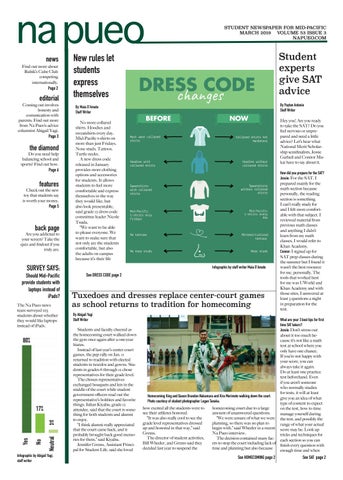
No more collared shirts. Hoodies and sweatshirts every day. Mid-Pacific t-shirts on more than just Fridays. Nose studs. Tattoos. Turtle necks. A new dress code released in January provides more clothing options and accessories for students. It allows students to feel more comfortable and express themselves in the way they would like, but also look presentable, said grade 12 dress code committee leader Nicole Tsuda. “We want to be able to please everyone. We want to make sure that not only are the students comfortable, but also the adults on campus because it’s their life
Hey you! Are you ready to take the SAT? Do you feel nervous or unprepared and need a little advice? Let’s hear what National Merit Scholarship semifinalists, Jessie Garbeil and Connor Mukai have to say about it.
Infographic by staff writer Maia D’Amato
See DRESS CODE page 2
Tuxedoes and dresses replace center-court games as school returns to tradition for homecoming By Abigail Yagi Staff Writer Students and faculty cheered as the homecoming court walked down the gym once again after a one-year hiatus. Instead of last year’s center court games, the pep rally on Jan. 11 returned to tradition with elected students in tuxedos and gowns. Students in grades 6 through 12 chose representatives for their grade level. The chosen representatives exchanged bouquets and leis in the middle of the court while student government officers read out the representative’s hobbies and favorite things. Julian Kiyabu, grade 12 attendee, said that the court is something for both students and alumni to enjoy. “I think alumni really appreciated that the court came back, and it probably brought back good memories for them,” said Kiyabu. Jennifer Grems, Assistant Principal for Student Life, said she loved
Homecoming King and Queen Brandon Nakamura and Kira Morimoto walking down the court. Photo courtesy of student photographer Logan Tanaka. how excited all the students were to see their athletes honored. “It was also really cool to see the grade level representatives dressed up and honored in that way,” said Grems. The director of student activities, Bill Wheeler, and Grems said they decided last year to suspend the
homecoming court due to a large amount of unanswered questions. “We were unsure of what we were planning, so there was no plan to begin with,” said Wheeler in a recent Na Pueo interview. The decision contained many facets to stop the court including lack of time and planning but also because
See HOMECOMING page 2
How did you prepare for the SAT? Jessie: For the SAT, I prepared mainly for the math section because personally, the reading section is something I can’t really study for and I felt more comfortable with that subject. I reviewed material from previous math classes and anything I didn’t learn from my math classes, I would refer to Khan Academy. Connor: I signed up for SAT prep classes during the summer but I found it wasn’t the best resource for me, personally. The tools that worked best for me was UWorld and Khan Academy and with those sites, I answered at least 3 questions a night in preparation for the test. What are your 3 best tips for first time SAT takers? Jessie: Don’t stress out about it too much because it’s not like a math test at school where you only have one chance. If you’re not happy with your score, you can always take it again. Do at least one practice test beforehand. Even if you aren’t someone who normally studies for tests, it will at least give you an idea of what type of content to expect on the test, how to time manage yourself during the test, and possibly the range of what your actual score may be. Look up tricks and techniques for each section so you can finish every question with enough time and when
See SAT page 2
news
17 student artists recieve various Hawaii Scholastic Art Awards
2
Mid-Pacific students were award recipients in the 56th Annual Hawaii Regional Scholastic Art Awards and receied the Gold Key, Silver Key and Honoarble Mention awards. This is a selection of art that is currently on display at the Hawaii State Art Museum until April 18. “Flowers” by 9th grader Rell Uehara, Intaglio Print by 10th grader Milia McCoy, Ceramics piece by 11th grader Peyton Ku, and “Repression” by 11th grader Kimberly Oshiro.
HOMECOMING:
SAT:
of gender issues and the traditional outlook, said Wheeler. “Yes, we want it to look like how it was 30 years ago, but schools on the Mainland as well as Hawaii are moving away from the traditional boy-girl couple type of court,” said Wheeler in a recent Na Pueo interview. A Na Pueo survey of 280 students reported that 67 percent of students wanted the homecoming court to come back, while just 7 percent said they did not want a court. Emily Lin, 6th grade, said she felt surprised that there was no homecoming court last year. “The court adds so much character and so much more excitement,” said Lin. This year, Following tradition in years past, the homecoming court also walked during halftime of the Varsity Boys Basketball homecoming game against St. Francis on Jan. 12. Kira Morimoto, homecoming queen, said that it was fun to represent her class on the court. “I enjoyed it because I got to bond with students from other grades as well,” Morimoto said.
you don’t know the answer, you know how to eliminate the options to get the best possible solution. Connor: Don’t be too hard on yourself. Have a good gauge of time. Don’t get frustrated on something that you don’t know. It’s okay to skip it and leave things blank but you should always guess if you have enough time. For the reading portion, it’s always good to get some reading in. It doesn’t necessarily mean you should take reading tests but just doing your homework and reading on your own time will go a long way.
DRESS CODE:
to 2 hours studying the night before but don’t stay up late cramming information into your brain, because sleep is way more important. If you’re too tired or get sick, then you won’t have the energy to take the test. Connor: Eat a nice dinner and go to sleep early. Go over 1-2 things that you feel iffy about but don’t try to cram everything in because it makes you more stressed. It’s best to go into the test feeling relaxed.
“Don’t stay up late cramming information into your brain. because sleep is way more important,” Connor Mukai.
What should you do the day before taking the SAT?
Jessie: It’s a good idea to review anything you weren’t 100 percent sure about or had a difficult time solving. Spend at least 1
too,” said Tsuda. Early this school year, Tsuda and school administrators started a committee to discuss the Mid-Pacific dress code. “Since I came on board, dress code has been a sticking point for some people that they didn’t care for, and they wanted to change,” said assistant principal and committee advisor Jennifer Grems. In the committee, members shared ideas and potential changes for the dress code. Members discussed reasons to
What do you think you could’ve done better during the SAT? Jessie: I’ve never managed to finish the entire math section, so I recommend future test takers to take no longer than a minute on a problem. If you do take up more than a minute, skip it and move onto the next question because if you stay on that one problem,
make changes, committee member Sasha Krstic said. “We’ve made a document before, but we haven’t made a document that actually will affect over hundreds of peoples’ lives in a way,” said Krstic. Students said the new dress code recognized changes in fashion and authorizes the clothing choices they’re already making. “Before everybody was breaking the dress code, and now it’s like we legalized it, so we don’t have to hide anymore,” said Ammen Tawfik, grade 11. Aliyah Curran, grade 11, said she wears pretty much the same clothes as she
“I can do exactly what I was doing before, but without being afraid of getting in trouble,” Aliyah Curran.
National Merit Scholarship Semifinalists Jessie Garbeil and Connor Mukai. Photo by staff photographer Payton Antonio. you won’t have a chance to attempt the other questions. You can always go back to the questions you missed, if you manage your time well on the rest of the section. Connor: I could’ve read more. I got lucky because I was reading a Jane Austen book the month before the SAT and when I took the test, one of the passages was from another Jane Austen novel so I was already familiar with how she writes.
did before the dress code changed. “I can do exactly what I was doing before, but without being afraid of getting in trouble,” said Aliyah Curran, grade 11. Grade 12 student Kolten Soon said he’s embracing the new dress code. “It was a struggle every day to find good polo shirts to wear, and it was expensive to keep buying uniforms to come to school in,” he said. Changes in the dress code are a small step forward in student expression, said Tsuda. “I think that if the students show they can be trusted by following a more relaxed dress code, then there might be more room to fit in another small step,” said Tsuda.
editorial page
Voices of journalists are smothered before they can speak
to deal with prior review, which Everyone hopes to live their happens when administrators life with freedom. To be able outside the newspaper staff deto say what is on their mind and from their hearts. But with mand to review the newspaper people confiscating our prior to the publication. rights as journalists, it is My staff and I believed hard for writers to speak the bill would have the truth. helped protect other In a recent article student journalists from in Civil Beat, public censorship by prohibitschool journalists are ing prior review. It currently facing backlash would have also stopped against themselves, their Payton Antonio: retaliation against the paper, and their advisor student media advisor for stories that are even Letter from the who’s defending student remotely controversial. Editor-in-Chief journalists and their work. Some students are also Although private feeling worried that the stories schools such as Mid-Pacific they write could put the school aren’t governed by legislature, community on edge. the bill would have had a ripple In the Hawaii State Legiseffect to private schools. At MidPacific, we are lucky to have an lature, the “New Voices” bill administration that allows the would have helped protect staff of Na Pueo to write and student journalists, but it didn’t publish our own stories. We get a hearing this year. Journalalso don’t have to worry about ism advisors pushed for the bill, our stories being changed or which would have given public even removed. This is due to the school student journalists inamount of support we have from creased protection and freedom our administrators who allow us of speech. to speak the truth without fear. In Na Pueo over the past I hope more people other year, we wrote stories dealthan journalists realize that it ing with controversies such as is important for students to vaping and bullying on campus. have a voice and be sure they Even with these type of stories, won’t have it limited in any way, we had support from adminisbecause we are the future and if tration who allowed us freedom we want to do something about of the press. Student journalists often have it, we need to speak up now.
3
Coming out to your parents involves honesty and communication Q: How do I come out to my parents? with other parents that gone Hi friend! When discoverthrough the same situation. If ing who you are, it’s important they don’t know anyone personto tell the people you love and ally, they can reach out to the care about. Coming out to your LGBTQ+ Center in Waikiki. parents might seem a little more “They can teach each other to difficult because you’re not sure continue to love and support if they’ll accept you, or maybe their child,” said Miyamoto. No you know that they are matter how you parents against it. Hopefully this react, good or bad, just advice will make telling know that you are loved your parents a little more and you are not alone. clear and less daunting. I Good luck! haven’t had to deal with this situation before, so Q: You and your best friend I decided to interview like the same girl, how should Camaron Miyamoto, Diwe choose who gets to go for rector of the LGBTQ+ the girl? Abigail Yagi: Center at University of I think you’re asking the Hawaiʻi at Mānoa, to get Student Survival wrong question. Instead his advice. Miyamoto said of wondering how you it’s important to be honest Guide should choose, maybe with ourselves about who you should let the girl we are. “Know that no matter choose! A relationship is a two what, we’re the way we’re supway street after all. There’s no posed to be,” said Miyamoto. point in wasting your time trying “It’s an important time to share to figure out who should go for all the parts of who we are with her when you can just ask the our parents.” First, figure out source herself. It’s also important what kind of support you have. to remember that girls aren’t a Who do you want to talk with prize, so I’m hoping that you and as you go through the process of your best friend aren’t making talking about things with your this a competition because that parents? Who can you turn to for isn’t considerate of how she additional emotional support? Is feels. Who knows, she might there support? There are many not like either of you. Also, ask resources online for your parents yourselves why you like her in as well if they have any questions. the first place. If the reasons are Try the website, healthychildren. surface level, then maybe you org. If you know your parents both are better off as friends. If won’t be accepting to you comit’s truly meant to be, then the ing out, here is some advice for opportunity will present itself. them to understand what you’re Relationships don’t usually end going through. Miyamoto sugwell when they’re forced. Think gested your parents could meet before you act, and good luck to
Editorial Cartoon by Piankhi Robertson-Chambers
the both of you. Q: How do I focus on homework at home? I easily get distracted by things around me and thoughts in my mind. I’m pretty sure most of us find sitting down and pumping out our homework a challenge. Especially with our anxious thoughts thinking about what we need to do next and what we would rather be doing. I even find it difficult to sit down and write this column right now. One thing that can be distracting to me is music. I’m the type of person who can’t help but sing to every song I listen to. So if you have the same issue, I play instrumental music instead so that I still can work but not in complete silence. I also suggest finding a space in your house that no one will bother you. Tell your family ahead of time if you don’t want to be disturbed. Another important tip is make sure to do your work on a desk or the kitchen table and not in your bed. Your bed is your resting place to escape from work and according to the website of American College of Healthcare Sciences, you get less sleep at night if you bring your work to bed. This is because your brain recognizes what place is your work environment and where it is to rest. If these two places overlap, your brain will keep you up, thinking that you have to be doing work. I know it’s a struggle but I believe in you! Best of luck.
Na Pueo Staff Editor-in-Chief
Payton Antonio
Features/Sports Editors Abigail Yagi
Photo Editor
Siena Usui
Staff Writers
Kayla Marutani Maia D’Amato Angelina Shaw
Advisor
Jessica Hanthorn
Information
Na Pueo is published by dedicated Mid-Pacific students. Personal opinions expressed by students, faculty,
and staff or outside guests do not necessarily reflect those of Mid-Pacific . We welcome contributions and feedback and will strive to maintain a high standard of professional journalism. Send letters, submissions, and suggestions to: Na Pueo c/o Mid-Pacific 2445 Kaala St. Honolulu, HI 96822 (808) 441.3713 email: newspaper@midpac. edu Please contact Na Pueo for advertising information and rates. All articles and photographs are copyright (c) MidPacific Institute.
features
SLEEP:
MID-PACIFIC LIFE
Lack of rest creates a stressful nightmare for students
By Angelina Shaw Staff Writer
Many Mid-Pacific students said they are lacking sleep, which could lead to many health issues and effects how productive one can be during a school day. “Lack of attention, lack of ability to focus, fatigue, which leads to an increase in stress which can start a whole cascade of events that can turn to illness,” said school nurse, Lorena Gaskill. Students often complain about being tired and not getting enough sleep and it is due to the stress of school and piles of homework assigned each night. “I sleep around 3-4 hours maybe on a good night, said 11th grader, Bree Yoneda.” Balancing homework, sports, and other activities can be very difficult which results in students staying up late and being exhausted the next day. “I have sports and clubs so I don’t get home until 6:30-7:00, so I try to do some homework during lunch or school,” said 10th grader, Maddie Au. Some students live far from school and have to wake up extra
See SLEEP page 5
Illustration by Rell Uehara
Speedcubing club popularity rises at speedy rates this year By Kayla Marutani Staff Writer
10th grader Hitoki Kidahashi practices his Rubik’s cube skills. Photo by staff photographer, Maia D’Amato.
Speedcubing members gather inside the library lab to compete in the monthly cubing competition: twisting the six-sided cube is a process that club members can complete in just seconds. “I started the Rubik’s cube club to give students the opportunity to develop their cubing skills at school and in their community; and so they can have a chance to compete in the international level,” said 10th grader and club president Hitoki Kidahashi. Speedcubing competitions have become an international event, with the world’s fastest cuber completing in 4.904 seconds, according to The Guinness World Records website. In addition, the American record 4.904 seconds and state record 5.58 seconds. Along with Kidahashi, 10th grader Seita Katayama helped to establish the club. He said that he found speedcubing to be “unique compared to any other clubs in the school” and cubing “differs itself from anything else.”
“The most enjoyable part about running the speed cubing club is to be able to watch other members improve rapidly,” said Katayama. “I like how we can analyze and reflect on our past results,” he said. The popularity of the club has increased this year, said Kidahashi. There are currently 12 students in the club, which is up 9 students from last year. Along with the club competitions in school, three of the students from MidPacific’s speedcubing club participated in the International Japan Championship for speedcubing this past winter. “[Entering the championship has] helped me to think strategically and competitively,” said Katayama. Katayama can complete the cube in 8.64 seconds. Along with competing, Katayama said from the competition, he met different people from different backgrounds who all share a common interest of speedcubing. “I felt honored and awesome that [I was able to] represent Mid-Pac” said Kidahashi.
features
SWITCH:
5
Gamers can’t get their eyes off of Nintendo’s portable console
By Siena Usui and Kayla Marutani Staff Writers
With their attention focused on the colorful graphics on the screen, students tend to tune out the rest of the world. Even though the Nintendo Switch was released in 2017, teenagers are still stuck on the console. Two students were so intent on the video game that they wouldn’t even look away from the screen as a Na Pueo staff member interviewed them. “It’s more high tech and has better graphics than any other console,” said 11th-grader Justin Li. Despite a price tag of nearly $300, students say that its portability and high quality graphics makes it worth its price. “You can play it on the TV, so you can take it on the go, or play it at home with your family,” said 11th grader Michael Tam. Having such an easy to carry video game device has never gone to this full extent. The Switch can
be portable or be used as a home console. “A lot of the most popular games are coming out onto the Switch and they’re ditching the old console [Wii U] ,” said Justin Li. “It’s more high tech and has better graphics than any other console,” he said. The Nintendo Switch was the best selling console of 2018, selling 22.9 million globally since it was launched in March 3, 2017. Its sales have surpassed GameCube and Wii U, according to the Hollywood Reporter. During lunch and after school, students often play on the Nintendo Switch in groups, clustered together. Grade 10 student Chazz Gaspar said he thought Nintendo marketed the Switch effectively to all age groups. “They’ve been advertising to the young adults, but I do think at the same time kids will see the “big kids” are doing this and they’ll think it’s cool,” he said.
Michael Tam, grade 11, plays on the Nintendo Switch. Photo courtesy by staff photographer, Kayla Marutani.
SLEEP:
By Maia D’Amato and Siena Usui Staff Writers As you scroll through your Instagram, a jolt of fulfillment rises in you as the recent picture you posted has 199 likes. Some Mid-Pacific students said social media has affected the way they view themselves. Being a teenager in the digital age has a lot of challenges. The younger generations have recognized that compared to their grandparents, the problems that they face are of entirely a different kind, according to a study from Pew Research Center. Such issues include social media. One of those difficulties is having insecurities about their “popularity,” according to the National Center for Biotechnology Information.
For 11th grader Kennedy Flores, the amount of Instagram followers she has impacts the way she views herself. She owns an art page where she posts photos of her digital drawings, but she said she too can be influenced by the media. “Business wise, maintaining the amount of Instagram followers I have matters,” said Flores, who has about 300 followers on Instagram. Flores sells art using her Instagram page, and she also uses it as a portfolio. When her follower count drops, she said she begins to think that the public disliked her art and unfollowed her as a result. Just like Flores, many students said most teenagers want to maintain their following or even increase their following. The obsession of gaining more fol-
lowers can be a sign of seeking validation, said Flores. On the other hand, not everyone thinks the amount of Instagram followers they have has a huge impact on them. “It doesn’t really matter as much to me because it’s just an app, it shouldn’t be my biggest concern,” said 9th grader Ella Ann Wong. Posting on your own Instagram account is entirely up to the owner. “I post what I want and what I’m confident in posting,” said 10th grader Mika Maii. Instagram has a huge reach and connects millions of people to each other. Spending a lot of time being concerned with how much people follow you can get out of hand, resulting in mental and physical problems, according to the Anxiety and Depres-
sion Association of America. A break is encouraged for students who feel like they’re obsessed with constantly checking Instagram. The pressure that’s put on them and the expectations they feel like they need to meet can be stressful, so taking a break may help to rejuvenate them. Behavior analyst Jessie Mitchell offered some tips on how to unplug yourself from social media. “Hobbies, sports, academics, family relationships and friendships are way more important than social media,” said Mitchell. Simply going on a hike or going to the beach can restore mental energy, according to Business Insider. “Being outside is so calming. Why would you wanna miss out on that you know?” said Maii.
early so it is important to go to sleep at a reasonable hour so they are focused during school. “It’s bad for me to stay up late because I wake up at 4:30 every morning,” said 9th grader, Noah Gosiaco. Sleep is essential for health and can determine attitude for the day. Especially when students are in class, they need to have full attention on the lesson and teacher, which can be difficult when running off of 3 hours of sleep. “Besides nutrition, sleep is probably the #1 factor to having a good day at school,” said Gaskill. Students can easily get distracted when trying to get work done and procrastination can lead to not getting work done and then going to sleep even later. “I think our iPads are very distracting. We end up looking things up and watching YouTube,” said 11th grader Kaia Hutchison. Knowing what you have to get done and being organized can help a lot when trying to get more sleep because you can plan your time more wisely. “Prioritizing and learning to saying no and not taking on too much and knowing what you can and cannot handle,” said Gaskill. Finding anytime during the day to get schoolwork done will create less to do at night and allow students to get to sleep earlier. “I use my free period to my advantage to get all my work done and I will talk to my teachers if I need help so I also use office hours,” said Hutchison. Lack of sleep can easily change one’s mood and quickly turn a good day into a bad one. “I think sleep is really important because your mentality changes depending on how much sleep you get,” said Hutchison.
the diamond
MID-PACIFIC SPORTS
FINDING BALANCE:
Athletes learn to juggle school and sports By Payton Antonio Staff Writer For student athletes, balancing sports with school can be a struggle, but time management is what gets Mid-Pacific students through their season, according to students and coaches. Middle school science teacher and baseball assistant coach, Todd Jinbo believes balancing school and sports is not strenuous, but it takes discipline. “We have so much going on in our life like relationships, socializing, family, and rest that student-athletes have choices to make,”
See BALANCE page 7 Student athlete and full IB student Micah Suan, grade 12, balances schoolwork and sports. Photo by staff photographer Abigail Yagi
Pueo Pride pauses after lack of student participation
Swimming star’s passion molds him into the person he is today
By Angelina Shaw Staff Writer
By Abigail Yagi Staff Writer
developed the app to bring more students to games to support the athletes at Mid Pacific. “We could have more of a fan A once-popular app for Midbase, it makes the Pacific fans could “Over the years players feel more be ended because few students use we’ve seen a huge supported, then they will play harder and it, according to the decrease in the better, and therefore athletics office. it could turn into Pueo Pride, which number of kids more wins,” said has been available in who’ve Wagner. the app store since actually checked When students 2014, had users dewould go to the crease from a peak of into the game,” games there was about 60 students to Scott Wagner a bluetooth set up about five students and anyone in the in the fall season. general area would “Over the years we’ve seen a huge decrease in the be marked down as being there, allowing them to earn points. number of kids who’ve actually At the end of the seasons and checked into the game,” said year, prizes would be given out Scott Wagner, the athletics to reward students for cheering director. on the athletes. Wagner and the school’s former director of innovation
See PUEO PRIDE page 7
“Wings up!” Michael Petrides shouts, raising his arms to look like wings, and the whole team laughs right before he walks off to win his 200 Yard IM race. The call has become his battle cry, a way for Petrides to motivate his teammates just before a race. Although the swimmer is ranked first in the state and just signed at University of Senior Michael Petrides swims freestyle. Photo contributed by Christopher Petrides California-Berkeley, Mid team. Trying to let him make an cording to swimswam.com. At Pacific swimming and diving impact beyond swimming and Swimming and Diving state coach, Kaz Yoshiwara said leave more of a legacy than ‘Oh, championships on Feb. 8-9, Petrides is one of the few elite he’s just that fast kid’.” Petrides placed first in the Boys athletes he’s ever come across, Petrides received an athletic 200 Yard Freestyle and the Boys and he wanted to push him out scholarship to University of 500 Yard Freestyle. Still, college of his comfort zone. California-Berkeley after a swimming will be a whole new “Usually they [elite athletes] season where he ranked 1st in beast for this owl. stay in a bubble somewhat and the state and 18th in the NCAA The Cal commit said he did within their club team,” said Swimming Recruits in the Boys Yoshiwara. “I’ve tried to get him See SWIMMING page 7 High School Class of 2019, acto reach out to other kids on our
7
sports
BALANCE:
said Jinbo. Grade 12 student Micah Suan participates in the full IB diploma program and played for the boys varsity basketball team. He said he used his positive mindset and attitude towards school and sports to alleviate stress. “In order to balance both school and sports simultaneously, I had to make a lot of sacrifices in terms of managing my time effectively,” said grade 12 basketball player Micah Suan. Students who successfully balance extracurricular activities and a strong academic workload tend to use their time more wisely, said college counselor and paddling coach Sara McKay-Hines. “Students who plan ahead, don’t wait till the last minute,
and work on their school work during little snippets of time, are those who are stronger and more successful with their future,” said McKay-Hines. Students who participated in vigorous sports did 10 percent better in science, english, math and social studies compared to other students, according to researchers at Michigan State University. Student-athlete, Kylie Rdechor participates in rigorous classes as well as paddles for the paddling team and runs track. By committing to a schedule, she learned to prioritize her school work, sports, and still have time for a social life. “The hardest thing about being a student athlete is time management and having to make sacrifices,” said Rdechor.
“In order to balance both school and sports simultaneously, I had to make a lot of sacrifices in terms of managing my time effectively,” Micah Suan
PUEO PRIDE:
Athletes had a GPA nearly a full point higher than nonathletes, according to a study by North Carolina High School Athletic Association. Athletes had a 0.7 percent dropout rate compared to an 8.98 percent dropout rate for non-athletes. “I take advantage of free periods and time before practice to do work and if I have something big like a test, I study ahead of time,” said grade 12 tennis player Emiko Yoshikawa. If students are struggling with managing their time with school, it is best they take some time off of extracurricular activities to make academics a priority, said McKay-Hines. Both coaches said they allow their athletes to work on school work even during practices. McKay-Hines allows her players to use their land training time for studying without restricting them from boat time. Jinbo said he lets his players leave practice early to bring their interim grades up or just to get work done. “As a student-athlete, you need to be disciplined enough to make the right choice and not what you want to do,” said Jinbo.
being marked down for Gift cards were given being at the games. out after each season to “Sometimes it was the winners, but at the hard for it to recognize end of the year prizes that I existed, so I had like headphones, camera to email Mr. Wagner lens, GoPro, and that I was there,” said surfboards, and $100 12th grader Presley gift cards to Ala Moana Wheeler, who won Center were given out. a pair of beats headEighth grader, Sebasphones about four years tien Kiyabu won a $30 ago. gift card during the fall Many students that sports season. He also have used the app beended as the last student fore agree that it should to win a prize for using come back, but many the app. students also don’t “Nobody really cares know about the app. about the app,” he said. “Not a lot of people Wagner is planning care about it but I think to set up a meeting it’s fun to do,” said to get some feedback Kiyabu. about whether the app Motivations to go to will come back or not. the games started the “I think the app is a idea of winning prizes, really neat idea, but if but some students students don’t feel that’s didn’t stay for the whole something they want to game and would check spend their time on then in then leave. we will find something “I went and watched Mid-Pacific officials said they might discontinue the Pueo else,” said Wagner. for about 15-20 minutes Pride App. There had been some and then I had to leave,” students said it wasn’t working issues with the bluetooth and said Kiyabu. as well and that they weren’t
SWIMMING:
Petrides will attend UC-Berkeley. Photo by Christopher Petrides not always see swimming in his future. Petrides planned on quitting when he turned 12 but his older sister convinced him not to. Petrides said he decided to continue because he trusted her and wanted to follow in her footsteps, as she is currently a sophomore swimming at Washington State University. The senior’s mother , Martha Petrides, said she and her husband always knew Michael would be a true competitor in swimming. “Michael was always competitive from the get go,” said Petrides. “We knew from the beginning that Michael could be somebody in this sport. That he could go far.” The senior discovered his passion for the sport when he was around 13 years of age. He said traveling with his team for the first time that year is what made the sport fun. “I used to really really hate swimming, and then one swim meet I had the option to travel with the team and that aspect of competing with your friends and all your teammates just made me happy,” said Petrides. Petrides won the 200 individual medley and the 100 freestyle at the state championships in 2018, but swimming in college is going to be a new experience with higher levels of competition. He said he cannot wait to swim in college because it is more team oriented. “I get to race people that are so dominant in their respective stroke. I get to have completely new training and really driven practices that are specific to what I swim. The whole nine yards,” said Petrides. Petrides said he looked at numerous schools in June and had trouble narrowing it down to the top five to take his official visits. The swimmer said everywhere
he went he felt like like they had an amazing program but once he visited Berkeley, it felt like the fit. “When the coach told me the offer I was very surprised just from the name of the school and the prestige,” said Petrides. “It’s probably one of the best moments of my life thus far. I couldn’t believe it could actually happen.” The soon-to-be bear did not have the skills to be a champion naturally. Making sacrifices like not hanging out with friends or not surfing, and going to practice the next morning instead, resulted in better meet times, making it all worth it. Martha Petrides said swimming has defined who Michael is in amazing ways. “It opened up doors that would’ve never been opened otherwise,” said his mom. “It kept him focused, hardworking. It’s taught him time management, and humility.” It’s a rainy afternoon at Punahou, the water seeping through the tarp covering the bleachers, but Petrides has a smile on his face, playing with a muscle massage gun, laughing with his teammates. Julian Kiyabu, a fellow senior and teammate of Michael, said although he’s the highest performer in the state, he still makes swimming fun. “Michael taught me how to enjoy something while still having goals and being determined,” said Kiyabu. When asked who pushed Michael to become a better swimmer, Martha Petrides said it was honestly Michael who pushed himself. “He has that internal drive. I think it’s an innate thing that he was born with,” said Petrides. “He has amazing coaches, supportive family, but I think it’s Michael.”
Illustration by Abigail Yagi