Mount Holyoke News AN INDEPENDENT STUDENT NEWSPAPER SINCE 1917 MONDAY, JULY 20, 2020
MOUNTHOLYOKENEWS.COM
Mount Holyoke releases official fall plan, including information on housing, courses and student life BY CASEY ROEPKE ’21, KATE TURNER ’21 & FLANNERY LANGTON ’22 NEWS EDITORS AND MANAGING EDITOR OF CONTENT
After months of student speculation and administrative planning, Mount Holyoke recently publicized its official plan for the fall semester. The College will invite first- and second-year students to campus for the fall modules, with juniors and seniors participating in classes remotely. In the spring, “assuming the fall semester proceeds as expected,” according to a statement to the Mount Holyoke community, juniors and seniors will be allowed to reside on campus while first-years and sophomores live off-campus. In the statement addressed to the community, President Sonya Stephens emphasized the core commitments of the College’s plan as “safeguarding the health and safety of our campus and surrounding communities, assuring and enhancing the College’s core academic missions and supporting inclusive excellence and ensuring the long-term financial sustainability of the College through organizational efficacy.” This statement released further information regarding the fall semester academic calendar, including specificity of arrival times and further details regarding the module system. Students’ arrivals will be staggered to adhere to social distancing guidelines. New students will arrive from Aug. 18 to Aug. 20 and returning students will arrive from Aug. 20 to Aug. 22. Each seven-and-a-half week session will contain short breaks with a larger intermission after two reading days and two final exam days. On Nov. 25, during the second module, all students will depart campus for Thanksgiving recess, then complete their courses remotely. In an effort to minimize the risk of transmission, the College is creating a “de-densified campus.” By bringing only half of the students back to campus, the Office of Residential Life will be able to offer every campus resident a single room. In addition to first-years and sophomores, students with extenuating personal circumstances, such as “current location, travel or visa concerns [or] health and safety considerations,” will be able to apply for campus housing. Mount Holyoke’s fall plan was announced nearly two weeks before the U.S. Immigration and Customs Enforcement mandate that international students must take in-person classes at their schools or risk deportation. Students attending schools that offer a hybrid model — like Mount Holyoke’s — “will be allowed to remain in the U.S., provided they are not taking a fully online course load,” according to Verge. ICE’s new regulation “does not address many of the unique situations in which our international students find themselves,” Director of International Student Advising Bri Rhodes said. “We are working
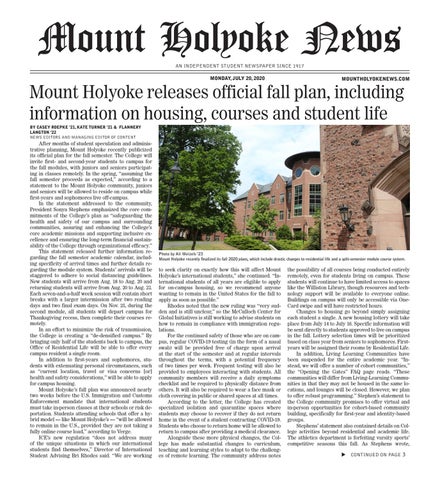
Photo by Ali Meizels ‘23 Mount Holyoke recently finalized its fall 2020 plans, which include drastic changes to residential life and a split-semester module course system.
to seek clarity on exactly how this will affect Mount Holyoke’s international students,” she continued. “International students of all years are eligible to apply for on-campus housing, so we recommend anyone wanting to remain in the United States for the fall to apply as soon as possible.” Rhodes noted that the new ruling was “very sudden and is still unclear,” so the McCulloch Center for Global Initiatives is still working to advise students on how to remain in compliance with immigration regulations. For the continued safety of those who are on campus, regular COVID-19 testing (in the form of a nasal swab) will be provided free of charge upon arrival at the start of the semester and at regular intervals throughout the terms, with a potential frequency of two times per week. Frequent testing will also be provided to employees interacting with students. All community members will receive a daily symptoms checklist and be required to physically distance from others. It will also be required to wear a face mask or cloth covering in public or shared spaces at all times. According to the letter, the College has created specialized isolation and quarantine spaces where students may choose to recover if they do not return home in the event of a student contracting COVID-19. Students who choose to return home will be allowed to return to campus after providing a medical clearance. Alongside these more physical changes, the College has made substantial changes to curriculum, teaching and learning styles to adapt to the challenges of remote learning. The community address notes
the possibility of all courses being conducted entirely remotely, even for students living on campus. These students will continue to have limited access to spaces like the Williston Library, though resources and technology support will be available to everyone online. Buildings on campus will only be accessible via OneCard swipe and will have restricted hours. Changes to housing go beyond simply assigning each student a single. A new housing lottery will take place from July 14 to July 16. Specific information will be sent directly to students approved to live on campus in the fall. Lottery selection times will be prioritized based on class year from seniors to sophomores. Firstyears will be assigned their rooms by Residential Life. In addition, Living Learning Communities have been suspended for the entire academic year. “Instead, we will offer a number of cohort communities,” the “Opening the Gates” FAQ page reads. “These communities will differ from Living-Learning Communities in that they may not be housed in the same locations, and lounges will be closed. However, we plan to offer robust programming.” Stephen’s statement to the College community promises to offer virtual and in-person opportunities for cohort-based community building, specifically for first-year and identity-based groups. Stephens’ statement also contained details on College activities beyond residential and academic life. The athletics department is forfeiting varsity sports’ competitive seasons this fall. As Stephens wrote, u
CONTINUED ON PAGE 3
2
.
Mount Holyoke News July 20, 2020
Mount Holyoke News Mount Holyoke News is an independent student newspaper written by and for Mount Holyoke College students since 1917. VISIT US: www.mountholyokenews.com www.facebook.com/themhnews www.twitter.com/mtholyokenews_
EMAIL US: mhnews@mtholyoke.edu
Executive Board Editor-in-Chief
Managing Editor of Content
Lily Reavis ’21
Flannery Langton ’22
Copy Chief
Managing Editor of Layout
Kelsey Thomas ’21
Yasmin Andrews ’22
Managing Editor of Web Zoë Farr ’21
Environmental
Kate Turner ’21, Casey Roepke ’21, & Liz Lewis ’22
Frozen ground in the Arctic is thawing, harming Indigenous people’s hunting livelihoods as well as destabilizing buildings and roads. The third EU country to do so, Portugal announced closure of national coal plants, driven to this decision in response to rising carbon costs and competition from clean energy companies. As a result of COVID-19, once manicured green spaces in cities across the world have been left to be rewilded with native flowers and grasses which have been attracting more diverse ecosystems of insects, birds and wildlife. Zanzibar in East Africa, a global hotspot for seaweed production, is initiating a new program for sustainable seaweed production.
Editoral Board News
Weekly Climate News
Meryl Phair ’22
Arts & Entertainment
Photos
Sabryna Coppola ’22
Ali Meizels ’23 & Rosemary Geib ’23
Layout Rose Sheehan ’22
Publication Guidelines Mount Holyoke News does not endorse any of the opinions or views expressed within the pages of the paper, excluding staff editorials. All content copyright of Mount Holyoke News. All rights reserved. Mount Holyoke News does not discriminate on the basis of gender, race, religion, ethnicity, sexual orientation or age.
Letters Policy Letters to the Editor appear exactly as they are sent to MHN, except for corrections to spelling, grammar and AP style. Letters cannot exceed 500 words. All letters must include the writer’s name and telephone number for verification purposes. Unsigned letters will not be printed. Names may be held upon request with the approval of the Editor-in-Chief. MHN reserves the right to decide which materials will be printed. Email submissions to mhnews@mtholyoke.edu by Saturdays at 5 p.m. for publication the following week.
Subscription To subscribe to our independent, student-run, biweekly newsletter throughout summer 2020, sign up at: https://forms.gle/9RPZybRqNuCwqJao7
Joe Biden revealed a $2 trillion climate plan. As methane emissions have reached a global high, Burger King will be treating cows to a new feed that includes lemongrass as part of an experiment on reducing the amount of methane cows burp into the atmosphere. Trump overturns key environmental laws which will speed up approval for projects like pipelines and highways, which could negatively impact low-income and minority communities. Read up on the links between racism and the environment with this resource list from The New York Times. Read up on the disproportionate effects of the climate crisis on Indigenous peoples and people of color with this article from Vice: The Environmental Movement Needs to Reckon with Its Racist History Read up on the factors that make communities of color more susceptible to climate disasters with this article from Grist: Why Racial Justice is Climate Justice Read up on the intersectionality between defunding the police and the environmental movement with this article from Vice: Why ‘Defunding the Police’ Is Also an Environmental Issue Read up on the challenges racism adds to climate activism and work with this article from The Washington Post: Racism Derails Our Efforts to Save the Planet
3
.
Mount Holyoke News July 20, 2020
Adverse birth outcomes: Climate change disproportionately affects health of Black mothers BY CATELYN FITZGERALD ’23 ENVIRONMENTAL STAFF WRITER
The interconnectedness of climate change and systemic racism begins early, with the pregnancy of a mother and the birth of a child. A review published in the Journal of the American Medical Association on June 18 found evidence that negative health effects caused by climate change start before birth. The review analyzed 68 scientific research articles which examined the effects of climate change-related heat exposure and/or pollution, including particulate matter and ozone, on pregnancy throughout the United States. These studies consistently concluded that exposure to heat and air pollutants during pregnancy corresponds with “adverse birth outcomes” such as low birth weights or miscarriages. These pregnancy outcomes are occurring at a growing rate as Americans are increasingly exposed to high heat and pollution due to climate change. Studies in the report that examined racial disparities in adverse pregnancy outcomes found that Black Americans were consistently at highest risk. Black Americans are exposed to higher levels of pollutants and face the brunt of climate change due to generations of environmental racism. The report’s conclusion that Black people are most likely to have negative health consequences due to climate change is particularly devastating because Black parents have more difficulties accessing proper prenatal care than their white counterparts. They also experience higher rates of pregnancy-related deaths. According to the CDC’s pregnancy mortality surveillance system, there are approximately 40 pregnancy-related deaths per 100,000 births for African Americans, compared to the United States’ average of approximately 16 deaths per 100,000 births. Many of these deaths are preventable, being caused by discrimination in medical treatment. In a story published in the Journal of Perinatal Education, a group of African American health providers pointed to a lack of professional resources and available information to the Black community as a cause of this racial disparity. In both their personal and professional ex-
Graphic by Karina Wu ’23
perience, the group experienced dismissive attitudes from medical professionals towards African American patients, particularly young women. Rather than ensure their patients understood the details of their own health and prenatal care options, medical professionals refused to offer detailed information on the assumption that their patient would not understand it or heed their advice. The health care providers also said that Black parents are less inclined to go to parenting classes because of cost, inconvenience and the underrepresentation of minorities in those environments, and instead give preference to family resources. The exclusion of Black parents from proper prenatal care can have serious health impacts, and the health effects of climate change only worsen the situation. The risks to pregnant Black Americans are multifaceted and have no easy fix, but there are actions that can be taken to improve pregnancy outcomes. Slowing
the progression of climate change or making systematic changes to redistribute its effects away from communities of color will reduce the negative impacts on pregnancy due to air pollution and heat. Additionally, improving access to and quality of prenatal care for Black Americans will help identify underlying health problems caused by climate change or other factors before they prove fatal to the expectant parent or newborn child. An article from the CDC said that hospitals and health care systems must “standardize coordination of care and response to emergencies” and “identify and address unconscious bias in healthcare” to improve pregnancy outcomes for Black patients. Opportunities for change exist in every level of the health care system, from national policies down to individual practitioners, which gives hope for the health of expectant parents and their children to improve if these issues are brought to light.
College releases official fall plan, continued u
CONTINUED FROM PAGE 1
Mount Holyoke “could not see a way to participate in any NEWMAC conference play, or other competitions and championships requiring both close contact with other teams and travel to other campuses.” Following the varsity cancellations, Stephens announced that club sports will also be prohibited from fall participation. Students residing on campus will, however, be able to access recreational spaces including Kendall Sports and Dance Complex, as well as Williston Library, after a mandatory two-week quarantine period. According to LITS research librarians, the library will begin scanning materials upon request in August.
Counseling Services will be available for students both on and off campus in a consultation capacity. Stephens wrote, “Whether or not remote students can receive services beyond consultation varies, depending on state laws.” Decisions pertaining to dining options have not been specific as they will be reliant on guidelines put forth by the state of Massachusetts and the CDC; however, “students should expect quality take-out options” during the fall semester, the letter stated. Following the release of this information to students, the College hosted a one-hour Reopening Panel and Q&A for Students and Families on Monday, July 6. The panel featured members of the administration including new acting Dean of Faculty Dorothy Mosby, Vice President for Equity and Inclusion and Chief
Diversity Officer Kijua Sanders-McMurtry and Stephens, amongst other faculty. The discussion was moderated by Vice President for Advancement and acting Vice President of Communications and Marketing Kassandra Jolley. This panel — the only Q&A session on reopening Mount Holyoke has so far advertised or offered to the general student body — provided little new information, instead frequently referring students back to the College’s website. Much of the content was aimed at parents of incoming first-years. Further and frequently updated information can be found on Mount Holyoke’s “Opening the Gates” page and will also be updated on MountHolyokeNews.com.
4
.
Mount Holyoke News July 20, 2020
Letter to the Editor
Dismantling racism: Our collective responsibility Here’s what the dance department is doing. We’ve heard from Kijua Sanders-McMurtry and Sonya Stephens about the recent killings of George Floyd, Breonna Taylor, Tony McDade and so many others. We have also heard from our academic department — have you heard from yours? While the initial email that we received from our faculty fell short, it helped catalyze conversations among students in the dance department that have been long overdue. At the Five College Dance town hall listening session, Kiara Badillo ’20 (Hampshire College) brought up the key point that this is not the start of the conversation — what’s changing now is who is in the room and who is listening. As protests began to gain more visibility on social media, Miranda Lawson ’22 messaged our dance group chat to stress the importance of continuing our outrage and action past this initial wave. The next day, we received an email from Five College Dance announcing an online dance festival. The email included no mention of the recent police murders and the protests. Soukeyna Abbott ’20 messaged the chat to urge us to write replies to FCD and its director, Alex Ripp, denouncing this insensitive and hurtful lack of recognition of current events and ongoing racism in the dance field. Lawson called our attention to the absence of teachers of color from the festival schedule. On Wednesday, June 3, we received an email from the Mount Holyoke dance department offering “support and solidarity” yet failing to back those sentiments with action. After Olivia Lowe ’21 replied all to denounce the hollow statement, many students sent emails to Chair of Dance Charles Flachs, cc’ing all dance faculty. After Sophie Clingan ’22 met with Ripp on the morning of June 4, they sent a summary of what they learned to the group chat and called for a meeting among the students in the dance
department to discuss next steps. In this two-hour-long meeting attended by many Mount Holyoke dance majors and minors, hard conversations were had. In our department, as well as across the Western world, focus is often laid heavily on the importance of modern and ballet, yet we fail to recognize the contributions of BIPOC to these forms. Meanwhile, dances of the African diaspora and other non-Western dances fall to the wayside. This is not surprising when our department does not have any full-time faculty of color. Discussing concrete examples of racism, as well as unveiling the trauma and hurt our Black friends and peers of color had experienced, brought us to a list of actionable demands for our department. These ideas are not perfect. Certainly, they need more funding than we have — and transparency about said funding is a crucial item on our list. How can we advocate for the hiring of faculty and staff of color, or bringing in a variety of dance companies to perform, when we don’t know where the money is coming from or going to? We want a dance history class that doesn’t focus on white narratives. We want more levels of hip-hop, house, West African and other non-Western dance forms. We want full-time professors of color in our department. We want a stronger connection to people outside our department, specifically with the dance organizations on campus that, it is worth noting, have more students of color than we do in our department. The racism in our department must be dismantled at the same speed at which we invite students of diverse racial and dance backgrounds to participate in our community. The intersection of racism and dance was acknowledged by the overarching body of FCD only after nu-
merous frustrated emails were sent. As disheartening as that is, it makes it absolutely clear that the student communities at Mount Holyoke need to get in touch with their respective departments as well. Higher education is an institution built on racist ideologies and white supremacy. Each academic department must actively work to dismantle this foundation. While we are sharing what is happening in the dance department, that is not the only place these conversations are or should be occurring. Did your professors reach out to you when the protests began? Are they having conversations about the classes they teach and the resources they promote, as well as what they may be leaving out? Are you joining your academic community to make a push against the implicit racism that all white students on our campus engage in daily? As white people writing this op-ed, we are working to straddle the tension between not expecting BIPOC students to do the emotional labor of educating us about these issues, while also recognizing that we can’t know what changes to advocate for without listening to the lived experiences of our peers. When BIPOC share their experiences, we need to value the time and energy that takes by amplifying their voices and concerns and demanding action and accountability from those in power. On June 16, MHC dance faculty and students gathered for a smaller discussion. These exchanges are an encouraging sign of change to come, yet reveal how much work there is to be done. This is not the beginning of the conversation. Many of us are just showing up. What is your way in? - Sophie Clingan ’22 and Izzy Kalodner ’21
Review: The ‘Hamilfilm’ is a radically different show streaming in 2020 BY LAUREN HIRTH ’21 CONTRIBUTING WRITER
On July 3, Disney released the much-anticipated filmed version of the smash-hit musical “Hamilton” to its streaming platform Disney Plus. The film, originally slated for theatrical release on October 15, 2021, presents a live-capture version of the musical using footage from two original cast performances back in 2016. While “Hamilton” received near-universal acclaim when it premiered at the Public Theater in 2015, fans and critics alike have since been more critical of the show’s depiction of the Founding Fathers as men of color and its erasure of American slavery. This comes, of course, in the midst of a national reckoning on racism and police brutality sparked by the murders of George Floyd, Breonna Taylor and many others at the hands of police. Numerous protests following these deaths have included calls to remove statues of slaveholders like Thomas Jefferson who, in the musical, is played by biracial rapper Daveed Diggs. Disney also released two roundtable discussions with members of the cast and crew, “The Undefeated Presents: Hamilton InDepth” with Kelley Carter and “Hamilton: History Has Its Eyes on You” with Robin Reed, that address the
show’s racial politics as well as its connections to the Obama administration during its conception and the current Black Lives Matter movement. Others, like Vox’s Aja Romano, argue that critical focus on Hamilton’s historicity miss its radical subversion of American history. The show, she argues, “is a postmodern metatextual piece of fanfic.” The “fanfic” quality of the stage show comes from its explicit historical revision, talking back to and taking ownership of the canon of American history by imagining an alternative history in which immigrants and people of color have always been “in the room where it happens.” Many of the actors have echoed this sentiment, such as the aforementioned Diggs, who, during the Reed roundtable, said, “the fact that we were all here playing the founding fathers and mothers of this country implies a sort of ownership over our country’s history that I had never felt before.” In this sense, “Hamilton” has a lot more to say about the politics of the Obama years, when progressives were more optimistic about the power of diverse representation to lead to racial equality, than the politics of the Continental Congress. Alongside these discussions, Hamilton was chal-
lenged with fitting in the small screen. Overall, the Hamilfilm does a great job of capturing the individual performances of its main cast. Director Thomas Kail treats fans to a close-up view of the stamina and verbal dexterity of the musical’s best rappers, Renée Elise Goldsberry (Angelica Schuyler) and Daveed Diggs (Marquis de Lafayette/ Thomas Jefferson). In addition, innovative cutting techniques in songs like “Alexander Hamilton” and “Satisfied” highlight many of the story’s emotional beats, creating a unique viewing experience somewhere between watching a movie and sitting in the theater for a live performance. However, these innovations come at the cost of erasing the set, the dancers and many of the minor characters who watch the events of the story unfold from the upper levels of the stage. In the stage show, these features are crucial to establishing the musical’s alternative history and furthering its self-conscious commentary on who gets to write history and what that means for future generations of Americans. In dou
CONTINUED ON PAGE 7
5
.
Mount Holyoke News July 20, 2020
ICE rescinds new guidelines, no longer mandating international students take in-person classes to avoid deportation BY CASEY ROEPKE ’21 NEWS EDITOR
The Trump administration and United States Immigration and Customs Enforcement recently rescinded a July 6 directive which would have stripped international students of their visas. This reversal in policy comes after a lawsuit filed by Harvard University and the Massachusetts Institute of Technology. Days later, the universities were joined in suing the Trump administration by 17 states, led by Massachusetts Attorney General Maura Healey. The original July 6 policy was set to bar international students from obtaining visas if their college classes were conducted entirely online. Those students, who were either attending colleges without in-person classes or were unable to reside on campus, would have been required to return to their respective countries of residence. Bri Rhodes, director of international student advising at the McCulloch Center for Global Initiatives, wrote an email to international students on July 6. In the email, she wrote: “Mount Holyoke College is aware of guidelines released today by the federal government
regarding on-line coursework by international students next academic year. While Mount Holyoke’s curriculum has both in-person and online components, this guidance does not address many of the unique situations in which our international students find themselves.” Because the College’s official fall plan indicates that juniors and seniors will not generally reside on campus, the July 6 directive raised concerns for international students — particularly juniors and seniors — at Mount Holyoke. “International students of all years are eligible to apply for on-campus housing, so we recommend anyone wanting to remain in the United States for the fall to apply as soon as possible,” Rhodes wrote. “We know this uncertainty is difficult, please know that the College is working on this as top priority and we will share additional information just as soon as possible.” According to The New York Times, “To maintain their status, many international students raced this week to enroll in in-person classes, even if they were not connected to their majors, and students at nearly a dozen universities started an online spreadsheet so that American students could try to swap in-person
course spots with their foreign classmates.” On July 8, Mount Holyoke President Sonya Stephens sent a statement to the College community regarding the ICE guidelines. In the statement, she wrote, “This action is of grave concern to us, putting at risk the wellbeing, education, aspirations and freedom of our international students, and the millions of other students and graduates pursuing education and work in the U.S.” Stephens added, “It is particularly challenging and especially aggrieving in the current context of anti-immigrant rhetoric, stigmatization of Asian individuals in response to COVID-19 and the ongoing brutality and racism experienced by so many.” Stephens wrote that the College supports these lawsuits, and Mount Holyoke was a signatory on an amicus brief in support of Harvard and MIT’s lawsuit challenging the regulation. According to Stephens’ statement, the College will make international students a priority in on-campus housing applications. It is unclear whether, following the rollback of the regulation, international students will still be prioritized in this way.
“Palm Springs” is a fun summer flick with an eerily timely message BY CASEY ROEPKE ’21 NEWS EDITOR
“Palm Springs,” the fizzy, kaleidoscopic fireworks display of a romantic comedy, is the perfect movie for pandemic watching. It is funny, light and heartfelt. Oh, and the central concept is a time loop in which the characters wake up to the same day over and over and over again. Sound familiar? It is July, and for many people, the external circumstances of pandemic living seem unchanged since the initial dregs of quarantine society back in March. Despite the months passing, I wake up each morning and think to myself: “Haven’t I lived this day before?” For Nyles (Andy Samberg, in a valiant effort at acting serious), the answer to this question is yes. Attending a November wedding in Palm Springs, California, with a flighty girlfriend and an endless beer supply, Nyles finds himself sucked into “one of those infinite time loop situations,” as he describes it. Every time he falls asleep (or dies — more on that later), he wakes back up in his hotel room, doomed to repeat the day again. The mechanics are pretty simple, following the logic of “Groundhog Day” and other movies that vein. But where “Palm Springs” diverges is when Sarah (Cristin Milioti) follows Nyles into the cave where the time magic happens, and (unfortunately for her) she is stuck in the time loop, too. “I decided a while ago to sort of give up and stop trying to make sense of things altogether,” Nyles says. “The only way to really live in this is to embrace the fact that nothing matters.” Nyles operates in a sort of optimistic nihilism: Nothing matters and he is all the better for it. This characterization feels hauntingly prescient in the
COVID-19-stricken world; we already exist in a world of uncertainty, and, now, each day seems to reveal more horrors outside of our control. We can either choose to be like Nyles — live with no regrets and no feelings — or, we can be like Sarah. Milioti, in a visceral portrayal of a woman who lost the normalcy of her world, yells and cries. She tries to fight the time loop with good karma, trying to be a better version of herself. She crashes her car into semi-trucks galore (death, she quickly learns, is the same as sleep; she returns to the morning of the wedding). She works her way through a sped-up version of the stages of grief. But she never lets go of her laser-focused goal of escape, a conviction which drives her to forgive her past mistakes with a commitment to do better in the future. The film poses a moral dilemma: What would you do if you no longer faced long-term consequences for your actions? Would you consign yourself to a life of perpetual Hawaiian button-ups and repressed emotions like Nyles? Would you learn to reckon with your imperfections like Sarah? Would you find beauty in the mundanities of life like a vengeful Roy, played by a bearded J.K. Simmons? These questions count, too, as responses to the pandemic. Do you roll with the punches? Or do you mourn a past life lost? “What’s the point of living?” Sarah asks brief moments into her first repeated day. Nyles mulls the question over before answering. “Well, we kind of have no choice but to live, so I think your best bet is just to learn how to suffer existence.” It would be wrong to pretend that “Palm Springs” is all morality quizzes and soul-searching. Director Max Barbakow’s feature debut is also a genre exercise in romantic comedy, complete with all the expected montage sequences, mushy wedding speeches and leading-man-smoldering.
To Samberg’s credit, he manages to fend off the sardonic humor that has coated his comedic career. Watching Samberg in a touching display of heartfelt emotion is affecting, even with his line delivery sometimes veering into SNL territory. Samberg is presenting himself to the world as a bona fide actor in a big way. In an interview with GQ, Barbakow spoke of his choice to cast Samberg in a different role than he was used to. “We talked about movies like ‘Eternal Sunshine’ and ‘Punch-Drunk Love,’ in terms of casting a comedian who is known for making people laugh and using something different in him,” he said, and Samberg’s onscreen chemistry with Milioti is proof enough that this risk paid off. The central romance avoids most common romcom tropes, instead allowing Nyles and Sarah to get to know each other and their world before swooping into the dramatic declarations of love. As The New York Times’ A.O. Scott puts it, “Sarah’s feline wit complements his puppy-dog silliness nicely, and it’s clear that the relationship Nyles brought into the movie (with Misty, played by Meredith Hagner) is doomed in any case. You don’t have to be a genre scientist to know where this will end up.” When Hulu and Neon co-purchased distribution rights for “Palm Springs” at the Sundance Film Festival in early 2020, breaking the record for the most expensive Sundance sale (by a Lonely Island approved margin of 69 cents), they could not have predicted a primarily virtual release of what was bound to be a summer blockbuster. But in a way, the film seems made for virtual streaming. As we try to maintain sanity in a chaotic and contagious world, “Palm Springs” is the ideal movie to rewatch over and over and over again in the time loop that is summer 2020.
6
.
Mount Holyoke News July 20, 2020
A wave of protest songs rises up behind the Black Lives Matter movement this June BY HIBA NAWAID ’23 ARTS & ENTERTAINMENT STAFF WRITER
Alongside June’s protests fighting for racial equality, American musicians stepped up to lend their art to the cause. A wave of protests against police brutality swept the country following the murders of George Floyd, Ahmaud Arbery, Breonna Taylor and many more. Additionally, Juneteenth commemorated the emancipation of slaves in 1865, making the month even more significant in American history. Impacted by the mounting political upheaval, the music community responded by extending both its art and its influence on the Black Lives Matter movement through the release of numerous protest songs throughout the month. Perhaps the most prominent music release was Beyoncé’s “Black Parade.” The song dropped on Juneteenth, a day of increased significance in Beyoncé’s home state Texas. In 1865, two years after President Abraham Lincoln’s Emancipation Proclamation, the news was finally announced. Beyoncé references her home in the lyrics of the song, saying, “I’m goin’ back to the South/I’m goin’ back, back, back, back/Where my roots ain’t watered down.” Proceeds from the song go toward the artist’s BeyGOOD’s Black Business Impact Fund to support small Black-owned businesses. The “Black Parade” release was also accompanied by the launch of a Black-owned businesses directory on Beyoncé’s official website, put together by herself and her longtime stylist Zerina Akers. Businesses featured on the website fall under the categories of arts and design, beauty, fashion, home and living, lifestyle, restaurant and bars, services and wellness. H.E.R. was another Grammy-winning artist who released music in protest of rampant police brutality. Premiering through an iHeartRadio Living Room concert on June 10, her poignant song “I Can’t Breathe” features a spoken-word bridge that calls out generations of racial injustice and white supremacy, as well as performative activism. Proceeds from the song on YouTube go to the Black Lives Matter movement. Similar to H.E.R., Dua Saleh also released the single “body cast,” donating proceeds to the Black Visions Collective. Based in Minneapolis, the singer-songwriter initially wrote “body cast” following the death of Philando Castile in 2016. However, with the lyrics still being painfully relevant, she released the song on her Bandcamp in response to the death of George Floyd. The intro of the song samples Angela Whitehead, a woman who found two police officers trying to enter her home in Billings, Montana, without a warrant or cause and, recognizing the violation of her rights, forced them to leave. Many protest songs also made a point of the ongoing pandemic. One such release was Anderson Paak’s “Lockdown.” The song’s music video, directed by Dave Meyers, shows musicians Jay Rock, Andra Day, SiR, Syd (of The Internet) and Dominic Fike gathering at a deserted restaurant with face masks and growing bruises, illustrating the aftermath of an unexpected
Photo by Ali Meizels ’23 As Black Lives Matter protests continued to sweep the country in June, many activists used music to support their cause.
riot. The end of the video shows names of victims of police brutality and a notice that the artist’s organization, Paak House, has donated funds to Action Bail Fund LA, Atlanta Solidarity Fund, Albany Safety Fund for Black Lives and Dream Defenders. Another notable release is Lil Baby’s “The Bigger Picture.” According to Forbes, it is the most-streamed protest track in the month-long period of June. The music video was filmed at a Black Lives Matter protest in Atlanta. It includes sound snippets of news about the ongoing protests and footage of the protests. Lil Baby can be seen marching next to Atlanta City Councilman Antonio Brown. The proceeds from the song go to the National Association of Black Journalists, Breonna Taylor’s attorney, The Bail Project and Black Lives Matter. These are not the only instances of protest music released in support of anti-racism movements. Many songs have often been used in protest and associat-
ed with Black Lives Matter. In 2015, Kendrick Lamar performed his song “Alright” at the BET Awards show standing atop a vandalized police car, condemning the violent mistreatment of Black people in the country. That year, the song was also chanted by a crowd of protesters protecting a 14-year-old boy, who was arrested and beat up for alleged public intoxication, from being taken into custody. The altercation occurred in Cleveland outside a Movement for Black Lives conference. After being treated by EMTs, the demonstrators blocked police cruisers to allow the boy to be released to family members, linking arms and singing “Alright.” Over the years, music has served in mobilizing community members and summoning a collective spirit of protest in demonstrations against oppression, especially racial injustice. This year it has become even more clear: As protests go on, artists will continue to step up and use their craft to contribute their voices and influence to the movement.
7
.
Mount Holyoke News July 20, 2020
Climate change as a “threat multiplier”: Environmental costs of the U.S. Military threaten global security BY MERYL PHAIR ’21 ENVIRONMENTAL EDITOR
Security in the United States is currently a topic of discussion, centering around possibilities of reevaluating public safety, as brought up by racial justice protests and global security, as tested by the COVID-19 crisis. Alongside these systems is another operative institution meant to ensure protection to Americans, which comes at a steeper cost to the preservation and safety of our world than many realize. The U.S. military views climate change as a “threat multiplier,” meaning it can dramatically enhance the threats of existing dangers and actively poses a threat to national security. The military has been increasingly calling for energy resiliency by investing in research and exploring renewable energy technologies. However, the Department of Defense’s increasing emphasis is at odds with active climate policies within the military. Currently, the Pentagon is the largest institutional user of petroleum and the largest single producer of greenhouse gases in the world. A report from Brown University’s Costs of War Project in 2019 estimates that since the invasion of Afghanistan in 2001, the U.S. military has created a staggering pollution output of 1,212 million metric tons of greenhouse gases. In 2017, CO2 emissions from the U.S. military reached a sweeping high of 59 million tons, a larger output than a list of industrialized nations including Sweden, Switzerland, Morocco, Peru, Hungary, Finland, New Zealand and Norway. The report by Brown University also confirmed that, if the U.S. military was a country, it would rank No. 55 in the world for the largest amount of CO2 pollution emitted. The sheer magnitude of environmental degradation linked to military activity, both domestically and internationally, is a direct result of resources pouring into the DOD from the U.S. government. The DOD budget makes up more than half of federal discretionary spending each year. In addition, the U.S. government spends more money on its military than any other country. Environmental degradation results from landscape damage caused during active hostilities with the destruction to crops, forests, water systems and other natural resources. Along with the more immediate impacts to the environment, military hostilities often produce pollution of the air, land and water, which affects the long-term health and safety of populations and ecosystems. For example, perchlorate, a component of jet and rocket fuel, is particularly corrosive in contamination of sources of drinking water, aquifers and soil. It has been linked to causing endocrine system and reproductive problems in humans. The Environmental Protection Agency has discovered perchlorate in 45 states, contaminating the drinking water of about 16 million Americans. Currently, California and Massachusetts are the only states with set perchlorate regulations after cases of contamination were found in 2006. Although a health impact analysis by the EPA showed that concentrations of perchlorate in drinking water which could present a public health concern were re-
corded at higher levels then concentrations in the 2011 regulatory determination, the EPA determined on June 18, 2020, that perchlorate found in drinking water did not present a large enough public health concern to require a national regulation. Along with environmental contamination, the DOD produces more hazardous waste than the five largest U.S. chemical companies combined. Hazardous waste includes depleted uranium, oil, jet fuel and pesticides as well as defoliants like Agent Orange and lead. These contaminants are released into the environment during active conflict but also seep into the earth at chemical manufacturing plants and in testing operations. The Pentagon’s environmental program reported to Newsweek in 2014 that across the U.S. alone, 39,000 contaminated areas reach 19 million acres of national land. Even while the U.S. military isn’t actively engaging in war itself, far-reaching impacts to the environment are produced through ongoing non-war operations and the maintenance of military installations. Emissions from vehicles and aircrafts, training area contamination and minimal waste management infrastructure all have compounding effects on the U.S. military’s carbon footprint. U.S. military bases have consistently ranked as some of the most polluted places in the world. The EPA has a list of “Superfund sites,” which qualify for clean-up grants from the government and hundreds of military bases are regularly listed. While the U.S. military has far-reaching operation impacts that negatively affect the environment, the military plays a significant role in environmental protection through technological advancement in innovating the clean energy sector as well as the potential to affect policy debates and influence individual behavior in the climate change arena. For example, a study conducted by Sarah E. Light, associate professor of legal studies and business ethics at the Wharton School of the University of Pennsylvania, found that participants were more inclined to purchase renewable energy when they learned the DOD was actively using renewable energy technology. The military is also being increasingly utilized to de-escalate threats to national security that result from climate change produced phenomena. For example, hurricane season is historically the National Guard’s busiest time of year, and thousands of troops are currently prepared to support in natural disaster relief as hurricanes are tracking at a 30 percent increase this year in comparison to just last year. Similarly, in response to COVID-19, about 120,000 of the National Guard’s 450,000 personnel were mobilized in overseas deployments linked to pandemic response as well as domestic missions, involved in pandemic related efforts in 50 states, three territories and directly in Washington, D.C. In response to COVID-19, natural disasters and unrest linked to racial injustice protests, domestically deployed troops reached an unmatched estimation of 32,000 this year in emergency support personnel. The militarized response to public protests against systemic racism in particular has escalated
calls for institutional accountability and reevaluations of national security. In 2019, the United States Army War College released a report which outlined the impact of climate change on U.S. military operations, stating that “the Department of Defense is precariously unprepared for the national security implications of climate change-induced global security challenges.” The report highlights threats of climate change on national security citing severe weather events, mass migration, diminishing global freshwater supplies, disease, Arctic competition, stress on the U.S. power grid and nuclear reactors, and sea level rise. Sea level rise is a particularly imminent threat as it will affect many coastal base installations and the infrastructure workforce as current populations will have to relocate in response. For example, the largest naval base in the United States in Norfolk, Virginia, is currently sinking and, as a coastal installation, is at risk from damages from hurricanes on the East Coast which will intensify as climate change progresses. As climate change mobilizes populations, limited access to resources such as food, water and jobs will heighten civil unrest and exacerbate conflict. Harm to vulnerable populations due to climate impacts will also become a pattern. Perhaps the biggest environmental concern of the U.S. military is the potential geopolitical competition which could have devastating effects on global ecosystems and the long-term continuity of planet Earth. The effects of climate change threaten national security systems and response efforts. While our nation contends with a tumultuous time, the institution meant to provide safety and security to our communities is one of the biggest offenders of harm. Not only do damages of the military affect the environment but their immediate as well as far-reaching effects harm the populations and inhabitants of our natural world.
Hamilfilm review, cnt’d. u
CONTINUED FROM PAGE 4
ing so, the Hamilfilm highlights the contradiction at the center of its story: that a theatrical revolution ultimately praises the current economic and political system. Fans should expect to feel a newfound discomfort with the politics of the show in 2020 that they might not have experienced only five years ago. In many ways, it is fitting how the story of “Hamilton” has changed in adaptation. The comfort that live theater provides in transporting audiences out of their day-to-day lives seems inappropriate considering the racial politics of 2020. Maybe, this year, instead of reimagining “the room where it happens,” it’s time to start knocking down walls and tearing up floorboards.
8
.
Mount Holyoke News July 20, 2020
Racist statues have been removed across the country — A glimpse into Richmond, VA
MHN’s Rosemary Geib ’23 recently traveled to Richmond, VA, to capture the Black Lives Matter movement’s success in removing confederate statues from the city’s Monument Avenue. As of July 20, the statues of Matthew Fontaine Maury, Jefferson Davis and Stonewall Jackson have been removed, while that of Robert E. Lee remains standing. “It was so incredible and personal to experience seeing all of the anger and passion displayed on these sites,” Geib said.
.
Mount Holyoke News July 20, 2020
9