Mount Holyoke News AN INDEPENDENT STUDENT NEWSPAPER SINCE 1917 THURSDAY, DECEMBER 3, 2020
MOUNTHOLYOKENEWS.COM
Student Thanksgivings look different as COVID-19 cases rise BY KATIE GOSS ’23 STAFF WRITER
With the COVID-19 pandemic still raging across the country, this year’s Thanksgiving was different for Mount Holyoke students, as most were already home or staying with friends. Many students celebrated with their households and decided not to have family visit or travel. Fiona Milton ’22 was at home with her parents this year and celebrated the holiday with them. She was not able to see her sister or grandmother for the holiday because they live in other parts of the country. “[It was] the first Thanksgiving without my older sister or my grandmother, but we had to do what was safest,” Milton said. “I couldn’t see anyone this year, so I just made people cards instead.” Lupe Antonio Lopez ’23 also stayed home with her family to celebrate. She spent the day eating, relaxing and doing some homework. Although it was a more relaxed Thanksgiving than usual, she was glad to be with her family, as she had stayed on campus last year for the holiday. “I just wanted to spend time with my family,” Lopez said. Grace Wallsinger ’23 also had a relaxed Thanksgiving in her household with her parents and older brother. “My mom made dinner, and I baked pies, and the next day we put out all the Christmas decorations and had a family gingerbread decorating contest,” she said. “It was lowkey compared to our usual Thanksgiving with all the extended family, but it was really nice.” Some students celebrated the holiday a little differently. Eugenia Montsaroff ’23 is currently taking a gap year and working as an EMT in Tukwila, Washington, where she worked a 24hour shift on Thanksgiving. There are four people in her crew: She and her partner are in one ambulance, and the other two are in another. They all brought some food and had a potluck between calls. “Everyone brought a little something — I brought pie and veggies; my partner brought steaks and a little por-
u
table grill, and the other crew brought mashed potatoes, cranberry sauce, sparkling cider and lots of snacks. It was hard because we kept getting calls while we were trying to cook everything. There’s sort of an EMS superstition that bringing steak means you’ll always get calls and have to let your food get cold, but we managed to work in a few hours of time eating together,” Montsaroff said. She was able to celebrate the holiday with her family, who she is staying with, on the Friday after Thanksgiving. “It was really nice to be able to share food with people I care about — that’s what most holidays are about for me,” she said. Montsaroff said that she is used to 24-hour shifts and does not mind working on the holidays. However, being an EMT during a pandemic does provide some worry. “Obviously being an EMT during a pandemic is stressful — I’m always worried about bringing something home to my family — but we’ve kind of reached a point at work now where it’s just kind of normal. We have our PPE and our procedures that we put in place for respiratory patients, and then you just try to go on with your life and not kill yourself with worry,” Montsaroff said. With Thanksgiving being a major holiday for friends and family to come together, there is usually a surge in travel in the preceding days. The New York Times reported that about 27 percent of surveyed Americans were planning to celebrate the holiday with people outside of their households. Although medical officials and the Centers for Disease Control and Prevention recommended that people stay home, it was reported that over 50 million people still traveled over the holiday, only 5 million fewer than those reported to have traveled last year. One NPR article said that airports and planes were more crowded around this holiday than they have been since the start of the pandemic. As stated on the CDC’s website, “Travel increases your chance of getting and spreading COVID-19. Staying home
4 FEATURES: No celebrations for fall grads
CONTINUED ON PAGE 3
u
u
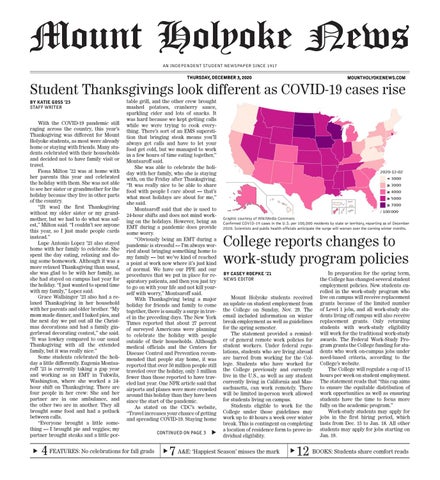
Graphic courtesy of WikiMedia Commons Confirmed COVID-19 cases in the U.S. per 100,000 residents by state or territory, reporting as of December 2020. Scientists and public health officials anticipate the surge will worsen over the coming winter months.
College reports changes to work-study program policies BY CASEY ROEPKE ’21 NEWS EDITOR
Mount Holyoke students received an update on student employment from the College on Sunday, Nov. 29. The email included information on winter break employment as well as guidelines for the spring semester. The statement provided a reminder of general remote work policies for student workers. Under federal regulations, students who are living abroad are barred from working for the College. Students who have worked for the College previously and currently live in the U.S., as well as any student currently living in California and Massachusetts, can work remotely. There will be limited in-person work allowed for students living on campus. Students eligible to work for the College under those guidelines may work up to 40 hours a week over winter break. This is contingent on completing a location of residence form to prove individual eligibility.
7 A&E: ‘Happiest Season’ misses the mark
u
In preparation for the spring term, the College has changed several student employment policies. New students enrolled in the work-study program who live on campus will receive replacement grants because of the limited number of Level 1 jobs, and all work-study students living off campus will also receive replacement grants. Only returning students with work-study eligibility will work for the traditional work-study awards. The Federal Work-Study Program grants the College funding for students who work on-campus jobs under need-based criteria, according to the College’s website. The College will regulate a cap of 15 hours per week on student employment. The statement reads that “this cap aims to ensure the equitable distribution of work opportunities as well as ensuring students have the time to focus more fully on the academic program.” Work-study students may apply for jobs in the first hiring period, which lasts from Dec. 15 to Jan. 18. All other students may apply for jobs starting on Jan. 19.
12 BOOKS: Students share comfort reads
2
EVENTS
December 3, 2020
Mount Holyoke News Mount Holyoke News is an independent student newspaper written by and for Mount Holyoke College students since 1917. VISIT US: www.mountholyokenews.com www.facebook.com/themhnews www.twitter.com/mtholyokenews_
EMAIL US: mhnews@mtholyoke.edu
Executive Board Editor-in-Chief Lily Reavis ’21 Managing Editor of Content Flannery Langton ’22 Managing Editor of Layout Rose Sheehan ’22
Publisher Liz Lewis ’22 Managing Editor of Web Zoe Farr ’21 Business Manager Sarah Nam ’23
Copy Chief Kelsey Thomas ’21
Editorial Board News
Casey Roepke ’21, Kate Turner ’21 & Liz Lewis ’22
Arts & Entertainment Sabryna Coppola ’22 & Mariam Keita ’24
Health & Science Features
Mimi Huckins ’21 & Tishya Khanna ’23
Sports
Opinion/Editorial
Gigi Picard ’22
Environmental Meryl Phair ’21
Books
Sidney Boker ’21
Photos
Global
Ali Meizels ’23 & Rosemary Geib ’23
Saman Bhat ’22 & Sophie Soloway ’23
Copy Editors
Event Highlights Thursday, Dec. 3
Everything Financial: What I Wish I Knew Then In this Alumnae Association webinar, designed for those within the first ten years of their careers, financial planner Gillian McCarthy ’12 debunks personal finance myths and misconceptions to provide guidance for these crucial years. Registration is required through Embark. 11:30 a.m. - 12:30 p.m. EST Environmental Career Paths Alum Panel Join us for our annual Environmental Career Paths Alum Panel and hear Mount Holyoke Alums share their experiences at MHC and beyond. Registration is required through Embark. 4:30 p.m. - 5:30 p.m. EST
Kessh Bhasiin ’22 & Zoe Greenberg ’23
Nina Larbi ’22 & Libby Spy ’24
Hunar Anand ’21, Audrey Hogan ’21, Molly Kleinman ’21, Audrey Shannon ’22, Margaret Connor ’23, Zoe Latham ’23, Lauren Leese ’23, Rhitom Mishra ’23, Kay Brown ’24 & Ella Jacob ’24
. Mount Holyoke News
Layout Editors
Maggie Donovan ’23, Angie Romero ’24 & Zoe Tang ’24
Web Editors
Audrey Hogan ’21, Shloka Gidwani ’22, Georgia Fish ’23 & Aarushi Sharma ’23
Publication Guidelines Mount Holyoke News does not endorse any of the opinions or views expressed within the pages of the paper, excluding staff editorials. All content copyright of Mount Holyoke News. All rights reserved. Mount Holyoke News does not discriminate on the basis of gender, race, religion, ethnicity, sexual orientation or age.
Advertising in MHN Interest in advertising in MHN can be directed to mhnews@mtholyoke.edu for pricing and deadlines. MHN reserves the right to refuse submissions on the basis of, but not limited to, advertisements considered to be libelous, obscene, defamatory or discriminatory.
Subscriptions Mount Holyoke News is a weekly publication that will publish online-only throughout the fall semester 2020. To subscribe through email, please visit the following form: https://forms.gle/VPCyskE4kMTDeDan8.
Friday, Dec. 4 Vespers
Join us for the first Virtual Worldwide Vespers concert hosted by the New York City Club. Held in some form on campus each December since 1899, this holiday tradition is much anticipated and reliably fills Abbey Chapel. This will be the first time it is being held virtually. 6:45 p.m. - 9:00 p.m. EST
Asking for Nelly: An Artist’s Talk with Adi Liraz
Artist’s talk with Romaniote-Ashkenazi feminist artist, Adi Liraz. Registration is required through Embark. 11:30 a.m. - 12:30 p.m. EST
Saturday, Dec. 5
Launch of 100@100, the 2020 Mary Lyon Concert
Mount Holyoke Symphony Orchestra celebrates 100 years of Women’s suffrage with an oral history project in collaboration with the Oral History of American Music at Yale University and the Women’s Philharmonic Advocacy. Registration is required through Embark. 10:00 p.m. - 11:00 p.m. EST
Asian Center for Empowerment Cook & Chat
ACE Advisor Erica Weathers will be cooking bulgogi live and afterward, we will be holding space to just hangout and connect. This event is open to all students, alumnae, faculty, and staff. Registration is required through Embark. 7:00 p.m. - 8:30 p.m. EST
Class of 2023 & 2024 Game Night
Letters Policy Letters to the Editor appear exactly as they are sent to MHN, except for corrections to spelling, grammar and AP style. Letters cannot exceed 500 words. All letters must include the writer’s name and telephone number for verification purposes. Unsigned letters will not be printed. Names may be held upon request with the approval of the Editor-in-Chief. MHN reserves the right to decide which materials will be printed. Email submissions to mhnews@mtholyoke.edu by Sundays at 5 p.m. for publication the following week.
Come & Join members of the Class of 2023 & Class of 2024 for a game night! We will have an assortment of games including JackBox Games. Registration is required through Embark. 8:00 p.m. - 9:00 p.m. EST
December 3, 2020
3
NEWS
. Mount Holyoke News
College receives more than $30 million in donations COVID-19 we need to affirm the need for the arts dents continue their work,” said Profesand the role that the liberal arts has sor of Computer Science Valerie Barr cases worsen, in the world,” Interim Dean of Faculty, on the Lynk program. Two of Barr’s stuMount Holyoke College released Vice President for Academic Affairs and dents used their Lynk funding to concont’d its yearly report on philanthropy in an Professor of Spanish Dorothy E. Mos- tinue the research they had begun with BY KATE TURNER ’21 NEWS EDITOR
email update to community members on Dec. 2, 2020. “As I reflect on the past year, I am uplifted by the generous outpouring of support from the generous alums and friends of Mount Holyoke College,” Vice President for College Relations Kassandra Jolley wrote in a letter to the community included in the report. In addition to the usual donations and awards, the report detailed the “extraordinary” community support necessitated when Mount Holyoke shut down in March due to COVID-19. Between March and June, more than 600 students were supported by the Student Safety Net Fund which raised $346,000, according to the report. Support ranged from aid with housing, travel and storage to purchases of technology and other academic supplies. “You shared not only your financial gifts but also continued the Mount Holyoke tradition of volunteerism — building connections with one another, and with our campus community,” Jolley wrote. “Your support ensures that the future of Mount Holyoke will be bright. Thank you for all you do to sustain our commitments to our talented and deserving students, faculty and staff.” “In this moment of the pandemic, as well as the conversations on race and social justice and social inequality that we are having: First and foremost
by wrote in the report. “To do that, we need to make decisions that will enable us to carry out our mission responsibly, not just for now, but for generations to come.” As previously reported by the Mount Holyoke News, the College lost upwards of $7.6 million in its initial COVID-19 pandemic response and anticipated losing substantially more. This loss was offset in part by a gift of $10 million from “a Mount Holyoke graduate and trustee” for the College’s financial aid initiative, though at their fall 2020 meeting, the Board of Trustees noted a continued “budget gap” caused by COVID-19. Earlier in March, the College hosted March4MHC, a month-long fundraising challenge where the College matched gifts from community members with an additional $350,000. In total, the fundraiser raised more than $1 million in what the College termed a “truly impressive outpouring of support.” The report highlighted the College’s Lynk program in particular, noting that over 1,150 students participated in summer internships or research in 2019. 75 percent of those internships, taking place in over 55 countries and 40 U.S. states, were funded through the College’s Lynk program. “That’s another wonderful place where support from the College is then wrapping around and helping these stu-
COVID-19 Counter: Positive test results in the last 24 hours: 1 Positive test results in the last 7 days: 2 Total positive test results since August 12: 6 Tests completed in the last 7 days: 548 Tests completed since August 12: 10,243 Updated Dec. 2, 2020
her in partnership with the Pioneer Valley local Girls, Inc. chapter “on asthma and lead levels in the neighborhoods and schools of their participants,” according to the report. Like Barr’s students, 46 percent of Lynk recipients reported finding their internship through Mount Holyoke community members or resources. The report also broke down sources of financial support, including alums, parents, families, “friends” of the College, foundations, corporations and others. Of the roughly $30 million donated during the 2019-2020 academic year, Mount Holyoke alums were the highest donors, providing more than $26 million to the College. “Fundraising for all purposes totaled more than $30 million — an incredible testament to the generosity of you, our philanthropic partners,” Jolley wrote. During the 2019-2020 academic year, 77 percent of Mount Holyoke students received financial aid, totaling $52,253,000. The average financial aid awarded to Mount Holyoke students last year was $33,101. “Alums are supportive of students financially, but also with networking, finding jobs, and socially,” Emily Carle ’21 said in the report. “I’m grateful for the support they’ve given me. A lot of what I’m able to do is thanks to them.”
News brief: Car crash on campus BY KATE TURNER ’21 NEWS EDITOR
On Saturday, Nov. 28, an unknown driver crashed into the basement of the Asian Center for Empowerment on the Mount Holyoke campus. The College notified community members of the accident in an email from the Office of Communications on Sunday, Nov. 29. The basement of the ACE House was empty at the time of the crash, and the car’s only occupant was its driver. The College’s statement contained no information about the driver’s condition or any circumstances that precipitated the crash. “We are saddened by the damage to the ACE, as it serves as an important space for support, education, and community for our students within the Asian diaspora, and has since 1998,” the statement said.
CONTINUED FROM PAGE 1
u
is the best way to protect yourself and others from COVID-19.” However, the CDC details precautions you can take while traveling if you decide to do so, such as wearing masks, social distancing and washing your hands as often as possible. They also go over each type of travel option, such as by airplane, car or bus, and give recommendations on how to take extra precautions for each type of transportation. Additionally, the CDC website has a special section for holidays in regard to COVID-19 that explains whether to attend a gathering, how to host a gathering if you decide to do so and how to cope with holiday stress. There is a special section for Thanksgiving outlining low- to high-risk activities and guidelines to determine what people should do for the holiday. The website states, “This holiday season, consider how your holiday plans can be modified to reduce the spread of COVID-19 to keep your friends, families, and communities healthy and safe.” The CDC also said that although it has guidelines to consider for small gatherings, these are not to replace any laws or rules set in place by the state or county and that everyone should stay home. Dr. Anthony Fauci stated that restrictions and recommendations to not travel or see anyone outside of your household will continue into the winter holidays, as it is expected that the COVID-19 situation in the country will worsen in the coming weeks. As of Nov. 29, COVID-19 cases broke 4 million, twice the amount that were recorded in October. Fauci said, “I think we are going to have to make decisions as a nation, state, city and family that we are in a very difficult time, and we’re going to have to do the kinds of restrictions of things we would have liked to have done, particularly in this holiday season, because we’re entering into what’s really a precarious situation.” In the last week, more than 1 million new COVID-19 cases have been reported in the U.S., according to the CDC website.
4
FEATURES
December 3, 2020
. Mount Holyoke News
Students reflect on their decision to graduate early due to COVID-19
Graphic by Anjali Rao-Herel ’22
BY CASEY ROEPKE ’21 NEWS EDITOR
“One day, I’m going to just log off of Zoom and be in my bedroom and be alone,” Claire Glover ’21 said. “There’s nothing to mark it being over at all.” Glover is one of a handful of students graduating early from Mount Holyoke College this December rather than finishing their college experience after the traditional spring term. Students can apply to graduate in the fall if they have completed their major and distribution requirements and have enough credits by the end of the term. According to the Office of the Registrar, there are 78 undergraduate students and one graduate student scheduled to complete degree requirements midyear, a 2 percent uptick from previous years. Eligibility for midyear graduation is determined in a multistep process. First, in the late spring of junior year, students are asked for their preliminary graduation plan. Seniors are required to apply to graduate and can mark their graduation date in that form. “Obviously, eligibility to graduate — early or on time — is based on students’ status in completing all degree requirements,” Registrar Elizabeth Pyle said. But in reality, eligible students do not graduate in December, Pyle added. “The ‘midyear’ group doesn’t actually graduate in December,” she said. “They may be finishing their requirements then, but fall grades aren’t available until January, and some students finishing away may still be taking courses in January term 2021. So the official degree date for all of these students will be March 8, 2021,” Pyle said. “We will be able to confirm that their degree requirements have been completed on a rolling basis once their grades come in, but the College will officially confer their degrees on March 8.” “I decided late this past summer,” Molly Aslin ’21 said of her decision to graduate early. “Right when Mount Holyoke made the announcement that they were only keeping a small number of students on campus. I remember reading the College’s plan and just thinking to myself, ‘Oh. That’s it for me.’” For many students, choosing to graduate a semes-
ter early resulted from COVID-19 campus closure and the College’s subsequent planning. “COVID-19 solidified my decision because what I was really nervous about was not being on campus with my friends in the spring, but because of COVID-19, I figured that even if we were on campus, things wouldn’t be that exciting,” Maddie Miller ’21 said. “I definitely did not enjoy spending the last two semesters of college online, but it is what it is.” Glover, a double major in biology and chemistry, has been considering graduating early on and off for the past year but thought she would be unable to complete her lab requirements. But with the shift to a module system this fall, she had the opportunity to enroll in three lab courses spread out over the two modules, rather than taking all three at once during a typical semester, and she was suddenly able to graduate in December. “COVID-19 and the module system made it possible for me to graduate early,” Glover said. “And then I had to sit down with myself and think about why.” “It’s definitely not a decision I would have made had we not been in a pandemic,” Aslin said. Aslin, a physics major, felt that she could not justify sticking around for the spring term. “With the way my classes ended up — some classes I had wanted to take in the spring were canceled because of COVID-19 — and with my decision not to write a thesis, I just couldn’t really justify paying for another semester of classes if I didn’t need them.” For Glover, the decision came down to her experience in online classes. “I did not like online school,” she said. “I was not succeeding or happy. It doesn’t replicate the Mount Holyoke experience fully. So in thinking about doing another spring term with online classes, even if we’d be on campus, I didn’t think it would be true to the rest of my Mount Holyoke experience. … I don’t think my experience is going to be worth paying the extra tuition.” Other students had planned to graduate early be-
Graphic by Anjali Rao-Herel ’22
BY WOODLIEF MCCABE ’23 STAFF WRITER
Have you been listening to the same playlist or album over and over? Watching and rewatching the same TV show? Playing the same video game you’ve beaten before? We’re all kind of stuck. The tangible stuckness of being in our homes with the same people all day may be impacting the types of media we are interested in consuming. When life is unclear, we tend to lean toward and stick to what makes us comfortable. Even though listening to Mitski every night is making me sad, I do it because I still know all the words, and it’s familiar to me. When we end up stuck, we can start to feel helpless and depressed. If you’re looking for a way to begin breaking
fore the pandemic interrupted campus life. Shanze Hasan ’21, an international relations major with a Nexus in law, public policy and human rights, had entered college with enough credits from high school to graduate after seven semesters. “Since I had planned to graduate in December of 2020 before the pandemic hit, it did not have much of an impact on the decision,” Hasan said. “I do wish I was able to complete my last semester in person rather than online. I feel sad that I will be graduating from home like this. It would have been nice to complete the last few months of college with my fellow peers.” Hasan is not the only December graduate with mixed feelings about graduating early. “I’m really very sad and disappointed about it,” Aslin said. “There’s no way around it. It’s really not something I actively wanted to do, but with the ever-increasing possibility that spring semester classes would be online as well, I didn’t really see a point in paying for remote classes when I already have the credits to graduate.” Aslin is graduating after six semesters at Mount Holyoke, a semester early and having taken a leave of absence during fall 2019 for an internship. “I’ve only spent a little over two years on campus,” she said. “I definitely regret missing out on lots of traditions because I had always assumed that they would be there for my senior year.” In reflecting on her past three years at the College, Glover was quick to express gratitude for her positive experience pre-COVID-19. “I’m proud of myself,” she said. While upset that she will not have complete closure to her college years, Glover is grateful for the relationships she built with faculty during her time on campus. “I don’t get to say goodbye to my professors,” she said. “I want to say ‘thank you’ to all of them and mark how much they have meant to me and how much I have learned from all of them.” Her earlier positive experiences were a main factor in her decision to graduate early. out of this emotional trap, start by introducing new media into your day. It could be a show that a friend has been recommending to you forever or a musician you’ve heard a few times who has more songs to discover. If you don’t know where to start, you could look for critics’ lists of the best albums, shows, games or movies of the year. Now is the time of year when those lists are compiled, so why not use them for suggestions? You could also swap out the TV shows you’re rewatching or the books you’re rereading for classics that you weren’t previously interested in. I am finally watching “Breaking Bad,” and I’m not worried about finishing it before a new season comes out since the series ended years ago. You could also consider looking into new forms of media you haven’t had the chance to explore. Graphic novels, comics and video games can all be enjoyed at a beginner’s level, so do a little research and find the genre that would be most interesting to you. Streaming platforms like Twitch are also a great way to learn about a new interest. You can find CONTINUED ON PAGE 5
u
December 3, 2020
FEATURES
. Mount Holyoke News
5
Naomi Brown ’21 takes to social media to share quarantine dishes BY LILY REAVIS ’21 EDITOR-IN-CHIEF
Under normal circumstances, Mount Holyoke students are required to purchase a full on-campus dining plan each year. So when the campus closed in March, students like Naomi Brown ’21 were unexpectedly left with extra household responsibilities and no ready-made meals. Without the options of running to the dining hall between classes or visiting Late Night, Brown has spent the past six months cooking for herself, her family and her roommates. Her dishes, often inspired by music and memories, have even made an appearance on social media. Brown’s self-titled “Platterstagram” (@platterstagram on Instagram) showcases her homemade meals, inventive recipes and themed plates from inside quarantine. After Mount Holyoke announced its closure this semester, Brown and three of her friends from the College moved into an apartment in South Hadley. All four housemates enjoy cooking, and the shared kitchen has become a space for relaxation and friendship. “Normally, in non-pandemic times, I would go to a movie with my friends or go to a party or something. And obviously, I’m not doing that now, so that’s the thing we do together instead of going out somewhere,” Brown explained. “We stay in, and every week we make a plan for what we’re going to make, and it’s our thing to look forward to.” On campus, Brown found it difficult to cook regularly because of a lack of kitchen and storage space. Although seven residence halls contain “Golden Pear” kitchens, students are largely responsible for supplying their own pots and pans. The closest grocery store is driving distance from campus, which can be a challenge for those without access to a car. In addition, students from outside of New England generally keep their school supplies in shared storage units over the summer break. Bulky kitchen items would take up room in the small dorms and storage areas, and cooking space is limited on campus to begin with. However, that doesn’t mean that students are opposed to cooking. Brown grew up watching her parents put immense care into each meal they cooked, with the bonus of being able to help around the kitchen when asked. She and her sister were invited to ask questions about recipes and cooking processes as kids, and creativity was always encouraged. When Brown got older, she began working at a summer camp where the high schoolers were responsible for cooking meals. Through that experience, she recognized that most people dislike certain foods because they haven’t had them prepared well. By putting care, effort and proper seasoning into vegetables and main courses, Brown explored new possibilities for ingredients she hadn’t previously given much thought. Working at the summer camp also taught her how to cook healthy meals for large groups, since roughly 100 kids attended each year. Now, that skill helps Brown plan and execute her own meals while working 30 hours a week and taking a full course load. “I plan ahead for whatever I’m going to make and try to think about how many ingredients I’m going to be using each week,” she said. By fully using each ingredient and cooking meals every weekend, Brown
Photos courtesy of Naomi Brown ’21 On her food Instagram account, @platterstagram, Naomi Brown ’21 showcases images, similar to those above, of her recent cooking endeavors.
manages to keep her grocery bill relatively low while also eating healthy, filling meals. Each weekend, Brown cooks two or three meals, which she eats for lunch and dinner throughout the week. “By the end of the week, I’m kind of like, ‘Oh my god, this again?’ but at the same time, I’m only spending the money on the ingredients for those three dishes and then eating them all week,” she explained. “And I get to try new things every week.” This Thanksgiving was the first time Brown spent the holiday away from family, and she instead celebrated by putting on a feast for herself and her housemates. The planning was done through one master Google Doc where Brown kept track of what ingredients they had, what they needed to buy and which dishes to make first. “I was very proud of making Thanksgiving dinner by myself for the first time because I’ve never cooked a turkey before, and I didn’t poison anyone,” she laughed. Unexpectedly living alone is a reality faced by dozens of Mount Holyoke students this year, Brown and her housemates included. Brown recognizes the weird situation students are in right now and thinks that it might play a role in cooking wariness. “I think a lot of people are intimidated by cooking because they think it’s too hard or that’s something that ‘real adults’ do, or they know how to make three things, and they stick to it,” Brown said. “But I really think if you pick what you want to do and you make a plan for it, and you really think it through, then anyone can make anything.” For example, one of Brown’s favorite recipes to cook at the moment is a vegetable and tofu soup made from produce scraps and served with pasta or rice. By preserving the peels and ends of vegetables, she can make her own broth and limit food waste. An added plus, the meal is basically free since its main ingredients are leftovers from other recipes. Going forward, Brown says she is leaning toward staying in her off-campus apartment instead of moving back to campus in the spring, but that decision is still up for debate. “Now that cooking has become such a large part of my life, I think I would miss it a lot if it wasn’t there,” she said. At the moment, she and her housemates are planning new meals and platters based on surrounding inspirations. One upcoming household event, for example, will showcase eight different appetizers based on each of Taylor Swift’s albums (chocolate chip cookies for “Red,” sweet potato
fries for “1989,” according to Brown). Platterstagram is also far from ending, and Brown said she is currently looking for new ways to expand her social media cooking presence. Favorites like themed boards, winter soups and in-the-process cookie bakes will continue for the foreseeable future because Brown believes that cooking and sharing food can be a life-altering experience. “I truly believe that once people start learning to cook for themselves and make good, healthy food that it can expand the quality of life,” she explained. According to Brown, that process starts with basic experimentation and a dedication to learning. “If there’s any takeaway, it’s that everyone can learn to cook for themselves,” she said.
Pandemica, cont’d u
CONTINUED FROM PAGE 4
people streaming pretty much anything. Streams also have comment sections in which you can ask questions and interact with creators and the community. Need some recommendations? Here are some of mine: Albums: “SAWAYAMA” by Rina Sawayama, “Electra Heart” by MARINA, “Good News” by Megan Thee Stallion TV Shows: “Documentary Now!,” “Santa Clarita Diet,” “Zone Blanche” (this is a French show on Netflix, you will need subtitles or dubbing) Books: “Helter Skelter” by Vincent Bugliosi (TW: it’s about the Manson murders), “Ghosts of Heaven” by Marcus Sedgewick, “Persepolis” by Marjane Satrapi (graphic novel) Podcast: “Lexicon Valley” Movies: “The Farewell,” “Misery” (Steven King adaptation), “Mad Max: Fury Road” Video Games: Outer Worlds, Baba is You, Portal Another great way to find a form of media you might like is to talk to your friends, coworkers or strangers (from 6 feet away). Ask about what they’ve been watching, reading or listening to and you might get some great suggestions.
6
. GLOBAL Leader in Iranian nuclear science assassinated
Photo courtesy of WikiMedia Commons Scientist Mohsen Fakhrizadeh was assassinated on Friday, Nov. 27.
BY SOPHIE SOLOWAY ’23 GLOBAL EDITOR
Iran’s top nuclear scientist, Mohsen Fakhrizadeh, was killed in an attack in his vehicle on Friday, Nov. 27. After a reported gun attack in northern Iran, hospital workers unsuccessfully attempted to revive the prominent figure. Fakhrizadeh was the head of Iran’s Research and Innovation Organization and was widely regarded as a national hero for his work with the country’s nuclear program, both before and after the Iranian government officially ended it. According to Senior Fellow at Carnegie Endowment for International Peace Karim Sadjadpour, “Fakhrizadeh likely knew more about Iran’s nuclear program than any living human. Losing his leadership, knowledge and institutional memory is undoubtedly a blow to the Islamic Republic.” Protests quickly emerged in Iran, reflecting the significance of
December 3, 2020
the loss for the country. Officials have not yet pinpointed the individual responsible for the attack. However, on Saturday, Nov. 28, Iran’s President Hassan Rouhani accused Israeli leadership of being responsible for the scientist’s death. According to The New York Times, three unnamed American officials have made similar statements. Having had a critical role in the nation’s development of nuclear technology, Fakhrizadeh has long been a person of interest to the Israeli intelligence agency, Mossad, as well as to U.S. intelligence agencies. The U.S. and Israel are allies and have historically vehemently opposed Iran’s nuclear program, as Israel specifically views Iran as its largest regional threat. Although Fakhrizadeh denied that the purpose of Iran’s nuclear program was related to building nuclear arms, documents stolen by Israel in early 2018 suggested otherwise. When Israeli agents stole approximately 50,000 pages and 163 discs of information on Jan. 31, 2018, they concluded that the Iran nuclear program was ongoing and dedicated to developing nuclear weapons. Israel’s Prime Minister Benjamin Netanyahu released this information days before U.S. President Donald Trump pulled out of a nuclear deal with Iran. As of Friday, Nov. 27, Netanyahu’s administration has not officially responded to Rouhani’s claims that Israel played a role in the murder of Fakhrizadeh. The assassination might provoke further conflict in the region. Rouhani has pledged to retaliate against those responsible for the murder. Fakhrizadeh’s assassination was also compared to the U.S.’ January airstrike on Qasem Soleimani, an Iranian operations leader. This previous attack is largely considered to
Mount Holyoke News
have increased tensions between Iran and the U.S. since Trump’s withdrawal from the Iran nuclear deal in 2018. As the U.S. presidency enters a transitional period, this attack may impact President-elect Joe Biden’s plans to alter relations with Iran. Carrie Lewis ’23, a Mount Holyoke student interested in international relations, noted that “because of the United State’s military support for Israel and their previous attack on [the] Iranian leader [Soleimani], this might block progress between the relationship between Iran and the United States, especially under Biden.” Biden has long stated that his administration plans to return to the Obama-era nuclear deal with Iran that Trump undid. Given the salient relationship between the U.S. and Israel and both nations’ suspected roles in assassinating high-profile officials, this recent attack is expected to make a nuclear deal with Iran significantly harder to achieve for the president-elect. As protests mourning Fakhrizadeh’s death continue in Iran and more Iranian officials place blame on the U.S.-Israel alliance, concerns regarding the future of these regional relationships mount. Helen Roane ’23, an international relations major, said, “I think it’s really interesting how Israel really put itself in the middle of an international conflict over Iran’s nuclear program. Because it seems like they are counting on the United States support, which is not guaranteed with a Biden presidency that is looking perhaps for a more diplomatic resolution to such issues. Either way, it remains an impactful action that clearly says that the government of Israel is not afraid of taking actions to stand for what they think protects their national interest.”
US plans to withdraw from Afghanistan move forward slowly BY AMELIA LUO ’23 STAFF WRITER & PHOTOGRAPHER
On Nov. 17, 2020, acting Defense Secretary Christopher Miller announced that the United States would reduce troop levels in Afghanistan by mid-January. This withdrawal would bring the number of troops stationed from 4,500 to 2,500, accelerating troops’ removal during President Donald Trump’s final days in office. The acceleration aims to fulfill Trump’s pledge to bring forces home, though it has been met with many objections from senior military officials who would prefer a slower pullout. Some U.S. allies have warned of the danger of withdrawing under current conditions, according to The Washington Post. The U.S. and the Taliban signed a peace deal on Feb. 29, 2020, which contains four major agreements: one, to convene the Intra-Afghan negotiation; two, for a cease-fire among the U.S., Taliban and Afghan forces to be put on the Intra-Afghan agenda; three, the withdrawal of foreign forces and reduction of U.S. military troops from 12,000 to 8,600 within the first 135 days; and four, that no groups or individuals use Afghanistan soil to threaten the security of the U.S. and its allies. Since signing this deal, the U.S. has closed at least 10 bases across Afghanistan. However, very little information on the final remaining sites and the actual situation of these military bases in Afghanistan after their closures have been made known to the public.
Despite the fast-approaching deadline, many withdrawal process plans remain murky. Ashley Jackson, an expert on the militant group with the Overseas Development Institute, told The Washington Post that the closing of U.S. bases also hands Taliban fighters both symbolic and tangible victories. Kayla Olds ’23, a politics major, suggested that “the decision is irresponsible, the timing is bad, and it will do much more harm than good by potentially making the situation worse for the people in Afghanistan.” Lucia Xie ’23, a double major in politics and history, remarked that “The United States has been involved in the Afghan conflict for nearly two decades, but it appears to be a stalemate that cannot be resolved in the short term.” Xie continued, “I think the U.S. withdrawal can be an appropriate decision because the U.S. has spent a lot of wasted time and resources on the Afghanistan problem. This process, of course, has not significantly advanced America’s counterterrorism efforts.” The withdrawal of U.S. troops from Afghanistan and the closing of military bases is part of the deal that the U.S. signed with the Taliban. However, the Taliban has not yet met the requirements to reduce violent attacks against Afghan government forces, nor have they broken ties with international terrorist organizations such as al-Qaida. If the U.S. chose to withdraw now, it would further weaken an already fragile Afghan government. Despite this, the Afghan security forces are
well supplied and funded by foreign economics, so the pullout of the U.S. troops would not necessarily cause a complete collapse in Afghanistan. Miller suggested that the U.S. would be ready to respond if conditions in Afghanistan change. Analysts and Afghan officials also suggested that U.S. troops are collapsing forces into bigger military bases to have a larger number of forces ready to secure various small outposts. This would also help bring U.S. troops closer to medical facilities, making it easier to evacuate the country if necessary. American military presence in Afghanistan was seen as an essential reason for the Taliban to keep its side of the deal and negotiate. However, this speedy pullout is sending signals to the Taliban that the U.S. is leaving the region regardless of the insurgency. According to The New York Times, immediately after the Pentagon’s announcement of the withdrawal plan, mortar shells and rockets were fired in several places in Baghdad, including areas near the U.S. Embassy, killing a child and leaving five civilians wounded. Trump’s determination was met with alarm from the U.S.’ NATO allies. NATO’s Secretary-General Jens Stoltenberg warned that “the price for leaving too soon or in an uncoordinated way could be very high.” According to The New York Times, allied nations have stated that they will reconsider their presence in Afghanistan if the U.S. withdraws, a decision which will likely change regional occupations.
December 3, 2020
. Mount Holyoke News
ARTS & ENTERTAINMENT
7
Hulu’s ‘Happiest Season’ is a huge holiday letdown
Graphic by Trinity Kendrick ’21
BY SABRYNA COPPOLA ’22 ARTS & ENTERTAINMENT EDITOR
Content warning: This article mentions homophobia and emotional abuse. The holiday season traditionally involves going home to see family, and that presents a potentially harrowing experience for many LGBTQ+ people. On Nov. 25, Hulu released their original film “Happiest Season.” Directed by Clea DuVall (famous for her role in “But I’m a Cheerleader”), the film follows Harper (Mackenzie Davis) and her girlfriend Abby (Kristen Stewart) as they visit Harper’s home for Christmas. Harper admits on the way that she lied about being out to her conservative (read: homophobic) family, and since her father is a politician running for reelection, she wants to keep their relationship a secret until after the holiday passes. The film opens with all the usual antics we can expect from this popular trope in LGBTQ+ movies, including lots of misunderstandings and innuendos. But as the movie progresses, Abby and Harper’s relationship becomes more strained.
Since Harper’s family doesn’t know about her identity, they keep trying to set her up with her ex-boyfriend. Left alone in an unfamiliar place, Abby befriends Harper’s ex-girlfriend, Riley (excellently played by Aubrey Plaza). Harper’s tense relationship with her parents, her extremely competitive older sister and her hiding of Abby all come together to create a ticking time bomb. The movie promises a star-studded cast, including Stewart, Plaza, Alison Brie and Dan Levy. However, it is only Stewart and Plaza’s talents that are fully utilized, as only their characters are fully developed. The rest seem to fall into flat stereotypes. Throughout the movie, Harper ignores Abby, who has admitted how hard it is for her to celebrate Christmas after the passing of her parents, and repeatedly convinces her to stay despite her discomfort. Levy plays Abby’s friend, John, who occasionally advises Abby over the phone to remove herself from the situation, eerily reminiscent of Jordan Peele’s horror film “Get Out.” However, at the end of the movie, he tells Abby that just because Harper is afraid to be open about her sexuality doesn’t mean that she loves Abby any less. Reminding Abby how scary it can be to come out to one’s family, he convinces her that Harper’s manipulative behavior is justified. Without revealing too much, I will say that I was immensely disappointed in this movie for many reasons. Following in the footsteps of almost every romcom relationship, Abby and Harper are completely dysfunctional and, frankly, toxic. The cast is also mostly white, and the three characters of color lack dimension. They seem to be used as diversity tokens for the election of Harper’s father, which is wildly problematic and wholly unaddressed. Two of them frame Abby for stealing something from a mall, adding an unnecessary and racist plot point. Harper spends the entire movie pandering to her right-wing upbringing, hiding the parts of her that will tarnish her father’s reputation and, in the process, actively hurting Riley and Abby.
This portrayal of LGBTQ+ romance is not the representation I wanted to see from DuVall, a lesbian icon. The best-case scenario would be a lesbian romcom that wasn’t about their sexual orientation. But this toxic couple undermines that possibility. Instead, preying on the terrifying feeling of coming out enables an unhealthy relationship in which Abby is emotionally manipulated into letting herself be mistreated by Harper. I’m not asking for the perfect movie, but it would have been nice for the first mainstream lesbian rom-com to promote more meaningful representation. The movie has had some mixed reviews. NPR called it “funny,” “charming” and “warm” and lauded the cast for their performances. However, lesbians on social media have expressed disappointment in the couple, pointing out how Harper’s general mistreatment of Abby is thinly glossed over by appealing to the fear of coming out. Like any rom-com, the problems are easily solved and the ending is perfectly happy — every problem is neatly wrapped up and put away. Despite how much I wanted to like this movie, I think it’s something that will land differently with everyone who watches it. Knowing how hard it is to come out to family shines a sympathetic light on Harper, but for me, it wasn’t enough to excuse her actions. The movie is still worth watching, but don’t expect too much. There are some genuinely funny parts and a cozy, festive atmosphere to the film. Stewart and Plaza, both usually typecast as cold and sarcastic, give wonderful performances. It does show a nuanced relationship, which is important for “representational” movies, but marketing toxic as romantic just doesn’t sit right with me. To anyone struggling with difficult family dynamics over the holidays, remember that you are worthy and deserving of self-preservation. It can be a tough time for a lot of us, but remember to take care of yourselves. If you find yourself in Abby’s position, pack your bags and put yourself first.
Artist profile: Vivi Corre channels current events, politics into artwork BY ANIKA SINGH ’24 STAFF WRITER
There is something immersive about Vivi Corre’s art. It is minimal yet enthralling — it entices the viewer to look, to relate. It draws them in. Gathering inspiration from current events, Corre sketched her latest piece, idly creating patterns influenced by her environment and ready to shape her newest work. Corre’s art journey wasn’t a straight line. “I used to not like art as a subject at all in high school,” she explained. “My own ideas and creativity were limited since the classes followed a technical flow and strived for a perfect depiction.” Corre did not find solace in this. “Art isn’t meant to be perfect, it’s supposed to be you!” she remarked. It all started with a birthday gift. New iPad and pencil in hand, Corre explored the new features the device offered, her love for art growing by the minute. Corre remarked that it is incredible what a simple instrument can do, whether it’s brightening up your favorite biology teacher’s day as you give her your art as a baby shower gift (featuring the words “Future Stemminist”) or celebrating your college acceptance
to Mount Holyoke by drawing Jorge enjoying M&Cs. was her “AOC+Among Us” drawing, which came These projects guided Corre to feeling a close affinity from the famous U.S. Representative Alexandria Ocfor art. asio-Cortez livestream during which she played the “The Jorge artwork was definitely a turning point game Among Us to encourage the youth of America for me,” she said. “I had sent it out to [the Office of] to vote in the 2020 presidential election. This piece is Admission and they liked it so much that they repost- playful, displaying cutesy Among Us figurines while ed it on their Instagram, which led to people DMing highlighting the political climate of America. Ocame to ask if they could get it in a sticker format. That sio-Cortez seems to play a significant role in Corre’s encouraged me to put my art out there,” she added. art, as some of her quotes serve as catalysts for her This resulted in the creation of a Redbubble ac- creations. count that now displays a handful of her creations. “I’m glad to see that my art can reach people,” Art is everywhere, Corre believes. She described Corre reflected. “I, unfortunately, don’t get to see who how her artistry comes to her, saying, “One of my purchased my art, but at times my art is favorite creations came to me as I sat in purchased from states or countries front of the television watching the 2020 that I might not know people vice presidential debate. Vice Presifrom, and I’m overjoyed to dent-elect Kamala Harris shut down know that my art is now Vice President [Mike] Pence by her not only something I enjoy iconic ‘I’m speaking’ quote. That’s but other people do as well. where I got the idea to draw a loudSuch a feeling can’t be respeaker with the quote.” placed.” Corre’s ideas are innovative and To support Corre and her Graphic by Vivi Corre ’21 shine the brightest when her art is influart, check out her Instagram art enced by current events. A remarkable piece account, @vivicdesigns.
8
ENVIRONMENTAL
December 3, 2020
. Mount Holyoke News
US-Mexico border wall is destructive to natural wildlife BY ABBY WESTER ’22 STAFF WRITER
The U.S.-Mexico border wall has been a point of contention in American politics since President Donald Trump made a promise to expand it during his 2016 presidential campaign. Along with political concerns about the effectiveness and morality of physical borders, worries about their environmental effects have also arisen. Physical barriers have existed on the U.S.-Mexico border for decades, dating back to the early 1900s. In recent history, the fencing along the border was expanded under President George W. Bush when he signed the Secure Fence Act of 2006 — a move supported by former President Barack Obama, 2016 presidential nominee Hillary Clinton and Senator Chuck Schumer. When Trump won the 2016 election, he came closer to realizing his promise of expanding the wall along the country’s southern border. Though he has been working against political opposition to building the wall, he has remained true to his promise. Soon after
his inauguration, Trump signed an executive order to begin building the border wall — and in January 2019, the longest American government shutdown took place because, according to Trump, the federal government’s budget did not put enough money toward building the wall. In Trump’s final weeks in office, he is still pushing to fulfill his promise and continue building the wall along the southern border, making it harder for President-elect Joe Biden to be able to undo the actions of his predecessor. Since the plan’s emergence, the expansion of the border wall has significantly alarmed scientists and environmentalists, as it has a number of negative environmental impacts. Bush-era fencing has resulted in flooding in parts of Arizona due to the buildup of debris blocking natural water flows during rainfall. The barriers do not allow for animals to migrate within their habitats, limiting their ability to find food and water and escape from floods or fires. A Bioscience paper concluded that a full border wall would inhibit one-third of 346 native wildlife species from accessing 50 percent or more of their natural habitats. The border wall also disrupts wildlife refuges, national parks,
Photo courtesy of Flickr Expansion of U.S.-Mexico border wall comes at an environmental cost.
Indigenous lands and surrounding communities. The environmental effects of physical barriers have existed for years on the border between the U.S. and Mexico, but they have been exacerbated by Trump’s expansion plans. While Trump’s time in office may have only lasted four years, the environmental and social impact of the border wall will long outlast his presidency.
John Kerry announced as special presidential envoy for climate
Photo courtesy of Flickr Former Secretary of State John Kerry at Climate Week NYC in 2014.
BY HELEN GLOEGE ’23 STAFF WRITER
President-elect Joe Biden announced on Nov. 23 that former Secretary of State John Kerry will serve as the special presidential envoy for climate, a new position created by Biden’s team. Kerry will serve as a cabinet-level appointee in the administration and will sit on the National Security Council as its first ever official dedicated to climate change. The term “presidential” in his title means that Kerry is likely to report directly to Biden. The term “envoy” means that Kerry is a senior diplomat and is thus responsible for representing the U.S. climate agenda in diplomatic circles, including in meetings with foreign leaders. Biden’s team has also promised to instate a domestic equivalent to Kerry, an appointment which has yet to be announced.
The appointment of Kerry to this office indicates was a climate negotiator under secretary of state for a shift in policy and approach to climate from the last global affairs in President Bill Clinton’s administrafour years under the Trump administration. The posi- tion, noted that Kerry “understands the depth of the tion shows that Biden’s approach to climate change is a climate issue and the need for a huge global economic foreign policy issue because Kerry will sit on the NSC transition.” Co-founder and Executive Director of the and work with international officials. Kerry will also Sunrise Movement Varshini Prakash, who co-chaired be sent as a representative of the U.S. on climate-re- Biden’s climate task force, also praised Kerry’s aplated issues — an unusual feature of this appointment pointment, saying he is “committed to engaging and in that most envoys normally require confirmation by listening to young voices — even when we might not the U.S. Senate. always agree — ensuring we have a seat at the table.” During the Obama administration, Carol Brown- Sunrise also responded to the position, calling for a er, an Environmental Protection Agency administra- domestic counterpart to Kerry, which the Biden team tor, served as a domestic climate policy coordinator. responded to by saying there would be a domestic Browner was known for having counterpart announced in the near a vast wealth of knowledge on future. climate change, but her pushDespite many encouraging es for action were frequently The appointment of Kerry to responses, not all reactions have countered by Larry Summers, this office indicates a shift in been positive. Wenonah Hauter, Obama’s chief economic advithe executive director of Food & policy and approach to climate Water Action, said that “Kerry has sor. Kerry succeeded Hillary from the last four years under been a long-time apologist for fosClinton as secretary of state in the Trump administration. The sil fuel fracking, and a reliable pro2013 and played a significant moter of false climate solutions.” role in the development of the position shows that Biden’s apThe environmental group Food & Paris climate accord. In 2019, proach to climate change is a Water Action has doubted whether Kerry co-founded a bipartisan Biden’s vision will be fast or effecforeign policy issue. initiative of world leaders and tive enough. Arkansas Republican celebrities to combat the cliSenator Tom Cotton is also critical mate crisis dubbed World War of the appointment, saying, “John Zero. During this past Democratic primary, he was the Kerry [is] thrilled at [the] prospect of returning to his co-chair of the Biden-Sanders unity task force that was dream job of living in Central European luxury hotels focused on producing recommendations on climate. while negotiating deals that are bad for America.” After its announcement, Kerry’s appointment The position of special presidential envoy for clireceived much praise. Michael Mann, the director of mate could be the beginning of many climate-related the Earth Science Center at Penn State, said he “can- positions in the Cabinet and government. For now, the not think of one person better qualified” for the job creation of this post shows that tackling the climate than Kerry. The Sierra Club’s acting Deputy Director crisis is a priority for the new executive branch. Withfor Policy and Advocacy Dalal Aboulhosn pointed to in the upcoming weeks, it is likely we will know KerKerry’s longtime advocacy on climate and decades of ry’s promised domestic counterpart and more details political experience as key positive aspects of the nom- about the Biden administration’s plans to confront the ination. Former Senator Tim Wirth of Colorado, who climate crisis.
December 3, 2020
. Mount Holyoke News
ENVIRONMENTAL
9
The ugly truth of the beauty industry: Environmental damage
Photo courtesy of Pxhere Cosmetics are found to have damaging impacts on the environment.
BY SIONA AHUJA ’24 STAFF WRITER
The cosmetics industry has been scrutinized for turning a blind eye toward unethical practices that are harmful for the environment. The industry produces more than 120 billion units of packaging material annually. Although there has been a surge over the past decade or so of products marketed as “pure,” “organic” or “cruelty free,” a majority of these are still taking a toll on the environment. Eighty-nine percent of the ingredients used in cosmetics are not regulated by the FDA, the Cosmetic Ingredient Review or any other publicly accountable institution, giving brands a chance to add hazardous chemicals and carcinogens that damage both the human body and the Earth. One significant environmental impact of the cosmetics industry is microbeads. Microbeads are little plastic balls less than 5 millimeters in diameter most commonly present in skincare products to give them an exfoliating effect. While these particles are scrubbed off of the skin in one to two minutes, they are rinsed down the drain, where they escape wastewater treatment centers and remain in the environment for tens of thousands of years. These beads have the capacity to upset entire food chains. They are routinely digested by marine life which, in turn, is consumed by humans, who end up ingesting the microbeads’ harmful toxins. While countries like Canada, the United States, South Korea and some European nations are realizing the toxic effects of microbeads, these plastic particles have yet to be universally eradicated. Since some versions of plastic microbeads are too small to see with the naked eye, Beat the Microbead, an app and
Weekly Climate News December 3, 2020 Outdoor heating systems have made an emergence into the outdoor dining scene as a result of the pandemic. Read this article on how they impact the environment. A compromise was reached between European and Saudi Arabian leaders on climate change at the G20 summit.
database, helps buyers check for the presence of this pollutant and make informed decisions about specific products. Skincare specialists and cosmetologists recommend using natural exfoliants instead, such as coffee grounds and jojoba beads. These experts also place a greater emphasis on chemical exfoliants, thus eliminating the need for physically abrasive and environmentally harmful skincare. While under the pretense of being eco-friendly, popular brands are still including bizarre animal products in cosmetics. Animal wax is a recurrent product in lip balms, and lipsticks owe their reddish tint to crushed red beetles. Most lipsticks have an ingredient called “pearl essence” — another name for fish scales — that gives them a unique luster. There are many, many more ingredients that have been renamed with elegant terms in order to obscure their origins. Fortunately, many brands are acknowledging this crisis, and in response, newer and cleaner companies are being launched. ILIA Beauty and Au Naturale are relatively transparent brands that are powering their way through the makeup market with natural tints and vegan products. The CosmEthics app and PETA’s website give exhaustive directories of animal ingredients and their ethical alternatives. A much less acknowledged side of the makeup world is the illegitimate procuring of ingredients for most products. Vanilla, a familiar ingredient used as an aromatic in the cosmetics industry, is the second most expensive spice in the world. Almost 80 percent of this spice sold globally comes from Madagascar where child labor, extensive working hours and underpaid cultivators are commonplace. While the price of vanilla fluctuates between $200 to $400 a kilogram, the field workers are paid only around $8 per kilogram. Similarly, cocoa farmers in tropical West Africa, especially in Ghana and on the Ivory Coast, supply almost 70 percent of the world’s cocoa. Many organizations have exposed the extensive use of child labor, human trafficking and even slavery in these extremely competitive cocoa farms where wages stoop as low as $2 per day. Mica, a mineral that adds glitter to everyday makeup, is largely found in India where it is illegally scavenged on protected forestland. This has caused major deforestation and loss of wildlife in large parts of the country. Children as young as 6 years old are involved in mica scavenging, a hazardous activity that increases one’s risk of tuberculosis and early death. Workers’ lives are at risk of being suffocated in mica mines; in
Bates Smart, an architecture firm in Melbourne, Australia, made plans to turn 1,200 acres of empty parking garage roofs into rooftop gardens. A joint U.S. and European satellite that will monitor the world’s oceans and the rise of global sea levels launched Nov. 21. Global warming makes Northeastern forests more susceptible to the large-scale wildfires that frequently light up the western United States.
fact, a 2016 report by the Thomson Reuters Foundation revealed that seven children had been smothered to death in mica mines in a span of just two months. The daily use of cosmetic plastic products generates millions of tons of non-biodegradable waste. Makeup wipes, toothbrushes and disposable razors are the most commonly disposed of items. Diana Felton MD, state toxicologist with the Hawaii Department of Health, said, “20 million pounds of single-use wipes (including baby wipes and disinfecting wipes) are disposed of every day in the U.S. Many wipes are disposed of in landfills, and despite claims to the contrary, most are not biodegradable and do not rapidly break down, creating too much trash to fit in our landfills.” The plastic fibers from these wipes leech into the oceans and create a hazard to marine life. To make matters worse, these single-use wipes come in equally harmful plastic packaging, which doubles the waste quantities they contribute. Makeup experts suggest eliminating makeup wipes from people’s routines entirely and instead using organic makeup removers or reusable washcloths. Similarly, disposable razors and toothbrushes have bodies made entirely out of plastic that, when thrown away, pile up in landfills for years to come. In 1990, the Environmental Protection Agency estimated that Americans tossed out more than 2 billion razors. Since then, the American population has grown by almost 75 million. According to research by FOREO, a Swedish multinational beauty brand, 1 billion plastic toothbrushes (50 million pounds’ worth of plastic) are thrown away annually. These toothbrushes and razors face the same fate as the makeup wipes. As more awareness is raised about these polluting products, recyclable metal razors and bamboo toothbrushes are making headway in the beauty and health care industries. As the world opens its eyes to the hazards of daily beauty practices and items, a few companies are trying to create change. Makeup artists and influencers like PaintedByEsther and Salwa Rahman are inspiring their followers by upcycling containers, encouraging people to buy secondhand products and refusing to promote companies that do not have a waste reduction policy. “The concept of refillable makeup should become the norm, as it … drastically reduces the eco footprint of an item,” says Lyndsey Bates, U.K. director of the world’s first refillable makeup brand, ZAO Beauty. “Furthermore, packaging can then be made sustainable.”
Natural disasters are increasing around the world, leaving marginalized and less advantaged communities in dangerous living conditions. The United Nations will make building a global net-zero emissions coalition a priority for 2021. Canada is set to put a goal for net-zero emissions by 2050 into law. New Zealand declared a climate change emergency.
10
OPINION/EDITORIAL
December 3, 2020
. Mount Holyoke News
‘The Crown’ misrepresents conservative College ranking politics, alluding to a larger media issue systems underto undermine the work Thatcher did for the U.K. The Right to Buy Act successfully allowed tenants to buy the council houses at a large discount, increasing the national homeownership rate by 15 percent, yet the Binge-watching media content has become a scenes in the show focused solely on citizens of lower household norm during lockdown, and with the incomes living in dilapidated council houses. A noble much-needed time off for Thanksgiving break, many endeavor is undermined when Thatcher’s name is people got the opportunity to watch the latest season dragged through the mud. In November, Vulture noted that Gilian Anderof the Netflix series “The Crown.” Season four, the last season for the Olivia Coleman-headed cast, welcomes son’s portrayal of Thatcher in the show reflected the two iconic women of the ’70s: Prime Minister Margaret animosity toward the prime minister’s conservatism Thatcher and Lady Diana Spencer. Needless to say, I as well. The over-the-top accent work went beyond had prepared myself for a week of endless drama and mimicry or character impersonation — it presented a shocking revelations about the British royal family. caricature of Thatcher to a 21st century audience that However, after days of watching “The Crown,” one showed the Iron Lady as rude, uptight and hated by thing stood out. While the mistreatment of Lady Di- many. Political analysts have countlessly voiced critiana as a member of the royal family has been widely cism regarding Thatcher’s adminpublicized for decades now, istration, which is understandable the negative representation when one analyzes the populism of Thatcher and the failure of that surrounded her campaign. her tenure is stressed in the The biased reporting of politics However, movies like “Vice,” course of the 10-episode seathreatens the integrity of fictional which portrayed Christian Bale son. This rather skewed repand Sam Rockwell as Vice Presiresentation of the first female representation and media prime minister of the United commitment to showing the truth. dent Dick Cheney and President George W. Bush, respectively, Kingdom reveals a dark truth echo the same liberal bias the film about the media: Conservative industry consciously perpetupolitics are hardly ever tolerates. By glamorizing Cheney and ated in TV shows and movies. Even if right-wing politics are showcased in this form Bush’s row with alcoholism and their post-9/11 conflict of media, it is done poorly and in a way that under- with the Middle East out of proportion, the film’s creators dangerously create an image for the public that mines the entire conservative ideology. The lack of representation of conservative poli- conservative politics is a nasty business. The biased reporting of politics threatens the tics is harmful to the public. Because people rely on works of fiction for truth about our reality, shows like integrity of fictional representation and media com“The Crown” have a moral responsibility to represent mitment to showing the truth. This liberal-minded inthe truth. The creator of the show, Peter Morgan, has terpretation of politics has unfortunately seeped into never denied taking artistic license when it comes to news outlets as well, with a Gallup poll finding that portraying the world’s most famous royal family while 66 percent of Americans think the news does a bad simultaneously emphasizing his devotion toward get- job of separating factual reporting from opinion. Varting some of the facts right. Nevertheless, getting Lady ious news outlets, like The Washington Post, discuss Diana’s iconic wedding dress and Queen Elizabeth II’s Obama’s presidency as if his worst controversy was corgis right cannot compensate for bending the his- a tan suit, rather than the impact of some of his dettorical and political truth Morgan is responsible for rimental programs like Operation Fast and Furious, which allowed for a dangerous amount of firearms portraying. For many of the viewers, my grandparents includ- sales. Headlines like these highlight the media’s favored, the 1970s and 80s are decades that they vividly re- itism when it comes to liberals. Thatcher is just one political leader who has been member. The Falkland War in 1982 and the Right to Buy Housing Act of 1980 are etched into the minds of reduced to an ineffective and ruthless woman by the the people who lived in the U.K. at that time. The fifth film industry, showcasing that the improper portrayal episode of season four is completely devoted to the im- of conservative political leaders across many media pact of Thatcher’s policies and the massive increase forms is a larger issue. With this misguided motive to in unemployment, something that seems unusual for a homogenize politics and to make every issue a partisan issue, we are being anything but democratic and drama like “The Crown.” After years of showcasing the intricacies of the undermining the achievements of leaders like Presiroyal family structure, “The Crown” detoured while dent Abraham Lincoln and President Ronald Reagan sensationalizing Thatcher’s reign. The episode nar- who helped the country as conservative leaders. The last two seasons of “The Crown” can only rates the true story of a Buckingham Palace intruder Michael Fagan who wishes to speak to the queen in depict the fresher political wounds the U.K. has had order to voice his concerns about the deteriorating to bear, and the public anticipates the portrayal of country under Thatcher’s rule. While this incident did national issues like the London bombing attacks and occur, the representation of the bureaucracy and the Brexit. One can only hope that truth prevails and congovernment’s inefficiency were selectively portrayed servatism is given a second chance. BY KAVERI PILLAI ’23 STAFF WRITER
mine historically women’s colleges BY JAHNAVI PRADEEP ’23 STAFF WRITER
By May 5, 2019, I finalized my decision to enroll at Mount Holyoke College, a gender-diverse liberal arts college in western Massachusetts. When my friends and relatives asked me where I would be starting school, a lengthy response would inevitably find its way out of my mouth. There was a need to clarify where and what this little-known college was. Eyebrows raised, people questioned why I chose what they might call an “all women’s” or “girl’s” college. Why an unheard-of liberal arts college? The raised eyebrows were common and still are. This negligence toward historically women’s colleges by both the general public and college rankings reflects the increasing need for more of such institutions. I’ve seen this negligence reflected in people I know, both in the United States and back home in India. When I stayed with my cousin in Boston during the break before arriving at college, neither he nor his friends had ever heard of Mount Holyoke. They didn’t know of the Seven Sisters either. I’ve often been questioned on the ranking of my college. The college rankings on different websites such as U.S. News reflect what appears to be only partial knowledge of these colleges. The lower ranking of Mount Holyoke amid the broader college culture has often left me confused. Currently, Mount Holyoke is ranked 34 in the list of national liberal arts colleges created by U.S. News. This has often led me to think that the rankings of HWCs in the broader college culture, including public perception, were determined by the fact that they were aimed at offering women and, later, transgender and nonbinary folks, an education. Did the fact that no cisgender men were walking around their campuses make them somehow less appealing to the masses? If this is the case, it turns away from the realities of inequality that still exist for women, trans and nonbinary individuals and the importance of empowering them and providing them with an education in a safe space. The Seven Sister colleges, for example, were established in the 19th century to provide women with educational opportunities equal to the then male-only Ivy Leagues. These colleges have continued to offer their students a sense of empowerment, drive and community outside the pressures of a hierarchy determined by cisgender men. For instance, Bryn Mawr College President Kimberly Cassidy, in a U.S. News article on gender gaps in CONTINUED ON PAGE 11
u
December 3, 2020
OPINION/EDITORIAL
. Mount Holyoke News
11
How the COVID-19 crisis reveals barriers to solving climate change BY CATELYN FITZGERALD ’23 STAFF WRITER
Humans have long entertained a complex relationship with cooperation. In the U.S. specifically, praise for individualism and a mixed trust of institutions mark our relationships with one another and how we view ourselves within a greater society. While we can go through the daily motions without considering the complicated nature of cooperation in America, the COVID-19 pandemic has thrown the issue at our feet, laying open our society in a way that begs us to take a closer look. Mask-wearing and social distancing have served as an obvious trial of Americans’ ability to act together with a particularly high-stakes incentive for collective action. Because masks protect others more than those wearing them, those who use them are choosing to benefit others at their own expense with the hope that everyone will do the same. A Pew Research Center poll conducted in August found that around 85 percent of adults say they regularly wear masks in stores and other businesses. While this number is admirable, an outspoken minority has been seen protesting mask mandates across the country. Many reasons exist as to why these so-called “anti-maskers” refuse to wear face coverings in public, one of which is a concern that mask mandates infringe on the rights and freedoms guaranteed to individuals by the Constitution. Individual freedom has long been considered a core part of American society going back to John Locke’s declaration of fundamental rights held by all individuals and the ratification of the Bill of Rights in 1791. American individualism has grown and changed since the birth of our country, and today it is often used as a reason to evade cooperation in favor of personal benefit. State and local governments are also failing to cooperate effectively in response to COVID-19. According to an article from The Guardian, states with Democratic governors have enacted school shutdowns, business closures and other COVID-19-related restrictions faster than states with Republican governors. The trend of instituting state health policy actions along party lines rather than based on the needs of the community and the recommendations of scientists show that other motives are at play. Along with varying responses among states, mixed signals given by government officials from local leaders to the president have caused confusion about the correct response to the virus and made a cohesive campaign impossible. Variation in the response to the virus is not completely irrational. Concerns over the economic and human costs of closing businesses are legitimate, but the virus pays no mind to state lines. Now is not the time for states to prioritize their own economic interests, as this does little to abate the virus and ultimately leaves everyone worse off. If there was a consistent and coordinated response from states when the virus first entered the U.S., we might not be in the condition we find ourselves in today: with cases matching the levels last seen in April and the economy struggling. If every person chooses to wear a mask and every state institutes travel restrictions and closes public spaces, COVID-19 cases will decline and we will eventually return to our normal lives with fewer deaths. But this happy ending can still be achieved without
Photo courtesy of Pexels In the U.S., struggles for cooperation in solving the COVID-19 pandemic could be a prelude to the coming challenges of solving the climate crisis.
total participation. A few people or counties could “cheat” and refuse to follow safety measures along with the rest of the country while benefiting from the sacrifices of those around them. Everyone has an incentive to cheat, whether it be social or economic, but as we see more and more individuals and states make choices that help themselves at the expense of others, we stray further from a virus-free future. The struggles we face with cooperation will not end with the pandemic. It is now more important than ever for us to look deeply at societal cooperation in the U.S. If we choose to learn from our mistakes now, we may be able to act together to protect the environment for the future. Climate change is one of the most collaborative issues humankind has ever faced. Every country, organization and person needs to do their part to avoid the catastrophic fates predicted by scientists.
We have seen in many ways how the refusal to cooperate has stopped potential strides in the fight against climate change. Struggles to pass climate legislation in Congress, corporations cheating on pollution restrictions and a growing league of climate deniers prevent necessary changes from being made to protect the environment in favor of political and economic gain for powerful people and organizations. Not only do these forces allow climate change to gain strength, they sow seeds of distrust in American society. As the challenges we face grow bigger and more complex, perhaps it is time to go back to the basics. We must consider our role within society, and the American government must consider its role as a world power. We must ask ourselves what drives our decisions and what we can do to build a better future — not only for ourselves, but for our greater community and those who will take our place in the future.
College rankings undermine HWCs, cont’d u
CONTINUED FROM PAGE 10
STEM, charts how gender stereotypes have led to an “unequal distribution of mentors and lab opportunities.” HWCs can offer their students opportunities outside these disparities and develop a “built-in sense of belonging, with plentiful female role models and female-majority workgroups,” Cassidy said. Even today, there is still a very prevalent hierarchy that seats the cisgender man at the top. There remains a need for safe spaces of education and empowerment for people of different gender identities. Isshita Fauzdar ’23 emphasized that there is still a strong need for HWCs today and their exclusion from rankings is unfair given their rich histories. “If the earliest women’s colleges weren’t founded in the mid-19th century, then we might not even have had the opportunity to attend any higher academic institution[s] today,” Fauzdar said. With this in mind, she encouraged more people to attend and recognize institutions that have “a solitary purpose of
empowering students with a rigorous education that might not have been accessible to all otherwise.” The incessant questioning of or indifference to the need for HWCs sidelines their intent and the fact that they offer educations as meaningful as the colleges cisgender men attend. When people keep asking, “Why a women’s college?” — if they are even aware of their existence — it proves that they do not understand the need for such spaces in our society. This reflects the prevalent and embedded hierarchy in our society. No, patriarchy is not gone, and yes, we still need colleges that are affirming and safe spaces. I have chosen to attend Mount Holyoke as a conscious choice, not because I had to settle for it. A gender-diverse women’s college has given me an empowering, quality education filled with rich traditions experienced alongside a bold and driven community. These colleges deserve more recognition and need to increase in number so that we can create a society in which gender inequalities are recognized and combatted.
12
BOOKS
December 3, 2020
. Mount Holyoke News
Students turn to childhood favorites to find comfort in 2020 BY CAT BARBOUR ’24 STAFF WRITER
Rereading a childhood favorite or otherwise beloved book creates a sense of comfort and enjoyment that only nostalgia can provide. Friends and familiar places wait within the pages, along with the memories of your life when you first read each page. As Cornelia Funke’s “Inkheart,” a young adult fantasy novel, puts it, “If you take a book with you on a journey, … an odd thing happens: The book begins collecting your memories … Yes, books are like flypaper — memories cling to the printed page better than anything else.” With the arrival of the holiday season during a global pandemic, a tense political climate and finals around the corner, it’s no surprise students are reaching for their comfort books. The Mount Holyoke News spoke with current students to see which books they revisit during tough times Overwhelmingly, students mentioned the “Harry Potter” series by J. K. Rowling, which chronicles boy wizard Harry Potter’s adventures at Hogwarts School of Witchcraft and Wizardry. Darcy Coleman ’24 read the series in elementary and middle school. “I was obsessed with ‘Harry Potter,’” Coleman said. “[The books] help bring me back to happy times during my childhood. I struggle a lot with anxiety and books give me an escape, as well as a way for me to relate to the characters and feel motivated and hopeful about my own challenges.” While Coleman reaches for “Harry Potter” for general comfort, Grace Lara ’24 seeks out “Fangirl” by Rainbow Rowell for a “reliable sick day read.” “Fangirl” follows the story of Cath, who, in a meta twist, is a huge fan of Rowell’s own “Simon Snow” series. Cath and her twin bonded over “Simon Snow,” but upon entering college, the books became more symbolic of their separation than their closeness. Now, out of her comfort zone and without her sister, Cath must navigate school by herself.
Photo courtesy of Chloe MC ’24 Orange blossoms and ranger cookies recipes from MC’s cookbook.
This past spring, Phoebe Murtagh ’21 sought out a book to help deal with her sadness following the closing of Mount Holyoke’s campus, finding solace in “Tell the Wolves I’m Home” by Carol Rifka Brunt. The story follows June as she comes to terms with the death of her uncle, the only person who understood her, and makes an unexpected new acquaintance at the funeral who might just be everything she needs to heal. Murtagh calls the book “well written and rich, centered around love and grief and heartbreak and life.” When Chloe MC ’24 wants the satisfaction of fin-
ishing a novel in one sitting, she returns to Douglas Adams’ “The Hitchhiker’s Guide to the Galaxy.” The book tells the story of Arthur Dent and Ford Prefect after Ford saves Arthur from being destroyed along with the Earth. The pair proceed to hitchhike the galaxy together, which happens to be Ford’s area of expertise. It is the first novel in the series. MC enjoys the “goofy little sci-fi series,” explaining, “The humor is what draws me in. [The characters] make everything [that sounds] so absurd [sound] perfectly normal.” MC also shared the story of her family’s cookbook. “Food is very important; basically every event or holiday is centered around food and the kitchen,” MC explained. “For my parents’ first Christmas [as a married couple], my grandma on my dad’s side typed up and photocopied a cookbook’s worth of recipes and put them in a binder. Most of them belonged to my great-grandmother Kitty Cat.” “We treat it as the holy grail,” she continued. “It’s where we go to first if we want a recipe for something. … It’s been around longer than I have. It’s comforting because it’s the go-to comfort food book. Some of the recipes are clearly dated (like soda salad) but some of it is gold.” While not everyone has access to something from their family’s history to find comfort in, bakers may have a part of MC’s family cookbook hiding in their kitchen. “Fun fact,” MC said, “it’s my great grandma’s recipe for pound cake on the back of the Swan’s Down flour box, the whipping cream pound cake.” There’s a reason that many books bring nostalgia and contentment to those who read them. Research by a professor at University of California found that people enjoy stories more when they know the ending. An example provided in the study reads, “If you’re driving up Highway 1 through Big Sur, and you know the road really well, you can now peek around and admire the view.” Rereading leads to a greater appreciation of the writing and gives readers a sense of comfort because they already know the plot.
New year, new books: Anticipated book releases of the winter BY ELIZABETH JACOB ’24 STAFF WRITER & COPY EDITOR
As 2020 comes to a long-overdue close, there is boundless curiosity as to what trials and tribulations 2021 has in store. To distract yourself from whatever the new year holds, here are some books releasing in December 2020 and early January 2021 to get excited about. Ranging in topics from race theory to mystery novels, the following books are sure to educate and intrigue readers this winter. “Mediocre: The Dangerous Legacy of White Male America” by Ijeoma Oluo Release date: Dec. 1, 2020 “Mediocre: The Dangerous Legacy of White Male America” by Ijeoma Oluo aims to educate readers on the destructive consequences of white male supremacy on American society, specifically for women, people of color and other minority groups. From the election of President Donald Trump to the correlating
rise in white male anger and entitlement, it is easy to wonder exactly how the U.S. came to this point. In this engaging survey of American history, Oluo uses multiple sources to determine that historically, the pedestal white American men are placed upon is more than just destructive. These men actively use “women and people of color [as] scapegoats for all the ways in which white men feel cheated out of what they believe they are due,” elaborated a Seattle Times review. Oluo concludes that white men have sustained a dishonorable hold on leadership in the U.S. and have actively “undermined the pursuit of happiness for all.” Oluo is a Nigerian American bestselling writer based in Seattle. Named as one of The Root’s 100 Most Influential African Americans in 2017, Oluo’s work primarily centers around race, identity and feminism. With work featured in The Washington Post, Time magazine and The Stranger, Oluo is most notable for writing the New York Times bestseller “So You Want to Talk About Race.” CONTINUED ON PAGE 14
u
Photos courtesy of WikiMedia Commons Agatha Christie, the titular character of Marie Benedict’s new novel.
December 3, 2020
SPORTS
. Mount Holyoke News
Kelley O’Hara’s podcast tells stories of success
Photo courtesy of WikiMedia Commons Kelley O’Hara, pictured above, hosts a podcast focused on highlighting women in sports titled “Just Women’s Sports.”
BY GIGI PICARD ’22 SPORTS EDITOR
Off the field, Kelley O’Hara, a two-time FIFA Women’s World Cup Champion, Olympic Gold medalist and defender for the Utah Royals FC in the National Women’s Soccer League, is the host of the “Just Women’s Sports” podcast. The podcast was founded by Haley Rosen and premiered last July. It aims to raise awareness of women’s untold success stories in the sports world. At its debut, the podcast hit No. 1 in sports podcasts, and it currently has over 300,000 subscribers. The first episode featured O’Hara’s U.S. women’s national soccer teammate Alex Morgan, who had just given birth. The other guests on the first season included U.S. snowboarder Chloe Kim and WNBA star Breanna Stewart. The second season of the podcast premiered on Oct. 27, 2020. In the first episode, O’Hara interviewed U.S. women’s track and field star Allyson Felix. Carli Lloyd and Mallory Pugh, O’Hara’s national teammates, have also been featured. The podcast is newly sponsored by Heineken, a Dutch brewing company. Senior Director of Media and Creative Studio at Heineken USA Frank Amorese said in a press release, “As a brand committed to uniting fans over the love of the game — on and off the field — and with only 4 percent of sports coverage dedicated to women’s sports, Heineken is proud to be a sponsor of JWS and supports soccer star Kelley O’Hara’s vision to create more visibility for women’s sports.” My Valley News reported that Heineken’s sponsorship will “redefine visibility for women’s sports and empower female athletes to tell their own stories.” One of the podcast’s goals is to tell the stories of women in sports with “no more pink and glitter.” “Just Women’s Sports” continues to tell the success stories of women every Tuesday with a new sponsor, hoping to redefine women’s sports on their platform.
13
Sarah Fuller: First woman to play Power Five BY GIGI PICARD ’22 SPORTS EDITOR
Sports history was made last Saturday as Vanderbilt University Commodores football took on the Missouri Tigers with the debut of Vanderbilt’s senior goalkeeper on the women’s SEC championship soccer team, Sarah Fuller. With a limited number of kicking specialists due to COVID-19, Vanderbilt needed a new kicker on the field. The Chicago Tribune reported that Vanderbilt does not have a men’s soccer team that the football team could have borrowed a kicker from, and the football staff still needed to find a suitable athlete who was already observing Vanderbilt’s COVID-19 protocols. Thus, Fuller was found, and traded her shin guards for football pads. Fuller took on the role of Vanderbilt’s starting and only kicker with her parents, best friend and boyfriend watching in the stands. She was able to practice with the team days before the game, and her farthest successful field goal kick was from 38 yards. Fuller’s football jersey number is 32, the same as her soccer number. She also sported a “Play like a girl” sticker on the back of her helmet in honor of the organization of the same name. “Tomorrow I will be wearing ‘Play Like a Girl’ on the back of my helmet. @ iplaylikeagirl is [a] nonprofit that encourages girls to play sports and get exposure to STEM opportunities. Check them out,” she tweeted on Friday. Before the game, Fuller received praise and wish-
es of good luck from former American tennis player Billie Jean King, the Dallas Cowboys from her home state of Texas, New England Patriots kicker Nick Folk, Lakers star LeBron James and many more. Fuller didn’t get much action on the field as her only play was a 30-yard kick-off to open the third quarter of the game. She would have had more playing time if Vanderbilt attempted a field goal or an extra point after a touchdown. Fuller’s performance made her the first woman to play in a Power Five conference game. The Power Five consists of five top tier athletic conferences in Division I of the NCAA, including the SEC, Big Ten Conference, Atlantic Coast Conference, Big 12 Conference and PAC-12 Conference. However, Fuller is not the first woman to play in college football. Katie Hnida, Tonya Butler, April Goss, Ashley Martin, Liz Heaston and Toni Harris have all taken the field before her. All of these women played on non-Power Five conference college teams. At the end of the game, Fuller said to the SEC Network, “I just want to tell all the girls out there that you can do anything you set your mind to, you really can. And if you have that mentality all the way through, you can do big things.” Since Missouri shut out the Commodores 41-0, giving Vanderbilt a 0-8 season, Vanderbilt Head Coach Derek Mason was released from his coaching position on Sunday. The Chicago Tribune reported that Fuller will continue kicking for the team.
Team of the Week: Mount Holyoke Volleyball BY GIGI PICARD ’22 SPORTS EDITOR
This edition’s team of the week is Mount Holyoke Volleyball. Captain Brayden Walden ’21 talked about what the team has been up to. According to her, Mount Holyoke Volleyball held several virtual meetings in the summer and fall. During the summer, the team posted challenges on their social media as a way to build “relationships within the team,” Walden said. “This was always fun to do and see how others did it while also keeping our hands on a volleyball while away from campus,” she added. There is currently one first-year on the team and two other walk-on players. Walden stated that they “fit into our team perfectly and we’ve all had fun getting to know them and slowly getting them used to the craziness that is the volleyball team[.]” She added that the new players are “super outgoing” and the team is overall happy with the new recruits. Additionally, Head Volleyball Coach Iris Carpio started a Friends of MHC Cans for Change collection over the summer with Assistant Rowing Coach Cara Murphy. Collectively, the team raised $1,500 for the NAACP. “With redemption centers closed due to the pandemic, we offered to drive and collect cans from colleagues and friends across campus at their homes for about two months and redeemed the recyclables for change that added up to a nice donation [toward] change,” Carpio said.
Photo courtesy of Mount Holyoke College Athletics Mount Holyoke Volleyball competing in their 2019-2020 season.
In terms of their fall training schedule, the team works out twice a week. Outside of workouts, the team meets virtually every other Saturday to catch up. According to Carpio, the team talks about their plans, academics, goals and other topics. Walden reminisced about what the team misses besides playing on the court, including post-practice boba runs and team bonding. “I think the biggest thing [our] team misses about the season is just getting to be around each other and hanging out,” she said. “We are lucky that, while we’re a small team, we are also a pretty close-knit team. So I think we are all missing just seeing each other in person and getting to hang out with each other.” ”I’m extremely proud of how my team has handled all the ongoing issues,” Capro added. “It’s been a very heavy time for everyone and they have handled things with thoughtfulness, understanding [and] flexibility [while] supporting one another.”
14
COMMUNITY
New year, new books, cont’d CONTINUED FROM PAGE 12
“The Mystery of Mrs. Christie: A Novel” by Marie Benedict Release date: Dec. 29, 2020
“Nick” by Michael Farris Smith Release date: Jan. 5, 2021 Michael Farris Smith intends “Nick” to be a prequel to “The Great Gatsby” by F. Scott Fitzgerald. Smith writes the origin story of Nick Carroway, the narrator of Fitzgerald’s classic novel. Beginning in the muddy trenches of World War I and moving from Paris to New Orleans, the reader is transported into Carroway’s journey of self-discovery in a brilliant story that, according to the blurb, “breathes new life into a character that many know but few have pondered deeply.” If you are a lover of classic literature or a fan of the inscrutable Carroway, this novel is for you. Smith is an author with awards ranging from the Mississippi Arts Commission Literary Arts Fellowship to the Transatlantic Review Award for Fiction. Smith’s novels have placed him on notable literary lists, such as Barnes & Noble Discover Pick and Indie Next Selection. His work has appeared in publications including The New York Times and Catfish Alley. Smith is currently an associate professor of English at the Mississippi University for Women.
. Mount Holyoke News
Chinese Language Table goes remote
u
“The Mystery of Mrs. Christie: A Novel” by Marie Benedict is a reconstruction of Agatha Christie’s notorious 11-day disappearance. When Christie goes missing in the cold December of 1926, no one knows where she could be. With all of England engaged in a nationwide search party for the author, no leads turn up — that is, until Christie herself unexpectedly turns up nearly two weeks later with amnesia and no explanation for her disappearance. This mystery raises the question: What happened to Christie that December, and what followed? Benedict aspires to provide answers. Asking what was real, what was fabricated and what role Christie’s unfaithful husband played, Benedict submerges the reader into the enigma that is Christie and her disappearance. Benedict is a lawyer and a USA Today and New York Times bestselling author. With a desire to bring the stories of women of the past to light, Benedict has written multiple novels, including “The Other Einstein,” about Albert Einstein’s first wife and the role she might have played in his theories, and “The Only Woman in the Room,” a Barnes & Noble Book Club Pick about the inventor Hedy Lamarr. Benedict is currently co-writing “The Personal Librarian” about the intrigue surrounding J.P. Morgan’s personal librarian, Belle da Costa Greene, with Victoria Christopher Murrary, set for release in June 2021.
December 3, 2020
Graphic by Anjali Rao-Herel ’22
BY SOPHIE SOLOWAY ’23 GLOBAL EDITOR
The Chinese Language Table has moved to a remote space this year. In past years, the group met over a shared meal featuring a traditional Chinese dish, but this year, event organizers have adapted to ensure that students still have an engaging space to practice the Chinese language. Students gather weekly to practice their speaking abilities with peers and TAs as well as discuss current events related to their studies. Jamie Day ’22, a double major in biology and East Asian studies at Mount Holyoke, talked about what she most appreciates about the event. “I enjoy talking about Chinese culture and … implementing
my newly learned vocabulary from that [day’s] Chinese lecture,” she said. “I get the rare opportunity to speak with native speakers and see other peers my age struggle with me to [perfect] a very tonal-heavy language.” In fact, some participants prefer the move to a remote setting. Day has participated in the Chinese Language Table since her sophomore year but has noticed that some aspects are better on a virtual platform. “Being virtual has made it easier for me personally. Before MHC went remote, [the] Chinese [Language Table] was during dinner time, and I was unable to make it at most times. The [dining] hall would be loud and made it hard to have one-on-one conversations,” she commented. Remote participation allows some students to have more individualized practice, as well. Day said, “Now, during our [Zoom] gatherings, the students [are] divided up into chat rooms and paired up with a professor or a TA. This [is] an improvement in terms of the learning environment.” Day described her new routine with the table, saying, “As a third-year Chinese student, I will usually come in with a Chinese newspaper article that I need help reading through for an assignment. When in my private chat room, I can get some quality tutoring and get all my questions answered effectively!” Day reflected that what she loves most about the Chinese Language Table is “the chance to keep in touch with my previous Chinese teachers that I don’t have classes with anymore, or meeting other professors in the Chinese department that I will likely take courses with in the future!” The Chinese Language Table meets every Tuesday from 11:30 a.m. to 12:30 p.m. EST and is open to students of all language levels. Contact Professor Alice Kao at akao@mtholyoke.edu to participate.