Mount Holyoke News AN INDEPENDENT STUDENT NEWSPAPER SINCE 1917 THURSDAY, NOVEMBER 5, 2020
MOUNTHOLYOKENEWS.COM
Presidential race remains tight as states count early ballots BY KATIE GOSS ’23 STAFF WRITER
“I am really looking forward to the possibility of finally exhaling for the first time in four years,” said Adam Hilton, professor of politics at Mount Holyoke College. “This is certainly the highest stakes election of my lifetime, and I think it might be one of the highest stake elections in American history,” he continued. “I will be very relieved to see Trump gone because I think he is a threat to American democracy.” With issues such as COVID-19, equal human rights, voter suppression and intimidation at play, as well as actions taken by Republican politicians to undermine nationwide confidence in mailin ballots, the 2020 presidential election has been a political race full of controversy. Due to the drastic divide between supporters of President Donald Trump and Joe Biden, this election is said to be one of the most important in American history. Lynn Morgan, a history professor at Mount Holyoke, compared the 2020 presidential election to that of 1860, which resulted in the secession of the South from the rest of the U.S. “The 1860 election — which Abraham Lincoln won on a ticket of nonexpansion of slavery into the West — is the closest comparison that can be made with the election of 2020,” Morgan said. “Secession won’t be the result of this election (I hope), but the levels of political acrimony and polarization characterize both elections.” “No other presidential elections bear such resemblances,” Morgan continued. “I don’t believe that history repeats itself, but I do believe that history can guide us as we try to understand current events. We need to reckon with history now more than ever if we expect to restore and expand upon the civil rights of all people and if we are ever to get serious about tackling economic inequality.” Hilton agreed with this comparison. “Many people have labeled what we are going through now as something like a low-intensity civil war, and I think there is some truth to that,” He said. “It is like
u
6
the 1860 and 1864 elections in the ways that it’s hard not to see this as a potential break point, a real shift in American politics, and I think there is an opportunity — if Biden wins and the Democrats take the Senate — I think there is a major opportunity for [Biden] to realign American politics in a positive direction.”
Supreme Court involvement The outcome of this election could bear resemblance to that of the 2000 presidential election between George W. Bush and Al Gore, which was decided by the Supreme Court. After several weeks, the court ruled in favor of Bush. Should the 2020 election be a very close race, it is speculated that it could potentially be decided by the current Supreme Court. However, according to Hilton, it would only go to the Supreme Court if the whole election came down to one or two states. “I don’t even think the Supreme Court will take it up unless it’s very close,” Hilton said. “If Biden wins by a substantial margin and Trump says ‘[Biden won] because there are millions of fraudulent ballots,’ that would be even riskier for the courts to weigh in on, because then they wouldn’t be resolving a contested election, they would be overturning the results of an election.” Some justices on the court have already introduced the idea of discounting large numbers of ballots in many states, potentially in order to skew the vote toward one side after an initial decision has been produced. Hilton specifically pointed out justices Kavanaugh, Alito and Thomas, who have already written dissents on how they would vote in regard to mail-in ballots. According to Hilton, Kavanaugh, Alito and Thomas are signaling a strategy should the election go to the Supreme Court. “The [core group of] conservatives will say that election procedural changes are only legitimate if the state legislature has officially changed them by statute,” Hilton explained, “which is
GLOBAL: Snacks from Vietnam
CONTINUED ON PAGE 3
u
10
u
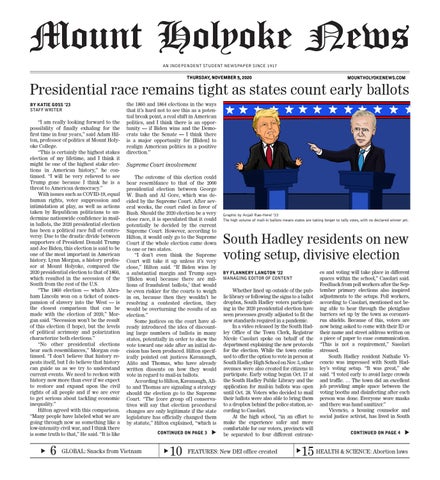
Graphic by Anjali Rao-Herel ’22 The high volume of mail-in ballots means states are taking longer to tally votes, with no declared winner yet.
South Hadley residents on new voting setup, divisive election BY FLANNERY LANGTON ’22 MANAGING EDITOR OF CONTENT
Whether lined up outside of the public library or following the signs to a ballot dropbox, South Hadley voters participating in the 2020 presidential election have seen processes greatly adjusted to fit the new standards required in a pandemic. In a video released by the South Hadley Office of the Town Clerk, Registrar Nicole Casolari spoke on behalf of the department explaining the new protocols for the election. While the town continued to offer the option to vote in person at South Hadley High School on Nov. 3, other avenues were also created for citizens to participate. Early voting began Oct. 17 at the South Hadley Public Library and the application for mail-in ballots was open until Oct. 28. Voters who decided to mail their ballots were also able to bring them to a dropbox behind the police station, according to Casolari. At the high school, “in an effort to make the experience safer and more comfortable for our voters, precincts will be separated to four different entranc-
FEATURES: New DEI office created
u
es and voting will take place in different spaces within the school,” Casolari said. Feedback from poll workers after the September primary elections also inspired adjustments to the setups. Poll workers, according to Casolari, mentioned not being able to hear through the plexiglass barriers set up by the town as coronavirus shields. Because of this, voters are now being asked to come with their ID or their name and street address written on a piece of paper to ease communication. “This is not a requirement,” Sasolari stressed. South Hadley resident Nathalie Vicencio was impressed with South Hadley’s voting setup. “It was great,” she said. “I voted early to avoid large crowds and traffic. … The town did an excellent job providing ample space between the voting booths and disinfecting after each person was done. Everyone wore masks and there was hand sanitizer.” Vicencio, a housing counselor and social justice activist, has lived in South CONTINUED ON PAGE 4
u
15 HEALTH & SCIENCE: Abortion laws
2
EVENTS
November 5, 2020
. Mount Holyoke News
Mount Holyoke News Mount Holyoke News is an independent student newspaper written by and for Mount Holyoke College students since 1917. VISIT US: www.mountholyokenews.com www.facebook.com/themhnews www.twitter.com/mtholyokenews_
EMAIL US: mhnews@mtholyoke.edu
Executive Board Editor-in-Chief Lily Reavis ’21 Managing Editor of Content Flannery Langton ’22 Managing Editor of Layout Rose Sheehan ’22
Publisher Liz Lewis ’22 Managing Editor of Web Zoe Farr ’21 Business Manager Sarah Nam ’23
Copy Chief Kelsey Thomas ’21
Editorial Board News
Casey Roepke ’21, Kate Turner ’21 & Liz Lewis ’22
Arts & Entertainment Sabryna Coppola ’22 & Mariam Keita ’24
Health & Science
Kessh Bhasiin ’22 & Zoe Greenberg ’23
Features Mimi Huckins ’21 & Tishya Khanna ’23
Sports
Opinion/Editorial
Gigi Picard ’22
Nina Larbi ’22 & Libby Spy ’24
Environmental Meryl Phair ’21
Books
Sidney Boker ’21
Photos
Global
Ali Meizels ’23 & Rosemary Geib ’23
Saman Bhat ’22 & Sophie Soloway ’23
Copy Editors
Audrey Hogan ’21, Molly Kleinman ’21, Audrey Shannon ’22, Margaret Connor ’23 Kenna Hurtuk ’23, Zoe Latham ’23, Lauren Leese ’23, Rhitom Mishra ’23 & Kay Brown ’24
Layout Editors
Maggie Donovan ’23, Angie Romero ’24 & Zoe Tang ’24
Web Editors
Audrey Hogan ’21, Shloka Gidwani ’22, Georgia Fish ’23 & Aarushi Sharma ’23
Publication Guidelines Mount Holyoke News does not endorse any of the opinions or views expressed within the pages of the paper, excluding staff editorials. All content copyright of Mount Holyoke News. All rights reserved. Mount Holyoke News does not discriminate on the basis of gender, race, religion, ethnicity, sexual orientation or age.
Advertising in MHN Interest in advertising in MHN can be directed to mhnews@mtholyoke.edu for pricing and deadlines. MHN reserves the right to refuse submissions on the basis of, but not limited to, advertisements considered to be libelous, obscene, defamatory or discriminatory.
Subscriptions Mount Holyoke News is a weekly publication that will publish online-only throughout the fall semester 2020. To subscribe through email, please visit the following form: https://forms.gle/VPCyskE4kMTDeDan8.
Letters Policy Letters to the Editor appear exactly as they are sent to MHN, except for corrections to spelling, grammar and AP style. Letters cannot exceed 500 words. All letters must include the writer’s name and telephone number for verification purposes. Unsigned letters will not be printed. Names may be held upon request with the approval of the Editor-in-Chief. MHN reserves the right to decide which materials will be printed. Email submissions to mhnews@mtholyoke.edu by Sundays at 5 p.m. for publication the following week.
Event Highlights Friday, Nov. 6
RACE AND….Dance: Caribbean Dance Featuring Tania Isaac This six-session series seeks to teach Five College students various forms of African diasporic dance and, crucially, the cultures in which they are rooted. Registration is required through Embark. 4:30 p.m. - 6:00 p.m. EST
STEMPOC Mixer
The STEMPOC mixer is a chance for students of color who are interested in studying STEM to interact with their peers and faculty. We hope that this event will help build community across the STEM departments, encourage retention in STEM, and prepare students of color with the necessary tools to navigate the culture of academia. Registration is required through Embark. 4:30 p.m. - 6:00 p.m. EST
Saturday, Nov. 7
HackHolyoke HackHolyoke is MHC’s annual hackathon where students from the college and dozens of colleges around the world come together to create innovative tech projects. Come to compete for cool prizes, learn at our many workshops, or just have fun with virtual Zoomba and M&Cs. Registration is required through Embark. 10:00 a.m. - 2:00 p.m. EST
Di Naye Froyen Kapelye: Women of Klezmer
The world premier of an ensemble of 5 eminent women of klezmer, performing a complete program of their own klezmer compositions. The ensemble’s works, many premier performances, will honor Women’s Suffrage as well as Eastern European Jewish Assimilation. Registration is required through Embark. 7:00 p.m. - 9:30 p.m. EST
Tuesday, Nov. 10
Panel Discussion of 2020 Elections
Join Mount Holyoke College Professors Lynda Morgan (History Department), Daniel Czitrom (History Department), and Ali Aslam (Politics Department) for a panel discussion of the United States November 3, 2020 election results and their implications. Zoom meeting ID: 945 3640 5335 4:15 p.m. - 5:45 p.m. EST
November 5, 2020
NEWS
. Mount Holyoke News
3
Trump declares victory with millions of votes uncounted, cont’d scanned or counted by a machine. If a state does not count mail-in ballots until Election Day, it is not possible for them not usually how they’ve been changed to get through all mail-in ballots in a all around the country. single day. In this situation, state judges usually Additionally, mail-in ballots that rule on what is or is not appropriate, as come in after Election Day, even if they the board of elections or the Secretary are postmarked with a date prior to the of State make arrangements early on. day of the election, may be rejected in “The Supreme Court is signaling that, some states. States that count their if it came to them, they would reject all mail-in ballots ahead of Election Day, of those arrangements and all of the such as Florida, are typically able to ballots cast under those produce more accurate arrangements,” Hilton projections of who the said. “That would be state will favor on elec“I don’t have faith in so bad for them to do tion night. The country the Supreme Court something like that, and will not have an official right now, but I have it would be such a rankwinner until all ballots ly partisan decision. It have been counted, more faith that [the flies in the face of any election] won’t go to the and since all 50 states rational explanation or are following differSupreme Court.” strategy.” ent mail-in ballot laws, After the rushed that process could take confirmation to the days or even weeks. - Maggie Micklo ’21 court of Amy Coney Further, with varying Barrett, along with time zones, differing Trump filling two other state populations and a Supreme Court seats, many members of wide array of laws in regard to voting, the Mount Holyoke community do not the country is not running on the same have confidence in the high court ruling schedule. fairly. On election night, Hilton explained, “I don’t have faith in the Supreme “News agencies call a state based on Court right now, but I have more faith projections, not the actual tallied rethat [the election] won’t go to the Su- sults.” Because of this, he finds the line preme Court,” Maggie Micklo ’21, pres- of thinking held by Trump and some ident of the College Democrats, said. “I Republicans that the result must be think that was more likely of a scenario announced on Nov. 3 “ridiculous.” He a month ago when the polls were a lit- added, “It’s never been the case that the tle more tight than they are now. That’s election ends on Election Day — it’s just not to say it couldn’t happen, and if it never happened.” happens, I don’t have very much faith Natalie Glick ’23, who plans to dethat Amy Coney Barrett would recuse clare a major in politics this year, said herself or that the justices would vote it would not be surprising if the results based on the facts.” remained unknown the week of the “I think it’s a different court than we election. “I think [for the] presidential had in Bush v. Gore, but I think we saw [election], we flat out will not know on then that ideology can often come first [Nov. 3] for various reasons, and I think over facts,” Micklo continued. “I think in a lot of Senate races — especially in that would be an extremely dangerous Georgia and potentially South Carolina thing for just American democracy in — we’re not going to know about those general, if this election is decided by a either,” Glick said. “I think it’s fair to asdelegitimized court, and puts in place a sume that this could be a process that president that once again does not have goes on for two to three weeks, similarthe support of the majority of Ameri- ly with what happened in 2000 with Al cans. That is probably the most danger- Gore [and Bush], which is very scary.” ous and terrifying outcome that I can Because Trump has been openly imagine,” she added. unsupportive of mail-in ballots, calling them “fraudulent,” many of his supporters were expected to vote in person. For A rise in mail-in voting this reason, analysts expected the surge A contested outcome could only go of tallied votes for Trump on election to the court after all votes were count- night. “We can expect to see the ‘red mied, which could take a substantial amount of time. Mail-in ballots take the rage,’ which is that many swing states longest to count because they are count- might turn red early, and then the ‘blue ed by hand, whereas ballots cast at poll- shift,’ which is that as all of those absening locations are typically electronically tee and mail-in ballots begin to be pro-
CONTINUED FROM PAGE 1
u
cessed,” Hilton said. He added that this change may happen quickly — as early as the morning after the election — or it may take a few days as mail-in ballots continue to be counted.
Counting the votes
Press announced that Michigan flipped blue in favor of Biden. Trump has already opened the possibility that if he loses, this election will be decided before the Supreme Court; however, many legal battles at the state level would need to happen before that point. He is currently fundraising for those legal battles and looking for support from the GOP along with his supporters.
As predicted, results were not available on election night. States like Pennsylvania and Michigan that did not start counting mail-in ballots until Election Day have since Pandemic influences said they may need until the end of the The outcome of the election was week to finish counting. Though these states have been showing a majority in not the only thing on voters’ minds in favor of Trump, it has been emphasized the weeks preceding the event. Due by state officials that majorities could to the pandemic, there was a surge in change as they count their mail-in bal- both mail-in and early voting. Because of this, Republicans in many states filed lots. “Some election results should come lawsuits surrounding mail-in ballots in up fairly quickly, though in some states order to get a number of them thrown (like in Pennsylvania) we may not see out. Although these efforts were not election results right away as absen- very successful, Hilton says it was the tee ballots aren’t being opened up until Republicans’ way of systematically unElection Day,” Sandra Scarlatoiu ’22, dermining public confidence in this votpresident of the College Republicans, ing method in every way possible. Micklo stated, “The amount of lawsaid. “I do personally believe this creates a lot of room for voter fraud, so suits that are happening right now from there is a possibility it could be brought Republican campaigns or operatives in [an] attempt to throw out ballots — to the Supreme Court.” States which were able to count that is just clear voter suppression and their ballots before Election Day but do trying to rig results that don’t actually not accept ballots after Election Day, match how the country is feeling, which such as Florida, were able to give final is awful.” Hilton added, “Not only do we have results on election night. Overall, by Nov. 4, 41 states had giv- the uncertainty introduced into the en their final results, leaving Biden with election by the COVID-19 pandemic — 253 electoral votes and Trump with 214. which would probably create all kinds Just after 2 a.m. EST on Nov. 4, of problems on its own — but then it’s Trump gave a statement in the White become such a partisan battle too. House to those gathering in support of Trump has not only been actively trying his campaign. He recounted that he had to undermine the legitimacy of mail-in ballots, but more or less the Republican won the electoral votes Party is backing that in Florida, Ohio and effort in an official caTexas and said that it “It’s never been the pacity.” was “clear” he had also case that the election Leading up to Elecwon Georgia and was tion Day, Trump has winning North Caroliends on Election repeatedly stated that na, Pennsylvania and Day, it’s just never voting by mail has led Michigan. happened.” to fraudulent results “This is fraud on the and urged his supportAmerican public. This ers to vote in person. is an embarrassment - Adam Hilton Although there have to our country,” Trump been a few cases of said. “Frankly, we did fraud related to mail-in ballots, a 2017 win the election.” Although his claim of winning cer- study by the Brennan Center for Justice tain states was true at the time of his showed that the overall amount of votannouncement, those states had stated ing fraud in the U.S. is less than 0.0009 that they had not counted all of their percent. Additionally, the Federal Elecmail-in ballots by the end of election tion Commissioner Ellen Weintraub night. Trump made these claims while said, “There’s simply no basis for the he was losing the popular vote, along with holding fewer Electoral College CONTINUED ON PAGE 11 u votes. Since his speech, The Associated
4
NEWS
November 5, 2020
. Mount Holyoke News
Voting in a pandemic: South Hadley and the 2020 election, cont’d u
CONTINUED FROM PAGE 1
Hadley for more years than she can count. This was her first time voting in a presidential election because she has recently become an American citizen. “It felt empowering, as it’s an additional contribution to my community,” she said. “I’ve already been paying taxes since I was 15 years old, but voting in this election was especially important to me and my family.” This was also a landmark election for resident Kathy Chirstal-McDonald. “I’m 61, and this is the most important election of my lifetime,” she said. “I and a few friends worry that it could be our last time voting if [President Donald Trump] wins again.” Chirstal-McDonald, who grew up in Northampton, has been surprised by the more conservative viewpoints she has heard in South Hadley and the Pioneer Valley leading up to the election. “I’ve always thought of the Valley as a bubble of liberals, and obviously I’m wrong,” she said. The pandemic has also shaped the political climate, according to Chirstal-McDonald, who shared a story of recent street harassment. “I went for a walk in my neighborhood a few weeks ago and someone yelled out their window at me, something along the lines of, ‘What a good little sheep.’ I had a mask in my hand just in case. It was shocking to me and so disheartening,” she said. Additionally, Chirstal-McDonald said the Facebook community page became so full of “conflict and hate” that the administrators had to shut down posts talking about the pandemic. “[COVID 19] is so divisive,” she said. “I’ve never seen science be a question of opinion this way.” Vicencio also thinks of this election as representing a larger societal conflict. “It’s a conservative versus liberal war,” she said. “At this point, this country can no longer hide the injustices that have been committed against all kinds of people, especially oppressed and marginalized people. The only way forward is by coming together to put an end to the blatant abuse that the obscenely rich people are committing against everyone else and the environment.” Vicencio continued, “Hate, bullying [and] harassment are not the values we should pursue as U.S. citizens. We need to refocus on the things that matter which is making sure we have access to affordable healthy housing, health care that does not involve bargaining between paying for heat or paying for premiums, affordable education, healthy foods free of pesticides
and pollutants and surviving this [COVID 19] pandemic,.” Mount Holyoke Professor and Chair of French Catherine Le Gouis and her husband Brian Carter, a former faculty member at Yale University, are both residents of South Hadley. The two voted in person on Nov. 3. “It seemed as if that is the most reliable way for our vote to be counted,” Le Gouis said. Despite deciding to vote in this way, they remained wary of potential Election Day crowds. Le Gouis and Carter spent Monday working out when they would go vote to avoid the majority of lines. “We are older people,” Le Gouis explained. “We don’t want to get exposed to the virus so we are being very careful to minimize exposure.” “I’m looking forward to it,” Carter said about voting. “I assume it’s going to go very calm and smoothly. … There may be some trouble somewhere. There isn’t going to be any trouble in South Hadley.” He emphasized that the only tangible difference for this election will be masks and social distancing. Despite incidents like what Chirstal-McDonald faced, Carter remained confident that the election itself would run smoothly, especially in South Hadley, where former Vice President Joe Biden is sure to win. South Hadley’s largely Democratic leanings were shown in the 2020 primary elections. There were 4,264 votes cast for president on the Democrat primary ticket as opposed to the 793 cast on the Republican primary ticket. Biden won the primary in South Hadley with 1,374 votes with Senator Bernie Sanders following closely at 1,190. Carter likened this election to the nervous buildup leading to Y2K when many were worried that a computer glitch was going to bring down the internet. “Everyone was scared and it turned out to be absolutely nothing,” he said. He remains confident about this in South Hadley specifically, where the only contested race on the ballot is the race for president. “It’s a Democratic town. It’s a college town in Massachusetts,” Carter said. He also argued that even in small towns that could vote Democratic or Republican, there shouldn’t be any literal conflict at the polls. “Most places in the United States are like South Hadley, … even the ones that are [in] contested [places],” Carter said. “There are little towns in Indiana and little towns in Massachusetts that the Republicans might win. But [everyone knows] each other. And they don’t have the animosity. They run these elections together for decades, and I would be astounded if there is a big problem around
Photo courtesy of WikiMedia Commons The town of South Hadley has taken multiple precautions to ensure voting remains safe during COVID-19.
here.” There are some worries about a peaceful transition of power as launched by Trump’s confusing comments in a conversation with journalist Chris Wallace that he wouldn’t necessarily believe the results of the election and may resist the outcome. Le Gouis didn’t voice immediate concern about this. Like Biden, she wasn’t entirely sure how Trump would try to hold power after January, hoping that other governmental organizations would step in. “Someone has to be the grown-up and it’s not going to be Trump,” she said. Carter, though still confident the transition will happen, is less sure about the process for ensuring it. “Trump has run politics like he ran his business,” he said. “You bluster, you bring out your lawyers, you stiff your contractors and when they object you just hit them with one lawsuit after another and finally they back down. Trump thinks like that, I think, and I wouldn’t be surprised if he makes a fuss, but it won’t get anywhere.” Carter does believe, however, that Trump cannot stop the votes from being counted because elections are conducted by states and localities. Regarding vote counting, Carter and Le Gouis are wary of the numbers and of potential victories declared on Tuesday night or Wednesday. “The mail-in ballots will be taking longer to count and the Republicans will probably be voting in person more than the Democrats, so there may be a delay as they count,” Le Gouis said. Carter related this to the “blue wave” and the “red rush.” “The red rush is the fact that the Republicans are voting in
person more than the Democrats, so their votes get counted first and that’s why everyone has been saying, left and right and center, expect that at least for the first part of the night and maybe into Wednesday … Trump is going to lead. But as the mail-in votes get tabulated, he’s going to lose, and there’s really no way he’s going to be able to stop the count,” Carter detailed. The future of both parties after this election remains uncertain. Even with a Trump loss, Le Gouis believes he will continue to control the Republican Party. “The base has a very strong attachment to him,” she said. “Even if he is in jail, he will continue to own the Republican Party.” For Le Gouis, the future of the Democratic Party hinges on if they take the Senate and Biden’s possible efficacy as a president. Additionally, if the Democrats do not take the Senate and Mitch McConnell (R-KY) continues to be the majority leader, Carter believes the recession will continue and the country will blame it on Biden. “It’s probably more likely that the Democrats take the Senate and McConnell becomes the minority leader and [is] no longer in charge of blocking everything then that he loses” he said. As of Nov. 4, the Democrats and Republicans each have 48 Senate seats with 4 left up for grabs in races in Alaska, North Carolina and Georgia. In Hampshire County, Biden is the predicted winner with an estimated 65 percent of votes counted. Detailed information on South Hadley will be released by the Town Clerk in the following days.
November 5, 2020
. Mount Holyoke News
OPINION/EDITORIAL
5
Laws protecting Indigenous sovereign- Celebrity activism is hypocritical and ty are toothless and discriminatory
Photo courtesy of WikiMedia Commons National laws often disadvantage and disvalue Indigenous peoples.
BY KAVERI PILLAI ’23 STAFF WRITER
Nobody is above the law. This idea, shared by many democratic countries, creates credibility that the legislative arm of the government embodies. In democracies with growing populations like India and the U.S., it is the codified law that holds sanctity together. When someone is involved in breaking the law, they are rightfully persecuted. Yet there are certain social groups, specifically Indigenous peoples, that miss out on these fundamental rights. Indigenous groups worldwide do not benefit from the promise of justice. A new wave of activism seems to have engulfed the larger public when it comes to awareness and campaigning for Indigenous rights. The divide that was created between the people of today and the people who simply do not fit in, often seen as the “other,” is commonly traced back to the colonizers and their vicious journey of pillage and plunder. 18th century India might have fought against the British before our tryst with destiny, but the “divide and rule” policy that they implemented is something the government has to deal with today. The 1979 Mandal Commission signed by the then-Prime Minister of India Morarji Desai was one of the few steps taken to formally identify the “socially or educationally backward” classes. Initially what might have been seen as a monumental constitutional right for scheduled castes and scheduled tribes in the Indian subcontinent — the protests regarding reservation of seats in universities and civil service job posts — is what made this social movement for Indian Indigenous groups a rather turbulent one. This first step toward justice laid the foundation for various Indian activists who challenge the myopic legislation and the unfair execution of the same. However, this wave of activism gets diminished when confronted by the oppressive national government. Since 2018, 16 activists who have been lobbying for Adivasis, the native tribes, have been arrested under the pretense of belonging to the radical left Naxal group. The recent arrest of a Jesuit priest, Father Stan Swamy,
further ignites the flame of intolerance that has been fueled by the right-wing government. Swamy, who has been a beacon of hope for the tribal community in the state of Jharkhand, has spent 30 years of life fighting for the Fifth Schedule of the Indian Constitution, which is supposed to grant free land and autonomy to the Indigenous groups of India. A believer in leveling out the scales and bringing peace to the ostracized, Swamy has also tried to advocate for native land for the creation of small and big industries. Coloring a Christian priest’s act of service and goodness as a threat to the purity of Hinduism is just the first tactic used by the not-so-secular ruling Bharatiya Janata Party. By labeling Swam a “Maoist,” the government has successfully shown the country and the world that India will never truly welcome Indigenous peoples as Indians. The irony that the ones who were colonized are now playing the role of the colonizer is something that unfortunately goes beyond national borders. The United States has established its global hegemonic status as the leader of the free world despite denying its own citizens freedoms for political reasons. The tales of the first few American presidents and the botched-up narrative of history reify this long standing animosity white Anglo-Saxon Protestants have regarding Indigenous peoples. This connection between native identity and native land echoes the need for tribal sovereignty, self-governance and legitimate autonomous rule that was earlier promised by the United States Supreme Court in the McGrit v. Oklahoma case in July. However, like all power hungry government bodies, the Trump administration gave the Environmental Protection Agency full access to the once-promised independent Muscogee Creek region of Oklahoma in October. Under nefarious acts like the Toxic Substances Control Act, which can, in a stupendous change of events, overrule a Supreme Court hearing, hazardous waste and toxic air pollutants can be discarded into this preserved land. What the government fails to realize is that this genocidal move does not only threaten the natives’ access to clean water or even sense of personal land, but also normalizes the fact that Indigenous land has no meaning to a 21st century society, and the people inhabiting this land are seen as anything but human. The separate colonial contexts of both India and the United States include different yet similar problems ranging from slavery to economic suppression. However, what seems to be a constant is the ill treatment toward Indigenous groups and the legislation that is passed by these “democratic” countries, which creates a divide between national citizens and native peoples. The world we now live in revolves around money and political gain. In this fight to achieve absolute power, the Indigenous population has been conveniently left out. This stifling nature of governmental bodies will soon enough crush the spirit that drives such groups and will reduce ethnic history to forgotten anecdotes that will be dominated by the spoils of oppressive modern states.
narrow, despite large influence BY JAHNAVI PRADEEP ’23 STAFF WRITER
Today, we live in a largely online society with most of our communications nurtured by the blue glares of our smartphone and tablet screens. In this ecosystem, the internet has influenced the way we interact with various forms of activism. A blue profile picture for Sudan, a red #StandwithKashmir Instagram story and a recent surge of black boxes and #BlackLivesMatter posts sum up our solidarities. We must pause to evaluate how this internet culture often echoes incomplete solidarity and hypocritical actions, and the first target of this scrutiny is celebrities. Many celebrities are performative in their activism, taking up topics as they are “trending” or selectively choosing topics that do not harm their privileged positions. They choose this over actually getting their feet wet and undertaking meaningful actions and dialogues. With the awareness of these public figures’ power and influence, we must call them out when they lack the responsibility to engage in certain discussions. Indian actress Priyanka Chopra is the embodiment of this selective and privileged activism. In June, Chopra expressed her solidarity with the Black Lives Matter movement, posting a “Please, I Can’t Breathe” image on Instagram. However, there is a dark side of her activism, or rather, her lack thereof. For starters, Chopra has been the brand ambassador of skin lightening creams and products that promote and reinforce colorism and its thriving industry in India. She endorsed Ponds lightening cream in 2008 and Garnier lightening cream in 2012. When influential figures like Chopra endorse such products, it sanctions discrimination and prejudice, and is the opposite of the “responsibility to end hate” that she posts about. As Bhawna Jaimini noted in a LiveWire article, “Nothing like earning those big bucks from endorsements and still earning those brownie-woke points.” Additionally, Chopra, who claims to be concerned about systemic oppression and police brutality, solely talks about occurrences in the U.S. What about incidents taking place in India? The anti-Citizenship Amendment Act student protests at the end of 2019 in India were met with state-sanctioned police brutality. During one such incident at Jawaharlal Nehru University, a masked mob entered and attacked, injured and CONTINUED ON PAGE 7
u
6
GLOBAL
November 5, 2020
. Mount Holyoke News
Pope Francis approves same-sex marriage in “Francesco” BY AMELIA LUO ’23 STAFF WRITER & PHOTOGRAPHER
In the documentary “Francesco” — which premiered on Oct. 21 at the Rome Film Festival — Pope Francis expressed his support for same-sex civil unions, stating that gay people are also the children of God. Pope Francis’ remarks, different from the traditional teachings of the church, might bridge the gap between the church and its recognition of LGBTQ+ community. “Francesco,” directed by Evgeny Afineevsky, documents Pope Francis’ (born Jorge Mario Bergoglio) papacy for the past seven-and-a-half years, including his views on the environment, poverty, migration, inequality and more. In the film, Pope Francis states, “Homosexual people have a right to be in a family. They are children of God and have a right to a family. Nobody should be thrown out or be made miserable over it. What we have to create is a civil union law. That way they are legally covered. I stood up for that.” This interview was the first time that Pope Francis has publicly stated his unequivocal support for same-sex civil unions after taking on the papacy. For years, the Pope has not given a definitive answer about their views on same-sex unions. In 2013, when asked about homosexuality on a flight back to Brazil, he answered, “If a person is gay and seeks God and has good will, who am I to judge?” Yet in 2016, he flat out rejected same-sex marriage in his book “Amoris Laetitia” (The Joy of Love), claiming that it is in no way equal to marriage between a man and a woman. That being said, he still voiced support for people who are in nontraditional relationships such as single par-
ents, unmarried straight couples and gay people who live together. According to The New York Times, public support from Pope Francis has “the potential to shift debates about the legal status of same-sex couples in nations around the globe,” mitigating the relationship of the Catholic Church to the LGBTQ+ community. Rose Lu ’23, a gender studies major at Mount Holyoke, remarked on how external societal factors play a large role in influencing people’s personal beliefs. “I believe that social structure [and] culture and people’s ideas are interlinked,” she said. “I always thought that if followers can accept other things that are forbidden in the Bible such as divorce and masturbation, then they shouldn’t exclude the LGBTQ[+] group.” Pope Francis has made increasingly progressive comments and decisions during his papacy. On Oct. 25, he appointed the first African American cardinal to the Catholic Church’s highest governing body in history. Archbishop Wilton Gregory is a Chicago native and the first American named to the College of Cardinals since 2016. Critics from both sides have commented on Pope Francis’ recent remarks. Since traditional Catholic teachings condemn and prohibit homosexual acts, conservatives have criticized him for “diluting” the church’s doctrine and reversing years of its teachings. Others point out that while Pope Francis has helped shift the tone of the church on the topic of homosexuality, there has been little action involved in actually changing its teaching or policies. Carrie Lewis ’23 expanded on this sentiment. “I think for Catholics in the LGBTQ+ community it’s a big step forward to accepting them fully for their sexuality,” Lewis said, noting that the Pope’s statement
Photo courtesy of WikiMedia Commons Pope Francis strays from the Vatican in supporting same-sex marriage.
likely will not reverse homophobia within the religion. “For the Catholic community itself, I would be curious to see how this is introduced at the parish level. I wonder if they’ll begin to teach this new ‘dogma’ in Catholic schools.” According to NBC, the Vatican is still firm in its claim that marriage is an “indissoluble union between man and woman,” thus making same-sex marriage unacceptable.
Lockdown treats from across the globe: Snacks from Vietnam BY MADHAVI RAO ’24 STAFF WRITER
During the pandemic and resulting online classes, many students are taking refuge in food and quick snacks. For Vietnamese students at Mount Holyoke, these treats can take a variety of forms. A popular snack is Vietnamese fresh spring rolls (gỏi cuốn). According to Celia Tran ’23, a member of the Mount Holyoke Vietnamese Student Association, “Gỏi cuốn consists of thin vermicelli noodles, pork slices, shrimp, basil and lettuce all tightly wrapped in rice paper (bánh tráng). Gỏi cuốn is a healthy and affordable dish [of] all balanced proteins and vitamins dipped in a hoisinbased sauce. A cool go-to for anyone out there who craves a fulfilling yet tasty snack.” Another popular Vietnamese snack food is Hảo Hảo, a brand of instant noodles. Anh Tran Nguyen Chau (Amy) ’23 described how she likes to pair the noodles with eggs and Welsh onion. “This dish reminds me of when I was 5 or 6; my grandma used to make [them] for us after we got home from kindergarten. It is also a food that I craved the most when studying in MoHo. I’m really glad to be back home now and enjoy all the food I want,” she said.
Photo courtesy of Dan Khanh Vo (Aurora) ’23 Dan Khanh Vo shares her favorite snacks: AFC Biscuits and chocolate.
Photo courtesy of Celia Tran ’23 Tran’s favorite snack, gỏi cuốn, is made with noodles, pork and shrimp.
A third Vietnamese snack favored by Mount Holyoke students is rice paper. As described by Dan Khanh Vo (Aurora) ’23, “From where I live, rice paper is [a] go-to street food. You can see it everywhere on the street, and it is delectable (at least for me)! To get a full combo, we mix in some other ingredients such as
dried shrimp, peanut[s], chili powder and many other add-ons.” On the sweeter end of Vietnamese snacks lies AFC Biscuits, a brand of vegetable crackers. “In Vietnam, especially the southern part, as kids and teenagers, we eat this nonstop,” Vo said. “They also come in many flavors, and my favorite one is matcha.” She added that another snack food favorite is chocolate, saying, “Everyone loves chocolate — anyone and anywhere!”
November 5, 2020
GLOBAL
. Mount Holyoke News
7
Chileans vote for new constitution The politics of BY SOPHIE SOLOWAY ’23 GLOBAL EDITOR
On Sunday, Oct. 25, 78.3 percent of Chilean citizens voted in a referendum in favor of a new national constitution. This majority decision follows a year of protests in Chile largely centered around calls for major changes to the country’s democratic process and leadership. According to The Guardian, this national vote was the first step in meeting protesters’ demands and beginning a new chapter for the country. Helen Roane ’23, an international relations major at Mount Holyoke, reflected on the referendum.“I think it is really important that Chileans have taken this step [toward] creating a more democratic government and ensuring that their voices can be heard in the future,” Roane said. “It feels especially hopeful in the context of living through the current United States election, where people are concerned about their votes counting or having their opinions heard.” In October 2019, it was announced that metro fare prices would be raised in Chile. The announcement was immediately met with disdain from citizens who claimed that this would make public transit inaccessible to the majority of Chileans. While this planned price hike was canceled just two days after its announcement, economic protests have persisted well into 2020. Beginning with intentional turnstile-hopping and soon culminating in a declared state of emergency, these protests quickly widened to encompass the extremely high rate of wealth inequality and rising living costs in Chile. One of the largest demands that emerged from the diverse array of protesters was that for a new constitution. The current legislation was created in 1980 under Augusto Pinochet, who is widely recognized as a dictator in the country’s history. Although changes have been made to that constitution, its relation to Pinochet’s rule holds weight in citizens’ eyes. According to Assistant Professor of Politics Cora Fernandez Anderson, “Since 1990 with the transition to democracy, the political regime changed but most of the economic reforms were left intact. As protesters were saying these days, ‘It is not about the 30 pesos (the increase of the subway fare), it’s about the last 30 years,’ about the lack of change brought by democracy, about the increasing social injustice and inequality that democracy was not able to address.” “The privatization of health and education done by Pinochet is still in place, and it is not surprising that students have been at the forefront of protests,” Fernandez Anderson continued. Fernandez Anderson also spoke to the increased influence of student protests in Chile. “The student movement in Chile is very strong; [it] emerged first around 2010 and had other peaks of mobilization, and while the initial protests were about the subway fare this time, students were fast to make these protests about something bigger than an increase of the price of transportation but throw light into the structural injustices present in the country,” she explained. In November 2019, political leaders voted to approve a public referendum on the subject of maintaining or demolishing the fraught constitution. However, the COVID-19 pandemic delayed its implementation. On Sunday, voters were finally able to vocalize
reproduction BY KESSHNI BHASIIN ’22 HEALTH & SCIENCE EDITOR
Content warning: This article contains discussion of abortion.
Photo courtesy of WikiMedia Commons Protesters gather in Santiago, voicing disdain against rising metro fees.
their hopes for the country in the voting booths. 50.9 percent of eligible voters cast their votes, marking increased voter turnout from the most recent presidential election, according to The Guardian. “This shows that the population has not participated actively in previous elections because of a deep crisis of representation,” Fernandez Anderson explained. “Existing parties were not giving real options, neoliberalism had been embraced by all parties and alternatives to this economic model were [off] the table. Political parties were not able to channel people’s discontent, voting turnout was low, and people found the streets as a way of expressing their frustration and their search for alternatives. The referendum and the decision to reform the constitution seems to show the political system acknowledged its crisis and is on the way to create a hopefully more legitimate political system in which people feel better represented and taken care of.” Voters will return to the booths in April 2021, when a vote for new assembly members is scheduled to take place. Yet another referendum will be held in the first half of 2022 in order to approve or disapprove of the proposed constitution that will be written by these newly elected officials. Fernandez Anderson noted that these votes will have a wide range of topics, including whether or not to remain a presidentialist system or change to a “parliamentarism or semi-parliamentarist system.” They are also considering the decentralization and regionalization of the country. Additionally, “A big issue will be to define the relationship with the Indigenous people, mostly the Mapuche [people] who have been demanding rights for decades,” according to Fernandez Anderson. The role of the state in the economy will be another controversial issue, along with its role in guaranteeing social rights such as health, education, housing and more, Fernandez Anderson explained. As the country awaits these upcoming elections, they also await a decision that would shape Chile’s political future. “I think this is a moment for Chile to rethink their whole political system and in the spirit of the protests push for a deepening of democracy, take advantage of this moment to put everything under scrutiny,” Fernandez Anderson said. “This is a foundational moment for this country and I hope they will take it as such.”
Tens of thousands of women braved the cold, possible arrest and a deadly virus as they marched across Poland to fight for their right to choose this October. Dressed as baby incubators from “The Handmaid’s Tale” in red hoods and carrying red lightning bolts, these women banded together in the country’s largest protests since the 1980s following an unappealable ruling to ban almost all abortions in the country. Per this new ruling, the procedure may be carried out only under strict exceptions — conception via criminal acts like rape or incest or when continued pregnancy poses a threat to the woman’s life. Prior exceptions granted for fetal abnormalities have been abrogated under this new law. A sense of despair and vehement anger toward the government and the Catholic Church appears to hang heavy across the European nation, with many visuals depicting smoke, shouts and tears. Given the United States’ confirmation of Justice Amy Coney Barrett — the third conservative justice President Donald Trump has appointed to the bench — it is possible to wonder if the U.S. is headed down a similar path. This Supreme Court bench is set to receive cases that could open the doors to overturning Roe v. Wade, especially with the conservatives holding a 6-3 majority and numerous Senate Republicans keen to support such a move. In essence, there appears to be a very real possibility that women could stand to lose their reproductive freedoms. Assistant Professor of Politics and expert on reproductive rights in Latin America Cora Fernandez Anderson discussed the importance of these freedoms and the role of government, if any, in regulating reproductive rights. Fernandez Anderson said that historical facts and current trends may help anticipate the aftermath of more restrictive abortion laws. The new laws may lead to the birth of great “social injustice,” similar to that in the U.S. and the majority of Latin American countries before 1973, according to Fernandez Anderson. “Rich women will still be able to gain access to abortion — they will just travel elsewhere to do it — while women belonging to minority and poor communities will no longer be able to access safe abortions,” she said. This lack of access has not historically translated to a decrease in the number of abortions performed in these countries. Women of all communities and economic statuses have still found CONTINUED ON PAGE 15
u
8
ARTS & ENTERTAINMENT
November 5, 2020
. Mount Holyoke News
‘The Haunting of Bly Manor’ offers more than just spooks
Photo courtesy of WikiMedia Commons Victoria Pedretti portrays Dani Clayton in “The Haunting of Bly Manor,” which has risen to the top of Netflix charts since its October debut.
BY ANIKA SINGH ’24 STAFF WRITER
“The Haunting” universe gets its second edition of spooks and scares from Netflix’s much-awaited “The Haunting of Bly Manor,” the season following its highly acclaimed predecessor “The Haunting of Hill House.” Adapted from the thriller novella “The Turn of the Screw” by Henry James, “The Haunting of Bly Manor” follows young American Dani Clayton (Victoria Pedretti) as she takes up a job as an au pair to two
orphaned children at their huge ancestral mansion located in the fictional town of Bly, England. Though Bly has a certain charm to it, given the beautiful landscapes of the English countryside and the friendly and sociable staff at the manor, something looms over its freshly manicured gardens. Dani, haunted by her past, seems struck by the eeriness of the mansion, and with the two children, Miles (Benjamin Evan Ainsworth) and Flora (Amelie Bea Smith), who are ever so polite (yet possessive) and the peculiar death of the previous au pair, she simply can’t avoid feeling uneasy.
Mike Flanagan, the creator of the series, does a stellar job at interpreting “The Turn of the Screw” with his creative insight and follows the sequence of timelines as his way of storytelling. We see a great in-depth approach taken to present the arcs of the various characters, especially that of Hannah Grose (T’Nia Miller), the housekeeper at Bly Manor. We see a beautiful portrayal of a series of events that coerces the audience to read between the lines. The first half of the show is slow, taking its time to unfold, yet manages to keep the audience occupied by various introductions of the past regarding the manor. The jump scares are kept to a minimum, which is different from “The Haunting of Hill House.” Instead, “Bly Manor” preys on the viewer’s mind by creating anticipation through long shots which build upon the mystery that surrounds the manor. If that was not enough, “The Haunting of Bly Manor” makes it a goal to strum the heartstrings of the viewer as they find themselves caring for the characters and the relationships that are strengthened, especially the blooming romance between Dani and the young gardener, Jamie (Amelia Eve). “The Haunting” universe, though enriched with a second season, seems to fall short when “Bly Manor” is compared to “Hill House.” “Bly Manor” offers a few scares, yet nothing compared to its forerunner. Perhaps “Bly Manor” is indeed more humane when it comes to its storytelling, focusing primarily on the characters instead of the situations they are in. However, the presence of so many characters makes them a burden to the viewer, resulting in a complicated web of people that becomes hard to navigate. Additionally, “Bly Manor” takes a more confusing approach to conclusions than its precursor, as the epilogue entails an open ending instead of the relatively concrete conclusion offered in “Hill House.” All in all, however, “The Haunting of Bly Manor” seamlessly tries to conjure up theories and conclusions to this creepy series. It is stylish, bingeable and unnerving with a hint of warmth mixed into it. This latest installment of “The Haunting” series is available to stream on Netflix.
Justin Simien’s ‘Bad Hair’ falls flat in tackling social issues BY MARIAM KEITA ’24 ARTS & ENTERTAINMENT EDITOR
Director Justin Simien’s most recent work, “Bad Hair,” is certainly a lot to take in. The new movie became available on Hulu this October after premiering at the Sundance Film Festival in January. Simien is most well known for his 2014 feature film “Dear White People,” which was later adapted into the hit Netflix series of the same name. Much like Simien’s other films, “Bad Hair” boasts a predominantly Black cast and his trademark comedic style. But unlike in his other films, Simien attempts to venture into new territory by crossing over into the horror genre. Unfortunately, he doesn’t do it well. I found myself
laughing when I was supposed to scream and yawning when I was supposed to laugh. The film centers on protagonist Anna Bludso (Elle Lorraine), an assistant at a Black television network who is unsatisfied with her stagnant career. After a suggestion from a co-worker and under the behest of new management, Anna decides to get a sew-in over her natural hair so that she can finally advance in the company. Little does she know, her new hair happens to be possessed. Though this movie had a budget of $8.9 million — more than twice the financial support that Jordan Peele’s “Get Out” received — it somehow managed to deliver less than half the performance. Featured among the movie’s star-studded cast were names like Laverne Cox, Usher, Kelly Rowland and Lena Waithe.
However, not a single one of their characters played a role that is central to the plot. Anna is a character without any dimension, whose life revolves almost entirely around her unsatisfying job. Her only “friends” and visible love interests are all co-workers, her relationship with her family is not stable at all and she is one missing rent payment away from homelessness. Throughout all of this, she remains a very passive agent in her own narrative, allowing bad things to happen without taking even the most rudimentary actions to fix them. As I watched “Bad Hair,” I couldn’t shake the feelCONTINUED ON PAGE 9
u
November 5, 2020
. Mount Holyoke News
ARTS & ENTERTAINMENT
Celebrity activism is performative, cont’d ly speaks up about the dangers of bigotry, racism and hate in the West. Chopra’s selective activism comes from a privileged position of securing her Modi friendarrested students. These government-backed ship while at the same time securing her place as an atrocities have continued in communal riots leading ally in the West. Chopra is not the only celebrity guilty of selecto injuries, deaths and the arrest of activists with no word from Chopra, who was otherwise preoccupied tive and hypocritical activism. Many other celebrities with galas and events and, according to Jamini, “cele- speak out about specific topics, but their actions say otherwise. One such example is Chrissy Teigen and brating the amassing of 50 million followers.” Additionally, the Black Lives Matter movement husband John Legend. Both have repeatedly spoken also sparked a Dalit Lives Matter movement in India about climate change, urging followers to support the environment. Recently, Teiprotesting the caste order and gen and Legend took a priits systemic oppression against vate jet to get dinner at an exthe Dalit community. Chopra clusive French restaurant 500 was silent. “Celebrities, seemingly offering miles from their residence, a Despite being an ambassasolidarity, need to be rechecked for sign of their elitist actions dor of UNICEF and a proclaimed not bearing congruence with feminist, Chopra’s activism reunderlying bigotry and the incomtheir earlier tweets. mains narrow. An explanation plete activism they endorse and Other celebrities, inof her performative action verprofit from.” cluding Leonardo DiCaprio, sus her actual activism is that have been called out for usPriyanka Chopra’s Black Lives ing private jets and yachts Matter post is simply a move to while campaigning for the establish herself as a part of the West, speaking up on social and political movements environment. The Kardashians are notorious for their here, while neglecting those back home. This idea is baseless solidarities. Kylie Jenner took to Instagram supported by the fact that her solidarity for BLM was in January to talk about donating to wildlife rescues a mere performative post with no active involvement and helping animals, but she was also caught wearing animal fur coats this year. Where is the consistency? otherwise. Celebrities, seemingly offering solidarity, need to Another reason for shying away from Indian matbe rechecked for underlying bigotry and the incomters could be Chopra’s allegiance with the Modi government. In her privileged position as Modi’s ally (he plete activism they endorse and profit from. No matter was even invited to her wedding), Chopra’s activism in how much we love a celebrity, we must bring to light India is absent, and she keeps quiet on the bigotry that their hypocrisies and injustices to meaningful causes his government carries out. While she implicitly en- and not let their icon status obscure their discriminadorses his atrocities as acceptable, she simultaneous- tion and tone deaf, selective solidarities.
u
CONTINUED FROM PAGE 5
Photo courtesy of WikiMedia Commons Priyanka Chopra has used her social media platform to promote the #BlackLivesMatter movement, but fails to engage in meaningful activism.
9
‘Bad Hair’ review, cont’d
Photo courtesy of Flickr Justin Simien, right, most recently directed “Bad Hair.”
u
CONTINUED FROM PAGE 8
ing that Simien is trying to punish Black women with this narrative. Though I won’t spoil too much of the ending, I will say that “Bad Hair” seems to offer Black women two options: sell your soul by buying into Eurocentric standards of beauty and forgoing all bodily autonomy, or embrace your natural hair and accept the fact that you will never progress in life. At different points in the storyline, Anna embodies both choices. She seems to oscillate between just two moods: anger and fear. As one of my friends so deftly put it during our conversation about the movie, the hair had more personality than she did. “Bad Hair” is an example of a movie trying to bite off more than it can chew. Some subplots that the movie attempted to tackle included colorism and texturism in the workplace, sexual coercion and gentrification. However, most of these themes failed to act in dialogue with one another, creating a chaotic storyline that is difficult to follow. After watching the entire film, I still don’t understand what the writers and producers were hoping to accomplish or what I, as the viewer, was supposed to take away from it. While it may have left a lot to be desired, the movie was not all bad. For example, I don’t know how but Simien managed to make something as simple as getting your hair done appear so terrifying and grotesque that I felt as though I was going to throw up and pass out at the same time. Another redemptive arc was the growth in Anna’s relationship with her cousin, with whom she has had a strained relationship from a young age. If you are looking for something to watch on a Friday afternoon that will give you a good laugh and get your mind working a little bit, “Bad Hair” isn’t a terrible option. Just make sure you don’t set your expectations too high.
10
FEATURES
November 5, 2020
. Mount Holyoke News
College introduces new Office of Community and Belonging BY ANSLEY KEANE ’23 STAFF WRITER
At Mount Holyoke College, there is a particular emphasis on the idea of community. The College has a Community Center rather than a student center and Community Advisors rather than residential advisors. These sentiments are in line with the introduction of the new Office of Community and Belonging. In the Oct. 16 edition of “The Dean’s Corner,” Vice President of Student Life and Dean of Students Marcella Runell Hall’s weekly newsletter, Hall announced the construction of a new Office of Community and Belonging within the Division of Student Life. In her email, Hall noted that the Office of Community and Belonging was created “in [an] effort to further Mount Holyoke’s commitment to building a greater sense of community and belonging for students.” Associate Dean of Students for Community and Inclusion Latrina Denson and Dean of Religious and Spiritual Life Annette McDermott serve as co-directors of the Office of Community and Belonging. In a joint statement, Denson and McDermott explained that the Division of Student Life decided to create the Office of Community and Belonging during the sum- Photo by Ali Meizels ’23 mer of 2019. “During this time, we [began] working On Oct. 16, Hall announced the creation of the new Office of Community and Belonging to foster those ideals on Mount Holyoke College’s campus. with an outside consultant to reimagine our work and conceptualize an integrated model for the Mount Holy- ciliation, racial healing and transformative justice,” and Belonging will “[integrate] the model with Relioke College students,” the statement read. according to the webpage. As co-directors, Denson gious and Spiritual Life to place intentionality on an The Office of Community and Belonging webpage and McDermott shared that they hope this office will intersectional framework. It’s a frame that connects states that “you can find your place at Mount Holyoke” mark Mount Holyoke as a place where “every student the curricular and co-curricular,” according to both and that creating a “beloved community” is a central who enters the gates of MHC will see themselves as deans. The Office of Community and Belonging will goal of the office. Hall’s email and the office’s webpage part of the community and over time [feel] a deep include “a frame where students will learn, grow, and both emphasize the importance of inclusivity and so- sense of belonging,” in a joint statement. feel like they matter,” Denson said. “We are not only cial justice on campus. Denson shared that she is especially excited “about creating an inclusive student community, but a comWhile the idea of a “beloved community” may engaging more students of color affiliated with the cul- munity in which every single person can learn from seem relatively abstract at first, Denson and McDer- tural centers in spiritual identity development and the each other, grow, and develop while feeling that they mott shared what it means to them. In a statement intersections of their cultural and spiritual identities.” belong and matter,” she added. written by both deans, they explained that American She is also looking forward to “the opportunities to Cultivating a lasting sense of inclusion and acauthor “bell hooks writes that a continue expanding the In- ceptance is not without its challenges, and students ‘beloved community is formed tergroup Dialogue Program are a part of this work. The cultural centers, which not by the eradication of differhere at MHC in collaboration are designed to serve as sanctuaries for and support ence but by its affirmation, by with not only our integrated students, the MoZone Peer Education Program, a stu“We are not only creating an inclueach of us claiming the identiareas, but Academic Affairs dent-led social justice education program and Intersive student community, but a comties and cultural legacies that and our visiting lecturer, group Dialogue, a program that teaches students how shape who we are and how we munity in which every single person Molly Keehn.” Denson noted to bridge cultural differences, are all part of the Office live in the world.’” that her “role has been and of Community and Belonging programming. While it can learn from each other, grow, They continued, “hooks’ will continue to be focused is a very new office, it is already attempting to ensure and develop while feeling that they understanding is one lens that on social justice education that all students feel welcome at Mount Holyoke by gives us both inspiration and and training, identity devel- providing a secure space for education and growth. belong and matter.” helps us pay attention to our opment, and the facilitation “The Office of Community and Belonging seeks campus engagement and stuof dialogues across different to create a student culture of belonging throughout - Latrina Denson dent experience and see how experiences, beliefs, values, the campus that embraces inclusivity, diversity, and we can encourage all of who you and identities. This role, as equity and celebrates all of who we are,” Denson and are to be — we want to celebrate we reflect on the state of our McDermott said in their shared statement. “Our proand make space for the whole global community and its grams and services are oriented toward meeting this person who chooses Mount Holyoke College.” impact on our diverse community, is more important goal of building a socially just community.” The Office of Community and Belonging is acting than ever before.” “We want the students to know that Community on the idea of a “beloved community” by “provid[ing] The Office of Community and Belonging is a col- and Belonging is a place where we not only encourprograms that support social justice education, dia- laboration between the Office of Community and In- age students to ask questions but to embrace their aulogue, celebration and identity development including clusion and the Office of Religious and Spiritual Life. thentic self,” they continued. “A place where they do intersectionality, as well as increasing understanding Denson explained that “Community and Inclusion pro- not have to leave one of their identities at the door, but of the role that liberatory consciousness, religion, eth- vide opportunities for identity exploration, education, bring their whole self, to practice, engage with [them] ics and spirituality play when working toward recon- and celebration.” Meanwhile, the Office of Community across differences to learn and grow.”
November 5, 2020
. Mount Holyoke News
FEATURES
11
MoHome Sickness: Shared spaces and friends’ rooms BY TISHYA KHANNA ’23 FEATURES EDITOR
Some of us keep our rooms messy, some tidy and some a mix of the two. Nostalgia creeps in as I recollect wanting to make space in my friend’s messy res hall room to listen to music, study or even just sit and chat. Usually we ended up sitting on the floor. When I didn’t feel like walking back to my room on busy days, a friend’s space was a haven I went to for my habitual afternoon naps. I’ve never had a meticulously tidy or an entirely messy room. Well, it could be horribly disheveled at times, but it’s usually a combination of orderly and cluttered. I also barely live in my room. I like to think of the campus as an extended, lavish home — the Dining Commons is the kitchen, the library is the study, the Makerspace is the art room, the rooms in Blanchard Hall are offices and the dorms are living areas and rooms to sleep in. It’s a shared living space. There, your friends are your family — your community is your family. I also miss the movement itself. Tired of studying? Walk to the Dining Commons, Grab ’n Go or the Cochary Pub & Kitchen to get a coffee or snack. Nice day out? Walk across the lakes. Can’t understand a concept from class? Take a walk to your professor’s building for office hours. Only five minutes left for class? Grab your bag and sprint. Now, in quarantine, I appreciate having that space to move freely between places on our small map even more. I liked the freedom to allocate different spots for different purposes, unlike in quarantine, where space
is confined. For many of us, our bedrooms are now for studying, sleeping, working, making art, living and everything in between. I liked bumping into friends now and then — the casual domesticity of it, the dailyness, the mundanity. A benefit of shared spaces is that your daily frustrations dissolve more easily when others surround you than when you’re by yourself. We’re all struggling to keep pace with our hectic personal worlds: the module system, a pandemic that seems to have no end in sight, the never-ending work. Our common frustrations are now divided into individual ones. When trying to converse with a friend, we struggle to decide upon a time to meet. We have to make more effort than before the pandemic, when we could just walk up to their room or meet them somewhere on campus. For some of us, the struggle extends further, to a difficult home life, the death of a loved one, declining mental health and more. College is a safe space that, for some, is more of a home than their own. The lack of a physical support system around manifests in wild, unpleasant ways. It’s easier to be kind to yourself when the people around you are kind to you too. An extended hand, a simple knock on the door or a genuine inquiry make an essential difference. Our shared spaces offer shared emotions and shared tenderness. Sometimes shared misery is laughter. I’d rather be crying about the ever-growing list of things wrong with the world with a friend who’s just as miserable and willing to ease the pain through humor. Then we’d go to the Dining Commons and have ice cream with hot fudge. Now our relationships translate to long phone calls and Zoom study sessions. If anything, it brings
Graphic by Trinity Kendrick ’21
to light one of the hallmarks of being a Mount Holyoke student: our community. Even when we are miles apart from each other, the faculty and students alike come together with a diligent, ceaseless effort to preserve some virtual version of the shared space so many of us call home.
Presidential race remains tight as ballots are counted, cont’d u
CONTINUED FROM PAGE 3
Assistant Professor of Politics at Mount Holyoke Ali Aslam agreed with Hilton’s comments about the conservative push to discredit mail-in ballots. “Trump’s statements about the so-called ‘voter fraud,’ I mean, that’s a throwback to the arguments that Republicans made during [the] Bush and Gore [election], and it is to disqualify a whole number of voters and the outcome [of the election],” Aslam said. Despite Trump’s claims, early voting and mail-in voting exceeded records this election year. As of Nov. 1, more than 91.6 million Americans had voted early, and 2020 pre-election votes had surpassed two-thirds of all votes cast in the 2016 presidential election. Most states also reached record early voting numbers, with the number of early votes cast in Hawaii and Texas surpassing their total turnout numbers from the 2016 election. Additionally, as of Nov. 3, more than 100 million Americans voted early, projecting the 2020 election to have the highest U.S. voter turnout in over a century. “We have seen the numbers of people voting and most records have been broken, in terms of early voting and vote by mail requests,” Glick said. “I do think a lot more people voted by mail than normal and [partic-
ipated in] early voting a lot more in hopes of avoiding big crowds.”
Massive mail-in voting: Intentions and realities Voting by mail can be more complex for voters because officials can decide to not count votes due to something as simple as the signature on the ballot not matching the signature on file. There are many instances in past elections where hundreds of thousands of mail-in ballots were thrown out for varying reasons. In an election that received a record number of mail-in votes, Democrats are concerned about whether or not they will all be counted. “I spent my summer researching vote by mail laws in different states, and in a lot of states it’s very confusing how to vote by mail,” Glick said. “They make a lot of loopholes on purpose, and we know in states that have higher rates of voter suppression that they will find reasons to not accept vote by mail predominantly with signatures.” “It is really worrisome,” Glick added, “and the problem also is that a lot of states do not have the infrastructure to inform you that your vote has been rejected by mail or they just don’t even tell you. Which means you think that you voted, but you didn’t. And in
this election, every vote counts.” Additionally, just a few days before Election Day, mail delays suddenly hit critical swing states. After Louis DeJoy was appointed by Trump as postmaster general, there were immediate budget cuts to the U.S. Postal Service, which included removing sorting machines and resulted in slower distribution of mail. According to The Guardian, the Postal Service delivery rates had previously been around 95 percent. In mid-October, the national delivery rate dropped to 82 percent with locations like Detroit having a delivery rate of 52 percent. In the week leading up to Election Day, news broke that mail-in ballots were being delayed in swing states. Roscoe Woods, the president of the American Postal Workers Union in Michigan, told The Guardian that the postal service prioritized ballots and election mail, and that employees were working overtime. “I’m from Illinois, and I can mail in my ballot on the day of the election, and if it’s postmarked by the day of the election it will get counted,” Micklo said. “Not having the option to do that in a lot of these key swing states, I think, is really going to affect the results. I don’t know if it will affect the results enough to actualCONTINUED ON PAGE 14
u
12
ENVIRONMENTAL
November 5, 2020
. Mount Holyoke News
Air pollution and particulate matter affect human health BY HELEN GLOEGE ’23 STAFF WRITER
At the start of this year’s pandemic-induced lockdown, a decline in air pollution produced photos demonstrating a clearer, lighter and completely unobstructed view of the India Gate War Memorial in New Delhi, India, and the clear, blue waves of the Grand Canal in Venice, Italy, known for its murky waters. These examples of the real-world impact of decreased air pollution reveal the dramatic effects of what the world would look like if air quality improved. While the amount of global air pollution has a clear connection to human activity, there is little known about the impact of air pollution on human health and what possible compounding effects it might hold for future generations. The World Health Organization estimates that over 90 percent of the world’s population breathes air containing harmful pollution levels. Polluted air often contains airborne particulate matter that is considered especially dangerous. Particulate matter refers to the mix of solid particles and liquid droplets. Some particles are large or dark enough to be seen with the naked eye, such as dust, dirt or smoke, while others are microscopic and remain unseen. According to the Environmental Protection Agency, particles come in various sizes and shapes and can entail hundreds of different chemicals. Some particles are emitted directly from sources, such as fires, fields or construction sites. Most of the particles form in the atmosphere due to chemical reactions, such as sulfur dioxide and nitrogen oxides emitted from power plants, industries and automobiles. There is not much known about the impact or location of particulate matter. The National Aeronautics and Space Administration is planning a satellite mission that will help determine connections between particulate matter, air pollution and human health. The Multi-Angle Imager for Aerosols satellite will launch into orbit around the Earth in 2022. The data from the satellite will provide maps of particulate matter air pollution that will be used by epidemiologists to study different types of particulate matter and its impact on health. Currently, there is a belief that infections derived from air pollution-related health problems make people more susceptible to severe illnesses. Larger particulate matter is responsible for irritating airways, while smaller particles may go deeper into the lungs and cause inflammation that affects other organs. Particulate matter 2.5 micrometers in diameter or smaller is associated with an increased risk of respiratory and cardiovascular diseases. People who breathe more particulate matter are more likely to develop lung cancer, lower respiratory infections, chronic obstructive pulmonary disease and health issues during pregnancy. A map produced by Physicians for Social Responsibility shows neighborhood-by-neighborhood pollution levels across Los Angeles overlaid by COVID-19 case counts. The maps show that heavily polluted areas tend to worsen COVID-19 outbreaks, while areas with less pollution have fewer COVID-19 cases. Researchers at Harvard University reported that in-
Photo courtesy of ecf.com According to the World Health Organization, about 90 percent of the world’s population breathes air containing dangerous levels of pollution.
dividuals living in areas with higher smog levels were more likely to die from COVID-19. Other researchers from Emory University found a similar correlation that linked higher COVID-19 death rates with nitrogen dioxide exposure. It is unlikely that air pollution is the full story. Redlining practices frequently exclude people of color from neighborhoods considered desirable, instead pushing them into housing near freeways, refineries and power plants. COVID-19 has disproportionately affected people of color. They are more likely to suffer from preexisting conditions, less likely to have access to health care and more likely to work jobs that are not remote. This information indicates that air pollution exposure isn’t the full story, and it is probable that there are other effects at play. Scientists have used monitoring instruments on or in the ground to measure air pollution exposure. However, to gain an accurate sample, a dense array of monitors is needed. The Multi-Angle Imager for Aerosols satellite will acquire data from space, preventing a need for monitors on the ground. Completed studies will examine the impact of long-term exposure to air pollution, focusing on particular locations. The target areas will be based on a set of criteria, including population, variability in the amount and type of particle matter, how well monitored the area is and access to public health records. The data will also apply to other research, including investigating aerosol and cloud interactions with climate. Aside from epidemiologists and other scientists who will use the raw data, policymakers and air quality regulators would also benefit from the information. This information will benefit a recent international health study called the Global Burden of Disease, which claimed that breathing in particulate matter resulted in over 4 million premature deaths globally. Another recent study specifically addressed the impact of air pollution on people in South Asia. It is expected that in New Delhi, going outside and simply breathing the air can shorten one’s life span by over nine years. There is currently a surge in air pollution in India, Pakistan, Bangladesh and Nepal. Bangladesh currently leads with the lowest average life span, with air pollution cutting the average life expectancy by about 6.2 years. Air pollution will shorten the average Indian life expectancy by 5.2 years. There are certain areas with much worse average life expectancy reductions, such as Delhi’s 9.4 years and Uttar Pradesh’s 8.6 years.
Meanwhile, in Pakistan, the average life is shortened by 2.7 years. In Nepal, life expectancy is cut by 4.7 years. The traditional air quality index provides daily air quality assessments but does not include the health risks that may result from the air quality. The air quality life index converts particulate matter air pollution into its impact on life expectancy. This work has quantified the causal relationship between human exposure to air pollution and reduced life expectancy. Particulate matter, as previously mentioned, has an impact on respiratory, immune and cardiovascular systems. Recent studies have pointed toward a link between long-term exposure to air pollution and global deaths from COVID-19. A study published in the Cardiovascular Research journal estimates that about 15 percent of global deaths from COVID-19 could be linked to particulate matter exposure. The study analyzed health and disease in the U.S. and China in connection with air pollution, including COVID-19 and SARS. The information gathered from the study was combined with data from satellites and ground monitoring on global exposure to particulate matter. That information was combined with satellite data and ground monitoring of global exposure to particulate matter. Particulate matter is known to increase the likelihood of COVID-19 risk factors such as asthma, lung and heart problems. Moreover, particulate matter appears to increase ACE-2 receptor activity, which is known to be involved in the way COVID-19 infects patients. The study says that this doesn’t mean pollution is responsible for killing people with COVID-19. Still, the pollution particles are likely factors that aggravate the disease. Current information highlights how little we know about the effects of air pollution and particulate matter on human health. Governments are responsible for setting limits on hazardous air pollutants to protect the public. Still, it is hard to determine the line for acceptable risk without adequate information. We know that methods for monitoring and estimating air toxins aren’t sufficient enough to determine the risks to human health, and more research needs to be done on the long- and short-term impacts. Attention must be paid to the separation of causal factors, as the combinations of hazardous air pollutants could have cascading effects and cause different outcomes.
November 5, 2020
. Mount Holyoke News
ENVIRONMENTAL
13
A look at the presidential candidates’ current climate plans BY ABBY WESTER ’22 STAFF WRITER
In the 2020 election, the issue of climate change often divides along party lines. Democrats tend to support policies that limit greenhouse gas emissions while Republicans generally take a more hands-off approach. Environmental policies also differ within the major political parties, specifically within the Democratic Party, as there are various moderate and left-leaning views. Joe Biden’s and Donald Trump’s responses to climate change have been split along party lines. Biden’s climate plan is regarded as one of the most progressive ever listed on the U.S. ticket. His proposal promises to make a $1.7 trillion federal investment in environmental justice and clean energy over the next 10 years. Biden has been seen as an opponent of the Green New Deal, the congressional resolution put forth by progressive members of the Democratic Party to fight climate change. “I don’t support the Green New Deal,” Biden said during the first presidential debate. However, the plan that Biden’s campaign has released is similarly modeled after the Green New Deal in that it connects protection of the environment to the revitalization of the economy. Biden’s plan has five key aspects. He promises the United States will use 100 percent green energy and have net-zero emissions by no later than 2050. He will invest in the nation’s infrastructure, which may improve climate resilience. The Biden campaign also pledges to rally the rest of the world to join in the Unit-
ed States’ efforts to combat climate change by urging other nations to abstain from actions that harm the environment, such as arctic drilling. By serving as a leader in the fight against climate change, Biden hopes to lead the world in creating green technologies and environmentally safe industry standards. Biden advocates for environmental justice and promises to stand up to the large polluters who, as the plan highlights, disproportionately harm communities of color and low-income communities. According to his plan, Biden will secure benefits for and invest in workers in the coal and power plant industries as the economy shifts toward clean energy. Many conservatives have rallied against the progressive Green New Deal since it was proposed in Congress by Representative Alexandria Ocasio-Cortez and Senator Ed Markey in February 2019. Trump has accused Biden of supporting the Green New Deal, and Biden in turn denounced the congressional resolution. While Biden says he endorses the framework of the Green New Deal seen in his own climate plan, their formats are fundamentally different. The Green New Deal is a congressional resolution. It’s a broad framework that outlines the goals of achieving net-zero carbon emissions by 2050 while providing improved infrastructure and secure jobs for all Americans. Biden’s climate plan offers specific details about how the climate and economic goals would be achieved. On the other hand, Trump has yet to release a cohesive plan of what he would do if granted a second term in office, but rather has provided a list of individual steps that he has already taken to benefit the
Graphic by Anjali Rao-Herel ’22
environment as well as the economy. For example, he created a Superfund task force to streamline the cleanup of hazardous waste sites, signed an executive order to protect and restore one trillion trees by 2030 and invested in clean water infrastructure. When it comes to burning fossil fuels, Trump has rescinded the Obama administration’s clean power plan — along with a number of other environmental regulations that would limit greenhouse gas emissions — and worked to improve infrastructure and resources needed to increase gas and oil production in the U.S. From immense detail to a more laissez-faire approach, there are several partisan ways to address environmental issues, such as climate change. Both candidates have taken steps to address the environment in a way that will please their core bases.
Rising temperatures in Antarctica show consequences of human activity BY SIONA AHUJA ’24 STAFF WRITER
Recent studies have confirmed that the Antarctic ice shelf is melting at irreversible rates. Industrial emissions from thousands of miles away have caused the depths of the Antarctic Weddell Sea to heat up five times faster than the rest of the ocean. Warming trends in Antarctica have been mixed, with western parts of the continent steadily warming while the eastern region has remained relatively unscathed. Unlike the Arctic, which is known for having heated up exponentially within the past few decades, Antarctica’s behavior has proven to be more difficult to map out. Natural fluctuations of warm and cool ocean currents (which cause the El Nino and La Nina currents) over a long period have pushed warm winds over to the South Pole. This natural phenomenon is not the only driving force behind the Antarctic’s heating, as indiscriminate burning of fossil fuels has also been a significant factor in melting ice shelves. Oceans consume more than 90 percent of excess heat generated by greenhouse gas emissions. These oceans also absorb large amounts of atmospheric shock. As a result, southern oceans have absorbed over half the heat generated from 2005 through 2017. The mixing of warm southern oceanic currents,
especially those enveloping Antarctica, means that deeper waters are heating faster than surface waters. The melting of Antarctic land ice into the sea also causes the ocean’s topmost layer to remain considerably cooler. This will eventually lead to what scientists at NASA’s Goddard Institute for Space Studies call a “heat flux,” where increased warming rates would cause the accelerated melting of ice shelves and a greater rise in sea levels, causing unmitigated disasters. Climate scientists remain skeptical about the world’s ability to stop or decelerate the warming of the continent. The world’s second largest emitter of greenhouse gases, the United States, formally exited from the Paris Climate Agreement on Nov. 4, 2020. Even if other countries fulfill the targets they set in this treaty, Antarctica’s fate remains sealed. Researchers believe that it will be difficult to counteract these changes if temperatures rise 2 C above pre-industrial levels. Dr. Richard Jones and Dr. Ross Whitmore of the Monash University School of Earth, Atmosphere and Environment, are lead authors of the Oct. 21 study. They state that the study implies ice loss unfolding in Antarctica is “likely to continue unbated for a long time — even if climate change is brought under control.” This change holds significant implications for the icy continent. The native animal population is decreasing. While some species are adapting to the heat,
other populations are declining. Krill, small shrimplike crustaceans crucial to Antarctica’s ecosystem, have also declined around 80 percent since the 1970s because of excessive commercial fishing, depleting ice and the recovery of whales. Warming has also caused new kinds of algae to bloom, shading swathes of snow tints of green, red and pink. This algae is so vivid that it can be seen from space. Moreover, ocean warming exacerbates the thawing of sea ice. Darker sea ice has lower surface reflectivity. This causes more solar radiation absorption, furthering melt and creating a “feedback loop.” Land in Antarctica is also growing greener. Rising temperatures have led to the growth of plants, mosses and lichens, which might pave the way for a whole new ecosystem. Expansion of the oceans gives way to numerous coastal disasters like floods and ice melting, which can endanger 40 percent of the world’s population that lives on coastlines. Scientists are certain this phenomenon will affect people living inland as well. Antarctica is facing the consequences of human activity despite being secluded thousands of miles away from civilization. Just as the whole Earth has impacted Antarctica, the changes it sustains are felt globally. Researchers hope their findings ignite conversations and policy changes that can prevent any future major disasters.
14
ELECTION
November 5, 2020
. Mount Holyoke News
2020 Election: Race for president remains undecided, cont’d u
ever, to monitor a poll unless you have gone through head down to McAllen and give Kamala Harris a nice the training and been certified to be a poll monitor, Trump Train welcome,” according to the DailyBeast. along with filming someone dropping off their ballot, In the wake of election night, outcome determined hiring private security to monitor a polling location or not, businesses across the country boarded up their states, I think, is really going to affect the results. I and threatening voters in order to sway their vote. storefronts to protect them in the event of riots and don’t know if it will affect the results enough to actual“I think the most common thing I have seen on so- civil unrest over results. Both national chains, such ly sway a state one way or the other, but it’s definitely cial media is this fear of voter inas Staples and Bed, Bath & concerning.” timidation, in Michigan and WisBeyond, and local businesses The rise in votes by mail is predominantly due to consin in particular,” Glick said. are taking precautions, espe“Trump has not only been actively COVID-19. However, the pandemic did not only affect “I have gotten a lot of emails cially in cities. trying to undermine the legitimacy the way a person voted this year; it was also a major from people [in these states] Protests, both peaceful factor in who a person voted for. of mail-in ballots, but more or less saying, ‘We need poll watchers and confrontational, broke On Oct. 30, the U.S. recorded the highest number of to come from Illinois and placthe Republican Party is backing that out in major cities across new cases reported in a single day in regard to any oth- es where we know that no one the country on Election Day, effort in an official capacity.” er country. Only Georgia and Hawaii saw a decrease in is going to show up with a gun involving both Trump and hospitalizations in October, and with California, cases and try to intimidate people into Biden supporters. Because remained steady. The other 47 states showed increas- voting for Trump,’ because it’s businesses and cities had - Adam Hilton es in their hospitalization numbers, with many states illegal to do that and everyone prepared for demonstrations, having at least one record-breaking day in new cases has the right to vote. But I think police and security officials reported in a single day during the month. in Michigan in particular, given the plot to kidnap their were already in these areas to prevent violence. MulTrump refused to set a nationwide mask mandate governor, it’s very real that it could happen.” tiple arrests were made in cities like Minneapolis and and shut down the country for a set number of weeks Micklo mentioned another type of voter suppres- Los Angeles, while other protests took place in Washto help control the virus, instead allowing states to set sion that has been a major issue in regard to the ington, D.C., Raleigh, North Carolina and Portland, Ortheir own rules. Because of Trump’s lack of national pandemic and social distancing: long waits at polling egon. Additional protests are currently being planned response to the virus leading to an increased number locations. “There are many stories of people waiting to continue to speak out against Trump and the elecof deaths and cases, voters affected by it may have vot- six plus hours or waiting overnight to cast an early tion’s outcome should he win. ed for Biden over Trump, Aslam explained. vote, and that is another form of voter suppression,” Although we do not know the winner of this his“COVID[-19] has changed everything,” Aslam said. she said. “It’s happening in more lower income [com- torical election as of Nov. 4, citizens are invested in the “It’s becoming harder, I hope and guess, to dismiss munities] or communities of color, and that is also un- outcome. With record numbers in voter turnout, many COVID[-19] as somehow ‘fake acceptable, because these loca- hope this enthusiasm continues in future elections. news.’ Afterall, the president tions should be able to hold 100 “I hope everyone at Mount Holyoke voted and exhad also come down with “There are many stories of people percent turnout.” ercised their right [to vote],” Glick said. “I think espeCOVID[-19], and he might “That’s something I don’t cially now more than ever, we realize the importance waiting six plus hours or waiting say this is nothing, but any blame on local election workers, of politics and the importance of having a say in govovernight to cast an early vote, person who spends a little that’s something that I blame ernment, and having a government that functions but bit of time following that stoand that is another form of voter on states and counties for not also someone that represents us as a people.” ry knows that he received a properly funding the election suppression.” level of care that is not availinfrastructure needed to supable to the rest of us,” he conport what is such high turnout,” tinued. “He was especially - Maggie Micklo ’21 Micklo added. lucky, I think you could say, Over the weekend of Oct. 23, but I don’t know if the rest of two ballot drop-off boxes were us would fare at the same age with the same level of burned in Copley Square, which resulted in a total of At Mount Holyoke News, our inbox risk factors. I think that’s first on people’s minds.” 40 to 45 ballots being unreadable due to the damage. Ballots which were burned from the fire but are still is always open and we are specifically readable are able to be counted. Those whose ballots Dangers of in-person voting focused on highlighting the voices of were destroyed have been urged to recast their votes students of color. Voter intimidation and suppression added ad- immediately. Additionally, the Biden campaign was forced to ditional fear to voting in person for those against Trump, as the president had urged his supporters to cancel an event in Austin, Texas, on Oct. 30 due to Any personal experiences, contributgo “monitor” the polls. States attempted to counteract harassment from Trump supporters. As the bus was ing articles, opinion pieces, testimothese intimidation attempts by banning openly carry- traveling to the event location, Trump supporters in ing guns at polling locations, like in Michigan, or by trucks surrounded the bus and slowed down, attemptnials, or other journalistic works from simply guarding the locations with sheriffs, like in ing to run it off the road. Because of safety concerns BIPOC students can be sent to some counties in Florida and Pennsylvania. Although at the event itself after this unsafe and illegal harassmhnews@mtholyoke.edu. law enforcement is not typically allowed to stand near ment from Trump supporters, Rep. Sheryl Cole anpolling stations, some states have designated this sup- nounced the cancellation of the event. Trump tweeted a video of the incident the next day port in order to prevent voter intimidation. Any questions regarding the editing States have differing laws against what they con- along with the caption, “I LOVE TEXAS.” and publishing process may be sent to Trump supporters were also encouraged to atsider to be “voter intimidation,” though a majority of tend an event hosted by Kamala Harris in Fort Worth, states collectively hold the same laws accountable. the same address. In most states it is legal to hold rallies greater than Texas, which ended up being canceled before the inci150 feet from a polling location, along with being loud dent in Austin. Donald Trump Jr. encouraged Trump and verbally disruptive. Although these actions are supporters to show up to this event as well, saying, frowned upon by poll workers, they are not typically “I heard you had an awesome turnout for the Trump enough to get any authority involved. It is illegal, how- Train. It’d be great if you guys would all get together, CONTINUED FROM PAGE 11
HEALTH & SCIENCE 15 How to cope with election stress disorder in 2020 November 5, 2020
. Mount Holyoke News
BY NANCY JIANG ’23 STAFF WRITER
If you are stressed or feeling anxious about the election results, you might be experiencing election stress disorder. (Yes, it’s a real thing.) According to the American Psychological Association, 68 percent of Americans claim that the 2020 U.S. presidential election is a major source of stress in their lives, more so than the 2016 election, when only 52 percent of Americans reported feeling stressed. The stress level is especially high for specific groups such as African Americans, who saw an increase from 46 percent in 2016 to 71 percent in 2020, and adults experiencing chronic illnesses. Although the exact reason remains unknown, 25 percent of college students reported clinically significant stress symptoms related to the election in 2016, meaning these symptoms were so severe that they needed to see a doctor. Uncertainty is considered a major cause of elec-
tion stress disorder. People worry not only about which candidate will win, but also what the future of the nation will look like, especially in an election between two candidates who are extremely divisive. It’s hard to make predictions as the country would be moving in opposite directions based on either one’s administrative plans. “No matter who wins, people will protest,” Allison Benguiat ’22 said. “One thing is for sure: the unrest of the crowd.” Additionally, international students’ experiences in the U.S. will be hugely affected by the outcome of the election, as they must face additional unknown factors such as the future policies for student visas and U.S. work authorization. “I’m worried about my visa expiring. That will stop me from coming back to Mount Holyoke,” Susan Wang ’23, an international student from China, said. “I hope the pandemic gets more under control after the election. As much as I miss the campus and hope to return, the increasing number of
positive cases makes me hesitate.” Some students appear more comfortable with the uncertainty. “We’ll have to figure out what to do based on the new policies,” said Kelly Li ’23, who is also from China, “But as for now, we can do nothing about it. We’ll have to take it as what it will be, so I’m not stressed now.” As of Nov. 4, Democratic nominee Joseph Biden had won 50.3 percent of votes while President Donald Trump had won 48.1 percent, according to the Associated Press. Li’s strategy of “taking it as it will be” is also suggested by the APA to help deal with election stress disorder. Distracting yourself from constant worrying might also help alleviate anxiety. Watch a few episodes of your favorite TV show, talk to family and friends or focus on schoolwork (although that might cause another type of stress). If that doesn’t work, you can also talk about your concerns with someone from Mount Holyoke’s Counseling Service online.
The politics of reproduction in Poland and the US, cont’d u
CONTINUED FROM PAGE 7
methods to carry out the procedure, either through self-injury or visiting illegal clinics with little to no protections in case something goes awry. Echoing the concerns of the feminist groups Fernandez Anderson worked with, she believes that such a ruling “would not end abortions, but end safe abortions.” However, looking to Latin American nations and certain states today shows that an existing drug may provide some relief. Misoprostol makes self-administered abortion procedures performed with the right information nearly as safe as surgical abortions. Networks have been developed by feminist activists across these regions, and if Roe v. Wade is overturned, they would possibly be “needed even more,” Fernandez Anderson said. Historical precedent suggests that there are a few reasons why some governments support banning abortions despite the greater possibility for maternal injury or even mortality. One of the leading reasons is the involvement of the Catholic Church. In the case of Poland, a country with nearly 33 million practicing Catholics, the government’s decisions have been heavily influenced by rhetoric from the church on valuing the sanctity of all life. When such rhetoric came to a head after SCOTUS’ 1973 opinion in Roe v. Wade and voters began to support the pro-life movement, politicians seemed to acknowledge that discussing women’s reproductive rights in a manner favored by their constituents could almost certainly guarantee them being voted into power. This is now such a pressing issue in some states that, in the documentary “Reversing Roe,” Texas Democrat Donna Howard commented that a candidate’s stance on abortion is deeply important even when voting for unrelated offices, such as agriculture. Fernandez Anderson further noted that in countries such as Poland, “a deep history of imperialism” has played a role in decisions to protect the unborn. This is being branded “Polish nationalism” by Jaro-
Graphic by Trinity Kendrick ’21
slaw Kaczyński, the incumbent leader of the rightwing Law and Justice party. Similarly, in Latin America, it is often believed that abortion came alongside increased involvement of the U.S. government in the region, thereby leading people to believe that such a practice was not a part of their own cultural identity. It appears that there is sometimes a choice to be made between standing for women’s reproductive freedoms or standing for one’s church and state. Interestingly, the church appears to be “more coherent than the state” on the issue, Fernandez Anderson said. The church has long advocated for welfare programs, increased support for child-rearing and a more holistic approach to childcare that does not simply end after the birth of the child. In the absence of globally subsidized health care, affordable day care and paid paternity leaves, it appears that governments
have a lot more work to do to provide adequate support for a child after its birth. Debates still remain about whether governments should truly have a role to play in determining reproductive rights. When considering this, Fernandez Anderson laughed, noting how she had spent a considerable amount of time debating this issue in her courses. “The only role governments should play is to guarantee these rights to all citizens,” she said. If there arises a situation of inaccessibility or harm to a minority, then governments should step in to “ensure equality,” she added. There does appear to be some indication that the nearly 50-year-old precedent set by Roe v. Wade will be too strong to overturn; however, a stricter exception policy, similar to the one enacted in Poland, may be fast approaching.
16
COMMUNITY
November 5, 2020
. Mount Holyoke News
^ ^ g HOROSCOPES HOROSCOPES g BY FLANNERY LANGTON ’22 MANAGING EDITOR OF CONTENT
March 21 – April 19 I know you want to yell, and you can! Find a big field and lay in it, then yell. But be conscious of others in your community.
June 21 – July 22 One bird will be calling at your window. You can ignore him; you already know what he will say.
July 23 – Aug. 22 April 20 – May 20 Try the MHC apple pie recipe but make a fancy crust. Pouring yourself into a craft will feel good this week.
This will be a long weekend, but you can do it! Getting up early is a blessing in disguise. See the sun rise and put on some comfy pants.
Aug. 23 – Sept. 22 May 21 – June 20 Two birds will be calling at your window. Listen to them. They have knowledge to impart.
You will have three times more fun this week than usual. Birds will sing out your window, and a nice fall breeze will empower you and put a bounce in your step.
Sept. 23 – Oct. 22 I bet for someone who’s big on balance this has been a tough week. Spend some time with yourself to recenter and realign.
Oct. 23 – Nov. 21 BY ANJALI RAO-HEREL ’22 STAFF CARTOONIST
Try it, you’ll like it! Only you know what it is.
Nov. 22 – Dec. 21 Visit a familiar place and bring some food. Looking at old comforts will ground you this week.
Dec. 22 – Jan. 19 Try a new hairstyle this week. If your hair is usually on your face, push it back. Use some product, make it stand up.
Jan. 20 – Feb. 18 The world is asking you to put on a warm jacket this week. Bundle up! It’s chilly out but if you stay warm, your days will be wonderful.
Feb. 19 – March 20 The moon is looking out for you this week. Give her a good long look back. You will find wisdom, security, clarity and a new kind of light.