Mount Holyoke News AN INDEPENDENT STUDENT NEWSPAPER SINCE 1917 THURSDAY, OCTOBER 8, 2020
MOUNTHOLYOKENEWS.COM
Trump, Republican officials test positive for COVID-19 BY LILY REAVIS ’21 EDITOR-IN-CHIEF
President Donald Trump announced that both he and the first lady had tested positive for COVID-19 just before 1 a.m. on Friday, Oct. 2. During a news conference the next day, however, White House Physician Dr. Sean Conley said that Trump had tested positive “72 hours ago,” which would have placed the positive test on Sept. 30 — 36 hours before the public was informed. The White House has yet to disclose when Trump last tested negative for COVID-19, drawing speculation from politicians, contact tracers and journalists about when and how the president contracted the virus. One potential answer is that he became infected at a Sept. 26 Rose Garden event for the nomination ceremony of Judge Amy Coney Barrett. At least 11 people who attended the event, including multiple Republican senators, White House Press Secretary Kayleigh McEnany and Assistant to the President Nicholas Luna, have since tested positive for COVID-19. The outbreak among high-ranking GOP leaders could have drastic implications for the upcoming presidential election, which takes place in less than a month. It could also seriously upset down-ballot races in a year where the party affiliation of the Senate remains up for debate. While the news of Trump’s positive COVID-19 test was shocking so close to the election, Assistant Professor of Politics Adam Hilton said that he was not surprised. “We’ve all witnessed the president downplay the severity of the disease and flout basic, simple safety protocols,” he said. “So that the president unnecessarily exposed himself to greater risk was obvious.” Initial announcements made by both Trump and the first lady were enthusiastic and downplayed the seriousness of the virus. Melania Trump said that she was asymptomatic and “feeling good” in a tweet on Friday. Later in the day, however, President Trump was taken to Walter Reed National Military Medical Center for monitoring after being administered supplemental oxygen and an
u
antibody cocktail at the White House. At Walter Reed, Trump began a five-day treatment plan of the antiviral drug remdesivir. He also experienced a second oxygen drop, with Conley reporting a fall to 93 percent. On Saturday, he was given a dose of dexamethasone, a corticosteroid drug shown to help severe COVID-19 patients and usually reserved for those on supplemental oxygen. Throughout his treatment at Walter Reed, Trump downplayed the seriousness of his illness and of COVID-19 in general. After leaving the hospital briefly to wave at supporters from a Secret Service limousine on Sunday, he returned to the White House in a theatrical show on Monday night. In video footage of his early return, Trump removes his mask and can be seen visibly gasping for air at the top of the White House steps. According to The Washington Post, White House staffers have not been given safety protocols to follow at work despite the multiple positive cases within the Oval Office circle. Trump once again dismissed the seriousness of the virus on Monday night, telling Americans “don’t be afraid of it.” In a tweet, the president said that he felt better than he did 20 years ago and urged the nation not to let COVID-19 “dominate your life.” On Tuesday morning, he equated the virus — which has killed more than 210,000 Americans in the past seven months — to the flu, which he falsely claimed kills up to 100,000 Americans per year. “That projects, I think, an image of a leader trying to downplay its severity,” Hilton said, regarding Trump’s dismissive attitude toward COVID-19 since becoming infected. “And that makes sense: Trump is very vulnerable on the issue. It is a national disaster and indeed a global pandemic, but it is a national disaster that he hasn’t really been able to get control of.” According to Hilton, contracting the virus has done no favors for Trump’s reelection campaign. “It foregrounded not only his own personal behavior that has been less than fastidious, but also CONTINUED ON PAGE 3
6 GLOBAL: Amnesty International leaves India
u
u
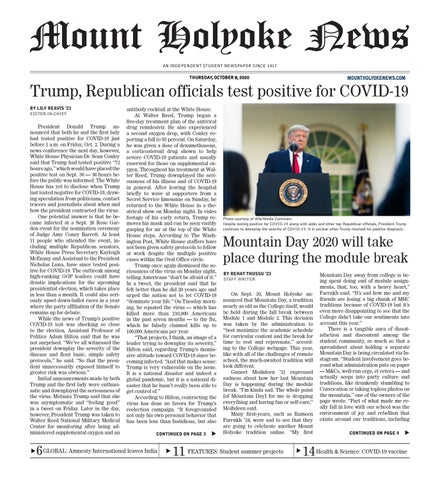
Photo courtesy of WikiMedia Commons Despite testing positive for COVID-19 along with aides and other top Republican officials, President Trump continues to downplay the severity of COVID-19. It is unclear when Trump received his positive diagnosis.
Mountain Day 2020 will take place during the module break BY REHAT THUSSU ’23 STAFF WRITER
On Sept. 30, Mount Holyoke announced that Mountain Day, a tradition nearly as old as the College itself, would be held during the fall break between Module 1 and Module 2. This decision was taken by the administration to “best maximize the academic schedule for curricular content and the break for time to rest and rejuvenate,” according to the College webpage. This year, like with all of the challenges of remote school, the much-awaited tradition will look different. Guneet Moihdeen ’21 expressed sadness about how her last Mountain Day is happening during the module break. “I’m kinda sad. The whole point [of Mountain Day] for me is dropping everything and having fun or self-care,” Moihdeen said. Many first-years, such as Rameen Farrukh ’24, were sad to see that they are going to celebrate another Mount Holyoke tradition online. “My first
11 FEATURES: Student summer projects
u
Mountain Day away from college is being spent doing end of module assignments, that, too, with a heavy heart,” Farrukh said. “It’s sad how me and my friends are losing a big chunk of MHC traditions because of COVID-19 but it’s even more disappointing to see that the College didn’t take our sentiments into account this year.” There is a tangible aura of dissatisfaction and discontent among the student community, so much so that a spreadsheet about holding a separate Mountain Day is being circulated via Instagram. “Student involvement goes beyond what administration puts on paper — M&Cs, well-run orgs, et cetera — and actually seeps into party culture and traditions, like drunkenly stumbling to Convocation or taking topless photos on the mountain,” one of the owners of the page wrote. “Part of what made me really fall in love with our school was the environment of joy and rebellion that exists around our traditions, including CONTINUED ON PAGE 4
u
14 Health & Science: COVID-19 vaccine
2
EVENTS
October 8, 2020
. Mount Holyoke News
Mount Holyoke News Mount Holyoke News is an independent student newspaper written by and for Mount Holyoke College students since 1917. VISIT US: www.mountholyokenews.com www.facebook.com/themhnews www.twitter.com/mtholyokenews_
EMAIL US: mhnews@mtholyoke.edu
Executive Board
Event Highlights Thursday, Oct. 8
Editor-in-Chief Lily Reavis ’21 Managing Editor of Content Flannery Langton ’22 Managing Editor of Layout Rose Sheehan ’22
Publisher Liz Lewis ’22 Managing Editor of Web Zoe Farr ’21 Business Manager Sarah Nam ’23
Copy Chief Kelsey Thomas ’21
Editorial Board News
Casey Roepke ’21, Kate Turner ’21 & Liz Lewis ’22
Kessh Bhasiin ’22 & Zoe Greenberg ’23
Arts & Entertainment
Features
Sabryna Coppola ’22 & Mariam Keita ’24
Health & Science
Mimi Huckins ’21 & Tishya Khanna ’23
Opinion/Editorial
Sports
Nina Larbi ’22 & Libby Spy ’24
Gigi Picard ’22
Books
Environmental Meryl Phair ’21
Sidney Boker ’21
Photos
Global Saman Bhat ’22 & Sophie Soloway ’23
Ali Meizels ’23 & Rosemary Geib ’23
Copy Editors
Maggie Donovan ’23 & Zoe Tang ’24
Layout Editors
Audrey Hogan ’21, Molly Kleinman ’21, Audrey Shannon ’22, Margaret Connor ’23 Kenna Hurtuk ’23, Zoe Latham ’23, Lauren Leese ’23, Rhitom Mishra ’23 & Kay Brown ’24
Web Editors
Audrey Hogan ’21, Shloka Gidwani ’22, Georgia Fish ’23 & Aarushi Sharma ’23
Publication Guidelines Mount Holyoke News does not endorse any of the opinions or views expressed within the pages of the paper, excluding staff editorials. All content copyright of Mount Holyoke News. All rights reserved. Mount Holyoke News does not discriminate on the basis of gender, race, religion, ethnicity, sexual orientation or age.
First-Years Starting Strong
First Year students will have an opportunity to discuss the challenges of distance learning, as well as, ways to remain connected to the college community and one another. Facilitated by Erica Weathers, LICSW and Hal Sposato, LICSW from the Counseling Service. Registration is required through Embark. 4:30 p.m. - 5:30 p.m.
Friday, Oct. 9
National Coming Out Day: Challenging Voter Suppression with Liliana Bakhtiari and Assistant Director of Campus Programming and LGBTQ Initiatives, Gabe Hall
Liliana Bakhtiari will join Mount Holyoke’s new Assistant Director of Campus Programming and LGBTQ Initiatives, Gabe Hall in a celebration of National Coming Out Day. Registration is required through the Office of Diversity and Inclusion. 11:30 a.m. - 1:00 p.m.
Jazz Ensemble Concert: “Pandem-onium”
The Mount Holyoke College Jazz Ensembles - Big Band, Vocal Jazz & Chamber Jazz - perform music reflecting on the unusual time we are now all experiencing, with songs by Alan Baylock, George Benson, Las Chakachas, and Adam Schlesinger. The Young@Heart Chorus will appear as special guest performers. Registration is required through Embark. 7:00 p.m. - 8:00 p.m.
Wednesday, Oct. 14
Advertising in MHN Interest in advertising in MHN can be directed to mhnews@mtholyoke.edu for pricing and deadlines. MHN reserves the right to refuse submissions on the basis of, but not limited to, advertisements considered to be libelous, obscene, defamatory or discriminatory.
Subscriptions Mount Holyoke News is a weekly publication that will publish online-only throughout the fall semester 2020. To subscribe through email, please visit the following form: https://forms.gle/VPCyskE4kMTDeDan8.
Letters Policy Letters to the Editor appear exactly as they are sent to MHN, except for corrections to spelling, grammar and AP style. Letters cannot exceed 500 words. All letters must include the writer’s name and telephone number for verification purposes. Unsigned letters will not be printed. Names may be held upon request with the approval of the Editor-in-Chief. MHN reserves the right to decide which materials will be printed. Email submissions to mhnews@mtholyoke.edu by Sundays at 5 p.m. for publication the following week.
Russian Club Movie Series
Join the Mount Holyoke College Russian Club to watch Sovietera cartoons! English subtitles are provided and no knowledge of Russian is required. Registration is required through Embark. 6:00 p.m. - 7:00 p.m.
October 8, 2020
NEWS
. Mount Holyoke News
3
Trump downplays virus, says he will continue campaigning, cont’d CONTINUED FROM PAGE 1
u
the wider policy failures of the administration,” he said. There was no sympathy bump recorded in recent polls, and many older voters who have historically supported Trump are now questioning his leadership. On Tuesday, CNN released a poll which placed Biden 21 points ahead of Trump in the 65 years and older demographic. According to a recent New York Times poll, only two age groups continue to support Trump: a small cluster of traditional conservatives who are 70+ years old and a group of middle-aged voters ranging from the oldest Generation Xers to the youngest baby boomers. Another important facet to consider is the role of the vice president in both the election and the Oval Office. Vice President Mike Pence has led the White House coronavirus task force since February, which has placed him in a position to be heavily criticized for the administration’s failed COVID-19 response. He falsely claimed in March that any American would be able to get tested for the disease, only to backtrack on his word days later. Each time that Trump’s response plan has failed, Pence has been at the forefront of backlash from American citizens and represen-
tatives. In mid-March, he reportedly placed calls with several governors to urge them not to direct anger at the administration’s pandemic response toward Trump, instead promising to personally deal with the issues at hand. Seven months and over 210,000 dead Americans later, Pence faces a difficult final campaign month in the face of the failed national response. “If you’re trying to lead a task force and you can’t even keep White House health protocols in line, that doesn’t look good,” Hilton said. On Wednesday night, Pence and Senator Kamala Harris took the stage for their first debate, divided by plexiglass barriers which were not used at the previous presidential debate. Both had tested negative for COVID-19 multiple times in the days leading up to the debate. Harris remained sharply critical of the Trump administration’s pandemic response throughout, calling it the “greatest failure of any presidential administration.” Pence largely evaded questioning about his role in the pandemic response throughout, instead changing the subject nearly every time he was asked a difficult question. After one question about the Affordable Care Act in regards to the coronavirus pandemic, Pence personally thanked Harris and Biden for their “expressions
and general concern” following the president’s positive COVID-19 test. “The American people have a right to know about the health and well-being of their president and we’ll continue to do that,” he said. It remains uncertain how the GOP outbreak will affect the final month leading up to the election. “It is almost a fitting motif for the end of the Trump presidency that, after four years of disruption and incompetence and, of course, some pretty nasty policies, the president himself contracts the virus,” Hilton said. “You can see it in the history books 20 years down the line as kind of an ironic ending to this presidency. That is, of course, assuming he will not be president after inauguration day, which isn’t a safe assumption.” Even though recent polls have largely suggested that Biden could win the popular vote next month, it is impossible to assume that either candidate is a shoo-in for the presidency. What may be a more important question right now is how the future of the Supreme Court will impact the American democratic system. With Trump’s recent appointment of Barrett to fill the seat of the late Chief Justice Ruth Bader Ginsburg, the Supreme Court now faces a 6-3 partisan division, and impacts are already being seen through recent conversations re-
garding Roe v. Wade and Obergefell v. Hodges. If the election comes down to a close count or a few states, Hilton is concerned that it will be contested, which would require a Supreme Court decision about whether or not to accept ballots mailed in near, on or after Election Day. If they do choose to accept those ballots, that could make the call for Biden, whereas the opposite could award Trump a second term. “That Supreme Court is going to face a really significant option,” Hilton said. “I don’t want to exaggerate, but I think one that could define the next era of American politics. If that court finds 6-3 in favor of Trump, it will be mayhem.” If the Supreme Court begins to be perceived as a partisan body by the American people, it could upset the constitutional makeup of the nation’s democratic structure, which relies on checks and balances. If decisions made by the Supreme Court — such as the re-election of a far-right president after a contested ballot count — are rejected by a large number of state governments, it could have tremendous effects on the future of electoral processes within the United States. According to Hilton, the CONTINUED ON PAGE 5
u
Co-founder of BLM speaks at Hortense Parker Celebration
Photo courtesy of WikiMedia Commons Activist Patrisse Cullors visited Mount Holyoke to speak at the annual Hortense Parker Celebration.
BY SOLEIL DOERING ’24 STAFF WRITER
“Don’t just bring in speakers, make real change,” said Patrisse Cullors, this year’s keynote speaker for the College’s 11th annual Hortense Parker Celebration. Cullors visited Mount Holyoke to
honor the legacy of Hortense Parker, the first Black student to graduate from Mount Holyoke in 1883. This celebration was started in 2009 by graduating seniors Ahyoung An and Camila Curtis-Contreras to raise awareness of the history, struggles and achievements of women of color at Mount Holyoke. The Hortense Parker Celebration was conducted via webinar on Tuesday, Oct. 1, and was themed around “Revolutionary healing in a digital world.” It began with a land acknowledgment from Noham Ghost by Water about the erasure of Native heritage in the South Hadley area. The statement was not simply an acknowledgment but a call to action; they urged attendees to use the information they shared as fuel in changemaking and educating others. Next, Mount Holyoke Associate Professor and Chair of Gender Studies Riché Barnes moderated a conversation with Cullors. Barnes introduced Cullors as the co-founder of the Black Lives Matter movement, founder of the organization Dignity and Power Now and author of the New York Times bestseller
“When They Call You a Terrorist.” Barnes, a Black feminist, award-winning author and the current president of the Black Anthropologists Association, asked Cullors how this new digital world has shaped the Black Lives Matter movement and her role as a leader. “Quarantine knocked me off my feet,” Cullors said. “It totally reoriented me around the work we do. How do we continue to build out our movement? While our government feels disconnected from the real world, I am very proud and have hope in the people. I saw human beings at their best, people rallying around each other. COVID[-19] is not the enemy — it is capitalism and its inability to take care of the people.” Cullors went on to discuss her experience as a Black woman who grew up in the generation that labeled Black children “super predators” and witnessed the “climb of investment into policing and the prison system.” She detailed how the continual neglect of communities of color by the U.S. government drove her to “call for divestment out of policing and a deep investment into
Black communities” through the movement to defund the police. Later, Cullors delved more deeply into the “journey to understanding your role” as a part of the Black Lives Matter movement. “Folks must see themselves as a permanent fixture within the movement,” she said. “It’s not about when it’s convenient to you. It means speaking up at the dinner table, changing your entire institution.” The event ended with an open question session run by Sophia Marcellus ’21, chair of the Students of Color Committee. Bea Rodriguez ’24 asked, “Do you believe that it is possible to create significant change within our country in regard to a perception of wealth, race and privilege, without a real revolution?” In response, Cullors said she believes the concept of revolution to be old-fashioned; the term has many different conflicting definitions. Cullors urged Rodriguez and others not to get wrapped up in semantics and to instead CONTINUED ON PAGE 4
u
4
NEWS
October 8, 2020
Mountain Day to take place over mod break, cont’d
Photo by Ali Meizels ’23 Last year, the hike up Mt Holyoke followed this trail.
CONTINUED FROM PAGE 1
u
Mountain Day, and I wanted to make sure that feeling wasn’t lost.” The Instagram page selected Oct. 6 as the alternative Mountain Day. “I think many students were looking forward to both the break between the two modules and Mountain Day and to
hear that they’ve essentially taken away our Mountain Day is heartbreaking.” Chisato Kimura ’22 said. “I’m disappointed in the school — yet again — for the way they’re handling this semester, and this is just the latest letdown by the MHC administration. However, I’m so glad that there is a movement by students to hold a separate and true Mountain Day that actually honors the wonderful tradition.” Kimura is one of the students who supported the Instagram page’s response. She plans to share the tradition with her family in Kansas. Regardless of whether students plan to take their own Mountain Day during classes or celebrate on the day the College designates, many intend to carry out the activities that are traditionally part of Mountain Day from the comfort of their homes and hope to share that spirit with their family and friends. Some plan to get tattoos, go out to eat ice cream with friends or hike a
local trail or mountain. In other words, the students are determined to make this year’s Mountain Day as memorable as any other, despite the pandemic and the College’s decision. During the 1918 influenza pandemic, the College still held a Mountain Day, even though 25 percent of the 864 students had fallen ill with influenza that year, according to a College webpage about how the College persisted through tough times in history. Now, 102 years later, a Mountain Day 2020 webpage will host the tradition online. College President Sonya Stephens will still ring the bells on campus, but students will hike and eat ice cream atop a mountain in their own locations and times, wherever in the world they may be. Students are encouraged to share pictures of the day, as well as their favorite ice cream and favorite playlists, to help bind together the student community that is currently spread across the world.
‘Writing for TV’ panel features Five College alumni BY REBECCA GAGNON ’23 STAFF WRITER
On Oct. 1, Amherst College hosted “Writing for TV,” an event that was extended to Mount Holyoke and Smith students. The panel, hosted on Zoom, consisted of Jenna Lamia, Amherst College ’98, Ashley Soto Paniagua, Amherst College ’11, Sarah Walker, Amherst College ’03 and Leila Cohan-Miccio, Smith College ’05. Carla Costa from the Loeb Center for Career Exploration and Planning at Amherst College served as the event’s host. “Sarah Walker, who graduated from Amherst in 2003, actually reached out to me with the idea,” Costa said. “We had met before when I led the students on a career exploration trip to LA exploring the entertainment industry. Alums are often contacted by students and recent grads so they have a timely take on the questions and the concerns that people have about breaking into the industry.” During the panel, students were able to ask the alums questions about what it takes to get one’s foot in the door of screenwriting. The advice applied not only to getting a job writing scripts for television, but also to writing-based jobs in general. There were over 50 participants in the panel, including students from Amherst, Mount Holyoke and Smith colleges. Although the event was open to everyone, it was specifically aimed
(Left) Photo courtesy of Carla Costa, (Right) photo courtesy of TJ Burke Costa (left) hosted a panel featuring Sarah Walker, Amherst College ’03, (right) & other Five College alums.
at people who are underrepresented in the industry, like women, LGBTQ+ students, students with disabilities and more. “We have to take intentional steps,” Costa said, “to actually create change in the entertainment industry, and it starts at every level of professional development, including time as an undergraduate student.” While creating this event during the summer, Walker was watching the impacts of the Black Lives Matter movement. “I saw that a bunch of my writer friends were reaching out on Twitter to read Black writers and making an effort to talk to underrepresented writers,” Walker said. “Amherst was the perfect specific, maybe even smaller but very specific place to me that I could make
an impact,” Walker added From this thought, Walker contacted Jenna Lamia and Leila Cohan-Miccio and asked them to be additional alums on the panel. Walker came to know Lamia and Cohan-Miccio because they all worked together on the show “Awkward.” Soon, Ashley Soto Paniagua, creator of the Raise the Percentage program, called Walker through Amherst connections. The Raise the Percentage program was a week-long mentorship of coffee meet-and-greets between Black writers and TV writers. The program was created by Ashley Soto Paniagua, a woman of color who is CONTINUED ON PAGE 10
u
. Mount Holyoke News
Hortense Parker 2020 speaker, cont’d CONTINUED FROM PAGE 3
u
focus on the specifics of what is required for change: legal and institutional changes throughout the country. “I wasn’t sure what place I had in this conversation,” Rodriguez said after the event. “I have privilege — a lot of it. I’m white-passing; I’m an immigrant; I’m Hispanic but that doesn’t really come up until I open my mouth. … Hearing her talk really made me feel like I had a place in this conversation. It was like a call to arms.” “We have to be present in this movement; we have to stand up, for not just racism but for homophobia, transphobia, all of these dangerous ideologies,” Rodriguez continued. “I know what it’s like to stand up against homophobia, but now I see it can also be my place to stand against racism. Not to speak for Black people, but to at least provide the marginalized groups with a voice that they might not have.” Trinity Rich ’24, a student who also attended the event, commented, “Tonight’s event was life-giving to me. I liked [Cullors’] calling out Mount Holyoke as an institution. … As a first-year student who’s been here for a little over a month, I’ve already experienced microaggressions and have firsthand seen the ways that Mount Holyoke needs to change.” Rich continued, “It was really refreshing to hear someone with more experience call that out as well and say that this institution needs to make changes. I hope that the leadership at Mount Holyoke took notice of that and is now making changes.” “This institution has to listen to their BIPOC students; there is always a lot of planning but I never see them asking for BIPOC students’ input,” Marcellus said. “Of course now it is more difficult because virtually it’s not as easy to collect students’ voices, but that should be the priority for every step that they take in terms of action.”
October 8, 2020
. Mount Holyoke News
OPINION/EDITORIAL
5
MHC virtual events lack community inclusion and cohesion
Graphic by Anjali Rao-Herel ’22
BY KAVERI PILLAI ’23 STAFF WRITER
On Sept. 30, Mount Holyoke announced that Mountain Day 2020 would take place during the fall break between the two modules, a divergence from the tradition’s usual scheduled date sometime during class time in the first semester. Under normal circumstances, the announcement of Mountain Day would’ve ignited a flame of rejoicing and celebration. However, this year, student responses ranged from confusion to disappointment A virtual Mountain Day continues to push the boundaries of our new expectations regarding school events, and one big question remains: Will replicating these long-established traditions online result in a failure to create an in-person feel? Should Mount Holyoke adapt to this online setting and create more suitable traditions? Most importantly, can one leave out traditions like Mountain Day and still create the sense of belonging students crave right now? From “It’s Mountain Day!” chants in the hallowed hallways of the Community Center to the long lines that lead up to the white shuttles, there’s more to Mountain Day than trekking up Skinner State Park. The feeling of waking up in the morning and having brunch with friends, followed by eating ice cream and pie on the summit while taking beautiful pictures, goes beyond just documenting our memories — we get to live this experience. With this event going completely online, it is fair to question what will happen to these experiences. The COVID-19 restrictions globally don’t allow most students to step outside their house, let alone to climb a mountain. The College seems to think that replacing the actual hiking with mountain documentaries and festive Zoom backgrounds can still create a sense of community, but students have their doubts. Shreya Nair ’22
said, “As an international student, the thought of going on Zoom for Mountain Day is not exciting at all, it just reminds me that I’m not on campus.” This comment echoes a shared sentiment among students: fear of not replicating the joy and excitement of actual Mountain Day, compounded by missing out on breaking in new winter shoes and scarves, not to mention the chance to miss classes. Mountain Day is such a treasured event because it gives students a much-needed break from the academic workload that starts to intensify around mid-semester. Given the shift from the traditional semester system this year, it is understandable why the College decided to keep Mountain Day during the intermission between Module 1 and Module 2. The module system requires academic rigor and is constrained by time; however, this time allocation for Mountain Day led to an exponential decrease in the appeal of the event. With no one missing any class this year, it can be assumed that many students won’t tune in to the online celebration. Mountain Day isn’t the only tradition being undermined due to its virtual celebration status. Other Mount Holyoke traditions and webinars are being negatively affected by the lack of in-person elements. M&Cs, a cherished tradition among all students on campus, is one of them. The entire appeal of a tradition like M&Cs is to allow students to take a break from their hectic academic and nonacademic responsibilities and enjoy the childhood joy of having late-night milk and cookies in dorm common rooms with friends. I remember the many nights I spent in MacGregor Hall pulling all-nighters for research papers and finding comfort in the fact that I could take a break and go to the ground floor if I wanted a snack. Virtual M&Cs defeats the purpose of this tradition. Moreover, like many other Mount Holyoke events, virtual M&Cs fails to include international students and blatantly ho-
mogenizes the applicability of Eastern Standard Time. Mount Holyoke administration should understand that 8 p.m. in South Hadley is 4 a.m. in countries in South Asia, which forces students to make a decision between sleeping at a normal local time or conforming to this facade of inclusion and community with cookies and milk from their own kitchen. Ava Healy ’24 understands the struggles of making friends and fitting in during her first year at MHC. “I work a lot outside of school and I’m afraid that I might miss the online events,” Healy said, further highlighting the problem with these synchronous events and the lack of participation that comes with them. Isshita Fauzdar ’23 said, “As times change, MoHo should modify their traditions accordingly. Replacing Mountain Day with something more practical like a virtual indoor activity makes more sense.” It is important to acknowledge this need to create a community off campus now more than ever. With students all across the globe, altering traditions to fit our new circumstances in an online platform would help unite students. It might be best to designate events like Mountain Day or M&Cs as on-campus activities and instead create new ones that can only be done virtually. The sense of belonging and the creation of a tight-knit community that new virtual events would create is part of what makes Mount Holyoke so inclusive. It would be a shame if we lost that due to the pandemic.
NEWS Positive COVID-19 tests in White House, cont’d u
CONTINUED FROM PAGE 1
legitimacy of the court could be called into question. “So, if I were a conservative and I want my now basically-assured hold on the whole federal court system to be a significant source of power over the next 25 years, and I get that decision in my lap of whether or not to effectively call the election,” Hilton said, “I would engineer a 9-0 in favor of Biden.” With the president back in the White House and reportedly beginning to recover from his COVID-19 symptoms, the day-to-day events of the next three weeks remain uncertain. On Tuesday, Trump said that he would participate in the next debate with democratic nominee Joe Biden, which is scheduled to take place on Oct. 15. The final debate is scheduled for Oct. 22, at a point in the election when many Americans have already submitted their ballots either by mail or through early voting processes.
6
GLOBAL
October 8, 2020
. Mount Holyoke News
Jamal Khashoggi’s trial raises questions in Saudi Arabia BY CORRINE CELUPICA-LIU ’23 STAFF WRITER
In October 2018, Saudi journalist Jamal Khashoggi was murdered while inside the Saudi consulate in Turkey. Khashoggi, who had been critical of Saudi Arabia’s leadership and who went into self-imposed exile in the United States the year prior, entered the consulate to get the necessary documents to marry his fiancee. The journalist never came back out. Throughout the investigation, much uncertainty and contrast arose surrounding what Saudi, Turkish and United Nations’ investigations concluded regarding the journalist’s death. U.N. Special Rapporteur Agnès Callamard concluded that Khashoggi was the “victim of a deliberate, premeditated execution,” while the Saudi public prosecution concluded that the murder was not premeditated. Professor of International Relations and Politics Sohail Hashmi noted how it was “very hard to imagine [the] murder would have taken place without the knowledge and acquiescence of [Crown Prince of Saudi Arabia] Mohammed bin Salman.” This sentiment was shared by Assistant Professor of Politics Ali Aslam, who felt that there is “no question that Saudi Arabia’s crown prince ordered and knew about the mission to kill Jamal Khashoggi.” Another issue surrounding the murder of Khashoggi involves the lack of transparency and fairness in the subsequent trials of his murderers. As Callamard noted to Middle Eastern news source Al-Jazeera, “We know that the trial failed to
meet the most basic international fair trial standards. Most importantly, the high-level officials who were named by the prosecutor were never included in the trial. … Also, all the hearings were held behind closed doors.” Carrie Lewis ’23, a student interested in international affairs, noted that “just the fact that it was not a public trial usually indicates that it was involved in obstructing justice.” During the trials in 2019, five people found to be directly involved in the murder were given death sentences. However, under Saudi law, the five individuals convicted were allowed legal reprieve after Khashoggi’s family pardoned them. Because one of Khashoggi’s sons, Salah, announced his family’s forgiveness for Khashoggi’s killers, the five death sentences were reduced to 20 year terms. Given that many of Khashoggi’s family members, including his sons, still live in Saudi Arabia, this announcement brings up questions about whether or not the Khashoggi family was pressured into the pardoning. Hashmi explained how it is “very hard to believe that no pressure was put on the family to forgive the killers. Even if they were not directly pressured, the mere suggestion would be enough for them to realize they had no other choice.” An additional matter of concern is the amount of time that has passed since Khashoggi’s murder and the subsequent trials. Hashmi noted that “so much time has passed now that in general I think the issue has been put in the past by the states involved.” Be-
Photo courtesy of Flickr Representative Jim McGovern (D-MA) waits to give remarks during a Capitol Hill event demanding justice for Jamal Khashoggi in 2019.
cause of this, the prospect of getting a fair trial and justice for Khashoggi is dwindling. Regardless of what future possibilities exist for a fairer trial for Khashoggi, there is now a rising concern about the implications of this trial on the safety of journalists around the world. Lewis noted how events like this “limit people from exposing injustices that their government is trying to hide and discourage them from pursuing journalism because it sends the message that partaking in it is risking their life.” “We should care about this because the press is a right that is not always protected,” Lewis continued. “It is important to be informed about events that could be limiting this right for people around the world.”
Amnesty International withdraws from India after accounts are frozen BY MADHAVI RAO ’24 STAFF WRITER
(Regulation) Act. According to the MHA, “Amnesty’s On Sept. 29, 2020, Amnesty International announced that it would be ending its operations in India. The human rights organization withdrew from the country after the government froze its bank accounts on Sept. 10, 2020, effectively ending its work there. This came after what Amnesty International has cited as years of harassment by the Indian government. In response, the government turned to the Foreign Contribution (Regulation) Act as justification for its actions, claiming that the organization’s foreign funding violated the law. Executive Director of Amnesty International India Avinash Kumar stated, “The continuing crackdown on Amnesty International India over the last two years and the complete freezing of bank accounts is not accidental.” He claimed that the Indian government has been raiding Amnesty International’s offices for years and harassing the organization in an attempt to silence it, especially in reference to its work in reporting human rights abuses in the Delhi riots and the region formerly known as Jammu and Kashmir. The Delhi riots, which started in December 2019, began after the passing of the controversial Citizenship (Amendment) Act. Protests against the CAA were met with violence, and the situation escalated into riots, where a majority of the brutality was targeted at Muslim communities.
Indian-administered Kashmir is the world’s most militarized zone, with 200,000 troops guarding 12 million civilians, as reported by Bloomberg. Kashmir is also the site of an excess of human rights violations, especially concerning dissent over the Indian administration. The tensions over the highly disputed territory were exacerbated by the change in Kashmir’s status from that of an autonomous region to a union territory on Aug. 5, 2019. This, coupled with telephone networks and internet access being cut off, increased concerns of human rights violations in the valley. Assistant Professor of History Abhilash Medhi said, “As much as organizations like Amnesty International and Human Right[s] Watch are important in drawing attention to what’s happening in Kashmir, there are fairly robust domestic circuits of information as well. In the valley and outside, more and more, Kashmiris have been creative in using the media to get their message out. This is something we can draw hope from.” According to The Hindu, statements condemning the Indian government’s actions have been released by the U.S. Department of State, the U.S. Commission on International Religious Freedom, the U.K. Foreign Office and the European Parliament. The Indian government responded to these allegations justifying their actions as an attempt to stop Amnesty International’s illegal funding from foreign investors. In a statement issued by the Ministry of Home Affairs, Photo courtesy of Flickr Amnesty International ended its operations in India on Sept. 29, 2020.
CONTINUED ON PAGE 7
u
October 8, 2020
GLOBAL
. Mount Holyoke News
7
Armenia and Azerbaijan fight over disputed territory BY ADITI PARASHAR ’22 STAFF WRITER
Armenia and Azerbaijan’s military forces have erupted into conflict, exposing their border to the heaviest fighting it has seen in years. The clashes began on Sept. 27, with both Armenia and Azerbaijan accusing the other of making the first move. This conflict has been the most significant military escalation the region has witnessed since the last war between Armenia and Azerbaijan ended in 1994. Al-Jazeera reported that experts and citizens alike fear that this could end in a full-scale war. Laurence Broers, a South Caucasus expert, said in a BBC article that containing the conflict within days, as has happened previously, might not be possible due to the intensity this time around. The decades-long conflict is centered around the battle between Armenia and Azerbaijan for control over the mountainous region of Nagorno-Karabakh, which is internationally recognized as a part of Azerbaijan but controlled by ethnic Armenians. The tensions in the region began in 1988 while the two were still republics within the Soviet Union. As the Soviet Union began to dissolve, it gave formal control of the contested Nagorno-Karabakh region to Azerbaijan, despite the region having an Armenian ethnic majority. During the time in which formal control of the region was given to Azerbaijan, Armenians made calls for the control to be transferred to Armenia; the Nagorno-Karabakh regional parliament vote showed the residents of the area wanting the same. Central Eurasian studies expert Michael P. Croissant explains the historical background in his book, “The Armenia-Azerbaijan Conflict: Causes and Implications.” “In August [of 1987] a petition signed by more than 75,000 Armenians was sent to General-Secretary Gorbachev, pleading for the Soviet leader to ‘reattach Mountainous Karabakh to Socialist Armenia,’” Croissant wrote. Azerbaijan took steps to suppress this separatist movement because it wanted to maintain control over Nagorno-Karabakh. After Armenia and Azerbaijan
both gained independence from Moscow in 1991, the region saw full-scale war due to the conflict of interest between the two countries. This resulted in tens of thousands dying in massacres and ethnic cleansing. Mass displacement led to a severe refugee crisis and various other human rights violations. The war lasted until 1994 and ended with a ceasefire; however, “Negotiations over decades, mediated by international powers, have never resulted in a peace treaty,” reported the BBC. Nora Cyra ’21, a double major in international relations and Russian and Eurasian Studies, said: “The recent years have seen a notable increase in nationalist rhetoric from either side of the border. Both countries have emphasized how the other is an existential threat to the people, and placed great importance on how integral the Nagorno-Karabakh region is to each country’s national identity. The increasingly strong public opinion on both sides, especially following the 2016 outbreak of fighting, is that the only resolution can come from direct conflict.” Shanze Hasan ’21, another international relations major, also weighed in on the conflict. “One of the major factors at play here is the desire for no compromise present on both sides. Both Armenia and Azerbaijan have hardened their positions on this conflict so considerably that it leaves no room for compromise to even be considered. When the other side has been vilified to the extent we see in these two countries, even if tomorrow both the governments decided to hold talks, the result of their aggressive propaganda would be seen in their own populations’ inability to accept such a move.” The BBC reported that the scale and scope of the conflict has surpassed the periodic escalations the border has seen over the years, this time “involving heavy artillery, tanks, missiles and drones.” Cyra explained, “Azerbaijan and Armenia have increased their own militarization capabilities in a way that has had a direct impact on the level of militarization visible at the border and thus, the willingness of both countries to engage in battle.” Cyra, who is completing her thesis on the resolu-
Photo courtesy of WikiMedia Commons A decades-long conflict in Armenia and Azerbaijan has erupted into heavy militarized fighting on the border due in part to rising nationalism.
tion of intractable conflicts in the former Soviet Union, further elaborated, “The changing international landscape has also led to an increased involvement of the allies of both countries which we could see result in a wider regional power conflict.” Turkey has historically been an ally to Azerbaijan and has lent its explicit support to the Azeri government. There currently exist no diplomatic relations between Turkey and Armenia. The other key country which could potentially get drawn into the conflict is Russia. Russia maintains relationships with both Armenia and Azerbaijan, supplying them both with weapons. However, Russia has a military base in Armenia, and both are members of the Collective Security Treaty Organization, an intergovernmental military alliance. The BBC reported, “The longer that fighting goes on, and/or if one side is seen to be losing in a more protracted struggle, the more likely it is that Russia and Turkey will face difficult choices over whether to become more involved.”
Amnesty, cont’d u
CONTINUED FROM PAGE 6
the Indian government blamed the organization’s continued violation of the FCRA. According to the MHA, “Amnesty’s failure to comply with local regulations does not entitle them to make comments on the democratic and plural character of India.” The FCRA, created in 1976, aims to protect India’s democratic process from foreign influence by prohibiting external powers from funding operations in the country. It is now being used to target NGOs, such as Amnesty International, which was said to have received funding from foreign investors. However, in a statement responding to these allegations and the freezing of the organization’s accounts, Amnesty International reiterated that all their funding was raised domestically. “The FCRA was put into place to limit foreign actors from meddling in domestic political affairs. But now it is used as a silencer of dissent,” Medhi said. “This in itself is telling of a larger project. Exceptions to laws, such as that of the FCRA, have been created in an effort to delegitimize these organizations and their work with human rights.” Amnesty International is one in a line of many organizations whose operations have been terminated. More than 20 NGOs, including Greenpeace, Compass International and the Ford Foundation, are under fire from the government regarding the FCRA, according to The Hindu. Kumar said in a statement released by Amnesty International, “For a movement that has done nothing but raise its voices against injustice, this latest attack is akin to freezing dissent.” Medhi said, “Their withdrawal from India is a worrying development. But it’s also part of a larger scheme. This process is occurring in slices, starting with NGOs and activists. What’s worrying is that if the current dispensation stays in power, this could happen to a huge chunk of the population.”
8
ARTS & ENTERTAINMENT
October 8, 2020
. Mount Holyoke News
SNL is ‘live from Late night hosts respond to chaotic debate New York’ again BY KENNA HURTUK ’23 STAFF WRITER
Season 46 of “Saturday Night Live” kicked off on Oct. 3 with unique guidelines and protocols in place for its cast members, crew and audience. Yes, audience — a select number of viewers, with a limited ticket selection for the general public as well as a special selection for health care workers, donned masks to enter the studio after being rigorously tested for COVID-19 and its symptoms. This is an unprecedented shift from the last several episodes of season 45, which were all aired virtually and filmed from cast members’ homes. Show creator and producer Lorne Michaels defended the decision to include a live audience. “With comedy, when you don’t hear the response, it’s just different. With the kind of comedy we do, which quite often is broad, timing gets thrown off without an audience,” he reflected. For this episode, timing in general was a major challenge, as just one day before the show went live, President Donald Trump announced that he had tested positive for COVID-19. Writers scrambled to incorporate information surrounding his diagnosis into the cold open which parodied the presidential debate between Trump (played by Alec Baldwin) and Joe Biden (played by Jim Carrey). They ultimately went the ironic route with Carrey as Biden remarking, “Imagine if science and karma could somehow team up to send us all a message about how dangerous this virus can be. I’m not saying I want it to happen, but just imagine it did.” Later, in host Chris Rock’s monologue, the comedian quipped, “President Trump’s in the hospital from COVID[-19], and I just want to say, my heart goes out to COVID[-19].” After the show aired, writers were accused of mocking Trump’s diagnosis. Baldwin responded to claims that the jokes were in poor taste. “We only have the words of the White House itself and the people who work there themselves to go on and all of them have been saying he is not in any danger. We only have their word to go by. If their word had been that he was in serious trouble, then we wouldn’t have done it,” Baldwin said. Additionally, the (albeit morbid) irony of Trump’s diagnosis would have been difficult to ignore, especially in the context of a debate in which Trump mocked Biden for wearing masks in public. Following the cold open, Rock brought both levity and urgency to the nature of presidential elections themselves. “I think we need to renegotiate our relationship to the government,” he explained. “Does it work? I mean, I think Joe Biden should be the last president ever. Like, we need a whole new system.” He added that “we’ve agreed in the United States that we cannot have kings, yet we have dukes and duchesses running the Senate and the Congress, making decisions for poor people. Rich people making decisions for poor people — that’s like your handsome friend giving you dating advice.” The comedian reminded the audience — both the socially distanced audience present and the millions of viewers watching from CONTINUED ON PAGE 9
u
Photos courtesy of WikiMedia Commons Stephen Colbert (left) and Jimmy Fallon (right) focused Sept. 29 shows on satirizing the presidential debate, attempting to mock its chaotic feel.
BY ROSE COHEN ’22 STAFF WRITER
After President Donald Trump and Democratic nominee Joseph R. Biden Jr. went head-to-head during the Sept. 29 disorderly debate in Cleveland, Ohio, late night hosts satirized several key moments. They mocked “Fox News Sunday” anchor and debate moderator Chris Wallace who repeatedly wrestled with stopping Trump from interrupting Biden. They ridiculed Trump’s blatant refusal to condemn white supremacists. They emphasized that fact checkers should alert viewers about candidates spewing misinformation.
Late Night vs. Wallace “The Tonight Show” host Jimmy Fallon compared Wallace to a kindergarten teacher attempting to run a class on Zoom. On “Jimmy Kimmel Live,” host Jimmy Kimmel jested, “Trump treated Chris Wallace like he was Eric [Trump] asking for more allowance money. You know things are getting heated when the moderator pleads, ‘Please, gentlemen, let’s return to the topic of race.’” During a monologue on “The Daily Show,” host Trevor Noah thanked Wallace for his service. “I hope that you have a lot of money for your therapy,” Noah said, addressing Wallace. “You made a valiant effort, but you were not ready for this, because no human being could’ve been ready for this.” “The Late Show” frontman Stephen Colbert poked fun at Wallace’s question about why Trump holds big rallies and Biden favors much smaller events. Colbert chided, “We already know the big rallies are bad, Chris. This is like asking, ‘Mr. President, you’re tying ladies to the railroad tracks as the choochoo train approaches. Mr. Biden, why did you go with the strategy of not killing your supporters?’”
On Trump Rejecting the Opportunity to Denounce Far-Right Hate Groups During the debate, Wallace asked Trump if he was willing to decry white supremacists and militia groups. In response, Trump told the Proud Boys, an
extremist organization that has been called “misogynistic, Islamophobic, transphobic and anti-immigration” by the Anti-Defamation League, to “stand back and stand by.” Colbert called Trump’s answer one of the most upsetting moments of his lifetime. With both of his pointer fingers in the air, Colbert then parodied the president. “I don’t support white supremacists. I just command them like a dog. That’s why I’ve got this shiny dog whistle. Proud Boys! Proud Boys! Stand back! Sit! Who’s a proud boy? You’re a proud boy!” “Yeah, it’s not good when you ask the President if he’ll condemn white supremacy, and the ‘Jeopardy!’ music starts playing in his head while he thinks it over,” Fallon quipped. Noah also commented on Trump’s frantic performance, exclaiming, “I can’t believe how hard his brain malfunctioned when they asked him to denounce white supremacists.”
The Fight for Live Fact-Checking Prior to the debate, the co-chair of the Commission on Presidential Debates, Frank J. Fahrenkopf Jr., told CNN that the nonprofit corporation does not require their moderators, including Wallace, to act as fact checkers. In a Fox News interview, Wallace had stated that he wanted to try to be invisible during the upcoming debate. Noah and Colbert both brought up the importance of fact-checking in their monologues. “Guys, debates need fact checkers, because otherwise, people can just stand on the stage and say whatever they want,” Noah said. “And there are no consequences — zero, nada, zilch. Every time a candidate says a lie, there should be some sort of, like, sign that they lied. Like, maybe a brick should come down on their side of the screen, you know, like ‘Tetris.’” “Ultimately, I think the American people — they were hurt tonight,” Colbert said. “And if you look online, they’re angry. Because this is a serious moment where human lives and the future of this irreplaceable country is on the line. And I know that Chris Wallace says he’s not a fact checker. But after one-and-a-half hours of chaos and lies, I can say there’s one statement tonight that was absolutely true.” The statement in question? A moment during the debate when Trump said, “This is not going to end well.”
October 8, 2020
. Mount Holyoke News
ARTS & ENTERTAINMENT
9
Indian media’s focus on celebrity drug scandals SNL returns, cont’d removes attention from national health crises u CONTINUED FROM PAGE 8
Photos courtesy of WikiMedia Commons Death of actor Sushant Singh Rajput (left) and the possible involvement of girlfriend Rhea Chakraborty (right) occupied major media since June.
BY JAHNAVI PRADEEP ’23 STAFF WRITER
Bollywood film and its supporting industries have long been a source of fascination and devotion for Indian audiences, permeating our lifestyles and making us experts on its movies and stars. However, this obsession has pervasively occupied media and government focus in recent times, making it a playground for controversy and moral debates. This has strengthened misogynistic discourses within the country and replaced media spaces meant for more critical national information. The media focus on the Bollywood industry began with the death of actor Sushant Singh Rajput in midJune. The resulting investigation has heavily focused on his girlfriend, Rhea Chakraborty, who was recently arrested on charges of supplying him marijuana. The media coverage has repeatedly slandered her and spread several conspiracy theories. Had she intentionally made him overdose? Was she trying to steal his money? Even leading news platforms such as Republic TV — a right-leaning prominent Indian news channel — painted her in a negative light, insinuating that she was a gold digger who had murdered her boyfriend. What happened to innocent until proven guilty? The case also led to a separate drug probe in which other Bollywood stars were questioned for their involvement with marijuana. Interestingly, all of the accused so far have been female actors. This issue illuminates moral debates about women in India. There have been long-standing stereotypes against women in the film industry, regarding them as morally loose since they perform and showcase their bodies on screen. Adding in drug use only furthers the patriarchal practice of policing female bodies. Associating women’s usage of recreational drugs with the death of a man demonstrates the perceived danger of such behavior and results in criminal allegations against women. Recently, a relative of mine mentioned how there will only be a change in drug usage and other habits in the common people when more prominent names are punished. Surely, if drug usage in everyday people is a problem, there is a better and more systematic approach to this, one that does not involve a smear campaign against solely female celebrities. Additionally, if we are debating recreational drug usage (mainly marijuana), why are only women being pulled into it? It is
hard to believe that no men use marijuana. Media outlets have become saturated with accused actresses’ names flashing across the headlines of different papers, tablet screens and ordinary conversations. In this process, other news, such as that regarding the pandemic, has been pushed to the sidelines. The government recently claimed it had no data on the deaths of health care workers and migrant workers. This reflects the irresponsibility of the government to support their biggest sources of support during this time. Tracking the numbers of deaths is the least the government can do to pay respect to these workers. If headlines and government agencies can find so much information relating to one superstar’s death, why can’t they document the deaths of thousands of heroes? The Indian government has consistently centered itself around ideologies. Is this another tactic for the government to shy away from their responsibilities and preoccupy their citizens with more sensationalized headlines? Silence is the only thing honoring these workers’ deaths. Mahua Moitra ’98, a member of India’s parliament and a Mount Holyoke alum, spoke to these events via Twitter. “Turning SSR into Bihar vs Maha & now a new Bollywood drama to focus attention from -23.9 percent GDP growth, Centre’s default on state’s GST dues, China border fiasco & host of other issues. No one plays the distraction game better than ModiShah!” one Tweet read. Another of Moitra’s tweets stated, “Once the ModiMedia stops obsessing over Bollywood dramas maybe they’ll ask the @BJP government questions about what really matters.” The other day, when I told my friend about my article, she laughed and told me to keep myself and my social media apps safe from the government. Have they achieved their goal? To use controversies to incite fear in their citizens and use this as their ruling weapon over open and well-informed media and structural change? Media in India has become a platform for patriarchal discussions on morality, drugs and Bollywood, instead of grounds for more meaningful conversations such as the pandemic and the government’s response to it. Is the Indian media hiding its reality behind the Bollywood industry’s controversies and feeding this to the cinephilic commoner instead of important news on government policies and responsibilities?
home — that “we’ve got to take this serious, man.” His monologue calls into question what the role of comedy should be during this time. Can shows like SNL justify the playfulness with which their platform addresses serious structural issues, even in the name of comedy? It is a delicate balance to tread. Megan Thee Stallion tackled this interplay between entertainment and advocacy in her performance of “Savage.” Midway through the number, she and her dancers raised their fists as the screen behind them shattered and the sound of gunshots rang through the studio. As they stared directly into the audience, an audio clip from Malcolm X’s speech “Who Taught You to Hate Yourself?” began to play, while the screen projected the quote, “The most disrespected, unprotected, neglected person in America is the Black woman.” When Megan Thee Stallion broke her silence, she said, “We need to protect our Black women and love our Black women, ’cause at the end of the day, we need our Black women. We need to protect our Black men and stand up for our Black men, ’cause at the end of the day, we’re tired of seeing hashtags of our Black men.” She and her dancers ended the song with emphasis on the message that had been projected onto the back wall of the stage: “Protect Black Women.” Megan Thee Stallion’s appearance enabled her to make a powerful statement while still being able to enjoy her time on set and showcase her lyrical and comedic talents. The rapper and singer-songwriter continued her SNL debut with a performance of “Don’t Stop” featuring Young Thug. Later, she also joined cast members Chris Redd, Kenan Thompson, Pete Davidson and Ego Nwodim in “Bottom of Your Face,” a music video commentary on dating while wearing masks. Since the first at-home episode of SNL, COVID-19 has been a recurring cast member, and it framed much of the context for this in-person episode. Despite limitations of social distancing, time constraints and the sheer volume of material to be packed into a single episode, this was a show to remember.
Photo courtesy of Flickr and Bill Meis First SNL show covers President Trump’s COVID-19 diagnosis.
10
FEATURES
October 8, 2020
. Mount Holyoke News
SGA District Senators to represent off-campus students
BY ANSLEY KEANE ’23 STAFF WRITER
On Sept. 21, a senate update was emailed to students that gave new information surrounding the structure of the Student Government Association and announcing the creation of District Senators. Typically, there is a Hall Senator to represent the residents of each residence hall in the SGA senate, but with many students living off campus this academic year, the SGA Executive Board established this new position. District Senators were created so off-campus students will continue to have representation in the SGA senate that relates directly to any concerns they have about their living arrangements. However, District Senators have not entirely replaced Hall Senators; students living on campus will still be represented by Hall Senators in addition to District Senators. Phoebe Murtagh ’21 is the chair of halls on the senate team, which is part of the SGA Executive Board. As chair of halls, Murtagh oversees Hall Senators and District Senators in addition to communicating with the Office of Residential Life, organizing Hall and District Senator elections and a number of other duties. In her senate update to the Mount Holyoke student community, Murtagh wrote that “each District Senator will function as a Hall Senator would, representing their constituents’ concerns relating to their living spaces (wherever that may be).” “We need at least a representative for off-campus students,” Murtagh explained. “That’s way too much work for one student.” According to Chair of Senate Jane Kvederas ’22, the SGA Executive Board decided to create the District Senator role over the summer. “We were trying to figure out what Hall Senators would look like ... given [at least] half the population would be off campus,” Kvederas said. The SGA Executive Board chose to create districts based on students’ last names rather than their geographic locations because, according to Murtagh, it
was a clear and streamlined way to accomplish the task. Students’ last names are only one piece of data that the SGA Executive Board needed from the College. Using last names also allowed the creation of districts and allocation of District Senators to be as random as possible. Kvederas noted that ideas such as major and class year were considered as well, but the last names idea still had the least logistical issues. Additionally, Murtagh made it clear that if the SGA had created districts based on students’ geographic locations, it was possible that certain districts could have more issues that needed attention than other districts. Murtagh gave the example that students living in cities might have fewer problems accessing the internet than students living in rural areas and, therefore, determining districts by last name was “a better way to make a fairly even distribution for the sake of the [District] Senators if we chose something that didn’t have that connection effect.” The SGA elected 12 District Senators and, according to Murtagh, there are around 200 people in each district. While the District Senator position is a new role, it is similar to the roles of Hall, Organization and Class Board senators. “As with any Senator, the main responsibility is availability,” Murtagh said. Kvederas added, “We want our Senators to participate in senate meetings as much as possible” and that “we expect them to pretty much do as much as possible without stressing them out.” The similarities between District Senators and Hall Senators appear to be by design. Murtagh shared that “it was important to me that students living off campus still have living-experience representation. … There have been a lot of issues that the administration hasn’t been able to predict ... because life is complicated.” Murtagh also stressed that some Mount Holyoke students have faced challenges that might not be represented by the kinds of data that schools would normally consider. Therefore, it is even more important for Mount Holyoke students to have someone who can call attention to their living space concerns. On-cam-
Graphic courtesy of Phoebe Murtagh ’21
pus students had the opportunity to vote for a Hall Senator for their residence hall and a District Senator for their district. Murtagh explained that “it was still really important that on a hall-to-hall level there was someone to contact,” and that on-campus students need Hall Senators in addition to District Senators because they have specific needs as students living in residence halls. The establishment of District Senators in place of Hall Senators for off-campus students is another way Mount Holyoke has adapted to the challenges of the pandemic and a fully remote model. Kvedaras summarized the SGA’s goal for the District Senator role by noting, “We’re hoping that as many students as possible have the necessary support and coverage in terms of having their needs met and their concerns addressed in senate.”
‘Writing for TV’ panel features notable Five College alumni, cont’d u
CONTINUED FROM PAGE 4
now a writer for “The Proud Family” on Disney Plus, to help people who are currently underrepresented in the entertainment industry meet people who can help further their career. The name refers to the low number of Black writers on TV shows — 16 percent — compared to the number of white writers on TV shows. Walker was one of the mentors in the Raise the Percentage program and was influenced to do something similar at Amherst. “[Paniagua] started that incredible Raise the Percentage program and I was like, if we could do a mini version of that at Amherst, why not?” Walker said. “Entertainment is a very relationship-driven industry,” Costa said, “and for students who don’t come from backgrounds where there is already an embedded family network or other professional networks, it’s so important for them to be able to rely on alumni
as the first kind of professional network.” During the panel, the alums talked about making connections with an emphasis on kindness, because that kindness will help build a good reputation in the industry. Walker also talked a bit about how it is very rewarding but difficult work. “When you start working in writers’ rooms, it is awesome. Usually, we work for 20 to 40 weeks, depending how long production is … so about a 30 week gig, awesome, but then, you are fully unemployed, like, it is not a vacation, you just don’t have a job and you don’t know when your next job is coming. That uncertainty and that waiting, not knowing what is coming next are really, really difficult,” Walker explained However, Walker also explained the upsides of the field of work. “It is so much fun! You get paid to be creative and you get paid very well,” Walker said. “Being on a film set is one of my favorite things; it is such a rush. … It is very cool to see an episode you wrote on television.”
Costa and the alums stressed the importance of being prepared by doing all you can as an undergrad and having scripts and drafts ready. “Go to the Career Development Center,” Costa said. “Talk to someone who can help you identify alumni you can connect with. Look at the tools and resources they have to support you in learning how to network. A frequently asked question yesterday [at the panel] was ‘What do I even ask?’ and those resources exist on the Career Development Center’s website.” “You can definitely do it, you are fully capable of doing it,” Walker said. “You have to love it, you have to really want to do it. It is just a lot of trial and error in finding a community and finding people. Writing on your own time, whether it is a script or small pieces, submit to McSweeney’s. I tell everyone, ‘Submit to McSweeney’s, be prepared to be rejected a lot and learn how to deal with that. Try to keep confident and keep developing that voice.’”
October 8, 2020
FEATURES
. Mount Holyoke News
11
Mount Holyoke students share their quarantine projects BY WOODLIEF MCCABE ’23 STAFF WRITER
This summer and fall looked different for all of us. The time when we would normally be going out and enjoying the company of others was transformed into a time of solitude and anxiety. Mount Holyoke students, just like people all around the world, have found ways to deal with feelings of isolation via the power of creation. Here, students share their work from various media and styles, reminding us that art and creation haven’t gone anywhere.
Gina Pasciuto ’23 has spent quarantine making embroidery art that she showcases on her Instagram @cursedembroidery. “I’ve been working on embroidery as a way to keep my hands and mind busy since Christmas, and the skills I’m picking up have been very useful during the pandemic,” she said. Her commissions are currently open.
Cadence Cordell ’23 has spent quarantine with a needle and thread. “Sewing has really helped me keep calm during quarantine, and[,] during Zoom classes, helps me stay focused on the lesson at hand,” she said. “I hand sew the stuffed animals and, with my new sewing machine, have recently started making clothes as well.”
Emily Eayrs ’23 has been sketching over quarantine.
Phoebe Murtagh ’21 has been working on this skull afghan for eight years, but has been especially productive since the end of last semester. “I was working on it in between finishing the semester and finding an internship. At the time my city was pretty much shut down, so audiobooks and crafts occupied a fair amount of my time,” she said. She spent this summer piecing together the hand-crocheted skulls and attaching the long strips of the skulls together in an offset pattern. “The multistep process and the sheer size of the project is why I’ve been taking so long at it,” Murtagh said.
In August, Jalia Nazerali-Ruddy ’24 created these two drawings, one of Harry Potter and one of a tiger. During quarantine, Autumn Lee ’24 opened an Etsy store named SoleilTies where she makes and sells bandanas for dogs. “I pretty much decided to do this because I have recently gotten back into sewing and I have been spending a lot of time with dogs lately,” Lee said. “This seemed like a sensible thing to do.”
Tory Halsey ’23 has made these oil pastel pieces of natural scenes. Halsey attempts to give Mount Holyoke students a little bit of MoHome sickness with her portrait of Jorge. She has also been constructing a tank for her aquascape where she keeps aquatic snails and plants.
Maggie Kamb ’22 shares her “gay vampire art.” These two characters have been featured in her art before. She describes the piece on the right as “before quarantine” and the other two as “after quarantine.”
12
ENVIRONMENTAL
Tightening restrictions on spread of climate misinformation
Photo courtesy of WikiMedia Commons Facebook created new climate crisis-based hub of information.
BY HELEN GLOEGE ’23 STAFF WRITER
Climate change has been evident this summer, between enough hurricanes to run out the 21 annual alphabetical names and forest fires across the West Coast and southwestern U.S. Along with the sharp and unwavering presence of environmental emergencies, there is a necessity to learn the truth about the climate crisis and its effects on daily life. In a modern and increasingly online era, people wishing to learn about the climate crisis often turn to online news platforms and social networks such as Facebook. Various news organizations have already been seen making changes in the information they report on climate change. Covering Climate Now was created to allow climate coverage to improve and give information to the public. The site was co-founded by the Columbia Journalism Review and The Nation in association with The Guardian and aims to help news organizations increase and improve coverage of the climate crisis as well as possible solutions. Various news services that have joined include The New York Times, The Washington Post, NBC News, CNN, the Los Angeles Times and many others. NBC News, which joined Covering Climate Now in April, launched Planet 2020, a new series, during the week of September 21. This broadcast involves Al Roker, the network’s chief climate correspondent and longtime weather forecaster who has been talking about climate change on the “Today” show for years now, and co-host Savannah Sellers. Together Roker and Sellers connect dots between extreme weather, climate change and the upcoming 2020 election. They hope to target millennials and Generation Z, groups that make up 37 percent of eligible voters. Another Covering Climate Now partner, Bloomberg, has launched a new digital outlet and print addition, Bloomberg Green, that aims to deal with economic aspects of the climate story. Of course, this hasn’t solved all of the probCONTINUED ON PAGE 13
u
October 8, 2020
. Mount Holyoke News
New ‘Climate Clock’ unveiled in New York City BY DNYANESHWARI HAWARE ’23 STAFF WRITER
“The Earth has a deadline” followed by the numeric “7:103:15:40:07” can now be seen flashing a rhythmic countdown on the glass exterior of One Union Square South on 14th Street in New York City. The clock currently reads that there are seven years, 103 days, 15 hours, 40 minutes and seven seconds left to prevent irreversible damage to the environment. The idea of the end of the world is not restricted to sci-fi books and films anymore, but many refuse to accept this reality. The Metronome, a public art project that has been in existence for more than 20 years, has now been turned into the Climate Clock, a graphic displaying the amount of time remaining for us to take significant action toward saving our planet. The transformation of the 62-foot-wide 15-digit electronic clock into a climate clock was done by artists Andrew Boyd and Gan Golan and commissioned by the Related Companies in collaboration with the Public Art Fund and the Municipal Art Society. The clock shows we only have seven years whereas many corporations, governments and international organizations such as the U.N. have pledged to adapt sustainability and development goals to alter their environment-degrading activities by 2030. On a YouTube talk show hosted by comedian Ted Alexandro, Boyd said, “It’s a very harsh timeline to reckon with. There’s different ways to slice the numbers and if we can get to net zero carbon in that
Photo courtesy of WikiMedia Commons Climate Clock counts down until possible irreversible climate damage.
amount of time, that gives us a 67 percent chance of staying under the red line that scientists are telling us we really shouldn’t cross of 1.5 degrees centigrade warmer.” The artists reject the idea that this is a doomsday clock. “It is showing our time window for action,” Goland said. “This is the best period of time we have to really make a difference.” The installation has been praised but also criticized for its focus on individuals rather than the corporations that are responsible for the majority of environmental degradation causing climate change. Either way, the Metronome clock has been given a new life, one that dismisses any arguments against the existence of climate change and its importance. It is now viewed not only by passersby but people around the world.
Presidential candidates debate climate change
Photo courtesy of ccnetglobal.com The presidential debate made history as climate change was discussed.
BY ABBY WESTER ’22 STAFF WRITER
Climate change is a growing crisis affecting the environment in a multitude of ways. In the past few months alone, the United States has seen historically devastating fires on the West Coast and a record-breaking hurricane season on the East Coast. Despite how this global crisis is expected to disturb economies, infrastructure and human health, it is still a heavily contested subject in American politics. United States presidential debates have a history of glossing over, or completely ignoring, the issue of climate change. The heated and insult-ridden presidential debate between President Donald Trump and former Vice President Joe Biden on Sept. 29 directly addressed the subject for the first time in 12 years. The last question about climate change in a presidential debate was posed in 2008. This year, moderator
Chris Wallace dedicated 10 minutes of discussion to the topic. According to a Tweet made by meteorologist and journalist Eric Holthaus, those 10 minutes “[double] the total amount of time [spent talking about climate change] in all 2000 minutes of presidential debates since 1988.” In an interview with NBC News, Nathan Hultman, director of the Center for Global Sustainability at the University of Maryland, stated that the presence of questions about climate change in the debate “[reflect] the heightened political and grassroots interest in the subject.” Groups such as the Sunrise Movement have been advocating for discussion about climate change since June 2019, when they staged a sit-in outside of the Democratic National Headquarters demanding a Democratic primary debate dedicated to the discussion of climate. Wallace’s question delivered differing answers from the two candidates. Trump spoke about his aspiration of “crystal-clean water and air” while dodging questions about his rollbacks of Obama-era environmental legislation and withdrawal from the Paris Climate Accords. Biden laid out his plan for renewable energy, but separated himself from the Green New Deal proposed by left-wing Democratic congresspeople. Although the candidates’ answers were filled with insults and interruptions, they still left an impression of their beliefs about climate change. Environmentalists and Americans worried about climate change were left with a sense of reassurance that this topic will be discussed further in the future of U.S. politics.
October 8, 2020
. Mount Holyoke News
ENVIRONMENTAL
13
Restrictions on the spread of climate misinformation, cont’d
Photo courtesy of Flickr Michael Bloomberg, then-UN secretary-general’s special envoy for climate action, speaks at Sept. 2018 Global Climate Action Summit.
u
CONTINUED FROM PAGE 12
lems in relation to coverage of climate change. It was found that only one of 93 segments that aired on ABC, NBC, CBS, CNN, Fox and MSNBC during the week Hurricane Laura hit the Louisiana coast connected the storm to climate change. In addition, out of the 46 segments ABC, NBC and CBS aired about the California wildfires, only seven of them mentioned climate change, demonstrating a huge need for improvement in journalistic coverage of significant climate events. Along with news outlets, social media is a big source of information for the public. Recently, Facebook pledged to create a Climate Science Information Center aimed at connecting people with science-based information and putting the company at net zero emissions by the end of the year. The information center includes factual resources from the world’s leading climate organizations and actionable steps one can take in everyday life. This includes facts, figures and data from places such as the Intergovernmental Panel on Climate Change and climate science partners, includ-
ing the U.N. Environment Programme, the National Oceanic and Atmospheric Administration, the World Meteorological Organization, the Met Office and others. They will also be partnering with 70 independent fact-checking organizations globally that will cover over 60 languages. Outside of the information center, they plan to reduce false climate-related posts in News Feed and apply warning labels to tops of posts on Facebook and Instagram so viewers understand the content is false. This has already launched in France, Germany, the U.K. and the U.S. and will expand to other countries later on. This is a new step for Facebook, which has in the past allowed false, misleading or disputed information on the platform. However, since the announcement, climate scientists and environmental groups claim the effort doesn’t do enough to rein in false climate change information and conspiracies. As many people use social media for their news, there is pressure on social media companies to do more to address climate change misinformation on their platforms. Distrust from climate activists and environmental groups with Facebook grew back in September 2019 when the CO2 Coalition claimed carbon dioxide from humans is beneficial for the planet, labeled as an opinion by Facebook. This has created a general concern from the public that climate misinformation will continue to run rampant despite these new measures. Additional concerns say that this initiative enables Facebook to set clear lines on fact and fiction. Outside of the Climate Science Information Center, Facebook plans to continue with warning labels that show false information but won’t take down posts unless they are an immediate safety risk. It is also unclear how many users will visit the information centers or how many people will see false information before it is labeled as false. Facebook is trying to find a balance between allowing free speech and tackling misinformation. Part of the concern about Facebook misinformation comes from a larger concern about social media in general. In a recent study done through online net-
work analysis firm Graphika, climate deniers were found to be posting on average four times as much as climate scientists, experts and campaigners. Since virality is how social media companies make money, it is likely that groups of people who post frequently can cause posts to go viral and receive attention without going through fact-checking processes. Social media also allows for echo chambers to form where groups of like-minded users will gather together and frequently share news and opinions that are similar. For example, there could be a Facebook group that claims that climate change is false and would ignore the false statement on Facebook posts because it disagrees with their idea. After the announcement in regard to the climate hub was made, hundreds of accounts linked to Indigenous, environmental and social justice organizations were suspended. For three days, over 200 people with posting privileges on pages involving those organizations were locked. Around the time they were suspended, there were events planned through Facebook that would have occurred during the lockout period. Facebook notices claimed account holders had posted content that infringed on or violated others’ rights or the law; however, when reinstated, Facebook told them it wasn’t for these reasons. It is unclear why the accounts were taken down and Facebook has yet to provide a clear explanation. Bans are frequently performed by a social media algorithm without human involvement, meaning there is a possibility for loopholes that claim true information is false or don’t flag false information. With the increased visibility of the effects of climate change in our daily lives, news agencies and Facebook have begun to act on the responsibility they hold to the public by providing information and updates on climate change. It is important for information on climate change to be accurate in order for appropriate actions to be taken. There is still a long way to go in preventing the spread of misinformation in relation to climate change.
Weekly Climate News October 8, 2020 The European Parliament voted in favor of cutting greenhouse gas emissions by 60 percent by 2030, an update from the previous 40 percent. South Asia is in the midst of the worst monsoon season it has experienced in the past decade with an estimated 17.5 million people in India, Bangladesh and Nepal affected by the severe flooding. The floods, combined with the pandemic, have heightened the need for significant economic recovery and damage finance. COVID-19 has exposed Mexico City’s increasing water crisis, with vulnerable households
experiencing shortages while gated communities have sufficient access to supplies. The August complex fire which started in California has expanded beyond one million acres, requiring it to take on the new classification of “gigafire,” the first in modern history. New data shows that 2020 had the warmest September on record. Woodlands in the Northeast experience changes as a result of climate change. Read about it here.
The racial achievement gap in United States schools has been widening as a result of increasing temperatures, a new study shows, which is yet another example of how the impacts of climate change are being felt disproportionately by people of color. A new partnership between the U.S. and Qatar is working on finding buried water in earth’s deserts. The ice loss in Greenland is likely to be more this century than at any other time in the history of civilization.
14
. HEALTH & SCIENCE Developing COVID-19 vaccines begin clinical trial
Photo Courtesy of Pixabay Over 90 COVID-19 vaccines are currently in the preclinical testing stage.
BY LILY CAO ’22 STAFF WRITER
Pharmaceutical companies around the world are working to develop vaccines against the novel coronavirus in an effort to alleviate the burdens brought by the global pandemic. The development of vaccines is a lengthy process. Before a vaccine gets to clinical trials, it must undergo various stages of testing to guarantee its effectiveness. During the preclinical testing stage, the vaccine is given to animals to see whether it elicits an immune response. Once the vaccine has been proven to elicit an immune
October 8, 2020
response in animals, it is administered to a small group of people, then hundreds, then thousands, during Phase 1, 2 and 3 clinical trials, respectively. If the vaccine passes all three trials, regulators then authorize the licensing of the vaccine for public use. Currently, over 90 COVID-19 vaccines worldwide are in the preclinical testing stage, and 44 are in various phases of clinical trials. However, not every vaccine in development will pass all three trials and arrive at the final approval stage. The Massachusetts-based biotechnology company Moderna Therapeutics, in collaboration with the National Institutes of Health, has been the front-runner in coronavirus vaccine development. Its technology is based on injecting viral mRNA into the body. The idea behind this is that the genetic information encoded in the RNA will be translated into protein, subsequently triggering an immune response. Compared to DNAbased vaccines, RNA-based ones are safer, as they pose no risk of altering the person’s natural DNA sequence. RNA vaccines are also less expensive and take less time to produce than traditional vaccines, making them a favorable solution to a rapidly evolving global pandemic like the novel coronavirus. If Moderna’s candidate gets approved, it would be the first mRNA-based vaccine to be used on humans. Moderna’s vaccine entered Phase 3 of clinical trials on July 27. It will enroll 30,000 participants from across the U.S. in its final round of testing. Janssen Pharmaceutica of Johnson and Johnson is investigating the non-replicating viral vector vaccine in which a portion of the coronavirus DNA is introduced into the adenovirus vector, which serves as the vehicle to deliver genetic material into the human body and trigger immune responses. The adenovirus is known to
Mount Holyoke News
cause the common cold; however, when used in vaccines, the virus is genetically modified so that it will not harm the vaccine recipient. The company launched its Phase 3 trial in collaboration with Operation Warp Speed in September, enrolling 60,000 volunteers worldwide. Maryland-based biotech company Novavax is known for its efforts in combating Infectious diseases using innovative vaccines. Its coronavirus vaccine candidate, NVX-CoV2373, was genetically engineered using its recombinant nanoparticle technology to produce the coronavirus spike protein-derived antigen. The candidate contains Novavax’s proprietary saponin-based Matrix-M adjuvant, which has been shown to augment immune responses. The vaccine works by allowing the antibodies generated to block the binding of the spike protein to receptors on human bodies, thereby stopping the virus from infecting and further replicating in the vaccine recipient. Because Novavax’s vaccine development method is based on traditional vaccine technology, some experts argue that its candidate shows promise, since the world has had experience with this vaccine development method before, unlike the mRNA-based vaccines other companies are developing. Novavax’s Phase 3 trial in the U.K. hopes to enroll up to 10,000 participants ranging from 18 to 84 years old. However, health care officials warn the public that even if the vaccines get approved soon, there is going to be a lag before their distribution. Moreover, not everybody will want to get vaccinated, and not everybody receiving the vaccine will produce an effective immune response. Therefore, people should still take serious safety precautions like washing their hands, keeping socially distanced and wearing masks.
Future arrival of COVID-19 vaccines sparks political debate BY NANCY JIANG ’23 STAFF WRITER
From empty coffee shops and Zoom universities to postponed travel plans and canceled concerts, many are eager for the release of a COVID-19 vaccine that would allow for a return to “normal,” like life before the virus. The development of the COVID-19 vaccine is already extremely accelerated. According to The New York Times, 44 vaccines are already in clinical trials, 11 of which are in Phase 3. National Institute of Allergy and Infectious Diseases Director Dr. Anthony Fauci has estimated 300 million doses of the COVID-19 vaccine will be available by 2021, while a typical vaccine, according to the CDC, undergoes over 10 years of development and distribution preparations. This cycle includes the exploratory stage, preclinical stage, clinical development, regulatory review, approval, manufacturing and quality control. Additionally, the FDA’s approval process alone can further split that step into stages of application, prelicensure vaccine clinical trials, a Biologics License Application, the inspection of the manufacturing facility, a presentation of findings to the FDA and a test of usability.
These condensed timelines of research, clinical tri- ple; however, there is no political consensus around this als and proficiency testing have led to some concerns just yet. about the effectiveness of the COVID-19 vaccine. BeTaking a step back, assuming that all are willing cause of this, it is uncertain if all will be willing to take to get the vaccine as the government instructs, Nature the final vaccine. has reported a plan in which health care workers and As reported in Science Magazine by first responders — who make up 5 percent of the Warren Cornwall, recent polls show total U.S. population — would get the vacthat only 50 percent of Americans cine first. They would be followed by the plan to get the vaccine. The re10 percent of the total population who maining 50 percent cited conare at high risk of severe illnesses, cerns regarding side effects, especially elders. The third group, safety or efficiency. Some, 30-35 percent of the population, especially young parents consists of essential workers, with multiple young chilsuch as school staff, teachers and dren, worry about potential homeless people, who are at modeconomic burdens brought erate risk. Finally, young adults by the vaccine. Anti-vacand children, who make up 40-45 cine groups, who regard the percent of the population, would pandemic as a political issue be vaccinated. and refer to quarantine and While this plan remains ambigsocial distancing as “medical uous, if it gets finalized and goes into tyranny,” pervade social media. action, Mount Holyoke College faculty Because of these hesitations, the and staff would be able to get vaccinated government may need to require the with the group of essential workers, and stuadministration of the vaccine to all peo- Graphic by Trinity Kendrick ’21 dents with the following group.
October 8, 2020
SPORTS
. Mount Holyoke News
15
Wasserman’s The Collective launches new think tank
Photo courtesy of WikiMedia Commons United States women’s national soccer team celebrates World Cup win.
BY GIGI PICARD ’22 SPORTS EDITOR
On Sept. 21, 2020, Wasserman — a sports marketing and talent management company representing over 150 female athletes — announced on Twitter a new think tank from their recently created division, The Collective. The new division is a team working to embrace women’s sports, entertainment and culture. Wasserman is based in Los Angeles with offices in cities around the world such as London, Amsterdam, Dubai and more. There are also other offices in
the U.S., including ones in Raleigh, North Carolina, and Dallas, Texas. Wasserman officially launched The Collective, a division of the company, with the aim of bringing visibility to women’s sports. The current president of Wasserman is Mike Watts. Casey Wasserman, who founded the company in 2002, serves as chairman and chief executive officer. The company currently represents well-known female athletes such as Tobin Heath, Katie Ledecky, Simone Manuel and Megan Rapinoe, and received praise for making the representation of women in sports a priority. Olivia Wreford, marketing manager for Wasserman’s operations in Europe, the Middle East and Africa, blogged on the company’s website about The Collective on Aug. 7, 2019. The blog mentions the actions Casey took to ensure a “growth and development of women in sports and entertainment.” In an effort to do so, the Wasserman Foundation, led by Casey, promised $1 million to their nonprofit partners, such as Women in Sports and Events and Evolve Entertainment Fund. Additionally, Wasserman planned on increasing “the number of female agents, data analysts and marketers in the industry. The Collective also partners with AT&T, Orreco/ FitrWoman, Snow Monkey, Google, Concacaf and the International Cricket Council. “The goal is ultimately to move women forward,” said Thayer Lavielle, The Collective’s executive vice president. According to sports business news website Ministry of Sport, Lavielle will lead the new think tank with
Shelley Pisarra, executive vice president of global insights at Wasserman. The Collective Think Tank is partnered with AT&T, ESPNW, Concacaf, Nationwide, EverFi and Royal Bank of Canada. The think tank has also begun partnering with professors and students from 10 universities including the Isenberg School of Management at the University of Massachusetts Amherst. Other participating schools include the School of Sport and Recreation and Tourism Management at George Mason University, the Ohio University College of Business and Ryerson University in Canada. These universities will launch research projects focusing on female fandom, consumption and purchasing power as well as how women who work in the business of sport are represented. At UMass Amherst, Nefertiti A. Walker, the vice chancellor, chief diversity officer and associate professor of sports management, talked about what it means for UMass Amherst to join the think tank. “Being a part of The Collective Think Tank allows us to leverage the power of multiple institutions and researchers, in our efforts to produce industry-changing research and insights on the economic power and social impact of women in sports,” a statement from UMass Amherst News and Media Relations said.“Several of those projects will be led by students, the future generation of sports marketers, while the balance will be led by the expertise of faculty academics.” “The unique thing about this think tank is it doesn’t exist in sports today, as it is, certainly in the women’s sports space,” Lavielle said about the project.
Final Module 1 team of the week: Mount Holyoke Field Hockey BY GIGI PICARD ’22 SPORTS EDITOR
This module’s final team of the week is Mount Holyoke Field Hockey. Last fall, Mount Holyoke Field Hockey finished their season on Nov. 5 while competing at the New England Women’s and Men’s Athletic Conference Championship Quarterfinals against host Worcester Polytechnic Institute. Assistant Coach Emet Marwell talked about what the team did over the summer. According to Marwell, they formed a Black Lives Matter Committee in order “to lead anti-racism work within our team.” The goal of the committee is to educate the team and the community around them. Further, Field Hockey also participated in the Athletes Taking Action Challenge by starting a fundraiser and raising over $1,200 to donate to Girls Inc. and the Black Business and Professional Association. In addition, the team featured Throwback Thursday and Flashback Friday baby pictures of team members on their social media. The captains of Mount Holyoke Field Hockey are Julia Klein ’21 and Mirei Golding-Powers ’21. Junior Leah Pendl-Robinson mentioned what the team is currently up to. The team has been holding biweekly meetings to check up on how school is going for each of the athletes. In terms of how the first-year athletes are doing, Pendl-Robinson said they “fit right in,” are not “afraid to ask questions” and are “super
Photo courtesy of Mount Holyoke Athletics Members of the Mount Holyoke Field Hockey team celebrate during the 2019 season. The team’s last game of 2019 took place on Nov. 5 at WPI.
enthusiastic.” Golding-Powers added that the team is planning virtual activities including a BFF quiz, a bake-off and a fact-matching game. “We also have smaller groups over social media platforms to include the first-years, which is always so fun,” she said. When asked what she missed most about the typical field hockey seasons, Pendl-Robinson said she missed “the team’s chaotic but happy atmosphere be-
fore games to hype us up and having so many friends around to have a good laugh with.” “I miss our night games under the lights on a cool fall night,” Golding-Powers said. “There’s just something so special about walking out onto the turf with your team and hearing the music blasting from the speakers to play a home game.” Mount Holyoke Soccer will be featured as our next team of the week.
16
COMMUNITY
October 8, 2020
. Mount Holyoke News
^ ^ g HOROSCOPES HOROSCOPES g BY FLANNERY LANGTON ’22 MANAGING EDITOR OF CONTENT
March 21 – April 19
It’s been an emotional week but things are looking up. Find some time for yourself this weekend. Try listening to your favorite middle school album. Those songs can always bring you something new.
June 21 – July 22
Always open the curtains during the day. The sunlight will speak to you this week. Make sure you are able to listen to its waves and secrets.
July 23 – Aug. 22
April 20 – May 20
The stars were made for you this week. Take a look up at the sky and make your own constellations. Only those can show you your true intentions.
Ask yourself lots of questions this week. Everything out there is trying to give you an answer, but are you listening? Take note of what the birds outside your window are saying.
Aug. 23 – Sept. 22
May 21 – June 20
Feed your brain this week. It’s all going to be about engaging conversations and getting through that reading you’ve been putting off. Try talking about a sport you’ve never played.
Stretch your legs and arms this week. Energy has been building there and it is dying to take you somewhere. Run, walk, swim, paddle or climb anywhere you can — something great awaits.
Sept. 23 – Oct. 22
People say you should be into “balance” but you haven’t yet felt it this week. Come this weekend, all will turn around. Try a new food to keep yourself on your toes.
Oct. 23 – Nov. 21
BY ANJALI RAO-HEREL ’22 STAFF CARTOONIST
Have a conversation with someone new. Try out some new Instagram or Twitter DMs, or chat with your neighbor about the strange new smells outside.
Nov. 22 – Dec. 21
This weekend was built for a long trip. Travel somewhere familiar to rekindle old imaginations and memories, but be sure to wear a mask.
Dec. 22 – Jan. 19
Take a break from your schoolwork this weekend. To maximize that time, lay in some grass before it gets too cold.
Jan. 20 – Feb. 18
It’s been a long week with excitement in plenty. Recenter yourself this weekend with a long book to ground your body and mind.
Feb. 19 – March 20
This week is all about feeling good as new. Take a nice bath or long shower. Try a walk outside, preferably in the woods. Go outwards and inwards and connect with your true self — you may be surprised by what you find.